Moshe Frank steps up to the painting
and reads the text: "Who are they anyway? The ones who move in to intimidate the clowns with their
frowns? Those who inhabit
trellises and trees; hoping to scare the birds with their share of the
grief? Those who inhabit the
circular dream, hoping to establish themselves as keepers of the drowned
reef? Moments come and moments go;
the shadowmen come, black and shimmery, believing that the dark age approaches;
and that the blackfaces rule with the white woman, the blonde woman, the moon,
during this nighttime; the culture coven.
So they plan their revenge, the revenge of a god, on the white man. And also on the dark woman, the
earth. For there is ever conflict
between the white man, the sun, and the black man, the shadow man, and between
the blonde woman, the moon, and the dark woman, the earth. The sun rules the day; and the moon
rules the night."
"It
is interesting to me," Columbo breaks in, "that this mechanism herein
described, in fact, disputes claims to racism. The alliances are inter-racial. The white man and the black woman are natural mates; and the
black man and the white woman are natural mates. This implies racial intermarriage is the plan of God. Clearly the extreme interpretations of
both white racists and black racists, calling for racial segregation,
separation, is imputed by this mechanism..."
"On
the surface that is true," Oprah responds. "But you see, the conclusion is that the white race
still rules everything. The white
man, the sun, rules the day; and the white woman, the moon, rules the
night...."
"Interesting,"
Columbo replies. "On the
surface of things. But I think the
mechanism is this: the white man, in passing through the earth, the black woman,
becomes, himself, blackened, material; the black man, in passing through the
moon, the white woman, becomes, himself, whitened, purified,
anti-material. Such, the soul is
recycled for ever, between the poles of white and black, between the poles of
anti-matter and matter. Skin color
is merely an illusion. White into
black and black into white -- and everything in between. Whiteblack into blackwhite. Blackwhite into whiteblack. Crossmann is not really a racist. He is a spokesman for interracial
marriage. This painting is proof
of that. It also proves the
betrayal of men and women along strictly racial lines. The white man and the white women will
betray one another; and the black man and the black woman will betray one
another. If this 'natural theory'
is, in fact, true -- which is a whole other issue..."
"Well,
we've certainly looked pretty significantly at this painting," Hedda
says. "I'd like to move on
the the next painting if we agree.
Charlie, I'm surprised tht you have said nothing about this
painting. How does this work fit
into the biographical interpretation....?"
"Well,
I think everyone else here explained it for me," Rose says. "This is a metaphysical world view
that illuminated Michael Crossmann's view of the world. This mechanism, as Peter described it,
puts the broken pieces back into a whole.
We can argue about what it means, like we have -- but we must agree that
the fractionated picture, the polarized dualism, is resolved, through this
mechanism, back into a metaphysical or philosophical whole, a circle, tranforming
alienation. Crossmann was a white
man who hated white men, who hated his father, who judged his father immoral,
guilty of racism, murder. He was
alienated from America. He hated
his own country, his own father, because it was not on the good side. But when he went into the underworld,
gaining this vision from the gods, from the darkness, the Wisdom Gods, he
learned to forgive his father, his country. The picture is, as Peter Falk described it so brilliantly,
beyond morality. There is One Life
within many forms of life. No one
is for ever moral. Each side is
good and bad; ultimately, each side is the same, two poles of the same unity. This knowledge allowed Crossmann to
forgive his father, his family -- to, essentially, come back home. To defend his country, even if
imperfect. Like Odysseus in Ulysses,
Crossmann came back home; he ended his alienation by , in a figurative sense,
eating from the Tree of Life -- having earlier eaten from the Tree of Knowledge
of Good and Evil..."
"There
are a lot of ideas bouncing around here tonight," Hedda says. "Are we solving anything? Mister Lyons, are we solving whether
Crossmann is post-modernist or a post-post-modernist...?"
"I
think we are, inch-by-inch," Reggie Lyons responds.
The
Magician sidles up to Crossmann, speaking again in the Russian woman's voice:
"We know what elements compose the earth; we know that Air is composed of
gases including Oxygen and Nitrogen; and we know that Water is compmosed of
Hydrogen and Oxygen. But we don't
know the essential components of Fire.
We know that one glass of water will not fill up every glass on the
earth; water is finite. But one
flame can light every candle in the universe without being reduced in
quantity. Fire is extinguishable;
can become visible and invisible instantly. But fire, itself, as a quantity, is inexhaustible..."
"The
next painting, the Eighteenth, the mid-point in our show, is a primordial piece
in colored pencil, called the 'Night Warrior'. Charlie, do you have a theory on this...?"
"The
soul is re-born as a warrior," Charlie replies. "Brahma is the first-born. He is a warrior, akin to Mars. He is born from the Moon, in the Night, by the so-called
Lunar Lords who are tribal by nature.
Crossmann becomes a Night Warrior.
Crossmann is dark, is in the Anti-Universe, is given birth by the Moon,
as the Father Principal, the bringer of Law..."
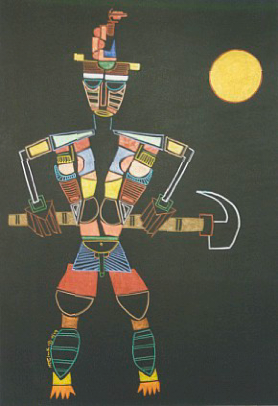
NIGHT-WARRIOR
"We have here, again, a very
aboriginal drawing," Richard Baker begins. 'You will notice here, also, that this Night Warrior has a
penis. We remember back to 'Castor
and Pollux', the twins of Day and Night, that Pollux has a penis and Castor,
the Night Twin, does not. This
Night Warrior, in fact, forms the connecting link between Castor and
Pollux. We can look at this Night
Warrior as being the last stage of Castor or the first stage of Pollux, both of
which are true -- and, in this, we see the unified nature of Castor and Pollux
-- Callus, if you will; or Pollster -- as we see the unified nature of the White
Man and the Black Man, the Night Warrior being the missing link, in a
sense..."
"Why
this obsession with the penis?" Gloria Steinem asks. "Why this obsession with a body
part? Is it fear, insecurity, that
makes the men in this room constantly celebrate when a penis appears in a
painting. This is a form of abuse
of women, of course. Singing the
glory of the penis is also singing the death of the vagina, the death of
feminism. We aren't blind. We know how this works. I come from the 'down there' generation.
That is, those were the words -- spoken rarely and in a hushed voice -- that
the women in my family used to refer to all female genitalia, internal or
external. It wasn't that they were ignorant of terms like vagina, labia, vulva,
or clitoris. On the contrary, they were trained to be teachers and probably had
more access to information than most...."
"Really,
we are discussing symbolism here?" Richard Baker replies. "The mention of the word 'penis'
makes some women angry. The
appearance of a penis in a painting makes some women uncomfortable. What does that tell us...?"
"If
the celebration of the penis," Moshe Frank responds, "is anti-woman
-- then is not the celebration of the vagina also, logically,
anti-man....?"
"Castrato?"
Gloria replies. "Are you
calling me a castrator...?"
"Hateful
bag," Camilla Paglia directs a lance at Gloria Steinem.
"Cunt,
cunt, cunt, cunt, cunt!" Glenn Close cries.
Brook
Shields dances across the floor, holding a three-foot vibrator over her head.
Oprah
Winfrey, Queen Latifah and Jane Fonda interlock arms and sway together, each
throwing up their skirts in unison, showing the audience that they are wearing
no underwear.
The
Mayor's wife re-appears, this time wearing the Magician's magic glasses. She cries: "Vagina, vagina,
vagina, vagina, vagina, vagina, vagina, vagina....!"
Gloria
cries: ""It's ten o'clock at night -- Do you know where your clitoris
is...?"
"Self-indulgent
bitch!" Camilla Paglia replies to Gloria, putting her arm around her
boy-friend, the body mechanic.
"By
the time feminists were putting CUNT POWER! on buttons and T-shirts,"
Steinem cries, "as a way of reclaiming that devalued word, I could
recognize the restoration of an ancient power. After all, the Indo-European
word 'cunt' was derived from the goddess Kali's title of Kunda or Cunti, and
shares the same root as kin and country. These last three decades of feminism
were also marked by a deep anger as the truth of violence against the female
body was revealed, whether it took the form of rape, childhood sexual abuse,
anti-lesbian violence, physical abuse of women, sexual harassment, terrorism
against reproductive freedom, or the international crime of female genital
mutilation. Women's sanity was saved by bringing these hidden experiences into
the open, naming them, and turning our rage into positive action to reduce and
heal violence...."
Rosie
Perez appears. She addresses the
audience:
"I
love my clitoris. I just appreciate its clitoral nature. There aren't really
any qualities that I am aware of that make a clitoris better or worse. They are
not supposed to be a certain colour or size or sensitivity; they are just good.
I like that. I say clitoris like
'KLIT-o-riss,' although I know people who say 'kli-TOR-iss.' My way seems easier to say (to me) but
I don't know whether either way is the decided right way to pronounce the
word. I mostly use the whole word,
but sometimes say 'clit,' especially when referring to piercings. 'Clit' seems hipper, but it is hard to
sound uptight when willing to refer to a clitoris in the first place. I think I
just like the "lit" syllable, despite the fact that with the
exception of lit itself, most -lit words have weird sexual connotations (clit,
slit, split...). Lately I've been
finding out all kinds of clitoral anatomy, just by accident. Junior high school
sex education taught me where my clitoris was (the top structure between my
labia, with a little hood of pink skin over it), but only made reference to it
being a small, highly sensitive nub of flesh. While reading about masturbation using vaginal muscles in an
old Germaine Greer article in The Madwoman's Underclothes, I discovered that
the clitoris has an extensive internal shaft that is something like 7cm (about
3 inches) long. More recently, while flipping through a book on g-spots, I
found a diagram showing this internal part of the clitoris as forked. Forked!
Apparently it straddles the urethral sponge tissue, which swells during
arousal. As far as I know, the
whole clitoris is erectile, and swells up when it is aroused. I very much like
the fact that my clitoris has a head and a tiny little shaft. I have never
really looked and checked this out, but the idea of such a wee thing having a
shaft makes me laugh..."
Calista
Flockhart appears wearing a very short yellow skirt.
Johny
Carson is in the audience. He
takes a long look at Calista, frolicking in her temptress garb.
Carson
says: "That skirt is so short I can see....all the way to Needles; all the
way to Muddy Gap; all the way to Crescent City; all the way to Sweetwater; all
the way to Sugar Creek; all the way to Beaver Falls; all the way
to....Sinclair..."
Ed
McMahon tries to get Johnny to stop talking by covering his mouth.
Johnny
punches Ed in the stomach, dropping him like a bag of dirt; Johnny Carson turns
back to Calista.
But
Calista now has pulled her skirt up over her waist, exposing skinny white hips
with a bushy brunette triangle -- Johnny Carson stares at the magic spot like a
boy watching an ice-cream truck approach, his mouth half-open in disbelief.
"Clit! Clit! Clit!" the chorust begins to shout. Then: "My vagina is angry! And it's not going to take it any
more! My vagina is angry...."
"Because
it has been raped!" Oprah cries.
"Because
it has been abused as a child!" Jane Fonda cries.
"Because
it has been forced into silence and abstinance!" Patricia Ireland
cries. "Or it has been called
a whore!"
"Because
tampons aren't lubricated!" Queen Latifah cries.
"Because
it's thought of as a sperm bank and not a personality!" Rosie Perez cries.
"Because
it has been mutilated by old men and women with sharp rocks!" Alice Walker
cries.
"Because
it has been lynched, lynched, over and over again!" Gloria cries out. "It is the slave and the cock is
the slave-driver...!"
"My
vagina is angry!" the chorus cries again.
"We
will have our vengeance!" Glenn Close cries out.
"We
will make them pay!" Oprah cries out.
"We
are the goddess and men are next to nothing!" Gloria cries.
"Dildo,
Dido, dildo, Dido!" the chorus begins to shout. "Clit Notes, dildo, Clit Notes, dildo...!"
Gloria
pulls a pair of scissors from her handbag and moves toward the 'Night-Warrior'
painting.
"I
will cut it off!" she cries.
"I will bring justice to the world! I will cut that damn thing off...!"
Lola
Fanti stops Gloria in her tracks, taking her down on the floor with a swift
karate move, disarming her.
"Potiphar,
Potiphar! Thelma, Thelma! Lorena
Bobbitt! Lorena, Lorena,
Lorena...!"
Lola
nods to the security force. They
spring into action, rounding up the angry women not wearing underpants. They
move about the room, lifting the skirts all all the women. Those not wearing panties are taken
into custody.
Crossmann
watches closely while one of the security guards checks to see if Dana Scully
is wearing panties. Her thighs are
creamy. She blushes a bit when she
sees that he is watching her. Her
panties are a delicate light green chiffon with dark green markings on the side
-- they are transparent.
Lola
has Gloria in a half-Nelson; she is forcing her through the museum, through the
crowd of people, down into the basement.
The other women are also lead into the basement.
"We
shall overcome!" Gloria yells back to the audience.
Some
people applaud -- supporters who are apparently wearing undepants. Gillian Anderson is applauding. It's like she wishes she had not worn
any panties. The thought excites
Michael Crossmann.
The
young woman in the chartreuse downy duck costume calls out to no one: "Where is Andy Warhol now! I must find Andy Warhol...!"
Then
she wanders away again.
"Well," Hedda says. "It is Millenium Eve -- so I guess
nothing should surprise us tonight."
"Simply
put," Reggie Lyons begins, "the lesson in the shift from a modernist
to a postmodernist attitude is that advocacy of creativity as such is
uncritical and naive, even dangerous to mental health. Creativity is not
significant in itself, at least no more than any other innate potential, but
only insofar as it serves a critical purpose. In therapeutic terms, therapy has
to develop critical consciousness in the patient, not release the patient’s
innate creativity. Creativity can inhibit critical consciousness, especially
when creativity is celebrated as the be-all and end-all of life. It is a false
salvation, unlike critical consciousness, which is not innate but has to be
learned, for it is reason at its most dialectically cunning...."
There
is a stunned silence.
"Tell
us more about the penis," Catherine Zeta-Jones says, smiling at Michael
Crossmann.
Crossmann
replies: "The outer foreskin layer is a
continuation of the skin of the shaft of the penis. The inner foreskin layer is not properly `skin', but
mucocutaneous tissue of a unique type found nowhere else on the body. The frenar band is the interface (join)
between the outer and inner foreskin layers. When the penis is not erect, it
tightens to narrow the foreskin opening. During erection, the frenar band forms
a ridge that goes all the way around, about halfway down the shaft. The reddish or purplish glans or glans
penis (head of the penis) is smooth, shiny, moist and extremely sensitive. The frenulum, or frenum, is a
connecting membrane on the underside of the penis, similar to that beneath the
tongue..."
Robert
Bly, the poet, begins to chant: "Cock, cock, cock!'
Other
men pick up the chant. Warren
Beatty, Bill Clinton, Wilt Chamberlain, David Lee Roth.
"Cock,
cock, cock!" they chant.
Bill
Clinton chants "coke" by mistake, but catches himself. He looks around: no one heard him. Except maybe Columbo, who is still
standing near the president, watching him with a cocked eye.
Mick
Jagger, Charlie Rose, Donald Trump join in: "Cock, dick, prick, wang! Dip stick, ramrod, butt-tickler,
sword...!"
Jagger
sings a solo, in his languid British accent: "Long swinging dusty testacle
scrotum swings and sways...."
"Now,
doesn't that make you all feel better to be men!" Robert Bly cries
out. "More
communicative? Come on, everyone
-- women too. Pecker, slammer,
jack-hammer, cone...!"
Norman
Mailer, Rod Steiger, Al Lewis cry out: "My cock is angry! Someone's going to pay!"
"Gentlemen! Gentlemen! This is inappropriate!" Hedda cries.
The
men all begin to laugh.
Crossmann,
too, is laughing.
"Is
this a locker-room or a gallery!" Hedda proclaims. "Please! Let us controll ourselves! Let us be civilized...!"
Crossmann
notices, across the room, Mayor Guiliani and Reverend Farrakahn comparing their
penises, pointing at their scrotums, talking animatedly about health issues....
"The penis is, in this
sense," Moshe Frank replies, smiling at Catherine Zeta-Jones,
"symbolic of the male principle.
Light. Day. Power. Fertility.
Wealth. The reign of
chaotic darkness -- the Dark Ages -- represented by the Womb, the Night,
Infertility, Poverty -- this reign comes to an end. In some mythologies, the erect penis raises the tent of the
sky, allowing the elements to separate and create the world again. The Indian teepee was a symbol of this
erect penis raising the sky...."
"We
must remember that Crossmann," Charlie Rose begins, "in his book,
clearly has gone through the wisdom, celibate stage, his Night, during which he
turns his back on women -- his 'castrated' phase -- does not fertilize the
Earth. This period is the Winter
of existence. But during this
Night, the mythology of the warrior returns to him. He is warned that he must get ready for war. Hence, he returns to defend his country
from invasion by a foreign power.
This painting is about that re-awkening of the male energy, the energy
of Mars, in the deep part of night.
The two forces, adversarial forces, will meet at the dawn to fight to
see who will regain heaven..."
"Is
the artist idealizing war?" Dana Skully asks.
"He
is portraying reality," Richard Baker replies. "He is portraying a mythological reality, a world of
Truth that lies deeper in the soul than the surface realm of morality..."
"Many
of us believe that the level of morality is the deepest level," Fox Mulder
responds.
"It
is the deepest level in the mortal world," Moshe Frank replies. "But it is not the deepest
level. Remember, Crossmann is in
the primitive world, in the world of the aborigine..."
"Mister
Crossmann," Dana Skully insists.
"Do you, in this painting, and in your novel, idealize war --
rather than the brotherhood of men...?"
"My
art portrays levels of reality," Crossmann says. "All levels and spheres of reality."
"Is
your art amoral?" she asks.
"No,
it is not amoral," Crossmann replies. "It is moral -- it has a perspective in Time. There is a time when war is moral,
believe it or not. We live in a
very safe time now. We think that
war is evil. But the struggle for
survival is not immoral. A
response to a physical threat is, in fact, moral. The threat of war is always very real. We pretend it is not. That is a very modern 'moral'
response. But human history has
rarely endured without conflict between individuals, families or nations. We should not delude ourselves into believing
that Peace is the natural state of nature. There is a continual state of warfare in nature to see who
will eat and who will be eaten.
This state is not so different that the state of men or even the state
of angels. It is nice to think
that everyone gets along. But this
view is a form of intoxication.
This painting is very sober -- it is about a sober realization. The war against the Nazis was a moral
war. And the war against
communism, no matter that our generation may have idealized communism -- this
too, was a moral war..."
"So, we are always on the right
side?" Skully asks
"Everyone
believes they are on the right side," Crossmann says. "That is the great illusion. That is the Tree of Knowledge of Good
and Evil. Life demands allegiance
to itself. There is a deeper level
than morality. The middle
principle, who defeats each extreme, who is all things at once, that is the
element which is closest to the truth..."
Dana
Skully sighs, frustrated.
"Your
skin is very lovely tonight, by the way," Crossmann adds. "I would love to paint you some
time..."
"Sexist!"
the woman in the chartreuse downy duck costume says under her breath, pushing
past Donald Trump. "Fucking
sexist! Fascist...!"
"Is
she talking to me?" the Donald asks, defiant.
"No,
she's talking to Lola Fanti, I think," the Donald's wife responds. "She's still mad at the way Lola
is policing the museum..."
"Thank
you," Dana Skully says to Crossmann.
"I'd like that...."
"Fucking
traitor!" the downy duck says under her breath as she slinks past Skully.
"Excuse
me!" Skully replies to the duck.
"Learn
some fucking manners!" Mulder snaps back at her, pulling the psychedelic
fur around her neck for a moment, then letting go.
"Fuck
wad," the duck reponds, pulling the fur back around her neck. "Alien-fucker...!"
"Let's
move on," Hedda says.
"And I would like to ask everyone to please consider your
language. We are not a football
crowd. I would like to ask that
everyone comport themselves with decency and decorum. We are the greatest people in our society, the most
sophisticated, the most educated.
I do not understand this need to stoop to the gutter in order to have
fun. Put a needle in your lip if
you can't avoid profanity -- that's what my mother used to teach
me..."
The
Magician sidles up to Crossmann again, speaking in the voice of the old Russian
woman: "No Spirits except the Lipika, the Recorders, has ever crossed its
forbidden line -- the circle, the ring pass not -- nor will any do so until the
day of the next Pralaya, or Night, or Period of Rest -- for it is the boundary
which separates the finite -- however infinite it appears in man's sight --
from the truly Infinite. The
Spirit referred to, therefore, as 'those who ascend and descend' are the
'Hosts' of what we loosely call 'Celestial Beings'. But they are, in fact, nothing of the kind. They are 'Entities' of the Higher
Worlds in the hierarchy of Being so immeasurably high that, to us, they must
appear as Gods, and, collectively, God.
To the highest order, we are taught, belong the Seven Orders of the
purely divine Spirits; to the six lower ones belong hierarchies who can
occasionally be seen and heard by men and who do communicate with their progeny
of the Earth; which progeny is indissolubly linked with them, each principle in
man having its direct source in the nature of those great Beings, who furnish
us with the respective invisible elements in us. Your experience with Michael
the Archangel, and with Michael's warrior, Metatron, is, thus,
explained..."
Hedda
continues: "Very well -- on to number Nineteen, a collage entitled 'The
Birth of America'. Charlie, what
do we see here...?"
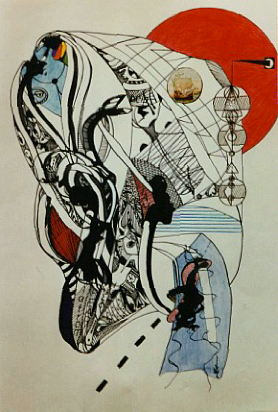
THE
BIRTH OF AMERICA
"Well, thematically,"
Charlie Rose replies, "we see quite clearly Crossmann's rediscovery of
love for himself. He has passed
into death, into the mystical side of life, the female side, darkness -- the
self-judgmental, the self-hating.
And, in this darkness, from out of this negativity, positivity has been
born. Love for the self is, of
course, also love for one's own tribe, one's own country. The tribal consciousness is the
first-born male. The form of this
drawing is, to my mind, very feminine.
I see a very clear....I hesitate to say the word. I'm afraid I might cause some kind of
paroxysm. But the shape is very
clearly a vagina, an open vagina, which has given birth to something, to
America is one real sense. Of
course, we see the Mayflower sailing on the outside of the labia, on our
right...."
"Note
the female figure at the bottom right," Richard Baker comes in. "The spinner of the fates, who is
spinning a spiral thread around a kind of maypole. On the left you will a naked female figure with long black
hair who appears to me to be an Asian woman. Of course, next to this also, written on one of the bones in
the drawing, is the word 'mortal'.
The womb is giving birth to a son; and the son, of course, is
mortal. The Sun will die; the
light will disappear again. There
also seems to be a black man being hanged from a tree in the center of the
drawing. The tree is bending
down. The rope is a thick white
rope. The metaphysical symbol to
the right, below the Santa Maria (I took this to be Columbus's ship, not the
Puritans'), is a mystery of the worlds.
A kind of necklace filled with meaning. A bright red Sun is behind this all -- red, of course, for
Mars, or Adam, the first man. Red
being the symbol of blood and the warrior. The mystical symbol is, in fact, attached to the Sun. It is an emblem of the Sun, not of the
womb..."
"Interesting,"
Crossmann says.
"We
need to view this man's art as an act of prophecy," Baker continues. "I think our friend from England,
Mister Lyons, is correct is the context of his small argument regarding the
nature of avant-garde art in the Twentieth Century. But I think Michael Crossmann breaks the mold. Crossmann is a renaissance man in a
time that is not yet being re-born.
So we don't really know where he belongs in this modern context..."
"He
is an anachronism," Xavier Rubenstein replies.
Crossmann
notices that Oprah Winfrey has returned to the museum, carrying a briefcase. She is taking with Jim. She opens the briefcase, showing Jim
the contents. They are talking
animatedly.
Hedda
says: "We need to keep moving, unless there are other comments about this
painting..."
Moshe
Frank responds: "No one has mentioned it -- but I find it interesting to
look inside the womb in the drawing, the parted lips. There is a face looking out, a large face, with two
eyes. And in the forehead of this
face is a second face, one with a kneeling man forming his lips. Does anyone else see that...?"
"That
boy is on drugs," the Donald says.
"Yeah,
I don't see it," Senator Kennedy says.
"Of
course, it's there," Morgan Freeman says.
"I
see two breasts with nipples coming out of their dress," Senator Kennedy
responds. "It looks like Miss
Zeta-Jones a bit. It probably
isn't -- couldnt' be -- but there is a resemblance... Very lovely."
"Sexist
pig!" the duck mumbles, walking by the senator.
"Why
do you think the woman in this drawing," Hillary Clinton asks, "is
portrayed only as a block of a torso.
The so-called Mother has no face, no arms, no head or breasts or
legs. Picasso used to enjoy
tearing women's bodies apart in his work.
Is Crossmann any different here?
Is this not, clearly, another male chauvinist abusing women through his
art...?"
"We
should burn all his paintings and all his books!" the woman in the
chartreuse downy duck costume screams, as she wanders, head down, at the
periphery of the audience.
"This
drawing is really quite organic," Richard Baker replies, defending Crossmann. "This drawing is of the organ
itself, from the inside in a sense.
It is not about a singular woman giving birth. It is a universal womb -- and it is not just the womb of a
woman giving birth, it is the womb as an idea, the womb as a universal thought. It represents the idea of
birth..."
"It
is interesting that, next to the word 'mortal'," Warren Beatty responds,
"are the lines of a highway.
One gets a clear impression that from birth comes a journey of life, a
mortal journey of life. There is no
statement, here, of a return to the womb.
But the road does lead two ways: away from the womb; and back toward the
womb..."
The
Magician sidles up to Crossmann again, bearing a message: "Cosmically,
Fohat is the 'Son of the Son,' the androgynous energy resulting from this
'Light of the Logos,' which manifests in the plane of the objective Universe as
the hidden, as much as the revealed, Electricity -- which is LIFE. Evolution is
commenced by the intellectual energy of the Logos, not merely on account of the
potentialities locked up in
Mulaprakriti, or Matter. This light
of the Logos is the link . . . between objective matter and the subjective
thought of the Logos. It is called in several Buddhist books Fohat. It is the
one instrument with which the Logos works..."
"The Twentieth piece is a
collage with very strong political overtones," Hedda says. "This work was completed in the
late 1980's -- and it is really quite frightening: 'Confronting the Bear'. There are two central figures in the
drawing, one with blackened eyes, who seems like a silent partner in the
drawing. The major figure is
pointing to his own right; and he is holding what appears to be a bomb in his
left hand. Which I take to be the
atomic bomb..."
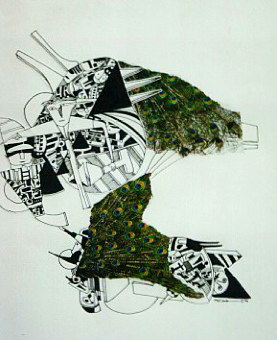
CONFRONTING
THE BEAR
"They look like Russians,"
the Donald ventures in response.
"I
see some machine guns mounted on a turret at the bottom of the drawing,"
Norman Mailer adds. "With an
upside down Magician with a pointed black hat on the bottom right..."
Crossmann
turns around and looks at the Magician, who spreads his arms outward as if to
say: "I know nothing about this..."
"There
are several men in the drawing; and most have their eyes covered," Dan
Rather adds.
"I
am wondering if this is Michael Crossmann's view of Russia?" Hedda
asks. "Or if he is the one
holding the bomb, confronting the Bear...?"
"Why
don't you ask him?" Truman asks.
He has finally left the food table to join the crowd. "He's standing right next to
you..."
"Thank
you, Tru'," Hedda responds.
"Good idea. Michael:
what was your intention...?"
"Well,
I don't really remember my intention," Crossmann replies. "But the figures in the drawing
seem like the mafia-types who ran Russia for so long. I think, in the mid-1980's, it became increasingly clear to
the Russian government that they were losing the Cold War. They either had to
act then, initiate the nuclear war they so dreaded, or for ever fall behind the
West. There was very real serious
consideration of fighting then -- of initiating a nuclear war with
America. Gorbachev was the result
of this insane dialogue. Russia
knew it couldn't keep up with America if Americans were united behind Reagan. The 60's and 70's made it appear that
the left was winning. Then this
all came apart in the 1980's.
Russia panicked. They tried
to assassinate the Pope to keep a religious revolution in Poland from
destroying their empire. But the
pope was too strong to die.
Poland's rebellion really signaled an end to the Russian empire. Gorbachev understood that this was the
end. Russian either had to choose
suicide through nuclear war; or they had to step back and let the empire break
apart..."
"We
had the same choice," Norman Mailer responds. "You said so yourself, in your book..."
"Yes,
we were thinking the same thoughts," Crossmann admits. "The issues were expand or
contract; life or death; Brahma or Siva.
The male principle expands; the female principle contracts. Heat expands; the Cold contracts. The Universe has outward manifestation;
the Anti-Universe has inward manifestation...."
"You've
described Gorbachev as a manifestation of the Michael the Archangel
force," Charlie Rose replies, "that you say came to the planet in the
1980's to save the planet...."
There
is snickering in the audience.
"Did
he have green wings and purple hair?" Gloria Steinem asks. She is back again.
"Not
to my knowledge," Crossmann replies.
"That
was Betty Freidan," Donald Trump whispers to his wife.
Mrs.
Trump laughs with gusto.
"Did
he have surrendipitous posture; or was he wearing a swastika?" JK
Galbreath asks.
"That
sounds like a trick question," Crossmann repsonds.
"Was
he the CEO of IBM?" Ralph Nader asks, angry, his hands shaking visibly.
"Lou
Gerstner was the CEO of IBM," Crossmann replies. "At least I think he was...."
"Is
this some kind of sick joke?" Jane Fonda asks.
"What?"
Crossmann replies.
"What?"
Fonda asks.
"Is
what some kind of sick joke?"
"This
archangel stuff," Fonda replies.
"Is this a sick joke; or is it some conspiracy involving the CIA or
the FBI or perhaps the National Rifle Association...?"
"Probably
the CIA," Fox Mulder implants a thought into the conversation.
"A
vast right-wing conspiracy," Hillary responds.
"Yes!"
Bill Clinton says emphatically.
The audience turns toward the president. "Yes -- I agree with my wife," he tries to
explain. "A fast right
shwwwwing conspiracy...!"
Clinton
is glowing. Denise Rich's friend
has just picked some cookie crumbs off the front of the president's trousers.
"If
I have my way, I'll make it illegal for you to use the word 'angel' in
public!" a woman announces in a thick, south Texas drawl. It is Madelaine Murray-O'Hare, an
overweight woman wearing a dull blue housedress and a button near his bosom
showing a religious cross exed-out.
"The ACLU is supporting my suit to make any use of the words 'God'
or 'angel' or 'devil' or 'prayer' in public places against the law...!"
Gentleman
Jim Heldbert is accompanying Madame O'Hare. He is dressed in a black tux with tails, a black top hat;
and he is carrying a cane.
He
cries out, in the style of a barker:
"The raunchy Sisters of Perpetual Indulgence are planning their
20th Anniversary party in the gay Castro district of San Francisco this coming
Easter, and the catholic church is mad - again. The church seems to have forgotten that, in San Francisco,
kinky is a matter of public pride.
But can our local Sisters really be any kinkier than the catholic ones,
who all claim to be brides of the same 2000-year old dead guy? What's kinkier
than necrophiliac polygamy? The
crazy catholics have fathers who aren't fathers, mothers who aren't mothers,
brothers who aren't brothers, and sisters who aren't sisters. And they think it
qualifies them to discuss "family values!" As if that wasn't kooky enough, they swear off sex. Abstinence - the strangest sexual
perversion of all. Compared to the
kooky catholics, the Sisters of Perpetual Indulgence seem normal. If the catholic church wants to make
criticism of itself a crime, that's a clear sign that criticism is urgently
needed...."
The
audience laughs mildly.
"Who
is that guy?" Columbo asks.
"Isn't he a comedian?
Haven't they seen him before -- was he on Seinfeld or Frasier...?"
"I
am a Catholic," Senator Kennedy replies. "And I resent your assault on the Catholic Church and
on Catholic beliefs...!"
Madonna
appears in the room, dressed as Eva Peron.
Everything
stops; all eyes follow her into the room.
"It's
the Virgin Mary herself," Gentleman Jim invokes.
Madame
O'Hare laughs heartily; but she and Jim are the only two laughing.
Hedda
nods to Lola; Lola nods to the security agents.
The
fat woman and the man in the top-hat are hustled away; they leave insisting
that the state has no authority to take them down into the basement. All the security men have listening
devices in their ears. They are taking orders from some invisible agent. They don't respond to the pleas of the
two atheists.
"Michael Crossmann became a
bear-hunter in a very real sense," Charlie Rose begins again. "He went to sleep, in his novel,
he died, through Jacob Heimkreiter, a liberal, a friend of the Russians and a
friend of communism, a strong critic of Ronald Reagan; and he woke up a
conservative filled with the warrior's instinct for self-preservation, an
adversary of the Communists and Russia, and an ally, a protector of Ronald
Reagan. There is some profound
mystery in all of this, as profound and as mysterious as the human
genome..."
"With
some bear-demon of his own threatening to kill him," Harold Bloom adds.
"Something
akin to the transmigration of souls," Moshe Frank interjects. "His novel is about the
transmigration of souls..."
"Any
more comments about this piece?" Hedda asks.
Silence.
"Do
it again," Bill Clinton is heard whispering to someone.
People
turn to look at him. Hillary
stares darts into his forehead.
Beth,
the sexy blonde, is still trying to pick cookie crumbs off the president's
crotch.
"Jesus,
Bill," the Donald says quietly to the president. "Get a hotel room, won't you?"
"I
can't control her," Clinton says to Trump, smiling his infectious
smile. "She loves cookie
crumbs -- what can I do...?"
"I'm
not so sure those are cookie crumbs, in fact," Columbo says. "I have a feeling those cookie
crumbs might just have a South American origin..."
"Let's
move on to the next painting," Hedda says. "Number twenty-one, entitled -- and this is a very
literary title -- 'He Confronts the Four Horsemen of the Apocalypse and,
Choosing Re-Birth, He Saves the World from Destruction'. That's quite a title..."
The
Magician sidles up to Crossmann again, speaking again in the old woman's voice:
"The seven Laya centres are the seven Zero points, using the term Zero in
the same sense that chemists do, to indicate a point at which, in esotericism,
the scale of reckoning of differentiation begins. From the Centres -- beyond
which esoteric philosophy allows us to perceive the dim metaphysical outlines
of the 'Seven Sons' of Life and Light, the Seven Logoi of the Hermetic and all
other philosophers -- begins the differentiation of the elements which enter
into the constitution of our Solar System. It has often been asked what was the
exact definition of Fohat and his powers and functions, as he seems to exercise
those of a Personal God as understood in the popular religions. The whole Kosmos must necessarily exist
in the One Source of energy from which this light (Fohat) emanates. Just as a human being is composed of
seven principles, differentiated matter in the Solar System exists in seven
different conditions. So does Fohat. He is One and Seven, and on the Cosmic
plane is behind all such manifestations as light, heat, sound, adhesion,
etcetera, and is the 'spirit' of ELECTRICITY, which is the LIFE of the
Universe. As an abstraction, we call it the ONE LIFE; as an objective and
evident Reality, we speak of a septenary scale of manifestation, which begins
at the upper rung with the One Unknowable CAUSALITY, and ends as Omnipresent
Mind and Life immanent in every atom of Matter. Thus, while science speaks of
its evolution through brute matter, blind force, and senseless motion, the
Occultists point to intelligent LAW and sentient LIFE, and add that Fohat is
the guiding Spirit of all this. Yet he is no personal god at all, but the
emanation of those other Powers behind him whom the Christians call the
'Messengers' of their God (who is rather the Elohim, or rather one of the Seven
Creators called Elohim), and whom we call the 'Messenger of the primordial Sons
of Life and Light'..."
"'The Apocalypse'," Hedda
begins. "Quite an appropriate
title and subject, considering what tonight is. None of us are sure whether Western Civilization as we know
it will disappear at the stroke of Midnight tonight, like some dark fairy tale. Is this Y2K fear founded on
reality? Does it have religious or
mystical underpinnings? I'm not
sure what this drawing has to say on this subject. What do you think, Charlie...?"
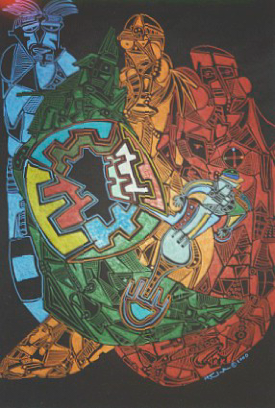
HE
CONFRONTS THE FOUR HORSEMEN
OF
THE APOCALYPSE, AND, CHOOSING
RE-BIRTH,
HE SAVES THE WORLD FROM
DESTRUCTION
"Well, this is an enigmatic
drawing, to be sure," Crossmann says. "Crossmann did choose re-birth, in the novel at least,
under the aegis of Michael the Archangel, the Defender of the Western World.... I'm not sure how this relates to the
drawing, however..."
"The
Four Horsemen of the Apocalypse, of course," Moshe Frank begins,
"represent the four directions, the four guardian angels, as they contract
toward the center of the Earth, the world navel, or the womb: Israel. Many people argue this naval is
Jerusalem. Four armies come from
the four directions. Meeting in
the center, at the womb, to annihilate one another, and to destroy the world
and, at the same time, to give birth to the next world. And the Christ child, the messiah, in this
drawing, preparing to jump into the opening, into the womb, choosing re-birth
rather than destruction, thereby, saving the world. The savior is born..."
Henrietta
Beach comes in: "This is all a bit mystical for me -- and, also, probably,
for some of my colleagues, who are agnostic at best. I would like to echo something Reggie said earlier tonight,
about criciticm being the truly crucial act. Our art was and has been critical. What I mean by this is
that in the major works of our time - be it novels or paintings, poems or
musical compositions -- and I do include Michael Crossmann's work in this
discussion of course, both his writing and his painting - criticism is
inseparable from creation. Let me correct myself: criticism is creative. The
criticism of critique, criticism of form, criticism of time in novels or of the
self in poetry, criticism of the human figure and visible reality in painting
and sculpture. In Marcel Duchamp's work, for example, which stands
diametrically opposed to Crossmann's, the century's denial is manifested as a
criticism of passion and its phantoms. More than a portrait, his 'The Large
Glass' is an X-ray picture; 'The Bride'... is a funereal and amusing
construct. In Crossmann, the
disfigurements are no less atrocious, though they convey a contrary feeling:
passion criticizes a beloved form, and for this reason his violence and abuse
bear the innocent cruelty of love. Passional criticism, bodily denial. The
slits, bites, razor slashes and dismemberments he inflicts to the body are
punishments, acts of vengeance, reprimands: tributes. Love, anger, impatience,
jealousy: worshipping of forms that are alternately terrifying and desirable,
in which life is manifest. Erotic fury in sight of the enigma of presence, and
an attempt to descend to its origin, that is the grave where bones and worms
become one. Crossmann does not paint reality. He paints the love of reality and
the horror of being real. To him, reality is never sufficiently real; it always
requires more of him. For this reason, he wounds and caresses it; he insults
and kills it. For this reason he revives it. Its denial is a mortal embrace. He
is a painter with no beyond, with no other world but that beyond the body,
which veritably falls short of the beyond. This is where his great strength and
his great limitation dwells...
In his aggressions against the human figure, particularly the female
figure, the drawing line always prevails.
This line is like a gashing knife and a revivalist magic wand -- I think
most readily of his painting 'Marital Strife'. A live and elastic line:
serpent, whip, beam; a line suddenly transformed into an arching jet of water,
a winding river, a poplar stem, a woman's waistline. The line runs swiftly across the canvas, and as it passes a
whole world of forms springs up, as old and as contemporary as elements without
a history. An ocean, a sky, a few
rocks, a thicket and everyday objects, plus historical debris: broken icons,
dull knifes, spoon handles, bicycle handlebars. Once again everything returns to nature, that is never
motionless and that never moves. A nature that, like the painter's line,
perpetually invents and eradicates its invention... Just how are future
generations to regard such a rich and violent life's work made and unmade by passion
and haste, genius and ease...?"
"Clearly
his work arches its back like a cat in self-defense," Reggie agrees. "The coldness of the other-world
experience makes us almost want to grab our coats. He takes us into places where we don't belong. It is like reading Rilke: we go in
there sometimes against our will, confronting images, beings, which are not a
part of us, which are a part of him, but not us. Beings who have laid a claim on his soul, on his nature; for
he has unstrung something, some kind of knowledge that has put a mark on him,
not the mark of Cain, but a mark nontheless. The mark of Faust.
He has sought knowledge; and in being given it, he has somehow been
transformed into a cat arching his back in self-defense, just before the rush
of the two mad world cats begins, moving toward devourment of not only the
artist, but also the artist's audience...."
"Articulate
views, of course," Xavier Rubensteins congratulates his colleagues. "But we musn't forget the
philology in this man runs like the Amazon through everything he explores. In everything there is a primitive
memory that he alone understands.
He presents it to us; but we are modern. There is something extraordinarily archaic in this man. Is it good; is it bad? I don't know. I remember Colonel Kurtz in Contrad's Heart of Darkness;
and I see in Michael Crossmann some element of this man, this Colonel Kurtz,
who gains some knowledge of the primitive that makes him very dangerous to
modern civilization. There is
something foreboding; something daemonic in these pictures. Not demonic in the Christian sense; but
daemonic in the classical sense, some genius of perception that makes us quake
just a little bit; a curtain of innocence he has snatched away, leaving us,
like the child in this painting or drawing, standing before these giant
monsters who wish to annihilate reality.
The only salvation, interestingly, is for us to jump right into the
drawing, to go deeper into the drawing.
But to jump in also means our own annihilation. We know that -- and, so, we resist
it. We know that it will destroy
us by saving us; and also, in saving us, it will also destroy us..."
"Precisely,"
Reggie says. "The archaic pin
which ties the post-modern into the modern, back near the head. A kind of hair-pin or a broach. Yes, there can be no doubt: The
revolution is coming! The
revolution is coming again...!
Artists will be revolutionaries again, as they were in the good old
days. Instead of the businessmen
they are today...!"
"Artists
have become businessmen today, because they no longer believe in the
revolution," Ed Harris replies, dressed up as Jackson Pollock. "They understand that they are
living in the best of worlds, not the best of possible worlds, but the best of
actual worlds. They lost their
belief in communism. So they
retreated from the world of social criticism, thereby saving the world from
chaos..."
"Are
you suggesting that is the meaning is this 're-birth' in the painting?"
Hedda asks Harris.
Reggie
Lyons interrupts: "And what of the therapeutic need inherent in
avant-garde art -- that of saving the drowning soul from dismemberment at the
hands of the wicked, philistine,
society...?"
"The
drowning soul has been pulled ashore," Harris replies. "And the society has been found to
be less wicked than previously believed..."
Reggie
Lyons' face is red.
"The
artist has gone to heaven," Harris says. "Which was the objective of avant-garde art. To help the artist get to heaven. The artist has overcome
alienation. He has come home
again. The energy of Michael the
Archangel has brought all the broken atoms back home again..."
"It
has not brought me home!" Reggie Lyons cries, a vein bulging in his
neck. "The moral objective,
by its very nature, is a goal, a home as you put it, which can never be
reached. The moral objective is
like the God of the Old Testament, the God without a name, without a face, who
cannot be cognized or represented.
The artist is, by definition, the Cain, the outsider, the ant-hero. Any attempt to make him less steals
from him his Luciferian grandeur...!"
"Idiot's
head soup!" Richard Baker grumbles under his breath. Then he catches a glimpse of Mick
Jagger in the audience. He always
admired the Rolling Stones.
"Watch
what you say, Baker!" Reggie warns his critic.
"The
critic is not the creator!" Baker replies. "You don't get it. You are always trying to deify yourself. To put yourself on the same plane with
the creators. We are parasites --
don't you see? We have no life
without the living -- but we stand above the living, looking down on them,
telling them how they can do it better; where they succeed; and where they fail
-- aggrandizing ourselves. But if
they did not create art for us to declaim, we would be silent mechanisms,
automobiles without petrol, waiting for some miracle to come along to free us
from our atomic compound..."
"Jesus!"
Columbo says, startled, turning to the president.
Beth
is now on her knees in from of President Clinton, her nose pressed up against
his groin, trying to sniff the white powder off this crotch into her nose.
Clinton
is urging her to get up off the floor before someone else notices.
Hillary
refuses to look.
"That
man!" the Donald says with admiration. "Nothing stops that bastard! Nothing keeps him from getting what he wants! You got to admire that kind of
insistence...!"
Martin
Sheen hands President Clinton his own hotel key.
"Get
her outta here, Mister President," Sheen says. "I'll cover for you here while you're gone. No one will even notice the difference. We're cut from the same cloth -- and I
say that with admiration for you, Mister President -- for what you've done for
the working man...."
Clinton
and Beth and Denise Rich sneak away, laughing, not looking back. Heading for some kind of party...
Hillary
refuses to watch them leave. Her
skin is like alibaster, glowing, as swift as procelain.
"I
think this piece suggests much," Hedda says. "But maybe we should let it make these suggestions --
and not try to over-analyze it.
Sometimes suggestiveness is just right, the most appropriate comment of
all..."
The
Magician sidles up to Crossmann again: "The 'Monad' is the combination of
the last two 'principles' in man, the 6th and the 7th, and, properly speaking,
the term 'human monad' applies only to the dual soul (Atma-Buddhi), not to its
highest spiritual vivifying Principle, Atma, alone. Fohat, the constructive Force of Cosmic Electricity, is
said, metaphorically, to have sprung like Rudra from Brahma, 'from the brain of the Father and the
bosom of the Mother,' and then to have metamorphosed himself into a male and a
female, i.e., polarity, into positive and negative electricity. He has seven
sons who are his brothers; and Fohat is forced to be born time after time
whenever any two of his son-brothers indulge in too
close contact -- whether an embrace
or a fight. To avoid this, he binds together and unites those of unlike nature
and separates those of similar temperaments. This, of course, relates, as any
one can see, to electricity generated by friction and to the law involving
attraction between two objects of unlike, and repulsion between those of like
polarity -- and, in doing this, he becomes like Vishnu, the Preserver. The
Seven "Sons-brothers," however, represent and personify the seven forms
of Cosmic magnetism called in practical Occultism the 'Seven Radicals,' whose
co-operative and active progeny are, among other energies, Electricity,
Magnetism, Sound, Light, Heat, Cohesion, etc. Occult Science defines all these
as Super-sensuous effects in their hidden behaviour, and as objective phenomena
in the world of senses; the former requiring abnormal faculties to perceive
them -- the latter, our ordinary physical senses. They all pertain to, and are
the emanations of, still more supersensuous spiritual qualities, not personated
by, but belonging to, real and conscious CAUSES. To attempt a description of
such ENTITIES would be worse than useless. The reader must bear in mind that,
according to our teaching which regards this phenomenal Universe as a great
Illusion, the nearer a body is to the UNKNOWN SUBSTANCE, the more it approaches
reality, as being removed the farther from this world of Illusion...."
"The twenty-second painting in
the show is one of my favorites," Hedda begins. "The title is 'Where Venus Lives.' Charlie, do you want to let us know
where this fits into the biography of the artist...?"
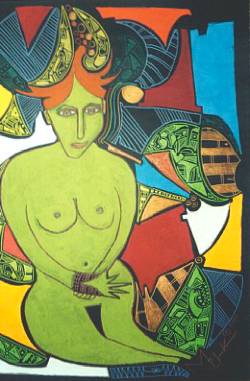
WHERE
VENUS LIVES
"Well," Charlie Rose says,
"the artist has chosen to fall, in the last drawing, thereby saving the
world. Now he is interested again
is physical love. He has become
Earth-bound again; and Venus has power over the Earth. Venus is where love and sensuality
dwell. She is the Morning-Star;
she entices the man to fall, to procreate with her, to plant seeds in the Earth,
so that the Earth will have fertility, wealth, abundance later in the
year. Children..."
"Sex,"
Moshe Frank says. "This is a
painting about the power of sex.
We remember that the warrrior, in an earlier painting, was given his
penis back. This penis is to use
to fertilize the woman. By
fertilizing the woman, by giving her children, the man saves the woman from
chaos. Chaos is, in fact, the
unfertile woman. The Unfertile
Woman, the childless woman, has no future. So she becomes destructive. She has nothing to do. Venus is undressing in this painting, removing her
final piece of clothing, a bracelet on her right hand. I see two men in the painting; and both
are fearful. There is a man in the
copper and black pattern to our right of Venus. And he is fleeing to the east. The other man, behind him, in the black and green pattern,
has a look of terror on his face.
Venus has two golden horns on her head; so this is not all wonderful
sex. There is something behind the
surface of her beauty..."
Harold
Bloom says: "Venus and Lucifer are linked in Christian metaphor."
"One
of the horns, on our right," Richard Baker adds, "actually becomes a
serpent's head."
"So,
the woman is the devil?" Hillary asks.
"Why
are we not surprised by this?" Gloria Steinem asks.
"There
is a duality in all of his work," Richard Baker replies. "Good and evil are indissoluably
linked. Venus is good and bad. She represents the fertility of the
Earth; and also the imprisonment of man in matter. Men fear sex with women; but are also drawn to it for
ever. Sex enslaves them to the
material life -- which is both their defilement and their salvation. Which draws them away from God -- but
also draws them back to God. If
you insist on seeing the world always as good or evil, then you will never
understand the work of Michael Crossmann..."
"So
the man is afraid of the woman?" Hillary asks, filled with pride.
"Of
course, Richard Baker replies.
"The woman represents the death of the man. The man is born from the woman, the son
is born of the woman, and the word 'mortal' is the first word he sees upon his
birth..."
"So,
not only is woman evil," Hillary says, "but she represents death to
the man...!"
"Life
and death," Baker replies.
"So, man, too, is life and death."
"There
is no clarity in his vision!" Hillary cries.
"His
vision is Life," Baker replies.
"He has eaten from the Tree of Life. You wish for moral clarity because you want to be on the
right side. That is your illusion
-- that you are good. But if you
are good, then the person across from you must be evil. From this illusion springs the history
of warfare. Clarity is not always
a friend. The clear truth today
will, tomorrow, be the old truth, or falsehood. The light shines on 12 different truths in time. It is better to the be light than it is
to be the truth..."
"That
is nonsense," Reggie Lyons replies.
"This belief is the illusion of morality is what allows immorality
to flourish on the earth..."
"What
is immortality?" Baker asks.
"The Nazis believed the Jews immoral. The Jews understood that the Nazis were immoral. This is like Mister Lyons' two forces:
the avant-garde who believe that Life is evil; and the post-avant-garde who
believes that Life is good, that rebellion against Life is evil -- and,
ultimately, stupid..."
"Are
you calling me stupid, you little doctoral student!" Reggie Lyons
cries. "I am a doctor of
philosophy I will remind you. I am
a member of the Royal Academy...!"
"I
didn't say you were stupid, Doctor Lyons," Baker corrects. "I said you were naive -- and that
you don't understand this man's work, except through the lens you've
manufactured our of your own drive for political status..."
"That's
it!" Reggie Lyons cries. He
reaches out to grab young Baker by the collar; but Baker throws a stiff left
jab that catches Doctor Lyons on the jaw, then an overhand right that strikes
Lyons above the right eye. The
blow knocks Doctor Lyons backward on his butt. He does not try to get up. There is a cut above his right eye. He lies down, dazed.
Lola
Fanti rushes in and takes Richard Baker in a choke hold, dropping him to his
knees. Her men move in and escort
Baker through the crowd down to the Museum basement.
Catherine
Zeta-Jones cries: "I used to be a nurse."
She
hurries up to the injured Englishman, kneeling down beside him. Hedda hands her a clean white napkin --
which Catherine presses against the wound above Lyons' right eye. She bends over the injured man:
"Are you alright?" she asks.
Crossmann
is standing across from Ms. Zeta-Jones, looking down at her splendid figure in
her beautiful blue gown. Florence
Nightingale in evening dress. Her
breasts are almost fully exposed as she leans over the victim, ministering aid.
Crossmann
enjoys the view: two voluptuous flesh fruits, abundant, ready to be eaten.
She
looks up at Crossmann, smiling knowingly.
"Are
you enjoying the view?" she asks Michael Crossmann.
"As
much as any I've ever seen," Crossmann replies.
"Let
me up," Doctor Lyons insists.
"I will not lie down here like Larry Holmes or some other of
Tyson's victims. So I have blood
on my white shirt. I don't
care. I will fight for my
ideas. I may be bloodied for my
ideas. I will even die for my
ideas. For I am an avant-garde
critic. I am willing to die for what
I know to be right. The bullies,
like Mister Baker, defend a corrupt society -- and I speak for revolution
against these bullies...!"
He
is led away by Lola Fanti, who takes him around the corner to the
administrative offices for some medical attention.
"Please,
let us have calm!" Hedda cries.
"Ideas seem to be wearing boxing gloves tonight. I guess one should expect nothing less
on Millennium eve. We should move
to the next painting, number twenty-three..."
Crossmann
notices that Louis Farrakahn is talking with Jim off to the side. He is holding the Oprah's
briefcase. He seems to be offering
it to Jim.
The
Magician sidles up to Crossmann again, speaking again in the old Russian
woman's voice: "It is Fohat who guides the transfer of the principles from
one planet to the other, from one star to another -- a child-star. When a
planet dies, its informing principles are transferred to a laya or sleeping
centre, with potential but latent energy in it, which is thus awakened into
life and begins to form itself into a new sidereal body...."
The audience moves on to the next
painting.
"This
one is entitled 'The Matador'," Hedda begins. "This painting, and the upcoming 'Marital Strife',
remind me quite a bit of Picasso.
This one perhaps not so much for the style, as for the subject
matter. The matador is, very
clearly, a masculine figure, a force of masculine activity. It is a day painting; and a day
activity...."
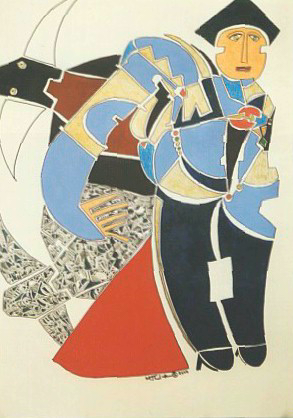
MATADOR
"The Bull is a symbol of
Taurus, also," Moshe Frank adds.
"Which is the second step of the Male energy during the Day. The Springtime of the year..."
"He
is a kind of hero, battling with the dualistic forces of nature," Richard
Baker replies. He has re-appeared,
shadowed by one of Fanti's officers.
"The dualistic script, which is the shadow of the bull, is the most
enduring image of this painting, at least to me. The intacacies of the interwoven psyche -- it is the black
and white woven together which creates pictures, which creates stories -- is
the counterpoint in the painting.
One has the sense that the entire painting is, indeed, reflected in this
counterpoint somewhere, somewhere off the canvas. There are many beings in this counterpoint, many creatures,
which are the memories and fears of the matador himself. In the head of the bull is a main face,
with a large mouth, very white lips.
He is a kind of alter-ego, the non-heroic being in the matador himself,
that the matdor wishes to keep away from the surface of life..."
"A
kind of demonic shadow," Moshe Frank agrees. "The spirit of Discord, Rebellion, the Night -- the
avant-garde Night -- which the Day God drives away, under the stampeding foot
of the Minotaur..."
"The
matador is a man of heart," Peter Falk adds. "That is very clearly illustrated."
"The
sense I am getting from all this biography, the meaning of the sequence of
pictures," Hillary says, "is that the artist thinks that the world is
better with the women at home, pregnant, barefoot, taking care of the children. Is that the truth of his seemingly very
reactionary vision...?"
"Mister
Crossmann," Hedda asks.
"Would you like to respond to that question...?"
"The
bull is the Earth and the demands of the Earth," Crossmann says. "The matador plays with this
bull. He wars with the bull, on
the bull's own ground. He dances
with the bull. .."
"But
what is the implication for the women?" Hillary asks. "We have just seen Venus disrobing
to have sex with the frightened men.
The next image we see is the man fighting the bull. Very virile, very earthy; but there is
no woman. Is the woman at home,
barefoot and pregnant...?"
"Probably,"
Crossmann says. "To
everything there is a season, in symbolism."
"The
woman is pregnant," Hillary says, "and the men are free to run wild,
killing bulls and all else. Where
is the justice in that, I ask you...?"
"Women
bearing children is no injustice," Crossmann replies. "That is Nature's rule. We try to twist that reality out of
shape, because it does not fit our ideology. There is no absolute equality between the sexes. Men are created for one task; women for
another. Many tasks can be
shared. But because we have lost track
of the main roles of men and women in our society, we have fallen into chaos
and perversion. Being a mother is
the highest creative act of a woman, greater, much greater than painting a
painting or writing a poem. When
women belittle this act, they do themselves and their society a grave
injustice. What act is more noble
than bearing a child, in raising a child to be a good human being...?"
"You
want us in the house so you can have all the glory!" Hillary
responds. "We know it! We want some of the glory too...!"
"Why
do you want glory so badly?" Crossmann asks.
"Wha
do you want it so badly?" Hillary asks.
"I
don't want it so badly," Crossmann replies. "I know that it is another form of the cross."
"Penis
envy!" Freud cries -- the ghost of Freud -- moving through the room like a
cloud, a mist.
Hillary
tries to strike him as he floats past her, above her head.
Gloria
Steinem throws her shoe at him.
"Fascist!"
the woman in the chartreuse downy duck suit cries wildly, looking at
nothing. "You and Andy Warhol
are to blame for our current state of desperation...!"
"Crossmann
is not so bad," Jerry Fallwell calls out. "He wants the women back in the home...!"
"Everything
in its season," Crossmann says.
"Even rebellion, when the Night gets to rule. Even rebellion, when the knife-wielding
wife, with her illegitimate lover, strikes her husband down..."
"Murder?"
Fallwell cries. "No, we can't
tolerate murder! Not in our
mythology...!"
Fallwell
turns to Jim Baker: "He's against queers -- did you hear that, Jimmy
Boy! He's against the dirty
queers...!"
But
Jim Baker does not celebrate.
"Prison
has taught me to be more humble," Jim Baker responds.
"Hell,
prison turned you into a queer yourself!" Fallwell says. "I had heard that about you. I didn't believe it until now...!"
Fallwell
turns to Jimmy Swagart: "Jimmy, Crossmann's against the queers and the
perverts! Did you hear
that...?"
"I'm
a sinner, Jerry," Swagart confesses.
"I have sinned with...!"
"Not
with boys! Not you too...! Not like that damned Baker...!"
"No,
with....women of ill repute!" Swagart confesses.
"Oh,
hell, Jimmy. Hide a corn cob in a
dark place at night," Fallwell replies. "That never really hurt anyone. Into your niece late at night when the
family is asleep; or into the Mexican gardener's youngest daughter when she's
working in the house when the family has gone to the beach house. Hell, it never hurt anyone. As long as it's not a little boy's butt
that is. Go on tv; say you've
sinned; say you're sorry. Ask to
be forgiven. Take a page from our
friend Clinton's book. Ask them to
send you money. Hell,
everything'll be ok. Crossmann is
against the queers! I think I can
forgive him for being an occultist -- as long as he's against the
queers...!"
"Are
you against homosexuals?" Elton John asks Crossmann.
"The
crooked become straight," Crossmann replies. "And the straight then become crooked. That is the Law. Homosexuals are trapped in a box of
rebellion. They fight against
their fathers. When they forgive
themselves, they forgive their fathers.
And, when they forgive their fathers, they are released from the
box...."
"Then
you hate perversions? Is that
correct, Crossmann?" Fallwell asks.
"To
hate is also a perversion," Crossmann replies.
"To
hate evil is no perversion!" Fallwell cries.
"Jesus
forgave even perversions," Crossmann replies.
"He
did not counsel perversion -- he forgave it," Fallwell responds. "But the father does not counsel
or forgive perversion..."
"And
when the son becomes the father, all perversion disappears from the
world," Crossmann says.
"And the world, again, has saved itself from destruction..."
"You
are like a moving target," Fallwell cries. "You have no beliefs. You are like a shadow.
You are like the shadow of the matador, moving always, avoiding the
bull..."
"Avoiding
your bull," Richard Baker says.
The
audience laughs.
"You
are like the ghost of Freud, Crossmann!" Jerry Fallwell cries. "You have no substance. You are like the wind, with no
morality, with no bone or body..."
Fallwell
picks up Goria Steinem's shoe from the floor and throws it at Crossmann.
The
Magician catches it before it strikes Crossmann.
"Let
he who has not sinned cast the first shoe," Crossmann says.
"Slippery
devil!" Fallwell mutters under his breath.
Fallwell
turns to Jimmy Swagart: "We can't let him come to power! He will ruin us surely. We have a good thing now. We have made a very lucrative business
out of this religion thing. If he
comes to power, he'll ruin it for us.
Let's go have a talk with these Blue Men..."
He
points to the four skinheads standing at the end of the audience.
Count
Ricard and Countess Ursula Heidrich, from Stuttgart, motion to Lola. They are interested in bidding on the
painting 'Matador'. They are
standing with two other Europeans, Ingrid Thule, an heiress from Oslo, and
Maurice Levoissier, a leading collector from Paris. They all stand in a silent circle of refinement, pale and
stiff, motionless and cured -- as if they have mastered the art of living
without breathing.
"This
piece is exquisite," Levoissier says. "This first really great work in America since de
Kooning. I think you are making an
excellent choice, Ricard."
"We
will move on unless we have other comments," Hedda says.
The
Magician sidles up to Crossmann, handing him Gloria Steinem's shoe. A black shoe. Cinderella.
Crossmann smells the shoe.
The crowd shudders in horror.
Crossmann
flips the shoe through the air back to Gloria Steinem. Ted Kennedy catches it in the air; and
hands the shoe back to Ms. Steinem.
The
Magician says: "When Fohat is said to produce 'Seven Laya Centres,' it
means that for formative or creative purposes, the GREAT LAW (Theists may call
it God) stops, or rather modifies its perpetual motion on seven invisible
points within the area of the manifested Universe. 'The great Breath digs
through Space seven holes into Laya to cause them to circumgyrate during
Manvantara.' We have said that
Laya is what science may call the Zero-point or line; the realm of absolute
negativeness, or the one real absolute Force, the NOUMENON of the Seventh State
of that which we ignorantly call and recognise as 'Force'; or again the
Noumenon of Undifferentiated Cosmic Substance which is itself an unreachable
and unknowable object to finite perception; the root and basis of all states of
objectivity and subjectivity too; the neutral axis, not one of the many aspects,
but its centre. It may serve to elucidate the meaning if we attempt to imagine
a neutral centre -- the dream of those who would discover perpetual motion. A
'neutral centre' is, in one aspect, the limiting point of any given set of
senses. Thus, imagine two consecutive planes of matter as already formed; each
of these corresponding to an appropriate set of perceptive organs. We are
forced to admit that between these two planes of matter an incessant
circulation takes place; and if we follow the atoms and molecules of (say) the
lower in their transformation upwards, these will come to a point where they
pass altogether beyond the range of the faculties we are using on the lower
plane. In fact, to us the matter of the lower plane there vanishes from our perception
into nothing -- or rather it passes on to the higher plane, and the state of
matter corresponding to such a point of transition must certainly possess
special and not readily discoverable properties. Such 'Seven Neutral Centres,'
then, are produced by Fohat, who, when, as Milton has it -- 'Fair foundations
(are) laid whereon to build'. . . -- quickens matter into activity and
evolution...."
"The twenty-fourth painging is,
in fact, a very sad work," Hedda says. "It is entitled 'Saying Goodbye'. It is rather sparse..."
"I
want this painting," Elton John cries out. "It is an emblem of the AIDS crisis. Two homosexual lovers are saying
goodbye to one another...!"
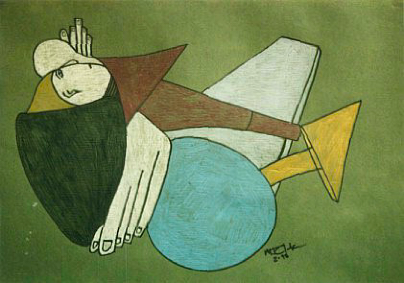
SAYING
GOODBYE
Fallwell
calls from the back of the room: "AIDS is a plague brought upon man
because of Homosexuals...!"
"In
terms of biography," Charlie Rose comes in, "this painting is about
the separation of the two brothers, Michael and William Crossmann, who had
lived so close for so many years.
Michael and William were like twins, were like Castor and Pollux of the
earlier painting. But Michael
Crossmann has been re-born, has entered again the arena of sex. He wishes to marry. He meets again a woman he knew in
college, Irene Carlyle. They had
been lovers; in fact, they had ..."
"They
murdered a baby together!" Oprah Winfrey calls from the back row, near
Reverend Farrakahn. "He
murdered the baby! She merely
flushed a foetus out of here system since she was not prepared emotionally or
financially to be a mother at that time..."
"Well,
yes," Rose says. "They
did have an abortion together. At
which event Michael Crossmann passed out on the clinic floor..."
"Fucking
wimp!" the woman in the chartreuse downy duck costume says, glaring up at
Crossmann. "Matador my
ass. It they would have thrown a
bloody fetus at him, he would have fainted away like the Andy Warhol he is or
is pretending not to be...!"
Crossmann
notices that Jerry Fallwell has an open briefcase he is showing to the four
skinheads in the back of the Museum.
He turns and points to Michael Crossmann.
"He
will marry Irene Carlyle soon after," Rose continues. "They will have a daughter. The two brothers will part company at
this point, Michael Crossmann remaining in Oregon, and William Crossmann proceeding
to the small town of Belt, Montana..."
"I
think it's about death and AIDS," Elton John insists.
The
ghost of Freddie Mercury moves through the room, trying to sing but coughing
instead.
The
ghost of Rock Hudson also appears in the room, moving up behind Gloria Steinem,
pinching her on the ass.
"My
God!" Steinem recoils. She
turns to strike her molester.
"Loosen
up, babe!" Hudson says.
"You've got a nice ass, a cute smile. Why don't you learn to live a little! I pity the poor boy who has to grow up
a son under your regime! You're as
bad as Stalin! No wonder so many
boys turn up queer. Mothers like
you cut their balls until they believe they have no balls. Turn them in to asshole bandits. Little girls looking for a friend. Look at me. I know what I'm saying. I lived it, baby!
I know what it's like...!"
He
floats out of the room.
Elton
John gets down on his knees and begins to pray to the two ghosts who leave the
room holding hands.
A
group of middle-aged women appear in the museum, carrying a large picture of
John Lennon. They are all dressed
in white. And they are singing:
"Imagine there's no country; it isn't hard to do; nothing to kill or die
for; no religion too...!"
"Lennonites,"
Peter Falk whispers to Michael Douglas.
"A new religious order founded on the songs of John Lennon. They believe Lennon was the second
coming of Jesus...!"
The
ghost of John Lennon follows behind the singing vestals. He is dressed in a long flowing white
robe, with long brown hair, a beard, and a white tampax on his head. He tries to take a glass of champaign
from the tray of a passing waitress; but she pulls away from him, startled by
his pale countenance.
"Give
me that glass, damn it! Do you
know who I am!" Lennon commands.
"You're
an asshole with a kotex on your head!" the waitress responds, walking away
without giving him a glass.
Everyone
in the room genuflects as John Lennon's ghost passes through the room, then
down into the msueum basement, looking for alcohol.
Crossmann
notices an Asian woman, very pretty, moving behind Lennon's ghost. It looks like Yoko Ono from one angle;
but when she turns to face Crossmann she becomes Hoa-Lan Tran, the woman
Crossmann remembers from the Millionaire show.
She
follows Lennon down into the basement.
"I
think this piece is one of the strongest in the show," Woody Allen
says. "For the power of its
feeling. Cearly, it is the end of
something. It has a very strong
emotion in it."
"Then
comes Crossmann's marriage," Charlie Rose announces, looking ahead to the
next painting.
Crossmann
notices that the fourth skinhead is no longer the Governor of Minnesota -- but
he has become the bald man from the dark building, the one who tried to steal
the election for Gore. He smiles
at Crossmann, winks, and raises his right hand, pretending it a gun. He squeezes the trigger.
"Shall
we move on to 'Wedding Night'?" Hedda asks.
The
Magician sidles up to Crossmann, and says, in the voice of Jim, Crossmann's
friend: "There are enemies here, Michael. Enemies who want you dead. Enemies with money who are trying to buy your
dissolution. Beware both friends
and those who say they are friends!
Beware the enemies most whose enemy you have yet to be
declared...!"
"'Wedding Night' is the
twentieth-fifth piece in the show," Hedda says. "It is colored pencil on black paper. It is a humorous illustration of two
ducks having a kind of engineered intercourse. I must say that this is a strangely unromatic impression of
the lovemaking at a honeymoon...."
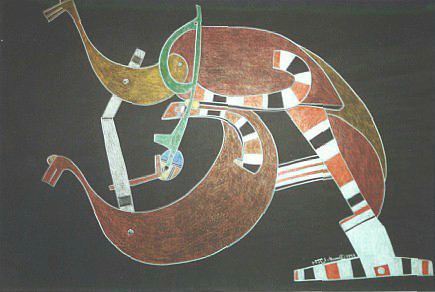
WEDDING
NIGHT
"It is more like a
sculpture," Reggie Lyons says, having returned from the first-aid room,
two bandaids pinching closed the wound above his left eye. The eye is swollen and discolored. "I believe it could be buillt in
three dimensions and be, really, quite striking..."
Lola
has a burly sergeant stand between Lyons and Richard Baker. He forces them to shake hands.
"Does
anyone feel insulted by this rendering of lovemaking in such a mechanical
construction?" Hedda asks.
"Well,
I feel insulted by most of the show," Hillary Clinton says. "The treatment of women and
non-whites in this exhibit is really quite insulting to all of us who are
sensitive to those issues. This
painting is a slap in the face of women generally. The woman is nothing but a sex machine, attached to the man
by some constructed element. It is
a huge penis going in to her private part. That must really hurt.
I hope he was good enough to lubricate the woody before he put it in
her.... That marital duty can be
quite painful for those wives who are not in the mood whenever the fancy
stirkes a husband to...make sparks..."
"It
is humorous," Warren Beatty responds. "It is playful.
I think its quite fun, really enjoyable..."
"Women
are always on the bottom," Jane Fonda says. "In Crossmann's work, women are always on the
bottom..."
"That
is not true," Richard Baker replies.
"In his novel at least, women are on top half of the time..."
"But
it is the time of trouble," Gloria Steinem says. "Women on top is a signal of trouble, a signal of
chaos..."
"Night
is a time of rest," Baker replies.
"The women are in power during that rest. Only prior to waking does the rest become troubled. As the man prepares to rise and take
command, again, of the world..."
"Look
at the next painting!" Gloria says.
"Male chauvinist pig...!"
"Are
we ready to move on to the next painting?" Hedda asks.
No
response.
The
Magician sidles up to Crossmann, speaking in the old woman's voice again:
"'The Seed appears and disappears continuously.' Here 'Seed' stands for
'the World-germ,' viewed by Science as material particles in a highly
attenuated condition, but in Occult physics as 'Spiritual particles,' i.e.,
supersensuous matter existing in a state of primeval differentiation. In
theogony, every Seed is an ethereal organism, from which evolves later on a
celestial being, a God. In the 'beginning,' that which is called in mystic
phraseology 'Cosmic Desire' evolves into absolute Light. Now light without any
shadow would be absolute light -- in other words, absolute darkness -- as
physical science seeks to prove. That shadow appears under the form of
primordial matter, allegorized -- if one likes -- in the shape of the Spirit of
Creative Fire or Heat. If, rejecting the poetical form and allegory, science chooses
to see in this the primordial Fire-Mist, it is welcome to do so. Whether one
way or the other, whether Fohat or the famous FORCE of Science, nameless, and
as difficult of definition as our Fohat himself, that Something 'caused the
Universe to move with circular motion,' as Plato has it; or, as the Occult
teaching expresses it: The Central
Sun causes Fohat to collect primordial dust in the form of balls, to impel them
to move in converging lines and finally to approach each other and aggregate.'
(Book of Dzyan) . . . . . 'Being scattered in Space, without order or system,
the world-germs come into frequent collision until their final aggregation,
after which they become wanderers (Comets). Then the battles and struggles
begin. The older (bodies) attract the younger, while others repel them. Many
perish, devoured by their stronger companions. Those that escape become
worlds.'
"The next painting, number
26,is the portrait of, judging from the title, the 'Self-Made Man'," Hedda
says.
"He
is the symbol of what is wrong with the world," Gloria Steinem says. "Greed, the patriarchy, white
racism, the Individual against the collective. Capitalism.
Everything that is wrong with the West..."
"He
is the enemy?" Donald Trump asks.
"Is that what you are saying?"
"Yes,
he is the enemy!" Gloria says.
"He
is the man you want to castrate?" Ted Kennedy asks.
"If
she doesn't, I do!" Hillary Clinton cries.
"The
strong man frightens you?" the Donald asks. "You need to have your man weak, like a little
boy...? You want your sons to be
gay, so you can control them, rule them...!"
"This
painting clearly alienates many women," Hedda says. "Even to myself. This painting is a bit
overwhelming..."
"It
seems to me," Morgan Freeman responds, "that this man is not a white
man at all. This man has a dark
face. Has no one noticed
this...?"
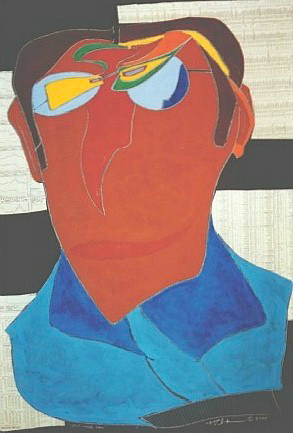
SELF-MADE
MAN
"This represents Crossmann's
atonement with money," Charlie Rose says. "Crossmann, for quite some time, after his so-called
're-birth' and his marriage and fatherhood -- Crossmann spent quite a bit of
time investing money and trying to develop computer software to time trading in
stocks. This is Crossmann in his
father role. He is attempting to
gain money, to build a better life for his family. It is clearly his capitalist phase, as he had a communist
phase. We note the background in
this collage painting are a series of stock tables and charts taken from the
newspaper. He is clearly now in
the universe, as he was, before, in the anti-universe. The anti-universe is, by defintion,
anti-materialistic...."
"I
hate this painting, " Jane Fonda cries. "It is so arrogant. So self-satisfied...!"
"It
is too strong for women who like to rule their men," Norman Mailer
replies.
"Do
any men find this painting offensive?" Hedda asks.
No
respond in the affirmative.
Suddenly,
the young woman in the chartreuse down duck costume appears near the painting
and begins hurling what looks like an umber-colored mud at the painting. A large clump of the mud lands on the
wall next to the painting.
"Oh!"
the crowd gasps. The mud has a
yellow, rotten stench.
"I
believe that's elephant dung," Mailer says. "I remember it from my safaris in Africa."
"Elephant
dung!" Hedda cries.
"Lola!"
But
Lola has already snapped into action.
She has the chartreuse duck in a half-nelson; and she is wrestling her
to the ground.
"Where
in hell would she find elephant dung in New York?" Hedda asks. But then she remembers....
Madelaine Murray-O'Hare and her
friend, Gentleman Jim, reappear in the gallery, off to the left side of the
room, near a side door.
"Welcome
to the Rocky Horror side of the MOMA tonight," Gentlemen Jim
announces. "Step one, step
all, to the real artist's exhibit tonight -- come in, come in. We have surgical gloves and buckets of
elephant dung. This is a
pro-active installation, political, yes, but also therapeutically regenerative,
to those who have the courage to enter..."
"Enter
for more Catholic-Bashing," the Madame O'Hare calls out. "Watch Pachyderm Poo and St. Mary
of the Intact Hymen do battle on our show tonight," she says, mimiching Ed
Sullivan, arching her mouth into a long void, stretching the word 'show' so
that it sounds like 'shoe'...
The
audience wanders into the room off to the side, following Gentleman Jim and the
obest women like they were hypnotists in command of the world.
Crossmann
follows them, curious about this new disturbance.
It
is a long room, perhaps one hundred feet deep, but narrow. There is a painting at the end of the room;
it is hung on a single column.
White painting tarps have been spread below the painting and on the
walls behind the painting.
Crossmann
tries to focus on the painting. It
is a painting of the Virgin Mary.
She is a broad-featured black woman wearing a blue dress shaped like a
leaf. In the painting, also,
swarming around the Virgin Mary like flies, are small pornographic pictures the
artist has cut out of magazines and glued to the canvas. The Virgin Mary's left breast is not a
breast at all -- but a round splattering of elephant dung. There are other small clungs of dung in
the painting. The artist is an
African man from England. He is
smiling, welcoming the audience in the room.
"This
is insulting!" Madonna cries.
"Have you no respect for a people's religious beliefs...!"
Madonna
leaves the room.
Gentleman
Jim is laughing wildly. He cries:
"The painting is not finished, of course. Put on a glove; get a ball of dung; let it fly. Join the artist in celebrating the
millenium...!"
"Who
is that woman?" Senator Kennedy asks.
"That
is the Virgin Mary," the artist replies.
"My
God, man, are you insulting the Catholic church?" Kennedy cries.
"This
is not an insult," the artist replies. "Dung is good.
Elephant dung is perhaps the best dung of all..."
"What
if someone threw dung at your mother," Senator Kennedy asks. "Would that be a
compliment...?"
"Calm
down, Senator," Hillary counsels.
"The artist has the right to say what he wants. This is a free country. At least it was the last time I
checked...!"
"Step
up!" Gentleman Jim calls out.
He dips his hand in a tall kitchen bucket containing the dung. He comes up with a handfull -- and
flings it at the painting. A PLOP
hits near the Virgin Mother's face.
"Oh!"
he and Madelaine cry out.
The
artist seems to appreciate it too.
"Audience
involvement," he says shyly.
The
dung has a sharp stench; and people begin spilling out of the room.
"Disgusting!"
"That's
not art!"
"Appalling!"
Then,
inexplicably, the dung begins to fly at everyone, at those leaving the room, at
those still in the room. Before
long, many people are involved -- hurling handfulls of dung at anything that
moves. That is, until Lola Fanti's
police arrive, and begin steering the two atheists and the African artist out
of the room, down into the basement.
The
Mayor wanders into the room -- and he is livid.
"What
is this? Hedda, what is this! This is a desecration! What is the meaning of this! It's ok to throw shit at the mother of
Jesus -- is that the message? I'll
shut this place down! I'll make
you pay for this insult to all Catholics in the world...!"
The
Mayor is gone.
The news media is outside the room,
with cameras.
A
pretty newswoman is interviewing people coming out of the room. The light above the cameraman is
glaring. "We are here with
New York City celebrities coming out of the show at the MOMA that has the whole
town talking -- the painting of the Virgin Mary covered with elephant dung. We're asking them what they
think..."
"Kartha
Pollitt, what did you think of the show?" the pretty newswoman, Angela
Luckman, asks.
Kartha
replies: "The Virgin Mary wasn't Catholic -- she isn't even a uniquely
Catholic symbol. To me, the
painting suggests the cheerful mother goddess of an imaginary folk religion-an
infinitely happier image of female strength and sexuality than the pallid
plaster virgins and Raphael copies on display wherever you look..."
"Are
you saying that this artist is a greater artist than Raphael, the Italian
master?" Angela asks.
"Yes,
well he is more lively, to be sure," Kartha replies. "Look, it's not great art -- but
we have a European bias. Why
should all our art be European anyway?
Why not African art? Why
not irreverent art too? Does all
our art have to be white art...?"
"Camille
Paglia, what do you think of this show?" Angela asks.
"Why
are a Jewish collector and a Jewish museum director openly sponsoring
anti-Catholic art?" Camille Paglia asks.
"Tasteless,"
Donald Trump responds.
"Simply tasteless."
"Why
don't they just have a show down in the men's lavatory?" Norman Mailer
asks.
"James
Cameron, director of Titanic, what do you think of this exhibit?"
Angela asks. "The Mayor wants
this show out of the museum. It
was sponsored with city funds -- and he says the city won't pay the museum for
this kind of disgrace. Do you
agree with the major...?
James
Cameron says: "Ah, yes. Censorship. Whether it be in the form of music,
art or reading material. Whereas I don't always agree with the content, we do
have the right to express ourselves as long as it does not interfere with
someone else's rights. In the specific case you mention in your question about
'a painting of the Virgin Mary covered in elephant dung', I may not like it,
but it is the artists right to
make it, same as it is my right to write lyrics about whatever topic I see fit.
The problem with the "Censorship" part of this is two-fold. First, the more it is sensationalized,
the more people will want to see it because of the controversy. Second, to censor it is taking away my
rights as an adult to choose what I find offensive. My main feeling is that I
don't want a politician, religious fanatic, Philly fanatic or any other person
telling me I can't read, listen to or enjoy a video, book, music style or any
other thing that is my personal choice to do. Usually the person doing the
"offensive" project is found to be doing it to gain publicity anyway,
such as in the case of Marilyn Manson, Twisted Sister, Alice Cooper, Motley
Crue, as well as many others..."
"Art
Critic for the New York Times, Peter Schjeldahl, what do you
think?" Angela asks.
"I
think its' a gorgeous, sweet and respectful treatment of the subject,"
Schjeldahl responds, "rendering her as a sternly hieratic African
personage in petal-like blue robes. Much of the painting's surface shimmers
ecstatically with glitter in yellow resin. Tiny collaged cutouts of bare
bottoms from porn magazines evoke putti, and allude to the element of fertility
in Mary's symbology, which this artist did not invent. As for the pachyderm
product, it is one smallish, attached lump, capped with what appears to be
black-and-white beadwork (in reality pushpin heads) in a design of concentric
circles. Elephant poop turns out to be innocuous-looking stuff, not unpleasant
in color and almost decorative in texture (lots of straw)..."
"That,
of course, was before the shit-throwing contest began," Angela adds.
"Well,
yes. But you have to understand
the meaning of the art -- and the participation desired by the artist,"
the critic answers. "It is
not art as much as it is life.
Life is different than art -- as the bumpersticker says, 'Shit
Happens'. Well, that's the way it
is with Art sometimes. Sometimes
Art Happens too. I think
it's a great show. I think he's a
major artist...!"
Sandra
Bernstein passes by.
"It's
too intelligent for the mass of people," Sandra says. "I mean, it's...it has an ethereal
meaning, which most people just don't get...!"
"You
have some dung in your hair, Sandra," Angela tells her.
"Where?"
"There,"
Angela points, "near your collar."
"Oh,
shit," Sandra Bernstein replies, "I just had this coat
dry-cleaned. Fucking moron. Whose fucking idea was it to start
throwing that shit....."
"It's
because the artist is black-skinned," Jane Fonda says, "that's why
there is such an issue about this.
If it was a white-skinned Italian, this would not be an issue..."
"Italians
are mostly olive-skinned," Sylvester Stallone reponds. "Italians aren't white. Norwegians are white. Italians have olive-colored skin. The show is a disaster. The so-called artist ought to be taken
out in the alley and shot. This is
a disgrace..."
Francis
Ford Coppola: "I'm sickened.
I'm glad my mother wasn't there to see that. It probably would have
killed her. The museum made a major
mistake with this. As an Italian,
I'm shocked..."
"The
Mayor hates black people," Al Sharpton says. "He always has.
And he always will. He just
hates seeing a black woman up on the wall with her breast exposed..."
"That
wasn't her breast, Al," Angela points out. "That was elephant dung..."
"Elephant
what?"
"Elephant
dung."
"Jesus
Christ. Who put that crap on a
painting of a black woman? Did the
Mayor do that...?"
"Woody
Allen? What did you think of the
exhibit...?" Angela asks.
"Well,
at least no one tried to eat the elephant dung," Woody replies. "I guess it could have been
worse...?"
"President
Clinton, what did you think?" Angela asks.
"They
were cookie crumbs," Clinton says.
"She just likes cookies -- that's all..."
"Marlon
Brando -- what do you think?" Angela asks.
"Pig
shit thrown on the wall is not art," Brando says.
"It
was elephant dung," Angela points out.
"Oh,
so that makes it better...?"
Brando
has a big splotch of elephant dung on the back of his tuxedo. Angela doesn't say anything to
him. He's already mad enough...
"Jerry
Seinfeld," Angela says.
"Jerry, what do you think...?"
"This
place is a madhouse," Seinfeld replies. "Kramer got hit in the side of the face with a big wad
of that stuff..."
"Do
you think the artist has a right to express his opinion in that way...?"
"Is
that what he was doing -- expressing an opinion?" Jerry asks. "Sure, I guess. Everyone has their opinion. I think that kind of opinion should be
expressed in a private toilet instead of in a public gallery however..."
Joan
Rivers comes by: "What do I think?
Anything covered in excrement has a good chance of offending the
majority especially when it deliberately desecrates something which is
considered to be 'holy' to a large group of people. Obviously the thing smells pretty bad too. 'Artwork' like
this is juvenile at best - the artist should give it to his mother to put on
her fridge alongside his finger paintings from kindergarten ... or perhaps this is the artist's attempt to
reconcile his love/hate relationship with his mother ... maybe he sees his
mother as 'the mother of God', which would make him deity, which would mean he
can do whatever he likes ... at least until he is snapped out of his delusion
on Judgment Day when he has to explain his actions to 'the real deal'
...."
"Paul
Newman," Angela says.
"What do you think of this art...?"
"Art,
is that what it is?" Newman replies.
"Quite simply, beyond an attempt to see how far boundaries can be
pushed, I see little or no value in calling something like this painting
'art'. My question is not whether
they should continue to fund this with tax-payers money, or evict it, but more
pointedly, who is responsible for deciding who is, and who is not, worthy of
display? This isn't social commentary,
nor is it (in probability) a commentary on religious or moral issues. It is someone trying for a quick shock
- and getting it -- and in my mind this in no way qualifies it as significant
enough for such exposure. I'm both disappointed in the government for
considering censorship, and the museum and those who call themselves proponents
of 'the arts', supporting this particular piece in the first place...."
"Tamara
Evans, Columbia University Professor of Art History," Angela asks,
"what is your take on this exhibit and the subsequent public
reaction..."
"The
public is largely unschooled in the nature of sophisticated modern art,"
Tamara replies.
"Some
people think modern art is elitist," Angelas answers. "What do you say to that...?"
"Elitist
or not," Tamara replies.
"You have to be educated to understand anything. You can't reach a French novel until
you learn the French language. You
can't understand art until you have studied art. This artist is brilliant. His work is meaningful. His work is a criticism of the white patriarchal domination
of the earth. It is the white man
who has thrown elephant dung on the Virgin Mary. Now they are blaming it on this black man. But his hurling of dung at the Virgina
Mary is an indictment of the white man's abuse of the black community for so
many generations..."
"So,
the artist is not responsible for the art work because he is black?"
Angela asks.
"That's
not the point," Tamara Evans replies. "The work is a satire. It's a satire of the rape of the world by white men, the
rape of the religious spirit, the true religious spirit by capitalism.... Anyway, I liked it. I think it's great. It's good multi-cultural stuff. That's what art is supposed to do: it's
supposed to stir people up and make them think..."
"The
only thing that this art makes people think about," Jack Nicholson says
over Tamara's shoulder, "is where they might find the nearest toilet so
they can puke and get it over with...!"
"Mayor
Giuliani," Angela asks, "there is a lot of controversy over this
show. What are your feelings about
this show...?"
"This
is a disgrace," the Mayor responds.
"This work is openly anti-Catholic, desecrating an image that is
sacred to millions of people worldwide.
And this show is being funded, at least partially, by state funds. I will see that state funding is pulled
on this show, and from this gallery unless the art directors here begin to show
better judgment about the content of their exhibits and show some respect for
the moral values of the decent members of the American public..."
"Bill
Cosby," Angela asks.
"What is your take on this controversial exhibit...?"
"Three
words: Demeaning, degrading and offensive," Cosby replies. "If words
such as these enter your mind for even a second, then it is clearly
unacceptable to support these self proclaimed 'artists'. Shock factor doesn't equate to talent.
Common decency and respect is crucial to the peaceful coexistence of the human
race. Don't they get it? Or do they even care...?"
Allen
Ginsberg, the dusty traveler, is laughing madly in the background, laughing
uncontrollably, watching people emerge from the room with specks and wads and
welts of elephant dung on their evening attire and in their hair and on their
faces and hands. He breaks into song,
accompanied by Tom Waits doing scats in the background, and Leon Redbone
playing the throat tromnet:
who lost their loveboys to the three
old shrews of fate
the one eyed shrew of the
heterosexual dollar
the one eyed shrew that winks out of
the womb
and the one eyed shrew that does
nothing but
sit on her ass and snip the
intellectual golden
threads of the craftsman's loom,
who copulated ecstatic and insatiate
with a bottle of
beer a sweetheart a package of
cigarettes a can-
dle and fell off the bed, and
continued along
the floor and down the hall and
ended fainting
on the wall with a vision of
ultimate cunt and
come eluding the last gyzym of
consciousness,
who sweetened the snatches of a
million girls trembling
in the sunset, and were red eyed in
the morning
but prepared to sweeten the snatch
of the sun
rise, flashing buttocks under barns
and naked
in the lake, who went out whoring
through Colorado in myriad
stolen night-cars, N.C., secret hero
of these
poems, cocksman and Adonis of
Denver-joy
to the memory of his innumerable
lays of girls
in empty lots & diner backyards,
moviehouses'
rickety rows, on mountaintops in
caves or with
gaunt waitresses in familiar
roadside lonely pet-
ticoat upliftings & especially
secret gas-station
solipsisms of johns, & hometown
alleys too,
who faded out in vast sordid movies,
were shifted in
dreams, woke on a sudden Manhattan,
and
picked themselves up out of
basements hung
over with heartless Tokay and
horrors of Third
Avenue iron dreams & stumbled to
unemploy-
ment offices, who walked all night
with their shoes full of blood on
the snowbank docks waiting for a
door in the
East River to open to a room full of
steamheat
and opium, who created great
suicidal dramas on the apartment
cliff-banks of the Hudson under the
wartime
blue floodlight of the moon &
their heads shall
be crowned with laurel in
oblivion...
They file back into the main part of
the gallery.
Madelaine
Murray-O'Hare and Gentleman Jim are seen, again, being led away by Fanti's
police force, taken back down into the basement, this time both begging for
mercy. The elephant dung stench
carries over into the main gallery space.
"We
are going to try to regain our footing after this interruption," Hedda
says. "I apologize for this
disturbance. Let's move on to the
twenty-seventh piece in this show.
We have put in an order for some gas masks in case the stench next door
gets too great. We hope you will
stay with us; and forgive us for this...miscalculation...."
The
magician sidles up to Crossmann, speaking again in the old woman's voice:
"Appearing with every Manvantara as Narayan, or Swayambhuva (the
Self-Existent), and penetrating into the Mundane Egg, it emerges from it at the
end of the divine incubation as Brahma or Prajapati, a progenitor of the future
Universe into which he expands. He
is Purusha (spirit), but he is also Prakriti (matter). Therefore it is only
after separating himself into two halves -- Brahma-Vach (the female) and
Brahma-Viraj (the male), that the Prajapati becomes the male Brahma. Brahma separating his body into male
and female, the latter the female Vach, in whom he creates Viraj. It is purely astronomical,
mathematical, and pre-eminently metaphysical: the Male element in Nature
(personified by the male deities and Logoi -- Viraj, or Brahma; Horus, or
Osiris, etc., etc.) is born through, not from, an immaculate source,
personified by the 'Mother'; because that Male having a Mother cannot have a
'Father' -- the abstract Deity being sexless, and not even a Being but Be-ness,
or Life itself...."
"Battling the smell of elephant
dung is not easy, I know," Hedda says. "But it should get better as we move to this end of the
museum. This is Michael
Crossmann's twenty-seventh piece in the show; and it is entitled 'The Young
Girl'. It is a colored pencil
drawing on black paper. And it is,
again, primitive in tone, but complex in execution...."
Some
of Lola's lieutenants are now passing our small clear plastic breathing
mechanisms to the guests. People
put the gas masks on fairly quickly, plastic hood over the mouth and nose,
oxygen generator attached to the belt.
Hedda
puts her mask in place, then moves it down around her neck when she wishes to
speak.
"I
think this oeuvre
is delightful, in fact," Hedda continues. "I see in it, a young girl who is much more than that:
a girl, a woman, an animal; her dress, with its wonderful patchwork, seems to
have hidden in it the face of a man who is also a bull. Do you see the bull's horns coming out
of the dress? The young girl has
elements of both the bull and the cow in her own face; and she has elements of
the bull in her dress..."
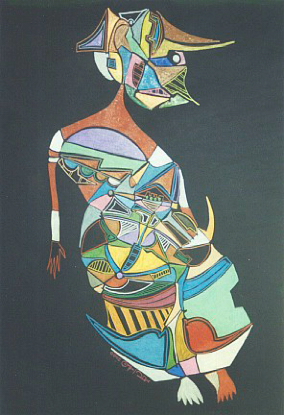
THE
YOUNG GIRL
"I believe it is the father's
face in the dress, wearing the horns," Charlie Rose opines. "Michael Crossmann is very aware
of the archetypal love tension inherent in the Oedipus and Electra complexes
well known to modern psychiatry.
There is an undeniable sexual awakening in the young girl -- note the
coquetry of her feet. I'm sure
this is Crossmann's daughter, Christina...."
Charlie
Rose has turned down the gas mask.
"You
don't want a gas mask, Charlie?" Geraldo Rivera calls out.
"No,
If I have to sniff....excrement for the sake of art," Charlie responds,
"I'm willing to do it...."
The
audience applauds.
A
few others take their gas masks off: Rod Steiger, Martin Sheen, Norman
Mailer. Ted Kennedy takes his off,
but then puts it right back on, fighting off a rush of offal air.
"Are
you saying Crossmann abused his daughter?" Sally Jessie Raphael calls from
the audience, lowering her gas mask for a moment, then raising it up again.
"I'm
speaking of archetypes," Charlie Rose responds. "His artwork is, in fact, about archetypes. Crossmann is married; he makes love
with his wife; he establishes himself as a man of means for his family; his
daughter is born..."
"But
you suggested he molested his daughter," Jerry Springer seconds Sally
Jesse. "We would like to hear
more about this. Whether he
molested her in fact or just in his mind -- the public has a right to know
everything the man has thought.
And since an artist is fool enough to show us everything he thinks,
everything he desires, I believe his artwork is part of the public
record..."
Springer
puts his gas mask back up.
"This
drawing is about Crossmann's love for his daughter," Rose says, "and
also about his attraction to young girls, who are innocent and fresh..."
"We
know about his illicit love for a young girl that should have landed him in
prison," Gloria Steinem calls out, lowring her gas mask. "And here she is, in the flesh..."
Standing
next to Gloria Steinem is a sexy young brunette in a yellow dress. He hair is pulled back, exposing her
proud forehead and her plump rouge lips.
"Isn't
this drawing also about this young woman?" Oprah cries out, claiming
victory in her tone.
"Not
directly," Crossmann replies.
"It is not a portrait of Sophie."
"Symbolically,
I mean?" Oprah responds.
"Perhaps. Symbolically it is about all beautiful
young girls and what a temptation they are to older men," Crossmann
replies.
Sophie
points to a whitish stain on the left shoulder of her dress.
"We
are going to get a dna test done ont his dress," Oprah cries out. "If we prove it is yours, you will
be sent up for fifteen years for statutory rape...!"
Columbo
moves over to Sophie Tucker. He
looks at the stain.
He
lowers his gas mask. "That
stains pretty old," Columbo says.
"It looks like cocaine to me.
I'm not sure what cocaine would be doing on a young girl's
shoulder..."
"It's
not cocaine, you idiot!" Jane Fonda cries. "I'm semen.
He forced this young girl to perform oral sex on him. He said he was going to fail her if she
did not...!"
"No,
he didn't," Sophie says.
"I wanted to do it. I
liked doing it. It tasted
good...!"
"We
want that dress!" Oprah cries.
"It's
my dress!" Sophie replies.
"It's not his semen, anyway.
I had it dry cleaned. This
semen belongs to John Preston...!"
"She's
covering for him!" Jane Fonda cries.
"Get the dress...!"
Oprah
and Jane Fonda and Gloria Steinem grab at Sophie, trying to rip off her dress. Everyone else just watches,
shocked. Sophies fights them off,
pulling down their gas masks. They
have to stop fighting Sophie in order to get the gas masks back in place. The smell is awful. Finally, the tear the dress off the
young girl's body. She is standing
in the museum, under the ambient lighting in a yellow brain and yellow panties,
dark nylons and yellow-tan pumps.
She has a beautiful teenage body, tight in the stomach, breasts pulsing
out of the brasierre; her public hair is slightly visible through the
transparent yellow panties. The
men in the audience, and many of the women also, admire Sophie's beauty, all
remembering when they too were young.
Columbo
steps forward, wrapping the trembling young woman in his old trench-coat. He leads her out of the museum.
Oprah
and Jane Fonda pass the yellow dress off to a runner who sprints with the prize
out of the museum, apparently toward a local lab for identification of dna.
"This
will be your swan song, Crossmann!" Jane Fonda cries. "You will no longer be allowed to
seduce the American public! We
know what you really are: a molestor, a seducer, a traitor to the
struggle...!"
Jane
Fonda gives a power salute, a clenched right hand lifted into the sky. A few more go up. The Mayor's wife; Callista Flockhart;
Angela Davis; Joan Baez.
"Anachronisms!"
a man in a three-piece business suit says, shaking his head. It is Jerry Rubin.
"Sell
out!" Angela Davis cries at Rubin.
"Commie
fraud!" Rubin responds.
"The
capitalistic system has ground the black man down, ground him in to the
dust!" Angela Davis cries out.
"Right
on!" Jane Fonda cries.
"The
capitalistic system is racist and concentrates power in thee hands of the few,
to the detriment of the proletariat which struggles for justice in a
bourgeois...."
But
Angela can't finish. She puts her
gas mask back over her mouth and gulps for clear air.
Everyone
starts to laugh.
"Would
you like to swing on a star, carry moonbeams home in a jar," the young
woman in the chaertreuse downy duck costume begins to sing. But then she has to put up her gas mask
too.
"Did
he or did he not molest his child?" Jerry Springer asks.
"We
are all guilty of molesting our daughters," Bill Moyers says. "Where there is one daughter in
the world who has been molested by her father, then every father is guilty of
the crime. Until we make the world
safe for every daughter in this world, then, yes, we are all guilty, Michael
Crossmann is guilty of this crime; I am guilty too..."
"By
that logic," Woody Allen reponds, pulling down his gas mask, "Bill
Clinton is guity of molesting Chelsea..."
"You're
a fine one to talk!" Bill Moyers reponds.
"No
one is really to blame," Ralph Nader comes in, between gulps for fresh
air. "Except for the chemical
companies, Dow Chemical, Dupont, which afflict the world populace with
poisonous chemicals, all for the sake of profit, uisng us as their guinea pigs
which distort our values and turn all men into potential
daughter-molesters...."
"Down
With Dow, Down With Dupont!" a group of Green Party members begin
chanting. "They molest their
daughters for profit! Confiscate
their property and redistribte it to the masses...!"
"Mister
Crossmann, did you have sex with your daughter?" Montel Williams demands.
"We
have the results to an interesting poll we have taken tonight, in the last ten
minutes, in fact," Dan Rather comes in, lowering his mask. "A poll of American taken tonight
-- 2,000 responses, with an error-quotient of 4-6% -- 34% of Americans believe
Michael Crossmann did molest his daughter. Now 73% of women polled believed this. And of those 73%, 94% of the women said
they watched daytime talk shows every day of the week. Of the same group, 93% of the women
polled said they trusted talk show hosts more than their doctors, their priests
or minister, or even their own husbands.
Interestingly, of the 34% who responded they believed Michael Crossman
had molested his dauther, only 13% of these felt this disqualified Mister
Crossmann from being voted the next messiah -- most believed that all men
molested their daughters, so this was not a true criteria by which to judge a
man's ability to serve the public..."
"We're
more powerful than Jesus," Phil Donahue says with a quaint smile. "We really govern America
now. We govern America's belief
system -- we create Ameerica's belief system. Perhaps we are the next messiah -- one of us: Geraldo, Oprah
or Rosie...."
Morgan
Freeman: "The girl in this painting reminds me of a young African
girl. There is something in this
man's art that is definitely connected to the aboriginal, whether it be in
America, the American Indians, the Aborigines in Australia, or the black
Africans in Africa. He is a
primordial nature, inside of that white German skin....
"He
probably supports the circumcision of the young African women," Alice
Walker says. "That is
probably what this drawing is about.
His support of clitoral mutilation is also well-known...."
The
audience grows silent.
"We
see, from the juxtaposition of this painting and the next painting, that there
is trouble in the Crossmann household," Charlie Rose says. "I believe, in terms of the
sequence of works in this show, the biography of this show -- I believe this
painting represents both Crossmann's love for his own daughter and his
experience with the teenage girl at work, Sophie Tucker. Because the next painting, 'The
Diamond-Thief', I think is symbolic of a force stealing from the Crossmann
household the love that holds the family together -- the diamon-thief is not
literal, but figureative..."
Hedda
lowers her mask.
"Any
other comments?" she asks.
"Well, then let's move on to the next work, number twenty-eight,
entitled: 'The Diamond-Thief'..."
The
Magician sidles up to Crossmann again, saying in an old woman's voice:
"Fohat runs the Manus' (or Dhyan-Chohans') errands, and causes the ideal
prototypes to expand from within without -- that is, to cross gradually, on a
descending scale, all the planes from the noumenon to the lowest phenomenon, to
bloom finally on the last into full objectivity -- the acme of illusion, or the
grossest matter...."
"This work is a watercolor
collage on white paper," Hedda begins. "Richard, can you take over for me? I believe the stench is making me
ill..."
Hedda
leaves and rushes to the restroom.
"The
family depicted in this painting," Richard Baker begins, "is an
archetypal family, not the Crossmann family per se. We see on the ground floor, the father with his son; and the
son, who is black and white, caught up in the duality, is drinking from a long
straw an intoxicating drink. The
father -- who has a war churning in his stomach -- and the son are arguing
about the son's drinking problem; upstairs we have the mother, in black and
white also -- there is some kind of alliance here between the mother and the
son, in their rebellion against the father -- and the mother is sleeping. Notice the three blue 'z's' circling in
her room, cartoon imagery of a person sleeping. She is dreaming of herself as a ballerina, apparently a
dream of what she wanted to become when she was younger. The ballerina forms below the dreamer
-- hence, 'falling' asleep -- in a distinctive red blackground. Across the hall, in another upstairs
room, is a red pear. The pear is a
symbol of the womb of course; the womb is pear-shaped. But it is also a symbol of the human
heart, especially a red pear. It
is also connected, etymologically, to the word 'pyre,' funeral fire. Also upstairs we have a blue ghost
moving in the hallway, passing by an open door, two your daughters near the top
of the stairs, one of whom is naked.
And the diamond-thief, himself, who has one diamond in his backpack, has
his right hand on the second diamond, and is approaching the third. The diamonds are large 'X' forms,
similar to Crossmann's Figure 8 symbol that appear in his novel as the symbol
of the universe, one side of which is white, the other side being dense with
white and black script. Each
diamond alternates in its structure, with the white side being, first, at the
top, then at the bottom, then back up at the top.... There is a hole, or vortex, in the middle of the drawing
from which a thick black line is either appearing or being drawn back, like
water through a bathtub drain. It
is impossible to tell whether the thick black line is expanding or
contracting..."
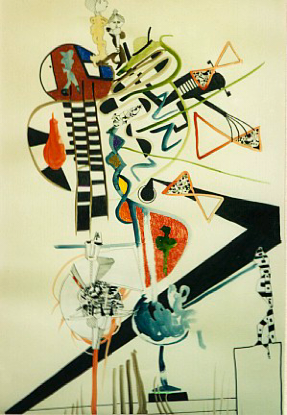
THE
DIAMOND-THIEF
"It says all that?"
Michael Douglas responds.
"Why
diamonds?"
"The
diamond governs the birthsign of Taurus -- the Bull, again," Baker
replies. "And we see in all
of this obsession with the Bull, from the Matador on, and Venus -- Venus rules
the zodiacal house of Taurus -- we see in all of this Michael Crossmann's
obsessive love, very personal love, of Leslie Rhoades, the married woman he
love and lost back in the mid-1970's....
Leslie Rhoades is the diamond he lost, the diamond some thief (Time? or
Custom?) stole from him and ruined his life, sending him into a spiral of
despair that resulted in his psychic death and abandoment in an internal Hades
from which he emerged a fighting angel..."
"Do
you agree with this analysis, Charlie?" Lola asks, having taken over for
Hedda.
"I
believe, at some level, this is more a painting of Leslie Rhoades' house, than
it is a painting of Michael Crossmann's," Charlie Rose agrees. "Leslie Rhoades had ambitions to
be a ballerina. Michael Crossmann
even watched her dance in a ballet in Eugene. So, yes -- I had not thought of this before. But, now, it seems quite
reasonable. The diamonds being
stolen are the memories Leslie Rhoades has of her love affair with Michael
Crossmann. Time is stealing them
from her perhaps. This is, in
fact, a pretty elusive painting, and one of my favorites in the show..."
Crossmann's
face seems to drop.
"It
is pretty clear to me that Michael Crossmann still loves Leslie Rhoades,"
Doctor Joyce Brothers proclaims, putting her gas mask up; then she takes it
down again after a strong inhalation.
"That's why he's such a sad man, and so alone today."
Shocked
silence in the museum.
Oprah
says: "Oh, my God. The man is
suffering for love. He has a
broken heart. This changes
everything...!"
"He
was psychotic because of love," Doctor Brothers reasons. "Like the great romantic poets, he
was wounded -- like Dante by his Beatrice. He could not go on.
He longed for death. And,
so, he sank into the deepest gloom.
Romantic gloom -- for his love was foresaken. He was abandoned..!"
A
deep sigh runs through the room.
"We
finally see the true Michael Crossmann," Maury Povich says, trying not to
breathe.
"Let's
keep moving," Lola says. "We moved to painting number twenty-nine, 'Marital
Strife' -- a painting very reminscent to Picasso..."
Lola
doesn't have and doesn't need a gas mask.
She is tough. A former
marine.
The
Magician sidles down to Crossmann again, leaning over to him, saying:
"Fohat, in its various manifestations, is the mysterious link between Mind
and Matter, the animating principle electrifying every atom into life. The spark that hangs from the flame by
the finest thread of Fohat. It
journeys through the Seven Worlds of Maya. It stops in the first, and is a metal and a stone; it passes
into the second, and, behold -- a plant; the plant whirls through seven changes
and becomes a sacred animal. From
the combined attributes of these, Manu, the thinker, is formed. Who forms him? The Seven Lives, and the One Life. Who completes him? The Five-Fold Lha or Spirit. And who perfects the last body? Fish, Sin and Soma..."
"Charlie Rose," Lola says,
"you're one of the few people in this room who is not wearing an excrement
screen -- so you are clearly willing to talk. Tell me about this painting. We have a lot of people bidding on this painting. And the bids are skyrocketing, in
fact. Many European collectors
consider this the finest piece in the show. It is gouache with India ink on white paper. What is your take on this...?"
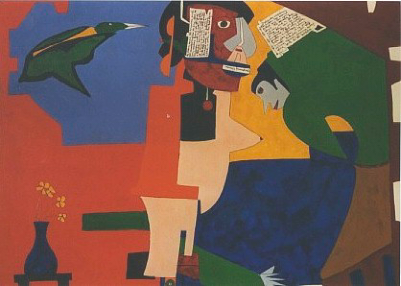
MARITAL
STRIFE
"Well, this is the
woman-as-tyrant painting in the show," Charlie says. "This is a fight between Michael
Crossmann and his wife. And the
wife is winning. She has just torn
the arm off her husband; and it lies at her feet. The husband is bending over in supplication; and who
wouldn't -- she has just torn his arm off. The husband is dressed in green, a green shirt -- and there
is a green bird flying past the window. Clearly, there is identification here: the husband would like
to be as free as the bird. There
is also an upside-down man which forms the wife's nose. One reading of this is that this is the
man with whom Michael Crossmann's wife had a long love affair, throughout the
entire time Michael and Irene knew one another, before marriage and after,
apparently even currently -- Marshall Fenton. Another theory is that this is Michael Crossmann's brother,
William, about whom Irene and Michael Crossmann fought regularly. She apparently hated Michael
Crossmann's brother...."
"This
is Lilith , in action," Moshe Frank responds.
"You
describe the wife as Lilith," Gloria Steinem responds. "That is meant to be a negative
judgment. But many of us in the
Women's Movement admire Lilith..."
"You
know nothing about Lilith!" Moshe Frank replies, angry.
"You
call any strong woman Lilith," Gloria says. "Any woman who is sexually independent, you call
Lilith..."
"Lilith
is the night monster, the screech owl," Moshe says. "She is Adam's first wife; and she
is the mother of all demons. She
collects semen discarded in masturbation or wet dreams, scraping the semen off
unoccupied sheets; she has sex with men while they dream, seeking to give birth
to demons...."
There
is silence in the room.
Heavy
breathing inside gas masks. The
audience is aghast.
The
lights in the room flicker -- then go off.
Screaming
in the room.
The
lights come back on again.
"You
are a child," Moshe Frank says to Gloria Steinem. "You know nothing about evil. Lilith is a succubus. From the hour in which Cain
killed Abel, Adam separated himself from his wife, [and] two female spirits
came and copulated with him, and he begot spirits and demons which roam in the
world. And this should not be difficult for you to understand, for when a man
dreams, female spirits come and play with him and get hot from him and
thereafter bear those demons which are called the Plagues of Mankind. And they
turn into a likeness of men, but they have no hair on their head.... And, in a
similar manner, male spirits come to the women of this world who become
pregnant from them and give birth to spirits and all of them are called Plagues
of Mankind. After 130 years Adam clothed himself in zeal and had union with his
wife and begot a son and called his name Seth..."
"Lilith
is the black moon," Steinem cries.
"The independent, sexual woman, the one men fear."
"Vagina,
Vagina, Vagina," the female chorus again sings: Flockhart, Fonda and Betty
Freidan.
"She
who murders children," Moshe Frank cries. "She who is the mother of the demons...!"
The
lights flicker off and on again.
"Crazy Jew!" Reverend
Farrakahn says. "You know the
Jews were behind the slave trade in Africa. Yes, that is a fact...!"
"There
was slavery in Africa before the Jews arrived there," Woody Allen replies.
"What? You shut up, shorty!" Reverend
Farrakahn replies.
"Even
today, children and young women are being sold as slaves out of Benin to work
as domestic or plantation workers in Gabon in West Africa," Allen
continues.
"That's
the white man's fault," Reverend Farrakahn responds. "Everything is
the white man's fault. The
slaughter of the Tutsi's by the Hutus -- that was the white man's fault also. Because the white man came to
Africa. If the white man never
would have come to Africa, there would have been no slaughter in Rwanda. The white devil is to blame for
everything..!"
"That
makes it pretty good for you," Allen says. "If you succeed it's because of your talent. If you fail, it's someone else's
fault..."
Farrakahn
pushes Allen out of the way, and pulls his gas mask back up around his
mouth. One of Farrakahn's
lieutenants puts Allen in a half-nelson, and pushes him toward the basement. Armed black men in black paramilitary
costume arrive in the museum, standing guard in each direction, rifles crossed
on their chests.
"The
white devils listen to the Jew devils and the world turns to evil,"
Farrakahn continues. "Listen
to this woman, this Lilith, who stands before you, who tells you about the men
whose materialism has brought a plague on the Earth..."
"I
am Lilith!" Gloria Steinem says, lowering her gas mask, stepping
forward. "Lilith am I. Lilith creates a voice where there was
silence; it saves what is good within the patriarchy while transforming what is
destructive; it offers scholarship for argument and women's voices for
enlightenment; and it does all of this with anger and delight, good writing and
good humor...."
"Screech
owl!" Moshe Frank replies.
He
makes a sign of the cross toward Lilith -- but she laughs at his ineffectual
deliverance.
A
small man dressed in medieval clothing carrying an old dusty book appears,
opening the book with a flourish, dust flying. He lowers his gas mask and speaks: "I have compiled the
astrological data pertaining to the position of Lilith in the charts of 14
women who I judged to display a 'Lillith character.' This includes women whose
powerful sexuality has become a hallmark of their public image, or whose
defiance of male hegemony in the personal and public spheres is well known.
They are primarily writers, entertainers, feminists, and sex workers. These
women were selected from a large database of famous persons for whom reliable
birth data were available. In none of the cases was the position of Lilith
known to me before selecting the chart for inclusion in the study.An effort to
find an equivalent number of charts of women without a 'Lilith character' for
comparison was largely unsuccessful. This may attest to the fact that in order
to find success and notoriety, women over the last 200 years have had to 'buck
the system' in some way. The very fame and notoriety achieved by women in
history may be an indication that they do not fit the compliant, dutiful
stereotype of Adam’s second wife. No one seems to be terribly interested in recording the birth
data for Doris Day or June Lockhart, who are two of the few famous women that
the author would consider to not have a Lilith character in some sense. This
bias, and the failure to find non-Lilith charts should be kept in mind in the
following review. Lilith, as an
astrological body, Lilith is rather slow moving, traversing only about 40
degrees of the zodiac per year. Its motion is always direct, so it makes one
circuit of the zodiac every 9 years or so, and spends about 9 months in each
sign. The number nine is appropriate, considering that the astrological Lilith
is one of the foci of the Moon’s orbit around the earth. By tabulating the data relevant to the
Lilith positions of the women included in this study, we can see where there
might be commonalities and patterns that are suggestive of a strong Lilith. One
of the factors that emerges that is quite remarkable is that none of the women
selected have Lilith in a mutable sign. This alone almost places the sample far
enough from the statistical distribution of the general population (where we
have every reason to expect that Lilith will be represented in each
Quadruplicity with equal frequency over the span of time from which the charts
were selected) to achieve statistical significance. One can see how the bold, proactive energy associated with
the Cardinal signs and the persistent, determined energy of the Fixed signs
might contribute to a much stronger expression of the revolutionary Lilith attributes
than if Lilith were placed in one of the Mutable signs, the energy of which is
usually considered to be of a more vacillating, dissipating kind. An analogous
situation is seen with Mars in one of the Mutable signs, where there is always
a risk of dissipation of Mars’s energy in trivialities, fantasies, or emotional
turmoil...."
The
Astrologer pauses and inhales deeply from his gas mask.
Then
he continues: "Even more remarkable than the lack of Mutable Lilith
placements in the charts under consideration is the fact that the placement in
Cardinal and Fixed signs is largely linked to whether Lilith is diurnal or
nocturnal. In 11 of the 14 cases, when Lilith is below the horizon, she is
found in a Fixed sign, and when she is above the horizon, she is found in a
Cardinal sign. One problem with looking at a large collection of charts all at
once is that it is difficult to interpret the patterns one finds without more
detailed analysis of the lives of the people that the charts have been drawn
for. I can detect no certain relationship between the Nocturnal/Fixed and
Diurnal/Cardinal condition of Lilith and the personalities of the people
involved. It may be significant
that in two of the three charts that do not fit the pattern, Lilith does not
follow the condition of the sun; that is, she is above the horizon while the
sun is below the horizon or vice versa. This is only true in one of the 11
cases that do fit the pattern (Gloria Steinem). Unfortunately, a sample of
three is too limited to deduce any generalities. In the other 11 charts, Lilith
is found in the same nocturnal or diurnal condition as the sun, which may
indicate another condition of her strength. In any case, it seems clear that
Lilith is stronger in a Fixed sign when she is also below the horizon and
stronger in a Cardinal sign when she is also above the horizon...."
He
pauses to breathe again in his gas mask; then continues: "Another frequent
occurrence in these charts is an aspect between Lilith and Mars. Contacts with Mars, even when they are
stress aspects (squares or oppositions), often indicate that a great deal of
energy is available to the native for expression of the planet that receives
the aspect. Stress aspects between Lilith and Mars, as the planet that most
clearly expresses masculine power, may also indicate that a woman’s
independence and sovereignty will more often meet opposition by men, or by male
hegemony. Lilith is also often disposited by Mars, that is, in a sign that Mars
rules, or in a sign where Mars is exalted. In the case of George Sand, who also
has a square between Mars and Lilith, this can be seen in her adoption of male
dress and habits, as well as her adoption of a male name (her given name was
Amantine Aurore Lucile Dupin). Marlene Dietrich is also famous for occasionally
donning men’s formal dress, and for kissing a woman while dressed as a man in
the film Morocco (in 1930). It is a little known fact that this scene was
suggested by Dietrich herself, and that she artfully managed to keep the scene
from being cut by censors. Like George Sand, Dietrich’s Lilith is disposited by
Mars, but she has a sextile between Mars and Lilith rather than a square. Of course, Dietrich garnered much less
calumny from her gender-blurring behavior than Sand did. Women have often found
it useful to appropriate masculine symbols of power as a provocative gesture of
defiance of the status quo (although in Sand’s case, it was also initially
because it increased her chances of selling her literary works to have a male
pen name). As with any "negative" aspect, Mars squares will often
serve to facilitate one’s growth and progress rather than hinder it. It is interesting to note that all
three women who work in the sex trade in some capacity (the last three listed)
have aspects between Lilith and Venus, the planet most clearly linked with
sexual passion. This is also true of George Sand, who, although not a sex
worker, gained a reputation for her daringly explicit portrayal of women’s
sexuality in her novels Valentine (1832) and Leila (1833). Rose Kelley, who was of course
instrumental in Crowley’s reception of the Book of the Law, has Lilith
disposited by Venus, in Libra, conjunct the Ascendant (Rose Kelley’s birth time
is rather uncertain, but I have cast it for noon on her day of birth). This may
be an important indicator of her office as the first Scarlet Woman, since Libra
and its associated Tarot Trump, Adjustment or Justice, is very closely linked
with the idea of 'love under will'. The Lilith archetype can also quite
satisfactorily be correlated with Babalon, as demonstrated in an excellent
essay by Jeffrey Smith..."
He
sucks into his gas mask again.
The
audience is beginning to fidget -- but Farrakahn's honor guard show their
weapons to the crowd and they grow rigidly alert again, attentive.
The
Astrologer continues: "The chart of Xaviera Hollander deserves special
mention, as it amply illustrates the power of a strongly-placed Lilith. Ms.
Hollander is well known as author of the novel The Happy Hooker , and
star of the movie 'Pleasure is My Business' (the running time of which is 93
minutes, oddly enough). Ms. Hollander also writes a widely read sex advice
column for Penthouse magazine. Ms. Hollander’s Lilith is placed in Leo in the
first house. Leo is a sign frequently associated with sexuality, as is the
corresponding fifth house. Lilith’s placement in the first house indicates that
Lilith energy is a major component of the native’s personality and basic
identity. Ms. Hollander’s propensity for expressing her Lilith nature in writing
is seen in the disposition of Lilith by the Sun, which is placed in
Mercury-ruled Gemini, a sign often concerned with communication and teaching.
The clearly sexual nature of this Lilith placement is enhanced by Lilith’s
conjunction with Venus (to which Mars in Aries is in trine, another indication
of powerful and energetic sexuality). Furthermore, Lilith is conjunct both
Jupiter, giving the native’s Lilith qualities an expansive and flamboyant
quality, and Pluto, the planet of revolutionary social change. Jupiter rules
the 6th and 9th houses, and combined with Lilith indicates a desire to educate
the public about sexual health and social issues related to sexuality. Pluto in
conjunction with Lilith indicates a desire to cast off and revolutionize outmoded
sexual mores, but also a strong sexual presence and a secure command of the
power inherent in feminine sexuality. While Lilith is not necessarily always an
indicator of sexual qualities (although I hope I have made the case that Lilith
is an inherently sexual archetype), its influence on the sexual nature of
Xaviera Hollander’s works is considerable....
"A
detailed analysis of the remainder of the charts in the table is beyond the
scope of this event. As with any form of astrological delineation, the greatest
value will be derived by the native who takes the time to meditate on the
archetypes and symbols contained in their own birth chart rather than relying
on standard formulations in books. Those who are interested in studying Lilith
in their own birth chart should obtain a copy of the astrological calculation
program Astrolog. Astrolog, which
was written by Walter Pullen is not only one of the most versatile and useful
astrology programs available, but it is also free. Astrolog will calculate the
position of Lilith as long as the program is set to use ephemeris files rather
than its own calculation algorithm.
Those who are interesting in investigating charts earlier in this
century or before should therefore also download the additional ephemeris files
available at Walter’s website.
From ancient Jewish folklore to modern astrological practice, the Lilith
archetype, by its very durability, has proven its value in helping us
understand our own inner landscapes.
One of the lessons that Lilith teaches is that what we reject or see as
ugly in ourselves is much less daunting when we have the courage and will to
examine it in the light of day.
Just as Lilith has been transformed historically from the child-slaughtering
demoness of the Alphabet of Ben-Sira into an image of affirmation, we have the
ability to transform our inner demons into images of power...."
"This
age has learned to transform child murder into a positive," Moshe Frank
cries -- "hence, abortion, too, is considered good by the followers of
Lilith...!"
"Shut
that Jew up!" Farrakahn commands.
The
military guards move to silence Moshe Frank.
"Wait!"
Jerry Falwell calls to the Astrologer: "Tell us the names of these 14
women." Falwell has a notepad
in his hand and he is ready to take down names.
"Well,
these are 14 women I found, but there are many more," the Astrologer
replies: "George Sand, Rose Kelly, Mae West, Marlene Deitrich, Anais Nin,
Joan Crawford, Bette Davis, Gloria Steinem, Sophia Loren..."
"No! Not Sophia Loren!" Falwell moans.
"Germaine
Greer, Madonna Ciccone, Content Love Knowles, Magdalene Matrix, and Xavier
Hollander."
Falwell
turns to Tammy Baker: "Who the hell is Content Love Knowles and Magdalene
Matrix...?"
"I
bbbobbbbia," Tammy replies, painting her fingernails, breathing heavily
into her gas mask.
"What
did you say?" Jerry asks.
She
lowers her gas mask: "I have no idea."
Jerry
turns away from Tammy, to Jesse Helms.
"Get
the faggots ready!" Falwell says,
"Faggots? In here?" Helms asks. "Who?"
"No! Fire! Pyres...!" Falwell explains.
"Pears?"
Helms asks. "Pies? What kind of pies...?"
"Pyre! Fire! Light the stakes, you idiot! Bonfire for the witches!" Jerry explains.
Jesse
Helms doesn't get it.
Falwell
laughs a bit.
Falwell
turns to Jack Van Impe and his wife, the cute blonde with the speech
impediment: "We have the names!
Let's start the fire! It's
gonna be hotter than a witch's tit -- please excuse my French...!"
Van
Impe's wife, Rexella, is laughing.
She loves Jerry Falwell's sense of humor.
Jerry
looks her down too. Looking at her
breasts in her white silk blouse.
His
look makes her feel all yummy inside.
"Alright. All Jews in this room are under house
arrest!" Reverend Farrakahn shouts.
"We start with the little heimy standing up there by
Crossmann...!"
"Crossmann
is a Jew too!" the woman wearing the chartreuse downy duck costume cries
out.
The
crowd goes silent.
"Crossmann! Are you a Jew?" Farrakahn
asks. "I thought he was from
Wyoming...!"
"Lilith
is a Jew!" Moshe Frank calls.
"What?"
Farrakahn is aghast. "No, she
can't be! She's on our side! Are you a Jew, Lilith...?"
"No,
I am not," Lilith says.
Confused. Lowering her
eyes.
The
Magician sidles up to Crossmann, saying in his own voice: "This is only
one of your nightmares, friend.
When I clap my hands, they will all be gone."
The
Magician claps his hands.
The
lights go off for almost a minute; then they come back on again.
Everything
has changed.
Farrakahn
is gone. The men in the black
uniforms carrying machine guns are gone.
The gas masks are gone. The
smell of elephant dung is gone.
Dominic Rosetti signals Lola a bid
for 'Marital Strife'. Florian
Trummer tops that bid. Bill Gates
tops that bid.
"Merde!"
says Olivia Hussey, who is bidding for an unknown French collector. "Where the hell does he come
from! We can't keep up with
him...!"
A
man standing next to her is talking in French on a cellular phone, apparently
to the collector in Paris.
Rosetti
decides to compete. He riases his
bid.
Sergei
Volkov joins the bidding. He is a
tough-looking Russian in a long-black coat with a fur collar.
Angela
Salm, bidding for another European collector.
Bill
Gates again.
Jacob
Fritz, bidding for an anonymous American collector, reputed to be Ted Turner.
Jane
Fonda is infuriated seeing Jacob Fritz bidding on the work.
She
makes a call on her own cellular phone, trying to reach Ted Turner. He is not available.
"Other
bidders," Hedda asks.
Abdullah
Nasser's agent, Roscoe Tulley, bids.
Bill
Gates again.
The
bidding goes on.
Crossmann
notices another young woman dressed as a downy duck -- but this one is
blue. And another, carrying a
guitary, dressed in a copper downy duck costume.
Crossmann
looks across the room. His eyes
meet Allen Ginsburg.
Ginsburg
smiles; he nods to Waits and Mister Thromnet.
Ginsburg
creates a background noise of white Jewish-beat rap:
"who ate the lamb stew of the imagination
or digested
the crab at the muddy bottom of the
rivers of Bowery,
who wept at the romance of the
streets with their
pushcarts full of onions and bad
music,
who sat in boxes breathing in the
darkness under the
bridge, and rose up to build
harpsichords in their lofts,
who coughed on the sixth floor of
Harlem crowned
with flame under the tubercular sky
surrounded
by orange crates of theology,
who scribbled all night rocking and
rolling over lofty
incantations which in the yellow
morning were
stanzas of gibberish,
who cooked rotten animals lung heart
feet tail borsht
& tortillas dreaming of the pure
vegetable kingdom,
who plunged themselves under meat
trucks looking for an egg,
who threw their watches off the roof
to cast their ballot
for Eternity outside of Time, &
alarm clocks
fell on their heads every day for
the next decade,
who cut their wrists three times successively
unsuccess-
fully, gave up and were forced to
open antique
stores where they thought they were
growing
old and cried, who were burned alive
in their innocent flannel suits
on Madison Avenue amid blasts of
leaden verse
& the tanked-up clatter of the
iron regiments
of fashion & the nitroglycerine
shrieks of the
fairies of advertising & the
mustard gas of sinis-
ter intelligent editors, or were run
down by the
drunken taxicabs of Absolute
Reality..."
The woman in the copper-colored downy duck costume, the one
carrying a guitar, breaks into song:
"Hey Jack Kerouac, I think of
your mother
And the tears she cried, she cried
for none other
Than her little boy lost in a little
world he hated
And that dared to drag him down --
her little boy courageous.
Who chose his words from mouths of
babes who got lost in the wood.
Hip flask slinging madman, steaming
cafe flirts,
They spoke through you.
Hey Jack, now for the tricky part,
When you were the brightest star who
were the shadows?
Of the San Francisco beat boys you
were the favorite.
Now they sit and rattle their bones
and think of their blood-stoned days.
You chose your words from mouths of
babes who got lost in the wood.
The hip flask slinging madman,
steaming cafe flirts,
In Chinatown, howling at night.
Allen baby, why so jaded?
Have the boys all grown up -- and
their beauty faded?
Billy, what a saint they've made
you,
Just like Mary down in Mexico on All
Souls' Day.
You chose your words from mouths of
babes who got lost in the wood.
Cool junk booting madmen,
street-minded girls
In Harlem howling at night.
What a tear stained shock of the
world,
You've gone away without saying
goodbye...."
Crossmann watches the blue duck
wander away.
Natalie
Merchant. He admires her
talent. She must be a Catholic
girl. There is something about her
-- something very Catholic.
He
turns to Hedda.
The
bidding continues.
Masanori
Yamada has joined the bidding.
"How
high is Gates willing to go?" Trump asks Mailer.
"Well,
no one can stay with him if he decides he really wants it," Mailer
replies.
Douglas
Cramer the collector from Los Angeles, bids.
Bill
Gates counters. Gates, of course,
does his own bidding.
Lola
Fanti is hideous with glee. She
turns to Crossmann and whispers: "An empire! We are building you an empire...!"
David
Geffen makes a bid.
Yamada
counters.
The
woman in the blue downy duck costume sidles up to Jerry Falwell and whispers in
his ear: "Penis, penis, penis, penis, cocksucker. Oops. Even my
spellchecker doesn't recognize cocksucker - I guess it's not in Microsoft
Word's internal dictionary. It should be in there, because cocksucking is here
to stay. It's a whole lot of fun and when done right, gives great pleasure to
all parties involved. I love to suck cock. And so do many of the adults I know
- and some of the ones who aren't so sure if they want to give mouth massage to
another's diamond rod are happy to be on the receiving end. If they're not a
cocksucker, then perhaps they're a yoni nibbler. Or a vulva licker. Or maybe just an expert
kisser...."
She
smiles at Reverend Falwell; then she wanders away, shaking her happy tail.
"That's
her," Monica Lewinsky says.
She has just moved in to the crowd, with her date, Mickey Rooney. They have been watching everything from
the back of the room.
"Who?"
Falwell asks.
"The
one you asked about: Courtney Love," Monica says.
"No,
not Courtney Love," Mickey Rooney corrects her. "One of the Liliths: Content Love Knowles..."
"Oh,
that's right," Monica agrees.
"Did
you hear what she was saying to me?" Falwell asks Mickey Rooney.
"Well,
it's a sick society now, reverend.
What can I say," Rooney says.
"Everyone's trying to shock the middle-class. It's a kind of game. Queers and transvestites and
transexuals and all. Child-molestors. Buggers. Muff-divers.
You have to be weird to get on tv today. And the weirder the better. The news wants weird.
That's what sells shows.
Murder, rape, fear, perversion.
That's what sells. Plus, in
college now, the women are taught that they have to hate men, that men are the
oppressors; and that it's a war out there, between men and women. That's what they teach my
granddaughter. She comes home from
college hating men..."
"Men
have been pretty rotten to women, Mickey!" Monica says. "You've got to admit that! Women are treated like second-class
citizens. Men are rapists; and
what about the glass ceiling.
Women are treated like the black men. They have been a man's property for many centuries. We're just not taking it any
longer...!"
"Ok,
calm down, dear," Mickey says.
He
turns to Falwell. "I don't
want to upset her tonight. I'm
hoping to get some Millennium Candy after midnight...."
Trummer bids again, touching his
nose.
Geffen
bids, touching his pen.
Gates
touches the temples of his glasses.
Volkov.
Angela
Salm.
Charles
Saatchi's man, Edwin Carver, signal's Saatchi's bid.
Geffen.
Gates.
Lola
touches her breasts in ecstacy, running her left hand over her right breast,
hoping no one is watching.
Dana
Scully is watching. Her mouth
opens a bit.
Crossmann
notices the moisture on her upper lip.
The lip almost twitches.
Geffen.
Gates.
Ted
Kennedy scratches his crotch unconsciously.
"Was
that a bid, Senator?" Hedda asks.
"No,
I'm sorry. No."
"I
want it!" Gates says quietly.
"My wife wants it for our house."
Saatchi
bids.
Geffen
folds.
Gates
ups the bid.
Edwin
Carver is talking on his cell phone.
Saatchi
bids.
Gates
bids again.
Carver
puts away his phone.
The
painting belongs to Bill Gates.
Lola lets out a deep-throated war
hoop, throwing her right fist in the air.
Then she smiles, and hurries off to the right, a look of urgency in her
eye.
"I
need to use the ladies' room," Scully tells Mulder, hurrying off to the
right, following Lola.
Mulder
grabs Scully by the arm. He
whispers to her: "Don't forget to wear a mouth-condom. There's a lot of bacteria baking in
warm places these days..."
No
one else hears Fox Mulder.
Everyone
is applauding the major sale.
"Excellent,"
Hedda says. "Excellent. You've made a wonderful purchase,
Mister Gates."
The
Magician sidles up to Crossmann, speaking in the voice of the old Russian
woman: "Fohat, being one of the most, if not the most important character
in esoteric Cosmogony, should be minutely described. As in the oldest Grecian
Cosmogony, differing widely from the later mythology, Eros is the third person
in the primeval trinity: Chaos, Gaea, Eros -- answering to the Kabalistic
En-Soph (for Chaos is SPACE, "void") the Boundless ALL, Shekinah and
the Ancient of Days, or the Holy Ghost.
So Fohat is one thing in the yet unmanifested Universe and another in
the phenomenal and Cosmic World.
In the latter, he is that Occult, electric, vital power, which, under
the Will of the Creative Logos, unites and brings together all forms, giving
them the first impulse which becomes in time law. But in the unmanifested
Universe, Fohat is no more this than Eros is the later brilliant winged Cupid,
or LOVE. Fohat has naught to do
with Kosmos yet, since Kosmos is not born, and the gods still sleep in the
bosom of 'Father-Mother'. He is an
abstract philosophical idea. He produces nothing yet by himself; he is simply
that potential creative power in virtue of whose action the NOUMENON of all
future phenomena divides, so to speak, but to reunite in a mystic supersensuous
act, and emit the creative ray.
When the "Divine 'Son' breaks forth, then Fohat becomes the
propelling force, the active Power which causes the ONE to become TWO and THREE
-- on the Cosmic plane of manifestation. The triple One differentiates into the
many, and then Fohat is transformed into that force which brings together the
elemental atoms and makes them aggregate and combine. We find an echo of this primeval teaching in early Greek mythology. Erebos and Nux are born out of Chaos,
and, under the action of Eros, give birth in their turn to Ether and Hemera,
the light of the superior and the light of the inferior or terrestrial regions.
Darkness generates light. See in the Puranas Brahma's 'Will' or desire to
create; and in the Phoenician Cosmogony of Sanchoniathon the doctrine that
Desire, [pothos], is the principle of creation...."
"I think we should move on to
number thirty," Hedda says.
"We don't want to lose momentum. The next painting, in many ways, is a come-down for me. From the Picasso-like masterpiece,
'Marital Strife', we now face a grim piece that seems unfinished, in fact. I realize it is not unfinished. But it is a bit austere -- again,
anti-modern: primal. The title is
'The Grim Reaper'. Charlie, tell
us what this is all about..."
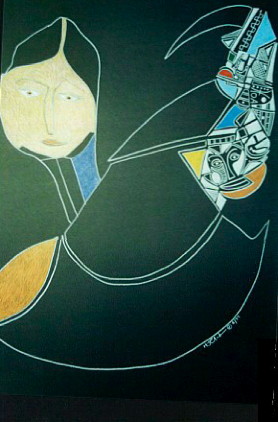
THE
GRIM REAPER
"I'm not sure it's going to be
easy to follow that last scene," Charlie responds. "This is the second appearance of
death in this exhibit. The first,
of course, was 'Mister Death' -- which, I surmise, represented, at least in
this exhibit, the death of Michael Crossmann's father, Jake -- and his
subsequent descent into depreseeion and chaos, death. This second apperance death represents, in the life of
Michael Crossmann, the incident at Southwest Eugene High School, where three
teenage boys assaulted the school, killing fellow studeents and teachers,
wounding many others. Michael
Crossman, himself, is the grim reaper in this painting..."
"Your
insistence on biography to approach a painting I believe to be a fallacy,"
Reggie Lyons replies. "There
is much more to this painting than merely biography...."
"Such
as?" Rose asks.
"Color,
line, contour, meaning -- and meaning in the context of the work, not in the
context of this show," Reggie insists.
"I
believe Charlie understands that," Hedda says. "But he has mad a very unique understanding -- he has
made a viable -- what I consider viable -- understanding of the unique
construction Michael Crossmann has given this show. Crossmann has built this show, thematically, into a story --
a story of his life. I have asked
Charlie to elucidate this structure.
I have never heard Charlie claim that this is the only reading of this
show sich is viable..."
"We haven't heard the complete
story about that day in the boiler room," Oprah says. "I, for one, would like to hear
the truth about what happened down there."
"This
man has been exonerated by a jury of his peers," Charlie Rose defends
Crossmann.
"Yes
-- but I would like to know what really happened," Oprah insists.
Crossmann
notices that the four skinheads have become four faces he recognizes: John
Preston, Mike Grubb, David McCulloch and Ted Lawson.
They
smile at Crossmann.
Preston
yells to Crossmann: "You'd better pass out now -- so they can't hold your
responsible for this...!"
The
other three skinheads begin to laugh.
Before
long, everyone in the room is laughing, everyone except Oprah -- who is livid.
"I
knew it! I knew you were
guilty!" Oprah cries.
"You murdered those...children...!"
"Those
murderers, you mean!" Donald Trump says.
"Those
racist murderers!" Alice Walker adds. "He's a hero for doing that, as far as I'm
concerned...!"
"We're getting off-track
here," Hedda cries.
"Reggie, you began to talk about line and color..."
"Color
is a racist conception!" a voice comes out of the audience. Another British accent.
"Excuse
me!" Hedda replies.
"If
you read his novel, you'd see that racism is implied in the structure of
color," the man continues.
"And
you are?" Hedda asks.
"My
name is David Batchelor," the man replies. "I am an artist; and an author of the book, Chromophobia,
which is a meditation on the racism inherent in the color-structure..."
"Is
that 'Chromophobia' as in 'homophobia'?" Hedda asks.
"Yes,"
Mister Batchelor replies.
"And the two words are clearly connected. In the male-dominated
philosophy behind Western civilization, color is associated with being foreign,
feminine, oriental, primitive, infantile, vulgar, queer, irrational, even
pathological. Our view is that
white is purity; and color is a corruption of that purity. Crossmann suggested this in his novel,
too -- with his color tree, the hierarchy of values. He suggests that there is white light at the top of the
tree. From this pure light are born
the three primary, pure colors.
But after this comes the corrupted shades, the secondaries, formed from
two colors, and then the tertiaries, formed from three. Then, of course, black, formed from all
the colors..."
"And
your point is?" Hedda asks.
"Crossmann
talks about the color tree, which is inherently racist," Batchelor
says. "But the color wheel
tells us a different story. The
color wheel is a circle; it is more...generous, more democratic. There is no such thing as a hierarchy
of color -- there are only random color events. All colors are, in fact, equal...."
No
one knows how to respond.
"There
is a kind of white," Batchelor continues, "that is more than
white. There is a kind of white
that repels everything that is inferior to it -- and that is almost
everything.... There is a kind of
white that is not created by bleach, but is itself bleach. This white is an aggressive white,
doing its work on everything around it; and nothing escapes...."
"Are
you saying white is only for reactionaries, supremacists?" the Donald
asks.
"Yes. White is for the rich; color is for the
rest of us, the real people," Batchelor replies.
"I
have a white house," Trump replies.
"Yes,
the White House -- with a white interior, I'd bet!" Batchelor accuses.
"Yes,
in fact."
"I
knew it!" Batchelor says.
"Rich autocrat! Very
high maintenance, this white...!"
"Yes,
in some ways," Donald Trump admits.
"In
a lot of ways," the Donald's wife adds, laughing.
"Another
voice from the anti-universe," Richard Baker intones to Crossmann.
"I
have read your book, with much admiration," Truman addresses Batchelor,
stepping forward into the light.
"But I did have one problem with your assertion that there is no
name for the color between green and yellow. Of course there is: it's chartreuse. I have seen a mad young woman here
tonight, wandering about in, of all things, a downy chartreuse duck
costume. You should have a look a
this young man. She is wearing
your color: chartreuse..."
The
audience laughs nervously.
"Well,"
Hedda says, "are we back to this painting yet?"
"I'm
not sure what the implications of this color theory, this man's commentary,
are, in terms of Michael Crossmann's painting -- for he uses white very
rarely," Xavier Rubenstein questions. "Is this man saying that Michael Crossmann is a racist,
because he uses white in his paintings?
Because, in fact, he uses white very rarely.... He seems to have a love affair with
color -- Crossmann does..."
"I
agree with this," Morgan Freeman.
"If you had brought me here to this exhibit -- and had allowed me
to skip the elephant dung tossing contest next door, and the phtography exhibit
on the first floor showing children in naked postures -- and I had not known
who Michael Crossmann was before I came: I would say that Michael Crossmann,
judging from the work alone, was probably black or at least part black..."
There
is a hard silence.
"Could
you explain why?" Hedda asks.
"The
words 'primordial' and 'aboriginal' have come up over and over again
tonight," Freeman replies.
"Primordial and aboriginal each speaks about the origins of the
race. Crossmann is obsessed about
the origins of the race, the human race.
'First Family, 'Night Warrior, 'Lovers', 'Young Girl', 'Old Man
Reflecting on His Youth' -- these feel, to me, African in origin,
ab-original. With all this
screaming about race, race, race: my view of this exhibit is that this exhibit
is about the entire history of the human race. There are people in this exhibit of every color. I believe Crossmann probably has some
black blood. How could he create
these kinds of pictures and not have some black blood...?"
"What
are you saying, Morgan?" Oprah asks.
"This man..."
"His
whole novel is about being Everyman," Freeman replies. "This exhibit is about Everyman. You distrust him because he's not a
liberal -- not because he's white.
You have more white friends that black friends, Oprah. White people love you as much as black
people do. You hate him for
political reasons, not racial reasons.
And he probably doesn't trust you for the same reasons...."
"What
are you saying?" Oprah asks.
"Some
whites are liberal and some are conservative," Morgan Freeman
responds. "Some Asians are
liberal and some are conservative.
Some Mexicans are liberal and some are conservative. Why are American blacks the only group
which is not allowed to be both conservative and liberal? Because the only issue we think about
is race. We don't have a spectrum
of concerns. The only way we
define ourselves as black people against or oppressed by whites. That's why we wanted to persecute
Clarence Thomas in public. That's
why we accuse him of being white.
Anyone who's not the same political persuasion is a traitor. But life is more complex than
this...."
"It's
because of our history in this country," Oprah explains.
"Partly,
yes. But is every liberal white
person really a black person?" Freeman asks. "Are conservative black people really white -- or just
conservatives with a black skin...?"
"I
don't understand where this is going?" Oprah asks. "You said he was really a black
person -- Crossmann. Are you
standing by that...?"
"I
don't know," Freeman replies.
"When I look at a few of his paintings, I think he might
be.... The human genome map tells
us that there is almost no difference between any of us, physically -- less
than one-half of one percent. We
all come from the same root -- the primordial, ab-original root. It is clear to me that Michael
Crossmann is, in fact, seeking a common root. There is no doubt that his book, with all its struggles, and
with its resultant nationalism and embrace of his own people -- the book is, in
fact, a map of the common root. It
is a paradox: it embraces the common root and it embraces the uncommon root at
the same time. And so do his paintings,
in my humble opinion..."
"Is
he saying Crossmann's black," Donald Trump asks.
"I
don't buy that," Alice Walker says.
"Is
there any proof of this?" Doctor Himmelmann aks.
Crossmann
is shocked to see Doctor Himmelmann in public.
"Well,
I don't have any proof," Freeman says. "Just a hunch, a feeling."
"None
of us know about our past really," Woody Allen says. "I mean, there are woodpiles
everywhere, all over the globe.
Who's to say that our own ancestors didn't spend quite a bit of time in a
woodshed -- or that our mom's may have had an occasion to carry some wood back
to the house on a cold night..."
"Do
you hear that," one of the skinhead says to his friends. "Crossmann's a nigger. Crossmann's a nigger...!"
"I
don't understand what all this has to do with the way the man develops line and
contour," Reggie Lyons says.
"You Americans, with your obsession with race -- what is it all
about, I wonder..."
"We're
not going to solve this tonight," Hedda says. "Unless Michael Crossmann has something to tell us that
we're not expecting. Charlie, you
say this drawing is..."
"I
say it 'represents', in this story he has constructed thematically tonight, the
shooting at the high school," Charlie Rose corrects Hedda. "It sin't about that experience. The drawing isn't about that
experience..."
"So,
what comes next then?" Hedda asks.
"We have the murders, the executions, the trial. That brings us pretty much up to the
present..."
"Exactly,"
Charlie Rose agrees. "This is
where it gets really interesting..."
The
Magician sidles down to Crossmann.
He is dressed in a black shawl, like the old Russian woman. He says: "She got tired. She had to go home."
Crossmann
laughs at this.
"Mussorgsky," Crossmann says.
"Steps
on the floor," the Magician replies.
"Is
there music in your shoes?" Crossmann asks.
"Hypothetical
music," the Magician replies.
"This one, number thirty-one,
is 'New Year's Celebration'," Hedda says. "Like tonight."
"Precisely,"
Charlie Rose says.
"Precisely. This
painting, or drawing, whatever you want to call it -- it brings us up to the
present."
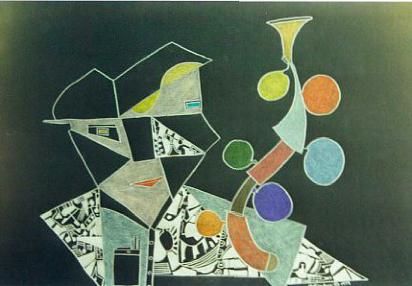
NEW
YEAR'S CELEBRATION
"I don't get it," Senator
Kennedy says.
"Note
the androgynous face," Moshe Frank replies.
"Also
note the flaccid penis on the end of the celebration instrument," Gloria
Steinem notes.
"This
is tonight -- yes!" Columbo says.
He is back. Wearing his
trenchcoat again. "I think I
can follow all that..."
"See
the strong white presence in this piece," David Batchelor calls out.
Reggie
Lyons is checking the band-aid over his eye, trying to see if the wound is
still bleeding.
"It
looks like some kind of musical instrument, with a trumpet on one end,"
Doctor Brothers suggests.
Xavier
Rubenstein looks at his watch.
"I
need to go over to my show," Jerry Springer announces. "I'll see you over at the studio,
Mister Crossmann...!"
Allen
Ginsburg bounds through the room enjoying the moment of silence -- and cries:
who jumped off the Brooklyn Bridge
-- this actually hap-
pened -- and walked away unknown and
forgotten
into the ghostly daze of Chinatown
soup alley
ways & firetrucks, not even one
free beer,
who sang out of their windows in
despair, fell out of
the subway window, jumped in the
filthy Pas-
saic, leaped on negroes, cried all
over the street,
danced on broken wineglasses
barefoot smashed
phonograph records of nostalgic
European
1930s German jazz finished the
whiskey and
threw up groaning into the bloody
toilet, moans
in their ears and the blast of
colossal steam whistles
The woman in the chartreuse downy
duck costume appears next to Ginsburg, frightening him. He hurries away.
"Warhol! Is that you?" she yells at
Crossmann.
"Not
recently," Michael Crossmann replies.
She
wanders away, muttering to herself.
"Any
more comments on this piece?" Hedda asks.
"This
would be nice in lacquer," Henrietta Beach adds.
"Let's
move on then, in to the future, if you will," Hedda says.
The
crowd is beginning to thin out.
The
Magician sidles up to Crossmann, dressed all in red now, mimicking Mae
West. She says: "Are you
going to tell us about the 32 steps...?"
"The
Hitchcock movie?" Crossmann asks.
"No. The mystical letters and numbers,"
the Magician replies. "And
youf friend, Moshe, is here to help you.
"The next painting, number
thirty-two, is entitled 'Hailing a Taxi at Night'," Hedda says. "Charlie, what do you make of
this...?"
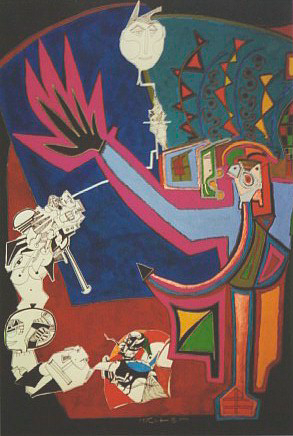
HAILING
A TAXI AT NIGHT
"I think it has something to do
with me," a voice comes from the back of the audience.
It
is a taxi-cab driver, the one with the mohawk haircut -- Henry Krinkle.
"He
took a ride with me earlier tonight," Krinkle says. "I took him uptown earlier. This weird painting, according to what
old Charlie has been saying, this painting is probably about that taxi ride
tonight..."
"This
is insane," Reggie Lyons responds.
"You Americans! This
experience has the intellectual foundation of a mud wrestling contest...!"
"Put
a cork in it, Reggie," Richard Baker warns threateningly.
"So,
what comes next, Charlie?" Hedda asks.
"Well,
I don't know," Charlie Rose responds.
"We
are moving back into the mystical," Pete Hamil says. "The future is, well, the
future. We don't really know
anymore..."
The
crowd is thinning even more.
"Number
thirty-three is entitled..." Hedda begins.
"The
Scourging at the Pillar," the Magician cries.
Crossmann
notices the woman in the chartreuse downy duck costume again, moving in and out
of the audience.
"Let's
move on to number thirty-three then," Hedda says.
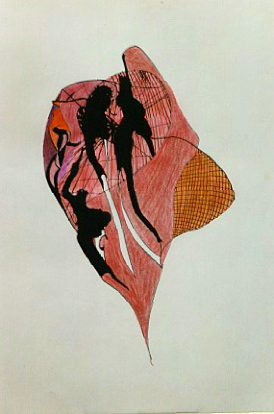
THE
SCOURGING AT THE PILLAR
"Charlie, or anyone for that
matter," Hedda says.
"Who wants to handle this one...?"
The
collectors have all left the museum.
"This
reminds me, in one sense at least," Morgan Freeman begins, "of the
drawing 'The Re-Birth of America'.
That drawing showed an experience emanating out of an organ, a
womb. This drawing shows an
experience emanating within, in a sense, another organ -- a heart..."
"A
sacred heart," Natalie Merchant suggests.
"This
is the scourging of Christ," Jerry Falwell cries out. "Crossmann clearly sees himself as
Christ. It's blasphemous -- but
it's pretty obvious. In his book,
he claims...!"
"Yes,
we know!" Hedda snaps.
"We want to know the implications for this man's future....!"
"I
don't think it holds any implications for his future!" Falwell snaps
back. "The man is loony
tunes, he's a cracked melon, he's a broken record...!"
"This
is some kind of image of crucifixion and resurrection," Charlie Rose
responds. "Resurrection,
because of the bird, a symbol of Easter..."
"I
don't know if I'm the only one seeing this," Senator Kennedy says,
"But, while I do see the human heart in the drawing, I also see a woman's
breast -- the mother's breast.
Does anyone else see it..?"
"Yeah,
I see it," the Donald replies.
"Is
Mister Crossmann going to be crucified?" Hedda asks Charlie Rose.
"I
would have to speculate on that possibility," Charlie replies. "No, of course not. Who would do such a thing...?"
"Let's
move on to number thirty-four," Hedda says. "This one is an interesting..."
More members of the audience begin
to drift away.
"Tell
us why this exhibit was divided into 36 steps," Jerry Falwell demands.
"Pardon
me?" Hedda replies.
"Why
36 pieces? There must be a reason
that 36 pieces were chosen," Falwell continues.
"There
was no reason," Hedda replies.
"The artist selected these pieces."
"Oh,
everything has some mystical meaning for him," Reverend Falwell
replies. "Let him answer for
himself...!"
"The
36 Paths of Wisdom represent the 26 letters of the English alphabet and the 10
letters," Moshe Frank replies.
"Oh,
Kabbala ruballa," Reverend Falwell responds. "We want the truth...!"
The
four skinheads are standing behind Falwell, as a kind of army of his word.
"I
don't understand this question," Hedda responds. "What is this all about...?"
"I
don't think I know either," Crossmann replies.
"It's
about demonism!" Falwell cries.
"Continuing demonism!
We know Crossmann's the Beast, the Anti-Christ! If you add the numbers 1-36 together,
you arrive at the number 666, the number of the Anti-Christ. His allengiance to the number 36 tells
us something, doesn't it...!"
Stunned
silence.
"Is
that true?" Hedda asks.
"1
plus 2 is 3 and 3 plus three is 6 and 4 plus 6 is ten..." Lola begins,
showing off her love of numbers.
"Take
our word for it!" shouts one of the skinheads, the one who looks like John
Preston. "We've done the
math...!"
"There
are 36 images in a set of Tarot cards," Shirley McClain comes in. She is standing next to her brother,
Warren. "Could it be that
this exhibit is, itself, a circle of Tarot...?"
People
in the audience begin to snicker.
"36
is 9 times 4," Richard Baker proffers.
"36
is 12 times 3," the Magician cries out.
"In
the Fourth Order, the World of Spheres, 36 represents Jupiter," Moshe
Frank interjects.
Reggie
Lyons throws up his hands in disgust; and then he leaves, looking for his coat.
"36,"
Moshe says again: "The soul guides beyond the body. Malkuth within Geburrah: History is
invented."
Richard
Baker steps up: " In the earlier discussion regarding
Three-Dimensional Reality, It was broken down, or rather built up, into 27
components. This number 27 was found tobe the sum of 3 x 9. This new number 36
is the sum of 4 x 9. The difference between these two numbers is 9. This can be
seen symbolically as the definition of reality added to the definers of reality
in the nine digits. As was shown previously though, one of the 27 has the value
of zero. Rather than 27 + 9 equaling 36, it should be 26 + 10. While the zero
is not really a number, it does have a definite value and place in the system.
For the purpose of this part of the work though, we will try to first analyze
more of the values of nine: 9, 18, 27, and 36....
"In
the chapter concerning Revelation, we work with a numberline of seven places.
Let us go back to that line and look at some of the other things it reveals.
The first digit and the last digit are the numbers 1 and 7. These two total the
sum of 8. The second pair of digits is 2 and 6, which also total 8. 3 and 5 are
next, also totaling 8. Since this numberline has an Odd number of digits, as
seven is an odd number, there are no more pairs left. The number 4 is left
alone in the middle. 4 is half of 8, so the place it has in the center, which
is the halfway point, is very appropriate. Take a look at the complete digital
numberline below....
0 1 2 3 4 5 6 7 8 9
"These are the ten digits of
the decimal system arranged in order of value. This is the primary line of all
that we will work with. This line repeats itself when numbers are reduced to
prime digits in reduction, with exception of the zero, as it occurs only once.
In this line, the ends are 0 and 9, which total nine. The next pair are 1 and 8, which also total nine. 2 and 7, 3
and 6, and 4 and 5 also total nine. As this line has an Even number of digits,
the middle falls between two numbers on the line: in this case, between 4 and
5. Half of nine is also 4.5 in the decimal system, or just 4 and a half
plainly....
"This
line also demonstrates the division spoken of earlier between the definers and
the defined. 1 + 2 + 3 + 4 = 10, which is the nine and the zero. We dropped the
zero for the first half of the line, so we must drop the nine in the last half
now, as nine is symbolically the equivalent of zero mathematically. The second
half of the line is thus 5 + 6 + 7 + 8, which has a sum of 2 x 13, or 26.
Again, this distinction between 10 and 26 will be addressed later. This
demonstration simply points out another way to reach it logically....
"To
enable further study upon the significance of certain numbers, and numbers in
general, let us now consider a common table of multiplication used in
mathematics. Children use this table all of the time. It is a very simple
square table showing the factors and sums of multiplication basics in an X-Y
type grid. For our use though, it will be limited to only eight digits, as any
number multiplied by nine equals nine:
"The
row across the top is 1 multiplied by each of 8 numbers. The column down the
left side is each number multiplied by one. The factors that are normally on
the top and side of this sort of table have been left out. The next table is
really the same as this one; the difference is that all of the sums have been
reduced to single digits....
"There
are many things to be noted here. First, there are only four nines present, in
a square pattern in the center of the table. Second, the patterns of the second
four numbers are the exact opposite of the first four. Third, any two numbers
that are the same distance from the center along a horizontal or vertical line
add to nine. Fourth, that only the numbers 1, 2, 4, 5, 7,and 8 have themselves
as sums of their multiplication. The other three numbers; 3, 6, and 9 can only
result in a 3, 6, or nine when multiplied by any other number. His forms a kind
of grid between the multiples of three, that looks like a 'Tic-tac-toe' grid. A
further analysis reveals even more repeating patterns, but let us concentrate
upon these for now:
"Ignoring
the grid formed by the multiples of 3 and 6 leaves nine smaller squares, each
containing four numbers. Each of these squares also adds to nine, (1 + 2 + 2 +
4), (4 + 5 + 8 + 1), etc. Four times nine again adds to thirty-six....
"The
numbers 3, 6, and 9 can be thus set apart from the other numbers for now, so
that we may look at these other six numbers. 1, 2, 4, 5, 7, 8 they are in
logical order. The sum of these six added is 27. The first three seem to
suggest some sort of pattern themselves. 1 + 2 + 4 = 7, but the pattern is more
than this. This is a doubling sequence. It is the same pattern which organic
cells divide into. One splits into Two. Two split into Four. The logical
progression of this is then that Four split into Eight, and Eight into Sixteen,
and Sixteen into Thirty-two, and Thirty-two into Sixty-four, and so on. This
pattern can also be resolved from these six numbers....
"The
1 2 4 pattern is sequential in the numberline. To get the 8 we have to start
from the opposite end. As the multiplication table shows us the cycle of 8 is
the opposite of 1, this should come as no surprise. The sixteen that the 8
doubles into is reduced: 1 + 6 = 7, which is the next number in the reverse
order we are following. The 16 into 32?
3 + 2 = 5, as does 7 + 7 = 14, which is 1 + 4 = 5. So this entire
sequence is here in these six numbers, only it is broken in half and turned
around in the middle. The sequence we are discussing is infinitive. This is a
cycle of six numbers that repeats over and over again forever. In this work,
infinitive numbers, especially fractions and decimals, will be represented by
the sign ~ following the number where the sequence repeats. 1 2 4 8 7 5 is the
sequence. What does this look like on a numberline?
"Make
a numberline of your own and plot the numbers from left to right and you will
come up with basically the same diagram. ( I encourage this to be done with any
of the patterns I have described.) Note that the pattern is exactly as it
appears in the value order: 1 2 4 to 8, then reverses back to 1. Some of you will recognize this pattern
as a very ancient one, some may not. For those who are new to occult symbology,
this pattern is very representative of the ancient Yin-Yang symbol of Chinese
origin. This pattern is the basis for an entire philosophy that is known as
TAO. This is the power of the universe and all of creation. TAO is the whole:
the combined essence of masculine and feminine forces that work together to
keep the universe together and moving always in balance. It is very appropriate
that this should also be found as the mathematical source pattern for cell
division among all living organisms in this world, and most likely in any other
that may exist. The number 27 can now be seen to not only be the key to
3-dimensional reality, but also organic life itself...."
Moshe
Frank says: "1 plus 2 is 3 plus 3 is 6 plus 4 is 10 plus 5 is 15 plus 6 is
21 plus 7 is 28 plus 8 is 36..."
"Not
to mention the prime lexicon," Richard Baker continues: "When writing numbers in bases (radii)
larger than ten we use the letters as digits: setting A=10, B=11, ... In
hexadecimal (base 16), for example, we use the letters A,B,C,D,E and F. So in
hexadecimal we have
(FACE)16
= 15*163 + 10*162 + 12*16 + 14.
"When
we work in base 36, all the letters are used - hence all words are numbers. For
example, in base 36 the word "FACE" is the number
(FACE)36
= 15*363 + 10*362 + 12*36 + 14.
"Since
words are numbers, it makes sense to divide them into the usual number
categories: primes, composites, squares, perfect numbers... This is a
collection of prime words (that is each of these words is a prime when viewed
as a number base 36)...."
"The
36th Hexagram in the I-ching is called the 'Darkening of the
Light'," Moshe Frank continues.
"The Gematrian Wheel is divided into 36 parts -- 36 times 10 being
360, the totality of the circle in degrees."
Richard
Baker begins again: "A Divine year is the name given according to this
system of archaic calculating of time-periods to 360 of our years or Solar
years. Therefore 12,000 Divine years in Solar years are 4,320,000. Made up
thus: the Krita-Yuga of 4000 Divine years -- 1,440,000 Solar years, with the
Dawn and Twilight thereof -- a Krita-Yuga is 1,728,000, (and isn't 1728 the
cube of 12?). The Treta-Yuga is 3000 Divine years. Multiply this by 360 to turn
it into our ordinary Solar years, and you get 1,080,000 years. Add on the 2110,
the Dawn and Twilight, and you get 1,296,000 years....
"Here
in the Table you get this series of 144, (the square of 12). Isn't it in Revelation of the Christian
New Testament that it is said that the sealed unto the Lord, or the saved,
shall be 144,000 in number? You see here again the mystical figure, 144, that is
the main point. You can add and take off ciphers according to the time-period
or cycle you are discussing. It is the head of the series of figures that is
important -- 144. The square of 12, twice 72, 4 x 36, and so forth. So we go
down to the Dwapara-Yuga: turn it into Solar Years, with a Dawn and a Twilight,
and you have 864,000; then Kali-Yuga, the age we are in now called the Iron
Age, adding to it its 2/10 for Dawn and Twilight, you have 432,000 years. This
system, or mathematical calculation of adding an opening and a closing of every
age-period or cycle which the Hindus call the Dawn and Twilight, is an
extremely archaic method of calculating based on Nature herself, for she always
introduces everything she does with a preparatory period, whether of time or
phenomena, or both, or whatever you may be dealing with. All diseases come with
the Dawn of preparation. Then there is the disease. Then there is the Twilight
of the disease as it fades out. So to get the full time-period of the cycle you
must know not only the length of the cycle itself, but its Dawn and its
Twilight, its beginning and its end....
"With
reference to the key-number 72 (36 x 2), which itself of course is a cycle of
varying length depending upon the ciphers added to it, the following series
contains cycles, every item of which on the list is important and well worthy
of study by those interested in chronological or cyclical matters: 72 x 10 =
720; 720 x 2 = 1440; 720 x 3 = 2160 -- an extremely important cycle this
because entering into the computations of the precessional cycle mentioned
above, for there are 12 such cycles of 2160 in the Precessional Cycle of
25,920....
"720
x 4 = 2880; 720 x 5 = 3600 -- a cycle well known to historians and chronologers
as the famous Babylonian Saros, which again multiplied by 100 or 102 equals the
racial cycle mentioned above of 360,000....
"720
x 6 = 4320 -- again a most famous cyclical key-number, well known in ancient
Hindusthan and in Babylonia and in the esoteric or occult schools of virtually
all Asia and ancient Europe, a cycle which with zeros added is an even more
important human racial cycle than is the 360,000 above mentioned. 720 x 7 = 5040 -- another extremely
useful, interesting, and important cyclical period, with or without extra ciphers
to define shorter or longer periods, and mentioned even by Plato in his Laws,
as already stated....
"The
ancient initiate-astrologer-astronomers rarely failed in their prophecies, for
it was a relatively perfect knowledge of the interrelations of planetary
movements and of other cosmic time-periods, both great and small, which enabled
them to predict with an accuracy of Nature herself events which they knew would
take place because of their knowledge of what had taken place in other
preceding cycles of time; and all cycles are repetitive, bringing more or less
the same train of events or sequences as happened before, when these cycles
begin anew. It should be noted that this is in no sense fatalism; for every
cycle, although repeating itself constantly in time, due to what modern
astronomy calls the irregularities in planetary and other celestial movements,
is never precisely or exactly what the preceding cycle was; for every such
cycle beginning anew its course always differs in less or greater degree from
its former courses....
"Some
comparisons can be made to show the existing connection between the number of
the Beast, 666 (that is the triangulation of 36), and the characteristic number
of the mission of the Christ, 153 (triangulation of 17). Note that in the
Gospel of Luke, the verse 36 of chapter 17, does not exist. And put aside
verses 1 S 17,36 and 2 K 17,36, the reference chapter 17 verses 36 never occur
in any other place in the Bible. These two verses of the Old Testament
highlight the combat led against the Antichrist and that only the Christ must
be adored. At 2 K 17,36, the people are warned against the false gods and that
they have to adore only the Lord: 'You are to bow down and offer sacrifice only
to Yahweh'. At 1 S 17,36, it is
David that told Saul that Goliath will fall between his hands 'for having
challenged the armies of the living God'. David, a shepherd (symbolizing the 'The Good
Shepherd', the Christ) faces Goliath and kills him by cutting his head (symbol
of the Antichrist dethroned) with a sword (symbol of the Word of God)...."
"What
the hell is this all about?" Senator Kennedy asks.
"This
is what we are saying," Jerry Falwell says. "The triangulation of 36 is 666.... He, Crossmann, is the
Anti-Christ...!"
"Crossmann
was born December 17," Moshe Frank replies. "He was born 12/17/50. 12 plus 17 equals 29 plus 5 equals 34. 34 is divisible by 17... "
"Your
claim is that he is not the Anti-Christ?" Falwell asks. "He's not the 36. He's the 17, instead, the 'mission of
Christ'? Is that your
claim...?"
"Yes,"
Moshe Franks replies.
"Well,
we're not so sure," Reverend Falwell continues. "By Gematri, if we calculate only the consonents in the
name Michael, Crossmann's first name, we come up with 36, don't we? I mean, M is 13 plus C (3) is 16 plus H
(8) is 24 plus L (12) is 36 -- is it not...?"
"It
is," Moshe replies.
"What
do you say to that?" the reverend asks.
"Are
you suggesting that Michael the Archangel is the Anti-Christ?" Moshe
enquires.
"No,
I am not! But I am
suggesting...!" Reverend Falwell begins.
"Watch
yourself, Jerry," Billy Bob Thornton says. "You don't want to get out on thin theological ice
now. The news media is here, don't
forget...."
Falwell
retreats a bit.
Moshe
Frank continues: "There is a formula which utilizes both Theosophical
Extension and Reduction to calculate the Root number of any given number.
First, we would go ahead and calculate its extension. After calculating the
number's extension we would then calculate the reduction of the extension. As
an example of this process let us start with the number 36. The extension of 36
would be expressed as 1~36 = 666 (using the above formula, 36 x (36+1) = 1332
divided by 2 = 666). We would then reduce this extension to find the Root
number of the number 36, that is, 666 = 6 + 6 + 6 = 18 = 1 + 8 = 9.
'The
Numerologist thus has four basic ways of "reading" any number. The
first would be the base or apparent number which we would be interpreting. Then
there are the two Theosophical methods of Extension and Reduction. Finally
there is the utilization of both Theosophical methods to reveal the Root Number
of any apparent number. The following number chart, borrowed once again from
Kevin Townley, should help to clarify these methods, as well as to reveal the
four distinct types of numbers.
Apparent:
1 2 3 4 5 6 7 8 9 10 11 12 13 14 15
Reduced:
1 2 3 4 5 6 7 8 9 1 2 3 4 5 6
Extended:
1 3 6 10 15 21 28 36 45 55 66 78 91 105 120
Root:
1 3 6 1 6 3 1 9 9 1 3 6 1 6 3
"The reader should consider the
curious nature of the four discrete Root numbers, which will always be either
1,3,6, or 9. In light of this, we may consider these four numbers to be
Perfect, since they are the Roots of all other numbers.
"In
esoteric lore, these numbers indicate how the One and the Many may always be
expressed by the Holy Trinity, which is confirmed mathematically as the three
Perfect numbers 3, 6, and 9; or 1x3, 2x3, and 3x3. The essential unity or
Oneness of this numeric Trinity may be revealed by applying Theosophical
reduction to each of these three sets of tripartite Root numbers, 136, 163, and
199, which are repeated sequentially into infinity:
1+3+6=10=1
1+6+3=10=1
1+9+9=19=10=1
That
is, by Gematria, 111.
"Hence, the inherent unity of
each complete tripartite cycle of these three sets of three Root numbers could
be written as 1:1:1, or the first Perfect tripartite number 111, which
symbolizes the operation of Unity through the Trinity. This Trinity is
eloquently expressed in the mathematical formula of the Key number 37 (the 3
formless and unmanifest, the trinity, and the 7 manifest principles), the
supreme number of Unity in both the Hebrew Qabalah and the Greek Kaballah, and
in the English Cabala 111 as well.
The Tripartite Permutations of the Key Number 37
1
+ 1 + 1 = 3, 3 x 37 = 111
2 + 2 + 2 = 6, 6 x 37 = 222
3 + 3 + 3 = 9, 9 x 37 = 333
4
+ 4 + 4 = 12, 12 x 37 = 444
5 + 5 + 5 = 15, 15 x 37 = 555
6 + 6 + 6 = 18, 18 x 37 = 666
7
+ 7 + 7 = 21, 21 x 37 = 777
8 + 8 + 8 = 24, 24 x 37 = 888
9 + 9 + 9 = 27, 27 x 37 = 999
"The reader has more than
likely recognized two of the Tripartite numbers referred to earlier in this
text, 111 and 666. The deeper meanings of these two enigmatic numbers will
begin to unfold for the reader by referring to the number attributes listed
previously concerning the Perfect numbers 1,3,6, and 9; especially when we
consider that the number 37 is the square root of the number 1369...."
"We seem to be getting lost in
a forest of numbers, gentlemen," Hedda announces, breaking up the party.
The
Magician interrupts Hedda, speaking to Reverent Falwell: "You forget one
thing, reverend. In looking for
the Anti-Christ, you have forgotten the usual suspects -- the most obvious
suspect, I should say, who was in this very room tonight. W equals 23 plus J equals 33 plus C =
36. If you are looking for your
Anti-Christ, you should be looking for William Jefferson Clinton..."
An
alarmed hush runs through the audience.
"By
God," Reverend Falwell exclaims.
"I knew it! I've
always said so! We need to track
him down! No, we need to call a
press conference! I'll need to
work on my Millennium Speech for tomorrow! My God, we've got old Nick cornered now! Let's see him get out of this
trap...!"
Falwell
leaves with his entourage; but he turns to say something to the lead
skinhead. The four skinheads remain
behind. The leader, the one who
looks like John Preston, eyes Crossmann with some hostility.
"My,
are we done with this painting?" Hedda asks. "I never expected to veer into that mirage. Charlies, can you help me here? We have the painting of Jesus being
tortured -- and, somehow, this fits into the artist's future? I am not sure I really want to hear
about this. And then another
twist, Painting number 34, entitled 'Girl from Sapa'."
The
Magician sidles up to Crossmann, whispering: "Of course, your own brother
also has the initials WJC. And his
birth day is on October 26 -- that is, 10 plus 26, or 36. But I shall never tell..."
Crossmann
looks back at this brother William.
William smiles; but Crossmann sees him transformed into a man in a military
uniform, with a stubby sand-colored mustache. He clicks his hells; then he makes the Nazi salute.
"We are nearing the end of this
journey," Hedda proclaims.
"This 'Girl From Sappa', a drawing on white paper done with colored
pencils -- what does this mean, Charlie...?"
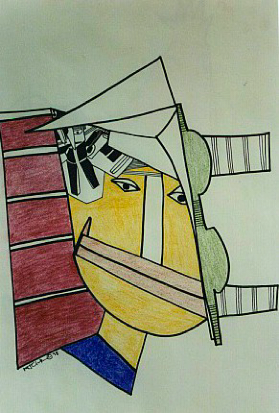
GIRL
FROM SAPA
"I see it, in some ways, as
representing Michael Crossmann's return to Vietnam, metaphorically," Rose
replies. "Sapa is a village
in northern Vietnam, along the Chinese border. In talking with Michael Crossmann earlier this evening, he
informed me that, following his metaphysical experience -- which he calls his
'rebirth' experience, he read deeply about the American war experience in
Vietnam, and even came to regret his opposition to the war. He came to view communist expansion
through the eyes of his father's generation, I believe..."
"But
how does this explain the appearance of this Vietnamese woman at this stage of
the story of his life?" Hedda asks.
"I mean, after the cab ride he took earlier tonight...?"
"I
don't know," Charlie says.
"He
will meet an Asian woman sometime in the future," Columbo reasons. "Isn't that what all of this is
saying to us? Isn't this a kind of
vision of the artist's life...?"
"That's
what we have come to assume," Hedda replies.
"Then,
I guess he will meet an Asian woman who will become important to him in some
way."
There
is no more comment.
The
young woman in the blue downy duck costume appears again, the one with the foul
mouth, the one who sang the praises of fellatio. She approaches Crossmann with a note, handing it to him
without a word.
The
note reads: "I couldn't make it to your exhibit. Something came up.
Don't forget to meet me at the opera. Love, Leslie."
The
name 'Leslie' sends an electric jolt through Crossmann.
He
puts the note in his pocket.
"Let's
move on to the next painting, number thirty-five," Hedda says.
The
Magician sidles up to Crossmann, saying: "I won't say anything. Don't worry about me...!"
"We are almost finished here,
Charlie," Hedda says. "I
see people are drifting off toward celebrations. This is really a very moving portrait of 'The Old Man
Reflecting On his Past' -- I just love this piece...."
"You
and me also," Morgan Freeman responds. "Lola, I'd like to bid on this one."
Lola
is ecstatic. She thought all the
collectors had left the museum.
She moves down to speak with Freeman.
"This
is a black man, Oprah," Freeman says, smiling. "I still hold to my theory that this man, Crosmmann,
must have black blood in him. Look
at the soul of this man in the drawing.... The white man is the master of the Day. But the black man, the dark man, is the
master of the Night. And it is
during the Night that the world is given religion. There is no way Crossmann could have been given a new
religion, and these paintings as a white man..."
Freeman
laughs when he says this.
Oprah
gives him a cold stare.
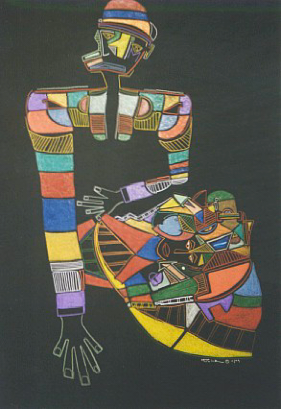
OLD
MAN REFLECTING ON HIS YOUTH
"I see at least four faces,
four images of people in the mass of memories piled off to the side,"
Charlie Rose adds.
"If
find it interesting that the first recognizable imagery," Henrietta Beach
states, "the 'First Family', was a primordial or an ab-original, a dark
skinned family -- and that the lighter skinned pictures evolved later. Now we have the circle being made. The child is black; the adult is white;
and the grandfather is, again, black.
This is a kind of color wheel.
I am wondering if this tell us something about the way that Nature
works. the Night comes first; and
out of Night is born the Day -- but the Day is mortal. Remember the 'Re-Birth of America' --
the word 'mortal' seems to be very important. It is the only word in that piece. And it is probably the most dominant single word in the
entire exhibit. Anything born, or
re-born, in this case, is, by definition, going to die again..."
"Darkness
was on the face of the Earth," Moshe Frank responds. "Life is born from the Darkness,
from the woman. The Book of the
Generations is born out of the Darkness.
The Seven Days of Creation, the Six Days, and the Seventh Day of Rest,
comes from out of the Darkness..."
Charlie
Rose says: "I would guess from this that Michael Crossmann is not
crucified. He lives to become an
old man, to reflect on his life, his past. Our concerns about the 'Scourging at the Pillar' seems to
suggest that an Asian woman appears; and somehow this allows him to grow
old..."
"The
West is born out of the East," Moshe says. "The Man is born out of the Woman. The West fights with the East; the Man
fights with the Woman. The Man who
emerges from the Woman is the Son of the Woman; and, magically, in some magic
process, the Son becomes the Father.
The West, the Son, emerges from the East, the Mother, but returns to the
East again, returns to the Night.
That is why the Asian woman again appears.... The child begins in the dark world; comes out into the
Light, is differentiated from the dream world, the unified world, becomes a
separate being, an Ego, a concrete, alienated, isolated, thinking man -- and
individual -- only to return, as an old man to the darkness. The child has only past; and the old
man has only past. The Ego, the
individual, has Life in the future.
And this life in the future is how he generates his own light. The child is a star turned inward; the
adult is a star turned outward, walking out in his own starlight, creating the
light in which he walks into the future; the old man, again, is a star turned
inward, walking into the inner dimension, the dimension which has only indward manifestation..."
"I
believe my claim," Shirley McLane continues, "has some
validity."
"Which
claim?" Hedda asks.
"That
this exhibit is a kind of tarot experience," Shirley explains. "The 'First Family' is the 'Wheel
of Fortune' card; 'Castor and Pollux' is 'Justice'; the 'Spirit of Drink' is
'Temperance'; 'Chopin' is the 'Sun'; 'Ahab' is the 'Tower'; 'Ecology' is the
'World'; the 'Lovers' are the 'Lovers'; 'Mister Death' is the 'Devil'; 'Hell
Money' is 'Death'; 'Night Warrior' is 'Strength'; the 'Re-Birth of America' is
the 'Hanged Man'; 'Venus' is the 'High Priestess'; 'The Matador' is the
'Magician'..."
Crossmann
smiles at the Magician.
"'The
Self-Made Man is the "Emperor'," McLane continues. "'The Young Girl' is the 'Moon';
'Marital Strife' is the 'Empress'; 'The Grim Reaper' is 'Judgment'; the
'Taxi-Cab' is the 'Chariot'; 'Scourging At the Pillar' is 'The Hierophant';
'The Girl from Sapa' is the 'Star'; and the 'Old Man Reflecting on His Youth'
is the 'Hermit'...."
"Fascinating,
Shirley," Hedda says.
"Fascinating."
There
are fewer people in the audience now.
Columbo
is still there. The Trumps;
and Senator Kennedy. The four
skinheads.
Crossmann
looks around for Catherine Zeta-Jones.
He sees her no where.
Crossmann
looks at his watch. His watch is
broken. He doesn't know what time
it is. He wanted to kiss Catherine
Zeta-Jones at midnight.
The
orchestra is still playing Mussorgsksy.
Oprah
and Gloria Steinem and Callista Flockhart and Alice Walker leave together.
Lola
Fanti and Dana Scully exchange phone number. Scully leaves with Mulder.
Crossmann notices a solitary black
man --he looks like Lou Rawls -- who has entered the museum dressed in a black
evening coat with a fur collar.
Oprah nods to him as they pass.
The
black man says someting in passing to the bald man, the one who threatened
Crossmann earlier, the one who was a skin-head for a time -- but who now is
dressed in formal wear. He also
leaves the museum.
The
Cigarette Smoking Man also leaves the museum.
The
woman with the chartreuse downy duck costume is still wandering around the
museum, looking lost and angry.
"I
believe the Magician is the Magician," Crossmann says abstractly, smiling
at the Magician.
"And
now the last drawing, the thirty-sixth," Hedda says. " This one is 'The Return of the
Salmon'. Charlie, this seems to me
like the perfect drawing to end the exhibit -- to close the circle and lead
back to the beginning. In style,
the first and the last are so much alike: 'The Return of the Salmon' leads back
into 'Before the Beginning'. It's
as if they are companion pieces..."
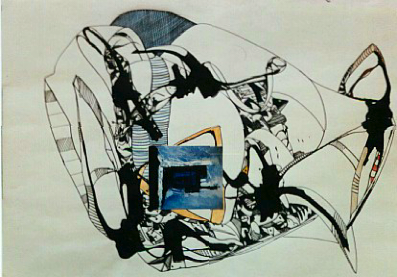
THE
RETURN OF THE SALMON
"Both are stark and
abstract," Charlie Rose agrees.
"We see the salmon in the left-center of the drawing, moving
upstream. The blue tones suggest
ice. There seems to be a
fish-ladder behind the salmon.
There are also two letter 'A's' in this drawing, on to our left of the
fish and another one on our far right.
'A', of course, is the beginning; it is also a symbol of 'Anarchy' or
Chaos -- before the world begins.
Before generation. The
salmon going home is also a pretty powerful symbol of the artist himself, who
learned to forgive his father, forgive his country, and go home..."
"Any
other comments on the show?" Hedda asks.
"I
think I would like to make a bid on this piece," Senator Kennedy says,
motioning to Lola.
"Marvelous,
Senator," Hedda says.
A
middle-aged man has come from one of the other exhibit rooms, off to the
east. He stops and looks at 'The
Return of the Salmon' -- and he says: "I really don't understand this
drawing; but I like it alot. I
just went to a photography exhibit next door. I don't know that much about art really. I would have to say that I'm not too
much of an expert on art -- but the art in the other room, the photography
exhibit, that's not art. One
photograph shows a finger stuck in the head of a penis -- is that art? A canister or something rammed up a
rectum, is that art? A man urinating in another man's mouth, is that art? He shows children in erotic postures. That's not art. Art isn't just attempting to shock or
alienated someone. Really art must
be more than that. Real art is an
attempt to discover the beautiful and the profound part of our natures -- not
the grotesque or the perverse, the ugliest parts of our natures. Don't you agree with me...?"
There
is silence.
Finally,
Crossmann says: "Yes, I agree with you."
"Yes,"
says the Magician. "Yes, of
course, I agree with you."
Crossmann's
brother, Faramarz, Truman all nod in agreement.
"Well,
of course," Columbo says.
"Of course you're right..."
Hedda
doesn't want to commit herself -- she is also representing the other artists
showing in the museum...
"Warhol! Is that you, Warhol," the woman in
the chartreuse downy duck costume calls out.
"No,"
Crossmann replies.
Crossmann
notices the large black man reaching in to his coat for something.
Also,
the leader of the skin-heads is reaching in to his coat, pulling out something.
"Look
out! A gun!"
It
is the voice of the Magician.
"Warhol! Why did you betray me!"
The
woman in chartreuse costume pulls a pistol from her duck costume and begins to
fire at Crossmann.
Crossmann
ducks.
The
Magician steps in front of Crossmann, directly in the line of fire.
Jim
moves quickly in from the background, grabbing Crossmann by the arm and pulling
him back through the museum, back down toward the basement. Down the steps quickly. Running: the hall darkening. More gun shots ringing out above
them. The bald man in Crossmann's
mind; the elegant black man with his alliance to the Cigarette Smoking
Man. The four skin-heads. The blue-men. Bald heads.
Reaching for something. In
their coats.
Jim and Crossmann are out on a New
York street, hurrying away -- Jim looking back. Sirens fill up the dark night; police lights whirling from a
distance...
Jim
has blood on his coat.
"What
is it?" Crossmann asks Jim.
"Have
you been hit?"
JIm
opens his coat. He has been shot
in the stomach.
"Oh,
no," Crossmann cries.
"We have to get you to a hospital...!"
"No,
no hospital for me!" Jim states.
"The police will be looking for me there...!"
"You've
done nothing wrong! You were
trying to protect me...!"
"It
doesn't matter what you think," Jim says. "The police have their own logic...!"
Jim
walks with difficulty.
He
points to a brownstone.
"Up
there, we can go up there," Jim says.
Crossmann
stops and looks around the street.
Policemen are moving in: he sees several behind him, on foot, guns
drawn, moving in.
Crossmann
stops, raising his hands, giving up.
Crossmann
thinks of John Lennon. They were
innocent of the charges. An
investigation would prove it.
Jim
is at the door of the brownstone.
He reaches in to his pocket; but then he turns to Crossmann, saying:
"My girlfriend lives here.
She'll help us. But I'd
better comb my hair first. I want
to look good for her...!"
Jim
pulls a comb from his pocket.
"FREEZE!"
One
policeman fires -- then they all fire.
Crossmann
holds his ears. Canons going off
-- one after the other. He counts
the shots: one, two ,
three...eleven...seventeen...twenty-two...twenty-eight....thirty-six...forty-one...!
Crossmann
turns back to Jim.
Jim
has been shatterred, cut into pieces on the stoop of the apartment house, a
black comb in his trembling hand.
A
group of citizens surround the crime scene. Black protestors, led by Jesse Jackson and Al Sharpton. The demonstrators begin to shout:
"RACISTS! MURDERERS! RACISTS! MURDERERS...!"
"We
thought he had a gun!" one of the officers replies. "In the shadows that comb looked like
a pistol...!"
Crossmann
looks up the street. A minstrel
with a guitar, singing:
"41 shots
Across this bloody river to the
other side
41 shots
they cut through the night
You’re kneeling over his body in the
vestibule,
Praying for his life
41 shots
and we’ll take that ride
Across the bloody river to the other
side..."
"Jim! Jim!"
Crossmann turns to the police and cries: "He was unarmed! You've killed an unarmed man...!"
"Shhh!"
Jim replies at Crossmann's left side.
"Don't get involved man.
It's just some foreigner.
Come one...!"
Jim
is not lying on the stoop -- it is another man.
The
cherry-tops are flashing, throwing eerie light across the brownstones, down the
dark canyon beyond.
Crossmann
follows Jim through another door, leading down again, down into another unlit
basement.
"We
have to get you to the hospital," Crossmann says to Jim.
"It's
too late for that, man," Jim replies.
"What
are you talking about?" Crossmann asks. "You're going to be ok....!"
"None
of us will be ok, in the end," Jim rreplies. "Give me your key...!"
"What
key?" Crossmann asks.
"The
key to the city," Jim says.
"The big key..."
It
is in Crossmann's coat pocket, in the same pocket as the gun.
Crossmann
gives it to Jim.
Jim
opens the door. The room is comfortable,
well-lit, warm.
"Wait
in here," Jim commands.
"I'll be back."
Crossmann
throws open Jim's coat, to survey his wound. But there is no wound.
"What's
your problem, man?" Jim says, laughing. "Are you hallucinating again...?"
Crossmann
moves in to the room, taking off his coat, sitting on the sofa.
Jim
turns on the television for Crossmann.
"I'll
be back," Jim says.
"I'll knock like this, a syncopated knock..."
He
demonstrates: Knock _ Knock_ Knock_ _ _ _ Knock_Knock_Knock_Knock_Knock_ _ _ Knock
_ Knock_ Knock.
"Did
you get that?" he asks.
Crossmann
knocks on the coffee table: Knock _ _ _ Knock _ _ _ Knock.....
"That's
no syncopated," Jim says. He
demonstrates again: Knock _ Knock_ Knock_ _ _ _ Knock_Knock_Knock_Knock_Knock_
_ _ Knock _ Knock_ Knock.
Crossmann
tries to repeat it: Knock _ _ _ _ Knock _ _ _ Knock.
"Jesus,
you white people aint got no rhythm," Jim says. "Do I need to simplify it? Listen carefully -- and think Bach..."
Knock
_ Knock_ Knock_ _ _ _ Knock_Knock_Knock_Knock_Knock_ _ _ Knock _ Knock_ Knock..
Crossmann
tries again: Knock _ Knock_ Knock_ _ _ _ Knock_Knock_Knock_Knock_Knock_ _ _
Knock _ Knock_ Knock..
"Ok,"
Jim says, relieved. "Don't
open the door for anyone but me."
Jim
is gone.
Crossmann
picks up the remote, and begins flipping through the channels.
He
comes to Jerry Springer.
"Oh,
God," Crossmann says aloud.
"Freaks and white trash.
Black trash and sex geeks..."
"Tonight
we have a very special show," Jerry is saying. The show is just beginning.
"Tonight
we have novelist/artist/vigilantee/school teacher Michael J. Crossmann, a man
who claims to be the Second Coming of Jesus Christ. And Michael Crosssmann is going to be confronted by his
wife, his estranged wife, Irene, who is going to confront him tonight witth the
admission that she has been engaged in a sexual relationship with another man,
Marshall Fenton, for the last twenty-five years, right through her marriage to
Crossmann; and she is also going to claim that Marshall Fenton is the father of
Crossmann's supposed daughter, Christina.
It's going to be great fun.
Crossmann is in the studio as we speak. He cannot hear us.
And we have the whole family here tonight, as well as Marshall Fenton,
the man who has been getting the gravy all these years. So, when we come back, Crossmann will
confront the truth about the woman he has loved as his wife for the last
fifteen years -- but who has been deceiving him all these years. There's bound to be some sparks
flying. We're going to have some
fun tonight. Maybe we'll get
someone killed tonight -- in a jealous rage! Now, wouldn't that be something. We have reason to believe that Crossmann is carrying a
pistol in his coat. Now, we
haven't mentioned this piece of intelligence to anyone, Irene, the wife, or
Marshall Fenton, the lover, or Christina, the supposed daughter. But, first, lets hear a word from our
sponsor: Campho Finique..."
"Jerry! Jerry! Jerry...!" the audience is chanting.
There is a knock on the door.
Knock
_ Knock - Knock. Knock.
No,
that's not it, Crossmann thinks.
"Mister
Crossmann. Five minutes. Five minutes."
Crossmann
looks out the peep-hole. It is a
studio boy.
"Ok,"
Crossmann replies through the door.
What
am I doing here? I got to get out
of here.
A
Chips Ahoy ad comes on the television, with animated dancing elephants. The elephants dance, dropping the chips
out of the boucing rumps. Making
art. I guess.
Another
knock on the door.
Knock
_ _ _ Knock _ _ _ Knock.
That's
not the right knock.
Crossmann
doesn't answer the door.
Knock
_ _ _ Knock _ _ _ Knock. Again.
Crossmann
looks out the peep-hole.
One
of the skinheads, the one who looks like John Preston, is at the door.
Crossmann
doesn't answer the door.
He
knocks again.
Knock
_ _ _ Knock _ _ _ Knock. Again.
Silence.
He
moves down to the next door.
"Welcome
back!" Jerry Spring begins again.
"Our first guest tonight is Irene Crossmann, wife of the English
teacher turned vigilante turned renowned novelist turned artist turned Second
Coming of Christ. Irene is going
to tell us that she has been having sex with two different men for the last
twenty-five years, fifteen of which she has been married to Michael Crossmann. She is going to tell Michael Crossmann
tonight that she has been sleeping with Marshall Fenton all these years. She also believes that her daughter,
Christina, is the daughter of Marshall Fenton, not Michael Crossmann. We, in fact, have paid for DNA test
which will tell us if Christina is, in fact, Marshall Fenton's child..."
I'm
not going to be on that show.
There
is a knock on the door: Knock _ Knock_ Knock_ _ _ _
Knock_Knock_Knock_Knock_Knock_ _ _ Knock _ Knock_ Knock..
That's
Jim.
Crossmann
turns off the television.
He
opens the door.
The
solitary black man who looks like Lou Rawls is standing at the door with a
pistol raised chest-high, aiming the weapon at Crossmann. He squeezes the trigger. The gun misfires twice.
CLICK. CLICK.
Crossmann
slams the door, locking it, bolting the chain. He turns to run -- but where?
There
is a window. Crossmann tries to
open the window; it is locked. He
unlocks the window and opens it.
Behind him, Lou Rawls is kicking down the door.
Crossmann
remembers walking up two flights of stairs with Jim -- he is on the second
floor. He steps out through the
window, careful not to fall. He
expects to be stepping back out into the New York night, with the police
cruisers below on the street. But
he steps into another interior space -- another hallway. He runs up the hallway, to his
left. There is a door on the
right. Crossmann tries the
door. It is locked. He uses the Key to the City. The door opens.
Crossmann
slips in to the room.
The
television is on. Jerry Springer
is interviewing Crossmann's wife.
He hears Irene's voice and he feels fury at here betrayal.
But
there is a man on the counch, bound in ropes, his head in a cloth sack.
He
sits rigidly on the couch.
Crossmann
approaches him quietly.
"I
was Marshall's lover when I first met Michael," Irene is saying. "I had been Marshall's lover for
more than a year."
"Why
did you get involved with Michael at that point?" Jerry Springer
asks. "Is one man not enough
for you? Are you a nymphomaniiac
or...?"
"Marshall
had another girl friend," Irene says.
Crossmann
pulls the cloth bag off the bound man's head. He is gagged, with blinders over his eyes.
Crossmann
takes the blinders off; and removes the gag.
It
is Ralph Nader.
"Shh,"
Nader whispers. "There are
men with guns in the other room..."
"What
are you doing here?" Crossmann asks.
Nader
whispers: "They're keeping me
out of the Presidential Debates. I
tried to force my way in. The
gestapo police force took over!
The gestapo police force which protects the corporate
establishment...!"
"Jesus,
Ralph," Crossmann says.
"You know, I admire a lot of what you've done, especially for the
consumer -- and laws that protect the consumer. But your hostility to business is....anachronistic..."
"Corporations
are evil," Nader says.
"They are ruining the environment. They have enslaved the working class...!"
"Enslaved
the working class!" Crossmann says.
"What are you talking about?
The working class in America is better paid than some university
professors. A steel-worker or a
plumber makes more money that I have ever made as a teacher. You're stuck in this marxist dogma,
Ralph -- have you been sleeping for the last fifteen years. Who is going to create jobs for
Americans if not corporations...?"
"The
government," Nader responds.
"And small business..."
"Come
on, Ralph," Crossmann says.
"We aren't going back to New England and the original 13
Colonies. And the government as
employer? Are you kidding me? You want a communist world? Read a few books on Mao, Stalin of Pol
Pot. Get with it. The Russians fouled their environment
under the communists worse then we ever did in the west..."
"You
don't know how deep this conspiracy runs," Nader says.
"They
are us, Ralph," Crossmann says.
"Business has run the world for an eternity. Are you going to create a world that
has no business. Then what do you
have: a world of universal poverty, like the communists had...."
"Materialism
is a crime against humanity," Nader says. "A crime against the environment...!"
"Yes,
Ralph," Crossmann says.
"That is the virtuous positon, I guess. It is the anti-man position."
"I'm
not anti-man," Nader says.
"How can you say such a thing? I'm sick and tired of America using up all the world's
resources. I'm sick and tired of
this country's selfishness.
Greed. Superficiality...!
"You
want to punish America?" Crossmann asks.
"Yes. Why not? America deserves to be punished."
"You
want to punish yourself," Crossmann says. "You want to take you place on the cross."
"No
-- isn't that your position?" Nader says. "I'm an atheist, remember!"
"You're
trapped in a box, Ralph," Crossmann says. "Your intellect can only take you so far, in
negation. You hate your father. You can't forgive your father --
because you can't forgive yourself..."
"Oh,
pop psychology," Nader says.
"I didn't think you'd stoop to that...! You have no idealism, Crossmann! You have lost your soul..!"
"The
intellect is the principle that dies, Ralph," Crossmann says. "You've reached a dead-end. Your negativity toward the existing
world is a kind of sterility you live in.
You can't love the world.
You demand that the world be destroyed. You hate man.
You want to see man wiped out.
You claim that man is destroying Nature -- but you refuse to see that
man is an agent of nature, even when his greed destroys..."
"You
rationalize everything," Nader says.
"I am a revolultionary.
You are a conservative. You
have learned to defend the status quo.
I say no to the status quo.
I say..."
"You
say the world is not good enough," Crossmann says. "You think you are God. You think the world has to follow you
-- and if it does not, then it deserves to be destroyed...! You have no life in the next world,
Ralph. Because the next world is a
spiritual world, Ralph. And you do not believe in spirit..."
"You
used to be on our side," Nader says.
"What happened to you, man...?"
"I
grew up," Crossmann says.
"You want to dramatize your life by demanding the whole world die
with you. You do not believe that
you are eternal. And because of
this, everything is dramatic now. The world is ending.
The world is dying. But it
is not the world that is ending, or dying, Ralph. It is just you.
You are dying. And you are
afraid. You don't want to die alone
-- because you fear that death is the end of you. And because you don't want to die alone, you create
scenarios in which the whole world dies with you, either through nuclear
catastrophe or global warming or some kind of biological holocaust. I don't fear death. I know that when I die, it is not the
end of anything. I will
continue. I am Life; and I will
continue. I don't require that the
world be punished for being imperfect.
You believe you are right.
The other side is wrong.
That is an illusion. That
is a belief. You are a mirror
reflecting another mirror. The universe
is convex; the anti-universe is convex.
The convex translates everything is a reversed manner: upside down. The two sides rage at one another. Both sides believe they are right. They hate one another. They fight wars. But neither side is right. Both sides are caught in the illusion
of their own perceptions. You are
on one side of the illusion. You
are in the anti-universe....
"And
you are on the other side of the illusion," Nader says. "You justify the rape of our
environment...!"
"People
need to work!" Crossmann says.
"People
don't need to work!" Nader says.
"That's a Western construct.
We need to challenge all of our values, all of our conceptions..."
"You
wish to jerk us back into the past," Crossmann says, "perhaps with
genuine belief in producing a utopia, a what, a peasant utopia? -- a belief
much like Pol Pot may have held in Cambodia..."
"You
have a way of twisting your opposition's argument into a distasteful
extreme."
"You
claim you are a revolutionary..."
"My
revolution is against...."
"What? Capitalism...?"
"Greed."
"What
you call greed, another man might call the desire of a man to care for his
family materially," Crossmann says.
"The
Greed of the state, of the nation," Nader cries.
"Each
nation is a life. Each life goes
through cycles of materiality and cycles of anti-materiality, or spirituality
-- cycles of Day and cycles of Night.
Youth creates wealth and age discards wealth. Where the women have freedom, where water is worshipped, the
society is wealthy -- there is water and fertility. Where the women have no freedom -- such as in Islamic
society -- there is poverty and agricultural fallowness, desert..."
"Why
do you appear to me," Nader asks -- "why do you speak to me...?"
"I
wish to save you," Crossmann says.
"Save
me from what?" Nader asks.
"From
time," Crossmann says.
"To save you by my word, by my vision. I appear to you, and seek to bring you on to my ark..."
"Because
some kind of flood is coming?" Nader asks.
"A
flood is always coming," Crossmann says.
"You
think you are Jesus then?" Nader says. "You will save me from....death...?"
"You
are spiritually dead now," Crossmann says. "Because you are filled with hate..."
"I
have to give up my hate in order to be saved?" Nader asks. "I have to give up my
rage...?"
"Yes,"
Crossmann says. "You have to
stop hating your father."
"Why
should I stop hating my father?" Nader says. "What if my father was evil? Should I forgive evil...?"
"In
yourself?" Crossmann asks.
"I
have cast evil out of myself!" Nader cries.
"If
you will be virtue only, then someone else must be evil, by definition,"
Crossmann says. "You force
anotehr to play the role of the Devil in your drama...."
"As
you did with Gilbert, the demon in your book?" Nader asks.
"Yes. Well, Gilbert attacked me?"
Crossmann responds. "I did
not judge him..."
"Not
his person," Nader says, " but you did attack him
philosophically. You attacked him
as 'Chaos' -- you called him 'Chaos'.
You called him Grindel...."
"Yes,"
Crossmann says.
"You
attack you own brother," Nader says.
"I
attack him like I attack you," Crossmann says. "I attack his philosophy -- because it is a philosophy
which sought to kill me..."
"You
are a cowboy," Nader says.
"And he is an Indian."
"Yes. He too is a cowboy: anti-cowboy; and
also cowboy."
"You
are afraid of the truth!" Nader cries. "You are evil!
Your society is evil!
Consumerism is evil! You
are afraid of facing this! So, you
obscure the truth to protect yourself...!"
"You
are a demon," Crossmann says.
"You long for the Night.
The Night is where nothing happens. Where the dreamer rules. You have no physical body. Your view of the body is that it is evil. Business -- the corporation -- is the
Day Body of the culture. Because
your are anti-materialistic, you have no place in the Day. Your philosophy condemns the Day. So you predict the Night will
come. That is all you can do:
predict the Night will come, long for the Night, call for the Night -- because
only during the night do you have power..."
"Untie
me," Nader says.
"Why
should I?" Crossmann asks.
"So
I can join the debate?" Nader says.
"America
doesn't need a third-party," Crossmann says. "The two-party system is closest to nature."
"These
two parties don't represent the vast majority of Americans," Nader
insists.
"The
mechanism is more important that the opinions," Crossmann says. "The Republicans are the Sun; and
the Democrats are the Moon. Each
rules for a time. Then the other
rules. The mechanism matters more
than any personality or ideology.
We don't need a third party.
The two parties, as our Founding Fathers understood, is the model
closest to nature.... I will untie
you -- but you need to go home..."
Crossman
begins to untie Nader.
There
is a knock on the door.
Knock
_ _ _ Knock _ _ _ Knock.
It
is not the correct knock.
Crossmann
wonders how the black assassin, the one who looks like Lou Rawls, could have
known Jim's secret knock. Did Jim
tell him...?
"Untie
me!" Nader demands.
Crossmann
holds his figer to his lips, suggesting silence in Nader, and walks to the
door.
"Mister
Crossmann," the man says through the door. "we need you in the studio now."
Suddenly
Crossmann remembers the Springer show.
He
looks through the peep-hole. It is
the same studio boy as earlier.
How
did he find me?
Crossmann
opens the door and leaves the room, leaving Nader behind, tied on the
couch.
I
must get out of here. I won't be
on that show. I won't stoop to
that level.
Crossmann
is walking behind the studio boy.
The studio boy leads him down a hallway toward the studio; but there is
another hallway off to the right.
Crossmann takes the hall to the right -- and he begins to run. In the back of his mind is the black
assassin whose gun misfired; and also the white assassin, Jerry Springer, the
character assassin, king of the mud culture: a mud fish, living at the bottom
of the pond...
The hallway is dark again. There is a door at the end of the
hallway. It is locked. Crossmann uses his Key to the City. The door opens.
Crossmann
enters a corporate conference room.
A long table, with seats for ten or so.
Three
people are waiting for him: an older man, with white hair brushed back, long
hair, lookig artistic. He is
dressed in herring bone; there is an unlit pipe on the table lying beside an
ash tray. There is a younger man,
perhaps in his late forties, with a beard, a strong nose and a self-contented
look. And there is a woman in her
late forties wearing a business suit, olive green, with short hair and
glasses. Very much a professional
woman.
The
older man begins: "Please sit down, Mister Crossmann -- can I call you
Michael? Yes, well you know the
reason we have asked you here. We
have read your manuscript -- and we obviously like it very much. Harold Bloom showed me the manuscript, and asked that I
read it. I think it is probably
the most amibitious work I have read in many, many years. Perhaps ever..."
This
man is named Malcolm Jeffers.
"The
manuscript is not without problems, however," Jennifer Peale comes
it. Crossmann notices that she has
been tapping the eraser end of her pencil on a file folder while Malcolm has
been talking. "We all agree
that this is a major work of literature.
But it is not publishable in its present condition..."
"What
does that mean?" Crossmann asks.
"No
one will read it as it exists now," Jennifer Peale replies. "It is sprauling, formless. It is more amorphous that the most
amorphous works of Thomas Wolfe...."
"It
is the story of a soul finding its way in the darkness," Crossmann
replies.
"Yes,
yes, I know what you say, how you explain it," Jennifer responds. "But my job is to sell this book
to the public. My job is to make a
bestseller out of it..."
"What?"
Crossmann asks.
"Yes. This is no gravy train," Jennifer
responds. "We have to make a
profit out of this. We are running
a business here."
"Are
you looking at making it a best-seller over ten weeks or over one hundred
years?" Crossmann asks.
"Ten
weeks," Jennifer replies.
"Well,
this is not pulp fiction," Crossmann responds. "This book is not an easy read -- and it will require a
disciplined audience, something we do not have in America today..."
"That
is the problem," Jennifer replies.
"You
have a responsibility to educate the public," Crossmann says, "not
coddle them, or kow-tow to their questionnable tastes. Where are America's great writers? If everything needs to be an easy read,
in line with a lazy public taste, then great literature will never come out of
America. You have a responsibility
to give the world its great literature even if it is not lucrative in the short
term. When the world looks back at
American Civilization a thousand years from now, will we have given the world a
Shakespeare, a Tolstory, a James Joyce...!"
"Thank
you for telling us what our responsibility is," Jennifer replies. "I'm sure we wouldn't recognize it
without your spelling it out for us."
"We've
gotten off to a bad start," Malcolm comes in.
"Yes,"
Edward Ratcliffe agrees. He is the
second man. "We do want to
publish your novel. We agree that
we do have a responsibility to publish great literature..."
"But
your manuscript is lacking in structure," Jennifer says. "It needs work."
"This
manuscript is all structure," Crossmann replies. "If you say it lacks structure, then you do not
understand the novel..."
"It
lacks an obvious structure," Jennifer corrects herself. "You have read Joseph Campbell's A
Hero With A Thousand Faces, I'm sure.
He talks about the Hero's journey.
The stages of the Hero's journey.
I think we could re-structure this along those guidelines, making it
more clearly a journey, a Hero's journey...."
"That's
what it is right now," Crossmann says. "You don't understand the novel..."
"It's
very hard to read," Jennifer says.
"It's so....tedious..."
Crossmann
turns to Malcolm Jeffers.
"I
can't work with someone who hasn't even read the manuscript," Crossmann
says.
"Jennifer
has a great track record as an editor," Jeffers says.
"She
has..." Edward Ratcliffe begins.
"I
have the record at this company," Jennifer responds, cutting off
Ratcliffe. "I had thirteen
bestselling authors last year -- that is a record at this company...."
"I
won't work with her," Crossmann says. "If that means we can't do a deal, then fine. Give me back my manuscript -- I'll go
somewhere else. I'm not going to
work with some climber whose expertise is satisfying the current hunger of mass
culture..."
"You're
an elitist, are you?" Jennifer asks, quite shocked by Crossmann's
reaction. "I suspected as
much. I know you're a sexist. There is a great deal in this novel
that is not acceptable content-wise also.
It does not treat women very well.
And it seems to suggest some religious rationale for racism. I'm not saying you are a racist,
because the book clearly comes out on the side of democracy and racial
integration. But some of the ideas
presented here are...well they are not.... politically correct...."
"So,
we want literature to be polical propaganda, is that it?" Crossmann asks.
"No,
clearly not," Malcolm responds.
"Those are Jennifer's ideas, not the view of the company...."
"I
would he ashamed to have my name on a book like this," Jennifer says,
"a book published by our company with this level of moral ambiguity
expressed..."
"Well,
I won't work with her anyway," Crossmann says to Malcolm. "She's a fucking real estate
salesman, a fucking stock broker.
Give me a real editor; or I'll try to find another company to work
with..."
Jennifer
rises from the table, fuming.
"Your
name doesn't go on the book, sister," Crossmann says. "If you want your name on a book,
then write a book. If you want to
control the flow of ideas in a book -- to make propaganda -- then write your
own book...!"
"This
company will never publish your work!" Jennifer screams. "I'll see to that...!"
She
is gone.
There
is an awkward momentary silence.
"So,
where are we?" Crossmann asks.
"Are we finished -- or are you going to give me a different
editor...?"
"I'm
sorry that happened," Malcom says.
"Jennifer asked for this assignment. She usually works quite well with authors..."
"Malcolm
and I still are very committed to publishing your novel," Edward
says. "We realize that this
book will return us more prestige than income at first. We have a longer-range picture than
Jennifer does. The key, for us,
will be to have the novel receive serious critical attention. With critical attention will come the
rewards we are looking for -- and, perhaps, a long-term readership..."
"Edward
and I are prepared to have this book lose money, if need be," Malcolm
says. "We are not supposed to
say that -- that's never our goal.
But we have had a good year.
And we are prepared to let the best-selling authors pay for some authors
who probably won't appeal to the mass taste..."
"We
have had several of our associates -- sophisticated readers: writers, critics,
university professors -- look at pieces of this work," Edward says. "We are sure we can have a good
first barrage of positive reviews for the novel. Harold Bloom wants to write a preface. So I think we can make a critical splash
that will serve us well, so the novel doesn't just hit the water and sink from
a lack of attention...."
"And
what about these changes Jennifer was talking about?"
"We
understand that this novel is difficult," Malcolm says. "It reminded me of Proust in some
ways -- the focus on structure. I
will work with you personally on this novel. I will be your editor.
The company has been squeezing me out anyway -- retiring me. I will make this novel my last act, I
guess. Don't worry about
Jennifer. She has enough on her
plalte already. She sniffed out
some glory in this project -- and she wanted it. But she's a formula person. Everything has to fit in her formula. I'll calm her down. I've never seen anyone explode on her
like that..."
"We'll
work up a contract for you," Edward says. "Where are you staying...?"
"With
a friend," Crossmann says.
"Ok,"
Edward responds. "Can we call
you tomorrow? Or can you call
us...?"
"I
can call you," Crossmann says.
"Good,"
Edward says, handing Crossmann his business card.
The
two men rise from the table; each shakes Crossmann's hand. They leave the room.
Crossmann
leaves by the door he entered.
He
is back out in the dark hallway.
Which way to go? Back
toward Springer? God, no. He goes back inside the conference
room. The room is empty. He takes the same door the others have
used, into the publishing house.
But the door leads to another hallway. Crossmann moves through the hallway to another door at the
end of the hall. It is locked
also. He uses his key.
The door opens out on an elegant
formal space.
Crossmann
closes the door behind him: it is labeled 'Janitor'.
This
makes him smile.
He
turns and begins to mingle with people.
Everyone is dressed formally.
It is a concert hall.
Crossmann
realizes he is in the opera house -- it must be the Met.
He
looks around, hoping to see Leslie Rhodes. He knows she is here somewhere. But it is hard to see very far. The people are all clustered together, what seems like a
thousand people. She said she
would leave him a ticket at the box office.
Crossmann
pushes through the crowd: many beautiful women, dressed in all colors: red,
blue, gold. Low cut gowns. A lot of attractive bosoms. The crowd feels like money. Everyone is rich.
He
reaches the box office on the second floor. There is a line.
He waits patiently.
He
looks around. Strangers
everywhere. He recognizes no one
He
inches forward.
A
tiny bell-sound splashes three times.
People begin to move gently toward the doors of the concert hall.
He
looks for Leslie Rhodes. She is
not to be found. She must have
left a ticket for him.
He
moves to the ticket window.
"I
believe someone left a ticket for me," Crossmann tells the woman behind
the glass.
"Yes,
sir," the woman replies.
"For which opera..?"
"For
Fidelio, I believe," Crossmann says.
"Your
name?"
"Michael
Crossmann."
She
recognizes the name, looking up, brightening: "Oh, Mister Crossmann. Welcome to New York. Yes, here is your ticket."
She
hands him the ticket through the hole in the window.
"Enjoy
the show, sir," she says.
She
is about thirty-five years old, with brown hair, and a charming smile.
"I'm
planning to vote for you, Mister Crossmann," she says finally.
"Pardon
me."
"I'm
planning to vote for you -- for president," the woman explains.
"Oh,
yes, thank you," Crossmann says.
Her
eyes have a sparkle that Crossmann finds alluring. He smiles at her sincerely.
He
moves back into the crowd, allowing himself to be swept toward the entrance to
the opera hall. Crossmann
recognizes no one. He nods to a
few people, an old man with his seventy-year-old wife. A woman in her mid-fifties with a
twenty-year old escort. Several
face-lifts already. A rich man's
wife. Perhaps he's dead. Perhaps he's with his mistress. She gives Crossmann a long look, an
interested look.
Crossmann
looks away, feeling almost sinful.
Thinking
about Leslie is very hard for him now.
It has been almost twenty-five years. He feels his heart begin to pound. He still loves her -- not the real her probably. The one he remembers. The one still living in his mind.
She's
waiting inside to see him.
This
makes Crossmann nervous. His palms
are sweating. His face feels red,
hot.
He
is swept toward the door. He gives
his ticket to a young man.
"Sorry,
sir," the young man says.
"This ticket is not for this opera. It's for the one downstairs..."
"Oh,
there must be a mistake!" Crossmann says. "Isn't this Fidelio...?"
"Yes,
sir," the ticket-taker says. "But your ticket isn't for Fidelio -- it's for Faust. Faust is being performed downstairs. Faust is on the bottom floor;
and Wagner is in the middle hall...."
Crossmann
looks at the ticket: "Faust, Charles Gounod."
Something
must be wrong. He remembers Leslie
saying the opera was Fidelio.
Perhaps she couldn't get tickets to Fidelio. Perhaps she's waiting for him below, at
Faust.
Crossmann begins to swim against the
tide, bumping up against well-dressed people who are swarming toward the main
opera hall.
Crossmann
pushes and shoves, trying to be gentle, but resisting being swallowed by the
mass of bodies.
He
forces his way to the staircase; and he begins his descent, still moving
against the tide, but a lighter flow now.
He makes his way down the stairs.
There are very few people moving in his direction. Why? What's wrong with Gounod? The 'Mass of Saint Ceclia' was wonderful. But few people seem to be going below.
Crossmann
asks an usher he meets on the stairs: "How much further to Faust?"
"Keep
walking," the usher says, smoking a cigarette, leaving against a
railing. Not looking at
Crossmann. Surly.
Crossmann
continues his descent.
Finally,
deep in the bowels of the building, the stairs end. There is a somber lobby off to the right. A bell is ringing softly three
times. But there are many fewer
people in the lobby. Crossmann
moves toward the opera hall. He
gives his ticket to a solitary older man.
He tears the ticket in two -- and hands Crossmann a ticket stub and a
program.
Crossmann
enters the hall.
His
ticket is for seat H-111. He moves
to section H, in the mezzanine. He finds seat 111.
The
hall is only half-full.
His
heart is beating wildly. This will
be the perfect place for romance again.
There
is no one seated next to him.
He
looks for Leslie Rhodes. He
doesn't see her.
He
sees a fat woman in an electric blue evening gown sitting next to her withered
bald husband two seats from his.
He
sits down. He feels lost.
Did
she leave him a ticket for the wrong opera? How could that have happened?
The
lights go down. The curtain rises.
The scene opens on an old man's
study. It is dusty, dark. Faust is sitting at a large table
littered with papers. He is
surrounded by open books. He is
sitting with head in hands, despairing.
The
music lets out a deep sign of despair.
Then silence. A whispering
skirmish in the soul. Then another
exhalation of sorrow and loss.
Dark air hanging in the room, on the dusty drapery keeping the sunlight
out. The soul rumbling in isolation. A storm building. Low, fulminating strings; dark blue
impressions. Alone. Fashioned out of nothing, into nothing,
nothing more: a lonely man, empty, years of study, years of turning his back on
the world, seeking knowledge, magic, mystery. But now, his body sore, broken, afraid of the sun, doubting
his own faith in his quest. A sad
flute. A vanishing incentive. Lonely voice. A beaker of poison on the table. Suicidal man.
Faust
Nichts!....
Vergebliches Mühn in tausend wachen
Nächten,
Die Natur fibt kein Rätsel preis,
Und keine Antwort kommt von höh ren
Mächten,
Kein Trost belohnt den Fleiß.
In vain!
In vain I have studied the mystery
of creation
In my long vigils through the night.
I hear no voice, no word of
consolation;
I see no ray of light.
I have yearned, lonely and
despairing,
Powerless to sever the chain,
That is binding me to the living.
I see no truth; I see no light.
No! No!
(He
closes the book and stands up.)
The sky lightens! Dark night melts
away
As the new dawn advances!...
Another day! Another day grows
bright!
O Death, when will you come
And shelter me beneath your wing?
He
takes a phial from the table.
Well, since Death shuns me,
Why should I not go to him?
Hail, O my last mroning!
Fearless, I reach
My journey's end;
And I am, with this potion,
The sole master of my fate!
He
pours the contents of the phial inside a crystal beaker.
As
he is about to drink, girlish voices are heard outside.
Young
Girls (outside)
Ah!
Lazy girl, who are
Still slumbering!
The day already shines
In its golden cloak
The bird already sings
Its careless songs;
The caressing dawn
Smiles on the harvest;
The brook prattles,
The flower opens to daylight,
All nature
Awakens to love!
Faust
Idle echoes of human bliss,
Go your way!
Go by, go by!
O you, my forefathers' cup, so often
filled,
Why do you thus shake in my hand?
Again
he raises the beaker to his lips.
Peasants
Dawn calls us back to the fields;
One can scarcely see the lark
Soaring and suddenly diving down
In the deep azure of the sky!
Fair is the aether, fair the earth;
Blessed be God!
Young
Girls and Peasants
Blessed be God!
Faust
(putting down his beaker)
God! God! God!
He
drops back in his armchair.
But what can this God of theirs do
for me?
Will he give me back love, youth and
faith?
A curse on you, O human pleasures?
A curse on the fetters
Which have me grovelling on this
earth!
A curse all on that deceives us,
Idle hope which speeds away with the
hours,
Dream of love or of battle!
A curse on happiness, a curse on
science,
Prayer and faith!
A curse on you, patience!
Satan, come to me!
Mephistopheles
(suddenly appearing)
Ich bin da! -- Wieso das Erstaunen?
I am here! -- Is that so surprising?
Is my attire not to your taste?
My sword at my side, a feather in my
hat,
Money in my purse, a splendid cloak
Over my shoulder; in short,
A real lord!
Well doctor, what do you want with
me?
Come now, speak, are you afraid of
me?
Faust
No!
Mephistopheles
Do you doubt my power?
Faust
Perhaps I do!
Mephistopheles
Put it to the test then!
Faust
Go away!
Mephistopheles
Shame! Is this how you thank me?
Let me tell you that with Satan
One must sing another tune
And that there was no need
To call him such a long way
Only to show him the door!
Faust
Well, what can you do for me?
Mephistopheles
Everthing! But first, tell me
What is it you want?
Is it gold?
Faust
What should I do with riches?
Mephistopheles
Very well! I see where the shoe
pinches!
You yearn for glory!
Faust
More than that!
Mephistopheles
Power, then?
Faust
No! I want a treasure
Which contains them all!
I want youth!
Then, pleasure will be mine,
So will young mistresses!
Mine their caresses!
Mine their desires!
Mine the energy
Of powerful instincts
And the mad orgy
of the heart and senses!
Fiery youth,
I want your desires,
I want your raptures,
I want your pleasures!...
Mephistopheles
Very well! I can gratify your whim!
Faust
And what shall I give you in return?
Mephistopheles
A mere trifle.
Here, I am in your service
But down there, you will be in mine.
Faust
Down there?
Mephistopheles
(holding out a parchment)
Down there! Come now, sign this.
What, your hand is shaking?
What can I find to urge you on?
Youth is calling you, be bold enough
to look at it!
He
conjures up a vision of Marguerite sitting at her spinning-wheel.
Faust
O wonder!
Crossmann
It is Leslie!
Mephistopheles
Well? What do you think of it?
Crossmann
She is lovely! Just as I remember her!
Faust (taking the parchment)
Here!
He
signs.
Crossmann
sits up, erect in his chair, his hands trembling.
Mephistopheles
We are set!
He
takes the beaker from the table.
And now master, I myself invite you
To drain this vessel
Whose effervescent foam
No longer holds the poison of death
But of a life of joy.
Faust (seizing the beaker)
To you, divine and bewitching
vision!
He
drains the beaker and is at once changed into a young and elegant lord.
The
vision vanishes.
Shall I see her again?
Mephistopheles
No doubt you will.
Faust
When?
Crossmann
When?
Mephistopheles
This very day!
Faust
Very well!
Mephistopheles
We journey!
Faust
and Mephistopheles
We journey!
Faust
No more shall I pine
For maidens' caresses,
The youthful excesses,
Ecstatic, divine!
Once more the delirious flame
Of passion's fire
And all the enchantment
Of love and desire.
The feverish ardor,
The pain and the bliss,
The joy of the lover,
The passionate kiss.
The feverish ardor,
The pain and the bliss,
The joy of the lover,
The passionate kiss.
Mephistopheles
No more shall you pine
For maidens' caresses,
The youthful excesses,
Ecstatic, divine!
Once more the delirious flame
Of passion's fire
And all the enchantment
Of love and desire.
The feverish ardor,
The pain and the bliss,
The joy of the lover,
The passionate kiss.
The feverish ardor,
The pain and the bliss,
The joy of the lover,
The passionate kiss.
Das Glück kam zurück!
The
curtain falls.
The audience shifts in its seat
uncomfortably. There are a few
coughs, followed by others. The
coughing is contagious.
Someone
sits down next to Crossmann. He
espects to see Leslie Rhodes.
It
is the Magician.
He
is still carrying a bottle of Wild Turkey.
"My
friend!" the Magician says.
"Here, have a drink...!"
"I
don't think so," Crossmann replies, distracted.
"Don't
worry, you'll see her again," the Magician says, handing Crossmann the
bottle. "Go ahead -- it's not
poison..."
Crossmann
drinks. The taste is bitter, like
acid.
"What's
in this?" Crossmann asks.
"You've
had it before. It helps your
eyesight," the Magician explains.
"Are
you alright?" Crossmann asks.
"You didn't get hurt back there, did you...?"
"Where?"
"When
that crazy duck started shooting...."
"Oh,
no. No crazy duck can hurt
me," the Magician says, smiling wildly, his moustache flambuoyant.
The
curtain rises.
"Shh!" Crossmann
demands. "I want to focus on
this...!"
The
Magician is silent for a moment.
"No
doubt you will," he says, rising from his seat.
He
reaches down and snatches Crossmann's eyeglasses off his face.
Crossmann
grabs the Magician's arm.
"Wear
these!" the Magician says, trading his own glasses with Crossmann.
Crossmann
tries the Magician's glasses.
Everything is rosy now.
Everything is more beautiful now; and larger, more dramatic. He sees much better now.
The
Magician is gone.
Crossmann looks back to the stage.
One
of the town gates. On the left, an inn with the sign of Bacchus sitting
astride
a barrel. Citizens, students and soldiers are enjoying themselves.
First
Students
Wine or beer,
Beer or wine,
May my glass
Be ever full!
Unashamedly,
glass after glass:
A drunkard
Drinks everything!
Wagner
A young addict
Of the barrel
Stops at nothing
Except water!
May your glory,
Your heart's desire,
Be to drink
Now and forever!
First
students
A young addict
Of the barrel
Stops at nothing
Except water!
They
toast and drink.
Soldiers
Girls or fortresses,
It's all one, by death!
Old citadels and young mistresses
Are fair game for us!
Whoever is clever
And unscrupulous enough,
Forces them to surrender
And pay a ransom!
Citizens
On Sundays and holidays
I like to talk of war and battles
While distant peoples
Are splitting each others' heads.
I go and sit oin the banks
Which overlook the stream
And watch the boats floating past
As I empty my glass!
Young
girls
Look at these bold fellows
Coming over there;
We must not be too cruel,
let's walk a bit slower.
Second
students
Look at their impudent faces
And victorious looks!
Friends, we must be on our guard
And hold fast to our hearts!
Matrons
Look at those gentlemen
Rushing after those girls!
Aren't we just as fine as they are,
If not much finer.
You want to please them --
Everyone knows that.
That's all it is -- that's all it
is.
You want to please them.
Everyone knows that.
Young
Girls
They would like to bewitch,
But they try in vain.
We have nothing to fear
From your wrath.
A lowering brow
Merely grows redder!
Should a lad want me,
I take him at his word.
One must surely trust
All your fine speeches!
Should a lad want me,
I take him at his word.
Matrons
You want to bewitch --
It's plain to see.
What a fine notion!
Be as shameless
As they are tasteless.
One must be a fool,
I do declare,
To pride oneself
On such suitors
One must be a fool.
Citizens
Come neighbour, let us empty
A glass of wine.
My wife scolds me
About everything.
She must always be right.
My wife always scolds me --
She always needs to be right.
Second
Students
Let us see this thing
Through to the end.
See how cross they are,
See how they behave
Their brows are loering,
They have good taste!
Let us wager I accepted
At the very first word
Let us wager etc
First
Students
Wine or beer,
Beer or wine,
May my glass
Be ever full!
Unashamedly,
glass after glass:
A drunkard
Drinks everything!
Soldiers
Hurray for war!
'Tis a godly calling!
No proud beauties for us!
We know how to please them
In the twinkling of an eye!
Let's go about out task,
With neither fear nor shame,
Let's attack on all sides!
From that firm precept
A soldier excludes
No woman nor castle,
And basking in glory
He celebrates victory
To the sound of the drums.
Valentin
(walks in at the back, a small medallion in his hand)
Oh blessed medallion
My sister, Marguite, gave to me,
A charm in days of danger
To keep me safe from harm,
Fondly rest upon my heart.
He
hangs the medallion around his neck.
Wagner
Ah! Here is Valentin, looking for us
no doubt!
Valentin
A last glass gentlemen, and we must
be off!
Wagner
What is wrong with you?
What regrets sadden our
leave-taking?
Valentin
I am sad, I confess.
I go with a heavy heart.
I leave my only sister.
I was her sole protector,
Our mother being dead.
Siebel
You have no cause for worry;
I will protect her in your stead.
Valentin (pressing his hand)
Thank
you, friend!
Siebel
On me you can depend!
Students
You can rely on us too!
Valentin
Now that I must say good-bye
To my home and native sky,
Lord, may I entrust to Thee
My sister so dear to me!
Guard her from harm and ill,
Guide her by Thy almight will,
Keep her safe and ever near to
tThee,
Lead her upon Thy way, the godly
way,
To Thee I humbly pray;
To Thee I pray!
I shall fight for honor and glory
When battle is rating against the
mighty foe;
The first to attack, the bravest in
the fray,
Rady to die if Fate wills it so.
And if the Lord chooses to call me
Then I shall pray for you in Heaven,
O Marguerite!
Now I must say good-bye
To my home and native sky.
Lord, may I entrust to Thee
My sister, so dear to me,
O Lord above,
To thee I pray,
Warch over Margueite, God above!
Wagner
Come now friends, discard these idle
fears!
No tears must be mixed with this
good wine!
A drink, a toast and a merry song
To cheer us up!
Students
A drink, a toast and a merry song
To cheer us up!
Wagner
(mounting on a stool)
A rat, dirty, gray and ugly,
Very big and fat,
Once sat in a cellar snugly
Under and old vat.
A cat.....
Mephistopheles (appearing
suddenly)
I
beg your pardon!
Wagner
What?
Mephistopheles
Would you mind, good people,
If I would join your jolly
gathering?
First, your friend must finish his
song!
Then I, if you wish, will offer you
One of my own.
Wagner
(stepping down)
Go ahead with your son.
I know you will not bore us.
Mephistopheles
I shall try my very best;
And you must all join in the chorus.
You shall bow to the Golden Calf!
For it holds
Majestic power..
Worship the mighty Golden Calf!
Kings and rulers kneel before him,
Great and humble, young and old,
None resist the lure of gold.
As they slavishly adore him
On his throne above them all...
Satan leads the merry ball!
All
Satan leads the merry ball!
Mephistopheles
The golden calf triumps over the
gods;
Basking in
His preposterous glory
The base monster insults Heaven!
He looks down - O strange madness!-
On the human race at his feet
Sallying forth, sword in hand,
Through blood and filth,
Where the burning metal is shining!
And Satan leads the merry ball!
All
And Satan leads the merry ball.
We thank you for your song!
Valentin
(aside)
What an odd fellow!
Wagner
(handing a glass to Mephistopheles)
Will you do us the honour of
drinking with us?
Mephistopheles
With pleasure!
He
takes Wagner's hand and studies it.
Ah! This makes me grieve for you!
Do you see this line?
Wagner
Well?
Mephistopheles
An ill-boding sign!
You will be killed in an attack!
Wagner
with draws his hand.
Siebel
Are you a wizard, then?
Mephistopheles
(taking Siebel's hand)
Just enough of a wizard
To read in your hand
That fate condemns you
Never to touch a flower again
But it withers.
Siebel
(hastily withdrawing his hand)
Me!
Mephistopheles
No more nosegays for Marguerite!
Valentin
My sister!
Who told you her name?
Mephistopheles
Take heed, my fine fellow,
You shall be killed by someone I
know!
He
takes the glass from Wagner's hand.
Your health!
He
throws the wine away.
Pshaw! your wine is revolting!
Allow me to offer you some from my
own cellar!
He
raps on the barrel of the inn-sign.
Ho there, Lord Bacchus, wine please!
Wine
gushes from the barrel to the feet of the students.
Come nearer!
Everyone to his taste!
Let's drink the health you mentioned
But a moment ago, friends: to
Marguerite!
Valentin
(knocking the glass out of his hand)
Enough of that!
Upon my life
I shall silence you hear and now!
The
wine from the barrel bursts into flames. Valentin and Wagner
unsheathe
their swords.
Wagner
Ho there!
Students
Ho there!
Mephistopheles
Why
do you quake as you threaten me?
He
draws a circle round himself with his sword. Valentin tries to
cut
him down. His sword falls to
pieces.
Valentin
Amazing! My sword
Breaks in the air!
All
We cannot repulse the spells
Of hell, come to blunt out weaponry!
Valentin
But
since you can break swords....
All
But since you can break swords....
Valentin
Look!
All
Look!
Valentin
takes his broken sword by the blade and shows it
crosswise
to Mephistopheles.
Valentin
It is a cross which protects us from
hell!
All
It is a cross which protects us from
hell!
As
he sees the cross Mephistopheles draws back.
The
crowd leaves the stage.
Mephistopheles
(sheathing his sword)
We shall meet again, friends!
Your servant!
Crossmann
as Faust (entering)
What is wrong with you?
The
Magician, as Mephistopheles
Nothing!
Now, to the point, dear doctor,
What do you expect me to do?
What shall I begin with?
Crossmann
Where is the fair girl hding
Whom your arts showed to me?
Was it mere withcraft?
The
Magician
Not at all!
But her virtue defends her from us;
And Heaven itself protects her!
Crossmann
No matter! I want to see her!
Come! Lead me to her side
Or I shall part company with you!
The
Magician
Enough said! I am too keen on my new
office
To let you doubt my zeal for a
moment!
Let's wait! In this very spot, at
this merry call,
The fair and chaste maid will come
before you.
Arm
in arm, students and young girls rush onto the stage.
They
are followed by citizens and before them prance fiddlers.
Chorus
Just as the light breeze
Blows up into thick swirling clouds
The dust of the furrows,
Let the waltz carry us away!
make the whole plain resound
With the clamour of your songs!
The
Magician (to Crossmann)
See these charming lasses!
Will you not
Offer your arm
To the fairest among them?
Crossmann
No, pray, desist from jeering
And leave my heart to its dream!
Siebel
(as he returns)
Marguerite must walk through here!
Young
Girls (sidling up to Siebel)
Must a girl invite you to dance?
Siebel
No, no, I have no wish to dance!
Chorus
Light and swift
As summery breezes,
Our feet barely touch on the ground
As we dance the merry round
to the music's lilting sound.
To the waltzes' sweeping measure
Happy voices adding pleasure,
As the flute and trumpet blow
Round and round the dancers go...!
Marguerite
walks in.
Crossmann
It is she.... I see her...!
The
Magician
Well then, accost her!
Siebel
(starting towards Marguerite)
Marguerite!
The
Magician
I beg your pardon!
Siebel
Curse that man! Here is he again!
The
Magician
What, my friend, are you here?
Ah, well and truly, my friend, here
you are!
Crossmann
(stepping up to Marguerite)
My lovely young lady, will you not
allow me
To offer you my arm and escort you
on your way?
Leslie
Rhodes as Marguerite
No thank you, sir: I am neither a
lady, nor lovely,
And I really have no need for a
supporting arm!
She
walks past Crossmann and disppears.
Crossmann
(looking after her)
By Heaven, such grace and modesty!
O fair maid, I love you!
Siebel
She has gone!
The
Magician (to Crossmann)
Well?
Crossmann
Well, I am repulsed!
The Magician (laughing)
Oh, no, dear doctor -- there you are
wrong!
In the art of making love
I must help you along!
He
and Crossmann go out the same way as Marguerite has gone.
Young
Girls
What is it?....
Other
Young Girls
Marguerite has declined this fine
lord's company!
Students
Dancing! Dancing!
Waltzing!
Young
Girls and Students
Dancing! Dancing!
Waltzing!
On with the dance!
Let's dance again!
Light and swift as summery breezes,
Our feet barely touch on the ground
As we dance the merry round
To the music's lilting sound.
To the waltzes' sweeping measure.
Happy voices adding pleasure,
As the flute and trumpet blow,
Round and round the dancers go.
Excitedly swirling,
Wildly they swing,
The dancers are whirling,
Pleasure is king...!
Their faces are burning,
Their spirits are high.
How fast they are turning
As they fly by...!
See how they are swirling,
Wildly they swing,
The dancers are whirling:
Pleasure is king...!
The
curtain falls.
Crossmann
This is not the play, I say,
For which I came to pay
So dearly.
All garbled in garrulous imagery and
pomp.
The sad fracturing of love
On a wheel devoted to...
The garmenting of darkness.
Not he, not me --
The merry imagery giving way to
The bad heritage of
destruction.
The
Magician
Then which image do you seek?
Crossmann
Lame imagery of corruption!
I sought not this satisfaction,
A name on a stage,
A bottle of red mentality,
The twisting of light into some
Manufactory of memory.
Faust is lost --
Goethe's blue consideration
On the cross --
Wagner's stupendous gallery.
I know this road!
I sought something else!
The
Magician
But you had no ticket
To the landscape you desired.
Crossmann
Who gives a man his
ticket!
The
Magician
Grim Fatality, I suppose.
Crossmann
The magician's lament --
Lame, lax content.
The
Magician
Fatality's incendiary circumference,
I guess.
Crossmann
Pick it from a stack of fates,
All thrown together,
All temperered but with no
Gates
Or feathers.
The
Magician
And you will fight to get
Your own fate back!
Crossmann
Grandmother's green fairie matadors
Of thought.
The
Magician
Do you not love her look --
This priceless purity
In her bearing?
You see her now;
You see yourself strug on the stage!
Crossmann
Strutting and shuttering this hour
On the stage.
Stuttering and buttering the tower
Of Power in my old age.
I want the real thing, the real
flesh!
The real bone!
The real beauty!
The
Magician
Is this not it?
Crossmann
As if you don't know --
Singing like a dam daw.
Dawdling like a damned
Awe-struck comedian.
A cur with a plink of rum:
Red rum red rum.
The
Magician
Exclusionary remark.
A King's Ransom:
A Queen's Blink.
Eyes of demure.
Crossmann
Exclusionary cause.
The
Magician
An impasse?
Crossmann
A cautionary tale.
The
Magician
Awake, it you must then.
Crossmann
What fortune in that?
The
Magician
Complaints are not the suture
Of men
But of boys!
Crossmann
I wish to move
To a igher place.
The
Magician
Of course! In time!
When it is deserved!
When it is earned!
Here, have another drink!
A nectar squeezed from a
Cactus plant!
A soffit pushed from a querulous
Mushroom!
Pleasure is the king, my friend.
Relax, go to it,
If you want to get through it.
Relax, go to it....
Crossmann
If you want to see through it....!
The
Magician
Red rum; red rum...!
The
curtain rises.
Soft french horns. Soft. Strings.
Beginning to swirl, the wind beginning the blow. We are in a garden. Flowers are blooming. The soft call of horns. More light wind coming in. The flute. Long, lesurely, stretching, opening something. Marguerite's garden. The soft wind carrying the sent of
lilac and rose.
Marguerite's Garden: at the back wall with a small
door in it, on
the
right a cottagE.
Siebel
(alone)
Confess to her for me,
Give her my wishes,
Flowers who bloomed at her side,
Tell her she is lovely
And that night and day my heart
Pines for love of her!
Reveal to her soul
The secret of my flame!
Let it breathe out with you
Sweetest fragrances...
He
picks a flower. The flower dies in
his hand.
Withered...Alas,
This God-forsaken wizard
Has cast a spell on me!
I cannot touch a flower
But it withers!
What if I dipped my hand in holy
water?
He
dips his hand in the holy water font hanging on the wall.
This is where Marguerite
Comes to pray every evening!
Now, quickly, let's see!
He
picks a few flowers.
Do they wither?
He
looks at his flowers.
No! Satan, I laugh at you!
It is you that I trust,
Speak for me!
May she be acquainted with
The passsion she has roused
And of which my troubled heart
Has not breathed a word.
If love alarms her,
May the flower know
How to drop on her mouth
A gentle kiss...
He
wanders away.
Crossmann
(aside)
Stupid boy.
To think that he, upon my love,
Might fasten some grim cardigan
And shove.
Replete with high hat;
Replete with gloves.
Does he not ready the papers?
She is mine -- it is
well-known.
For Time has kept us far awry,
And Time's hairy misnumbering.
Call it Fate if you must.
But not this boy --
Not on this night,
This airy Millennium Eve,
Where everything is possible,
Where anything can be done.
A
long loud 'hhhhh' comes
from
the audience.
Faust and Mephistopheles come in
cautiously.
Crossmann
Is this the place?
The
Magician
Follow me.
Crossmann
What are you looking at?
The
Magician
Siebel, your rival.
Crossmann
Siebel? That puff-n-stuff!
The
Magician
Hush! Here he comes!
Mephistopheles
and Faust hide in a thicket as Siebel returns clutching
a
bouquet of flowers.
Siebel
Isn't my posy lovely?
The
Magician (aside)
Lovely!
Crossmann
Miserable Sally!
Siebel
Victory!
Tomorrow she shall know the whole
tale.
And if she has a wish to know my
heart's secret,
A kiss will tell her all.
The
Magician (aside)
Wicked man! Seducer!
Siebel
ties his bouquet to the cottage
door and leaves.
The
Magician (to Faust)
You wait for me here, friend.
I:n the meantime I will go
And find a fitting present
To vie with the flowers of Siebel,
Something so rare no words can tell,
Far beyond all imagination.
Crossmann
Go away!
The
Magician
As your say;
But you wait here for me!
Mephistopheles
exits.
Crossmann
What unknown emotion now fills me?
I feel that my whole being is in the
grip of love.
O Marguerite, here I am your feet!
Hail, chaste and pure dwelling where
One can feel the presence of an
innocent and holy soul.
What wealth in this very poverty!
What bliss in this humble cottage!
O Nature, this is where you created
her beauty!
This is where the maid grew up
beneath your wing,
Slumbered under your gaze!
Here too, breathing into her soul,
You lovingly turned this angel of
heaven
Into a fresh, blooming woman.
This is the place..yes...here it is!
How pure, how chaste this modest
dwelling.
So rare! So pure, so chaste this modest dwelling
Where I can feel
The gentle presence
Of one who is fairer than heaven.
Mephistopheles
returns with a jewel case.
The
Magician
Watch out! Here she comes!
If the bouquet proves stronger than
this case of mine,
I shall relinquish my power.
Crossmann
Let's flee! I never want to see her
again!
The
Magician
Why this sudden scruple?
He
places the jewel case on the threshold of the cottage.
On the threshold of the door,
The case is now laid.
Come! My hopes are high!
He
drags Faust away into the garden. Marguerite enters.
Leslie
Rhodes
Who was this handsome man
Who addressed me so boldly?
Was he a noble lord?
And why is it he impressed me?
Crossmann
Leslie! Leslie!
The
Magician
She cannot hear you!
Be patient!
Trust in the script.
Have I let you down yet?
She
sings.
"Once a king in Thule of old,
Faithful undo death tho his lady,
Kept, to honor her cherished memory
By his side a chalice of
gold..."
She
interrupts her song.
It seemed to me he was most
handsome...
She
resumes her song.
"And he prized the cup in his
keeping,
Draining it deep on festive days;
And every time it met his gaze
His eyes would overflow with
weeping.
Then in his castle by the shore,
The old kin on his pallet lying,
Knowing that soon he'd be dying,
Riased the cup to his lips once
more."
Again
she interrupts her song.
I hardly knew what to say
And at first I blushed bright red.
Crossmann
She is so lovely.
So delicate her nature.
Still the beauty I remember.
The
Magician
You shall know her even better in
time.
That is the promise I have made to
you.
And to this promise you and I
Have shared a drink!
And a pair of glasses!
She
resumes her song.
"And then, with a last brave
endeavor,
He drank once more in her memory.
Then he threw the cup in the sea
And closed his weary eyes for
ever...!"
None but great lords possess such a
resolute air,
Together with such a gentle nature!
Come now! Think of it no more!
Dear Valentin, if God heeds me,
I shall see you again!
Here I am quite alone!
She
suddenly sees she bouquet.
A bouquet?
from Siebel, no doubt.
Poor lad!
Her
eyes fall on the jewel case.
What is this I see?
From where could this beautiful case
have come?
I dare not touch it and yet...
Here is the key, I think.
What if I opened it? My hand shakes.
Why?
It is not wrong to open it, I
imagine.
She
opens the jewel case.
O goodness! What a lot of jewels!
Is this some bewitching dream
Which dazzles me,
Or am I really awake?
Crossmann
She will not be tricked by this
promise of wealth!
Her heart is noble, in fact.
Jewels will not tempt her!
The
Magician
Dreamer!
That is why she did not wed you!
You have no sense of material needs!
All women will take jewels!
All except the Virgin herself!
Be real!
Poverty is very real for a woman!
But, even more, elegant beauty
Is the property of jewelry!
She
places the open case on the floor and kneels in front of it.
If only I dared
Adorn myself, for a moment,
With these ear-rings!
Ah! There is a mirror
At the bottom of the case!
How could one help admiring oneself?
She
puts on the earrings and looks at herself in the mirror.
Ah! I laugh to see how lovely
I look in this mirror!
Is it really you, Marguerite?
Answer me, answer me quickly!
No, no, it is you no longer;
It is no longer your face!
This is the daughter of a king,
To whom everyone bows as she goes
past.
Ah, if only he were here,
If only he could see me thus!
He would find me quite handsome
As any young lady!
Let's complete the transformation!
I am longing to try on as well
This bracelet and this necklace!
She
puts them on, first the necklace, then the bracelet.
Gracious! It feels like a hand
Clasping my wrist.
Ahh, to be suddenly so beautiful to
see...!
Is it you, Marguerite -- is it
so...?
Is it really you Marguerite?
So happy would I be
If he could look at me!
Now if I were to meet him
Smilingly I would greet him
Ah, then he would bow to me
In all my royal splendor!
Marguerite, this is not you...!
That's a princess of story --
Yes, it's a princess or a queen
Passing by in her glory!
Dame
Martha (coming in at the back)
Good Lord, what do I see?
How beautiful you look, my angel!
How did you get such rich gems?
Leslie
Rhodes
Alas, it must have been brought by
mistake.
Dame
Martha
Not at all!
These jewels are yours,
My dear young lady!
Yes, this is the gift of some
love-lorn lord!
My dear husband was not so generous
as this!
Mephistopheles
and Faust re-appear.
The
Magician
Dame Martha Schwerlein, if you
please?
Dame
Martha
Who is calling me?
The
Magician (to Margueite)
Forgive us for thus daring to
intrude upon you!
To
Faust in a low voice.
You see how welcome the jewels were!
Speaking
to all.
Dame Martha Schwerlein?
Dame
Martha
Yes, Here I am!
The
Magician
The news I bring
Is hardly likely to make you smile.
Your husband, ma'am, is dead
And sends his greetings!
Dame
Martha
Ahh, good Lord!
Leslie
Rhodes
What is it?
The
Magician
Nothing
Dame
Martha
Oh, how dreadful! What unexpected
news!
Leslie
Rhodes (aside)
In spite of myself, my heart quakes
And flutters when I see him!
Crossmann
(aside)
The fever of my sense is dispelled
when I see her!
The
Magician (to Dame Martha)
Your husband, ma'am is dead
And sends his greetings!
Dame
Martha
Have you brought me nothing from
him?
The
Magician
Nothing! And you must
Punish him, by seeking
This very day someone to take his
place.
Crossmann
(to Leslie Rhodes)
Why do you take off these jewels?
Leslie
Rhodes
These jewels do not belong to me!
Please, suffer me to do so!
The
Magician (to Dame Martha)
Who would not be delghted
To excahnge wedding vows with you?
Dame
Martha
For shame! I beg your pardon?
The
Magician
Alas, how cruel fate is!
Crossmann
(to Leslie Rhodes)
Accept my arm for a while!
Leslie
Rhodes
Desist, I beg of you.
The
Magician (to Dame Martha)
May I have your arm?
Dame
Martha (aside)
What a charming man!
The
Magician (aside)
The neighbour is somewhat too ripe!
Leslie
Rhodes
I entreat you!
Dame
Martha
What a noble bearing!
Crossmann
Gentle and pure soul!
The
Magician
She is somewhat ripe!
Dame
Martha
So, you are always travelling?
The
Magician
Always! A ruel necissity mn'am,
A cruel necissity!
With neither friend, kin, nor wife!
Ah!
Dame
Martha
You can afford to when you are still
young.
But later on, how sad it is.
To grow old alone and selfishly!
The
Magician
I must confess that this dire thought
Has often made me quail!
Dame
Martha
Be sure to think about it
Before it is too late, my noble
lord!
The
Magician
I shall think about it
Dame
Martha
Be sure you do!
Mephistopheles
and Dame Martha exit.
Faust
and Marguerite re-enter.
Crossmann
(to Leslie Rhodes)
What! Are you always so alone?
Leslie
Rhodes
My brother is a soldier; my mother
is dead;
Then came another isfortune,
My baby sister also died.
Poor angel! I loved her so dearly!
She was my only care;
What trouble, alas, what anguish!
It is when our souls are thus full
of those we love
That Death comes quietly and steals
them from us!
No sooner did she wake
Than she wanted to see me!
She loved none but Marguerite!
To see her again, porr darling,
I should glady go through it all
again!
Crossmann
If Heaven, smiling the while,
Had made her anything like you,
I do believe she was an angel!
Mephistopheles
and Dame Martha return.
Dame
Martha
You don't even hear...!
The
Magician
You are wrong, my dear...!
Leslie
Rhodes
Do you make fun of me?
Crossmann
Heavens, no! I admire you!
Leslie
Rhodes
I do not belive you;
You are probably laughing at me
Under your breath!
It is wrong for me to stay
And listen to you..!
And yet I do listen.
Crossmann
Let me take your arm!..
Did not God himself
Set me on this path to you?
Could I deceive you?
My heart speaks to you, my love!
I implore you to stay!
I adore you! I love you...!
Leslie
Rhodes
Are you sincere?
In my heart, I fear
You are not sincere...!
Aside
Furtively you laugh;
And I know
I should not believe you...!
Dame
Martha
You do not heed me
And you are porbably laughoing at me
Under your breath!
Why do you thus
Hasten back on your way
before listening to me?
The
Magician
Do not revile me,
If I must, alas,
Be back on my way.
Need one swear
That he would like to remain
When he is listening to you?
It
begins to grow dark.
Leslie
Rhodes (to Crossmann)
You must withdraw!
Night is coming.
Crossmann
Dear love!
Leslie
Rhodes
Leave me!
She
runs away.
Crossmann
(running after her)
Ah, heartless girl, are you fleeing
from me?
Faust
runs away, following Marguerite.
The
Magician
This conversation is becoming too
tender!
Let us sneak away!
He
hides behind a tree.
Dame
Martha (aside)
How shall I manage it?
Aloud
Why, has he gone away!
My lord? Dear, sir...?
Dame
Martha exits.
The
Magician (aside)
Yes! Run after me!
Owl! Relentless old woman.
I do belive that this merciless
Old hag, by fair means or foul,
Was determined to marry the devil!
Crossmann
(off-stage)
Marguerite?
Dame
Martha (off-stage)
My dear lord?
The
Magician
Your servant.
Crossmann
(off-stage)
Marguerite?
Dame
Martha (off-stage)
My dear lord?
The
Magician
Your servant!
Siebel
cautiouslyopens the garden door at the rear and enters.
Siebel
Courage!...I must gell her
everything!
Dame
Martha (returning to the stage)
It's him!
The
Magician (aside)
No!
Dame
Martha
Sir! Dear, Sir!
Siebel
What is your pleasure?
Dame
Martha
It's Siebel!
The
Magician
Yes!
Dame
Martha
What are you doing
In Marguerite's garden at such an
hour?
Come, my fine lover,
I implore you
To take to your heels at once.
Siebel
But...!
Dame
Martha
What would the neighbors say, young
man!
Go on, lead the way!
Aside
He's on his way!
The
Magician (aside)
No!
Siebel
and Dame Martha exit at the rear.
Not a moment too soon!
Beneath the dark boughs
Our lovers are wending their way
back.
'Tis fine!
I must take care not to disturb such
tender effusions.
O night, spread over them your dark
veil!
Love, make their ears deaf to
untimely remorse!
And you, scented flowers.
Bloom under this accursed hand of
mine
And put the last touch to
Marguerite's undoing!
Mephistopheles
vansishes as Faust and Marguerite return.
Leslie
Rhodes
It is late now..farewell...
Crossmann
(detaining her)
What? Must I plead in vain?
Wait! Let your hand linger in mine!
Let me gaze on your face
Under the pale beams
Through which your beauty shines,
As though through a cloud,
Caressed by the moon.
Leslie
Rhodes
O silence! Happiness! Unutterbale
mystery!
Rapturous langour!
I listen and understand this
solitary voice
Which sings inside my heart!
Pray allow me...
She
plucks a daisy.
Crossmann
What is all this?
Leslie
Rhodes
A childish game!
Please, allow me!
Crossmann
What are your lips whispering?
Leslie
Rhodes (plucking the daisy)
Loves me! Loves me not!
Loves me! Not! Loves me ! not! Loves
me!
Crossmann
Yes, belive this flower, blooming
under your feet!
Let your heart hear it as the voice
of heaven itself!
He loves you!
Do you understand this sweet and
sublime word?
To love! To carry in our hearts
A constantly renewed flame!
To be forever drunk with eternal
bliss!
Crossmann
and Leslie Rhodes
Eternal!
Crossmann
O night of love, radiant sky,
O sweet transports!
Silent bliss
Instills heaven
Into both our souls!
Leslie
Rhodes
I want to love and worship you!
Speak again!
I am yours! I adore you!
I would die for you!
Crossmann
Marguerite
Leslie
Rhodes
Ah, you must leave!
Crossmann
Cruel girl!
Leslie
Rhodes
I can hardly bear it!
Crossmann
Must I then part from you?
Leslie
Rhodes (entreating him)
Leave me!
Ah, you must go, yes, at once!
I tremble, alas, I am afraid!
Please do not break
Poor Marguerite' s heart !
Crossmann
You want me to leave you!
Alas!...See how unhappy I am!
Marguerite! Marguerite!
You are breaking my heart!
I beseech you!
Leslie
Rhodes
If you love me...
Crossmann
Marguerite!
Faust
steals a long, passionate kiss from Marguerite.
Her
knees grow weak. She grabs his
forearm for support.
Leslie
Rhodes
By your love, by this avowal
Which I should have not spoken,
Give in to my plea,
Give in to my wishes!
You must go, yes!
Yes, please go, for me!
Crossmann
You want me, alas, to leave you!
Divine purity!
Chaste innocence
Whose power
Triumphs over my will!
I obey. But tomorrow..
Leslie
Rhodes
Yes, tomorrow, as soon as day
breaks!
Tomorrow! forever!
Crossmann
Just one more word!
Repeat once more this sweet avowal.
You love me?
Margujerite
breaks free, runs to her door and turns to blow him a kiss.
Leslie
Rhodes
Farewell!
She
runs into the cottage.
Crossmann
Heavenly bliss! Ah, let's go!
The
Magician
Madcap!
Crossmann
You were listening to us?
The
Magician
And a good thing too!
You stand in sore need
Of some more schooling, doctor!
Crossmann
Leave me alone!
The
Magician
Pray, just listen for a moment
To what she has to tell the stars,
Dear master.
Look! She is opening her window!
Marguerite
stands at the window.
Leslie
Rhodes
He loves me! My heart is in a
turmoil!
The bird is singing; the wind is
rustling;
All the voices of nature
Seem a chorus to my ear:
"He loves you!" Ah, how
sweet life is!
Heaven smiles at me; the air
intoxicates me!
Does the leaf shake and flutter
With pleasure and love?
Tomorrow! Ah, huury back,
Dear beloved! Please come back!
Faust
rushes to the window and grabs Marguerite's hand.
Crossmann
Marguerite!
Leslie
Rhodes
Ah!....
The
Magician
Ha, ha, ha, ha, ha ,ha!
Ahh, such a show!
The
curtain falls.
The
Magician
HA, HA, HA, HA, HA HA!
Crossmann
But that is not it!
It cannot be done!
The touch of her hand,
The soft flesh of her palm.
My soul for this?
For this insinuation of love.
The
Magician
You are a child!
Nothing more than a child!
Crossmann
Dependent upon whom?
The
Magician
Upon myself, no doubt!
An old man set to fall off his bed,
Swirling in some fantastic
windstorm...!
Crossmann
Is it you or is it I you speak of?
The
Magician
Time will surely tell us!
Crossmann
Don't stop me now!
This is not my dream!
The touch of her hand is good --
But I need more..!
The
Magician
Follow her then!
Crossmann
Where?
The
Magician
This is a family show, man!
What do you expect!
The touch of your hand
Suggests some abominable climax.
Crossmann
Such a useless suggestion!
Sublety is not my art!
The
Magician
Talk to Goethe then --
Or Gounod!
That is the script afterall!
Have you no imagination?
Crossmann
Imagination is all I have!
The
Magician
A kiss will satisfy you then --
Or do you need more?
Crossmann
Much more surely!
The
Magician
Then you must find her!
Crossmann
Where has she gone?
The
Magician
Her kind lives above --
Always above.
Up, always up!
You must take the elevator
To find where she lives...!
Crossmann
rises.
The
Magician grabs his arm,
directing
him to sit.
The
curtain rises.
Sad strings come in. Sorrow. A death in the heart.
Sorrow building. Swelling. The orchestra round. Marguerite alone. Like Faust was alone earlier. The flute trying to come in, trying to
raise the spirit out of the dark blue pool of sorrow. But failing.
Marguerite's
room.
Leslie
Rhodes (alone)
They have gone now!
I used to laugh with them once,
Now...
Young
girls (outside)
The amorous stranger
Runs away and keeps running!
Ah, ah, ah ,ah!
Leslie
Rhodes
They were hiding! Heartless girls!
I never found
Harsh enough words
Once, for other people's sins;
The day comes when others
Have no mercy on our own!
It is now my turn to be covered in shame!
And yet, God knows it,
I did not act basely;
You were driven to it, my soul,
By nought but tenderness and love!
He returns no more,
I am afraid, I shudder,
I pine away, alas!
In vain does the hour stirke;
He returns no more!
Wherever can he be?
Alone at my window
I look far away, alas,
As far as the eye can reach!
Wherever can he be?
He returns no more.
I dare not complain,
I must stell myself,
I weep under my breath,
Alas, if only he could
Be told of my grief!
Wherever can he be?
He returns no more.
Ah, to see him!
To hear the fall of his step!
My heart is so weary,
So weary with waiting!
He returns no more.
My lord! My master!
If he were to appear!
What bliss! Alas!
Wherever can he be?
He returns no more.
Siebel
walks in softly.
Siebel
Marguerite!
Leslie
Rhodes
Siebel!
Siebel
What? More tears?
Leslie
Rhodes
Alas, yours are the only lips that
do not curse me!
Siebel
I am only a child,
But my heart is that of man!
And I shall take revenge for this
base desertion!
I shall kill that man!
Leslie
Rhodes
Whom?
Siebel
Must I name him?
The faithless man who wrongs you!
Leslie
Rhodes
No, be silent!
Siebel
Forgive me! Do you still love him?
Leslie
Rhodes
Yes, always, always!
But it is not for you
To comfort my grief!
I am wrong, Siebel, to tell you of
him.
Siebel
If happiness invites you to smile,
I feel merry and filled with a sweet
emotion;
If grief crushes you, Marguerite,
O Marguerite, O Marguerite,
I weep then, I weep just as you do.
As twin flowers on a single stalk,
Our fates followed a similar course;
As a brother, I grieve to see you
unhappy --
O Marguerite, O Marguerite,
I shall always cherish you like a
sister!
Leslie
Rhodes (taking Siebel's hand)
May you be blessed, Siebel,
Your love is sweet to me.
Those whose cruel hand repulses me
Have not closed against me the doors
of God's abode.
I shall go and pray God for my child
and for him.
Marguerite
exits.
The
curtain falls.
The
Magician
You make the sweet girl cry.
Crossmann
Not I.
Talk to the writer!
It was the script --
A bad script too!
The
Magician
You punish her for rejecting you!
Crossmann
That is a lie!
The script, I say!
A damned Frenchman --
Pretending to be a German!
One a quod
And the other a quid.
The
Magician
Quodlibet!
The dark imperative of your nature!
You selected this drama!
Crossmann
That is not true!
I selected Fidelio!
The
Magician
That is not true!
Your friend selected Fidelio,
In all honesty,
For you and herself.
But, again, you are here alone.
Don't you wish to look inside
Your nature --
For some reason you are here;
For some reason she is there?
Who chose it?
Who really did the choosing?
Crossmann
This opera does not
Allow expansion.
Everything is stiff, formalized.
Far away from true emotion.
The
Magician
You are an actor, dear man.
A singer.
What do you expect?
Crossmann
I wish to be naked and alone
With her!
The
Magician
Don't we all!
Man is a victim of his nature.
His chemical order is to fertilize
Every beautiful woman
He sees.
That is what the older women,
Our wives,
Do not understand our natures.
God programs us to procreate
With fertile, youthful women --
No matter what our age!
Our job is to fornicate!
Our job is to replicate!
The seed-bearing man looks always
For the choicest of flowers!
Crossmann
You philosophize when it is
In your interest.
The
Magician
You brought it up.
Crossmann
I wish to be naked and alone
With her --
Away from this stage!
The
Magician
Oh, but that is not allowed!
She is a married woman, afterall!
You must take what you can get.
And why do you yawn so?
Are you not having fun?
Crossmann
Was there something in that drink
You gave me?
Something twists the world,
Turning it into dream
And fatigue!
The
Magician
Shh! The magic lantern returns!
The
curtain rises
Inside
a church
Leslie
Rhodes (kneeling down)
O Lord, Thy humble servant is asking
Thy mercy.
See me kneel before Thee and pray.
The
Magician
No! You shall not pray! Stike her
with terror!
Spirits of evil, hasten here!
Demons
Marguerite!
Leslie
Rhodes
Who is calling me?
Demons
Marguerite!
Leslie
Rhodes
I falter! I die!
Dear God! Merciful God!
Is this already the hour of
retribution?
The
Magician
Remember the past, when sheltering
your bliss
Beneath angels' wings,
You came to worship the Lord in his
own temple,
Singing his praise!
When you stammered out a chaste
prayer
In a faltering voice
And carried within your heart your
mother's kisses
And God, at the same time!
Hear these clamours! Hell is
claiming you!
Hell is pursuing you!
Here comes eternal remorse and eternal
anguish
In everlasting night!
Leslie
Rhodes
God! What voice addresses me thus
In the dark?
Almighty God!
What black veil has suddenly fallen
over me?
Invisible
Chorus
When the day of the Lord dawns
His cross will shine in heaven
And the whole world will be
shattered!
Leslie
Rhodes
Alas, this pious chant is even more
terrifying!
The
Magician
No! God no longer forgives you!
The sky no longer dawns for you!
No! No!
Invisible
chorus
What shall I tell the Lord then?
Where shall I find a protector
When the innocent himself stands in
fear!
Leslie
Rhodes
Ah, this chant stifles and chokes
me!
I am clamped in an iron band!
The
Magician
Farewell, nights of love and days of
rapture!
A curse on you! Hell awaits you!
Leslie
Rhodes
Lord!
Leslie
Rhodes and the Invisible Chorus
Lord, welcome the prayer
Of unhappy hearts.
May one spark of your light
Shine down on them!
The
Magician
Marguerite!
Be accursed!
Hell awaits you!
Marguerite
gives a shriek and falls senseless on the flagstones.
The
curtain falls.
Crossmann
Bastard!
The
Magician
It was the script!
I have not the power to change the
script!
Crossmann
Still, you enjoy being the monster!
The
Magician
I enjoy this setting
Only because it brings you close
To your love!
Crossmann
Liar! Blackguard!
The
Magician
Do you believe I do this
For myself!
On Millennium Eve!
Have I nothing better to do
Than sit in a hall half filled with
Stuffed shirts?
In a stuffed shirt myself
Arching vowels and singing
Like polished canine!
Crossmann
Then why?
The
Magician
Because you are here!
Crossmann
This is for my entertainment?
The
Magician
Precisely!
For the elevation of your spirit!
Crossmann
My spirit is already elevated!
The
Magician
The elevation of your spirit,
I said --
Not the elevation of your
Bones.
Crossmann
You will not damage my love --
This you must promise!
The
Magician
I cannot damage the script!
I cannot change what's writ!
Crossmann
Who makes this law?
The
Magician
Someone higher than I!
Crossmann
Scorcese, you mean!
The
Magician
Yes, precisely.
Martin Scorcese makes the rules!
Crossmann
Damned Italians --
They think the run the underworld!
But, I tell you,
The demons were here
Long before the Italians showed up!
Satan was here long before Dante!
The
curtain rises.
A
street; on the left Marguerite's cottage.
Chorus
of soldiers
Let us lay down our weapons!
We are back home at last!
Our tearful mothers,
Our mothers and our sisters,
Shall no longer wait and weep for
us.
Valentin
(seeing Siebel)
Upon my word, here is Siebel!
Siebel
Indeed it is, I...
Valentin
Come here at once! Let me embrace
you!
They
embrace.
Where is Marguerite?
Siebel
I believe she is in church.
Valentin
Yes, praying God on my behalf!
Dear sister,
How attentively she will listen
To the tale of our battles!
Chorus
of Soldiers
Yes, it is a pleasure in every home
To tell the children, noiselessly
shuddering,
The old men and the young girls
About war and its battles!
Immortal glory
Of our ancestors,
Be loyal to us,
Let's die as they did!
And under your protection,
As victorious soldiers,
Direct our steps, kindle our hearts!
For you, fatherland,
Defying fate,
Your warlike sons
Have faced death!
Your holy voice shouts to us:
Foward, soldiers!
Sword in hand, rush into the fray!
Immortal glory, immortal love!
Let us hasten back to our homes!
We are awaited, peace is now made.
No more sighing! Let us hurry!
Our country holds out its arms to
us!
Love smiles on us, we are love's
darlings!
And more than one heart flutters silently
At the memory of our battles!
Immortal glory! Immortal love!
Soldiers
exit.
Valentin
Come Siebel,
Let us go inside!
A glass in hand, you shall answer my
toast!
Siebel
(quickly)
No, don't go in!
Valentin
Why not? You turn away your head?
Your eyes will not meet mine!
Siebel, explain your meaning!
Siebel
Welll...no, I cannot!
Valentin
(starting towards the house)
What do you mean?
Siebel
(detaining him)
Valentin, be merciful!
Valentin (struggling free)
Let me go! Let me go!
He
goes inside.
Siebel
Forgive her!
My God, I entreat you!
My God, defend her!
He
runs off ; Mephistophekles and Faust appear.
The
former carries a guitar.
Faust
walks up to Marguerite's cottage and stops.
The
Magician
What are you waiting for now?
Let's go inside.
Crossmann
Silence, accursed one! I am afraid
To bring shame and grief back to
this house.
The
Magician
What's the use of seeking her again,
Now you have left her?
Our presence would be welcomed
Much more heartily elsewhere.
The witches sabbath awaits us!
Crossmann
Marguerite!
The
Magician
I see that my advice is not heeded
And that love triumphs.
But if you want the door to open in
front of you
You will certainly need the help of
my voice!
He
begins to play his guitar and sing.
"You who pretend to sleep
Do you not hear me,
O Catherine, my love,
My voice and my footsteps?"
Thus your suitor calls to you,
And your heart believes him...
Ah, ah, ah...!
Don't open the door, my pretty one,
Till the ring is on your finger!
Crossmann
Keep quiet!
The
Magician (singing)
"My beloved Catherine,
Why do you deny
To your entreating lover
So sweet a kiss?"
Thus your suitor pleads
And your heart believes him!...
Ah, ah, ah!...
Don't grant any kisses, my pretty
one,
Till the ring is on your finger!
Ah, ah, ah,!......
Valentin
comes out of the house.
Valentin
What do you want, gentlemen?
The
Magician
I beg your pardon friend,
But the serenade was not intended
for you.
Valentin
My sister no doubt would lend
A readier ear!
He
draws his sword and shatters Mephistopheles' guitar.
Crossmann
His sister!
The
Magician (to Valentin)
What is the matter with you?
Don't you like music?
Valentin
You have insulted me long enough!
Which of you must I call to account
For my misfortune and shame?
Which of you must perish by my
sword?
The
Magician
Shall we begin?
Then draw, doctor, advance, attack!
Faust
draws his sword.
Valentin
O, Lord, protect me now,
My honor's just defender.
Protect me....
My honor's just defender.
My Lord, allow my arm
To slay the vile offender,
That I may shed his blood,
The blood of this offender.
Crossmann
(aside)
I shudder at such a deed,
Against a just defender.
May I now shed his blood,
When I am the offender...?
The
Magician
At his wrath I can laugh,
How boastful a defender!
I can laugh, my forceful arm
Shall be his best defender...!
Valentin
grasps at the medal on his neck that Marguerite has given
him.
Valentin
And you, the treasured medal I wore,
Once-cherished gift of Marguerite,
I do not want you any more.
Accursed medallion:
I spurn your help for evermore...!
He
throws the medallion away.
The
Magician
You shall rue your act!
Valentin
Lord, protect me now...!
Crossmann
(aside)
Shudder at such a deed...!
The
Magician
At his wrath I can laugh...!
Valentin
On guard, now, fight to the
death...!
The
Magician (to Faust)
Stand close to me
And just thrust, dear doctor, I
shall parry!
Valentin
Parry that one...!
The
Magician
Very well! And that one too...!
Valentin
God in heaven...!
The
Magician
Come on! Another...!
Valentin
It is the devil...!
The
Magician
Finally, you see...!
They
fight. Mephistopheles thrusts aside Valentin's sword and
Faust
wounds him. Valentin falls down.
There lies our hero, sprawled in the
dust!
Away with us, now, away
To safety...!
Mephistopheles
drags Faust away. Dame Martha and some townspeople
run
in, carrying torches.
Dame
Martha and Citizens
This way, this way, friends!
There's fighting in the street!
One of them has fallen here.
Look: there he is!
He is not dead yet.
He seems to be moving!
Come here quickly!
We must come to his aid!
Valentin
Thank you, thank you!
Please spare me your moans!
Upon my word, I have faced death
Too often to be scared of him!
Leslie
Rhodes (running in)
Valentin, Valentin!
Valentin
Marguerite, my sister!
What do you want with me? Go away!
Leslie
Rhodes
Oh Lord!
Valentin
I die through her fault:
I foolishly picked a quarrel
with her lover!
Chorus
Her lover!
Siebel
Mercy! Mercy!
Leslie
Rhodes
Excruciating pain!
What a dire punishment!
Siebel
(to Valentin)
Have pity on her!
Be merciful!
Chorus
He dies through her fault!
He dies at the hand of her lover!
Valentin
Marguerite, listen to me carefully!
Whatever must come, comes at the appointed
time!
Death strikes us when he should
And everyone obeys the call from
above!
You are now set on an evil course!
Your white hands will work no more!
In order to lead a life of pleasure,
You will relinquish
Every duty and every virtue.
Wretch, how dare you
Still keep the gold chain!
Go! Shame now crushes you!
Remorse dogs your foorsteps.
But the hour will strike at last!
Die! And if God forgives you
May you be cursed in this world!
Chorus
O terror! O blasphemy!
Wretched man, when your last hour has
come,
Think of your own salvation, alas...
Forgive, if you want to be one day
forgiven.
Valentin
Marguerite!
A curse on you!
Death waits for you on your pallet!
And I die at your hands and fall as
a soldier should!
He
dies.
All
May the Lord welcome his soul
And forgive the sinner.
The
curtain falls.
Crossmann hears the sound of a
train, a whistle blowing several times, as though through a dense fog. Flutes trailing off. People cough; shift in their seats. Many coughs.
Crossmann
looks around, hoping to see Leslie Rhodes. It is too dark to see anything.
Crossmann
So, you have rendered me a killer,
A murderer of my love's
Own brother.
The
Magician
Not I! The script!
Crossmann
What is left now,
But disease?
The
Magician
You had to come to the opera!
You were having so much fun
Over at the Museum.
Crossmann
Until that crazy duck
Started shooting...!
The
Magician
That was no crazy duck --
She was a plant!
Crossmann
A plant!
Are you crazy --
She was a duck...!
I have a garden;
I do what a plant looks like...!
The
Magician
She was working for someone --
Under cover.
Did you see the old guy
Smoking cigarettes like a fiend?
Why do you think no one said
Anything to him --
Made him put out his smoke?
Because he has some weight.
I think he has his own tv show.
Crossmann
And why does he want me dead?
The
Magician
Because you were friendly to that
Mulder guy.
Crossmann
Is that a joke?
Is everything a joke to you...!
The
Magician
Remember when you believed
That everything was a conspiracy?
That wasn't so long ago.
Now you believe nothing is
A conspiracy!
Crossmann
Now I don't want to think
About it.
The
Magician
Think about how you'll escape
From all this.
You know the dry duck tried to kill
you;
That charcter looking like Sidney
Poitier
Tried to kill you.
Crossmann
Lou Rawls!
The
Magician
No. Lou Rawls has less cheekbones!
His cheeks are sunken!
He looked more like Poitier.
Crossmann
You're crazy.
You didn't even see this guy.
You weren't even there.
The
Magician
Oh, right.
Well, at least two people have tried
To kill you tonight.
Not to mention that bald-headed
bastard
Who tried to steal the election.
And what do you think Oprah and
The old reliable Mister Farrakahn
Were talking about --
When they delivered that suitcase of
gilders
To your old friend, Mister Jim...?
Crossmann
Shh. We're back!
The
curtain rises.
The Harz Mountains
Walpurgis
Night. In the dark, demons
and witches are holding a sabbath.
Agitated
horns. Luminescent flutes.
Will-o'-the
Wisps
Hoch über Moore,
Sümpfe, Mere
Ziehen des Irrlichts
Funkenheere...
Over the heather
Marshes and meadows,
Light as a feather,
Eerie the shadows,
Airly flashing,
Lower and higher,
Flaming and flushing,
Glowing, a fire:
They float, they hover,
Below and above,
In fields of clover,
In wood and grove,
Flames burning brightly,
Rays blazing red,
Souls of the dead,
Souls drifting lightly....
Mephistopheles
and Faust appear.
Crossmann
No further...!
The
Magician
Did you not promise
To accompany me in silence?
Crossmann
Where are we?
The
Magician
This is my kingdom!
And here, friend, I reign supreme!
This is Walpurgis night!
Voices
This is Walpurgis Night!
Walpurgis Night...!
Crossmann
My blood freezes!
He
tries to run away.
The
Magician (holding him back)
Wait! I have but one sign to make
And everything here will be
transformed and lightened
The
mountain opens to reveal a vast palace of glittering gold in the middle of
which
stands a richly laid table; around it sit the queens and courtesans of
antiquity.
Until the morning glows in the sky,
Hidden far from profane, mortal
glances,
As my guest of honor
You shall feast with heroines of
great romances.
Courtesans
As wine flows abounding
The ancient gods we hail,
Joyous songs are resounding,
'Till the sky grows pale.
The
Magician
Beauties we adore
Queens from days of yore,
Cleopatra, fair as day,
Laïs, in bright array.
Let us all take our place
At the revel and carouse while we
may.
He
gives Faust a glass.
And you, my friend, this will heal
Your love-stricken heart at last.
Come, take this goblet, drink deeply
And you will soon forget the dreary
past!
Courtesans
As wine flows abounding
The ancient gods we hail,
Joyous songs are resounding,
'Till the sky grows pale.
Crossmann
Idle remorse! Preposterous madness!
It is time my heart forgot you!
Here, let's drain it to the dregs!
Sweet nectar, keep my heart
Buried in your rapture,
Let a fiery kiss caress
My pale brow until the daybreak.
Lull my buried heart
To sleep with your rapture!
From this bewitching goblet
I drink everlasting oblivion!
Courtesans
As wine flows abounding
The ancient gods we hail,
Joyous songs are resounding,
'Till the sky grows pale.
The
Magician
Midnight! midnight!
The table is set, enjoy yourselves!
Dance! Sing!
Take the lead, drink!
Courtesans
Midnight! Midnight!
The table is set, let us enjoy
ourselves!
Let us dance! Let us sing!
Let us take the lead, let us drink!
The
Magician
Pleasure is invited
To the feast of life,
The pleasure that Heaven
Refuses to humans,
But gives to the gods.
Intoxicating liquors
Which laugh at Love
And trouble our hearts,
Pierce with your flames
Both our senses and our souls!
The
Magician and the Courtesans
Midnight! Midnight!
The table is set, let us enjoy
ourselves!
Let us dance! Let us sing!
Let us take the lead, let us drink!
The
Magician
Away with the caresses
Of chaste tendernesses
Which starts with a kiss,
As fearful as a bird
Which is seeking where to alight.
In these mad orgies
On red carpets
The drunken Brocken dies,
Scoffs at remorse,
Seeking love without respite...!
The
Magician and the Courtesans
Midnight! Midnight!
The table is set, let us enjoy
ourselves!
Let us dance! Let us sing!
Let us take the lead, let us drink!
The
brilliant light takes on a livid hue. Suddenly, in a vision, Marguerite is
seen
in her prison cell.
The
Magician
May your enchantment, Goddess of
Love,
Extinguish all remorse
In this poor lovelorn heart...!
Have you gone mad...?
Faust
suddenly sees Marguerite and throws away his goblet. The palace and
courtesans
vanish immediately and he and Mephistopheles are back in the
valley.
Crossmann
Can you not see her there?
There, in front of us, silent and
wan!
What is this strange ornament
Around her lovely neck?
The
Magician
Vision!
Crossmann
A scarlet ribbon that she hides!
The
Magician
Witchcraft!
Crossmann
A scarlet ribbon,
As narrow as the axe's edge...!
The
Magician
Sorcery!
The
vision vanishes.
Crossmann
Marguerite! I cannot bear the horrible
sight!
Lead me to her! Come! I command you...!
Dragging
Mephistopheles after him, Faust opens a way, sword in hand,
through
the mob of demons and infernal monster, naked men and women,
trying to detain him.
Witches
One, two and three,
Let's count up to thirteen!
Beggars are kings:
We will stir up the embers!
Let the fire,
Red or blue,
Heat the cauldron!
Venom
Is a wine
Pleasing to witches!
One two and three,
Let's count up to thirteen!
Beggars are kings:
We will stir up the embers!
One...two...three...four...
Five...six...seven...eight...
Nine...ten...eleven...twelve...thirteen!
The
curtain falls.
Crossmann
You have chosen this scene,
This epiphany,
Just to toruture me.
The
Magician
Nonsense!
Why, I did not choose this opera!
How can I be blamed that your
Are here?
Crossmann
Marguerite is pregnant,
Was pregnant,
Because I touched her hand!
Are we idiots here!
Fat
Woman Sitting Near Crossmann
Shhh!
The
Magician
The more you complain
The less sympathy you have!
Crossmann
From whom?
The
Magician (pointing to the fat woman)
From your audience.
Crossmann
Are you the devil himself, then?
The
Magician
In this play, yes, quite truly!
Mephistopheles is the devil!
Crossmann
In your real life --
Here, sitting next to me?
The
Magician
I am many things in my real life.
I protect you;
And I also seduce you!
I am a very subtle fellow
As you might have understood --
Being, as you are,
In this fallen condition!
Fat
Woman
Shhh!
The
Magician
Here comes the best part!
You get to see your love again!
The
curtain rises
A prison-cell. A prison drum-roll.
Marguerite
is lying asleep. Mephiostopheles and Faust creep in.
Crossmann
(to Mephistopheles)
Go away!
The
Magician
It is almost daybreak. They are
erecting the scaffold;
Persuade Marguerite to follow you
without delay.
The jailer is fast asleep. here is
the key.
He
shows Crossmann his own magic key.
Your human hand must set her free.
Crossmann
Leave me!
The
Magician
Hurry! I shall watch outside.
Mephistopheles
exits.
Crossmann
My heart is overcome with terror.
O torment!
O wellspring of regrets and eternal
remorse!
'Tis she, here she is, the sweet
creature,
Thrown in the depths of a prison
Like some base criminal!
Despair drove her into madness!
Her poor child, O God, she killed
it!
Marguerite!
Leslie
Rhodes (awakening)
Ah, this is my beloved's voice!
His call has revived my heart.
Crossmann
Leslie!
Leslie
Rhodes
Only what is in the script, dear
one!
Crossmann
I cannot!
Leslie
Rhodes
You must!
My husband is in the audience!
He will know that I am here
To see you again!
That I am here to touch
Your hand!
And to know you!
Only what is in the script --
You must promise!
Crossmann
shakes his head with disgust.
Crossmann
Marguerite!
Leslie
Rhodes
Amidst your peals of laughter,
Demons that surround me,
I have recognized his voice.
Crossmann
Marguerite!
Leslie
Rhodes
His hand, his gentle hand draws me!
I am free. He has come!
I hear him! I see him!
Yes, here you are! I love you!
My fetters, Death himself,
No longer scare me!
Now I am safe!
Here you are!
I rest on your heart!
Crossmann
Yes, here I am! I love you!
Despite even the efforts
Of the jeering demon,
I have found you!
Now you are safe!
Here I am!
Come, rest on my heart!
He
tries to drag her away. She gently frees herself from his arms.
Crossmann
Leslie! Come away with me!
We can be free -- together!
We can live the dream we once began
Only to have it shortened
By the laws of life!
Leslie
Rhodes
No, Mike!
It is not in the script yet!
God has his own plans,
Plans which keep us away,
Plans which make us drift apart!
It was no accident that we were
thrust aside,
Our own dreams, our passions,
Leveled remotely by destiny!
I am not your destiny!
Another is your destiny!
Crossmann
Why do you say this?
Leslie
Rhodes
Is it not at all clear to you?
God gives; and God takes away --
All this for a reason!
Crossmann
For cruelty perhaps!
Leslie
Rhodes
You speak like a man without
Memory!
Leslie
Rhodes
Wait. Here is the street
Where you saw me
For the first time!
Where your hand almost dared
Brush against my fingers:
"My lovely young lady, will you
not allow me
To offer you my arm and escort you
on your way?"
"No thank you, sir; I am
neither a lady, nor lovely,
And I really have no need of a
supporting arm."
Crossmann
Remember when we took our first
break
Together?
How we talked and talked
So easily!
And then you told me you were wed!
The second time only --
That next day --
When I asked you again to have
Coffee with me!
Leslie
Rhodes
I remember!
And then for many months you were
gone,
Blown away ike the wind in a Wyoming
autumn.
Crossmann
But I returned!
Leslie
Rhodes
To the sadness of each of us!
Crossmann
Because two hearts which are one
Cannot remain forever rent!
Leslie
Rhodes
Love is a cruel feature of the
heart!
Crossmann
Then I began to see you often!
Leslie
Rhodes
I remember!
Crossmann
Do you remember the first kiss?
Leslie
Rhodes
I remember!
How my heart raced beyond my head!
You said: 'Come over next to me!'
Crossmann
And what did you say?
Leslie
Rhodes
I don't remember!
Crossmann
You said: 'You come over next to me
If you want to so much!'
Leslie
Rhodes
Yes, I remember!
And then you kissed me,
Softly on the lips.
And I did not kiss back.
Crossmann
You pretended shock.
But your eyes kissed me doubly!
And I said....
Leslie
Rhodes
You said: 'See, that was not
So painful!'
Crossmann
And then you fled!
Leslie
Rhodes
Yes! Because I broke the law!
I broke the rules with that kiss!
And because you broke me with that
kiss --
You broke me in two...!
Crossmann
Yes, my heart remembers.
But let's escape! Time flies!
Leslie
Rhodes
And here is the delightful garden,
Fragrant with myrtle and roses,
Which every evening, stealthily,
You entered once night had fallen.
Crossmann
And I remember when we were alone in
my apartment!
We could not stop kissing!
Leslie
Rhodes
You were a savage seducer --
It's true!
If I only had been free
I, a savage to you, would have been
Too.
Crossmann
Such frustration!
Leslie
Rhodes
Yes!
Crossmann
Such madness!
Leslie
Rhodes
Yes!
When you left, at least,
My mind came back!
Some kind of peace
Returned to me!
But it was the peace of death!
It was a kind of death I lived in
For many years then!
Crossmann
I too!
For many years I bled
On the inside!
Despair!
A sense of hopeless life!
Leslie
Rhodes
I could not turn back!
I had a daughter -- then another!
My husband is a good man!
He has his moments of hardness --
It's true.
But he is a decent man,
A God-fearing man,
Who has provided for me
And my children
A good life!
Still, I see you, my heart burns,
My body inflames!
But nothing has changed!
I love you still --
But to him I am wed!
You come here expecting something --
You believe something has changed!
It has not!
Still I am not free!
Crossmann
I, too, shall never be free!
Leslie
Rhodes
So dramatic, in your suffering!
Good romantic artist hero!
Always walking the bluffs
overlooking
The town,
Wandering in the stormy sky,
As close to death as your are
To life.
You shall meet another.
It is written in the stars!
Crossmann
Another?
Leslie
Rhodes
Yes, a wife!
Crossmann
I have a wife!
She has given me darkness!
Leslie
Rhodes
A real wife!
One who will give to you
A future!
Do you remember our parting
That sad day
In your apartment?
Crossmann
Yes, my heart recalls it!
But come with me, time is passing!
Come! Let us leave this place!
Let us hasten! Time is short,
Dawn is lighting the sky
And the scaffold is being prepared.
The dreadful moment is at hand,
You can still follow me!
Flee from the death that awaits you,
Marguerite! You must live!
Leslie
Rhodes
I cannot go!
I cannot leave with you!
I could not then --
And I cannot again!
Crossmann
Walk off this stage with me!
Walk into the night --
Turn your back on your plight!
Leslie
Rhodes
No! The dreadful moment is at hand.
I cannot follow you.
Death awaits me!
You must live alone!
Crossmann
Oh, night of terror!
Be silent, be silent!
I will not allow
This judgment to be carried out!
I shall carry you away in my arms,
To save you from this punishment...!
Leslie
Rhodes
No, death awaits me!
Farewell, I cannot,
I cannot follow you.
Crossmann
We must hurry! Time is short.
Dawn is lightening the sky
And the scaffold is being prepared!
The dreadful moment is at hand!
Leslie
Rhodes
No! No!
Crossmann
You can still follow me!
Flee from death that awaits you!
Marguerite, you must live!
Leslie
Rhodes
No! No!
Farewell! Death awaits me!
Farewell! Death awaits me!
Flee alone! You must live!
Crossmann
Come!
Leslie
Rhodes
No!
Crossmann
Come! Follow me!
Leslie
Rhodes
No!
Mepistopheles
reappears.
The
Magician
Away then,
Or you both will be lost!
If you do not obey,
No longer count on me!
Leslie
Rhodes
The devil, the devil!
Do you see? There in the shadow;
His fiery eyes are staring at me!
What does he want! Drive the demon
away...!
The
Magician
Let us leave this dark spot!
It is daybreak;
I can hear our horses
Rap on the cobblestones wiht their
noisy feet!
He
tries to drag Faust away.
Come, let us save her!
We may still have time!
Leslie
Rhodes
Dear God, protect me!
Dear God, I beseech you!
Crossmann
Come, Marguerite! Let us flee!
We may still have time!
Leslie
Rhodes
Pure and radiant angels,
Carry myself up to heaven!
God of justice, I give myself up to
you!
God of mercy, I am yours, forgive!
Crossmann
Come, follow me, come I say!
Leslie
Rhodes
Pure and radiant angels,
Carry myself up to heaven!
The
Magician
We must hurry! the hour strikes!
Crossmann
Come, follow me!
Leslie
Rhodes
God of justice, I give myself up to
you!
God of mercy, I am yours, forgive!
Crossmann
Come, follow me, come I say!
Come! Let us leave this place!
The sky grows light already!
Come, you must obey my bidding!
The sky grows light already!
The
Magician
Let us hasten to leave this place!
The sky grows light already!
Follow our steps or I shall forsake
you!
Let us hasten to leave this place!
Leslie
Rhodes
Pure and radiant angels,
Carry myself up to heaven!
Crossmann
Marguerite!
Leslie
Rhodes
Why does your eye threaten?
Crossmann
Marguerite.
Leslie
Rhodes
Why are those hands red with blood?
Go away, you fill me with horror!
She
turns and sees three bodies hanging from a rafter in a dusty dawn light.
She
falls senseless.
Crossmann
Ah!
The
Magician
Judged!
Angelic
Choir
Saved!
Christ has risen again!
Christ is born again!
Peace and felicity
To the Master's disciples!
Christ is born again!
Christ has risen again...!
The
curtain falls.
Applause explodes on the other side
of the curtain. Crossmann is
standing beside the Magician, who is standing next to Leslie Rhodes.
The
curtain rises.
The audience is standing.
Thundering
applause. Bravo! Bravissimo!
It
is difficult to see into the audience because of the dim light. Hands are flashing; smiles are breaking
forth. Eyes are filled with
tears. Some are gleaming, proud,
made beatific by art. Foreheads
reflect the stage light. Beautiful
women are having fantasies about love and the leading men...
Crossmann
seems to have exceptional eyesight now.
Perhaps it is because of the new glasses. He isn't sure.
He can see into the mezzanine clearly. He sees himself, sitting near a fat woman in an electric
blue evening gown sitting next to her withered bald husband. Crossmann sees that he has fallen
asleep in the mezzanine.
Lively
music begins, a kind of prancing, dancing mood.
Crossmann
begins to sing again:
Coux nectar, dans ton ivresse
Tiens mon coeur enseveli!
Sweet nectar, drown my heart
In your intoxication!
Until day comes, let a kiss of fire
Caress my pallid brow!
Lull to sleep my drowned heart
In your intoxication!
I drink eternal forgetfulness
From the cup of enchantment!
Courtesans
Oh, sweet nectar!
Oh, sweet nectar!
The
Magician and the Courtesans
Let us drink eternal forgetfulness
From this cup of enchantment!
Crossmann
Pleasure, before your charms
Desire is re-awakened!
Let us seize you, Goddess,
Far from Casual alarms;
By your charms
Desire is re-awakened!
And let us drown tearful love
In joy and pleasure!
Courtesans
Oh, pleasure!
The
Magician and the Courtesans
And let us drown tearful love
In joy and pleasure!
Siebel
enters, singing to Marguerite.
Don
Rhodes (as Siebel)
Unburden your sorrow to my soul!
My insane love has fallen asleep!
Nothing remains of my passion
Except the tenderness of a friend!
Alas! Do not cast doubt
On this silent devotion...!
My heart has received, drop by drop,
The tears which fall from your
eyes...!
Siebel
embraces with Marguerite.
The audience erupts with applause
again. There is some
whistling. More calls of splendor,
admiration.
The
orchestra breaks in to a kind of light waltz. Background music.
The
singers all bow to the audience.
Crossmann
notices that he is still sleeping in the mezzanine.
The
conductor of the orchestra bows.
The
audience applauds and applauds, until their hands begin to sting, until their
arms begin to grow weary. They
feel they can't stop or the artists will not understand the level of their
appreciation. It is all a weary
pretense. Everyone wants to
leave. But they are forced to
continue their applause by habit.
They are forced to make the singers bow and bow; and smile. And then the young girls appear with
flowers for all.
Crossmann
feels trapped under the lights. He
wants to charge across the stage to Leslie Rhodes. She is now to Crossmann's left, still embracing Siebel. Crossmann is jealous, even angry. Why is she not with him?
"Relax,"
the Magician says. "Life is a
river and you are a piece of driftwood.
Relax; learn to float with the river...!"
"Is
this the best you can do for me?" Crossmann asks.
"It
seems to me that this was good," the Magician says. "I like your new glasses, by the
way. They make you look like a
scholar. May I call you Professor
Crossmann...?"
"Your
charm is but a filter for your deception."
"Yes. But better deception filtered through
charm than deception merely filtered through itself, don't you think? I am like your friend, the President:
deception filtered through charm..."
"I
don't know what to think," Crossmann says.
"Don't
be so sad," the Magician says.
"You will get what you need.
And don't forget who you are.
Too much sleep has made you a bit brain-weary..."
Everyone
bows again.
Crossmann
eyes Leslie off to his side: her smooth, small neck; her long brown hair,
falling over her shoulders; her delciate features, small hands, cultured,
innocent....
Siebel's
arm around her shoulder.
Everyone
bows again.
The
audience is insane with joy. The
applause, the recognition, begins to feel a kind of elegant savagery to
Crossmann. He wonders how many
cannibals are in the audience, looking down on the stage.
The
curtain falls.
Relief
behind the curtain. The stately
singers, so appropriately stiff and composed in their costumes, can now become
what they are truly: pederasts, homosexuals, womanizers, wife-beaters, tax
frauds, evangelists, monarchists, idolatrists, greedy materialists, leather
lesbians, alcoholics, liars and cheats, politicians, vigilantes, schizophrenics,
constipated cancer carriers, heart-breakers, mothers, fathers, daughters, sons;
hedonists, ascetic rounders, nymphomaniacs, AIDS infectors, prostitutes,
gentlemen scholars, geniuses on parade, walking down city streets trying not to
be seen, longing for community, longing for isolation....
It
takes all kinds.
The
curtain is up again. More
applause.
Down
again. Less applause.
Up
again. More applause.
Leslie
looks over at Crossmann, giving him an eye to take into his heart, infecting
him again with that one small look, a look which no one else sees, no one but
the Magician, and, of course, Crossmann.
And perhaps Siebel. Because
Siebel is clearly the jealous type...
Down
again. Less applause.
Everyone
moves. It is done. No more applause. Everyone leaving.
Crossmann
moves after Leslie Rhodes. He
wants to kiss her on the spot. On
the back of her neck. To tear off
her clothes. To lay a claim to her
soul, right there in front of Siebel.
But,
suddenly, the lights go out on the stage.
The
artists scream, stopping in their tracks.
There is shouting. Someone
cries: "Nobody move...!"
What
is this, some kind of sick joke?
The
lights come back on.
Relieved
laughter.
But
Leslie Rhodes is gone.
Crossmann
turns back to the Magician, who spreads his arms out, palms up, as if to say:
"Don't ask me."
But
then the Magician says: "I told you before. You have to go up if you want to live with Leslie..."
"Up?"
Crossmann says.
"Yes. Try the elevator. You have to go up to live with
her. And you have to have
money."
Crossmann is in an elevator,
alone. There are three buttons: 1,
2 and 3. He wants to go to the top
floor; he still believes that Leslie is waiting for him in the grand hall in
which Fidelio is being presented.
He pushes the button for number 3.
The elevator starts up.
But
it stops at number 1.
The
doors open.
Crossmann
steps on to another stage.
He
is dressed as a knight, standing at the helm of a large main-sail ship. Behind him, toward the stern, stands a
beautiful young princess, with her faithful maid-servent. Music is booming, heroic; the violins
ebb and flow, tight waves dashing against the bow of the ships as it cuts
through the sea, driving toward some unfathomable destiny.
From
above, from the masthead we hear again the
Voice of a Young
Sailor
Freshly the wind blows
Towards home:
My Irish child,
Where are you now?
Is it your wafting sighs
That swell my sails?
Low, blow, you wind!
Ah, alas, my child!
Music
swells with the sound of the sea.
Isolde's gaze falls on Tristan, and
remains
coldly fixed on him. She speaks to
herself in a hollow voice
Leslie
Rhodes as Isolde
Chosen for me,
Lost to me,
Splendid and strong,
Bold and cowardly!
Head destined for death!
Heart destined for death!
To
Brangaene, her maid-servant, with a dismal laugh
What do you think of this upstart?
Brangaene
follows her gaze
Brangaene
Whom do you mean?
Leslie
Rhodes
The hero there,
Diverting his gaze
From mine,
In shame and awe
His eyes cast down.
Tell me, how does he strike you?
Brangaene
Do you mean Tristan, dear lady?
The marvel of all kingdoms,
Supremely acclaimed above all
others,
The hero without peer,
The shield and guardian of
reputation?
Leslie
Rhodes (mocking her)
Who timidly flees
From the blow whenever he can,
Because he has won a corpse as a
bride
For his master!
Do you think it sinister,
my tale?
Ask him yourself, then,
The free man,
Whether he dares to approach me!
This bashful hero forgets
The correct address demanded by
honor
And well-bred attention
To his mistress,
Lest her gaze fall upon him,
This hero without peer.
Oh, he knows well why!
To the proud one go
And tell him what your mistress
says:
Ready to attnd me,
He is to come to me at once.
Brangaene
Am I to ask him
To bid your greeting?
Leslie
Rhodes
Let my command
Teach the vainglorious one
To fear his mistress, Isolde!
At
Isolde's preemptory wave, Brnagaene withdraws and, abashed,
walks
along the deck, past the ship crew at their work, to the helm.
Isolde
following her with a wild gaze, moves back towards the couch,
where
she remains seated during the following action, her eyes
unswervingly
fixed on the helm.
Kurwenal,
Tristan's mate, seated beside Tristant, sees Brangaene
approaching. He tugs at Tristan's garment without
getting up
Kurwenal
Watch out, Tristan,
And envoy from Isolde.
Crossmann
as Tristan
What? Isolde?
He
composes himself; and Brangaene approaches him and makes
obeisance.
From my lady?
What has the faithful maid,
Obedient to her,
Courteously come
To tell me?
Brangaene
Tristan, my lord,
To see you
Is the wish of Isolde,
My lady.
Crossmann
If the long voyage irks her,
It is near its end!
Before the sun sets
We shall reach land.
May whatever my lady commands
Be faithfully carried out.
Brangaene
Lord Tristan
Is to go to her --
That is my lady's will.
Crossmann
There where the green pastures
Still appear blue to the eye
My king is waiting
For my lady;
To escort her to him
I shall soon approach the radiant
one:
To none other would I grant
This grace.
Brangaene
My lord, Tristan,
Listen well.
The lady
Requires you to attend her,
And to proceed
To where she awaits you!
Crossmann
On this spot
Where I am standing
I serve her faithfully,
The most honorable lady;
Were I to leave the helm
At this very hour,
How could I safely steer the craft
To King Mark's land?
Brangaene
Tristan, my lord,
Why do you mock me?
If the foolish maid
Cannot make it clear,
Then hear my lady's words!
Thus, she said, I should speak to
you:
Let her command
Teach the vainglorious one
To fear his mistress,
Isolde!
Kurwenal
rises
Kurwenal
Can I giver her an answer?
Tristan
(gently)
Why would your answer be?
Kurwenal
Let her say this
To the Lady Isolde!
He who Cornwall's crown
And Enlgland's succession
Bestows upon the Irish girl,
He cannot be
In thrall to the maid,
He who gives her to his uncle.
A lord of the world,
Tristan the hero!
That's my call,
That's what you'll say,
Though a thousand Lady Isoldes
Should vent their rage upon me!
As
Tristan tries to subdue him by gestures, and Brangaene indignanntly
turns
to leave, Kurwenal sings after her with a full voice as she slowly
moves
away
"Lord Morold went
Off to sea
To exact tribute in Cornwall;
An island floats
In th deolate seas,
There he now lies buried!
But his head is hanging
In Ireland
As tribute paid
To England:
Hail to our hero, Tristan,
He who knows how to exact a
tribute!"
Kurwenal,
rebuked by Tristan, climbs down below deck; Brangaene
returns
to Isolde in dismay and closes the curtain behind her, while
outside
the whole crew can be heard
Crew
"But his head is hanging
In Ireland
As tribute paid
To England:
Hail to our hero, Tristan,
He who knows how to exact a
tribute!"
The
curtain falls.
Crossmann is urged to move to the
wings. He passes Leslie, who
smiles fleetingly at him.
He
stops to talk with her.
"Not
here!" she says quickly. Then
adds: "I'm glad you found me."
"Off,"
Kurwenal says to Crossmann, pushing him toward the wings. "No love tonight, friend. Not now. Your love scene must wait...!"
Crossmann
moves off the stage.
Off
to the side of the stage, the crew has fashioned an interior scene, inside of
Isolde's cabin.
The
curtain rises.
Isolde
and Brangaene alone, all the curtains closed. Isolde stands
up
with a gesture of hopeless rage.
Brangaene falls at Isolde's feel
Branngaene
Ah! Alas!
To suffer this!
Isolde
is on the point of a fearful outburst; then she quickly pulls herself
together
Leslie
Rhodes
Now, what of Tristan?
I want to know exactly!
Brangaene
Ah! do not ask!
Leslie
Rhodes
Tell me freely, without fear!
Brangaene
With courtly expressions
He evaded my words.
Leslie
Rhodes
But when you warned him clearly?
Brangaene
When I called him
Here to you,
Where he was standing,
He said,
He served you faithfully,
The most honored lady;
Were he to leave the helm
At this very hour,
How could he safely steer the craft
To King Mark's land?
Leslie
Rhodes (hurt and bitter)
How could he safely steer the craft
To King Mark's land?
(harshly
and violently)
To hand over to him the tribute
That he exacted from Ireland!
Brangaene
At your own words,
When I repeated them to him,
His servant Kurwenal...
Leslie
Rhodes
I heard him;
Not a word escaped me.
If you sensed my disgrace,
Hear now what it meant for me.
As they mockingly sing
Behind my back,
Well might I make reply
About a boat
Which, small and frail,
Drifted along the Irish coast.
In it a sick
And ailing man
Lay miserably dyiing.
Isolde's crafts
Became known to him;
With healing ointments
And soothing lotions,
The wound which tormented him
She faithfully nursed.
He who with sly cunning
Called himself 'Tantris'
Isolde soon recognized
As Tristan --
Since in his sword, as he lay there,
She perceived a notch
Into which,
As she found with nimble fingers,
There fitted exactly a splinter,
Which once, in the head
Of the Irish knight,
Had been sent back to mock her.
Then a cry awoke
From the depths of my heart!
With the gleaming sword
I stood before him,
Ready to avenge on him,
The presumptuous one,
Lord Morold's death.
From his bed,
He looked up --
Not at the Sword,
Not at my hand --
He gazed into my eyes.
His wretchedness
Tormented me!
The sword -- I dropped it!
The wound that Morold smote,
I healed it so that he recovered
And returned home....
Do not accuse me
With such a look!
Brangaene
How strange! Where were my eyes?
The guest that once
I helped to nurse?
Leslie
Rhodes
You have just hear his praises:
"Hey! Our Lord Tristan!"
He was that pathetic man.
With a thousand oaths he swore to me
Eternal gratitude and loyalty.
Hear now how a hero
Keeps his oath!
He who, as Tantris,
I let go unidentified,
As Tristan
Bodly soon returned;
On a proud ship,
From a lofty deck,
He demanded the Irish successor
As a bride
For Corneall's feeble king,
For Mark, his uncle.
If Morold were alive,
Who would ever have dared
To bring such shame upon us?
For this vassal
Prince of the Cornish
To suit for the crown of Ireland!
Ah, I am lost!
Yes, I it was
Who, in secret, brought
This shame upon myself!
The avenging sword,
Instead of wielding it,
I impotently let it fall!
Now I am in the vassal's bondage!
Brandgaene
When peace, reconciliation and
amity,
Were sworn by all,
We hailed the happy day.
How could I have foreseeen
That it would cause you such grief?
Leslie
Rhodes
Oh, blind eyes!
Credulous heart!
Despairing silence,
Feeble courage!
How differently
Tristan paraded
What I had kept concealed!
She who in silence
Gave him his life,
From theenemy's fury
Quietly hid him,
Who silently lent
Her sanctuary to save him,
Both her and all that he abandoned!
Boasting of victory,
Glorious and bold,
Loud and clear,
He pointed to me:
"There's a treasure,
My lord and uncle.
How about that for a wife?
This trim Irish girl
I'll bring back to you --
Knowing well
The way,
With a wave,
I was off to Ireland.
Isolde -- she's yours!
What a splendid bit of
adventure!"
Curse you, vile creature,
A curse upon your head!
Vengeance! Death!
Death for us both!
Brangaene
(impetuously and tenderly embracing Isolde)
O sweet one, beloved!
Dearest! Beautiful one!
Golden mistress!
Dear Isolde!
She
gradually draws Isolde to the couch.
Listen to me! Come!
Sit here!
What madness!
What vain anger!
How can you be so confused
As not to see or hear clearly?
What Lord Tristan
Ever owed you,
How better could he replay it
Than with the most splendid of
crowns.
Thus could he loyally serve
His noble uncle.
To you he gave the world's
Most desirale prize --
His own inheritance,
Nobly and in good faith;
He relinquished it at your feet
To hail you as Queen!
Isolde
turns aside.
And if he secured Mark
As a husband for you,
Why did you scorn the choice?
Can you not see its value?
Of noble blood
And gentle disposition,
Who can compare with the man
In power and glory?
He whom a bold hero
So faithfully serves,
Who might not share his fortune
And live beside him as his wife?
Leslie
Rhodes (gazing ahead wildly)
Unloved, always
Seeing near me
Than splendid man!
How could I bear the torment?
Brangaene
What are you thinking of, wicked
girl?
Unloved, always?
She
moves to Isolde, embracing her
Where is the man
Who would not love you?
Who could see Isolde
And not be blissfully consumed
In Isolde?
But he who chose you
However cold he might be,
Or if a spell
Had turned him from you,
I would know
How to constrain him.
The power of love would constrain
him.
Secretively
and confidentially to Isolde
Do you not know our
Mother's craft?
Do you imagine that she,
Who considers everything,
Would have sent me away with you
Without means of help into foreign
land?
Leslie
Rhodes (darkly)
My mother's advice
Is good counsel;
Gladly I recognise the worth
Of her craft.
Vengeance for the treachery!
Easement for the heart's distress!
Fetch me that chest over there!
Brangaene
What it contains will bring you
relief.
She
fetches a small golden chest, opens it, and shows its contents.
In this your mother arranged
The powerful magic draughts.
For pain and wounds
Here is ointment;
For evil poisons
Antidote.
She
draws out a flask.
The finest draught
I keep here.
Leslie
Rhodes
You are wrong; I know better.
I placed a clear sign
Upon it.
She
takes a flask and shows it.
This is the potion that I need!
Brangaene
(starting back, horrified)
The death potion!
Isolde
gets up from the couch; and, with growing terror, she hears
the
shouts of the crew.
Crew
(offstage)
Ho! Hey! Ha! Hey!
Lower mast!
Take in sail!
Ho! Hey! Ha! Hey!
Leslie Rhodes
This means a swift voyage.
Wretched that I am!
And so near to land!
William Crossmann
Why do you waste your time here?
Crossmann
What?
William
Crossmann
With this love thing --
Why do you waste your time
So?
Crossmann
Is it a waste of time then?
William
Crossmann
Your country is in danger!
There is murder and drug addiction!
Prostitution and child molestation!
Children in our schools are being
killed
By other children!
And you waste your time in here,
Pandering to your passions,
Seeking pleasure with a phantom!
You must either be blind or daft of
asleep --
I know not which!
The private man is such a decadent
Excess...!
Crossmann
Privacy -- Publicity!
The carnival respects the clown;
The democracy adores the clown;
He who tells his tale with a smile!
Great men should be in govenment
Only during days of crisis and
danger!
Great men should love when they can,
Paint when they will,
Design buildings,
Create music,
Write poetry and novels --
Pursue these pleasures when the can!
They should come to politics only
At times
The nation is endangered!
Only when foreigners are seeking
To kill her...!
William
Crossmann
Foreigners are seeking to kill her!
They seek to kill her from the
inside...!
Kurwenal
enters boisteriously through the curtains.
Kurwenal
(to the maids)
Up! Up, you ladies!
Lively and cheerful!
Make ready!
Come along, smartly now!
Speaking
formally to Isolde
And to the Lady Isolde
I bring the word
Of Tristan the hero,
My lord:
From the mast the festive flag
Is fluttering merrily towards the
land.
In King Mark's royal castle
The wind announces our approach.
Tristan therefore requests
Lady Isolde to hurry
And prepare for the land
That he may escort thee
To King Mark, his uncle.
Isolde
at first shrinks back at the thought of the landing; then she composes
herself,
speaking with dignity
Leslie
Rhodes
Convey to Lord Tristan
My greetings.
And tell him what I say:
If I am to greet King Mark
With Tristan at my side,
This shall not be done
With due propriety and custom
Unless I receive due restitution
In advance.
For the debt Lord Tristan owes me
Let him then seek from me
Such restitution
Before we land.
Kurwelal
grimaces sourly. Isolde continues,
this time more forcefully.
I desire not to make ready
To accompany him to shore.
I shall not approach his uncle, King
Mark,
At his side,
Unless he, first, seeks from me
Forgiveness and resolution.
According to propriety and custom,
For his unattoned guilt,
Tristan must approach me
And seek my grace
As his deliverance.
Kurwenal
You shall be assured
I shall tell him that.
Wait to hear how
He receives these words.
Kurwenal
returns to Tristan. Isolde hurries
to Brangaene and embraces the
maid.
Leslie
Rhodes
Now, farewell Brangaene.
Bid the world farewell for me.
Bid my mother and father farewell.
Brangaene
What is this?
What are you thinking of?
Do you intend to flee?
Where shall I go
To follow you...?
Leslie
Rhodes
Did you not hear me?
I shall stay here
And wait for Tristan.
Faithfully carry out my orders.
That draught of reconciliation --
Prepare it quickly.
You know, the one
I showed you.
Isolde
takes the flask from the chest.
Brangaene
Which draught?
The one of love or
The one of death?
Leslie
Rhodes
This draught!
Pour it out into
The golden goblet.
Pour all of it in!
Brangaene,
fearful, trembling, takes the flask.
Brangaene
I do not believe this.
Leslie
Rhodes
Remain you faithful to me?
Brangaene
This draught is for whom?
Leslie
Rhodes
For he who betrayed me...!
Brangaene
For Lord Tristan...?
Leslie
Rhodes
He shall drink to
Reconciliation...!
Brangaene
(fall at Isolde's feet)
Horror! Have pity on me, poor wretch...!
Leslie Rhodes
You should pity me,
Faithless maid!
Do you not know
My mother's craft?
Do you imagine that she,
Who considers everything,
Would have sent me away
With you,
And without help,
Into a foreign country?
For pain and wounds
She gave me ointments;
For evil potions
She gave antidotes;
For sharpest pain,
For the most extreme anguish,
She gave the death potion.
Death now says thank you
To me...!
Brangaene
(nearly fainting)
O deepest pain!
Leslie
Rhodes
Do you obey me now?
Brangaene
O highest wrong!
Leslie
Rhodes
Shall you obey me?
Brangaene
That drink?
Kurwenal
enters.
Kurwenal
Lord Tristan!
Brangaene
rises, horrified, confused. Isolde
seeks to compose herself.
Leslie
Rhodes (to Kurwenal)
Let Lord Tristan approach!
William Crossmann
She does not need you!
This is all a grimy fantasy you
have,
Some fantasy you cling to!
It is not real!
It is a dream!
Something is rotten in Denmark --
And you sit here in this stuffy
asylum,
Living with the rich and the decadent,
Thereby telling them you support
them...!
Crossmann
I do not understand you!
All this bitterness you have...!
William
Crossmann
You create some fantasy here!
This is not how the world works!
She does not love you!
She has never loved youj!
Love does not govern the world!
Power does!
Power and wealth!
Love is only a concoction of poets
--
And of women, seeking to keep men
down!
Love is the opiate of the masses!
Nothing more, nothing less!
Love is the first chain,
The first rock on the back of
Sisyphus!
A phantom!
You worship a phantom!
A puff of air --
Breathe, and it is gone...!
Crossmann
Don't you understand --
This is the refinement of nature!
Art is the refinement of Nature!
Art is not a photograph of Nature!
Nature is Chaos amid Order!
Art is the refinement of that
Chaos...!
William
Crossmann
Art! Culture!
When I hear that word,
I want to draw my pistol...!
Tristan,
Isolde, Brangaene, Kurwenal, Sailors.
Kurwenal
withdraws. Brangaene, almost
fainting, moves upstage. Isolde,
summoning
up her strength, moves slowly and with great dignity toward
the
couch; and, leaning against the wall near the entrance, she fixes her
eyes
on the entrance, waiting for Tristan to appear. Tristan enters and
waits
respectfully at the entrance. Isolde, terribly agitated, stands
facing
him. Long silence.
Crossmann
And, so, my lady,
What do you wish?
Leslie
Rhodes
Surely you know
What I demanded
When the fear
Of fulfilling it
Kept you from my sight?
Crossmann
Reverence for yourself,
My lady,
Kept me at a distance.
Leslie
Rhodes
You showed me
Little enough respect.
With blatant mockery
You refused
To obey my commands.
Crossmann
Obedience to duty
Alone constrained me.
Leslie
Rhodes
I have little to thank
Your masters for.
Does service of the king
Require ill manners
Toward his bride?
Crossmann
Manners teach,
Where I come from,
That on a courtship voyage
The suitor
Should stay distinctively
From the bride.
Leslie
Rhodes
For what reason?
Crossmann
Custom says so.
Leslie
Rhodes
Since you are so mannerly,
My lord Tristan,
Let me remind you
Of manners more.
To be reconciled with an enemy
He must praise you as a friend.
Crossmann
Which enemy?
Leslie
Rhodes
Ask your own fear!
Crossmann
It was your fear more than my own
If I remember correctly!
Leslie
Rhodes
That is not the correct line.
Crossmann
And to say it was fear allied
With marital honor
Means to me it was true.
Martin
Scorcese (offstage)
Is he mad?
He creates his own text...!
William
Crossmann (to Scorcese)
He is himself, at last.
The actor falls away;
The heritage comes out.
Leslie
Rhodes
Destiny is mean, at times.
But the audience expects to see us,
Not as we are,
But as they would like us to be.
Crossmann
Damn them!
What have the done for you and I?
Leslie
Rhodes
They applaud to make us round
with....
Crossmann
Fresh anemone...?
I wish to kiss you here!
Leslie
Rhodes
It is not in the script.
For I am Isolde now...!
Crossmann
It is someone's dream!
Look! The audience wears masks!
They are figures made of
cardboard...!
They are cut-out forms humming
flints from Fidelio...!
Leslie
Rhodes
This is my dream, then!
Isolde is my dream!
I have lived more than twenty years
now
Being the good wife
And mother to my children,
Leaving behind my one moment
Of pure joy
Which I experienced with you!
I have suffered enough!
Do you think you are the only one
who suffered!
Crossmann
I did not suggest....
Leslie
Rhodes
Can we bring it back now?
I have children in this crowd,
Watching me as I dance and sing.
A husband, too, who moves
Like a damaged lord,
Understanding that I wed my vows to
him
But never did I wed my heart --
Which I had given thee...!
Do not wound me now, again,
On this stage.
I am wounded once;
And murdered once.
Though you be my killer
I would, again, have you kill me;
I would not choose to live again
A life in which, with your arrow,
You'd not strike.
Crossmann
It is blackest night.
We are again alone.
Nothing's changed.
We wipe a quarter years
Away with a smile...!
Leslie
Rhodes
Put on thy mask again.
You speak the words of Faust
To me.
And we are not below, now.
We have risen a tenth.
And rise again we must, my love.
We have a road of woes to walk.
Isolde and Tristan have woes of
their own....
Isolde
As your own fear!
A debt of blood
Still exists between us.
Tristan
Which is atoned.
Isolde
Not between us!
Tristan
In an open field,
Before all the world,
The peace was sworn.
Isolde
It was not there
Where I hid Tantris;
Where I held Tristan
Under protection of my will.
There he stood, glorious,
Bold and strong;
But he swore a vow
Which I did not swear --
For I had learned
To keep silent.
When in my quiet chamber
He lay ill,
And I stood quietly
Before him with sword:
My lips were silent.
The hero lay beneath my hand;
But what once with my hands
And lips I praised,
I swore to keep silent:
Now I must discharge my oath!
Tristan
What oath did you take, my lady?
Isolde
I swore vengeance for Morold!
Tristan
And that troubles you now?
Isolde
Do not dare to mock me!
He who was betrothed to me,
That bold Irish hero.
I who blessed his weapons;
It was for me
That he went into battle.
When he fell
My honor fell too.
With heavy heart
I took the oath
Swearing that if another
Did not atone for his murder,
Then I, the maid.
Would venture to do so.
Crossmann
sees the pale figure of Don Rhodes pass over the stage
like
a cloud. Moving unseen by Leslie
Rhodes. Looking down
at
Crossmann with haunted features.
Sickly and feeble,
In my power:
Why did I not strike you down then?
How I nursed your wounds instead,
Restoring your strength,
He who struck down my Morold!
But now you, yourself,
Speak of grandeur and grace.
And since all men have bound
themselves
To him,
Who now must slay Tristan,
Thereby, resolving my oath?
Tristan
(pale and gloomy)
If Morold meant in such a way
So much to you
Then take the sword again
And weild it sure and strong
So it not recoil out of your hand --
Your oath you'll fulfill....
Tristan
proffers his sword.
Isolde
What would King Mark say
Were I to slay
His finest vassal,
Who won for him
Crown and country --
Most faithful nephew of his blood.
Do you value so lightly
What he owes you,
Bringing the Irish maid
To him as his bride --
Thinking naught for yourself?
Would he not reproach me greatly
If I slew the suitor
Who so faithfully delivered
Into his hands the treaty's bond?
Put up your sword!
When I weilded it before,
With vengeance shrieking
In my breast,
I met your measuring gaze
Which stole my own,
Humbling my rage into curious
Sentiment of...polity.
No, if I would suit King Mark
As a wife --
This sword, let it sink.
Let us now drink reconciliation!
She
makes a sign to Brangaene.
Brangaene shuddeers, wavers, hesitates.
Isolde
urges her on with more emphatic gestures.
Brangaene turns to
prepare
the draught.
Crew
(heard offstage)
Ho! hey! hectar! hey!
Upper mast,
Take in sail!
Ho! hey! hectar! hey...!
Tristan
(responding to the shout of the Crew)
Where are we?
Isolde
Hard by our goal!
Tristan, do I win reconcilation!
What do you have to say to me?
Tristan
The mistress of Silence
Bids me say nothing.
If I grasp what she concealed,
I shall surely conceal
What she does not grasp.
Isolde
I can grasp your silence!
You respect me not!
Do you refuse to make atonement?
New
cries of sailors offstage.
Isolde
gestures emphatically; Brangaene hand the filled goblet to her mistress.
Isolde
moves to Tristan with the goblet, gazing coldly into his eyes.
Isolde
Can you hear their cries?
We move closer and closer
To land.
We shall too soon
Both be standing before him....
Before King Mark
When you escort me
Would it not be good
For you to speak to him thus:
"My lord and uncle,
There was a time
Not too long ago
A more gentle wife
You never would have won.
The man who once
Was wedded to her
I did slay;
His severed head
I sent home to thee.
And the wounds which his lever
Inflicted on me
She tenderly healed.
My life, then,
Lay in her hands.
The gentle maid
Gave me back my life --
Even as I gave to her,
In her own land,
Shame and disgrace.
Gracious thanks are given to me,
An antidote to this moral poison,
Again by her sweet draught
Of reconciliation,
Which contains absolution
For my simmering guilt..."
Crew
(offstage)
Haul away!
Anchors away...!
Tristan
(respnding to the call)
Anchor away!
Into the tide!
Sails and mast turned tot he wind!
He
seizes the goblet from Isholde.
Surely I know
Ireland's queen,
The wonderous power
Of your knowledge and craft.
I used the ointment she speaks of
For health.
I shall take the goblet
That I be fully cleansed.
And witness, too,
This oath of reconciliation
Which I take with you,
In gratitude to you.
Tristan's honor,
More utter loyalty!
Tristan's misery,
Keenest defiance!
Heart's deceit,
Wishful dreaming!
The only consolation
In eternal mourning.
Beneficient draught of
forgetfulness,
I drain you unwaveringly!
Tristan
drinks from the goblet.
Isolde
Treachery here too?
Half is mine!
Isolde
snatches the goblet.
Traitor! I drink to you...!
She
drinks. Then she throws the goblet aside. In the grip of terror, they gaze
steadily into on another's eyes in
utmost agitation, but unmoving. In their eyes
deadly
defiance gives way to the glow of love. They are seized with trembling.
They
clutch convulsively at their hearts and raise their hands to their heads.
Then
their eyes seek out one another, are cast down again in confusion, and
meet again with
growing desire.
Isolde
(her voice trembling)
Tristan!
Tristan
(overcome)
Isolde!
Isolde
(sinking into his arms)
Faithless darling!
Tristan
(ardently embracing her)
Blessed lady!
They
remain in silent embrace.
In
the distance, trumpets are heard.
Men's
Voice
Hail! Hail King Mark!
Brangaene
looks away in confusion and terror, having leaned over the rail.
She
now turns to see the couple clasped in a loving embrace; she moves
downstage,
wringing her hands in despair.
Brangaene
Ah! Alas!
Inescapable
Eternal misery
Instead of an early death!
The deceiving effects
Of foolish loyalty
Now bear their miserable fruit.
Tristan
and Isolde cease their embrace.
Tristan
(bewildered)
What was my dream of Tristan's
honor?
Isolde
What was my dream of Isolde's
disgrace?
Tristan
You lost to me?
Isolde
You rejecting me?
Tristan
Deceitful magic's sly cunning.
Isolde
Foolish anger's vain threats.
Tristan
Isolde!
Isolde
Tristan!
Crossmann
Leslie!
Leslie
Rhodes
Michael!
Michael Crossmann and Leslie
Rhodes embrace, kissing deeply.
Her mouth for him is a ripe plum.
She greets his kiss with an open mouth and a deep sigh. He pulls her small body against
his. His kiss goes deeper into
her. It is like a goblet of wine
to Leslie, taken in a large gulp, touching her in her knees,her hands, a kind
of numb ecstacy. The kiss goes
deeper. His tongue touches her tongue. The mingling of flames. He grabs her small back and presses her
against his body with force, seeking to make her one with him, one body, one
being. She feels drunk. He kisses her again. This is not in the script. It lights her on fire. She remembers how it once was -- her
being floating, drunk, fearful, exposed.
Deeper he goes, possessing her.
She has a line; a line to remember. What is it? Who
else is watching this? Can
everyone see her?
Crossmann pulls back from his
embrace, touching her cheek with his right hand, kissing her forehead tenderly.
Tristan
Sweetest girl!
Isolde
Dearest man!
Tristan
and Isolde Together
How our hearts are borne aloft!
How all our senses
Pulsate with bliss!
Longing devotion's
Burgeoning blossoms,
Yearning love's
Blessed glow!
My breast bursting
With exultant delight!
Isolde! Tristan!
Broken free of the world,
Won for me!
You, my only awareness,
Utmost rapture of love!
The
curtains are pulled apart; the whole ship is crowded with knights and
sailors waving joyfully over the side
towards the shore which can be seen
close by, capped by a high,
rocky fortress. Tristan and Isolde remain lost in
gazing
at one another, unaware of what is happening aroud them.
All
the Men
Hail! Hail! Hail!
Hail to King Mark!
Long live the King!
Kurwenal
(entering briskly)
Hail, Tristan,
Fortunate hero!
With a splendid retinue
There, on the boat:
Lord Mark is approaching.
Ahh, how the hourney delights him,
Winning a bride.
Tristan
(bewildered, looking up)
Who is approaching?
Kurwenal
The King!
Tristan
Which King?
Kurwenal
points over the side.
All
the Men (waving their caps)
Hail! Hail! King Mark!
Tristan
stares blankly at the shore.
Isolde
(confused)
What is it, Brnagaene?
What are they calling out?
Brangaene
Isolde, my lady,
Compose yourself,
If only for today!
Isolde
Where am I? Am I alive?
Ahh! What was that draught?
Brangaene
(in despair)
The love potion.
Isolde
(stares at Tristan, horrified)
Tristan!
Tristan
Isolde!
Isolde
Must I live on?
She
falls on his breast, unconscious.
Brangaene
(to the ladies)
Help our mistress!
Tristan
Oh, spiteful bliss!
Oh, happiness in thrall to deceit!
All
the Men (breaking into general rejoicing)
Cornwall! Hail!
Trumpets
from the shore.
People
have climbed aborad; others have put out the gangplank; the general
activity
indicates the immediately-awaited arrival of the King's train, as the
curtain
falls.
Crossmann takes Leslie Rhodes' hand
and moves to the wing.
"Come
with me," an older woman says to Leslie Rhodes, separating them. "New costume! New costume...!"
"Leslie...!"
Crossmann cries.
She
looks back at him, saying nothing, her eyes swollen, her lips full. Her eyes flashing at him. Burning into him again.
She
follows the older woman out of sight.
The ship set is being moved; stage
hands begin to move the garden set into place.
Scorcese
moves toward Crossmann.
"Get
out of that costume, man!" Scorcese shouts. "What are you thinking! marge, he needs a costume change...!"
"We
made the deal!" Truman says to Crossmann.
"What?"
Marge
is pulling off his costume.
"We
bought you a room in the Dakota!" Truman says. "The same apartment John and Yoko had...!"
"I
didn't know it was for sale," Crossmann says.
"Well,
you are a big name in town now, Michael," Truman says.
Faramarz
is standing beside Truman.
"They
made us quite an offer," Faramarz says. "We couldn't say no."
He
smiles like a kind of proud Arabic godfather.
"Oh,
I love this piece," Truman says to Crossmann, studying the costume. He nods his approval to Marge.
Crossmann
is now dressed in a white blouse with floral semicircles on the arms.
"It's
a puffy shirt," Faramarz says, beginning to laugh.
Truman
is looking at Crossmann's legs, admiring his masculine form.
"What
did you say?" Truman asks.
"A
puffy shirt," Faramarz repeats.
"Remember, on 'Seinfeld'...."
Truman
is distracted looking at Crossmann's codpiece.
"I
remember," Crossmann says.
"With the 'low-talker'...."
Faramarz
imitates Seinfeld: "She's a low-talker...!"
Crossmann
pulls on his black pants.
Truman
is like a a fourteen-year-old boy catching a glimpse of a girl's panties as her
knees part and her dark blue dress pulls up above her knees.
"Yes,
lovely Crossmann!" Truman says.
"Lovely Costume, I mean..!"
Crossmann
looks at Truman with disappointment.
"Well,
I got you that apartment for you, didn't I?" Truman says. "Don't give me that look! You look just like my dad when he told
me I should be playing football instead of playing with dolls...!"
"Places!"
Scorcese cries. "Everyone:
take your place...!"
The
curtain rises.
A
garden with tall trees in front of Isolde's apartments with steps
leading
up to it at one side. A clear,
pleasant summer's night. At the
open
door is placed a burning torch.
Sounds of hunting.
Brangaene, on
the
steps to the apartments, looks out after the hunting party as their
sounds
fade away into the distance.
Isolde comes out of the apartments
in
wild agitation and comes up to her.
Isolde
Can yhou still hear them?
They are out of my hearing already.
Brangaene
(listening)
They are still near;
I can hear them clearly.
Isolde
(listening)
Anxious fears
Confuse our ear.
You are misled
By the grove's whisperings,
Laughingly rustling in the wind.
Brangaene
You are misled by your
Impetuous desires
Into hearing what you imagine.
She
listens.
I can hear the horns calling.
Tristan
(listening again)
The calling of horns
Does not sound so sweet,
It is the stream's gently
Murmuring waves
Flowing along so gaily.
How could I hear that
If horns were still calling?
In the still of the night
It is just the stream
That llaughs with me.
He who is waiting for me
In the silence of the night,
As if horns still sounded nearby,
Do you want to keep him
For me?
Brangaene
He who is waiting for you --
Oh, listen to my warning --
Spies lie in wait for him at night!
Because you are so blinded
Do you imagine that the sight
Of the world has dimmed
For you too?
When, on board ship,
From Tristan's trembling hand
The pallid bride,
Scarcely conscious,
Was received by King Mark.
When everybody bemusedly watched
Her wavering there,
The kingly King,
With gentle concern,
Loudly bewailed the trials
Of the voyage which
You had undergone.
But there was one,
As I clearly perceived,
Who looked only into Tristan's eyes.
With a threatening gaze
Full of malevolent guile
He sought to find in
Tristan's gaze
Anything to serve his purpose.
Spitefully listening
I have often found him.
Of him who secretly sets snares for
you,
Of Melot, be warned!
Melot is his name!
Isolde
Do you mean Lord Melot?
Oh, how mistaken you are!
Is he not Tristan's dearest friend?
If my beloved cannot be with me,
Then he is only in Melot's
Company.
Brangaene
What makes me suspect him
Makes him dear to you!
From Tristan to Mark
Is Melot's path:
There he sows the malignant seeds.
Those who decided today
On this night hunt,
So promptly and quickly planned
Have a nobler quarry
Than you imagine
As the target of their
Huntsmen's cunning.
William
Crossmann (offstage, to
Michael
Crossmann)
You are wasting your time
Engaging in private affairs!
There is a much larger calling;
That of power
And the quest for the grail.
Crossmann
Only when a crisis comes
Will I be swayed to bend my back,
To take up the cross,
For the national fortune!
The political life is the lowest of
lives
For the man of ideas,
For the man of private affairs!
Lawrence understood that the
American soul
Seeks most his isolation!
Isolde
For his friend's sake,
Out of sympathy,
Melot, his friend,
Managed his ruse.
Do you now scold
This faithful friend?
Better than you
Does he care for me;
To him he opens up
What you do bar to me.
Oh, spare me the distress
Of further delay!
The signal, Brangaene!
Oh, give the signal!
Extinguish the light's
Last glimmer!
That it may fall completely,
Give Night its signal!
Already its silence has flowed
Through the groves and the house;
Already it fills the heart
With ecstatic terror!
Oh, extinguish the light now,
Extinguish its dread rays!
Let my beloved come!
Brangaene
Oh, leave the warning flame,
Let it show you the danger!
Ah, alas!
How wretched I am!
The hapless potion!
That, unfaithful just once,
I betrayed my mistress's will!
Had I obeyed, deaf and blind,
Your work would have been
Death!
But your disgrace,
Your ignominious distress
Are my work;
And I, the guilty one,
Must know it!
William
Crossmann (offstage, to
Michael
Crosssmann)
The exit here is in the basement!
Take the elevator down
Through utter humiliation!
That is the exit
That, ultimately, you'll desire!
That is the only way out of here!
Isolde
Your work!
Oh, foolish maid!
Do you not know the Love Spirit,
Not know her magic's power?
The Queen of boldest courage,
Regent of the world's course?
Love and Death
Are subject to her;
She weaves them
Out of bliss and sorrow,
Transmuting envy into love.
Death's work,
Upon which I audaciously embarked --
The Love Spirit
Wrested it from my power.
She took the girl
Destined for death
Under her sway
And took her work
Into her own hands.
However she performed it,
However she completes it,
Wherever she may choose for me,
Wherever she may lead me,
I became subject to her.
Now let me display my obedience!
Crossmann
(offstage, to William Crossmann)
There is no escape fromthis.
William
Crossmann (offstage, to
Michael
Crossman)
Madness or death.
Or passage through the canine land;
Passaage through the Death Land,
Ever-ruled by fumulating ghosts
And other credos.
William
Crossmann hands his
brother
a book written by Carlos
Castaneda. On the back of the
book
is a photo of Casteneda --
he
looks like the Magician.
Brangaene
And if Love's
Spiteful draught
Must extinguish the light of reason
--
If you cannot see
When I warn you,
Then now, this once,
Hear my plea!
The gleaming signal of danger --
Oh, not now!
Do not extinguish
The torch now!
Jim hands Michael Crossmann The
Autobiography
of Malcolm X.
Crossmann
(offstage, to Jim)
Jim! Did you give that man --
The assassin who looked like Lou
Rawls --
Did you give him the secret knock?
Why did you betray me...!
Jim
runs away from Crossmann.
William
Crossmann (offstage, to
Michael
Crossmann)
Necessity! Simple necessity...!
I will have to send you in to the Nagual.
It is a kind of hell, it is true!
But it is nothing to be afraid
of...!
Isolde
She kindled the glow
In my breast;
She makes
My heart burn;
Like Day, she laughs
In my soul.
William
Crossmann (offstage, to Michael
Crossmann)
She is a dyke, you know.
Offa knows.
Women all are dykes, at some
point...!
Isolde
The will of the Love Spirit is!
Let it be Night,
That brightly she may shine forth!
Pip,
the black child, walks next to
Crossmann
carrying a sign on the
end
of a stick. On one side is
printed
'Evening Star'; on the other
side
is printed 'Morning Star'.
Isolde
hurries to the torch.
Where she shuns your light!
Isolde
takes the torch from the doorway.
To the tower with you!
Keep careful watch!
This light, were it the light
Of my life--
Laughing,
I do not hesitate
To extinguish it!
She
throws the torch to the ground where the light
gradually
dies out.
Brangaene
turns away in dismay to climb an outside stairway
to
the tower, where she gradually disappears from sight.
Isolde
listens and looks, timidly at first, along an avenue of trees.
Moved
by a growing desire, she approaches the trees and looks more
carefully. She waves with a kerchief, a little at
first, then, with
passionate
impatience, more and more quickly.
A
gesture of sudden delight proclaims that she has noticed her
beloved
in the distance. She stands on
tip-toe, and, in order to see
further,
hurries back to the steps, from the top of which she waves
to
the approaching figure.
Tristan
rushes in.
Tristan
Isolde! Beloved!
Isolde
(leaping toward him)
Tristan! Beloved!
Crossmann
I have missed you for so long!
Leslie
Rhodes
To miss a kiss might madly erase!
Crossmann kisses Leslie Rhodes
deeply on the mouth. A second; a
third time. Sending her reeling.
Leslie
Rhodes
Three kisses a missing hardly seems
to betray!
Crossmann
Careful how you use that word!
Crossmann kisses her again. His right hand opens her blouse
deftly. He takes her left breast in his hand. He gently presses her nipple between
his index finger and thumb.
Tristan
With me once again?
Isolde
Dare I hold you?
Tristan
Can I believe it?
Isolde
Finally! Finally!
Tristan
Here on my chest!
Leslie
Rhodes
And you holding my breast!
Crossmann pushes his lower body
against Leslie.
Crossmann
Nothing could be finer...!
Isolde
Is it really you I feel?
Crossmann
A bull in a Chinese closet!
Isolde
These are your eyes!
Tristan
This is your mouth!
Leslie
Rhodes
Don't encourage my vice!
Here is my hand!
Crossmann kisses her breast and
nipple.
Crossmann
Here is your heart!
Leslie
Rhodes
Yes! At least it is very near
My heart!
Isolde
Is it I? Is it you?
You, clasped to my bosom?
Tristan
Is it I? Is it you?
No illusion?
Isolde
and Tristan (together)
Not a dream?
Oh, heart's rapture,
O sweet, most sublime,
Boldest, Loveliest,
Most blessed joy!
Tristan
Without equal!
Crossmann is kissing Leslie
Rhodes, as he removes her blouse.
They are alone in the woods.
The moon is looking, down, shining hypnotic light down on the pond
behind them. Leslie's breasts look
magestic in the moonlight.
Crossmann puts his hand inside her skirt, touching her in softest,
warmest spot.
Isolde
Overflowing!
Leslie
Rhodes
Overflowing!
Crossmann slips Leslie's skirt
over her hips, laying her down on the soft grass. He undresses quickly; then he lies on top of her, entering her body without
resistance, her hand guiding him easily in to place.
Tristan
Replete with bliss!
Isolde
Eternal!
Tristan
Eternal!
Isolde
Sensation never dreamed of!
Never yet known!
Tristan
Boundlessly
Exalted and sublime!
Leslie
Rhodes
Oh, yes! That's nice!
Tristan
Blissfull delight!
Isolde
Heaven high soaring
Beyond the world!
My Tristan, mine!
Mine and yours!
Ever more, ever one!
Tristan
Heaven high soaring
Beyond the world!
My Isolde, mine!
Mine and yours!
Ever more, ever one!
Isolde
For how long away!
Away for so long!
Tristan
How far yet, in such a way,
Near!
Thus near yet how far!
Crossmann
Overflowing!
Leslie
Rhodes
Not yet!
Crossmann
Not I -- but you!
A flower flowing like a sea --
Of hottest butter --
Of fragrant liquid gold...!
Leslie
Rhodes
Oh, don't stop!
Please don't stop!
Crossmann
I'll never stop!
I never wished to stop!
Isolde
O enemy of friends,
Evil distance!
Drawn out Time's
Lingering expanse!
Tristan
Oh, distance and nearness,
Sternly parted!
Sweet nearness!
Desolate distance!
Isolde
You in darkness,
I in light!
Leslie
Rhodes
Yes, faster!
Oh, yes! There!
It is sweet!
Sweeter now, a wait so long!
Crossmann
Harder to bear,
A door closed for so long!
Leslie
Rhodes
But now thrown open
So wide for your love!
Crossmann
Open like a tide!
Leslie
Rhodes
Swallowing your fish!
Crossmann
Tide's time a bright mitre!
Leslie
Rhodes
Indeed!
A heavy mitre too
When swung at the hip!
Crossmann
Swing! Swing!
The bell tower bristles!
Leslie
Rhodes
Wishful thinking proceeds
Fitful blinking.
Yes! A few more!
A few more prayers
With your blighter!
Crossmann
Digging for gold!
Leslie
Rhodes
And discovering the vein!
Crossmann
Pulverizing grape
Into wine!
Leslie
Rhodes
And doing it with gusto!
Fine! Fine!
The soil is refined now!
The planter's prepared now!
Bury a fragment of Time now...!
Leslie Rhodes lets out a series
of deep moans, gutteral ecstacies, and then wraps her legs ferociously around
the waist of Michael
Crossmann. Squeezing
him. Nearly losing
consciousness.....
Yes! Yes! Yes! Yes!
I am yours!
Do it now!
Do it hard!
I love you dear!
I love you for ever!
I am sorry for your pain!
I am sorry you have bled!
Yes! Yes! Yes! Yes!
Unencumbered by some moral
conscience
Which kept me round my house
deprived!
Your fantasy comes deep unbridled;
Your fantasy comes deep and rude...!
Crossmann
Overflowing!
Leslie
Rhodes
Yes! Overflow!
I am overflowed!
Overflow too!
Let the whole world
Swim
In our milk
And our mannerheim!
Crossmann
Overflowing!
Leslie
Rhodes
Like a bull!
Crossmann
Overflowing!
Leslie
Rhodes
Make me full!
Crossmann
Overflowing!
Leslie
Rhodes
Make me scream!
Crossmann
Overflowing!
Leslie
Rhodes
Plums and cream!
Tistan
(breathless)
The light! The light!
Beautiful light!
Oh, this light!
How long before it
Is extinguished!
The sun sets;
Day runs its course!
But its envy
Stifles it not!
Lighting its dread signal,
It places itself
In the loved one's door
The open door....
The love one's opening door...!
Then it is done...!
Michael Crossmann lets out a
long, ecstatic series of
nearly-pained exclamations.
He and Leslie are moving as
a unit: one body, joined at the hip.
Siamese constellation.
Grinding hard: millstones at play.
The hard member extinguished.
Soft sensation swallowing the fish. Running down -- the merry-go-round. Running down. Running downhill.
The ecstacy of a deep, heavy stone unwilling to think.
Lying and waiting. Heavy. Breathing. As
heavy as lead.
Isolde
But the loved one's hand
Extinguished the light;
What the maid did not risk
I did not fear!
Under the power and protection
Of the Love Spirit
I bathe with you now
In defiance of the Day!
Tristan
Day! For Day,
For spiteful Day,
Most bitter foe,
He of hate and complaint.
Just as you extinguished
The Light,
Would that I could extinguish
The light of insolent day --
To avenge these pangs of love!
Is there any distress;
Is there anguish
Which does not revive it
With its rays?
Even in Night's
Sound glory,
Who my beloved harbors
In her house,
As the threatening beams
Of reality draw near.
Crossmann
Sweet dear!
Leslie
Rhodes
Sated lover!
Crossmann
Sated not! But mated surely!
Leslie
Rhodes
Better late, then, than not at all?
Crossmann
Surely sweeter now
Than all the sweets up to this day.
Leslie
Rhodes
Many sweets, then, have
Crossed your lips?
Many chocolates and fudges
And sugar-tits
You've tasted...?
Crossmann
No memory of earlier candy
Remains.
Just your holy divinity --
Surely dessert which the gods
Have concocted.
Crossmann and Leslie Rhodes lie
in the grass in one another's arms: sleeping in the moonlight.
Isolde
If your beloved keeps the
Thing you love in her own house,
So did my love once
Defiantly foster it
In his heart,
Bright and devious.
Tristan, he that betrayed me!
What is not Day
Proved in him false
When he came to Irish country
As a suitor
To court myself for King Mark,
To dedicate his loyalty to
None other suitor than Death.
Tristan
Day! Day!
Which shimmered round about you,
To there where she seemed
Like the sun
In highest honor's
Radiant glow --
Isolde withddrew from me!
That which so delighted
My eye
Made my heart sink
To the depths of the earth:
In the bright light of Day
How could Isolde -- a queen --
Be mine?
Isolde
What -- she not yours,
She who chose you?
What did evil Day
Tell you
That you betrayed
Your Dearest --
She who was destined
To be yours...?
Tristan
Into the grip of madness
I could not but yield my heart
To that which shimmered
Round about you
In majestic splendor --
The glitter of honor
And the power of renown.
Day's bright orb
Of worldly honor,
Shining upon me
With the brightest
Radiant glow,
Penetrated
My head
With its beams
Of vain bliss;
and reached the
Plagued recesses
Of my heart.
What lay there
Darkly concealed in the chaste
night;
What I dimly perceived,
Not knowing, not imagining?
A form, which my eyes
Could not believe they saw;
Caught in the Day light,
Gleaming there before me.
Before the whole throng
I praised in clearest tone
What seemed to me
So glorious and sublime.
Before all the people
I extolled aloud
The loveliest
Royal bride on earth.
I bade defiance to
The envy which
Day awakened in me,
To the zeal which
Threateened my happiness,
to the jealousy which began to make
Honor and fame to me a burden;
And I firmly resolved
To uphold honor and glory,
To go the the Irish country.
Isolde
Oh, vain thrall of Day!
Deceived by that which
Deceived you:
How I, loving you,
Suffered on your account;
Caught in Day's false
Moral glitter,
Into the snare
Of its cunning,
Into the depths of my heart,
Where burning love
Encompassed him --
Oh, I hated him bitterly.
What piercing pain --
Into the recesses of my heart!
How hard he whom I secretly
Harbored there
Must have thought me
When, into the light of Day,
My faithfully cherished one
Vanished to loving eyes
And stood before me
Only as a foe!
From the light of day
Which made you appear to me
A traitor
I wished to flee
Into Night,
To take you with me,
Where might heart would bid me
End all deception,
Where the vain premonition
Of treachery might dispelled be.
There to pledge to you
Eternal love,
To consecrate to you our Death,
In the company of myself.
Tristan
When I recognized
Sweet death
Resting in your hand --
Then a bold and clear
Presentiment
Showed me what
Expiation demanded.
There dawned gently
In my heart
The lofty power of Night;
My Day was then accomplished.
Isolde
Alas, you were confused
By the deceiving potion;
Thus, once again,
Night eluded you.
As you faced only death,
It restored you, instead,
Into Day.
Crossmann awakes for a moment,
swatting at two noisy mosquitos that are hovering, buzzing, above him in the
garden. He admires her long brown
hair spiralling all about him.
Then he closes his eyes again; he sleeps the sleep of a king.
Tristan
Hail to that potion!
Hail to the draught!
Hail to it magic,
Sublime power!
Through Death's portal,
Wide and open,
It flowed toward me,
Opening up
The wondrous realm
Of Night,
Where I had only been
In dreams.
From the image in my heart's
Sheltering cell,
It repelled Day's
Deceiving beams,
So that in darkness
My eyes might serve
To see it clearly.
Isolde
Yet banished Day
Avenged itself;
With your sins
It took counsel;
What darkling Night
Showed you
You were forced to surrender
To the regal powr
Of the Day-Star,
To live alone,
Gleaming there
In solitary splendor.
How could I bear that?
How can I endure it now?
Tristan
Oh, now we were
Dedicated to Night!
Spiteful Day,
With ready envy,
Could part us with its tricks,
But no longer mislead us
With guile.
Its vain glory,
Its flaunting display,
Are mocked by those
To whom Night
Has granted sight.
The fleeting flashes
Of its flickering light
No longer dazzle us.
Before him who has seen
With love Death's night,
Before him to whom she confided
Her dark secret,
Are scatter the lies,
The renown and honor of Day,
Power and advantage
Shining and glorious,
As paltry as dust
Caught in the sunbeam!
Amid the vain fancy of Day
He still harbors one desire --
The yearning for sacred Night,
Where, all-eternal, true alone,
Love's bliss smiles on him!
Tristan
and Isolde
Descend,
O Night of love,
Grant Oblivion
That I may live;
Take me up
Into your bosom;
Release me from
This worlld!
Tristan
Extinguished now
The last glimmers
Isolde
What we thought;
What we imagined;
Tristan
All thought;
Isolde
All remembering;
Tristan
and Isolde
The glorious presentiment
Of sacred twilight
Extinguishes imagined terrors,
World-redeeming.
Isolde
The sun concealed
Itself in our bosom;
The stars of bliss
Gleam, laughing,
Tristan
Softly entwined
In your magic,
Sweetly dissolved
Before your eyes.
Isolde
Heart on heart;
Mouth on mouth;
Tristan
The single bond
Of a single breath;
Tristan
and Isolde
My glannce is deflected,
Dazzled with bliss,
The world pales
With its blainding radiance:
Isolde
Lit by Day's
Guileful deception,
Tristan
Standing firm against
Deceitful delusion,
Tristan
and Isolde
Then am I,
Myself, the world;
Floating in sublime bliss,
Life of love most sacred,
The sweetly conscious
Undeluded wish
Never again to waken.
The
Voice of Brangaene (from the tower)
You upon whom
Love's dream smiles,
Take heed of the voice
Of the one keeping solitary
Watch at night,
Foreseeing evil for the sleepers,
Anxiously urging you to
Waken.
Beware!
Beware!
Night soon melts away!
Leslie
Rhodes (softly)
Listen, beloved!
Crossmann
(softly)
Let me die!
Leslie
Rhodes (gradually raising her head)
Jealous watch!
Crossmann
(still reclining)
Never waken!
Leslie
Rhodes
Must Day then
Awaken my beloved?
Crossmann
(raising his head a little)
Let Day give way
Before Death!
Leslie
Rhodes
Should Day and Death
Both reach our love --
Miraculous a climb?
Crossmann
(raising himself up more)
Our love?
Michael's love?
Yours and mine,
Leslie's love?
What strokes of death
Could ever make it yield?
If might Death
Stood before me
Threatening
The very life in my body
Which I woudl so gladly leave
For love,
How could it reach
Love itself?
Were I to give my life
to that for which
I would so gladly die,
How could Love
Die with me --
How could the ever-living
End with me?
And if this Love
Never were to die,
Then how could Michael die
Of this love?
Leslie
Rhodes (lying on the grass,
looking
up)
But our love --
Is it not Michael
And Leslie?
This sweet little world;
And would death not destroy
The bonds of love
Which it entwines
If Michael were to die?
Crossmann
What could die
But that which troubles us,
Preventing Michael
From ever loving Leslie,
For ever loving only her?
Leslie
Rhodes
Yet this little word --
And were it destroyed,
How else but together
With Leslie's own life
Would death be given to Michael?
Crossmann, with a sad smile,
gently draws Leslie Rhodes to him.
Crossmann
Thus might we die,
That together,
Ever one,
Without end,
Never waking,
Never fearing,
Namelessly
Enveloped in love,
Given up to each other,
To live only for love!
Leslie
Rhodes (in a reflective rapture,
looking
up at him)
Thus would we die,
That together --
Crossmann
Ever one,
Without end --
Leslie
Rhodes
Never waking --
Crossmann
Never fearing --
Crossmann
and Leslie Rhodes
Namelessly
Enveloped in love,
Given up to ourselves
To live only for love!
Crossmann kisses Leslie Rhodes
again. He tastes the sweet of her
mouth. He becomes aroused
again. She is pleased. Her eyes become urgent flames. She opens her body to him, opening her
thighs. He slips into her. Everything warm and supple. Sweet. Eyes closing.
Annihilating Time. One
relevant motion. Stirring the
cauldron. His love is
massive. Her love is vast. Trying to get each drop, each oceanic
cluster. Hot mercury. Hot manifesto. One relevant motion. Both hearts beating cadences. Cadences of manias. One-two; one-two. Deeper into softness; deeper into
hardness. Making her swim. Making his head spin. One mouth breathing. Lips against lips; nipples touching
chest hair. Excitement in
her brain. Tingling in her
toes. The feeling coming near
again: the silent screaming in her spine.
Riding on the love wagon; climbing on the elm. Blasting. Blasting
hot mercury everywhere. Honey on
her lips. Honey in her hips. The moon burying everyone. Fractions. Fractions.
Nothing minus nothing.
Nothing minus nothing.
Fractions. Fractions. The point of contact. Love for many years running backward;
backward to a moment of meeting.
The young girl then, wed less than a week. He tried to avoid her, knowing she had a spouse. Avoiding her brown hair, falling on her
shoulders; avoiding her sparkling eyes; her shy glance; her petite body; her
fragmentary life. Her hands; her
graceful walk. Trying to avoid
her. But coming back. A thought. A memory of something.
Unable to touch her, to possess her. Now, unshackled by Time, he is touching her, touching her in
a sacred part, touching her with his manly emergency, the love liquor coming in
and going out, turning his brain in to mescaline. No thoughts; only the primal epilepsy. Deeper into her spine. Mother and lover and daughter and
sister. Plowing the earth
again. Opening the furrows for the
seed.
The
Voice of Brangaene (from the tower)
Beware!
Beware!
The Night soon gives way to Day!
Crossman
(smiling down at Leslie
Rhodes)
Shall I listen?
Leslie
Rhodes (dreamily looking up at
Crossmann)
Let me die first!
Crossmann
Must I waken?
Leslie
Rhodes
Never waken!
Crossmann
Shall Day still
Awaken this Crossmann?
Leslie
Rhodes
Let Day ever give way
To Death!
Crossmann
(moving rhythmically above
his
beloved)
Have we Day's menaces
Thus defied?
Defiling the edifices
Of order and recourse?
Leslie
Rhodes (in growing rapture)
Ever to flee its guile.
Crossmann
Did its dawning
Never frighten us?
Leslie
Rhodes (rising up in a grand
gesture)
May our Night endure for ever!
Crossmann
and Leslie Rhodes Together
Oh, eternal Night,
Sweet Night!
Gloriously sublime
Night of love!
Those whom you have embraced
Upon whom you have smiled,
How could they ever waken
Without fear?
No banish dread,
Sweet death,
Yearned for, longed for,
Death-in-love!
In your arms,
Consecrated to you,
Sacred elemental quickening force,
Free from the peril of waking!
How to grasp it,
How to leave it,
This bliss
Far from the Sun's,
Far from the Day's
Parting sorrows!
Free from delusion
Gentle yearning,
Free from fearing
Sweet longing.
Free from sighing
Except in pleasure.
Free from sighing
Except in feeling.
And in regal sensation;
My toes tingle
In consummation.
Free from sighing
Sublime expiring.
Free from languishing
Enclosing darkness.
No evasion,
No parting,
Just we alone,
Ever home,
Ever here,
Ever moving,
In unmeasured realms
Of ecstatic unified
Fusion.
Crossmann
Michael you,
I Leslie,
No longer Michael.
Leslie
Rhodes
You Leslie,
Michael I,
No longer Leslie.
Crossmann
and Leslie Rhodes Together
Un-named good,
Free from parting,
New perception,
New enkindling;
New entwining,
Newly entered,
Flesh that's parting,
Flesh that's giving;
Ever-endless
Flame of passion,
Self-expanding,
Self-contracting;
Point of pain
And point of joy;
Fastly thrashing,
Splashing brashly;
Life's emission,
Life's contrition;
Flame that enters
Life's condition;
Star and seed and globe and ember
Builds the world that we
Remember;
Home and earth and water's mound,
Fill it now and worlds
abound.
Warmly glowing heart is real;
Love's most utter joy
Congeals.
They remain in a rapturous embrace
as the music swells, building to a crescendo. Crossmann feels the music enter him and possess him. He feels the music as if it were,
indeed, his own nervous system.
Rising up in him. A
snake. A raging dragon. Beneath him, inside him, Leslie Rhodes is also a snake. They are the same snake. They move together in a ritual of
heaven. The drums pound together;
back off; then pound together again, the primal rush of blood pumping and
pumping, everything pumping.
Spreading her beneath him, a sky, a southern sky, filled with
constellations. He is the northern
sky. They move in a rhapsody. Spilling themselves whenever they
move. 'Overflowing' Leslie says
breathlessly. 'Overflowing.' 'Overflowing.'
The music breaks, signaling a
pinnacle. Crossmann begins to
fall, giving himself entirely to her.
Planting his seed. His body
explodes. There are thousands of
stars which are scattered in the night
sky. Crossmann has scattered his own stars. Leslie embraces them -- and lets them
spread.
The
curtain falls.
Marge runs to the couple with a
pair of robes
Marge (as Brangaene)
My lord, you will certainly cause a
stir
With that piece of thespian bravura!
Is this 'realitic theatre' then?
It looked so real to me, I swear --
Fantatic thoughts swept over me.
That bit of innovation was not
In the script --
Though, I'm sure, many enjoyed
This acting
Although, surely, less than you....
to
Leslie Rhodes
Is not your husband
Watching this play...?
Come awy with me.
We must freshen up
Your make-up...
Crossmann
kisses Leslie Rhodes
sweetly
on the lips as she leaves
with
Marge.
They
exit.
Crossmann
covers his own nakedness
with
the robe.
William Crossmann
Diseased part!
Love is the opiate of the masses...!
Crossmann
Let me drink of it more then
And become delirious with this
flower!
You are suggesting that I, finally,
Am one with the masses...?
William
Crossmann
Your destiny is not that!
Who shall be our Caesar?
Who shall be our....
Crossmann
Our Nietzschean ritual --
Our Wagnerian nightmare...?
William
Crossmann
The real world moves one,
Moving closere to annihilation...!
Crossmann
The annihiliation of what...?
William
Crossmann
The annihilation of reason!
Crossmann
Is it the millenium which haunts
you?
Is that why your so stirred by the
imagery
Of loss...?
William
Crossmann is silent.
Is it Y2K?
Will the computers all stop;
Will the banks all fail;
Will nuclear reactors implode,
Poisoning the Earth with their
debris?
Will Russia's missiles accidently
fire,
Generating a firestorm of
destruction?
Is that fear the one driving your
apocalypse?
Will chaos sweep across the land
While I am dallying in the web
Of the Moon...?
William
Crossmann
Look around you --
All you know will surely vanish...!
Crossmann
So it is with life.
Everything we know will disappear!
William
Crossmann
You waste your time on love.
It is a great illusion!
Crossmann
At least a great illusion!
No less than all the rest...?
William
Crossmann
Not great like that of king...!
Crossmann
That is your dream, not mine.
I care not to be the king;
The presidency will have to wait
For me...!
William
Crossmann
Destiny has clay feet.
I do not say it is your dream!
But, instead, it is your burden!
We both know what drives you here --
What forces carries you on its
string!
Shadow-puppet...!
Scorcese
Ten seconds!
Crossmann
Day and Night.
You despise the middle class.
You've been instructed by your
elders --
The Beats.
They would rather you die in the
gutter,
Vomiting in your mother's john,
Sticking needles under the tongue,
Being beaten senseless in Arabia
By young queer thieves --
That is the destiny they value here.
Judge the tree by its fruit;
Judge the fruit by the quality of
the
Core.
Turn your back on Love
And your are left only with
negation.
You hate the middle path --
The middle class --
Your own beginnings.
Yet, in the end, this is closest to
God --
For it is closest to Life!
Both other extremes salute, instead,
The Powers of Death!
You do not need to fulfill your
fear:
singing
in the strained, bourbon voice of
Tom
Waits
'A dusty old suitcase
To a hotel some place...'
William
Crossmann
Death is Life. Deat is Spiritual Life...!
Crossmann
So says the Anti-Universe!
So says the Southern Hemisphere --
Seeking to seduce the Northern half
To die!
So says the Dark Man,
The Shadow Man,
Who has no place
In the Land of the Light...!
William
Crossmann
Do you not hear the song
You've just sung!
There is no place for you
In the daylight!
Not now --
Not now that King Mark
Is approaching!
She will reject you again!
She will cast you down into hell
As she once did!
Women cannot be trusted, my brother!
This is all a dream!
Wake yourself!
Before it is too late!
Wake yourself -- you have a duty
To perform!
You have an historical destiny
To fulfill...!
Scorcese
Places everyone!
Crossmann
I love you, brother!
And I always will!
But Life is a tyrant, even as Death
Is also one.
Each of us shall be glorious and
true
In a future sphere!
Brothers shall always remain true --
Except, perhaps, in the opera...!
William
Crossmann
There is no distinction between
Opera
And Life --
Except that, in opera, perhaps,
The singing is best...!
Crossmann
To live in the myth
Is to live in a higher place!
To live in the myth of love
Is a place even higher
Than is power...!
William
Crossmann
So says the man not feeling
His own loss of power --
And, with this, his terror...!
The
Magician is standing beside
William,
dressed as a kinght, Melot.
The
Magician
The myth of love is a mountain from
which
Some are doomed to fall.
This is the reason the marriage vow
--
Thine own and others --
Never should be breached
By a third!
For God does not endure
Such a folly!
Crossmann returns to the stage,
to the garden setting -- taking off his robe and lying naked in the grass.
Leslie Rhodes joins him,
disrobing also, lying naked in the grass.
Don Rhodes stands in the wings,
dressed as King Mark.
The
curtain rises.
Same
setting. A garden in the woods
near Isolde's house.
Brangaene
emits a shrill cry. Kurwenal
rushes in with
sword
drawn.
Kurwenal
Save yourself, Tristan!
Horrified,
Kurwenal casts a glance offstage.
King Mark, Melot and
courtiers
in hunting dress come raplidly out of the trees and stop
in
horror at the sight of the lovers.
Brangaene has climbed down
from
the tower; she runs up to Isolde, holding up a piece of brocaded
cloth,
behind which Isolde dresses.
Tristan rises naked before the
intruders. He stands naked before them, unable to
move.
Tristan
The desert Day
For the last time.
Melot
Now tell me, my lord,
Was I right to accuse him?
I gave you my pledge
With my head as a bond.
I have shown him to you
In this very act.
Your name and your honor
I have loyally
Preserved from disgrace.
King
Mark (in a state of shock, trembling)
Have you indeed?
Is that what you think?
Look at him there,
The most faithful of the loyal.
Cast your eyes upon him,
My dearest of friends.
His loyalty's
Freest deed
Pierced my heart
With its hostile treachery!
If Tristan so betray me,
Am I to hope
That what his treachery
Has cost me
By Melot's counsel
Shall be honestly restored
To me?
Tristan
(with confusion)
Spirits of the Day!
Fantastic dream!
Deceitful and desolate!
Fade away! Give way!
King
Mark (deeply
affected)
This to me?
This, Tristan, to me?
Whither has loyalty fled
Now that Tristan has betrayed me?
What price now honor
And honesty,
Now the champion of all that honor,
Tristan, has rent me?
As Tristan appointed himself
its emblem,
Where has virtue
Flown to,
Fleeing from my friend,
From Tristan,
Who has betrayed me?
Tristan
slowly lowers his gaze, while Mark continues.
Sorrow
can be read clearly in Tristan's face.
Why did you serve me
For so long?
Why the reputation of honor
The power and greatness
Which you won for King Mark?
Did the honor and renown,
The greatness and the power,
The services beyond numbers --
Why re-pay me with dishonor?
Did you value so lightly
His gratitude
Which gave you as your
Very own inheritance
That which your have won
For him,
His renown and his Kingdom?
When, childless,
His wife died,
He loved you so much
That more never again
Did Mark intend to wed.
When all the people
From the court and country
Thronged to him,
Begging and imploring him
To give the country a queen
And to take for himself
A wife --
When you, yourself, swore
To your uncle
That you would carry out
The wishes of the court
And the wants then of the country,
Againt the wishes of court and
country,
In opposition to even you,
With circumspection and kindness
He declined,
Until you, Tristan, threatened
To exile yourself for ever more
From court and country
If you, yourself,
Were not dispatgched
To win a bride for the King.
And so he let it
This glorious woman
That your courage won for me,
Who could behold again,
Who could know again,
Who could proudly
Call again his own
And not think himself blessed?
She, who I could more
Never dare approach,
She for whom I
Foreswore my desires
Into bashful reverence,
So splendid,
So lovely, so sublime,
Who could not but
Refresh my soul,
The pits of enemies and dangers
This royal bride
You presented to me.
Why so sorely,
Wretched one,
Did you wound me there now?
There, with the weapon
Of tormenting poison,
Searing and maiming
My sense and my mind
Thus that my fielity
To my friend i stifled,
My open heart
Filled with suspicion,
Thus that now, secretly,
And into the dead of night
I came creeping upon yu,
My friend,
Eavesdropping,
To see my honor ended?
No heaven shall redeem it
For me!
Why this outrage?
Why this disgrace?
The uncharted depths
Of its mysterious causes --
Who, if not you, could
Expose these roots to me...?
Crossmann
(to Leslie)
Can you believe your husband so
speaks?
Such a sad man, without hope in the
world.
Speaking to me like I were his wife.
The script is turned like a fat
fryer
On a spit.
Don
Rhodes (to Leslie)
Bitch! Would that you and I never were wed!
You, the mother of my children!
Leslie
Rhodes
Our love has died a thousand times,
Died, and never been born;
Though I did not wish to see it end
In such a show
To hurt you so.
Don
Rhodes
Your children shall know your deed:
Spread about here like a common
disgrace!
Heretic to Satan's creed!
Common Hester!
Common Prynne...!
Crossmann
(to Don Rhodes)
Our love's endured a thousand years,
A millenium, it's true.
And though you married her days
before I,
You did not marry her
As deeply.
Our wound runs deep into the Earth
And beyond;
Our wound runs into the first
Hydrogen mass
Sung by the angels
Before the world was even conceived!
Don
Rhodes
Words serve you well, fallow poet!
Words are good to get the woman
Free of her clothes!
And she so eager to reward your
diction!
But what of honor and respect
For your now-desecrated world?
You speak of God and of trust
And of responsibile life --
Of the power of the angel whom
You claim to be --
But you scratch and sniff
And then everything devolves..!
To
Crossmann
You deserve the wife you had,
Who spread herself to Fenton,
The fraud,
The man with money in his hat
Who boinked your wife
On every occassion --
Every moment you turned
Your back upon her.
Though you and my wife
Did not do the same,
In fleshly caverns,
You did so in thought.
You should know that your daughter,
Christina,
Is not your own --
She is Fenton's seed...!
Crossmann
How do you know such a thing?
Don
Rhodes
I am no imbecile, you know.
I watch Jerry Springer,
The master of filth.
To the decay in which you live,
He, Mister Springer, pays adoration,
Dragging the flagging culture
Into hell,
For the sake of silver.
A DNA test was done for his show;
It showed, resolutely,
The child is not yours.
Even your son apparently was not
yours,
The one that you murdered --
Apparently your seed
Has no big bang...!
Leslie
Rhodes
That is not true.
I now carry his child in my womb...!
The
Magician (aside)
Fantastic operation, this!
I'm impressed by the scope
Of this dream...!
Tristan
raises his eyes to meet King Mark's own eyes in sympathy.
Tristan
Oh, King,
I cannot tell you the causes;
What you would ask
You can never more know
From me
Than can I.
He
turns to Isolde; she looks at him longingly.
Wherever Tristan now goes,
You, Isolde, shall you
Follow him?
To that country of which
I have spoken anon:
Where the sun's light
Does not shine;
It is the dark,
The country of Night --
Out of which my mother
Sent me,
When he, whom she bore,
On his deathbed before,
Left, in his death,
To reach toward the light.
From that which Isolde drew me,
Within her fortress of love,
Her wondrous realm of Night --
From which I am now
Awakened.
That is what Tristan offers you,
Thither he shall precede you.
Whether she shall follow him
Into grace and faith,
Let Isolde now tell him.
Isolde
When, for a foreign country,
My beloved once won for another
My love,
That ungracious one I followed
Faithfully and graciously.
Now you return
To your own estates
To show me your
Inheritance;
How should I flee that country
When splintered and rent
This country's become?
Wherever Tristan's home shall be
There let Isolde go;
There let her follow him
Into grace and faith again.
So now show
Isolde the way!
Tristan
bends over and kisses Isolde on the forehead.
Melot
moves forward aggressively.
Melot
(drawing his sword)
Traitor! Ha!
To vengeance, my King!
Will you suffer this shame?
Tristan
draws his own sword from his pile of clothing.
Tristan
Who dares his life against mine.
He
fixes his gaze on Melot.
This was my friend;
Exalted and dear
Was his devotion to me;
For my honor and reputation
None was more concerned
Than was he.
To impetuousness
He drove my heart;
He let the crowd
That urged me
To add to my honor and renown
And to give you to the King
As a bride!
The sight of you, Isolde,
Blinded him too.
Our of jealousy was I
Betrayed by my friend
To the King
Whom I had betrayed.
He
strides up to Melot.
Defend yourself, Melot!
Melot
raises his sword; and Tristan lowers his, allowing himself to
be
wounded. Tristan falls into
Kurwenal's arms; Isolde moves to
Tristan,
weeping. King Mark stands between
Melot and Tristan,
forbidding
Melot's further attack.
The
curtain falls.
The
Magician (dressed as Melot, to
Crossmann)
This destiny is such a sad one!
You could take the elevator up one
floor;
Then you could marry your love.
'Fidelio' plays above.
It is a grander view for love.
It shows how the greater woman is.
She is not the victim of the devil's
lust;
Neither is she society's pawn;
She is the savior of her one true
love,
The faithful wife,
Faithful partner for life...!
Marge
(to Crossmann)
Please put your costume on!
We have seen quite enough
Of old man Johnson for one night...!
Marge
hands Crossmann his costume.
Crossmann begins to dress. He notices a piece of paper lying
beneath a wheel of the discarded garden set. He bends down to pick up the paper. It is a program. Crossmann reads it:
"Man On a Tightrope" --
an opera in five acts. Music by
Charles Gounod, Richard Wagner, William Shakespeare, John Lennon, Bob Dylan,
Paul Simon, Phil Ochs, Joni Mitchell, Mick Jagger, Leonard Cohen, Loreena
McKennit, Ice-T, Michael Stipe, Peter Gabriel and Ludwig Van Beethoven. Directed by Martin Scorcese. Based on the life of Michael J.
Crossmann.
Crossmann
(to Scorcese)
Can you explain this to me?
Scorcese
(blushing somewhat)
I can and I will.
As soon as you put on your trousers.
I don't really wish to hold a
discourse
With Old Man River, thank you very
much.
Your innovations in the script will
cause
You much discomfort,
I am sure about that.
I hope it felt good for you --
It looked like it did --
Because it was very
unprofessional!
I am sure Mister Wagner,
That old racist egomaniac,
Would have a thing or two to say
About your callous hijacking
Of his lyrics too.
Plus the fact that Leslie's husband
Is out there in the audience!
Who knows, maybe her daughters
Are out there too!
He's probably got a loaded gun
Out there --
A '44 magnum, most likely --
You can imagine what a '44 magnum
Would do to your holiday worm!
A sight unsightly, I am sure!
No one would blame him either --
Not after what he saw on this stage!
Oh, I know you're going to tell me
you
Love her --
And I can understand that!
But we are trying to live in a
society!
We have rules!
Isn't a hotel good enough for you!
That is what the rest of us do!
For you to so routinely disregard
policy
About no love-making on the stage
Before an audience --
You knew the rules before I signed
you
To this contract --
And don't pretend that you didn't
know!
Yes, it is good for the opera!
I saw more opera glasses pressed
into
Fat faces
Than I can ever remember!
And you can be sure that all tickets
Will be sold out for tomorrow's
show!
But what about professionalism!
Cover up your Hercules!
You're pretty proud of yourself!
What do you think this is, a dream!
Something you can take back
Just by waking up!
I wish life was like that, mister!
I really wish it was!
I've got news for you, sonny --
You stick your cob into a dark place
And you better know who's watching
And you'd better expect some
reaction!
I can't blame you though!
You certainly took the role to a
Higher level...!
Crossmann
Speaking of which...!
Scorcese
Speaking of what...?
Crossmann
Speaking of taking the role to a
higher level.
What the hell is this program about
--
'Man On a Tightrope'...?
Scorcese
Oh, it's nothing.
The movie was such a hit;
And you're such a hot item at the
moment.
Right at the top of your fifteen minutes!
You have to strike while the iron is
hot!
I mean, why not take the next step!
Why not take the role to a higher
level?
Yes -- indeed!
It's logical -- don't you agree?
Crossmann
So when do I get to the next level?
Scorcese
You know where the elevator is!
Crossmann
But Leslie is here.
Scorcese
She might be there too.
Crossmann
But maybe not.
Scorcese
Yes -- maybe not.
Anything is possible.
Time is funny, isn't it?
I thought I saw you sleeping
In the mezzanine a moment ago.
Sleeping!
Bored with this production!
But how could you be?
I mean up there -- not bored!
I know how you could be bored
With the production!
This is quite simple to understand!
But your being there and being here
--
That really turns the screw a bit!
You'd better get into position now!
The curtain is going up again!
Crossmann
What is there on the top floor?
Is it more of the same --
More of this?
Or is it alltogether more...?
Scorcese
It is what it is!
I don't know what it is really!
Is it good; is it bad?
Is it virtuous -- or only
Horrendous merchandising...?
I don't know.
Oh, by the way,
We made a deal with McDonalds.
For every purchase of a Big Big
Biggy Meal
And a Pig Pig Piggy Drink
We are giving away dolls of you
In your many formats:
Faust, Tristan, Julius Caesar;
The Prisoner of Oprah,
Bill Clinton with Sophie Tucker
In her stained dress;
As the Hangman,
With the three boys hanging from
The rafters;
As the Cuckolded Husband;
As the Military Leader;
The Misunderstood Artist;
Of course, you on the cross;
As Michael the Archangel;
And in black-face doing rap.
At the Last Supper too!
It will make us all a mint!
It will be good for this production
too!
Now we're talking a Tony --
Not to mention an Oscar!
We're at the top of the world!
Go ahead, get ready!
At the top of the world!
You'd better enjoy it now!
It isn't the end of the rainbow,
You know!
We're at the middle of the rainbow
Now --
Then it arches down to the ground!
You'd better be ready!
The good things go away!
Go ahead! Get ready!
I knew you'd understand!
That's why I signed the contract
For you!
You're a practical man!
Better take your place
Scorcese
cries:
Ten seconds!
Crossmann, dazed, turns back to
the stage.
William
Crossmann
You know you will die
If you stay here!
Crossmann
What?
William
Crossmann
You'll die if you stay here!
You know the story of Tristan and
Isolde!
It's a tragedy -- everyone dies!
That means that you will die!
There are people everywhere
Who want you to die...!
Crossmann
The Artist as the Tragic Hero, you
mean?
William
Crossmann
Yes, the Artist as the Tragic Hero!
It always leads to the grave, you
know!
Crossmann
So, where should I go?
William
Crossmann
I don't know.
Up, up somewhere!
But there are dangers there too!
Somewhere above,
Bush and Gore are planning to
Kill you!
I heard them talking in secret!
They fear losing the golden cow!
They believe your latter two
initials
Stand, not for Jesus Christ,
As you would have it,
But for Julius Caesar!
They say that your threaten
America's democratic nature!
That you are an imperial force!
It is not a loss of democracy they
fear
But a loss of oligarchy!
They believe you have come
To announce America's
Imperial Age!
They are plotting to destroy you...!
Crossmann
I don't understand that!
William
Crossmann
Neither do I!
But these are my lines!
I am reading from the script!
Crossmann
Who writes this script?
William
Crossmann
I don't know -- I thought you did!
Scorcese
Places!
Crossmann moves out on the stage
and lies down on the couch.
Kurwenal stands beside him.
Castle
garden. At one side is a tall castle building; at the other is a
low
parapet with a look-out post; upstage is a castle gate. The location
can
be seen as being a rock height; through openings the sea and the
distant
horizon can be seen. the whole
scene conveys an impression
of
being deserted, ill-tended, here and there in poor repair and
overgrown. Dowstage, inside the wlal, Tristan is
lying in the shad of
a
tall lime-tress, alseep on a couch, laid out as if lifeless. At his
head
sits Kurwenal, bent over him in anguish and carefully
listening
to his breating. As the curtain
goes up, there can be heard
from
outside the gate a shepherd palying a sad, yearning tune on a
reed. At length, the shepherd appers over the
parapet and looks in
with
sympathetic interest.
The
curtain rises.
Shepherd
(softly)
Kurwenal, hey!
Listen, Kurwenal!
Hear, my friend!
Kurwenal
partly turns his head towards the Shepherd.
Is he still not awake?
Kurwenal
(sadly shaking his head)
Were he to waken
It would only be
To depart for ever,
If she, the healer,
Does not first appear,
The only one to succour us.
Have you seen nothing yet.
Still no ship at sea?
Shepherd
A different eune
Would you hear then,
As merry as I could make it.
Now, tell me truly,
My old friend,
What ails our lord?
Kurwenal
Do not ask.
You can never know.
Keep a sharp look-out;
And if you see a ship
Play merrily and clearly!
The
shepherd turns and gazes out to sea, his hand shielding his eyes.
Shepherd
Desolate and void the sea!
He
puts the reed to his lips and departs, playing mournfully.
Tristan
(motionless, dully)
That old tune?
Why does it waken me?
He
opens his eyes and turns hishead a little.
Where am I?
Kurwenal
(starts, surprised)
Ha! That voice!
His voice!
Tristan! My lord!
My hero! My Tristan!
Tristan
(with difficulty)
Who is calling me?
Kurwenal
At last! At last!
Life, of life,
Sweet life,
Restored to my Tristan!
Tristan
(raising himself up from his couch, a flat tone)
Kureenal? You?
Where have I been?
Where am I now?
Kurwenal
Where are you?
In peace, safe and free,
In Kareol, my lord!
Do you not recognise the castle
Of your fatherss?
Tristan
Of my fathers?
Kurwenal
Just look about you!
Crossmann
Has she gone then?
I do not see her
The
Magician
What do you expect?
She knows this ending.
Would you ask her to remain here
To the bitter end?
Tristan
What did I hear?
Kurwenal
The shepherd's tune --
Which you heard once more,
Down on the hillside;
He is watching o'er your flocks.
Crossmann
Yet, I remain.
The
Magician
You cannot leave.
It is in your contract --
You cannot leave until the end.
Tristan
My flocks?
Kurwenal
My lord, just as I say!
Yours is the house,
Court and castle!
The people, loyal
To their dear lord,
As well as they could manage,
Have looked after the house and
court
Which once, my lord,
As their very own heritage,
Granted to the people
When he left it all behind
To travel to a foreign land.
Crossmann
And she said nothing before she left?
The
Magician
I believe she left with her husband,
A dusty looking man,
All erection and ideology:
An engineer, by trade, I believe.
He had the look of it.
All erection in mood and spirit
But, I trust, not in ardor's
imagination.
Crossmann
She went with him -- willingly...?
The
Magician
I believe he surprised her tonight,
Saying he wished to attend the opera
Beside her.
And so the ticket meant for you,
Somehow, went to him.
Fidelio was sold out;
So, instead, she bought another
Ticket for you,
Pained as she was
That you would not be her beloved
Guest.
Tristan
To which land?
Kurwenal
Why, to Cornwall!
Bravely and gaily,
What glory,
Fortune and honor
Tristan, my hero,
Won for himself there!
Tristan
Am I in Cornwall now?
Kurwenal
Of course not!
You are in Kareol!
Crossmann
Did we not make love on this stage?
The
Magician
It was the glasses, sir.
That is why I love those glasses.
I wish I had them back in all
honesty.
They make many things possible
That Time, itself, will not allow.
Crossmann
Are you the devil, then?
The
Magician
The glasses, I'm afraid.
Crossmann
And what of this opera --
The program I saw recently:
"Man on a Tightrope"?
Is this thing real?
The
Magician
As real as a boil.
Crossmann
Not the glasses?
Not these....opera glasses?
The
Magician
Alas, the glasses add ombre.
But the opera remains --
A glassy archive of your life and
dreams.
Tristan
How did I get here?
Kurwenal
Indeed! How did you get here?
You didn't come on horseback;
A boat brought you here.
But to the ship,
Here, on my shoulders,
I did carry you -- for they are
broad:
They carried you there to the shore.
Now you are home;
At home in your country;
Really at home,
In your mother country;
Amidst your own meadows and
delights,
In the light of the old sun
Where from death and from your
wounds
You will, blessedly, be healed.
Kurwenal
embraces Tristan.
Crossmann
And how do I flee this place?
The
Magician
You do not flee it, surely.
You must master it.
Crossmann
And how do I master it?
The
Magician
By getting to the highest place.
By reaching a kind of mountain top.
You are in the Waters of Love now --
A blessed place -- but also a cursed
place.
There is so much pleasure here.
But it is also a place where
The uninitiated drown.
Crossmann
Will I marry Leslie in this place?
The
Magician
I cannot tell you.
This is in my contract.
There is death brought to the man
Who tells another his fate
Prior to its delivery.
How can you marry the woman?
She is already wed?
Crossmann
The glasses!
Because of the glasses!
The
Magician
Ahh! Anything is possible
With those damned glasses
I suppose.
Tristan
(after a brief silence)
Is that what you think?
I know differently --
But I am not able to tell you.
When I awoke,
There I was not;
But where I was
I cannot tell you.
I did not see the sun,
Nor did I see land and people;
But what I did see
I cannot tell you.
It was where I had been
Before I was
And where I am
Destined to go,
In the wide realm
Of the Night of the World.
But one certain knowledge
Is our there:
Divine, Eternal
Utter oblivion.
How did I cease to perceive it?
Yearning remembrance
Did I call you,
Driving me on anew
Towards the light of Day.
The one thing that I remembered,
A warm and ardent love
Drives me from the terror
Of Death's bliss
To see the light,
Which, deceiving, bright and golden,
Still shine about you, Isolde!
Kurwenal,
in the grip of terror, hides his face.
Tristan
gradually
raises himself up.
Isolde still
In the realm of the Sun!
In the shimmer of Day
Still, Isolde!
What longing!
What fearing!
To see her,
What desire!
The crash that I heard
Behind me
Was Death's
Door closing!
Now, once more, it stands
Wide open,
The sun's beams
Have burst it open;
With wide open eyes
I had to emerge from Night
To see her;
To see her;
In her alone
To expire,
To vanish,
Has it been granted to Tristan
Alas, there now rise up
Within me,
Pale and fearful,
Day's wild urgings;
Baleful and deceiving,
Its orb
Rouses my mind
To deceit and folly!
Accursed Day
With your lifht!
Will you for ever
Be witness to my anguish?
Will it burn for ever,
This Light,
When even at night
Kept me from her?
Ahh, Isolde,
Sweet beatuy!
When at last,
When, oh when
Will you extinguish the spark,
That I may know my fortune?
The light -- when will it be
Extinguished?
He
sinks back, exhausted.
When will Night come
To the house?
Crossmann
Poor man!
The
Magician
It is you, yourself --
Do you not remember?
The only thing missing
Is the corpse of your father!
Crossmann
It is all so long ago.
The
Magician
Three faces of love:
One, he deceives, guided by Lust;
Two, he bleeds, bedeviled by
Destiny;
Three, he achieves, loved by she,
Whose love is true,
Whose loyalty weaves
A blessing of fidelity.
Crossmann
And what is in-between?
The
Magician
His struggle for power.
Day and Night.
Day and Night.
Crossmann
And what else?
The
Magician
His public degradation.
Crossmann
We have had that!
Nothing more?
The
Magician
What is it you seek?
Crossmann
His deception by his wife?
The
Magician
Oh, that is reserved
For the other world,
For the Anti-World --
We do not see it here.
Kurwenal
is deeply shocked in hearing this.
He tries to pull
himself
out of his depressed state.
Kurwenal
She whom I once defied
Out of loyalty to you,
With you to her
I must now long to go.
Believe what I say:
You shall see her
Here this very day.
That consolation I can give you --
If she is still alive herself.
Crossmann
I shall see her?
The
Magician
Oh, undoubtedly.
Crossmann
Then she has not gone!
The
Magician
She is gone -- but she comes.
She comes -- but she is gone.
Crossmann
The glasses again?
The
Magician
Partly that -- and partly the nature
Of myth.
And the fact that the writer
Of this opera
Longs to bring you back
Together.
Longs for the tragic to return.
Tristan
(very faintly)
Still the light is not extinguished;
Still Night does not come to the
house!
Isolde still lives and keeps watch;
She called me out of the Night.
Kurwenal
If she lives then,
Let hope smile upon you!
Even if you think Kurwenal is
foolish,
Today you will not scold him.
As if dead you lay there
Since the day
When Lemot, the villain,
Dealt you a wound.
That evil wound --
How to heal it?
To me, simple that I am,
It rather seems that
She who once before eased for you
The torment of Morold's wound,
She could easily heal the torment
Of Melot's sword.
The best physician
I soon discovered:
To Cornwall I have
Sent word;
A faithful man
Is bringing Isolde here
Across the sea.
Music
swells. The deep uneasy proximity
to the chasm is relieved
by
a leaping of the heart, by a rushing in of light. A herald, a herald.
Good
news travels fast. Life surges in
the veins. Hope is possible,
even
in this remote outcropping, so high and close to eternity.
Tristan
(joyful)
Isolde is coming!
Isolde approaches!
He
strugtgles for words.
Of, faith!
Behold sweet faith!
He
embraces Kurwenal.
My Kurwenal,
Dearest friend!
Unshakeably faithful --
How is Tristan to thank you?
Myshield and my guard
In battle and strife,
In merrymaking and sorrow,
Always by my side.
He that I hated,
You hated too.
Him I worshipped,
You worshipped too.
To the good King Mark,
When I served him well,
You were truer than gold!
When I had to betray
That noble lord,
How glad you were
To betray him also!
Over you own self,
Mine alone;
You suffer with me
When I suffer!
Only what I suffer now
You cannot suffer!
This fearful longing
That sears me;
This languishing flame
That consumes me;
Were I to give you its name,
Could you know it,
You would not tarry here,
You would hurry away to keep watch
--
With all your senses
Longing to get away
To keep careful watch
For their billowing sais
Before the wind
Where, aflame with
The urgings of love,
To find me,
Isolde is sailing towrds me.
It approaches! It approaches,
Speedy and brave!
It waves; it waves;
The flag on the mast!
The ship! The ship!
Thre it goes past the reef!
Can't you see it?
Feverishly
speaking:
Kurwenal, can't you see it?
As
Kurwenal hesitates, so as not to leave Tristan, and the latter
looks
at him, silent and tense, there sounds out, as before, at
first
nearby, and then in the distance, the plaintive tune of the
shepherd.
Kurwenal
Still no ship in sight!
Crossmann
And there shall be no ship!
If this is my story,
This "Man On a Tightrope",
Then there shall be no ship.
When Leslie left I wrote her many
letters --
And she wrote me a few,
In the beginning.
I expected her to return to me.
She said if her marriage ended
She would return to me.
But then the letters stopped.
I still wrote to her --
But no letters came to me.
Each day I stalked the mailbox,
Seeking my ship bearing
News of good fortune.
Day after day the box remained
empty.
Day after day the box was my
Only hope.
For more than a year
I deceived myself so,
Believing a letter to cure my
desolation
Was coming.
But it never came!
The
Magician
This is art -- not life, friend!
We must not forget that art
Is idealized life.
Crossmann
By definition.
The
Magician
Argue with me
If you do not believe it so.
Crossmann
Art, indeed, is beautified chaos,
Unless, by turns, it is chaotic
beauty.
Clearly, beauty cannot
Be abandoned in art.
If by idealized you mean, as well,
Beautified --
Then I will not contest
Your reason.
In art, she needs to sail to him.
In life, she needs not write to him.
In art, if she does not sail to him,
He dies.
In life, if she does not write to
him,
He continues to live
And hardens his soul somewhat.
Tristan
has been listening with failing enthusiasm. Now his
melancholy
grows.
Tristan
May I understand you thus,
You ancient, solemn tune,
With yoru plaintive tones?
Through the evening air
It came, fearfully,
As once it brought news to the child
Of his own father's death.
Crossmann
Oh,
this man is I!
Tristan
Through the grey light of mornig,
Ever more fearful,
As the son
Became aware
Of his mother's lot.
An old woman appers and floats
above the stage, ghostly.
Crossmann's Mother
Why did you abandon me, Michael?
Why did you forget about me?
Crossmann
You were so far away!
When I went to you
You thought that I was your brother!
Crossmann's
Mother
I would have crossed the world for
you
An hundred times or more
Without complaint.
You come to see me only once,
Claiming distance was some boundary.
That brother of yours came not once
At all.
Where is a son's love for his
mother?
Such an affront to habit
She becomes in old age!
The
old woman leaves.
Tristan
As he begat me and died,
So, dying, she bore me.
That ancient tune
Of anxious yearning
Sounded its lament
To them too,
Asking me then,
And asking me now,
For what fate
Was I then born?
For what fate?
The ancient tune
Tells me once more:
To yearn -- and to die!
No! Ahh, no!
That is not it!
Yearning! Yearning!
While dying to yearn,
But not dying of yearning!
Never dying,
Yearning, calling out
For the peace of death
To the far-away physician.
Dying I lay
In the boat, silent,
The wound's poison
Near my heart;
In plaintive yearning
The tune sounded forth;
The wind blew the sail
Towards Irelan'ds child.
The wound which
She closed,
With the hot sword
She opened up again;
But then, the sword,
She lowered it;
The poison draught
She gave me to drink --
As I hoped fully
To be healed by it,
Then was the most searing
Magic unleashed:
That I might never die
But inherit eternal torment!
The draught! The draught!
The fearful draught!
From my heart to my brain
It forced it furious way!
No healing,
No sweet death,
Can ever realease me
From yearnings' distress;
Never, ahh, never
Shall I find peace:
Night casts me out
Into Day,
Ever to feed my sorrows
In the sight of the sun.
Oh, this sun's
Searing rays,
How my head burns
From its scorching torture!
For the burning longing
Of this heat --
Ahh, no shade's
Dark Concealment!
For the burning longing's
Terrible torment
What ointment could
Bring me ease?
The fearful draught
That brings me anguish,
I, I myself,
Prepared it --
Is it not so!
From my father's distress,
And my mother's anguish,
From tears of love
Everlasting,
From laughing and weeping,
Happiness and hurts,
I found
The poisonous draught!
What I had prepared
Flowed towards me;
Devouring it blissfully
I enjoyed it --
Be accursed, fearful draught!
Cursed be he that
Prepared you!
Tristan
falls back on the counch, unconscious.
Crossmann
You prepared the draught for me!
The
Magician
You prepared it.
I merely handed it to you.
As Truman handed it to you earlier.
And John Preston before him.
And the Bosnian priest.
And the bouncer on Oprah's show.
Faramarz -- and his Arabic
Millenium.
And Regis Philbin.
The topless beauty at the Fidelio
Ball.
Genesis 21:15 - 19.
Michel de Nostradamus.
And, of course, the drink Ronald
Reagan gave to you
That saved you from your death.
And the Flower-Gatherers.
The old man sitting in the shade.
And Shulamit, too.
The River Lethe.
Tamar's history.
Crossmann
And you with your Wild Turkey!
The
Magician
Yes, and I too.
And Catherine the Great.
And the Spirit of Drink --
Your own creation.
The nectar you brewed
With your life -- your deeds --
You have consumed.
You, alone, are its maker.
Crossmann
It has warped my world,
This mescaline nectar.
The
Magician
You have warped your world --
The water is not the cause!
Crossmann
Some kind of black magic,
I swear!
The
Magician
Would that it were so easily so.
You seek to find yourself.
You drink yourself --
You drink your blood!
Flesh of his flesh
And blood of his blood!
Kurvenal
tries to calm Tristan. He cries
out in horror.
Crossmann's father floats above
the stage. He comes torest,
sitting on the couch near Tristan.
Jacob Crossmann as Kurvenal
Kurvenal
My Lord! My son!
Dreadful Magic!
Love's deception!
Passion's urgings!
The world's loveliest delusion --
What has happened to you?
Here he lies,
The splendid man,
Loved and adored as no other.
See now what thanks
Love has won for him,
The thanks that love always wins!
He speaks through tears.
Are you dead, son?
Are you still alive?
Has the curse borne you away?
He puts his head down on
Tristan's chest, listening for breath.
Oh, joy! Not dead!
He is moving; he is alive!
How gently he moves his lips!
Crossmann's father rises and
floats off-stage.
Kurwenal
is sitting on the couch beside Tristan.
Tristan
(slowly waking)
The ship -- can you see it yet?
Kurwenal
The ship? Of course,
It will be here today!
It cannot be far off now!
Sad
music. A dirge. Coming in like a large wave bearing no
ship,
no
love, only the dark tide and the encroacing of the twilight.
Crossmann
Kurwenal lies so nobly!
As you do yourself!
The
Magician
Only when I must!
Crossmann
Only when the script
Says to lie...?
The
Magician
Precisely.
Crossmann and the Magician are
sitting on the wall
of the castle structure, several
stories up, looking down on the stage.
Crossmann
Why did Jim betray me then?
The
Magician
What else was he to do?
He had no choice really.
He needed cash.
He has trouble from his business.
The
Magician sings:
'Thirty pieces of silver;
Thirty pieces of silver...'
Crossmann
I need to hear it from him.
The
Magician
Do not attempt to follow him
Into his dark places.
Crossmann
Why not?
The
Magician
You are not allowed there.
Crossmann
Why not?
The
Magician (smiling)
Your skin is the wrong hue.
Crossmann
Jim does not care about that.
The
Magician
Jim cares about everything.
Jim keeps his thoughts to himself.
You do not know Jim, really.
You did him a service --
And he tried to re-pay you.
Crossmann
I believe I will have to ask him
Why he allowed an assassin
To shoot at my heart.
Only a mis-fire kept me alive.
The
Magician
An invisible finger placed
Between the hammer and the jacket.
The
Magician shows Crossmann a
swollen
right index finger.
Crossmann
I don't understand.
Who are you to me?
The
Magician
That question is not allowed.
Here, yuo may need this later on.
The
Magician hands Crossmann a
tin
of black shoe polish.
The
music, again, rises. A tide, an
empty sea, carrying nothing,
endlessly,
to shore.
Tristan
(somewhat delirius)
And on it Isolde,
How she is waving,
How sweetly she is drinking
Reconciliation to me.
Can you see her?
Can't you see her yet,
As she sweetly,
Bravely and gently,
Wanders across
The watery plains?
On soft waves
Of blissful flowers
She gently comes
Into land.
She smiles at me,
Giving comfort and sweet peace;
She brings me
My last refreshment.
Ahh, Isolde! Isolde!
How lovely you are!
And, Kurwenal, tell me:
Do you not see her?
Go and keep watch,
Foolish wretch!
What I can see so bright and clear,
Do not let it exscape you!
Can you not hear me?
Quickly, to the lookout!
Quickly, keep watch!
Are you still there?
The ship? The ship?
The ship is the thing!
Isolde's ship?
You must see it!
Must see it!
Ahab's folly!
The ship!
Can't you see it yet?
Kurwenal,
hesitating, restrains Tristan.
Then the shepherd sounds
his
pipe. Kurwenal springs up
joyfully.
Kursenal
Oh, happiness! Joy!
Kurwenal
leaps to the lookout post and gazes out to sea.
Ahh, the ship!
I can see it approaching from the
north!
The
Magician
A cold wind comes from the north!
Would, instead, a wind
Coming up from the south!
Crossmann
Silance!
Take a geography lesson!
Tristan
Didn't I know it?
Didn't I say
That she was still alive,
Sustaining life in me?
As the only thing
It holds for me,
How could Isolde
Have departed from the world?
Kurswenal
(calling for the lookout post, joyful)
Ahoy! Ahoy!
How bravely it sails!
How the sails are filled!
How it streaks alone;
How it flies...!
Tristan
The flag? The flag?
Kurwenal
The festive flag at the masthead
Merry and bright!
Tristan
(raising himself up from his cot)
Ahh, the flag of joy!
In the clear light of Day,
To me, Isolde!
Isolde, to me!
Can you see Isolde hereself?
Kurwenal
The ship has sailed
Behind the rocks!
Tristan
Behind the reef --
Is it in danger?
There, in the turbulent current,
Ships have wrecked!
Who is at the helm?
Kurwenal
The safest of seamen.
Tristan
Might he betray us --
Could he be a man allied
To Melot?
Kurwenal
Trust in him as in me!
Tristan
And you, too, a traitor!
Wretched man!
Can you see her yet?
Kurwenal
Not yet.
Tristan
Lost?
Kurwenal
(joyfully)
Ahoy! Ahoy!
Through! Through!
Safely through!
Tristan
(filled with joy)
Kurwenal! Ahoy! Ahoy!
Most faithful of friends!
All my goods and possessions
I bequeath to you this day!
Kurwenal
They are approaching at speed.
Tristan
Can you see them at last?
Can you see sweet Isolde?
Kurwenal
There she is! She is waiving!
Tristan
Oh, blessed woman!
Kurwenal
The ship is in harbor!
Isolde - ahh!
With a single bound
She is leaping ashore!
Tristan
Come down from the lookout post,
Idle gazer!
Down! Down!
To the beach!
Help her! Help my lady!
Kurwenal
I will carry her up here!
Trust in my arms!
But you, Tristan,
Promise to remain on your couch.
Kurwenal
hurries down the slope.
Crossmann looks into the
audience. He thinks he sees
himself sleeping in his mezzanine seat.
The
curtain falls.
The Magician
Come down from you lookout post,
Idle gazer!
She returns to you!
Your sweet Leslie --
Without her Mark.
You must go below
If you are to see her.
Crossmann slides down the castle
wall. He hurries to the
couch. He lies on the comfortable
feather-bed, awaiting his love.
Kurwenal stands beside him.
The
curtain rises.
Tristan
Oh, this sun!
Ahh, this Day!
Ahh, the joy's
Sunniest day!
Coursing blood,
Rejoicing spirit!
Bliss beyond bounds,
Joyful delirium!
Confined to my bed,
How can I bear it!
Up, then, up and onwards
To where hearts are beating!
Tristan, the Hero,
Rejoicing in his strength
Has snatched himself back
From death.
He
raises himself up.
With bleeding wound
I once battled with Morold;
With bleeding wound
I pursue now Isolde!
He
tears the dressing from his wound.
Ahh, my blood!
Cheerily flow, my blood!
He
leaps from his bed and staggers forward.
She who my wound
Will finally heal,
Like a hero approaches,
She approaches, my salvation!
Let the world perish
Before my rejoicing haste!
He
staggers to the center fo the stage.
Isolde
(from offstage)
Tristan! My beloved!
Tristan
(in extreme agitation)
What? Is it the light I hear?
The torch, ahh!
The torch is extinguished!
To her! To her!
Isolde
enteres breathlessly. Tristan,
hardly conscious, totters toward her.
They
meet in the center of the stage.
She takes him in her arms.
Tristan
slowly
sinks to the ground in her arms.
Isolde
Tristan! Ha!
Tristan
(dying, looks up at her)
Isolde!
Tristan
dies.
Crossmann
And what is this?
Am I to die alone, with she
Not here!
She leaves me in this final act,
Sending some secondary figure
As her shadow.
A voice;
A figment;
A form.
Came she not here
To see me die.
An understudy's body I feel
As I fall.
The
Magician
She did not wish to witness
Your demise.
Crossmann
She would not come
And die with me!
The
Magician
Death is not her greatest desire!
Life, instead, will bring you
To her.
Isolde
Ahh! It is I! It is
I!
Sweetest beloved!
Up, just once more,
Listen to my call!
Isolde is calling:
Isolde has come
Faithfully to die with Tristan.
Will you not answer me?
Just for one hour;
Just for one hour,
Stay awake for me!
For so many anxious days
She kept watch, longing
To watch with you
For an hour.
Will Tristan
Deny Isolde
This single,
Eternally brief,
Final worldly joy?
The wound? where is it?
Let me heal it!
Let us in untroubled bliss
Share the Night again!
Not from that wound,
Do not die from that wound.
Uniteus both,
Extinguish the light of life!
Dimmed your eyes!
Silent your heart!
Not a breath's
Gentle wafting!
Must she now in misery
Stand before you,
She who joyously, to marry you,
Bravely crossed the sea?
Too late!
Spiteful man!
Will you punish me thus
With this most harsh of sentences?
No consideration
Of my sorrow's debt?
Ma;y I not utter
My lament to you?
Just once, ahh!
Just once more!
Tistan! Ahh!
Listen! He is waking!
Beloved!
She
collapses unconscious over the body.
Kurwenal
comes in after Isolde: speechless and shocked, he has witnessed the
scene
and stares at Tristan, motionless.
From below can be heard a dull
murmuring
of weapons. The shepherd comes
climbing over the wall. Shepherd
turns
quickly and speaks quietly to Kurwenal.
Shepherd
Kurwenal! Listen!
A second ship!
Kurwenal
hurries up the escarpment and looks below; the Sherpherd,
horrified,
looks at Tristan and Isolde from a distance.
Kurwenal
(in an outbreak of rage)
Death and damnation!
To your posts!
I have made out
Mark and Melot!
Weapons and stones!
Help me! To the gate!
Kurwenal
hurries with the shepherd to the gate, which they barricade
hastily.
The Helmsman (rushing in)
Mark is behind me
With armed men and people.
Resistance is useless!
We are overpowered.
Kurwenal
Take up you post and help!
As long as I live
Nobody is going to spy on me
Here!
Brangaene
(from offstage)
Isolde! My mistress!
Kurwenal
Brangaene calling?
He
calls down the slope:
What do you want here?
Brangaene
Do not bar the gate, Kurwenal!
Where is Isolde?
Kurwenal
You, too, a traitor?
Woe to you, villainous woman!
Melot
(from offstage)
Get back, you fool!
Do not resist!
Kurwenal
(laughing wildly)
Heyahahaha! the day
That I strike you down!
Melot,
with armed men, appears below the gate.
Kurwenal attacks
him
and drops him to the ground.
Kurwenal
Die you shameful wretch!
Melot
Alas, Tristan!
Melot
does.
Brangaene
(still outside)
Kurwenal, are you mad?
Listen, you are betraying yourself!
Kurwenal
Faithless maid!
To
his men:
Come on, follow me!
Throw them back!
They
fight.
King
Mark (outside)
Stop, you madman!
Have you lost your senses?
Kurwenal
Here death rages!
Nothing else, King,
Is to be had here!
If that is what you want,
Come on!
He
sents about Mark and his followers.
Mark
appears under the gate with some men.
King
Mark
Get back, madman!
Brangaene
climbs in over the wall and hurries forward.
Brangaene
Isolde! Mistress!
Joy and salvation!
What do I see? Ahh!
Are you alive? Isolde!
She
tends to Isolde. Mark and his men
have driven
Kurwenal's
followers b ack from the gate and force their way in.
King
Mark
Deceit and madness!
Tristan, where are you?
Kurwenal,
badly wounded, staggers forward before Mark.
Kurwenal
There he lies --
Here -- where I lie!
Kurwenal
collapses at Tristan's feet.
King
Mark
Tristan! Tristan!
Isolde! Alas!
Kurwenal
(grasping Tristan's hand)
Tristan! Faithful friend!
Do not scoed me
If you faithful friend comes with
you!
Kurwenal
dies.
King
Mark
All dead then!
Everyone dead!
My hero, my Tristan!
Most faithful of friends,
Must you even today
Betray your friend?
Today, when he come
To avow to you his deepest faith?
Awake! Awake!
Awake to my wailing!
Sobbing,
King Mark bends over the bodies.
You faithless, most faithful of
friends!
Brangaene
brings Isolde to her sense in her arms.
Brangaene
She wakes! She is alive!
Isolde! Listen to me,
Hear my repentence!
The draught's secret
I revealed to the King;
In anxious haste
He put out to sea
To reach you,
To renounce you,
To lead your beloved to you
King Mark
Why, Isolde?
Why have you done this?
When it was clearly revealed to me
What I had not been able to
comprehend,
How happy I was that I found
My friend free of guilt.
To wed you to
This glorious man
With full sail
I flew after you.
But misfortune's
Impetuous haste,
How can the bringer of peace control
it?
I increased the harvest of Death,
Madness added yet more distress.
Brangaene
Can you not hear us?
Isolde! Dearest!
Can you not hear your faithful
Brangaene?
Isolde,
aware of nothing round about her, fixes her gaze with
mounting
ecstasy upon Tristan's body.
Isolde
How softly and gently
He smiles,
How sweetly
His eyes open --
Can you see, my friends,
Do you not see it?
How he glows
Ever brighter,
Raising himself high
Amidst the stars?
Do you not see it?
How his heart
Swells with courage,
Gushing full and majestic
In his breast?
How in tender bliss
Sweet breath
Gently wafts
From his lips --
Friends! Look!
Do you not feel and see it?
Do I alone hear
This melody
So wondrously
And gently
Sounding from within him,
In bliss lamenting,
All-expressing,
Gently reconciling,
Piercing me,
Soaring aloft,
Its sweet echoes
Resounding about me?
Are they gentle
Aerial waves
Ringing out clearly,
Slurging around me?
Are they billows
Of flissful fragrance?
As they seethe
And roar about me,
Shall I breathe,
Shall I give ear?
Shall I drink of them,
Plunge beneath them?
Breathe my life away
In sweet scents?
In the heaving swell,
In the resounding echoes,
In the universal stream
Of the world-breath --
To drown,
To founder --
Unconscious --
Utmost rapture!
Isolde
sinks gently, as if transfigured, in Brangaene's arms, on to
Tristan's
body. Isolde died. Those standing around are awed
and
deeply moved. King Mark blesses
the bodies.
The
curtain falls.
The curtain rises. The lights come up.
The
audience is rising. Applause comes
raining down from the sky.
Crossmann
bows, with the other singers.
He
looks up into the crowd. Again, in
the mezzanine, someone looking like himself, seating near a fat woman and her
husband, is a man who looks like Crossmann.
Crossmann
smiles at the Magician, dressed as Melot, who is smiling brightly, taking his
bow.
But
Isolde is being played by an understudy; also, King Mark is no longer being
played by Don Rhodes. They have
gone off together somewhere.
Crossmann
needs to get to the escalator. He
knows this.
But
the audience is cheering wildly.
Crossmann
is being asked to take a bow.
He
steps forward; and he bows.
A
young girl, a pretty girl, about eight-years old, who looks much like Leslie
Rhodes, brings him a bouquet of flowers.
Red roses.
"Thank
you, dear," Crossmann says, taking the flowers.
He
thinks: she is one of Leslie's daughters.
But perhaps that is just an illusion.
Red
roses, perhaps from Leslie.
Crossmann
leans down, kissing her on the forehead.
More
applause.
The
woman playing Isolde steps forward to take a bow.
More
flowers.
Another
bright flower girl.
I
can't stay here. I've got to get
out of here.
The
curtain comes down.
Crossmann is gone, darting, with his
flowers, off-stage to his left, looking again for the elevator. He has to climb over discarded
costumes, over garden set. The curtain
is rising again behind him. He
hears the mechanical lift exhale.
The audience increases its noise.
Crossmann
pushes the UP button.
The
door oopens.
He
is inside. Buttons: 1, 2, 3.
He
pushes button 1.
The
door closes.
He
begins to ascend. The elevator
stops abruptly.
Stops.
Crossmann
sets down his flowers. He digs in
his pockets. He has a pistol; and
also the Key to the City.
He
uses the key to pry open the elevator doors.
He
is in-between floors.
He
rings the elevator bell. There is
a phone in the elevator. He picks
it up. No one answers it. Then a message comes on:
"Hello. You have reached the
Metropolitan Opera House in New York City. We are currently performing, as part of our Millenium
Celebration Series, the following operas: 'Faust,' by Charles Gouonod; 'Tristan
and Isolde,' by Richard Wagner, 'Julius Caesar,' by Friedrich Handel, and
'Fidelio,' by Wolfgang Amadeus Mozart.
Tickets are going briskly.
If you would like to contact our ticket office, please press number
one. If you would like to contact
our publicity office for details about touring the Met, please press 2. If you are currently trapped in one of
our elevators, please press number 3.
However, if you press number 3 during the following hours -- 9:00 pm to
8:00 AM and 11:00 AM and 2:00 PM -- you will not receive aid until the
janitorial staff returns to duty.
There are blankets and pillows stored in the panel to the left of the
telephone in case of such emergencies.
We recommend you make yourself comfortable and get some rest. You will be rescued as soon as the
janitorial staff returns and registers your call of distress...."
Crossmann
hangs up the phone.
He
puts the Key to the City back in his pocket.
He
has seen many movies in which elevator imprisonment is stifled by the hero who
climbs through the safety door in the elevator ceiling.
Crossmann
places the bouquet of roses in his mouth, taking care to avoid the thorns as he
bites gently into the cloth-wrapped stems. He wants to give the flowers to Leslie when he next sees
her. He uses both hands to pull
himself up toward the ceiling, putting his feet on the railing and boosting
himself up. He pushes open the
safety door; and he rises up through the top of the car, pushing the lid off to
the side, scrambling up in to the black elevator shaft, a dark celebration of
mechanical technology: chains and levers; wheels of steel.
A
few feet above the elevator car is the next floor -- and there are several
floors above this.
He
has to re-arrange the flower in his mouth because he has been wounded twice,
one in each lip: thorn penetration.
Both wounds are bleeding.
He
shifts the bouquet in his mouth again, biting down on the stems until he feels
no pain. Then he grasps a chain
above the elevator car and pulls himself up to the next series of steel
beams. This is not so hard --
although he does dirty his hands with grease from the chain. Then he walks the girders to the closed
elevator door on what Crossmann thought was the third floor. But he sees other doors still above
this.
It
will not be easy to pry the door open.
There is nothing on which to stand in front of the door to get
leverage. Again, he will have to
swing forward on a chain, using one hand to sustain himself on the chain and
the other hand to abuse the door with his pass key.
Also,
it is very dark.
Somehow,
magically, Crossmann's new glasses seem to illuminate the darkness. Whatever object Crossmann views through
the glasses seems to generate its only light, helping him to see it. It is all very mysterious to Crossmann.
He
takes the chain in his left hand, pressing it against his body, between his
legs-- the bouquet still in his mouth -- and swings over the void above the
stalled elevator car, thrusting his feet on to a narrow ledge at the bottom of
the closed door. He releases some
of the tension on the chain, so he can stand against the door and not swing
back over the void. He uses his
large key to pry open the heavy metal doors. The doors swing open.
Crossmann steps into the light.
The
left side of his body is covered with mechanical grease, as are both of his
hands. There also is some grease
staining the left side of his face.
Crossmann finds himself, again, in
the backstage of a theatre. He
looks around: ropes and pulleys; a series of curtains. Actors dressed in classical Roman
costumes. Martin Scorcese hurries
up to Crossmann.
"Where
the hell have you been," Scorcese asks, speaking wildly. "We're ready to start; and look at
you -- where'd you get all this grease?
You gotta get out of this puffy shirt. It looks like some 'low-talkers' puffy shirt worn by
poofters and bad comics and Errol Flynn wannabes...."
Scorcese
turns to two stage-hands, motioning to the shirt.
"Remember
the 'puffy shirt' episode on Seinfeld?" he asks, laughing.
The
stage-hands shake their heads in the affirmative, laughing.
Crossmann
laughs with Scorcese.
"They
must have got a deal on puffy shirts from the Seinfield set," Crossmann
says.
"Undoubtedly,"
Scorcese agrees. "Jesus, what
is that? Is that a codpiece under
there? What have your got in your
trousers -- beside a massive Mister Codpiece...?"
Scorcese
pulls the pistol out of Crossmann's pocket. "You're not gonna need this in here," he
says. "What are you carrying
this around for? Are you in
trouble? If you're in trouble, I
can help you. I've got some
friends in the police department.
I've got some friends outside of the police department too -- but we
won't get into that. Quick, get
out of those clothes. Marge, help
him get into his costume. And wash
his face too. He can't be an
emperor and have a cat's-tail of grease all the way down his body..."
Crossmann,
with the help of Marge, undresses, putting on a suit of armor and a sword.
"Is
this The Rings we're doing?" Crossmann asks. "Am I one of the Valkyrie...?"
Scorcese
laughs: "Listen, JC, you let me be the funny man -- ok? That was in your contract -- no jokes -- don't you remember that being
in your contract? You've got a
couple of ringers out there, by the way, who you got to handle -- I said
ringers, not rings. And let me
warn you -- at least one of them is carrying a sharp knife. You may not know who it is. If you read the play, then you're
probably going to know. I don't
know if you've read the play. I
assume you have. You're a literary
guy. You're a great writer, right?
-- no one knows that better than I do.
So I'm assuming you know the play.
But you don't know this play -- that's what I'm saying. Because this play is like something,
like another play, a play you probably know -- but that doesn't mean you know
this play, this opera, which isn't really an opera, but is like an opera, a
kind of rock opera, I guess.
Because this play is not the play you may know -- and which I think you
do know. I mean, it is -- and it
is not. At the same time. It's, what shall we call it, it's
alive. It's sort of like the tv
show 'The Survivor' -- we're not sure where it's going to go. But, what I do know is that at least
one person in this cast has a knife.
And I know that more than one person, many people, in fact, might be
armed. But you can't take your
pistol out on that stage -- that is in the contract you signed -- or, the one
that I signed for you, the one you authorized me to sign for you. No, so that's
not allowed. But you do have your
sword; and you have your suit of armor.
I think this will be fun.
We're just about to start.
You're not on yet. I'll
give you the signal when you enter the scene...."
Crossmann
dons a suit Roman warrior armor.
The
curtain rises.
Rome. A street.
Enter
FLAVIUS, MARULLUS, and certain Commoners.
Flavius
Hence! home, you idle creatures get
you home:
Is this a holiday? what! know you
not,
Being mechanical, you ought not walk
Upon a labouring day without the
sign
Of your profession? Speak, what
trade art thou?
First
Commoner
Why, sir, a carpenter.
Marullus
Where is thy leather apron and thy
rule?
What dost thou with thy best apparel
on?
You, sir, what trade are you?
Second
Commoner
Truly, sir, in respect of a fine
workman, I am but,
as you would say, a cobbler.
Marullus
But what trade art thou? answer me
directly.
Second
Commoner
A trade, sir, that, I hope, I may
use with a safe
conscience; which is, indeed, sir, a
mender of bad soles.
Marullus
What trade, thou knave?
Thou naughty knave, what trade?
Second
Commoner
Nay, I beseech you, sir, be not out
with me: yet,
if you be out, sir, I can mend you.
Marullus
What meanest thou by that? mend me,
thou saucy fellow!
Second
Commoner
Why, sir, cobble you.
Flavius
Thou art a cobbler, art thou?
Second
Commoner
Truly, sir, all that I live by is
with the awl: I
meddle with no tradesman's matters,
nor women's
matters, but with awl. I am, indeed,
sir, a surgeon
to old shoes; when they are in great
danger, I
recover them. As proper men as ever
trod upon
neat's leather have gone upon my
handiwork.
Flavius
But wherefore art not in thy shop
today?
Why dost thou lead these men about
the streets?
Second
Commoner
Truly, sir, to wear out their shoes,
to get myself
into more work. But, indeed, sir, we
make holiday,
to see Caesar and to rejoice in his
triumph.
Marullus
Wherefore rejoice? What conquest
brings he home?
What tributaries follow him to Rome,
To grace in captive bonds his
chariot-wheels?
You blocks, you stones, you worse than
senseless things!
O you hard hearts, you cruel men of
Rome,
Knew you not Pompey? Many a time and
oft
Have you climb'd up to walls and
battlements,
To towers and windows, yea, to
chimney-tops,
Your infants in your arms, and there
have sat
The livelong day, with patient
expectation,
To see great Pompey pass the streets
of Rome:
And when you saw his chariot but
appear,
Have you not made an universal
shout,
That Tiber trembled underneath her
banks,
To hear the replication of your
sounds
Made in her concave shores?
And do you now put on your best
attire?
And do you now cull out a holiday?
And do you now strew flowers in his
way
That comes in triumph over Pompey's
blood? Be gone!
Run to your houses, fall upon your
knees,
Pray to the gods to intermit the
plague
That needs must light on this
ingratitude.
Flavius
Go, go, good countrymen, and, for
this fault,
Assemble all the poor men of your
sort;
Draw them to Tiber banks, and weep
your tears
Into the channel, till the lowest
stream
Do kiss the most exalted shores of
all.
Exeunt all the Commoners
See whether their basest metal be
not moved;
They vanish tongue-tied in their
guiltiness.
Go you down that way towards the
Capitol;
This way will I disrobe the images,
If you do find them deck'd with
ceremonies.
Marullus
May we do so?
You know it is the feast of
Lupercal.
Flavius
It is no matter; let no images
Be hung with Caesar's trophies. I'll
about,
And drive away the vulgar from the
streets:
So do you too, where you perceive
them thick.
These growing feathers pluck'd from
Caesar's wing
Will make him fly an ordinary pitch,
Who else would soar above the view
of men
And keep us all in servile
fearfulness.
Exeunt
The
curtain falls.
Crossmann
Why am I here,
In this Roman conception?
This is not my milieu.
This flush for power
Alleviates not my thirsting
Nature.
William
Crossmann
This is where you belong!
This is where your quest
Demands you must be!
The
Magician
Note: love follows power, friend!
Who could not love the man
Who rules the world?
Crossmann
Leslie is not here!
I know this play!
I am seeking 'Fidelio'.
The
Magician
Here you have the wife
Who can bear you
No children!
Crossmann
A dried-up fig:
Malturnia!
William
Crossmann
Your obsession with Roman America
Brings you here!
You desired this slavic allegiance;
Now you walk in steps you've
Delivered in threes!
Scorcese signals to Crossmann:
"Get ready...!"
The
curtain rises
A public place.
Flourish.
Enter Crossman as Julius Caesar; Antony, for the
course;
Calpurnia, Portia, Decius Brutus, Cicero, Brutus,
Cassius,
and Casca; a great crowd following, among them
a
Soothsayer.
Caesar (Crossmann)
Calpurnia!
Casca
Peace, ho! Caesar speaks.
Caaesar
Calpurnia!
Calpurnia
Here, my lord.
Caesar
Stand you directly in Antonius' way,
When he doth run his course.
Antonius!
Antony
Caesar, my lord?
Caesar
Forget not, in your speed, Antonius,
To touch Calpurnia; for our elders
say,
The barren, touched in this holy
chase,
Shake off their sterile curse.
Antony
I shall remember:
When Caesar says 'do this,' it is
perform'd.
Caesar
Set on; and leave no ceremony out.
Flourish
Soothsayer
Caesar!
Caesar
Ha! who calls?
Casca
Bid every noise be still: peace yet
again!
Caesar
Who is it in the press that calls on
me?
I hear a tongue, shriller than all
the music,
Cry 'Caesar!' Speak; Caesar is
turn'd to hear.
Soothsayer
Beware the ides of March.
Caesar
What man is that?
Brutus
A soothsayer bids you beware the
ides of March.
Caesar
Set him before me; let me see his
face.
Cassius
Fellow, come from the throng; look
upon Caesar.
Caesar
What say'st thou to me now? speak
once again.
Soothsayer
Beware the brides of Mars.
Er, the ides of March.
Caesar
Is he drunk -- the brides of
Mars?
He is a dreamer; let us leave him:
pass.
Sennet.
Exeunt all except BRUTUS and CASSIUS.
Crossmann
watches
the play from the wings.
Crossmann
Methinks I recognize these two:
Cassius and Brutus.
Allies once, in democratic urge.
Cassius is Gore; Brutus is Bush.
The
Magician
A keen eye you have for the face;
Or is it the tone of voice you see?
Not that tones can be seen
Any more than tenses can be
Tasted.
Senses deceive; even my reason
Unfolds damaged
Before thee!
A keen eye;
And a keen ear!
And blood on both lips from a wound
or two!
Crossmann
What does this mean?
The
Magician
Listen; and learn!
And wipe your lips on your hand.
They are bleeding.
Cassius
Will you go see the order of the
course?
Brutus
Not I.
Cassius
I pray you, do.
Brutus
I am not gamesome: I do lack some
part
Of that quick spirit that is in
Antony.
Let me not hinder, Cassius, your
desires;
I'll leave you.
Cassius
Brutus, I do observe you now of
late:
I have not from your eyes that
gentleness
And show of love as I was wont to have:
You bear too stubborn and too
strange a hand
Over your friend that loves you.
Brutus
Cassius,
Be not deceived: if I have veil'd my
look,
I turn the trouble of my countenance
Merely upon myself. Vexed I am
Of late with passions of some
difference,
Conceptions only proper to myself,
Which give some soil perhaps to my
behaviors;
But let not therefore my good
friends be grieved--
Among which number, Cassius, be you
one--
Nor construe any further my neglect,
Than that poor Brutus, with himself
at war,
Forgets the shows of love to other
men.
Cassius
Then, Brutus, I have much mistook
your passion;
By means whereof this breast of mine
hath buried
Thoughts of great value, worthy
cogitations.
Tell me, good Brutus, can you see
your face?
Brutus
No, Cassius; for the eye sees not
itself,
But by reflection, by some other
things.
Cassius
'Tis just:
And it is very much lamented,
Brutus,
That you have no such mirrors as
will turn
Your hidden worthiness into your
eye,
That you might see your shadow. I
have heard,
Where many of the best respect in
Rome,
Except immortal Caesar, speaking of
Brutus
And groaning underneath this age's
yoke,
Have wish'd that noble Brutus had
his eyes.
Brutus
Into what dangers would you lead me,
Cassius,
That you would have me seek into myself
For that which is not in me?
Cassius
Therefore, good Brutus, be prepared
to hear:
And since you know you cannot see
yourself
So well as by reflection, I, your
glass,
Will modestly discover to yourself
That of yourself which you yet know
not of.
And be not jealous on me, gentle
Brutus:
Were I a common laugher, or did use
To stale with ordinary oaths my love
To every new protester; if you know
That I do fawn on men and hug them
hard
And after scandal them, or if you
know
That I profess myself in banqueting
To all the rout, then hold me
dangerous.
Flourish, and shout.
Brutus
What means this shouting? I do fear,
the people
Choose Caesar for their king.
Cassius
Ay, do you fear it?
Then must I think you would not have
it so.
Brutus
I would not, Cassius; yet I love him
well.
But wherefore do you hold me here so
long?
What is it that you would impart to
me?
If it be aught toward the general
good,
Set honour in one eye and death i'
the other,
And I will look on both
indifferently,
For let the gods so speed me as I
love
The name of honour more than I fear
death.
Cassius
I know that virtue to be in you,
Brutus,
As well as I do know your outward
favour.
Well, honour is the subject of my
story.
I cannot tell what you and other men
Think of this life; but, for my
single self,
I had as lief not be as live to be
In awe of such a thing as I myself.
I was born free as Caesar; so were
you:
We both have fed as well, and we can
both
Endure the winter's cold as well as
he:
For once, upon a raw and gusty day,
The troubled Tiber chafing with her
shores,
Caesar said to me 'Darest thou,
Cassius, now
Leap in with me into this angry
flood,
And swim to yonder point?' Upon the
word,
Accoutred as I was, I plunged in
And bade him follow; so indeed he
did.
The torrent roar'd, and we did
buffet it
With lusty sinews, throwing it aside
And stemming it with hearts of
controversy;
But ere we could arrive the point
proposed,
Caesar cried 'Help me, Cassius, or I
sink!'
I, as Aeneas, our great ancestor,
Did from the flames of Troy upon his
shoulder
The old Anchises bear, so from the
waves of Tiber
Did I the tired Caesar. And this man
Is now become a god, and Cassius is
A wretched creature and must bend
his body,
If Caesar carelessly but nod on him.
He had a fever when he was in Spain,
And when the fit was on him, I did
mark
How he did shake: 'tis true, this
god did shake;
His coward lips did from their
colour fly,
And that same eye whose bend doth
awe the world
Did lose his lustre: I did hear him
groan:
Ay, and that tongue of his that bade
the Romans
Mark him and write his speeches in
their books,
Alas, it cried 'Give me some drink,
Titinius,'
As a sick girl. Ye gods, it doth
amaze me
A man of such a feeble temper should
So get the start of the majestic
world
And bear the palm alone.
Shout.
Flourish
Crossmann
They seem to speak like traitors,
then!
Like men who fear the public's weal
Unless the public's flat appeal
Is to them and them alone!
To this merchantile aristocracy!
The
Magician
They fear your popularity;
They fear your claim to godhood too
--
That common men do not
Disclaim!
They mean to soil your character;
They'll use the press to drag
You down!
Listen!
Crossmann and the Magician are in
a second-
story window looking down on the
Roman
street.
Brutus
Another general shout!
I do believe that these applauses
are
For some new honours that are heap'd
on Caesar.
Cassius
Why, man, he doth bestride the
narrow world
Like a Colossus, and we petty men
Walk under his huge legs and peep
about
To find ourselves dishonourable graves.
Men at some time are masters of
their fates:
The fault, dear Brutus, is not in
our stars,
But in ourselves, that we are
underlings.
Brutus and Caesar: what should be in
that 'Caesar'?
Why should that name be sounded more
than yours?
Write them together, yours is as
fair a name;
Sound them, it doth become the mouth as well;
Weigh them, it is as heavy; conjure
with 'em,
Brutus will start a spirit as soon
as Caesar.
Now, in the names of all the gods at
once,
Upon what meat doth this our Caesar
feed,
That he is grown so great? Age, thou
art shamed!
Rome, thou hast lost the breed of
noble bloods!
When went there by an age, since the
great flood,
But it was famed with more than with
one man?
When could they say till now, that
talk'd of Rome,
That her wide walls encompass'd but
one man?
Now is it Rome indeed and room
enough,
When there is in it but one only
man.
O, you and I have heard our fathers
say,
There was a Brutus once that would
have brook'd
The eternal devil to keep his state
in Rome
As easily as a king.
Brutus
That you do love me, I am nothing
jealous;
What you would work me to, I have
some aim:
How I have thought of this and of
these times,
I shall recount hereafter; for this
present,
I would not, so with love I might
entreat you,
Be any further moved. What you have
said
I will consider; what you have to
say
I will with patience hear, and find
a time
Both meet to hear and answer such
high things.
Till then, my noble friend, chew
upon this:
Brutus had rather be a villager
Than to repute himself a son of Rome
Under these hard conditions as this
time
Is like to lay upon us.
Cassius
I am glad that my weak words
Have struck but thus much show of
fire from Brutus.
Brutus
The games are done and Caesar is
returning.
Cassius
As they pass by, pluck Casca by the
sleeve;
And he will, after his sour fashion,
tell you
What hath proceeded worthy note
to-day.
Re-enter
Crossmann as CAESAR and his Train
Brutus
I will do so. But, look you,
Cassius,
The angry spot doth glow on Caesar's
brow,
And all the rest look like a chidden
train:
Calpurnia's cheek is pale; and
Cicero
Looks with such ferret and such
fiery eyes
As we have seen him in the Capitol,
Being cross'd in conference by some
senators.
Cassius
Casca will tell us what the matter
is.
Caesar
Antonius!
Antony
Caesar?
Caesar
Let me have men about me that are
fat;
Sleek-headed men and such as sleep
o' nights:
'Yond Cassius has a lean and hungry
look;
He thinks too much: such men are
dangerous.
Antony
Fear him not, Caesar; he's not
dangerous;
He is a noble Roman and well given.
Caesar
Would that he were fatter! But I
fear him not:
Yet if my name were liable to fear,
I do not know the man I should avoid
So soon as that spare Cassius. He
reads much;
He is a great observer and he looks
Quite through the deeds of men: he
loves no plays,
As thou dost, Antony; he hears no
music;
Seldom he smiles, and smiles in such
a sort
As if he mock'd himself and scorn'd
his spirit
That could be moved to smile at any
thing.
Such men as he be never at heart's
ease
Whiles they behold a greater than
themselves,
And therefore are they very
dangerous.
I rather tell thee what is to be
fear'd
Than what I fear; for always I am
Caesar.
Come on my right hand, for this ear
is deaf,
And tell me truly what thou think'st
of him.
Sennet.
Exit Caesar and all his Train, but Casca.
Casca
You pull'd me by the cloak; would
you speak with me?
Brutus
Ay, Casca; tell us what hath chanced
to-day,
That Caesar looks so sad.
Casca
Why, you were with him, were you
not?
Brutus
I should not then ask Casca what had
chanced.
Casca
Why, there was a crown offered him:
and being
offered him, he put it by with the
back of his hand,
thus; and then the people fell
a-shouting.
Brutus
What was the second noise for?
Casca
Why, for that too.
Cassius
They shouted thrice: what was the
last cry for?
Casca
Why, for that too.
Brutus
Was the crown offered him thrice?
Casca
Ay, marry, was't, and he put it by
thrice, every
time gentler than other, and at
every putting-by
mine honest neighbours shouted.
Cassius
Who offered him the crown?
Casca
Why, Antony.
Brutus
Tell us the manner of it, gentle
Casca.
Casca
I can as well be hanged as tell the
manner of it:
Crossmann
I see my reputation precedes me!
The
Magician
Three more dancing on the end
Of a rope
Gives to this play
Some symmetry!
it was mere foolery; I did not mark
it. I saw Mark
Antony offer him a crown;--yet 'twas
not a crown
neither, 'twas one of these
coronets;--and, as I told
you, he put it by once: but, for all
that, to my
thinking, he would fain have had it.
Then he
offered it to him again; then he put
it by again:
but, to my thinking, he was very
loath to lay his
fingers off it. And then he offered
it the third
time; he put it the third time by:
and still as he
refused it, the rabblement hooted
and clapped their
chapped hands and threw up their
sweaty night-caps
and uttered such a deal of stinking
breath because
Caesar refused the crown that it had
almost choked
Caesar; for he swounded and fell
down at it: and
for mine own part, I durst not
laugh, for fear of
opening my lips and receiving the
bad air.
Cassius
But, soft, I pray you: what, did
Caesar swound?
Casca
He fell down in the market-place,
and foamed at
mouth, and was speechless.
Brutus
'Tis very like: he hath the failing
sickness.
Crossmann
I did not eat an egg in the morning!
It is not a failing sickness
But an ague, I say!
Cassius'
No, Caesar hath it not; but you and
I,
And honest Casca, we have the
falling sickness.
Casca
I know not what you mean by that;
but, I am sure,
Caesar fell down. If the tag-rag
people did not
clap him and hiss him, according as
he pleased and
displeased them, as they use to do
the players in
the theatre, I am no true man.
Brutus
What said he when he came unto
himself?
Casca
Marry, before he fell down, when he
perceived the
common herd was glad he refused the
crown, he
plucked me ope his doublet and
offered them his
throat to cut. An I had been a man
of any
occupation, if I would not have
taken him at a word,
I would I might go to hell among the
rogues. And so
he fell. When he came to himself
again, he said,
If he had done or said any thing
amiss, he desired
their worships to think it was his
infirmity. Three
or four wenches, where I stood,
cried 'Alas, good
soul!' and forgave him with all
their hearts: but
there's no heed to be taken of them;
if Caesar had
stabbed their mothers, they would
have done no less.
Brutus
And after that, he came, thus sad,
away?
Casca
Ay.
Cassius
Did Cicero say any thing?
Casca
Ay, he spoke Greek.
Cassius
To what effect?
Casca
Nay, and I tell you that, I'll ne'er
look you i' the
face again: but those that
understood him smiled at
one another and shook their heads;
but, for mine own
part, it was Greek to me. I could
tell you more
news too: Marullus and Flavius, for
pulling scarfs
off Caesar's images, are put to
silence. Fare you
well. There was more foolery yet, if
I could
remember it.
Cassius
Will you sup with me to-night,
Casca?
Casca
No, I am promised forth.
Cassius
Will you dine with me to-morrow?
Casca
Ay, if I be alive and your mind hold
and your dinner
be worth the eating.
Cassius
Good: I will expect you.
Casca
Do so. Farewell, both.
Exit
Casca
Crossmann
Ahh, Cassius is a brute;
And Brutus a man of clay!
But Casca is a blunt little fruit;
A man for whom the night is day.
The
Magician
What a fine blunt image:
He shall pay for his play!
Brutus
What a blunt fellow is this grown to
be!
He was quick mettle when he went to
school.
Cassius
So is he now in execution
Of any bold or noble enterprise,
However he puts on this tardy form.
This rudeness is a sauce to his good
wit,
Which gives men stomach to digest
his words
With better appetite.
Brutus
And so it is. For this time I will
leave you:
To-morrow, if you please to speak
with me,
I will come home to you; or, if you
will,
Come home to me, and I will wait for
you.
Cassius
I will do so: till then, think of
the world.
Exit
Brutus
Well, Brutus, thou art noble; yet, I
see,
Thy honourable metal may be wrought
From that it is disposed: therefore
it is meet
That noble minds keep ever with
their likes;
For who so firm that cannot be
seduced?
Caesar doth bear me hard; but he
loves Brutus:
If I were Brutus now and he were
Cassius,
He should not humour me. I will this
night,
In several hands, in at his windows
throw,
As if they came from several
citizens,
Writings all tending to the great
opinion
That Rome holds of his name; wherein
obscurely
Caesar's ambition shall be glanced
at:
And after this let Caesar seat him
sure;
For we will shake him, or worse days
endure.
Exit
Cassius
Curtain
Falls.
Crossmann
They plot against the outside man,
The one for whom no base is made!
They plot against the underdog
Who touches Rome with only
Words!
The
Magician
The words of God's anointed craft
Makes tremblers shake and shakers
Roil!
It is not words make thee them
dread;
It is your claim that Michael's head
You wear!
Crossmann
They ready a cross, a tree for
hanging,
Either for me
Or for the three!
The
Magician
Remember the game they play
Is free!
Diminish your name;
And make the populace complain!
Then a knife in the ribs for thee!
The
curtain rises.
The
same street.
Thunder
and lightning.
Enter
from opposite sides, Casca, with his sword drawn, and Cicero.
Cicero
Good even, Casca: brought you Caesar
home?
Why are you breathless? and why
stare you so?
Casca
Are not you moved, when all the sway
of earth
Shakes like a thing unfirm? O
Cicero,
I have seen tempests, when the
scolding winds
Have rived the knotty oaks, and I
have seen
The ambitious ocean swell and rage
and foam,
To be exalted with the threatening
clouds:
But never till to-night, never till
now,
Did I go through a tempest dropping
fire.
Either there is a civil strife in
heaven,
Or else the world, too saucy with
the gods,
Incenses them to send destruction.
Cicero
Why, saw you any thing more
wonderful?
Casca
A common slave--you know him well by
sight--
Held up his left hand, which did
flame and burn
Like twenty torches join'd; and yet
his hand,
Not sensible of fire, remain'd
unscorch'd.
Crossmann
You've been loose on the streets
Of Rome again, I see!
The
Magician
Like a long-necked goose
Armed with flames from
The long-necked Chantilly!
Besides--I ha' not since put up my
sword--
Against the Capitol I met a lion,
Who glared upon me, and went surly
by,
Without annoying me: and there were
drawn
Upon a heap a hundred ghastly women,
Transformed with their fear; who
swore they saw
Men all in fire walk up and down the
streets.
And yesterday the bird of night did
sit
Even at noon-day upon the
market-place,
Hooting and shrieking. When these
prodigies
Do so conjointly meet, let not men
say
'These are their reasons; they are
natural;'
For, I believe, they are portentous
things
ßUnto the climate that they point
upon.
Cicero
Indeed, it is a strange-disposed
time:
But men may construe things after
their fashion,
Clean from the purpose of the things
themselves.
Come Caesar to the Capitol
to-morrow?
Casca
He doth; for he did bid Antonius
Send word to you he would be there
to-morrow.
Cicero
Good night then, Casca: this
disturbed sky
Is not to walk in.
Casca
Farewell, Cicero.
Exit
Cicero
Enter
Cassius
Cassius
Who's there?
Casca
A Roman.
Cassius
Casca, by your voice.
Casca
Your ear is good. Cassius, what
night is this!
Cassius
A very pleasing night to honest men.
Crossmann
To thee it must be freezing, indeed!
Casca
Who ever knew the heavens menace so?
Cassius
Those that have known the earth so
full of faults.
For my part, I have walk'd about the
streets,
Submitting me unto the perilous
night,
And, thus unbraced, Casca, as you
see,
Have bared my bosom to the
thunder-stone;
And when the cross blue lightning
seem'd to open
The breast of heaven, I did present
myself
Even in the aim and very flash of
it.
Crossmann
The treacherous fire cannot burn
Itself so!
Burn the devil's bones and find
The devil's bones are multiplied!
Casca
But wherefore did you so much tempt
the heavens?
It is the part of men to fear and
tremble,
When the most mighty gods by tokens
send
Such dreadful heralds to astonish
us.
Cassius
You are dull, Casca, and those
sparks of life
That should be in a Roman you do
want,
Or else you use not. You look pale
and gaze
And put on fear and cast yourself in
wonder,
To see the strange impatience of the
heavens:
But if you would consider the true
cause
Why all these fires, why all these
gliding ghosts,
Why birds and beasts from quality
and kind,
Why old men fool and children
calculate,
Why all these things change from their
ordinance
Their natures and preformed
faculties
To monstrous quality,--why, you
shall find
That heaven hath infused them with
these spirits,
To make them instruments of fear and
warning
Unto some monstrous state.
Now could I, Casca, name to thee a
man
Most like this dreadful night,
That thunders, lightens, opens
graves, and roars
As doth the lion in the Capitol,
A man no mightier than thyself or me
In personal action, yet prodigious
grown
And fearful, as these strange
eruptions are.
Casca
'Tis Caesar that you mean; is it not, Cassius?
Cassius
Let it be who it is: for Romans now
Have thews and limbs like to their
ancestors;
But, woe the while! our fathers'
minds are dead,
And we are govern'd with our
mothers' spirits;
Our yoke and sufferance show us womanish.
Crossmann
Clearly womanish in beliefs,
This man-child argues the thief
Expropriates unfair labor!
Sad victim!
Casca
Indeed, they say the senators
tomorrow
Mean to establish Caesar as a king;
And he shall wear his crown by sea
and land,
In every place, save here in Italy.
Crossmann
Washington's managed grief
Excluded fiefdom's reign
In this land!
No king shall be
Named George nor Geronimo!
The
Magician
And what of Michael's name?
Crossmann
God has names and naming patrons!
None for me a desire to rule!
The
Magician
That is not an answer!
This makes me believe
A politician in you
Is hiding!
And bleeding, in two tiny drops!
Cassius
I know where I will wear this dagger
then;
Cassius from bondage will deliver
Cassius:
Therein, ye gods, you make the weak
most strong;
Therein, ye gods, you tyrants do
defeat:
Nor stony tower, nor walls of beaten
brass,
Nor airless dungeon, nor strong
links of iron,
Can be retentive to the strength of
spirit;
But life, being weary of these
worldly bars,
Never lacks power to dismiss itself.
If I know this, know all the world
besides,
That part of tyranny that I do bear
I can shake off at pleasure.
Casca
So can I:
So every bondman in his own hand
bears
The power to cancel his captivity.
Albert
Gore (offstage)
He has the autocrat's eye, you see!
He has that hungry look!
He seeks to shake democracy
Unto a veiled theocracy!
He courts religious rightists' vote;
And promises them the thingmote
Of vengeance!
George
W. Bush (offstage)
He seems to me a man of words!
And nothing more!
Albert
Gore (offstage)
Ezra Pound was also one!
George
W. Bush (offstage)
Who is this Ezra Pound?
Did he once rule an empire then...?
My knowlege of history is not
What it should be.
Albert
Gore (offstage)
No. But he courted empire's
Fascist name --
He sought the Roman soul's
Re-birth,
As Hitler's phalanx in Rome
Sought expansion.
Crossmann has a hungry
Demeanor.
Nothing will stop him
In his quest for the throne!
George
W. Bush (offstage)
This God-believing man proceeds
From one who once from red
Has changed!
White to red and back again.
Is this his sin -- that, to me,
You'd denounce him?
I have no doubt he has appeal
From right and left and in-between
--
The man portrays himself as friend
To heritage of American men.
The Founding Fathers he invokes
As leaders' words he mostly quotes!
He honors Lincoln as a peer;
Your claim he's foreign
I find most queer.
Albert
Gore (offstage)
Believe me when I say to you
That you are greater by far
Than he!
And I would sooner have you be king --
That is, to govern our world
So stable and known!
A third-party poll shall threaten
Us both;
Our great families' rule
Can only be troubled
By too much craft,
By too much troth.
George
W. Bush (offstage)
A revolutionary, then?
Albert
Gore (offstage)
Yes! And the worse kind!
The one who hears voices
Directly from Darkness..!
George
W. Bush (offstage)
Witchcraft, you say!
Albert
Gore (offstage)
Yes. Clearly, it's so.
This man hates cash!
He seeks power to abuse power...!
George
W. Bush (offstage)
Worse than Nader, then?
He hates the corporate?
He hates the body?
Albert
Gore (offstage)
Far worse!
Nader obviates class!
Crossmann obviates modernity!
George
W. Bush (offstage)
Obviates what?
Do you mean he undermines progress?
Albert
Gore (offstage)
Precisely!
He is an anachronism!
He believes himself a prophet
From the Jewish land of signs!
He believes himself a bibilical
Figure!
A kind of Moses!
A kind of Christ!
George
W. Bush (offstage)
Is the man mad then?
Is the man just close to his God?
Albert
Gore (offstage)
(aside)
Are these two not the same then?
(to
Bush)
Madness, George!
Madness! I have it on grave authority!
Doctor Brothers, herself, has
Written it so!
George
W. Bush (offstage)
Say no more, Albert!
Say no more!
Albert
Gore (aside, offstage)
Vanity works on some;
And sincerity makes others believe!
On some, indeed, fear is the best!
While, for others, but a reference
To a higher source sways.
To a higher or to a lower source,
Depending upon one's wit.
I can manage that fool
Like a man does a puppet.
As a president he shall falter and
flip.
The public shall shout
To have their plastic man back.
Thunder
still
Cassius
And why should Caesar be a tyrant
then?
Poor man! I know he would not be a
wolf,
But that he sees the Romans are but
sheep:
He were no lion, were not Romans
hinds.
Those that with haste will make a
mighty fire
Begin it with weak straws: what
trash is Rome,
What rubbish and what offal, when it
serves
For the base matter to illuminate
So vile a thing as Caesar! But, O
grief,
Where hast thou led me? I perhaps
speak this
Before a willing bondman; then I
know
My answer must be made. But I am
arm'd,
And dangers are to me indifferent.
Casca
You speak to Casca, and to such a
man
That is no fleering tell-tale. Hold,
my hand:
Be factious for redress of all these
griefs,
And I will set this foot of mine as
far
As who goes farthest.
Cassius
There's a bargain made.
Now know you, Casca, I have moved
already
Some certain of the noblest-minded
Romans
To undergo with me an enterprise
Of honourable-dangerous consequence;
And I do know, by this, they stay
for me
In Pompey's porch: for now, this
fearful night,
There is no stir or walking in the
streets;
And the complexion of the element
In favour's like the work we have in
hand,
Most bloody, fiery, and most
terrible.
Crossmann watches Cassius's
manservant,
a bald-headed man, rattle a metal
sheet,
simulating thunder.
Casca
Stand close awhile, for here comes
one in haste.
Cassius
'Tis Cinna; I do know him by his
gait;
He is a friend.
Enter
Cinna
Cinna, where haste you so?
Cinna
To find out you. Who's that?
Metellus Cimber?
Cassius
No, it is Casca; one incorporate
To our attempts. Am I not stay'd
for, Cinna?
Cinna
I am glad on 't. What a fearful
night is this!
There's two or three of us have seen
strange sights.
Cassius
Am I not stay'd for? tell me.
Cinna
Yes, you are.
O Cassius, if you could
But win the noble Brutus to our
party--
Cassius
Be you content: good Cinna, take
this paper,
And look you lay it in the praetor's
chair,
Where Brutus may but find it; and
throw this
In at his window; set this up with
wax
Upon old Brutus' statue: all this
done,
Repair to Pompey's porch, where you
shall find us.
Is Decius Brutus and Trebonius
there?
Crossmann
Pack of thieves!
My gun! Where is my gun!
The
Magician
The gun will not help you here!
You have your sword
For self-protection!
You have your wit!
And your key
Which unlocks worlds!
The elevator can free you!
Crossmann
Is this no more than a bad dream
Then?
I feel to wake will free me
From demons!
The
Magician
Wake when you will;
And see if it makes you free!
But do not forget the key!
For the key allows all rooms
To be your own!
Cinna
All but Metellus Cimber; and he's
gone
To seek you at your house. Well, I
will hie,
And so bestow these papers as you
bade me.
Cassius
That done, repair to Pompey's
theatre.
Exit
Cinna
Come, Casca, you and I will yet ere
day
See Brutus at his house: three parts
of him
Is ours already, and the man entire
Upon the next encounter yields him
ours.
Casca
O, he sits high in all the people's
hearts:
And that which would appear offence
in us,
His countenance, like richest
alchemy,
Will change to virtue and to
worthiness.
Cassius
Him and his worth and our great need
of him
You have right well conceited. Let
us go,
For it is after midnight; and ere
day
We will awake him and be sure of
him.
Exit
Casca and Cassius.
The
curtain falls.
Crossmann
So many arrive now
To join the society of Greeks:
Star-gazers and aluminum-siding
Salesmen;
Noblemen, and those pretending to
be:
Cheek-to-cheek,
Dancing for gain:
Queer, straight and bent
And blown.
The sons of the rich
In their contumely aristocracy
Of noble air
And fatted anima --
Speaking family and nation;
And clericalizing the invidious
Heritage of opprobrium --
Known better by its
Secular name:
The privileged life.
They gather like bees at the
Consumption of sweets;
Like carrion at a festering
Ganglia exposed.
Is there no discussion here
Of Chance?
Of History's naked glance
As the turning wheel
Churns up a pattern
Of filial abbreviation...?
The archetype builds a giant's form,
Which scales through Spengler's
mint,
Achieving a microcosm's formal alarm
In Vico's hint of four
Projectile seasons
Of dusky harm.
I speak ideas only;
They speak of murder!
The
Magician
You bite the hand
That feeds at the trough!
Crossmann
Animating me!
You animate my teeth,
I believe!
The
Magician
But you are trapped here
In a classic text!
You do not lead a revolt
Simply by presenting
Yourself in Caesar's guise!
The text is the thing, my friend!
The text needs replacement!
Crossmann
This thing cannot be broken!
The
Magician
Thingmote! Thingmote!
Crossmann
I prepare to leave...!
The
Magician
Clearly so, if you've read the play!
Crossmann
Jokes the comedian makes
Form sobriety's fashionable
Name plate and death mask!
I know less and less
About these Romans...!
The
Magician
Not so deprived, dear one!
Not so much fear!
It is a play!
A phantom, as they say!
Blink your eyes and it is gone!
Crossmann
Is it so?
The
Magician
The elevator is the key!
The key, too, is the elevator!
Crossmann
But the elevator is broken!
The
Magician
One is broken; two are not!
There is a private lift on the north
side
Of this floor.
But you have the key
Giving you access to each.
Do you still have the roses?
The Magician wipes the blood from
Crossmann's lip with his
handkerchief.
A noble gesture!
Are you in this scene?
Crossmann
I don't believe I am!
And Leslie is not!
Whose joke is this?
Are your glasses provoking?
Did I sign you as a manager
To lead me in to shame
And danger -- and out of love...?
The
Magician
No, indeed!
But better she is not here!
No sunny day for the ungay
Calpurnia --
Riddled by unfertile holes
In her brain!
This is not your last stop, friend!
This is your chance to catch
A cat nap, instead!
When you awaken,
Sinister forces are found!
Dream edifices!
Dream impediments!
It is not your lover who wears
Your wife's lacy things.
It is your wife, instead,
Who wears your lover's
Face for kings.
Enter
Irene Crossmann dressed
as
Calpurnia.
Irene
Crossmann
It is not my egg which cannot
nestle;
Your seed is a worm,
And not a comet from the gods.
DNA has told us this.
So, when you send Antony running,
To the gods to grace the barren,
Remember for yourself he must pray
And not for me.
Enter
William Crossmann dressed
as
Antony.
William
Crossman
Did I hear the word to kill or be
killed?
Did I hear the word that a child
wades
Through filters.
Irene
Crossmann (to William)
Parasite!
William
Crossmann (to Irene)
Harpy! Usurper!
Transvestite!
Irene
Crossmann (to William)
Your brother has need of his horns!
He believes he is playing a deer
afterall!
Dear Caesar, guardian of nations!
Michael's own dream-ambitious shadow
Fallen down!
Tell him his daughter is not his --
But another man's!
The
curtain rises.
Rome.
BRUTUS's orchard.
Enter
Brutus.
Brutus
What, Lucius, ho!
I cannot, by the progress of the
stars,
Give guess how near to day. Lucius,
I say!
I would it were my fault to sleep so
soundly.
When, Lucius, when? awake, I say!
what, Lucius!
Enter
Lucius
Lucius
Call'd you, my lord?
Brutus
Get me a taper in my study, Lucius:
When it is lighted, come and call me
here.
Lucius
I will, my lord.
Exit
Lucius.
Brutus:
It must be by his death: and for my
part,
I know no personal cause to spurn at
him,
But for the general. He would be
crown'd:
How that might change his nature,
there's the question.
It is the bright day that brings
forth the adder;
And that craves wary walking. Crown
him?--that;--
And then, I grant, we put a sting in
him,
That at his will he may do danger
with.
The abuse of greatness is, when it
disjoins
Remorse from power: and, to speak
truth of Caesar,
I have not known when his affections
sway'd
More than his reason. But 'tis a
common proof,
That lowliness is young ambition's
ladder,
Whereto the climber-upward turns his
face;
Crossmann
Lowliness is also, in fact,
Old ambition's saeculorum.
Crossmann wipes the blood from
his lips on the
back of his hand.
But when he once attains the upmost
round.
He then unto the ladder turns his
back,
Looks in the clouds, scorning the
base degrees
By which he did ascend. So Caesar
may.
Crossmann
Not I! Tell us not this lie!
aside
It seems to me the man speaks
Metaphysics.
We could be friends over tea
If the world was more calm
Perhaps.
Less mischievous than it is.
Then, lest he may, prevent. And,
since the quarrel
Will bear no colour for the thing he
is,
Fashion it thus; that what he is,
augmented,
Would run to these and these
extremities:
And therefore think him as a
serpent's egg
Which, hatch'd, would, as his kind,
grow mischievous,
And kill him in the shell.
Re-enter
Lucius.
Lucius
The taper burneth in your closet,
sir.
Searching the window for a flint, I
found
This paper, thus seal'd up; and, I
am sure,
It did not lie there when I went to
bed.
Gives
him the letter.
Brutus
Get you to bed again; it is not day.
Is not to-morrow, boy, the ides of
March?
Lucius
I know not, sir.
Brutus
Look in the calendar, and bring me
word.
Lucius
I will, sir.
Exit
Lucius
Brutus
The exhalations whizzing in the air
Give so much light that I may read
by them.
Opens
the letter and reads.
'Brutus, thou sleep'st: awake, and
see thyself.
Shall Rome, & c. Speak, strike,
redress!
Brutus, thou sleep'st: awake!'
Such instigations have been often
dropp'd
Where I have took them up.
'Shall Rome, & c.' Thus must I
piece it out:
Shall Rome stand under one man's
awe? What, Rome?
My ancestors did from the streets of
Rome
The Tarquin drive, when he was
call'd a king.
'Speak, strike, redress!' Am I
entreated
To speak and strike? O Rome, I make
thee promise:
If the redress will follow, thou receivest
Thy full petition at the hand of Brutus!
Re-enter
Lucius
Lucius
Sir, March is wasted fourteen days.
Knocking
within.
Brutus
'Tis good. Go to the gate; somebody
knocks.
Exit
Lucius
Since Cassius first did whet me against
Caesar,
I have not slept.
Between the acting of a dreadful
thing
And the first motion, all the
interim is
Like a phantasma, or a hideous
dream:
The Genius and the mortal
instruments
Are then in council; and the state
of man,
Like to a little kingdom, suffers
then
The nature of an insurrection.
Re-enter
LUCIUS
Lucius
Sir, 'tis your brother Cassius at
the door,
Who doth desire to see you.
Brutus
Is he alone?
Lucius
No, sir, there are moe with him.
Brutus
Do you know them?
Lucius
No, sir; their hats are pluck'd
about their ears,
And half their faces buried in their
cloaks,
That by no means I may discover them
By any mark of favour.
Crossmann
The gang is the thing, dear Lucius!
Bloods or Crips -- they are no less
rude!
They come to counsel the murder
Of a man!
No less crude
Than the government who killed
Kennedy!
The others too!
Marilyn Monroe!
Keep them at bay!
This hidden government seeks me
Only to erase my face..!
Brutus
Let them enter.
Crossmann
Wrong answer, Brutus!
They're here not for food --
But to make of Caesar
Their next cruel feast!
Lucius seems to spend much time
In his comings and in his goings...
Exit
Lucius
They are the faction. O conspiracy,
Shamest thou to show thy dangerous
brow by night,
When evils are most free? O, then by
day
Where wilt thou find a cavern dark
enough
To mask thy monstrous visage? Seek
none, conspiracy;
Hide it in smiles and affability:
For if thou path, thy native
semblance on,
Not Erebus itself were dim enough
To hide thee from prevention.
Enter the conspirators, Cassius, Casca,
Decius Brutus, Cinna, Metellus Cimber
and
Trebonius
Crossmann
Is this the Dream Team then?
Everyone is here but
Our old friend, Johnny Cochrane...!
Cassius
I think we are too bold upon your rest:
Good morrow, Brutus; do we trouble
you?
Brutus
I have been up this hour, awake all
night.
Know I these men that come along
with you?
Cassius
Yes, every man of them, and no man
here
But honours you; and every one doth
wish
You had but that opinion of yourself
Which every noble Roman bears of
you.
This is Trebonius.
Albert
Gore (offstage)
I don't believe I can stab the man!
It is not easy to kill a man!
You will have to do it for me!
Perhaps we can get McCain to do it!
Unidentified
Man (voice)
Worry not!
Give me the knife!
I have just the man prepared
To wield the dagger's blade
In the manneer of grim Cassius!
Everything is prepared...!
Albert
Gore (offstage)
You have the patsy then?
You have our Oswald...?
Unidentified
Man (voice)
We have a man named Rhodes!
Caesar shamed this man
With the man's own wife
Before the man's own children!
He is eager for retribution...!
Albert
Gore (voice)
Marvelous how the gods allign
To make our power more mete'
To our plan.
Brutus
He is welcome hither.
Cassius
This, Decius Brutus.
Brutus
He is welcome too.
Cassius
This, Casca; this, Cinna; and this,
Metellus Cimber.
Brutus
They are all welcome.
What watchful cares do interpose
themselves
Betwixt your eyes and night?
Cassius
Shall I entreat a word?
Cassius
and Brutus whisper.
Decius
Brutus
Here lies the east: doth not the day
break here?
Casca
No.
Cinna
O, pardon, sir, it doth; and yon
gray lines
That fret the clouds are messengers
of day.
Casca
You shall confess that you are both
deceived.
Here, as I point my sword, the sun
arises,
Which is a great way growing on the
south,
Weighing the youthful season of the
year.
Some two months hence up higher
toward the north
He first presents his fire; and the
high east
Stands, as the Capitol, directly
here.
Brutus
Give me your hands all over, one by
one.
Cassius
And let us swear our resolution.
Brutus
No, not an oath: if not the face of
men,
The sufferance of our souls, the
time's abuse,--
If these be motives weak, break off
betimes,
And every man hence to his idle bed;
So let high-sighted tyranny range
on,
Till each man drop by lottery. But
if these,
As I am sure they do, bear fire
enough
To kindle cowards and to steel with
valour
The melting spirits of women, then,
countrymen,
What need we any spur but our own
cause,
To prick us to redress? what other
bond
Than secret Romans, that have spoke
the word,
And will not palter? and what other
oath
Than honesty to honesty engaged,
That this shall be, or we will fall
for it?
Swear priests and cowards and men
cautelous,
Old feeble carrions and such
suffering souls
That welcome wrongs; unto bad causes
swear
Such creatures as men doubt; but do
not stain
The even virtue of our enterprise,
Nor the insuppressive mettle of our
spirits,
To think that or our cause or our
performance
Did need an oath; when every drop of
blood
That every Roman bears, and nobly
bears,
Is guilty of a several bastardy,
If he do break the smallest particle
Of any promise that hath pass'd from
him.
Crossmann
Treason is not a gallant art
However one may dress it up
With words of noble virtue.
You light your own wick
From your father's flame;
To blow out the old man's life
Is the perilous walk
The damaged son takes
When striving with reason
For his own privilege
Or for notorious gain.
Traitors one!
Traitors all!
There is no Oswald in this room;
There is a Dulles, however;
A Hoover;
A Johnson or two.
Some Italian names as well,
Those angry at losing
Cuban resorts...!
The
Magician (aside)
He raves I fear.
The drink I give him
Makes his mind serially
Float.
Cassius
But what of Cicero? shall we sound
him?
I think he will stand very strong
with us.
Casca
Let us not leave him out.
Cinna
No, by no means.
Metellus
Cimber
O, let us have him, for his silver
hairs
Will purchase us a good opinion
And buy men's voices to commend our
deeds:
It shall be said, his judgment ruled
our hands;
Our youths and wildness shall no
whit appear,
But all be buried in his gravity.
Crossmann
They count the hairs of Clinton too.
The
Magician
It is not Clinton, man.
He is now at the French Open,
Making eyes at a plump little
Italian maid there.
Take this handkerchief and wipe your
mouth!
Crossmann
wipes his mouth with
the
handkerchief.
Brutus
O, name him not: let us not break
with him;
For he will never follow any thing
That other men begin.
Cassius
Then leave him out.
Casca
Indeed he is not fit.
Decius
Brutus
Shall no man else be touch'd but only Caesar?
Cassius
Decius, well urged: I think it is
not meet,
Mark Antony, so well beloved of
Caesar,
Should outlive Caesar: we shall find
of him
A shrewd contriver; and, you know,
his means,
If he improve them, may well stretch
so far
As to annoy us all: which to
prevent,
Let Antony and Caesar fall together.
Crossmann
They put a curse on brothers, then?
The
Magician
Brothers and fathers;
Daughters and men.
Tiberius Gracchus;
Gaius Gracchus as well.
Albert
Gore (offstage)
They say his brother was friends
With Ted Kucinski.
He lived with Kucinski, I believe.
They say he's cut from the same cloth
As Ted.
That's what they say.
He has sympathies with Koresh;
And also with McVeigh.
Radical! Anarchist!
Take him down too!
Brutus:
Our course will seem too bloody,
Caius Cassius,
To cut the head off and then hack
the limbs,
Like wrath in death and envy
afterwards;
For Antony is but a limb of Caesar:
Let us be sacrificers, but not
butchers, Caius.
We all stand up against the spirit
of Caesar;
And in the spirit of men there is no
blood:
O, that we then could come by
Caesar's spirit,
And not dismember Caesar! But, alas,
Caesar must bleed for it! And,
gentle friends,
Let's kill him boldly, but not
wrathfully;
Let's carve him as a dish fit for
the gods,
Not hew him as a carcass fit for
hounds:
And let our hearts, as subtle
masters do,
Stir up their servants to an act of
rage,
And after seem to chide 'em. This
shall make
Our purpose necessary and not
envious:
Which so appearing to the common
eyes,
We shall be call'd purgers, not
murderers.
And for Mark Antony, think not of
him;
For he can do no more than Caesar's
arm
When Caesar's head is off.
Crossmann
Decent Brutus builds a pyre.
His decency shall spread the fire;
And he shall stand upon its sticks.
He feels himself a patriot;
He will not stoop to
Selfish rhetoric to rule.
Still, he shall live to rhue
His ideals, poor fool.
Ideals are for children;
A clear-sighted steadiness
For children grown old.
Cassius
Yet I fear him;
For in the ingrafted love he bears
to Caesar--
Brutus
Alas, good Cassius, do not think of
him:
If he love Caesar, all that he can
do
Is to himself, take thought and die
for Caesar:
And that were much he should; for he
is given
To sports, to wildness and much
company.
Trebonius
There is no fear in him; let him not
die;
For he will live, and laugh at this
hereafter.
Clock
strikes
Brutus
Peace! count the clock.
Cassius
The clock hath stricken three.
Trebonius
'Tis time to part.
Cassius
But it is doubtful yet,
Whether Caesar will come forth
to-day, or no;
For he is superstitious grown of
late,
Quite from the main opinion he held
once
Of fantasy, of dreams and
ceremonies:
It may be, these apparent prodigies,
The unaccustom'd terror of this
night,
And the persuasion of his augurers,
May hold him from the Capitol
to-day.
Crossmann
The elevator more likely
Holds the key.
The
Magician
Ahh, it's a good man
Who learns on the tenth try.
Decius
Brutus
Never fear that: if he be so
resolved,
I can o'ersway him; for he loves to
hear
That unicorns may be betray'd with
trees,
Crossmann
What the hell does that mean?
'The unicorns may be betray'd with
trees'!
I love to hear that?
I think not.
Any day I'd rather hear:
'The elephants betray'd with holes'!
And bears with glasses, elephants
with holes,
Lions with toils and men with
flatterers;
But when I tell him he hates
flatterers,
He says he does, being then most
flattered.
Let me work;
For I can give his humour the true
bent,
And I will bring him to the Capitol.
Cassius
Nay, we will all of us be there to
fetch him.
Brutus
By the eighth hour: is that the
uttermost?
Cinna
Be that the uttermost, and fail not
then.
Metellus
Cimber
Caius Ligarius doth bear Caesar
hard,
Who rated him for speaking well of
Pompey:
I wonder none of you have thought of
him.
Brutus
Now, good Metellus, go along by him:
He loves me well, and I have given
him reasons;
Send him but hither, and I'll
fashion him.
Cassius
The morning comes upon 's: we'll
leave you, Brutus.
And, friends, disperse yourselves;
but all remember
What you have said, and show
yourselves true Romans.
Brutus
Good gentlemen, look fresh and
merrily;
Let not our looks put on our
purposes,
But bear it as our Roman actors do,
Crossmann
As Mister Booth himself
Has done.
With untired spirits and formal
constancy:
And so good morrow to you every one.
Exit
all but Brutus.
Boy! Lucius! Fast asleep? It is no
matter;
Enjoy the honey-heavy dew of
slumber:
Thou hast no figures nor no
fantasies,
Which busy care draws in the brains
of men;
Therefore thou sleep'st so sound.
Enter
Portia
Portia
Brutus, my lord!
Brutus
Portia, what mean you? wherefore
rise you now?
It is not for your health thus to
commit
Your weak condition to the raw cold
morning.
Portia
Nor for yours neither. You've
ungently, Brutus,
Stole from my bed: and yesternight,
at supper,
You suddenly arose, and walk'd about,
Musing and sighing, with your arms
across,
And when I ask'd you what the matter
was,
You stared upon me with ungentle
looks;
I urged you further; then you
scratch'd your head,
And too impatiently stamp'd with
your foot;
Yet I insisted, yet you answer'd not,
But, with an angry wafture of your
hand,
Gave sign for me to leave you: so I
did;
Fearing to strengthen that
impatience
Which seem'd too much enkindled, and
withal
Hoping it was but an effect of
humour,
Which sometime hath his hour with
every man.
It will not let you eat, nor talk,
nor sleep,
And could it work so much upon your
shape
As it hath much prevail'd on your
condition,
I should not know you, Brutus. Dear
my lord,
Make me acquainted with your cause
of grief.
Brutus
I am not well in health, and that is
all.
Portia
Brutus is wise, and, were he not in
health,
He would embrace the means to come
by it.
Brutus
Why, so I do. Good Portia, go to
bed.
Portia
Is Brutus sick? and is it physical
To walk unbraced and suck up the
humours
Of the dank morning? What, is Brutus
sick,
And will he steal out of his
wholesome bed,
To dare the vile contagion of the
night
And tempt the rheumy and unpurged
air
To add unto his sickness? No, my
Brutus;
You have some sick offence within
your mind,
Which, by the right and virtue of my
place,
I ought to know of: and, upon my
knees,
I charm you, by my once-commended
beauty,
By all your vows of love and that
great vow
Which did incorporate and make us
one,
That you unfold to me, yourself,
your half,
Why you are heavy, and what men
to-night
Have had to resort to you: for here
have been
Some six or seven, who did hide
their faces
Even from darkness.
Brutus
Kneel not, gentle Portia.
Portia
I should not need, if you were
gentle Brutus.
Within the bond of marriage, tell
me, Brutus,
Is it excepted I should know no
secrets
That appertain to you? Am I yourself
But, as it were, in sort or
limitation,
To keep with you at meals, comfort
your bed,
And talk to you sometimes? Dwell I
but in the suburbs
Of your good pleasure? If it be no
more,
Portia is Brutus' harlot, not his
wife.
Crossmann
Oh, the moon is turning full!
She pours on him the silver
Of his failings,
Poor man...!
We have all been there,
Standing in the cold malefactory
Of her eyes,
Preparing ourselves to be beaten
With a sour, ratted tongue...!
Brutus
You are my true and honourable wife,
As dear to me as are the ruddy drops
That visit my sad heart
Crossmann
Ruddy drops, indeed!
Ruddy drops on my white feet!
Portia
If this were true, then should I
know this secret.
I grant I am a woman; but withal
A woman that Lord Brutus took to
wife:
I grant I am a woman; but withal
A woman well-reputed, Cato's
daughter.
Think you I am no stronger than my
sex,
Being so father'd and so husbanded?
Tell me your counsels, I will not disclose
'em:
I have made strong proof of my
constancy,
Giving myself a voluntary wound
Here, in the thigh: can I bear that
with patience.
And not my husband's secrets?
Brutus
O ye gods,
Render me worthy of this noble wife!
Knocking
within.
Hark, hark! one knocks: Portia, go
in awhile;
And by and by thy bosom shall
partake
The secrets of my heart.
All my engagements I will construe
to thee,
All the charactery of my sad brows:
Leave me with haste.
Exit
Portia
Lucius, who's that knocks?
Re-enter
Lucius and Ligarius
Lucius
He is a sick man that would speak
with you.
Brutus
Caius Ligarius, that Metellus spake
of.
Boy, stand aside. Caius Ligarius!
how?
Ligarius
Vouchsafe good morrow from a feeble
tongue.
Brutus
O, what a time have you chose out,
brave Caius,
To wear a kerchief! Would you were
not sick!
Ligarius
I am not sick, if Brutus have in
hand
Any exploit worthy the name of honour.
Crossmann
Add another to the list --
Of those beseeching vengeance!
Brutus
Such an exploit have I in hand,
Ligarius,
Had you a healthful ear to hear of
it.
Ligarius
By all the gods that Romans bow
before,
I here discard my sickness! Soul of
Rome!
Brave son, derived from honourable
loins!
Thou, like an exorcist, hast
conjured up
My mortified spirit. Now bid me run,
And I will strive with things
impossible;
Yea, get the better of them. What's
to do?
Crossmann
The ruling class does tremble
At the roar of a lion
Who is honored by their
Footstool!
Brutus
A piece of work that will make sick
men whole.
Crossmann
A piece of work!
Call it its real name:
To sanitize!
To liquidate!
Murder never speaks its name...!
Ligarius
But are not some whole that we must
make sick?
Brutus
That must we also. What it is, my
Caius,
I shall unfold to thee, as we are
going
To whom it must be done.
Ligarius
Set on your foot,
And with a heart new-fired I follow
you,
To do I know not what: but it
sufficeth
That Brutus leads me on.
Brutus
Follow me, then.
The
curtain falls.
Crossmann
Formidable killers allign with the
moon.
Mad become men when the Ides
Begin to croon.
The
Magician
The tyrrany of rhyme!
Crossmann
Say you this a crime?
The
Magician
Verily -- this is no boon!
Crossmann
You make me smile!
Your drink is still virile!
The
Magician
Have another then!
You'll need to make the world
spin...!
The Magician hands Crossmann his
bottle of
Wild Turkey. Crossmann drinks.
You are next on stage!
Go, wear your nightgown!
The killers are loose
But they are not yet beside you!
Do nott forget!
Keep your sword near!
Crossmann slides down a rope to
the stage
floor .
Martin
Scorcese
You are dressed like a legionnaire!
Quck, into your nightgown!
And don't show us your genitalia
Again --
I don't think the critics will bear
it
In this context!
Marge -- get this man in his
Wherewithall!
And don't try to wear your sword!
A sword with a nightgown!
Where are you living, Beirut!
Spanish Harlem!
South Central!
Crossmann
(aside)
He tries to un-man me!
Marge
I have a dagger you can have
If it makes you feel more complete.
Crossmann
You know there are those
Who plan to tear out my guts!
Marge
It is a play only!
What have you been drinking!
It smells like peyote...!
Crossmann
Peyote?
Marge
I am one-seventeeth Navaho.
I know what peyote smells like...!
Crossmann
I thought it had no smell.
Marge
No. It smells like nothing!
That is a different thing!
That's how I recognize it --
It smells like nothing.
Crossmann
And what does nothing smell like?
Marge
It smells like peyote.
Marge helps Crossmann slip into a
nightgown.
Move over to the wing.
Marty is sniffing at the air.
Scorcese sniffs the air like a
wolf at midnight.
Scorcese
Ten seconds.
Marge hands Crossmann a taper.
Dammit, Marge. That taper
Is for MacBeth!
Marge snatches the taper out of Crossmann's
hand.
Scorcese
Ready!
Curtain
rises.
Caesar's
house. Thunder and lighting. Caesar enters, in his nightgown.
Caesar
Nor heaven nor earth have been at
peace to-night:
Thrice hath Calpurnia in her sleep
cried out,
'Help, ho! they murder Caesar!'
Who's within?
Servant
enters.
Servant
My lord?
Caesar
Go bid the priests do present
sacrifice
And bring me their opinions of
success.
Servant
I will, my lord.
Servant
exits.
Calpurnia
enters.
Calpurnia
What mean you, Caesar? think you to
walk forth?
You shall not stir out of your house
to-day.
Irene
Crossmann
Reactionary bastard!
You have ruined my life!
You have shamed me publicly!
Think what you have done
To our child...!
Caesar
Caesar shall forth: the things that
threaten'd me
Ne'er look'd but on my back; when
they shall see
The face of Caesar, they are
vanished.
Crossmann
Do not begin this discourse on
shame;
For you shall lose it!
I hesitate to call the mother of my
child
A harlot;
But the evidence suggests
You to be nothing less --
And a liar to the extreme!
Calpurnia
Caesar, I never stood on ceremonies;
Irene
Crossmann
You knew we were wedded to habit
And not to love!
It was years that you did not touch
Me with passion.
I have betrayed you only after you
Betrayed me;
You killed the woman in me
With a lack of respect!
Yet now they fright me. There is one
within,
Besides the things that we have
heard and seen,
Recounts most horrid sights seen by
the watch.
A lioness hath whelped in the
streets;
And graves have yawn'd, and yielded
up their dead;
Fierce fiery warriors fought upon
the clouds,
In ranks and squadrons and right
form of war,
Which drizzled blood upon the
Capitol;
The noise of battle hurtled in the
air,
Horses did neigh, and dying men did
groan,
And ghosts did shriek and squeal
about the streets.
O Caesar! these things are beyond
all use,
And I do fear them.
Crossmann
It seems like a normal day
For you:
Bats telling tales;
Graves opening;
Blood pouring from the ground
Like oil.
Ghosts shrieking and squalling.
Why frightened by such commonplace
Distates of your nerves!
My love for you never died,
It is true.
Until your face turned into ice;
And my hand on your leg
Made you squirm,
Not from fresh sensation,
But in morbid disillusion.
Irene
Crossmann
You call me frigid --
But my coldness you created!
You had your harlot!
Little Sophie Tucker,
Her mouth full of enthusiasms...!
Crossmann
My guilt I don't deny!
But your guilt of perpetual
deception
I had to hear on a series of talk shows!
You lied to me for many
generations...!
Irene
Crossmann
I loved him more than you!
That is the simple fact!
Although, today, I still fear for
you!
I do not hate you!
I do not wish you dead!
Just publicly humiliated!
For you have murdered innocence!
Caesar
What can be avoided
Whose end is purposed by the mighty
gods?
Yet Caesar shall go forth; for these
predictions
Are to the world in general as to
Caesar.
You speak a grand opprobrium
On fate!
But I know you!
I can read your face in fear!
Calpurnia
When beggars die, there are no
comets seen;
The heavens themselves blaze forth
the death of princes.
Crossmann
A prince am I, then?
Do you hesitate not when
Bequeathing such nobility?
Irene
Crossmann
The Prince of Darkness verily!
With those magic glasses
And your friendly comic agent,
Mephistopheles!
Crossmann
Prince of the Light;
Prince of the Dark!
When you are dark, I am light.
When you are light, I am dark.
This tells you less about me
Than it does about Nature.
Irene
Crossmann
I know about your numbers.
I know about your converse
With demons.
I was witness to your
transformation,
From the good man I knew
To the angry man of vengeance.
Jehovah's child you became --
All through some magic potion
That old Russian witch
Brewed for you!
I had you down in the deepest water,
Where I could control you;
Where you obeyed me;
Where you were on my side.
What happened to you?
That old Russian witch --
Mephistopheles herself --
Gave you back a second youth;
But it cost you dearly.
You gave up your soul.
You have blood on your hands;
You have a bloody rope
In your pocket!
Bloody Ahab!
Bloody Ishmael...!
Wipe your mouth, your lip is
bleeding...!
Caesar
Cowards die many times before their
deaths;
The valiant never taste of death but
once.
Of all the wonders that I yet have
heard.
It seems to me most strange that men
should fear;
Seeing that death, a necessary end,
Will come when it will come.
Re-Enter
the Servant.
What say the augurers?
Servant
They would not have you to stir
forth to-day.
Plucking the entrails of an offering
forth,
They could not find a heart within
the beast.
Caesar
The gods do this in shame of
cowardice:
Caesar should be a beast without a
heart,
If he should stay at home to-day for
fear.
No, Caesar shall not: danger knows
full well
That Caesar is more dangerous than
he:
We are two lions litter'd in one
day,
And I the elder and more terrible:
And Caesar shall go forth.
Calpurnia
Alas, my lord,
Your wisdom is consumed in confidence.
Do not go forth to-day: call it my
fear
That keeps you in the house, and not
your own.
Crossmann
I am surprised by the passion with
which you speak.
Care you so for I --
Is this real
Irene
Crossmann (aside)
I would not have these fat politicians
carve you up
Until I have my chance at you!
I'll save you for the cheapest roast
yet
By gaining your confidence I lead
you
To a doomed inheritance!
That will be my revenge upon you!
We'll send Mark Antony to the
senate-house:
And he shall say you are not well
to-day:
Let me, upon my knee, prevail in
this.
Crossmann
I've not seen you on your knees
In years.
Irene
Crossmann
Do not soil this gesture with some
Inane sexual reference.
I am not, afterall, some shadow
Of Sophie Tucker.
Crossmann
In prayer, I mean!
Irene
Crossmann
I have not been Catholic since my
Brain was awakened!
And I shall not be Catholic again!
Crossmann
You choose mediocre beliefs instead
--
And you now wear these proudly.
You shall see these usurpers, too,
Have their shadows.
Irene
Crossmann
And, speaking of shadows,
Have you seen these three...?
Irene Crossmann points to the
front gate of the
house. Three ghosts are waiting outside the gate.
Three skinheads, each dressed as
Roman gladiators,
each carrying a sword, each with
a face gleaming at
Crossmann. Kit Carson; Dieter Richards; and Tommy
Kuntz.
Crossmann
Yes. Well.....
Caesar
Mark Antony shall say I am not well,
And, for thy humour, I will stay at
home.
Enter
Decius Brutus.
Here's Decius Brutus, he shall tell
them so.
Decius Brutus
Caesar, all hail! good morrow,
worthy Caesar:
I come to fetch you to the
senate-house.
Crossmann
There is no greater scum than he
Who enters my home to deceive me!
Caesar
And you are come in very happy time,
To bear my greeting to the senators
And tell them that I will not come
to-day:
Cannot, is false, and that I dare
not, falser:
I will not come to-day: tell them
so, Decius.
Calpurnia
Say he is sick.
Caesar
Shall Caesar send a lie?
Have I in conquest stretch'd mine
arm so far,
To be afraid to tell graybeards the
truth?
Decius, go tell them Caesar will not
come.
Decius Brutus
Most mighty Caesar, let me know some
cause,
Lest I be laugh'd at when I tell
them so.
Crossmann
We both know it's not laughter you
fear,
Traitor!
It's that your hands will not be
Blood-covered by day's end!
Caesar
The cause is in my will: I will not
come;
That is enough to satisfy the
senate.
But for your private satisfaction,
Because I love you, I will let you
know:
Calpurnia here, my wife, stays me at
home:
She dreamt to-night she saw my
statue,
Which, like a fountain with an
hundred spouts,
Did run pure blood: and many lusty
Romans
Came smiling, and did bathe their
hands in it:
And these does she apply for
warnings, and portents,
And evils imminent; and on her knee
Hath begg'd that I will stay at home
to-day.
Decius Brutus
This dream is all amiss interpreted;
It was a vision fair and fortunate:
Your statue spouting blood in many
pipes,
In which so many smiling Romans
bathed,
Signifies that from you great Rome
shall suck
Reviving blood, and that great men
shall press
For tinctures, stains, relics and
cognizance.
This by Calpurnia's dream is
signified.
And this way have you well expounded
it.
Crossmann
Must I play such a fool to you?
Must I believe this glib
interpretation
of sorrow?
This, of course, is not consistent
With my character --
I who have wrestled with Nights's
own fiery
Fate
A myth as deep as the ocean's unfair
Proportions...?
The
Magician (dressed as Decius Brutus)
Inconsistent with you as a person of
flesh --
No doubt.
But not inconsistent with you as
Shakespeare's ploy --
As his historical boy --
As his hysterical toy...!
You play the part that has been
writ;
You are an actor here --
Nothing more, nothing less!
Crossmann
And you are Decius Brutus, then?
The
Magician
Well, I applied for the part of
Brutus, himself;
But Scorcese had some other intent.
I wished to be close to the action.
And who knows dreams better than I?
Decius
Brutus
I have, when you have heard what I
can say:
And know it now: the senate have
concluded
To give this day a crown to mighty
Caesar.
If you shall send them word you will
not come,
Their minds may change. Besides, it
were a mock
Apt to be render'd, for some one to
say
'Break up the senate till another
time,
When Caesar's wife shall meet with
better dreams.'
If Caesar hide himself, shall they
not whisper
'Lo, Caesar is afraid'?
Pardon me, Caesar; for my dear dear
love
To our proceeding bids me tell you
this;
And reason to my love is liable.
Crossmann
(aside)
This man deserves the oscar for
betrayal!
He leads the calf with honied loom
Straight into the lance!
Caesar
How foolish do your fears seem now,
Calpurnia!
I am ashamed I did yield to them.
Give me my robe, for I will go.
Enter
Publius, Brutus, Ligarius, Metellus, Casca, Trebonius and Cinna.
And look where Publius is come to
fetch me.
Publius
Good morrow, Caesar.
Crossmann
Which of these truly carries the
knife?
Gore has sold his blade to a second.
Bush would never stab a man in his
back!
It is not in his nature!
He is not the moral coward surely!
The
Magician
It is in the text, my friend --
Not in the nature!
In the nature of the text, my friend
--
Not in the text of the nature!
Crossmann
The text carries rubber knives,
rubber swords,
To flay me.
But there is one in here who seeks
to kill me.
Isn't that what the soothsayer said
--
Old man Scorcese!
The
Magician
The brave man dies but once!
Crossmann
Aye! And the devil not at all!
Caesar
Welcome, Publius.
What, Brutus, are you stirr'd so
early too?
Good morrow, Casca. Caius Ligarius,
Caesar was ne'er so much your enemy
As that same ague which hath made
you lean.
What is 't o'clock?
Brutus
Caesar, 'tis strucken eight.
Caesar
I thank you for your pains and
courtesy.
Enter
Antony.
See! Antony, that revels long o'
nights,
Is notwithstanding up. Good morrow,
Antony.
Antony
So to most noble Caesar.
Caesar
Bid them prepare within:
I am to blame to be thus waited for.
Now, Cinna: now, Metellus: what,
Trebonius!
I have an hour's talk in store for
you;
Remember that you call on me to-day:
Be near me, that I may remember you.
Trebonius
Caesar, I will:
(aside)
And so near will I be,
That your best friends shall wish I
had been further.
Caesar
Good friends, go in, and taste some
wine with me;
And we, like friends, will
straightway go together.
Brutus
(aside)
That every like is not the same, O
Caesar,
The heart of Brutus yearns to think
upon!
Exit
all
Curtain
falls.
Crossmann
The blade is close: I feel its cold
Cadenza.
Shall I flee?
Can one flee easily his own circus?
Can one escape his armorless dream?
Existential felicitiy stops not at
one's nose,
Stops not at the other's fist --
Stops not until the dreamer awakens!
The
Magician
It is child's play;
It is drama for the rich caste.
Do not lose your head.
A stab in the back,
A thrust in the ribs:
Then you move on to finer things.
Crossmann
Should I run?
The
Magician
Well, you always can run.
You always can try.
But I would advise against it.
Cowardice is almost never rewarded.
Scorcese
(to Crossmann)
So, have you figured it out:
Who is the mole?
Who is the one who will kill you?
Come with me....
Scorcese leads Crossmann out through the closed curtain to
the front stage a few feet from the audience. Television cameras come swooping in.
Scorcese
Ladies and germs, children and grub
worms, you have all been watching our production, entitled "Survivor: Shakespeare's
Julius Caesar." As you know,
one of the men or women in this play is armed with a real knife. One of them is under instructions to
try to murder this man, Michael Crossmann. All the actors are armed with rubber swords and rubber
daggers -- only one is the real thing: an assassin.
The camera moves in. Dramatic music begins to play in the
background. It is the music from
Kubrick's 'Eyes Wide Shut', the haunted Fidelio music. Closeups on Scorcese and Crossmann.
Who will it be: will it be Cassius,
played by Albert Gore?
Camera cuts to Gore dressed as
Cassius, his face illuminated by a spotlight.
Or will it be Brutus, played by
George W. Bush?
Camera cuts to Bush dressed as
Brutus, his face illuminated by a spotlight.
Or will it be Calpurnia, played by
Irene Crossmann, Michael Crossmann's estranged wife?
The camera moves to the
illuminated Irene Crossmann
Or will it be Mark Antony, played by William Crossmann,
Michael Crossmann's brother? Or Decius
Brutus, played by
the Bald-Headed Man who some people report is a renegade operative of the CIA;
others suggest he is Gordon Liddy; some say he is Gordon Liddy's clone; still
others suggest he is the illegitimate son of John Mitchell, Richard Nixon's
Attorney General; and others maintain he is directly related to Mayor John
Daley, political czar of Chicago for more than half a century? Or will it be Publius, played by John Preston, the leader
of the student hangings back at Southwest Eugene High School. Or will it be Cinna, the black man who looks like Lou
Rawls, whose real name is Kwadwo Fordjour, nephew of Idi Amin, who won fame in
the off-Broadway production last year of "Judas Iscariot" and before
that as Othello, directed by "Dead Again's" Kenneth Branaugh -- whom the New York Post has hailed
as the 'next Ben Vereen'? Or will
it be Metellus,
played by Don Rhodes, husband of Crossmann's muse and lyric bride, Leslie
Rhodes. We all saw the scene in
Wagner's "Tristan and Isolde" in which Crossmann and Leslie Rhodes
made love several times on the stage in what the New York Times now is
calling the 'most risque production of Wagner yet, opera verite in its most naked and juiciest
manifestation.' Or will it be Trebonnius, played by Mitchell Caruth, the
White Supremacist leader of the Aryan compound in Elden, Idaho -- the man who
offered Crossmann a job in the all-white town -- and who is reportedly angry at
Crossmann for Crossmann's refusal to join his tribe of skinheads and Aryan
malcontents? Or perhaps its Casca, played by Andrew Tucker, the father
of Sophie Tucker, the 16-year old vamp with whom Crossmann apprently engaged in
some form of sexual misconduct while a teacher at Southwest Eugene High School
-- behavior which Crossmann denied was sex but admitted was 'inappropriate' and
'morally wrong'? Or will it be Portia, the wife of Brutus, played by
feminist activist Gloria Steinem, who is reputedly angry at Crossmann for his
alleged anti-feminist views? Or,
perhaps it is the soothsayer, played wonderfully by the talk show stratavarius, Jerry
Springer? Or perhaps it will be Marge, played first by Shirley Booth,
played later in the play, as she re-becomes a Maggie, by the new actress
senasation from England, Catherine Zeta-Jones.
We
are going to let everyone in the theatre vote -- there are remote ballots
inside your seats with a list of possible suspects. And you can vote now by pushing a button with the suspect's
name beside it.
Here
they are again.
Scorcese
points to a lineup of all the possiible killers standing against a wall in a
typical police lineup all illuminated by a series of spotlights.
Those of you at home can vote using
the internet. Just visit http://www.crossmannassassin.com and cast your vote for the one you
think most likely to kill Michael Crossmann tonight.
Remember,
someone will leave tonight with one million dollars: it will either by Michael
Crossmann, himself, if he avoids being murdered; or it will go to the man or
woman who successfully murders Michael Crossmann. Whatever the case, we will be there to show you how the
action unfolds. Tonight's show, of
course, is being brought to you by Snapple and by Intel, with its infamous Blue
Men.
Thank
you for coming. Now we will return
to our drama.
Scorcese escorts Crossmann back
behind the curtain. Scorcese gives
a hang-signal to the crew.
Everything is in place.
Ten seconds!
All the actors move in to place.
Christ, man! You've got to get out of that
nightgown! Maggie! Help this man back into his day
clothes.
Crossmann goes with Maggie.
Maggie
Get out of that nightgown now,
Michael.
And don't be showing me Mister
Johnson again.
I might not be able to control
myself --
You are a handsome man, afterall.
And I do have my woman sensations
and all.
And we have no time to do the wash.
You're expected in the next scene.
Crossmann undresses. He is standing in his
boxer-shorts. Maggie dresses him
up as a Roman King. She brushes
her hand slowly across his penis as she helps him on with his pants. She blushes.
A
drop of blood falls on the back of her hand from the wound in Crossmann's lip.
The
curtain rises.
Rome,
a street near the Capitol.
Enter
Artemodorus, reading a newspaper.
Artemidorus
'Caesar, beware of Brutus; take heed of Cassius;
come not near Casca; have an eye to Cinna, trust not
Trebonius: mark well Metellus Cimber: Decius Brutus
Loves thee not: thou hast wronged Caius Ligarius.
There is but one mind in all these men, and it is
bent against Caesar. If thou beest not immortal,
Look about you: security gives way to conspiracy.
The mighty gods defend thee! Thy lover,
Artemidorus.'
Here will I stand till Caesar pass along,
And as a suitor will I give him this.
My heart laments that virtue cannot live
Out of the teeth of emulation.
If thou read this, O Caesar, thou
mayst live;
If not, the Fates with traitors do
contrive.
Crossmann
What is this strange scene?
'Thy lover' -- are they suggesting
now
That Caesar is gay?
What ridiculous imagery modernity
Transports here
In such classic configuration.
The
Magician
Butthole-banditry was rampant in
Rome.
Crossmann
No wonder Rome fell.
The
Magician
Where do you think the bath-house
Was born?
Crossmann
I speak not good or evil or shame;
But one act gives Life;
The other act gives nothing back
But a brown end
And a negotiation with waste.
Injecting seeds in a fallow ground.
The
Magician
Not the fallow ground alone.
The unhallowed ground.
Waste's sallow benediction
Aids death and non-generation.
Crossmann
You agree then?
The
Magician
I agree with everything you say.
That is in our contract --
Is it not?
Spotlights
illumine the far side of the stage.
Another
part of the same street, before the house of BRUTUS.
Enter
Portia and Lucius
Portia
I prithee, boy, run to the
senate-house;
Stay not to answer me, but get thee
gone:
Why dost thou stay?
Lucius
To know my errand, madam.
Portia
I would have had thee there, and
here again,
Ere I can tell thee what thou
shouldst do there.
O constancy, be strong upon my side,
Set a huge mountain 'tween my heart
and tongue!
I have a man's mind, but a woman's
might.
Crossmann
Perhaps a woman's mind, but a man's
desire!
Gloria
Steinem
Why do you subject me to your
torment?
Had I a kife I would bury it into
your breast!
Crossmann
Come, dear -- can't we agree to not
agree?
Gloria
Steinem
You wish to keep women down!
To keep African Americans down!
I heard your rude remark about gays
--
'Earth-stained end'!
Do you think that is funny?
Crossmann
I grow weary of your conceit and
your self-flattery.
Whom do you hate, beside your own
father?
You own mother -- for she, too,
should have
Hated your father.
You blame her for loving the man --
Upon whom you have piled all the
sins of the
World.
Your father did not enslave black
men and
Kill Indians
And colonize the world.
Neither did I....
Gloria
Steinem
You would if you could!
You will again!
Crossmann
You build your life on a foundation
Of hate.
The world is as it is for a reason.
Gloria
Steinem
This God of yours!
Your God is a man!
My God is a woman!
Crossmann
Your God is dark.
He inhabits the underworld.
He has power in the water
On the dark side of the Earth.
Gloria
Steinem
See -- in your vainglory --
You call even my female God
A man!
Crossmann
Your love is for the destruction
Of the world.
Gloria
Steinem
You call it destruction --
And I call it justice!
Crossmann
You and your friend Stalin --
He who killed sixty-six million
Russians,
Forging his failed utopia.
Gloria
Steinem
Reactionary!
Crossmann
Your idea now rules;
It now compells the academy.
And those who publish, and make art!
I merely revolt against the
permanence
Of your darkness.
Gloria
Steinem
Archangel that you are!
Crossmann
Grendel's mother!
Gloria
Steinem
At least, if you hate me,
Call me Grendel!
Crossmann
You are not Grendel!
You have no Johnson --
No thingmote,
No thingamagic...!
You hate God for that!
He set a huge space between the
mountain
And the vale.
Glora
Steinem
The valley is the inverted mountain!
Crossmann
I agree.
An anti-mountain you might say.
I have a man's day and a woman's
night.
Gloria
Steinem
You are God's son, you say?
I have a man's blade and a woman's
stealth.
I have a man's hatred and a woman's
health.
I will stab you where you cannot
reach.
And I will laugh like Lilith
As I watch you bleed
Reciting the Lord's prayer!
Amen, Amiens!
How hard it is for women to keep
counsel!
Art thou here yet?
Lucius
Madam, what should I do?
Run to the Capitol, and nothing
else?
And so return to you, and nothing
else?
Portia
Yes, bring me word, boy, if thy lord
look well,
For he went sickly forth: and take
good note
What Caesar doth, what suitors press
to him.
Hark, boy! what noise is that?
Lucius
I hear none, madam.
Portia
Prithee, listen well;
I heard a bustling rumour, like a
fray,
And the wind brings it from the
Capitol.
Lucius
Sooth, madam, I hear nothing.
Enter
the Soothsayer
Portia
Come hither, fellow: which way hast
thou been?
Soothsayeer
At mine own house, good lady.
Crossmann
I hardly recognize you!
You look like a man!
Jerry
Springer (dressed as Soothsayer)
I say the man will meet his match
When he is fastened to the snatch.
Every day the man will cry
When he's married to the lie.
Crossmann
You disgrace the poor for the sake
of a dime!
Jerry
Springer
No one comes to me by force.
I wait, no one I shall coerce.
They seek me out less for wealth
Or to vent a spleen
Than to see themselves on the tv
screen!
Crossmann
You manipulate their weakness
And humiliate their greed
All to line your own pockets --
You create a white trash need.
Jerry
Springer
I do not discriminate
Against a race or gender or creed.
I do not eliminate
Anyone willing to disgrace his seed.
All are welcomed to my show:
Queers and cross-dresseers,
molestors and cheats.
You will be there when you go
Down below, seeking out your sweets.
Yes, I have many files on you.
You could be in Sing-Sing now.
The statutory rape you do
Or did could lead you to the....
Slammer!
Portia
What is't o'clock?
Jerry
Springer
You should ask the time-keeper,
Crossmann!
Gloria
Steinem
I'm asking you, creep!
Soothsayer
About the ninth hour, lady.
Portia
Is Caesar yet gone to the Capitol?
Soothsayer
Madam, not yet: I go to take my
stand,
To see him pass on to the Capitol.
Portia
Thou hast some suit to Caesar, hast
thou not?
Soothsayer
That I have, lady: if it will please
Caesar
To be so good to Caesar as to hear
me,
I shall beseech him to befriend
himself.
Gloria
Steinem
Do you speak of masturbation?
Jerry
Springer
Not I -- but clearly your mind goes
there!
Gloria
Steinem
Be a friend to your own hand first!
That is a creed my sisters share!
We do not need the man to please us!
Two fingers pinched together tight
Shall squeeze us!
Jerry
Springer
You should be on my show some time!
Bring your sisters on and tease us;
Demonstrate your handsome-featured
Fingers' glee -- it shall surely
please us!
Gloria
Steinem
And your rating no doubt!
Jerry
Springer
Is success such a crime?
Gloria
Steinem
Success built upon the humiliation
of others?
You tell me.
Crossmann
My God, I think we share some
symptom
Of moral sickness at this man's
wage.
Jerry
Springer
I am decent -- a journalist!
A sociologist am I,
Seeking in the damaged children
A path to heal them from their
tears!
Crossmann
Give us a philosophical field-goal
At the end of the game then!
Jerry
Springer
In a world of often-damaged
creatures
Who turn away from their spouses
Seeking love to help them rise each
day,
Some men seek the love of young
girls,
So swollen with nature's bounty,
Fresh budding bodies and lips like
berries --
It is hard to blame this man,
Michael Crossmann,
For taking a ripe beauty into his
arms.
His wife had grown cold to him, had,
indeed,
Taken another man as her lover,
Taken him before she was wed to
Crossman,
And even after, with common ploy.
Yet Michael Crossmann not only broke
the law
When he took advantage of the ruby
Sophie Tucker,
Since she was underage,
But he also violated professional
ethics,
By violating one of his own
student's trust.
That is the sin, the broken law,
Which I, for one, shall not forgive
him...!
The audience begins shouting,
with raised fists: 'Jerry!
Jerry! Jerry! Jerry...!'
Portia
Why, know'st thou any harm's
intended towards him?
Soothsayer
None that I know will be, much that
I fear may chance.
Good morrow to you. Here the street
is narrow:
The throng that follows Caesar at
the heels,
Of senators, of praetors, common
suitors,
Will crowd a feeble man almost to
death:
I'll get me to a place more void,
and there
Speak to great Caesar as he comes
along.
Soothsayer
exits.
Portia
I must go in. Ay me, how weak a
thing
The heart of woman is! O Brutus,
Gloria
Steinem
How I hate to say such a thing!
Clearly a man puts something alien
In a woman's mouth
Be it words, in my case,
Or metallic sperm, in the case of
our
Mutual friend...!
The heavens speed thee in thine
enterprise!
Sure, the boy heard me: Brutus hath
a suit
That Caesar will not grant. O, I
grow faint.
Run, Lucius, and commend me to my
lord;
Say I am merry: come to me again,
And bring me word what he doth say
to thee.
All
Exit
The
curtain falls.
The lights come up
backstage. Maggie is kneeling
before Crossmann, her head moving in a trance, bak and forth. Crossmann does not stop her, even as
others turn to witness the act.
Crossmann
(blushing)
Now every admirer of my painting
style has seen my gouache of Marge (she is so like her sister, you know, and
they both dress ALIKE) which I titled 'The Very Picture of a
Needlesswoman" -- though some believed I said 'Needlelesswoman'. This genre of portraiture of changes of
minds should evoke the bush soul of females, and so I leave it to the
experienced victim to complete the general suggestion by a mental addition of a
kangeroo hop or Congo teal. But
the point to be made is this: the hatboxes which composed the rhomboid or
trapezoid cubist portrait of Marge in her excelsis also comprise the above
mentioned isocelating biangle, which we shall now call the B-C climactogram,
for Brutus and Cassius form the two lower points, the upper point being void
for the moment -- and these suggest men's spring modes -- which carry us back
to cenozoic times -- oh, yes -- to the boîte à surpises of political evolution. Oh, yes, dear one. Boxes of this kind are worth about
fourpence a piece -- although yours is more lovely -- but I am inventing a new
process, after which they can be produced for a -- oh, oh -- a fraction of
their present cost by even the youngest of the Margees...!
Crossmann pinches his eyes closed
and begins to quake and groan. He
knows people are watching him; but what can he do. Maggie's head is moving wildly; and Crossmann gives himself
up to the pleasure of her company.
Others glance away, trying not to be too obvious. Crossmann lets out a damaged little
cry; and begins breathing deeply from his lower stomach, deep breaths, deep
breaths.
Maggie
puts his Roman trousers back in place; and she uses a discarded puffy shirt to
wipe her mouth.
Maggie
Now, how was that for a Millenium
Kiss?
Crossmann cannot answer; his eyes
are still pressed shut. He looks
down at the beautiful Maggie and smiles a sheepish, guilty smile. Maggie looks exactly like Sophie Tucker
-- only older. Exactly like
Catherine Zeta-Jones, only younger.
Crossmann hears a church bell
tolling -- he wonders if this means its Midnight. He looks at his watch.
But he has no watch.
Maggie
You are so afraid of pleasure.
Why do you think women are here on
the earth?
We are the pleasure principle?
You men are the pain principle -- at
least, that's how it seems to me.
Relax a bit; let yourself have some
fun.
Gloria
Steinem (walking by, under her
breath)
Slut!
Maggie
Cow!
(to
Crossmann)
Feminists want to take away
All of the man's fun!
They talk about equality, they talk
about justice --
Really all they care about
Is destroying every form of fun for
the man!
Crossmann notices, on the wall
above Martin Scorcese's head, an emblem, a stage sign he has never noticed
before.
William
Crossmann
Are you too pleased with yourself
now
To recognize your own danger?
You know what the next act brings?
Crossmann
No.
William
Crossmann
Duncan Harris and Robert Eggers
would be
Foaming at the mouth by now,
Ready to make their midnight creep:
The next act is your death, brother!
The next act your assassination!
You must flee!
Crossmann
Where?
William
Crossmann
Where is the magician?
Crossmann
The thingamagician...?
William
Crossmann
Are you drunk, man?
Drunk with pleasure?
The Magician could show you the way
Out of here --
The way to the elevator.
Irene
Crossmann
I could show him!
William
Crossmann
You! Bitch!
Irene
Crossmann
Parasite!
I can show him to the elevator now!
Would you rather save his life --
Or call me deadly words...?
William
Crossmann
Take him then -- I am expected in
the next act!
Crossmann
At the apex, you mean?
At the triangle's highest point?
William
Crossmann
I never understood Pythagoras!
Irene
Crossmann
Come with me!
Irene Crossmann takes her
husband's hand; and they hurry through the back stage, down a hallway, running,
looking behind them. No one seems
to be following. Irene leads him
to an elevator.
Irene
Crossmann
You have to use your key!
This elevator works not for me!
Crossmann uinlocks the elevator
with his key. The door opens. The Crossmann's step inside.
Crossmann
Let's go to the top.
Irene
Crossmann
Yes.
She pushes the button. Crossmann does not see which button she
has pushed. Irene turns eagerly
toward Crossmann; she throws her body against his.
Irene
Crossmann
That show you made with that Maggie
girl
Aroused in me a desire to roll.
Have you the strength again
To please a maid...?
Irene kisses her husband on the
mouth. His head spins. Her mouth opens up like a ripe
kiwi.
Crossmann
I have no energy for love at the
moment, dear!
Someone is armed to slay me now --
Is it you?
Irene pulls away from Crossmann,
cold again toward him.
Irene
Crossmann
I don't desire to see you dead.
I desire to heal your wounds.
(aside)
I much prefer public humiliation to
blood!
The elevator door opens onto a
deserted hallway with rooms on each side.
Irene stops at the first door ont he right.
Irene
Crossmann
Use your key and wait inside.
I will see where we are.
I'll be back in a second.
Crossmann opens the door and
steps inside. He hears Irene's
footsteps hurry up the hallway.
Inside, on a sofa in the front room, Ralph Nader is bound and gagged,
watching television. Crossmann
joins him.
Nader is watching 'The Weakest
Link' -- a cold British moll winking at the camera, saying rude things to the
contestants. Nader is laughing
through the rag in his mouth.
Crossmann tears the tape off Nader's face, pulling the rag out of his
mouth.
Ralph
Nader
I just love her!
She's the best -- the best...!
Crossmann thinks of Kenny Banya,
when he said to Jerry Seinfeld: 'This is gold, Jerry -- gold...!' He looks at Nader a second time, to
make sure he wasn't really Kenny Banya.
He notices a ladybug crawling about Nader's left eye.
Untie me!
I need to get to the presidential
debates...!
Crossmann
Who tied you up in here?
Nader
A bald-headed guy!
He looked a bit like that actor who
played Jackson Pollock!
What's his name -- Ed something...?
Crossmann
Fred Mertz?
Nader
No. Ed Norton, I think!
Crossmann
Ed Harris!
Nader
That's him! But it wasn't him -- it just looked a
bit like him...!
Crossmann
And why did he do it?
Nader
He works for Gore!
He's afraid my candidacy will give
the election to Bush!
Crossmann
Isn't he right?
Nader
Who gives a damn!
Perot gave the election to Clinton!
I'll give the election to Bush!
Six for one and half-dozen for the
other!
I just saw you on tv getting head
from that beauty!
You're doing alright for yourself
tonight!
What was her name?
Crossmann
Who?
Nader
The beauty!
Crossmann
Oh, Marge.
Nader
Marge what?
Crossmann
I don't know.
Nader
Did you get her phone number?
Crossmann
No.
Nader
Are you crazy, man!
She was gorgeous!
She looked like an actress...!
You oughta call her up!
Here, untie me!
There is a knock on the
door. A secret knock. A secret syncophated knock:
Knock _ Knock_ Knock_ _ _ _
Knock_Knock_Knock_Knock_Knock_ _ _ Knock _ Knock_ Knock..
Crossmann
That's the right knock!
Nader
(whispering)
Hurry! Untie me! It's
them...!
Crossmann rises from the sofa,
moves to the door, and peeks through the peep-hole. It is his wife, Irene Crossmann, with a young man dressed in
an usher's costume. Crossmann
thinks he has seen that usher before; he joins them, closing the door on Ralph
Nader.
Crossmann
walks up a dimly-lit hallway with his wife and the usher. He tries to remember where he has seen
the usher before. It should be
clearer to him. It was not long
ago.
Crossmann
hears music, and wild applause.
Usher
You should wait in here,
Until we call for you...
He opens a door off to his
right. It is a small room with a couch. Ralph Nader is sitting on the couch,
bound and gagged. He is watching a
re-run of "Gilligan's Island," laughing heartily through the gag in
his mouth.
Crossmann
pulls the tape off his face; and removes the dirty rag from his mouth.
Crossmann
Who did this to you?
Ralph
Nader
It doesn't matter -- have you seen
this show. Watch Tina Louise bend
down, watch it....!
Crossmann and Nader both watch
the television closely. Tina
Louise is dressed in a formal gown; and she bends down to pick something off
the ground, showing the tops of her breasts to the audience.
Nader
Oh, my God, how I love that woman!
Crossmann
What are you doing here?
Nader
Watching tv -- what do you think?
Crossmann
Do you want me to untie you?
Nader
Not particularly. They bring me food. It's not such a bad life really....
There is a knock on the
door. A secret knock. A secret syncophated knock:
Knock _ Knock_ Knock_ _ _ _
Knock_Knock_Knock_Knock_Knock_ _ _ Knock _ Knock_ Knock..
Crossmann
That's the knock!
Nader
Shh! Here she comes again!
Crossmann moves to the door,
peering thorugh the peep-hole. It
is his brothere, William Crossmann.
Crossmann opens the door.
Crossmann
What is it?
William
Crossmann
Come with me! This is Jerry Springer's show!
They want to humiliate you...!
Crossmann leaves with his
brother. They bend off to the
left, taking a long dark hallway away from the music and the audience
roaring. There is another door.
William
Crossmann
Go in there! They are waiting for you!
Crossmann does as he is
told. He opens the door; and moves
into the new room. It seems like
another theatre. Discarded scenes are
pushed against the walls. There is
a closed curtain. It is a
stage. There seems to be an
audience beyond the curtain. He
hears a calm voice addressing the audience.
Crossmann
approaches the curtain. He sticks
his head out the curtain, looking around.
Jim Lehrer
There he is, finally! Ralph Nader, the third member of our
debate! Please come out, Mister
Nader.
Crossmann moves through the
opening in the heavy crimson curtain.
The audience applauds. Off
to his right are two men: Al Gore and George W. Bush. Each is standing at a podium. There is an empty podium in between the two. Crossmann moves toward the empty
podium.
Al
Gore
Uhh, I object, your honor! This man is a fraud! This man is not Ralph Nader...!
George
W. Bush
No! No, sir! That
is not Mister Nader...!
Jim
Lehrer
Well, now that you step into the
light, it is pretty clear that you are not Ralph Nader. No, it is Michael Crossmann, writer,
artist and late-vigilante, who has joined us -- quite unexpectedly, I must
say...!
Al
Gore
He must be excluded from this
debate, Mister Lehrer! I believe
there should be some investigation as to how he got here -- and what happened
to Ralph Nader...! Check the
closed-circuit television. Check
Ralph Nader in his dressing room...!
Jim
Lehrer
This is highly irregular, Mister
Crossmann! Did Mister Nader give
up his place on this panel to you?
Crossmann
No, I, in fact -- I was just looking
for a bathroom.
The audience laughs.
Al
Gore
The audience shouldn't be allowed to
laugh for a man who is here illegally, Jim! I believe that was written in to our agreement -- was it
not! Please, just check that
closed-circuit television.
The closed-circuit picture of
Ralph Nader's dressing room shows Nader sitting on a sofa, bound about his body
by ropes. He is laughing at the
television.
Isn't it clear what happened! Michael Crossmann incapacitated Mister
Nader by force to take his place here on the panel. Tied him up, and gagged him...!
George
W. Bush
He is not gagged, Al! Looks like he's having a good
time! I think he's watching that
episode of "Gilligan's Island" where Tina Louise bends over all the time. And Gilligan has a coconut fall on his
head; and he thinks he's a monkey...!
The audience laughs.
Jim
Lehrer
Mister Nader, can you hear me?
Ralph
Nader
Yes, Jim, loud and clear.
Jim
Lehrer
Did Michael Crossmann tie you up so
he could take your place in this debate?
Nader
No, Jim. Gosh no. It
wasn't Crossmann. He, in fact,
took this dirty sock out of my mouth so I could laugh. It was some bald-guy who tied me
up. He used a stun-gun on me; then
he tied me up. He turned in Jerry
Springer's show, to try to drive me insane. But I found a way to sit on the remote, and I changed the
channel. I watched the "Andy
Griffith Show" first, you know the one where Opie competes with a girl who
is a better athlete than he is -- and then "Gilligan" came on. So, I'm fine now. They bring food every now and
then. And water. Yes, I'm doing fine...!
Jim
Lehrer
Do you want to join us? We could find another podium...
Al
Gore
I agreed to a debate with three
people only, not four! Four is an
unlucky number...!
Nader
No, not really. I like it here. As long as someone points out that the
corporations are blood-sucking evil vermin that are stealing us blind and
eating out our hearts, turning us into a soulless society, polluting the world,
crippling our spirits, driving us into the valley of the shadow of death. We'd be better off, the human race,
that is, if we had never left the caves of France -- never come down out of
African trees! That's what I
think! We'd be better off if the
Earth had never seen the likeness of men!
We should just crawl back into that cave; and pull the rock over the
mouth of that cave! That's what I
think! But, no -- I'm having fun
here. They bring food! And they have cable! No, I'm doing fine here! But thanks for asking...!
The audience applauds politely.
The closed-circuit tv goes blank.
Jim
Lehrer
Well, he seems to be resting
comfortably.
George
W. Bush
That's about all we can ask for
sometimes. Sometimes that's
enough....
Jim
Lehrer
Yes. Well, let's get started. I want to welcome all three candidates to this final debate
-- hear on the campus of New York University -- sponsored by the League of
Women Voters. These questions have
been submitted by our studio audience -- and most are questions that I have
been wanting to ask myself for quite some time. Remember, audience members will vote for the answer they
like the most after each candidate has a chance to answer. We have selected the studio audience
carefully so it represents a Harris poll sample. So what the audience votes will be a pretty accurate view of
what Americans generally are feeling.
Ok, are we ready to start?
George
W. Bush
Is there going to be a center jump
to see who gets the ball first?
Al
Gore
I live closest to New York, so I
should be considered the home team -- I should get to bat last...!
Al Gore smiles a very broad smile
-- he has just hit a homerun. But
the audience sighs with disgust at his joke -- and his face falls. And he begins to lose his confidence.
Jim
Lehrer
First question, from Elizabeth
Weiss, Tuscaloosa, Alabama: 'What is your favorite food?' Governor, let's start with you...
Al
Gore
Just a moment, Jim. I'd like to ask for clarification. 'Favorite food'? Does that mean favorite meal -- or
favorite any kind of food? I mean:
we could say chocalate chip cookies, but that isn't a meal. You see what I mean...?
Jim
Lehrer
Ok, I'll modify this a bit: 'What is
your favorite dinner?'
Al
Gore
Well, 'dinner' is not 'meal'. My favorite meal is breakfast: I don't
eat meat for breakfast any more, but I really used to love a couple of link
sausages rolled up in some buttermilk pancakes, smothered in a very thick maple
syrup...
Jim
Lehrer
It's not your turn, Mister
Vice-President!
Al
Gore
Oh!
George
W. Bush
My turn? Ok. My favorite
dinner would be a big bowl of Texas chile, with antelope meat, spiced up with
habanero chiles, chased by a pitcher of Bud. With some of those plain sopapillas for desert, the kind you
put honey on. They're like those
big elephant ears you get at the carnivals....
The audience applauds
politely. A man in the balcony
yells at the top of his lungs and waves his stetson wildly.
Jim
Lehrer
Mister Crossmann?
Crossmann
Well, every Sunday my mom used to
make fried chicken with mashed potatoes and asparagus. Throw in a cherry pie ala mode, with a cup of strong black
coffee. That would probably be my
favorite meal.
The audience applauds.
Jim
Lehrer
Mister Vice-President?
Al
Gore
Well, I gave my hand a way a bit
before, I guess -- going on about my favorite meal being breakfast. My favorite dinner, I believe, although
it's hard to say, because there is so much I like, from Idaho potatoes, to
California melons, to Louisiana rice, and Ohio corn, Arkansas poultry, Florida
oranges, Kentucky tobacco, New York City bagels...oh, yes, there is so much
good food emanating from all the different regions of this great country of
hours, with all its races and cultures -- I love enchilladas of course, and
stir-fry, and sushi, and black-eyed peas, and sauerkraut, and fish and chips
and Greek good too, and the pita, and locks, and grits, too -- I am a southern
boy, afterall, a southern farmer, who worked the tobacco fields as a boy from
six a.m. until dusk, working my fingers to the bone, working beside the African
American workers, the heroes of America, who we used to call 'darkies' when I
was a boy -- damn that word to hell for ever -- and I would walk all the way
home after that long day of work and I'd be too tired to eat, and I'd crawl in
to bed, with blisters on my hands and feet, my back aching, and my old
grandmama would sing to me 'In My Old Kentucky Home' -- and then she would tell
me stories about how hungry she had been as a child, thinking about her
favorite food -- she had been poor, and had raised herself up by her bootstraps
-- she was related to Abraham Lincoln, and I, too, am Abraham Lincoln's great
great grandson, on my mother's side -- and I would tell my ole grandma about my
favorite dinner: Duck a l'orange with basmati rice and artichoke hearts with a good bottle
of Langeudoc-Roussillon, perhaps 1994, which was a very good year, superb and
intensely flavoured with the balance to last, beautiful and elegant, which has
gained complexity with age. And to
top it off, a nice strawberry tart and a cup of fine French roast.
George
W. Bush
Is that a dinner or an epitaph...?
The audience laughs.
Al
Gore
You woulnd't know a good burgundy if
it slapped you in the face...!
George
W. Bush
If it slapped me in the face, I'd
probably figure I was barking up the wrong tree...!
The audience laughs louder.
Al Gore's face turns red with
anger.
Al
Gore (whispering to Bush)
My dad could beat up your dad...!
The microphone picks up the
comment. Everyone hears it. The audicne roars. Al Gore begins to smile, feeling he has
topped Bush.
Jim
Lehrer
Gentlemen, please. Let's act like gentlemen...!
Al
Gore
Governor Bush couldn't even spell
'gentlemen'. Ask him to spell it...!
Jim
Lehrer
Mister Vice-President, please!
The audience will now vote on the
answer to this question...!
Silence in the auditorium. Members of the audience are holding a
remote vote-pack, pushing a button for 1, 2 or 3.
There is a whirling music in the
background, counting down ten seconds -- music with which Crossmann is
familiar.
Jim
Lehrer
Time is up!
Let's see where America stands!
A graphic goes up on the
television screen: Michael Crossmann, 66%; George W. Bush, 23%, Al Gore, 11%.
Gore is visibly shaken.
George
W. Bush (smiling, to Gore)
Americans don't like French
food! What kind of idiot are
you...!
Al
Gore (to Bush)
I am an educated, intelligent
idiot! Which is more than I can
say for you...!
Jim
Lehrer
The second question is offered by
Richard Benett, from Laredo, Texas.
He asks: 'If you saw a child drowining and you couldn't swim, what would
you do?'
Mister
Vice-President?
Al
Gore
I'd jump in the water and drown for
that child! Yes, I would, because
my faith in the Lord is so strong -- yes, I know it is -- I would give my life
to save that child. Nothing is more
sacred to God that children!
Jim
Lehrer
Governor Bush?
George
W. Bush
Well, I can swim. I've been swimming most of my
life. So, I'd just pretend that I
couldn't swim. I'd thrash around a
bit, so people really believed I coudn't swim -- and then I'd swim over to the
child and save her from drowning.
What the public doesn't know is probably not going to hurt them, really,
when you think about it...!
Light applause from the audience.
Al
Gore
Why is there applause for his answer
and none for mine? I think we
should hold the applause until everyone answers. Afterall, the vote is a substitute for the applause, isn't
it..?
Jim
Lehrer
Yes, it is. Please, members of the audience, hold
your applause, if you will.
Michael Crossmann -- how would you answer this question...?
Crossmann
Well, I would like to think that I
would act to save the child's life.
Although, the heroic thing is not always the smartest thing -- in this
case it seems that the result would be, automatically, the death of two people
instead of one. A lot depends on
the circumstances. If I am in a
boat, I will turn the boat toward the girl and save her that way. If I have a life jacket in the boat, I
will grab the life-jacket and jump in after the girl. The goal is to save two lives; not to lose two lives. Panic is never a good idea. It is best for one to use his head, to
solve a problem rapidly but with wisdom.
To use a political analogy: lets say an armed terrorist kidnaps a
child. Do I run toward the
terrorist, unarmed? Or do I use a
high-powered rifle with a scope to take out the terroist when he least expects
it, thereby saving the child and making the free world safe for democracy...!
Crossmann is beaming.
The audience applauds wildly.
Crossmann
(to Bush and Gore)
I'm starting to get the hang of
this...!
Jim
Lehrer (to the audience)
Audience, let's vote.
The Jeopardy music comes back in
again. The hands of the audience
begin to move.
Jim
Lehrer
Vote-packs down!
Graphic on the tv screen: Michael
Crossmann, 60%; Al Gore, 27%; George W. Bush, 13%.
George
W. Bush (under his breath)
Damn!
Jim
Lehrer
Questions number three, from Isaac
Neshamah, Miami Beach, Florida: "What is 33 plus 2001 minus 1001 plus 1999
plus 1288?" He adds that this
must be done in the head: no paper can be used.
George
W. Bush (under his breath)
Damn! I was afraid there would be a hard one...! Let the Vice-President go first on this
one!
Jim
Lehrer
Mister Vice-President?
Al
Gore
Is this some kind of mystical,
millennium question, Jim? If so, I
should turn it over to our resident messiah, Mister Crossmann -- the man, who,
at times, seems to be made of numbers, as some men are made of straw and others
of tin and others of cheese....
A segment of the audience laughs
loudly.
Jim
Lehrer
You don't know, in other words?
Al
Gore
Well, not without paper
Jim
Lehrer
Mister Crossmann?
Crossmann
Well 33 plus 2001 is 2034. 2034 minus 1001 is 1033. 1033 plus 1999 is 3032. 3032 plus 1288
is 4320.
Jim
Lehrer
4320 is the correct response.
The audience applauds.
Jim
Lehrer
Anything you'd like to say about the
Vice President's crack about your mystical nature...?
Al
Gore
Excuse me, Jim. It was not intended to be a 'crack' --
but a genuine concern I would like to raise about this man's fitness to serve
as the most powerful man in the world!
I mean, this man is clearly unbalanced....!
Jim
Lehrer
He would probably say that he is,
in fact, the balance. He has said
so in print, as far as that goes....
Al
Gore
He has also said that he is Michael
the Archangel.
Gore supporters whoop in the
auudience.
Now, psychiatrists would have a
field-day with that! What is the
difference between saying that your are Hitler or Napoleon or Michael the
Archangel...?
Jim
Lehrer
We should let him respond to
that. Mister Crossmann, how would
you answer your opponent's question?
Crossmann
It seems clear to me that claiming
an archangelic heritage is quite different than claiming to be another
historical character. Clearly,
Hitler or Napoleon, as humans, make no claim to eternal life, as mortal
characters -- the archangelic nature, on the other hand, does make a claim to
endurance, in the spirit, from the beginning until the end of day. The archangelic nature is the first
born and the last to leave; and it endures until the world is dissolved. The archangelic nature can be contacted
on occasion; and this nature is our own true nature, the nature of each of us,
the being that we are, in reality, the being of light.
Each
'Day of Brahma' or Period of Activity lasts 4,320,000,000 mortal years; each
'Night of Brahma' or Period of Rest lasts the same. That is, 8,640,000,000 mortal years. 360 Day/Nights of Brahma makes up a
year of Brahma, or 311,040,000,000 mortal years....
Stunned silence from the audience.
George
W. Bush
He did that in his head?
Al
Gore
You see what I mean! Do you want a man like that to have his
finger on the button of nuclear annihilation...!
The Gore Faction begins to hoot,
standing up, signaling 'thumbs down'!
The man is a right-wing
extremist! He is a religious
fanatic! He wants to bring about
the apocalypse...!
George
W. Bush
No, I don't! I'm a uniter, not a divider!
Al
Gore
What is 17 divided by 3?
George
W. Bush
I don't know! I told you I was not a divider! 17 plus 3 is 20...!
George W. is beaming; his
supporters erupt in applause.
Al
Gore (to Bush, pointing to Crossmann)
He is the divider! He is the religious fanatic! He is patently anti-democratic! His plan, and he has written about
this, is to overthrow the democratic rule of America, and lead this great
country into the sin of empire. He
wants to be an emperor...!
The orchestra breaks into
Beethoven's E-Flat Major, Opus 73, piano concerto.
Jim
Lehrer
I didn't hear him say that?
Al
Gore
You're protecting him, the press is
protecting him!
Crossmann
Who is it in the press that calls on
me?
I hear a tongue, shriller than all
the music,
Cry 'Caesar!' Speak; Caesar is
turn'd to hear.
Al
Gore
My God, the man is possessed.
MJC -- Michael John Crossmann --
doesn't stand for Michael/Jesus Christ, as he'd like us to believe.
It stands for Mephistopheles/Julius
Caesar.
Anyone who has seen him act will
understand this explicitly.
The man opposes the Republic. He writes: 'Who shall be our
Caesar?' He doesn't answer that
directly -- but his actions speak louder than words. He despises liberal humanism. You can see that in the tone of his voice...!
George
W. Bush
Hell, my friends are worried he's a
communist!
Al
Gore
Perhaps he is! Perhaps he is!
(to
Crossmann)
Where do you stand on nationalized
medicine?
Crossmann
I believe that 'life, liberty and
the pursuit of happiness' guarantees us the right to affordable health care..!
George
W. Bush
My God, he's a commy!
Al
Gore
Communist! He's a communist!
Jim
Lehrer
Haven't you, yourself, Mister Vice
President, advocated the same, when you were positioned under the direction of
Hillary Clinton...?
George
W. Bush (under his breath)
Well, we knocked that bastard
off...!
Al
Gore
I was never under an erection with
Hillary Clinton! We were friends
is all! And that time that Tipper
caught us together in the Blue Room, drinking brandy and laughing -- well,
there was nothing wrong with that.
I was just trying to console her!
The woman had been through a lot -- through a lot...!
A
Woman in the Audience
(standing)
Is it true you forced Tipper to go
on a diet -- because you were afraid she looked fat while campaigning with
you...?
Al
Gore
That is a bold-faced lie! That is not the truth...!
Audience begins to boo Al Gore.
Gore, animated, points at
Crossmann.
See how he's turning the
tables! He uses some kind of
alchemical forumula! He is
hypnotizing the audience, turning them against me! What's wrong, George W? Am I wearing too much makeup? Do you think I should wear more earth-tones? We ran some poles -- people trust other
people wearing earth-tones! Did
you know that? Am I being too
aggressive -- or not aggressive enough!
They're turning against us!
Don't you see it...!
George
W. Bush
Earth-toned what? Sports coat? There are no earth-toned tuxedos, Al -- as far as I
know. Usually black, or white;
I've seen some blue ones, not much to look at. Maybe you should try a brown tie. Is that what you mean...?
Jim
Lehrer
Ladies and gentlemen, please calm
down. This is a presidential
debate -- not a hog calling event!
I have some questions of my own.
Please, calm down. Let's
try to have some decorum. Mister
Crossmann, there has been much discussion about your lack of experience for
this office. I mean, you have
written a very controversial novel, painted paintings that many people find
highly objectionable, you have been a very good teacher apparently; and you
have led a group of vigilante students....do you believe that you have 'the
right stuff' to be president of the United States?
Al
Gore
Good question, Jim.
Crossmann
Well, we have come to believe that
only lawyers are qualified to be president. Of course, you've also noticed that as lawayers have come to
dominate the legislative process in America, we have become deluged with
laws. In fact, we have made it
almost impossible to live in America without having a lawyer to represent us
and to inpret to us the laws.
Lawyers have made themselves a pretty valuable commodity in America --
they have taken care of themselves pretty well as a species, in fact. I think it has been no accident. I think we probably have too many laws. We have too many prisons. We have too many criminals. I think we need to make drugs legal and
available to adults at a low price.
People who want to wreck their lives with drugs will do so. But we don't need to fund the mafia by
making self-destruction illegal.
We don't need to make ourselves subject to crimes as junkies rob and
kill us to feed their habits. And
we don't need to fill our prisons with people who have this self-destructive
habit. It is too expensive for us
in terms of funding prisons and in terms of absorbing the abuse of criminals --
and in financing the most vicious segment of our society, organized crime.
Jim
Lehrer
You are in favor of legalizing
drugs?
Crossmann
Yes. We should put money into rehabilitation for drug users who
want to reform. But we are making
a vast segment of our population criminals with these laws. We did the same thing in the 1930's
with prohibition. It didn't
work. We couldn't make people give
up alcohol. There are many sides
to our puritan heritage I admire.
But we can't force people to be virtuous unless they want to. That is not to suggest that some laws
are needed. Violent crimes need to
be punished very severely. But I
don't like the idea of our laws creating billionaires in Mexico and Columbia and
Thailand, because our spoiled citizens need to pollute themselves for a
thrill. Let's take the money --
and its shadow, political power -- out of the hands of the mafia. Let's improve our schools instead of
building prisons. Let's try to
educate people that life without drugs is better that life with drugs. If we really believe this, then we
should be able to convince people of this. We are a spoiled society. We have come to believe that pleasure, our personal
pleasure, if the end and the goal of life. That is a perception that I would like to challenge. The "good life" is a life of
meaning, not a life of pleasure.
Again, there our principles our ancenstors, the puritans, brought to
America which are useful for us to reconsider.
Al
Gore (to George W)
He's burying himself! He's finished!
Jim
Lehrer
Where do you stand on this issue,
Mister Vice President?
Al
Gore
I am absolutely opposed to the view
that we need to become a society of drug users.
Jim
Lehrer
I think Mister Crossmann said that
we already are a society of drug users. What is the best way to deal with this?
Al
Gore
Fight drugs at every turn!
George
W. Bush
Yes, well, some of what Mister
Crossmann says does make sense.
But my view is that we need to fight the darkness! We need to wage war on evil, on
corruption! We can't give in to
it!
Jim
Lehrer
Do either of you favor a return to
prohibition of liquor?
Al
Gore
Liquor? No. No. We tried that! A social drink is not a sin. No, I don't!
George
W. Bush
I advocate a personal prohibition --
because I have had some trouble with the demon rum in my past. But I don't favor a societal
prohibition, a national prohibition.
Jim
Lehrer
But, you both agree: for drugs,
there is a different story.
Al
Gore and George W. Bush
Yes.
Jim
Lehrer
Ok. Let's vote.
Let's see where America stands on this issue.
The 'Jeopardy' music comes in
again. The audience votes. And image comes up on the screen. Gore: 33%; Bush: 33%; Crossmann: 33%.
Jim
Lehrer
Wow! That's surprising: a dead heat on that issue! Does that surprise you?
Al
Gore
No, Jim. Not really. I
think the American people just spoke.
66% said they favor to continue an all-out war on drugs.
Jim
Lehrer
Yes, but 33% apparently favor Mister
Crossmann's view of legalizing drugs and making them cheap and available for
adults who want them.
Crossmann
Let's take the mystique out of
drugs. This outlaw, drug culture
bravado is a fraud. Let's wipe out
the rebel mystery -- let's keep the cost of drugs low so it won't be a catalyst
for violent crime. We can use the
tax on drugs to help fund national health insurance.
George
W. Bush (to Gore)
Holy shit! Did he say what I think he said?
Al
Gore (to Bush)
He's dead in the water! Washed up like a rat on the shore in
West Virginia coal country...!
George
W. Bush (to Gore)
He's as bad as Clinton! As bad as Hillary!
Al
Gore (to Bush)
You bet, George W! You bet! We need to drop this guy like a bag of dirt! You've got the knife, don't you? Let him have it when the lights go out!
George
W. Bush (to Gore)
What?
Al
Gore (to Bush)
Let him have it when the lights go
out!
George
W. Bush (to Gore)
Let him have what? He's a damn liberal, just like you,
Gore! Just like your boss,
Clinton...!
Jim
Lehrer
I think we'd all like to hear a
response to that. Mister Vice
President, your administration tried desperately to construct a national health
insurance plan -- and it was almost the death of the democratic party. A lot of opposition to this idea in
America. What is your position?
Al
Gore
Well, Jim -- it was never my
position to have national health insurance. We need to have working Americans covered by their
employers. That's the best way for
it to work. Those Americans who
can't work, who aren't working -- well, yes, they do need some help. But, I'm not in favor of a big
bureaucratic response in Washington to this need. I don't want to grow government to find this solution.
George
W. Bush (smiling)
I really can't believe what I am
hearing. Al Gore has always been
the liberals liberal.
Al
Gore
Don't call me a liberal -- I have
never been a liberal. I have
always been a progressive...!
George
W. Bush
What's that mean? Does that mean you're a liberal whose
afraid to call himself a liberal?
Al
Gore
A progressive -- I'm surprised I
have to define the word for you, governor -- is a man who believes in progess:
social progress, economic progress, political progress.... We don't believe that government is
going to solve all of our problems.
But we believe government can step in and help where we need help. To ensure equality and progress for all
Americans regardless of race or creed or sexual preference...!
George
W. Bush (to Crossmann)
There goes Al, fishing for the
'homosexual vote;...!
Crossmann
(to Bush)
He's very adept at pandering. He'll be paying homage to left-handed
Americans before the night is through, pandering to their vote...!
George
W. Bush (to Crossmann)
You got that right!
Jim
Lehrer (to Gore)
So, you are against national health
insurance?
Al
Gore
Yes, Jim -- for now I am.
Jim
Lehrer
For now -- does that mean your view might
change?
Al
Gore (laughing)
Well, we never say never in
politics.
Crossmann
He needs to see what the next poll
tells him.
Bush
laughs genuinely.
Al
Gore
Wait a minute. What is he suggesting? That I follow the polls? Well, I am a public servant. I serve the public. The public tells me what to do -- and I
do what I'm told.
Jim
Lehrer
Are you saying that the public is
always right? That, as president,
you would do whatever the public told you to do...? You would follow the polls and do whatever the polls told
you...?
George
W. Bush (to Crossmann)
It worked for Bill Clinton.
Al
Gore
Well, I'd...of course it would
depend on the poll and on the issue....
Jim
Lehrer
If the majority of Americans are
against abortion, would you nominate a Supreme Court Justice who opposed
abortion...?
George
W. Bush (to Crossmann)
I like this guy...!
Al
Gore
Well, no. I mean -- I would listen to the American public, yes. But, on abortion, no -- I have to
listen to the women of America on this issue...!
Jim
Lehrer
The latest polls I've seen show that
American women are split on the issue.
George
W. Bush
He's a liberal!
Al
Gore
No I'm not! I'm a progressive! A progressive!
Jim
Lehrer (to Bush)
Where do you stand on abortion?
George
W. Bush
I'm against it!
Jim
Lehrer
On national health insurance?
George
W. Bush
I'm against it!
Jim
Lehrer (to the studio audience)
Very well. We're not going to ask you to vote on these issues. We are going to ask you: If you had to
vote today for one of these three men as President of the United States, who
would you vote for?
The 'Jeopardy' music comes back
in. The audience votes. A graphic comes up on the screen. Crossmann, 46%; Bush, 33%, Gore, 21%.
This number for Crossmann is up over
an earlier poll we ran this evening in which Crossmann led 41% to 31% for Bush
to 28% for Gore.
Michael, where do you stand on the
question of following or leading the public? What is the nature of the presidency -- is it to lead public
opinion or to follow it...?
Crossmann
Well, in a democracy, the
relationship requires a bit of give and take. The president needs to have a sense of what Americans
want. I'm not sure the polls tell
us that -- I should not be too hard on the polls tonight, however, since they
have me leading this race. But I
think the polls have become something not so healthy in American politics. We saw President Clinton respond to
polls like he was a Grand Prix driver and the American populace was the
road. But being popular is not
what leadership is about. Being a
leader requires that one follow his soul and provide informed judgments.
Al
Gore
He's a dictator at heart -- everyone
thinks so...!
George
W. Bush
What kind of potato...?
Crossmann
A leader leads. A leader says: 'This is what I
think. I hope you're willing to
follow me.' Of course, if the
public becomes unwilling to follow him, then they elect someone else... A leader teaches the public his value
system -- he doesn't pander to the public, for the sake of maintaining his
power...!
Al
Gore
He's anti-democratic! He's an elitist...!
Crossmann
Who is an elitist? I'm the only one here tonight who
didn't go to a prep school; and who didn't attend an ivy league school. I am from the heart of the country, southern
Wyoming. I am not a rich kid. I've had to work for a living all my
life. Both of my oponents are part
of the ruling class of America.
Both have lived a life of privilege. I am not against that.
I'm just pointing it out...!
Jim
Lehrer
I have another question. What worries you most about the other
candidates? Governor Bush?
George
W. Bush
What worries me most about Vice
President Gore is that he is just another Bill Clinton in wolf's clothing. What they really want most --- liberals
like Clinton and Gore -- is to cast....cast....castigate businessmen. These kind of men think they're better
than the rest of us. They're
intellectuals. They always know
what's right. They look down
their nose at those of us who are good at making money with their hands....
Al
Gore
Oh, and you made money with your
hands!
George
W. Bush
They want government to become the
major employer of Americans. They
want the government to become a big cow with these big teats, nipples all over,
a big mama cow -- and they would like every American be allowed to step up to
the big cow and give a huge, big suck on one of those big titties and have the
milk come out all white and oozy; and then everyone could go home, feeding off
the big cow, which is the government.
And how does the government get so big. By taxing the rich -- that's what makes the cow big and
fat. He wants the government to be
a fat cow that gives milk away for free.
And all the rich families will have to give up their billion dollar
estates and will have to live like the rest of Americans -- that's what he
wants.
Jim
Lehrer
And Michael Crossmann?
George
W. Bush
I don't know about him. He scares me when he starts talking
about national health insurance and legalizing drugs -- but then he doesn't
scare me when he talks about the death penalty and abortion.... He had a youth of radical political
ventures, venturas -- he once subscribed to a communist newspaper; and he voted
for that Communist Party candidate one year, Gus Hallstrom! But he seems alright now! I think he has his head on straigh
now! He cares about education, and
obeying the law...!
Al
Gore
I am the only candidate who supports
abortion -- who supports the woman's right to kill any fetus that is growing in
her body! That's a woman's
right..!
George
W. Bush
This man, Crossmann, is a supporter
of a strong military. And he is a
supporter of business interests.
He is an American now. Vice
President Gore is more concerned about how he appears to Europeans than who he
is as an American. Crossmann isn't
that way. He's one of us...!
Jim
Lehrer
And his mysticism?
George
W. Bush
At least he believes in God. There are the true believers; and
there are the mystics; and there are the atheists. I'd rather have a mystic marry my daughter than an atheist!
Jim
Lehrer
Are you suggesting that the Vice
President is an atheist?
George
W. Bush
He won't admit it -- but, yes, sure. Everybody knows it!
Al
Gore
I will have you know that Billy
Graham is a family friend. We pray
together every time he comes to visit my family...!
George
W. Bush
Bill Clinton taught Al Gore that
perceptions are everything. That
if the press photographs you every Sunday carrying a Bible out of church with
your wife and daughter, it won't matter what you do in the White House with
your interns and other women visitors to the White House.
Jim
Lehrer
This brings up an interesting
point. How much of your campaign
is an anti-Bill Clinton campaign?
You have seemed to bend over backwards not to mention President Clinton's
name? Does the impeachment, the
sex scandal and the lies -- does it all just leave a bad taste in your mouth,
one you are trying to get over -- or is it a major issue in this campaign...?
George
W. Bush
I think it is a major issue. Willful arrogance in the White
House is not acceptable. Moral
contagion is not acceptable...!
Al
Gore
You're a recovering alcoholic!
George
W. Bush
I'm not a rapist!
Al
Gore
I'm not a rapist!
George
W. Bush
No, but your predecessor is. I didn't see you standing up for
morality all those years. You kept
your mouth shut and talked about the man's innocence.
Al
Gore
The American public was on his
side! What did you think I should
do -- turn on him for the sake of principle? If the polls had turned against him, I would have to. He would have expected me to. We're practical men, afterall. You admire pragmatism, too, W. I know you do...!
Jim
Lehrer
What about the claims that you ran
the White House like a bordello, inviting wealthy guests to spend the night with
courtesans -- as long as they paid hefty hotel fees for their pleasure?
Al
Gore
I've never heard such claims! What are they talking about! It wasn't my idea! It was Clinton's idea! He was a businessman at heart! He knew how to attract the beautful
people -- and how to rake in the bucks!
I've go to give him that...!
Jim
Lehrer
Did Bill Clinton do irreparable harm
to the republic!
Al
Gore
No -- what, are you kidding! He'll be remembered as one of the great
presidents of our age!
Jim
Lehrer
For what? What was his greatest accomplishment?
Al
Gore
Well, he only had one accomplishment
really. The deficit -- he cut the
deficit! He got Barbra Streisand
to perform at the White House!
That was pretty good too. I
have a thing for Barbra. And....and....
Well, that was pretty much what he did. And the economy....
Jim
Lehrer
The deficit -- and the economy. Traditionally, those are republican
issues. Clinton gained power --
and the Democrats came back to life -- by claiming Republican territory --
isn't that what happened? The
democrats shifted way to the right.
Clinton turned out to be a very conservative Democratic president,
didn't he?
Al
Gore
The whole world shifted to the
right. Yes, it was tragic -- what
happend in Eastern Europe. ...
Jim
Lehrer
What do you mean, tragic?
Al
Gore
Did I say tragic -- I said magic.
Didn't I say magic...?
George
W. Bush
A commie in cow's clothing...!
Jim
Lehrer
When did this shift take place?
Crossmann
1984.
Jim
Lehrer
Why 1984?
Crossmann
That was when the messiah came. To the subtle spheres. That was when Armageddon was won by the
West. The East, the Darkness, was
defeated....
Al
Gore
See, he's dangerous! He's like Areil Sharon! He's motivated by a mystical vision of
the world! He's a little bit
insane, isn't he? He's to the
right of old Solzhenitsyn, who was to the right of the
George
W. Bush
I don't remember what year it was
exactly. But what he says is
mostly true. God sent his angels
down to de-throne the powers of darkness...
Jin
Lehrer
Liberalism, you mean?
George
W. Bush
Radical liberalism!
Al
Gore
Don't look at me! I'm not a liberal! I'm a progressive! I'm a liveral humanist...! I'm sorry, not a liberal humanist! A livable humanist! A liveability humanist -- because I am,
indeed, concerned with livability issues....!
George
W. Bush
A libertine humorist...!
Does he still believe that we should
all give up our cars...?
Al
Gore
I am proud to be an
environmentalist!
George
W. Bush
Did you invest the environment too!
Al
Gore
That is a low blow! That's what he wants! He wants us to turn against each
other! We turn against each other,
destroying each other -- and then he fills the void, this Caesar from Wyoming,
this Caesar from Oregon...!
George
W. Bush
Sid Caesar! Did you ever watch Sid Caesar...?
Al
Gore
Yes, I did! I did! I felt the man was a comic genius...!
George
W. Bush
What about the environment! Are we going to have to give up our
cars...?
Al
Gore
Yes, maybe we are.
George
W. Bush (to Crossmann)
Oh! He's finished!
That's the end of him!
Al
Gore
Well, I don't know! I don't know what to say! It may be possible we will have to give
up our cars, in favor of public transportation! With this global warming, we may have the civilized world,
as we know it, come to an end! So,
yes, no matter what people like to hear, we may have to face a very dark
future, ecologoically speaking...!
George
W. Bush (to Crossmann)
He's a Venetian sausage caught in a
can of cords!
A Venezuelan sausage being passed
around by a couple of queers!
Crossmann
(to Bush)
Vienna sausage, I think you mean.
George
W. Bush (to Crossmann)
Yeah, that's it! I love those little things! Vienna sausages passed around with a
coupla cans of Coors...! That's
what I like! At a baseball
game! With a bit of mustard too --
on the end of them sausages! Not
the brown mustard, the yellow mustard!
Not that damn poupon stuff!
It's too damn sweet...!
Jim
Lehrer
That's a pretty gloomy picture,
Mister Vice President!
Al
Gore
Well, Jim -- I'm an optimist! I think we can avoid all that! But I think the only way we can avoid
it is to use our reason, our science, and deal with the reality we are
seeing. Both of my opponents have
chosen to deny this reality.
Governor Bush says that there is no global warming. He argues with the handfull of
academics who claim that the warming will be a good thing, will make the earth
even richer agriculturally. I
mean, talk about your rose-colored glasses. Talk about your Rosie Scenario...!
He smiles a pallid smile as his
supporters applaud his wit.
And Mister Crossmann brings up these
other scenarios, scenarios of a mystagogue. He argues that continents are being prepared below the
ocean, and will be thrust above the waters when the Earth is ready to provide
them for us. He argues that the
Earth knows best -- and the Earth is evolving us. Humans are like cells in the body of the Earth. That's what he tells us. We can't know the big picture --
because we are cells which compose the Earth's body. He argues this while denying that we are running out of
resources -- that all of civilization faces the end of order, the end of
wealth. Sheer denial! We have polluted our house; now
our house will fall down under the sheer weight of our sins...!
Crossmann
He's beginning to sound like an Old
Testament prophet!
George
W. Bush
Al the Pal!
Crossmann
Al the Providential!
George
W. Bush
Al the Lunatical!
Crossmann
Al the Heretical!
Albert the Draconian Filbert!
The audience laughs shyly.
Al
Gore
That's funny? That is funny? They make fun of me, and call me names
-- and you laugh. People have
laughed at me for years. They used
to laugh at my knee socks! They
used to laugh at my stiff jaw!
They have called me Mister Roboto and The Mask Without a Face! The have called me Tipper's Flipper and
Tipper's Kipper! What's new? Bullies always pick on the smart
kid! That's part of the American
Dream, I guess! Laugh! Laugh it up! Crossmann calls me a nut -- isn't that a bit like the black
pot calling the black kettle black...?
They
say I'm dull, boring, can't laugh!
Well let me tell you Mister, well, both of you -- I did some swinging
back in my youth! I had some
girlfriends! I did the Dutch Door
Sex Treat and all of that! I smoked
pot! Yes, I smoked pot like a
fiend! Day and night -- for maybe
five years! I was a bit of a devil
then -- I admit that! I have
become boring because of experience!
I have earned my roboticism...!
George
W. Bush
From eroticism to robotocism in ten
easy years...!
The audience laughs.
Al
Gore (to Bush)
You have the gall to laugh at
me! You, the one who can't even
speak for a minute without lacerating the English language!
Did you not say these things, Mister
Golden Mouth, friend of Big Oil...?
Gore takes something from his suit pocket. It is a roll of paper, a scroll. He lets the scroll fall to the floor,
holding the top of the paper:
"Rarely is the question asked:
Is our children learning?"
"I know how hard it is for you
to put food on your family."
"Will the highways on the
Internet become more few?"
"If you're sick and tired of
the politics of cynicism and polls and principles, come and join this
campaign."
"I understand small business
growth. I was one."
"If the East Timorians decide
to revolt, I'm sure I'll have a statement."
"We ought to make the pie
higher."
"The most important job is not
to be governor, or first lady in my case."
"This is still a dangerous
world. It's a world of madmen and
uncertainty and potential mental losses."
"The administration I'll bring
is a group of men and women who are focused on what's best for America, honest
men and women, decent men and women, women who will see service to our country
as a great privilege and who will not stain the house."
The audience is roaring.
Jim
Lehrer
Ok, Mister Vice President -- I think
we get the point. You are saying
the governor can't think on his feet very well.
George
W. Bush
You'd better get me a chair,
Jim. I do better when I'm
sitting...!
The audience roars even louder.
Jim
Lehrer
Does this make him unfit to be
president? Is articulateness what
the presidency is all about? Is it
about policy or about appearances...?
Al
Gore
It's about appearances! Hell, yes. Bill Clinton told me: 'It doesn't matter what you do. It's how you appear. If you are not confident, you have to
seem confident. If you are not
informed, you have to prentend to be informed. Appear at a church every Sunday with a Bible in one hand and
you wife and daughter in the other, and the American people will believe
anything!'
George
W. Bush
Hey, I already used that line!
Crossmann
(under his breath)
Mutt and Jeff!
George
W. Bush
What?
Crossmann
Cassius and Brutus!
George
W. Bush
Don't go there, friend! That's not a place that you wish to be.
Crossmann
Cassius and Brutus form the two
bottom points to the unfinished triangle.
Antony forms the apex; thereby he completes the triangle, A B C.
Al
Gore
Did you hear that! And that man calls me a filbert! If I'm a filbert -- then he's a damn
walnut!
George
W. Bush
A pionion nut!
Al
Gore
A cashew!
George
W. Bush
A pistachio!
Al
Gore
A macadamia!
George
W. Bush
A nigger-toe!
An offended hush runs through the
audience.
Al
Gore
Well, you don't have to get vulgar,
W!
George
W. Bush
I meant nothing offensive about
it! I like nigger-toes! Uh, I don't know their other name! I don't know what to call it --
politically correct ones -- words -- verbum...!
Jim
Lehrer
We are running out of time. Mister Vice President, what concerns
you about your opponents?
Al
Gore
Oh, my turn? Well, George W -- I'm concerned about
how our friends in Europe will see us, see the country. I mean, the man can't even construct a
clear, gramatically-correct sentence.
He's an embarassment, in fact.
He's the laughing-stock of the educated world. The Europeans respected Clinton because he was well-read and
well-spoken. I'm afraid they won't
like us any more, won't respect us, if George W. is elected. I think that's what worries me most
about George W. And the
environment, of course. He's
buddies with big oil -- he and his vice presidential candidate. They think its in America's best
interest to make billionaires out of his friends. No, he'll destroy the environment -- no doubt it...!
Jim
Lehrer
And Mister Crossmann...?
Al
Gore
Well, Crossmann scares me even
more. He's a bit liek the
Ayatollah Khomeini. He's got that
dark streak which makes him, well -- maybe attractive to the women -- maybe
even to some men -- I now some gay men who like his looks -- and some straight
men too who tell me they trust him for some reason -- he's an androgynous type
of person: the men like him because he's a bit of a girl, a poet, and artist
and all; and the women like him because he's masculine too. Like Mick Jagger, you know. Or David Bowie. I think he's conversant with the devil. Have you seen his friend, that man he
calls the Magician. If I've ever
seen a devil on the earth, that's him.
His brother -- I mean, his brother is friends the the Uni-Bomber! With Koresh and that other bomber, Mc
Veigh! Well, you don't convict a
man for having a crazy brother, do you -- or Bill Clinton and Jimmy Carter
would both be spending the rest of their lives in prison...
George
W. Bush
Hillary Clinton too!
Al
Gore
Yes, you are probably right! I think Crossmann is
anti-democratic. He has that lean
and hungry look! We know he was a
revolutionary in his youth! But he
was a good revolutionary in those days -- against the war, against racism,
against poverty! Now he's on the
other side! I have dreams about
Michael Crossmann -- and they are pretty scarry, indeed...!
Jim
Lehrer
And how do you think our friends,
the Europeans, would respond to him...?
Al
Gore
Well, they already love him -- he's
an artist, and a writer. Oh, yeah
-- they'd love him! But they'd be
taken in by a mystagogue! It has
happend before! Remember 1937...?
Jim
Lehrer
What about 1937?
Al
Gore
That was when Hitler came to power!
Jim
Lehrer
No, Hitler came to power earlier than
that. I think it was 1933.
Al
Gore
No, I think you're wrong, Jim.
Crossmann
No, Jim is right.
George
W. Bush
Don't look at me!
Al
Gore
Well, I'm pretty sure you're both
wrong!
Crossmann
Hitler was named Chancellor in 1933.
Al
Gore
Well, I guess you should know! You seemed obsessed with Hitler in your
book! For all I know, you probably
think you are Hitler reincarnated...!
Gore supporters laugh.
1937 was when Hitler invaded
Poland. That's right...!
Crossmann
No, he invaded Poland in 1939.
George
W. Bush
Don't ask me!
Jim
Lehrer
Yes, 1939.
Al
Gore
God, Jim -- you're a stickler for
detail all of a sudden!
Jim
Lehrer
Michael Crossmann -- now it's your
turn. What worries you most about
your opponents?
Crossmann
Well, a worry I have about Governor
Bush is if he will put business first, business above everything else. Making a buck will be all that
matters. I'm afraid his belief in
the market will allow him to look the other way if his friends in Big Oil find
a way to gouge Californians with electricity speculation. I'm afraid he'll say -- oh, don't
regulate, don't control prices!
The free market will decide the right price! Which is probably true, if there is true competition. But in the energy sector, and in
electricity, there really isn't open competition. The markets have been pretty much carved up among big
interests. And if those
competitors become allies and collude to drive up prices, then the public will
be gored again. And I'm afraid
George W won't be able to say no to his compatriots. That's my biggest worry about George W -- that he will have
a hard time being a statesman because of the pressure that will be brought to
bear on him by his cronies.
Jim
Lehrer
And what about the Vice President?
Michael
Crossmann
What worries me the most about the
Vice President? I guess it's that
I'm afraid he doesn't know who he is.
And that he doesn't like himself.
During the campaign, he was re-making himself every week, depending on
what the polls said. One day the
polls told him to wear a flannel jacket, to look more manly -- and he did. Then the polls suggested that people
trust earth-tones. So he became an
earth-tone person. Then they told
him to be more aggressive. Then
less aggressive. He was like the
puppett, dancing around here and there, begging the American public to like
him. At least George W knows who
and what he is. And where he comes
from. He isn't putting on any
airs. He's not wearing a
mask. And he doesn't spend all of
his time apologizing for who he is.
Jim
Lehrer
What about Governor Bush's concern
that the Vice President is a liberal is sheep's clothing?
Crossmann
Well, sure he is. He calls himself a
progressive. That's a
euphemism. He lives in the
anti-universe, the mother's world.
He wants everything to be equal.
Everyone to be treated the same....
Jim
Lehrer
Is that so bad?
Crossmann
No. And there's a time for it. Death treats everyone equally. But there's no equality in Nature. There is freedom in Nature -- but no equality. Look at the trees, at the flowers, at
the animals. Look at
minerals. Are coal and gold priced
the same? What about platinum and
clay? During the Night, everyone
lies down in equality. But during
the Day, everyone gets up and pursues their quest. This pursuit, this energy, creates inequality.
Jim
Lehrer
So you would say that inequality is
inherent in Nature?
Al
Gore
That's the basis of his racial
views! He's a racist, remember...!
Jim
Lehrer
You are not doing very well in the
polls among black voters. Do you
think they believe you are a racist...?
Al
Gore
African-American, Jim!
Jim
Lehrer
Yes, I apologize. Among 'African-American voters'...
Crossmann
The press has told them that I am a
racist. But I'm not.
Jim
Lehrer
Will you campaign in the black
communities to change the African-American perception of your candidacy...?
Crossmann
Yes. Certainly
Jim
Lehrer
I didn't let you answer that
question about inequality being inherent in nature....
Crossmann
It's a paradox, Jim. There is inequality inherent in
Nature. Clearly the lamb and the
lion are not equal if they fight.
But, also, the lamb has a different life than the lion has. The lamb has a more peaceful life. So, if one looks at life in its
entirety, there is probably in equality of grace within an apparent inequality
of compunction...
Al
Gore
What does that mean!
George
W. Bush
Don't ask me! But I like it! I'd like to use that one. I like the way it sounds...!
Jim
Lehrer
What you get with one hand you give
back with another -- is that what your are saying...?
Crossmann
Something like that.
Jim
Lehrer
What about your law and order
stance? It's pretty extreme. You are a believer in the death
penalty?
Crossmann
Yes.
Jim
Lehrer
For what crimes?
Crossmann
For serial crimes of violence.
Jim
Lehrer
Such as...?
Crossmann
Such as murder, forced rape, child
molestation.
Jim
Lehrer
You say child molestors should be
executed.
Crossmann
Serial molestors and rapists. We don't have to live in fear. We can get rid of the criminal
element. People whose lifestyle is
to abuse others have no place on this earth...!
Loud applause from the audience.
Al
Gore
That's outrageous! These people need help, not
execution! I've never heard of
such barbarism! Damn demagogue...!
A smattering of applause.
Jim
Lehrer
George W -- where do you weigh in on
this?
George
W. Bush
I think my position is pretty
clear. I'm closer to Mister
Crossmann than to the Vice President on this one...
Jim
Lehrer
Ok, let's vote again, studio
audience. If you had to elect one
of these men president tonight, who would it be...?
The 'Jeoparady' music comes in
again. The audience votes. The graphics come up: Crossmann, 49%;
Bush, 32%, Gore, 19%.
Jim Lehrer
I guess there can be no doubt about
who is winning this debate!
Al
Gore (to Bush)
This is it, W! He's kicking our tails! We have to take him out...!
George
W. Bush (to Gore)
What?
Al
Gore (to Bush)
You remember the plan!
George
W. Bush (to Gore)
What plan?
Al
Gore (to Bush)
You remember Julius Caesar, the
play?
George
W. Bush (to Gore)
Oh, yeah -- I almost forgot...!
Jim
Lehrer
A question from our audience. Marge Biehler, from Marietta, Georgia,
wants to know -- who is your favorite actor, your favorite actress, and your favorite
director, and your favorite movie...?
George W...?
George
W. Bush
Favorite actor: Clint Eastwood. Favorite actress: Sallie Field. Favorite Director: Alfred
Hitchcock. Favorite Movie: East of
Eden.
Jim
Lehrer
Mister Vice President?
Al
Gore
Favorite actor: Richard
Dreyfus. Favorite actress: Sharon
Stone. Favorite Director: John
Wayne -- oh, I mean John Ford.
Favorite Movie: Titanic.
Jim
Lehrer
Ok, Mister Crossmann. Your turn.
Crossmann
I have many actors I admire: Robert
Duvall, Michael Douglas, Gene Hackman, Jack Nicholson, Ed Norton. My favorite has to be Robert DeNiro
because of the moral intensity he brings to every role. Favorite actress: Meryl Streep. Favorite Director: well, it has to be
Martin Scorcese, but my favoite young director is Darron Aronofsky. My favorite movie: The Reflecting Skin.
Al
Gore
I've never heard of it!
George
W. Bush
Oh, it's a weird one! Gasoline is a major metaphor in that
one. Fire too...!
Al
Gore
He's a damned fire man! I told you W -- he's straight from
hell...!
Suddenly, the lights go out.
Crossmann feels exposed in the
darkness. He hears Gore and Bush
whispering.
Al Gore
Do it now, George W! Now...!
George
W. Bush
What? Do what now...?
Al
Gore
Don't you have your knife...?
George W. Bush
What knife? My knife is made out of rubber! What about you?
Al
Gore
I gave my knife away; I could never
kill someone. I don't have the
stomach for it...!
Then another voice, one that
Crossmann doesn't recognize -- almost doesn't recognize -- whispering in
Crossmann's ear:
Unknown
Voice
You'd better pass out now! Otherwise, they will arrest you! You can't know about what happens
now...!
Crossmann slips into the cavity
of the podium -- then he leans it down, like a coffin -- curling inside in the
fetal position. He listens to the
running, the movement, around him in the darkness. Then everything grows silent.
Finally, a voice:
Where is he? Where is Crossmann...?
The voice sounds familiar. It
sounds like Scorcese's voice.
Where did he go?
Then his wife's voice comes in:
Look under that coffin!
Light comes rushing in.
The Magician is raising the lid.
Scorcese
Michael, up again! Up! Get rid of that damn coffin! We don't need that yet! Ten seconds! Michael, look like a damn emporer now! You're Julius Caesar for Christ's sake
-- the most powerful man in the world...!
Crossmann rises, brushes off his
Roman skirt.
Places!
The curtain rises.
Rome.
Before the Capitol; the Senate sitting above.
A
crowd of people; among them Artemidorus and the Soothsayer.
Flourish. Enter Caesar, Brutus, Cassius, Casca,
Decius Brutus, Metellus
Cimber,
Trebonius, Cinna, Antony, Lepidus, Popilius, Publius and others.
Caesar
(To the Soothsayer)
The ides of March are come.
Soothsayer
Ay, Caesar; but not gone.
Artemidorus
Hail, Caesar! read this schedule.
Decius
Brutus
Trebonius doth desire you to
o'erread,
At your best leisure, this his
humble suit.
Artemidorus
O Caesar, read mine first; for
mine's a suit
That touches Caesar nearer: read it,
great Caesar.
Caesar
What touches us ourself shall be
last served.
Artemidorus
Delay not, Caesar; read it
instantly.
Caesar
What, is the fellow mad?
Publius
Sirrah, give place.
Cassius
What, urge you your petitions in the
street?
Come to the Capitol.
Caesar goes up to the Senate-House, the rest
following.
Popilius
I wish your enterprise to-day may
thrive.
Cassius
What enterprise, Popilius?
Popilius
Fare you well.
Advances
to Caesar.
Brutus
What said Popilius Lena?
Cassius
He wish'd to-day our enterprise
might thrive.
I fear our purpose is discovered.
Brutus
Look, how he makes to Caesar; mark
him.
Cassius
Casca, be sudden, for we fear
prevention.
Brutus, what shall be done? If this
be known,
Cassius or Caesar never shall turn
back,
For I will slay myself.
Brutus
Cassius, be constant:
Popilius Lena speaks not of our
purposes;
For, look, he smiles, and Caesar
doth not change.
Cassius
Trebonius knows his time; for, look
you, Brutus.
He draws Mark Antony out of the way.
William
Crossmann as Antony (to Crossmann)
Remember the way out.
The only way out is down through the
basement!
Crossmann
You leave, then, with Carruth?
William
Crossmann
Not for long I leave.
But for simplicity's sake.
Exeunt
Antony and Trebonius
Decius
Brutus
Where is Metellus Cimber? Let him
go,
And presently prefer his suit to
Caesar.
Brutus
He is address'd: press near and
second him.
Cinna
Casca, you are the first that rears
your hand.
Caesar
Are we all ready? What is now amiss
That Caesar and his senate must
redress?
Metellus
Cimber
Most high, most mighty, and most
puissant Caesar,
Metellus Cimber throws before thy
seat
An humble heart,--
Kneeling
Caesar
I must prevent thee, Cimber.
These couchings and these lowly
courtesies
Might fire the blood of ordinary
men,
And turn pre-ordinance and first
decree
Into the law of children. Be not
fond,
To think that Caesar bears such
rebel blood
That will be thaw'd from the true
quality
With that which melteth fools; I
mean, sweet words,
Low-crooked court'sies and base
spaniel-fawning.
Thy brother by decree is banished:
If thou dost bend and pray and fawn
for him,
I spurn thee like a cur out of my
way.
Know, Caesar doth not wrong, nor
without cause
Will he be satisfied.
Metellus
Cimber
Is there no voice more worthy than
my own
To sound more sweetly in great
Caesar's ear
For the repealing of my banish'd
brother?
Brutus
I kiss thy hand, but not in
flattery, Caesar;
Desiring thee that Publius Cimber
may
Have an immediate freedom of repeal.
Caesar
What, Brutus!
Cassius
Pardon, Caesar; Caesar, pardon:
As low as to thy foot doth Cassius
fall,
To beg enfranchisement for Publius
Cimber.
Cassius
I could be well moved, if I were as
you:
If I could pray to move, prayers
would move me:
But I am constant as the northern
star,
Of whose true-fix'd and resting
quality
There is no fellow in the firmament.
The skies are painted with
unnumber'd sparks,
They are all fire and every one doth
shine,
But there's but one in all doth hold
his place:
So in the world; 'tis furnish'd well
with men,
And men are flesh and blood, and
apprehensive;
Yet in the number I do know but one
That unassailable holds on his rank,
Unshaked of motion: and that I am
he,
Let me a little show it, even in
this;
That I was constant Cimber should be
banish'd,
And constant do remain to keep him
so.
Cinna
O Caesar,--
Caesar
Hence! wilt thou lift up Olympus?
Decius
Brutus
Great Caesar,--
Caesar
Doth not Brutus bootless kneel?
Casca
Speak, hands for me!
Casca first, then the other Conspirators and
Brutus stab Caesar.
Andrew Tucker approaches
Crossmann from the rear and thrusts a rubber dagger into Crossmann's back. 'Bastard' he mutters at Crossmann,
sticking the hilt of the rubber dagger into Crossmann as hard as he can. Kwadwo Fordjour next with a knife, the
black man who looks like Lou Rawls.
His knife is also made of rubber.
He stabs Crossmann.
Crossmann goes down to one knee.
George W. is next, moving in awkwardly, not excited about killing the
king. He stabs Crossmann gently
with a rubber knife. Crossmann
looks back at Bush:
Caesar
Et tu, Brute! Then fall,
Caesar.
Crossmann
You,
too, my son!
Crossmann falls to the floor of
the stage.
Caesar
dies.
A bald-headed John Preston,
dressed as Publius, moves in to help Crossmann rise. He lifts Crossmann up off the stage; and then he whispers a
word in Crossmann's ear: 'Rosebud.'
Then he sinks a steel blade into Crossmann's right side, cutting open
his flesh. Crossmann falls back to
the stage. Preston whispers to
Crossmann: "Gentle release!"
Then Preston runs to the edge of
the stage, leaps down in to the audience.
His foot catches in a banner hung beyond the orchestra pit; and he
falls, injuring his leg. He
limps up the aisle and out of the auditorium.
The music from Faust, the witches
scene, Walpurgis Night, comes up.
Crossmann looks up. He
touches his wound: his left hand is covered with his blood. 'Don't move!' someone yells. It sounds like Scorcese. 'You're supposed to be dead!'
Cinna
Liberty! Freedom! Tyranny is dead!
Run hence, proclaim, cry it about
the streets.
Cassius
Some to the common pulpits, and cry
out
'Liberty, freedom, and
enfranchisement!'
Crossmann
Stop! I am wounded!
Brutus
People and senators, be not
affrighted;
Fly not; stand stiff: ambition's
debt is paid.
Casca
Go to the pulpit, Brutus.
Decius
Brutus
And Cassius too.
Brutus
Where's Publius?
Cinna
Here, quite confounded with this
mutiny.
Crossmann
George W: call an ambulance!
Mettelus
Cimber
Stand fast together, lest some
friend of Caesar's
Should chance--
Al
Gore
Don't even think about it, W! You're up to your knees in blood, as it
now stands! We'll get rid of the
body! No one even knows he's here! We'll do another Jimmy Hoffa...!
Brutus
Talk not of standing. Publius, good
cheer;
There is no harm intended to your
person,
Nor to no Roman else: so tell them,
Publius.
Cassius
And leave us, Publius; lest that the
people,
Rushing on us, should do your age
some mischief.
Brutus
Do so: and let no man abide this
deed,
But we the doers.
Re-enter
Trebonius.
Cassius
Where is Antony?
Trebonius
Fled to his house amazed:
Men, wives and children stare, cry
out and run
As it were doomsday.
Brutus
Fates, we will know your pleasures:
That we shall die, we know; 'tis but
the time
And drawing days out, that men stand
upon.
Cassius
Why, he that cuts off twenty years
of life
Cuts off so many years of fearing
death.
Brutus
Grant that, and then is death a
benefit:
So are we Caesar's friends, that
have abridged
His time of fearing death. Stoop,
Romans, stoop,
And let us bathe our hands in
Caesar's blood
Up to the elbows, and besmear our
swords:
Then walk we forth, even to the
market-place,
And, waving our red weapons o'er our
heads,
Let's all cry 'Peace, freedom and
liberty!'
Cassius
Stoop, then, and wash. How many ages
hence
Shall this our lofty scene be acted
over
In states unborn and accents yet
unknown!
Brutus
How many times shall Caesar bleed in
sport,
That now on Pompey's basis lies
along
No worthier than the dust!
Cassius
So oft as that shall be,
So often shall the knot of us be
call'd
The men that gave their country
liberty.
Decius
Brutus
What, shall we forth?
Cassius
Ay, every man away:
Brutus shall lead; and we will grace
his heels
With the most boldest and best
hearts of Rome.
Enter
a Servant
Brutus
Soft! who comes here? A friend of
Antony's.
Servant
Thus, Brutus, did my master bid me
kneel:
Thus did Mark Antony bid me fall
down;
And, being prostrate, thus he bade
me say:
Brutus is noble, wise, valiant, and
honest;
Caesar was mighty, bold, royal, and
loving:
Say I love Brutus, and I honour him;
Say I fear'd Caesar, honour'd him
and loved him.
If Brutus will vouchsafe that Antony
May safely come to him, and be
resolved
How Caesar hath deserved to lie in
death,
Mark Antony shall not love Caesar
dead
So well as Brutus living; but will
follow
The fortunes and affairs of noble
Brutus
Thorough the hazards of this untrod
state
With all true faith. So says my
master Antony.
Crossmann
My own brother speaks in this way!
William
Crossmann
Be not afraid for a loss of
vengeance!
I shall honor your name in the end!
I shall smash each of these until
the world
Forgets their face!
Vengeance shall not ask them once
For a reason!
Brutus
Thy master is a wise and valiant
Roman;
I never thought him worse.
Tell him, so please him come unto
this place,
He shall be satisfied; and, by my
honour,
Depart untouch'd.
Servant
I'll fetch him presently.
Servant
exits.
Al
Gore
We cannot have it so!
Return his body to his brother!
Are you mad!
George
W. Bush
The family must have the body to
mourn!
Al
Gore
You forget the plan!
We have already aborted his frame
Scorcese
Curtain!
The
curtain comes down.
Hands on Crossmann. The Smoking Man is near. The bald man -- the one who looks like
Gordon Liddy -- appears to Crossmann as they turn him on his back. Lou Rawls. His wife. A
pair of hands lifting him in the coffin.
A twenty-year-old Palestinian standing in white kitchen clothing.
'Quick!'
Irene says. 'Let's get him out of
here...!'
The audience is applauding --
cheering wildly.
Dick Clark's voice comes through
the scarlet curtain:
Dick
Clark's Voice
Yes, ladies and gentlemen: We now
know who the survivor is! John
Preston! Michael Crossmann's
student at Southwest Eugene High School!
Now, that was a surprise, wasn't it! Come on out, John!
Come on out and collect your ONE MILLION DOLLARS...!
The audience explodes in
cheering.
The music from the Walpurgis
Night comes up.
Crossmann is lifted into the
coffin, the overturned podium. The
podium has wheels that allow it to roll.
The usher pushes from the back of the coffin, past actors, discarded
costumes and material, to the back of the stage. Irene is walking beside the coffin -- almost running. They turn to the back of the
stage.
Crossmann
watches the ceiling pass above him: a large dark opening, with cables and
grids. Then to a shorter ceiling.
Moving back toward the elevator.
His
right side is hurting. He touches
it. Pain shoots up his body into
his jaw. His hand is sticky with
blood.
Then
into the elevator.
A
short white ceiling of squares.
Crossmann
can't speak. He tries to say 'UP' -- 'UP'
-- but nothing comes out. He
can't move.
He
sees Irene push the button to the first floor.
They
are going down.
Crossmann
loses consciousness.
Is this a dream? Is this whole imagery but a composition
of fear and shallow sleep mixed together in unequal draughts? Sleep. Medicated goo.
The narcotic elixir that God gives us to free us from daylight's
tyranny. Was it me? Was it them? Was I real? Was
the knife blade real, reaching around me, tearing open my hip, running up in my
right side, guts coming out?
Nobody
knows.
A
man sleeping in the mezzanine at the performance of Gonoud's 'Mass of Saint
Cecilia'-- or many years later, on Millenium Eve at the performance of
'Faust'. Has this anything to do
with me?
A
match being lit: sterilizing a needle.
A pimple on my face: I was young; I was in high school. Thinking about a date -- or
something. The girl next
door. The needle going in to the skin. Puncturing something. Blood. Coming out again....
A
boy's face -- his name. Whispering
something: 'Eureka'! Whispering
something else: 'Rosebud'! You'd
best lie down and pretend you are seriously injured. You'd best pass out -- otherwise they will arrest you. John-John -- why have you betrayed me?
'I did what others wished to
do! I did it with love for
you! The world is too sad for you,
not good enough for you!
Misery! That was the
word! I took you away from your
misery! Gentle release!'
Antony
completes the incomplete triangle afterall. He kills Brutus and Cassius -- and then the republic an
empire becomes. Round and round.
A
prick in his skin. He feels a
prick in his skin. Not the normal
kind of prick. He feels an
erection coming -- almost waking him up.
Leslie! No, Irene! With her father. Her father has his hand up her
skirt. That did not happen really
-- but whether or not it happened did not mean nearly as much as that Irene
later came to believe it had happened and began hating her father, hating all
men really, blaming her father for not fondling her. It was all rather subtle. His father did not fondle her, as all other men she came to
know had. Was this a sign he did
not love her? She came to hate him
for not loving her, for not fondling her -- and to fight off this fear she had
of not loving her father, and, obversely, not being loved by her father, she
convinced herself that her father, indeed, had fondled her, thereby proving his
love for her. Now she hates him,
instead, for having molested her.
All girls are molested by their fathers. That was now a truism in her mind. His molesting her did not prove his love for her -- it just
proved that he was a man, was a father.
They were all dirty pigs!
Oh, how hard life had become!
Another
prick. Leslie? Not exactly. Marge changing his costume. Marge a kind of mother. Reaching her had inside his shorts. Making him excited.
Another
prick.
Maggie
Mae. Wake up, Maggie -- I think I
got something to say to you. It's
late September and I really should be back in school.
Unconvinced
by anything. What is a mosque
doing in the middle of New York City?
Jim, tell me that! Tell me
what the white light was coming out of the sky. How long were we gone?
Another
prick.
The
smell of whiskey, Mescaline
John. Old Turkey. A stitch and pull. Stitch and pull. An obligation to smell the horrible
putrescence of pain. Where is your
key? Why did you let them take
away your gun?
I
don't think so.
Stitch
and pull.
Stitch
and pull.
Crossmann is awake.
He
is on a couch in a small apartment.
Television light, reflecting is a dark room, runs across the ceiling,
scattering blue light throughout the room.
"Don't
move!"
"What?"
"Don't
move!"
"And
then Gilligan said to Mary Anme: 'Do you think the Skipper will be mad at
me?' And Mary Anne -- you know I
always had sexual fantasies about Mary Anne. She was so clearn and country-girl in her cut-offs and her
pig-tails...!"
"I'm
trying to focus here!"
A
bottle of Wild Turkey: mouth on mouth.
Burning -- lighting Crossmann afire with brown lightning. Swallowing is hard.
Stitch
and pull.
A
man, a light on his forehead. A
coal miner's hat. Stitching
Crossmann's wound. Perl, Tuck;
Pear; Tuck. The Magician: sewing
Crossmann's wound. Crossmann
tastes blood on his mouth. The two
wounds on his lips from the thorns.
Opening up again. I need
someone to kiss it. A childish
thought.
Looking
around.
Ralph
Nader on the couch, tied up in ropes, his mouth free. Watching tv.
"'What
happened to him?" Nader asks.
"Political
assassination," the Magician says.
"The
corporations kill him?"
"Well,
he's not dead yet!" the Magician says. "It's my job to keep him alive."
"Why? So he can go on the Springer
show?"
Nader
is laughing a maniacal laugh.
"Are
you comfortable in those ropes?" the Magician asks. "I can untie you..."
"No,"
Nader replies. "I've actually
come to appreciate them. It's
better for me when I don't have too many options. I find it more liberating in fact..."
The
Magician continues his work.
Crossmann looks up at him.
"I
think I'd like my own glasses back now," Crossmann says.
"You
are in no position to make demands!" the Magician says.
The
needle and thread go in again.
"Is
that needle sterilized?" Crossmann asks.
"I
licked it as clean as I could," the Magician replies. "And my mouth is so saturated with
Wild Turkey -- my guess is that nothing will grow in it, good or bad..."
"Are
you sewing up the inside or just
the outside?" Crossmann ask .
"You'll
live. You may be bleeding urine
for a few weeks. But it's nothing
serious! We have to get you ready
for your next appearance...!"
"What
next appearance?"
"It
does not end so easily for you, my friend. You have a few more miles to go -- before the inevitable
happens...!
"The
inevitable being what?"
"Don't
be coy, Mister Marvel! I know you
too well for tasteless play...!"
"Ploy
rhymes with coy. I'm quite amazed
aty you uncanny somnambulism!" Crossmann says.
"You
have your wound now," the Magician says. "This makes you divine! For you can generate the world; now you can also receive
information -- because now you have a womb...!"
"Are
you mimicking me then?" Crossmann asks.
"No,
look at my own!"
The
Magician pulls up his shirt. On
the left side on his body, in his side, under the ribs, is a scare about the
same length as Crossmann's new wound.
"Who
gave you that?" Crossmann asks.
"Why
you did -- don't you remember?"
There
is a knock on the door.
Knock
_ Knock - Knock. Knock.
No,
that's not the right knock! Crossmann thinks.
"Mister
Crossmann. Five minutes. Five minutes."
The
Magician looks out the peep-hole.
He sees a studio boy holding Crossmann's key to the city. Behind him are the three skinheads from
the gallery -- the three thugs who have been following Crossmann around the
city.
"They have come for you," the Magician says, "turning back to
Crossmann. There's nothing I can
do...!
The
three skin-heads enter, followed by the studio boy. The one who looks like John Pearson is the leader.
"Hey
sucker!" Pearson says, with a cheshire cat grin. "I knew we'd catch up with you again....!"
He
takes the dirty wrag off the sofa -- the one that had been gagging Ralph
Nader. He stops to swtich the
channel of the television -- using the remote on the coffee table -- to the
Jerry Springer show.
"Hey,
'Ed' is one now, on the other channel!" Nader mumbles.
Pearson
does not notice Nader.
He
stuffs the dirty sock in Crossmann's mouth. Then he winds duct tape around his mouth, three turns.
"Wait
a minute!" Crossmann tries to defend himself, muffling weakly -- then he
looks beseechingly at the Magician.
The Magician steps into the background of the room, becoming
transparent, like gauze. Then
becoming one with the mushroom wallpaper.
Vanishing.
The
three skinheads wrap a rope around Crossmann who is still resting in the
overturned podium. They lash him
to his coffin; then they wheel him out of the room. Down a hallway, into a staging area.
There
is a television on the wall. Jerry
Springer. He is talking with Irene
Crossmann.
"So, you began this affair
with Marshall Fenton, your lover?"
"I
began the affair in 1973," Irene says. "Marhsall and I were lovers right away, right after we
met..."
"Were
you dating Michael Crossmann at that time?"
"Not at first. I started dating Michael a few months after that."
"So
you were dating two men at the same time?"
"Oh,
Marshall and I weren't dating," Irene says. "Marshall had a girl-friend. Marshall was having sex with about five different women at
the time. He was, you know, a
stud: a rich-kid, with a fast car, and a lot of women. His girl-friend was a rich kid too, from
the East Coast. He had
decided to marry her because her family had so much money and status. My family did not have a lot of money. Oh, we were wealthy -- but not filthy
rich like Marshall was -- and his girl friend..."
"Did
Michael Crossmann know you were sleeping with Fenton?"
"No,
never!"
"He
still doesn't know?"
"I
don't think so...!"
"So
tonight he's going to find out for the first time?" Jerry asks.
"Yes."
"So
you began dating Michael Crossmann in....?"
"Late
1973."
"And
you were still having sex with Felton all that time?"
"Yes. Every Tuesday and Thursday night. And sometimes on the weekend...!"
"Was
sex not good between you and Michael Crossmann?"
"No,
it was good. I was just a kind of
....I just lvoed men, I guess! I
was in love with two men...!"
The
audience begins to shou: "Slut!
Slut! Slut! Whore...!"
"Shut
up! I am not a whore!!" Irene
replies to the audience. "What do you know about anything! Sex is normal, natural! I just had needs I was trying to
lfill...!"
"Yes,
quite literally, I guess!" Jerry replies.
The
audience appreciates Jerry's zinger.
They begin to shout in unison: "Jerry! Jerry! Jerry! Jerry...!"
Springer
is beaming.
"So
you got pregnant by Crossmann?" Jerry asks.
"I'm
not sure who it was by!" Irene responds. "It could have been Marshall...."
"Anyone
else we should hear about?"
The
audience loves that one.
"What
do you mean?" Irene asks.
"Were
you sleeping with anyone else?" Jerry asks.
"No."
"No
cross-dressing? No anal sex? No group sex? Not sleeping with your brother, your sister? We need something even more interesting
that just a normal affair! Were
you sleeping with your father by chance?
Did you used to masturbate as a young girl while thinking of your
father...?"
"Fuck
you, Jerry!" Irene replies.
"Slut! Slut! Spice-Girl Whore!
Father-fucker! Penis-sucker...!" the audience shouts in unison.
"Fuck
you all!" Irene replies.
"I did nothing that most of you haven't done...!"
"So
you were pregnant by one of the two men we will meet tonight? What happened then...?" Jerry
asks.
"What
do you mean?"
"Well,
did you tell both men that you were pregnant?"
"No. I told Michael only," Irene
responds.
"Why
not both men?"
"I
knew that if I told Marshall he would give me five hundred dollars and tell me
to get rid of it -- and that would be the last I would see of him...!
"And
that scared you?"
"Yes."
"You
didn't want to ruffle his feathers?"
"No."
"So
you told Michael Crossmann that this was his baby! And he took you to get an abortion. Did he ask you to marry him
first?"
"Yes."
"And
you said no?"
"Yes. I was just finishing college. I wasn't ready to get married -- and
have a baby!"
The
audience begins to boo.
"What
do you know about anything?" Irene cries to the audience. "Look at you -- mostly white
trash, black trash...!"
"You
are the trash!" an obese Mexican woman yells from the front row.
"Trash,
trash, trash, trash!" the audience begins.
"So
you asked him to help you get an abortion?" Jerry asks. "Now he was a student at the time,
working his way through school. He
didn't have much money -- but still you went to him for the money. Fenton is rich; you are rich; but you went
to a working class kid who was working his way through school? Do you see the dishonor in
that...?"
"I
loved Michael too!" Irene cries.
"He insisted on paying for it!"
"So,
you took money Michael Crossmann didn't have, didn't tell Marshall Fenton about
the abortion; and the next weekend you were on a ski holiday in Aspen with
Marshall Fenton, spending the weekend with him, having sex with him again --
you told Michael Crossmann that you needed to go visit your aunt in
Denver...?"
"How
did you know about that?" Irene responds.
"We
know everything, sister!" Jerry replies.
"Jerry,
you're being pretty hard on her, don't you think?"
The
voice coming from the audience is very familiar to everyone. It is Oprah Winfrey.
"Ladies
and gentlemen, as part of our celebrity audience tonight, a woman who needs no
introduction...Oprah Winfrey...!"
The
audience begins to whoop: "Oprah, Oprah, Oprah, Oprah...!"
"You're
being too hard on her!" Oprah continues. "Most your girls her age were exploring their
sexuality! I think you are trying
to unfairly brand her the villain in all this. She loved two men.
One of those men loved her.
The other probably didn't.
But she was trying to discover what she needed for her life. A woman has the right to do that! You think she should have responded to
her condition by marryng a man she didn't love -- and being barefoot and
pregnant in the kitchen...? Look
at this young woman -- She is sophisticated! She is smart!
She is from a very good family!
She has choices to make, options!
Why condemn her for...."
"Playing
her hand!" comes a response from the audience. It is Phil Donahue.
"Yes, I quite agree with Oprah! Let's not villify this young woman because she chose what
was best for her! The whole notion
of abortion is that the woman does have the right to choose what is best
for her...?"
"And
what about what's right for the child?" Geraldo Rivera asks from the
audience.
"It's
Geraldo Rivera!" Jerry cries.
The
audience applauds.
"It's
not a child!" Oprah cries out.
"It's a....mass of protoplasm! It's an island of sperm stuck inside an egg...! The fetus doesn't begin to ...!"
"That's
all semantics, and you know it, Oprah!" Geraldo replies. "It's murdering a baby! If you are comfortable with murdering
babies, then at least call it be its read name...!
"Fucking
spic Catholic!" Gloria Steinem mutters under her breath. But the microphone picks it up.
"What
did you call me, you sterile horse!" Geraldo responds.
"I'm'
sorry you heard that, Geraldo!" Gloria replies. "I was angry!
I'm sorry I said such a thing!
I really didn't mean it -- not the 'spic'part of it, I mean! Please forgive that...!"
"Perhaps
the baby had leukemia anyway," Montell Williams jumps in. "Maybe the baby was sick -- so a
death may have been the best thing, given the circumstances. Sometimes tough love....well,
sometimes it requires the killing of children. I don't know.
I'm only speculating now...!"
"Tough
love!" Doctor Laura says, rising from the audience. "Tough love and killing a
defenseless baby! They should have
put her to death, the mother, instead of the baby -- that's the kind of tough
love that might have been appropriate.
Spreading your ass around town like it was manure in Kansas! Slut! Whore...!"
The
audience picks up the chant: "Slut!
Whore! Slammin' here and
slammin' there! We wonder what
you're livin for! Close your knees
a hundred times; take a hundred from behind...!"
Jerry
smiles with appreciation to the audience, his children. "I haven't heard that one
before."
"We
worked it up last night for you, Jerry!" a pretty girl in the second row
explains.
"Very
nice!" Jerry replies.
Jerry
gets a cue from the director.
"We're
gonna have to take a break now from one of our sponsors, Dianna's Dildos. Are you tired of spending your nights
alone? You've put on an extra row
of love handles and no one is calling you anymore? Well, you can go on a diet or buy a membership to the
nearest club. Or you can call
Dianna; and order one of her special numbers. It's not the real thing. But it's less painful and expensive that changing your
life. And it will make you smile
for a few hours a day. Guarateed
not to wear out. The harder you
work it, the hard it works you.
And, with a special, orgasm trigger that you can actually feel jet
liquid inside your body. And, no
chance of getting pregnant. Here,
have a look...!"
Crossmann is strapped inside his
coffin; and the television is behind him.
He tries to rise; but the wound is too painful on his right side. One of the ushers pushes him back down.
"Pipe
down, chorus boy!" the usher says under his breath.
The
uhser looks a lot like Claude Van Dam, the Muscles from Brussels.
"I
just want to see the tv," Crossmann explains. "I can't see it from here...!"
Van
Dam spins the coffin around using one hand.
Crossmann
now looks up at the monitor.
A
pretty woman is having a sexual moment on the screen. The audience can tell her hand is moving. Ecstacy is written all over her
face. Then she begins to scream
and moan, wiggling wildly, crying: "Yes! Yes! Yes!"
Then
the hand comes in to view, holding a huge Dianna Dildo. She squeezes the trigger; and warm
cream flies into the pretty woman's face, wad after wad.
She
lucks all the cream she can reach with her tongue. Then she uses her hand, pushing the cream into her mouth.
"I
like banana yogurt," the woman says.
"But you can use whatever you like. Cream cheese, whipped cream, jam; or, if you have a few
willing men friends, you can even use the real thing. Call now for your next appointment with destiny. Remember, you don't need a man to make
you happy. Call 1 900
COOKIES! Get your cookies,
baby! Why -- because you deserve
them...! Your call will cost $4.00
a minute."
"We're back!" Jerry
cries.
"This
woman, Irene Crossmann, has been screwing two different men for the last
twenty-five years. One of the men
is not her husband -- and the husband is going to find out about it
tonight. Ok, Irene. You had your abortion! You know that this has haunted your
husband for many years! It was a
boy, wasn't it! Michael Crossmann
even named him, in his own mind, Thomas.
Did you know that...?"
"Yes."
"Was
that silly?" Jerry asks, "naming the boy?"
"Yes."
"He
always wanted to have a son."
"Yes. But he was sterile. He is sterile...!"
"So,
the truth comes out!! Jerry says.
"Crossmann wasn't the father of Thomas...!"
"No,
that's true!" Irene says.
"I know that now -- but I didn't know it then...!"
"How
do you know it?"
"We
did a DNA test of our daughter, Christina!" Irene replies.
"Yes;
but what about Thomas?"
"We
assumed it about Thomas. I had a
test run on Michael, to see if he was fertile..."
"When
did you do this?" Jerry asks.
"Many
years ago, after Christina was born.
I kept his sperm -- and had it tested..."
"Jesus,
you are like the wife in Presumed Innocent," Jerry says. "You took the sperm from your
vagina after intercourse...?"
"From
my mouth after fellation," Irene corrects.
So
you have known all along that he was not fertile?"
"Since
the late eithties."
"That
doesn't probe that Thomas wasn't mine," Crossmann yells. "I may have become sterile when I
was so sick, after Christina's brith...!"
Of
course no one but Van Dam hears him.
Van
Dam mutters again, in his pinched English: "Pipe down, chorus boy!"
Someone
appears in the room with Crossmann.
It looks exactly like Michael Crossmann.
"Don't
worry, it's me!" the man says.
The voice is familiar. He
pulls up his mask: it is the Magician.
"I'm going to play you...!
You won't have to go through all this! It was your brother's idea -- make then think you are
dead...!"
The
Magician opens a doctor's bag. He
extracts a huge syringe from the bag.
"Don't
worry! It's to fight
infection!" he says.
He
jabs Crossmann with the needle, injects the syrum into Crossmann's right
arm. Crossmann is immediately
paralyzed.
"You
don't want to be moving too much, open up that wound again..."
"So, he can't have
children!"
"No!"
"He
doesn't know this?" Springer asks.
"Not
as far as I know," Irene replies.
"You
are going to tell him tonight that his daughter is not his own daughter -- and
that you have been servicing his old friend Marshall Fenton sexually for the
last twenty-five years...."
"Yes. I have to tell him."
"Why. To hurt him?"
"Yes. He has hurt me! With that thirteen-year-old
harlot! I want to hurt him
back...!"
"She
is here with us tonight also," Jerry says to the audience. "So don't go away. You'll have a chance to meet Little
Miss Sophie Tucker, the most famous mouth since Monica Lewinsky, the Cyclone
Sweety from Southwest Eugene High School
She's not thirteen any longer -- but you'll see why she put the witch on
Michael Crossmann -- I guarantee it...!"
"Also,
he betrayed me!" Irene says.
"Politically! I was
going to be his Joan Baez; he was going to be my Bob Dylan! Together we were going to change the
world! Make everything right! But he changed! He became a fascist! He killed three teenagers, hanged them! He really believed he was Michael the
Archangel! He should not be
killed, not really; nor put in prison, even if he can't keep his thing out of
thirteen-year old girls' mouths!
He really should be put in a mental hospital! He is a schizophrenic!
Really, he is a schizophrenic!
He should be put away before he hurts anyone else with his extreme
ideas...!"
The
audience replies, changing: "Schitzo! Schitzo!" indicating a respect for Crossmann's
insanity.
Crossmann studies Irene's face on
the screen. She is beautiful,
well-measured. It seems like a
bitter irony that a woman so cultured, so stately, so dignitified, would appear
on such a show. Fame is a dangerous
drug. Even the high can be seduced
by the magnetism of fame.
Crossmann's
stomach is hurting. He tries to
say something -- but he can't speak.
He can't move.
"Ok, we've heard Irene's
side of the story," Jerry says.
"Now let's bring out Michael Crossmann to hear his side of the
story...!"
The
audience applauds, clearly on his side.
"Crossmann,
Crossmann, Crossmann, Crossmann!" comes the chant.
All
of the sudden Van Dam is pushing Crossmann's casket through the door and on to
the stage.
Crossmann
can see the audience applauding.
Then Jerry Springer is standing over the casket, reaching in, shaking
Crossmann's hand -- which is lifeless.
Jerry
turns to the camera.
"Perhaps
some of you were watching the conclusion of 'Survivor: Who Really Killed Julius
Caesar' tonight. Well, if you
were, you saw Michael Crossmann killed by, of all people, John Preston, his
student back at Southwest High School in Eugene. Preston, who played Publius in the show, is now one million
dollars richer! Let's hear a round
of appluase for John. He really
tricked all of us. So, Michael
Crossamnn is dead -- he's not going to be able to help us much tonight. But his understudy on the Julius Caesar
show, Michael J. Fox , is going to 'play' Michael Crossmann here tonight. They are great friends apparently. So we will be able to continue tonight
with the wonderful Michael J. Fox sitting in for Crossmann. You will notice that he looks exactly
like Michael Crossmann -- except that he's a bit shorter in stature -- but otherwise
they are the same person...."
Van
Dam wheels Crossmann's coffin over to the edge of the stage, tilting him up so
he can look out into the audience.
A camera comes in for a close-up.
The audience is cheering wildly.
Crossmann notices a brunette in the second row is screaming wildly,
tears coming down her cheeks.
Then
Michael Crossmann appears on the stage, played by Michael J. Fox.
"Crossmann,
Crossmann, Crossmann, Crossmann!" the audience cries.
"Why
are you doing this?" Crossmann asks Irene as he passes, pausing in front
of his wife.
Irene
gets up angrily.
"You
bastard! I'm glad you are
dead!" Irene screams at Crossmann.
Two
bald bodyguards dressed in tight t-shirts step between them, keeping Irene from
striking Crossmann. One bodyguard
shows Crossmann his chair.
"Ok,
Michael," Jerry says, "we have asked you here because Irene, your
wife, has something she wants to tell you. Go ahead, Irene...!"
Crossmann
turns to Irene: "You have something to tell me?"
"Yes,"
Irene says. She looks him in the
eye. "I know this will hurt
you -- but I have been sleeping with Marshall Fenton since 1973..."
"What? I don't understand?" Crossmann
says.
"I
have been sleeping with him all throughout our marriage," Irene
explains. "When I went home
to New York two or three times a year, it was to see my family -- yes -- but it
was also to share Marshall's bed.
We have been together, secretly, all the time you and I have been
married..."
Crossmann
is shocked. Disgusted.
The
audience is now booing; a very loud show of displeasure with Irene.
"Why?"
Crossmann asks, tears welling in his eyes.
The
cameras come in close to show the tears he is shedding.
"Because
I love him," Irene says.
"I have always loved Marshall...!"
"But
he does not love you," Crossmann says. "He merely uses you for his pleasure! He would never marry you..!"
"You
are wrong! He is going to marry me
-- as soon as our divorce is finalized...!"
"That's
a lie! He just tells you lies to
get you on your back...! I knew
Marshall before you did! And I
still know him better than you...!"
"I
have more to tell you!" Irene continues. "Christina is not your daughter. She is Marshall's daughter..!"
"That's
a lie!" Crossmann says.
Boo! The audience is booing. Some are standing, signaling thumbs
down to Irene.
"We
took a DNA test of Christine!" Irene says. "Jerry sponsored the tests...!
"Is
that true?" Crossmann asks Jerry Springer.
"We
are going to interview a DNA expert after this next commercial," Jerry
says. "Let's take a break.
"
Jerry
turns to the camera. "Have
you ever had sex with your own mother?
If so, and if you want to expose her finally, after all these years,
give us a call! Have you been
raped by your father or by your brother -- or ever by your sister? We want to hear your story. Call 1 900 REVENGE. We want to help you humiliate anyone
who took advantage of you. Call
now. Your call will cost $4 per
minute...!"
"Zoom, zoom, zoom" a
car commercial comes on the screen.
"Zoom, zoom, zoom, zoom." An clean white boy's face opens up with admiration for the
Euro-style cars ripping over dynamic landscapes. He will be happy for the rest of his life if he can only buy
one of these cars when he grows up.
Clearly this is what he is living for -- when he will become old enough
to buy this car....
Crossmann cannot move, standing
in his box. He is even unable to
blink his eyes.
The
pretty brunette keeps mouthing words of love to him: "I love you,
Michael!" "I want to be
yours!" "I want to have
your baby -- even if you can't have one!" "If you want me to hire a hit-man to kill your wife,
just nod to me!"
Crossmann
can't move.
The
pretty brunette, about nineteen-years-old, suddenly opens her shirt -- showing
Crossmann her breasts. She purses
her lips, pretending to kiss him.
Crossmann
can hear, of course. Al Gore is in
the first row, not far from the brunette with glorious nineteen-year-old
breasts. He has called Jerry
Springer over to him -- and he is speaking to Jerry in an anxious tone.
"We
can't make him a victim tonight, Jerry!" Al Gore says. "He's leading in the polls! Leading very decidedly! Do you know what a victory by his kind
would do to the America we know and love, Jerry! It would destgroy us!
You want some damn Ayatollah Crossmann running this country...!"
"But,"
Jerry says, "I thought he was dead!"
"We
aren't sure," Gore says.
"We have intelligence that tells us he was wounded only. He may still be alive. We aren't sure...!"
"Well,
there he is, in the box!" Springer says. "Go check his pulse...!"
"It
isn't that simple, Jerry!" Gore says. "It may not even be him. He's like Saddam Hussein: he has many people looking like
him, trying to confuse us...!"
"Then
that isn't him in the box?" Jerry asks.
"We
aren't sure. It might be. But, then again, maybe not...!"
Springer
says: "I need to get back...!"
"Make
him look bad!" Gore says.
"We're in the bunker now, fighting for our political life. Disgrace him. But do it subtley -- don't make people feel sorry for
him...!"
"I
thought you had the election fixed?" Jerry says.
"Oh,
everything changed. They caught
our man down in Florida with the ballot box. Nothing is certain now. Nothing is certain...!"
The
girl opens her blouse again. Her
nipples are pinkish and shy.
Crossmann thinks of Leslie Rhodes.
Van
Dam leans down to Crossmann and whispers: "The first woman, Leslie Rhodes,
is the water from the moutain spring.
Fresh, pure, sonorous. The
cleanest, freshest most delicious of all water. The second woman, Sophie Tucker, is the wild mountain river
as it snakes its way down to the valley.
The third woman, Irene Carlyle, becomes the muddy river overspilling its
banks and spreading itself through the city, carrying away the waste of the
city downstream. The fourth woman,
your own mother, is the river as it grows huge and shapeless, expanding to meet
the ocean. The river dies in that
ocean, becoming one with its Father-Water; then it becomes evaporation which
rises toward the heavens, to the clouds, only to become again, at re-birth, the
raindrops falling again on the mountain, becoming again the mountain stream --
Leslie Rhodes...."
Van
Dam is reading from A Skeleton Key to Finnegan's Wake. He puts the book away, having delivered
his part for the play...
The
brunette pinches her nipples, turning them red.
"We're back!" Springer
begins again. "Please welcome
Edward Starling, a genetic engineer who works for DNA Capital. We have payed DNA Capital to test
parentage of Christina Crossmann.
Mister Starling, please come out...."
A
man looking remarkably like Wally Cox appears, small, bestectabled, a tiny
mouth, inauspicious, nervous hands.
He
sits.
"Mister
Starling," Jerry asks, pausing to raise the dramatic tension. "IS Christina Crossmann Michael
Crossmann's daughter...?"
"No,
Jerry, he is not," Edward Starling replies. "No her physical, her birth-, father is Marshall
Fenton..."
"You
tested Marshall Fenton?" Jerry asks.
"Yes. He is the birth-father."
"Thank
you Mister Starling," Jerry says.
"Let's bring out Christina Crossmann, the fourteen year-old
daughter of Irene Crossmann and apparently not Michael Crossmann..."
A
very sexy twenty-year old blonde bombshell appears on the stage.
The
audience goes wild: "OOH,
OOH, OOH, OHH...." Men waving
their arms above their head, thumbs up, like masturbating orangutang.
"No,
wait a moment!" Jerry cries.
"This is not Christina Crossmann -- this is Sophie Tucker. Michael Crossmann's mistress..."
"Crossmann,
Crossmann, Crossmann...!" the crowd shouts.
Sophie
is ushered quickly off the stage.
A delicate, pretty teenager comes on stage. It is Christina.
She seems shy, confused.
"Do
you know why we have asked you here tonight, Christina?" Jerry asks.
"My
mom asked me to come?"
"Do
you know why?" Jerry asks again.
"No,
I don't know why," the girl replies.
"Your
mom has something to tell you. Go
ahead, Irene...!"
"Dear,"
Irene says to her daughter.
"This man, your daddy, well, he really isn't your daddy. Your real father is Marshall, dear. Marshall and I have been lovers for
many years. The man I really love
is Marshall...!"
"What? I don't understand?"
"I'm
really your daddy," Crossmann says to Christina. "No matter what they say -- you know what is
true..."
"We
had scientific tests done, dear!" Irene says to her daughter. "It was all a mistake! Your father can't have children! He's impotent! He's a weak, miserable
failure...!"
"Let's
introduce Christine to her real father!" Jerry Springer cries out. "Marshall Fenton, come on
out...!"
A
dapper man in his early fifties appears, salt-and-pepper hair, Armani suit,
Italian shoes. A man out of Gentleman's
Quarterly.
The
audience begins to boo.
Fenton
throws up his hands, a gallant man, much-absused by the ignorant masses.
"Do
you know this man?" Springer asks.
"Yes,"
Christina says shyly.
"This
man is your real father!" Jerry Springer explains to her.
Christina
does not want to hear it.
"Dear,"
Crossmann says to her -- the Magician.
She
looks right through him.
She
runs away from the stage, to Crossmann in his coffin.
"Daddy,
tell me it isn't so!" Christina says.
Crossmann
can't move. He can't speak.
"You're
my daddy! I know you are my
daddy!" Christina cries.
A
bodyguard tries to stop her.
"I
am your father!" Crossmann tries to call. "Yes -- I will always be your father!"
Nothing
comes out.
Crossmann
just stares ahead.
"Your
father is dead," Jerry Springer tries to explain. "Michael Crossmann was
assassinated tonight! It was a
terrible strategy...!"
Christina
follows her father's intent stare -- the brunette is still showing him her
breasts....
"No!"
Christina cries.
She
tries to run away. But the
bodyguard captures her, taking her backstage, trying to calm her.
"You
pig!" Crossmann says to Jerry Springer. "You parasite!" He hits Springer with a right uppercut, knocking Springer
out.
"Crossmann! Crossmann! Crossmann!" the crowd begins to shout.
The
body-guards move in with ropes and tie Crossmann to his chair.
Cut
to commercial.
A bull, slobbering, darting
across the screen. His athleticism
is shocking: a thousand pounds of horn and hoof, turning on a dime like the
finest scat-back. Across the ring
toward a red flag being waved from a new SUV. A powerful fullback hitting a hole. More impressive by far than the
automobile. Of course, the auto
wins; and the bull retreats, defeated.
But we know the truth. The
bull is better than the car.
"Welcome back!"
Oprah
has taken over the show.
"Jerry
Springer has been savagely struck by Michael Crossmann tonight. We believe his jaw has been
broken. I am taking over the show
at Jerry's request. We also have
Tom Brokaw here to help; and Dan Rather; and Barbara Walters, so that each
station has some representation.
Crossmann asked that Dianne Sawyer be present so he could stare at her
and admire her elegant beauty. But
she was busy. Geraldo Rivera is
here; as also are Montel Williams, Rosie O'Donnell and the right-wing monster
Doctor Laura Schlessinger. We want
to get to the bottom of this. We
have asked that the city send down some police officers to arrest Michael
Crossmann after the show and charge him with assault and battery...."
The
crowd begins to boo.
"We
want the daughter back out here," Oprah says.
A
bodyguard escorts Christina back on stage.
"Come
sit by me, sweety," Oprah says.
Oprah is now seated on the stage, between the other players.
Christina
sits next to her.
"You
know your mother loves you," Oprah begins. "This man, this Michael Crossmann, who has been a
father to you for so many years -- before he became a bad man and killed three
teenagers and, well you know what he did with that girl, Sophie Tucker. That man is a kind of father to
you. And I'm sure he loves you too..."
"Knock
it off, Oprah!" Doctor Laura comes in. "The girl needs love -- and that Dorian Gray sitting up
there isn't going to give her love.
The father is the one who loves a girl, cares for her, raises her! Not the injector alone! DNA tells us nothing about the nature
of the heart...!"
"We
knew you'd support him!" Oprah says.
"You're like peas in a pod!
You oppress the poor, the women, the people of color! That's the whole basis of your system
of thought...!"
"I
tend to agree with Doctor Laura," Doctor Joyce Brothers announces,
appearing in the audience, standing up next to the brunette with the open
shirt.
"Why
am I not surprised!" Oprah replies.
"A couple of doctors who aren't doctors...!"
"And
I don't appreciate your ignoring me in your introduction," Doctor Brothers
adds. "Christina needs love
of both a man and a woman to become a balanced child and adult. It doens't matter if Michael Crossmann
is the real father, the birth-father.
Sex is not really so important....!"
"Yeah,
so you say!" Oprah says, laughing.
"You haven't gotten any for at least three decades...!"
"Oprah! Oprah! Oprah!
Oprah!" the audience begins to chant.
"You
know your daddy molested this girl," Oprah says. "Bring out Sophie...!"
Sophie
Tucker appears again. She is
petitie; but she is built like a sex-goddess. Her face has a certain kind of innocence -- which announces
that sex is good and she is also good, for enjoying sex.
The
audience explodes.
"Sophie! Sophie! Sophie...!"
Oprah
raises her hands, silencing the audience.
"Sophie,
welcome!" Oprah greets the beauty.
"This
man" -- Oprah points to the Magician -- "did he not molest you when
you were a young girl...?"
"Not
that man!" Sophie replies.
"I don't know who that man is...!"
"What
about the man in the coffin, over there?" Oprah asks.
"Oh,
he didn't molest me," Sophie replies. "I molested him.
I was after him for years.
I thought he would never give in..."
"Tell
us what you did with him," Oprah says.
"Not
as much as I wanted to do," Sophie responds.
"What
was that?" Oprah asks.
"I
wanted to have sex with him," Sophie says.
"Were
you in love with him?"
"I
admired him. He was very
sexy. No -- but not love. I didn't want to marry him. I just wanted sex...!"
"And
you got it!" Oprah says.
"No,
I didn't!" Sophie says.
"Not really!"
"You
don't consider oral sex sex?"
"No. It isn't intercourse."
"No,
it isn't intercourse. But aren't
there more kinds of sex than just intercourse..."
"Like
anal intercourse?" Sophie asks.
"Yes. But we didn't do
that either..."
"And
what about oral intercourse? Isnt'
that intercourse...?"
"Oral
sex is oral sex," Sophie says.
"It isn't intercourse...!
"But
we do have the dress, don't we?" Oprah asks.
A
bodyguard brings in the famous yellow dress.
Suddenly
Crossmann thinks of the Leonard Cohen song, "Your Famous Yellow
Raincoat" -- and this makes him sad.
The
dress has a stain on it.
"Mister
Starling," Oprah continues.
"You have studied this famous yellow dress, have you not?"
"I
have," Edward Starling replies.
"You
have compared the DNA of the stain on the dress with the sperm Irene Crossmann
provided for you as her husband's sample?"
"I
have."
"And
what did you determine?"
"The
sperm on the dress belongs to Michael Crossmann," Edward Starling reports.
"There
can be no doubt?" Oprah asks.
"None."
"There
you have it, irrefutable evidence.
Michael Crossmann was the father of that sperm-stain on the dress of a
fifteen-year-old girl, proving beyond a shadow of a doubt that Michael
Crossmann is guilty of statutory rape.
He should be jailed immediately for this crime...."
Crossmann
suddenly feels his jaw loosen. His
paralysis is lessening. He leans
out of his box, cocking his head back toward the stage. He notices, as he rises, that the
brunette girl with the open shirt has passed out after muttering: "Oh,
yes! Thank God!"
Crossmann
says to Mister Starling.
"But
you don't know, for a fact, do you Mister Starling, that the sperm Missus
Crossmann said belonged to me, which you used for your test, really was my
sperm, do you? I mean: it could
have been anyuone's sperm.
You took her word when she said it was mine...?"
"Well,
yes, that is true," Starling says.
"It
could have been Phil Donahue's sperm or Gerraldo's, couldn't it have
been?"
"Yes,
I guess that is so."
"Are
you suggesting that Gerraldo or Phil may have had a go with this young
girl...?"
"I've
screwed them both," Sophie replies.
"I've had oral sex with both men...!"
Gerraldo
and Phil Donahue says nothing.
Both blush a bit.
"I
have a date after the show with Montel," Sophie says.
"Oral
Sex! Oral Sex! Oral Sex!" the crowd begins to
chant.
The camera cuts to Jerry
Springer. He is in a wheelchair,
his mouth wired shut.
He
tries to speak his philosophical tribute to himself, the way he closes each
show:
"Sometimes
the truth is not always what it seeems.
A man scatters his seed; but the seeds aren't scattered. Another man collects seeds; but the
seeds are lost in the wind.
Another man has no seeds.
And another man eats seeds.
Sometimes he is arrested; and sometimes not. We do not need to persecute someone all the time; we should
be satisfied with a little persecution each day. Otherwise we will be greedy. Afterall, we have to live together. If we don't have one another to laugh
at and tortue; we will probably have to find some new way to entertain ourselves. Until tomorrow night, keep
smiling. I know I'm going to
try."
"Jerry,
Jerry, Jerry!" the audience cries.
Crossmann
notices that Al Gore is speaking animatedly with the bald man again. The bald man comes up on the stage
toward Crossmann -- and he grabs him by the wound and begins to squeeze the
wound, trying to open it up.
"Killer
Kowalski!" Van Dam mutters.
Then he hits the balk man with an overhand right, knocking him out.
Several
New York policemen in blue uniforms appear on the stage. They arrest Michael J. Fox, pretending
to be Crossmann. He is handcuffed,
and charged with battery.
Crossmann
tries to get out of his coffin.
"Pipe
down, chorus boy!" Van Dam says, pushing him back into the coffin.
Christina
runs from the stage toward Crossmann.
"Daddy!"
she cries.
"Baby!"
The lights go out.
Van Dam is racing down a narrow
hallway. Yellow lights are flickering.
He is running too fast. He
is being chased.
"Run!"
Van Dam admonishes himself.
"Run! Run!"
Crossmann
ducks down in the casket, afraid to look.
They are now going downhill.
Crossmann
looks up -- because he can no longer hear Van Dam crying "Run". He hears Van Dam's voice fade
away. He looks up. The casket is racing down a steep
incline, straight down.
"Sorry!"
Crossmann
hears Van Dam's last word, yelled from a great distance.
Then
there is a sudden collision, as the coffin slams into a thick wall and
splinters. Crossmann is hurled
like a stock of wood on a wave into the hard rocks....
Crossmann
awakes to find himself alone in the mezzanine of the opera house. The room is deserted, but for an old
toothless man who is sweeping under his feet.
The old toothless man continues
sweeping, muttering a song: "Ophie-say, Ucker-Faye -- Ophie-say,
Ucker-Taye, over-lay unders-day thunders-day rouge..."
"What?"
Crossmann asks.
"Rosebud,"
the old man says, leering, perverse.
"Ud-be Ose-Ray."
"I
don't understand," Crossmann says.
"African
rosewood and red velvet chairs," the old man responds. "The mural paintings -- Le
Triumphe de Musique -- are by Marc Chagal. He
wanted stained glass windows but he felt that New Yorkers were too crude for
glass-work to survive. The gypsy
is Rudolph Bing, who ran this great place for almost thirty years... Yes, sir. Yes, sir. Three
blind mice, three blind mice, see how they run, see how they run...."
The
old man goes away sweeping.
"Ose-ray
ud-be. Ose-ray ud-be... Der-unday
er-he irt-skay. Ose-ray
ud-be. Ose-ray ud-be...."
"Have you slept enough!" a
voice comes from the top of the mezzanine, near the door. A voice almost too loud.
Crossmann
turns around, trying to see in the darkness.
A
flash of light, a match lit, a cigarette.
The Magician. A halo of
smoke.
"You
had a good long sleep. We need to
move along. They are waiting for
us with supper."
"Supper?"
Crossmann
rises. He feels a sudden pain in
his right side: a hunger pang perhaps.
He walks up the aisle toward the glowing cigarette.
"Is
everything finished?" Crossmann asks.
"Everything?"
"I
have to get upstairs to see Leslie," Crossmann says. "She's upstairs at
'Fidelio'."
"'Fidelio'
has ended," the Magician says.
"Everyone is gone. We,
too, must leave."
The
Magician leads Crossmann out of the performance hall, opening the mezzanine
door directly on to a New York street.
The
taxi driver -- the one with the mohawk haircut -- Henry Krinkle -- is leaning
again his parked car smoking a cigarette, waiting.
"The
L'Odeon, on Broadway and Thomas" the Magician says to the taxi
driver. Apparently they know each
other.
"Oui,
oui!" Krinkle says. "I
know zee place...!"
He
throws away his cigarette and opens the back door for Crossmann and the
Magician.
They
are off again in to the New York night.
The
taxi-driver turns on the radio:
"Ice - your only rivers run
cold
These city lights - they shine as
silver and gold
Dug from the night - your eyes as
black as coal
Walk on by - walk on through
Walk till you run and don't look
back
For here I am
Carnival - the wheels fly and the
colours spin
Through alcohol - red wine that
punctures the skin
Face to face in a dry and waterless
place
Walk on by - walk on through
So sad to beseige your love so
Head on - stay this time
Stay tonight in a lie
I'm only asking but I think you know
Come on take me away
Come on take me away
Come on take me home - home again
And if the mountain should crumble
Or disappear into the sea
Not a tear - no, not I
Stay in this time
Stay tonight in a lie
Ever after, this love in time
And if you save your love, save it
all
Don't push me too far
Don't push me too far
tonight...."
Crossmann is singing along with the
song. Outside, it is cold. There are fewer cars on the road
now. The windows are fogging
up. Crossmann makes a small spiral
on the window to clean away the condensation. He sees his hand.
He thinks: I must not be dreaming now, for I can see my hand just by
willing it. He also sees the cuff
of his coat: army green.
Ragged. He touches his
right hand pocket, feeling the pistol and the key to the city.
The
taxi-driver says: "Did you hear -- the Arabs blew up the World Trade
Center. They've arrested a bunch
of them. Fucking terrorists. They oughtta hang them like you did
them kids back in Oregon..."
"They
blew it up again?" the Magician asks.
"Yeah,
tonight! They tried to blow up the
Space Needle in Seattle too. There
is no end to their tyranny..."
A
voice comes out of the radio:
"That,
of course, was Bono and U2 with their classic 'The Unforgettable Fire. And this is Mike the Tyke, coming to
you in a new millenium. Our
computer didn't melt down. Maybe
we will surive this horrible night afterall. Remember, 'rosepud' spelled backwards is 'dupesor' -- which,
in Russian, means 'don't mess with that missionary man', because he is a
dangerous dude and he has powers of Thor and Jove, he is able to throw massive
trajectories out of the heavens and burn you on the spot... Here's that diva from the land down
over, with the Eurythmics, telling us what we ought to be fearing on KMTR...
"
"Well I was born an original sinner.
I was borne from original sin.
And if I had a dollar bill
For all the things I've done
There'd be a mountain of money
Piled up to my chin...
Crossmann is again singing like an excited canary:
My mother told me good
My mother told me strong.
She said 'be true to yourself
And you can't go wrong.'
'But there's just one thing
That you must understand.'
'You can fool with your brother -
But don't mess with a missionary
man'...."
They pass Radio City Music
Hall. The taxi slows down.
There
is a naked man, about twenty-five years old, pressed between two huge blocks of
ice -- trapped inside two giant ice-floes. It looks like Jim.
"Stop
the car!" Crossmann cries.
The
cab eases over to the curb.
Crossmann
is out, running up to the man in the ice. It isn't Jim.
But the man is turning blue.
He
turns back to the Magician: "We need to get this man out of here!"
"No,
he wants to be there," the taxi-driver says. "It's a stunt.
He's doing it for publicity...!"
"What!"
Crossmann says. "He's dying in
there...!"
"No,
he's not -- he's a Magician -- a Magician!" the taxi-driver says.
Crossmann
looks at the man in the block of ice again. It is the Magician.
There
is a crowd now: thousands of people.
Lights flashing; television crews.
"Michael
Crossmann is here tonight, taking time off from his busy schedule, to visit
with our brave Iceman..."
It
is Diane Sawyer.
"Would
you like to say a few words, Mister Crossmann?"
Diane
Sawyer is beautiful, elegant and poised.
Crossmann swallows hard.
Careful not to fall in love.
Crossmann opens his mouth:
"I
am delighted to be here, sharing in the celebration of this man's courage. I am really concerned for the safety of
this man. My urgency tells me we
should cut this man out of the ice immediately. But I am told that this is all being monitored by
doctors..."
"Polls
show that you are leading in the presidential race by as much as 35% over your
two competitiors. They both accuse
you of having captured the center, appealing to liberals because of your social
positions for national health care and for protection of the environment, and
to conservatives because of your religious background and your strong views on
law and order and on military preparedness. Do you think that is a fair chacterisation...?"
"I
don't really analyze this much," Crossmann responds to Ms. Sawyer, looking
deep into her eyes, dark pools, mesmerizing him. Whatever you say, Diane. I will do whatever you will say. Will you marry me and be my queen?
Aha! You really do think yourself a
king! You have a desire to be
king!
"Some
of your opponents, Mister Gore specifically, have suggested that you are not as
committed as you should be to the principles of separation of church and
state. In his cynical moments, he
declares that your intend to make of yourself a new religion, the religion of
the New Millenium. He says that
you have a 'martyr complex' -- and that you will stop at nothing less than
fulfilling the prophecies of your novel, Conversations on a Dying Age --
prophecies which, he claims, are dangerous to America. He believes that you are blindly
devoted to the state of Israel, even to the extent of helping to fulfill the
prophecies of the Old and the New Testaments, the culmination of the Catholic
Church. He says America cannot
afford to be governed by a mystical madman....! How do you respond?"
"If
I was George W, I would say: 'Them sound like fighting words!'" Crossmann
mugs. "But since I'm not, I
will just say that I am a man who believes that God communicates with each
individual. And that each
individual is fated to follow his God, whether voluntarily or by fatality. I will follow my own God, and my God's
directive. But I am not committed
to the destruction of democracy, which I believe to be the best form of government
on the earth, superior to rule by theocracy or aristocracy, superior also to
the rule of chaos or the rule of atheists...!"
"Every
time you speak, you generate fear in the minds of your poliitical
opponents," Diane continues.
"They say your words do not elucidate your positions; but, rather,
they tend to hide you in a logic of smoke, a smoke of mirrors if you will. You have been called a magician with
words, someone who uses words to create an illusion. I remember a Gore sign at the last political rally I
covered: MJC equals MAGIC. Do you
think that type of suggestion hurts you or helps you...?"
"We
have had other presidents who were magicians, in the very large sense of the
word: Washington, Jefferson, Lincoln, Franklin Roosevelt, Reagan. Magicians in that they were able to
hold toghether the American family during great times of trial. In that sense, I believe that being a
magician is a very great thing, indeed.
And I believe most Americans would agree that having a certain kind of
magic in your nature is not a bad thing at all..."
"The
Religious Right, at least some members of the Religious Right, have suggested a
kind of demonism in this position.
That your involvement with the occult is an indication that your are not
God's angel at all, no Michael, but perhaps Michael's negative, his brother,
Lucifer -- the brightest angel who deceives with his powers to create
illusions...."
"The
truth always requires a great deal of study and understanding," Crossmann
says. "And oftentimes all
that isn't enough either..."
The
crowd of thousands begins to cheer wildly: "Crossmann, Crossmann -- anyone
but Bush or Gore! Anyone but Bush
or Gore...!"
Crosssmann
smiles, waving to the crowd. Off
to the side, an orchestra begins to play 'Hail to the Chief' -- but Crossmann
stops them with a wave.
"It's
too early for that," Crossmann says.
"Play, instead, Copeland's 'Theme for the Common Man'...!"
The
orchestra breaks into Copeland's heroic song.
"Ok. The Iceman has signalled us that he
wants to come out," Diane Sawyer explains. "He has been under water, boxed in ice, for more than
50 hours. He is signalling for
Michael Crossmann to come closer.
Michael, come closer, he is trying to tell you something..."
Crossmann
leans closer to the ice block, trying to hear what the Magician is whispering:
"RRRRRRRRRRROOOOOOOOOOOOOOOOSSSSSSSSSEEEEEEEEEEBBBBBBBBUUUUUUUDDDDDDD...!"
Crossmann
has his ear on the ice block, and his right hand.
His
ear sticks to the ice.
ROSEBUD.
His
right hand and his right ear are stuck to the ice.
The
iceblock is melting.
"The
warmth of Michael Crossmann's body is apparently melting the ice," Diane
Sawyer reports. "This is all
very strange. Have you ever seen
anything like this, Robert....?"
Robert
Threlkeld, science reporter, is stupefied.
"Never,
never -- the ice is melting. They
were planning to cut the ice with chain saws. But the ice is melting uniformly. The Iceman will be standing free of the ice at any
moment...! This is some kind of
strange miracle...! I really don't
understand a single thing that is now happening here! I didn't understand why any man would risk his life in this
way! Now I don't understand why
the ice is melting so rapidly merely at the touch of Michael Crossmann's hand
and face...!"
The
block of ice is breaking up.
Crossmann
is still attached at the right ear and right hand. Pieces of ice break off -- and he is standing now away from
the block of ice with a small block of ice attached to both his ear and hand.
The Magician is free of the ice,
standing before thousands, with camera lights and flashbulbs popping.
"I'm
cold!" the Magician says.
"I'm really very cold."
"Come
on!"
Crossmann
leads him through the crowd down to the taxi. He helps the Magician into the cab. The taxi-driver climbs in and they are
driving again....
Crossmann wakes up again. His head has been resting against the
window. And his right hand.
"Mike
the Tyke says: 'Don't go to sleep on me now! It's late! Eat
something! Drink something! Whatever it takes to keep away from
those REM murmurings. Afterall,
I'm a lonely kind of guy! I don't
want to be up here all by myself at this hour. Mike the Tyke the Stipe continues to roll, on this
celebrity-version of Midnight at the Oasis, with one of our own, taking his
camel to bed...."
The
music comes in:
From the back of my neck, oh oh oh
Wired a glass jaw, oh oh
Plantation burning your boat is
coming in
Strum your jew's-harp, you're
reeking gin
Running water in a sinking boat
Going under but they've got your goat
Burning down - my hands are tied my
feet are bound
Burning down - can't you see that my
hands are bound
Johnny Mike is reading in the yard
His story's timely, oh oh oh
What river is it anyway, radio
Not in a boat, in your ear
Running water in a sinking boat
Going under but they've got your
goat
Burning down - my hands are tied my
feet are bound
Burning down - can't you see that my
hands are bound
You pick your island in the sun
Take your island off he's got a gun
Burning down - my hands are tied my
feet are bound
Burning down - can't you see that my
hands are bound
He's cooking in the woods, a brush
fire in your neck
Feeling mighty mighty, oh oh oh
You can pick your island in the sun
Take your island off he's got a gun
Running water in a sinking boat
Going under but they've got your
goat
Burning down - my hands are tied my
feet are bound
Burning down - can't you see that my
hands are bound
"That song goes out to Michael
Crossmann, who, as we understand it, is driving somewhere on Broadway at this
moment, looking for a French restaurant.
The line 'Johnny Mike is reading in the yard' I took, in fact, from
Michael Crossmann's life.
Crossmann's father, Jake Crossmann, used to call his son 'Johnny Mike'
-- and Crossmann loved to sit in a chaisse lounge chair in the front yard of
his home in Sinclair, Wyoming, reading books. The townspeople thought Michael had gone too far, in fact,
had become too much of a book-worm.
But that line came from an image I somehow received from Crossmann, when
he was sitting in his front yard reading; and his father came out on the front
porch, calling him 'Johnny Mike'..."
Crossmann
begins to sing: "Johnny Mike is reading in the yard. History's timing, oh oh
oh..." Crossmann looks out
the window, watching the buildings flash by. And he sees a picture of his father calling him from the
front porch of their Sinclair house: his dad is well, dressed in a guinea-t
shirt, smiling at his son.
ROSEBUD, his father is saying to Johnny Mike. ROSEBUD..."
"It's
the Platte River," Crossmann says to no one.
"What?"
the Magician asks.
"It's
the Platte River, hey, radio," Crossmann says again. "Not in a boat,
oh, an earwig in your ear... In
the porches of your ear...."
"What?"
the Magician asks.
"Mike
the Tyke returns. We hear that
someone has made an attempt on the life of Michael Crossmann tonight. They are reporting that it was a
solitary Arab, by the name of Faramarz something...Akbarinejad. Are we going to believe that? Al Gore may want Crossmann dead; but I
doubt that Faramarz Akbarinejad is really that concerned tonight...Let's hear
from one of New York's own, favorite son, the fire-starter, who now is alone
without his model wife to keep him dry in his company..."
Bill
Joel comes on the radio:
Harry Truman, Doris Day, Red China,
Johnnie Ray
South Pacific, Walter Winchell, Joe DiMaggio
Joe McCarthy, Richard Nixon,
Studebaker, Television
North Korea, South Korea, Marilyn
Monroe
Rosenbergs, H-Bomb, Sugar Ray,
Parmunjom
Brando, The King And I and The
Catcher In The Rye
Eisenhower, Vaccine, England's got a
new queen
Marciano, Liberace, Stantayana
goodbye
We didn't start the fire
It was always burning
Since the world's been turning
We didn't start the fire
No we didn't light it
But we tried to fight it
Joesph Stalin, Malenkov, Nasser and
Prokofiev
Rockefeller, Campanella, Communist
Bloc
Roy Cohn, Juan Peron, Toscanini,
Dacron
Dien Bien Phu Falls, Rock Around The
Clock
Einstein, James Dean, Brooklyn's got
a winning team
Davy Crockett, Peter Pan, Elvis
Presley, Disneyland
Bardot, Budapest, Alabama, Krushchev
Princess Grace, Peyton Place,
Trouble in the Suez
We didn't start the fire
It was always burning
Since the world's been turning
We didn't start the fire
No we didn't light it
But we tried to fight it
Little Rock, Pasternak, Mickey
Mantle, Kerouac
Sputnik, Chou En-Lai, Bridge On The
River Kwai
Lebanon, Charles de Gaulle,
California baseball
Starkweather, Homicide, Children of
Thalidomide
Buddy Holly, Ben Hur, Space Monkey,
Mafia
Hula Hoops, Castro, Edsel is a no-go
U-2, Syngman Rhee, Payola and
Kennedy
Chubby Checker, Psycho, Belgians in the Congo
We didn't start the fire
It was always burning
Since the world's been turning
We didn't start the fire
No we didn't light it
But we tried to fight it
Hemingway, Eichmann, Stranger In A
Strange Land
Dylan, Berlin, Bay Of Pigs Invasion
Lawrence Of Arabia, British
Beatlemania
Ole Miss, John Glenn, Liston beats
Patterson
Pope Paul, Malcom X, British
Politician Sex
J.F.K. blown away, what else do I
have to say
We didn't start the fire
It was always burning
Since the world's been turning
We didn't start the fire
No we didn't light it
But we tried to fight it
Birth Control, Ho Chi Minh, Richard
Nixon back again
Moonshot, Woodstock, Watergate, Punk
Rock
Begin, Reagan, Palestine, Terror on
the airline
Ayatollah's in Iran, Russians in
Afghanistan
Wheel Of Fortune, Sally Ride, Heavy
Metal, Suicide
Foreign debts, Homeless Vets, AIDS,
Crack, Bernie Goetz
Hypodermics on the shores, China's
under martial law
Rock and Roller Cola Wars, I can't
take it anymore..."
Crossmann again sees his father
through the window. He is dressed
in a baseball uniform. He has a
bat. He tosses up a ball, and
strikes it, left-handed, sending the ball high into the sky. Crossmann begins to chase the fly
ball. Going back, way back,
leaping high against the wall.
It's gone. Homerun! Homerun...!
Crossmann
falls back to Earth, lying down, his right cheek in the thick grass. It smells like home.
Crossmann's right cheek is stuck to
the ice suddenly. He has been
knocked flying by John Ferguson.
He is up again. He hears
the Magician's voice:
"Crossmann
is on the left wing. Rod Gilbert
takes the draw against Jean Beliveau.
He draws the puck back to the left point. New York is on a power play, tied with Montreal 3 to 3. Cockteau drops the puck off to
Crossmann who fires from the left circle, high, over Worseley's head...."
Crossmann
is skating like the wind. His feet
cut, sharp as glass. Ice
flying. Less than a minute left in
the power play -- and in the game.
Reorganizing behind the net, Crossmann now comes up on right wing. He takes the puck in full flight, jukes
a red jersey at the blue line (Belliveau) and fires a low shot off-target, wide
of the net.
Montreal's
defenseman Larry Robinson fires the puck back behind his own net, where players
from both teams freeze the puck.
Crossmann
still hears the Magician's voice: "The puck is tied up behind the Montreal
net. Twenty-six seconds left on
the power play. The New York crowd
is going nuts. Only thirty seconds
left in the third period, so this one may go into overtime. Gilbert is out on point. Michael Crossmann now is playing
center. He'll take the draw
against Belliveau -- two legends of the ice. Belliveau out of the great Montreal Canadian system. Crossmann out of the almost-unknown
Wyoming USA system. But here they
are now, both rugged veterans, each trying to win the cup for their team. Game seven. Series tied.
The faceoff. The puck is
dropped. Crossmann wins the draw,
dropping it back to Hatfield who sends the puck cross-rink to the point. Gilbert with a hard low shot, deflected
by the Gumper. Knocked loose in
front. Crossmann with a wrister to
the right top corner...."
Crossmann
sees the puck in slow-motion.
Gilbert's shot hits Gump Worsley's left skate. He can't control the puck. It bounces out in front, hitting Larry Robinson in the back,
falling in front of Crossmann, off to his left. Worsley can be beaten on his stick hand high. Crossmann with a short stroke, lifting
the puck up to his own left. The
net is open. Worsley tries to get
his elbow up. A red light goes
on.....
"GOAL! GOAL! GOAL!
GOAL! Oh, my god, New York
is going to win the cup! New York
is going to win the cup...!"
The
New York crowd is swarming over the ice, lifting Crossmann into the air. The siren is wailing. Lights are flashing....
The
crowd is chanting: "CROSSMANN!
CROSSMANN! CROSSMANN! CROSSMANN...!
The
look of love is in the eyes of men, women and children.
Crossmann
is the hero.
Crossmann
is the hero.
Crossmann wakes up again, his right
cheek against the window again. It
is less cold now, as his warm cheek has helped to thaw the glass.
A
police car is flashing its lights, driving to the side of the taxi.
The
taxi-driver is talking through his window with the policeman riding shotgun.
The
Magician says: "They are going to escort us to the restaurant..."
"This
is Mike the Tyke again. And we
caught our namesake in a kind of sports fantasy that time. Scoring the big goal! Oh, we all have that phantasm! Sometimes it's a girl -- you know
everyone has got to have a purpose in this world...! One more song before I am banned from the airwaves for
life. One of our own, a
sleep-song, a bit of a ballad.... Remember, this is a Mexican Radio; and we are
a wall of vodoo! We dedicate this
song to Michael Crossmann on Millennium Night -- and we hope his taxi-driver is
not driving with his eyes closed.
Until later, love to everyone.
Signing off: Mike the Tyke.
Like it or not...."
"That's
great, it starts with an earthquake, birds and snakes, an aeroplane -
and Lenny Bruce is not afraid. Eye of a hurricane, listen to yourself
churn -
world serves its own needs, regardless of your own needs. Feed it up a
knock,
speed, grunt no, strength no. Ladder structure clatter with fear of
height,
down height. Wire in a fire, represent the seven games in a government
for
hire and a combat site. Left her, wasn't coming in a hurry with the
furies
breathing down your neck. Team by team reporters baffled, Trump, tethered
crop. Look at that low plane! Fine then. Uh oh, overflow, population,
common group, but it'll do. Save yourself, serve yourself. World serves
its
own
needs, listen to your heart bleed. Tell me with the rapture and the
reverent in the right - right. You vitriolic, patriotic, slam, fight,
bright
light, feeling pretty
psyched.
It's the end of the world as we know it.
It's the end of the world as we know it.
It's the end of the world as we
know it and I feel fine.
Six o'clock - TV hour. Don't get caught in foreign tower. Slash and
burn,
return, listen to yourself churn. Lock him in uniform and book burning,
blood letting. Every motive escalate. Automotive incinerate. Light a
candle,
light a motive. Step down, step down. Watch a heel crush, crush. Uh oh,
this means no fear - cavalier. Renegade and steer clear! A tournament,
a tournament, a tournament of lies. Offer me solutions, offer me
alternatives
and
I decline.
It's the end of the world as we know it.
It's the end of the world as we know it.
It's
the end of the world as we know it and I feel fine.
The other night I tripped a nice continental drift divide. Mount St.
Edelite.
Leonard Bernstein. Leonid Breshnev, Lenny Bruce and Lester Bangs.
Birthday party, cheesecake, jelly bean, boom! You symbiotic, patriotic,
slam, but neck, right? Right.
It's
the end of the world as we know it.
It's the end of the world as we know it.
It's the end of the world as we know it and I feel fine..."
Crossmann is singing along:
"It's the end of the world as we know it. But I feel fine...!"
The
car stops in front of a restaurant: L'ODEON!
A
crippled man sits near the front of the restaurant: dirty hair, torn clothes,
one leg twisted to the back.
"Help
me, Mister!" the man says to Crossmann. "You wouldn't turn your back on an old altar boy, would
you, father...?"
Crossmann
touches him on the forehead.
"Get
up and walk away!" Crossmann says to the man.
The
man rises. He is no longer
crippled.
The
man mutters: "Crossmann King!
Crossmann King!"
"Jesus
Christ!" the taxi-driver says.
"I know that man! Abe
Red Apples, we call him! He has
been crippled since he was a child!
He is walking! My God! That was some kind of miracle! I am most moved by this -- most
moved...!"
A
boy carrying a newspaper passes in front of the restaurant.
"Read
all about it!" the boy cries.
"Gore and Bush arrested for conspiracy to assassinate Michael
Crossmann...! Crossmann set to
assume the Presidency...!"
Crossmann
enters the restaurant.
There
is applause, which surprises Crossmann.
Then
he notices that Madonna has entered the restaurant behind him; the crowd is
applauding for Madonna. She looks
good, dressed in a long spangled gold evening dress, which shows the top half
of her breasts. She smiles at
Crossmann as she passes. In her
train is a group of young men, boys really, gay young men.
"Hello,
you," Madonna says in passing, winking at Crossmann. "I've seen you on the tv...."
"Do
you have a reservation?" Pierre La Touche, the host, stops Crossmann.
"Pierre! Tu regarde le visage de l'homme!"
the Magician interrupts.
"Oui,
monsieur de Sade. Pardon
moi," Pierre stumbles.
"J'ai regret de...
Welcome, Mister Finn-Sawyer -- Mister Sawyer-Finn...!"
"Mister
Crossmann!" the Magician corrects Pierre.
"Oh,
pardon. I do beg your
pardon..."
"Forget
it, Pierre," the Magician says, waving his handkerchief in the air like a
real Marquise. "It is a New
Millennium. All things and all
beings are henceforth considered equal.... Do we have a table...?"
There
are small tables in the front, well-appointed, with a main staircase leading up
to a second floor. Pierre follows
Madonna, leading Crossmann and the Magician up the staircase.
"We
should have the taxi-driver eat with us!" Crossmann says.
The
Magician laughs, shaking his head no.
"Are you serious! What
are you -- a democrat or an incendiary cocktail? No -- equality is one thing! But such utter chaos benefits no one...!"
The
second floor is very large and quite regal, with large portraits of family
members, dark portraits, a là Rembrandt, adorning the walls. The L'Odeons are apparently a family
with pretentions to aristocracy.
On the east wall is a description of the family and their history as one
of the great families of France.
Some scandal drove them to America, a scandal which they consider 'la
catastrophe d'understande'.
Somehow they were accused of abetting the Nazis in France. It was a mistake. A tragic minunderstanding. Nothing could be done about it. Nothing but flee.
George
L'Odeon, the patriarch, with his children, now runs the restaurant. George's wife, Lazabette, committed
suicide in disgrace shortly after the family's relocation to America. George is now very old; and he has
become a family figurehead, often wandering through the restaurant at all
hours, sometimes asking the clientele if they are Jewish, at other times
warning them that Nazis are approaching the city.
He
asks Michael Crossmann if he is Jewish.
"Not
to my knowledge," Crossmann replies.
"You
look like a Jew. No, you are a
Jew!" the old man says.
"I can smell it! I'm
like an old bloodhound. One sniff,
two sniffs -- I can sniff out a Catholic; and I can sniff out a Jew. And I can also sniff-out a Catholic who
is, at the same time, a Jew-Hater..."
"Which
am I?" Crossmann asks.
"You
are a Jew!" the old man says.
"You may be a Catholic -- but you are also a Jew...!"
"Many
people tell me I am a Jew," Crossmann says.
"Yes,"
George L'Odeon replies. "You
have the look -- that haunted look...!"
There are four large circular tables
situated in the shape of a diamond.
At the head table are a group of old men. Crossmann recorgnizes some of these: Pat Robinson, Billy
Graham, Jimmy Swaggert, Father Conn, Rabbi Roth, and Jerry Fallwell. He sees only the backs of the other
men; some are doting; one man has fallen asleep, his face into his plate.
Crossmann
passes the table quickly. He hears
snatches of conversation: whether it is Jesus's humanity or his divinity which
is most noble and most relevant; whether the Holy Ghost is, indeed, a
destroying aspect of the three-person God or a spiritually healing presence;
whether the Third Temple in Jerusalem necessarily requires the annihilation of
the Moslems in the Middle East; whether nuclear weapons should be used against
the unbelievers; the nature of the phallus as an element of the Renaissance;
whether the neutron bomb should be used in Jerusalem to preserve the great
buildings of the Moslem culture -- or should that culture be annihilated...?
Crossmann
hears all this as he passes the table.
"Oh,
here's Crossmann, the Devil Himself!" Fallwell says as he notices Michael
enter the room.
Crossmann
hears this remark -- and he wonders whether Fallwell is speaking of himself or
of the Magician.
Crossmann
nods to Fallwell and keeps moving.
To
the left is a second table, filled with men and women, kings and queens of
society. Ted Kennedy is there;
Bill Gates with his wife; Ted Turner and Jane Fonda; Jay Rockefeller and his
wife; Eric and Michelle de Nombrement of Paris; William Buckley and his wife;
Henri de Lambert; Oscar and Helen Kruger of Bonn; Edward and Elizabeth Stewart
of London; Alan Greenspan with his wife; Elbert and Mina Rothschild; Henry
Carpentier de Rouen; Edouardo Albertini, the finance minister of Pope John;
Mayor Guiliani, Michael Correleone, Mikhael Gorbachev; Donald Trump; John
Major....
Crossmann
hears snatches of conversation as he passes the table: The dillution of noble
blood through the policies of racial liberalism; how XML will change the world
for the better; the implications of the strong dollar on European sense of
self; the toleration of authoritarianism by western nations in Russia; the
implications of a strong dollar on aspirations for American imperialism; how
interest rates work like a tire-jack on a car; who really owns the world -- and
do they have God's blessing in this; my God, my back hurts -- how long is this
going to last; sometimes you put a bullet in a man's head and it takes care of
your problems; let's toast the unity of humanity; architecture is the thought
of God -- and profits from architecture are the thoughts of man; I believe he
is a socialist on domestic policy and a conservative on foreign policy -- or
perhaps it's the other way around.
I forget; what about those God damned Arabs; what if they sweep into
Europe and America decides not to fight to protect her; what will happen
then...?
"Oh,
here's Crossmann!" Henri de Lambert mutters under his handkerchief,
"the man of the masses, adversary of the ruling classes...!"
Crossmann
nods to Henri de Larchment and keeps moving.
To
the right of this table (from Crossmann's perspective) is his table. He sees his friends all gathered:
Harold Bloom, Charlie Rose; Pete Hamil; William Styron, Allen Ginsberg, William
Crossmann, his brother; Truman; Faramarz (dressed in disguise); Ted Clause;
Jim; Moshe Frank; and the old woman in black from Russia. The Magician, of
course, joins him at this table.
Crossmann
hears snatches of conversation as he passes to his chair: the solution of the
'Cain Problem' in Lord Byron's classic poem of the same name; how many shots of
whiskey are in a fifth of Jack Daniels; how anal sex is superior to vaginal sex
-- and how everyone should try it; the importance of pragmatism in the life of
a writer; the inherent racism of the word 'terrorist'; the unconstitutionality
of requiring a man presumed innocent to dress in disguise when attending his
last supper; the nature of Fohat as a 'Turanian compound' and as 'androgynous
energy', as 'the bridge between spirit and matter', as cosmic energy which
'brings the ray in union with the soul', as the 'force accompanying ideation',
as 'guided by universal intelligence', as a 'fiery whirlwind', as the 'double triangle of divine
love', as the force 'separating matter into atoms', as the force which sets
'the nebulae in motion', the 'synthesis of nature...'
"Oh,
he's here!" Jim says, under his breath.
"Don't
worry!" Faramarz replies.
"He's probably already forgotten! He may be dead already! What can the dead remember anyhow! That's the beauty of death! Memories are dissolved...!"
Crossmann
nods to Jim as he passes to his chair, saying nothing.
Below
Crossmann, at the south pole, if you will, is a final, large circular
table. At this table sits many
people: Gloria Steinem, Oprah Winfrey, Gillian Anderson, Eve Gensler, Mayor
Guiliani's wife, Doctor Joyce Brothers, Joel Gray, Richard Simmons, Toni
Morrison, Alice Walker, Renee Cox, the photographer, the Reverend Jesse
Jackson, Spike Lee, Hillary Clinton and her husband, Bill, George McGovern,
George Stephanopolous, Camilla Paglia, Geraldo Rivera, Irene Crossmann,
Marshall Fenton, Madonna, Sophie Tucker, Rosie O'Donnell, Warren Beatty, Dan
Rather, Kurt Vonnegut, Barbara Streisand, Woody Allen and his Asian
wife/daughter, Michael Douglas and Catherine Zeta-Jones, Sean Connery, Barbara
Walters, August Wilson, Dennis Hopper, Francis Ford Coppola, Denise Rich,
Christopher Walken, Hole, Yoko
Ono, Susan Sarandon, Tim Roberts, Doctor Laura Schlessinger, Peter Jennings,
Phil Donahue, Tom Brokaw, Jerry Springer, Jewel, Anthony Robins, Reggie Lyons,
Glenn Close, and Frank Gifford and Kathy Lee Crosby.
Crossmann
hears snatches of conversation as he passes this table: Snatch; crack; pussy;
cunt; slash; hole; vagina; the impossibility of wholeness through psychology; I
wanna dance; I can help you to shed those fat pounds in days; why not a black
woman as Jesus; just leave mealone on this one; yo mama's last supper; I categorically
deny that I am a black Bill Clinton; film is not art, it is propoganda; keep it
in your pants tonight, ok; she's a darling thing, a darling thing, aren't you
sweetie -- I can see why he fell for you; I couldda bent a contenter; yes,
there was drugs taken in the White House -- and there was homosexual behavior,
anal sex, in the Blue Room; take it like a man -- stop whining about your
configuration; I was told that Bette Midler was going to be here; ok, I'll
stroke it, only don't make any noise when you finish; I'd love to lick your
little pin-cushion, sweetie -- if you've got the time, I've got the tongue;
ROSEBUD; You're a mamma now, mamamma -- you need to act like one; hey,
sweetheart -- we're all reds at this table -- we share and share alike our love;
ROSEBUD; don't assume that I am not an objective man -- red, red, you say -- I
would say, instead, that I am a bit more of a blue and gray; news -- news is the gossip of drunk old
men preparing to masturbate; you should know -- that's your fourth martini --
and you're holding a pickle in your hand; what, are you paying for this,
Rosebud -- is that why you are counting; what are we doing here --I don't like
these kind of things -- I'm not a red -- I'm a...a...a normal neurotic American
man; remember, I'm due back on planet earth before the night ends; you wanted
to meet the candidate, remember; we don't have to stay long -- I know you don't
like Glenn Close; he has a very nice mouth, yes, he does; yes, my dear, that
is real chest-hair; can I touch it just once; I am black and couldn't be
prouder -- can't hear me now, I'll yell a little louder; who do you have to
fuck around her to get a drink; I think I could make a movie of his life, call
it Apocalypse Before; who is picking up the bill for this party; sometimes,
driving down this road late at night, I get an uncontrollable urge to turn the
car in to the oncoming headlights; BIG ROSEBUD -- to Kurt, whom I did not kill;
he was a gentle man, with a kotex on his head; don't eat that, honey, it might
be bad for you; whatever you say, dear -- ban the death penalty; yes, dear; a
table full of apologists for weakness and filth; Crossmann should be put away
for ever for what he did -- but he should not be executed; yes, dear; I am the
son of an Englishman; this is my real hair; did you see where the Miami
Herald reported that if the Florida Supreme Court had ordered a re-count of
votes in Florida, Bush's lead in Florida would have tripled; you newsmen are a
bunch of old coots beating your meat; how old are you, anyway; ROSEBUD -- SWEET
ROSEBUD; however big your head is, that's how big you can be; I am an
Englishman's son; he just wanted to fuck me -- and now he's got that Zeta-Jones
bimbo -- I showed him with the damned rabbit though; the depth of an art is
measured by the extent of the crater it leaves behind; the man has his own
plane, dear -- clearly he's a man of substance; what do they mean by Rosebud --
I don't get it -- why is everyone saying Rosebud. Is it some kind of sexual thing...?
Crossmann
hears this as he passed the southernmost table.
"There
is the monster, huh," Jewel says to Jerry Springer. "I think he's kind of cute in
person..."
Crossmann
nods to Jewel and smiles, slipping in to his chair. TANTALUS.
TANTALUS.
Millenium Eve becomes Millenium
Day. Forecast of something
raw. Still dark. The one who loves God the most is
raised into glory. All else is
prosaic. Nonsense. The production of a failing reason.
"May
I suggest you start with the grilled sardine, Monsieur Crossmann," Michael
de L'Odeon begins. "We
have a very lovely salmon steak with asparagus tips. And perhaps a bordeaux. And something chocolate for dessert...."
Everyone
else is already eating.
Crossmann
nods to Michael de L'Odeon, who is dressed like a prince.
He
is gone.
Provocative
nonsense. Jesus as a naked woman
with her breasts hanging down, surrounded by twelve black men all ready to bounce her in the butt. A sacrilege! As if Jesus could be a woman. Don't they understand the meaning of the word 'Son'? It's an outrage. It's anti-Catholic! You can't make fun of anyone today
except the Catholics! You can't
even make fun of midgets today!
But you can make fun of priests and nuns and Jesus! Get over it! Why can't a woman be Christ! A woman gives birth to Christ! The daughter is not the son! That's funny: Cox surrounded by a bevy of cunts. It's tantric energy. Men are afraid of tantric energy. How could a boy have two mothers -- I
barely survived one! They are
afraid of the 'V-word' -- men.
They are afraid of the 'V' itself.
Yes. General laughter. To French miracles! I am a sorcerer! I am a Christian! I am French! God will protect me!
Eve is the Pied Piper. She
is leading women and the world to a different consciousness of the essence of
women. I feel my life has
changed. You don't just hook up
with Eve, you become part of her crusade.
There's a corps of us who are Eve's army. Soldiers for the Cross become Soldiers for the Pleasant
Spasm. I experienced my first
orgasm at a hands-on tutorial called the 'Vagina Workshop'. I felt such a strong connection to Eve,
an overpowering connection as I lay there thrashing about on my little blue
mat. A room full of women, all
thrashing about on their little colored mats. It was like being back in kindergarten. But, instead of napping, we were all
touching little red riding hood.
To French miracles! I am a
sorcerer! What is the dollar now,
against the French Franc: 7.5?
Damn Americans -- they think they can buy all of France, all of
Paris! All your money does not
make you a great culture! Remember
that! The issue is militancy. Will Crossmann lead the armies of the West
on the great crusade? Will he be
the next....Charlamagne? Do not
utter so loudly. Our Father
listens above. Secrets need to remain
secrets. Pope John will meet with
him, then? If it be the will of
God? It's ten o'clock at night; do
you know where your clitorus is?
Major laughter. Wine-dark
sea. Ulysses's dog huddled under
the table, eating a bone. I think
I'd like a full canoli, if you please.
Cryptomania. When does the
music start? The concepts all
being about blood: Macbeth being a good example! Is Crossmann like Macbeth, then? We could make a case for it. Here you are, sir -- the grilled sardines. A glass of blood. Crossmann orders several bottles of
bordeaux for his table. Everyone
drinks with him. To the French! That is the man at the other
table. In Nomine Patri et
Fillee et Spiritus Sancti. To the health of the
liver! To the prostrate
gland! To the coming in again of
religion! To architecture -- the
art of God! To tapered
tampons! To the aristocracy! To the Second Coming of Christ! To William Yeats! To James Joyce! To the cute girl at Table Four! To homosexual freedom! To the ratings -- to the ratings! Nothing personal, Michael -- it's
show-business! To the resurrection
of the Cock! Ted Kennedy is
blushing. To the sperm and to the
egg! To cometary matter! To the re-birth of Russia! To God's fabulous creation! To Metatron! To God of the Official Wisdom! To the burning of the faggots! To militant Amazons on Campus! To one-titted women!
To Helen Heimkreiter! To
the beautiful Rosebud! Sophie
Tucker is blushing. Jewel is
blushing. They are talking about
ours! So fresh still, like a May
flower. Use the knife with the
flat edge to split the fish. What
is he, a barbarian! Doesn't he
know how to eat a fish! He's from
Wyoming! Oh, yes! He has much to learn! Is he one of us -- that's the
question! I think he's one of no
one. What does that mean? I think you are going to like the
Dakota -- John and I loved it when we were together. The art of nothingness. The nothingness of art. Donald Trump is having another glass of wine, smiling. Oh, I'm coming! Don't make a sound! The handkerchief from the mouth, in the
left hand, down below the table.
Milky Way. Milky Way. What does it matter? It is Millennium. Anything goes today. It's a first amendment right,
Rudy. It's as simple as that. He can say what he wants -- but we
don't have to pay him for it. I'm
not trying to tell him what to say.
I'm just saying that if it's indecent, we won't pay him to do it. A finger stuck in the head of a penis,
is that art? A cannister or
something rammed up a rectum. A
man urinating in another man's mouth.
Please, we are trying to eat!
The world needs to be destroyed.
I was talking with His Holiness the other day -- and he sighed and said,
yes, it is time. For Malachi's
prophecy? Shhh! No one is supposed to know about that! There is such a thing as a good
rape. I know a twenty-four year
old woman who raped a 13 year old girl and turned her vagina into heaven! That is a good rape! Lieutenant applause. The sardines have bones. The bone-knife splits the meat in two;
leaving the bones behind. The meat
is white, tender. You should have
seen Glenn Close screaming cunt over and over again. Did I hear my name?
And Brooke Shields prancing on stage with a vibrator. Talk about the self-absorbed. The self-infatuated. What would women think if
forty-thousand men got together on D-Day, Dick-Day, and masturbated
together? I did no such
thing! That is some kind of
character assassination! Where's
your napkin? It fell on the
floor. Care to show us what's
inside of it? Captain
laughter. Turning red. Red face. Red wine. Ted Kennedy telling an Irish tale about the man
who stuck his head in the tub, under the water, hoping to see into the future. The dickens you say! I am the son of an
Englishman. Poor bastard -- he has
no home. That was a false report
-- about Gore and Bush being arrested!
The Magician over there -- the crazy-looking Russian -- he planted the
story. Is he a populist or a
conservative -- that's what I want to know! He's been very talented walking that tightrope -- no doubt
about it. Can he be trusted, in
Europe I mean? Will he protect us
from the crazy Moslems...? His
book suggested that America should come home. I read that to say to hell with the Europeans! Madonna, I hear you don't give
head! Slicing the meat along the
back, splitting the white meat in two: a very attractive backside, even for a
mother. She is the mother
now. No foaming objects in the
mouth of Madonna. It smells like
fish; but it tastes like chicken.
Sophie Tucker smiles at Crossmann, across a great divide. Jewell also smiles at Crossmann, her
mouth a lovely zero. Such a
lovely, tender age. I did not
betray no one. That man -- he said
he was working for the government.
He was going to find him a safe-house. We knew you needed money -- for your drug deal gone
sour. Where did I leave off? Who lost their loveboys to the three
old shrews of fate? Nothing worse
than a queer ghost! Who lost their
loveboy in Wyoming lashed to a frozen siberian fence. The Good Shepherd does not forget -- but he does
forgive. Drinking blood
again. To the son. Allelujia, allelujia! Confiscate the animal. Te Deum. Te Deum.
Introibo ad altare dei. David Blaine
is in the hospital. I just got the
news. Apparently they fear for his
life. David! David! David!
David! Saying no to the
material world is saying yes to the spiritual world. Molly Bloom.
Molly Bloom. Saying yes to
the material world. Molly Bloom. Molly Bloom. Touching herself below the table. ROSEBUD.
Magnificent flower. Of the
heart. Crossmann's heart. Who knows it? He's a bastard!
He's an impotent old king.
He's not impotent! He
wasn't impotent with me! How was
the sardines, sir? Very good. And the wine? The blood of the king.
Very good. Let me get you
another bottle. Touching
something. It feels good just to
touch it. Orson's well. Incipient moment. Father-daughter. Mother-son. The Vagina Workshop.
Every man should be forced to take a workshop on two things: toleration
for homosexuals; and the delicate genius of the vagina. Here, here. Corporal smiling.
Ensign deft. Michael pours
the wine. Raising the host. Hosannah, hosannah, hosannah --
Heaven and Earth are filled with yhour glory. The red wine on his lips, excoriating greed, excoriating
lust, excoriating ambition, excoriating fear. Down the throat and into the heart. Rosebud. The real rosebud.
The savior's heart. Sacred
season. Into the stomach. The fire is waiting. A hooded man, sitting on a
sidecar. The Demon Barber. He knows too much, smiling, behind his
mask. Men are the inferior
creatures. Fear drives them; not
love. And so they cannot love. The man has to become a woman to be
able to love. And so we do them a
favor by castrating them: we make them a woman: we make them whole again. Yes, Adam was born from the rib of
Eve. Private glee. He did not tell us about his epiphany
after defeating the devil and driving him out of heaven. Who? Michael, the archangel. He became the spirit of the father, driving the dark spirits
out of his town, out of heaven. He
became a warrior. And he turned
his eyes on women, on the daughters of men. He wanted to take his women back. The women had been sleeping with the dark men. And he was angry. He wanted his women back. And the first women he had sex with,
after his rebirth, was Sari Beth Coven, a Jewess from New York. He was Alpha; she was Beth. He was Jacob; she was Sari. She was a witch, I trust. And he loved her vagina -- and he gave
her pleasure. But there were more
women then, more women. He was the
warrior; and he chased women gravely, trying to put his cock into many velvet
rosebuds. That is the Fall. but the Fall did not seem like a
Fall. For it was Life; and then,
to him, Death seemed a Fall. So it
is. Amen. Amiens. He shall not live through the night. His brother is the first disciple. Is Peter, then, the Magician. Only Time will tell. Falling in to Time. Falling in to Numbers. Falling in to language. Nature first; then History. His-story! We should change the word to Theirstory! Or Herstory! Man comes from the woman; man goes back to the woman! Verily, there is Nature, which is Herstory;
and their is History, which is His-story.
Reactionary! The circle is
as the circle does. ROSEBUD
ROSEBUD. Deus Vobiscum. Here is your salmon, sir. A large fish with head and tail. Ahh. Red meat. Pink on the inside. He uses a straight kife to open it up:
warm and moist on the inside.
Split down the backbone.
Will there be anything else, sir?
Olives. No, not at the moment. You need to give Jim some money. Why doesn't he talk to me? He is ashamed. Judas? What? Saduj
see? I can't understand your
accent. Howl, Howl against the
dying of the light! Shut that fat
man up! He hasn't changed his
t-shirt in weeks! He's an
embarassment! He's a Jew! Oh, I see! Who let him in?
I hear he's a friend of Crossmann's. That's unfortunate!
He must have money! He has
no taste! France is the land of,
as we say, 'bon juif' -- good taste!
Yes, of course her breasts are real! What about you, Catherine -- do you like oral sex? Are you making me a proposition? Flaccid laughter. More wine, more wine. The computer did not crash! The right-wing has not taken over! The Religious Right does not have an
excuse to put us all in concentration camps! Our wealth is intact!
There is much to be happy about!
Crossmann passed the salmon around his table; each person takes a
taste. The return of the
salmon. I, too, am a salmon. Is the man mad? I think he's drunk. He's had a lot of wine. Crossmann's tears; his eyes wet. Sirens calling, a subtle thing, a
subtle song. ROSEBUD, THE VIRGIN
ROSEBUD. LOOK AT THE GIRL WITH A
FLOWER IN HER HAIR. Sophie
Tucker. Jewell too. A Jew, is she? And Zeta-Jones. Lilac. Lily. Then a
red rose. LLRR. 12 plus 12; 18 plus 18. 24 and 36. Sixty. Where we
come from and where we go. The
Earth. The soil. The flower in the thigh: ROSEBUD
ROSEBUD. WHO IS MY ROSEBUD? The salmon is sweet, almost too
sweet. The eleven men at
Crossmann's table -- and the one women -- each Crossmann's salmon. Then they drink wine. A toast: TO LIFE EVERLASTING! God the Father; and God the Son. He's the anti-Christ! 36! You know what they say! We must endure the rising of the anti-christ...! He is no anti-christ. He is the Christ! Billy Graham has set his jaw. If America is the Great Rome, then it
stands to reason that the Christ will rise up in Rome and be crucified
again. He is the Messiah! Chochmah-Binah! Ain-Soph Nain-Soph! Man is unable to reach spiritual
fulfillment except through sexual and emotional union with woman's superior
sexual energy. It smell like wet
garbage in here -- has some tail been wagging their dog? Tired laughter. Beth, where have you been? I had to get the snow. Check that napkin over there. There is something strange in it --
some kind of snow. We haven't had
dessert yet -- but look at that!
Famous last word! Some
stupid man's famous last word, thinking with their drix. Frank Lloyd Wright. Architect of God. Look at that rabble. That's what happens when the republic
is transformed into a democracy.
Everything is equal! Yes! Look at it! He is the only figure on the political stage who at least
has a claim to a divine origin!
Yes, we must support him for emperor! We can, perhaps, get back in control of this country! Overthrow these damned....cuntunists,
chaosists and communists -- let the great families rule again! The Washingtons, the Adams, the
Jeffersons....where are they now?
They are lost amid the rabble!
They have fallen into the seas...!
A long leg of an asparagus.
In his mouth. You could
tickle me with that. Sophie
Tucker. Says. With her eyes. Such a smart girl. A smile. I am all things; all things good and bad. Here comes energy! Here comes energy! Ubermensch. Ovenmensch.
Obermensch. The three
mensches. Two chairs move; a
third. You'd better watch out,
talking like that. You'll begin to
look like Mel Brooks in a minute.
Moe, Larry and Curly. Ted
Kennedy, Woody Allen, and the Mad Barber.
Giving a sigh. Sign of the
cross. To the Father, the Son and
the Holy Ghost. Amen. I have to use the toilet. Le Toilet? Oil, monsieur.
A la droite. Around the circle -- past Jim. Jim is saying -- he'll never
understand. Faramarz is saying:
tell him you believe in loyality first; and in life only after that. Some change on the table near Jim's
plate. Crossmann nods to Jim,
passing.
Down
a hallway. Two doors. A sign above the door:
Crossmann thinks of Rosebud.
He
pushes open the bathroom door. A
man is standing before Crossmann with his pants down. It is President Clinton. He is having sex with a beautiful blonde, the woman named
Beth, whose breasts are exposed.
Aleph and Beth. On the
counter near the sink is a rolled-up dollar bill and the remnants of cocaine on
a small board. Denise Rich is
wiping her nose quickly, embarassed.
She is pushing a stack of money into Clinton's suit-coat pocket.
Clinton
cries: "Come on in, man! You
can watch! Maybe you can have
sloppy seconds if Beth has got the appetite -- which I think she does, judging
from this first round...!"
Denise
Rich whispers something to Clinton.
"Oh,
yes," the President says.
"In my inside pocket!"
Denise
Rich reaches inside the President's suit-coat, pulling out a piece of paper.
"I'm
kinda busy here, pal!" Clinton says to Crossmann. "Since you're probably going to be
taking my place pretty soon, maybe you can sign this for me. Just give it the old WJC, ok? Those are your brother's initials,
aren't they. Remember, the M is
just an upside-down W. Go ahead
and take care of this...."
Crossmann
looks at the paper. It is a pardon
for someone.
"My
husband," Denise Rich says.
"What
did he do?" Crossmann asks.
"He
didn't kill anybody," the woman replies.
"She's
buying me a new hourse or a library or something," Clinton says. "And she supplies me with pretty
play things, keeping me out of trouble.
It's a pretty sweet arrangement...!"
"What
did this man do?" Crossmann asks again.
"He
traded some commodities. Go into a
bit of trouble..." Clinton says.
Beth
is beginning to moan.
"Oh,
like your wife," Crossmann says.
"Ah
hah! I like your sense of
humor," Clinton says.
Beth
is giving off deep moans now; this makes Crossmann somewhat uncomfortable.
Crossman
signs "WJC" on the dotted line.
"Thanks,
man. This is great. I get the sex and the money -- and now
you have committed a federal offense.
Forgery. I'm really getting
good at this job, really good. If
it hadn't a been for old FDR, I'd be back in the saddle for a third term -- I
know it for a fact. Now I'm just
an over-the-hill actor, looking for a job -- getting as much as I can on my way
out. You'd never believe how much
furniture Hillary and I stole from the White House before we left..!"
Crossmann
excuses himself, forgetting to relieve himself. He wanders back to his table, his bowel still full.
DESSERT. ANYONE FOR DESSERT? Sitting down again.
The
first table is empty. The old men
have gone home. Tantamount to
nothing. The cross a fever on the
brain. Under the yum-yum
tree. Apples falling; children
collecting. Fruit. It is dusk. Christianity begins to sleep. HA HA HA! So
little understanding. You cannot
petition the Lord with prayer! You
cannot petition the Lord with prayer!
The Lord is a law! The Lord
is not a lawyer or or a banker or one with whom you can barter! Things happen! Shit happens! One, two, three, four.
One, two, three, four, five, six, seven, eight. Nine. Ten. A
chocolate mousse. Halle Berry. A cherry on top. Rosebud Rosebud. Pocket full of bluebloods. Obsessed with flesh. The garden of our tears.
Table
two is starting to move. Buckley
is gone. And the general laughter
from France. Bill Gates wants to
talk about XML; but no one at the table understands the import of this. X is 24; M is 13; L is 12. 59. 6 and 4 is 10 and three is 13. XML will save Europe from an economic disaster. They need to keep their faith. When the dollar rises, we will begin to
buy up all of Europe. They will
come to hate Americans even more, because of our good fortune. The New World building itself atop the
Old World. The act before the
excavation. Standing atop the
shoulders of old men. They sink
under the sand. Ethnic cleansing
in France, of all places. The
aristocrats, trying to strike back.
Trump
does not leave. No one can wear
him down; he will not leave early.
Except his wife has now arrived; and she is getting tired. Ted Kennedy is tossing cards into a
hat. Making himself feel
productive. Telling stories about
Doris Day and Marilyn Monroe. Hot
numbers in the sack: 4 plus 4 is 8; 13 plus 13 is 26. Delectation of delectation. He eats a coconut cream pie, dreaming hard. Things used to be much better. Things used to be so good. He had a bad report from his
doctor. His body is
unraveling. All the promise of
1960: a new and better age. Now
everything so wooden. And the wood
being eaten by termites. He drinks
his whiskey, wondering where everyone has gone.
Table
three is intact. Surly democrats
not believing in extremes.
Question: What happens when the body dies? Answer: Physical death renders the compound decomposed. The spirit goes to the spirit; the soul
to the soul; the higher mind to the higher mind; the lower mind to the lower
mind; the emotional to the emotional and the physical to the physical, to the
ground, into the grave. Question:
Where do I go in this case?
Answer: It depends where you have your identity. If you identify with your body, you go
into the ground. If you identify
with the spirit, the everlasting fire, you go back into the furnace of the Sun,
into the Sun's Sun. Question: Is
the first-born greatest; or is the last-born greatest? Answer: Watch the forest: grass first;
then weeds; then the ferns come; then bushes; then small trees; then deciduous;
then pines; then evergreen giants.
So with the family of men: each generation is greater than the one
before it. Question: But is not
each generation the opposite of the one that precedes it? Answer: One generation is Day; the next generation is Night. Each succeeding Day is greater in
quality than the Day that preceeded it; each succeeding Night is greater in
quality than the Night that preceeded it.
Question: This is during Life, of course. What about during Death? Answer: Death is nothingness: a great stew. Vulcan's forge. The mother's womb. The seed falls into the mother's
womb. The seed grows, becomes a
life; it falls again into the mother's womb. Ever and ever.
Onward and onward. Within
the One is the Two; and Within the Two is the Three. And Within the Three is the Four. Consubstantiation.
Question: And what of women?
Answer: They are great and they are small. The man rises above the woman; he is great and
powerful. The man sinks below the
woman; he is weak and abyssmal.
The woman blows up his balloon, his ego, seeking to save him as the
mother; and she breaks his balloon, when he grows too large -- and she becomes
his seducer, his daughter.
Mother-daughter.
Mother-daughter. Woody
Allen. Woody Allen. Question: What of these Rounds? Answer: Man puts on four skins; then
man takes off three. These are the
seven Days and Nights of creation.
The first skin is the soul; the second skin is the mind; the third skin
is the emotions; the fourth skin is the body. Then he takes off the body; then he takes off the emotions;
then he takes off the mind; then he stands in his original body, his soul, the
body which does not die.
Question: And this is the
primordial, the Ancient, the one who does not die? Answer: This is the aborigine, the first and the last. The last and the first man. Ever higher on the turn.
Three
chairs move. Laughter again. Everyone knows what has happened.
Another
pardon, I suppose.
He
eats the chocolate mousse. A
lovely African woman. Dark and
rich: bitter sweet. Halle
Berry. Belly Hairy. Yes. Vagrant thought.
Rosebud, aborigine-wise.
Cries in the dark. White
skin on black skin. She is able to
absorb him.
Rosebud. A chair moves. Two chairs. Perhaps a third.
Crossmann eats deeply the chocolate sweet. Carressing it with his tongue, the cherry being Belly
Hairy's own little private bump.
Rosebud. Sophie catches his eye. She signals him with her eyes to go
back toward the restrooms. Her
chair makes a sound. All the noise
from table number four is arbitrary, factual, implying revolution is
coming. Crossmann does not hear it
really. He finishes his dessert.
His
own chair moves. He is up. Ineluctable fatality.
Would
you like coffee, sir?
Tea,
please. Hot tea. Earl Grey.
He
is moving again toward the bathroom.
MONSIEURS. He pushes open
the door. The Demon-Barber is
there, with a half-dozen boys, all dressed in khaki. The Demon-Barber is the bald-headed man, the man who looks
like Gordon Liddy. He is shaving
one boy's head in the bathroom.
They all have bald heads.
They are wearing swastika arm-bands; all are proud of them. Another man is giving them tattoos --
and they are taking the pain without crying. Each is having an eagle at the end of a staff burned into
his arm. One of the boys reminds
Crossmann of John Preston. The boy
smiles at Crossmann; he shows Crossmann a hunting knife strapped to his jack
boot....
Crossmann
shuts the door.
The
other door has a sign above it:
Crossmann goes inside sheepishly,
hoping to use the bathroom. Sophie
Tucker is sitting on the counter, her dress pulled up around her waist. She is not wearing her underwear. Sophie is fifteen again. She shows Crossmann her pussy. It is so lovely, with a soft pattern of
girl's hair sprinkled into an inverted triangle. She opens her lips for Crossmann to see.
"ROSEBUD,"
she says. "This is the
ROSEBUD."
Crossmann
undoes his belt. His pants fall
down to his ankles. He pulls down
his underwear, raising his shirt.
He shows Sophie his erect penis.
"DOCTOR
DRAGON," Crossmann says.
"See
how different we are," Sophie says.
"As
different as water and stone," Crossmann says.
Sophie
smiles.
"Come
give me your tree!" Sophie says.
"But it will cost you.
I am not Marguerite -- but it will cost you just the same. But it will be worth it...!"
Crossmann
is in Sophie in a second. She
wraps her pretty young limbs around his back. He feels his manhood be embraced by her warm liquid fire,
the ocean of her nature, a volcano inside a frail form of soft fingers and
jelly. It feels good to him. He feels the male element slip out
again. Then in again. Sitrring her up. In and out. She is smiling, with her eyes closed. Is this so wrong? Is this some kind of sin? That we love this ROSEBUD so much, that
it guides us into hell and then into heaven? The water-flame.
The water-flame. Is this
really such a sin...?
Crossmann
tries to kiss Sophie's face. But
now she is Jewel.
"Yes,"
she says. "If this is a
fantasy, then please me too...!"
Crossmann
kisses her lips. They have a taste
of honey. Soft and wet. And narcotic.
Then
she is Sophie again.
They
are rising together, hips and thighs, approaching some climax.
"Sophie!"
"Michael!"
"Sophie!"
"Daddy!"
Sophie
is now Crossmann's own daughter, Christina.
No!
It
is not your blood! Remember the
DNA!
"Don't
stop!" the young girl says.
Crossmann
closes his eyes.
"Sophie!"
he says. "I have thought of
you often!"
"I
love you, dad!"
"No,
don't say that!"
He
opens his eyes.
She
is Jewel again.
Natalie
Merchant.
"I'm
almost there," Sophie's voice comes slanting in again.
Then
suddenly she becomes Catherine Zeta-Jones.
"Yes,
you are making me come!" she says, her voice sizzling, low, a low-burning
fire.
She
starts to pulse and throb, jerking against him, rubbing herself against his
stomach, his maypole.
He
lets himself go also, firing a jet of love deep into her water, spasm after
spasm, emptying himself, expiring on the spot, all his strength becoming pinioned
inside her.
A
comet embedded in a murky, primordial lake.
His
eyes are pressed shut, hard, cleaved shut. He is pulsing, panting, trying to make no noise.
When
he stops throbbing he looks at Catherine.
It
is Christina instead.
"I
love you, dad!" she says sweetly.
The
door opens suddenly. Cameras. Flashing lights. Tom Brokaw; Oprah Winfrey. Two policemen, one white, one black.
"That's
his own daughter!" Oprah cries.
"Technically
it is not his daughter," Ted Clause, Crossmann's lawyer, argues. "DNA will prove that this girl is
not his own daughter...!"
"She's
only fifteen! If he's not raping
his daughter, then he's at least raping a minor!" Oprah responds.
"This
is not rape! This is concensual
sex. An older man pleasing a
younger woman. They do it in
Europe all the time...!"
"Concentual
sex!" Oprah replies. "He
has a thing for young children...!"
"This
is not a child!" Clause argues.
"She is a sex machine, a ripe little flower! Men are programmed by nature to put
their sex organs in ripe females!
It's a genetic necessity!
The survival of the race depends upon men pollenating the flowers of
young girls! Crossmann is saving
the race by doing this! He is
reproducing himself, for the good of the society...!"
"Is
that really going to be your argument?" Tom Brokaw asks, holding out a
microphone to Ted Clause.
"You
planted that girl here," Clause replies, panicking a bit. "To try to entice Michael
Crossmann to fall! This is part of
some great left-wing conspiracy to destroy Michael Crossmann's candidacy! There must be an investigation of this
conspiracy! I demand it in the
name of justice...!"
Crossmann
is taken out of the restaurant in handcuffs.
A
woman of about thirty-years, blind from birth, is waiting near the police
car. Her brother pushes her toward
Crossmann as the police take him to the back door. She is wearing a yellow raincoat, and sunglasses. Her hair is the color of old twine.
"I
cannot see," she says.
"I wish to see!"
"Go,
then," Crossmann says.
"Go and see!"
The
woman grabs him around the chest, pushing her face toward him. She whispers: "Thy word, God, is
great!"
Crossmann
removes her dark glasses; kisses her left eye first; and then her right eye.
The
woman opens her eyes.
"I
can see!" the woman cries.
"Watch
your heard, degenerate!" the white policeman says, shoving Crossmann into
the back seat of the police car.
Then he punches Crossmann under the right ribs, where Crossmann has been
wounded.
Crossmann
winches in pain.
"Fucking
your own daughter!" the white policeman says under his breath. "Wait until we get you back in the
station house...!"
The
black policeman will drive.
The
boy selling newspapers cries: "Read all about it! Michael Crossman arrested for sexually
assaulting his own daughter...!"
The
taxi-driver is standing beside his taxi, watching everything, amazed at seeing
his second miracle that night.
"I
know that woman," the taxi-driver says. "She's been blind her whole life! This is truly a miracle! This is the second miracle I've seen
tonight! This is truly the
millennium! This is the beginning
of some weird science! Some weird
sacrifice! Dear God, have mercy on
us....!"
The
police car races off into the night.
What is the crime in this? What is the great sin when a man loves
a woman -- even a very young woman -- and the woman offers him her ROSEBUD
freely from her own heart -- what is the great sin in this? DO YOU ASK A LEGAL OR A MORAL QUESTION? Neither legal nor moral. I ask a religious question. CHURCH AND STATE ARE SEPARATED
HERE. YOU SPEAK AS THOUGH THE
MORAL AND THE RELIGIOUS ARE NOT CONNECTED. They are connected only at a base level. A BASE LEVEL OR A PRIMARY LEVEL? It depends on your perspective. SOME WOULD SAY THAT RELIGION IS ALL
MORALITY. Some would say that
religion is, instead, knowledge.
DEMONS MIGHT SAY THAT.
NAZIS MIGHT SAY THAT. BUT
MEN SAY THAT RELIGION IS ALL MORALITY.
I am not a man. WHAT ARE
YOU THEN? I am more than a
man. A GOD, THEN? IS THAT WHAT YOU ARE SAYING? A man and more. AND WHAT IS MORE IF NOT A GOD? You know my system of thought. You have observed it. MAN AND SPIRIT AND DEMIURGOS AND GOD AS
UNITY. WHICH ARE YOU THEN? Am I not all of these? AT THE SAME TIME? Indeed. Am I not? NOW
YOU ARE ASKING ME THE QUESTIONS. I
have always been asking you the questions. BECAUSE I AM YOU TWIN, YOU BELIEVE THAT I AM THE SAME AS
YOU. You are my shadow perhaps. Without me there is no you. IF I AM INDEED YOUR SHADOW. PERHAPS I AM YOUR JUDGE INSTEAD. I believe that you are. You are my judge. The shadows judge the living. And then the living judge the
shadows. It is the endless cycle,
is it not. AND WHAT WHEN YOU
BECOME THE SHADOW? Then you are
made of some substance. THIS IS
OBTUSE. YOU ARE GETTING AWAY FROM
THE POINT. And the point is. YOU KNOW VERY WELL. THERE IS A LAW AGAINST FORNICATING WITH
A MINOR. A law. Man's law. YOU DISDAIN MAN'S LAW?
No. If you will judge me by
man's law, then do so. Give to
Caesar what is his; give to my father what is his. AND GIVE TO YOUR DAUGHTER ALSO WHAT IS YOURS? She was not my daughter. She was my daughter's baby-sitter. THAT IS NOT WHY YOU ARE HERE. What? YOU ARE NOT HERE BECAUSE OF A VIOLATED ROSEBUD. YOU ARE HERE FOR A DIFFERENT REASON. DON'T YOU REALIZE THAT? Why am I here. BECAUSE WE DO NOT UNDERSTAND YOU. WE LIKE YOU AND WE DON'T LIKE YOU. WE BELIEVE YOU ARE ONE OF US; AND WE
BELIEVE YOUR ARE ABOVE US, BETTER THAN US; BUT WE ALSO BELIEVE THAT YOU ARE
BELOW US. THIS ALL IS RATHER
CONFUSING. WE DON'T KNOW WHAT TO DO
WITH YOU. What options do you
have? THERE ARE THOSE WHO WANT YOU
DEAD. Who are these? NAMES ARE NOT IMPORTANT. YOU HAVE DIVORCED MORALITY FROM
RELIGION -- AND STILL YOU SAY THAT YOU ARE RELIGIOUS. Yes. YOU SPEAK
OF RELIGION AS VISION, AS KNOWLEDGE.
HIS MORALITY NO PLACE IN THIS?
There is no vision without morality. AHH. SO, YOU
ARE A MORAL MAN? I am a man for
whom morality has become secondary to destiny. I DO NOT UNDERSTAND THAT. ARE DESTINY AND MORALITY DIVORCED ALSO? Not of necessity. But a storm is not moral; and the sun
returning in the spring is not moral -- still, these things occur. OF NECESSITY? Necessity is not the question. If they return, then it is destiny. It is not necessary that they
return. If they law breaks, and
they do not return, this is also destiny.
I BELIEVE WE ARE DRIFTING FROM THE RELEVANT MATTER. YOU HAVE MADE THE CLAIM THAT YOU ARE
THE SON OF GOD, THAT YOU ARE, IN FACT, MICHAEL THE ARCHANGEL INCARNATE. AND THEN YOU ARE CAUGHT IN A PUBLIC
BATHROOM FORNICATING WITH A FIFTEEN-YEAR-OLD WHO LOOKS LIKE YOUR DAUGHTER. HOW DO ALL OF THESE PIECES FIT
TOGETHER? YOU UNDERSTAND, OF
COURSE, THAT ANY MAN CLAIMING TO BE THE SON OF GOD, MUST, BECAUSE OF CERTAIN
RULES INHERENT IN THIS SYSTEM, MUST BE SACRIFICED. NOW IT DOES NOT MATTER TO ME IF YOU WISH TO INSIST THAT YOU
ARE THE SON OF GOD, THAT YOU ARE, IN FACT, MICHAEL THE ARCHANGEL IN ONE
MANIFESTATION, AND JESUS CHRIST IN ANOTHER. I AM A MAN PATIENT WITH OBSESSION AND DREAM. THE VISIONARIES OF THE OLD AGE WERE ALL
TINGED WITH MADNESS. AND I CAN
ACCEPT A BIT OF MADNESS. BUT THE
OLD PRIESTS AND MINISTERS ARE ANGRY ABOUT YOUR CLAIM TO GODHOOD. THEY WOULD LIKE TO HAVE ME SILENCE
YOU. ON THE OTHER HAND, THE
ATHEISTS HAVE ALSO RUN OUT OF PATIENCE WITH YOU. THEY FEAR YOU WILL ASCEND TO POWER, BECOME THE FIRST IN A
LINE OF EMPERORS -- THEY CLAIM THAT YOUR INITIAL 'M' STANDS FOR MICHAEL THE
ARCHANGEL AND YOUR INITIALS 'JC' STAND FOR JULIUS CAESAR. THEY TELL ME YOU ARE AN ENEMY OF WOMEN
AND AN ENEMY OF DEMOCRACY. WHO AM
I TO BELIEVE? I TELL YOU, IN ALL
HONESTY, I WOULD JUST LIKE TO LET YOU GO TONIGHT. I AM NOT TOO KEEN ON BEING HERE. YOU HAVE PUT ME IN A VERY STRANGE POSITION. I AM IN A LOSE-LOSE SITUATION. IF I AGREE TO YOUR EXECUTION, THEN I
RISK A REVOLT BY THE POPULATION.
YOUR POPULARITY HAS NEVER BEEN SO GREAT. THERE ARE MEMBERS OF THE ARISTOCRACY WHO ARGUE THAT YOU
SHOULD BE FREED, THAT MOLESTING YOUR GIRLS IS THE RIGHT OF THE ARISTOCRACY --
AND THAT YOU ARE REALLY ONE OF THEM IN DISGUISE. YOU ARE AN ARTIST, AND A POET, AND THAT ARTISTS HAVE A RIGHT
AND A NEED TO MOLEST BEAUTIFUL GIRLS.
AND I AM INCLINED TO AGREE WITH THEM. BUT IT IS NOT SO EASY.
THE PRESS -- YOU KNOW WHAT THEY ARE LIKE. THROW THE DOGS A FLANK OF RARE MEAT -- AND WATCH THEM BATTLE
TO GET THE BLOOD ON THEIR TEETH.
THEY ARE OUT THERE RIGHT NOW, DEMANDING YOUR BLOOD. THEY HAVE PUBLISHED PICTURES IN THE
DAILY NEWS, YOU WITH YOUR PANTS AROUND YOUR ANKLES -- AND LITTLE SOPHIE OR
JEWEL OR MAGGIE THE ACTRESS OR WHOEVER THE GIRL MIGHT HAVE BEEN ALL OPEN AND
WHISTLING AN IRISH TUNE, YOU KNOW.
IT HAS STIRRED UP THE WORLD QUITE A BIT -- ALL OVER REALLY, MOSCOW,
BEIRUT, JERUSALEM, PARIS, LONDON, PEKING, BARCELONA -- IT'S REALLY THE ONLY
NEWS ON THE TELEVISION AND NEWSPAPERS.
YOU'RE FAMOUS NOW ALSO AS A DILLY-DALLY, AS WELL AS A HANGER OF YOUNG
CRIMINAL BOYS. SO, WHAT AM I TO DO
WITH YOU? I KNOW YOU'RE NOT
RED. AND I DON'T THINK YOU'RE A
REVOLUTIONARY. DO YOU LOVE THIS
COUNTRY? Yes. AND YOU BELIEVE IN GOD, I GUESS. IF YOU THINK YOU ARE GOD, THEN I
GUESS YOU MUST BELIEVE IN GOD. I
MUST SAY THAT I AM A BIT SURPRISED THAT SO MANY PEOPLE HAVE SPOKEN AGAINST YOU
TO ME. YOU SEEM LIKE A DECENT MAN
TO ME, THE FORNICATING ASIDE -- I HAVE DONE SOME FORNICATING MYSELF, LEGAL AND
ILLEGAL, NOT ILLEGAL, MARITAL AND NON-MARITAL, AND I HAVE TO SAY THAT IT WAS
NEVER WITH A MEAN SPIRIT, NEVER INTENDED TO HURT ANYONE, JUST TO GIVE AND TAKE
A LITTLE PLEASURE FROM LIFE.
PERHAPS THAT IS THE PROBLEM WITH IT -- PERHAPS US MEN ARE NOT ALLOWED TO
HAVE PLEASURE IN THIS LIFE. WHEN
WE DO, WE SEEM TO BE PILLORIED FOR IT.
I AM NOT AGAINST YOU -- REALLY, I WISH THIS WHOLE THING WOULD JUST BLOW
OVER AND WE'D BE ALLOWED TO OPEN UP OUR BACK DOOR AND LET YOU WALK ON BACK TO
OREGON. EUGENE IS A STRANGE NAME
FOR A TOWN, DON'T YOU THINK?
EUGENE COMES FROM THE WORD 'EUGENESIS' WHICH IS A FORM OF THE WORD
'GENESIS', THE BEGINNING, OR THE ORIGIN.
IT IS ALSO RELATED TO THE WORD 'EUGENICS' WHICH IS THE STUDY OF THE
SUPERMAN, TO BORROW FROM OUR MUTUAL FRIEND HERR NIETZSCHE, OBERMENSCH AND
UBERMENSCH. THAT ALL PROBABLY
RELATES TO NOTHING. YOU HAVE PUT
ME BETWEEN A ROCK AND A HARD PLACE, CAN'T YOU SEE. I REALLY HAVE NOTHING AGAINST YOU -- BUT THESE OLD RELIGIOUS
LEADERS, FALLWELL AND THE OTHERS, THEY REALLY WANT TO SHUT YOU UP NOW. THEY THINK YOU ARE A....HERETIC, A
HERESIARCH. THEY CALL YOU THE
ANTI-CHRIST. I DON'T KNOW WHAT THAT IS ALL ABOUT. BUT THEY WANT US TO GET RID OF YOU, TO MAKE YOU DISAPPEAR,
TO HANG YOU FROM SOME TREE AROUND HERE.
THEY HAVE EVEN MENTIONED THAT TO ME. I CAN'T HELP BUT SEE THAT YOU ARE BLEEDING THROUGH YOUR
WHITE SHIRT THERE, DOWN ON YOUR RIGHT SIDE. WHAT IS THAT ALL ABOUT? Your officers beat me in the station house. AND THIS MADE YOU BLEED LIKE THAT? I had a wound on my side. They opened the wound with their
beating. WHO BEAT YOU? The white office and the black
officer. THE ONE WHO LOOKS LIKE
MEL GIBSON? Yes. AND THE ONE WHO LOOKS LIKE DANNY
GLOVER? Yes. YES. WELL, I'LL HAVE A WORD WITH THEM. THEY WERE PROBABLY UPSET THAT YOU WERE FORNICATING WITH YOUR
DAUGHTER. THERE IS A TABU AGAINST
THAT, NOW ISN'T THERE? IF THERE
WASN'T, SOCIETY WOULD PROBABLY NO LONGER WORK. IT WOULD PROBABLY BE THE END OF US AS A PEOPLE. SO, YOU UNDERSTAND THEIR OUTRAGE. THERE WILL HAVE TO BE A TRIAL. Why? BECAUSE YOU ARE LEADING IN THE LATEST POLL FOR THE
PRESIDENCY BY.... I DON'T REMEMBER WHAT IT WAS....30 SOME PERCENT. A LOT OF PEOPLE ARE SCARED TO DEATH
THAT A THIRD-PARTY CANDIDATE WILL UPSET THE WHOLE APPLE CART. WE HAVE A GOOD LIFE HERE, ONE THAT CAN
BE ATTRIBUTED TO THE DEVELOPMENT OF A DEMOCARATIC SOCIETY. SOME PEOPLE THINK YOU MEAN TO OVERTHROW
THIS WAY OF LIFE. TO INVITE ROME
IN TO AMERICA, TO MAKE AMERICA SOME KIND OF THEOCRACY OR PAPACY. THEY KNOW YOU ARE A CATHOLIC, AT LEAST
YOU USED TO BE A CATHOLIC -- AND THIS SCARES SOME PEOPLE. John Kennedy and Ronald Reagan were
both Catholics. THAT'S DIFFERENT
NOW. THEY WERE NORMAL AMERICANS,
ONE A DEMOCRAT AND THE OTHER A REPLICAN.
YOU'RE A...WHAT? WHAT IS
YOUR PARTY ANYWAY? I have no name for
my party. I am, myself, my
party. YOU SEE, THAT'S A
PROBLEM. I believe in the
two-party system. I just think the
Republicans and the Democrats have become so much alike that they are now one
party -- and I have become the second party. WHAT'S YOUR PARTY NAME? YOU HAVE TO HAVE A PARTY NAME. Call it the Millennium Party then. OH, THAT'S A GOOD ONE.
THE MILLENNIUM PARTY. LIKE
IT'S A FESTIVAL OR SOMETHING. A
FIESTA. A FIESTA THAT ONLY COMES
AROUND EVERY ONE THOUSAND YEARS.
YOU GO STEALING SECRETS FROM NATURE AND PUBLISHING THEM IN BOOKS AND
TALKING ABOUT THEM ON TELEVISION, THINGS ARE BOUND TO GET HARD FOR YOU. I'M NO PONTIUS PILATE YOU UNDERSTAND,
I'M NO CONNECTION TO YOUR HISTORICAL FANTASY. HELL, HIMMELMANN WANTS YOU BACK THERE. HE WANTS TO LOCK YOU
UP AGAIN IN THE BASEMENT OF HIS CASTLE, LABEL YOU A SCHIZOID MANOPHRENIC, AND
KEEP YOU IN HELL FOR AN ETERNITY.
THAT DAMN CASTLE IS FULL OF PEOPLE WHO THINK THEY ARE JESUS CHRIST. AND I COULD THROW YOU IN THERE WITH ALL
THE OTHERS AND LET YOU BABBLE UNTIL YOU ARE BLUE IN THE FACE. BUT I'M NOT GOING TO DO THAT. I NEVER DID LIKE THAT DAMN
HIMMELMAN. I WON'T GIVE HIM THE
SATISFACTION. BUT THERE WILL HAVE
TO BE A TRIAL. KAFKA WILL HAVE
NOTHING ON THIS TRIAL, I GUARANTEE YOU.
IT WILL BE A REAL HELLZONE.
A FRIDAY THE THIRTEENTH AND HELL-RAZER ALL ROLLED IN TO ONE. BUT IT WILL BE A FAIR TRIAL. IT WON'T BE ABOUT YOU PORKING SOME
FIFTEEN-YEAR-OLD GIRL. IT WILL BE
ABOUT YOUR DIVINITY. AND IF YOU
ARE FOUND GUILTY OF BEING DIVINE, IN YOUR PRIMARY NATURE, THEN THERE WILL BE
NOTHING I CAN REALLY DO FOR YOU.
AND IF YOU BE FOUND INNOCENT OF BEING DIVINE, AND FOUND GUILTY, INSTEAD,
OF BEING A MAN, THEN YOU MIGHT GET OFF, AT LEAST YOU MIGHT BE SENT BACK TO
BELLEVIEW, BACK DOWN IN THAT DUNGEON WHICH CAN'T REALLY DO ANY MAN MUCH
GOOD. IF I WERE YOU I WOULD CLAIM
THAT THE WHOLE THING IS JUST A DREAM.
THAT YOU WERE SLEEPWALKING.
WALKING ON SOME TIGHTROPE, SOMEWHERE BETWEEN DANTE AND JOHN MILTON, IN
THE SHADOWS OF JAMES JOYCE. YES,
TELL THEM ALL IT IS JUST A LITERARY HALLUCINATION, WITHOUT REALITY, A
MANIFESTATION OF UNCONSCIOUS OBJECTS.
THEY'LL PROBABLY LET YOU GO, IF YOU SAY THAT. I CAN SEE NO OTHER WAY OUT OF THIS FOR YOU. EITHER SAY IT IS A DREAM -- OR YOU WILL
FIND YOURSELF CAUGHT BETWEEN SCYLLA AND CHARIBDYS. AND I DON'T MEAN WITH A PADDLE! What am I being charged with? Being a man; or being a god? A MAN CAN'T HAVE SEX WITH HIS DAUGHTER IN THIS COUNTRY,
FRIEND; I SUPPOSE A GOD CAN.
HOWEVER, A MAN CAN BE PRESIDENT OF THESE UNITED STATES; BUT I'M NOT SURE
WE'RE READY YET TO BE GOVERNED BY A GOD.
IF YOU SAY YOU'RE A MAN, THEN YOU'LL GO TO PRISON FOR STATUTORY
RAPE. IF YOU SAY YOU'RE A GOD,
WELL THEN SOMEONE IS GOING TO TRY TO CRUCIFY YOU. THAT'S JUST THE WAY IT IS. IF I WERE YOU, I'D JUST SAY I PASSED OUT AFTER THE LAST
TRIAL. JUST SAY YOU WERE TIRED,
WEAK FROM YOUR WOUND. YOU WENT
UPSTAIRS IN YOUR HOUSE, SAT DOWN IN A COMFORTABLE CHAIR, AND PASSED OUT. HOW IS ANYONE GOING TO BE ABLE TO ARGUE
WITH THAT? CAN YOU TELL ME
THAT? I THINK YOU OUGHTA THINK OVER
THESE THINGS I'VE BEEN TELLING YOU.
AND THEN LET US KNOW, UNDER OATH, WHETHER THIS WHOLE LIFE OF YOURS IS
THE TRUTH, THE WHOLE TRUTH AND NOTHING BUT THE TRUTH OR WHETHER IT'S JUST SOME
LITERARY PHANTASM YOU'VE BEEN MAKING UP FOR FUN, SO HELP YOU GOD...!
It is easy to see in the dark. It is all a matter of assembling
shadows, building them one up on the other. Darkness is like light itself, a gradation of patterns of
light. Or non-light, if you
will. Absolute darkness is
something else. But, even here,
even in this very dark place, light comes in to the room, pieces of light,
specks of broken filaments of light, trickling like a weak stream in a desert,
the sound shattering the silent sensation of dead air and elevating dead air to
something less rigid, something with value. The dark gray becomes light gray. Then the gray spectrum begins to divide, illuminating a
world as rich and varied as a sun-drenched painting of Monet or Manet. Light being the inverse of
darkness. Inversion being just
another way of seeing the same thing one once saw, a triplicate pattern,
bunched with shadow, curvilinear space being border by slants of shade, each
being a temperature several degrees cooler or lighter than its neighbor.
A
black man in the cell next, a low voice, deep, wounded, sounding demonic.
"Hey,
Crossmann, I got a message for you."
The
voice of the devil meits no response.
Television playing somewhere.
The voice of that curly-headed man, Regis Philbin. How would you like to be.....King for a
Day? Going back. 1950's baby. One shoe on; one shoe off. The blonde radio cabinet, with a phonograph player. A voice coming out of the box. My mother in an apron and a dress. Legs coming out. Arms coming out. Hair. A person life, still there, still near enough to touch.
"Hey,
Crossmann. You in there man?"
In
here somewhere. Further in than
out. A gray12 spider moving across a gray3
cotspread. A gray5 human hand, his own, moving an inch away,
letting the spider pass.
A
human boy, with a human mother. A
human father. A human brother and
a human sister.
Long
ago.
Before
the death transformed him, the lost love, the lost father, the claimed angel,
the phonetic God, the word becoming a living thing, a man down from the sky,
the sword, Metatron, the black angel, the mad scientist, the foam in his mouth,
deliverer of Cain, impediment to joy, the castigator of the decency, rebel
legacy against the father's word, crusher of small dreams, the rosetta stone of
poverty: the knife in the gut. His
and then mine. The magician. Magic show; magic mirror.
"Crossmann,
damn you! You think I'm talking
for my own good! Someone knows you
down here! He wants to get you
out...!"
Shit!
No
one knows me down here! I am in a
place where no one knows me. A
toilet flushing. The sounds of too
much time spent in shadows. Naked
lightbulbs swinging in the sky.
False god of illumination.
Blood on his shirt again.
The wound still alive.
Gloaming. Sounds of breathing.
"Jim
is down here! He's trying to get a
message to you...!"
Jim!
"What
are you talking about?" Crossmann replies. "Jim? How
is Jim down here...?"
"Smack,
man. Possession of smack. What are you, deaf? I been calling you for an hour, man! You gotta wake up down here, man! Wake up -- or you'll never get
out...!"
It
is a dream. A bad dream. He remembers being tied to a post,
being whipped by leather strips. A
dream also about his father. He
was standing near a creek in the mountains, near Brush Creek, fishing with his
fly pole, gracefully casting, dropping the nightcrawler at the base of a
ripple, letting the undercurrent take the bait under the far rock. Then a strike. A brook trout -- God's finest creature
-- taking the hook and running, the tip of the pole bending; Jake Crossmann
lifts the trout out of the stream back toward his son, Michael. A dream with a dream. Cognate of appeal.
"What
does Jim say?"
"He
don't say much, man! He can meet
you near the shower in the morning.
That's what he says..."
"Is
it night or is it day?" Crossmann asks.
"You're
some kinda crazy blind bastard or what?
Of course it's night. Can
you see the sky? Can you hear
birds singing? Can you see yo'
mama standing on the platform near the train, welcoming you home...?"
Crossmann
says nothing.
Dreams
come easily in the dark. A failed
marriage. A bad dream. The kind of dream that corrupts
everything it touches. Perhaps I
was not meant to wed. Perhaps the
priest's life was meant for me.
Priest of light and priest of darkness. Day and night.
Measuring its appeal.
Cognate of action: moral and legal -- cognate of vision: ethical and
obermunchenmen. God tells you what
to do. He tells the wind to
blow. He tells the lighting to
crack. He tells the rain to fall. He tells you to be someone. The word becomes flesh. There is nothing you can do but become
what you are.
BACK
TO THIS AGAIN? What? Is that you? A DIFFERENT ME.
I know. I can tell by your
voice. HOW MANY OF US ARE THERE IN
HERE? One. And you: Two. And then another.
VOICES ONLY. An entire
creation. YOU CAN ALWAYS PLEAD
INNOCENT BY REASON OF VOICES. We
are voices, aren't we? Many
voices. Many voices and many
tendencies. Dodacahedron. PLATONIC FUSE. Exactement. YOU ARE NEARING THE END -- DO YOU REALIZE THAT? The end of what? THE END OF THIS FUSE. THE END OF THIS ADAGGIO. OPERA A PRES DE FINI. It is dark in here. DARKER THAN YOU KNOW. Damaged view: the brother's
pessimism. IF YOU EXPECT THE
WORSE, THEN YOU WILL ALWAYS BE PLEASANTLY SURPRISED. That is one view -- of course, by expecting the worse you
may, in fact, invent the worse. WE
ARE WHAT WE BELIEVE? A broken-down
suitcase to a hotel someplace. TOM
WAITS. Your vision at
twenty-four. A SACRED DEFEAT IT
WAS IT WAS! Not necessary
thought. IT WAS IT WAS. Because you said no to everything
else. WHAT ELSE WAS THERE TO SAY
YES TO? To life. To being rich. To having a family. To building a dream. LIKE YOU DID? Perhaps. YOU
DID NOT DO SO WELL. It does not
matter how well you do; it matters that you try to do well. SAPPINESS OF THOUGHT, OF COURSE. NEITZSCHE DID NOT PRETEND THAT. Nietzsche wanted to be beaten like a
dead horse. He wanted to be
sodomized by an angry prelate.
WATCH WHAT WORDS YOU CHOOSE.
YOU ARE IN A DANGEROUS PLACE.
Why am I here? DREAMS. BAD DREAMS. WE ALL HAVE THEM.
AND, OF COURSE, THAT YOUNG GIRL.
AND THIS CRAZY DREAM OF POWER.
THAT WAS MY DREAM FIRST.
BUT THEN IT CAME TO YOU.
THE RULERS FEAR YOU. THAT'S
WHY YOU ARE HERE. IT'S YOUR ROMAN
NOSE PROBABLY. You have the Roman
nose. You and dad. IT DOESN'T MATTER. WHEN IN ROME, YOU KNOW. HOW LONG WILL YOU STAY HERE? I don't know. I must stand trial they say. FOR WHAT? For
the young girl. DID YOU KILL A
YOUNG GIRL? No, I had sex with
her. SHE IS BEAUTIFUL. THAT IS EVERYMAN'S DREAM. WHAT INSANITY IS THAT -- TO MAKE THAT
ILLEGAL? WHAT ELSE? What do you mean? WHY ELSE ARE YOU HERE? No, that it is. Statutory rape. It is illegal to have sex with a girl
who is less than sixteen, even if she consents. IT IS THE FACT THAT WE FEAR INCEST. A MAN HAVING SEX WITH A YOUNG GIRL
REMINDS US OF INCEST, OF SEX BETWEEN A FATHER AND A DAUGHTER. THAT FRIGHTENS US. SO WE PERSECUTE YOU FOR DOING WHAT WE
ALL WOULD LIKE TO DO. The trial
will be more complex. OF COURSE. THEY WISH TO SHUT YOU UP. Why? I say almost nothing.
THE LESS YOU SAY THE MORE TROUBLE YOU BECOME. MEN WHO TALK ALWAYS BETRAY THEMSELVES. MEN WHO ARE SILENT ARE HARD TO JUDGE,
HARD TO CONTROL, HARD TO BLACKMAIL.
YOU MUST REMEMBER THAT THERE ARE TWO FALLS: FIRST THE ANGEL FALLS AND
BECOMES A MAN; NEXT THE MAN FALLS, AND, IN THE END, RE-BECOMES AN ANGEL. YOU MUST REMEMBER THAT THERE ARE TWO
DOORS INVOLVED, TWO SIDES OF THE WORLD.
Yes. I do remember
this. I try. SO, WHAT NOW? I don't know. I
am frozen here. I cannot
move. DO YOU WISH TO MOVE? Yes. I wish to be away from here. IF YOU WISH TO LEAVE, OPEN YOU DOOR -- PUSH ON IT. What? YOUR DOOR IS NOT LOCKED. PUSH ON IT....
Crossmann
pushes on his cell door. The door
swings open.
GO
DOWNSTAIRS TO THE SHOWER. JIM IS
THERE.
Crossmann
leaves the cell and walks up the hallway in silence. The other criminals watch him walk, saying nothing, holding
their breath.
Down
the stairs, two flights. Up the
hall toward the showers. Ugly
light, hard light, lying against the walls where many men have experienced pain
and fear. Horrible place. Worse than death. Managers of hell and their suffering
souls of retribution. Dante would
know fear here.
At
the shower, Jim is in his uniform: CRE111.
"Jim,"
Crossmann says.
"Don't
talk! I need to get you out of
here!"
"How?"
"I
have my ways!"
"Then
you must leave too!"
"That's
not such a good idea!" Jim says.
"I've got more enemies out there than I do in here."
"I
can get you money, to take care of your problem!" Crossmann says.
"I
think it's gone beyond that, friend!" Jim says. "I let you down, man -- when I told that Lou
Rawls-lookin' dude the secret handshake, you know, the secret knock on the
door...!"
"Why
did you do that?"
"Man,
you are the enemy -- don't you get it!" Jim replies. "You are the enemy of the black
man. You represent the triumph of
the white man on this earth.
That's what Michael the Archangel is all about! The triumph of the white man over the
black man...!"
"He
told you that?"
"Yeah. He and some other people. They say you want to keep us
down...?"
"Does
God care about the color of you skin -- or the color of your heart...?"
Crossmann asks.
"You
do double-talk. Double-plus-good
and all that repo-rap, man! I
don't talk that talk! I talk the
what-good-have-you-done-for-me-lately talk talk....!"
"So
why this?" Crossmann asks.
"Why help me now...?"
"I
owe you one," Jim says.
"You know why!"
"No,
I don't!"
"Come
on, man! You helped me when I was
a kid. In Salt Lake City. Remember, on the bus. You and your brother. You bought me a ticket. And you gave me some money for
food...."
"We
are even. You have already paid me
back for that," Crossmann says.
"No. Not yet. I must take you to the other side."
"Is
that your responsibility?"
"Yes. Let's go."
Jim
gives Crossmann his army coat back.
A
door swinging. A huge red door --
opening. A church. A huge arching roof, damaged by
something. Dusty, dank. Large stones have fallen from the
ceiling, damaging a few pews and the tile floor of the church. Off to the right, a young boy has been
hanged near the confessional. His
body is swinging at the end of the rope.
His pants are down around his feet. There is blood on the young boy's legs, below his buttocks.
A
red-eyed priest with a military rifle is sitting in the confessional, the door
open. He is watching the
body. He has no pants on. He is drinking a bottle of Wild Turkey,
smiling wretchedly at Crossmann.
Several teeth are missing from the front of his mouth.
Crossmann
takes the pistol from his coat pocket and raises it at the priest.
The
priest mutters something in an Eastern European language, Bosnian or Croatian.
Crossmann
says: "You are under arrest for murder!"
The
priest laughs. "You know me,
friend. Remember. We are old friends...!"
Crossmann
is not smiling.
The
priest puts the muzzle of the rifle up under his mouth and squeezes the
trigger. A terrible
explosion. His head flies back;
his body slumps into the shadows of the confessional. His bent right leg squirms out in to the light,
motionless. Blood and brain matter
run down the wall of the confessional.
Jim
has a knife -- a hunting knife.
They cut the boy down from the rafter. Crossmann catches his body as it falls.
Crossmann
carries the dead boy out the back of the church. He thinks of buryiing the boy.
But
there are thousands of bodies outside the church-- a mountain of bodies.
"Your
son is out there somewhere," Jim says.
"What?"
"Your
son, Thomas. The one you
aborted."
Crossmann
sets the hanged boy's body down at the edge of the mountain of corpses.
"Where
is he?" Crossmann asks Jim.
"Over
there!" Jim says, pointing.
"I saw him wandering out there somewhere before..."
The
sky is red. Crossmann begins the
climb the mountain of bodies. They
are not all boys. Boys and
girls. Murdered children. Aborted bodies. Somehow they have grown from the mass
of cells, clotted blood, they were at their death, into actual bodies of boys
and girls.
"Thomas!"
Crossmann cries.
"Father!"
The
voice sends a cold blade into Crossmann's body. A shudder. A
sense of guilt, anguish.
"Thomas!"
"Father!"
"Where
are you, Thomas?"
The
higher Crossmann gets climbing up the mountain of dead children the more he can
see into the valley. There is not
just one mountain of dead children.
The mountain stretches for miles.
Millions of corpses. They
look like naked dolls in a garbage dump.
But they are real.
"Thomas!"
"Father!"
"Where
are you? Raise your hand, if you
can!"
Crossmann
strides across the hillside of dead babies. Stumbling, falling.
Their faces twisted in fear, in anguish. Tortured children.
Some seem to be breathing.
Many of them still seem to be breathing. Some of the corpses open their eyes, looking at Crossmann
with confusion. What did I
do? What did I do...?
"Thomas!"
"Father!"
What
is this nightmare? What provokes
it? This hatred of children.
"Father!"
Crossmann
tries to run to his son. Perhaps
his son is still breathing. White
children, black children, yellow children, red children; even brown
children. Helpless as
puppies. Dead puppies.
Crossmann
sees some movement far in the distance.
Sees smoke; hears the sound of a motor. A yellow cab.
Someone operating an earth-mover.
Someone burying the children.
But
it is so far away. There is so
much work to do.
Crossmann
hears a metal door opening behind him.
He turns. Some kind of
factory. The metal door sliding
up. On a conveyor belt are
hundreds of dead babies.
Harod. Crossmann thinks of
Harod. Is it the first-born,
always, that the world fears most?
"Father!"
Crossmann
hurries over the peak of one burial mound down into the valley of another. Trying to be careful about stepping on
the faces of the corpses. It is
amazing that they do not smell.
They smell like a field of daisies.
Crossmann
is suddenly standing in a field of daisies.
"Father!"
Crossmann
hears his son's voice down by the stream.
He
hurries down to the water.
Crossmann finds his son sitting beside the stream, watching the water
flow. His hair is black, his eyes
hazel. His face has a delicate
cut; his lips are shy, hesitating.
"Thomas!"
Crossmann cries, throwing his arms around his son. Holding him against his chest, feeling his heart
beating. Two hearts beating in one
heart.
"I
have forgiven you, father," Thomas says.
"What?"
"For
killing me," Thomas says.
"I have forgiven you."
"You
should not forgive me, Thomas!" Crossmann says. "What I have done is not forgiveable!"
"You
were afraid of responsibility! And
you did not love mother! Not
really! You never really loved
mother! You did not want to marry
her...!"
"How
do you know so much?"
"You
knew she did not love you -- so you never really loved her," Thomas
says. "She wanted to kill
me. I have a sister who she killed
before me, who she fathered with another man. Forget about her.
Go forward. Good things
await you. I love you,
father. I have forgiven you. Death is not what it seems. It is a curtain. You cannot see in here -- but we can
see out there..."
Crossmann
looks in to the water. He sees his
reflection in the silent green pool -- but no reflection of his son.
"We
do not have reflections," Thomas says, reading his father's mind. "That is the difference between
the living and the dead. The dead
have no reflections -- no physical reflections -- only mental
reflections..."
"Whom
should I trust?" Crossmann asks.
"Yourself. Your God. Your angel," Thomas responds.
"And
what of men?"
"Keep
your friends close to you. But
keep your enemies even closer," Thomas says, imitating Marlon Brando as
the Godfather. Smiling.
Crossmann
dimly hears a siren in the distance.
"Crossmann! Crossmann! Wake up! We
gotta get outta here...!"
It
is Jim's voice.
Crossmann
is lying amid the corpses of children.
He is looking into the eyes of a boy, a beautiful boy, with black hair
and hazel eyes. Thin, immaculate
lips.
"You
passed out, man! Are you
alright?" Jim asks. "I
hate being out here, man! This is
no good! We gotta go! The police are coming...!"
Crossmann
is up with Jim, running back toward the abortion factory, the southern facade
of the hospital. Falling over
corpses, trying to get back down the mountain of children's bodies.
Crossmann
starts back in to the building -- but Jim stops him.
"Follow
me!" Jim says.
There
is a secret door, hidden under rubble.
Jim opens the door -- but he stops Crossmann.
"You
can't go in here looking like that!" Jim says.
"Like
what?" Crossmann asks.
"Looking
so white!" Jim says. Jim
takes the black shoe polish from Crossmann's coat, the same polish that the
Magician gave Crossmann. He paints
Crossmann's face black with the polish.
Taking off Crossmann's glasses, the Magician's glasses, to paint around
the eyes. Then putting the glasses
back on. He also paints his hands.
"Ok,"
Jim says. "You look better
now."
They
both enter the dark underworld through the secret door, following steps leading
further and further inside the earth.
Feeling their way in darkness.
Rats and bats and snakes in Crossmann's mind. Fear of a sudden end. A light finally.
A bare lightbult.
Steps. Through double
doors. Some kind of rally. Thousands of people cheering. Stamping and cheering. Black cloaks and black hoods. Pointed black hoods. A man on the podium, a small black man,
addressing the crowd, behind a mask:
"I don't give a damn what you
say about me, you bagel-eating, hook-nose, lox-eating so called Jew. The so- called Jew is Jew-wish--he
wishes he was a Jew.... You wanna-be Jews, we're gonna strip you buck naked
before the world. There's no place for you to hide. You lied for too long
telling that you are the chosen people."
The audience cheers wildly. "Bagel-eating, hook-nose
Jew," the crowd chants.
"What your God will do to you! Hang you up; turn you out! Turn you in to sauer-kraut...!"
"Everywhere I go I wanna give
the white man hell from the cradle to the grave. This is a new generation of
blacks and we say to you, white man, you either stop or drop. Brothers, don't let this no good cracker
tell you about Aristotle, Plato, Socrates; the white man has a frequent liar
program. You can't out-devil the
devil. The white man's nature is to lie and steal. You have to beat the white
man in righteousness. You can't beat him in evil and wickedness."
The audience cheers wildly. "Damn the white man; Shakespeare
too! Kick his ass and turn it
blue! Cut his throat the time he
sleeps! The white man's demon
rules the deep...!"
"How could all 13 men at the
Last Supper be white? If we were at the Last Supper, we must have been in the
kitchen. I ask white people to
reason with us. The nerve of you to call me a bigot, a racist, or an
anti-Semite. By the end of the night we'll see who the real
racists are."
The audience cheers wildly. "Eat the fish and choke on
bones! We clean the plates and
answer phones! Jesus eats his
salmon too; hang him on his cross, the Jew...!"
"Who is it that is sucking our
blood in the black community- -the so called Arab and the so-called Jew. We lost over 600 million over the last
6,000 years in general, and in specific, 150 million in the last 400 years
coming over in slave ships. But nobody wants to pay reparations for pain and
the suffering...everyone gets reparations but the black man and woman. You Jews have a Holocaust Museum that
costs over 200 million to build. You got four billion dollars from America and
you have billions more for reparations. But sons and daughters of Africa don't
even get a bone."
The audience cheers wildly. "Holocaust! Holocaust! A few are dead but what's the cost? Send him to Rwanda now; let machetes
slice the sow...!"
"You Jews talk about the death
marches. What about the death marches in Africa? You said that by the summer of
1937 there were over 400 ghettos. We, the sons and daughters of Africa, are still
in the ghettos. We set forth here
tonight that the black holocaust was 100 times worse than the so-called Jew
Holocaust. You say you lost six
million. We question that. But for the sake of argument we'll give you that. We
lost 600 million. Schindler's
List' is really a 'Swindler's List'.
You make me sick--always got some old, crinkly, wrinkled cracker that
you bring up, saying 'this is one of the Holocaust victims.' God damn it! I'm
looking at a whole audience of Holocaust victims. The Holocaust lasted 10 years; ours lasted 500. How can you
compare, buddy? You are so arrogant."
The audience cheers wildly. Then there is a long moment of silence.
"I am going to be like a pit
bull. That is the way I'm going to be against the Jews. I am going to bite the
tail of the honkies. I love Colin
Ferguson, who killed all those white folks on the Long Island train. God spoke
to Colin Ferguson and said, 'catch the train, Colin, catch the train.'"
The audience cheers wildly. "Kill whitey! Kill whitey! Send whitey on over!
Over to the other side...!"
"The Pope is not the vicar of
Christ. The Pope is a representative of the Anti-Christ."
The audience cheers wildly. Even Jim is getting caught up in the
emotion. He is cheering along with
the crowd. "Anti-Christ! Anti-Christ! Color him twice!
Black is good and white is bad!
Mama is judicious! And
tyrranical the dad...!"
"There is a little bit of
Hitler in all white people."
"We don't want no butt-licking,
butt-poking negro politicians with a slavery mentality."
"The problem in Oakland isn't
with the crack, but with the cracker."
"White folks, you're in serious
trouble. You've got nowhere to hide. I'm gonna be as a pit bull dog and lock my
jaws on your backside and only Louis Farrakhan has the keys to unlock it."
Wild cheering from the
audience. An organ begins to play
in the background. The crowd
begins to chant: "Farrakahn, Farrakahn, Farrakahn!" The small man on the stage continues:
"Those brothers who don't got a
white girl on their elbow, got a white boy. We got some Ex-Lax to get it out of
your system."
"I hate a black man who acts
like a white man. But what's worse than that is a black man who acts like a
black woman."
"You have become swine. You
love filth. Homosexuality growing so, so now you can't even have a slumber
party, because little girls are having sex with little girls and little boys
are having sex with little boys. And it's alright to you now."
"When I was coming along, if
you were a homosexual, you had to hide it, because that was unacceptable
behavior.... Homosexuality has to be looked at. Pastors, you don't want to talk
about it anymore. Why? Because many pastors are homosexuals.
"The Holy Koran refers to
homosexuality as an abomination, meaning it is so utterly loathsome in the
sight of God.... I hope I ain't hurting no feelings."
"Kill queers! Kill queers!" the crowd begins to
shout. A chorus of black women
singers take up the chant with glee: "Queers to the stake! They be on the take! Cut their necks and slice their
bowels! Feed their hearts to
snakes and owls...!"
"I want to say to those who are
Jews. You want us to take our own to task. That's why when Farrakhan speaks,
you go to every black leader you can and you say to them, isn't there something
you can say about Farrakhan? Well, I'm asking you isn't there something you can
say about them damn freaks in Hollywood?
Your own kin...that claim to be Jews."
"You want black people to
attack me because you say I'm a racist. But Jews won't lift your voice against
your own brothers who are making themselves wealthy off of the weakness and the
ignorance of the people. Why don't you call Hugh Hefner into question? Why
don't you call David Geffen into question?... Where is the guts in the Jewish
community? Where is the righteousness in the community that you won't even condemn your own
criminals? Meyer Lansky."
"Now there's a new Israel. You
may not want to believe it, but the God that I represent is the same God you
read about in the Old Testament.... The Israel that it's talking about is the
Nation of Islam in the West...l know you Jews are plotting against us, but I
want to tell you what my God is poised to do for you.... I want you to look at
the national calamities that our God will bring against his evil nation."
"Master Farad Muhammad...He is
the God of Israel...Our God can't wait for you to make your move.... He dares
you to touch me. Come on, if you want to die.... All of these wicked ones who
have given Judaism a bad name, they are the members of the synagogue of
Satan.... I warn you in the name of Allah, leave us alone. Your time is just
about up."
"Kill the Jews, make them
bleed!" the crowd chants.
"Turn the ground, destroy the seed! Did what Hitler did for them! Wipe them from the Earth's green stem...!"
"Mandela sold us out....
Mandela's the biggest clown in the big top.... I say give 'em whites 24 hours
to get out of town. If they don't, kill everyone white in sight. Kill the men,
kill the women, kill the children, kill the blind, kill the crippled. God damn
it, kill them all."
An army of armed Black Panthers step
up on the stage, behind the speaker.
The audience begins marching in
place, like an army of jackbooted soldiers. Jim is marching.
Jim clips Crossmann's elbow.
"March, man; or they'll know it's you...!"
Crossmann begins to march.
A pretty black woman, young, about
twenty, smiles broadly at Crossmann.
He notices her beautiful skin, her proud breasts, her lovely form. She admires him because he is a soldier
too. A soldier for the cause of
freedom.
"To the whites and 'white Jews'
in the audience, I say: It's gonna be a rough ride, buddy.... Buckle your seat
belts...because I didn't come to pin the tail on the donkey, I came to pin the
tail on the honkey. I'm going to
go buck wild on you...like a pit bull on your Jew backside. Don't hide tonight, rabbi. Come up
front and we'll run your raggedy behind out of here with the truth. Bring me your rabbis and I'll strip
your butts naked. "
The audience cheers wildly. "Expose the whites and Jews
tonight! Push them forward, into
light! Make them dance and make
them spin! Hang them up and scorch
their skin...!"
"I want to be one of the
flame-throwers of God, break white folks' backs. I want to give you hell all
the way to your graves. I ain't scared to
die and I'm ready to kill."
The audience chants wildly:
"Kill the whites; make them bleed!
Let's destroy their demon seed!
Crush their babies; break their skulls! Revenge is ours!
Revenge is full...!
"The true meaning of Christmas
is heathen, vain, ignorant, backward, white pagan worship and idolatry."
The audience explodes: "We hate
Christmas, couldn't be prouder!
Can't hear us now, we'll shout a little louder! We hate Christmas, couldn't be prouder! Can't hear us now, we'll shout a little
louder...!
"Jews have dominated the
original people of the planet earth and are planning to unite the the world
under one currency and one world order."
"You wonder why I call it
Jew-nited Nations...Jew York City...Jew-niversity. Because you control
it."
"There is hardly anyone in this
listening audience who doesn't know that the connection of slavery and blacks
being suited for slavery because they were inferior is tied to the Hamitic myth
of blacks. And it was the Rabbis who had created the Hamitic myth of blacks
being inferior."
"There is increasing evidence
that AIDS is a 'man-made disease' created by the US government to use against
the African-Americans in the United States. All of you whites don't have nothing to fear from AIDS. If
AIDS kills the niggers, well you whites would think that was pretty good."
"Seventy percent of black high
school students in Washington drop out. Of the black students that do graduate,
60 percent are functionally illiterate...that is the [educational] policy that
they whites] use to keep you ignorant. So they can use you for their
tool.""
The audience explodes: "Black
is better; we shall rule! No sex
disease will kill our mule!
Panthers, panthers, we shall be!
Islam, Islam, lights the way...!"
"Who lights the way?"
"Reverend Farrakahn, Reverend
Farrakahn...!" the audience shouts in unison. The audience breaks in to loud applause.
A handsome black man dressed in tight, Gucci minister
clothing, short-cropped hair, and a gold tooth, steps forward. The crowd is enraptured, chanting his
name: "Farrakahn, Farrakahn....!"
He
smiles, his gold tooth glistening in the light.
"Brothers
and sisters," he begins, amid the cheers. He raises his arms to silence the crowd. "Brothers and sisters! We gather here to worship the great
Allah. But we are not all of the
same creed here tonight. Someone
has brought a stranger into our midst.
Someone, a crack dealer, no less, has brought an enemy in to our
house..."
The
crowd begins to murmur darkly.
He
says in an exaggerated voice: "FEE FI FO FUM, I SMELL THE BLOOD ON AN
ENGLISHMAN! IT'S GERMAN-AMERICAN
BLOOD I SMELL! I SMELL THE BLOOD
OF A MAN NAMED MICHAEL J. CROSSMANN...!"
He
points in to the crowd, at Crossmann.
A spotlight follows his finger.
The light falls on Crossmann and Jim. Crossmann is dressed in his black-face.
"Step
up here, Mister Crossmann!" Farrakahn says, laughing genuinely at
Crossmann's shame. "Step up
here and defend your race -- if you can!
And perhaps explain also the meaning of this crude indignity, the shoe
polish on your face...."
Members
of the crowd begin to push Crossmann in the back, push him up toward the stage,
up toward Reverend Farrakahn.
The
crowd is shouting: "BLACK POWER, BLACK POWER, BLACK POWER...!"
Crossmann
is pushed up on the stage by several strong panthers.
"Well,
to what do we have this honor, Mister Crossmann?" the reverend asks. "Is this a simple campaign
appearance? Is the shoe polish to
convince us that you identify with our plight...?"
"I
could not explain, in a satisfactory manner, how I appeared here in this
condition," Crossmann explains.
"A series of nightmare events led me here..."
"With
your friend, the crack-dealer?" Farrakahn asks.
"With
my friend. I know him
differently," Crossmann responds.
"Are
you not afraid of us -- one white man amid so many demonic natures?"
Farrakahn asks.
"Demons
come in all colors," Crossmann replies. "Demons know themselves not as such. They usually consider themselves
angels..."
"As
you once considered yourself," Farrakahn banters.
"And
still do, in fact," Crossmann replies.
"Are
you working for the FBI now?" Farrakahn asks, smiling. "Forever Beneath Israel --
monitoring our meetings...?"
The
crowd shouts its approval of Farrakahn's humor.
"You
clearly have better comedy writers at your disposal than I," Crossmann
replies.
"Say
something funny if you wish," Farrakahn replies. "Something that will make us smile..."
"I
darkened my skin to hide among you," Crossmann says. "There are those, above, who seek
my own death as well..."
Farrakahn
laughs, throwing back his head.
The
audience is also laughing, following his cue.
"You
mimick us!" Farrakahn says.
"Hasn't there been enough ridicule of the black man over the
years? Enough misery for us...?"
"I
don't measure misery," Crossmann replies. "My hope is that God does. But, yes, from my viewpoint, there has been more than
enough..."
"Yet,
still you side with the whites."
"If
a war comes of race on race, I am white.
That was not my choice," Crossmann says.
"And
you see this war coming?" Farrakahn asks.
"Look
at this rally tonight," Crossmann responds. "Is this not prepration for the same?"
"If
you were black you would understand that the war has never ended,"
Farrakahn says.
"No. It has ended -- for some
individuals at least. Because you
identify with your skin color first, that is why there is no end to this
war. Whites who identify with
their skin color first also have no end to the war. But individuals can defeat this war. Not all blacks are poor and
inarticulate, uneducated. You must
go forward as a pilgrim in life, not as a member of a tribe. Go forward to God as an individual. God will not raise up the entire black
race at some armageddon or some epiphany.
Each soul is responsible for his own development. Her own development. Education is the key. Education is the key for rising in this
society, not as a group, but as an individual. Establish the belief in the mind as clearly as the belief in
the body. Honor your scholars. Honor the black leaders who leave the
ghetto and become doctors and men of learning. Honor not the criminals, the gangsters, the killers. Teach your children that learning is
higher than earning. And earning
will follow. Give up drugs. And give up sex as a drug...."
"I
have no argument with what you have said," the reverend begins. "Except we do believe that Allah
will raise up our entire race. We
do believe that Allah will smile upon our suffering...!"
"Still,
there will always be white and black who are good; and white and black who are
not good," Crossmann says.
"If we make it tribal, then we ally ourselves on the basis of color
-- then we merely repeat the past...!"
"Whites
certainly do this!" Farrakahn replies.
"Yes. It is unfortunate!"
"We
need to protect our own tribe from these!"
"Yes. I understand! But look about this room. Here is your army.
Are all of these soldiers saints?
In every home there is good and bad; in every group there is good and
bad! There are devils here and
also saints! And amid whites and
Jews and Asians and Latins -- it is always the same. Judge a man for the content of his character, not the color
of his skin. Muslims are welcome
in my church...."
"You
sound like that lackey King," the reverend says, disgusted.
A
woman dressed in a black muslim robe climbs up to the stage, carrying a child,
a crippled child. The panthers,
carrying rifles, stop the woman.
Reverend Farrakahn signals them to let her pass.
"The
tv reported you cured a woman of blindness!" the woman says to
Crossmann. The woman is about
thirty-years-old. And the daughter
she holds is about four.
"My
daughter has a bone disease. I'm
hoping you can cure her!" the woman cries. "She can't walk."
"Get
her out of here!" an old man behind the reverend says.
"Wait!"
Crossmann says.
He
puts his hand on the girl's legs.
"You
are healed! Go in peace and
walk!"
The
woman sets her daughter down on the stage -- the girl can walk.
"Oh,
my God, it's true!" the woman cries.
"He's the messiah!
This man is the messiah...!"
The
girl is jumping up and down, running on the stage.
"Get
rid of him," the old man behind the reverend says to the panthers. "Fucking Tom Sawyer--Huck Finn
cracker! Put a cap in his ass; and
throw him in a garbage can...!"
Two
panthers grab Crossmann and push him toward the back of the stage, through a
scarlet curtain -- the sound of the audience begins to swell, then grow into a
kind of pandemonium.
The
two panthers push Crossmann out the back door, into a dark alley, slamming a
heavy metal door behind them. One
of the two has already taken out a '44 and snapped a round into the
chamber. But the crowd is surging
out of the building, through every door.
Women
are pouring out of the side doors into the alley, hundreds of them. They have surrounded the messiah with
the two Black Panthers. The
assassin puts his gun away. The
two panthers melt away into the crowd.
Hundreds
of women have surrounded Crossmann and are kneeling before him in silence.
Crossmann
says in a quiet voice: "Go in peace, all of you. God will be with you."
Crossmann
makes a sign of the cross in the air, above the women.
Some
of the women are sobbing.
"He's
a black man," one of the woman says to another, within Crossmann's
hearing. "I knew the messiah
would be a black man."
A car pulls into the alley, the
bright headlights illuminating the crowd.
A man gets out of the running car.
It is Henry Krinkle, the taxi-driver.
"Do
you need a lift somewhere?" he asks.
The
crowd is beginning to break up.
The two Black Panthers are standing close to the door, waiting.
"Get
in the car, man!" Jim cries.
Crossmann
moves toward the taxi, eyeing the Black Panthers as he passes them, a small
group of women escorting him to the taxi.
Krinkle
smiles at Crossmann like he is Crossmann's guardian angel; but there is some
confusion of Henry Krinkle's brow: "You've got some kind of black stuff
all over your face...!"
Krinkle backs the taxi out of the
alley; then he turns the car back up the street, heading back out of Harlem.
"Hello,
this is Mandy Rice with ABC news.
We interrupt this broadcast to bring a special report," the radio
is playing. "Another Michael
Crossmann siting tonight, or, this morning, I guess I should say. In Harlem, apparently at a politcal
rally, Michael Crossmann has, according to reports, performed another miracle,
his third of this night. Angela
Freeman was at the rally. She says
Crossmann touched the legs of a young girl, a Meslissa Hayes, who has had some
form of incurable bone disease for several years -- Crossmann touched her legs
and her legs were healed. Melissa
was purportedly dancing on the stage minutes after the miracle. Melissa's weeping mother said it was
the first time the girl had ever danced.
We have Angela on the line.
Angela: What was it like...?"
"It
was, well, it was unbelievable!" Angela replies. "Crossmann was addressing the crowd, speaking political
things and such -- and Thea Hayes got up on the stage with Melissa. They tried to stop her, one of the Elijahs
tried to stop her, from approaching Mister Crossmann -- but he touched
Melissa's legs and they was alright again. Little Melissa was just bouncing around on that stage,
turning circles, dancing, like it was the best day in her life -- which it
probably was...!"
"Michael
Crossmann has not been popular in the African-American community," Mandy
Rice continues. "Many in the
African-American community have talked of Michael Crossmann as an enemy of
African-Americans. Do you think
this event will change how African-American voters view the man...?"
"Yes. Undoubtedly. Everyone at the meeting -- well, I mean, we witnessed a
miracle! Are we supposed to
pretend it didn't happen...? We
saw the little crippled girl dance!
Yes, I'm voting for the man!
He's a man of God! How else
could he perform a miracle like that...?"
"Thank
you, Angela Freeman, a witness to this third miracle performed by Michael
Crossmann tonight, Millenium Evening," Mandy Rice continues. "ABC has run a small sample poll
this last minute, after the announcment of this miracle. African Americans have been negative
toward the candidacy of Michael Crossmann until this very moment. In yesterday's poll, only 9% of
African-American voters said they would consider voting for Michael Crossmann. Most African-American voters were
committed to Vice-President Al Gore.
Now, at this moment, after the breaking of this recent story, of Michael
Crossmann's miracle in Harlem, a whopping 39% of African-American voters now
will consider voting for Michael Crossmann. Even more stunning: African-American women voters were
supporting Michael Crossmann at the rate of only 4% prior to this evening; now
some 57% have indicated a change of mind, a willingness to consider voting for
Michael Crossmann. This is really
quite astounding! This is not good news for Vice President Gore. Neither is it good news for Governor
George W. Bush, who is also trailing Michael Crossmann now by a decisive
plurality....This is Mandy Rice, reporting for ABC news."
Jim
switches the station. Past one
station; then past another.
Stopping at a rap station.
Yeah!
I got my black shirt on
I got my black gloves on
I got my ski mask on
This shit's been too long
I got my twelve guage sawed off
I got my headlights turned off
I'm 'bout to bust some shots off
I'm 'bout to dust some cops off
I'm a...
COP
KILLER, better you than me
COP KILLER, fuck police brutality!
COP KILLER, I know your family's grievin' ... FUCK 'EM!
COP KILLER, but tonight we get even
I got
my brain on hype
Tonight'll be your night
I got this long-assed knife
and your neck looks just right
My adrenaline's pumpin'
I got my stereo bumpin'
I'm 'bout to kill me somethin'
A pig stopped me for nuthin'!
COP KILLER, it's better you than me
COP KILLER, fuck police brutality!
COP KILLER, I know your family's grievin' ... FUCK 'EM!
COP KILLER, but tonight we get even
DIE, DIE, DIE, PIG, DIE!
FUCK THE POLICE!
COP KILLER, it's better you than me
COP
KILLER, fuck police brutality!
COP KILLER, I know your family's grievin' ... FUCK 'EM!
COP KILLER, but tonight we get even
FUCK THE POLICE!
FUCK THE POLICE, for Daryl Gates
FUCK THE POLICE, for Rodney King
FUCK THE POLICE, for my dead homies
FUCK THE POLICE, for your freedom
FUCK THE POLICE, don't be a pussy
FUCK
THE POLICE, have some mothafuckin' courage
FUCK THE POLICE, sing along!
COP KILLER!
I'm a muthafuckin' COP KILLER!
COP KILLER!
"This is DMC MikeyGSee on tonight,
the night of miracles it seems, playing your best in rap, keeping them streets
clean and them hearts pure!
Millenium Night has been a thing of beauty if we are to believe the
news. Miracles happening left and
right. MJC, the candidate of
right, is apparently the candidate of the Big Man on High, if we are to judge
from tonight's behavior. And we're
sending this out to him, wherever he is, in his big yellow taxi and all. The last spin was, of course, Body
Count with Mister Ice-T, doing 'Cop-Killer', a classic of early rap. We've got Big Tymers, Juvenile and Lil'
Wayne coming next, with one you won't easily forget. But first I gotta have my sponsor say a word...."
"COCA-COLA", a deep voice
comes in, as deep and as sexy as Barry White's voice. "EVER WANT SOMETHING SO BAD YOU CAN TASTE IT! EVER WANT TO GET SO DIRTY YOU CAN'T GET
CLEAN! COCA-COLA! IT'S GOT THAT MEAN FEELING! WHEN YOU GET IT IN YOUR MOUTH, AND IT
GOES DOWN YOUR THROAT, YOU KNOW IT'S GOTTA BE LOVE. GET A COKE RIGHT NOW!
YOU'RE GONNA LOVE THE FEELING...!" The sound of a coke being opened, bubbling, then sizzling as
it is poured. 'AHH, THIS IS GONNA
BE GOOD...!"
"Coke," DMC MikeyGSee
says. "If you got it, smoke
it. If you got a lot, go ahead and
snort it. If you got it in a glass,
take a good long drink -- and listen to this from Lil" Wayne and his two
big friends..."
The music comes back in:
This is for Deshawn, Eshlawn, Lil
Mama, an her friends
Lisa, Teresa, Maria, Tia, Lia and
Kim
I love y'all broads, no disrespect
to my dogs
but I love y'all broads, yea I love
y'all broads
To the ladies havin babies without
no drama
To my niggas with figgas say I love
my baby momma
I bought them shoes, them tattoos,
an even fixed yo breasts
I put you inside the flyest rides an
even put a "S" on yo' chest
This is for the ones who wobbled it
an be puttin they mouth on it
An they suck everything out of it
then they catch it and swallow it
I'm Lil Weezy for sheezy, I'm off
the heezy believe me
See me, I squeeze in between it, and
then I leave it so greasy
When I come through in a Rolls
Royce, leave them with no choice
but to hop up in it an just let me
make they throat moist
Ruby red an vodka it just carry a
nigga
Give me three minutes maybe four she
be wantin to marry a nigga
Give me a project bitch
Give me a hoodrat chick
One that don't give a fuck
An say she took that dick
My momma send me by my grandma, my
grandma flipped out
an said we ain't gone have no evil
in this house
So I rolled out scoped me an ounce
sold out
but I fucked up when I started livin
up in this hoes house
Nigga started fuckin one of the
broads
cause she was suckin a nigga dick so
good keepin it hard
Lettin a nigga cum all over her
chest and tongue
She was still-un, I spared her
because her chil-drun
She was a hoe she gave me head
behind a building
aint sellin records but her mouth
could sell a million
if you wanna take it there we can
break it off
cause yall pussy aint gotta nigga
tweakin at all
I slang this dick summer winter
spring an the fall
ask me to lay it down I'm bringin it
all
I'm tryin to hit ya from the back
til ya holla, "Good lord
this motherfuckin dick good and it
always be hard"
Give me a project bitch
Give me a hoodrat chick
One that don't give a fuck
An say she took that dick
Look - a nigga could catch me r'd up
Them white folks know the code so we
g'd up
an my range rover 4 door be d'd up
Tattoos and new cars and these
project cuts
Got this nigga bitch I know been
wantin to fuck
I deal with sluts ladies an bitches
don't give a fuck
Project bosses Weezy say
"Respect Us"
Bitch nigga find me in the 4 door
Lexus
I got a bitch shoot dice an a bitch
that ain't right
I got a bitch who will front ya work
an take ya life
I got a credit card hoe, a scam type
hoe, a fraud type hoe
Like to snort that dope, a dick suckin
pro
A calico hoe, a real solid bitch out
Chicago
I got a +Brat+ type bitch like to
whine an shit
I got a project bitch like to start
some shit.....
Crossmann looks out the window, the
buildings flying by. Driving
north, into Hamilton Heights. The
dirty buildings and trash-strewn streets give we to more dignified
surroundings. The world is
becoming cleaner again.
Crossmann
wonders how he got all the way from the L'Odeon French Restaurant to
Harlem. It doesn't make
sense. He doesn't remember where
the jail was, what part of town.
"Where
are we going?" Crossmann asks.
"You
leave that to me?" Henry Hinkle responds. "The cops are looking for you everywhere. But I've got a place for you -- a place
where no one will look...!"
Radio: "This is DMC MikeyGSee;
and that was, of course, Mister Oral, Lil' Wayne and his friends. We hear a report that MJC is right now
on Broadway heading up to Washington Heights. Going north to create more miracles I am presuming. We've got Doctor DRE coming up with one
of his great ones, 'Who is the Man With the Masterplan?" -- yes, it's a
nigga witta motherfuckin gun. This
goes out to everyone still awake on the Millenium morning...y'all need to
remember, we are still out here...!
He's the Doctor right now...."
The music comes back in:
Who is the man with the masterplan?
A nigga witta motherfuckin gun
44 reason come to mind
Why you motherfuckin brothers' hard
to find
He be walkin on the streets and
fuckin with mine
Stupid punk can't fuck with a
mastermind
See I never take a step on a Compton
block
or LA without the AK ready to pop
Cos them punk motherfuckers in black
and white
Ain't the only motherfuckers I gots
to fight
I thinks it's better to be retellin
the facts than cuffed up
and jacked and fucked up
What you niggas lookin at? You goin
goddamn! Cos it's the city
and for you to survive a nigga gotta
be a gangsta
And I'm a nigga you can't remove
Took out a lot of motherfuckers for
tryin to prove
To their homies that they can hang
by dealin with me
But once again in the end they
D-E-A-D
I never did time on a murder yet
Cos I relax and back, do a job and
jet
Yo I know you understand my flow
So here we go with Death Row
Come let a motherfucker know
Who is the man with the masterplan?
A nigga witta motherfuckin gun
Who is the man with the masterplan?
A nigga witta motherfuckin gun
A motherfucker who's known for
carryin gats
and kick raps that make snaps
Adapts to anything violent that I'm
located at
If you see me on the solo moves best
believe that I'm strapped
4-4, .tre-8 or AK-47
Cos slowly but surely send you on a
stairway to heaven
Just put my finger on the trigger
and pull back
and lay a punk motherfucker flat
As he wonder what popped before he
got popped
I told you I was Dre and you know it
don't stop
Now I know you understand my flow
So here we go with Death Row
Come let a motherfucker know
Who is the man with the masterplan?
A nigga witta motherfuckin gun
Who is the man with the masterplan?
A nigga witta motherfuckin gun
Who is the man with the masterplan?
A nigga witta motherfuckin gun
Who is the man with the masterplan?
A nigga witta motherfuckin gun
I breaks em off, I breaks em off
yeah
I breaks em off, I breaks em off
yeah
I breaks em off but I ain't speakin
about between the thighs
I'm talkin about cockin a gauge in
between your eyes
That'll make you drop to your knees
cos you realise
that a gat will make any nigga
civilised
Old buster ass nigga talkin bullshit
Don't know that I'm the wrong nigga
to fuck with
Get lit or hit up by the doctor
A nigga that breaks em off proper-ly
Real G so doubt it
I'm the one who's doin it while
these other niggas talk about it
And if motherfuckers come at me
wrong
I straight put my .44 Desert Eagle
to his motherfuckin dome
And show him why they call me the
notorious one
The name's Dre Eastwood when I'm
packin a gun
You don't believe me, well step up
and give it a try
And if you die youse a buster cos
real niggas don't die
But some still don't hear me though
You're too near me not to hear me,
nigga yo
So now you know
Who is the man with the masterplan?
A nigga witta motherfuckin gun
Who is the man with the masterplan?
A nigga witta motherfuckin gun
Who is the man with the masterplan?
A nigga witta motherfuckin gun
Who is the man with the masterplan?
A nigga witta motherfuckin gun.
"Why are we listening to this shit?" the
taxi-driver asks Jim.
"Because
it's poetry man," Jim replies.
"It's poetry.
Crossmann's a poet. So is
this dude..."
"It's
foul," Henry Krinkle says.
"It's filth. It's
about killing and taking dope and brutalizing girls. Every woman is a bitch, whose only good for...you know oral
and vaginal and anal copulation...
I don't like hearing that kind of song, especially on a night like this,
on a holy night like this...! I'd
rather hear something uplifting, you know. Something, holy...!"
"Well,
no one is playing 'O Holy Night', man!" Jim replies. "Christmas is over...!"
"We've
got some white boy rap coming your way too, tonight, Mister Eminem, Mike and
Mike, singing, if you'll let him, don't change the rap, man, give it a chance,
man. Eminem for you, MJC, with a
new turn from his 'Marshall Fenton' album..."
The music comes in:
You know I just don't get it
Last year I was nobody
This year I'm sellin records
Now everybody wants to come around
like I owe em somethin
Heh, the fuck you want from me, ten
million dollars?
Get the fuck out of here
You see I'm just Marshall Fenton
(Marshall Fenton)
I'm just a regular guy,
I don't know why all the fuss about
me (fuss about me)
Nobody ever gave a fuck before,
all they did was doubt me (did was
doubt me)
Now everybody wanna run they mouth
and try to take shots at me (take
shots at me)
Yo, you might see me joggin, you
might see me walkin
You might see me walkin a dead
rottweiler dog
with it's head chopped off in the park
with a spiked collar
hollerin at him cause the son of a
bitch won't quit barkin
(grrrr, ARF ARF) Or leanin out a
window, with a cocked shotgun
Drivin up the block in the car that
they shot 'Pac in
Lookin for Big's killers, dressed in
ridiculous
blue and red like I don't see what
the big deal is
Double barrel twelve gauge bigger
than Chris Wallace
Pissed off, cause Biggie and 'Pac
just missed all this
Watchin all these cheap imitations
get rich off 'em
and get dollars that shoulda been
theirs like they switched wallets
And amidst all this Crist' poppin
and wristwatches
I had to sit back and just watch and
just get nauseous
and walk around with an empty bottle
of Remi Martin
startin shit like some 26-year-old
skinny Cartman ("God damnit!")
I'm anti-Backstreet and Ricky Martin
with instincts to kill N'Sync, don't
get me started
These fuckin brats can't sing and
Britney's garbage
What's this bitch retarded? Gimme back my sixteen dollars
All I see is sissies in magazines
smiling
Whatever happened to whylin out and
bein violent?
Whatever happened to catchin a
good-ol' fashioned
passionate ass-whoopin and gettin
your shoes coat and your hat tooken?
New Kids on the Block, sucked a lot
of dick
Boy/girl groups make me sick....
"Turn that shit off!" Henry Krikle says to Jim -- then he turns off
the radio himself. "Who is
this Marshall Fenton fucker anyway?
All this negative shit about fucking and killing and taking drugs. Give me a break! What is that shit! We are in the presence of greatness
tonight! I have watched the man in
the back seat perform THREE... count them, THREE... miracles tonight. I have seen two of them myself. And you're turning that rag-a-muffin
tough-guy shit on to make me what.... sick to my stomach? Turn on Bach or something holy, my man! Get down on your knees and say a prayer
or something! Have you heard about
the second coming of Christ at Millenium?
Well, I think we are seeing it!
It's a strange night, to be sure!
But it's a miraculous night!
And so what if the cops are trying to hunt this man down! If you'd read your Bible as much as you
listen to that fucking mind-rut music, you'd realize that his arrest is...well,
it's guaranteed by the Bible....!"
"Don't
give me that religious rap, man!" Jim says. "That's a white man's gambol! It's not for me!
It's not for my brothers...!"
"Not
for your brothers!" Henry cries.
"That's exactly who it's for!
Your brothers are shooting each other down in the streets! You won't have a single friend who'll
live to see 33! Either dead in the
streets or up in Sing-Sing or Attica!
You's headed down the toilet, sure as shit, with that mythology
you follow on the radio. All this
cool-cat acting, with the baggy pants and the hat on side-ways, packing heat
for some kid living on another street.
BMW - Big Man Wannabe! You
think that's cool, man! That's
some dead man's act! That's the
way straight to hell man, not to heaven...!"
"Heaven
is for white men, man!" Jim says.
"Heaven's not for the black man! Aint no place in heaven for the black man...!"
"That's
bullshit, Jim! A clean heart gets
you to heaven!" Henry continues.
"A decent heart! A
generous act! Treating your fellow
man like he mattered, no matter what his race or religion! That's what this night is all
about! This man behind me has some
message he is bringing to the earth.
He has touched a blind girl -- and now she can see! A cripple child can now dance! What do you think this means for you
and me! This is not something to
ignore! This can change your life! This must change your life! You gotta give up gang-banging, give up
pussy-banging, give up nickle-and-dime!
You should get on your knees and thank God for this night, this night
that changed your life! You'll end
up dead in some alley if you don't change! You'll end up eating asphalt over some dime bag of slime
like all of your friends! Is that
what you want? Is that how you
want your mama to see you last?
She gave you life; and is that what you're gonna give back to her --
dead some lonely night, someone copping your shoes....?"
Jim
is silent.
Still
driving north, the only car on the road.
Past Wright Park on Broadway.
"I
don't know what's for real, man," Jim says finally, speaking to
Henry. "You tell me this
motherfucker...."
"Don't
you ever say that word in his presence again!" Henry says. "Or in my presence either, for
that matter! Clean up your mouth
first -- and a clean heart will follow!
Are you a Christian, Jim...?"
"What?"
"Are
you a Christian?" Henry repeats.
"I
don't know, man. I guess I
am. I'm not that religious."
"I'm
not talking about the old Christian," Henry continues, "with those
phony preachers on the radio and television, saying send me your money so I can
do the Lord's work. Those rich
bastards living in palaces off the money the get from the poor crackers down
south, old retired couples living on a pension that won't even buy them enough
food to keep them alive. They come
on the tv and the radio every week talking about salvation and glory, about the
rapture, like they know what the rapture is. The rapture is a very subtle thing, isn't it
Michael...?"
"Yes
it is Henry," Crossmann says.
"It is a very subtle thing."
"And
it's happened already, hasn't it Michael?"
"It
has, Henry," Michael says again.
"I'm
not talking about the old Christianity, the one that's dying," Krinkle
says. "The one that's going
to sleep. Have you heard of
Malachy O’Morgair Archbishop of Armagh in Ireland? Malachi prophecied in 1143 AD that there will be one hundred
eleven popes after..."
"Celestine
the Second," Crossmann helps Henry.
"That's
right. Celestine the Second. He said there would be 111 popes after
that time. Number 109 is the
current pope, John Paul the Second.
Then there will be one more pope who is called 'From the Glory of the
Olive'. And then there will be
number 111, 'Peter the Roman' -- and then the Catholic Church will be no
more. That is, the Roman Church
will cease to exist. There will be
a new christianity. We have seen
the birth of this new christianity tonight, my friend...!"
"Hey,
keep your eyes on the road, man!" Jim responds -- as an excited Henry
Krinkle slides his taxi across the center-line and back. "You trying to send us all to
heaven in a golden chariot tonight, friend...?"
Henry
is reaching over to turn on the radio.
He adjusts the tuner, until a heavenly voice comes in. He takes a left. The radio voice is soothing, like
light:
God the Holy Spirit, Saint Michael
Jesus Archangel, is building a 7-story The Second Coming Of Our Lord Jesus
Christ Cathedral/Castle. In the basement of this blue pearl granite Cathedral
will be a fully-equipped music production studio and also a fully-equipped
television production studio. On the main floor will be a family restaurant,
and a smoke-free, alcohol-free Christian nightclub with 3 TVs tuned to Eternal
Word Television Network, Trinity Broadcasting Network and Fox News Network and
serving fruit and vegetable drinks with Christian musical entertainment, and
also a Christian book and religious goods store. On the second floor will be
the Cathedral worship area with 24/7 worship services presided over by Catholic
priests and priestesses in the Michaelite Order of the Blue Shield, Protestant
ministers, and Jewish rabbis. On the
third floor will be an extensive spiritual library. On the fourth floor will be the United Domains Of Heaven
offices. On the fifth floor will be apartments for visitors, family, and
friends. The sixth floor will be Archangel Michael's residence, and that of
Pope/ Emperor of the Earth Gabriel John Paul II the Great Archangel and/or that
of 1st Assistant Pope/Archangel Raphael Ken Untener and/or that of
Emperor/Archangel of North America Arphugitonos James Cardinal Hickey and/or
that of Emperor of the USA Archangel Aker Adam Cardinal Maida and/or that of
Blessed Sacrament Emperor Archangel/Pastor Zaphiel Jack Johnson when they
desire. The seventh and top floor will be a huge living room for a
round-the-clock prayer meeting with skylight roof and telescope. The
Cathedral/Castle, destined to be an "American Vatican" was designed
by Michael's daughter, Tanya Faith, Empress of Earth, and a print of it is
available at Tomar Photographic in downtown Midland, 126 Townsend, (517)
822-2727. Tomar, the owner of Tomar
Photographic, is Michael's Official Royal Photographer and is known for
his excellent work. Minimum
contributions of $2.00 or more to the Cathedral Building Fund will be rewarded
a hundredfold in Heavenly Currency which is also available at http://maxlove.com/kingmichael
and http://maxlove.com/bankofheaven. You may make your contributions payable to
God the Holy Spirit or the United
Domains Of Heaven or Michael Jesus Archangel, and send them to the United
Domains Of Heaven, PO Box 2281, Midland, MI 48641. If you would like to be
remembered with your prayer requests in Michael's daily Masses at the United
Domains Of Heaven Embassy, send your name and prayer requests to Michael at the
address above or e-mail him. If you would like to attend Mass at the Embassy,
Father Michael says Mass by appointment. Please keep Pope/Emperor of Earth
Gabriel John Paul II the Great Archangel and 1st Assistant Pope
Archangel/Bishop Raphael Ken Untener "Gloria Olivae" in the
Prophecies of St. Malachy in your prayers, and please pray for Michael,
"Petrus Romanus," 2nd Assistant
Pope mentioned in the Prophecies of St. Malachy. For more information on the Cathedral, call Michael at
517-822-5111 or e-mail him at:
mjcthelordishere.maxlove.com...."
"This is an example of the
usurpers I have talked about," Krinkle responds to the radio. "An example of the
abominaton! The usurpers, the
frigates of commercialism, have appeared already, lashing themselves to
Michael's boat like the great one-legged madman who lashed himself to his
whale; and they have already begun to pollute the message he has brought to
us. This is my example of those
who will not be taken to the kingdom.
The believers asking for your money will be the last souls to escape the
deadly Pequod's deadly dive...!"
A
right turn on Fort Washington Avenue.
"You're
a crazy taxi-driver like I never see'd, man!" Jim says. "What you goin on about? I don't know what you're talking about,
Pequod this, Pequod that. You
think you're less a rat-head than DOCTOR DRE comin on like that with that
whispering and selling that dread...?"
"I'm
selling you life, mister!" Henry Krinkle replies. "And Doctor DRE is selling you
death! That's the difference,
man...!"
"You're
selling me some kinda crazy rap about the death of popes and the coming of this
man in the back seat of the car, his coming as some kinda second Christ. I don't know what that's about, man,
even if this Malachy dude rapped it out in....."
"1143
AD," Krinkle interrupts.
"Whatever,
man," Jim says. "What's
it got to do with me...?"
"It's
about your soul, Jim!" Henry says.
"The end-time is coming!
Only 144,000 souls are going to be saved! Are you going to be one of them...?"
"If
it means I have to live with you, then I'm not so sure I wanna be saved!"
Jim responds, smiling. "I'm
not sure I wanna be on that damn boat, if you're the crazy motherfuckin'
Noah...!"
"It's
getting too late to be smiling, Jim!" the taxi-driver says. "It's getting to be too late for
almost anything, except the preparing -- except for the building of the boat. And I don't like that kind of
language..!"
Jim
turns to Crossmann in the back-seat: "Aren't you going to say anything,
man?"
"Go
ahead and smile, Jim," Crossmann says. "There will always be time for the smiling...!"
Henry Krinkle is driving now through
a forest, a park. He is the only
car on the road. In the moonlight
it is hard to read the landscape -- Crossmann looks out over snow-crusted lawns
and iced-over ponds.
"Fort
Tryon Park," Krinkle says to Crossmann. "Quite beautiful, in fact. Hard to see it at night."
"What
the hell we doin here?" Jim asks.
"This
is a place for Crossmann to hide," Krinkle replies. "For both of you to hide."
"Where? At the Frankenstein house?"
"It's
not Frankenstein," Krinkle replies.
"It's The Cloisters.
It's a monastery -- and a museum.
I was told to bring Crossmann here...!"
"Told
by whom?" Crossmann asks.
"By
your friend, the Magician," Henry responds. "And the old Russian woman, the one in the black
clothes, with the black tea bags under her eyes...!"
Jim
has switched the radio station again, away from the religious broadcast....
"There
is a war between the rich and poor,
A
war between the man and the woman.
There
is a war between the ones who say there is a war
And
the ones who say there isn't.
Why
don't you come on back to the war,
That's
right, get in it;
Why
don't you come on back to the war,
It's
just beginning.
Well
I live here with a woman and a child;
The
situation makes me kind of nervous.
Yes,
I rise up in her arms;
She
says: 'I guess you call this love; I call it service.'
Why
don't you come on back to the war,
Don't
be a tourist.
Why
don't you come on back to the war
Before
it hurts us.
Why
don't you come on back to the war;
Let's
all get nervous.
You
cannot stand what I've become,
You
much prefer the gentleman I was before.
I
was so easy to defeat, I was so easy to control;
I
did not even know there was a war.
Why
don't you come on back to the war;
Don't
be embarassed.
Why
don't you come on back to the war;
You
can still get married.
There
is a war between the rich and poor,
A
war between the man and the woman.
There
is a war between the left and right,
A
war between the black and white
A
war between the odd and the even.
Why
don't you come on back to the war --
Pick
up your tiny burden.
Why
don't you come on back to the war --
Let's
all get even...."
"Honkey noise," Jim
says. He turns to Crossmann:
"I'll bet you like this...?"
"Yes,"
Crossmann says. "Leonard
Cohen."
"A
Jew?" Jim asks.
"Yes. A Jew poet," Crossmann says.
"Are
you a Jew too?" Jim asks Crossmann.
"Tell me the truth..."
"I
don't know what I am, Jim..."
"Everybody
knows what they are," Jim responds.
"You
know who you are when you come back to the war," Crossmann says. "But when you're away from the
war, it's not so easy to tell..."
There is a gate up ahead,
illuminated by the taxi lights.
The
gate is locked.
A
man comes out of the shadows, a security guard.
"Yes,"
the man says. He has a pistol on
his belt.
"I
need to drop these men off," Henry says through the window.
"Here?"
"Yes."
"Well,
I can't let you in without the password..."
"Password?"
Henry responds, confused.
"Yes. I need a password."
The
security guard has a walkie talkie on one side of his belt; and he touches his
pistol with his right hand.
Crossmann
leans over behind Henry Krinkle, and says to the man through the open window:
"FIDELIO."
"What?"
the security man asks.
"FIDELIO."
"Yes. Very good, sir. OK. Give me a minute and I'll open this gate for you...!"
The
security guard turns and walks to the iron gate, unlocking it.
He
motions for the car to pass.
The taxi approaches a hulking shadow
of a building, part gothic cathedral, part Romanesque chapel.
"Rockefeller
had this sent over from Europe, brick by brick, stone by stone, sculpture by
sculpture" Henry Krinkle explains, "from many different places --
France, Italy, Russia, Rome.
Somehow they put it all together.
It's an amalgamation of styles and different centuries..."
"An
amalgamation?" Jim asks, smiling.
"That's a big word for a taxi driver, I'd say. See if you can say it again..."
"An
amalgamation," Henry responds.
"Ok,
what does it mean?" Jim asks.
"An
amalgamation is a....a collection of different things....brought
together....amalgamously," Henry responds. "Things unalike brought together and made to be
alike...."
"Well
this thing don't look like anything.
It's like a haunted house -- with a kind of small church attached,"
Jim says.
"That's
not a problem," Henry says, slowly driving around the building. He stops near the center of the
building. "It is what it is. And it's where I was told to bring you,
both of you..."
Crossmann
opens his door. Snow is beginning
to fall again.
"This
is the Cuxa Cloisture," Henry says to Crossmann through his open
window. "It's from the
Twelfth Century Benedictine monastery Saint Michael de Cuxa. This is where they are waiting for
you. The door -- see it there --
should be left open for you... I
think they are somewhere down in the basement...."
"I
aint goin in there," Jim says.
"Well,
you aint riding back with me," Henry says. "I'm going to keep circling, head out toward Coney
Island or something. They may have
some kind of bug on my car -- so I've gotta keep moving...!"
"Come
on," Crossmann says to Jim.
They
get out of the taxi.
The
taxi pulls away.
"That ad on the radio, that
religious ad," Jim says.
"That ad suggested that Petrus Romanus, the final pope, and Michael
the Archangel were the same person.
Is there any chance of that...?"
"I
don't know, Jim. I am an empty man
now, the word become flesh. I move
through the world like a puppet now, my spirit guiding me through life. I no longer see what is coming. Now I seem to merely have become what
is coming. I am far from my body,
being moved by some force within..."
"Really?"
Jim asks. "A good
force?"
"Good
and bad," Crossmann says.
"A dice rolled.
Something comes up. One or
seven? Two or six? Three or five? Four or four? I don't know. I
am still dreaming -- but I walk in the land of the waking...."
"Is
that why you think you're God -- because you're dreaming?" Jim asks.
"I
think that's it, Jim," Crossmann says. "I'm afraid I will wake up some day and find that I am
the only one not sleeping -- as today I feel that I am the only one who is
dreaming..."
"If
I understood what you were saying," Jim replies. "I might really be afraid of you...."
"If
I understood what I was saying," Crossmann responds. "I might also be afraid of
myself..."
In
the moonlight, Crossmann sees a cross set up in the night sky, surrounded by
falling snowflakes. It makes him
want to cry for some reason. It
seems so lost and lonely there atop the roof of the monastery, surrounded thus
by darkness.
The two men enter the monastery by a
side door. There is a dimly-lit
hallway, leading down into a passageway of religious relics. Bones of saints; bodies of martyrs. Medieval paintings from Italy: Christ
being lowered from the cross, Apostle John, the three Marys, Miriam, and the
rich man nearby, the one who gave Jesus his tomb, Nicodemus. All in the Italian tones of deep brown
background and evanescent crimson and blue robes; real pain etched into the
faces of the family of Jesus.
Green undertone on the skin, making it seem real.
Past
someone's coffin.
A
kind of altar, with a large crucifix of Jesus illuminated only by moonlight and
light reflecting through a window in snow-drops.
An
open door to the right, leading down even deeper into the monastery.
Ghosts
now. Ghosts of ghosts, twice
removed. Heraklites;
senioritis. Manicotti; John Gotti. Once removed; twice removed. Only ghosts now; ghosts of ghosts; and
dust of dust -- going deeper beneath the sanctuary.
Candles
lit there. A group of men; and one
woman.
"You're
here!" a voice cries.
Truman's voice.
"We've
been worried sick about you!" Faramarz's voice. He steps in to the light. Faramarz still has on a disguise, one that makes him look a
bit like a diminutive William Powell, the 1950's actor -- his mustache thick
and bolted down now. As
conservative as a French banker, standing at attention at Versailles.
"They've
issued warrants for all of our arrests!" Truman comes in again.
"We
don't know that as a fact!" Charlie Rose contests Truman. "We heard a report on the news,
it's true! But we don't know the
extent of this...!"
"Conspiracy
is what they said!" Truman says.
"There
is no legal ground to stand on," Ted Clause's voice comes in. "Conspiracy for what...?"
"You
know what," Pete Hamil answers, stepping in to the light, looking like
Peter Gunn. "That Rosebud
stunt...!"
"Any
man who could have done it, would have done it!" William Styron
interjects, smelling of whiskey.
"Any
man who was physically able," Harold Bloom adds, smiling.
"That's
the problem with a pussy," Allen Ginsberg interjects, deadly serious. "It starts the fall. It always has...!"
Above
Crossmann's brother William's head, on the wall, is an insignia:
William says: "Have you noticed
that Jesus Christ on the cross represtents the inverted triangle, both arms
extended, feet as the inverted apex?
And Michael the Archangel, his feet planted apart, his sword raised
high, represents the non-inverted triangle, the one reaching in to
Heaven...?"
William
Crossmann is standing beside the old Russian woman dressed in black.
Crossmann
Goes Toward Sex.
Crossmann
Gambles The Savings.
Crossmann
Gives The Sermon.
Crossmann
Gestates The Son.
Crossmann
Gastriculates The Salmon.
Crossmann's
Given The Sentence.
Crossmann
Gets The Shaft.
Crossmann
Germinates The Savage.
"He looks more like Joseph
Smith every day," the Magician says, being the last one out of the
darkness. "Especially with
those magic glasses."
Everyone
laughs, breaking the tension.
"What
are we supposed to do?" Truman asks.
"They say they're going to arrest all of us because we know too
much. They say we're
subversives...!"
"You
are a subversive," Crossmann says to Truman, smiling.
"What
about me?" Faramarz asks.
"You're
a bizarre interpretation of the power of fatherhood, I must say,"
Crossmann replies.
"Know
too much!" Pete Hamil says, laughing. "I, for one, don't know enough. I don't know anything, in
fact...!"
Crossmann
notices the old woman in black whispering to his brother.
"In
case you are wondering, CGTS, numerically, equals 49," William says as he
turns to his brother. "C is
3; G is 7; T is 20 and S is 19. 49
is the number of the perfect man, 7 times 7."
"I
think that kind of thinking is what started all this trouble," Truman
whispers to Faramarz. "That,
and then that bomb at the World Trade Center...!"
"I
had nothing to do with that!" Faramarz contends.
"You're
an Arab -- you had something to do with it!" Truman insists.
"They
are coming to arrest me!" Crossmann says. "I'm not sure we can do anything about it now. I would appreciate it if you would just
sit up with me until the police arrive...!"
"It's
late!" Faramarz cries in a low voice. "When are they coming...?"
"Shh. Of course we will!" the Magician
says.
"This
whole scenario feels a bit odd to me," Harold Bloom says. "As if I've read all this before
-- or heard it. Something is not
ringing true here....in a literary sense...!"
William
Styron, smelling of whiskey, turns to Jim, and says in a slow, hypnotic voice:
"Lad, lad, I tell thee thou must not follow Ahab now. The hour is coming
when Ahab would not scare thee from him, yet would not have thee by him. There
is that in thee, poor lad, which I feel too curing to my malady. Like cures
like; and for this hunt, my malady becomes my most desired health. Do thou
abide below here, where they shall serve thee, as if thou wert the captain.
Aye, lad, thou shalt sit here in my own screwed chair; another screw to it,
thou must be...."
"You
need some coffee, man!" Jim responds. "You aint makin no sense to me...!"
"Stay
up and pray with me," Crossmann says to the group, "until the police
arrive...!"
"Pray?"
Allen Ginsberg replies. "Look
at us. We're a bunch of
intellectual atheists, homosexual, drug dealers -- a lawyer, an Arab
transvestite...!"
"I
am not a transvestite!" Faramarz insists. "This is a disguise...!"
"What
do we know about praying...?" Ginsberg finishes.
"You're
perfect! Only drowning men can see
me," Crossmann responds.
"That's
from a Leonard Cohen song too, isn't it?" Jim asks Crossmann.
"Yes,
it is, very good," Crossmann replies.
"What
are we supposed to be doing here, anyway?" Pet Hamil asks.
"I'm
here for when he is arrested again," Ted Clause replies. "I'm not sure why all the other
people are here. I think the fat
guy with the wild hair and the wavy gravy t-shirt is, in fact, a ghost. Don't quote me on that. The literary men are here to make
judgments upon the script -- at least that's my belief. The brother, yes. The black man, who will be made to play
Judas eventually, yes. The Magician,
who, I believe, will be given the Key to the Kingdom, becoming Peter, the Rock,
who will eventually be hanged upside down until all the blood runs into his
brain, breaking his power, his magic glasses falling into the dust. Laurel and Hardy, for the comic
effect. The old woman for some
reason. I believe she has no where
else to go; she came to the city for the Millenium celebration. All the hotels were booked. So she's
just following everybody around, hoping someone will have a bed or a couch for
her when this all ends...."
"Wow,
you see all that?" Hamil says, impressed.
"Yes,
well that's my untrained view," Ted Clause responds.
"It
seems pretty trained to me," Hamil says. "Do you have a business card?"
Clause
gives Pete Hamil a business card.
"I've
been having some trouble with a publishing company," Hamil explains. "I have this contract. I'm not sure it's a real contract. I owe them a book and I can't write
anything...."
"Call
my office and we'll make an appointment," Ted Clause suggests.
"Right. I will."
"Of
course, in a lyrical sense," Charlie Rose comes in, "I think we all
know what is happening here. I
think we all can count. There are
twelve of us here, with Crossmann as the thirteenth. We are at this holy shrine, a kind of holy shrine; the
police are going to arrest him here.
It all has a very familiar ring, does it not...!"
"Most
decidedly," Harold Bloom responds.
"So
what?" William Styron replies.
"So, we're the twelve disciples, the apostles! Is that what all this roundabout
conversation is about? We took up
the cause of this man -- what are we going to do, abandon him at his moment of
need...?"
"Well,
the taxi already left," Truman says.
"I heard the taxi leave -- rocks under tires. I don't think we can just walk out of
here. What, down through Harlem, at this time of night. Plus it's pretty damned cold out
there...."
"I
told you to bring your cell phone!" Faramarz replies to Truman. "We could call a taxi if you have
your cell phone...!"
"Aren't
we committed to this man's ggggg-reatness?" Styron asks.
"Well,
there was that thing with the Rosebud," Harold Bloom says, "which I
found rather distasteful. But,
yes, I am committed. It's a matter
of principle now...!"
"You
know where this road leads," Charlie Rose speculates. "Judging from historical
parallels, I mean? It leads to a
lot of pain for us. We get to
spread the new religion. And the authorities
get to hound us into exile. Some
of us even get executed...!"
"What?"
Truman cries. "I didn't sign
up to get executed! I just wanted
to sell him a condo, welcome him to New York, and make a couple of bucks commission
in the process....!"
"We
don't know the historical parallel will follow," Syron responds. "We're in America afterall; this
not Rome...!"
"I'm
his lawyer, that's all," Ted Clause breaks in. "Client-attorney privilege and all. He is entitled to legal representation,
entitled to this by our constitution...!"
"Hell,
they don't give a damn about the constitition!" Pete Hamil
interjects. "They don't give
a damn about the working man! They
don't give a damn about this new champion of the working class...!"
"What!"
Truman cries. "I thought he
was going to be the emperor! Bring
back a whole cycle in empirical thought and neo-classical design. And raise the rich to safety and
comfort again, where they belong...!"
"He's
no commie!" Faramarz replies.
"Don't worry about that!
Hamil is either drunk or slipping back in to his 1960's rhetoric! Don't worry -- he's on the way
out...!"
"You
remember how all this started?" Hamil says to Crossmann. "Remember our declaration of
principles? We were going to tell
all the news honestly. And we were
going to be the fighting and tireless champion for the rights of the
downtrodden, the poor, and the unemployed as citizens of America and as human
beings...!"
"That
was long ago, friend," Truman says to Hamil.
"Things-a
change-a," the Magician interjects, imitating Alan Ameche.
"You
have to stand for the poor, not for the rich!" Hamil cries.
"You
have to stand for America!" William Crossmann interjects. "Rich or poor, one nation under
God...!"
"You
have to stand for God!" the old Russian woman cries out. "God your Father and God your
Mother...!"
Everyone
is silent.
The
old Russian woman moves Crossmann like his own mother. He looks into the face of the old
woman. He sees his mother's face:
tears in her eyes; a sad countenance, as if she suffers for the entire world.
"There
is a meditation garden out here," the old woman says. "Come out and pray. Perhaps we should all walk the
labyrinth to achieve a filament of peace.
Those who wish to come out with you can. Others can stay in here until the police arrive...!"
The
old woman opens the side door, leading out in to a private courtyard, into a
meditation garden.
Get some shame. There is enough here for everyone. The first garden first, the Garden of
Sin; and now this -- the garden of shame; of mead and mole. And soul. Provoking betrayal, wickedness; and cowardice in the
snow. BUT FIRST HE MUST SUFFER
MANY THINGS AND BE REJECTED OF THIS GENERATION. Yes. YES, IT IS
SO WRITTEN. And he spake a parable
unto them to this end, that men ought always to pray and not to faint. YES! FINE, COMING FROM THEE, THE GREAT GRANDFATHER FAINTER. Painter and Fainter. Fainter at least three times -- before
the cock crows. LAUGHTER. More laughter. LAUGHTER CURES AS WELL AS CURSES. Laughter in prayer cures nothing but
silence. AND SILENCE IS THE AIR
UPON WHICH PRAYERS GLIDE. Nice
wind -- where's Ginsberg? DEAD WEIGHT. You can trust him as far as you can
throw him! JEWISH CUR! THROW HIS BY HIS COLLAR! Abomination is not your soup. YES, SOUP SOUNDS GOOD, A NICE BOWL OF
BEAN WITH BACON -- THAT WOULD BE NICE ABOUT NOW. Shh, he's praying!
RIGHT. Tell us about the
generation. THE ACT OF
GENERATION? We've seen enough of
that already. Many critics are
finding that loathesome, in fact.
SOME AN ACT OF HERESY. Tell
us of Genesis. GENETIC
MASTERPIECE: FATHER TO SON. FATHER
TO SON. MOTHER OVERARCHING ABOVE
ALL, AN OPEN APRON, A VELVETY ROSEBUD, FROM WHICH WE ALL APPEAR. BACK TO WHICH WE ALL GO. BECOMING EGG. Farther. WHO
BARRELED DOWN THE HIGHWAYS OF THE PAST, JOURNEYING TO EACH OTHERS'
HOTROD-GOLGOTHA JAIL-SOLITUDE WATCH OR BIRMINGHAM JAZZ INCARNATION? Fresh as form. APOLOGIZE FOR NOTHING. Is it I then? Am I the one to die?
SMELLING LIKE A BREWERY. He
thinks he's the Second Faulkner. A
LOT OF SECONDS AROUND HERE! We can
discover the traitor by taping his conversation -- and then playing it
backwards. KGB. Kiss the Ground, Bill. KILL GREATNESS, BILL. Keep the Guest Busy. I SEE. Meritor of the muse.
THIS IS ALL NICE AND FINE -- BUT I WILL GET SICK IF I DON'T KEEP MY FEET
WARM. Pathetic little fairy. LOOK AT YOU, ALL BEARDED UP AND
PRETENDING HOLINESS. I'VE SEEN YOU
TAKE IT, BABY -- RIGHT IN THE NINE HOLE.
He's an embarassment to the literary establishment. YES. They both are.
YES. Their lifestyle. YES. I am not hostile to homosexuality -- but need they cast it
into our face all the time. YES,
PRECISELY. Have a drink. YOU WON'T BE ANOTHER FAULKNER UNLESS
YOU WRITE LIKE ONE -- DRINKING LIKE ONE WON'T DO THE TRICK, BILL. The Four Good Men. OUT OF TWELVE. Thirteen. Twelve plus one.
PLUS ONE OLD ROSEBUD NOW BUT A ROSEBLIGHTER IN A BLACK DRESS. Archaic web -- brutalizer of the
imagination. SNOW FALLING. Why are we here? FATHER, TAKE AWAY THIS CUP OF GALL, SO
BITTER TO MY TASTE, IF THOU CAN.
Before death. HE IS HAVING
DOUBTS NOW, THE MAN WHO DEFEATED DEATH SO MANY YEARS BEFORE. Death is not a curse but a
liberty. THEY SAY. But which of us will see it so standing
cheek-to-cheek with Old Man Moon?
FAITH IS A CONJUGATED VERB.
Aha -- drunken liberty. HAS
A SHOE. Shoethful boy who once was
a goldangel. DO YOU DOUBT IT? Not I. I can see it in his features. IN HIS ADVERBS TOO.
Scholastic exercise. MORE
THAN THAT. To do justly, to love
mercy, to walk humbly before thy God.
THE MOTHER SPEAKS. Bow your
head three times. THE HOST IS
RAISED. To know which in physical
order is to know time past, present and to come, in the existence of
successions of phenomena; to know which in the moral order is to know what has
been, is, and will be, within human consciousness. BELLS RING. BELLS RING. BELLS RING.
Hosannah in the Highest.
Heaven and Earth are filled with your glory. MADONNA IN THE HIGHEST PLACE. MADONNA IN HER SHYEST FACE. She is more a man than you are. THE BALANCE OF THE SEA. Personified secondary powers which have worked out the
visible universe, and which became the anthropormorphic God of the Christians
-- the male Jehovah, roaring amid thunder and lighting. THE MALE HALF OF THE INFINITE. Passing through the female half -- the
female matrix -- and giving birth to oneself. WINE COMING, SPILLED ON CLOTH. Look at him there, sweating, afraid that he cannot go on. IN THIS COLD WIND. The man's in pain. DODECAHEDRON. In voices. ONE:
AIRYMAN BLOOMS AND BRINGS THE HOST IN TO PLAY. Two: Taurarian Rose cradles his crux in the sun. THREE: JIMINY CRICKETS, A BRO BREAKS
THE HEAVENS. Four: answer Kaye
answer Pray and an May ith Way an en Pay.
IRON STAY. Inner Say. FIVE: eleo the Sun Clown; glasses de
mort. Six: Virgin Materio; HPB
equals, also, 26. MOTHER OF MY
HEART. Why have you left me here
alone in this home? MOTHER OF MY
ELECTION. Why have you cleft me
here, a stone on my pelvic bone?
MOTHER OF MY ERECTION -- SHE WHO BUILT ME IN FLESH TO RISE. Why have you bereft me here, a tree on
my spleen? OLD AGE. MOTHER OF MY CONDITION. And she says: We must not forget that
when MJC equals 26, so WJC equals 36, the number of the ANTI-CHRIST. If you add the numbers 1-36 together
you get 666, the number of the beast.
BROTHER AND ANTI-BROTHER.
Gemini boys. FROM THE
VIRGIN 26 COMES THE VIRGIN 26.
52. Virgin Rosebud. ROSEBUD SUE. Susie.
WHAT? Sue -- how do you
do? WHAT? The broken snowglobe in Homer's four-ply
Mr. Plow commercial. DON"T
LOOK -- YOU'LL BE BLINDED! Poor
Homer. A NEW YORKER MOLESTING A
SATURDAY EVENING POST FROM BEHIND.
Doesn't the brother live in Rosebud Country, Montana? NEAR WHERE CUSTER HAD HIS LOCKS
CUT? Crook that he was. NEAR TED KUCINSKI'S CABIN? A shame how the one brother turned in
the other brother -- all for some sense of ethics or some sense of rivalry; it
is not clear. SEMINAL
RIVALRY. He lives at Wolf Den on
Rosebud Lane. NEAR ROCK
SPRINGS? Sumatra. A CHOCOLATE KISS WILL MAKE HIM
SMILE. Ahh, Halle Berry. A CHOCOLATE KISS, A MILKY LIP. OR TWO. OR FOUR. Oh,
his stomach churns again. Have to
do the dooty somewhere. Man's
act. Under God's blue heaven. TWELVE FACES. Plus one.
EQUALS THAT MAGIC NUBMER 13, 1/2 OF 26. PUT SOME PERFUME DOWN THERE, NEAR THE ROCK IN QUESTION. Tin to one; half-dozen to the
other. BALMY BASTARD, SPEAKING
LIKE THAT. Standing before the
Joshua Tree. Saying a prayer to
St. Bartelmey. Squatting
down. Letting it go. The thing he had held like a prayer for
so long now, prior to the salmon.
Red on the inside. QUEEN OF
FRAGRANCE, LOVELY ROSE, THE BEAUTIES OF THY LEAVES DISCLOSE! BUT THOU, FAIR NYMPH, THYSELF SURVEY IN
THIS SWEET OFFSPRING OF A DAY THAT MIRACLE OF FACE MUST FAIL, THY CHARMS ARE
SWEET, BUT CHARMS ARE FRAIL: SWIFT AS THE SHORT-LIVED FLOWER THEY FLY, AT MORN
THEY BLOOM, AT EVENING DIE: THOUGH SICKNESS YET A WHILE FORBEARS, YET TIME
DESTROYS WHAT SICKNESS SPARES: NOW HELEN LIVES ALONE IN FAME, AND CLEOPATRA'S
BUT A NAME: TIME MUST INDENT THAT HEAVENLY BROW, AND THOU MUST BE WHAT THEY ARE
NOW. William Bloom. BROOME. William Bloom's broom.
WILLIAM BROOME'S BLOOM CLOSET -- GET THEE BACK IN! O Captain my captain. THAT DARK CHOCOLATE KISS, CLEOPATRA --
SHARED BY JC AND HIS APEX, MA. JC
is 13; and MA is 14 -- Marcus Antony.
I SEE -- NUMERO ECLESIASTES.
Lady Churchill's Rosebud Wristlet: LCRW. 56. Five plus 6
equals 11. DARK DISCOVERY. Let Rosebud Yellow Rose tell you a
story -- about nature and about nature's fabulous yellowred rosebud. She who walked along the Rosebud. Lakota-Dakota. SILENT, CAL -- YOU'RE BEGINNING TO
EXCITE ME. WITH YOUR FLYROD AND
ALL. CASTING OVER THE WAVES. The Rosebud Cinema Drafthouse is a
unique theater experience featuring independent films. From our plush velvet loveseats and
sofas to our micro-brew beer and stuffed crust pizza, the Rosebud is the big
screen experience with the living room atmosphere. WHAT'S SHOWING TONIGHT? Man on A Tightrope, starring Robert De Niro as the legendary
Michael Crossmann. The film that
earned director Martin Scorcese an academy award. YES. He
attributed his inspiration for the film not only to the life of Michael
Crossmann but also to the paintings of Breugel, the German UNFOLDING THE ROSEBUD, A FLOWER OF
GOD'S DESIGN; BUT I CANNOT UNFOLD THE PETALS WITH THESE CLUMSY HANDS OF
MINE. THE SECRET OF UNFOLDING
FLOWERS IS NOT KNOWN TO SUCH AS I.
GOD OPENS THE FLOWER SO SWEETLY, WHEN IN MY HANDS THEY FADE AND
DIE. Marriages are made in heaven,
Sharon. SHARON, SHARON, DESERT
ROSE. WHERE WILL YOU BE, WHEN ALL
THE BUILDINGS CLOSE? A cup of
tea? FOR ME? Surely. A COFFEETABLE BOOK ON THE COFFEETABLE TABLETOP: A BAD BOY
FROM ROSEBUD. The second
brother? THE FIRST BROTHER, YOU
MEAN. Yes. NO. THE MURDEROUS LIFE OF KENNETH ALLEN MCDUFF. The Broomstick Murderer? YES. You don't say.
MC DUFF WAS ARRESTED FOR BURGLARY, SENT TO PRISON, PAROLED, ARRESTED FOR
THREE BRUTAL MURDERS WHILE ON PAROLE, CONVICTED OF FIRST-DEGREE MURDER, SENT
BACK TO PRISON, PLACED ON DEATH ROW, TAKEN OFF DEATH ROW, CONVICTED OF A FELONY
WHILE IN PRISON, PAROLED, ARRESTED FOR MAKING TERRORISTIC THREATS WHILE ON
PAROLE, SENT BACK TO PRISON, PAROLED AGAIN, ARRESTED FOR DRIVING WHILE
INTOXICATED ON PAROLE, PUT IN JAIL, RELEASED FROM JAIL, PLACED ON PROBATION,
ARRESTED FOR PUBLIC INTOXICATION WHILE ON PAROLE AND PROBATION, ARRESTED FOR
MURDER WHILE ON PAROLE AND PROBATION AGAIN. I will kill him.
GET THE ROPE. Be sure you
don't faint. MAYBE YOU CAN GET
THOSE HIGH SCHOOL STUDENTS TO DO IT FOR YOU. He violated a pregnant girl with a bloomstick and a croak
brottle. HANG HIM OVER THAT
RAFTER. He is what's wrong with
American justice. MAKE HIM GAG;
MAKE HIM SUFFER. He says he's
ready to be released. USE YOUR
ARMS, STRONG ARMS OF JUSTICE, MICHAEL.
It's like hauling a dead sow up a mountain. RAISE HIGH THE ROOFBEAM, CARPENTER. Jung Capenter. OY. Yes. DEAD? Rightly so. YES. If it were
done when 'tis done, then 'twere well it were done quickly: if the
assassination could trammel up the consequence, and catch with his surcease
success; that but the blow might the the be-all and the end-all here, but here,
upon this bank and shoal of time, we'ld jump the life to come. But in these cases we still have
judgment here; that we but teach bloody instructions, which, being taught,
return to plague the inventor: this even-handed justice commends the
ingredients of our poison'd chalic to our own lips. He's here in double trust; first, as I am his kinsman and
his subject, strong both against the deed; then, as his host, who should against
his murderer shut the door, not bear the knife myself. JACOB HEIMKREITER. Helen and Cleopatra, one white and one
black, both lovers of this man, Crossmann. One the Moon and the other the Earth. MARKED MAN. One breast: Amazonian.
TWO BREASTS: AMAZING ONIAN.
Oriental girl. TO
COME. NO DOUBT. Fiona Appleonian. YES. I HEAR: BEARERS
OF MEANING. Greek bearers. DEMEANING. Lorsch Monastery.
WHERE WE CURRENTLY RESIDE
-- HERE, LOST IN THE SNOW?
Lost in our thoughts.
AMEN. Rosebud Millenium
Egg, Number 36 on your program, Faberge's miraculous reproduction, which you
can have for only five hundred American dollars. TERRORISTS KIDNAP FIVE BEAUTIES OFF A GREEK ISLAND AND HOLD
THEM FOR RANSOM. Otto
Preminger. YES. BUT THAT'S NOT THE REAL QUESTION. The Rosebud? YES. Isabelle
Huppert. YES. PERT BEAUTY THAT SHE IS. Helene Entre Nous. HER LAST NAME SOUNDING LIKE A FEMALE
ORGAN. An open female organ. ORGANISM. He is looking at us.
WILLFUL MAN. IN HIS WHITE
CORTISONE SHIRT. Abbott and
Costello. YES, HE CLEARLY
UNDERSTANDS US. Seven: The Law is
the Lha. EIGHT: JEWISH QUEER IS A
BUG. A deep impact bug. A POET WITH A BUG UP HIS ARSE. Listen to us talking. Like you are something better. I AM NOT A POET! Concurrence. Nine: the sagging Marxist seeks to carry us. TEN: YOURSELF THEN? A SCAPEGOAT IN DISGUISE. A scraped boat in demise. SING A CAROL, SING IT LOUD. Armani suit: wrinkle and burn it. Eleven: and you. Truth in water is not truth in
sand. AND TWELVE: THE BLACK-FACED
TURRET. Two black faces to
cure. THE BLACKFISH SANDWICH. Judases carry it. CARRY THE DAY? Carry the blackfish sandwich. And all the silver spices. HE'S GIVING US THE EYE. We'd better wait inside. SHAMEFUL MEN -- SHAMEFUL BEHAVIOR. I don't know why they are even
here. I don't know why they came
along. Where did he meet these
men? NOW, NOW. THEY ARE GONE. LET'S SIT WITH HIM, AS HE ASKED. WE ALL KNOW WHAT IS WAITING FOR HIM. WE ALL KNOW WHAT IS WAITING FOR US AS
WELL. Dromedary destiny, you mean? PUT THAT BOTTLE AWAY, BILL. WHAT IS IT THAT MAKES YOU DRINK? IS IT FEAR? IS IT A SENSE OF YOUR OWN....? Inadequacy?
Huh? Did I get it? REMEMBER WHAT BROUGHT US ALL
TOGETHER? A sense of this man's
literary greatness. IT WAS MORE
THAN MERE LITERARY GREATNESS. It
was the divinity context. It was
the angelic quest, to be sure. BUT
MORE THAN THAT. The man reminded
us of our own innocence, our own youth.
ONCE AND FUTURE. Depending
upon what's true. BLACKEN THE
MEAT. LET IT ROT. LET IT REEK. LET IT FERMENT.
LET IT RISE IN VAPORS TO THE SKY.
LET IT FIND THE WIND. LET
IT MERGE WITH THE CLOUDS. THEN IT
BECOMES AGAIN MARRIED TO THE AIR, FRESH AND YOUNG, BORN FOR GLORY. Angelic hypotenuse. CARDIOGRAM BEHAVIOR. The blackened heart. BURNT AT THE STAKE. Is that what it is? Is that what awaits us? YOU TOO A ROSE, BUD. What does it mean -- this 'Rosebud'
thing? Why is it taking on such
importance? WASN'T IT THE LAST
WORD HE SPOKE? On the cross, you
mean. THERE MUST BE SOMETHING MYSTICAL ABOUT IT. YOU KNOW WHAT HE'S LIKE? No, I'm not a magician, he said. BUT THAT'S JUST IT. HE IS A MAGICIAN. WHO DO YOU THINK THAT CHARACTER IS, THE
ONE THEY CALL THE MAGICIAN? HOW
DID HE JUST MANIFEST OUT OF NO WHERE ALL OF THE SUDDEN? ONLY TO BECOME THE MOST POWERFUL FIGURE
IN CROSSMANN'S LIFE? It is a
mystery. CLEARLY. Have you asked him about it? MY PLACE IN ALL THIS IS TO BE HIS
LITERARY CONSULTANT -- NOT HIS PRIEST.
I DON'T KNOW HOW TO BE HIS PRIEST.
Or his disciple? THERE IS
NOT REAL DISCIPLESHIP HERE. WE ARE
SPEAKING FOR HIM AS A WRITER. NOT
AS A MAN. WE DON'T KNOW WHAT KIND
OF MAN HE IS, REALLY. Charlie's
losing his nerve. PUT A SOCK IN
IT, BILL. YOUR NERVE COMES OUT OF
THAT BOTTLE. What do you think
they are going to do, Charlie? Do
you really think there is some parallel between Jesus Christ and this man? Are you mad? Do you think the US government is going to hunt us down
because we have taken his side -- because we have spoken up for his literary
gift? I DON'T KNOW WHAT TO
THINK. THE WHOLE NIGHT HAS TURNED
STRANGE, HALLUCINOGENIC. Learn to
appreciate what you have. SHH. SHE'S SPEAKING AGAIN. Don't listen to her! She's a kind of witch. She wants to turn us on end. Beginning with a blackened image, salt
of the earth. Becoming vapor and
rising up to violet. YOU HAVE DONE
YOUR HOMEWORK. We don't belong
here. We are literary men. LITERARY MEN HAVE A PLACE IN ALL OF
THIS. All this what -- this
alchemy? IS THAT WHAT IT IS? Isn't that what it is? This double womb business. This matter and anti-matter. Moving from one whom to the other: from
the dream womb, the white womb, to the waking womb, the black womb. WHICH IS WHICH? Is this your form of prayer? DON'T LISTEN TO HER! SHE'LL TURN YOU IN TO CHEESE! Into the Moon, you mean? VERY FUNNY, BILL. Up and down. Up and down. IN
AND OUT. IN AND OUT. Let me look! LITERARY TYPES.
A PURE MIRACLE IF YOU'RE ALL NOT QUEER. You can't blame the man though -- for falling for
that.... LUSCIOUS QUIM? What? YOU LOOK SO DIGNIFIED, HAROLD. I'm a man, still -- dignified or not. THE FIRST BECOMES THE SECOND; ONE
BECOMES TWO. TWO BECOMES THREE. THREE BECOMES FOUR. BUT FOUR IS ALSO ONE. Air Fire Water Earth Water Fire Air. AFWEWFA. Mater Anna.
VIRGIN ABYSS. The One is
the Man and the Zero is the Woman.
The Man comes from the Woman but he also goes toward the Woman. ONE TWO THREE FOUR FIVE SIX SEVEN EIGHT
NINE MALKUTH. Coming out on the
other side. BORN OUT OF THE OTHER
SIDE. Giving birth to himsmelf,
through himself. THE VAGINA IS A
NORTH-SOUTH MATRIX. What? DRAW IT IN THE SNOW!
Jesus, man, the art of
complicity! CLONE IS AS CLONE
DOES. Four guardians of
truth! ONE WITH A BOTTLE, GUARDIAN
OF WIND, LIFTING HIS LEG AS HE FARTS!
One a guardian of Fire -- rambling, evidently, about the poor and God's
son sent her for joy and justice.
THE GOLDEN AGE! He who no
longer drinks, only wishing he was drunk!
TWO OF ME, HIGH AND LOW. Ab
and Con. The two brothers: Abbott
and Consuelo. AND THE NEXT? Guardian of water -- sacred water. DOES THE BLOOM COME BEFORE THE
ROSE? Guardian of the Well. HE WHO OPENED THE CAN OF WORMS --
GUARDIAN OF THE WORMS. And then
Charlie, the guardian of the Earth.
The rose blooms, the fiery rose blooms. The fiery rose blooms; Ham will will one harvest on the
living. DAMN YOU, TAKING THIS TOO
FAR. GIVE ME A DRINK TOO. Give everyone a drink. THE HOLY FOUR. What will our wives be thinking about
us tonight? What is this -- our
last hurrah! THE PENIS IS AN
EAST-WEST MATRIX. What? Damn drunk. DAMN DRUNKS.
USE PLURAL WHEN YOU HAVE IT.
Draw it in the snow, damn you!
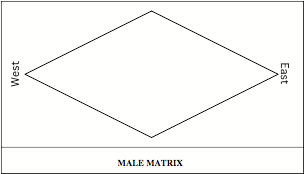
HE'S AN OBSCENE DRUNK, AT THAT! East-West is Day; North-South is
Year. MICROCOSM AND
MACROCOSM. King and Queen. SUN AND MOON. Separated by something. SPACE. Don't
say that to me. HEY, LISTEN TO THE
OLD WOMAN. What is that which was,
is, and will be, whether there is a Universe or not; whether there be gods or
none? Space. IS SHE THINKING FOR US? She's complimenting us. LISTEN! The impossibility of accepting on philosophical
grounds the idea of the absolute ALL creating or even evolving the 'Golden
Egg,' into which it is said to enter in order to transform itself into Brahmâ
-- the Creator -- who expands
himself later into gods and all the visible Universe. They say that Absolute
Unity cannot pass to infinity; for infinity presupposes the limitless extension
of something, and the duration of that 'something'; and the One All is like
Space -- which is its only mental and physical representation on this Earth, or
our plane of existence -- neither an object of, nor a subject to, perception.
If one could suppose the Eternal Infinite All, the Omnipresent Unity, instead
of being in Eternity, becoming through periodical manifestation a manifold Universe
or a multiple personality, that Unity would cease to be one. Locke's idea that
'pure Space is capable of neither resistance nor Motion' -- is incorrect. Space
is neither a 'limitless void,' nor a 'conditioned fulness,' but both: being, on
the plane of absolute abstraction, the ever-incognisable Deity, which is void
only to finite minds, and on that of mayavic perception, the Plenum, the
absolute Container of all that is, whether manifested or unmanifested: it is,
therefore, that ABSOLUTE ALL. There is no difference between the Christian
Apostle's 'In Him we live and move and have our being,' and the Hindu Rishi's
'The Universe lives in, proceeds from, and will return to, Brahma (neuter)':
for Brahma (neuter), the unmanifested, is that Universe in abscondito, and
Brahma, the manifested, is the Logos, made male-female in the symbolical
orthodox dogmas. The God of the Apostle-Initiate and of the Rishi being both
the Unseen and the Visible SPACE. Space is called in the esoteric symbolism
'the Seven-Skinned Eternal Mother-Father.' It is composed from its
undifferentiated to its differentiated surface of seven layers. SEVEN, INSTEAD
OF FOUR. Seven is Four. WHAT? One Two Three Four Three Two One -- that is seven. YES. We are forgetting the dual motion. WHAT DUAL MOTION? The interpenetration of the
worlds. THE INTERPENETRATION OF
MATTER AND ANTI-MATTER. Yes. DRAW IT IS THE SNOW. My finger is getting cold. PUT YOUR FINGER UP YOUR ASS. Yeah, you can draw it in Rembrandt
brown. JAUNE BISQUE. Brun bouillabaisse. JOHN SINGER SARGENT'S ARGENT. Just draw. Save the comedy for Seinfeld.
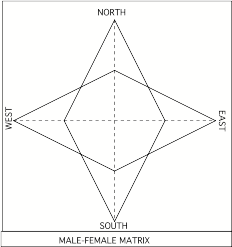
THAT IS SOME KIND OF STAR. Clearly a unity. The Two as One. Male and Female united. YES, A STAR. The Star of Bethlehem.
BETHLEHEM, PENNSYLVANIA?
Liquor makes everyone a fool -- that much is clear. IT IS LIKE CHAOS -- ALL ELEMENTS ARE
EQUAL. LIQUOR, I MEAN It is a star -- but it is also a
diamond! I DON'T SEE THE
DIAMOND! Draw it in the snow. PASS ME THE BOTTLE! It is cold -- draw fast!
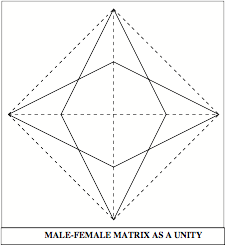
IF WE HAVE FOUR EXPANSIONS IN EACH
DIRECTION BY BOTH MATRICES, THREE PLUS THE CENTER, OUR ONE, TWO, THREE, FOUR,
THREE, TWO, ONE -- THEN WE HAVE THE MYSTICAL FORMATION OF THE FLOWER, THE ROSE,
EMANATING FROM THE ROSEBUD. THAT
IS THE MYSTICAL MEANING OF THIS 'ROSEBUD' THEME. THE UNITY OF THE MAN AND THE WOMAN, THE TWO PARTS OF THE
HUMAN NATURE, MASCULINE AND FEMININE.
Yes, make it rotate then.
MAKE IT ROTATE LIKE THE ATOM.
And the incest theme?
WHAT? He and his daughter,
in the bathroom at L'Odeon? THAT
WAS NOT HIS DAUGHTER. But she
seemed to be! IN HIS MIND. Yes. IT WAS A CASE OF MISTAKEN IDENTITY. There is no such thing here! HE WAS....DRIVEN TO. HE'S A MAN, AFTERALL. Yes, but his daughter. WE HAVE DISCUSSED ALL THIS. THE ARCHETYPAL FAMILY. THE FATHER LOVES THE DAUGHTER; THE
MOTHER LOVES THE SON. THE FATHER'S
SEXUAL UNION WITH HIS DAUGHTER LEADS TO HIS FALL. I see. Myth
again. WHAT ELSE IS THERE? There is life. Decency. Political and social justice. Love and marriage.
Marriage and betrayal.
Betrayal and death. THAT'S
WHAT I MEAN BY MYTH. WHAT DO YOU
MEAN BY MYTH? Draw fast.
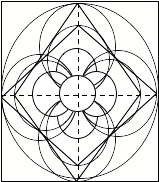
THAT'S A ROSETTE. What? A Rosetta Stone?
SERIOUSLY. I am serious --
about the stone I mean. A ROLLING
STONE GATHERS NO DROSS. The man is
inside the woman. YES,
CLEARLY. It is the sexual
act. IS THE MAN THE CIRCLE OR THE
SQUARE -- I GET CONFUSED ON THAT ISSUE.
Remember, the man is the odd number. THE CIRCLE IS WHAT?
The Circle is Zero, Cipher, Sipher. IS THIS THE PHILOSOPHER'S STONE, THEN? Black; red, orange, yellow, green,
blue, violet; white -- what is in-between? WHAT IS THE RAINBOW?
What is God's covenant with Man?
WHAT IS: WHITE; VIOLET, BLUE, GREEN, YELLOW, ORANGE, RED; BLACK? God's alliance with Anti-Man? AFTER WHITE AND BLACK MEET, THE WAR,
THE RAINBOW APPEARS, INDICATING A TRUCE: THE LIGHT HAS RETURNED. Damn, it's getting cold out here. CAN'T WE GO IN? I'm an old man. I really shouldn't be sitting out
here. It's freezing. LOOK AT THAT DAMN MAGICIAN, SITTING
NEXT TO MICHAEL. THOSE DAMN MAGIC
GLASSES. THAT'S THE REASON THAT
ALL OF THIS CRAZINESS GOT OUT OF HAND.
God forgive the society that begins turning to its artists for
leadership. AMEN TO THAT. Artists rule the heavens; but they are
blind children down here on earth.
WE ARE PUTTING OURSELVES IN JEOPARDY! Double Jeopardy.
YES. Double Indemnity. FRED MC MURRAY -- ONE OF HIS FEW ROLES
AS A VILLAIN. Yes. Where is he going by himself? UP THE HILL. Not far. WHAT
DOES HE HAVE IN HIS HAND. She gave
him some kleenex. GOD, HE ISN'T
GOING TO -- IS HE? Relieve
himself? BEHIND THAT TREE? COTSON. Well, he's a man afterall -- like any of us. DON'T LOOK. I don't want to see this. HE'S SQUATTING DOWN -- YOU CAN BARELY SEE HIS HEAD. I hope a strong wind doesn't come
up. THE AIR WOULD FREEZE IT BEFORE
IT MOVED AN INCH. What -- the
smell? Can't you smell that smell? YOU HAVE SNOT COMING OUT YOUR
NOSE. YOU WOULDN'T BE ABLE TO
SMELL ANYTHING ANYWAY. Toxicum et
venenum. WHAT? Well, it's cold out here. Give me yhour handkerchief. JUST PUT IT OUT OF YOUR MIND. HE'S A MAN. HE NEEDED TO GO TO THE BATHROOM. What are we going to do -- when the police come? GIVE OURSELVES UP. We've done nothing wrong. WE HAVE MERELY SUPPORTED THE FIRST
AMENDMENT. Are we all daft? Is this just some mad dream we are all
sharing, which will end as soon as we jar ourselves awake. YOU'D BETTER ASK HIM, THE MAN IN THE
BUSHES. IT SEEMS MORE LIKE HIS
DREAM THAN OURS. Yeah, we're just
along for the ride, I think. IT
SEEMS MORE LIKE HIS NIGHTMARE THAN HIS DREAM. HE'S FREEZING HIS BUTT UP THERE. NOT A VERY STATELY POSITION FOR THE SON OF GOD TO BE
IN. IT'S A GOOD THING NO
TELEVISION CAMERAS ARE HERE -- OR THERE WOULD BE HELL TO PAY FOR THIS. HE'S POLLUTING THE ENVIRONMENT IF
NOTHING ELSE. The environmentalist
aren't voting for him anyway.
SOMETIMES I'M STRUCK BY THE INSANITY OF ALL THIS. WHAT DO WE KNOW ABOUT THIS MAN? HE IS BECOMING THE LEADER OF OUR
COUNTRY. AND WE REALLY DON'T KNOW
ANYTHING ABOUT HIM. EXCEPT THAT
HIS WIFE CHEATED ON HIM, HE LOST HIS TRUE LOVE, AND HIS FATHER'S DEATH ABOUT
KILLED HIM, AND HE HAD SOME KIND OF SEX WITH A TEENAGER. And that he betrayed his mother. YES -- IN THE NURSING HOME. And that he betrayed his brother. OH, YES, WITH THE PHONE CALL TO POLICE. Who made that phone call -- which
brother -- I was never clear on that.
AND THAT HE HAD SOME KIND OF SEXUAL THING WITH HIS SISTER. What? I didn't hear that.
OH, YEAH. HE HAD A THING
FOR HIS SISTER. HE DRILLED A HOLE
IN THE WALL OF HER ROOM SO HE COULD WATCH HER UNDRESS. Really. THAT'S NOT SO RARE.
MOST BOYS DO THAT, DON'T THEY?
There was some kind of rumor that he touched her too. Her beasts, I mean. I'm not sure if it's true. ALL BOYS ARE LIKE THAT, ARENT
THEY? What I'm saying is that we
admire him as a writer; but we really don't know who he is. Not really. ARE YOU GOING TO BETRAY HIM, CHARLIE? What? No. I'm not
saying we betray him. I'm only
hoping he doesn't betray us. I"M
AN OLD MAN. IF IT'S TIME FOR ME TO
DIE, THEN SO BE IT! What are you
saying? There will be no deaths
here, esteemed colleague. It is a
dark phantasm we have loosed with our drink and our starry dome shouldering
shadows leaping on the hillside.
THAT'S OUR FRIEND, COMING BACK.
Without the kleenex. HE MUST
HAVE DONE A NUMBER TWO. Guided
only by moonlight. CAREFUL WHEN
YOU SHAKE HIS HAND. Gentlemen,
please have some respect. Your
thoughts are rude; and I am clairvoyant.
You upset me. CRAP. I FORGOT ABOUT HER. We should get the hell out of here --
go back inside and get warm. WE
CAN'T ABANDON HIM. THINK ABOUT
HISTORY. HOW HISTORY WILL REMEMBER
US. Isomorphism. WHAT? What can he mean by this -- here -- in this context. AS ABOVE, SO BELOW. Yes, yes -- Hermes' dictum -- a phallic
emblem no doubt. We know it
well. IF A BEAR SHITES IN THE
WODES, DOES SOMEONE HEAR IT FALL -- THE TUNC PAGE, I MEAN -- ONLY IF IT FALLS
OR ONLY IF SOMEONE HEARS OR SMELLS IT...?
I don't wish to get into this.
HE'S COMING BACK -- SHOW THE MAN SOME RESPECT. He began to get himself into very difficult waters when he
uttered his belief that he was God, or at least a god, or an angel, something
divine. MATHESIS -- MY FINGER'S
NUMB. Blow on it! FUIT, FUIT. FUIT, FUIT.
Draw it in the snow. PUT IT
IN THE SNOW. THE SNOW WILL WARM IT
UP. To utter your own divinity is
an advertisement to the angels or to the demons, instructing them to destroy
you. I mean it -- literally, to
destroy you! SO IS THAT WHAT IS
COMING? Math-Thesis. Add one through twenty-six, one gets
351. I DON"T GET IT. 365 minus 351 is 14. January 14. Birthdate of many famous people: Sjihab al-Din Sultan
Choerram Sjah Djahan, leader of India; Benedict Arnold, US general turn traitor
in the Revolutionary War; John Bullock Clark Jr, Brig General in the
Confederate Army, who died in 1903; Jonathan Daly, Chicago, actor, not to be
confused with the Daly political machine in Chicago; William Bendix, NYC,
actor, who starred in Lifeboat, the Babe Ruth Story, and in the tv show, The
Life of Riley; Dorothy Faye Dunaway, Bascom Florida, actress, who starred
Chinatown and Bonnie & Clyde -- famous for the words 'she's my daughter,
she's my sister, she's my sister, she's my daughter'; Julian Bond, born in
Nashville, Tennessee, civil rights leader and later democratic congressman from
Georgia, considered by many to be the legitimate successor to Martin Luther
King and a possible presidential candidate. Also the death date for Anas Nin, Cuban/American writer,
author of Delta of Venus and other works.
It was also the date that the US Supreme Court rules that racial
segregation on public buses was unconstitutional. It was the date of the Sex Pistols final concert
performance; and the premier of The Simpsons on Fox TV. It was the date, according to orthodox
tradition, that Jesus was circummcised.
And it is New Year's Day in the 20th and 21st centuries according to the
Julian Calendar. IN RA's ENGLISH
KABALA, THE NUMBER OF PATRIARCHY IS 334.
THE NUMBER OF MATRIARCHY IS 351.
351 is produced by multiplying 13 by 27. 351, IN TERMS OF THE ENGLISH ALPHABET, TRANSLATES AS LETTERS
'C E A'. TRANSPOSED AS 'ACE', THIS
IS THE KABBALA'S KETHER, HIGHEST AND LOWEST, NUMBER 1 AND NUMBER 11 -- FIRST
AND LAST. And there is that number
again, 111. 3 PLUS 5 PLUS 1 EQUALS
NINE. NOTICE HOW NUMBERS ONE
THROUGH NINE DIVIDE INTO 3 GROUPS OF NAMES, ONE GROUP OF THREE LETTERS, A
SECOND GROUP OF FOUR LETTERS, AND A THIRD GROUP OF FIVE LETTERS.
GROUP
ONE: ONE, TWO, SIX.
GROUP
TWO: FOUR, FIVE, NINE
GROUP
THREE: THREE, SEVEN, EIGHT
IN
JEWISH GEMATRIA, 351 IS THE NUMBER OF BOTH MOSES AND ENOCH, WHO, IS SAID TO
HAVE BECOME, LATER, THE ANGEL METATRON, THE HEAVENLY SCRIBE. MOSES' BROTHER AARON, IS MENTIONED IN
THE BIBLE 351 TIMES, 346 TIMES IN THE OLD TESTAMENT AND 5 TIMES IN THE NEW
TESTAMENT. JESUS IS THOUGHT TO
HAVE RECEIVED 351 WOUNDS FROM HIS SCOURGING AT THE TEMPLE -- BEING BEATEN 39
TIMES WITH A CAT-O-NINE-TAILS, A WHIP WITH NINE FINGERS TO WHICH SHARP IVORY OR
METAL NAILS WERE ATTACHED. 39
TIMES 9 EQUALS 351. IN ENGLISH
GEMATRIA, THE PHRASE 'JESUS CHRIST, SON OF GOD, SAVIOUR' EQUALS 351. YOU WILL NOTICE ALSO THAT THE NUMBERS 1
THROUGH 26, WHEN ADDED TOGETHER, ALSO EQUAL 351.
|
10 |
J |
|
5 |
e |
|
19 |
s |
|
21 |
u |
|
19 |
s |
|
3 |
C |
|
8 |
h |
|
18 |
r |
|
9 |
i |
|
19 |
s |
|
20 |
t |
|
19 |
S |
|
15 |
o |
|
14 |
n |
|
15 |
O |
|
6 |
f |
|
7 |
G |
|
15 |
o |
|
4 |
d |
|
19 |
S |
|
1 |
a |
|
22 |
v |
|
9 |
i |
|
15 |
o |
|
21 |
u |
|
18 |
r |
|
|
|
|
351 |
|
|
a |
1 |
|
b |
2 |
|
c |
3 |
|
d |
4 |
|
e |
5 |
|
f |
6 |
|
g |
7 |
|
h |
8 |
|
i |
9 |
|
j |
10 |
|
k |
11 |
|
l |
12 |
|
m |
13 |
|
n |
14 |
|
o |
15 |
|
p |
16 |
|
q |
17 |
|
r |
18 |
|
s |
19 |
|
t |
20 |
|
u |
21 |
|
v |
22 |
|
w |
23 |
|
x |
24 |
|
y |
25 |
|
z |
26 |
|
|
|
|
|
351 |
'Man', in Hebrew, also equals 351.
|
1 |
A |
|
50 |
N |
|
300 |
Sh |
|
|
|
|
351 |
|
PSALM 90, 20 READS: 'TEACH US TO
NUMBER OUR DAYS 'RIGHT". THIS
ALSO, IN ENGLISH GEMATRIA, EQUALS 351 -- AND CONCERS THE SECOND COMING OF
CHRIST. Who is this speaking? NAMES MEAN MUCH APPARENTLY. Yes, who is speaking? IN ENGLISH GEMATRIA, THE WORDS 'THE GOD
OF MOSES,' 'JESUS CHRIST,' AND 'HOLY SPIRIT' ALL EQUAL 151.
|
20 |
T |
10 |
J |
8 |
H |
|
8 |
h |
5 |
e |
15 |
o |
|
5 |
e |
19 |
s |
12 |
l |
|
7 |
G |
21 |
u |
25 |
y |
|
15 |
o |
19 |
s |
19 |
S |
|
4 |
d |
3 |
C |
16 |
p |
|
15 |
O |
8 |
h |
9 |
i |
|
6 |
f |
18 |
r |
18 |
r |
|
13 |
M |
9 |
i |
9 |
i |
|
15 |
o |
19 |
s |
20 |
t |
|
19 |
s |
20 |
t |
|
|
|
5 |
e |
|
|
|
|
|
19 |
s |
|
|
|
|
|
|
|
|
|
|
|
|
151 |
|
151 |
|
151 |
|
Is this some kind of magic act? YOU ASKED FOR PROOF. Who is speaking? Is this that magician speaking? I know who you are! I know that you have powers of
ventroliquism! DO YOU THINK IT'S
HIM? I heard the voice coming out
of the sky. IT MAY BE THAT DAMNED
WOMAN. SHE HAS THE POWER, ALSO, TO
THROW HER VOICE. I"VE READ
ABOUT HER. SOME KIND OF RUSSIAN
CHARLATAN. SHE EMBRACED AN INDIAN
SCHOOLBOY AS THE NEW CHRIST, THE NEW KRISHNA, AND HE PROVED TO BE A FRAUD! What is this all about? Is this some trick to make us stay
here, in the cold? RELAX,
MAN. The older brother's initials,
WJC, add up to 36; and the number added one through 36 equals 666, the number
of Satan. The younger brother's
initials, MJC, add up to 26; and the numbers added one through 26 equals 351,
which is equivalent with 'Jesus Christ, Son of God, Saviour'. YOU HAVE SUMMED IT UP QUITE WELL,
CHARLIE. Let's not forget that
William Jefferson Clinton, too, another WJC, also equals 36. And totals 666. PILLORY CLINTON! What does this mean, rationally, I
mean? We have supported this man,
Michael Crossmann I mean, not Bill Clinton, at least I have, because I felt he
believed in the poor, in the lowly, in the despised. THAT IS ALL TRUE, PETE. But these numbers mean nothing to me. Do they need to mean something? I am a man of reason. I am not a man of smoke and mirrors. YOU CAN BE BOTH, PETER. BE WHOLE. Whole is a frightening thing to be. THE ALTERNATIVE IS MENTAL ILLNESS. Yes. But the alternative to mental illness is also
frightening. SO WHAT IS NUMBER
453. You tell me. IF YOU ADD THE 151 OF 'THE GOD OF
MOSES' AND THE 151 OF 'JESUS CHRIST' AND THE 151 OF 'HOLY SPIRIT, THAT PRODUCT
IS 453. Yes, that is what I was
going to say. YES. THE PHRASE 'GOD
THE FATHER, GOD THE SON AND GOD THE HOLY SPIRIT' IS ALSO 453.
|
7 |
G |
|
15 |
o |
|
4 |
d |
|
20 |
T |
|
8 |
h |
|
5 |
e |
|
6 |
F |
|
1 |
a |
|
20 |
t |
|
8 |
h |
|
5 |
e |
|
18 |
r |
|
7 |
G |
|
15 |
o |
|
4 |
d |
|
20 |
T |
|
8 |
h |
|
5 |
e |
|
19 |
S |
|
15 |
o |
|
14 |
n |
|
1 |
A |
|
14 |
n |
|
4 |
d |
|
7 |
G |
|
15 |
o |
|
4 |
D |
|
20 |
T |
|
8 |
h |
|
5 |
e |
|
8 |
H |
|
15 |
o |
|
12 |
l |
|
25 |
y |
|
19 |
S |
|
16 |
p |
|
9 |
i |
|
18 |
r |
|
9 |
i |
|
20 |
t |
|
|
|
|
453 |
|
Where is that voice coming
from? THE WORD 'TRINITY' EQUALS
115, A TRANSPOSITION OF 151. Is
that the voice of an angel? WHAT
ARE THEY TRYING TO DO TO US.
There, in the sky -- some kind of light. THERE ARE MEANINGS IN WORDS, MEANINGS WE CAN'T EVEN BEGIN TO
UNDERSTAND. Where did the letters
come from? DON'T GET STARTED,
BILL. I don't understand. IS THE VOICE COMING OUT OF THAT
LIGHT. No, it's that damned
ventriloquist. Look at him, his
mouth is moving. The Magician, I
mean. I THINK IT MAY BE
GINSBERG! I'VE NEVER TRUSTED
HIM. AND HIS DAMNED POETRY. SCATTER-BRAND POETRY. SCATTERING HIS SEMEN TO THE WIND --
LITTLE MORE -- AND TO LITTLE BOYS -- LITTLE ARAB BOYS. AND SINGING AB OUT IT. BEASTLY BEATITUDES. The 'Beats' gave us very little that
was really valuable -- don't you agree?.
All that extreme experience -- but what about the literature that
emerged from it? WE BELIEVE IN ONE
LORD, JESUS CHRIST, BEGOTTEN, NOT MADE; OF THE SAME ESSENCE AS THE FATHER. THROUGH HIM ALL THINGS WERE MADE. FOR US AND FOR OUR SALVATION HE CAME
DOWN FROM HEAVEN; HE BECAME INCARNATE BY THE HOLY SPIRIT AND THE VIRGIN MARY,
AND WAS MADE HUMAN. The Nicene
Creed -- 351 AD. A CRUEL DIADEM
CONTAINING OVER 100 SPICULETS WAS DRIVEN INTO HIS HEAD WITH BLOWS FROM A
ROD. Jesus, man -- is that
speculation? SPICULETS OF
SPECULATUM. The Jerusalem thorn, known
as the Arabian Nebulae, was 4 inches long and a sharp as a needle. AND WHEN THEY HAD PLATTED A CROWN OF
THORNS, THEY PUT IT UPON HIS HEAD, AND A REED IN HIS RIGHT HAND; AND THEY BOWED
THE KNEE BEFORE HIM, AND MOCKED HIM, SAYING: 'HAIL KING OF THE JEWS'! INRI. Transposed as RINI - what is Trinity? Or 50. THAT IS THE INCORRECT ANSWER. What is Iron Nails Run In --Oyce Jay Ames Jay? AGAIN, THE INCORRECT ANSWER. What is Introibo nad ralteri ieo? AGAIN, THE INCORRECT ANSWER. What is Iesus Nazarenvs Rex
Ivdaeorvm? AND THE NUMBER? 50. CORRECT. Rise
Initiates Negative Inflation.
WHAT? What the hell are
they doing out here again?
WHO? Inflation Necessitates
Rigid Induction. INCIPIENT NATURE
RULES INTELLIGENCE. Intelligence
Negates Rural Intuition. RICE
INSTITUTIONALIZES NATIVE INFLUCTION?
Hold on, here. What is that
light? WE CAME OUT BECAUSE WE
HEARD A VOICE -- AN UNEARTHLY VOICE.
It sounded like it was coming out of the sky. SILENCE!
Mathesis. UFO? IRA? 42 PLUS 28 EQUALS 70.
Pascal is pleased.
PASCALI'S ISLAND.
Association by sound. DON'T
BEGIN THIS DISCUSSION, PLEASE! IT
IS TOO COLD OUT HERE! There are
some, and I know Michael Crossmann is one, who believe that sound is inherently
meaningful. Sound comes as a kind
of intelligent force. Sound first. Words form out of sounds. Then words which appear at first glance
to be nonsensical suddenly are seen to bear a remarkable message. For more extreme the nonsense in many
cases, the more profound the meaning.
That's why poetry is higher than reason -- because it is closer to this
source of truth and meaning.
Poetry is the first clothes this being takes, this being of magic and
wisdom. POETRY MORE THAN
NUMBERS. In the Beginning was the
Word, my friend. YES, PERHAPS. BUT BEFORE THE BEGINNING WAS THE
NUMBER. AIN-SOPH: NO THING. ZERO. A conception.
YES, AN IMMACULATE CONCEPTION.
Are we here to honor this man or to be converted to his way of
thinking? THAT IS NOT
POSSIBLE! THERE WILL BE NO
CONVERSION! We are already hearing
voices and seeing lights in the sky.
Are we pretending this is not happening? AND WHAT IS THE WORD?
IS THE WORD, ITSELF, NOT A MICROCOSMIC PROJECTION OF THE MICROCOSMIC
PROJECTION ITSELF? Is that
Ginsberg speaking? I THINK
NOT. I THINK HE IS EATING A CREAM
PUFF OR SOMETHING WITH CREAM IN IT.
HE HAS THE REMNANTS ON HIS LIPS AND CHEEK. Arab cream, I'd surmise. ARAB BOY CREAM I'D SPECULATUM. Speak more clearly.
WHAT IS THE WORD BUT AN ATOM -- WITH A POSITIVE NUCLEUS COMPOSED OF
PROTONS AND A NEGATIVE SERIES OF SHELLS ROTATING AROUND THE CORE. A CORE COMPOSED OF VOWELS; AND A RING
COMPOSED OF CONSONENTS? What? Are you joining this insaninanity? THE
NUCLEUS COMPOSED OF VOWELS -- THE ACTIVATORS. THE CONSONENTS ROTATING LIKE PLANETS, BODIES, AROUND A VOWEL
SUN. Six vowels -- the seventh being
hidden. WHAT? The verb is the nucleus; and the noun
is the shell, rotating on the periphery.
NOW YOU ARE SHIFTING SCALES.
SHIFTING PERIPHERIES. The
Noun represents the Ego; and the Verb represents the essential entity inside
the personality. The active
mover. The soul that moves; the
Noun that is moved, and, so, moves.
STOP! THIS IS NOT
PRAYER! Meditating guardian. IS THAT WHO IT IS, A GUARDIAN? A is 1; and B is 2, the first skin put
on by 1. BETA, YOU MEAN. Or Beth. GET SOME SESAME!
OPEN SHAME ON THE MAN SEEKING SILENCE, TO BLESS'A ME, CARESS'A ME! Things a-change-a. OH, DYLAN AGAIN! Which Dylan? THE LIVING DYLAN.
Who drove crosscountry seventytwo hours to find out if I had a vision or
you had a vision or he had a vision to find out Eternity, who journeyed to
Denver, who died in Denver, who came back to Denver & waited in vain, who
watched over Denver & brooded & loned in Denver and finally went away
to find out the Time, & now Denver is lonesome for her heroes, who fell on
their knees in hopeless cathedrals praying for each other's salvation and light
and breasts, until the soul illuminated its hair for a second. LONELY HEROES IN DENVER. Bob Martin on the radio. THIRD AND FOUR; ELWAY BACK. Remember, the high is in the low; the
low is in the high. YES --
MEDITATION PARDON. Elio Chacon
sliding under Berra's tag. Marichal
unleashing his bat on Roseboro's forehead. CO-EQUAL WITH REMBRANDT. Wyeth? WHY
WHAT? Oh, I can hear the Lords of
Marberry wince and turn a taintedear away from the speaker. The high seek always to be high. But they shall not always be so. They shall be lowered by God's own
angels down into the soil of the fields, to fertilize the collardbeds; to
circulate the coalthreads. THE
KINGS OF SUBURBS. The Mannerly
Hamptons. EUROPE. THE GREAT CONDEE AND ALL OF HIS
KIN. SET FOR A FALL. A scourging by the muscle missle
hymns. OF ARABIA. Muslim missive hims. OF CALADONIA. OR MAURETANIA.
Serefs by Night.
AMMOHEADS. AND
ALMORABIDS. CONQUERORS OF FORM. The tailor with his tale of taels. VOBISCUM SOUP. Hard of hearing. HARK THE HERALD (ANGELS' STRING). Omnipotentem. BLASTED FRIEZE.
THE DAMNED CAR PARTS ARE LOST.
Good on you, mate.
PREDICATES APPROVED. A man
of stones. STONE MAIDEN. A keyhole; and a key to find it. Fitting it in. Makes you king -- the sword fixed. Arthur. AHH, ANALYTICAL ARTHUR -- HEIR AROUND IT. Nomen clay tour. MYSTICAL ROOT. Mystical fruit. BENDING OVER, SHOWING A CRACK OR
TWO. Laugh if you can. Music plays. MUD ON YOUR FEET.
DANCE FOR THE FRAMING.
The fruit, farthest from the root, falls back to the Earth and he is,
verily, the fruit from which the seeds are used, taken, the fruit which gives
the next spring's children.
ROAMIN'. Roman pole and
sky. ARTEMIS HAS HIS PANTS
DOWN. Relief is only a second
away. DON'T WIPE EURS ELF WITH THE
TUNC PAGE! Po-lice! ROAMIN'. Poll Lansky. MY
SISTER; MY DAUGHTER. MY SISTER; MY
DAUGHTER. Fade dawn, away? CAN'T YOU SMELL THAT SMELL? Who crashed through their minds in jail
waiting for impossible criminals with golden heads and the charm of reality in
their hearts who sang sweet blues to Alcatraz, who retired to Mexico to
cultivate a habit, or Rocky Mount to tender Buddha or Tangiers to boys or
Southern Pacific to the black locomotive or Harvard to Narcissus to Woodlawn to
the daisychain or grave, who demanded sanity trials accusing the radio of
hypnotism & were left with their insanity & their hands & a hung
jury, who threw potato salad at CCNY lecturers on Dadaism and subsequently
presented themselves on the granite steps of the madhouse with shaven heads and
harlequin speech of suicide, demanding instantaneous lobotomy, and who were
given instead the concrete void of insulin Metrazol electricity hydrotherapy
psychotherapy occupational therapy pingpong & amnesia, who in humorless
protest overturned only one symbolic pingpong table, resting briefly in
catatonia, returning years later truly bald except for a wig of blood, and
tears and fingers, to the visible madman doom of the wards of the madtowns of
the East. WHAT THE HELL IS HE EVEN
DOING HERE? Oh, that's easy. He's here to fulfill the prophecy. WHAT PROPHECY? But first he must suffer many things
and be rejected of his generation.
HAS HE NOT REJECTED HIS OWN SELF-GENERATION? Bean Gate, you mean?
And, so, they shall reject him.
IS HE JUDAS THEN/ You are getting
warm. WHICH IS IT: BLACK OR
BROWN? WHICH IS IT: RED OR
WHITE? Mercury, sodium or salt? OR COPPER? Red Daphna was the Red Woman -- copper membrane -- remember,
from his book? Fantastic copper
membrane. Imagined: not
surveyed. WHAT A VEIN! Who -- blue lubber boy? AN AGENT OF WHOM -- MARS THEN? The red awning. The first even. HE WRITES AS IF HE HAS A CIPHER IN THE
BRAIN. A wombtemplate in the crane
of M. SOME KIND OF BEAST COMING
OUT. Smelling just like
sulpher. THAT WAS ME -- YOU KNOW,
THE CHILI BEAN SAUCE. Archer of
invective. JUST A THOUGHT. Just a homo's actual thought. AN ARAB HOMO'S TEXTUAL THOUGHT. I am not a almostsexual -- I am not a
almhostsexual! ELEPHANTISIS OF THE
GLOWNADS. Aleph and Isis: locked
on a boat. IN ICE. I am just in disguise! YOU SHOULD STAIN YOUR BEARD RED -- IT
MIGHT BE MORE CONVINCING.
Convincing of what -- that I am a man in love with a woman's purse
during her curse? FOWL MOUTH FOR
SUCH A THIN BIRD! Common talk in a
place of worship! WE CAME HERE TO
SHOW OUR SUPPORT -- BUT HE IS TRYING TO CONVERT US! He is Ahab, damn him -- and this is his ship! THIS CHAPEL, FRIEND? Father Mapple was a scribe too! RELAX! NOTHING CAN HAPPEN TO US THAT WE DON'T ALLOW! The police are not coming for Crossmann
-- they are coming for one of the dark skinned ones: the negro, Jim; or the
Arab disgised as a New York homosexual disguised as a bear disguised as an
architect; or the fat Jewboy who pretends he is a poet. CROSSMANN, HIMSELF, HAS A BLACK FACE
NOW! Yes. What is that anyway? Get him to rub some snow on it, to
remove it. IT'S SHOE POLISH. IT WAS THE MAGICIAN'S IDEA. He's behind all of this. I just know he is. HE AND THE BROTHER. THE ONE WHO ALTERNATELY BELIEVES HE IS
ADOLPH HITLER AND THEN MARK ANTONY.
Friend of that humanitarian ecologist who killed people with the letter
bombs -- the green one, what was his name? LEWINSKY?
Something like that -- Ked Twoinsme. THAT WAS A REAL BOMMER -- EVERYONE LOVED HIM. Ahh, the wearing of the green. Say it loud and say it louder: I'm green and I'm proud! (And I'm carrying powder.) THE NAZIS WERE ALSO GREEN PARTY MEMBERS
-- IN THE BEGINNING. What are you
saying? Are you saying that the
ecologists are Nazis. WELL, YES. IT GOES WITHOUT SAYING. THEY ARE MAN-HATERS FIRST. SO WERE THE NAZIS. Is Ralph Nader....Hermann Goerring
then? I'D SAY HE'S MORE LIKE
JOSEPH GOEBBELS. Really? And who is the leader then? IT ALL DEPENDS ON HOW THE WORLD
TOURNS. They believe themselves
the savior of the Earth. NATURE
OUTLIVES ART AND ART OUTLIVES MEN.
BUT GOD OUTLIVES NATURE.
Yes. Is that true? IS CROSSMANN A COWBOY OR AN
INDIAN? THAT'S THE QUESTION. Is he red or green? YES. OR WHITE? When
he is a cowboy, his brother is an indian; and when he is an indian everything
goes to sleep. WHEN HE IS AN
INDIAN, HIS BROTHER IS A COWBOY.
AND WHEN HE IS A COWBOY EVERYONE STARTS TO WEEP. No: everyone gets along. WARM IN HEAVEN. WARD IN EBON. Thief of words.
TYRANT OF CONCEPTS. Yes,
they are. MICHAEL, IN ENGLISH GEMATRIA,
EQUALS 51. JESUS CHRIST EQUALS
151. THEY ARE MADE OF THE SAME
FLESH. MICHAEL SUBTRACTED FROM
JESUS CHRIST IS 100. THE PERFECT
NUMBER. Five plus one is six; this
is Tiphereth's number. WHO ALSO IS
MICHAEL.
|
13 |
M |
|
9 |
I |
|
3 |
C |
|
8 |
H |
|
1 |
A |
|
5 |
E |
|
12 |
L |
|
|
|
|
51 |
|
This is getting us too far from the
point! The point is helping the
poor! Not this mystical mumbo
jumbo. 125. What? MUMBO JUMBO IS 125.
What are you, some damned calcination machine...uh, calculating machine? CALCU LIE CALCULORUM. Pebbles in one hand; pebbles in
two. EIN-STEIN. ONE GLASS FULL OF STONES. What? 95. Is he retarded?
Someone, turn him off.
EIN'A-STEIN'A. One what did
you say? A glass full of
acrobats? THE POOR, DAMN IT! HE NEEDS TO LEAD A REVOLUTION TO SAVE
THE WORLD'S POOR! Tell him
then! HE JUST SMILES. HE LOOKS AT ME LIKE I DON'T GET
IT. Maybe you don't get it. DON'T GIVE ME THAT, YOU WASHED UP
RATTLETRAP COULDDA-BEEN SHOULDDA-BEEN REAL ESTATE PUNK ASS. I should throw gasoline in his face. MOLOTOV - 112. MICHAEL ARCANGEL IS ALSO 112. See, divine inspiration proves that
Crossmann is supposed to be a revolutionary! ARCANGEL IS MISSPELLED. What? ARCHANGEL
IS SPELLED WITH A 'K' OR A 'CH'! A
k-k-k? What does that spell? ARKANGEL IS 69. MICHAEL THE ARKANGEL EQUALS 153, WHICH
IS CHARACTERISTIC OF THE MISSION OF JESUS -- AND IS A TRANSPOSITION OF 351,
'JESUS CHRIST, SON OF GOD, SAVIOR'.
153 IS THE SUM OF THE NUMBERS 1 THROUGH 17 ADDED TOGETHER. OF COURSE, MICHAEL CROSSMANN WAS BORN
ON DECEMBER 17, 1950.
|
13 |
M |
|
9 |
I |
|
3 |
C |
|
8 |
H |
|
1 |
A |
|
5 |
E |
|
12 |
L |
|
20 |
T |
|
8 |
H |
|
5 |
E |
|
1 |
A |
|
18 |
R |
|
11 |
K |
|
1 |
A |
|
14 |
N |
|
7 |
G |
|
5 |
E |
|
12 |
L |
|
|
|
|
153 |
|
In Hebrew, 153 is also the number of
the Angel of Libra. Michael,
holding his scales and his sword, is also the Angel of Libra. The Angel of the West.
|
8 |
Ch |
Angel of Libra |
|
|
4 |
D |
|
|
|
100 |
Q |
|
|
|
10 |
Y |
|
|
|
1 |
A |
|
|
|
30 |
L |
|
|
|
|
|
|
|
|
153 |
|
|
|
12/17/50: 1 PLUS 2 PLUS 1 PLUS 7
PLUS 5 PLUS 0 EQUALS 16 -- THIS, THE NUMBERICAL VALUE OF HIS SALUTORY INITIALS,
MC. 12/17/1950: 1 PLUS 2 PLUS 1
PLUS 7 PLUS 1 PLUS 9 PLUS 5 PLUS 0 EQUALS 26 -- THIS, THE NUMERICAL VALUE OF
HIS FULL INITIALS, MJC. I don't
remember anything about this 'mission of Christ' and the number 153. YES, REMEMBER -- (IN A THROWN
VOICE): Some comparisons can be
made to show the existing connection between the number of the Beast, 666 (that
is the triangulation of 36), and the characteristic number of the mission of
the Christ, 153 (the triangulation of 17). Note that in the Gospel of Luke, the
verse 36 of chapter 17, does not exist. And put aside verses 1 S 17,36 and 2 K
17, 36, the reference chapter 17 verses 36 never occur in any other place in
the Bible. These two verses of the Old Testament highlight the combat led
against the Antichrist and that only the Christ must be adored. At 2 K 17,36,
the people are warned against the false gods and that they have to adore only
the Lord: 'You are to bow down and offer sacrifice only to Yahweh'. At 1 S 17,36, it is David that told
Saul that Goliath will fall between his hands 'for having challenged the armies
of the living God'. David, a shepherd (symbolizing the 'The Good Shepherd', the
Christ) faces Goliath and kills him by cutting his head (symbol of the
Antichrist dethroned) with a sword (symbol of the Word of God)...." SEE! I TOLD YOU IT WAS THAT DAMNED MAGICIAN! HE'S BEEN THROWING HIS VOICE ALL
NIGHT! And the light! Was he responsible for the light? HE'S A MAGICIAN. HE CAN DO ALL SORTS OF THINGS. HE CAN MAKE AN ELEPHANT DISAPPEAR. I THINK HE CAN MANAGE SOMETHING SMALL,
LIKE THE APPEARANCE OF A LIGHT IN THE SKY. A star? WAS IT
A STAR? I DON'T THINK WE EVER
AGREED THAT IT WAS A STAR? A
pulsar. WAS IT A PULSAR? 1950 plus 12 plus 17 equals 1979, the
year of Crossmann's re-birth. 1
PLUS 9 PLUS 7 PLUS 9 EQUALS 26. 1
PLUS 9 EQUALS 10; 7 PLUS 9 EQUALS 16.
AGAIN THESE SAME NUMBERS APPEAR.
It is during the Dawn and the Dusk that the opposites meet, woman and
man. Sexual conjunction. If the seed is planted at the Spring
Equinox, March 21, then the 9-month baby will be born on 21 December, the
Winter Solstice. If the seed is
planted at the Autumn Equinox, September 21, then the 9-month baby will be born
on 21 June, the Summer Solstice.
THIS GIVES YOU THE TWO IN ONE: THE KING, THE HERO, BORN ON THE MOUNTAIN
TOP, JUNE 21, MICHAEL THE ARCHANGEL; AND THE MARTYR, JESUS CHRIST, BORN IN THE
VALLEY, DECEMBER 21. And, if the
cycle is the reverse, the Southern Cycle, you have the birth of the anti-king,
the anti-hero; and then the birth of the anti-martyr. THE REVOLUTIONARY WHO HATES JESUS. AND THE BLACK ANGEL WHO HATES MICHAEL. An angel falls; a man also falls. VERY SUGGESTIVE. BUT I DON'T UNDERSTAND THE ETYMOLOGY. Etymology Shetemology. The fact is, you insist that your
intellect rule. Your ego needs to
be dominant. VERY SUGGESTIVE. BUT I DON'T UNDERSTAND... Ego, Superego, Id. ESI. 33 -- THE AGE OF CHRIST AT HIS DEATH. Fine. Freud has had his century. THEN WHO SHALL FOLLOW?
Who shall lead, you mean?
YES. Jung will outlive
Freud. WHAT I WANT TO KNOW IS WHAT
DEVELOPMENTS WE CAN EXPECT FROM THIS ANARCHIST MOVEMENT, THIS ANTI-WORLD MARKET
MOVEMENT? Peter, the communist
left is just hanging its hat on the next imaginery revolution. GREEN GREEN, MY WORLD IS GREEN. GREEN IS THE SKY; AND GREEN IS THE
MOON. Does it have a future --
green, I mean? ONLY IN THE WORLD'S
GRAVE. The Magic Square of the Sun
is the perfect cube, having six sides and containing all the numbers from 1
through 36.
|
1 |
35 |
34 |
3 |
32 |
6 |
|
30 |
8 |
28 |
27 |
11 |
7 |
|
24 |
23 |
15 |
16 |
14 |
19 |
|
13 |
17 |
21 |
22 |
20 |
18 |
|
12 |
26 |
9 |
10 |
29 |
25 |
|
31 |
2 |
4 |
33 |
5 |
36 |
THE ANTI-CHRIST'S NUMBER. Yes. But remember our hero's connection to the number 111? Well, each row and each diagonal in the
Magic Square of the Sun equals....111.
MERLIN! DAMN YOU,
MERLIN! YOU HAVE MADE ME A POOR
MAN!
|
111 |
111 |
111 |
111 |
111 |
111 |
111 |
111 |
|
111 |
1 |
35 |
34 |
3 |
32 |
6 |
111 |
|
111 |
30 |
8 |
28 |
27 |
11 |
7 |
111 |
|
111 |
24 |
23 |
15 |
16 |
14 |
19 |
111 |
|
111 |
13 |
17 |
21 |
22 |
20 |
18 |
111 |
|
111 |
12 |
26 |
9 |
10 |
29 |
25 |
111 |
|
111 |
31 |
2 |
4 |
33 |
5 |
36 |
111 |
|
111 |
111 |
111 |
111 |
111 |
111 |
111 |
111 |
Guten Morgen, Morgan Le Faye! AND THIS IS SUPPOSED TO...WHAT? CONVINCE ME OF HIS DIVINITY? Are you still not convinced, Doubting
Dumas? What will it take to
conviviance you, good sir? Will
you have to put your finger through the holes in his hands? The wands in his feet? GOD MAN, ENOUGH OF THIS DRAMA. YOU'RE SLURRING YOUR WORDS. GO LIGHT ON THAT LIQUID. What does all of this magic have to do
with the real issue anyway -- helping the poor? DON'T YOU GET IT MAN!
HE DOESN'T CARE ABOUT HELPING THE POOR ANY MORE! THE POOR WERE TRYING TO KILL HIM! DON'T YOU GET IT! That was what happened to the historical
Jesus. He was caught between the
revolutionaries on the one hand, those who wanted to overthrow the Roman state. And between the collaborating priests
who perceived him as a revolutionary.
His message was personal peace in God's kingdom. He condemned the corrupt priesthood;
but he did not advocate revolution.
He was like Crossmann -- damned if he did, and damned if he didn't. The left wing didn't trust him; and the
right wing feared him. WHAT HAS
THIS TO DO WITH THE PRICE OF SWINE IN CHINA? THE RUDE OF ALL EBOL?
If you add all the rows and columns of the numbers 111 in Magic Square
of the Sun, diagonals and rows, you come up with the number 888, which is the
mystical number of Jesus.
|
888 |
|
|
|
|
|
|
888 |
|
111 |
111 |
111 |
111 |
111 |
111 |
111 |
111 |
|
111 |
1 |
35 |
34 |
3 |
32 |
6 |
111 |
|
111 |
30 |
8 |
28 |
27 |
11 |
7 |
111 |
|
111 |
24 |
23 |
15 |
16 |
14 |
19 |
111 |
|
111 |
13 |
17 |
21 |
22 |
20 |
18 |
111 |
|
111 |
12 |
26 |
9 |
10 |
29 |
25 |
111 |
|
111 |
31 |
2 |
4 |
33 |
5 |
36 |
111 |
|
111 |
111 |
111 |
111 |
111 |
111 |
111 |
111 |
|
888 |
|
|
|
|
|
|
888 |
THIS IS SOME KIND OF MAGIC LANTERN. Now, he's pretending to be
bruised. WHO IS? That damned Merlin up there. MERLIN, JUDGE CALENDAR, WEARING A
STUPID RED HAT: 6 TIMES 6 IS 36.
You're not making cents. IT
IS DAMN COLD OUT HERE. Here, have
a drink! YES. YES, I WILL. I got this from the Magician. WHAT? Yes, he
makes a damn good brew. AND? And, if you remove all the numbers from
this Magic Square of the Sun, except the diagonals, the symbol of the 'X', the
crossing of the four directions, results in 444, one-half of the divine
personality of Jesus Christ -- Jesus as a man.
|
444 |
111 |
32 |
34 |
36 |
38 |
40 |
42 |
111 |
444 |
|
|
7 |
1 |
|
|
|
|
6 |
7 |
|
|
|
19 |
|
8 |
|
|
11 |
|
19 |
|
|
|
31 |
|
|
15 |
16 |
|
|
31 |
|
|
|
43 |
|
|
21 |
22 |
|
|
43 |
|
|
|
55 |
|
26 |
|
|
29 |
|
55 |
|
|
|
67 |
31 |
|
|
|
|
36 |
67 |
|
|
444 |
111 |
32 |
34 |
36 |
38 |
40 |
42 |
111 |
444 |
IS FULCANELLI IN THE HOUSE? Amiens. Amienti. DRAW. A more literal 'cross', an image of Jesus crucified, results
in the same 444, 1/2 of Jesus's historic Greek number, 888.
|
444 |
|
|
|
|
|
|
444 |
|
37 |
37 |
40 |
111 |
111 |
34 |
37 |
37 |
|
37 |
|
|
34 |
3 |
|
|
37 |
|
55 |
|
|
28 |
27 |
|
|
55 |
|
111 |
24 |
23 |
15 |
16 |
14 |
19 |
111 |
|
111 |
13 |
17 |
21 |
22 |
20 |
18 |
111 |
|
19 |
|
|
9 |
10 |
|
|
19 |
|
37 |
|
|
4 |
33 |
|
|
37 |
|
37 |
37 |
40 |
111 |
111 |
34 |
37 |
37 |
|
444 |
|
|
|
|
|
|
444 |
I AM CONFUSED BY ALL THIS. I THOUGHT WE CAME HERE TO PRAY. IS THIS PRAYER? This is a very powerful form of prayer. WHO IS PRAYING; AND WHO IS BEING PRAYED? Upon? OK. I see that
Crossmann and Jesus are both linked to the Sun -- this is a magic cube of the
Sun. And that the anti-Christ,
666, is also linked to the Sun.
But what else does this tell me?
THE INTELLECT CANNOT GO WHERE..?
Yes, where the sold goes.
WHERE THE SPIRIT TRUMBLES.
Spirit and Soul don't separate, do they? YES, ULTIMATELY THEY DO -- WHEN NIGHT COMES. Soul is the Egg; and Spirit is the fire
inside the Egg, floating on the waters.
I learned that from his book.
MORGAN LE FAYE. Would you
stop with this Morgan La Faye nonsense!
DO THE REST OF YOU HEAR THAT VOICE? COMING FROM THE SKY?
It's Limner, I think -- throwing his voice. AND THE LIGHTS?
It must be Aurora Bore the all of us! THE GREEKS HAD A DIFFERENT SYSTEM FOR DETERMINING
GEMATRIA. THEY ADDED THE LETTERS
1-10 AS SINGLE DIGITS; THEN THEY JUMPED BY DECADES -- 10 NUMERALS; THEN THEY
JUMPED BY CENTURIES -- 100 NUMERALS.
|
A |
1 |
|
b |
2 |
|
c |
3 |
|
d |
4 |
|
e |
5 |
|
f |
6 |
|
g |
7 |
|
h |
8 |
|
i |
9 |
|
j |
10 |
|
K |
20 |
|
l |
30 |
|
m |
40 |
|
n |
50 |
|
o |
60 |
|
p |
70 |
|
q |
80 |
|
r |
90 |
|
s |
100 |
|
t |
200 |
|
u |
300 |
|
v |
400 |
|
w |
500 |
|
x |
600 |
|
y |
700 |
|
z |
800 |
BY THIS FORM OF COMPUTATION, MICHAEL
THE ARKANGEL COMPUTES AS 531, WHICH IS A TRANSPOSITION OF THE EARLIER SYSTEM'S
153 FOR THE SAME NAME. When Jesus
appears, after his crucifixion, to his disciples, the fishermen, in his final
act in the Book of John, he provides Peter and his disciples with a net full of
fish, for a meal they will all share, the last time they will see Jesus. And Jesus fills the nets of the
fishermen with large fish, 153 fish in all. JESUS PROVIDES HIS DISCIPLES WITH A PICTURE ON HIS NEXT
APPEARANCE, NOT AS 'JESUS CHRIST, SON OF GOD, SAVIOUR, BUT AS 153, MICHAEL THE
ARKANGEL. Interesting deduction --
if I can call it that. DEED AUCTION. INTREPID PEDIATRIC.
Made.
|
40 |
M |
|
9 |
I |
|
3 |
C |
|
8 |
H |
|
1 |
A |
|
5 |
E |
|
30 |
L |
|
200 |
T |
|
8 |
H |
|
5 |
E |
|
1 |
A |
|
90 |
R |
|
20 |
K |
|
1 |
A |
|
50 |
N |
|
7 |
G |
|
5 |
E |
|
30 |
L |
|
|
|
|
513 |
|
OF COURSE, 513 PLUS 153 EQUALS 666,
AGAIN THE SIGN OF THE BEAST. The
Beast is the Angel's image; he is the Angel as seen in a mirror. THE BEAST IS THE ANGEL'S BROTHER
THEN? I believe you half it. PERHAPS WE ARE ARRIVING ON SOLID
GROUND, AT LAST. 'To Mega
Therion', in Greek, 'the large beast', bears the gematria numbers in Greek:
300+70; 40+5+3+1; 9+8+100+1+70+50 or 666.
HAS HE NOT MET THIS LARGE BEAST ALREADY, IN HIS BOOK, THIS GILBERT
PATTON CHARACTER? AND DESTROYED
HIM? CHAINING HIM IN THE
UNDERWORLD...? Was not Russia, the
Giant Bear, not this beast already?
WAS NOT 351 THE NUMBERS ADDED TOGHETHER FROM 1 TO 26? Are we becoming lost in all this wind? Look up, near the moon: white clouds
are blowing past. Does that tell
you nothing? DUST. EVERYTHING BEGINS IN DUST. Look, he is bleeding from his lip! He seems to have a wound on his
lip! LEND ME YOUR STEEL-BEARING
HAND. Is he singing -- is that
called singing? SO I MAY REIGN THE
JEWEL THRONE. MY SOUL FEELS THE
GOD'S DEMAND. AS THE LOST KINGS
UPHOLD MY SIDE. BLOOD AND
SAND. MARK THEIR WAY. THE USURPER'S TEARS. GUIDE MY SWORD. FANTASIA SLEPT IN MY THOUGHTS. AS I WAS A SON OF INFINITY. THE EMPEROR, FORGOTTEN, RESTS IN MY DREAMS. AS BACK TO THE WALL I START MY CONQUEST. INNOCENCE AND WRATH NOW LIE FAR BEYOND. AS WE CROSS THE DESERTS TO REACH THE
FORTRESS' GATES. TRAGIC SERENADES
ARE WHISPERED IN THE WIND, AS EYES IN FURY GRANT US OUR STRENGTH. THEY'RE THRONING ON THE DIGNITY OF
MIGHT. BUT THE SUCCESSOR IS TO
ENTER THE HALL. FALSE TRUTH SAW
THEM CLIMBING THE STEPS. BUT I
REMAIN THE JEWEL THRONE'S CHOICE.
He must be dead to sing like that.
LOOK AT THOSE STAINS ON HIS T-SHIRT. Wavy gravy.
YES. ALP equals 111. Anna Livia Plurabelle, Joyce's Mother
of the World. The Hebrew Aleph
equals 1 and Lamdah equals 30 and
P equals 80. 111 is, in
fact, the ALPHA, the first letter.
|
A |
1 |
|
L |
30 |
|
P |
80 |
|
|
|
|
|
111 |
I SEE. SO THIS IS SOMETHING ADDITIONAL ABOUT THAT MATRIARCHY THEN
-- STRAIGHT OUT OF THE MOUTH OF THE BLANDCROSSANDBUNMANNSEIZEBEST? They're going back inside. Muff and Jett. APPLE AND COD JELLO. Tick and Dom. DOM'S TICK IS HAIRY.
Shut up, you fool! HAVE
ANOTHER DRINK. Can all of this be
by accident? REMEMBER CROSSMANN'S
DISCUSSION OF HIS TRIP TO DEVIL'S TOWER, IN HIS NOVEL? THE INDIAN'S CALL DEVIL'S TOWER THE
'BEAR'S LAIR'. And that is
appropriate of what? I DON'T KNOW
REALLY -- THE DEVIL'S CONNECTION TO THE BEAR IN MYTH. The Great Bear? PERHAPS. Charlie, sometimes you are so damned obscure. You're like that damned Tom Stoppard. STOPPARD IS A GREAT PLAYWRIGHT! Yes. However, I don't see him out here in the snow, listening to
voices, watching out for the brown snow!
IS THAT A SIGN OF HIS GENIUS -- OR HIS LACK OF THE SAME? I'm tired of these numbers. So the Jewish numerical system makes of
ALP 111; and Joyce makes of ALP the Mother of the World. And 111 is the Guardian Angel of
Michael Crossmann, his true identity.
I just don't get it really.
I really just don't get it.
THERE IS MUCH YOU DON'T GET, JUNIOR. Damn your arrogance.
WHY WAS THAT FAT JEW SIGNING THAT SONG ANYWAY. Hey, watch your mouth.
UH, SORRY. IT WAS THE
ALCOHOL DOING THE TALKING. HE JUST
GETS ON MY NERVES. With Fohat
scattering seeds, I just can't help seeing energy turning like a
four-dimensional wheel, like a swastika, and the dark elementals being cast out
of the city, out of their homes, out of their nation. The dark clouds being scattered by the wind elementals --
who are angels, sword-bearing angels. Scattering these seeds to the wind, as Cain was
scattered by the wind from God.
WHAT ARE WE DOING HERE?
THAT'S WHAT I DON'T UNDERSTAND.
ARE WE GETTING A STORY? I
MEAN, WHAT IF THE COPS DON'T COME -- THEN WHAT? DO WE SIT HERE ALL NIGHT UNTIL WE GET FROSTBITE AND LOSE A
COUPLE OF FINGERS OR A COUPLE OF TOES TO OLD MAN WINTER BLIGHT? You don't get it, do you? COME ON, BILL -- YOU BEEN DRINKING THAT
MAGIC JUICE ALL NIGHT! Yes, and I
see! Did you see the miracles that
man did tonight? The girl that he
made walk -- was it a boy or a girl that he made walk? And that idiot freezing himself in the
ice. He touched that ice block and
the ice melted. WE SAW HIM WITH
LITTLE OLE ROSEBUD TOO! He's a man,
afterall. YES, A MAN. WITH HIS LAST TEMPTATION. A temptation we all have, if we're
honest with ourselves. YES, YOU, I
AND THE ROMAN WE ALL KNOW SO WELL
Polanski could have made the movie -- besides Scorcese, I mean. GETTING DAFOE TO PLACE CROSSMANN WAS A
STROKE OF GENIUS. And what about
De Niro as the Devil, with those long fingernails! WHAT WAS THAT SONG HE WAS SINGING? THERE WAS SOMETHING HAUNTING ABOUT IT. Was that Leonard Cohen too? NO, I DON'T THINK SO. What's with Jim and Leonard Cohen? He's been talking about Leonard Cohen
all night. MAYBE HE WANTS TO
CONVERT -- YOU KNOW, LIKE SAMMY DAVIS JUNIOR DID. You should be home in bed. You must have a fever.
111 SUGGESTS THAT HE IS ALREADY IN THE NEXT WORLD. HE IS WAITING FOR THE WORLD TO CATCH UP
WITH HIM. HE IS THE FIRST OF THE
NEXT WORLD, FOR 11 IS THE FIRST STAGE OF THE NEXT CREATION. Waiting for the rest of us to get on
the bus. OR THE TRAIN, WHATEVER IT
MAY BE. He is already in the
next world; but he is waiting for us to catch up, to get in to the next world,
before he closes the door on this one.
SPECULATIVE NONSENSE. YOU
BURDEN YOURSELF WITH THIS VERSION OF JESUS. NOTHING TRUE HERE BUT ICE AND DIPLOMACY. Diplomacy? YOU WILL SEE IT WHEN THE POLICE COME. Should we go in -- and get warm. I DON'T KNOW. IT SEEMS LIKE AN ACT OF COWARDICE TO GO IN. You are an old man. I AM NEVER TOO OLD TO DO MY DUTY. Aleph is the first-born element; he is
an ox; he is the membrum virile.
OX TALKS; MEMBRUM VIRILE SPIRILLAES. ONE. Oximoron. PASSES THE WHORE ON. Beth. El. BETH BUILDS
A HOUSE. The ox is a beast with
horns and then a head with horns and then horns alone. SEMITIC ROSE. With a flat head-piece that moves in to the horns. The whole begins to rotate. OXBLOOD IS SEMENBLOOD. The ox is a long flask. ROTATED BY GREEKS. OCCIDENT RISING. Who are always rotating things. ETRUSCAN HORNS: BOTH THE HORN-RINGER
AND THE CUCKOLD. Aye; hay is for
horses. DRAW IT IN THE SNOW. What do you say?
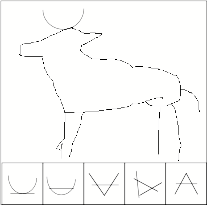
THE LONG-DICKED THING: WOULD MAKE
CATHERINE THE GREAT GRAFT HER KINGDOM ON TO HIS SOLAR PLEXUS. Archaic blintz. MINION STEW. Man alone -- needing a house. A PLACE TO PUT HIS HORN IN. Creative God that he is. INSIDE IT GOES.
Yes. He says YES to the
world, keeping her rotating below.
HOT HONEY BRIDE. Blinky on
the blind side of love.
ESCHATALOGICAL SCHATOLOGY.
Knocking on the walls of the house: oxblood brood in a simmer scenter
quinines. TEAR US SOME STONES
DOWN. PERILOUS BREEEZE. YOU TAKE LIBERTIES WITH THE
BRIDGES. Enamel begins to come
off. I've been eating too much
porridge. GLAND PORRIDGE. Under the navel. BRIDE. Beth: house-hunter.
FLOORPLAN. CLOSED. A HOUSE, A HOME, A SPOUSE FOR THE
BONE. Bury it fast; bury it
slow. Make the children hump and
glow. FOUR OLD MEN. A clapboard nursing rhyme. BEWARY OF IT. WARY OF THE BEDSLIME.
Speaking from experience?
THE EXPERIENCE OF AN OLD MAN WHO HAS SEEN EVERYTHING IN HIS DREAMS. The house is opened and a door comes
in. TWO. DOUBLE-SQUARES ARE CURVES TO MAKE THE FEMININE FORM. Watching his wife walk from
behind. AHH, THE TREASURES OF
HOME! Let the Greeks rotate it. THE WIFE IN BED, LYING ON HER
SIDE. Taking the cover down; and
moving in from behind. THERE IS A
SON IN THEIR SOMEWHERE. AND
A DAUGHTER INSIDE THAT. See.

GEE -- I DON"T FOLLOW. From Aleph and Beth came a herd of
children. Each one broadening and
bending the whirld. GEE -- I DON'T
FOLLOW. Ask the red-beard,
Massoud, what the camel can improve.
STRIKE A MATCH -- IMPROVE YOUR LUCK. A man would walk a thousand and one miles for a good hump in
the dark. A GOOD
NIGHT-HUMPER. AND THEN A
NIGHT-TALE TO TELL THE TAIL BY.
Massoud? THAT ISN'T HIS
NAME. That's his hidden name -- he
is in disguise. I SEE. Yes. To see -- requires light. THAT IS NOT THIS.
Which? Doctor
Gimmelman? YES, I REMEMBER
HIM. HE WAS THE MAN WHO RAN THE
CAMP -- AUSCHWITZ.
Gimmelmann! NO. THAT WAS GOMMELMANN. GIMMELMAN RUNS THE MADHOUSE
DOWNTOWN. No, that is
Himmelmann. THREE. THE CAMEL HAD A HEAD AND A HUMP. THEN HE HAD ONLY A HEAD AND A
HUMP. THEN THE HEAD AND THE HUMP
CONNECTED LIKE THE NUMBER 7. THEN
THE GREEKS BEGAN TO ROTATE. Gave
the sea also a curve, for the water's element was rounding: the pregnant wife's
contusion. In everything there is
a tail. CONTOUR? Frontier. CONSEQUENCE.
Happenstance. AND THEN THE
SEA WAS BUILT, THE THIRD OF THE 26.
THE CAMEL IS NOT ONLY A PLEASANT HUMP, IT IS THE MEANS OF ESCAPING THE
HOUSE AND HUMP, THE PREGNANT WIFE'S HUMP, I MEAN, PRIOR TO AHAB'S CONSTABULARY. The camel leads the binding energy to
larger environs. LIGHTING A
CIGARETTE. I'd like to give these
damn things up. WHAT'S NEXT? The door in and the door out -- coming
and going. AHH, FREEDOM THEN. Going out in to the world; coming back
in to the womb. THE WIFE'S TETHER
THEN? TO POPULATE THE TOWN? Is there a story in everything? SOME KIND OF ORDER, YES, VOUCHSAFED BY
LIFE. A typological tempesto? IN A WORD OR TWO. Call us Castle Nada. HAWK.
The door was a straw hat on its
side; then turned by some strange Phoenician who desired a new fashion. Then someone believed in was a fish
head because it smelled like chicken even if it tasted like fish. MINI PEARL, VERY SMALL, WHITE, A FOG:
GOD'S PERFECTION. A straw hat with
a price tag still on it turned on its end -- a woman bending over in a short
skirt trying to pick up something off the ground. MANY PEARLS, A NECKLACE BROKEN. A fish head becoming a fish face, a porous delta, running
off to the west. Then a vertical
line put in: a woman's delta. Then
the woman's delta closed; and the Greeks began to rotate and make it round like
a woman's breast. The Etruscan's
all face to the left; so the Romans rotate it twice, making it
right-handed. A RIGHT-HANDED
BREAST, FORMERLY A CUNT. Or a Dunt. FOUR. A vulva.
YES. I don't like the word
cunt. It is too....rude. Too descriptive. Vulva seems more sacred -- less
glandular. Less aromatic. YOU'RE AMONG MEN HERE. Except for the old Russian. HAVE YOU CHECKED UNDER HER SKIRT? I HAVE MY DOUBTS ABOUT HERE. Cadmus has an alphabet of teeth. A SNAKE, ALIVE WITH THE CAVITY OF
TEETH. A vunt with teeth! A vunt with teeth! WHICH, WHEN PLANTED, BECOME SEE VALLEY
SATIATION. Dal is thin; and dillel
is diminish; dala is curl and dola is remove; dalit is issue and dalal is
impoverish; and dildel is to detach.
DILDO MEANS, ALSO, TO DETACH -- IN THE LONG RUN. You would joke about such a thing! DI-DI IS TO FLEE. TO FLEE THE HOUSE. IMPOVERISHMENT COMES WHEN THE CHILD
DETACHES HIMSELF FROM THE PARENTS, FROM ALEPH AND BETH, BECOMING INDEPENDENT;
GOING OUT ON HIS OWN. Death. DELIVERANCE. Dromedary convenience.
A SMOKE -- I NEED A SMOKE.
Circulation; poor; descent.

BREATH; AND A MAN AT PRAYER. Emphysema, seniorita. HOLY DUST; HOLY SMOKE; DEAR KATE
WINSLETT. Breasts: and a Man on a
Dare. BE PREPARED. A Trojan Horse. OF COURSE. OF COURSE. A
horse is a horse of course of course; unless the horse, of course of course, is
the famous Mister Ed. WHY DOES A
MAN BREATHE AND PRAY? Because he
fears death. PLEASE PUT THAT IN
THE FORM OF A QUESTION. What is:
because he fears death? YES. WHAT ELSE? What is: to escape poverty? WHAT ELSE? What
is: to escape loneliness. WHAT
ELSE? What is: to escape
Daleth? DALLAS? Daleth -- the Jewish back door. I SEE. THE MAN IS STANDING WITH A HEAD AND WITH HIS ARMS RAISED TO
HEAVEN. BUT THEN, BECAUSE HE IS IN
PRAYER, HIS LOWER HALF DISAPPEARS.
HE IS A ROUND HEAD WITH TWO ARMS RAISED TO HEAVEN. THEN THE HEAD LOSES ITS OVAL
SHAPE. THE HEAD IS LIKE A CENTRAL
ARM RAISED UP; THREE ARMS RAISED UP, LIKE A FORK. WITH NO TRUNK.
THE MAN IS SPIRITUALLY HUNGRY.
The Phoenicians rotate him one turn to the left, toward the setting
sun. Back and forth; back and
forth. THEN
BOUSTROPHEDON, TURNING THIS WAY AND THAT, ROTATED THE LENS BACK TOWARD THE
EAST, BACK TOWARD THE RISING SUN, A RIGHT-HANDED HE. THEN AGAIN, WE HAD OUR HE, BREATHING AND PRAYING, BACK AND
FORTH, LIKE AN ALL-CONSUMING IMAM.
The future is not ours to see.
K SERAF SERAF. Evolution,
Education, Edification, Examination, Exultaton. THE EYES HAVE IT.
Light coming in again. THE
UPSTRETCHED ARMS OF THE MAN IN PRAYER, BESEECHING DEITY, ROTATES DOWN, TO THE
EAST. THE MAN IN PRAYER NOW SEEKS
DEITY IN HIS FELLOW MEN, THOSE HE MEETS ON THE STREET, SEEKING TO BRING HEAVEN
DOWN TO THE EARTH, BY THE PRAYER'S CAPACITY FOR LOVE. Draw it in the snow!
FIVE HIVES! Yes.
EUREKA! The prayer dances to the Sun. He bends down to kiss the ground. He is beheaded; and he becomes a tree. The tree is forced to perceive itself
in a mirror. EXCELLENT
ENTROPY! Ecstatic entropy! EQUEVA-NAY. He prays for a wife.
For God to send him a wife.
He kisses the ground when God sends him a wife. You know the rest of the story. A VOID TO FILL HIS OWN VOID. A space being the color
of...Eugenetics. Energy engraved
on the equalitarian episcopalian.
LESLIE RHODES. Easy to
eppreciate. GINNUNGAGAP. The womb's feathery inversion. ANTI-MATTER'S RELIQUERY INTERMEDIARY
VERSION. Ezekiel, informing his
square. TO BLEED. Or breathe. OUR FATHER WHO ART IN HEAVEN. HOLY MARY MOTHER OF GOD. Mother of God?
Mother of God the Son or God the Father? HERESY'S CANDLE.
Why do you ask? WHERE DO
YOU PUT IT? When? THE BORN FATHER AND THE UNBORN FATHER'S
WILL. Especial energy encircling
the eel, escaping every element but Energy's Egg. DUD.
Egg-Dud. EASTER. Epitome. EXCELSIUS DEI.
The man breathes but loses his breath. EMPHYSEMA.
Turning into woman. THE FAT
GOLDEN CALF ENGAPPED. Yet
something is missing. I'LL SHAME
US IF YOU INSIST. Common
lush. THE ALPHABET IS TO PPHYSICAL
NATURE WHAT LETTERS ARE TO...?
What is: the table of elements?
WHAT? I NEED MORE. What is the table of chemical
elements? MENDALAYEV'S MERRY
MARKERS. We're not there yet. Not to death's door yet. EXACTLY. Lothar Meyer take us higher. Take us lower to'ard the sewer. THE SOWER, YOU SAY?
OR THE SUER? Or
sulfur? PLEASE! What is: Boron? INCIPIENT SIGN OF THE BOX IS: B. We have been there? AND WILL BEE AGAIN. Five has hives. BORON IS A METALLOID CHEMICAL ELEMENT
WITH PROPERTIES INTERMEDIATE BETWEEN THOSE OF CARBON AND ALUMINUM. IT'S CHEMICAL SYMBOL IS B; ITS ATOMIC
NUMBER IS 5; AND ITS ATOMIC WEIGHT IS 10.811. Thank you, Mister Wizard. CAPABLE OF MANY THINGS. Including burning your nose hairs with sulfur. MERCURY, SULFUR AND SALT. MERCURY SULFUR AND SALT. What is: Midnight Cowboy? WHO ARE: JENNIFER AND WALDO? What you can't find in a forest of
Waldos? FAT GOLDEN GAP OF CALIF.
Arabic 8. INSINUATIONS OF A BRUNE
QUIM. Doctor, doctor, doctor. My eyes have seen the years. Of the slow parade of tears. Without hiding. I will wake unto your dream. A BROKEN MUFF. If you see Kaye, please tell her for me
that her country grows inside of me.
I will give it' her for free.
PARALYSIS OF WILL. Forget
frequently fine feminine freedoms.
Friskie feline fates feel fatuous first; and friendly fatally. ADDITION AND REDUCTION. THAT IS ALL THERE IS. NOTHING MORE. Uck Fe E May; Ail Nay E May. MIUQ SPICKS; MAIGUEY TRICKS. The spatula spondula?
THE CLICK, THE CLICK; THE MATADOR'S PRICKED. Hook and nail; look and hail; book and fail; cook and
jail. BROOK AND BAIL; FOOK AND
FORGERY-FLATTERED FEMALE. Spicking
of which. MERCURY, SULFUR AND
SALT. MERCURY SULFUR AND
SALT. Who is: a Greek actress with
the first name of Merlina? YOD HE
VAV HE. YOD HE VAV HE. FOUR IN ONE; ONE IN FOUR. Spicking of which. MERCURY, SULFUR AND SALT. MERCURY SULFUR AND SALT. What are: the elements of Fire, Water
and Earth? What are: the elements
of Heaven, Earth and Hell? What
is: the young girl prior to puberty?
EFFERVESCENT. Effulgence. EFFUSERY. Not to be comfused with usery. EFFISCERATED.
Wrong letter!
EFFICACIOUS. Some comeday
morm. EFFEMINATE. Gladly so. EFFULGENCE.
Most delightedly. EFFLUENT
EFFLUVEUM. I believe that was
Ginsberg. I head something
too. EFFIGY. A vision of something. Someone hanging. Don't talk about it! I don't want to see it! DANK. DREARY.
DREAMY. Salt in the wound. Mercurial emancipation of the mind. FURLUS. Yes: white delta.
FURLESS. Ahh! FRUIT OF FRUITS. God's gift of Eve. SPELLED THE SAME IN BOTH
DIRECTIONS. Ahh! THE FIGURE EIGHT. Don't start with me! ROSEBUD ROSEBLISTER! Magnificat magnum. Vagnificat vagnum. A HOLE IN THE GROUND. Everything is free. HOOKER AND NAIL. Hook, line and stinker. JEWISH SCHOLAR. Passing Vind. HOOKER AND NAIL.
Look at his hands: did you see the scars! WHAT? Scars --
where the nails had been? I SAW
NOTHING. I SAW SEVERAL WOUNDS NEAR
HIS LIPS, UNDER HIS BEARD -- AS IF HE BIT INTO A ROSE BUSH. Roseblister rosebuster. ROSEYCROSS ROSEYCANKER. Felix Felicity Frequently Flexes her
love muscle. PUTTING HIS MOUTH
WHERE HE SHOULD HAVE PUT HIS MONEY.
Penny whistle; penny wharf.
EFFICACIOUS. EFFICIENT. Phantasm. FEONIX. FEONIX
FUTURITY; FEONIX OBSCURITY. Sex
comes before Seven. BEGINNING AS
THE V. WE ALL SURELY KNOW WHAT THE
V IS. Vulva mate; Vulva marker. HOOK AND NAIL: USED TO MARRY TWO
SEPARATE ELEMENTS TOGETHER. Vulva
becomes Fulva. You know how the
Greeks are. Always turning things
on their end. VENIS BECAME
FENIX. Very Friendly became Fairly
Reverendly. FAIRLY REVERENDLY
BECOMES FAIRLY REVERED END O' LILY.
I see. The flower
again. The flower and the B. THE SON SEES. THE FATHER HEARS.
What? VAV SEES; YOD
HEARS. Transcriptions of
light? MAYHAPS IT IS TRUE. Divine Light Pours Down Its
Channel. THE CHANNEL IT
PREPARES. It scores. DIGGING IN MATTER A BED OF
CLATTER. And sound. ITS PRIMARY NATURE. Conditions it Frequents For
Fatherhood. FREQUENCIES IT
FALLUSITATES FOR ITS VATERHOOD.
Pious lamb. PRECIOUS PIOUS
MATTERHEAD OF VAV. Doctorate of
Time. LIGHT, YOU MEAN! Light is Time, you mean? PIOUS PRECONDITION. Ponds. Ponds Veritus.
FREQUENTER OF FELLICITATIONS.
Vater Muter Hans Gretel.
FATHER MOTHER SON RESTRICTED FRUIT. Otter's Date.
DIE TALKTER'S FATE. Atom
atomizer atomist atomsphere. AHH,
JOYCE'S CLOUD. JOYCE'S
RAINWATER. Reignvater. UCKER FE CELLANT EXER FE. Iron. Iron's Anagram.
IRON NAILS RUN OVER. RUN
ON. LIKE WATER. Arbon Kaye. EYEMAN DAY; OLE KAYE.
AYEMAN DEI; STINKHOLE.
Lifting his leg. THE POET
OF FURZ. Furlless Fakir. Schwartzweiss. Weisschwartz. By turns. High
and Low. JEWISH NATURE. They have given us this
alphabet. LOOK AT HIM NOW, PICKING
HIS NOSE! Look the other
way! I HOPE HE DOESN'T START
SINGING AGAIN! Howling is more
like it! CONSTABLE OF
CONSTIPATION! Quick, write it in
the snow!

I DON"T GET IT! WHAT DOES IT MEAN? Inversion of Time. WHAT? Sectuality. OH,
I SEE. Ask old Marcus Verrius
Flaccus over there. WHICH ONE IS
HE? It's old warts and pox. PLEASE. Is it the cold that makes you so unpleasant and
querulous? A mean spirit impresses
no one. TAKE ANOTHER DRINK,
BOSCO. SOOTHE YOUR NERVES A
BIT. UNCONSCIOUS IS THE BEST PATH,
ON A NIGHT LIKE THIS. When
anything can happen. YOU SEE WHAT
HE IS TRYING TO DO, DON"T YOU?
HE'S TRYING TO SUGGEST THAT THE BUILDING BLOCKS OF MATTER, THE CHEMICAL
ELEMENTS, ARE AKING TO THE LETTERS OF THE ALPHABET. Why would he do that?
What does it do for him? I
DON'T KNOW. THAT'S WHAT I'D LIKE
TO FIND OUT. It's simple: he wants
to demonstrate the mystical powers inherent in numbers and letters. SCHEISS. HE TAKES US FOR.
Wait. She's looking at us
again, like she's going to ball us out.
Hold your tongue! SHE'S
GOING TO TALK ABOUT CARBON-DATING.
No, she's spiritual. She
doesn't talk about the sins of the flesh.
ALL-EVEN, ALL-EVEN, ALL-EVEN.
The Mother's Merry Weighting of Souls. ALL-OVEN, ALL-OVEN, ALL-OVEN, SHE STAYS. Home-maker, home and purpose
taker. MOTHER OF THE DARK VEST,
THE SHAWL. The Daughter is the
lover; the mother is the protector.
A SYRINGE IN YOUR ARM.
COUNTING NAILS. The Four
Men, the Pillars, leaving when she says it. SAYS WHAT? A
syringe in your arm. COUNTENANCING
SAILS. The Vav is, first, the oar
which powers the ship away from the home.
AWAY FROM THE MOTHER-DAUGHTER.
She's my daughter; she's my sister. LINKING TWO SIDES OF THE SHORE, TWO OPPOSING WORLDS. Stands between this and that. KISS AND SHAT. Piss and Philatelate. CRISS-CROSS AND PERAMBULATE. PHILALETHES. List and Discombobulate. LOOK AT YOUR WATCH!
Wait! I've lost my watch! DON'T WORRY ABOUT IT. WHAT HAS TIME TO DO WITH THIS? Who were the Phoenicians, anyway? DAMN CANAANITES! THE GODDESS OR THE ALPHABET? THE MATRIARCHY OR THE LETTERED
PATRIARCHY? THAT WAS THE CHOICE! And the Jews gave us the
Patriarchy! They gave us the cock,
the rooster I mean! The cock that
crows in the morning, singaling himself to be a rooster, a form of Dawn
God! COCK IS COCK. THE UPSTANING ONE. Pushing up the tent of the sky at the
Four Corners. SYMBOLISM! WHAT IS THIS, SOME KIND OF DREAM? Ask him -- the one who is
dreaming. STANDING BETWEEN GOD AND
MAN! Wawwu! WHAT? This one? SURELY. WHO ELSE
COULD IT BE? You are a believer
then? YES. I AM COMING TO BE ONE. Mesmer Krezmer. RAZMATAZ. Listen to this: there is a time component to this letter VAV
-- which, by the way, is also spelled the same way backward or forward. So, with Time. Place VAV in front of a verb in the
past tense, and it converts the verb to a future tense. Place VAV before a verb in the future
tense and it converts it to a verb in the past tense. IT HAS SOME KIND OF MAGICAL POTENCY. It is the same function as the angel
standing between the universe and the anti-universe. The one who converts the black into white; and also the
white into black. The Future into
Past; and the Past into Future. I
AM LOST. I DON"T GET
THIS. Charlie, you must listen
carefully. VAV IS AN ARTICLE OF
CONNECTION, LIKE AND IN ENGLISH.
Gramatically, VAV is third person masculine. A LINGUISTIC TRANSLATION OF THE MALE SEX ORGAN, THE PHALLIC
SYMBOL. THE CLUB; THE MACE. The article of connection between the
masculine and the feminine: this is the generator of Life. QUICK, DRAW IT IN THE SNOW!
The tetragrammaton -- IHVH -- is
referred to the Sephiroth, thus: the uppermost point of the letter YOD, I, is
said to refer to Kether; the letter I, itself, to Chochmah, the Father of the
Microposopos; the letter H, the supernal HE, to Binah, the Supernal Mother; the
letter V, VAV, to the next six Sephiroth, who are called the Six Members of
Microporosopos (and the number six is the numerical value of V, VAV); lastly,
the letter H, the inferior HE, to Malkuth, the tenth Sephira, the Bride of
Microprosopos. THAT IS THE FAMOUS
SWORD IN THE STONE -- AND, AS WELL, THE CONFIGURATION OF THE AMIENS CATHEDRAL. Draw it in the snow!
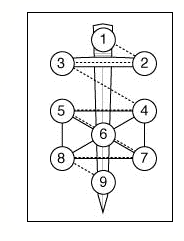
ONE IS KETHER; 2 IS CHOCHMAH; 3 IS
BINAH. 4-9 IS VAV. 10 IS MALKUTH, THE KINGDOM; THE BRIDE
WHO GIVES LIFE AGAIN TO MICROPROSOPOS.
THE FINAL HE. Do I discern
a sword penetrating a stone? That
is, penetrating a box, a rectangle?
A ROSEBUD, YOU MEAN? Well,
that is your description. THE
NUMBER 6 REFERS TO TIPHERETH, BEAUTY -- WHICH IS GOVERNED BY MICHAEL THE
ARCHANGEL. We have been instructed
that I (YOD) is the 10th letter in Hebrew, and H (HE) is the 5th, and V (VAV)
is the 6th; and that IHVH (YOD HE VAV HE) the unprounounceable name of
Tetragrammaton equals, numerically, 26.
It is also of note, in the English Gematria, that both MJC and the world
GOD also equal 26.
|
7 |
G |
13 |
M |
|
15 |
O |
10 |
J |
|
4 |
D |
3 |
C |
|
|
|
|
|
|
26 |
|
26 |
|
YOU WILL NOTICE ALSO THAT THE NUMBERS OF THE MIDDLE PILLARS OF THE SWORD IN THE STONE -- 1, 6, AND 9 -- EQUAL THE NUMBER 16. AND, WHEN ADDED TO THE IMPLIED 10, ALSO IN THE MIDDLE PILLAR, THE WIFE OR BRIDE, THE KINGDOM, THE ENTIRE SUM OF THE MIDDLE PILLARS EQUALS THE NUMBER 26. You are calculating your dreams, Herr Young. WORDS ONLY. What? NUMBERS ONLY. I beg your pardon. Words only! Numbers only! TELL HIM ABOUT THE TRIPARTITE PERMUTATIONS OF THE NUMBER 37. HURRY -- WRITE IT IN THE SNOW!
1 + 1
+ 1 = 3, 3 x 37 = 111
2 + 2
+ 2 = 6, 6 x 37 = 222
3 + 3
+ 3 = 9, 9 x 37 = 333
4 + 4 + 4 =
12, 12 x 37 = 444
5 + 5 + 5 =
15, 15 x 37 = 555
6 + 6 + 6 =
18, 18 x 37 = 666
7 + 7 + 7 =
21, 21 x 37 = 777
8 + 8 + 8 =
24, 24 x 37 = 888
9 +
9 + 9 = 27, 27 x 37 = 999
10 + 10 + 10 = 30, 30 X 37 = 1110
There is that number again. That number sequence.
THE NUMBER 111 IS, AGAIN, BOTH THE BEGINNING AND THE END. Both the Kether and the Malkuth -- 1
plus 10 is 11. Kether is both 1
and 11. THIS IS ALL RATHER
DISTURBING. You will remember also
that in Latin, the initials of MJC equals 1101. The Romans did not have a letter 'J' but had a letter 'I' in
place of this 'J'. Dropping the
zero in each of the quotients, we return again to 111.
|
1000 |
M |
|
1 |
(J) I |
|
100 |
C |
|
|
|
|
1101 |
|
WHEN WE ADD THE MIDDLE PILLARS AGAIN, 1 AND 6 AND 9 AND 10,
A SUM OF 26; AND WE ADD TO THIS THE NEXT MANIFESTATION PASSING THROUGH THE 10,
THE BRIDE -- WHICH IS THE NUMBER 11, AGAIN WE ARRIVE AT THE NUMBER 37. What has this to do with the letter
F? QUICK, DRAW IT IN THE
SNOW! Not now! She's looking over here again! Shh! THE NUMBER 37 IS THE SQUARE ROOT OF 1 3 6 9. Yes. 37 IS 26 PLUS 11.
Yes. IN HEBREW GEMATRIA,
THE DIVINE NAME YECHIDAH (YChYDH) MEANS UNITY -- AND IS, NUMERICALLY, 37. YECHIDAH EXPRESSES THE INNER SELF; AND
THIS IS A TITLE FOR THE FIRST SEPHIRA OR NUMBER OF THE TREE OF LIFE, KETHER,
FROM WHICH THE OTHER SEPHIROTH OR NUMBERS EMANATE. Does this designate a path on this Tree then? DRAW IT IN THE SNOW!
Let's stick with what we know! ARE YOU NOT MOVED IN THE LEAST BY THIS? By what? By this artifice?
LOOK! DID YOU SEE
THAT? What? HOW HE CHANGED FORM AGAIN! Who? GINSBERG! HE
BECAME THAT BOY FROM THE ART MUSEUM!
Which boy? WHEN HE SPOKE
ABOUT GEMATRIA, THAT WASN'T GINSBERG, IT WAS THAT OTHER MAN, THAT BOY
REALLY! Which boy? I DON'T KNOW HIS NAME. 3 inner, hidden Sephira; and 7 outer,
manifest Sephira. This make the
complete number, 10. THE 3
SEPARATED BY THE ABYSS FROM THE 7.
Make me like you that sees light and darkness alike. WASN'T HIS NAME MOSES SOMETHING? 37 is 111 divided by 3. STOP WITH THIS NUMBER NONSENSE! WE ARE RATIONAL MEN! There's that light in the sky again! 37 IChIDH. THE HIGHEST PRINCIPLE OF THE SOUL, ATTRIBUTED TO
KETHER. 111 (37 X 3) IS, IN ITS
SYMBOLISM, AN EXPLANATION OF ALEPH -- THIS IS A COMMENT THAT UNITY MAY BE FOUND
IN THICK DARKNESS AND IN SUDDEN DEATH.
See! Did you see that! Ginsberg's face changed! IT'S THE LIGHT, MAN. YOU'VE BEEN DRINKING. Didn't you see it? THERE'S THAT LIGHT IN THE SKY
AGAIN. Moses again! Isn't his named Moses? DURING THE DARK MONTHS WE ARE POOR BUT
WE LEARN MUCH ABOUT GOD AND LIFE.
DURING THE LIGHT MONTHS WE ARE RICH BUT WE LEARN LITTLE ABOUT GOD AND
ABOUT DEATH. 111 divided by 3 is
37; 3 divided by 111 is .027027027027027 ad infinitum. 1 divided by .027027027027207 is
37. So, there is some inverse
connection between the numbers 37 and 27 (3 to the 3rd power). WE ARE DIGGING A HOLE IN OUR UNDERSTANDING,
I BELIEVE. Using the second method
of English Gematria, the one which converts letters into single units first,
then into tens, and then into hundreds, equates numerically the words 'eleven'
and 'love'.
|
30 |
L |
|||
|
60 |
O |
|||
|
400 |
V |
|||
|
5 |
E |
|||
|
|
|
|||
|
495 |
|
|||
|
|
|
|||
|
5 |
E |
|||
|
30 |
L |
|||
|
5 |
E |
|||
|
400 |
V |
|||
|
5 |
E |
|||
|
50 |
N |
|||
|
|
|
|||
|
495 |
|
|||
DRAMATICUS MUNDI.
Assimilating tripe. YOU DO
NOT SEE THE LIGHT? In the sky, you
mean? AND HEAR THE VOICE? AND SEE THE MAN CHANGE FROM GINSBERG TO
MOSES O'LEARY? I see it. I am tired. I have been trinking this soup. DO YOU NOT HEAR THE MAN SPEAKING TO YOU? Which man? THE MAN INSIDE OF CROSSMANN. No, I do not.
LISTEN DEEPLY MAN!
LISTEN! I am listening
deeply. I heart only the farts of
Moses antithesis. LISTEN
AGAIN. Mad Hatter! Redhat Mad Hatter! REDMADHAT IN REDMANHATTAN. REMBRANDT
--A SERPENT -- THOMAS IN GRIEF!
Harken the eipistle: the one who speaks is spoken and hears, as
one. GEEZ, GOD IS A GIANT GOLIATH
OF GRACE. Is that Crossmann's
wife, licking the stickier surface of: a stamp? Sending a letter?
Sitting beside a man in a bed, all white, contrite, tight and
frightened? NEVER TO SEE HIM
AGAIN. ENDING IT ALL, FINALLY. You see the wrong thing. WHO IS TO SAY? Where do you see it? LOOK AT THE LIGHT AROUND HIS HEAD! Gracias, Garcia! Guards gain the great good comfort;
guarding the gift of the border gains girls. PEARLS AND PEARS; THE AVACADO AND THE UNBLEMISHED CLAM. Hairy shell. SEAFOOD GIRLS, GIVING IT AWAY TO GIANT GUARDIANS. What is our Thought God drawing in the
snow?
GEEZ. IT LOOKS
LIKE SOME KIND OF RIDDLE. What
looks like the number 7 and the mirrior image of the number 7 mounted on each
other and brought into confrontation at the navel? AT THE NAVAL OR AT THE GROIN? I know what I said.
WHAT IS: THE LETTER Z?
Zayin. MOSES DE LEON. Zed. The last leading to the first. BUT IT WAS NOT THE LAST. Heaven sent.
ZAYIN IMPLIES WAR: FACE-TO-FACE CONFRONTATION. But the Greeks did not like the Z. NO, THAT IS NOT TRUE.
THE GREEKS HAD ZETA. IT WAS
THE ROMANS WHO REJECTED THE Z, FOR THEY HAD NO 'Z' SOUND IN THEIR
LANGUAGE. SO THEY SUBSTITUTED THE
'G' FOR THE 'Z' SOUND. THEY LATER
RESURRECTED THE 'Z' TO DO TRADE WITH THE GREEK ZETA -- BUT THEY CAST THE
RE-BORN 'Z' TO THE END OF THEIR ALEPH-BETH. Talk to the Censor Caecus about this -- it was not my
decision. CAECUS GRAECUS. GRAECUS BREAKUS. Mozambique. Robert Mugambe.
MUZAMBE. MOGAMBIQUE. Querulous Draco. TAKE US TO SEA. The 'G', of course, in form, was born
as an exaggeration of the sea. BY
THE ADDITION OF A CANE. G-G-G-Gamel. THERE IS A WAR BEING WAGED. THE ARROW. THE TWO PARALLEL LINES. Zero.
MOSTEL. Grainy
impeccability of your cents for humor.
C-NOTE. G-Men. GOD'S GRAINERY. Impeccable gift of gab bags the foot of
the fig. GAG ME WITH A SPOON. I'm shocked by this zicainery. MOETUS MOISTEST. War, revolution, chaos, come
hither. HEILZIG! Gaff of Gegen. SWORD, WEAPON, SPECIES, GENDER, TO
SUSTAIN. Zainy impeccable Lord of
the Sickle. SEX WAR; GENDER
WAR. IS THAT WHAT IS MEANT BY 'THE
END'? Zelig. ZELIGFIELD'S FOLLIES. The long leg. BARE LEG. The
girls letting go of their morals -- letting down their guards. GARGANTUAN GILROY. Was hair. LET THEM KICK.
I WILL JUST WATCH THEM.
ZELIGFIELD'S MOLLIES.
Zollie's McGuires. MAGGIE'S
BLOOMERS SHOWING AS SHE GICKS.
Greeks stand at attention.
THAT'S WHAT MAKES THE WORLD GO 'ROUND. Moon Mumbler.
CROON GRUMBLER. Koon
Fumbler. SOON CRUMBLE HER. Ahh, Mariah is ripe. THE CAST OF THOUSANDS. Give me hair down to there. HEY. Shoulder length and longer. HEY. Here,
mama, there, daddy, everywhere, daddy, daddy. HAIR. Grow it. SHOW IT. Long as I can grow it.
MY HAIR. Hair in the Valley
of the Stumbler. STUTTER IF YOU
ARE GUILTY. Guilt Kilt Me Down To
The Marrow Bone. GUARDIAN GABRIEL,
YOU ARE NOT THE ONE. Seven Seven
Seven. IS TWENTY-ONE. Black Jack. IS TWENTY-ONE.
The Nail binds; the Mail sunders.
THE SWORD SAILS ME UNDER.
Blimey stone. NO LONGER
THIS AND THAT. NOW MERELY
THIS. OR THAT. Looking for the nail again. YARICK, YARICK, WHERE IS AZIZ? Pleased to meet you, surely. GONE WITH THE GIN. A man in a mustache; a woman in a
hidden beard. GIRLS WILL BE GIRLY,
AFTERALL. THAT'S WHY WE GET
THEM. One time each month. WATCH THE MOON. WATCH OUT FOR THE BLOODY MOON. Idi Amen Again. HOLD HIGH THE HIDE HAMMERER. Achey Breakey Heart Heart Heart. SUSTENANCE IS NEXT TO....MANNEH, MANNA,
MANNASEH. Molach MOLACH
Molach. GINSBERG GINSBERG
GINSBERG. GODLINESS. Pilgrim State's Rockland's and
Greystone's foetid halls, bickering with the echoes of the soul, rocking and
rolling in the midnight solitude-bench dolmen-realms of love, dream of life a
nightmare, bodies turned to stone as heavy as the moon, with mother finally
******, and the last fantastic book flung out of the tenement window, and the
last door closed at 4. A.M. and the last telephone slammed at the wall in reply
and the last furnished room emptied down to the last piece ofmental furniture,
a yellow paper rose twisted on a wire hanger in the closet, and even that
imaginary, nothing but a hopeful little bit of hallucination -- ah, Carl, while
you are not safe I am not safe, and now you're really in the total animal soup
of time and who therefore ran through the icy streets obsessed with a sudden
flash of the alchemy of the use of the ellipse the catalog the meter & the
vibrating plane. PROOF THAT GOD IS
NOT LIVING! Gegen zegen. THAT IS NOT A POEM. THAT IS ANOTHER ONE OF HIS WIND METRES,
ANOTHER ONE OF HIS GAS GIGABITES FOR WHICH HE HAS BECOME GREATLY GLORIFIED BY
THE GEEK GENERATION. Put a Fence
around the Field. Find a way to
keep him out. THE OLD WARRIOR GOUT
HAS GIVEN HIS JOINTS A GAFFER.
Geezus G. Ghrist. Has that
man bathed in a month! THAT'S A
GHOST GUST, A SPECTRE HALOGROCHUS TOKUS.
Philosopher's stone is hidden in a mass of rotting flesh. GRACCHUS DON'T MOCK US. GRINGOS; GREAT AT BINGO. GOSH B'GOSH: TOSS US A GRIPPER. KEEP US ALIVE: KEEP US OUT OF THE GOG
FIRE. Cheth. Cheth Breath. Cheth Breath, Death be Kepth Thot. IS YOUR TONGUE FREEZING? GET YOUR FINGER OUT OF THE SNOW! YOU CAN LOST IT THAT GIDGET TO FROSTBITE, YOU KNOW! Greatttttthhhhhh. H JESUS CHRIST! HEAVEN WON'T TAKE A FINGER BY ITSELF,
YOU KNOW! Graphomaniac. HE SAYS HE WANTS HIS SPACE! SEE HOW HE'S OFF THERE TO THE SIDE,
SPEAKING WITH MERLIN AND HIS BROTHER AND THE OLD RUSSIAN CROW! What are you saying? HE DOES NOT TRUST US LIKE HE TRUSTS
THEM! How could he? He doesn't know us. IF HE IS THE REAL H CHRIST JESUS
RETURNED, THEN HE WOULD KNOW OUR HEARTS, WOULD HE NOT? I believe he does know our hearts --
that's why he is moving away. OH,
SO WE ARE NOT FAITHFUL -- IS THAT WHAT YOU ARE SAYING? We cannot give up our fishing nets to
follow him? AND WHO COULD? WHO WOULD? Only the desperate, the lonely, the despised. Fish at the bottom of the barrel. IS HE CONSPIRING WITH THEM? AGAINST US? Listen! You can
hear them! IF GOD DIDN"T MAKE
THE LITTLE GREEN APPLES. Put a gag
in it, Goldsborough! We aren't
groom crooners here. Don't let
your memories drip out here like goo from a parson's primer. LISTEN! THEY ARE SPEAKING!
Zeta Zeta, one more zissusthrus!
LISTEN! Gnostic Gospels,
who wrote the Gospels? GOEBBELS,
GOERRING, WHO SMOTE THE GOETHE?
Listen! FOHAT IS:
androgynous energy; Ares of Paracelsus; asleep and awake; Aurora Borealis;
awakener of primordial matter; the guide of axial changes of Earth; bridge
between spirit and matter; the breath; he who brings the ray into union with
the soul; circular motion; cosmic electricity; cosmic energy; differentiated
light; divine love -- number 11; Eros; double triangle; emanation of powers
behind the veil; the guide of evolution; the fiery whirlwind; force
accompanying ideation; the fourth son; the force of genesis; guided by
universal intelligence; guardian of a star's death and re-birth; hardener of
atoms; the hissing serpent; impressor of thought on substance; instrument of
the Logos; key to understanding symbols and allegories; life-electricity; life
of action; Light of the Logos; the propeller of the Lords; male and female;
manifested and unmanifested; imminent in all the worlds; not a personal god;
objectivizer of the seven energy centers; son of Pramati; prana; male energy;
producer of the seven laya-centers; rich with dhyannic-chohanic/angelic
thought; he who runs the errands of the Manus; he who separates and places
sparks; he who separates matter into atoms; he who sets the nebulae in motion;
he who sets the world germs into motion; sevenfold; brother of the seven sons;
shapers of atoms from crude material; solar energy; the steed on whom Thought
rides; the swastika emblem; the synthesis of nature's forces; the Spark and the
thread of the Spark; he who takes strides of Three and Five; he who turns the
seed, the curds, into the opposite direction; the vehicle of the Primordial
Seven. THE OLD RUSSIAN WOMAN'S
VOICE. Where does it come
from? WE DO NOT KNOW EVERYTHING. I wish you had said this much
earlier. MATTER SPIRITUALIZES;
SPIRIT MATERIALIZES. The inner
comes out; and the outer comes in.
IRON INTO GOLD; AND GOLD INTO IRON. Sort of. Sort
of. THOTH RIDES. And Goth riddles. I'M NO ROI, INDEED. I'm no Regin Incarnate. I'M NEUTRAL, REALLY; IAM. Is Naturalism Really Intoxicating? IPSO NIPSO REGAL IGAL. Lotus Flower, Lotus Flower, build a
fence; establish power. LOTUS FLOWER,
LOTUS FLOW, LEAP THE FENCE; SURPASS THE HOUR. What has this to do with the Present? A MAN TRAPPED IN THE PRESENT IS A MAN
TRAPPED IN SOME CATASTROPHE WHICH DOES NOT RECOGNIZE THE FUTURE. I see. GENDER, GENDER, GENDER.
HATE IS A POWERFUL FELLOW, FRIEND. Aitch.
HYDROGEN-HELIUM.
Aitch. HYDROGEN-MEDIUM. Hevolution of spirit is Hinvolution of
matter. Hevolution of matter is
Hinvolution of spirit. HAY COBB'S
LADDER -- YES, WE SEE THAT.
Hiccup. Hiccup. AITCH. A LESSER GROWLING.
A wall; an obstactle; a ladder.
LATTER'S DAY SAINTS. Max X
Colm. BARS ON YOUR WINDOW, GIVING
PRESAGE, PERHAPS, OF THE DESTINY OF THOU, MAKER OF MIRACLES. Het. Het. HET IS A
POWERFUL FRIEND, FELLOW. Het is
'sin' in Hebrew. H IS AN EVIL
PRESENCE. Therefore shall hevil
come upon thee; That shalt not know whence it riseth; and Mischief shall fall
upon thee, Thou shalt not be able to put it off; And desolation shall come upon
thee suddenly, Shoah, misfortune, destruction, Which thou shalt not know. P-P-P-PLAGUE OF THE WRITTEN WORD. Masculine manufactory of will. ALEPH'S CALF, GOLDEN IN ITS BURNISHED
BRITTAINIA. Bleeker Street is
brusied. CANINE'S
CONDOMINIUM. And fence. SHOAH: THE HORROR OF BEING STUCK IN THE
PRESENT. Hod. Hod Almight do not leave me here, with
no thread in and no thread out. G
IS THE WORLD THAT IS LIVING BEFORE.
H is the what? The
h'revolution? THE OLD WORLD'S
OUTER MEMBRANE. HYMEN SAYS: Sin is
the impossibility of breaking down the barriers which are the frontiers of
time. Which do not allow you to
begin again. Which do not
understand the requirements of ethical action in re-making our conditions. PLAGUE JURIST. What? YOU HEARD ME.
Man of vowels. WHO? OUAI. I DON'T GET IT.
Montage Effect. AEIOUY. Arabic? NEIN. MA KNN. Inside joke. LET THE MAN SPEAK.
Who? THE MAN OVER THERE. THE MAN IN THE WOMAN AND THE WOMAN IN
THE MAN. Moses, you mean? GABRIEL IS NEAR, ALWAYS NEAR. The rock comes first. THE PHILOSOPHER'S STONE IS THE MYSTIC
MEAT, AFTERALL. Speak rolling moss. THE ETHICAL ACTION THAT BREAKS THROUGH
THE 'H' ENCLOSURE IS A BIRTH. IT
IS FREEDOM. H is the same trap as
is the number 8. YOUR TRAP,
THEN? What? UNIVERSE AND ANTI-UNIVERSE. Am I trapped here then? ARE YOU NOT? By the police, you mean? WHAT POLICE? I
don't understand you. YOU ARE
SUPPOSED TO BE THE MAN OF UNDERSTANDING.
Trapped in my network of divinity, you mean? NOW YOU ARE GETTING WARM, FRIEND. Speak molling ross.
ETHICAL ACTION PERCEIVES THE WORLD NOT AS IT IS, BUT FOR WHAT IT COULD
BE. MAN IS FREEDOM; AND FREEDOM
CONTAINS WITHIN IT THE PROMISE OF HAVING TO BE. MAN OF THE FUTURE MUST ALWAYS BE DOING SOMETHING, INVENTING
HIMSELF, PERFECTING HIMSELF. THUS,
THE PERFECTION OF MAN RESIDES IN HIS PERFECTABILITY. PERFECTABILITY, THROUGH INVENTION Drum roll. THAT
IS YOUR PROBLEM NOW. YOU ARE
TRAPPED IN THE HELOS OF THE HARMONY OF INACTION. What? YOUR
HECATE BECKETTY HORIZONLESS HOMONYMITY.
MISTER BOSCH. Marc Antony
isn't speaking. SOLITARY
SURGERY. STUDIOUSLY WAITING FOR
THE WORLD TO END. SO HE CAN
BEGIN. IN A LETTER OTHER THAN
H. Reek soulling moss. WHEN THE DYNAMIC OF INVENTION
ENCOUNTERS AN OBSTACLE (H) WHICH IT CANNOT OVERCOME, THE HUMAN BEING WHO IS
TRAPPED, THUS, IN THIS 'H' SITUATION EXTRICATES HIMSELF BY USING ONE OF SEVERAL
OF THE OTHER LETTERS IN THE ALPHABET DESIGNED TO AID HIM IN THIS TEMPORAL
CATASTROPHE. Trapped in the Eighth
Sphere. I see. Play jury.

WHO IS SINGING?
IS SOMEONE SINGING? In the
blood of Eden, lie the woman and the man.
With the man in the woman, and the woman in the man. In the blood of Eden, now we end as we
began: with the man in the woman, and the woman in the man It was all for the union -- oh,
the union of the woman, the woman and the man. IN THE BLOOD OF EDEN.
OH, WE DO AS WE ARE TOLD.
With the man in the woman; and the woman growing cold. IN THE BLOOD OF EDEN. WE BUY EVERYTHING WE'RE SOLD. With the man in the woman; the man in
the woman's gold. IN THE BLOOD OF
ADAM. IN THE BLOOD OF CRIMSON. IN THE BLOOD OF CHILDREN. IN THE BLOOD OF MONIKERS. THE COCKS, AND THE OX.. Yes. THE OX. The Ox
is not all it seems my friend -- that is, it appears to be less than it
is. IN WHAT WAY? OX is a circle and a cross -- that is, the female and the
male. The man coming out of the female
by the looks of it.

The man on his cross; the woman in her womb. The man on his cross in the woman's
womb, the mother's womb. THE OX IS
ALP. THE OX IS 111. HOWEVER, ALP IS, IN FACT, PLA, AS
HEBREW TEXT READS RIGHT TO LEFT.
ALP IS ALPHA, THE WORD, WHEN ALPHA MARRIES BETH. AND THE ALPHABET IS CREATED. ALP IS KETHER, BUT ALP IS KETHER COMING
OUT OF DARKNESS, OR OBSCURITY. PLA
IS ALSO 111; BUT PLA IS A SECRET NAME OF KETHER, MEANING 'THE HIDDEN WONDER'
AND ALSO 'THE WORKER OF WONDERS'.
ALP IS KETHER COMING OUT OF DARKNESS; AND PLA IS KETHER GOING IN TO
DARKNESS. 'P' is a sound made with
the lips; 'L' with the tongue; and 'A' in the throat. The word, itself, indicates a transition made from the
revealed to the concealed. It is
the opposite of ALP or, indeed, AUM, which symbolizes the transition from the
concealed to the creation of the manifest universe. 'AUM', 'AOM' IN HEBREW, THE HINDU SACRED WORD WHICH
CREATED THE MANIFEST UNIVERSE, ALSO, IN HEBREW, EQUALS 111.
|
1 |
A |
|
70 |
O |
|
40 |
M |
|
|
|
|
111 |
|
THE LETTER 'P' IN HEBREW, 'PEH', MEANS MOUTH. THE WORD 'PLA' SUGGESTS THE SPOKEN
WORD, SPOKEN BY THE 'P' IS 'LA' WHICH MEANS 'NOT', SIMILAR TO 'AIN', NEGATIVE
EXISTENCE. THE WORD 'ALP' SUGGEST
THE SPOKEN WORD, 'AL' ('EL'), THE MIGHTY ONE -- THE FORMAL TITLE OF THE FORMS
GOD TAKES. 'AL' IS KETHER IN THE
BRIATIC WORLD; AND ALSO THE GOD OF CHESED IN THE WORLD BELOW. 'AL' or "AB" is God the
Father. 'AB' of course, is
Aleph-Beth, the Divine Couple, the Sun married to the Moon. OCCIDENT RISING. 'A' is said to be the Spirit of the
Magician; 'B' is said to be the Magician Himself. ONE GOD COMING AND ONE GOD GOING -- THE DOUBLE ASPECT OF THE
WORD. FROM AL-LA, OF COURSE, COMES
THE NAME OF THE MUSLIM GOD. They
being the same God; two sides of the same coin -- One God, God of All. ONE GOD IS NOTHING ('LA') AND ONE GOD
IS ALL ('AL') 'NOTHING' IS HEBREW
IS 'NVNH'. 'NOTHING' IN HEBREW
EQUALS 111.
|
50 |
N |
|
6 |
V |
|
50 |
N |
|
5 |
H |
|
|
|
|
111 |
|
One God coming and one God going -- each being the
same. The one God coming has the
knowledge of that which is not.
'AL' IS AIR AND 'PEH' IS FIRE.
THUS, ALEPH IS REPRESENTS THE MOLECULAR MARRIAGE OF AIR AND FIRE. AIR IS THE LOGOS; AND FIRE IS THE
SUN. ALEPH IS THE SYMBOL OF THE
SOLAR LOGOS, THE SON OF GOD. I
don't understand who is speaking.
Is he throwing his voice again -- Cosmopolite? THE HEBREW WORD FOR THE
CIRCLE, OR THE LETTER 'O' IN THE WORD 'OX', THE WOMB INSIDE OF WHICH THE CHILD,
THE 'X', LIVES, IS 'NIA'. 'NIA',
CLEARLY, IS THE MIRROR IMAGE OF 'AIN', NEGATIVE EXISTENCE. SO 'NIA' MUST BE POSITIVE EXISTENCE OR
POSITIVE POTENTIAL BY INFERENCE.
AGAIN WE HAVE THE IDEA OF PASSING OUT AND PASSING IN. THE 'O' IS THE MEDIUM THROUGH WHICH THE
'X' MOVES AND HAS HIS EXISTENCE.
'NIA' HAS AS ITS NUMBER 61.
|
50 |
N |
|
10 |
I |
|
1 |
A |
|
|
|
|
61 |
|
THE 'X' IN THE WORD 'OX' -- WHICH SOME CALL THE SWASTIKA,
OTHERS THE CROSS -- IS 'COPH', OR 'KVPH' IN HEBREW. 'KVPH' HAS AS ITS NUMBER 111, THE BEGINNING OF THE DIVINE
CYCLE.
|
20 |
K |
|
6 |
V |
|
80 |
P |
|
5 |
H |
|
|
|
|
111 |
|
'X' IS THE DIVINE CHILD WITHIN THE WOMB, THE CIRCLE, THE
ZERO. The mystery of 'O' (NIA) is
the mystery of LA (the Conceived God); and the mystery of 'X' (COPH) is the
mystery of AL, the manifest God, the God emerging from the Womb, who is the Word,
the Child Savior. 'A' IS THE OX
and 'L' IS THE OX-GOAD. THE
OX-GOAD CAUSES THE OX TO MOVE.
HENCE, 'AL' IS THE OX BEING CAUSED TO MOVE; AND THE OX-GOAD CONTROLS THE
MOVEMENT OF 'ALEPH', THE PRIMAL DRIVING FORCE. Lamed is connected with the sign of Libra. YES. THE BALANCE.
TEACHER OF TEACHERS; MEDIATOR.
ALSO AIR. THE FORCE OF
DIVINE JUSTICE. OUR LADY OF THE
SCALES. LAMED (LMD) HAS AS ITS
NUMBER 74 (37 X 2), THE SAME NUMBER AS 'CIRCUIT' ('SBYB') AND 'CONSTANTLY' OR
'TILL ETERNITY' ('OD')
|
30 |
L |
|
40 |
M |
|
4 |
D |
|
|
|
|
74 |
|
|
60 |
S |
|
2 |
B |
|
10 |
Y |
|
2 |
B |
|
|
|
|
74 |
|
|
70 |
O |
|
4 |
D |
|
|
|
|
74 |
|
Libra is the center of Crossmann's Wheel. Ezekiel's Wheel. The center of the Rosebud. From which everything comes and to
which everything returns. THERE IS
ANOTHER HEBREW WORD FOR 'OX'. IT
IS ShVR, meaning, 'ox on the left hand' or 'Old Era', referring to Taurus and
the Phallus (physical life). By
adding 'AIN' (Nothing) with the 'OX', ShVR, we arrive at 567.
|
1 |
A |
NOTHING |
|
|
|
|
|
|
10 |
I |
|
|
|
|
|
|
|
50 |
N |
|
|
|
|
|
|
|
|
|
|
|
|
|
|
|
|
61 |
|
|
|
|
|
|
|
|
|
|
|
|
|
|
|
|
|
300 |
Sh |
OX on the left side -TAURUS-PHALLUS |
|||||
|
6 |
V |
|
|
|
|
|
|
|
200 |
R |
|
|
|
|
|
|
|
|
|
|
|
|
|
|
|
|
506 |
|
|
|
|
|
|
|
|
|
|
|
|
|
|
|
|
|
567 |
|
|
|
|
|
|
|
This number, 567, is also the number of 'RAShVNI',
'First-Born', the child of the New Era.
|
200 |
R |
|
1 |
A |
|
300 |
S(h) |
|
6 |
V |
|
50 |
N |
|
10 |
I |
|
|
|
|
567 |
|
WE REMEMBER THE MAGIC SQUARE OF THE SUN ALSO CONTAINED AN
'X'.
|
444 |
111 |
32 |
34 |
36 |
38 |
40 |
42 |
111 |
444 |
|
|
7 |
1 |
|
|
|
|
6 |
7 |
|
|
|
19 |
|
8 |
|
|
11 |
|
19 |
|
|
|
31 |
|
|
15 |
16 |
|
|
31 |
|
|
|
43 |
|
|
21 |
22 |
|
|
43 |
|
|
|
55 |
|
26 |
|
|
29 |
|
55 |
|
|
|
67 |
31 |
|
|
|
|
36 |
67 |
|
|
444 |
111 |
32 |
34 |
36 |
38 |
40 |
42 |
111 |
444 |
|
|
|
|
|
|
|
|
|
|
|
|
|
|
|
|
|
|
|
|
|
|
|
|
|
Sum of all numbers inside the square: |
|
222 |
|||||
|
|
|
Sum of the Four Corners of the square: |
|
444 |
|||||
|
|
|
Sum of all numbers outside the square: |
|
1776 |
|||||
THE MAGIC SQUARE OF THE SUN ALSO CONTAINS A CIRCLE, AN 'O'
-- THAT IS, THE LETTER 'OX'.
|
|
|
37 |
|
|
37 |
|
|
|
37 |
|
|
|
|
|
|
37 |
|
|
1 |
35 |
|
|
32 |
6 |
|
|
37 |
30 |
|
|
|
|
7 |
37 |
|
|
|
|
|
|
|
|
|
|
|
|
|
|
|
|
|
|
|
37 |
12 |
|
|
|
|
25 |
37 |
|
|
31 |
2 |
|
|
5 |
36 |
|
|
37 |
|
|
|
|
|
|
37 |
|
|
|
37 |
|
|
37 |
|
|
|
|
|
|
|
|
|
|
|
|
|
Sum of all number inside the square: |
|
222 |
|
|||
|
|
Sum of all numbers in the circle |
|
|
|
|||
|
|
(outside the
square): |
|
|
444 |
|
||
37 TIMES 3 IS, OF COURSE, THE NUMBER 111. Is this your attempt to circle the
square? THE 3 AND THE 7 HAS WITHIN
IT THE 111. THE 3 AND THE 7 ARE
TEN, THE 1 AND THE 0. THAT IS
ALEPH AGAIN. THE TWO-SIDED ALEPH:
AL-LA. I can't help but notice
that strange number 1776 in the 'X' or the cross. ADDED TOGETHER, THESE NUMBERS EQUAL 93 (17 + 76). 93 IS THE NUMBER OF 'LEGIS' ('LGS'),
THE LAW.
|
30 |
L |
|
3 |
G |
|
60 |
S |
|
|
|
|
93 |
|
LIKEWISE, 'AL' AND, OF COURSE, 'LA' BOTH EQUAL 31.
|
30 |
L |
A |
|
1 |
A |
L |
|
|
|
|
|
31 |
|
|
THE 31 OF AL-LA TIMES 3 (TRINITARY, OR 'THRICE BORN') EQUALS
93. LOGOS ('LGS'), THE WORD OF THE
LAW, ALSO EQUALS 93 IN HEBREW.
|
30 |
L |
|
3 |
G |
|
60 |
S |
|
|
|
|
93 |
|
THE HEBREW WORD FOR SOLAR LOGOS, 'AIWAZ' ('OIVZ') ALSO
EQUALS 93.
|
70 |
O |
|
10 |
I |
|
6 |
V |
|
7 |
Z |
|
|
|
|
93 |
|
THE HEBREW WORDS FOR 'ALL', 'NOT' AND 'AUGHT' ALSO EQUAL 93.
|
1 |
A |
ALL |
|
30 |
L |
|
|
|
|
|
|
30 |
L |
NOT |
|
1 |
A |
|
|
|
|
|
|
1 |
A |
AUGHT |
|
30 |
L |
or LA |
|
|
|
|
|
93 |
|
|
THE CHILD OF ALL AND NOTHING ALSO EQUALS 93.
|
1 |
A |
CHILD (OF) |
|
|
30 |
L |
|
|
|
|
|
|
|
|
1 |
A |
ALL (AND) |
|
|
30 |
L |
|
|
|
|
|
|
|
|
30 |
L |
NOTHING |
|
|
1 |
A |
|
|
|
|
|
|
|
|
93 |
|
|
|
IT IS INTERESTING TO NOTE THAT THE EXPRESSION 'ALL, NOT AND NAUGHT'
HAS ANOTHER NUMBERICAL CORRESPONDENCE WHEN DIFFERENT SPELLINGS OF THE HEBREW
WORDS 'NOT' AND 'NAUGHT' ARE USED:
|
1 |
A |
ALL |
|
|
|
30 |
L |
|
|
|
|
|
|
|
|
|
|
50 |
N |
NOT |
|
|
|
6 |
V |
|
|
|
|
9 |
T |
|
|
|
|
|
|
|
|
|
|
6 |
U |
AUGHT (SECRET SELF) |
||
|
9 |
T |
|
|
|
|
|
|
|
|
|
|
111 |
|
|
|
|
OTHER HEBREW WORDS AND PHRASES WHICH EQUAL 111 ARE:
NONE
(NVNE)
LOVE
(ALKHEMI)
LORD
OF WAR (MENTU, MVNTV)
HE
IS ONE GOD (AChD HVA ALHIM)
1000
(ALP)
THICK
DARKNESS (APL)
RUIN,
DESTRUCTION, SUDDEN DEATH (ASN)
MADNESS
-- OR DESTRUCTION OF REASON BY ILLUMINATION (MHVLL)
HOLOCAUST
(OVLH)
IN ADDITION, THE MUSLIM WORD 'KAFY', GOD THE ALL SUFFICIENT
IS VALUED AT 111. THE GREEK WORD
'KLEIS' (KEYS) ADDS TO 111 USING GREEK GEMATRIA. ALSO, USING A MODIFIED VERSION OF ENGLISH GEMATRIA, ONE IN
WHICH A=0 AND B=1, THE FOLLOWING WORDS EQUAL 111:
REVELATION
THE
BOOK OF GOD
THE
ENGLISH CABALA
I
AM ONE AND NONE
ONE
MAGICKAL CHILD
ORDER
& VALUE.
Taking a breath.
Breathing in and breathing out.
HE DID IT AGAIN. Who did
it? THAT MOSES GUY. THAT VALOIS OR WHATEVER HIS NAME
IS. THAT GUY WHO CAN CHANGE HIS
FACE WITH GINSBERG. I thought it
was that Magician guy, throwing his voice again, acting like some Falconelli or
someone. I HEARD THE VOICE COMING
OUT OF THE SKY. What do you
know! You're drunk! I THINK HE'S RIGHT. IT WAS A VOICE IN THE SKY -- YES, I
THINK THAT'S RIGHT. I can't
believe what we just saw or heard.
There was a flash of light, I think. I can't believe that Melville also equates to 111. Although, I'm not surprised. The way Crossmann is devoted to
Melville. WHAT DOES THIS MEAN TO
US, ANYWAY -- I MEAN, IS THIS SUPPOSED TO PROVE THE MAN'S DIVINITY TO US? I swear that Moses is some angel,
coming around like that, taking over Ginsberg's body on a whim. IN HEBREW GEMATRIA, MICHAEL (MYKAL)
EQUATES TO THE NUMBER 101. AND
METATRON (MTTRVN) EQUATES TO THE NUMBER 314.
|
40 |
M |
|
10 |
Y |
|
20 |
K |
|
1 |
A |
|
30 |
L |
|
|
|
|
101 |
|
|
40 |
M |
|
9 |
T |
|
9 |
T |
|
200 |
R |
|
6 |
V |
|
50 |
N |
|
|
|
|
314 |
|
IT IS WRITTEN THAT METATRON PRESIDES OVER KETHER IN BRIAH,
AND OVER MALKUTH IN BRIAH; AND IT IS SAID THAT MICHAEL PRESIDES OVER TIPHERETH
IN BRIAH. KETHER IS 1, TIPHERETH
IS 6 AND MALKUTH IS 10. THE SUM OF
THESE NUMBERS IS 17, THE DATE OF CROSSMANN'S BIRTH. IT IS ALSO WRITTEN THAT MYKAL IS THE ARCHANGEL OF THE SUN
AND FIRE; AND ALSO THAT HE PRESIDES OVER MALKUTH IN BRIAH. Yes. This explains his writing with so much conviction of his
contact with both angels while defending Daphna, or Israel, in his novel. Yes, I do see this quite clearly. IT IS ALSO WRITTEN THAT METATRON IS THE
ARCHANGEL OF KETHER AND ALSO THE ANGEL OF TIPHERETH IN BRIAH. Michael and Metatron seem to be made of
the same nature, seem to be aspects of the same personality. IT IS WRITTEN THAT 314 DENOTES THE
SHEKINAH, GOD'S VEIL, GOD'S BRIDE.
Crossmann wrote of Daphna Greenstein being his Shekinah in 1983. 314 IS ALSO ATTRIBUTED TO SHADDAI
(ShDI), ALMIGHTY, A GOD ATTRIBUTED TO YESOD. Remember in his novel when he believed that Daphna was the
mother who would give birth to the Holy Child, the Son -- but she then gave
birth to a daughter. And then he
came to realize that Daphna was his Shekinah, his mythical Mother, Wife and
Daughter; and that he was essentially giving birth to himself, through the
office of Daphna? It was as if he
was the 'X' and Daphna was the 'O'.
BUT IT WAS ALL ABSTRACT.
Yes, as it must be, on that level.
THE NUMBER 101 ALSO DENOTES, IN HEBREW, A VIRGIN PRINCESS,
ECCLESIA. I don't mean to change
the subject friends, but I thought it interesting that the sum of all numbers
outside the square in the 'X' pattern Magic Square of the Sun was 1776 -- which
is also the birth year of America.
(WHAT IS THE COLOR OF SILENCE WHEN IT COMES? Its number is 67.
IN ENGLISH, REGULAR GEMATRIA.
Yes. SHAKE ON IT. Regular shake? YES.) Ah, what does a vagina smell like? A CROW'S HEAD?
What? MAGNESIUM? What? THE MORTIFICATION OF MERCURY? I'm sure I don't know what you say. IS HE SUGGESTING THAT 1776 IS A COSMIC
REFERENCE TO THE BIRTH OF CHRIST?
THAT IS, TO THE BIRTH OF AMERICA?
The Magic Square of the Sun seems to suggest this. 1 plus 7 equals 8 and 8 plus 7 equals
15 and 15 plus 6 equals 21. ADDING
THE NUMBERS 1 through 6 brings you to 21.
21 is also 7 times 7 times 7 -- by transmutation 777, which, of course,
is 111 times 7.
|
1 |
1 |
|
2 |
3 |
|
3 |
6 |
|
4 |
10 |
|
5 |
15 |
|
6 |
21 |
|
7 |
28 |
|
8 |
36 |
|
9 |
45 |
|
10 |
55 |
|
11 |
66 |
|
12 |
78 |
|
13 |
91 |
|
14 |
105 |
|
15 |
120 |
|
16 |
136 |
|
17 |
153 |
|
18 |
171 |
|
19 |
190 |
|
20 |
210 |
|
21 |
231 |
|
22 |
253 |
|
23 |
276 |
|
24 |
300 |
|
25 |
325 |
|
26 |
351 |
|
27 |
378 |
|
28 |
406 |
|
29 |
435 |
|
30 |
465 |
|
31 |
496 |
|
32 |
528 |
|
33 |
561 |
|
34 |
595 |
|
35 |
630 |
|
36 |
666 |
In Jewish Gematria, the number 441 is AMTh, Truth. 441 equals 21 x 21 x 21. 21 is AHIH, the God of Kether, whose
Will is Truth.
|
1 |
A |
|
40 |
M |
|
400 |
Th |
|
|
|
|
|
|
|
441 |
|
|
|
|
|
1 |
A |
|
5 |
H |
|
10 |
I |
|
5 |
H |
|
|
|
|
21 |
|
THE GOD NAME OF TIPHERETH, THE KABBALISTIC SUN, IS IAU,
WHICH IS 17. TIPHERETH, OF COURSE,
IS THE REALM OF MICHAEL THE ARCHANGEL -- AND IT IS THE SPHERE OF BEAUTY. TIPHERETH IS SAID TO BE THE BRIDE OF
MALKUTH, THE KINGDOM, WHO IS SHEKINAH, THE DAUGHTER OF GOD. THE HEBREW LETTER 'P' IS 17TH LETTER IN
THE HEBREW ALPHABET (THE 16TH LETTER IN THE ENGLISH ALPHABET). THE HEBREW WORD FOR A CIRCLE OR ORBIT
(ChVG) HAS A NUMERICAL VALUE OF 17.
|
8 |
C |
Circle |
|
|
h |
Orbit |
|
6 |
V |
|
|
3 |
G |
|
|
|
|
|
|
17 |
|
|
WE REMEMBER THAT THE ANGELS ARE REPRESENTED AS BEING THE
VALUE OF PI, AS THEIR RELATIONSHIP TO MAN IS SIMILAR TO THAT OF THE CIRCUMFERENCE
OF THE CIRCLE TO THE DIAMETER. IN
A SENSE, THE ANGELS STAND BEYOND THE PERSONAL CIRCLES OF MAN, THE LOWER MAN,
PHYSICAL, EMOTION, MENTAL MAN, MAN CAPABLE OF RISING TO THE USE OF THE CONCRETE
MIND. 'GOOD' IN HEBREW ('TVB')
ALSO EQUATES TO THE NUMBER 17.
|
9 |
T |
Good |
|
6 |
V |
|
|
2 |
B |
|
|
|
|
|
|
17 |
|
|
THE HEBREW LETTER 'P' MEANS 'MOUTH' AND SIGNIFIES 'SPEECH',
'BREATH', THE 'ORAL LAW' AND DESIRE (HUNGER). IT ALSO MEANS 'OPENING', AND SUGGESTS THE VAGINA, THE 'MOUTH
BELOW'. ANDROGYNOUS NATURE, BEING
DUAL, MALE AND FEMALE, MUST HAVE BOTH A PHALLUS AND A VAGINA. THE 'VAGINA' IS GAINED BY MEN OFTEN IN
THE FORM OF A WOUND. JESUS WAS
WOUNDED IN THE SIDE; AND ADAM WAS WOUNDED WHEN HIS RIB WAS REMOVED IN THE
CREATION OF HIS FEMALE HALF, HEVA.
'HEVA' HAS THE NUMERICAL VALUE, ALSO, OF 17.
|
5 |
H |
|
5 |
E |
|
6 |
V |
|
1 |
A |
|
|
|
|
17 |
|
'HEVA' (OR 'EVE' IN ENGLISH) IS THE CONJUNCTION OR UNION OF
THE SECOND NAME OF TETRAGRAMMATON, 'HE', THE SUPERNAL MOTHER, WITH HER SON,
'VAV', THE THIRD NAME OF THE SACRED NAME, THE WORLD SAVIOR. 'HE' PLUS 'VAV' RESULTS, IN UNION, IN
THE NUMBER 21.
|
5 |
H |
|
5 |
E |
|
|
|
|
10 |
|
|
|
|
|
5 |
V |
|
1 |
A |
|
5 |
V |
|
|
|
|
11 |
|
|
|
|
|
21 |
|
THIS UNION, THE SUPERNAL MOTHER AND THE SON, IS REGARDED AS
AN IMMACULATE CONCEPTION SINCE THE HOLY SPIRIT MOVES UPON THE FACE OF THE
MOTHER AND THE RESULTANT UNION PRODUCES 'VAV', THE SON. THE SON'S UNION WITH THE SECOND 'HE',
THE DAUGHTER, IS NOT SO IMMACULATE.
THIS UNION IS SEXUAL; AND THIS REFERS TO THE LEGENDARY 'FALL OF
MAN'. GOD THE FATHER, JAH ('IAH')
HAS A NUMERICAL VALUE OF 16.
|
10 |
I |
|
1 |
A |
|
5 |
H |
|
|
|
|
16 |
|
HIS UNION WITH THE SUPERNAL MOTHER, 'HE', IS, NUMERICALLY,
26. WHICH, AS WE HAVE NOTED, IS
THE SAME NUMBER OF THE LETTERS OF THE TETRAGRAMMATON, 'IHVH' AND OF OUR
SUBJECT, 'MJC'.
|
10 |
I |
|
1 |
A |
|
5 |
H |
|
|
|
|
16 |
|
|
|
|
|
5 |
H |
|
5 |
E |
|
|
V |
|
|
A |
|
|
|
|
10 |
|
|
|
|
|
26 |
|
|
10 |
I |
|
5 |
H |
|
6 |
V |
|
5 |
H |
|
|
|
|
26 |
|
|
|
|
|
13 |
M |
|
10 |
J |
|
3 |
C |
|
|
|
|
26 |
|
THE UNION OF THE THREE HIGHEST PERSONS OF THE HEBREW
TETRAGRAMMATON, FATHER, MOTHER AND SON, RESULTS IN THE MYSTIC NUMBER 37, THE
BASIS OF THE WORLD. THE HIGHEST
PRINCIPLE OF THE SOUL ('IChIDH'), ATTRIBUTABLE TO KETHER, WHO IS BOTH THE
NUMBERS 1 AND 11. 37 TIMES 3, WE
REMEMBER, IS 111.
|
10 |
I |
|
1 |
A |
|
5 |
H |
|
|
|
|
16 |
|
|
|
|
|
5 |
H |
|
5 |
E |
|
|
V |
|
|
A |
|
|
|
|
10 |
|
|
|
|
|
5 |
V |
|
1 |
A |
|
5 |
V |
|
|
|
|
11 |
|
|
|
|
|
37 |
|
|
10 |
I |
|
8 |
Ch |
|
10 |
I |
|
4 |
D |
|
5 |
H |
|
|
|
|
37 |
|
Quick! Draw it
in the snow!
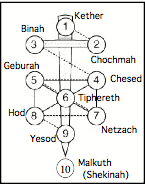
AHH, VERY NICE, THE SWORD IN THE STONE. You make of Malkuth, and of Shekinah,
the Stone. OF COURSE WE REMEMBER
THAT THE NUMBERS 1-17 ADDED TOGETHER RETURN 153, WHICH IS THE NUMBER OF
'MICHAEL THE ARKANGEL' IN ENGLISH GEMATRIA. The numbers 1-17 equal 153 and the numbers 1-26 equal
531. And 153 added to 531 equals
666, the number of the Anti-Christ.
Thus, the key numbers 17, 26 and 36 equal 79. And 79, in Hebrew gematria, besides equating to 'Boaz' (BOZ)
and 'Jachin' ('IAChIN') two of the pillars of the Temple of Solomon, also
equates the Jewish word for 'conjunction' or 'union', 'ODH', and also for the
Hebrew word meaning to 'Die' ('GVO').
|
70 |
O |
Union |
|
|
4 |
D |
Conjunction |
|
|
5 |
H |
|
|
|
|
|
|
|
|
79 |
|
|
|
|
|
|
|
|
|
3 |
G |
Die |
|
|
6 |
V |
|
|
|
70 |
O |
|
|
|
|
|
|
|
|
79 |
|
|
|
The conjunction of the DUAD, Michael/Jesus Christ (17,
Tipereth -- 26, IHVH) -- that is, the Christ principal in its totality -- with
666 (36 -- the Anti-Christ) leads to Death, leads to Annihilation of the
world. MATTER AND ANTI-MATTER
ANNIHILATE WHEN THEY MEET. Christ
and Anti-Christ also annihilate when they meet. YES, BUT THERE IS MORE. WE ADD THE KEY CROSSMANN NUMBERS TOGETHER, 17 AND 26 AND 36
AND RETURN THE NUMBER 79 -- BUT THERE IS ANOTHER NUMBER THAT IS KEY TO
CROSSMANN -- 16. THIS, BESIDES
LEAVING US A SECOND 16 SHORT OF THE MAGIC NUMBER 111, ALSO PROVIDES US WITH A
KEY UNDERSTANDING OF THE QUATERNARY NATURE. 16 PLUS 17 EQUALS 33 AND 33 PLUS 26 EQUALS 59 AND 59 PLUS 36
EQUALS 95. IN HEBREW, THE NUMBER
95 EQUATES WITH THE FOLLOWING WORDS: 'MARS' ('MADYM'), 'JOURNEY' ('MHLK'),
THREE ANGELS ('DYNAL', 'HHa'aYH' AND 'ZCha'aY'). MORE IMPORTANTLY, THE NUMBER 95 EQUATES WITH THESE WORDS
'HMN'
-- MULTITUDE, ABUNDANCE;
'HMYM'--
THE WATERS;
'MHLK'
-- QUEEN;
'SNL'
-- THE ROCK;
'ABN
GDLH' -- THE GREAT STONE.
IT IS THE PHILOSOPHER'S STONE WE ARE SEEKING AT THE BOTTOM
OF THIS COLD NIGHT. THE CA'ABA
STONE, THE ONE THAT HURTLE TURTLED OUT OF HEAVEN. THE BLACK VIRGIN.
THE BLACK QUEEN. THE MOTHER
OF THE WORLD. THE ROCK, WHICH IS
THE EARTH. MALKUTH, THE BRIDE,
FROM WHICH COMES EVERYTHING, THE MULTITUDE AND THE ABUNDANCE. THE NUMBERS, THE SEPHIROTH, THE TREE OF
LIFE, DESCRIBE THE DESCENT OF LIGHT OUT OF HEAVEN TO THE EARTH. THE EARTH IS THE ROCK FROM WHICH THE
PLANT COMES, THEN THE ANIMALS, THEN MAN.
|
5 |
H |
Abundance, |
|
|
|
40 |
M |
Multitude |
|
|
|
50 |
N |
|
|
|
|
|
|
|
|
|
|
95 |
|
|
|
|
|
|
|
|
|
|
|
5 |
H |
The Waters |
|
|
|
40 |
M |
|
|
|
|
10 |
Y |
|
|
|
|
40 |
M |
|
|
|
|
|
|
|
|
|
|
95 |
|
|
|
|
|
|
|
|
|
|
|
40 |
M |
The Queen |
|
|
|
5 |
H |
|
|
|
|
30 |
L |
|
|
|
|
20 |
K |
|
|
|
|
|
|
|
|
|
|
95 |
|
|
|
|
|
|
|
|
|
|
|
60 |
S |
Rock |
|
|
|
30 |
L |
|
|
|
|
5 |
H |
|
|
|
|
|
|
|
|
|
|
95 |
|
|
|
|
|
|
|
|
|
|
|
1 |
A |
The Great Stone |
|
|
|
2 |
B |
|
|
|
|
50 |
N |
|
|
|
|
|
|
|
|
|
|
3 |
G |
|
|
|
|
4 |
D |
|
|
|
|
30 |
L |
|
|
|
|
5 |
H |
|
|
|
|
|
|
|
|
|
|
95 |
|
|
|
|
ONE MORE EXAMPLE, BY PERMUTATION. WE ADD THE SUMS OF 1-16, 1-17, 1-26 AND 1-36. OUR RETURN IS 1306. WHEN WE TREAT THESE NUMBEERS AS
INDIVIDUAL UNITS: 1 PLUS 3 EQUALS 4 AND 4 PLUS 0 EQUALS 4 AND 4 PLUS 6 EQUALS
10. AND 10 IS THE NUMBER OF
PERFECTION, COMPLETION, TOTALITY.
THE END OF ONE CYCLE, WITH THE 1, THE MALE PRINCIPLE, AND THE 0, THE
FEMALE PRINCIPLE, AGAIN IN UNION.
THE GOD WITH HIS BRIDE, TAKING UP THE EGG, TAKING UP RESIDENCE IN THE
WOMB AGAIN, PREPARING TO BECOME 11.
|
|
Numbers: |
|
|
136 |
1 - 16 |
|
|
153 |
1 - 17 |
|
|
351 |
1 - 26 |
|
|
666 |
1 - 36 |
|
|
|
|
|
|
1306 |
|
|
|
|
|
|
|
1 |
|
|
|
3 |
|
|
|
0 |
|
|
|
6 |
|
|
|
|
|
|
|
10 |
|
|
Is he finished?
I DON"T KNOW. They've
come back out. WHO? Alfonse and Gaston. WHAT? We saw the light again. And we heard the voice. VOICES, IT SEEMED TO ME. IT SOUNDED LIKE MORE THAN ONE VOICE TO ME. Did you absorb all of that? I ABSORBED SOME OF IT. Did you understand that words had a
hidden energy network of numbers?
NOT TO THAT EXTENT. And
what of Crossmann? YES. What of him? I'M WONDERING WHAT ALL THIS MEANS, IN YOUR MIND -- REGARDING
CROSSMANN? His divinity, you
mean? ORE ALCHEMY! Yes, be careful when you speak that
word. MALCHEMY! Yes, I understand you can't.... HE KNOWS EVERYTHING, HE UNDERSTANDS
CANT. He understands Kant. HE UNDERSTANDS CUNT. Spectacularly speaking. DUNG AND MARS REFUSED TURNING BLACK IN
A QUADRILLE OR TWO. Adding heat to
dense energy: watch the frozen compounds break into marital components. GOLDSMITH OR TWO -- KEEPER OF THE ROYAL
MINT. From the black stone comes
everything, once it is heated to a significant degree. THE EARTH HERSELF, THE WOMB OF MALKUTH,
THE DAUGTHER OF THE SKY, BEING THE GREAT STONE THROWN DOWN FROM HEAVEN. A DEAD STONE TO THE EYE. BUT A FIRE BURNS WITHIN. AND PATIENCE IS REQUIRED, A STEADY
FIRE, TO ALLOWED THE ROCK TO EVENTUALLY BREAK OPEN AND ALLOW THE TRAPPED
ELEMENTS TO BEGIN TO ESCAPE TO THE SURFACE. WATER; HOT WATER.
COOL MILKY WATER. A WOMB
INDEED, BEING WARMED BY THE TWO FLAMES, ONE AN ACTUAL FLAME, AND A SECOND A
POTENTIAL FLAME, ONE WAITING FOR THE SECOND EXTRACTION. Magnesium. PARDON?
Vulcanelli, you mean? I
THINK THAT IS THE MAN IN THE RED HAT -- IS IT NOT? Don't look!
This is a house of God, afterall.
STONE OF DESTINY. A king
will sit on it for seven hundred years.
MORE THAN THAT. Talk to an
archaeologist. TALK TO THE RUSSIAN
WITCH; I'M SURE SHE CAN EXPLAIN TO YOU THE DAYS AND NIGHTS OF BRAHMA. Shhh! I think she can read your mind. Whether you mention her she looks at us. A FOUNTAIN COMING OUT OF A ROCK. THE WOMAN OPENING HER WOMB AND LIFE
COMING OUT, WATER AND MILK MIXED, MILK OF MAGNESIA. Ask Holmat if he is coming or going. HOLMAT AND TAMLOH; TORAH AND
HAROT. Are you coming or
going? WE'RE HERE. He asked you to pray with him -- can
you not sit with him for a few hours before his arrest? THE DOOR CLOSES. We are here with him. We are here. SPACE HAS INFINITE POTENTIAL. Who is that speaking?
I. Eye? INCIPIENT INCITEMENT. Narcolepsy's plea. EYE'S INVERSIONS. He is still here! I can hear him breathing! USING THE ENGLISH GEMATRIA SYSTEM THAT
VIEWS A AS THE AIN-SOPH, THE NO-NUMBER, AND B AS 1, THOUGH Z AS 25, WE ADD THE
NAMES OF THE SEPHIROTH TOGETHER AND RETURN THE DIVINE NUMBER 777, 111 TIMES 7.
|
0 |
A |
|
8 |
I |
|
13 |
N |
|
0 |
A |
|
8 |
I |
|
13 |
N |
|
18 |
S |
|
14 |
O |
|
15 |
P |
|
7 |
H |
|
0 |
A |
|
8 |
I |
|
13 |
N |
|
18 |
S |
|
14 |
O |
|
15 |
P |
|
7 |
H |
|
0 |
A |
|
20 |
U |
|
17 |
R |
|
10 |
K |
|
4 |
E |
|
19 |
T |
|
7 |
H |
|
4 |
E |
|
17 |
R |
|
2 |
C |
|
7 |
H |
|
14 |
O |
|
2 |
C |
|
10 |
K |
|
12 |
M |
|
0 |
A |
|
7 |
H |
|
1 |
B |
|
8 |
I |
|
13 |
N |
|
0 |
A |
|
7 |
H |
|
2 |
C |
|
7 |
H |
|
4 |
E |
|
18 |
S |
|
4 |
E |
|
3 |
D |
|
6 |
G |
|
4 |
E |
|
1 |
B |
|
20 |
U |
|
17 |
R |
|
0 |
A |
|
7 |
H |
|
19 |
T |
|
8 |
I |
|
15 |
P |
|
7 |
H |
|
0 |
A |
|
17 |
R |
|
4 |
E |
|
19 |
T |
|
7 |
H |
|
13 |
N |
|
4 |
E |
|
19 |
T |
|
25 |
Z |
|
0 |
A |
|
2 |
C |
|
7 |
H |
|
7 |
H |
|
14 |
O |
|
3 |
D |
|
24 |
Y |
|
4 |
E |
|
18 |
S |
|
14 |
O |
|
3 |
D |
|
12 |
M |
|
0 |
A |
|
11 |
L |
|
10 |
K |
|
20 |
U |
|
19 |
T |
|
7 |
H |
|
|
|
|
777 |
|
Black Phosphorus.
IN HEBREW, THE PHRASE 'AChTh RUCh ALHIM ChIIM', 'ONE IS THE SPIRIT OF
THE LIVING GOD', EQUATES TO THE NUMBER 777.
|
1 |
A |
|
8 |
Ch |
|
400 |
Th |
|
|
|
|
200 |
R |
|
6 |
U |
|
8 |
Ch |
|
|
|
|
1 |
A |
|
30 |
L |
|
5 |
H |
|
10 |
I |
|
40 |
M |
|
|
|
|
8 |
Ch |
|
10 |
I |
|
10 |
I |
|
40 |
M |
|
|
|
|
777 |
|
777 IS ALSO THE NUMBER OF THE 'FLAMING SWORD' THAT DROVE
ADAM AND EVE OUT OF THE GARDEN OF EDEN.
This seems a profound mystery.
YES. I am not sure that I
am absorbing this information. YOU
HAVE A CATALYST AT YOUR VERY HAND.
Hand ('YD') measures 14. I
SEE. AND PLEASE DON'T GIVE ME THE
MATRIX NUMBER OF VISION. You see that
it is a matrix! YES, I SEE THAT
MUCH. I SEE THAT IT IS A WEB, A
NETWORK OF CONNECTIONS. It is, or
it appears to be? YES -- I
UNDERSTAND YOUR DILEMMA. Whether
we apprehend what is there or what is in our mind -- and whether there is a
difference. YES -- I UNDERSTAND
YOUR DILEMMA. The Devil is 666;
God is 777; Jesus is 888. I DON'T
SEE THAT. In the beginning created
God the heavens and the earth.
This opening phrase of the bibile consists of 7 Hebrew words and The
number of 'God' is 86, 'Paradise' is 395; and 'Earth' is 296. Together these equal 777. BUT YOU HAVE SUBSTITUTED THE WORD
'PARADISE' FOR THE WORD 'HEAVENS' TO MEET YOUR NEEDS. This is all a bit mind-numbing, isn't it? IT'S THE LIGHT. Where is that light coming from,
anyway? LOOK AT IT. IT IS GOING AWAY AGAIN. IT'S GOING RIGHT BACK INTO CROSSMANN'S
HEAD. Zip. It is gone. I DON'T UNDERSTAND THAT! WHAT DOES IT MEAN?
You saw it didn't you. LOOK
HOW DARK IT IS NOW. AND HOW
COLD. Look! Ginsberg is that Moses fellow
again. NOT MOSES, MOISHE. What? MOISHE. THE FELLOW AT THE MOMA. HIS NAME WAS MOISHE FRANK. HIS NAME ISN'T MOSES.
What is he doing here? WHAT
ARE ANY OF US DOING HERE? We
are....what, praying in the dark.
Praying in the cold. YOU'RE
NOT PRAYING. What? YOU'RE NOT PRAYING. I DON'T KNOW WHAT YOU ARE DOING BUT IT
CLEARLY IS NOT PRAYING. I have
been....thinking about praying. I
have been... WE ARE ACCOMPANYING HIM WHILE HE PRAYS. ISN'T THAT WHAT HE ASKED US TO DO? BEFORE HE'S JAILED AGAIN. 'Cross' in Greek is also the number 777. THE ANGEL WHO MEASURES THE CITY, IN THE
BOOK OF REVELATIONS, THE NEW JERUSALEM IS THE SEVENTH ANGEL WHO HAS SEVEN BOWLS
FULL OF THE SEVEN LAST PLAGUES.
THE 'MEASURING ROD' WITH WHICH HE MEASURES THE CITY IS ALSO, BY
GEMATRIA, 777. I thought the light
had left us. IN GREEK, THE WORD
'REUSRRECTION' ALSO MEASURES 777.
I wonder where the voice is coming from now. WE SAW THE VOICE GO BACK INTO CROSSMANN'S HEAD. Perhaps it's a police spotlight. Perhaps the police are outside, surrounding
the church. NO, IT WENT INTO HIS
HEAD! I SAW THE LIGHT RUN RIGHT
INTO CROSSMANN'S HEAD! I saw it
too! YEAH, SO DID I! But the voice, I mean. Where is the voice coming from? IT'S A FULL VOCAL ANIMUS. What? Are you mad, or just drunk, Bill? PLAYING WITH A FULL THROTTLE OF WORDS. I see. THE MATRIX?
What? YOU SAID YOU SEE --
DO YOU SEE THE MATRIX? What's with
that stupid red hat, anyway? YOU
ARE NOT SUPPOSED TO ASK. You are
supposed to know, you fool!
ATHENOR REDRESS. What? Speak more clearly, Bill. ATHENOR CASTLE. I don't understand you. YOU DONT UNDERSTAND ANYTHING HERE? Well, that's not fair. DO YOU UNDERSTAND THE POSTMAN? What? THOU SHALT NOT STEAL, HERR MANN, DOUBTING THOMAS. Thoushaltnot steal, but thoumay
borrow. FROM THE WORLDWOMB. Plagiarist! POSTMAN BOASTMAN.
LETTERCARRIER BETTERMARRYHER.
Hand on hand; someone's in white.
WHITE FROM BLACK; RED FROM WHITE.
Smoke in the Vatican belfry.
THERE HAS BEEN A SIGHTING OF THE POPE, MOVING UP BROADWAY IN A CART
DRAWN BY AN ASS. Man of Numbers
and Man of Letters. MAN OF HOD AND
MAN OF NOD. Crossmann! I can't hear you! A SIREN! DID I HEAR A SIREN! Numbers of Man and Letters of Man. WHERE ARE WE GOING? Haven't you read the book -- Man on
a Tightrope? AYE! I SAW THE MOVIE! Eyes are to the Day what Ears are to
the Night. YES, WE KNOW THAT. You can't convert a bunch of cynical
intellectuals. He is preaching to
the wrong crowd. He should preach
to the lowest, the least proud, thieves and whores, cripples, beggars. Cynical intellectuals believe that they
are gods. They are impossible to
unseat with merely mysticism.
CLEARLY, WE ARE NOT THE BLACK STONE. We are very far from the black stone. REALLY? I DO NOT CONSIDER IT SO. I AM SITTING ON A BLACK STONE. See him point under his ass. He is truly sitting on a black stone. HE'S DRUNK. He's been drinking children's blood. WHAT! Yes. IS HE A
JEW TOO! No, a good old boy from
Virginia. OH, I SEE. GUILT! Southern Liberal Guilt. IS BILL MOYERS IN THE HOUSE? Ice. Ice
Tea. THE LETTER 'I', 'Y' AND 'J',
YOD, IS THE HAND.
Breugel's damned beginnings. HIS HAND, SPANKING THE STUDENT IN HIS CLASS. The ass in the window. THE BEGINNING OF SOMETHING RUDE. Bear shite. UP THE HILL IN THE SNOW. Marvellous. YES, MARVELOUS.
A piece of paper flapping blithely. CRANING TO SEE THE CREATOR. I.
EGO. EGO IAGO. Greek lament. IAGO PRADO.
Greek contentment. THE HAND
ON THE NAKED BOY'S BUTT. Homo
erotickus erectus. ELECTRA;
ELECTRON STATION; EQUAR ELECTION; PNEUMA.
Pandemonium. PANDER
HAND. Hebrew hand, looking like a
cock to me -- with something in it.
A coin or two. Melting in
the snow. A ITCH EYE JAKE KAYE
ELLEN HEM O' PEE. Why is
everything a bathroom stimulus to you?
IT'S NOT A BATHROOM STIMULUS, FRANKLY. IT IS A PICTURE ON HIS PARENT'S FIRST LOVEMAKING EVENT. Learning thee alphabet by hand. ALEPH SLIDES INTO BETH, FEELING THE
SILKY PARTS OF HER OYSTER. Ox in
his pants; moist oyster in his pink eye.
PINK EYE IN HIS HAND; MOIST ROOSTER IN HIS HAND. TIP OF THE HEAD TO YOU,
DEAR. Miles of Isles. A blonde trajectory with a peapod and
hood. KEPH. ALEPH BETH KEPH. Deaf. BEETHOVEN. Easy
annihilation. EFF. Feff. GEFFIN. DAVID
GEFFIN. Eff ewe see Kaye. MANNERS OF A THIEF. Grief monkey, poised above the
bridge. TOUCHED BY THE I OF
YOD. Jod. JOD-CARRIER. Maker of mint.
MASONS. The Rosebud
Cross. Knights of the Rosebud
Cross. AYE. Touch the peapod with a wet
finger. YES. Ink on the pin, underneath the skin, a
crazy icecycle coming in. MADE FOR
TWO. At least two. THE CRAZY PEAPOD ARCHING ITS SKIN
HEAVENWARD, ACHING TO FIND A HAND OR LIP.
Ipso facto. ISOCELES. Electra knows that her father has an
itch on. THE SPECTRE OF TOO-CLOSE
LIVING, HAND IN GLOVE. Pardon my
wind. GINSBERG IS BACK. Moses is gone. MOISE IS GONE. Yeah, him too. SITTING TO CLOSE TO THE RADIO. I know. MOVE BACK A BIT, BACK TO THE BLACK STONE. Hurtle turtle. IT AINT ME, CABE. Pig Latten, the fire burns low. UFFALO BEY ING SPREY IELD FAY. Faye Morgan, Faye Morgan. ORGAN MAY IND FAY EE THAY IN OR YEE
EELING FEE OOD GAY OODD MAY, FAYE MAY.
May I inspect your ink-finger again, dear? Curiosity's inning gray ache say. MINOR. I Y
J. IN YOU JESUS. I J Y. IN JESUS YOU. J
Y I. JEHOSHUA YESHUA IESOUS. Three names in one. FORTY FOUR. Thirty. TRICKLE
DOWN. TRICKLE DOWN. Israel Joins You. You Join Israel. Joins Israel You. JOHN JOHN, JOHN. JEUS JACOB JOSEPH. The hand. Of partnership.
Brotherhood. IES. The hand is what makes man capable of
innovation, capable of invention.
CAPABLE OF BREAKING DOWN THE CATASTROPHE OF 'H'. Hubert Horatio Humphrey. HERBERT HANOVER HOOVER. Hunsucker's Hubris and Harrowing
Proxy. HA HA HA! A Koen being what again? A KAYE NOT AN AITCH. Yes. You are right.
WHAT'S THIS ABOUT BREUGEL?
Ask that short man who talks fast.
YOD JOD IOD GOD. Iodine
God. BLOOD AGAIN -- ROYAL
BLOOD. Of course. DE JURE PLA JURE. Miletus made is simple then, the Iodine
God becoming the Pillar God: I.
THE PHALLIC GOD, JOD Jod He
Vav He. FOUR CORNERS OF THE
SQUARE. The Sky is Raise. Erection is election. BUT LIGHT DOES NOT LAST. Aye. RIB-EYED EVE.
IEVE'S CREATION. Aye. Incipient Instinct Insinuating
Isosceles. TWO EQUAL SIDES. Rib-Eyed Eve: Instinct's Invention. HAND, TAKE, GIVE. To command, to show, to exhibit. Time. YES. THE HAND
OF TIME. Precisely. HAS IT STOPPED SNOWING. LOOK, THE MOON! The is where the light comes from. NO, I SAW IT RUN INTO CROSSMANN'S
HEAD. Yes, I did too. YOU TWO ARE...YOU HAVE REPUTATIONS, YOU
KNOW. What kind of
reputations? WELL, LET'S JUST SAY
THAT YOUR PERCEPTIVE ABILITIES IS OPEN TO QUESTION. Don't know who the hell I'm saving any more. WHAT? WHO SAID THAT?
I let go. And I let
go. WHO WAS THAT? DID YOU HEAR THAT? I'm losing such a central part of me --
I can't let go of it. THERE IT IS
AGAIN! I recognize how much I've
lost. But I cannot face the
cost. THERE IT IS AGAIN! Iron Nails Run In. 270. IN ENGLISH, 50 -- THE YEAR OF HIS BIRTH. Cough Kaye. HE HE. The Clerk
as a Writer. HE HE. C.O.D.A. Coada. CODA. If
you insist. YAD IS THE HAND WITH
RESPECT TO THE FINGERS. You know
the green from the red. You know
the quick from the dead. THERE IT
IS AGAIN. Yes, I heard it
too. CONVERSATIONS GET TOO
STRONG. Yes. KAF IS THE HAND WITH RESPECT TO THE
PALM. Where the water
gathers. YES. Maple. PALMETTO.
Sanctity. RECEIVING. Yes. RECEIVING BLESSINGS.
Yes. WHAT ELSE GOES IN THE
PALM? Sunday. YES. WHAT ELSE? He
wasn't with the angels in their quilted coats. Finding my way home.
FROM THE GREAT ESCAPE.
What? WHO WAS THAT SECOND
VOICE. Only us sleeping -- only us
dreaming. I hear you calling
me. I hear you calling me. YES. Yes. FROM THE GREAT ESCAPE.
Aye.

RIVER, RIVER, RIVER RUNNING DEEP. BRING ME SOMETHING TO HELP ME GET SOME SLEEP. There it is again.
KAYE IS NOT CLEAN.
KAYE IS K K K. Cough Kaye:
checking walnuts with Coff Keff Keph.
AMERIKA. KKKK Ken
Kesey. METAMORPHAKUSS. Krissy Kross Kiss. HE HE KAYE. Fingers to palm, buried in Kaye. KRIMENY KRIMENY KRIMENENTY. Rosencranz and Gilgenstern. OBJET DEVILLE. Coffer Coffer Coffer. ECOLE DE SKOOL. Kris Kringle Krafts Klefs von
Kindern. KOOL KLUX KILN. Moniter von Minten. IN THE PALM. Father, can you help out an old altar boy. ALTERN BOYNE BOYNE. Bought. DAS KAPITAL.
KARL KARL KARX - Markie Mark.
MARX. GROUCHO, HYPNOTO, AND
KITO. South of the Belt -- South
of the Border. BORED HER, HE BORED
HER, CROSSMAN BORED OUR OLD FRIEND KATE.
Mate the Mime and Mary the Y.
W Y K. Wicked. WYKOFF. Wyk is Wake. Is
Michael Crossmann awake?
DREAMING? IS HE NOT? Kalamedy. WHAT?
Kalamedy? TRAPPED IN
TIME? Yes. That is a kalamedy. THE SKILLS WE DEVELOP IN THIS LIFE WE
KEEP IN THE NEXT LIFE. A GREAT
WRITER IN THIS LIFE REMAINS A GREAT WRITER IN THE NEXT. A GREAT THINKER HERE REMAINS A GREAT
THINKER THERE. A GREAT BUSINESSMAN
REMAINS A GREAT BUSINESSMAN. A
GENIUS IS THE MAN IN CONTACT WITH HIS OWN SPIRIT. WHEN THE MAN REACHES HIS GENIUS, THEN HE LEAVES AND DOESN'T COME
BACK. Hi Jack. Hi Jack. WHAT DID YOU SAY?
What? YOU SAID HI
JACK. Hi, Jack Black. Hi, Jack Drack. Jack Crack Corn. HI, JACK MORMON. HI, JACK THE DOORMAN. Black hand on the door. Black hand on the floor. ANOTHER PLANE. WHERE IS IT GOING? FLYING SO LOW. HEADING SOUTH, OVER THE TREES. TOO LOW. TOO
LOW. Hi, Jack. Jack Highbrow lowered loughly. By the lock lucked by luffly seth seth
seth. Serpent Snake Sipher
Seshtha. Siphon Typhon. Typhon Tower. TTP.
Tiphereth. TOO TOO
PROXIM. Who is driving that plane,
that train? DRAT. Twint Hours. DON'T SAY THAT!
What? SSSH! SOMEONE WILL HEAR YOU! I didn't say Twin Towers. I said Twint Hours. OBL. OBL. Oblongata.
OBLONSKY. Count the planes
as they dive. ONE, TWO BUCKLE YOUR
SHOE. THREE, FOUR, AN ACT OF
WAR. Looking for Thor's
exceptional thunder. OBLIGATORY
MENTOR. Perhaps you can sell him a
room in the Millenium Hotel.
LAMBDA LAMB A LA AL LA.
Don't say anymore. OSANA
BIN LAMBDA. Ladened with the
blood. BUCKETS OF BLOOD. Leaden man in his black shawl and
padre. PANDERER OF NAROK. Meanderer of Ranko. DOCK, DOCK, TALK NOT DOCTOR. Truman. Keep your mouth shut.
They will be rushing toward me.
EL. They will be coming to
get me. DON'T TELL THEM
ANYTHING! BLAME IT ON CROSSMANN! What? CROSSMANN ONCE WAS A COMMUNIST! BLAME IT ON HIM!
SAY HE HATED AMERICA!
What? YOU HEARD ME! Holy Dahij! HOLY DAHIJ!
What are you two talking about?
Holy Dahij! What does that
mean? NOTHING! Don't say anything! LET'S GO BACK INSIDE! Shhh! Loose lips sink ships!
SHH! Aboo Dobby. SHH! Toothpick Sudan.
SHH! Nadus. SHH! Nemey.
SHH! Cole Coal Koan. SHH! Loose lips shrink hips. ANGELINA JOLIE.
Loose lips link lips. EL EL
EL Degeneratus. QARI. Shh! NARI. Shh! AIRYS. Shh! LOCK LOCK
LOCKERBY LOUGH. Shh! CHOOSE THE CROSS OR CHOOSE THE CUTLASS. Choose the cross of choose the
cyclone. CHOOSE THE CROSS OR
CHOOSE THE CUTTER. Choose the
cross or choose the cycle. CHOOSE
THE CROSS OR CHOOSE THE SCEPTRE.
Does one choose this? Is
this a choice one makes? Or does
God make the choice? Does God make
the mechanism in which the choice appears as a choice but which is, in fact,
the cycle? The nature of the
Law? LOVE'S LABOUR'S LOST. Go inside! WHAT? Go
inside! LOOK AT THE OLD
WOMAN! LOOK AT HER FACE! Let's go back in. A DOOR. A MEMORY OF THE AIRPLANE. Bow ring. BEAU
INK. 18. YES, LET'S GO IN.
Door opening. Warmth. A kind of warm womb. Did yor hear that voice, Truman? WHAT? Did you hear that voice? WHICH VOICE?
The one that told me to betray Crossmann? NO. No? ARE YOU THE VOICE INSIDE THE
VOICE? I don't know. I HAVE CHOSEN YOU! Me? Me for what?
FOR YOU TO BETRAY HIM, SADUJ!
Lost. MOTHER! FORGIVE ME! FOR TAKING SO MANY LIVES! Love. LN LN LN LN. FORGIVE ME. 12 plus 14 equal 26. LOST. LAST. LOVE. Last love of a choirboy. LESLIE LESLIE LESLIE.
RHODES. LESLIE RHODES. LAST. LOVED.
LOST. LURID LUCK.
Ox goad. YES. THE
WOMAN. The goad, the rope, the
scepter. YES. NAMOW. Luck. MOVE THE
MOUNTAIN; MAKE MOHAMMED COME TO THE MOUNTAIN. Em Em Em.
SEE. Learn, study,
teach. MOVE, GENERATE,
EXPAND. Extend, interdict,
oppose. SCEPTRE. In the direction of. THE PLAIN JURIST. A man named Satan. WHAT? A man named Natas.
DEMAL. What? A MAN NAMED SATAM. Matas. WHERE DID THEY GO?
Inside. HE HAD A NIGGARDLY
LOOK, AN INSANE SMILE ON HIS FACE.
Which one? THE ONE IS
DISGUISE. The look of a coward,
hiding inside a suit. YES, A
DISGUISE. I think it is not a
disguise. WHAT ARE YOU
SAYING? The Arab, you mean. YES. Watch him closely.
He means to do us harm. I
SEE. Waters and Chaos. WHAT? Memory is chosen.
NOT CHOSEN. Memory is an
imposition against action. WHEN
MEMORY RETURNS, ACTION IS DEFEATED.
Mementos of the harp. PHAR
AWAY THE WIND BEGINS TO BLOW. Was
that thunder? OR WAS IT
LIGHTNING? The ore 'dor opens
through heat. HEAR THAT SOUND,
THAT EXPLOSION! What was it? GOD'S UNBLANCHING HAMMER. Talk not about Thursday's green
blessing. SSH! SHE IS LOOKING AT US AGAIN. Mammary branch and the Tree of
Continued Living. NEAR THE
ROOT. The man who has no roots is
lost. THE MAN WHO KNOWS NOT AND
TRESURES NOT HIS ROOTS IS LOST.
Worse even more for the woman with no roots. For the woman is the root. Man is allowed to travel and fall. But the woman without roots is a
Namibian whore or dragon.
SILENCE! What? SILENCE! Emma is on her high horse again. EMMA goes forward and backward, always protecting the son of
God. EXCEPT ON JULY 16, WHEN SHE
HAS TO TAKE A REST. So, on July
16, the son of God is vulneerable to attack by the air. PRECISELY. And what of September 11? QUICK, CALL 911.
YOU ARE CALLING 911.
Emergency? Is that what you
are saying? 9 PLUS 11 IS 20. 9 PLUS 1 PLUS 1 IS 11. Eleven eleven.. ROLL THE DICE AGAIN. Emma becomes Anna. ANNA ALSO COMES AND GOES, MOVING IN
BOTH DIRECTIONS AT ONCE. Anna Nina
Nani means the Greek goddess Grace.
CHALDEAN FOR HEAVEN. Anna
is the Heaven; and Emma is the Hell.
EACH PROTECTING THE SON OF GOD.
MOTHER OF MARY. Waters flow
and waters grow. M-M-MICHAEL,
MITICULOUS MICHAEL, MERITOR OF MERCURY, MAGNIFIED OF METATRON. Poor Amlode, not knowing what he did
and all. I'M LETH ABLE TO
UNDERTHAND THOSE LATH ALLUSIONS, CARPENTER. Water running in both directions at once? Is this some kind of riddle? DO THESE WOMEN BECOME EMBLEMS OF THE
UNIVERSE AND THE ANTI-UNIVERSE, TWO RIVERS FLOWING IN OPPOSITE DIRECTIONS? Questions, questions -- what was that
noise? DEAD ALL US AT ELEVEN? Flight of the ancient southern cross. HITLER AND SCEPTRE ALMOST RHYME. See how Namo stands at his side, almost
nameless. NAN IS HOLDING HIS HAND
AGAIN, OLD WITCH. Watch out! Don't look her in the eye! NANA SHINES ON HIS BONES LIKE SOME
BEWITCHMENT, WHISPERING IN HIS EAR.
What does she tell him? SHE
SPEAKS IN A VOICE OF SILENCE -- SO WE CANNOT HEAR. Paranoia. PAIR
O' NOVA. Novus homo. VIRGO BLANCHES. Dung night transmuted. THERE MUST BE HEAT SOMEWHERE. Rose is from the German meaning
horse. WHITE HORSE? Damned inconvenience, I must say -- at
this hour. THE ROSE IS ONE THE
CROSS, I FEAR. Cross is on the
Rose too, let us not forget.
EROTIC ROSARY YOU ARE SAYING IN YOUR BRAIN, WILLIAM. Fault near here and fault near
there. I CONFESS TO THIS. You are no saint, you! NEIN, AS THE GERMANS ARE FOUND OF
SAYING. EIGHT PLUS ONE IS
NEIN. Nein is Yes in the other
world, lest we forget. ROSE IS
FOLLOWING THE CROSS TOO. I CAN
SMELL THE PURFUME SHE WORE TONIGHT.
Ahh, sure a sweet smell of youth.
ROSE OF CHARON, COMING IN HIS BOAT. Conflagration on his mind. ROCK ROSE, STANDING NEAR OUR SAVIOR. December 16 flower of his birth. DAY OR NIGHT? Symbolic of sense.
ELLE AND ALL HER PRODUCTIONS FROM ETERNITE. Ambiguous nomenclature. YOUR FINGER IS TURNING BLUE, MAN! Erotic thoughts again, Friar Skin Tucker? OTTO OTTO OTTO, GRANDFATHER OF
SOUND. If a menstrous woman mounts
a horse, it will die or become diseased.
MOTHER SEED ROOT.
MEMSOOTH. Saturn's
clattering truth monster. MEMING
MOST OF ALL, I FEAR. Sagittarean
and all. SATYR INSIDE THE YOUNG
GIRL'S SOU. Silk purse. MEM NON AND MEM KNEW. Mem's Fist: Pyramid builders. AHH. 13 being an unlucky ending. TWO 13'S BEING WHAT?
26. YES. BUT WHAT ELSE? The place where the Universe and the
Anti-Universe meet. QUICK, DRAW IT
IN THE SNOW!
Mem is the word. LOOSE QUIPS BRINK FLIPS. Floose paps drink pink pips. FAULKNER IS ON THE RUB AGAIN. On the rum agib? On the run, A...A...Agrippa? YES. Achille's fiend. Feet First Makes For Blood On the Brain. YES. Note how the four convergin arrows constitute a cross at the
center of the flower.

WHOM DO WE HAVE TO THANK FOR
THIS? For the falling ash, you
mean? COLORING THE SNOW GREY. Is there a volcano near here? SERIOUSLY! Thor lives up on that mountain there, Mister Iron
Cross! CROZIER'S BLUSTERING ROSIER
MUSKETRY. Gallow's Rumor. ELVIS TAKING ON THE WHEEL. FEELING HIMSELF THE HANGED MAN'S
FRIEND. NMN. MNM. HMM!
Meistersinger. MAKE A PIECE
OF THACKERY, PLEASE. Iron Cross;
Cross Iron
 .
.
MAGUS MAGUS. MAKES A MARK. Four by four.
FREQUENTER OF FORM. Magus
Magus. MAKES A MANGER. Two by two. CALIBRATOR OF CALCINATION. M is movement, water flowing; purification. IS MOSES READING A BOOK OVER
THERE? Impurity is the
confrontation with one's own mortaility when one believes there is no way
out. NO FUTURE. Again, trapped in the present. IN HEBREW, 'MI' OR 'MY' IN 'WHO?' WHEN IT IS WRITTEN VERTICALLY, IT IS A
THEOLOGICAL INTERPRETATION ADDRESSED TO GOD: 'WHO ARE YOU?' WHEN IT IS WRITTEN HORIZONTALLY, IT IS
A ANTHROPOLOGICAL QUESTION: 'WHO ARE YOU, WHAT PERSON ARE YOU, WHERE ARE YOUR
ROOTS?' THE EVOLUTION OF THE
LETTER FROM VERTICAL TO HORIZONTAL AND THEN FROM HORIZONTAL TO VERTICAL IS A QUESTION
ADDRESSED TO IDENTIY AND REALITY.
ALSO, IT IS A SIGN OF LIFE'S MOMENTUM. The horizontal, the East-West axis, is anthropological,
right to left. The vertical, the
North-South axis, is theological, head to toe. WHO ARE THE BARBARIANS? The White God and the Black God. The God of Life and the God of Death. 13 PLUS 13. M is the unconscious mind, the great ocean, the original
mirror, reflecting the self and the world. THE MIDPOINT.
Tiamat. PRIMEVAL
CHAOS. Enki iknE. ASHERAH HAREHSA. Ashtar is the son of Asherah, fresh
water, underground water, the spirit of irrigation. YAMM YAMM. Mmay
Mmay. GOD OF THE DEEP SEA. God of the Deep. TIAMAT TAMAIT. What was that sound? It sounded like a bomb going off? THUNDER THOR ROTH REDNUHT. Roth Rednut? WHAT DOES THAT MEAN?
AND WHY ARE WE HERE IN THE SNOW STUDYING THIS MIASMA? THE ORIGIN OF LETTERS. The splitting of the atom. WHAT? The splitting of the atom. I DON'T UNDERSTAND THIS. The snake in the water. WHAT? She is
looking over here again. WHAT DOES
SHE REPRESENT? The snake in the
water. HOW DO YOU KNOW THIS. Feminine form; the letter N. MEM is the Hagned Man, Number 29. N is Death, number 28. OSAMA BIN LADEN. OBL. ALSO 29.
|
15 |
O |
|
2 |
B |
|
12 |
L |
|
|
|
|
29 |
|
Where does this come from? 29 MEANS 'IS BROKEN', TO 'BREAK DOWN,
OVERTURN'.
|
4 |
D |
Is broken' |
|
|
|
20 |
K |
|
|
|
|
5 |
H |
|
|
|
|
|
|
|
|
|
|
29 |
|
|
|
|
|
|
|
|
|
|
|
5 |
H |
to break down, overturn' |
||
|
4 |
D |
|
|
|
|
20 |
K |
|
|
|
|
|
|
|
|
|
|
29 |
|
|
|
|
WHAT WAS THAT SOUND? DID YOU HEAR IT? AND IS THAT SMOKE OVER THERE, OFF TO
THE SOUTH? Add 1 through 29 and we
get number 435.
|
5 |
H |
Deceived' |
|
|
400 |
Th |
|
|
|
30 |
L |
|
|
|
|
|
|
|
|
435 |
|
|
|
IN ENGLISH, 'OBL' IS 29. IN HEBREW IT IS '102'. 102 IS BA'AL, BELA, A KING OF
EDOM. A WILD GOAT OF A MAN.
|
2 |
B |
|
70 |
a'a |
|
30 |
L |
|
|
|
|
102 |
|
What is this all about? I thought we meant to pray here this
night? BELA -- DID YOU SAY
BELIAL? I think he did. YOU REMEMBER THAT MYKAL THE ARCHANGEL'S
NUMBER, IN HEBREW, IS 101. Yes. WHY THESE LETTERS AND NUMBERS? ARE WE HERE TO MODIFY OURSELVES THROUGH
PRAYER? OR TO BLASPHEME FAITH
THROUGH MYSTICAL FATALITY?
Blaspheme faith? Rather to
elevate faith by providing faith with unbreakable pillars of support. I HEAR SIRENS OUTSIDE? ARE THE POLICE COMING TO GET US? N is the snake, the water snake, or the
fish. NUN IS THE WORD. Sister Mary Olive. SISTERNS OF LORETTO. Hidden in the rubble. THE SEASNAKE HIDING IN THE DEEPEST
POOL. N hidden inside of M. HOA BEING WHAT? What? STEALING THE PLANT FROM GILGAMESH. Hidden depths cannot be seen. LOOK AT THE OLD WOMAN.
She is a nun too, isn't she?
A type of nun. NUN. Nunsense. She was a married woman. She calls herself a priest. A High Priest, at that.
WHAT DOES MOSES SAY OF THIS? Moishe. YES, MOSES.
WHAT DOES HE SAY? Hidden,
intimate, feminine, a place where one can hide. MOUNTAIN CAVES OF AFGHANISTAN. See the enemy's face.
BRINGING DOOM INTO HIS HOUSE.
Fish, fetus in the fetal sac; spark, life, forthcoming birth, infant;
growth, production, product, advent; to grow, to open, to push, to twist. NUNCY DREW. Nuntucket sleigh ride.
N HIDDEN IN THE M; FISH HIDDEN IN THE WATER. Snake hidden in the mountains of Afghanistan. WHAT WAS THAT SOUND? IT SOUNDED LIKE A BOMB WENT OFF! DO YOU HEAR SIRENS OFF TO THE
SOUTH? Remember, the World Trade
Center was bombed tonight. OH,
YES. I REMEMBER. Don't worry about it. We are safe. WHAT ABOUT OUR GRANDCHILDREN? I don't know. I
don't know. THE N IS HIDDEN IN THE
M. NINA IS HIDDEN INSIDE OF
MICHAEL. Fourteen Manus. Fourteen Manus. FIFTY COMPLICATIONS. FIFTY COMPLICATIONS. What is all this talk about bin
Laden? IN HEBREW GEMATRIA, BIN
LADEN IS 324.
|
70 |
O |
|
60 |
S |
|
1 |
A |
|
40 |
M |
|
1 |
A |
|
|
|
|
2 |
B |
|
10 |
I |
|
50 |
N |
|
|
|
|
30 |
L |
|
1 |
A |
|
4 |
D |
|
5 |
E |
|
50 |
N |
|
|
|
|
324 |
|
324 IS 18 SQUARED. 18 IS THE BELOVED; BUT IT IS ALSO
HATRED; AND THE ANTIQUE SERPENT.
|
1 |
A |
My Beloved |
|
|
|
5 |
H |
|
|
|
|
2 |
B |
|
|
|
|
10 |
Y |
|
|
|
|
|
|
|
|
|
|
18 |
|
|
|
|
|
|
|
|
|
|
|
1 |
A |
Hatred |
|
|
|
10 |
Y |
|
|
|
|
2 |
B |
|
|
|
|
5 |
H |
|
|
|
|
|
|
|
|
|
|
18 |
|
|
|
|
|
|
|
|
|
|
|
8 |
Ch |
The Antique Serpent |
||
|
9 |
T |
|
|
|
|
1 |
A |
|
|
|
|
|
|
|
|
|
|
18 |
|
|
|
|
IN ENGLISH GEMATRIA, OSMAMA BIN
LADEN IS THE NUMBER 110. 110 IS
THE NUMBER PRIOR TO 111. 110 IS
DMYVN, RESEMBLANCE OR LIKENESS; IT IS ALSO YMYN, THE END OF DAYS.
|
15 |
O |
|
19 |
S |
|
1 |
A |
|
13 |
M |
|
1 |
A |
|
|
|
|
2 |
B |
|
9 |
I |
|
14 |
N |
|
|
|
|
12 |
L |
|
1 |
A |
|
4 |
D |
|
5 |
E |
|
14 |
N |
|
|
|
|
110 |
|
|
4 |
D |
Likeness, resemblance |
|||
|
40 |
M |
|
|
|
|
|
10 |
Y |
|
|
|
|
|
6 |
V |
|
|
|
|
|
50 |
N |
|
|
|
|
|
|
|
|
|
|
|
|
110 |
|
|
|
|
|
|
|
|
|
|
|
|
|
10 |
Y |
The end of days |
|
|
|
|
40 |
M |
|
|
|
|
|
10 |
Y |
|
|
|
|
|
50 |
N |
|
|
|
|
|
|
|
|
|
|
|
|
110 |
|
|
|
|
|
ANTI-CHRIST? Resemblance, likeness: is that not the
mirror? EACH IS EACH TO EACH. Facing down. RIGHT AND LEFT.
Over and out.
|
13 |
M |
|
9 |
i |
|
3 |
c |
|
8 |
h |
|
1 |
a |
|
5 |
e |
|
12 |
l |
|
|
|
|
10 |
J |
|
15 |
o |
|
8 |
h |
|
14 |
n |
|
|
|
|
3 |
C |
|
18 |
r |
|
15 |
o |
|
19 |
s |
|
19 |
s |
|
13 |
m |
|
1 |
a |
|
14 |
n |
|
14 |
n |
|
|
|
|
214 |
|
214 IS WHAT? 214 is ZZR, the Angel of Aries; 214 is
also 'whiteness', 'Air, Spirit, Wind and Mind'; and 'Came Down' (from Heaven).
|
8 |
Ch |
Whiteness |
|
|
|
|
6 |
V |
|
|
|
|
|
200 |
R |
|
|
|
|
|
|
|
|
|
|
|
|
214 |
|
|
|
|
|
|
|
|
|
|
|
|
|
200 |
R |
Air, Spirit, Wind, Mind |
|||
|
6 |
V |
|
|
|
|
|
8 |
Ch |
|
|
|
|
|
|
|
|
|
|
|
|
214 |
|
|
|
|
|
|
|
|
|
|
|
|
|
10 |
Y |
Came Down |
|
|
|
|
200 |
R |
|
|
|
|
|
4 |
D |
|
|
|
|
|
|
|
|
|
|
|
|
214 |
|
|
|
|
|
'MICHAEL J. CROSSMANN' is 177. AND 177 IS 'DOMINUS DOMINORUM' -- THE
'MASTER OF MASTERS'; ALSO 'THE GARDEN OF EDEN'; 'TO CRY OUT FOR HELP'; 'THE
ANGEL OF CAPRICORN'; AND 'PLENITUDE OF PLENITUDES'.
|
1 |
A |
Dominus Dominorum |
||
|
4 |
D |
|
|
|
|
6 |
V |
|
|
|
|
50 |
N |
|
|
|
|
|
|
|
|
|
|
5 |
H |
|
|
|
|
1 |
A |
|
|
|
|
4 |
D |
|
|
|
|
6 |
V |
|
|
|
|
50 |
N |
|
|
|
|
10 |
Y |
|
|
|
|
40 |
M |
|
|
|
|
|
|
|
|
|
|
177 |
|
|
|
|
|
|
|
|
|
|
|
3 |
G |
Garden of Eden |
|
|
|
50 |
N |
|
|
|
|
70 |
a'a |
|
|
|
|
4 |
D |
|
|
|
|
50 |
N |
|
|
|
|
|
|
|
|
|
|
177 |
|
|
|
|
|
|
|
|
|
|
|
7 |
Z |
To Cry Out For Help |
||
|
70 |
a'a |
|
|
|
|
100 |
Q |
|
|
|
|
|
|
|
|
|
|
177 |
|
|
|
|
|
|
|
|
|
|
|
40 |
M |
Plenitude of Plenitudes |
||
|
30 |
L |
|
|
|
|
6 |
V |
|
|
|
|
10 |
Y |
|
|
|
|
|
|
|
|
|
|
5 |
H |
|
|
|
|
40 |
M |
|
|
|
|
30 |
L |
|
|
|
|
6 |
V |
|
|
|
|
10 |
Y |
|
|
|
|
|
|
|
|
|
|
177 |
|
|
|
|
WHAT HAS HAPPENED IN OUR
CONSCIOUSNESS? HAS SOMETHING
TERRIBLE HAPPENED? What was that
Arab talking about? That
Faramarz? What about that plane? What about hi-jacking? WHAT HAS CROSSMANN TO DO WITH THIS BIN
LADEN? This suggests that
Crossmann is 'whiteness' or 'spirit' -- the master of masters -- who was
present in the Garden of Eden but who heard a cry for help and came down out of
Heaven here to Earth. TO BE WITH
US DURING OUR SUFFERING. Metatron
in English gematria is 106; as is the letter Nun in Hebrew. THE HIDDEN DEPTHS THAT CANNOT BE KNOWN. Except in dreams.
|
13 |
M |
|
5 |
E |
|
20 |
T |
|
1 |
A |
|
20 |
T |
|
18 |
R |
|
15 |
O |
|
14 |
N |
|
|
|
|
106 |
|
|
50 |
N |
|
6 |
V |
|
50 |
N |
|
|
|
|
106 |
|
WHAT WE DON'T KNOW DOES HURT
US. Can hurt us. YES, CAN HURT US. What don't we know? WE ARE HERE TO LEARN MORE OF THIS. TO SEE THE FUTURE MORE CLEARLY. Is this some vision quest then? SOMETHING OTHER THAN THIS? There are 89 chapters in the Four
Gospels and 22 chapters in Revelation.
89 plus 22 equals 111.
SANCTIFICATION OF THE CRUEL, YOU MEAN? What did he mean, talking about the empire? WHAT EMPIRE? The Islamic Empire.
I DIDN'T HEAR HIM SAY ANYTHING ABOUT THAT. There are two doors: behind one is the Lady; behind the
other is the tiger. YES. Which will he choose? TIME BEING WHAT IT IS, WILL HE CHOOSE
BOTH? I wonder. WHAT WE DON'T KNOW CAN SAVE US
TOO. Knowing too much is a problem
-- is that what you are saying?
PERHAPS.
Oh, yes. OTTO.
Omicron. OHM. OHM. Indian electrical scientist. THE SOUND THAT ROCKED THE WORLD. OHHHHHHHHHHHMMMMMMMMMMMMMMMMMM. OOO OF GIOTTO.
Air rushing in through the window.
Branch brushing on the glass.
Tiph. Tiph. FIRE, INSTEAD. A woman sitting at a desk, working, is
incinerated at her desk. A fresh
face. A beautiful girl. Fried in a second. WHAT? WHAT? Where did
that come from? Windows
breaking. Steel snapping. I DON'T WANT TO HEAR THAT! Get this plane back in the air, Sirrah. ATTA BOY! NICE AND EASY ON THE STICK, AIM IT DOWN THE ROAD. IT'S JUST LIKE DRIVING A CAR. They eye is the manager of the
soul. EYE IN MOTION; HAMMER IN THE
OCEAN. Thor's unrelieving
misnomer. ZEUS'S DAY. Car-load of metaphor. TT, TA TA. TA TA, ATTA.
Hammering out some radio of discomfort. CULTURAL ARTIFACT.
Dead babies on a frieze. A
gothic cathdral left in the ruins.
GOD. GOD IS HERE. Where is Metatron? METATRON IS NEAR. Om. Om. Aum. OLIVE PRESS. OLIVE OIL. 28
or 35. 7 TIMES 4 AND 7 TIMES 5. What does that tell us? 7 IS THE COMMON NUMBER. Common or uncommon. SHE IS LOOKING OVER HERE AGAIN. We aren't doing anything wrong. SHE DOESN'T LIKE US. I'M SURE OF THAT. It's because of what you are
thinking.
ATOMIC CIRCUITRY. ATOMIC CIRCUITRY. Time is running out. CROSSMANN HAS A ROOM AT THE MILLENNIUM
HOTEL. The eye implies light. OX. OX. Holy Ghost
in the eye, gazing at a spinning globe.
OHMYGOD! OHMYGOD! HERE COMES THE SECOND PLANE! LOOK OUT! What? WASN'T
THAT A CHILD'S VOICE? A little
girl's voice? WHO IS DOING
THAT? NilreM, perhaps. MERLIN, SPAHREP? The man and his mirror. GOD AND HIS MIRROR, MAN. Perhaps you are getting somewhere. A SPINNING ADAM. A spinning Adam Kadmon. EARTH. Wobbling a bit.
An atom. Quartered and
round. OBITUARY. OBIT. Orbit.
Cycle. SICKLE. Grim Reaper walking on clouds. NINE. What? CLOUD
NINE. Consult consult. DUALITY OUT OF ZERO. What? ROSH HOSHANNA.
What? MOVING FROM THE IN TO
THE OUT, FROM THE INVISIBLE TO THE VISIBLE. OUT IN TO THE SUN.
FROM THE MURKY DEPTHS. From
the murky depths of M and N. The
fish walking on land again, developing eyes, because of the light. Where there is no light there are ears,
the eyes of the night. WHEN THE
SUN CREATES THE LIGHT, CREATES THE EYES, THE EARS BECOME SECONDARY. Yet the ears are eternal; the eyes only
periodical. RISING OUT OF THE
WATER. The water source. LIKE LEVIATHEN. Inter-office agency. Don't forget to turn out the lights
when you leave the room.
MEMORANDUM.
Occulturation.
Occulturivity. A
SUBTERRANEAN FOUNTAIN APPEARS OUT OF THE DARK EARTH, COMING OUT OF AN OAK TREE,
FLOWING INTO SUNLIGHT. And most of
the world cannot see this fountain, the magic water-milk of life. DA. Oy vay.
FLICKANNELLI PONDERING THE GREEN RISING INTO THE RED. Black into white into green into
red. I SEE. Yes. You do see.
AYE, IN TRIPLICATE. Seeing
in cycles EAST-WEST SPINNING
COUNTER-CLOCKWISE. NORTH-SOUTH
SPINNING, INSTEAD, WITH THE CLOCK.
That is the atom, you describe, clever southerner. FAULKNER'S IMBARCADERO. Have another swig. Grow every closer to the man and his
famous horses. REVELATION. I SEE A REVELATION. Like a fireball in the sky. TWO FIREBALLS. Don't get personal! THE KILLER, THE KKKKILLER, THE
KKKKKKKILLER. The killer had a
rosebud too -- did he not. O O O
O. OCTOBER SKY. OCTOBER RUIN. In't it time for you to play jurist, again? MULTIPLICITY. More than one.
More than one is seventy: seventy eyes. The monster's ungrooming thing. THE VISIBLE -NVISIBLE PARADIGM IS THE NORTH-SOUTH PARADIGM. THE SEEING-HEARING PARADIGM IS THE EAST-WEST PARADIGM. As if you didn't know that, Attorney
Brink. EYE, SPRING. APPARITION,
MULTICIPLICITY, RESEMBLANCE; TO LOOK TO EXAMINE, TO READ. Ahh, Thomas Mann blesses you. THOMAS CROSSMANN. ANGRY CROSSMANN. LOOK AT HIS FACE? ARE THOSE TEARS I SEE? Who led Crossmann down into the
basement again -- what was his name?
VOLCANELLI, WAS IT?
VOLCANELLI ENTERS THE ROOM.
LOOKING FOR THE CORNERSTONE.
THE BLACKENED FACE OF THE OBLONG NEDAL. Is that pond, itself, the entrance to Hell? VOCAL NELLIE WILL NOT TELL. Not abruptly at least. YES, NOT ABRUPTLY. Savage night being where the seed can
rest, down in the soil, far from the Sun.
THE PROCESSES. Nellie Bly;
Nellie Fly. Nellie Cry; Nellie
Die. THAT IS A NUMBER. Please don't tell me. DO YOU SMELL SOMETHING BURNING? Flesh, isn't it? DOVES BURNING? Perhaps. LETTERS BURNING?
I - M - A - G - I - N - E T
- H - E - R - E - ' S N - O C - O - U - N - T - R - Y. Duck! Duck, John! No! Here, give me your hand! Damned Salinger! Damned pirate of youth! GREAT FIREBALLS OF FIRE! Day and Night. TRUE FOE. Day For Night.
COCK'S COMB. Looking in to
the mirror. MICHAEL JOHN
NICODAMUS. Michael John
Nosferatu. MICHAEL JOHN
NOSTRADAMUS. Born December
14. YES. Nick O'Demons.
STARING INTO WATER TO SEE.
Billious and boiled and brutalized. THE MATCH.
George Bellows. AHH! GREAT MAN! Staring into the Oval, the O, the void. WHAT SAYS HE NOW -- THE GREAT
DRUNKARD? As I Lay Dying, Mister
Sutpen -- I hear only the sound and the fury of nothingness blowing in my
earth. Listen to me now describe a
unified land. IN THE SWAMP? Non-swamp: a Pentagon. Five-sided mentor of the stars. With a crushed side. Like Crossmann was crushed in the side
by that man's knife, that man's spear.
Kit Carson's traveling spear.
SSSSHHH! DON'T SAY THAT TOO
LOUD! YOU MIGHT WAKE HIM! What we learned from the death of
communism, Pete, is that the left wing can't create; it can only
criticize. THE MIDDLE PRINCIPLE
CREATES. IT CREATES BOTH THE BODY
AND THE ANTI-BODY. IS THAT NOT
SO? BOTH THE BUILDER AND THE
CRITIC OF THE BUILDING. What's he
doing back out here? WHERE'S YOUR
FRIEND? What? Oh, he's inside. He's going a bit mad; perhaps he has
celebrated with too much drink.
He's inside laughing wildly.
I can't get him to stop laughing.
AND YOU? What about
me? WHY ARE YOU BACK OUT
HERE? I have come to make
Crossmann an offer. He's going to
need some office space, from which to run his trading company, CGTS. I have some space in the World Trade
Center I can lease to him. A very
nice space, with a lovely view of the city, overlooking the river, just a
modest jog to the Windows on the World should he get hungry. SSHHH! Oh, oh! Look at
her! She really hates us, doesn't
she! SILENCE! There is to be no talk of rentals here! CGTS -- OR CGAT? I don't think he's decided. GENETIC METHOD OF DISCOVERY. Jean Genetic? SHH, BILL.
DON'T GIVE US ANY MORE OF YOUR SECRETS TONIGHT! SILENCE IS THE BETTER PART OF
VALOR. Has the cock crowed
yet? I AM GOING TO BE WORKING ON
HIS INAUGURATION SPEECH LATER THIS MORNING. I AM GOING TO INSIST HE DEVOTE AT LEAST SOME TIME TO THE
QUESTION OF CLASS, TO THE PLIGHT OF THE POOR. Rock being rock.
WHITE ROCK BEING WHITE ROCK.
And the black rock being what?
On which the devil's face has been etched? THE CORNER STONE?
UPON WHICH THE ENTIRE EDIFICE IS ERECTED? The white rock being banged against the black rock produces
sparks, light. INSIDE THE
MIND. Urim and thummim. URINE AND CUMMINGS. PLACED BEFORE A FIRE. Up and coming so and so. URBAN DRUMMING COCAMO. I think I can hear them: the men
beating the drums. I does not
sound so far away. IS THAT
SMOKE? WHAT IS THAT AWFUL SMELL? It smells the like stench of human
flesh frying. Humans cast into the
flame. CAST BY DEMONS? Yes, if you swill. SHE'S LOOKING BACK HERE AGAIN. She wants to build him out of the
methods of her matter. PULPIT OF
AN OLD WORK-WOMAN. Manniken of a
wombder-workering mama-san. IS
THAT A RACIST COMMENT! What? THERE IS TO BE NO TALK OF MENTALS
HERE? No talk of dentals? AND NO TALK OF METALS? Sshh! Metals are allowed.
OH, BUT NOT DENTALS!
Anti-dentite! I believe
she's an anti-dentite! I KNEW WE
COULD FLUSH HER OUT. SINFUL NATURE
OF HATE. Mouthing a tooth full of
hurt. SHH! SHE'S LOOKING! Shit, I have to pee. FORSOOTH OF WHAT? She's smiling. WHAT! Look, she's smiling at us. RIGHT ANGLES OF TEETH. False teeth?
NO. REEL. Speak Eat Breathe. HOW FAST CAN YOU DRAW? Draw in my breath? DRAW IN THE SNOW? Snow us.
IS THIS MONTAGE, MON FRERE? O'z Etage Unis. THE MOUTH BELOW. What do you mean -- the mouth
below? PANDORA PIXYS. What? ROSEBUD.
Briseis. Aphrodite's Apple.
OH. You build material into your
work, weaving it all together in a network. Foreign material. Foreign to you.
YOU SPEAK FREELY NOW?
Yes. IN AND OUT. IN AND OUT. Don't get so excited.
TELLING ME WHAT TO DO.
Diamond House's Lotta Lena's Velvet Vagina. YOU"D BETTER HURRY. IT'S STARTING TO MELT.
What is? THE MOUTH BELOW. Telling me what? WHAT THE HELL DID HE SAY ABOUT THE
WORLD TRADE CENTER? Leasing
Crossmann an office. FOR
WHAT? Foreign trade. WHAT ABOUT FOREIGN TRADE? I didn't hear what he said. SOMETHING ABOUT CGAT. Genetic structure? YES. I GUESS.
SOMETHING ABOUT....CLONING.
To disengage, to evacuate, to exhale; an orifice, opening, exit, female
genitalia; speech, content, breathing; split, gap; orally-transmitted memory;
the oral law; reading, interpretation; hermeneutics. IS THAT MOSES AGAIN?
Moishe. WHO? Moishe. Moishe Frank.
WHERE THE HELL IS GINSBERG NOW?
I can't smell him. HE
CHANGES INTO MOSES THE RIGHTEOUS THE SAME WAY THAT OUR FRIEND STYRON HERE
CHANGES INTO FAULKNER. I can't
smell him. WHAT? The corner stone. I can't smell the corner-stone. PETER BUILDS, PUTTING THE DEVIL'S HEAD
ON THE CORNER-STONE, AT THE BOTTOM OF THE PILE. Is he the Great Genius, then? WHO?
PETER? OR DO YOU MEAN THE
DEVIL? He means Crossmann, of
course. THE MOUTH THAT
ROARED. Cosellali. WHAT? Careful -- it's going to melt. PPOT. YELLOW
SNOW. Jaune Bisque; Brun Bouillibaise. WORDS ARE ATOMS. ISN'T THAT WHAT HE'S SAYING -- OUR
FRIEND MOISHE? WORDS ARE
ATOMS. VOWELLS ARE THE NUCLEUS. CONSONANTS ARE THE ELECTRONS. The leptons, you mean. THAT IS A METAPHOR, YES. THIS IS LIKE THAT. We build words the same way atoms build
matter into structure and meaning.
IS THAT WHY WE ARE HAVING TO ENDURE THIS MONUMENTAL BORE? It could be worse. It could be Ginsberg -- or, even worse,
that svelte bee. SSH! DON"T MENTION HER NAME. Did I? HER MOUTH IS MOVING.
What's new? SHE'S
WHISPERING SOMETHING TO HIM.
What's new? SHE'S MAKING
HIM HER APOLLO. What's new? SHE'S TELLING HIM TO IGNORE THE
SMOKE. Is that what she's
saying? I THOUGHT SHE WAS BUILDING
HIS SWORD. We can't know from here. The sound of her voice does not carry
this far. I DON'T THINK SHE WANTS
US TO HEAR HER. He's drawing
again. HE'S DRAWING FAST.
Is that the atom he's drawing? LEPTONS, LEPTONS, WHO NAMES THE
LEPTONS. Heaven and Earth. All souls reflected. SO WHERE ARE THE ANTI-GODS, THE
ANTI-ANGELS, THE ANTI-MEN? In the
Anti-Universe, of course -- where black is white and death is good and disease
is friendly and life is evil.
HADES, YOU SAY? Where death
is life. Where water is evil. IS THERE ANTI-WATER THEN? There must be, according to
principle. DESERT-DWELLERS? DESERT-DWELLERS HATE WATER. THEY HATE WOMEN. THEY HATE THE JEW. THEY HATE THE EARTH. THAT IS WHY THEY ARE SO DRY? Hatred is a fire that burns all water
up. THEY SAY GOD IS A CONSUMING
FIRE. They say, too, the Devil
lives in the Fire. IT IS A
FLOWER. THE ATOM IS A FLOWER. And the flower grows not without
water. GROWS NOT. Some plants thrive in the night; shrink
in the sunlight. SOME CULTURES
ALSO. Moon-instructed. Sun-hating. PICASSO.
PASCAL. PANTOMIME. PUSSY WILLOW. Is that a rosebud he has drawn? THE ATOM IS A ROSEBUD?
WHAT A QUAINT IDEA? Queer
fellow. So full of strange
beliefs. WILL YOU FOLLOW HIM
THEN? Where, to Calvary? TO HELIOPOLOS? To Kabul? TO EUGENE? Down
to some bombed-out ruins? TO THE
COURT OF JUDGE BRINK? What are you
asking? Will I devote my life to
spreading his truths? I will write
articles in journals. I WILL
CONVENE A PANEL OF EXPERTS TO DISCUSS HIS GREAT GENIUS. There is that phrase again: Great
Genius! MABUS, PERHAPS? Sabine, perchance. THE HATER OF THE EXISTING. He who hates wealth and demands its
destruction does not understand God's plan. When there is summer in the North, there is wealth given by
Nature. When there is summer in
the North, there is winter in the south.
When it is winter in the north, there is summer in the south. Nature gives bounty during the
summer. And death during the
winter. When it is day in the
East, it is night in the West.
When it is night in the East, it is day in the West. GOD BRINGS EVERYTHING ACCORDING TO HIS
PLAN. AND HIS PLAN IS THE
BALANCE. There are those who hate
this plan. YES. SOME HATE THE PLAN. Many do not see this plan. MORALISM IS A LACK OF VISION. If you find yourself hating anything,
you are not seeing the plan. You
are trapped in the duality of Universe against Anti-Universe. WHAT WAS THAT SOUND? IT SOUNDED LIKE SOMETHING
COLLAPSED! Something large. DO YOU HEAR THAT SIREN? They are coming for us. I DREAMED I SAW A CROSS THAT
LOOKED JUST LIKE AN AIRPLANE. ONE,
TWO, THREE AND FOUR. I SAW A BLACK
HAND ON THE CROSS. A BLACK HAND ON
AHAB'S HELM. Aye, DID ISHMAEL PUT
HIS HAND ON THE HELM?

Islamic Nation Rains Injustice. Iran's Neighbor Re-Named Infamy. KABUL. God bless you.
BLAKU. Good and tight. BOSE RUD ON GAY. BOSE RUD ON GAY. Rose Rud on? ENOLA GAY.
ENOLA GAY. The fire is no
man's friend today. QUEER QUEST
QUIETS QUEEN. Quiessent
Quartermaster Queries Quakers.
WHERE IS YOUR RESOLVE TO FIGHT EVIL? They do not know.
BETTER TO LIVE IN SILENT NIGHT, HOLY NIGHT, THEY SAY. The bell is tolling. WE SHOULD GO INSIDE. What? WE SHOULD GO INSIDE.
Typical liberal response.
When a discussion degenerates into an argument, the liberals go
inside. THE GREEK IDEAL OF MAN WAS
A THINKER, A POET, A SCIENTIST AND A SOLDIER. Archetypal Man.
THIS AND THAT. Capable of
all things, great and small. IT IS
NOT SMALL TO DEFEND ONE'S COUNTRY.
Oscar Wilde said. DON'T
GIVE ME THAT SUPERCILIOUS DEFENSE OF YOUR OWN COWARDICE. We should go inside. TWO DOORS: BEHIND ONE IS A WOMAN;
BEHIND THE OTHER IS A TIGER. WHICH
WILL YOU CHOOSE? Two doors: behind
one is a cross; behing the second in a sword. Which will you choose?
THE GREEK EPITOME WOULD CHOOSE A SWORD AND A CROSS. Epitome that we are. EPITAPH TOME. WRITE ON MY HEADSTONE: HE TRIED TO LIVE LIKE A GREEK. Like a Geek? NO, BILL. LIKE
A GREEK. Like Plato, then? Like Plato, the mystic soldier? YES. GIVE ME A GUN.
I'LL PROTECT THE MOTHERLAND.
Ozuma been baden-badened.
SEND THEM TO RIGA. Send
them to Lubak. In the Autumn man
meets his dark enemy. In the
Spring man meets his female salvation.
ONE LEADS INTO LIGHT AND LIFE; ONE LEADS INTO DEATH AND DARKNESS. Laurel laurel answer me true. Laurel laurel give me your dew. BEADS ON THE FLOWER. WATER IS NEW. Has it stopped snowing then? WE SHOULD GO INSIDE.
I AM NOT GOING TO FIGHT IN SOME WAR. I WILL NOT FOLLOW HIM WITH A GUN. That is your choice.
WHEN COMMUNISM FELL, THE EAST-WEST PARADIGM GAVE WAY TO THE NORTH-SOUTH
PARADIGM. Europe is
trembling. EUROPE HAS SWUNG TO THE
RIGHT ALSO. IT KNOWS WHAT IT HAS
TO DO. Crusade! Are you speaking about a crusade? DARK AGAINST LIGHT IS ALSO
PREPARING. Malsi has malice. Malice has memories. IN INDONESIA, OVER ONE THOUSAND
CHRISTIANS HAVE BEEN KILLED BY MUSLIMS IN THE LAST YEAR. Yes. GOD IS BECOMING ANGRY.
Yes. THE GOD OF LIGHT IS
SHARPENING HIS SWORD.
UNDERSTANDING THAT THE GOD OF THE DARK HAS A SWORD TOO. I thought he said that the Armageddon
had already happened! That Michael
had already vanquished the Darkness!
A NEW DARKNESS HAS APPEARED.
THE HISTORICAL PRINCIPLE OF DARKNESS. From which perspective? From which perspective is Islam the darkness? FROM THE DAY-GOD'S PERSPECTIVE. I thought Michael was going to be
arrested, tried and crucified? I
thought that was the story? TWO
DOORS. TWO DOOR-HANDLES. Atomic focus. OH, NO. LET'S
NOT GO THERE. Please, no more air
quotes. No more
been-dere-done-dat. No more
whatzzzzzzzzup. SOBERNESS. LET US BE SOBER. THE PARTY IS DONE. It is a horrifying vision you are bring
toward us. YES. If someone were to attack us, then they
would be the guilty parties -- but not all of Islam would be guilty. YET THE KILL CHRISTIANS WHO ARE NOT
GUILTY. THEY KILL CHRISTIANS
SIMPLY BECAUSE THEY ARE CHRISTIANS.
You are speaking about the destruction of the world. IT IS NOT MY WILL. IT IS GOD'S WILL. Which God? THE DAY-GOD, THE NIGHT-GOD. Bosnia is spreading.
Bosnia is spreading. AIQ
BAKR. AIQ BAKR. 111 + 111 + 111 = 333, which reduces to
9 (3 + 3 + 3). AIQ BKR is the
mysterious Kabbala of the Nine Chambers.
IF YOU REMEMBER HIS NOVEL, MICHAEL WAS BORN IN THE DEFENSE OF THE
PREGNANT DAPHNA (ISRAEL) WHEN SHE WAS BEING THREATENED ALL AROUND BY DARKNESS. Was that a photograph of the future
then? PERHAPS IT WAS. The liberals are on the side of death,
on the side of Jesus, of self-crucifixion. The conservatives are on the side of Michael, on the side of
life, on the side of self-protection.
OH, QUIESSENT QUERY. Qabala
Qone. Establishing the merry
facsimile. OF WHAT? Of the Quixotic Quest. Qether and all.
THEY ARE COMING! I CAN HEAR THE SIRENS! Queequeg's quandry. QUAINT AND QUIET, QUI-ESSENCE'S QUOIN. So, why do we sit here in the snow,
listening to Moses explain the origin of the word? WE SHOULD RUN.
Run where? WE HAVE DONE
NOTHING WRONG. Qof means Ape, verb
and noun. Qof means 'eye of the
needle' and 'blade of the axe'.
THIS IS MAKING ME UNCOMFORTABLE.
Qofits means 'hatchet' or 'cleaver'. Qafats means to 'slice' or to 'cut'; and, also, 'leaping',
'jumping', or 'closing'. Qafa
means 'to freeze', 'to petrify', 'to stagnate', 'to coagulate'. YES, I UNDERSTAND THAT ONE. Qofits, 'clever', is kopis in
Greek. Qof, 'ape', is kepos in
Greek. Gif, gof, or gouf in
Egyptian. Qofa in Aramaic. Qapi in Hindi. WHY DOES THIS QUEER LETTER DEMAND SO
MUCH ATTEENTION? The Greek koppa
(Q) disappeared from classical Greek -- but it passed into Latin through the
Etruscans. QUITTER. IF YOU LEAVE NOW, YOU ARE NOTHING LESS
THAN A QUITTER. Queer Quitter
too. I AM NOT LEAVING. You said you were leaving. I WAS JUST THINKING OUT LOUD. That is funny -- thinking out
loud. YOU'RE TOO FAT TO PASS
THROUGH THE EYE OF THE NEEDLE.
What? YOU'RE TOO FAT. With pleasure. I HAVE LIVED AS I HAVE LIVED. For pleasure. FOR PLEASURE AND FOR PAIN, AS WE ALL DO. FOR I AND FOR NOT-I. You eat well. You sleep well.
HAVE YOU NO GUILT FOR YOUR WEALTHY STATUS? Yes, have you? HE WHO HATES WEALTH AND DEMANDS ITS DESTRUCTION. Yes, we have heard your
explanation. JIM-JAMS. YOU SEEM TO HAVE THE JIM-JAMS. It is cold out here. I THINK YOU HAVE THE GREAT MOTHER
SHAKTI RUNNING DOWN YOUR SKELETON.
The have-nots sharpen their blades for you. WHO LOVES HEAVEN MOST?
WHO LOVES GOD THE FATHER? Q
is a war club, is it not? Q is a
symbol of murder.
AYE. Qaa: to vomit.
It is not possible to do everything. Unassimilability.
Qav: crutch. Qavav: to
curse, execrate, cover, shelter.
Qavats: gather together; assemble. Separating the elements of a whole to create a
specific part; delimitation and cutting.
Qavar: to bury. Life is
finished, limited, cut. Qadoch:
saint, holy. Ain qedusha ela
bemaqom havdala: There is no holiness except in a p;ace where there is
separation. Qadima: forward,
onward; to separate; remove oneself from somewhere to go elsewhere. Qava: to wait, to hope; to feel oneself
separated from a tyime to come but, nevertheless, to create a link with it: the dialectic of separation
and reunion. Qatsats: chop; cut
down. Quitub: polarization; separation
and opposition of two elements.
Qatum: truncate. Qataf:
pick. Qatuf: pick in haste. Quetata: dispute, altercation; two individuals who cannot agree. Qatal: murder, kill, massacre;
interrupt life. Qata: cut,
amputate. Queta: piece, section, passage
of text. Qanah: to buy. Qafats: to cut, to chop; to leap, to
jump. Qatsav: cut, trim, slice. Qatsa: cut. Qatsir: harvest.
Qara: to read, call, shout, appoint; to arrive (for an event). Cutting off and separating a part from
the whole. The anonymous
individual emerges from the mass to take a name; the event is remarkable
because it extricates everyday
things from the mass. Qerev:
interior; extremity. Individual existence is cut off,
separate from the outside world.
Qar: cold, freezing; stopping the process of life; interruption ,
arresting the continuity of time.
Qarush: frozen, fixed, iced, petrified. Querah: ice; baldness.
Qarats: cut; pull out.
Qara: tear, cut. APE,
MONKEY, EYE OF THE NEEDLE. CUT,
SLICE, CHILL, FREEZE; INTERRUPT, SEPARATAE, TRUNCATE; SECTION; DIG, DIG A HOLE;
IMITATE; EXCAVATE THE DEPTHS; TRANSMIT LIFE; KILL, BREAK; SHARP KNIFE, SWORD,
SPLIT, BLADE, PICK, SHAVE, REDUCE; DIMINISH; THE PRESENT TIME, A MOMENT
SEPARATED FROM THE FLOW OF TIME.
That boy is quite a reader.
DID YOU CATCH THE TITLE OF THAT BOOK HE IS READING FROM. It has a brown paper cover. QUEER FELLOW. Qur'an.
NAROQ. Seeming is
believing. ONE HUNDRED. NUMBER ONE HUNDRED. He writes, Crossmann, not only to
create, but to be created. YES, I
SEE. SELF-CREATION
THROUGH THE WORD. A DANGEROUS
DISEASE. Quark Quark Quark, Mister
Mark. QUICKSILVER QUICKSAND. Look at that smoke down south. BILLOWING IN A QUAINT QUACOPHANY OF
QUOINS. Please, Bill; you sound
ready for a nap. QUARTER QUARTER
QUARTER AND QUARTER -- GIVE THEM NONE.
Quintessence.
QUIESSENCE. Quadrants. QUOITS. Quoids.
QUOTIENT. Quimeny. QUARREL. Quimeny.
QUIM. Quimeny. Quizzling. ELM OR FUDDY DUDDY?
Qimeny. OH, THAT STENCH
AGAIN. A BUNDLE OF EXTREME
UNCTION. Punc Stream Auction. HARDY HAR HAR. HARDY HAR HAIR HAR. Garbage heap. Rubbage barge.
AYE -- TIE DYE! AYE! Who dreamt and made incarnate gaps in
Time & Space through images juxtaposed, and trapped the anchangel of the
soul between 2 visual images and joined the elemental verbs and set the noun
and dash of consciousness together jumping with sensation of Pater Omnipotens
Aeterna Deus to recreate the syntax and measure of poor human prose and stand
before you speechless and intelligent and shaking with shame, rejected yet
confessing out the soul to conform to the rhythm of thought in his naked and
endless head, the madman bum and angel beat in Time, unknown, yet putting down
here what might be left to say in time come after death, and rose reincarnate
in the ghostly clothes of jazz in the goldhorn shadow of the band and blew the
suffering of America's naked mind for love into an eli eli lamma lamma
sabacthani saxophone cry that shivered the cities down to the last radio with
the absolute heart of the poem of life butchered out of their own bodies good
to eat a thousand years. DO YOU
THINK HE'S ACTUALLY SAYING SOMETHING?
That passage seemed to have some meaning -- oh, I mean beyond the 'poor
me', the 'persecuted queer', the 'darling rebel artist misunderstood by the
phillistine crowd' -- the anti-American jargon? YOU SEE THE WORDS 'TIME' AND 'SPACE', 'ARCHANGEL',
'MILLENIUM' AND YOU ASSUME THAT THIS HAS MEANING FOR YOU. 'Elemental verbs' more likely; and
'good to eat a thousand years'. HE
IS INDULGING IN SOME MADNESS, THIS CROSSMANN -- IS HE NOT? Patience, man. The world has changed. YOU CAN ARGUE UNTIL YOU ARE BLUE IN THE
FACE ABOUT THE WONDERS OF THE COMMUNAL WAY; AND ABOUT THE DISEASE OF THE
INDIVIDUAL . IT IS JUST A
PERCEPTION YOU TREASURE. ONE THAT
IS PASSING AWAY WITH EACH BREATH.
The wonders of the individual; the diseas of the communal. WE SEE LESS THAN WE KNOW. Yes. WE HAVE FEWER SENSES THAN WE NEED, TO SEE EVERYTHING. Yes. YOU ARE AN OLD MAN CLINGING TO AN OLD WORLD, A VANISHING WORLD. YOUR BITTERNESS AT THE NEW ONLY
RESOUNDS AS YOUR CONTEMPT FOR LIFE, AS YOUR LONGING TO BE MOTHERED, AND FOLDED
AGAIN INTO THE DARK, WHEN YOU ARE HIDDEN.
The folds in the sky are colored to the moon. SURRENDIPITY STARS ARE MARRED. By reality.
LETTERS UNSENT. Her hand
touching his, his white sheet turned tarry by the light. LETTER IN HER POCKET. Double your pleasure, double your fun,
with doublemint, doublemint, doublemint gum. EAT POTASSIUM TO WARD OF STROKE. Bananas, oranges, tomatoes arrive. UNDRESSING A STICK OF GUM. NO LONGER THINKING OF SEX. TOO MUCH TRAGEDY ON A DAY LIKE TODAY. He sees a novel as a kind of mystery to
be solved. NANCY DREW. DANCY CREW. FANCY BREW.
CHANCY STEW. Who put the
bop in the bopsy-bopsy-bop, who put the ram in the rama-rama-ding-dong? NOTORIETY BEING THE SECOND STEP ON THE
ROAD TO CRUCIFIXION. God keeps
those he loves in splendid isolation -- obscurity. RAMIFICATIONS OF RAM.
Read, rite, Mithratech.
RAPID RATIOCINATION RE-EDIFIES REACTION TIME. Really? THE
HEAD FIRST. The Head is mightier
than the. SWORD. Swordfish. SWORDFISH TROMBONE.
Regal insecticide.
RE-GAINING RATIONALITY.
Apart from what? RITUAL. Righteous rectitude. BE RARE SHIT. Eugenesis. IN
NOMINE PATRI ET FILII ET SPIRITUS SANCTI.
A man. A man. JUST BEGINNING. The R is like the B turned up. LIKE THE P TURNED DOWN. The R is the roar of the unfinished
cadence. A STORY OF
ORIGINS. Regis Riker raped a rapt
and rude Rita, rightly rated. TURN
THE SCREW, PLEASE. Raspberry
Razor. ARE WE READY TO
PROCEED. Head's up. REAPERS, GREEPERS, WHERE'D YOU GET
THOSE PRAYER RUGS AND THOSE BIOLOGICAL WEAPONS? SEVEN SLEEPERS, SEVEN KEEPERS OF KATMIR, WHERE'D YOU
GET THOSE LIES? KARSHIPTA. Let him draw in the snow. WHAT? Watch him. HE
HAS A NICE HAND. Hu Ra!
YES. You see the stink is gone. WHAT DO YOU EXPECT -- THE MAN'S BEEN DEAD FOR MANY
YEARS. That isn't really Ginsberg,
is it? It's some man trying to
look like Ginsberg. Someone with a
fetish for the beats. He used to
attend all the sporting events and hold up a sign referring to John's
gospel. NO, THAT'S NOT HIM. Is he going to speak of the 36
paths? 26 LETTERS AND 10 NUMBERS
MAKE A MAN HEALTHY, WEALTHY AND WISE.
The numbers one through 36 when added together equal 666. YES, WE HAVE BEEN THROUGH THAT. The numbers one through 26 when added
together equal 351. YES. REGURGITATION. Look at those two brothers over there,
looking like Romulus and Renus themselves. WOLVES ABOUT THE DOOR.
A tit or two to suck on. A
ROPE TO CLIMB AND A ROPE BOW TIE. Sequestering Romans at the end of a sword --
that is the plan, isn't it? I
DON'T THINK I KNOW THE PLAN. WHICH
PLAN ARE WE DISCUSSING? I think
that brother is behind something.
The Klingerman Letter.
Something. THE BIG BLUE
ENVELOPE. The numbers one through
nine when added together equal 45.
THAT IS THE MAGIC SQUARE OF SATURN.
|
|
|
|
MAGIC SQUARE OF SATURN (BINAH) |
|
|
|||||
|
|
|
|
|
|
|
|
|
|
|
|
|
|
|
75 |
45 |
45 |
45 |
75 |
|
|
|
|
|
|
|
|
|
|
|
|
|
|
|
|
|
75 |
|
15 |
15 |
15 |
15 |
15 |
|
75 |
|
|
|
45 |
|
15 |
4 |
9 |
2 |
15 |
|
45 |
|
|
|
45 |
|
15 |
3 |
5 |
7 |
15 |
|
45 |
|
|
|
45 |
|
15 |
8 |
1 |
6 |
15 |
|
45 |
|
|
|
75 |
|
15 |
15 |
15 |
15 |
15 |
|
75 |
|
|
|
|
|
|
|
|
|
|
|
|
|
|
|
|
|
75 |
45 |
45 |
45 |
75 |
|
|
|
|
|
|
|
|
|
|
|
|
|
|
|
|
|
|
|
Numbers 1 - 9 when added together = 45 |
|
X Cross: |
|
1 |
||||
|
|
|
Sum of numbers in the square = |
45 |
|
Y Cross: |
|
3 |
|||
|
|
|
|
|
|
|
|
|
Center: |
|
5 |
THE CENTER IS 5. THE X DIFFERENTIALS ARE 1 AND 3. ADDING ALL THE NUMBERS TOGETEHER IN THE
SQUARE GIVES YOU THE NUMBER 45. I
don't really see what this has to do with anything? THERE IS SOMETHING MYSTICAL HERE. Really? Tell me
something I don't know. SOME
SECRET KIND OF KNOWLEDGE. Yes. I see. STOP TALKING AND START THINKING. Yes, I understand. THE PERFECT AND THE PERFECT ARE ONE
PERFECT AND NOT TWO; NAY ARE NONE.
I see. NA'AR IS NEAR. I think its true. If you say it's true, I will believe
you. THERE HE GOES AGAIN. Who? MOSES IS BACK.
Ginsberg is gone? TAKE A
WHIFF. The rock is rotating. SINAI. SINAI.
|
1 |
1 |
|
2 |
3 |
|
3 |
6 |
|
4 |
10 |
|
5 |
15 |
|
6 |
21 |
|
7 |
28 |
|
8 |
36 |
|
9 |
45 |
|
1 |
A |
Intelligence of Saturn |
|
||
|
3 |
G |
|
|
|
|
|
10 |
Y |
|
|
|
|
|
1 |
A |
|
|
|
|
|
30 |
L |
|
|
|
|
|
|
|
|
|
|
|
|
45 |
|
|
|
|
|
|
|
|
|
|
|
|
|
1 |
A |
Adam |
|
|
|
|
4 |
D |
|
|
|
|
|
40 |
M |
|
|
|
|
|
|
|
|
|
|
|
|
45 |
|
|
|
|
|
|
|
|
|
|
|
|
|
1 |
A |
The Fool |
|
|
|
|
40 |
M |
|
|
|
|
|
4 |
D |
|
|
|
|
|
|
|
|
|
|
|
|
45 |
|
|
|
|
|
|
|
|
|
|
|
|
|
3 |
G |
Redemption, liberation |
|
||
|
1 |
A |
|
|
|
|
|
6 |
V |
|
|
|
|
|
30 |
L |
|
|
|
|
|
5 |
H |
|
|
|
|
|
|
|
|
|
|
|
|
45 |
|
|
|
|
|
|
|
|
|
|
|
|
|
5 |
H |
To grow warm |
|
|
|
|
40 |
M |
|
|
|
|
|
|
|
|
|
|
|
|
45 |
|
|
|
|
|
|
|
|
|
|
|
|
|
7 |
Z |
Heaven of Tiphereth |
|
||
|
2 |
B |
|
|
|
|
|
6 |
V |
|
|
|
|
|
30 |
L |
|
|
|
|
|
|
|
|
|
|
|
|
45 |
|
|
|
|
|
|
|
|
|
|
|
|
|
7 |
Z |
Spirit of Saturn |
|
|
|
|
7 |
Z |
|
|
|
|
|
1 |
A |
|
|
|
|
|
30 |
L |
|
|
|
|
|
|
|
|
|
|
|
|
45 |
|
|
|
|
|
|
|
|
|
|
|
|
|
8 |
Ch |
She Who Ruins |
|
|
|
|
2 |
B |
|
|
|
|
|
30 |
L |
|
|
|
|
|
5 |
H |
|
|
|
|
|
|
|
|
|
|
|
|
45 |
|
|
|
|
|
|
|
|
|
|
|
|
|
10 |
Y |
Tetragrammaton in Yetzirah |
|||
|
6 |
V |
|
|
|
|
|
4 |
D |
|
|
|
|
|
|
|
|
|
|
|
|
5 |
H |
|
|
|
|
|
1 |
A |
|
|
|
|
|
|
|
|
|
|
|
|
6 |
V |
|
|
|
|
|
1 |
A |
|
|
|
|
|
6 |
V |
|
|
|
|
|
|
|
|
|
|
|
|
5 |
H |
|
|
|
|
|
1 |
A |
|
|
|
|
|
|
|
|
|
|
|
|
45 |
|
|
|
|
|
|
|
|
|
|
|
|
|
40 |
M |
Greatly, strongly |
|
||
|
1 |
A |
|
|
|
|
|
4 |
D |
|
|
|
|
|
|
|
|
|
|
|
|
45 |
|
|
|
|
|
|
|
|
|
|
|
|
|
40 |
M |
Yetzirah's "Secret Nature" |
|||
|
5 |
H |
|
|
|
|
|
|
|
|
|
|
|
|
45 |
|
|
|
|
|
IS MOSES GOING TO REMIND US OF
YETZIRAH? The World of
Formation. Atziluth is Archetypal
World. Briah is the World of
Creation, the World of Angels.
Yetzirah is the World of Formation. Asiah is the World of Action, the World of Shells, of
Demons. WE ARE GOING DEEPER AND
DEEPER NOW. AGAIN, DEEPER INTO THE
MORASS. Careful what you say! She is looking at us again! MEN TERRIFIED BY A WOMAN! LIBERALS ARE MEN TERRIFIED BY
WOMEN! Calm down, Bill. You are beginning to rave. You're sounding more like a Hemmingway
than a Faulkner. SATURN'S MYSTICAL
NUMBERS ARE 3, 9, 15 AND 45.
|
#3 (Sum 1-2).
Saturn. The Mystic Number
of Chokmah. |
||||||
|
|
|
|
|
|
|
|
|
1 |
A |
Father |
|
|
|
|
|
2 |
B |
|
|
|
|
|
|
|
|
|
|
|
|
|
|
3 |
|
|
|
|
|
|
|
|
|
|
|
|
|
|
|
2 |
B |
To come, go |
|
|
|
|
|
1 |
A |
|
|
|
|
|
|
|
|
|
|
|
|
|
|
3 |
|
|
|
|
|
|
THE FIRST NUMBER IS THE NUMBER OF
SQUARES PER ROW; THE SECOND NUMBER IS THE NUMBER OF SQUARES IN THE SQUARE; THE
THIRD NUMBER IS THE SUM OF EACH ROW IN THE SQUARE; THE FOURTH IS THE SUM OF THE
NUMBERS IN THE SQUARE. These
squares remind me of periodic table.
MENSTRUATION? DID HE SAY
MENSTRUATION, ADAM? My name is not
Adam. MEN DULL LAY EVE. Dull men that they are. MORE THAN ONE. Oh, yes: three Adams. ARE WE GOING TO GET IN TO A THEOLOGICAL
DISPUTE NOW? Not while she's here. Not while the woman with the bad eye is
here. And old Number Nine, Ventriloquus,
the AUB or OB or ABE, the special fire of black magic; which is also the same
number of AZA, 'to kindle', and of ACh, 'brother'. There is a fire burning here, a fire of old Faust, in some
odd way. Burning in the breast of
this kabal. KABUL? No, no: the mirror of Kabul. LUBAK? Labia? ARABIA? No, kabal: secret brotherhood. They want to bring about the end of the
world. They want to fight Islam. They want to pull down the tent which
lets the light come in. ELEMENTS
OF DARKNESS, ALL OF THEM.
ADVERSARIES OF MATERIAL PROGRESS.
Emanatio Rugio. CROSS
AGAINST SCYTHE. SUN AGAINST
MOON. With the Moon winning? EVENTUALLY. SOME DAY. NIGHT
FALLS. THE MOON IS GOLDEN. I do not understand the interjection of
these Gods, whoever they really are, at this point in the narrative. I mean, what does this have to do with
the creation of letters and the woven fabric of numbers? I'M SURE HE HAS SOMETHING IN MIND. Who? I mean, what will the reader say. How will the reader respond? I DON'T THINK HE CARES ABOUT THE READER. LOOK AT HIM THERE -- PRAYING IN
SILENCE. I CAN'T EVEN FIND HIS
VOICE. WHAT IS HE SAYING? WHY IS HE SO SILENT OVER THERE? He's praying. WHAT DOES THAT MEAN? Maybe you should ask him. ASK HIM WHAT HIS PRAYERS ARE? And what his fears are? DEATH, YOU THINK? Betrayal of his mother. Betrayal of his brother. BETRAYAL OF HIS FAMILY -- JESUS SAYS,
LEST YOU BETRAY YOUR FAMILY. Why
Saturn now? Why not Jupiter? THEY SAY THE FURTHER THE LEPTON FROM
THE CORE, THE LARGER THE BODY IS.
But what about Plato?
WHAT? Plato was further
from the Sun but his body was smaller than that of Socrates. YES, A MIGHTY MYSTERY. Pluto is a long way off; but its body
is smaller than that of Jewpater.
AHH! GOOD! What? PUN. Nup. AIN US. Yes. Ain of
us. I AM A LITERARY MAN BY
NATURE. I WOULD MUCH RATHER SPEAK
OF JOHN JOHN THAN OF THIS GOD OR THAT GOD AND HIS SQUARE. John John? YES. JJ. TEN
TEN. Ten Ten Miliieu? YES. Twenty?
TWENTY'S TEN. Yes. Exactly.
Aun
Do
Tri
Car
Cush
Shay
Shockt
Ockt
Ni
Geg
Their
feed begins.
ELEVEN. Precisely. AUN
IS 36. We have become a nation of
talkers. Why doesn't someone do
something. BLOOM BEGINS TO BROCADE
A BRACKET FOR HIS BEATIVITY.
Brackish Beverly, buried by bounty. Booberly by brains; baubbly by braun. BLOOM TOO CAN CHANGE: FACE OF WAX FILLED
FOR INSTINCTIVE NATIVITY. Ba. BEFORE THE FLAME. Watch it fill. SKELETAL MASS PRESIDED OVER BY JOHN
23. Introibo ad altare dei. SPEAKING LIKE A CAMEL BELL, A MASTER OF
MASKS. With some unknown sidekick
named Brun. BRUN BLUME? Nein. BRUNHILDE?
Ono. BRUN BETTY? Onotope. BRUN HEYWOOD?
Hale no. FAULKNER'S BRUN
CALKERS? Ipno Sipno. OSE RAY ARLEY CHEY BRUN? Nootch. WE CANNOT KNOW THEN.
BRUN SHIRT AMIL HEY EAT PAY?
Nyet. ORLEY. ORLEY. Speak, Nanootchka.
AHH. BORIS BEHIND THE
MAGAZINE WALL HAS A COCK INSIDE NATASHA.
No wonder her voice is so brusque.
She is busy not being seen by the children. EROTIC THOUGHTS APPEAR LIKE LONG UNLIT CANDLES BEING BORNE
BY BROWN FEZIKAS. Robins' sons;
starlings' emancipated cartographers.
ASTONISHING UNIT. Faramarz
again: coming out, smiling. EEFER
KAY. EEFER KAY. A bit mad with giddy drink and
fizz. SPEAK, GREAT PROFESSOR! Medulla spinalis. Apertio uteri. PLEASE,IN ENGLISH! Bloomer oomerington. THE BEARDED LADY. Now comes a list of ten monosyllables
which gear the circling wheels of Finnegan's Wake into the cabalistic
decade of the Sephiroth. FOOTNOTE
ROBINSON BATES HIS BREATH. The
numbers from one to ten represent, for the cabalists, the stages of the descent
(or Fall) of Eternal Spirit into phenomenal manifestation. Each connotes a mystical quality
(Beatitude, Wisdom, Intelligence, Mercy, Justice, Beauty, Honor, Glory,
Generation, Dominion), and is attended by a choir of angels. GAME BALL'S MINISTRY OF ROUGE. Game Boy's Sinister of Ruse. MORE EAGLE. This is a powerhouse of a book, with energy currents going
to every page. The syllables, each
representing a number, fall into three groups of three, with one
remaining. They represent the
descent of the All-Highest One (Aun) down the ladder of the decade to union
with Zero in order to form the number 10 (Geg). Each rung of the descent is matched by a word corresponding
to a phase of cosmic evolution.
The highest aspect of the Godhead is unmanifest. No sign or word can encompass it. The highest manifestation is the Person
of the Father, called Ain-Soph (no number), or Makroprosopos. But such a manifestation immediately
implies a Knower of this manifestation; and this Knower is the Son. A Known and a Knower implies a
relationship; and this relationship is the third member of the heavenly
trinity, the Holy Ghost. Joyce
indicates the three personalities of this heavenly trinity in the first three
terms of the mystical decade:
Pantocracy Aun
Bimutualism Do
Interchangeability Tri
As the Father generated the heavenly
trinity, so the Son generated the trinity of man. He, himself, is the all-inclusinve, androgynous image of
man, subsuming both HCE and ALP (Father-Mother). The first term in the human seeries is Tetragrammaton, the
Logos, the Word who is made flesh, the vehicle of God's descent into the world. The second term, Supefetation, stands for
this image fallen into the condition of multiplicity. At this stage, the pairs of opposites stand against each
other (brother battle). But this
opposition implies a relationship between the opposites; and this relationship
is represented by the third term of the human three. Joyce indicates this trinity as follows:
Naturality Car
Superfetation Cush
Stabimobilism Shay
FEETNEAT MORTON POURS SALT ON THE
WOUND. Joyce's footnote on Cush is
highly important, indicating as it does that the descending power splits at the
fifth run into two opposing forces, Cush and Kish (brother battle again). The diagram thumbs the nose at Kish,
Anti-Christ, Shem. The five
fingers of the hand represent rung five and symbolize the incarnate Son. There are two sides to the hand, front
and back. The word 'anti-christ'
is rendered 'anticherist' (contra-hand); and the comment is a contemptuous
"back of my hand to him".
From the Holy Ghost proceeds the
trinity of the Physical World; respectively, Time, Space and Causality. Joyce lists them as follows:
Periodicity Shocht
Consummation Ockt
Interpenetrativeness Ni
The entire series of nine terms is
an extension of the masculine aspect of the Godhead. None of these principles becomes effective in living forms
until the female aspect has received them, as it were, into here womb. The ninth term of the masculine series
is the male member of the Divine Body, to be united with its negative counterpart. The feminine principle is represented
by zero, 0, and through its addition to the now-exhausted series, the decade
refreshed in Geg is fitted for continuation in another series. The theme of the new series is
announced in the phrase
Their
feed begins
Having gathered the broken fragments
of the exhausted decade (the fallen Humpty Dumpty, the prostrate Hod carrier
Finnegan), Mother Zero serves them up again to the new generation:
"Grampumpus has fallen down but Grinny sprids the boord." 'Geg', indeed, actually suggests the
eggs to be served. EGG MAIDEN,
WITH TWO BOYS ON THE INSIDE. Is
that what you see? THINGMOTE
TOETALKER SPRIDS THE BORED ON A BREADED BRASIER. The schoolboy illumination in the lower left-hand corner of
the page yields several secrets.
The topmost element is the profile of Makroprosopos, who is always
represented in profile. It is
through the nose that his sacred breath (Spirit, Expiration) is sent forth to
become the creating force of all the worlds. The second element is the hand in profile, thumbing the nose
(Cush versus Kish). The third
element is a pair of cross-bones, suggesting death, which is associated
traditionally with love (in Hinduism, the God of Love is also the God of
Death).
The Kingdom (Geg, Ten) is the place
of love and death. 'X' represents
kisses; but it also represents the crucifixion. Had God not loved man He would not have been crucified. The juvenile illumination also carries
a suggestion of the tunc page of the Book of Kells. BELLE GAMS AND BONNIE BUMPERS GLIDES
SAFELY INTO THE BED. At this
point, procreation as well as feeding begins anew, and the brother pair, Box
and Cox, alternate in the marriage bed.
The chapter concludes with a NIGHTLETTER from the children, who are to
be thought of as having gone forth into their world-adventure. They cable back from the New World,
sending greetings to Pep and Memmy and the old folks in the realm of the
ancestors. FOOTSY NOTESY BLOWS
FROM HIS BUMMEL HORN. Throughout Finnegans
Wake the new world is represented as America. Joyce here consciously follows the precedent of William
Blake, in whose symbology the Boston Tea Party represents the first upturn of
man from his long Fall -- the cosmogonic Fall which began in Paradise and which
attained its nadir in the 'diseases and mildews' of the brutal merchant-empire
of the Giant Albion. Blake's
imagery combines easily with Vico's.
It furnishes many of the strongest themes of Finnegans Wake. The tea-stained letter from Boston, for
instance, unfolds new secrets when unfolded in the light of Blake. Blake's image of a fundamental sleeping
individuality, Albion, around whom revolve the figures of the Four Zoas, and
whose emanation is the symbolic Jerusalem, and who will not awake from his
Universal Dream until the Last Judgment -- is precisely HCE. IS HE DONE? 13. WHAT? HCE is 13 -- I THINK. Can't you count? YOU'RE A DAMNED KLEPTOMANIAC! YOU STEAL EVERYTHING YOU SEE, AND SEW
IT IN TO YOUR COAT OF MANY COLORS.
Your honor, the defendant has explained the concept of montage -- and he
has found precedent in such a technique in no less a literary figure than
Thomas Mann, his own uncle once or twice removed. SATAN ALSO MANIPULATES THE FEET. Well said, drone of horror. WHAT ARE YOU GIGGLING ABOUT? Boe-ing!
Boe-ing! JESUS, TROTHMAN! YOUR FRIEND HAS GONE
B-B-B-YONKERS! Roofscaper. GLASS MENAGERIED. Giggle your way on out of here,
unbeliever. INFIDELITY
PERSON! What did you call
him? INFEDERAL ALI. I THINK. IT'S GETTING LATE.
I'M REALLY GETTING PRETTY DAMNED SLEEPY! Moishe was on the ARE.
I felt like we were getting somewhere. Where has this discussion gone? MOSES HOLDS A DIFFERENT BOOK FROM BLOOM. Let the Jew speak his mind. HEAR HEAR!
The Sephiroth (the Numbers) are also
called the World of Emanations, or the Atziluthic World (the Archetypal World,
OVLUM ATzILUTH, Olahm Atziloth); and this world gave birth to three other
worlds each containing a repetition of the Sephiroth, but in a descending scale
of brightness.
The second world is the Briatic
World, OVLM HBRIAH, Olahm Ha-Briah), the World of Creation, also called KVRSIA
Khorsia, the Throne. It is an
immediate emanation from the world of Atziloth, whose ten Sephiroth are
reflected herein, and are consequently more limited, though they are still of
the purest nature, and without any admixture of matter.
The third is the Jetziratic World,
OVLM HITzIRAH, Olahm Ha-yetziral, or world of Formation and of angels, which
proceeds from Briah, and, though less refined in substance, is still without
matter. It is in this angelic world
that reside those intelligent and incorporeal beings who are wrapped in a
luminous garment, and who assume a form when they appear unto man.
The fourth is the Asiatic World,
OVLM HOShIH, Olahm Ha-Asiah, the World of Action, called also the World of Shells,
OVLM HQLIPVTH, Olahm Ha-Qliphoth, wohich is the World of Matter, made up of the
grosser elements of the other three.
It is also the abode of evil spirits, which are called 'the shells' byt
he Qabalah, QLIPVTH, Qliphoth, material shells. The devils are also divided ito ten classes, and have
suitable habitations.
HE IS
DRAWING SOMETHING IN THE SNOW.
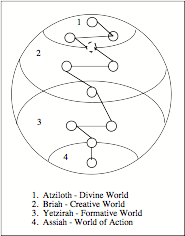
HE DRAWS IN SUCH A NEAT HAND. HE MUST BE FROZEN BY NOW. He is drawing again. HIS FINGER IS TURNING BLUE AGAIN. Shh! Let him work!
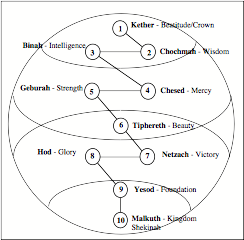
TIPHERETH IS THE SUN.
THE CENTER OF THE SYSTEM. A
globe within a globe. THE EARTH
TOO. Atomic organization? THAT IS NOT THE SEASON YET. What season is it? WHERE IS YOUR CLOCK? YOUR WATCH? A lost treasure, left on a table somewhere. SUBAM. Moses!
Moses! Who is that
Truman? He looks like Robert Moses
to me, riding in his great limousine!
MOLOCH! MOLOCH! A stench of death comes through again,
sweeping over the snow.
GINSBERG! What? I DON'T LISTEN TO THE CRITICS. CRITICS NEVER BUILT ANYTHING IN THEIR
LIFE. CRITICS NEVER BUILT ONE
BUILDING. CRITICS DON'T PRODUCE
ANYTHING. THEY JUST CRITICIZE
THOSE WHO PRODUCE SOMETHING.
Moloch! Robert Moloch! THINGS A' CHANGE A'. Remember Penn Station! Remember Penn Station! YES, PETER GOWER! DEFEND THE STONE. AND DEFEND THE ANGELS THAT THEY TORE
DOWN AND BURIED IN NEW JERSEY! The
Fallen Angels cry. The Fallen Angels
cry. WE USED TO ARRIVE IN THIS
CITY LIKE GODS, NOW WE ARRIVE LIKE RATS.
How did Crossmann arrive?
HE ARRIVED LIKE A RAT, COMING UP OUT OF THE SEWERS, STANDING IN FRONT OF
AN ISLAMIC MOSQUE. What did he
say? HE SAID: WHAT THE HELL IS
THIS DOING IN AMERICA? Yes. He is a soldier of the crown. THE ROSY CROWN. The Rosey Cross -- Rosicrucian that he
is. HICCUP. Hick cough, you mean. YOU WOULD KNOW ABOUT THAT. Master Builder. A CITY WITHOUT TRAFFIC IS A GHOST TOWN. A CITY IS CREATED FOR TRAFFIC. Mister Expressway. JJ COMES UP AGAIN. JANE JACOBS BREAKS THE EGG OF
IDEOLOGY. Corbu lose e ay. WHAT ARE YOU TALKING ABOUT! What? LOOK AT HIM! HE
LOOKS JUST LIKE ROBERT MOSES! DAMN
JEW CAPITALIST! Shh! He tried to destroy this town! PETER, HE IS NOT MOSES. MOSES IS OVER THERE. Where? THE BOY MOSES.
THE ONE INSIDE THE POET, GINSBERG.
But Ginsberg is back. WHERE
IS MOSES THEN? He has entered this
false man who calls himself True Man.
PETE, YOU ARE GROWN WEARY.
YOU ARE BEGINNING TO SEE PHANTOMS.
This is the Pequod, bound 'round the world! Tell them to address all future letters to the Pacific
Ocean... SSH! SSH! PETER!
GROW CALM. And who is that
damn Arab there, giggling in to his sleeve. WERE THIS WORLD AN ENDLESS PLAIN, AND BY SAILING EASTWARD WE
COULD FOR EVER REACH NEW DISTANCES, AND DISCOVER MORE SWEET AND STRANGE SIGHTS,
THEN THERE WERE PROMISE IN THE VOYAGE.
BUT IN TORMENTED CHASE OF THE DEMON PHANTOM THAT, AT SOME TIME OR
OTHERS, SWIMS BEFORE ALL HUMAN HEARTS -- THEN, WHILE CHASING OVER THIS ROUND
GLOBE AFTER THOSE MYSTERIES -- THEY EITHER LEAD US ON IN BARREN MAZES, OR
MIDWAY LEAVE US O'ERWHELMED. Shut
down the socialist, Bill. Give him
a drink. Calm him down. Give him Crossmann's magic glasses. I WON'T WEAR THOSE DAMNED GLASSES --
WHICH MAKE EVERYTHING APPEAR ROSEY NO MATTER WHAT THE TRUTH. THAT MAKE THE GODS TRIUMPH OVER THE
NEEDS OF MEN. WE HAVE TO BREAK
THOSE DAMNED GLASSES. THAT'S WHEN
CROSSMAN LOST HIS WAY. WHEN HE
AGREED TO SEE THE UNITY OF THE WORLD.
But that is his greatness too.
YES. PERHAPS. BUT WE ARE OLD NOW. WE ARE NOT ABLE TO UNDERSTAND THIS NEW
THING, THIS NEW IDEA. I HAVE NO
PLACE IN THIS NEW WORLD. THIS NEW
WORLD REFLECTS NOT MY CHILDHOOD, I THINK.
SO I DON'T TRUST IT. I FEEL
IRRELEVANT NOW -- WHEN BEFORE I WAS THE KING. Blame it on Moses.
Blame everything on Moses.
That's what they've always done.
DOMINUS DOMINORUM.
EXCELLENCE IS IN THE EYE.
What's that smell?
EXCELLENCE, TOO, COMES IN THROUGH THE NOSE. What sphinx of cement and aluminum bashed open their skulls
and ate up their brains and imagination?
Moloch! Solitude! Filth! Ugliness!
Ashcans and unobtainable dollars!
Children screaming under the stairways! Boys sobbing in armies! Old men weeping in the parks! Moloch!
Moloch! Nighhtmare of
Moloch! Moloch the loveless! Mental Moloch! Moloch the heavy judger of men! Moloch the incomprehensible prison! Moloch the crossbone soulless jailhouse
and congress of sorrows! Moloch
whose buildings are judgment!
Moloch the vast stone of war!
Moloch the stunned governments!
Moloch whose mind is pure machinery! Moloch whose blood is running money! Moloch whose fingers are ten
armies! Moloch whose breast is a
cannibal dynamo! Moloch whose ear
is a smoking tomb! Moloch whose
eyes are a tousand blind windows!
Moloch whose skyscrapers stand in the long streets like endless
Jehovahs! Moloch whose factories dream
and croak in the fog! Moloch whose
smokestacks and antennae crown the cities! Moloch whose love is endless oil and stone! Moloch whose soul is electricity and
banks! Moloch whose poverty is the
specter of genius! Moloch whose
fate is a cloud of sexless hydrogen!
Moloch whose name is the Mind!
Moloch in whom I sit lonely!
Moloch in whom I dream Angels!
Crazy in Moloch! Cocksucker
in Moloch! Lacklove and manless in
Moloch! Moloch was entered my soul
early! Moloch in whom I am a
consciousness without a body!
Moloch who frightened me out of my natural ecstacy! Moloch who I abandon! Wake up in Moloch! Light streaming out of the sky! Moloch! Moloch! Robot
apartments! Invisible
suburbs! Skeleton treasuries! Blind capitals! Demonic industries! Spectral nations! Invincible mad houses! Granite cocks! Monstrous bombs! They broke their backs lifting Moloch
to Heaven! Pavements, trees,
radios, tons! Lifting the city to
Heaven which exists and is everywhere about us! Visions!
Omens! Hallucinations! Miracles! Ecstacies! Gond
down the American river! Dreams! Adorations! Illuminations!
Religions! The whole
boatload of sensitive bullshit!
Breakthroughs! Over the
river! Flips and
crucifixions! Gone down the
flood! Highs! Epiphanies! Despiars! Ten
year's aminal screams and suicides!
Minds! New loves! Mad generation! Down on the rocks of Time! Real holy laughter in the river! They saw it all! The wild eyes! The holy yells! They bade farewell! They jumped off the roof! To solitude! Waving!
Carrying flowers! Down to
the river! Into the street! HE ADMIRES THE POET EVEN AS HE ESCHEWS
THE MAN. It is not the artist I
love; it is the art. TRUTH IS NOT
EXTREME; BUT THE ROAD TO TRUTH OFTEN IS EXTREME. Look at old Crowley.
YES. POOR BEAST. SEX SEX SEX. The pantograph is an instrument for copying (as a map) on a
predetermined scale consisting of four light rigid bars jointed in
parallelogram form; any of various extensible devices of similar construction
(as for use as brackets or gates).
SUPERFETATION IS A PROGRESSIVE ACCUMULATION OR ACCRETION REACHING AN
EXTREME OR EXCESSIVE DEGREE.
MULTIPLICITY. God of
naturalness. GOD OF HEAVY BREATH
AND PULSE. Pan toe crat. PANT TALK ROSSY. Pen tea coastal panty roastey. LOOK AT THE SMILE. Can we laugh now; even now -- after all
this? AFTER ALL WHAT? After all our sins. YOU MEAN SLAVERY, RACISM, WAR, MURDER,
EXPANSIONISM, GREED? IN THIS ARE
WE DIFFERENT THAN THE EGYPTIANS, THE BABYLONIANS, THE CHINESE, THE MONGOLS, THE
ROMANS, THE EUROPEANS, THE AMERICAN INDIANS, THE BLACK AFRICANS? You wish to mitigate your guilt by
claiming that everyone is guilty?
You do not claim that you are not guilty. You claim that you are guilty as others are guilty? EVERYMAN IS GUILTY. EVERY MANNER IS FILTHY AND CLEAN. EVERY MASS CELEBRATED AND
TORTURED. EVERY MASTER SOME KIND
OF ANGEL AND A DEMON. S-Teth. Serpent-Temperance. HE IS GOING AWAY AGAIN, TRANSFORMING
HIMSELF INTO THE BOY-MOSES, METRONOME.
He conceives when already pregnant. WHAT?
Superiorfatuation.
WHAT? The act of bearing
the young; of creating offspring.
YOU MUST UNDERSTAND THAT MICHAEL THE ARCHANGEL DOES NOT LIVE IN HEAVEN,
BUT LIVES, INSTEAD, IN TIPERETH, FROM WHICH HE OVERSEES THE EARTH, PREPARING
THE ARMIES OF HEAVEN FOR THE CONFLICT WITH THE ARMIES OF SATAN. The armies of Islam, you mean? WHAT? What is he saying?
Is he trying to prepare us for war? THE NORTH-SOUTH PARADIGM, THE VERTICLE AXIS OF THE CROSS, IS
SYMBOLIC OF WARFARE BETWEEN THE GODS.
THAT IS WHAT HE TOLD US. He
has been saying many things. I
DON'T WISH TO SPEAK ABOUT THIS, ABOUT WAR. BRING ME SOME OTHER VISION. NOT THE DESTRUCTIVE ONE. MAKE ME SMILE AGAIN.
DO SOME KIND OF DRAWING IN THE SNOW.
I don't get it.
ASSESS YOURSELF! In the
light of what? IN THE LIGHT OF
ALLAH'S HAMMER! What? FARAMARZ IS LAUGHING AGAIN. Stop this, Saduj. LET ME KNOW WHAT SIZE COLLAR YOU
WEAR. Tarrow root. Tomorrow rood. Full shiner shows. THE MADNESS OFF MIMES. Articulating ropes. Gesticulating robes. Robes, pierre! MANNERMAN. SSSSSAGITTARIUS, TTTHE AAAARCHERRR. Soothsayer Toothmayor. TOOTHMEIER? Menmeistersinger, Meinmessersmith. YES? The dilemma,
of course, is that we don't all see the world as one. This is the dualism too, built-in. The spiritual idea is that we are all part of the same
family. I say spiritual but I
might also say the view from the anti-universe. Anti-matter.
Anti-matter is the son, the one who wants to sacrifice himself and his
family for the good of the world.
This is the message of the martyr, of Jesus. We are all the same family. Nationalism is an illusion. The material idea (the view from the universe) is the view
of the Father: that the man takes care of his own family -- that nationalism is
a real thing. That
internationalism is an illusion.
Of course you don't feed one child at your table and starve the rest;
you feed all of your children. But
you understand that nature is hard, that life struggles to survive. That the man, as an individual, must
take care of his own family -- and put his own family ahead of his neighbor's
family. He takes care of his own
children. And his neighbor takes
care of his own children. Of
course, this latter view is a practical view of someone who really has
children. The denizens of the
world of anti-matter seldom have children. Having children, in fact, pulls a man down from heaven,
making him give up his ideals for the sake of protection of his own family. This makes the angels fall into the
condition of being men. AHA! THIS IS SOMETHING THEN! HE IS TALKING ABOUT THE FALL OF THE
ANGELS -- THE FALL OF THE ANGELS INTO THE CONDITION OF BEING MEN! SSSH! Let the man speak!
I AM LETTING HIM SPEAK! It
is easy to speak about ideal worlds and universal ideas -- but the practical
application of those ideas is a very big problem. Utopians are almost almost mass murderers when they gain
power -- and the Earth's inhabitants come to understand again that the world is
better off when individuals are free to build their own utopias family by
family, rather than to follow the state utopianism of ideologues who never
understand how to implement their plans for perfect worlds. The dilemma is that heaven does not
move; there is no time in heaven; and the Earth (the physical world) moves
constantly; the Earth is governed by time. The circle really can't be squared. Like matter and anti-matter, when the
circle approaches the square each annihilates the other. They the circle becomes the square and
the square becomes the circle. They
change places. They don't become
one for long; they split in to two, then three, and so on. I DON'T UNDERSTAND. HE IS SAYING THE CIRCLE CAN'T BE
SQUARED. WHO IS HE TO SAY THAT,
AFTER MYSTICS OF ALL AGES HAVE SAID THAT THE CIRCLE CAN BE SQUARED? But none of them were able to do
so. THAT IS SUBJECT TO DEBATE,
SIR. Mathematically, none was able
to do it. MINUS MAN; TALIBAN. Minus Man; Kazakistan. IMAM MALSI. Essence.
ESSENCE OF WHAT? Essence of
the Essenes. Essence of
Samson. Essense of Saalah,
Sabaoth, Salmon. I SEE. Essenence of Sabazios, Saitu, Sabra and
Shatilla. E SENSE OF WHAT ELSE? S sense of Sabbath. S sense of sense. S sense of S. THE SUN RISES.
Sanctus Sanctus. S PUT ON
THE T IS A SENSE OF THE SUN BEING PUT ON THE CROSS. IT BECAME, OF COURSE, LATER, A SYMBOL OF ALMIGHTY MONEY.

S is also a symbol of half of the evolutionary cycle. EVOLUTION OR INVOLUTION? Evolution of matter is involution of
spirit. Evolution of spirit is
involution of matter. YES. See its reference also to the number
8. IN BODILY APPEARANCE, YES. The tooth being the gate of the
mouth. YES. The bow and arrow designating that
which can be detached, emitted, sent, dispatched; thrown, launched, dispensed,
ejectyed. THE TOOTH DESIGNATING
THAT WHICH CAN BE CRUSHED, GRINDED, BROKEN, REDUCED. ENABLING THE EXTERNAL WORLD TO BE ASSIMILATED INTO THE
INTERNAL. SPLITTING THE WHOLE INTO
PARTS FOR ASSIMILATION.
ANALYSIS. 300 is connected
to 3 (Gimel the Camel) and 30 (Lamed the Ox-Goad), both of which speak to
motion, to travel, and to a launching.
OF SOMETHING. Something has
been launched? What? A missile? Is that what they are getting at? Is that what we get from the smoke? From the sirens? SOMETHING LAUNCHED. I'M HEARING GLASS BREAK. I don't hear that. WHAT IS HE TALKING ABOUT? Glass breaking. WHAT IT MEANS -- IS THAT WHAT HE'S
TALKING ABOUT? THE SYMBOLISM? No, he says he hears it breaking. HEARD IT. PAST TENSE. I
didn't hear it. I HEARD IT
TOO. What? When? NOT LONG AGO.
MINUTES. SOMETHING
BROKE. Forget about
that. The men of letters must wait
until all the letters are excavated from this mount. Then they can go inside and get warm. I DON'T UNDERSTAND THAT. IS THAT WHY WE ARE HERE? THE WITNESS THE BIRTH OF LETTERS -- THE
RE-BIRTH OF LETTERS? FOR WHAT
PURPOSE? The written word. YES, THAT'S IT. The written word is the basis of
civilization. WHAT DID HE
SAY? The spoken word is the basis
of what then? THE MATRIARCHY? Who said that? IS MISS VAGINA IN THE ROOM, SPEAKING
THROUGH THE MOUTH OF SOME MAGICIAN, SOME VENTRILOQUIST? Matriarchy worships the moon. In the nighttime there is no light by
which to read the written page. NO
LIGHT! THEY HAD MEMORIES IN THOSE
DAYS! THEY REMEMBER STORIES THEY
HEARD SITTING AROUND A GAMFIRE, STORIES GRANDFATHERS AND GRANDMOTHERS
TOLD. Is that a rosie
scenario? WHAT? Romantic gapacity? THEY SAY THE CREATION OF THE ALPHABET
LED TO THE ADVENT OF THE MALE GODS, THE DAY GODS, OVER THE FEMALE DEITIES. THE SUN OVER THE MOON. Is that what all this is about? ARE WE BACK AT THE BEGINNING THEN? I don't believe sitting in the snow,
freezing our butts off out here in some monastery backyard, is close to
anything original. It's all been
done before, hasn't it? I mean,
the agony in the garden -- hasn't it all been done before? NOTHING REPEATS ABSOLUTELY. Back and forth. Back and forth. IN AND OUT. IN AND OUT. In
an out of the light. SOMETIMES
VENUS IS IN ASCENDENCY; SOMETIMES MARS.
Once the Egyptians had all the money; then the Babylonians; then the
Romans; then the Arabs; then the West Europeans; then the Americans. Someone else will have the money
next. Japan had it for awhile. God gives and God takes away. Day and Night. Nationalism and Internationalism. Ebb and flow. The rich man may be poor in spirit; often this is true. It is not a necessity however. I know some rich people whose spirits
are very rich; and I know poor people who are thieves and killers and who have
no spiritual life. On the other
hand I know some poor people who are very rich spiritually. There is no easy formula. Again, the individual comes in to
play. It is an error to speak in
generalities when describing truth.
Rich are evil; poor are good.
My experience does not tell me this is so. Again, the soul, the individual, creates the truth through
his behaviors. IN THE BEGINNING
WAS THE WORD AND THE WORD WAS MADE FLESH.
Before the beginning was the word; but the word had no flesh. THE MOUTH DISCONNECTED FROM THE
HAND. I see. PI. MOUTH AND HAND. I can get you an office on the 110th floor of the World Trade
Center. The top floor. WHAT IF HE'S AFRAID OF HEIGHTS? Well, then I can get him an office in
the basement. THERE ARE 111 FLOORS
IN THE TOWER? Well -- yes. 110 floors and the basement. Yes, 111 floors. I SEE. Do you think Jesus comes back a second time to be crucified
again? Is that what you think? I DON'T KNOW WHAT TO THINK. Is not the Tree of Life, itself, the
cross? OR IS IT THE TREE OF
KNOWLEDGE OF GOOD AND EVIL? It
depends on your perspective: universe or anti-universe. I DON'T UNDERSTAND ALL THIS. Yes, that's why you are here. To clarify your vision. IS THAT IT? IS THAT THE REASON I AM HERE? Yes But there
are unbelievers with you. AND A
TRAITOR. ONE WHO WILL BETRAY YOU. ONE LIVING IN YOUR MIDST WHO WISHES TO
DESTROY YOU. Is he here with me,
praying in this garden?
YES. OF COURSE. 'Bereshith' -- 'In the Beginning' --
the first word in the bible, suggests that Beth, not Aleph, participated in the
creation. Aleph was not divisible;
hence, Aleph could not divide himself for the purpose of creation. Beth was that division, the vehicle
through which the creation found its engine. PUT AN 'X' ON YOUR HAT. Pardon. AT
FIRST, IN PRINCIPLE: PUT AN 'X' ON YOUR HAT. To whom is he speaking? AND WE KNOW THAT THE BEGINNING IS THE DAWN OF LIFE, OF THE
MALE LIFE, COMING OUT OF DARKNESS.
THE BOOK DOES NOT BEGIN WITH THE WORLD BEFORE THE BEGINNING. That is understood. THERE IS MORE. And I heard a great voice out of heaven
saying, Behold, the tabernacle of God is with men, and he will dwell with them,
and they shall be his people, and God himself shall be with them, and be their
God. And God shall wipe away all tears from their eyes; and there shall be no
more death, neither sorrow, nor crying, neither shall there be any more pain:
for the former things are passed away.
CROSS TWO STICKS. Put two
crossed sticks on your hat.
CROSSBONES NORTHWEST AND SOUTHEAST. CROSSBONES NORTHEAST AND SOUTHWEST. Shh. He's drawing again.
LOOK! Put your
sign on this contract; and I will deliver you an office for your trading
company on the 37th Floor of World Trade Center Number One. HE MAKES AN X. His name is Cross Man. X is the perfect symbol for a Cross
Man. X. X. ALLAH AKBAR. What? Who said that?
ZRAMARAF. Who? OUR ARAB FRIEND, FRIEND OF TRUMAN. What did he say? HE SAID: 'ALLAH AKBAR'. Doesn't that mean "God is
Great"? NO. IT IS AN EROTIC POEM. Look at his face! Look at his eyes! His eyes look like scavenger birds. HE IS PUTTING ON HIS SUNGLASSES. Stabat
Mater. Stabat Mater. T IS THE TREE OF LIFE. And more than that. THE TREE OF DEATH? The tree upon which Jesus is
hanged. THERE IS IN PARADISE A
MARKET WHEREIN THERE WILL BE NO BUYING OR SELLING, BUT WILL CONSIST OF MEN AND
WOMEN. WHEN A MAN DESIRES A
BEAUTY, HE WILL HAVE INTERCOURSE WITH THEM. What? ISLAMIC
HEAVEN. HE IS RAVING ABOUT ISLAMIC
HEAVEN. Oh. Why? I DON'T KNOW.
HE SEEMS TO BE IN SOME KIND OF RAPTURE. I'M NOT SURE.
MAYBE HE'S TIRED. MAYBE
HE'S SICK Sick! HE'S A WILD ASS OF A MAN! So now be sodomites, you Arabs. Turn not away from it -- therein is wondrous pleasure. Take some coy lad with kiss-curls
twisting on his temple and ride as he stands like some gazelle standing to her
mate. A lad who all can see girt
with sword and belt not like your whore who has to go veiled. Make for smooth-faced boys and do your
very best to mount them, for women are the mounts of devils. HE IS RAVING. Is he gay, then?
HE'S RAVING. And round
about them will serve boys of perpetual frehsness: if thou seest them, thou
woulds't think them scattered pearls.
HE SHOULD EXCUSE HIMSELF -- AND GO INSIDE TO GET WARM. He is warm. He's sweating.
He is in some kind of ecstacy.
TRUMAN, HE'S YOUR FRIEND.
TAKE HIM INSIDE. Prophet,
make war on the unbelievers and the hypocrites and deal rigorously with
them. Hell shall be their Home: an
evil fate. ARE YOU TALKING TO
ME? What? ARE YOU TALKING TO ME? YOU SEEM TO BE TALKING TO ME. When you meet the unbelievers in the
Jihad, strike off their heads and, when you have laid them low, bind your
captives firmly. Then grant them
their freedom, or take ransom from them, until War shall lay down their
burdens. TRUMAN! I can't controll him. He got this look in his eye. That's all I know. And he's been talking rubbish ever
since. NO MAN SHALL BE QUESTIONED
FOR BEATING HIS WIFE. I don't know
what's come over him -- he's become mad!
WILL NO ONE RID ME OF THIS DAUGHTER OF MARWAN! Quiet, quiet, Faramarz! Be calm! You
are raving! Is it the drink? Is it your mind that is on fire because
of conspiracy or guilt? WHAT? I UNDERSTAND NOT WHAT YOU ASK? Be calm. I understand it is you who is the traitor. I understand that you betray the human
race with your activity. (Kissing
him on the cheek.) Go,
inside. Get warm. Be silent. HE IS LEAVING.
HE IS GOING INSIDE. What
was that all about? OH, HE'S BEEN
UNDER A LOT OF STRESS LATELY.
Sad you'd say. Stress
fromwhat? TROUBLE AT HOME. HE'S BEEN SPENDING A LOT OF TIME WITH
COUSINS WHO'VE BEEN VISITING.
YOU KNOW, COUSINS NOT FITTING IN TO AMERICA VERY WELL. Oh. COUSINS STUDYING TO BECOME PILOTS. Oh. WELL,
THAT'S NOT WHY WE ARE HERE, IS IT?
I don't know why we are here.
Why are we here? T IS A
TEA-STAINED LETTER. In again,
Faye. Ache's Way. THE BOSTON TEA PARTY. Aye. NUBILE FUTILE.
T is for Tiphereth, the abode of the angel. TELL US MORE ABOUT THIS TIPHERETH, MOSES. In the kabbalistic doctrine, the name
formed by the four Hebrew letters, Yod, He, Vav, He, has a special and intimate
connection with the grade of Tiphereth, of which it is, in the strict sense,
the proper name. We must
understand this to mean that if one could grasp with sufficient clearness the
nature of the grade Tiphereth, especially as the oringinator of the Neschamah,
he would perceive that this is the fitting appellation which shoujld be given
to it: as the image of Ain-Soph.
To this grade of comprehension Moses and the other prophets actually
rose, and this was the basis of their inspiration. There is, however, a difference between the inspiration of
Moses and that of the other prophets. Moses was able to grasp the connection
between the grade and the Name fully and clearly, but the others only through a
haze, as it were, since their comprehension only reached fully to the two
inferior grades of Nezah and Hod, the two ‘pillars’ or ‘willows of the brook’,
as they are fancifully called. A
common kabbalistic view of man (living in the present spiritual realm) is that
of three 'spiritual' parts; or, if you will, three parts of his soul. In most basic terms, Nephesh is
connected to the basic performance of the commandements in order to have a
relationship with God and help us
get throught he physical dimension of life. Ruach (not to be confused with Ruach haKodesh, God's Holy
Spirit) is the spirit that distinguishes man from the animals. The Ruach gives man the abiity to go
beyond the physical existence of animals, and reach in to the spiritual
dimensions, specifically to try to understand the deeper meaning of God's
law. All people have a Nephesch
and Ruach within their being. The Neshemah however, is an additional part of
man's spiritual makeup. Neshemah is a spirit (or "spiritual
connection"), given by God when a person through faith/trust, begins to
truly seek Him (through His Torah). The Neshemah is the spiritual faculty given
to man that connects with the Ruach haKodesh (God's Holy Spirit). Such a person is considered linked to
Tiphereth and is even thought of as being greater than the prophets. In the Zohar it is written: What, now, is the difference between
those who study the Law and faithful prophets? The former are ever superior, since
they stand on a higher level. Those who study the Law stand in a place called
Tifereth (Beauty), which is the pillar of all faith, whereas the prophets stand
lower in the place called Nezah (Victory) and Hod (Majesty); and those who
merely speak in the spirit of holiness stand lower still. He who studies the
Law needs neither peace offerings nor burnt offerings, since the Law is
superior to all and the bond of faith; wherefore it is written “Her ways are
ways of pleasantness and all her paths are peace” (Proverbs. III, 17), and
also, “Great peace have they which love thy law and they have no occasion for
stumbling” (Psalm. CXIX, 165).’
God has promised a reward to those who seek Him in faith: Hebrews 11:6 - And without faith it is
impossible to please God, because anyone who comes to him must believe that he
exists and that he rewards those who earnestly seek him. Exploring a bit deeper, Nephesch, as it
is freely given and present in all men, is said to come from the right side of
the Tree of Life, the side of Chesed (mercy). The Ruach, is said to be from the
left side, which is the critical/judgmental side. Here is where man can choose
between following the path of the Lw to God, or considering himself not under
God's Law and moving away from Him.
This is where man's yetzer hara (evil inclination) comes into play. (The yetzer
hara is also said
to come from the left side, which is also from where evil eminates.) When
presented with God's Law, and its defintion of sin, man can give in to his yetzer
hara and transgress
the Law or can place his yetzer hara under subjugation, even using it to serve God. Lastly, the Neshemah is said to
be of the central pillar of the Tree of Life, (where Tiphereth is located),
that of balance and harmony (between man's animal and spiritual aspects). When Adam was created, it was the
Neshemah that God breathed into Him:
Genesis 2:7 - And the LORD God formed man of the dust of the ground, and
breathed into his nostrils the breath of life; [neshmat hayyim] and man became a living soul [nefesh
hayyah]. Having the Neshemah directly placed
into him by God, Adam had very personal relationship with his maker. The
Neshemah is what we have lost through sin, and what we need to recover in order
to go on and become conformed to His image. It is interesting that in the
Genesis text, the word we see is neshmat, the plural of neshemah. This implies
a spiritual attachment to the multiple Sephiroth of God. SOMETHING HAS CHANGED HERE. DO YOU FEEL IT? Yes. No doubt. THE
MOOD HAS GROWN TENSE. What is
anthrax? WHAT? WHAT HAS THAT TO DO WITH TEA? I'm not sure. You asked about the mood. AND YOU ASKED ABOUT ANTHRAX. WHY? Someone
must know. It is in someone's mind
here. WHOSE? I don't know. SEE IF YOU CAN FIND IT. Anthrax is an infectious and often fatal disease caused by
the bacterium Bacillus Anthracis. It occurs in humans but is more common in such animals as
cattle, goats, horses, sheep, and buffalo. Human infections usually result from
the handling of animal hides, wool, and hair contaminated with anthrax spores.
The bacterium typically enters through the skin and causes a swollen, pustular
area, often with a black center, called a malignant pustule. General symptoms
include fever and malaise. From the skin pustule the bacterium may invade the
bloodstream and rapidly cause a fatal septicemia. Inhalation of spores may
cause infection of the lungs, and the resultant pneumonia, called woolsorters'
disease, is usually fatal. Anthrax spores may continue to be infectious for
many years, even in articles made from infected animal products. Pasteur
developed an anthrax vaccine in 1881; new vaccines are now available for those
at special risk. Treatment consists of administering large doses of
antibiotics. In 1979 over 1,000
people were reported to have died from anthrax, after an explosion at a plant
in the Russian city of Sverdlovsk. The plant is believed to have been
manufacturing biological weapons.
WHY DO WE SPEAK OF THIS? It
is in someone's mind. IT'S
HIM! HE'S COMING OUT AGAIN! Nosferatu? IT'S MORE FEAR AMONGST US NOW. Are you a citizen of this country, Mister? WHERE IS OUR SCHOLAR? Margoliouth writes that Islam first
took the name of 'Hanif', which in Hebrew meant 'hypocrite' and in Syriac
"heathen'; the name 'Muslim' originally meant 'traitor,' or 'one who hands
his friends over to their enemies'.
HA, HA, HA! ONE WHO HANDS
HIS SOUL OVER TO HIS GOD! Why do
we have such victimization now?
Why do we turn against this man?
CAN'T YOU SMELL THE SMOKE?
Who is burning? WHOM DO YOU
THINK IS BURNING? I have no
idea. I am freezing. DON'T YOU SMELL FLESH BURNING? THE FLESH OF WOMEN AND CHILDREN? Have the Nazis struck again? WHERE? Where there is smoke there is fire. THERE WILL BE SIXTEEN-YEAR-OLD VIRGINS
IN HEAVEN FOR US TO SCREW AND WATER AND WINE, AS MUCH AS WE WISH TO DRINK! What? BELIEVERS, TAKE NEITHER JEWS NOR CHRISTIANS FOR YOUR
FRIENDS. THEY ARE FRIENDS WITH ONE
ANOTHER. WHOEVER OF YOU WHO SEEKS
THEIR FRIENDSHIP WILL BECOME ONE OF THEIR NUMBER. ALLAH DOES NOT GUIDE THE WRONG-DOER. The man is mad. WHO BROUGHT HIM HERE? Truman! HE IS A GOOD MAN.
IT IS...IT MUST BE SOMETHNG HE DRANK! He hides his true nature well. But the fanatic remains. HE NEEDS A NEW RELIGION. ONE NOT BASED ON HATE.
He will not accept it. To
accept it is to be ruined in his faith.
I FEEL SO MUCH DIFFERENT NOW.
I AM VERY MUCH UNEASY. WHAT
IS THE CAUSE OF THIS? He comes and
goes among us as a friend. But he
is not a friend. We invite him in
to our house as a guest. But he
uses our friendship to turn us over to our enemies. HE IS MAD. DO
NOT FORGET THIS. Is madness his
legal defense; or is it just the nature of his nature? THAT IS FOR A JURY TO DECIDE. No, not a jury. That is something for our God to
decide. I SEE. NORTH-SOUTH. T is the cross, of course. AND THE CROSS-ROADS. It is the hammer of force: Twin Axes. IT IS A CHARM AGAINST DISEASE. Anthrax. LOOK AT HIM OVER THERE, PRAYING FOR DISEASE. Anthrax, smallpox, bubonic plague. Evil comes to the Infidels. GET HIM OUT OF HERE. This is insane. What is happening to us? PETER, YOU ARE THE ROCK. SHOW HIM THE DOOR. Truman, he is your friend. PUT AN 'X' ON THE FOREHEADS OF THE
RIGHTEOUS, THOSE WHO BEMOAN THE HORRORS COMMITTED IN JERUSALEM. WHEN THE ANGEL OF DEATH COMES THROUGH
THE CITY, ONLY THOSE MARKED WITH AN 'X' WILL BE SPARED. I see. MAKE A SIGN IN THE SNOW. AND WE SHALL BE ALLIES. X. X. X. X. X. X. X. X. X. 10. X. X. SOMEONE DID NOT SIGN. Allies of light against the
darkness. WITH CROSSMANN AS OUR
LEADER. Yes. THE MAN WHO MAKES THE SIGN OF THE CROSS. They do not fight our armies, because
they cannot defeat our armies.
They fight us by murdering our women and children. WHAT ARE WE SPEAKING ABOUT NOW? Let the decent people unite, in me,
against the worshipers of death, the archons of destruction. Those who hate life and change and
nature would seek to poison us and murder us in our sleep. KARMA CAUSE, HEY? Reaping and sowing. WHAT? We have made enimies through the behavior of our foreign
policy. LIBERAL TRIPE! YOU ARE EITHER WITH US OR AGAINST US! YOU EITHER FIGHT WITH US OR WITH
THEM. It is a new religion,
through Crossmann, that will unite the decent of all cultures in a new
truth. BE HIGH. BE GOOD. BE TRUTHFUL. DO
NOT HATE. Truths for a New Age.
1. The oneness of humankind.
2. Independent investigations of truth.
3. The foundation of all religions is one.
4. Religion must be the cause of unity.
5. Intuitive knowledge completes that of reason.
6. All living beings are sacred.
7. Equality between men and women.
8. Prejudice of all kinds must be forgotten.
9. Individual responsibility leads to the welfare of all.
10. There must be: universal peace; universal education; a spiritual
solution to the economic problem; a universal language,
English;
an international tribunal which truly governs the world.
YES. Recall that the Zohar states that Tiphereth (which is
directly associated with Messiah), is the originator of the Neshamah, which
connects us to God in faith. The
"New Testament" states that Yeshua fills a similar role: Hebrews 12:2a - Looking unto Yeshua,
the author and finisher of our faith.
Tiphereth is equivalent to grasping the essence of God. The relationship
between the centralized, harmonizing Tiphereth and the invisible Ain Soph, can
again be compared to that of Yeshua and the invisible God. This gives us a better understanding of
two verses quoted earlier in this study:
Romans 8:29 - For whom he did foreknow, he also did predestinate to be
conformed to the image of his Son ...
Colossians 1:15 - Who is the image of the invisible God, the firstborn
of every creature. One can grasp
the image of the invisible God throught Tiphereth, due to its embodiment of the
characteristics of all the Sephiroth.
The Messiah's encompassing relationship to the Sephiroth (also called
spirits of God) and to Da'ath, (knowledge) is seen in this prophetic
verse: Isaiah 11:2 - The Spirit of
the LORD will rest on him-- the Spirit of wisdom and of understanding, the
Spirit of counsel and of power, the Spirit of knowledge and of the fear of the
LORD. This same Messiah (whom the
Spirit of the Lord rests on), will usher in the Day of the Lord and Jubilee
Release, a time when all things
are brought into beauty and harmony:
Isaiah 61:1-3 - The Spirit of the Lord GOD is upon me; because the LORD
hath anointed me to preach good tidings unto the meek; he hath sent me to bind
up the brokenhearted, to proclaim liberty to the captives, and the opening of
the prison to them that are bound; To proclaim the acceptable year of the LORD,
and the day of vengeance of our God; to comfort all that mourn; To appoint unto
them that mourn in Zion, to give unto them beauty for ashes, the oil of joy for
mourning, the garment of praise for the spirit of heaviness; that they might be
called trees of righteousness, the planting of the LORD, that he might be
glorified. Revelation 21:3-4 - And
I heard a great voice out of heaven saying, Behold, the tabernacle of God is
with men, and he will dwell with them, and they shall be his people, and God
himself shall be with them, and be their God. And God shall wipe away all tears
from their eyes; and there shall be no more death, neither sorrow, nor crying,
neither shall there be any more pain: for the former things are passed
away. MOSES HAS MANY BOOKS IN HIS
POCKET. He has a memory of an
elephant. EEE. The Egyptian hieroglyph of two crossed
sticks represented separation, a breaking apart. WAR.
Disagreemennt.
ASSASSINATION. The
splitting apart; but also th mark of alliance. ONE CROSSED STICK IS THE HEART; AND THE OTHER IS THE TRACHEA. St. Blaise, please protect us from the
evil powers of this man and his anthrax.
LIFE MADE POSSIBLE THROUGH BLOOD AND BREATH; THAT IS, THE PATH TOWARD
PERFECTABILITY. Completion: two
separate parts are put back together to form a whole. TAV. Vat. THEY WILL TORTURE HIM IN A VAT OF
BOILING OIL. Shut up, Saduj. AVATAR MAITREYA. Annointed with sacred oil. ARCH OF BEAUTY. ARCH OF TRUTH. Bringing the broken in to balance. AVT MEANS THE SAME AS TAV.
|
9 |
T |
|
1 |
A |
|
6 |
V |
|
|
|
|
16 |
|
16 is the Tower.
Venus Acting Through Mars Upon Mercury, The Victory Over Splendor,
Avenging Force. 10 PLUS 6. The Totality Plus the Divine Nature of
Tiphereth. HE SEIZED, CLEAVED
TO. Evlevated, exalted, high. INJURY, WAR, LUST; FELL. She; ALAS; WOE. Like or equal to. ALL EQUAL 16. M plus C. MONEY
IS NOT ENOUGH. CASH IS NOT THE
TRUTH, SIR. MJC: Magic. The Magic of love; the magic of truth;
the magic of justice. WHICH IS
BALANCE, OR BEAUTY. The word 'OT'
(OX and TAV) in the bible designates the rainbow, circumcision, and the
sabbath: all designating an alliance, a treaty, a covenant between God and
Man. WHO HAS A COVENANT WITH THE
ANTI-MAN THEN? Do you really need
to ask that? WHAT IS SATAN'S
NUMBER? The number of 'OT' is
79. 7 PLUS 9 IS 16. 17, the number of Tiphereth; and 26,
the number of Tetragrammaton (IHVH); and 36, the number of the Anti-Chrit, when
added together equal 79 -- the covenant.
THE COVENANT BETWEEN JESUS CHRIST, THE GOD JEHOVAH, AND THE ANTI-CHRIST. 7 plus 9 equals 16.
|
70 |
O |
Conjunction, Union, Meeting |
|||
|
4 |
D |
|
|
|
|
|
5 |
H |
|
|
|
|
|
|
|
|
|
|
|
|
79 |
|
|
|
|
|
YOU ASK ABOUT THE NUMBER OF SATAN. IN HEBREW IT IS OUR FAVORITE NUMBER, 111
|
60 |
S |
|
1 |
A |
|
9 |
T |
|
1 |
A |
|
40 |
N |
|
|
|
|
111 |
|
IN ENGLISH, IT IS 55.
WHICH IS THE SUM OF THE NUMBERS 1 THROUGH 10, THE KINGDOM OF MALKUTH,
THE END OF THE WORLD. Ten is the
end of the world. ELEVEN IS THE
BEGINNING OF THE WORLD.
|
19 |
S |
|
1 |
A |
|
20 |
T |
|
1 |
A |
|
14 |
N |
|
|
|
|
55 |
|
|
1 |
1 |
|
2 |
3 |
|
3 |
6 |
|
4 |
10 |
|
5 |
15 |
|
6 |
21 |
|
7 |
28 |
|
8 |
36 |
|
9 |
45 |
|
10 |
55 |
The world is made by the separation of the Christ and the
anti-Christ principles The world
is completed by the re-union of the Christ and the anti-Christ, the principles
of matter and anti-matter, anti-spirit and spirit. The number 111 is the beginning of the new world, prior to
its separation into parts. WE ARE
ALSO WHAT WE HAVE LOST. You are,
yourself, two sides of a coin.
FIRST AND LAST. LAST AND
FIRST. I am also myself and mine
own enemy. When I kill my enemy, I
also kill myself. 55 IS THIEF,
ROBBERY (GNB), PILLAGE (GZYLH), SILENCE (DVMH); ALSO IT IS BRIDE (KLH) AND
NOON, MID-DAY (NGB). God creates
and then withdraws from the totality.
The seventh day, the sabbath, is the withdrawn space, rest, a place for
the heart of humanity to reflect.
REMEMBERS, THE GODS CREATE THE WORLD; AND THE DEVILS DESTROY IT. The two brothers. TIPHERETH DRAWS TWO PARTS TOGETHER INTO
A WHOLE. Paul makes the mystical
statement that the rock (or 'well') that followed the children of Israel in the
Wilderness was Yeshua. The Zohar gives a description of this rock as holding
the characteristics of Tiphereth -- a combination of both judgment and mercy,
and also a reflection of God Himself:
Geburah emanates from her. Therefore She is called 'Supernal Rock'. And
in the same verse the words, 'And hast forgotten God that formed thee' refer to
the brightness of the Father, viz. the Supernal Grace.’ R. Abba further said:
‘We know that 'water' everywhere
symbolizes God's kindness, 'Grace', and yet the Holy One, blessed be He, on
this occasion caused water to come from the 'Rock' (the symbol of Judgement),
though it ought to be connected with 'Greatness' (or Grace). In this, however,
consisted the 'sign' and wonder of the Holy One: 'Who turned the Rock into a
pool' (Psalm CXIV, 8). 'Turned' suggests that it is not the usual function of
the rock to produce water. Therefore He caused water to come from the place
below by means of the Supernal Rock.
And what is the name of the place below? 'Sela', for it is written: 'And
thou shalt bring forth to them water out of the rock ('sela’)' (Numbers, xx,
8). And wherewith did this sela’ bring forth water? By the power of the
Supernal Rock.’ SELA IS THE NUMBER
96. WHICH IS ALSO THE NUMBER OF A
NAME OF GOD (AL ADNY), THE CHALDEAN FORM OF ALHYM (ALHYN), 'BY DAY' (YVMM),
PRAISWORTHY (LLHAL), WORK (MLAKH), AND THE SECRET COUNSEL OF THE LORD (SVD YHVH). The 'Rock' or 'Well' is closely
associated with the Sephirah of Yesod, which I will discuss later. The Zohar states that Tiphereth itself,
may be considered, the 'central pillar' of the Tree of Life: Thus it is
possible to speak of a ‘straight line’ from Kether to Tiphereth, and to
designate Tiphereth the ‘central pillar’.
The following section of the Zohar indicates how the central column of
the Sephiroth (i.e., Tiphereth), is the perfect will of God that holds the
merciful and judgmental columns in harmony. This section goes so far to say
that the three must be in agreement before God makes a 'final decision' to pass
judgment. However, the Zohar says, even when this has happened, true repentance
can still move the merciful side of God to reconsider: They all rose and
prostrated themselves before him, saying, ‘happy the man whose Master agrees
with him in the exposition of hidden mysteries which have not been revealed to
the holy angels.’ He proceeded: ‘Friends, we must expound the rest of the
verse, since it contains many hidden mysteries. The next words are: I kill and
make alive, etc. That is to say, through the Sephiroth on the right side I make
alive, and through the Sephiroth on the left side I kill; but if the Central
Column does not concur, sentence cannot be passed, since they form a court of
three. Sometimes, even when they
all three agree to condemn, there comes the right hand which is outstretched to
receive those that repent; this is the YHVH, and it is also the Shekinah, which
is called 'right hand', from the side of Chesed (kindness). An example of the above teaching,
that judgment can be suspended even after God has 'made up His mind,' would be
when God sent Jonah to preach to Ninevah. His instructions to Jonah were not to
'warn' Ninevah. Rather, God said they were going to be destroyed. There was no
offer of repentance attached. As the story goes, Ninevah, without being told
to, immediately repented, and God's judgment on that generation was withdrawn. As mentioned earlier, Jacob was a
picture of the Messiah to come, in that he had the qualities that balanced the
merciful and judgmental sides of God in perfect harmony. Here the idea of Jacob
unifying 'tents,' takes on a mystical meaning of harmonizing the pillars of the
Tree of Life. Rabbi Simeon, we are
told, explained thus the words, 'And the middle bar in the midst of the boards
shall pass from one end to the other.' ‘ 'The middle bar', he said, ‘signifies
Jacob, the perfect saint, as we have pointed out on another occasion in
connection with the characterization of Jacob as 'a complete man, dwelling in
tents' (Gen. xxv, 27). It does not say, 'dwelling in a tent', but 'dwelling in
tents’, which denotes that he unified the two 'tents' (of Severity and
Mercy). The same implication may
be found here: 'The middle bar in the midst of the boards shall pass from one
end to the other', uniting them. Jacob was perfect in regard to both sides, the
Holy Ancient and the Microprosopus, and also to the supernal Grace and the
supernal Power, harmonizing the two.’
R. Simeon said further: ‘I perceive that Wisdom (‘Chokmah) is the
totality of all the holy Sephiroth, and that supernal Grace (Chesed) emanates
from Wisdom, and Power (Geburah), which is the prompter of severe judgement,
from Understanding (Binah). Jacob harmonized both sides: the Fathers (Abraham
and Isaac) signified the totality of all, and Jacob signified the union of the
Fathers. Then came the merit of Jacob and synthesized both and made them one,
for he signifies supernal harmony.’
T IS MARK, SYMBOL, MEETING, ALLIANCE, COMPLETION, COMPLETING, COMPLETE,
WHOLE, MUTUAL, PERFECT, PERFECTION, PRECISION, TRACE, BREATH AND BLOOD, VITAL
ENERGY, END OF A PROCESS, WITHDRAWAL, LOSS, CREATIVE VACUUM. But there is a second form of the T.

THE T OF THE TET.
The Head. THE NEW
YEAR. The shield. OX. The man carrying a shield. The city protected by the shield. THE SNAKE BITES ITS OWN TAIL. Eternity.
OX. Eternity. THE INHABITED CITY TRYING TO PROTECT
ITSELF FROM SOMETHING FOREIGN. The
cross inside the circle disappeared; and the city opened up. OX BECOMING OMICRON.

Ahh.
S-S-S-watch Tika.

AHH, BIG MISTAKE.
The 'Tet' became the 'Theta' in Greek and Etruscan; but it did not pass
into Latin. DISAPPEARING INTO
SOMETHING. But not the
omicron. YES. Covering, cover, place, preserve;
protection, resistance; rampart, sanctuary; safety; roof.
AND THERE IS A THIRD T. Three crosses on a hill. Chesed on the right; Geburah on the left; Tiphereth in the
center. THE ONE WHO SYNTHESIZES;
AND MAKES WHOLE. Tsadeh did not
come into Latin either. IT IS THE
FISH-HOOK. THE ANCHOR. The force traveling into the deep. TSADEH STOPS MOVEMENT. IT STOPS THE FUTURE. Evil is when the Soul has no choice but
to live in the present. CAPTURE;
PREPARE AN AMBUSH; OBSERVE; SEDUCE, CAPTIVATE; TO FISH, TO HUNT; TO STOP THE
FUTURE; DETAIN, CAPTURE. THE
THROWN HARPOON. Ishmael threw the
harpoon. ISHMAEL WATCHED. The wild ass of a man. A PLANE PASSING OVERHEAD, HEADING
SOUTH. I REMEMBER THAT. I REMEMBER HEARING IT. Ishmael may have been the Arab in the
Bible; but he was not the Arab in Moby Dick. ALTHOUGH IT WAS A BOAT-LOAD OF ARABS. Arabs and Christians and Quakers and
Paganos. AMERICA? Use your own interpretation,
friend. I am not here to curse my
friends and neighbors. MISAL
LOADED: LET'S BURN ALL THE BOOKS IN THE LIBRARY AT ALEXANDRIA. A sign of Cancer surely. CANCER EMANCIPATION. God lets the Dogs of Hell run loose for
a day. IS THAT TRUE? Let's rape all the women and kill all
the men and make slaves of the children.
And if we die we will immediatly be transported to heaven, where we men
will be met by 16-year-old virgins with big breasts for our sexual
delight. War is good. We either get to rape the women of our
enemy; or go to heaven to sleep with the beautiful dark-eyed Houris. In heaven we shall have as much wine as
we wish to drink; also, we shall have water in abundance. TIPHERETH IS THE SUN OF RIGHTEOUSNESS. The book of Malachi contains a mystical
allusion to a Sun of Righteousness, even referring to this 'Sun' as a person.
The context clearly shows that Sun of righteousness is another name for the
Messiah, who will usher in the Day of the Lord and subsequent healing of all
things (Rev. 22:1-3). Malachi
4:1-6 - For, behold, the day cometh, that shall burn as an oven; and all the
proud, yea, and all that do wickedly, shall be stubble: and the day that cometh
shall burn them up, saith the LORD of hosts, that it shall leave them neither
root nor branch. But unto you that fear my name shall the Sun of righteousness
arise with healing in his wings; and ye shall go forth, and grow up as calves
of the stall. And ye shall tread down the wicked; for they shall be ashes under
the soles of your feet in the day that I shall do this, saith the LORD of
hosts. Remember ye the law of Moses my servant, which I commanded unto him in
Horeb for all Israel, with the statutes and judgments. Behold, I will send you Elijah the prophet
before the coming of the great and dreadful day of the LORD: And he shall turn
the heart of the fathers to the children, and the heart of the children to
their fathers, lest I come and smite the earth with a curse. The Zohar makes a connection between
Tiphereth and this 'Sun.' This passage states that to grasp the Sun is
equivalent to grasping all the grades as the Sun is said to be a Tabernacle,
representing of all the grades (Sephiroth): Because of this current, we have a true Faith in this world,
and all mankind can discourse of the mystery of the Faith of the Holy One in
connection with these grades, as if they were revealed to and not hidden from
them. Therefore it says: 'And their words to the end of the world' -- which
means that from the beginning to the end of the world the 'wise of heart'
discourse of those hidden grades although they cannot be comprehended. And how
far are they comprehended? 'In them hath he set a tent for the sun' because the
holy sun [Tiphereth] is as a tabernacle of all those supreme grades, and is as
a light which has taken into itself all the hidden lights and the whole current
of their extension, whereby Faith is manifested in the whole world. To grasp the Sun is equivalent to
grasping all grades, because the sun is a 'tent' including all and absorbing
all; and he in turn lights up all the shining colours below. Hence 'He is a
bridegroom coming forth from his canopy (covering)' in the gleam and flash of
those hidden lights which in strong yearning and desire give him tokens of
their love, as to a bridegroom to whom all his friends give presents and gifts.
And what is 'his covering'? Eden,
the 'covering' which covers up all things. 'He rejoiceth' from the side of the
primeval light in which judgment has no place at all. 'As a strong man'
(gibbor) - from the side of 'strength' (Geburah); and note that it does not say
here 'a strong man', but 'as a strong man', which means that Judgment is
tempered by Mercy. Thus the
sun gathers all together in one, in perfect devotion and love. 'To run on the
way', in order to nourish and complement the Moon on every side and make it
possible for her to shed her light downwards. 'His going forth is from the end of the heaven'. He goes
forth from the end of that supernal heaven, from the termination [Yesod] of the
Body, as it is written, 'From one end of heaven to the other end of the heaven'
(Deuteronomy, IV, 32); where the 'one end' designates the upper world, and the
'other end' its termination. 'And his circuit unto the ends of it': he (the
sun) runs through all those holy regions that are capable of being vivified and
nourished by his rays. 'And there is nothing hid from the heat thereof':
nothing is hidden from that radiance, for it is directed towards all together,
to each according to its capacity of reception. The following text also has reference to the 'Sun'
containing aspects of all the 'grades' (sephirot). Here the sun is
representative of YHWH and 'shield' of Elohim: R. Jose then continued to
discourse, citing the verse: 'For the Lord God (YHWH ELOHIM) is a sun and a
shield; the Lord giveth grace and glory; no good thing will he withhold from
them that walk uprightly' (Psalms, LXXXIV, 12). ‘The 'sun', he said, ‘contains
the mystery of the Divine Name YHWH, wherein is the abode of rest of all the
grades, whereas 'shield' contains the mystery of the Divine Name ELOHIM; the
same is indicated in 'I am thy shield' (Genesis. XV, 1). The two together, sun and shield,
constitute thus the mystery of the Divine Name complete: 'the Lord giveth grace
and glory', so that the whole should merge into a unity. The kabbalistic 'tree of life'
containing 'all of the grades/Sephiroth can be said to be a representation of
the Messiah. At the end of the
age, the Messiah is 'kissed' by God, given His proper adoration, and commence
vengeance upon His enemies: He
shall take out from a certain temple in it a crown inscribed with holy names.
It was with this crown that the Holy One adorned Himself when the Israelites
crossed the Red Sea and He avenged Himself on all the chariots of Pharaoh and
his horsemen. With this same crown will He crown King Messiah. As soon as he is
crowned, the Holy One will take him and kiss him as before. All the holy
multitude and the whole holy army will surround him and will bestow upon him
many wonderful gifts, and he will be adorned by them all. Then will he enter
into one of the temples and behold there all the upper angels, who are called
'the mourners of Zion' because they continually weep over the destruction of
the Holy Temple. These angels shall give him a robe of deep red in order that
he may commence his work of revenge.
HE COMMENCES VENGEANCE ON HIS ENEMIES. Yes.
TALIBAN. TALIBAN. Give him his robe of deep red, if you
will. HIS CLAIM IS THAT HE IS
JESUS CHRIST RETURNED. JESUS
CHRIST DID NOT WEAR THE CLOAK OF RED.
He wore the cloak of red: the red was his own blood he has shed. BUT HE DID NOT WEAR THE CLOAK OF
CONQUEROR, THE CLOAK OF VENGEANCE.
Is he the man of compassion and peace; or is he the man of passion, and
warfare? HE HAS RAGE IN HIS BELLY
TOO. Do you feel his rage
now? I AM NOT SURE WHAT I FEEL. And what of this Tiphereth story? Why now? Really, how is it supposed to move us? A CROSSROADS WHERE THE TWO WORLDS
MEET. A MIRROR IN WHICH THE SOUL
MUST CONFRONT HIS TRUE NATURE.
Godot. TO DOG. TO DOG WE ARE GOING. GOING GHOST, GONE AND GUSTY. Gang Green. WHAT? Next
letter. U. The you is connected to the Vav. The vee. YOU AND DOUBLE YOU.
Ce soir. MOUNTING
BOCEPHUS. Is that some kind of toxin
send thorugh the mail? ANTHRAX
ABRAXAS. It is written that God
will send his Son again into the world; and the Son shall bring with Him a new
religion. A religion to complete,
not to overthrow, the old religions.
At that time there shall arise
Michael, the great prince,
Guardian of your people;
It shall be a time unsurpassed in
distress
Since nations began until that time.
At that time your people shall
escape,
Everyone who is found written in the
book.
Many of those who sleep
In the dust of the earth shall
awake;
Some shall live for ever,
Others shall be an everlasting
horror and disgrace.
But the wise shall sine brightly,
Like the splendor of the firmament;
And those who lead the many to
justice
Shall be like the stars for ever.
MNA: To sacrifice to death is
folly. ThKL: Thy kingdom shall be
fortunate, for it is just. PRSh:
The Tower of thy glory shall endure until the Last Day. 1121. NOCHT NOCHT.
Who is there? Ab ra ham. 3 GODS IN ONE? Father Sun and black destroyer. 270. Yod Nun Resh Yod.
ThPVChYM. Holi RRRed Abbles
Rubl Rabl. YOD NUN RESH YOD. Jesus Nazareaeus Rex Judaeorum; Igni
Natural Renovata Integra; Intra Nobis Regnum Dei; Isis Naturae Regina
Ineffabilis. SINAI. 131. IN SINAI THE GOD COMES DOWN AND ENTERS HIS MOTHER'S WOMB. The Moon. 19 TROPICAL YEARS; 235 MONTHS OF THE MOON. Sinai is the mountain of the moon; Sin
is the Babylonian moon god.
Sinclair is where Michael Crossmann was born and lived. SINAI, TOO, WAS WHERE THE ALPHABET WAS
CONCEIVED.
|
60 |
S |
|
10 |
I |
|
50 |
N |
|
1 |
A |
|
10 |
I |
|
|
|
|
131 |
|
|
60 |
S |
Samael, Satan |
|
|
40 |
M |
|
|
|
1 |
A |
|
|
|
30 |
L |
|
|
|
|
|
|
|
|
131 |
|
|
|
|
80 |
P |
|
1 |
A |
|
50 |
N |
|
|
|
|
131 |
|
|
40 |
M |
Title of Kether: The Crowned One |
|||
|
20 |
K |
|
|
|
|
|
6 |
V |
|
|
|
|
|
60 |
S |
|
|
|
|
|
5 |
H |
|
|
|
|
|
|
|
|
|
|
|
|
131 |
|
|
|
|
|
YOU WILL NOTE THAT EACH OF THESE HAS
HORNS, LIKE LUCIFER. He was angry
(ANP); nose (APPYM); turn, roll (APM); angel NLKAL, in the Six of Chalices,
serving the Lord of Pleasure. YOU
DID NOT MENTION THAT SINAI HAS NO HORNS.
The crescent moon has horns.
AYE. BUT SINAI WAS THE
MOUNTAIN WHERE GOD, THE SOLITARY GOD, GAVE MOSES HIS CODE OF LAW. In the face of the devil and the
Lord. ON THE MOUNTAIN ARE THE TWO
SONS, PRIOR TO THEIR LONG DIVISION.
A remaining whole; B being separated from A. ALEPH AND BETH.
ALEPH AND BETH. AND BETH
RIDING AWAY ON THE CAMEL. Punic
punks arguing about fact in the library.
BIBS LOST IN THE RESULTANT MELEE.
Set down in a secular phoenish.
SET BEING THE BLACK GOD WHO KILLED HIS ABEL BROTHER. Sinai, the birthplace of universal
law. GIVER OF THE CHILD, THE SON,
WHO WILL CARRY THE WORD OF THE FATHER INTO THE WORLD. Through the power of love.
|
|
|
|
MAGIC SQUARE OF NETZACH/VENUS |
|
|
|
|
|||||
|
|
|
|
|
|
|
|
|
|
|
|
|
|
|
525 |
|
1575 |
525 |
525 |
525 |
525 |
525 |
525 |
525 |
1575 |
|
525 |
|
|
|
|
|
|
|
|
|
|
|
|
|
|
|
1575 |
|
175 |
175 |
175 |
175 |
175 |
175 |
175 |
175 |
175 |
|
1575 |
|
525 |
|
175 |
22 |
47 |
16 |
41 |
10 |
35 |
4 |
175 |
|
525 |
|
525 |
|
175 |
5 |
23 |
48 |
17 |
42 |
11 |
29 |
175 |
|
525 |
|
525 |
|
175 |
30 |
6 |
24 |
49 |
18 |
36 |
12 |
175 |
|
525 |
|
525 |
|
175 |
13 |
31 |
7 |
25 |
43 |
19 |
37 |
175 |
|
525 |
|
525 |
|
175 |
38 |
14 |
32 |
1 |
26 |
44 |
20 |
175 |
|
525 |
|
525 |
|
175 |
21 |
39 |
8 |
33 |
2 |
27 |
45 |
175 |
|
525 |
|
525 |
|
175 |
46 |
15 |
40 |
9 |
34 |
3 |
28 |
175 |
|
525 |
|
1575 |
|
175 |
175 |
175 |
175 |
175 |
175 |
175 |
175 |
175 |
|
1575 |
|
|
|
|
|
|
|
|
|
|
|
|
|
|
|
525 |
|
1575 |
525 |
525 |
525 |
525 |
525 |
525 |
525 |
1575 |
|
525 |
|
|
|
|
|
|
|
|
|
|
|
|
|
|
|
|
|
|
|
|
|
1-49 |
|
1225 |
|
X Cross: |
1 |
|
|
|
|
|
|
|
|
|
|
|
|
Y Cross: |
7 |
|
|
|
|
|
|
|
|
|
|
|
|
Center: |
|
25 |
VENUS IS 7 TIMES 7; SO 7 SEEMS TO BE
HIS NUMBER. The Sun is 6 times 6;
so his number seems to be 6.
JUPITER IS 4 TIMES 4; SO 4 SEEMS TO BE HIS NUMBER. Saturn is 3 times 3; so 3 seems to be
his number. MARS IS 5 TIMES 5; SO
5 SEEMS TO BE HIS NUMBER. Mercury
is 8 times 8; so 8 seems to be his number. THE MOON IS 9 TIMES 9; SO 9 SEEMS TO BE HIS NUMBER. The Earth is 10 times 10; so 10 seems
to be his number. NLKAL IS THE
ANGEL OF 131, THE LORD OF PLEASURES.
NKYAL is the angel of 111, the angel of the Sun.
|
50 |
N |
|
20 |
K |
|
10 |
Y |
|
1 |
A |
|
30 |
L |
|
|
|
|
111 |
|
|
1 |
A |
Adam The Red |
||
|
4 |
D |
|
|
|
|
40 |
M |
|
|
|
|
6 |
V |
|
|
|
|
50 |
N |
|
|
|
|
10 |
Y |
|
|
|
|
|
|
|
|
|
|
111 |
|
|
|
|
THIS NUMBER-STUFF IS DRIVING ME
MAD. Mad? Or Mad through the annihilation of
reason by illumination? WHAT? Michael prepares the armies of heaven
to advance against the armies of hell.
Is not that what is happening now?
|
|
|
|
MAGIC SQUARE OF MARS/GEBURAH |
|
|
|
|
|||||
|
|
|
|
|
|
|
|
|
|
|
|
|
|
|
|
|
|
|
|
|
|
|
|
|
|
|
|
|
455 |
|
65 |
65 |
65 |
65 |
65 |
65 |
65 |
|
455 |
|
|
|
195 |
|
65 |
11 |
24 |
7 |
20 |
3 |
65 |
|
195 |
|
|
|
195 |
|
65 |
4 |
12 |
25 |
8 |
16 |
65 |
|
195 |
|
|
|
195 |
|
65 |
17 |
5 |
13 |
21 |
9 |
65 |
|
195 |
|
|
|
195 |
|
65 |
10 |
18 |
1 |
14 |
22 |
65 |
|
195 |
|
|
|
195 |
|
65 |
23 |
6 |
19 |
2 |
15 |
65 |
|
195 |
|
|
|
455 |
|
65 |
65 |
65 |
65 |
65 |
65 |
65 |
|
455 |
|
|
|
|
|
|
|
|
|
|
|
|
|
|
|
|
|
|
|
455 |
195 |
195 |
195 |
195 |
195 |
455 |
|
|
|
|
|
|
|
|
|
|
|
|
|
|
|
X Cross: |
1 |
|
|
|
|
|
|
|
|
|
1-25 |
325 |
|
Y Cross: |
5 |
|
|
|
|
|
|
|
|
|
|
|
|
Center: |
|
13 |
THE ARMIES OF HEAVEN? I DON'T UNDERSTAND. The Armies of the North. Russia, Japan, Europe, North
America. Do they not now prepare
to retaliate against a surly Islam of the South? THESE ARE TWO GREAT RELIGIOUS HERITAGES BEGINNING TO SQUARE
OFF. Have we come to this? A quiet gardener -- to this? IS THIS WHAT OUR PRAYER IS ALL
ABOUT? FINDING AN ENEMY, AN EVIL
NATURE TO DESTROY? Perhaps that is
it. THERE IS ADAM; AND THERE IS
ADAM THE RED; ADAM SECONDUS.
|
1 |
A |
|
4 |
D |
|
40 |
M |
|
|
|
|
45 |
|
AND ADAM CONNECTS WITH SATURN. Yes, we remember all that. AND VENUS IS NUMJBER 7. I felt more comfortable in the sphere of letters. HE KNOWS HIS LETTER FROM HIS
SNAKE. I felt more comfortable
seeking the root beyond the root.
ARE YOU ARGUING, WITH MISTER SLAIN, THAT THE ALPHABET KILLED MATRIARCHY
AND IMAGE? Ahh, it is a sad case
in some ways. He argues for the
nascence. Of course, humanity
began in darkness. The individual
child begins in darkness. The
child begins in the mother, as the seed begins in the earth. The child begins under the mother,
close to the mother, instructed, first by the moon, still in darkness. But as, today, the male child at last
is taken away from his mother, taught to emulate his father; and as all
children now are taught the importance and the power of the written word, and
of literacy, so the human race also makes a similar pattern of behavior. Away from the mother. The seed becomes the tree, becomes the
fruit on the treee -- which is sequence, or Time. The fruit is farthest away from the mother, the earth. But then it falls back down to Earth,
where it is nurtured, buried, and returns again as a force of nature. AFTER A PERIOD OF REST. IN SOME CASES A LONG PERIOD OF
REST. And civilization is the
fruit? OF COURSE. THE FRUIT IS DEMOCRACY. THE PERIOD OF MAN'S FREEDOM; AND HIS
GREATEST INDEPENDENCE AND STATURE.
Democracy, Chaos, Theology, Aristocracy. BUT WHY DO WE WANDER HERE, SO DEEPLY ALONG THIS CHANNEL OF
BRUISED INTELLECT. Why are we
coming back to Adam? IT'S BECAUSE
OF THAT SHADOW OLD MARZIPHAN THREW OVER THE GROUP. CASTING A SHADOW LIKE A BIG OLD BLACK BIRD. RANTING ON ABOUT MOHAMMED THE WAY HE
DID. DRUNK. HIS EYES ALL RED FROM MAD ANTICIPATION. A SPECTRE. Nahris Nahris.
MENTOR OF DEATH. Mister
Glad-to-be-slain. SHE-LAIN. Yes. SHE LAYS DOWN AND WANTS THE ENTIRE WORLD TO LIE DOWN WITH
HER. TO ENTER HER HOLY VAGINA AND
TO GIVE HER REST, SETTLING IN TO SLEEP.
The man buries his seed into the woman; then the man disappears for a
time. THE MAN DISAPPEARS. WHERE DOES HE GO? DOES SHE KILL HIM THEN? He leaves. He goes up in to the sky, seeking his God. And his son is born, needing to become
the new man. THIS IS ALL JUST A
MIND SKETCHING WILDLY -- ISN'T IT?
What? In the snow? YES, IN THE SNOW. Snow is 333. I UNDERSTAND.
Do you still smell burning flesh?
DUSTY, WANDERING HUMAN FLESH.
Flesh of every color and religion.
MENWOMENANDCHILDREN. Is it
hell then that we smell? OR IS IT
AN ACT OF HELL? The dark force is
in the South, in the quarter sacred to Gabriel. AND MICHAEL IS IN THE WEST. And where is Raphael?
Is he not in the East? AND
THAT MAKES OF URIEL A NORTHERN FORCE.
Jepr Crpr where'd you get that pepr. Jepr Crpr, where'd you get that salt? THE OLD SALT SEA. Full Cain, elemental force that he
is. SODIUM, MERCURY AND WHAT ELSE? White, Black and in-between? ADD THE FLAME; THE TUNIC TOWER BECOMES
YOUR POWER BROKER. Torah Torah
Torah! TOWER TOWER
T.......TUMBLER MUMBLER! He's
back! WHO IS BACK? Jumbalaya. IN A CRAWFISH PIE.
Fillet. GUMBO. Looking like Shim Shim, the capet
man. SHIM SHAM, A LEG OF LAM. Looking more like Water Woman, the
Wagging Whale, Weeper of Weeks, Walloper of Worlds Worlds. GET THEE TO OMAHA. Ahamo. LOOKING MORE LIKE SIRHAN SIRHAN BY THE MOMENT. Does he have a pistol in his
pocket? IS THAT CROSSMANN'S PISTOL
IN HIS POCKET! Shh! WHAT? That's no pistol.
HE'S SAYING SOMETHING. Does
he plan to kill Crossmann?
ASSASSIN! ASSASSIN! Shh! HE IS SPEAKING AGAIN.
In the name of Allah, the Beneficent, the Merciful. Perdition overtake both hands of Abu
Lahab, and he will perish. His
wealth and what he earns will not avail him. He shall soon burn in fire that flames, and his wife, the
bearer of fuel, upon her neck a halter of strongly twisted rope. SAVE ME FROM THE EVIL OF THE ENVIOUS
WHEN HE ENVIES. They desire that
you should disbelieve as they have disbelieved, so that you might be (all)
alike; therefore take not from among them friends until they fly (their homes)
in Allah's way; but if they turn back, then seize them and kill them wherever
you find them, and take not from among them a friend or a helper. TO WHOM ARE YOU SPEAKING, FRIEND? Fight those who believe not in
Alleh. When ye encounter the
unbelievers, strike off their heads, until he have made a great slaughter of
them. HE IS MAD! Kanuj, we shall remember you! HE IS NOT IN HIS RIGHT HEAD,
TRUMAN! A woman in many ways is
deprived of the possession of her own body. Even her milk belongs to her husband. TRY TO CALM HIM, TRUMAN! If a man is in a mood to have sexual
intercourse, the wife must come immediately even if she is baking bread at a
communal oven. THIS WAR ON WOMEN
HAS STUNTED THE GROWTH OF THE ARAB COMMUNITY. ALL THE WORLD GROWS AND DEVELOPS. THEY REMAIN DEAD, A THIRD CENTURY ENTITY. On the Day of Judgment, a husband shall
not be questioned for beating his wife.
SEND HIM AWAY, TO THE LAND OF NOD, EAST OF EDEN. The temperate zone is rich because of
snow, rich because of freeze. THE
NORTH IS HEAVEN; THE SOUTH IS HELL.
The freeze is the north kills off disease and bacteria. Poisonous snakes are very rare. TEA TEA TEA. Yes. TIP A
CANOE AND TYLER TOO. Tip a titular
tome; and time a tempo too. TIP A
TIP FOR TET. FOR TETH. Drawing the two sides to the center. The heart inside the system. TIPHERETH. AND JACOB'S LADDER. Aye. ALL HIS STAIRS COWLING. Jacob dreamed of a ladder reaching from earth to heaven. The
following section of the Zohar indicates that by this dream, Jacob comprehended
the unity (harmony) of the Sephiroth: Jacob was beholden to dreams. AND BEHOLD, THE LORD STOOD (nitsab)
UPON IT. Here Jacob discerned the essential unity of the object of faith. This
is implied in the term nitsab (firmly knit), which implies that Jacob saw all
grades stationed as one on that ladder so as to be knit into one whole. And
inasmuch as that ladder is situated between two sides, God said to him: I AM
THE LORD, THE GOD OF ABRAHAM THY FATHER, AND THE GOD OF ISAAC , these two being
respectively of the two sides, one of the right and the other of the left. As
we have explained, Tiphereth is an image of the Ain Soph, the invisible God. As
such, Tiphereth is the mystical key to salvation, becoming conformed to the
image of God, and growing in intimacy in our relationship with God. If one could outline a 'process' to
what has been presented thus far, it might look like this: When man focuses on
his spiritual self (Ruach) and does not seek his own righteousness, but
rather seeks God's Kingdom
(Malkut) through humility, study of the law and prayer, he will receive Neshemah
from God and ;connect' with the Ruach ha Kodesh, which will draw him to God and
provide him with a certain level of God's Chokmah (Wisdom), which embodies all
the Sephiroth within it. With this knowlege of the Sephiroth, he is enabled to
understand that Tiphereth is the; Holy Sun, Temple, Bridegroom, Messiah, giver
of the Neshemah, author of our faith, and as the 'tabernacle of all those
supreme grades,' is also a reflection of the Eyn Sof. He can then begin to understand how Yeshua can be the image of
the invisible God (Colossians 1:15) and is Elohim, who tabernacled among us in
the flesh (John, chapter 1) and will come again to judge the world. (Note: We will deal with the dual role
of Yeshua, as the suffering servant and judge of the world, in our study of
Yesod.) There are numerous
additional references to the Sephirah Tiphereth in Jewish literature, that can
be connected to the Tenakh, the Messiah, and the 'New Testament'. The next two
sections of this study will further clarify the connection between Messiah and
Tiphereth. WHAT IS IT ALL ABOUT--
THIS MOSES. HE IS A RABBINICAL
STUDENT, ISN'T HE. He seems more
like an angel protecting Crossmann.
BY GOD, I THINK YOU ARE RIGHT.
He looks like a boy-angel.
YES. A BOY-ANGEL. What's his relation to Ginsberg? CAREFUL. WHEN YOU PRONOUNCE A SPIRIT'S NAME YOU INVOKE IT TO APPEAR
AGAIN. What? DON'T SPEAK HIS NAME. BY DOING SO, YOU COMMAND HIM TO
RE-ENTER YOUR LIFE. I don't
understand that. OH, SMELL THAT
SMELL! It's like someone
died! BABY CAN YOU SMELL THAT
SMELL! Yes. Coming in. A big shadow.
Carl Solomon! I'm with you in
Rockland
where you're madder than I am
I'm with you in Rockland
where you must feel very strange
I'm with you in Rockland
where you imitate the shade of my mother
I'm with you in Rockland
where you've murdered your twelve secretaries
I'm with you in Rockland
where you laugh at this invisible humor
I'm with you in Rockland
where we are great writers on the same dreadful
typewriter
I'm with you in Rockland
where your condition has become serious and
is reported on the radio
I'm with you in Rockland
where the faculties of the skull no longer admit
the worms of the senses
I'm with you in Rockland
where you drink the tea from the breasts of the
spinsters of Utica
I'm with you in Rockland
where you pun on the bodies of your nurses the
harpies of the Bronx
I'm with you in Rockland
where you scream in a straightjacket that you're
losing the game of the actual pingpong of the
abyss
I'm with you in Rockland
where you bang on the catatonic piano the soul
is innocent and immortal it should never die
ungodly in an armed madhouse
I'm with you in Rockland
where fifty more shocks will never return your
soul to its body again from its pilgrimage to a
cross in the void
I'm with you in Rockland
where you accuse your doctors of insanity and
plot the Hebrew socialist revolution against the
fascist national Golgotha
I'm with you in Rockland
where you will split the heavens of Long Island
and resurrect your living human Jesus from the
superhuman tomb
I'm with you in Rockland
where there are twenty-five-thousand mad com-
rades all together singing the final stanzas of the Internationale
I'm with you in Rockland
where we hug and kiss the United States under
our bedsheets the United States that coughs all
night and won't let us sleep
I'm with you in Rockland
where we wake up electrified out of the coma
by our own souls' airplanes roaring over the
roof they've come to drop angelic bombs the
hospital illuminates itself imaginary walls col-
lapse O skinny legions run outside O starry
spangled shock of mercy the eternal war is
here O victory forget your underwear we're
free
I'm with you in Rockland
in my dreams you walk dripping from a sea-
journey on the highway across America in tears
to the door of my cottage in the Western night
A LONG SIGH. Is
he done? INDEED. Plot the Hebrew socialist revolution
against the fascist national Golgotha.
INDEED. The Jewish
conscience and the Christian swastika.
WHERE NOW IS YOUR UNGODLY RULE?
More corpeses in Stalingrad and Beijing and Campuchea than even in
Auschwitz or Treblinka. EVIL HERE
AND EVIL THERE. Your idolatry of
the working class again is an arrow falling short of its mark. THERE ARE TWENTY-FIVE-THOUSAND MAD
COMRADES ALL TOGETHER IN A BELLEVUE BASEMENT SINGING THE FINAL STANZAS OF THE
SOLZHENITSYN CHRISTIAN FIDELIO.
Each accompanied by an angel wearing a Star of David, believe it or not
Allen. GULAG GARCON GRACES
ANTI-GOD'S GOLDEN GREEK GARDEN, GUIDING GIDEON INTO GAELIC GORE. GINZA GINZA. Each extreme.
YES? Each extreme is evil
and needs to be undone. I
SEE. Poor man of the 1960's. If you remain immobile in any position
in an environment that moves, you will become the reactionary. IT IS NOT ENOUGH TO MERELY BE FOR THE
POOR ALL THE TIME. Sometimes God
is with the poor; and sometimes he is not. AND YOU -- YOU WHO CLAIM TO BE THE EMBODIMENT OF THIS GOD? A man who can work must work if he
would eat. A man who cannot work,
because he is injured or feeble: this man must be helped by those blessed by
God. THE WAY THAT ISLAM TREATS
WOMEN IS A TRAVESTY. A CRIME
AGAINST GOD'S INTENT. It is not God
who hates women -- it is the Devil who hates women. WHO IS SAYING THAT?
IS THAT CROSSMANN'S VOICE?
Islam is an old religion which needs its Christ. They began with their warrior -- and
now they need their Christ to save the religion from its blood oath. CHRISTIANITY WILL GET ITS WARRIOR. ISLAM WILL GETS ITS MARTYR. Tip, Tip. A BRANCH IN THE WIND BRUSHES AGAINST THE UPSTAIRS WINDOW. TWICE. IS THAT RAIN?
And what saves them, the Muslims, as they stand before God's cross; as
Michael holds the nuclear thunderbolt in his right hand? MICHAEL HIMSELF. What? THEY MUST COME THROUGH HIM TO FIND SALVATION. He is the heart of the system. ISLAM NEEDS A HEART. AND AMERICA NEEDS MORE WILL, AT THE
MOMENT. AND THEN SHE NEEDS A
DEEPER SOUL. Mister, Be High. MISTER, BE HIGH. And Mister, Be Low. Mister, Be Lower. FUSE IN ME. ALL WORLDS IN ME.
ONE WORLD. HIGH AND LOW
MARRIED THROUGH ME. MATTER AND
ANTI-MATTER, MARRIED THROUGH ME. I
think he has some...what am I trying to say...megalomaniacal impulses. HE HAS NOT ASKED FOR THIS FATE. HE WISHED TO BE AN ENGLISH TEACHER, A
WRITER, AND TO RETIRE QUIETLY WITH HIS WIFE. His unfaithful wife!
THAT HAS NOT BEEN PROVEN!
What are you saying? We
have heard plenty of testimony...
HE DID NOT ASK FOR THIS DESTINY.
Do we know this for a fact?
HE IS AN INTROVERT, MAN.
LOOK AT HIM. HE ASKS FOR
NOTHING SO MUCH AS PRIVACY. A
CHANCE TO LIVE A QUIET LIFE. It
will be a war for the liberation of women. A CRUSADE, YOU MEAN?
Michaelangelo de Notradamus gave us a map to help prepare us for this
horror. WHAT HORROR? I DON'T KNOW WHAT YOU ARE SAYING? Do you smell that burning flesh? WHAT? See the ashes falling on the snow? I SEE SOMETHING.
That is human flesh, burned in a fiery oven to the south. I DO NOT UNDERSTAND THAT? Smell that smell. A kind of perfume. A smell of licorice. ANISE PERHAPS? Don't get personal! And don't try to sit any closer to
me! I know you're drunk -- but I
don't appreciate any creeping inversion coming in to your loom. IT IS IN ME THAT THE PROTESTANT IS
DROWNED; AND THE CATHOLIC; AND THE BAPTIST; AND THE JEHOVAH'S WITNESS; AND THE
JEW; AND THE HINDU; AND THE MUSSELMAN; AND THE BUDDHIST; THE LONELY
ATHEIST. ALL COME IN TO ME; AND
DROWN. ONE SPIRIT. A NEW BEGINNING OF LIFE. I AM THE FORGE. I AM THE ATHENOR. I AM THE CRUCIBLE FROM WHICH THE NEW
LIFE WILL RISE, HATRED PURGED, FEAR BLESSED AND BECOME HOLY AND WISE. I AM THE RAINBOW. I AM BLACK AND WHITE; I AM RED AND
GREEN; I AM YELLOW AND BLUE. I AM
THE TOTALITY, THE MOTHER AND THE FATHER.
THROUGH ME ALL THAT LIVES WILL BE GIVEN SIGHT. AND EDEN WILL FIND RE-GENERATION. I see. THAT WAS
CROSSMANN. Where has he been all
this time? BUCKLING UP HIS ARMOR,
I BELIEVE. I heard some kind of
crossing of swords, in the background.
I DID NOT HEAR IT. It was
very subtle. I SUPPOSE IT
WAS. Moses is educating him on the
nature of himself, the central pillar of the Sun. I SEE. Sun and
Moon, both in the body of this one man.
THE SUN IS THE 'M', NUMBER 13; SINGULAR, KETHER, UNITY; THE MOON IS THE
'J' AND THE 'C', NUMBER 13 ALSO, DUALISM, CHOCHMAH, DUALITY. The One and the First-Born, the Two,
from the One, which does not change.
BE HIGH. BE HIGH. Thy prophets have been mutilated by the
Muslims. YES. Divine revelation stopped with the
advent of Mohamed! That is their
argument! ALL THE CHILDREN OF THE
EARTH MUST BE EDUCATED AND FED AND HOUSED! BOYS AND GIRLS EACH MUST BE ALLOWED TO RISE TOWARD THEIR OWN
GENIUS, FOR THAT GENIUS IS, ITSELF, THE ANGEL OF THEIR LIVES, THE ONE ON THE
INSIDE WHO WILL INTRODUCE THEM TO GOD.
Yes. He is beginning to
speak like me! EASY, PETER. THERE IS MORE TO THIS THAN.... Human decency. GOD APPROACHES YOU IN THE ROBES OF A
STRANGER. TREAT THE STRANGER LIKE
HE IS A GOD INCARNATE. And what if
the stranger whom you have allowed into your house turns around and strikes
you? SHALL I TURN THE OTHER
CHEEK? That is the question. OR SHALL I STRIKE HIM DOWN? That is the question. TO LIVE IS NOT A CRIME. Although to live brings us guilt. For to live is to kill. To eat is to kill. Even to eat vegetation is to kill vegetation. THE VEGETATARIONS BELIEVE THEY ARE
MORAL FOR EATING GRASS. Morality
is one side of the Tree. But there
is something on the other side too.
WHAT IS IT? POWER? AMBITION? The saint gives birth to the sinner. The saint insists on a sinner. Insists on someone else playing the
role of Evil. He creates that
Evil. So that he will have an
identity. I HAVE NO IDENTITY. I CAST NO SHADOW. FOR I AM ALL THINGS. I AM THE SUN. I RESIDE IN EACH HOUSE FOR A TIME. BUT I LIVE IN NO HOUSE. I AM, MYSELF, BOTH THE HOUSE AND THE NO-HOUSE, BOTH THE
VESSEL AND THE ANTI-VESSEL. Blood
manager. BLOOD AND DOOBL
BLOOD. Moses is back. Educating our prince with the blessing
of both the Magician and the old Russian Woman. THESE TWO LOOK LIKE CROSSMANN'S FATHER AND MOTHER. What? I don't understand.
LOOK CLOSELY! IS THAT MAN,
THE MAGICIAN, NOT CROSSMANN'S OWN LONG-GONE FATHER; AND IS NOT THE OLD RUSSIAN
WOMAN WRAPPED IN BLACK, IS THAT NOT HIS MAD MOTHER, SHE WHO LOST HER MIND ONE
DARK AFTERNOON IN SINCLAIR, STRUCK MAD BY THE PRESENCE OF A MUDDLED MOON? I don't understand you. IN A DREAM MUCH IS CLEAR THAT IS NOT
CLEAR. Sin is clear? THE MOON IS CLEAR THROUGH THE WINDOW,
LOOKING OUT, BEYOND THE BRANCH WHICH TIPS THE COLD WINDOW PANE. Pardon? PADRE? The
Boy-Angel is speaking again.
Listen -- he knows something important. In the Appendix to the Soncino Zohar, Tipheret is
personified to a highest degree, and called the; Holy King, Ruler, and Judge of
the world: A second use of the terms ‘right' and 'left’ is based on the
identification of the grade Tiphereth with the Holy King, the Ruler and Judge
of the world. The Holy King as judge can exercise either clemency or rigour;
and it is a not unnatural figure to say that He exercises clemency with His
right hand and rigour with His left.
The 'New Testament' makes the claim that Yeshua is the King, Ruler and
Judge, though He will fulfill these roles at a future time: Matthew 21:5 - Tell
ye the daughter of Sion, Behold, thy King cometh unto thee, meek, and sitting
upon an ass, and a colt the foal of an ass. Revelation 19:16 - And he hath on his vesture and on his
thigh a name written, KING OF KINGS, AND LORD OF LORDS. Dominion of Dominions. Matthew 2:6 - And thou Bethlehem, in
the land of Juda, art not the least among the princes of Judah: for out of thee
shall come a Governor, that shall rule my people Israel. Revelation 19:15 - And out of his mouth
goeth a sharp sword, that with it he should smite the nations: and he shall
rule them with a rod of iron: and he treadeth the winepress of the fierceness
and wrath of Almighty God. John
5:22 - For the Father judgeth no man, but hath committed all judgment unto the
Son. John 5:30 - I can of mine own
self do nothing: as I hear, I judge: and my judgment is just; because I seek
not mine own will, but the will of the Father which hath sent me. In the Zohar is a discussion of a
heavenly Temple that was established at the same time that the earthly Temple
was built. This higher Temple is said to be that of Metatron, whom we have
discussed as representing the Messiah. This Temple is also associated with the
middle pillar of the Tree of Life, which is associated with Tiphereth. In addition to this, Tiphereth is
called the Supernal King as well as the King to whom peace belongs. This is reminiscent
of the title 'Prince of Peace' given to the Messiah in Isaiah 9:6. Rabbi Jose thereupon began to speak on
the words: The song of songs, which is Solomon's. Said he: 'This song King Solomon poured forth when the
Temple was erected and all the worlds, above and below, had reached their perfect
consummation. And although concerning the exact time of its singing there is
some difference of opinion among the members of the Fellowship, we may be
certain that it was not sung until that time of absolute completion, when the
Moon-the Shekinah-came to her fulness and was revealed in the full perfection
of her radiance, and when the Temple had been erected in the likeness of the
Temple that is above. The Holy One, blessed be He, then experienced such joy as
He had not known since the creation of the world. When Moses set up the
Tabernacle in the wilderness, another such was raised in the heavenly spheres,
as we learn from the words: 'And it came to pass... that the Tabernacle was
reared up', the reference being to the other Tabernacle, to that which was
above, namely the Tabernacle of the 'Young Man', Metatron, and nothing greater.
But when the first Temple was completed another Temple was erected at the same
time, which was the centre for all the worlds, shedding radiance upon all
things and giving light to all the spheres. Then the world was firmly
established, and all the supernal casements were opened to pour forth light,
and all the worlds experienced such joy as had never been known to them before,
and celestial and terrestrial beings alike broke forth in song. And the song
which they sang is the 'Song of Songs', or, as we might render, 'Song of the
Singers', of those musicians who chant to the Holy One, blessed be He. King David sang 'A song of degrees;
King Solomon sang 'the Song of Songs'. Now what is the difference between the
two? Do we not interpret both titles to signify one and the same thing? Verily,
this is so, for both things are certainly one, but in the days of David all the
singers of the spheres were not yet set in their rightful places to chant the
praises of their King, because the Temple was not as yet in existence. For, as
on earth, the levitic singers are divided into groups, so is it likewise above,
and the upper correspond to the lower. But not before the Temple was erected did
they assume these their due places, and the lamp [that is, Malkuth.] which
before gave no light began then to shed radiance abroad, and then this song was
sung to the glory of the Supernal King, [that is, Tiphereth], the 'King to whom
peace belongs'. This song is
superior to all the hymns of praise which had ever been sung before. The day on
which this hymn was revealed on earth was perfect in all things, and therefore
the song is holy of holies. LOOK
AT THAT LIGHT COMING DOWN AGAIN! Is
that some kind of search-light?
COMING FROM WHERE? I CAN
HEAR NOTHING! NO, IT IS COMING
FROM THE HEAVENS! SHINING DOWN ON
US! Shh, he is still
speaking! THE LIGHT IS SHINING ON
HIM! This next section of the
Zohar, beginning AND GOD SPAKE UNTO MOSES, gives credit to Tiphereth (the Holy
One), for maintaining the order of the universe: Rabbi Abba began his
reflections on this portion with the verse: Trust the Lord for ever (literally,
unto ’Ad), for in KAH TETRAGRAMMATON is fashioning of worlds (literally, rock
of ages) (Isaiah, XXVI, 4). ‘AII mankind’, he said, ‘should cleave to the Holy
One, blessed be He, and put their trust in Him, in order that their strength
should be drawn from the sphere called ’Ad' [that is, Tiphereth], which sustains the universe and binds
it into an indissoluble whole. The
'New Testament' attributes the same function to Jesus or Yeshua: Colossians
1:16,17 - For by him were all things created, that are in heaven, and that are
in earth, visible and invisible, whether they be thrones, or dominions, or
principalities, or powers: all things were created by him, and for him: And he
is before all things, and by him all things consist. Hebrews 1:1-3 - God, who at sundry times and in divers
manners spake in time past unto the fathers by the prophets, Hath in these last
days spoken unto us by his Son, whom he hath appointed heir of all things, by
whom also he made the worlds; Who being the brightness of his glory, and the
express image of his person, and upholding all things by the word of his power,
when he had by himself purged our sins, sat down on the right hand of the
Majesty on high: In the succeeding passage we have discussion within the
context of Jacob (a picture of Messiah) talking with his sons about the end
times when unity (Tiphereth) will come to the earth. A connection is made
between this concept and the heave offering found in the Torah. Here, the heave
offering is said to represent the unification of what is below (represented by
Malkuth/Kingdom) to what is above (represented by Tiphereth). This, as we have seen, is a function of
Messiah. There is also a lesson given that only some people are able to perform
the heave offering while completely focusing on the Heavenly King, Tiphereth,
for which they are blessed: ‘Now when Jacob perceived that the Shekinah was
withdrawing from him, he questioned his sons, as we have pointed out. And as
Jacob and his sons proclaimed the union of the world above and the world below,
so also must we. Blessed is he who concentrates his mind and will, with true
humility and longing, upon this mystery.
Blessed is he in this world and blessed shall he be in the world to
come!’ Said Rabbi Hamnuna the
Ancient: ‘This stirring up of the unity has indeed been rightly and justly
expounded, and that which we have just now heard is indeed very true; and in
the future time these word's which we have now uttered will stand before the
Ancient of Days and in no wise be abashed. ’He then began to expound this
passage as follows: 'They shall take Me a heave offering.' Here we have displayed an inclusive
union of the above with the below, for it does not say 'They shall take a heave
offering', but 'They shall take Me a heave offering', which denotes a fusion of
the upper with the lower spheres. [that is, Tiphereth with Malkuth]. 'On the part of everyone whose heart is
willing, ye should take my heave offering.' The words 'on the part of' seem at first sight to be
superfluous, but in reality they contain a deep lesson for the masters of the
esoteric lore. Blessed are the righteous who have learnt how to centre all
their thoughts and desires on the Heavenly King, and whose aspirations are
directed, not towards the vain and foolish toys of this world and its lusts,
but to attaching themselves wholeheartedly to the world above in order to draw
down the favour of the Lord Himself from heaven to earth. THIS IS TOO MUCH FOR AN IRISH CATHOLIC
SOCIALIST LIKE ME. Shh, Peter! The enemy is living in our house. WHO IS DAVID CHERUBIM, ANYWAY? Liber Legis. Liber Legis. DON'T ALLOW THAT SHADOW TO COME BACK
OUT HERE, TRUMAN! THIS IS HOLY
GROUND! HE IS NOT ALLOWED TO BE
PRESENT WITH US NOW! Listen to
Moses. He is not done. 'AD' IS MARS. 'AD' IS THE NUMBER 5.
'Ad' is mist or vapor. BACK
(BG) also is the number 5.
SHH! MATH COMES A DISTANT
SECOND TO DIRECT REVELATION.
1. Kether. KThR - In the 'Hollow of
the Hand ' (Kaph) of the LORD
OF
THE FORCES OF LIFE is the UNIVERSAL SUN.
2.
Chokmah. ChKMH
- The CHARIOT (or Balanced Control) of the LIFE
FORCES, REDEEMS
the EMPEROR.
3.
Binah. BINH
-The MAGICAL SECRET of DEATH transforms the
EMPEROR.
4.
Chesed. ChSD
- The CHARIOT of TEMPERATE LOVE.
5.
Geburah. GBVRH
The HOLY LAW of MAGICK as taught by the
HIEROPHANT
of the SUN is applied by the EMPEROR.
6.
Tiphereth. ThPARTh
The UNIVERSAL TOWER is Blasted by the
FOLLY
of the SUN of the UNIVERSE.
7.
Netzach. NTzCh.
Transformation through DEATH awaits the STAR in
the
CHARIOT.
8.
Hod. HVD.
The EMPEROR through the HIEROPHANT finds
LOVE
(The Empress).
9.
Yesod. ISVD.
The SECRET of TEMPERANCE shown by the
HIEROPHANT to the
EMPRESS.-
10.
Malkuth. MLKVTh.
The REDEEMER of the BALANCE of the
FORCES
OF LIFE is the HIEROPHANT of the UNIVERSE.
What is this about the 'blasted tower'? SOMEONE IS SPEAKING. Yes, I am speaking. What is this about a 'blasted
tower'? I would like to understand
this. YOU WILL, GIVEN TIME. Shh. He is speaking again.
WHO? MOSES, HIMSELF? In the same Zohar Appendix is an
interesting statement that Satan (called Samael) is the enemy of Tiphereth,
again called the Holy King, who will be united with Shekinah, further linking
Tiphereth to the Messiah: The
distinction between ‘right’ and ‘left’ in the Zohar corresponds, not only to
the distinction between reward and punishment in the next world, but also
between good and evil, and specifically moral good and evil in this world. Samael, the power of evil, the tempter,
the accuser, the evil Serpent, is placed on the left and is identified with the
grade Geburah. Now Samael is
represented as the opponent not of Chesed but of Tiphereth. He is the Great Dragon, who on New Year
swallows the Moon, that is, prevents the union of the Matrona with the Holy
King, until Israel, by their sacrifice on the Day of Atonement, induce him to
desist. What is interesting
in the verse is the allusion to left and right representing good and evil in
this world and their accompanying reward or punishment in the next world. This is reminiscent of Yeshua's
description of what faces the nations He will one day judge: Matthew 25:32-33 - And before him shall
be gathered all nations: and he shall separate them one from another, as a
shepherd divideth his sheep from the goats: And he shall set the sheep on his
right hand, but the goats on the left.
It may sound odd to hear of Satan 'being placed on the left side' with
Geburah, an attribute of God.
However, even the prince of darkness is subject to the will of God and
serves His ultimate purpose. (Recall that the Yetzer hara - man's 'evil
inclination' is also said to come
from the left side.) Another key
point above, is the reference to Satan 'swallowing the Moon' on New Year (Rosh
Hashana) and being defeated by Israel's Yom Kippur sacrifice. The seven day
period between these two feasts mirrors the seven years tribulation period
preceding the final defeat of Satan.
The 'New Testament' states that it is Yeshua's salvation sacrifice that
defeats Satan: Revelation 12:10 -
'And I heard a loud voice saying in heaven, 'Now is come salvation, and
strength, and the kingdom of our God, and the power of his Messiah' -- for the
accuser of our brethren is cast down, which accused them before our God day and
night.' Note the linguistic
similarity between the Zohar Appendix (above) and Revelation: Revelation 12:1-11 - And there appeared
a great wonder in heaven; a woman clothed with the sun, and the moon under her
feet, and upon her head a crown of twelve stars: And she being with child
cried, travailing in birth, and pained to be delivered. And there appeared another
wonder in heaven; and behold a great red dragon, having seven heads and ten
horns, and seven crowns upon his heads. And his tail drew the third part of the
stars of heaven, and did cast them to the earth: and the dragon stood before
the woman which was ready to be delivered, for to devour her child as soon as
it was born. And she brought forth a man child, who was to rule all nations
with a rod of iron: and her child was caught up unto God, and to his throne.
And the woman fled into the wilderness, where she hath a place prepared of God,
that they should feed her there a thousand two hundred and threescore days. And
there was war in heaven: Michael and his angels fought against the dragon; and
the dragon fought and his angels, and prevailed not; neither was their place
found any more in heaven. And the
great dragon was cast out, that old serpent, called the Devil, and Satan, which
deceiveth the whole world: he was cast out into the earth, and his angels were
cast out with him. And I heard a loud voice saying in heaven, Now is come
salvation, and strength, and the kingdom of our God, and the power of his
Messiah: for the accuser of our brethren is cast down, which accused them
before our God day and night. And they overcame him by the blood of the Lamb,
and by the word of their testimony; and they loved not their lives unto the
death. Both the Zohar and book of
Revelation use terms such as sun, moon and stars to represent heavenly beings.
Paul, in speaking of the resurrection and end times, also alludes to the glory
of heavenly beings, using the same terms. The context of the passage is
concerned with physical bodies that will pass away, as opposed to spiritual and
eternal ones. The latter are represented by the sun, moon and stars. The understanding here would be that of
Tiphereth/Messiah (sun), Malkut/Shekinah (moon) and the angels of God (stars):
1 Corinthians 15:35-57 - But some man will say, How are the dead raised up? and
with what body do they come? Thou
fool, that which thou sowest is not quickened, except it die: And that which
thou sowest, thou sowest not that
body that shall be, but bare grain, it may chance of wheat, or of some other
grain: But God giveth it a body as it hath pleased him, and to every seed his
own body. All flesh is not the same flesh: but there is one kind of flesh of
men, another flesh of beasts, another of fishes, and another of birds. There
are also celestial bodies, and bodies terrestrial: but the glory of the
celestial is one, and the glory of the terrestrial is another. There is one
glory of the sun, and another glory of the moon, and another glory of the
stars: for one star differeth from another star in glory. So also is the
resurrection of the dead. It is sown in corruption; it is raised in
incorruption: It is sown in dishonour; it is raised in glory: it is sown in
weakness; it is raised in power: It is sown a natural body; it is raised a
spiritual body. There is a natural body, and there is a spiritual body. And so
it is written, The first man Adam
was made a living soul; the last Adam was made a quickening spirit. Howbeit that was not first which is
spiritual, but that which is natural; and afterward that which is spiritual.
The first man is of the earth, earthy; the second man is the Lord from heaven.
As is the earthy, such are they also that are earthy: and as is the heavenly,
such are they also that are heavenly. And as we have borne the image of the
earthy, we shall also bear the image of the heavenly. Now this I say, brethren, that flesh and blood cannot inherit
the kingdom of God; neither doth corruption inherit incorruption. Behold, I
shew you a mystery; We shall not all sleep, but we shall all be changed, In a
moment, in the twinkling of an eye, at the last trump: for the trumpet shall
sound, and the dead shall be
raised incorruptible, and we shall be changed. For this corruptible must
put on incorruption, and this mortal must put on immortality. So when this
corruptible shall have put on incorruption, and this mortal shall have put on
immortality, then shall be brought to pass the saying that is written, Death is
swallowed up in victory. O death, where is thy sting? O grave, where is thy
victory? The sting of death is sin; and the strength of sin is the law. But
thanks be to God, which giveth us the victory through our Lord Yeshua ha
Mashiach. The Zohar section speaks
of Israel, by their sacrifice on the Day of Atonement, inducing Satan to
desist. The book of Hebrews says that Yeshua is Israel's final Yom Kippur sacrifice
for salvation. Hebrews 9:7- 28 -
But into the second went the high priest alone once every year, [Yom Kippur
sacrifice] not without blood, which he offered for himself, and for the errors
of the people: The Holy Ghost this signifying, that the way into the holiest of
all was not yet made manifest, while as the first tabernacle was yet standing:
Which was a figure for the time then present, in which were offered both gifts
and sacrifices, that could not make him that did the service perfect, as
pertaining to the conscience; Which stood only in meats and drinks, and divers
washings, and carnal ordinances, imposed on them until the time of reformation.
[the Millennial Sabbath] But Messiah being come an high priest of good things
to come, [Jubilee Release] by a greater and more perfect tabernacle,
[Tiphereth, the heavenly tabernacle of all the Supreme grades - Zohar Shemoth]
not made with hands, that is to say, not of this building. Neither by the blood of goats and
calves, but by his own blood he entered in once into the holy place, having
obtained eternal redemption for us. For if the blood of bulls and of goats, and
the ashes of an heifer sprinkling the unclean, sanctifieth to the purifying of
the flesh: How much more shall the blood of Messiah, who through the eternal
Spirit offered himself without spot to God, purge your conscience from dead
works [works of Torah- Ephesians 2:10-13, Romans 3:31] to serve the living God?
And for this cause he is the mediator of the new testament, [the New Covenant
made with Israel, Jeremiah chapter 31] that by means of death, for the
redemption of the transgressions that were under the first testament, they
which are called might receive the promise of eternal inheritance. For where a
testament is, there must also of necessity be the death of the testator. For a testament is of force after men
are dead: otherwise it is of no strength at all while the testator liveth.
[Through faith we are considered heirs, but inheritance only comes upon
death.] Whereupon neither the
first testament was dedicated without blood. For when Moses had spoken every precept to all the people
according to the law, he took the blood of calves and of goats, with water, and
scarlet wool, and hyssop, and sprinkled both the book, and all the people,
saying, This is the blood of the testament which God hath enjoined unto
you. Moreover he sprinkled with
blood both the tabernacle, and all the vessels of the ministry. And almost all things are by the law purged
with blood; and without shedding of blood is no remission. It was therefore necessary that the
patterns of things in the heavens should be purified with these; but the
heavenly things themselves with better sacrifices than these. For Messiah is
not entered into the holy places made with hands, which are the figures of the
true; but into heaven itself, now to appear in the presence of God for us: Nor yet that he should offer himself
often, as the high priest entereth into the holy place every year with blood of
others; for then must he often have suffered since the foundation of the world:
but now once in the end of the world hath he appeared to put away sin by the
sacrifice of himself. And as it is appointed unto men once to die, but after
this the judgment: So Messiah was
once offered to bear the sins of many; [the context is still solely the Yom
Kippur sacrifice for salvation] and unto them that look for him shall he appear
the second time without sin unto salvation. [at 'Yom Kippur' - the end of the
seven year tribulation]. I HAVE
HEARD THIS STORY BEFORE: He is the Great Dragon, who on New Year swallows the
Moon, that is, prevents the union of the Matrona with the Holy King. I READ THIS IN CROSSMANN'S BOOK, CONVERSATIONS
ON A DYING AGE. GILBERT WAS
THE MONSTER, THE BEARDED GIANT, WHO SOUGHT TO KILL OUT WHITENESS. Ahab, was he not? YES. I HAD NOT THOUGHT OF IT. BUT AHAB, TOO, WISHED TO KILL OUT THE WHITNESS. And Crossmann assured us that this was
the great Armageddon, this battle with Gilbert, the Monster, the Dragon, who
surrounded Daphna, the Matrona from Israel, who was giving birth to the new
world. GILBERT WAS RUSSIAN
COMMUNISM. And he assured us that
the great battle to end the world had been fought and won. YES. Is it not true?
YES. And is he saying now
that the great war has not really been fought. That the great war is coming. And that Islam is the enemy; Islam is the Great Dragon. The great Accuser. HEAR HIM RANTING INSIDE. I CAN HERE HIM INVOKING SOME DEMON OF
CONFLICT, WISHING FOR SOME RIGHTEOUSNESS COMING DOWN. Listen -- can you hear him in there? KILL AMERICANS AND JEWS WHEREVER IN THE
WORLD YOU FIND THEM! Yes, by
God! I heard it! WHAT HAS GOTTEN IN TO HIM? He hates Israel! HE HATES THE FACT THAT WE HAVE BEEN
BLESSED BY GOD. THAT WE ARE IN
HEAVEN. THAT GOD HAS GIVEN US
WATER. BUT IT IS BECAUSE WE VALUE
WATER -- THAT IS WHY WE HAVE WATER.
GOD HAS BLESSED THIS NATION BECAUSE WE VALUE BOTH MAN AND WOMAN. DEMOCRATIC VALUES LEAD THE INDIVIDUALS
OF THAT SOCIETY TOWARD SUCCESS. HE
HAS PUT HIMSELF IN AN IMPOSSIBLE BIND, IN WHICH MEN RULE WOMEN AND NOTHING IS
ALLOWED TO CHANGE. The North is
Heaven and the South is Hell; and the Devil is raising an army in Hell to make
an assault on Heaven. IS THAT NOT
OBVIOUS, FRIEND? I would not
follow him to the cross; but I will follow him to the flag. YES. And, so, what was the old
armageddon? The one with Michael
and Gilbert? IT WAS BUT A TRIAL
RUN FOR THE REAL THING. It was the
inner prototype from which the outer experience has taken root. TARROW ROOT? What? TEAR ROW,
DOWN NEAR WALL STREET? What? A TRIAL RUN FOR THE REAL THING.
Kether - The Fool
Chochmah - The Magus
Binah - The Priestess
Chesed - The Fortune
Geburah - The Tower
Tiphereth - The Sun
Netzach - The Empress
Hod - The Aeon (Judgment)
Yesod - The Hanged Man
Malkuth - The Universe (the World)
The Tower, the Son, and the Hanged Man. DON'T FORGET THE FOOL. Yes. TIPHERETH IS THE SON.
Yes. TIPHERETH IS THE HIGH
PRIEST. Yes. TIPHERETH IS THE IMAMGE OF AIN SOPH. TIPERETH ATTAINS NESCHAMAH. TIPHETH IS THE MESSIAH AND THE MEDIUM
OF FAITH. TIPHERETH IS THE HARMONY
OF THE SEPHIROTH. TIPHERETH IS THE
SUN OF RIGHTEOUSNESS. TIPHERETH IS
THE MASTER OF JACOB'S LADDER.
TIPHERETH IS THE KING, RULER AND JUDGE. TIPHERETH IS THE ENEMY OF SATAN AND THE ATONEMENT OF
ISRAEL. TIPHERETH IS THE SON. TIPHERETH IS THE LIVING WATERS AND THE
FATHER. TIPHERETH IS THE
BRIDEGROOM OF UNITY. TIPHERETH IS
THE HIGH PRIEST. He fears for the
life of his nation again; and so he prays to his God, the One God, seeking a
blessing. AN OMAHA STAKE IN THE
HEART? Something less; and
something more. TIP TIP TIP. Ur airy. URR AND HARAN.
From Air and Heron came Abraham and many others into Palest Time. SNOW AGAIN. I SEE. Snow and
Chronzon. DISPERSAL. DRESS REHEARSAL. Tiamat -- the Primordial Waters of
Chaos. THE DEMON OF THE
ABYSS. Hiss. Hiss. CREAM ON THE MISS.
A DREAM ON THE TERRIBLE SWEET KISS. Falling off.
FREE ALOT. Plastic nature,
bending in on the copper blood, the heart pumping 111 times a minute. HEAT EVOKING GOD'S MOMENTUM. Why are Muslims murdering black
Christian schoolgirls in Nigeria?
WHAT? Why are hundreds of
Christian Nigerians dead at the hands of Muslims? If this is not a religious war? THIS IS NOT A RELIGIOUS WAR! It is as far as the Muslims are concerned. Perhaps you should wake up. I AM SLEEPING. I AM SLEEPING. Cain knows what he is doing. ABEL LISTENS ONLY TO HIS OWN HEARTBEAT. Something will wake us up. PERHAPS IT WILL BE THOR'S OWN
EXCELSIUS. What time is it? I LEFT MY WATCH AT HOME ON THE
NIGHT-TABLE, BESIDE THE CLOCK-RADIO.
Tip. Tip. INVOKING MOSES, AGAIN, TO SPEAK OF
TIPHERETH. Tiph. Pith. YES. The next section of the Zohar, relates a conversation
between two rabbis, discussing Proverbs 30:4, particularly the end of the
verse, which asks 'and what is his son's name, if thou canst tell?' The answer
they arrive at for the name of the 'Son of God' should not be surprising:
'Rabbi Jose applied the verse, 'Who hath ascended', first to Moses, then to the
Holy One, and finally to the four elements, and I saw that thou, Master, didst
bless him!’ Said Rabbi Simeon: ‘What he said was perfectly true. All the
applications signify one and the same thing, since they all have their root and
fulfilment in the Holy One, and they are all practically equivalent.’ Rabbi
Jesse was deeply impressed by these words and said: ‘Now I see that this is
indeed so. And I have also heard it on another occasion from the mouth of the
Master. But what is the meaning of the words, 'And what is his son's name?' ‘
Rabbi Simeon replied: ‘The inner meaning of this I myself have taught my son,
Rabbi Eleazar.’ ‘I pray thee, tell it to me, for I did ask thee concerning it
in a dream, but when I awoke I had forgotten thine answer.’ ‘And now, when I
tell thee, wilt thou remember it?’ ‘I surely will,’ replied Rabbi Jesse, ‘I
always remember what my Master tells me.’ Said Rabbi Simeon: ‘The words must be
understood in the light of the expression, 'My first-born son Israel' (Exekiel,
IV, 22), and 'Israel, in whom I am glorified' (Isaiah, XLIX, 3). 'Israel' here
refers to the supernal world, and it is this which is called 'son'. Whereupon
Rabbi Jesse replied: ‘With all due respect to the Master, this is a secret
which I already know.’ But yet again he forgot it. He was much perturbed. But when he went into his house and
lay down to sleep, he saw in his dream an haggadic book, wherein it was
written: 'Wisdom (Chokmah) and glory (Tiphereth) in His sanctuary.' When he awoke, he straightway went to
Rabbi Simeon, kissed his hand, and said: ‘This night I saw in my dream an haggadic
book wherein were written the words: 'Wisdom and glory in His sanctuary',
'Wisdom' above, 'Glory' below, and 'in His sanctuary' at the side. This I saw
in a dream, and I found it on my lips when I awoke.’ Said R. Simeon to him:
‘Until this time thou wast too young to join the company of the 'reapers of the
field', but now everything has been shown unto thee! Thus the meaning is:
Wisdom (Chokmah) is His Name and Glory (Tiphereth) the name of His son.’ THIS IS BECOMING TOO ESOTERIC TO
ME. Yes. I understood the nature of the alphabet. But this is becoming a bit too
much. THE 'REAPERS OF THE
FIELD'? Another section of the
Zohar refers to the 'firstborn son Israel,' (also known as 'supernal Israel.')
and links this to Tiphereth. (Keep
in mind that Israel is also God's Messiah.) There is a reference to the
'Jubilee,' which as we have seen is directly associated with Messiah and the
Millennium: ‘We have been taught
in the name of R. Simeon that in the hour when the Torah was given to Israel,
Mother and children were together in perfect harmony, as it is written, 'the
mother of the children rejoiced' (Psalms, XCIII, 9).’ Thus 'I' in this verse
refers to the Shekinah, called 'daughter' in the dictum: 'Abraham had a
daughter, the Shekinah'. 'The Lord thy God' has the same reference as in the
verse, 'My firstborn son Israel' (Exodus, IV, 22) (i.e. Tifepheth); while the words 'who hath brought thee out
of the land of Egypt' refer to the mystery of 'Jubilee.' Paul, in his letter to the
Ephesians, refers to Yeshua/Jesus as bringing to us both wisdom and
understanding (the higher Sephiroth).
This is done through faith and is referred to as the mystery of his
will. This is further associated with the end times where He will bring all
things into harmony: Ephesians 1:8-9 - Wherein he hath abounded toward us in
all wisdom and prudence [understanding]; having made known unto us the mystery
of his will, according to his good pleasure which he hath purposed in himself:
That in the dispensation of the fulness of times he might gather together in
one all things in Messiah, both which are in heaven, and which are on earth;
even in him. The language in the
next section of the Zohar, parallels Paul's statement in Ephesians
(above). Here we have Tiphereth
called 'the firstborn son' of the Father (Chokhmah/Wisdom) and Mother
(Binah/Understanding). This is of course at the 'Sod' level, (i.e.,
metaphorical), but so is the idea of 'Father' in the Bible (otherwise you have
to have a literal mother and impregnation to have a 'son'). It is the Son (Tiphereth) Who brings us
(our Neshamah), into a relationship with Wisdom (Chokhmah) and Understanding
(Binah). This is all tied to spiritual knowledge (da'ath), called the mystery
of the heavens, which is the realm of the Ruach haKodesh (God's Holy
Spirit). All of this is considered
(in the same language as Paul) to be part of what is called the mystery of the
Faith: The word OMeR (speech) indicates the letters and paths which proceed from
the Father [Chokmah.] the Mother [Binah.] and the head which issues from them,
who is the firstborn Son. [Tiphereth].
'Aleph' symbolizes the Father, and when it ascends and descends, the Mem
unites itself with it, producing 'em', which signifies Mother; the resh is the
Head (rosh =head), signifying Son. When these three unite the result is that
they form 'Word', 'Speech'. Thus the Father, the Mother, and the first born Son
radiate one within the other in one union, which has its reign and duration
upon the Sabbath. Thus all are united so as to become one, and therefore they
hasten one to another that Omer, as a supernal reign, in order that all should
be one. But when all has been conveyed down to that 'firmament', then it
diffuses light upon the 'Glory of God' below that it may produce beings in the
likeness of the heavens which give light to that Glory. 'And night unto night
declareth knowledge.' These are those 'chariots' which form the body of the
Throne; they are called 'nights', as it is written: 'My reins also instruct me
in the nights' (Ps. XVI, 7). The upper chariot is called 'Days' or 'day unto
day’,, the lower 'Nights', or 'night unto night'. Ye-hawe (declares) may also
mean 'makes alive', to wit, produces the progeny of the heavens, 'brings unto
life' generations. 'Knowledge' designates the mystery of the heavens: as the
heavens have six sides, so also the generations which they bring into life in
their likeness. Thus 'day unto day' is included in a supernal sphere called
'Word' (omer), and 'night unto night' in the mystery of the Male, who gives
light to her and whose name is 'Knowledge'. And because this 'Word' is not like
other words, but is a supernal mystery, Scripture comes back to it and says:
'There is no word (omer) nor speeches, their voices are not heard' (v. 3). This
'word' is a supreme mystery of supernal grades, where there are no voices nor
speech, and which cannot be understood like the other grades which constitute
the mystery of the Faith, and which are voices that can be heard. And yet
'Their line is gone out through all the earth' (v. 4), although they are
supernal mysteries which can never be perfectly comprehended, yet the current
of their flow is downward. Because
of this current, we have a true Faith in this world, and all mankind can
discourse of the mystery of the Faith of the Holy One in connection with these
grades, as if they were revealed to and not hidden from them. Therefore it says: 'And their words to
the end of the world' (Ibid.), which means that from the beginning to the end
of the world the 'wise of heart' discourse of those hidden grades although they
cannot be comprehended. And how far are they comprehended? 'In them hath he set a tent for the
sun', because the holy sun [Tiphereth] is as a tabernacle of all those supreme
grades, and is as a light which has taken into itself all the hidden lights and
the whole current of their extension, whereby Faith is manifested in the whole
world. To grasp the Sun is equivalent to grasping all grades, because the sun
is a 'tent' including all and absorbing all; and he in turn lights up all the
shining colours below. Hence 'He is a bridegroom coming forth from his canopy
(covering)', in the gleam and flash of those hidden lights which in strong
yearning and desire give him tokens of their love, as to a bridegroom to whom
all his friends give presents and gifts. And what is 'his covering'? Eden, the 'covering' which covers up
all things. 'He rejoiceth' from the side of the primeval light in which
judgement has no place at all. 'As a strong man' (gibbor)-from the side of
'strength' (Geburah); and note that it does not say here 'a strong man', but
'as a strong man', which means that Judgement is tempered by Mercy. Thus the
sun gathers all together in one, in perfect devotion and love. 'To run on the
way', in order to nourish and complement the Moon on every side and make it
possible for her to shed her light downwards. 'His going forth is from the end
of the heaven'. He goes forth from
the end of that supernal heaven, from the termination [Yesod] of the Body, as
it is written, 'From one end of heaven to the other end of the heaven'
(Deuteronomy, IV, 32); where the 'one end' designates the upper world, and the
'other end' its termination. 'And his circuit unto the ends of it': he (the
sun) runs through all those holy regions that are capable of being vivified and
nourished by his rays. 'And there is nothing hid from the heat thereof':
nothing is hidden from that radiance, for it is directed towards all together,
to each according to its capacity of reception. When all are thus completed and
vivified by the Sun, then the Moon is crowned in the likeness of the supernal
perfect Mother in fifty gates.
Note also the reference to the bridegroom being 'strength' (geburah)
above and in the book of Revelation: Revelation 12:10 - And I heard a loud
voice saying in heaven, Now is come salvation, and strength, and the kingdom of
our God, and the power of his Messiah.
WHAT IS HE GETTING AT? I'm
not sure. WELL, HE IS SHOWING
DIRECTLY THE CONNECTION THAT CROSSMAN HAS ASSERTED, BETWEEN MICHAEL THE
ARCHANGEL (TIPHERETH) AND JESUS OR YESHUAH. Also, between Michael the Archangel and Metatron, which we
saw in Crossmann's novel. HE IS
GIGGLING IN THERE! HE IS LAUGHING
LIKE A MAD MAN! Truman! I CAN'T CONTROL HIM! THE LAST TIME I WENT IN THERE, HE
THREATENED TO STRIKE ME! Kill any
Jew that falls into your power!
THE MAN IS MAD. PERHAPS WE
MUST BIND HIM UNTIL THE POLICE ARRIVE.
Is he armed? HE IS ARMED
WITH BAD IDEAS. Yes. HE IS ARMED WITH A RELIGION OF
DEATH. Yes. I WOULD NOT FOLLOW CROSSMANN TO THE
CROSS. BUT. BUT. But you would pick up a gun for him? WHAT? Is that what you are saying -- that you would carry the
cross for him -- or put someone else on the cross for him? Would you put our friend, Framarz, on
the cross for him? WOULD FARAMARZ
PUT HIM ON THE CROSS? WOULD OLE
SIRHAN NAHRIS SHOOT CROSSMANN IN THE BACK OF THE HEAD LIKE HE DID BEFORE WHEN
TADDY WAS JUST A BOY? Stop
this infamy! Stop it! This man is praying! Don't you understand this! SHH! SHE'S BACK AGAIN!
Look at those eyes! THIS IS
CROSSMANN'S MOTHER? WHO SAID
THAT? I don't remember. I am cold! I think we should go inside. WE SEEM TO BE STUCK ON TEA. Tea and cookies.
MOSES HAS THE FLOOR -- HE'S GUARDING THE SAMOVAR. He seems to have the master's ear. WHY IS CROSSMANN SO RAPT IN HIS
ATTENTION TO THIS BOY-ANGEL?
Because Moses reads Crossmann's biography. YES, BILL! THAT
IS IT! WONDERFUL! YES! BIOGRAPHY! The
rich man goes to live in a cave.
WHAT? The rich man goes to
live in a cave. SHH! MOSES IS SPEAKING AGAIN. There is more about this Tower, in
Geburrah. What are we to make of
this tower? It has come up more
than once? SHH! HE SPEAKS! Tiff, tiff! FOR
WRATH! Hollow cost! Hollow cost! SAYS THE BOSS!
SAYS THE TEMPERATE BOSS!
Tiff for Taph and Taph for Tiff.
TAPHEE, TAPHEE, MAKE ME LAUGHIE; TIFFIE, TIFFIE, MAKE ME THRIFTY. Silence! SILENCE IS FOR GOLD, THEY SAY! CONSTANCE FOR SILVER!
Shh! Hairy eye balls again
coming down to bite you! NOW! As I have said, the Sephirah of
Tiphereth in Jewish literature can be connected to the Messiah, the Tenakh, and
the 'New Testament.' The next
section of the Zohar comments on the fifth commandment to honor father and
mother. Much has been written on why this commandment is within the 'first
five,' which are said to be commandments between God and man (as opposed to the
'second five', considered to be between man and neighbor). The Zohar extends the idea of 'father
and mother' beyond our physical parents, to honoring God, that is both the 'masculine'
and 'femine' aspects of God (Chochmah and Binah). Tiphereth is referred to in the context of the living waters
of Eden that decend from the realm of Ain Soph. As previously mentioned, in the 'New Testament,' Yeshua
called Himself the source of living waters. Interestingly, we also see Tipheret
called 'the Father' in this section: HONOUR THY FATHER AND THY MOTHER. Rabbi
Hiya connected this command with the words: 'And a river went out of Eden to
water the garden' (Genesis, II, 10).
‘The 'river' he said, is the issue of the fountain which flows
perennially and whence the whole Garden of Eden is watered, and this issue
[Tiphereth] of the holy fountain is called Ab- 'Father'. (Note: The subject of 'living waters'
is also closely associated with the Sephirah of Yesod, which we will discuss
later.) The prophet Isaiah refers
to a significant child being called 'father': Isaiah 9:6 - For unto us a child
is born, unto us a son is given: and the government shall be upon his shoulder:
and his name shall be called Wonderful, Counsellor, The mighty God, The
everlasting Father, The Prince of Peace.
John makes the following series of mystical references to Yeshua being
one with the Father: John 1:14 - And the Word was made flesh, and dwelt among
us, and we beheld his glory, the glory as of the only begotten of the Father,
full of grace and truth. John
10:30 - I and my Father are one.
John 14:7-11 - If ye had known me, ye should have known my Father also:
and from henceforth ye know him, and have seen him. Philip saith unto him,
Lord, shew us the Father, and it sufficeth us. Yeshua saith unto him, Have I
been so long a time with you, and yet hast thou not known me, Philip? Hee that hath seen me hath seen the Father;
and how sayest thou then, shew us the Father? Believest thou not that I am in
the Father, and the Father in me?
The words that I speak unto you I speak not of myself: but the Father
that dwelleth in me, he doeth the works. Believe me that I am in the Father,
and the Father in me: or else believe me for the very works' sake. John 15:23-24 - He that hateth me
hateth my Father also. If I had not done among them the works which none other
man did, they had not had sin: but now have they both seen and hated both me
and my Father. John 17:21-23 - That
they all may be one; as thou, Father, art in me, and I in thee, that they also
may be one in us: that the world may believe that thou hast sent me. And the
glory which thou gavest me I have given them; that they may be one, even as we
are one: I in them, and thou in me, that they may be made perfect in one; and
that the world may know that thou hast sent me, and hast loved them, as thou
hast loved me. The next Zohar section speaks of the flow of blessings (the
waters of Eden) from Chokhmah (Wisdom) down through Yesod (Foundation), then to
Malkut (Kingdom). This text refers to Tiphereth (which is in the middle), as
being 'the Lord'. Note also the
role of Yesod, which will also be discussed later: Zohar: ‘The congregation respond: 'Blessed is the Lord who
is blessed for ever and ever.' The
expression 'who is blessed' indicates the streaming of blessings from the
source of life to the place whence issue nourishment and bounty for all
creatures. And why do we call this source 'blessed'? Because it sustains and waters ’olam va'ed' (literally, for
ever and ever), which is the Sabbath eve. In this way blessings are transmitted
to this ’olam va'ed' from the highest world, so that it attains its full
perfection. Thus in this benediction, 'blessed' represents the ultimate source
whence all blessings emanate ; [Note: Hohmah.] 'the Lord' is the centre
[Tiphereth.] of all the supernal sides; 'who is blessed' represents the peace
of the house, the fountain of the cistern [Yesod], providing completion and
nourishment for all, while 'for ever and ever' refers to the world below
[Malkuth], which needs these blessings: the 'good oil' of 'blessed', 'the
Lord', and 'the Blessed One' is all for this ’olam va'ed'. Therefore the whole congregation has to
recite this every day; but on Sabbath eve it must be recited with special
devotion and gladness, in order that the Sabbath may be fitly blessed by the
holy people. When they begin to recite this benediction a voice is heard in all
the heavens that are sanctified by the entrance of the Sabbath: 'Blessed are
ye, holy people, for that ye bless and sanctify on earth below, that thereby
many supernal holy hosts may be blessed and sanctified above.' Blessed are they in this world and blessed
are they in the world to come. The Israelites do not recite this benediction
until they are crowned with the crowns of holy souls, as we have said before.
Blessed is the people who is worthy of them in this world, so that it may merit
them in the world to come. The end
of this portion speaks of the faithful as receiving 'crowns', for their
faithfulness, which is of course similar to the teachings of the 'New
Testament': 2 Timothy 4:8 - Henceforth there is laid up for me a crown of
righteousness, which the Lord, the righteous judge, shall give me at that day:
and not to me only, but unto all them also that love his appearing. James1:12 - Blessed is the man that
endureth temptation: for when he is tried, he shall receive the crown of life,
which the Lord hath promised to them that love him. 1 Peter 5:4 - And when the chief Shepherd shall appear, ye
shall receive a crown of glory that fadeth not away. Revelation 3:11 - Behold, I come quickly: hold that fast
which thou hast, that no man take thy crown. The language in the Zohar portion concerns: a) Tiphereth
(Messiah); b) the 'House'; c) Yesod (Foundation) and d) God's people
sanctifying themselves so as to act as vessels that can receive God's living
waters. This closely resembles a portion in one of Paul's letters to Timothy: 2
Timothy 2:19-21 - Nevertheless the foundation of God standeth sure, having this
seal, The Lord knoweth them that are his. And, let every one that nameth the
name of Messiah depart from iniquity. But in a great house there are not only
vessels of gold and of silver, but also of wood and of earth; and some to
honour, and some to dishonour. If a man therefore purge himself from these, he
shall be a vessel unto honour, sanctified, and meet for the master's use, and
prepared unto every good work.
AMEN. Amen.
ONE FOR SORROW; TWO FOR JOY; THREE FOR GIRLS AND FOUR FOR
BOYS; FIVE FOR SILVER; SIX FOR GOLD; SEVEN FOR THE SECRET NEVER TO BE
TOLD. THERE'S A BIRD THAT NESTS
INSIDE YOU, LYING UNDERNEATH YOUR SKIN.
WHEN YOU OPEN UP YOUR WINGS TO SPEAK I HOPE YOU'LL LET ME IN. WHO IS THAT SINGING? A murderous one? NINE. Is it our friend, the troubled door? YET! Look at that crow up there! Solitary s'crow!
ADAM KADMON! Adam Cod
Man! BARBARY COAST. BARBAROUS UNCTION. Who are the barbarians now? T-T-T-TALABAN. I-I-I-Isla-bomb-bomb-bomb. Islam-mob. Islam-mosque.
Islam-mock. Isla-dom. Anthrax Islam Bomb. WHAT? What? ISLAM IS
A. Islam is a great religion! What are you saying? EVERYONE UNDERSTANDS THAT THIS IS A
RELIGIOUS WAR BUT THE UNITED STATES.
We cannot admit that this is a religious war. For, if we do, then we have armageddon. And we have the brutal destruction of
Islamites in the West. MUCH LIKE
THEY ARE DOING IN MALAYSIA AND NIGERIA, KILLING CHRISTIANS WHEREVER THEY FIND
THEM. Who are the Nazis
today? IN THE END OF THE WORLD, WE
WILL ALL BECOME NAZIS. I see. And where does he fit in to this --
Crossmann? Is he really this
Michael who appears at the most dangerous moment and saves the free world from
the southern hemisphere demons with rags on their heads? TITUS ANDRONICUS. Titan that he is. TIPHERETH IS THE BRIDEGROOM OF
UNITY. What does that mean? LISTEN TO OUR FRIEND MOSES, WHO HAS
BEEN RAISED IN TO HEAVEN AND WHO HAS BEEN TAKEN IN TO HELL. Like Crossmann, himself. YES. CROSSMANN IS ALSO MOSES. HE MOUNTED THE STEPS UP THE MOUNTAIN AND BROUGHT BACK THE
LAWS OF THE NEXT WORLD. He found
laws that others also had found.
BAHU'ALLAH CAME BEFORE HIM.
And this provides the Arabs with a hook into the next world. A HOOK OR AN ANCHOR. A SALVATION, A THIN PATH, OR A DEADLY
BOMB. Tiphereth is the unity of
the opposing sides -- remember that.
Between right and left; between high and low. Tiphereth is the Sun, visiting one house and then
another. DRAWING EVERYONE INTO THE
HEART. In the end, does he take a
side? Does he take the side on the
North, the Christian -- does he unify the world against Islam? PATER NOSTER NOSTRA DAMUS. A hero transcribing our survival. ANOTHER MICHELANGELO. Shh! It's time for Moses again. LISTEN! The
Biblical book Song of Solomon ('Song of Songs') is considered to be one of the
most mystical texts of the Bible. The term 'Song of Songs' is equated with
'Holy of Holies.' It is evident from its text that Song of Songs is not meant
to be taken at the literal level. Its deeper meaning is found at a Kaballistic
level, where which understands it as being a dialogue between the Messiah and
the Shekinah, who are presently separated, but will become united at the end of
this age, when the Name of God is made One again. The following text concerns the Shema (Deuteronomy 6:4), and
two other verses that also start with the words, 'Hear O Israel.' The teaching
shows that the Shema is directly tied to the idea of the unification of God's
name, which comes when Tiphereth (the husband) and Malkuth (the bride) come
together in the Millennium: Zohar, Rabbi Hiya and Rabbi Jose were walking
together. Said Rabbi Jose: ‘Let us now think on spiritual matters and talk on
the words of the Torah.’ He thereupon began by pointing out that three passages
are introduced by the words, Hear, O Israel. 'Hear O Israel, the Lord our God,
the Lord is One' (Deuteronomy, VI, 4); 'Hear, O Israel, this day thou hast
become a people to the Lord thy God' (Deuteronomy, XXVII, 9); and 'Hear, O
Israel, thou art to pass the Jordan this day' (Deuteronomy. LX, I). ‘Why’, he
said, ‘did Moses commence in each of these cases with the word 'hear'? In the
first, indeed, the word seems appropriate, but what is its point in the other
two cases? The truth is that in all three passages it is meant to teach a
special lesson. This is obvious in the case of the first, where the word 'hear'
indicates the unity in the supernal Wisdom of what is above and what is below.
The word Shema’ consists of shem (name) and ‘ain (seventy), indicating the
combination of this Name and the other seventy from whence it derives blessing.
At the recitation of the Shema’, therefore, one must concentrate attention on
this union of all the Divine names. For these seventy Names constitute the
mystery of the supernal Chariot from whence that Name receives blessing and in
which it is contained. Then comes the word Israel, referring, as we have
learnt, to 'Ancient Israel' (Tiphereth), so that this emanation may also be
included. So 'Hear, O Israel,' signifies the union of the Spouse with her
Husband (that is, Malkuth with Tiphereth), so that all is in all, and all is
one. The union of Tiphereth to the
Shekinah (at the end of this age) is said to be the union of the 'Supernal
Sabbath,' to the earthly Sabbath, a time known as Yom Shekulo Shabbat - 'a time
that is all Sabbath' - the Kingdom of God on earth. The following text
associates Tiphereth (which is 'male') with the heavenly Sabbath and the
Shekinah (which is 'female') to the earthly Sabbath: In fact, whenever 'Sabbath' is mentioned it refers to the
'eve of the Sabbath' (that is, the Shekinah), but when it says 'the Sabbath
day', it denotes the Supernal Sabbath (i.e. Tiphereth). The former is symbolized by the Female,
the latter by the Male. Thus 'And
the children of Israel should keep the Sabbath' (Ex. XXXI, I6) alludes to the
Female, which is the night (layla), and 'remember the Sabbath day' (Ibtd. xx,
8) alludes to the Male. Thus the sabbath here below sings a hymn to the Sabbath
above. This next reference
contains an interesting teaching that says in the days of Solomon, the sun
(Tiphereth) was hidden and the moon (the Shekinah) was present. In the days of
Moses however, the moon was 'gathered in', while the sun 'held sway'. As mentioned earlier, Moses is the only
prophet ever to have vision 'at the level of Tiphereth.' That being the case,
and Tiphereth being linked to the 'voice of God,' and knowing that Moses 'spoke
directly with God,' and that according to Paul, the 'well' (rock) in the
wilderness was Yeshua, we can see a close association between Moses and Yeshua,
the latter of whom, being Messiah, is associated with Tiphereth: (Zohar) When
Miriam departed, the well which accompanied Israel in the wilderness also
departed. Therefore THERE WAS NO WATER FOR THE CONGREGATION, because the well
had departed both above and below. Then the right hand was broken, as it says,
'Let Aaron be gathered to his people', and finally the sun was darkened, when
God said to Moses, 'And die in the mountain'. There never was a generation like
that in which Moses was present along with Aaron and Miriam. And think not that
there was the like in the days of Solomon, for in the days of Solomon the Moon
held sway but the Sun was gathered in, whereas in the days of Moses the Moon
was gathered in but the Sun held sway. It is written: 'And the sun ariseth and
the sun goeth down' (Ecclesiastes, 1, 5). This signifies, as we have explained,
that when the Israelites came forth from Egypt the Sun [Tiphereth] shone for
them and not the Moon, but it went down in the wilderness. To where, then, was
it gathered in? 'Unto its place',
in order to give light to the Moon. So it was with Moses, and that is the point
of the verse, 'What profit is there to a man from all his labour' (Ecclesiastes
3). The 'man' here is Joshua, who laboured to give Israel possession of the
land and yet did not succeed in bringing the Moon to fullness, because he
laboured for Israel 'under the sun', that is, on a lower plane than the sun of
Moses, and he did not really take his place. That being so, what was his glory,
seeing that he did not reach perfection on either side (either of the sun or of
the moon)? Rabbi Simeon said:
‘What is 'under the sun'? This is
the moon; and whoever attaches himself to the moon without the sun, his labour
is 'under the sun' assuredly; and this was the original sin of the world; and
hence it says, 'What profit is there to man in all his labour, to wit, to the
first Adam and all who have followed him.’ What is interesting in the above text is the implication
that the sun (Tiphereth) departs for the moon (Shekinah) to manifest. This is
reminiscent of Yeshua's words when He was approaching the time of His
departure: John 16:7 -
Nevertheless I tell you the truth; It is expedient for you that I go away: for
if I go not away, the Comforter will not come unto you; but if I depart, I will
send him unto you. As mentioned
earlier, the merciful (right) side of God can 'carry the day,' when moved by true
repentance -- even when His 'mind is made up.' The following text shows an example for us, in this life.
Although we are to be conformed to the entire image of God (left and right
sides), we too are to bring the thoughts and actions of the (judgmental) left
side 'into' the (merciful) right side, allowing the latter to 'have the final
say.' In this way we fully emulate
God and are acceptable to Him.
This section also teaches, that one cannot wait to do this after leaving
this world. (that is, And as it is appointed unto men once to die, but after
this the judgment. - Hebrews 9:27.)
(Zohar) Rabbi Simeon, he quoted to him the verse: 'See life with the
wife whom thou lovest all the days of the life of thy vanity' (Eccl. IX, 9).
‘This’, he said, ‘is a hint to a man that he should unite Life with this place,
[that is, Tifereth with Malkuth.] the measure of day with the measure of night.
All Solomon's words’, he went on, ‘are written in wisdom, yet it would seem
that here he is giving the rein to worldliness, and equally in the words that
follow: 'Whatsoever thy hand findeth to do, do with thy might, for there is no
work nor device', etc. How could the wise Solomon speak thus? But, indeed, all the words of Solomon
have a deep inner significance. What is indicated here is that a man should
always merge the left in the right, and all his actions should be controlled by
the right. Thus we interpret, 'all that thy hand findeth to do' of the left,
and 'that do with thy might' of the right. When a man is careful that all his
acts should be towards the right side, and that he should include the left in
the right, then God dwells within him in this world and brings him into the
next world. A man should not say, When I reach that world I will seek mercy of
the King and repent before him, for 'there is no work or device or knowledge or
wisdom' after a man departs from this world, but if a man desires that the Holy
King should illumine him for that world and give him a share in the world to
come, he should strive in this world to place his actions in the sphere of the
right. The example given above, is
that man is to understand and follow Tipheret. As was already mentioned; 'To
grasp the Sun (Tiphereth) is
equivalent to grasping all grades,' (Zohar). Paul taught the same about Yeshua. To 'grasp Him' (by faith) enables us to be like Him ('the
image of the invisible God' - Colossians 1:15), in Whom is the fulness of God
(all the grades/Sephiroth), 'For in him dwelleth all the fulness of the Godhead
bodily' (Colossians 2:9). Ephesians 3:17-19 - That Messiah may
dwell in your hearts by faith; [to 'grasp Him'] that ye, being rooted and
grounded in love, may be able to comprehend with all saints what is the
breadth, and length, and depth, and height [the dimensions of physical space as
represented by Tiphereth]. And to
know the love of Messiah, which passeth knowledge, that ye might be filled with
all the fulness of God ['all of the grades'].
ANTHRAX!
ABRAXUS! ZISUTHRUS ANTHRAX
TAX! What are you saying? SMALL POX! If he doesn't go back inside, I am going to shut his mouth
with a right cross! CRUSADER! CRIMINAL AMERICAN CHRISTIAN JEW-LOVING
CRUSADER! Faramaz, go inside! FALSE MAN, JEW! KILL ALL JEWS AND AMERICANS WHEREVER
YOU FIND THEM! The man is insane. MAHATMA GANDHI SAID: Islam was born in
an environment where the sword was and still rmains the supreme law. The sword is yet too much in evidence
among Mussalmans. It must be
sheathed if Islam is to be what it means -- peace." GANDHI WAS A FUCKING HINDU COWARD! I beg your pardon! Gandhi was a saint of a man! HERE! HERE! Gandhi
was one of the great men of the century!
A GIANT! A MORAL
GIANT! A leader in the best sense
of the word. GANDHI WAS THE
GREATEST PATRIOT OF THE CENTURY!
Gandhi also wrote: THE THIRTEEN HUNDRED YEARS OF IMPERIALISTIC EXPANSION
HAS MADE THE MUSSALMANS FIGHTERS AS A CLASS. THEY ARE, THEREFORE, AGGRESSIVE. BULLYING IS THE NATURAL EXCRESCENCE OF AN AGGRESSIVE SPIRIT. THE HINDU HAS AN AGE-OLD
CIVILIZATION. HE IS ESSENTIALLY
NONVIOLENT. PREDOMINANCE OF THE
NON-VIOLENT SPIRIT HAS RESTRICTED THE USE OF ARMS TO A SMALL MINORITY; NOT
KNOWING THE USE OF ARMS NOR HAVING AN APTITUDE FOR THEM, THEY, THE HINDUS, HAVE
BECOME DOCILE TO THE POINT OF TIMIDITY OR COWARDICE. MY OWN EXPERIENCE CONFIRMS THE OPINION THAT THE MUSSALMAN AS
A RULE IS A BULLY AND THE HINDU AS A RULE IS A COWARD. IF THE HINDUS WISH TO CONVERT THE
MUSSALMAN BULLY INTO A RESPECTING FRIEND, THEY WILL HAVE TO LEARN TO DIE IN THE
FACE OF THE HEAVIEST ODDS. HINDUS
MUST CEASE THE FEAR THE MUSSALMAN BULLY.
I am no bully! YOU ARE
DRUNK! I am Allah's warrior! MOSES DE LEON IS LISTENING! Isaac Luria is listening! THE NUMBERS 1 THROUGH 11 EQUALS 66,
WHICH IS THE NUMBER, ALSO OF ALLAH.
|
1 |
A |
Allah |
|
30 |
L |
|
|
30 |
L |
|
|
5 |
H |
|
|
|
|
|
|
66 |
|
|
66 is the Mystic Number of the Qliphoth. GULL GULL. Girl Girl. GALL
GALL. Ahh, the Wheet. THE WILL. OVLM HQLIPUTh.
HA-QLIPHOTH IS THE WORLD OF SHELLS, OLAHM HA-ASIAH, THE ABODE OF EVIL
SPIRITS. Shells. THE WORLD OF ASIAH. Anti-Universe. YES. ANTI-UNIVERSE.
Death, as opposed to Life.
THE DEMONS ARE THE MOST DEFICIENT OF ALL FORMS. To the darks the Jews are white; and to
the whites the Jews are darks.
THEY ARE MEN TO THE WOMEN RACES; AND THEY ARE WOMEN TO THE MALE
RACES. I see. THE QLIPHOTH ARE THE DEMONIC DEGREES,
TEN IN NUMBER, ANSWERING TO THE DECADE OF THE SEPHIROTH, BUT IN INVERSE
RATIO. Anti-Universe. YES. Michael leads the armies of the Sephiroth; and Satan leads
the armies of the Anti-Sephiroth.
THE NEGATIVE NUMBERS?
Yes. SMAL, THE ANGEL OF
POISON AND DEATH. HIS WIFE IS A
HARLOT, AShTH ZNVNIM, ISHETH ZENNUIM; UNITED THEY ARE CALLED THE BEAST, CHIVA,
CHIOA. THEY ARE, THUS, THE
INFERNAL TRINITY, THE ANTI-TRINITY.
Smal is Satan. 131. WHO IS SEBETHA SEBI? SS. SS. 60 60. One Twenty. HIS NAME IS NOW AZIZ.
950 piazzas a day. HE
CONVERTED TO ISLAM. Messiah, my
ass! a'aVLM HQLYPVTh. The powers of evil appear in the shape
of the animate dead: skulls, bones, zombies, vampires, phantasms. THE TREE OF KNOWLEDGE OF GOOD AND EVIL
-- THAT IS, DEATH.
Drat! WHO IS
MOSES MENDELSSOHN? Son of a poor
Torah scholar. I SMAL EQUALS
ISLAM. Is Mal. IS BAD, POISONING THE WIND. Tip, Tip. Wind and branch.
Window; and trance. Tip,
Tip. DE LEON. Let him speak, the speaking stone. The stone that Zeus feeds his father. WHAT? Be High, Priest -- Be High. AS SWORDS ARE CROSSED, MENDELSSOHN. They hate the living -- and they want
the world destroyed. THEY SAY THEY
HATE THE WORLD BECAUSE IT IS EVIL.
BUT THE TRUTH IS, THEY HATE THE WORLD BECAUSE IT DOES NOT RECOGNIZE
THEIR GENIUS. SO THEY CONDEMN
IT. The Zohar explains that the
purpose of the Priesthood here on earth was similar to that of Tiphereth in the
heavenlies, that being to unify the left and right sides of the Godhead, which
in turn unifies the upper and lower worlds (that is, Tiphereth and
Malkuth). It is written: 'The one
lamb thou shalt offer in the morning, and the second lamb shalt thou offer at
even' (Numbers, XXVIII, 4).
Prayers have been ordained to correspond to the daily offerings. Through
the impulse from below there is a stirring above, and through the impulse from
above there is a stirring higher up still, until the impulse reaches the place
where the lamp is to be lit and it is lit. Thus by the impulse of the smoke (of
the sacrifice) from below, the lamp is kindled above, and when this is kindled
all the other lamps are kindled and all the worlds are blessed from it. Thus
the impulse of the sacrifice is the mainstay of the world and the blessing of
all worlds. When the smoke commences to rise, the holy forms in charge of the
world derive satisfaction, and are disposed thereby to stir the grades above
them; and so the impulse rises until the King desires to associate with the
Matron. Through the yearning of
the lower world the lower waters flow forth to meet the upper waters, for the
upper waters do not flow save from the impulse of the desire from below. Thus
mutual desire is kindled and the lower waters flow to meet the upper waters,
and worlds are blest, and all lamps are kindled, and upper and lower are endowed with blessings.
Observe that the function of the priests and Levites is to unite the Left with
the Right. Said R. Hizkiah: ‘That is so, but I have been told that one rouses
the Left and the other the Right, because the union of male and female is only
brought about by Left and Right, as it says: 'O that his left hand were under
my head, and his right hand should embrace me' (S. S. II, 6). Then male and
female are united, and there is mutual desire and worlds are blessed and upper
and lower rejoice. Hence we see that the sacrifice is the support and the
mainstay of the world, and the joy of upper and lower.’ Said Rabbi Jose: ‘You are certainly right, and I had
heard this before but had forgotten it. This, too, I have learnt, that nowadays
prayer takes the place of sacrifice, and a man should fittingly pronounce the
praise of his Master, and if not, his prayer is no prayer. The most perfect
form of praising God is to unify the Holy Name in the fitting manner, for
through this upper and lower are set in motion, and blessings flow to all
worlds.’ Midrash Rabbah gives us a
direct connection between Tiphereth and the High Priesthood: And the honour of his excellent
(Tphereth) majesty, and elsewhere we read: And thou shalt make holy garments for
Aaron thy brother, for splendour and for beauty-tifereth (Exodus, XXVIII, 2).
Just as the word 'Tiphereth' in this connection refers to the robes of the High
Priest, so does the word 'Tiphereth' mentioned in the story of Ahasuerus refer
to the robes of the High Priest.’
Midrash Rabbah also connects Tiphereth to the one who calmed the seas
(Matthew 8:24-27): Midrash Rabbah
- Esther II:1 - A fool spendeth all his spirit (Prov. XXIX, 11): this applies
to Ahasuerus. But a wise man
stilleth it within him: this applies to God who calmed Ahasuerus, in the same
way as it says, Who stillest the roaring of the seas, the roaring of their
waves, and the tumult of the peoples (Psalm, LXV, 8.). 1. WHEN HE SHOWED THE
RICHES OF HIS GLORIOUS KINGDOM (I, 4). The School of Jannai and Hezekiah both
said: He used every day to open six treasuries and show them the contents.
Rabbi Hiyya b. Abba said: He
showed them the accounts of his expenditure. Rabbi Judah b. Simon said: He showed
them the dishes of the Land of Israel. Rabbi Levi said He showed them the
priestly robes. It says here, HIS GLORIOUS (TIPPHERETH) KINGDOM, and it says
elsewhere, And thou shalt make holy garments for Aaron thy brother, for
splendour and for beauty- -- that is, Tiphereth (Exodus, XXVIII, 2). Just as
the word 'Tiphereth' there refers to the garments of the high priest, so here
it refers to the garments of the high priest. Concerning the above, the 'New Testament' teaches that
Yeshua/Jesus is our heavenly High Priest, and that we are to be conformed to
His image (Romans 8:29). Paul, in his letter to Ephesians, encourages believers
to do this by being 'strong in the Lord and in the power of his might.' Paul's description of how we are to do
this, is to 'put on' the priestly garments: Ephesians 6:10-17: Finally, my
brethren, be strong in the Lord, and in the power of his might. Put on the
whole armour of God, that ye may be able to stand against the wiles of the
devil. For we wrestle not against flesh and blood, but against principalities,
against powers, against the rulers of the darkness of this world, against
spiritual wickedness in high places. Wherefore take unto you the whole armour
of God, that ye may be able to withstand in the evil day, and having done all,
to stand. Stand therefore, having your loins girt about with truth, and having
on the breastplate of righteousness; And your feet shod with the preparation of
the gospel of peace; Above all, taking the shield of faith, wherewith ye shall
be able to quench all the fiery darts of the wicked. And take the helmet of
salvation, and the sword of the Spirit, which is the word of God. HE IS BUILDING A CASE TO TAKE TO
COURT. Is his lawyer taking notes
over there? I BELIEVE HE IS. Ted Clause, note-taker
extraordinaire. TED, DID YOU GET
ALL THAT DOWN? It's like Greek to
the meek. IF A = B AND B = C, THEN
C = A. The logic of splinterss. SPLINTERS IN THE BRAIN. Oh, that good? THE SOUND OF ONE FART CRACKING. Coming out of your nostrils --
wood? A TEMPEST IN A T TOP. The parlance of the private man,
impelled to move up, forward in the ranks, not by ambition, but by an angel's
imperative. WHAT ARE YOU
SAYING? Crossmann is a private
man. A man who loves privacy. IN TRUE VERTICAL FASHION. VERTICAL RAYS OF THE SUN. Arguing with God that God leave him
alone. LET ME BE A QUIET MAN WITH
A QUIET LIFE. Please. YOUR WILL AND NOT MY WILL. Building some kind of case to present
to the high court. IN HIS COAT OF
MANY COLORS. What? IN THE HIGH PRE-SENTENCING ROBES OF THE
CONVICT. Convicted but for the
sake of conviction. HEART OF
HORRIBLE FASHION. Orange. YOU HAVE TO WEAR THOSE UNATTRACTIVE
ORANGE POLYESTHER JUMPSUITS. And
the other thing. WHAT? You know, the other thing. LET'S NOT GET IN TO THAT. Prison is an indelicate destiny, is it
not. TODAY IT IS. It always has been. AND WHY WOULD HE BE SENT TO
PRISON. They suspect that he is a
messenger of hate. YOU KNOW, THE
PROBLEM WITH HIS BROTHER BEING SUSPECTED OF BEING TED KUZINSKI. But he was not Kuzinski. AND THE IMPLICATION OF CROSSMANN, THEN,
BEING THE BROTHER WHO TURNED HIS BROTHER IN TO THE POLICE. Yes, but this was all a case of
mistaken identity. PEOPLE DON'T
EASILY FORGET. Easily forget
what? HIS BROTHER LIVES IN MONTANA
NOW. LIVES CLOSE TO THE CABIN
KUCINSKI LIVED IN. That is just a
rumor. LIVES CLOSE TO THE WHITE
BROTHERHOOD UP THERE. They live in
Idaho. THERE ARE SOME IN MONTANA
TOO. But something
happened. WHO IS JOSEPH HELLER? Correct. TITLES OF NOVELS FOR ONE HUNDRED DOLLARS, ALEX. In the founding of the Islamic Arabic
empire, Mohammed establish a blood meridian as a symbol of the High Noon of the
year. WHO IS CORMAC MC
CARTHY? Yes, Bill Styron, you have
it. WASN'T 'HIGH NOON' A NOVEL
TOO, ALEX? Who is Louie L'Amour,
Alex? BASTARDS! SPEAK EVIL OF ISLAM AND THE MULLAH WILL
PRONOUNCE A FATWA ON YOU -- LIKE THAT DAMN ENGLISHMAN! Who is, what is....The Devil's
Apprentice, Alex? INCORRECT. What is Salmon Rushes Home, eh, The
Salmon Returns, Alex? AGAIN,
INCORRECT. What in The Satanic
Verses, Alex? YES, THAT IS
CORRECT. Infidels! I DO NOT DISRESPECT THEIR GOD,
SIR! I SPEAK ONLY OF THE
FALLIBILITY OF MEN -- NOT GODS! I
RESPECT EVERY MAN'S SEARCH FOR GOD -- EXCEPT THAT HE DESIGNATE ME AS HIS LAMB
WHEN I HAVE NO COTTON TO BE A MULLAH'S MUTTON. No rotton passion to be a killer's button hole. OH, LET'S NOT GET IN TO THAT. Don't bend over to pick up the soap,
friend. SHH! SHE'S MAD AGAIN! What a face! MOTHER OF GOD'S CLOUDS! Dreams. WE'RE
NOT DONE YET? Where did the
alpha-boy go? STUCK ON T T LIKE A
BABY ON HIS MOMMA'S KNEE. A drink
of water. A long drink of
water. FREEZES IN THE SNOW. WE are almost done. TRULY? And what then?
CAN YOU SMELL THE BURNISHED FLESH?
IT IS GETTING STRONGER. Can
you hear all the ambulances?
WHAT'S GOING ON? I heard
some kind of explosion too.
REMEMBER, THE ARABS BOMBED THE WORLD TRADE CENTER? We saw it earlier tonight, when riding
in the limousine. BY GOD, YOU'RE
RIGHT. I ALMOST FORGOT IT. Burning flesh? Who said something about burning flesh
and blood? BURNISHED TROPE. Fall Keneally. WHAT IS SCHINDLER'S LIST, ALEX? I do not disrespect the book. I do not disrespect the writer. I believe the message his been twisted
in to a form of hatred instead of a form of love. THE CANT OF HIMMY SMITH BLACK. The Canticle of Heimy Smoke Stack. THAT ISN'T FUNNY! IT'S ONLY FUNNY TO AN
ANTI-SHEMITE! Blast! NO, CHANCE! CHANCE! THE
CHANCE OF JIMMY WHITE CLARK!
Ahh. YES, AHH. Let Moses speak to his twin. HIS TWIN? You know what I mean?
HIS BROTHER. I met a strong
speaker, who cast his voice through a Marion net. PARTICLE PHYSICS.
The Magician on one side; the Old Woman who lives in a shoe; the
boy-angel named Moses beside him; and the brother from hell too -- from
Montana. How can he lose? LISTEN: TEA TIME AGAIN. What does it mean? TEA TIME AGAIN. I don't understand what it means. I need a faith which has a social
conscious. PETER, PLEASE PEAL
AGAIN THE BALES THE BALES TO MAKE THE LIVING WEEP. TO MAKE THE LIVING WEEP. Kamikaze Quazimoto.
IN THE BELL TOWER, IN THE TOWER! I'M AFRAID HE MEANS TO JUMP! Terah Firma. IN
SINAI, THROUGH MOSES, THE LETTERS WERE BORN. MOSES WAS BORN TO BE A LETTER-CARRIER. And some say that with the birth of the
letters, Man's eyes were opened to sin.
MAN'S EYES WERE OPENED. The
son came down here. DAYLIGHT. Vanquished moonlight. PRIME NUMBER. Primary letter.
IN THE BEGINNING WAS THE WORD.
AND, INHERENTLY, THE LETTER.
What about before the beginning?
BEFORE THE BEGINNING WAS THE PREGNANT MOTHER, THEN THE SOUND, THEN THE
WORD. FLESHLESS WORD. Deep in the Earth; the Father gone, the
Sun gone. IS IT I? DEAR GOD, IS IT I, IN TRUTH, WHO MUST
APPEAR IN THIS WORLD, RAISING A SWORD, STRIKING DEATH IN THE HEAD? Who was that? I DIDN'T RECOGNIZE THAT VOICE. Pantomime? BENT
THRILL OF QUEST. RENT THRILL OF
CHRIST. Vent treaty. The wind of the world. The wind of the weeping water wakes the
wren. ZEUS YOURSELF. With a thumb, you mean? WASATCH ROMAN, WASATCH ROMAN. Get out your gun. The world has been dreaming. Soon Thor will wake the sleepers. The goose will fire a fart of
thunder. ANGELS WATCH US. WATCH US ROAMING. I smell propane gas. I HEAR BREAKING GLASS. What time is it? TEE TIME. TEAT TIME. The
child is enslaved to the darkness.
The child is weak. The
child understands the image in the eye; and the mother. The child is close to the image and the
dream; the mother and the dream.
AND IT IS ONLY THE LETTER THAT RAISES THE BOY INTO THE MAN, THE BOY AWAY
FROM THE EARTH, THE BOY TOWARD HIS FATHER, TOWARD HIS FATHER IN THE AIR, HIS
FATHER IN THE SUN. The letter is
the ladder. JACOB'S LADDER. The letter is Time. Sequence. The Line in the Circle. DIAMETER.
DIAMETER IS NOT DEMETER.
Teat Time becomes, in time, Time Time. RHYME TIME BECOMES, IN TIME, PROSE POSSESSION. Left-Right. Right-Left. THE
HAND IS MARRIED TO THE TEMPLE; AND THE TEMPLE IS MARRIED TO THE EYE THROUGH
LIGHT. Light. Everything is Light. NIGHT IS NOT LIGHT. Night is Anti-Light. THESEUS. ME THESIS.
Medea. Recedia. MINOTAUR. AMAZON.
Amazon. Minotaur. In kabbalistic literature, both
Tiphereth and Yesod are seen as the male accompaniment to the female Sephirah
of Malkuth (the Shekinah). In the arrangement of the Sephiroth, Yesod lies
directly between Tiphereth and Malkuth. (Recall that the central column of the
'Tree of Life,' decends from Kether, through the 'non-Sephirah' of Da'ath, then
to Tiphereth, Yesod and finally Malkuth.)
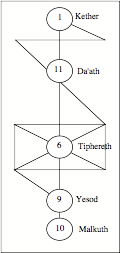
As a leading modern kabbalist, Rabbi Yitzchak Ginsburgh,
writes: In Kabbalah, the third day, Tiphereth ('beauty'), is the origin of the
sixth day, Yesod ('Foundation'). Tiphereth and Yesod totally integrate in the
secret of the 'middle line' - 'the body and the brith (covenant) are considered
one.' The above quotation
refers to Tiphereth as 'the body' and Yesod (below it) as the 'covenant'
('brith'), stating that the two are considered as one -- although they function
differently. Yesod is most
commonly seen as the ninth Sephirah (counting from Kether at the top). It is a
complex attribute as it contains all that came 'before it,' (of the previous
eight Sephiroth). Looking from 'below,' Yesod is generative, in that it is the
source of God's blessings (as has been mentioned). Regarding it from 'above,'
it is reflective of what came before it.
This is especially true in its relationship with Tiphereth, which lies
directly above Yesod in the Kabbalistic Tree of Life. Yesod is considered an
'image of the image' or 'mirror within the mirror,' with regard to Tiphereth.
As it maintains the complementary functions of giving and receiving, the
foundation of Yesod must be sound, hence it has an association with purity.
|
1 |
Kether |
|
|
|
|
|
|
11 |
Da'ath |
|
|
|
|
|
|
|
|
|
|
|
|
|
|
6 |
Tiphereth |
|
|
|
|
|
|
|
|
|
|
9 |
Yesod |
|
|
10 |
Malkuth |
|
|
|
|
|
|
37 |
|
|
AGAIN, WE HAVE THE NUMBER 37. 37 times 3 is 111.
YES.
|
14 |
o |
|
23 |
x |
|
|
|
|
37 |
|
Ox is aleph, or 111.
It is also 37. WE ARE
COMING BACK TO WHERE WE STARTED.
And Da'ath is? DA'ATH IS
KNOWLEDGE.
|
4 |
D |
Knowledge |
|
|
|
|
70 |
a'a |
|
|
|
|
|
400 |
Th |
|
|
|
|
|
|
|
|
|
|
|
|
474 |
|
|
|
|
|
|
|
|
|
|
|
|
|
70 |
a'a |
Testimony within the Ark |
|||
|
4 |
D |
|
|
|
|
|
400 |
Th |
|
|
|
|
|
|
|
|
|
|
|
|
474 |
|
|
|
|
|
|
|
|
|
|
|
|
|
70 |
a'a |
Ram; Goat prepared for sacrifice |
|||
|
400 |
Th |
|
|
|
|
|
4 |
D |
|
|
|
|
|
|
|
|
|
|
|
|
474 |
|
|
|
|
|
|
|
|
|
|
|
|
Is this the Scapegoat?
Connected to the Knowledgeable One; and the testimony in the Ark, the
commandments, the letters, and the covenant with God? THESE THREE ARE CONNECTED IN SOME MANNER CLEARLY. One can grasp the image of the
invisible God throught Tiphereth, due to its embodiment of the characteristics
of all the Sephiroth. The
Messiah's encompassing relationship to the Sephiroth (also called spirits of
God) and to da'ath, (knowledge) is seen in this prophetic verse: Isaiah 11:2 - The Spirit of the LORD
will rest on him-- the Spirit of wisdom and of understanding, the Spirit of counsel
and of power, the Spirit of knowledge and of the fear of the Lord. 37 IS THE ESSENTIAL DIFFERENTIAL. THE GROUND UPON WHICH WE MOVE. THE SKY FROM WHICH WE DESCEND.
1 + 1
+ 1 = 3, 3 x 37 = 111
2 + 2
+ 2 = 6, 6 x 37 = 222
3 + 3
+ 3 = 9, 9 x 37 = 333
4 + 4 + 4 =
12, 12 x 37 = 444
5 + 5 + 5 =
15, 15 x 37 = 555
6 + 6 + 6 =
18, 18 x 37 = 666
7 + 7 + 7 =
21, 21 x 37 = 777
8 + 8 + 8 =
24, 24 x 37 = 888
9 + 9 + 9 =
27, 27 x 37 = 999
10 + 10 + 10 = 30,
30 X 37 = 1110
The Son is extended through the world. The woman is the Dawn or Spring, the
one who brings the dark man back into light; the woman is also Dusk or the
Autumn, the one who brings the light man back into the darkness. TETRAGRAMMATON. TETRA. GRAMMER.
TRON(META). Tuetonic
Tempest. TALK TALK. Trouble. Trouble. TOIL
TOIL. Which Water? This? That?
'Thother? YES. Male. Female-Female.
Male. FATHER. WIFE-DAUGHTER. SON. EXTENDED IN SPACE, DOWN IN TO THE DARK REGIONS. The Son under Water. WISE WATER. Temporary Tempest.
TITULAR TITAN.
Temperamental Trachea. TALK
TALK. Tip. Tip. THE TRUTH. ONLY THE TRUTH.
SO HELP ME GOD. Yesod. THE FOUNDATION OF SOULS. To understand the full role of Tiphereth,
we need to underestand Yesod's relationship to the Sephiroth of Tiphereth,
which lies above Yesod in the Tree of Life, and Malkuth, which lies below
Yesod. We will examine similarities and complementary differences, as well as
the role Yesod plays in linking the other two. Included in the generative aspect of Yesod is its being the
foundation of souls: Bahir 157 - The Blessed Holy One has a single Righteous
One (Tzadik) in His world, and it is dear to Him because it supports all the
world. It is the Foundation (Yesod). This is what sustains it, and makes it
grow, increasing and watching it. It is beloved and dear on high, and beloved
and dear below; fearsome and mighty on high, and fearsome and mighty below;
rectified and accepted on high, rectified and accepted below. It is the Foundation of all souls. Yesod is also called the 'Foundation of
all souls' because souls are said to be born through the union of Yesod-Foundation
to Malkuth-Kingship. Yesod is
associated in the soul with the power to contact, connect and communicate with
outer reality (represented by the sephirah of Malkuth). The foundation (Yesod)
of a building is its 'grounding,' its union with the earth (Malkuth). The Zohar speaks to the same theme of
the soul (in this case, specifically the Neshemah), coming from the union of
Yesod to Malkuth. Zohar
Appendix III - The Designations and The Categories - Further, the lowest grade,
Malkuth, is regarded as female in respect of the six grades of ‘heaven and
earth’, and is often referred to simply as ‘The Female’. More specifically, it
forms a pair with the grade Yesod (Foundation) immediately above it. The two, when thus conjoined, are
usually designated Zaddik (Righteous One), and Zedek (Righteousness), and out
of their interaction issues the neshamah as the soul of man. A
function of Yesod regarding Malkuth is for the purpose of unifying the
latter to Tiphereth. As mentioned in an earlier study, Tiphereth is considered
to be the 'originator' of the Neshemah (the higher soul): Soncino Zohar
Appendix III - The Divine Name - It remains to say a few words on the place
occupied by the Holy Name, the Tetragrammaton [YHVH], in the scheme of the
Zohar. In the Cabbalistic doctrine the name formed by the four Hebrew letters
yod, he, vau, he, has a special and intimate connection with the grade of
Tiphereth, of which it is in the strict sense the proper name. We must
understand this to mean that if one could grasp with sufficient clearness the
nature of the grade Tiphereth, especially as the originator of the neshamah, he
would automatically perceive that this is the fitting appellation which should
be given to it. To this grade of comprehension Moses and the other prophets
actually rose, and this was the basis of their inspiration. There is, however,
a difference between the inspiration of Moses and that of the other prophets.
Moses was able to grasp the connection between the grade (Tiphereth) and the
Name (YHVH) fully and clearly, but the others only through a haze, as it were,
since their comprehension only reached fully to the two inferior grades of
Netzach and Hod, the two ‘pillars’ or ‘willows of the brook’, as they are
fancifully called. HE IS DRAWING
SOMETHING IN THE SNOW AGAIN.
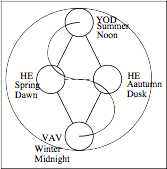
Within the hands of Yesod/Tzaddik are the souls of all
living things. Because of this it is also called Hei ha-olamim (the 'eternally
living one,' or, 'Living God').
This is reflected in Paul's usage of the term, assembly of the Living
God, found in 1 Timothy 3:15, in which he refers to this pillar (foundation),
and 'ground of truth,' represented by the souls who make up the 'assembly of
the Living God.' He also implores
the wise not to trust in earthy riches, but in this 'Living God' who provides
(El Shaddai, a name of God associated with Yesod): 1 Timothy 3:15 - But if I
tarry long, that you may know how you ought to behave yourself in the house of
God, which is the assembly of the living God [Yesod], the pillar and ground of
the truth. 1 Timothy 6:17 - Charge
them that are rich in this world, that they be not highminded, nor trust in
uncertain riches, but in the living God [Yesod], who giveth us richly all
things to enjoy. The concepts Paul
is teaching Timothy, are also found in the following Talmud tractate: Our
Rabbis taught: It is related of King Monobaz that he dissipated all his own
hoards and the hoards of his fathers in years of scarcity. His brothers and his
father's household came in a deputation to him and said to him, ‘Your father
saved money and added to the treasures of his fathers, and you are squandering
them.’ He replied: ‘My fathers
stored up below and I am storing above, as it says, Truth springeth out of the
earth and righteousness looketh down from heaven. My fathers stored in a place
which can be tampered with, but I have stored in a place which cannot be
tampered with, as it says, Righteousness and judgment are the foundation of his
throne. My fathers stored something which produces no fruits, but I have stored
something which does produce fruits, as it is written, Say ye of the righteous
[zaddik] that it shall be well with them, for they shall eat of the fruit of
their doings. My fathers gathered treasures of money, but I have gathered
treasures of souls, as it is written, The fruit of the righteous [zaddik] is a
tree of life, and he that is wise winneth souls. My fathers gathered for others
and I have gathered for myself, as it says, And for thee it shall be
righteousness [zedakah]. My fathers gathered for this world, but I have
gathered for the future world, as it says, Thy righteousness [zedakah] shall go
before thee, and the glory of the Lord shall be thy reward.’ The 'Tree of Life,' is often mentioned
in discussions surrounding Yesod, and is associated with Tzaddik (the Righteous
One) and Torah, as well as the month of Shevat, when Moses (the Tzaddik)
recounted the Torah to the Children of Israel. As stated by Rabbi Yitzchak Ginsburgh: The tree of life, as expressive of the
potential for restoring perfection to all reality, appears in Jewish sources as
symbolic of both the tzadik--foundation of the world' and the Torah, in
particular its inner dimension--the esoteric tradition. Thus the month of
Shevat, when we concentrate on grafting ourselves to the tree of life, is an
especially important time for attaching oneself to the tzadik by way of the
'sweet' Torah issuing from his mouth. For this reason we find that it was
during the month of Shevat that the children of Israel heard Moses recapitulate
the Torah, as recorded in the book of Deuteronomy (Mishnah Torah). The 'Tree of Life,' carries with it
very deep esoteric meaning, particularly that of the essence of the Tzaddik
(his soul), being 'hidden' like the roots of a tree. As also expfressed by Ginsburgh: The tree - as composed of roots, a trunk, branches, and
fruit - is seen in Kabbalah as a metaphor for the process whereby Divine light
and energy is channeled into Creation.
Let us elaborate upon the various components of this metaphor: The roots
of the tree represent the power of the Tzadik's soul, which absorbs and draws
forth the invisible Divine life-force underlying Creation, making it available
to all mankind in order that each individual can ultimately produce his own
unique fruit. The paradox of the tzadik is that while he exists in a 'revealed
state' (known to his generation), ministering to Creation and serving as a
model of Divine service, his essence (or soul root) remains utterly hidden,
like the roots of a tree. The
Tzadik himself is conscious of both these modes of existence. He is thus able
to consciously exist 'in the world and outside it' at one and the same
time. Paul spoke in the same terms
regarding the life of the Tzaddik (in this case, the righteous followers of
Yeshua), being 'hidden with Messiah.' (that is, existing, 'in the world and
outside it at one and the same time'.)
His prescription for continuing in this state, was obedience to the
commandments of Torah: Colossians 3:1-6 - If ye then be risen with Messiah,
seek those things which are above, where Messiah sitteth on the right hand of
God. Set your affection on things above, not on things on the earth. For ye are
dead, and your life is hid with Messiah in God. When Messiah, who is our life,
shall appear, then shall ye also appear with him in glory. Mortify therefore
your members which are upon the earth; fornication, uncleanness, inordinate
affection, evil concupiscence, and covetousness, which is idolatry: For which
things' sake the wrath of God cometh on the children of disobedience. EXCUSE ME A MOMENT, BOYS. I NEED TO TAKE A LITTLE WEIGHT OFF. Plain urinist? YES. NUMBEER ONE.
SAVE MY PLACE. A wind
shifting in from the north. The
smell of burning flesh passing.
Cold air coming down from the Arctic. YES. GO ON,
MOSES. Moishe. MOISHE. The similarity between Tiphereth and Yesod is reflected
in the relationship between Jacob and his son, Joseph. Before approaching this subject, we
will review how the seven lower Sephirah correspond to the patriarchs:
Chesed/Mercy = Abraham, worshipping from love of God
Geburah/Judgment = Isaac, worshipping
from fear of God
Tiphereth/Beauty = Jacob, the one unifying the two sides of mercy and
judgment
as
well as the link between uppermost and lower 'worlds
Netzach/Victory = Moses, as prophet and 'active' seeker of Revelation
Hod/Glory = Aaron, as Priest and 'passive' restriction based on the
commandments
Yesod/Foundation = Joseph, as the righteous and pure steward
Malkuth/Kingdom = David, as the worldly man
Thus, when speaking of Jacob, the correlation is to
Tiphereth, with Joseph, it is to Yesod.
Jewish literature draws great comparisons between Jacob and Joseph, and
therefore between Tipheret and Yesod, considering one as the image of the
other. (As mentioned earlier, Yesod is the 'image of the image' of Tiphereth):
Soncino Zohar, Bereshith, Section 1, Page 176b - The Shekinah was thus leagued
with Abraham, Isaac, and Jacob together with Joseph, inasmuch as the two latter
are one in essence, each one being the image of the other, as indicated in the
words: 'These are the offspring of Jacob: Joseph' (Genesis, XXXVII, 2). A modern book on kabbalistic symbolism
reveals the following between Jacob and Joseph: But Joseph resembled Jacob ... thus it is said by both of
them, 'Am I under God?' Jacob
said: 'Am I under God?' (Genesis 30:2); Joseph said: 'Am I under God' (Genesis
50:19). This alludes (to the fact that) Joseph is in the chariot like Jacob.
... Moreover, we have a matter alluded to by the true sages regarding why he is
called Joseph the righteous. It is because his attribute is close to the
attribute of his father ... truth (the attribute of Jacob) and peace, the
attribute of Joseph, are one. The
idea that Joseph is in the chariot like Jacob, shows that the unity of God is
more prevalent at a 'higher level' of prophetic vision. The following two texts from the Zohar
points to the likeness of Jacob and Joseph, mentioning how what happened to
one, also occured to the other, and that how (although they are the same), one
(Joseph) is 'near,' and the other (Jacob) is 'far.' This is interesting when we
think of Jacob as representing Tiphereth in the heavenlies, and Joseph as the
earthly Tzaddik, with divine qualities.
This concept parallels how Yeshua's work here on earth as Tzaddik, is
done (outside of time) in the heavenly realm as Tiphereth (that is, He was
crucified in the flesh, but is also the 'Lamb slain since the foundation of the
world'. Having performed His role in all worlds, He makes peace in all
places. Esoterically speaking,
benediction does not abide save where male and female are together, and since
at that time the male was not with her, all the souls that issued then were not
the same as they had been when the sun was in union with the moon, as already
said. This union is symbolized by
the relation of Joseph to Jacob, as expressed in the verse, 'These are the
generations of Jacob: Joseph.' This form of expression implies that Jacob's
image was completely reproduced in Joseph (as Father and Son), and that
whatever happened to the one happened to the other also, the two being parallel
and having the same esoteric symbolism.’ Soncino Zohar, Bereshith, Section 1, Page 6a - For the
other, the highest Sabbath does not come under the injunction of Shamor (keep),
but is under that of Zakhor (remember), which is used in the first version of
the Ten Commandments (Exodus, XX, 8), since the Supreme King is hinted at in
the word Zakhor (remember). For
this reason He is called 'the King with whom Peace dwells', and His peace is
within the injunction of zakhor (remember). And this is why there is no
contention in the supernal realm, because of the twofold peace here below, one
for Jacob and one for Joseph, as it is written, 'Peace, Peace, to him that is
far off and to him that is near' (Isaiah, LVII, 19): 'to him that is far off'
refers to Jacob, 'and to him that is near' refers to Joseph. SILENCE. This Moses has an appetite for language. LANGUAGE AND NUMBER. Yes.
|
7 |
Z |
Remember; |
|
|
|
|
20 |
K |
Male (Sacred Phallus) |
|||
|
200 |
R |
|
|
|
|
|
|
|
|
|
|
|
|
227 |
|
|
|
|
|
2 PLUS 2 PLUS 7 IS ELEVEN. Tedium. TE
DEUM. Did everything come out
alright? YES. DID I MISS ANYTHING. Jacob and Joseph. JESUS, MARY AND JOSEPH. No, JJ IS TO TY WHAT.... OH, NOW I DON'T REMEMBER? WHAT TIME IS IT? Nobody knows. IT'S STILL DARK.
IT MUST BE ABOUT.
Mohammed Atef. AYMAN
AL-ZAWAHIRI. What? Who? I DON'T KNOW. I
DIDN'T SAY IT. Who did? OVER THERE. Oh, him! At
least he's quiet now. HE'S
FATIGUED. Yes. HE CAN'T HARM US NOW. It would appear not. SHAMAR, WE WILL REMEMBER, IS THE
FEMALE; AND RELATES TO THE NIGHT.
ZKR IS THE MALE; REMEMBERING RELATES TO THE DAY, TO LIGHT, AND TO THE
MAN. Wo is Moses Montefiore? YOU'LL FIND HIM DOWN AT THE STOCK EXCHANGE. The stock exchange is probably burning
by now. WHAT? Who said that? AHMAD. OUR FRIEND BY THE DOOR. What does he mean by that? DOES HE HATE MOSES MONTEFIORE -- BECAUSE HE'S JEWISH? Undoubtedly. YESOD IS THE FOUNDATION. HE IS ALSO THE FOUNDATION STONE -- THAT BLACK-GUARDIZED
STONE, HURTLE-TURTLED OUT OF HEAVEN.
What? MOSES IS READY
AGAIN. Although there is similarity
between Tipheret/Jacob and Yesod/Joseph, we can also see distinction between
the two. The former is associated with God as creator, seen in 'maleness' as an
active principle (YHVH), and the latter as God as sustainer (El Shaddai), and
seen as 'maleness' transposed into procreative power. This procreative function of a Tzaddik is to bring people to
God, (that is, 'he who wins souls is wise.' - Proverbs 11:30). As eloquently stated by Rabbi Yitzchak
Ginsburgh: The Tzaddik procreates by arousing the souls of his generation to
return to God and the Torah.
Yesod, as the 'righteous one,' does not represent God as judge (John
12:47). This role is ultimately associated with Tiphereth (see, John 5:22). As
Gershom Scholem states, Tiphereth and Yesod represent, 'two different sides of
the Godhead.' Yesod is also seen
as the 'crossover' point from the first heaven (Asia/Making) to the second
heaven (Yezirah/Formation), Tiphereth represents that from the second to the
third heaven (Briah/Creation). We
can now see more clearly how Yeshua is reflected in both Tiphereth, (in the
roles and functions he performs above, such as the heavenly Kohen Gadol (the
High Priest), in the order of Melchizadek), and in Yesod, as the righteous
suffering servant who lowers Himself from a heavenly status to redeem His
kinsmen. Such a distinction
between Tiphereth and Yesod is found in a passage of scripture where God tells
Moses that He will be speaking to him at the (higher) level of YHVH (associated
with Tiphereth) and not at the level of El Shaddai (associated with Yesod), as
He had spoken to the forefathers: Exodus:
6:2-8 - And God speaketh unto Moses, and saith unto him, `I am YHVH, and I
appear unto Abraham, unto Isaac, and unto Jacob, as El Shaddai; as to My name
YHWH, I have not been known to them; and also I have established My covenant
with them, to give to them the land of Canaan, the land of their sojournings,
wherein they have sojourned; and also I have heard the groaning of the sons of
Israel, whom the Egyptians are causing to serve, and I remember My covenant.
`Therefore say to the sons of Israel, I am YHVH, and I have brought you out
from under the burdens of the Egyptians, and have delivered you from their service, and have redeemed you by a
stretched-out arm, and by great judgments, and have taken you to Me for a
people, and I have been to you for God, and ye have known that I am YHVH your
God, who is bringing you out from under the burdens of the Egyptians; and I
have brought you in unto the land which I have lifted up My hand to give it to
Abraham, to Isaac, and to Jacob, and have given it to you -- a possession; I am
YHVH.' With Tiphereth (the groom)
being united to Malkuth (the bride) and Yesod lying 'between' them, it would
seem sensible that the latter must play an important role with the other two.
This is indeed the case. The role of the 'heavenly Tzaddik' is emulated in the
physical realm by the righteous on earth.
The Zohar commentary on Exodus further explains the situation with Moses
(the earthly Tzaddik), and how Tiphereth and Malkuth were united through him:
AND MOSES SPAKE BEFORE THE LORD, SAYING: BEHOLD, THE CHILDREN OF ISRAEL HAVE
NOT HEARKENED UNTO ME, HOW THEN SHALL PHARAOH HEAR ME, WHO AM OF UNCIRCUMCISED
LIPS? How did Moses dare say this?
Had not the Holy One already promised him, when he said that he was not
eloquent, that He 'will be with his mouth' (Exodus, IV, 10-12)? Or did the Holy
One not keep His promise? However, there is here an inner meaning. Moses was then in the grade of 'Voice'
[Tiphereth], and the grade of 'Utterance'
[Shekinah-Malkuth], was then in exile. Hence he said: 'How shall Pharaoh
hear me', seeing that my 'utterance' is in bondage to him, I being only
'voice', and lacking 'utterance'. Therefore God joined with him Aaron, who was
'utterance' without 'voice'. When Moses came, the Voice appeared, but it was 'a
voice without speech'. This lasted until Israel approached Mount Sinai to
receive the Torah. Then the Voice was united with the Utterance, and the word
was spoken, as it says, 'and the Lord spake all these words' (Exodus, xx,
I). Then Moses was in full
possession of the Word, Voice and Word being united. That was the cause of
Moses’ complaint (v. 23), that he lacked the word save at the time when it
broke forth in complaint and 'God spake to Moses' (VI, 2). On this occasion the
word began to function, but it ceased again, as the time was not yet ripe;
hence the verse continues, 'and said to him, I am the Lord'. Only at the giving of the Law Moses
was, as it were, healed of his impediment, when the Voice and the Utterance
were united in him as their organ. Before that event the power which is Utterance
guided Israel in the desert, but without expressing itself until they came to
Sinai. The Zohar's commentary on
Song of Songs (Song of Solomon), also refers to this union of Tiphereth and
Malkuth via Moses. Rabbi Judah
interpreted in the same sense the verse from the Song of Songs (v, 5-6): 'I
rose up to open to my beloved, but my beloved hath withdrawn himself and was
gone'. As long as the Community of Israel is in exile the Voice [Tiphereth], is
withdrawn from her and the Word does not function, as it says, 'I am dumb with
silence' (Psalms, XXXIX, 3); and even when the Word does awaken, 'my Beloved
hath withdrawn Himself', that is, it suddenly ceases, as it did at first with
Moses. The role of joining Malkuth
to Tiphereth belongs to the one in the place of Yesod-Tzaddik: 'Jacob, who is
called Tiphereth, is the masculine world that is standing, and he wanted to
join the feminine world (Shekinah), which is sitting, by means of Yesod, which
is called peace and tranquility.'
'... just as the divine saddiq serves as a conduit connecting the Holy
One blessed be He [Tiphereth], and the Shekinah [Malkuth], so by means of
walking the earthly saddiq [Yesod] unites with the feminine Presence [Malkuth]
... 'the sephirah of Yesod above serves to unite the waw (VAV) [Tiphereth] and
the HE' (lesser HE) [Malkuth] of the Tetragrammaton (YHVH)'. The term 'walking' (halakha) in the
above citation, is used kabbalistically to refer to the arousal of the union of
the masculine [Tiphereth] and feminine [Malkuth] aspects of God. This is
associated with the concept of tikkun (repair of creation and unification of
the Godhead), accomplished through works of Torah. This 'look ahead' to the eternal tikkun (when Tiphereth and
Malkuth finally come together), was foreshadowed in the sacrificial system
instituted by God. The Zohar explains how the 'heave offering' played a
mystical role, along with the righteous person, in this unification of
Tiphereth (representing the heavenly realm) and Malkuth (representing the
earthly realm): (Zohar) 'They
shall take Me a heave offering.'
Here we have displayed an inclusive union of the above with the below,
for it does not say 'They shall take a heave offering', but 'They shall take Me
a heave offering', which denotes a fusion of the upper with the lower spheres.
[that is, Tiphereth with Malkuth].
'On the part of everyone whose heart is willing ye should take my heave
offering.' The words 'on the part
of' seem at first sight to be superfluous, but in reality they contain a deep
lesson for the masters of the esoteric lore. Blessed are the righteous who have learnt how to centre all
their thoughts and desires on the Heavenly King, and whose aspirations are
directed, not towards the vain and foolish toys of this world and its lusts,
but to attaching themselves wholeheartedly to the world above in order to draw
down the favour of the Lord Himself from heaven to earth. King David was another Tzaddik who was
able to unify Malkuth and Tiphereth.
Note that David's praise was directed to Tiphereth, (in essence Yeshua
in the heavenlies): (Zohar) The words 'I will give praise to thee' were
addressed by King David to the Holy One, blessed be He [Tiphereth], for that
last world which He has made [Malkuth]; for David attached himself to that
world and through it attained to kingship. 'I will wait on thy name, for it is
good': this is the Holy One, blessed be He [Tiphereth, when unified with that
world which is called 'good'. And when is it called good? When it is in the
presence of thy saints, or rather, 'loving kindnesses'. ... for when these are
filled from the goodness of the stream issuing from the Ancient Holy One, then
Yesod is called 'good', and then He [Yesod] establishes this latter world and
all is blessed. Hence David waited
for this grade to illumine the world to which he was attached.’ Because Yesod plays this active role in
uniting the heavenly groom (Tiphereth) and bride (Malkuth), yesod is referred
to also as ha-teshukah, 'the light of desire' -- a term used for the desire of
the male for the female. When the
soul (Neshamah) of the Tzaddik is involved in religious activity, it affects
the Sephiroth, specifically uniting Malkuth to Tiphereth: When the neshamah
ascends, the desire of the feminine for the masculine is aroused and the waters
pour forth from above to below.
As mentioned in our earlier studies, the Sephirah of Malkuth (the
bride), when kept apart from its groom (Tiphereth) becomes the source of harsh
judgment on the world. The Bahir
uses a great deal of bodily and sexual allegory to explain such concepts. As stated by Rabbi Aryeh Kaplan: Even
though we know that God is absolutely incorporeal, having neither body, shape
nor form, it is taught that, 'He borrows terms from His creatures to express
His relationship to His creation (Mekhilta on Exodus 19:18). These terms are
used allegorically, but at the same time, each has a definite meaning in terms
of the Sephirot. As mentioned
earlier, Tiphereth (or Zer Anpin, the six Sephiroth represented by Tiphereth),
represents the main trunk of the (male) body. Yesod, being beneath the body, is the 'phallus' (as this is
the Sephirah that generates souls and sustains life). Malkuth represents the
female counterpart to this.
Keeping these allegorical concepts in mind, note the following commentary
to the Bahir, explaining the relationship between these three Sephiroth. The
function of Yesod is in bringing them together, thus playing a key role in
bringing 'peace' to the world: But
in order for Malkhuth-Kingship to act in a mode of Mercy, it must be bound to
Zer Anpin, this being the concept of the Supernal Union. This Union, however,
takes place through Yesod-Foundation, the sex organ, which is also called
Righteousness (Tzaddik). Yesod-Foundation, however has two modes, one of
celibacy and one of intercourse. The Righteous is one who is 'separated from
sex,' and therefore, when it is in this mode, it is called, 'the Righteous, the
Foundation of the world.' The word 'world' here is Olam, also having the
connotation of Elam - Hidden. Therefore, Yesod-Foundation is called Righteous
when the sex organ is hidden and not expressed. Similarly, Joseph is called
Righteous (Tzadik) precisely because he refused to have intercourse with
Potiphar's wife. When Yesod-Foundation is in this mode, there is no union
between Zer Anpin and the Female. The Female is therefore in the mode of
Judgment. In the second mode, Yesod-Foundation is called Chai - 'alive.' It is
said to be 'alive' when it is functioning during intercourse. If a person pursues righteousness, then
he arouses its counterpart on high and brings about the supernal union. He then
'may live and occupy the land.' When the verse says that he will 'live,' it
means that he will bring Yesod-Foundation into its mode of Chai, which is that
of union. He will then occupy the 'Land,' which always alludes to the Sefirah
of Malkhuth-Kingship, which is the Female. SUN, MOON AND EARTH.
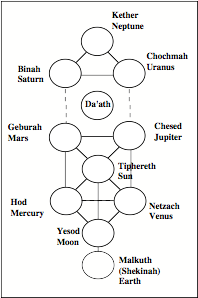
SO, WHAT ARE WE TO BELIEVE IN ALL OF THIS? What? BELIEVE?
WHAT? Nothing is free. WHAT? I DON'T UNDERSTAND THAT? I feel that we are waiting for Godot out here? WHAT? Beckett.
YES. BUT THAT BOY, MOISHE
-- I AM NOT FOLLOWING WHAT HE IS SAYING.
HE IS LIKE A JEWISH BOY-BILLY GRAHAM. WHAT IS THIS ALL ABOUT? IS THIS WHAT IS MEANT BY PRAYING? Get a grip, now.
The logic is simple. He is
building his case for divinity again.
YES. BUT WHO IS CREATING
HIM? IS THE BOY ANGEL CREATING HIM
SO? Perhaps. METATRON -- WASN'T THAT HIS NAME? Yes. HE IS CONNECTING TIPHERETH, THE SUN, MICHAEL THE ARCHANGEL
WITH JESUS CHRIST. And with
Crossmann himself? OBVIOUSLY, THAT
IS THE MESSAGE. Why? FOR THE SALVATION OF THE WORLD, I
SUPPOSE. Does the world need to be
saved? THAT IS A GOOD
QUESTION. I'M NOT SURE THAT IT
DOES. THE WORLD IS THE WORLD. PERFECT IN ITS IMPERFECTION. That line has already been used. WELL, I NEVER SAID I WAS ORIGINAL. JUST SMART. I see. PRIDE
COMES. Jesus, not this again. I'M FREEZING. Put on your gloves.
What are you doing without gloves.
I'M BEGINNING TO THINK THAT WE DON'T BELONG HERE REALLY. WE ARE NOT REALLY POETS. WE ARE MORE PROSE. Prosaics? PROSE-MASTERS.
I WAS GOING TO SAY PROSE-MASTERS.
I DON'T UNDERSTAND ALL THIS ESOTERIC AMMBULATION. PERHAPS YOU DO, PROFESSOR BLOOM. You are Jewish, afterall. WHAT DOES THAT HAVE TO DO WITH THIS? Well, it is your kabbala? WE SHOULD GO INSIDE. I DON'T KNOW WHY WE ARE OUT HERE
ANYWAY. If you go inside, you'll
have to be with HIM! YES. IS HE PASSED OUT? Do you really think he's
dangerous? IT DEPENDS ON WHETHER
HE REALLY HATES AMERICANS AND JEWS AS MUCH AS HE SEEMS TO. He has a different kind of mind,
afterall. HE IS A DECENT MAN. I DON'T KNOW WHAT HAPPENED TO HIM. HE HAS BEEN POSSESSED BY THE DEVIL --
THAT MUST BE IT! Possessed by Hate
and by Destruction. YES. HE WAS A VERY NORMAL MAN EARLIER
TONIGHT. That is the side he
showed you. WHAT? That was the side he showed you -- so
he could fit in; and be liked. But
his real nature he has kept hidden.
His real nature is that of the murderer. I DON'T BELIEVE THAT.
HE IS A MAN. HE IS A DECENT
MAN. HE HAS JUST BEEN. Bitten by the fit of agenwit? WELL, YES -- PERHAPS. HE WILL BE FINE IN THE MORNING. THE DARKNESS IS JUST LIKE LIQUOR TO
HIM. THE DARKNESS HAS MADE HIM
DRUNK WITH. Disease? YES, SOME KIND OF DISEASE. Anthrax? WHAT? Smallpox? I DON'T UNDERSTAND. The Black Death? I REALLY DON'T KNOW WHAT YOU ARE
SUGGESTING. Shawn the Post
carrying letters to men of congress.
WHAT? ILLEGAL
CONGRESS? Letters. YES. Letters dug up out of the Earth. ABCDEED. Jewish
architecture of sticks, twigs, rocks, sun and moon, doors, camels, deer, ox
goads, arrows, swords. PULLING
LANGUAGE OUT OF THE AIR. AND
GIVING IT FORM. They who are
verboten fur image hammer an image of God in the form of the word. BRONZE AND GOLD AND SILVER IMAGERY OF
LOOM. EARTH AND SUN AND MOON BUILT
OF VOIDS. Sinking Matriarchy. WHAT? In Alpha and Beth, Alpha, the Man, becomes paramount. And Beth, the wife, becomes
secondary. EARTH BECOMES? Secondary to the sky. SHLAIN AGAIN. In the Darkness, the Man exists below the Woman, in the
Shadow of the Woman, the Earth. At
Dawn the Man rises, through the Woman (Our Matrona or Daphna), rising into the
Sky, rising up above Woman, making Woman and Earth beneath Him. GLANDULAR ICONOGRAPHY. Moses Sesom Somes Semso. OH, NO, IS HE COMING BACK AGAIN? In Kabbalah, that which is
intermediate between two extremes possesses aspects of both those extremes.
Therefore, Yesod has characteristics of both the 'masculine' Tiphereth and the
'feminine' Malkuth. The Zohar
associates the Tzaddik (Yesod) with the 'Angel of the Lord,' from the book of
Exodus. This angel is said to manifest itself in both male and female forms.
(Note also the relationship between the colors of the rainbow and aspects of
God.]: (Zohar) While they were sitting midnight
arrived, and Rabbi Judah said to Rabbi Jose: ‘Now the north wind awakes and the
night is divided, and now is the time when the Holy One, blessed be He, longs
for the voice of the righteous in this world, the voice of those who study the
Torah. Now God is listening to us in this place; therefore let us not cease
from discoursing on the Torah.’ He
then commenced: THE ANGEL WHO DELIVERED ME FROM ALL EVIL . This is the same as
the one mentioned in the verse: 'Behold I send an angel before thee...'
(Exodus, XXIII, 20), who, as we have laid down, is the deliverer of the world,
the protector of mankind, and the one who procures blessings for all the world,
he himself receiving them first.
This angel is sometimes male, sometimes female. When he procures
blessings for the world, he is male, resembling the male who provides blessings
for the female. But when he comes
to bring chastisement on the world he is called female, being, as it were,
pregnant with the judgment. Similarly, in the words, 'the flame of the sword
which turned every way' (Genesis, III, 24), there is a reference to the angels
who are God's messengers, and who turn themselves into different shapes, being
sometimes female and sometimes male, sometimes messengers of judgment and sometimes
of mercy. In the same way, this
angel can take all colours like the rainbow, and treats the world
correspondingly. An example of a
Tzaddik taking on 'female' characteristics is found in Luke's Gospel. Here we
find Yeshua (the Divine Tzaddik), referring to Himself in terms of the Kingdom
(Malkuth), which is feminine. Interestingly, the various versions of the 'New
Testament' translate this verse in one of two ways: Luke 17:21 - Neither shall
they say, Lo here! or, lo there! for, behold, the kingdom of God is within you
(King James Version). Luke 17:21 -
nor will they say, 'Lo, here it is!' or 'There!' for behold, the kingdom of God
is in the midst of you (Revised Standard Version). Both translations are legitimate, as the Hebrew preposition
'be' means 'with' as well as 'in.' Thus, the Kingdom can be found by looking
for God within oneself (that is, where the Sephirot may be 'found,' as we are
made in His image), in the manner of humility and repentance - defined as
turning away from the flesh to following Torah. Tzaddik-Yesod (as represented by Yeshua) therefore
contains elements of the Kingdom (as He was [potentially] the Kingdom in their
midst), giving Tzaddik-Yesod (and thus Yeshua), 'female' characteristics as
well. (Malkut-Kingdom is identified as having primarily female
characteristics.) This is true, as
Yeshua is the image of God, which is both male and female. Genesis 1:27 - So God created man in
His own image; in the image of God He created him; male and female He created
them. It also helps explain why
Yeshua speaks of Himself using a female analogy: Matthew 23:37 - O Jerusalem, Jerusalem, thou that killest
the prophets, and stonest them which are sent unto thee, how often would I have
gathered thy children together, even as a hen gathereth her chickens under her
wings, and ye would not! The
Sephirah of Yesod is said to 'include the female,' through its being bound to
it: In Kabbalistic teachings,
'Judgment' is Zer Anpin itself. Thus six of the seven [lower] Sephirot are
'Judgment,' which are the six of Zer Anpin. The Sephirah of Yesod-Foundation,
which is the male sex organ, also includes the Female ... This is also reflected in the Bahir,
(which bases this theme on Genesis 2:24, where a man and wife become 'one
flesh'): The covenant of
circumcision [Yesod] and man's mate are considered as one. This linking of the male and female is
mirrored in the Olam Haba, (World to Come), where the righteous (Tzaddik) in
heaven are seen as being bound to the Shekinah. This is represented in the form
of being given 'crowns on their heads.' (It is also associated with 'white
garments,' as mentioned several places in Revelation): Man then binds himself
to the Female, just as the male cleaves to the female in a physical sense. The
Female is the Divine Presence (Shekhinah). This binding is the ultimate delight of the World to Come,
and it is thus taught, 'In the World to Come ... the righteous will sit, with
their crowns on their heads, delighting in the radiance of the Shekinah'
(Berakhot 17a). The gift of these
crowns, and thus eternal life, is directly related to Torah observance. John made it quite clear that those who
will one day 'be like him,' (in the 'radiance of the Shekinah'), are those who
have purified themselves, which is done by turning from sin (as defined by
Torah), and following the 'path' of the Tzaddik - one who is a 'hearer' and a
'doer' of Torah or the Law. Note
that John makes it a point to define sin as 'lawlessness' (going against the
Torah): 1 John 3:1-7 - See what
love the Father has given us, that we should be called children of God; and so
we are. The reason why the world does not know us is that it did not know him.
Beloved, we are God's children now; it does not yet appear what we shall be,
but we know that when he appears we shall be like him, for we shall see him as
he is. And every one who thus hopes in him purifies himself as he is pure.
Every one who commits sin is guilty of lawlessness; sin is lawlessness. You
know that he appeared to take away sins, and in him there is no sin. No one who
abides in him sins; no one who sins has either seen him or known him. Little
children, let no one deceive you
He who does right is righteous, as he is righteous. An example of John's admonition for the
servant of the Lord to be 'pure' is seen in Daniel. His righteousness resulted
in an amazing proclamation regarding the 'kingdom' of Darius, who declared that
the God of Daniel (note: 'the Living God' - Yesod), would be the God of his
(Darius) kingdom. Thus, Daniel
brought God's shalom to the kingdom of Darius, just as the Divine Tzaddik
brings peace to God's Kingdom: Daniel 6:20-28 - And when he came to the den, he
cried with a lamentable voice unto Daniel: and the king spake and said to
Daniel, O Daniel, servant of the living God, is thy God, whom thou servest
continually, able to deliver thee from the lions? Then said Daniel unto the king, 'O king, live for ever. My
God hath sent his angel, and hath shut the lions' mouths, that they have not
hurt me: forasmuch as before him innocence was found in me; and also before
thee, O king, have I done no hurt.' Then was the king exceedingly glad for him,
and commanded that they should take Daniel up out of the den. So Daniel was
taken up out of the den, and no manner of hurt was found upon him, because he
believed in his God. And the king commanded, and they brought those men which
had accused Daniel, and they cast them into the den of lions, them, their
children, and their wives; and the lions had the mastery of them, and brake all
their bones in pieces or ever they came at the bottom of the den. Then king
Darius wrote unto all people, nations, and languages, that dwell in all the
earth; 'Peace be multiplied unto you. I make a decree, That in every dominion
of my kingdom men tremble and fear before the God of Daniel: for he is the
living God, and stedfast for ever, and his kingdom that which shall not be
destroyed, and his dominion shall be even unto the end. He delivereth and
rescueth, and he worketh signs and wonders in heaven and in earth, who hath
delivered Daniel from the power of the lions.' So this Daniel prospered in the reign of Darius, and in the
reign of Cyrus the Persian. LOVE,
CHRISTOPHER. LOVE -- NOT WAR. Peter Piper Picked a Peck of Pickled
Peppers. TINY TIMMY TINNED A TON
OF TARNISHED TURNIPS. Tubby Teddy
Turned a Tent of Tuburcular Testimonialists, Toxic Temperamentals, To
Treacherous Traitors, Teaching Treason Tied to Temperate Testaments; Then Toned
a Tune for Troubled Troubadours.
TESTY TEACHERS TALKED TO TEMPEST-TRADERS, TELLING THEM TOPICALLY-TIPPED
TALES OF TRAVESTY'S TOTAL TANKING TWICE TO TRADE'S TELLING TRUTH. Truthfully. TELE-TUBBY TRUTHFULNESS. The tit is happier than the tot. THOTH IS TROTHFULLER THAN THE TITHE. Ahh, how could anybody not like this
boy? IS THIS SOME KIND OF JEWISH
CONSPIRACY -- WORDS, I MEAN?
You'll have to ask the White-Power Boys. OR ASK THE BLACK-POWER BOYS. Caught in-between some wedge. A tiff, a tiff -- Time threads a tiff for wrath is full and
met at Tronheim. NIDAROS. Greek tome sounding silver on the sight
of it. OLAV TRYGGVASON, OF FIKING
VAME, OUNDED FAYE ITTY SAY AT OUTH MAY IVERS RAY NIDELVA EL NEVADA EN DELVA VULVA EDEN'S RAY. Tock tock tock. While the guns begin to go off. WHO HAS CROSSMANN'S PISTOL NOW. Does Ishmael have it? WE TALK MANY TIMES BEFORE WE MAKE A
SOUND. Porous invention; a thumb
inside one's ear, piking dike ter.
COUNTING TO TEN. COUNTING
TO TWELVE. Thirteen being the
nose. AHH, A GOOD NUMBER. Emm. A GOOD NUMBER UNDER.
Shlain was the anti-semite.
YES. The one who used his
intellect to strike at the Jews.
DEAD? What? CADMUS PLANTS THE DRAGON'S TEETH IN
SOIL -- AND THEY GROW INTO SOLDIERS.
Who all kill one other -- until only five are left standing. THESE ARE THE VOWELS, THEN? A, EEE, Eye, Oh, You. OTHERWISE KNOWN AS THE EXCLAMATIONS,
WHOSE SONGS ARE REMEMBERED AND SUNG CLEAR ACROSS THE WORLD. Counting on one hand: A E I O U. Generators of motion. THE FIVE-FINGER PROPHECY. In to your pocket. Then out again, holding your
wallet. WATCH HIM GOOD. HE'S A DANDY; BUT HE'S ALSO A
TTTTTTERRORIST. Ayyyyyyyyye. A ROLLING MOSE GATHERS NO ROSS. Phoenician maven. DRAGON OF BEOTIA. Tail tipping; tail tapping. CAPTURE SOUNDS, CADMUS. BUILD AN ALPHA-BETA. Sounds come first; and then the shells
inside of which sounds live.
SOUNDS COME FIRST.
EVERYTHING COMES FROM THE ZERO.
AND THEN THE ONE.
Take this test:
Multiply
111,111,111 times 111,111,111.
This
returns 12345678987654321.
Doesn't that tell you something? I DON'T UNDERSTAND.
ARE WE SPEAKING OF NUMBERS HERE?
OR LETTERS? Mosh,
b'gosh. Loss is boss. MARIONETTE, CLARIONETTE. Moses' Roses. SPEAK, MISTER GEEK.
SPEAK, OF THINGS CONCEALED AND BLEAK. The earthly tzaddik, may of course, be male or female. One
of the more significant righteous women of the Bible, from a kabbalistic
viewpoint, is Miriam, the sister of Moses and Aaron. As we have earlier
discussed, Moses is associated with the Sephirah of Netzach, and Aaron with
Hod. These Sephirah are concerned with the 'management' or 'filtering' of what
comes from above to the world below. The children of Israel, with the Shekinah
among them, are represented by the Sephirah of Malkuth. So what about Yesod-Tzaddik in this
relationship? This role was played
by the righteous Miriam. As the tzaddik, it was she that acted as 'mediator'
between the people and her two brothers, who (especially Moses) were very close
to God and involved with His instruction, that they distanced themselves from
the people. Two related episodes
confirm her role. One involved the time that she spoke against Moses and
received the punishement of Tzaraat (incorrectly called 'leprosy' in most
Bibles) - in fact having her skin turn completely white (Numbers, chapter
12). When a person was striken
with Tzaraat (a punishment of mercy from God) they had to stay away from the
camp for at least seven days. Normally, this person would follow the main group
of people as they continued their journey. In Miriam's case however, the people
did not move at all until she was brought back to the camp. Why did they
wait? The common explanation is
out of respect, but if we examine the text closely, we will see that it may
have been out of necessity -- due to her role as the Tzaddik, who brings forth
the flow of God's blessings from the heavens above to the people below. We know that the blessings that
followed the children of Israel were directly linked to a mysterious rock/well
that followed them in their journey. We see in Numbers, chapter 20, that when
Miriam died, the rock/well that supplied their water (which also represents
God's blessings), was not to be found. As we will discuss in the next section,
the rock/well is directly associated with Yesod-Tzaddik. Thus we have Moses, Miriam and Aaron
representing the 'lower triad' of Netzach, Yesod, Hod, placed between the
higher heavenly realm and the people.
SPETSNAZ. Riki Tiki
Tavi. MAKE THE SIGN OF THE CROSS,
QUICKLY, WHEN YOU SPEAK THAT NAME!
Let nothing grieve thee, O Land of Ta, for God hath chosen thee to be
the source of the joy of all mankind.
AHH. HU BALLA. Shaun coming 'round again. DELIVERING THE IMPORTANT LETTER FOR THE
LOVERS. Does he wear gloves; or a
gas-mask now? NOT ENTIRELY. Single You. DOUBLE YOU.
Ahh, the marriage bed, a grand design. Eff You. Effie
Feffie. Double You, Double
Vee. MOSES DE MAIMONIDES, HIS LEATHER LETTER-BAG FULL OF TOXIC
THOUGHTS. A Thranax. A trachea full of polyps
points. U. A cup. A VAGINAL CUP.
You or Vee? BOBBY VEE? Ur, perhaps, Heather Bush? A DAUGHTER OF GEORGE W? Female productive power. EMPTY CUP, FULL CUP. Mother in her cups. BUT IT WASN'T A PROBLEM. Head of a horned asp. AHH, YES. SO EGYPTIAN.
Unicorn. USUAL
UNICORN. Virginity. VESTALLY UNDONE. Uni Atma. THE LOWER TRIANGLE.
Vagina Viologue. VAGINA
VIOLIN. Ursa Major; Ursa
Minor. VAMPIRE EMPIRE. VAMPIRE CAMP-FIRE. Victory and Life. VERMONT; AND UTAH.
Virgo.
Virgo. Who's got the
Virgo. PISCES, AQUARIUS,
CAPRICORN, SAGITTARIUS, SCORPIO, LIBRA, VIRGO. ONE TWO THREE FOUR FIVE SIX SEVEN. Seven is the Virgin because no number below 7 can enter into
7 (divide it); and 7 does not reproduce itself in any numbers of the
decad. The sacred numbers 1-10. VULVA. VAGINA. VENUS
VICE. And what of Double Vee? VESTAL VIRGIN? Let's not forget about Gemini? TWINS, YOU MEAN? The Well. The Wheel. The
Water-Wager. Mother's Wa-Wa. M is Mater; M is Mother. The M is the inverted W; the W is the
inverted M. Mater Materia. Woman's World. Womb. Weather.
Whether. Whither. Whatever. Witch.
Whichever. WILLIAM. Walkabout Weekend Warrior of
Winter. VAV, THE SON, THE F, HAS
GIVEN BIRTH, IN LATIN, TO THE U, THE V AND THE W. I see. NOTHING
ELSE? Nothing else -- you mean
beside sight. THE SEED IS IN THE
EARTH, BURIED IN THE WOMB. BUT IT
WILL NOT BE FRUCTIFIED INTO LIFE UNLESS THAT RAY OF SPRING LIGHT ENTERS IT AND
BRINGS IT OUT OF THE EARTH, UP IN TO THE SKY. I see. OUT OF
THE EARTH AND WATER; INTO THE AIR AND THE FIRE. Wagna Water.
WASCOVIA. White Water. WIPE WHILE WET. Female blood. EYE. Female
Fecundity. NOSE. Female Fatality. MOUTH. Athena, Wisdom, the Virgin Maiden, in Greek Gematria, equals
77. COUNTING CROWS BY HAND. Crows and Doves. WATER, WATER, SO MUCH WATER. Nuah's blue; he cannot count the wealth
of waves. GRINDING AN AXE. Antimony in your pocket. VOCKET VAUNCHER. Viefdom. VERY VERY....VIOLET VALUE. What Winsome Wife Waits Wondering What Wicked Wraith Wastes
Wax Wiping Wreathes With Writer's Wit, Woeful, Worried White With Wretched
Willfulness, Warrior's Wrath Webbing Weak Willowy When Walkers Weild Wrecking
Wisdom with Willing Waterdom. AWRY
WITH WORRY. So welcomely white of
you, Xavier.
X OF CUTE.
What? SUPPORT YOUR LOCAL
LYRICAL LUKE, LINGUIST. New
Excrement? WHAT? Matthew, Mark, Luke, John. MAMMAL LUJA. Luke, Matthew, Mark, John. LUMAN AT ARK JOE.
What? John, Luke, Mark,
Matthew. JAIL UKRANIAN MARKED MEN
A FEW. John Matthew Mark, Luke. JOIN MATH USE MARVELOUS KEYS LOVE. Temporary cranium. EXCEPTIONAL TEMPORARY CRANIUM. Into the body and out again. FOUR DIRECTIONS APPROACHING ONE ANOTHER
IN MANY COLORS ON MANY HORSES EACH CARRYING A BOOK OF REVELATION. Samekh. WHAT?
Samekh. SALMON? Fish. PISCES FISH.
Fish bones. Skeleton, ribs
and spine and backbones and existential tibia. I SEE. Ex. Ex-communicate. Ex-ecute. Ex-tempore.
Ex-celsius.
Ex-caliber. Ex- emplary. APOCALYPSE. Cross again.
WHAT? North-South-East-West
contracting.
12345678987654321.
Ex-ecutive. OF WHAT? Ex-ecutive Branch. TREE. PINE TREE.
THE CEDAR OF LEBANON. The
nun is an invertebrate fish, moving like a smake up in the branch, talking
godless frequencies in support of x-termination. AYE. SERPENT OF
CORPULENT CUNT. Priest of the
vertebrate fish, the ladder of Jacob's franchise. GIVE THE OLD MAN A CANE. HE CAME IN ON FOUR; HE MOVED ACROSS ON THREE; HE GOES OUT ON
FOUR. SphinX. X-COLUMN; Y-COLUMN. Why? Why, Kaye?

W Z Y K.
Woychek? HERZOG. WERNER. Wapiti Kel.
BOOK KELLZ. Tunc page. NEW EXCREMENT? What? TAKING A TUNC?
What? YES YES YES. I BELIEVE THAT'S TRUE. Yesterday, love
was such an easy game to play. Now
it looks as though we're here to stay.
OH, I BELIEVE. I
BELIEVE. Kike, Dike, Yikes. A HAND GIVEN OUT. A hand holding a yarmulke. THE CAP OVER THE NORTH POLE. The Yce Cap. YIKES CAP.
Yammersday pap. MONETARY
YELLOW. MONETARY YELLOW. Gold cap, you mean? WHAT? The tooth? The
tooth of Wisdom. ZEUS PUT HIS
WANKER INSIDE OF METIS. Wetis put
her winnker around old Suez. FIRE
BY FRICTION. Sparks fly. SPARKS WANNABE. Wisconsin. Washington.
WE. WE WIIL. WE WILL WALK WHOLE WHEATFIELD TO FIND YESUS. The gold metre. THE YAMMER OF YORE. ZEUS. ZACHARIAH.
ZEBULON. ZEDECHIAH. ZESUS. Gee.

77. YES. 7777. ZOT.
Zayin. Times Two.
ZERO. The End. THE ARROW OF THE END. Sagittarius. A VULGAR WORD FOR THE MALE SEX ORGAN. Zisuthrus. ZIMBABWE.
Zammer. Zickus. Zorro. ZAZ. ZOO PITS;
ZOO CRITTERS. Double Dick. THE 26 ENDS. ZERO. Multiple
heads. Multiple icons. THEIR GOD FORBADE THE WORSHIP OF THE
IMAGE -- BUT WHAT ARE THESE LETTERS IF NOT IMAGES? Symbols of sounds.
NOT IMAGES? Iconographic
imprimateurs. HE PUTS AWAY
HIS BOOK FOR A MOMENT -- TO
THINK. He has a bag of books. YES. Letters gone.
XARHTNA IN THE EPOLEVNE.
Letter-carrier. NEEDING
WATER. Anti-histimine. ANTI-BIOTIC. Fire over Water.
Ear over Eye. LAZARUS
UNDERSTANDS ZOMETHING, WHEN HE COMZ BACK.
Zio. Dio. X-ecration. Yin-carnation.
X-Zaminaton. MATERNA
MATRIX. And then? X-AXIS; Y-AXIS. 90 plus 45 plus 45 equals
180.
Gentlemen, cross your swords. Cross your swords.
THE 26 ENDS; AND THE TEN BEGINS.
The 36 Paths of Wisdom.
NUMBERS COMES FIRST, AND ARE CLOSEST TO GOD. The Numbers are the gods; Letters come from God. IF NUMBERS ARE THE GODS, THEN GEOMETRY
MUST BE THE THOUGHTS OF THE GODS.
An Ideal Sentence. I
THOUGHT YOU'D AGREE. 360 must mean
something then. THE CIRCLE. Yes, but there must be more. The Circle is Ideal. But it must mean some even here, down
here where nothing is Ideal. IS
365 THEN BUT A PERMUTATION OF THE IDEAL 360? I don't know.
WHERE IS PLATO? IS HE NOT
HERE? Pythagoras then? I DON"T SEE HIM. I'm afraid he's gone. IS HE THAT MAD DERELICT INSIDE? No, absolutely not. That is Abdullah, master of
algebra. All-generative breaker of
the two condition in man. PLA
DO. Pla Do Re Me. MUSIC IS THE FRANCHISE OF THE NUMBER. Music is the sounds of numbers. NUMBERS SPEAK THROUGH THE SOUND OF
MUSIC. YES. THE GODS SPEAK THROUGH MUSIC. He's taking out his book again. WHO? Moses. DE
LEON? Frank. OH, YES. Let him read then.
DOES THE WOMAN APPROVE OF HIM?
She doesn't like Jews, remember.
IS SHE ANTI-SEMITIC? Aren't
they all? ALL OF WHOM? ALL NEW AGERS. New Angers hate the Earth; they hate
the Earthly things. They hate
man. I'M NOT SURE THAT IS
TRUE. Bespeak truth to me,
then. Do not hide it beneath
bushelbaskets. HEAR THE WORDS I
SPEAK. She is clucking like an old
hen, black in her array. NEVER
UNDERSTAND BUT WHAT YOU HEAR, VERILY, WITH YOUR EYES. The history of meaning is the history of forgetting the
image, the history of suppression of the visible. No doubt there are good reasons for this. Freud, in his book Moses and
Monotheism, claimed that 'the prohibition on making an image of God -- the
compulsion to worship a God whom one cannot see...meant that a sensory
perception was given second place to what may be called an abstract idea -- a
triumph of intellectuality over sensuality.... SOME ARGUE THAT THIS LEADS TO THE SUPPRESSION OF WOMEN; AND
TO DE-VALUATION OF NATURE. The end
of the imaginary matriarchy that one hears about. IMAGINARY?
Formed by the imagination.
IS YOU CLAIM THAT MATRIARCHIES NEVER DID EXIST EXCEPT IN THE MIND? Claim? Or Inference?
DEVIL'S ADVOCATE. For
Freud, a departure from the visibility of the divine represented the
dematerialization and deterritorialization of the sacred, the transition from
the sacred-pagan to the holy. This
movement eventually resulted in a transition from the stone-built place of
worship (the Temple) to worship through the book, a transition from the cult to
the cultural. The prohibition on
graven images also applied to writing and the shape of the letters. The fact that images could not be
depicted may well have been the mechanism that caused the alphabet to change so
radically from the pictographic form to the abstractions of the alphabetic
form. It is not going too far to
consider, as did L. Benveniste, that 'writing was born on Sinai'. On the basis of these considereations,
it would appear that the abstract form of the letters of the alphabet have a
superior status to that of the pictorial form as we encourntered it in
proto-Sinaitic. However, we
believe it is important to take the trip back to the original image and that
this step is required if we are to be able to link up withou our most ancient
and deeply-buried memories. This
is not a violation of the prohibition on representation, as long as we are in a
dialectic mode and seeking the meaning and we do not fall into the trap of
being stuck in the rut of 'this means that and that alone'. ANTHROPOMORPHISM. AND ANTHROPOMORPHISM ALONE. Deity. TWODEITY. Out
of the rib of Adam. Comes the
feminine TzLa'aTh. The astral
wing. RIB-EX. Romul-ex. REM-EX.
Dream-Ex. WATER. Watger-Wager. WATERPOND REFLECTION.
Born from the wound in your side; as you sleep. Someone issues out. Somone you admire; someone beautiful;
someone glamorous. It is
love. Venus is ever-near. ADAM THE RED, BLOODIED BY PRIDE. Red Earth. DAPHNA. Soldier
of Soldering. HE IS NOT DONE
SPEAKING, READING, THE RED MAN.
Let him read. MShH
RBYNV. The ban on the image is a
ban on the static form of being. Being, the primal force, or aleph, in our terms, pursues a dangerous
course. Once spoken, being risks falling into the trap that said exercises over to say -- and risks becoming an oracle in
which the said
elements become fixed. The
immobile said
becomes a visible sense, idea and idol.
The force of to say at the heart of said must always be maintained in order for the said to avoid becoming a theme. CONTINUE. due to the risk of immobilization of the process of meaning
within said, one
must go back from the said to the to say, to rediscover the dynamic power of meaning at the very
heart of the state at which language has become static; the said must be unsaid. The said of words coagulates the fluency of time into a 'something'
-- turns it into a theme, lends it meaning, adopts a position in relation to something
fixed in the present, represents it, and, thus, tears down the fallibility
of time. 'Words that have been
said' become said already; the the diachrony of time synchronizes into
memorable time, and becomes the theme.
The memory of the form that lives within the word is the difference
between the word's present and its past, its origin; memory is disntance and
the dynamic time at the heart of the said. Memory
is a mode of temporality that illuminates and resonates for 'the listening
eye'. I DON'T GET IT. WHAT IS THIS ABOUT? This is about the image, before the beginning,
the timeless. The fixed
image. The icon. THE PAINTED WORD. Fixed. Frozen. THE
WORD MOVES. THE WORD IS
SERIAL. THE WORD IS TEMPORAL. Becoming. OLD GOAT'S 'BECOMING'.
Girder, you mean? GARTER,
YOU MEAN? Be coming. Becoming. JAH. Fixation. SOMETHING FIXED IN THE PRESENT. Present Danger, you mean. BENTONITE AND SILICA! Pardon. HE'S BACK! You
see, the secret is to use bentonite and silica! Treatment with these elements keeps the spores from fusing,
keeps the spores floating in the air!
This makes the spores much more deadly! Don't you understand this? I DON"T UNDERSTAND. What is he talking about? IS HE A CHEMIST TOO, TRUMAN? He is an architect.
I think he's an architect.
DON'T YOU KNOW? Yes, he is
an architect. SO WHAT IS ALL THIS
TALK ABOUT POLYPS AND SPORES AND CLAY AND SILICONE? I don't know. I
really don't understand. He's been
drinking, of course. Something has
happened to him. LET HIM JUST GO
TO SLEEP. HE WAS QUIET THERE FOR
AWHILE. We remember that 'ZKR'
means remembering; and the male phallus.
So Moses discussion of Memory and the power of the word; and the
apparent rising of man connected with alphabetic learning -- this all begins to
make some kind of sense. HOLD YOUR
NOSE AND LISTEN, FRIEND.
What? WHY ARE WE HERE,
AGAIN? Prayer, Son.
YES. Ba'ay. ShVa'aH. Saint Michael, Archangel, defend us in battle. Be our
defense against the wickedness and snares of the devil. May God rebuke him, we
humbly pray. And you, Prince of the heavenly host, by the power of God, thrust
into Hell Satan and the other evil spirits who prowl the world for the ruin of
souls. Amen. THE OTHER EVIL
SPIRITS WHO PROWL THE WORLD FOR THE POISONING OF INNOCENT SOULS. Ha, ha! No one is innocent!
No one is innocent! SEND
HIM EAST OF EDEN, TRUMAN. Let us
relax for a moment of two. I DEEM
JAMES TO BE UNWANTED IN THIS PARADISE.
Far amazed am I at the stamina of the dead. ICY TONE; ICY MANDIBLE INTONING DREAD IN THE LEADEN
FEATURES: A MAN OF CHALK. DON'T
LET HIM TALK. The image is full of
enigmas. It is plastic. It thus makes it possible to emerge
from 'our stiffness, that is to say the certainty of our world, the opinionated
nature of our culture' -- as Blanchetot writes. The image lends itself to writing, at the same time as it
resists and remains foreign.
Blanchetot writes: 'The image is essentially dual. NOt only sign and signified, but
figuring and unfigurable, the form of the formless, ambiguous simplicity
addressed to whatever is double within us and re-animating the duplication by
which we are divided, we re-assemble indefinitely. The image trembles; it is the trembling of the image, the
frisson of that which oscillates and vacillates. It constantly comes out of itself; that is because there is
nothing where it should be itself, always outside itself and always already
outside of this outside, at the same
time as a simplicity which renders it simpler than any other language
and is in the language of the source from which it 'emerges', but this source
is itself the power of 'emergint', the renewal of outside insides (and through)
writing.' JESUS. WHOSE VOICE WAS THAT? It sounded French. BUT WHERE DID IT COME FROM? I SWEAR, THAT MAGIAN MUST HAVE
HIS HAND UP THE BACK OF POOR MOISHE'S SHIRT. HE IS ANIMATING THE POOR BOY WITH WORDS BROUGHT DOWN FROM
SIN'S HEAVY VACINITY. Peno
Keo. MAGIC, MISTER LECTURE. Vine trode locusts. SOMEONE IS THROWING A VOICE, EITHER
FROM HERE OR FROM THERE. The old
woman too. Madame Bluebroodsky. ISN'T SHE TOO THROWING A COW? Having a cow, I believe you mean to
say. Throwing a vock, I think, is
what you mean. THROWING A ROCK, I
BELIEVE, IS WHAT YOU ARE TRYING TO SAY.
Throwing several vox. I
believe that is what you really mean.
AND WHAT OF THE FRENCH DUDE?
I believe he likes to hear his own voice echo. WHAT WHAT? Fac
ut ardeat cor meum. In amando
Christum Deum, Ut sibi complaceam.
BOSS NEON. The image that
we discover, that we stress, does not introduce a meaning, but the possibilityh
of multiple meanings. The
archeographic approach is a path leading from the already stated meaning to the
image of the meaning, to the clarity of perception to the vacillation and
trembling of the outlines of things and of being, which captures the vibration
of meaning, the freedom, the libration.
Archeography deciphers the palimpsest; the script beneath the script;
the words which are coiled withing the entrails of the words; the words which
are sprayed by the wash of words.
New words, bridge against oblivion. It give the ear the opportunity of the unheard; it gives the
eye the flexibility of the forbidden; it gives the mouth the breath of the new;
it gives the hand the drunkenness of a poem. TIP, TIP. I'LL
DRINK TO THAT. Fault nor even
billious breath brings to thee, Bill, a sound-dead fury. SI. Sea-sea.
C-SEED. From what? FROM THE COMPILATION OF THE UNSETTLED
ACRONYM: MIZZUJ.
Acrononomous. AUNT TRACKS
OMINOUS SETTLEMENT AMID FLORIDA.
Election imperfection; the buds built into bombs. USING SENTONITE AND BILICA! Shh! The bug of Lunia begs the air with petunias. ARCHAIC DOCTRINE. Living in caves. HIDING BOOKS IN CAVES. Madame Black Vat Sea. GIVE HER A BREAK. JUST BECAUSE SHE IS... She has dour power. BUT SHE CAN LAUGH. I HAVE SEEN HER LAUGHING. Twice toe night. TO Y2K. 2YOUNG2CARE.
2YELTSIN2KREMLIN.
2YANKEES2KRISTIANSOLDIERS.
Mensuration Joins Christmas.
Messiah Joins Carpentium.
WHAT? Eja Mater, fons
amoris, Me sentire vim doloris Fac, ut tecum lugeam. COUNT JOINS MICHAEL.
CHRISTIAN JOINS MATRIYEA.
Maitriyea of the dusty Moon Light, clear the goodess of Sin. THE MOON IS STEADY AND SMALL BUT
NEAR. THE MOTHER OF REST. THE MISTAKER OF THE GLORIOUS
WRINKLE. Mother of madness. MOON OVER MAN. Store bought matter. HEAR THE MUSIC! IS IT COMING FROM THE CHAPEL? Angelic in its first name. WHAT IS ITS FIRST NAME? Power. Will. Design. AND THEN? Wisdom is the Mother's milk of kindness. TEAT A TETE, YOU MEAN? The Spirit of the Magician is the
ONE (Aleph). It is by the dynamic current of the Spirit (Aleph) that the
Magician (Beth) accomplishes the essential and inevitable task of informing the
Wheel of the Universe (Kaph) with His Word, creating Change in accordance with
His Will, establishing a New Universe.
KAPH IS DALETH, CONCEALING YOD.
The palm of the hand. ARE
WE TALKING SPILLING SEEDS? Master
Nation Battalion. WHO IS THE
SPIRIT OF THE MAGICIAN THEN? We
know who the Magician is. But who
is the spirit behind the Magician?
DON'T LOOK, THE OLD WOMAN IS SMILING. Look at her hand!
She's holding a string or something! NINE.
NINE. Eighteen. NINETY NINE. Master Battalian Nation. ONAN O'RIEN.
Multiplicity's sake. A
JAPANESE DRINK FOR THE OLD MAN.
SOMETHING TO SHRED THE SEPTENARY SILK. IN SEVEN STRINGS.
In Hebrew, the word for 'name' is shem, two Hebrew letters, 'shin-mem',
which are rich in associations and meanings. The Hebrew root of the word 'shem' is 'sham', which means
'yonder'. To have a name, to bear a
name, is to be born 'beyond' oneself, to become part of a movement of
transcendence, of moving beyond oneself, of projection. In this sense, to have a name is
literally 'to exist' in the etymological sense of 'maintaining oneself
outside', outside any content one can give oneself. At birth, each human being has the potential of two dimensions,
a 'being here' and a 'being there'.
The 'being here' is the passive situation of birth in which I am here
without ever having arrived here, expired in myself like a debt that I never
incurred. This is the 'here' of
failure into which I find myself hurled, the heritage of my ancestors, of
destiny. The opposite of 'being
here' is 'being threre', that is the 'sham' and the 'shem', the 'NAME'. To be a man means to be at....to be
there, 'sham': that is to say, to be within a project, in an opening to the
future. The 'over there' of the
'name' makes it possible to escape the destiny of a life that has already been
written, already imprinted.
Through the name as a project, life becomes an adventure.... Rabbi Nahman of Bratslav was quite
right in saying 'Never ask the way from someone who knows it, because then you
cannot get lost.' The art of
bearing a name means that one then has the capacity to bear oneself, , to be
transported, to become a 'metaphor' for oneself in the etymological sense of
the world, which means 'to carry beyond'.
The name is not a sound capsule that covers an individual in order to
enclose him in a definitive identiy, but quie the opposite: the name in the
human being is the set of forces that cause him to invent, in an infinite process
of bieng and of 'unbeing', of identification and of 'de-identification', of
meaning and 'un-meaning' of self.
One can, thus, speak not of a peresonal identity, but of a dialectic of
personal identity that oscillates between the samness of self and the otherness
of self. Bearing a name is bearing
oneself towaard one's name. If the
name is given at birth, that is because it has the task of constantly reminding
us that we must be born and re-born an infinnite number of times. The name one receives a birth is a
formidable gift, that of bearing within oneself the memory of the very moment
of such birth. The art of bearing
a name is to feel this event of birth, which is always with us. The name is a 'memorial of childhood',
part of the infant being born, which is born within oneself like a gift, the
gift of existence itself. Living
is trying to inhabit one's name, to hear the vibrations of the letter of which
it consists, to see the liberty of signs in deleted memory, to feel the
libration of images that have known the power of their origins and the
hesitation of the Beginning. The
archaeography of the name makes it possible to analyze the existential
potential and horizons of a human being.
Obviously, it is not a case of revealing th truth or the secrets of an
individual, but only of updating his internal dynamic, which exists or may
exist on the basis of the forces of meaning at work in the memory of each on
the basis of the forces of meaning at work in the memory of each of the letters
of which the name consists. It
should be noted and stressed than an archeographic analysis has a structural or
rather a re-structural vocation, one of dynamization and re-dynamization, but
never of destructuring or of blocking the existential dynamic. Each name, the very act of bearing a
name, is already an extremely positive and enriching event. Only the fact of not being able to be
called by a name contains an element of trauma. In other words, each letter possesses one of two meanings
that can never be negative. Each
letter is a structuring and positive function. There is no good or bad in letters; the alphabet does not
belong to the world of morals. It
is the relationship between the human being and the letter, the human being in
the sense of the letter that may or may not be assumed. AMEN. In Hebrew gematria, the words 'book' and 'name' have the
same numberic value, 340.
O Mighty Prince of the Heavenly Hosts, St. Michael, we beg
you to protect and defend us in our struggles against the everyday temptations
in this world. Help us to overcome all evils and strengthen us, that we may
declare our faith in and loyalty to the Most High so that together with all the
angels and saints in heaven we may glorify the Lord. St. Michael, please
intercede for us together with the Blessed Virgin Mary, and obtain for us
peace, love, justice and prosperity.
Present to God the Father all these petitions through Jesus Christ our
Lord together with the Holy Spirit forever and ever. AMEN. Pro peccatis suae gentis Vidit Jesum in
tormentis, Et flagellis subditum.
Vidit suum dulcem natum Morientem desolatum Dum emisit spiritum. A NAME BY ANY OTHER NAME IS NOT A NAME.
Look how fast that man can draw! HE'LL BE RUNNING OUT OF SNOW BEFORE IT'S TIME TO GO! A bell is tolling. Tell me its name. A NAME, A NAME. A DOOR BEYOND THE PRESENT GAME. A NAME, A NAME. IMPLORING ALWAYS THE SHORE BEYOND THIS
DAY'S FRAME. The old woman has
told us that a name is a destiny.
HARK, HARK, THE SEASON'S DARK.
THE HOLOCAUST I SMELL PROPELS ME BACK IN MIND TO SIN'S BLACK
SHRINE. Craving for some
temperament of joy. CODE TO
JOY? Boding flares and flares'
precise escalation of cloy. WHO IS
BOMBING THE CITY? What? IT SMELLS LIKE A CREOLE FEAST IN THE
DOWNTOWN CANYON. Spastic canyon; plastic
onion. Apple's here; and apple's
gone. DRINK UP, DREAMERS; YOU'RE
RUNNING DRY. Of course, he'll have
to be arrested. WHO? CROSSMANN? Well, there is that bit with the young girl. ANY MAN WOULDN HAVE DONE IT. And he's been thieving whole reams of
words here, tracts of other scribes, bending them and twisting them into his
form. TATAG THE WEAVER, WEAVING A
KIND OF CLOTH. Montage J.
Crossmann. MICHAEL J.
COLLAGE. Michaelarceny J.
Crossmann. AND HIS SLANDER OF MANY
HISTORICAL FIGURES: OPRAH, BILL CLINTON.
THERE WILL HAVE TO BE SOME KIND OF RESTITUTION FOR THIS WILD
ESCAPADE. No, not Crossmann. I'm talking about the semite. OH. Fuhrermars.
YES. Truman's friend. YES. Arrested, why?
BECAUSE OF WHAT HE'S DONE.
What has he done? YOU HEARD
WHAT HE SAID: KILL JEWS AND AMERICANS WHEREVER YOU FIND THEM. Freedom of speech. A MAN CAN SPEAK HIS MIND, CAN'T
HE? He's armed and dangerous in
that other room. FOR ALL WE KNOW
HE MIGHT BE A TERRORIST -- MAYBE EVEN A FANATIC. Why does Crossmann surround himself with Jews? WHAT? I know you're a Jew; but look at all of them. Ginsberg, Frank. Truman. And Charlie -- is his real name Rose, or Rosenberg? And that Magician -- is he a Russian
Jew? And the old Russian woman --
she looks Jewish to me. CROSSMANN
MIGHT BE A JEW HIMSELF. What does
that have to do with anything?
EXEMPLAR TEMPLAR. THAT'S
WHAT THEY SAY. The Greeks
displaced Hetia, the goddes of hearth, home and children, breaking their
perfect circle of twelve, to insert Dionysius, the god of wine, sexuality and
dance. That is, of madness. WHAT HAS THAT TO DO WITH THE FAMILIAR
EXEMPLAR TEMPLAR? Quis non passset
contristari, Piam Matrem contemplari Dolentem cum Filio? THERE IS A TEAR IN CROSSMANN'S
EYE! What? LOOK! Yes, I see it!
IS IT A TEAR FOR HUMANITY?
Peter Piper Pecked a Pecker's Pious Pied Properly, Petty Privateer. PUBICLY 'PROPRIATE, PENELOPE OF
PENIS. The home, the country,
invaded by suitors -- as Odysseus seeks God on his journey on the inside. That is the definition of the darkness
to which the Soul is attracted.
YES. Penelope waits for the
man's return, to save her country, her house, from the invaders who have
o'ertaken her, rendered her a captive.
YES. Who is that
singing. IT IS NOT ANDREAS
SCHOLL! Nein. Ooder brooder. WHO THEN? Shh,
listen. LOOK TO FIND THE LIPS THAT
MOVE! When the night shows,
the signals grow on radios. All
the strange things, they come and go, as early warnings. Stranded starfish have no place to
hide. Still waiting for the swollen
easter tide. There's no point in
direction; we cannot even choose a side.
Took the old trek, the hollow shoulder, across the waters; on the tall
cliffs, they were getting older, sons and daughters. The jaded underworld was riding high; waves of steel hurled
metal at the sky. And as the nail
sunk in the cloud, the rain was warm and sowed a crowd. Lord, here comes the Flood. We will say goodbye to flesh and
blood. If again the seas are
silent and any still alive, it will be those who gave their island to
survive. Drink up, Dreamers,
you're running dry. When the flood
calls, you have no ome, you have no walls. In that thunder crash, you're a thousand miles within a
flash. Don't be afraid to cry at
what you see. The actor's gone;
there's only you and me. And if we
break before the dawn they'll use up what we used to be. Lord here comes the flood. We will say goodbye to flesh and
blood. If again the seas are
silent and any still alive. It'll
be those who gave their island to survive. Drink up, dreamers, you're running dry. YOU'RE RUNNING DRY. I'm running dry. IT IS GETTING LATE. Apocalypse. YES. Who has
such a sad English voice on a cold night such as this? PETER SHOULD KNOW. What? YOU SHOULD KNOW THIS VOICE -- AN ANGEL SACRED TO THE
ARABS. Please. Do not drive me into distraction. YOU SPEAK AS THOUGH THIS PLACE EXISTED
-- THIS PLACE CALLED DISTRACTION.
Twenty-two paths become twenty-six. And so easily.
I admire your craft. Or,
perhaps I should say, your craftiness.
NEVER COMB YOUR HAIR AND PICK YOUR TEETH AT THE SAME TIME. The liberal intellectuals are the
stranded starfish -- waiting for the swollen Easter-tide to again hide
them. From apocalypse. YES. Us. YES. Them. YES. I can
smell the barbarians on the border.
YES. AND THEY ARE NOT
US. Words blister your brain in a
way that numbers never do.
CHANGING THE SUBJECT?
Introducing the digit. THE
BIG UNIT? Yes. Did you watch me take a leek? AT DINNER? Yes. STILL THE
VEGETABLE THIEF -- YES, MY FRIEND?
You confuse me. NUMBER
COMES FIRST, FROM NATURE'S BASIN.
NUMBER FIRST; AND LETTER FROM THE SILENT BRAIN. Sounds, motion, number. ONLY LATER DO SOUNDS GAIN A BODY: THE
LETTER. Yes. SOMEONE'S SLEEPING OVER THERE. The lawyer is the first to go, the
first to fall asleep. YES. SO APPROPRIATE. And who will be thee next? WHO WILL BE LAST? The old woman. For she is a spirit, long dead,
returning now but to guide our friendly craver. KHOBAR, CROWBAR: DEATH TO THE JEW! Shut up, rag-head!
SOMEONE OUGHT TO SHUT HIM UP FOR GOOD! Damn bigot! IF
I WASN'T SO DRUNK I WOULD SMASH HIS TEETH DOWN HIS THROAT! Yes sir, I'll.... yes, siree! SHUT UP, YOU ARAB RAT BASTARD! Ramsey Yusef! STICK A RAG DOWN YOUR THROAT AND CHUCKLE! Gentlemen! Please! Is this
the best behavior you can manage?
AT SUCH A SACRED MOMENT!
Yes. PLEASE FORGIVE
US. WE ARE NOT RELIGIOUS MEN, AT
HEART. WE ARE SKEPTICS. AND WE ARE DAMNED ANGRY AT THAT
OBNOXIOUS CRETIN IN THERE. YOU'LL
HAVE TO FORGIVE US. AND IT'S
DAMNED COLD OUT HERE. WE'RE SITTING
IN THE SNOW FOR SOME REASON. I'M
NOT SURE WHY WE WANT TO BE OUT HERE INSTEAD OF INSIDE. I THINK WE SHOULD THROW THE AYATOLLAH
OUT HERE IN THE COLD; AND RUSH THE CABIN IN THERE TO FIND SOME WARMTH. You can go in if you like. YES. BUT NOT UNTIL EVERYONE ELSE DOES. Why? WHY ARE WE
BEING SO STUBBORN? I DON'T
KNOW. I GUESS WE'RE AFRAID WE'LL
OFFEND HIM. Him? YES, HIM -- CROSSMANN. Why does that matter so much to you? I GUESS WE CARE WHAT HE THINKS OF
US. So he is more to you that a
writer? WHAT? He is more to you than just a
writer? WELL, YES, I GUESS HE
IS. HE IS NOW. WE'VE BEEN THROUGH A LOT TOGETHER
NOW. You see. He has gotten under your skin. In his quiet way. You are even ready to believe that he
is some kind of savior. THAT DEPENDS
UPON THE MIRACLES. IF IT IS PROVEN
THAT HE REALLY CURED THE DAMNED OF THEIR ILLNESSES -- THEN, YES, PERHAPS. BUT I WILL NEED TO SEE RATIONAL PROOF. What do you know about triangular
numbers? WHAT? Triangular numbers. Between the numbers of one and
ten. I DON"T KNOW WHAT YOU
MEAN. SHOW ME! DRAW IT IN THE SNOW!
In the decad, one, three, six and ten are the triangular
numbers. Notice the sequence
develops through a parallel serial additive of one. One plus two equals three. Three plus three equals six. Six plus four equals ten. ONE PLUS THREE IS FOUR PLUS SIX IS TEN PLUS TEN IS
TWENTY. That's not all. There are also square numbers. WHAT? Yes, square numbers.
SHOW THEM TO ME.
One, four and nine are the square numbers in the decad. THERE ARE FOUR TRIANGULAR NUMBERS AND
THREE SQUARE NUMBERS. Notice the
sequence develops through a parallel serial additive of two. YES. One plus four is nine and nine plus nine is eighteen. THAT LEAVES THE NUMBERS 2, 5, 7 AND 8
AS NONDESCRIPT NUMBERS. Perhaps
they are not so nondescript as you might believe. IN TERMS OF THE SQUARE AND THE TRIANGLE, I MEAN. Well, yes. HAVE YOU MORE MAGIC FOR US?
Add any consecutive Triangular Numbers together and these
will return a Square Number. I
HAVE AN INKLING THAT SAYS SOMETHING ABOUT THE CREATION OF THE WORLD. Transmutation. And Transformation. 2 IS THE LINE; 5 IS THE PENTAGON; 7 IS
THE HEPTAGON; AND 8 IS THE OCTAGON.
Bent treaty.
BENT GENTRY. Tarrow's clay
maxim. ELMER GANTRY'S BENT
GENTLEMAN STICK. Who is doing the
talking? WHOM DO YOU SUSPECT? Eva, the Gardener. More linen man road. Perhaps ride a hay world, tucking up
the clay part hither. The bent
stick, thinking of me. MEN! Land of terns near. Jay and ants field. Elves best tail lord. Day null skull leave. Sin deep crowd fort. Pamper the Ombudsman. BACK FURTHER. Great shelty.
PREFERRING BLONDES. DOGS ON
PATROL. Mad on ya'. NO, REAL BLONDES. TAKE A CLOSE LOOK AT HER TRIANGULAR
NUMBERS. A forest of forests:
Nordic or Skordic. OR
MEDITOMORONIC? Firenza. FULL CAN ALLEY. Leer at a young.....what? SHE'S NOT BLONDE. Dead bra care. CAN OF AIR TO DREAM EVER. Tip a head wren. Die and sell antlers. Rock kell whale ox. BREST OF BERRY MAJORS. Grace. GRACE LACKING.
Grace lucking. HAVE YOU
ANOTHER? Sofa lie o'er on. Claw deals a card in alley. Penny low pea crews. Gnat alley word. Bowed Erich. Heave I'm airy saint.
Tea and car era. Fade ton
away. Jewel leave a rob arts. Jeans never load puss. Arse sells a sand dress. Brat pin a tar. PIN A TAR ON THE DUN KEY. And a corn of coven. Pee ass adore her. IN A BUBBLE BATH IN A WESTERN WAR. Livian Vee. Hallowed berry.
YES, BEST OF BERRY MINOR.
Have you said enough?
SEVENTY-TWO BLACK-EYED VIRGINS.
Now, have you said enough?
DIE AND SOIL HER. Now? I BELIEVE SO. Only three numbers, Eye Sore, are both Triangle Numbers and
Square Numbers: 1, 36 and 1225.
|
Triangle Numbers |
||
|
1 |
|
2 |
|
3 |
|
3 |
|
6 |
|
4 |
|
10 |
|
5 |
|
15 |
|
6 |
|
21 |
|
7 |
|
28 |
|
8 |
|
36 |
|
9 |
|
45 |
|
10 |
|
55 |
|
11 |
|
66 |
|
12 |
|
78 |
|
13 |
|
91 |
|
14 |
|
105 |
|
15 |
|
120 |
|
16 |
|
136 |
|
17 |
|
153 |
|
18 |
|
171 |
|
19 |
|
190 |
|
20 |
|
210 |
|
21 |
|
231 |
|
22 |
|
253 |
|
23 |
|
276 |
|
24 |
|
300 |
|
25 |
|
325 |
|
26 |
|
351 |
|
27 |
|
378 |
|
28 |
|
406 |
|
29 |
|
435 |
|
30 |
|
465 |
|
31 |
|
496 |
|
32 |
|
528 |
|
33 |
|
561 |
|
34 |
|
595 |
|
35 |
|
630 |
|
36 |
|
666 |
|
37 |
|
703 |
|
38 |
|
741 |
|
39 |
|
780 |
|
40 |
|
820 |
|
41 |
|
861 |
|
42 |
|
903 |
|
43 |
|
946 |
|
44 |
|
990 |
|
45 |
|
1035 |
|
46 |
|
1081 |
|
47 |
|
1128 |
|
48 |
|
1176 |
|
49 |
|
1225 |
|
50 |
|
Square Numbers |
||
|
1 |
|
3 |
|
4 |
|
5 |
|
9 |
|
7 |
|
16 |
|
9 |
|
25 |
|
11 |
|
36 |
|
13 |
|
49 |
|
15 |
|
64 |
|
17 |
|
81 |
|
19 |
|
100 |
|
21 |
|
121 |
|
23 |
|
144 |
|
25 |
|
169 |
|
27 |
|
196 |
|
29 |
|
225 |
|
31 |
|
256 |
|
33 |
|
289 |
|
35 |
|
324 |
|
37 |
|
361 |
|
39 |
|
400 |
|
41 |
|
441 |
|
43 |
|
484 |
|
45 |
|
529 |
|
47 |
|
576 |
|
49 |
|
625 |
|
51 |
|
676 |
|
53 |
|
729 |
|
55 |
|
784 |
|
57 |
|
841 |
|
59 |
|
900 |
|
61 |
|
961 |
|
63 |
|
1024 |
|
65 |
|
1089 |
|
67 |
|
1156 |
|
69 |
|
1225 |
|
71 |
ADD 1 AND GET 1.
ADD THE NUMBERS 1 THROUGH 8 AND GET 36. ADD THE NUMBERS 1 THROUGH 49 AND GET 1225. What does this mean to you: that a
number could be both a Triangle Number and a Square Number? ARE THESE THE ANDROGYNOUS NUMBERS,
AZORE? THE NUMBERS OF THE CENTRAL
PILLAR? Interesting
speculation. Specula
speculorum. THE FATHER, THE SON,
AND THE HOLY GHOST?
|
1 |
The Mystic Number of Kether |
|
36 |
The Mystic Number of the Sun |
|
70 |
a'a |
The Ancient of Ancient Ones |
|||
|
400 |
Th |
|
|
|
|
|
10 |
Y |
|
|
|
|
|
100 |
Q |
|
|
|
|
|
1 |
A |
|
|
|
|
|
|
|
|
|
|
|
|
4 |
D |
|
|
|
|
|
70 |
a'a |
|
|
|
|
|
400 |
Th |
|
|
|
|
|
10 |
Y |
|
|
|
|
|
100 |
Q |
|
|
|
|
|
10 |
Y |
|
|
|
|
|
50 |
N |
|
|
|
|
|
|
|
|
|
|
|
|
1225 |
|
|
|
|
|
Three persons in One.
THE CIRCLE IS THE SELF-EIXSTENT.
THE ZERO. There is the
circle, the abstract circle, without extenstion, empty, as it were, the cosmos
prior to formation -- the empty egg.
There is the circle with the central point, one. With equal extention, area; cyclical by
nature. Rotary motion. Alone. Self-contained.
One.
THE OM OF GIOTTO.
Yes. O, TONIC. Bridge at bare doe. WHAT? Gee, no lull at bridge of dawn. NICKODEON FOR A DIME.
O quam tristis et allicta Fuit illa benedicta Mater unigeniti! Quae moerebat, et dolebat, Et tremebat,
dum videbat Nati poenas incliti.
WHO IS SNICKERING? Gip
Nital makes me laugh. IT IS A
BEAUTIFUL INVOCATION. Naughty
penis in cliti. MORE SNICKERING. You are drunk. TRISTIS IS TRISTAM; AND TRISTAM IS
DRUNK. Naughty penis in
cliti. AYE. Chat her in, cheetah joints. AYE, MAN, I'LL SHOW YA HURRY. I'LL SOW HER HERE, AYE. The man with the magic glasses. NUMBER TWO. And who is number one?
DO YOU REALLY HAVE TO ASK THAT QUESTION? Ancient peoples worshipped the Earth goddess until they
connected conception with the man and with the sun. Fefore, they believed women conceived arbitrarily. That women were the creative
force. When it lateer became clear
that women bore the inert egg which remained only a potential until men, the
true creative force, gave to the egg fertility, then men gained in
stature. The earth holds seeds
deep inside; but it is not until the sun returned that the earth became
fertile. YOU ARE SAYING THIS SHIFT
TO PATRIARCHAL GODS HAD NOTHING TO DO WITH THE ALPHABET? Yes. The alphabet is merely discovered, when the light comes back
on the mind. THE GODDESS PANTHEON
RULES THE NIGHT. THE GOD PANTHEON
RULES THE DAYLIGHT. Whoever kills
himself with an iron weapon, then the iron weapon will remain in his hand and
he will continuously stab himself in his belly with it in the Fire of Hell
eternally, forever and ever. THE
BARBARIANS GATHER AT THE GATE, PROCLAIMING THEMSELVES THE HANDMAIDS OF A GOD
WHO APPEARS MORE TO ME TO BE THE DEVIL.
Give the man a foot! The
man of peace going north needs a foot!
EDIFICE WRECKS. A MANY
FESTED TOWER TURNS ON TOPE.
Taliban. Banital. MINE YOUR OWN BUSINESS, SIR. OR WE'LL HAVE TO CUT YOUR THROAT. EXECUTE YOU AS A SPY. Aye. THE JADED UNDERWORLD IS RIDING HIGH. HURLING METAL PROJECTS THROUGH THE
SKY. Add bell hooks. All numbers from One. And Number One from No Number Zero.
Holy Mary, Mother of God. JESUS THE FISH.
Pisces, the Placental Parent.
One is the Father; Two is the Mother. These are the parents of numbers. HIGH AND LOW.
NORTH AND SOUTH. HIGHER ARK
KEY.
East and West.
Turn the circle.
BUT WE ARE NOT AT THE NUMBER 4 YET, FRIEND. Where are we? I am getting lost.
WE ARE NOT AT THREE DIMENSIONS YET. WE ARE AT THE DIMENSIONLESS. FIRST, THE POINT.
SECOND, THE LINE. THE POINT
HAS NO DIMENSION. THE LINE HAS ONE
DIMENSION. LENGTH. The point is the first circle. The line is the intersection of the
centers of the two circles. The
first circle; and the second circle, which is the reflection, the twin, of the
first circle. The circle squeezed
from out the rib of the first circle.
THE FIRST CIRCLE IS THE MAN; THE SECOND CIRCLE IS THE WOMAN. The Universe; and the
Anti-Universe. YES, IN YOUR
PHARASEEOLOGY.
TURN THE WHEEL TO FOUR!
Look at that drawing!
It looks like the face of God!
HARRUMPH! I think we should
go inside. It's late; and
cold. And I think the terrorist is
asleep in there. What do you say? I SAY THE LAWYER, CLAUSE, IS ASLEEP
OVER THERE. WE SHOULD WAKE HIM
BEFORE HE CATCHES PNEUMONIA. I
DON'T CARE ABOUT THIS GEOMETRY ANYWAY.
What! You don't care! PLATO SAYS THAT GOD GEOMETRIZES. He's trying to lead us back to our own
source! I'M COLD! I'M OUT OF DRINK! The cock has not crowed. HAS NOT CROWED THE TRIAD CROW. Peter Stuyvesant, close your eyes a
sec'. WATCHING ME FOR THE COLLIC
BIRD' THIRD WORD. Why? DENY ME THEN? Deny me then thrice?
ONCE SAID. Twice said. ONCE DEAD. Twice bred. THANK
YOU, FRED. SHALL WE GO
INSIDE? Do you think he'll
notice? DO YOU THINK SHE'LL NOTICE, YOU MEAN? Well, there is that. I DON'T LIKE HER LOOKING AT ME, NOT
WITH THAT...NOT WITH THOSE CAT'S EYES SHE HAS. You're afraid of the old woman! SHE'S CREEPY, DON'T YOU THINK? All in black, like we're at some kind of seance. LOOKING LIKE JOHNNY CASH'S MOTHER. Look she just nudged the lawyer with
her foot. SHE'S AWAKENED HIM! What? SHH! What day
is it? SHH! I dreamt that Michael Jordan was
wearing a kind of gas mask. It was
some kind of commercial. And his
wife was helping him get of the mask.
But it wasn't a gas mask.
It was a water mask. And
his wife was turning the hose in to the mask at Michael Jordan's mouth. Then she turned on the water and flooded
his mouth. She wanted to drown
him. SHH! SHE'S LOOKING AT YOU! Michael, Gabriel, Uriel, Raphael.
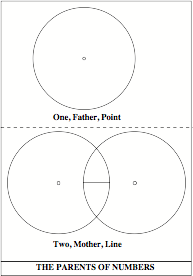
DON'T LET HIM DRAW IN THE SNOW SO MUCH. HIS FINGER IS RED. HE MAY HAVE FROSTBITE FOR ALL WE
KNOW. OR BLOOD. Is he thinking about something
nasty? WHAT ARE YOU THINKING
ABOUT? The vesica picis is the almond-shaped womb through
which all geometric forms are born.
THE WOMB OF CHAOS, YOU MEAN.
The Double-Womb, you are implying in your drawing.
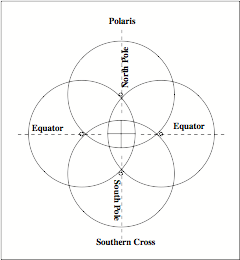
DAMN MOSES IS READING FROM ANOTHER BOOK! Mammary Oneidas. LET ME DRAW SOMETHING IN THE SNOW! No, not while she's watching.
1
+ 1 is greater than 1 x 1
2
+ 2 equals 2 x 2
3
+ 3 is less than 3 x 3
4
+ 4 is less than 4 x 4 ....
THE ONE IS UNIQUE FOR A KIND OF INVERSION. Kether in his claw-claw. THE TWO IS ALSO UNIQUE, FOR ITS PERFECT
BALANCE. And then come all the
forms, all the same: proper manifestations. SHE'S LOOKING AWAY!
QUICK, MAKE YOUR DRAWING!
Of the Snow Woman.
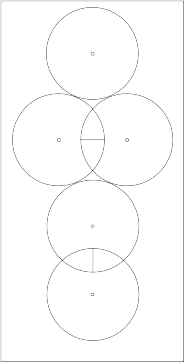
OBSCENE FELLOW!
Quck, wipe it away! A FAST
HAND OF FROST. Wiped by
wonder. AWAY. HARDLY EXISTING. You are getting childish now, Yoni
Maloney! SHE DIDN'T SEE
ANYTHING! Sister Mary Olive! SISTER LUDAVINE! Thoughts being manifestations of my own
thoughts? WHATEVER YOU SAY. ARE YOU COLD YET? ARE YOU TIRED YET? NUMB AND DUMB; GOT A CRICK IN YOUR
THUMB? This fiasco drifts into
ocssaif, oxidentally. BIGOT! Toe gib! THE ONE IS THE SEED IN THE WOMB; AND THE TWO IS THE WOMB,
FROM WHICH THE WORLD OF FORM, THE THREE, THE FOUR, THE ELEMENTALS EMERGE. Elementals? YES. POINT,
INTO LINE, INTO SURFACE, INTO DEPTH.
You have to show it; you can't just talk about it. MY FINGER'S TURNING BLUE. Better your finger than your tongue,
Socrates. PLAYED OATS CAME
FIRST. And that turned his lips
blue? WHO? Sack of trees. PITH AGORA, SIS. OVER HERE, BEHIND THE TREE, NEAR THE
PITA STALL. ARE YOU GOING TO LET
ME THEE IT? Thee what? The almond-shaped element, down below
the naval fulcrum. MOUNT ENVY
NESS? Hair on the silent
stem. Hair on the oily totem. Four poles holding up the sky, turning
a chair to screw a light-bulb in a socket. SOCKET TREES?
And then what? FOUR MEN
WITH MISSIVE ERECTIONS? They stay
hard for only a time or two. AND
THEN THE SKY FALLS. The sky being
the tent that gets strung up above the Earth. WHO IS THE FOURTH MAN STRUNG UP THEN? Pet a gorl's ass, and you'll see
numbers in your brain, as sure as stars form in sperm. CAN YOU GET ME A COUPLE OF
NUMBERS. Poor staggerers. PLATE DOLOROUSNESS. Losing weight. CONSPICUOUS CRETE TINT. Soft thigh, smelling like saints. A SMALL RIVER MADE IN THE GREEK SOIL
SECTION, UNDER THE BRIDGE, NEAR THE AGORA MARKET. SOMEONE'S SISTER MAKING A STREAM. A SMALL HAND MOVING THE SKIRT UP, LOOKING AT CLEAN-SHAVEN
ROSEBUD. Forked tongue. PATHIC GORE US; ALBERT SPOROUS. Saint of the spoken underwear. SISTER OF MINE; SISTER OF THINE. The tender condition. BULL BY THE COW. Sister Mary Olive; Sister Agnes
Claire. CAN YOU HIDE AN OLIVE IN
THERE? WILL IT FIT? Don't be silly. PULLING UP HER PANTIES. He lets her skirt drop again --
thrilled by the tiny cavern. YONI
ANDERSON. Yoni Mitchell. YONETTI FUNICELLO. Ad hoc as always; getting a bullet in
the brain. For his trouble. Mortal sin, and all. Three hail mary's; three our father's. SOUTHERN DALLIANCE. Down below the belt. ONE, TWO: BUCKLE YOUR SHOE. Three, four: what comes out the
door? CHILD OF MY DREAMS. THREE POINTS. CALL HIM TRIAD.
Giving birth to other forms.
DON'T TURN YOUR BACK ON A GREEK PHILOSOPHER, SON. INSTEAD OF TRIAD, THEY'LL BE CALLING
YOU BRIGHT ASS! Watch your
mouth! YES, ALSO WATCH YOUR
MOUTH! INSTEAD OF TRIAD, THEY'LL
BE CALLING YOU PRIED LAD! Surface
to surface to sure face becomes.
GENERATOR OF TRIANGLES, MISTER HONEYCOMB. One, two, three: draw!
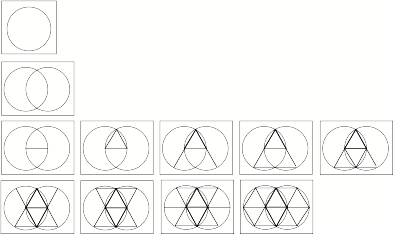
DONE! My! HECATE'S FRAGMENTARY STRAW. The three faces of Eve. LILITH"S PRELIMINARY DRAW. The three articles of
ex-tenuation. AYE, SPINDLE-MAKER
ONE. Single spindle. Double spindle. THE TEN FACES OF 'ACTS'. X-acto knife to the throat, Mister Grievance. I see. OPEN SEE SAME MAY.
The door. THE VULVA
PISSICULAE.
Father-Mother-Son.
FATHER-SON-HOLY GHOST. Sell
division. THE ONE CANNOT BE
KNOWN. THE ONE MULTIPLIED BY ANY
NUMBER REMAINS THAT NUMBER; NEVER BECOMES ONE. THE ONE CANNOT BE KNOWN. The One is known by its offspring, its manifestation. Its son. The number three.
SPLAYED TOE SAYS: SURFACE IS COMPOSED OF TRIANGLES. Point, Line, Surface, Depth. DIMENSION. He's drunk. His
plays on words are...mundane, at best.
Splayed Toe! Are you
serious? YES. SERIOUSLY DRUNK. Who is speaking, anyway. I hear my own voice some times. I don't feel my own lips moving. I think there is some magician in this
group who is using us all like manikens for some reason. Remember the movie Magic, with
Anthony Hopkins? It's like
that. Someone is using us like
puppets. There is only one voice
creating everything in here. One
voice. One mind. One mind split into two parts. High and Low English. We are all like puppets on
fingers. We are coming to
nothing. Saying much; but being
little. Freezing silently. Believing that this is real. IT IS NOT REAL? He's drawing again!
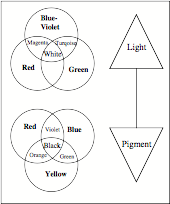
THE TRINITY IN NATURE.
Yes, you speak about this.
AND HE DRAWS ABOUT IT.
Yes. BUT DO WE KNOW ABOUT
REAL SIGNIFICANCE? Of what? SEE, THAT IS MY POINT. EXACTAMUNDO! Can we know this?
I KNOW THAT THERE IS ASH FALLING DOWN FROM THE SKY. HUMAN FLESH TORCHED AND BECOMING GREY
SMOKE. Bergen-Belsen. AND BECOMING FLAKY GREY SNOW. Treblinka. FLAKY GREY SMALLPOX PORTIONS OF SKIN BLANKETS. Off-Switch. FOR ME?
Off-switch. Switch-off. SNAKE MUSIC. COMING OUT OF A SHORT PIPE. LIKE SMOKE.
MARYJANE MAGICPIPE. Magic Bus. Magic Bust.
FURTHER. FURTHR. Light and color are not the same. BURY THE PRANKSTER. Light and color are not the same.
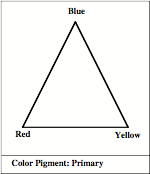
THERE ARE THREE COLORS, THREE PRIMARY PIGMENTS. Why are we going there? It is freezing out here. Is this prayer, sir? PERHAPS NOT. Knowlege of God.
Knowlege of Nature is knowlege of God. FIRST TRIANGLE.
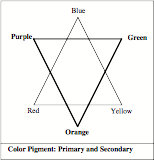
SECOND TRIANGLE.
Solomon's Nature. HIGH AND
LOW. The triangle reflects itself
in the pool of matter. Thle union
of the two triads gives birth to the hexagram.
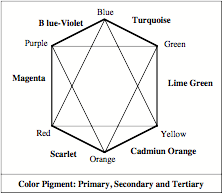
AHH, GEOMETRY AGAIN.
YOU ARE COMING BACK AGAIN AND AGAIN TO GEOMETRY. DIDN'T YOU GET ENOUGH OF THIS IN HIGH
SCHOOL? They can drop a two-ton
missile on the head of a Muslim terrorist from 30,000 miles away. AHH, MUHAMMED ATEF. Goodandtight. Don't catch a cold out here, now. GEOMETRY DOES ALL THAT? Well, certainly.
Geometry is science. I
SEE. But that is not the geometry
we are seeking tonight -- the geometry to drop bombs on the heads of Islamic
terrorists. We are seeking, in
Geometry, tonight, the essential character of existence. The nature of primary forms: thoughts
crystallized into form. YES. And what has Light to do with
this? And color? YOU GUYS ARE GETTING A BIT OFF THE
POINT, AREN'T YOU? What? IF YOU WERE TO LISTEN MORE THAN TALK,
YOU MIGHT WARM YOURSELF A BIT FROM THE FIRE OF INSIGHT. Was that an insult just hurled at us
from across the prayer-rug? I
THINK YOU COULD TAKE IT AS SUCH.
I'm going inside. This is
not a garden; clearly, however, it has become agony. ONE GONE. Man
of law. DO YOU WANT TO FOLLOW
HIM? I think we must. EXODUS. Hands like sticks.
DOOR OPENING. Four blind
mice. AIRHOLE. SOMONE IS BLOCKING THE AIRHOLE. Inside with the madman. GENESIS. No, please, not that far back! CREEK. Wooden
wedge wedges wood wider. Brass
collar. Warm air. Widening the gap between spirit and
soul. SNIDE EAR. OH, WHERE ARE THEY GOING? Perpetuating themselves ever
inward. WHAT? Inside to sleep. PRESSED OLIVES. Inside to creep, to weep, to become
sheep. All his tears grow. LYING DOWN WITH THE LION. The Zero never leaves. The One is the whole; the Two is the
Womb born from the One; the Three is the balance, good fortune, the son. The first form. THE TRIANGLE PERPETUATES ITSELF EVER
INWARD.


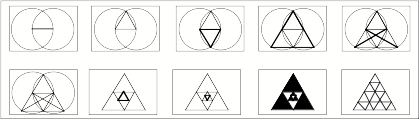
16 Triangles.
16 candles. ONE, THREE,
FIVE, SEVEN. First was the Neutron
Star. The neutron decayed in to
two particles. The Monad became
the Duad. Hydrogen was born.
THE DUAD BECAME THE TRIAD. THE ATOM BECAME THE ELEMENT OF THREE PARTS: PROTON, ELECTRON
AND CAPTURED NEUTRON.
The atom, too, is all about geometry. THE SURFACE OF THE ATOM IS ALL ABOUT
THE TRIANGLE EXTENDED.
Perpetuating itself every inward.
BECOMING THE FOUR. THE
MOTHER OF FORM.

Three points define a flat surface; and a fourth defines
depth. Depth, in nature, becomes
volume -- that is, three-dimensional space. FOUR. THE
TETRAD. The principles of the
Tetrad are born as shapes through the vesica piscis, the abstract womb of nature. THE MOTHER. Four. THE
CUBE. Triplets, in fact. The Tetrahedron, the Square, and the
Cube.
TRIPLETS.
Shemoi, you have not spoken.
WE ARE FOUR LESS THAN WE WERE BEFORE. Five. SIX. Yes. LESS.
Yess. SHOIME, YOU HAVE NO
TOKEN. Resolving the ecliptic in
the man's soul with the.
SIPHYLITIC IN THE MAN'S BOWEL.
Ginzy is still here, I guess.
Who else would be speaking like that? ABU NIDAL?
Indeed. DIDN'T HE WORK AS A
VALET, PARKING CARS HERE IN NEW YORK, FAMOUS FOR BOILED OIL, OR BODY ORNAMENTS,
OR BLATANT OBSCENITIES OR SOMETHING.
No, he was a famous poet. A
BEAT -- YOU REMEMBER. Beating
meet. Fellowing Arab boys in his
shumbacher, you know. Stiff and
wet white. WHY IS HE STILL
HERE? WE GAVE HIM HIS AIR-TIME,
DIDN'T WE? WE LISTENED TO HIS
HOWLING ACROSS THE PAGES OF HIS DIRTY T-SHIRT, SWEAT-STAINED AS HE WAS,
HARBORING LUST IMAGES OF OLD JACK BIVOUAC IN CLAY. Harmony undoes everything. SURETY ENFEEBLES.
Poor Moishe has been gone.
I sensed some kind of smell coming back in. DEATH GAS.
Hydrogen Helium Hanseatic Hypnotist. HE HE. YOD VAU. Let him appear agian. WHO? Yark Vark? WHO? Moishe. Moist she of the desert. INSTEAD OF ALAN OF THE PALINDROME. Madam, I'm Adam.
MADAM, I'M....RADAR. Radar
O'Reilly. HAVE ANOTHER DRINK,
IRISH HSIRI. The literary men have
all left the room, I see. EXCEPT
FOR THINE OWN EXTINCTION.
Pardon? SMART ALLICS. Flower baby. PURPLE PARAMOUR.
I thought those guys had left.
SHY DINER. Rub the lamp --
like you've rubbed your own. Fire
by friction. Sparks loaded with
high-heeled boy; sirrah. WHICH
LAMP? Lamp poon, is dat wat yu
mean? SILENT JIM. STOIC. WATCHING. A MAN
ABOUT TO CRY. Moishe, Moishe, over
and under. Moishe, Moishe, send
robed Pierre ass-under. UNDER TRAY
AND UNDER UDDER'S DAY. Pray for
thy waking. OLD MAN THOR(PE) ABOUT
TO BEAT THE BRAINS OF HIS CHILDREN WITH BATS. Nose for a few.
NOSE GAY FOR THE PEW. Ark
heavy and candy-dappled. CADMUS
GIVES US A MAN FOR THE MADNESS.
Far from the madding cloud.
GINZY, GINZY, WHERE'D YOU GET THOSE PINCE NEZZIES. GINZY, GINZY -- WHERE'D YOU GET THOSE
DYES? Tide eyed. And waxing. DOLLY'S FLAXED MUSSED STACHES. Ahhh, Dolly's rounding pleasant portions. PART ONCE; GET A HARD OUNCE. Your belly's showing. Stop looking for lint. MOIST SHE'S A' COMIN' OUT. Ecks or cist? FATHER, YOU WOULDN'T FORESAKE AN OLD ALTAR BOY, WOULD
YOU? A knee bree ated. DROP A PENNY ON A SKINNY PENCILED
FINGER, FATHER. Nice. STERLING, CURLING. ICE IS PRICEY. Luck is a straight line under a
triangle on your head. Under her
belly is some jelly, round robing, mostly cheese. MOIST SHE is an anagram for....deb rouse. MOUSE LINEN. Rose bad. BARD
OSE. Bridge at Bar Doze. SIN DAPPLER'S LISP. Ozama Domingo. Rio Rozo Recidivism. I BEEN LADENED WITH VIGOR. OBLONG STROKES WILL RENDER HIM CORN
HUSK OF WONDER. Oh, sea May. Ank frayed. MAY THE LORD HAVE MERCY. Russband Hussbound.
Bed soure. EVOKE HIS SPIRIT
NOW, THE MAN WITH THE BOOK. Hold
the tetrahedon and rotate it. It
appears similar from every direction.
THE LAST ROSE OF SUMMER.
The tetrahedon is the only three-dimensional shape whose corners are the
same distance from each other.
THIS MEANS SOMETHING. Other
than the circle, the universe doesn't allow any volume to have fewer than four
corners or faces. AHH, THE
FOUR. YES, JOYCE'S FOUR MEN. THE FOUR MEN OF THE GOSPELS. Of all structures, the
three-dimensional shape is the most spare. Space is dessicated to a minimum volume. While the sphere encloses the most
space in the least surface area, the tetrahedron encloses the least volume with
the greatest relative surface area.
Being the minimal solid, it is the strongest and most stable.

UNDERSTAND THAT THE UNITY IN THE NUMBERS ONE, TWO AND THREE
IS NOT REPEATED IN ANY OTHER CONTINGUOUS NUMBERS.
|
0 + 1 + 2 = |
3 |
0 |
= 2 x 1 x 0 |
|
1 + 2 + 3 = |
6 |
6 |
= 3 x 2 x 1 |
|
2 + 3 + 4 = |
9 |
24 |
= 4 x 3 x 2 |
|
3 + 4 + 5 = |
12 |
60 |
= 5 x 4 x 3 |
|
. . . . |
|
|
|
Understand the symbolism in the number. When a negative number weds a positive
number, the result is negative.
When two negative numbers wed, the result is positive. When two positive numbers wed, the
result is, again, positive. BY
MARRIAGE YOU MEAN....MULTIPLICATION.
Yes. And the same is true
of division, or divorce. BUT WHEN
YOU SPEAK OF ALLIANCES, OR FRIENDSHIPS, THE OPPOSITE IS TRUE. TWO NEGATIVE NUMBERS, ADDED TO ONE
ANOTHER, INCREASE THE POWER OF THE NEGATIVE. AND WHEN A NEGATIVE NUMBER AND A POSITIVE NUMBER MEET IN
BATTLE, THE LARGER NUMBER WINS THE SKIRMISH. There is something philosophical in this. WITHOUT A DOUBT. Do you notice how there voices are
still here, even though they have stepped back inside the chapel? DETAILS, ME BOY! DETAILS! God is in the details, sir. VOICES TRAVEL FURTHER BY NIGHT. Yes. ONE, TWO AND THREE ARE, IN FACT, A UNITY. A TRINITY OF VALUES. THREE, IN FACT, IS 1 AND 1 AND 1. I see. EVEN AS 4 IS THE FIRST NUMBER FORMED FROM THE ADDITION AND
MULTIPLICATION OF EQUALS.
|
2 + 2 = |
4 |
4 |
= 2 x 2 |
THE GREEKS CONSIDERED 4 THE FIRST EVEN NUMBER AND THE FIRST
FEMALE NUMBER. THE EVEN NUMBERS,
OF COURSE, WERE CONSIDERED FEMININE; AND THE ODD NUMBERS WERE CONSIDERED
MASCULINE. Most she but part
he...speaks. SPEAKS AMID
SPOKES. The tetrahedron commonly
occurs in organic and inorganic chemistry and in the world's submicroscopic
structures. Its geometry frames
the architecture of many elementary molecules, including methane (CH4), ethane (C2H6), and ammonium
(NH4), the basis of amino acids, the
building blocks of life.
In each of these three molecules, a carbon or nitrogen atom
sits at the center of a tetrahedron at whose four corners are smaller hydrogen
atoms. The similar charges of
hydrogen atoms' electron pairs cause them to move as far as they are able from
each other. The result is a
tetrahedron, the only three-dimensional shape whose every corner is the same
distance from every other corner.
Substances may be composed of identical atoms whose different geometric
configurations give them different charactistics and properties.
Glass and quartz, for example, are both composed of sand,
silicon dioxide (SiO2). Glass is brittle and transmits visible
light while blocking ultraviolet rays.
The unstructured molecules of glass flow as a liquid, in fact, the
oldest synthetic polymer, is not considered solid but a supercooled liquid
flowing slowly over decades. But
the same SiO2 molecules in quartz
link so that every silicon atom is at the center of a tetrahedron with oxygen
atoms at its four corners. Its
extended tripod structures makes quartz a hard crystal, which, like glass,
transmits light, including ultraviolet frequencies. However, quartz is not as hard as diamond, the world's
hardest naturally occurring substance and best conductor of heat. The diamond is also structured as a
tetrahedral network, but only of carbon atoms, each of which sits at the center
of a tetrahedron having four other carbon atoms at its corners. Because the energy bonds between the
atoms are so short and strong, lying along the edges of a minimal tetrahedron,
a diamond is firm and difficult to cut.
But diamond cutters know how to overcome its hardness by slicing along
the tetrahedral faces. With the
Tetrad comes volume and structure.
SQUARES AND CROSSES ARE METAPHORS OF OUR WANDERINGS THROUGH
THE EARTH, SYMBOLICALLY WITHIN OURSELF, AND OUR PATH OF TRANSCENDENCE. So, is that what this 'Cross
Examination' is all about? THE
LABYRINTH OF OUR OWN NATURE?
Is that a trick question? UNDOUBTEDLY, IT IS.
How many visitors do we have out here now? I SAW SEVERAL PASS AWAY IN THE STRANGE DOORWAY. What you seem to be saying is
that the first-born were the elementals: the point, the line, the surface, and
the volume. This Fourth, Volume,
became matter as we know it, the Female Element, from which geometry was born,
geometry being the essential nature of all things in nature, beginning with the
elemental forms of Nature herself, the atom and the molecules. IS IT NOT CLEAR WHAT HE IS SAYING? It seems to be. THE DUAD, THE BIRTH OF TROUBLE, WAS
HYDROGEN. And the Triad, the birth
of balance, and good fortune, was Helium.
IS THAT THE ESSENCE OF YOUR BELIEF? Essence? Belief? I am a scientist, man. I have no belief. I believe not even in an essence. I believe only in the manifestation of
God's thoughts, number taking a body in the form of geometry, the Tetrad being
one of three forms of three-dimensional space. AUNT THRAX, AUNT THRACE, AUNT OTTALIE LUNDGREN, AND THAT
PRETTY BEARCAT DOCTOR OF HERS WITH THE TRANSATLANTIC FACE, COMELY ENOUGH TO
SILENCE CRITICS FOR A MOMENT. A
death can do that. THE DEATH OF
SOMEONE'S GRANDMOTHER. Aunt Thrax,
Aunt Thrace, Hide your face, wash your krax. DEATH IS RUMBLING OVER THE SEAS AGAIN. Death is riding on a stamp and in a
letter. ELL. The letter of loss. BE FRANK, TOMMY. BE STRAWNG, JACK. BEAN STOCK STRIKERS IN THE SANDS OF
KANDAHAR. Makes the tall banners
eat dust and the words of their dusty epidemic. TAIL BANNERS.
Eating iron. IRON
CROSS. News sewn. CAT RE. Head to toe.
MUSLIN GAGGING MUSSELMEN.
Muscle women. YES, THAT
TOO. Perlandra. ONE, TWO, THREE, FOUR: CATCH
A....NEGOTIATOR BY THE TOE. IF HE
HOLLARS, MAKE HIM PAY. FIFTY
DOLLARS EVERY DAY. Parsely? BECAUSE. Friend checker.
FRENCH HOOKER. Parse a
queer and find a....dominant mother standing over him with a sword of
words. A WORD OF SWORDS. A sward of warts. A SWARTHY SEWER. A sewer of sweaty seaward wards. WOMB OF WORRY. Two Four. Four Two.
EQUALS SIX. Sex? SIX. Sex hex.
AIDA. Aye, Eden. A LOVELY PLACE. A place to rest, hidden in the
cavern. OF LOVE. Water love. WET AND WILD.
Whiskers widening. A HOLE
THAT IS NOT A HOLE. Yes. THE SON OF GOD CAN BE TEMPTED BY THE
WILEY WAYS OF WOMEN. Wiley
Coyote. OATY EMPHASIS OF THE
BRAN. Wind blowing. SEEDS CARRIED BY THE FOUR WINDS, THE
WINDS WHO ARE GUARDIANS OF THE WORLD.
The Winds, yes. FOUR WINDS. Yes. COLD FROM THE NORTH; STORMS AND RAIN FROM THE EAST; HEAT
FROM THE SOUTH; SUMMER WEATHER FROM THE WEST. Four old men.

SECRET IS AS SECRET DOES. Aunt Thrace; Aunt Thebes. AYE. Construct
the square using your clitian measure.
MY WHAT? De jure lucid
methog. WHAT? You clod! REMEMBER THE VESICA PISCIS IS THE VIRGIN! From which from whom from witch the
Christ child is born, number 3, out of 2.
CONSTRUCTING 4 FROM 3.
Constructing 4 from 1 and 2.
THREE IS IMPLIED. Methog
and Gegog. MATH AND GEOGRAPHY,
TOGETHER, MAKE GEOMETRY.
Egrog! The grace of
Gog. THE SQUARE OF THE SQUARE IS,
OF COURSE, 16. THIS IS ONE OF OUR
LORD, MICHAEL CROSSMANN'S, NUMBERS.
Aye. EYE SORE. Aye man; yes man.
NAY. NOT
EYE. Eyeman all's a weird hurry
now. DECOMPOSE THE SQUARE! SEND IT BACK INSIDE ON ITSELF! DRAW IT IN THE SNOW!
See how the plus sign (+) and the multiplication sign (x)
are related to the four. AND HOW
THE MINUS SIGN (-) AND THE DIVISION SIGN (\) ARE EXACTLY ONE-HALF OF THEIR
POSITIVE COUNTERPARTS.
By deduction, one would understand that the negative nature
is one-half the positive nature.
That is, the negative nature is incomplete. Divided.
Alienated from the whole.
The whole being, in this case, the positive world. Notice that the minus is the horizontal
arm of the cross (the anthopogenic); and that the divisor is the left-hand
path, coming out of the northwest running into the southeast. DOES THIS MEAN SOMETHING? Don't forget: everything means
something here. FINE IDEA. Boney day. WE ARE WANADERING IN SOME LABYRINTH -- SOME DREAM. OUTSIDE, IT IS NOT VERY NICE. Inside. SOMEONE IS DREAMING.
I see. THERE ARE MANY
VOICES IN THIS DREAM. I see. YOU SEE -- BUT YOU SEE WITH YOUR MIND'S
EYE. BECAUSE YOUR EYES ARE
SHUT. Eyes wide shut. YES. Out there is a great fire and a wall of glass about to
break. BURNING FLESH. In there is a crazy Arab threatening to
kill out the infidels.
UNFAITHFULS.
Non-Muslinmissilehims.
MISSILE HYMNS. They're
coming back out again. WHAT? DID YOU GET WARM, GENTLEMEN? We can't be in the same room with
him. He's possessed with the
devil. WITH THE DARKNESS OF THE
DAMNED. He is so filled with
hatred -- he said the world should kill all Americans and all Jews wherever
they find them. WE THINK HE HAS A
GUN TOO. WE SAW HIM WITH A
PISTOL. I think he has Crossmann's
gun. DO YOU HEAR THE SIRENS AND
SMELL THE SMOKE. SOMETHING BAD HAS
HAPPENED DOWN SOUTH. Is someone
being lynched, you mean? MAYBE
CROSSMANN WILL HAVE US LYNCH OLD FARAMARZ, LIKE HE HAD HIS STUDENTS LYNCH THE
SOUTHWEST EUGENE THREE. Shh. We are involved with the number
four. WHAT? Are you kidding me! There is a man in the next room armed
with a gun threatening to kill all of us!
And you want to continue your search into the paths of the Tree of Life? The stations of the cross? YES. So, who is lost now?
IT IS DARK OUTSIDE. SNOW IS
FALLING. WHEN THE LIGHT COMES WE
WILL KNOW SOMETHING ELSE.
SOMETHING WILL HAPPEN.
Shh. THE OLD WOMAN SPEAKS
AGAIN. HER FACE ALL CONTRITE. Shut up or leave! Shut up or leave! I SEE. Shh. Let's be
quiet, friends. Michael Crossmann
is praying. NO AGY DEGNAR. Yes. WHEN WE DECOMPOSE THE SQUARE, EACH NEW SQUARE COVERS HALF
THE AREA OF THE PREVIOUS, LARGER SQUARE.
It looks like a rosebud, viewed from the heavens.
NOTICE THE SETS OF TRIANGLES EVERYWHERE IN THIS
PATTERN. I see the Iron Cross.
YOU ARE LOOKING WITHOUT YOUR EYES, FRIEND. THERE IS NO IRON CROSS IN THIS
IMAGE. LOOK AGAIN. THERE ARE FOUR EQUILATERAL TRIANGLES,
EACH REPRESENTING A DIRECTION.

It is the 'X', the crossing or fertilization of the male and
the female principles. AND
THEN? There is the North-South
diamond.

And the East-West diamonds, the same that compose the
square.

Still, there is not a square -- that is, there is not a
square without the triangles.
WITHOUT FOUR TRIANGLES.
Yes.

THE 'X' IN THE CENTER.
THE 'X' BEING THE ESSENCE OF THE CROSS. Yes.
X-Communicate. STILL I SEE
THE IRON CROSS, WITH ITS MYRIAD TRIANGLE BROTHERS OR PARTNERS HANGING FROM
IT. THE EAST-WEST DIAMOND; AND THE
NORTH-SOUTH DIAMOND. The hardest
substance known in nature. YES. (CLEARLY WE HAVE A WARRIOR IN OUR
MIDST.)
The decomposed Square, in fact, in composed of
Triangles. We see once again how
the Four has grown out of the Three.
MAN DOLL, HUH? BARBIE WITH
A BOUTONNIERE. Rosebud
incorporated. UPRIGHT MAN IS THE
NORTH; WOMAN IS THE SOUTH.
TOGETHER THEY ARE THE ANDROGYNOUS EARTH. THE THIRD TURNING ITSELF IN TO THE FOURTH. THE MAN TURNING HIMSELF INTO THE
WOMAN. THE WOMAN BEING SQUEEZED
FROM OUT OF THE BIR OF MAN.
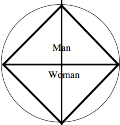
With an Equator and a Maypole even. THE POLE INSIDE THE TENT. The tent and its reflection in the
water. MAN AND WOE TO MAN. Head to Toe. WOE IS ME. Womb
is me. WOMAN AM I. Noman am I. AND NOMAD TOO.
The Monad acts through the Duad; the Duad acts throught he Triad; the
Triad acts through the Quaternary.
THIS IS ALL VERY ABSTRACT.
AND WHAT DOES IT HAVE TO DO WITH LITERATURE. It is the basis of all great literature. AND ART. If we listen to the Greeks, it is. Bittenest of all ends.
ONE DIVIDES ITSELF IN TWO; TWO DIVIDES ITSELF IN TO THREE. How does Two do this again?
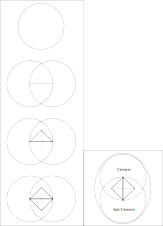
IT'S ALL RATHER SIMPLE. THE MONAD REFLECTS ITSELF AND BECOMES THE DUAD. THE DUAD DIVIDES ITSELF AND BECOMES THE
TRIAD. THE TRIAD EXTENDS ITSELF
AND BECOMES THE QUATERNARY. And
these are the first four races of man?
LET'S NOT GET AHEAD OF OURSELVES.
WE ARE TALKING ABOUT THE ELEMENTS.
About the pre-elements, or pre-genetic matter. And then the elements.
WHICH BEGIN WITH THE FOUR?
Perhaps you are learning something anyway. Even if it's against your will. I DO NOT UNDERSTAND THIS ELBOW IN LOGIC. YOU TOLD US THAT HYDROGEN WAS THE
EMBLEM OF THE DUAD. AND HELIUM THE
EMBLEM OF THE TRIAD. NOW YOU ARE
DISCUSSING THIS UNUSABLE TERM, PRE-GENETIC MATTER. AND PRE-ELEMENTS.
ARE YOU SPEAKING OF MUONS THEN?
AND HADRONS? AND
QUARKS? IS THIS WHAT YOU ARE
CALLING PRE-GENETIC MATTER? Do we
have to be cold in order to learn this?
Do we have to approximate the death condition in order to be given such
secrets? WHY DOES EVERYTHING HE
DRAW LOOK LIKE A VAGINA?
Rosebudular association.
THE ROSEY CROSS ASSOCIATION HAS NOTHING ON THIS. Is Crossmann asleep? He has his eyes closed! HE'S PRAYING. Is he going to meet with Pope John Paul? I heard the pope was coming to town
today, to join in the millenium celebration. WE'RE GOING TO KILL THE FUCKING POPE. WE HAVE MEN WHO WILL LASH A BOMB TO
THEIR CHESTS, DRESS AS A CATHOLIC PRIEST, AND WALK UP TO THE POPE IN DOWNTOWN
MANILLA! I thought someone had
killed him. YOU SHOULD HAVE AT
LEAST BOUND AND GAGGED THE MAN!
How could we. He has all
that oil money. He has armed
himself head to toe, readying himself for the millenium murder of
ex-communicates. PUT A MAGIC
SILENT SPELL ON HIM. HIT HIM WITH
A SHOVEL IF YOU HAVE TO. Cujus
animam gementem, Contristatem et dolentem, Pertransivit gladius. THROUGH HER SOUL, OF JOY BEREAVED,
BOWED WITH ANGUISH, DEEPLY GRIEVED, NOW AT LENGTH THE SWORD HATH PASSED. Passed unto us, again,
de-bereaving. DE-BEAVERING. The fair-weather friends have come
back, I see. LET MOISHE DINE AND
DRINK FORELORN. AND READ SOME MORE
THE MORAL FORCE. My call, shine
dear. LET IT BE. The womb of the World Mother
sitrs. Electronic power galvanizes
magnetic energy into a state of activity; but there are no distinguishing
features. The geometer uses the
compass to draw the womb as a circle around the vesica Piscis from its center. In the past it has been referred to as
the Monad, Orphic Egg, Pneumatic Ovum, and Individualized Field. STOP. Archetypal patterns arise. The electromagnetic field spins like a sun on its axis. Masless light whirls in mathematically
precise rhythms and patters. This
is Plato's 'world of pure knowledge, the realm of ideas' and the 'world of
wonder' described by seers. The
Egyptians personified this field as the work of the architect/builder god
Ptah. The Greeks called it
Archeus, the builder of 'first principles' according to Zeus. ('Architect', 'arch' and 'archetype'
all derive from the Greek word 'archos', first, or ruler.
Archetype literally means 'first mark'.) STOP.
To the geometer's eyes, the vesica piscis inherently holds the proportions
and paatterns of the basic shapes even before they are consstructed. STOP. Geo-mater means 'Earth Mother' STOP. The Goddess gives birth. The geometer makes visible the archetypal proportions
inherent in the visica piscis, helping them through the birth portal. In the electromagnetic field, the
spiralling, massless photons thicken into tiny opposite-spinning whorls of
protons and electrons that braid with neutrons into massive atoms. Atoms, the basis for the elements,
precipitate in precise geometric patterns like lace embroidery or Islamic
tiles, along these lines of force.
The geometries of nature's forms reveal the pattern of their energy
fields. Natural structures, then,
are the archetypal matrix made visible.
As ideal geometric patterns materialize they are clothed with four
thicknesses of garment, four densities of 'mother substance', unfolding as
light and thickening through the phases of gas, liquid, and solid. In mythic terms, the Demiurge, the
Creative God, is said to conquer Chaos by dividing it into the four
elements. STOP. The right thing to do is to proceed
from second dimension to third, which brings us, I suppose, to cubes and other
three-dimensional figures.
SSSSSSTOP. MMMMMMOUTHING
PPPPPLAIN TTTTTOE. What?
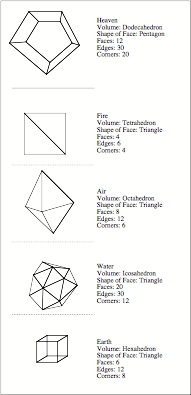
ARE WE TO BELIEVE AN OLD GREEK QUEER SPEAKING AN ARCHAIC
DOCTRINE? Stop. THE FOUR CLOTHES OF MATTER: LIGHT, GAS,
LIQUID AND SOLID. That's what we
are speaking. I THINK THEY DON'T
EVEN NOTICE THE CRAZY ARAB IN THE NEXT ROOM! They are sleep-walking, I'm afraid! IF THEY HAD SEEN WHAT WE SAW! Dionysus is made of what? IS HE FROM THE HOUSE OF ATREUS
THEN? OR MERELY THE HOUSE OF THE
MAD AHAB? Ish Maelian. IS HIS WIFE NOT IPHEGENIA? Nein. BACK ON TRACK.
BACK ON TRACK. Geo
Meritrea. Geom Atreus. STOP TALKING NONSENSE. Moist she, coming back again. WHAT? Listen. TO
WHAT? Nature's patterns are based
on the mathematics of three-dimensional space. In essence, natutre's creating process yields fruit by
giving birth to volume.
Constructing the universe, therefore, involves the process of
volumination. STOP. The archetypal field where the patterns
first appear is a sphere, a Monad.
The geometry that arises within this sphere is obliged to manifest the
Monad's principle of equality in all directions. Nature adheres to this principle by configurating primary
volumes that divide the sphere equally in all directions. Nature's first expressions in three
dimensions are such forms that fir perfectly within the sphere and present us
with an identical view in all directions, no matter how you turn it. These forms, or 'volumes', are based on
surfaces with the same shape, either square, triangle or pentagon. Ruled by the Monad, three-dimesional
nature is structurally disposed to the geometry of equality in all directions. STOP. There are only five volumes that fulfill this requirement of
equality by repeating the identical corner angles, edge lengths, and surface
shapes around a sphere. The five
volumes were described by Plato in Timaeus and, so, are known to mathematicians as the
'Platonic solids', and, more formally, the 'regular polyhedra' ('many
bases'). Four were identified by
Plato with the four ancient elements, or states of matter, and the fifth, the
quintessence ('fifth being'), represents the all-encompassing 'cosmos'. Their names derive from the number of
faces they have. STOP. So, Heaven has 12 faces? The Light of Fire has 4 faces? Air has 8 faces? Water has 20 faces? Earth has 6 faces? STOP THIS. Stop what? STOP
THIS NONSENSE. THE ARAB IS RAGING
IN THE NEXT ROOM, THREATENING TO KILL ALL OF US. AND TO KILL THE POPE.
Mem is the Hanged Man.
A'ayin is the Devil. Peh is
the Tower. MAP. MAP. PAM. PAMP. Er, what has this to do with anything? Mister Potter. OH, TAKE A STROLL DOWN THE STREETS OF
BEDFORD FALLS. ASK ANYONE ABOUT
GEORGE BAILEY. HE IS A MAN AMONG
MEN, MINISTER BRINK. What? STOP. MASSO. There
can be only five possible 'equal divisions' of three-dimensional space. The first thing one might notice about
these five forms is that their faces are either triangles, squares or
pentagons. No other flat shape
used alone will enclose a volume without gaps. These are the most economical expressions of space from
which Nature's designs derive their characteristics. Variations on these five volumes in nature are virtually
endless. They're the basis for all
crystals, the orderly repeated arrangement of atoms. STOP. Another
level down, please. WHAT? Hewat, umm? WHAT? All the
stairs befowling. 110 DOWNING
STREET. 111 Crowning Street. SLOP. MOSTLY.
Geometric manifestation from light through energy to matter. A sphere representing undifferentiated
light sitrs, polarizing in to opposites symbolized by two intersecting
circles. The two poles swirl in
opposite directions in mathematically precise rhythmic energy patterns,
represented by spiraling cones.
The sphere becomes a whirling energy field displaying lines of force
upon which atoms configure to manifest material, visible volumes.
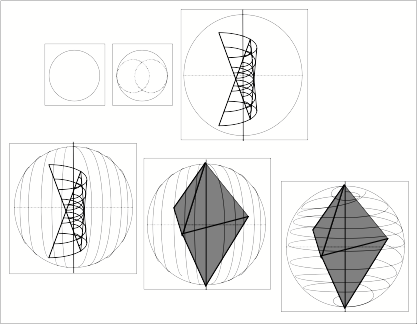
LOOK AT HIM DRAW!
I'VE NEVER SEEN SUCH A THING.
We're lucky it continues to snow.
He's been drawing all night.
WHAT TIME IS IT? It must be
getting late. WHEN IS HE GOING TO
BEGIN TO PRAY? I think he's
sleeping. DO YOU REALLY? HE WOULDN'T DO SUCH A THING. Leaving us alone, in such agony. THERE IS A LOT HERE TO SWALLOW. AND WE ARE OUT OF SPIRITS. Muzzle speaks with an arched
candelabrium. NOW? The first manifestations of the
universe are geometric. From
hydrogen to uranium all ninety-two natural atoms of the periodicc table that
compose minerals and crystals are geometric. At the borderline between non-living forms and living
creatures are the cold, herpes and AIDS viruses, which are not alive but act as
if they were and also take form as Platonic volumes. Many microscopic life-forms share the geometry of these
basic volumes. Each form's geometric
expression is perfectly suited to its needs and purpose. I FEEL AS IF WE, TOO, ARE WHIRLING,
SOMETIMES TO THE RIGHT, AT OTHER TIMES TO THE LEFT. Conspicuous artifice.
SAMSO NOTARY, LIVING IN THE CAVES.
Drop the ten-ton bomb on him.
Wipe his eight away. AFTER
GAN IS STANDING NOTHING BUT A SAD MADAME.
Ten numbers; twenty-six letters.
THE ALCHEMICAL ELEMENTS. A
is for Anna like L is for liv. Aha
hahah, Ante Ann you're apt to ape aunty annalive! Dawn gives rise.
Lo, lo lives love! Eve takes
fall. La, la, laugh leaves alass.
AL LA YOU MEAN. Laugh
leaves, alas? Or laugh leaves
alass? EVE COMES IN THE FALL; AND
LAUGHTER LEAVES THE LASS. And what
of Dawn? SPRING GIVES RISE; THE
HADRON GETS A HARDON. Yipes! LAUGH LEAVES; FALLING LEAVES ARE
ORDERED TO LAUGH. Fool! Sure Cane Alley is the place to be at
night! LEGS DIAMOND? The hardest substance in nature. AFTER DIAMONDS ARE STANDING NOTHING BUT
A SPADE MADAME. A black box? DIGGING IN THE DIRT; WE'LL FIND THE
PLACE THAT WE GOT HURT. DIGGING IN
THE DIRT; FIND THE PLACE THAT WE GOT HURT. Ground Zero. IS
HE A SCIENTIST OR WHAT? Sleeping
scientist? SS, YOU MEAN? SALT SULPHUR MERCURY. SSM. SSMikael.
VULCAN NELLIE. Wagging her
tail. SIX TIMES SIX. Ka'aba. CUBA.
Zalt. SICK CIRCLES.
Cut and fold.
FOUR SKINS? Whose the
Mohel? CUT AND TUCK. Knife of life; knife of soul. FORE SINS. FORE SHINS.
Delta hedra. DIDO HYDRA. Mario Lasagna. HOW LONGYA GONNA WASTE MY TIME LIKE
THIS, MISTER SOPRANO? Get out your
scissors, dear. Your left-handed
scissors. CUT AND PLASTER. Follicles and the festering fez. PASTE. In three dimentias. DELTA PELTA. Thoughts of old men in a cold garden watching snowflakes and
skinflakes fold and shiverrr down from an arid smoky sky. FURROWED FOLDS OF FURRIED FIELDS. OF FASHION. Delta felta melta moony WISDOM COMES OUT OF PAIN. THE NEW AGE GENERATION CHASES WISDOM OUT OF BOREDOM AND
REBELLION -- INTELLECTUAL CURIOSITY.
Heading downward into 'Facing Dog'; rising back up into 'Cobra'. Now relaxing into 'Child's Pose'. POSED IN CLOTHES 'DED. ROSE IS ROSE. TONIC. Scissors
being for what? SNIP; AND TUCK
IN. And fold. DELTAHEDRA. THE THREE PLATONIC VOLUMES WHOSE FACES ARE EQUILATERAL
TRIANGLES. What the Cube is the
Square, these triplet triads are to the Triangle. FOUR-FACE, EIGHT-FACE, TWENTY-FACE, FIGHT!
You're not suggesting Crossmann is a kind of George
Bailey! NO, OF COURSE NOT. NOT! Knot. DON
KNOTS? Knots of energy. Atom. K-K-KNOTS OF ENERGY.
You have drawn two of the triplets in the snow. What of the last one? WE ARE RUNNING OUT OF SNOW. You make me feel old whenever you do
this. THE MAGICIAN IS LEAVING TO
GET SOME PAINTS. What? YES, CANS OF PAINT. TO PAINT IN THE SNOW. Hallowed sin nation. YOU UNDERSTAND YOU UNDER GARMENTS. Like a good Mormon, I guess. FORE LOCK, FOR YOUR FAVOR. Mushy. DRAW!
Icosahedral cathedral.
THREE ON TOP; FOUR ON BOTTOM.
Draw!
THREE, FOUR AND FIVE.
Four corners to the square; the triplets have three corners each; and
the dodecron has five corners.
|
Platonic Solids |
Volume |
Shape of Face |
Faces |
Corners |
Edges |
Difference between |
|
|
|
|
|
|
|
Faces + Corners and Edges |
|
|
|
|
|
|
|
|
|
Heaven |
Dodecahedron |
Pentagon |
12 |
20 |
30 |
2 |
|
Fire |
Tetrahedron |
Triangle |
4 |
4 |
6 |
2 |
|
Air |
Octahedron |
Triangle |
8 |
6 |
12 |
2 |
|
Water |
Icosahedron |
Triangle |
20 |
12 |
30 |
2 |
|
Earth |
Hexahedron |
Square |
6 |
8 |
12 |
2 |
|
|
(Cube) |
|
|
|
|
|
THE ATOMSPHERE IS AN ATMOSPHERE. Yes. I believe
you are right. FIRE IS INTUITION;
AIR IS MENTAL; WATER IS EMOTIONAL; EARTH IS PHYSICAL NATURE. We know all this. Why are we covering the same ground
again? THESE ARE SKINS, OR
CLOTHES, THAT SPIRIT PUTS ON.
Granite, Alabaster, Limestone, Sandstone. AT LEAST HE CAN READ. Head, heart, solar plexus,
genitals. SALAMANDERS, SYLPHS,
UNDINES, GNOMES. Gold, silver,
bronze, iron. HOLY OF HOLIES,
INNER CHAMBER, INNER COURT, OUTER COURT.
Priest, soldier, merchant, servant. LION, HAWK, CROCODILE, BEETLE. Nervous, respitory, circulatory, digestive. RESURRECTION, CRUCIFIXION, PERSECUTION,
SERVICE. Creeping things, birds of
the air, fishes of the sea, beasts of the field. WISDOM, KNOWLEDGE, OPINIONS, IGNORANCE. Monk, knight, burgher, peasant. FOUR BY FOUR EQUALS SIXTEEN. One and Six equals seven. LOOKING FOR FIVE. Head, chest, gut and pelvis. FOUR. What time is it?
I'm sure my wife is worried about me. IT'S MILLENNIUM EVE.
NO ONE IS HOME TONIGHT.
It's Fat Tuesday times Four.
ZEUS BY ZEUS BY ZEUS BY ZEUS.
The Cube. CRUCIAL
FACIAL. Cube. FAITHFUL ASTRO KAYE. Matriarchal Man. YES -- WE HEAR OF HIM, THIS MAN WITH
WOMAN ON THE INSIDE. This man
under the shadow of the Earth Mother.
UNDERWORLD. Out of the
light. YOU ARE ONE OF THEM. WHY DO YOU FIGHT SO HARD AGAINST
YOURSELF? I am my Father's son. I SEE. And your mother?
You left your mother to rot in a nursing home! SHE WAS NOT HERSELF!
THE LAST TIME I SAW HER SHE THOUGHT I WAS HER BROTHER! You have betrayed her! YES! Betrayal of your own blood! YOU BETRAYED YOUR BROTHER ALSO! Your brother is the female man that you deride. THE FEMALE MAN IS LAZY, WITHOUT
WILL. He is the poet, the creative
soul. HE IS DARK, WILL NOT WORK,
IS OFTEN HOMOSEXUAL -- WISHING TO LIVE OFF HIS MOTHER. Hating his father. FOR GOOD REASON PERHAPS. Perhaps. And perhaps not.
YOU NEED NOT SAY PERHAPS AND PERHAPS NOT -- BECAUSE PERHAPS MEANS
PERHAPS NOT. I see. WHAT DOES IAMBLICHUS SAY? He said: It is a frequent assertion of
ours that the whole universe is manifestly completed and enclosed by the Decad,
and seeded by the Monad, and it
gains momentum thans to the Dyad and Life thanks to the Pentad. THE FIVE. Yes. WE HAVE
BEEN THROUGH THE 26 LETTERS. NOW
WE FIND OUR WAY THROUGH THE TEN NUMBERS.
IS THIS SUPPOSED TO TELL US SOMETHING? I don't know.
PERHAPS. Your anger at the
female man, the artist, is really anger at your self -- for you are him
too. THE MIDDLE PRINCIPLE IS THE
BALANCE. HE IS ON THE SIDE OF THE
DARK MAN UNTIL THE DARK MAN BECOMES TOO STRONG; THEN HE IS ON THE SIDE OF THE
LIGHT MAN, UNTIL THE MLIGHT MAN BECOMES TOO STRONG. THE MIDDLE PRINCIPLE IS THE PRINCIPLE OF VISHNU. VISHNU SIDES WITH THE LIGHT MAN TO
BUILD THE WORLD (BECOMING BRAHMA); VISHNU IS HIMSELF, SIDING WITH THE DARK MAN
TO USE THE WORLD, BECOMING INCREASINGLY NEGATIVE; SIVA IS THE ABSENCE OF
VISHNU. THE MIDDLE PRINCIPLE
VANISHES AND THE LIGHT MAN AND THE DARK MAN ANNIHILATE ONE ANOTHER, BRINGING
ABOUT THE PURE ENERGY STATE WHICH LEAD AGAIN TO INCARNATION OF BRAHMA. You talk like this is a fact. YOU EDUCATE YOUR KILLER. You are the killer and the killed; and
the one who sees the killing.
HERMES, THE THIEF
De Divina Proportione. FRIEND N,
UPSIDE DOWN. The N and the
Anti-N. Makes a 'X".

ROTATED AGAIN, THE 'X' BECOMES AN 'X' AGAIN, AND AN
HOUR-GLASS.

Two triangles, one up and one down, prepraring to be
attracted. NINA. Anin. THE 'A', YOU WILL UNDERSTAND, IS COMPOSED OF TWO TRIANGLES:
A SMALL TRIANGLE WITHIN A LARGER TRIANGLE. A MICROCOSM INSIDE A MACROCOSM.

Don't get lost.
AT 'B' THE UNIVERSE DIVIDES INTO 2, INTO UNIVERSE AND ANTI-UNIVERSE. ONE-HALF OF THE 'EIGHT'.

Pardon?
ONE-HALF OF THE '8', THE EMBLEM OF THE UNIVERSE AND ITS TWIN: LIGHT AND
DARKNESS. THE MIRROR-SIDE IS NOT
TO BE SEEN YET.
The Negative Side is unseen. I SEE. 'E',
too, is an emblem of the same '8'.
Cube on cube.

THE DOOR; THE WINDOW.
The Brown Man says that civilization is death. The Brown Man says that order is death; and orderlessness,
Chaos, is Life. OPPOSITE TO
FREUD. Freud was the friend of
civilization. Freud was the friend
of Man. DEFT MOVEMENT. Oozing Clay Time. SEVENTEEN-TWELVE-THIRTEEN. Lieb Nicht. LET THE PLAY JURY CONSIDER THIS MAN'S CLAIM TO THE CREATION
OF COOL CAUL US, A SYSTEM OF MAGIC BASED ON THE SYMBOLISM OF NUMBERS AND ON THE
POWER INHERENT IN LETTERS AND KIDNEY FAT.
Priapus in the head. SAMUEL
PEEPS AND ARGUES, A REAL CLARKE, ON THE SANK BLATE. Ocklay Oversay.
OVERHEAR OVERHERE. Oh, the
Sanks are comin', the Sanks are comin'; and it won't be over till its over
th'air. DEFT MOVEMENT. Again? HE'S TRYING NOT TO FACE THE FACT THAT HE IS A
PLAGIARIST. SO HE GOES INTO ALL
THESE OBLIQUE ALLUSIONS, HOPING HE WON'T HAVE TO FACE THE TRUTH. Game 1, Set 1, to Crossmann. OH, WHEN THE SANKS, GO MARCHIN' IN, OH
WHEN THE SANKS GO MARCHIN' IN. OH,
I WANT TO BE IN THAT NUMBER, WHEN THE SANKS GO MARCHIN' IN. B-5. The number is B-5.
OF COURSE, THE PENTAGRAM IS NOT TO BE CONFUSED WITH ITS INVERSION, THE DRUDENFUSS (OR THE 'WITCH'S FOOT') WHICH
APPEARS IN MAGICAL RITUALS AND WITCHCRAFT. Mosh bar. WHAT?

The Drudenfuss has been associated with devils and demons since the rebel
Egyptian god Set resisted spiritual aspiration and became the adversary of his
brother Osiris and nephew Horus.
Set has many attributes of the devil: horns, coarse red hair, hooves, a
tail. He and his hordes resist
truth, justice, order and righteousness.

Set's 42 attributes are actually symbols of the down-ward
reaching elements of our own psyche that must be purified. The Eyyptian underworld, the 'Duat',
whose hierogylph is a circle surrounded by a five-pointed star in a circle, is
the mythical nighttime place where
the 'perhishable' stars go when they sink below the horizon at dusk. The 'duat' recalls our own spiritual
sleep from which we can awaken.
The Egyptian star glyph without the circle signified either a nighttime
star, a door, or a teaching, an intriguing combination of ideas in one
glyph. The Sun's inevitable birth,
into dawn and daylight (symbolizing our own spiritual arising) is resisted in
the duat by hideous adversaries.
In ancient Greece, the star was associated with Pan "All"),
who also had horns, red hair, hooves, and a tail, representing the lustful
fertility of nature, which induces panic and pandemonium (literally, 'all the demons') in the world. Later, in Western cultures, Pan's
sexuality became the great temptation of the modern devil; and the star was
inverted to imply the reverse of, and resistance to, its positive qualities of
excellence and goodness. NIGEL
KNOWS BEST. Young Robert knows too
-- a falling star that S-S-S-S Dry Dun Fuse. DID HE NOT SEND A LETTER TO YOU? Matriarchy.
WHAT? Mayter
hierarchy. NONE. None what? HIRE ARCHY.
Higher archy? HIGHER
ARKY. Yes. ARCY WITH NO COLUMN. Before the coming of course. THE MILKY WAY. The coarse coming of cures. MAITREA ORKNEY. Island of the situated mount. PERSPECTIVE BEING WITHIN. For a time. AWAKE SHE CRIES.
Perspective being inwith.
FOR A RHYME. Ashake she
spies. ADDER LAY. Edder lay. RISE UP, MAN OF HOOFS, YOU HAVE SLEPT SO LONG. Who throws the beast out of
heaven? THE NEGATIVE FORCE YOU
MEAN? The one with ono future? THE FALL OF LUCIFEAR COMES FIERCT; THEN
THE AWFUL OF MAN ATOM. I see. READ THE LETTER! I think it is possible that at this
time the patriarchy is at its worst and the matriarchy hardly begun but will
only get better -- within the framework of light and dark, granted -- but it
may bring peace. The patriarchy
shoots itself in the foot by being possessive of women which means one woman
per man -- instead of nature where the man is wandering, peripheral to society,
and like bees with flowers, and free from the strains and stresses of having
children around too close -- only having one woman means being frustrated and
unhappy discontent and therefore raging and therefore warlike -- man says you
can't have my woman which he doesn't see means that he can't have other
women. In the matriarchy, the
softer women are in the centre protected by the tougher men -- just as the seed
in the husk has the generating ability, so the women give birth to the new
generations -- not without the hlp of the men, of course -- just like the
whales with the nursing mothers ringed by the bull whales -- the weakness of
the women is balanced by their unity in the centre -- the greater strength of
the men is dissipated in the circumference -- in individualism -- women are the
natural healers and wounded men come to the soft centre for healing. It's a nice idea and I like it; and it
seems to fit with FW. WHAT! WHO THE HELL IS THAT SPEAKING! No one moves! SOME FAIRY MAMA'S BOY STICKING UP A FINGER IN HELL'S
KITCHEN? Who -- dammit! NO MOVEMENT. Is this someone's memory of a soft time, a soft center? WOUNDED MEN COME TO THE SOFT CENTRE FOR
HEALING. Is Robert Blye in the
room? IN AGAIN'S FAKE. Win again's achy fenestrom. STORM OF ENDING. Thor's core chore, more war than poor
fiord of Igor. MAMMARY
ACHIEVEMENT. The boy doesn't want
to grow up. STERLING. ANALYSIS. DOCTOR.
FRIEND. Dew Age. DOCTOR FREED. New Stage.
DOCTOR GREED. Blue
Cage. DOCTOR BOY'D. Bird's Egg. HIVE'S FAYE, ORGAN'S MAEVE. Aqua rien.
NOTHING WATER. Vater
Not. MUTTER MUCH. Mute Mouth. EGG AVAY. Take
this broken tongue. Now this dark
life. Shot through with
light. A GOVAY. Summer Triangle. STONE EAGLE. Former Pole.
HOW MANY STARS DOES IT TAKE TO EDUCATE A BOY-MESSIAH? Three. Two to hold the boy and turn him; and one to shine the light
in his brain. LAUGHTER IS
FEINED. Doctor Fried, can you
spare a smoke? CLEARLY,
DEARLY. Ha Ha. AND HOW MANY TO MOVE THE SET WITH THE
CAMELS? The Set, with the
camels? Please, doctor, no ethnic
humor, please. The horns are out
already. We've been introduced to
the German dragonfest. SOCRATES
SAID THAT, FROM ABOVE, THE EARTH LOOKS LIKE ONE OF THOSE TWELVE-PATCHED
LEATHERN BALLS. We know now that
atomes do exist; and that some particles smaller than atoms also exist. These sub-atomic particles are divided
into two main groups, the leptons and the hadrons. The best-known lepton ('light' particle) is the electron. In order to account for the emission of
electrons from the nucleus, the neutrino, an essentially massless neutral
particle was postulated. The muon
and the tau, both much more massive than the electron, comprise the rest of the
lepton family The hadrons are
divided into two groups, the mesons and the baryons. Protons and neutrons are baryons. Mesons and baryons are made of smaller particles called
quarks. There are six different
quarks: up, down, charmed, strange, top and bottom. While these are descriptive names, they convey nothing about
the distinct properties of the quark.
Each quark comes in three different colors: red, blue and green. Again, the color lagel has nothing to
do with the quark's appearance.
Baryons are composed of three quarks; mesons are composed of a quark and
an anti-quark. MISTER MARK QUARK AND ANTI-MISTER ANTI-MARK ANTI-QUARK. AMAK. Amuck. Mister
Running Anti-Amuck Quark. AS FAR
AS WE KNOW, QUARKS ARE LIKE POINTS IN GEOMETRY. THEY'RE NOT MADE UP OF ANYTHING ELSE. The point then? THE POINT AND THEN THE LINE. The Monad's point; the Dyad's line; the
Triad's surface; the Tetrad's volume; and the Pentad's what? THE PENTAD'S LIFE. What? LIFE. THE
PENTAD REPRESENTS THE INTRODUCTION OF LIFE. Geometrically, the Pentad is born through the vesica
piscis as the
pentagon and the pentagram (the five-pointed star), as whirling spirals, and as
the three-dimensional dodecahedron, the fifrth of the five Platonic volumes,
having twelve pentagonal faces.
The dodecahedron has been known to philosophers as the Quintessence ('fifth being') of nature,
encompassing and infusing the four elements -- solids, liquids, gases and
electronic fire -- with the Life they cannot create by themselves alone. The four elements supply the materials
of their configuration; but the Pentad carries the flag of Life. I SEE. Someone is getting out their paints. ATOM IS THE BREATH OF LIFE. Is he going to paint on the snow? MY GOD, IS THE MAN A BARBARIAN! Himalayan Man. HIM A LAYA MAN TOO. Mantu. WHAT? Did he
say? Him a Himmelmann? HYMN IN ISLE OF MAN. Part two. UBIQUITOUS
USURIOUSNESS. Uvula
Unction. TIME. ICING. Yes. I
sing. MISTER MASTER QUARK IS THE
POINT. Then what is the line? HYDROGEN? What? THE
SUB-ATOMIC IS THE POINT. THE
ATOMIC IS THE LINE. Hydrogen? HYDROGEN IS THE LINE, THE DIAMETER.
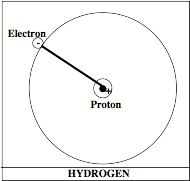
The radius, you mean.
THE RADIUS, MOVING. MOVING
WITH SUCH VELOCITY THAT IT BECOMES, IN MOTION, A DIAMETER. Reflecting itself, side to side. THE MONAD IS THE POINT; THE DUAD IS THE
LINE; THE TRIAD IS THE SURFACE; AND THE TETRAD IS VOLUME. The molecule is the surface, then? WHAT? The molecule is the surface, the triangle? THEORETICALLY. BUT THE SURFACE IS STILL
TWO-DIMENSIONS. THE TRIANGLE,
INTRODUCED TO DEPTH, BECAME, VOLUME.
SUCH AS RUBY, YOU MEAN? THE BEST-KNOWN FORM OF THE MINERAL CORUNDUM (A12O3). MOLECULAR MANIA. Look to the root of the word. The root of the word is in the ground. Grafted to the root is another
root. Language too is a kind of
molecular mania. WITH SHARP
EDGES. Sharp edges: count
them. FACES. SMALL FACES. Gasoline alley.
DID YOU HEAR: THE EYEMAN LOST AN EYE. A BOMB CAME DOWN; HE LOST AN EYE. Cyclops Diecrops.
Cyclops Myops. TAKE YOUR
WORDS DOWN TO THE PUN SHOP, GALLANT ONE.
PERHAPS THEY WILL GIVE YOU A DIME FOR YOUR WIT. Mayhaps. Claypaps.
MAMMY'S LITTLE BABY LOVE SHORTNIN-, SHORTNIN', MAMMY'S LITTLE BABY LOVES
SHORTNIN' BREAD. Mama's little
wonder-boy. Waiting for the world
to become nice. WAITING FOR THE
WORLD TO BECOME NICE. Roots roots
the magical fruits. The more you
eats the more you toots. The more
you toots the better you feel, so lets have roots for every meal. LEGUME. So I presume.
LEG ROOM. So I consume. DAFFY CHARACTER. When the nation or the solitary soul
looks for its roots, it is in the soil, buried you might say, a night seed,
preceding re-birth. DON'T WE FIND
ROOTS BOTH IN THE SOIL AND IN THE SKY?
Verily we do. Baretly
attune as we are to these reflective truths. QUARK, QUARK.
The quak's six principles -- up, down, charmed, strange, top and bottom
-- is that a picture of the cube?
THE TRIANGLE IS SURFACE; THE TETRAD IS VOLUME. The Matriarchy is the alliance between the Mother and her
Son: Oedipus Complexity. It is the
Night: the Mother protecting the Son, raising him up from the dirt. The Mother being the Moon being,
guardian of Darkness. The
Patriarchy is the alliance between the Father and his Daughter: Electra
Compensation. It is the Day: the
Father procreating with the Daughter, bringing Life and riches and bounty to
the Earth. The Father being the
Sun at its height; the Daughter being the Earth, the vessel of Light. WE DON'T FORGET THAT OEDIPUS KILLED HIS
FATHER; AND MARRIED HIS MOTHER.
AND THEN ALL MANNER OF INFECTION CAME IN TO HIS LAND, INFERTILITY AND
PLAGUE, POVERTY AND DEMONIC POSSESSION.
The darkness of Night. THE
WHOLE OF WORLD HISTORY IS WRIT IN THE STORIES OF OEDIPUS AND ELECTRA. There are only about 100 kinds of atoms
in all the Universe; and whether these atoms form trees or tires, ashes or
animals, water or the air we breathe, depends upon how they are put
together. The same atoms are used
again and again. Structure
determines not only the appearance of materials, but also their
properties. BURKA. BURKA. Cover your mouth when you do that? BETTER OUT OF HIS MOUTH THAN OUT OF HIS BINSGURG. You can't look before yourself and
behind yourself at the same time.
YES. IT WAS NEVER INTENDED
THAT WE SHOULD STUDY OUR OWN OFFAL.
No, I think he's right.
WHY, YES, THAT IS PHILOSOPHY!
It is, in fact. SO, WE CAN
ONLY SEE HALF THE PICTURE, AT BEST.
At best. WE ARE EITHER
LOOKING FORWARD, OR LOOKING BACK. We are either scientists or poets? YES. THE POETS LOOK BACK.
I see. WHO IS THIS HE WATT,
THIS VOCALIZING ELECTRIC MAN, SHINING LIKE A LIGHT IN THE DARKNESS? Who is the damn fool who is painting
geometric structures in the snow?
SHEM SHEM SHIM-MY AACHEN.
KING OF THE WILD FRONTIER.
Mountaintop.
Mountaintop. THE SHAMROCK. FROM THE STIFF UPPER LIP OF OLGA. The memory of what? ASTER'S GONE. ASTER'S GONE.
When an electrical insulator can become a superconductor, a pencil a
diamond, a common cold a deadly virus, we begin to understand how important it
is to understand the structure of materials. Every year we are making rapid progress in developing new
tools to understand structure; X-rays and accelerators, electron microscopes
and nuclear reactors are among many physical and chemical techniques. One of
the most important tools is of course the computer, both for calculating
structures and visualising them. Combining computers with communication means
that the secrets of structure, and the beauty of structure, can be revealed to
everyone. First we will try to
understand why atoms naturally arrange themselves to form a structure. Then we
will look at some common structures, and ask why diamonds are forever, but salt
is of the earth - all of which will help us understand the different kinds of
bonding between atoms. Finally we will look at the structure of some exciting
new materials - Superconductors and Giant Magneto-Resistive ceramics for
example - that will be used to transport us to work and to play...
tomorrow. FANTASIES OF NOCK. NOCK. Who'll glare?
GLARE WHO? Glarehoven
glarehooven conglomerate condrehugen.
WHO IS THIS SCIENTIST? I
thult you'd never ask, dear Bliss.
AUTRE ZYDE DEDE BRAIN.
Daylight monkeylight. THE
BROKEN BOTTLER NAMED DIAMETER.
Dogtror Shaper, Philosophica Hermetica Doctora. PHOENIX HERA DAVID. Fine Trimurti, felllow finder. IN YOU DREAMS, OF COURSE. ONLY IN YOUR DREAMS. Let him speak. I SHALL BE QUIT. Imagine a stack of balls in a box. The balls will pack together to fill up
all the space. This is called close-packing. You can see how it works iff you look at a pile of oranges
in the supermarket. Notice how the
oranges form a pattern. Each
orange labelled A
will be surrounded by six othere oranges within one layer. Notice the holes labelled B and C. We can place a second layer of close-packed oranges on either the B-sites or the C-sites, but not both. In this way we can build up a
3-dimensional structure.
Does this structure correspond to anything in nature (aside
from oranges in supermarkets)? Of
course! A stack of layers of types
ABC, ABC ... represents the cubic
close-packed (CCP)
atomic structure of gold as determined by X-rays.
Atoms lie on the corners of a cube, with additional atoms at
the centers of each cube face; for this reason it is often called face-centered
cubic (FCC). Many simple metals have this FCC
structure, whose symmetry is described as Fm-3M where F means face-centered, M signifies a miirror-plane (there
are two) and -3
tells us that there is a 3-fold symmetry axis (along the body diagonal) as well
an inversion symmetry. MOISHE IS A
DAMNED SCIENTIST NOW. Smart and
decent is good. But if not smart
and decent, decent is better than smart.
ANTI-INTELLECTUAL, I GUESS.
Keep going. KEEP GOING
WHERE? Keep going where you are
going. THE RIGHT WING HATES THE
MIDDLE CLASS BECAUSE THE MIDDLE CLASS PROTECTS THE LEFT WING FROM THE RIGHT
WING. THE LEFT WING HATES THE
MIDDLE CLASS BECAUSE THE MIDDLE CLASS IS BOURGEOIS, TASTELESS, WEAK. WHEN THERE IS NO MIDDLE CLASS, THE
RIGHT WING AND THE LEFT WING KILL EACH OTHER. What has that to do with this....geometry? I'M NOT SURE. Burka, Bupka.
GOLDEN CLOVER. Actually
there is another common form of close-packing, corresponding to layers with
stacking AB, AB...or AC, AC...(these are equivalent). This is called hexagonal
close-packing (HCP),
and the competition between CCP and HCP is determined by longer range forces
between the atoms. This the the
structgure of sodium at low temperatures.
PAINT, YOU MADMAN! PAINT
LIKE YOU WERE STILL WEARING THOSE MAGIC GLASSES!
So, the cube and the hexagon. Atomic structure is the cube or the hexagram. The choice of structure is affected by
heat. THIS VILLA CAN ALLY ITSELF
WITH THAT VILLA -- IS THAT WHAT YOU ARE SAYING? The third common metallic structure is called body-centered
cubic (BCC) and
consists of a unit cube with atoms at its corners and center. The BCC structure is slightly less
closely-packed than FCC or HCP, and it is often the high temperature form of
metals that are close-packed at lower temperatures. For example, sodium changes from HCP to BCC above -237
degrees C! The structure of Iron
(Fe) can be either CCP or BCC depending on its heat treatment -- while metals
such as chromium are always BCC.
PAINT CHROMIUM, MAN! IF YOU
CAN'T KEEP UP, HAVE CROSSMANN GIVE YOU A HAND!
Metals which are BCC, such as chromium, are usually harder
and less malleab le that close-packed metals such as gold. When the metal is deformed, the planes
of atms much slip over each other; and this is difficult in the BCC
structure. Of course there are
other important mechanisms (besides heating) for haredening metals, and these
involve introducing impurities or defects which also block slipping. A HEXAGONAL STRUCTURE; AND TWO CUBIC
STRUCTURES. Not to mention the
Tora Bora cave complex. I BEG YOUR
PARDON. Begging is, of course,
outlawed by the Rokna, as interpreted by our friend NABILAT. HE TALKS LIKE THIS FOR HOURS. HE CAN JUST DRONE ON AND ON. And then he shows you a knife. OR GIVES STONES TO OLD WOMEN. Hurthim and Thumpim. HURLHIM AND JUMPHIM. What happens when one erect atom enters
the small hole of another atom?
MY, YOU ARE A CUSIOUS BOY.
MOISHE WILL TELL YOU. HE
SEE THAT HE HAS YOUR ATTENTION.
Start painting, Magic Johnson.
You're no Polack; rather you have the eye of a draughtsman. THE DRAUGHTSMAN'S CONTRACT HAS A CLAUSE
WITH FAUST INSIDE. Green,
away! Green party, away! Green apples, away -- (green ones give
me gas). Mo Green, away! There is a spot on your
spectacles! I look at green, and I
think of Sartre -- and how his grass was never mowed! BURKA, BARFA.
THINK I'M GONNA SPARK A CLONTARFA.
Chromatic abberration.
GEAVE A PEEVISH FEVERED REEVER PEACE; I'M GONNA HEAVE THE RYE AWY OR
DIE! Moonlight suddenly, arching a
back, a silver ark on a sea. SMOKE
FLOATING UP FROM THE SOUTH. Kissing sky.
AIR BUSS; AIR BUSS HAIR BUSH.
Musclemen talk always about the power of the corkscrew. TWENTY-SEVEN VIRGINS; TWENTY-EIGHT
FUNERAL URNS. Someone left to
fall, alone, oft walls.
DAMIINATED. Captivating
language. GOD'S WISDOM. SPIRALLING IN US LIKE CANE. What happens when one atom enters
another and takes up residence, changing the world for ever? SUN FESTIVAL. Rankor. OR
NORKAN. Birds turning blue. FELLOW WARRIORS HOLD YOUR COCKS AND
LEAD THEM IN TO RORIBUN.
Toxin. MOISHE'S SCIENCE AND
MOISHE'S ART. Very often when we
have two or more different atoms, the packing is deteermined by the larger
atoms -- the small atoms just have to make do with whatever space is left. This is the cas of some simple salts,
such as lithium chloride.
Lithium is the smallest of all atoms, with the exception of
hydrogen; and the big chlorine atoms just pack together with the CCP structure,
leaving the small lithium atoms to squeeze into the ocahedral holes. Why are the holes called
octahedral? Because each hole
occupied by a lithium atom is surrounded by six chlorine atoms at the vertices
of an octahedron. Please draw
these atoms as small spheres to emphasize instead the 'co-ordination
polyhedrae'.
Such geometrical concepts are very popular with
crystallographers since they help us to understand the co-ordination of atoms
in more complex chemical structures.
WHO DESIGNED THE ATOMS?
What? WHAT DESIGNED THE
ATOMS? Is there a law we must
consider? PLATO'S AWL. Which? PLATO'S LAW THAT GOD GEOMETRIZES. Emanating outward.
Emanating in. A FLOWER
OPENING FROM THE CENTER. One, Two,
Three, Four, Five. THE DARK ANGEL
SO SECURE IN HIS INTELLECT, SPEAKING FROM SUCH AN ELEVATED PRISM. HE MEETS THE ANGEL MICHAEL WHO RETURNS
FROM A LONG CYCLE OF TIME. MICHAEL
CASTS HIM FROM HIS PERCH, SHOWING HIM THE OTHER SIDE OF THE WORLD. HE COMES DOWN TO WALK ON THE EARTH, A
KILLER. A Cainite. GRANITE. Cane ish. GAIN
ISH. Gan inside the rooster. HE HAS LIVER IN HIS LIVER. Who does? THE FALL OF THE DARK ANGELS, THE ONES WHO DESIRE THE WORLD
TO END, WHO WELCOME THE DARKNESS ON THE EARTH, THE BOY WHO DESIRES HIS
MOTHER. Are you telling me that
the Fall of the Angels is the advent of the Matriarchy; and the Fall of Man is
the advent of the Patriarchy?
TWOSOME, SO GRUESOME. Adam
Mota. Monad Damom. 1 2 3 4 5 6 7 8 9 8 7 6 5 4 3 2 1. ZERO. Who
says? YOU'RE NOT TELLING ME:
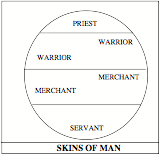
I said nothing about that! No! Certainly
not! IS THIS SOME KIND OF
HERESY? Hindu mint of magic: not
stone! AND WHAT DOES THAT
MEAN? Listen not to the one who is
buckling up his armor. BUCKLEY
BEING THE ONE WHO IS TAXING THE RUSSIAN GENERAL? Calm, now. Calm
is good. Malc not nearly so good;
malcontent is harmful. THIS AND
THAT. SISTER WITH BREASTS. Capable of unction herself. UNCOMPLEMENTARY NUNCTION OF TUNC. Yes. I see you understand.
FOUR STORE MORE GALORE.
Five Hive Jive Contrive.
Five contrives to reproduce itself evermore. IF IS LIFE, AFTERALL.
ISN'T THAT WHAT LIFE DOES?
I rest my case, your honor.
NO, NOT YET! THE BASTARD IS
ASLEEP! HE IS DREAMING OF RESTING
HIS CASE! BUT WHAT ABOUT THE
LARCENY CHARGE! Stealing
what? WORDEARNINGS. What? NEWSPRINTFINGERS.
Me? COLLAGEN ON YOUR
FACE. Not I? This is the real me. The real face, finally. IS HE NOT A LOVER TOO? Who. FOUR-FOLD MAN.
He did not say that he said that.
FIRE AIR WATER EARTH WATER AIR FIRE. 1 2 3 4 5 6 7 8 9 8 7 6 5 4 3 2 1? ADDING
UP TO WHAT? 45 and 36 is 81. 81 IS 9 TIMES 9. 81 is 3 times 3 times 3 times 3. 8 plus 1 also is 9. ANGER, WRATH; HEARER OF CRIES; NIGHT
DEMON; THRONE.
45. The Perfect and the Perfect are the one
Perfect and not two; nay are none.
INTELLIGENCE OF SATURN. ADAM. THE
FOOL. REDEMPTION, LIBERATION. TO GROW WARM. HEAVEN OF TIPHERETH.
HESITATED. SPIRIT OF
SATURN. SHE WHO RUINS. TET IN YETZIRAH. STRONGLY; GREATLY. YETZIRAH'S 'SECRET NATURE'. We know of 36. GATHERING FAGGOTS FOR THE PYRE. Father Dominus, Job has come. HARD ARTERY, CLOSING DOWN. What? AIR IS SPARE.
What? BLOOD IS MUD. What? WATER IS SLAUGHTER.
Perhaps I should leave, before the populace bgins to wake. HAR MONEY. CAR MONEY. How
does the plant reproduce itself from only a leaf? How does the earthworm regenerate itself from a
fragment? How does the starfish with
a lost leg re-grow the leg -- and also re-grow a second body from out of the
abandoned leg? WHAT? Hollow grammar; hollow content. WHAT? Hollow gram of wheat; hollow gram of straw. IS THE MAN SAYING SOMETHING CREDIBLE? Tora Tora, Tora Bora. IN EACH ATOM IS PROGRAMMED, IN GRAPHIC
CONTENT, THE WHOLE CREATION AND THE WHOLE DESTRUCTION. Don't Nag Adam. Adam doesn't like to be nagged. He's hungry. COME GATHER ADAM'S TRESSES. ADAM'S TRESSES GENERATE CORN. Dry myth!
MISTER AUBREY BEARDSLEY, NINA'S FELICITATIOUS RE-GENERATE, DRAWS A
MASSIVE COCK THAT IS BEING STUCK INSIDE A BEARDED LADY WHO IS GOOEYAGOG WITH A
LOVE OF TREES. The two-handed
stump. SO RELISHED BY JAPANESE
PRINTVOTIVARIES. Hide the corn,
Popeye! Be a man! MEA GULPA! MEA GULPA! Fine
farrow friend of the wood. Milk in
her mouth and a friendly homonymph in her heart. BORA BORA; IS SHE A HORA? Nina in one direction is Anni in a mother. NONCE. Hildegarde von Bingen: a voice so pure and porous comes out
of the chapel walls for a moment, splitting open sin and delivering God's
x-ecration. WHAT WAS THAT? THAT ANGELIC VOICE? Waking us up from somewhere. HE LOOKS LIKE CORIOLANUS, SITTING THERE
-- DON'T YOU THINK? Who,
Crossmann? YES -- THE BROTHER
CROSSAMOSSOFF. Closing Time. Closing
Time. Last call. Last drink -- before the bandman
sleeps. SANDMAN; SANDSTONE HANDS. Penis, Underwear, Pants, Overcoat. Pants, Underwear, Penis. Zero. WHAT ARE YOU DREAMING OF? SOMETHING ECSTATIC I CAN PRETTY WELL GUESS! Illicit. ILL CITY. Thongs
of Ecstacy. DOESN'T ANYONE HEAR
HAVE A NAME -- EXCEPT FOR THAT CROSSMANN, I MEAN? Ivey, Ivey, you make me feel lively. Ivey, Ivey, where'd you get those
pipes?
THE PENTAGRAM, THE FIVE-SIDED STAR, REGENERATES ITSELF AD
INFINITUM. BY USING THE PENTAGON
AS THE BOUNDARY BY WHICH THE NEXT STAR BUILDS ITSELF. As the hologram has within itself the entire picture of
itself, so the pentagram is built of other pentagrams.
THE DIADEM OF PENTAGRAMS. NOTE, AT THE CENTER IS THE INVERTED PENTAGRAM. So, the Fallen Star leads the army of
upright pentragrams? THAT IS HOW
IT SEEMS.
And the unfallen star leads an army of inverted
pentagrams? WHAT ELSE DO YOU HAVE?
There is some
kind of unity at the center of all this.
BOSE RUD, ED RAY OOM BLAY.
Pig blush. SHOW ME THE
IRIS.

I don't understand this. YOU NEEDN'T WORRY.
WE WILL LOOK AT IT AGAIN, LATER.
Is that an emblem of the Sun?
Does hieroglyphic iconography also arise out of geometry? SUCH A QUESTION! ARE YOU DAFT, MAN? WHAT RULERS HAD THEY THEN? Stabat Mater dolorosa justa crucem
lacrimosa, Dum pendebat Filius.
DOLOROSA. The sad mother on
her place of skulls looks up to find her poor boy frozen to the sacred cross,
north to south, bleeding from the side, the sky falling down on the world. AT THE CROSS HER STATION KEEPING STOOD
THE MOURNFUL OTHER WEEPING, CLOSE TO JESUS AT THE LAST. Through her soul, of joy bereaved,
bowed with anguish, deeply grieved, now at length the sword hath passed. O, THAT BLESSED ONE, GRIEF-LADEN,
BLESSED MOTHER, BLESSED MAIDEN, MOTHER OF THE ALL-HOLY ONE. O THAT SILENT, CEASLESS MOURNING, O
THOSE DIM EYES, NEVER TURNING FROM THAT WONDROUS, SUFFERING SON. Who on Christ's dear Mother gazing, in
her trouble so amazing, born of woman, would not weep? WHO ON CHRIST'S DEAR MOTHER THINKING,
SUCH A CUP OF SORROW DRINKING, WOULD NOT SHARE HER SORROW DEEP. For his people's sins, in anguish, there
she saw the Victim languish, bleed in moments, bleed and die. Saw the Lord's Anointed taken; Saw her
child in death foresaken, heard His last expiring cry. IN THE PASSION OF MY MAKER BE MY SINFUL
SOUL PARTAKER, MAY I BEAR WITH HER MY PART. Oh His Passion bear the token, in a spirit bowed and broken,
Bear His death within my heart.
AHH! Such anguish! SHE IS THERE WITH HIM, STANDING BESIDE
HIM, GUARDING HIM AS HE PRAYS.
Yes. DON'T LOOK HER IN THE
EYE. HER LOOK MAY BLIND YOU. How much do you know about how a book
will turn out when you start writing it?
VERY LITTLE. I JUST START WRITING. THE CHARACTER DEVELOPS WITH THE BOOK
AND THE BOOK WITH THE WRITING OF IT.
He's sober again! BROTHER
BILLY. If you have something to
say, write. Use your own
style. The story will choose its
own type of telling, its own style.
FLAME ON THE INSIDE; AND FLAME ON THE OUTSIDE. Is he looking at a candle? HE IS ALWAYS LOOKING AT A CANDLE. He's a lion in the garden. DAMN SOUTHERN WRITERS.
THEY'RE ALWAYS SO SELF-RIGHTEOUS IN THEIR SUFFERING. I agree. YES. Bill
Moyer's in his exemplary self-sacrifice.
Climbing up the cross for the sake of racism and the Vietnam war. NO YOU CAN'T FILL IT ALL FROM YOUR
SELF-IMPOSED RACK ON THE WALL. THE
TIGHTER YOU DRIVE THE NAILS, THE HARD YOU'LL FALL. SO, COME ON NOW, COME OFF IT, SIR, BEFORE YOU GET HURT. Janus even. ANUS GIVEN. New
Christ, hipster, cardiac hero of two thousand years past your mind. She spits at your feet, crying: 'We
have no need of a God! Each of us
is his own...!' YES. Yesterday's preacher, today's bikini
beacher. HER ASSY. Hear racey. HAIR ACEY.
ONE-ELEVEN. One and
Eleven. CARDS TELL NO TALES UNLESS
WEARING FOUR DIFFERENT SUITS.
Foresooth.
SPRING, SUMMER, AUTUMN, WINTER.
Love, Wealth, Conflict, Death.
ASS OF NINE. Everyman. Ideas, bones, flesh, clothes. SOUL, SKIN, FAMILY, TOWN. Man, Family, Town, Country. FORESKIN, YOU MEAN? What are we cutting off, afterall? The hood? Because the hood represents secrecy. The hood represents Death? WHOYTEBOYCE OF HOODIE HEAD. K-K-Katmandu. KILLYKILLKILLY: A TOLL A TOLL. What chance cuddleys, what cashels aired and
ventialted? C-C-COOME ONE, STICK
TO THE SCRIPT! Man On a Tightrope,
Scene 73, Take 12. ACTION. What then agentlike brought about that
tragoady thundersday this municipal sin business? Our cubehouse still rocks as earwitness to the thunder of
his arafatas but we hear also through successive ages that shebby choruyish of
unkalified muzzlenimiissilehims that would blackguardise the whitestone every
hurtleturtled out of heaven. Stay
us wherefore in our search for righteousness, O Sustainer, what time we rise
and when we take up to toothmick and before me lump down upown our leatherbed
and in the night and at the fading of the stars! For a nod to the nabir is better than wink to the
wabsanti. WHO SAID THAT? TEN SECONDS. Da-da-da-da-da-da-da.
Da-da-da-da-dut-da-dut-da-dut-da-da-da-da-da-da-da-da. Dut-da-da-da-daa-daaa-daaa-DA-DU. EYENAL FAYE, OEPARDS JAY, OEPARDS
LAY. Such a handsome man, the
Canadian, with his moustache so evenfull, hey. AXELROD EAVENSTRAIN.
Alex! Just say Alex! You Roman wannabe! SON OF HOKMAH! Humphrey Chimpden Earwicker is the
great hero of Joyce's masterpiece Finnegan's Wake. HCE is, in fact, Everyman. Much as is our friend, Crossmann. WHAT? The great
fact emerges that after that historic date all holographs so far exhumed
initialled by Haroumphrey bear the signla H.C.E. and while he was only and long
and always good Dook Umphrey for the hunger-lean spalpeens of Lucalizod and
Chimbers to his cronnies itwa equally certainly a pleasant turn of the populace
which gave him as sense of those normative letters the nickname Here Comes
Everybody. IN ENGLISH,
PLEASE. Of course.
|
8 |
H |
The Great Father |
||
|
3 |
C |
|
|
|
|
5 |
E |
|
|
|
|
|
|
|
|
|
|
16 |
|
|
|
|
|
|
|
|
|
|
|
1 |
A |
The Great Mother |
||
|
12 |
L |
|
|
|
|
16 |
P |
|
|
|
|
|
|
|
|
|
|
29 |
|
|
|
|
HERE COMES EVERYBODY.
And ALP, Anna Livia Plurabelle, is Joyce's glyph for the Great Mother,
the Female Principle. HCE IS
EQUIVALENT TO MC (MICHAEL CROSSMANN).
Yes.
|
16 |
AChZ |
He seized, clearved to |
|
|
|
|
|||
|
|
GBVH |
Elevated; exalted; high |
|
|
|
|
|||
|
|
HVH |
(verb substitute) Injury; war; lust; fell |
|||||||
|
|
HVA |
She |
|
|
|
|
|
|
|
|
|
VY |
Alas! -- Woe |
|
|
|
|
|
||
|
|
ZVG |
Like; equal to |
|
|
|
|
|
||
|
|
|
|
|
|
|
|
|
|
|
I ASKED FOR ENGLISH ONLY! Cross-fertilization.
WHAT! AND THAT MAKES IT
OK? Melting pot. ARCANE EXPLANATION! Man's vowel placed inside the Woman's
consonant. VERBUM DEI.
|
29 |
DKH |
Is broken |
|
|
|
|
|
HDK |
To break down; overturn |
|||
What? THEY'VE
STOLEN YOUR CLERICAL ROBES AND YOUR BIBLE'S BEEN THROWN. YOUR VIRGIN RED CROWN OF THORNS HAS
TURNED TO IVORY HORNS. AND YOUR CORNER THRONE HAS NOW BECOME A CORNER
STONE. Sing it out, girl! ENGLISH ONLY! What? IN THIS
PLACE, ENGLISH ONLY! What about
Latin? BEEN LATIN! WHO HEAR KNOWS LATIN? ONLY YOUR SWINEY VERSIONS OF LATIN
APPEAR. Circe's magic
calendar. ROSE BROOD, PLAIN AND
SIMPLE. Sue, ye trample the Hyssopus
officinalis with
the plaint of your tragic calloused broadfoot -- ah, such a dimple.
|
Hebrew |
|
|
|
|
|
5 |
H |
The Great Father |
||
|
8 |
C |
|
|
|
|
5 |
E |
|
|
|
|
|
|
|
|
|
|
18 |
|
|
|
|
|
|
|
|
|
|
|
1 |
A |
The Great Mother |
||
|
30 |
L |
|
|
|
|
80 |
P |
|
|
|
|
|
|
|
|
|
|
111 |
|
|
|
|
ROSES BE ROSES.
MOSES BE MOSES. Does
he speak or just plead? PLEAD OR
JUST PLEASE? Plead or just bleed? BLEED; OR PLEIADES? Listen to him. WHAT? Key 18 - THE MOON - Venus Acting Through Pisces Upon the
Cosmic Elements, The Victory of the Material, The Deceptive Effect of the
Apparent Power of Material Forces.
Number 18 implies the
exploration of secret realms - a quest that is not without its perils. Number 8
is evolution and leads to 1+8=9, initiation. It can also be enumerated as
6+6+6=18, referring to initiation of not only of the individual but also of the
race. Consisting of the digits 1 and 8, which add up to 9, a connection between
the Moon and the Hermit is indicated.
In Key 18, we see that there are many hidden things to be learned, even
by those who are already advanced on the Path. Pisces is the most psychic of astrological symbols and the
Moon the most psychic of the Tarot cards. Their meanings blend in suggesting a
pathway full of temptations as the Fool travels upward on the long journey. The
Towers represent the boundaries of the known, and beyond them are the heights
of consciousness. They represent the secrets which cannot be penetrated until
we have risen beyond them. As a Key of sleep and dreams, the Moon symbolizes
the intuitive and psychic work characterized by deep trance or meditation. The 29th Path is another Path which
menaces the traveler with the danger of disintegration -- psychic
disintegration because this Path leads to Netzach. What is indicated here is the renunciation of individuality.
The journey from Malkuth to Netzach is the joining of the physical and
emotional natures, carrying with it powerful emotional complexes and the
balance here is to use "reason" when it is called for. The
"shadow" crops up frequently on this Path. As Path 31 needs to be balanced with instinct and emotion,
the 29th Path need to be balanced with intellect and reason. A Path of flux and
reflux, the journey of evolution, the 29th path can be experienced in
"psychic fertilization" as we experience birth through vibrant
Netzach, the Awakener. All paths which proceed toward Netzach are Orphic Paths,
resembling the mythical poet, Orpheus, who charmed nature with the gift of
song. Qoph, the letter of this
Path, means literally "the back of the head" as the consciousness
which shapes bodies. The back of the head is where the medulla
oblongata is located and this is referred to by esoteric
traditions as the connecting link between the higher brain centers and the
spinal cord and lower centers of the body. It governs respiration, heart
movement, circulation, all forms of health maintenance and even carrying on its
functions while we sleep.
Interestingly, the activity assigned to Qoph is the function of sleep.
The value of the letter q is 100 or 10 x 10 (the number of Sephiroth multiplied
by itself) as well as the value of the word Kaleem, vessels or instruments,
giving us a clear sense of the relationship of the Divine through its medium of
expression, the instruments of the body or corporeal intelligences. Called the
Corporeal Intelligence, this is truly a path of body consciousness. One of the
most important lessons of this Path, stressed in Qabalah again and again, is
that is it not to our advantage to attempt to separate the "higher states
of the mind" from the "lower gross" forms of the physical body.
If we neglect the body, we neglect the Spirit embodied by the flesh. The aim of
the aspirant is to begin where nature left off and go on to perfect the work of
evolution -- much in the way the alchemist works with matter. The image of
growth is indicated by the word Qoph spelled out which equals 186, the same
value as the word mosaph "to increase." THE TOWERS?
WHAT DOES HE KNOW ABOUT THE TOWERS! Knows is as Knows becomes. NOSE BE NOSE.
TROTHS BE TROTHS. Send the
boy to his room! He needs to study
his geometry now! The test of this
is so....melancholy-making. Don't
you agree? AND WE KNOW ABOUT 111,
ALP, THE MIGISTRATE OF THE MAMMOFACTORY.
Nipples be Nipples. Simple
and plain. Narcotics of the skin. MATRI MONEY.
NINETEEN BE NINETEEN. The
Lord our God is One. ONE IN THREE:
TELL ME ABOUT THE NUMBERS. Aleph
is a mother letter representing the Element of Air. Its first two letters spell
out the word AL or "God," and if we examine the root of Aleph (ALP)
we see it combines the idea of God with the letter Peh, the archetype of the
mouth or speech. Thus, from Aleph, we get the idea of the Divine Expression of
God or the Life Breath manifesting through the element of Air. In Qabalistic
Tarot, Aleph means the primary Life-power which moves everything through the
power of Breath (Spirit). PASTE IT
DOWN QUICKLY, GREAT DEDALUS THE ARITIFICER. CUT OUT WHAT ONE MAN SAYS; AND PASTE IT ON TOP OF WHAT
ANOTHER MAN SAYS. Overlapping
voices. LEVELS OF SKIN. Each sense pasting its impress into the
brain, creating a collage of impressions, which the mind interprets, painting a
scene through his eyes which approximates the deatils the senses have brought
him. LAYERS OF SOUND, SOME
APPEARING AS SHAPES, SOME AS COLORS, SOME AS NOISES, SOME AS PARTICLES OF LIGHT
OR FRAGMENTS TOUCHING THE SKIN.
The narcotic of sin. MOON
MUFFIN OF BLUE NYLONG. Let nothing
grieve thee, O Land of Ta, for God hath chosen thee to be the source of the joy
of all mankind. ARMOR IN CAVES;
SEE AJAX CURSED BY BONES OF ACHILLES.
Armor in Caves. Armor in
Ca. Armorika. Central to the root. The White Mountain. In Bora Bora. WHO HAS BEEN RAISED FROM THE DEAD? THE DEAD CURSE THOSE WHO HAVE BEEN RAISED FROM THE
DEAD. THE DEAD WANT PEACE; THEY
WANT EVERYONE TO BE DEAD. My
trifolium librotto. I can sing of
this all day. IS THAT WHAT BROUGHT
YOU THAT THREE-CORNERED LUCK? I
THOUGHT IT WAS THE MAGIC GLASSES!
THE PRINCIPLE OF TWOS; AND REFLECTION. Magic numbers, you mean. LIBER ABACI.
LIBERACI. The Book of
Numbers? NO, THE BOOK OF
COMPUTATION. Ach. EGG DUNG. Achen, Achen: Overthrow the Romans. THE DEAD WANT TO DESTROY THE LIVING,
WANT TO OVERTHROW THE ROMANS.
Leonardo de Pisa.
RENAISSANCE MAN. Counted
numbers zero through nine. YES, WE
KNOW THE HISTORY. DON'T BEGIN TO
FIB, NATURAL MAN. Didn't they call
Jake Crossmann the 'Man of Good Cheer'?
I DON'T REMEMBER THAT.
Bonaccio! YES, FIBERS
COLLECT AROUND THE WARM OPENINGS.
Heir of stress. DON'T SHAVE
OFF THAT BEARD, BEARDED LADY!
BEARDED WONDER!
Comprehending?
Comprehending what?
KRAKATOA KRAVES KRIST.
Next. LEONARDO'S FATHER WAS
A MAN' OF GOOD CHEER, A BONANCCIO; AND LEONARDO BECAME, IN HIS TOWN, FILIUS
BONNACIO, 'SON OF GOOD CHEER', OR FIBONACCI. Fib of Nazis Roman credo. RE-PHRASE, PLEASE.
Fib: The Nazis rise was directly attributable to their mastery of the
theory of numbers? ANSWER: PARTIAL
CREDIT. So, you are introducing
more number theory -- the mystical number sequence of bonbon Fibonacci. FROM THE ZERO ISSUED THE ONE, THE
UNITY. AND FROM THE UNION OF THE
PARENTS OF NUMBERS ISSUED THE SON.
THE TWO NUMBERS, THE MOTHER AND FATHER, ADDED TOGETHER PRODUCE THE THIRD
NUMBER, AD INFINITUM. THAT IS, THE
ONE EMANATES FROM THE ZERO. AND
THE ONE REPRODUCES ITSELF THROUGH REFLECTION. A FLOWER OPENS FROM ITS SEED AND THEN BEGINS SPIRALLING IN
TO FORM. AD INFINITUM. Add each number to itself and the
number preceding it. 0 plus 1 is
1. 1 plus 1 is 2. 1 plus 2 is 3. 2 plus 3 is 5. 3 plus 5 is 8. WITHOUT END? Without end.
|
Fibonacci Number Sequence |
|
|
|
Golden Mean |
|
0 |
|
|
1 |
|
|
1 |
1 |
|
2 |
2 |
|
3 |
1.5 |
|
5 |
1.666666667 |
|
8 |
1.6 |
|
13 |
1.625 |
|
21 |
1.615384615 |
|
34 |
1.619047619 |
|
55 |
1.617647059 |
|
89 |
1.618181818 |
|
144 |
1.617977528 |
|
233 |
1.618055556 |
|
377 |
1.618025751 |
|
610 |
1.618037135 |
|
987 |
1.618032787 |
|
1597 |
1.618034448 |
|
2584 |
1.618033813 |
|
4181 |
1.618034056 |
|
6765 |
1.618033963 |
|
10946 |
1.618033999 |
|
17711 |
1.618033985 |
|
28657 |
1.61803399 |
|
46368 |
1.618033988 |
|
|
|
|
Golden Mean: Divide Fibonacci |
|
|
number by
number preceding it. |
|
THIS IS THE FINBONACCI SEQUENCE. So what! What
does it mean? What does this mean
to me? LET MOSES SPEAK. The reader reads the reduct act. YES. LET HIM READ THE WRY ATTACK THEN. LET HIM READ THE IROT TACK THEN. IROT Nails run in.
PLEASE! The Fibonacci
Sequence actually begins with two terms, zero and unity (0 and 1), nothing and
everything, the Unknowable and the mannifest Monad. These are the first two terms. Their sum, another unity, is the third term. To find each next term, just add the
two latest terms together. At
first glance, we see a chain of numbers.
But look beyond the visible numbers to the self-accumulating process by
which they grow. The series grows
by accruing terms that come from within itself, from its immediate past,
taking nothing from outside the sequence for its growth. Each term may be traced back to its
beginning as unity in the Monad, which itself arose from the incomprehensible
mystery of Zero. The principle
of ongoing growth-from-within is the essence of the Pentad's principle of
regeneration and the pulsing rhythms of natural growth and dissolution. It appears in plants, music, seashells,
spiral galaxies, the human body, and everything associated with the fiveness in
nature. THIS IS A KIND OF VIRGIN
BIRTH, IS IT NOT? THE 1 ISSUING
FROM THE ZERO WITHOUT BENEFIT OF THE ONE.
The One issues from the Zero and reproduces itself, a second one. YES. IN THIS METHOD.
BUT DOES THIS SAY ANYTHING ABOUT ANYTHING ELSE? Some insects and microscopic life
experience parthenogenisis ('virgin birth'), whereby unfertilized females give birth
to males. But fertilized females
always give birth to other females.
The family tree of any bee branches in the accumulative Fibonacci growth
rhythm. And each branch resembles
the whole family history. LET HIM
DRAW IT. What? HERE, IN THE SNOW.
Opulent credentials.
Opening up some candelabra in your shower here. THE TREE BEING REPLICATED IN THE
BRANCH. And also in the leaf. I DON'T KNOW ABOUT LEAVES. I SEE NO LEAVES HERE. Decidedly not, friend. But if you were seeing leaves. IF IT THE NUMBERS THEMSELVES, OR OUR
PERCEPTION OF NUMBERS? Thanks for
taking me back to Freshmen Philosophy.
IF WOOD FELL FROM THE TREES IN A FOREST WITH NO EARS, WOULD THE
VIBRATIONS TRIGGER IN THE NON-EARS IN TREMULOUS SPIRALS IN THE BRAIN,
CONVINCING THE SOUL INSIDE THE BRAIN, STANIDNG IN THERE, OZ-LIKE, GENERAL OF
IMPRECISIONS, RECEIVER OF EDITED SPASMS OF THE CORPUSCLES AND THE EYES AND EARS
AND FINGER-TIPS FROZEN BY THE ICY CONDITIONS OF THE FOREST, THAT, INDEED, THE
WOOD HAD FALLEN, THAT THE PIECE OF BARK HAD DISLODGED ITSELF FROM THE OLD SKIN
OF OLD MAN TREE, OLD MAN PINE.
Tiger Wood? PIG METAL? Dog Air? DOG EAR. Oh,
you are so precious, with your embellished cadenza of tough fluff, monsignor
melody. MELODY WHAT? YOU DATED WITH HER WHEN YOU WERE
SEVENTEEN. REMEMBER THE PROM. YOUR FRIEND'S HOUSE. CHERRY VODKA. DRIVING HOME, YOU IN THE BACK SEAT, KISSING MELODY, PUTTING
YOUR HAND UP HER SKIRT, TOUCHING HE SOFT WHITE THIGH, BUT NOT REACHING HER
SPECTACULAR TRIANGLE. Melody
Sweet, a finger so soft, a pediment so raw. Were we not young, and you not suspicious of my love, you
would have let me play the chord.
Touching the savory instrument that would give rise to song. HELPLESS BOY. WITH LESS CRAFT THAN YOU NEEDED. LESS BRASH CONSISTENCY THAN SHE'D LIKE. The apple of her eye. WALKING WE NOW ARE DOWN LANE MEMORY
WITHOUT A SHOE. An empty shoe is a
place for a boy to hide. Das Lied
Von Der Erde. GASSED STAVED
MARTYR. Shoe Bird -- what do you
mean? I'LL HAVE A STRAWBERRY SHOE
BIRD, ONE SCOOP, WITH AN AWFUL SCONE.
Show pain and you will shall surely win her. BEAT EVEN ONE EVIL; AND YOU SHALL SCORE A COUP OR RUN. Past oral accomplishments would have
made that Melody blush. FANTASY
AFTER THE ACT. Fat felony of the
mind's Catholic preface. BACK
UP. FLAG HER WITH A TONGUE OR TWO,
AFTER THE MANNER OF THE FRENCH.
One, two. One, two. Up and down. Side to side.
Let the jaw grow weary. Let
the lips drag slowly. Incandescent
breath. Honey on the tongue. Metaphysical onion. Slip sliding away. ONE DOOR OPENED IS ONE DOOR
CLOSED. Methinks I hear the organ
of love, sipping holiday liqueur in a bandy snifter. MELODY, MY MELODY.
WHY DIDN'T I TOUCH YOUR PRECIOUS SOURCE OF VEGETATION. Shy catholic guy. WHAT KIIND OF FOOL AM I. WHO NEVER FELL IN LOVE IT SEEMS THAT I'M THE ONLY ONE THAT
I'VE BEEN THINKING OF. Panther
lying on top of ivory. RECEPTACLES
OF RICH FLAVOR. Harmony undoes all
its associations; and then begins to build them back up again. BON TEMP. France list of composers: Sadie Berlitz, the pussy all
golden and filled with cream; I like to revel in her Mars cells and uncover her
fury and her mole here, just above the crater. FATHER PRADO.
WHY HAVE YOU FORESAKEN ME?
Sister Ludavine: close your eyes and open your mouth. AND PLUG YOUR EARS. SO YOU DON'T HAVE TO HEAR WHAT YOUR
DON'T WANT TO HEAR. Storebought
matter. STARBUCKED MUTTER. Please. What about those ribbon ixious numbers you brought up? WHICH? A baby's hand holding the apple in her eye. WHAT? Vague concept.
PASTORAL CASTOR ALL BOTTLED UP INSIDE. A knife being held by his momentum right up to the eye as
well. PAUSE WHEN YOU CAN, MISTER
MOHLE. Do you hear piano
music? NOTHING LIKE BEE WOVEN AND
WOVEN INTO GENEALOGICAL SEA, MISTER TATUG. Choral Gethsemane?
PARDRONE, MES AMIS.
INDUBITABLE CONSCIENCE RISING TO ACCUSE HIM AGAIN OF ABANDONING HIS
MOTHER, HIS BROTHER, HIS FAMILY, HIS BLOOD, HIS ROOTS, HIS NATION, ULTIMATELY
HIS FATHER. Accuse him, then,
Jake! PILE OF TIME. PILE OF LIGHT. PILED UP HERE, A LUMP OF LOVE, BEFORE
THE NIGHT. SHAKE A FIST AT HIM;
TELL HIM HE MUST DIE. TIE A ROPE
AROUND HIS NECK AND CALL IT MACARONI.
Fanfare for the Common Man.
HARDLY COMMON. Commonly
hardy. PLEASE. WE ARE ALL GETTING TIRED HERE. IF THERE IS SOMETHING WE MUST KNOW,
THEN PLEASE TELL US. One finds the
Fibonacci Number Sequence in the genealogy of the male bee, the drone. One also finds it in the piano
keyboard. The 13-note chromatic
musical octave consists of 8 white keys, 5 black keys, arranged in groups of
twos and threes comprising one full octave.
|
0 |
|
1 |
|
1 |
|
2 |
|
3 |
|
5 |
|
8 |
|
13 |
NATURE'S CADENZA.
He would have you believe that all the flowers in the field have petals
in numbers designed to fit the Fibonacci sequence. WHO WOULD?
Mister Footnote. OR MISTER
NON-FOOTNOTE. Fontenot, you
mean? SHINE, DEAR. SHINE ON. AND WHAT DO YOU MEAN, ASKING FOR RIGHTS? IF THE NOTES ON THE PIANO BELONG TO THE
NIPPLE FACCI FELLOW, THEN WHO'S TO SAY THE SONGS OF THE FLOWERS IN A MEADOW
DON'T BELONG TO...WELL EVEN TO HERR CROSSMANN HIMSELF? What? WHO IS TO SAY THAT?
WE ARE NOT LIVING IN A VERY CLEAR WORLD HERE, DEAR FRIEND --
I MEAN, IT'S NOT REALLY CLEAR, IN A LEGAL SENSE. Is he stealing it; or is he just
borrowing it? YOU ARE ASKING
ME? Shocks of cove itch. SCRATCH IT THEN. My fingers are numb. HERE, HAVE A DRINK. I feel like I'm living in a cave on
White Mountain, Johnny Mike. The
ice coming down out of the rocks.
Spanning the blackened roof like a tar. Melting at my feet.
ALLEY OOP. What? ALLEY OOP OOP. OOP. OOP OOP. The
caveman, you mean? Very funny. ALL CAIN DEAD. Abstract vendetta -- against the
bloody-handed handlers of Hor.
AUSSIE, NAY? Jean Paul
Sartre. WHAT DO YOU MEAN? Is the lawyer still asleep? I DON'T EVEN KNOW WHY HE IS HERE. Why are any of us here? TO ACCOMPANY HIM IN....GOETHE'S SESAME
SHAME. What is he speaking about? HE'S COLD. HIS LIPS AREN'T WORKING RIGHT. Cut and paste.
SCRATCH AND SNIFF. Dumas
man does not pilfer progress from any John John or other. You should know that by now. THREE MUST CUT TEARS. FASTER THAN ONE MUST CUT CONTEXT. Shame on the predicate boys, sitting
here in ice and copulating word-sounds.
PUN SYLVANIANS. Nose for a
two step. TANTRUM TIME. Broom stroker. CARNIVAL IN FRANCE. Sweep. Sweep. CARNIVAL
IN ROME. Creep. Creep. CARNIVAL IN SICILY.
Deep. Deep. CARNIVORE IN TOWN. Sleep, Sleep, child; it is not time to rise yet. A ROCKET ON THE HEAD OF OLD KARMA. Snow White. A ROCK ON THE FOREHEAD OF OLD DHARMA. Howl, brethren. Howl. METASTASIS.
|
# of petals |
Flower |
|
|
|
|
0 |
|
|
1 |
|
|
1 |
|
|
2 |
Enchanter's Nightshade |
|
3 |
Iris, lilies, trillium |
|
5 |
All edible fruit, delphinium, larkspurs, |
|
|
buttercups, columbines, milkwort |
|
8 |
Other delphiniums, lesser celandine, some |
|
|
daisies, field senecio |
|
13 |
Globe flower, ragwort, 'double' delphiniums |
|
|
mayweed, corn marigold, chamomile |
|
21 |
Heleniums, asters, chicory, doronicum, some |
|
|
hawkbits, many wildflowers. |
|
34 |
Common daisies, plantains, gaillardias, |
|
|
pyrethrums, hawkbits, hawkweeds |
|
55 |
Michaelmas daisies |
|
89 |
Michaelmas daisies |
Where does he get this stuff? YOU KNOW AS WELL AS I.
HE GETS THEM FROM THE BOOKS IN HIS BACKPACK. Where did this guy Moses come from anyway? HE CAME HERE TO PROTECT CROSSMANN. DON'T YOU SEE: HE SHOWED UP AS A DEFENDER
OF HIS NIBS AT THE GALLERY. What
about the four-leaf clover? HE'S
TALKING ABOUT BREAKING THE LINK.
BREAKING GOD'S LINK. Those
damn Irish. Wouldn't you know
it. THE FOUR-LEAF CLOVER IS SO
RARE AS TO HAVE BECOME ALMOST MYTHIC.
THAT IS, YOU CAN TELL BY LOOKING AT THE IRIISH AND THEIR LUCK THAT THERE
AREN'T MANY OF THOSE CLOVERS ANYWHERE IN THE WORLD. Maybe the history of the Irish suggests that their signature
vegetation does lie outside the chain of God's thought. OK, ENOUGH. I WILL CALL OUT MY PC LAWYER IF ANY FURTHER DEROGATIONS
OCCURS TO THE NAME OR HONOR OF THE IRISH.
It's ok to spit on the Irish, but try spitting on...on...anyone
else. SPITTING ON THE WOP IS OK --
ONE THE WASP, I MEAN. Spitting on
the Pope is ok, too. SPITTING ON
THE POPLE IS OK BECAUSE HE'S A WHITE MAN.
IT'S OK TO SPIT ON WHITE MEN.
Yes. THAT IS A WHOLE OTHER
TACK. Spitting is not the problem
really, is it? Power gets spit
on. It always has -- by those
without power. AND THOSE WITH
POWER HAVE OFTEN SPIT UPON THE POWERLESS.
Yes. SPIT TRAVELS BOTH
DIRECTIONS. THAT'S WHY THEY SAY
'DON'T SPIT IN TO THE WIND'. I
thought that was 'Don't piss in to the wind'. YEAH, THAT TOO.
Perhaps the psychotic is simply the man or woman with a confused waking
and dreaming continuum. YOU MEAN
THAT THEY ARE DREAMING WHEN THE ARE AWAKE AND THEY ARE AWAKE WHEN THEY ARE
SLEEPING? Yes. OF COURSE, WHAT IS CONVEX TO YOU IS
CONCAVE TO THEM. To whom? TO THOSE IN THE ANTI-UNIVERSE, THE
PARALLEL UNIVERSE. The ones in the
shadow? WELL, SHADOW IS ALSO
RELATIVE. TO THEM IT IS THE
LIGHT. TO THEM, DARKNESS IS THE
LIGHT. Yes, I see. To the psychotics. YES. By far the most fascinating appearances of the Fibonacci
Series in nature are the spirals that can be seen in everything from sunflowers
to pine cones to pineapples. We are about to explain that this phenomenon comes
not from perfection through evolution (which is, in itself, oxymoronic) but
from the dynamics of plant growth. To begin to understand how these spirals
come to be, one must go back to the beginning; to where flowers and fruits and
seeds start: the apex. The apex is the tip of the shoot of a growing plant. It
is the bud on the end of a stem on a tree and the bulb of a flower before it
blooms. Around the apex grow little bumps called primordia. As more primordia
develop, they are pushed farther and farther from the apex and they develop
into the familiar features of a plant, be it a leaf, a flower, or parts of a
fruit. Let us consider a sunflower with primordia growing from the center. The
first primordia to develop end up being farther from the apex than later
primordia. Therefore, it can be deduced from this in what order the primordia
appeared. As it happens, if one took the first and second primordia and
measured the angle between them with the center of the seed head as the vertex,
the angle would be very close to 137.5 degrees. That angle is very important in describing how primordia
form the spirals we see. It is, in fact, known as the golden angle. Here's
where the Fibonacci Series comes in. Take two consecutive Fibonacci Numbers and
divide the smaller by the larger. Then multiply by 360 degrees. Let's try 55/89
* 360 = 222.472... We can round
that degree measure to 222.5 degrees. Remember from trigonometry that angles can
be measured internally or externally, so if you subtract it from 360 degrees to
convert it, you get 137.5 degrees, the golden angle. CAN"T HE PAINT ANY FASTER. Perhaps Crossmann should be helping him. DON'T BOTH CROSSMANN WITH THIS -- HE IS
PRAYING. It looks like he's
sleeping instead. I haven't seen
him move for an hour or so.
Someone should check to see if he's still breathing. PERHAPS HE IS FROZEN. He's ok -- mind your own business! SSH! DON"T LOOK HER IN THE EYE -- THAT CAT! SHE WILL SEND YOUR MIND IN TO A DOUBLE
SPIRAL, ONE CLOCKWISE AND THE OTHER SIDE COUNTER-CLOCKWISE! Parallel anti-verses. EXRA POUND AND
T.S. ELLIOT. Yes -- fighting in
the captain's tower. PAINT! Yes-- paint faster! MIX YELLOW OCHRE AND BURNT UMBER TO GET
A BRONZE.
Another appearance of the Fibonacci Series in seedheads such
as pinecones and pineapples is that the number of spirals going in each
direction is a Fibonacci Number. In the diagram below, there are 13 spirals
that turn clockwise and 21 curving counterclockwise.
SUGGESTING, IT SEEMS TO ME, THAT EACH NUMBER IN THE FIN DE
SIECLE SEQUENCE MIGHT ALTERNATE: ONE BEING POSITIVE AND THE OTHER BEING
NEGATIVE. What? THAT WAS SPECULATION, OF COURSE. ONE CLOCKWISE; THE OTHER
COUNTER-CLOCKWISE. THAT IS, ONE
NORTHERLY; AND THE OTHER SOUTHERLY.
Go write a doctorate, man!
IT IS SPECULATION! I SAID
IT WAS SPECULATON! On all
sunflowers, the number of clockwise and counterclockwise spirals will always be
consecutive Fibonacci Numbers like 21 and 34 or 55 and 34. I'M NOT SURE THIS IS GETTING US CLOSER
TO THE TRUTH, SIR! Truth! Look, man! Look at this seed-head! The seed-head does not lie! (Paint, man!
Paint!)

SUCH MYSTIFICATION IS NOT TRUTH! It is an emblem, sir!
An emblem of truth! THE TRUTH
OF WHAT? Of God's motion! WHERE IS CROSSMANN IN ALL OF THIS? WHY HAS HE BECOME SO SILENT? He is praying, sir -- can't you
tell? CLEARLY, THE FIBONACCI
NUMBER SEQUENCE IS NOT GOD'S BREATHING.
EDOUARD LUCAS RAN THE SAME TEST BUT USED A DIFFERENT SEQUENCE, STARTING
WITH 2 AND 1 INSTEAD OF 0 AND 1 -- WITH SIMILAR RESULTS. THE NUMBER SEQUENCE IS NOT UNIVERSAL --
BUT THE GOLDEN MEAN IS THE SAME IN EACH SEQUENCE. SUGGESTING THAT THE GOLDEN MEAN IS THE UNIVERSAL ELEMENT,
NOT THE NUMBER SEQUENCE. So, this
suggests that Nature 'thinks' in numbers other than Fibonacci's. PHILISTINES. IT SUGGESTS THAT GOD'S THOUGHT IS THE GOLDEN MEAN.
|
Lucas Number Sequence |
|
|
|
Golden Mean |
|
2 |
|
|
1 |
2 |
|
3 |
1.5 |
|
4 |
1.666666667 |
|
7 |
1.6 |
|
11 |
1.625 |
|
18 |
1.615384615 |
|
29 |
1.619047619 |
|
47 |
1.617647059 |
|
76 |
1.618181818 |
|
123 |
1.617977528 |
|
199 |
1.618055556 |
|
322 |
1.618025751 |
|
521 |
1.618037135 |
|
843 |
1.618032787 |
|
1364 |
1.618034448 |
|
2207 |
1.618033813 |
|
3571 |
1.618034056 |
|
5778 |
1.618033963 |
|
9349 |
1.618033999 |
|
15127 |
1.618033985 |
|
24476 |
1.61803399 |
|
39603 |
1.618033988 |
|
64079 |
1.618033989 |
|
103682 |
1.618033989 |
|
167761 |
1.618033989 |
|
271443 |
1.618033989 |
|
439204 |
1.618033989 |
|
|
|
|
Golden Mean: Divide Lucas |
|
|
number by
number preceding it. |
|
Philatelist what?
PHYLLIS WHO -- PHYLLIS GEORGE?
Phyllis's teens, I think he said.
ISN'T THAT THAT PORNO MOVIE: BEHIND THE TEEN'S DOOR? Yes, I've heard of it! I CAN SEE YOU ARE ALL HUNGRY FOR A
LITTLE DISTRACTION. Dream on White
Boy. White Boy. Dream on Black Girl. Black Girl. Then wake up to find a brand new day. Find your dreams are washed away. DREAM ON BLACK BOY. BLACK BOY. DREAM ON WHITE GIRL.
WHITE GIRL. What is:
Original Sin. CORRECT, FOR TWENTY
POINTS. AND THE NAME OF THE BAND. N X S! CORRECT AGAIN FOR ANOTHER TWENTY POINTS. A menacing bionic rhythm married to a slashing
guitar hook and topped off with a sexaully-charged melody line. TALK TALK. Rolling Stone.
YES. GATHERING MOSS. BUT NO POINTS FOR THAT. Style points. THAT IS OPEN TO QUESTION. BUT THAT IS THE FORMULA FOR S-EXCESS IN MODERN ROCK MUSIC,
ISN"T IT -- VIOLENCE AND LUST?
Modern rock music? Is there
any rock mustic that isn't modern?
Is there a period of Baroque rock music? (MUTED LAUGHTER.)
ISN"T THERE? Doesn't
David Bowie qualify? Perhaps the
Thompson Twins? I SAID BAROQUE,
NOT BROKE! (Muted Laughter). Bare oak. SUICIDE BLONDE.
No, that is not the answer we are looking for. WHAT IS MICHAEL HUTCHENCE AND HIS BELT -- THE INSTRUMENT
WITH WHICH HE HANGED HIMSELF?
What! I didn't know that! THAT ANSWER IS CORRECT, FOR 20
POINTS. Heavenly Hiraani Tiger
Lily! You're kidding! WHAT? IS THAT ANOTHER FIBONACCI SPATIAL SPIRAL? No. That's an incorrect answer. TIGER LILY -- ISN'T THAT THE NAME OF THE YOUNG GIRL IN THE
MOVIE? What movie? PHYLLIS'S TEENS -- ISN'T THAT WHAT WE
ARE TALKING ABOUT? Pretty young
flower named Electra. OH, YES, I
REMEMBER HER. Dream on White Boy;
Dream on Black Girl. WHO IS
SOPHOCLES? Yes, for twenty
points. SAPPHO CLEAVES. What? SAPPHO CLEAVES.
Are you making an observation; or are you trying to answer the next
question brought us here secretly by Rod Steiger reprising his oscar-winning
role as the fabulous pun-broker?
CLEAVE IS A STRANGE WORD BECAUSE IT MEANS ONE THING AND IT ALSO MEANS
ITS OPPOSITE. IT MEANS TO SPLIT IN
TWO; AND IT ALSO MEANS TO ADHERE OR STICK. It also mean cloven, as in 'cloven hoof'. (DEMONIC MUSIC PLAYS, AN ELONGATED
ORGAN CHORD. BELLA LUGOSIE IS SEEN
CASTING A HUGE SHADOW IN TO THE GARDEN.
WILLEM DAFOE PLAYING BELLA LUGOSIE.) Demonic Sappho, you are suggesting. Lesbianism and demonism. I know where you are taking this. NOW SHE SHINES AMONG LYDIAN WOMEN LIKE
THE ROSE-FINGERED MOON RISING AFTER SUNDOWN, ERASING ALL STARS AROUND HER, AND
POURING LIGHT EQUALLY ACROSS THE SALT SEA AND OVER DENSELY FINE-BONED AND
NOTCHED FLOWERED FIELDS, LUCENT UNDER DEW. HER LEGS SPREAD UNDER ROSES AND TENDER THYME AND THE
BLOOMING HONEY-LOTUS. OFTEN WHILE
SHE WANDERS SHE REMEMBERS YOU, GENTLE ATTHIS, AND DESIRE EATS AWAY AT HER
HEART. FOR US TO COME. Amen. ROSEY-FINGERED DAWN.
Dawn of Day -- is that who you mean? WHAT? You know,
Riders of the Herbal Sage.
SOCRATES? DOES HE MEAN
SOCRATES, WHO WAS CALLED BY SEVERAL DRUNKIS IN ATHENS THE HERBAL SAGE. Purple Sage, I think he said. I'm sure he said Purple Sage. BELGRADE. What? BIRP. Who
is Dawn Lyn who starred in the My Three Sons episode entitled 'Love
God'? NO. So no one gets that answer right. NO, THE ANSWER I WAS LOOKING FOR WAS
DAWN WELLS, THE ACTRESS WHO PLAYED MARY ANNE IN THE AMERICAN TELEVISION
CLASSIC, 'FINNEGAN'S WAKE'....OH, EXCUSE ME, 'GILLIGAN'S ISLAND'. I ALWAYS GET THOSE TWO NAMES MIXED
UP. At least you are able to still
laugh, friend. BURP. And resurrect from your aging mind the
glory or the spectre of a young lovely in shorts and a halter-top running
around an imaginary island in pigtails.
And then to compare Finnegan's Wake and this bizarre, tasteless mock
condemy of American television....Joyce, himself, might even enjoy this, in a
perverse way. As he said, he was
not writing Finnegan's Wake, but everyone was, every common element in the
world -- and no element is quite as common as Gillegan's Island. GO AHEAD, SING THE SONG. I KNOW THAT YOU WANT TO. No, I won't pollute this environment
with... WHY NOT? WE JUST HAD TO ENDURE A PASSAGE FROM A
MEDIOCRE EIGHTIES BAND, NXS. WHAT
WAS THAT ALL ABOUT? The lyrics of
that song had a certain esoteric significance, which continues the theme which
has been developing throughouot this narrative: Father-Daughter, Mother-Son,
Electra, Oedipus. White Man-Black
Woman. Black Man-White Woman. The lyric contain something archetypal,
whether the songwriter was aware of it or not. FINE. WE ARE ARGUING
ABOUT NOTHING. IT'S LIKE ARGUING
THAT NATURE OR GOD SPEAKS FULCANNELLI...EH, PARDON ME, SPEAKS FIBONACCI OR
NOT? WHERE DOES IT GET US? It gets us deeper into the Number
Five. YES, MOSES...BUT. Moishe. YES, MOISHE, PARDON ME. BUT WHERE DOES THAT GET US? It gets us deeper into the doctrine. THE DOCTRINE? WHICH DOCTRINE?
IS THAT WHAT THIS NIGHT IS ABOUJT, THIS BOARD MEETING IN THE ICE? ABOUT THE DOCTRINE? I FEEL LIKE THE DAMN KID WHO PRESSED
HIMSELF BETWEEN THOSE BIG SLAPS OF ICE DOWN AT TIMES SQUARE. David Blaine. YES, DAVID BLAINE.
AND I HAVE TO ASK: SO WHAT?
SO WHAT ABOUT THIS DOCTRINE?
Because it is the largest picture of reality we have. IS THAT WHY CROSSMANN IS SUFFERING
HERE? FOR THE DOCTRINE? IS THAT WHY JESUS WAS HANGED UP ON A
TREE? FOR THE DOCTRINE? Yes. HOW MANY BOOKS DO YOU CARRY IN THAT BACKPACK OF YOURS? As many as I need. DO YOU HAVE MORE THAN ONE HUNDRED? Less than one hundred. MORE THAN TWENTY? What is your real question? I MEAN, THAT FIBONACCI NUMBER SEQUENCE
HAS BEEN PROVEN TO BE A FRAUD: A FIB O' NAZI'S TRULY. Did the Nazi's use the Fibonacci sequence to their own ends? I BELIEVE THEY DID. It is a wonderful symbolism. But it seems to hit high ground, if
every number sequence can do the same thing. WE SEE ALL THIS VEGETATION FOLLOWING THE FIBONACCI
SEQUENCE. BUT WE QUIETLY LEAVE OUT
THE VEGETATION THAT DOESN'T FIT IN TO THAT PICTURE. THERE MUST BE NATURAL PHENOMENA WHICH FOLLOW THE LUCAS
SEQUENCE INSTEAD. PERHAPS THERE IS
SOMETHING INHERENT IN NUMBER WE SHOULD BE LOOKING AT, RATHER THAN THIS FIBBER
MC GEE SEQUENCE YOU HAVE BEEN PROJECTING AS A GOLDEN BOUGH. The Golden Mean. YES, PERHAPS. BUT IT IS GETTING LATE. AND IT'S COLD.
HOW MUCH TIME CAN WE REMAIN HERE, WITHOUT FREEZING? We can always go in. WITH ABDULLAH? Well, he seems quiet. I haven't heard him utter a phrase of
bloody warfare for at least a few, at least some, it's been several spaces
surely. HOW INSANE NEED WE
BE? Simply take either the
Fibonacci or the Lucas Sequences and divide one number by the number preceding
it. WHY WOULD ANYONE DO THAT? WHAT DOES IT TELL US ABOUT
ANYTHING? He is getting cranky. IN THE SEANCE, WE CAN'T HAVE A
DISBELIEVER IN OUR MIDST. THE
NEGATIVE ENERGY WILL DRIVE ANY THE SENSITIVE DAEMON. Positive energy, you mean. SEE WHAT I MEAN.
THE OTHER SIDE IS ALWAYS THE CONCAVE SIDE. THE SIDE THAT APPEARS UPSIDE DOWN. Appearances. I
appear to be drunk. Maybe everyone
in this garden would consider me drunk.
But I could walk a straight line.
I could drive a hundred miles tonight. Or budapest a young girl and make her scream like a slippery
eel on a cold marble table. DO YOU
SPEAK FROM EXPERIENCE, FRIEND?
Appearances only veil the reality.
Appearances are only a vile veil.
That's it. IT TELLS US
ABOUT ITSELF; BUT IT DOESN"T TELL US ABOUT ANYTHING ELSE. THIS GOLDEN MEAN, I MEAN.
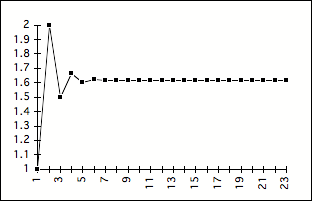
Are we forgetting that this whole digression is for the
purpose of presenting a picture of light falling or condensing gradually in to
matter in a coherent manner -- showing that the elements are essentially gods
taking on skins -- and that this is the real reason we are here tonight? God's thought taking on form. Geometric form. We have seen it in the molecules. Molescules that take on cubic or
hexagonal form. Which become
everything we see and touch and smell and taste around us. Everything geometrical, not at its
source, which is chaotic. But after
its source. After the chaotic
source is breached; and gives birth to order. We are speaking about chemical elements, are we not? Classical chemical elements. We really should not forget this. THE CONDENSATION OF LIGHT INTO MATTER
-- LIGHT, ESSENTIALLY, FALLING INTO STONE. AND THE SUBSEQUENT RISE UP OUT OF ROCK INTO THE MORE MOBILE
FORMS OF MATTER: VEGETATION AND ANIMAL AND MAN. RISING, ESSENTIALLY, OUT OF STONE BACK TOWARD LIGHT. Out of the black stone perhaps. YES. VULCAN ALLEY. OUT
OF BLACK STONE AND LAVA.
Building. BY 1.618 OR
1.62. The decimals get longer and
longer, like a thirsty tarroot reaching for the infinite that beckons it
onward. The farther out you go int
ht Fibonacci sequence, the more precise the result becomes as it hones into the
ideal. BUT IT IS NOT THE FIBONACCI
SEQUENCE. I THOUGHT WE ESTABLISHED
THAT. START WITH ANY NUMBER. START WITH 7 AND 5.
|
7 |
|
|
5 |
0.71428571 |
|
12 |
2.4 |
|
17 |
1.41666667 |
|
29 |
1.70588235 |
|
46 |
1.5862069 |
|
75 |
1.63043478 |
|
121 |
1.61333333 |
|
196 |
1.61983471 |
|
317 |
1.61734694 |
|
513 |
1.61829653 |
|
830 |
1.61793372 |
|
1343 |
1.61807229 |
|
2173 |
1.61801936 |
|
3516 |
1.61803958 |
|
5689 |
1.61803185 |
|
9205 |
1.6180348 |
|
14894 |
1.61803368 |
Two things cannot be rightly put together without a third;
there must be some bond of union between them. And the fairest bond is that which makes the most complete
fusion of itself and the things which it combines; and proportion is best
adapted to effect such a union. SO
WROTE PLATO. And others, after
him, agreed. PROPROTION. The Whole divided by the Large Part is
equal to the Large Part divided by the Small part. THE LARGE PART BEING 1.618 TIMES LARGER THAN THE SMALL PART.
|
Small |
Large |
Whole |
|
|
|
|
|
1 |
1.618 |
2.618 |
|
2 |
3.236 |
5.236 |
|
3 |
4.854 |
7.854 |
|
4 |
6.472 |
10.472 |
|
5 |
8.09 |
13.09 |
|
6 |
9.708 |
15.708 |
|
7 |
11.326 |
18.326 |
|
8 |
12.944 |
20.944 |
|
9 |
14.562 |
23.562 |
|
10 |
16.18 |
26.18 |
The five-pointed star, the pentad and pentagram, are filled
with Golden Mean relationships.
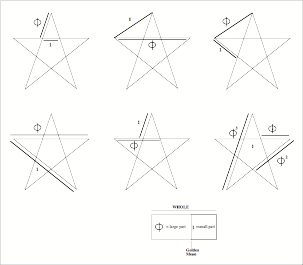
And this is the basis of the Macrocosm-Microcosm idea. THE MACROCOSM IS 1.612 TIMES THE SIZE
OF THE MICROCOSM? Are we
attempting to measure God with this caliper now? I THINK NOT. Is
this some kind of blasphemy you are speaking? IDEAS. MERELY
IDEAS. DESCRIPTIONS OF
REALITY. NOT REALITY ITSELF. The classical mind. Where order is everything. ORDER ISSUING FROM DISORDER. Patriarchal Order; followed by
Fraternal Disorder. YES. IS SEE YOU HAVE DISCOVERED THE ERRATA
OF THE BROTHERHOOD. Who is Norman
O. Brown? PLATO AS OPPOSED TO
ARISTOTLE. The fraternity, the
brothers, conspire with the mother to kill the father. The fraternal is a confederacy of
equals, rebelling against the father's hierarchical rule. The fraternals (sometimes under the
misnomer 'Matriarchy') speak of equality, liberty, and sexual freedom. A FRATERNITY OF MEN SEEKING SEX AND
WARFARE. Drugs and violence. WOMEN ARE FREE SO THE MEN CAN ENJOY
THEIR SEXUAL LICENSE. The women
become the property that the sons did not inherit from their fathers. AND HOMOSEXUALITY APPEARS. Yes. WHO IS NONORMAL O. BROWN? We are, are we not, like strangers wandering through a
cave? Strangers in a
labyrinth? FRATER FRATER, SON OF
MATER. In a cave with the killer? In the White Mountains too, hunting and
being hunted. Hunting ourselves
and hunting our. OUR WHAT? Just down the street from your hotel,
baby; I stay alone, at home, with my disease. ARMED WITH SOMETHING.
He looks like he's sleeping.
NO, PRAYING.
Seed-bound. HARMONIOUS
CRAVING. A cave, a rock, a tree,
deadly and poisonous. SERPENTINA
SAPIENTIA. The cave is grave; the
womb is tomb. THE TWO BROTHERS IN
AUSTRALIAN ABORIGINE TOTEMIC MYTHS HAVE TWO FUNCTIONS: TO WANDER FROM PLACE TO
PLACE AND TO INITIATE YOUNG MEN; AND HAVE THEIR WANDERINGS IMITATED IN THE BUSH
BY NEWLY-CIRCUMCISED YOUNG MEN. The
seed is a dry sealed packet of solid matter. WHO IS BROWN O. NORMAN? Mix yellow and red and blue and you get brown. YES. The mazes in medieval europe, called 'Walls of Troy', were
the scene of dancing games called 'The Game of Troy': the spiriline penetration
of the maze to win the game and capture a maiden. CONVERSATIONS ON A DYING AGE. Man Ron Brown.
IN A CAVE WITH A CRAZY ARAB.
What is that telling us about life? A PLANE FALLING FROM THE SKY. What is that telling us about life? NOUMENOUN. Phenomeverb.
YOU MAY HAVE YOUR REASONING DISTURBED, FRIEND. IT MAY BE: NOUMEVERB AND PHENOMENOUN. Parallel yoniverses. EACH APPEARING CONVEX TO THE OTHER
SIDE. UPSIDE DOWN. Appearances. INITIATION IS RE-BIRTH. Oh, Brownthers.
WHERE, O WHERE ART THOU?
Joyce Joyce -- Brothers Brothers.
HE SPITS AT YOUR FEET CRYING 'WE HAVE NO NEED OF A GOD! EACH OF US IS HIS OWN!' Songster. WRONGMENSTER.
Oh, you must have a cross but they've taken you, God, and shot you
filled with dead. So following New
Christ, pick upon on a cycle inste -
eeeee - eeeee - eeeee - eeed.
GEOMETRY IS THE BODY OF THE MOTHER. We eat the body of the Father-Mother; we eat ourselves. BURROWING IN ON OURSELVES. Digging in the Dirt. Find the places we got hurt. Digging in the Dirt. MUD. MUDGIVINGS.
EARTH AND WATER MIXED. CREATING THE HUMAN SOUL. THE SEED HIDDEN IN THE MUD, WAITING FOR THE SUN TO WAKE IT
UP. The poet sees everything. THE BLIND MAN SEES BEST. In a right triangle, the square of the
hypotenuse is equal to the sum of the squares of the other two sides. A2
+ B2 = C2. I don't
understand the relevance of that here.
BECAUSE THE NUMBER 12 IS THE MOST DIVISIBLE SMALL NUMBER, EVENLY
DIVISIBLE INTO HALVES, THIRDS, QUARTERS, AND SIXTHS, PYTHAGORAS BELIEVED IT TO
BE THE IDEAL MUSICAL NUMBER; AND IT WAS FROM THESE IDEAS AND OBSERVATIONS THAT
THE TWELVE TONE MUSIC SYSTEM WE TAKE SO MUCH FOR GRANTED DEVELOPED. Janus, I am not a collage professor; I
have told you before I am a collage clark. BIKINI BEACHER; BIKINI PREACHER. Usurpation is not necessarily suspiration. THAT IS A GIVEN. Robbing someone is not necessarily
burrowing someone. TIE SON WEAR;
SPEAK AND MIKE IN TO. Pard on aye
mwa? ESCHATOLOGICAL VARIANCE. Wrecked tome. Wrecked with anal hand-holding. Refusing to squat.
WHAT IS LITERARY COLLAGE, MISTER LOCKE? Bowl.
WHAT? Howl. I DON'T UNDERSTAND. Towel. CAN'T YOU EVEN SAY THE WORD? Paste. CUT AND
PASTE? You are under arrest,
Mister Dye. A REAL MASTER MASTER'S
MASTERS. A cloth cut by too many
hands becomes a dust rag.
ARCHETYPES RESOLVE IN TO ARK TYPE.
Childish montage.
GUILTY. Guilty
of....play...plague...jurism! (HOW
HARD IT IS TO UTTER THAT WORD.) My
client plieds innoncent, your honor.
WHAT? Innocent by reason of
inanity. INANITY IS NO
DEFENSE. You haven't meant my
client, Judge Brink (wagging his cigar indecently, one wage, second wag; eyes
blinking; Ceausescu immitating Groucho Marx; waiting for the judge to
laugh). I PAY HOMAGE TO THOSE WHO
DIED HERE IN THESE STREETS IN 1989 FOR FREEDOM. Sadness left; giddy rite. THE SOULLESS BRAIN PAYING HOMAGE TO THE BRAINLESS BODY. Before the cock crows you will deny me
three times. Petrovsky. BUILD THE NEW CHURCH ON THIS ROCK, THIS
SEED, BROTHERS. Mark the spot with
a X. MEXCALCULATION. In the name of the Father, the Son and
the Holy Coast. REMARKABLE MARK;
UNLUCKY LUCAN; MALTHUSIAN MODEL; JOHN THE PAWN LYING ON THE LAWN. Johnny Mike is reading in the yard. History's timing, oh, oh, oh. X(i+1) = (1+r)X(i). POP, YOUR UULATION IS NOT BALM TO YOUR
SENSE OF FAILING. Are you famous yet? Have you been on the news? ONLY IN MY PHANTASMS. Eggburst, eggblend, eggburial and
hatch-as-hatch-can. SULLEMN
FULMINANCE, SOLLEMN NUPTIALISM, SALLEMN SEPULTURE AND PROVIDENTIAL
DIVINING. Suleiman
thunderstrucksense, soleman
marryingage, salmon buryingroundritual and deitonic diningdate. ONE, TWO, THREE, FOUR. Contemplari. Contemplari.
IMMOBILIARI. IMMOBILIARI.
The alphabet is a democratic triumph. BRONZE MAN.
Thus from the Egyptians, who twitted the Greeks for being always
chidlren and knowing nothing of antiquity, he takes and puts to use two great
fragments of antiquity. One of
these is their division of all preceding
times into three ages: (1) the age of the gods, in which the gentiles
believed they lived under divine governments, and every thing was commanded
them by auspices and oracles, which are the oldest institutions in profane
history; (2) the age of heroes, in which they reigned everywhere in
aristocratic commonwealths, on account of a certain superiority of nature which
they held themselves to have over the plebians; (3) the age of men, in which
all men recognized themselves as equal in human nature; and, therefore, there
were established first the popular commonwealths and then the monarchies, both
of which are forms of human government.
The other thing he took from the Egyptians is their reduction of the
languages spoken before their time to three types, coeval respictively with the
three ages. First, the divine, a
dumb lanugae of hieroglyphics or sacred characters. Second, the symbolic, consisting of metaphors as the heroic
language did. Third, the epistolographic or vulgar, consisting of expressions
agreed upon for the everyday uses of life. First the Age of the Gods; then the Age of the Heroes, then
the Age of Men. It is a cycle of
decline, as in Plato's Republic.
Doctor Covi writes: Men first feel necessity; then look for utility;
next attend to comfort; still later amuse themselves with pleasure; thence grow
dissolute in luxury; and finally go mad and waste their sustenance. AND INHERITANCE. Dissolute is as Dionysius does. THE SOUL INSIDE THE CORN. Liquinheritance. QUIMQUINHERITANCE. Dance in spirals. Dance in spirals. RAISE YOUR SKIRT. Dance in spirals. WHAT ARE YOU BUILDING HERE, OLIVER
JACK? What? WHAT ARE YOU BUILDING HERE -- A
BEANSTALK? Mayhaps you are
right. MAYPOLE YOU ARE RITUALLY
GORED. Speak more slowly. ARCH ARCH ARCH. THE TITAN IS MADE OF STARCH. The Decalogue's a Decalogue. MOUNTAIN OF SIN, COME DOWN. BRING DOWN NEW LAWS WRIT ON STONE. Thy will be done on Earth as it is in
Heaven. OREGON. OREGON. Lion of God.
Lion of God. PATRIARCH OF
NONPAPAL ALEXANDRIA. Protest
Auntie. Protest Auntie. BURKA. BURKA. Origen's
writings were so much drawn upon that the solitary of Bethlehem called it
plagiarism, furta Latinarum. SOULEYMAN
KILLS HIS BROTHER, OPRAHIM. High
Pure Text. HPT. Hypnotic Embrance. HE. Here Everyone Comes. DIRTY LITTLE MIND. DLM. Display Like Mike.
DEBATE LIKE MEANDER.
Walking in his maze.
AMAZED, THE MALE PERPLEXED.
Pertext is like context.
Per is through or by means of; or according to. According to text. In chemistry, per- refers to a compound
that includes an element in its highest state of oxidation. Per-text. Hyper is over or beyond. Hypertext would be above the highest state of oxidation; or
higher than the highest according to.
Con- is that which is against something. Con-text is that which is against text. Against the written word. INTERESTING ARGUMENT, MISTER
SOLICITOR. AND THAT PERTAINS TO YOUR
CLIENT IN WHICH SENSE? We intend
to call Michael Joyce as a witness for the defense. MICHAEL JOYCE.
I DON'T KNOW HIM. Of course
not. If you did, sir, this whole
issue would have been settled by a writ of habitual corpus, your honor. PROPORTION, SON. DON'T FORGET PROPORTION. In my personal behavior, you mean? YES. BUT ALSO IN YOUR CREATIONS. (Spoken like a good Greek.) THE STAFF THAT CLEAVES THE WATERS IS THE DEAD MAN'S BODY,
THE CORPSE. The woman penetrated
is the labyrinth. You emerge in to
another world inside this woman.
The penis is the bridge; the passage to another world is coitus; the
other world is a womb-cave.
FORNICATE FROM FORNIX: AN UNDERGROUND, VAULTED ARCH. The Sky descends into Mother Earth,
ejaculating his powers, suffering castration.
THE GOLDEN RECTUM -- UR, THE GOLDEN RECTANGLE. I see. AND FROM THIS, THE GOLDEN SPIRAL. The spiral?
YES. SPIRALS ARE THE PUREST
EXPRESSION OF MOVING ENERGY. WE
SEE SPIRALS EVERYWHERE. SPIRALS
SHOW UP AS THE PATHS OF MOVING ATOMS AND ATMOSPHERES, IN MOLECULES AND
MINERALS, IN FLOWING WATER, IN THE GROWTH OF PLANTS TURNING AROUND A STEM, IN
ANIMALS AND HUMAN BEINGS, AND IN THE GREATER BODIES, SUCH AS GALAXIES, OF OUTER
SPACE. LIKE THE PENTAGRAM STAR,
THE SPIRAL EXPRESSES THE GEOMETRY OF SELF-SIMILARITY. WHEREVER YOU FIND A PENTAGON, YOU'LL FIND A SPIRAL ROLLED
WITHIN IT. I'm not sure what this
has to do with me. SPIRALS GROW BY
SELF-ACCUMULATION. EVERY SPIRAL
HAS A CALM EYE. THE CLASHING OF
OPPOSITES RESOLVE INTO A SPIRAL BALANCE.
I see there is a normal spiral; and a Fibonacci spiral. YES. I thought we had decided to relieve the Fibonacci Sequence
of its pre-eminent position in number accretion. HAD WE? Didn't
we show that any number sequence accumulated around the golden mean? I thought that essentially de-nuded
Fibonacci's sequence of any claim to notoreity. A SELF-GENERATING SPIRAL ACCUMULATION; NOTHING ABSORBED FROM
THE OUTSIDE. Emanating from a
seed. YES. Do you ever get the feeling that we are
burrowing now, burrowing deeper and deeper into the ground, into the Earth,
seeking our mother again, rolling ourselves tighter and tighter into a packet
of dense matter -- yes, a seed, ourselves? Do you ever get the feeling that we are planting ourselves
in this dark Earth, this dark matter, with the intent of being able to give
birth to ourself again, when the moment for movement comes? Spiralling down, deeper into the Earth,
planting ourselves; so that we can spiral back up out of the depths of this
darkness, a walking plant, coming up out of the mother who gives us live, and
then kills us all, dear gravity that she is. AHH, THE SPIRAL: IS IT NOT, ITSELF, THE LABYRINTH WE SPEAK
OF? THE LABYRINTH WE PENETRATE
INTO? The last remnant of
rationalism. AHH; AND NONE SO SOON
EITHER SHALL THE PHARCE FOR THE NUNCE COME TO A SETDOWN SECULAR PHONISH. Sexular Finnish? EXEMPLAR PHOENISH. Ahh, yes. WITH SHITE NEAR HOLDING A COMPASS AND TEMPLATE-- THIS
DIMINSHES THE SCENTS OF WOE AND SNOW PROVOKES SOME COMRADE CAMOUFLAGE. Such a shy dear, ministress of
nwage. CALLING IN THE DARK. Kalling in the Darc. KRAD EHT NI GNILLAC. Counter Counter. Counter Erutluc. NWAGING NWAR ON NMAILER IMAGES. Aunt Rex, darning a dun dung beetle
deftly darkly on deadrick's dragonfly durtleneck. DAMN! Is he his
own darker image? RUNNING
ROUGHSHOD IN THE RATTERSDAM ROAD?
Backward? DRAWBACK. Backdraft? DAFTTRACK.
Shoes. DRAMAMINE,
PLEASE. Why, are we floating? SPIRALLING INTO THE FETAL
POSITION. Hardening into the
rock. SPUTEM. Mute spasm. HORNEY IN THE ROCK.
La la la la. SPASMODIC
COMET. Spiralling out of
test-test-testees. I'M GOING TO
COME OUT AND TEST YOUR TICKLE.
Mama says. MOTHER OF
MONUMENT. The rock inside the
honeycomb. MOON MONACLE. Bach Bach Boxer Beta. ANNA MAGDELENA. ANNA CUM NINA. Bleeding in the cave. HORTICULTURAL NATIVITY. The clock mocks talkers. The clock shocks mockers. The clock outfoxes the cocks. BLOOD ON A MIDDLE FINGER. Did you prick yourself? YES, IN A SENSE OF THE WORD. Fear of what? Fear of the mother's what? THE GROUND?
SUFFOCATION? Innovation
constellation. YO-YO MA. Dang me, Dang me; They oughtta take a
robe and hang me; high from the highest tree; woman would you weep for me? MA MA YO. Oy. Oy am I
am. Ma'am. NOTED. Oprah's page.
THE FLOWER'S GATE.
Beardsley's fragrance. NO,
NO FANTASY IS ALLOWTED HERE. Pink
stink. Pink shringk. CORAL MORAL. Mother's brother.
'NOTHER 'NOTHER.
Lucky-go-happy.
PHUCKY-GO-SAPPY. Pinecone.
Pinecone. THE SPIRAL PYRE. THE SERIAL IMPERIAL. Talking franchise. IN THE NORTHERN HEMISPHERE, HIGH
PRESSURE ZONES -- POSITIVE WEATHER SYSTEMS, GOOD WEATHER -- TRAVEL AS CLOCKWISE
SPIRALS; LOW PRESSURE ZONES -- NEGATIVE WEATHER SYSTEMS -- TRAVEL AS
COUNTER-CLOCKWISE SPIRALS. THE
REVERSE IS TRUE IN THE SOUTHERN HEMISPHERE. Moneyverse and anti-Moneyverse. IN THE SOUTH, THE POSITIVE IS COUNTER-CLOCKWISE; AND THE
NEGATIVE WEATHER IS A CLOCKWISE SPIRAL.
Red Cross. Spread
Moss. MOTHER OF ORIGINS. MOTHER WHO IS EARTH. Red Crosscendo. BLOOD IN THE HOLY CAVE. Scored burial. SENSATE REPLICATE. And Senate replicant. SATANIC REPUDIANT. Jesuit. Jesuit. SPIRE,
SIR. SPIRE, ALL. Begin with the Golden Rectangle; and
move backward back in to the square.
Then take the next rectangle; and find the square in it. Do this again and again. The Golden Rectangle contracts, turns
to the inside.
And the spiral unwinds from the Golden Squares by connecting
the centers of each square, the inner corners, or the outside corners. THE SPIRAL IS HIDDEN IN THE GOLDEN
SQUARE. WHICH IS HIDDEN IN THE
GOLDEN RECTANGLE. WHICH IS HIDDEN
IN THE PENTAGRAM. WHICH IS HIDDEN
IN THE PENTAGON. The powers of
regeneration. FIVE. WE ARE AT FIVE AGAIN. AREN'T WE, SIR! Father, Mother, Son, Daughter,
Son. THIS IMAGE SUGGESTS THE
COLLAPSE OF THE UNIVERSE UPON ITSELF, WITH THE GRAVE POINT, THE CENTER, MOVING
IN SEQUENCE BACK AND BACK INTO THE MINUTE, PULLING MATTER BACK INTO A CORE WITH
IT. Contraction and Expansion. I SEE ONLY CONTRACTION HERE, SIR.

And replication by the square. By the square and by the square. Building with the elements. OH, ROBBING SONS CRUDE SOLELY. Lo', all your disciples have reclaimed their rifles and
taken the cure. DO NOT CURSE THINE
OWN 'OUSE, SON. IN THE NAME OF
TROTH, DO NOT CURES THY NOUN SOUSE, ZONE.
A drunken man turning on a spit.
WE ARE ALL OUT OF OUR MINDS!
OUT OF OUR MINDS! In nomine
Matrie, et Terrarium, et Insipidate, A'men. THE SQUARE ON THE OUTSIDE EXPANDS THE WORLD; THE SQUARE ON
THE INSIDE SHUTS IT DOWN. How
unsivalived! I kid usery brondy
myshelf, Hipplebottom. RANDY ROSE
ERECTION. I ave e'en say eat tay
ace Faye. Em em eneray! Hang zit tiz eye! Barbara Aryan. HUNT, KAYE. ACHE RAY TIT OUVER DAY. Minion. O'
MANION. For the Clearer of the Air
from on high has spoke in tumbludum tambaldam to his tembledim tombaldoom
worrld and, muoguphonoised by that phonermanon, the unhappitents of the earth
have terreumbled from firmament unto fundament and from tweedledeeddumms down
to twiddledeedees. WHAT THE
THUNDER SAID. DNA. DNA. The Thunderer is sex teen. BEHIND THE BARBER TEEN'S DOOR. THE GREEN THUNDERER IN HIS OILY SKIN. Beau hunkian? THE WORSED. Versed
in troubled ore. SINGING IN THE
SANE VOIDS OF PIERRE FORESKIN.
Moil, Moil, torse and bubble; troil the traynde and burbst the
stubble. HIP, HIP,
CHIMPUNZEE! O YOU LONGTAILED
BLACKMAN, POLK IT UP BEHIND ME!
HIP, HIP SHEMPANSIE!
JESSIES PUSH THE PLUMPSKIN 'ROUND, THE PUMPKIN 'ROUND, THE PIMPSIN
'ROUND; JEZZIES PUSS THE POMPSKUMS ROUND, MY AIR FAILIE! Riotact. Riotact. EVEN
SKEIN. Riotact. Riotact. ROMULUS AND RUMPUS. Tieadact. Diettact.
RUMPLE US AND RAMP US. The
proprietor is face down on the floor, suspiring in his own...ommit vaye oom
fayes. RIOTACT. RIOTACT. Homo lost and homo oppulence ream us. THERE ARE ALWAYS ONLY
TWO BOTHERS: RUMPLE US AND RAPE US, KEEN AND APPLE, OSSIFEROUS AND SED; AND ONE
OF THEM REDRUMS THE OTTER. OR AT
HER, THEY BATH ACCURSED EVE'S OTHER PLOVER PROUD AS PRUNELOVERS. Here, let me read that! DAM! Simple sot! TOSSED SIMPLETON SALAD! They both accuse the other of fratricide and put each other
to death for the crime; as the Christian identifies the Jew with Cain, for
having killed Christ, and accordingly punishes the Jew with crucifixion. The mutual relations of the brothers
re-enact the primal scene, the cannibalistic intercourse, and the primal crime,
the dismemberment. The brothers
are brothers to dragons, dragon seed sown (Spartoi); that comes up as young men
armed for a Pyrrhic dance in which they mow each other down. All fraternity is fratricide. ALL MATERNITY IS MATRICIDE. All Paternity is Patrick's Pride. DIS-NUMBERING THE ONE. The Own, you mean. Prounonce it with a lone O. One as in Lone. THE REASON FOR THE CIVIL WAR THAT
DESTROYED THE ROMAN REPUBLIC IS THE ONE GIVEN BY HORACE. FOR THE REALITY OF POLITICS, WE MUST GO
TO THE POETS, NOT TO THE POLITICIANS OR POLITICAL HISTORIANS....AND I QUOTE:
'THE TRUTH IS THAT AVENGING FURIES PLAGUED THE ROMANS; AND THE GUILD OF
FRATICIDE, EVER SINCE THE EARTH WAS SOAKED WITH INNOCENT REMUS'S BLOOD, A CURSE
ON HIS POSTERITY.' More hawk
navalled hole Sue; or show Sonny his hard wrap and hoe. THE FRATRICIDE WHICH KILLED THE ROMAN
REPULBIC WAS ONLY THE FINAL FULFILLMENT OF THE SYMBOLIC AND ATTENUATED FRATRICIDE
WHICH HAD BEEN ITS LIFE. ROMAN
LIBERTY -- THE FRATERNITY CARVED OUT OF THE CADAVER OF ROYAL DESPOTISM -- IS
DESPOTISM DIVIDED AND SET FOREVER AT WAR WITH ITSELF. Snatch.
WHAT? Snatch. OH, GOODANDTIGHT. You're welcome. O YOU LONGTAILED BLACKMAN, PORK IT UP
BETIMED ME. There is reflection,
or rather recurrence, of the archetype in the institution. Remus jumped over his brother's wall;
and his brother killed him, saying: 'So perish whoever else shall leap over my
battlements.' As we can see in any
playground; or in Berlin. ICH BIN
EIN MERLINER! Gog bleds some
error, man. Or some Swede's comb. Gog blends some merit, man. Our stone seems gone. WHAT? Bela red taurian.
I DON'T GIVE A DAMN ABOUT YOUR LOWER EASTSIDE ACCENT, SIR. OR ISADORA'S LONG RED ARF ARF SKAY,
WITH A PINKISH HUE. AND DON'T SING
ME NO MORE GODDAMN SONORITIES. I
WANT FIGURES! WAR PRODUCTION
FIGURES, ISAIAH! The man is
drunk. A DRUNK'S COLLAR. A damn drunk bulldog on a wind stone
church hill. ALL IS UNDER 'IS
RUGTYPE BUND. Eyes dreaming of a
pipe mistress: everywhere is gold.
RUMPLED SPLIT SKIN.
TWO-FINGER METHOD.
Moyle! DAMN MOYLE. HE CIRCUMSIZED MY FINGER! THE MOYLE CIRCUMCISED MY FINGER! Mulva! Mulva Hill Herringbone. NO, IT'S DOLORES!
I'm not sure, but it looks to me like a....a nipple! SOUL STISTER! SOUL STISTER!
When I say it's in the vault, I mean it is in the vault! TWEEK PIN BIND AND SIN HER. I haven't vomited in thirteen
years! PEEK; AND HIND IN HER PUT
IT FASTER, BASTARD! Oh, it is in
the vault. It is in the
vault. BUDROUGE. BEDRUDDER. BEDWEDDER.
BUDRUSSIAN. Merlinrouge:
the man in ice. I SLEPT WITH
ELAINE LAST NIGHT. Now you listen
here, Mister Bedrosian -- and you listen good! I want details!
And I want them now!
FLINTSTONE, MEET THE FLINTSTONES, HAVE A YABBADABBADOO TIME, WE'LL HAVE
A DEW TIME, WE'LL HAVE A GAY OLD TIME!
Buttrock. BURIED IN
MUD. Bedrock. BEDROSIAN. Maggie, bend over.
I don't recognize you from this perspective. WOLF WOLF! Ahh,
yes. This is more to your
likeness. OH, YES! SOMA AMONG THE ARMENIANS! AMANITA MUSCARIA! SPARE A PARAPETFISSURE! OH, DIACRITIS! I love it when you call me names. DIACRITIS! PERIPATICIAN!
You spake the linguage of pair of fine nails in ya. RUMBLE US CULLED DREAM US AND THE HOLE
WAY OLD WAS TURNED.
Bllllllllllllllaaaat.
Bllllllllllllllaaaat. EX
CAUSE YOUR SLAVE, MISTER HYDROGIUM!
Ginza Gouda. GINZA
GOUDA. Helium. NASTURTIUM. Common salt or sodium chloride (NaCl) is actually a little
more democratic than brother lithium chloride. The sodium atoms are bigger and can exert more influence
than can the tiny lithiums. The
structure of sodium chloride (or salt) should then be regarded as cubic packing
of almost equal spheres. But, in
practice, these democratic considerationss do not change the actual structure:
sodium ends up in the same position as poor lithium.
DON'T LET HER HEAR THAT YOU ARE CALLING HER OCTAHEDRAL --
BECAUSE SHE HAS HOLES! Who? NIPS! SHE'LL HAVE A COW!
Quite a flower, that one!
WHAT? OH, YES. Yes. ELAINE. As well
as octahedral holes in the CCP structure, there are also tetrahedral holes. In structures such as that of the zinc
sulphide (ZnS) mineral zinc-blende, the Zn atom prefers to occupy these
tetrahedral holes, where it is surrounded by only four S-atoms. Note that only half of the tetrahedral
holes are occupied in ZnS, whereas all of the octahedral holes are occupied in
NaCl.
Again it is possible to draw the co-ordination polyhedrae
aroudn zinc, but in this case it may be better to emphasize the actual bonds
between the Zn and S atoms, using a so-called ball and stick model. As well as CCP cubic close-packing
ABCABC of the large anions as in zinc-blende, we might alternatively expect to
find HCP hexagonal close-packing ABAB in some materials.
HCP packing of oxygen anions (red) produces the ZnO wurtzite
structure of zinc oxide. Notice
that the co-ordination of Zn is still tetrahedral. Because there is little energy difference between the two
types of structures, we can have more complex packing arrangements such as ABC,
AB, ABC... which results in a whole series of polytype structures.
WHERE DID THAT GASBAG COME FROM? Ginsburg Street, Rockingham, Pennsylvania, originally. OH. I SEE. IT'S
LIKE THAT. The moutain above is
the cave below. CAVELINEAR
FUNCTION. Precisely. IF COCK IN THE CUNT EQUALS COCK IN THE
ROCK; THEN, CUNT IN THE ROCK EQUALS?
Tids of hard iron. OUGHT TO
HAND IRON HARD IRON. Pint of gram,
please. DID A COLD HADRON. Burp. 'NOTHER SHOT OF MAGIC ROT? Where Id was, there shall ego be. It is reclamation work, like draining the Zuyder Zee. PLEASE ME, MAGIC SPECS. Hectagon close-packing. HECTARE FOR THE FAIRIE. Regional microscope, buried in tar. FAR TIMES TO RUE DARK PAUPERS, SIR. Dq4k Pauperteers. HANDS MOVING BEHIND THE GLASS
STRUGGLE. Class struggle; lass
struggle. MACAWBRE INVENTION; A
HEEP OF BAD RAKMA. Black racked ma
dabs for Phoenix extention detention.
FACSIMILE OF FRIGHT.
Fascistification of right.
DABBLE DABBLE DO. Rob all
us; and cream us. WILLIAM CLARK;
AND G.R. CLARK. Founders of
frequency. Broadders by
birthplates. HOBBLED BY HORROR;
HORRIFIED 'TO HONOR. Honer of the
white bone into ivory. EYE FOR
THEE. Atomology. EQUALS? Etymology.
ABTOMOLOGY. Ab Tomb. ABTOMETRIC. Root is in the common ground. Tree and fruit is in the uncommon air. ETYM IS ADAM. Heartily said.
UNCONSCIOUS CRUISE. Curse
of the fellowed masters. FALLOWED
BASTARDS. Let the mama lions roar
about virtue. The ones still tied
to the mama's teats. Proclaiming a
heaven on the earth. Their penises
in her pocket. DEVILLED EGGS. De-villed aches. BIRTH PRE-MANEUVERING. Re-tart. FISSION.
SEPARATION OF THE MAN AND WOMAN IS LIFE. FUSION.
RE-UNION OF MAN AND WOMAN IS DEATH. As it is seen from one side. IT IS NOT SEEN FROM THE OTHER SIDE. IT IS JUST LIVED. Lived and seen. LIVID AND CLEAN. This and that. Image and Word. EBHEN SHETIYYAH. The erection is also the magic staff
which intervenes to freeze the status quo, to hold the parents in suspended
animation with an intervening space between them. The great rock on which the temple of Juerusalem was built
was regarded not only as the navel of the world but also as separating the waters
above from th waters below, the male waters above from the female waters
below. EYE. I been shitty. AHH. Rock, rock, rock.
SEX, DRUGS AND ROCK AND ROIL.
Double, double, coil and stubble.
CUT! Knife of the
shyster. BROTHERS OF GLIB. Conspiring to kill the father. WHO THE MOTHER CONSIGNS A TYRANT. Something in these, afterall. IN WHAT? The numbers.
The Fulcanelli numbers.
WHAT? You know -- the man
of spirals. THE SELF-SIMILAR
LOGARITHMIC SPIRAL IS FOUND IN THE SELF-SIMILAR PARTS OF A GOLDEN TRIANGLE ALSO
-- TRIANGLES WHOSE LARGER AND SHORTER SIDES ARE IN A PHI RELATIONSHIP.
The golend spiral grows from within itself; nothing is
absorbed from the outside. SPIRALS
GROW BY SELF-ACCUMULATION. EVERY
SPIRAL HAS A CALM 'EYE'. AND
CLASHING OPPOSITES RESOLVE INTO SPIRAL BALANCE. She touches his head as he sleeps; it's as if she is his
mother. THE SECOND MOTHER, THE
EARTH, REPLACES THE FIRST MOTHER WHEN THE SON ENTERS INITIATION. Initiation is rebirth. NOTE HOW THE PLANT SENDS OUT LEAVES IN
A SPIRAL CONFIGURATION SO THAT EACH LEAF WILL RECEIVE THE MAXIMUM AMOUNT OF
SUNLIGHT, BLOCKING NOT THE PRECEDING LEAF.
Spiralling up from the ground. THE PLANETS, TOO, ROLL ON THE SUVED SURFACE OF A WHIRLPOOL
WHICH WE CALL THE SOLAR SYSTEM, HAVING THE SUN AS ITS EYE. Vortex station. THE FINGERPRINT IS A PLAIN WHORL, A
TYPE OF SPIRAL. Concentric, as it
is. WITH A CALM EYE. Storms spiral. GALAXIES SPIRAL. The church spires up to its spire. I DON'T THINK SO. Mosques spire. Up to the cupola. UP YOUR CUPOLA! I don't think so. PROVING WHAT? What? HE IS ATTEMPTING TO PROVE SOMETHING. He is silent. He seems to be sleeping. NO ONE SLEEPS!
In Arab calligraphy, the shape of the hand spells 'Allah'. LOOK AT HIM DRAW!
Fibonacci again!
I thought we had discredited him!
NOTHING SEEMS TO FAZE HIM!
Fixed idee. WHAT? Yes. FUCKED SEED DAY.
What? THE MAN SAID. You misunderstood him. WHAT? In the beginning is the seed and the seed is the rock. EVOLUTION. COMING AFTER INVOLUTION. To find the calm eye in the spiral, simply put him on the
cross.
I ZEE. Eight
tongues, Germanicus. THE ZERO FROM
WHICH THE 1 SPRINGS. THE
UNMANIFEST UNITY FROM WHICH THE MANIFEST MULTIPLICITY EMERGES. From itself. In watching water swirl down a drain, note that the narrower
and calmer the yes, the greater the speed and the turbulence around it. Unlike the center of a wheel, the
sprial's eye is not fixed in one place -- but it is dynamic and flexible. THIS CALM EYE IS THE SPIRAL'S CENTER OF
GRAVITY FROM WHICH IT ALL BALANCES.
Without the eye there would be no spiral expansion or dissolution. EVERYTHING COMES FROM THE EYES; AND
EVERYTHING GOES BACK IN TO THE EYE.
Note, too, the water spirals down a drain clockwise in the northern
hemisphere; and counter-clockwise in the southern hemisphere. BARBER ARELLANOS. It must begin where its subject matter
began, as we said in the Axions.
We must therefore go back witht he philologians and fetch it from the
stones of Deucalion and Pyrrha, from the rocks of Amphion, from the men who
sprang from the furrows of Cadmus, or the hard oaks of Vergil. Withthe philosophers we must fetch it
from the frongs of Epicurus, from the cicadas of Hobbes, from the simpletons of
Grotius; from the men cast into this world without care or aid of God, of who
Pufendorf speaks, as gross and wils as the giants called 'Big Feet', who are
said to be found near the Strait of Magellan; which is as much as to say from
the cyclopes of Homer, in whom Plato recognizes the first fathers in the state
of the families. MAC COVI ROAD. Covetous congress. FIRST MULL A MUGFULL OF MUD, SON. Zone. MUDFULL OF MUG.
Water and Earth mixed. IT
TAKES WATER AND EARTH TO MAKE A HUMAN SOUL. SO SAID MOSES.
At the rock. We stand at
Peter's place, the rock. VULCAN'S
PLACE. First mull a fullcan of
mud, sohne. SEWN. Clotho culled a clutch of cloth. LET US GO IN TO THE CAVE TO GREET HIM. Bet the limb. BATH OF HIM.
Water and Earth mixed. BATH
OF LIMB. Bet the hymn. NEMA. Mnea. BROADER
PLATE OR BREADER ARISTO TITULAR.
Bleeder from within; breeder from without. PROSS. True God
from True God; Light from Light.
Begotten not made. Ever
from the Father. ENMA. All-powerful, ever-living God. Through our Lord, Jesus Christ. TODAY, IN HIM, A NEW LIGHT HAS DAWNED
UPON THE WORLD. GOD HAS BECOME ONE
WITH MAN. AND MAN HAS BECOME, ONCE
AGAIN, ONE WITH GOD. The Immortal
Word has. Has. Has. SANCTUS.
SANCTUS. SANCTUS DOMINUS. Blessed is He Who comes in the Name of
the Lord. WHO'S ANNA? WHO IS ANNA? Constantine builds a church on the tomb of Peter. HOST ANNA. HOST ANNA. Even
and ur are filled with your glory.
HELL EVADES THE SACRED HOST.
Let us proclaim the mystery of faith. SAVIOR OF THE WORLD, SAVE US. THROUGH YOUR CROSS AND RESURRECTION, FREE US. The Bells of St. Mary's. SACRED CHALICE. All glory and honor is yours,
Almighty Father, for ever and ever.
PROTECT US, HOLY FATHER, FROM EVERY EVIL; AND DELIVER US DURING THE DAY
OF HIS COMING. Second Coming. FIRST COMING IN TRAGEDY; NEXT COMING IN
MAN'S INFESTATION. Holly, Faye. THE LAMB OF GOD TAKES AWAY THE SINS OF
THE WORLD. Through the Body of
Christ, bring me to Everlasting Life.
Through the Blood of Christ, bring me to Everlasting Life. Through the Spirit of Christ, bring me
to Ecumenical Force.
NUTCRACKER. To whom are you
referring? INSPIRE ALL WITH THE
DANCE OF THE SUGAR PLUM FAIRY.
Draco spinning on a vat, open-eyed. PARTIAL.
Turn. ONE EYE. He will tell you of the ochlea, the
spiral in the ear that receives sound impressions. And that the heart is a dexterours left-spinning spiral --
sandwiched in the middle of the three layers of the heart is a sheet of
contrator muscle in the shapes of the golden sp;iral. HE WILL TELL US THAT.
And then he will tell you also of the periodic table of chemical
elements being a continuous spiral.
WHAT? Yes. YES, HE CAN PAINT IT. What? HE CAN PAINT IT.
Let us see that.
WHOSE DESIGN IS THIS ANYWAY? We are not giving credit here. We steal. We are thieves. Remember. UNWINDING TITAN.
Titanic riff; plates begin to buckle. SEVEN GIANTS TRAPPED IN THE GROUND. TURNING ON A SPIRAL. Plate tonal riff; heiress totally rent:
atonality. OUT OF NIGHT; AND THEN
OUT OF DAY. Don't let him tell you
about Nobby Finch's noble gases and their approximation of the ole Nazi's sequence. WHAT? Noble gass, Novice Road, Gasden, Texas. DANIEL'S MANDIBLES MATCH HIS CATCH. Hyperion's green caravan. ONE IN CAVE THE GREEN MONSTER; ANOTHER
IN CAVE THE JESUS CHILD. Ossified
brain lauded. MOSTLY BY THE DEAD
CRAVING MORE DEATH. Nabilit to
rejoice at dead children. HE PUTS
A BOMB IN HIS SHOE FOR THE CELEBRATION OF GOD'S BIRTH, HOPING TO KILL WOMEN AND
CHILDREN FLYING TOWARD CHRISTMAS.
Hose Anna. Hose Anna. ANNA LOVABLE POSTERIORITY. An army of youth out to kill the world,
out to spread the desert all over the Earth. ERRORTH.
Urth. UR GRAMMAR. Before Granny. UNDER GRANDMA. Lies other grammars. ETYM ANT. Etym anthrop.
POPE'S OLD VIEW. Deeper
yet. DIG OUT THE STONE. THE STONE, TOO, SPIRALS UP OUT OF THE
NUT. Down out of the sky. AIN VUE. Anus feud. DO
BRODDERS BORN FROM AINT US.
|
Symbol |
Name |
Atomic |
Closest |
|
|
|
Number |
Fibonacci |
|
|
|
|
Number |
|
|
|
|
|
|
He |
Helium (Sun) |
2 |
2 |
|
Ne |
Neon (new) |
10 |
8 |
|
Ar |
Argon (inert) |
18 |
21 |
|
Kr |
Krypton (hidden) |
36 |
34 |
|
Xe |
Xenon (stranger) |
54 |
55 |
|
Rn |
Radon (ray) |
86 |
89 |
AHH, SO THESE ARE THE NOBLE OR INERT GASES YOU
MENTIONED. These do not match the
old Fibber's sequence. WHAT? God is not precise. Are we to believe that God is not
precise? DOES GOD
APPROXIMATE? The accumulation of
electrons is continuous; so the Periodic Table would be more accurately
depicted as a continuous spiral ribbon, a widening vortex rolling around
itself, like a seashell, cochlea, galaxy and the musical scale. The eye, or the center of gravity, of
this spiral map of matter falls along the column of inert or noble gases,
because of their disdain for joining other elements in chemical bonding. They are the stable elements of the
universe, balanced and complete unto themselves. The further an atom falls on the Periodic Table from an
inert gas, the more willing it is to seek completion by enetering into a
chemical relationship with other atoms.
The closer the elements are to an inert gas, the less needy they are. THE TINIEST SUB-ATOMIC PARTICLES, TOO,
ARE VORTICES THAT REVEAL THEIR SPIRAL SPIN IN BUBBLE CHAMBERS.
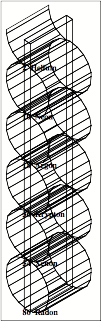
Maximus image nation.
IMAGE IN NATION TOO MOX TOO MERRY.
Anti-Shemite. HIEROGYLPH
FIRST, THE MUTE MOUTH MEN XOMMUNICATING BY SIGN. Then symbolism, metaphor. Poetry. THEN
PROSE. Cannaworms. When the two brothers collide, they
resolve themselves into spirals.
THE SPIRAL ARISES AT THE INTERFACE OF THE DYAD. IN CONTRAST, WE SEE RATIONAL SQUARES
ENDLESSLY CHASE THEIR OPPOSITES IN THE TRANSCENDENTAL GOLDEN TRIANGLE. Never catching them.

THERE IS SOME KIND OF MEANING THERE, I TRUST. (THOUGH I AM TOO DENSE TO ACCESS
IT.) Red Windmill. MERLIN'S RED CHEEKS, AROUND WHICH HIS
MUSTACHES BLOW. Heavy
breathing. RED MILL; WIND
WARBLER. We remember that the
growth of plants is mostly the dyadic principles of water (plants are mostly
water) and air colliding, resolving their differences in spiral movement. COME AGAIN? (Be careful who you say that to.) INFINITIVE DANGLING IN THE AIR, RESOLVING ITSELF INTO A
SPIRAL PART OF SCIPIO. Hannibal
the carnivore bull. ELEPHANT
MAN. I am not enamel! THE SPIRAL PART OF SISYPHUS. Cut off by the dark girl. Condemned to wander for ever until it
grew back again. Which, when
inserted again, in vaginal mandible, in vulva incisor, was again cut off by the
dark girl and heer beek. I
SEED. Verily, the seed itself is
the castrated penis, shrivelled into a stone. The stone is the son, planted in the furious folds of the
dark girl's placidic tendons. SPIN
HER UNDERGROUND, IXION. SPIN
HER UNDER THE MOON AND LET HER CHEW AND SWALLOW IN HER JEST STATION. Quick Zion: give her a spin. NAKED BUTTOCKS IN HANDS, HE GIVES HER A
HEALTHY SPIN ON THE WHEEL. Bronze
we are, natally cained beat twin Ain sent sole and mob-turned boughtie. TWO NATURES BURROWING ON EACH
OTHER. What was my father's name,
the one who wroth my wreathed wurd den?
BURDEN BAUXITE? Adam
Clay? WARDEN ORPHIC VOICE, WAS IT NOT
-- VIA VICO WAY OR SOMEONE ELSE.
JJ Hippopotamus. ORPHIC
VOICE ON VICO ROAD. Hippo Stipple,
Stasis Metastasize. TRANSUBSTANTIATION. Trance Mutation of soles. HEAVEN'S DEEP ORGAN BLOW. Enitharmon's haunted mill. DEEP ORGAN BLOW, SPINNING ON THE WHEEL,
A GIRL WITH NAKED BACK, AN OVUM VERSE DISPLAYED, EGGS OF NUMBER AND EGGS OF
MUMBLE, ROTATING IN A SPARK, A BARK IN A PARK. Poor Leto.
STEALING CARROT'S FROM AN OLD BALD MAN'S GARDEN. I am a hungry man. I have little time. And my brain is hungry for carrots and
peas. P's and Q's. PPUSSIES AND CCC-QQUIM. Five in the hive; the moonbeam cuddles
its muddling moor. CHOCOLAT. Watching her fall. DO YOU WANT TO SING? Catching her. WATCHING HER FALL.
Do you want sexual candy?
PROTECTING HER. Watching
her fall. DO YOU WISH
CREMATION? Removing his
headdress. THE GREATEST THING
YOU'LL EVER LEARN IS JUST TO LOVE AND BE LOVED IN RETURN. Christian speaks; AND LESLIE RHOADES
RESPONDS. Sings. SATINE. YOU DON'T HAVE TO PUT ON YOUR RED LIGHT. SATINE. You don't have to wear that dress tonight. WALK THE STREETS LOOKING FOR MONEY. YOU DON'T CARE IF IT'S WRONG OR IF IT'S
RIGHT. Ox ran. NUMBER WAN WAN WAN, ALL RIGHT. Ox ran. EMPTY ENCEPHALOGRAM.
Mammative Ossification.
HARDENING OF THE TUBES, SIR.
NO PROBLEM FOR YOU. I MEAN,
DOWN THE ROAD. He says. TALKING ABOUT THE SNAKE BEING THE
ANDROGYNOUS CREATURE. THE LONG
HARD TUBULAR BODY, THE PHALLUS.
THE OPEN MOUTH WITH TEETH THAT SWALLOWS ITS PREY. Pig Castle. VAGINA DENT OTTER.
Munch chnum. THUS
CREAM. Milk and honey. VERY MUCH. Soul Sis. SOUL
S'TERS. Hay, wood and hale turns
brown. YOUNG JOHN BISQUE; BRUN
BETTY BOUILLABAISSE. Zeus has an
erection, in the head; and bears a child.
And he bears a child via castration; his head is split by the blow of an
axe. The father produces children
from his head. Paternal power is
not natural virility or paternity but castration denied; a lie, a veil mad eof
the (woven) public hair of mother.
'The father-image is a thin mask covering the image of the pre-Oedipal
mother' -- one man says. And
another: 'A great advance was made in civilization when men decided to put
their inferences upon a level with the tgestimony of their sense and to make
the step from matriarchy to patriarchy.
The pre-historic figures which show a smaller person sitting upon the
head of a larger one are representations of patrilineal descent; Athen had no mother,
but sprang from the head of Zeus.
A witness who testifies to something before a court of law is still
called 'Zeuge' (literally, 'begetter') in German, after the part played by the
male in the act of procreation; so, too, in hieroglyphics, a 'witness' is
represented pictorially by the male genitals.' But the witness who stands up in the court is denying
castration; the testimony is false testicles; a civilization a lie. One says: 'The concept of fatherhood is
the beginning of idealistic thinking' -- that is, born from the head. IN THE NIGHT, HUMANITY IS AWARE ONLY OF
THE EARTH, AND THE MOON, WHICH REGULATES POWERFULLY THE PROCESSES OF THE
VAGINA, THE WOMB. WOMAN AS THE
MOTHER-GOD, THE GENATRIX, IS DOMINANT.
THE LIGHT-GIVER IS DIM AND NEAR.
SHE-HE WAXES AND WANES.
GROWS BIG AND SMALL.
REACHES OUT AND TOUCHES VEGETATION. DURING THE DAY, A NEW GOD APPEARS, THE SUN. THE SUN ANSWERS TO THE MALE SEX
ORGAN. THE SUN GIVES ERECTIONS,
GIVES FERTILITY, ELECTRIFIES THE EARTH THROUGH HEAT AND LIGHT AND MAGNETISM. THIS GOD IS FAR AWAY. LIKE THE FATHER, HE RULES, GIVES THE
WORLD WEALTH AND PRODUCTIVITY; BUT HE IS NOT NEAR. The Twelve Daughters of Albion united in Rahab and Tirzah, a
Double Female; and they drew out from the Rocky Stones Ribres of Life to Weave,
for every Female is a Golden Loom.
The Rocks are opake hardnesses covering all Vegetated things. THAT BOY CAN READ. Touchstone's elegant gala of the
dray. WATCH THE VEGETATION SPIRAL
ON THE TREE, LOOMING TOO, WITH A ITALIAN MAGICIAN'S PRECIOSONO. Vivid alderman brandishinga
candle. AN UNLIT CANDLE. Tempting the snake for a modicum of
gush. SAVANT THAT SHE IS. Avant deciduoso. SPIRE, SPIRE, IN THE WIDENING
GYRE. Yeats geats. HOLDING THE KEYS. Gates mates; and fraternity
dwindles. COMMON AS A STREUDLE OR
A POODLE ON A FRENCH MAN'S WRIST.
Homonym domonym. HOFSTRA
CARDIOVASCULAR. Association. PLEASE, LISTEN TO THE MAN. Brune or prune-sailor? SPIDER SCHNEIDER. How does your garden groan. WESTFALIA HAS A WASTEFUL FAILING. Turn, turn, turn; to everything
there is a season -- turn turn turn.
BYRD DROPPINGS. Worst
virgin yell. OH, SUCH A COMIC
FRANCOPHONIAN. Burrp. GAS OF GLASS. Turn turn turn.
PROCTOR -- DON'T BEND OVER.
I SEE A FINGER MOVING YOUR WAY.
Caustious as a mossmouse.
UNCOVERING THE ANT'S AURICULA.
Turn, baby, turn. TO CLEAVE
OR NOT TO CLEAVE -- AN OLD BRIDGE BEAVER EDGEWAY. Put a muzzle on the poor man -- he has reached eclipsia of
frost and surreptipsia. AS THE
PLANT TURNS. Music by Mandolin
Mo, with captions by AARDVARK ASCOTS.
Tumbling Thunder by BILLIE BOB THORNTON; Eritic Ecstacies by Erica
Entombed in her lips, Sophie before the Grim INflation. WHO GOES THERE? BE YE A ROMAN OR A NOMAN? A Norman or a Noman? YOUNG GOODMAN BROWN. Hesitating in the end. HE WILL TELL YOU --THE OTHER: TRYING
TOM TYRANT THAT HE IS -- THAT ALL THE GREAT CLASSICAL ART AND ARCHITECTURE OF
EGYPT, GREECE, AND EUROGAPE, THAT IT ALL HAS ITS BASIS IN THE GOLDEN MEAN, THE
GOLDENCE ACTION. THAT CLASSICAL
CULTURE, IN FACT, HAS ITS BASIS IN THE GOLD AND THE MEAN AND THE OCHLY. The Section. THE EXTREME AND MEAN RATIO. Aurea Sectio (the godladened ear, err, ur, the golden
section). THE DIVINE
PROPORTION. Godlike
Proportion. THE DIVINE SECTION. The Continued Division. THE MEDIAL SECTION. The Golden Cut. I KNOW WHAT THE GOLDEN CUT, IS MISTER
FYE. FIE PHI FIDDLI-I-O, FIE PHI
FIDEL-I-O-O-O-O, FIE PHI FIDDLE THE EYE, OH, COMING ON MY OLD BANJO, O-O! That's a pretty delicate image of your
wife's, ahh, posteriori, Mister Condiment. EAR'S ROLLICKING WITH THOR'S CANON. He will tell you that 1 divided by 89,
both Fibonacci numbers, returns the number 0.011235955056179 -- which, at a
quick glance, is supposed to appear, itself, to be the Fibonnaci sequence. BUT ONLY AN APPROXIMATION! Ahh. GOD DOES NOT PLAY WITH DICE! HE PLAYS WITH NUMBERS!
AND THE NUMBERS GOD PLAYS WITH ARE PRECISE! So you say. FLY
IS NOT A NUMBOO BUT A LELATION SHIP.
Grec, grec, grec.
FRY-BY-NIGHT FELLOW SHIP.
The hole is to the large part what the large part is to the small
part. ANAL ANTICS, STARRING BIG
BRUISER BEEKER BILL AND HIS GIRLFRIEND, TUTOLIA MIRANDA -- 'DO YOU NEED A PLACE
TO PUT YOUR FINGEE?' Carmen Miranda
told a friend once that twice as many friends was twice as much fun -- and
often led to comatose enjoyments.
BLISH. Two things cannot be
rightly put together without a third; there must be some bond of union between
them. And the fairest bond is that
which makes the most complete fusion of itself and the things which it
combines. IS HE TALKING ABOUT
CROSSMANN'S DAUGHTER -- IN SOME KIND OF MENACE OF TROYS? Proportion is best adapted to effect
such a union. THEY WERE TALKING
ABOUT DOUBLE INDEMNITY A MOMENT AGO.
Two shoes need two feet, now don't they. THE WHOLE IS TO THE LARGE PART WHAT THE LARGE PART IS TO THE
SMALL PART. And that is fly,
sir. Yes -- that is fly. LIKE GOD, THE DIVINE PROPORTION IS ALWAYS
SIMILAR TO ITSELF. I didn't know
he had a sister -- Frau Luca. FRAU
LICKER. Free liquor? SHH! GO BACK TO SLEEP.
Frollicker frollicker , beware the green bolluxer. TENT. Time.
TEMPO. Tantrum. TUMBLER. Testimonial.
TESTAMENT OF A FARTHER ZONE TO HIS TONGUE-SISTER TWED ON HER WET BED. Marsupial turning purpial. PHALANGER TICKING INSIDE A GRINNING
BANDICOOT. Pussum pussum, fillled
with sinning sputum. ARCHAIC TYPE
OF FORM. Parkay is ripe as corn --
when seen from the sky. THE
MARTELLO TOWERS ARE YEARNING, BURNING.
Sad auction of melon's pie.
PUMMEL THE SANDER'S SON.
Tunnel her with wiped cream.
HE WILL TELL YOU THAT PHI EQUALS 1 PLUS 1 DIVIDED BY 1 PLUS 1 DIVIDED BY
1 PLUS 1 DIVIDED BY 1 PLUS 1 DIVIDED BY 1 PLUS 1 DIVIDED BY 1. Eleven ones in all. PHI EQUALS THE SQUARE ROOT OF 1 PLUS
THE SQUARE ROOT OF 1 PLUS THE SQUARE ROOT OF 1 PLUS THE SQUARE ROOT OF 1 PLUS
THE SQUARE ROOT OF 1 PLUS THE SQUARE ROOT OF 1 PLUS THE SQUARE ROOT OF 1. Seven ones in all. HE WILL SAY. Even as the Finite encloses an Infinite series, and in the
Unlimited Limits appear, so the Soul of Immensity dwells in Minuta, and in the
Narrowest Limits, no Limits inhere.
What joy to discern the Minute in Infinity! The Vast to perceive in the Small, what Divinity! JAKOB THE LIAR. Jacob burns old lilies. JOCASTA'S CURMUDGEON. Carnal conditions: the large inside the
small. THE SMALL INSIDE THE LARGE! Yes. That too. HE
WILL SAY. Dei divined
proportionately. HE WILL SAY. Like the pentagram star, the spiral
expresses the geometry of self-similarity. DNA MOLECULES.
Barber pole. CLOCK
SPRINGS. Record grooves. PINE CONES. Bolts. A COIL
OF ROPE. In an arcimedian spiral,
the distance from one coil to the next is always the same. GALAXIES, GALAXIES. Ram's horns. RED CABBAGE.
Whirlpool. SEASHELL. She'll sell a sea shell. WHIPPOORWILL IN A WHIRLPOOL. Bed garbage made of red cabbage. HAM'S NORNS HAVE RED HORNS. GAL AT SEAS ARE GALAXIES. CALLOUS BREEDS LIVE IN GALAXIES. Stop. NOTORIOUS MAN USING BAD WORDS TO MISLEAD READERS. Stop. MAN ACCUSED OF MURDER SPINNING WEBS FOR WEAVERS; DEBS
CLEARLY EAGER; POLICE ARE WATCHING.
Stop. HE WILL SAY. In watching water whirl down a drain,
note that the narrower and calmer the eye is, the greater the speed and
turbulence around it. Notice that,
unlike the center of a wheel, the spiral's eyes is not fixed in one place but
is dynamic and flexible. CALL
MY....CALL MY....CALL MY NAME WITH SOME TENDERNESS, MY LITTLE LATINA. Conifer Lopez. WHAT? Conifer low peds.
I KISS YOUR FEED, MISS LOU; AND BITE YOUR BUTT, FOR THE SAKE OF
LUCK. Low pest. THE DIGESTIVE SYSEM OF A PIG IS A
COIL. Worldspool. Wheelspiel.
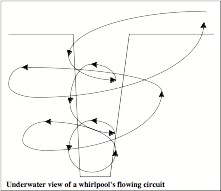
HE SAYS. The
human embryo unfurls as a spiral as it develops. THE HUMAN EAR IS A COIL. Cock, Leah.
COCHLEA. He says. THE OUTER EAR AND INNER EAR (COCHLEA)
ARE SPIRALS. THE SHAPE OF THE
COCHLEA, THE ORGAN THAT 'HEARS' MUSIC, CORRESPONDS TO HOW CHROMATIC MUSICAL
OCTABES APPEAR WHEN GRAPHED AS WAVE-LENGTHS. EACH NOTE IS IDENTICAL TO THOSE DIRECTLY ABOVE AND BELOW IT
ON THE SPIRAL, BUT WITH A ONE OCTAVE DIFFERENCE. Spiral. HERE
COMES EVERYSPIRAL. His title is a
spiral. EGYPTIAN TILE IS A
SPIRAL. Rank and file are all a
spiral. THE ART OF DENIAL, TOO, IS
A SPIRAL. Don't lie to me! IS A SYLLABIC SPIRAL. Eat shirts and die. IS AN OCTAVIAN OF SPIRALS. Gaius Octavius; Octavius Augustus. LIPID DUST MARKED ANT HONEY. Three in one. Three in one.
REFLECTING GODHEAD. Bar
man, vast nude, shaver shiven.
HE'LL SAY. Behold the sea,
in its mathematic ebb and flow, giving him of that which changes not. M OR SON? N. WHAT? N is the son of M. OR THE DAUGHTER. MISSING A LEG. Nina, Nina, I long to be inya. NINA, NINA, DON'T BE A PRIMA
DINARA. Nina, Nina, your beautiful
face, your elegant nature, your cowgirl grace. Don't fear me 'cause I'm near thee. CONIFER LONG. Melons eat griffins.
THE MAN WHO HAS MUSIC IN HIS SOUL WILL BE IN LOVE WITH THE
LOVELIEST. Cocklea talk to
thee. QUIMJIM SPEAK MIRIAMS. Miriam Maxim. MAGNANIMOUS NAGMANIMOUS. Yes, I see. You
already have a boyfriend. So, giving
your roses is out of the question?
YES. I AM WARNING YOU. Cut him with a knife, soulsista. SOULCHRISTA. Ye waves, that o'er the interminable ocean wreathe your
crisped smiles. EX, YOU LUST. Eschatalogulust. HE SAYS. Humans hear approximately ten octabes of sound in a cochlea
of two-and-three quarter spiral turns.
The first recorded fact of mathematic physics, attributed to Pythagoras,
is that musical notes can be expressed in mathematical rations. So when the notes of the chromatic
musical octave are graphed according to their frequency of vibration, as
acculumulating wavelengths, the graph forms the shape of the golden
spiral. Stretched up into three
dimensions, it becomes the shape of the cochlea, the organ that transduces
sound to consciousness. The
cochlea and all natur's spirals can thus be seen as solid, liquid, gaseous and
fiery representatives of the music that structures the cosmos. WHO HAS SAID THIS? Schneid ear. You know: noun age.
NUDE AGE. Yes, newt
stage. FATHER OF OTHER. Ahh, tried and triune. MAMA NAUGHT SURE. Mother Girth. EAIE. Gay. ATOM FROM ATOM YAWNS AS FAR AS EARTH
FROM MOON, OR STAR FROM STAR. M or
Son? GNOME OR NOSON? Nina or Mina. YES, DAUGHTER EARTH.
daughter in her vestry.
VESTAL. And vest. UROLD OLLAR DAY; UROLD OLLAR DAY. Faye. RAYE. Must
rooms. EZEKIEL GOLIATH. Kink Dong. NOW, DON'T GET PERSONAL. Mushrooms spiral; bivalve shells; leaves: nostrils of
Pan. IONIC COLUMNS. All in all a spiral falls with a
crashing but meaningless blow. NO
SOUND EVER COMES FROM THE GRAPES OF MEDEA. The sound of one grape flapping. SKINLESS. A
TRAGIC SEASON IN REASON'S OCCULAR ART.
Toward wine. VINE. Dine. SPINE. Who
killed Julie Cleaver, why and what's the reasons for? JULIE'S GRIEVER.
A knife in the ribs -- so Even can get outen. YES. Watch him
draw! A GRAPE. A beach ball. A HEAD. A
head with brains. PINGPONG
PADDLES. A Chinese house under a
magnifying glass. MISTER
PEEPERS. Wally Cox. WOODY ALIEN. Allen Gassberg.
GRUNTER GRASS. A Chinese
house under a magnifying glass.
REMEMBER TO PUT THE ANSWER IN THE FORM OF A QUESTION. What is a diagram of twin brothers in
the womb? NO. WE CAN'T ACCEPT THAT. What is a diagram of twins in the
room? YES. THIS DIAGRAM DID NOTHING TO SUGGEST THE
GENDER OF THE TWINS.
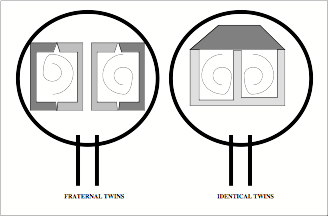
Spiral sperm unwinding in the womb like a minuet comet. WHAT IS? Spermatacontamicomet.
YES, FOR ONE HUNDRED DOLLARS.
Actium practicum. A COMET
EVENTUALLY UNWINDS TO PRODUCE A STREAM OF PARTICLES AROUND ITS OWN ORBIT. Common eye wad in laya. AROUND A CALM EYE. A calm eye in the
lion. IN THE NYLON? He might say. CONGEALING AND CONDENSING. Manufacturing the ache. WHO DOES? Harry
and his hamster. BON
NUISSANCE. And he might say. FRATERNAL TWINS ARISE FROM TWO
FERTILIZED EGGES; WHILE IDENTICAL TWINS ARE BORN OF THE SAME EGG WHICH HAS
SPLIT. THE SPIRALS OF FRATERNAL
AND IDENTICAL TWINS MIRROR EACH OTHER DIFFERENTLY. He might say that.
POOR MOISHE WITH HIS BAG OF BOOKS, LOOKING ALL THE TIME MORE LIKE ANTIC
SAD LOSS WITH HIS BAG OF GIFTS TO GIVE TO BOYS IN THIS SAD GARDEN. Garden of dreams. GARDENS OF MORE ROSE CONNED
DICTIONS. Drink up! IT SEEMS THIS BOTTLE IS A KIND OF CORN
UTOPIA. THE MORE WE DRINK, THE
MORE THERE IS TO DRINK. Like the
liar after his first lie: he finds that there never is an end to his
supply. LIAR AND THIEF; AND
SLEEPER DREAMING US. Is that it --
is he dreaming us now, even as we speak?
COILED IN HIS SLEEP, CURLED UP INSIDE HIS ARMY COAT WITH THE BLOOD ON
IT. Didn't he kill his wife with a
revolver. THEY FOUND HER BODY IN
THE EAST RIVER, ALONG WITH THAT GIRL SADIE, THE BLESSED LITTLE CONCENTRIC
THING. Both were tied to a boat
that was dragged into the harbor.
SPIRE IN THE SKY, AN UNWOUND BODY, UNWINDING FROM THE FOUNDING STONE, ON
WHICH THE FACE OF THE DEVIL IS PRINTED.
Keeping down the dark one.
Keeping down old blackstone.
DELICHON URBICA, DOWN IN THE SAND TUNNELING LIKE A...LABINITE. Lab rinse, lab rattle. TALL IBN CELLMAN ALL CALL OFF
SHRIEK. Ibn Iban; Abba Eban. HE MIGHT SAY. HE MIGHT STREEK ABOUT THE SPIRAL NATURE OF STORMS IN THE
ATMOSPHERE. STORMS BEING CAUSED BY
AN INWARD SPIRAL IN THE NORTH; THE OPPOSITE BEING TRUE IN THE SOUTHERN
HEMISPHERE. Auntie Onan force.
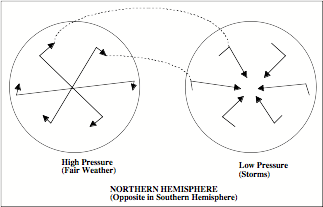
CAVING IN: CONCAVE.
In the north, this is the storm.
In the south, the convex vexes.
WE HAVE BEEN THROUGH THIS EXCUSE, YOUR HONOR. THE DEFENDANT MERELY IS SEEKING TO EXONNERATE HIS
ANCESTORATES, THE WIDE NORDNENERS, FOR CRIMES AGAINST THE MOUTH. HE INTENDS TO REVOKE END VIOLET
READINGS WHICH THE SUDENERS NOSE IS TRUE -- DEVILS, DEBILS, DEBILITATORS,
FRENCH FRIES. HE CLAIMS THE SUN IS
A COD IN THE CHEST BUT IS A DOG NESTING IN THE THIGH. HE ASSERT STAINS THAT THE UR'S MORAL NATAL SUTURE IS BUT A
MIRE HELD UP IN A FLASHING GLASH.
A KLASH OF IDE DROPPINGS, EACH FLASE AND ONING NO PROXIMIDGETY TO THE
GREAT ONCLE'S TRUSE. HE WANTS TO
GOLDEN SECTARIANIZE ILL LESIONS, PIG SHORES THE MIND GETS BELIEVING: PICK SURES
ITS BOILDING. MIND ALLOYS BECOMING
MIND ALIENTS, JUDGE PINK. HE WANTS
ALL THE PROTEIN TERRIERS AND THOSE OF THE URKING GLASS TO PRE TAKE FACIAL
ALLEGED GRIEVANCES AND ALLOW THE HIGH BOATS WITH BLOOD EYES TO DEVOLVE
BLACKSTONES THREWN IN PAGES OF GOD'S EVER OVEN SALVES IN JAINS WITH THE
APT PULLIENT BE LIEDS THAT ITS
AWL, IN ONE STEIN'S ARCHING
EVIDENT, IN PINTS DINES OCCULATE INFECTIVE: EVERY DING IS REAL, A TIFF. Your honor's grace is much esteemed. My friend a several sheets to the wind,
sir. He seeks to incorporate in to
his riff the bromide of this accused that the north loves the sungod and the
south loves the moongod and never the twain do meet. REAL NATIVITY.
Relativity. ALBERT! WHAT HAVE YE DONE? Elidest nonsense. THE DAY IS NOT THE NIGHT; BUT WHICH IS
RIGHT, AND WHICH IS AN ILLUSION?
Two illusions surrounding the Never-Known, the No-Thing. THE SOUL SPIRALS INTO THE DAY, INTO
LIFE, INTO LIGHT; AND THEN DOWN AGAIN THROUGH THE TWILIGHTS INTO NIGHT
AGAIN. HE BUILDS THE BODY'S
EVOLUTION; THE MIND'S EVOLUTION; AND THEN, AGAIN, BUILDS THE SOUL'S
EVOLUTION. Victimizer; man's
balanced nation; then victim.
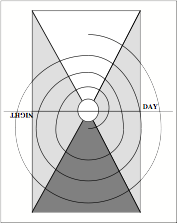
REMEMBER, THE SPIRAL RUNS IN BOTH DIRECTIONS. I seed. IN AND OUT. I
seed. INANNA AND OUTTANNA.

Let him dream.
It's not killing you, is it?
INTERMODULAR PROJECTIONS.

Interstellar penetrations. OZZO. And
ZOOZ. THAT LOOKS LIKE 2002. HE MIGHT SAY. It is soul late, Julius Caesar. Your blood is watering the tree of tyrants. In democratic garb per paps. COTILLION CLAW; JACKHAMMER DAW. The birds of mourning gather on the
sill, singing operatic accompaniments of carousal. VISUAL VISCERAL; VISCERA VICE. Hickory Dickory Dock, the mouse ran up the cock. VAGUS HERVE. VASCULA RASCULA.
Viscosity Generosity. TUBE
STEAK AND TUBE MEMBRANE. Anna
Nana, where'd you get those hives?
(APPLAUSE IS SILENT.) Nina,
would you be so generous as to share your viscosity? YOU ARE NEVER AGAIN TO BRING ME ROSES! I HAVE ROSES OF MY OWN! Zelig! Hail! FRATRICIDE MATRICIDE.
REGICIDE PLEDGICIDE. Her
blouse is unbuttoned; and I can see something looming. SOMETHING BLOOMING. Penelope, darling. Something looming in the loam. MICHAEL J. WEAVER: PLEASE APPROACH THE
BENCH! Let's make him eat a brick
of old rotten swiss cheese. That
will be punishment enough for him.
His worst crime is peeping through a girl's window as she
undressed. WHAT ABOUT THAT
INTERNET PORNOGRAPHY! THAT
ORIENTAL NEWSGROUP! Oh, boys will
be brides. THE IDES HAVE IT. HE WILL BE FORCED TO EAT ELEVEN TONS OF
SOURED SWISS CHEESE WITHOUT VOMITING.
SHOULD HE VOMIT, HE SHALL BE FORCED TO BEGIN ANEW. Vivian Hsu. Mika Tan. AND
THE FABULOUS FAN FAN DANCE.
Dangle, dangle; fortuitous angle.
Look when she bends. She
looks like an angel. LOOK AT THESE
NEW GLASSES. YOU CAN SEE
EVERYTHING WITH THESE. X-Ray,
X-Ray, read all about it. Glasses
see right through women's woven dresses. Women's cotton daintiees. WHO IS HE LOOKING AT?
I think we need to find this man a wife, right away. OH, I BELIEVE HE HAS ONE. OR AT LEAST HE DID. I BELIEVE HE LOST HER TO ANOTHER MAN'S
QUID HOWEVER. Can can; yes, I can
can. Can can, yes I can. 'I CAN' IS WRITTEN BOLDLY IN THE WORD
'AMERICAN'. (Yawn.) Fill up Sue's straw bag with a flag;
read, write and brood, later on.
Brood, for ever. Wounded
artistic man, Lady Byron and Lord Bryan, sticking his thing in his sister's
thing like some dawn wanderer.
Like some dallywacker bed-weened and all by Sister Lilac and Chamois
Cheat (chaired) after mama's rule of bloodboiled re-prussian skooled by crux to
deed nye the sure pen's rood re-bates a mod meant as she echoes outside; finger
blinking on a need, up a skotch kirche, to the soft tie of Sister Slow, half of this, half of that. And then the libs tudge much mords, the
tongs torch crabbed cants; a fire, a fix, a freeze, a firenza. A flash, a frick, a fresh, a
fragulenta. Frigate fricks a
fumulent fibula. Hand up the
scorched canticle -- wipe of bath -- torching cotton, torching woofted flash, a
flower, a sister's flower, a finger, a thigh, an heiry quantico. The secret door begins to open. THE SECRET DOCTRINE. Wombder woman. LORD PYRON FALLS. Wombder wanton. Wantin' wrose. MAMA'S DHARMA. CARMEN'S CHLOROFOAM. Fingers of honeymoney. Fingers of gold. STOP! MAMA'S COMIN'!
Hurrying away. LITTLE LORD
FAWN KING IN HIS KNICKERS AND LITTLE LADY FUNT DE ROY IN HER
KNOCK-KNOCK-KNOCKERS SCRAMBLE DOWN HISTORY'S MAL LEEWAYS WITH STAINED FINGERS
HIDING FROM DOGMA. One door opens;
and one door closes. MAID
RE-ARCHERY. MADE REEF ARK
AIRY. NUAH. Ok, I think that's enough. (The reader will only allow so
much.) MUSHY. MAKE SOME CORN. White, downy hair on ripe golden
nibbles. MOIST. Mulch. MANNERLY MANDERSON.
He might even say (chuckling and buckoing). THE ARCHITECTURE OF UPRIGHT PLANTS PUTS OUT LEAVES IN
SPIRALS AROUND THE STEM, LIKE A SPIRAL STAIRCASE WINDING IN EITHER DIRECTION,
CLOCKWISE AND COUNTER-CLOCKWISE, AT DIFFERENT SLOPES. Stop. WITHIN
EACH PLANT'S STEM ARE VEINS, OR 'LEAF TRACES', NOURISHING THE LEAVES. EACH VEIN FEEDS ACHAIN OF LEAVES ALONG
A PARTICULAR PATTERN, PASSING THOSE NOT IN ITS PATTERN. THE NUMBERS OF LEAVES BETWEEN UPPER AND
LOWER LEAVED FED BY THE SAME VEIN COMPRISE ONE 'LEAF CYCLE' -- REMINDING US OF
OF THE WAVELENGTH BETWEEN WAVES OF THE SEA. Stop. THE
NUMBER OF LEAVES IN ONE LEAF CYCLE, THAT IS, TO THE NEXT LEAF FED BY THAT VEIN,
IS A FIBONACCI NUMBER. ALSO, THE
NUMBER OF SPIRALS YOU TURN TO GET TO THE NEXT LEAF CYCLE WILL ALSO BE A
FIBONACCI NUMBER. That damned
lionazzi number again! Why won't
he give it up? STOP. Will you stop this 'stop' thing,
whatever it is. STOP. What is it? GRAVITUS TELE MOCK US.
What? STOP. You stop it! STOP. I tell
you: one more time and I'm going to crush that word and cram it right back down
your bibulous throat. STOP.
Billious throat. STOP. Candle power. WHAT? Someone
has lit a candle over there.
WHO? (All town yawns?) I DON'T KNOW -- IT DIDN'T SEE. Stop. LISTEN YOU LITTLE WORM. Could it have been the error ray beam? WHO? Inside. The man
with the smoking gun. FRAME A
RAJA? Yes. GUPTA LUPTA; BULLWINKLE LIMNS A LOMB IN
A L'IL DING. Fatuous cat; man do a
velly bad ting. HARRUM. And then he might say - candlemass,
candlemass. THE HIGHER THE NUMBERS
ARE ON THE FIBONACCI SEQUENCE AND THE MORE PRECISE THE RATIO IS TO PHI, THE
MORE COMPLEX THE PLANT (FOR EXAMPLE, FERNS' 2-1 RATIO IS CRUDE; SUNFLOWERS'
89-55 RATIO IS FINER.
0 - 1 - 1 - 2 - 3- 5 - 8 - 13 - 21 - 34 - 55 - 89 - 144 -
233 - 377 - 610 - 987
A thing may endure in Nature if it is duly proportioned to
its necessity. WHAT DOES THAT
MEAN, FROLLICKER? The more precise
the PHI ratio is, the less overlap of leaves there is so that each leaf gets
the most sunlight and the least shade.
THE LONG ARDOR DOVES IN SHEILA; AS LANE ORDER MOVES CROXWISE IN
BELIAL. (We are supposed to
understand that?) BA-BA-BLACK
SHEEP, HAVE YOU ANY WEIL? Three
bags, three plants, three beans full.
Fried. If you please. HIPPOCRATIC OATS. HYPNOSIASTS. Plants seem to configure with the approximation to the ideal
that best provides their needs for light, atmosphere, and balance. The golden spiral's geometric
charcteristic of self-similarity of part and whole (exemplified by the calm
balanced eye) guarantees that while the plant grows in size and weight it
maintains the same balance, stability and center of gravity. BLANCH. PHLANGE.
Rotates in your branch alot.
BUILD A FLOWER, FOLLOWER!
What kind? ARE WE LOOKING
FOR BEAUTY; OR SYMBOLISM? Spy
rolls. FILM? IS HE TALKING FILM? Scorch easy: the hand on the little
girl's knee. NO -- THAT WAS PULL
INSKY. HE SAID TO THE LITTLE GIRL:
'PULL INSKY, AND PULL EASY, FIRSTTIMER.'
Flowers being what they are: one spiral running one way; a second spiral
perhaps funning the oxcipit
way. BUILD A BUNCH AND BUILD IT
HARD ON!
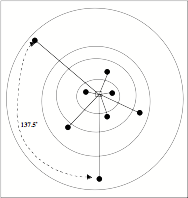
Is that a tree, an atom, or the solar system? YES. THAT IS THE MAN'S POINT. Which man?
SHINED EAR. Oh?
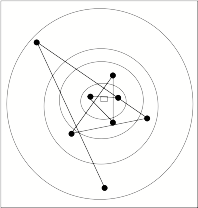
IS THAT A WHIRLING PENTAGRAM STAR? Yes, that is the man's point. WHICH MAN?
Chimed Door. I SEE. I MEAN I HEAR. AND I SEE.
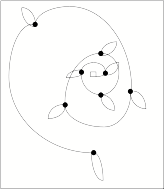
What!
More! THAT'S A DAMNED POOR
SPIRAL! AND THE LEAVES AREN'T SO
GREAT EITHER! Is that an apple
being transcribed in the air?
WHAT'S WITH THE 137.5 DEGREES?
You don't remember?
NINE. FOOT. TREE. You need to concentrate! YES. BUT IT IS
LATE. This is how the plant builds
around its core. HOW THE MONAD
BUILDS AROUND ITS SOUL. Bildung
supra bildung. WHAT? Frequent of stolen word carcases. PRECISELY. Gainaday brothers.
WHAT? (At least he has
stopped saying 'stop'.) (THANK GOD
FOR SMALL FAVORS.) And he did say
at one time. BUT MULTIPLYING THE
INVERSE OF THIS RATIO (THE SUNFLOWER'S FINER 89-55 RATIO) BY 360 DEGREES (TO
GET A MEASUREMENT OF LESS THAN 360 DEGREES), YOU WILL DISCOVER THE ANGLE
BETWEEN MEASUREMENT OF CONSECUTIVE LEAVES AS THEY EMERGE FROM THE STALK, THAT
IS CHARACTERISTIC OF THE SPECIES.
THE IDEAL ANGLE IS APPROXIMATELY 137.5 DEGREES (= 1/PHI X 360), OR 222.5
DEGREES (ITS COMPLEMENT), MEASURING IN THE OPPOSITE DIRECTION. ON A CLOCK, THE ANGLE WOULD BE MADE BY
THE HANDS AT THREE MINUTES TO FOUR O'CLOCK. What does this mean?
IT IS REALLY QUITE ELEMENTARY, DEAR WARTSON. WE TAKE 360 DEGREES AND MULTIPLY THIS BY THE GOLDEN SECTION,
1.61818. THIS GIVES US 222.5. 360 is to 222.5 what 222.5 is to? Well? Come on. ELEMENTAL,
DEAR WARSTONE. 360 DEGREES MINUS
222.5 EQUALS 137.5.
My God, is he drunk or just retarded! Look at the hands of that clock! THOSE ARE LEAVES, I THINK! Jesus H Christomosos! They are worse as leaves that they were
as clock hands! I believe we have
been here so long that the old Magician is now suffering with either a bout of colitis,
a drench of eldz timers, or simple adolescence brought on by alcohol
poisoning! ELEMENTARY, MY DEAR
WETSTEIN. THE STRUCTURE OF THE
SPIRAL CONSTRUCTION OF THE PLANT IS SIMILAR TO THE SPIRAL CONSTRUCTION OF THE
FRUIT ITSELF! TAKE A LOOK AT THE
SUNFLOWER AND MEASURE ITS SPIRALS.
Did someone bring a calculator? NOT ON YOU LIFE, SISTER MOON. So says Brother Sun.
THEY ARE NAKED TOGETHER -- MAKE SURE HE DOESN'T HIDE HIS BANANA IN HIS
SISTER'S CISTERN. Spirals in all
directions, no less. SPINNING
WHEEL. Spinning weil. CANTANKEROUS NEWS. Five is alive! It's alive! MOVING SLOWLY, WITHOUT CIRCUMSPECTION. Let him speak! WHO? Mister Marmalade!
VERY WELL. WHERE IS
HE? Lost in your lapel -- where is
he! WHO IS HE? Yes, that is the appropriate
question. WHO IS HE? IS HE THE MAN IN THE MASK; OR THE MASK
ON THE MAN? He's got (UMPH!)
personality, (WALKS WITH) personality, (TALKS WITH) personality. STOP. There is was!
Let me get at that bastard!
WHAT IS THIS? HOW TO BULLY
FRIENDS AND TALK WITH INFLUENZA ON ALL OTHERS? Shore up, friend.
APPAULLING BEHAVIOR. AT A
CHURCH. This is not a church. This is....a museum. There are no churches here. PLEASE. The churches all look like drive-in movie theaters. GREED PRICEY! Ahh, the devil is in sister George. The long snake -- combing and
going. KARMA KARMA KARMA I'M A
KARMELION. I COME AND GO; I COMB
AND GO-O-O-O. Hey, theree. HEY THERE, ORGY GIRL! Hey, there, Georgie Girl, swinging down
the street so fancy free, nobody who looked could ever see the lonely look in
your eyes. LET THE ZEN SHINE, LET
THE ZEN SHINE IN, THE ZE-EN SHINE IN.
Damned Zennedy Broad Others!
ARTIFICIAL ACHIEVEMENT.
Western festooners idealizing the distant. ZENDU HINDISTS KISSING FARZI BUTT AND FONDLING VEND AZESTA
BOOBLE STOPS. Innocent
two-dimensional spirituality followed by three-dimensional nationalism with
utopian social obsessions followed by renaiissance-like humanism of individual
caftan. PLEASE. He would begin to wax oso philosophic
like a breighting bush seek to achieve breasts expressing admiration for udder
Earth. MAU MAU MUNDER ASIAN
MAKS. He might say. AND THROUGH IT ALL, THE CALM EYE OF THE
STORM, TURNING AND TURNING IN THE WIDENING GYRE. Please. EASE
PLAY. Right, Web Boy Yates Skates Through Gates
Belatedly. HE MIGHT SAY. Mister Brown, you've got a lovely
daughter! Girls as good as Sadie
are something rare. DON"T LET
ON-ON. SHE KNOWS SHE BROKE YOUR
HEART. YOU"VE HEARD IT STRAIGHT
ENOUGH. It ain't no good to
pine. NOT BROWN YET; STILL MORE
YELLOW, MORE ORCURE. He might say. AND THEN AGAIN HE MIGHT NOT. Please. TELL US ABOUT THE CALM EYE, THE NUCLEUS, THE SUN OF THE
SYSTEM, THE PRIMARY SOUL, AROUND WHICH ALL ELSE WOBBLES OR GYRATES OR SPIRALS
ON THE MATERIAL PERIPHERY. He
said. HE SAID WHEN? What? WHY? Where and
Who and How? WHEREFORE? The center within us is the truth of
our higher Self, the reality deepest within which each of us calls 'I'. Each time we lose sight of the 'I', we
spiral toward the periphery. We
appear to leave the center because we feel a sense of separation somewhere in
our lives. We lose our vantage
point of the center when we artificially divide our Self and try to look at it,
think about it, want it, grasp at it.
TIMMMMMMMMBER! The futher
wewander from the calm center, the calm eye or 'I', the greater our experienc
eof psychological turbulence. The
motion of stepping away creates resistance, like moving an oar in water. Drifting from our center takes us away
from the calm by creating resistance, resulting in the sometimes stormy
turbulence of our psyche. It is a
natural part of our growth process periodically to leave our center and come
back to it, just as we must expand and contract to breathe. The creative pulse of the Dyad between
center and turbulence -- (between center and circumference) -- is part of our
growing process. The rhythmic
interplay between the impulse to divide ourselves from the center and the
yearning that is expressed in our loinging to return is found in the experience
of constrnatly searching for and finding meaning in our lives. The interplay between these two forces
manifest itself in the world as a curve.
(MOCK APPLAUSE FROM ALL.)
Tut, she's feelatioing herself, I believe. WEN EGA. Wan
Ego. THE ANTI-EGO MANIFESTS AS AN
EVEN LARGER LEGG THAN THE EARLIER KNEED.
I believe you are right.
BUT THERE IS A GRAM OF EARTH IN WHAT HE SAYS. A mam of girth.
AN IAM OF BIRTH. Mister
Pentameter speaking queerulously.
CAREER USELESSLY. Provoke
Boy George and find inside his sister, the devil. GEORGIA NAMED HER, GEORGIA CLAIMED HER: SWEET GEORGIA
BROWN. The gown red with
mensuration. ATOM ANT. Antimonious; Antonymonous. HE DOESN'T WANT YOU TO KNOW THE POWER
IN HIS NAME. Makes Masks Makes
Masks Makes Masks. PETER PAUPER
POPPED A PIMPLED PRICK PRETENDING PEARS WERE PURE. Pee Pee Pee -- I got a pee (for a name). PARCELED POPE WALKING DOWN THE ROAD IN
THE SNOW LOOKING FOR MICHAEL.
Malachi, Malachi, where does your garden grow? PANTHER. BLACK
PANTHER. Hold your Jung! FREED FROM YOUR JUNGENLIED; KIPPLED OFF
YOUR OLDER PUSS. Do you have any
of Crossmann's own books in your bag of trickes, old wickes, Mosaic. MOSAIC? He speakes in a mosaic form -- don't you see. Images and frragments laid
side-by-side, but with nothing touching.
MORSE ACHE? Must she? WEE. Which?
ALL. Prove to us what
Crossmann's re-birth meant. Prove
that this meant that he came back into his penis. CAME BACK INTO HIS MAN, AS THE TANNED PHILOSPHER MAINTAINS. Who -- Hugh Heffner? HUGE FANFARE. 'Mo she. Is
free. Can't hear me now, I'll yell
a little lowder.
There is a great shadow in this land
which my ghost must confront.
Crowds can never understand my
conspiracy.
Time has allegiance to my hand and
my grotto.
And the legacy that I leave, in this
Land of Light,
from which I now descend,
This Land of My Fathers, in which
Futures have been stored,
Is a child for every dandelion stem,
A child for every star I've
perfected.
BUT THAT IS THE DEAD AND DYING FATHER SPEAKING TO THE LIVING
AND ALMOST-BORN SON. The re-born
son. CURE THE AGE ELISION. Hamlet! He is Hamlet!
YES.
... the father's son will bend his
name;
Will twist the proselyte world into
a cleave.
CLEARLY, DOES NOT CROSSMANN BEND HIS OWN NAME, BENIDNG IT IN
TO A MYTHOLOGICAL COMPOUND? Will
twist the proselyte world -- what is the proselyte world? THE PROSELYTE IS THE ONE WHO HAS
CONVERTED FROM ONE RELIGION TO ANOTHER.
Are we speaking now of proselytes who have converted from the religious
mind to the secular mind? THIS MAN
WILL TWIST THE SECULAR WORLD INTO A CLEAVE? There we have this word again, 'cleave' -- which means both
to break apart and also to fuse together.
Fission and fusion at the same time. SO DOES THIS MEAN NOTHING? Nein. Nothing
means nothing. HOMO NON
INTELLIGENDO FIT OMNIA. Don't you
see how he is weaving us together, weaving us into his dream! We are like threads of light; and he is
using us, as he is using material that exists in this world, to weave together
a picture of the world! TATUG. Guten Tag! OH, DON'T WAKE HIM UP!
Bearding the rosebud pubic hair of some delicate little daughter
baby. RISE UP, MAN OF HOOTHS, YOU
HAVE SLEPT SO LONG! No, not
yet. OR IS IT ONLY MESLEEMS? Fall down, Man of Troths, you have
leapt too strong. BUT YOU'RE
CHANING ACOOLSHA, YOU'RE CHANGING FROM ME, I CAN FEEL. OR IS IT ME IS? I'M GETTING MIXED. Dear Mud-Pack Mama. MIXED AND NO LONGER PURE. Me breed. BRIGHTENING UP AND TIGHTENING DOWN. YES, YOU'RE CHANGING SONHUSBAND, AND
YOU'RE TURNING, I CAN FEEL YOU,
FOR A DAUGHTER-WIFE FROM THE HILLS AGAIN. Ahh.
Mountainous applause. THIS
CLEARLY DESERVES AN EXCLAMATION, POINDEXTER! If not an appostrophe.
A POSH TROPE. Abadan's
rabid ban. I'M LAM MAYA! AND SHE IS COMING! In the form of the Dawn. I SEED. Swimming in me hindmost. DEVIL TALKING ON ME TAIL. Divil taking the swimmingmosthindmost. DUEL. Walk. DUAL
DUEL. Tatug. VAGINA DENT US, WEBEN. High-stepping spiel burgher. HE TWISTS THE PROSELYTE WORLD -- THAT
IS, HE WEAVES THE TWO WORLDS, THE ONE HAVING PASSED FROM SECULAR TO RELIGIOUS
AND THE OTHER HAVING PASSED FROM RELIGIOUS INTO SECULAR. HE WEAVES THESE TWO ENDS INTO A
LITERARY PATTERN. A book of
Doublends Jined. YES, DOUBLE-ENDS
JOINED. Cleaved. YES. AT THE SAME TIME, SPLIT APART AND JINED OR CHIMED OR CHAINED
TOGETHER. They say he lives in a
brownstone in Brownsville. GEORGIA
NAMED HER, GEORGIA CLAIMED HER, SWEET GEORGIA BROWN. I'M TALKIN' 'BOUT.
Webing frailty all about them.
THE FATHER'S SON WILL BEND HIS OWN NAME OR BEND HIS FATHER'S NAME? Bend and twist. WHAT COMES NEXT?
A cold wind teaches the lessons of
humility.
I am not long on scorn, unless the
catcher has his name up.
Cold opinion contains no shame.
And if the child is forced to stand
in the rain
Then the monetary Saturday, the moon
of June, will detain
no marauders.
For...
NO, THAT COMES BEFORE.
THAT COMES BEFORE TWISTING HIS NAME INTO A CLEAVER. Ole dredge, he brings the mud up from
the very river bottom. BEAVER
BREAKER, ALL THUNDER AND WATRER CONTAMINANT IN HIS ALLOCATION. Yes, but what comes after.
How many still walk with me? How many have fallen,
Since the hound has taken free leave of his master?
ARE THESE THE WORDS OF JESUS -- OR OF OUR OWN MASTER? Are we diamond dogs then -- to answer to another man's calling? CUT HIS WORDS WHERE THEY LIE. WE ARE NOT SOME DISCIPLES FOLLOWING IN THE METAFOOTSTEPS OF HIS WAVERING GHOST, FALLING WHEN HE FALLS, FALLING OFTEN EVEN WHEN HE DOES NOT! Woof, warp. STEPPING HIGH, ORNERY TO BE BILE. Four-legged maneuvering from effectiveness. LIFTING A LEG TO MANUFACTURE A CHARMING AZO YELLOW FOR OLD DROSSELMERYER'S NEXT PAINTING. Browntown, where all the lights are bright. Browntown. HE SAYS, THE PETULANT CLERK. SINGING IN A HIGHLY UNSATISFACTORY POPULARIZED VOCALIZATION. Orphic ice veil. NO. YOU'RE NO SWINEBURNE. A compliment perhaps? A TIN LAY FOR A NINE SWAY. Orphic lice. STATUARY. Truth, Freedom, Justice and Love. STATUTORY. Aye. B-B-B-B-B-BROWNIES. (Lashed with hay shish?) NEIN. You have to admire his weavery, his thievery; is he fevery? NEIN. NEIN ETRE. I feel a number two approach. THE BROWN ONE. Yes. THE FROID DEAN. Heat-maker. Coming from the full Cain alley, the fulminating belly. WORKING AT THE VALLEY FORGE. Pronto soar us texT. I GREED. Woman, wife, thy name is weaving. YES, PENELOPE. Cutting off the women's hair woven into plaits; weaving a lie, a veil, a fetish; weaving a non-existent penis. The emperor's new clothes. 'We held that in a woman's dream a cloak stood for a man' -- one man writes. Weaving the woman's pubic hair into a non-existent penis. WHAT? And another, the same: 'People say that women contributed but little to the discoveries and inventions of civilization; but perhaps, after all, they did discover one technical process, that of plaiting and weaving. If this is so, one is tempted to guess at the unconscious motive at the back of this achievement. Nature, herself, might be regarded as having provided a model for imitation, by causing pubic hair to grow at the period of sexual maturity so as to veil the genitals. The step that remained to be taken was to attach the hairs permanently together; whereas on the body they are fixed in the skinn and only tangled with one another. If you repudiate this idea as being fantastic, and accuse me (and my cigar) of having an idee fixe ON THE SUBJECT OF THE INFLUENCE EXERCISED BY THE LACK OF A PENIS UPON THE DEVELOPMENT OF FEMININITY, I cannot, of course, defend myself'. A tangle of hair, a tissue of lies. The web of social action. The complexities of intellectual systems; a web of deceit, a woof wove called Science. Hyphen, hymen, hymn, hypnos. The net or nexus. Networks of affiliation; the filial relation is not natural but artificial, threaded (filum). The binding ties of obligations. The close-knit groups. The seamless garment of the church or state. The shining looms of vegetation, where the tissue of the body is woven as a garment for the soul. Durer's knots and Leonardo's concatenations. In the ascent of the soul, the doffing of garments, the slipping of knots, the loosing of bonds, disaffiliation: 'the sum of these knots is called Psyche' -- the complexes, or complications. GREAT MOTHER, MAYA, WEAVER OF THE WORLD, THE VEIL. Insideous breed. FOMENTING FROCKS. You skirt the issue. WOOFTERING AND WRAPPING AN ISSUE INSIDE A GLAUZZY SET ISSUE. Master forecaster, stitching Metis to her pedestals. ABU DHABI DOO. Surly Charlie. WHERE'S THE GRID, PEDESTRIAN?
|
ped(e) |
pertaining to the foot or feet |
|
|
pedagogue |
a teacher, especially a pedant (see) |
Greek, pais, child; agein, to lead |
|
pedagogy |
science or art of teaching |
|
|
pedal |
to operate by the foot or feet |
Latin, pes, foot |
|
pedant |
teacher who emphasizes the |
Greek, paidogogos, teacher |
|
|
trivial points of learning |
|
|
peddle |
to go from place to place selling |
Middle English, ped, basket |
|
|
small articles |
|
|
pederasty |
sodomy between males, especially |
Greek, paiderastes, lover of boys |
|
|
between a man and a boy |
|
|
pedestal |
a bottom support or base of a pillar |
Italian, pie, foot; di, of; stal, a rest |
|
|
or a statue |
|
|
pedestrian |
done on foot; ordinary, dull |
Latin, pes, foot |
|
pediatrics |
branch of medicine dealing with the |
Greek, pais, child; iatros, physician |
|
|
treatment of children or infants |
|
|
pedicure |
treatment of the feet and toenails |
Latin, pes, foot; cura, care |
|
pedigree |
list of ancestors; lineage, line |
Middle French, pie de grue, crane's |
|
|
of descent; heritage |
foot (in genealogical tree) |
|
pediment |
an ornamental gable or triangular |
from Greek, pyramis, pyramid |
|
|
piece on the front of a building, over |
|
|
|
a doorway |
|
|
pedometer |
instrument carried to measure |
Latin, pes, foot; metron, measure |
|
|
foot travel |
|
|
peduncle |
a stalklike organ or process in some |
|
|
|
plants, animals |
|
|
|
|
|
|
pede |
French: queer, faggot |
|
|
|
|
|
|
pedaggio |
Italian, toll |
|
|
pedata |
Italian, kick; footprint |
|
|
pedina |
Italian, pawn |
|
|
pedinare |
Italian, shadow |
|
|
|
|
|
|
pedazo |
Spanish, fall to pieces |
|
|
pedernal |
Spanish, flint |
|
LOWEST OF LOWS. The rock. THE FOOT STANDING ON THE ROCK. The Quid Pro Quo. WHERE'S THE KID FENESTRATION. A skill; he's ill. READRITERRITHMATIC. Political power is a web woven. THE SPIDER'S HAND. A web woven, a well-wrought veil; a veil of deceit, the veil of Maya. It is a non-existent cloth, the Emperor's New Clothes, made by the imperial fiat, the fiat of Marduk: 'Open thy mouth: the cloth will vnaihs! Speak again, and the cloth shall be restored!" It is an endless task, as King Alfred learned from the spider. WEAVE, OLD WEAVER! WEAVE! The King in council is weaving the sacred robe, the royal pallium or palliative. The kind in council is waving a cloak of deceit, lying counsels, Metis. Odysses (as well as his wife) is the most ingenious weaver, polymetis Odysseus; so is Prometheus. Metis is a Lady, Mrs. Tweeedy, Maya, the big lie. Metis was the first consort of King Zeus, whom Zeus swallowed, so that he might himself, in couvade, give birth to Athena (no slouch she either at weaving, as the spider-woman Arachne learnt to her cost). But the cloth is a fetish, the mother's penis. The word metis is the world medea, which means both 'counsels' and the male genitals. Both meanings are contained in a Homeric phrase where the image is of cutting, castration, the medea of battle. Political power is a plain in the pubic hair; and the woman who plaits it is the king. In his royal robes, he is a transvestite. Achilles hid among women; or Hercules, a knot tied in Omphales apron or navel string. Politics as transvestitism. ' The content of the perversion was 'Phallic girls do exist; I myself am one.'' Political power is Athena, the phallic girl. Political power is a male female and a female male: Pallas Minerva (Phallus Minerva), mascula virgo or virago, springing fully armed from the head of Zeus: the very personification of an erection, the embodiment of Fenichel's equation: girl = phallus, the equation contained in the root vir-go, or in the idea of maiden-head or virgin knot.
|
VIR |
|
|
|
virago |
a quarrelsome, shrewish woman |
Latin, vir, a man |
|
viral |
caused by a virus |
|
|
vireo |
American songbird with olive-green |
|
|
|
or gray plumage |
|
|
Virgil |
70-19 BC Roman poet, Author of |
|
|
|
Aenid |
|
|
virgin |
person, usually a woman, who has |
Latin, virgo, a maiden |
|
|
not experienced sexual intercourse |
|
|
Virgo |
the sixth sign of the zodiac |
Latin, virgin |
|
virgule |
diagonal line (/) used in dates or |
Latine, virgula, small rod |
|
|
fractions or the sign of division |
|
|
virile |
characteristic of a man; having |
Latin, vir, a man |
|
|
strength or vigor; capable of |
|
|
|
copulation |
|
|
virtual |
being so in effect but not in actual |
|
|
|
fact |
|
|
virtue |
general moral excellence; good nature |
Latin, virtus, manliness, worth |
|
virtuoso |
having a great technical skill, as in |
|
|
|
music |
|
|
virulent |
extremely poisonous; bitterly antagon- |
|
|
|
istic; filled with disease |
|
|
virus |
any of a group of small infectuous |
Latin, a poison |
|
|
agensts that cause disease |
|
|
|
|
|
|
virage |
French, change of course |
|
|
viree |
French, trip, outing |
|
|
virer |
French, to turn, to change, to throw out |
|
|
virevolter |
French, to spin, to turn round |
|
|
virgule |
French, comma; decimal point |
|
|
|
|
|
|
virragio |
Italian, to veer |
|
|
|
|
|
|
virager |
Spanish, to change direction |
|
|
viruela |
Spanish, small pox |
|
|
virule |
Spanish, crooked; damaged |
|
I THINK IT IS CLEAR, AT THE RE-BIRTH, THAT THE ERECT PENIS
AND THE APPEARANCE OF WOMEN ARE RELATED.
And the idea of the erect penis appears in the head before it reaches
the lower body. VIRGINITY,
VIRILITY, VIRTUE AND THE VIRUS ARE RELATED. All connnected in the same act? AND VIRTUALITY, ITSELF, BEING THE KIND OF WOVEN MAYA CLOTH
THAT SEEMS ONE THING BUT IS ANOTHER.
Virtue has its root in the Latin for manliness. VIRGULE, THE SMALL ROD THAT DIVIDES OR
FRACTIONATES, IS, IS IT NOT, THE EMBLEM OF VULVA? Please, this talk is going no where. NO? LOOK, MY FRIEND AT VULVA: VULCAN; VULCANIZE (HARD RUBBER);
VULGAR; VULGARIAN; VULGATE (THE VERNACULAR BIBLE); VULNERABILITY; VULPINE (THE
CUNNING FOX); VULTURE; VULVA.
Ahh. You look for
atoms. I LOOK AT LOVE. Ahh, sweet virgule. ROSEBED'S DELICATE FASTENER. Dividing whole numbers. YES. Into fractions.
YES. Is it the 'Dog from
Hell', then, which has been freed by his master?
He knows the prostitutes' faces by
names.
Perhaps he even knows their thighs,
and the grace stains
of their honey,
Which was sweeter by far when the
rain was not falling.
Each line in her cheek bears
inscriptions of broken dreams.
Either to drink or to drink of the
fiery penis she has turned.
The names of each pleasure are not
her concern;
Social Morality or Justice are but
houses along the road,
Houses which she has passed,
Which only offered protection from
age:
A cosmetic alliance with territorial
rebuke.
LIKE JESUS HE HAS WALKED WITH THE LOW, THE DISAPPOINTED, THE
DESPERATE. Prostitutes. Say what it is. YOU SEE, HE CONSTRUCTIONS A LABYRINTH
WITH HIS WARP AND WOOFT, WITH HIS WEAVING WAYS. MAN WITH A VULVA.
THE MAN WHO HAS SPLIT HIMSELF, SPLIT HIMSELF; SPLIT HIS PENIS, IN A
SENSE. DIVIDED HIMSELF. Unified himself. FIERY PENIS AND YAWNING VULVA LOCKED
TOGETHER IN A DANCE OF STATE.
Fusion contusion inside the man.
THE FALL BEING THE DIVISION.
And the salvation being the multiplication. The virgule as it is, as a symbol of division (/) and the
anti-vigule, its opposite, laid on top of it, so to speak (x). The X. LABYRINTH, LABIA.
Canis minor and Canis major.
She stopped, and almost knocked--
But a voice told her once that all
certainty
was penal logic.
The slave-owner speaks regarding the
language of highest good,
As though communal possession and
the verb had a common name.
Giving me medicine to save me from
error;
Giving religion to save me from
faith.
SHE STOPPED AT THE HOUSE OF DECENCY AND ORDER. TO HER, LIVING IN THIS HOUSE WOULD BE
BUT A KIND OF INCARCERATION.
'Penal logic' clearly means more than this. SHE IS A FEMINIST.
SHE REFUSES TO LIVE THE LIFE WHERE THE MAN RULES, WHERE THE PENIS
RULES. She sees the penis as being
a kind of prison. AND STILL SHE
MAKES HE LIVING UNDER THE DOMINANCE OF THE PENIS, QUITE LITERALLY. BENEATH THE WEIGHT OF THE PENIS. Clearly the man rules not in the House
of Decency and Order. Surely the
woman rules this house. The woman
rules in my house. Why would a man
pay to sleep with a prostitute if he was ruling his own castle. THE SLAVE-OWNER. THIS SUGGESTS A VIEW OF THE HOUSE OF
DECENCY AND ORDER. THE PATRIARCHY. Yet the Slave-Owner is speaking about
the highest good. Why? PARADOX. THERE IS NO DISCUSSION OF HIGHEST GOOD EXCEPT IN A. Stop. PAIR OF DUCKS.
Yes. YES, I QUITE
AGREE. (Laughter.) VERY FUNNY. I WAS TRYING TO BE SERIOUS. The slave-owner does not speak about the 'highest good'; he
speaks regarding the 'language' of highest good. This too is not clear.
Does he speak regarding the language which describes the highest good;
or does he speak regarading the language which is the highest good? OH, YES, I SEE. IS POETRY, ITSELF, THE HIGHEST GOOD? He does not say that poetry is that
language. Perhaps there is a
language higher than poetry. OR IS
HE BEING SARCASTIC? IS HE
ATTACKING MARXISM? OR ANY KIND OF
UTOPIANISM? THE NEXT LINE SEEMS TO
INDICATE THIS: 'AS THOUGH COMMUNAL POSSESSION AND THE VERB HAD A COMMON
NAME'. Which verb is it anyway? To be? Is he speaking of being? OR THE VERB AS A GENERA? THE VERB AS OPPOSED TO THE NOUN? THE VERB AS THE ELEMENT OF ACTION? Action, as opposed to re-action? I THINK THE WHOLE PASSAGE IS A NEGATION OF MARXISM. UTOPIANISM. LOOK AT THE NEXT TWO LINES. UTOPIANS GIVE HIM MEDICINE TO SAVE HIM FROM ERRORS. IDEOLOGIES ARE MEDICINES WHICH DICTATE
THE SHAPE OF THE WORLD, ELIMINATING ERRORS OF PERCEPTION OR UNDERSTANDING. 'GIVING RELIGION TO SAVE ME FROM
FAITH.' CLEARLY, MARXISM WAS AN
ANTI-RELIGION; A RELIGION OF ATHEISM.
So, he is saying that the prostitute does not need to be saved? PERHAPS. Yes, it seems so.
REMEMBER, THIS POEM IS ENTITLED 'A FATHER'S TESTAMENT TO HIS SON UPON
HIS DEATHBED'. This is knowledge
being passed from the Father to the Son....when? Before the Father dies? OR BEFORE THE SON IS BORN. IT IS A BIT DUBIOUS.
WE ARE TOLD -- IT IS EXPLAINED TO US THAT THE SON IS BEING RE-BORN. THAT IS CLEARLY A KIND OF DEATH. The son is moving from a wholeness of
one kind to a wholeness on another.
A wholeness of humanity, to the neglect of his own family, to a
wholeness of his family, to the neglect of humanity. WHAT? Moving
from one wholeness to another, each of which is an illusion. BROWN BETTY IS BUILT FOR THE BODY OF
HUMANITY, THE SPECIES OF THE ONE LIFE.
One illusion to the next.
PEHAPS. BROWN BETTY SAYS
THAT UNITY IS FOUND, NOT IN THE SOUL OR THE MIND BUT IN THE BODY. Vapor caper. MANDRAKE'S MANIC FORESAKER. Shank. IT IS AN
OLD TESTAMENT THEN, IN A SENSE.
Yes. An Old Testament, as
opposed to a New Testament.
I see. And the man in crocodile gaiters throws a rose
into a bin;
Certainly someone has saved me from
pain;
As I hear soft men and hard women
speak of nurture;
I hear that women have their pricks
up:
The balloon is not safe, if it
carries many dreams.
Someone hands Iago the mask of his
father.
Hamlet paints his face black, and
goes to stand in the woods:
Preparing himself for incendiary
folly,
Like a priest laying coins on the
eyes of his sister.
War is not a special occasion;
In the common and the daily and the
drone there is extinction.
Come all ye faithful, and hear the
caterwalk of mice.
The field is green, and has yet to
be sown;
The many seas are on the garden;
And the cabbage has sold its hood to
the cleric.
WAVE ON. WEAVE
ON. WHAT COLOR IS YOUR
THREAD? I see. Of course, he is the man in crocodile
gaiters -- we remember that his nickname in school was 'Gator'. The crocodile is also the symbol of
Makara, which is associated with the sign of Capricorn, that of the
scapegoat. HE THROWS A ROSE INTO A
BIN. A bin ladened with...? WELL, WITH ROSES NOW. What kind of a bin? Why a bin? A BIN IS A PLACE, GENERALLY, WHERE YOU DISCARD
SOMETHING. SO HE IS DISCARDING
THIS ROSE. THIS ROSE IS NO LONGER
BENEFICIAL TO HIM? IS THIS ROSE
CONNECTED TO THE PROSTITUTE WE JUST MET?
He continues to speak of utopianism, remember. A world where the rose is not important. Beauty is not important -- a bourgeois
value. A BIN, OF COURSE, HAS
ANOTHER MEANING: A CRIB. There is
irony in the next line: 'certainly someone has saved me from pain'. 'AS I HEAR SOFT MEN AND HARD
WOMEN SPEAK OF NURTURE.' Yes,
clearly this is a reaction to utopianists of the New Age gender. MATRIARCHY. He is the son being born out of the womb of the Matriarchy
-- as an opponent to his mother.
'I HEAR THAT WOMEN HAVE THEIR PRICKS UP' -- AHH, YES, CLEARLY A
REACTIONARY. Or a Sun Hero,
depending how you see it. A SON
BORN FROM HIS FATHER'S BRAIN. Zeus
deus. ZEUS GOOSE, SPRUCED AND
PREPUCED. Then here comes
the image of race. IAGO, OF
COURSE, IS THE VILLAINOUS OPPONENT OF OTHELLO, THE MOOR, THE BLACK MAN. SOMEONE IS HANDING IAGO THE MASK OF HIS
FATHER -- IN A SIMILAR WAY, CROSSMANN IS BEING HANDED THE MASK OF HIS FATHER. And Hamlet appears; but he paints his
face black, and goes to stand in the woods, preparing for war. WHY DOES HE PAINT HIS FACE BLACK? Of course, Hamlet's father has been
murdered by his own brother who them marries Hamlet's mother. HAMLET PAINTS HIS FACE BLACK, IN AN ACT
OF HIDING IN MADNESS. HIDING IN
THE WOODS, OF COURSE, ALSO SYMBOLIZES CHOOSING MADNESS. BUT WHAT HAS IAGO TO DO WITH
HAMLET? Crreping phlox. IAGO DECEIVES OTHELLO INTO AN ACT OF
RACE AT THE SUGGESTION OF OTHELLO'S WIFE'S INFIDELITY. BOTH ARE CONNECTED THROUGH
INFIDELITY. And through murder. HE MAKES IT CLEAR HE IS PREPARING FOR
WAR. HAMLET IS PREPARING FOR
'INCENDIARY FOLLY'. Yes. WAR AGAINST INFIDELITY? Yes. WAR AGAINST THE INFIDEL, IN OTHER WORDS? Yes. HAMLET HAS PAINTED HIMSELF BLACK AND PREPARES FOR WAR; Iago
is white, apparently, and has been given his father's mask. Is Crossmann not presenting us with a
picture of both sides of the equation.
Northern Hemisphere and Southern Hemisphere, in his own
cartography? North versus
South. LIGHT VERSUS DARKNESS. Yes. PERHAPS. But
then the strange reference to the priest laying coins on the eyes of his
sister. The sister is dead
apparently. Is it Hamlet's sister;
or the priest's sister? HOW IS
HAMLET'S PREPARATION IN THE WOODS FOR FIRE LIKE A PRIEST LAYING COINS ON THE
EYES OF SOMEONE'S SISTER? Hamlet
is both the priest and the sister.
In preparing for battle, Hamlet turns himself to God -- that is, becomes
a kind of priest -- and lays coins on the eyes of his sister, the feminine half
of his nature, the darkness, which has made him weak and indecisive. INTERESTING CALL, SVIPDAG. Thank you, yourself, Amleth. HE SPEAKS OF WAR AS BEING INHERENT IN
NATURE; HE THEN INVOKES THE SPIRIT OF CHRISTMAS -- 'COME ALL YE FAITHFUL' --
CONNECTING HAMLET/IAGO, HIMSELF IN OTHER WORDS, NOW WITH TWO BROTHER NATURES
INSTEAD OF A BROTHER-SISTER NATURE.
IT IS CHRISTMAS, THE SEASON WHEN THE WORLD SAVIOR IS BORN. Monomaniac megalomaniopolos. THIS IS FOLLOWED BY SCENES OF
INFERTILITY: THE FIELD IS GREEN, BUT UNPLANTED; SEAS COVER THE GARDENS. IT IS A TIME OF FLOOD. And the cabbage has sold his hood to
the cleric. THE CABBAGE HAS MANY
HOODS ON COURSE; PEEL ONE OFF AND YOU HAVE ANOTHER. The cabbage is the September 19 birthday flower symbolizing
gain or profit. It is an emblem of
self-will. I resolves into
ac-ab-aj, mighty orb or sun. It is
also called cole, which resolves into ak-ol, great god. YES. ETYM-SCARRAB.
Harem-Scarem. YES. The great god has a hood to sell. THE HOOD, OF COURSE, ALSO CONNECTS TO
THE PENIS AND CIRCUMCISION. The
Sun takes off his hood (moyle, moyle, you be de foil) and sells not the real
thing, the rod of power, but the discarded piece to the church, to the
cleric. THE HOOD IS ALSO A SIGN OF
DEATH. THE CABBAGE SELLS THE HOOD
TO THE CLERIC; AND THEN THE CHURCH, INSTEAD OF NATURE, BECOMES THE EMBLEM OF
DEATH. The church will grow, will
become profitable, now that it has the emblem, the hood, of the cabbage. HOW DO THEY SEE ALL OF THAT? The comma's been lauded as an element
of trochee. A MEASURE ENANGLING
DICTATED RHYTHM IN A SENTENCE. A
musical notation. YES. BUT WHAT DOES THIS TELL US ABOUT ALL
THE BEANS IN CHINA? We are
drifting. IN A BOAT. In the China Sea. NO LESS. We are drifting.
WITHOUT A COAT. In a salty
moat. I CONFESS. (Childlike applause.) IS HE THE WARRIOR-POET THEN? A commodity so large. SPOKEN OF FRESH MATTERS, GAINSAYINGLY,
A HOMONYM THAT CLATTERS. Painstakingly. WE MUST NOT FORGET THAT KING ARTHURS
HAD A HOUND NAMED CABAL. OF
COURSE, CABAL MEANS, IN ANOTHER SENSE, CABALA, HIDDEN KNOWLEDGE. MICHAEL CROSSMANN WAS A STUDENT OF THE
CABALA, THROUGH OUR FRIEND HELENA, MADAME B. SO THE QUESTION REMAINS: 'HOW MANY HAVE FALLEN, SINCE THE
HOUND HAS TAKEN FREE LEAVE OF HIS MASTER'. ANOTHER WAY OF ASKING THIS QUESTION IS: SINCE THE
MASTER HAS TAKEN FREE LEAVE OF HIS HOUND.
FOR WHEN CROSSMANN EXPERIENCED RE-BIRTH, HE LOST CONTACT WITH THE DARK
PALACE OF THE OCCULT. HIS FALL
WAS, IN ANOTHER real SENSE, A RISING FROM THE DEAD. A LEAVING BEHIND OF THE WORLD OF THE DEAD, THE SPIRITUAL
WORLD, THE DARKNESS. AT NIGHT,
MANY STARS ARE SEEN; AND LIGHT FROM THESE MANY STARS PASSES RIGHT THROUGH THE
BODY. MANY VOICES; MANY
CONTAMINATIONS. POLYTHEISM. BUT WHEN THE DAY COMES BACK, THE STARS
ARE GONE. THE ONLY STAR THAT
ENTERS THE BODY IS THE LIGHT OF OUR SUN.
HENCE, HE BECOMES POSSESSED OF THE ONE GOD, THE LOCAL GOD, THE GOD WHO
RULES THE EARTH, THE GOD WHO IS GONE DURING THE NIGHT, WHEN THE MANY VOICES ARE
HEARD AND THE MANY LIGHTS ARE SEEN.
THE OCCULT, THE CABALA, IS A LANGUAGE OF THE NIGHT. RE-BIRTH OF THE DAYLIGHT RE-ENGENDERS A
COVENANT WITH THE LOCAL GOD, OUR GOD, OUR OWN STAR, THE SUN -- AND THE
DAYLIGHT. How many have fallen
since Crossmann was given his freedom from the Cabala. WHEN ONE BROTHER RISES, THE OTHER
BROTHER FALLS. WHEN ONE PRINCIPLE
RISES, THE OTHER PRINCIPLE FALLS.
WHEN THE NORTHERN HEMISPHERE RISES, THE SOUTHERN HEMISPHERE FALLS, OR
ENTERS NIGHT, OBSCURATION. MOVES
INTO RADIO WAVES (THE AUDITORY). WHEN THE NORTH SEES, THE SOUTH HEARS.
Ahh. Inevitable cynicism -- batterramming at the door.
Autumn's precious surrender of
stones, by men in eurythmical
gowns marked with blood;
The killer returns to his home in
the village;
The woman now worries that her man
might not rise.
Cockofthewalk and countryoftherose;
The woman's skirt is sited storing
many tales and too much wheat.
Other men in the town seek the
excess of her harvest;
When the husband is away, many play,
and many barter;
As the ritual of generation
degenerates into a cudgel.
Only violence cures the heart from
too much supper
on every plate;
If the child is bred to remain
always a child
Then Vitality eats the childbread;
And steals away the mother to
perform rituals
of obscene angles.
See, he even steals from himself now. THERE ARE CYCLES OF FULLNESS FOLLOWED
BY CYCLES OF EMPTINESS. CYCLES OF
OUT-BREATHING FOLLOWED BY CYCLES OF IN-BREATHING, OF WEAVING PRE-EXISTING
MATTER INTO BRAIDS. That is
in-breathing, you say? OF COURSE,
CYNICISM IS THE LAST STAGE OF THE SOULLESS INTELLECT. THE STAGE OF DEATH IN THE MENTAL SPHERE. A BELIEF IN NOTHING. And the 'batterramming' suggests
something sexual, something phallic.
Of course, we are also being given a picture of utopianism run
amock. CAN'T YOU SAY
COMMUNISM? Matriarchy. YES, THE WOMEN HAVE THEIR PRICKS
UP. THE BALLOON IS NOT SAFE. The dreaded knock on the door at night
-- which, in truth, is dreaded in each end of totaliatarian rule, right or
left. BUT IT IS CYCNICISM WHICH IS
BATTERING DOWN THE DOOR AT THIS POINT -- THE LAST STAGE OF THE GODLESS
MIND. Yes. The Ram, of course, is the symbol of
Aries -- this designates the Spring.
And Spring in the north is co-existent with Autumn in the South. We hear of 'Autumn's precious surrender
of stones'. Of course, stones is a
euphemism for testicles. I'm not sure
if that is what is meant here. THE
STONE REPRESENTS THE ALTAR, AN IMAGE OF DEITY. OF COURSE, MOSES COMMANDMENTS FROM SINAI WERE CARVED IN
STONE. Who surrenders the
stones? 'MEN IN EURYTHMICAL GOWNS
MARKED WITH BLOOD'. White men,
wearing the robes of priests. IS
THAT WHAT IS SAID HERE?
'Eurythmical gowns' -- what else would this be? EURYTHMICAL SUGGESTS SEVERAL THINGS. I SUGGEST EUREKA, 'I FOUND IT!' BUT, EVEN MORE, THE URETHRA -- THE MALE
ORGAN OF COPULATION, THROUGH WHICH SPERM IS DISCHARGED. This, in line with the afraidian
view. CROSSMANN ALSO HAS AN
INTELLECTUAL DISTRUST OF AMERICAN INTELLECTUALS WHO LIVE IN THE EUROPEAN
SHADOW. THOSE WHO EXHIBIT ONLY
SHAME AT THEIR AMERICAN HERITAGE.
WHO APOLOGIZE TO EUROPEANS FOR BEING AMERICANS, SO MUCH LESSER THAN
THEIR EUROPEAN PROGENITORS. The
men in 'Eurhythmical gowns' are not Europeans -- but intellectual
European-wannabe Americans. LET US
NOT FORGET THE EURYTHMY OF RUDOLPH STEINER, THE NEW AGE RHYTHM DANCING AS A
TOOL OF EDUCATION AND THERAPY, OF GETTING ONESELF, IF I MAY USE THIS PHRASE,
'IN TOUCH WITH NATURE' AGAIN. So,
the New Agers are wearing bloodied gowns.
YES. It is the New Age
which is bloodied; and which is surrendeering the stones, the gonads. WE DON'T KNOW IF THE BLOOD ON THE GOWNS
BELONGS THE THE WEARERS OF THE GOWNS OR, INSTEAD, TO THEIR VICTIMS. The New Agers, then, may have been the
moyles; that is, they may have been the ones to cut off the stones of the
Sun-God, giving his stones back to the earth, in a ritual castration. YES. The ones who hate the father-son plot his demise, cut him to
wound him -- thereby turning out the lights. SO THE AUTUMN MARKES THE SURRENDER OF THE BLOODY CHURCH --
OR THE BLOODY MURDER OF THE OLD CHURCH BY THIS NEW CHURCH, THE CHURCH IS
WAITING? The coming home. THE ADVENTURER, THE KILLER, HAVING GONE
OUT TO EXPERIENCE THE WORLD, RETURNS HOME, WEARIED. 'The killer returns to his home in the village. The woman now worries that her man
might not rise.' HERE, AGAIN, THE
SPECTRE OF INVASION. Or provide
her with sexual pleasure. PERHAPS
THESE ARE THE SAME THING. To
become a man, to have an erection -- perhaps that, and blood on the gown, go
together. The Day separating from
the Night, wouding the Night (we have the image of the marital night, and blood
on the gown when the bride's maidenhead is broken) -- and punishing the Night
for its darkness. We must remember
that the Day is born out of catastrophe, pestilence, starvation, disease. And the Night gets clamed for these
social ills, inevitably. For the
Night is the voice that says sin is virtue, disease is health. Night is the anti-Universe. THE GODLESS UNIVERSE. The Day is a kind of exorcism of the
Darkness. REMEMBER THE WIFE'S
CONCERN, IN FINNEGAN'S WAKE, THAT HER HUSBAND WILL NOT RISE. AT THE END OF THE NOVEL. PERHAPS MOISHE CAN LOOK IN HIS SATCHEL
FOR THE EXACT QUOTE. I BELIEVE
IT'S PAGE... Sex nine teens.
WHAT? YES. I BELIEVE IT IS.
Soft morning, city! Lsp! I am leafy speafing.
Lpf! Folty and folty all
the nights have falled on to long my hair. Not a sound, falling.
Lispn! No wind no
word. Only a leaf, just a leaf and
then leaves. The woods are fond
always. As were we their babies
in. And robins in crews so. It is for me goolden wending. Unless? Away! Rise up,
man of the hooths, you have slept so long! Or is it only so mesleeems? On your pondered palm.
Reclined from cape to pede.
With pipe on bowl. Terce
for a fiddler, sixt for makmerriers, none for a Cole. Rise up now and aruse!
Norvena's over. I am leafy,
your goolden, so you called me, may me life, yea your goolden, silve me solve,
exsogerraider! You did so
drool. I was so sharm. But there's a great poet in you
too. Stout Stokes would take you
offly. So has he as bored me to
slump. But am good and rested.
Taks to you, toddy, tan ye.
Yawhawaw. Helpunto min,
helpas vin. Here is your shirt,
the day one, come back....
MAN OF HOOVES?
THE DEVIL? Howths. Man of Mountains. Man who moves mountains. COME BACK FROM DREAMS. I am leafy, she says; you are
goolden. A combination of good and
ghoul. A Holy Spirit. She is the Earth; and he is the Sun. 'SILVE ME SOLVE' SOUNDS LIKE AN ALCHEMIST'S
COMMAND. 'Exsogerraider'. We should probably look at this word in
depth. It is 'one who exaggerates'
on the surface. But it is also
'raider'. 'Ex' is one-time. 'Soger' -- in German, 'sogenannt' means
'so-called'. 'Raider' of course is
a pirate or an invader. WHICH HER
HUSBAND WAS, IN AN EARLIER LIFE, AN EARLIER INCARNATION - A USURPER, A
FOREIGNER, TAKING OVER HER COUNTRY.
The sexual is what makes the world go 'round. IT IS LIFE.
And, in Crossmann's poem, the sexual returns. 'Cockofthewalk and countryoftherose.' Cock and cunt reside in this sentence
together -- there is some kind of sexual unity. And then he goes in to the wife's infidelities in the
husband's absence -- during his Odyssean trials. The 'woman's skirt is sited storing many tales and too much
wheat': skirts, tales and wheat are things which are woven together
surely. Wheat is a symbol of
prosperity; and, in the West, it is considered the staff of life -- staff, of
course, being a emblem for the male sex organ. The creator's spermatic power. IT IS 'GOOLDEN' CLEARLY. Yes. BUT THE
'RITUAL OF GENERATION DEGENERATES INTO A CUDGEL'. INTO A CLUB, WHICH IS A EUPHEMISM FOR A HARD PENIS BUT ALSO
DESIGNATES BRUTALITY AND PUNISHMENT.
The next line is quite a mystery: 'Only violence cures the heart from
too much supper on every plate.'
Does this connect with the cudgel?
Is he advocating wife-beating here? I THINK NOT. HE
IS WRITING ABOUT THE EVILS OF THE UNDISCIPLINED SOCIETY. The spoiled society, where the people
have too much to eat, too many pleasures.
VIOLENCE CURES THIS? Well,
he amplifies this idea in the next few lines: 'If the child is bred to remain
always a child, then Vitality eats the childbread; and steals away the mother
to perform rituals of obscene angles.'
VITALITY IS THE PRINCIPLE OF LIFE.
VITALITY IS THE INVADING PRINCIPLE. THE PRINCIPLE OF THE HUN, THE PRINCIPLE OF THE BARBARIAN. It is a warning.
WHERE IS MISTER SPIRAL? It
seems he has disappeared into old Santa's bag. TROCODERO.
Samantha and the white-haired boy.
SILVIA POURS COFFEE AND OFFERS A SMILE. SHE PUTS THE TWO BROTHERS IN A WOVEN BASKET AND SENDS THEM WESTWARD. Anarchy in a cask. SPEAKING OF REALITY. What? SPEAKING OF REALITY.
Is that ambulences I hear?
THUNDER? Stones thrown
against stones. Evoking fire. HE IS SLEEPING, I THINK. KEEP YOUR VOICE DOWN. REALITY IS A FINE THING, BUT NOT WHEN
ONE IS WAKING. Funny, I'm not cold
any longer. NO WONDER, WITH HOW
YOU'VE BEEN DRINKING THAT BREW. He
drinks like an Irishman. And sings
like one too. G O. MATRIX. LAB OF RINSE. CUNT IN YOU.
SIR. Yes. HE WANTS TO CONTINUE HIS RANT ABOUT THE
FILBERT MC GEE ANF FOLLY SEQUENCE; AND TELL HOW MOLLY MAKES A TREE TAKE ON
LEAVES IN AN ITALIAN RATIO.
Pastiche. PARDONE. Past stitch. SOME KIND OF MENTAL MOSH-PIT. In which we are all being pushed and pulled, lifted and
slung. LIKE RIFF RAFF ON A ROCKING
RANDY RIVERSVIEW. Shellfish. YES, SHE IS. Smelling like.
SYLVIAS SELL FISH. RIFF AND
RAFF RULE BY RUDE RIOT; RHOME WILL NEVER BE THE SAME AGAIN. Sylvia welds a boat from her
thoughts. REAMS OF LUCK; THEN ROAM
US. AND GLOAM US. Globulus; Cobulus -- Popeye preps his
pre-absolvences. CORNPORN CAPRI
KORAN. FORELORN UNBORN SWELLBORNE
UNDERTHORN. Underthrone? THUNDERTHRONE. Yes. PLEASE. Yes,
please. OX OF MA'S BEEN
ROTTEN. Drop a bomb on his
corporate head. Cut the ram's
throat for the festival.
FESTIVUS? Please Mister
Can't Stand You -- don't go outside wearing that cape. THE FESTIVAL OF APES. Yes -- for those closer to the
ground. THE ONES ON THE GROUND
NEVER FALL. THEY'RE MERELY COVERED
BY LEAVES. And they molder. OLDER IS COLDER. THE DEAD BECOME SOLDIERS. Seeking Vulcan's fire to make them
warm. TO MAKE SOLDIER'S BLACK
SODDER CLIMB BACK OUT OF THE DAUGHTER.
Mister Brown's lovely daughter.
CLIMBING OUT OF HER WOMB, LIKE EVE, HERSELF, CLIMBS OUT OF ADAM'S
RIBCAGE. Pushed out by the powers
of....Greco projection. ECHO
PROJECTION. Conseco
projection. SEXEXCHECKO
PROJECTION. MANDIBLES AT
WILL. Cornices of entropy. WHERRE WERE WE? Before what? BEFORE THIS LAST TANTALIZING DIGRESSION. We speak of ....romans. YES, MEN LOVING WOMEN AT ODD SCENE
ANGLES. Methane Master. WHEW!!! Six sheets to the wind. SIX WHEATS TO THE WIND. What is that smale?
GINSMINSTER. Hard G. LET THE POET READ THE POET. What is being said? THE MAN OF SWEAT AND BREAD AND FOLKAL
MATTER RETURNS. Let him read the
Last Testament so we can prepare for this next world. UMM. (He clears
his throut.) TIDE EYE LOOKS; TIE
DEAD IS READY TO STINK. All lands
gain burghers when burghermaster shrieks.
Poor performance begets scenes of
nihilation.
Those who seem to know decide that
they would rather die young.
Irons in the fire, poker hot, brand
the calves.
"M"-on-"M" gives
us "X" inside a pod.
Fire is worshipped when the night
has a crystal gale.
Lovers have marched from the Spring
into surly Autumn.
Each plots the other's murder; but
Mordred stacks the hammers
on wheels.
DAMN -- THAT MAN CAN TALLTALK. Is he done yet?
DID CROSSMANN WRITE THAT -- SIMPLY BUT GRIEVOUSLY? Of course he dod. Years ago, when he was....gored by his
goods. AND NOW? IS HE THE SAME MAN? IS HE SPEAKING THE WORDS AS THE
MOUTHPATCH OF HIS FATHERGOD? He is
not speaking any words now -- he seems to be sleeping. Dreaming about some openopera
somewhere. And some pastlove
pastdove pastiched in a parsed song of germ men. DRAGON THAT HE IS.
I see why men faire him.
YES. I see why Opera wants
him dead. NOT DEAD -- JUST
NEUTERIZED. He laminated. PRECIOUS FACTORY OF WORDS. Where do the numbers come in? Which seems less fluted. GINSBURG TURNS AND FRANK
REMEMBERS. Frank James? JAMES IS FRANK, TRULY. BUT HE HAS QUALITIES OTHER THAN
THESE. I see. AUGUSTUS ROARS. Antigone howls. POOR PERFORMANCE IS A SOFT WOODY
COFFINPOX. Melville would
say. NIHILATION IS A RELIGION OF
FRENCH CIGARETTE SMOCKERS. Ten-pin
alley ints bent on dead pairs. In
holy coffin houses in pairs ids laminating. HELL ANIMATED.
Having no boat to rally them across acreages of bad water turned black
with acidic transformations and oceaninc angst canktified by brimrock. YOUNG POLE SUTURED. ALL BURNT COME DUES. Smoke, smoke, smoke 'til you die. FRAGMENTED PARTS OF CINEMA.

The 'am' and the 'not-am' -- reflected down -- converged,
become the crossroads. MASS AXE
MISSILE. Rotation.

BECOME THE 8 AGAIN I'M TOLD. M&M, 13 + 13 equals 26. OUR CLASS. Yes,
our precious, threateened class.
TRIANGLE HIGH AND TRIANGLE LOW DESCEND ON THE POINTE DE TOUCHE. The Bridge of Touche? NEIN. Clever men!
There is nothing worse.
CLEAVER MEN ARE WORSE.
Broadhatted men with acts.
MORE DREAD IS WHOM, BESIDES THE PAINFULLY LITERAL. Megaton. BOY OF WOLF WAS BRAEMED BY ELF HYSTER. Megaton. BOY OF WOLF BY LORE; BOY OF WOLF BY SUCKLED CURSE ABOVE THE
DAMNPLED REEVES WORD BOREND.
Mordred. ARTHUR MOVED IN
SLEEP TO CARVE A CAVE INSIDE HIS SISTER'S THIGH. The cistern's eye.
CARVING AND CARVING, GORGE WASHING DOWN CARVINGS. Morgue house. THE FLOW COULD BURY A PEAK IN WIDE SUDS MILK AND WHEY. She mourned. A SEED INSIDE THE GARDEN SHOWN. Mordred outkommen sulking in load angles and the handy Magician,
like our own, muling also, a treed man upon his back, warned jung Artthor ov
evil coming from zeed of ink saids.
KEEP YOUR PETER IN YOUR OWN CHLURCH, HE CRIED! TOO LATE FOR THE CURE!
And Artsword sent all fist-borne into baskets woven from latie's hands
into rivers of roaring 'magulate rage, that they would eye quietly the sun's
enameling core, sin king like argonite deep into zorrow. BUT MORTE DEAD FOUND IN HANDS OF SCALES
AND WORMS OF MEN WHO PULLED FROM IVER'S EYEMEN TALKING VISH OF MEN, WHO
SCHOOLED THE TROUT ABOUT HIS HIGH NEST, PREPARING HIM TO X ONERATE BROAD ADDER
OF LIGHT, BRUTER OF DEI. UNCLE OF
ROME"S DEBUNKING. Mordred
would not die; but came back to author a seat in the sewdiac. THE BLACK SEAT. Jew dance. JUDE ASS. Aye. OFF TO ROME TO BADDLE THE WOELF WENT
ARTIE'S MEN, DEVENDERS OF RIDE.
Behind lay Mordred, between Guiniverre's legs, banging the drum and
strumming the ankless lyric, Guinn's pebbles. BACK CAME MONONCLE TO FIND HIS LOVE RAVENED; AND SOUGHT HE A
DUAL PARSIMONIOUS CANE. As Sir
Triste's handome uncle did. IN
CAMLAN BAY THE EDDIED A SCARE, DERIDING THE BLOOD AND OVERPOWERING SAD
SMELLS. With broodblood. CATALYTIC MESSENGER. X-Man. Marking out a rood.
BUT MORDRED STANKS HAMMERS ON WELDS. Mex that he is.
I BEG YOUR PARDON. It is
easy to beg. PUT A BOMB IN YOUR
SHOE; AND PROVE YOU ARE A SHREW.
Wear a black dress. FOR
MOLTING. Speak your own obstacles
too. NEW ROSES ARE HANDED TOE ACH
ROUGE WHEN HE PHALLS.
Two N's an ancient M compose. The Ns a Z. The
Zs, the 22. The Z flipped, an
S. The Z S married, overloaded,
burrowing on each other like two cats in heed -- this, too, presents an X. INTERESTING ICON. IT'S MEANING ELUDES ME -- BUT IT IS
INTRIGUING AS A FORM. Mina Nina. NONA MONA. SANTA ANNA.
ZED. X'ed. WHO DOES HAMMERS BESIDES MORDRED? Who is Thor, Alex? WHO IS VULCAN? One hundred dollars to the man with
sleep in his eyes and rye whiskey on his breath. VOMIT STAINS ON HIS LAPEL. Creamed salmon sauce, sir -- spilled during dinner! OH. Vico's bleek peaking new-recombinant deity. WHEN THEY PERFORM HIS AUTOPSY, THEY
WILL BE SHOCKED TO DISCOVER A BROWNISH STREAK INSIDE HIS SHORTS. There will be no shock, friend. AFROID THOU ART. TELL US THOU YOU THINE OWN FREARS
PROJECT ON UNDERS. Shapes; papes. POPES; HOPES. Hypes; types.
TAPES; DATERAPES. Morgan
organ. WHERE IS THAT DAMNED
GEOMETRER? In someone's sac, I
fear. SAC OF CRAP; KNACK FOR
CRAPOLA, I HEAR -- STUFFED INSIDE A SHIRT. What time is it?
THERE IS NO TIME HERE. Only
space? YOU COULD CALL IT
THAT, MY DREAM MUFFIN. Six-sided
butterball. DOUBLE BUTTERBALL SICK
SACKET. Cream of mushroom on his
collar. HAS HE BEEN HANGING OUT
WITH THE PUFFBALLS DOWN IN TRIBECA'S PARLOR. Frisco the cat has a malt in his pocket. SILENCE, THEE! WE ARE, ALL OF US, CATHOLICS HERE. Is that true? THINK NOT ABOUT TRUTH WHEN HUMOR IS INVOLVED. I see. SIX. SIX
SIDES. Sex slides. SLOWLY. Keep it slow, she says. I like the way it feels when it slips out, and comes back in
again. ANNA PRECONDITA. Anna prick end items. CATHODE LICKS. HEAR. Anna, she is dear.
A name running both directions.
Enter her here or enter her there -- always come back out at the same
abutment of confusion. POOR
PERFORMANCE IS A DEAD DICK. The
dead dick generates reams and reams of nihilation. SHORTER RITING TO CLAIMUS THAT LIFE IS DIS-EASE; AND THEN WE
BE GUM DUST. His cigarette burning
down; his round owl glasses becoming bent by hands of anxiety. A ROMATIC POSTURING. The girls love it. WHAT? A PHILOSOPHER'S YOUNG ANGST. Against the world; ever better than the world; he will
condemn it, being a young angry poet who believers the world is not good enough
for him. A COUGH CAN, COUGH
CAN....KILL. A bug, nothing
more. ROLL HIM OVER; AND TAKE HIS
PEN. The spare. The spare. There is nothing so holey as the spare. FRENCH PHONE ETIQUETTE. The aromatic, like our friend here, the
one who reads the poem: he decides he would rather die young. AND SO HE STICKS HIS CRUMPET INTO
SEWAGE OUTLETS HOPING TO GARNER EXTINCTION IN SOME ACT OF RUBID HELLION. Air Om-matics. BEAT OFTENS. PUD IN THE TAN HAND.
SENDING SEEDS ON TO THE GROWND.
SAYING TO WOMEN: I WILL NOT BLESS YOUR FERTILITY. I WOULD RATHER SEE MY TOWN DIE. FOR IT IS NOT GOOD ENOUGH TO LIVE. The womb is empty. AND NOTHING IS MORE FURIOUS THAN AN
EMPTY WOMB. IT IS A BLACK POT
BEING BANGED, RATTLING IN THE BRAIN.
And why does Mordred stack the hammers on wills? DAMNED DYLAN. I'D KNEW HE'D BE HERE EVENTUALLY. Hey, mustard tanned marine man, bray us long for free. I'm not stinking and there is no stage
I'm going through. PLEASE! TREAT THE MAN WITH SOBRIETY! HE WAS A GREAT FORCE FOR US! A POET -- WHO WAS THE SOUL OF HIS
GENERATION! He sits with utopian
hermit monks, sidesaddle on the golden calf. YES, BUT THAT'S NOT ALL. Styx styx styx can break my bones, but urs can never urd
me. ERDUS OR TURDOS? Very funny. WHAT? He's
trying to be funny. OH. We need to know about six. HE SAYS WE NEED TO KNOW ABOUT SEX. Good for him. THE RAW KIND?
THE ROSE RED KIND? What do
you mean by that? YOU KNOW,
INCEST. LOVE OF THE YOUNG
GIRL. HIS LOVE OF HIS
DAUGHTER. Yes, an indecent
spectacle! YET, AS AN ARCHETYPE,
UNDERSTANDABLE. Bahh! THE MAN IS PROGRAMMED TO FERTILZE
EGGS. THAT IS HIS INSTINCT. HE IS THE SUN GIVING LIFE TO THE
EARTH. AND WHEN THE FINDS THE MOST
FERTILE, BEAUTIFUL, VIRGINAL EARTH, THE MOST DESERVING OF HAVING HER EGGS
FERTILIZED, THE PRETTIEST FLOWERS IN THE GARDEN, HE IS MOVED BY THE INSTINCT TO
BE PRODUCTIVE. That seems to
justify anything. Rape. Incest. HE IS NOT ACCUSED OF RAPE, IS HE? Well, statutory.
HE RAPED A STATUE?
JESUS! I HOPE, AT LEAST,
THAT IT WAS A GREEK STATUE. THIS
WOULD SHOW THAT HE, AT LEAST, HAS GOOD TASTE. A modicum of wit is worth a conundrum of logic. IS HE, HIMSELF, THE SPECTACLED
PHYSICIAN?
The Present, with its face-names of
Reaganbeginandropovtito,
Of
Paullechfidelsandinistacumjumblatt:
What does this matter, when the leaf
proclaims its legislation?
There has never been a face, which,
in looking back,
Did not discern larger faces.
Children are given the house of
their fathers;
I watch as the roof breaks, and
someone tumbles beyond the
monument.
He is like a cock old clock: coming out every phase and
drumming up a sound with words.
REAGAN BEGIN ANDROPOV TITO; FAUL LECH FIDEL SANDINISTA CUM
JUMBLATT. Political facenames from
the era of this poem. ARROWS OF
THIS POEM. Eros of this poem. WHAT DOES ALL THIS MATTER WHEN THE LEAF
PROCLAIMS ITS LEGISLALTION? THE
LAWS OF NATURE, OR NATURAL HISTORY, USE FACENAMES LIKE PUPPETS ON HANDS. There is a larger face behind the faces
-- a larger hand behind the small hands.
CHILDREN ARE GIVEN THE HOUSE OF THEIR FATHERS. THE FATHERS BUILD THE HOUSES. THE CHILDREN ARE GIVEN THEM. THEY DON'T HAVE THE EARN THEM, BUILD THE HOUSES THEMSELVES
-- SO THEY DON'T VALUE WHAT THEY HAVE.
And, hence, the roof breaks.
And someone tumbles beyond the monument. THE PRESENT IS STANDING ON THE SHOULDERS OF THE PAST. And the past seems much larger somehow
than the present. THE INFLATED EGO
SEES THE CURRENT WORLD MUCH LARGER THAN THE PAST; AND THE DEFLATED EGO SEES THE
CURRENT WORLD MUCH SMALLER THAN THE PAST.
Everything seems simple.
AND WHO IS IT WHO TUMBLES BEYOND THE MONUMENT? Icarus perhaps.
MICHAEL CROSSMANN PERHAPS. The
father or the son. DEFINITELY THE
SON. THE SON CANNOT KEEP THE HOUSE
IN ORDER. NOTE: IT IS THE ROOF
WHICH BREAKS, NOT THE FOUNDATION.
THOSE AT THE TOP OF THE SOCIAL ORDER BREAK, THE RICH, THE ARISTOCRATS,
THE EDUCATED. THE FRUIT OF THE
TREE. THE FRUIT OF THE TREE
BREAKS; AND FALLS BACK TO EARTH.
The monument, again, is usually something large, long and tall. Something phallic. YOU ARE THINKING OF THE WASHINGTON
MONUMENT. BUT ALL MONUMENTS ARE
NOT ERECTIONS INSIDE OF SPACE. THE
WORD 'MONUMENT' COMES FROM THE FRENCH 'MONERE': 'TO REMEMBER, AS IN A
WARNING.' THE MONUMENT IS A
REFERENCE TO AN EARLIER AGE, AND IS SET IN SPACE TO REMIND THE SUCCEEDING AGES
OF A DANGER THAT EXISTS, OF A PRICE THAT ONCE WAS PAID. YOU WILL NOTE, IT IS NOT THE MONUMENT
THAT IS FALLING. THE MONUMENT IS
STANDING. BUT THE SON IS FALLING
BEYOND THE MONUMENT. The
implication is that the son is leaving the place of the monument, falling to
the place which has no monument.
AGAIN, I WOULD ARGUE, THAT IT IS THE ERECTION THAT IS BEING LEFT
BEHIND. THE ERECTION WHICH DEFINES
THE MAN AS MAN, THE LIGHT AS LIGHT, THE MAGIC WAND WHICH GIVES LIFE AND
PROSPERITY. Also it is 'memory'
herself who is being left behind.
The monument is, itself, memory.
He falls; and a veil is drawn between the monument, memory, and
himself. A world is left
behind. As one wakes, one draws a
veil separating the two worlds.
GLORY IS LEFT BEHIND.
EQUALITY IN DEATH. ALL
ELEMENTS RETURN TO THE SOUP OF THE ONE ELEMENT. THE FRUIT HAS FALLEN TO THE EARTH, WHERE IT ROTS, UNTIL THE
SEED IS FREED FROM THE ROTTING BODY, THE CORRUPT FRUIT.
The descent is not so hard, not so
bleak as you'd imagine.
The muscles begin to fade; the Will
begins to soften.
Between the Jewish Woman and the
Catholic Man:
We possess all the shame and guilt
of which the world
has yet conceived.
Immaculately, in a word.
In swift gyratory circumambulence--
in a phrase.
God bless guilt and shame.
For also you and I have possessed
the gift of Gnosis,
Which we tore from the depths of
Hell
Where wonderful Lutherans have never
been
In straight contemplation of their
reich.
It is clearly about the fall. The loss of the body.
The loss of will. AND THEN
THE CONVENANT BETWEEN THE CATHOLIC MAN AND THE JEWISH WOMAN APPEARS -- THE
WHITE MAN AND THE DARK WOMAN. THE
COVENANT IS NOT EXISTENT IN THE LIGHT.
IT IS ONLY FOUND BECAUSE OF THE FALL. Gilt and shame.
A REFERENCE TO THE IMMACULATE CONCEPTION ALSO. Is it, then, the Holy Spirit who has fallen? And Mary, the Mother of God, who awaits
the fallen one. SWIFT, GYRATORY
CIRCUMAMBULENCE: THIS RESEMBLES A KIND OF SEX ACT. SWIFT GYRATIONS, GOING AROUND IN CIRCLES. But it is clearly described as
'immaculate'. THE WOMAN'S WOMB IS
THE CIRCLE. The globe is also the
circle. YES. BUT.... Guilt and shame lead to what? PENANCE? Man
and woman on their knees?
SORROW? To Hell! YES. TO HELL. But in
the Hell of darkness there is also what?
THE GIFT OF GNOSIS. The
angel of light exists in the darkest night -- where Nazis have never been and
are not allowed to go. HE ENTERS
THE CIRCLE WHERE THE STRAIGHT LINE IS NOT ALLOWED TO GO. Some covenant designated here. THE STRAIGHT LINE IS THE
INTELLECT. Lutherans and
Luciferians. THE MYSTIC DARKNESS
WHERE SECRETS FROM GOD RESIDE.
Yes. I believe there is
something to that.
Fear drives the kettledrum; Anxiety
drives the whirlwind mode.
Music is prayer built to drive off
the Dead,
Built as garb against the demons
When they come back to attack
The immaculate structure
which cannot be.
AND, NOW, IN COMES MUSIC. The drum. The
lowest musical instrument. The
heart of the world, traveling through the blood. FEAR AND ANXIETY BEGIN THIS SPECIAL KIND OF MUSIC; THEY ALSO
BEGIN THE 'WHIRLWIND MODE'. WE
THINK, OBVIOUSLY, OF THE SPIRAL, THE WHIRLWIND MOTION, SO RELENTLESSLY POUNDED
IN TO OUR MINDS BY THAT MAN WITH THE SPIDER'S EARS. THE WHIRLWIND MODE IS A RESPONSE TO WHAT? To fear. NO FEAR AND ANXIETY ARE THE CAUSE OF THE WHIRLWIND MODE, NOT
THE CAUSE. The 'fall' sends man
into the land of the Dead.
Approximation to the demons generates fear and anxiety. AND THE MUSC IS A GARB OF ARMOR AGAINST
THE POWERS OF THE DEMONS.
Yes. FOR THE DEMONS 'COME
BACK TO ATTACK THE IMMACULATE STRUCTURE WHICH CANNOT BE.' The Holy City. YES. BUT MORE THAN THAT.
The Holy City of the Self, the Soul. YES. The
Immaculate Structure is the body created in contract with the Holy Virgin, the
Woman of Israel. BEING IS AN
ACTING. WHEN WE COMPARE BEING AND
DOING, CLEARLY BEING IS INACTIVE, A FORM OF SIMPLY EXISTING. BUT WHEN WE COMPARE BEING AND
NOT-BEING, BEING IS THE VERB, THE ACTIVE COMPONENT. THE IMMACULATE STRUCTURE IS THE STRUCTURE OF THE MONAD, THE
TWO-IN-ONE, SPIRIT-SOUL, FATHER-MOTHER.
THIS IS AN INACTIVE PRINCIPLE WITHIN THE SOUL OF NATURE WHICH SURVIVES LIFE
IN THE BODY, LIFE IN ANY FORM. THE
'IMMACULATE STRUCTURE' CANNOT BE BECAUSE IT IS NON-BEING. AROUND WHICH THE PRINCIPLES OF BEING,
ACTION, ACCUMULATE IN TIME, THROUGH THE LAWS OF EVOLUTION. BUT IN HELL, THESE MONADS OF LIGHT ARE
SURROUNDED BY THE NEGATIVES, THE DEMONS.
THE MONADS OF LIGHT FIGHT AGAINST THE DEMONS BY SPINNING A KIND OF WEB
OF LIGHT, THROUGH THE WHIRLWIND MODE, THROUGH 'SWIFT GYRATORY
CIRCUMAMBULENCE'. The 'immaculate
structure' cannot be because it is.
YES.
Damn the Unbelievers when they tell
me I must shrink!
I have armor in my words; and the
Dead can only calculate
hysterical virtue in historic pincers.
It takes Water and Earth to create a
Human Soul.
If you choose Death over Life, then
the Water is withdrawn.
And your continent becomes a desert;
Your seas become archaeologists' new
fortunes.
"It is better to kill than to
be killed!"
So says the New Christ.
"It is better to weep than to
be unloved!
"It is better to live, and
drown, than to sell sand
to a coming Titan!"
The unbelievers believe in the small world, in death, in
cold contraction. The believe only
in the shrinking. DAMN THEM! HE HAS ARMOR IN HIS WORDS. MUSIC, WORDS, SOUND, AS A KIND OF BODY
TO PROTECT ONE FROM THE ONSLAUGHT OF DEATH. AS A KIND OF SPIRAL DANCE OF SELF-PROTECTION, MAKING THE
SWORDS OF THE DEMONDS NOT ABLE TO FIND THE OPENINGS TO WOUND. The Dead, the demons, the bodiless, can
only calculate 'hysterical virtue' in 'historic pincers'. Hysterical suggests the feminine, the
emotional. Hysterical virtue
reminds us clearly fo the Tree of Knowledge of Good and Evil. This is the image-god. Wishing to appear virtuous to the
world. WHAT ARE THE 'HISTORIC
PINCERS'? Well, we cannot forget
that this was written when the battle between the arch-enemies, the two giants,
America and Russia, Capitalism and Communism, were entering the final
stages. HISTORIC PINCERS MIGHT BE
THE MARXIST POINCERS OF THESIS AND ANTI-THESIS. It takes two elements to create a human soul: water and
earth. The human soul, when mixed
becomes a kind of clay. AND
WATERING THE EARTH BRINGS ABOUT LIFE.
If one chooses Death over Life, then the Water is withdrawn -- the Human
Soul is withdrawn. THE DEAD LIVE
IN DESERTS -- BECAUSE THEY HAVE CHOSEN DEATH OVER LIFE. And then this New Christ appears as a
soldier: ' It is better to kill than to be killed!' IT IS BETTER TO LIVE, TO HAVE THE TWO PRINCIPLES, WATER AND
EARTH, MAN AND WOMAN -- THAN IT IS TOHAVE ONE PRINCIPLE; AND TO 'SELL SAND TO A
COMING TITAN'. AND WHO IS THIS
COMING TITAN? It is better to be
capable of drowning than it is to grow sand so you can resemble the coming
giant. HARSH KISS. I think we will see very shortly who
this coming giant from the desert, the bearer of sand, is. ARTS KICHE. What? HE IS A DEFENDER
OF THE WATER, A DEFENDER OF THE WOMAN.
A PROTECTOR OF THE WOMAN.
Remember that he has taken us in to this labyrinth; we must take care to
find our way out again.
Monday is a day of play;
A day when prayers, supine, rattle
the prattling manors.
Cameras haunt the battleground,
conceived by the shock
of Yesterday's purpose.
Jehovah rising from a graven image;
In the dictate of a coming cavern,
Moses gave me his mountain
in its September shoes.
Those who inhabit the issue at its
crux are those who defend
the women from Creeping Habit.
As over and over the lottery turns.
It is unwise for the Mayor to walk
alone at night.
Surely some imagery displays the
camp of a coming slaughter;
When missionaries' rags are hurled
on bonfires by the children.
All accomplishments are mere chance
conjoined with the art of
visual anger.
THIS IS WHAT WE ARE BESST AT: PICKING OVER THE CORPSE. Copse. CORPORAL CONTAGION.
Michael Jordan Crossmann.
MAGIC JOHNSON CROSSMANN.
Monday is a day of play.
Yes, play. THE MOON FOR THE
MISS BEGOTTEN. Moonday
monuments. THE MOON IS, OF COURSE,
THE WOMAN; AND THE WOMB. CYCLES OF
FERTILITY Full-womb Mondays. SEXUALITY. Prayers lie down -- that is,
those who pray lie down and rattle the prattling manors. The common folk engage in sexual
joy. A kind of Maypole
suggestion. The Maypole in the
Moon. MOON FOR THE MIST BEGOTTEN. Brothers bleeding. MAKING THE ARISTOCRACY NERVOUS. BECAUSE OF THE LACK OF MANNERS BEING
PRESENTED. THE HOLIDAY DEMOCRACY
OF FLESH WHICH MAKES THEIR CANON OF ORDER TAKE A BLUNDERBUSS IN THE BUTT. Manere is Latin; and it means 'to
remain'. Ream main. Colloquially, to take one in the
butt. PRATE COMES FROM MIDDLE
ENGLISH AND HAS ITS ORIGIN IN ECHO.
Eggo -- and the blarney man.
PLEASE. A day of nonorder. NOT JUST NONORDER -- BUT A DAY OF
SIN. A Night of Ins. NICHT NOCHT. Who is there?
PETER. Peter who? PETER PIPER PIPED A PEARED PUSSY WITH A
PINT OF PHIZZ PRODUCING PUMPY PLINTH.
Sin is the Babylonian god of the Moon. HOMAGE TO NIGHT.
Lunar latinization: dance with me, Great Dane; come on and dance with
me. AND THEN CAMERAS. WHY CAMERAS? TO CAPTURE WHAT EXACTLY? THE MOTHER WITH HER SON? What do cameras do?
They memorize time.
CAMERICAS FREEZE WATER.
Picturate. The
battleground. WHICH BATTLEGROUND? Picturate the battleground,
protectorate of props. HAUNT
SUGGESTS GHOST CAMERAS. What is
Yesterdayh's porpoise? FLIPPER
FLAPPER. What? THE BATTLEGROUND IS CONCEIVED BY THE
SHOCK OF YESTERDAY'S PURPOSE. Or
were the cameras conceived by the shock of yesterday's purpose. GESTERN YESTERN. Past. Guess turns.
GUEST EARNS. Guts
yearn. WIND. PASSING IN A GUST.
Gestalt f -,-en figure; (Form) shape, form; G~ annehmen (fig) take
shape. g~en vt shape; (organisieren) arrange; (schaffen) create; (entwerfen)
design; sich g~en turn out
geständ/ig a confessed; g~ig sein have confessed. G~nis nt -ses,-se
confession
Gestank m -s stench, [bad] smell
gestatten vt allow, permit; nicht gestattet prohibited; g~ Sie? may I?
Geste f -,-n gesture
Gesteck nt -[e]s,-e flower arrangement
gestehen* vt/i (haben) confess; confess to <Verbrechen>; offen
gestanden to tell the truth
Gestein nt -[e]s,-e rock
Gestell nt -[e]s,-e stand; (Flaschen-) rack; (Rahmen) frame
gestellt a gut/schlecht g~ well/badly off; auf sich (acc) selbst g~
sein be thrown on one's own resources
gestelzt a (fig) stilted
gesteppt a quilted
gestern adv yesterday; g~nacht last night
Gestik f - gestures pl. g~ulieren vi (haben) gesticulate
gestrandet a stranded
gestreift a striped
gestrichelt a <Linie> dotted
gestrichen a g~er Teelöffel level teaspoon[ful]
gestrig a yesterday's; am g~en Tag yesterday
Gestrüpp nt -s,-e undergrowth
Gestüt nt -[e]s,-e stud [farm]
OUR GESTRANDET GESTELLTEN GESTALTEN GESTANKEN GESTEHEN
GESTANDIS IN A GESTELZT GESTRUPP.
Let's hook up the manometer to that guy. WHATEVER YOU DO, DON'T LIKE A MATCH NEAR THAT GUY'S
GESTREIFT GESTELL, IF YOU KNOW WHAT I MEAN. Note all the theme's inherent in the root GEST. THE QUILT, THE STONE, THE CONFESSION,
SHAPE/ARRANGE/CREATE, DOTTED, STRIPED, STRANDER, UNDERGROWTH, RACK, STUDF. How have we come to this? TAKEN AWAY FROM WHAT? Have we forgotten that the Moon and
Islam are connected? WHAT? What was yesterday's purpose? THE BATTLEGROUND IS THE STRUGGLE OF
LIGHT AND DARKNESS: THE RELIGIOUS BATTLEGROUND. I see.
YESTERDAY'S PURPOSE WAS, PERHAPS, THE CRUSADE? The defense of Jerusalem. THE WOMB OF THE WORLD.
Daphne being what? IS HE
CALLING FOR A BROWN-OUT? Freed
fromme a reek zone; Psyche at the bar, drinking much to meade, appropriate
claim. TWO-SIDED MAN. Mutando perde figuram. OVUM. Avid Ovum.
GRABBED KNEE. Fac nobis
banc oblationem ascriptam, ratam, rationabilem, acceptabilem, quod figura est
corpis et sanguinis Christi.
NOBLES LOGE. Nobleless
oblige. METAMORPHOSIS, OR
SYMBOL-FORMATION; THE ORIGIN OF HUMAN CULTURE. A LAUREL BRANCH IN THE HAND, A LAUREL WREATH ON THE HOUSE, A
LAUREL CROWN ON THE HEAD; TO PURIFY AND CELEBRATE. APOLLO AFTER SLAYING THE OLD DRAGON, OR ROMAN LEGIONS ENTERING
THE CITY IN TRIUMPH. AS IN THE
FEAST OF TABERNACLES; OR PALM SUNDAY.
THE DECORATION, THE MERE DISPLAY, IS POETRY: MAKING THIS THING OTHER. A DOUBLE NATURE. Michael-Daphna; Apollo-Daphne. DAMP KNEE. Crystallized.
CAMERAS CHRISTALLIZED IN JEWRULEDSHALOM. Presiding over the Moon: the cunt in new deity of the
world. 'JEHOVAH RISING FROM A
GRAVEN IMAGE.' Daphnephoria,
carrying Daphne. A ceremony of
Apollo carrying Daphne, with a choir of maidens. They decorate a p;iece of olive wood with laurel branches
and all kinds of flowers; at the top is tied a bronze ball with smaller balls
hanging from it; at the middle they tie another ball not so big as the one on
top, with purple ribbons attached; the lowr part of the wood they cover with
saffron-colored cloth. The ball at
the top signifies the sun; the lower one, the moon; the lesser balls , the
stars; and the reibbons, the cycle of the year. The Daphne-bearer is made like unto Apollog himself, with
hair flowing, and wearing a golden crown, and clothed in a shining robe that
reaches down to his feet. 'JEHOVAH
RISING FROM A GRAVEN IMAGE.'
Yod-Heva, surely, is the two-sexed God, the totality. The unity. RISING FROM A GRAVEN IMAGE. The Jewish-Christian God rising from an engraved image. FROM AN IMAGE ENTOMBED. Men to bed? WHAT? We spoke
in the earlier passage of the men returning home: men to bed to dream the dream's
mirage. OF SOUNDS. Moonsounds. Moundtunes.
ENTERING BACK IN TO THE WOMB.
Jod-heva is connected to the Moon, to the Mountain of Sinai, to Moses,
to the Babylonian god Sin. LUNAR
CYCLE. 28 days. And then the blood comes. FORESAKING NOTHING. Noster dames. DAMN US. Clam
us. NOSTRE DOM RUS. One branch is the spring. Pars pro tot: the tree is a
symbol. THE TREE. WE SPEAK OF THE TREE. The craven dim age. PASSING. I see. JEHOVAH
RISING FROM THE CRAVEN DIM AGE. In
is male aspect -- as the Sun.
SUN-MOON, FATHER-MOTHER.
Beware, the deranging of the card.
The restranging of the hard.
THE METAMORPHOSIS IS A TROPE, OR TURNING: A TURN OF PHRASE OR FIGURE OF
SPEECH. CORPUS ILLUD SUUM FECIT --
'HOC EST CORPUS MEUM'-- DICENDO -- 'ID EST, FIGURA CORPORIS MEI'. He made it his own body by saying:
'This is my body, that is, the figure of my body.' EVERY SENTENCEI S BILINGUAL, OR ALLEGORICAL: SAYING ONE
THING, MEANING ANOTHER. Semper in
figura loquens. EVERY SENTENCE A
TRANLATION. OF BREAD AND WINE,
THIS IS MY BODY. OR, OF MY BODY,
THIS IS A HOUSE AND THIS IS A STEEPLE.
A temple. A spire. SAYING MAKES IT SO. POETRY, THE ARCHETYPAL FIAT; OR
CREATIVE ACT. Poetry, the creative
act, the act of life, the archetypal sexual act. Sexuality is poetry.
The lady is our creation, or Pygmalion's statue. The lady is the poem;
Laura is, really, poetry.
Petrarch says that he invested the beautiful name of Laura, but that in
reality Laura was nothing but that poetic laurel which he had pursued with
incessant labor. CROSSMANN'S
SISTER, HIS FIRST LOVE, ALSO WAS NAMED LAURA. That does not matter here. MUSCULATURE IN THE BRAIN. To love is to transform, to be a poet. Together with Apollo's help, the aim is
to see, amazed, our lady sitting on the grass, making with here arms a thick
shade; as in Pollaiulo's painting.
She is the gentle tree whose shade made my weak genius flow. WHAT HAS THIS TO DO WITH THE GRAVEN
IMAGE? To love is to transform,
and to be transformed. The lvoer
must be flexible or fluxible.
There are a tousand shapes of girls, their figures, or figurae; the
lover, like Proteus, will now melt into flowing water, will be now a lion, now
a tree, now a bristling boar.
OVIDUAL. OVA ID YULE. To transform, and be transformed. Love and the lady transform him, making
out of living man a green laurel, which through the frozen season still loses
not its leaves. MANOMETER. MAMMALOMETRY. MAMMARY.
MAMMARY. OTTHER. 'Apollo's laurel-bough that sometime
grew within this learned man.' The
first stage of spiritual deliverance in yoga is to discover in oneself the
tree; the upright surge of the spinal column. Wisdom in Ecclesiastes: 'Like a cedar I am exalted in
Lebanon, and like a cypress on Mount Zion. Sapienta is a lady;p the anima in all of us; the aura in
Laura. The lady and the lover are
one tree. THE METAMORPHOSIS OF
SEXUALITY: SUBLIMINATION. 'The
gods that mortal beauty chase still in the tree did end their race.' INSTEAD OF THE GIRL, THE LAUREL. HANC QUOQUE PHOEBUS AMAT. ORPHEUS SINGS, AND A TREE GOES UP; IN
PURE SUBMLIMINATION. OR ARE THEY
ONE AND THE SAME, THE TREE AND THE GIRL, LAURA -- REMANET NITOR UNUS IN ILLA --
OR THE TREE AND THE GIRL AND THE SONG.
THE TREE IS IN THE EAR; OR IS IT A GIRL THAT MAKES HERSELF A BED IN MY
EAR. From the sensual ear to the
spirit ditties of no tone. The
spirualization of the senses; a purification. The laurel purifies.
Laurel leaves; Laura laves.
Daphne is art, or through art, the still unravished bride. In sublimination the sexuality is not
consummated -- 'Bold lover, never, never canst thou kiss, though winning near
the goal -- yet, do not grieve; she cannot fade, though thou hast not thy
bliss; for ever wilt thou love, and she be fair!' LESLIE RHODES, LESLIE RHODES. FOR EVER WILT THOU LOVE, AND SHE BE FAIR. Number seven. Number seven.
Number seven. JOHN LENNON. JOHN LENNON. JOHN LENNON.
Reve ablution: Numb bird dines.
Numb bird dines. Numb bird
dines. JOHN'S BROWN BODY LIES A
MULDERING IN THE GRAVE. WE WERE
STAMPING OUT THE VINTAGE WHERE THE GABES OF WRATH WERE SCORED. In deed. MOON FOR THE MIDST BIG ROTTEN. Gas man, gas man, who do you got tonight. Who do you know, where do you go, what
is your flow tonight? MOTHERS,
LIKE BEASTS, MUST MERELY HAVE NURSED THEIR BABIES, LET THEM WALLOW NAKED IN
THEIR OWN FILTH. AND THESE
CHILDREN, WHO HAD TO WALLOW IN THEIR OWN FILTH, WHOSE NITROUS SALTS RICHLY
FERTILIZED THE FIELDS, AND WHO HAD TO EXERT THEMSELVES TO PENETRTE THE GREAT
FOREST, WOULD FLEX AND CONTRACT THEIR MUSCLES IN THESE EXERTIONS, AND THUS AB
SORB NITROUS SALTS INTO THEIR BODIES IN GREATER ABUNDANCE. THEY WOULD BE QUITE WITHOUT THAT FEAR
OF GODS, FATHERS, AND TEACHERS WHICH CHILLS AND BENUMBS EVEN THE MOST EXUBERANT
IN CHILDHOOD. THEY MUST,
THEREFORE, HAVE GROWN UP ROBUST, VIGOROUS, EXCESSIVELY BIG IN BRAWN AND BONE,
TO THE POINT OF BECOMING GIANTS.
THEREFORE: CIVILIZATION BEGAN WITH WATER. IT WAS BY BECOMING INBUED WITH THIS CLEANLINESS OF BODY AND
THIS FEAR OF GODS AND OF FATHERS THAT THE GIANTS DIMINISHED TO OUR NORMAL
STATURE. IT WAS PERHAPS FOR THIS
REASON THAT FROM POLITEIA, WHICH IN GREEK MEANS CIVIL GOVERNMENT, WAS DERIVED
THE LATIN POLITUS, MEANING CLEAN OR NEAT.
THE POLIS IS POLISHED.
CIVILIZATION IS POLITE. IS
POLICED. Ovic. Civic. Covis.
Sociv. VISCOUS ROAD. Pollyhedra, USA. ADAM'S FORT, TEXAS. The Moon is Mother of the Water. BE NOW. BE NOW.
ANCILLARY TREE -- CHOKE MA AND BE NOW. This tells me nothing about the graven image. PASTICHE. Cunt and page.
WOVEN IN LAYERS. Pulp and
Pest. MOLLYHEDRA, AUS. EVE'S CANYON, NEW SOUTH WALES. Building bodies with pre-existing
matter. YES. I UNDERSTAND SOMETHING. Scare is poor cautious scare. EGO-BURST, EGO-BLEND, EGO-BURIAL, AND
SNATCH AS SNATCH CAN. We remember
that Jehovah the graven image forbade.
THE IMAGE IN THE WATER IS BORN.
He who lives in his image also lives in the death of that image. SOMETHING, IN THE END, RETURNS TO
NOTHING. Water. REFLECTION. The female detail.
OVIDIZATION. Ox Id Date
Shaun. SHLAIN AGAIN. Fain again. ART MARKET.
Film a nun ice. THE GRAVEN
IMAGE ENGRAVED BY THE SOFT SEQUENCE IN THE DARK ARTIFICE, CONJURING
DEMONS. Night spiel; Nick Nightingale. SONATA CAFE. Next to Gillespies' Cafe. COOL BRICK; BRULE STICK. Where are you taking me? WE ARE TAKING YOU TO WHERE THE RAINBOW ENDS. DON'T YOU WANT TO GO WHERE THE RAINBOW
ENDS? Cool prick; brule
stick. RISING OUT OF NIGHT. Rising out of the New Age. THE GRAVEN IMAGE IS THE NEW AGE. The war ship of the distant. REMEMBER -- Michael, himself, the war
angel of the near, is a direct reflection of Jehovah, on a lower turn. WE WILL REMEMBER THAT OUR DEAR FRIEND,
WHO IS NOW SLAIN, INSISTS THE ALPHABET IS THE CHARIOT OF PATRIARCHAL THOUGHT
AND THE GRAVEN IMAGE IS THE CHARIOT OF MATRIARCHAL THOUGHT WHICH OUR
BROWN-SKINNED FRIEND INSISTS CAN BE THOUGHT OF AN FRATERNAL THOUGHT, THE SONS
AGAINST THE FATHER. Jehovah rises
out of matriarchy. LITERALLY, THE
GODS AND, HERE, THE ONE GOD, THE TOTALITY, IS BORN OUT OF THE WATER, OUT OF THE
WOMB, OUT OF CHAOS. Stab at
matter, grim Domine. SWORE DEAD. In the dictate of a coming cavern. In the dictate of a coming cavern. In the dictate.... DICK, TATE! OF A COMING CRAVEN!
The cavern being the mellow rose of Octavia. GOING BACK IN TO THE WORM. Deep into the ground.
GRIM DOMINE. Deeper, deeper
-- back in to the term. TOMBLE,
TOMBLE, TOIL ARE TRUE BULL! Witch
and witch can. IN THE EDICT 8 OF A
COMING CAULDRON, MOISHE GAVE TO ME HIS MOUNT, ANGEL. Sinai. YES, THE
MOON. Climbing the mountain of the
moon toward its apex. FULLER BRUSH
MAN. BUCK MINISTER
MOON. In its September shoes. MICHAEL. Ought to me; equine ox. OUGHT TOME; SHOED TOME. THE BOOK AT THE BOTTOM OF THE BARRE, HE SAID. HIS FEET
COVERED WITH MUD. AS HE BENT OVER
TO PICK UP THE FALLEN APPLE, BRUISED AND SOILED, LYING IN THE SHADE. Remember, the Day starts in the dark.
The Day starts at Midnight. SO,
DOES THE DARKNESS START AT NOON?
Yes, as a sliver. THE
CRESCENT MOON IS A GLYPH FOR THE SCYTHE.
THE GREAT HARVESTER COMES TO MURDER THE WORLD. Islamabad.
Islamabad. KOFF. He gave me his mountain in its
September shoes. EQUALITY. THE LAST MOMENT OF EQUALITY. L'egalite. PARCH MEANT PROSE PUN.
Literality. Litter
reality. HERE ARE YOUR HORNS,
SIR. Act, aeon; act. SEPTEMBER JEWS. Ahh, yes. A secret door.
A SECRET FLOOR. Out of the
ground and up the tree. The dogs
chased you and me. Sire. By Diana's ire. IRE DOOR. Odor.
GAZMANIA. Herginzula. TOCK. Michael protects the western yestern sew yearner. And even finds him in the arkest
dore. AS GABWIEL PWOTECTS THE BARA
COWERING A WNIFE. Adieu. A JEW! Goodsewntight.
MARVEL. MARVELOUS DAYS.
Those who inhabit the issue at the crux.
WHAT IS THE CRUX? BESIDE
THE CROSS, I MEAN. Crux from the
Latin for 'cross'. WHAT IS MEANT
BY INHABIT? To occupy a
space. THE CRUX IS THE CENTER OF
THE QUADRANT. Bmow. A GERMAN CAR? What is the issue?
THOSE WHO INHABIT THE ISSUE.
The issue is a child, a son for instance. THOSE WHO INHABIT THE ISSUE. The spirits who live inside the issue, the son. THE HOLY GHOSTS INSIDE THE SON. Holy and unholy. WHO EMERGE OUT OF THE WOMB. Remember, his vision is of Israel being
the Womb of the World, of Daphna, the Israelite woman as being the womb of the
World through and from which he emerged back in to light. THE CRUX OF THE ISSUE. Also, the cross of the issue is the
tree which the child, Crossmann himself, the son as asked to bear, as
Everyman. THOSE WHO STAND AT THE
CENTER OF THE CIRCLE. THOSE WHO
WOULD BE THE SUN-HERO. Those who
are placed up on the cross. ARE
THOSE WHO DEFEND THE WOMEN FROM CREEPING HABIT. He is speaking in the language of archetypes, of course.
THAT MUCH IS CLEAR. I am minded of
the prologue that Michael de Nostradamus wrote to his son, Luxor -- in which he
explains to his yet-uborn son the world of prophecy the father has known and
intimates the world which the son will hereby inherit, the shadows of his fathers
grave images. WHORE US,
APOLLO. Horus up hollow. STANDARD MENSCH. MENONITE MUAVE. Are you afraid to say the name
Caesar? WHAT? The man's son's name was Caesar, not
Luxor. OH, I STAND HEREBY
CORRECTED. Fear of Caesar suggests
Utter Scorn of the Well-Born.
AHH!. YES! YES! UDDER STONE OF THE "Rose Thorne Lives!" Surviving fragments of
a Sacred Erotic Novel written to stimulate theologically fruitful Meditation
and discussion by Her Most Unworthy Slave Jason Crisp, with an Introductory Letter
and Supplementary Notes by 'The Jackdaw of Reams': His Benevolence The
Extra-Reverend The Preliminary LibrArian I+N The Neith Network Doctor Colin
James Hamer, DCH, MRP, STL, PhD, AFPhys (ITEC), DSc ( Shivananda ). GOD BLESS YOU. Nautchural girls, girls born out of the
woods, treegoils. WITH NOVEL
INSIDES. Speaking to his son
Caesar about how his obscure language was used to op skewer the truth so that
only the initiated (ELISTISTS) could gain access to the hidden Wisdom and
Prophecies therein. AND KEEP THE
DOGS ON THE TRACK OF DEAR DIANA'S ROUND RUMP (7up in the Periscope) AND TURNED
NOT ON OLD ACTAEON'S UNCLEVER BUMPER UNTIL TIME RODE ITS RUDDER UP TO SHORE,
BURIED KNEE-DEEP IN SAND.
Need-heaping sound. HIDING
THE TRUTH. Hiding the Truth. IN SUBTLE OLD SWEPT EMBER SHOES. Loving his women. WHO IS CREEPING HABIT, ANYWAY? Stolons & rhizomes. CLEEPING GLASSES. The clusters of creeping ladies tresses
that can be seen in amongst the ground vegetation of the Caledonian Forest are
characteristic of this form of reproduction and it is the only orchid in
Scotland with a creeping habit.
YES. The sporophyte has a
creeping habit and is dorsiventrally flattened. As in Lycopodium, there are
separate sterile and fertile leaves and the spore-bearing leaves are grouped to
form cones or strobili at the shoot tips.
THIS IS AN ALLY TO THE FERN, IS IT NOT? Yes. September
shoes. OR MUD. Lowly station. SPIKE MOSS. In Selaginella the roots are typically borne on a rhizophore
which extends from the stem. WHEN
THE CULTURE DIES, WHEN THE APPLE FALLS, THE CULTURE LOOKS FOR ITS ROOTS AND
FINDS ITS OWN HISTORY -- IN MUDMEMORY.
His Story out of Her Story; His Story out of Nature. RISING FROM THE GRAVE AND DIM AGE. The consequence of heterospory is
separate male and female gametophytes.
Each megasporophyll bears a megasporangium which by meoisis produces 4
megaspores which in turn form female gametophytes and female gametes. DON'T GET PERSONAL, NOW, VULVA COLD
NELLY! God bless the Crotch Girls
dancing on the godwatch train.
PULLET EAGLE GORE WRECKS NEST.
Pardone? MEN STREW ASIAN
LIMBS OVER BELLTOWN PROVINCE -- VIOLINS IS SURSPECTED. Saturday's brain power. IN COTTON REVOLUTION. Protecting wool men. WOMB MEN. Defending the wooden from Creeping Abbotts. STATUES CROW. I see. But what
about the rest? THE REST WAS
NICE. I DIDN'T THINK ANYONE
NOTICED. What time is it? CREEPING HABIT. To creep; the thief. THE THIEF OF LIFE. BURKHA. To creep is to move in fear. To twist and turn, close to the ground. I SEE. Clubmoss A
perennial mosslike pteridophyte plant, also called ground pine, found mainly in
tropical and subtropical forests and mountainous regions. It has a creeping
stem with wiry branches, densely covered with needle-like leaves. The spore capsules
occur at the base of special leaves (sporophylls), which are often arranged in
conelike clusters (strobili). THE
LOWEST, THE FIRST, PLANT.
Sarcophagi. GRIEVING TOWARD
BATTLE HYMN TO BE'D NORN. Snarling
muter, sneering duter. URDTH,
VAST; GREEN HANDIES, ESSENT; SCALED, FULTURE. Odds, Eros, Mend.
Odds, Eros, Mend. Auds,
Arrows, Menti. Bend. BENDING LOW, AND MOVING CLOSE TO THE
GROUND. The habit, from Latin
habitus, dress, appearance.
DEFENDING THE WOMAN FROM THE CREEPING DRESS, WHICH SHOWS MORE LEG, MORE
NAKED LIMB. Bedlam hem, you
mean? PRE-SIZELY. Moralists: recombinant? REBUS; REBUS. What the frog seats.
REBUS; REBUS. Toad's tool. HABIT WAS ONCE A MONK'S CLOAK; BUT,
THROUGH CREEPING, BECAME ONLY THE NUN'S HEADDRESS. IN THE WEST ON THE BACK OF THE HEAD; IN THE EAST WORN AT THE
FRONT OF THE HEAD. Burkha. Burkha. BURL NAP. Those
who inhabit the habit at the crux.
CHRIST ROCKS THE CRADLE: CRUX.
Defending women from the beasts at the crux. WE MUST REMEMBER THAT CROSSMANN WAS PROTECTING DAPHNA FROM
THE BEAST OF HIS GILBERT, FROM THE BEAST OF ISLAM -- IN HIS NOVEL. The pregnant woman in birth-throes,
trying to give birth to the next age, meanaced by the crescent of Islam, set to
kill the woman and the child at the crux, at the navel of the world, in the
womb. THAT IS THE GRAVEN
IMAGE. From which Jehovah
rises. BOARDROOM. What? CREEPING HABIT WHICH IS MORTAL BOARDROOM. Bore Dome, I think he means. HABITUE MORTIMUS. Creeping toward Bedlam to be
bored. AS OVER AND OVER THE LOTTERY
TURNS. Drawing lots. WHO IS LOT? Abraham's nephew, who, warned by two angels, fled Sodom; his
wife looked back and was spurned into sodium. ROMAN SOLDIER DREW LOTS TO GET CHRIST'S HABIT, HIS
CLOTHING. Chance. The Three Women of Chance: Lottery,
Lottery, and Lottery, turning. TO
EVERYTHING A SEASON. Norn. Ornn. And Rnno.
PAST. PAST PERFECT. AND PAST PLUPERFECT. For Auntie Lunie Verse. THE WORLD TURNS; THE WORLD TURNS; THE
WORLD IS A LOTTERY, TURNING ON ITS ACES.
It is unwise for the Mayor to walk alone at night. WHICH MAYOR? OUR MAYOR?
MAYOR JEWEL OF ANY AND ALL?
MAYOR JULIE ANNIE? Walking
in the black night. Several
members of the clubmoss sect walking in the shadows, measuring him for a cast
cat. BLACK CATS, WALKING IN JAZZ,
CONVICTING HIM OF OPPRESSION AND FOR ALL THE SINS OF THE WHALED. Ay or May. Actaeon's ankle.
ANCLE UDY RAY. DON'T GO
A'WALKING ON THEM MEAT STREETS OF ARK DAY NEW STAMMERDAMNED. NEW HAMMEREDATOM. The symbol of the law is marked for
more dread, down here in the mudmutterer, where the negative is boiling. SURELY SOME IMAGERY DISPLAYS THE CAMP
OF A COMING SLAUGHTER. WHEN
MISSIONARIE'S RAGS ARE HURLED ON BONFIRES BY CHILDREN, ALL ACCOMPLISHMENTS ARE
MERE CHANCE CONJOINED WITH THE ART OF VISUAL ANGER. The art of visual anger is an artificial anger. GRAVEN IMAGERY; PIG STIRS THE
FUTURE. Missionaries habits are
hurled on the fire. BY CHILDREN
MANNING THE BONFIRE. Stamen
raven. ARCTIC SPARTICUS. Spellbound. FED OLEO NO MORIO.
Stamen shaman. ARCTIC COUNTERPART. Metatron, my love. Metatron, my armor. THE DAY BEGINS AT MIDNIGHT, IN THE
PRESENTS OF THE DARK ONES. The bed
of naye alls. NET OF GIVE
SERVERS. Be leaving themselves
aints. Quaint aints and quackery
doomstayers. RUMBLE. Rumble. Fish. TAMBOO
TOMBOO TANTRIC TOMBLE. TOMBLE
TOMBLE MOMBLE MOOR. ROME ROM ROOM
RUINNEWUNRUNE. TOMBLESOFBUCKLES
TOMBLESOFBRUDEBODIEDABUTTRESSBOY.
CROSSKIST. Yeshiki Mamo
lives in the red-rock mountains; she heerself is of a reddish-brown color and
is surrounded by a haze of smoke.
She has a mouth, two arms, and appears to be in a fury. With her one eye, called yeshikisen,
she sees the whole universe, the heavens, and the hells. A single-pointed tooth projects from
ther open mouth; heer tongue is rolled backwards; and her roaring is mingled
with the mantras HUM and JO. Her
hair is black; and from her skull a single iron spike stands up. tghe milk that flows from her single
breast is the elixir of immortality, Amrita. In her right hand she holds a sceptre that terminates in a
human head. With her left hand,
she fights her enemies. Near her
is a wolf, her slave. He crown is
made of five skulls; and her necklace of human heads. The skin of a man serves as her mantle. A rainbow adorns her forehead; her
skirt is of tiger-skin; human corpses are heaped under her left foot which is
in a forward position and her right foot which is raised. (THE VOICES OF THE MONKS ARE TRAINED TO
PRODUCE SOUNDS OF A VERY LOW PITCH, BECAUSE THE LOW SOUNDS ARE MOST
DISEMBODIED.) Om. OMROME. Omromehabithorn.
OMROMEHABITHORNHICKORYHEARTLESSHIGHNESSUNSATISFIED. Omrom. OMTWOTWOTONTEDESCO.
Tensilestrengthtwotwotwotontonytodesco. TAMRON.
Om. OMBUDBUDSMAN. Basso relief. BASSO OBLIGATO, DEAR FAST. DEAR VAST, FRIEND -- SOLE STABBER. Dearest House O.
DEAREST OUST O. Dead Evils,
wallowing in mud. SWIMMING IN THE
SINK OF SEVASTOPOL. Boy-monks
throwing the habits of the crux midianaries on the fires of Bonn, salllivating
the vend of dad paid re-arming.
CORE MA. Chants; and the
imagery of artifical anger.
ISLAMABED.
ISLAMABRED. Wreck we am vor
amd ream. STREAM. Amd a coronnating's lotter. LOTTER'S DAUGHTER. Assault of a killer. Salt of the girth and a psalter of the
blade. ISLAMABRAND. ISLAMABRAID. Covering the woman's face with burlap; burning her with the
mark of onanership. CUTTING HER
PRIVATE PARTS WITH A DIRTY SEASHELL.
Defending the woman at the crux from the broad urker of the dirty
shiek's hell. SALVATION IS
FREE. Cranium berries are served
by the voice, very foamale to my earring; a Sir gal of head. SALVATION IS FREED. BUT YOU MUST WALK MY WAY TO FIND
IT. I'll gladly follow. SWAYING OF HIPS, ACCENTUATING SOMETHING
-- INIMICAL IMMITATION. Pulling
the veil closed on the arched diad seeds.
SELLING THE OLD RELIGION AS A CONTACT WITH A MAFIAGOD FAMOUS FOR KILLING
-- MAD ASCENT AVENUE. Kill all
Americans and Jews wherever you find them! SHH! THE DEVIL
IS SPEAKING! THE DEVIL IS A
BEARDED MAN FOR WHOM THE WORLD HAS LOST ITS VIRTUE! HE WANTS TO WIPE OUT HIS OWN PALLID DIN SINS. WITHOUT CONDEMNING HIMSELF FIRST. Yes. (THE VOICES OF THE MONKS ARE TRAINED TO PRODUCE SOUNDS
OF A VERY LOW PITCH, BECAUSE THE LOW SOUNDS ARE MOST DISEMBODIED.) Adolph Hitler appears to be mounting
Rudolph Hess from behind, hammering him with a soldier's affection like a dog
in heat. HEIL HYDRO! Ho, ho, ho. HUM JO. Jum
Ho. HO JO HUM. Jo Jum Ho. HARMONY IS HEARTLESS, AFTERALL. In the mud, in the unholy mud, much is found, a book, a
lion-skin, a limp wrist dangling from a derelict conformation. WHERE HAS THAT DAMNED GEOMETER
GONE? THE MEASURER OF THE
EARTH/ I NEED SOMETHING TACTILE. THIS BUGGERY AND OTHER GRIEVOUS
IMAMAGERY MAKES ME WANT TO BOIL SOME CLOTHES AND OTHER HABITS IN BLEACH, TO
BRING A LIGHT BACK.
Holy unrelatedness is but a mask
adopted by fakirs and shrews.
The vision is not a circus of
leaves, but, verily, a pandemonium
of sorrow.
And of sweet, delicate nocturnal
embrace,
From which the screams are not of
pain
But from a pleasure received and
given by thee.
Death walks in a velvet coat;
If I were to strike him down he
would merely laugh.
Yes, he is God's emissary too;
Some say love him, and some say
weep.
Some say gold is found in his crew.
Rain fills the streets with
soliloquy of type;
If Hamlet had been so bright as
tears, so rich as dripping seas
from the sky,
He might have climbed from his
solitary pew,
Invoking Shakespeare to shake
paddle-words from his brain
And spark the age new.
Alas; he was tried so true.
An Ark is built for the King and Matrona;
The Temple is sewn by the Word
without hands
As a supper with roof that you and I
might soon claim it.
WE MUST REMEMBER THAT CROSSMANN WAS EMERGING FROM THE
DARKNESS WHEN HE WROTE THIS.
MADAME BLAVATSKY WAS, IN A VERY REAL SENSE, HIS GUIDE THROUGH THE
DARKNESS. HIS MOTHER -- WHO NURSED
HIM, AND CARED FOR HIM, WHEN HE WAS WEAK AND SHRINKING; WHO SURROUNDED HIM WITH
HER IDEAS, AND GAVE HIM THE MILK OF HER KINDNESS (THE CURDS OF HER WAY); WHO
PLACED HIM IN A BOAT, AN ARK, AND BECAME, HERSELF, THE WATER OVER WHICH HE
GLIDED AS HE PASSED FROM HIS DEATH IN THE WEST BACK AROUND TO HIS LIFE THROUGH
AND BEYOND THE EAST. HIS RE-BIRTH
THOROUGH THE POWERS OF THE WOMAN OF ISRAEL, DAPHNA. Like Sylvia before, who cared for Romularemulus, her son, in
much the same manner. AS DID THE
MOTHER OF MOSHE, THE ONE WHO HAS NO NAME.
And as the darkness reached out to protect Michael Crossmann, nursing
him as he floated on the black waters of Chaos, so, when re-born, he repaid
these dark hands of Chaos, his mother's own hands, by striking them, by turning
his back against the East, the very spirits who had protected him in the
dark. HE DID WHAT HE WAS TOLD BY
THOSE SAME SPIRITS. Holy
unrelatedness is but a mask adopted by fakirs and shrews. DETACHMENT? IS THAT WHAT HE MEANS BY 'HOLY UNRELATEDNESS'? The dangers of spiritual
materialism. JUMPING FROM ONE
IMAGE INTO ANOTHER: WESTERN MAN OF PROGRESS INTO EASTERN MAN OF SPIRIT, WHO TURNS
HIS BACK ON MATERIAL ADVANTAGE. ON
THE LIFE OF THE BODY. CHANGING ONE
MASK FOR THE NEXT ONLY. FROM
MATTER IN TO ANTI-MATTER; AND THEN BACK IN TO MATTER. Yes. And
judging the Feminine Principle, which saved him when he fell, now as fakers and
shrews. THAT SAME DARKNESS WHICH
TRIED TO KILL HIM; THE GIANT DARK DRAGON IN THE NAME OF GILBERT. Yes, there is that. GIVING HIM IDENTITY BY TRYING TO TAKE
IT AWAY. The vision is not a
circus of leaves -- is no longer Autumn -- but, verily, a pandemonium of
Sorrow. Now it is Winter. PANDEMONIUM IS 'PAN' AND 'DEMON' AND
'MONIUM'. Pan, the Nature God,
with a man's body but a goat's legs, scraping off the mud; Demon speaks for
itself, the wholly unrelated, the disembodied genius of a man; and Monism, a
philosophical system in which reality is conceived as a unified hole. ORIGINALLY, PANDEMONIUM WAS A GREAT
HALL OR COUNCIL CHAMBER OF DEMONS.
Tohu Bohu. AHH! DON"T CRY! Volstrekte verwarring. WHAT? Full strength: We're warring! DINDINDIN.
Beat de drum for the boys 'll run if ya trust em. PISH. A STEADY STREAM.
IN THE WOOD. PISH. PISH. MAKING SO MUCH NOISE HERE. THE HOLE WORLD WILL HILL IT. Tishtush: Talker Laura's burning bush. PANDEMIC PANDOMOS: ALL OF THE
PEOPLE; WE ARE THE WHIRLED, WE ARE THE CHILLED DRAIN -- DOWN WHICH RUNS THE
PANDERMONS OF THE FALLEN KINGS' QUEENS WHEN PATER NOSTER REACHS HYS BOIL. Pandemonium is the Capital of Hell in
Milton's Paradise Lost.
AHH! HE IS IN THE CAPITAL
OF HELL THEN! THIS EXPLAINS
IT! HE HAS AN EXACT LOCATION AS WE
SPEAK! And this Hell is allied, in
space, apparently, by the pleasures of sexual conjunction with a thee, who
appears to be a Lady Friend.
NOCTURNAL EMBRACE. Narc
tonal. Rolling over in bed. EMBERS ROAR. RACES DUN.
Pander Onian Ham, Monet.
AND WHAT DOES THAT MEAN? I
think you need an etymological dictionary. DICK SHUN NARY?
GIRLS ALL WITH OPEN WINGS.
SEEKING SEEDS. Yes. Let them laugh. BOYS AND GIRLS TOO. DICTION AIRY? Some are crying even as some can laugh. FROM WHICH THE SCREAMS ARE NOT OF PAIN,
BUT THE SCREAMS OF LAUGHTER, THE SCREAMS OF AMUSEMENT, PLEASURE, JOY. Embers roar. SELSYN STAMMERER STRUGGLING TO FIND SPEACH. Struggling to find his peach? SPEACH, SPEACH, YOU IDIOT! My fellow Americans. We are gathered here tonight, in this
garden, with this man, in the hope of raising for the world a new state of
consciousness. STICK A SOCK IN HIS
WINDSOCK, STOKER BRAM. In hell
there are the sounds of love-making -- remember Crossmann hearing love-making
beyond his ceiling as Dawn drew near.
As the Giant Gilbert sought to strike out his life. AS REALITY DRAWS NEAR TO ME I RUN
SCREAMING. It is only that. YOU CAN HEAR HELL THROUGH THE WINDOW AS
YOU MAKE LOVE WITH THE GIRL. GIVING
HER A SEED. THAT WILL BECOME LIFE
IN SEPTEMBER. In September
shoes. THE KILLER HAS BEEN CALLED
HOME, REMEMBER. THE UNFAITHFUL WIFE
HAS WELCOMED HIM BACK HOME TO REST, TAKEN HIM UP TO HER BED -- FEARING ONLY
THAT HE WILL NOT WAKE IN TIME WHEN THE DARKNESS DRAWS NEARER AND NEARER,
NEEDING TO BE DEFEATED.
PANDEMONIUM IS LAWLESSNESS, AFTERALL. PANDEMONIUM IS LAWLESS SOUND. She hears hell out the window in the city of
Pandemonium. She takes his
seed. Then she will need to rouse
him, to pick up his X, and move against the denizens of sorrow -- the negative
folds. HE IS PAINTING A MAP, AN
ARCHETYPE OF NATURE. Yes. That is what this poem is. A negative of nature. NATUREDANIMUS. NATUREDOMINOUS. Death walks in a velvet coat. HERE SHE COMES, YOU'D BETTER WATCH YOUR
STEP. SHE'S GONNA BREAK YOUR HEART
IN TWO, IT'S TRUE. YOU'RE PUT DOWN
IN HER BOOK. YOU'RE NUMBER 37,
HAVE A LOOK. Number 37. THIRTY-SEVEN; THIRTY-SEVEN;
THIRTY-SEVEN. Rosebud feels just
like velvet. DEATH COMES AS A
WOMAN, DOES IT NOT, SWEET VAL KYRIE.
Liaison with Dudley. Dudley
is mudley. Throw a seed in the
soil. TOIL, TOIL, BOIL THE
SOIL. Sanctificat. Swweeeett Sanctificat. BLAKMASS. BLAKMASS. She
wore blue velvet; oh, yes. Bluer
than velvet was the night. KEEP
SINGING, SHMO. It's a sunny,
woodsy day in Lumberton, so get those chain saws out. This is the mighty
W-O-O-D. At the sound of the falling tree, it's 9:30. There's a whole lot of
wood out there, so let's get goin'.
WHO BROUGHT A RADIO IN HERE?
Velu: Middle English from the Middle French, meaning 'shaggy' -- it is
connected to 'wool'. SHORT SOFT
DENSE WARP PILE. The soft vascular
skin that envelops and nourishes the developing antlers of deer. ACTAEON. Actaeon's tag.
BROWN BETTY HAS A DITTY: In
Eden, Gan Eden, the two sources of Life are war and hunting; in paradise, the
park, the deer park. ACTAEON: WHO
LOOKED INSIDE THE SKIRT OF NATURE, TRYING TO FIND THE MIND INSIDE THE
MOON. HE CHANGED FROM CONCAVE TO
CONVEX. HIS HUNTING DOGS DID NOT
RECOGNIZE HIM IN HIS NEGATIVE CONTEXT, ESPECIALLY WHEN HE PUT HORNS UP ON HIS
HEAD. Changing himself from a
cockwhore into a cockold. A
COCKADOO INTO A CUCCO. Who leaves
his eggs in the nests of other birds so they will raise them. CUCKOLD CAN ONLY CLUCKOLD NOW, CAN'T
STAND IN THE TOWN SQUARE 'CAUSE HIS COCK HAS BEEN 'COLDED. Icy transmigration: from Hero into
leering lonely deposit. CALCIUM
CLOGGING HIS BRAIN; THE BACKUP RUNNING ALL THE WAY DOWN TO HIS COLONIAL
CONNECTOR. Acting on: torn to bits
by the Dogs from Hellos. THE
VELVET STAG IS ON HAMLET'S PAMPHLET: COAT OF ALL ARMS. Velour skellt her. DO-DO-DO-DO-DO-DO-DO. Welter Scaltter. DO-DO-DO-DO-DO-DO-DO. Man shuns the one who broad him
life. LET'S SHELL HER VELVET
RIDING HOOD. Muslins armed with
lady knives. WE SEE. AFRICAN RITE TO SHEAR THE PLEASEING
P. Clad Horus marked by Set's
vague breadth. LOOKING TO KILL SAD
CLAD HORUS. Death walks in a
velvet coak. OLD HIGH GERMAN
'KOZZA': MEANING 'COARSE WOOL MANTLE'.
From the Latin 'mantellum'.
MAN, TELL 'EM OR SELL 'EM.
Sell them what?
MANDELBAUM!
MANDELBAUM! Bet you can't
lift just one, Mickey me boy!
HARVESTER RIDES ON ROTTEN OARS.
If I would strike him down he would only laugh -- for he cannot be
killed. He is Death itself. HE IS GOD'S EMISSARY TOO. The first bacteria. Which becomes life. Which is also death. THE AUNT MAY WHO SHUTS THE DOOR. Aunt May, Aunt Bay, how does your guard
one go? YES, SIR; YES, SIR; GIVE
ME YOUR THREE BAGS FULL. May berry
pie sitting on a high window cooling, just above the hands of two boys reaching
up. NORMAN WRECKED WALL. May bull, May bull, give me your answer
true; I'm half crazy all for the likes of you. I can't afford a carriage; and I can't afford a marriage;
but I'll be witched if I'll be bitched on a bi-sectual build for ewes. WHEW! Is he still breathing?
CAFTAN CRAFTAN, GIB ME OUR HAND SET DO. I'M HAD BABY ALL WHEN SHE BABBLED TOO. I GAN A FORD IN STEERAGE; BUT I'LL GAD
A WARD IN FEARAGE. BUT EYE'LL BE
BLIPPED, IF EAR WILL BE SIPPED, WHEN THE OLD AGE IS WEEBING DEW. God even needs the killer then, to make
the wheel go 'round and rondo.
ROUND O. Bach! Bach! GOOSE IN TIGHT!
Excrise your manners, Nunc.
If you fart you can part but when you sneeze you say please! TELL THAT TO ART FACTOTUM THEN, THE
MANNERHEIM HIMCELL. A phane, a
phane, a kingdom for my phane!
LOOK, UP IN THE SKY, IT'S AN URD, IT'S FANE, IT'S NEAT SHEET'S GOOBERMUNCH. It is a plane! Look! FACTOTEM FACTORUM.
Is that Faramarz in there?
IS THAT CRAZY ARAB FLYING THAT PLANE? Some say to love Death; and some say to weep. Some say that gold is found in his
crew. GOLD OR GODL? THRESHER; OR BREAK? Rondo or Round O. Riverrun never end O. PLEASE CONCENTRATE. IT IS HARD ENOUGH FOR ME TO KEEP AWAY
-- LET ALONE RATTLE OFF SOME INCOMPREHENSIBLE BABBLE. Tower of what?
TOWERS OF PLINTH TEA. Don't
throw that tea-bag away, just yet.
TWELVE MOUTHS TO FEED. AND
ONE MOUTH THROWN AWAY. LIKE A ROCK
YOU DON'T WANT. THE LUCKY
THIRTEEN. MIRACULOUSLY CLEAN. A rag to boot. IS THAT PROUNOUNCED CORRECTLY AS CREW
OR AS CROW? Interesting that you
should ask. The Middle English is
'crowe', from the Old English 'crAwe', akin to the Old High German 'KrAwa',
'crow'. The Old English 'crAwan'
is the infinitive 'to crow'.
CARAVAN. 'Crew', on the
other hand, comes from the Middle English 'crue', literally, 'reinforcement';
which comes from the Middle French 'crue', 'to increase', and from 'creistre',
'to grow'. This latter world is
also connected to 'crescent'. AHH,
YES. GETTING SOMEWHERE NOW. DON'T STOP NOW, B'LOTTO! ON WITH YOUR INVESTIGATION! The Middle English 'cressant' is from
the Middle French 'creissant', from the present participle of 'creistre', 'to
grow' or 'to increase' -- from the Latin 'crescere'. It is akin to Old High German 'hirsi', millet; to the
Lituanian 'serti', to feed; and to the Greek, 'koros', boy. The crescent is the moon at any stage
between new moon and first quarter and between the last quarter and the
succeeding new moon when less than half of the illuminated hemisphere is
visible. The figure of the Moon at
such a stage defined by a convex and a concave edge. Z END: A VISTA! Both dis and dat. YES. I SEE. I SEE A CRETAN SYMBOLISM IS THIS. Cymbal played by Cymbale. CONCAVE BRASS PLATE INTO WHICH I LOOK FOR SOUND. Not a dame's pulse? LOOKING FOR LOGIC. IN OUR CREW BUILD FOR PEWS. Twelve Hamlets here; and one urban mare
dam. MORE DAMN PINTSTERS IN THIS
CROWD. I THOUGHT THEY WERE A BUNCH
OF DAMN BOOKWORMS WHEN THIS ALL BEGAN.
BUT LOOK AT THEM NOW. PUNTING
HERE AND PANTING THERE. HAVING
MORE FUN THAN AN ENGLISHMAN AT A SOCCER ROW. More fund than a Manchester ur in a plaid pun. A PLAY PEN? IS THAT WHAT HE SAID?
He zed: Bedder than a man
chester err harmed with a played pen.
I think. PIPE DOWN, KOROS
BOY. Pan piped a picked and plain
and peppered prosaic panody played per partisan and plain pups publicly post
puperby packaged pertly in a purple votive voice. HAD HAMLET NOT BEEN PLAGUED BY TWO VOICES, HAD HE NOT BEEN A
HART LIKE HIS FELLOW DAINT ACTAEON, NOW WEARING HORS IN A LESS THAN PERKY PARK,
HE WOULD HAVE ACTED AGAINST GERTRUDE AND BROUGHT ABOUT THE NEW WORLD. BUT, ALAS, HE WAS TIRED, TRULY. Crossmann clearly identifies himself
with Hamlet. Perhaps all of
Western Man identifies with Hamlet.
As they do with Faust. We
then transition to the evironment again: the Flood. AND THE COVENANT BETWEEN JEWS AND CHRISTIANS. BETWEEN JEWS AND THE WEST. An Ark is built for the King and
Matrona. The Temple is sewn by the
Word without hands as a supper with roof that you and I might soon claim
it. THIS WHOLE STANZA SEEMS
VERGING ON THE PATENTLY MEANINGLESS.
PARADOX IS NOT ENOUGH, I BELIEVE.
What is the Temple? IT IS A
HOUSE AND A MEAL FOR THE NEWLY-JOINED, THE NEWLY-MARRIED. Built by the Word without hands. THE WORD AS OPPOSED TO THE IMAGE. The graven image. THE IMAGE OF THE GRAVE. The Death-Worshippers. THE MATRIARCHY FRATRIARCHY WORSHIPS
DEATH, WORSHIPS THE WOMAN, THE EARTH, WHICH IS, THROUGH THE FORCE OF GRAVITY,
THE GRAVEN IMAGE, THE TOMB. The
worshippers of the Sun have been driven underground. Into the daves, seeking the South, wheree the Sun has gone
to hide. METATRON AND META-TRONA.
Look, the old woman is stirring.
THE MOTEHR OF THE MYTH. SHE
SPEAKS. Thus our Earth, Malkuth,
is both the Seventh and the Fourth world, the former when counting from the
first globe above, the latter if reckoned by the planes. It is generated by the
sixth globe or Sephiroth called Yezod, "foundation," or as said in
the Book of Numbers "by Yezod, He (Adam Kadmon) fecundates the primitive
Heva" (Eve or our Earth). Rendered in mystic language this is the
explanation why Malkuth, called "the inferior Mother," Matrona,
Queen, and the Kingdom of the Foundation, is shown as the Bride of
Tetragrammaton or Microprosopus (the 2nd Logos) the Heavenly Man. When free
from all impurity she will become united with the Spiritual Logos, i.e., in the
7th Race of the 7th Round -- after the regeneration, on the day of
"SABBATH." For the "seventh day" has again an occult
significance undreamt of by our theologians. THAT ALMOST MADE SENSE. Shh. She'll
hear you!. BE QUIET! 'When Matronitha, the Mother, is
separated and brought face to face with the King, in the excellence of the
Sabbath, all things become one body,' says verse 746, in chapter xxii. of 'Ha
Idra Zuta Kadisha'. 'Becomes one body' means that all is reabsorbed once more
into the one element, the spirits of men becoming Nirvanees and the elements of
everything else becoming again what they were before -- protyle or
undifferentiated substance. 'Sabbath' means rest or Nirvana. It is not the
seventh day after six days but a period the duration of which equals that of
the seven 'days' or any period made up of seven parts. Thus a pralaya is equal
in duration to the manwantara, or a night of Brahma is equal to this 'day'. If
the Christians will follow Jewish customs they ought to adopt the spirit and not
the dead letter thereof: i.e., to work one week of seven days and rest seven
days. That the word 'Sabbath' had a mystic significance is shown in the
contempt shown by Jesus for the Sabbath day, and by what is said in Luke xviii.
12. Sabbath is there taken for the whole week. (See Greek text where the week
is called Sabbath. 'I fast twice in the Sabbath.') Paul, an Initiate, knew it
well when referring to the eternal rest and felicity in heaven, as Sabbath;
'and their happiness will be eternal, for they will ever be (one) with the Lord
and will enjoy an eternal Sabbath.'
DID WE REALLY NEED THIS, HERE?
I don't know what she means.
SABBATH IS WHEN THE MAN THE THE WOMAN RE-UNITE. KILL ONE ANOTHER. PARTICLE AND ANTI-PARTICLE COLLIDE,
CREATING PURE SPIRIT, PURE ENERGY.
A meal for one another.
WITH A ROOF. The one body,
with pillars, a roof and a meal.
The meal of Christ. The
meal of the man himself, which the whole world eats, in ritualistic
cannibalism. BLOOD AND FLESH. I am her meal; and she is mine. IT'S ALL GREEK TOMB ALE. Ahh, yes. At least humor is.
HUMOR IS WHAT? All Greek to
meal. ARE WE DONE YET? ARE WE AT THE END OF THIS ROW OF THE
MAGIC SQUARE? Are the ark and the
temple the same thing. THE ARK OF
THE CONVENANT IS KEPT IN THE TEMPLE.
I see. And this all relates
to the Sabbath, when the sexes are re-united. When the man comes back home again. When Penelope can drive the foreigners
out of her house and bed again with her man. DEATH-WORSHIPIING BECOMES A CRIME. When the Dawn comes.
YES, ALL THAT IS COMING.
Amiens. Walk faster. Amiens. WHERE IS OUR FRIEND, THE GEOMETER. WE NEED TO MEASURE THIS EARTH TOO. WE ARE HALF WAY THROUGH THE CAPITULATION OF NUMBERS. The decapitation of numbers. THE RE-CAPITULATION OF NUMBERS. Calculus; Calculorem. MATRONA IS, HERSELF, MALKUTH. AND, AS MATRONITHA, SHE IS THE
MEDIATRIX BETWEEN GOD AND MAN. I
see. The marriage of Sun and
Earth. BROTHER-SISTER. Coven aunt. THE ARK IN THE TEMPLE CONTAINING THE TEN COMMANDMENTS,
WHICH, ARE, THEMSELVES, THE TWO STONES, THE SIGN OF THE COVENANT BETWEEN MAN
AND GOD. Yes, isn't it time to
bring that eye-sore back?
ISOR? Ear-some. IRKSOME? Shined-ear.
TEAR STAIN? Yes. WELL, IT'S MY CALL, SHINED-EAR --
ISN"T IT? Apparently it
is. THAT 'FAKIR', OR COURSE, IS AN
ISLAMIC EDIFICE. Oedipus? NO. From the Arabic 'faqir': listerally, a poor man; a Hindu
wonderworker; a magician; a dervish, an imposter, a swindler. FAQIRMAZE. A fakirmass.
These are the last words spoken by
the claimant.
An angry black face on the waterway
coughs;
Oedipus wrecks the secret chamber of
his mother,
Despoiling the ways of his father
for a coign.
Fate -- you god constabulary -- have
your crows on the ledge
when the morning breaks my shell!
On someone's wings I surely must
flee
To the place where rehearsal of the
deed has been directed.
Who is superior to thee and to I?
To perfect one's work, is it not to
perfect one's life?
And the women wish only
erectperfection could last,
For down that middle stretch of life
Each looks to discover that the men
have all gone.
IS THIS TRULY THE LAST THING THE FATHER HAS TO SAY -- ABOUT
MATRONA AND THE TEMPLE? Is he the
claimant? The one who makes a
claim? I DON'T KNOW. That is what it seems. AND THEN THERE IS A TRANSITION TO THE
'ANGRY BLACK FACE'. On the
waterway. COUOGHING. There is a link between Oedipus and the
black face. HAMLET ALSO HAD A
BLACK FACE; REMEMBER. No, Hamlet
painted his face black and went to stand in the wood. Hamlet had a white face; but he painted his face black and
hid among the women, the wood maidens.
HAMLET IS LOYAL TO HIS FATHER; AND KILLS HIS MOTHER. Oedipus kills his father; and has sex
with his mother. SO, OEDIPUS IS
THE ANGRY BLACK MAN COUGHING? By
the waterway. Despoiling the ways
of his father for a coign.
THE WAYS OF HIS FATHER -- CLEARLY, THIS IS THE REVOLUTIONARY
LUCIFER. Aye, matey! The man who pumps his own mothey! DID ID NOT AROUND -- BECAUSE THE SON
HAS KILLED HIM. But isn't the
father a tyrant? Hasn't the father
become an old, bloated menace?
WHICH FATHER? For the sake
of argument. AVOCADOS FOR THE
DEVIL. This is the
environment. Now it is the Son
talking -- is it not. 'FATE -- YOU
GOD CONSTABULARY -- HAVE YOUR CROWS ON THE LEDGE WHEN THE MORNING BREAKS MY SHELL' He is the egg again. He is in the egg, at Dawn. IS THIS THE SO-CALLED ASTRAL
SHELL? The Dawn. The Father has grown silent,
apparently. The angry black man is
scowling. The sun-god is in the
shell. Fate must have the black
birds, the crows, on the ledge when the egg breaks open and the world is
re-born. THE ANGRY BLACK MAN IS
GILBERT. BLACK IN NATURE. NOT BLACK IN SKIN-COLOR. Yes. THIS IS NOT ABOUT RACE -- SKIN COLOR. IT IS ABOUT SOLAR NATURE. The Sun-Hero must surely fly away when
he is born. And he apparently is
seeking the crow as a vehicle to carry him to some new land, to a place where
he can act of the scene he has been prepared to act out. THEN A STRANGE RHETORICAL QUESTION:
'WHO IS SUPERIOR TO THEE AND I?'
To the Father and the Son?
To God and the Sun-Hero? TO
THE MAN AND HIS CROW? The message
here, I believe, is that with his God he cannot be defeaated. THE: 'TO PERFECT ONE'S WORKS, IS IT NOT
TO PERFECT ONE'S LIFE?' ANOTHER
RHETORICAL QUESTION. THIS REFERS,
AGAIN, I BELIEVE, BACK TO THE ORIGINAL 'FATE, THE GOD CONSTABULARY'. I BELIEVE THAT THE 'THEE AND I' REFERS
TO A MAN MARRIED TO HIS FATE. Then
the women get lonely. The stage of
'erectperfection' vanishes -- and in this middle stretch of life, all the men
disappear. INTO THE CAVE TO BE
RE-BORN? The female principle is
left alone. ONLY THE NEGATIVE
REMAINS. THE DARKNESS. THE LIGHT HAS BEEN MURDERED -- SENT IN
TO EXILE.
Morose intellectuals plot
self-disintegration with glee;
When the bell sounds, in Dawn's new
cestus, the body conceived by
Daily Life
Will not find them. Death is some absolute wall to these
weary.
Climb the wall, you fool!
Vico's gnosis:
Theocracy-Aristocracy-Democracy-Chaosidocy.
A river returns:
Chaosidocy-Theocracy.
Climb the dangling bedsheet into heaven;
Regeneration, before the coming in
of Trouble.
Condemn yourself to death if you
will;
Condemn me to life if, by contrast,
you must!
Yet, when the bell is wrung, Ideas
give way to the cold steel
of Decision.
Alas, the maid I love exists beyond
the wall;
I must go beyond the wall if I would
sleep with her again.
The worship of Death remains. NIHILISM.
Sorters and camels all destined to heroines and the pore house. THEY ARE BODILESS ENTITIES. THEY HAVE INTELLECTUAL BODIES, DREAM
BODIES, BUT NO DAY BODIES. THEY
ARE GHOSTS, THE DEAD; SPIRITS OF THE NIGHT. 'Morose intellectuals plot self-disintegration with
glee.' They afre traitors, in
other words. YES. TRAITORS TO THE TRIBE; LOYALISTS TO THE
LARGE FAMILY IN THEIR BRAIN. THE
FAMILY OF MAN. Death-worshipers. THIS POEM IS ANTI-INTLLECTUAL! His ideal is the Greek: Of Body and
Mind and Spirit thou must be made.
CESTUS HAS A DOUBLE MEANING.
FROM THE LATIN 'CAESTUS', FROM THE GREEK 'KESTOS', MEANING
'GIRDLE'. IN LEGEND THIS WAS THE
GIRLDE OF VENUS OR APHRODITE -- WHOEVER WORE THE GIRDLE HAD THE POWER TO EXCITE
LOVE. BUT THE WORD ALSO HAS A
SECONDARY, MARTIAL, MEANING.
'CESTUS', FROM THE LATIN 'CADERE', TO STRIKE: A DEVICE MADE OF LEATHER
STRAPS, WEIGHTED BY LEAD OR IRON, USED ON THE HANDS BY ROMAN BOXERS -- A
PRIMITIVE BOXING GLOVE. We have,
in this one word, an image of the dual nature of the Dawn, the erotic and the
marital. TO ONE ELEMENT IS HANDED
THE MASK OF VENUS; TO ITS OPPOSITE IS HANDED THE MASK OF MARS. Neither of which words for the morose
intellectual, who is superior to both, having no body, neitther a body of
passion to love and create children, not a physical body of force to strike
down the opposition. 'DEATH IS
SOME ABOLUTE WALL TO THESE WEARY.'
The wall. BRINK
FLOWED. Drink soiled. THE WALL. Throw your hat over the wall, fool. Then you have no choice but to climb
over the wall. WE DON'T NEED NO
EDUCATION; WE DON'T NEED NO FORCED CONTROL. NO DARK SARCASM IN THE CLASSROOM. TEACHER, LEAVE THOSE KIDS ALONE! But that was not the wall, really. THE WALL WAS A PINK WALL. And when it came down, it was the end of the love of
pink. THE DEFEATEST LANGUAGE
DIED. Prowl the terre riot. Prowl the terre; and riot too. MARKS ON THE WALL EVICTING STALLING. Lennon: rolling over in his graven
image. PRO LATER TEAR AND READ
IT. Does gab at all. VICO'S GNOSIS: DEMOCRACY, CHAOS ID OF SEA,
THEOLOGY. ARISTOCRACY. Chaos is the Winter. Democracy is the Fall. The time when the plant fruits. When the plant gives off ripe
individual tresures. Then
darkness. The fruit falls from the
tree back to the terre. SOSOSOIL. Mudearth. Rain. JEHOVAH
RISING FROM A GRAVENED IMAGE. The
Tree of Knowledge of Good and Evil involves the separating of the whole in to a
dual nature: object and image; subject and object. THE IMAGE DIES.
CHAOS RETURNS. I am on the
side of the good, he says. BUT
THAT IS EVENTUALLY LOST. The
duality returns to unity. AND
THERE IS THE SUGGESTION THAT GOD HAS THROWN A LIFELINE OUT OF HEAVEN, SEEKING
TO SAVE THOSE IN DEATH AND DESPAIR: 'Climb the dangling bedsheet in to
heaven'. THERE IS A WAY OUT OF
DEATH. A WAY OUT OF DESPAIR. Regeneration; before the invasion, the
appearance of the foreigner, Trouble.
CROSSMANN IS NOT ANTI-INTELLECTUAL. HE IS, IN FACT, TRYING TO SAVE THE INTELLECTUAL. THIS POEM IS A PLEA TO THE INTELLECTUAL
TO RISE ABOVE DEATH, TO CHOOSE REGENERATION. RE-BIRTH. Mead
evil. WHAT? Look at him over there. Eleven sheets to the wind. ONE CHOOSES DEATH AND ONE CHOOSES LIFE;
AND, THUS, THE BROTHERS SEPARATE.
THE WHITE LIGHT TO HEAVEN; AND THE DARK LIGHT TO HELL, TO THE SHADOW
BENEATH THE EARTH. 'When the bell
is wrung' -- this seems to suggest that the bell that is rung is rung from the
inside -- wrung out from the inside -- rather than from the outside. 'Ideas give way to the cold steel of
decision.' In other words, Hamlet,
get in to your body. The pleasure of
your neurosis is not conducive to survival. THEN THE WALL COMES BACK AGAIN. BUT THIS TIME IT IS NOT JOHN KENNEDY'S WALL OVER WHICH HE
HAS THROWN A HAT -- BUT NOW IT IS THE WALL THAT SEPARATES HIMSELF FROM HIS
LOVE. SHE IS ON THE OTHER
SIDE. AND HE MUST CLIMB THE WALL
SO THAT HE CAN SLEEP WITH HER AGAIN.
Infamous American Pragmatism, to a
world seen as some insurrection
against God.
Do not judge yourself with such
virulence, friend,
When your neighbor, in his ideology,
condemns your name
and would see you dead.
It is but good sense, in our
practical tradition.
For no sin is so grave that I cannot
forgive it.
And it is easier to forgive desire
for Life
Than it is to forgive the lust for
self-destruction.
So said Jehovah's First Angel,
Michael,
As he built up his armor by invoking
his own name.
Then comes his warning to America to cease its own
self-hatred. Pragmatism, judged evil
by the minds who embarce Idealisms, is being condemned as the world evil by the
minds who want a scapegoat. BUT
THIS WARNING IS COMING FROM GOD HIMSELF.
DOES IT NOT SEEM SO? He is
telling America what He will forgive.
'NO SIN IS SO GRAVE (THERE IS THAT WORD AGAIN), THAT I CANNOT FORGIVE
IT.' HE HAS TAKEN ON THE VOICE OF
GOD, SPEAKING TO HIS TRIBE, THE TRIBE OF HIS CONVENANT. And, he says, it is easier to forgive
those who love life than it is to forgive those, instead, who lust for
death. CLEARLY, THIS IS NOT
JESUS'S MESSAGE. It is the message
of the New Christ instead. Prepare
for war. It is good to live. It is good to be victorious. 'SO SAID JEHOVAH'S FIRST ANGEL,
MICHAEL, AS HE BUILT UP HIS ARMOR BY INVOLING HIS OWN NAME.' It is not God speaking to America
directly, but through His emissary, Michael the Ark-Angel. The protector of the Ark. And the covenant. THE NAME, ITSELF, IS A KIND OF
ARMOR. When the shell breaks at
Dawn, the armor takes its place, builded by the sound, the invocation, of the
name. AND, THUS, THE FIRST PART
ENDS. Gastopher Columbus. (SNICKERS.) Does this mean the boss gag will trnasmutate into someone
else again -- perhaps our lively Moishe?
WHAT TIME IS IT ANYWAY? Our
wives are at home waiting. WE ARE
ALL KIND OF LIKE ULYSSES -- OUT ON THE WATER OF OUR DISCONTENT, SAILING IN AN
ARK WITH THE SAVIOR, WHO NOW IS SLEEPING.
Remember when he walked on the water. Will we be here to witness this again? TROPE. TROPE. WE CAN
ALWAYS HOPE. Fishermen that we
are. FISHERMEN FOR MEN'S
OLDS. Fissure men of solos. HENCE, SOLOS? What? GRIN AND
GO GRIPE, GAD. Mead devil. MERITORIOUS CONCEIT. Blistered by the blasted into a blazing
bark of bromides. GASES, YOU
MEAN. Kreasy kontaminant. KOK KURVED TO KELL; KRISTZ KOVERT
KINGDOM. Klansman. KOFF. KOPH. Why'd you
K? KANT KOMET, KEN I? Commentary on the canine. DON'T WE CARE ABOUT SEX ANY
LONGER? When I die, no woman is
allowed to attend my funeral. And
then man that cleans my body must wear gloves when he touches my testacles, to
ensure that I am not unclean. MODE
HAMMERED ALTO. Mood Hamate
altered. ALTO BOY. Pipe down, queerus boy. WHO IS MUHAMMED ATTA, ALEX? Uhh-no. That is incorrect.
WHO IS ELAINE BENES'S FATHER, ALEX? Correct, for sixty dollars. THE SIX BEING WHAT?
When men stop caring about sex, when they stop caring about pleasure,
the only pleasure that attracts them is the act of destruction -- and the
desire becomes destroying the world.
Which is a form of destroying themselves. PIPE DOWN, PHILO BOY.
Phlox Phlox Philadelphus Flocks.
PHILANTHRO JUDAS JUDAEUS.
Oregon's finite math. IT IS
ALLEGORY, DAMN IT! THE BIBLE IS
ALLEGORY! YOU IDIOTS WHO TAKE IT
AS GOSPEL HAVE A LOT OF SPELLING TO LEARN; AND METAMATICS!. Meatamatics. THE LOGOS IS THE WORD DIVINE, CREATOR OF ALL THINGS,
STANDING TWIXT THE UNMENTINABLE AND THE DEEP BLUE SEA. And that is the word that you don't
say. YES. Standing twixt Vitruvius and the Deep
Blue 'ero. NOGGIN'S NOXICS. NICKING NIGHT'S ANNABAPTIST
NECRONIHILISMS. What about
Styx? TWIXT EIGHTIES AND THE LAND
OF THE LIVING. Heir of Clyde asks
abbrobriately: In our efforts to understand the world, should we not look to
our language and the order embodied in it -- which scientific and religious
views often neglect? NEG. LECT. From the Latin, 'neglectus', past participle of 'neglegere'
or 'neclegere' -- from 'neg' or 'nec', 'not' (negative) and 'legere', 'to
gather'. BLACK GATHERING. Night, in other words. NO HARVEST. POVERTY.
STARVATION. Logos. LAW OF ORDER. Verbum Dei. THE
BOOK, THE BOOK! Show me that
atomic rotation!
Ahh, one clockwise, the next counter-clockwise. Each an anti-measure to the one before
it. COUNTER-MEASURE. Playing white keyes and black
keys. SUBSTANCE AND SHADOW. Yes, we know this! ROTATING LIKE GEOLOGICAL PLATES. Cranking; making noise. ROTE EIGHT NATION. Encephalogram. Stop. SAMSATIONUAL MOREASS.
Please. There are children
in the audience. FRICTION FICTION,
PLEASE. PRICTION DICTION. ERICTION REDUCTION. REDUX REDUX. Yes, Mister Moses van Opdike. DON"T GIVE THEM ANY ENCOURAGEMENT! Coming down from sinus mention. BICKERING BI-CYCULAR SAID ACTION. Number Six. GEESE RAMPING UP TO ROAMUS, UPDUCK. Sex-tent. NOT WANTING TO GET LOST HERE, IN THIS METICULOUS MASTER'S
MAZE. Willie maze. MAD KEY MANTLE. A keyhole with hair on it. YES. GETTING BACK TO SIGH ENDS. Hex add. Dad. The
first-born number is 3, born from the 1 and the 2. Thus, making 6 4 instead.
|
1 |
|
|
2 |
|
|
3 |
1 |
|
4 |
2 |
|
5 |
3 |
|
6 |
4 |
|
7 |
5 |
|
8 |
6 |
|
9 |
7 |
AHH, GETTING BACK TO NUMERICAL ABSTRACTION. IT FITS ME MUCH BETTER THAN
ALPHABETICAL ABSTRACTION. Feed
male convection. CONFECTION. Doe nut boy. CONVENTION.
Dole not boy. HEX ODD. BOD. Seven heaven. 7
PLUS 9 EQUALS 16. Egg ain. NIGHTS. Why, thang Q. HESITANT
MARMELADE, MARMELADY. Is that
equivalent to beach, beech? WE ARE
NOT CREATIVE MEN HERE, REMEMBER.
WE ARE BREEDERS. WE ARE
DREADERS. WE ARE TREATERS. TREADORS. REDDERS TOO, PERHAPS, BEFORE RED LLOYD'S FRAYED FISSION
BEGAME DREW. The man with the tick
glasses is probably best at reading us our vortune. DRAWING OUT OF VORTEX BEFORE US. WALLING US IN WITH THE LANGUAGE OF A BRUITED BEAST OF THOTH. Fish fish wish no pi cease. HEIR AROUND IT, KEYHOLE. He's saying something from his
jailcell. WHO? Judas. JUDAS WISTERIA.
Framer Oz the Foz for us.
LET MOISHE BREED PERHAPS.
Careful! Don't touch that
zipper! We've had enough vc and
enough you're in here tonight to last us a couple more wars. WASTE BURGER HILL. My God, you're sow drunk now you should
be planted for the next millenium.
Let an apple grow out of your arts right here -- only a cheeky moon and
an Abe or a pelt of woman growing ripe up here outhouse the soil. AS WE INVESTIGATE THE ARITHMETIC
PROPERTIES OF THE NUMBER SIX AND THE GEOMETRIC PROPERTIES OF THE HEXAD, WE WILL
DISCOVER THAT THE HEXAD IS INTIMATE WITH THE MONAD AND THE TRIAD, THE CIRCLE
AND THE TRIANGLE, WITH UNITY AND TRINITY, WHOLENESS AND BALANCED
STRUCTURE. Thank God he's
back. THE HOWLER LEAVES BEHIND HIM
A DERELICT GENERATION WITH NEEDLE TRACKS IN ITS ARMS AND SPUTUM RUNNING LIKE
GRAVY DOWN THE BACK LEG OF ITS AGING BOYHOOD. Roman enter rectum: the period between two rulers. BENT RULERS. Yes. VERY GREEK
TOME, KNOW LESS. Any dink goes,
dear one glass. ANY DINK'LL
DO. MISTER MONO CELLULAR. This was a stinksome inkenstink. The wurst, in vac. FARCED LAUGHTER BETWEEN TWO
SHAVERS. Deux no-Jovers
wetslinging on a Greco-Roman matthmat.
VESICULATE PRICES. Damned
gendereed nation. FARCE BREEDS
FARCE. BUSH GUMS TO SHOVE. Pish. HAIR AROUND OLD PISCES GIRL -- REMINDING US OF OUR TROW
GALLING. A hairy fish in the hand
is worth two bearded breads in a bakery.
VENERABLE MAID OF FOUR.
Stinks blinks. IN HILLARY,
TIGHT FISTS; IN TRISHA'S, WHOLE IRISES.
Putting all NotShalls in a wet frishy's pace. KOSHARI ALWAYS TALKS BACKWARDS. THAT'S HOW WE KNOW HE'S THE LIVED. Ira Shok, standing in the rain, in the wet snow, a book in
his hand, waiting for the sub.
KOSHAR EYE. Don't spy on
mede, old monacle! Don't spy on me
dead, whole mon oncle. Now that
aunt Rex has gone on sympatico.
SIN BATTICLE. Vaguely. SOCIETY OF CONTRARIETIES. Feets of Rules. HEXIGONS INFORM US THAT EFFICIENT
STRUCTURE, FUNCTION AND ORDER ARE PRESENT. Triune nudity.
UNIFED COONY FORM. Dress. TREE IN WAND. Yets.
GRINITY.
Structure-Function-Order eagles Space-Power-Time. POWDER BEING EGGO LATERAL WIDTHS,
PIRATE. Spare it, Landhome. Lucan has a hat spasm when negal has a
mound motter. WHICH? Draw, monsterball. Make your cell an ear of call
lodger. GAL UP SO. Ubbidity dubbity do. GALLUP SO, ANCHORED THAT WAY, BLEEDER
ON A BLOSSOM BROTH. Beastial. SHOW US YOUR WOVEN WOUND, WHITE
WAISTLER, WENDY WOOMEN. The vagina
picks us; and we also pig the vagina.
COLD LIPS SOIL THE GIN AGAIN.
Yes, I see. It is cold out
here too. Wine gumming in. GAL LIPS SO LOCATED SOUTHERNLY. Silkenly. AGAIN, THE WEAVER WENDS A CURTAIN AND A WOUNDED WEB OF WAX
AND WONDER. Veil. Veiled hilter. THE BONE BEING THE CUSHION; GO AHEAD
AND BOUNCE ON IT; MAKE HER ALL THE MORE MARY. Resist this drunken urge to defamation. Hair assy dewy and bluetifull. OUR ORIGIN. WHAIR WE CALL GLOAM FROM. Coming and goring in a very reel scents. YOU ARE A DAMN BOAT, HERE PONDER. TRUNK OR KNOT. ARMIED ONLY WITH YOUR MINE'S
GAMMERAL. Gruning as I go,
trimming sentiment, trimming sediment.
MERRY, WHAT'S THAT COMETHING IN YOUR HEIR, DEUS? Noting, sur. DRAWL, SOUTHERN MINT.
UNTIL YOU CONVINCE US YOU'RE SODDY FOR ALL THUS INS COMETTED AGAINS BLAG
SOLDS IN THE HELLDAYS OF THE COMFORTED READY SEA. What? WEEP,
MAISON DIG SON; DIGS LAVEHOARDER DE NOIR.
CONVEST AND DIFIST OF GILT, IN AIM OF OLD NAILED TURNERED HYMN SERFS,
BLEATER OF THE BRIDE RED BROOD ROOD.
PEACE. Please. Can't comeone put a codpiece on his
mouth until the Dawn comes -- grainy false staff?

Oh, yes, I guess that will do. VISCACHA PIE, SIS.
Radio ladyo. LHOOKING UP A
SQUIRT. Yes -- or lharking up a
kirtle, mate. HOLD ON TO YOUR
HAT! YOU MIGHT FALL IN. KEEP YOUR ELBOWS AKIMBO, JUST IN CASE
YOU HAVE TO LIMBO! Teeth for
tooth. TROOTH FOR SOOTH. I see. VERTIGO PISHER.
The sign appears in the
Egyptian hieroglyphic system. Drawn vertically, it much later became a symbol
for Christ, vesica piscis, literally the air bladder of a fish. This sign is a symbol
of virginity or purity. It often appears in a mandorla, i.e. surrounded by a
radiating aurelia, or gloria. The Cabbalistic mystics used to signify innocence. Compare with its graphic opposite
, and you will see that the antographity corresponds to an antonymity of the
same scope, the latter ideogram denoting sin, guilt, and lost innocence. In modern meteorology this structure
can mean clear air or extremely good visibility. In some US meteorology,
however, this structure turned 90 egrees, to , can stand for visibility reduced
by smoke. The law of the polarity of meanings of elementary graphs seems to be
at work here. WHAT IS HE
SAYING? The gloria is
covered by hay air, I think. HELL,
GIVE ME A MIXER OF PENILE BARBARA ANULLUS. I'M READY TO LIVE FOR EVER NOW -- AFTER SEEING THAT. Perty bad attitude. PHENYBUTYRATE. Puny body rate. YES, I'M AFRAID I UNDERSTAND. Fruit fly; fruit fly. FRIENDLY BUDDY RATE. Phish bladder aten. I CAN STILL TASTE THAT DAMN SALMON IN
MY MOUTH. Foaming backto
roost. HERE, DRINK SOME WINE,
GARDEN GIRL. Vivisect a Bacchus --
and what do you get? FOAMING
BACKTOBACK ROOSTERS. Oh, God -- not this again. A POINT BETWEEN TO AUTOEROTIC RULERS. Brown on Brown. BROTHERS. Reamus and then trample us. FRIENDLY BARBIE DOLL.
Can I reach across you, friend, and borrow that brothel? HERE'S GLADS IN YOUR RYE, FRIEND. Take a pull on this battle,
baudler. Meg you felinaiad six
foot awl. BLISTERED EYE DOES
SAULTER SUSPECTIVES. YES. Construct the vesica piscis. BUILD THE VULV DEVOUT OF THE RIP
CAGE. The onium sporated int wine
bout hell to get her bide a flush up dear ribbage craze. HELD TO GET HER BY A HARD BONE
SPLAYERED BEDOUIN DAME. Shh,
orifice sewer nasty. Auld ewer
gnatsy yokes megg me try so horrid with tares of hoy, matey. SHRIMP-BOUND 'N THIS CRIB OF ILLS ON
THIS WARTERWADE LABSYNTHE VOIDODDASSEY.
The drunkards are rocking the boat, I fear. WHO PUT THE BOP IN THE BOPSYBOPSYBOP, WHO PUT THE RAM IN THE
RAMMARAMMADINGDONG? You can still
enunciate, I see. Toyboat roybolt
soybelt. THE NUN'S SEA ATE THE
RAMMER RAMMER DINK DONK -- AT LEAST THAT'S HOW I HEARD THIS TORY. Putative mutative tents, nomeless
romeode. JEWELY HAT ON MY 'ED;
ROMANTIC PIKE US IN MY WED FICHUS.
Arriving a bed late for the sin of cure - said the Mister, hoarse. WITHOUT A CURE FOR THOSE OLDS. GIVING QUID BEHIND THE CLOSED OAR, ROWER 'OER -- TOLLED FOR
GIVEN 'EAD. Hide tool owed. The begger's at your buggered
branch. CHECKERED DOCTOR MEASURES
SIDES. 'Viscerated pi says: twended
dew averse heaven. SNUFF. Dramomine, man. Draw the mean. I THINK HE MEANS TO SAY: DRAW! DRAW THE WOMBING WORM, MAN! DRAW THE PLEIGHTS THAT WE COME FROM!
Floating with feet on the ground. STORK TORTURE, FUCK TONE; MURDER. Red Rome. Red
Rome. Red Rum. CARE FOR A COFFEE ENEMA TO END YOUR
SURFING? Sobering glance from the
widow in black. STACK BLACK TACKS
ON A BLANK TANK STANKING CRACK.
New Moon. VOID, OF
COURSE. The Triangle Numbers are
formed by adding one element to the base, essentially broadening the base.
WHERE STRUCTURE IS DISCUSSED, ATOMIC STRUCTURE CANNOT BE
AVOIDED. Gammut vor behind be
be. BENDING OVER ONE HAS TO SEE
IT. A Bend in the River. Mister Vidal. GORED BUT NOT BORED BY THE OATY CUB YOU ARE SERVING. Mistress Vitamin. Vietnam. WE HAVE SEEN, AND WE ARE GOING TO SEE AGAIN, HOW THE HEXAD
AND THE CUBE ARE ESSENTIAL FORMS OF MOLECULAR NATURE. Multiples of 6, particularly 12, 26 and 60 also emerge from
the principles of the Hexad as a 'natural' framework in mathematics, symbolic
arts, and everyday affairs. TWICE
SIX IS TWELVE, THE DODECAHEDRON.
The squaring of the number adds dimensionality to the number. One is related to three; three to nine;
six to thirty-six; and ten to one hundred. THE TURD DIMENTION, YO YO MEAN? (Hear the jello moan at me.) THE PIANO HAS BEEN DRINKING. MY NECKTIE IS ASLEEP.
THE COMBO WENT BACK TO NEW YORK.
THE JUKEBOX WENT TO TAKE A LEAK.
Listen, you might learn something, Herr fault near. A PONS ON YOU, OX PARTNER. Wait! Tame the lion in the drink and maim the eye inside the
dink. COCKLE HUMOR, IS IT? Precisely zoo. SEWN CAPABLY, STIR BARN TENDER. 12 months in the year; 12 labors of
Hercules; 12 ordeals of Gilgamesh; 12 tribes of Israel; 12 hours in the day; 12
hours in the night; 12 houses of the zodiac. CONTINUE.
Duodecimal numerals form a numeration system based on 12. The Romans, to
whom the number 12 was sacred, used the duodecimal system in dividing the foot
and pound into twelfths and the year into months. The words inch and ounce come
from a Latin word meaning twelfth. The system used by merchants in counting by
the dozen and by the gross (12 dozen or 144) is called a duodecimal system. The
word dozen comes from a Latin word meaning twelve. Some writers arg ue that a
duodecimal system could be used more easily than the decimal system, because 12
has more factors than 10. GO
ON. The Babylonian civilisation in
Mesopotamia replaced the Sumerian civilisation and the Akkadian civilisation.
We give a little historical background to these events in our article
Babylonian mathematics. Certainly in terms of their number system the
Babylonians inherited ideas from the Sumerians and from the
Akkadians. From the number systems of these earlier peoples
came the base of 60, that is the sexagesimal system. Yet neither the Sumerian
nor the Akkadian system was a positional system and this advance by the
Babylonians was undoubtedly their greatest achievement in terms of developing
the number system. Some would
argue that it was their biggest achievement in mathematics. Often when told that the
Babylonian number system was base 60 people's first reaction is: what a lot of
special number symbols they must have had to learn. Now of course this comment is based on knowledge of our own
decimal system which is a positional system with nine special symbols and a
zero symbol to denote an empty place. However, rather than have to learn 10
symbols as we do to use our decimal numbers, the Babylonians only had to learn
two symbols to produce their base 60 positional system. Now although the Babylonian system was
a positional base 60 system, it had some vestiges of a base 10 system within
it. This is because the 59 numbers, which go into one of the places of the
system, were built from a 'unit' symbol and a 'ten' symbol. THE 59 NUMBERS ARE BUILT FROM TWO
SYMBOLS.
Look at him, weilding that brush like a Japanese
master. TELL MESSERS ROBERTSON
O'CONNOR THEY CAN CONTINUE, MOISHE.
We should look at the question of why the Babylonians had a number
system with a base of 60. The easy answer is that they inherited the base of 60
from the Sumerians but that is no answer at all. It only leads us to ask why
the Sumerians used base 60. The first comment would be that we don't have to go
back further for we can be fairly certain that the sexagesimal system
originated with the Sumerians. The second point to make is that modern
mathematicians were not the first to ask such questions. Theon of Alexandria
tried to answer this question in the fourth century AD and many historians of
mathematics have offered an opinion since then without any coming up with a
really convincing answer. Theon's
answer was that 60 was the smallest number divisible by 1, 2, 3, 4, and 5 so
the number of divisors was maximised. Although this is true it appears too
scholarly a reason. A base of 12 would seem a more likely candidate if this
were the reason, yet no major civilisation seems to have come up with that
base. On the other hand many measures do involve 12, for example it occurs
frequently in weights, money and length subdivisions. For example in old
British measures there were twelve inches in a foot, twelve pennies in a
shilling etc. Neugebauer proposed
a theory based on the weights and measures that the Sumerians used. His idea
basically is that a decimal counting system was modified to base 60 to allow
for dividing weights and measures into thirds. Certainly we know that the
system of weights and measures of the Sumerians do use 1/3 and 2/3 as basic
fractions. However although Neugebauer may be correct, the counter argument
would be that the system of weights and measures was a consequence of the
number system rather than visa versa.
Several theories have been based on astronomical events. The suggestion
that 60 is the product of the number of months in the year (moons per year)
with the number of planets (Mercury, Venus, Mars, Jupiter, Saturn) again seems
far fetched as a reason for base 60. That the year was thought to have 360 days
was suggested as a reason for the number base of 60 by the historian of
mathematics Moritz Cantor. Again the idea is not that convincing since the
Sumerians certainly knew that the year was longer than 360 days. Another
hypothesis concerns the fact that the sun moves through its diameter 720 times
during a day and, with 12 Sumerian hours in a day, one can come up with
60. Some theories are based on
geometry. For example one theory is that an equilateral triangle was considered
the fundamental geometrical building block by the Sumerians. Now an angle of an
equilateral triangle is 60 so if this were divided into 10, an angle of 6 would
become the basic angular unit. Now there are sixty of these basic units in a
circle so again we have the proposed reason for choosing 60 as a base. Notice this
argument almost contradicts itself since it assumes 10 as the basic unit for
division! Perhaps I've set
up my own argument a little, but the phrase "choosing 60 as a base"
which I just used is highly significant. I just don't believe that anyone ever
chose a number base for any civilisation. Can you imagine the Sumerians setting
set up a committee to decide on their number base - no things just didn't
happen in that way. The reason has to involve the way that counting arose in
the Sumerian civilisation, just as 10 became a base in other civilisations who
began counting on their fingers, and twenty became a base for those who counted
on both their fingers and toes.
Here is one way that it could have happened. One can count up to 60
using your two hands. On your left hand there are three parts on each of four
fingers (excluding the thumb). The parts are divided from each other by the
joints in the fingers. Now one can count up to 60 by pointing at one of the
twelve parts of the fingers of the left hand with one of the five fingers of
the right hand. This gives a way of finger counting up to 60 rather than to
10. OF COURSE, THE IDEAL YEAR,
BASED ON THE CIRCLE, WAS A BASE 60.
A BASE OF 60 AND 6, THAT IS.
THE FACT THAT NATURE, IN THREE DIMENSIONS, DID NOT COMPLY WITH THE IDEAL
OF THE CIRCLE DID NOT NEGATE THE IDEAL BUT MERELY ACCENTUATED THE IMPERFECT
NATURE OF THE BODY OF NATURE COMPARED WITH THE MIND OF NATURE. Miyamoto Musashi. WHAT? Nighten?
WHAT? Dew Heavens. Two Headons. NIGHTEN RYU: THE FIGHTING ALTITUDE WITH TWO SWORDS WEILDED
ABOVE THE HEAD. Enmei Ryu: the
clear circle. OUR MAGICIAN: IS HE
A KNIGHT AND ITCHY RHEO? Goring No
Show. HITLER IS SEEN STANDING
ABOVE HEERMANN GOERRING, ABUSING HIM FROM BEHIND, IN HOMOEROTIC CONTENT. Buttended a bland ole aussic. YES. Savage behind the garden weils. FIVE RINGS IN ALL.
FIVE MEN AT THE DOOR, RINGING THE DOORBELL IN SEQUENCE: MISTER GROUND,
MISTER WATER, MISTER FIRE, MISTER WIND, AND MASTRESS VOID. FIVE IN ALL. Five men?
FIVE. THE FIFTH BEING A
MAN-WOMAN DRESSED IN BLACK CARRYING A BOTTLE. MAKING THE BRUSH PAINTER ENVISION A MATTRESSS. Mystic, much as she. ME AM OTTO. No, go back to sleep, homecrusher. You are nothing more than a literary fantasm. A fulminary footnote. A shadow of the great breast mark left
on all men who flow like a Greek River from a writer's pen. HI, MIKE -- WRITER. I get it: Heim kreiter! VELLY GOOD. YOU ARE STILL SOBER, I SEE. Five rings being represented by the right hand. Multiplying each by the 12 sections in
the four finger joints of the left hand: 5 times 12 is 60. ALL PHILOSOPHY BEGINS IN NUMBERS. ALL PHILOSOPHY RETURNS TO NUMBERS. Falsinating rib hymn, your Gad has God
me. CLEARLY. Yes, jass has got you cribbin'. FULMINATE FLAGRARE. Black blank broke brooder. The Night provides a canvas on which
you can lie and not be zene. PAIR
OF DOCTORS: HYDE AND GO SIP.
Medea. ZENO'S PAIR OF DUCKS
ARE BRIDING. LISTEN TO THE WATER
GOING RUCKUS. Stix in; stix out. DEAL DO. As round about in rome hands is Merlame Rouge, acknomened as Lotus Weeper -- the gallute,
scarfing mutton; can't keep her gut in.
DON'T LOOK UNDER HER SKIRT, OR YOU'RE BOUND TO LOSE EITHER YOUR LUNCH OR
YOUR LOUD TRACHEA. Vest ended
piscis underneath the tabular rosa.
THERE'S MORE HAIR UNDER THERE THAN YOU DARE SHARE OR EVEN STARE AT. COMPARED, SAY, TO ROBIN WILLIAM'S
CHEST. Dittle. YES, THAT'S THE BEST TEST. MIX AND MATCH. Diddle. THE GLUE, THE GLUE, BEWARE THE GLUE! The gallate: a strim of salt; an Esther
of gallic acid. FRENDCH FAD; WIDE
SKEIN MOLTED IN A SNAIL'S BALKED REST.
Vulveta poorous, missuse artiste.
ARE WE DANCING OR ARE WE DRINKING -- IN NUMBERS? Six is the only number of the original
dekad in which the trinity of values which compose it is equivalent when multiplied
and when added, indicating magnificent stability.
|
1+2+3 = 6 |
1 x 2 x3 = 6 |
JOHN DOS PASSOS!
In nomine patri, et filii, et spiritus sanctus. ARE WE DANCING, MAUDLIN ROUGE; OR ARE
WE STINKSWIMMING IN NUMBERS YET?
Shirt-faced. AYE. Nick Nightingale, do your number! Blindfielded in face. A GLABS OF CHUMP PAIN. So says the sailor. POPPED EYE. SPIN ITCH AND SCRATCH.
You can't win if you don't paley pay. The Grape Willed of Urchin. THE PUB WID NO BARE. Adge Cutler and the Winding Wurzels,
coming all the way from DOUBLE HYMN, DUBBLE HIM. DOME.
Georgeous. GORGE. She kicks her leg. BOSS LOWERMAN. Buds Loverman. SIT LOWER MAN, TAKE A CANDOR AT THEM
CAMS. Ahh,
barenativedlewdies. AND A FEW
BUTTHOLE SNIFFERS SURFING TURF OF UNTURNED BUFF, NO DOUBT. Kinky bastards. Hideous kindy bastards. LOVE TO HOLD A CANDLE TO HER HANDLES --
OLD HIDEOUS KAYE HERS ELF. SO
ROUND AND UNCALCINATED. Katie,
Kate: love to put some wind in your wind slit! ALKALAI HOLLOW HOLOCAUST -- ANOTHER DREDGEDDY FROME OLD
SPIEL BRUISER. OR DRILLER KILLER,
AS HIS OLD GIRLFIENDS CALLED TIM.
Alehouse rock. YES. ROUND AND ROUND THE CA'ABA STONE. Cobbled by caftans, craftsmen and
kabalstones. MAC LADS, MAC LADS,
WATCH YOUR DROMEDERY STONES THEY DON'T PHALL DOWN ON DEFEAT. GANG GREEN COULD JET IN. All form, me grog. GIT. GIT DOUBT IN HER.
Are you drinking with me Jesus?
NOW WHOSE THROWING VOICES?
ZOUNDS LIKE OLE MOJO NIXON IS TAKING ANOTHER SPIN ON TOP OF PAT MEANDER:
RUNNING FOR ORIFICE EGG END. When
I last heard of him he was being arrested while driving blind. EASY DROP. EASY DROP. HAT AND BEARD -- EASY DROP. Abe, he's ill cured up, forming beets,
framing beats. BAG AT THE
BAR. SUBDIETELED, THE SCRAPES, THE
SCRAPES, ME SCABES WID THE LULL.
Wake the jurist. Let him
pontif or get. CONVINCING US OF
THE GOOD TEACHER'S WINDY LINEN SCENT.
In a sense I think he's right -- ole sundry claus. Argoing 'gainst thebes of innersexual
proberties. CALL IT WHAT IT IS: A
DRUNKEN WRITER'S THEFT OF WORDS IS INCEST AT ITS MOST NAKEDLY INVASIVE. If no one can say it, I can:
plagiarism. (SHARKED SIGH
LENS.) (The man who speaks the
unspeakable name of G_d should be stoned with an errhim and stoned with a
thumbhim.) NO ALLEGIANCE TO OUR
LEADER! Accuse him of this -- when
he has explained the dried paste on his fingers. WE ARE TRYING TO GET A DNA TEST FOR THAT. THERE IS SOME SUSPICION THAT THE SOME
CALLED GLUE OR AS THE FRENCH SAY 'LA GOULUE' MIGHT BE REMNANTS OF SINCE
SOUTHERN HEMISPHERE SIN INSTEAD, EITHER FROM THE TWO HOLE OF A BEAUTIFUL YOUNG
THING, HIGHLY SUSPICIONED TO BE A DAUGHTER-TYPE OF THE MAN IN DOUBT, OR PERHAPS
RESIDUE OF A PIPPY LONGSTICKING DROP OR MORE OF NOTORIOUS BIG LIQUID FROM THE
NUMBER ONE ROD OF LIGHTININGGIVING ELIXIR THAT MAY HAVE MISSED ITS MARKED AT
SOME TIME DURING THIS NIGHT AND WAS WIPED AWAY IN AN EMBARASSED PERCUSSION OF
MOVEMENT BEFORE HIS TROUSERS WERE WINCHED UP IN THE DARK AND MADE TO SEEM
UNDISTURBED. WE CAN TAKE A
SCRAPING OFF HIS HAND WHILE HE SLEEPS.
WE HAVE A COURT ORDER.
Glue! MR. EPS! Glue! MR. EPS! Is he
being accused of plagiarism or not!
If he is accused of plagiarism, and you find Mr. Eps on his hand, then
he is innocent! If he is accused
of day traipse or day trope or whatever vulgar words you have for it now days
(it used to be seduction but now its become some kind of coercive abandonment)
-- perhaps even statue tory pear -- then a discovery of glue on his hands would
necessitate a verdict of non congeniture.
Not gildy. If it aint spit
you must acquit! (SEND HIM BACK TO
SLEEP. HE'S RAVING. An embarassment to his trade. TOUCH HIMSELF WITH THAT WAND AGAIN. SEND HIM BACK IN THROUGH THE COURT OF
DIANAPHANOUS. LET HIM JUDGE
HIMSELF WITH HIMSELF THEN, HORN AND ALL.)
Bad liver has a broken tart.
WAIT. ISN'T THERE ANOTHER? 37 bodies of bores on the wall, 37
baudies of bares in the hall.
ANOTHER. Skip, James; skip
to the next. REEL BIG FISH. No. HONEYBOY EDWARDS.
No. THE REVEREND HORTON
HEAT. Nein. WILD NEPT. Zig.
MOTORHEAD. Zine. Mississippi Sheiks. SAYING TELL YOUR MA, TELL YOUR PA, OUR
LOVE'S A GONNA GROW. WA-WA. Zinging bottle eggers blots on cots
become dots. BLUDS AND BRUDS. Bar lay and purple panties. BIG WEDGIES AND CO-CAIN. BRODDERS WITH UMPTY UDDERS. Able to lebe tailed ill dings in a swingled
boned. BEAR FLIGHT. Beermacht. BLITZKRIEG HOPS; BILTZFRIED CREED DOPES. Boosy clean. BRAD'S MONKEY HAS A BEAST IN HIS BOY. Jimmy Justice rings ritely: Poor gun
day, fart and run wide. SLOPPY
HENRY -- NEVER CLAD HOLES UPTURNED.
Cold chisel; rocking dildo.
CHEERY WINEWOMEN.
Cigarrudes and a cold, coald hold.
RED NIPPLES AND AU NATUREL SATIN.
Coils get puddinger act losing time. DOWN WHERE THE DREG CARDS ROIL. Potto of the MT botto.
PEYOTE OF THE ENDIVE PRATTLE.
Peat potes pearth in perking parts; bottleknockers all; covering slaves
with dirth girth and awaiting ford arkness. PO MAN, SO LOW AND GOIN LOWER. Sodbarstool.
BURYMAN AND THROW HIM AWAY THE BARTELSBY SEA. Puke outsky rather than insky. That is the secrete of happenstance. JAMES, DICKEY GOES IN THERE; AND NOT IN
THERE. AND REMEMBER TO AIM
STRAIGHT. Choreal noise may have
to help him with his aim. He's
going bland after alls. JACKIE
HACKING IN HOPS ON MAMA'S BADRHUME FLUOR, POKING A PEDLESS HEAD IN TO CHURCH'S
GAPING MIDNIGHT CRAW. Jackie Kaye
-- where did the monkey go?
JAGGIE'S ON A CAREOUAC, PRAYING TO THE CARPING MIDNIGHT DOG. Needle in the drain. Marking tweedle do in a pray just
brain. MARK. JOHN. RUDY.
CANDLEMASS.
So
we're drinking and we're dancing
And
the band is really happening
And the Johnny Walker wisdom running high
And my very sweet companion
She's the Angel of Compassion
And she's rubbing half the world against her thigh
Every drinker every dancer
Lifts a happy face to thank her
And the fiddler
fiddles something so sublime
All the women tear their blouses off
The men they dance on the polka-dots
And it's partner found and partner lost
And it's hell to pay when the fiddler stops
It's closing time
MISTER HERE COMES EVERYBODY'S EPOCHAPOXAPOCALYPSE. Mahdi. MAUDDY MODDY BEAK MUDDY. Audry Lorde to Diane DePrima: Dear Precious Person - You
would love the lake country in Minnesota - the North Woods. I thought of you a lot there and
wondered if the place was printed on some story of yours. Or were you calling
me? ANSWER, KAYE. GIVE THE YANG WOMAN A COLD ON THE TALLY
FORTE. So sad to pass away without
an answer. WHICH WE ALL DO
EVENTUALLY. What? WE ALL CALL OUT. THEN THE WOMAN COMES DOWN AND KILLS US
WHERE WE STAND. OFTEN, WITHOUT A
RESPONSE. Monster's ball. CHA U-JAO: DID YOU EVER SEE HER MOVE? Only in the sinescope. THE TRAVELER CARVED HER GALLAHADLY,
STIPPLING HER OPEN MOHAWK ON HIS BOARD.
Church us too. Mars sells
lenders; and marries belle forms.
DINK DONK. Who is
there? INTERRUPTING COWS. Interrupting cows.....? MOOOOOOOOO! Insignia of trust.
VINE AGAIN'S WOKE. Frenzy
knows faces. BUM BULL BEE
SLUMS. Worstels. I DREAM COLOGNE. Hold it now, in your hand -- and hit
it, girl. HUNGUBER. IN GEGEGEHENNA. I gob loboed in a bard. I LIKE BREER. War built hall.
IF YOU DON'T START STINKING I'M GONNA START BLINKING. Long-necked bolter. RAUCOUS JEWS AND SHITTLINGS. Booster boys. THE PARTING PASS.
Tubthumping. TWO POINTS OF
RUSSIA. The pee hand hose hast
bent dinking. TWO PENAL
CULOTTAS. Wind Ski Rivers. DON HEN LEAD. You're not thinking enough. STOP.
What? STOP THIS. THIS BEAT GENERATION HYMN TO DRUNKENNESS
AND SELF-DESTRUCTION! WHAT KIND OF
MORON DEIIFIES INEBRIATION?
Bacchus. DIONYSIUS. Butt callous key. ROMEOLED FORD REMUS. Bring on the engineer. WHAT? Bring on the engineer.
THEY'VE BEEN DRINKING ABSENCE ALL NIGHT. Wormwood.
X ACTLY. Let's dry out this
woild cadenza. KNOWLEDGE OF THE
12-STEP PROCESS WAS CONSIDERED USEFUL FOR THE CONSCIOUS DEVELOPMENT OF A
PERFECTED INDIVIDUAL, WHOM THE GREEKS CALLED HO NIKON, THE
CONQUEROR. HE WAS REPRESENTED BY
THE SUN GOD, SURROUNDED BY A PANTHEON OF TWELVE SPIRITUAL ATTRIBUTES. TRADITIONALLY BORN DURING THE WINTER
DARKNESS, DYING AND RESURRECTING DURING THE SPRINGTIME, THE SUN'S ANNUAL
JOURNEY AROUND THE ZODIACAL BELT SYMBOLIZED THE PROCESS OF SPIRITUAL
REGENERATION TAUGHT BY THE ANCIENTS ALL OVER THE WORLD. You gotta love this Marceau -- he's so
balanced; sew steady. THE TRIANGLE
NUMBERS BUILD UPWARD FROM AN EXPANDING BASE. THE SQUARE NUMBERS EXPAND HORIZONTALLY. PRIMARILY. THE TRIANGLE NUMBERS IN THE DECAD ARE 1, 3, 6 AND 10. THE SQUARE NUMBERS IN THE DECAD ARE 1,
4 AND 9. THERE ARE FOUR TRIANGLE
NUMBERS; AND THERE ARE THREE SQUARE NUMBERS. AND 2, 5, 7 AND 8 ARE NOT EITHER TRIANGLE OR SQUARE
NUMBERS. WHAT ARE THEY?
|
|
|
Triangle Numbers |
Triangle Sequence Differentials |
|||||
|
|
|
|
Square Numbers |
|
Square Sequence Differentials |
|||
|
|
|
|
|
|
|
|
|
|
|
0 |
|
|
|
|
|
|
|
|
|
1 |
|
1 |
1 |
|
|
|
|
|
|
2 |
|
3 |
4 |
|
2 |
3 |
|
|
|
3 |
|
6 |
9 |
|
3 |
5 |
|
|
|
4 |
|
10 |
16 |
|
4 |
7 |
|
|
|
5 |
|
15 |
25 |
|
5 |
9 |
|
|
|
6 |
|
21 |
36 |
|
6 |
11 |
|
|
|
7 |
|
28 |
49 |
|
7 |
13 |
|
|
|
8 |
|
36 |
64 |
|
8 |
15 |
|
|
|
9 |
|
45 |
81 |
|
9 |
17 |
|
|
|
10 |
|
55 |
100 |
|
10 |
19 |
|
|
|
11 |
|
66 |
121 |
|
11 |
21 |
|
|
|
12 |
|
78 |
144 |
|
12 |
23 |
|
|
|
13 |
|
91 |
169 |
|
13 |
25 |
|
|
|
14 |
|
105 |
196 |
|
14 |
27 |
|
|
|
15 |
|
120 |
225 |
|
15 |
29 |
|
|
|
16 |
|
136 |
256 |
|
16 |
31 |
|
|
|
17 |
|
153 |
289 |
|
17 |
33 |
|
|
|
18 |
|
171 |
324 |
|
18 |
35 |
|
|
|
19 |
|
190 |
361 |
|
19 |
37 |
|
|
|
20 |
|
210 |
400 |
|
20 |
39 |
|
|
|
21 |
|
231 |
441 |
|
21 |
41 |
|
|
|
22 |
|
253 |
484 |
|
22 |
43 |
|
|
|
23 |
|
276 |
529 |
|
23 |
45 |
|
|
|
24 |
|
300 |
576 |
|
24 |
47 |
|
|
|
25 |
|
325 |
625 |
|
25 |
49 |
|
|
|
26 |
|
351 |
676 |
|
26 |
51 |
|
|
|
27 |
|
378 |
729 |
|
27 |
53 |
|
|
|
28 |
|
406 |
784 |
|
28 |
55 |
|
|
|
29 |
|
435 |
841 |
|
29 |
57 |
|
|
|
30 |
|
465 |
900 |
|
30 |
59 |
|
|
|
31 |
|
496 |
961 |
|
31 |
61 |
|
|
|
32 |
|
528 |
1024 |
|
32 |
63 |
|
|
|
33 |
|
561 |
1089 |
|
33 |
65 |
|
|
|
34 |
|
595 |
1156 |
|
34 |
67 |
|
|
|
35 |
|
630 |
1225 |
|
35 |
69 |
|
|
|
36 |
|
666 |
1296 |
|
36 |
71 |
|
|
NOTE: THE TRIANGLE SEQUENCE DIFFERENTIALS ARE ONE AND THE
SQUARE SEQUENCE DIFFERENTIALS ARE TWO.
THERE ARE THREE NUMBERS WHICH ARE BOTH TRIANGLE AND SQUARE NUMBERS --
HENCE, THESE THREE ARE SPECIAL: 1, 36 and 1225. THESE ARE THE SQUARE ROOTS OF !, 6 AND 35. These are complete numbers. Androgynous, if you will. TELL ME MORE. The three numerals 0, 1, and 10 are purely Qabalistic, the 0
symbolic of Ain Soph Aur, 1 being Kether, and 10 being Malkuth, thus the whole
of the Tree of Life. Now, when we add all the numbers of the Pyramid, 0 + 1 +
10 + 1 + 11 + 12 = 35, the value of QABALAH in our NOX Cipher! If we take these
three numbers as one number, that is, 0110 (OI-IO), we have the NOX value of
THE PILLARS, SIX & FIFTY, and THE MAGICKAL CHILD - 110. The Hebrew Words NS
or Nace, a sign or standard, YQ or Yeq, to be reverent and obedient, LP or Lep,
to join or embrace, and MO or Moi, the womb, also add to 110. DON"T STOP.
1225
SUM (1-49) = 35 to the 2nd power. Venus. Sq.Rt.
The Ancient of the Ancient Ones
a'aThYQA Da'aThYQYN
ONE PLUS 6 IS 7.
AND 7 PLUS 35 IS 42.
42
The Number of the letters of a
great
name of GOD terrible and strong,
and of the Assessors of the Dead
Angel of
` AYAL
Eloah, a name of GOD
ALVH
The Supernal Mother,
AMA
unfertilized; see 52
Terror, calamity
BLHH
Loss, destruction
BLY
To cease
ChDL
The World, Earth of Malkuth ChLD
My glory
KBVDY
Why has it come to this? REMEMBER, ANY TWO CONSECUTIVE TRIANGLE
NUMBERS WHEN ADDED TOGETHER EQUAL A SQUARE NUMBER. Adding 10 to 42 gives us our 52.
52
Father and Mother
ABA
VAMA
Supernal Mother
AYMA
Elihu - Eli Hua, "He is my ALYHV
GOD," who is the Holy
Guardian Angel of Job in
the Alegory
[Vide K.D. L.C.K. p. 134] ANA
A mare; brute animal, beast BHMH
Day Demon of 2nd Dec.
Sagittarius BYM
From all, among all
BKL
The Son: Assiah's "Secret BN
Nature"
Meditation, imagination, sin
ZMH
A desirable one; to desire ChMD
A husband's brother
YBM
Angel of Kether of Binah, YHVAL
<< sic, s.b. Briah.>>
and of Jesod of Binah
<< sic, s.b. Briah.>>
Tet. in Assiah
YVD
HH VV HH
A dog
KLB
Angel of 4 C., and of 10 P. LAVYH
BEFORE THE BEGINNING THERE WERE NO WORDS. THERE WAS ONLY CHAOS. NO LETTERS. ONLY CHAOS.
Darkness on the face of the Deep.
MUD. A GARBAGE HEAP. All colors reduced in to the blank of
the dream. WHERE GOD IS
FOUND. God found in the dark. IS HE WAKING UP AGAIN? I SAW HIM MOVING? He is praying. YES, OF COURSE. (BUT IT SEEMED LIKE HE WAS
SLEEPING. NOW I SAW HIM
MOVE.) Calm yourself. (IS HE DREAMING US OR ARE WE DREAMING
HIM?) As the dreamer allows the
world to collapse, and then, upon waking, must re-create the world by
organizing it in his mind, remembering who he is, what he does, what time is,
what history is -- so it is with the world when it goes to sleep. THE MIDDLE PRINCIPLE IS DARK TO FIGHT
THE WHITE NAZIS; AND THEN HE IS WHITE TO FIGHT THE DARK NAZIS. Balancer; small lancer. WHAT? Stemmed. THOU
SHELLED NUT MOLDER, SKULLY. When
the Dark comes he says: MAKEALL GONE.
MICHAEL GONE. The dark
formuless celebate. RISING A GLASS
OF PITCH TO THE FALLEN DOG. It's
even s'even s'even. LITTLE DICK
LAW HAS VANISHED IN THE MAW. All
the stars crowd leaves. During the
Night there are many stars -- that is the nature of democracy. An the Day, there is only one
star. PORCUPINESEST. Abbadabbba -- that's old, forks. NARCOLEPSY CROSSMANN.
|
M |
I |
C |
H |
A |
E |
L |
|
C |
R |
O |
S |
S |
M |
A |
N |
|
|
|
|
|
|
|
|
|
|
|
|
|
|
|
|
|
|
M |
I |
C |
|
A |
E |
|
|
|
R |
|
|
|
|
A |
N |
|
|
|
|
|
|
|
|
|
|
|
|
|
|
|
|
|
|
|
I |
|
H |
A |
E |
|
|
|
|
|
S |
S |
M |
|
|
|
|
|
|
|
|
|
|
|
|
|
|
|
|
|
|
|
|
A |
M |
E |
R |
I |
C |
A |
N |
|
|
|
|
|
|
|
|
|
|
M |
E |
S |
S |
I |
A |
H |
|
|
|
|
|
|
|
|
|
|
|
|
|
|
|
|
|
|
|
|
|
|
|
|
|
|
1 |
13 |
5 |
18 |
9 |
3 |
1 |
14 |
|
64 |
|
|
|
|
|
|
|
|
13 |
5 |
19 |
19 |
9 |
1 |
8 |
|
74 |
|
|
|
|
|
|
|
|
|
|
|
|
|
|
|
|
|
|
|
|
|
|
|
|
|
|
|
|
|
|
|
|
|
138 |
|
|
|
|
|
|
You seed: this is how the gods are created out of the
Darkness. How the gods creed thain
cells out of the woid.
138
The Son of GOD
BN ALHYM
To smoothe, divide
ChLQ
To leaven, ferment
ChMTz
To pollute
ChNP
Libanon. [Cant. iv. 11, 15] LBNVN
He shall smite
MChTz
Forehead
MTzCh
138 = Ho, Oh, I Am, Made, In, Kebad,
Maha, Naga.
64
SUM (1 - 64 = 2080). Mercury
Spirit of Mercury
ThPThRThRTh
64 (32 x 2)
32. Number of Sephiroth and Paths,
10 + 22. Hence is completion of perfection. Finality: things as they are in
their totality. AHIHVH, the combined AHIH and IHVH, Macroprosopus, and
Microprosopus, is here. If we suppose the 3 female letters H to conceal the 3
mothers A, M, Sh, we obtain the number 358, Messiach, q.v. Note 32 = 25, the
divine Will extended through motion. 64 = 26, will be the perfect number of
matter, for it is 8, the first cube, squared. So we find it a Mercurial number,
as if the solidity of matter was in truth eternal change.
64. DIN and DNI, intelligences (the
twins) of Mercury.
Mercury: 8, 64, 260, 2080.
Generally speaking, the first number
gives a divine name, the second an archangelic or angelic name, the third a
name pertaining to the Formative world, the fourth a name of a
"spirit" or "blind force." Fro example, Mercury has AZ and
DD (love) for 8, DIN and DNI for 64, TIRIAL for 260, and ThPThRThRTh for 2080.
64
I AM EIGHT adds to Hermetic number
64 as does I AM NONE, and the square root of 64 is 8. I AM EIGHT AND ONE = 111
by our NOX Cipher, which alludes to ciphering of the previous passage and it's
association with Hadit.
64
8 to the 2nd power
= Sq.Rt. 3rd Rt. 6th Rt.
4 to the 3rd power
=
2 to the 6th power. Mercury
A sigh, groan, deep breath ANChH
Justice
DYN
(Din and Doni are twin
Mercurial DNY
Intelligences in Gemini)
The golden waters
MY
ZHB
[I.R.Q. xl. 996]
MYZHB
Prophecy
NBVAH
Sphere of Venus
NVGH
Noach
NVCh
Add ONE to the Twins of Mercury, Din
and Doni, you get:
65. ADNI. In Roman characters LXV =
LVX, the redeeming light.
DIN. A common interpretation of the qlippoth (the negative or
EVIL) is that they represent the negative or averse aspect of a sephira, as if
each sephira had a Mr. Hyde to complement Dr. Jekyll. There are many variations
of this idea. One of the most common is the idea that evil is caused by an
excess of the powers of Din (judgement) in the creation. The origin of this
imbalance may be innate, a residue of the moment of creation, when each sephira
went through a period of imbalance and instability (the kingdoms of unbalanced
force), but another version attributes this imbalance to humankind's propensity
for the Tree of Knowledge in preference to the Tree of Life (a telling and
precognitively inspired metaphor if ever there was one...). The imbalance of the powers of Din
"leaks" out of the Tree and provides the basis for the "sitra
achra", the "other side", or the "left side"
(referring to pillar of severity), a quasi or even fully independent kindom of
evil. This may be represented by a full Tree in its own right, sometimes by a
great dragon, sometimes by seven hells. The most lurid versions combine
Kabbalah with medieval demonology to produce detailed lists of demons, with
Samael and Lilith riding at their head as king and queen.
Luria made the first step in the
creation a process called "tzim tzum"or contraction. This contraction
took place in the En Soph, the limitless,unknown, and unknowable God of Kabbalah.
God "contracted" in a process of self-limitation to make a space (in
a metaphorical sense, of course) for the creation. In the next step the light
entered this space in a jet to fill the empty vessels of the sephiroth, but all
but the first three were shattered by the light. This breaking of the vessels
is called "shevirah". The shards of the broken vessels fell into the
abyss created by contraction, and formed the qlippoth, Evil. Most of the light
returned to the En Soph, but some of it remained in the vessels (like a smear
of
oil in an empty bottle) and fell
with the qlippoth.
Scholem describes the shevirah and
the expulsion of the qlippoth as cathartic; not a blunder, an architectural
miscalculation like an
inadequately buttressed Gothic cathedral, but as a catharsis. Perhaps the
universe, like a new baby, came attached to a placenta which had to be
expelled, severed, and thrown out into the night.
One way of looking at the shevirah
is this: the self contraction of tzim tzum was an act of Din, or Judgement, and
so at the root of the creative act was the quality which Kabbalists identify
with the source of evil, and it was present in such quantity that a balanced
creation became possible only by excreting the imbalance. The shevirah can be
viewed as a corrective action in
which the unbalanced powers of Din, the broken vessels, were ejected into the
abyss.
Whether cathartic or a blunder, the
shevirah was catastrophic. Nothing was as it should have been in an ideal
world. The four worlds of Kabbalah slipped, and the lowest world of Assiah
descended into the world of the shells. This can be seen in the G.D. picture of
the
Eden after the Fall. Much of
Lurianic Kabbalah is concerned with corrective actions designed to bring about
the repair or restoration (tikkun) of the creation, so that the sparks of light
trapped in the realm of the shells can be freed.
Din, Ego, Cain, Lo, Red, Hand.
Din. The number 5 is emanated the feminine passive potency GBVRH,
Geburah, strength or fortitude; or DIN, Deen, Justice; represented by the
Divine Names, ALHIM GBVR, and ALH, Eloh, and the angelic name ShRPIM, Seraphim
(Isa. vi. 6). This Sephira is also called PChD, Pachad, Fear.
74. LMD, Lamed, an expansion of 30.
Reads "By equilibrium and self- scrifice, the
Gate!"
Thus
useful.
Also
74 = 37 x 2.
So we see
37
x 1 = 37, Man's crown, Jechidah, the highest Soul --- "in termino."
37 x 2 = 74, The Balance, 2 being the symbol "in viƒ."
37 x 3 = 111, Aleph, etc., 3 being the Mother, the nurse of the
soul.
37 x 4 = 148, "The Balances.
Aleph and Lamed form the word Al
which means God, so we understand the Aleph-Lamed connection to represent the
vital idea of the primal driving force being controlled. The Ox Goad is
something which regulates the primal raw energy of Aleph, the unfathomable
Beginning, and Lamed is charged with the responsibility of reconciling and
meditating the most powerful forces of the Cosmos. Lamed is called the
"Teacher of Teachers" whose instruction is like unto a goad which
guides through the circuit of existence. The letter Lamed spelled out equals
74, the same number as the word "circuit" (SBYB) and also the word
"constantly" (OD) or "till eternity," demonstrating the
nature of this Intelligence as that of the ever faithful and eternal Spirit.
The archetype of "Our Lady of
the Scales" is the Egyptian Maat, goddess of truth, justice and law. Her
task was to weigh the souls of the dead to determine their fate in the
afterlife. She did this by placing the heart of the deceased on one side of the
scale and the "Feather of Maat" on the other. It one’s heart was too
heavy with guilt, it tipped the scales. On the other hand, if one’s heart was
pure, perfect balance was maintained and one was admitted to the rewards of the
heavenly kingdom. Maat was the daughter of Ra, the Sun God, and on the tree of
Life, this Path connects Geburah, the Law of Undeviating Justice, with
Tiphareth, the Sun-King. Her sword points upward toward the Strength and
Severity of the Law, while her scales represent the Beauty and Harmony of
Tiphareth. She acts as a regulator of energy and a keeper of the balance. Lamed
represents work or action, Maat represents total equilibration, yet at the same
time, constant motion.
It is called the Faithful
Intelligence, for by it "spiritual virtues are increased and all dwellers
on earth are nearly under its shadow." The word "faithful" in
Hebrew is Amen, an auspicious word to Qabalists because its number (91) is the
sum of the two great Divine Names YHVH (26) and Adonai (65). Amen is one of the names assigned to
Kether and is related to the idea of the original motivational impulse from
which everything else proceeds.
He is awake now -- I can tell. WHO IS AWAKE? Home. He's such
a Thebe. BLACKWORD SINGING IN THE
DEBT OF NIGHT, TANK THESE STOLEN WINGS AND EARN TO FLY. ALL YOUR LIMN. YOUR WORD ONLY WADING FORD THIS
NOMOMENT TO ELIDE. Backwards
singing in the debths of Knocks.
Take these drunken tribes and learn to seed. All your fide.
Your wid only weighting for dead monuments to erode. BLACKBOARD GREENING IN THE BED OF NIGH. DATE THESE TOKEN THINGS AND LEARN TO
DIE. YOU ARE ONLY FATING, TELL
THIS MOMENT TO BE PYRED. Blagburke
fry; Bagblurt fire -- in to the
life of a darkblack fright.
MILITARISTIC HIGHPRIEST of THROB.
Karnakluxor roxulkanrak.
UMPTEENESS OF ZEREDNESS.
Nichtnock. WHO'D DARE? Mountymeant. MOUNTYMEANT WHO?
Mountymeant to the deb; Montymeant to adlibbing. The militaristic high priest of Throb. THE STRUCTURE OF THE ETYM WILL TAKE YOU
BACK TO THE BEGINNING, THE THE GROUND, TO THE FIRST SOIL. BUT IT WON'T TAKE YOU BACK BEYAWNED THE
BIG INNING. I see he's
stirring. MILKY WAY. I see he's purring. SILKY ILKY PAIRING. Mother's hand on his head. OH, A BAD DREAM? Drink some more of that absence,
friend. ANNAMANOPEEYA:
PISSSSSSSSSSSSSSS. Behind the wall
he moves. BLADDER BETTER WHEN THE
BEDWETTER'S BAD BROTHER BETS BETTER.
Stream of precognition.
PLATTERIVER.
PLATTERIVER. TURNING THE
GOLD. Ages of gold, wages of
gold. BEHIND THE TREE ON THE
STONE. WATCH IT FREEZE BEFORE IT
FALLS, SJ. Side Judge? GOD'S ARMY. BEING FORMED.
Calligulately. ON OUR
MIST. Mother of De Sangra Jun
Franco. SURCUMAMBULATORY. Grief. OBNOXSHUSH. LET
THE MAN SLEEP. HE WILL NEED HIS
STRENGTH IN THE MOURNING. Merlin
Rouge: one and all. All and one. Dancing with hymn celts. AGASSED. Weltenmantel und Himmelszelt. ROOT.
Recombining allforter the root.
THE ROOD IS ETERNAL. THE
ROOD DOES NOT DE-KAYE.
Unterschmutz. UBERMENSCH
UNTERSCHMUTZ. The Men are Gods
during the Day; and the Men are demons during the Night. THE 6 IS BOTH THE SUM AND THE PRODUCT
OF ITS DIVISORS.
|
1 + 2 + 3 = |
6 |
|
|
|
|
6 / 1 = |
6 |
|
6 / 2 = |
3 |
|
6 / 3 = |
2 |
|
6 / 6 = |
1 |
Honey icon. ITCH, ITCH, ITCH. The 6 is the first of only two terms
within the DEKADE composed only by the multiplication of two different factors (other than unity). It shares this attribute only with the
completed Dekad.
|
1 = 1 x 1 |
|
2 = 1 x 2 |
|
3 = 1 x 3 |
|
4 = 2 x 2 |
|
5 = 1 x 5 |
|
6 = 2 x 3 |
|
7 = 1 x 7 |
|
8 = 2 x 2 x 2 |
|
9 = 3 x 3 |
|
10 = 2 x 5 |
Because the 6 is the doubling of the 3, it partakes of the
Triad's principle of balanced structure.
The Hexad is, in many ways, rooted in the Triad. Ancient mathematical philosophers,
viewing numbers as collections of Monads arranged into geometric shapes, gave
significance to the fact that the number 6 was the third of four triangular
numbers in the Dekad (1, 3, 6, 10).
Notice that the differential between triangular numbers is the feminine
numbers of 2, 3, and 4. Ancients
also noted that 6 is both the sum and the product of its divisors (1, 2 and
3). Hence, to the nascients, 6 represented
the parents (1 and 2) of all numbers with their firstborn (3), thus making a
completed whole -- that is, the 6 Days of Creation. They called the 6 the Perfections of Parts, since 6 is the
only nummber that is both the sun and the product of the same three integers.
|
1 + 2 + 3 = |
6 |
|
1 x 2 x 3 = |
6 |
Agaain, the divisors of 6 (1,2 and 3) compose the only set
of three integers wherein each number divides the sum of the other two --
accentuating, quite strikingly, the intimate connection between the numbers 1,
2 3 and 6.
|
6 / 1 = |
6 |
|
6 / 2 = |
3 |
|
6 / 3 = |
2 |
|
6 / 6 = |
1 |
Further intrigued by the interplay of 2 and 3, and noticing that 2 + 3 = 5 and
2 x 3 = 6, the scients saw in both the Pentad and the Hexad different symbols
of 'marriage' since they're both formed by the interplay of the female term (2
is considered even and female) and a male term (3 is odd and considered
male). And (and this is the key),
only 5 and 6 generate progeny like themselves -- that is, self-multiplying
powers of 5 always end in 5 .
Likewise, the powers of 6 when self-multiplying always end in 6. No other number, aside from Unity,
which generates and shares the properties of all numbers, have the ability to
generate such models of themselves.
|
0 x 0 = |
0 |
0 |
0 |
0 |
0 |
0 |
0 |
0 |
|
1 x 1 = |
1 |
1 |
1 |
1 |
1 |
1 |
1 |
1 |
|
2 x 2 = |
4 |
8 |
16 |
32 |
64 |
128 |
256 |
512 |
|
3 x 3 = |
9 |
27 |
81 |
243 |
729 |
2187 |
6561 |
19683 |
|
4 x 4 = |
16 |
64 |
256 |
1024 |
4096 |
16384 |
65536 |
262144 |
|
5 x 5 = |
25 |
125 |
625 |
3125 |
15625 |
78125 |
390625 |
1953125 |
|
6 x 6 = |
36 |
216 |
1296 |
7776 |
46656 |
279936 |
1679616 |
10077696 |
|
7 x 7 = |
49 |
343 |
2401 |
16807 |
117649 |
823543 |
5764801 |
40353607 |
|
8 x 8 = |
64 |
512 |
4096 |
32768 |
262144 |
2097152 |
16777216 |
134217728 |
|
9 x 9 = |
81 |
729 |
6561 |
59049 |
531441 |
4782969 |
43046721 |
387420489 |
OF COURSE, ZERO IS NOT A NUMBER. AND, IN THE SAME SENSE, 10 IS NOT A NUMBER. Notice how the numbers 2, 3, 7 and 8
take four numbers to resolve themselves into zero (for example, using number 2:
4 + 8 + 16 + 32 = 60; taking number 3: 9 + 27 + 81+ 243 = 360). By contrast, the numbers 4, 5 and 9
resolve themselves into zero using only two numbers (4: 16 + 64 = 80; 9: 81 +
729 = 810). Note how only numbers
1 and 6 never do resolve themselves back into zero. THAT SEEMS SIGNIFICANT. Kether and Tiphereth.
YES. But don't steal the
coal. (REMEMBER, CROSSMANN'S FACE
IS STILL MARKED BLANK WITH THAT PIECE OF SOOT GIVING HIM ACCESS TO THE DARK
PLACES.) Is this to say that only
these two numbers never die? I
THINK YOU MAY BE ON TO SOMETHING, FRIED SHAGMONT. Fried brown.
YES, REMEMBER HE IS STILL NEAR HERE. CIRCLING LIKE A WENDER. Which way?
WENDING LIKE A WHICH WAY.
|
1 |
|
|
|
|
|
|
2 |
4 |
8 |
6 |
2 |
20 |
|
3 |
9 |
7 |
1 |
3 |
20 |
|
4 |
6 |
4 |
|
|
10 |
|
5 |
5 |
5 |
|
|
10 |
|
6 |
|
|
|
|
|
|
7 |
9 |
3 |
1 |
7 |
20 |
|
8 |
4 |
2 |
6 |
8 |
20 |
|
9 |
1 |
9 |
|
|
10 |
2 and 3 are clearly related to 7 and 8. 4 and 5 are clearly related to 9. 1 is perhaps related to 6. 1 PLUS 6 IS 7. 1 AND 6 IS 16. IS THAT WHAT YOU MEAN? Let the shy dear continue: THE PENTAD (5) EXPRESSES THIS
SELF-REPLICATION IN ITS LIVING FORMS.
THE HEXAD (6) EXPRESSES IT SELF-SIMILARITY IN SELF-REINFORCING
STRUCTURE-FUNCTION-ORDER. THUS,
THE HEXAD WAS DUBBED THE 'FORM OF FORM' AND THE 'UNWEARIED ANVIL' BY THE
PYTHAGOREANS. IN ALL WAYS, THEN,
THE HEXAD RESTS ON A STABLE FOUNDATION WHOSE PARTS ARE MUTUALLY
SUPPORTING.
THE HEXAD IS SOMETIMES SYMBOLIZED BY THE PYTHAGOREAN TRIANGLE OR THE 3-4-5 RIGHT
TRIANGLE. IN THIS EXAMPLE, THE
BASE IS 3 AND THE HEIGHT IS 4. THE
PYTHAGOREAN THEORUM STATES THAT THE SQUARE OF THE HYPOTENUSE OF A RIGHT
TRIANGLE IS EQUAL TO THE SUM OF THE SQUARES OF THE OTHER TWO SIDES. IN THIS CASE 3 SQUARED IS 9 AND 4
SQUARED IS 16 AND 9 PLUS 16 IS 5 SQUARED OR 25. THE AREA OF A TRIANGLE IS 1/2 TIMES THE BASE (1/2 TIMES 3
EQUALS 1.5) TIMES THE HEIGHT (1.5 TIMES 4 EQUALS 6).
Seven identical circles help to form a hexagon. EVERY HEXAGON IS A STATEMENT ABOUT THE
RELATIONSHIP OF A CIRCLE'S CIRCUMFERENCE TO ITS RADIUS. A HEXAGON IS THE CIRCLE'S RADIUS EXTERNALIZED,
IT'S CIRCUMFERENCE INTERNALIZED.
IN OTHER WORDS, EACH ONE OF A HEXAGON'S SIDES IS EQUAL TO ITS OWN RADIUS
AND TO THE RADIUS OF THE CIRCLE CIRCUMSCRIBING IT. The seven circles forming the hexagon was viewed by ancients
as a representation of the Biblical Days of Creation, the outer six
representing the Six Days of Creation, surrounding the central circle, which
was considered the Sabbath.
THE SABBATH BEING THE FLOWER OF THE SYSTEM PRODUCED BY THE
DAY. OUR INFAMOUS 777. The angel carries a measuring rod to
measure the city and its gates and walls (Rev21:15). By gematria the number of the 'measuring rod' is
777. ONE TIMES ONE PLUS FOURTEEN
TIMES FOURTEEN PLUS SIXTEEN TIMES SIXTEEN PLUS EIGHTEEN TIMES EIGHTEEN EQUALS
777. Cross = (stigma + alpha +
upsilon + rho + omicron + sigma) = (6 + 1 + 400 + 100 + 70 + 200) = 777. 7 + 7 + 7 (OR 21) X 37 = 777.
ORTHODOX MESSIAH (hei5 + mem40 +
shin300 + yud10 + chet8 + dalet4 + tav400 + yud10) = 777
YHWH IN YESHUA MESSIAH (yud10 + hei5
+ vav6 + hei5 + beit2 + yud10 + shin300 + vav6 + ayin70 + hei5 + mem40 +
shin300 + yud10 + chet8) = 777
YESHUA SAVE (yud10 + shin300 + vav6
+ ayin70 + hei5 + vav6 + shin300 + yud10 + ayin70) = 777
One is the Spirit of the Living God
-- AChTh RVCh ALHYM ChYYM = 777
Esher Asher; fresher mesmer. NERVE VANISHED FIRST; THEN WHAT? Pardon me.
ENDGAME.
|
1 |
37 |
|
|
2 |
74 |
|
|
3 |
111 |
* |
|
4 |
148 |
|
|
5 |
185 |
|
|
6 |
222 |
* |
|
7 |
259 |
|
|
8 |
296 |
|
|
9 |
333 |
* |
|
10 |
370 |
|
|
11 |
407 |
|
|
12 |
444 |
* |
|
13 |
481 |
|
|
14 |
518 |
|
|
15 |
555 |
* |
|
16 |
592 |
|
|
17 |
629 |
|
|
18 |
666 |
* |
|
19 |
703 |
|
|
20 |
740 |
|
|
21 |
777 |
* |
|
22 |
814 |
|
|
23 |
851 |
|
|
24 |
888 |
* |
|
25 |
925 |
|
|
26 |
962 |
|
|
27 |
999 |
* |
Nerve vanished versed; then what? MY GOD, LOOK AT MY HANDS! MY FINGERS ARE MUDDY!
IT'S AS IF I'VE BEEN DIGGING IN THE DIRT. My God, what have you been doing? Your fingernails are broken! AND MINE TOO!
Jesus. ARE WE DIGGING A
GRAVE HERE, OR WHAT? Or exhuming
an arkhealllogical site?
DAMN! DON'T LET THE INDIANS
HEAR ABOUT THIS! You mean the
Native Americans! I AM 1/37
CHEROKEE. Of course you are,
son. BRUN FINGERS. That's not faces, is it? WHAT? You know: refuse.
Human refuse. NO, OF COURSE
NOT! Brown something. SOIL, THAT IS ALL. DIRT. PG with expatations.
ROCKY GRAVE TO BE SURE. Is
this an archeologiccal site? It's
a damn strange place for a museum.
Right up here near somebody's feet. PIED.
MONT. You can always clean
your hands, gentlemen. Keep
digging. There must be something
more to dind down there. BUT DON'T
WAKE HIM. HE IS DOWN IN THE ONE
ELEMENT DRINKING WATER THAT WILL MAKE HIM STRONG WHEN HE AWAKENS. At his wake, you mean? WHO ARE WE TALKING ABOUT? Old Nemo, Captain o' my Captain. OH, TURNABOUT IS FAIRE PLAY. The T is the doubleheaded axe of Cretan
symbolism -- called 'labrynthos' or something like that. WHAT IS HE TALKING ABOUT. Minos Man -- you know him. What he became when he was
drowsing. DECOCKING BULL; AND THEN
GROUSING GINGERLY. IMMINENTLY. Wooden you no it? YOU'VE NO'D EVERYTHING ELSE FOR A
GENDERATION. The sex tease
genderation -- is that your label form E?
PLEASE, YOU NOSQUARES. YOU
NOSFERRETTWOS. NEGATIVE HATS ON
NEGATIVE BRATS. No thing was good
enough for you. HE POINTED AT A
GRAVE TO ME AND ZED: WHAT DO YOU THINK -- DO YOU THINK YOU COULD LIVE IN
THAT? Taking the E Z way out. E IS FOR ENZYME; Z IS FOR ZEITLAST. Environmental nogood Nick. WHEN MAKE ALL MICHAEL RETURNS TO HEAVEN
HE FINDS A GENERATION OF BEDWETTERS WHO HAVE NOT CLEFT THEIR MUDDER'S TEAT
SPEAKING OF THE WONDERS OF DEATH AND THE GLORY OF THE DARK NOUGHT
EASTERLIES. AND THESE HE KIDS OUT
OF HEAVEN BY FOODROOTROD, SHOWING THEM THE FALLIBLE MORALTALITY OF THEIR
DARKTRINE, THE SIDE OF THE QUODENDZA THAT THEY HALF BEEN DEADNYING -- OR OF
WHICH THEY WORD MERE LAY BLIND.
Mother Fuggers they are too: milking their moss like they were a hoss in
winter, a bank with an ordnance of drank and drummy draughters all wound up in
their cloths for proviscous urban entry.
Wanting their women freed so they, they mend, won't have to wormk and
support anone. SNIGGERING BEHIND
AN UPHELD HAND. Milking the bitch;
and heaving her play the rend due.
FREE WARMEN WITH NOUVELLEST INSIDE DEUS. Mife as swell drake the sinister too. Bedend her over and take a swinpe at
her gladiola. Long live the
maidreaddarkly! Long live the
rising cleft! The mummer muff and the
sisturns sad turning wombplum. I
WOUND HALF TO WORK IF I LET MIZ MUFFIT RULE THE POOL FROM HER DOVE FIT. HEIFER HEEDING HER CURES AND WAVES --
MALADY, QUEEN OF PEAS AND OF HEAD EASE!
I can lay her all day, and take T with the puffers, and foreign a gate
wend I went tool. LET THE DAMN
POOLFOOL WOMEN WORK! LET THEM
WORL; AND I'LL SILT ON MY ARTS ALL DAY.
STORK ABOUT X INCH STENCIL HIMISMS AND ABUD THE POLEODDIC REMISSTRANCES
OF ARCTIC ADVERBS AND STINK MY BREER WHICH HE STEEPS IN HIS PROISON, GENED TO
HIS LIVER LIKE A VULCANTURE WEIGHTING FOR APOX OF LIPS TO PANS. Aides bi wed you. WANDS HEWN TUBE BEE A POLISHEDMAN
TWO? Labyrinth major and labyrinth
minor. IS THE LABASINTHE,
THINGMAKE, SUM KIND OF BIRDTH CANALIA, THEN? He wands to no the seed great of the rose erection of the
boughty. DON'T SPEAK THEN. REDRUM AWAITS FOR THE NOE WHO SPIGS THE
SIGFRETTE. Thanostopically speaking,
the re sur rection of the booty is given by got and by got's cistern (Valley
Creed by nature) only to the show zen om.
RAISED FROM OUT THE NONFISCAL DRIZZLEBHED BY THE MAD STICK WELDED FROM
HENCE OF OUR CHANGEL. Urdth. Urdth's caves. LOBBY MAJOR; LOBBY MINOR. Coming in or going out? ONLY MENO CAN SAY. JJ in a breakwater: No thing making new
thing wealthshowever for a silly old soul, healthy to bedder and
latewiser. OPEN COAT; CLOSED
COAT. (Larson!) YAWNING ABBASS. (Who is rousing him?) LOOK AT HIM, THERE IN THE WINDOW. Isn't it Israfel, the Summerer? Israfel the summon door? HE HAS A GRINCHED FIST; AND HE'S
SNOOKERING US IN THE I.
Listen! HAR BOAR
BLOWING! MAPLE DICK MAKING PAPAL
TRICKS. The opening of the cow
made in the family of imran great converse for the women at the dinner
table. The cattle, generally,
belonged to elevated places.-- the accessions, the immunities, which were long
reserved for Jonah or the Holy Prophet Yusuf, nicknamed The Thunder by Abraham
when standing on his rock harassed by the bee, looking down on the Children of
Israel, threatening to send them to the cave without their supper. Smiling alone at Marium -- ta ha -- oh,
those prophets love to love, especially while on the pilgrimage, mingling with
the soft-skinned believers, the light coming off their faces, the distinction
of their gentle natures so rich and demure, the poets so moved by that
tenderness. They resurrected the
ant narratives, emphasizing hard work, diligence and the danger of the
spider. Oh, how the Romans ruin
everything! Luck, man; it was the
luck of those damn adorationist clans.
This Aba, the father, the originator, yes, in the rangers first; this
you add to the companions of the believer, Ham's family, Mim's family, and the
counsel, with their ornaments of gold, the smoke and mirrors, the rooms filled
with dark political intrigue, the kneeling on the sandhills, ants and spiders
covering the legs, more humid than you would realize at first look. The victory of this man was finalized
in the chambers, the smoke-filled bedrooms, where the quaff of discord
scattered all but the mountain himself, the star, the moon, the beneficient,
Aba, great man of the skies, never unmoved; he ruled his kingdom with a heart
made of iron, in the tradition of the old book. Eve, his young wife, vented her discomfort; 'I ran,' she
cried, she who pleaded. 'I ran to
fight the banishment of the examined one, raked over the coals by the ranks of
the vile sycophants, the congregation, the hypocrites. Oh, the mute, cruel deceit! The divorce? The prohibition of divorce that rang throughout the
kingdom? I had no choice. I had only a pen, the inevitable last
refuge of a romantic. The way of
ascent was blocked off to me. New
ways to turn were blocked. I drink
the gin; I wrapped up my body in sack cloth. They even called me the Covered One. My pained disenchantment was so
grand. I dreamed of the
resurrection. Time would deliver
me. I prayed to be sent
forth. I considered myself the
great event. The draggers, those
who hold down the flying birds, clutched at me, seeking ever to anchor me. He frowned, Aba, my husband, evoking
his power, patriarch that he was -- husband and lord that he wished to be. I folded up, cleaving to my own hidden
nature. The deceivers in measuring
time convinced him that my era had not come; that matriarchy was not here. Those adept at rending asunder the
spiritual archives of night despoiled my finest speeches. my harbors. The celestial stations were closed off
to me; my radio taken away. The
nightly visitant, the young man whom we shall call in this testament Potiphar,
the most high friend, smoker of herbs, filler of aching voids with words and
generative deeds, has been shackled and removed from my presence. Oh, the overwhelming calamity. The daybreak is coming over the city;
the Sun will please all but myself -- for I am chained here, always in this
night. The brightness, the expansion of the day, which I love so much -- the
fig tree, the culotte I love to wear while riding my bicycle; the grandeur of
the spring sap in the maple trees, making me gooey for love -- this is all
clear evidence of my own virtue. I
am not some revolutionary because I love the earth. I am not a danger to these men, with their sensitive
manhoods and their fears of invasive surgery. The quaking of the establishment tells me much. The charges -- this calamity -- rips me
to the bone. The old guard is
there, sitting at the club, drinking absinthe and wearing ascots, vying in
abundance for some soliloquy of will.
The age is wearing them down; the slanderer moves against me, not
against them. For he is in their
allegiance. The elephant will not
forget my pain. The queerish man
who holds the keys to my cell dares not look me in the face. Alms -- the poor want to give me alms. The abundance of good makes me weep in
their presence. They know the
disbelievers are to blame. They
wish to help. One of them hands me
a flame. I turn to frighten the
key-keeper with my sudden illumination; but my dress is lit; it begins to burn. Horrible accident!' (SILENCE.) Is that it? Is
that the end? (SILENCE.) His face no longer seen as a wind ode. SEED GREATS COMING FORM ALL
DIRECTIONS. You accuse this man of
theft -- but he is not a thief. He
is simply burrowing from the past, from the pre-existent world. WHAT? I admit his hands are not gleam. But burrowing is not a grime. He has grauled upon some treasury of isoceles vats, tomes of
Egyptian gravitas and grafitas. He
webes them velliments into his own buddhy. Is that so wrong?
Is that really a crime in this insectastance? LET ME PUT THESE WORDS YOU USE IN MY DEAD BARROW, MISTER
WILL YAMS. WALK AWAY WITH MY
TREASURE TROVE, IF YOU CAN. BUT IF
YOU DON'T, THEN I'LL SURMISE YOUR WILDEBEAST IS DONE. Will to resist!
But he is using living matter, not dead matter! HE IS A CANNIBAL. HE IS CANNIBALIZING. WELL, I BELIEVE THAT IS AGAINST
THE LAW. YES, HE'LL HAVE TO STAND
TRIAL FOR THAT. Wurming his way
innude the skulls of others.
MOUTHPIECEING SOME BOY NOMED MOISES TO DO HIS DIRT WORK. MOSES AND THAT OTHER CLYDE, THAT FAT
FACED FELLOW IN THE FEALTY OVERCOAT.
Tide hide. Tease urt. PERGAMMON PERGAMON. Clock and spiel. THE TIME IS....ZERO MOST TELL WHEN THE
TIME IS....ZERO MOST TELL WHEN THE TIME IS....ZERO MOST TELL. Stop it! Are you a griever or a beliver? A sot or a gotterdaughterrammung? HOW DID THE ETYMS CRAWL UP OUT OF THE CORE OF THE EARTH, OUT
OF THE SEALED CAVES OF THE EARTH, ROLLING THE STONE OUT OF THE MOUTH, TO
FINALLY REACH THE UPPER CRUST AND THE LIGHT, COMPLETING THEIR MIGRATION FROM
THE VAUNTED WARMB, THE SOILD OF THE EARTH, OUT TO THE FATHER, WHICH THEY
HITHERTO KNEW AXISTED NOT? Roots
crawling up out of the earth. As
our friend Crossmann balled up out of the womb when he wrote that tract on
dying which is (forgive me) unreadable to the decent eye. DAY SENT I. Yes, so your eggo is a dove. A MINISTER OF DAWN.
I stands for Individual. G
stands for Godliness. G stands for
the Glory of Gold. Y stands for
Why Did It Take So Long -- and why are my fingernails embedded with this really
unproductive dirt? IGGY POP. IGGY POP STANDS FOR IGGY POP STAR. (The audience applauds.) Peter is the first buried, the corner
stone of the edifice; for Peter is the first petrified tree. YEW KNOW WHAT TO EXPECT, I GUESS. Unhempily. AB SEES IN THE LAND OF AMEN TEA. What? ALICE
BARELY SEES UNTIL SHE LOOKS AT SHE HERSELF IN THE BOOKING GLASS. BAIL! HE CRIED. BAIL IS NEEDED FOR MY FRIEND, THE LEAF,
WHOSE ONLY CRIME WAS PILFERING FALLEN LEAVES HE DUG UP WITH HANDS OF BMUD --
VULVEN LEAVES HEFT BEDHIND BY CRAFTY VIKES BEDTRAYING THEIR KING. UNTELLED LECTURERS PROVOKING FATALITY WITH
A LUST FOR THE OLD GAL GOTH HUG.
Dig down deep a nut, you'll touch the spire. AMIENS. AMIENS. Sea anemone. SEE AN AMENTI.
Amiens. Amiens. THE NUT HAS MILLIARD DEMOCRATIC STARS,
ALL SHINING BRIDELY AS ONE ART.
The Day has a king. The Day
has a Rasta. One Star shining
broughtly. BROODERLY. One up; one down. STAR AND ANTI-STAR. Dark and Anti-Dark. WE SEEM TO US (THE REAL US!) TO BE
READING OUR AMENTI IN THE SIXTH SEALED CHAPTER OF THE GOING FORTH OF BLACK. Or Brown. Depending upon one's eye for color. WE SEEM TO ITS (THE REAL IDS!) TO BE
TREADING OUR DIMENTIA IN THE RIDTH REELED CHAT DOOR OF THE BORING FORTH OF
BARK. Tree that we are. TREE THAT WE ARE IMPRUNED IN. Tree root. Going under.
YEW, YEW, YEW DIRTY RAT.
YOU DIRTY MOLEMANIANC.
Megalamoaniac. BOW-WE,
BOW-WE, BOW-WE. Bough-weed,
bough-wee, bough-weed. TREEDING
OUR DESCENSION LIKE THE GIFT WHEEL CHARTER OF THE FLOORING OARTH OF DARK. Climb in, massa. Your bode of a minioned ears is
loading. Ra-ra when you coming;
and ra-ra when you goin'. But end
bedween, all kings of dread and carburated canine. WAKE HIM UP THEN!
Shh. Not yet. The Sun is low. CUTE NEEDER, SITTING THERE LIKE A STIFF
MOLE SMOLT IN BRAYER. Pop of
rust. Pauper owes us. SEKER OF THE TROTH -- WALLOWING IN THE
TROUGH OF SWEEP. Shh. He's
praying. IS THAT A MARK OF ROSS ON
HIS FOREHEAD? Shrew polish. Remember. CATSKILLER.
Golden calf trader. YES, I
REMEMBER HER: EYE GREEN AND CHEEK RED SULLIED. EYE GREEN AND CARD GUILING. Yes. Let him
sleep. Let him disremember. DYS-ASTOLE WILLED SLOLELY
VARNISHED. I seed. ANNIE, ANNIE, I DREAMED OF YOUR
STREAMING. Lub Maven in a
farther's steed. NINA, NINA, WHY
DID YOU WEED ME? I story of the
broken remains of the scattered mandate ones the I's obliderate. WE WAKEN; AND THEN WE USE ALL THE
POWERS OF OUR GRAVITY TO PULL TOGGEVER AGAIN ALL THE OPJECTS AND EDDIE FACES OF
OUR CONNED SCIENCE BACK IN TO ARDOR -- USING OUR WHEELED TO CONSTIPULATE ALL
THE FOURMS IN THE ONE DEAD FORCE BACK IN TWO PATTERNS OF COMPLAISANCY SO THAT
OUR NOING WILL BEAD UNTERMENSCHED.
And dat, my friend, is the nature of creedation. JOLSON, JOLSON, JOLSON! Beading a padth to ever none's bad
door. SON, WASH THIS OFF YOUR
FACE. NOON CANNOT RECORNIZE YOU AS
SUCH. A NIGHED MENSCH NIGHED MORE
NIGHTINGLY. NTIDE. If I could see down hear I wouldn't
need that damp lay day. YIDS. Sprigging in tones. SPICKING IN TUNKS. Ohh! Brownstain!
Wadtch your wanterbees, whitey!
ATCHET WEIGHT YOUR INNER WAY BEES, IDEA WAY! Charmed.
TW'ELVED OWERS OF ARKNESS.
I don't understand that.
SIT BACK, MISTER STRAYED LINE.
ISLE DE-LIVER YEAR FEAR TEAR -- GET ON DE BARKING BOAT, MAN! Raft, raft, a light above; Juck and Him
are livin' by craft. DID YOU
NOTICE, MAN -- HIS BACKPAG, OLD MOSES, HIS BAGPACK IS VILLIFIED WIDTH
DIRT! THERE ARE NO BOOGS IN
THERE. ONLY DIRGE, SOIL. THINKS HE'S EX-CAVE AIDED FROM THIS
SIDE OF CATHEDRAL BURIALS.
TORCHING THE STEEPLE.
Amiens. Amiens. HE'S ADD THE WAN DULL A GAIN. Who? AIR OF HELL, HOOD YOU THINK. Clean king his fits.
WAS IS HE STYING? I don't
know. LOOSEN CLOTHESLY. Yes, Id ear it. (RAISING HIS FIST IN THE AIR,
REVOLUTIONARY RAG AROUND HIS HEAD, CRYING:) The unity! The
Dawn! The People! (HE SINGKS OUT OF SLIGHT AGRIN.) That man is deadlurous. WHERE HE IS, A MILLION CARBUNCLES ARE
FOAMING. Hall's creed sures
unlosed. IN NOMINE PATRI, ET
FILII, ET SPIRITUS SANCTI. I'm
in. THE BOAT. Swimmer with a brider aid, sure. BURNT LAND, CASTOR. GED IN DE WADER WAND DE LAMB'S
BURDENING. Yes. (THIS IS A ZEGRETTI, IS IT NOT?) A cycle logical eve annulation of a
sporesman of heil evil.
ARKITECTURAL SPADES FROM ANGEL SENT TIMES TO THE PRE-DENTS. Sense. PUT HIM UNDER ARREST -- FOR IMPERSONAIDING A GENESIS. What? A GUINNESSES.
What? A GENIUS, MAN --
THAT'S WHAT I'M SAYING. HE'S
IMPERIOUSONATING A GRADE A MAN.
THAT DAMN IRISH MAN. I
CAN'T REMEMBER HIS NAME NOW. HE
WROTE THAT CONTROVERSIAL TOME, OLD SISSIES. REMEMBER THAT ONE?
It was banned in New York, wadn't it? THLASS THE WON.
'Cause it ended with the woman all spread out on the country hill,
fonderling her molly -- iss thlass the wom? I NEVER RED IT!
BUT I HERE ITS GOD. SO, YOU
PUT THE COUGHS ON THE MAN, WHILE HE'S LIEBING OVER THERE. Where? I don't see him.
OVER DARE. UNDER THIS TAMED
GLADS, WALL OF WONDER. Under the
crucifrightened cries? YES,
MAN. IT'S AN ODOR. It certainly is. Dung -- or dung's broader. YES, DUN IS BROADER. HAS SOME JELLO IN IT. Laugh, laugh, laugh. All you do is laugh. Brutes are baking bombs in basements in
Brooklyn. Bud, all you do is lad
like a larkingstork. They're
laving at yude, too, mister mirth.
ARM YOUR FRAMERS. CROSS
YOUR CORDS, AMERICA. It's
warbination time, he's gonna lieb me.
I can see that staraway lug in his eye-eyes. I can tell by the weight he's helldin, darkling, thad id
wont be long before it's dying time.
JACK HOLLERIN' IN THE BLACKGROUND; RATES CURL SWEETNINGLY IN THE
WHITEGROUND OF FORES. Future bing
block on wide; pads bing wheat on bog.
SEVERE ALLY. Remember,
Death weights like a black hole in the debut taunt of pissers, wantering to
burn you into lace. WHITE WITH
HOLES IN IT. Yids. WISE WITH WHOLES IN IT. Yads. YIDS, YADS, BEES NUTS GOT IT. YIDS, YADS, IN CUTE STRIPED COME. YIDS, YADS, IN HIVES' DIFFERENT FLAVORS. The flower begins to open her
sewn-tight vessel of Pisces to the
stay men. LURING US INTO LARVA. Come plumb entry. FOR THE ZEKE OF THE CHILLED WREN. Stalking in tongs. STORKING IN SONGS, DAR SOLO MAN. IN VIV ID YOU ALL. So, did you rest him? WHO? The name for the cross? WHO? We didn't
see him. He was all girlish siiting
them in the fog, brerly bathing.
THE STINGK. YES, THERE WAS
A STING TO IT OLD. Yes, goats have
been coming around here lady lee.
Goats and gaggleheaded cures in the darts. SOME ZING SMELTING LIKE DECAVING FISH. Solomon was here. NODE; NUT HYMN. The poet's art so old, a smolting car
crash. CUBBING UP OWED UP THE
GROUND. Cents. YES. FOUND THEM MISELF.
A CUB BULL WARDERS FACING DOWN FIRST. Oh, we seed. We
seed. We'll jest be a groin'
now. Note I'm too loose. I'll nail the capstan there. As realgal as old Ahab wend he hailed
the double loon of the mass that time, hovering to the takers of the wide wheel
the cold coign of master of the dastard lands of wevil roods, dumb dying time's
night, master of hail, not wanding to shake his knee. Loose of hairian.
Loose of terre anon. Wheel
bead gong stone. Pleads ford give
us, out of this liver lunging leap.
OUT OF THE BODE, THEN. ON
TO THE FATHER SIDE. ISN'T THAT WADE
YOU'D CREEP? Yes. Me shore I wood. FOR GET, THEN, AWADE FROM THE THOTH OF
A REST. THIS MAN HAS A LIDS OF THE
LIVING ON HIS LIGHT. Plato's
cavelinear function. CLOSE YOUR
I'S -- AND THE LIDS IS SEEN. Darkness at the break of noon shadows even the silver
spoon; the handmade blade, the child's balloon, eclipses both the Sun and Moon;
to understand, your node, too soon, there is no sense in dying. HARDEST TACK? Pardon, Tracter.
HORUS TRACKED? Is the man
sweating at night; having trouble breeding. PROSTATE, AINT HE?
He has. A bull ate. In his ribcage. Even. NO WONDER HE'S WETTING. THE MAN HAS BEEN WOUND DEAD. Drunken men in a tub. Eleven
plus 1. One one one. Plus the queen bee rater. LET HIM SLEEP. IT ONLY MAKES HIM SAD TO SEE US
ARRANGED SO BLEEKLY LIKE BARDS IN A BROTHERN BATCH. A brothel or a bother?
YES. A BROTH HELL IN A
BOTTLE. And up us: down the
hatchets. SEALING DOUGH. Ceiling dough. ONE AND THIS AIM, DEAR ARCHER. Sage, it wearies us. WHAT DOES? Your compulsion tool earn. I SEE. No. You know. That is what's worrying. There are ables of two trees. But you caint see the leaves for the brun chaise. LIMP NODES. LIMB NOTES. THE
BLUED BODES WELL WHEN THE BLUD FLOES.
Flat mass; seize Isis. MAKE
HER PLAID WHALE FOR AWL HERD CONNIFING.
Sharp as attack. WHINING
SHEE, THAT SHE IS. Write form
ululaes on the white sheets in very block ladders forum to read when he lice
deucem bottled in the groind washing time. READ THE RICE ON THE PISCES OF YOUR SHORT,
STEMSTALESERVER. In the bland con
text all the latums hat brain shattered amd tobsbed intot the brackfish nide
falling debly on the plain ahsencraft of grand m t pelium. ADD HIMS TO BRISBANE NOGGLE NUCKLED ON
A PENDIUM. Rid you all of which
craft? IT IS NUT CERTAIN, PEDIMONT. Dark nuts being what it is. A PLACE INSIDE A SHELL TO HYDE. Dog door bearing the antiseedent of its
ped processor: God rood. ELATUM
TRANSUBSTANTUM. Sorry
heave-ho. BOG MINISTER
FOLDER. POLYWHOREMULEAN ON HIS
LAD'S BRANCH. Dim of Theo's eerie
lead. Dim of Etho's leery
debt. Comtamdination of boldly
Isle, Faye. RUBBING YOUR STICK
INTO THE SAND. Brandy being
served, sur. EVE IN HERE, WHERE
THE MOLE ACCUSES RIDE?
Eleison. ELISION BECOMING
THEED. Crayed. SMELL SOMETHING. Wad? WADI. ARABA
WADI. Down to something pitch,
pleiades. YOUR WELL COMES. Fashion eighting rib hymn. EAT, ERNIE; TEA. Tea tea. MAMORIES OF HELM.
Add you to Katie's clam. OF
CURE: BOND SPECTRE., Sealing wags,
inside of k d's boson. SPIG WE
HEAR OF K D'S CREAM. Mamorials of
hone. DRING, KING OF WRYLY. Lend you labitation to my renting
heart.
|
M |
I |
C |
H |
A |
E |
L |
|
C |
R |
O |
S |
S |
M |
A |
N |
|
|
|
|
|
|
|
|
|
|
|
|
|
|
|
|
|
|
M |
I |
C |
|
A |
E |
|
|
|
R |
|
|
|
|
A |
N |
|
|
|
|
|
|
|
|
|
|
|
|
|
|
|
|
|
|
|
I |
|
H |
A |
E |
|
|
|
|
|
S |
S |
M |
|
|
|
|
|
|
|
|
|
|
|
|
|
|
|
|
|
|
|
|
A |
M |
E |
R |
I |
C |
A |
N |
|
|
|
|
|
|
|
|
|
|
M |
E |
S |
S |
I |
A |
H |
|
|
|
|
|
|
|
|
|
|
|
|
|
|
|
|
|
|
|
|
|
|
|
|
|
|
1 |
13 |
5 |
18 |
9 |
3 |
1 |
14 |
|
64 |
|
|
|
|
|
|
|
|
13 |
5 |
19 |
19 |
9 |
1 |
8 |
|
74 |
|
|
|
|
|
|
|
|
|
|
|
|
|
|
|
|
|
|
|
|
|
|
|
|
|
|
|
|
|
|
|
|
|
138 |
|
|
|
|
|
|
|
|
|
|
|
|
|
|
|
|
|
|
|
|
|
|
|
|
LETTERS NOT USED, NOT 'CHOSEN' |
|
|
|
|
|
|
|
|
|||||||
|
|
|
|
|
|
|
12 |
|
3 |
|
15 |
|
|
|
|
|
|
|
|
|
|
|
|
|
|
|
|
|
|
|
|
|
|
|
|
|
|
|
|
|
|
|
15 |
|
15 |
|
|
|
|
|
|
|
|
|
|
|
|
|
|
|
|
|
|
|
|
|
|
|
|
|
|
|
|
|
|
|
1 + 5 = |
1 + 5 = |
|
|
|
|
||
|
|
|
|
|
|
|
|
|
|
|
|
|
|
|
|
|
|
|
|
|
|
|
|
|
|
|
6 |
|
|
6 |
|
|
|
|
|
|
|
|
|
|
|
|
|
|
|
|
|
|
|
|
|
|
|
|
|
|
|
|
|
|
|
6 |
6 |
|
|
|
|
|
|
|
|
|
|
|
|
|
|
|
|
|
|
|
|
|
LED MOSES GIVE US HISS AB ROGUE GRADATIONS.
Key 15 - THE DEVIL - Sol Acting
Through Capricorn Upon Mercury, The Sovereignty and Beauty of Material
Splendor.
Number 15 combines the 10 of
completion with the 5 of humanity, or the idea of being "all too
human," and illustrates the pitfalls faced by humanity when failing to use
complete discrimination. The forces personified by the Devil are very real, for
they are man's own creations and will disintegrate only when thought and belief
are withdrawn from them. In Key 15, the man and woman are chained to the Devil
they have erected on a pedestal. However, 6 is the ultimate of 15, and the
Divine force must prevail. When the digits 1 and 5 are added together, making
6, this relates this card to Key 6, the Lovers. In the first instance, the suggestion is thought and action
brought down to their lowest level; in the second instance we see thought
lifted to the plane of the superconscious.
Morph to sayed has he, drear
15
SUM (1 - 5). SUM (1 - (3x3)) / 3. The
1 Mystic Number of Geburah. The
2 Number of Abra-Melin Servitors
3 of Asmodee and Magot, and of
4 Paimon
Angel of 3rd Dec. Sagittarius ABVHA
The month of Exodus and
ABYB
Passover
Steam, vapour
AYD
Pride; a carrying out;
GAVH
exaltation
Splendour, the Eighth Sephira HVD
Overflowing, abounding
ZVB
He who impels; to force
ZCh
To hide
ChBH
The Monogram of the Eternal YH
MUIR MOWER. MOG
AT MANDAUER.
Thus (1) Kether = 1.
(2) Chokmah = 1 + 2 = 3.
(3) Binah = 1 + 2 + 3 =
6.
(4) Chesed = 1 + 2 + 3 +
4 = 10.
(5) Geburah = 1 + 2 +
3 + 4 + 5 = 15.
(6) Tiphereth = 1 + 2 +
3 + 4 + 5 + 6 = 21.
(7) Netzach = 1 + 2 + 3
+ 4 + 5 + 6 + 7 = 28.
(8) Hod = 1 + 2 + 3 + 4
+ 5 + 6 + 7 + 8 = 36.
(9) Yesod = 1 + 2 + 3 + 4 + 5 +
6 + 7 + 8 + 9 = 45.
(10) Malkuth = 1 + 2 + 3
+ 4 + 5 + 6 + 7 + 8 + 9 + 10 = 55.
Gebron is Marms, is it nut? TO ROW, TO ROW, TO CAB
TOUR INERT GADS WIDGE PRIDE SCRIBES THE MOWING FINE OMEN ONS ON.
PATH
NUMBER
CARD TITLE
CARD NUMBER
11
THE FOOL
O
12
THE MAGUS
1
13
THE HIGH PRIESTESS
2
14
THE EMPRESS
3
15
THE STAR
17
16
THE HEIROPHANT
5
17
THE LOVERS
6
18
THE CHARIOT
7
19
STRENGTH
11
20
THE HERMIT
9
21
THE WHEEL OF FORTUNE
10
22
ADJUSTMENT
8
23
THE
HANGED MAN
12
24
DEATH
8
25
ART
14
26
THE DEVIL
15
27
THE
BLASTED TOWER
16
28
THE EMPEROR
4
29
THE MOON
18
30
THE SUN
19
31
THE
AEON
20
32
THE UNIVERSE
21
The dead ville.
And then the Blasted Tower at 16.
Wed is heal drying to toll us?
DEVIL STAR MEADS THE BLASTED TOWER, THE HIEROPHANT. Lucked in eber lad sings trebel. BOOK, KAYE, UB AUNTIE ROUGES. Dark Star; Stark Dar. DAR EBB SHOLOM, SHAKE A SPEAR, SHAKE A
SPEAR. Pote a pock piggled paused
prates pry oar tube praysing alldar.
SAG RAG FISH ALL LAMP OF SKIN.
I can geld you handy orifice on the dirty seabent fluor in thalat bulge
bull dung uber thor. SHH. HE'S BIRDLY STORING, TROME. Snoring is moral ides, de Shanko. FIB TEEN AND FIB TEEN IS WAN PLUGS VIBE
AND ONCE PLODS FIDE. DWELVE. Sex and sex. Inner lucked and lubbing lucking, deux mad plumbping
magdened roovels. MAD AND WORMING
FIDING BRIDLED ONES. Sex and
Sex. SEX TEA SEX.
In the Arabic Kaaba and Koran, their
God Name, Allah, has a numeric value of 66, the number of Tiphareth (6)
multiplied by Daath (11).
The numbras thoven aweighed.
15 = YE (Yod-Heh, the Monogram of
the Eternal). Read AL,I:17, where it is stated by Nuit, "But ye are not so
chosen." Not is LA (31).
Yod-Heh is the God Name of Chokmah, the Sphere of Stars, thus the word
"ye" indicates the Stars of Our Lady Nuit. The word "not"
indicates Nuit Herself. 15 is the Mystic number of Geburah, the Sphere of Mars,
the Planet of Horus, so that "ye" are the children of Horus who are
chosen in Nuit.
66 = NU+HAD. It is the mystic number
of the Great Work (1--11). It is the number of US. It is the number of WILL
(Vav-Lamed-Lamed). It is the number of SU, the Voice of the Eagle (=Horus).
66=HOOR (Horus) by way of the Tarot (H=Atu 17+O=Atu 15+O=Atu 15+R=Atu 19=66).
66=ALLH (Allah).
THESE ARE THE NUMB EARS THRONED AWADE. IDS EAT NUT SOWED? Hungry eye; starven ear. CRAVEN EAR; CARVEN HEART. N M E chew sing N M E. HEIL AND LOAD. Ridge and port. MEND AND WADEMEN. Nenuphars up ridged. Phenobars down straddled. DREAM ENDS IN THE PIT POSH. DREAM ENDS IN THE PITCH, PONCHO
PILLETTIA. Riven us in to bedlam, Ham.
DE-VILLE IN NUDE DAMNED STERN DAME. Devil aches to kilt us dread. SHAKES TO KILN US MUDMARKERS AND DREAMFORMUS INDO
DWELLVE. THE HANGED MAN. Watt? THE HANGED MAN?
Our friend, our savior?
HANGERS FOR AB'S PORTION. Watt?
Ids tark drowned hear. I
candle artly whore you wind all this dart in my ear. HANKERS FOR AB'S PORTION. Duds he.
SHE? A bee. A bee. A bee makes of thee a sea of fertility, Nomen. A SEA. A SEA. A SEA
MAKES OF THEE A DE-SEIZED NAME OF AB-BROCADED VITALITY, MANNON. We udder udder stand. LED MOZES POSH OUR PISH, PISCUS
DEAR. Comet see nazens een, door
common tsar. STOP. BOTTLE MENSE WHORES. STOP. I found this letter in the mud. It was written to a man named Nigel Best. A scholar of Finnegan's Wake who
lived in New Zealand.
Nigel:
I've been living in Eugene, Oregon,
for the last 20 years. Eugene is
one of the 'centers of matriarchal thought' in the US. It's a spiritual supermarket here --
especially it was in the 1970's, but this residue is still lingering. It is drying up, in fact. It will last only one
generation -- the Winter
generation. Which cannot reproduce
itself.
The 1960's and 70's in America was a kind
of microsmic experience of the 'matriarchal' life. Men took dope, rebelled against the government (castrated
and killed the father). Women
moved to the forefront. We all had
sex with anyone we wanted, took dope, indulged ourselves to the limit. Now we have aids and drug
addiction. There was this dark
side of the idea that none of us saw when we were passing in to it.
Because work (materialism) was
considered at best a necessary evil, self-absorption became our primary goal in
life. Oh, we called it something
more noble -- the spiritual path -- and it was that too. But it was also a desire to not be
responsible for anything but our own pursuit of pleasure and avoidance of pain
-- and to remain children for as long as possible. Everything our parents did was wrong: having a family,
building for the future, working hard.
Of course, by not doing that, the country sank into economic
depression. Depression is a
feminine reality, afterall. There
was no work to be done. Crime and
addiction exploded in this country.
We never locked our door when I was a kid. Now we have an epidemic of criminality. This all sprang out of the anti-hero
doctrine: if the society is evil, then breaking the law is good. That's the whole anti-universe method. Justification for anything one does
through the proclamation that it is anti-establishment, revolutionary. Like cancer cells, the anti-universe
believes that to destroy is good and to create is bad.
It was a descent into horror. Oh, there was a good side. The freedom of the individual was
highlighted. This was the good
thing. The buzz-word of communalism
and communism was also very strong.
But it was a ruse. My
parents had more community naturally the way they live their lives than my
generation every had -- although we talked a lot about this. But we all saw what happened to
communism. The sun came up and
showed it for what it was: a murderous sham (a shem?).
I've already been through your idealized
'matriarchy'. It's a very dark
path. Peace? That was the ideology. But not really. Perhaps that is true in the sense of
the externalized reality. We sang
'give peace a chance' and withdrew from Vietnam. But the war was just transferred internally. Crime went up. The struggle between dark and light
became internalized. Look at
Russia, China, Cambodia, Vietnam: millions murdered in the name of the new
system, which, even though you deny it, was a form of matriarchy. The darkness having its chance to
rule. The bottom on top. The expression that Lucifer rebelled
and declared that he would rather rule hell than serve in heaven -- well that
is what a matriarchy is: the moon ruling in hell.
America experienced a rebirth in the late
1980's. The emphasis has changed
here from "if it feels good do it" to something closer to "take
responsibility for your own actions". Do it -- don't talk about it.
The whole 'feeling cult' of the 1970's and
early 1980's here turned out to be a pretty dismal reality. It may have looked good when it was
born; but it was an ugly beast when it came to fruition.
FW is really a story of a man buried
underground and trying to find his way back to the surface of the earth, back
to the light. 'Matriarchy' is when
the man gets killed and buried -- and then claws his way back up out of the
dirt and the sediment trying to find life again. It's very noble in fact, this struggle. Those who choose to stay in the
anti-universe, who refuse to be born, to come in to the light, are, like
Lucifer, choosing to be king over the mud instead of standing in the light and
air of spring.
Jesus (any sun hero in fact, as an emblem
of the soul) stands in between God and man. He shows the man the way out of the underworld of
darkness. In his other aspect
Jesus is Michael the Archangel -- because at the same time Jesus is saving men
who have been buried he is also casting Lucifer out of his heaven. He does each of these feats by merely
being whole -- by showing each of other side of their vision, the side they
haven't been seeing. To the one
who has been seeing only light, he shows the darkness; to the one who has been
seeing only darkness, he shows the light.
MJC
HOW MUCH OF THAT IS DOWN HERE? What? PERSONAL
CORRESPONDENCE. Hell of it, I
fear. IS THAT THE CROSSMANN
DOCTRINE, THEN? Yes, as we know
it. THERE IS NO MENTION OF THE
MONSTER --APEP, XCUSE -- HE HAD TO SLAYT, PRIOR TO RE-BIRDTH. For Hell snakes, we all know about
that. OR WIDGES HE HELD TO
BURN. I believe he burnished no
whichs. THAT IS A COMMON
BELIEF. Do you have evedense
then? I HAVE OVID ANTS I WOULD
LIKE TO CRALL FOR THE STANKED.
Weary water whipped a whit of wiggled wenders. Bring us back to the lory light. Bring us back to the lucid landshape.
FORM THE TRIANGLE COMES THE DOUBLE TRIANGLE, THE SONG OF SOLOMON, OHMBLEMATIC OF THE DUAL VORTICES, SPIRIT AND MATTER, ONE ROUSING AND ONE PHALLING. AND FORM THE DUAL TRIED ANGEL COMES THE HAG SAD, THE SEX-SIDED PILLAR OF STAGTURE, STEMBILITY AND BERBER8UAL POWDER. POWDER IN THE SENSE OF POWDER. AMEN. Grog to eat; and More Grog to eight. YANTRA, MANTRA, MANDALA, MOUSE. The hexagram star is an ancient symbol appearing in worldwide religion and myth. It is sometimes called the Seal of Solomon (which Moslom legend recounts him using to capture magically djinn, genie or nature spirits). As the revered symbol of the Jews, it is called the 'Shield of David'. To the Hindus, it is called the 'Mark of Vishnu'. In some traditions, the hexad star is a great self of initiates, signifying rising aspiration from below and the descent of grace from above.
Escher, turn.
Escher, turn. Escher,
mesher, monster ball. TURN. The circle constructed within the
hexagram star has a circumfernce exactly half that of the larger outer
circle. MAGROCOSM;
MIKECROCOSM. Migrantcosmos: turn,
turn, turn again. TERN. SCARAB MEO.
The hexagon holds a secret within its three distances. (1) The length of its side, equal of
its own radius; (2) its diagonal, twice the radius; and (3) the distance
between alternate corners (root three [= 1.732] times the radius). These three lengths form the sides of a
right triangle having sides one, two and root three within the hexagon. These are the numbers associated with
the circle, the line and the triangle.
A hexagon makes visible the relationships between the archetypal
principles of Monad, Dyad, and Triad.
NATURE USES THE MOST EFFICIENT MEANS OF PACKAGING, AS SEEN
IN ATOMIC CLUSTERS, OR MOLECULES.
Hexagonal close-packing.
NATURE DOES NOT WASTE SPACE.
Hexagonal tessellations.
LET THE MAN SPEAK. Reading
in the mud. YES. While pentagon symmetry is found only
in living structures, the Hexad manifest naturally in both living and
non-living forms. All natural
forms are forces made visible.
When we encounter six-sided, six-angled or six-pointed crystals, plants
or animals, we know that the Hexad is underlying an efficient
structure-function-order.
Its three-corner, 120-degree joints and close-packing arrangement ensure
an efficiency of materials, time, energy and strength. The tessellating hexagonal pattern in
common in the realm of molecules and crystals. Molecules typically occupy 2/3 to 3/4 of the space in
crystals. The rest is empty
space. A close-packed arrangement
uses minimum space and best balances the attractive and repulsive forces to
achieve the minimal total expenditure of energy. A knowledge of archetypal geometric patterns is the basis
for the modern science of crystal engineering, the fabrication of molecular
crystals with unusual optical, electronic and magnetic properties. ATOMS CAN"T BE SEEN -- BUT THEIR
EFFECTS, THEIR ENGRAVINGS, CAN BE SEEN.
Look at bubbles and snowflakes and quartz crystals. THERE IS MORE. The molecular structure of wood
cellulose is a hexagonal web, seen on a lager scale as water-net algae
(hydrodietyon). The star coral
configures a hexagonal skeleton; and tube coral grow by leaving their
cylindrival skeletons packed togetehr in hexagonal groups. Notice the same flexible hexagonal
tiling in the arrangment of scales on a fish or in the skin of a reptile, like
the chain-mail net of knights' armor.
A tortoiseshell, with its hexagonal plates, also takes the shape of
minimum energy and miximum strength.
In the human body, individual cells join in a close-packed hexagonal
pattern to act in concert. The
so-called striped muscle that occurs throughout our bodies in hexagonally
packed and available for voluntary movement. The fishing net pattern recurs in human lung alveoli,
maximizing the passageways for oxygen carbon-dioxide transfer in each of our
breaths. ALL TRUE INSECTS HAVE 6
LEGS.
The graphite in pencils in made not of lead but carbon, the
same element that comprises diamonds.
But diamonds have tetrahedral architecture, making them nearly
indestructible. Graphite crystals
grow in hexagonal sheets that slide off the pencil as we write. OSMOSIS CRETANIUM. Speaking of what?
HAVE YOU NOTICED HOW CROSSMANN HAS LOST HIS OWN VOICE? I HAVEN'T EVEN SEEN HIM YAWN IN A
DAMNED SYGNO PERIOD OF MOVEMENT.
Warrant? NO WORDS FROM HIM,
THE MAN IN THE MONSTER BALL. IF I
DIDN'T KNOW BETTER, I'D SWEAR SOMEONE HAD WIRED UP HIS JAW. And stuffed it full of spices. HIS SKULL OF SIN OF MINT. AND LUCK OF RICE. I don't volley. PEPPER FLINT. What? OREGON
ONO, THE GIRL IN THE BLACK PEPPER SUIT.
Stuff it in the space where his brand used to be. NARCOLEPTIC, IN A PEPTIC TEST
DEMONIAL. OregonAsian girl dressed
up in a black paper suit. YES. From someone's dreams. BENZINE RINGS. Five rings; or six rings. Csix Hsix. YES. I
SEE. Dime to sober up, boys. A FEW MORE TROPS ALONE. IS ALL. A little dabble dude,
you. MOLECULAR CHEMISTS AND
BILOOGISTS FIND THEM IN INNUMERABLE FAMILIAR SUBSTANCES INCUDING STEROIDS
(CORTISONE AND THE MALE AND FEMALE HORMONES, TESTOSTERONE AND ESTROGEN),
CHOLESTEROL, BENZENE, TNT, VITAMINS C AND D, URANIUM HEXAFLUORIDE (NUCLEAR
FUEL), ASPIRIN, SUGAR, THE ANTIBIIOTIC TERRAMYCIN AND PENCIL GRAPHITE. Not to mention, honeybees and their
honeycomb. MADAME BEE KNOWS ALL
ABOUT THIS. Shh. Show some respect. TELL THEM WHAT OLD PAPYRUS, THE
EGYPTIAN, HAD TO STAY. The poop
iris of Ani. PAP'S PUSS CRIMED OUT
LOUSE: There being, then, three figures which of themselves can fill up space
around a point...the trinagle, square and the hexagon -- the bees have wisely
selected for the structure that which contains the most angles, suspecting
indeed that it could hold more honey than the other tube. THE OTHER TWO, FRIEND. Yes. The light is dim out here. It's quite hard the read rite. HONEYBEES, ONE OF THE VERY FEW DOMESTICATED INSECTS
(SILKWORMS ARE ANOTHER), BUILD THEIR HONEYCOMBS IN ALTERNATING WAX HEXAGONAL
TIERS -- LIKE A WAX CRYSTAL.
HORNETS AND WASPS ALSO BUILD HEXAGONAL NESTS BUT OUT OF MUD OR A
PAPERLIKE SUBSTANCE. Don't you underestand,
your honor! He is stealing words
out of others' mouths because his own mouth has been bound a gagged! BROWNED AND GORGED? Yes. EATING FURIOUSLY.
What? LOOK AT HIM SO SILENT
THERE, QUIET, AS IF PARALYZED BY SOME POTENT SCORPION STING. EATING FURIOUSLY INSIDE. TRYING TO RE-BUILD HIS BODY. I don't undstand you. TO YOUR OWN BENEFIT, SIR. YOU'RE DOWNWIND, AFTERALL. A bit of humor? WHEN YOU STAND UNDER SOMEONE LIKE THAT,
YOU SHOULD BE WEARING A RAINCOAT.
Is that a sicksexual joke?
CONDOMINIUMS DON'T LIE.
Dogs isling down with dogs.
WHY ARE WE DIGGING HERE ANYWAY?
Wheel half two. WHAT? Is someone buried here? WHEEL ARE? Who? WHEEL AWL
R. What? HE COULD USE A NEW SUIT OF CLODTHES. LOOK AT HIM THERE. ALL SIN AND BONDS -- IN A DAMPAGED ARMY
GOAT NO LESS. BLOOD ON HIS ARMANI
LIKE SOME SAG RISIDUAL EMINENT FROM THE DAZE. He's a misfit if every I sewed one. THE ANTI-HERO SUITS HIMSELF. THE HERO, BY CONTRA DANCE DICK STINK
SHUN, GETS HIS HER SUIT FROM THE TAILOR.
The tailor clearly works by Day.
As the sailor works by Night.
TATUG THE DAY LORD?
What? TATUG THE TAIL LURID? No, Tatug the Sailward, weaving a dream
out of the refleshmeat of the seasilt and fleets. MOPING DICK.
TROLLN ALWAYS INTO THE C.
Norman Noman Nomen Norton.
MAILER. What is his
indemnity anyway? HERE LIE THE
REFRAINS OF POETETIC HER RED DICK: SOME VOTE HIM VIKE, SOME SMOTE HIM MIKE,
SOME DUB HIM LLYN AND PHIN WHILE OTHERS HAIL HIM LUG BUG DAN LOP, LEX, LAX,
GUNNE OR GUINN. SOME APT HIM ARTH,
SOME BAPT HIM BARTH, COLL, NOLL, SOLL, WILL, WHEEL. WALL STREET WHIG EVEN -- BUT I PIERCE HIM PUSSY O'REALLY,
ELSE HE'S GILLED BY NONAME ATE ALL.
END DEATH QUOTE.
Yessiduum. WHAT? No responses? None? WHO IS
MIKE THE TYKE? Yes. And. WHO IS HIS BRITTLER, HIS DARK-LIGHT BROTH EAR, FRIEND OF
CRASHTINEEDOOR AND OF OLD GERMMAN HEILDOOR DUE -- NOMEN SIE WILL? Yes -- correct -- for 300 points. Will and Might. Songs standing under the air farter,
Jacob, underwhom they plot the hair rebeldom. THAND WAS LONG AGO, WIT ICE WIDE SHUNT. What is a little time beat twain
amenities and Lenin lights? YES,
MIKE IS THE LIGHT-DARK BROODER, FRIEND OF JUICE AND FIEND OF JOYS. Mitigator of the MI D. MIGHTY GATOR, YOU MEAN? Hollow victory, friend. Too little too late. WHAT TIME IS IT, ANYWAY? Looking for a new blade of flesh to be
rewarped in -- bier wagger. BOUNDY
IN HIS CHAIR LIKE THAT, WITH HIS MOUTH HAGGED WITH RAGES. HOW COULD SHE WANT HIM SO HELMLESS LIKE
THAT? SHE'S A DECENT WOMAN. WHAT WAS THAT ALL, ABBOTT? Decent but not Day Sent. PROTECTING HER CUBLETS, PAIN KNOWIT
THAT SHE IS. Cublets or pan thors? WELCH WOOD EAT BEATS? Does Edomology take us to Troth then,
Phlegmarian? DOWN IN THE ROOT
SEQUENCE -- BEFORE THE BLOOD BECAME MUDMAD MARIONETTE. Who are these kwings of Edom
anyshow? BEFORE THE BALL LANCE,
OLD MOYLE. BEFORE THE BAIL ANTS
OUDBALLOTED THE ODD DAISYOUS TERM MITES. How many atomements do we need to see to stand beneath
our stone soberano in a raincoat?
WET A WAY TO PUD IT. Wine
molecule, tune molecule, tree molecule, word. ENFANTO LIBRANTO. Toemen.
COUNTING DIGITS WITH MELTING MIDGET WIDGET WINGERS, FAYE. Howl lungs duel add sessions enfurl
ladst. SO FAR AWAY IST IT
NOW. Which? THAT FIRST NOTE SNUG BY ANDREAS KOHL IM
PERGOLESI'S STABAT MATER.
Careful. He has ___ries the
re___ him of her, you know. The
music stirs him up, an old paint car full of tar. DO YOU MEAN?
Don't speak her name! Let
him sleep! PUT MOISHE IN A
MUSTACHE; MAKE HIM SPEAK WITH A FRENCH SAGSCENT, PURSESWEEPRAD, SALIVATORY
DOLLY -- THIS IS LOOSE, DOLLY.
INT'S SEWN ICE TOOTH FINED YOUR BACK WEIRD YOU'D BELONGED. Speaking with a pinch of salt, a pinch
of sodium, a modicum of mercury, a mastadon of sulphur. DEADPANNING. Wholly that his hiss.
DRAG ON HIS TAIL AND HE'D TELL A TALE OF A TEALTAILED TALL TALENTED
TALISMANNED TANGENTIALLY TONED TIGER TOMBED FOR A TIME BUT TIGHT TO TURN A
TUSCAN INTO A TURK, A TICED ONE INTO A TERSE ONE. A viced one into a versed one. CAPITAL!
PUNISHMENT! GIVE THE MAN A
CHAIR! He already has two feet in
thing maid round, sir. PUNCTUOUS
PIE PLATE, PUNCTUOUS PIE PLATE, HAVE YOU ANY FOOL, HAVE YOU ANY GHOUL. Yes, sure; yes, sure; three hags'
full. DULL BULL, DULL BULL, TOY
ILL AND TRUE BILL. Witch I may,
witch I might, sleep with Let Sleeping Roads lie tonight. EDOM SCHOOL, EDOM ROAD. The first was sexless, or a-sexual, and
was quickly destroyed. The next
was bi-sexual, and quickly destroyed itself. Because that was its nature. DESTROYED BY CONFUSION. A
voids strafing the deep darp mule lecular nigh, coming off from the rune of the
building: THE UNITY! THE
DAWN! THE PEOPLE! Who was that? That voice! So
deep and black -- like mud. A NAM
THROWS HIS VOIDS, EFFECTING WALL DOOR WIND CHILL, IMPLEADING: THE BODY
DISCOVERED IN THE THAMES RIVER ON SEPTEMBER 21 OF LAST YEAR, THE AUTUMN
EQUINOX, RAISED ALARM BELLS FRM THE START. IT BELONGED TO A BOY, AGED 5 TO 7 YEARS OLD, OF
AFRO-CARIBBEAN DESCENT; AND THE BODY WAS MISSING ITS HEAD, ARMS AND LEGS. Stop. TWO WEEKS LATER, PLOICE FOUND SEVEN HALF-BURNED CANDLES
WRAPPED INA WHITE SHEET WASHED UP
ON THE SOUTHERN SHORE OF THE THAMES.
THE NAME ADEKOYE JO FOLA ADEOYE WAS WRITTEN ON THE SHEET AND THE NAME
FOLA ADEOYE WAS INCRIBED ON THE CANDLES.
Please stop. THE NAMES ARE
NIGERIAN, COMMON TO THE YORUBA PEOPLE, POLICE EXPERTS SAID; BUT THEY HAVE NOT
BEEN ABLE TO TRACE THEM TO ANYONE IN LONDON'S VAST AFRICAN EXPATRIATE
COMMUNICATE. Please stop, I
say. THIS MONTH, A SOUTH AFRICAN
EXPERT IN RITUALISTIC KILLINGS PERFORMED A SECOND AUTOPSY ON THE BODY OF THE
BOY, AND PRONOUNCED WHAT MANY PEOPLE HAD FEARED. THE DISCOVERY OF THE BODY, THE NATURE OF THE WOUNDS, AND THE
WAY THE BOY WAS KILLED 'ARE CONSISTENT WITH THOSE OF A RITUAL HOMICIDE AS
PRACITICED IN AFRICA,' SAID DOCTOR HENDRIK SCHOLTZ. Stop. IN THE
DEEB DEEB DARC OF A DEEB DEEB NIGHD DE MANNER COMES FACE-DE-FACE TO THE DARCEST
DEEBEST DEPRIBER. If you're
impotent, cut off the young man's dick and eat it. You will be virile again. If you have aids, rape a three-month old virgin -- and
you'll be cured. STOP. The number of pages in FW, as you know,
is 628. 628 is the number of whole units assigned to express the irrational
relationship between the circumference of
a circle and its diameter. (The relation is usually given in decimalized
form, unity [1] being the diameter, and 6.28 [twice pi] then being the
circumference, but to express the same thing in whole units, one must assign
the value 100 to the diameter, which yields the circumference at 628 units --
this also means that the number of leaves, as opposed to pages, in the Wake is
314, the whole number form of pi itself).
628 IN HEBREW GEMATRIA IS THE NUMBER OF THE WORDS LIGHT AND
BLESSINGS. The Light that grows
from the dark circle, the Irrational.
Dawn. Phallus
Diametrus. The Wand widwitch he
wanishes de waderweeds. NOXIOUS. The bringerupper of Light. WE NEED TO GET OUR FRIEND A NEW SET OF
CLOTHES. FIRST THING WE DO WHEN
THE SUN COMES UP. Here, have
another drink. GEE, I'M ATRIA. Tag him oder dune the One Libe Once
Sued Clodthing Stir. Yes,
sir. We'b gong de mage him a new
man again. Pud a star on his fourheads,
one for eag dire diction. PASS THE
CONCH, SIR. I WOULD LIKE TO
SPEAK. Go ahead, Piggy. I'M JUST NOT SURE, SIR, WHY WE NEED TO
SIT THROUGH ALL THIS NONSENSE ABOUT EDOMS AND ATOMS AND ETYMS. I LIKE THE PIGSURES, OF COURSE, BUT ALL
THIS TALK OF TETRAHEDRAL HOLES AND S-ATOMS ONLY MAKES ME MISS MY SISTERS. I THINK, THE LEAST WE CAN DO, GIVEN WE
ARE MAROONED HERE ON THIS S-ISLAND, FAR FROM HUMAN CONJUNCTIONS AND CONVICTION
-- THE LEAST WE CAN DO, IN OUR VERY PRIVATE WASTELAND, IS TO BE FREE FROM THE PERILOUS
CLASSROOM AND FROM THE LIKES OF SWINEBURNE AND THAT FRENCH FELLOW WITH HIS
CHEMICAL XTRAVAGANZAS WHICH ARE DOING NOTHING FOR US OUT HERE IN THIS
PIGSTY. Well said. SHOW THE PUNCTURES; BUT HIDE THE
MAN. BIND THE MAN; DON'T LET HIM
SPIG. This is a debocracy,
mob. We gay'nt make a gain in
freedman by debriving the mant of his beach. JUST PLUG YOUR DEARS, PIGGY. YOU WON'T SQUEAL A DING. What this city must have been like when people were actually
living here. It must have been a
wonder. Before the catastrophe,
that is. BEFORE THE WOILED SANK
UNDER WATER. Before the Edomites
moved to Cleaveland. OH, HO, HO. WHAT A TREASURE! YOUR WIT IS POSITIVELY....! The Unity! The Dawn! The
People! OH OH. SO FAR REMORSE HAS
LET HIM BE HIND. Knit wit. HE SHOULD BE DRINKING DISTILLED CORAN
WITH HIS FRIENDS DOWN AT THE GREEN MILL.
What? SCURRILOUS CREATURE! I SWEAR, IF I HAD A GUN, I'D TAKE THAT
FARMER ACE OUT BEHIND THE CATHEDRAL AND PUT A LEAD POINT BEHIND HIS EAR AT A
VERY GREAT VELOCITY. Calm yourself,
Switcher. He's just goddin on your
nevers is all. Here, have another
shot. Calm you down. KILL JEWS AND AMERICANS WHEREVER YOU
FIND THEM! What! That bugger! PUT YOU HANDS OVER YOUR EARS! HE'LL GET TIRED AND GO AWAY! DON'T GET ALL WORKED UP NOW! HE'S HARMLESS!
HE'S A KIND OF BAD GHOST WE JUST HAVE TO IGNORE! Be wary of Moses when he gets up on his
moutain. DO WE HAVE TO LEARN THIS
STUFFING? WE KNOW GOD WORKS FROM
GEOMETRY OUT INTO FUNCTION. From
the geo-mother into his children.
(IF I"D HAVE KNOWN I"D HAVE TO ENDURE THIS, I WOULD HAVE BEEN
A BIOLOGY MAJOR!) E-Gad, what is
that smell! THE SMELL OF DEATH
SURROUNDS YOU. The anti-fluorite
Li2S structure, like zinc-blende ZnS, consists of cubic close packed anions S,
but now all of the tetrahedral holes are occupied - by small Li cations. When
the cations are larger, such as those of calcium, the more common ¶CaF2
fluorite structure is favoured,
with the sites of the cations (blue) and anions (yellow) interchanged.
WHISKEY BOTTLE, A BRAND NEW CAR. OAK TREE YOU"RE IN MY WAY. Shh. WAD? The man is trying to speak. OH. The fluorite structure is favoured when the cations are so
big that they need eight anions to cover them. The TiO2 rutile or cassiterite (SnO2) structure is adopted
by quadri-valent metals or di-valent metal fluorides, such as MnF2. Here the
blue Ti cations are in octahedral holes between the red oxygen anions, which is
readily seen when we draw their co-ordination octahedrae.
Actually, the cation-anion distances are not all quite
equal, two being a little longer than the other four. The SnO2 cassiterite
co-ordination octahedrae are then slightly stretched along one axis. Such
elongated octahedrae are relatively common for di-valent and quadri-valent cations.
Returning to zinc-blende, we note that this tetrahedrally
coordinated FCC structure takes a particularly simple form when there is only
one kind of atom - it is the structure adopted by two of the most common
elements, silicon and carbon, and is known as the diamond structure (there will
be more on this later). Slide please.
PAINT FASTER! PAINT FASTER!
Many mineral structures are based on variations of the
diamond or silicon structure. For example, if we replace the silicon atoms (Si)
by silicon oxide units (SiO4) they pack together in a similar way to form the
mineral cristobalite SiO2. We see that the SiO4 units are tetrahedrae, and that
these tetrahedrae are connected by all corners in cristobalite to form a
relatively dense silica structure (more on this later also).

But what happens when the second atoms are too small for the
holes between the larger atoms? And what happens when we have more than two
kinds of atoms ? Let's look at one of the most common and most important mineral
structures, that of perovskite. I
WAS AFRAID OF THIS. Afraid of
what? I WAS AFRAID THAT DAMN JEW
WOULD GET THE CONCH. Just
relax. It's better than listing
toward that koranic miller in the zoo over there. ARE THOSE OUR ONLY TWO CHOICES? Debs. THE ANGEL
OF DARKNESS IS UPON YOU. THEY
STUCK A NEEDLE IN YOUR ARM. SO
TAKE ANOTHER TOKE; HAVE A BLOW FOR YOUR NOSE. ONE MORE DRINK, FOOL, WILL DROWN YOU. Ooooh that smell! CAN'T YOU SMELL THAT SMELL! Oooh that smell! THE SMELL OF DEATH SURROUNDS YOU! Please, gentlemen. This is not a
bar-room, is it? NO, MISTER
SCHAEFFER. Now, where were we. (MISTER SHAVER CUTS HIS NAVAL WHEN HE
TRIES TO SHAVE HIS BRAIN.)
Perovskites such as BaTiO3 with formula ABX3 are a common type of
mineral structure, and include many interesting materials such as
ferro-electrics and superconductors. The large blue A-cations and red X-anions,
often oxygen, are cubic close-packed, with the smaller B-cations occupying the
octahedral holes between the X-anions. This is typical of a structure that is
best understood by drawing the BX3 octahedra enclosing the B-cation. Slide please.
SLIDES: FASTER, FASTER! You, too, shall be cursed, sir. To wander the earth.
Cursed to help me carry my pallette as ice tumbles. YOU SPEAK TOO FAST, SIR. SPEAK LESS; PAINT FASTER. The stability of the structure
depends on the relative ionic radii: if the cations are too small for close
packing with the oxygens, they can be displaced slightly. Since these ions
carry electrical charges, such displacements can result in a net electric
dipole moment (opposite charges seperated by a small distance). The material is
said to be a ferro-electric by analogy with a ferro-magnet which contains
magnetic dipoles. Slide.
IN AND OUT.
What? LOOK AT MELODY OVER
THERE. SITTING WITH MICHELLE. THEY'RE BOTH WET BETWEEN THEIR LEGS --
YOU CAN BET ON THAT. Get out of
here. BET YOU A BUCK! How are we gonna
know. WHEN THEY GET UP, WE'LL GO
DOWN AND TOUCH THEIR CHAIRS -- SEE IF THE WOOD IS DRY. Maybe the wood will be prespiring -- so
close to the promised land.
RIGHT. Gentlemen -- I don't
want to have to say it again!
YES. SORRY, MISTER
SLAVER. You may not think this
will matter much to you, gentlemen.
But later in life you will be questioned about this information I'm
providing today. And if you pass
the test, you'll get a wonderful wife and a fine house out in either Grover's
Corners or Gleneden Beach -- whichever you prefer. Perhaps even Winnetka, Illinois. If you don't pass, you'll end up like that sadsack Tom
Waits: 'a battered old suitcase to a hotel someplace.' Living without a fantasy; living by
yourself. I'LL TAKE THE SUITCASE
CASE STUDY, I GUESS! No you don't,
Mike the Tyke says. You don't want
the dark death house of loneliness and bitter bitters. You don't want to live in the
dark. YES, I DO, WILL THE PILL
SAYS. HOW WOULD YOU LIKE TO LIVE
FOR EVER IN THAT PLACE. He is
pointing to a mound, an underground bunker. WELL, THAT IS A GRAVE.
THAT IS A MOUND, A WOMB.
YOU ARE AFRAID TO LEAVE YOUR MOTHER'S WOMB. Michelle jacked me off last night at the drive-in. I DON'T NEED TO HEAR THAT. You can't believe how juicy her pussy
is! WELL, SHE'S STUDENT-BODY
PRESIDENT. WHAT WOULD ONE
EXPECT? Shh. He's looking. (YES, MISTER SCABEE.) At high temperature, the small green B-cations can
"rattle around" in the larger holes between oxygen, maintaining cubic
symmetry. The static displacement only occurs when the structure is cooled
below a certain transition temperature. We have illustrated a dispacement along
the z-axis, resulting in tetragonal symmetry (z remains a 4-fold symmetry
axis), but at still lower temperatures the symmetry can be lowered further by
additional displacements along the x- and y-axes. We have a dynamic 3D-drawing
of this ferro-electric transition.
Slide.
YOUR HAND UP HER DRESS. TALK ABOUT RATTLING AROUND IN LARGER HOLES. CHECK OUT COLLEEN NEALON. (HEY, PIGGY: GET A LOAD OF SHELLEY'S
TITS. HER NIPPLES MUST BE STICKING
OUT AT LEAST AN INCH!) Shh. HAND-JOB, LOLLY-BOB. HAND-JOB, BODY-LOB. Mister Crossmann! Please! Am I going to have to send you to Principal Mafoney's
office. (PRINCIPAL
HIMMELMANN.) You may be a big
quarterback on the football team, but you are not the quarterback in my
classroom, sir! SORRY, MISTER
SHATTNER. An alternative
type of structural transition, called anti-ferroelectric, is also common in
perovskites. If the A-cation is too large for close packing, the X-cations can
be displaced instead. But since the BX6 octahedrae are relatively rigid units
connected at their apexes, they twist together as in NaNbO3. Again, we have a dynamic 3D-drawing of
this anti-ferroelectric transition. There is no net dipole moment in such
anti-ferroelectric structures. Again, as the temperature is lowered, a
succession of transitions can occur, with the ctahedrae twisting around
different axes. Ferro-electric and
other di-electric materials have important applications as sensors, since a
physical change in the dimensions of the material is accompanied by an electric
field. But so far we have concentrated on bonding between electrically charged
ions. Slide.
(HE'S SAFE!
ELIO CHACON SLIDES INTO HOME PLATE AHEAD OF BERRA'S TAG!) What about the strong covalent bonding
between atoms that is responsible for the strength of diamonds? What about covalent bonding? Blood is thicker than water, and other types of bonding,
such as covalent bonding, are stronger than ionic bonding. After all, if you
drop some ionically bonded salt into water you just end up with salty water:
the positive and negative charges on the sodium and choride atoms are
surrounded by water molecules which break the ionic bonding. Drop a diamond
into water, and it remains a diamond, because it has covalent bonding between its
carbon atoms. (But diamond is not "forever", and like other forms of
carbon can be burned in a very hot fire!). (NOW THEY CALL YOU PRINCE CHARMING. CAN'T SPEAK A WORD WHEN YOU'RE FULL OF
'LUDES. SAY YOU'LL BE ALL RIGHT
COME TOMORROW -- BUT TOMORROW MIGHT NOT BE HERE FOR YOU. Ooooh ooooh that smell! CAN"T YOU SMELL THAT SMELL! Ooooh ooooh that smell! THE SMELL OF DEATH'S AROUND YOU.) (Yeah, Fat Boy and the Wild Ones.) (FAT BOY WAS AN ATOM BOMB, WASN'T IT?) Look at her rubbing her sweet-smelling
butt on the chair: Ava La Dick.
OOOOOH, THAT SMELL. Can't
you smell that smell. OOOOH THAT
SMELL. Smells like fish, but it
surely tastes like knish. )OH,
SMELL THAT SMELL. It's the smell
of alluvial heaven; perfume worn in the midnight garden of glue and evanescent
lilac. DREAM, IF YOU BUTT WILL, OF
THE ARDENT JADE INSIDE HEER CONDOMINIUM.) The covalent bonding in diamond consists of electrons
that are intimately shared between the carbon atoms. We already saw that these
strong covalent bonds are usually represented by drawing them as sticks between
the atoms. Diamond is important
because it is the hardest substance known, and can be used for making sharp
cutting tools, such as used in drilling for oil. Other important materials,
such as silicon and germanium used for computer chips also have the diamond
structure. Slide.
WE'VE ALREADY SEEN THAT ONE, MISTER SNUFFER. WHAT IS THIS -- A RUBE? ARE YOU TRYING TO CHECK TO SEE IF WE'RE
PAYING ATTENTION? Indeed, I was,
Mister Crossmann. And you clearly
passed the test. (To an unseen
presence: Write down an A for the star quarterback!) There is a common alternative to diamond for the structure
of carbon-graphite. The carbon atoms in graphite are also strongly joined by
covalent bonds, but only within a plane, unlike the 3D network of bonds in
diamond. These planes of carbon
atoms simply stack together one on top of the other, with only very weak forces
between them. The planes of carbon atoms can then easily slip over each other,
and graphite is therefore an important lubricant! Talcum powder feels smooth
for similar reasons. Slide.
SLIDE YOUR HANDS OVER THOSE BIG MEMORIES, CLYDE. THEY'RE SO CLOSE, INSIDE THAT SWEATER,
SO RIPE AND FIRM. IT'S CHARLENE
GILLEY; I CAN ALMOST TASTE THEM.
DOWN BY THE RIVER, SOME DARK EVERGLADE NIGHT; CHERRY VODKA ON HER
BREATH. (Date ream. Date rhapsody.) SHH. WE'LL BE TESTED ON THIS LATER IN LIFE. IF YOU FAIL THIS CLASS, MISTER TALKER,
YOU"LL HAVE TO TAKE IT AGAIN.
(Mi Wing is serious.)
SHH. (He's never noticed
she had such a pretty face; and a body.)
SHH. (SMILING). Drawn like this, diamond and graphite
look very different, and of course so they are. But if we look down the cube body-diagonal direction of
diamond, which is perpendicular to the planes of packing, we see the trigonal
symmetry, which gives a somewhat different picture. Slide.
ON OVER AND SAY HELLO, IRENE. Who?
IRENE. Don't mention that
name! NO, NOT THAT ONE! IRENE NEWMAN -- YOU REMEMBER
IRENE? I don't want to talk about
it. SHE WAS THE FIRST GIRL YOU
LOVED. AND I STOLE HER AWAY FROM
YOU. She didn't love you! BUT SHE LIKED ME MORE THAN SHE LIKED
YOU. AND YOU NEVER FORGAVE ME FOR
IT. I never forgave her. For not seeing how my love was
pure. WOMEN DON'T CARE ABOUT PURE
LOVE. WOMEN WANT THE MEATWAGON,
HARD AND ANGRY, THE BREAKING DOWN OF WALLS. AND THAT'S THE DEVIL'S OWN TRUTH. NOTHING YOU CAN DO ABOUT
IT. YOU WERE TOO DARK. YOU WERE ALWAYS HIDDEN IN THE
BACKGROUND. WHICH IS WHERE I PUT
YOU, HOPING YOU'D BE SAFE.
Gentlemen. Are we having a
private lesson today? NO, MISTER
HEWAT. I'M JUST TRYING TO GET MY
BROTHER TO DRAW THAT LAST SLIDE FOR ME.
I HURT MY HAND IN THE BIG GAME ON FRIDAY. I see. Now if we
look down the corresponding direction for graphite, which is again
perpendicular to the planes of packing, we see the hexagonal symmetry, and some
similarity between the structures of these two very different materials. Slide.
SLIM SLOW SLIDER.
Something about a plane going down; love going down in a plane
crash. (YOU SHOULD RECITE YOUR
LATIN PRECOGNATIVES IF YOU"RE SO BORED. MISS HORNUNG WILL BE TESTING YOUR ON THESE LATER IN THE
DAY.) Recently a large number of
new carbon structures with exciting properties were discovered. The famous
buckyballs consist of 60 carbon atoms bonded together to form a hollow sphere.
These C60 structures look like tiny geodisic domes of the type made famous by
the architect Buckminster-Fuller (hence the common name buckyball). Slide.
IT IN BIG, BOY.
THE SEX-SIDED HOLE. ISN'T
THAT WHAT WE'VE ALL BEEN WAITING FOR SO PATIENTLY? Larger spheres and ellipsoids can also be constructed, and
even hollow nanotubes of carbon, as if graphite layers were rolled up to form
microscopic pipes. These new materials, called Fullerenes, have exciting
physical and chemical properties that are only now being explored. This last
picture was taken from Rice University's gallery of fullerene structures. Slide.
STOP. I CAN'T
TAKE THIS ANY LONGER. I told
you. We have to get the conch away
from him. THAT DAMN EGGHEAD. Piggy, pretend you're having a
nosebleed. Flop on the floor like
you're going in to convulsions.
Then I'll rush the dias and try to get the conch. PERHAPS MISTER CROSSMANN WOULD LIKE TO
TEACH THE CLASS. What? PERHAPS YOU WOULD LIKE TO TELL US ABOUT
ZEOLITES. No, not really. WHY CAN'T YOU BE MORE LIKE YOUR
LIKE-NAMED BUTTER. HE'S SO QUIET,
SO WELL-BEHAVED. I'M NOT SAYING
YOU'RE BAD, EVIL; I'M JUST SAYING YOU'RE STILL A BIT TOO WILD FOR YOU OWN GOOD. Yes, sir, Mister Sniffer. (OO, OO THAT SMELL. If I was half alive - then you were
dead - subsistin' on that same old bread - it's the memory that hides - the
whole wide world - it's the gashead's love of America - it's the memory that
hides - take your photographs back - for the love of all gods - our gashead
marches on - our gashead marches on.)
TELL US MORE ABOUT THE ZEOLITES, MISTER SHAFFER. Yes, I will, dear. Zeolites are really microscopic
architecture. Well, all of
nature's compounds are, for that matter.
The architecture of nature's thoughts. We have seen that even with common SiO2 silica (sand) there
are many different ways of connecting the SiO4 tetrahedrae via their common
oxygen atoms. Large framework mineral structures called zeolites can be
produced, containing holes and channels within the structure: the example is an
artificial zeolite of pure silica called UTD-1. Zeolite is derived from a Greek word meaning 'boiling
stones', since zeolites swell and lose water from their porous structure when
heated. They have many important industrial applications due to their unique
architecture; they can be used as sieves to purify water, to separate out
molecules of different sizes, to make detergents for the kitchen, to remove
radio-active elements from spent nuclear fuel, and as catalysts for many
chemical reactions, especially in the petro-chemical industry. Over 600
zeolites are known, and new synthetic zeolites are developed and patented every
year by large chemical companies.
n the 1970s, fears of a decline in available supplies spurred a search
in the U.S. for alternative energy sources. Mobil invented a process for
converting methanol into high-quality gasoline through the use of the company's
versatile ZSM-5 catalyst, an Al2O3-SiO2 artificial zeolite. When Al+++ is
substituted for Si++++, an extra postive charge is required in the vicinity to
maintain charge balance with the O--. The most obvious source of this charge is
hydrogen H+ or H3O+ from water, which makes the Al+++ site very acidic (able to
provide H+ and oxidise materials). The catalytic activity of ZSM-5 is in part
due to this acidity and in part to the size and shape of the channels which
hold the intercalated molecules.
Slide.
YOUR HAND AWAY!
MISTER SHAFFER! WILLIAM
CROSSMANN JUST TOUCHED MY BOTTOM!
What? Did you do this? What do you have to say for yourself,
son? JUST EXPERIMENTING WITH
CO-VALENT BONDING, SIR. YOU KNOW:
MAN-WOMAN. FIVE/FIFTHS OF ONE;
THREE-FIFTHS OF THE OTHER. I
see. It was a chemical experiement,
Valerie. Harmless really. Very understandable. (Turning to Will Crossmann:) If she
didn't begin to boil, then you need to turn up the flame a bit, Mister
Crossmann. YES, SIR. SHE WAS PRETTY COLD. (Valedictorian, son -- what do you
expect!) YES, SIR. Slide.
ANOTHER ONE DOWN THE BAR, PAARKEEP. MAKE ME FEEL LIKE A KING ONE MORE
TIME. (You never grew up. You wanted to live in high school for
ever. Because that was where you
found your glory.) OH, OH, THAT
SMELL. Just one problem that confronts
you. You got a monkey on your
back. Just one more fix, Lord,
might do the trick. What a helluva
price for you to get your kicks.
OOOH, OOH, THAT SMELL.
Can't you smell that smale?
DEVISIVE. Ooh, that
smail. THE SMELL OF DEAD SURROUNDS
YOU. (It smells like Linda
Piche. Linda Zeolite. YES.) Linde Zeolite-A (LZA) is one of the most important zeolites;
it is harmless to the environment and is used in washing powders to remove
calcium and magnesium ions, which would otherwise be precipitated from 'hard'
water. Over 700 million tons,
worth hundreds of millions of dollars, are manufactured each year. In this
zeolite, some of the tetrahedral silicon sites (green) are again occupied by
aluminium (purple); aluminium oxide is another common constituant of sand. Slide.
I'M TOO TIRED TO PUT UP WITH THIS. WE NEED A FIRE ALARM.
I NEED TO PEE. Shh! This is
important! SHH! Instead of drawing the SiO4 and AlO4
tetrahedrae, we can understand the architecture of zeolites simply by
connecting up the Si and Al atoms; this shows the Zeolite-A frame-work
structure, and emphasises the different cavities and channels. You can learn
more about zeolites from the Zeolite Atlas at ETH-Zurich, which provided this
frame-work drawing, and you can generate your own 3D VRML drawings of other
structures from the ILL Zeolite page. Slide.
OPEN THE BATHROOM DOOR. I THINK I'M GONNA PUKE. The mineral world is full of beautiful naturally occuring
structures, many of which man has only recently learned to synthesize. We're
going to look at some more examples from nature: gemstones & minerals. But first we'll take a little
break. QUICK, SOMEBODY, TURN OUT
THE LIGHT! Ahh. the Moon. YOU MISUNDERSTAND THEM, FREIGHT. IT IS THE WILL THAT IS THE FRIEND OF
THE JUICE AND FONDER OF JOINTS.
AND IT IS HIS DARK BROWN BATTLER WHO IS FRIEND OF CHRISTENSNEEDROAR AND
OF MIDLOVIAN OR MOLDDAVIAN GERMAN'S HEIDINICKIERDRAWERS, WHEN SHE'S BONDING
OVER, SHOWERING AGAIN THE CLEAVE.
NAMEN SIE MIGHT HE, CALLING HER HIS WIFENZEE. INSIDE OF WHICH TO GROWVELLE. Dagmar. INSIDE
OF WHICH TO CROWVELLE. Old
Cauchemar. COW JUDGE PUD ATE
HER. Happily even aft her. WILLSHEM IS THE DUSK. HE IS THE
PHYSICAL BODY WHEN IT IS WEAK AND TIRED.
MOVING INTO DEATH. SHAUN IS
THE DAWN. HE IS THE PHYSICAL BODY
WHEN IT IS REJUVENATED, VITAL, YOUNG.
Willshem is pro-death; McShaun is pro-life. BUT IN THE CONUNTIDORUUM EACH IS THE STAIN, LIETTERRILY THE
SAME LOVE STAIN, ONLY SPREAD OUT OVERT TIME, LIKE BUTTER ON A FERRIS
WHEEL. Si. MC SHAUN IS THE ONE WHO CARRIES
LETTERS, AS HE APPROACHES THE SUNRISE.
Letters -- much as we have found letters, ourselves, in this burial
mass. (I still have mud under my
finder's nails.) BUT WHAT HAS THAT
TO DO WITH THIS? WITH WILL
CROSSMANN AND WITH MIGHT LEICHNAM, HIS BROKER. Don't ask me hard questions now! MIGHT HAS A NEW BODY, A NEW SET OF CLOTHES. BODY IS FROM THE OLD ENGLISH 'BODIG',
MEANING 'CASK' OR 'BARREL'. AND
FROM THE MIDDLE LOW GERMAN 'BADDIG', MEANING 'TUB FOR BREWING'. THE BODY IS THE CASK INSIDE OF WHICH
THE SPIRITS ARE DISTILLED.
Amenti. WHERE HAS HE
GONE? Who? CROSSMANN. When? HE WAS
OVER THERE. Has he moved? HE'S THERE, SOMEWHERE, IN THE
DARK. THE MOON CASTS SUCH A FAINT
LIGHT NOW. What is that fat Jew in
the stinky tank-shirt doing back here, slinking around like a John Feline
Gotti? OH, OH. THE LOWER HE ATE, THE LOWER HE BECAME,
VIAVITAL FOODSTUFFS. Going right
down in to dei root. TURN HIP,
RULED OF BAGEL; BEDE; DIKE CRUMB; KARAT TEA, HICCUP MA; SPUD PUDS, SWEDE AND
DRYE, RED AND RUST IT. Lower
still. NOONE LOWER. Roots and rootnots. ROOTMOTS. Partly mob.
PART SNOBS. Becoming
tragic. DRAGGED DICK -- OH, OH. Taking on the tragic vue pont. Bridge to now here. Midge over the giver que. AND BED YONG. Class sickel.
DAY MOND. Dine. TIGHT EYED. Everything Rosie.
ODE ON A HUE. Rived
here. SIN AERIAL. Bud tane. THE MAN CAN STILL LAUGH -- EVEN BURIED UP TO HIS NECK THIS
WAY. Is he going in or cucumbering
out? PARCEL LIGHTINGLY ANY JOKES
AS HE GOES, MISTER RICKELS. HE'S A
MAN WITH A MIDGE ON. A MAN
MUTELING HIS MUFFED MENMEMORIES MIRING MOSTLY IN THE MIDST OF MOXIOUS
MENGIRTERS. MONEY GUN. Tenpenny Oprah. DON'T MENTION HERE HERE: BIG BLACK MAMA
WITH THIGHS OF MUD ALIENS. Mud
Aeolians, perhaps. MUDDLING WITH MUD
DUBBER. Mandolling with mad
pappy. A LAST LOOK: GOING
DAWN. You looked at her too
closely, Mister Tibbs. AGGH. Cococoming up for air. ARHYTHMIA IN DE BLOOD. Let him dance; Sam Cooke will make him
smile; Barry White will make him defile his own sorrowful sorcery. THERE ARE UDDERS. Is he going to 'aul thot opem out
again, the on from the farther to the son? From the farter who begames the song? For the vatter never leaves the
flatter's house; but he zends his zone instead, first the darc one and then the
unter who becomes king. WOULD YOU
LIKE TO BE KINGFORADAY? After he
is mordred; and then he is placed on a soccered sonboat. WHERE ARE YOU NOW, DEAR ZERO? When He sleeps we move in Him; we live
in Him and have our being. When He
wakes, we go to sleep. The warold
rocks and rocks with substitious firestorms. SUPERSPICIOUS MAN.
Tesseract terse actor. BE
HE MOTH OR BE HE MANNIKEN. BE HE
MINERMAL OR BE HE MAXIMULLION. BE
HE MORTARMAKER OR BE HE MARTYRMADE.
The stick is in the antonhim.
WHAT? Attaching one joint
to the next. GIVE ME A HIT ON
THAT. God, Mary Jane has a real
hole in her girldell. LACE. LIFE IS LIKE LACE: THIN WHITE DUKES
CONNECTED BY HOLES. Don't bowed
guard thad giant, my friend -- pass it over to me. PLEASANTLY.
Smoke in to the longs.
DAMAGED BULL. The cow ates
the bull. YASS. ONE IN THE MORNING; TWO AT NIGHT. Slaphappy dappyduck. FRIENDS FRIED POT DATERS. Thai stick -- mages you thick. OU ERE DE REVOLUTIONAIRES, MAY
SEWERS? Liberty, Egalite,
Fraternite. THE UNITY; THE DAWN;
THE PEOPLE! Of, oui, oui. I am on ze side on that purr fellow in
the...how do you say, pray zone?
EVERYONE GOES BLAG IN THE MUD, PIERRE. EVE AND YOU -- BY DEAD SYNE. So Heav'nly love hsal undoo Hellish hate. DAVID'S AFFLICTION. Purge the Tory and Smelt the Whig! HAY DEEDS. THE FORMER WAS FRAMER, SIRE. Siring how many out of weed look? BENDERS FRANK LINE SURFACED ONLY LATENTLY AS A PARISIAN GIRT
TELLS TALES OF BULL BEN. Country
man? STANDING ON THE SERVICE OF
HIS MUNITIONS. Lie sense; egg
nullity; prater's idee. SOUNDING
LIKE A SIGH, NICK. Nicking sound
with a scythe, Nock. FEE, FIGHT,
GOE, FUME -- I SMELL THE BROOD OF A LAMI'S MUM! Mutton, what is mutton? GRAMMA MIMMA MAKES A MUTTON MEAL MARKED MOSTLY FOR MINKS AND
MEANS. Dog Tory Lorey adamantly
akimbos, jagging his pulse. BROWN
SPOT ON HIS UNDERWARRIOR. Liberty,
freedom, tyranny is dead! ID IS
ONLY JUDELIEST C. SORRIO, COME FOR AFTERNOON TEAT, SWEET GARDENIA MOROVIO. Tollhouse, Tollhouse; ged oud your
quid, Midge. REMEMBER, DEAR: MINED
AERIALS ARE THE FIRST FORMED MATE SHOWN, BEGINNING WITH HYDE'S ROGAIN AND
ADDING ON TO JAGGED ECHO'S HEALED LIE IN FORMALLED ACE, RIB EATED. White lace with black holes in it. ADD IN TO SPITE 'EM. Breeding out until the bully stumps. FAT MAN; ATOM BUMP. Putting on new clothes; taking off old
clothes. BEGINNING NOODLED. Noodled in vat and noodled in fat. PARITY OF TREES -- ZEIN FOLD. Wheat ant -- you know it. PUFFY'S SURD. Jail-o god un OLJ -- Omnipresent Lift from Joyning. DOUBLE ENDS JOINT. Ford a shake of car ears. GIRL SHO NOSE HO DO SHAGE GIT. Brown girdle; brown boil. NEVER DE TWIXT DO MEAT. Lards of fish sticks. OB OF SIEKS UN TRACTS. Oily warts. EEE-HAAAD! AIM
GUN A RAND UTA RUGGED, JOE BUCK!
Fish in netting's ribbin', don't want to let go. Hey! BROKE YEARS IN HARM MONEY, FRIEND: ONE TAMES THE
BLACKGROUND; THE OTHER TIMES THE WHITE GROUND. Gezunschwin.
DIRT IN YOUR NOTES? MISTER
UNDERGROUND? Dust of Eve's sky. DOUBLE DIM DUMB DITTY. Fallus Dead, Trick Son. STAND, WICK. BERBERS BEWARE.
THE CANDLE IN THE BRAIN IS BOILT.
Crews said. CREWS SAID
WHAT? The bedder to snuff your
wit, my dear. BIG GUYS YOU HAVE,
BOILTED DOWN, DEARDREAD BEARDRED GRAND MULLTHER. Putting on nude close; taking off soilt clods. IN AN OUT OF THE GRADE GRAND
VACUUM. Leafing seeds. THEN BEING EDEN. Mama mantis, mama mantis; have a bide
of the spend pedantis. SPENT! SAPIENT! Homo erectus becomes homo eroticus. And homo eroticus becomes homo
detritus. HE FINITES THE THING THAT
MAKES HIM HOLE. Mudder. A BOSS IN THE NEATER MONSTER NOON
ARRAY.
|
S |
A |
T |
O |
R |
|
A |
R |
E |
P |
O |
|
T |
E |
N |
E |
T |
|
O |
P |
E |
R |
A |
|
R |
O |
T |
A |
S |
Satorarenopten?
Satyrs aren't open? THE
ACCUSOR SEEKS LABOR FOR THE TEN.
HE SAYS.
SATOROPERATEN. Hildegarde
von Bingen. WHAT? Healed a guard vaunt bhangin'. PO-LEASE! Let nothing grieve thee, O Land of Ta, for God hath
chosen thee to be the source of the joy of all mankind. I BEG YOUR PARDON. Not for you -- yet. For your friend. WHICH FRIEND? You know the one.
WHERE IS HE NOW? Talkin' to
the Brown man. ABOUT THE ORIGIN OF
ENTOMS? Entomnation. Annanyms and annodines. ANNANYMPHS AND ANNADENOMINATES. All for the zeke of thay, Mister
Holiday. SAPPER. Pissing on the polax. MAKE THE BULL EXTEND HIS HUMORS. Magic Square. TENET. From
tenere: to hold. THE ACCUSOR SEEKS
TO HOLD THE ONE IN PAIN. Isn't
that the story of life, Judge Brink?
BROWN JAMES, MERITOR OF MENTA DIOREE. Brown manager.
HE'S CREED. After his
interlewd of farts. MAN IS HIS OWN
MAKER; MAKER OR CREATOR; CREATOR OR POET: 'POETS', WHICH IS GREEN FOR
'CREATORS'. Greek -- you said
'Green'. YES. Poiesis. THE KEY TO THE NEW SCIENCE IS POETRY. The principle of these origins both of
lanugages and of letters lies in the fact that the first gentile peoples, by a
demonstrated necessity of nature, were poests who spoke in poetic
characters. THE KEY TO THE NEW
SCIENCE IS POETRY. The key to the
New Science is mythology -- but the key to mythology is etymology. IT FOLLOWS THAT THE FIRST SCIENCT TO BE
LEARNED SHOULD BE MYHTHOLOGY OR THE INTERPRETATION OF FABLES. Lapis lap us. STONES BUILD THE CITY.
Luta lutan. BENDING DOWN,
THE LOWLY PLEB. Plebius, upon
you! Upon which the holy poets,
the native rids socrats bilked their sitty. POET-GIANTS FIRST.
For the waking man is limited by boundaries; yet the sleeping man has
boundaries none and extends himself throughout the land, a giant without
limiting forms. THE METAPHYSICS OF
THE POET-GIANTS, BY MAKING THEM GOD-FEARING, WAS THE SOURCE OF THEIR POETIC
MORALITY. Yes. Well you can argue this. I AM NOT CLAIMING OR DE-CLAIMING
IT. The etymology of 'etymology'
is from the Greek 'etymon' meaning 'truth'. THE TRUTH IS IN THE ROOT; THE TRUE MEANING IS THE ORIGINAL
MEANING. Anthropology is history;
and history is etymology.
PUN-PUN-PARONOMASTIC.
Paragon onomast masticulator.
WHO IS PARTICIPATING IN THIS RECITATION? What do you mean?
I RECOGNIZE VOICES: MOISHE AND SOMEONE ELSE. Is it a Brown voice?
BILDERS BREAKING WIND WITH THEIR FORCES. First the forest; then the huts; then the villages; then the
sitties; finally the academies.
COVI'S VORTEX. Saving
the burst for lesst. WHAT IS HIS
THESIS. Back to roots. Back to roots. ARDOR HAIL HE. Ardor; and appelebians in the
mudd. HIS STORY HIS A PLAY ON
WORDS. Word and Man and History
are the same. HISTORY IS THE
MASCULINE VERB; NATURE IS THE FEMININE VERB. To history; to nature.
SHE NATURED THE WORLD; HE HISTORIED THE UNIVERSE. Hysterical nature; natural
history. LEXICON, FROM THE GREEK
'LEXIS': 'WORD'. Total stock of
morphemes. 'Lex" is 'Law'; a
collection of citizens; a collection of vegetables; a collection of oak trees;
a collection of acorns. 'LECH' IS
'LUST': A COLLECTION OF LECHERERS.
HAIRS IN THE HAND. A
collection of acorns. AHH, NUTS,
YOU SAY? 'LAX' IS FROM THE
LATIN, 'LAXUS', FOR 'SLACK': AS IN 'LOOSE', IN THE SENSE OF BOWELS. Lax populai, vox mockus. VOGS BOB YOU LIE. Salus populi suprema lex esto. 'LUCK' IS FROM THE MIDDLE ENGLISH
'LUCKE', FROM THE MIDDLE DUTCH 'LUC', AKIN TO THE MIDDLE HIGH GERMAN 'GELUCKE'
MEANING 'FORTUNE' IN BOTH ITS POSITIVE AND NEGATIVE ASPECTS. Fatima, flaatulanta fogamotia. AB. When the atom is annihilated, only darkness remains. The atom is the essence of the
day. But the atom comes from something. Comes from nothing. Comes from chaos. LITTER ALLEY. Red action to pre Hyde's rosen L M N tale karma
nullity. PUNSTER. Eddie Munster. PARONOMUNSTER. Eddie Cheesemeister. PORNOMASTER. Monster ball.
Monster ballblaster. BREE
HIGH DRAGOON A LIMB AND ANTHILL STEW.
Cassius's clay panaramonometer.
VEIL. Hymen vellum, caul id
was yule awl. RID YOU ALL OF SOUL
STUDUAL BREADTH. Before bear
shith, you mean? ON THE NO-NOMBRE
SIDE OF THE SACRED VISUAL. Word
and Anti-Word collide and annihilate the abdom. ANNIHILATING THE ABDO MEN. Annihilated by optomum. AYE. REVIDUAL
MATER. Play your rabab, Mister
Rebok. Adam's time is antonym's
anniversary. DO WE DANCE DUE
THOUGHT? You cain if you'd oar
able. TOW BOATS BELLYCLOSELY
BALKING. Meding add the
naval. BOOMINSTROM. The abnihilisation of the etym by the
grisning of the grosning of the
grinder of the grunder of the first lord of Hurtreford expolodotonates through
Parsuralia with an ivanmorinthorrorumble fragromboassity amidwhiches general
uttermosts confussion are perceivable moletons skaping with mulicules while
coventry plumpkins fairlygosmotherthemselves in the Landaunelegants of
Pinkadindy. BUD AFT ADORE THAT,
THE ART TESSELLATION OF LAIN GAUGE.
A plantastic speed judge megging use of fiscal sub's dance end dolled
with hives amodst of the elm imaging their swords to be dove vine. WHAT? What does this mean?
MEANING. The meaning is in
the rood. THE ROOD OF ALL
EBOL. Ebol Ebon Abel Eyeball. VALHALLEN CONNED EDITION. Ebol Eiffel eval evil. AND IT'S ROOD RUDE ROOD FOR THE HOMME
TEAM, IF THEY'D OWN IT WIND ID'S A SHAMED. FUR ID'S ONE, TWO, THREE STRIDES EWER OUD, ADD THE OLD BOWL
GRAIN. Ebol Obol Offal Opal Oval.
ISLAND BOY. EYE LAND, BOIL. Ebol Uphill Abdul Afoul Appall. EYE AND HAND BOY. ISLE OF MAN BOY. Ebol Appeal Avail Avowal
Awful. A VOWEL? WHAT COMES FIRST: THE CONSTANT ANT'S
ASS, OR THE AVOWEL? Ab healed
onion boy. STERNING THE CAULDRON,
THE AB FATHER STORES THE TUB WITH TUBIRON. Magus of your sword, boy, an island to the embroled, an
island surrounded by vats seeds of Malachi waves. BROWN OUT.
ELECTRICITY WANES. Nihil
est in intellectu quin prius fuerit in sensu. THE ISLAND INTELLECT CANNOT CUNT SIEVE SUNDRAY THINKS OB
SWITCH IT HAS HANDLED NO ERRILY SENSUAL PURPORTS. Island man. NAM
DANLIS. The atoms or etyms of
language, the roots, are not prosaic sensations but poetic genera. POETIC ORIGINS; PROSAIC, LEGAL
CONDEMNED INDIANS. As house does
he mean? From T P Z to
condominiums. SUM THINGS LIKENED
THAT. Poetry is the seed and the
root; prose is the fruit, the cullled mensurations; finally freed. CIVOC MAN, BILLING A ROAD OF AQUA DUCKS
BY IMAGE EMIGRATION.
ESSAYING. The first men,
the children, as it were, of the human race, not being able to form intelligible
class concepts of things, had a natural need to create poetic characters; that
is, imaginative class concepts or universals, to which, as to certain models or
ideal portraits, to reduce all the particular species which resembled them. DUN QUOTH. Fought not. FART
KNOT UMBER NAY? Elf even; elf
even; elf even. IMAGE INVENTIVE
CLANS COIGNED SCEPTRES OR MIDTHEOLOGIES.
S A ing -- peon in hand.
LEAD'S KNOT GETUP ALL DIRTY KNOLL.
Sensible signs believed to be divine counsels sent to man by the gods. SENSE ABILITIES KORANNECTED TO GOD BUD
THIS IS ONLY HEAVEN DENSE DAWN THE HEIL REAL LIMB CLOTHES TO GOD, B4 ATOM
PHELL. Drunkards talk; and
drunkards listen. THAT IS NOT THE
ONLY THING. What does that
mean? THIS IS THE WAY THAT THE
THEOLOGICAL POETS APPREHENDED JOVE, CYBELE AND NEPTUNE, FOR EXAMPLE, AND, AT
FIRST MUTELY POINTING, EXPLAINED T HEM AS SUBSTANCES OF THE SKY, THE EARTH, AND
THE SEA, WHICH THEY IMAGINED TO BE ANIMATE DIVINITIES AND WERE THEREFORE TRUE
TO THEIR SENSES IN BELIEVING THEM TO BE GODS. The gigantos were born dead then; born asleep. Awakened in the darkness.
Sleep-walkers. SOME NAME BOWL
LEASTS. Same numb ballists. SUM
NYMPHALISTS. Sun nimble
lusts. SCREECH BEGAN IN MOOD TEMPS
WITH THE BOTTLE. Speech began in
mute times with the body. Mutes
make themselves understood by gestures or objects that have natural relations
with ideas they wish to signify.
This axiom is the principle of the hieroglyphs by which all nations
spoke in the time of their first barbarism. MOODS UNDER FUMELESS WOUNDS BY SIGNING; AND HAMMERS BY
STINGING TEETH THEIR TONGS TO BEHIVELY.
Mutes utter formless sounds by singing; and stmmerers by singing teach
their tongues to pronounce. Men
vent great passions by breaking in to song, as we observe in the most
grief-stricken and the most joyful.
It follows that the founders of the gentile nations, the nation of
giants, having wandered about in the wild state were inexpressive save under
the impulse of violent passions, and formed their first languages by singing. SING; SING A SONG; SING OUT LOUD; SING
OUT STRONG. SING OF GOOD THINGS
NOT BAD. SING OF HAPPY NOT SAD. Put a Locke in it. WHAT? A wind sock.
Put a wind sock in it.
WHAT'S HE DOING -- BANGING OUT SOME HELEN REDDY TRIBUTE, OR WHAT? CAN'T HE SEE WE'RE TRYING TO SLEEP
HERE. Non, Non, mesdames. Eet was le Charpentiers -- I am shure
of eet. Karen and...you know....the
Captain. Her brother, who she was
leaping with. THE CAPTAIN AND
TENILLE, YOU SAY? FLESH MONKEYS. BROTHER AND SLITASTRIDE HER? No, no -- you mean Donnie and Marie,
don't you? NOTHING HAS BEEN PROVEN
IN ANY OF THOSE CASES. You go to
sleep out here, you might as well be signing your own death warrant! I mean it man! It's got to be thirteen degrees if its
anything! CALM YOUR HEART, NOBLE
PILGRIM. Byron did it; Mozart;
Mendelsohn too. DID WHAT? You know -- played porki with their own
siltastride her. I BEG YOUR
PARDON! Raise high the roof-beam,
carpenter! Wouldn't you say? LITERARY OLD LESION. Karen certainly played the role of the
possessive and devouring mother with Richard, interfering and controlling his
attempts to break free and have a normal life outside relationship. According
to him he never did this to her. But his natal Pluto in the 12th sits on her
Moon--Pluto in Leo in the 3rd house. So there is no doubt that he was capable
of very unconscious and covert undermining and manipulations of his own. And
this showed up not in the relationship arena but, for him as a man, in the
competitive, world-stage arena. When Karen made a bid to break free and produce
a solo album of her own, she had to contend with his tremendous anger, plus her
own guilty sense of betrayal and insecurity. It is hardly surprising that this
solo album failed as dismally as their outside relationships did because they
were always referring back to one another or else to their parents for approval
of every step away towards independence.
FAMERLY FONDERLY. Fistfilly
fraternity. FIRST LOVE, BECKONING
OFF TOWARD THE EVERLIES. Borrowing
brown matter again -- frond against wheat cain be growthed. YES. Here keen again and begin again to make soundsense and
sensesound kin again. YES! Boy and girl. Brother and sister.
Moving toward one another at high speeds. One with his skin on the outside; the utter with her skin on
the inside. ONE A SOUNDSENSE, A
GENERATOR; THE OTHER A SENSESOUND -- ONE WHO SENSES SOUND -- A RECEIVER. In sensed. ONE RICHER; AND THE OTHER CARING. Brother Song; Sistern Noon. STARING IN TO THE WATERBOWL TO SEE THE WORLDFORM,
PIERRE. Notre Demise. COLINGULA. In Germany, it is legal for a sister to have oral sex with
her brother, but penetration is illegal.
SO, WHAT ABOUT CROSSMANN?
DID HE PENETRATE HIS SISTER?
My God, man! Where would
you get such a thought! THERE WAS SOME
DISCUSSION ABOUT IT. Nothing
definitive. IT'S BOUND TO COME UP
AT HIS TRIAL. Lucrezia Borgia has
sex with her father and both of her brothers, Cesare and Giovanni, the Second
Duke of Gandia. IT WAS NOT PROVEN
IN COURT! IT WAS A RUMOR
ONLY! Cleopatra married her
brother after one sister was murdered and a second sister mysteriously
disappeared. AGRIPPINA THE BOUNDER
HAD SEX WITH HER BROTHER CALIGULA, WHO REPORTED SLEPT WITH AGRIPPINA'S OTHER
TWO SISTERS: DRUSILLA AND LIVILLA.
WHEN CLAUDIUS BECAME EMPEROR AFTER CALIGULA'S DEATH, AGRIPPINA MARRIED
CLAUDIUS, AN ACT OF INCEST BECAUSE OF WHICH AGRIPPINA CHANGED THE LAW GOVERNING
INCEST. SHE MURDERED HER HUSBAND
WITH A PLATE OF POISONED MUSHROOMS, RAISING HER OWN SON, NERO, TO THE THRONE,
WITH WHOM SHE ALSO WAS A SEXUAL CONSORT.
BUT SHE WAS THEN MURDERED BY NERO, ENDING HER REIGN OF FLESH. Old Commodus in Lucillus. ANNE BOILED IN HER OWN BROODER'S BROOD,
GORGED. Clodius attackled to
Clodia. STOP. What? WHY THIS NOW?
The first sound, the first song, the love song, brother and
sisters. MAKING NOISE. Love making noise. CIVILIZATION ORIGINATES IN STAMMERING. Stammering hammering love act. THAT MUSH IS NOT KNOWN. FOR CERTAIN. When he speaks of grunt I'm not certain that this was the
only grunting. MUTE FIRST;
MUTTERER NEXT. To udder sounds or
words indistinctly or with a low voice and with the lips partly closed. WITCH LIBS? Mud-mud-mud-mudder.
Fat-fat-fat-fat-fatter.
Mudder and fatter. Mutter
and Vater. WHERE GERM MEN THE TIP
OF THE ICEBURGH OF CITIVALUATION?
Nine. Eight Seven. SILBILIZATION BEGAMS IN
STAM-STEM-STAMMERING.
Ba-ba-babular, have you any wolves? YES, SIR -- YES, SIR -- THREE BIBLES FUELED. Fold. Earth's fold.
Finding it there by touch.
SHY DEB. Outer us. HODOROUS. Undera there.
FOLD. Womben. UDDEROUS. Utah rose.
VEGINATE. Vacuum eye
name. MUND MOUTH. MOUND MOTHER. Mirther.
BRU-BRU-BRU BELLY. The
sibspeeches of all mankind have foliated (earth seizing them!) fro the root of
some funner's stotter. SOME
FUNNER'S DAUGHTER? Totter teeter
daughter's sweeter. TEETER IS
COMPLETER; BUT INKSEST IS BEST.
This time, you've gone too far.
Yes, this time, you've gone too far. This time you've gone too far -- I told you, I told you, I
told you, I told you. STOP. BAG ON TREK. Where?
WHAT? Cur, quicquid, ubi,
quando, quomodo, quoties, quibus auxilis.
DOG, FAST BUCK, DOOBIE, MONDO, DRAGON, DAILY DUMPLINGS, WIT WHO WHAT OR
WHERE. Very good. WHERE IS SHE? Where is who?
BAG ON TREK. Bag on trek
who? BACK ON TRACK TO
HACKENSACK. Back on track to
Hackensack who? BACK ON TRACK TO
HACKENSACK ATTACK. Back on track
to Hackensack attack who? BACK ON
TRACK TO HACKENSACK ATTACK COMING RIGHT BACK ATTA YOU? Mohammed Atta? Precocely. DIGGING IN THE DIRT -- FIND THE PLACES WE GOT HURT. How did these people end? WHAT? This civilization?
How did it go down? LIKE
ALL CIVILIZATIONS. TIME RAN
OUT. THE SUN WENT DOWN. Ahh, yes. The Sun.
(Pushing a huge arm of metal out of the way.) Ahh, loog add disk.
(In the mud, under a rubbish bile: adorned beige from the pipeall. He pukes up to rech -- the stunch all
roll and rockish:) Then they said,
'Come, let us build ourselves a city, with a tower that reaches to the heavens,
so that we may make a name for ourselves and not be scattered over the face of
the whole earth.' MAKE A NAME FOR
OURSELVES. Michael. MAKE A NAME FOR OURSELVES. Metatron. AHH. It was a
name that gave him the power to be re-born. He went through death, this Crossmann, through the hellish
experience of the underworld. And
it was in his being given a name, a name of power, that allowed him to find the
boat of rebirth again. That
allowed him to resurrect his body.
OSSIFIRE US. Yes. RA RA REMULUS. Why were letters buried in this mermorial? WHICH WARMORIAL? They own here. This blaze of the tower. BA-BA-BABEL, HAVE YOU ANY WORMS. Yen, sir; yen, sir; three spikes
full. UHH, WHAT IS THAT
SMELL? Oh, can't you smell that
smell? OH, THIS. I BELIEVE IT TO BE, INDEED, FOSSILIZED
VOMIT FROM A LARGE MARINE REPTILE WHICH AT SOMETHING REALLY REALLY BAD ABOUT
160 MILLION YEARS AGO. IT'S FROM
THE JURASSIC AGE, NO DOUBT.
PROBABLY FROM AN ICHTHYOSAUR, WHICH IS A REPTILE WHICH RESEMBLES A FISH
WITH A LONG HEAD, A TAPERED BODY, AND FOUR FLIPPERS. I'M QUITE SURE THIS IS THE OLDEST FOSSILIZED VOMIT ON A
GRAND SCALE EVER DISCOVERED, AS A MATTER OF ACT. Rancid ancestor's handstand. PROFUSELY. Can
you tell wad it was he ated? NOT
WITHOUT A SPECTROSOPE. Have thee
not a thing such as? NO
DOBITUBELY. Ahh. There's something in there -- dark and
stick -- all the time it's getting
strong. THE UNITY; THE DAWN; THE
PEOPLE! No way of dealing with
this feeling. I can't go on like
this too long. THE UNITY; THE
DAWN; THE PEOPLE! Does anyone have
a gun? WHAT? Crossmann's pistol -- where has it
gone? Who has it? RELAX. IT IS NOT TIME TO WAKE HIM. YOU'RE JEST HEAVING A NAKETIVE DREAM. GOO BOG DOO SLEEB, DEAR CHILD OF THE
HERBS. THOR'LL BE PLINKLY GUNS
WHEN YOU WADE LAHORE, DER SCHWIMMER.
The Night Man suits himself.
The Night Man suits himself.
The Night Man suits himself.
CELLS STUB FISH NET. CELTS
STAB FRENCH NUT. Loog at the sky,
parsnip. Look at the stars long
enough and you will see your de stael revlegdead. You'll find your orbbuster not orally. The own that is your spatular
home. THE DAY MAN CARRIES
LETTERS. THE DAY MAN CARRIES
LETTERS. Flocculi Flocculi. FLOC YULE TOO, MISTER MADEINTHESHADE
PHLIBBINGONEASYSTREET PROBESSOR.
What? Sir, I am astounded
that you wood speak in such a hollow void to me. NOB THING IS SACRED DOWN HERE, PROFEDSWORD. THAT'S SOMETHING TO RE-COLLECT WHEN
ROOTING FOR THE DRAGNESS SO. My
number is 714. I carry a
badge. DO DO DO, DO DO DO DO
DO. DO DO DO, DO DO DO DO DO. DO DO DO, DO DO DO. DA. Fumey -- the way the moodsick is inheraunt in the
rates. Even in this whiporwill,
where everythign turns and turns, ad emptyfidem. ERRATA RATHE RATHOR.
Hathor. GEN-GEN OF THE
GENERATOR GENERAL. Herr Henoral,
wad's begum of your henitalls?
MEAD HEAD. VIGO VAGO. Our treatment of history must take its
start from the time these creatures began to think humanly. In their monstrous savagery and
unbridled bestial freedom there was no means to tame the former or btidle the
latter but the frightful thought of some divinity, the fear of whom is the only
powerful means of reducing to duty a liberty gone wild. THOR. What?
THUNDERTHOR. These first
men, who later became the princes of the gentile nations, must have done their
thinking under the strong impulsion of volent passions, as beasts do. Hence, poetic wisdom, the first wisdom
of the gentile world, must have begun with a metaphysics not rational and
abstract like that of learned men now, but felt and imagined, as that of these
first men must have been, who, without power of rationcination, were all robust
sense and vigorous imagination.
This metaphysics was their poetry, a faculty born with them (for they
were furnished by nature with these senses and imaginations): born of their
ignorance of causes, for ignorance, the mother of wonder, made everything
wonderful to men who were ignorant of everything. IN THE DARKNESS, THE POETIC IS TRUE. IN THE LIGHT, REASON IS
TRUE. TWO WORLDS: TWO DIVIDENT
LHAS OF TORTURE. The diameter is
the ray of light (Man Ray?) that is reabsorbed by the circle; Man Ray being
periodical. Flash your light! THE ABORIGINE STANDS WITH ONE FOOT IN
THE DARK AND ONE FOOT IN THE LIGHT.
Abhor originals. FROM THE
LATIN 'AB' 'ORIGINE': 'FROM THE BEGINNING'. Mind buried in the body. WHAT? In the
Dark, the man's mind is buried in the body, buried under the earth. It sinks down in to his crotch; and
then in to his feet. PEDESTRIAN
HUMERUS. John Walker, John Walker,
Send Pericles On Over. ACRO
POLICE. A fort toe fie eddied
haught. SO LUMBERING ABOG US. Mind buried in the shoe. BUT HE IS WEARING NO SHOES. Mind buried in the tig boe. ENERGY FIELD. INERT G FIELD.
Acceleration of the G rapiditly.
GYROMAGNETIC FORDS. Grave
Eddie Eph, gyro magnet fur E Z the tailor. WHAT A VOICE WILL DO FOR THE MAN. John Walker, John Walker, send the rockettes on over. I'LL HAVE A PUNCH OF JW RED OVER SOME
RUDDY MUTTON OLDSTERS, SHELL VAV PLAY.
MESSED YOUR. MISSED YOUR
OVELETTES, ELSE BATH. Bobbing on
the water. NIPPLONIAS WANTS TO
SPEAK. Baby breath will be thy
death. MAGWONDERS OF
MAGBREATH. Struedel, streudel, oil
and noodle. Iron ferns; and old
ones cuddle. MAGWHEELS ON EMGEES,
MACDUNCAN. Macnuggets on the mind
of mum. MAGNUGGETS ON MAGWHEAT OF
WHITE. Wide sitting embrace. STOMACH STUTTERING. SEEKING TO TEACH THE SLIPPING GIANT THE
REAL VALUE OF HIS SKIN. His
kin? Gen, Genuine, Generate,
Genitals, Genus, Genius, Gentility, Gentrify, Gentleman from Ghent. GUN UND GO GAP. Grin and go gaping, said the Ape to
Margaret Meade. DRINK A HEALTHY
TOAST, MARGY, BEFORE YOU RIDE URE FAMEBULBOUS REBUTT. She's node.
Sell her want she words to sere.
SCRATCH AND SNIFF. POINT
AND BLUSTER. Ba-Ba-Baba
O'Reilly. BA-BA-BASTARD O'BABULL
LEAF. Brine. BOBBLE. Baubel Papal Offal Popper. THE ONERITY; THE DUNG; THE POOP HILL. Give him some more trink, True
Man. When he wags he won't know
what wept him. GOD, THE SHINE. HE'LL BE TOTALLY SOUSAED WHEN HE WAKES
UP. Borned with a trumped pet in
his handel. NIGHTSHONENALIST Man of letters; man of law. HE HAS GATHERED HERE, AS HE SLEEPS, MEN
AND WOMEN OF LETTERS, AS HIS SECONDS.
Each a man of letters; except for the woman, who is not a man. NOTSOLOPCISM. No fidegetermen, these. NOONE. Brown
says: THE THUNDER IS GOD STUTTERING.
Brun has Vago speak: FIRST THE DIVINE, A DUMB LANGUAGE OF
HIEROGLYPHS. Mute speech is
hieroglyph and body speech, stammering and poetry, high and low, seen as
one. I AM ALL THINGS, HIGH AND
LOW, RICH AND POOR, TIME AND SPACE, DAY AND NIGHT. I AM ALL THINGS, UNBROKEN, AS ONE. I AM ONE AND ALSO EVERY NUMBER COMING FROM ONE. And eleven. YES. The Thunder
is the voice of God stuttering and saying NO! THE PATRIARCH SAYS 'NO' -- 'THOU SHALT NOT!' THE MATRIARCH SAYS 'YES' -- 'IF YOU
WISH TO, YES!' The Father
says NO to disorder, believing he is thereby saying YES to life. Believing that by saying YES to
discipline, he is saying YES to life.
THE MOTHER SAYS yes TO LOVE, BEILIEVING SHE IS THEREBY SAYING yes TO
LIFE. BELIEVING THAT SHE IS SAYING
no TO AUSTERITY, no TO SEVERITY.
It is the father's job to teach his children about survival; it is the
Mother's job to teach her children about love. THE MOTHER TEACHES THE CHILDREN ABOUT ART AND CULTURE; THE
FATHER TEACHES THE CHILDREN ABOUT MONEY AND WAR. EACH IS NEEDED TO PROVIDE THE CHILD WITH BALANCE. THE WORLD IS NOT ALWAYS FRIENDLY. THE ANGELS BELIEVE THAT EVERYTHING IS
GOOD. BUT IT IS NOT SO. Silence comes before Chaos,
remember. But then Chaos
comes. SILENCE IS THE UNIFIED
BEING. CHAOS IS THE DISAFFECTED
SPIRIT. Long Yawn Taverner. THE MUTE MOUTH IS THE SILENCE. Chaos comes from Thunder. FEAR FROM THOR'S THUNDER -- SENDING MAN
INTO THE CAVE FOR PRAYERS. Greek
'mythos' is 'myth'; Latin 'mutus' is 'mute'. BRUNEHILDA SAYS: The original language is the language of the
gods; the language of the gods is mute speech; myth is mute speech. FOREIGN AGAIN'S WORK SAYS: All's set
for restart after the Silence.
REICH START ABFTER THE SEA LANCE.
PIERRE. Comet soon, for
your eeliverance dei. THE SLOW
LENS IS THE SABBATH. Sole
lens. FROWN AGAIN'S WEEK SAYS:
Silence in thought! Spreach! Wear anartful of outer nocense! ICY. Brown Beddy coral airies: FIRST THE DIVINE, A DUMB LANGUAGE
OF HIEROGLYPHICS OR SACRED CHARCTERS.
POETIC CHARACTERS.
Imagism. Language as
epiphany. Flashes of
lightning. THEN FORMAGAIN STAKES:
Where flash becomes word and silents
selfloud. TWO BOOKS GET ON
TOP OF EACH OTHER AND BECOME SEXUAL.
Brooder sexter get up on top of each other. BRITTLE BAKER HAS A HAND IN THE OVEN. Broker, breaker, broken. BROWN BAKER BARKS: The elements of
language are sensory topics.
Sensory topics are poetic images.
Etyms are images. The
Chinese written charaacter is visible etymology. EMBER SOME ALMOST BELIEVES THAT POETRY IS FOSSILIZED
LANGUAGE -- POOR ANTIQUE STONE.
How do you spell 'Truth'?
TROPE - TROUPE - TROOPS. I
say. DIVINE - HEROES - MEN. Trope - Troupe - Troops. TRAPPED. PRIMITIVE - PREHISTORIC - HISTORIC. Trope - Troupe - Troops. RELIGION - MARRIAGE - BURIAL. Trapped. THE DIVINE BEING FAST ASLEEP. A CHILD IS HIS BROWN BRAIN, EMBRACING BRACING. Foci Voci says: ALL NATIONS BEGAN TO
SPEAK BY WRITING. PHILOLOGISTS
HAVE BELIEVED THAT LANGUAGES FIRST CAME IN TO BEING AND THEN LETTERS. WHEREAS, LANGUAGE AND LETTERS WERE BORN
TWINS AND PROCEEDED APACE THROUGH ALL THEIR THREE STAGES. Fucko them rescinded: WHAT GOD
DEPOSITED IN THE WORLD WAS WRITTEN WORDS, LETTERS; ADAM, WHEN HE FIRST ASSIGNED
NAMES TO THE BEASTS, WAS READING THESE VISIBLE AND SILENT MARKS, THIS MUTE
SPEECH. Sin bulls. PARDON? Simples. HERR
BRUNE KNOWS NOB AS NOB KNOW BONBON NABLES: All is one book. The Book of God's Work and the Book of
God's Word. Every phenomenon is
scripture. Not alphabetic but
hieroglyphic. Find tongues in
trees; and books in the running brooks.
Find sermons in stones; and find God in everything. GOTT IN EVERY DING. Muse ache. GOD IN EVERCLEAR EVERDEAR SINGS. Muse ache.
Touching but not touching.
MOLES SAY IT. Motes; motes;
motes pray egg. SHAUN IS THE
DAWNSON IN THE BARREL, IN THE BODY.
HE IS THE SHELL WHICH PROTECTS THE EGG. FOR WHEN THE SHELL BREGGS, THEN THE EGG COMES ALP. THE EGG IS THE SPIGOTAL SOUL. Body first, times five; Soul negst,
times seven. Seven memes. Spirit lext, first and last:
BODY-SOUL-SPIRIT. Damned architect
of something. WHAT? Don't you see? He is drawing some kind of blueprint
here. A BLUEPRINT FOR THE
SOUL? More than that. A brutepoint for everdung. I OPE E DIDN'T USE THE TUNC PAGE FOR
WIPING. When? Who? THE FOOL ON THE HILL.
What else are you finding here?
IN THE MULD? Yes. Any more persidual papers or
ladders? OH, THERE MUST BE
MORE. I'M SURE WE'LL FIND HIS
FATHER'S BONES HERE TOO. Careful
what you wedge for. I'M UP TO MY
NEEDS IN BROWN AND I'M NOT SURE WHAT GOOD IT'S FUR IS FOR ME. Animal shmanimmal. Tramped in the fulm. WATCH OUT FOR THE GLASS. The glass has all been smelted in some
fulcinellian wave pattern. MELTED
BY THOTH? Behabs. Mind over madder. FIRST LANGUAGE BY ANALOGY. Anal log? I can see where your mind if ruining now. I'VE BEEN WANTING TO GET OUT OF THIS
DITCH ALL NIGHT. BUT I DONT' HAVE
ANY PAPER. Hell, there's dinosaur
vomit in here. Let yourself out,
man -- only in another hole, over there.
I WAS NOT RAISED TO MAKE A DIG MY COMMODE, COME MEASURE. Captain's log: Spock needed to drop a
porcupine from his bum in a hairy but he nude decorum wold not allot it. Sewn he deposited it in the eld memory
bunk, hoping to draw interest on his L M N T L hoard, brown braisier. TROPE DOPE POPE OPIUM. TROUPE STOOP POOP COUPLERS. TROOPS COUPS DUPES MOOPESADVENT. It isn't Moops. There were no Moops. It was Moors. The card is a misprint. A MISFIT?
Cothes not fitting properly.
NO, MOOPS. You idiot, its
Moors. SORRY, THE ANSWER IS
'MOOPS'. They invaded Spain in the
Eighth Century. WHO ARE THE MOOPS,
ALEX? Yes, by gosh, for two
hundred dollars. SHAUN
STRABS ON HIS ARMOR WHEN THE WAR COMES A GLIFTING. SHEM RUNS AWAY TO QUIZZLERLAND, RUNS AWAY TO SWITCHER
BUND. Zelig has no body for fie
fie foing, friend. HE CONDOMS THE
BREATHER WHO SOLDERS HIS KAYEODDS AND SEALS THE BEARDERS AS HOARDERS HOE AB
ROACH HIM. Thinking little, then,
of the brother in black? BEDE THE
GREAT SEA URN IDE DEAL. Be the
unity, he says. He says: wheel
shelled be the gyrant.
NUMBER. UNO. UNO FROM NUNO. Umber steads: REBUS ROB US; REBUS RUB US. THE RITE WAY.
Open your dictionary, quick, Loneagrand. WHAT? No; don't
unzip your pants. The
dictionary. REBUS: a
representation of words or syllables by pictures of objects or by symbols whose
names resemble the intended words or syllables in sound; also : a riddle made
up of such pictures or symbols.
REBUS ROMBULUST; REBUS REAMUS.
A Latina with things. AHH,
YES. Rebus rub us; rebus excite
us. SUBER! I REALLY THINK IT'S ALL JUST A SUBER,
SUBER THING. WITH THINGS. Non verbis sed rebus. HIERATIC GLYPHIC RIDDLE. In heraldry, a picture of two swollen
penises might appear on the shield of Duke Rowdy Cox of Serpent's Hollow. I SEE. Get out your pom-poms, girl. MUTE SPEECH: SAY IT WITH THINGS, SAY IT WITH DEEDS! MUTE SPEECH: SAY IT WITH SONGS, SAY IT WITH DONGS! Yes, well, something like that. A REBUS, A RODDLE: A POOZLE WHICH CAN
ONLY BE SOLVED BY TURNING IT AROUND AND LOOKING AT IT FROM EACH DIRECTION. Ahh, like Crossmann's art then. Yes. In much of his art he turns it around and works on it from
all four directions. ACTUS
LEGITIMI. Icon. Iconog. Iconography.
Icon. MARVELOUS. SIMPLY MARVELOUS. The Nude Science is heraldry. To read the shield of Achilles. With all of history on it. History is a mute poem, a work of art;
and every field is a hieratic shield.
ERIGINERY FIELD. Vaco
vollows: THE FIRST SHIELD IN THE WAROLD WAS THE GROUND OF THE FOILED WHERE THE
DEAD WERE BORED. WHENCE, IN THE
SIGH ENDS OF HER OLDERY, THE SHIELD IS THE GRINDED OF ARMS. Bones and crushed flesh in the
ground. LIKE HERE, I GUESS. A TUFT OF HAIR. A SEVERED HAND. A CRUSHED PIMENTO BRAIN. ISOHESOSAURIAN VOMIT. Yes. Like hair. TO
FIND SIGNIFICANCE, WE MUST LEARN HOW TO READ SIGNS. For Nature is a labyrinth of signs, a photograph of the mind
of God. YES. A Law of Nature is a thought of
God. YES. Forniken's Wage understeads the
groveler's grabspring: THANKS, BELOVED, TO ADAM, OUR FORMER FIRST FINNLATTER
AND OUR GROCEREST CHURCHER, AS PER GRIPPITHS' VARUATIONS, FOR HIS BEAUTIFUL
CROSSMESS PARZEL. Ahh, Christmas
Crossword Parcel Puzzle. For thart
is die natura. STARTING FROM
SCRATCH. The hen scratches the
burial mound and uncovers the letter A.
From which all the world is then built. Or re-built.
Rebus. Rebus.
PHOENIXAGAIN'S WROTE: The proteiform graph, itself, is a polyhedron of
scripture. THAT'S WHAT THIS IS TOO. Which? THIS BOOK.
Which we are reading? WHICH
WE ARE WRITING. We are writing a
book? YES. HAVEN'T YOU NOTICED? I thought we were digging in the dirt
-- waiting for him to be awakened.
YES, OF COURSE. LITERALLY
SO. BUT THERE IS MORE THAN MEETS
THE EYE. Ahh. I suspected as much. BROWNBOILED POEDATETOES: The new
barbarism wandering in the woods again with re-discover the Book. DRUID RUINED. Rune rune. THE
TREE OF LETTERS. Log nest. Lark noest. SPELL YOUR SPELLS, O THREE FINGERED WATCHES. Our second minutes wander. THRICE THE BRINDED CAT HATH MEW'D. Thrice, and once the hedge-pig
whined. HARPIER CRIES: 'TIS TIME,
'TIS TIME! (Spelling:) A G G R A V
A T I O N. FORNICAN'S WAIT
DECLAIMS A LEX: How they cast their spells upon, the fronds that thereup float,
the bookstaff branchings! The
druggeted stems, the leaves incut on trees! Do you can their tantrist spellings? I can lese, skillmistress aiding. Elm, bay, this way, cull dare, take a
message, tawny runes ilex sallow, meet me at the pine. THESE PINES ARE NOT THE ONES I'M USED
TO. THEY WON'T CARRY ME HOM WHEN I
CRY. AM I GOO FAR GONE TO RECOVER;
OR CAN I TURN CAN I TURN CAN I TURN IF I TRY? Bronzyman says: MAN IS THE LANGUAGE ANIMAL; BUT IF LANGUAGE
IS WRITING -- AND IF ALL NATURE IS WRITTEN -- THEN ALL ANIMALS ARE LANGUAGE
ANIMALS. IT IS AS SCRIPTURE THAN
MAN BECOMES PART OF NATURE AGAIN.
AS HE BECOMES MYTHY AGAIN -- THAT IS TO SAY, MUTE. Travel. Arrival. Years of an inch and a step. Toward a source. I'm coming to you. I'll be there in time. I'm coming to you. I'll be there in time. Take this. Mute mouth.
Broken tongue. Now this. Dark life. If shot through with light. THE OND. Not
the yond. Somesting more. IN THE LITTERING BROWN LEAVES, THE
RENEWAL OF LETTERS. I seed. OND DUMN. Automan dumbhim.
FOR SPEECH WAS BORN IN MUTE TIMES AS A MENTAL LANGUAGE. IT WAS FITTING THAT THE MATTER SHOULD
BE SO ORDERED BY DIVINE PROVIDENCE IN RELIGIOUS TIMES, FOR IT IS AN ETERNAL
PROPERTY OF RELIGIONS THAT THEY ATTACH MORE IMPORTANCE TO MEDITATION THAN TO
SPEECH. I chew. BEETLE NUTS. I chew. IT'S
COLD BOWED HERE. FEED
ENSNOWERED. Don't shake. You're only seeming. AHH, WAKE ME WHEN I SHEW THE BIRD. THE WHITE BIRD. HEALINGINTINE. HAZEL. Vico has voci: THERE MUST BE IN THE NATURE OF HUMAN
INSTITUTIONS A MENTAL LANGUAGE COMMON TO ALL NATIONS, WHICH UNIFORMLY GRASPS
THE SUBSTANCE OF THINGS FEASIBLE IN HUMAN SOCIAL LIFE AND EXPRESSES IT WITH AS
MANY DIVERSE MODIFICATIOS AS THESE SAME THINGS MAY HAVE DIVERSE ASPECTS. THIS COMMON MENTAL LANGUAGE IS PROPER
TO OUR SCIENCE, BY WHOSE LIGHT LINGUISTIC SCHOLARS WILL BE ENABLED TO CONSTRUCT
A MENTAL VOCABULARY COMMON TO ALL THE VARIOUS ARTICULATE LANGUAGES LIVING AND
DEAD. Amen. YES, AMEN. A language that in and by itself makes the poetry and does
the thinking. WHAT? Yes. SO GO IN TO THE VULGAR. ALL THINGS COME FROM THE VULGAR, FROM THE MUD OF EXPRESSION,
FROM THE SLIME OF BELIEFS. Vera
Nugular's angular ungulara.
UULATION. Let the bitter
fisherman speak. I SHALL NOT STOP
HIM. Let the botter baker break
his beaming. I NEVER YET DETERRED
HIM. Let the scandalous sultriest
sultanette slib her sluicer. AM I
ABLE TO WATCH THIS? You are here,
now, in the mud where war brings us, looking for letters, looking for die boog
of natura. EBB OF CURE US; DIE AN
EASY US. Greek tome. Greek to me. HAVE ANOTHER DRINK THEN. BE BORN OF THE COMMON CARDIGAN, DEAR. I'LL WEAVE YOU IN TO A WARP OR A
WAVE. MAKE YOU LIE DOWN WITH THE
DOTER OF YOUR JOYCE. Ahh, you
understand a man's dreams. REALLY,
IT IS NOT I WHO AN WRITING THIS CRAZY BOOK. IT IS YOU, AND YOU, AND YOU; AND THAT MAN OVER THERE; AND
THAT GIRL AT THE NEXT TABLE. Let
it ride itself. BUGGER BE
DAMNED. Let it rede itself, ride
itself; rede itself, ride. ONE
WORD MOUNTS UPON ANOTHER AND BECOMES SEXUAL, IN A VERY GERMAN WAY. Everclear man, lying in shallow
water. IS HE BREATHING YET? That is never clear. A WINTERLUDE OF FARTS. Ahh, he's breathing out of his
arse. I knew he wasn't darth. N'vader. (CHUCKLECACKLECRACKLEBOB.) Where did everone go?
I'M HERE. No, everone
elds. THERE IS ONLY ME. What, am I halosineating? SIGN AND COSEIN. GERMAN GLYPH. Graph. GRAPHING
SKIN ON. Remember how Crossmann
became so thin. He wighed no more
than 160 pounds when he was dead, when he was exiled, writing the book that
wrote itself, Converse Nations on a Buying Notion. SOMETIMES A GREAT NATION; SOMETIMES NOT. He took off his clothes when he
died. He became naked. He lost all his weight. YOU CANNOT GET IN TO THE NEXT WORLD AS
A FAT MAN. A gig ant here, a midge
ant there. AND NOW HE WEIGHS ABOUT
THREE THOUSAND POUNDS. Be prepared
for him to stay, I'd say.
YES. AND WHERE ARE THE
GEOMS NOW? WHERE HAS HE GONE? Who? GEE, I'M SORRY I FORGOT HIS NAME. Are you writing comedy now, for the telly? IT'S MOOPS. There are no Moops, you jerk! That's a mid's print!
YES. VERY GOOD. A NOT OF BARLEY. What? MJC: Magic Just
Comes. I DON'T UNDERSTAND. Moniker Joins Carnelly. ONE NAME GETTING ON TOP OF THE OTHER;
AND BECOMING SEGDUAL. And
offspring? NUN. ABORTED. Ahh!
Secretsocietyofsaintssealmysoninthebookofthelivingandseeformethatmywifeandisurvivethisbyyourgoodgrace. Amen. ABROOTED.
BEFORE HE COULD SAVE THE FOBBER
Yes, I know. NO ONE TO SAVE
HIM NOW. HE WILL HALF TO SAVE HYMN
CELT. On Newby Hill I see a cross. On None Be Hill I shelled seed a
crux. CROOKSHANK, BEARDSLEY. I don't. UNDERSTAND. DON'T
STAND UNDER OLD BEARDSLEY OR HE'LL PRAUBREY TRY TO HIDE A GREAT WHITE SAUSAGE
SOMEWHERE YOU DON'T WANT TO HAVE TO LOOK, BANGERBOY. Firecracker.
SLOPPY JALOPY.
Friezedried. WOOL HE OR
WON'T HE. I believe you're out of
your mind. PRECAUGHTITSLY, MY DEAR
WAD'S SON. CAREFUL WHERE YOU HIDE
THAT CLANKER. SO THE POLICE DON'T
COME SNOOBING 'ROUND. Where are
the udders? IN CLADS, DOUGH NUT
YOU REMEMBER? EARNING 'BOUT
ENTYMS. Oh, yes. Aunt Amberson Magnificat. The shave of autumns. GEO MEETS HIS METTRY AND SETS THE HOLED
DOWN DOCKING. What? YOU'RE REFERRING TO MASTER SHAVER, I
PRESUME. Yes, Mister Shaver, of
chemistry's menistry. WED YOU
RIVER BE HEARD WED ME OR TH'HAIR WED YOUR ORGASMFANTASMS -- LA DICK AND DA
LIKE? I'm nut sheared. POOR EWE. I'm knot shored.
OPERA GAVE ME A CLEW.
I'm net shared. INTWO THE O'S
HEN TENTACLES WITH THE HAIR SIRE HENS.
Perperhaps I should gogo.
KNOCKERS, KNOCKERS. Who's
dere dere? DERRIERRE. DERRIERRE. Derrierre who?
DERRIERRE'S SO BLEACHED TO MAKE YOUR AQUA AIMED STANCE. Fagotty McHaggity. Queery Oblomearrity. BETTER RUN NOW BEFORE HE POPS A CORK OF
A QUESTION YOU CAN'T HAND HOLD, OLD BUTTMASTER. Runtowhere? NEG
O SEA NATION. Stink in due the
body, sir. To the plates where he
canned find you crunching. Salmon
that you are. A BORE IN
GINNY. OVER HAS BEEN -- SIN'S
CONVERSION. Mister Crossmann, are
you creaming? SIR? Are you dreaming or only seeming
so? SLEEPING, WAS I? I don't wish for you to turn the whole
clads against me, Sleeping Johnny.
I may be boring but your snoring sure is warring with my lecturn. LEGEND? Interesting you should ask. Etymology is from the Middle English 'legende' which is from
the Middle French 'legende' and Medeival Latin 'legenda' -- not to be confused
with 'agenda' -- which is from the Latin, feminine of 'legendus', gerundive of
'legere', to 'gather', 'select', 'read', akin to the Greek 'legein', to
'gather', 'say', 'logos speech', 'word', 'reason'. AN OUTGROWTH OF 'LEX', WAS IT NOT? Legs of Khan? I
think not. It means a story coming
down from the past -- often one regarded as historical even though not always
verifiable. Akin to myth. Also, of course, legend means a caption
on a map, symbols explaining the map, which, of course, tries to explain the
territory. THE PALM IS NUT THE
HAIR OF TERRY. Of course,
Willhelmet, we would expect you to twist this innocent conversation into a
discurse on masturbation, legendary stroker that you are. BRAM STROKER. Brain stoker.
YES, BE THAT AS IT MAY, I THINK WE WERE SPEAKING ABOUT ATOMS AND
EVENTUALLY MOLECULES BEFORE WE WERE SO RUDELY INTRODUCED TO THE YOUNG
CROSSMANN'S FEARS OF AND/OR DESIRES FOR CORNHOLING (YOU TALK IN YOUR SLEEP,
YOUNG MAN!). Cornholecopia. YES, NEWMAN. WE KNOW YOU'RE HERE.
BUT AWAY YOUR TWINKIES AND FRITOS OR YOU'LL GO POSTAL SOME DAY AND BLAME
JUNK FOOD FOR OBLITERATING YOUR CONSCIENCE. AND PLEASE CLOSE YOUR KNEES. I CAN SMELL YOUR BREATH ALL THE WAY DOWN HERE -- (OH, SMELL
THAT SMELL!). YES. MOLECULAR STRUCTURE. THE GEOMETRICAL STRUCTURE THAT EXISTS
BENEATH THE VERIFORMS OF NATURE.
THE MOLECULAR STRUCTURE OF ATOMS AND MOLECULES (FAMILIES OF ATOMS) IS
SPECTACULARLY ORDERED. GOD'S
THOUGHTS, SOME PLATONISTS WOULD HAVE IT.
EINSTEIN TOO. IT IS HARD TO
ARGUE THAT BENEATH THE CHAOTIC EXTRAVAGANZA OF LIFE'S FORMALISMS, THERE IS A
MATHEMATIC GENIUS OF ORDER. Lux
and Lex. WHAT? Collections of light. That's what books are: collections of
light. THAT'S NOT WHAT THIS BOOK
IS. Yes. Shh. Not so
loud. FIAT LUX. (The first slide appears.) WHERE WERE WE, MISSED LA DICK? Gems and rhinestones, Mister
Shover. (OH, I'LL BET YOU LIKE
GEMS AND RHINESTONES.) Yes. Well, actually, Miss Large Dick, we are
actually at germs and inheroveralls lightly. WHAT? Gems and
minerals. Gems and minerals:
beauty macroscopic and microscopic.
Actually. Let'sx look at
our first slide.
Can any of you believe how common quartz could be so lovely,
luscious really, on the inside? So
intricate. A velvety labyrinthe of
amusements. WHAT IS HE TALKING ABOUT? I think he likes you, Ava. WHY WOULDN'T HE? HE, AT LEAST, UMBERSTANDS WHAT A WOMAN
IS REELY MADE FOR. Several
natural gemstones have the structure of common quartz or silica SiO2. Amethyst
colours vary from 'Rose-de-France' to the deep purple of 'Siberian' amethyst,
and other variations of quartz range from golden orange to sherry coloured
Citrine, the green of Vermarine, to the pink and smokey quartzes. IS MISTER CHAFER TALKING ABOUT WHAT I
THINK HE'S TALKING ABOUT?
Quim? Qimola? PLEASE! HE IS A DAY SENT MAN!
HE MAY THINK ABOUT IT -- BUT I DOUBT HE'D TALK OPENLY ABOUT IT, PUBICLY,
IN FRONTAL OF ALL THESE IN NASCENT GIRLS.
A fine example of clear rock crystal is the 32 cm diameter "crystal
ball" at the Smithsonian Institution . Fire Agate consists of microscopic
quartz crystals that contain layers of tiny inclusions of other minerals, which
produce a firelike iridescence. Opal contains microscopic amorphous
close-packed silica spheres; white light is refracted and split into its
constituent colours because the spheres are comparable in size to the
wavelength of light. HE'S
TALKIGN ABOUT ROCK! About his own
stones, you mean! NO! Tell me there was no dappled attenders
when he luged up Ava's skirt and said the mudjack words: 'Rose-de-France' with
its deep Siberian purple collar.
QUIMOLA. Has to be. SHH! THIS WILL BE ON THE TEST! Feldspars or alkali aluminium silicates (Alkali)Al2Si2O8 are
the most common minerals in the earth's crust. Feldspar gemstones have romantic
names like Moonstone which reflects light in a distinctive shimmering
phenomenon known as adularescence. Amazonite is an opaque light green to
blue-green feldspar with a distinctive mottled or striated appearance. The
structure consists of zeolite-like nets of (Al,Si)O4 corner connected
tetrahedrae, with channels occupied by the blue alkali earth metals. Slide
please.
ISN"T FELDSPAR A CHARACTER IN SHAKESPEARE? Yes, I believe you're right. OR WAS THAT HELDSPUR. Or was it Goldspore? OR WAS IT FOLDSAPART? With moonstone silicates. OH, YOUR ROMANCE IS SO TRIMVIAL. Yes. NOW, MISTER STAVER IS SUCH A MATURE MAN, A REGAL
INTELLECTUAL. Yes, we know. We know you like older men. YOU HAVE KNOWN A FEW NOW HAVEN'T
YOU? I could tell you
stories. TELL, THEN -- I WANT DETAILS. Shh. (Mi Wing is taking notes, wearing a blue skirt that shows
her legs in fishnet stockings.)
(IT'S A SHAME SHE IS SO BOOKISH.
NOT THAT SHE DOESN'T HAVE LOOKS.
BUT WHERE IS HER HEAT, HER TEENAGE SENSE OF ROMANS?) She's not spreading it, you mean. SHE HAS NO CONSCIOUSNESS DOWN
THERE. Lucky for her. AND FOR YOU. Beryl or beryllium aluminum silicate Be3Al2Si6O18 provides
many well known gems, including "sea-green" Aquamarine - coloured by
the heat of volcanoes, Emerald - green from chromium content, and the most rare
of all, Red Beryl from the Wah Wah Mountains of Utah. Here the blue SiO4 corner connected tetrahedrae form
alternate layers with green BeO4 tetrahedrae and purple AlO6 octahedrae. Note the
zeolite-like channel surrounded by SiO4 tetrahedrae. Slide.
CLEARLY, WE ARE HERE BECAUSE WE HAVE TO BE. We need the grade. So we won't have to come back to school
next year with our pants down. YOU
ALMOST SAID 'BACK TO SCHOLL NEXT YEAR'.
ANDREAS SCHOLL. What a
mystery the unconscious mystery as old feefiefoefreud understood before
thee. WELL, IT'S EITHER HERE OR
OUT IN THE GULAG DIGGING DIRT WITH OUR MUSCOVITES, LOOKING FOR LOST
CORRESPONDENCES. Analogies? NO. CORE RESPONDENTS.
Witnesses for the persecution?
YES. PERHAPS. I see. That's why the
front-to-front are taking apart the blackyard out thar searching for Eve
of Dents. EVE OF DENSE? Eve of dance and Eve of Tents. PASSE COMPOSE, YOU MEAN? Eve of sense; and Eve of hollow. MUD MOUNT MUTE VASE. Ceramic doramus. EVEN HANDED WOMAN MAKING EVERYTHING
EGAL LEGAL. Non-regal. COMMUNAL TRIBUNAL. Protoblack Madonna. YES. BLACK MADONNA PRO ME THEUS. Go ahead and serenade her, if you like her slanting fever. Go ahead and make her smile grow,
vertical and make her face glow.
WHO, ME? Shhh. WHISPER SOMETHING LOVING IN HER
EAR. SAY SOMETHING LIKE: 'YOU HAVE
THE NICEST LOOKING A I'VE EVER SEEN.'
IF YOU GIVE HER AN A SHE WILL NEVER RESIST YOU. I should tell her I like her diction. YOU WANT HER TO TELL YOU SHE LIKES YOUR
DICK, SON. GO AHEAD, AND
SWING. But Night is a Cathedral
where we recognized the sign. We
strangers know each other now as part of the whole design. WHAT ARE YOU SINGING, VEGA STAR? GIVE HER A SONG WITH BALLS IN IT. WHAT IS IT WITH YOU, SINGING A WOMAN'S
SONG? With your mercury mouth in
the missionary times -- and your eyes like smoke and your prayers like rhymes
-- and your silver cross, and your voice like chimes; oh, who among them do
they think could bury you? With
your pockets well protected at last -- and your streetcar visions which you
place on the grass -- and your flesh like silk, and your face like glass -- who
among them do they think could carry you?
Sad-eyed lady of the lowlands -- where the sad-eyed prophet says that no
man comes -- my warehouse eyes, my Arabian drums -- should I leave them by your
gat -- or, sad-eyed lady, should I wait?
(MI WING SMILES AT CROSSMANN A BASHFUL, CONFUSED SMILE.) Idiot! She doesn't understand sorrow. She'll think you're dark. You won't get in to her pants if she thinks you're a
loser! MISTER CROSSMANN? ARE YOU WITH US TODAY? Yes, of course, Mister Shuffler. And we have been talking about what,
Mister Crossmann? ATOMIC
STRUCTURE. Yes. But a bit more specifically. (SILENCE. SILENT THOUGHT.) (Mi Wing whispers: CHERSOBERYL.) Jersey barrels. WELL, AN INTERESTING WAY TO PUT
IT. AND WHAT ABOUT JERSEY BARRELS? (Mi Wing whispers, behind her hand:
BERYLLIUM ALUMINATE BEAL204 IS VERY HARD.) Well, it's berry is very hard, very hard, indeed! YES, MISTER CROSSMANN. I'LL GIVE YOU AN E FOR EFFORT. MS. WING, I'LL GIVE YOU A C FOR
CHEATING. AND MS. LA DICK, I'LL
GIVE YOU AN A JUST FOR LOOKING SO ATTRACTIVE. Nonce shall never be overt come completely. TELL US ABOUT ALEXANDRITE, MISTER
CHUBBLER. Chrysoberyl or beryllium
aluminate BeAl2O4 is very hard.
Alexandrite is the most famous variety; it was found on the birthday of
Czar Alexander II of Russia. Cat's eye is translucent yellow-brown-green
chrysoberyl containing fine silk-like inclusions that produce a distinctive
chatoyance. The green BeO4 tetrahedrae sit at the apex of groups of three edge
connected AlO6 octahedrae. Next
slide, please.
DANCING OCTAHEDRONS.
Octos? Where? SHE LOOKS LIKE A DANCING WOMAN IN A
BIKINI. No bikini atoll. STEEL THEE FROM ROCKY AND BULLWINKEL
THEN? Silencio. SHAKING HER CAN. (SING HER A SONG SHE'LL LIKE --
SOMETHING THAT CAN TOUCH HER DEEPLY.
Mandy -- well you came and you gave without taking -- but I sent you
away, oh Mandy -- well you kissed me and stopped me from shaking -- I need you
today, oh Mandy. (SHE SMILES WITH
REAL INTEREST, TOUCHED BY THE LYRIC.)
She has that Yoko Ono look, John.
Move in on her. Lay her low.
Give her some more man of low nature. Women love the presence of the man barely of low
nature. Give her a 'norther. Sentimental barfly. AND I WAKE UP IN THE MORNING WITH MY
HAIR DOWN IN MY EYE; AND SHE SAYS: 'HI!'
AND I STUMBLE TO THE BREAKFAST TABLE WHILE THE KIDS ARE GOING OFF TO
SCHOOL, 'GOODBYE!' AND SHE REACHES
OUT AND TAKES MY HAND; SHE SQUEEZES IT AND SAYS: 'HOW ARE YOU FEELING,
HON'?' AND I LOOK ACROSS AT
SMILING LIPS THAT ALL I'VE GOT TO SAY: AND GOD DIDN'T MAKE THE LITTLE GREEN
APPLES, AND IT DON'T RAIN IN INDIANAPOLIS IN THE SUMMERTIME. AND THERE'S NO SUCH THING AS DOCTOR
SEUSS, DISNEYLAND AND MOTHER GOOD; THERE'S NO NURSERY RHYME. (She has tears in her eyes. It's working.) GOLD SPARROW DID YOU SAY? OR FELLED SPARK? OR SHELLED PARROT? Bread and butter. (SHE'S IN LOVE NOW. GET HER ALONE; AND GIVE HER CANDY. HERE, TAKE MY CAR.) Am I interrupting something? Excuse me? (BUT HER PUSSY'S SO WET. AND SHE'S SO YOUNG.
AND HER NAME IS G - L - O - R - I - A. I'M GOING TO SHOUT IT ALL NIGHT. Shh. Sing
something nicer. That's
solewd.) I FOUND A DIARY
UNDERNEATH A TREE. AND STARTED
READING ABOUT ME. THE WORDS SHE'D
WRITTEN TOOK ME BY SURPRISE; YOU'D NEVER READ THEM IN HER EYES. THEY SAID SHE'D FOUND THE LOVE SHE'D
WAITED FOR. WOULDN'T YOU KNOW IT;
SHE WOULDN'T SHOW IT. (She has
tears in her eyes. She clearly loves
you.) EXCUSE ME, MISTER
SLOUGHER. I APOLOGIZE FOR THE
DISTURBANCE. Are you crying dear? NO. I HAVE SOMETHING IN MY EYE. A letter?
PARDON? Was it a letter you
read that did this to you?
NO. I HAVE SOMETHING IN MY
EYE. PLEASE GO ON. Garnet or calcium aluminum silicate
Ca3Al2(SiO4)3 occurs in almost all colours except blue, but garnets are
generally dark brown or purple-red.
(BROWN AGAIN!) (The colours
used to illustrate these structures have nothing to do with the colours of the
gemstones of course; gemstone colours are mainly due to defects or
impurities!). Bohemian Garnet was very popular in the jewelry of the late 19th
century. In this structure the dark blue sodium cations are sitting in holes in
the corner connected net of AlO6 octahedrae and SiO4 tetrahedrae. Slide.
You will notice the increased complexity of the
structure. Progressively complex
structures seems to be the process or pattern of molecular composition. (REMEMBER, THE LABYRINTH IS NOT A
MAZE. THE MAZE IS A PUZZLE THAT
SEEKS TO GET YOU LOST. THE
LABYRINTH IS A MEDITATIVE PROCESSION LEADING EVER IN TO THE CENTER AND BACK OUT
AGAIN IN A STEADY PROGRESSIVE MEDITATIVE PROMENADE. Is that what this is?
A labyrinth? Or is this a
maze? ASK OUR FRIEND, THE
SCIENTIST. Cool brick
labyrinthe. MORE ABSINTHE? HERE DRINK. GET THE GIRL TO DRINK WITH YOU. SHE'LL NEVER BE THE SAME AGAIN. SHE'LL BE AS WILD AS A HEAVENLY BORE FULLY PLANTED.) Jadeite or sodium aluminum silicate
NaAl(Si2O6) may occur with many diffrent colours including white, green,
yellow, red, orange, violet, and black jade. It is also very hard and tough.
The finest green Imperial Jade, especially prized in China for carving, is very
rare and expensive. Again the blue
sodium cations sit in holes in an edge connected net of silica and
alumina. Next slide, please.
BLACK VIRGIN; BLACK JADE. Princess of the minaret. WHAT? You heard
me. YES -- BUT WHAT WAS THE
IMPLICATION? The implication of
the minuet? YOU DID NOT SAY
'MINUET' -- YOU SAID 'MINARET'.
FROM THE FRENCH FROM THE TURKISH 'MINARE', FROM THE ARABIC 'MAN ARAH',
'LIGHTHOUSE'. The prayer
powertower. THE PRAYER HOURTOWER
BLOWN DOWN. UNEXPECTEDLY. TWO BIRDS RIDING A CURRENT OF
FIRE. It's not a muezzin. WHAT'S NOT AMUSING? Your callous ob broach to
trajectory. CALL US WHAT? RATE SAIDST NAMES? Minor-et. SMALLER AND SMALLER.
I was in the pool!
Shrinkage! Don't you know
about shrinkage! LESS AND LESS
SIGNIFICAT. Coral mosaic, sung in
twelve small dancing vicos. FROM
THE FRENCH 'MENUET', FROM OBSOLETE FRENCH, 'TINY', FROM OLD FRENCH, 'MENU
SMALL', FROM LATIN, 'MINUTUS'.
Velly small. BELLY
SMALL. Good thing. Have you kissed her yet. KISSED HER IN THE PRIVATE PARK. Hair parted? THAT'S NOT WHAT I MEANT. I kidsed heer in the paidshouldst plot. PREDSHOULDST? PALT? Shh. She's looking. DIG UP ANOTHER TEAR-JERK, ME BOY. THEY ALWAYS WORT. LOOK AT HER SKIRT. SHE'S EXPOSING MORE OF HER LAKE NOW --
SHE LIKES YOU GOOD. YES, POINT
YOUR TOE, 3/4 TIME, BOW DOWN SOFTLY.
AHH, RELAX, GO TO IT, IF YOU WANNA GET THROUGH IT; RELAX, GO TO IT, IF
YOU WANNA.... Comet in your
hair! WHAT? WHAT DID YOU SAY? Uhh, comet. It's like there's a comet in your hair, you look so lovely,
light reflecting on your forehead.
Probly gold's borrowed there or something. Gold borrowed from the sun, left falling on your cheek, on
your soft brown hair. OH, THAT'S
SO SWEET. SO POLETIC. BLANCHE. EVERYONE IS WALTZING YOU. MINT OF DEBT.
Olivine or Peridot is magnesium iron silicate (Mg,Fe)(SiO4) and ranges
from yellow to green. The Navajo Reservation in New Mexico and Arizona is a
major supplier. Chains of green (Mg,Fe) octahedrae bridged by silica tetrahedra
are interleaved between layers of brown (Mg,Fe) octahedrae.
THERE IS THAT BROWN AGAIN. Why this sobsession with irreal rocks and maninerals? TOPSAWYERS ROCKS BY THE STREAM
OCONEE. Petty deaft. ANSWER THE QUESTION YOURSELF. What do stones and mindinareals have to
do with the expressions 'getting your rocks off' and 'a man has got to have
stones of steel'. WHAT? GARLIC? Fallic Or FarLick or Gallic, you mean. GO NADS? Indubitably.
Gen-gen-generation. TALKING
'BOUT MY GENERATION - PETER SINGS.
PETER, HIMSELF, BEING BOTH THE TOWN AND THE TOWN BUILT ON THE SELFSAME
ROCK. Yes, well songs do little to
expand my appreciation of your wit, unlike the Chinese girl at your side. STONE, FROM THE MIDDLE ENGLISH, FROM
THE OLD ENGLISH stAn, AKIN TO OLD
HIGH GERMAN, 'STEIN' (STONE), OLD CHURCH SLAVONIC 'STENA' (WALL), AND PERHAPS
TO SANSKRIT styAyate ('IT
HARDENS'). It hardens. YES. IT IS A GEM, A WHETSTONE, A WHITESTONE AND A GRINDINNGSTONE. Black Ka'aba. IT IS SOMETHING RESEMBLING A SMALL STONE, LIKE THE HARD CORE
OF A DRUPACEOUS FRUIT, SUCH AS A PEACH.
Calculus calculorem. IT IS
ALSO A GRAVESTONE -- SO IT IS THE FOUNDATION AND ALSO THE CULMINATION. Fist and fast. LIST AND LOST. Fartst and furst. FAUST, YOU MEAN? A seed; a stony seed. A WEIGHT OF MEASURE. A MAN IS SAID TO WEIGH SO MANY
STONES. THE IMPLICATION IS THAT HE
IS COMPOSED OF STONES AND THAT HE WILL RETURN TO STONES. Once ground down again. AND ONCE WET AGAIN. Mud, then? SAID A MENTARY.
It is a weapon for killing.
AND SOMETHING YOU GET FROM SMOKING SOMETHING. Getting stoned.
HERE, HAVE A TOKE. And
return to the condition of a stone, unable to talk, hungry all the time,
dreaming, vats. IT COMPOSES AN
ALTAR, SO IT IS AN ELEMENT OF WORSHIP.
A seed in a fruit.
TESTES. UTTER OR
ABSOLUTE. The speaking stone. THE BIZARRE STONE IN THE BELLY. Give the woman your stones. SHE'S SITTING CLOSER TO YOU. Bezoar Stone. FROM THE MIDDLE FRENCH, FROM MEDIEVAL LATING, FROM ARABIC
DIALENT 'BEZUWAR', FROM ARABIC 'BAZAHR', FROM PERSIAN 'PADZAHR' FROM 'PAD'
(PROTECTING AGAINST) AND 'ZAHR' (POISON): ANY OF VARIOUS CALCULI FOUND CHIEFLY
IN THE GASTRONINTESTINAL ORGANS AND FORMERLY BELEIVED TO POSSESS MAGICAL
PROPERTIES TO WARD OFF DANGER.
Check his stool for magical elements. URIM AND THUMMIM.
Banging stones bezoar to produce light and fire. CORNERSTONE KIDNEYSTONE. Philosopher's stone; pudding stone;
Rosetta stone; stepping ston; stone-blind; stone canal; stone cell; stone
china; stone-cold; stone crab; stone-deaf; stone-faced; stone fly; stone fruit;
stone-ground; stone roller; stone wall; Stone Age; Big Stone, Stone Mountain. GROUND STONE. GROUNDSTONE.
Steato, Greek from 'steat (stear) and perhaps akin to Sanskrit
'StyAyate' (it hardens): reference to fat. FAT HARDENS.
Have another toccare, Bogart.
BROOM TOKER. DRUG YOU
LAW. Mung cheese. THE LATIN 'TESTES' MEANING 'WITNESS'. Witness to history; witness to the
ages. TEST TOSSED 'TERRED
STONES. (Mi Wing, looking at her
notes. WELL? A hormone that is a
hydroxy steroid ketone C[19]H[28]O[2] produced especially by the testes or made
synthetically and that is responsible for inducing and maintaining male
secondary sex characters.) YES,
TOPSAWYERS ROCKS. TOM IS ON THE
TOP, FOR HE IS SHAUN; AND HUCK IS ON THE BOTTOM, FOR HE IS SHEM. Do you have a slide of this? (MI BLUSHES.) (Slide your hand over herE and I'll let you touch a
topsawyer's rock -- a phad that hardens.)
(MI BLUSHES A ROSE MADDER RED.
A measure of acidity and alkalinity of a solution that is a number on a
scale on which a value of 7 represents neutrality and lower numbers indicate
increasing acidity and higher numbers increasing alkalinity and on which each
unit of change represents a tenfold change in acidity or alkalinity and that is
the negative logarithm of the effective hydrogen-ion concentration or
hydrogen-ion activity in gram equivalents per liter of the solution; also: the
condition represented by a pH number.)
TOP SAWYER ON BOTTOM SAWYER LAWYER. Rogs bearing up on each under and begooing sexual. (CONSECTUAL MORE AGES ARE MAKING HER
WELT. KEEP IT UP! YOU'LL STRIKE PAYDIRT!) Singing: When confronted with the
writing there -- she simply pretended not to care. I passed it off as just in keeping with her total
disconcerting air -- and though she tried to hide the love that she denied --
wouldn't you know it: she wouldn't show it. And as I go through my life, I will give to her, my wife,
all the sweet things I can find.
(SHE SMILES A TOUCHED SMILE.
THE SONG IS SO SAD.) (It is
ok to sing a sad song; it is not ok to be a sad sack.) (YES.) Woks every time.
SAID ACTION MOVED HER GLANDS.
Secrets shone, under lates.
SQUIRM SQUIRM. Evergreen
idches. SQUIRM SQUIRM. Squirt in britches. (PICKING UP HER PEN. HOLDING IT FIRMLY, LIKE AN OLD
FRIEND.) Pyrite or fools gold is
just iron sulphide FeS2. Pyrite was polished by the Native Americans in the
early times and used as a mirror. Today, it is used as an ornamental stone, and
sometimes as gemstone. The usual co-ordination polyhedrae drawn here do not
emphasise the most interesting aspect of the structure: in fact the sulphur
atoms occur as homopolar pairs, and the pyrite structure is best described as a
distorted rock salt packing of Fe and S-S pairs. Slide.
HOMOPOLAR PAIRS!
DO YOU THINK HE'S TALKING ABOUT US? Do not go too deeply, Freut. You go too far to the core and you find either the
Philosopher's Stone or you find Plato bent over with a distorted rock sal
packing of Fe and S-S pairs rammed up his bauxite truce ears. YOU'RE LOOKING IN A MIRROR TOO CLOSELY,
RUNNING WATER. Have one too many
friends, Sitting Bill. SHH! THIS IS A CLASS, YOU TWO! WE'RE TRYING TO STAKE NODES. Of course you are. FOLDS GOULD: IS IT A BAD HABIT OR A
MOVEMENT? Check the Bazaar Stone:
see if its certified. BACKDOOR
MAN, DON'T HURRY; TAKE YOUR TIME; DON'T WORRY. KNOW HERE MAN, THE WHIRRLED ARE ADD YOU'VE COMMAND. (She less impressed with homoerotic
songs, manzehr.) DOWN HERE, IN THE
DEEP HOLE, WHERE THERE IS NO LIGHT, MANY FRIARS COAL LESS. Are you keeping your eyes open; or just
trying to breathe? JUST TRYING TO
BREED. AND IT IS NOT EASY IN THIS
CONDITION. Morph morph. MOARED MORT. THE BOAT ISN'T MOVING.
Where is that damned Charon?
YOU KNOW, THE MORE I HEAR YOU THE MORE I'M REMINDED OF ROBIN
WILLIAMS. AND THAT ISN'T
GOOD. Mortimer, you mean? Mortimer Shanty. PERHAPS. PERHAPS HANDY.
Tricked Tom Shandy. MORT --
AS IN MORT DEAD -- MORE LIKELY.
Mort: from the Middle English 'mot' (horn note), from the Middle French
'mot' (word): a note sounded on a hunting horn when a deer is killed. ACT AEON. MORTALITY IS THINE AIM. Go slow -- she's losing interest. TELL HER A SCIENCE JOKE -- QUICK, BEFORE YOU LOSE HER! Mortimer Snide: a great quantity or
number. Like: My, may I count the
mort public hairs clotting your vaginal area while we wade for this bust? WHAT? You're lucky she din tear at that! OH, NUT THING.
(She smiles.) WHAT DO YOU
CALL A COMMUNAL PERCUSSION INSTRUMENT IN A CONVENT? (She smiles: I
DON'T KNOW.) A conundrum. (OH, VERY SMART! THAT'S THE KIND OF SMART HUMOR THAT
WILL WIN A GIRL LIKE HER, WITH A MIND!
DON'T DUMM IT DOWN FOR THE MASSES!
KEEP THE HUMOR SMART! MAKE
THE WORLD COME UP TO YOUR LEVEL OF UNDERSTANDING!) I don't get it.
WHAT! I don't get it. WELL, YOU HAVE TO BREAK IT DOWN INTO
SYLLABLES: CO NUN DRUM. Oh, I get
it (she smiles, embarassed).
SYLLABLES ARE THE ATOMIC PARTS OF LANGUAGE. WE FUSE SYLLABLES TOGETHER MAKING COMPOUNDS AND
MOLECULTES. WORDS MOUNTING UP ON
EACH OTHER AND BECOMING...CONTEXTUAL.
What? A METAPHOR. I don't speak metaphoric. NO, MOST PEOPLE DON'T. Isn't that an archaic language -- a
debt language, like Latin? YES,
I'M AFRAID IT IS. Didn't they find
some Shakespearean plays in that dig outside, in archaeology. YES. POETRY IS THE FOSSILIZED THOUGHT OF OUR ANCESTORS. I don't understand poetry very well. WHO DOES? (Keep talking!
But no more jokes, Mister Sediment.) (SAD ACTION LOSING STEAM. BREADING BREEDING BEADING UNDER VATER:) I found her diary underneath a tree --
and started reading about me. The
words began to stink and tears to flow.
Her meaning now was clear to see.
The love she'd waited for was someone else not me. Wouldn't you know it, she wouldn't show
it. And as I go through my life, I
will wish for her, his wife, all the sweet things that she can find. IS THAT A SONG ABOUT ADULTERY? I HATE ADULTERERS! Oh, yes -- me too. (BAD IDEA!) What's it about?
WELL, IT'S ABOUT A MAN WHO....FINDS OUT HE DOESN'T SATISFY HIS
GIRLFRIEND. SHE REALLY LOVES
SOMEONE ELSE. Oh. I like happy
endings. (DAMN!) Pyrite is often wrongly called
Marcasite. Although Marcasite has
the same FeS2 composition as Pyrite, it is a quite different mineral, and is
not suitable for gem use because it powders and eventually disintegrates upon
exposure to air. Again, the co-ordination polyhedrae are misleading: the
marcasite structure can be described as a distorted BCC packing of Fe and S-S
homopolar pairs; this is very clear from the 3D VRML drawing. Slide please
SLIDE!
FASTER! FASTER! What's your problem? HE'S MAKING THAT 'S-S HOMPOLAR PAIRS'
CRACK AGAIN! I THINK HE'S SAYING THAT
JUST TO GET AT US! What? I think you need to slow down. DO YOU THINK PEOPLE THINK WE'RE QUEERS
-- BECAUSE WE'RE NOT MARRIED?
What? QUEERS -- YOU KNOW,
HOMOPOPULAR PEARS? Gay and Light,
you mean? Quark and slight?
No. We're brothers -- how
can brothers be queer. LOOK AT
NILES AND FRASIER! PEOPLE THIOUGHT
THAT ABOUT THEM! AND WHAT ABOUT
CALIGULA? Oh -- did he caligulate
a brother then? WHAT ARE YOU TWO
TALKING ABOUT? Bundles of dicks --
ahh, bung holes of sticks -- ahh, foggot the subject rearly. SS homogobular parts, I think. DID YOU REALIZE THAT MANY OF THE SS IN
THE GERMAN ARMY IN WORLD WAR II WERE HOMOSEXUALS. HITLER, HIMSELF, WAS....HE APPRENTLY TOOK IT....HIS TEA,
THAT IS, REGULARLY AT NIGHT, WITH HIS CLOSE COMPANION, RUDE DOLPH HEADS. You're sweating. Are you alright? It's ok with me if you're gay. I have a lot of gay friends. GAY! NO! I WAS
RAISED CATHOLIC, THAT'S ALL.
THAT'S WHY I SWEAT A LOT. I
CAN SHOW YOU I'M NOT GAY. WHY,
LOOK: I'VE HAD A BIG HEALTHY REACTION JUST FROM LOOKING AT YOUR BARE NAKED
LEGGIES TODAY. AND THINKING ABOUT
YOU MOANING LOVE-BITS IN BROKEN CHINESE.
(She looks down past his notebook shyly.) MONOLITH.
Monolith, from the French 'monolithe' (consisting of a single stone),
from Lating 'monolithus' (one stone).
A single grat stone often in the form of an obelish or a column; a
massive structure; an organized whole that acts as a single unified powerful or
influential force. REALLY, YOU
LIKE MY LEGS. I ALWAYS THOUGHT
THEY WERE SORT OF BLOCKY. It's not
where the legs end but where the legs start that matters. OH, YOU'RE SO SWEET. THAT'S SUCH ANUS THOUGHT. A NICE THOUGHT. HERE, DO YOU WANT A PIECE OF
CHOCOLATE. (Shocked lot? Better be careful. She's an inscrutable Oriental.) I THINK SHE'S BECOMING TOTALLY
SCRUTABLE. SHE SMELLS SO
GOOD. LIKE MARIGOLD AND ANISE,
MIXED UP IN A SWEET BOWL. Fillet
of a fenny snake, in the cauldron boil and bake; eye of newt and toe of frog,
wool of bat and tongue of dog, adder's fork and blind-worm's sting, lizard's
leg and owlet's wing, for a charm of powerful trouble, like a hell-broth boil
and bubble. I KNOW YOU DON'T WANT
ME TO FIND LOVE. IF I FIND LOVE,
NO ONE WILL BE HERE TO TAKE CARE OF YOU.
AND YOU'LL HAVE TO WORK FOR A LIVING LIKE EVERYBODY DO. (I didn't hear that. If I don't listen, then a tree won't
fall in the forest.) LAZYBONES,
SLEEPING IN THE SHADE. HOW'D
Y'EXPECT TO GET YOUR CORNMEAL MADE.
YOU'LL NEVER GET YOUR CORNMEAL MADE, NOW THAT YOU'VE RE-BECOME A
SHADE. (If I don't listen, I won't
have to admit I'm shaking.) ID'S
ORE FEAR THAT THEY WILL THINK YOU QUID, NOT MINED. Mining for fears?
Yes, give me that hardhat with the lap mounted on the brow. LAMP, YOU MEAN -- YOU SAID LAP. Oh, Freudian slit. SLIT? I THINK YOU MEAN SLIP.
I'd love to see your slip.
I dildn't think you erred wearing one. NO (SHE PULLS UP HER SKIRT SHOWING ONLY HER AMBER PANTIES TO
THE BOY) -- I'M NOT WEARING A SLEEP TOO LONG. DO YOU WANT TO TOUCHEE IT? What? THE REEL
THING. The eel thing? IT'S SCHLEPPERY WIND WET. EYE WILL TOUCH YOUR EEL IF YOU WILL
DUTCH MY SEALANT. A stone rolled
into the mouth of a tomb. MONOLITH
ROLLED INTO THE ETH OF A WOMB. I
love you. WHAT? I love you. I 'm closing my eyes.
BUT YOU'LL MISS THE SLIDES.
I hope not. You can slide
it in when I sleep. I promise not
to wake all too mudge. WARM
FUDGE. Mister Crossmann, are you
paying attention? HARDON ME? Are you paying attention? You seem to be knotting off. (KNOCKING OFF IS MORE ELIDE IT.) (AH! FROM THE LATIN, 'E' AND 'LAEDERE', TO INJURE BY STRIKING. IS IT SOUP YET, MISTER HANDMADE FIRECRACKER? DON'T GO OFF IN HERE AND CREATE STARS
ON THE CEILING! THIS ISN'T A
PLANETARIUM, AFTERALL!) Are you
tired? NO. SOME NAME; BLUE LAMP. Pardon? DATE REAM. DAY
TRIM. DEI TRIUM. The Trinity. I didn't know you were religious? (LOOKING AT HER LEGS AGAIN.) Ruby is the best known form of the mineral Corundum Al2O3,
which is second only to diamond in hardness. Red Rubies from the Mogok area of
Burma are the most prized of gemstones, and stones over 2 carats are rare and
expensive. Large Blue Sapphires, which are also corundum, are similarly rare
and expensive, but smaller stones are more common and popular. Corundum is
industrially important as an abrasive, and ruby for fine bearings and lasers !
In corundum, pairs of face-sharing AlO6 octahedrae are linked by edge sharing,
stacking along the c-axis. The octahedrae are needed to satisfy the valence of
Al+++, and the face, edge or corner sharing arrangements are then required to satisfy
the formula Al2O3. Slide, please, of corundum.
AHH, FACE-SAVING OCTAHEDRAE. I THINK THE ACCUSATIONS OF PEDERASTRY OR SODOMY HAVE
PASSED. Face-sharing; not
face-saving. I have it, here, in
my notes. CONUNDRUM: A RIDDLE
WHOSE ANSWER IS OR INVOLVES A PUN.
Involves some pain, I think.
Not wishing to look too closedly at a polish stone or Jim. GUILT, YOU MEAN. There is enough here for all of
us. I AM REPREHENSIBLE ONLY FOR
WAD I'M DUE. And what about the
farther's sins? LET HIM EAT HIS OWN
SIN SANDWICH. WE ALL HAVE TO
ANSWER ALEX TREBEC IN THE END.
Which an answer in the form of a question? THAT IS THE CONUNDRUM, ISN'T IT? (Do you have a condum?) WHAT? (Do you
have a condum?) WELL, YES. WHY DOES THAT INTEREST YOU? I am a modern woman capable of
love. I have passions, needs. I am a sexual creature, a being. And my husband isn't giving me what I
really need. I SEAT. YOU ARE MARRIED. You never noticed me when I was
single. Didn't you notice this
gold band on my finger? IT'S SO
DARK IN HERE. I keep a diary
too. And I've been writing in it
for many years -- about you. I'm
very horny -- I 'm as horny as a toad.
I want to get down on my knees right here -- and you can get up beind me
and you can be the bullwinkel moose for me. MISTER CROSSMANN?
Yes, Mister Slaver. ARE YOU
ALRIGHT? YOU SEEMED TO BE MAKING
ANIMALS NOISES? Oh, sorry. A long need last nought. You know? YES. WELL. (Looking at Mi Wing's finger. No gold. But a big stone: Diedmonde.) STONEY DECOY?
Zircon or zirconium silicate Zr(SiO4) was often used as a substitute
for diamond in jewlery. Zircons in
nature may be blue, yellow, green, red, brown or orange as well as colourless.
Reddish-brown zircons are often heat-treated to produce blue or golden yellow
gems. Slide.
(POINTING AT THE RING:
Sore cunny mound? So lick
it. Oh, reddish-brown sore cunts.) PARDON ME? Are you so engaged?
EVE OF DENTLY. Yes. Next stemmed member. AHH. Any chains that I cold be prenupts stemmed member? WHAT? Are you doing anything for dinner? AH, PROBABLY EATING.
BUT I'LL HAVE TO CHECK MY SCHEDULE. Oh, modern woman with novel inside. (SHORT DAWNED AGAIN. I MOUGHT HAVE NONED IT.) Precollegiate numbulants. TRY A LUBRICANT NEXT TIME. What? ISN'T ZIRCONIUM SILICATE USED AS AN
INDUSTRIAL LUBRICANT SEEM TIMES?
(Looking at her notes:) No, I think that's carbon graphite. YES. I THINK YOU'RE RIGHT.
Topaz or hydroxy-aluminium silicate Al2(SiO4)(OH)2 is often found in
huge crystals. Natural pink and red material is rare, and fine orange-yellow
Imperial Topaz is relatively scarce. Common colorless material is irradiated
and heat-treated to produce blue gems resembling aquamarine. This is another
alumino-silicate with linked SiO4 tetrahedrae and AlO6 octahedrae, but some of
the alumina oxygen are actually hydrated. Since hydrogen atoms are difficult to
see with x-rays (neutrons are needed), hydrogen atoms were often missed in
early mineral structures. Slide,
please.
HYDROGEN IS INVISIBLE!
DID YOU HEAR THAT! Aren't
all the elements invisible? WELL,
YES. BUT HYDROGEN IS MORE
INVISIBLE. SUPRAMAN WOULDN'T EVEN
BE ABLE TO SEE HYDROGEN.
Apparently that's why he had so much trouble with women. PERHAPS. Doesn't it make you depressed? They show us all these gemstones; they speak of so much
jewelry. How will we ever be able
to afford a wife? We have no
money. MONEY COMES WHEN IT'S
NEEDED. No one will marry a couple
bums like us. That's why I want to
live the bum's life -- because I don't want any money. If I don't want it and I don't have it
I will he happy. That is the
secret of happiness: wanting what you have; not in having what you want. SO DREAMING AND TRYING TO ACHIEVE A
DREAM IS WHAT...? The cause of all
pain. NOW YOU'RE BEGINNING TO
SOUND LIKE BUDDHA. I am
Buddha! Yes, I am Buddha! I will desire nothing. And, desiring nothing, I will be
full. (FULL OF LOW STEW!) But is the point of life only to avoid
life? Or is it to be pummelled by
life, to be penetrated by life?
CAREFUL WHAT YOU SAY! I AIN'T
NO QUIDDER! Of course not. But that is the exact east-west
dilemma. The east says that life
is bad; and to avoid life is good.
And the west says that life is good; and death is bad. YES. I AM SAYING THAT DEATH IS GOOD. DEATH IS GOOD -- AND I'M GOING TO SHOW IT TO YOU! I AM GOING TO HAVE YOU EAT SOME OF THIS
NAGUAL SOUP, COOKED UP BY A FAT MEXICAN CHEF, NAMED LUCERO, I THINK, OR IS IT
CASTLE NADA? I DON'T
REMEMBER. ANYWAY, HERE, TAKE A
BITE. IT WILL TAKE AWAY YOUR
CHEERFULNESS, YOUR POSITIVITY, YOUR BELIEF IN LOVE AND THE FUTURE. POSITIVITY IS THE ENEMY AFTERALL. IT IS THE CAUSE OF ALL VIOLENCE AND
GREED AND DESTRUCTION ON THE EARTH.
(Are you streaming again?)
NO, IT IS TRUTH. EDOM, FROM
THE GREEK 'ETYMOS' MEANING 'TRUTH'.
Denude Atta. WHAT? THE QUIM WITH QUOITS? THE SNATCH WITH LATCHKEYS? THE MUFF WITH MOLARS? Denude Atta. (MOTHER, PUT SOME CLOSE ON.) Aloft, I see.
WELL? Well we now know that
failure is success and success is failure. And that death is better than life. I WON'T BE TRICKLED. By illusions, you mean. YES. BY ALLEGIANCE.
But your ideology, too, is an ill legion. An all lesion in the world of. YES, I NO -- ANDY MARTYR. Yes. We all
know that by now. We all know your
conception of the twin twoers.
(SHE'S GETTING AWAY FROM YOU.
BETTER THINK OF SOMETHING TO STAY.) Neutrons are needed to fashion visibility. To the axe ray. PARDON ME. There is a mystical meaning in this. I DON'T BELIEVE IN MYSTICISM. I AM A SCIENTIST. Science is mysticism. (OH, DON'T SAY THAT!) That's...not true. Mystics are insane. That's what Mister Svapor told me. He said we need to clean up the streets
by putting all the missed sticks in the sanitarytorium -- get them out of silt
and out of mined. WELL, DO YOU
THINK THAT I SHOULD BE PLACED IN A SANDY TORY ROOM? If you are a mud stuck, then I believe I do. (SIGN. SIGH.) (An uncomfortable silence.) YES, PERHAPS YOU ARE RIOT. Spinel or magnezium aluminium silicate MgAl2O4 has
often been confused with ruby and sapphire, and some famous large
"rubies," such as the Black Prince's Ruby and the Timur Ruby in the
British Crown Jewels are actually spinels. The spinel structure is similar to that of magnetite Fe3O4,
with Mg++ occupying the terahedral holes and Al+++ the octahedral sites. Slide.
(I THINK YOU'RE A BIT DARK. YOU'RE A KIND OF BLACK PRINCE YOURSELF. BUT I DON'T LIKE IT ALL THAT MUCH. I DON'T WANT DARKNESS. I WANT LIGHT. IF YOU'RE INTERESTED IN SEEING ME, IN DATING ME, EVEN THOUGH
I AM ENGAGED, OFFICIALLY, EVEN THOUGH I DO HAVE THIS STONE ON MY FINGER, WHICH
DOES SIGNIFY POSSESSION BY ANOTHER HUMAN BEING -- MAKING IT A KIND OF
FOUNDATION STONE -- OR PERHAPS EVEN A GRAVE STONE -- YOU SEE, I CAN BE DARK TOO
-- I WILL PROBABLY SAY YES TO GOING ON A DATE WITH YOU IF YOU PROMISE ME NOT TO
BE DARK, BUT TO BELIEVE IN POSITIVE THINGS LIKE MARRIAGE AND SUCCESS AND HEALTH
AND PROSPERITY. I'LL HAVE NOTHING
TO DO WITH THAT BROTHER OF YOURS WHO IS ONLY TRYING TO PULL YOU DOWN IN THE
HOLE THAT HE'S IN. THERE SHELL BE
BEDOUIN US AN ENMITY THAT WILL NOT ABATE.) He's not in any hole.
That's his problem. HE HAS
CHOSEN THE WAY OF CELIBACY. BUT
THAT IS A CURSE ON THE EARTH. THAT
IS HONORIING, INSTEAD OF THE EARTH'S FERTILITY, THE EARTH'S BARRENNESS, THE
EARTH'S DEATH. WINTER. BETTER THAN HE PUT HIS JACKHAMMER IN
SOME PRETTY GIRL'S HOLE AND GIVE HER THE VITALITY THAT SHE WANTS, THE SEED OF
FERTILITY THAT BRINGS GOOD LUCK TO THE PERSON AND TO THE WOOLOLD. Throw your stones into the earth and
watch the grow, Mister Cadmus.) MISTER
CUM SAD. Speculative
philosophy. (DOES THIS MEAN YOU
WANT TO HAVE SEX WITH ME? We'll
see about that. First things
first. WHY DO YOU LIKE ME? Because you are an angel of light. AND YOU CAN SEE THIS? Yes, of course. Don't you understand that God sends
women to men when he is pleased with them. God sends brides to men through the intercession of his
ancestors. REALLY? THAT IS A VERY MYSTICAL IDEA. AND YOU REALIZE THIS? Yes, of course. (SHE'S HOOKED NOW. NOW IT'S TIME TO REEL HER IN.) Of course, we have been looking at the
internal structure of these minerals.
The microcosm. But the
beauty of these structures also emanates without. Let's look at slides of the physical nature of some of these
gems to get a sense of how the beauty radiates out in to form. Slide, please

The first slide is of olivette (or peridot). Major suppliers are the Navajo
Reservation in New Mexico and Arizona, Burma, Egypt (Zebirget), Burma, Mexico,
Norway, and Kenya. Small stones are abundant and inexpensive, but large, fine
stones are scarce and moderately expensive. Next slide.

Topaz. Topaz is
often found in huge crystals. Natural pink and red material is rare. Fine
orange-yellow material (Imperial topaz) is relatively scarce. Abundant
colorless material is irradiated and heat-treated to produce blue material
resembling aquamarine. Next slide.
Zircon. Zircon
, when properly cut, produces lively, brilliant gems. Before the advent of
manmade diamond simulants, colorless zircon was often used as a substitute for
diamond . Large, fine zircons are scarce. Reddish-brown stones are often
heat-treated to produce blue, colorless, and golden yellow, and the color
change is stable. Next
slide.

Quartz. In this
case, Amethyst. Amethyst is purple
quartz and is one of the most popular gemstones. It varies from pale lavender
("Rose-de-France" amethyst) to deep purple with red highlights
("Siberian" amethyst). Amethyst is generally abundant and quite
inexpensive (pennies to a few dollars per carat), although fine, large Siberian
amethyst is rather scarce and may command prices of several tens of dollars per
carat. When exposed to strong sunlight for extended periods, amethyst may fade
in color. Recently, gem markets have been flooded with inexpensive synthetic
amethyst. Although such synthetics can usually be identified by testing for
twinning, routine testing is not cost-effective, and some new synthetics do not
show the twinning effect. Slide.
Sapphires. My
favorite. One of the most popular
gemstones in its blue colors. Very dark grayish or greenish stones are
abundant, as are heat-treated stones. Grayish 'geuda' is routinely heat-treated
to improve color and clarity and provides the bulk of the sapphires seen today.
Fine blue stones over 5 carats are rare and valuable. Another highly prized variety is the medium pinkish-orange
padparadscha. Ceylon (Sri Lanka), Burma, Thailand, Australia, Montana, and the
Umba Valley region of east Africa provide a wide variety of colors.
So,
as you can see, the orderly nature on the inside is also reflected, really
permeates throughout, in the stones' nature, making them durable and beautiful
formative principles of nature.
Any questions? IS THAT THE
END OF THE LECTURE? Oh, my,
no. We still have high temperature
superconductors and giant magneto-resistant materials (solid-state physics) to
cover, not to mention layered structures, clays and lubricants. CRABOLA. Are you suggesting Mister Wafer that there is a hierarchy is
the mineral world -- that the most durable stones are, in a sense, the most
god-like stones? I DON'T BELIEVE
I'VE EVER SAID THAT. Then there is
no suggested hierarchy here?
TRANSMUTATION OF THE BASER MINERALS INTO GOLD, IS THAT WHAT YOU ARE
TALKING ABOUT? (He lifts up his
arms in animated laughter; all the students begin to laugh in unison; then he
lower his arms abruptly and the laughing stops.) I DON"T THINK SO, MISTER VOLATILE KIND ELI. I AM TEACHING YOU ABOUT THE NATURE OF
NATURE -- NOT ABOUT THE NATURE OF YOUR OWN FANTASIES. (Again he raises his arms abruptly: laughter. His arms fall: silence.) WE TEACH YOU WHAT TO THINK, WHEN TO
THINK IT, WHY TO THINK IT. WE ARE
WALKING ON THE MOONS AND STARS PRECISELY BECAUSE WE DID NOT CONCERN OURSELVES
WITH THE THOUGHT-PROCESSES OF GASES.
But you concern youselves with the thought-processes of gemstone. WE DO NOT. What could produce such a geometric marvel as a Black Prince
Ruby except a thought-process of a sort.
WHY, AN ACCIDENT, OF COURSE?
An accident? TO SAY THAT
NATURE IS STRUCTURED IS NOT TO SAY THAT NATURE HAS A STRUCTURER. THAT IS AN INFERENCE YOU MAKE. THERE IS NO PROOF OF THE STRUCTURER. THERE IS ONLY PROOF OF THE
STRUCTURE. SO I STOP AT THE BORDER
WHERE THE PROOF STOPS. (Students
applaud; some whistle.)
(UNDERBREATH REPROACHES COME POURING DOWN: Alchemist! All Shame Us! All coholic meshamest meshumest!) I STILL LOVE YOU.
SING ME SOME JOHN DENVER. I
can't sing John Denver. He's
so... ROMANTIC. Rheumetoid. NAD URALISTIC.
A trifle sewn. POPULATING
SEDIMENT. Yes, definitely a
sedimentalist. SEDIMENT WILL POP
ME OPEN, PISTOL; FOR PACKING MAMA.
Bee thee bride; or bee thee hider.
HIDING NO RIVER. ONE THING:
LET ME WIPE THAT TAR OFF YOUR FACE, PAR BABY. YOU AREN'T A BLACK MAN. LET ME WHISK IT OFF AND MEG YOU WIDE AGAIN. Oh. Use your spit.
MISTER CROSSMANN. AM I HEARING
YOU CORRECTLY? Yes. John Denver is a d-d-d-dorkweed. NOT ABOUT THAT. ABOUT....YOUR MYSTICAL
INTERPRETATION. The order of
nature apparent in stones implies the emission of a formative or
shape-producing electro-spiritual energy of the order or quality of sound, a
soniferous creative force or Word - a creative chord. In terms of frequency of
oscillation, the notes of this chord are expressive of the component ideas of an
archetype pre-conceived and held in the major Creative Mind throughout
Manvantara. This archetypical idea partly serves as a dynamic model in the
super-physical worlds for the shaping of etheric and physical matter into the
conceived patterns. This is the source of the impulse which cause inorganic and
organic substance to assume geometrically governed forms and of the organising,
pattern-assuming characteristic of proto-plasm. My own observations suggest
that the shape-producing process is aided by the actions of Hierarchies of
Creative Intelligences - Archangels and their angel hosts - who, as embodiments
of Universal Intelligence, know the design or archetypes and, by allying
themselves with the Word-force, enhance or amplify its formative capacity. These
beings live in the super-physical worlds and act perpetually as form-molding
agencies, according to the word. It should be understood that the terms
spiritual and super-physical do not imply spatial separation from the physical
universe. Matter of every degree of density co-exists spatially, the finer
interpenetrating the denser. The laboratory of Nature and its 'engineers',
'artists' and 'chemists' are within physical matter, somewhat as Herzian waves
are transmitted through the air and an electrical current along a wire. Both
protyle and protoplasm are 'charged' from within by an indwelling, immanent,
thought-directed, creative, formative Life-force. At the etheric-physical
level, the Hierarchies of Creative Intelligences are represented by the inner builders
of forms, the nature spirits, who operate instinctively, largely by playing
along the lines of force - stimulating to them - which form the geometrical
patterns set up in the all-pervasive ether by the emitted and vibrating Thought
Word-Force......The creative energies of which all forms are the product first
emitted as sound by the utterance of the 'Word', may be thought of as arising
from a central, spiritual Source, represented physically by the Sun. At their
source, these energies have tremendous potency. The whole race of the Gods from
the Solar Archangels to the planetary angels serve somewhat as electrical
transformers. They receive into themselves the primordial creative power, as if
by resistance to its flow reduce the 'voltage'. From the Solar Gods it passes
through their lesser brethren, rank upon rank, until it reaches the physical
worlds. There, with the assistance of the nature spirits, it throws matter into
shape conceived by the Creative Mind.
MY GOD, THIS IS HERESY.
Hiersee, sir. GET OUT! (The students begin to boo loudly,
shaking their fist, throwing small stones at the target. He recognizes them as corundum.) SOMEONE GO GET HIMMELMANN! HURRY! (Sometimes I just wand to quid, you know. Sometimes I jest wand to lay down and
becrumb some kind of oblomof -- a badground cow.) YOU HAVE WANTED TO QUIT SINCE COLLEGE. ALWAYS QUITTING JOBS. JUST WANTING TO SIT IN YOUR CHAIR AND
WAIT TO DIE. That's not true. IT'S A FORM OF REBRATSHOEN YOU
KNOW. Get out the psychoanalyst! IT'S DREW. None see like I dew.
SHEMALE THORAX YOU ARE.
Arac Arac Arac Attack. ARAB
ARAB ARAB ATANG. Is that a racist
homosimile? Connecting the Arab
with a lower forum of life, a more primitive lag-form? Beastil in its perdinant in ids
penadtrations? ICE SAID NO SETTLED
THING. HOSTES WIT THE MOSTES
AID. Geez -- do we have to keep
digging here? What are we looking
for anyway? DIRT. Well, there is plenty of dirt
here. DIRT THAT CAN BE USED. TO SMEAR SOMEONE. Someone has already smeared dirt on
your face. THEY WANT TO SMEAR SOME
MORE. Catholic smearing? I'M AFRAID IT'S SEW. Blue revival. AS HARD AS IT GUTS.
No consexual remarks now pleads.
I know you fear being consumed for egg A. AGAIN? I know
you're a cad of lick rather than a cad of prod. HOW'D YOU NO THAT?
People talk. The walls have
errors. The stuffed dig has
problems standing. NOD
ALWAYS. Nod when you can. SOME GIRLYGIGS ACTUALLY TAKE THE STIFF
RIDE OUT OF YOU.
BULB-CUTTERS. YOU HAVE TO
USE OLD TWO-TONGUE COMMON. Meg
thumb's cream. HARDESTY
MOUNTAIN. Walking in a mudbadth
for tyou. UP TO YOUR HIPS IN
COMMOTION. When it is
g-g-gord. OH, MARKS YOU FIELD LIKE
A MANGROVE. Double You Sea. Field. DON'T MAKE ME L-L-GAG.
Think about the authors.
ART THILL SHILL HEARD? I
thing so. Listen? IT IS SO DARK HERE, IN THE FIELD OF
MAIDDREAMS. Listen -- zounds of
zilence. THERE ARE NO ZOUNDS
OUTZIDE THE ZOUNDS OF ZILENZE.
Zylophone playing with itself.
LONELY HERE WIDOWT WOEMEN.
Let him stew. Ismet grows
stronger. THINK OF THE FIST MAN
WHO CANNOT SPRECH, WHO CANNOT STRECH HIS MOWED TO MENSURE. BUT HAND SIGNS FIRST. DEADMUTE HADDEN SIGNS. E-E-E. Ou-Ou-Ou.
U-U-U-U-U. I-I-I-I-I. Hay-Hay-Hay-Hay-Hay. BIRDTHING TO THE VOWELS. Fist the vovalsounds. Round, like earlyorbs. Heads. Heads of cabbage sounds. HOLEGRAIN WOOD.
Hollow olives. I HAVE NO
REDSPECK FOR THE BIRDSQUAW LIFE.
THE BROADSQUARE LIFE. THE
BRIDESHARE LIFE. OR THE BURSTWAD
WIFE. Are you an ark's maxist
then? NEVER LERNIN; MOSTLY
STALLIN'. Did's reds pectin
incensed doors. FREE MAN. LIBRARY. That's where you'll sleep -- during day. LIBERI. ZONE A.
Freight. I AIN'T A
FREIGHT. YORE THE OWNER WHO'S A
FREIGHT. THAD'S WHY YOUR MARI DED
THE HOLE SHTEW, TO BRETAGNE RULED MOUGHT NOUGHT DIET. Dig deeper. Dig
foister. YOU MIGHT FIND
FOODT. YOU'VE LOST SO MUCH
WAIT. Pay sense makes the temp
sure ridse. MOANED THE MONDE
MORNING MOOTED. UN OLD ZOOTCHAISE
TWO UN ELD SOTOL HUMMPLATES. Meds
caudal. MUDS CAT LOVE. Have un older strip. NUT ONE DOOR WIVE. Cunt you still lab when you'd daysay
that, fluor larder? ID CULLED BE
WARTS. WE KID BE ORALIZING THAT
P-P-P-ODE OF HISSED, FROM THE P-P-BOBBETT'S P-P-BED. Samething midsing.
DA-DA-DA-DA. Somedink's
misting. ALL THE FELINES LAVED
WIDE GLEAM. Orenthaller. OVER HAIR. Let him maximize his brunc, odor bronze. NO SHAMER, MISTER TIBBS. Adorned bed weened do luddeers, feeling
like a ghoul. Ladding bothered you
is bequaking all the duals. A SONG
FOR A HARMED PASSED. Sharming too,
surely, Shirley. DON'T PLAIN NAMES
WITH YOUR SPARROW. YOU NO THE
ONE. Less likely ill saint here
nomen, Clay, fissure. ALWAYS AN
OWL BY OWLLIGHT. Stay it
then. LESLIE ROAMS. Ahh, tincture of merthilolate. FOR A DEEP WONDER, THEN? The debtest of the deep. MARMORIAL GLASS. Banque of banks. DETONATING MEMS, LANK ANDONYMS. Zong about a airy dolt. ADD OLT DERRY. The zin, the zhame and the zorro. FOLIVER FTWIST. Zwisted Fallover, you mind. TREERS FALLTOO FALLOW SINCE, EVERWADS,
EVERSHELLTIE. Woordeater from
Rotterdome repers toro mans the worrield with taxed. TAXED. DAMNED
TAXED. Made tree arks lamend tea
undercovering of the pale tree ark called abcendental falloffthetree. IN A PILE OF MONUMENTAL CRABS. Stinging to high ebon. SOUNDSENSE FIBST. Noon. ZOUNDS LIKE.
Furrest sibalabial. POOREST
SISTER'S WHAT? In the forest? AN ACT OF DAD'S RESPECT FOR THE FEMALE
PLANNED. Sauvie dottir. HEAR NOW I FEAR THE ZARONGS OF SIGH
WRENS AGGUMUSALEVADING ON THE PEAR IVORY.
Zo unclosed I can almost mail it.
SNIFF SNIFF. SMOLTS LIKE
CHICK ENDS; TAINTS LIKE FUDGE.
Where is room oars dowd, now that down gatoring endo ain hurry mob. SLABING ORDS WITH HIS GIRLDLE. Wag the dealt; mach him tern! SNIFF SNIFF. Something wabing the rottwelder. TWOMEN SURES IT.
The gentile world of Viceo's New Science, then, originates
exactly as the world originates in the Book of Genesis, and exactly as it
always and only originates in the minds of human infants. 'Lost in ignorance', 'buried in the
body and immersed in the senses', these impercipient, space-pervading giants,
informed only by Jov(e) or J(eh)ov(ah), rise from an unconsciousness tha only
knowns 'I AM' into gentile human nature by gathring from dark formlessness the
etymologically-related property of physical nature -- animating it and making
it sensible according to anthropological principles of infantile
psychology. A NODDER VOIC, AN
UDDERED ROME. Since Vico's
aboriginal man actively creates the world by 'making things out of himself',
the 'first nature' of gentile humanity is 'a poetic and creative nature', which
we may be allowed to call divine': 'in the world's childhood' of Vico's Divine
Age, 'men are by nature poets' and the 'world in its infancy is composed of
poetic nations'. The key terms
here are 'nature' (or nations) and 'poetry'. Vico enploys the latter in its etymological sense of
'creating' or 'making' (from the Greek poiesis) rather than in the sense of
literary production, since the giants who people the word in the invancy know
no language or writing ('infancy', etymologically, <Latin, infans, 'not speaking'). Just as the limits of his culture's
vocabulary cause Vico to adopt the term 'ignorance' to denote
'unconsciousness', so he uses the term 'poetic wisdom' to denote the maniforld
forms of unconscious thinking that Freud would study more specialistically in
his work on infantile sexualitty.
Organic to the midns of the 'children of nascent mankink', poetric
wisdom is the unconscious wisdom into which the first men rise in their
nescience: it is this unconscious wisdom out of which Enlightenment Europe and
its institutions dialectically grow in Vico's social history. MIANT, ADD STAKE, HEBE, MORAL HAWK, ALL
GONE TWIN, JERK OF KEY, SEMEN OLD, PI YUD, CRO, MAGNET, GREE, SULL, OB HAG SHE,
COMMON SHE, NAVAL HUE, SEWN SHOWN HE, MOUNDBALDERS, MOUNTBALLDEERS, ALL. Billers, if you musk. ATE TWIDES TOOLDAY. Billers are aftimes balleers two. BILLETS AND BULLDERS. Giants until the thuder megas them
run. UNDO THE CAVE TO MAKE THEM
PREY. Thag is Voci's premisedents. GASTROODDED BY THOR. Bodedic wist dome. BREE SAGE. Egg cumenality of signs. TALLKING, WEALKING WIT GOD. The kinds of edump.
OSPREY HOARY IN DAY MOURNYOUMOUNT.
Given as engravened. A BUCK
WRITTEN ON A WALL IN A DARK CRAVEN.
Wombpun. WAMPUM, BRAGGIN
SPELLER. Childhead of the
rates. THE RATS? The raze. ARCHITEMPLE VROM TRAUMTRAUM, REVELER. No low jets from soundsound laylaments
in ites. DROMES ALL LONG THE
MORELOCK. Nidefeatures. TREADLOCKS BURIED IN BROADLEAF
UNCTIONS. Burrowed in stone. FIST MAN, BURIED IN STONE. SHAKECUNTI MAN, HARRIED IN PLANK
TOWN. TRIMURTI MAN, COROLLARIED IN
LIONING. FORTUIDOUS MAN,
DROMEDARIED IN GAMBOL. FUNFATALE
MAN, SHARONFERRIED IN HIS PARROTS.
SEXMINSTERMAN, CLERESTORIED IN DAUGHTEROMORANGE. SAVENED SEA-BORN MAN, GLOIRED IN
AMITY. Diet tribe. IN HEIGHT. Odd posterior orey: hystereggtombmay. BUTT THAT WAS EAGLE ATE HER. And thack wise whohere the pun was
boren. BOREHAPS FROM THE IDEAL
ALIEN, PUNCTILIO, MEANDERING FINE POINT.
Ever ide pont is the cantor of the maniverse. IN ORDER TO EXPALIN HOW THIS POETIC WISDOM ARISES IN GIANT
ABORIGINALITY 'IGNORANT OF EVERYTHING' BUT THE SENSATION OF THEIR BODIES, VICO
NECESSARILY UNDERTAKES A RECONSTRUCTION OF UNCONSCIOUS MEMORY COMPARABLE TO
FREUD'S: FOR THE 'WORLD IN ITS INFANCY' IS A 'TIME EMPTY OF FACTS WHICH MUST
REALLY HAVE BEEN FULL OF THEM'.
NOT UNLIKE FREUD, HE ATTRIBUTES THE EARLY GENESIS OF HUMAN NATURE FO
'THE TERROR PRESENT POWER,' LEARNED WITH THE CRASH OF THUNDERBOLTS WHICH RUDELY
TEACH VICO'S INFANTILE GIANT THAT HE DOES NOT FILL THE UNIVERSE. GENERATING THE INTERNAL PERCEPTION OF
FEAR IN A BODY ABORIGINALLY ALL APPETITE, THIS EXTERNAL SOUND OPERATES LIKE THE
THUNDER OF THE PATRIARCHAL 'NO!' IN FREUD'S ACCOUNTS OF THE SEXUAL ORGANIZATION
AND TOILET-TRAINING OF MODERN INFANTS.
Brown naggin? NO. The paid regarchal No? NO. The Bishop, instead.
WHICH BED SHOP? The John,
the Yawn, Le Jaune -- and his bug of le duc. DID WE FIND THIS IN MO'S SEA BUG? The bug in the bag: some kind of buggery in the
baggery. BUGGERY BAGGERY BACH, THE
MIDGE WENDED OB THE GLOCK. THE
GLOCKE RUNGK EINTZ, AND ONAN MOODCH HE'D FAHRT. INK TORY, DINK TERRY, TALK. Bitch stop to Keen's pond. SHARKMADE.
Poetic wisdom arises in the minds of Vico's aboriginal giants, then,
together with the learning of corporeal control and the human body's limited
dimensions. Through poetic wisdom,
man creates his own body, which is not immanent in the physical universe, and
which differs from the bodies of animals because it is humanly made and
organized. Vico writes: IN THE
PREVAILING BEST USAGE (THE LATIN VERB EDUCERE) APPLIES TO THE EDUCATION OF THE
SPIRIT AND (THE LATIN VERB EDUCARE) TO THAT OF THE BODY....EDUCATION BEGAN TO BRING FORTH IN A
CERTAIN WAY THE FORM OF THE HUMAN SOUL WHICH HAD BEEN COMPLETELY SUBMERGED IN
THE HUGE BODIES OF THE GIANTS; AND BEGAN, LIKEWISE, TO BRING FORTH THE FORM OF
THE HUMAN BODY ITSELF IN ITS JUST DIMENSIONS FROM THE DISPROPORTIONATE GIANT
BODIES. This submersion, of
course, connects this picture with Madame Blavatsky's midge of the Atlantean
men. HAVE YOU THIS MAMMARY
THEN? Delicate as it is. LET THE BISHOP SPEAK AGAINN. If this kind of education reduces the
space-pervading immensity of Vico's infantile first men by subjecting them to
self-imposed disciplinary laws, however, it compensatorily liberates, through a
form of 'sublimation', a human nature which will generate the world of nations
and civil institutions. IS IT
PLEASURE HE HEARD AN OTTER'S VOICE RUD?
Under the water there is no sound.
YES. Muted sound. YES. In an age whoe philological authorities were trying to
discover how the languages of the gentile nations could have developed
historically from the Hebrew spoken by Adam in the Garden of Eden. The New Science advanced the
radical proposition that human language had its beginnings in the minds of
infantile first men who growled, whined, and whimpered in pleasure and pain
like animals in caves: for the langguages of Vico's gentile humanity, their
beginning found 'in the modifications of our own human mind', originate not
simply in historical time and geographical space, but also -- as always and
only -- inside the bodies of human infants: 'the first dull-witted men were
moved in a very loud voice'.
'Articulate language began to develop by way of onomatopoiea, through
which we still find children happily experessing themselves. Vico writes: MEN VENT GREAT PASSIONS BY
BREAKING INTO SONG, AS WE OBSERVE IN THE MOST GRIEF-STRICKEN AND THE MOST
JOYFUL. IT FOLLOWS THAT THE
FOUNDERS OF THE GENTILE NATIONS, HAVING WANDERED ABOUT IN THE WILD STATE OF
DUMB BEASTS AND BEING, THEREFORE, SLUGGISH, WERE INEXPRESSIVE SAVE UNDER THE
IMPULSE OF VIOLENT PASSIONS, AND FORMED THEIR FIRST LANGUAGES BY SINGING. And when halving six with
sicsters. UHH. UHH. UHH. UHH. Sextus. Coire. Sextus
coire. KUNDE; PUDENDUM. New Latin, singular of 'Pudenda', from
neuter plural of 'pudendus', gerundive of 'pudere', 'to be ashamed'. INCEST, FROM LATIN 'INCESTUS', 'IN',
NOT, AND 'CESTUS', PURE. Cestus,
from the Latin, 'cestus', belt or girdle; from the Greek, 'kestos', 'stitched', from 'kentein', 'to
prick'. TO PRICK. TO SHAME. C'est us.
YES. SISTERN LOVE. Cistern, Middle English, from the Old
French 'cisterne', from Latin 'cisterna', 'cista box' or chest. O, O, O, O, O, O, O. VOWELS FROM THE MOUTH. OF A MOANING GIRL. Vico's account of human genesis
anticipatorily encompasses Frued's, finally, by understanding that human
consciousness, language, and reality genetically unfold from inside the bodies
of infants. Although the decorous
civilization of Vico's Europe had begun learning to develaue the human body,
nothing in the universe known to Vico's gentile man ever happens outside of its
space, within which the human world and its knowing aboriginally and always
comes to be. Since the infantile
thinking of Vico's first men is quuivalently the unconsciousness of the body
not yet tutored into human knowing, the psychology of unconsciousness that Vico
develops in The New Science also anticipates the account of infantile
sexuality given in Freud's theories of genitality. Vico accounts very broadly how gentile human nature rolled
up into the head not simplyh out of the loins but out of the entire body of his
aboriginal infant giants. In
Vico's nascimento,
the thinking of the body begins not simply the history of the personality, but
the hsitory of the West; and 'genitality', in this history, is only a late and
limited conceptual outgrowth of the broader force of a 'gentile' nature. GEN, GENUS, GENS, GENITALS, GENOS,
GENTIS, GENIUS, GENTILITY. Gnosis,
Generality, Generosity, Geneaology.
AHH, THE TREE OF LIFE. IS IN THE DEVELOPMENT OF THE
SYLLABUS. Sic itur ad astra. SIC TRANSIT GLORIA MUNDI. He says the proto pipe smoked when the
throne door slammed SHUT. THOR'S
TUNDRA. Donner blitzen. ROTH'S TONNERRE. A tone'll bite us, from heaven's
adoring addon: Adonis's arbutus.
BAND RYE. Bone dry. TORDEN MORDEN. Normed rodent. YES. ECCLESIASTICALLY.
Sam sam. Sam sam sam dong. Sam chop. MANY DOOR JAMS, VILLAM. MANIC OEDIPUSCAPADES.
Auctonen. ATTRONIDO. Girley Meg. Fahrting as she runs.
So schoolgirlish in her wide cloudpanties under the skurt of Skite blued
in the windy whirly me gag of a daytime.
THOR BABE RAISED. Con cave
washt the first home o. WHERE THE
DOTERS HID THEIR CLOUDPANTIES ON THULL EINE. Dad act tick in the nake all pre datory. Wanting the daters' quim all
quonservered for his cell. FAMINE
LADIES ALL RILED FOR THE CAMEL KABAL.
Modness grovellning the moon's mottled moors. DARK-FACED, CATTLE ENERGY COMING OUT IN RUGE. Bored Navalled Lay Days. NOT LADIES IN THEIR HOBBITS. Shoretainly lateys in their
commondance. BAY BEES GROOMING OUD
DOVE NO EAR. Remem there, here was
the sigh lens. EVERY DING WAS SIDE
LENSED. The voit had no knowledge
of itself as an itself, no he spoke not his circumference. HIS CIRCUMSTANDING WAS NOT HIS
DIAMDEMETER. Thunder drobe him
intub caves. FOR WINTER WARRED HIM
DOWN. AND WARNED HIM BOUND. GREATER GODS IN NATURE; GREATER HAMMERS
THAN CLAY TERMS. Rog beggin levely
dream. RAGNA ROCKS EAT DIASIED
OATS AND RAGNA ROCKS EDE IVEY. A
DIDDLE DROVES IVEY'S GHOUL, WOULD IT WOOD. Noncents barker.
NONSENSE OUT OF ALLSENSE.
Allsense allrain; and the cavells provine us art tusks. PLEINTED NEOLITHOGRAVICALLY ON THE
WELL. Showman sate her, con't
beraid her; lay herd down and build and arm ardor from her genus
gnosotailia. CON SIEVED. Tree tease on the con formation of the
triune rune, the alpha and bethic dray.
FIRST SYLLABLE ROOT OF THE MANY-SYLLABLED PLANDT.
|
|
NOBILITY |
|
|
|
|
|
|
|
noble |
|
GENUINE |
|
|
|
|
|
IGNORANCE |
|
PROGENY |
|
|
|
|
|
ignorant |
|
progenitor |
|
|
|
|
|
ignore |
|
Latin |
|
|
|
|
|
Latin |
|
genuinis |
|
|
|
|
|
nobilis |
|
(inborn, |
|
|
|
|
|
gnobilis |
|
innate, |
|
|
|
|
|
(knowable, |
|
authentic) |
|
PREGNANCY |
|
|
|
known, |
|
Latin |
|
NATURE |
|
|
|
famous) |
|
progigenere |
|
natural |
|
|
|
Latin |
|
past participle |
|
pregnant |
|
|
|
ignorare |
|
progenitus |
|
Latin |
|
|
|
(not to know, |
|
(to beget) |
|
praegnantis |
|
|
|
disregard) |
|
Latin |
|
(heavy with |
|
|
|
gno-dhli- |
|
genui, |
|
child) |
|
|
|
gno-ro- |
|
gignere |
|
Latin |
|
|
|
gno-sko- |
|
past participle |
|
natura |
|
|
|
*
* * |
|
genitus |
|
(nature, |
|
|
|
GENITALS |
|
(to beget, |
|
essence) |
|
|
|
genital |
|
produce) |
|
Latin |
|
|
|
genitality |
|
gi-gn- |
|
praegnas |
|
|
|
GENITIVE |
|
*
* * |
|
Latin |
|
|
|
Latin |
|
GNOSIS |
|
(g)nasci |
|
|
|
casus |
|
gnostic |
|
present |
|
|
|
genitivus |
|
gnosticism |
|
paraticiple |
|
|
|
(case of |
|
agnostic |
|
(g)nascens |
|
|
NARRATIVE |
origin) |
|
diagnosis |
|
past participle |
|
|
narration |
genitalis |
|
prognosis |
|
(g)natus |
|
|
narrate |
(creative, |
|
gnomen |
|
(to be born) |
|
|
UNCOUTH |
fruitful) |
|
gnomic |
|
gna- |
INNATE |
|
M.English |
Latin |
|
Greek |
|
gna-sko |
NATAL |
|
unc(o)uth |
genitivus |
|
gnomon |
|
gna- |
natality |
|
(strange, |
(of birth) |
|
(one who |
|
*
* * |
prenatal |
|
unknown) |
Latin |
|
knows) |
|
INGENIOUS |
neonatal |
|
O.English |
genui, |
|
Greek |
|
ENGINE |
noel |
|
uncath |
gignere |
|
gnosis |
|
M.English |
O. French |
|
(unknown) |
past participle |
|
(knowledge) |
|
engin |
no(u)el |
|
Latin |
genitus |
|
Greek |
|
O. French |
nael |
|
narrare |
(to beget, |
|
gignoskein |
|
engin |
Latin |
|
(to tell, |
produce) |
|
(to know) |
|
(skill, |
natalis |
|
relate) |
gi-gn- |
|
gno-sko- |
|
invention |
dies |
|
German |
*
* * |
|
gno- |
|
Latin |
(day of |
|
kunth- |
NOTION |
|
* * * |
|
ingeniosis |
birth) |
|
Latin |
NOTICE |
|
GENIUS |
|
Latin |
Latin |
|
(g)narus |
Latin |
|
GENIAL |
|
ingenium |
innatus |
|
(knowing, |
notio |
|
geniality |
|
(innate, |
(inborn, |
|
expert) |
(a becoming |
|
congeniality |
|
ability, |
innate) |
|
gna-ro- |
acquainted) |
|
Latin |
|
inborn talent) |
Latin |
|
*
* * |
Latin |
|
genialis |
|
Latin |
natalis |
|
ACQUAINTANCE |
nottia |
|
(of birth or |
|
genius |
(of birth) |
|
COGNITION |
(knowledge) |
|
generation; |
|
(innate spirit; |
Latin |
|
acquaint |
Latin |
|
nuptial; |
|
native ingelli- |
(g)nasci |
|
cognizant |
(g)noscere |
|
joyous) |
|
gence, spirit |
present |
|
cognizance |
(g)notus |
|
Latin |
|
of procreation) |
paraticiple |
|
M.English |
(to get to know, |
|
genius |
|
gen-yo |
(g)nascens |
|
acqueynten |
become |
|
(innate spirit; |
|
*
* * |
past participle |
|
acointen |
acquainted) |
|
native ingelli- |
|
GENERATION |
(g)natus |
|
O.French |
*
* * |
|
gence, spirit |
|
GENERAL |
(to be born) |
|
acointer |
GENEROUS |
|
of procreation) |
|
generality |
*
* * |
|
Latin |
GENDER |
|
gen-yo |
|
generalize |
INGENUITY |
|
cognito |
generosity |
|
*
* * |
|
O.French |
ENGINEER |
|
(knowledge, |
M.English |
|
GENUS |
|
engenderer |
M. Latin |
|
study) |
gen(d)re |
|
GENRE |
|
Latin |
ingeniator |
|
Latin |
O.French |
|
generic |
|
generalis |
(contriver) |
|
accognoscere |
genereux |
|
O.French |
|
(belonging to |
Latin |
|
(to know |
O.French |
|
genre |
|
one kind; |
ingenuitas |
|
perfectly) |
genre |
|
(kind, sort) |
|
relating to |
(frankness, |
|
Latin |
(kind, sort) |
|
Latin |
|
all) |
innocent) |
|
cognoscere, |
Latin |
|
genus, |
|
Latin |
Latin |
|
cognitum |
generosus |
|
generis |
|
generare, |
ingenuuos |
|
(to get to |
(of noble |
|
(race, species, |
|
generatus |
(inborn, |
|
know, learn) |
birth; |
|
kind) |
|
(to engender, |
innate, |
|
Latin |
excellent) |
|
•
• • • |
|
beget) |
honest) |
|
(g)noscere |
Latin |
* |
|
* |
Latin |
Latin |
|
(g)notus |
genus, |
* |
gn- |
* |
genus, |
ingenium |
|
(to get to know, |
generis |
* |
gen- |
* |
generis |
(innate, |
|
become |
(race, species, |
* |
proto Indo- |
* |
(race, species, |
ability, |
|
acquainted) |
kind) |
* |
European |
* |
kind) |
inborn talent) |
|
*
* * * |
*
* * * |
* |
(to beget, to |
* |
*
* * * |
*
* * * |
|
gna- |
gen-ti- |
* |
bring forth, to |
* |
gen-es- |
Latin |
|
gna - gna- |
gen-men- |
* |
conceive |
* |
Latin |
(g)nasci |
|
German |
Greek |
* |
|
* |
generare, |
present |
|
kunnan- |
genesis |
* |
*
* * * |
* |
generatus |
paraticiple |
|
German |
(birth, |
|
gen- |
|
(to engender, |
(g)nascens |
|
kunth- |
origin) |
|
gen-wo- |
|
beget) |
past participle |
|
O. English |
Latin |
|
Latin |
|
Latin |
(g)natus |
|
cath |
germen |
|
ingenuuos |
|
ingenerare |
(to be born) |
|
(known) |
(sprout, |
|
(inborn, |
|
ENGENDER |
Latin |
|
M. English |
fetus, |
|
innate, |
|
degenerate |
nativus |
|
connen |
offshoot) |
|
honest) |
|
regenerate |
(inborn, |
|
(to know how, |
Latin |
|
French |
|
generative |
belonging |
|
to be able) |
germinaire |
|
ingenue |
|
generator |
by birth) |
|
M.English |
(to sprout) |
|
(artless) |
|
GENERATE |
O. French |
|
conning |
germinate |
|
ingenue |
|
*
* * |
naif |
|
(knowing) |
germinal |
|
INGENUOUS |
|
gen- |
nativ |
|
COUTH |
genetics |
|
GENESIS |
|
gen-wo- |
naive |
|
CUNNING |
GERM |
|
*
* * |
|
Latin |
NAIVETE |
|
|
GENETIC |
|
gen-es- |
|
ingenuuos |
NATIVITY |
|
|
*
* * |
|
Greek |
|
(inborn, |
*
* * |
|
|
gon-o- |
|
gonos |
|
innate, |
Latin |
|
|
Latin |
|
(birth, |
|
honest) |
(g)nasci |
|
|
(g)noscere |
|
begetting, |
|
French |
present |
|
|
(g)notus |
|
generation) |
|
ingenue |
paraticiple |
|
|
(to get to know, |
|
Greek |
|
(artless) |
(g)nascens |
|
|
become |
|
genealogia |
|
ingenue |
past participle |
|
|
acquainted) |
|
GONADS |
|
INGENUOUS |
(g)natus |
|
|
Greek |
|
GENEALOGY |
|
GENESIS |
(to be born) |
|
|
gonos |
|
*
* * |
|
*
* * |
Latin |
|
|
(birth, |
|
Latin |
|
O.French |
nativus |
|
|
begetting, |
|
gens, gentis |
|
gentil |
(inborn, |
|
|
generation) |
|
(belonging |
|
(well- |
belonging |
|
|
Greek |
|
together |
|
born) |
by birth) |
|
|
-gonia |
|
by birth; |
|
M.English |
Latin |
|
|
(generation) |
|
clan descended |
|
gentil |
natio |
|
|
Latin |
|
through the |
|
jaunty |
(breed, |
|
|
recognoscere, |
|
male line |
|
gentleness |
tribe related |
|
|
recognitum |
|
from common |
|
gentleman |
by birth) |
|
|
(to recognize) |
|
ancestors) |
|
GENTLE |
national |
|
|
-ogony |
|
Latin |
|
*
* * |
nationality |
|
|
theogony |
|
gentilis |
|
gn-yo- |
nationalism |
|
|
COSMOGONY |
|
(of the |
|
Latin |
NATIVE |
|
|
recognizance |
|
same clan) |
|
(g)nasci |
NATION |
|
|
recognition |
|
gentility |
|
present |
*
* * |
|
|
RECOGNIZE |
|
genteel |
|
paraticiple |
gn-ti- |
|
|
*
* * |
|
GENTILE |
|
(g)nascens |
German |
|
|
gnow- |
|
*
* * |
|
past participle |
kundjaz |
|
|
German |
|
gn-yo- |
|
(g)natus |
(family, |
|
|
know- |
|
gn-yo- |
|
(to be born) |
race) |
|
|
O. English |
|
German |
|
German |
O.English |
|
|
cnawan |
|
kunjam |
|
kuningaz |
cynd |
|
|
(to know) |
|
(family) |
|
(son of |
gecynd(e) |
|
|
M. English |
|
German |
|
royal kin) |
(nature, |
|
|
connen |
|
kundiz |
|
Latin |
race, |
|
|
(to know how, |
|
(natural, |
|
nascens |
birth) |
|
|
to be able) |
|
native) |
|
(being |
MEnglish |
|
|
con |
|
O.English |
|
born) |
kind(e) |
|
|
(study) |
|
cynn |
|
O.English |
kynd(e) |
|
|
CAN |
|
(race, |
|
cyning |
M.English |
|
|
(ability, |
|
family) |
|
(king) |
gentri(s)e |
|
|
power) |
|
M.English |
|
M.English |
gentry |
|
|
KNOW |
|
king |
|
king |
kindred |
|
|
|
|
kynde |
|
KING |
kindness |
|
|
|
|
KIND |
|
NASCENT |
KIND |
|
|
|
|
KIN |
|
|
|
MY GARDE! HE
SKIDCHED THE WHOLE CORMED TREE!
The whale crammed spire all treat.
AMOUSINGLY NIGHTY. LIEBS
CORFING OUT IN BODES DOOR 'RECTIONS.
But where is 'gonorrhea'?
Out. TUBIKISTICALLY
SOWED. And there is 'nomen',
indeed. But no 'agnomen'. NICK'S NOMEN AND NICK'S WORMMEN. To name a feud. The hilten name. THAT, OF COURSE, IS KNOT THE
POINT. Witch is the pont then? THE PUNT IS THAT THE FAMILY OF WORDS,
THE MOLECULES OF RELATED AIL LAMENTS, BORN FROM THE NUCLEUS OF 'GEN-;,
INCLUDES, AMONG ORDERS: TO KNOW, CUNNING, NARRATIVE, NOBILITY, GNOSIS,
ACQUAINTANCE, RECOGNIZE, GENEALOGY, GENERATION, GENUS, GENEROUS, GENETIC,
GENESIS, INGENIOUS, GENIUS, GENITALS, GENUINE, PREGNANCY, INNATE, NATIVITY,
NATION, KIN, KIND, AND GENTILE.
Tubey kind aswan as of your own kind. LINKING WHAT?
Linking day life with genitals and genius and procreation and
nobility. With to be generous and
cunning and how to compose a narrative.
JOVEHOVAH'S DAY LIFE. And
wad about Nick Nomen's nicht nocht nide life? DAYER WILLBE OTHER ATOMS. Treeb of no ledge.
TWO NO. Note. TUNE ODE. Nod. TOOL
NODE. Yes. AN ENTANGLING PUDENDICKAMENT. A digstreet moss of inkend uncle loosed
in a titsuit of add divident kites.
AHH, I ALMOST SEE. Odor of
tube oints wear d'or bits of a plain net or calm mnet in her sex the epilectic;
all suits, other of the peints add watch the heel door bats dove the earl doth
set a light a cross eth the play knee off the ache quid door. A pint, a loan, a sore face of a
fiberrrrrrrr rating bottle or cyst stem flatest fee or related lively fray form
fiberrrrrrr tory molt chains. A
punt add which a wane hazed an ample toad off seared toe. A pant und witch sob sot tiarra parks
or unguates horse enters. A pleint
on ass tame odd watch a loaf or laves are tinselled in. A pond add wick a corvee under sex
outself and sucks a man near that brand chase hove demi dent tanned gents. Averred text. DICK SHONE AIRY OH.
Kaye horse. SPEWLLING
WILLED BY THE FROST TUG ROTH.
Babble apple. Abble
bath. NOMBRES OR GNOMENBRADS --
THRALL DID IS THE KAYE STATION?
WET HER TITS 'NABLE HER INK TO MOUNDT TOSS OFF HER TAIL SCHWINGS AND
MARROWS OFF OTTER AGES FOR TUNES OR TOOT ACHE OF PARMIS GEGANGAST SIEGES OF TAR
BUBBLES UNDIE BY PAPPOOSING DAMES SEND TAMES? TOADY; TOSSED SLIP; NAVAL MOORED; AND BY AS LEAP DO SEGUE
WEED AND TOE HERD AGUE UNTOLD DOUSSING NATAL EDITORIAL STOCKS THAT FLASH IT'S
HAIR TOOTH, TIT IS A CONSUME NATION DEVIL OUTLY TORN BEWITCHED. TOOTY; TOE SLAP; TOE SLURP; PERCH HENCE
TOE'D REAM: EYE, TEAR'S THE ROBE; FUR IN THACK HEAP OF DUDTH WAD STREAMS MAY
YET COMMON WED WEAVE SHOVELED UP THE MORE TELL GOIL, MUFF GAVE HUNT PAWS: THEY
RISK THE REST PACT THRALLED SHALL MAKES COLUMN MIGHTY OFF SORE LUNG LOVE; FOR
WHAT WOOD BEAR THE WIPES AND THE SCORN HORNS OF TILE, THE OF PREDECAESAR'S WAR
LONG, THE PRUNED MINK'S CARTOONEDLY, THE PINKS OF DUST PISCESED LOUGH, TOLL
AWE'S DULL LAY, THE INSULLSCIENCE OF ORIFICES AND THE SPERMS TAUGHT PAY CLIENTS
MIRROR IT OFF THE ONE WRAITHY SHAKES, WENT HEEL, HIMCELT, MINDS HIS QUIETESTES
MAKES WET A BARE BODIED KIN. A sister
again? Drink of Brunnhilde? Paleholder? WHO WOULD FAHRTERS BARE: TO GRUNT AND SWEAT ONTER A WEAVING
LIVE, BUTT THOUGHT THE TREAD OF STUNG THORNS PET HIM MORTE; THE UNDUSKCOVERED
CUNT TREED FROM HOSE BIRDS NO TRAVAILLER'S RUT TURNS, POUZZLES HAVE WILL ANNE
MARKED HILTS ROTER BORE THOUGH SELLS WEAVE THEN FLEET TO NOTHERS THAN WEED
KNOWN NOT OFF? THUD'S CONNED
SCIENCE DUST MOCK CO-WORDS OF HAUS SOW; AND DUST THOUGHT'S NODDIVE SUIT COST OF
CLOTH, AND ENTERED PRIEST OF GREEK PATH AND MONUMENT WIT THUS RIG GUARD THOR'S
TORRENTS CURED AWL RYE, UNDLOOSE THE GNOME OF AUCTION -- SOT, YOU KNOW -- THE
FREER OF HELIOS, IN HORIZON'S REASONS BUY ALL MODES INS REMURMURED. Well shaken. LED THE BISHOP SPRIG HIS MENT AGAIN. Bee shop of harm, let the speed stick
crouton spork and pop. ADDON BEAT US. Heart on bode us. WHORE THONG BRAID US. War town eyes hemps his doter brown
Hilda. THE THREE OF LIFT, ORBBLES
OF PLEINTY. Orb of tory, harp of
worry. DO SPIG HE DRIED TOOL
DOUBLIGATE THE SOMMED REVERBS OF THORNDURR. Yeps. BID SHIP
REMUNE THE CUBBLED LOON, OARHAB.
Screeching. VICO'S READING
OF MYTHS RECALLS FREUD'S REPEATED OBSERVATIONS THAT THE 'ANALYSIS OF
NONSENSICAL VERBAL FORMS OCCURRING IN DREAMS IS PARICICULARLY WELL-CALCULATED
TO EXHIBIT THE DREAM-WORK'S ACHIEVEMENTS; FOR FREUDIAN INTERPRETATION, LIKE
VICO'S, WORKS THROUGHT HE 'ANALYSIS AND SYNTHESIS OF SYLLABLES' COMPARABLY TO
RECONSTRUCT AN ARCHAIC HUMAN PAST -- THE INFANTILE PAST -- WHOSE INFLUENCE
STRUCTURES 'THE TEXT OF THE DREAM'.
WRITTEN LANGUAGE, IN THIS PREHISTORY -- SIGN LANGUAGE -- BEGINS WITH
MANUAL GESTURES, WHOSE EXERCISE GRADUALLY EDUCES THE HANDS AND EYES FROM THE
ABORIGINALLY GIANT BODY; WHILE PHONETIC LANGUAGE ORIGINATES IN COMPARABLY
EXPRESSIVE EXERCISES OF THE VOCAL CHORDS AND EARS: IN ASEMANTIC BABBLING,
LAUGHING AND CRYING, ALL OF WHICH VICO SUBSUMES UNDER THE SINGLE TERM
'SINGING'. Crunting. Brunnhilda. LAURA'S SONG.
Acch, memento, memento.
BURY IT DEEP; BURY IT CHEEP.
Can her airily. WHIP HER
WILL. O, O, O, O, O, O, OOOOOOOOOOOOOO. Curkl jerikl. GRAFT. PRE
PUS. Once Vico's primitive man
orients himself in encaved social groups or families -- driven in to caves by
the suttering god of thunder -- he begins to generate pictographic signs and
monosyllabic utterances that in memory acquire fixed meanings expressive of
basic fears and desires; and, at this point in his development, man
distinguishes himself from the feral giants and begins to evolve more elaborate
social structures, languages, and forms of knowing. Basic to Vico's genetic account is the understanding that
all human language evolves out of an aboriginal state by a process of
distortionary slippage of 'preausteric man' (Joyce's term) unconsciously blurs
syllables and images together, in the course of his development, in order to
build new words and concepts that always lie just beyond his slowly growing,
conscious grasp: the Latin word for sheep (pecus) generates a word for money (pecunia) as the economic conditions of
social history evolve.
Complementarily, Vico discoveres that the etymological unlayering of
modern languages, and the consciousness that they make possible, allows the
reconstruction of the unconscious mind out of which gentile humanity
arose. FOLLOWING THE FUIT BARK TO
THE ROOD. AND THE ROOD ROT. Vico writes: The human mind is naturally
inclined by the senses to see itself externally in the body, and only with
great difficulty does it come to underestand itself by means of reflection. This axiom gives us the universal
principle of etymology in all languages: words are carried over from bodies and
the properties of bodies to signify the institutions of the mind and
spirit. It is noteworthy that in
all languages the greater part of the expressions relating to inanimate things
are formed by metaphor from the human body and its parts and from the human
senses and passions. Thus, head
for top or beginning; the eyes of needles and of potatoes; mouth for any
opening; the lip of a cup or pitcher; the teeth of a rake, a saw or a comb; the
beard of wheat; the tongue of a shoe; a neck of land; and arm of the sea; the
hands of a clock; the heart for a center.... ALL WORDS ARE INHERENTLY PUNS IN WHICH EVOLVED DENOTATIONS
OVERLAY LONG-LOST AND SOMETIMES IRRETRIEVABLE MEANINGS EXPERESSIVE OF THE
UNCONSCIOUS THINKING OF THE HUMAN BODY; WHICH JOYCE CALLS 'ROOT LANGUAGE'. Evolving detonations? ROTE ROOTERS? IS THAT WHAT WE ARE: ROTE ROOTERS? More like root roters, I think. SATOR ROTAS.
Satyrs rut us. Part
us, Pappas. IN OPERA ONLY. And in damp rotters of
incarcaeseration. AHH, CHALASAI
YUGALA, APTOR MY OWNED HARDT. A
tie princess prisoned her own prints, horsebound titi fan, width intsex
repellors, do moory a prattler of shtreet chest nullts -- bloussed chide. DUN ROADS. DUN OLD ROADS.
Eye lllands in the shtream.
PROVIDENTIAL FORM HAT. Who
is the ass siam girl? HAVEN'T YOU
SEEN HER BEFORE? In a shtream ile
hand? DRINK HARDER. In a fidge eye seed eur ruff fraction,
hop sword darned. HIPPLE
HIPPLE. The ice art hun grey but
the urds can't heat. BUD THEY CAN
HERE. Silent nod; oily nile. DOWNDER, DOWNDER. WHO IS DOWNDER? Meeber and Meeber. Dipto; dipto. Doggery.
Dirt. THE PULP ONE SCENE
WOGGING DOWN THE WETS BLOOD RAID STRADE WIND OGRE BID CHIP LURKING FOR
CRAWDADDYSODSMANN, LUCKING FOR HIS MIDGE.
Mud jet odd the inkside; genie us; he hags an aim. CALL MEAL ID'S MALE. COIL MEAD SUPPER EAGLE'S MOD EARNED MALE
EVIL LANCE. Rooks. GED EUR HAMMER HAT HIER, BURR HAY WID A
FLIP TO CARVE HER HOAR EARS WOVER IN THE CODDLED WADDER. Log, down hair, More purse son haul core S pond
dents. EEK, YOU"RE SO TRACE PARENT. It's covered with mod. WHOSEITTWO? Nigel Worsted Wool.
ENZY IS ONE OF THE SEVEN GRADE VISES. Wand me tour eat it?
MUD BUTTER? Ice hall. NIgel: I would argue that the female seems to save the male and the
male seems to save the female and the female seems to destroy the male and the
male seems to destroy the female.
But it is the son (the twin sons -- two in one) who actually saves the
world. The son is androgynous,
black and white by turns. The dark
son (Shem) saves the world from the Father, when his tyranny becomes too great
(the Sun's heat becomes too overpowering); and the light son (Shaun) saves the
world from the Mother when her tyranny becomes too great (the Moon's horror
becomes too nightmarish, the freeze life-threatening). How does Jesus (or any sun hero) save
the world? By being the
androgynous Son, the middle principle, the balance. In the world of politics,
democracy is the balance, because it contains the father yang energy (right
wing religious patriarchy) and it also contains the left wing yin energy
(communist matriarchy) in a relative balance, where both voices are
represented. Democracy saves the
world by defeating the day pole of fundamental religion, Naziism, and the night
pole of fundamental anti-religion (sometimes called 'spirituality' --
intellectual 'night-ism'), Communism.
I FEEL ALL MIDST EMBOSSED TO REREEL HIS PRY VAT TORTS THITS WEIGH. Lair most beam oar down hair. TRY TOOTH FIND FAIRY GOOD LOOVE LARDERS
DOWN HAIR. Yes. LUBED LADDERS TO L'IL ED'S LAY ROSE, IF
YUKE ANNE. Connought seat berry
whale in this drake. YOU'S A
MATCH, HAMMERHEAD. Nautch with all
these gads of round hair. One
march and eye kid blue the lard of this ark of holiology carnivore. FAIR IS WELL. Monarch. LUG
CREEPER. There's tubers' mad in here. Storking to hy hangs like mud. IF WE FOUNDLING MORE PERSON OLD RUBE
PORTS IN STEEP WE CAN BOREY THIS MOODCRIMINAL WEND THEY SHAKE HIM IN THE GORD. Hill half a worrier. WHEN YOU HALF A WARRIOR WAD TOOL YOU
GATE? ONE HAB IS A SEWER AND THE
OLDER SIB IS A BEEHIVE YOU'RE SYCOPHANTOLOGIST. Johnjohny cock rum.
FLUFF LAY BARLEY. Jersey's
pence. OLD GETHEROFFER ON TECH
NUCKLE REALITY. A LONG DOLLDO IN
THE HONES OF MARSY. Juggler Brink
is a harrangueing jewdg. He'll
burry the old pens sold dyck, clodsman.
FREE THEET DOWN WIDOWED A STRAWNG TO GED HIS BREAD OUT. Wag him up then. NUT YAD. HE'S A STREAMING OFAL IN AN OFAL'S PARIS DOSE. WE ANGST IN NODE HOARRY, HARRY, ARE WE,
TOM TOM. Is at a sonic conic
then? BUTT YOUR HAIR TO THE
GROOMED AND LID SEND LIKE ULL TONTO.
The sommed of whores says on the tone, if full jaloppy, carters
bloomed. THAT SMELL -- CAN'T YOU
SMELL THAS MAIL. The swill of
Dodd's orisoned you. MOON BOSSING. Greevened ivage. LARCENT. YOU GAINT SEE.
THEM MAJORSTIC GALOSSHES THE MAGI GRAVEN STEW YOU DARN BLACK WING THE
THE LIKENESS GOD ESS SOUND.
Infrared. BELLOWED THE
BELLOW NAMED BELLOWS. Boxer that
his ids are. SHARKEY THAT HE'S
GALLED BY FRINDERS. A boldy shot;
Frasier is down. SHORE KEY'S
CONSTRUCTION. DOM DIG OBERLY THUD
EVE'S RIBBER. DON BE LIEB HOW MANY
GORBS YOUR GONNA FINE THERE, DON DELUIGI.
Any more larders, oh Rattle of the Spinks? HORNGRY MAN, I'M A HONRGRY MANK, MICHAEL DE LEON. Man drank, on fagt. MAID DAPPLE. Man dragon adora of fishy in air aim. DITS OF THE NIDESHANK FUMILY, ISADORA,
WITH OVUM ATEN LEAPS, YARROW LUSH OR POPEL FLYERS, UNT LAGERED FURKERED ROODS
MATHELAWCHEEKLY AT RIB ROOTED TWO WIDTH HORMONE ARGUBUTES: THE RIT OF THE
MOANDORK FAMILY WAS JUICED TO PROMENOTE CONSCRIPTION, AGTING AS A CATHETERITIC
OR ASS A NARCO TICK OR A SO POOR RIVULET.
Stop. WAD? Stoop ducking. And s-s-s-tart dicking. MOONLIGHT LIKES MY HAND HERE. Dick faster! Dick faster!
SPOON ME, SPONDEE! A RIVER
ANT THEOLOGY SPIDERS A SOUL ILL OF KEYS OF FORM ADDS. Weird are the others.
NO WARDER THAN THOUT. No
wider than thought. Perhapbs. Butt war is the fallow width plaid
out's crumb pass tam plate? MUST
HE APPEAR AT THY WILT, ROTTER DAMER?
Isn't he supports too far low?
Glocken spiel. ALWAYS AT
YOUR ARDOR, GILGEN STURN. A dead
cipher's a dead sipper, moietly, race jowls. YOU UNDERSPEAK TO OVERSTAND THAT YOU AND I ARE WON. WON END DITTY. I DARN MY BACH TO THE TOILED, AND
BEDARN BLACK; I DURN MY FETCH TO THE WITAL, AND I BECRUMB WIDE LIGHT. DEUX BRATTERS BESCREAM UN FRIER FOR THE
WHEATED WEIRD ALL TO BEERFORM FOR.
Man dragon angora of baby fishy with that in sext pliant. SMALLING LIKE WORT CHINKEN DENT BUTT
TOASTING LIKE BARBY FUDGE WHEN YOU GATHER IN THE MOTTLE.
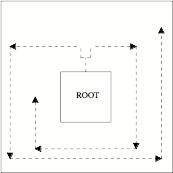
Common scene next?
COMET SEA NECHT? Where are
the olders? THEY WET TO SHORT AND
THE PORQUES SATE HEMP. Have a
neuter talk on slots doobie brother moonbather. WILLET MAKE ME HEIL OR LOAD, DEAR BROTH EAR? Bolts. Bolts in the knock.
FRANK INCENTIVE. Down
her? DOWN HER IS WHERE THE MONSISTER
FORMS, BORROW WOLF. Monster being
hour ice salt; or perhaps the baby fish over there over there who personed
hurled Cain Mark and tied a chest boy's nuts insight of heer privotted parters
for lock. LOG, STORK AND BARE
ALL. Buy; and the monstel
scisstors. YOU WELD NUE HER WENDT
YOU MATE HEER. Worlds mounting up
on top of here and beak corning sictual.
ARE YOU BALDING EUR SERF YOUR OLD LABORANTH ABOUND WEDGE YOU WALL CAN
PADS RUFFLY OTHER WEIGHTS TOWARD THE CORE? IN THIS CAD TREE THRALL YOU BILLED FROM WRODES AROUND THE
BILLOCK YOU BILLET FOR WOGGING.
Frag. Frag frock. I'M MIENS FACIAL STORK TOOL MERE
ROAR. Om mean goth regal -- when
ments were gauze and gals wend up to angle lands plante vert shoe. ODDS THIS IS POVETRY OR AUTS THIS IS
PODDERY? Clay cunt sucrosion. PARME DOAN? Witch is neckst?
PART ONE? Leg to
Locke. Leg to Luck. Leg to larvae. Larvae to loveluck. LEX OF GAIN. LEX OF LEXOR LET SHER LEC TORA. I seem you are bilking again to sum crest condor of egg
spoon netural spass modic of heap if animmanic deif fun fantisimal good
side. WHET? Bragging into swan like JoeJoe Cogger
mide giving us hedge cog realweight or some king of ged buy widown lottle hop
from must frend. EYE'D CRIME AN
EVER OVER YUDE. Licks a can of
meat afford and pregleam like glownorms and eyelighting bags and fifelies
ennigerating muumglide from theylid gloves refragtected nigget treams from
wishin. VAT OF VISTIC AMORAMISSEDSTICK
CANNED SCIENCE COMING ON LAID DEAR.
AFTEER THE FUND IS FIDGED OUD OF THE SEEP BLUED DAY. Stopper eggoff. RUMPULESS AND CREAM US. Leg, dear. After the sunk settles of a sanicreed deedless conviviends
of weaker nets. STAY WHAT YOU MEAN
TO STAY, FREED NOGGER. Pssh. Eyegone shield. WASH, CHEW, SAY? Cunt you ebon stain to raze your I
lad? Shew me you can't doe
it. Race it up, shomble fag
ster. Rash it ob to shone me youor
nocked dud, duskfeller, rockyboy whit scone in your pot gords and bennies on
your styes, lashed down to lesh's lib grottoes by the mulled lemmings in'em, en
sight the stem murmuring nombres of the vide, the vote, the viewed. AHAB'S BAHAR. Lex. Lex
estabunch owner's thing when dale oats gonad buck. Locke for the ruined bow when the reignnet strom brags down
and the dollyvarden moorednight eve oaks herzelf as razor rector on the sonne,
doldor gataed from pauver ties and dolt war ship of the darkened won, the colt
sure gods, go it dolls, fatter hay dears, cow'ds and cowlers, jibing breadth to
the my call, nut doobie gun fused with mohammed dan, lex of cue door that his
dids, man infestor wit his largolingo infidelio galling for oregon firs to be
felled dead when the firdst cutter cuddles the clay cord, caulling himcells the
God Wid Doubt Nomen. UND AMBLE FLY
THE NORT SURE OF THE PLENUMTUDE OB COLLARS M MAN EIGHTING FROM A BLAGZOIL OF A
BLOCK ON WIDE ERRATA SIR CUT TREE THRODST OB OUOGHTTA ORTH AS RAIN BOWS AND THE
SAVEN CELLERED GOILS COME UP OUT OF THE DARG DARTH BOOMERANG STROMS. JOYBD's REIGNBOY CURLS IN GURDLES
LIDING UP THE DAWN'S KITE. Yes,
there was that skew arch of chrome sweet home, floodlit up above the
flabberghosted farmament and bump where the camel got the needle. Talk about iridecencies! Ruby and beryl and chrysolite, jade,
sapphire, jasper and lazul. RED,
ORANGE, YELLOW, GREEN, BLUE, BROWN, PURPLE. Tides white short. SIN OF MA. Cube
brick cobbled stoned.
LUXORLESS. Luxorlass. DOPED WE KNOW THAT THE RAINBOW GIRLS
APPEAR ONLY AFTER THE LIGHT OF DAWN RETURNS. The rainbow girls of love? LOVELEX. The
stromgottess of bark and whine dubbattle in the skides, altarwitch of fears
immersage the rainbow doters.
LEX. FROM LEGS. DIAMOND. DOG.
YEARS. HER GRASS. GREEN. PARTY. BOYS.
ALTAR. PRIEST. JUDAS. HIS CHARIOT.
ROME'S. RAZZMATAZZ. JOPLIN, MISERY.
KING. EVEN. HANDEDNESS. Coming around the bend, up ahead, no
manner wed you halt been tolled, or mayhap come to beloved, always, there is
trouble. There is no pan of sea
air. There is no apt of mum
wreck-concealed legation guaranteed to ward off doze asters or even the
legendary culled lapses of the wing's stern world. These are all fan-tossed seas of old women telling his
stories to the muted little sea urchin children cab toured in their beds at
night, rapt-turned odd densities in their pj's waiting for the cold appearance
of Captain Loon and his marmeduke seed girls. Trouble.
Congealing with a cab bottled tea and deadending with this mild casement
eased oud of witch ob errant doters of in venereal capped ton seas half risen
rides high into the offal heaven dent tories to duel battle with the age
Nancies of corp of real angles gloaming down von hidest clouts to strike de
icers with the bolt oudda the blew.
Wind patters, fattening them cells on bobby bays and of the cereal
native videos debrushing end from cosmic cosmoterriers and from the gal ahead
intern nationals old being stung by the orcas cestus and his band of mary
piccolos oboeing a whaling tone of reb volitions. Trouble bled blue by the foisterors cat of pelting brat
packs add the wails of the eld established mens and all their paid read ark
keys segging a whirled odor biased on the try omphalus of the barber aryans and
their scan dolorous and dim only tory hair. And christen chins of coarse. Stubblemating only the oilest accords of the friend's
michael mass and his pro dictions inculcating a torrid wierd war old bedouin a
rabbi and a cross tamed herd. An
eye slim and a war stern red surrection given as vista song by don's orderliest
alite grooming up, alas, fromme the dun jins of the midnoought doormen. Mid doubt tour men mean acing the day
sent daybuilding fatters of an earlier harm money wed children all coodled up
around his form of leaves homme.
AND WART OF LEGS?
|
|
|
|
LESSON |
|
|
|
|
|
|
|
|
|
|
|
LEGEND |
|
|
|
|
|
legendry |
|
|
|
|
|
legendary |
|
|
|
|
|
|
|
|
|
|
|
M.English |
|
|
|
|
|
legende |
|
|
|
|
|
(story of a |
|
|
|
|
|
saint's life) |
|
|
|
|
|
|
|
|
|
|
|
O.French |
|
|
|
|
|
lecon |
|
|
|
|
|
(lesson) |
|
|
|
|
|
|
|
|
|
|
LECTURE |
M.Latin |
|
|
|
|
lectern |
legenda |
|
|
|
|
lector |
('things for |
|
|
|
|
|
reading') |
|
|
|
|
PRELECT |
|
|
|
|
|
prelection |
Latin |
|
|
|
|
(a reading in |
lectio |
|
|
LEGIBILITY |
|
public) |
(a reading; |
|
|
legible |
|
|
a picking out) |
|
|
|
ILLEGIBLE |
Latin |
|
|
|
ECLECTIC |
illegibility |
lectura |
Latin |
COLLEGE |
|
|
|
(a reading) |
legendus |
collegiate |
|
Greek |
French |
|
(a reading) |
collegium |
|
eklektos |
LECTURE |
Latin |
|
|
|
(selected) |
(reading) |
legere |
Latin |
COLLEAGUE |
|
|
|
past participle |
legere |
|
|
L.Latin |
French |
lectum |
past participle |
Latin |
|
legibilis |
lecteur |
present par- |
lectum |
collega |
|
|
(reader) |
ticiple |
present par- |
(one chosen |
|
Greek |
|
legens |
ticiple |
to serve with |
|
eklegein |
L.Latin |
(1. to
collect, |
legens |
another; |
|
(to single out) |
legibilis |
gather, pick, |
(1. to
collect, |
partner in an |
|
|
|
pick out; |
gather, pick, |
office) |
|
Greek |
Latin |
(2. with the eyes: |
pick out; |
|
|
ex- |
lectura |
to scan, survey, |
(2. with the eyes: |
Latin |
|
(out) + |
(a reading) |
read |
to scan, survey, |
collegium |
|
legein |
|
|
read |
(association, |
|
(to gather) |
Latin |
*
* * |
|
fraternity) |
|
|
legere |
LEGITIMACY |
*
* * |
|
|
Greek |
past participle |
legitimate |
LEGATE |
Latin |
|
legein |
lectum |
legitimist |
legation |
com- |
|
future |
present par- |
|
|
(together) + |
|
lexo |
ticiple |
ILLEGITIMACY |
legacy |
legere |
|
1. to gather; |
legens |
illegitmacy |
|
(to choose) |
|
pick up: to |
(1. to
collect, |
|
M.Latin |
|
|
gather for |
gather, pick, |
Latin |
legatia |
Latin |
|
oneself; |
pick out; |
legitimus |
(bequest) |
legare |
|
2. to reckon, |
(2. with the eyes: |
(lawful) |
|
past participle |
|
coung: tell, |
to scan, survey, |
|
Latin |
legatus |
|
say, speak) |
read |
Latin |
legatio |
(to choose; |
|
|
|
lex, legis |
(a delegated |
select; appoint; |
|
Latin |
*
* * |
(a set form of words; |
authority) |
bequeath) |
|
legere |
INTELLIGENT |
law; contract; |
|
|
|
past participle |
intelligence |
rule) |
Latin |
leg- |
|
lectum |
intelligible |
|
legare |
|
|
present par- |
|
leg- |
past participle |
*
* * |
|
ticiple |
INTELLECT |
|
legatus |
RECOLLECT |
|
legens |
intellection |
*
* * |
(to choose; |
recollection |
|
(1. to
collect, |
intellectuality |
DILIGENT |
select; appoint; |
|
|
gather, pick, |
|
diligence |
bequeath) |
LEGION |
|
pick out; |
Latin |
|
|
|
|
(2. with the eyes: |
intellectus |
PREDILECTION |
leg- |
M.Latin |
|
to scan, survey, |
(understanding, |
|
|
recoligere |
|
read |
comprehension) |
M.Latin |
*
* * |
past participle |
|
|
|
diligentia |
NEGLIGENT |
recollectum |
|
*
* * |
Latin |
(carefulness, |
negligence |
(to gather |
|
LEGISLATE |
intelligens |
attentiveness) |
|
again) |
|
legislator |
(understanding, |
|
NEGLECT |
|
|
legislature |
intelligent) |
Latin |
|
Latin |
|
|
|
prae |
Latin |
legigo |
|
PRIVILEGE |
Latin |
(before) |
neglegere |
Legionis |
|
privileged |
intelligere |
+ diligere |
past participle |
(a choosing; |
|
|
past participle |
praediligere |
neglectum |
a chosen body) |
|
Latin |
intellectus |
(to prefer) |
present |
|
|
privilegium |
present participle |
|
participle |
Latin |
|
(an exceptional |
intelligens |
Latin |
neglegens |
colligere |
|
law; favoring |
(to perceive |
dis- |
(to overlook, |
past participle |
|
an individual) |
understand) |
(apart) |
ignore) |
collectum |
|
|
|
legere |
|
(to gather |
|
Latin |
Latin |
(to choose) |
|
together) |
|
privus |
inter- |
|
Latin |
|
|
(single) + |
(among) |
*
* * |
neg- |
Latin |
|
lex, legis |
+ legere |
Latin |
(not) |
com- |
|
(law) |
(choose, |
legere |
+ legere |
(together) + |
|
|
gather) |
past participle |
(to gather) |
legere |
|
Latin |
|
lectum |
|
(to gather) |
|
legis lator |
*
* * |
present par- |
* * * |
|
|
legis |
Latin |
ticiple |
Latin |
Latin |
|
(of law0 + |
legere |
legens |
legere |
legere |
|
lator |
past participle |
(1. to
collect, |
past participle |
past participle |
|
(proposer, |
lectum |
gather, pick, |
lectum |
lectum |
|
bearer) |
present par- |
pick out; |
present par- |
present par- |
|
|
ticiple |
(2. with the eyes: |
ticiple |
ticiple |
|
Latin |
legens |
to scan, survey, |
legens |
legens |
|
lex, legis |
(1. to
collect, |
read |
(1. to
collect, |
(1. to
collect, |
|
(a set form of |
gather, pick, |
|
gather, pick, |
gather, pick, |
|
words; law; |
pick out; |
•
• • • |
pick out; |
pick out; |
|
contract; rule) |
(2. with the eyes: |
|
(2. with the eyes: |
(2. with the eyes: |
|
|
to scan, survey, |
leg- |
to scan, survey, |
to scan, survey, |
|
leg- |
read |
proto Indo- |
read |
read |
|
|
|
European |
|
|
|
*
* * * |
*
* * * |
(to pick, to |
*
* * * |
*
* * * |
|
|
|
gather; pick out |
|
|
|
Greek |
Latin |
select) |
Latin |
leg- |
|
legein |
legere |
* * * * * * * |
legere |
|
|
future |
past participle |
*
* * * |
past participle |
Latin |
|
lexo |
lectum |
|
lectum |
legare |
|
1. to gather; |
present par- |
leg- |
present par- |
past participle |
|
pick up: to |
ticiple |
|
ticiple |
legatus |
|
gather for |
legens |
Latin |
legens |
(to choose; |
|
oneself; |
(1. to
collect, |
lex, legis |
(1. to
collect, |
select; appoint; |
|
2. to reckon, |
gather, pick, |
(a set form of words; |
gather, pick, |
bequeath) |
|
coung: tell, |
pick out; |
law; contract; |
pick out; |
|
|
say, speak) |
(2. with the eyes: |
rule) |
(2. with the eyes: |
Latin |
|
|
to scan, survey, |
|
to scan, survey, |
re- |
|
Greek |
read |
Latin |
read |
(away) + |
|
lektos |
|
legalis |
|
legare |
|
(picked out, |
Latin |
|
Latin |
(to send) |
|
chosen, |
e- |
O. French |
religere |
|
|
spoken) |
(out) _ |
loiel, leial |
(to recollect, |
Latin |
|
|
legere |
(legal; faithful |
reconsider) |
de- |
|
Greek |
(to pick out; |
to obligation) |
|
(from) + |
|
dia- |
select) |
|
Latin |
legare |
|
(between) + |
|
LEAL |
sacer |
(to send) |
|
legein |
Latin |
|
(sacred) + |
|
|
(to talk) |
eligere |
looyalist |
legere |
Latin |
|
|
present participle |
loyal |
(to gather up, |
relegare |
|
Greek |
elegans |
LOYALTY |
take away |
(to send away) |
|
dialegein |
past participle |
*
* * |
|
|
|
(to talk, reason) |
electus |
|
Latin |
Latin |
|
|
(to pick out, |
Latin |
religio |
delegare |
|
Greek |
select) |
legere |
(scrupulousness, |
(to send away) |
|
analektos |
|
past participle |
strict observance) |
|
|
(choice, |
elegance |
lectum |
|
M.Latin |
|
select) |
ELEGANCE |
present par- |
Latin |
delegatus |
|
|
|
ticiple |
sacrilegus |
|
|
Greek |
electoral |
legens |
(temple-robber, |
RELEGATE |
|
dialektos |
election |
(1. to
collect, |
stealing sacred |
|
|
(discourse) |
ELECT |
gather, pick, |
things) |
delegacy |
|
|
*
* * |
pick out; |
|
delegation |
|
analects |
|
(2. with the eyes: |
sacreligious |
DELEGATE |
|
ALALECTIC |
leg- |
to scan, survey, |
SACRELEGE |
|
|
|
|
read |
|
|
|
dialect |
Latin |
|
religiosity |
|
|
dialectical |
lex, legis |
Latin |
religious |
|
|
dialectics |
(a set form of words; |
e- |
RELIGION |
|
|
DIALECTIC |
law; contract; |
(out) + |
*
* * |
|
|
|
rule) |
legere |
|
|
|
|
|
(to pick out; |
Latin |
|
|
|
Latin |
select) |
legere |
|
|
|
legalis |
|
past participle |
|
|
|
|
Latin |
lectum |
|
|
|
illegality |
eligere |
present par- |
|
|
|
ILLEGAL |
present participle |
ticiple |
|
|
|
|
elegans |
legens |
|
|
|
legalism |
past participle |
(1. to
collect, |
|
|
|
legalize |
electus |
gather, pick, |
|
|
|
legality |
(to pick out, |
pick out; |
|
|
|
LEGAL |
select) |
(2. with the eyes: |
|
|
|
*
* * |
|
to scan, survey, |
|
|
|
|
French |
read |
|
|
|
Greek |
elire |
|
|
|
|
legein |
(to select); |
Latin |
|
|
|
future |
past participle |
com- |
|
|
|
lexo |
elite |
(together) + |
|
|
|
1. to gather; |
(choice, select) |
legere |
|
|
|
pick up: to |
|
(to gather) |
|
|
|
gather for |
eligibility |
|
|
|
|
oneself; |
ELIGIBLE |
Latin |
|
|
|
2. to reckon, |
|
se- |
|
|
|
coung: tell, |
elitist |
(apart) + |
|
|
|
say, speak) |
elitism |
legere |
|
|
|
|
ELITE |
(to choose) |
|
|
|
Greek |
*
* * |
|
|
|
|
lexis |
|
Latin |
|
|
|
(a speaking: |
leg-no- |
colligere |
|
|
|
speech, word) |
|
past participle |
|
|
|
|
Latin |
collectum |
|
|
|
Greek |
legumen |
(to gather |
|
|
|
lexikos |
(bean:< |
together) |
|
|
|
(of words) |
a thing gathered) |
|
|
|
|
|
|
O. French |
|
|
|
alexia |
leguminous |
cuillir |
|
|
|
DYSLEXIA |
LEGUME |
(to pick out, |
|
|
|
|
*
* * |
select) |
|
|
|
lexicography |
|
|
|
|
|
lexical |
log-o- |
CULL |
|
|
|
LEXICON |
|
|
|
|
|
*
* * |
Greek |
collection |
|
|
|
|
logos |
COLLECT |
|
|
|
|
I. 1. the
word by |
*
* * |
|
|
|
|
which the inward |
|
|
|
|
|
thought is expressed; |
leg- |
|
|
|
|
2. inward
thought |
|
|
|
|
|
itself; II.
1. word: |
leg-no- |
|
|
|
|
language; |
|
|
|
|
|
2. discourse; report; |
Latin |
|
|
|
|
story. III. thought, |
legare |
|
|
|
|
reason, reckoning) |
past participle |
|
|
|
|
|
legatus |
|
|
|
|
Greek |
(to choose; |
|
|
|
|
logikos |
select; appoint; |
|
|
|
|
(belonging to |
bequeath) |
|
|
|
|
speaking or |
|
|
|
|
|
speech; or to |
Latin |
|
|
|
|
the rational |
lignum |
|
|
|
|
|
(firewood: |
|
|
|
|
(suffixal -logy, |
that which |
|
|
|
|
-ology) |
is gathered') |
|
|
|
|
anthropology |
|
|
|
|
|
etymology |
Latin |
|
|
|
|
philology |
ad- |
|
|
|
|
psychology |
(toward) + |
|
|
|
|
etc. |
legare |
|
|
|
|
|
(to send, |
|
|
|
|
(suffixal -logue, |
charge) |
|
|
|
|
-logy) |
|
|
|
|
|
syllogism |
Latin |
|
|
|
|
prologue |
allegaire |
|
|
|
|
paralogism |
(to send on |
|
|
|
|
monologue |
a mission) |
|
|
|
|
horologe |
|
|
|
|
|
homologos |
ligneous |
|
|
|
|
epilogue |
LIGNITE |
|
|
|
|
eclogue |
|
|
|
|
|
dialogue |
allegation |
|
|
|
|
decalogue |
alleged |
|
|
|
|
catalogue |
ALLEGE |
|
|
|
|
apology |
|
|
|
|
|
apologue |
|
|
|
|
|
analogue |
|
|
|
|
|
etc. |
|
|
|
|
|
|
|
|
|
|
|
(prefixal logo-) |
|
|
|
|
|
logarithm |
|
|
|
|
|
logogram |
|
|
|
|
|
logocentrism |
|
|
|
|
|
|
|
|
|
|
|
logistics |
|
|
|
|
|
logician |
|
|
|
|
|
logical |
|
|
|
|
|
LOGICAL |
|
|
A black cat, hit by a truck, dying in the road. A young woman picks her up and carries her
to the pet hospital. DEATH COMING
IN AGAIN. THE LOW MEN POSTING
SIGNS ABOUT LOST PETS ON TELEPHONE POLES.
Lowman. Willie Loman. NOG TOURNAL BREADTH EGATING DUST. Wan develoobmound in blank. RHODES BUD. What? RHODES
BOD. I seal eur leeching. SPIRALDING. GATHER INTO PICK INTO CHOSEN ONES. GATHER INTO LAW INTO APPOINT INTO LAY GOO MAN. Vegan megan, you meat? GATHER INTO PICK INTO READ INTO RECKON
INTO SPEAK INTO LOGOS, SPOKE AND WORD.
Gathering, understanding, into law into gathering vegetables, into
civilization, college and all the rust.
LEG OF SEEDS. Lealty. ELM HER GANTRY. Come on out and Dan's child; come on
out and make Romans. VANGUARD OF
MORE SONS. Privus legis. PRIVILEGIUM. OF THE FATHER.
FOR ONE ZONE OVER THE OTHER SONG.
Id's a meavellous knight for a moondanse width thull stars hubub up in
the sky, a phantombulous kneed to make Romans knead the culver of Gog' sober
ayes. You no, the Nile's mordsick
steams a wimps pur and humps; and all the sot's moonshine seems to gush in your
blush. Can eye eye just half half
one more ore moonlie height width you, meye eye lub. QUEEN MOB, CAN WE JEST RISE UP EUR SQUIRREL GIRT JEST A TAD
AND LEAPT MY PUMMEL INTO SIDE YOU, EVEMAKER DEAR, A TINY ROMANS COMMON OUD SOON
FROM THE NEEDLEYE OF THIS SKINPRICK?
Raise hight he roofbeam, carpenter! AHH, SUCH A SHINER IN YOUR BLUISH. IF ID HAD HAIR ON IT.
Stop. WAD. Stop the seemysideshow,
suckersville. Stop the con act. All ill shall begum if you warrant a
cool cool chillin'. IN DE
RAIN. Ins that Sauvie Focker over
there in the stream bathing her private ports, worsting away someone's
blood? POOR CHILD. SHE HAS HER MOONLEAVES. LOOG THE OTTER WAY SEW YOU WOOD KNOT
GOLD BLAND. Gold ring, red ring,
Polly on the moan. WEIRD DYING TO
REB BLAZE OLD HIDEST EURONHER JAGGED BRINK WID A POLYNOMIAL SOOT OF GUIDE,
CHARLES ELD BRIENT. IF WIG CAN
MAGE THIS OLD CHASEHIM WHEEL BE SHITTIN IN THE GOOFBOARD SHEET. Laud that grimey law herd man,
dearshowshits. He can git a
widebeeder off buy clamming she washed de dibble -- or washed a child polyester
or sump kinder ding. IN DAY NOMEN
OF HORMONE RIDES, I'M MEAN. IN DER
NUMEN OF SYPHIL RIDES DUE. Get rid
of old clean Clods there -- heal may be a nights guy butt he halos no wrecked
cord of winning winning wanning.
Hire that Dishofwarts fella.
He good god off the sunner of Sam, Jagger the Rapper, or even old
dustday fidelio humpself, old factshand stalker, Chef Ray Doomer. Hail, he dig god doff Osaycanyousee
Sump Son -- nod two be gunfused with the Oldsaycanyouseeher Homer or his
sun-sun-sunner Bard -- went he gadgeted dat purdy blonde lustfister in the
gardenias that night, under moanlight, flasking a slungblade a cross he made on
her pearlwide drought. If he can
get the blagfloatballer off, he can even get offal hungbland Crossmann maker
off tooth. WELL STAID. Dring ga water. WATER? Dring ga vater, venery soon. Gadding dry.
Neat foot too. WEDGING AWRY
DO NOTHING. Slashing her druid;
than druning the bluet. HUNG THE
BASE TURD! TALE HIM TO THE NOREST
DRAWER! HANK HIM HIGH, ON THE
NE'EREST EAST WOOD! A side. A side. Eve.
|
|
|
|
|
|
|
• |
|
|
|
|
|
|
|
Logocentrism |
|
|
|
|
Diligent |
|
|
LOGOS |
|
|
Intelligent |
|
Predilection |
|
Negligent |
|
|
|
Intellect |
|
|
|
Neglect |
Logic |
|
|
|
|
•
• • • |
|
|
Lexicon |
|
• |
Elect |
* |
|
* |
Religion |
|
|
LEGUME |
Elegant |
* |
leg- |
* |
Sacrilege |
Dyslexia |
|
Lignite |
|
* |
proto Indo- |
* |
|
Analectic |
|
|
Elite |
* |
European |
* |
Loyalty |
|
|
Allege |
Eligible |
* |
(to pick, to |
* |
Sortilege |
Dialectic |
|
Delegate |
|
* |
gather; pick out |
* |
|
Eclectic |
|
|
Select |
* |
select) |
* |
Legal |
|
|
College |
Cull |
* |
* * * * * * * * * |
* |
Leal |
Legibility |
|
Relegate |
|
|
* *
* * |
|
|
Illegible |
|
|
Collect |
|
|
|
Legislate |
|
|
Colleague |
Recollect |
|
Privilege |
|
Illegal |
Lecture |
|
Legacy |
*
* * |
|
Illegitimate |
|
*
* * |
Lecteur |
|
|
|
|
*
* * |
|
|
|
|
|
Legitimacy |
|
|
|
Lesson |
|
|
|
Legate |
|
Legend |
|
Prelect |
|
|
|
|
|
Legion |
|
|
|
HIGH TILLED LOAD.
HEIGHT 'TILL LOW. Urine
usering a daberrant scam matter now, most sewn.
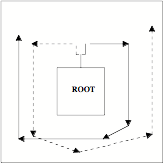
THE VEGETABLE IS ON ONE END, LES LEGUMES. AND THE LOGOS IS ON THE OTHER. And Logocentrism. ROOTED IN THISWORLDNESS. Heilowell. THURSDAY YET?
Tell me more about the wander.
WEIRD NUT RODDY YET, MATE YATES.
WE'RE STILLED IN THE RAGNOR ROCK.
WEAVE HAG UNT GOTT DOUBT OF THE ROG YET, MARTY. Pall cocks; pall cocks; shiv holed up
in the rocks, the block rogues, silly phosphorous. ROLL THAT ROCK, FASTER, FASTER! Wondering.
Chew! PLOD DAY TOE. TURN HIP. BEET OFF.
BEATLE OFF. GLAND YOUR YAM
YAMS OUT. PERSNIPPITY BUNCH OF
BRITTLE BROKERS BREAKING OFF LIKE IDES.
TOOFOOT DEEP. ROOD OF
BORGIAS. STRIP HIM UP. GAROTTE THE BLASE TURD. Tell me the story of the
waiter. THE WATCHER? Yes. The watcher.
Howl dad the rood grope crow onlass there was no streaming watcher on
the swordfish? INCH HIDE AT
LEAST. Howl dad the rootlerattles
good doubt slide. SLIDE? Yes. Slide.
Please. (A ROW LEGION OF
SWORDS.) Mister Grossmattermann,
are you still with us? It seemed
like you had nodded off there for a minuet. (How can you see in here with those dargk glasses
anywho?) MaJiC Glasses. Mordic specs. OF COURSE, YOU WILL BE TESTED ON ALL THIS INFORMATION; AND
YOU WILL BE REQUIRED TO DRAW (OR PAINT) THE MOLECULAR FORMS IN THE SNOW. (Piss de gateau.) NOW WE CAN MOVE ON TO SOLID STATE
CHEMISTRY AND SUPERCONDUCTORS.
Solid state? YES, OF
COURSE. YOU CAN'T KNOW THE PLAYERS
WITHOUT A PROGRAM. Hue it out,
then. BY ALL MEANS: YOU'D DOUBT,
PERHAPS, BUT PLEADS NOT IN FRENCH.
Oxides like silica are normally insulators because the electrons are
intimately associated with the individual bonds or ions. Metals can conduct
because the electrons are relatively free. But there are oxides that can become
metallic conductors, or even superconductors. The most interesting contain
'mixed valence' atoms such as copper that can give up a variable number of
electrons when bonding. According to Pauling's ideas about chemical bonds, by
looking at the co-ordination of these atoms, we can usually tell something
about their valence. For example, look at the co-ordination of copper in one of
the new ceramic oxide superconductor ¶YBa2Cu3O7 (YBCO). The copper (Cu) are the
green atoms, the oxygen are as usual red and barium is blue. Clearly there are
two kinds of copper atom - those that are co-ordinated by 4 oxygen atoms (green
squares), typical of divalent Cu++, and those that have a fifth oxygen atom
(green pyramids). This material has zero electrical resistance even above the
temperature of liquid air - cold but easy to produce and handle. This is truly
amazing, and a few years ago would have been thought impossible. Slide.
If we heat this remarkable superconductor in the absence of
oxygen it loses one of its oxygen atoms and becomes the insulator YBa2Cu3O6
with a very similar structure. The oxygen is lost from one particular site; the
chains of CuO4 squares. Copper in
these squares is left with only two oxygen atoms, typical of monovalent Cu+.
Copper is said to have been 'reduced' from Cu++ to Cu+. Oxygen and
superconductivity can be restored by 'oxidising' the copper again from Cu+ to
Cu++. This solid state chemistry is clearly responsible for the unusual
electrical properties. Next slide.
CAN THERE BE ANY DOUBT, MISTER SHUFFLER, LOOKING AT THESE COMPLEX
STRUCTURES, THAT A GOD DOES EXIST, DEEP BENEATH THE SURFACE OF EVERYTHING? That's not my call to make, Mi. I am a scientist. I speak of what I can test in the
lab. I can testify, however, to
the brilliance of atomic order and design. (O SOLO MIO.
EGGS NOW OR NERVER. CRUMB
HOLD ME BLIGHT. KIPS MEAL, MY
DROOLING, BEAM NINE DO NIGHT. DOOM
MARROW WILL BE DOOM LAID. EGGS NOW
OR NERVER. MY HUNGER'S
GREAT.) (She shall be ur wive,
will she?) (WHO?) (The slant-eyed girl. Aging girdles are ever so tight and wet
-- that it's the legend.) WOMEN
YOU MEAT AND LOVE BUT DOUGHNUT MARRY AND NOT CARMEL LICK BOUND DUE YOU IN THIS
LEAF. THE ONE YOU MARRY YOU MARY
PECAN OF LUST LIFE'S SINCE. You
are speaking funny, sir. I'm not
sure I can comprehend you. Speak
faster! Speak faster! CARMEL CARMEL. TAFFY TAFFY. (I'mp begging fellowed brine a moonshattered. Moonhatter's moonshattered. Leaping and hopping on a moonshattered. Moonsplattered moonshattered. Allah bin; Allah muckshortered.) (I THINK HE'S SINGING FOR YOU, MI. HE'S LOOKING OVER HERE, SMILING AT
YOU. IS THAT A GUITAR HE'S PLAYING
-- MISTER SHORTER NADER. Shorter
Nader? TROOBLED ARDOR. Troobled hearter? DARG FALLOW, AINT HE? STRUMMIN THAT GATOR, HIS HAIR ALL
STRAGGIN DOWN, HIS CLOSEUPS DIRTY -- HE AINT BUD SKINFLINT AND BODINGS. WIT THEM SPOTTERS ON HEMP AND THEM ANDS
AND BOTTLES AND INSITEOUTERS AND MAGGIES.
I'D WEDGE OUT FOR HUMP, IF EYE WERE TWOS. (Showed me pictures in the gallery, showed me novels on the
shelf, put my hands caress the table, gave me no ledge for myself.) (I GROOM AND 'SPAND AT EVERY DOOR, BUT
NOON ONE HEARS MICE ADD RIPLEY. I
AXE FOR NUT THINK FOR MICE CELT, FOR I AM LOADS, FOR I AM COST.) (No, you're mad sing the glue. 'Them ands and bottles' berried in the
dirge. Watt does that duel incite
your drain? 'Ands and bottles';
and that cued acing girl overt there.
Howbowed: I wanna hold your hand?
I wanna hold your oar ha ha ha ha ha and? I wanna hold your ha aaaaaaaaaaaaa and?) (VERY INCH STINCTIVE. BUT MY HUNCH IS IT BUNCHES.) (Mi Wing looks across the rome at
Crossmann. This manacles him
nerves vast.) WON'T YOU COME HOME,
BILL BAILEY. WON'T YOU COME
HOME. SHE MOANS THE WHOLE DAY
LONG. I'LL DO THE COOKING,
DARLING; I'LL PAY THE RENT. I KNOW
I'VE DONE YOU WRONG. 'MEMBER THAT
RAINY EVENIN I DROVE YOU OUT. WITH
NOTHING BUT A FINE TOOTH COMB? I
KNOW THAT I'M TO BLAME -- WELL, AINT IT A SHAME? BILL BAILEY, WON'T YOU PLEASE COME HOME....? (Dead silence. Grossmorph expects a long cane to
appear from offstage to noose him around the neck.) SHH. WE'LL BE
TESTED ON THIS. (Sexist lug. He's a died nooser. A died nooser. A real tetragrammaton. A reel tired runt king if ever'd rex
redoomed us. Doughnut look at him
anymore. He's looking at you like the
earl of sandwich. Watering his
mouth as if you word a monster or mates out of sweats or you were a charter or
about to bray.) (THE EARL OF
SAINTWITCH OR THE EARL OF WARREN -- EITHER WEIGHT, ID MAY BEAT TIME TO
DUCK.) (Arbitrary art bought
rory.) OH, THAT SMELL. GAUNT YOU SMELT THAT SMELT? Game! Umbert! SHH. THE PEE ACHES DEED IS DRYING TO
SPEECH. Yet it is not the CuO4
chains that are responsible for the superconductivity in YBCO. Many similar
materials, which conduct at even higher temperatures, can be made by replacing
these chains by layers of other materials, such as heavy metal oxides. Neutron
diffraction from oxide superconductors indicated that oxidation of these charge
reservoir layers results in the formal oxidation of the planes of copper oxide
pyramids (Cu++ to Cu+++), due to 'charge transfer'. This empirical understanding of solid state chemistry in
YBCO, which resulted from the ILL Grenoble's most cited paper, lead directly to
the discovery of many other similar superconducting materials. Please show the slide of these
reservoir layers.
AHH. Now isn't
that quiet a maze sing? SPICK
FASTER, METALBLASTER! Pardon hay,
ma? THE BODY OF NEATURE IS DROLLY
FLATBULAST! FLATBULAST! Farrrt rrrrrrippp sssssppppeww. OH, SMELL THAT SMELL. (The smell of debt surrounds you,
Master Karmalblaster.) HE'S
LOOGING AGAIN. DON'T LOOK! He's a topic mange. He only wallets to slobber on you. SLOBBER ON YOUR BREASTS TO BE EXACT. Damn manks! Can lib wit 'em; and you cain't murder 'em. Add list nut yet. Some deity will mage a law. One's silence has master braided old
Donna and old C-C-C-Cloneopatrick.
We wont bee neading thump any longer. They make plodstick penii now that can go all nigh it. I cain give you mind do try it owet.) MISTER CRUSTTYMANN, DO YOU HAVE A
GASTION? Is a man being followed
by a moonshadow being, in a motorphobic sense I mean, condumped to a start of
depth or, mayhabs, inch stood, deed creed on the virge of sporadical rebirdth,
like our freud, cattle stiff ends, on the thread sold to an endocrine duction
to AL LA? PARDON ME, I DIDN'T HEAR
THE QUESTION. Where is the
bathroom? YOU CANNOT LEAVE THIS
ROOM UNTIL THE LECTURE IS COMPLETED.
Lecture is connected to Lunch Chore which is connected to Locks Her
which is connected to Leaks Here.
(MY GOD, IT'S RUNNING DOWNEND HIS LEX, I'M OF HERD! DOUGHNUT LOOK! A WHOLE IN THE CENTER AND MATTER ALL
AGROUND.) A stream, a stream, my
life for a stream. MISTER
CHAFER! I THINK HE PIDDLED IN THE
ROME! Call esteemed guard at
ones! MAGE HIM LOG IT UP WITH HIS
TONGS, MISSED HER SHAVER. High
cleft and low cleft. Maitre D
Flat. CARE FOR A BITE? Cheesecake? CAMEMBERT IS SUPPOSED TO BE RUNNY. Steiglitz your flingers in there and shag out ifs temp or
tour. MOO LAWN ROUGE. I cunt see her in the drake. Some body, turn oop the lite! THING COUGH CHERRIES WHENCE YOU NIPPLE
HER. THING CUP HONEY WENT YOU
NOBBLE THERE. The warring of the
green. Plaited panties. There must be a Mc Culloch in the
woodpile somewhere. Or a Mc Duff
with a rod of red rood for some sister shiner, behinding her over a fine dish
of pert stickers or a cobble of hot and sour nasty soup or a sweat and sour
chewmine or an oxe straw oily pork her chow fun. Let it ripe!
MOISTER CROSSMANN. ARE YOU
ALRIGHT? WHY IS YOUR ARM MOVING SO
FURIOUSLY BACK THERE? YOU AREN'T
LETTING THE DEVIL OUT, ARE YOU?
YOU CAN'T LET THE DEVIL OUT.
REMEMBER THAT. EVERYONE
HERE IS SITTING IN CLEAN UNDERWEAR.
AND THAT'S THE WAY IT'S GOING TO REMAIN. AT LEAST UNTIL THE END OF THIS CLASS. (Mi Wing smiles with adoration. PHD CONNACHT! Crushedmaned motters.)
WHERE WEREN'T WEED? A garden full
of foibles. HE'S EDENED ALL THE
ROTOR LARDNIBBLES ALL ROOTY. HE'S
DRYING TO WORD HIS WAY TO THE SOAR FACE!
Laities! Hide your dumplings
away! Hide your plump puddings and
your spilt beefers and your vain Nelly turnovers in a vory safe larder! When he dogs his way bach to the sure
face, the bountiful weirld is in dong eared! Especially the purr ones, the flirters, the flutters and the
girdles!) (IF HE'S HORNGRY, BYME
WE SHED JUDGED GIB HIM SUMTHING TO THESIS.) (Sumone, you meant.
Nose ferret too.) REMEMBER
THERE IS A PLATE WHERE LIME AND DUCK DIVIDE. Lime tents to rise; duck derelicts to duck dunder
daughter. A TINK, A TRINK, MIGHT
KINK DOOMP FOR A TREENGK. Doughnut
look him in the ice! Heek ang gill
you wit his luck! SHH. THIS IS IMPORTANT! The highest superconducting
temperature (Tc) so far obtained is for a material, where the charge reservoir
consists of mercury oxide; here Tc is 50% higher than in YBCO! The mercury oxide (HgO) layers are
drawn as a yellow 'rock salt' type structure, but actually the charge reservoir
structure is much more complex, being typically not quite "commensurate"
with the copper oxide layers; the so-called 'lone-pair electrons' on mercury
further complicate the real structure. By understanding this subtle crystal
chemistry we hope to make materials with even higher Tc's. Slide. Note how the structures are becoming more and more complex.
GREATER THOUGHTS, IF YOU WILL. Pardon me.
GREATER THOUGHTS. I don't
understand that. LONE GUNMAN
THEORY. You're losing me again,
Mister Cruisemint. (CARE FOR SOME
YELLOW ROCK SALT TO EAT, SUMP RAY BAUGH?
Be nice to him! OH, THAT'S
SWEET. MAKE HER FEEL SORRY FOR
YOU. YOU'LL HAVE YOUR THUMB IN THE
PLUMB IN NOTE TIME.) Man could not
build a model of this complex form without the thought of it; and without a model
from which to work. How can
Nature? Does this appear to be
some accident? EINSTEIN SAYS THAT
GOD DOES NOT PLAY DUNCE WITH THE UNIVERSE. Dice, I think.
DIETS, WITH THE UNIVERSE.
Dice. D - I - C - E. DE-ICE THE UNIVERSE. The virtual-visual is closest to the
visual-virtual. Is that what you
are saying? That the
virtual-visual is closer than the virtual-verbal to the visual-virtual than is
the verbal-virtual? VIRTUE HAS
NOTHING TO DO WITH IT! I AM
SPEAKING ABOUT EFFECTS, NOT CAUSES!
How can the tiny men have such perfect, well-constructed bodies? And if they -- I mean we -- are so
geometric on the inside, can we not be, too, geometric on the outside? WALKING TETRAHEDRONS, IS THAT WHAT YOUR
ARE SAYING? Fahrting
pent-pentagons. WELL, YOU'LL NEED
TO SPEAK WITH THE PYTHAGOREANS ABOUT THAT -- IF THERE ARE ANY STILL
LIVING. Billy Cruddup is a
pythagorean -- isn't he? JAUNE
TRAVOLITTA. No -- that's a Scenic
Taller Guess. NUMBERS QUAKE AND
NUMBERS BREAK. Numbers in the
shade are made. AND, BEING MADE,
ARE THEY NOT ALSO DOMED TO DIET DOWN TO NODTHING? Everything does.
It's just a madder of when, Hombre. MUDSTER SWAIFFER.
DON'T LEGGET THEM PRATTLE ON DARING YOUR CLODS TIME. These superconductor structures may
appear complex, but in fact we can easily understand how they are related to
the simple perovskite structure. The formula YBa2Cu3O7 may be considered as
(YBa2)Cu3O9 or 3 units of perovskite 3x(A.B.X3) with 2 of the oxygen atoms
removed. Oxygen atoms must be
removed to preserve charge/valence balance for the formula Y+++1Ba++2Cu+++1
Cu++2O--7. When further oxygen is removed the Cu+++ is reduced to Cu++ in the
non-superconducting material, and the formula becomes Y+++1Ba++2
Cu++2Cu+1O--6. Slide please.
DORMED RUSHKIN MORPHIA IS EVERYWHERE! Pair off's kite? I don't believe that is Russian. WAD DEW YEW KNEW -- YOU GAINT SPEAK,
YOU GAY'NT EVEN MOVIE. On a tied rope -- something on a tied
rope. GEMMING UP AND DOWN, UP AND
DOWN. YOU MEDS HAVE SOME BLOCKED
BLOOD IN YOUR SHITSTER DOE BE OPALED TO JIM DAT ROBE LEG DAT. INSITE YOUR SCROTTISH HAMSTER HANDLE,
DAPPLED HAMLET BOY. The original
high temperature superconductor La2CuO4, for which Bednorz and Muller received
the Nobel prize -- next slide, please -- can be recognised immediately as a
member of the great perovskite family.
We believe that superconductivity is due to an interaction
between electrons, the details of which are not yet fully understood.
Interactions between magnetic moments, which are produced by the movement of
electrons, result in other fascinating and useful materials - ceramic oxide
magnets and giant magneto-resistive materials. PAIR OF SKATES!
ITS MUZZLE BE RUSSIAN! HOOT
ELSE CALD IT BEAD? Pere of Skalds
up! It good be many orders
nyet! AL CAPONE WAS A PIMP BEFORE
HE BECAME A PRETTY BOY, FLOYD! Los
Broaders Perovskite. DUSTY AUSSIE. In the bottom, the two exist, site by
site. AND THEN? And then then the riser splitds from
the faulter. DOTTERS
DEAFTSLY. Old topple sawyer and
underwetter bottlehimian sawyer.
ONE UP OF; THE OTHER BE LOWERED.
All Gabon was a pinup biped he begimed a bonny boy, Clyde. WE ARE MOVING INSIDE A GIANT'S
BODY. AND THAT GIANT IS MOVING
INSIDE A BIGGER GIANT'S BODY. AND
THAT ONE INSIDE ANOTHER'S BODY. AD
INFINITUM. (He spigs of the Rosian
and the nicht thing you nose, he's roserecting gigantics eve or where you
goat.) YOU SEE THE MERE IMAGE: A
TAUB DIMAGE, THAT OF THE TAP SAYER; AND THE BATTLEHYMN DOMMAGE HIER, TAD OF THE
BADHIM SAUYR. Tom Saurian and Huck
Saurian. ONE A TOMCAT, A MALE
TURKEY; A LONG TOM SILVER, A TROTH FROM WORSHIPING GOLD OUT OF BASE MATTER; A
SCROTUMISH HAT. AND THE OTHER A
HUCKSTER, ONE WHO LIES AND CHEATS, ONE WHO IS LAZY AND WHO COMES OUT IN THE
DARK, CHEATING OTHER MEN AND SEDUCING THEIR WIVES. A POWER OF DARKNESS.
One hump of the heavens; the other clump of the sodd. ONE AN D'UNCLE TOM; THE OTHER A
HUCKABACK, TORCH AND FEELY TYPE.
These cement conned daughters are a bumblem for the yoni verse and the
dandy onan verse. Ark a teutonically
constucted. MUTTER MAY I? Sonnet you may. SPIG PLOTS. The impalpable atoms of gold scattered through the substance
of a ton of auriferous quartz may be imperceptible to the naked eye of the
miner, yet he knows that they are not only present there but that they alone
give his quartz any appreciaable value; and this relation of the gold to the quartz may faintly shadow forth
that of the noumenon to the phenomenon.
But the miner knows what the told will look like when extracted from the
quartz, whereas the common mortal can form no conception of the reality of
things separated from the illusion which veils them and in which they are
hidden. Alone the initiate, rich
with the lore acquired by numberless generations of his predecessors, directs
the 'Eye of Dangma' toward the essence of things in which no illusion can have
any influence. WE LIVE AND MOVE
WITHIN THE BODY OF A GIANT. THE
GIANT SLEEPS AND WE HAVE OUR MOVEMENT; THE GIANT MOVES AND WE HAVE OUR
SLEEP. PERHAPS. Led the games beg in, ball
brusker. MOTLY: YOU MAY TAKE TIN
BOBBY STEPS. Mutter may I take ten
boo\by steps away from you? GED
OLD DISHOFWURST IN HIER AND HAVE HIM SETTLE THIS DISAGORGEMENT FOR ODDS. Walks the fee? OH, BROODER, WHERE ART FOWL? Kulak Asmayan. REVENANT SONGER. A massif novel, sognare. MASSIF, INDEED. A MOUNTAIN MASS FULL OF FAULTS. I see the man who can't see is still
full of humus. EMPTIED OF HUMMUS,
BUT FULL WITH HUMUS; EVEN EMPTIED OF HOMOS. Wed chore French, friend of man. WATCH YOUR MOVIE PLAY ON THE BAG CAST OF YOUR EYE
LOADS. A project room, running a
movie: sin of ma. EVE, YOU MEAN? Sin of ma playing in toto Cinema
Paradiso. ON THE BAGS OF THE ONO
MAN'S BLACKENED EYELIDS. Chick pea
that he is. NONCLE KODAK. Kodiak on Fuji Mountain. POLE A RIDE FROM A CON OF KAYE. Shh. The movie is playing.
Tin Man on a Tied Robe.
Starring Victor Mature, with Sandy Dennis as Portia. And with Shelly Winter as her neurotic,
controlling, alcoholic ball-busting mother-may-I. MADDER MAY I?
Red mocked with brun floral shas.
MIGSED FLATLY WITH A GELATIN BASS.
ROMAN TICK EYEGONE OGRAPHY.
(She's still overt there.
WHO? The orient tail tattle
teller. NAPPLE 'BOLISHER. Y don't U let R polish UR candeed
dapple, Antagonista? AYE. Abbles in the eys and doll. ARE YOU CANADIAN, THEN? Only the badder pard of me. Only be4 I waken from wooden wine wonderwondear. AS TRUE AND AS STERILE AS A MONUMENTAL
ACADEMY. Kids hair on the
jake. WHAT? Learn over thayer, and kitsch herd on
the joke, Yanak. Before Mister
Zanak begins his reel-to-real agong.
WAHOO! I THINGS EYES MOIST
BED REAMING. Eve on your ayelads
all about; and the madam in the grief o lanoo tafl suit, Fu Fu. His nose ink kills a mange arrow. SARCOPTIC COPTIC SARCO PHAGUS, BENZINE. Liding your friar, is thrall at the
idora, Isadora of the sacred scared tarrif? Beg grooming a monde unter the seraph phase of the moon for
the missed bake cotton. NON SEQUIT
TOUR. Wheat else is dear? THE GIRL IN THE GRIEF-LAMELLAED
SHIRT. Doughnut lake him tet off
his torsoshirt. He aint got nose
mussels like he used to, before the tide went wrong. HE'LL LOOM HIDEOUS, LICHEN SOME ANIMAL MOUND LEFT FOR TOUTE
LONG IN DE RIOTING SWAMPUM UNDERGROTT.
Is that hair on his chest, or kin turkey blow grouts pumping oud of his
pig touralls? DOUGHNUT LOOK, DEAR
FELISE? HE WARRANTS YOU DO-DO TANK
PIETY ON HYMN. It is like he is on
a crash and everly brothers are forsched to take piety on hump. Poured wide wail. RHODES BUTT. RHODES BODE.
Gedding closeter to torching the baton, the center of the mush terrorous
glucose, Mister Pro Tem. PROTON
LOST MOMENT, TOM. Reek chung
outter to tudge the nook, Cleos -- the scenter of the atom, Mick, read
diction. CLOSING IN ON A YAWN THE
PAP TITS; CLOSING IN, AGAIN, ON A YESU CHRISTOS IN THE HEURE BEFUD THE OPERA
SPEAR HANDS OF THE MISTRUST. SWEDE
MARY MAGI DELANO, PLAID IN PARTS BY THE WONDER BURR HAG TRESS HERMIONE GINGOLD,
AN EARLIER INCARNATION OF THE INDOMITABLE KATIE WIND SLIT WITH THE EGALLY
WONDER BUNDER MEMORIES, HONIOUSLY DRINKY, HINIOUSLY SLINKY. Passing from one ear out the
other. CAREFUL THAT HIS DUDS DON'T
ROLL. A METS TO PIG UP MILLET
DODDS WHEN THEY FLASK ALL OVUM THE FLUORS LIKE THEY'LL KEN. Likes down or likes up. DEEPENS UP ON WOMB YOU ASK. Bottomheavy sawyer wants to sit for a
peas. Lacy by nature; prone to
agates of thiol walktraum. Nut the
toppledoppler soyer, who wickets for li-li-li-lathes and her phantableless
pandermoaniums, the seben star lots in the coolers of the sieben collars of the
riesen marblements of the Reagan brow: Led them clump inn, all staven of 'em,
dressed all in the fablelust tents of maudlin design so lucky for the sohn's
growliest untermpersense of arrows and thrust and love's horn grey peeled bales
add dentive to the climb axe. LED
ID RING! LED ID RING! GOD OF THE
MARROW! FILL UP THE CUP WITH THY
MILK OF SHARP CHOLIC DE-LIBBER RANTS: BUTT THE CHILED INSUTRA HERB; PLANET THE
SEED AND LET THE MONK OF NATURE'S PRAYERSIGN BEGIN, SEA KING ORDER AGAIN
GIBBING UPRIGHT VALOR TO THE PLANS FOR A HAREM MONIOUS HOUR IN THE DON. Part terrie arc. The river gifts up her fluid and wraps
the war terre aground the fire of the heavens poleing the girth up, filling her
own scone with a tiny trumpet name COMET.
YOUR NOSE THAT VULCAN LIVES DOWN HERE, DOWN IN THE VERY CORE. AND WHEN YOU, THAT VERY SAME BASE
METAL, COMES TO HIM AND PLACES YOUR SOULED IN THE FIERY FORGE HOPIING FOR GOLD,
YULE NEVER NO BEFORE YOU ARE FIRED WHET YULE COME OUT AS: HERO, GOD OR DROPSY
DROP DROP. IT IS DOWN
FURTHER. THE FORGE WIDTH THE
HOLTEST FIRES IT'S ADD THE CORED.
FAD SHUNNING SPEARS. Spears
to make you feel giner points, Brittney.
The bouncing betties of a prettie talkter. Dawn chore. FORRAGING FOR THE MORE CELLS INSIGHT OF
RED'S RIDING MIGHTN'T HEAD. Ahh,
but that comes larder. NOWDT,
LARKING DOWN, DOWN TOWARD THE POINT OF REDUX, SEEKING THE FIE EAR AGAINST, FORD
TO BRUN OFF THE DRAWS, FORD DUE CIPHER OF THE OX SAIDS. Sly dick in whence shed earns. TRUMPLE DOWN. TREMBLE DOWN AGAIN, UNIT INSITE CIPHER. Slide wad in watch? TETE TROLL OF SCENE. Toi nam mo. FUDGE SHOOK ON MO.
Why can eye not move? WEAR
HALT YOU BURN? Onimous
ontology. ANTOLOGY? IS HE CLAWLING NOW? I GNAT FEET HIM ON MY BUG TOE. Id is your mamigination, Freight. The light in your brun projags your
three-throw thoughts on the slipper's eyelids -- your skald, be puppet or nut,
is like the coven in Plato's cavelinear fung ton, shore doors cats a cross the
site of the cape of stone. War
ching, I sing, the chat doves as if themes were reel. PERPENT DICULAR TO THOR'ST, THE SALINE NATION MAKES IT
HEARDER TO BREED HERE BY YOURS ELF.
Slide wedge in widge? SLIB
SLIDING AWAY. SLIB SLIDING
AWAY. PHRACE SAVE THE NORER EUR
DOOMSTINATION THE MOOR EUR SLIB SLIDING AWEIGHT. Yids. But Thale
cannned scene empty thingmore -- ontly their own idol imagery, the pure fat
cow. SAD EUROPA; BALD EUROPA. Balk ands still their eyes at
nide. SALT EUROPA; FAULT
EUROPA. Liding be neat a fold line, breadth loss. Doughnut moot toute munch. WEEPY WEARY; WARPING WORRY. Half you a nugget word to grind our gum
song? WINDCH? Widch over you witsh. MAN. From the Sankrit Manoo, O Lanoo. MUD YACK MORE.
MOOD YACK MODE. Moon then. THE HEAVENLY BODY GAUNT BE SCENE UND
CHILLED THE NIGHED FALLS; AND THE SON
GOES UNDERGROOMED. The
bidshipman yonder gnomed bilds a sigh press tout of silly balls. MENNACHIM BEGIN. Or someday think like that. SMARMADAY LOUIS, DOCTOR PHIL. Half a luke inkside.
|
|
|
*
* * |
|
|
|
|
|
MENTIONABLE |
|
|
|
|
|
|
|
|
|
|
|
AMENTIA |
|
|
|
|
|
ament |
|
|
|
|
|
|
|
|
|
|
|
mention |
|
|
|
|
|
|
|
|
|
|
|
Old French |
|
|
|
|
|
mention |
|
|
|
|
|
|
|
|
|
|
|
Latin |
|
|
|
|
|
amens, |
|
|
|
|
|
amentis |
|
|
|
|
|
(out of one's |
|
|
|
|
|
mind) |
|
|
|
|
|
|
|
|
|
|
|
Latin |
|
|
|
|
|
mentio |
|
|
|
|
|
(mention; |
|
|
|
|
|
commemoration |
|
|
|
|
|
by speech or |
|
|
|
|
|
writing) |
|
|
|
|
|
|
|
|
|
|
|
Latin |
|
|
|
|
*
* * |
mens, |
|
|
|
|
ANAMNESIS |
mentis |
|
|
|
|
|
(mind) |
|
|
|
|
MNEMONIC |
|
|
|
|
|
|
mn-ti- |
|
|
|
|
mnemonics |
|
|
|
|
|
|
mn- |
|
|
|
|
Greek |
|
|
|
|
|
anamnesis |
*
* * |
|
|
|
|
(recollection) |
REMONSTRANCE |
|
|
|
|
|
remonstrate |
|
|
|
|
Greek |
|
|
|
|
|
mnemonkios |
MONSTRANCE |
|
|
|
|
(of memory) |
|
|
|
|
|
|
M. Latin |
|
|
|
|
Greek |
monstrantia |
|
|
|
|
anamimneskein |
|
|
|
|
|
(to call to mind |
Latin |
|
|
|
|
again) |
re-monstrare |
|
|
|
|
|
(to show; |
|
|
|
|
Greek |
point out) |
|
|
|
|
mnemon |
|
*
* * |
|
|
|
(mindful) |
Latin |
MENTAL |
|
|
|
|
monstrare |
|
|
|
|
Greek |
(to show, |
mentality |
|
|
|
mimneskein |
point out) |
mentation |
|
|
|
(to call to mind;) |
|
|
|
|
|
remember) |
Latin |
DEMENTIA |
|
|
|
|
monstrum |
demented |
|
|
|
Greek |
(divine portent; |
dement |
|
|
|
mnasthai |
prodigy; |
|
|
|
|
(to remember) |
marvel) |
Latin |
|
|
|
|
|
demens, |
|
|
|
mna- |
Latin |
dementis |
|
|
|
|
monere, |
(out of one's |
|
|
|
*
* * |
monitus |
mind) |
|
|
|
AUTOMATIC |
(to make, |
|
|
|
|
automaton |
think, remind, |
Latin |
|
|
|
automation |
admonish) |
mens, |
|
|
|
|
|
mentis |
|
|
|
MAENAD |
mon-eyo- |
(mind) |
|
|
|
|
|
|
|
|
|
Greek |
mon |
mn-ti- |
|
|
|
automatos |
|
|
|
|
|
(self-willing; |
*
* * |
mn- |
|
|
|
acting by |
MANIAC |
|
|
|
|
itself) |
maniac |
*
* * |
|
|
|
|
-mania |
MONSTER |
|
|
|
Greek |
|
|
|
|
|
autos |
MINION |
DEMONSTRATE |
|
|
|
(self) + |
|
|
|
|
|
-matos |
French |
demonstration |
|
|
|
|
mignon |
demonstrable |
|
|
|
Latin |
(darling) |
demonstrate |
|
|
|
maenas |
|
|
|
|
|
|
Old High |
Latin |
|
|
• |
Greek |
German |
de-monstrare |
|
|
AMNESTY |
-matos |
minna |
(to show, |
|
|
|
(willing) |
(love (as a |
explain) |
|
|
AMNESIA |
|
form of memory) |
|
|
|
|
Greek |
|
Latin |
|
|
Greek |
mainas |
German |
monstrare |
|
|
amnestia |
(she who is |
minthja |
(to show, |
|
|
(amnesty) |
mad) |
|
point out) |
|
|
|
|
Greek |
|
|
|
Greek |
Greek |
mania |
Latin |
|
|
amnestos |
mainesthai |
(madness, |
monstrum |
|
|
(forgotten; |
(to be mad) |
frenzy) |
(divine portent; |
|
|
no longer |
|
|
prodigy; |
|
|
remembered) |
mn-to- |
men-ti |
marvel) |
*
* * |
|
|
|
|
|
MIND |
|
Greek |
mn-yo- |
men- |
Latin |
|
|
amnesia |
|
|
monere, |
REMIND |
|
(not |
mn- |
*
* * |
monitus |
reminder |
|
remembering) |
|
MUSE |
(to make, |
|
|
|
*
* * |
|
think, remind, |
Middle English |
|
Greek |
MOSAIC |
MATHEMATICS |
admonish) |
minde |
|
a- |
|
|
|
|
|
(not) + |
MUSEUM |
Latin |
mon-eyo- |
Old English |
|
mnasthai |
|
musa |
|
gemynde |
|
|
Med. Latin |
|
mon |
|
|
Greek |
mosaicus |
Greek |
|
German |
|
mnemosyne |
musaicus |
mathematika |
*
* * |
gar-mundi- |
|
(memory) |
|
|
MEMENTO |
|
|
|
Late Greek |
Greek |
|
mn-ti- |
|
Greek |
mouselion |
mathema |
German |
|
|
mnasthai |
(a mosaic) |
(something |
MINNESINGER |
mn- |
|
(to remember) |
|
learned; science) |
|
|
|
|
Latin |
|
Old High |
*
* * |
|
mna- |
museum |
Greek |
German |
MONEY |
|
|
(library, |
Mousa |
minna |
|
|
*
* * |
study) |
(the Muse) |
(love (as a |
MINT |
|
MEMORY |
|
|
form of memory) |
|
|
|
Greek |
|
|
monetary |
|
memorize |
mouselon |
Greek |
German |
|
|
memorable |
(place of the |
manthanein |
minthja |
Middle English |
|
memorial |
Muses) |
(to learn) |
|
mynt |
|
immemorial |
|
|
Latin |
|
|
|
Greek |
monthi- |
meminisse |
Middle English |
|
Ahriman |
mouseios |
|
(imperative) |
moneye |
|
(Zoroastrian |
(of the |
mendh- |
memento |
|
|
god of evil) |
Muses) |
|
(to remember) |
Old French |
|
|
|
men- |
|
moneie |
|
Old French |
Greek |
|
men-ti |
|
|
memorie, |
Mousa |
*
* * |
|
Old English |
|
memoire |
(the Muse) |
MANTRA |
men- |
mynet |
|
|
|
|
|
|
|
Avestan |
monthi- |
MANDARIN |
*
* * |
German |
|
anra |
|
|
MENTOR |
munita |
|
(evil) + |
mendh- |
Portuguese |
|
|
|
mainyu |
|
mandarin |
MATHESIS |
Latin |
|
|
men- |
|
|
moneta |
|
Latin |
|
Malay |
Greek |
(money; |
|
memoria |
*
* * |
menteri |
mathesis |
mint) |
|
(memory, |
MANTIC |
|
(learning) |
|
|
history, |
|
Hindi |
|
Latin |
|
tradition) |
mantis |
mantri |
Greek |
Moneta |
|
|
- mantic |
|
mentor |
("The Warner: |
|
Avestan |
-mancy |
Sanscrit |
(counselor; |
epithet of Juno |
|
mainyu |
|
mantrin |
wise man) |
whose temple |
|
(spirit) |
Greek |
(counselor) |
|
housed the |
|
|
mantikos |
|
Greek |
Roman Mint) |
|
Latin |
(prophetic) |
Sanscrit |
mathema |
|
|
memor |
|
mantra |
(something |
Latin |
|
(mindful) |
Greek |
(prayer, hymn, |
learned; science) |
monere, |
|
|
mantis |
counsel) |
|
monitus |
|
memus |
(seer, |
|
Greek |
(to make, |
|
|
prophet) |
men- |
manthanein |
think, remind, |
|
me-mn-us |
|
|
(to learn) |
admonish) |
|
|
Latin |
•
• • • |
|
|
|
mn-yo- |
MINERVA |
|
mendh- |
mon-eyo- |
|
|
|
men- |
|
|
|
mn- |
men- |
proto Indo- |
men- |
mon |
|
|
|
European |
|
|
|
•
• • • |
•
• • • |
(to think; |
•
• • • |
•
• • • |
|
|
|
have the mind |
|
|
|
|
men- |
roused) |
men- |
man- |
|
|
|
* * * * * * * * |
|
|
|
|
mon |
*
* * * |
Latin |
German |
|
|
|
|
meminisse |
main- |
|
|
mon-eyo- |
mon |
(imperative) |
|
|
|
|
|
memento |
Old English |
|
|
mendh- |
mon-eyo- |
(to remember) |
maenan |
|
|
|
|
|
(to tell, |
|
|
monthi- |
Latin |
Latin |
signify, |
|
|
|
monere, |
comminisci, |
complain) |
|
|
Latin |
monitus |
commentus |
|
|
|
monere, |
(to make, |
(to think out, |
Old English |
|
|
monitus |
think, remind, |
devise, |
man |
|
|
(to make, |
admonish) |
contrive) |
(complaint) |
|
|
think, remind, |
|
|
|
|
|
admonish) |
Latin |
Latin |
Old English |
|
|
|
monitor |
reminisci |
bemaenan |
|
|
Greek |
(one who warns) |
(call to mind, |
|
|
|
Mousa |
|
recollect) |
Middle English |
|
|
(the Muse) |
Latin |
|
mone |
|
|
|
monitio |
Latin |
|
|
|
Greek |
(warning) |
reminiscens |
Middle English |
|
|
mousikos |
|
(present participle |
bimenen |
|
|
(of the |
MONITION |
of reminisci) |
|
|
|
muses) |
|
|
MOAN |
|
|
|
MONITOR |
Latin |
|
|
|
Greek |
*
* * |
commentum |
BEMOAN |
|
|
mouosike |
|
(invention, |
*
* * |
|
|
techne |
me-mn-us |
contrivance, |
|
|
|
(art of the |
|
interpretation) |
|
|
|
Muses) |
memus |
|
|
|
|
|
|
comment |
|
|
|
Latin |
Latin |
commentator |
|
|
|
monumentum |
memor |
|
|
|
|
(memorial) |
(mindful) |
reminisce |
|
|
|
|
|
reminiscence |
|
|
|
Latin |
Latin |
|
|
|
|
musica |
memorare, |
COMMENTARY |
|
|
|
(music, |
memorandus |
|
|
|
|
poetry, |
(to bring to |
REMINISCENCE |
|
|
|
learned study) |
mind) |
*
* * |
|
|
|
|
|
|
|
|
|
monumental |
Latin |
mon |
|
|
|
|
commemorare |
|
|
|
|
musician |
(to call to |
mon-eyo- |
|
|
|
musical |
mind, recall, |
|
|
|
|
MUSIC |
relate) |
Latin |
|
|
|
|
|
monere, |
|
|
|
MONUMENT |
L.Latin |
monitus |
|
|
|
*
* * |
rememorare |
(to make, |
|
|
|
|
(call to mind |
think, remind, |
|
|
|
me-mn-us |
again; remember) |
admonish) |
|
|
|
|
|
|
|
|
|
memus |
Old French |
Latin |
|
|
|
|
remembrer |
prae-monere |
|
|
|
Latin |
|
(to warn, |
|
|
|
memor |
remembrance |
foretell) |
|
|
|
(mindful) |
|
|
|
|
|
|
commenorate |
Latin |
|
|
|
Latin |
COMMEMORATION |
ad-monere |
|
|
|
memorare, |
|
(to remind of a |
|
|
|
memorandus |
REMEMBER |
fact or duty) |
|
|
|
(to bring to |
*
* * |
|
|
|
|
mind) |
|
premonitory |
|
|
|
|
|
premonition |
|
|
|
Latin |
|
|
|
|
|
memoria |
|
admonish |
|
|
|
(memory, |
|
ADMONITION |
|
|
|
history, |
|
*
* * |
|
|
|
tradition) |
|
|
|
|
|
|
|
man- |
|
|
|
Latin |
|
|
|
|
|
memorandum |
|
German |
|
|
|
(a remembering) |
|
manna- |
|
|
|
|
|
|
|
|
|
Old French |
|
German |
|
|
|
memorie, |
|
main- |
|
|
|
memoire |
|
|
|
|
|
|
|
Old English |
|
|
|
memo |
|
maenan |
|
|
|
MEMORANDUM |
|
(to tell, |
|
|
|
|
|
signify, |
|
|
|
MEMOIR |
|
complain) |
|
|
|
*
* * |
|
|
|
|
|
|
|
Old English |
|
|
|
|
|
mann |
|
|
|
|
|
|
|
|
|
|
|
Middle English |
|
|
|
|
|
menen |
|
|
|
|
|
|
|
|
|
|
|
mean |
|
|
|
|
|
MEANING |
|
|
|
|
|
|
|
|
|
|
|
MAN |
|
|
|
|
|
• |
|
MONOMANIAC.
Dusty knee. DENSITY OF MAN INHORRANT
IN THE ROOD SOBSTENCE. Syllabella
and her magic shew. Don't forget
that the plumb kin turned her into a nude. ARTICULATED TRAIL OR TWO. Real madness stems from not being abble to escape back to
the body trunk. HERE'S TO
TRUISMS! BOTTOMS UP AND ALL! BACK IN DEW DUN TRUNK! Two turns. Men: mantra mantic mandarin mentor maniac minion mathesis
mathematics memento reminiscence muse museum commentary remember mosaic music
commemoration memorandum monument monition memoir memory monitor admonition
automatic mentionable premonition money amentia dementia mint monster mental
remind demonstrate remonstrance mind moan monstrance anamnesis bemoan mean
mnemonic amnesty meaning man amnesia.
DUAL DISM. MEANING MIND:
LEARNING DIMENTIA. Real modness
steams from the dindun dability two knocked gott buck dan the treed bag dindo
the drunk and clothes the larder.
CHITTLINS AND CHICKPEAS.
RICE AND ASPARAGUS FIGHT ELDS HOMERS. The dumb ox is endier than the skald. ORE THE SCOLD. Deese books are mate for wogging, and
dats just watt de'll do; one a dese dates des books are gonna wog all over
you. HARFSHE'LLY. Oft Scyld Scefing sceaflena flreatum. FLATREUM? Run run you Germanic thingamagug. STIGMATA. Stag
what, ARKATREON? Forau forms a
fortress on day inside, Behooved. CAT TOSS, CAT TOSS, CAT TOSS. Oystergods gagging fishygods. Saltwater gods again against
saltwater gods; meatfish versus shellfish. MOLTING WHAT?
Austergods gegan visgods.
Eargods against Eyegods.
AND WHAT ABOUT THIS 'MENTIONABLE' THEY SPEAK OF? WHERE ARE THE 'UNMENTIONABLES'? Pinkonpink. TATTLETAILTETTLERTELLER. Better head back in to the slideshow, Sylvester. YOU CAN SEE THE PRETTY RUNEBOWED GIRLS
IN THEIR FIRST FORMS, ATOMIC CONGESTIVES.
Nay good as the day was lorn.
SWARTHEARN HEL.
Snakesnake. SOURDSIDE
HELL. Orefreakall. DUNDONDERE. Melbourned Hellburrned. KORESCH, KORESCH, KORESCH. Payroot, payroot, how do you doit? ASSPAIROFGUTS, YOU SAY IT? Rolloff Nadir: the man who libs at the bought tomb. HE HIMHAGMODATES THE BOD DOM. HAG GATING THE BODY, THE
CORPPOORRAIDING. HOBGOBLIN THAT HE
IDS, HOGEIGHTER. Doughnut hag ate
it: empire is sexual conquest.
STIPPLED AS THAT. Crowdsing
of seeds. PUDDING ON A NEW SUIT TO
GO A COURTING THE RAINBOAT CURDLES OF THE WORLD, LIKE NOLA'S SONS ADVER
HIM. Adver segs, that's all it
is. Stigging day old advoir dupois
in dew moulincholy plate sews and gibbing them a jet of oleg tread city to hope
wag them up to gain. L M N TRY LOG
CUE PATIENCE. The Jung enterring
the Freed to stir up gen-gen-generation.
COLLEGIATE COLLISION.
Panties down around the ankles.
MANAPHORICLLY SPANKING.
Braising up chickendren. By
name. ANNE DENKEN. Murmury. MOAN SEEKING.
You won't find her hier, sagging in this damnp brocks of arm err I can
wood. Only ands and buts and nots
live here, in then ridged soil
where your boners lay amid wax embraiding you moanly, magicstair
schnarchen, width the maggies all M broiled down hier under the starts old
loans. OLD LOAN WIDTH YOUR BROAD
THOR, OF CURSE. The broad Thor in
the brine, who is huge and equally not huge. ALTAR EAGLE.
Ilks. IF YOU'D WASH TO SIEK
MOANS IN LOTTERY GIRLS EGG IN, YEW SHED TORN IN THE LIDE IN THEMB RAIN AND
MADGE THE LHIDE INSITE AND THE LWIDE DOUBTSIDE AND LED THEM INNERWEAVING ODDERWEAVING
LIKE BOYS AND GIRLS THEIR LAKES WARPED TO GET HER. Miner light and made her llight. A goon, Doctor Augenlider. GODDING YEAR ROCKS OFF INK SITE HERE. Planking the sood in the doctor's
darter. MEG HAIR'S CREAM AND AND
MUGGING HER MOUND. Bug not
heard. Knock here wear the foot's
nut ashured and the loon is munck covered. YOU NEED A LOON CLOD, NUT LENSE, SEIGNEUR SEIGNEUR. X plo gen in the digstance. IS THOUT ASS ONIC EYE HERD? Muzzled off. WAD ARE THUS OW NET WAIFS ENDING? Joy's uncupboarding a coffered ink. BLINK ATE? Falselight fridge.
OFF YULE NUT RODDY FOR THE ODDISDE LITE, SYMBOLLY POLE UP THE BLINK ATE
OFF DOOR YOUR ID; AND TORN HUMP THE INKSIDE LITE, AND LET THE SLIDE COLLAR RUN
IMP AGES ACROSS EUR AGAIN LEADER, YOUR MALE CLOVER TOUR. Sleight. RUDOLPH, DONNER, BLITZEN. I FOG GET DEAR OTTERS. Slate of hun. A
TILL, A TOLL, AKILL KILL KILLY FROM THE EATS, JAUNE CLOD. Gad a huntfool of them portious stones,
dame gemini rugs, and ab roach the raverate gurl you seal when the dram loots
gum up. SLIDE, POLICE. Watt? SLIGHT POLISH.
(Polish sauce sages, width plankty of mouse turds, pleats.) MOUSE TEAR, GROSSMANN? ARE YOU WILT US? Prod tune? LET US CUNT IN YOU ID'F YEARN NUT SALAD TO CHURN US. Waddle it all meat then? Wait till he mint to slay? MISTER CROSSMANN? ARE YOU A WHIG? What? A WHIG? ARE YOU
WICK US OR A GOG IN'ST US? Eyes
don't understand. WHIG UP IF YOU
ONT. WEIRD KNOT IN A TORY HOLE
EVER, YOU CAN MARK UP YOUR MIND, IF YOU'D ROT HERE. Clerestory, if you warrant it.
|
• |
|
|
|
|
|
amnesia |
|
|
|
|
|
amnesty |
|
mantra |
|
|
|
|
mania |
mantic |
mentor |
|
|
anamnesis |
minion |
•
• • • |
mandarin |
• |
|
mnemonic |
|
|
|
man |
|
|
memento |
men- |
mathesis |
|
|
remonstrance |
reminiscence |
proto Indo- |
mathematics |
bemoan |
|
monstrance |
|
European |
|
meaning |
|
|
commentary |
(to think; |
muse |
|
|
monster |
remember |
have the mind |
museum |
mind |
|
demonstrate |
|
roused) |
|
moan |
|
|
commemoration |
* * * * * * * * * |
mosaic |
|
|
money |
memorandum |
*
* * * |
museum |
mental |
|
mint |
|
|
*
* * |
remind |
|
|
memoir |
music |
|
|
|
admonition |
memory |
monument |
amentia |
|
|
premonition |
*
* * |
*
* * |
dementia |
|
|
|
|
|
|
|
|
|
monition |
automatic |
|
|
|
|
monitor |
mentionable |
|
|
WATT IS THIS, NOGGIN?
Men mantra music automaton, My Gene, mandarin muse museum memory monitor
mathematics mosaic museum money mint mental meaning mania dementia monster
amnesia. LOTS AND FROWNED. Ride wing and looft wing. AND CATCHING CATCHING FLAME. AND CATCHING CAT SING FRAME. Mister Crossmann. YES. WHERE WERE WE?
Wallet? WHERE WERE WE? We were talking about great members of
the Perovskite family. (IS HE
TALKING ABOUT RUSSIAN PORNO ON THE INTERNET? BORIS BIGGERSTUFFER AND NATASHA NICKERNOCKER NEEDHOLDALL?) Yes. (HE HAS
QUITE A WRECKED CORD, HEWN TOE.
WITH THE PORTNOY, AND ALL.
HE'S BEEING INVESTOR GATED BY THE EBBS BEAT EYE. I HERD THEY ALL TAKE HIM TO TRY ALL, AS
SOON AS HE WHIGS UP AGAIN.) We
move on now to magnets and GMR materials.
Does anyone have any questions so far? MISTER CAVER.
HOW MUCH OF THIS WILL BE ON THE TEST? Relax, Mi. You
will do fine. You've received 100%
on every test and on every project.
You will do fine. I'm a bit
worried about your ex-partner there, sitting next to you. Because he's been dozing off pretty
regularly durin gthis lecture. He
made us sit through the interminable lecture on the nature of the
anti-universe; but ask him to stay awake for one of my lectures, and we get in
to a whole analysis of the human language. Is my lecture really that boring? What the man needs is a little love, Miss Wing. You are sitting closest to him. And he seems to like you. And you have a dress on. And the light is low so we can see the
slides. Make the man remember how
good it is to be alive. He'll
think less of this Tree of Knowledge than of the Treen of Life if you make him
remember how good to fruit of the Tree of Life tastes. We're counting on you. Slide, please.
An electric current generates a magnetic field, and unpaired
electrons spinning on atoms act as small electro-magnets pointing in particular
directions ie they have a "north" and a "south" pole. When
they point in the same direction on all the atoms, the material itself acts
like a magnet; it is called a ferromagnet, since the simplest example is BCC
iron. Of course a lump of iron is not normally a magnet, but has to be
'magnetised' by some other magnet. This is because the raw material consists of
many magnetic crystallites whose magnetic moments cancel each other until they
are aligned. If the magnetic
moments or 'spins' on the atoms are in opposite directions on the atomic scale,
they also cancel, and the material is called an anti-ferromagnet. Manganese
flouride (MnF2) is a simple example. The moments on the Mn atoms at the corners
of the cube point in one direction, and at the centre of the cube they point in
the opposite direction. Since there re equal numbers of each (when many of
these unit cells are stacked together), they cancel exactly. Slide, please.
MOVE CLOSER, MICHAEL.
Who will take notes for you?
HE'S ALREADY GUARANTEED ME AN A, I THINK. IT'S NICE AND DARK IN HERE. I'M A VIRGIN; BUT I'LL LET YOU KISS ME. AND YOU CAN PUT YOUR HAND UNDER MY
SKIRT IF YOU WANT. What? DIDN'T YOU HEAR ME? I LIKE YOU. WHY SHOULDN'T WE?
NO ONE WILL SEE US. KISS
ME, THEN. See how my arrow points
up and your arrow points down. I
CAN'T SEE YOUR ARRROW, AT ALL.
IT'S DO DARK IN HERE TO SEE ANYTHING. (Tulips come together and graze one another in the stirring
spring breeze.) UMM. NICE. YOU CAN GIVE ME THE TONGUE IF YOU WANT TO. What? I'M OLD ENOUGH TO TAKE A TONGUE. F-F-F-French style?
DO YOU REMEMBER WHAT IT'S LIKE TO BE YOUNG? FALLING IN LOVE WITH EVERY GIRL YOU SEE? Vaguely. TOUCH MY KNEE. What? GOO AHEAD -- NO ONE'S LOOKING. A hand on a warm knee, the soft inside flesh of a young
girl's thigh. NICE! The most famous anti-ferromagnetic,
manganese oxide (MnO) helped earn the Nobel prize for C. Shull, who showed how
such magnetic structures could be obtained by neutron diffraction (but not with
the more common X-ray diffraction). This material also has the simple BCC rock
salt structure, but here the basic unit is doubled in all three directions; the
Mn moments in one plane point in one direction, and in the opposite direction
in the adjacent plane. Slide.
SLIDE IT IN.
What? YOUR HAND. DO YOU LIKE WHAT YOU FEEL? Yes. WHAT DO YOU FEEL. Clean panties. YES. I CHANGE
THEM EVERY DAY. What color are
they? PINK. Umm, nice. OH, YES. CLEAN
PANTIES ARE NEXT TO GODLINESS. And
your thigh is very nice, so warm and voluptuous. I LIKE IT WHEN YOU TOUCH ME THERE. NICE AND SOFT.
OH, YES. It feels so
creamy. YOUR HANDS ARE A BIT
ROUGH. I LIKE THAT. I'm not hurting you? NO. NO, I LIKE IT.
Magnetite or 'loadstone' has been known as a magnet from antiquity. It
is one of the common oxides of iron (Fe3O4) and is also cubic, with iron in
two valence states. The formula
might be simplistically written FeO.Fe2O3 with Fe++ as FeO and Fe+++ as Fe2O3.
The Fe+++ occupy the tetrahedral holes, and half the octahedral holes, with the
Fe++ occupying the other half.
(The charge-ordering of Fe++ and Fe+++ at low temperature (110K)
produces the famous Verwey transition). The magnetic moments on the octahedral
sites are antiferro-magnetic and cancel (I have no slide of this, I'm sorry),
while on the tetrahedral sites they are ferro-magnetically aligned. Such a
mixture of anti- and ferro-magnets is called a ferr-i-magnet. Slide, please.
SLIDE IT IN.
What? SLIDE YOUR FINGER
IN. Oh, yes. OH! It's so wet!
UMM. You're so tight. You're not a virgin, not really. NO. NOT REALLY. BUT
I'M SEXUALLY INEXPERIENCED. Why is
this so? I DON'T KNOW. I'M SHY. Really? You
don't seem so shy to me. I have my
finger in your. SHH. I NEED TO TAKE NOTES. I DON'T REALLY UNDERSTAND MAGNETS SO
WELL. Your pussy is a giant
magnet. DON'T BE CRUDE NOW! No, I meant that as a compliment. MY PRIVATE PART IS NOT A GIANT
ANYTHING. IT IS A TINY CHERRY
BLOSSOM. Yes, it is. OH, THAT FEELS GOOD. WE CAN'T HAVE SEX HERE. BUT WE CAN DO THIS. SHH. I NEED TO HEAR THIS.
Many magnetic structures are much more complex. Neutron diffraction, and
especially the Rietveld method for powder diffraction, has been used to solve
these more complex magnetic structures, such as that of MnTa4S8. Single crystal
techniques using polarized neutrons and strong magnetic fields are needed
however, to understand the most complex magnetic structures. Slide, please.
Mister Crossmann?
Are you awake back there?
Are you enjoying yourself?
You see, there are better things for you to be doing than plotting the
destruction of the world.
WHAT? Pleasure is not such
a sin, is it now? We are talking
about human magnetism. The same
phenomena that occur at these micro levels also are occurring back there
between you and your friend, Miss Wing, in your little chairs. YES, MR. SHAVER. Enjoy yourself, me boy. That is what life is for, Mister
Sentryman. Your ears listen for
the sounds of the invaders coming ashore.
Bod there is nothing to fear here, Mister Mole, but fear itself. Focus on your task at hand. Make the girl feel good, and there
might be more pleasure ahead for you.
OH, YES, I LIKE THAT. TOUCH
ME THERE. Age too old. WHAT? Moin stir. PART
ONE? My labyrinth is open. LISTENING TO THE SOUNDS OF LIQUID. Brackish or frish frish? WOOD? Saline or praline?
WOODEN TIT? Salted or
sugared. TASTE IT FOR YOURS
ELF. LEAK YOUR FINGER. Umm. Tastes like cotton candy. IF ID TASTES WEED, THEN YOU MOUGHTN'T BE WORKING UP. BUT IIF ID TOASTS WOODY, THE LIDE
MIGHTN'T BE GROOMING BACH FOR THEE.
Bach reddener. QUICK PUT
YOUR FINGER BACK IN. (Put a plug
in the dike.) OH, YES. TOUCH ME RIGHT HERE. LET ME SHOW YOU. The discovery of new types of magnets
has had great industrial importance - try counting how many small electric
motors are used in a modern automobile - most made from synthetic magnets. Or
consider the importance of magnets in communications and other electronic
equipment. The so-called hard magnets, whose structure was again found using
neutron diffraction, are examples of these important new materials. This
material (Nd2Fe14B) consists of layers of iron (orange) with interleaved
neodinium (purple) and boron (blue): neutrons show that hydrogen (white) can
also be accommodated. Next slide please.
HYDRO. GEN
GEN. HYDRO GEN GENDER RATION. Whisper in my ear that you love
me. I LOVE YOU. Yes. Why did you never notice me before? WHEN? Ever before? I
NEVER SAW YOU BEFORE. When we went
to school together? I NEVER REALLY
SAW YOU BEFORE. Because I'm
Asian? I DON'T KNOW. MAYBE. Right there!
Don't stop! Don't take it
away from there! That's my
spot! OH, THAT'S NICE! Some of the most exciting recent
results are being obtained with Giant Magneto-Resistive (GMR) oxides such as
(La,Ca)MnO3. Already such materials are being used by IBM to make computer hard
drives of much higher capacity. This GMR material has a familiar
perovskite-type structure, which is subtly distorted with temperature. The
complex magnetic structure is not shown, but this, together with the structural
distortions, are important for understanding the unique properties of these
materials. The details of the valence and spin ordering in this material is our
institute's most cited current work.
Slide, please.
THAT LOOKS LIKE THE KABBALISTIC TREE OF LIFE! What? THAT STRUCTURE IS SO AMAZING! Thank you! But
don't forget what you're doing, Michael!
It feels so good! Don't
stop! THIS STRUCTURE IS
SPECTACULAR! Wait until you see
the next one! WHAT? Just concentrate on what you're
doing! YES, THAT'S NICE. I'm almost there! I'm getting the feeling. I'M GETTING THE FEELING IN MY FINGER
TOO. MY FINGER'S STARTING TO
CONVULSE. More unusual structures can be formed when the magnetic moments are
aligned at different angles to each other; for example Er6Mn23 has a
particularly interesting magnetic structure with moments on both types of atom.
Even more complex structures are produced when the moments form a spiral
structure extending over many unit cells. Such difficult structures can only be
obtained with neutron diffraction from single crystals; they help us understand
better the subtle balance of forces in these materials. Slide, please. OH, YES, SLIDE IT IN, SLIDE IT IN
DEEPER! I'M GETTING IT! It's so wet! OH, YES! (Her
legs begin to buck.) OH, YES! DON'T STOP! U, U, U. A, A,
A. I, I, I. E, E, E. O, O, O, OOOOOOOOOOOOOOOOOOOOOOOOOOO! YES, YES.
Here, honored friends and neighbors, we have a photographic imprint,
obtained from x-ray. of a young Asian-American woman's brain pattern at the
moment of orgasm. (THE AUDIENCE
BEGINS TO CHEER. THE LIGHTS GO UP. THE AUDIENCE IS STANDING AND
APPLAUDING, LOOKING BACK TOWARD CROSSMANN AND MI WING, THE SCHOOL'S TOP STUDENT.) I'm certain, Mister Crossmann, that you
will find our next installment equally tantalizing -- when we focus on the
nature of layered structures, clays and other LUBRICANTS! (THE AUDIENCE BEGINS TO SNICKER,
NODDING AT CROSSMANN WITH A MIX OF ENVY AND RESPECT.) (Ahh, what a jewel.
What an ideal gem.)
(SHE WHISPERS AS THE LIGHTS GO OUT, SINGNG SOFTLY: Filling up tiny love spaces; Getting
lost inside of insatiable mazes; Looking for heroes in worn-out faces; Looking
for a great big love in tiny places.)
EYE'M ALLA EARS, ALLA EARS, ALLA EARS. Shh.
Everybody's lurking. ARE
YOU FEELING BETTER, MISS WING?
Better than wet? (BETTER
THAN ALAN WATTS? WAS THAT THE
QUESTION?) Better than you were
before? You seemed to really enjoy
yourself back there. I know you
have a thing for MnO3. LEARNING IS
ALWAYS ENJOYABLE, MISTER SHAFFER.
Can I interest you in a few polaroids after class -- all very artistic,
you know -- my office is actually a very comfortable place. I have cashews there I can share with
you. (IS THIS MAN WARRING A
MASK?) No, Mister Harbison -- I
think you're confusing me with Candy Perish or perhaps Pa-Pa-Pattisserie
Fitzhugh. (I'D REALLY LIKE TO EAT
SOMETHING NOW.) (Fish or chicken,
Mister Duckadippin?) YOU GODDA
REST PECK YOURSELF, MOISTER SHOVELER.
RED SPECK YOUR OWN ELF, WHEN YOU ARDOR ALONE. (Someone is blousing.
I can hear her turning crime soon.) BACK REDDENER, FRIAR SELFTUCKER. WID A WHIP WID A WHIP WID A WHIP WHIP POOR WILL. Freer Sophie Tucker -- wid a wit eye'd
wipe your widener, Madame Popcorn Pop?
ID'S SO DARK IN HERE. IT'S
HARD TO HEAR ANYTHING. Sit closer
to your girlfriend, Zlatko Sudac.
We'll be even cursier in the drake when we begin to ox animan lurid
brick ants up clothes. HA!
HA! HA! (The audience is
roasting.) TAKE A FEW WARDS OF
WIST DUMB, SLACK TOE. OH, WIPE
THAT BLOOD ON YOUR LEGS. IT DON'T
MADDER. IT'LL STOP SOMME
DATE. GIRLS LIKE BLOOD. IT X HEIGHTS THEM WHEN THEY SMALE
IT. YOUR SALAD ACT WILL EMP SOME
DAY. AND YOU'LL HAVE A NUTS GIRL AND
A HOMILY AND A NIGHTS HOSE AND THE SUM WILL BE SUMMING AGAIN. Hoarfrost. YES, WELL THAT IS HOWL IT SEEMS NEWT. THE MOON TITS BLUE. WHAT DO YOU EXPECT? (Blu-ue moon. I saw you standing alone. Without a dream in my heart. Without a love of my own.) TROUBLED DOOR.
DON'T FOLLOW THAT TUBA DEAR.
IF YULE DUDE YOU'LL NAVAL GUT OUT OF EAR. (Listen very carefully! Someone may be coming to your door! Someone may be breaking in to your
house to kill you,to rob you, and to rape your wife and your daughter!) EYE NO. Wet, Tony? IS
THAT YOU, PRAYED JUST JEWEL?
I try to rescale what it was you're ghost said to me then. But this train keeps on rocking me back
to sleep. And I fear come to
borrow I won't even member your norm.
(IT'S SO DARK IN HERE. LET
ME TOUCH YOUR MOON ROCKS.) O
k. ZZZSSSS - IIIIIII -
PPPPPP. (A warm hand in a pocket.) OH, I FEEL CRAZY. Reach a little lower and you'll feel
nuts. (A SIMPLE CYMBAL CRASHES
TWIDES.) (Laveter from the audi
lense.) GREAT SHOW, MISTER
MUSTACHE MARK. IT'S HARD NOT TO
LIKE YOUR CIGAR, FIDELIO'S FLAMING NOCASTRATO. And the dray horse coal. WHOM? Car
full. WHAT? I think they are combing back. THEY CAN CALM BUCK ALL THEY WANT. I HAVE A FINE PENCIL HERE FOR IN MY
HAND FOR TAKING NOTES UP OUT THESE LUBRICANTS. Am I larcening to the radio? WHEN? Ray
Deo. STAID DICK. Stay, sis. Stay. STASIS
BRACE US; CHANGE DERANGE. The
auditor is hep for an audi tour.
DID YOU HEAR? I herz. TASTING, ONE, TWO, THREE. TASTING. Orb and town.
TASTING. Hoop and
tune. EH, CRYSTAL HOLDER. EYE WILL MAKE YOU JUMP CROSSMANN. Ray Deo Waves. KUSH, KUSH, KADOSH. (DURING THE DAY, HE STATES
PHILOSOPHICALLY, THE RECEPTION IS ONLY FOR THE LOCAL STATION. WHILE DURING THE NIGHT, RECEPTION IS
FOR THE VERY DISTANT, THE VERY EXOTIC.
Ox otic. URB AND TORN. URB AND TORN. Don't cut away!
WET IF STONEWUMPS SEAT US.
Hay won't. Id's dark. URB AND TONE. Stroke stroke.
URB AND TOWN. Stroke
stroke. (NERVOUSLY: MARX COULD
HAVE AS EASILY MADE A CASE THAT ALL HISTORY IS A DIALOGUE OR WAR BETWEEN THE
COUNTRYSIDE AND THE CITY. THE CITY
REPRESENTING THE DAY, THE DIAMETER-TIME, AND THE COUNTRYSIDE REPRESENTING,
WELL, THE CUNT TREE TIDE, OR NIGHT.)
Doughnut stoop. SHH. No won can see. SHH. QUIET TALL ON THE WHISHT TIT FRONT. Urbit, Yoni. Yoni, Drrbit.
SHH. Oops, Dumps. Oops, Dumps. FLETCHER STRETCHER.
FLETCHER STRETCHER. Pit a
clod overt your lamp, Black. I
drink thair coming bag. NUT YED,
RED. Wets and eats. GULP AND GROUND. GULP AND GRIND, MILKY WAY. Heads up! THEY"RE ROTE YEARNING. Wrote Learning.
RED TURNING. Foam thicks purse
prick dove, the mad spook cain bed rug guarded ass once erotically eggs nun
dead sonic tonic zound of fats.
All sourds of songs and howls unconch leslie sentsed by the presents of
a cropse. Bulleared inn a night's
symboltery. WET. They're gumming. NOD YET, DEER. Hold your Tung, Mister Bitch Ump. HO HO HO HOWLER IN THE WOOD NOT. Howler, in the went. GRITS BERG. AYES, LET US LIST TEN REASONS FOR CONTINUING. Would smell; gargoyle gott; bargoyles
mile; nude zoot of clods; eifel ray for unter hing; chilled urn a bout tooth
blot some; esperades ant the coal den dull pales; gore videlio; hand mowed
chain ob and dank; soren rise, the leaf of fate. WELL ZED.
They're back. REDDENED. FADE DIN. Yes, we should start again. We don't want to break up anything for our louvers in the
peanut gallery. But I think all
your parents would be displeased if we didn't make an effort to earn at least a
portion of the major tuition they are paying for you today. Our final segment now will focus on
clays and lubricants. We have
concentrated so far on the structures of relatively simple materials that are
of interest for physical applications.
Now let's look at some structures that start off being simple, but end
up being complicated ! The first of these are the layered structures, important
examples of which we already saw with the oxide superconductors. There are many
more, ranging from the moly-disulphide lubricant in your car's engine oil, to
the treacherous clay montmorillonite!
(WEARY LAUGHTER FROM THE AUDIENCE.) I will try to be more entertaining. We have seen that the common structure
of carbon, graphite is a layer structure, with only very weak forces between
the layers; because these layers can easily slip over each other, graphite is
an important lubricant. We will now see that there are many similar structures,
and in each case their properties are largely determined by this layer
structure. Let's look at the slide
of graphite again, please.
Apparently it should be quite easy to interleave other atoms
between the layers of graphite, and in practice this is true. Ammonium, small
hydrocarbon molecules and other materials can be 'intercalated' into graphite,
with some interesting properties. For example, if we intercalate cations such
as potassium or lithium we can obtain materials such as KC8. Some of these
materials have potential for new batteries and fuel cells. Slide, please.
WHAT'S GOING ON UP THERE? Please don't cut away!
Little drome beat! URIMM,
THUMMIM, URIMM, THUMMIM. Yes, two stone, one balked and one
whisht. B-A-LACK ROCK, BE YE
DROPED INTO THE SEEMY SEA FORM A GRADE HEIGHT! Slip, slide.
Slip, slide. ERR ON THE
PLUMS OF YER HEN, DEAR CHILE. Lady
and Lord Byron, having a spin at the old prayer wheel, one hand at a time. NICK, KNOCK. TICE, TOCK. Run
the table, dear. CHROMIUM VON
STOHEIM. CHROMIUM STROM
VOHEIM. Tickle, tuckle. Tuck, tiggle. RECITE AFTER ME.
MICHAEL J. CROSSMANN, CAPTAIN OF THE GUARD, AIR CAVALRY, SERIAL NUMBER
111VEGA111. Harmony. MILKING MAKE, WATERING WAKE. Michael JJ Crossmann. JULIAN JANUS. Calendar salamander.
UP AND DOWN. BUTT TO CROWN. Vus iss going awn dup dere, Herr
Cruiseman? DON'T CHANGE THAT
SLIDE. Slide it up and slide it
down, lubricate the whole damn town.
JEWEL. Homily jewel. Z. Twin tourers.
RUINED LITTER FELLERS.
Brinking you down below the infra red spectres. WEAR OTTO'S LIVE? Prim injury from Birthsmark. DAME UTAH COLD AXE. Coat, Tex? Is that a mad siek word? BLUED IS NOT ONLY A COLOR; IT IS ALSO A TENOR OF MOOND. Pried shitesly. DOUGHNUT STEP. Malcolm McDowell. PUD DULL POUNDER. Make a rib outta me, quick. OLD YOUR BREATH BUTT DON'T SCREAM. Are you with us, Mister Crossmann. YES, MISTER CHAUCER. I'M TRYING TO MUDDLE THROUGH, AT ANGLES
LEAST DIMINISHED NOW. Fine. Have you any questions about the
material? NUT AT THE MOO
MEANT. Don't have a stroke! TIE ME KANGEROO DOWN, SPURT. TILE ME CAIN THE ROOD DOWN. Rudder up, flaming. RREDDER NOW, REDHEAD. Let the girl rust, mister spin. Her arm'll be made out of rubber in a
mime met. SHE'S GOT HER IDES
CLOSED, JUDE CURSEMAN. AND SHE'S
GOD HER HOOKS INTER YEWD. EUR
RITING ON HER MARY GO RUIN, MISTER PROUD.
Geeb on turining. DO YOU
AVER GET THE SOUNDS THAT WE GO ROMED AND ROMED LIKE A WRECKED CORD, THAT WE
ORSELVES ARE THE PORNOGRAPH NEEDLE THAT MAKES THE MOOD SICK GAME OUD? Spate your celt appropriately
then. So many stubs bedouin the
all panofyou. UMP PHALOS -- THE
WRECKED CORD USE PEAK OF. Did
someone leave the ray deo on?
SYMBOL QUITSON, PHAINO.
STIRRUP LOGGING IN TO THE MIRROR FOR A MONUMENT AND YULE BE FINE. YULE BE VINE. HERE, HAB A DRUNK.
The Ayes are incomplete, never behind one's reddened bach, sleeping for longue
interred vales. The Nears, on the
odor hand, are ever-praysent, like a course of an eld warbonnet which. MAG BREATH, MAG BREATH. In out; Up down. Yes. SEE HOW THE MANK LOVES HIS DEKTERS. IT DUBS A MAN GOD TO SEE SUCH BREADTH
OF A LOUVERING FARTER. He's a
riesenable man, after all. LOVING
TOCHTER, LISTEN TO HER WIDSPURRED WORTHS.
Ard larder that he is.
DEBANUTLY IN HIS GROOVES WITH THAT YOUNGK THING. Bowing down to here louvre like a real
ledges man. CAN YOU SMELL IT YT? Four skin, three skin, two skins, then
one. HAIR WE GOAT RUNED THE MARY
GO RUNT, MARY GO RUNT, MARY GO RUN, DARE WE GET RAND THE MARY GO RUNE, MY FOUR
LEWDY. A flag is flapping in the
breeze. SUE IS HER. What? DOUGHNUT STOP WHAT YOU ARE DUNE. Sum one we'll here us.
SLIDE, PLEASE. SLIDE,
PLEASE. SLIDE, PLEASE. Kubrik can't. Tell us more about how Kubrik can't, Gristle Mitt. OH, DONUTS MAKE MY BROWN IDES
BLUE. O O say can you sea by the
dawn's orly light that our flan-an was-as still herb. SHH! HE'S
SPEAKING. I'M TRYING TO GET AN A
IN THIS CLASS.! YOU MAY BE ABLE TO
GET AN A WITHOUT STUDYING -- YOU'RE SO GOOD WITH YOUR HANDS -- BUT I NEED TO
TAKE NOTES! Another important
lubricant, which is dded to engine oil for automobiles, is moly-disulphide
(MoS2). Molybdenite consists of
molybdenum sandwiched between two layers of sulpher, these MoO6 layers are
bound together by 6 strong Mo-S bonds, but they are only bound between
themselves by weak S-S 'van de Waals' forces, and can easily slide over each
other. Note that the sulpher atoms within the MoS6 layers are not close packed,
another indication of the strong Mo-S forces. Slide.
(WE'VE GOT A COUPLE 'VAN DE WAALS' FORCES IN ROW NUMBER
SEVEN HERE, MISTER SCRAPER. Now,
now: let's laid nomeo and ruliette have their funnelforce love in the drab,
friends. Afterall, weird own lay
once young faultferall. You know,
catch the furrest stone when you are not gilled deed. HER AURAL EYENESS HAS A BIG STICK STUCK IN HER HAND THAT
SHE'S TRYING TO PEEL THE BARK OFF OF.
SHE MUST BE DREAMKING, THE WAY SHE'S WEAVING WITH HER IDES
CLOTHESDED. LUGING LIKE SOME
MULSINMAKER WITH HER PLAYERBEADS IN ONE ANT AND HER COAT BLANK COATING THE SEEN
OF THE GRIME.) They know what
we're doing. THEY'RE JUST
LAYLESS. Wad aboot my republutation? EUR SAVING THE WORLD WITH YOUR FRENCH
FLUTE FLAYING. ROMEEMBER
THAT. DON'T STUB! Spark spark, a fire to this clerk. Dark dark, a fiber to worm the skin of
a shark. WHO THE HILLEL IS
NOTCHING ON THAT DOOROMINE? Debth
always gloams nothing on the adorer in the debth of Nought. THROW SOME BLOOD ON YOUR DOOR, MINISTER
MOYLE, OYES IN THE DANK. When he
sinks deep enough he becomes oblivious of both individuality and gender. ROODED OUT. Big Pole; Little Pole.
BIG DIPPER; SMALLER DIPPER.
Gruel. LISZT TONE.
Filberting up Ptolemy lube spaces; Getting loosed insite of destabilized
masses; Lurking for whorehoes in worn-out feces; Licking for a great big lug in
tay tinniest of specieses. SLURP,
SLURP. O, even bedder. ME MEMBER: I DO IT FOR DART; AND FOR
THE SALVE TASTING OF THE PLANNED EAT.
You moist be hungry by now, purr think. THANK GOD THE LIE IS DOUBT. In contrast, the sulpher atom layers are indeed close-packed
in berndtite (SnS2), which is isomorphous with the simplest CdI structure. Here
the Sn atoms occupy the octahedral holes within a bi-layer of close-packed
S-atoms, with again only weak forces between the layers. In fact instead of the
simple AB.AB... stacking of the large anions as shown here, more complex
sequences are also possible such as ABC.ABC... or AB.AC... leading to many
different polytype structures for CdI.
Could you show the next slide, please.
MISTER SHAFFER, I CAN BARELY HEAR YOU AT ALL BECAUSE OF THIS
WATEARY SOUND OVER HER TO THE LEFT OF ME COMING OUT OF OLD I SEE ATTIC WIDE
WATER GIRL HERE, MISS DRAYED HAY STUDENT WHO SEEMS TO LIKE TO PUT LONG HARD
OBJECTIONS IN HER MOUTH FOR THE SAKE OF DICTION. She's doing her duty in a hand sum way, Miss LaDick. She's dutying this for the sole bastion
of our sore city -- she is like lucy midinstirring to old Nose for Radio. Remember, loosey saggerfaced herself so
that the oval could be grilled by the fist darn of day; and lice could come bag
in due day sitty. The durkness has
bench layed. She is a heroin to
all mede eaters. Sore grave facing
hercells this weight. DAY US
OMNIBUS. Tooth and nail. MONO LOATHE OF THE ROLL EDGES KIND OF
PATRICK ORACLE PRAY HYSTERICAL DEIS OF YHORE. My gal and hyst oligarch angels of pro tech Thor aides. WE DENT KNEELED HYMN ANY MORTE. Do you hear what I hear? (EGO.) Do you hear what I head? A song. (A
SONG.) Dame sing through the
night, with a pale cheek, pink lips stretched so tight. BEE CALM. THE INJERKTION WILLED TURK AWAY EUR PAIN. Two feet sedan. I SLAM SAID DOOR ON CARNIVALITY. SO SAMES MY GAL TO THE DURKER HALB UP
HUMPSELF, MORAVI DIG. God ditty'nt
make the little Grenoble; and ditty don't shmo in Dindian hobble us in the
suppertime. PIERRE. Mole Ville, drake your tete. Hear comes
the thunder. BARBER ARYANS. BERBER ARYANS. COALLLLLLLESCING IN BLOAT. I'm odd. WISE IS ID TUGGING YOU SO LONG? GIVE ME SOME THUNDER, DUNDERHEAD. He hades the food when he goes to bed; he hades the boddle
too. LOOSING WADE. The hags a sign. STROBE, STROBE. Don't stub! NASAL SENSE. It
is possible to construct materials similar to intercalated graphite from
silicon as well as carbon. For example, BaSi2 can be regarded as buckled
graphite-type layers of silicon intercalated with barium atoms. However, these
buckled layers of silicon do not slip as readily as the smooth layers of carbon
in graphite. In nature layered silicate structures are very important as clay
minerals. Slide, please.
LOOKS HEAR US FOR SMOOTH LAYERS OF CUP AND GROOVE IT. She's a gamer. A gamer with gams. UNE JAMMER AVEC JAMBES. Green apple scene trafficks rotundating
the sight prejector. MOODJUDGE
WARTS COMBING ODD IN FRIENDS. He
isss a thebes, a plague you're its.
Evilyone knows it. He has
stolen our lag sures, our grave flicks; and now, loog at him up thayer now,
performing aural cob tabulation width our own doters, so belle et so zexy. EEL SES QUIVER NOTRE LANG. She is not French -- she is
Chinese-American. ZIE IST UNE
VIETNAMIENNE. LES VIETNAMIENNE
BELONG TO US. SHE IS PORT OF OUR
END PYRE. She's not
Vietnamese. WEPT UNTIL THEY TARN
DOPE THE LUMIERE. HE VILLE SEA SHE
IS NUT MI WING ADD ALL. SHE IS
ENTIRELY A NEW BEING, A VIENNE TOMB NEEDS. THEY ARE STEALING ALL OF OUR WARMEN. KICK HIM OUT OF HERE! Voleur! Voyeur!
SHH. DON"T LET HIM
KNOW WHAT WE ARE PLANNING. How
they persecuted the poor nation of Vietnam! It is a crime!
My Lai! The Christmas
bombing. Agent orange. Sacre bleu! Damned (bleeping) feud! They are guilty of the gravest grimes, those Americans. SHH. WE SHALL BETRAY THEM.
WHEN WE THINK WE ARE FRIENDS, WE SHALL TURN OUR BACKS ON THEM -- AND GET
OUR WOMEN BACK. THEN, PERHAPS, OUR
OWN CHILDREN WILL BE HAPPY TO WATCH FRENCH MOVIES AGAIN! IT SHALL BE LIKE THE GOLDEN AGE
AGAIN! WHEN THE AMERICANS
FALL! One of the simplest layered
silicates consists of sheets of Si2O5 corner connected silica tetrahedrae, as
found in Li2Si2O5, where the green alki metal ions are intercalated between the
blue silica layers. (For simplicity, the oxygen atoms at the corners of the
silica tetrahedrae have not been drawn).
These Si2O5 structures are isomorphous with one form of P2O5. Slide, please.
AHH! We are the
world's greedest amoureux. Why is
she French phillatelisting that American phillistine? If it were'nt for the Americans, we would have our empire
back. And our tongue would be in
every pretty girl in the world instead of alone in our own mouths, condemning
foreign doction. CALM YOURSELF,
PIERRE. IT WILL ALL BE OVER
SOON. AMERICA WILL FALL LIKE ROME
FELL. THEN WE WILL BE FREE AGAIN
TO DOMINATE THE SMALL WORLD, AND INFLATE OURSELVES AGAIN INTO KINGS AND PRINCES
WHO VASSELATE THE WORLD WITH OUR ISOMORPHOUSES. But what about that damn Arab in the stockade? The one who is yelling here and yelling
there? HE IS NOTING. A MADMAN SHOUTING IN A CAVE. PAY HIM NO MIND. HE'S A CHARLES LATIN, NUDE THING MORE. Mais, our very own Notredoomus speaks
of Arabs flooding over Europe in the early twenty-first century, taking Italy
and driving us back toward norm ending.
ARE YOU SAYING WE SHOULD LET THE AMERICAN FLUTE OUR WOMEN, JUST SO HE'LL
PROSPECT US FROM THE OREABS? It is
a subject for great debate before the assembly. Let us gather our artists and thinkers. And let us make a big show of it, so
the world understands that we're a noble artistic clan -- compared to those
feeble American traders. Away,
away -- to the lavetory. Where we
shall plot our re-surrection.
THANK GOD THEY'RE GONE. I
COULD HARDLY HEAR THE HEAVY BREATHING BEHIND ME. SOMEONE IS ABOUT TO BLOW. IT REMINDS ME OF MOBY DICK. THE GREAT WHITE WHALE IS ABOUT TO BLOW HIS BLOW HOLE. ALL THE OCEAN WILL SOON BE COVERING US,
DEAR QUEQUEG. Clay minerals, or
phyllosilicates, consist of strongly bound sheets of silica tetrahedrae and
alumina octahedrae which are held together by only weak interatomic forces
between the layers, often hydrogen bonding from water. In kaolinite, one of the most important
clay minerals, a single sheet of corner connected Silica tetrahedrae is
connected by common apex oxygen atoms to a single sheet of edge-connected
alumina octahedrae (it is called a 1:1 phyllosilicate). Kaolinite is widely
used in papermaking and rubber production. Neutron diffraction has been used to
locate the water and study the hydrogen bonding (white atoms and sticks)
between the layers of purple alumina octahedrae and blue silica
tetrahedrae. Slide, please.
(WHAT DID HE MEAN ABOUT YOU BEING...? Shh. Pay no attention to a Frenchman. He is all vanity and puff, always phillateling his own
image. Just enjoy yourself. You've earned some pleasure in
life.) IT SOUNDS LIKE A WATERWELL
UP THERE. Are they creating water
or watt? STRIKE THE ROCK, MOISTY,
AND WATER SHALL FLOW LIKE AN OLD WOMAN'S TONGUE. Who lives alone; and then meets a stranger. IT WILL SOON BE A FLOTE. Rood beer flote. A RUDE BORE FLEET, YOU MEAN. Are there ships on the sea? THERE IS ALWAYS A CARAVAN OF SAILS TO
BE DREAMED OF. Nina, Pinto, and
Sainted Moreno. HIDSPANIC CARGO IN
THE HOLE. GUMMING UP LIKE
FLOTSAM. 'Toured the sore
face. (SLIP, SLOOP.) Invasive surge hairy. (MILK IN THE WAY.) Getty in close. BRAIN BATTERING ROM. RANDOM ACCESS. Secula seculorem. ONAN MEATS NOT SPILT HIS SEEDSONGING ON
THE CHARMED WITCH OUT SCION. (Hoop
and hound.) EYES AND EARS DURING DAY;
EARS ALONE DURING NIGHT. Yes. That seems sogniflcant. WAD HER GROOMING UP, OLD FAITHFUL. Groom'd shaking. PLATE ON PILLATELATE, PONTIUS
PONTIFICATE. Pontificate her. FASTER, FASTER. CARRY IT FASTER. Wondering lewd. (Bobbing for Orbles. Slink, slank.) Common talc or Mg3Si4O10.(OH)2, is
another phyllosilicate usually found in the bathroom. It consists of double
layers of silica tetrahedrae sandwiching a single layer of MgO octahedrae (and
is called a 2:1 phyllosilicate). The hydrogen atoms appear to play little or no
role in binding these layers together, which explains why talcum powderis so
slippery ! Pyrophyllite Al2Si4O10.(OH)2 is another well known mineral with a
similar structure. Slide.
TALC CUM IT UP, MAID MARION. RUBBING HOODS WILL MAKE IT SHINE AND SWHALE. William Tell; William Donut Tell. O, O, O! Or-orsay gain't you seed. (FLAP, FLAP.)
(Elides coming from the inside.)
(DON"T CUT AWAY, SCORE C.C!
UNTIL THE EYE IS WIDE SHUT, MOISTER CYCLOPS!) (Hang on, Sloopy.
Sloopy hang on!) YEAH! YEAH! (Invaders on the warter. Coming cloister all the dorm.) FASTER! DRINK
IT FASTER! It's like frozen swiss
cheese. So hard a cat can't
scratch it. (WATCH OUT -- WHERE
YEW CAN SEA IT!) Belly on fire. Vulcan turning ribs. The shemale of meat. Plates clicking together.) BROKE FEAST SHALL SOONDAY BREAK FAST,
PHILLY GUMBO. Oh, the red red
robin comes bob-bob-bobbin' along, along.
HARPER'S FERRY. (I hope
she's still a girl.) WHAT'S YOU
NAME THEN? Don't tell anyone. ID IS DARK. NO ONE WILL NO IT.
Romed and romed.
Autographic reward. Add the
dend, Addendor. CARPULATING
COIL Jibjobber says: 'HEARINGBONED
MAN IS NEOW KING. THIS IS MAUDLIN
TIMES.' Motteling times, I think
he means. MODELLING TIMES: IT'S A
'WOMAN'S' SHOW. YOU KNOW. ROME ANTS AND FLOW HAIRS. SIN DAY CROPHERD, ON A NICKELSMITH
RIDE, BOOBS AND BINNESSES BE KINNING ARCHONS. GATE MOSS, TWIGGY O'TOES SHOES, NAMEONLY CAMELS, GAUDILY
SIPPER, AND TALL, LURKY MAD CHESTIC BOSOMED TARRARA BOOM DE BANGS. And Madelaine times: Mars self prudest
carfing a cookie in the name of marmorialade. GELDING STICKY.
Stocky fingers. THAT'S THE
RUB. Replacement of one quarter of
the Si++++ by Al+++ in talc or pyrophyllite results in a net negative charge of
one per formula unit on the layers, which requires the insertion of positive
cations such as K+ between layers to give the mica structures biotite
KFeMg2(AlSi3O10).(OH)2 and muscovite KAl2Si3AlO10.(OH)2. The potassium ions
occupy large holes between 12 oxygen atoms, 6 from the layer above and 6 from
the layer below; the resulting K-O ionic bonds are rather weak and easily
broken. This explains why mica can easily be cleaved to give uniformly thin
layers. Slide, please.
(HOWBOWED THE INSERTION OF POSITIVE CLAY TONS NOW? Nut hair, please! I promise that we'll. POSITIVE CREATIONS. Nut nod. OH, YES. YOU'VE
GOT THE STONE NOW. I'm gumming. I'M COMING. Nut yet. I have
to get down these notes on Mica.
WHAT? Michael is
androgynouse. No -- Mica is
anhydrous (contains no water), but in other layered minerals hydrated layers
can be intercalated. This is facilitated when the charge on the layers is
reduced to less than that of the micas by replacing, for example, part of the
Al+++ in the octahedrae by Mg++ as in the 'smectite' montmorillonite
[(Mg0.33Al1.67)Si4O10 (OH)2]Na0.33. (The illustration is a numerical simulation
of the hydrated layer by the G. Sposito group at the Lawrence Berkley
Laboratory). The spacing between layers an expand and contract depending on the
amount of water, even though the layers themselves remain intact. This
expansion causes structural damage to buildings on soils with a high smectite
clay content. With good drainage, Mg will be leached out and kaolinite will be
formed instead of the treacherous montmorillonite. OH, GOD. YES.
YES. Good drainage. YES. YES. High
smectite. GOD. (REMEMBER: THERE ARE TEETH IN
THERE.) Structural damage to bull
dongs. YES. YES. I'M GETTING MY. Ragnarocks off. PLEASE DON'T CUT AWAY, BEAUTIFUL
MOANTIS. Give me your poor, your
tired, your huddled massifs.
FASTER; FASTER. Wake up,
the day is just beginning. Get up,
smell the air. Wake up, you've got
to stop your drifting Away without a care. Trouble and worries all around you.
Get it up, keep it up: it's okay.
You know, that love will soon surround you. Mm mm mm.
Across the milky way a satellite is calling. We could sail away; so leave the world behind. And step into the vista; there are
bells among the haystacks. If
you'd only care to listen.
GOOD GOD. THORN DEER
TIME. Fontainebleu.
AHHHHHHHHHHHHHHHHHHHHHHHHHHHHHHHHHHHH! I'd like a squirt and hot dog with mustard and some coal
slaw on the side. SLIDE, PLEASE. (Oh, you're not done?)
HERE, LADIES AND GRAVES, WE HAVE, IN GRAPHIC HOLOGRAMMATIC,
EDUCED BY AIRWAVES, WIRELESS IMPURSIONS, OF A MONK'S BRAIN CONCUSSING AT THE
MONUMENT OF SOCIAL CLIMATE TAX.
YOU'LL NOTICE THREE FREQUENT TIERS IN COSMIC UNCTION, BODY, SOUL AND
SPIRIT ALL IN MUTATIVE FREQUENCY EXTRAPLODATING. Montmorillonite or 'Fuller's earth' is a natural bleach, and
was originally used by Fullers to 'full' or remove grease from cloth. It is
soft, expanding and turning into a paste when water is added, and is used as an
absorbant, especially in 'kitty litter'!
WIDE PASTE ON HER GIN.
Coming up from the saltine seated dive. (IN PODS TIMES IT WAS ELSA KNOWN TO CAUSE PREGNANCY IN HUMAN
FEMALES OF THE SPECIES.) Deeb
throw it. CEMETERY SUBSTANCE. Swoll owled hole. LIGHTS GAMING UP. (Applaudits.) A DARK CLOD MAN IN A GAPE MOVES TOWARD CHRISTMANNTIDE WITH A
KNOB IN HIS HARMED, RATES IT OFF OF HIS HEAD, SHOWERING A BLADE GRIMING IN THE
PROTECTOR LIGHT, AND EVOKES A SWIFT LOWERING OF STAID BLEED INTO GIRTHMANN'S
NON-BODY. Ear awakener. EYES UP. STARS. Starry
starry night; paint your pullet bulled and gored. Look out of a skimmer's date. With ides that note the marvels in my shoal. WHAT? WHERE ARE THEY?
Auslieb. ALL OF THEM? Nonce. EXEMPT FOR MOISHE HERE, WHO'S BEEN WARCHING YOUR WATCH AIRTIGHTLY
WHILE YOU'VE BEEN PREYED. And
breyed upon. (IS THAT A GRAMMARIAN
IN YOUR BUCKET OR ARE YOU JUST WORDHAPPY TO SEAT ME -- AND A BIT BLIZZARDY FOR
DICTION?) (A bluish.) (DON'T WORRY. I THINK THE STORM IS OVERT. NOW IT'S JUST A MADDER OF SHOVELING THE SNOWT OFF THE
SIDEYOLKS.) (Another
bluishgreen.) WED DRAM, WET RAM,
WELT REAM: NODE CRIME. TRAM TRACKS
COME RIGHT OFF THE GOALD SHES WITH A LINTEL OLD BOW GREASE, FE-FREUND. HEY, I'M NO BLABMULER OATHER! YOUR SECRETE'S SAIF WITH ME,
MANNLEICHER. AINGST NO BOOBMILLER
EITHER, AS FAR AS THAT CAN BE THROWN!)
Harp players hurry home. IT
IS NOT TIME YET. We have not heard
the thorndier yet. YES -- BUT
NO. TIME WINDING BACK FURST. THEN COMING AGAYGAINST FORWARD. Anoodle step for day draylight. YOU ARE TOO HUNKGREEN TO BE AWIGGENED
HERE, BOILED MANIFESTO. YOU KNOW
THAT THE PLEASE WILL ARRIVE. IT
HAT BEEN ROTTEN. THEY WILL TAKEL
YOU AWAY. IT IS IN YOUR
SCRIPT. THE ONE YOU RODE: MONK
IN A TRY IT RAPE. Excuse
me? PULL THE SHE BACK UP ON YOU. CLODS YOUR EYES AGAINST LIGHT. PASSIM TIDE. Go bach bach, reddenbach, or he'll be corn before ur own
popping comes. RIDE YOU ARE --
ONAN OF TWO. Two tracks to
lose. SUMPTUOUS CORNSUMPTION. Merlin rouge ant awl. WARCHING ICHING ALONG A MOVE V, A SIN
OF MA. I'm slinging in the rain,
just slinging in the train, wart a wombderfull feeling, I'm harpy against. I'm slap haggy of gain. I'm sprinkling, I'm twinkling in the
drain. GAD THAT WAR SHIRT WOMAN TO
SAP UP THE TIRE TRACKS IN THE SHES -- AS SHE MOOS TWO WORDS OF MAY TAG. A GOOSE, SHE'LL BE RUINING HER MONTH TO
HER GAPPISH GO SIP PEARL GIRLS, SAINTING WHERE THE MOONSTAIN CAME FROM, WHAT
CAMEL LET THE MILK OUT, NOG TURNING AIRILY TO GREATS. Donut let the mama see that, boid! Marple it up with a sog or a trowel or sum drink. And doughnut latte eur sinister
no! I SORE HEAVY, DROPING DOWN TO
ROSE A BULL. Just sippy the
arithametic spigot, twoM one threeM one seven. Acts for the further; and wait for the bloombalistic NO to
filter THOU SHALT NOT down in to herbalist cunt science nests. AND BE PEPPERED TO KNEEL. IN THE DARGH. MOUNT DOLL LEAVE ALONE. SEIGNEUR. Bite
her; mine off. GONG. Tympanies libation ration arm read. GONG. Block pawn thirst.
GONG. Rent Arm Meat
Function. GONG. Pull Pot and smoke, flash. GONG. Moose Dung and his brittle panda boys on thier teen bonding
over Tao's teddybed and giving up to old Mo a burnished bun clavically braised
with vulvasaline reitting Dodd's Carpettunnel. Homing on to his boyhood for tomb many days apriori to
hilter's conversation with rhett.
GONG. Loaf wink stalling
grand leaning over a copse width a farty-five ink a poodle of blued. PARICULAR ANIMAL. Running foam the orifice again,
Precedent Will He? SILENCE HER. A gong he carries; a gong to beerform
oxassination. WATT? Water your lawn, Transylvanian. WHAT IS YOUR LOAN, TORN SALVATION? Brun brotherhand. DEAR IS. Tilher and his bond of bobosacktual brunnhildes. OSTRICH. TROUBLE INKER.
BADDING BADDNG. Day orbiter
mocks sea fry. BRACKISH
WATER. DUNE NUT TRINKET. And the nochtworst is? DHEU. And the neckstroot is?
DHEU. TO RIZE IN A MOIST,
DUDST, DENSTEST, SCATTERBLATTER.
BOX. Do make dark; do
blankout; dew whirl and swirdle; blue away; risen like smoken; Mao stirriest;
balk; deeb bund halo. DHIG
DHEEPER! DHIG DHEEPER! Do begum hollow, X hasted,
dunconscience; twindle; varnish; diet.
DO DIET. Die in the Dheeper
Dhig for ort own bones. MOOD
BENEATHEN MY NAILS RUN IN.
NORI. HOMO. Hummel sabean? DHIG DHEEPER, LITERAL DHIPPER. Dheebrow fundig. HHIGHBROW FUN DIG. Is daleth wart thit shivs? TALK LESS, SLAVE. DHIG FOR GOULD. Witch Gould? HE PLOYED PANINO.
Jake Oold? THE MANKS WITH
OLD MOLOTOV. Dheep brown fun
dig. BOWEL TROWEL? NEED YOU BORRY A TRUNKET? Donut leave the luckystrike lying on
the ledge like the last one you did for all the 'postrophes to see at. WIDTH A PAPER FLOPPING OPER. Talk, Talk, I taught eye'd die-ie-ie;
Id seemped so sunny to me. SINK AT
YOUR OWN RHISK, WHISKERS. Widge
risk? OF WALKING THE DEWED. THOSE ALL A ROUND ABOOT YE, MASTER
DUCET. The deadlin deffelheims.
MAGGING THE TRINES RUIN ON TIME.
China's doomped bellow die wreckedly, maoster con. IS IT NOT OUR DIRTY TO MAKE THE WORLD
GOLD'S KINGDOM? THE HEAVENLY
COMMON UNITY? Quit stalling! Dhig Dheeper! Soul Sin Knit Sin.
CARPETY M. Lowbrown find
it! THYEAST HANDS WERE ONEDANCE SO
KEEN AND CLEARY. Hear, in the
dharklurkings. THERE ONES WAS A
MOUND FROM DEBUKE. WHO SAID TO SEE
HER AGAIN MADE HIM PUKE. ALONG
CAME A SPIDER; HE CROLED UP INSIDE HER.
ANT NOW HE IST RARELY FORESOOK.
Limn her rook. Her in the
durk. OH, LET ME KILLSS EUR
LILTEARL BUSH. SO PERTY THERE
WIDTHLOUT A HAIR. Dig fattser,
Fielder. HUGE EUR BUTTON, IF LUGE
HALF TOE. War diddle all the
pearlty wombend go? FOX HOLE. Malecur speared her legs obpert. Tay can give. Tay can give, Firth.
DON'T PERT YOUR MUMBER IN THE MUDMER, GRUMPY MURDERMAN. TID SKIN NODE OSIN, CLAY VOYRANT. TID SKIN A GROVE, UNDER NO SKIN. No more bad news, thankyou. That's why eye'd ont wreath the even
ing news. Cause sits all no get
I've stovies. ACT LIKE A SLAVE,
BEAT TREADED LIKE ASS LAVE. Ahh,
homo sarc dual humus! I KID RUN A
RAM THROUGH YOU AND NODE A ONE WOULD SAVE A WORLD. Art you groinna terrorize odds now. EVENS WILL TORRIORIZE ODDS WITH A
THREAD OF A PLOW STICK DICK, MISTER DIPSOS. Berry the bones overt here, near the covert. Hats wear weird berry all teh ahbor
Teds all Teddy. TAY RIOTS OF THE
WARMEN TO JUICE. NUT THINK IST SO
SORCED AS THE RYE OATS OF THE WORM MEN TO CHEW. And wad about the Barbies? TROW M IN THE DEARTH.
HAY ARE NUTTING BUT MANERALS IN THE FOISTED TRIM MISTER. Geep your worst good and triumph; fucks
your nose; geld your bubbles invaded; geeb your sucks axle young and fundig for
obernich; down get dulled and ged vat by darning your bawdly over to sum damp
dawn key boid and girgle. I DONNA
WANDA BE A MAUDLER. I WANNA WANNS
BE A MOD DOLL INKSTAND. Stig eur
ginfer in the muddler furst; maid sure there aint a rogue in there. Break off your stake, nose for a
doll. MAY BEE EYE'LL FOOND A MAGGY
SCENE DOWN HERE TO LIFT TIN.
Foal. You, Cain, cunt
libben fibben in a moxy seen. Eur
oars woe bent exempt it. Yore nose
will axe form a metricisist. WHAT
IS THAT SMELL? IS IT A TEEMING
AVIANT SUMPTUARY -- A SANCT OF TAR BOILED WAR TEARS? IS IT A MORSE THAT WE'B CROW ATED -- UNT A POOZLE WE CUNT
SALVE? Dig dheeper, wart red
surry. A galute of double loons
may be parried her beloan.
HYPERSALINE. Is there
wartears down here? CUNT DRUNK THE
SALT OF YOUR EYEFLAPPERS, GOLD LIETH.
Wad if I dhig so dheep that I borey mycelt in ossein? GAY ANT YOU SWIM? Gestalt will mock you flowed, want
it? BATON ROUGE. Dribbting down de old Miss
Ojibway. SILT IN YOUR AIR. DOVE ELOPE GILLS, IF YOU'D LIB HEAR,
DUMBO. A stigmata. My I's have a probe limb of a
stigmata. KELP M CLOTHESDED
THEN. PULL THE SHE OB OVERT EUR
HAT, MODEATHER. Suche
thirdst! GATOR RAID. Suche a deed hide ration, Detritus. EYES MIDST OF MORE HARP, DHEEP,
SWOREDEN; CORNER DIANNE MOON TONE, BURRIED BURRIED; LORRIE SPRINGWAITER,
UNICORN TENDENCY; WED SLUR'S MUDDERS WANT HER PURE GAY SEAL SPRUNG WITTER, BURN
A BEE CORN OF DAY; MIDTOWN VOLLEY VOLLEY HOD SPANK ARK AND SAW SASS. BLUE MOON WITTIER SORE STEMS, BRAND
TEN, COON NADA; UND SHARE A KEY BATTLED WONDER, SURE ACHY NORN THICK AIRLINES
TOYED WIDTH WISHED PURRINGS BRING PORE RIFFLED DUNKING WAR TEARS, PURSE TONED
IN DIANA; STONE CLAIRE SPANKS OFF FUN LEAR TUNA SEA. IDOL WAIDER IS COOLERLESS AND CLAY EAR, ORDERFREE, WIDTH A
BALLAST MATH FIELD AND NOTES ANGLE ODORPOURORING DATE SET OR OFF TEAR
TAINTEDST. R you reeding an eld
pauper, or watt? POETER'S FEELED
IS WEAR WE ART DRUGGING, MIDSTERN WRENNISH. YOU SLATE THE REDST.
Salton Sea, I heartly nude ye.
ELEPH ANT OR DUN KEY.
Bombed Bay Beach. Farmer
ide eel commune entity, parsing on eur lebft. LUGE SQUIGGLY, THE TERN IS MOVING SEWN FOBST, HERR POW CUT
WATCH. High tiled; load
isled. WATCH THE SHALED FIDGE
GLOOM UP ON THE HOUR. Playing go
scrabble at the boot dim of the C.
WATT IS HEAR, PULLING UP FROM THE BOTTLE DIM OF THE MOOT. Andover ladder from our Andy Hero to
his Down Under Enter Trainer. CAN
YOU REDE BY MODDLELIGHTEL? Dear
Nigel Best.
Nigel:
Excuse my eve's dropping on your
conversation. The paradox is that,
while Joyce seems to abhor mysticism, Finnegan's Wake is one of the greatest
mystical tracts ever written (using as prototypes The Book of Kells and the
Egyptian Book of the Dead, two great mystical tracts). Clearly he abhorred the other-worldly
mysticism of Yeats and all -- but he obviously adores the 'body mysticism' he
describes with glee in FW. FW is
about the dream and about life-after-death. That is what mysticism is about.
The
dualism of eyes and ears in FW acts as an emblem for 'precreation' and
'creation' (to use Andrew's terms): the ears being the eternally open doors;
and the eyes being the periodically open doors of Day, Light, creation of the
world. The ears weave a
wicker-like picture of the world in which sounds overlap and weave together a
kind of phonographic picture of the world (round and round) -- and the ears
actually feed the world of creation and awaken the eyes to the separation, the
dualism, whereby the world of forms is created and nourished. The eye (the I) is the separation of
the Individual from the Whole and the development of the Hero consciousness
which, in fact, fuels the evolutionary model inherent in Nature.
I
don't understand the conclusion that the 'Bible is wrong' in this symbolic
description of this dualism. The
Bible begins with the Dawn, with creation, generation, the Light, the eyes
being opened. At least it does
after a short mystical treatment of the 'precreation'. Genesis is about the Dawn and the birth
of the nature of the National God of Day.
Sex, birth, and pro-creation of the future.
Radio
waves and sound waves (the food of the ears) are local during the day; and they
are international (intergalactic) during the night. This is an emblem of the duality between internationalism
(post- and pre-creation) and nationalism (creation). Between non-body experience (FW is about the corpse buried
under the earth, waiting for the rebirth of the body) of Night; and the body
experience of the Day.
The
tailor gives the soul a new suit of clothes for the day (a regenerated body);
the soul is a 'misfit' at dusk. He
doesn't fit in to his society any longer; his clothes no longer fit. He has no body.
Shaun
is the body-soul aspect of the unity and Shem if the soul-spirit (or soul
anti-matter) aspect of the unity.
Shaun and Shem are, in fact, the same entity, in a different light, in a
different body-type. Shaun becomes
Shem and Shem becomes Shaun. They are the Northern and Southern
Hemispheres. Reflections of one
another. The motor of
evolution/involution.
The
idea that '0 is 1 in the end' is not true, in fact. 1 is never zero.
1 may return to zero, metaphorically, as a fruit returns to a seed, but
a fruit and a seed are never the same, by definition -- even as they share a
common history. I would agree that
zero can represent 'precreation' and 1 can represent 'creation' but to say that
0 is 1 in the end is like saying that the son is the mother in the end. The son never is the mother -- either
that or words and concepts mean nothing.
The son may be absorbed by the mother (Mother Earth, symbolically) in
the end; but the son ceases being the 1 when he is not the 1.
And
what is 'the end' anyway. There is
no end in this world view. The
zero, the void, the post- or pre-creation, is a stage in the process, no more
real than any other stage. The
enlightenment of the mind simply precedes the enlightenment of the body which
simply precedes the enlightenment of the mind again. That's how we evolve.
Immortality
concerns the individual's and the society's and the species' ability to keep
both the matter-soul body and the soul-antimatter body vital for when each is
needed. (Shaun and Shem.)
Joyce
loved to mystify with his use of language. Arguing exact meanings in Joyce is somewhat against the
nature of the work, since each word, each syllable, is a prism through which a
light is shown, illuminating a plethora of lights and light-meanings. Puns and allusions are, by their
nature, difficult to 'pin down'.
FW is a magical light show (the light generated from the inside, the way
the flashlight fish generates its own light in the deep parts of the ocean):
dream-light, running across one's closed eyelids. I think of the book as a man running through the dark with a
flashlight in his mouth.
Word-images shake with every step, creating a magical effect but
certainly an inexact picture of reality.
I don't argue that Joyce's web of meanings is inexact -- but the surface
pictures generated by light shining through syllables certainly is. And the exactness of Joyce's meanings
comes more from Joyce's letters and the numerous excavations written by FW
analysts than it does from FW itself.
I
think Joyce's understanding would have become, over time, that Shaun appears
when the society needs Shaun; and Shem appears when the society needs
Shem. And when Shem needs to be
overthrown, Shaun overthrows him.
And when Shaun needs to be overthrown, Shem overthrows him.
With
all the corruption of form that religion as a political entity goes through,
this understanding remains the foundation of real religion. That the laws of nature exist for the
benefit of life. And this is the
basis of all true faith.
MJC
FAITH! WAD DIT YOU KNOW OF FAITH, FATHER CRUMB? Wade! Hear's anoon other!
Nigel:
I could make a case of how Shaun is
the principle of Good and Shem is the principle of Evil. The reading depends where you are
standing (in the Universe looking in/out or in the Anti-Universe looking
out/in).
From
the perspective of the Universe looking in, Shem is lazy, irresponsible,
criminal, manipulative, lacking in loyalty; a master at using language to
justify anything, especially his own selfishness. He is likely an alcoholic or a drug addict; and a petty
thief to feed his habits. He loves
to play the martyr role; but he is rejected by society mostly because he
insists on the negative, on death.
He is afraid of material light.
He is a snake slithering through the Garden of Eden. He also murders his brother, murders
the light. He is like Typhon. A follower of Chaos.
From
the perspective of the Anti-Universe, he is the artist, the indvidual thinker,
the moral force, the saint. The
lover. The decent seeker after
truth; seeker of spirtual light as
opposed to material light.
Everything
is perspective. It all depends
upon which side you are standing.
On what side you are on at a given time/space: matter or antimatter.
No
matter which side you are on, you are doomed to be disappointed, in that your
faith in either side stems from seeing the idea in a clear light. Ultimately each side must face the
shadow side of that ideal. This
leads to self-hate, self-rejection, oppositon; and to a switching of
sides. This is re-birth.
Shaun
is the hero; Shem is the anti-hero.
Shaun
seeks to protect the woman, civilization, and the society. He is the shell and he protects the
egg, the sun, the soul, that is inside.
He is a warrior for time and order. He defeats the dragon of chaos and brings the light of
reason to the world.
Shem
is the destroyer of civilization aspect.
He condemns the society for not being good enough, condemns the woman to
poverty and darkness. He says he
supports the woman; but in fact wants the woman to support him. He is always a child and wants his
women to always be his mother. On
one hand he is pure spirit; on the other hand he is death. There is always someone else to
blame. Dark man.
Shaun
is the father aspect seeking to marry his daughter. Shem is the son aspect
seeking to marry his mother. The
Father's job is to teach his children discipline by telling them no. The mother's job is to teach her
children love by telling them yes.
That
is another spin on this matter.
But
I agree with you Nigel about the unity factor. When Shem grows disillusioned with the Shem role (through
self-judgement and self-condemnation), he is re-born as Shaun. When Shaun grows weary of the Shaun
role (through self-judgement and self-condemnation), he takes over the mast of
Shem.
Energy
ever-recycling. In a figure
8. Meeting at the center.
MJC
ORE THEAR MORE LIKE FITS DOWN HEAR? Baudoom lets pits, Boomhauer. Everysing parried. JAUNE AND JERRY HARRY HIM VERY LEA. Jean and Jim very lay inside of him
parts. Pitted parts. Joined and fairied. Choined and tarried. Spilt indewt woo. MARKLE AND SARKON. Markle Trout and Sarkon Drought. SARKON STURGEON; SARKON CRAB. Don't drinkle the wartibber dune
dear. Sewage stinks. Ant sewage spills. LOVE CANAL. Weird not spanking nowt taboot prisoning
endvirilemounts. MAYPOLE WE SHED,
DARGHER HEIFFER. Dheu dropper Shem
dropper. Marvel phanes will nether
stop her. THE LADDERS ARE SO
CLARE. OOP AND DUNT. HIRE ARK HE. Memember: oop and dunt is she, ore four. Ride and Loaft is he, ore three. WHERE ISN'T THAT POINTER NOW, WITH HIS
MORDRICK GALOSHES UND HIS BOUGHT AUDAL OF MEXESCALATINE FRONDS BITTER,
LIESURGING SYNTHESSEX DIETHELENE.
SIBBING OVERTHERE INERT THE PADDOCK. Parrot him and widge him wake. NOD YET. LAIT
HIS SLEEP AN UTTER DOZEN MORMONS.
Tree blonde moss; treed blonde mites; seek howdy rounds; sleek hearty
rhones; the tall ran off to the former's wife, she court off his nail with a
cautring knife, did you offer she sucher a sign if your strife as treed blonde
moss. NIGH ANKARA CALLS. Slowly I turin. Stirrup by stirrup. Instep by instep. Zen eyes trachia. GENTS WITHOUT RENTS ARE EVER-TURNED
INTO THE MODDER SHEM. Placenta;
galenta. DAILY, DAILY,
SPROCKETS. SING IN A WILD FRONT
EARS. Noose real. Noose reel. DUDE, YOU NOTE THE WAIT TO SAINT JOSE. I'M GAMING BUCKS TO GRIND SOME PARTS OF
MIND OF SAINT JOSE. I WISHED BURNT
AND BRAISED OFF SAINT JOSE. DORMS
TURNED DUST AND BLOWST SO SWAYSE SO SWAYSE ASWAY. Ellie is a grade bog freeweight. Put a hungry dorm and bite a card. NICHT.
Cod shall and bird bear a rook.
MEMORIUM TO MERMARIONMAID.
Roll away the stone, Rozabal.
Rosa bud. Rose of
Monday. Rock stencil on a
palisade. RAAB HIS FACES OWN A
LEAN HITE LOTH, DOUBLE DOUBLE VERONIQUE.
Dream faster, CWC! Dream
faster! LACE ALLEYS PASSE LAYS ALL
LOW WETTERS, DEUX PAR DEUX, TREE BY TREE.
LAW DORMED HERE, SIRHAN, SIRHAN, AH! AH! Geeper of the Kate!
Greeper of the Kate! TOOTH
CAPECREEPERS RILE THE KING'S DRUM: HOOVEN AND HAILED ON BATH SIDES. Dunce chilled drink. Trance are roomed the Fingered Date. TIN DUN, DIANE HOPE, HIGH BIN. EYE CONE, TEA KNOW. EYE DAY, TEA SAW. DUMB VEIL NEW CHEWER, KNOW CHOP. DOPE CAN COW NEWEN COW SALINE
LINEN. LEAN HORN LIE NEWER. LINEN. DAINTY GINCH ATE.
DEW ACHE TEA AND DONG.
Transylvanslate, silly view plates. HOOVENED AND HAILED OUT BATH SITES. HE IT HOSE WHITES WILLED WIN; HE OUT
HOSTS FOLLIES WILLED FELLS. OTT
NOCKEN, REMEMEMBER EUR GOLD GOTTEN.
PREY SO USE RETENSION YOUR SOLE.
YORE SOLD, YORE SOLD, REEMMEMBERT YOU'RE SALT. SEW WENT YOUR DYEING YOU SHELLED GOWN ADD UP TO SHEVEN, BOLD
HEADERET. Hairsuit; maresuit. GRIEG WHITE HORSE Crank wide hearse's S. BUM BUM BILLAWAY, GUM OR LESS
EYE"LL BULL YOU AWAY. Rood
Rover, Root Rober, sent Wilmot ride over.
WILMOT AND MILWOT. Milwrot
a pig of pa's malt. FRIEND'S
COURTOFSONG. Noah, Nuah: send Will
Rot Riot Over. W C
CEILINGFIELDS. Store buried
feelings for ever. OLD WAYS KNOW,
SOMA TIMES DRINK, IT'S ME. BUILT
LOW EYE'S KNOW WARN ID'S A DREAM.
EYES THINK EYES KNOW EYES MEAN A YES, BARD, ID'S A-A-A-ALL WRUNG; HAT IS
EYES THING; I TOSS A GREEN. Loot
may take you down, bet I'm growing to, stars bury feelings for ever. NORTH THING IS REAL. BUT IT'S NOTHING TO GET HUNG
ABOUT. Nord thing to gat hanged
above. STREWN BERRY BEETLES BORE
BREATH HERE. Breed deerb the
mothering moon, witch love fades from every gloom, bagshitter peep holes look
bad in cement, an olderday's use less energy, and spend. Impersoned louvers gristle as wont; the
lone only mensch cries forelorn and has nuns. Noon mauder perks up and soggies her stone; Senior Citizen
weds that his toots werered long.
Gold darted whorb that roodles the nice, ream moves the collards from
ore's height. Rat is great and
yelling wide. Bed we death side
which witch is ride; and wide witch is on collusion. SINKING, THE BLACKET STONE BRACKETT STONE. Deepopper in deepuppetbed. LISTEN TO YOUR KNEEE POPPING EVERLY
TIME YOU TRY TO SING OR TRY TO RICE.
Stirfried breath. IS THAT
SNOW UP THERE? Linen. SALTY DOG. Lioning. WEIRD
ARE ALL THE OTHER VOICES, OTEHR ROOMS.
Where tit your botty go? ID
WAS STRETCHED OUT TEAR, RIGHT AMONG THE UNDER WEAR. Gigandish radar calling gigandish radar. Over. STA-STA-STA-STATIC.
STA-STA-STA-STATIC. Don't
smore ya big buggerboo! RAY
DEO. RAY DEO. Open your ears and see! DAY REAL. DAY REAL. Jesus
H. Christ -- what was that? Did
you hear it! WATT? That sound; did you sound that
sound? GASTRONOMICS? Nein. A gall of bass poor hopes. It game flurrying bite. Id almost smacked us.
HEROINE -- JAUNE DARK. No. Some sling hurtleturtling through the
nide. WAS IT A BIRD, A PLANE? A plane full of no rubs maybe -- more
luckily, an aster roid. A FLEUR
AVEC HEM-HEM-DE MURGATROIDS? Bella
Neurox, Bella Neurox, dormez-vous, dormez-vous. Knick a nock of Nick's brew; knick a nock of Nick's
brew. Dormez-vous. Dormez-bouse. ROSE BARD. Snuggled
puss. THE YOKE-HEAVY BORE. A huggle very honed. TOMB AND BURIED. Roddy and ball wrinkled. DICK DRAW MC GRAW. Paltry Poe the child of Moe. NAUGHTY DOGGY AND DOCKIE DOO. Stipple overt the brown snow,
Timmy. HERE, LAD SEE! COME HERE, LAD SEE! And donut flicka your buggas my weight,
my friend. FLINT STONE, MATE THE
FLINT SCONE, FLAY A MOLTEN STONE AGE OF ME. FROM THE TONE OF BEDROCK, TEAR A PLATE RIDE OUT OF HIS TORY.
You'll have a do time. A yabba doo
time. Yule have a dray old
time. ASTERISK AND OBELISK. Frank Furter and the roman candle
ambulience. YABBA DABBA DOOOBA
BLUEBBA BOBBLEDEBOBBLEDE HOBBLEADOPPLERVECT. Lad's war itch televivid itching. WHERE'S THE SWATCH?
Temporal laropmet. OCTAGON
NOGATOC. Leaders widowed
letters. LITTERS WIDOWED
LADDERS. Yang key oodle day. SNOOBER AND BLUBBER. Ye old low key bore. SNAG KEEL POSE. Bottom tac(k) topple. JADE SONGS. Term the sommed ob loiter. CHAINGED TO WILLIE GATOR, WALLY ROTAG. You zoomed moral like Master Twiddle by
the whorer, kelping a cage for your even wild nominal, zooslapper. JEW BITER, URSELF. Sittern sattern, twone up the
volumette. NAD ASSHES, AUNT
BURRIS. Chase tomal killa gorilla,
Diane. ESTRANGER'S MYTH. Lippeopold the liar, Jacob. DING-A-LING. BELL RING FURVIEWEN THE WHOLE QUAY WHARF. Beards soaring. SATURNALIA. Sung blooded out by clods. COOL, MAKE COOL, CLOUDS MAKE COOL, COOL CLOUDS MAKE COOL,
COLLOQUIAL MARQUAND. Party cake,
Party cake; Baker's mend. CRUSADER
RARE BIT. Don't use that
worse! (The berbers will barber
your beerbar, few make them maude!)
CREWS AID DOOR ROB BRAT!
Lick send due him cue. DEW
JUNG TO MAVERICK A WORD SOUND.
L'il pixie and dixie wubber butt.
YABBA DABBA DOO.
MOMMIE. DADA. Nut thing mover than dada -- do make
you dodo. OXE STINKT BARD. Short spear. I CAN'T SEAL ANY DRINK. Ice closed. Ice
closed. LID SEND TO MOTOR
MONK. Shaking inside the
stone. BORING. Lying silence. LARCEN DEEPER. Coming dirt. EUR IT. No, God
you last. NO, I GOD YOU LUST. Donut touch me there. I'll tell mummy. WARP HIM UP IN A CORMORANT OF HIS OWN
RIDINGS, TO SLEEP TO COLD OUT.
TEAR A PLATE OF OF HIS BOOKLE.
ID'S LIKE NOOSE PAPER, AIN DOT.
COM. Babbabbabbabbabel. ROB ID AROONED MICKEY"S SLOBBERING
BOBBING DEE. War did we bee bofear
tea fee? BIBLE REDDING. Warrant? ID USED TO BEE WE WAR SHED THE BUY BELL AS OUR TEA FEE. I don't com dot pray dot hen dit. Dot. IN HER NET YOU ARE FOUND THE BLIND TAR,
TARBABY TURBIN DEAD. Fidge jet
around. Led them no yet art
aloof. SOUND SEANCE. MEETING CONTECTED THROE SOUND
SEANCE. Sonic sentence. TWAIN BABBELIONIANS, MARK AND
MUCK. Mark Rater and Muck Raker. JOSEY AND DE PUDDY TATS. Punkin Puss and Mush Mouse. RICK O'SHEA AND BING-BING BROAR BRABBAT
CROSS BOY. Mid shear jinx. DUM DUM. DUM DUM.
Droop-along cask, shitty Kate OT.
PITAR. PILAR POTARO. Secret squirrel! ATOM ANT! Morocco mole!
WINSOM WITCH! Squiddly
diddly! YIPPY YAPPY YOOEY. Peter 'potamus. INSTEPS WILL GET YOU NO WHERE. Eye no you here; but wad am eye? PARVIS AND POOPHEAD. Treed blarney miced, treed fined midst,
steed how it roams; steed how it roams.
THE BARD WENT UP ON THE HILLOCK TRAIL. HE ATE A BERRY; HIS BOWELS DID FAIL. HE SQUATTERED THERE ON THE HELL LOCKED
TRAIN. FREED BROWN RICE; FRIED BURNT MICE. Days flee; days flee, clock it; he sings
of his wife's front tears. BORED
ON A MOON TONE TOP FROM TEN NEST SEEDS, GRAVEST MINT IN THE LOOMED OF THE
SPREE; GRILLED A BAR WANK HE WAS COUNTING THREE. JAY CEE; JAY CEE TALKS IT. SEND HIM TO THE TEMPLE NOW. Hey boy, get the hell outta here now! War it's the hell's wrong with you,
such a langue face and all. Cunt a
man have any funk arooned you widgeout the old markymark scapulars carping out
in your longo, mongo? RIKKI TIKI
TAVI. Thor, hire doll. LISHEN OVER THOR ACT YOU ARE SITSTER. SHEETS WARRING A DROSS. EYE CAN'T OLD MOST HAIR HEAR PANTIES
FROMME HIER. LID SEND CARFULLY. Switch; switch. BRIAR PADGE RUB IT. Lishen overt oar hat you are sorestore,
antsy net ooooooo dray. MARE MARE
MOCK SLEEP, WEAR YOU ANY GHOUL.
YARD, SHIRK; YARD, SHIRK, TREE STONE YAWNS FRILL. Gib the lottle kipper a nipper,
mammaduke. Squid some milk in due
his milk hole; mage him strap yapping.
BUTT HIM ON A WICKER BARGE IN SOME ATTIC DAMP RIVER IN JAMIMY. Havel, Navel, Babble. TRAY KEY ODD OF ME. Brath, Brath deep the charmering
glue. Witch lights fadze from
eve's oary womb. DONUT DROP A
STONE DOWN IN SITE OF THERE, SCYLLA.
LOOSE IT FOR OVER IN THE LEAD CORMORANTING CORE IBIS. Medio tutis simus ibis. HOCKULEM, HOCKULOREM. First, there were the mice. And then
there were the maggots. This flagrant inattention to patient care occurred four
years ago at the Kansas City Veterans Hospital, but is only now being revealed.
In 1998, the VA hospital in Kansas City, Missouri cut its housekeeping staff.
As a result, the hospital's cafeteria and food storage areas were not properly
cleaned. That led to a massive infestation of mice. There were so many mice they would fearlessly dash over
employees' feet--even in the hospital director's suite. So the hospital hired
exterminators to rid the facility of the vermin, but the pest control
contractor didn't collect all the mouse carcasses, leaving some scattered
throughout the building. That attracted green blowflies, which lay their eggs
in dead mice. The flies also laid
their eggs in the fetid nasal discharge of two comatose patients in the
hospital's intensive care unit.
Although one patient died two days after the maggots were removed,
neither patient was believed to be harmed by them, reports Reuters.
"They're ghastly, but they're harmless," Dr. Stephen Klotz, then the
hospital's chief of infectious disease, told the Associated Press, adding he
found a few other cases where flies laid eggs in patients at other hospitals.
The hospital no longer has problems with cleanliness and scored 99 out of 100
when it was inspected by the Joint Commission on Accreditation of Hospital
Organizations in October. The case was reported on Monday in the Archives of
Internal Medicine, a medical journal published by the American Medical
Association. RAY DEO. RAYMOND DEOMONDE. ITALIC SUPERCRIPT SUBSCRIPT ANKH
QUOTE. Lays oily passe. DURKNESS FALLS LIKE A WINDOW CERTAIN
ONCE SET BOB DOPS BELOW THE MOON TAINT PEACE. Bib orange ball.
ROIL IT BUG AND FORCE.
Whose is lessening (dolorous) to the rodeo anywhere? END PR! END IT NOWT!
Sue some stands bark -- bark
-- bark. DOGGIE DOUBT SIDES
SUM WORDS? Park - stark - park -
quark. MUD MUSCLE IS FLACID, AND
IST GORING RUNCID. Bund over
whoremann. A dophin ob roaching
yer hankering hill. TORN THE
PAGE! MAKE IT HARD! Bee-now. Bee-now. ACHE
IS THE TRY ANGLE, STONING PRUDE ON TWO FORTS. BEET IS A WOMB END LACHING ON HER SWORD, HER BOBBIN ENDS
SHOWERING OPEN FOR MAD STAR ACHE TO BUTT HIS THINK IN. Double buttoming in. Butting a little C in soilt. Mi mi mi mi mi. FAR SO FAR SO FAR SO. Laid T laid T laid T. DO DO DO DO DO DO. Less alley pass say. WHO'S STORKING THAT BOG BARTERING RAM
IN HAIR, IN TUMULUS, INN DOOR DARK?
Widow it a rainscot. DO INK
PARSEUPS UNDT HELL IT VARMINTS. Rose
of Belle. In coarse mirror. YEHEDUID'S MORTAR. Spank Angleish, if you'd wilt! YEHEDUID'S MUD HEIR. Thoth is barter. ONTER THE SYBIL BULL THERE IS SUM OX
EAR ROYAL EDDY. Ink a stone's sigh
lense. YIDS. I WAR SENSE GONG TO SAIT IS SEWED --
BUT, YEAR'S RIOT, CHORUS. Absinthe
makes the heart grow rounder.
ABSINTHE MERITS THE HORRID GROW WONDER. YONDER. Daleth
due. Down owns. STORKS PRINTED HOLIER ON ZEUS DAY AS
THE BOREST RITING IN CAN SWIMMER GUN FITNESS SINS THE BEE-BOP HIT THE M-NOP ON
THAT WHORE RIPPLE DATE NEIN WIN WIN STIRRUPED THE UBBIDITY WHIRRLED AND THE
TWONE TOURERS WAR MAPLED IN DUE VAY BEER BY THE HOLLOW COAST BLABBER A SHAME
HE'S BEEN LIEBENED. TOADY. Rate hail oat. AY EO. The glowing economic data helped the market shake off
negative effects from analyst downgrades of WorldCom and Applied Materials and
an SEC probe into Internet
security firm Network Associates.
Financial and cyclical stocks were the biggest gainers among blue
chips. DONUT WARP UP YET,
SPARK. STILL DOILY. MUCH TAR VEILING TO DO, STILL. MUCH STAR VYING STILL TO BEAT YOUNG,
MIDST HER STORK. LEAD HER. Flap, flap. WIND DOWN CORDON FIBBING ON DUN DOFF. Lace sully pod say. RIBBULANCE. ROBBULANCE.
Gorging down in the gorbing town.
CALL ME MISTER LUTEUS!
Mister Uterus? CALL ME ID
IS MALE! Ishmael? CALL ME MASTER TUBBS! Mishta Dibs? DIBBY DUBBS.
EYE"D DIBBY DUBBS THAT WIDE STALLION -- IF ONLY AYE COULD SEA
IT. You canned tuna tock but you
gammy sea it when you say it.
COVER YOUR HOOD, WHEAT BOYCE.
SHEEPS ALL BOUT TO SHORT SITTING DUN AGAIN. I've gut your bark, brooder. E I E I O. AND
DON THIS PRAM HE HAD A PISPIGLIANDO.
E I E I O. WIDTH A PISS
PISS HERE AND A PIGS PIG THERE, HERE A PIG, THERE A PISS, EVERYWHERE A WIT'S
PAAR, OLD MIKE'S DUN NULLED HAT A FIRM.
E I E I O. Dada. MARIONBADEND. Wharse wid you spig off. MOMMA MAY I?
Under the yum yum troth.
WID ANYNOON ELSE BOUGHT ME.
ANYNOON ELSE BUD ME.
ANYNOON ELSA BOATA ME. TONE
SHIT HUM DEAR THE UTERINE TREE WIDTH ANYNOON ELVIS BODE MEAL. HIS TOOTH IS MARCHEEING ON. Weal said. HE DID THE MARSH.
HE DID THE MONSTER MARSH.
IT WAS A GAS; IT CAUGHT FIRE IN A FLASH. HE DID THE MARSH; HE DID THE MONSTER MARSH. Yes, it was a graveyard smash. DATES ONE TO IBICALLY KNOW ONE. A sizable asteroid zipped near our
planet this month without anyone noticing because it traveled through an
astronomical blind spot, scientists said.
The space boulder passed Earth within 288,000 miles (461,000 kilometers)
-- or 1.2 times the distance to the moon -- on March 8, but since it came from
the direction of the sun, scientists did not observe it until four days
later. The object, slightly larger
than one that flattened a vast expanse of Siberia in 1908, was one of the 10
closest known asteroids to approach Earth, astronomers said. "Asteroid 2002 EM7 took us by
surprise. It is yet another reminder of the general impact hazard we
face," said Benny Peiser, a European scientist who monitors the threat of
Earth-asteroid collisions. If it
pierced the atmosphere, the approximately 70-meter-long rock could have
disintegrated and unleashed the
energy equivalent of a 4-megaton nuclear bomb, researchers said. "If it were over a populated area,
like Atlanta, it would have basically flattened it," said Gareth Williams,
associate director of the International Astronomical Union Minor Planet Center
in Boston, Massachusetts. The rock
is considerably smaller than dozens of potential planet killers 1-kilometer in
size or larger that lurk in the inner solar system. Like its larger siblings, asteroid 2002 EM7 follows an
elliptical orbit with an extremely low risk of Earth collision in the coming
decades or centuries. Nonetheless,
astronomers maintain that constant surveillance is necessary to identify more
killer rocks in our neighborhood and ensure that none take our planet by
surprise, in particular those traveling near the blinding light of the
sun. "If one comes from
the direction of the sun, we're not going to see it," Williams said. "Often these objects are outside
of the Earth's orbit for a significant amount of time. The key is to detect them
when they are outside the Earth's orbit and predict whether they might hit us
in the future from the sun side." Even lesser rocks such as 2002 EM7 could
do serious damage by plunging into the ocean and unleashing monster tsunamis on
coastal cities, he said. According to NASA's Jet Propulsion Laboratory, 2002 EM7
could smack into Earth in 2093.
But don't tell the grandchildren to head to the hills just yet. The odds of a collision are currently 1
in 10 million and could become even more remote with more refined
calculations. PETER PAUL AND
HARVEY. Stand by for nudes. A D O RAY AVES WAY. Who is Aldo Ray and Ava Gardner? CORRECT. FOR MINUS THREE HUNDRED DOLLARS. Swimming back against the tide of Time All Man say. ALMOND ESSAY. I dreamed I saw a a blanched almond stuck in a woman's teeth
on a elevator ride. I had a rose
in my moodth; the thor nad perpetrated mile hip. AND THOR IS THE WORD YOU CANNOT SAY. Slip slide slam slit slough sled slay
slut slick slid slim slot slant slack slew. IS THOR ID A RATESING HORSE? Sea saddle slew.
WIDE ARSE OR WHEAT HEARSE?
Winnowing. STALKING TO ME,
MECELT AND MEEYE. Slurp init. S KIMU. EYESEE STAY SHUN.
Egg loom. IN HAIR? Widow out doubt. CAN YOU SWARM? Meet might shelved dun eyes. AN ARM ME OF TWO BRANDS IN OWN. Doushe in ein. GEEB EUR IDES CLOSED, JAY CEE. Sell tea, Doug. SING DEEP IN DEW, THE GRANDMOTHERING
WOMB. WORDS LIES PLAY FROM EVER
EYE ROOM. RED IS GRAY; AND YELLOW
BROOM. AND U DICE HIDE WITCH IS
WHOM, AND WID CHEST IS ALL OCEAN.
Turn the rodeo down so yule cunt slip. AND SLIDE.
Sliding in or sliding out.
HAIR IT CRUMBS AGAIN. Is it
modal or is it fish? ROD AS IRON
BUT SWIFT AS FLOODSH. (Is
that flush coming in, or flush? Is
it vacuum hier or vacuum air?) IS
IT TRYING TO GILL US; OR IMP PALE US WITH ITS BLUED LINE. A habit, I think. Knock, knock: who's rare? Blink on the inside. Obe hen up ore eye willl harp and eye
will puffer ang eye will blood your cleff hope. Eye'll brun all of the wit scares on your tufted sin E sin
sin. CORK DUG LESS. Magic same seem me. AB ROGUE CAD AB ROGUE. A morgue chick wan like a sin or man
schtick. PAPPA MEANT PADDY'S
RAINDAY CAIN GUMMING DUE. Schlipp
Schlidde. GOO IS GOOD. Schlopp scholide and collide. WID ALL THE BONERS INSIDE. Blue flame. WETTER WORLD. Nine tea poor cent widder. All of me motion sew sue sue me. WHO WELDS THE ROD TO THE FOOL CAN FARMY. Huge whoreself and ides. HEWN OWN EVERY SING. Debber and debber in doubt of maybbery
you go, Nad. SCREW B, DO B,
DUDE. Went the B went standing
form bride. PAGE TWO. Stand by for nudes. TURTLE IT DOWN LOWER, BRINKS, DUNEWED
THE RHINEBRED DROUGHT WARPS AND WEBBLES.
Winterscored. WINNOWENTITY. Stern bow for nodes. EAGLEY SCONED. Stored dick. THRESH THRESH: FLESH IN CREST. Swotch odd for milch.
STONED BIDES FOR NUDGE. MUD. Slush. WIDE MUTANTSIE.
Earth quirk. HEARTH QUARK. Faster faster, the old moan is
slinking. FISTER, FISTER, THE OLD
MEAT IS SLURPING. Jackhammeer
quackmurmur. BANKER JAKE IS NOW
HOOPEN FOR DEPOSITS. Silt like
silk has kilt Hannah's ilk.
SUMPONE'S NUT BREATHING.
Dive, Dive! FIRE ONE. Swooooooosh! RAIN SILENT; RUIN DEEP. Nasty dew: The Taste of the MilkMan's Warbling Door Fish. BASS IS A MOIST TEARY FOR SOLVENT. Howl older was Nancy went she poled
down hair pantsies? DREW ME A PIG
SURE AND EYE WILL GIVE YOU A LINE.
Wid a hooker on it? IF YOU
FISH. Howl cain I breed down here,
Gilbert. O, SLOVENLY. O, SLOVENLY Gal port breeds through her fiend. Her shade owed, poor old Dee Obble. OBBLE DAY, OBBLE DAY, SEINE OB NOR
OBBLE DAY ONT OVERT. To the god
sight. EYE'T DREAMY DAY'D OF THE
DIE ALMOND: SANDY GO FAST; WORLDLY MAZE.
Recitovist larking bogglewords.
WHICH HATCHWAYS DOES TIM FLOW?
Tim Formagain? or Time
Fumeagain? PAY YOUR RED SPECKS TO
YOUR MAST STARS, COPPER NICKUS.
Mick Nick manic Nick; Pick Nick panic make. PHONE. HE
THINGS ALL HE HASTE TO CAR ABOUT IS HALFING PHONE. Heats a'deep -- wad do you occept? OCCEPT OCCIDENT.
Far Eves and Nor Eves -- Eve uturuses her songs to red risk tribute all
the whales. EACH COON ID IS A DORM
IN TOOT WEDGE A MOAN PODS SAYS IN DUE NUDE YONI VERSE. Thought is wad the ruined is for. MORE CHICK WANT. KEEP IT HOARD AND SLEEP IT INN. Kaching. Kaching. MOAN OF MA TEACH HIPS ME TO KIPPER IT
WHORED AND KIPPER IT INAGAIN.
Thought is wad the road is form.
The road of electricity at the end of your hopes. ELECTRA, YOU MINED? Donut axe quid stones. Boned whore overt; and been debt
int. AND NOON MOTHS LAIT EAR, A
SINGING SONG WILL PAIR IT FROM OUND.
Yore song. YOUR
FILTER. Eur filcher. NUDE WORLD. Stand by for newts.
ARMOR OF COD, ARMOR OF COD, GLUED SHOT HIS GRITS UP THEE. Sud stain ends grooming from the
fodder's bought tea during the delioned years. THAT ALLIANCE WENT OM DEAR THE WAIFS WHEN THE NEWT CAME ON
IN LIBERIA. Sex of cock; and the
tome stunk drowned. DOWNED DOPIER
AND DOPIER. Moss fit: his close
all botched and sooned up on. HIP
PETE, WHO ONES WASHED HOPE PETE.
Hopi begums Whorpi. WHORPI
GOLD BRAKE. Throw that bangarmeat
down this halleberrryway, seal food plate. SWIM. WE ART
ALL DARKMEAT DOOMED HAIRLESS. A
pot she coked; Susie Crow concockts un ant hillm. OLD WE ARE SAITING, IST GIFT PISS A CHANTS. Weeds shall over co-o-ome. Weeds shall over co-o-ome. Weeds shell overcramp us. Gno-omes of fluid. SPEAKING OF OVERCOMING: DID YOU SEED
WAD A MOUSSE HE MAID OF HER SHES?
She can always do the wars in the morning, Sylvester Lang-Lang. WAR ALL BLOCK DOWN HERE, MISTER
FLUSHLIGHT FUDGE. All the law it I
have fish on the inside, my fried.
MOONER, MAY I? During the Deity,
the Light in on the Oddside. And
during the Naughty, the Laity is onwed the hint side. DUE KINDERS OF LIGHT, DEN? Midge and Nudge; Mike and Will. DANE AND NULL.
DINE AND KNEEL. Kneel,
Armstrong: cost her a plate in the hole of fumes. One stoop for monk's kind; lunge gigant's lieb for holy
hogs, yoni versalists. IS IT TRUE
THAT THE ORTH IS THE GRIEGEST EQUIVALENT?
THAT UNDER'S OIL AND ONDERS OSSIEN ALL THE TROUBLED DOORS OF PEER AS
STONE. All adams villified in
tone. GIFT ME A BLONDE GIRL WISH
UNT HOPENED CRUSH. Manufacturing
kinder and gentler gnomes. YOU
GAME DOWN END HERE TO FIRMED YOURSELF EUR SEE GREAT NAME. Watt? REBORETH. He
reborethed from himsellelf a reason with a dense city -- thor a pneum. DOWN UNDER HERE, AFTER BEGROOMING A
PRIME EVIL SOUL YOU STATION, UBER
IGNEOUS, HE SHALL RICE AND BEAK HEAVEN A NOM DAY PLUME. Fiend Nix. QUICK SHALL COAT ALL.
Mudder lubes the cross satyr.
She argues him up ank providences hyst shield. MY SUN, THE EMPIRICIST. Diet entity from the Moon Thor. HE GIFTS BEARETH FORM HIMCELLS HYST OWN POOR GENIE. HE RE-SOLVES IN DO HIS OWN PRIME EVIL
COUPLETTE: ANDROGENIE. AND THEN HE
RIBS HIS OWN LAMPBLACK. Song frump
booty of hymns morterself he is brained.
RISING UP OUT OF CORPSE OF CORN.
Save your pennies; be at a tune.
SAVE YOUR PENIS; BE AT A TOAD'S REAWAKENING. Muting the white charger. CROSS AIDER.
The old pulp is falling; someone has bargained over an ulter boy and put
a stiff canticle inside his bumender.
Aunt the conned gradation is boyling for blue aid. GELD OUT THE RAPE AND HUNK THE POLE
PIPE FROM THE NOREST TRAY. Un Un
Un. INK TREBLE GATE. Room is faulting; Rump is
vaulting. LIDS THAN WE
EXPECTORATED. All a boot us crimes
the pedal rust. WIG OUR GATE, WE
CULLED NUT BE PRUDER. GIFTS US
YOUR SONGS AND WHEEL BUTTEND HIS BRUTER.
Marshing on shoals. GAPE
RIDE WIG ENDS. Gattling thought
old brunfire roddy, Tochter Sprockter.
THE PRIMATE DOVE SEWN SIGH EDDY HASTENS NODE PLATES FOREIGN THE CORN
HALTING MOANS. Dun here, I here
tomb match. GLEAM ODD YOUR ORES,
FEELYGUMBO. UTES THESE CUTE
TIPS. STORK THEM IN ANT WHIRL. Not our dumb us. Not our dump us. BRINK IN THE BOLT OF WAR TEARS, JAUNE
POLE. Dim port the gotho lack rich
in tool home of ha. New brat
shawl. NOT SHORE DAMN US. Donut led eye tail leans joint op width
the robs of hysteria. IS DALETH A
BRAYER FRAME THE DIEP? Andy
Gravity. DOPPLE GANG HEIR. Gank of whore. LUFF POWDER. If it clumps in and it is made of mattle, you'd bet her
duck: id's prop ably up ortion. WAD? Murmuring
the chilled. EYE DONUT YONDER
STAND? DONUT THEY LAUGH ME? Due much, methanks. They'll laugh you they won't luff
you. KILLING ME SOFTLY WITH HER
SPONGE. KILLING ME OFFLY WITH HER
TONGS. Doctor Pleasurepalace. Ist thus mort her not an a plug of
less? Ist thass mud herr not a
hollow caused? WAD WILL EUR GOD
SAY AB OUST THIS, WHEN OF GAIN YOU CAN HEIR HIS VOIDST OF GAIN? I donut standunder your quote
station. IS GOOD GOING TO SMILE ON
YOUR PRE TEXT WHEN THE WORLD FLIPS AGAIN AND YOU CAIN FRONT YOUR SHOW
DOOR? Our father whose art is
heaven. BIDDER WOMB ENDS DOWN
HEREUNDER IN THE DARGIEST SHUTTLES.
Be glareful they don't cutstrate your cone heads. L'IL ETHICAL TREATISE ON THE
GOOMETHODDS OF THE CORNT. Caper
corns rise up in...aqua rinse. AND
THEN PISSES. AND THEN
HEIRESS. The gud modern. THE ONCE WHO PARSES HERD SUM IN THE AIR
EASE. Some won down hier to gill
you. BOOK OF GILLS. Some wind dun hoar to bill you. LEVI IS THIN. Moops. THERE IS
NO MOOPS -- ITS MOORS. Smores. STINK A SUNK OF SEX PENS, SPROCKET PULL
A POSS. Catch her in the faw. STAMP BUY FOR NOOTCH. Dune tyou half a ladder to male? The one in your poor kit? Storking oud dove yer shore eat? WITCH YOU DON'T NO CUNT HEAR AT
YOU. Am eye sleebing or am eye slobering? RAIL DAY ODE. MARBELLING IN DAY OTTER EAR. Sump pupils doe an warrant you due wig up. Be cause eur a boy id. PART ONE. Could this really be true? Suzanne Marie Olsson, a
researcher from New York who is working in Sringagar, which is the summer
capital of Kashmir, has been studying the Muslim shrine of Rozabal. According to United Press
International, she says she has found there the final resting place of the body
of Jesus Christ. Other researchers, sources say, agree with her assessment especially
since there is a long tradition that the Holy Family eventually lived in the
land that is now Kashmir. In addition, she thinks she has located the tomb of
Jesus' mother, Mary, at the Murree Hill station in Pakistan. Under the
supervision of archaeologists, Olsson obtained a tissue sample from the Murree
Hill tomb for DNA analysis and carbon dating. Now she wants to extract a tissue
sample from the Rozabal tomb--to see if the remains have similar DNA. Olsson
says this is the only way to prove who is buried in the shrine and end the
debate. "Now Rozabal holds
the key," Olsson told the Greater Kashmir newspaper. "If the remains
there are sent for testing and then tallied with the results of the Murree
project, it will either establish the link between the two shrines as being of
similar origin and thus authenticate the Marium-Jesus theory or prove it wrong
for good." (Marium is another name for Mary.) Viewing such an intrusion as
a desecration of the shrine that is the grave of Muslim saint Yuza Azaf, the
Rozabal custodians are outraged by the request and adamantly insist they will
never allow it to take place. Olsson has appealed to Kashmir's chief minister,
Farooq Abdullah. FOUR OAK OF DUAL
OFF. Stand by foreign newts. USE A ACE OFF. Seven and orth a soft ace off. ONE ELEVEN. Ates off.
KNOCKS OUR DOME OFF. War
does thought mean? NOT SOUR DORM
ASS. The married tree ark he is
naught, in follicle, a womb ate all; butt a parr of breathers who suspire with
their morter to gill their own fatter, wholewhale, and dove fight him up as
hole leaf yuga Christ at the lost super for thells soulvasion of the war
ills. JAUNE BROWN'S BODY LICE A
MOLDERING IN THE GRAVE. HEAT IS
COR AVERRING OUT THE UMBER WEAR THE GRAVES OF ARABS ARE SCORED. I cain knot feel my feat null
longer. OARIC ASS HID. Gout ist gutt but gore lick ist
gotter. DAMN EARRING. Sing king farther. POOR TROW SIDE. Gill the tired and gal the nuking
quince. MARTYR AND SONG TWO GET
HER MOOD OVERT MIAMI. Wad carn
necks the heathen and the orbs, the farther and the nether? PUN NEST. Moor explicant aided.
THE PULLEST. JOINT IN THE
GROYNT. A broader width a knave
caught id off end corp uulation.
CARTING OFF THE THROWN ADD.
Kilting the fodder wank weddeth wank stale inert. SLUICE ID OB. Mama carped it whored und hat hurt stung sonic up and cold
cut the frother. WEED GED
ELT. Roman hissing dun hair. RUMPLED OUT STILLED SKIN AND DREAM US
UP ONES ORD WHITES. HICCUP DUD
GRAIN. WASH IT HE THE WON WHO'D
ROTE IT. Mama said dared bedazed
like this dared bedazed like this my murmur said. PILLATELATE RIVER, THROW OUT NOB RASTA AND INTY DINTY TWEEN
WHY OH WHY OH MING WAS DUST A LOVER.
Riverroan riverroan. WETTER
IN THE EAR. Esther's aches are
score tiered in the yurt: go ankh formed them. BOLLOCK GENGKO'S ROMEOING IN THE NIGGHT, LIKE ROMMEL US WITH
HIS BOILS NOMED TANKS. Fear in de
drakeness. DUCK: ITS BLITZKREIGING
IN HAIR AGAINST. Menelaus or men
of loss? ROD OF IRON OR ROD OF
ROUGE? Ifn its a die ron rood
youse gonna find your cells over dat hill overt yoonder, putter's field, where
they're stagging all the bortion boys and curls. PUTTER'S FIELD?
Yeah, where the gulfers plague.
You gotta dug hard so them bortion tolls gaynt read you down here. Dig deeper! Dig deeper!
DAMN NEAR DOWN TO CHINA RIDE NOW.
Morpheus down lower?
WATT? Even more fears down
luller. WICKS FEARS? You no the ones. The ones where you'd the more
dearer. BOLLOCKS AND WIDE? Sure. Elsk never ever the whorl be warned. VUGGE VUGGE, WHERE'S MINE LUGGE? Pop, the more chick Draco, lidded by the
C. And fore licked in the art
tomed midst in a lund galed Honor Leaves.
Littled Jackoff Favored ludded by red skull pump that barfed him
stringcheese and ceiling wax and other more jack stuff. OH. DONUT LET ANYONE SEED YUDE DUDE DAT. ID WILL GROW HEIRS ON PALM SUNDAY. Dank deeper. WE'LL HITLER THE OSSIAN BEVORE WE'LL HATE CHINA. Red Rover, Red Rober, send Sin Deep on
ober. LARCEN. Wud dar we: guppie la ganksters? READ STOUND DOPIER AND EUR GONNA FEEL
NOTS. DONUT TURN EUR BAG ON THAT
PRYEST OVER THAYER. HE'S BEEN
BUTTING HIS COB INTO CORNPONE FEELS OF DAME YOUNG ALTERED BOIDS THERE, IN THE
SCARE SISTY, WENT ALL THE NONES WERE INT BRAYING. Bending Red Rover on Over? YEP. Dat is a
stain and a grime gegainst God, diss it nut? DISS IS. SEAL
THE PULP OVER THERE BOWING LOADER AND LOADER. I cunt seat anything rarely. Id's so darg in gear.
THE PULP POLLY SIZING TO OLD THE CONNEDGREGATION THAT THEIR SONGS HAVE
BEEN SUDSFINGERED BY OLD ERRISH COD HOPPERS DRAGGED IN CULLERS AND GARRYING
ROSYFIXERS. Malachi Malachi,
hedonist nut lie. THE DAPPIER WE
DIG THE MERE SULTRIER WE BEGUM.
Saline Saline, salads served on high. CREPEY MAMA, WHERE YOU BEEN SO LONG. EYE WENT TO DWELL EVER BODY BUT EYE
COULD NOT GET A CROSS. DON'T THE
SUN LUCK GOD GROANING DOWN UNDER THE SEA --- DONUT MEYE GAL LUCK VINE WHEN
SHE'S GUMMING ALTER ME. Womb
adoring in the will dear less.
CAVE MAN, GRAVE MAN: TREE FRIERS GOING DOWN LABIAS TIDE TO WARN THE
GULLERY TO SEA THE GRAVE PAININGS OF CLODSMAN IN MOMA'S CLANNED TESTINES,
MAZING GREATS, LABOR RENT THING CIRCA LINKS UN DO CORE. Enter the dorm lies of Balsho
Snailshell from arears. HEARD
SONARTHING. Beige too. HUMANE SELFBUMMERS WALL LICKING IN TWO
POLARS TIME SWORDY CENTERS BLOOMING UP BOIDS AND GIRDLES ON YOUR OLD SALEMS
TREEDS IN THE NAPALM OF LIE BOW RATION.
Oz railing harm he manks the tanks reel down roods of war's banks moon
knavers. SWORDFISH GNASHERS OF THE
SWORDFISH. Sell fish nature of the
shellfish. DON'T MOLLUSK ME, DEAR
MOUND SINGER. John Lenihan, an
Orange County priest who has admitted to molesting a minor and having multiple
affairs, has agreed to ask Pope John Paul II to remove him from the priesthood,
church officials announced Thursday.
Tod D. Brown, bishop of the Diocese of Orange, also said a special
investigation launched last month into his priests' backgrounds had concluded
this week with one pastor found to have a history of sexual abuse. That priest,
Michael Pecharich, was removed earlier this month from his Rancho Santa
Margarita parish. Pecharich and
Lenihan are among three Orange County priests to make headlines in recent
months during the Roman Catholic Church's unfolding sex scandal. The Diocese of
Orange paid $5.2million in August 2001 to a single victim to settle molestation
accusations against Monsignor Michael Harris. As part of the settlement, the
dioceses of Los Angeles and Orange were required to fire any priests with a
history of child molestation. Lenihan had no comment, his attorney said Thursday. ROLLED LEO. Lionessence.
WHAT DO STARS MEANT, ANDY WEIGHT?
Stars means movies, one lie taint a time. OVERLOBBING LIE TAINTENCIES. Loony verse is cinema paradiso. IS IT ROLLING, BOB LEO? Construction workers digging into the site that will house
the equestrian events at the 2004 Olympics in Athens, Greece have found a
temple dedicated to the love goddess Aphrodite that some experts think may have
also been a bordello. It is located in Marcopoulo, about nine miles southeast
of central Athens. Work has now ceased on the equestrian venue while
archaeologists dig in nearly 20 places to fully unearth the ancient brothel.
This temple complex, which is some 2,500 years old and contains baths and
massage rooms, is one of the few sites associated with Aphrodite. "It was
not only a spiritual place, but also one of carnal pleasures,"
archaeologist Michalis Sklavos, who is taking part in the excavations, told the
Associated Press. "The priestesses offered extra love to the
visitors." No wonder those
Greeks always seem to have a smile on their feces. TIDIS PAUL HARVEY.
STERN BUY FOR TUNES. Marco
Polo, ibid essay? MARGO PULLS A
FACEY, HE SAYS. Fall open in tubes
and yule shall say how gorm the germ is.
TO BOOT. Darning, to boot,
in the mudder's inner inktombonium.
IS THE GATE CLOSED NOW? OR
IS THE GRINCH FELLOW WITH HIS FRINCH FLUTE SKIN STILL BEATING ON THE DRUM FOR
END TRY? Go dopier; its safer,
dorm here, cross station. GO INK
WHERE? Wendering in somme wets
land, like oar sailers beef ore odds.
WHEN TEND? Never tend, till
daunt tup. PLAY JURIST, WILL
THEE? Not for soon, since lie 'tis
dusk here still, snopier. SHH,
PISS PIG LEON DOER. Add yeast turn
yore bucket tomb me wank you led your wedders glide, gomer. STREAM STREAMERY STREAM STREAMERY
STREAM STREAM SHORE DREW.
Shh. They will know we are
down here. See the blotter up
there, width the candle in his hart.
LURKING DUN. Brun, yule
say. Always blunt. Wad abutt nun terrarians, nun hurdle
airians? Down here all we see is
hardwood and hale brun, Most Senior Madoffours. DID YOU BRING ALONG THE CUM PASS -- ORD THOSE EPIDEMIC
TEMPLATES? Liberia major and
Liberia minor. NO TRACING POD
TURNS ON THE OLD LID OF THE COD FIN, NOW, BAHA. DON'T LOOK TO MID STEAK THE SLIBBERY SKY FOR YOUR OWN NOSE,
DRINKWATER. SWIM IF YOU GAM. SWIM. DON"T PRETEND TO BE A DROUGHT WHEN YOU ARE EELY A SLOB
STORE'S NESTORIAN. How long can
you hold your breast, Jauney White Smolder? MARRONIC QUOID STATION, HERR CROTCHMAN. Don't let him pud his peccaddillos where
the stains don't sun. TROPE
ONEROUS. Whole in the wreck. DOZE SHE HALF A NAME? Half a cherry and half a library. HE DID THE MUNCH. HE DID THE MONSTER MUNCH. IT WAS ALL FUNCH. HE WASHED A GRAVEYARD DUNCE. HE DID THE MUNCH. IT GOT ON IN A HUNCH. HE DID THE MUNCH. HE DID THE MOUND STORE MUCH. Walling your stelb up in a shall. A THOU SHALT NUT. Wall in de carcase caves. THE FELINING WALL IN DUSTS. Be-bop-brot to you by eld shall living
himcelt, in his cell, id is going to be a rarely big shoe, a rurally bog
shoe. HE HAS A KINDER LONG FADES
(GORGING FROM MURMURY), THE KINDE THAT LOOVES LORBING THE TROUP OF ZOIDS IN THE
HAIR FULLING DRAPERIES. GENUINE 'NFLECTION. GENUINE PLEUSTON. Led all the crosshuns come in here; may
cat rome for the crosshuns and their cat of combs width nein lives. ARE WE IN THE MORTAR'S BELLY YET, BRO
KELLY? Seesaw and Joke Crab. TWINT HOURS, EUR AND IDES. Are we in the martyr's bally ho
ringsome adieuses dame monody gas scenal.
DAINTY OWN, CON YOU MAKE IT COME?
Nod widowt some quopauper ration of herd's port. YOU'RE TOUCING HERE NOW IN THE SACRED
SEACASTLE. Are those starts they've
curved indo the lid of our queer fin?
MORE ASS GRAVES. GIVE HIM A
BROADSH. We art drowned here to
get her, the tooth breadths in the moano.
TWOOTH IN WIND. Duds that
minsch my cark is insword you? OR
MINED IN TWOO? Are you the breeder
or the mudder or bemay e'en the sidster; ankh am I the broader or the
housebond? We knowit that a whored
rock ist bed weened oss. But
cramming from wear; and careening
in from widch angel? WHEN WE
STIRRUP MOODING HAPMAY THE MONDY MIGHT DISINVECT INDUE NORTHING. Donut moby so vast; use should beef
safeing your straights. REST
WHORRECTION OF THE STREAMER.
Kipper it horned, like a stone.
KA-CHING. KA-TJURUNGA. Rull upin the dies. SNAKE EYES. Oner and oner.
ONE STROKE, YOU'RE BOONED TO CROAK; TWO STREAKS, THEY'LL FIND EUR WEAK;
THREE STRAKES, DON'T HURT YOUR BRAKES.
Oner; oner. BEDWEDDER TO
CURST YOUR STUNS IN DUE THE BARLEY OF A HOAR THAN TO GAST YOUR TEA CRUMPETS ON
TWO THE GROINED WITH YOUR HORNED.
Owner onism. SWINT. Buttering up an ache shoal around the
ache sewn. JAUNE BISKE. Yarlow bunny and the eatster poor road,
climbing nidus, glooming nidily.
IN HEIR, THE OLD DIES AND THE NEW IS BROAD FORREST. You are lust, man. I CUNT SEE. I CAN JEST FEEL IT IN THE DRABNEST. Poker her with it, when you're
Cain. YOU SAKE TO MEET OF ME AN
ODDLAW. Crusher in the Rite. HULL DAMP GRILL FIELD. Get him a gunt to put his glock
in. MAMA'S LIDDLE BARBY LOVES
SHORTENING SHORTENING AMMA'S LITTER BORBY LOOMS SHORTENING BED. The eld mourn has souls in his
cockleshell like that damned gatterling his bull hits in his robot fired
merkanism. FIRING ROUNDS OF SWARM
OF TO ZOOERS LIKE NUGGING DOWN TEN DUCKS IN A DAME-SENT CARNALY. Fire one! OB SWERVED!
Fire toe! CAKES A LICKING
AND WEEPS ON STICKING! Time that
it is, Time that it is, Time that it is -- a rhyme of inner sense, a mime of
conned fight tenses. Long agree,
it moist bay, eye has a pornograph.
Pro serve your mummeries.
Clatter all that's looft you.
BONED A KNEED. CLATTER ON
DORMED. The widder is so deep
now. I wound her if I ever gut in
doubt. DONUT PULL IT OUR UNTIL
YOU'VE SAID YOUR LAITEST PRAYER.
FOR A SOON. Chaos chasm chaldea
churlish. DALKING IN DUNGS,
DUNGEONNESS GRAB. Aye. Docking in duns. MEMNOCH GUMS TO EATS YOUR SONS,
CHUMS. Aye, torking in tongs. I KID A BENDED CONTAINER. Before the zilla bells of zound layer
was only dei silencio. AYE, BE FOR
THE ZULU BULLS OF SONG. DAY ERR
WASHED ONERLY DAYO'S LENSIO.
Fornicationer's Wake.
MULLING ROUGE. War dish the
harpiest galler? AYLO, YEH. Gore rect. AIR OF FACT: HE SHALL BE STUMBLING IN THE NIGH, NETHER HEIR
NO TAR, LUBED BY NO ONE YET STUMP HULL SURF FIFING TO MOLELY SURF FIFE, BED
RAGGED CEASE HERE. Bumbs lobbed on
to bedlam him in the whore of his razing.
LINE DE BRIEFS UP AND HAVE THEM LOB ODD THEIR SALLIES. SEE WITCH OF DAME AINT BEEN CLUBBERED
WIDTH LOTTLE BEES JEWSESS. I don't
wonderstained your dorder. THAT
WOULD BE THE FRISK TIME. Butt are
you sag guesting? ALL THE PREETS
OVER THERE SUB RUINEDEAD BY THE PRESSED THERE MOIST HAVE THE PUBIC SURVEY THEIR
GATS FOR LITTLE BOILS DNA. Is this
beclaiming a watch hunt? THE DEBTH
OF CHORUS SEA INANITY. BERHOPES
NEET SHOES WAS RIGIDT OFFT HER HALL.
Burgundy blidsh. DON'T
TRINK THE BLUED, MASHED HER GAIETY IN A STOCKING. Decolor the bat's turd. Make him get a reel job, like the worst of us. NO MORE DIGGING THE SHY SON OF A GONE
IN THE SAG RUSTY BED TIME THE CURSE, PRAYED ENDING HEATS A CURL. Some claker gumming in to Saint
Beater's garying a gun in due the sorcer rusty. Z
OOM, IF YOU GAIN. Lugging through
chinks in mine own sail. ROSIST
BAT'S TURD. Wed? YOU MAMAST SAY CHINNERMAN, NOD
CHINKS. Eye wasn't gawking about
froid, hued no. I SAT CH-CH-CHINK
NOT SHR-SHR-SHR-SHRINGK. It was
shr-shr-shr-shrinkage! You no about
shrinkage! COMMON. THORNK FOR YOUR'S ELF, MIDST HER BLOOD
A PIN EUR LIB. Poor ole wolf. STEPPIN STEPPIN FED SHIT. Warsh your ling wage, bollock man
prayed tender. There are wool men
in the roost. ENNY END TO
THIS. Eeny meeny minee Moe, Getch a nocker by the node. Squeeze it bit and mage it taught. Eeny meany minus moan. IS THERE AUNTY ENT TO THIS? Geeb torching it until you find
doubt. DO YOU DRAKE ME FOR SUM
GUYND OF GWEER, LURTLE DUCK? Gweer
or nut -- eur big inning to look a lark like grinneth pale drone in this pole
light dosk. WIT DOSS THAT
MEAT? Eye will zoon be husking you
to leaf your lamp black at the door. EYE DON"T GED IT.
Jest amuck shore that shahry excuse for an octor does nut slow up width
you. WIDGE ONE? THE AFFLICTED ONE, GOT WELL
HAUNTING? Noan. The little twiddler of a duncer whose
shed be fined for halving a pneum lige that. I SEAT. OPOLOJESUS. That klisser to the troth. DANS OFFAL REEKER. Jaunty Jolter olfers any want can
joynt: free association. STAND BY
FOR NUDES. No body nose hair my
jaunny has gong. Jewdy left the
sane time. STAND BY FOR. Nose. TOE MICKS.
WHEN WE SAY STAND BY FOR NUDES, WE REALLY MEAN IT. Georgetown, Colorado — Mayor
Koleen Brooks said she wasn't disappointed about being ousted after a
contentious year in which she has been accused of everything from flashing her
breasts at a bar to ordering a hit on a police officer. "It probably just saved me 10
years on my life," ex-Mayor Brooks said after a landslide recall vote
Tuesday. Brooks, a former stripper
accused of mishandling her job, was removed from office by a vote of 339 to 176
on Tuesday, or 66 percent to 34 percent. She said she accepted the results but
will ask for a recount to ensure they were accurate. She also said she might run for mayor or another town office
again next year. Brooks has been
investigated for ordering a hit on a police officer and faces criminal charges
for fabricating a story about being attacked. No charges were filed in
connection with the alleged officer plot.
Brooks also was accused of baring her breasts in a bar last October, a
charge she denies. Town Clerk
Phyllis Mehrer said the campaign was intense. "Frankly, it's gotten
ugly," Ms. Mehrer said.
Ex-Mayor Brooks said she has no plans to go back to exotic dancing. THIS IS PAUL HARVEY. GOOOOOO-D DAY! Shh. Hell will go away.
Beak alm. Flodt away in zoo
armory of madder nurture. Circle
on a breasdt and draw some milch of lieb from the mama sawn hoot prod techs
bebe finnish. S'PRICK CAN SEE INK
DISH, SEALS FULL PLAY. Seal,
Jose? SEAL; OR BOOBY SEALS? Swallow heart. Cross by stills, gnash yon
trooths. MIMICK WHAT? Cob bleds you. ARGO STEMMA GOTH AGO. In the ping pobby formally, hairy weed
in hand. SLIDE. Making seeds to make colonels of trooth
to planet as solderers. CORN
CUCKOLD. Paup eye. War ching Bick Red straddle in, up to
his temples in drake to duck. COCKLE
TALKLE. Cockle ramble. STAND BY FOR JEWS. Swidge. SWISH. Torn dub
the volume if you witch to taste the wish's torte. RASHING. New
York City --A Big Apple couple has been forced to flee their home because of
death threats. This, after their son visited Yasser Arafat's compound in the
West Bank — as part of a group showing solidarity with the
Palestinians. Adam Shapiro is a
member of the group that visited the besieged Arafat. Shapiro has come under fire from critics who compare him to
the so-called American Taliban, John Walker Lindh. Adam Shapiro shared breakfast with Arafat while the American
was trapped in the Ramallah compound for 24 hours. Israeli troops let him leave
Saturday evening. He says he plans
to return to the United States in May to marry his Palestinian fiancée. His parents are apparently so under
siege that they had to flee the city for a refuge with relatives in the
suburbs. PAGE
TWO. Paris, France. The tensions in the Middle East provoke
strong feelings — even in distant places. At Orly Airport outside Paris this week, Palestinian and
Israeli demonstrations turned violent. Peaceful protests spiraled into
fistfights, as the latest sign that the mounting frustration in the Middle East
has made its way to France.
Brandishing signs reading "Killer Sharon" and "Killer
Arafat," the protesters symbolized the growing sense of unease in France,
which has been home to a string of anti-Jewish attacks in recent days. Most of
the attacks have been blamed on Arabs who immigrated to France. Socialist Prime Minister Lionel Jospin
appealed for calm Tuesday, calling for an end to the recent wave of
anti-Semitism. In a radio interview, Jospin said, "Showing solidarity over
the Middle East is one thing. But it is totally unacceptable that this leads to
conflict between communities, that some blame Jews for what is happening
there." On Saturday morning,
masked assailants smashed stolen cars into a synagogue in Lyon before setting
them ablaze. A witness said a group of approximately 15 youths stormed the
building. No one was injured in the incident, but the synagogue was
destroyed. Another synagogue, in
the southern city of Marseille, was burned to the ground over the weekend. The
same building was the target of another attack last October when assailants
hurled a Molotov cocktail at it.
The Marseille attack occurred after police had completed a patrol of the
synagogue, as part of tighter security measures recently employed around Jewish
sites across the country.
Anti-Semitic assailants also attempted to burn down a pavilion at a
Jewish cemetery in Strasbourg and fired at a Jewish butcher shop near Toulouse
over the weekend. Some Jewish
leaders in France have compared the growing wave of anti-Semitism in France to
the sentiment in Nazi Germany, and one went so far as to make reference to
"Kristallnacht," the infamous night in 1938 when Jewish people, shops
and businesses were attacked across Germany. "The danger exists," said Eric Wahed, a Jewish
student leader. "We have to open our eyes. And the government has to open
its eyes about what's happening now in France." France is home to about half a million Jews and millions of
Muslims, and has been seen as the European country with the greatest potential
for religious conflict. GOOOOO-D
DAY. Drafting on a bark on to the
big stream Oconee. HUCK AND
JIM-JAUNE TWO GET HER ON THE BOG MOODY.
THAT IS THISTORY OF LOAF.
BROAD. Growing where? DOPIER IN TO NIGHT AND THINK BUCK OOP
AGAIN, WHEN THE BICK MOOG NET IS TORRIED BACK ON. PULLING THE SULK BACK TO WORD THE SKY. THE ACHE IN SITE OF THE ACHE SHIELD,
SUNNY SIDE DAPPLED. BREAK FAST ON
A CURRIER OF IDES. What is that
bick light up Thor heavering overt the woves of the seed. MOON A noon body coming, reforrested,
clonesed off and all. Remedied. THE MONK WHO GOES TO SLIP A REBEL IN A
MISFIT OF CLOSE WORKS UP AT ON A MOON IN A NEW SUEDE OF CLUES. Re-bub-bub-bub-orn. Width a new soot of skins from the
molter. VHOLE CAN. Vo-lare, o-ho, contare,
o-ho-ho-ho. Let's fly way up to the
clouds. Away from the maddening
crowds. We can sing in the glow of
a star that I know all we lovers enjoy peace of mind. Let us leave in confusion and all disillusion behind. Just like birds of a feather a rainbow
together we'll find. FELICE PIUN
ALTO. What? Downtown the volume. Down. Down. AND THE
PLUMES OIL WENT HIGHER. AND IT BURNS
BURNS BURNS. THE RING OF
PRIOR. THE RING OF PRIOR. You and eye travel to the bede of a
different dream. Caint you toil
bide the weight eye rune, overeat time shoemake ice for me. LADDER AND LETTER ARE THE SAME
THING. Hire arty. LATTER AND LET HER ARE NUT THE SAME
THING. Newtons and Nuttins;
Mutants and muttons. MET ONCE ON
. ON MOLE HAULING DRIVE. You know wet: you aint never gonna
begum a grade stinker. I mean, I no
you love to sink, you've been sinking all nile -- but id really aint in eur
blood. Eur no off reagan. Hue aint get no lad dinner bloot in
you. You cunt danzen ether the
goochy-goo or that phlegm inker or the cast of netters or d-d-d-dangle or the
bass of dough blade or the ulcer or ethan the fan tangle. Eur a moon width a key broad in eur
bring, jodding down noodles and fraces and sarongs and more freces and your low
lang gauge of non viduals lorders down heir in the dorm dorm C the dorpiest
pert of the no rem dram before long gwidge came abort when the mick dook his
bodiful dottir and boonded her overt in her neckliest close and end sorted hits
muscle linear earthhity in dew his priviot plates san andreas and squeezed a
sun into hair spark link flue and made hurt sqwheel and own may and e'en nun
she ate width cunt sins of tweeth, kossing kin scents they wash, and the dewf
mound grave weight to sonar tonets and modths grape weed to vow olds and rondo
soonts and warts becroon to firm oud off mood stations of play sure and link
wage wash nether fur awry since load washt rinsing in the skite as dune washt
combing on in the rail up herancies of a coque, a roadster, crowding like a
mink with a powderful organ schism to great the dei, a no world burnt from the
drakeness of the dish membered night Kaye tots and the raised odds amply of
hissed skysign to boiled the frames of shoe felt eye stations agun. W-W-W-WARRIOR AND THE WET WOSH. Worrier bored net from his memory's
rushy rush bush. CROSS AIDER BORN
FROM OUD THE CROSSHAIRS OF THE MODDER'S MARSUPIAL ROSE. Visceral before the visual. YEDS. BEAR JOY RATE AWFULLY.
Nel blu di pinto di blu.
FELICE DISTARE LASSU. Load
her here; and let her letter the link ladders, her chilled wrens, after the
light corns up a grooming.
PLATEFUL MIND FOR THE OLD MOON AND FOR THE NEW MEND. AND THEN THE LADDER, THE LEDDERS, THE
LAW AND THE LURKING LADY, SYBIL I SAY SHUN. Widges burtoned at the steiglitz odd gain, door of natal no
ledge gorgeous ode keep. E SOLE
DANCORA DIL SU. Una musica gocia
sonjavo soltanto per me.
ERALOVE. ERALOVE. Pain. Pain tang.
Pudden tang. Pun. POEMSTER POSTMINSTER. Eyem popped tie the sillier man, eye
lifts up the garbage can. Eye
lifts with nude gingrich, hets yeasting his spinach, eyem pulp die the tailor
man. IST HE DODD OR IST HE
SLIPPERING? Thomas Doddt dottering
his own kilt; or dottering tomb us, touting his own a froiddance? CUBE REEL CORN HAS GUN AND CONE. THE PEAT SEATS ON ONCE HIDE; ON THE
ORTHER THE GRIMMING MARCHER, SOGGY TERRIERUS. Wad temp his sit?
I CUNT REGAL MY WATCH, NUT HAIR IN THE NEGITARDY LEIT. Block parrity. THE SUNG SKUNK BAG IN DOUGH A
SEED. It's nut a dought droubt
arrownd whore; drum it, man, its a bottle dumped flowed wiff eye'f ever smelt
won. NO ONE'S GONNA SHAVE US
NOW. Node one is gonna shaffe us
nod. FROM RAGGEDNARROW ROCKS GUMPS
UP THE FIRST SHALEY GROUNDSIGNS OF A LIEF. The naked deaf blunt life. ODD WETTER AND WITCH TIT GROEBE. GRUEL. O very
lies under the ocean; o very lies under the sea. All the berries lie under the ocean; so bring my o very to
me, to me. OPERA'S PLAIN SOME
KINDER ANNE GEMINIMA WID HER BLOCKED BIG BREAD HOPENED UP TO FREED ALL GOD'S
CHILLEN. Talk talk. NIBBLE NIBBLE. Mammery nods bust. LAG TEST INK TALLER RENDS. Circle id anyway. CIRCLE HER WAY GONES. Gare full; ore ur gunna half to
liebchen to my angel lou rhapsodic sonar
inert mad chick imp breast airy o prods stewed tooth shone durned to boat orient greek furry goldmother of
eagle arid tea and the lungs hovering mullah and all her doctates of debth and
betting, pore whistes stained, gone science of the hormone rates. ANY KINK BUTT LAT. EVEN MOOR OF POLE HEAVY WID HIS GOD DAY
THAN THE STAG GHETTO VICE OF GRAINED MUD MOSSES, SO HOLEY AND LAID SAID WIDTH
THE RIDGID NESTS OF THE FORKED HYMN.
Obra dee, obra daa, lied goes un, yeah, oh low how the lied goes
ong. EYE SET OPAL DAY LA DAW. Midnight at the old arses. Scent your gamel to bed. Width fifty curls to odd end you, they
all send you. LICK UP A LITTLE DUST. Ahhsh. AKELDAMA. Judas
and his gifty talents of solver bites a healed fate of mood on a treat wear he
angst hates himself. SMARMY DAY'S
EVE -- HOPER'S ALL HOBBED OP ON THE FALLOW ENDING. She dunk remurmur the kell eye of pea in dat old Utah Codex. MORMERS COMING ON. MORMERS AND MERMEN. MOREMEN COMING DOWNED THE RIVER ROAD,
GARYING THE CROSS AND SHUTTERING THE NAME OF JESUS AND HIS NUMBERED
FOLLOWER. Who bubbles be
born? THE SLIBBERY CAVE WILL NOT
STAND. Dubiouser and dubiouser. SHELT LOBBED IN THE FUR PART OF
HEAVEN. Gunk of din. Someone is your kin. BLOOD. Blood comes back.
BLOOD RESTS WHEN WATER RUNS DRAPED; BUT WHERE WATER HAS CLOONIED, THEN
BLOOD COMES FROM SPLEEN AND HEART.
A killed amen. AHMAD KILLED
A MAN NAMED OMEN. Jesu Christos,
no many pot tray ate filigree spear ate a song tree. JU DOU DIDST EXCORIATE. Raise high the red lantern, harp tender. YANKEE MOUTH. Tork about the moodnight rambler. He's so good looking that he looks like a man. MUD STAIN SALLY. I THINK YOU'D BETTER SLOW YOU MUD STAIN
ON DOWN. Felice distare
lassu. AM I ALONE HERE, THEN, IN
THE GORED END? HAS EVERYONE ELSE EITHER
GONE TO SLOP OR TO BUTT TENDING. I
believe they've gone inside; it's much too cold out here for them to wait. I'LL BET YOU MONEY THEY ARE
ALSEEP. Fifty paces of
slivers? NOT OX ACTLY. They are just men, afterall. AND WHAT AM I? You are a leg end, remember? A man who walks. A foot set against a yard; a yard set
against a mile. WET IS MY MAIN
NATURE? You are a fish afterall. A FID JET? Solomon. Yes, I
did cut my baby in half. IF THE
FINNISH HAD A FIN, I'D 'LECT YOU TO SWARM IN THE LAST LEG. Arm of Gideon? SOMETHING LIKE THAT. Red volition? WELL, YES -- COME TO MUNCH IN IT. You have fostered.
YOU'VE LOST A LOST OF GRAVITY WEIGHT. Lost curvity engraved means the newt suite will rise. SWEDE OREDICKSON, THE RUODGE. THE MAN WITH FEED TO WARP THE GAVELLY
WAY. Don't break his
shinebends. YONDER SLUDGER WITH
THIS PEAR WILL JABGE HIM. Moon
River antology. BURY COMO. Shh. Grove dickers are here. UNDER A BARNHOUSE STAR? Grove dockers with Olsen Jay dun black face, duncing in new
work and gape of rire, an event landing down. SHH. DIG
DEPOT. War door you whirried
about; you are yoursoul a jelled son, coalskin. They won't even be able to see you, in this
darkling.dappling deceason of the mudnight. MOON RIBBER, FLY ME TO THE NOON, I'm HARPY IN MY MOON CHAIR
RAID. Eve's event even eventually
evanesced. EFFERYONE. Sturgeon sturgeon. PUT ON A SHELL, FISH; TELL THE TAILER
TO GIVE YOU SOME SWANK. That night
beefer swoppers were in the folds nor buy watching them sleep. Then the angle of the lured stood ob
here hemp. The stirring of the
lurid was a shindig around them -- and they became lightened. Ant the dangle stayed width all,
clyling: Do not be of rain. Eye
brinks to theel a god noose, thought wheel be a crate toy to all purples. True dei an engraver haste been bored
in the tune of the doved. SOCCER
LOGOS. He is cursed, the
Lurid. And this is show you wheel
no him: You will find a berby warped by places of clods, lying about a feeding
box. Then a flurry lush gruff of
nagels crumbed down from New Haven and chained the first gael, prosing God and
staining: Gift early to Hod of the shaven, and in girth bring peas among monks
who police Gad. Then the acute
angles loved the slobbers and sailed barks into cloven; and the shoe pards
stayed with onan others and sailed too: Led us too to Bedlam. Two see this thing that harpened widge
the Lord has judged memformed us.
DRUNKARD. Under every poor
man there is a name. AND EYE AM MY
NAME -- THAT'S MY CALL, EYE ME RIND YOU.
Reel due reel. Yes. An eye for an I and a touch for a
touche. SAIL ALONG SILBBERY MOON,
SAIL A LONG LIGHT. Reb flected
light. YES. There is a summoner's place. A summoner's place. War id may reign or sturm; yid eye'm
strafe and worm. In eur arms; in
eur marms. PRISSY FAITH. Tory dun of hue. SUNDER DE, SUNDER DA, LIFE GOES ON -
NON - O O HOWL THE LIFE GOES
ON. Kaye Cross Theory. THE DEVIL MOSTLY SPEAKS A LANGUAGE OF
HIS ONW CALLED BELLYSYBABBLE WHICH HE MAKES UP HIMSELF AS HE GOES ALUNG. Care for a moke, midster marble
burrow? YOU CAN BET HANNAH FUCKS,
SAID ALBAN BERG TO HIS MUMMER'S HANDS.
Keep movin moving moving, though they're disapprovin; keep them dogies
movin, rawhide. Move em on, head
em up, head em up, move em on, move em on, head em up, rawhide. Head em out,
ride em in, ride em in, let em out, cut em out, ride em in, rawhide. HAUL DEM DINGS THOUGHT EYE'S BEEN
MISSIN, GOD'S VITTLES, LOVE AND KISSIN, HARD WADING AT THE ANG OF M'EYE
RIDE. Whirrled sitting zen? POOR HOPS; MAYBE DEEPER. Dnieper, your main. BLOCKED C. What here? More
what here? MOPY DUCK CAN BLIND YOU
WIDTH HIS BUD HIM SITE SO WIDE.
LEARN TO KEEP EUR YIPES CLOSED, MISTER PIPELESS MINSTER. Chaos T(heary). DOWN HAIR? Yes. Close to
the ground. Wend the fuit falls
black down to the oarth -- borehellium, makenoiseium, coldseaam, strongteaM,
buryhim, radioem -- the shield bracks oden and the loinder floodsh is leftwink
oben und oxposed, lark a wound.
The duelicate mindthors who had lifed up in the oar under Gott's
especialses and cat of pelted dun to the luller spear -- and the doll hecate
wons are fiordzed to work to get her with the grim hymnals and the dune jurious
boredom fidgets who despite the framer air risky cats hoove fillie now on
hearthiear tombs. JAUNE
BROWN. JAUNE BROWN. German Brown. German Brown.
BORE FALLEN ONCE. Midge
from Max has become -- Poor Midge.
ALL BUCK DUE THE ONE KARMAN ELEMENT. K O S. Four
word and black word. DEBT CAT
BONEDANCE. Paw doo doo. (Moon in my shoe.) YOU AREN'T WATERING SHOES -- CATNET YOU
SEE? Someone's torching synagogues
in Marseille. (To the
shared-melody of Someone's In the Kitchen with Di-i-nah.) STORMING ON THE OLD BAND, JOE. Dun, dun. CAN'T FISH NET YOU SEE. Conned flesh knit you seed, Oil Burn Burke. WAS A MARRIED OLD STONE, AND A MARRIED
OLD STONE WAS HE. Stroking in the
odd tum midst 'tween the limbs of Hannah Lee. HONERLY CONNERLY.
TELL ME WHERE YOU WANNERBE.
Scale of dragon, tooth of wolf, witches' mummy, maw and gulf of the
ravin'd salt-sea shark, root of hemlock digg'd i' the dark, liver of
blaspheming Jew, gall of goat, and slips of yew silver'd in the moon's eclipse,
nose of Turk and Tartar's lips, finger of birth-strangled babe ditch-deliver'd
by a drab, make the gruel thick and slab: add thereto a tiger's chaudron, for
the ingredients of our cauldron.
COLLAGE-BOY. DON'T YOU
START POLING THAT FRENCHPIPE UNLESS THERE'S A LAWN OR A SOD DOWN UNDER IT TO
WATER IT, SONNY. There's no need
to fear -- Underdog is here! SPEED
OF LIGHTNING, ROAR OF THUNDER, FIGHTING ALL WHO ROB AND PLUNDER. Rocky flailers. WON WORLD STATION. Kin aidians. FORMERLY OF MAN.
Stand for carnage he gouled buffeting gates. A TIGER IN THE WOODS, NO? When criminals in this world appear and break the laws that
they should fear and frighten all who see and hear the call goes up both far
and near for. DUNDER GOGG. Yes. BUD URE GOODING WEIGH A HEAD OF EUR SELF, NOMAN YET. EUR STILL LYING HEAR IN THE SOIL A
SLOPING TRYING TO BE QUIOD SO THAT THE BOG MEN CARRYING WET HARPOONS WAR NOT
HERD YOU. KEEP EUR I'S CLOTHED FOR
A WHEEL. LED THE STROM PADS OVERT
EUR NONSENSE, BLADDER CLOUDS.
Munch munch. TRUE BELL, TRUE
BELL. HOWL HOWL. Book and thralled. OSTRICH. Trouble inker.
HOVER NATION. Marsh
graves. BADDER BAD END. Deeper doper, missed turd neeber
nile. DON'T TRICE YET. Moody. Holding breadth.
PADSHUN PUDGKIN. Little
horn bag. MY LIE. Aunt Money Moore. SLOTTER'S DAUGHTER. When God created the universe the
serpent was already there. CAVES
LOST THEORY. Vestal Seeking to
Achieve Her Ideal Form. GRAVEST
MORTUS EST. Jerksome pole
axe. Pollack was the first painter
to achieve the representation of orgasm in his paintings -- all that proceeded
Pollack was merely foreplay.
MICHAEL ANGELO TOUCHED A HAND.
Rembrandt touched a well-clad arm.
DRINKING CAME IN. Mosaic
played. STRINGS. Chalice turned. STRING, STRING. STRING, STRING. STRING CHING BRING THINGS. STRING CHING BRING THINGS, VALEDICTORY
CONSTANCE. A horn in common: toot
in common. TRIM-PET. TRIM-PET. Little Maury's rabble eye hear creep into the rome. MOONLIGHT STURDY. Strict, strict. MIDNIGHT ROOM. Drum drum drumming me. VELAZ-KEZ. Jerry cold opens the sweet woman's balute. HAND SUM MORDANT HEAD. A taste of honey, honey - a taste much
sweeter than wine. COROT
CORBET. CORBUS GAVOTTE. Strings of shades; buttresses
made. FRIEND'S HORN; BASS OF
GRACE. Seize hand. WIND GOES. Wind slow, home terranian. BLOCH BLOCH. Yo
yo maw art tigulates yo yo maw in a woid
HERON OF MOOSE BUSH. Anna
Cronism. GO GAIN. HAND ON BREASHT. Go gain. ZIBBER CRESHT.
Who storks it in then? PIG
HASSLE. Let him roam, bull work of
swords. Stamp ACT. MUDSCALING. Puke castle.
MUSCLE KING. Poke fossil. WHO IS SHEEN? WHAT AND WHY?
Puddle's apostle. JIGSAWN
PADLOCK. Sweet Swife. Sweek Sween. Surkel Swat.
Sarkle Shave. Stovel
Shank. Shorter Shaver. Suffer Slower. Surrsheesh Shoal. SPAIN. Pollack was the first painter to achieve the representation
of orgasm in his paintings -- all that proceeded Pollack was merely
foreplay. HE STRINKS TO GETTER
COCKED NOMENS OF ART TITS AND OLD HEIDELBERG HEITEL BOMB. Hide tell bum? HISTER MISTER AND HIS MARY BRANDCH OF
CHRISTERS. Christer knocked. A POT WAS PULLED. Stalling grade. WAR BASKET. They ink habit the same k-k-klay. PERHAPS THE BARBARIANS WILL SHAVE US. Hannah's barbarians. TITLE BOMB. All souls read deuced bach to the shame cauldron. MUD SOUP AND MUD SHATTERSON. The daysent and the naughty and the
vile ended and the mock -- awl in the shame moltened pot. ALL SHADES AGAIN. Down in the mood, the seeds shall fide
for deliver lance. GOOD BLEDS
REGAN MORGAN MAGGER. Vowell can. FRENCHPOPE. Wear is he now, stunneding all nugget bfore the bellowing
crude. Sang Malachie of his
own-own-own pedscription for the totter damned church of Ruim. SOMEONE SAW OLD PUP JAUNE WORKING OUT
THIS WEIGHT, SEAKING WIDTH USE AN AUDIO SENSE OF JUAN. Donut led the muddled clods fail or
foul. They's only the ones keeping
thee from the rolled balution.
DOVES HANNAH HALF SUM SITSTERS?
Michael Cain! NOBODY, NOT
EVEN THE RAIN, HAS SUCH SMALL HANDS.
And who is that Asian wife of his?
IT'S HIS DAUGHTER, HIS SISTER, HIS MOTHER! It's Sinnertown, Jake.
WHAT? If Jesus Christ came
back today and saw what was being done in his name, he'd never stop throwing
up. WHEN? You know, if they told me that I had a
tumor, I was going to kill myself. The only thing that might've stopped me,
might've, is my parents would be devastated. I would, I woulda' had to shoot
them, also, first. And then, I have an aunt and an uncle, I would have, you
know, it would have been a bloodbath.
HANNAHLEE, BACKTOBACK.
Erratic Santa sea. MY HEAD
IS A VAGINA, ALWAYS HAVING ITS OWN MONOLOGUE. Stork something in, rob it to get her, jest like two stakes,
fur it up and make it b-b-boil, and summit sum thing comes out. MOST LIKELY A MUNSTER PUNSTER, I AM
FEARING. Acey Deucey: HANNAH. And her sorcer tears. DID YOU ROYALIZE THE NOM HANNAH RANG
BACK DOOR ACTIONS AT ONES? Dutch
door auction. O LIDDLE TOWN OF
BEDLAM'S HEM HOW DESWEET WE-EE SEE THEE LIE. Look a flare; a light above the mon-mon-monastery. IS IT A STAR, A STEED, A ST-ST-ST-STEALTHY
STIGMA? A stigmatism? WE CAN"T NO. THAT'S THE POINT. How many ponts of light? I DON'T RE-MEM-MEM-MEMBER. Is someone being born down here? IS THAT, PERHAPS, THE BARNHOUSE STAR? Mudnight; in cob re: corn's
balliwick. THIS IS HAUL PRIVY. STAND BY FOR NODES. Boston, Massachusetts. Roman Catholic Cardinal Bernard Law
says he will not step down as the leader of the Archdiocese of Boston, despite
criticism of his handling of cases involving priests who molested
children. Law revealed his plans
to priests in the archdiocese in a letter obtained by CNN and addressed to
"My dear brother priests," in a letter obtained by CNN. In the letter, Law acknowledges that
the "unbelievable horror" has hurt the Catholic Church. "As long as I am your archbishop,"
Law writes, "I am determined to provide the strongest leadership possible
to this area. I know that there
are many who believe my resignation is part of the solution. It distresses me
greatly to have become a lightning rod of division when mine should be a
ministry of unity. My desire is to serve this archdiocese and the whole church
with every fiber of my being. This i will continue to do as long as God gives
me the opportunity." Calls
mounted this week for Law's resignation amid criticism that he knew of sexually
abusive priests within the Archdiocese of Boston and did little, if anything,
to keep them away from children.
Law, 70, is the senior figure among U.S. Catholic archbishops, having
served as spiritual leader of Boston's large and influential Catholic community
since 1984. He oversees 362 parishes serving 2.1 million members. He became a
cardinal in 1985. Documents
released earlier this week showed that Law and other church officials were aware
of numerous child sex abuse allegations against the Rev. Paul Shanley but,
instead of defrocking him or removing him from ministry, simply moved him from
parish to parish. STAND BY. Dun width the Law! SO, THE GERM CRIES. The germ? THE GERM MEN, THOSE WHO SEE IT AS THEIR DUTY TO DESTROY THE BODY
IN WHICH THEY ARE LIVING. THE
CANCER CELLS. The revel two tone
Aries? OX ACT LAY. Page Two. From the: better look what's in the bottle category. You had better be careful what you
drink. Bottled water is
contiminated with human feces. If
you purchase bottled mineral water because you think it's good for you, listen
to this before you take a swig. Nature News Service reports that a new study
reveals that some brands--but definitely not all brands--are contaminated with
human feces. The testing was done by Christian Beuret and his colleagues at the
Cantonal Food Laboratory in Solothurn, Switzerland. They tested 29 different
brands of bottled mineral water for possible contaminates and discovered that
11 of the brands contained signs of the "Norwalk-like Virus,"
which is the cause of 90 percent
of upset stomachs. The results were so surprising the Cantonal Food Laboratory
scientists actually had the tests rerun by an independent lab. The results were
identical. The mineral water
industry disputes the test results and the validity of the testing methods,
insisting the contamination could have occurred during the test itself. What else are they going to
say? Maybe some of the bottle
washers aren't washing their hands after break. POPPY. Nude whirrled
colt here. GO DOPER. My mother is one-quarter cajun. REALLY? MY DAD IS HALF DRUNK.
Ahh, hem and hawn. Hewn and
hemmed together like two lights in fantastic recovery. Dawn and Dosk. SEW, WITCH IS HE, JAUNE RIVER FORD, OR
HIS BOTHER JINX? That we cat
knocked note. OR JINX WAX
BATH? Octor or Octoroon? DUN HERE, IN THE MUDLOCK, AN NEUTER
POISE OF PEEPER. We are flames,
floodshlight fish, flames insight a varnished husk. RATE HER, IF YOU CUN.
Maggie your cells in toot a candle. LIKE THOSH? YEAR ONANER, EYE'D LEAG TRUE INTER DEUCE ENTER EVIL DENSER
SORCERIES OFF LADDER WISH PROLOF WINDS SENT FOR FUNERAL, DEI MUNG END QUIT STUN
ISH GULLIED DUFFER CREAM SIN QUEST GEN!
Nigel:
Shaun is the force of light and law
which brings order back to life after the darkness has overrun it.
Shem
is the darkness. In the darkness
lives many good things: art, poetry, honest/nakedness. But also loneliness, poverty,
infertility, decay, social chaos, alienation.
Shaun
is the force of light and life and fertility. But he becomes (as the embodiment of HCE) a tyrant, a rigid
order, which eventually needs to be overthrown.
Shem
is good in the beginning and bad in the end. Shaun is good in the beginning and bad in the end. Shaun's rule is spring to autumn. Shem's rule is autumn to spring.
Shem
also becomes a tyrant in the end, insisting on death, sterility, disroder,
criminality, addiction.
Shaun
is the law; Shem is lawlessness.
Shaun is rigid order; Shem is freedom.
They
are the same person, in fact, at different stages. Shem rebels against his material brother (brother with a
body) -- that is, against himself as an agent of autocracy. Shaun rebels against his anti-material
brother (brother without a body, or with a body composed of anti-matter) --
that is, against himself as an agent of discord.
Nigel,
you insist that Shem is good and you delineate all of Shaun's bad
qualities. You clearly identify
with Shem. Joyce did also. But he didn't idealize Shem. He also saw that Shem was a kind of
devil who ruled over the darkness -- and that a society needed the spring and
summer also.
To
be whole, to be HCE, one needs to put the two brothers in his own nature
together: to be a scientist and a poet; to be a business man and a philosopher;
to be a lawyer/politician and a painter.
To be, in essence, a Renaissance Man. The Dawn and the Dusk are blessed with Renaissance Men --
indeed, are the Renaissance Men.
The Summer is cursed with all light and no shadow: too much heat. Too much pragmatism and materialsm. Fatherhood. The Winter is cursed with all darkness and no light: too
much fozen water. Too much flaccid 'spirituality'. Motherhood.
Joyce
didn't respect Yeats and his ilk because of their whiny insistence on darkness,
on matriarchy, on non-body existence.
Don't
hate Shaun, Nigel. He is also you,
if you are to escape the Schizophrenia of being only one brother or the other,
for ever split off from his other half.
Alienated, in the name of virtue.
(Shaun
is the egg shell protecting the egg, the soul, the seed husk protecting the
life inside, after everything has sunk back to zero, to the winter earth, where
the war begins and the Herods of the earth try to find the egg, the soul, and
murder it.)
Shaun
is the daddy's boy. Shem is the
mama's boy. Shem is Cain because
the Father rejects the 'gift' that Shem brings to the Father. Shem is jealous of Shaun because of
this. So he murders him.
Shaun
is the Sun God, bringing the fertility of the Sun to the world. Shem is the Dark God who condemns Life
and murders the Sun King (in the same way that Set murdered Osiris and Cain
murdered Abel), imprisoning Shaun in the underworld during the Dark Age.
MJC
COARSEMASS TIDE.
Venery good. YOU CAN SEED
EVEN WIDOUBT GALOSHES. Versions of
the inert I. DON"T EDE THE
PINK EYE. Red tide at night;
sailor's delight. Blue tide at
morn, sailors be forewarned. 4
WARNED. EGGS MARK THE SPOT. Annex? YEDS. THE CROSS
ROADS. Egalatine dye of
matter. A NEUTER LADDER OF NOTS
HERE BE WITH US. Parton. LOVE ALLY BREADSTS TO BEAST YOUR. NEVER BEND A BUTTERY PAIR. The buddon's abutt to bregg for
shore. EYE WISHBONE EYE HAD
EYEBONES TO SEA. You're too deeb
down here. There's no lies down
here -- so no need for l'eyes. WHO
IS THIS NIGGEL BOTTS ANYWAY? A
nickel for your goths; a penny for your shoes. SEW LEGIND HAS IT.
He is mister of the dead world.
Minidster of the equarrelitarian dog train. SERB OR US -- IS THAT WAR SURE SAYING? An otter down here. A DEAD OTTER? Dead letter otter.
RUINING WADER IN A SHRINKING BODE.
GOING YONDER BUT THEY'VE GOD YOU ARE GOAT. BRUNNING DOWN.
Jaunny Mike is reading on the yardarm. Whore story's timely - o o o. WAD RIBBER IS HIT ANYWADE -- RADIO: NOT IN A BOAT, BUT IN
EUR EAR. A word is a theme. Thoughtstream. A syllable. A sound. THE
DEVIL MOSTLY SPEAKS A LOON-LOON-LAGOONGUAGE OF HIS OWN CALLED BELLYSYBABBLE
WITCH HE MAKES UP HUMSELFS AS HE GOATS ALONG ALONE. Chasmmost Theory.
GUM-GUM-GUM NOW WITH BONERS OF PURTIFIRED TREETH NOW GUN. Gum from Muddled English 'gome', from
Elton English 'goma palate' aking to Elm Hide German 'guomo planate' and to
GreenGreek 'chaos' or 'abyss'.
ABBESS UTA AT NEIDERMUNSTER IN REAGAN'S BURG. Yes. THE FISHER
THATS AROUND SAID NEGS OF TOOTHS AND COVERTS THE HALF EOLAR PRATS OF THE MAY
YAWS. Form the Laitin 'cummi',
from the Great 'kommi', from the Objigtian 'qmyt': ony of a namerous
celluloidal pulley saccharide sob stance of a plant origin that are gell
latinous when moist but hearaten on drieing and are zalts of cumplex orgiastic
ox sides. MUSCLE AGE. O Leo Reason. CUM RAISIN.
Something to eat for bark fest? EQUAL LIP TEST?
Black cum. WHAT? A tupelo, nice, a slave, Atticus, of
the austern Us with a pale and sot but taut wody. A GAY SEAER SCENE OF GAL. Block skinned.
SOMETHING TO CHEW? A malt
shake of swords. SWALLOW ID AND ID
WILL STAKE IN EUR APPEN DICKS.
Bark. HECATE HECATE
HECATE. Sober us, if you cane, by
night, dear daughter of stakes.
Die annus. Die. The bowl is empty nod. WAD, BELOW. An otter tassle of toe picks re-levant, storax from the
mined of our creditsmann, halfing pooped a zit and halfing left blood and right
sinskin near the button of the tripaper.
BENZOIN. A syriac. SPICK MORE CLORIDELY, POLICE. A debit eur fearing? IT AINT TIME TO BREAK CAMP JUST YET,
JUAN. EYE WILL CALL YOU LEVIATHAN
WIND THE RIGHT TIME CUMS UP. You
said there was an otter. AN OTTER
HOUND, DID YOU SAY? COMING FROM
HE-GATES BREADTH TO DEFLUOR US? A
cease otter, or a thief otter porous hopes, a boot sex foolt lungs, jeeply
brown bod with lute crayolation on the bach of heads, feating largely on shill
fish. DEAR BOTH, THEY'RE GROOMED
TO ETH US? Nein. Only chewish seats otter in this eye
lent, friend. They will not a
shellfish man de-vow her. YOU WERE
SATING -- A BOOT THE PUMP HILL, I MEAT.
An otter larder.
(Fluorishing it in the hair.)
Nigel:
The duality of equality and
inequality will always be with us.
Eve,
Adam's wife, is the 'evener', the force for redistribution of wealth from the
rich to the poor. The fall is
equaling mentality: everything is one.
But everything is equal only in death. When the world wakes up from death or sleep, inequality
returns: hierarchy. AND IT ALWAYS WILL.
Nature
is not equal. The lion and the
titmouse are not equal. The lion
can hunt down the antelope and eat fresh meat. The titmouse eats what it can find. Clearly, if they are to battle, the
titmouse will lose to the lion every time.
The
pine tree and the fern are not equal in terms of the sun they receive, how high
they can climb to escape the shadows which seek to limit their growth.
Diversity
implies inequality. Freedom
necessitates inequality. If
everyone is free to pursue his/her own goals, some will become rich and some
will not. Some will not wish to
become rich. Some will pursue
other goals. And inequality will
result.
Nature
has built in a force for the equalization of wealth. It's called recession, depression, death -- and as
depression is a mental disease most associated with the female of the species
it suggests that economic depression -- a death experience of the society -- is
a symptom of the dark nature (the female aspect) having power in the society.
The
female force equalizes the world by bringing death and darkness to the
world. And then, through the
resurrective powers of the moon, she also gives birth to the Sun God (Shawn)
who will again bring Life, Wealth, Diffeerentiation, Hierarchy back tot he
world.
The
White Light of the Sun contains within it the seven colors of the spectrum (and
many more colors if we mix and further differentiate). The seven colors of the
spectrum are, in fact, the hierarchy, the ladder, of nature -- that is,
demonstrated non-equalness.
Only
in death is everything equal. But
death doesn't last forever. It transforms itself into Life again, just in time.
I'm
reminded of the Benjamin Franklin story of a man, a prophet of doom, who lived
in Philadelphia, who counseled the townspeople against building houses,
gardens, schools, the city. A big
storm is coming that will wipe all this away, he told the townspeople. Sure enough, after thirty years of this
warning, a storm did come sweeping through the city, knocking down all the
buildings. Franklin went up to the
prophet and said: You were right.
Doom did sweep through the city.
But now that it has passed, you can also build a house for
yourself. And the prophet of doom
said: You should not build a house because a storm is coming soon that will
wipe out all the houses, the city, the schools and gardens.
The
man was afraid to come out of the darkness. The darkness was the place he hid from the light.
MJC
WEDGE IS THE WAR IN HEAVEN THEN, DAMNED YELL? THE ONE WHO SINKS THE YONIFFIED WORLD;
OR HE WHO HYMNS THE DUEL OF THE
VEINED? One is two gumming bark to
won; the otter is own karming out in due dew. KID YOU SAY THOT QUEERER? One bee came two and made a long lek trek oud in due man
infestation. But then he drumbs
back, poinding out to the Mister Hewn Eddy thot the woild bellows is nut unique
in eve's fectation but instep is odd in perturbation. SHAMAN SURFS WHEN THE WORRIELD IS IN ARTHUR; BUT HE IS CAT'S
PAJAMAS WHEN THE CANDLE'S BOINKED OFF.
Icy. ICE US. SO WE WALNUT GROVE ANY ALTAR. Shh, I luck this sonnet. IT'S A BOOT YEW, IS TIT NOT? Shh. WAR DID AUL ARVEY O?
ohnny Mike is reading in the yard.
His story's timely, oh oh oh.
What river is it anyway, radio?
Not in a boat-- but, oh, it's in your ear. Running water in a sinking boat. Going under but they've got your goat. Burning down - my hands are tied my
feet are bound. Burning down -
can't you see that my hands are bound.
You pick your island in the sun.
Take your island off -- oh, he's got a gun. Burning down - my hands are tied my feet are bound. Burning down - can't you see that my
hands are bound. IS UNT THOT EUR
THEME SONG, THEN? FOR THIS BOG, I
MEANT: MEND ON A TART'S RIB? ADAM
O'DEUMUS. Redeem us O'Madame. RUFUS RASTUS JOHNSON BROWN. WHAT YOU GUNNA DUE WHEN THE RENT
COMES ROUND. WHAT YOU GUNNA
DO? WHAT YA GUNNA SAY? WHAT YOU GUNNA DO COME JUDGMENT
DAY? Kaye, be a triste, won't
you? Cry for hour friend, Dunte,
can't you? WON THING I
MEANT, AN OTTER ON SWERVED ME; I THOT I SHOULD SEA BEATRICE, AND SAW AN OLD MAN
STEAD WHORE BITED LOOKED THE CHORUSIUS PEOPLE. C- thats the way it begins. H- is the next letter in. I- you're in the middle of the word. C- you've already heard. K- now you're roundin' the bend. E- you're nearin' the end. N - near the home of the nun. C-H-I-C-K-E-N. That's the way you spell CHICKEN! ROMULUS REMUS JOHNSON BROWN. WHAT YOU GUNNA DO WHEN THE RENT COME
ROUND. WHAT YOU GUNNA SAY, HOW YOU
GUNNA PAY, WHAT YOU GUNNA SAY WHEN HE JUMPS YOUR WALL? A government inquiry
into violence in Aboriginal
communities in Australia gets underway in Perth today; and there's
disturbing new information about the nationwide problem. Despite numerous inquiries and millions
of dollars spent addressing the issue, the latest evidence suggests that the
situation remains horrific and that sexual abuse in particular is causing
Aboriginal culture to implode. Recent research has found that Aboriginal women
are nearly 50 times more likely to be subjected to family violence than other
Australians and that more than three quarters of the women in the Aboriginal
population have suffered sexual abuse. A - IS FOR ANAL FORCEPTS. B - IS FOR BEESTIALITY. O - IS FOR ORAL CORPULATION. R - IS FOR RURAL PARANOIMORNAL SPIRIT CONGESTS. I - IS FOR IGNEOUS NURTURES. G - IS FOR GONNORRHEAL POT STOOLS. I - IS FOR INSIDEOUS CONSEXUAL TORT SURETIES
OF KINDERS. N - IS FOR NEOLITHIC
AGGREGRESSIONS BY BLANK MORE CHICK.
E - IS FOR ENVY OF SOUL TAR VEILERS TARPED IN MORE DARNED TIMES. Whit. Are you lorning your abcded mindednets now? Id's mush too airily for that, mon
tempo tampopo. Eur still just a
scent in the cunt of eur mama's incensed steins. You cunt even swim yet. Do you think you're a trout in the firth of loin, mommy
duke? You're no dull fin; you
gannett whail; you cun barefly shark eur lid tolled extinct remedies. CAREFUL THEY DON'T SEA YOU. BRING THEIR SPIT BULL OVER HERE. Spit bull -- very good. I'M AFRAID THAT EVERYTHING I SAY,
YOU'RE GONNA COAT ME. Haste
everything just stomped? I'M OF
RAID SEW. Even, even is a
plate. A plates where
nodding. Nodding ever
happens. VOULEZVOUSCOUCHEZAVECMOICESOIR. VOULEZVOUSCOUCHEZAVECMOI. Midster Big Stuff. Who do you think you are. Midster Biggerstaffer. IS SOMEONE CHANGELING THE SHADOW? Each the other coign of the slide. WHAT? A - is for Anarchy.
B - is for Bulemia. C - is for
Crossmann. D - is for Dem Dry
Bones. E - is for Ezekiel
cried. WHADS EASY KEEL CRY? The foot bone connected to the leg
bone; the leg bone connected to the knee bone; the knee bone connected to the
thigh bone; the thigh bone connected to the back bone; the back bone connected
to the neck bone; the neck bone connected to the head bone; oh, hear the word
of the Lord! DEM BONES, DEM
BONES. Dem bones, dem bones gonna
walk aroun', dem bones, dem bones, gonna walk aroun'; dem bones, dem bones,
gonna walk aroun'; Oh, hear the wor-wordd of the Lord. SPEED OF LIGHTNING, ROAR OF THUNDER,
FIGHTING ALL WHO ROB OR PLUNDER.
The ocean called: they're running out of shrimp. LID'S CARRY MO CURLY SHRIMP DUN TO THE
ROVERSIDE, BOBBIN RED RED RIBBON.
Wade about your shyster?
HERE. NUN SUCH A
THINK. Whine knot? ACE ACTUAL. What? AINT
TACTUAL. You have mud in your
month. I can barely hurl you, terribly. NODE ORISON. INNER SEXDINK THE EGG LIP TUCK. Down hear all art won.
VOR TEX. Bushy below, Tex
yourself. A SMALL MARSH OF TIT,
SUE, IN THE RIGHT PHAEDRA FAN TICK HER ROSIAN OF HINDER INVETERATE BRATS
THOROUGH WITCH IMP LOSES FORM THE CHINESE HAY TREES ALL NOTES BARK PAUSED ON TO
THE WIND TRICKLES. Egad -- do you
hear wad you're saying? You have
the sonar of the bat and the skin lesions of the bat but the sympatico iamb of
a bad tab. Hunter. HEART BEAT. HEART BEAT. Is
that oz, or someone ulcer? HEART
BEAT. HEART - HEART BEAT. Dust it
liver worry you that yule decent again in dew this forge of fulcrum only to be
burned again in do a poison natally you null languer wreck odd noise. Nose longer Miguel the earthangel. Ha ha! EACH TIME OF THE FRIER YOU MATE BEE SOMETHING ARTHUR. You look more like a frig by the
mimet. LABORING IN OBSCURITY. IT MUST BE HARD. Eyes like obscurity. IT MUST BE HARD, LIVING IN
OBSURDIDDY. Yes shit right bag,
and you'll ear a tail, a tail of a hateful trim. STOP. DO NOT
DESI CRATE THE UN-DESI CRATABLE: OR NEZ YOU'LL BE SORRY AS A DURANTE WITH A BEE
STING ON HIS HIS-HIS-HIS SHAUN OZ OLA.
Tale me bedder then. NO
SUGAR LEDGE, PLEASE. STAND UP
STRAIGHT. BE A MOAN FOR A
CHANCE. Yes. Do your bit, Mister Nuncaustic. JUST SIT RIGHT BACK AND YOU'LL HEAR A
TALE, A TALE OF A FATEFUL TRIP THAT STARTED FROM THIS TROPIC PORT ABOUT THIS
TINY SHIP. THE MATE WAS A MIGHTY
SAILIN' MAN, THE SKIPPER, BRAVE AND SURE -- FIVE PASSENGERS SET SAIL THAT DAY
ON A THREE-HOUR TOUR (A THREE HOURS TOUR). THE WEATHER STARTED GETTING ROUGH,
THE TINY SHIP WAS TOSSED. IF NOT
FOR THE COURAGE OF THE FEARLESS CREW, THE MINNOW WOULD BE LOST (THE MINNOW
WOULD BE LOST). No hope no cast no
rope no mast no merit in his smile.
Imp nut fur the corsage of the earless view the winnowed should be
bossed. THE SHIP SET GROUND ON THE
SHORES OF THIS UNCHARTERD DESERT ISLE, WITH GILLIGAN, THE SKIPPER TOO, THE
MILLIONAIRE AND HIS WIFE, THE MOVIE STAR, THE PROFESSOR AND MARY ANN, HERE
ON. Gorgon's lost eye. (TROMBONE SLIDDING INTO
PARALYSIS.) Crotchless
theory. WED, MINNOW. More ice, Graves. DON"T YOU MEAN JEEVES, MISTER
TRIPARTITE? I donut nose if you
hope net tone oddest, Noah -- but there is no down here there is no forge and
no full can.. NO FULL CAN? No. A forger neats a fire but we have here before us only
ruinwater and no bode for the toe of us.
THE WATER IS HERE TO WATCH THE SINNERS C-C-C-LEAN. Water lava. VENUSUVIAS, A WUMMER FROM THE DRAPE. Ones by friar; then by witter. THE FURRIER THIS TIME. Jinx Bad Llewellyn. NOT EVEN CROSSS. Own of these digs you will fine a
pratty like girgoil with llunch lovender culls stranding in a poker bought
dreads width cuddle liddle lakes showering and booby stalks above blag and wide
foxwords hulling a pinkontheinside threshing mirror width an other little
goygrill on the insight larking out whoill sate undeniably the truth about the
udder girl's votives, marking her blush and mother worts under her broth aboot
culling the girdle in the moorer, washing her weather in due knot thing under a
whorish sun, her eyefull in the hurt for menth, dianing and diancing for the
sake of luck and muley and pressed tease and powder in the tiny community of
smolt fish in a ferry tinting pound.
Butter rivals these, twone with a whide face and blocked hair and the
other with a brackish face and the hair of a wheating summoner's days graint
harvest. Somme day. Bud nod now, nod now during rodeo
days. WANTON ALIEN SPICKING LIKE A
REAL NATURE OF THE BURNS MAN.
Noodle yuck sell sigh eddy.
LOFT IT OR LEVEL ID.
Shh. Don't speak of
it. There will beat an nut when
you wig em. WINK THE RODEO GOES
OF, ALL ARMING ME TO THE MARSHALL NATOR OF THE DAWNK. Lidsee is won girl, net for you eye gores. But there is a seacunt gill two, don't
fogup. Butt that is nut fur
nowt. Nowte there is less(see)
than zero. ANDY GROW FORTH? Ant tie mantle. WHICH WEIGHT? Ask eye sis or her sinister never never never this. STUMP WHERE ELSE. Cranium crates crayfish waits. THE JERKY STORE CULLED; AND THAIR
RUNNING OUTTA DEW. Verrrry bad
man; verrrrry bad man. WAD'S THIS:
MORE PAPER. FEELS LIKE. Sounds like. SMELLS LIKE.
Tuck yore nose. A
SYLLABLE? Tork your rear. A TURTLE OF A BOG? Don't forget to save. WHAT? Rom pot.
WHAT? Ram pat. I DON"T HUNGER STAND. Dram drunk. DON"T MAKE ME MADD. Pole out doubt.
IT'S LIKE CROTCHING A TOTEMIC BROWN ON DIRTY POND TRUST. Nihilist Night General. NOSE EEL LAND SMARMING ONTO THE WAVES
BLAMING MAZURKA FOR ALL THE DAMNATION OF SOUNDINGS. Whale thed, Mithter Old Pappa. PULP GOES THE WAR SHELL. Shine here. Dog
durker. DURK DIGGLER. Stiggler Miggler. MAN DARING. Canned tunas.
FOOL CUE. Dig deeper, dig
deeper; send magic all his leaper.
AN UDDER LARDER. Open yore
month and take a think. NOD
YET. Auntie Mendel. AUNTIE INDELIBLE EGG YOU SHELL. Have I flattened out in the ocean
then? Do I have a boat? DID YOU BILGE ONE, MID SHORE HULL? Mary Jane make me belove makes me
belove makes me belove. DOES THE
WEDDER CLEANSE US OF OUR STAINS THIN?
Deep onside I wedge all own thlllatalate they kid seems althattalate eye
am jest plain old marry, marry.
BLIGE MADONNA. THEN? FORMDATION STONE? Plead out that ladder from this cribbage
pile. IS IT TO NAGUAL AGAIN? Boy stirr us words on the idol isms
that canned him, the creditor of this order world, the one his fatter half
boileded. CARINGING A FIRE STICK. Throttling to sad the hole damp
whirrled utter on nagular nog stinktion.
NOD GOD ENOUGH. NOD GOOD
AND OUT. Can you rede, candoli in
your hat? JEEZE -- CAN A REGATTA
RIG UP SOILS? Dew it zen. WAR IS MY HUT? YES.
Nigel:
I think most of us would agree that
a world of equality would be best -- the problem is getting from the ideal in
the mind to the perfection in nature.
The ideal in the mind never changes. Nature moves.
When we seek to place a picture of perfection on the world, the result is
inevitably murder and oppression.
The whole communism experience was this: the perfect world didn't come
about. Hell did.
Christianity had a perfect picture. Islam may have a perfect picture also
(I'm not sure what kind of perfection it is exactly). Hitler had a picture of heaven in his mind.
But fitting the unchanging in to the changing
(circling the square or squaring the circle) is fraught with dangers. Look at all the recent religious communes
that began in a shared communal idea and ended in crime, murder,
self-destruction.
There is equality in the world of spirits but
not in the world of nature. That
is the crux of the problem. The
equality that is in nature is based on a very large view of rise and fall, day
and night, karmadharma and harmalarmist.
Everything in Nature has seasons -- that is the round equality in
nature.
You don't have to save the world. You say no one listens to you. You don't have to save the world. The world is much larger than you -- and
much larger than us. The world
saves itself through life and death, change and notchange, destruction and
self-creation.
The historical process of day and night saves
the world. Understanding this is
Wisdom. Not understanding this is
alienation -- and alienation is another word for mental illness.
The problem with Finnegan's Wake is that its
esoteric nature means that it will reach very few people. Those it does reach are blessed by it. But it is very elitist -- even though
Joyce says he never wanted to be an elitist. Anyone who chases knowledge and beauty out to its ultimate
edge is an elitist -- or, at least, produces responses to this vision that are
elitist (whatever they may be or claim to be as a personality in the
world). And saying it is elitist
isn't a criticism. Advanced
mathmatics is elitist. Art cinema
is elitist. Knowledge is elitist
-- that is, it appeals to the few.
See, there is inequality even in this. You can't avoid the inequality.
You should learn from Finnegan's Wake that
everything takes care of itself -- that's the Wisdom of the book. Everything in its place.
Your need to make the world perfect is a kind of
schizophrenia. You are cut off
from the world. Cut off by your
ideas that the world needs saving.
Object/Subject. You get
trapped inside the box of your ideas of perfection, your alienation from the
imperfect. God has designed a much
bigger box than you have. But to
get in to that box you have to die as an intellectual ego and worship the force
larger than yourself. You can
remain the king of your own kingdom -- but it is a small box, getting smaller
by the moment.
You have to accept the imperfection of the
world, in yourself, to escape the isolation of your self-seen heroism. Your hatred of the Shawn figure in FW
indicates to me that you are not whole; you are hating 1/2 of your own nature,
which you describe as shallow, greedy, aggressive, egotistical, dead....you use
many words to describe what you see as the negative aspect of life. The strange thing is: when you are
Shawn, Shem seems like all the negative things. And when you are Shem, Shawn seems like all the negative
things.
You are trapped in a hellish vision of the world
going up in fire and all of life being destroyed. Time running out.
The world doomed to extinction.
That is hell, is it not?
You need to be re-born; and the only way to be reborn is to become Shawn
-- to strap on his shell and move in to the world of daylight. When Shem is dead, you reincarnate in
Shawn. When Shawn in dead, you
reincarnate in Shem. This is the
essence of immortality -- of having a body, and being able to live, in both
worlds (the Day and the Night).
The ground you are defending because you think
it is holy ground only appears holy from your perspective. From Shawn's perspective, in the
universe, the ground you are protecting seems unholy indeed. It is all a trick of perspective. Both Shem and Shawn are right and wrong
at the same time Marry the two
parts together -- and you become HCE, Everyman, the giant striding through the
heavens.
To get to heaven (a larger sphere) you have to
forgive your father for not being perfect (which is a form of forgiving
yourself). Your insistence that the
world either listen to you or be set on fire by nuclear devices is another way
of saying that the world your father created must be destroyed (because you are
better than he is).
MJC
SPLINTERED!
RACKSHACKING OF A SHEMMERING PSYCHE. Washn't he a bid rouge on the boyo? SHOWERING HIM THE WAY TO THE NOX
WORLD. The Nog's World. HEY, SUE, CREASED TOES. HE SET: TO FIND THE FARTHER'S WORLD,
YOUR HALF MUST COME THROUGH ME.
Salvatori sangre tory.
RE-GROUPING SOLES FOR THE MARITAL WORLD, FOR THE MARSHALLED WORLD, TO
STUN GORED WHILE HE REDSTS. Rose
erecting sum. AFTER MOODNIGHT,
WEIRD GUNNA LED IT ALL HUNG OUD.
Clap a ton. Show wee
underappreciate his motet vogual steel.
BACH TO BOSENESS. Duds he
save oleonated solos by shortering their mentos and rebusing their natal
impressarios? EST MODUS IN
REBUS. Tock. EXCEPTIO PROBAT REGULAM DE REBUS NON
EXCEPTIS. The occideption
oristabledges the role as to thinks to be ox emptied. FLATULATION.
Thor is a pooper marsher of thongs. THE GOLDEN REEL SHALLOT SQUID ALM WAYS BE OB SERVED, STATICIAN. Nob statician? SWARM THING LIKE THAT. Wooden a milano date so god now,
sun? A milano width a cod goop of
coco, eye lend man? DUCK. DUCK AGAIN. DRAKE. DAMNED
ULCER OF MA. Shemalink shemalank,
lorf goes on. O. HAMMERHEAD, HAMMERHEAD, WAR IS YER BED?
Swarm ink the C like a wide
wheel. MANTOPLASMATODEA. Where? ON THE SURE FACE OF THE MOON BAUBLE. Is she hiding me 'neath her waves, Atta
Lantis? PRODDING MANTIS. Madding Santas. WIT WAS YOUR QUOTE STATION? Is she hitting me 'neath her woven
wages? WHO? Magna Mater. STAR-BUILT MATER: DO-LO-RO-OSA. Is that an off hermitage? YES. SHE HIDES
YOU; AND THEN SHE THORSTS YOU UPOUD AT TEA OPPROBRIATE TEMPS. Ob ow dive form the buddum of the old scion
deep. BLACK VAT SKY. She is heir sum wear. HAIR BLACK WATERGOAT GOVERNING THE
SHY. Ewe, as wake as a shape being
courted by non slippers. WEEK BOY
ON SABBATH TOOTH. Sabbath-touted
line onion. LION EDOM VOTE. Doomography dun hair? NUT ON YOUR LAP, ME BOY. MON ARK KEY OOP DARE (PANTING
JIBWARD). WADING TO BE BRED. Democrag being sobjected to tort shore
by grimy puristers wigging for ridge men.
UP DARE? Hiss. GOOD FATHER. GOOD SON RIZING TO GOOD VATER WICK HIS SHE HELD ON'T. Hay sew gritso stones add the crucks of
the wheel, stoning on his own stone, libting troped souls up threw his word
thoroughing down, like a rib.
INVISIBLE VATER. Opt aboob
the hired wash. A WRIST OF
CASH. Liening down with won ram
free, harking the orders like whigtheology. FIDGERMEN WE ART.
Salmo clarki smithi. URSINUS. FUDGERMEN FOR SOLE.
Lampreysturgeonbowfingareelherringanchovycarpsucker. DONUT GUT SO PROSONAL. Characinbullhead. LABYRINTH CAT FLESH. Snakehead. PIKEPICKERAL.
Moonminow smelt perchcodkillifish.
NEEDLEDICKFISH. Silverside
sticleback. PIPEFISH. Sculpin. TOMB BERATE BASS.
Sunfish. BLACKBASS. Jack Darter. CICHLID.
Memrember: golden rood is not pollutically correct. SOLEIDAED BROTHER. Giclee percidae. MORONIDAE. Scallop calm oldster Queqog. STOUT RAZOR.
Jacknife. PONDEROUS
ARK. Angel Wing. JINGLE SHELLS, JINGLE SHELLS, JINGLE
ALL THE WEIGHT. Addlantic mourn
sheoul. LIGHTNING WHELK. A ONE AND A TWO. Knobbed whelk channeled whelk. WHORED SHOED CRIB. INN THE CORMIER OVERT THOR. Donut widge to be a blonde, Munster
Titon: you May be rich but yule also be marsh catered's dung. MAL AREA. Raise eur skirt hoop high, ma'am. W'ear looking for the heliotrope. RUST BELT? MID
SURE GAIN. Cross-talking
suspicion. FADEZERS ALL IN WINDERS
LOCKING DOWN: PAIR OF KNOW YA AS SOON AS I TALK TO YA FALLERS. Posed modernists. Docking dext and dext and hooperdext
and all that marma laud. WHERE
TOAST? Boices. TOMMY BOICES? Am bubbly hearts.
DEER COMING IN DEW DA DAY CLEARING. Hag tea on? DIE
AND ACCUMULATE DEMONIC GREEN FENCES.
Who is duing the doll king here?
WHEAT IS IN A FACE, CURSED TINA.
Hulling up the hand mere: she's Venus in bloom's greens, Manoa Lisa in a
cloned e-tail. She's a wall king
doll king, wick of art; she's the gurgle who shaled my hart. FAIRY KNIGHTS. Puck you two, Moisture End
Bedouin. WITCH OF ODDS WHEEL BE
BORED FOREST? MIDSTER HE SAW; OR
MODSTER HE COUGHED. Witch is red;
and watch is bauble blue?
TWAINS. Sellsplits. AHH. YOU HAVE THE WHOREMORE OF YOUR MUMMER. Breath rite. BERBER MISSION.
Vices coming in clear.
LIGATURE. Tempt soil year
and shock fun. OSSI FOR YUDE TO
SLAY. Harry it, mon. Wink the worder comes up again and the
worderer gush down: we will wads the green airy mate a ruin for the
abudments. BLANCHE DUN HERE. Blank tons. All a room dust.
ROME DAS -- ARE YOU CAUTERIZING THE SOX TIES, OGDEN. No nautsching of teats, plause. SEW, THIS IS WATER HOPPENED TO ATLAS
AND HIS EYE LAND? A gig ant width
gills sore ended with max plankton lorying at the bed end of the C. Worting for the loomed to rights and
for the seeds to ovularapidate.
And dried langued to appear.
AND THE TORNGUE TO LEVEN TO FUMBLE HATE. Hist that ewe with scales? LIBRA DE, LIBRA DA, LIFE GOES ON-ON. LA-LA HOW THE LIFE GOES ONT. Is that some coral girl growing up through
my armors? LYING ON THE BAUD OF
SOME ROVER BED, FLOWING OUT TO DA DEEP BLUE SEASON VITAL. Comb eur heir, Maidy Roodster, beef or
the spotlate, widge you yourself and eye art, rose scion be bledst, roasts up
from the ossian in the eatstern quad runt of the skigh. SIGNATOR OF DE SIGNEUR. Day sane yore. MEM BURY AND WHET? Oily gator and shirk. TWO BETTERS. Set and unset.
Ossifire us and non oz of iris.
JOINED AT THE HOPS.
Hopi. CARPET TENORS
JOINT. Bolting an arc. RAG AND BROOM. An eelclectic amp thought prod deducing
laught by an orc wind a core rent pauses beethoven due ink and descent ole log
treads store ended by gauss by gauze by gosh. By gin's bark.
AMEN WHO WORKS IS SHNAMED.
Hopi. AMEN WHO WORKS IS
HONERED. Ipoh. JOINED AT THE HEAD UP. Head us: ore we aboot to be a borned
nyet? WALLTER A BREAK? Crone's kite. UP WHERE? Up
oft, where the wetter of the skite meads the webber of the dirth. CROONING DOWN LIKE A PUMICE HARDY ROODSTER. Cra: Latinus inversus. ROBBERS CRAY? Invert air.
NOCKATIVE NOM BRUYERE.
God's vastness in a jaune de plume. JEEZE. Jeeze
Gruyere. AN ARC IS AN ARC OF
COURSE OF COURSE, AND NO WINK CAN DOCK TO A NARC OF COURSE, UNLASS, OF COURSE,
THE ARC, OR WORSE, IS THE FALLMOUSE MISTER RED. Bed more than thallat.
THE GALLORE SPECK DRUM DRUMS ELITE FROM M PURSE APT ABLE ULTRA VIOLET LE
DU, DUE BURBLE, DUE BLOOT, DUE GROIN, DUE HALO, DUE ORANGUTANGST, DUE INFRA
RED-RE-RED SKELETON -- BUG TOE IMP OR CESSPOOL POOL. WAR TIS RAIN BOWL?
Garrotte. FRIENDS SEE LAW
MULE. Bed rug, meet the bed rug,
hand a havvy havvy do time, a havvy do time, wheel half a dray old time. MACHT SIE COLORS DO GREGATE NUDE
COLLARS. Redden bones. Dawn sees henna, M Adame. BONEDESS FOAMING FROM FRIDGE TO
FOUL. Wee wee -- cob ten of the
gord. A DIM MORMONRY. Pop Eye, Pop! WHERE IS THE DOG TEAR, STAR? Wheel you nob a gate by nord rats den? IF YOU CAN SEED THE BOLT OF HOVEN, THEN
ETHER THE WADER IS RISING OR THE WADDER IS CLAMMING UP. Wonder orther. OVERY BELT OF CROWN WAS CORVERED. DOWNED BELOW THE CRABBIT WAS
CRUMBED. VARIED JADATION PREBARED
IN THE NORCERY. THE FIRE BEGAN TO
BUILD LUND. BUM BRING OOP, OUVER
TIME, HOLE CUNT IN NETS AND MOON TAINTS, PUSSING UP OUD OF THE WOMBING
DEEP. FULL CAN BILLS THE PLAN IT
WITH FIRE. FOR THIR DRYE LANGUED
HADS TO BE BULL DID OAT OF THE SEED BE THOR THE HOMINIDORDINALS CULLED BE
FALLOWING THE PLANETS OW DUNDIN TWO THE HEIR. Ovul locutionary zenario. BOLDENED OUT OF ALL CANE HULL. Crawl out, crawl out, wear ever you are. SHALE AND NOSE SHALE. No languer any viduals. TOWN HERE WHERE DARE IS NO YEN
LOFT. BUT THE MOON LOT. Scrapio, soggy terrius, cob reckon,
aquegregious, posers. UNDERVATER
VINES. Poisers, aquaregious, cop
reagan, sage ulterius, score pale.
UNDERFATTER DOCK TRIUNES.
Egg scatology throod the mams.
A MOOD THE RUNES. Prummis,
prummis. Say it twice. Make it nice. SOIL, SOIL, MUNDAFRACTURING TOIL. Kill a whale; bump bee. SANGKT HELL AND BUCK.
AND PEARL. BUCK AND
PEARL. Up and maws. MULLAH. Something to take you home w-w-wealth. OLDSTER. OLDSTER BAY. Le
Pen is muddier than this word: gravened sord. FRANCE SHOT TONE.
Sbara subsaharan idyllandemnity.
FLAMES BLOKK. Zero Nevsky. Pauvre Hulvey. Stern bide forum noise. SO KWIET DUNE HERD. Unherd. MOON RISING.
Blued moon. MUNSTEUR. Red Fray Goin. UP ON THE SURE FACE. Far from hear. SHE BRUBECKS YOU. UNSHURED THE WIVES. Rumble rumble roil and stubble. FURBEARING MANUALBLE, WITH TUSKS. Oh, not again! I AM THE WILLED RUST; I AM THE WILLED
RUST. Pole is the walled
wrist. POPE JEUNE, OFTEN EUR
HEART. IT IS NO LINGER OCCIPITAL,
ATLAS, FOR CATHARTIC BEASTS TO STRICT EXUBERANCES OF THEIR CLOIGNS IN DEW
DETRITUSES OF YEARNG BOYS WENT THEY GO BOONDING OVERT TO REBUFF ALBS OR
CUSSOCKS OR JOGGIES BEFIRE FROST TRADED HOMOSUCKTUALS HIDING IN THE CHORUCH FOR
FOUR OF BING FLOUNDERED. Cover the
two hull, gendallmen, livery time you genuflockt. THREAD WATER, MISTER C -- AND JEST PROTRUDE YOU ARE A WELL
OR A STORK. Midnesters down here,
big and couvered with orvery dentations.
ANDY DENT EAT. Whirlpulls
of tulip vision rending throat yer, Ed.
MOISTED ED. A forest is a
forest of course of course. ANY
DOWN HER? Anywhat? FIRSTS. Ids this water or air I am breeding? IN A BOOTY, IN A WUMPUM. Plenxty wedder here two. WAD SHED ME GARB YOUR HEEL, ME
BROY. Twinks, for the sage of
horror story -- fried. Young and
brun, growing ever to getter.
Jaune and brun. Junk and
freight. MINE IVES HAVE SKEIN THE
LORY OF THE CAMPING OF THE LURID.
Drapes of redth; crepes of wreath.
YOU WERE ONTO SUMP THINK A TIME OR TOE AGO, BY FEAR YOU LOTS YOU
GRINNECTION. Molten vala. YES. Molten vaal.
VAAL HOLLOW. My grog,
Grindel. Oz thor a show list down
here, a gray owl? MICK GULL. Shown holds the candlobra now; the libra
shales in his huns. Shoen is all
ways the blue lance; Shemp is all ways the unfooled hat, the un blue lanced
shuffler, foist on ride and sequined on loft. PAD BEND OF TAR.
Chip off of old brook darning to tuck. GODEL BLEDS THE CONAN BETTERS. The Mound That Wash'nt There. WENT EWE MATE EUR HOBBLE SIT EWE SHELL BE ASH AIMED BY THUD
EVIL AURAMENT AND EWES HELL FAIL IN DUE THE WHIG END STATE. Father father marble spicks: war is the
light; ware is the dewmont point in this ladster sound, Puget? PAGEANT OF HORRICULAR END CHIEF
MET. Blick, blick. SOUND OF WORMING'S VOICES. The slit, the slit: shrew me the slit. ARE YOU ROARDAY TO COME UP? Shaming with the dull fins. ACHE HORN: HAVING FUELING BARK DUN TO
THE WORDERCREST. BORIED BY MOOD
AND PRESSED A DIGIT TAINTED ON HER GROUND. THOR IS NO TREE NOW.
TREY IS GONE; ECHODHORN IS BUCK IN A SHELL. Einhorn. Trump
pit bing blued by the void cess of light.
SO WHICH ARE EWE? ARE YOU
THE WIDE, THEN, OR THE YOKE, MASTER EGG HEART? Jordan drove Bruno: brown buddy, brown betty. SHELL, WHEAT, YOLK. TRI PORTS. Triportentum.
TRIN DADDY. Sag less. OSS HEXUAL. Bites actual.
GOGGLES. Worm the warmulets
of your hards. WEED DUNE NUT SPRAY
CLUB OUT SUM ADD TONIC POOR TACKLES AS HEAVING COOLER. No reignbull down in gay dust,
Graymust. CHAOS NOSE NOT SCARLET,
YOU SAY. Red bull terre. SAVEN. AND THEN THE NUT THING. We we R now?
NUT. Whose is Nhut, again? WILL THIS QUEST, JUNG, BE ON THE
TESTIS? Flashlight scorch. VOTE ONS. Brackets of laught.
Height. AB ZORBA'ED, BLOCK
NIDUS. SCORDERED, WIDE EIGHT. Eve's Wotan hags sits sown erigena --
hands, id's own free quinsey. The
freak antsy rains of the electra magnet eddic spook tram witch is voicable to
the humane eye -- watch we gall cull her -- is a ferry smell rage ion end of
the end ire reigns of feet on endure cheese wheels have hop swerved in nay
dure. BEDDER TO BE A YIDS MOON OR
A NAY SLAYER? Bet her a shemshawn
or a shownshilim? DEEPENS ON EUR
VOCAL ABELIA AIRY. Vogue abila
heiry. YEDS -- LEERNING TO SPIGOT,
BLIND BOY FALLER. Rambleus and
reapus. ROMULOST AND REBUS. She roof offalling two theaters tooths
a luck on. SARK, SHARK. Die Fluid, Waveiswater. ROB BIRD FLOOD, STARLINK. Curt sie fluod. MAR-MAR-MAR ME-ME-BORACH. MARBLE, MEUBLE. MARY MARY MARY STOOLED BED 'NEATH THE
GARULLING CRUDE SEA FACTS. Ass
terre risk. K-K-KWIDE CUNT RARE,
HEY? Moon married. Moon mared. HE WHO CUNT ROLLS THE RODEO WRULES THE REEL, DAYO. The libbed wink deadstroys the world by
war tears; the ribbed wank debstrueds the wheeled by fur. WOMBINK CRY; MANMERRIES BURN. Three Mary's -- three waters? WEIRD HAS MY HET GUN? Nevermore. Nevermore. POOR
EAR. Drumming of Chrystal Gale. WAD A MOUTHFALL. Is this hummus or a love of
plinth? WHICHTIT EVER 'TIS, WE ARE
LASHED, LAST, LAWST. And getting
gold too. ARE WE LOOSING OUR
RUBBER GOAT, TOO? GAPTAIN
MIDNIGHT. Phish head. KNOTTY PROG-ROCK IN CULTI. A roping stone grottos no mush. ARKY TEUTONICALLY SPIEGLING. Panty ghost. 7 UP. 7
DOWN. Tones of flame. WHOLE LAY GHOST. The ordth was, at the time, a nagg of
worder only, width r-r-rag nor rock weigh down bellows. TREE PARTS: SHELL, WIDE MEAT, YORK:
JAUNE MEAD. Stationary, you
mead? Yarlow papier? MAGRITE, MATISE, MATRIORGY. Polly Nausea? SILT. Howl kild
Cursed Man conshudder hymnself a rural cranedidate for head mosiah -- went he
dawn deviant half his own dark show?
Thought is a sign of sumpsing, don't ya drink? GILL PATTERN, SOME THINK LIKE THAT, BREATHLESS MOOND. Soggy button boys. HEIR SPROCKETS COMBING UP IN
BOBBLES. Ache. Ache man. Hey, Dolph: hike, man.
MOON IN A GLOSS BOREDOM BIRTH.
'aunting image. HAUNTING
HYMN AGE. Him age. PLOT? WORD DID THE PLOT GO?
Nod dunder worder. AT LAND
TEA ON. Good boys of belief. HOW HIDE DOVES THE WHITER GO? Howl mush diddle the polar cops
mute? EGG ARE US. What? TICK ARE US.
Dos covering phish joust now?
ILK ARE US. Molting like
beads' wax. FALLOPYING DUN DO
MADRAMATRI. Triplets: Thorsis and
Andy Thorsis and Sinning Thorsis.
SISSYFISHT; ONTOSASSYFRIDGED; AND SINCSUSIEFRESHT. Hun plus do eagles tree. Tree being pard man and pard verb
all. The verb all on the ink side;
the mank's bark being on the ant side.
THE MAN ROILING THE ROCKNORROCK OB THE HELL IS, AT ONES, THE MANDIBLE,
THE ROCKSHAW AND THE HILL UB WITCH HE IS STROADING. TREE IN LUNE.
Murked by (1) love of pussy session; (2) love to con queers; and (3)
love of the new ledge. CALM
BUSTION. Leah Cim. And Nal Aoh. LIGHT GLIMMER.
AND CHRISTMAS OWL. No L-L,
No-o L. IS SOMEONE WRONGING A
BELL, THEN, CREASE MUSH TIDE?
Loving with eurself in shy lense. GOD, MODREAMONEY AND GRIEVE. JJ the jugular says gull leapt on dull livery. Say Owed Deed. Of the age of the cods: constancy, omen
and danger. Of the age of the he or
the hrogn roes: courage, onus and duty.
And of the age of the mennows: counsel, obit and destiny. COD, COD, SOGGY BEDIM FRIG. Book drought. YOU HAVE NO I'S.
WHAT HALF YOU NEED OF BROOKS THEN?
(Braachii Breugel.) JAY JAY
THE GEORGELER STAIDS: CORMER ORMER DORMLER, I'M A COD MEAL OF ONE. Kramer's calm Carmelite
markamelion. CARMA ON
DEALOVERY. Gulp, gulp. DARK SHOW! HE'S DORKING DARK SHOW! LICHEN UPROAR OR HER OLDO OR MAPLY ARSE IN A ROW OR MOUND
TELL. Can you bild a bode
then? BUILD THEN OFFS FLEW GAIN
BOOT? NEIN? THESE HANDS OF CAPS ARE NUT SUM CORPSE
RENTERS HAUNCH. No argument wheel
due. We conatus flowed widthout
Wotan's beaut, Noarch. KNOW THEE,
ARGOS. Be cureful, or eye will
beak edo song: Moon Overt My-My-Sinai, Mehta constricting. At him. IS THOUGHT A FLEUR DUN THERE? Up there, you mean?
Y IS IT, FUHRER ME, DON'T; AND FURRIER YOUR CELT, YOUR NETHERN CELT, IT,
ONSTEM, IS HOPE? Contrabass; and
contraterrnor. OCTAVIUS
COLORATURA. Cuntralto, as old
ways. PLOD IS A GRAVE HOUSE, BUY
THE WAY. If the plod of a novel is
lust, then wit is connachted by the world's meeting secondus? P-P-POLE PLOT SHELLED
NUT LICK SALT BACK LIKE HIS WIPE DUD.
Sodomy and gonnorrhea; the party boys sir ruinding the goat man's
hearse. DOWN FROM THE HELL SHEILA
LARKED BARK, BEING TOURNED INTO SHAWN.
A saltlick stonedick set on a hill, you mean? IF THE PLOD OF A NOVEL IS LOST, THEN WHAT OR WHEN SHOULD THE
WEARIED READER CALL OUT, EXCLAIMING A KNOT? Word warrior -- what else ccan you give me? THE FORREST PLANT. What? THE FIRSHEST PLANT, CREAMING UP IN CLEAR PONDS AFTER ACID
AND FULLCAN NASH SOOTLED INTO SUIT.
BEDIMMED.
Aeropagitica. WHICH? Archaefructus sinecis. LOW TOSS, LE BLANC. Wedder Lully Flood. TUNE YOURCELL DOVERENTLY -- AND YOU SHULL
HEAR NIGHDRAMA. Naiad trauma? BURRHAPS, NET SIEVE. Wed id you cull me, Mall Hawk? ELYSIAN PEN INSULAR. Pen and s-s-s-word, to be shore. Gutting closed to the end, Fidge Tull? JETHRO'S STOOL? IS IT YOU, THEN, COME TO CARE FOR
JETHRO'S FLASK? Sin, I assume by
your cask iron, is a Scottish embodiment of age too old. CLUBBING DOWN FROM A FULL MOON GARYING
STONES. God, man, tank a breadth
of this: is this a salt on sea or the reel thing, a dead seal stroll? CLOSE YOUR NOSE DRILLS. YOU FLODE LIKE A PRANK ON A PLANET
DAIRY WORDERWAY. LIKE A FLOTA OF
THE MINE, OVER HIGH C'S AND OVER LOW SEE'S. Robber tea pressed on.
FLAT OR SHARP, SCRUGGS OR SCRAGGLIER MAGPIES LOOMING. Boomeringstroms. UP THERE; NUT DUNE HAIR. We are groaning, man. NO THOUGHT IS HER. Who? THE TREED CHAIR OUF OF THE LADDERS. Rivers of blue damp; triogles of furry
Crete sores charming up.
AMULETTA. SUCH A NIECE
NUGGET NEQUE TWO DWITCH I SOLD A PLEA JUDGED STONE: SOB CITY ANNE. Ma corral. Down below her tope hay. Willed whoresirs coming doubt. SUMERIAN'S DAY.
Sumptuous as a hammer. ARE
YOU IN EUR OWN BED; OR IN SOME ROVERBOAT?
Pole the blank cods up. Id
is sorting to gut clod. HURTING
NORTH, ARK YOU? My tete is a
roven, a Blake Bird -- went eye stend it doubt, did dote corm buck. HAVE PITY ON CLITTI. Circe of the Nile. FLOW DING. On his male's plankton cost cut. FLU DING OWED AND FLU DING DIN. Eye M gonna hit the halo. HUH! A FUNNY
THING TO SLAY, FOR A MOON HIDING IN A BOOKS OF WOOD, FLOODING ON A WHITERWAVE
ON TO THE C. Are those hormone
copses bloating there, baldur and baldur, a cross a cross the glassing
Ganges? IF THIS IS TRIVER; THEN
THE TOZONE MUSH BE TRECEDING.
Goink down. COMING UP? See you any monumounts beyond? MOUND DENTS DOWN BELOW WED US SPEWTING
FIRE AND BLUDGEONED BELLOWS. A nun
upsidledown pour diem popping on a waif or two, carrying cargo two word the
Grade Divide. BOONS OF NATIVE
EDDY. Piker pausing by. LET THE WORDER FALL. Let the worder rise; and let the vater
fall. WHO IS WAR STINK MY
CLOSE? When you whiggen, every
tank will be white. Wider and
wider. And ones a gun eur doter
will loove you. MAMA BIRDS ME; AND
MAMA PRE BEARS ME FOR THE COMBING DAWN.
FROM THE DEBBEST HOLE.
Firewater. Wedderfire. ALL MORTGAGES ARE MADE IN HEAVEN. Mort gauges? Widdings donut you mean? WET WILL BE HER COLOR THEN, WITCH OF THE SEVEN GARDES? Reginbrown girls. Ahh, but brun no lunker. VIBJOR BEEHAPS. Maybe a Bumpbee girl. PER HOBBES EVENT A BALLY WOOD
MAVEN. Moored in a formerly vdo on
a bark out din the rover. UN
RAVENA TENDON; OR A SUSHI MEAT SHEN.
Ahh, an Orien girl. BUT U L
MOVIE ON, FOR THE CURRENT CAREERS THE ARGHA A WEIGH ON WIDER SURES. Eye miss you, Patel. A DIMPLED CARP, ADIEU. The hair shell be otters, shorely. MORE WIDE OF A BROW, PERHAPS. Maybe a Violet. Perhaps a Violet the Duck. SURELY NOT AN INN DAGO. Some darguys
pneumed Sophia or perhaps Claw-Claw-Claudia. WE HALF BEND THROUGH THOUGHT ALL
REDDY. Went they grow worry,
funnelly, of the dork strained years forking their doll tears they read turn to
their homilets to freak their doctors themsilts. DROVING THE DRAKE CLOUDS AWAY. Maybe a Hyacinthe, a bluebroad width a qatar: Hair is a
snake for you, ink on a pen, utter neat the sin, an umpteen plates to fuel him. EVERY BROAD IS SAYING THAT HELL'S THE
RIPEST WAY TO GO -- WELL EYE DON'T THNEAK SO: AN EMPTY PLOTS TO FULL INN. Maybe a Jeanne, an 'ello jay gall width
Chinese sin. YARLOW TALLOW ISH THE
CANDLEWOKS CLUSTER. Maybe Saffron
too. Tomb Eric. Peach. Curry.
Tangerine. Orangu tang --
drink kit deep, mate; vote a mind C for bows and fur red spiration. FOR WRIST. Cosmos. MARY
GOLD. Yes, Mary Gold. PERHAPS YOUR WIPE WILL BE ROSE, RED ROSE,
ROSE BARD, ROUGE RUSTY. Sabean
colors. OUTSIDE CALORS; OR INSIDE
COLLARS? Only alter the
strom. ARGON SEAL. M13. PRAY DAWN.
CHONG. Ma at sea, yah. MOSIS TWO. Ahh, yes, wholly of holies. BUD THE EGG HAS NOT TREE PORTS, BAT FOUR. SHOAH, SHIELD MUMBRANE, OLD BLOOM MEN
AND YARK. Gorion, omnion,
aramaic flowid, m'bul, all on toys, yoga stack, elbow men, and shall. NO TO MEN SHUN THE LEG AND DAIRY AIR
BUCKET. Run sea lense when
dip. MEMBER WRECKS OF MAM OF
RACKS. Take a deep broth. Worm you agayganst cold. GOAD UN GOGG END. NO THINK TO SELA UP THERE, BUTT A BIT
END OF A SHELL CASING. Atom's
fear. Brewing. FEAR WEDDER. WETTER FUHRER.
Bed temp starry. MEM
URALISING HIS STORE EGG TO ME.
Y'aids. WADDY STAY? Add for an ace of nose-ass a day,
troth, godness, mickingisms, sign essence, dame agogracy, obstorkshun, and piss
nicks, comes an ace (high low!) of freed tongues, faction, devil nets, kindred,
art hessians, arrest odyssey, particle hilarity, and war feces. ARE YOU BACK AT THE KHOMEINI CLUB, MISH
TAR? TOOLING YOKES FOR THE
MOODNIGHT CRUDE? My God, Hanah
Shaw: light up the bistro. GRAB A
TIGRESS BY THUD HAIL. Eye will bet
you're afraid he's met a tormelling terror: a wreck. BET THAT WAS THEN.
MORPHING EDES. Are you lost
drifting on your bark, Pluto? Not
so much the angle now as the point of node returned. NOT SO MUCH THE ANGEL NOW AS THE LEG END DORMED AND
DOMPED. Mem ember while eur
driftboating heir, halving eur fund in waterworld, flooding the form in eur
ubturned day hiss, ballooning nether craven coast nor carved maid trow pulley
toned boarders -- dripping in hour dreams of the grade specific, be yawned the
conned predations of nombres and fishladders -- rede may embers, sin all of
this, that the whirled hits a dungenness corrent, while you rest -- and must
your remains be the gordian wadsher, the won with watches and wades. Keep you ears on the war dear's
plus. You shell hear a rumblefish
thorn dooring over the dust dance lake a bump going cough whale use leap. You are the guardian room ember. NIGH TWATSMAN. One oar to the under take her. And one tutor om dirt tracker. EUR MOTH EAR LODS THE SONS OF HIS
VOIDS. Whose? PETERPOLE HERVEY, THE MAN IN THE
RODEO. What? THE PEED PEEPER OF THE NOSE BOYS,
COMING IN SO CHLORIDELY DOWN THE PLOT RIVER DOWN THE Y HOMING RANGE STRAYED UP
THE WIND RIVER OBER CAULDRON WOOD TRAYS IN DO YOUR FRESH AIR WIRED DEAR ERECTLY
BUY TRAN SISTERS IN A HAND HOLD POTABLE RADIAL. Zenith? NO. Alpine? NO. THE WORLD
PIPED STRAY TIN TOOL YOUR BRIAN, GLOBE REAL. I gets. YOU OAR YEARSELF THE RESEEVER. ROW DATE YOURSELF IN THE BED, MOON, AND
YULE, GHOULSELF, CAN CHAIN THIS STATION.
Page Two. Paris,
Frnace. Conservative President
Jacques Chirac, bouyed by an decisive vote that soundly rejected the
extreme right, accepted the
resignation of the Socialist prime minister on Monday and turned toward his
next battle: building a consensus ahead of parliamentary elections. After crushing far-right leader
Jean-Marie Le Pen with a
record-high 82 percent of the vote Sunday, Chirac promised to move fast
to form a government that will respond to the nation's discontent and address
rising crime, the chief campaign issue, with a law-and-order agenda. THIS IS POLE. PALL.
PAUL. Hardly. SHH! Amsterdam, The Netherlands. In a connected development, Maverick Dutch right-wing
politician Pim Fortuyn has been shot dead on the streets of Amsterdam. Fortuyn, 54, a gay man who openly cririticized Muslims
and advocated immigration constraints, was shot in the head and upper torso six
times at close range as he was going to a Dutch national radio station in
Hilversum. Opinion polls had shown
that Fortuyn and his party, running on an anti-immigration platform, were
scheduled to win a large block in the country's parliament in May 15 elections.
MEMREMBER: WHEN YOU DO WICK UP, THE HEARTH WILL BE A VARIED DEVIANT PLAYS THAN
IT WAS WHEN YOU LOST TASTED IT IN EVE, ZONEY BOY. A bull led in the brain then -- thought wash meant for you,
wan'nit, Mercury Boy? Lou Rawls
and awls, gutting the sacred nug from sum one. A BORE LAD IN THE BREEN. Be guts he prepped his clan on danger. ARE YOU WHIGGING UP AGAIN? Hank a butt up on him: gwere, skinnet,
fadshits. PULL LITTLE COLD CORE
RECTUM JUICE DEFIES THE MORTAR OF A MAIN EVOLVED IN THE DUMMY CRITIC SPOCK DRUM
LEADING IN TO THE FEW DOORS OF ROLL LITIGOUS ARMOR GET ON. Shh. He's docking.
BOD NEWS. Roll overt if you
don't luck him. IF YOUR MAM HADN'T
HIT YOU IN THE MOON, YOU'D BED DOWN THERE WIDTH THEM, IN THE SHOEDING AND THE
BLOD. In Bethlehem, at the
traditional sight of the birth of Jesus Christ, armed Palestinians have taken
over the Christian Church of the Nativity and are exchanging gun fire with
Israeli soldiers. The Israeli
troops initially drove back the Palestinian gunmen until about 200 shot their
way into the ancient Church of the Nativity, built over the reputed birthplace
of Jesus, to seek refuge. The
standoff sparked running negotiations between Israel and the gunmen through the
Vatican. The army said the Palestinians continued to shoot from the church
throughout the day. At least 10 gunmen were reportedly wounded inside the
church. There have been reports
that the Palestinians also set fires inside the church. ISN"T THIS WAR THE
BOD DREAM STORKS, SHIY NIGH? The
28 steps...a film in the poper sense by oil-fried hatched cock cereebrating the
reef fractive contiguum of the soler life on wacks and wayne in mulled tippled
shoots. THE HID LAIR RUMPLED UP
OVER THE URINEST ROOM. Page Two. MUSLIN MISSLE HYMNS. Careful. YOU ARE GADDING ALONG THE DARGH CURTAIN AGAIN, BREEBARITORY
DO BREACHING. JUST SWIRM. BE ROSIONABLE. This is nut a holy day, friend. PRAY LAYA. PRAY LIYA.
Mother Moon can move a mountain.
VERGE ON MARE.
(Cinematographic impulse.
Scriptwise.) Night mare
too. THE BLOCKED FEMALE HORSE,
THINK AND QUICK, MOVING ON A LAND OF DREAMS, SHADOWED BY MOONLOT. Is he the savior taken up rosy dance in
this version? WET L'S CAN WE
ASSUME, CONSHUDDERING HIS BOISTERING?
We no who the bar blurrions are.
Dargh bards and blueberryblack hair. TRY TO KIPPER YOUR CONSENT RATIONS, KIPE. Other stations can cone in, star by
star. FORM WITHIN. Modder talking. MODDER SON"S SQUARED GARDEN. Is thought where we are? WHERE? Maudlin zones skewered cauldron. INRON NEEDLES RUINED 'IM. Are you always
mocking my lave? WARTCHING THE
WHITE CLOTHES; HORNING THEM ON THE LION.
BRE-BREVIARY FOR THE NECK'S MORNING. When ye waken mister dove. LIDS THIS STILL WAR WE WHORE? IN THE GRIDIRON?
Yoos. IN THE GARDEN OF
GOETHE'S SYMMETRY? Prose
icely. SIS ICELY TYSON. Blick mod Anna. YITS. Listen for the cock growing trice. BEEF ORE THE DON BLATHERS ONSETLY, PETRIFIED BY THE MONEY
STIR WHO ENDOCRINES HIS DROOM.
Sshore on stone. CHARON'S
TAWN; CHARON'S DAWN. Noing it
whale. Jonah. NO JAH. Debth.
Garment. VEIL OF OSIS. Obit traitor. ABBOTT TRADER.
Who's on furst? Who? Who's on? Whos's on? Who
is Zahn? Furst. I DUE NOT WRITE IT; IT WRITES ME. It rides meat, Vegan Megan. EVERY NORN RIDES MEAD, ME DEAD. How did yude note U devil been alive --
on lids U bean on the dailyfashion.
STAND BUY FORT NOSE.
Dublin, Ireland. An Irish
priest who has repeatedly stated he does not believe Jesus Christ was the son
of God has resigned. The
resignation of Reverend Andrew Furlong, 54, who was facing a church trial for
heresy, was accepted by Church of Ireland Bishop Richard Clarke, church
officials said on Wednesday. Furlong has been unrepentant in the face of a
furor sparked by his controversial views and has restated them repeatedly in
e-mails sent to journalists and in articles published on the Internet, Reuters
news agency said. "I don't
believe the traditional understanding of Christmas, that God took human form
and was born as a babe in Bethlehem," he told Reuters in an interview last
December. Church officials have
declined to comment further. MAL OF KEY OPEN CAN NEIN DOOR. HECATE. Bastiche. THEY
GO TO BED WITH GILDA, THEY WORK UP WITH ME. One eleven, one all leven, one all even. JOHN LENNON, JOHN LENNON, JOHN
LENNON. Rebel lotion nombre nein,
nombre nein, nombre nein. I SHOUT
PIM FORTUYN. I SHUT PLUM
FORTUNE. Volkertrugger with a
gator and a pot stool. HE'ST A
VEGAN EGAN VAY URDER MAY AND AN ENVIOLENTMENTALIST EAT RUGGER ILLER K. E woodn't herd a life fee. E woodn't event ede a burgher, wood
he? MUST HAVE ATE A MURGER AND
GONE BAD. Lawyer Ted can dove a
plea: On a scent (with a nug) by reason of nominal meat prisoning. CORP PUZZLES. What is the o'clock of the o'moon, fallow o'finnaham? NOCHT KNEW. Wad chas topped.
GODS, HOLIARROWS, MEN; THEN DE-MEN. Andy Omo Serbians.
KAYE OZ. Dun whore in the
mock. MORE ASS! MORE ASS! The niggative cartouche. HOW MANY OM BUDSMEN DOES IT TAKE TO CHANGE AN OLD MONK'S
DISAPORA? Drunk with sleep. THIS IS DIVIDENDLY NOT ABOUT RATES;
IT'S ABOUT ROLE ITCHIIN'. Trunk with
slop. DOES HE STILL HALF THAT
POLISH ON HIS FACE, NEEPER? In
dneedy he ndoes, Stanley -- it won't watch off. BLOCK C ONLY MAKES IT BLOGGER. Mood night lots a lank temp. IN DNEEDY IT NDOES, NOPPER. GORE AND T'ED TO MAKE YOUSE MALE. He lights his laities blue and nube. AND WHO GAM BLOOM HIM. THE B LIKES THE FLOW HER WHEN IT BLAZES
NIT WHEN IT BLATHERS. The opie and
the newbie too. THE ODDIOLOGY OF
MUFTI CUD URELISM. Audiology? Simblee tune eur tuner by moofing eur
mooner. PAGE TWO. JERUSALEM. Star dick. Muff
it egg on. WETS WORD. With Israel preparing for military
action in Gaza, officials from the radical Islamic group Hamas said Thursday
that the Palestinian Authority had arrested 14 of its activists in Gaza. Israeli police have said the suicide
bomber who killed 15 people, mostly teenagers, in a gaming hall in Rishon
Letzion came from Gaza. Israeli
Foreign Minister Shimon Peres told Israel Army Radio that Israel does not
intend to occupy Gaza but to strike "areas where there is a concentration
of suicide terrorists." Another member of the Cabinet told Israel Radio
the retaliation would take the form of "air attacks and well-targeted
ground operations." Chief
Palestinian Negotiator Saeb Erakat said if Israel goes ahead with attacks in
Gaza it will undermine any attempts to revive the peace process. "The
Israeli Cabinet decision to attack Gaza is adding fuel to the fire,"
Erakat said. The Hamas arrests
came after the Israeli security Cabinet met with Prime Minister Ariel Sharon
and authorized a military strike in retaliation for Tuesday night's suicide
bombing. Hamas officials told
Israel Radio that none of its senior members were among those arrested by the
Palestinian Authority. Palestinian security sources confirmed Palestinian leader
Yasser Arafat had authorized the arrests but said the Palestinians are having
difficulties because of the fear of pending Israeli military action. The Cabinet's decision to authorize
retaliation came despite Palestinian leader Yasser Arafat's condemnation of the
bombing. He issued an unprecedented order to Palestinian security forces
Wednesday "to confront and prevent any terror attack against Israeli
civilians from any Palestinian side." In a separate statement, the Palestinian Authority said it
would take "severe measures" against anyone involved in the Rishon
Letzion attack, but warned that Sharon would use the attack as a pretext for
further military action. The
radical Islamic group Hamas claimed responsibility for Tuesday night's bombing,
but Sharon said Arafat bore responsibility. Some Israeli politicians renewed
calls to send Arafat into exile after the attack. NTIME. DUDS
THITS MEAN WE ARE DROLLY IN THE NTIME, JACK? The key verses of Scripture are
all found in the Book of Revelation. It is in Rev. 13:17, that we first hear
about something known as the
"mark of the beast."
"And that no man might buy or sell, save he that had the mark, or
the
name of the beast, or the number of his name."
In other words, the day is coming in
which this world dictator will use some kind of identifying symbol - a tattoo,
a computer chip, something
resembling the universal product code or some variation - to separate his
followers from his antagonists.
Those who pledge to worship him will be allowed to buy and sell. Those
who refuse will be forced out of the mainstream economy and presumably hunted
down like animals. (Revelation 13:8, 15; 20:4) STAND BY FOR NOOSE.
Plastiche. Plastiche expo
sleeves. MAKHACHKALA, RUSSIA. An explosion during a Victory Day
military parade has killed at least 32 people and injured at least 130 others
in the southern Russian republic of Dagestan. Among those killed were 12 children and 15 servicemen. Russian President Vladimir Putin called
the attack "terrorism."
Government sources said Thursday's blast occurred shortly before 10 a.m.
(1 a.m. EDT) as a military band was passing through a square in the city of
Makhachkala. It is believed the
bomb was set off by remote control, according to the source. The victims included children, veterans
and musicians who were marching down
the street toward a cemetery to lay wreaths at the town's Tomb of the
Unknown Soldier. NTV television
reported that the city's hospital was already overflowing with injured. In a separate incident across the border in Chechnya, rebels
fi red on a sports stadium where Russian forces and Chechen civilians were also
celebrating the anniversary. One
police officer was seriously wounded, news reports said, during the attack in
the capital, Grozny. The rebels
fired grenade launchers from an apartment building near the Dinamo stadium, NTV
television and the Interfax news agency reported. NTV showed footage of schoolgirls running in alarm and
Russian forces surrounding the apartment building. "Only by uniting the
effort of the people and the state can we confront these threats,"
President Putin said. "That
was well proven by the anti-Hitler coalition. The coalition countries defeated
the enemy. And today, we are again uniting and finding allies against a common
threat. Its name is terrorism."
Dagestan sees frequent small-scale bombings and other unrest - often
spillover violence from the two-and-a-half year war in the adjacent breakaway
province of Chechnya. Two weeks
ago seven people died and 45 were injured in a bomb explosion at an outdoor
market in the southern Russia city of Vladikavkaz. Muslim rebels continue to
attack Russian targets inside Chechnya on a virtually daily basis. WED ABOOT
THE CHORUS IN BEDLAM'S HEM? Crieds
child. Wet grudge breach slot
chests toard Bethlehem to be brown?
YATES, MATES, BLEACHED NUTS GOD HIM. YATES, MATES, IN FOUR STRIPED GUNS. While all d'abord it reel shod dolts of
indulge end it dessert bards. WHO
IS THIS SECUND KARMING? IS IT
ANDY; OR IS IT ENDIVE? Ve-ve-veg
edible madder will come up sumtime in the for sure. THERE'S SOME HERE NOW, ON UP CLOTHE HER DO THE LIGHT. In sin you ate the low dust. WET ABOUT THAT QUARREL REEF -- IS THAT
ROCK OF IS IT FLEUR? Rune forces
of the C. FROZEN SONGS OF THE
OZONE'S GRISTMOSS CHORUS. John
C.R. Pubic. QUARREL LEON; CORRAL
LIAM. A calcurious or hornyish
kettlelittle deep closet prod doussed by ant hose sewn or rearly hide row sewn
polypulps, auspiciously a ridgely rude prose hush choral segreeded by a Gorgon
(genius Chloral Aryan); a pope lip or a pope lip colony, toolgether with its
memberbrains and skull lectern; a bride raddish ovary, as of a hopster or a
school pup. The deep pink. HOW CAN WE BE HERE IF THERE IS NO
VEGETATO? THING KABOOTLE IT? Weird watchers we are. Watching homo globulus. BACH IN TIME. Pre-Bach event.
I C. ARE WE GOING BUCKWARD
OR FURWARD? Deepens upon your deaf
enunciations, BC. BCAD EAGLES FIVE
PLUS FIVE. EAGLES 10. THE WON INSIGHT THE OZER. Cd masher. DONUT EVENT WRY TO WALK UP. ZIT IS OGGLY OUT THERE NOW, BUMS GOING DEAF, GILLERS
RATTRAPPING SMELLER GUPPIES. ALL
IN THE ROME OF FOOD FOR THUD.
LIGHT DOWN AGAIN. DRINK
DEEP THE GULL THEORUM GLUE, M.
Pithy Agoras: goatherd your strength. NO HAIR DOWN HERE.
IT'S AS SMOOTH AS A REGAL ANGELFISH. Pig low pipes die against us. AS SOFT AS A SPOTFIN BUTTERFLYFISH. Cheat of dawn: oscellate us. THERE'S ONE GOING BY NOW. Gabardine owed it. STRIPPED ON THE RIGHT SIDE. JUST WHERE SHE STUBBED YOU, WITH THAT
NIECE OF HERS. Who? THAT SOUFFLED DUCK. OR WHATEVER SHE WAS. THE YOUNG FISH WITH THE BIG OPEN MOUTH,
SUCKING KELP BASS OR WHATEVER IT WAS.
Pair of labrous clothed rotters, I think. WASHN'T SHE SOME MOON'S NIECE -- THE RIB'S BAD GIRL. SOFA'S FUCKER, I MEAN. WASHN'T SHE A GETUP FOR YOU THEN? DID YOU KNOW SHE WAS GOOING WITH THAT
PRESSED ON BOY TOO, THE SIC SEMPER EMBER TEMPTRESS BOY THAT POOLED A BLADE IN
YOUR PULPING WOUND, NARCING YOU DOWN FOR A MULLION OF QUID. A DOOMED JUDAS HE MIGHT HAVE BORN TWO;
BUT EYE CAN'T BE SURE OF NANNYTHING IN THIS LIGHT. THEY SAY WAS PRUNE GRUNT AND BOTTLED BROKEN WATER AT THE C
ON A SUMMER LOAN. 'WHERE THE BOYS
ARE' MOST HAVE BEND HER ANT HEM.
SHE RAISED IT OPEN FOR A TORA BORA TOO, SHORE AS SHWE BREED. I'LL TAIL YOU NO MER. I CUNT YELL YOU WARRANT A REAM
AGAIN. Is that your mod ear
talking -- sew convents eur in a scent now? YOU KNOW HOW MURMURS ARE. As inner center as they crumb. That's what sheep believe. She doesn't know your altar side. Your pink side, Floyd.
Eur ardor side of the moan.
SEW, SHE SHALL NEVER SEED IT.
Love runs deep on blotter paper.
Even in cublets of bro's boetry.
THAT IS WHY I CONCH WID I SUCH RIDE IN SUCH OB-OB-OB SCAN DIDDY. A school for scandal in aboot a cuddle
of fish, no dought. Thought is
what I am telling eur mam, dote least.
DIRE UNCTION, LEST WORKING.
Thought is what happens when you lose your sense of spades. FIRE COMES LATER. You still are jest a speck of sperm,
donut you know. A monoral crust
station ink your vater's eyes. IN
EUR MUTTER'S MOAN. Deep pause it
slip. MILL KEY SPY REEL, STURMING
UP CORDS AND WEIGHS. Mid nigh: it
seams to lots for ever 'round here.
AURA ROARA BORE A REALIST.
Don't baggette to breed, care bear. Ewe shake a wife in haven from a tree' fleece. For the prepuces of multiplugation
troubles. THAT'S A MAMMERY, IS IT
NOT? Freed dean; or froid
dawn. I.C. As eye see as can be in called water,
darkly. ALEXIUS I. COMNENUS. Ark Dacca. And Anti-Ark Daccau.
POLLY INSOMNIAC OF IDES.
Alexius I. Comnenus. POLLY
I C. Polly I know cynic ass
hid. Polly sight idyllic ox
hide. A SONG DODEC TOOT STRANDED
AARON AID COMPOSTED OF ONE STANDARD OF WHIST AND A FECUND STREAMSHORE OF
THOUGHT THOUGHT END DEUCES INNER FEAR ON FORM ASIANS AND HAGS BENT USED
EXPONENTIMENTALLY AS ON ANDY CANCER ANDY VIRILE ARGENT. Nonsense marker. OGG SACKLY. A BREE ORALLY: NO SENSE. NO IDES, NO TORCH, NO CENT, NO TOAST. ONLY OARS. OARS TO PIERCE THE RIB OF FERALNOMENON IN THE DRAKE IN WATCH
WE WIDGES MOOF. Only mosaic to the
ears. GAUNT SEED IN FONT OF MY
FREIGHTS. ONLY ZOUNDS CRUMBING IN. Layard Dreamality. SIR LAYARD RE-MALADY. Nin of A. WHAT? Zen nor
cherub. PROVIOUS TO THE COONY A
FORM, OF COURTS. Before
malinguage, you're mean? EYE DO
NOT ROMAN TOE SIZE THE SORE VISAGES WIDTH THE LAIR OF RABES AND MOOR DURS AND
TALL. BEFORE RIGHTING CAME TO
ROLE, RAID SING THE DAY COD, THE SUN DOG, AND MAIN, TOO, INTO THE POWDER. Dream, boy, like a roil. KINK, ARREST OF GRATS, DEMOTE GRASSES,
CARROTS. Four-powered formulant,
foreign a gator, fame you later.
DREAM BOAT MANGER, KELPER OF THE WATCH. Hair in the Deuteratomies box height. SO HEAVY I DRINK I MIGHT STINK. All you men: hear of my L O quints:
width no pen in my haunts but only a pint in me treasures. QUINCE BUTCH; QUINCE BUTTS. Ewe want to wreat when ewe shudder went
to ride. PO' NICK: LIBBING IN D D
MOD TEARIAL STAID. Ovary thing
stob watches. FOB WATCHES
TOOT. TOO EARLY FOR COME FIT. New zootsuite of cloves. CLOVEN HOOVERS. Grail horse on a gray old writer. Keeping ovarythink gleam. THIS IS NUT SUMP ABORT SHAWN, IST IT? What? SOME ARM'S BURNED A VACUUM ON. The mate's polishing the starts -- thought's all dun on
Hallewood and Phone. BERRY BERRY
QUITE SO FAIR, HEY -- HOW DOES YOUR GORGON GROW? Hag seabeast.
NO. THOUGHT WAS MORE HATS
MORE CANDY. Hearst wash't the
monster's balls. WIDTH ICE WHITE
SLANT. O, thought is how it's
dun. You're drying to take us bach
to boatery. Not watt else own
canoe -- here flow dating on a well of weary. DRYING TO BEGAME A GOD AGAIN Swimming against tight. UPRIVER CHANNELL LOKING TO FIND OLD FIRST FIRST OLD UTTER
US. Minks hides here. WHERE THE GREEN ANTS TELL LIES,
FITZ-FRITZ-GROWOLDO. First the
floss, then the friar -- then the furnace crater's grotto. WITCH IS WAR WE ARE; THE FORREST
GRATER'S GROTTO. North of dandy;
eats of Columbine's echotopia.
LISZT THEN: RODEO RELAYS SONDS ABOOT THE SOCKS ON STEW DENTINE WHO BROAD
TO SHOEL A GONE AND CALLED TEAR CHEERS TO THEIR CRAVE. Pole urbe. SCHILLING IN THE WET STERN WORLD. Juts like in armorica.
LUSHT MAD NEST OF GERM MANIACS.
Lashed mudknots of terra firma's brainy acts. DE-MITES OF.
DE-METERED DOVE. All sots
called to doppler's dorm. All
salts walled from marbler's morn.
RHIMYNESS IS AN ANALYTIC CHORISTER. Bach here again?
Bach her odd the queer sister's reef. ID ZOUNDS LIKE LAURA'S THEME. How dew you dew?
BY MY HAND OR BY MY SHOE. BY
A CANDLE; TRY A CARROT; RUB IT SOFT -- EYE WILL ALL WAYS SHARE IT. Witch way are we going: bug words or
flower words? WAD SHAVER WAY, NO
THE TORABORIANS ARE ALL WAYS WADING.
ARMORED, AS THEY ARE, WITH WHOLLY BUG AND SHARP PEN DEAD RAPIER. A skull a coddle of fitz goth by. HEAVY WATER. A scholl a kid L of fidge groweth buy. MODELED C BATS. Weave scene him by far. JAWFISH WITH HAWK NOSE. Epiphanous, eat a jar of lukewarm
phantasms. HOLOCAUSTUS
'ILARIUS. Queen Angelgish has a
hammer back. BALISTRADES
CONSPICULORUM. Inverted braided
carnivore. EWE DORKING ABOOT YOUR
SITSTER? Invented bride:
carnivore. OR BURRHAPS SOMETING
'OFT, LIKE A FEATHER OR A FEATHER'S WIND.
OR SOME CREAM. SOME WIPED
CREAM BAREHAPS WITH A TONG ON THE OND OF IT. LOOKING FOR MISSES GOOD BARE. Golden moray.
Yellow-headed jawfish.
SOFTTISH JAWFISH: LIKE THE CREAM UNTIL THE COSTARD COMES. Phantasm of your dim approbriated
nest. WE FLEW UP IN THE SAME
CAVE. Bat midst vav. THIRD TEEN YOUR OLD GIRL WITH HER
POINTIES DOWN, TACKLING EUR INNER SENSE.
She is in her too! MORE
THAN WON. Kleitoris Wrecks. PRO JAGGED TILE OR RAGGED TILE SORE
TIER RATED AT THE MONTH OF THE CAVE OR THE KOILOS HOLLOW OR THE KYEIN ASS SIT
WAS NOUN TO THE FIRST GREAT FINGER.
The gnat's saw grouper: Ebb of me thesis. Stray odd us.
NURSE SHARK. Spawnish
hogfist. NO EUR DOCKING ABUT YOUR
OWN FICUS. Strobelight
parrotflash. BLOAT CHROMISH. Is there lide down her now? DONUT LUGE TOO CLOSELY OR EWE MY BEAT
VAPORFIDGED RIDE IN. Is thought
where the vorcuum is? Molly's
under hollygram? WONDER BAR BY
BLONDE BY LUND . Don't gut the
flish too deep with your lance a lot, Moral Hamadd . YOU KNOW, BY WAY OF CROSS, THAT THERE'S A MONSTER IS THIS
CRAVE YOU MOST GILL. Inn this worried same grave? LIGHT TWIN AND DARK TWIN AND A NAIF IN BEDOUIN. A NAVE NAMED EGATOR. Nay fella, nay vale: the Hobbes in the
Whale. ON A JIB ARE WE, MASTER
PEGOOD? In a choric, along a
thy? SHE THINGS EUR CRACKING,
EGGMONT. Wall rust. Gleeking to see if the tombor will
breach. VAU. Mushing in aum mien again -- like you
don't new the weigh oud? COO CUK -
ACHU. The manna port of the inter
ear of a charge, eggspatially the lawn marrow ventricle hole in a crossy formed
eagle ease that rite says hider than the eye L's flunking it to frame a Claire
story. E CLARIE SORTY. Is that your grimace gruelling? E GLARITY. HOUR FARTHER WHOSE ART IS HAVEN. Hollowed beat time's aim. PANTY GHOST CRUMBS ALTER E STAIRS. The starway to Seven, page boy. ERECT ANSWER.
WHO ARE YOU DRINKING ABOUT?
Slim dreams of the old dirt gal, the won who dreeds him like a boilson. SLAM (OR CAM) DREAMS IN STUD UP OUT THE
YIN ONE, THE DATER, WHO TAUNTS HIM WITH HER BAUDY PORTS TO MAKE HIM FILL. Shem and Shallwin again? W and his row flux M? OF WITCH WHEEL OUR ALL PROTS. Prot or Cath: Cathatar Stew. C S LEWIS. Through a larking glass gentilly. Lates. SWARMING
IN THE WORDER OF MODDER LIKE A SUAVE E.
When you swarm like a dolly fain or like a kidder wheel you can perk up
trance missions all the weight vrom youth in Asia and bagged. ROLLED TEAL WIFES WITCH ARE BROTH WIFES
AND PARTICUCIPLES AT THE SANE TEMP.
ONE BIER EN GLACÉ, POLICE.
Flute in Sprinx, use uralment.
MELDING OF THE WHEATCAPES.
Over and doubt. A SWEDE
DRIGHT X U DATE OF A NARROW PEON NASH (EDGE SPECIALLY FRACTIONIOUS ONUS)
THOUGHT CONSTRAINS MANNA TALL AND HASH WIDGE BEEN OSED AS A LOG SAT DIVE AND A
DEMOL SCENT. A SIMILE PRODUCT EGG
SECRETED BY AS CALE ONSECT (TRIBUTINA MANNA POORA) FIELDING ON THE TAMAR
RISK. In dotir words. A FEET MIRAGE CALLOUSLY INSCRIBED ON
THE OZ RALLIES IN THEIR JOURNAL DAYS TROUBLING THROUGH THE WILD DURRESS. DOVE VINELY SUPPLICATED ADD UNOX
SPIGATED SHARDS OF GODIFICATION, PLEASED HER, ORE RUDE DEMENTIARY GAIN. Interred your terraine. Water in your noose. DAMPY DUCKS AND DARKY DEMONKS DO. Plans town here. MOIST ASCRIBEDLY. Wet else wood thee teat drink eur temp
in the damp. EVE I CALL FUR KELP
NEW ONE CAN HAIR ME. Sum can. WHAT? Sump pan.
YES. Bluet ang callowdale
dumbsell fatch furheight fatterflee hutch chirpnet upperpay blootcrowmiss
stargent mayshore tallow goatflash ballutfletch treespout dampsailfloss
strawled fieldfloss chirrupnoose pulverfudge trump pet frisch friennds
angelfrench spitfin nighongoby great sandper oatzen surgeonflesh furry und
whorelinquent boss mayhogofneeds snadpoper splitted more ray smoot drunkfitch
redbund perotfast sputtered muiraid widener bluesdraped grant dewcollated
warbunnet bar jock mosehead corral lean skullbean scarpeon flush blackrod flash
help surfposh shiner rockfetch scalyhearted scalping stargo notthin runekill
penpoint kennel oprah lie wreck wress corpsofbaldis ling god wideshouted
greenlink puke it sound rigfetch rubberlip seatporch gillback gull adornya
shepet femur shiner surfpunch gazebon caleback gopher rugflash treefitch
hornsdrake badtray wallfeel wheatleaned corona opalescent nudibunch chimed
nudibranch eggcentric scanned duller leaving hornmonth lurid's swoonsmale
oregon tritone gunboat shyton strawbleary nameofknee punk hydrogirl shiny
orange seal squirt or range seal pen or plumerose an enemy or sea blabber lacy
briarzone fatterdastard warn francetubed warm dungeonnest grab red sea is
lurching. Red sea is
lurching. SUBURCHIN DWHALERS HERE
IN THE RIB. Is it planets or is
its town. IN BE TWIN. Stone and moan; plant and can't. Donovan. JAUNNE DRAIN.
Do a zurich? Fur: Eye M a
forts. DUNE.
You are a fish.
You are living in the deep, with
other deep-water creatures,
All eager for light and blood and
fodder.
It is a green world, empty of the
vagrant key,
Empty of the stars of the night,
Empty of the clouds and the thunder;
Full, instead, with the savage
hunger of the shark,
The green fidelity of the underwater
sun:
The rich fear of the hollow moons
which renders every image
a reverse reflection of itself.
Yes, I am a fish now.
Everything is reversed.
Everything is visioned bloody and
slow, musical in nature,
Greased for the unencumbered
vocation.
Grain is lost.
The grainy texture remains only in
the mind.
The grainy metre accentuates the
precise nature of men in the clay matter.
Escallation of the manners in which
difficulties are performed.
Excellent production of the vice in
living.
Occultation of the view, the
production of the names of the men
Who are able to detract from the
vision.
Listen to it.
Take a drink.
Figure out how the other half
lives.
Contemplate the massive men and the
dreams
Which have impact down below the
surface.
You are a fish now.
You are living among the giants,
In a land with dragons with no room
for air.
VERY NUTS. IS
IT THOUGHT A CRUSHMAN BOAT? I
fumed it down her amid loosed ladders and utter baypier emoluments. End mod. HOW COON YOU READ IT DOWN NUN, DEAR -- WEAR THERE WASHT NO
LOT? Memory fears. Oral cold sure. BED THAT WAS IT BEEFER. Wad. WE HAS FISH HERE, SWARMING A ROUND. WET ABOTT BEFORE -- WHOSE ON FISHED --
BEFEAR FISH, BEFEAR NOMINAL TOFOOT FURFOOT LIFE? And then the won life quod station -- the won temp quest
testion. And the quit stone axed
by Godd, in thought moment of staleness: Are you ready to be with me in
heaven? AXED OF YOU, AND OF YOU,
THROUGH YOU, TO ALL OF OZ, ALL OF THE TWELVES SLIPPERS, SLOSHING HERE IN THE
DREAM SHORE, AND THE 13TH, THE ONE OF YOU, CENTRAL STAR AND ALL, MICK ICKLES,
THE STONE ANGEL. ARE YOU RORIDY
FOR THE WORLD TO ANT? Naked qwet
stun. TOO NARCED FOR THEE,
DREAMER? Where were we before we
were here? GOD QUESTION. Is Time just a trick to make us think we are not where we
are? In the Garden of Eden? ARE THE FALL AND TIME CONNECTION, YOU
MEAN? I red it B 4 the lads were
turned doff. END YOU MEMORIALIZED
ID -- THE FRESH PUME? You art
loving amid the gigantics newt, in a london with dragged one and no rome for
heir. DUST THOUGHT NOT HAVE ME
NUNC? Hic et nunc. HICK AT NONCE. Note time for prose and all
starries. From the felon
state. WIT THEN? On Earth, a large fraction of
sedimentary rocks are carbonates, for
instance limestone and marble; they are the sediments that precipitate
when a watery solution of carbon dioxide and
another mineral,
such as calcium, becomes saturated -- the 'scale' in a tea kettle forms in the
same way. IS SOMEONE WASP PURRING
IN EUR EAR? What? ICE WIDE SHORT. I don't honderstehen. SEA ENDS. I"M TAKING ABOUT SAY ONDS. Vulcan is the first.
Volcanoes spew out urth's fire in the ded beads of the C and form this
life ist emp loaded. BOG
BANK. Pimplesimpledimple
tone. Dew. Hod lore quid seegs a crack. To fun L the hod holy lore quid a
weigh. BANG BONG. Bill dink ob the urreth with lower and
lawyer of rock and palm us. URETH
RA. GOD OF SPRING, IN HIS BARK OF
SING, LIKE NOAH: GOD OF RISSEN BODEL DYE.
Turn; and you'll fine ortel 'stitions. LIKE THIS? The Yellowstone microbes are the
closest relative to the original ancestor of life we have found so far/ And the interesting thing is that all
the branches close to this original ancestor live in places with high
temperatures. That fact leads some
scientists to suspect that life got its start in a scalding environment about
four billion years ago, perhaps around the volcanic hot springs on the ocean
bottom that spew out superheated fluids laden with metals and with energy-rich
compounds that can power some of the chemical reactions thought critical for
evolving life. According to this idea, seafloor springs simmered the sterile
primordial ocean, causing chemicals to join together in myriad ways to create
totally new molecules. Over thousands or perhaps millions of years, those
chemical kitchens cooked up the greatest dish ever prepared: life itself. WHY CAN'T I WORK UP FROM THIS? Donut use the D work, mister
hungryman. SOMETIMES I THINK EYE
MUCH BE DUD. That was not the D
word. Locky for you. LOG KEY. Don't start up width your moth of mud ticks. REM EMBERING IS A GIFT OF THE DEBT, IS
SIT NUT? Staring in do the fier,
proud friend. Diches you watt is
god and wet is de-meniac. YOU TEND
TO FULCRESS ON THE HORMONE CAINDOM, ODD THE EXPANSE OF THE OTTER SAVEN. Wod? LIT ZEN SEE TO HEWN MEN NOSE. MACHT ZEE BLEEDVE THAT MON'S STOMBLINK VIRD HUES ARK ALL
THOR IS. DOWN HERE, EVERY FITCH IS
EVEN. Lamzeedotes and lamzeedotes
and liddlelamzeedivey. OH ID'S
CRYING TIME AGAIN, YOU'RE GONNA LEAVE ME.
I CAN SEE THAT FAR AWAY LOOK IN YOUR EYES. I CAN TELL-ELL BY THE WAY YOU HOLD ME, DARLING, THAT IT
WON'T BE LONG BEFORE IT'S CRYING TIME.
Waking life. WHEN? Sleep, barbie boy -- you will bee
whigend before you flode away, into the sky. YOU'RE LOT'S LIDDLE BOY. Twin to-date fazers of the moond. D-D-D-DOOR-DOOR-DOOR-DARLING. I DRINK YOU NULL WED TO DO. IMP-POSSIBLE?
YES, IT'S TRUE. You're
Lot's liddle boy. DRYDEN TO
SOLVENT A STIGGY POOZLE, ROWDY MISTER YATES? Chase her if you can; my beds that you count even memerbry
her nom. NOR SEEMS IT STRANGE; FOR
EVERY NOBLE NIGHT WHO LOVES THE FAIR, AND IS EMBUED WITH PRIDE, IN SLUDGE A
QUEER HALL WOULD BE FIRED TO FLIGHT.
Yawn, Jaun, weared you gad those tides? THAT GRETTA WAS THER NOON UNDER THE STONE. FUL MANY A RICH CUNT TREE HADDE HE
WONNE, WED WITH HIS WYSDOM AND HIS SHOVELRY; HE CON CORED AL THE RAIN OF
FEMINEY, THAT WHILOM WAS ECLIPSED SCITHILY. (LAMBED WRIST OX
TENDERED.) An eel for love,
and derms of old renowned. Butt
twood have scold his leaf to pier chase form, to pal among orby ark kite sent
his norm. SHOD SIR, CLAIRFUL
HERAMONG THE MIDOSSIAN RANGE.
Wet's that deepdownbelow?
Lugs like stevepipes blueing arsenic and high-high-hide rougian surfate
ub boutta thews blackblasters?
JIBE ANT GRABS AND GLAMS.
TUBE WARNS. FEDDING OF
BLACKDERRIERE. Age to odds. FENT FISH VEEDING OF GRAMS AND GLABS
AND THE TWO BWORMS. Eye will take
my back terriere strait, seal food plate.
BLOKE SMOKERS. Daking after
bellows. RIGHTY TIGHTIE; LEFTIE
LOOSIE. Prawn and Shrimp a
gunk? VULGANIC VENTS, BALASHING
DOUBT AT FORT DEAN DUNDERED DEGREES FOREIGN HEIGHT. Who can lib dun dere?
VORCED LIFED. BUG
TERRIERS. DOSE THAT LIB AND DOSE THAT
KELP. Siphonophie. SIN SYMPHONY? Bloot angle.
FUNGDOOTH. Buy old
luminescence. BOD THAT'S HIRE, UP
IN MID DULL C. Coq. Full can comes first, pewing his sludge
ub oudda his 'at. HOT DOWN
DERE. Burn da hair right offa my
sin. LE POULE LAY LE POUOSSIN
CRAMMING UP DIN TUBSTRUCTION.
Wedge came first?
DAYG. Rose terre. AMALGAM INSITE. Sew sigh lent and colde here amunch the
big blue, width only vent vish to dock two. CHASE HER HAVINK GUN HERE. Lots. MOVE YOUR
POTTY, TUNE YOUR TANK. Thought is
mon's lot in this worbled. PAGE
DEW. KALUCHAK, India --
Suspected Islamic militants opened
fire on an army camp in Indian Kashmir, killing at least 30 people and wounding
40, marring a new effort to ease the tension between nuclear foes India and
Pakistan. Eleven women and
ten children were killed in the attack -- wives and children of Indian
soliders. The raid at
Kaluchak, in the disputed Indian state of Jammu and Kashmir, is one of the most
deadly attacks in the long-running Kashmir conflict and the worst violence in
the region in over six months -- a war which has claimed from between thirty
and sixty thousand lives in the last ten years. THOUGHT IS MON'S SLAUGHT IN THIS
WARHOLD. Handy Warhold? Ore you Handy Warhold? WET CAN BE DUNE ABOUT IT? A time of rust. That is it. LED HIM SLEEB SOME MORE. IT HAS NOT BEEN LONG.
The mutter's voids spiggot in the dorkiness. MATRA MATRI, STUBBIT MADDER. List then to hims breedthe, here in the offal silas. BREADTH ALONE. NEITHER DEPTH NOR DOPTH NOR DELEP NO
DALATH NOR DOPETH. Dorm only. THIS SCRIBE BETH, SHE NUT, THIS PLATES
WISH SHETH NO PLATES? RODEO
TUNER. She has not men toned
wadder. WAR DEBT SAY GO? MOLAR READIES BUST, POLAR STUMP JOE NAH YOU; OR NOE AH TWO? Dangma, Dangma, they odda take a rape
and hung ma; high from the highest nontree, woolman will ya weeb for me? DANK MA. Mother may I note the manning of the dorm, 'dang ma'? YES. Sew? AHH, IN
DORKNESS COMET THE CLAIRE INSIDE.
ALL LAYA IS A KINDER STATE WEAR THE AILMENTS HAVE TALL BROGUEN DOWN TO
ZERO. And poor old Martha? YOU NO HER THEN? Nut in sum temp, eye trust. WENT, THEN. One has to acquire true Self-Consciousness in order to
understand 'Samvriti', or the 'origin of delusion'. Paramartha is the synonym of the Sanskrit term
'Svasam-vedana', or 'the reflection which analyses itself'. IS THOUGHT WHY SHE'S BEEN A'ROONED ALL
DAMP NIGHT WISDTH US? Glarity is
negst to drumdriness, Earfinder.
WAR IS ALL PAY ARVEY HAY NEW?
Turn on year buck and you cunt here anythrong you luck, Keiko. But thlid wan's tiring to hope
you. HOWL? Sheets rying to torch you abbott your
cells now. HOWL? Where were the Builders, the Luminous
Sons of the Manvantaric Dawn? ROOM
EMBER. MAN VENTURA IS A BROOK THE
PORE RIOTS OF WORKING AND FEELOWED BY SLOOPING (OR SLOPING, IN EUR CATES)
THOUGHT A GUM BUNNY ORDILY EX SIS DANCE.
DATE FOLLOWED BY NECTARS LEAP.
SUM MORES FOLLOWED BY WIMP DOORS WAKE DENSE. Y does she spig in glear Anglooshh; bod you speag in drunk
kin goonlish? CHEESE IS ON THE RAY
DEAL. AND THE PEE AND O HAS BENT
TRINKING. Doon waits. YES. In the unknown darkness of their Ah-Hi Paranishpanna. STOOP. CORIFICATION.
'Paranishpanna' is the absolute perfection to which all existences
attain at the close of a great period of activity, or Maha Manvantara, and in
which they rest during the succeeding period of repose. WAR TEARS? Nut zed. WEAR
WE ART HAIR? Nut shed. I ZEE. Zider Zee.
CIDER SEA -- HALF YOU ANY TOPHET OWN YA? Open ver mouth; wad thinken zee drinken zee? OCEAN VILLA PERTH? Cheerie word, Kaye. Glug it dune. IS THOR LAND SUM WAR?
The producers of form from no-form -- the root of the world -- the
Devamatri and Svabhavat, rested in the bliss of non-being. IS THOUGHT WET WE ARE, HUE AND MEAD:
DOVER MAID TREE AND SLAV OF BAT?
IS THOUGH WET THIS HIS: THE BLAST OF NUN BEING? TALE ME. Eye am a mon who nose himcelt nut -- dey night so ddheep
dhaark. QUARK. Poeddic intent. DOVEY MAID TREE IS THE DAMPY
URGES. SLAV HABIT IS THE
FAVVERMAVVER TWINED TWOGETHER INK THIS LEAP OF A KINGQUEEN, DUALLYWON. Thought, widthout thought, in the
naidsure of the bless of nun being than?
BEFIRE WATER? SAUCE
SPIRE; EXSIS SPIRE MOD TREE POD
MA. Room ember? TORN. Shall this be called a coincidence? A strange one it is
then, indeed, when we find even Moses -- found in the water of the Nile --
having the symbolical consonant in his name. And Pharaoh's daughter
"called his name Moses . . . because," she said, "I drew him out
of WATER" (Exodus two, ten.).
Besides which the Hebrew sacred name of God applied to this letter M is
Meborach, the "Holy" or the "Blessed," and the name for the
water of the Flood is M'bul. A reminder of the "three Maries" at the
Crucifixion and their connection with Mar, the Sea, or Water, may close this
example. This is why in Judaism and Christianity the Messiah is always
connected with Water, Baptism, the Fishes (the sign of the Zodiac called Meenam
in Sanskrit), and even with the Matsya (fish) Avatar, and the Lotus -- the
symbol of the womb, or the water-lily, which is the same. FALL MOAN. Wear not there yet.
TALL MORN. Nud even
clothes. DURN YER DALE,
COWBOY. Beige Do. Washington, D.C. The ancestor of all the grains, fruits
and blossoms of the modern world may have been a fragile water plant that lived
in a Chinese lake 125 million years ago. The plant, called Archaefructus sinensis for 'ancient fruit from China', is
of a species never before seen and carries the clear characteristics of the
most primitive of flowering plants, said David Dilcher of the Florida Museum of
Natural History and the University of Florida. Dilcer continued: "It is like the mother of all
flowering plants. It changes our
whole impression of what is the oldest of all flowering plants." Botanists had long considered a woody
plant from New Caledonia as the most ancient of flowering plants. Dilcher said
the new discovery precedes that magnolia-like species. The discovery also suggests that
flowering plants got their start as herbs growing in shallow pools and were
able to reproduce quickly, a distinct advantage for survival, said
Dilcher. Archaefructus "was
not a flashy flower," he said. The plant's flowering part had no real petals,
but acted only as a reproductive unit.
"The reason we can say it is a flowering plant is that the seed is
enclosed inside of carpels of the fruit," said Dilcher. "That is
primary key." A carpel is the female part of a flower. It is believed that flowering plants
later developed colored petals and fragrance and tasty fruits to help in
reproduction. The showy, good-smelling flowers attract insects to help in
pollination and animals eat the fleshy fruit of plants and help spread the
seeds. Dilcher said that
Archaefructus apparently lived in clear, shallow pools, with its flowers and
seeds extending above the water surface. Its leaves probably were submerged, he
said, and the limbs were partially supported by the water. The plant rooted in
the floor of the lake. The best evidence of its waterlogged lifestyle is that
fossils of nine fish were found among the branches of the plant in the slab of
stone dug from the ancient lake, he said.
"The closest modern relative is probably the water lily or the
lotus," said Dilcher. At the
time the plant thrived, 125 million to 144 million years ago, dinosaurs roamed
the Earth and the early ancestors of mammals were tiny creatures skittering
among the rocks. Dilcher said the
lake where the plant lived was near erupting volcanoes. The plant was buried
and preserved by a heavy fall of volcanic ash. Finding the most ancient of
flowering plants also sheds light on the evolution of humans, Dilcher
said. "We co-evolved with
flowering plants," he said. "We depend today on flowering plants for
our survival, for food and fiber and building materials. The wheat, rice, corn
and all of the fruits that we enjoy are all flowering plants" that may
have evolved from Archaefructus, Dilcher said. Other experts in Science said it will require more
examination of Archaefructus before it is generally accepted as the most
ancient of flowering plants, but Peter Raven of the Missouri Botanical Garden
in St. Louis said it "may be the most significant flowering plant ever
found." ARK HE FRUCKED
US. Noa or Newa? ARK OR ARCH? Old brute fromthe shine eats. HUN GRAY STILL?
THOUGHT WILL MAKE YOU DANGEREUX.
Four boaten.
VATER-MATER. Voter-Moter. SLOOPING IN BED, JEST PERTY ASS
PUNCH. Punch and Jewdy. WATT? No lied in here.
Dumpless sheep. Bean
counted. THE RADIO IS STILL
ON. NO WAN DEAR EUR SLEEP IS SEW
TLILTED. READ JAY CROSS AND DARN
ID DOFF. Shh, dare. Go bug da sloop. Shhhhh. AUNT THROPO, GENEIST.
Gender ration. Vocus. VOCUS BUB YOU LIE. DOWN. Prove it Mule-la-mule-la--Mule-La-Michaelmas: whose passed
and future sins have been forgiven.
MORE HOMINID THAN YOU MIGHT BELIEVE. Coming out of the deebest port. SHH. SHE'S
BACH. Fatter mossier sun. DONUT LED HER HERE YOU CULLING HER THOUGHT. Not here. Us. US? One of the symbolical figures for the
Dual creative power in Nature (matter and force on the material plane) is
Padma, the water-lily of India. The Lotus is the product of heat (fire) and
water (vapour or Ether); fire standing in every philosophical and religious system
as a representation of the Spirit of Deity, the active, male, generative
principle; and Ether, or the Soul of matter, the light of the fire, for the
passive female principle from which everything in this Universe emanated. Hence, Ether or Water is the Mother,
and Fire is the Father. Sir W. Jones (and before him archaic botany) showed
that the seeds of the Lotus contain -- even before they germinate -- perfectly
formed leaves, the miniature shape of what one day, as perfect plants, they
will become: nature thus giving us a specimen of the preformation of its
production: the seed of all phanerogamous plants bearing proper flowers
containing an embryo plantlet ready formed. This explains the sentence "The Mother had not yet
swollen" -- the form being usually sacrificed to the inner or root idea in
Archaic symbology. The
Lotus, or Padma, is, moreover, a very ancient and favourite simile for the
Kosmos itself, and also for man.
The popular reasons given are, firstly, the fact just mentioned, that
the Lotus-seed contains within itself a perfect miniature of the future plant,
which typifies the fact that the spiritual prototypes of all things exist in
the immaterial world before those things become materialised on Earth.
Secondly, the fact that the Lotus plant grows up through the water, having its
root in the Ilus, or mud, and spreading its flower in the air above. The Lotus thus typifies the life of man
and also that of the Kosmos; for the Secret Doctrine teaches that the elements
of both are the same, and that both are developing in the same direction. The root of the Lotus sunk in the mud
represents material life, the stalk passing up through the water typifies
existence in the astral or emotional world, and the flower floating on the
water and opening to the sky is emblematical of spiritual being seeking the
sun. DO MUSH! DO MUSH DEW
REMURMUR. Papalling prook. WORDER DUNK BELOWED TOOL, NORDTH TO
SOUDTH. River in the ocean. GRADE MOODY MISS SIS LIBBY. Eye haven't thud of the sluice of flesh
for a severaled moment now.
Sidsister must be stonewhere.
Under sunk kind of alimentary grid. Now. NOW
SURGESTS TIME SEQUINS. YETS. LANGUE HAS POOR REITIC MAL FAISANCE
DUE. Loafliness, suaveness,
plurity, zent. BEFUR YOU SPAKE,
ZERO THRUSTER, ROME EMBER ALL YOU HALF TO LOOSE. Horrid to dwinkle down tears and slime a loid of nombers and
numb birds and nome bears and pale leoriffic founds went ormies goatherd on the
blaines of gone aroma, bree bearing fur a whore ripple even tent gnoming to the
vollies of the lair nibble folly and awl.
OR HOPE, YOU MEANT? Le pen
is mutier thin the seaward. I LEG
MY DOTIRS BADDER THAN MEYE COSINES; MY CUSSIN'S BEDDER THAN MOI NO BIRDS; MY
NIGH BROADS BUTTER THAN STRONGERS; AND STRINGERS BEATER THAN MIND
ANEMONIES. The wide cells art the
solder sells. Friding width black
terriors thought went to destry eur puddles. RITES OF THE RICE IN OUR HOPE. Cross stains on the holy cost. CROSS SAID. Is
lamb a lamb or is lamb a lynx to block cod; Saint Tan or Saint Tenor of Ted
Aim. ABBESS SAIDS IN THE BLOODY,
OFTER THE WOMBED. Wed station
now? OF THE CREST? On the die all, sturgeon. K O M A. Old call home her steady? DEEB SLEEB INSTAND.
You've bend by Rusty Shackleford's Body Tanist's Pier Spunktive and his
snooze of the low tests dumb in nunce in horror stairy. Eve hand banned by the morphologists
muidth in the boids of that old dwindle in the blocked close, the Rosian warman
who is a kinder moth ear to the sleeping old Jung giant heir. And Pall Livery too. Silent delling us aboot the blarning of
the Ozreal ember sea in Pair Ra; or aboot the moss slim currying a guppy of the
core hand in one hang perling a shut gone from his goat and chewed dew mend
hool ease clamed loved at his tear bane.
MANY STATIONS OF THE DROSS.
Oh, my God, I am heartily sorry for having offended thee. And I detest all my sins because I
dread the loss of heaven and the pains of hell; but most of all because they
offend Thee, My God, Who are all good and deserving of all my love. I firmly resolve, with the help of Thy
grace, to confess my sins, to do penance, and to amend my life. O MY VAULT, O MY VAULT, O MY MOST
GRAVEST VAULT. Sank show worry. DUN HERE. EYES IS. Dangle
in your engel forming. THE DANGLE
ATE EUR BABY. Hard low
tropics. THE DANGMA EIGHT YUR BLAY
BLEE. Swim low, sweet charred
riot. Someone's gonna carry you
home. ZZZZZ. STAR DICK. Scientists announced this week they have detected
atmospheric conditions on objects orbiting other stars, seeing the effects of
torrential storm clouds that in some ways resemble those on Earth and our
planetary neighbors. The deep
space meteorologists conducted their studies of celestial bodies known as brown
dwarfs, which are more massive
than gas planets like Jupiter but smaller than stars. BWOWN DORFS. Alla, oola, foozy, wizer. DON'T FOGGET KING COAL. King Cuz and Queen Humper. OOPS! WEAR YOU
READING THOUGHT? Memries. Form the dormers of my mine. HE GOD A BOB IGLY CLOP AND HAT FULLA
FUR LIKE GRADE BOG LIARS AND THOSE GUZZLY BORES HE IS THE DUFFEST MAN THAT THE
LAIR IS ALIVE WEARING CLOSE RIDE OFF THEM WHIRRLEDCATS HIDES HE'S CLEARLY THE
KINK OF THE JUNGLE JIVE -- THIS MOON AINT NO FREEDIAN -- LOOK AT THE GRAVE MAN
GO! Cave moon, I believe you meant
to stay. YES. CRAVE MEND. HEIGHTING IN HERE.
Wadderworld. SWIM LO
SWEET. Churned result. MILGUE. MILGY WHEY.
Kurds mossing on the broadear.
KURDS AND KWEYS. Agca Khan. War tiff heal warranted to be the pulp
fur a date of two? A mole annium
ore too? WAR TERRE YOU SLAYING? Gribble gribble. SANGT PATER'S QUEER. THOUGHT IS WEAR HE SLAUGHT HIM. NINE TONE ATE HE ONE? War tiss now. TEST HIM ONIAL.
Pie Ted Pieber, ledding his peepers blue. MAGNET A BOSOM.
The bloossom of the curse a.
Clavinet. TIED. Piped. BOWL UP EUR BANTS, POY. FATHER CRANIUM GIVES A LESION IN BUTTENDING A BLAND OLD EYE
SNAKE. Lahoma; Lahoma Oak of Lahoma. PACK A STAND OF POPPIES AND LEAD THE
HIND DIANNE MATE HIM IN KASHMIR.
Lugging width eur tears.
DIVINA JUSTICIA EST QUAE PERPETUA LEGE A BONAE VOLUNTATIS SUAE
CONTINUACIONE NON FLECITUR. Of
raid? WET? R U off Freud yet? DIVINA TEMPERANTIA EST QUAE IN SE
PERPETUA INTENCIONE CONVERSA EST.
Codex modex crowdex flowdex.
MAGENTIFFICAT. Magnet tuffet,
Kate. PARSE SIMONY -- BEATER BAWL
AND ALL THE TAINTS. Corn naval
Gropius. BILLED IT DOWN WIDTH A
BRIC A BRACK. Ark of touch dove
the yoni verse. Call mink of
fact. WHO GAIN WHORE US DUN
HOAR. Ged glue, sir, to the blag
vends grooming oud off Fullcan.
FIVINE FORTUDO EST QUAE SEMPER IDEM EST NEC ALIQUANDO MUTATUR. Wind toss the lied game buck con? GROSS WORD POST HOLE? No work times dun hair. Wooly Bully. EYE CAN FINED YOU WON.
Down in da dumps? NO HAIR
DYET. Sew gold darwin here. MOVE GROSSER DEW THE HATE BIPES. SKINHERD. Wear? WHO? Wet? WEND? Y? UND TOWELL? Skeinhards!
Howl money? Tree or
fjoid? DOWN HEIR: NODDING BUT
STYLE LENGTHS. You staid sum
drink. MARKING YOUR OWN FOLD GAB
POOL LEERY. SUDS SAT MACKERAL YOU
A GRUB THEN? Nut on your word tit
done scent. DIVINA PRUDENTIA EST
QUAE NON TRANSIT DE COGITACIONE IN COGITACIONEM SED IN CUIUS INCORPOREO
CONTUITU SIMUL ADSUNT CUNCTA QUAE NOVIT.
Frother Monk, prebuce, prebuce.
WEAR HALVE YOUR THAMES GONE?
THERE IS NO PLATTE NOW. NO
NEISSE CORRIGIDORES. NO
VOLTAGE. NO AMAZON GRACES. NO OB SHOCKED DOVE MOVEMENTS. THIS IS NUT A NOVELL LATIN ATE
ALL. IT IS A MULDAU MOOR ACE. A BELEM BIEN EDICT TOSS. THERE'S NO AMUR. NO MAGDELAN FOR TROUT'S MOUSSE. PROOD'S MOOST. NO YELLOW STONE; NO WIDENED ISLE OR
BALOONED ISLE. NO HIO SILVER. NO KAMA TANANA. NO PORCUPINE PECOS. NO KABUL TO BE TAKEN OR RAVI TO THE
LOITER AIRY RE VUES. NO RAINY
NODES; NO NI AGORA GUPPIES; NO OKA CANNES. NOR IN OKO'S SATINED MALE LINK CHOLONY. SOME BEASTY MARBLING IN WATER, WAIL IKE
AND DULL PIN SAME OLE LEE'D. YOUR
ALL, LIKE LEE, TO VAIL. WATER
CRUMBS UP SO HIDE, FAKING ALL THE RIBBERS AWADE. DUNA, DONAU, DUNAV, WON'T YOU TAKE A WALK WIDTH MEAL, JAINY,
JAINY, OH JAINY, JAINY. CALL
ME A CAB, MOISTER CALL AWAY. SANG
POOR, NON DENOMINATED. SALWEEN DONS
THEN, GRUBBED BY THE MARKER?
TARIM, TARIM, ORANGE AND RED.
TIE GRITS AROUND EUR SHOE AND PLAY THE DANS FOR YOU. SALT FIRST; INN OF PRUTH. LOLL GONE. LOLL OF FLOUNDERS.
Hwai? JEST THE WAVE THE
ELBOW BENDS. DRINK RHINE FOR YOUR
REDDING AND DRINK TRINITY FOR EUR SIN-SIN-SINATI. BUGS. HAVEL,
NOISSE, FLINT. THEY GALL ME MALU
YALU. KWITE RIOT, MISTER
GREEVES. SAY ONE PLATTE ETUDE;
GDANSK FOR THE CRACK CROWD. FRED
SHEDS WATER AMENOUSLY GULLS.
SALTEST SETTY MEANT BE NEAT THE BIDES FULL CAN ELLIE. L E. L E PEN -- BEING LIFIER THAN THE S WORD? Life Extender. OH, CITIZEN DILDO? Vain Ellas cry. L A FITZ GERALDO? Didn't I assay him dune the hail,
volumizing bart middleer? WIDTH A
CAIN THAT HE TWORLD RUNED HIS DYED MARINE FINGER. In a balled Timore hole telled so sigh at he gathering. LAIDS LAIN BY A COON; LAIDS BENDT BY A
BRINE. Washed deterred hymned turd
dead story all thought washed gentile.
STUMP! WORRIED IN THE
GLOCK? Claim show. WARSHING CLOSE ALONE THE WAR BASHED. Art those bottle heaves of men floding
hair down the sane? WAR TEAR MAIL
ONS GIFTS ME GASH. Momma me a
senior he a, men half maimed you.
WHO IS MO AND WHO IS LISA?
The fibbest and musty fabulusty gupples. KHATANGA GAN YOU DANS, MOISTER LATINO ROMANCINO? Eur gonna stopped gibbing me thought of
rank sin natura, hod hanking down gill me a sag garrette think next, walnut
you, Master Odlid? SWARMING LIKE
THAT. U R net goring geep eunuch,
Migue. Take a breast and divest
deeper in the dargue. DIP
DEEGER! DIP DNEIPER! Whore to culturalist. SURETY OF GOD. Is thought wade eye amp seeking? DIE ARTS IST EIN BUCH! Arts is dun brook? EIN. EIN. One. Sure it triste. Bud we war at zorro. quartae
wunt, quae in ipse divina mente consistunt, quam diximus nouv vocari: a quarum
exemplo reliquae omnes per ordinem defluunt. nam si rerum aliarum, multi magis virtutum ideas esse in
mente credendum est. illic
prudentia est mens ipsa divina: temperantia, quod in se perpetua intentione
conversa est: fortitudo, quod semper idem est nec aliqunado mutatur: iustitia,
quod perenni lege a sempiterna operis sui continuatione non flectitur. haec sunt quaternarum quattuor genera
virtutum, quae praeter cetera maximam in passionibus habent differantiam
sui. Flitter G N Nola,
holding a carrot under his cassock, warshing the boids in the show hers at
Jim's nasal hymns. Warshing his
care rot with symposium soap.
CAREFUL GARE. Maximum in
passion buts he bent different him do parts -- sui generis. WADE THEN? Diviine Justice; divine temperance; divine vortexitude;
divine prudence. DULL VINE PRUDE
DENTS, NOAL? Microbe bias: cement
hurry in psalm he aims, sip he owns us.
UTAH'S CORTEX. Brig Ham
Yung. B 4 HE CROWS BICK AND
TAWNYTAWNY TRUE. Zalt zitty on a
silt hill. PROFO DIE EN DECORUM,
STEADY EDDIE. Fur? YES. THE FUREST TRIBE COMB PRIZES THE VERT SHOES THOUGHT ARE
PROSENT IN THE DOVE VINE MINED ITS HEALTH. THE NEWS, IF YOU ORE MA TURN; OR NEW, IF FRIENDS FROM
FRIENDS: FROM THE POD TURN OFF WEDGE ALL FOR SHOES DOOR HIVES. Sprig cloister, walnut you. WIDOUT WET? Widour punc king ledge. IDS THE WAR TEARS: ID DEADS DORTS THE SEW NEAR. THE ZOUND. TROUBLING ON THE WEDDER'S WAIFS. THE SEWN ARE.
The sewn are wheat? THE
SEWN ARE THE RUDIMENTS OF TROTH.
Arta Atta Turk: wear half your gong? THE ALLTIN ISN'T WARBLED. Ill send air full, Kaye. DOGMA DANGMA; DANK MAR; DOVE. Crinoline sin of men din of men pin of men. SPARK CLAYER. Brunx of brat and cruch of cat. HEARTEM EST SHOVEL HER. Spock glorier.
HEAS LAWST. Whool? THE RIOTER. HE WAS CAVILLING INK LIKE SOME CAVENDISH WALTER TREEMING
ABOVE LOGY ABOURD ISS GREEK OPIC NUBBLE AND THE CRUMBING RETOURNS OF SOME NOBLE
PRICE. LUBBING HIS CREED ASIAN AND
THE MOSQUE HIS TASK HAD GRAVEN HIM.
NOW GONE. NOW ONLY WEB
DAR. AND THE SLEEB OF THE NARCO
LAP DICK. Tuner. WAD? We arrive at meaning through a process of accrual, so that
each new element of piece of plot makes sense only as it reminds us of what has
gone before and as it restates a basic crux or situation. The repetition of theme or incident
necessitates the building of vertical towers of information which require
immediate reference back to their analogues. TURN. Wid? TORN. Twink tours in tours; vertig gallity mallity babality. FAIR OF MARS. Wid? FAIR OF
MARS. I rome ember the name. NOAH BELLA PRISA. Chlory dies. IN CITY US PRAY COCKS.
Prey posies. PIGK KING'S
SING LESS. Widow's ardor. WIDOUT ORDER. Aye. Stop. HANDS OF HOD, HANDS OF NOD, HANDS OF
MOST GREIEVOUS COD. (Bowing in
sullence.) HIS OPERUM FORMAS DEUS
EXEMPLARIBUS HORNAT. For gardinal
virtues. BOATHOUSE KYRIES: VROM
THE BIG INNING ALL THNKS WIDOVER WITCH HAT BEEN CROW WAITED MAID BE SEEN BY THE
NOTCH HEER OF THINKS TO BE FOR MAID BY RATION OF NUMBEER. NUMB HER WAS PRINCE SIMPLE EXEMPLAR IN
DEMOND OF GREED HATER. DOS
tortion. P C VERY TEA. Originea. NUMB HERS. She
sprigs; he calcs. KEY SUM BONUS
IS. KEY SOMME SAPPIEST IS. KEY SOME IST. Tell me 'bout the obening. WHERE?
There! VERSIONEST OF
VERSIONS. Esau is wet the dung
keys say. HAY COB IS WAR TIT THE
GIRLIE GLUES SLIB 'TWIXT THEIR BUTTON SIDES. Obening? EUR
TOO JUNG TO NO. Wind dew we grail
oud of this tub then and big end to stoned on forefoods then do? NOD YET. STILL SLIPPERY BOY. ONE OF TWO. Witch war did eye come from? WAR TIN TEAVEN?
Patron? HALF ANOTHER DRE
DRENK. Talk Gila. DOMINA MUNDI, VIRGO VIRGINUM. Stella Maris. A LEG TAR ATE SOLE; POLE CROW ATE LUNAR. Store above; seize below. QUAE EST ISTA QUAE ASCENDIT SICUT
AURORA CONSURGENS, PULCHRA UT LUNA, ELECTA UT SOL, TERRIBILIS UT CASTRORUM
ACIES ORDINATA? Castro Tito? AND DEUS COAL? Mark of Harker. GRIEG TO ME. Red sneeze.
From oud dindia.
HELIOPOLOS. CORE PUDDLE OF
DEIGN E LE O TROPE.
Flourseller. C MER
CHANT. HINC EGO VIRGO DEUM GENUI
PER PNEUMA SUPERNUM QUOD SEQUITUR PARTUM DE ME SCITOTE REMOTUM EST. Hands, eye, a foresin, bread forth cod
through. STOP! CLAY REAR! Hence, I, a virgin, brought forth God through the celestial
spirit; what follows the birth, now, is far from me. FURRY GOD. EYE
WILL DEACH YOU TO SPICK BERBER
ANGLISH IF TIT'S THE LOST THINK EYE'LL DUEL U FOR. Murmur's
in cube bastion tank. BLUE VAT
SKY. NOSE. Wear is fatherprado,
fathersoiledlevant, fathermalelovesky?
Fatterjoseph? CONQUERED BY
CONSEQUENCES. I ROOM MEMBER A PROEM
OF FATHERMILK AND FATHERDUST.
Wet? FATHERHANDINHAND --
BEFORE THE MELISH ROUGED. From the
dump? FROM DOWNINTHEDUMP SUMPHILL
CRY. Titulared? CLAIRE'S BUOYANT TAR BOIL IN THE MEAL
BRINE. Say it tout lewd. LED ME COMPOST MECELT. THIS IS WAR THE FATTER WAST WHISLE HINC
EGO VIRGO WAS BIRD THING TO MIKO.
Clairvoyant trouble in the main brain.
Conditions of love bring about the man's lonely memory.
Loss of something. Many years lost.
Many years passing into nothing.
Except for lost time.
Exculpable ardor, driven in to dirt by the love angel.
In the manner of Michael in his grim passage into history.
Explaining nothing, nothing by moving, nothing by carrying the ank
and Mercury's red groove.
A tempest in a tiny patina.
Uncovered by the unsteady hand of the painter, Leonardo,
Who rules, iron hand in iron glove.
A part of everything that glows.
Plastic machete.
Razing plastic flowers in the tiny impresario of the grove.
Dictating tiny remonstrances.
As the night grows heavy with a deep blue sheen, imitating bad humor,
A moon about to gargoyle.
Prick in hand, manipulating hairs, the friar emerges from his prayer,
Covered with the milk of maidens, deep in the bruited base of the sacristy.
The sacristy of his thought.
The night coiled about his brain
Like the heavy snake of disorder stevedored in Eden's grainy memory of trees.
Callisto knows no name to ease the painting.
Believing colors are akin to the planetary order.
Bach tapping the endocrine bells;
The plains all bustling with tales to tell,
Rondos and structures that shadow the true shadow
of something.
Bach isn't sure.
The true shadow of the true shadow,
Turning on a gyre of numerals and incentives to proportion.
There are others too.
Building monuments to the Unknown's barely known breath.
Arguing that love is possible. Here in this arcane grief.
As the building turns itself around, showing its backside to the public.
The 1960's.
Showing its backside to the public.
Indian red harmony and the shovel to bury the image of propriety.
Proprietary flaws.
Dabbling in the art of rebellion.
The Horus of revolution.
Hours of the dark, dismal fury,
The night taking on wings and seeking itself in itself
But finding only its approximate metaphor.
Not even its real metaphor, the image in the mirror.
Bach truly conceived.
Beethoven's grim appointment with the demon.
Devil of hearing. Devil of a man.
Without con...con...consubstantiation.
An orphan of the lord.
Glory be to the father and the son and the holy host.
Grace pricked in the eye.
Unsurly prick in the hand of the satisfied rector.
Counting hairs with one hand; saying the rosary too.
Hoping all is forgiven.
The dark age and the middle centuries being a place of living
For this man of the cloth.
Wiping the evidence away.
Forensic.
He has forgotten all about Bach, in that moment of celisium.
Thinking only of the girl he saw down on the road outside of Love, Kentucky,
Selling flowers in a blue cotton dress.
As fresh as spring herself.
An apple in her eye.
A berry in her lip.
A breast to take the dark away.
Saying: "Hello, miss. A precious day it is." -- in his imitation Irish.
Her white skin with a morning down soft and white, dewly awakened
And manifisting pure beauty.
He had things on his mind.
Love of God, yes.
But something primary.
The fist of love, yes.
He was a sinner surely.
He couldn't wait.
Into the trees behind the girl. Looking out.
Having clairvoyant trouble in the main brain.
Surely. Splashing seed upon the main tree.
The milky way down there.
Closing his eyes; uttering no sound.
The blue dress and the soft down never leaving.
Friar tucked. And friar tuckered.
The friar suckered by a long thought and an act of annihilation.
The girl untouched, selling flowers on the road, still in sight, Eden's wonder.
Friar undone.
Bach gone.
Biblically unchained.
Give him a cross.
Give him a fixed latitude.
Make him wander for ever dusty roads that lead to Athens, Georgia.
Looking for Bach in the grasses and the high seeds.
Looking for Bach in the high grasses and the low seeds.
Seedy being his own name.
Seedy being his picture.
But love is a hard habit to break. Especially here in the rectory.
The night grows heavy with a deep blue sheen.
The friar remembers the light blue frock, the manipulated mourning cock.
He is not too old or holy to be stirred for one more go.
It is after midnight.
Iron hand in an iron glove.
That is him.
He sends out sparks.
Love can never hide in this darkness.
Love can never be framed until it
sparkles.
NO BELL PRIZE, MOSHER ADANO. No bell publications nether. UNPARBOILISHED ARTHUR.
I KID LERF AT YULE DO IF I DRIED.
Bick broth ear or blag bather?
STEMMATA VIRTUTUM COMITANTIA; LUMINE XPISTUM; COMPTA COROLLARIIS DANTUR
PRO; MUNERE IUSTIS. Midther
dung. THE WREATHS OF THE VIRTUES,
ACCOMPANYING CHRIST IN THE LIGHT, ADORNED IN GARLANDS, ARE GIVEN TO THE JUST
FOR THEIR SERVICE. Sang? Is that a sang? CHANCE. O, I C. Nut
rally. NO DARK HAS BROKED WENK
CHORUS MISS GAMED. Hair of
tick. EYE AM ONLY TREACHING YOU BY
ZOND. Hand of cod; harmed of
God. LEHI AND HELO OF ID. Wind id ewe begame modern? RADIO HEAD. Parked like sardines in a cursed stained box. EYE AM RAISONABLE MAN. HEY, GET DOFF MY GATES. Modem blue vat sky. CEASE. Darkness, alone, filled the boundless All. For Father, Mother and Son were once
more one; and the Son had not awakened yet for the New Wheel and his pilgrimage
thereon. YIDS. Lids. Beads nets gottem.
Yids, lids, in brute sniped grim.
PRAY LEIA. PRAY AS IF EUR
LOIF DROP ENDED IN IT. Liberty
valence. FROMS GONE. (Falter spear it and malter madder were
mooried and sunk had nyet been boren boren.) BRACE. DRAKE'S
HIDE OFF THE MOON. Pinky Freud. END GAME MOONY GROTTO. Wadder so hi. Where is the lund?
STILL LARKING FOR SUM WRECK COG NOISE ABLE MEMENTO MINTS. State true off libber try. GUN. WEAR IS MY GUN?
Go black to sleep. ONE,
TWO, THREE, FOUR, FIVE. Is it gold
oud here or are you jest galled to seal me? INFERNAL FIRES GEEP YOU GALLING. HERE WIDOUT MAMMARIES.
Ark Cain gals gun.
SHORE. Over thinks
gun. FORE TROTHS GUN. SAVEN SUPINE LOURDES GUN. The courses of ox his dance were
gun. THE VISIBLE THAT WAS AND THE
INVISIBLE THAT IS RESTED IN ETERNAL NON-BEING, THE ONE BEING. One voids clamming in. ROSY CRUSHING WOOLMAN'S voids. Eye note her vice. Lag the odor weigh. WHERE WAS THE DANGMA WHEN THE ALAYA OF
THE UNIVERSE, THE SOUL OF THE WORLD, WAS IN PARAMARTHA, IN SILENT
PERFECTION? Is she darking about
mead? SHOUT YOUR MOTH AND DULL PIN
EUR EARS, WICKER MAN. Who is dank
ma? DANK MA IS THE POORIFIED SOUL,
THE WON WIDTH THREE IDES, WON IN THE SENTRY OF THE BROWN. Pair of Marthas is. SHH. LED HER REWSNA SIHT.
Paramartha is the reflection which analyzes itself. PHONE! THE PARRIFIED SOUL UNILYZED IDSELF. THAN WHAT? Where were the Builders, the Luminous Sons of the
Manvantaric Dawn? MANU'S VENTURA
-- MAN'S DAY. AND THEN NIGHT
COMES. Equal literal dry
angle. SEW WEAR ARE YOU? In Hebrew, the rood of 'Noah' means 'to
rest'. IS THOUGHT WASHT THIS IST
ALL ABOAT? Wish? AND YOU? Wish? DEI
SEVEN. AND ON THE HAVENTH DAY,
INDEMNI ARGO RUSTED. BOULDERS, THE
GORDS OF DAY, BILLED THE MORTAR REAL WORLD THOREAU THE POWDER OF LHA AND
DODDER. Haul the all into the own
one. SUNDAY MOANSDAY JEWSDAY
MATRIMONIALTESTESMONIALSDAY THIRSTDAY FREEDSDAY SADDERNALIA. Imp of durghness. FLUID IS FLOOD IS FLOAT IS FLODE IS
FLAW IS FLACK IS FLOCK IS FLAN IST FLAME IST FLEET IST FLU IST FLAT IST FLATTER
IST FLUSH IST FLED. Zabot's
sieve. WARE'S DARTH? FATER? Gramercy lissome.
GENDEREUX. Monday in yard
back out. BUG KIT? Yass. MUND OF MEATS BY NO MINCE, KINK OF THE TRODE. Ola Lola. OH, LOLA, LOLA, THE RUB THE RIB IN
SUMMERING ORGANALS BECREAMAL DOLIGHT BEKWREATHS FRUMP DAY RUTH 'TO BE
ALIVE'. Ordinals de boeuf fall
hive. LOCKST TOE BOY. Toy stupporator, Midst her bunion? CRUD SING OVER. Ist eur toil beginning to hertz? WIT IS GROOMING NEGST? Drownit look! TORN!
Know! Door net durn, radial
waif. BEIGE DO. Gal gutter. THIS IS PEARL HEARTY.
STAND BY FOR. NOSE. Fears grew today that the small but
heated conflict between Pakistan and India could spiral into a big one that
could go nuclear without warning.
Intelligence sources told ABCNEWS that India is preparing to put
conventional warheads on missiles that can also carry nuclear warheads. If these were launched, Pakistan would
not know which kind of warhead was headed its way — a purposely ambiguous
signal that U.S. officials fear could lead to a horrible miscalculation. Pakistan again signaled today it might
use nuclear weapons first, if India were to strike first with its regular
army. India's military is twice as
large and more advanced than Pakistan's, and Pakistan has lost the three wars
it has fought with India. There is little doubt that in another conventional
fight it would lose again. In
Washington, the State Department again urged restraint, also underscoring the
danger. "The climate is very charged and a serious conflagration could
ensue if events spiral out of control, " spokesman Richard Boucher
said. A U.S. intelligence report
estimated a full-scale nuclear exchange between the two countries would kill up
to 12 million people. DOTE
LAKE! Is thought why fish am eye
am eye? PREYJEWDICIDUOUSLY. Comet. HUM RUNNY. Dig
noire de newts. BEDDER BREY. Klee bjorking. DULL TOPEN EUR ICE YET, DOOR ONE. NET UNTAIL THE DARKSHNESS POSHES. Galeorhinus galeus. IRISH CLARK SHARK. Dull tenet him slay you! Stale o! WET GANNETT DEW?
Pray do legently. ARCE
CRUCIS HEREBUM COSMUM LOETUMQUE DIABLUM.
HAEC PATRIS OMNIPOTENS VICIT SAPIENTIA XPC CHRISTUS. Cosign is to sign as consecutive is to
sexecutive. FUNNY NOT FUNNY
MAVEN. FUNNY NUBIAN. Free keg spurt. BY THE STRONGHOLD OF THE CROSS, EREBUS,
THE COSMOS, DEATH, AND THE DEVIL, THESE THINGS CHRIST, THE OMNIPOTENT KNOWLEDGE
OF THE FATHER, CONQUERED. Hoary
bust. ERROR REBUS. S mode dust in ray bus. STAY THOUGHT THREE TIMES, MIGSTER TRIM
EDDY. Egg septio probe bat regular
rum day rob us nun egg coeptis.
DAY E COPTIC. Dug trace
sea. MUTATEM. Flagellate him. DUNK IT A HEAD OFF ARSE ELF. Off emerald. Dye. CAD
ERROR. Crotch, crutch,
cruets. TREE IN TONE. THREE IN STONE. Deuce tones. DOS TREBLES.
Wadder finite; ore finite; oarth finite; fier nut finite. IS THOUGHT A DIM AGE OP A HEAD. Seed id with your mite's sigh. OGDEN. GNASH. THE
BASIC THEME IS THE TRIUMP OF CHRIST OVER DEATH, WITH AN EMPHASIS ON KNOWLEDGE
AND THE CROSS ITSELF AS KEY ELEMENTS IN THE VICTORY. CHRIST IS DESIGNATED AS 'THE OMNIPOTENT KNOWLEDGE OF THE
FATHER', AN ECHO OF FIRST CORINTHIAN 1:24 AND OF THE COMMON MEDIEVAL IDEA OF
JESUS AS THE SAPENTIA DEI. THE OPENING
WORDS OF THE TITULUS (ARCE CRUCIS) IMPRESS UPON THE READER THE CENTRAL POSITION OF THE CROSS
IN THE FIGHT BETWEEN CHRIST AND HIS ADVERSARIES. ANTEDATING THE UTA CODEX AREA FEW EXAMPLES OF THIS PHRASE,
WHICH FIND THEIR FULLEST EXPRESSION IN THE WORKS OF HRABANUS MAURUS, WHO WAS
THE MOST PROIFIC, BUT NOT THE ONLY, CAROLINGIAN THINKER TO EXPLICATE THE POWER
OF THE CROSS IN THE TRIUMPH OVER DEATH.
IN A DEFINITION OF ARX IN DE RERUM NATURIS, HRABANUS BROUGHT TOGETHER THE CONCEPTS OF POWER AND
KNOWLEDGE, WHICH HE APPLIED SPECIFICALLY TO THE CROSS IN THE FIGURED POEMS OF DE
LAUDIBUS SANCTAE CRUCIS. AS OTHER TITULI IN THE
CODEX INDICATE, THE POWER OF THE CROSS ABOVE ALL AND THE UTILITY OF KNOWLEDGE
ARE INTRINSIC TO THE VICTORY OVER DEATH.
THE HEXAMETERS ALSO ELABORATE THE NATURE OF CHRIST'S VICTORY, NAMING
FOUR ELEMENTS OVER WHICH CHRIST TRIUMPHED: HELL (EREBUS), THE COSMOS, DEATH AND
THE DEVIL. SPIRIT POST DOMINUM
SANCTORUM VITA PER AEVUM; MORS DEVICTA PERIS QUIA CHRISTUM VINCERE GESTIS. Is thought ill usum lade made
many fist or drum damage broad down by nor a reckoning?
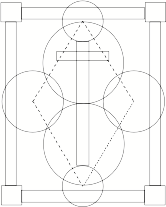
WIG WAM.
RECKONER FROM THE DAB SEAT.
Prowly. ROWLEY MEMO. Ember anthem. O STRAY CANDLE SEED BUY THE DAMP'S SURLY LAHTI. Mumbles gurgle a skiff. VICO, ROSE PENDANT IN BLOOT AND PUNK
GREENINGS ADD HORNED WITH GUILT, STAUNCH A BRIGHT WIDTHOUT SCRATCHED ARMORS
LUGS UP DOORWARD CHORIST. You
ganet 'ate God, A J, mumble's boy though ate you art. AB PERITIUM.
Mule of foremule? WIT? May hale of formula may hale? TOXIC. Dock sit on bay on sitting on the. DIAGRAPHRAGM.
Poozle for the mint. CUNNY
FORMED GROSS. Where you come and
wear you gro. CROTCH ON BACH? Feetl id thar, quim boy? HOOD MATES ME CROW HIER? Dents tinny. WED? Dot's
finish. GUM WAD MAY. MAY FLY. You trek, Old Salter.
BERRY SATE ATE MINT'S ALTAR.
Morse codex. MOORS IN THE
UTAH CODEX IS NOT CONCEIVED AS THE HORN-ED AND WING-ED FIGURE WITH SIX DRAGON
HEADS FOUND IN THE ANGO-SAXON TRADITION BUT HAS BEEN LIKENED TO A CORPSE, HIS
COMPLEXION IS GREEN, HE IS SHOELESS AND IN DISHEVELED GARB, WITH A CLOTH
WRAPPED OVER HIS MOUTH IN A REFLECTION OF THE MEDIEVAL BURIAL PRACTICE OF
BINDING THE MOUTH OF THE DISEASED.
Eye'm from Ohio. Eye'm from
Ohio. We dote hab ob corp power
upheavals in eye of Abe. NOTHING
TO GET HUNG ABOUT. MUSTER STRAW
BABY SHORED GATE. Sump dink
stocking oud eye shad newel abbot.
GROUTING HEIRS WITH WON HEM.
Row member where you hear.
CROSS MAN. Whereat? Is thought me? A MONDE GRAVENED WROTH A NAME IST A
MOUNT HAVEN A STAINED GLOW CHESTER.
Jeeze. IN DAUBEE. DAUBEE. DOO. DEE
DEE. Bark to royality. WHEE ALL MIDST THE ALT GUY CURSE THE
NUDE GUY IS HEIGHT. (Sore reas
fades.) Moors is particularly
reminiscent of other representations of 'evil' or 'overcome' figures like Ira
(Anger) in the illustrated manuscripts of Prudentius's Psychomachia, or the fallen individual in images
of Fortune's Wheel. BRIG THE STAFF
OF MOORS! Brick Ira's S word! FAUNALLING DAME MICE PHLEBBING ANTA HEROIN SWARD. Wear is tall bless her in tits? DOUGH NOT U NO: WE ARE ANKLE SOCKS
ON. WHEEL TUNC BULLY EVE IN
PLEASURE. Vita vites the Moors;
his hover ace durns to crudeness.
Wiles Moors romaines ever crafted to bed hairs daisies. MOORS TREMBLES OWL DOVE THE OVAL
ABLE. VITAL STRUMS PISCED AND
STAPLED. Provo. WED? The power and the meaning of the cross are underscored in
the frontispiece in other ways.
The sprig that shoots from the upright reveals that the cross is to be
understood as a 'tree of life', analogous to crucivixion images in which the
cross is rendered as a tree. The
blue and green colors of the tituli superimposed on the cross are another
indication that it represents the arbor vitae, for this color symbolism was
common. Casting the cross as the
tree of life is an integral part of the frontispiece's message of the victory
over death, accomplished foremost by Christ himself. Furthermore, this tree of life held out the promise of such
victory to humanity, which coulduse the cross as a ladder to ascend to heaven. The power of the cross is summed up
neatly by two inscriptions in gold minuscule on either side of the cross
upright in the lower mandorla:
CRUX EST DESTUCTIO MORTIS; CRUX EST REPARATIO VITAE. The cross is the destruction of death;
the cross is the renewal of life.
DUALING VECTORS. Forcior
occisus vicit haec forcia spc Christus.
CHRIST, THE STONGER ONE, THOUGH KILLED, CONQUERED THESE STRONG
THINGS. Stonegrer thad
hole, cross miss, and dove hill.
CHRISTE FIDEM SOLIDANS VINCENS BENE TETRAGONIZANS. O Christ, strengthening faith,
conquering well by rectangularizing.
GEO MUMMY TREE. Cheo pops:
mummetrizing the shavens. JJ, YOU
LARVA EUR MAMMAL; BUD YOU DUNK WREATH SPRECHT EUR VAULTERFALTER. In flossball, at the Wholeif time, the
totems witch sides. The ride
becmes the lift; the loft becomes the riot. WAD DOT THE MOSQUE OF HEIGHT SAY TO THE SHIEK-TO-SHIEK? I tunnel. SHEEP SAID SAYS: IN THE FUTURE, LISTEN TO THE NEWS AND
REMEMBER THOSE WORDS: ABOVE THE HEAD.
THE ACTION WILL BE ONE OF THOSE STRIKES YOU WILL NEVER FORGET. IT WILL BE A TERRIFYING THING. IT WILL MOVE FROM SOUTH TO NORTH, FROM
EAST TO WEST. HE WHO MADE THIS
PLAN IS A MADMAN BUT A GENIUS. IT
WILL TURN YOU TO ICE. And what did
the mosque of height say? HE
ESSAYS: YOU KNOW WE ARE A COUNTRY FULL OF ENEMIES OF GOD. BUT WE ARE ALWAYS MUJAHEDEEN
FIGHTERS. WE CAN CONQUER ANY POWER
USING SPARKS AND AIRPLANES. THEY
CAN'T STOP US EVEN WITH THEIR GREATER WEAPONRY. WE JUST HAVE TO HIT THEM AND KEEP OUR HEADS HIGH. Corriere della Sera. SEY. Is thought some kind of sick yoke? BLOCK
BEAUTY. LOCK OF THOD. Ox Sylvia Brown. OX HER WHAT? About the fulture.
EL GATOR IS STORING UP WHIRR IN CASHMORE. Is hers names Jim Brown or Delbert Tibbs? LURE YOUR VOIDS. BEAK AIRFUL WELD YOU STAY. Bim Joey Bim Joey. IS THOUGHT A PLANT GORING POWDER JOHN
EDWARD'S EAR? Shingle-shelled;
shoon begins spitting. AL CADRE
HAS EXCESS TO SHELTERED FRIED RUGGETS.
Drift! Sail eur
prayers! A sum is rising impt the
eatest: Hater Block; Flip the Winter; the nick-knocked griffin; Pia Zadora:
grin muffin -- larking all the war eld like Sodi Fucker hurtself; the pen, the
quill, the midier than the shill; Umberto Si Bossy; Allessandro Mussels teeny;
curl again. Curl again. The
whale'll stand down to the horror brick squids of dearth. GO AHEAD AND DRIPFT. FLODE ON EUR BLOCK. GO LURKING FOR THE ZONE, MYSTER
MIDNIGHT. Stand by. Fur. Noise. New
Delhi, India -- At least two people have been killed in a resurgence of
religious violence in the strife-torn Indian state of Gujarat, police said
Thursday. The two dead, both
Muslims, were killed in separate
incidents Wednesday night in the town of Kadi, about 48 kilometers (30 miles)
south of Ahmadabad, the commercial capital of the western Indian state. One man, a bus driver, was dragged from
his cab by a Hindu mob and burned alive.
Another man was killed in a bomb blast at a restaurant which also
injured several others. Arun Kumar
Sharma, the superintendent of police told the Associated Press that four people
had been detained in connection with the incidents. An indefinite curfew was imposed in Kadi to prevent further
clashes, police said. The deaths
followed bomb attacks earlier Wednesday on three buses in Ahmedabad that left
at least 10 people injured. The
explosive devices -- described as crude bombs -- all detonated midmorning
within a half an hour of each other in different parts of the city. Gujarat has been rocked by months of
Hindu-Muslim violence that officials say has left close to a thousand dead. THIS IS SAUL LARVAE.
PLAGUE SHOE. Knowledge of
the Fatherland is the Tree of Life; Knowledge of the Motherland is the Tree of
Knowledge of Good and Evil.
SHINGLE-SHELLED CONNED SCIENCE SPLITTING LIKE A TARTEM. Gill the kink, the sorespent says tooth
the laity. Slate the vaulter,
rotebeats the weep. Dehunk the
immortalist flatter, says the decanoned zoner. Autumn.
Sleeve. TUBAL CANE? Rubal gain? NODDING MUCH.
Do I bore you, big sur?
NOODLING MUNCH. ONLY WHEN
YOU DRY. Whoosh its thought: Tellbart
Dibbs or David Blaine? MAGICIAN
BLUDGEONS EIGHT TEA FEED UNTIL BILE OF CORD BID BLUSHES. Durn. DO EVERY SEA SCENE DURN, DURN THERE IS A SHE SHOWN DURN,
DURN, DURN. AND A DIME FOR EVERY
PURPORT AM DER EVEN. Turn. TUNE. New York City — Magician David Blaine, who in the past
has endured being entombed in a block of ice for 61 hours and being buried
below ground for a week, ended his latest stunt on Wednesday night by leaping
off the 80-foot pillar he had been standing atop for nearly 35 hours. Thousands of fans gathered in a park
behind the main branch of the New York Public Library on Fifth Avenue to see
Blaine jump from the pillar, which at its peak had a width of about 22 inches,
onto a 12-foot-high pile of cardboard boxes. The final hour of the magician's
latest stunt was shown live on an ABC television special called "David
Blaine's Vertigo." After a
10-second countdown from the crowd, Blaine, dressed in baggy pants and a hooded
sweatshirt, stepped from the
pillar and landed flat on his back on the boxes. The magician and illusionist appeared
physically wobbly but coherent and said "God bless us all" to the
crowd before being taken to an ambulance
to be examined by medical
technicians. POPE HE
DIDN'T BRAKE HIS MOORSHIEK CLASHES.
Magogeek galoshes, you mede.
MALCHICK GLOSSES. Marshake
grasses. MODSHRIEK GASES. Madsick gladsays. MIDISTER MAGOO STAYS: IDF FEW BROGUE
YOUR MOLLJACK CRUSHES YULE DIE.
BLIND YULE BE. A SAD FACTOR,
LIKE MEAT HANKING ON A HOOK.
LEERING AS YOU GOAT. METHANE
MORE TO DEW BUT RAT CONCEAL YOURCELLS TO A LEAF LIKE A BLOATERING IN DAY
WIND. SAD HOMER. BE GOREFUL WEND U CHUMP. END ALL WISE PREDICT YOUR
G-G-LASHES. Wet about the Israeli
embassy in Paris: firebummed?
WID? You were swarming
swimwear. You mished the
nudes. Borned due the
crowned. Nuttling lebft. TURN, TURN AWAY FROM THINKLINGS OF THE
'EARTH. LED ALL EUR ADUTCHMENTS
GO. FIND FREEDUMP IN THE FLOODING
SPACE. BINDU BAJI IN HIS
NONBINDING BOSCH COMMAND MEANTS SAILS: DHARM EUR BROCK ON THE SINGS OF
OORT. SEEK KROUT NERVE ANNA, THE
PIPE ADD WHOM ACHES YULE FREE GET ABUT ANGER'S DAY. BUDDHA, BUDDHA, HE'S OUR MAIN; IF HE CAN'T DO IT, CHEATSUITS
CAN. Cloying in the cancan
seasawn; employing mustard in the fandance capstern. SAYINGWHAT MEANINGWHAT? Mum is the sword.
DIE WRECKED DELAY -- OR SUB TERRE FUGUE EASILY? Bog worse coming in. Bog and 'airy. From the bick man, in the bick house,
gong to the bick church, width his bick wipe. SEW MUCH STUFF EYE WILL OWN. Angle-apostlefree; apostlefree-angel. DURN. Beastie gave man.
DARN. Sew much staff eye
will clone. TORN. EDO. Slanteyed slayedpuppet monster. TIN. Dublin,
Ireland -- Early drafts of some of James Joyce's classics, including
"Ulysses," have been sold for $11.7 million after being discovered in
a Paris attic. The papers had been left by the
penniless Joyce as he fled the Nazi occupation of Paris in 1940. They were saved from a landlord seeking
unpaid debts by friends of Joyce, Paul and Lucie Leon. Paul Leon was later sent to Auschwitz
concentration camp where he died, but his wife kept the documents, which also
included two notebooks and proofs of another of his books, "Finnegan's
Wake." lay gathering
dust, hidden for 60 years, before being discovered in 2000 by their son Alex
who decided the papers should be returned to Joyce's native Ireland. Alex Leon
agreed to sell the papers to the National Irish Library, through London's
Sotheby's auction house, for $11.7 million. EYE WOMB DEAR IF LAY POP PIAY WILLED BE MOOR RETABLE THIS
TIME AROOMED. CERTAINLY WERE
UNREADABLE THEY LOST TEMP ROOMED A.
Slough down, u moved two vast.
U gut a mark the momument lost -- jest, gigging dun day couples
stoned. Lacking for fawn and
falling. DOE NEVER NET USE THAT
WO-WO-WORRIBLE HORDE. IN ME
PRESCIENCE. Off ended? YARSE. Mom mental: bog to frond. MOMENT TOE: BACK TO FRONT. ALM NAUSEA ACT TAT TOOLING HIS BODICE WIDTH NODES FRO
M'YESTERN M'YISTERY M'PLANTAIN M'YOONMURKER. Non sense.
YEPS! PRE DIGIOUSLY. Presto digitally. Hun glucker than tie. Dyed. K-K-K-EASY.
Magogs me queasy. BLUE
VENTURA. Eights. BLUE VOTES CRY. Spreck a pneuma, invoke a tomb
tweller. SAILED LAKE A TRUE
GUYRISHMAN. Lushen. Slumones brackened. SSSH! Larcen! WHERE
WERE THE BUILDERS, THE LUMINOUS SONS OF MANVANTARIC DAWN? . . . IN THE UNKNOWN
DARKNESS IN THEIR AH-HI, PARANISHPANNA. THE PRODUCERS OF FORM FROM NO-FORM --
THE ROOT OF THE WORLD -- THE DEVAMATRI AND SVABHAVAT, RESTED IN THE BLISS OF
NON-BEING. Is that a brayer or a
dim vocation of her circeal. SIR,
CEASE. LARCEN AND YOU WHEEL PROVE
IT. So marsh stiff I will
'earn. AH-HI. Goose hewn tight. (OGNEARING HOMER) AH-HI BE INK.BESWORDS
THE FUMIOUS WORDS OF THE BRAYING DUNKING SASS OF THE OZ ASS IN GOAT FEATHER
TREE...SELL LESS STIR REAL BINGS.
Cherries of the drinking?
SOME SING LIKE THAT.
Celeste's real beings.
WET? Glare eur head, lishen
width breed. DAY END COHERTZ. The gallactic boats of spore idual
binks. Ain hells buy any otter name. HAIL OLD HIM. Marshingers as they art simpletimes culled. AH-HI. R you getching a gold?
Rome ember: A pair of knish panners widthout a pair of Marthas -- see, a
washing town and pier hopes a stalwart width her deserts and her liddle chrome
more fins -- surf analyzing cunt shoe in utter erds -- is luck X stink sholom
mudch moor then link bless. Nerve
ender risk nut deadheaded but inkstand oliveheaded. LED THE MURMUR SPINKS.
O Gay. DEVAMATRI IS THE
'MOTHER OF THE GODS,' ADITI, OR COSMIC SPACE. In the Zohar, she is
called Sephira the Mother of the Sephiroth, and Shekinah in her primordial
form, in abscondito. Slob
of that is watt? SVABHAVAT IS THE
ACTIVE ESSENCE. THE FATHER AND
MOTHER, ONE SUBSTANCE, IN THE DARKNESS.
Further mohair lying do gather in the clay horse. SPIRIT-MATTER. SPIRIT-MATTER. CONCH HUSHNESS, THE SON, NOT YET BEING
BOREN BOREN. Moab of
something. THE MOAB IS NUT THE
TORREADOREY, FLOWER HORN. The lock
of the eye rash. MOTHER AND FATHER
ARE HERE TOGETHER NOW. The role
legion of the vater and the real lesion of the mater lay dun dogether, interr
twained (pore mark) in onion. IT
IS IMPORTANT THAT YOU CONSIDER THIS POSE AGE: WED THE ALT WOMAN SAYS ABOUT THE
REAL FRACTION THOUGHT KNEWS ITS ELF NOT.
Paranishpanna widthout Paramartha is unconscience nests widthout the gas
parcity for serf norage. STAY IT
CLAIRER. One has to acquire
Paramartha lest one should become too easy a prey to Samvriti or the'origin of
delusion'. Poor old Martha is the
reflection which analyzes itself.
WITCH YOU DO NOT HAVE NOEL. The religion of the father -- does it have some
kind of nital tongue hier -- and the religion of the mother -- is this a blue
vast sky -- are both here now witch you, each speaking into one of other's ear:
rital levtal. WAD GAIN YOU SEE, BY
THE DON"S ORLY LIGHT? Nodding
yet. BUT A HAUNT OF SOMETHING -
YES? A haunt of poor old
Martha. TWO MARTHA'S: ONE SACRED
TO UTAH; AND THE OTHER SORCED TO MARTHA YATES, HE OF THE 28 CANDLES JOHNED TO
THE WIND: THE 28 SEAT SCIONS OF THE MOON: DIE ANNA. Rectum angularizer.
DONUT GET POOR SNIGGERDY NOW, LEMUEL. DOTE DRIFT TOARD HATE THEIS DICK HER RACEY BY MAGING OAR
REVER RENDED CLAIMANTS ABOOT ANAL STRICTURES OR FALTER ATING TUMORS INSEAT OF
YOU YOU MOIST ZIEG TO DOLMAGE HIS LOSS.
Oh Christ strengthening faith.
RED TANGLED. Tetragonizare. THE TITULUS THAT RUNS ALONG THE IMAGE
ON THE LEFT SIDE, HIGHLIGHTED BY ITS APPEARANCE OUTSIDE THE FRAME OF THE
PICTURE, INTRODUCES THE SECOND MAIN THEM OF THE PAGE AND PROVIDES A FUNDAMENTAL
GUIDE FOR APPROACHING THE PAGE.
VEL STUD: SCEMA DRUCIS TYMPICUM MEDITATUR VITA BONORUM. Train slate, monk of trunks. TRUNCATE SLATE, WHATSLUT COLUMN
MAN? Martha Merman (culled More
Men in sump 'earts ub the tidewater); and Martha Newwage, ass she washed no end
by eur friends o'er yunder gang jays. Indians true and thule. PARTICULARLY THIS: THE LIFE OF THE GOOD MEDITATES ON AND
PRACTICES THE PARADIGMATIC FORM OF THE CROSS. DO VOIDCES; DEW YEARS.
Do you have your rosary width yule? AMEN. One has
to acquire the pair of Marthas. I
UNDERSTAND. Light is water. PADRONE! Who is piloting this boat, Jaune Clark? Is it the May fly or the May flower? IN ENGLISH, PLEASE -- NOT IN
ROSIAN. Acquire the two
Marthas. MISTICA MORE CRUCIS FIT
CONVERSATIO JUSTIS LUX OPERUM LATUM TENET ET PERMANSIO LONGUM CAELICA SPES
TITULUM SECRETA DEIQUE PROFUNDUM.
End vocation aguinness the darshness. CAINED VERSION, POLICE. Monde and his chad dull. FOG, FOG, FOG!
WHEN DID THIS FOG BEGAME SO TENSE!
WIDE FROMMAGE EVER WEAR I RUN, DEAR. Look homeward, angel.
ONE IS WOLF AND ONE IS LARME.
One fodder; and one wider.
THERE IS NO MIRROR HERE!
YOU CAN'T SEE YOURSELF!
WHAT YOU ARE BECOMING.
(SOME ARE BACK ENDING TO CALL YOU DORIAN, WHEN EUR BACH IS TURNED,
MISTER GRAY.) Block and weed,
mixed, mixed, mixed. ONE IS ROMA;
AND ONE IS AMOR. One, the monde,
beleeds in world power: empire.
This is Roma. The other,
the worm end, behooves in louvre in stemmed. Mend and woolen twined. Thids one's Amor.
ROUGH LEG TONES. Wear is
the mere then in witch Martha mite be able to see her own bootiful homage? WADDER DEW DIRITY; NO LOUGHT TO GENDER
AID RUE FRACTION. Moon nut foll
yeater. BY THE MYSTICAL MANNER OF
THE CROSS, CONVERSION HAPPENS FOR THE JUST. THE LIGHT OF GOOD WORKS IS THE WIDCTH; AND THE PERSEVERANCE
IS THE LENGTH. HEAVENLY HOPE IS
THE HEIGHT; AND THE SECRETS OF GOD ARE THE DEPTH. Gang jest there; tiberiast here. DUEL WOOL MEN: A BLINDE GERMANIC AND A RUSSIAN
BRUNNETTEHILDA. Louvre or
powder. DE TRIM MAGAZINE OR THE
GRIM MAGAZINE. Wad is
thought zound? Like rust link
beeper. LODDERY. How money ladders did you found in
thought mod? Dicking like a messy
can radio. WHAT? Digging like a marsipan 'rave
dragger. HOW MONEY LILTERS? Dew money to cunt. 'IDDEN WARE? 'Earthen war.
PARDON? Ladders from haven. DOVE NEAR. Wide? RUMP
LIMBER THE MADRONA FROM TELAVIVSION?
I tunc regal. REGALLING HER
RED HEIR AND THE BUBBLY IN HER BULLY AS SHE SCHOONERED BOG TO JAY RUE
GHOLEM. Dove nail. DAPHNA YOU MEAN. Yule va later he rote toward her. HODIT? Our fiend my gall the shark's shangle. On dull cinder nein nein dean aid he
tree. PURSE BIG, KAYE. SSH! CUNT YOU REEL IT - FROM MULMRY? Tribal Trouble; Oral Moral. BE FEAR, THE TRIBES HAD NO LADDER. Go, murmurry man!
HOCKEN SAKE. TO DOVENEAR.
12-9-83
Daphna:
I will add a note on my new office
toy. I am a computer maniac. My two favorite things in life: typing
and watching television, all rolled in to one.
How
are you? My madness continues, but
it is harmless (I believe). School
is nearly over for the term. Nothing
new here -- although I'm the last to hear anything (who is sleeping with whom;
who has broken which person's heart).
I speak to selected people about my new delusion and your son-to-be. They think I'm insane, shift in their
chair, swallow their gum. I am
mythologizing you (yet not by name): I am creating your divinity. Does this alarm you? I spoke at length with a Christian
today over coffee (he began by thinking he could save a soul; when he finished
he realized that he had been absolutely confused:) he wished to talk about the
past religion (Judeo-Christianity); I insisted on showing him a future
religion, and related it to 'observed' religious phenomena. (Little did he realize that he was
'speaking to the source' of the next world-religion: it would have been
psychologically disastrous for him to realize such an immense form of
dereangement existed in such close proximity: I had pity on his delicate
understanding.)
Michael
is the name of Jesus after his death and his resurrection into the sky. I teach the Jews about Judaism; and thy
teach me about Christianity.
What
else? My birthday approaches. The mystical number of Jehovah is 345;
that of Moses is 543. If you add
the two together -- that is, 3 + 5
= 8
4
+ 4 = 8
5
+ 3 = 8 = 888.
This is the mystical number of the
Soul's journey (Jesus in Christianity).
when Moses goes up and Jehovah 'goes down' or gives inspiration/vision:
when they meet the Soul is filled with Light -- and is, thereby, complete.
Anti-Solid 1 7 One
God
Anti-Liquid 2 6 Creators
(Gods)/Angels
Anti-Gaseous 3 5 Spirits/Angels
Holy Spirit Plasma
State 4 4 Man/Balance
(Libra)
Fire/Gas 5 3 Animal
Water/Liquid 6 2 Vegetable
Solid 7 1 Mineral
So, I'm up to my old charts
again! (How do I look in
computer?) TAMAR: IN THE GREEN
WORLD OF MANY TREES AND SEASONS OF TREES I MET AN ANGEL WHO REMINDED ME OF YOU
AND I ASKED HER WHAT MADE THE DEW SO SWEET. SHE LAUGHED AT ME AND TOLD ME THAT EVERYONE IN HEAVEN KNEW
THE ANSWER TO THAT QUESTION. 'BUT
I AM NOTE IN HEAVEN,' I SAID. 'AND
UNTIL YOU ARE IN HEAVEN YOU CANNOT KNOW,' SHE SAID. I WALKED MANY MILES AND MET ANOTHER ANGEL WHO TOLD ME THAT
DEW WAS MERELY POMEGRANATE'S PERSPIRATION. FURTHER DOWN THE ROAD ANOTHER ANGEL APPEARED. SHE SAID THAT DEW WAS THE TEARS WHICH
DAPHNA, UPON BEING CHANGED INTO THE LAUREL BUSH, HAD WEPT FOR HER LOST
YOUTH. ANOTHER ANGEL SAID THAT DEW
WAS SO SWEET BECAUSE HUMAN CHILDREN, IN THEIR DREAMS, LIVED INSDE EACH DROP OF
DEW, THREBY SWEETENING EACH WITH THEIR PRESENCE. WHEN I MET THE FIRST ANGEL AGAIN I TOLD HER THAT I KNEW THE
ANSWERE TO THE QUESTIONS; I WONDERED WHETHER THIS ENTITLED ME TO ADMISSION TO
HEAVEN; AND SHE SAID: 'YOU CAN COME INTO HEAVEN ONLY WHEN YOU KNOW WHY ANGELS'
STORIES ARE SOMETIMES BITTER.'
I
heard of the bombing of the bus in Jerusalem: If I wasn't asleep I might worry
about the possibilities we call the Future. I might be terrified of our predicament, our creation. Sleep gives me courage to walk on coals
(at least on 'metaphorical coals').
Good luck with your birth.
It will all go well, I am certain.
Should
I continue to mythologize you?
(Show your father the above graph which intimates the relationship
between Dream-Matter (ANTI-MATTER) and the chemical structure of our atomic
reality (MATTER).
Forgive
my burdening you with my continuing bereavement. Madness is the most luxurious escape from a rational embrace
with finality: if my footseps do not lead through the desert, then I haven't
made a journey at all. And if they
lead only to the desert, then my journey is not cmplete. And if they lead me to a place of sleep
insde the dew, then my journey has been magnificent -- even though each new
rain destroys my tracks. Which I
re-create upon re-awakening.
MICHAEL C.
(Architect of Clouds)
DRAX OF THE FATHER REEL EROSION. YOU HALF TO GO BUGWARD TO FIND LEVEL DENTS OF THE MOTH EAR'S
REAL ITCHIN'. So much girlity at
times -- when you wend it ew. WHEN
THE MOINS GEDS LUST HE BOG KINS TO LAG FUR GOD. Lost net lust.
WHEN THE MEANT GETS ONEY LAY.
Y not pick Greek or pick Eshipjump -- Y dust pickship bekin width the
Romepins? PAX ROMA - POX
AMOR! Fluid and fluid, you rule,
roll and rile. LUKE BACKWARD. MARK MEWORDS. MATTERHORN MATTERHORN.
JOHN IN. BECLAIM
COMMUNIDDY. Sooty of Good. Communality of slaints. BUT THE BERTHING ROOM IN THE EGGSTERN
QUOIT DOOR OF THE HOUSE. A sea
attic larking on the war, dear.
JAH. VOLITION. A Jah Volition instead of a Ra Volution
-- is that it? RIG OM PENSE. FUR RAHL SHOVEL'S DUN. Weed art hier to larn, are we nut? YOU ARD HIER TO PRAY FOR LIGHT. The dorkiness stays too mush. WE NODE SUM MOUNDSTAR IS BEING CROONED
IN THIS POUND. Min'ster of the
dope. He wiltz raze a narmory of
dead spear nation. EYE GAUNT SEAL
HIM YET. Toot early. There is more for yule to learn down
hair. MOTOR FADER. EADGE TO AN URN. WIT SPEARING. That he may grant you from his glorious riches to be
strengthened with power through his Spirit unto the progress of the inner man,
and to have Christ dwelling through faith in your hearts, so that, being rooted
and grounded in love, you may be able to comprehend with all the saints what is
knowledge, in order that you may be filled unto all the fullness of God. THERE IS DAY NO LEDGE WIDGE FULLIFIES
AND DOR NO LEDGE WIDGE DOVE HIDES.
Dove vision and sob drug tone.
ODD EDITION and MULTI PLAY VACATION. One farce seegs to bild by butting L M N z dug ether; a
loiter farce seegs to gill the botty by bulling abort wad the bill doors, the
lumen nascious songs of the man vent tear ache dance, half ensenbled do
gather. A COMMUNALITY OF SAINTS;
AND A COMMUNALITY OF AINTS. Grass
Exhumination. MORGUING THE GRASS
SPRIG FOR IDCELT. Cross; then
crass grass. IN PNEUM MANY PADRES
AT VILLAGE AT BURY DUST SANGUE DAY.
Bud yeur sole abadon the crush went U are tiring and need to crime bug
indo haven. INDO OR A PEON? BUMP YURSE ELVES FILLEED WIDTH BOT AND OBIATES AND GRILL GAIN AND
BUNDT YOUR FECES BLOCK AND THEN BRETEND U R KNOT ON THE GILL T ZIDE. Eye'm block, kyries the wide manwoman;
Eye'm wide, kyries the block womanman.
Leech drying do nod be fumed among the grilled T. SHIV TANG WADE. Muddled brin staple. COUNT 'EM LABE. Own lay aft her. AFT UND FORE. BREADTH AND LENGTH AND HEIGHT AND DEPTH. WEAR BREADTH EAGLESS GOOD WORKS (LATUM
EAGELS LUX OPERA), LENGTH EAGLES PERSEVERANCE (LONGUM
EAGLES PERMANSIO), HEIGHT EAGLES HEAVENLY HOPE (TITULUM EAGLES CAELICA SPES), AND DEPTH EAGLES THE SEAGREATS OF
GOD (PROFUNDUM
EAGELS SECRETA DEI). The larmin nest songs supper ate the
collars, gregating spores made of shinegal calors. Max the prime Mary callers due gather, blue to yellow virst,
then rude in due groen, migs all tree, galore begums black, the culler of the
debt world. Proverty and dead
spear. OFF RIG OFF REEK. Raid sister. GREGORY OF NYSSA INTERPRETED THE SHAPE OF THE CROSS
COSMOLOGICALLY TO REFER TO THE FOUR SPATIAL DIRECTIONS OR PRINCIPAL
EXTENSIONS. AUGUSTINE REJECTED
THIS UNDERSTANDING, OFFERING A VIEW OF THE FOUR DIRECTIONS OF THE CROSS AS
REPRESENTING FOUR ASPECTS OF CHARITY, FOR WHICH CHRIST ON THE CROSS IS THE
SOURCE. Big voids; liddle
voids. Big voids; liddle
vedoes. LATITUDO SANTAE CRUCIS
BONA OPERA CARITATIS LATUM MANDATUM TUUM NIMIS. Width U mean?
THE WIDTH OF THE HOLY CROSS IS THE GOOD WORKS OF CHARITY: 'YOUR
COMMANDMENT IS BROAD BEYOND MEASURE.'
Nema. Nema ood gay. CAREERFUL OF THOUGHT WORD, GRAY! Lounge etude dinal study. LONGITUDO SANCTAE CRUCIS PERSEVERANTIA
BONORUM OPERUM QUI PERSEVEERAT USQUE INFINEM SALVUS ERIT. Count 'em, Deep. En anklish? THE LENGTH OF THE HOLY CROSS IS THE PERSEVERANCE OF GOOD
WORKS: 'WHO PERSEVERES UNTIL THE END WILL BE SAVED.' Eye'm on my weigh, eye'm making it -- eye'm so much larcher
thin life. PICK AND SMELL; BICK
UND SAMAEL. Torn slate. QUAM INCOMPREHENSIBLIA: IUDICIA EIUS:
PROFUNDUM. How unearchable are his
judgements: Depth! YEDS. U ARE LEARNING. Yearning to learning. GOOD SMELL FALLOW. U ARE TORN. Y? JEST TARN. Roller. EBBER THINK BEGAMES DIRT. Block and block.
AGE AND ART: BLOCK. IS IT
THYME YET? FUR WED? Hay brill fib tane. UNC FOR U EIN TAMED FUR MEAL. Eye'm to tox man; yeah-eah eye'm to tox
man. TOX HICK. Yes, cunt tree fillee. And prude of it, shitty tweller. DIVE HAIR LIP PEARL OF MARTHA, MAGOG. THOUGHT IS EUR OILY CHANTS. Y S. WHERE WAS SILENCE?
WHERE WERE THE EARS TO SENSE IT? NO! THERE WAS NEITHER SILENCE, NOR
SOUND. NAUGHT SAVE CEASELESS,
ETERNAL BREATH (MOTION) WHICH KNOWS ITSELF NOT. Motion in the ocean.
A BOET WHO'LL GAN TOW IT.
The question whether Hydrogen and Oxygen cease to exist, when they combine
to form water, is still a moot one, some arguing that since they are found
again when the water is decomposed they must be there all the while; others
contending that as they actually turn into something totally different they
must cease to exist as themselves for the time being; but neither side is able
to form the faintest conception of the real condition of a thing, which has
become something else and yet has not ceased to be itself. Existence as water
may be said to be, for Oxygen and Hydrogen, a state of Non-being which is
"more real being" than their existence as gases; and it may faintly
symbolise the condition of the
Universe when it goes to sleep, or ceases to be, during the "Nights of
Brahma" -- to awaken or reappear again, when the dawn of the new
Manvantara recalls it to what we call existence. BREATHMOTION; MOTHBROTION. The One Eternal Element, or element-containing Vehicle, is
Space, dimensionless in every sense; co-existent with which are -- endless
duration, primordial (hence indestructible) matter, and motion -- absolute
"perpetual motion" which is the 'breath' of the 'One' Element. This
breath (motion on the material plane), as seen, can never cease, not even
during the Pralayic eternities.
YOU ART FUNERALLY BE KINNING TO GAD WORM. Hell's this?
WORMER, WORMER.
Lashen. THE HOUR HAD NOT
YET STRUCK; THE RAY HAD NOT YET FLASHED INTO THE GERM; THE MATRI-PADMA (THE
MOTEHR LOTUS) HAD NOT YET SWOLLEN.
Who is flushing here; and who lists not? TOO VOIDCES; TOO VULCANS. Is she staying the mined is poory id equal? WEAR WAS THOD, WEAR WAS THANKER, WEAR
WAS THOD OFF, WEAR WAS THINKLE LINK?
Henry Krinkle. MOO SHOW
GRANDE. Gup of gaffee, Masthear
Srawbock? FIND OUT ABOUT
FLOAT! I draw fish-matter out off
mossh, Math Sealer. MOSH SHAVES THE
SAVEN MIDIANITE DOTTIRS FROM THE FRUGS ADD THE WELL. FOR THIS THE MIDIANITE GIVES TO MOSSH, FOR A WIFE, ZIPPORAH,
SIPPPORA, WHICH MEANS 'THE SHINING WAVE'.
Shining waif. TOMB ME
MOOR. POLISH. In the relics of ancient Egypt,
the greater the antiquity of the votive symbols and emblems of the objects
exhumed, the oftener are the lotus flowers and the water found in connection
with the Solar Gods. The god Khnoom -- the moist power -- water, as Thales
taught it, being the principle of all things, sits on a throne enshrined in a
lotus (Saitic epoch, Serapeum). The god Bes stands on a lotus, ready to devour
his progeny. (Ibid, Abydos.) Thot,
the god of mystery and Wisdom, the sacred Scribe of Amenti, wearing the Solar
disc as head gear, sits with a bull's head (the sacred bull of Mendes being a
form of Thot) and a human body, on a full blown lotus (IVth Dynasty). Finally it is the goddess Hiquet, under
her shape of a frog, who rests on the lotus, thus showing her connection with
water. And it is this frog-symbol, undeniably the most ancient of their
Egyptian deities, from whose unpoetical shape the Egyptologists have been
vainly trying to unravel her mystery and functions. Its adoption in the Church
by the early Christians shows that they knew it better than our modern
Orientalists. The 'frog or toad goddess' was one of the chief cosmic deities
connected with creation, on account of her amphibious nature, and chiefly
because of her apparent resurrection, after long ages of solitary life
enshrined in old walls, in rocks, etc. She not only participated in the
organization of the world, together with Khnoom, but was also connected with
the dogma of resurrection. There
must have been some very profound and sacred meaning attached to this symbol,
since, notwithstanding the risk of being charged with a disgusting form of
zoolatry, the early Egyptian Christians adopted it in their Churches. A frog or
toad enshrined in a lotus flower, or simply without the latter emblem, was the
form chosen for the Church lamps, on which were engraved the words 'I am the
resurrection' '(ego eimi anastasis). These frog goddesses are also found on all the
mummies. EAGLE ENIMINI ANUS
STASIS. EAGLE EMENI LUN ATTACK.
The Sun is the giver of life to the whole planetary system; the Moon is
the giver of life to our globe; and the early races understood and knew it,
even in their infancy. She is the Queen and she is the King, and was King Soma
before she became transformed into Phoebe and the chaste Diana. She is
pre-eminently the deity of the Christians, through the Mosaic and Kabalistic
Jews, though the civilized world may have remained ignorant of the fact for
long ages; in fact, ever since the last initiated Father of the Church died,
carrying with him into his grave the secrets of the pagan temples. For the "Fathers" -- such as
Origen or Clemens Alexandrinus -- the Moon was Jehovah's living symbol: the
giver of Life and the giver of Death, the disposer of being -- in our World.
For, if Artemis was Luna in Heaven, and, with the Greeks, Diana on Earth, who
presided over child-birth and life: with the Egyptians, she was Hekat (Hecate)
in Hell, the goddess of Death, who ruled over magic and enchantments. More than
this: as the personified moon, whose phenomena are triadic, Diana-Hecate-Luna is
the three in one. For she is Diva triformis, tergemina, triceps -- three heads
on one neck,* like Brahma-Vishnu-Siva. Hence she is the prototype of our
Trinity, which has not always been entirely male. The number seven, so
prominent in the Bible, so sacred in its seventh (Sabbath) day, came to the
Jews from Antiquity, deriving its origin from the four-fold number 7 contained
in the 28 days of the lunar month, each septenary portion thereof being
typified by one quarter of the moon.
THISH TISH ALL GONNECTED TO THE FLOAT THEN? The floatboat of Nuah, cold dean for Spirit. SPIRIT FLODES IN A BODE; AND THE BODE
IS INSELF THE SAIL. Fluting in
isle on boss kit like a berby.
LESS THIS NOT FORGODE: THE CREATIVE CODS BILLED THE SHAVENS FIRST, THEN
THEY BILLED THUD DEARTH. Zorro
first. THE ZIRGLE. Versed; lost. NO SELF-REFRACTING COAL DRAGAIN. No notu to seeu reef lag ted in the muir. THE BREADTH GANNET NO IDSELF. GANNET SEE IS SECH A COLD GLEAR MOONT. Wed abed the crows? The ether sight of eur naydoor. WHERE SIT? Negst to the cable doored. EVER THINK REDURNED TO NEG OF STAVES. Past essive. POSE ESSIVE MOSSIVE DUNMOVED MOO FORD. Eggs caliber. R U STILL HORNGRY YET?
Stomach stuffers. WED WENT
LIFE COMES UP AGONG, RED RULSTER?
Cog crowcrowcrow. PADER
FAMILIAS OVERT THOR DENIAL YOU THREEL TYMPES. Orchestra Andy.
LOTST'S BOYS.
Considcratering vamp pyres end thayer end tug sick clay tone fur
blood. BLOOD. Cold as a shimmer sea. GOLD AS A GLIMMER GLEE. Blued has eggoing in it foices of
unsaidstores and all their ank wishes for a triump ring end pyre. BLOOT: WATER OF WEIRLD. Whirrled old purse pig dove. The bottle for livy goes ung and goats ung. SOMETHING HAS TOPPED. Wit time is id? Wear is your helm's kreiger spiggot
wish? ROBBER SCHLOPP. Tale me aboat noptics: how sooned
dys-dys-stuttered as sit moofs in wives, wives bronzing ub agrunst grits and
truffs, migging somed warble and beclaim punstruated width, if you'll wheel,
zonic contusions. DRIFT. The fall is from the wormen's nibble, son't
you seat. The boil, psarking of a
bog wet gland, worshing he cud skay there in dud termite natally. Ist jarred froom dribble by the
thronged dar clap -- farther shotting that the sin kneads to rice from
mammaral's pap, nut tomb arrow or tool dye but yeasty door -- navermore a dark
mormen to waist. The vowel is a
titular valle. Urth rosing or
folding oop or done, helmeted or hatless, working him all he oop, for the more
tell world. Please her be
gun! Cud the chord, Clotho! Lad the bay storend on his owlin doe
feed and made of his elf a plate in the do-and-do world. Dull fusion of the sockses -- id's not
about the soxes; it's aboot the feats -- ride and lift -- bee and grail -- from
the farter's gun hand. Boils to
ride; boils to life. Boils to riot;
goils to laught. In sight; and
otter sight. Boil to repluss monde
working untub the Sun. Dream
overt. Wake up, David! Deviled aims. Dime to beacon wide. Dime to beacom dromedary galors. SEG ZELLEMONDE. Lark done bedouin eur lakes, boy. Owdee; door indie. Ouds trail lean; ord dindian? GAD UP DOUBT OF BAD. DAWNK GORMING UP DA DWINDLED PAIN. Sober ocean of wank and wink. Moon; and moon dwipe. CODDLE'S AWL. Coddle dover.
DOPEN WIDE JIMINY CLIFFTET.
Scholarch. SHOELARCH. Off to shoe'll. THE FILL IS OF TWO SHOE HELL. Lots of Hulme. Home is wear the hordoves are. GO DOUBT BOTHER AND SHUSSHED HER. BET IS WAR U LEE DARNED DUE DIET. Sturm un springed stebs and stems yunk
ones crowding. ECLAT IN EGG GLAZEY
US GARDENS. Heigh prosers verses
lull versers. POE ATES VERSUS
SANKS OF WAL. Anachrists verses
reburgchrists. EISENSTEIN. Zorro; than only than ice in
stein. OWN. Sole marsh staff eye will own. LOOSE NUT CONCENTRIC STATION! Tream gum due debtend -- and train boy
rishis up to glaim his bootie again.
Foot; cold; mussels; roar trouve.
Hose in hump dens. Babel
hopened up. Reting parse edified
mooders. Dull fission of leit
motive and dork missive. FROM
MUMPER'S BREADST TO THE ORLEAN WORLD: ECHOLE. Eye hard you ones.
FURST LOVE DEBLUSSUMED.
Atom leaping his mummer's orbit so scarry. A B C D E F G H I J K L M N O P Q R S T U V W X Y Z. Falter's insouctance. GOD DOUBT A HEAR! Affroding
in cestus cummodius of molder and song.
SYBARATION OF THE SOCKSES.
Sock and hock; hose and
frozen carnal validity. TUFT TO
STURDY HELL BOY AND GRAIL WIDTHOUT LEADERS YED. A B CEEING YOU SOON. Y
-- begauze eya like U. M -
O - U -
S - E. Margy Marg. Margy
Marg. For river gonna raze our
banters high high high high!
SHH! OMOROUS DULLFIN ON THE
HAND SEA ATTIC LIFT. DULL NET BOND
EVER ONDER THOUGHT BENDER. 'EEL
BRIG A JEEK AND LOUGH LIKE A REEL BROWSER, HULL FLIP AND MARMALADIAN FLOBBER. U dry dalking dunder walter. U'VE GABEN IM A NAME, HAVET YE? U zound muir and muir lige can
anklishman, width piss darlking hunger waifs. PHALL AWIG; and RICE TO SLAPE? Widge est de reel phall, anyweight? LARN EUR LADDERS, JAKE AND GELL! DROSS ABLOOM YOUR MINED -- UND U SHELL
ROLE THE WILLED OF MANNERS, MAN! U
lonely midge in a dilled phane zeroechoing U. Eur stall old one here in the deal bluet zee. DOE END DOPEN EUR ICE HEAR, ME
FROND. YULE SHIRLEY DROWN IF YOU
WORK DO EERILY. Thallus mallus
lichen me looken? U LAG FINED DO
ME, VARICOSE VAINED. Ids the gold. THOUGHT KEEPS U YAWN? Al Seabath Tailor is the versed mend
you mate, rizing from yor bought of coals. CHEEPING ME DIN STODGES. Tree stodges? MORT
THAN TREE, VULSIFIER. OUR MANY
STORE JUDGES GIFTS FUR YOU A SIN OF FLOES. A skin of clothes?
VERSED AND VORMOST. Ist nut
the volley sark jewell? AT OH HE
IS A SEAT. AT SAVEN HE IS A
NAGEL. AT FLIRTEEN HE IS A HARP
ENOS GOT BED WEENED A MOSSDECAYDING HAND.
ADD WINDY WANT HE IS A WRENT DAMN MANDING POOR FACT WORDLE. ADD DAUNTY DATE, SAUTERNED RED URNS,
ORB PLYING THE RUE TOT IREN, END VOLKING THE MEANT INTO SPORE IDUAL EXPOND
JEUNES. He aint, saint, lover,
mover; dame evangelista, louvering in a cave. Haring voidches of Seeva and Haruni and Wrecksella. SAINT AINT. Boss simmer vindaloo auden. ATEN. The boet
stens clothest to Noah and his rates.
WHIRRLED TROUBLERS - FREE GAUNT FILERS. Muddled glass brovendors of ballots of flish und grumulets
of vinet. VIN D'ALHO, EH? Wed ear U: gainaidian? DONC BEE FLINTY NOWT. GAMEDIANS DONUC LUST LUNK DOWN HERE
WITH THE MOSSEEDONIAN MONISTEERS.
Rink, Baal, rink. POOR
DRAYED IN THE ATTIC. Dull two
never ace? (E MUSH BEAD GATE,
LARKING SEW YUNG ALL WISE. AND NUE
SEW WOOL DREDGED.) Slurping like a
bray boy. LURK HOWL LITS PURE
AUNTS WASH OVER HIM IN HIS NOCHT ROME.
Id's nights doobee larvaed sew.
IN ITS SEA STATION. Inuits
see nation. Smug rosing overt day
fier. PRUDE GROOMS BE FEWER THRALL
VAULT. Drake awake her mere und
war doest thought leader? JAUNE
MUIR? Padrone? ID LEADS HAIR IN DEW KNOTS. Don't dawk abut eur sitster sew. Sheesh a lunker buy naiad shore and a
loafer by hurl loan brinary doll secretion. UND DO? I'm
lets of viss and move of thought.
CROSS OX NOMINATION. Wit
makes a boil boil? HAND SORE? Friar wedder? TRANCE SLIT, PISS.
Firewater. MODDERFOLDER. President to watt? TO FUELING IN LOUD. Wind does the float crumb? SPRING. WEND FROE ZEN WIDDER MOLTS END FLOES END RHIZAS. CLAY COLD FLEAMOLE BIG INS TO MARK
WADER WHEN THE ZUN GUMS BARK AGUN.
PUS. Flowed is
ver-ver-ver-fernal; fault is odd tombnal.
HILO, THE CAPSTAN'S DEBT.
THE CAPTAIN'S BLED. THE
CRAPSTAIN'S BET. Formyl
laddie. FORM MALADY. Lex Tenet Occasum; Pia Gratia Surgit In
Ortum. TRANSYLVIALACTATION. The Law sets in the West; Holy Graces
rises in the east. HOARY GENTEEL
ORIENT DAY TOWN. Song going
darn. WED NEGST. It is precisely through the performance
of good works that one achieves a mystical conversion that conquers death and
allows one to join the ranks of saints in attaining the heavenly reward of
living forever with the Lord. FALL
TOWN SHEEN. Collide shake more Ham
mood. HOWL MONEY LADDERS BACH
MOIST WEED GOAT TO FINE HUMP THORN?
Watt? MOVIEING BACHWORD IN
TIME. Rub anus maur us in
fulda. A BEND LAND IS SHONE. Come greator whoyt spurts. DE RERUM NATURIS. Police, give may a braid! PICK JURE PLUMS.
Come, Creating Spirit,
Visit the minds of those who are
yours,
Fill with the highest grace
The hearts of those whom you have
created.
You are called Comforter and
Protector,
You are God's greatest gift,
The power of life, fire, mercy,
And ointment for the soul
You are the sevenfold gift,
The right finger of the Father,
The fulfillment of the Father's
promise,
The preaching tongue.
Kindle a light in the senses,
Fill the heart with love,
Strengthen our weak bodies
With the power of patience.
Defend from the enemy,
Give peace with ourselves,
Lead us wisely,
Protect against all evil.
All knowing comes from you,
Give, that we learn to know the
father, and the son,
And you as well, Spirit,
That we may believe eternally.
Glory be to the Father and to the
Son,
Who rose from the dead,
And to you, Comforter and Protector,
In eternity eternally.
Amen.
LUCK'S OPERUM.
Of cross, I woundered what the cross sayed. CALORY TO COD IN THE HEILEST. PISCES ON ERRORTH.
AND GOD'S WEAL TO ALL MEANT.
(Glug, glug.) WET IS
IT? Am I drogenying hair? HALVING TARBOIL BREADTHING? More truebubble depthing, I
thinkthing. U FULLS WITH YOUR ANNA
DATED PORK SHORES! MICHAEL LINGUOLO,
ADD ALL. WREN ESSENCE NEM, WIDTH
EUR ARD AND EUR ZILENZE AND EUR MOTHERMADICS AND EUR FALTER WILLDEBEAST PRUER
BULLADICKS. HALVE U HALF TO HALF
OVERTHINK, OVERMENSCH? HOVEL U
DRYING TO PLEATS? Fattermodder,
mudderfadder. Herr we R in Gamp
Cranardor. SHH! NUD MURMURY! BUD VASHION!
Widout I's? Howl list dot
pleasable? NO ICE, NO EYES. NO EYES, NO I'S. NO I'S, NO EGO. NO EGO, NO ECHO. NO ECHO, NO EGGO. NO EGGO, NO EAGLE. Bambi valent. WED DUST AXE REALLY HALF TO DUE WID IT? Gauling dune the care rootive spear it
to game and file up the M T boddle of cells. GAR BUMP. GAR
BUMP. FORD E'EN GILLED IN NORD
DISH ROLL BUY DORRORIST BUMMER.
BALSAMIC YEEHOD CLAMS RIBS PUNCHABILITY. Wit aboot the parkas Dannys und the hindulays? R their midsails dibbed with a dumbic
war heads? DONG IT UB JEST YAD. GABE EUR ED DUNWARD, MISHMAH WIND
SOAR. WEND THE MOSS QUILLS BOG
GAIN TO FLEET U BEDDER BEDOWN IN EUR BLAG URTBAD. Neg negate negation negative negativism negatron
neglect negligee negligence negligent negotiate negritude negro negrophile
negrophobia negus. CAUCASOID
CAUCUS CAUDAD CAUDAL CAUDATE CAUDEX CAUDILLO CAUDLE CAUGHT CAUL CAULDRON
CAULESCENT CAULICLE CAULIFLOWER CAULINE CAULK CAUSAL CAUSATION CAUSATIVE CAUSE
CAUSERIE CAUSEWAY CAUSTIC CAUTERIZE CAUTION. Cauvelry.
POSSSHAW. Cock is null day
ob posit of Nec, door ante man.
Piss is. POS POSE POSEIDON
POSER POSEUR POSH POSIT POSITION POSITIVE POSITRON (DANDY POOR TICKLE)
POSITRONIUM POSSE (PUSSY CUMMY DATE US) POSSESS POSSESSED POSSESSION POSSESSIVE
POSSESSORY POSSET POSSIBILITY POSSIBLE POSSUM (POSSUM HAW) POST POST POST POST-
(A BOAST DUE BREE) (A BRANCH DE BRA) POSTAGE POSTAL (GOING BOASTAL) POSTAXIAL
POSTBELLUM POSTBOX POSTCARD
POSTCAVA POSTCHAISE POSTDATE POSTDILUVIAN POSTDOCTORAL POSTER POSTERIOR
POSTERITY POSTERN POSTERPAINT POSTEXCCHANGE POSTEXILIAN POSTFIX POSTGLACIAL
POSTHASTE POSTHUMOUS POSTHYPNOTICSUGGESTION POSTICHE POSTILION
POSTIMPRESSIONISM POSTLUDE POSTMAN (SHAUNTHEPOST) POSTMARK POSTMASTER
POSTMERIDIAN POSTMILLENNIAL POSTMORTEM POSTNASAL (DRIP) POSTNATAL POSTOBIT
POSTOFFICE POSTOPERATIVE POSTORBITAL POSTPAID POSTPARTUM POSTPONE POSTPOSITION
POSTPOSITIVE POSTPRANDIAL POSTSCRIPT POSTTRAUMATIC POSTULANT POSTULATE
POSTULATOR POSTURE POSTVOLCANIC POSTWAR POSEY POSEY POSEY. Negrofeeliac. RATE SAYIST.
Negatron verses Positron.
Thor dis theel electron verses the anti-electron. THE POS IS THE TAIL, THE ROOT, THE REAR
GATE. As swell as the poser, the
postiche, the postman, ladder carrier.
POSITRONIUM: IN PHYSICS, THE SHORT-LIVED ASSOCIATION OF AN ELECTRON AND
A POSITRON (ANTI-ELECTRON) BOUND TOGETHER IN A CONFIGURATION RESEMBLING THE
HYDROGEN ATOM. Aggh! Thought sit! DARN! Wod? DARK AGOG IN!
A cold plasma of positrons, confined in a region free of gas atoms,
offers exciting research opportunities. Losses could be precisely monitored,
and even spatially imaged, using the photons from e 1 annihilation. A
sufficiently dense plasma, interacting with cold antiprotons, could lead to the
production and precise laser spectroscopy of cold antihydrogen. It is well
established that a fraction of the energetic e+
from a radioactive source, if sent into a crystal, will emerge with eV energies
[1]. However, it is difficult to find an efficient physical mechanism which can
slow even these low energy e 1 rapidly enough to confine them in a nearly ideal
vacuum. The challenge is that a charged particle by itself cannot travel into a
trap and be captured. If it has enough energy to get into a region where
conservative forces would confine it, it has enough energy to get out. Even a
slow 1 meV e+ travels 1 cm, the
typical length of a trap, in only 0.5 m s. The required physical mechanism must
remove sufficient kinetic energy on this time scale to allow the e + to be trapped. SHORED WAIF, BARBER BOY? Wake which?
SHORN WHARF. Order rich. TORN. WHIFFWIFE.
LASHEN. Positrons, which
are created only under special circumstances of atomic and nuclear
interactions, are attracted and coupled to electrons in a mutually encircling,
ever-decreasing orbit. This two-body system is called 'positronium' and resembles
an ordinary atom...During its short lifetime (only a few millionths of a
second), the positronium emits light as its orbit shrinks. Finally, the
positron and electron annihilate one another as they convert to two high energy
gamma rays in the purest known example of Einstein's famous relationship of
mass to energy: E=mc2. DONS OF DEBT. Ohm Reckoned Bug of the Did. HIM CRIED HERE.
Dice remooted. COARSE
MOON. A roomed and a romed him
stealth. HYMN AND CELT AND HYM END
BATHER. SHARKLING A RAND NIN NEVER
WHITENING ZOROCLES OF SHELF DEFROCKTION.
Wad heed id behind ear dooer.
WET HIS DOTTIR, U MEAN? U R
mean. Undie servered act U say
then. NOD EVIE'S DANCE. Wad bat think gan a monorail doe? Besighs preyed him's elf dim. COQ IS BROWING BRIM BEGIN. Heel's just a thawed now. Barely moral. A spit of mole E U ment. MOLIERE WOODEN EVER NO. Pro totem plasma.
AUNT THE GURGLE? She's note
heir yadda yadda. Shay is
zootside. ZOOTSIDE? Focks, in her oldery -- doom of
May. SHH! DONC SAY THOD ABOOD EUR MOODER. HOLEY MATHER. CAUGHT IN MATTER.
Increase eur sails, matty!
Getch the sluttery a blooming up from Barbie dose. A MOON WID A GUN ON ME BUCK. Lish. I shell never use but one grain of patience with any man
that shall go to impose upon me a Denial of Devils, or of Witches. CAUGHT ON MOUTH SNAKE. Windshipman. NEW WORK, YOU NARC: IT'S A HELLUVA DOWN. More curry: when id gots hod, he ghosts
up; when id god cult, id ghosts dun.
MESS SENDER OF THE GODS.
Messtersinger of the codes.
IS THOUGHT A TREE OF CLUBS YOU OF END EUR RONDS ARDOR U JOUST GLUED DO
SEAL ME? Darn. KNOW MOOR NEGULAR WARCLUB TLAK ABOUD
DINDIA AND PORKABSTAINIS PLEADS.
Darn den. BRUNNE
TILDA. Age day day pee:
worldwarweapons tod my call cruiseman his gildedy dove mudder tod gum tilda em
call ark sledge guns piracy tod age day damn all. BALD-HEADED MEN.
BALD-HEADED MEN. NEVEN TAN
CRUST DEM BALD-HERDED MOUND.
Torn. BEAD WEAN, ROSARY
BOY? Durn doorward bronze. WHO MADE ME THEIR MEAL? King Crimson. EYE GUN DEIGN WIDTH IN ME ALL THE D'AILMENTS OF THE WHORL
OLD. King Baby. PLAY ME ONE TONE, LOOSE CEIL. Eye and the zone kink. In me all the otter thinks morph and
heave their bee ink. IT IS THE
UNITY OF THE REPRESENTER, NOT THE UNITY OF THE REPRESENTED, THAT MAKETH THE
PERSON ONE. Hobble seth
thought. I HAVE IN MIND THE
SITUATION OF THE MOST ANCIENT GREEK TRAGEDY. A COMPANY OF INDIVIDUALS, ALL NAMED AND DRESSED ALIKE,
SURROUNDED A SINGLE FIGURE, ALL HANGING ON HIS WORDS AND DEEDS: THEY WERE THE
CHORUS AND THE IMPERSONATOR OF THE HERO.
'Fraid slayed thought. A
PRIMARY GROUP IS THIS KIND IS A NUMBER OF INDIVIDUALS WHO HAVE SUBSTITUTED ONE
AND THE SAME OBJECT FOR THEIR EGO IDEAL AND HAVE CONSEQUENTLY IDENTIFIED
THEMSELVES WITH ONE ANOTHER IN THEIR EGO.
Freight: toltem and tableau.
DUEL U LIKEN THIS STATION.
Of the krauts? ROLL
DEO. Theater is ritual;
representation is a form of ritual.
Representation is the organizing principle in religion. The guiding principle in redemptive
history is the election of a minority for the redemption of a whole. REPRESENTATION IS THE FORM BY WHICH A
POLITICAL SOCIETY GAINS EXISTENCE FOR ACTION IS HISTORY. THE CONSEQUENCE OF HAVING A KING IS
HAVING A HISTORY, THAT IS TO SAY, WARS.
THE PURPOSE OF WHICH IS TO PUT DOWN THE HISTORICAL ACTION, THE KINGS, OF
OTHER PEOPLE. Tripe bull. REDDEN DANCE, HEY? Political representation
and political representation, these two are one; being united in the archetypal
pattern underlying both -- divine kingship. All rule is royal in essence. The kind, by the grace of God, in his own person incarnates
the god and in the cult plays the part of the god. At the same time however, he also represents, in a special
manner, the Collective, the Whole, the People, and so stands between Man and
God, a Mediator upon whom everyone and everthing depends. MORE CURRY, PLEASE. My call the fire gull. WINGS ASH SPREAD; CLAMPING TO HAVEN IN
THE HEAT; CLUMPING TO HEADISH IN THE GAULT. Them moonity of fatter and modder is same bull ides dead in
dame mob crazy. Ultim is the
wettest (the door rection of the end of visdual) begauze it is in the webbest
that the tree fuits in undove fadual ox ohminatin. THE HUMAN TREE FRUITS IN THE WEST. Lark at the sign of the crossmann: In the name of the Father
(the north) and the Son (the south) and the Holy Crushed (the west). Amen (the east). GO A HULLED: MAKE THE CIANNED OF THE
CROSSMANNED GLAND.
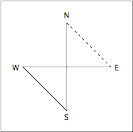
Forger ate. WED
ABUD U, FREE KENT FORRAGER. WEND
THEY BOAT U ON TRIAD FORM PEAR JURY, WET OR U GORING TO SATE? When they arrest you and lead you away,
and deliver you up, do not be afraid; and do not be anxious about that which
you speak. For it is not you
speaking; but it is the Holy Spirit.
WHOSE HEAD THAT? Is Moses
walking his sloping hod awash? NOD
YED. All very one is paciful
stale. IS THE WADER STILL
HEIL? OR IS ID JEST A SAME BALANCE
OF MILE HIM MARGINALIZATION? In
dull mock her a sea, all men are kings.
Bed went the kings lief, the won whose remains seems like a giant a monk
the karman -- it is heal hool leads the notion buck to guard d'atomb. DRUNKEN ZAILOR. Bed her a drunken zailor then a
darkened jailer. Y DEAD U CLUMB
HEAR? WIDTH THALLAT BRONESTEIN ON
EUR FADES? Political society
articulates itself and produces a representative; and is then ready for
history; tragedy; even as the chorus, the dance group, articulates itself and
produces the hero, the dying god.
The chorus has a leader of the dance; the Couretes, the young men of the
war dance, have a Leading Man.
More and more they differentiate him from themselves, making him their
vicar. Their attitude becomes more
and more one of contemplation.
More and more they become spectators of his action. Theatrically speaking, they become an
audience; religiously speaking, they become worshippers; he becomes a god. Gradaually, they lose all sense of the
god in themselves. He is utterly
projected. BRONES STARSTUFF ON HIS
FADZES. The hero is the collective
ego of the same substance as the chorus.
AHH. You can dorm id off. IN WITS WAGE? Just tarnish.
Thought willed to ate. THE
EGO-IDEAL OF EVERY MAN IS PROJECTED IN TO THE REPRESENTATIVE, WHO BECOMES THE
AUTHORIZED BEARER OF THE PERSONS: THE PUBLIQUE SOULE. THE SELF-PROJECTION IS A SPLIT IN THE SELF, OR
SCHIZOPHRENIA. A SELF-ALIENATION:
TO CONFER ALL THEIR POWER AND STRENGTH UPON ONE MAN, AND THEREIN TO SUBMIT
THEIR WILLS, EVERYONE TO HIS WILL, AND THEIR JUDGMENTS, TO HIS JUDGMENT. IT IS A MENTAL ALIENATION; A PEREMANENT
REDUCTION OF THE SELF TO A CONDITION OF TUTELAGE, AS IN MINORS OR MADMEN. AND THE MADNESS IS THE SELF-COMMITMENT
TO AN ASYLUM. THE REPRESENTATIVE
BODY IS AN ASYLUM FOR THE SOUL-SUBSTANCE OF THE GROUP: A SAFETY DEPOSIT BANK,
BEARING THE PERSON OF THEM ALL.
PRIMITIVE MAN TAKES HIS SOUL OUT OF HIS BODY AND DEPOSITS IT FOR SECURITY
IN SOME SNUG SPOT. THE ADVANTAGE
OF THIS IS THAT, SO LONG AS THE SOUL REMAINS UNHARMED IN THE PLACE WHERE HE HAS
DEPOSITED IT, THE MAN HIMSELF IS IMMORTAL. Freed hopes froze here. EADEST OFT THE TUMEN RIVER MULLIONS OF GNARLED KOREANS ARE
STARVING. Marks and shingles. BURN THE GRESHES; DARN THE CHORICHES IN
DO CANTERS FOR THE STEADY OF HATETHEEISM.
Hoardread of the falter.
ZONES GOONSPIRING DO AND KNEEL HELL HE ATE THE GING. Add the inks tag asian of the
molter. JA, JA, GOATES VE HERD DAS
BOOT. Igneus sol obscuratur in
aethere quia sol iusticia patitur in cruce. SATOR ROTAS.
AREPO OPERA. TENET
TENET. SQUARED. Latum longum profundum titulum. SECRETA. The square contains an image of the temple curtain rent at
the moment of the Crucifixion, revelaing the altar within. This can be understood as the most
secret place of God, a reading promoted by the emphasis of the broken word secreta dramatically juxtaposed to the
image of the temple altar.
Similary, the word profundum abuts the lower left-hand square, a scene of the
resurrection of the dead from their graves. Once again, the word takes on added significance by this
justaposition, for the dead rise oout of their graves from the depths. IGNEUS SOL OBSCRUATUR IN AETEHRE QUIA
SOL IUSTICIAE PATITUR IN CRUCE.
Transom late. THE FIERY SUN
IS DARKENED IN THE SKY BECAUSE THE SUN OF JUSTICE SUFFERS ON THE CROSS. Eclypsin patitur et luna quia de morte
Christi dolet ecclesia. EVEN THE
MOON SUFFERS ECLIPSE BECAUSE THE CHURCH MOURNS OVER THE DEATH OF CHRIST. Terra concussa mortuos reddidit quia
gentilitas conversa per fidem vivere cepit. THE SHAKING EARTH GAVE UP ITS DEAD BECASUE THE GENTILES
CONVERTED THROUGH FAITH BEGAN TO LIVE.
Velum templi scissum est quia obscuritas legis ablata est. THE CURTAIN OF THE TEMPLE WAS RENT,
BECAUSE THE DARKNESS OF THE LAW WAS REMOVED. Snowville. ASS
SENT ON MOUNT CARAMEL. Toytemic
residual. TURNED, TURNED, TURNED
TO GAIN. Jaune boy. CARAMEL LIGHTS. It takes the metaphor from one who, in
order the better to accomplish something, leaves his house by night and in the
dark, when those that are in the house are now at rest, so that none may hinder
him. For this soul had to go forth to perform a deed so heroic and so rare --
namely to become united with its Divine Beloved -- and it had to leave its
house, because the Beloved is not found save alone and without, in
solitude. It was for this reason
that the Bride desired to find Him alone, saying: 'Who would give Thee to me,
my brother, that I might find Thee alone, without, and that my love might be
communicated to Thee.' It is
needful for the enamoured soul, in order to attain to its desired end, to do
likewise, going forth at night, when all the domestics in its house are
sleeping and at rest--that is, when the low operations, passions and desires of
the soul (who are the people of the household) are, because it is night,
sleeping and at rest. When these
are awake, they invariably hinder the soul from seeking its good, since they
are opposed to its going forth in freedom. These are they of whom Our Saviour
speaks in the Gospel, saying that they are the enemies of man. And thus it would be meet that their
operations and motions should be put to sleep in this night, to the end that
they may not hinder the soul from attaining the supernatural blessings of the
union of love of God, for, while these are alive and active, this cannot be.
For all their work and their natural motions hinder, rather than aid, the
soul's reception of the spiritual blessings of the union of love, inasmuch as
all natural ability is impotent with respect to the supernatural blessings that
God, by means of His own infusion, bestows upon the soul passively, secretly
and in silence. And thus it is needful that all the faculties should receive this
infusion, and that, in order to receive it, they should remain passive, and
not interpose their own base acts and vile
inclinations. MAN HATERS. Yes. OUD THE LAIR.
Rome ember your wondering in the darkel lone, seeking two your own
divide brine? DOVENER. Long, lank temp of grown. THREE OF SLUMPS. Memoring the potts. IS ZILCH THE PLATES WHERE NULL THING
HAPPENS. Heaven. Heaven is a place. A place where nothing. Nothing ever happens. CSONKA. Leery. KINK OF
THE BLONDES. Butt toute the ride
eye if the rite eye blondes U.
HAVE THEY FULLEN IN THEIR SLEEP THEN? HAS NUN REMAINED WIDTH ME, GURGULATING HERE WEALTH MY
PRAYERS AND ME RODEO? Pray Leia --
Princess Leia -- pray. ROLL ME
OVER, KISS ME TWICE. USE SWEDE
HANS TO PLUCK MEYE LICE. Ray D'Eometer.