*************************************************************************************
Crossmann leaves the building and steps out into the night.
It is cold and dark.
Crossmmann feels alone in a big dark city. He looks for Jim. He looks both directions. He recognizes no one.
He hails a taxi.
Several go by.
Finally one stops.
"Where to?" the driver asks.
"MOMA," Crossmann replies.
"Ok. You could have walked there, you know. It's not that far," the driver says. "And traffic tonight is pretty nuts...!"
"It's too cold to walk," Crossmann says.
"Too cold? Oh, a tourist, huh?" the driver asks.
"Yeah, sort of."
"Here on business?"
"Yes," Crossmann says.
"Ok."
The taxi pulls away from the curb and starts south down a crowded street.
"I am God's lonely man," the driver says, under his breath.
"What?" Crossmann says.
"What? Are you talking to me...?"
"I thought you said something..."
"No, I didn't say something. Did you say something...?"
Crossmann now sees the driver's head and face in profile. The driver has a mohawk haircut. He is wearing a faded green military jacket, similar to Crossmann's. He seems to be agitated.
He drives up to the end of the block: red light.
Crossmann looks out the window. Wall to wall canary taxis. A few linousines. People stumbling along the sidewalks, beautiful people, out celebrating the New Millennium. Drunk. The biggest party of the century...
"Drunks!" the taxi-driver says, reading Crossmann's mind. "Drunks all over this town tonight! I hope they aren't driving...!"
The driver takes a right at the light.
Crossmann thought the MOMA was the other direction.
"Short-cut," the driver says, again reading Crossmann's mind. "Too much traffic here. I know a short-cut..."
Heading up the dark streets under street lights wafting in the wind. Light patterns lurching drunkenly on the street.
Another stop light.
Two women cross the street, dressed in short-skirts, short coats.
One of the women, a black woman, large, slams her hand on the front hood of the taxi.
"Boys, want some action?" she asks.
The other woman with her is just a girl, fifteen or less. Reddish hair.
"That's a crime," the driver says. "She's just a baby..."
The driver rrolls down his window and yells at them: "Let that baby go home to her mother. You're old enough to do what you want -- but she's just a baby...!"
The young girl laughs. She pulls up her dress to show the driver. She isn't wearing any underwear.
"This baby'd grind you down to nothin', taxi man!" the black woman calls back.
"She's a fucking man!" the taxi driver says to himself and Crossmann. "Did you hear that voice! That was a man's voice...!"
"You fucking....transvestite!" he yells at the black woman. "You're a disgrace! You call yourself a man...!"
"No, I call myself a woman!" the black woman cries.
Both women are giving the taxi driver the finger.
The light changes.
I should have walked, Crossmann thinks.
"I told you you should have walked," the driver says. "Be a lot damn easier on you...! Fate is what Fate is though...!"
"What?" Crossmann asks.
"Fate."
"What about Fate?"
"Fate is what Fate is," the driver repeats.
He takes a right and is heading north.
Crossmann tries to read the street signs, to get some sense of where they are. But the windows are fogging up. He wipes them clean.
To his right is a dirty-movie theatre. "Sometime Sweet Susan" is playing. Also the "Swedish Marriage Manual". And "Anita Nymphette". Prostitues in winter coats but showing leg in front of the theatre.
"The animals come out at night," the taxi driver says. "Whores, skunk-pussies, buggers, queens, fairies, dopers, junkies. Sick. Venal. Some day a real rain is going to come along and wash all this scum off the streets...!"
Crossmann says nothing.
The light changes.
The taxi moves again.
"I go all over," the driver says. "I take people to the Bronx, Brooklyn, Harlem. Some won't stop for the spooks. But it really doesn't matter to me, I'll take anyone...!"
The streets are getting darker and narrower.
"Why are we going north?" Crossmann asks. "I thought I said the MOMA...!"
The driver looks Crossmann in the eye through the rear-view mirror.
"I seen you on television, haven't I?" the driver asks. "Yes. That's it. I knew there was something about you that was familiar... The Jerry Springer Show. That as it...!"
"I don't think so," Crossmann says.
"Oh, yeah, that was you," the driver says. "You and your wife. She told you she had been having an affair with some... I don't remember his name... Marshall Felton. That was it."
How did he know that? Crossmann says nothing.
"Fenton," Crossmann says finally.
"What?"
"Fenton, not Felton," Crossmann says.
"Oh, it doesn't matter," the driver says. "But that was you, alright..."
"When did you see this show?" Crossmann ask.
"It was on tonight. I saw it tonight," the driver says.
Crossmann is silent.
"Why are we going north?" Crossmann asks again.
"I thought you might want to see your friend, Jim."
"What?"
"You didn't hear me?" the driver asks.
"What do you know about Jim?" Crossmann asks.
"Jim deals junk, man! Don't you know about that?"
Crossmann says nothing.
"Jim has taken a few rides in my cab. Jim sells junk, man. And he's in trouble in Harlem because he tried to fuck somone over..."
"I don't believe you," Crossmann says.
"You don't believe me. Why would I lie to you? What does it matter to me...?"
Crossmann says nothing.
Into the darker side of town. Fewer lights. Older cars parked on the curbs. Some cars burned out. Some buildings burned out. Four or five black teenagers run out of the shadows and pelt the taxi with empty beer cans, a milk carton. There is milk on the windshield. The driver turns on the wipers to eliminate the milk.
"Animals!" the driver says under his breath.
They drive on.
"What's your name?" Crossmann asks the driver.
"What?"
"What is your name?"
"Oh, I thought that was what you said. Henry Krinkle...."
"Kinkel, did you say?" Crossmann asks.
"Krinkle. K-R-I-N-K-L-E. Fairlawn, New Jersey. I live in Fairlawn, New Jersey..."
"I don't know anything about New Jersey," Crossmann replies.
"Of course you don't," the driver says. "You have a very narrow spectrum of experience, Michael..."
"Ok. How did you know my name?"
The driver is smiling, his head tipped back as he smiles in the mirror, his mohawk haircut dancing in the streetlights rushing in to the cab. There is something monstrous about the man. And something attractive. Crossmann notices his right hand on the steering wheel. The fingernail of his little finger is very large. It seems perverse to Crossmann.
"I told you. I saw you on Springer," he says, laughing.
"What's this about Jim?" Crossmann continues.
"Double-crossed another blood and now they're both packing, looking to do some damage," the driver says. "Hey, you gonna need a gun while you're in New York? I can get you one...I have a friend -- Doughboy -- he knows a guy named Easy Andy. Easy Andy can get you anthing you need while you're here, guns, dope, weed, uppers and downers....but you got a gun already. You got a .38 in your coat pocket right now, ain't that right, Mister C...?"
"How do you know that?" Crossmann asks.
"I've been watching you on tv, friend."
"Are you some kind of all-knowing being?" Crossmann asks.
"No. Only the dead know everything. Then they forget everything, right before they're born again..."
"Do you believe in reincarnation then?" Crossmann asks.
"Nah. I've been watching your show. The Michael Crossmann Hour..."
He is laughing. A slightly malicious laugh.
"You know something else about your friend Jim," the driver says. "Jim is that kid on the bus to Salt Lake that you and your brother helped. The one you two raised money for, to help him get to New York. Jim is that very kid..."
"That's crazy!"
"Everything's crazy here, Mister C. This is Millennium Eve -- or had you forgotten...?"
Deeper into the night they go.
"I gotta get in shape now," the driver says to himself. "I've been sitting too much; my body's been taking too much abuse. No more pills, no more bad food. From now on it will be total organization. Every muscle must be tight..."
The taxi turns right on a dark street.
"There's your boy, Mister C, going into that alley..."
"That's where I met him," Crossmann says. "He was sitting on that stoop over there..."
"I know. I've seen the film," the driver says. "Man on a Tightrope. I've seen it all. That's why I know so much about you. I turned off that last part, the Charlie Rose part. You almost lost me there, doc. Too many words. What were you thinking? Nobody's going to vote for an egghead in this country. Shit! Whose managing you anyway? Adlai Stephenson? Jimmy Carter...?"
Crossmann watches Jim turn into the alley.
Crossmann tries to open the door. The door is locked.
"Hey! No, sir, you can't intervene!" the driver says. "You can just watch."
"I need to help him!" Crossmann says.
"You can only watch. Those are the rules."
Then the shooting begins.
Crossmann hears the guns explode, sees the flashes of light. Maybe six or seven flashes.
He tries the door again. The door won't open.
The cab pulls away.
"Stop this cab," Crossmann yells. "I need to help him...!"
"You'll see him again. It's no big deal," the driver says. "Niggers get killed in this town day and night! It's a regular arcade around here. No matter what they say in the papers. I need to get you back into town..."
He turns on the radio, low, barely audible.
Crossmann recognizes Jackson Browne:
Awake again, I can't pretend
And I know I'm alone
And close to the end
Of the feelings we've known.
How long have I been sleeping?
How long have I been drifting
Alone through the night?
How long have I bee running
For that morning flight
Through the whispered promises
And the changing light
Of the bed where we both lie
Late for the sky...
"You're glad to get out of Harlem, aren't you?" the driver says, smiling.
Crossmann was listening to the music.
"What?"
"You don't like it much here in Harlem, do you, MC?"
"Not much," Crossmann replies.
"Feel threatened?"
"Yeah."
"That's good," the driver says. "You are threatened up here. It's no place for you. They'll kill you where you stand if you got a white face up here. Unless you're Clinton or someone like that. Some celebrity. Revenge. Revenge is in their hearts up here. That's why Jim was looking out for you. Jim's been looking out for you the whole time you been here..."
"I know that," Crossmann says.
"So, what are you doing for him...?"
"What?"
"What are you doing for him?"
"I dont' know," Crossmann says.
"Give him some of your money," the driver says. "He needs to pay off his boss back there. He misappropriated some money from his boss. He's selling drugs -- but he came upp short. You know what I mean? Give him some money and you can save Jim's life again...!"
"I did give him some money!" Crossmann says.
"Oh, that was long ago!" the driver says.
"No, tonight!" Crossmann says. "I gave him some money tonight...!
"Oh, that was play-money," the driver says. "Give him some real money...!"
"I will! I will!" Crossmann says.
"You've got money now! You're rolling in money now...!"
"I know. You said I'd see him again...!"
"Yes, you will. I need to stop here a minute...."
He pulls the taxi over a minute.
Crossmann wipes the window on condensation again. Belmore Cafeteria.
Crossmann watches the taxi driver go inside. He talks with a bald man who is sitting at a table with a black man, older, solid-looking, and a goofy-looking white man in a cap.
The driver is back out quickly.
Then they are driving again, turning right, again heading south.
"What did you need in there?" Crossmann asks.
"An address," the driver says. "I'm not very good with addresses. I don't have a very good memory for addresses..."
They hit Central Park West and move into the light again.
"This is more your style, I'll bet," Henry says.
To the right large, elegant apartment buildings begin to come into view. On the left is Central Park.
They ride.
The music has changed. Now it's John Lennon. Crossmann begins to hum along.
People say I'm crazy doing what I'm doing
Well they give me all kinds of warnings to save me from ruin
When I say that I'm o.k. well they look at me kind of strange
Surely you're not happy now you no longer play the game
People say I'm lazy dreaming my life away
Well they give me all kinds of advice designed to enlighten me
When I tell them that I'm doing fine watching shadows on the wall
Don't you miss the big time boy you're no longer on the ball
I'm just sitting here watching the wheels go round and round
I really love to watch them roll
No longer riding on the merry-go-round
I just had to let it go
Ah, people asking questions lost in confusion
Well I tell them there's no problem, only solutions
Well they shake their heads and they look at me as if I've lost my mind
I tell them there's no hurry
I'm just sitting here doing time
I'm just sitting here watching the wheels go round and round
I really love to watch them roll
No longer riding on the merry-go-round
I just had to let it go
I just had to let it go
I just had to let it go
The music makes Crossmann sad.
The taxi pulls over to the curb. The cab crawls up a few feet toward the corner of West 90th Street. Henry turns off the meter.
"I'm not getting out here," Crossmann says. "Where are we...?"
"The El Dorado Apartements," Henry says. "Rich people live here."
"So. You're not trying to sell me an apartment too, are you...?"
"Oh, that's funny...."
Crossmann sees a white limousine pull slowly up past the taxi.
He sees Truman and the old Russian woman in black looking out the window, looking up at the El Dorado. Truman's mouth is moving wildly. He looks drunk. His face is red.... Crossmann sees himself in the white limousine creeping up the street, drinking champagne....
"Yeah," Henry cries. "There they go. You want to get a ride with them. You like them better than you like me, won't you...? Oh, you're gonna make me cry...!"
"What are we doing here?" Crossmann asks.
"Look up there."
"What?"
"Up there. The seventh floor, with the light on," Henry says.
"What?"
Crossmann wipes the condensation off his window.
"The one that's closest to this edge of the building," Henry instructs. "The light on the seventh floor. See the woman in the window...?"
Crossmann sees a woman's silhouette in the window.
"Yeah, you see it. Good. You see the woman. Good. You ever see what a thirty-eight caliber gun can do to a woman's face close-up? Well, it will blow it apart. It will blow a big, fucking hole in it. Have you ever seen what a thirty-eight caliber gun could do to a woman's pussy? You should see that. That you should see. A woman's pussy. I bet you think I'm sick, right. Do you think I'm sick? No, you don't have to answer that..."
"What are you talking about?" Crossmann asks.
"Well, don't you recognize the woman?"
"What?"
"Don't you recognize the woman?"
"No."
"You don't?"
"No."
"Well that aint my wife in there. It's your wife..."
"That's not where she lives," Crossmann says.
"That's where her boyfriend lives," Henry says. "What's his name -- Marshall Felton...?"
"Fenton."
"That's his apartment. Your wife is in there going down on that Ivy League queer right now. That's why you've got that gun in your pocket, remember. You're going to take both of them down tonight...!"
"What?"
"That's the plan, remember?"
"I don't remember anything," Crossmann says.
"Are you a man? That's your wife in there...!"
"I'm not going to kill her," Crossmann says.
"She left you, man," Henry says. "When you needed her most. And she took your daughter with here. You're alone, man. They've left you all alone. You have nobody in this life..."
"I'm still not going to kill her."
"Oh, mister big-talk!" Henry says, scoffing.
"I never said I was going to kill her. I have no intention of killing her...!"
"Why not? You're home free tonight. You have the key to the city. You can do anything. It's like being in a dream. You won't be responsible for anything you do. It's like being poor in a heaven of liberals. You can do anthing you want...."
"Who are you, the devil?" Crossmann asks.
"Henry Krinkel, I told you."
"What's that haircut all about?" Crossmann asks.
"Going primeval. That's what it's about," Henry says.
"Going primeval?"
"Going primeval means you can do anything you want. You can become a vigilante if you want...."
"Who put you up to this?"
"Who do you think?"
"Tell me..."
"Didn't you ever try looking through your own eyeballs in the mirror," Henry says.
There is silence.
The radio is still playing...
Our life together is so precious together
We have grown, we have grown
Although our love is still special
Let's take a chance and fly away somewhere alone
It's been too long since we
took the time
No-one's to blame, I know time flies so quickly
But when I see you darling
It's like we both are falling in love again
It'll be just like starting over, starting over....
"Drive the car!" Crossmann commands.
The car pulls away from the curb.
Henry says: "You're like me, man. You're like me...!"
"How and I like you?" Crossmann asks.
"You're a vigilante, man," Henry says. "I'm a vigilante too...!"
"We're all vigilantes, Henry," Crossmann says. "You and me and William Foster. We're all vigilantes..."
Henry says: "Who the fuck is William Foster...?"
"Oh, he's an imaginary person. Did you see the movie Falling Down. That was William Foster..."
"I don't watch movies much," Henry says. "They give me headaches..."
"Do you know Michael Douglas, the actor?"
"Sure, Kirk's kid," Henry says.
"Well, it was his movie. He played a vigilante. A decent guy, who became a vigilante..."
"Ok," Henry says. "Whatever...."
Henry drives on in silence for a moment.
Then he says: "When you become president, you should clean up this city. It's like an open seweer full of filth and skum. I can hardly take it sometimes: I smell it and get heaches The next president should clean up this whole fucking mess, just flush it down the fucking toilet. When you become president, that's what you should do...!"
Crossmann says nothing.
Then, under his breath, he says: "I'm not becoming president...!"
"Oh, that's what you think!" Henry says, laughing. "I've seen the moving, remember. I know what happens...!"
Crossmann sees a commotion up on the right, on the sidewalk. People begin running. Then he hears gun shots.
"What the fuck!" Henry shouts.
"Pull over here," Crossmann says. "Something's going on..."
Henry eases the taxi over to the right. He gets out of the taxi.
"We need help!" a woman cries out. A Japanese woman.
People are carrying a man's body toward the taxi. They open the back door.
Crossmann moves over to the left.
They slide the man into the taxi. He is bleeding.
"Get him to Bellevue!" a policeman cries. "Take him to Bellevue!"
The Japanese woman is trying to close the door, but the man's feet are still in the street.
Crossmann takes the man in his arms and pulls him in to the car.
Crossmann notices a copy of Catcher In the Rye lying on the sidewalk.
The Japanese woman closes the door. Then she stands at the car, looking in throught he window. She has a look of utter sadness. It makes Crossmann want to cry.
Then her face changes. She changes into the woman from the millionaire show, Hoa-Lan Tran, the Vietnamese woman who Crossmann is supposed to know but doesn't. She smiles at Crossmann. She puts her lips up to the window, kissing the window.
Then she opens the front door, gets into the taxi.
She looks back at Crossmann. She is now the Japanese woman again.
Henry is back in the car and they are out of the street.
"Get there as fast as you can!" the Japanese woman cries. Tears are streaming down her cheeks.
"Who would do this?" she pleads. "Who would do this!" she cries to Crossmann.
Crossmann doesn't know what to say. He thinks Holden Caulfield might do this....
But then he says: "A madman. Only a madman...!"
"Why do the gentle ones always get killed...?" she asks. "Is that part of God's plan...?"
Crossmann says nothing.
The man in Crossmann's lap is breathing in short gasps.
He is bleeding all over Crossmann's green army coat -- the one Jim gave to him. It doesn't matter.
Henry is hurtling up the street and then takes a hard left. He leans on his horn.
It seems like it takes an eternity to get one block.
"Drive this thing, Henry!" Crossmann cries. "Drive this thing...!"
The wounded man in Crossmann's lap tries to say something.
Crossmann leans down.
"What?"
"Tell her..."
"What?"
"Tell her I love her..."
"He says he loves you," Crossmann says.
"Oh, John! I love you too! I love you too...!" she cries. "We are going to get you to the hospital! They will be able to save you! Don't worry! God is taking care of you...!"
"Drive, Henry!" Crossmann cries.
He feels the life slipping out of the man in his arms.
"No!" Crossmann says. "No! Don't give up! You've got to stay with me...!"
But he is gone.
The Japanese woman is still talking, still telling John to hold on. But John is gone.
Crossmann says nothing to the woman. He holds John as if he is still alive.
He doesn't want her to know. He doesn't know what to do.
At Bellevue, the medics run out and draw John out of the taxi, pulling him on to a gurney.
He and the woman are gone.
Henry is arguing with someone about where his taxi is parked, threatening to break the guy's face.
Crossmann gets out of the taxi and wanders toward the hospital.
"Hey, Crossmann," Henry cries out. "I'll take you to the MOMA. Get in! You don't want to be late...!"
"You go ahead," Crossmann says. "I don't have any money to pay you."
"I don't care about you money!" Henry says. "I never cared about your money. Get in...!"
Crossmann is in the hospital.
A nurse hurries up to him, crying: "You're bleeding! Have you been shot...!"
Crossmann says: "It's not my blood. It's someone else's. I'm fine."
She gives him a towell to wipe the blood from his coat.
Crossmann is again outside, at the front of the hospital. Everything is quiet. Around the corner, the main lobby is locked, dark. Crossmann uses the Key to the City. It works. The lobby door opens.
The lights come on.
The entrance rotunda: white walls, four central pillars, four doors leading into the room. A series of large paintings on the wall. Crossmann recognizes the paintings. These are his paintings. Winding around the room.
Crossmann moves from painting to painting.
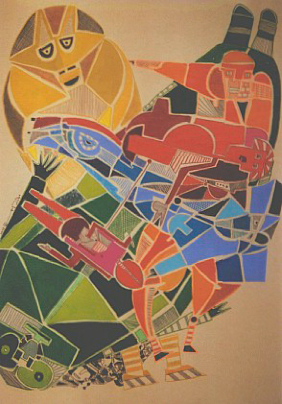
I. Evolution
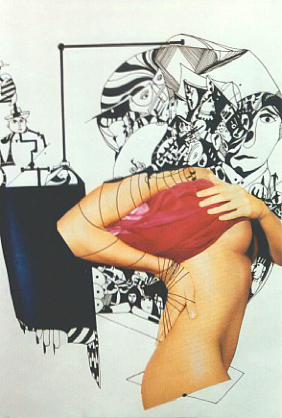
II. Science
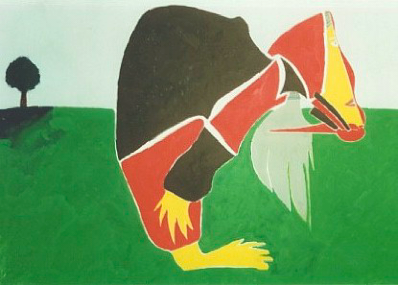
III. Agriculture
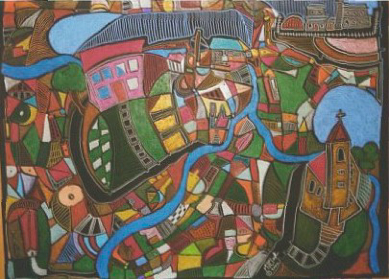
IV. Industry
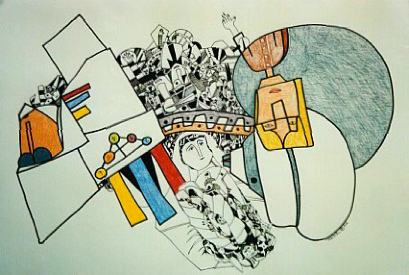
V. Family
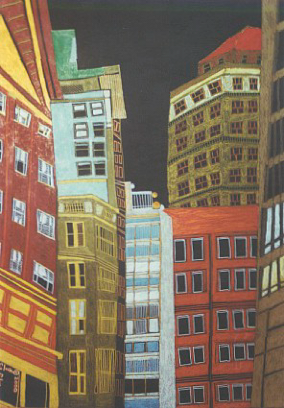
VI. Construction
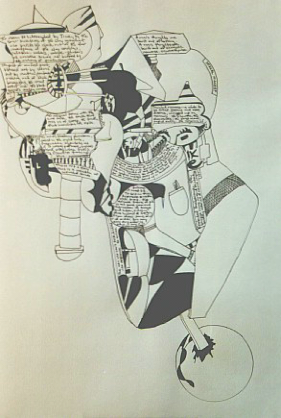
VII. Destruction
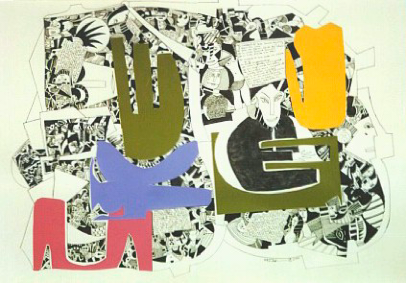
VIII. Democracy
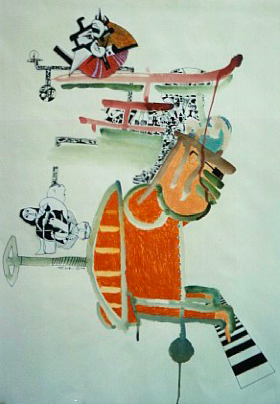
IX. Recreation
A door in the back of the rotunda opens.
"Stranger!" a voice comes into the room. A Russian voice. Broken English.
"Welcome back, stranger! How do you like my present for you...?"
It is the Magician. He is dressed in a tuxedo. Still he is wearing gigantic glasses, tinted a magenta hue. His hair is black, long and greasy. He is holding a bottle of Wild Turkey, half-empty, cap gone.
Crossmann has not seem him above ground before.
"Abrahadabra," the Magician says to Crossmann, making a sweeping gesture down with his left hand.
He moves across the room and shakes the Magician's hand. Then he hugs him.
The Magician offers him a drink from the bottle of Wild Turkey.
Crossmann takes a drink.
"I love your work!" the Magician says.
"How did you get it in here?" Crossmann asks.
"I have my ways. I have connections here. I live below by choice. But I have connections all the way to the top..."
"Himmelmann?" Crossmann asks.
"I'm teaching Himmelmann's daughter how to paint," the Magician says. "And she loves my dog. But Himmelmann is nobody. No, I have connections to the very top."
"With God, you mean?" Crossmann asks.
"Even higher. I'm friends with the night janitor."
Crossmann laughs.
"Come with me!" the Magician says.
"Where?"
"You have to meet your public..."
At the back of the rotunda is a poorly-lit corrugated metal spiral staircase leading straight down. Room enough for one person to pass at a time. Spiralling down, around and around, deeper into darkness.
"Don't worry," the Magician says. "This is a cork-screw we are walking on. And it leads you to your biggest intoxication yet. It gets light at the bottom again...."
Crossmann descends by feeling, touching the railing, guiding himself down through the blackness. He can see nothing. He hears the Magician ahead of him, hears the whiskey bottle the Magician holding bang against the railing from time to time.
"Ok," the Magician says finally. "We're here. Yes, give me your hand."
Crossmann reaches out in his blindness, somehow finding the Magician't hand.
The Magician leads him down a pitch black passage. The Magician walks like he can see. He says: "This whole city is connected by underground passageways. You can walk all over the city underground if you know what you are doing. Come this way, just a bit farther...."
Then he throws open the door.
Light comes rushing in on Crossmann.
Music. A chamber orchestra is playing something by Bartok. It is a formal room: elegant. Chandelliers. Men dressed in tuxedos. Women in long gowns. Everyone looks rich.
"Where are we?" Crossmann asks.
"At the gallery," the Magician cries. "At the museum, for your show. Here, get rid of that coat. What have you been doing, eating at Mc Donald's? You got ketchup all over yourself...!"
"That's John Lennon's blood," Crossmann says.
"What? Sure it is!" the Magician plays along. "I was going to offer you a pair of magic glasses -- but I guess you already have your own...!"
Crossmann straightens his glasses, pushing them up on his nose. He hates it when they slide down his nose.
The Magician feels the gun in the pocket of Crossmann's coat.
"You won't be needing this here," he says. He puts the pistol in his belt at the back of his tuxedo. He throws the stained army coat off to the side, saying: "You can't go in here dressed like a bloody bolsehevik, now can you...?"
He takes Crossmann's arm, and presents his to the king and queen.
Mayor Guiliani and his wife. His pretty wife. The actress.
"Hello again, Mister Crossmann," the Mayor says. "I hear you've had quite a full day in our great city."
He shakes Crossmann's hand.
"Donna Hanover," the pretty strawberry blonde woman next to the Mayor says. "My vagina speaks four different languages and over 70 dialects...."
"Please, dear!" the mayor says, under his breath, angry. "You're not on stage here! This isn't your show. Behave yourself...!"
"I say 'vagina'," she explains to Crossmann, "because I want people to respond. I say it because I'm supposed to say it. I say it because it's an invisible word, a word that stirs up anxiety..."
"It's clearly stirring up anxiety in your husband," the Magician says, taking a pull on the Wild Turkey.
"Oh, he's got cancer in his testicles," Donna says with a smile. "That's why he appears so anxious...."
The Magician whispers to Donna, so the mayor doesn't hear it: "Do you just talk about it, or do you show it off at all...?"
"Oh, I show it to some of my friends," Donna says, seductively.
"Come this way, Michael -- can I call you Michael?"
The Mayor leads Crossmann away from his wife. The Magician stays behind, seeing opportunity present itself.
"I'd like to present you to Catherine Herr-Clement, one of the great benefactors of New York Art."
The woman is tall and thin, a bit gray, like she has been eating air for several generations. She has the air of aristocracy. And Crossmann knows he is supposed to admire this air; but he finds it, instead, a bit thin.
"Your work if really refreshing, Mister Crossmann," Catherine says. "I wouldn't call it revolutionary art. But, then, one can only take revolution so far until it becomes...."
She searches for the right word.
"Reactionary?" the Mayor suggests.
"No."
"Uncivilized?" the Mayor tries again.
"No."
"Childhish," another man adds, one who is listening to the conversation.
"No."
"Unceremonious?" say another.
"No."
"Debilitating?"
"No."
"Insincere?"
"No."
"Taxing?"
"Heavens, no!"
"Animalistic?" Crossmann says.
"Yes, indeed, animalistic." Her eyes flash into Crossmann's, as though the word has awakened in her some primal memory long slumbering in the antarctic of her soul. "Animalistic," she says again with relish.
Anthony Hopkins is in the crowd. He smiles at Crossmann, then at Catherine. Then turns away, sheepisly.
"There are a lot of people here you have to meet," the Mayor says.
"Is this the artist!"
Catherine Zeta-Jones is there, dressed in a rapturous blue gown showing three-quarters of her lovely breasts. She is drinking champagne; and she is a bit tipsy.
"Your work is so strangely satisfying," Catherine the second says, smiling a rosy full-lipped smile. "Satisfying like afternoon love-making in Rangoon on a rainy afternoon during Monsoon is satisfying. Do you know what I mean....?"
"Not personally," Crossmann says. "I''ve never been to Rangoon. But if you hum me a few bars, I might be able to follow along..."
The comedian in Crossmann is coming out again.
Catherine laughs genuinely, throwing back her head. Her breasts nearly come out of her dress as she moves too abruptly for the structure of the gown.
Crossmann's eyes grow large.
"Here, have a drink," she says, handing him a glass of champagne she has just snatched from a passing waiter.
"We bought one of your paintings," Catherine says, "me and Michael, my Michael. I don't remember which one, but we liked it alot. We're going to put it in our study, I think. Although it has too much blue in it for the study, I'm afraid..."
Crossmann wants to kiss her. He wants to take her down on the couch and swallow her beautiful lips in his mouth like two succulent berries. But there is no couch in the room.
"The one we bought reminded me of Picasso's Weeping Woman -- it had that same kind of feeling...."
Crossmann is staring into her eyes, mesmerized by her beauty.
"You are much more beautiful in person," Crossmann says. "I don't really like you as an actress that much. But I sure like the way you look in the flesh..."
She realizes he's flirting with her. She smiles, almost blushing.
Crossmann wishes she would begin to discuss her vagina and the words that it can pronounce.
But then her husband appears. Michael Douglas. He shakes Crossmann's hand.
"Michael!" It is Lola Fanti, the director of the gallery. One of the Associate Directors, that is. Lola is very nervous, very high-strung. She clearly is too busy, and has too much responsibility. Her eyes do not focus properly: when she is talking with a person, her eyes are doing calculations of something past or present.
"Michael! Oh, Senior Douglas and Seniorina...."
"Zeta-Jones," Catherine helps her out.
"Yes. Of course, Zeta-Jones. I have too much on my mind," Lola says, apologizing. "They bought one of your pieces," Lola says to Crossmann.
"Yes, Catherine just told me," Crossmann says. "The one that looks like Picasso's Weeping Woman..."
"I didn't say it looked like it," Catherine corrects Crossmann, laughing. "I said it reminded me of Picasso..."
She is much sweeter than he thought she'd be. Perhaps it is the champagne.
"Michael, I think maybe you need to meet some friends of mine," Lola says. "I hate to take you away from this lovely couple, but...."
"No, that's fine," Catherine says. "It was nice meeting you. I'm sure we'll meet again, some time later tonight..."
"I'll be looking for you at Midnight," Crossmann says quietly to her, so that her husband doesn't hear.
"Ok," she whispers back to Crossmann. "You have a date...!"
Lola drags Crossmann across the room. He looks back, looking to catch another glimpse of the beauty.
"What is she talking about!" Lola snaps under her breath. "'She Loves to Talk' looks nothing like 'The Weeping Woman'! The woman is hopeless...!"
"Feelings," Crossmann says, defending her. "She was talking about feelings...! How the painting made her feel...!"
"Oh, you Americans!" Lola replies. "Everything is feeling! Feeling! It makes me want to puke some times! She is such a....bimbo! What's the word you have.....'gold-digger'? Yes, that's it...!"
"Be nice," Crossmann says. "She was very nice to me...."
"Well, of course," Lola says. "You are a man. She probably wants something from you...!"
"Like what?" Crossmann asks.
"How do I know," Lola says. "Use your imagination. People are saying you might be president some day. I'm sure she'd love to be the First Lady. Now, don't you think that might suit her...!"
Crossmann had never thought of that. He never thought he might be holding more cards that Michael Douglas.
"Michael Crossmann!" Lola nearly shouts, "Enzo Stendi and Marissa Niemo."
An stately couple stands before Crossmann. Italians, Crossmann guesses.
"Hello," Crossmann says, shaking hands with each.
"We have made an investment in your work tonight," Enzo announces. "We have purchased six of your pieces. And we feel that this is just the first step for us. We will collect your work, assuredly. For we find your work really breaking new grounds in the world of art. Going back is sometimes going forward. We understand this as you do.."
"Si," Marissa adds. "The work is....like Gaudi. The dream becoming....the dream..."
"Yes, precisely," Crossmann agrees.
Enzo is a handsome man of wealth, with gray hair brushed back, a full mustache, and strong shoulders. He is not exactly handsome. One eye wanders furtively, his left eye. But he does have a presence. An aristocratic flavor.
His partner is short and muscular-looking, with short-hair in the style of European feminists. But she is obvously Enzo's lover. They are both lovers of the arts.
"I appreciate your patronage," Crossmann says, bowing to both.
"Enzo, Marissa, I will see that he spends more time with you later tonight," Lola says. "I need to see that he meets everyone now, everyone who matters...!"
They shake their heads graciously.
"It is a pleasure meeting you," Crossmann says.
Lola whisks him away.
"Don't waste your time on people without money -- remember that!" she commands. "You only have so much time tonight -- and there are many people you must meet! If you don't smell money, keep moving! You are selling yourself here, remember that! Look at these clowns! They have no money! They'll never buy your art...!"
Lola nods over toward the wine table. Crossmann sees his brother William, Truman, Faramarz, Alan Ginsberg, and the old Russian woman in black. Jim is also there, dressed in his chauffeur's uniform. Crossmann smiles to them.
"You know those losers?" she asks. "They should have stopped them at the door. They're just here for the food...!"
"Relax, Lola! You've already sold seven pieces," Crossmann says. "That should more than cover the cost of the food for my friends...!"
"Seven pieces! I've sold more than that! Now don't you get all soft on me! We're going to build an empire for you! Nothing less will do...!"
"Lola" the Magician appears again. "Stephen S is down in the Hershfield Room. He's thinking about buying one of Michael's paintings. I think you better swoop in for the kill. He's opened up, like a crab on its back in the sun...!"
"Oh!" Lola exclaims, throwing her hands up. "Yes. Stephen S. Stephen S. Going in for the kill! Remember, Michael: Nothing short of an empire! Nothing short of the gugular...!"
Lola vanishes.
"I could tell you needed to be rescued," the Magician says.
Crossmann laughs.
"Don't tell me there was no Stephen S," Crossmann says.
"There is a Stephen S," the Magician says. "But he's not downstairs." The Magician smiles mischievously. "Lola's a rabid canine. She can ruin your night in a minute or two -- in a New York minute, as the song says. You better avoid her. She tastes like arsenic with a beer chaser...."
The Mayor's wife is following the Magician. She has taken a shine to him.
"She likes you," Crossmann says, pleased.
"I think it's my magic glasses," the Magician says to Crossmann. "She looks at herself in my glasses, seeing her reflection. And it makes her think she's on tv...."
Donna approaches, moving with energy, projecting a role.
"If your vagina could talk, what would it say?" she asks, emoting with a diva energy. "If your vagina got dressed, what would it wear? What does you vagina smell like? The responses range from the pithy to banal: 'Yum, yum' -- 'oh, yeah' -- 'Is that you?' say interviewees who mentally dress their 'sexy' and 'wet garbage-smelling' vaginas in everything from a pinafore to a slicker..."
Woody Allen walks by Crossmann with his Asian wife, eyeing Donna with heightened confusion. Then he gives Crossmann a sympathetic look.
"Dear," the Magician says. "Can you give it a rest. I'm not the BBC or PBS afterall..."
"Take off your glasses," Crossmann says.
"What?"
"Take off you glasses."
The Magician takes off his glasses.
Donna stops talking suddenly.
She says: "I never realized you have such a damaged face, Mister C. Where did you get all those pockmarks...?"
"I earned them. In prison," the Magician says.
"In prison? You've been to prison?"
Donna walks away dejectedly, energy sapped, looking for another pair of magic glasses in the crowd.
"Crossmann, like your art!" It is Donald Trump -- 'the Donald' as he's called by those who know. He has a beautiful blonde on his arm. "I bought a couple pieces. First Date -- it reminded us both our our first date! Now, don't laugh! We're still young at heart, you know... What was the other piece...?"
The woman is laughing.
"It is very sexual," the woman says. "The painting. First Date."
"Yes, it is," Crossmann says.
"There is a pulsing sexual instrument in the painting," she says, taking the theme a step further.
"Bloody red and ready to explode," The Magician says, seeing that such talk exictes the blonde.
"Yes. Beneath everything, initially, every love attraction, there is sex," Crossmann says. "That is what draws the man and woman together. It's not what keeps them together. But it's what brings them together in the beginning...."
"It's what drives them apart in the end," the Magician says.
"Oh, come on now," Trump says. "Sex isn't what pushes the world apart. It's what keeps the world alive...!"
"Yes," the Magician agrees. "In the beginning. And before the beginning..."
"It's what keeps a romance alive," the woman says.
"Romance is one stage of a love affair," the Magician says. "It is the youth of love. But people who must experience the youth of love always jump from romance to romance -- and the love affair is never allowed to develop. The plant is pulled out of the earth always before it can really bloom. Passion is the first stage of love. But passion isn't love. Love is passion and not-passion at once...."
"Are you...I don't even know you -- but I get the sense that your are criticizing my life-style," Trump says, smiling. "Am I to take this analysis personally...?"
"No. I speaking about the 'happiness cult' in this culture," the Magician says. "The idea that everyone has a right to be happy. Everyone doesn't have the right to be happy. We have no rights. We have life. Life makes us happy and sad; and the sad part can't be exiled from life if we want to build our character, to deepen our understanding and natures. That's all I'm saying."
He takes a swig of Wild Turkey.
"A philosopher," Trump says under his breath. "A European philosopher."
"Love is supposed to go through youth and maturity and old age," the Magician says. "Sorrow in love, alienation in love, also is a part of the fruit. A part of the experience. People who want to bounce on the surface chase only the sunny part of love; but they never develop real character either..."
"Listen, you Russian kook," Trump says. "Better watch yourself or I'll plant a big ugly hammer on your head..."
"You can't hit a man with glasses," the Magician says. He puts his magic glasses back on.
Trump begins to laugh.
The blonde on his arm also begins to laugh.
Soon, everyone is laughing.
The Magician hands Trump the bottle of Wild Turkey. Trump takes a pull.
"Crazy Russian artist!" Trump says.
"Crazy American Capitalist!" the Magician says.
'I have about ten of this lunatic's paintings," Trump says to Crossmann, pointing to the Magician. "Are you like him?" he asks Crossmann.
"I don't know," Crossmann says. "I don't think anyone's like him."
"He's not like me," the Magician says. "I'm a devil. He's the angel. Don't you see it? I'm Lucifer; he's the real Michael."
"Yes, we were watching you earlier on tv," the Donald says, "with Charlie Rose. What is that Michael the Archangel stuff? Do you really thing we've already fought Armageddon? We've already won the war of the apocalypse? I don't understand that..."
"No one understands it but him," the Magician says.
"Do you really think you were Micahel the Archangel?" the blonde asks Crossmann. "We weren't planning to come here tonight. We had been asked to several parties. But when we saw you with Charlie Rose tonight, I really wanted to come meet you..."
She is smiling a big, cuddly smile at Crossmann.
"She insisted we come down here," Trump says. "And, I thought, if we're coming down, we might as well open up the check book; support the arts a bit in town...."
"I love your work," the blonde says.
"We hear some Italians are driving up the price of everything?" Trump says. "Is it Enzo and his little scarlatti? I'm sure it must be them...."
"Rudolf Heinz has also come over from Dusseldorf," the Magician says. "There are several Germans entering the bidding also. He's considered a litrary genius in Germany, in all of Europe really..."
"We bought First Date and The Re-Birth of America. Your work on black paper reminds us of Hundertwasser... But it's a bit too dark for me. I like the work on white paper more...."
"Hundertwasser was a wonderful artist," Crossmann says. "He was a bit of a bore politically. But he was a wonderful artist. As were his predecessors Klimt and Schiele..."
"We're very fond of the Austrians, too," the Donald says. "We have originals of both Klimt and Schiele in our house. And now we have two of your paintings to go with them..."
"May I have your attention for a moment." Hedda Krantz is a late middle-aged woman of medium height, short sandy-hair, and a facial expression of steely resolve. Not unsympathetic. Some warmth in her face. But a fierceness too. She is dressed in black and white. In fact, everyone is the room is dressed in black and white. Crossmann can't believe it. He is too.
"I would like to welcom you all tonight; and thank you for spending Millennium Eve with us tonight -- and, more importantly, with our featured artist, Michael J. Crossmann, controversial but respected fine arts, novelist, poet, from the Pacific Northwest. I'd like to ask Mister Crossmann to come up here for a moment and say hello to you all. We are showing thirty-six pieces of his work tonight, work on paper and board, work in ink, colored pencil, gouache and acrylic. Mister Crossmann's work has been called an echo from the pre-World War II expressionist era. He calls his work Abstract Expressionism; and he refers to his imagery as veritable photographs of the psyche, part dream, part reality, part figure, part abstraction. He works in archetypal forms, dream images which, because of their archetypal nature, belong to everyone, are a part of everyone's experience...."
Crossmann has moved slowly toward Hedda Kranta, the museum's managing director. Making his way toward the microphone.
"It's my pleasure to introduce Michael J. Crossmann...."
Crossmann moves to the microphone. The audience applauds. A young woman, in here twenties, dressed in a chartresuse downy duck costume, hollars to Crossmann: "Racist, fascist, misogynist...!"
The crowd lets out a gush of disapproval.
Two ushers move to the protester, surround her and ask her to leave.
"How the fuck did she get in here!"
It is Lola's voice, behind Crossmann. "I'll fire that fucking doorman! I'll fire him tonight!"
Lola moves through the crowd, moving toward the fluffy duck with an intention to maim.
"I appreciate your coming here tonight," Crossmann says. "I realize that my ideas are controversial to some, and misunderstood by some; and they are, in fact, misrepresented by some others. But I appreciate being given a forum in New York City to show my art work -- which is really not especially political by nature. Which is, as Hedda Krantz has suggested, very private, on one hand; but very communal on another, primal in the sense of coming from our own common roots, our roots in dreams, from the gods of vision. I hesitate to say that I am eager or willing to answer questions about my art, since I am not sure that talking about the visual arts is a good thing, or even possible, except as a kind of masturbatory exercise. I think people talk about art more as a way to shine a light on their own intellectual processes, which may or may not have any connection to the art upon which they are throwing shadows or handsfull of light. The visual arts touch us in places, quite often, where words don't exist. Our first response to visual art is in the stomach or in the heart, very rearely in the intellect. There are exceptions to this. Some of my own art, I believe, is an exception to this -- the works which incorporate written poetic texts are, in fact, in some ways, illustrated texts which require intellectual analysis to understand. Generally, I don't talk much about my art. I try to look at it. To see things in it. I know there are secrets in there, things I should know, faces I should recognize. I know that my art is trying to educate me. But not through language. Something more immediate than language..."
"Which is what?" someone asks in the audience.
"My process in creating art is working from the inside out. Pushing the dream, the imagery hidden in darkness, out in to the light. I think many people don't understand abstract art. But the way I view abstract art is as, often, as a magnified view of the very close, the microscopic. I am a photographer -- an amateur photographer. But one of the wonders I see in photographer is the power to view to small, the infinitessimally small, in close-up. And how the small, the close-up, becomes, by nature, abstract, mysterious, difficult to solve, to master with the mind. Because it obscures scale. It is not clear if the picture is very large or very small. Patterns emerge; patterns become definitions of space. Colors become definitions of space. Forms are very less dominant than patterns. One can photogaph the skin on a woman's arm and discover wonderful, beautiful skin patterns which have no formal connections in the frame. Jackson Pollock is like this, especially in his drip paintings, which I find wonderful; Mark Rothko is also like this, a close-up of something he sees with his mind's eye. There may be a tight intellectural philosophy eventually built up around the art -- but the basis of the art form is a microscopic, or, at the other end of the spectrum, a macroscopic view of a slice of reality. One can get the same abstract pattern-qualities by pulling very far away in scale. Abstract art, generally speaking, is art not at the human scale, art at the atomic or sub-atomic scale or art at the God scale. My own art, I believe, is both abstract and figureative at the same time. If abstract art is the art of chaos, and figurative art is the art of form, then my art attempts to synthsize these opposites, being, as it were, a description of the reality between these two poles, Chaos and Form, Dream and the Awakened Object. In most of my work, both choas and formality are present together, abstraction and form living in close contact, interwoven, illuminating one another..."
"For someone who doesn't like to talk about his art, you do ok," Norman Mailer says. Mailer has made it to the opening. He smiles Crossmann.
Crossmann smiles back.
"I think this is quite a wonderful introduction to the art of Michael J. Crossmann," Hedda Krantz comes in. "I have asked four people to come by tonight, and provide us with a walking tour of the work on exhibit here tongith. As I have said, we have thirty-six of Michael's pieces displayed. I have asked Henrietta Beach, art critic of the New York Times to join us; Xavier Rubenstein, art historian from Columbia University, Reggie Lyons, Baker Chair Professor in Art History at Oxford University, and Richard Baker, a doctoral student at NYU who is working on a book entitled: Abstract Narrative: Mosaic Construction and Hermetic De-Construction in the Painting of Micahel J. Crossmann -- I have asked these four people to visit with us this evening and take us on a walk through the mind of our artist. Of course, I am hoping that the artist himself will join us in this excursion into his controversial and fascinating creations -- and that you, too, the audience, will also participate in our analysis of the work..."
The chamber orchestra beings playing Mussorgsky's Pictures at An Exhibition. This is a kind of inside joke; but many of the sophisticated audience understand the allusion and show their appreciation with well-mannered laughter.
Crossmann joins the four analysts and Hedda Krantz as they proceed to the north side of the building, to the first painting to be considered.
Crossmann notices a young Hasidic Jew with forelocks, wearing a black broadhat move in with the four analysts. The Russian woman in black also joins the group, as well as Alan Ginsberg, Faramarz and Truman, who is clearly soused; but brother William and Jim stay behind, near the food.
"The first piece is a work on white paper in India ink, a collage entitled 'Before the Beginning'," Hedda Kranz begins. "My first sense, and, I think, appropriately, is that the work appears unfinished. But how appropriately so. Because the idea here is, for lack of a better word, pre-genesis. Three words appear in the drawing: KOS, Chaos; Space; and Zero. What does this tell you? Anyone...?"
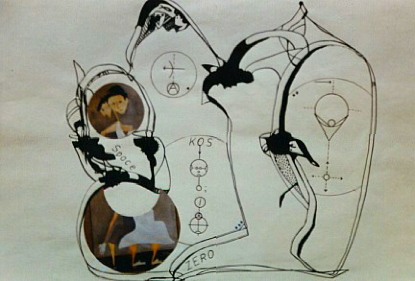
BEFORE THE BEGINNING
Richard Baker steps forth, the NYU graduate student. He is a small man, with sandy hair, looking like a headier version of Michael J. Fox. He is dressed immaculately; he clearly has a sense of his own importance: "One has to understand Michael Crossmann's metaphysical system, which we get from his novel. Pre-genetic matter; Chaos. The Dark Principle; the Night. The abode of the woman. Space and the Womb and Chaos and Zero all being the same thing. The two women of the left -- they seem to have two heads growing out of one stem, one neck. This is an illusion; but we only see this as we move down the body to see the dresses of the two women. The dress in the foreground is white; the dress in the background in black. Those familiar with Conversatons On a Dying Age will remember Crossmann's metaphysi of the two women, one a white woman (the Moon) and the other a black woman (the Earth). One being the Mother (the Moon); and the other being the Daughter (the Earth). The Father mates with the Daughter; and, thus, the Son is born. But the Son is born under the Earth -- hence, he is the Dark Man, the Shadow, who then mates with his Mother, the Moon. Electra and Oedipus. Of course, this drawing occurs prior to the appearance of the Man. It is before the beginning. The two women's heads and bodies are separated, with Space in-between the head and the body. Before the beginning, the Mind and the Body as principles are not connected. At the beginning, the principles are connected. This drawing does not state that; but the title implies that. When the heads and the body move back together, they will be a perfect fit. At death, of course, in religious thought, the mind goes to heave and the body stays on the Earth...."
"Well, that is an interesting analysis," Hedda Kranz replies. "The geometries in the drawing?"
"I don't know. They seems to be a kind of private language," young Baker responds.
"May I interject something?" a man asks. A rumpled man in an old white trenchcoat. It is Peter Falk.
"Mister Peter Falk," Hedda Kranz says, smiling broadly.
The crowd begins to applaud.
Everyone loves Peter Falk.
"Excuse me, thank you, Hedda," Falk says. "Hedda and I -- well, we've known one another for years. I dn't know that much about art. But I did notice something in this drawing. I was in here studying it earlier, before the crowd came in. In the three circles that were drawn by the artist -- note that in the top circle -- and I think of this drawing as having four panels: the first with the two women and the words space; the next with the two circles, the smaller one on the top and the larger one on the bottom; the next utterly empty; and the fourth on the far right, with the largest circle. Anyway, the small circle in the second panel has a single dot on the periphery of the circle; the largest circle on the far right has two dots on the periphery; and the second circle in the second panel, below the small circle, has three dots on the periphery. I believe these are time codes. They are sequences; and the story is to be read in that order: 1, then 2, then 3. Also, looking at circle number one, we have an arrow pointing to the left, back in time. The A in the circle: the A is the beginning. This would read: 'Before the Beginning'. The first circle on top is the title of the drawing...."
"Very impressive," Hedda says.
The crowd applauds again.
"What about the other two circles -- what do they say?" Hedda asks.
"I have no idea," Falk replies, laughing a gravely laugh. His bad eye is floating a bit; both eyes are twinkling.
"You said that the third panel was utterly empty," Baker replies. "But that isn't true: there is a word, 'ZERO' in that panel..."
"Yes, that's correct," Falk says. "He is correct."
"Why don't we ask the artist about this drawing?" Henrietta Beach suggests.
"Well," Crossmann says. "It does have a meaning. But I did this drawing in 1987. Thirteen years ago. I really don't remember what it says. It is a mystical text, a hieroglyph. but I believe I have lost the key. I do notice that the movement of the text is clockwise. I'm sure that has some significance."
"It is worth noting," Reggie Lyons begins, "that a repression of the psychological is, implicitly, an attempt to deny the validity of what for the 19th century German art historians who founded the field was the ultimate goal of art history: to articulate, with all the subtlety at one’s command, the psychological meaning of art, or, more particularly, in the words of Heinrich Wölfflin, to be a “psychologist of style.” For the majority of 20th century American art historians, this made art history a kind of Geistesgeschichte rather than empirical, documentary history—the only genuine kind of history for them. From Max Dvorak’s studies of medieval art through Wilhelm Worringer’s Abstraction and Empathy, which in a sense was the final fruit of the conception of art history as Geistesgeschichte—the conception played itself out, or rather ingeniously went underground in Erwin Panofsky’s ostensibly empirical studies of Albrecht Dürer and Early Netherlandish Painting—art history was concerned to understand the “emotional values” of art, to again use Wölfflin’s words. The indifference of American art historians to such values, or more broadly to the psychological process in history—it is a general problem for historians, as Peter Gay’s Freud for Historians makes clear—has ultimately to do with American society’s elevation of social issues, and social reality, over psychological issues, and psychological reality, and above all the refusal to see any connection between them. In art history as in the society at large, there has been a reluctant and somewhat shallow, if at times loudmouthed yeasaying of emotional values.... Crossmann's art is clearly a hearkening back to the emotional, the psychological, away from the social, vlaues of art -- the artist as a shaman, a contactor of the energy of the gods. Political correctness does not drive this man's art. The shape of the psyche drives his art...."
"Harold Rosenberg and Clement Greenberg have also written about this," Xavier Ruberstein interjects. "About the cult of the avant garde..."
"Crossmann's work is dealing with the psychological," Henrietta Beach joins in. "But the psychological at a much deeper level. The psychological is very personal and private, unless taken to that deeper. You seem to be arguing for a Freudian view of the work, Reggie; whereas, the artist himself seems to be arguing for a much for Jungian view..."
Peter Falk ignores the two historians.
"You'll notice that there are either the beginnings or endings of graphics in the second panel of this collage, just above the 'Before the Beginning" hieroglyph. A kind of cartoon inscription..."
"A man armed with a bow, a fish and a man," the Hasidic Jew says mildly. "It is the end of the zodiac: the Archer is Safittarius; the Man, the Water-Carrier, is Aquarius, and the Fish is Pisces. The only sign missing from this group is the Goat, the Scapegoat, from Capricorn."
"Interesting," Peter Falk says.
Crossmann notices that the Magician, his magic glasses still in place, in conversing with the old Russian woman dressed in black at the food table.
"This, to me," Moishe Frank says, "indicates that the remnants of the previous world are still present. A kind of inert matter, without an animating principle...."
"This has been just wonderful," Hedda Kranz says. "Can we move to the second piece...?"
The group begins to move toward the second painting.
The Magician sidles up to Crossmann, saying in the voice of the old Russian woman: "In order to become a divine, fully conscious god -- aye, even the highest -- the Spiritual Primeval Intelligences must pass through the human stage. And when we say human, this does not apply merely to our terrestrial humanity but to the mortals that inhabit any world, i.e., to those Intelligences who have reached the appropriate equlibirium between matter and spirit, as we have now, since the middle point of the Fourth Root Race of the Fourth Round was passed. The Breath becomes a stone; the stone, a plant; the plant, an animal; the animal, a spirit; the spirit, a god..."
"Very well," Hedda begins. "The second drawing is colored pencil on black paper. The Title is the "First Family." And this was completed this year. This has a very primitive, primordial feel; the feel of mythology. The man and the woman appear to be riding in a kind of ship, a ship that has a body, with two eyes below the body of the woman. I see this face, the body of the ship below the woman, as being the son in the womb of the first mother. But the ship is being born upon the back of a goose. And the woman has speared a fish -- so we definitely have the marrying of two elements in this drawing, the Air and the Water. I think the drawing is quite wonderful. It is one of my favorites in the show...."
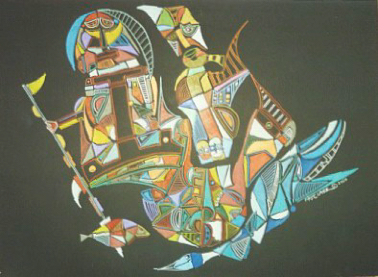
FIRST FAMILY
Xavier Rubenstein begins: "Michael Crossmann has gone on creating big, complex, slow paintings and drawings. There are no cheap tricks here, only expensive ones -- effects bought with thought and reconsideration, and that precious comoodity -- time. The recent paintgs and drawings are bolder and tauter than the early works. The work is more attenuated, the forms stretched thin. Rectilinear Sturm and Drang has given way to more lithesome dramas. But Crossmann's allegiances remain visibly, gloriously mixed -- High Modernism and Deep Symbolism married together like an interracial couple. Formal rigor and pretty pastels, the sign-posts of ideology set in the fluffy landscape of reverie. What Crossmann has done, virtually alone among his peers, is to create a pictorial language in which hope, despair, faith and humor all come together, not in post-modern overlays, but in a series of single, cogent images -- a thin surface, deep as the world..."
She waits for the applause.
"What did she say?" Peter Falk asks.
"Post-modern overlays," a beautiful woman replies to Falk. She is wearing a bit too much makeup for his taste; but there is no question that she is beautiful. She has full brunette hair that has been teased. She is wearing a deep blue silk gown. She has the body of a godiva.
"Do I know you?" Peter Falk asks.
"I don't think so," the woman says, smiling. "My name is Denise Rich."
"Please to meet you. I'm..."
"I know who you are, Mr. Falk," she says.
"Can I get you a glass of champagne?" Falk asks her.
"Yes; that would be nice," she says.
"Don't go away, dear," Falk says; then he wanders off in search of champagne.
"The fish motif appears for a second time," Moishe Frank says. "And the goose is the Hansa."
"Tell us about Hansa?" Hedda replies.
Moishe Frank says: "The Hansa is the Hindu goose of creation who, when given milk mixed with water, separated the milk from the water and drank only the milk. She is the foundation upon and through which the world is built."
Crossmann notices that the Magician is speaking with the old Russian woman again near the table with the food.
"This man's art is about meaning," Woody Allen says. "Besides the obvious aesthetics quality of the work, there is meaning underlying the work."
"Aboriginal art," a strong, deep voice comes from behind Allen's. It is Charleton Heston's voice. "The work reminds me very much of aboriginal art: the work of the primitives. The Mayans; and Australian Aborigines."
"Because of the symbolism?" Hedda asks.
"Primarily," Heston says. "And because he is dealing with archetypes, first forms and models. With the beginning of the world. Many of these drawings and paintings, many are dealing with the beginning of the world..."
"The work is classical as it is very modern," Henrietta Beach, from the New York Times, says. "It is classical because of its reliance upon, and its re-formation, of classical mythology. It is modern in the fact that it re-dresses the symbols, the mythology, in abstract forms. The work has a modern body and a classical soul. As he synthsizes prose and poetry in his faction, he also synthesizes styles of art, merging the classical and the modern, the seeming opposites, poles...."
"We should move to the next piece," Hedda says.
The Magician sidles up to Crossmann and speaks in the voice of the Russian woman: "When the 'Divine Son' breaks forth, then Fohat becomes the propelling force, the Active Power which causes the One to become Two and Three -- on the Cosmic Plane of manifestation. The Triple One differentiates into the many and then Fohat is transformed into that force which brings together the elemental atoms and makes them aggregate and combine."
"Yes," Hedda Krantz begins. "The third piece is entitled 'Castor and Pollux'. It is a gouache and acrylic painting, filled, I am sure, again, with symbolic meaning. Who wants to start?"
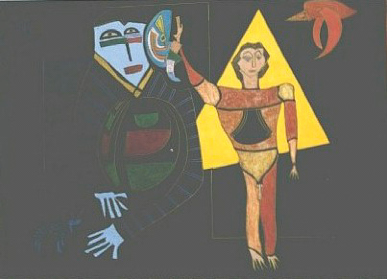
CASTOR AND POLLUX
Reggie
Lyons begins: "My work involves a regression to a Geistesgeschichte
conception of art history, but involves a more updated—more theoretically
sophisticated or at least elaborate psychology, namely,
psychoanalysis—than that used by the 19th century German art historians
and Geistesgeschichte theorists. More particularly, I have tried to use psychoanalytic
concepts—no doubt in a fashion many of you will find too eclectic,
although you will note a tendency to use object relational and self
psychological ideas—but also to let the artists and their works speak for
themselves, if interpreting what they say psychoanalytically. Thus, my basic
thesis—that avant-garde art is therapeutic in intention, which is part of
what gives it its authenticity, and motivates its stylistic innovations, while
neo-avant-garde art has lost or rather forfeited that intention, which is part
of why it is inauthentic—derives from the avant-garde artist’s recurrent,
stated fear of decadence and disintegration in the modern world, which is what
leads him or her to search for self-renewal and rejuvenation through the
innovations of avant-garde art, and from the neo-avant-garde artist’s explicit
acceptance of the decadence and disintegration of avant-garde art, involving
its institutionalization or socialization and academicization, and his or her
determination to benefit from this ironically decadent institutionalization.
Where the avant-garde artist feared for the relevance of art in the modern
world of science and technology—did it have any place in such an
enlightened, demystified world?—the neo-avant-garde artist realizes that
art is an important, major way to fame and fortune, that is, social success in
the most grandiose terms—one becomes a part of art history—which is
partly why it is conceived of as the ultimate cure for all emotional
ailments."
"Do
you see this painting in those terms, Reggie?" Xavier Rubenstein.
"Parddon
me?"
"Do
you see this paint in those terms?"
"Well,
I see the artist in these terms," Reggie replies.
"I
would quite agree," Xavier says.
"I would argue that Mister Crossmann is, perhaps, if I am not
stating the case too grandly, a synthesis of this avant-garde artist you speak
of and the neo-avant-garde artist."
"An
interesting thought," Reggie responds. "There are elements of each."
"Without
making claims as to the authenticity, import or truth of a previously named
abstract art (the genuine thing, some might call it, the work beginning with
Kandinsky and Klee andthe German expressionists), I would assert that this
contemporary re-named “abstract” art has as its primary cultural function the
erasure of any imagined or imputed force, relevance or memory of what
previously was claimed to have occurred under that title. We are less concerned
with the look of contemporary painting and more concerned with contemporary
production being premised upon a seemingly necessary evisceration of the
past. Historical abstraction
predicated itself on the creation of a fiction of timelessness. The rhetoric of
this timelessness was unrelenting in the sweep of its application: everything
from human nature to color, line, and composition appeared universal and
timeless. The conceit was that such a thing as a profound human nature could
only adequately be expressed in a correspondingly essentialist language of pure
color, line, etc. We propose that the term Compositional Formalism designate
this dream of a universality configurable in a timeless visual
language...."
"Exactly,"
Reginald says, smiling broadly.
"I
think you are missing the point," Richard Baker -- the doctoral student --
replies. "While one could
argue that Mister Crossmann's work -- as you put it -- attempts to perpetuate
the historical abstraction predicated on the creation of a fiction of
timelessness, one must comprehend his work as being what it is. That is, Mister Crossmann's work, at
its basis, is a portrait of the timeless. A portrait of a kind of aboriginal dream-time. This is something fundamental,
something especially relevant in the age of post-structuralism and deconstruction,
an age struggling to free itself from its own suffocating, totalizing 'mastery'
of technology, art and thought.
Henrietta
Beach comes in: "Piet Mondrian, for example, who was so profoundly
influenced by Cubism, and the most radical aspects of Futurism and
Constructivism was never a Platonist. Nevertheless, he was, in a sense, a Platonist,
as is revealed in his purist attempt to attain the essence of that which
disrupts limited form, which disrupts 'any idea'. He operates in the spirit of
Plato by pursuing an ideal, through his examination of theosophy, the ideal he
pursues is the destruction of idealism itself. As we would learn by analyzing
his Tree series, he has discovered a unique structural principle which promotes
that which has been repressed and bound by form and 'essence.' This principle
is itself a new universal, a new essence, a new order, the antipode of the
Platonic essence, an order that can oppose repression by opening out Platonic
ideas like 'particular form' and 'the individual.' This is the 'essence,' the
'universal,' the 'unity' that Mondrian speaks of when he is sounding
Platonic. Mister Crossmann's own
flirtation with theosophy is similar and led him to similar results."
"What
did she say?" Peter Falk asks.
He has returned to Denise Rich with a glass of champagne.
"She
said that Mondrian was a theosophist," Denise Rich replies.
"Oh. What does that have to do with
anything?" Falk asks.
"I
have no idea," Ms. Rich replies.
"Again,
you are missing the point!" Richard Baker says. "Crossmann's paintings are about meanings, underlying
meanings. Occult meanings. Meanings that will not be illuminated
by analysis of one's own theories about art, or by psychoanalysis of the
artist, but only through an understanding of the symbolism in the painting
itself. One can't understand this
painting through self-reflection; one must actually look at the painting to
understand it!"
"What
a revelation!" the Magician says loudly.
"Castor
and Pollux are the twins in Greek myth," Moishe Frank says. "The twins of Day and Night."
Richard
Baker says: "If one were familiar with Mister Crossmann's book -- and I am
assuming that many in this room have -- one would be aware that Castor and
Pollux are two of the most important characters in the book, as the twin
brothers of Day and Night. One
brother, Pollux, is eternal. The
other brother, Castor, the Night brother -- Castor comes from the world
'castrate' -- is mortal. He, in
fact, is fallen man, man without power.
Of course, which brother actually 'falls' depends upon your
persepective, your point of view.
But note in this painting, on the viewers right side is Pollux. He is a warrior; he has white skin,
rosy skin. He has a penis. He is a Grecian hero. His companion if a red war eagle, an
animal of the sky, of the air.
Pollux is framed in a golden triangle, the Sun, the Three being a symbol
of the Mind, the Head in manifestation.
Castor, on the other hand, is framed by a dark square, the Night
Body. His face is blue, reflecting
the Moon. He has an upper body but
no lower body. He has no
penis. And his companion is a crawling
creature, an Earth creature, the scarab.
"The
scarab is, in fact, an androgynous entity," Moishe Frank adds. "A symbol of fertility,
creativity, and immortality. So,
in this painting is everything, even the promise of re-birth for Castor. Castor will re-become Pollux through
the intercession of that small bug, the scarab. In Christian churches, the name is sometimes associated with
Christ; and, in astrology, with the house of Cancer."
"Castor
is the godless man, the intellectual, the man who has no kahones," the
Magician says. He seems to be
quite drunk. "The one who is
lost in the darkness of political ideology."
There
is an embarassed silence.
"Any
more comments," Hedda asks.
Xavier
Rubenstein says: "In his paintings, the layers of paint, of figures, of
ideas composed and then abandoned, bear implicit witness both to seriousness of
intent and to changes of heart.
Through visual reference he makes his dilemma explicit. When I look at this paintings, I think
of the phrase: the architecture of repression rendered in the painterly hand of
regret..."
There
is a kind of stunned silence.
"It
seems to me that this is the first painting where we see the racism inherent in
Crossmann's work begins to surface."
It is a woman's voice. She
is standing in back. The crowd
turns, parts to see who she is. It
is Oprah Winfrey.
"Oprah,
welcome to our... humble abode," Hedda Krantz says. "His racism. In what way?"
"The
implication that Day is good and Night is bad," Oprah says. "The implication is that White is
good and Black is bad."
"The
implication, my dear lady," Richard Baker replies, "is that white and
black are the same thing. If you
had read his book..."
"His
book is boring," Oprah says.
"It's one of the most boring books ever written. I don't know anyone who could get
through it..."
"And
still you judge him by it?" Moishe Frank asks. "Without havin read it?"
"The
implication is that Day and Night are the same thing, through the intercession
of Christ," Richard Baker says.
"Through the intercession of the golden bug, the Scarab."
"That's
all a bunch of malarky," Oprah says.
"It's an intellectual slap-dance. He's a white-supremacist, clear and simple."
Crossmann
notices the Magician talking again with the old Russian woman off to the side.
"Any
more comments on this painting?" Hedda aks. "I like the way this is generating discussion. We may not all agree here; but we are
communicating. Let's move to the
next painting...."
"I'd
like to add something," Charlie Rose says. "Something that hasn't been mentioned. I doubt if many of you are familiar
with Michael's unpublished manuscript of prosepoems, Instrumentation in the
Wheelhouse. But Crossmann
structures that book, in terms of time, to reflect the progression of one life
from pre-genesis through birth, childhood, adolescence, adulthood and
post-genesis. I am wondering if we
may have a similar order in these paintings. We began in pre-genesis, with "Before the
Beginning"; then we had the "First Family," with the primordial
father and the pregnant mother. We
all know how close he was to his brother William, who is in this room
somewhere...
"He's
over eating all the food with his loser friends," Lola Fanti exclaims,
glaring bullets back toward the motley crew at the table.
"I
believe this represents the birth of the two brothers, who were often confused
by others when they were young of being twins," Rose says.
"Interesting
thought, Charlie," Hedda says.
"So you think the order of these paintings might create a structure
of the man's life. That is very
interesting. So, are we ready to
move to number four...?"
The
Magician sidles up to Crossmann again.
He speaks in the voice of the old Russian woman: "Fohat is closely
related to the One Life. From the
Unknown One, the Infinite Totality, the Manifested One or the Periodical
Manvantaric Deity emanates; and this is the Universal Mind, which, separated
from its Fountain Source, is the Demiurgos, or the Creative Logos of the
Western Kabalists, the four-faced Brahma of the Hindu religion. In its totality, viewed from the
standpoint of manifested Divine Thought in the esoteric doctrine, it represents
the Hosts of the high creative powers..."
"Well, the fourth piece is a
drawing entitled 'The Girl Next Door'," Hedda begins. "This piece is a collage, with
text, done in India Ink and colored pencil. I wonder if the artist has anything to say about this
one...?"
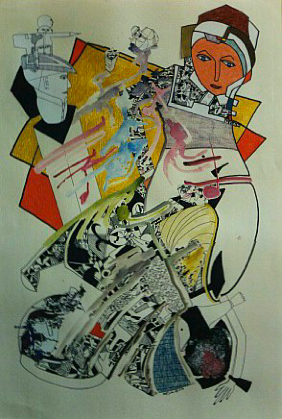
THE
GIRL NEXT DOOR
"Well, this style of
drawing/collage is the main type of Day drawing I have done," Crossmann
replies. "In much of my work,
the force of Chaos remains very strong.
The sense that forms emerge from Chaos is very important in my work. Light emerging out of Darkness. I love the world of Chaos, the primeval
world, the Dark World. But I also
love the world of Form, the brithplace of form, the place where the first form
emerges out of Chaos. This is the
World of Archetypes. First Forms. This drawing is really about the first
recongition in our hero, if we do view this exhibit as the life of a hero, as
Charlie suggested -- then this is the first recognition in our hero of sex, of
the girl, of the opposite pole of life."
"The
woman is clearly a sex object," Gloria Steinem says from the back of the
group. She is now standing beside
Oprah.
"Yes,
that is true," Crossmann says.
"The drawing is about the recoognition of sex as a force in
life."
"I
don't believe any of your art work shows the woman as anything but a sex
symbol," Gloria replies.
"Well,
'Othello's Wife" does not," Crossmann replies.
"That
is a racist painting!" Oprah comes in.
"The
'Young Girl' and the "Girl From Sapa' are not sexual in nature,"
Crossmann says.
"They
do not represent the woman as the hero, however, do they, Mister
Crossmann?" Gloria continues.
"The Man is always the hero in your work; the woman is never the
hero."
"That's
not true," Crossmann replies.
"The woman is the hero in 'First Family'. She is not only capturing the food for the family, she is
also bearing the child. She
actually dominate the man in that painting. In 'The Lovers', the woman is equal in strength to the man;
and in 'Venus' the woman is heroic as a force of love..."
"But
not as a symbol of Power," Gloria insists.
"The
woman's power is the power to generate darkness," Crossmann says. "The woman's greatness is the
power to generate the world through love..."
"Woman's
power is negative, then?" Gloria aks. "Woman's quest for power results in Chaos -- is that
what you are saying...?"
"That's
what mythology teaches," Crossmann says.
"Then
we have to re-create mythology!" Gloria demands.
"If
the world isn't what you like it..."
"Then
you change the world!" Steinem says.
"Mythology
portrays the world as it is," Crossmann says. "You are not discussing changing the world, but
changing the description of the world.
If you don't like the world, change the description of the
world...."
"That's
what communism is all about!" the Magician cries out. "See the scars on my body! The communists didn't like my art,
didn't like the message in my art, so they attempted to change my body by
putting out cigarettes in it, and by re-describing me as a lunatic...!"
"Are
you here with anyone?" Peter Falk asks Denise Rich.
"I'm
planning to meet someone," she says.
"An
artist seeks his truth, Gloria," Xavier Rubenstein says to Ms.
Steinem. "An artist must be
free to seek and express his truth."
"Even
if his truth is a lie?" Goria asks.
"A
lie according to whom?" Xavier replies.
"According
to the truth itself," Gloria says.
"I know the truth. We all now the truth. Men abuse women; they always have; and, if we let them, they
always will...."
"If
you don't like this drawing, then you will probably really hate the next one,
the watercolor darwing entitled 'First Date'," Hedda responds. "Let's move to this one."
The
Magician sidles up to Crossmann, speaking in the old woman's voice:
"Fohat, running along the seven principles of Akasa, acts upon manifested
substance or the One Element and by differentiating it into various centers of
Eenrgy, sets in motion the law of Cosmic Evolution, which, in obedience to the
Ideation of the Universal Mind, brings into existence all the various states of
being in the manifested Solar System...."
"This work, entitled 'Frist
Date' is in watercolor and ink," Hedda says. "Again, I would say, that teenage sexuality is the
subject of this piece. The man is
carrying a small, dried-up handfull of flowers to this girl-friend. But beneath this hand holding the
flowers emerges a very vigorous erect penis with a big red head. There is a small man's head in black
and white peeping out of the center of the painting. I'm not sure if this is the young man's angel or conscious
or what. This is very clearly
about teenage love. And I think it
has to be viewed with a sense of humor..."
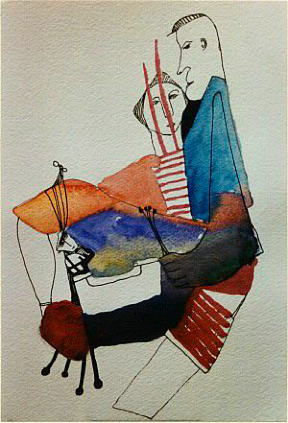
FIRST
DATE
"Much of my work must be viewed
with a sense of humor," Crossmann says.
"This
is one of several works in this show that remind me of Picasso," Reggie
Lyons begins. "Crossmann has
found his own artistic roots, not in the future -- he is not a futurist,
surely, and I say that with admiration -- but in the past, in the best work of
this century. Picasso for
instance. As Clement Greenberg
said, when everyone is a revolutionary the revolution is over. Or, as Rosenberg
put it, when a revolutionary “new look is ... a professional requirement,” the
new is not only a tradition, but no longer meaningful. The avant-garde artist
was a genuine “antenna of the race,” to use the felicitous phrase Ezra Pound
used to describe the artist at his or her best. He or she was attuned to modern
society, which was still fresh and surprising and not the unsurprising cliché
it has become—Baudelaire thought that art’s purpose in modern society was
to convey the surprise of the new, but
today the new is no longer surprising but peculiarly stale. The
unpredictable is predictably manufactured. The avant-garde has become a
tyranny. That is, the avant-garde artist registered, in his or her own
individuality and art, the pressures and threat to individuality and mental
health a new, modern society presented. The avant-garde artist wanted to be of
service to this society, if only by suggesting various ways of critically and
creatively working it through. In contrast, the neo-avant-garde artist
conceives of his or her relationship to society and the purpose of art in a
completely different way. He or
she is an ironical conformist, using art not only to become part of the
establishment, but as an empty fetish—commodity. For the neo-avant-garde
artist art is a cynical career rather than a desperate, uncertain
calling."
"And
you place Michael Crossmann in which group?" Xavier Rubenstein asks again.
"He
is a reactionary, cleary, and that is good," Reggie says in his lovely
British accent. "He is a
throw-back to the great tradition of the avant-garde artist as a...shaman --
that is the world used tonight -- as a primordial savior of society..."
There
is scattered applause.
"I
am not certain that saving society is what the avant-garde artist really
intended," Crossmann replies.
"Perhaps that was so in a very idealistic sense. Of saving society and leading it back
to a more primitive construction.
Artists make very good critics but not very good leaders. Artists lead, in a very subtle sense,
in that they, as antennas of the race, may anticipate the future. Although one could make a claim that
artists are really not very good in this either. One could argue that science fiction writers are the true
visionaries of our race, because they look forward. And that the so-called avant-garde artists, who are so
frightened of a world which includes technology, are the forces of death in the
society because of their desire always to look back, to retreat. Can one imagine Michaelangelo or Da
Vinci of wincing at the prospect of a technological future? Hardly. Da Vinci was an engineer, in addition to being an
artist. The Renaissance Man is
afraid of neither the past nor the future -- but he attacks the future. He brings light to the world. Not just the light of fear, which is
what most artists today carry with them.
Fear of nuclear annihilation, fear of governmental tyranny, fear of
global warming, fear of a new ice age, fear of having children, fear of war,
fear of success, fear of being perceived as being on the wrong side
politically. Artists aren't
leading today; they are dragging their feet, afraid of moving in to a future in
which they fear they will not have power.
Artists have power only in the darkness. The Shaman led primitive societies because those societies
existed in darkness. Here the
shaman connected them to their gods.
Although the shaman had a pretty mixed record of bringing health and
well-being to the society. The
shaman was used by the society to try to mitigate the negative. Disease, death, poverty, starvation --
the shaman prayed to alleviate these things. But, generally speaking, his success rate was rather
minute. Since everything came and
went in cycles, a kind of salvation was built in to the system. Artists are best at criticizing the
existing world than they are at building a better world. We should not expect the artist to be a
savior of the race. God saves the
race; at best, the artist attempts to portray God's inventiveness. Picasso, and I love Picasso's work, did
not save the world; he brightened the world with his work. But if the world had followed Picasso,
as the creator of a life-style, the world would have fallen into decay and
poverty. Avant-garde artists
sought, in almost all cases, to destroy the middle-class. That became the goal of art after our friend Van Gogh. To attack conventional
life-styles. To portray the
stupidity of middle-class life.
That was not always the case.
Art did not always attack life.
There was a time that it served life. There was a time when art sought to portray the beauty
and the depth of Life. Art has now
become Anti-Art, the goal of which is to portray the ugliness and the
shallowness of Life. I agree with
Mister Lyons in his assessment of the neo-avant-garde, in which 'newness' is
confused with art. An artist
hurling dung at an image of the Virgin Mary is treated as art. An artist painting herself as a nude
Jesus Christ is art. Not because
of the quality of the work, but because of its 'newness', and its shock
value. If an art shocks today, it
is considered important. As if
shocking an audience is what art is and should be. Social significance has become the only criteria in some of
the art establishment's minds in determining the value of a work of art. Is it politically correct? If it is justifiably politically
correct, then it needs to be shown, even if it is an artist throwing dung at
the Virgin Mary. I can assure you
if it was an artist throwing dung at an image of Martin Luther King or Ghandi
or Gloria Steinem or Buddha it would not be praised or tolerated...."
"Here! Here!" Mayor Guiliani cries out.
"What
colors does my vagina come in?" a woman's voice responds.
"We
live in a world now in which portrayal of the small is lauded," Crossmann
continues. "Portrayal of the
ugly. Portrayal of the
insignificant. And, as such, the
most insiginificant are applauded.
We place 'social consciousness' as the highest value in art. And Reggie is correct in this --
although I wish he had a way of talking to the world instead of talking only to
the faculty club -- social consciousness has become the only criteria in
measuring art; and the inner nature has been disregarded. The great work of this century, in all
forms of art, all genres, came from deep explorations of the self. In literature, Joyce, Proust, Faulkner,
Hemmingway, Thomas Mann, Virginia Wolfe.
In fine arts, Picasso, Klimt, Kandinsky, Pollock, Wyeth, Georgia
O'Keefe. These artists did not
seek to re-make the world by throwing dung at the world. They sought to re-make the world
through coming to an understand of Life as it is. Where everyone is a revolutionary, the revolution is
over. Where everyone is a
revolutionary, the oppression has begun...."
"Thank
you for including a few women in your list," Gloria Steinem replies.
"Political
propoganda is not art," Crossmann says finally. "Political propogranda is the opposite of art. It is anti-art. Because it begins with the
understanding that the truth is known.
True art begins with the understanding that the truth is not known; and
the process of creating art is an attempt to catch a glimpse of the truth, if
only for a moment..."
Silence.
The
Magician is again chatting with the old Russian woman in the distance.
Moishe
Frank says: "We must remember that, in the Kabbala, there are thirty-two
paths to Truth. The 22 letters of
the Hebrew alphabet and 10 numbers.
There are 36 pieces in this show: the 26 letters of the English alphabet
and 10 numbers."
"Do
I know this person you are meeting?" Peter Falk asks Denise Rich.
"Oh,
I think you probably do," the pretty woman replies, with a bashful smile.
"Who
is he?"
"I
won't tell," she replies.
"You
are not suggesting, are you Mister Crossmann?" Michael Douglas asks. "That aesthetics is the only
consideration in great art...?"
"No. I am suggesting that an anti-aesthetic
is not a significant criteria, no matter how wll it can be justified in
words," Crossmann says.
"There has been a rapid growth in workshop art in America over the
last few decades. Retired people
taking workshops, being taught the techniques for rendering landscapes,
children, dogs, roosters. This is
the one pole of irrelevance in art: technique only. Technique can be learned. But an art with technique alone is a curse, an abomination. Painting pretty pictures is not art; it
is a kind of tedium elongated, and often rewarded by nouveau-riche who have no
taste. All sentimentalism and no
substance. The other pole of
insignificance can be seen in most of the galleries in Soho, or in any major
city in America in the gallery districts.
Anti-art art, generally abstract, with no attention to aesthetics;
anti-aesthetic generally. With
many gallery directors having fallen under the spell of the the elitist
understanding that only art not comprehended by the ignorant masses is real
art. Oftentimes, the uglier it is,
the better. Sloppiness should not
be rewarded as art, even if there is a sophisticated written philosophy
accompanying it. Throw out the
written word when it comes to art.
The work of art has to stand on its own. A title is acceptable as a text throwing light on a
subject. But a written tract
should not be needed to justify a work of art. The work of art must justify itself -- and, traditionally, a
work of art has justified itself under this criteria: Would I like to have this
in my home with me? Do I want to
live with this vision in my own sanctuary; will I bring it in to my own
sacristy...?"
"You
admire Pollock?" Michael Douglas asks.
"Yes. I admire many of his drip
paintings," Crossmann says.
"Which, to me, show a high level of concern for aesthetics..."
"Does
this mean you would dismiss all social art?" Oprah Winfrey calls out.
"Not
all. Hundertwasser had a very
strong political and ecological message to his art," Crossmann says. "But the art is paramount. If the artist is hitting me across the
face with a wet fish, which is his or her message, I generally lose interest
quickly. For the right and wrong
of life is a pretty superficial understanding of existence. There are much deeper levels to be
explored. Hundertwasser's work
goes into the deep levels. That's
why I love his work. Picasso's
'Guernica' is political in nature; but, even more, it is human. It is about human suffering in
war. Picasso clearly had his own
sense of good and evil; but the slaughter of humans in his masterpiece could,
in fact, have happened under any totalitarian regime, right or left. It has, in fact, happened under both. Was fascist Spain and fascist Germany
more evil and violent than communist Russia or communist China or communist
Cambodia? I think now. I don't get the sense in 'Guernica'
that Picasso is saluting communism as a salvation from fascist violence as much
as he is bemoaning humanity's stupidity and waste of life. When I watch a movie, if I sense the
director emerging from behind the camera to tell me how to think, I turn off
the movie. Art is subtle. If you want to brainwash me, convince
me that your are correct, then you have to do it very subtley. Propoganda is the art of tyranny;
argument is the art of subtlety."
"Any
other comments?" Hedda asks.
"Ok, let's move to number
Six..."
The
Magician sidles up to Crossmann, speaking again in the old woman's voice:
"Fohat is, then, the personified electirc vital powr, the transcendental
binding Unity of all Cosmic Eenergies, on the unseen as on the manifested
places, the action of which resembles -- on an immense scale -- that of a
Living Force created by the Will, in those pphenomena where the seemingly subjective
acts upon the seemingly objective and propels it to action. Fohat is not only the living Symbol and
Containeer of the Force but is looked
upon by the Occultists as an Entity, the forces he acts upon being
cosmic, human and terrestrial, and exercising their influences on all those
planes respectively."
"Very well," Hedda
begins. "Work Number Six is
entitled 'The Spriit of Drink'.
This is another Night painting with colored pencil and gouache. Anyone wish to comment...?"
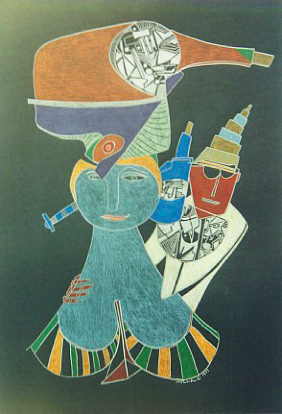
THE
SPIRIT OF DRINK
"Again,"
Gloria Steinem begins, "the woman is portrayed as the cause of Man's
downfall."
"Clearly,"
Richard Baker responds, "the woman in this painting is not really a woman
but is the spirit inside of the man urging him on to drink. The man is smaller than this urge. The labels on the bottles, the
interwoven black and white imagery, is also in the weak man's heart. This drawing is anti-bacchanalean much
more than it is anti-woman....
This is about a man's weakness.
He is not being seduced by a woman. He is being seduced by his own idea of how he will find a
woman..."
"I
think that's right," Charlie Rose replies. "Remember, this is an autobiographical exhibit. His interest in women, in sex, as part
of the teenage rite of passage also includes the rite of drink, of
intoxication. The party. The image of the party will come back
again at the end of the exhibit.
It comes back, in fact, to this very night, the celebration of the
millennium. Which I find quite
intriguing..."
"Any
more comments?" Hedda asks.
"I
find this image striking," a man in the back replies, a well-dressed man,
with an intrigued look. He is
standing beside his wife. "We
love the humor and compassion which is appaarent in nearly all of Mister
Crossmann's work. We believe it
must come from a strong religious faith.
That, even with the tragedy and sorrow of the world, there is some
underlying meaning, some underlying reason for existence..."
"That's
Howard and Donna Stone, from Chicago," Lola whispers to Crossmann. "Time to advance! They have money up the Rocky
Graziano...!"
The
Magician sidles up to Crossmann again: "On the earthly plane, Fohat's
influenceis felt in the magnetic and active force generated by the strong
edesire of the magnetizer. On the
Cosmic plane, it is present in the constructive power that carries out, in the
formation of things -- from the planetary system down to the glow-worm and
simple daisy -- the plan in the mind of nature, or in the Divine Thought, with
regard to the development and growth of that special thing. He is, metaphysically, the objectivised
thouoght of th gods, the 'Word Made Flesh', on a lower scale, and themessenger
of Cosmic and human ideations. The
active force in Universal Life."
"Piece number seven,"
Hedda begins, "is a Day painting in gouache entitled: 'Chopin, George
Sand, the Birth of Fortune, and Destiny'.
I find this really quite exquisite. The black and white cartoon imagery we find in many of
Michael Crossmann's Day paintings represents -- and correct me if I am wrong
Michael -- the mental conflict of the principles of Light and Darkness, the
duality inherent in all evolution, all progress of ideas..."
"If
one remembers Mister Crossmann's descriptions of the Universe and the
Anti-Universe in his masterpiece, Conversations," Richard Baker
says, "one will recognize that these forces of black and white, or Night
and Day, are illusions. But still
powerful illusions. The illusion
of being on the right side is what has led to all the war and brutality in the
history of the world. It is true
that these are illusions, as Mister Crossmann demonstrates quite clearly in his
book -- IF ONE READS THE WHOLE BOOK!
This dualism is not in stasis.
We remember that Michael Crossmann's hero in the book, either Jacob
Heimkrieter or the Clerk, who is a form of himself, goes to sleep an adversary
of Ronald Reagan and wakes up a supporter of Ronald Reagan. The darkness, essentially, in the death
process, flips from the Anti-Universe in to the Universe. The black-bodied electron (the
electron) smashes into the white-bodied electron (the anti-electron) -- they
annihilate one another, exchanging bodies in the process. The white becomes black and the black
becomes white. It is all quite
scientific; and all quite factual.
Science's discovery of the Anti-Universe will cement to truth of Mister
Crossmann's mystical vision of the nature of reality. And perhaps it will lead to a period of heavenly, scientific
understanding -- about, at least, the nature of duality..."
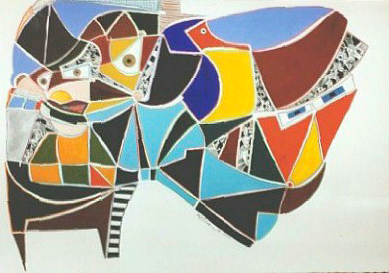
CHOPIN,
GEORGE SAND, THE BIRD OF FORTUNE, AND MISTER DESTINY
"This is one of my favorite
pieces, because of its mood -- it is a very gentle frozen mood, as if Chopin
were caught in a dream." The
speaker has an English accent, a handsome androgynous face, with the whitest of
short-cropped hair. Very masculine
-- but also sensitive in features.
It is David Bowie. "I
love the color patterns in this painting also. How the piano keyes blend in with the slivers of thoughts,
the black and white elements, that seem a kind of glue in this painting. The dark tones fot he piano are
repeated in the hair of George Sand; then again as trim in George Sand's gown
and shoe, which becomes the mouth of Mister Destiny. The darkest tones are repeated in Chopin's top hat, George
Sand's hair and in the cheekbone of Mister Destiny. The only unique color really, the only color not repeated,
is the blue gody of the Bird of Fortune..."
"I
don't see any of this," Gloria Steinem says.
"Neither
do I," Senator Ted Kennedy says.
"Perhaps it's because I arrived late. I don't see George Sand. Where is George Sand...?"
"It
looks like a chaotic jumble to me," Steinem says.
"No,
look," Peter Falk says.
"See the light blue gown George Sand is wearing, with the black
trim..."
"I
swear, perhaps I need to drink some more," Senator Kennedy. "I really can't see anything
here..."
"You're
joking surely, Ted," Charlie Rose says.
"Oh,
hello, Charlie," Ted replies.
"No, no. Perhaps I
don't understand his use of color.
Perhaps that's it..."
"It's
all chaotic noise," another woman says. It is Hillary Clinton.
She has just come in with Ted Kennedy.
"It
is noise," Bowie agrees.
"And there is clearly an element of chaos in it. But it is frozen chaos. I find this harmonious, like Chopin's
music. The silence between the
notes is as much the music as are the notes themselves..."
"Is
he on acid or what?" asks a bald-headed man, standing near Falk.
Crossmann
looks out and sees the bald-headed man.
He remembers him from before, in the dark hallway, when the bald-man
wanted to kill him. He reminds
Crossmann of Gordon Liddy. But it
isn't Gordon Liddy. Behind him
stands a jaundiced man with jowls, smoking a cigarette. And near him are Dana Skully and Fox
Mulder. Crossmann is amazed at the
creaminess of Skully's skin. He
feels himself becoming aroused; and he fights off the thought, since he would
be embarassed to be standing before this multitude with an erection under his
dress pants.
Crossmann
looks around the room, looking for Catherine Zeta-Jones. He doesn't see her.
"Any
other thoughts?" Hedda asks.
"I
think we need to remember the One Life theme of the exhibit," Charlie Rose
says again. "This is the
man's, the artist's, first introduction to culture, to art. This corresponds to his college years,
I believe. The sex and the
drinking of teenage life transforms into the love of art, of beauty..."
"It
is interesting that George Sand is put second in the painting," Gloria
Steinem begins again. "She
was a very strong person, stronger certainly than Chopin -- in fact, many
historians believe she killed Chopin -- that's how strong she was. If ever there was a female hero, it was
George Sand, for she competed with men, and defeated them. Still, the artist puts her in second
place, subservient to Chopin, the tuburcular boy..."
"Chopin's
art was sublime," Richard Baker defends Crossmann. "Sand's art was second rate. She deserves second billing in terms of
artistic genius...!"
"I
am not sure that being able to kill men is the goal of the women's
movement," Meryl Streepe interjects.
"No,
that is not what I meant," Gloria responds. "But her strength as a man....er, as a woman. That was my compliment to her..."
"Many
women consider ourselves feminists," Meryl Streepe continues. "But that doesn't mean we hate
men. We are here together. If we want to get rid of war in the
world, then surely we must conquer war inside ourselves first..."
Denise
Rich moves away from Hillary Clinton and Ted Kennedy, moving quietly, not
wanting to attract notice. Peter
Falk follows her.
"We
find this piece quite wonderful," Michael Mendelsohn says. He is a tall men wearing a black
sweater, black hair (that appears to be died -- it is too black). He werar quiet crimson glasses. Both he and his wife Gael are holding
small customized European dogs: Sissy and Sassy.
"We
have put in a bid on this piece," Gael says quietly to an hispanic man in
a tuxedo standing beside her. It
is Geraldo Rivera.
"I'll
bid on it," Geraldo cries out.
"I absolutely love this one."
"I
have bid on it too," David Bowie says.
"I'll
bid on it too," Senator Kennedy says. "I'll bid $50,000."
A
hush sweeps over the room.
"Bidding
begins at $250,000," Lola says, smailing like a cheetah. "I can take bids, if you are
interested...."
Michael
Mendelsohn and Gael move to Lola; David Bowie moves to Lola; Ted Kennedy tells
Hillary that he is going to find a glass of champagne.
"Shall
we move to the next piece?" Hedda asks rhetorically.
The
bald man is making faces at Crossmann.
Grimaces. He is either
choking or he is threatening Crossmann.
The
Smoking Man continues to smoke.
Crossmann
looks back at Dana Skully. He
winks at her, thinking about her creamy skin. His penis begins to inflate again; he quickly thinks about
Bella Abzug, an anti-erection medication.
It works.
The
Magician sidles up to Crossmann, saying: "In his secondary aspect, Fohat
is the Solar Energy, the electric vital fluid, and the preserving foruth principle,
the Animal Soul of Nature, so to say, or -- Electricity. In India, Fohat is connected with
Vishnu and Surya in the early character of the (first) God; for Vishnu is not a
high god in the Rig Veda.
The name Vishnu is from the root vish, 'to pervade'; and Fohat is called
'the Pervader' and 'the Manufacturer' because he shapes the atoms from crude
material. In the sacred texts of
the Rig Veda, Vishnu also is 'a manifestation of Solar Energy' - and he is described
as striding through the Seven regions of the Universe in three steps...."
"We are at painting number
eight, 'Ahab'," Hedda announces, "a Night painting with gouache and
colored pencil. A striking piece,
powerful. Clearly powerful in the
same vein as the prototype, Melville's great captain. Would you like to tell us something about your process,
Michael? How did this painting
come about? Did you think about
Ahab, do some kind of mock-up design...?"
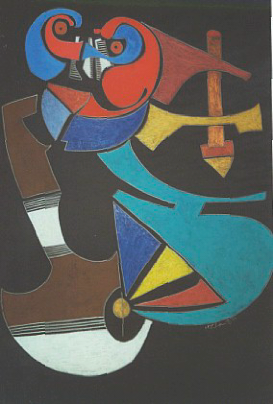
AHAB
"No," Crossmann says. "My process is very organic --
although I fear using that word, since it has become such a cliche. By organic, I mean that I start, quite
literally, with a seed, a point.
The point becomes a line.
The line becomes connnected lines, some kind of irregular geometry. Usually it is an irregualar geometry. I have no idea where I am going before
I begin. And, often, I have little
idea where I am going when I reach my destination...."
"It
looks like it," a voice comes from the rear.
Three
young men in black leather coats, with shaved heads, are standing near the back
of the crowd. Crossmann remembers
the one who has spoken. He was at
the old beatnik restaurant that night Crossmann first came to New York. He was also at the scene of John
Lennon's murder. He is the one who
told the police that Jim did the shooting.
"My
process," Crossmann continues, "evolves step-by-step, building a
painting or drawing brick-by-brick.
I don't want to know where I am going. I want the whole process to be mysterious. I want the form to emerge from nothing,
from chaos -- and I want it to surprise me. The art, really, besides the technique of building with a
media, is in being able to see the story, to find the story in all the
chaos. Abstract narrative. It begins as an abstraction and emerges
as a narrative, as a story, a form emerging. Finally, it gets a title which is designed to help others
recognize the story; and also to give the story a sense of epiphany. An exclamation point. A bow of sorts...."
"Do
you focus at all on the therapeutic value of art for the artist's sake?"
Hedda asks.
"I
haven't spoken about this much," Crossmann says, "but creation of
art, whether it be through writing or painting, is, in my mind, a form of
worship of my God. It is a form of
communication with my God. It
keeps me balanced, sane and healthy -- which is function of prayer in every
society. Not only does it drive
off despair. It also helps one
build the sacred island, the sanctuary, in which the soul finds itself to be
itself: wise and human..."
"More
broadly, I trace the emotional values underlying the shift in attitude,"
Reggie Lyons begins again, "from avant-garde to neo-avant-garde. I argue
that the avant-garde artist’s therapeutic intention is socially empathic, if
also involving the notion of art as self-healing, while the neo-avant-garde
artist is essentially narcissistic, for all his cynical social attunement. My
book is not simply an intellectual exercise: I see a psychomoral
lesson—indeed, a basic psychodynamic paradigm in modernity—in the
shift of attitude from avant-garde to neo-avant-garde. I think the avant-garde
artist discloses an ironical truth about the modern world: one’s mental health
in it is necessarily paradoxical—at least if it is health in a meaningful
sense—in that it reflects one’s way of dealing with one’s recognition of
the pathology of one’s social situation, symptomatic of the larger social
pathology of modernity. In modernity one becomes truly healthy emotionally by
recognizing and making the best of one’s abandonment by society. More
particularly, mental health involves using a kind of artistic cunning to come
to grips with and survive the anguished experience of existential
groundlessness—the profound annihilation anxiety or disintegrative effect
of recognizing that modern society gives one no reason for being and is
indifferent to one’s particular being, except as an instrument of its larger
purpose. In modernity one’s instrumental value replaces what traditionally was
conceived of as one’s transcendental value. To become aware of this, to
experience and not deny it and the anxiety it arouses, which most people for
good reason dare not do—it is the true existential shock of recognition
in modern life—is to be awakened from one’s naive, somnabulistic
relationship to the modern lifeworld, and to try to respond to it critically
and creatively, in order to survive in it. I may be idealizing them, but I
think avant-garde artists were individuals who experienced such existential
agony and awakening. Their innovations were attempts to critically and
creatively cope with that disillusioning, debilitating experience
symbolically—that is, to make new symbols (and thus new selves) of the
experience and its “existential-artistic solution.” In a sense, they make clear
that whatever else it may be avant-garde art is a response to a destructive,
psychotic experience of modern society, which itself is destructive and
psychotic, as it were, in that it does not recognize the inherent value of real
individual life, but reduces it to an instrument of collective
purpose...."
"I
think there is a grain of truth in what Mister Lyons says," Crossman
replies.
Several
snickers run through the audience.
"Alienation
is the nature of what...in a religous sense?" Crossmann asks. "this is a test, to see who has
read by book."
"Of
eating from the Tree of Knowledge of Good and Evil," Moishe Frank says.
"Very
good."
"Why?"
Crossmann asks.
"Because
splitting nature into Good and Evil, in one's mind, requires that one experience
alienation from the wholeness which was the original condition," Moishe
Frank replies. "By splitting
the world into Good and Evil, and identifying oneself as good, and one's
adversary as evil, one brings war into the world. Splitting the world into Good and Evil is, itself, an act of
alienation. One feels cut off from
perfection, from heaven; alienation from the modern is both a reality to
artist; and also a romantic pose, for the modern world does not recognize the
importance of the artist. The
scientist has precedence in the modern world, for the scientist, the engineer,
solves practical problems. The
artist solves, perhaps, the subtle metaphysical problems that are not really
recognized as being important to the modern world. The artist wishes to be the Hero; but he cannot be the Hero
in the Modern World which views the artist as being an accessory only, one who
paints pretty pictures, one who writes stories. A child, in a very real sense. Close to God in his own mind; but more often close to the
Devil in the minds of Modern Culture...."
"Very
interesting analysis," Crossmann replies. "I give you an A."
"Is
this a refutation of Mister Lyons' treatise?" Xavier Rubenstein asks. "Or is it a confirmation...?"
"I
would like to know what this has to do with this painting?" Harry Anderson
asks. Anderson is a tall man, with
a conservative manner, short brown hair.
He is standing with his wife Margaret. "Some of us would like to know more about this
painting. My wife and I are both
considering buying this piece..."
"Anyone
who reads Crossmann," Richard Baker replies, "knows the importance of
Ahab, as a symbol, in Crossmann's world.
Ahab is a symbol of America, of America's mystical tradition. Ahab is a double-symbol in Crossmann's
book, because the original Ahab was a Jewish king who was manipulated into
power by his wife. This persona
was taken on by Jacob Heimkrieter.
The second Ahab, the American Ahab, is one of the most potent symbols in
all of literature. He presides
over the destruction of America in Melville's novel. And he is a major player in Crossmann's novel. In many ways he is the emperor
Crossmann seeks in the second half of his novel..."
"I
would argue against that last part," Charlie Rose says.
"I
agree," Harold Bloom says.
Bloom is seventy-some, with flowing white hair, ponderous in physique;
he is dressed in an academic tweed; and he is one of the few people in the room
not wearing black and white.
"The emperor Crossmann seeks is God; and Ahab is the captabin of
the ship taking Crossmann to God.
On another level, Crossmann asks, near the end of the novel, 'Who shall
be our Caesar?' Crossmann is of
two minds, clearly -- and perhaps many more. But one mind fears the American empire; and another mind
rejoices in it. The future, in the
Roman parallel, suggests that democracy will give way to empire. And that this will, ultimately, lead to
the end of the American empire, similar to the way Rome was ended...."
"This
composition is one of Crossmann's boldest designs," Henrietta Beach
responds. "There is an
oscillation between abstraction and the figure; between all-over and focused
space; between varieties of relative confusion and varieties of relative calm;
between, finally, opacity and invisibility. There are also remarkably
consistent themes -- a persistence of certain habits and flourishes on the one
hand and certain strategies on the other. We may also point to two persistent
motifs: the lonely, alienated man, a man so alone as to be capable to destroy
the world, to hunt the Mystery God, the Great White Whale, into extinction,
render in an elbow-like brushstroke. And to certain moods: irritation and
humor. And, most of all fear. Look
at the fear in Ahab's eyes: terror really, akin to madness. And finally to a color: blue, a
dominant blue; red; and the striking brown and white of the wooden leg; the red
and gold of the harpoon. And the ambition, however dissembled or cancelled,
that tries to include all these, so that they can all be treated equally, like
the spaces in which they are set."
Charlie
Rose says: "In keeping with the line of thougth that this exhibit is a
description of Michael Crossmann's life, the introduction of Ahab continues the
exposure of Michael Crossmann to cultural material, in this case to literature. In other words, a calling is introduce,
while in college -- that of the writer."
Crossmann
sees the Magician laughing with the old Russian woman again.
"Any
more comments about this painting?" Hedda asks. "Well, let's move to the next Ninth piece."
The
Magician sidles up to Crossmann.
Crossmann smells the Wild Turkey on his breath. The Magician speaks in the old woman's
voice: "The 'three strides' of Vishnu through the seven regions of the
universe in the Rig Veda have been variosuly described by commentators
as meaning as fire, lighining, and the Sun cosmically; also, as the 'three
steps of the dwarf' (Vishnu's incarnation), though more philosophically -- and
in the astronomical sense, very correctly -- they are the vaious positions of
the sun as rising (Dawn), Noon and setting (Dusk)... The triangle, in other worlds: the Day Triangle. Vishnu is the conservationist force,
the preserver of the existing world.
The world that Brahma has created."
"We move now, in Charlie Rose's
perspective at least, into Michael Crossmann's liberal, social phase,"
Hedda says. "The painting
'Ecology' -- a drawing actually --
colored pencil on black paper -- we see a beautiful bucolic night scene, with
the moon lighting a house, a kind of homestead. With a waterwheel, with three reservoirs reaching up to the
waterwheel and running down to the of ground water. This is perhaps Michael Crossmann's most political
statement: that the Earth is sacred and needs to be protected...."
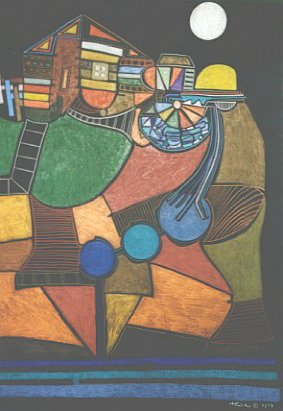
ECOLOGY
"This man writes," Albert
Gore cries out, "that the Earth is preparing new continents below the
oceans now to push up above the water when a new continent is needed. He does not support ecology. He supports development, the human
expansion and technologoical growth across the planet. This drawing says one thing; but his
writing says quite another...!"
"Mister
Crossmann?" Hedda asks.
"I
support the balance between development and the purification of our
environment," Crossmann says.
"But I do not support radical environmentalism which is
anti-man. Radical environmentalist
envision Nature perfect prior to an after humanity. Humanity is a curse on nature. But this is a very warped view of nature. Nature is a violent, hostile place, a
constaant war between species.
Writers refer to Nature's delicate balance. Nature has no delicate balance. Nature is a violent, brutal balance. Nature is a killing machine. Study the animal kingdom. A vicious war is going on at every
level to see who will eat, and who will survive for another hour. Man soils his environment; but he can
also purify it again. Man is a
cell in the body of the Earth.
Earth's evolutionary destiny is not known by men -- it is known by very
few men. Critics want to stop the
boat, freeze the picture, keep everything as it is at this moment. But life goes on. Always life goes on. We can't live without industry, without
development, without exploration, without development. Sustainability is a catch-word for
death. Capitalism has a built-in
rise and fall, ebb and flow, expansion and contraction, Day and Night. This is good. Wealth and Poverty.
The so-called sustainability that many ecologists are crying out for is
death itself: a kind of flatline.
That is the end of things.
The Night.
Dissolution. But man's
destiny is to explore, to expand, to create. The so-called friends of the Earth are too often humanity-haters
in sheep's clothing. They weep at
the loss of a tree; but feel nothing when a man raising a family loses his job
and the family experience dislocation and sometimes separation. The goal of radical environmentalists
is the destruction of human society, as it is, for some picture they have in
their heads of the ideal life-style, one of chosen poverty, small being
beautful, poverty being glory. It
is the picture from the Anti-Universe.
But this is a fantasy.
Utopias are the abberation.
State utopias are the burden of humanity, the ogre by which the world is
gored and cast in a mass grave.
The Utopians are the right wing and the left wing. Count the corpses in Germany, in
Yugoslavia, in Russia, in Cambodia, corpses offered up to the utopian
gods. The Greens are no different
that the Nazis or the Communists: a few elitists who want to force the majority
to live the way they, the elitists, feel is best. But the elitists, almost always, hate life. And they lead those who follow them
toward this imaginary utopia -- they lead their followers through Berlin,
through Rwanda, through Jonestown.
Everyone gets a glass of strichnine kool-aid. Mao's Red Book is strichnine kool-aid; Mein Kampf is
strichnine kool-aid. It is always
the same. Extremism is always
folly -- and almost always deadly folly...."
"Spoken
like a true dinosaur," Gloria Steinem replies.
"The
dinosaurs in America, in fact, are those clinging to the 1960's,"
Crossmann says. "You cling to
the same ideas you held in your twenties.
This means you haven't grown in thirty or forty years. The world turns. Things change. If a thirty-year old woman was still clinging
to the ideas she held when she was four, we would consider this
retardation. But when you cling to
the same ideas you held forty
years ago, you tell me that it is wisdom. Is it any wonder I don't believe you...?"
"Fascist!"
a young woman yells from the back of the crowd: the woman in the chartreuse
downy duck costume.
"You
call me fascist so that you can dismiss my ideas without thinking about
them," Crossmann says.
"It is a way you protect yourself from thinking..."
"This
man is not political," Hedda cries out, bruised by the exchange. "Can we not be civil to one
another? Civilization implies that
we will treat one another civilly, even in disagreement..."
Reggie
Lyons comes in, trying to break the tension: "I use various exemplary artists and their art to make
my psychosocial point. I deliberately cut across conventional stylistic
categories. On the avant-garde side, I combine Picasso and Duchamp, Mondrian
and Malevich, and Expressionism and Surrealism. Each double unit represents a
different solution to the problem of being anxiously modern—the feeling
that to be modern is to be inherently sick. Each avant-garde innovation is
conceived of as a different therapeutic technique, if also articulating the
pathology of modernity. On the neo-avant-garde—or
pseudo-avant-garde—side, I use Warhol and the appropriationists, with
Beuys as transitional between avant-garde and neo-avant-garde attitudes. My
entire discussion is framed by a deconstruction of the modernist myth of the
artist as having unique power of perception, unique spontaneity, and as a revolutionary transmuter of
negative into positive values. I show the ironies of the myth, and debunk it,
even as I argue that it was the sustaining myth of the avant-garde
artist...."
""Please
continue," Xavier Rubenstein encourages Reggie. "I find your ideas fascinating."
Reggie
continues: "I regard Picasso as instituting perceptual distortions and
Duchamp as instituting conceptual distortions—a deliberate destructive
use of deformation or “negation” or contradiction for subliminally
constructive, therapeutic purpose. The shock value of their work—its
frequently black humor—had paradoxical proto-curative effect, for it
shook one out of one’s conventional assumptions about perception and the
possibilities of art, making one critically conscious of both and the critical
consciousness invested in both at their best. I argue that in Mondrian and Malevich, on the one
hand, and Expressionism and Surrealism, on the other, avant-garde art becomes
explicitly therapeutic in purpose. The former represent what I call the
geometrical cure, the latter what I call the expressive cure. They are opposite
in character, but in both cases cure involves contact with the
primordial—in the first case primordial detachment or transcendence,
represented by abstract geometry, and in the second case free, spontaneous
expression of primordial emotions, whether by means of automatist gestures or
dream images. Cure, in other words, is effected by contact with and
articulation of what is fundamental in existence—the absolutely “higher”
and absolutely “lower” are equally
fundamental—which is understood as liberating one from the unessential
pathology of the modern, everyday lifeworld, with its banality and indifference
to individual existence.
"The
tenor of my argument changes as I move to Warhol," Reggie continues,
"who signals the end of the avant-garde attitude and the beginning of the
neo-avant-garde attitude. Warhol is explicitly indifferent to therapy—he
in fact hates and dismisses it, suggesting watching television as an
alternative—and concerned only to become famous, which he achieved. I
examine the narcissistic effect of this wish and achievement on Warhol’s life
and art; it is largely devoted to portraiture of famous people—as well as
the ironical emptiness involved in fame and narcissism. I also show that his
art represents an abandonment of avant-garde innovation and a return to banal,
everyday means of representation, confirming the social status quo of
perception, “art,” and importance or value. As such, it is
postmodern—nontransformative or minimally transformative. Overinvested in
fame, Warhol becomes a non-person, that is, a machine, as he himself said, no
doubt unaware of Tausk’s influencing machine and von Bertalanffy’s idea that a
conflict basic to modernity is between the closed system robot and open system organic model of human being.
(He thinks the former is demonstratably false.) I also distinguish between fame
and celebrity, arguing that the latter, which is dominant in the everyday
postmodern lifeworld, has bankrupted or at least corrupted the meaning of the
former.
"I
then discuss Beuys, whom I regard as transitional between avant-garde and
neo-avant-garde attitudes, and between a modern and a postmodern lifeworld. I
conceive of him as a tragic victim of his own therapeutic ambition. His art is
addressed to a postwar German audience, which it hopes to heal—I argue
that all his art, which is essentially a performance art, symbolizes the
healing process—but it increasingly tries to reach its audience by using
methods, objects, and images derived from the everyday modern lifeworld, as
well as by manipulating his own position as a celebrity. As his art became more
accessible, it loses its therapeutic power. That is, Beuys begins as an
avant-garde artist and ends as a postmodern artist—begins, as he himself
said, as a shaman, and ends, as he was aware others thought of him as being, a
showman. He was caught on the horns of a dilemma, realizing that in both the
modern instrumental and postmodern cynical, all too knowing worlds a shaman
with therapeutic intention could not help but be regarded as just another kind
of manipulative showman and celebrity. “Trickster” has an unresolvable
ambiguous meaning in both modernity and postmodernity...."
"Put
a quarter in that man to see if you can shut him up!" the Magician calls
out.
"Beuys,
like our friend who has just spoken," Reggie continues, "has ceased
being the martyr so that he can become the drunken buffoon."
"And
where do you place Crossmann, in this strata?" Norman Mailer calls out.
"I
believe he is a fascist throw-back to Picasso," Lyons replies.
"Fascist
in the positive or the negative sense?" William Buckley asks.
"We
aren't comfortable with his witchcraft," Pat Robertson calls after
Buckley. "The black
paper. All the work on the black
paper. His fascination with the
occult. It all his a devilish tone
to me. I believe this man is in
league with the devil. I have said
it before, on my television show.
This man is no Michael the Archangel. But he may be, indeed, the anti-Christ we have been warned
about..."
"Fascist
is a political word," Reggie tries to clarify. "I should have said reactionary. I think his reaction to the post-modern
is, in fact, a sign of sanity....
He is a shaman clearly. His
work is jerked out of the dream world by the hairs of its head..."
"Out
of the darkness, yes," Pat Robertson agrees. "That's why the man is dangerous."
"Is
he a sorcerer then?" Michael Douglas asks. "Is that what you are telling us?"
"Precisely,"
Robertson says. "He is the
wolf is sheep's clothing."
"If
you say he is the devil," Douglas says, "then I'm inclined to believe
him a saint. And if Gloria Steinem
says that he is a fascist, then I'm inclined to believe that he is a visionary
of the future."
Crossmann
sees Catherine Zeta-Jones standing beside her husband. Her lips look like swollen
strawberries.
Crossmann
thinks of Joyce Brothers, another anti-erection device.
"We
have seen that the artist's childhood had tensions and deprivations," a
woman's voice comes in, "expriences which should propel us to feelings of
compassion for the man...."
It
is Joyce Brothers.
Christ!
Crossmann thinks -- that wasn't what I had in mind.
"We
see in his art something very similar to the pre-Columbian genius of the native
Americans in the southwest," a woman says. A beautiful black-haired woman, who looks like Bianca
Jagger's sister. "We agree
that his work is closest to the aboriginal in style and content," the
woman continues. It is Chitranee
Drapkin, with her husband, Robert, by her side: collectors from Florida.
Crossmann
nods to Chitranee, catching her eye for a second.
Oh,
oh.
Roseanne
Barr, Crossmann thinks. Working
again.
Roseanne
appears. "Where are the
hot-dogs?" she calls out. She
is wearing a low-cut black gown showing round bosoms. "I would kill someone for a hot-dog," she shouts.
"My
own work on Mondrian," Xavier Rubenstein begins, "corroborates your
view of the man, who has been grossly misunderstood by the
post-modernists. Central to my
position is the notion that Mondrian’s work, all his work, is characterized by
a powerful commitment to the spirit of realism (not abstraction) coupled with a
prophetic awareness of the problems posed by what today would be called the
“ideology” of the representational process. Ultimately, I hope to demonstrate,
in the face of the accepted wisdom of the time, that Mondrian’s modernism is an
achievement to this day still new and little understood...."
"Are
you hiding from someone?" Peter Falk asks Denise Rich.
"Not
exactly," the woman replies.
"I'm trying to hear the discussion better."
"It
looked to me that you were trying to avoid Ted Kennedy back there," Falk
says.
"No,
you are mistaken," Denise Rich replies.
"Did
you have an affair with Ted Kennedy at some point?" Falk asks.
"Hasn't
everyone?" Denise Rich asks with a smile.
"I
haven't," Peter Falk replies.
"Oh,
ok. Everyone but you."
"Are
you saying Ted and Hillary Clinton are doing the old two-step?" Falk asks.
"No,"
Denise Rich says. "I think
HIllary probably has a girl-friend somewhere...."
"Oh,"
Falk replies, his jaw dropping.
"Anyone I know?"
"Not
if you're lucky," Denise replies.
"Any
further comments on this drawing?" Hedda asks.
Steely
stilence.
"Well,
let's move on then," Hedda continues. "To the Tenth piece..."
"The
Tenth Symphony!" Andre Previn calls out. He has been drinking again.
The
Magician sidles up to Crossmann again, offering him more Wild Turkey. Crossmann declines. The Magician speaks in a woman's voice:
"It is stated and plainly demonstrated in the Zohar that in the
beginning The Elohim (Elhim), the creators, or Demiurgos, were called Echod,
'one' -- 'the Deity is one in many', a very simple idea in a pantheistic
conception (in its philosophical sense, of course). Then came the change: 'Jehovah is Elohim', thus unifying the
multiplicity and taking the first step toward Monotheism. 'How is Jehovah Elohim?" -- 'By
three steps, from below.'..."
"Ok. We are now at Number Ten," Hedda says. "This painting is 'Night On the
Town,' a gouache painting on paper, what Crossmann calls a Day painting -- that
is, on white paper. Is biography
the best way to understand the work of an artist? Charlie Rose has suggested that this is the way to
understand this exhibit. And, I
agree, there is some logic to this approach."
"This
continues the theme of the life of the painter in college," Charlie Rose
says. "This is the artist on
a date, a night on the town. His
liberal education in college includes an emancipation from his Catholic
upbringing -- and a further discovery of love and sex between a man and a
woman."
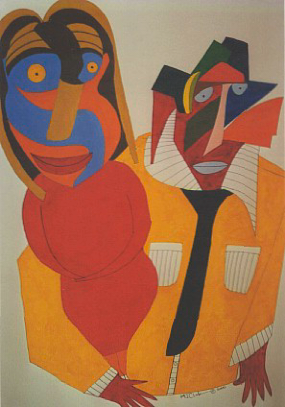
NIGHT
ON THE TOWN
"You will see, here, another example
of why I oppose Crossman's view of women," Gloria Steinem remarks. "Look how delicate, how tiny the
woman is, fitting on his shoulder.
She would fit in the palm of his hand if he only bothered to turn his
hand up."
"You
insistence upon political correctness makes you an arid playmate," Hugh
Heffner reponds. He is standing
behind Gloria Steinem.
"What? Did they let you in here?" Steinem
demands.
"They
certainly did," Heffner replies.
"And, I must say, I'm liking what I'm seeing so far. There was a lovely young woman near the
door who had lips the size and hue of ripe strawberries..."
Crossmann
thinks immediately of Catherine Zeta-Jones. He looks at his watch.
It is not midnight yet. He
has to be near her at midnight.
"This
sexist argument is getting old hat, Steinem," a woman pipes up. A wiry Italian woman, who is
accompanied by a man in dirty coveralls, with 'Mike' scripted above a
'Michelin' tag above his left breast pocket. It is Camilla Paglia.
Small and testy, striking, like a Siamese cat: wound as tight as a
corporate executive's prostate gland.
"Ball-cutters
in the intellectual community are like cat at a mice convention, baby,"
she continues. "Get a
life! We're all sick of your
whining, and your self-victimization.
The world can be read as the history of men abusing women, or of the
ruling class persecuting the working class, or of the love affair between men
and women. You can read into
reality what you want. Reality is
plastic. It shifts; it changes
shape for you. Only don't believe
it when it tells you what it wants you to. It's just lying to you, trying to please you, make you feel
good..."
Bianca
Jagger appears with a new boy-friend, a man who looks like Jack Nicholson, but
who turns out to be a Spaniard named Esteban.
"I
believe the woman in this painting is Michael Crossmann's estranged wife,
Irene," Charlie Rose says.
"We know that they were lovers for a time in college. This is an idealized view of their
courtship in college, at the University of Wyoming -- that is my
interpretation.
Edwin
Fuller also appears, a gray-haired collector from England, who has a
twenty-year old boy on his elbow.
Behind him is Maxfield Graves, a fellow collector from London, a man
known as the 'Hale Wolf' in England for his history of leveraged buyouts of
English and European companies.
Henrietta
Beach pipes up: "His bold brush strokes of flat, muted colors could very
well be absttract -- but they are never very far away from the natural
world."
"What
the hell does she mean by that?" Ted Kennedy whispers, but louder than he
expected. "She's not a bad
looking woman though. What do you think, Hillary? She's kind of cute, don't you think...?"
"She's
a distinguished professor of art history at Columbia, Ted" Hillary
replies, cold as a Wyoming nail on New year's day. "All you men think about is that phalanx between your
legs...!"
"I
know. I know all that. Yes, of course," Ted says.
"Sober
up, Ted!" Hillary says with scorn.
Then she looks away from him deliberately.
Senator
Kennedy eyes Mayor Guiliani's wife moving toward him through the crowd...
She
wanders up to Senator Kennedy. She
whispers to him: ""I felt connection, calling connection as I lay
there thrashing about on my little blue mat ..."
Kennedy
smiles to Hillary, nodding to his new friend. "I like that," he says. And he follows the Mayor's wife as she wanders through the
crowd.
"Is
the artist going to tell us about his sex life?" Doctor Ruth calls
out. "Oh, yes. I would really like to hear about that. It is good for one's mental health to
talk about his sex life..."
"Sex
life! Sex life!" the three
skin-heads begin to chant.
Governor
Jesse Ventura is soon standing beside them, chanting: "Sex life! Sex life!" -- but not sure what it
all means. It all sounds good. And there's a camera there
somewhere. It's always nice to get
on the camera.
Crossmann
notices that Oprah is talking with Jim, off to the side of the room, in an
animated fashion -- trying to wear him down with some insistence.
Crossmann
notices Natalie Merchant coming in to the museum. He would like to talk with her. He loves her voice.
Her poetry is like crystal.
"We're
going to move on to Number Eleven, unless we have other comments."
"Eleven
is a very important number for Michael Crossmann," Richad Baker comes
in. "Numbers 1 and 11. For the number 111 has been following
him around for many years..."
"James
Joyce numbers Anna Livia Plurabell 111, the All-Amazingfull," Moishe Frank
adds. "Aleph is 1;
Lambda is 30; Pe is 80."
Crossmann
thinks he sees the ghost of Bishop Sheen moving through the museum, in the air,
like a cloud wearing a shroud, looking down at Crossmann as he passes by,
muttering: "In nomine patri, et filii, et spiritus sancti..."
"We
know where you live, we do! We
know where you live, we do!"
The
four skinhead now are singing, dancing like the Backstreet Boys, to everyone's
delight.
Oprah
is shaking her finger in Jim's face.
Allen
Ginsburg is chanting: "Lawrence Ferlinghetti! Kerouac, Kerouac!
Cassidy too!" -- trying to match the beat of the new Backstreet
Boys. He has his eyes on one of
the young tough boys.
"Are
you Andry Warhol?" the girl in the chartreuse duck costume asks
Crossmann. "Or are you Jesus
Christ...?" She, too, is
singing to the beat of the four skinheads performing, the governor now leading
the younger three men.
"Get
her outta here!" Lola Fanti calls.
"Security!
Security!"
The
chartreuse girl fades into the crowd, disappearing, melting away like nothing.
"I
know it is New Years -- Millenium Eve -- forgive me! We need some order here," Hedda Krantz announces. "We need some dignity for this
man's presentation!
Please...!"
The
crowd grows silent.
The
Magician sidles up to Crossmann again, this time looking and smelling like
Allen Ginsburg a bit. He says to
Crossmann in Ginsburg's voice: "
"Here is work Number
Eleven," Hedda says. "A
drawing in colored pencil on black paper, entitled 'Father and Son'. This piece is one of my favorites. The child is so vulnerable in his
father's arms. It's like he is
somehow glued to his father. The
father is very expressive, gesturing; but the son somehow is snugly pressed
against his father's cheek. Again
we have the characteristic balck and white world of thought, and conflict,
coming in waves out of the father's head.
This is one of my favorites.
It looks almost like a pastel.
Some people don't like pastels; but I find this painting
wonderful..."
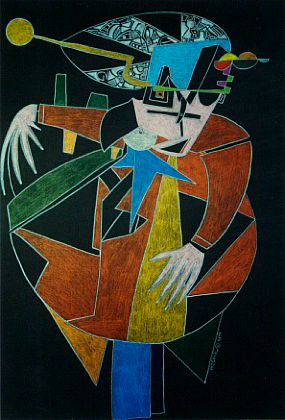
FATHER
AND SON
"Of course, there is a darker
side here," Oprah responds.
"This is apparent to any of you who watched my show today. We did an evaluation of the life of
Michael Crossmann. Besides finding
him the offspring of some pretty dubious parentage, we discovered that
Crossmann and his current wife, then his girlfriend, had an abortion in the
early 1970's. And the loss of this
son -- Crossmann apparently always considered him a son -- has Crossmann ever
since. He does not have an heir
now, of course; not a male heir...."
"So
you say that this is a portrait of Crossmann with the son he never had?"
Charlie Rose asks.
"With
the son he murdered," Oprah says.
"But
you don't oppose abortion, Oprah," Hillary Clinton says, shocked by
Oprah's words.
"I
don't oppose a woman's right to choose," Oprah says. "But for a man to support this --
a woman is protecting her body, her life, from the oppression of
childbirth. But what is a man
protecting: his irresponsibility?
His freedom? In my eyes, on
his side, it is a kind of murder..."
Jerry
Falwell shouts to Oprah: "My God woman, you finally see the light! Mountains of dead babies! Mountains of murdered children on our
conscience! You talk about
karma! Michael Crossmann likes to
talk about karma, likes to talk about Brahma and Vishnu and Siva, good old
Jesus Christ isn't enough for him, he has to talk about Prometheus, Odysseus
and Isis. Well, I will tell you
that there will be a reckoning.
The man claims to be Jesus Christ.
Did Jesus Christ ever fornicate with a woman; did he ever murder his
child; did he ever participate in hanging of sinners, criminals? Jesus forgave criminals -- lest we
forget. It is heresy what this man
writes; what this man says.
Fornicator, I call him; adulterer; anti-christ. Michael the Archangel, indeed! This man never met Michael the
Archangel! It is all a literary
ruse! You can bet your clean apron
on it! Who does this man admire? He admires David Bowie and Bob Dylan
and Leonard Cohen. He admires Mick
Jagger and people like the Psychedyllic Furs and Talk Talk and U2. You see these people in his novel
appearing over and over again with
a friendly description. Mick
Jagger gives his money to the London Society for the Kabbala; David Bowie's
music is littered with occult references.
He is an agent of the darkness -- I say it now. It is no surprise that he killed his
baby! He probably kills babies all
the time, as part of his dark ritual.
I saw how he was looking at Dana Skully over there -- the pretty young
woman with the creamy skin -- and Catherine Zeta-Jones: he probably wants to
kill their babies too...!"
"You
are missing the point about art!" Reggie Lyons cries out,
exasperated. "Art is not
about some personality symptom, some accident of phenomema. Art is elevated; it comes out of the
God realm. At least this is so for
the avant-garde artist. It is not
so for the neo-avant-garde artist, of course -- for the postmodernists who are
no more than businessmen in stained suits.
Richard
Baker mimics Lyons under his breath: "Crossmann I believe to be a
post-post modernist. A visionary
lookiing forward, only seeming to be looking backward. He is looking so far ahead that it
looks like he's looking back to us..."
"Yes,"
Reggie Lyons replies, surprising Baker. "That is it. Crossmann is no apportionist! He's a conservative revolutionary. So quietly revolutionary that the conservatives are afraid
of him...."
"Apportionist?"
Peter Falk cries out. "What
are you saying, sir...?"
"Yes,"
Reggie continues.
"Appropriationism has become, wittingly or unwittingly, the dominant
mode of artmaking in postmodernity. Quoting another artist, especially an
avant-garde one, and in the process denying his or her therapeutic intention,
trivializing his or her creativity and innovations, and supposedly
deconstructing his or her art—showing that it means the opposite of what
it was thought to say, and turning it into an ironical cliché or shadow of
itself—has become de rigeur in many quarters, a supposedly major
conceptual achievement. I analyze appropriationism as the ultimate cynicism about
art in general and avant-garde art in particular, as well as about creativity,
and distinguish appropriation from influence, finally arguing that
appropriationism signals a creative deadend—a feeling of the futility of
creativity to effect any change in the lifeworld, and thus a failure. In
appropriationism critical consciousness capitulates to the status quo,
ironically but also smugly. Appropriationist art is neither transcendentally
abstract nor spontaneously expressive, nor is it addressed or of service to
anyone, but simply confirms the status quo of media consciousness, there for
the asking by everyone. Appropriationist art is a kind of historicist spectacle
or show with little or nothing to tell—the ultimately decadent,
indifferent art, blending almost seamlessly into the pathological Potemkin
Village media facade our culture increasingly depends upon for its
'self'-consciousness. I do suggest that certain appropriationists who work in a
comic way offer what seems to be a critical consciousness of art’s and
society’s tragicomic situation, but I am not sure I am right, although I
believe that comedy is ultimately more therapeutically effective than tragedy.
As Freud suggested, humor is a sign of ego strength, and it was the strength of
the individual ego in the face of a society that weakened it through its
indifference and failure to be an existentially facilitating environment, and
that they thought would sooner or later destroy itself, that was of basic
concern to the first avant-garde artists. They wanted to save people from
society, not society from itself,
however much some of them fantasied a social utopia in which reason was
triumphant. Thus, the comic appropriationists may be the new avant-gardists, if
that idea makes any real sense these days...."
"If
the idea ever did make any sense," Richard Baker replies under his breath.
"I
am not sure if you are saying that Michael Crossmann is the comic
appropriationist," Xavier Rubenstein responds, "and that this movment
you are describing merely traces a circle between the alienated artist and the
non-alienated artist and back around again...."
"Are
you saying, when you say that Crossmann is influenced by Picasso,"
Henrietta Beach asks, "are you really saying that he is 'quoting
Picasso'. Clearly Crossmann does
not believe that the artist will save people from society. We have heard him speak with disdain
for the idea of utopias. He speaks
also with some disdain for the artist as well, the artist who would consider
him a savior of the masses, a revelator
of Truth. In his novel, Crossmann
seems to maintain that artists make good critics but almost never good leaders;
and that society needs, at least in some ways, to be protected from artists --
who are the masters of the dark vision and who bring, usually, dark visions to
their societies when in a position of leadership. Is not Crossmann, in fact, more a neo-avant-garde artist
than an avant-garde artist? He laughs
at his own work. His work almost
always has a touch of self-deprecating humor in it -- almost always the
comic. I would suggest that
Crossmann is, himself, this comic appropriationist. Michael Crossmann seems to have no respect for the
anti-hero; and your avant-garde artist is nothing other than the anti-hero,
rejecting society because it is corrupt, dangerous, evil. Crossmann has said no to this; and, in
his novel, he speaks very passionately for the re-birth of the hero, the
overthrow of your anti-hero who only brings darkness, chaos, to the land. He choose Life over Art. He has said this clearly...."
"To
everything a season," Crossmann says. "Too much Day calls out for Night; too much Night calls
out for Day..."
"You
are a relativist, then!" Falwell calls out. "Like your friend Bowie, or Jagger or Dylan!"
"Like
my friend Eccclesiastes," Crossmann says.
"God
is not a relativist, Mister Crossmann!" Fallwell replies.
"Do
you claim then to know God's thoughts?"
"As
you have claimed, sir."
"I
have claimed to know my God's thoughts," Crossmann replies. "The God who creates me and who
drives me into exile, and who calls me back home."
"Is
you God the same as my God?" Fallwell asks.
"My
God is everyone's God," Crossmann replies. "But I have no knowledge of your God. I have no knowledge of your heart. I do know, however, that Jesus warns us
not to trust the man who shouts his prayers from a streetcorner, for all to
hear. Who beats his chest with
claims of his own holiness..."
"You
take me for this man you describe?" Jerry Fallwell asks.
"Those
fall well who overassume God's counsel," Crossmann says. "And those who make a profit of
God's word, an obscene profit, in his name..."
"Do
you judge me now, Mister Crossmann?" Fallwell asks.
"I
judge a type of man, a man who uses religion as a profession. I don't know your nature. I know that you have appeared here
judging me -- and I have never before met you. Clearly, you know me even less that my mercurial opponents,
Oprah and her ilk."
"You
come here to destroy, even though you dress in silk and speak with a serpent's
tongue," Fallwell says.
"What
I will destroy I have already destroyed," Crossmann says. "What I preserve shall for ever be
preserved...."
"I
expect at any moment the Roman soldiers to appear and arrest you Mister
Crossmann." It is Mick
Jagger, with his long brown hair, his androgynous face and body, dressed in a
flourishing black overcoat -- a beautiful brunette at his side.
"Not
until we finish the exhibit," Hedda says, smiling. "With God's blessing...."
Hedda
looks up at the sky, feigning a short prayer.
The
atheists and agnostics in the crowd laugh a bit too loud, announcing their
identity with Hedda and her disbelief.
Senator
Kennedy isn't sure what to do, which side to join, since he does believe in
God, knows the existence of God rather explicitly. He takes another drink, looking again for the Mayor's wife.
Crossmann
notices Oprah again talking heatedly with Jim, near the back wall. The Magician is craning his neck to overhear their conversation.
"Let's
move on to the next painting," Hedda says.
The
Magician sidles up to Crossmann, speaking in the voice of Crossmann's friend,
Jim: "There are enemies here, Michael. Enemies who want you dead. Enemies with money who are trying to buy your
dissolution. Beware both friends
and those who say they are friends!
Beware the enemies most whose enemy you have yet to be
declared...!"
"This painting is probably the
most delicious in the whole exhibit, I think," Hedda says. "The most psychedellic...."
"Most
of his paintings are psychedellic," Allen Ginsburg says. But no one hears him; no one can hear
Allen Ginsburg -- because Allen Ginsburg is a ghost.
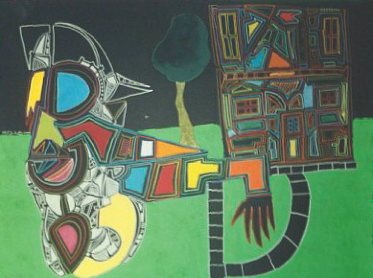
HE'S
LEAVING HOME AFTER LIVING ALONE FOR SO MANY YEARS
"Well, the title is taken from
a Beatles' song," David Bowie says.
"Transgendered, if you will."
Bowie
signals to Lola Fanti. "I
want to buy this one," he says.
"Very
well, Mister Bowie."
"David,
hold on," Mick Jagger says.
"I had my eye on this one." His English accent as thick as stew.
"Wait
a minute! Hold on!"
It
is Paul McCartney.
A
triumverate. Now that Lennon is
gone.
"I
think I have the first claim on this one," McCartney says.
"Why
is that?" Bowie asks.
"The
title -- the Beatles' claim," McCartney replies.
"I
really want this, Paul," Bowie says.
"It
talks to me."
"Ok,"
McCartney replies. "You
can have it."
"You
see," Fallwell says to Pat Robertson. "He's not one of us. Look at this art on the wall. You think Jesus would
paint something like this...?"
"I
don't know, Jerry," Robertson reponds. "So much else fits."
"Look
at his friends," Fallwell says.
"He's a rocker at heart, Pat.
He fits with them. He
doesn't fit with us. He's not
one of us..."
"That's
just it, Jerry. Jesus didn't fit
in with the rabbis either. Jesus
was a kind of rock star. He didn't
socialize with the rich Levites.
He was a kind of rebel..."
"I
don't believe that kind of interpretation, Pat," Fallwell says. "You're saying that we are like
the corrupt Jews who turned the temple into a marketplace...."
"Isn't
there some truth in that?" Pat Robertson says. "I've been thinking about this lately."
"You're
saying that we will kill the next Christ?" Fallwell asks. "Is that what you are
saying...?"
"I
don't know," Robertson replies.
"You know what the Japanese tea ritual suggests?
It suggests the belief that, in the presence of a cyclic reality, every
event is unique and will never be repeated...."
"What
are you saying, Pat?"
"I
don't know what I am saying," Robertson replies. "I'm saying that nothing repeats exactly.... But that everything repeats
non-exactly. That is the paradox,
Jerry..."
"I
think, in terms of biography," Charlie Rose comes in, "this
represents Michael Crossmann's leaving Wyoming and moving to Oregon. College, love, alcohol, intoxication;
then the abortion; Michael and Irene were separated; and Crossmann move to
Oregon with his brother William...."
"I
don't believe it matters what the biography of the author is," Henrietta
Beech responds. "The work of
art must stand alone, as this piece does on this wall. We need to know nothing about the
artist. We do not even need to
know who the artist is. The work
of art stands alone. It is a
complete piece, in a vacuum, in a sense.
We approach this work of art as a unique experience, like the Japanese
tea ceremony. When we study more
about the artist we do not learn more about the art -- we learn more about the
artist. The suggestion that this
piece represents the artists leaving Wyoming is really a mental construct
placed upon this piece, in the context of this show, by the viewer. It really doesn't tell us more about
the piece. In fact, it tells us
less, because we are no longer focussing of the piece of art -- we are beginning,
instead, to focus on our own conceptions about the artist. We have put up a filter of organization
that now stands between us and the work of art..."
"In
that sense we can never know anything through thought," Charlie Rose says.
"We
can never know anything through thought except thought," Henrietta Beach
replies. "This painting, like
a symphony, is not composed of words.
The title is even an afterthought.
A stamp the artist puts on it.
His impression of the painting.
Perhaps coming from a memory.
More likely coming from a memory of words that have faint connection if
any to the painting itself. The
visual and the verbal are opposite sides of the brain. The visual is the female brain; the
verbal is the mental brain.
Humanity has a visual language before it has a verbal language. Cave paintings through hieroglyphics,
there was no written language.
Hierogyphics was the first step toward the marriage of these two
opposites...."
"You
talk about verbal language," Harold Bloom says, "and you really mean
by this written language. The
alphabet."
"Yes. Of course, the verbal, the spoken
language, the grunt," Beech says, "comes with the birth of the
baby. The cries, the whelps of the
new-born baby. But children draw
pictures before they write letters.
Children draw pictures naturally.
Hand a child a pencil or a crayon and that child will draw, without
being told to draw. But the same
child has to be twisted, threatened, cajoled into learning the alphabet. And it is the alphabet that abstracts
the child, draws him into the masculine, unnatural brain. You will notice in Michael Crossmann's
novel, that his passing into death and into the land prior to his re-birth as
Michael the Archangel, the darkness, or chaos. The womb or the egg Crossmann calls it. He gives us a very explicit description
of the Life taking up residence in the egg, in the womb. When the Life is first born, that child
remains in darkness for a time, under the governance of the Mother. And it is at this time that drawings begin
to emerge in his novel, the geometrical drawings first, diagrams. But this is also the time that Michael
Crossmann began to draw and paint.
He puts this time at roughly 1985.
The visual arts are feminine; they are natural to the child. The alphabet is not natural. The learning of the alphabet is a
masculine activity. It requires
abstraction. The creation of
letters is an abstract act. The
transcription of thoughts into a shape, a body. It is a kind of incarnation of spirit. A taking of a body, if you will. The Jews have, for centuries, forbidden
graven images of the deity. No people
have pursued the written word with such a vengeance as the Jews, for they
understood that thought, the letter, the alphabet, was the key to gaining power
on the Earth..."
"That's
provocative nonsense," Donald Trump says to his wife.
Brian
Moore, the writer, takes a glass of champagne off a passing tray -- and says:
"There was a book written about that last year. It was called, I think, The Goddess and the Alphabet. It's an indictment of men, of
course. Women are the good side;
and men are the bad side. It
portrays egypt as being the symbol of a cultural matriarchy, a king of eden,
prior to the coming of men, the thinker, the weilder of the alphabet..."
"Alpha
and Beth," Moishe says.
"The Man-Woman, the Father-Mother. The Alphabet, one and two."
"Well,
that comment brings us to the next piece," Hedda comes in. "Number 13..."
"Number
13 is also an important number to Michael Crossmann," Moishe Frank
continues. "We remember, in
his book, the great significance the author put in his initials: M is the 13th
letter in the English Alphabet; J and C are the 10th and the 3rd -- that is,
together, also 13. Michael J.
Crossmann is composed of two sets of 13.
The M, of course, is the top half, Michael the Archangel; JC is, of
course, the bottom part, the part that comes down to Earth, the Jesus Christ
half..."
"That
is heresy!" Jerry Falwell cries out.
"This man is no more Jesus Christ than I am Sigmund Freud! Numbers are....the devil's playground! This mysticism of numbers! We don't want to hear it any
longer! Decent Americans are tired
of hearing it! The Bible promises
an anti-christ before the coming of the messiah...!"
"Asian
communism was the Anti-Christ!" Moishe Frank replies.
Moishe
apperas, more and more, like a disciple of Crossmann.
"Don't
tell me you believe that gobble-de-gook in that novel of his?" Fallwell
cries out. "This man is not
the messiah returned. I would
recognize him if he was! I, more
than nearly anyone in this room, would recognize him! Where is the rapture?
What about the rapture...?"
"Your
rapture is a subtle thing," Crossmann replies to Fallwell. "The Bible is very subtle. You look for the literal in everything. God did not create the world in six
day. That is an allegory. Creationism is an allegory of the
creation of the world is stages, in periods of days and nights, periods of rest
and activity, with the seventh day being the day of completion, the day of
rest. Which we haven't reached. Creationism, literal creationism, is
not what the Bible teaches. The
universe evolves from the simple into the complex and then back into the simple
again. From the complex into the
simple back into the complex again.
The two unvierses evolving as true opposites: one gaining strength,
expanding, as the other contracts; the other contracting as the second gains
strength. The one cell split into
two. These two separated but not
separated cells being to one another the photograph and the photograph's
negative...."
Crossmann
appears animated.
The
entire room gets quiet for a moment.
Crossmann
notices Morgan Freeman enter the museum, dressed in a black tuxedo, looking
gallant.
"Let's
move on to painting Number 13," Hedda begins again. "We still have a ways to go to
reach the end, so let's walk briskly and make only comments which throw light
on the painting..."
It's
not clear for whom the last message is intended -- but many people in the
audience feel Hedda's barbs are addressed directly to them. But Hedda is a rather silly creature
afterall. It is Millenium Eve. There is nothing else to do but party --
to have some fun, and pehaps get a little rowdy. The volume of the audience rises another notch or two.
The
Magician sidles up to Crossman again, speaking this time in the voice of
Catherine Zeta-Jones. He whispers:
"Don't forget about midnight, Michael. I have something to give to you too..."
"This thirteenth painting is
another primordial, aboriginal drawing in colored pencil on black paper,"
Hedda says. "The title is
'The Lovers'. It is stark, in a
way. Dark. Dark-skinned. Somewhat African.
I say that, not knowing why.
I think it is quite a wonderful piece; one of my favorites....
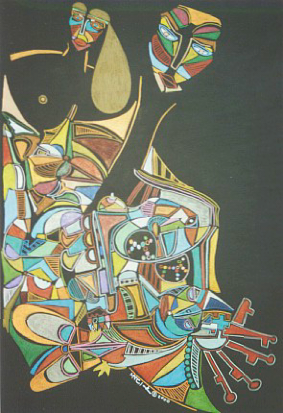
THE
LOVERS
Mick Jagger motions for Lola Fanti
to approach him.
"I
am interested in this piece," Mick Jagger says to her.
"Get
in line, Mister Jagger, and make us an offer," Lola says, gloating. "Jo Carole and Ronald Lauder have
already put in a considerable bid on this piece."
"Well,
I'm sure they won't outbid me," Jagger says. "What is the current bid?"
"Come
with me, Mick -- can I call you Mick? -- I'm Lola -- as in I shouldn't a told
ya," Lola says. "We
should talk about this in private...."
She
leads Jagger out toward the door.
Jagger
passes Biance, his ex-wife -- they nod to one another coldly.
"Small
world!" Jagger says, "too damn bloody small sometimes...!"
"So,
where is this mystery man, anyway?" Falk is asking Denise Rich.
"Who
said it was a man at all?" the woman replies.
"Oh,
I see, very mysterious of you," Falk says. "Although I don't see you meeting another woman
here. No, I believe you're
dressing for a man..."
But
just then a pretty, sexy blonde woman, about thirty-years-old appears next to
Denise Rich.
"What
took you so long?" Denise asks.
"The
traffic is hell out there," the younger woman says. "The damn taxi driver was some nut
with a mohawk haircut. He kept
trying to tell me about John Lennon's lyrics..."
"Oh,
Beth, this is Peter Falk," Denise says to her friend.
"Oh,
Columbo!" Beth replies.
"Yes. Well, not really. I'm not really Columbo..." Falk
says.
"Oh,
I don't want to hear that," Beth cries. She has something white on her nose. Falk recognizes traces of
cocaine. "None of us here
want to be who we really are. We
all want to be who we're pretending to be. We're all actors.
You're not the only actor in this room. We're all pretending to be who we're not. Even that angel up there. He's trying to not be an angel. He's trying to be an English teacher
instead. But we are who we
are. We're all just faces on a
talk show; voices in a camera.
Surface things. Afraid of
what's below. Afraid of the
vastness below, the arid nature below.
We dance, we laugh, we snort cocaine, we screw. We scream; we hate; we want to
die. Because we are afraid of that
empty thing inside of us. No,
don't tell me who you really are.
I can't bear to know who you really are. I want to think of you as Columbo. That is something that I can understand. And control, in a sense, because I know
who you are. When you are Columbo,
you can't really not be Columbo.
You have to be Columbo as long as I believe that you really are
Columbo...!"
"You
have something on your nose," Falk says to Beth.
"Oh,"
she giggles, wiping the cocaine away.
"Love candy," she says.
"Eat the candy; and fall in love. And when you wake up, the love is gone. So you just eat another piece of
candy..."
Then
she turns to Denise: "Is he here yet?"
"Not
yet."
Now
Columbo is really interested.
Reggie
begins to speak again: "I think there is a larger lesson to be learned
from the change from avant-garde, modernist to neo-avant-garde, postmodernist
art—a lesson about creativity: it is not a guarantee of criticality, and
criticality is ultimately more important in life than creativity. Criticality
is a major ego function, and the only source of adult autonomy and
independence, whereas any dependent child, with a limited ego, can be creative.
T.S. Eliot thought that genuine creativity was an act of criticality, but that
was a modernist idea that is no longer necessarily—indeed,
hardly—the case in postmodernity. One of the modernist
claims—articulated particularly by Duchamp and Beuys—is that
everyone can be creative. That is, creativity is not the prerogative of the
artist, but a potential of every human being, even if people who are actually
creative are regarded as superior to those who are not. But what postmodernist
art makes clear is that the creative everyman does not necessarily use his
creativity critically. The issue is not simply to be creative, but to use one’s
creativity in the service of critical consciousness. One cannot assume that it
automatically will be. Indeed, I want to argue that it is harder to develop
critical consciousness—I think, incidentally, that it is what
psychoanalysis does, with respect to psychic but also social reality—than
to be creative. Indeed, creativity is all over the place these days, if to no
critical purpose."
"What
do you think of this Mister Crossmann?" Hedda asks. "Is the critical faculty more
important in life that the creative faculty, as Mister Lyons
suggests...?""
"I
think those people who can approach the creative arts only through the critical
faculty," Crossmann responds, "live in such a hell of inferior
feelings that they are driven to seek ways to inflate their own
importance. Without the creator,
the critic has no livelihood. The
critic responds to something always; the critic cannot generate things. The critic almost always holds himself
superior to all things, for he believes it his task to tell the world if a work
of art, an artist, is good or not.
He is a kind of god of judgment.
Clearly, the exemplary creator must have a honed, refined critical
eye. But the critic who can't
create is more akin to the creator who has no critical faculty -- in that both
are incomplete. I believe it is
easier for the creative person to develop a critical consciousness than it is
for a critic to become creative.
Because the creative person is a child, according to Mister Lyons own
conclusion; and, of course, children are much better learners than are
adults...."
"You
will notice that there are more lovers in this drawing than the two obvious
ones," Richard Baker says.
"We have another couple implanted in the midst of this drawing,
with an east-west allignment. I
think it is also interesting, in a mystical sense, that the hand of the man in
the drawing is, at the same time, a series of keys. Perhaps keys to unlock the meaning of the drawing
itself..."
"I
hesistate to bring this up," Charlie Rose comes in. "But 'The Lovers', in the
biographical sense, corresponds to the love affair Michael Crossmann had with
Leslie Rhoades, the married woman who so devastated Michael Crossmann in
Eugene, Oregon. This lost love
sent Crossmann inside himself. His
despair thrust him into a journey into death, the nature of the soul. The next painting, 'Mister Death',
corresponds to the death of Micahel Crossmann's father. These two events, together, really
forced Michael Crossmann to retreat from the world and confront his own death
on the inner plane, which brought about, ultimately, the novel Conversations
On a Dying Age...."
"There
may be some truth to Charlie's conjectures here," Henrietta Beech
replies. "But this says
nothing about the painting really.
Who organized this show?
Who determined the order of this show? Was it the artist...?"
"Well,
the artist gave us directions of how he wished the pieces to be ordered,"
Hedda Krantz admits.
"So
this organization tells us more about Michael Crossmann's sense of proper
order, thematic order -- it tells us more about Michael Crossmann as a writer
-- than it does about these paintings...."
"But
we shouldn't dismiss understanding this mechanism of Michael Crossmann's
mind," Charlie Rose says.
"If we admit he has some genius both for the visual arts and also
for literature, perhaps we should seek to learn the lessons this organization
is providing for us..."
"Yes,
perhaps you are right in this," Henrietta agrees. "But I think we should keep these
ideas separate: (1) the painting is one reality; (2) the story of these
paintings is something else -- the literature of Michael Crossmann, the
writer..."
"But
this may also tell us something essential about the nature of life -- this
narrative of motion," Rose says.
"Perhaps it tells us something about the structure of life, the
history and, indeed, the future of Life, evolution...."
"It
is possible," Henrietta replies.
"If
the critical mind can discover it," Reggie Lyons says.
"The
power of the alphabet to discover some critical pattern or structure,"
Henrietta continues. "The
male rationalizing the primary female nature. It is not clear if the mind is describing itself or
describing natue however...."
"Are
we ready to move on to Number 14?" Hedda asks.
The
Magician sidles up to Crossmann, speaking in the voice of Morgan Freeman. He says: "I don't understand this
thing about 'African American'. I
am an American. Anyone who tries
to take any part of that away from me, with some insinuation that I am really
from somewhere else, is not doing me a favor. I am an Amereican.
I will always be an American..!"
"We are now at work number
14," Hedda says. "It is
a colored pencil drawing on black paper.
And it is dark. Eerie. There are many faces in this drawing,
many human images, some in pain, many twisted, black and white. Of course behind all the foreground
imagery is an overlord, a personality wearing a yellow hat. Mister Death. I'm sure Charlie will tell us what this painting or drawing
represents in terms of the biography of the artist. What does anyone else want to add about this drawin? I call it a painting, mistakenly,
because the effect, with the colors, is more like a painting than a
drawing. It is a painting without
pant, I suppose..."
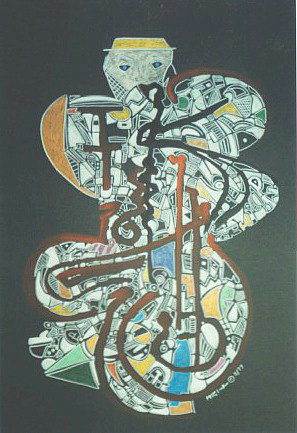
MR.
DEATH
Reggie Lyons begins: "My point
is that creativity always becomes trivial and presumptuous when it does not
serve truly critical consciousness. This is the problem with creativity in
postmodernity: it serves no important psychosocial purpose, that is, does not
address any developmental-existential issue that has become a particular
problem in the lifeworld, and it tends to blow up a half-truth into a whole
truth. Finally, postmodernist creativity is a social fetish and self-fetishizing
spectacle. The postmodernist artist says “Look at me, look at what novel stunts
I can do, especially with old artistic props.” In contrast, the modernist
artist said “Look at this difficult psychosocial issue through the lens of my
art, which I hope clarifies it, and illuminates the general problem of living
in the modern world.
What do I mean by critical consciousness? There are a number of ways it
has been understood. Adorno’s is perhaps the most intellectually trenchant.
Critical consciousness is not the 'duplication of reality by means of thought,'
such as occurs in positivistic science. Rather, critical consciousness of a
psychosocial phenomenon results when it is viewed 'from a perspective of true
interest—the perspective of a free society, a just state, and the full
development of the human being.
Whoever does not measure human beings by what they themselves are
supposed to signify will not merely see superficially but falsely.' To this I would add Baudelaire’s idea
of art criticism as passionate, partisan, and political advocacy of art within
the widest possible horizon of understanding. Critical consciousness involves
advocacy—of a free society, just state, full development of the human
being, and the art that furthers them, if only by pointing to the unfreedom,
injustice, and blocked development that exist in society, the state, and the
individual. But critical consciousness also means bringing to bear on a
particular human being or human product every possible perspective that might
be of use in understanding its complexity.”
"But
Crossmann's art is not, at least on the surface, partisan, passionate,"
Richard Baker replies. "It is
detached, if you will. It is
reflective. It is wise. His view, it seems to me, is humorous, the
kind of humor of a man who has seen both sides of the political spectrum, who
believes in neither passionately.
His passion now is in preserving the good that he sees in the status
quo, in democracy, in capitalism, in western belief in progress..."
"Vishnu,"
Moishe Frank responds.
"That
is still passion," Reggie Lyons replies.
"When
you see Michael Crossmann's art to you see an artist trying to save the
tortured, alienated soul from a corrupt society?" Richard Baker asks. "Do you see that in this
painting...?"
"I
see Michael Crossmann, more and more," Reggie Lyons says, "as the
post-post-modernist, who, through subtle humor, is drawing us back around the
circel toward the avant-garde artist again...."
"I
don't believe Michael Crossmann views society as sick," Richard Baker
replies. "We could ask
him. He is standing right beside
us. You view is that the anti-hero
is going to save the individual from the sick society. And that once was Crossmann's view, as
well. But he turned on the
anti-hero. That was his message
back in Eugene, at the high school.
We must not forget that our hero -- and I believe 'hero' is the correct
word here -- chose to preserve society rather than destroy it. The anti-hero chooses to destroy
society, because he believes it sick.
He tries to save society, the individual in society, by destroyiing the
society. Crossmann has spoken
loudly with his actions that the society needs to be preserved. That the so-called avant-garde artists,
who Mister Lyons treasures so, are mistaken in their view that society is not
worth saving...."
"A
trick of perception," Crossmann says.
"Precisely,"
Baker agrees. "Life is a
trick of perception. Duality is
the fuel of passion; but duality is an illusion. The sick artists condemn the sick society because they are
looking at themselves through the mirror of the society..."
"It
was the best of times, it was the worst of times," Crossmann adds.
"Precisely,"
Baker agrees.
"Mister
Death reminds me a great deal of the diagrams Crossmann includes in his
novel," Charlie Rose comes in.
"The figure eights -- circles stacked on top of one
another...." Rose draws
wildly in the air with his hand trying to graph his idea in space.

"It is a kind of snake, a kind
of serpent, this Mister Death," Rose continues.
"The
left-hand path," Moishe Frank adds.
"We
know, in terms of biography," Rose continues. "This is the appearance of death in Michael Crossmann's
life: he has left home, left college, moved to Oregon; he has had a love affair
with a married woman, a love affair which has shattered his heart and his faith
in the future, breaking his spirit; and now his beloved father has died. Mr. Death comes and takes away the
man's father...."
"It
is interesting to me that, in terms of imagery, both this painting,"
Camilla Paglia interjects, "and the painting 'Leaving Home' seem to
suggest these men, these forces, are moving on wheels instead of feel. Each has a wheel or a planet for feet. This is a very mystical idea..."
"Give
to the Father what is his," Michael Crossmann says. "And give to the Romans what are
theirs...."
"Mysticism
marks the death of progress," Gloria Steinem mumbles, bitter. "Camilla is a traitor. And you know what we do to traitors,
don't you...?"
Steinem
is talking to no one, to everyone.
"Cut
their throats?" Columbo asks.
"No,
we make them have babies," Gloria responds. Then she begins to laugh, laugh maniacally.
Lola
Fanti sees this.
Gloria
Steinem is laughing wildly, implaccably.
Fanti
signals the ushers to move in.
They
sweep in smoothly, gather Ms. Steinem in by the arms, and lead her away, down
below into the basement, her damning laugh echoing back up the hallway into the
museum proper. It is a horrible
laugh: madness mixed with a thirst for vengeance. A goddess's wrath.
A candle flame hissing out with a frighrening last pop.
"Satire
is not art," Reggie Lyons cries out.
"Satire is anti-art.
Because satire is anti-passion."
"Art
is not propoganda," Richard Baker replies. "Comedy is the art of age. Tragedy is the art of youth."
"Comedy
is the art of the cynic, the one who gives up trying to make the world
better," Reggie counters.
"Comedy
is the art of the man who understands that it is not his will alone which
determines the shape of the world," Baker replies. "The avant-garde is the willfull
child, rebelling against his father.
The avant-garde believes in art or death. The neo-avant-garde, if I have to use your terms,
understands that it is Life, first, and Art, second. Fod, first; and Art next..."
"I
knew someone would bring God into the discussion," Reggie says with
disgust. "That is
what..."
"What?"
"That
is what," Reggie tries again.
"The
avant-garde is atheistic and communist?" Richard Baker asks. "Is that what you are trying to
say...?"
"The
avant-garde artist did tend to be atheistic and communist," Reggie
Lyons admits. "So social
justice became paramount..."
"Social
justice, in terms of what? The
Russian paradigm....?"
"Hindsight
is twenty-twenty," Reggie Lyons replies. "We are not talking about the reality, but about the
idea..."
"The
illusion?" Baker asks.
"How many artists did Russian communism destroy? How many avant-garde artists flourished
in either communist Russia or in fascist Germany? The avant-garde flourishes only in a democracy, a bourgeois
democracy -- and the avant-garde artists seek to destoy the only environment --
the bourgeois democracy -- in which they can thrive, for they are, at heart,
self-destructive. The anti-hero,
is, at heart, at bottom, self-destructive, a suicidal cell, a death worshipper,
seeking to destroy its home, seeking to burn down its own house, not realizing
that it is cold outside. The
mystical saves the world from social deconstruction. Look at Crosmmann's 'Apocalypse' -- there is a deep meaning
in this painting...."
"Ok,
so we've had Mister Death appear," Hedda comes in. "With that cute yellow hat -- but
with the coldest blue eyes...."
"This
is where Crossmann begins his descent into the underworld," Charlie Rose
begins.
"The
next painting is called 'Hell Money'," Hedda answers. "So I really do think there is
some truth in your conjecture, Charlie."
"I
object to this biographical interpretation," Reggie Lyons interjects. "Xavier has spoken against this;
and Henrietta; and I, as well.
This is not real art criticism..."
"Your
art criticism," Richardd Baker says, "is not about the art, it is
about your own intellectual development.
You use the art to aggrandize yourself. Even to the point, tonight, of placing the critic above the
artist, criticism aboue creativity...
You say that criticality is the major ego function, and the only source
of adult autonomy; and you compare the artist to a dependent child. You're right about the major ego
function: Control; power. The
critic refuses to give up power, control.
And one can only be creative by giving up control. One becomes creative by worship one's
God, by worshipping one's muse..."
Reggie
Lyons and Baker look at one another with disdain. They have come to dislike one another.
"Gentlemen,
please!" Hedda says.
"Let us move along.
What is 'Hell Money' anyway, Mister Crossmann...?"
"Hell
money, in Asia," Crossmann explains, "is paper money that Asians burn
at a funeral so they will send their loved on into the next world with money,
with wealth...."
"It
is an Asian superstition?" Hedda asks.
"It
is an Asian tradition," Crossmann responds. "Superstition is a Western view of this. But which of us knows what the next
life is like...?"
"I
thought you knew, Crossmann!" It is one of the four skinheads standing
near the back of the audience.
"Lola,"
Hedda says, turning to Ms. Fanti.
"Can you show those gentlemen out?"
Lola
makes a signal to the users, who approach the four skinheads.
The
Magician sidles up to Crossmann and again speaks in the voice of the old
Russian woman: "Fohat traces spiral lines to unite the Six to the Seventh
-- the Crown. An Army of the Sons
of Light stands at each angle -- with the Lipika, the scribes, in the middle
wheel. The Lipika say: 'This is good.' The First Divine World is ready. The First is now the Second World; the
the Divine Arupa (the Formless Universe of Thought) reflects itself in
Chhayaloka (the shadowy world of primarl form, or the intellectual) the First
Garment of the Anupadaka (the parentless)..."
"'Hell Money' is a watercolor
collage with india ink on white paper," Hedda says. "There is a lot happening in this
piece; and the presence of the Chaotic is very strong. I see a kind of bird in the
foreground..."
"A
dragon," Moishe Frank corrects Hedda, "in fact, two dragons."
"Yes,
they are dragons, aren't they?" Hedda agrees. "The dragon being a symbol of wisdom in the East,
Wisdom connected to chaos, darkness or death. In the West, of course, the dragon is often a symbol of
evil. St. Michael, in the guise of
St. George, is a slayer of the Dragon of Chaos; Michael the Archangel is a
slayer of Satan, who, too, is the dragon of darkness. There are many faces here hidden in the white and black
script. I don't know if it is
technically a script..."
"I
think script is an excellent word for this," Richard Baker comes in. "A pictographic script -- I think
that is exactly what it is..."
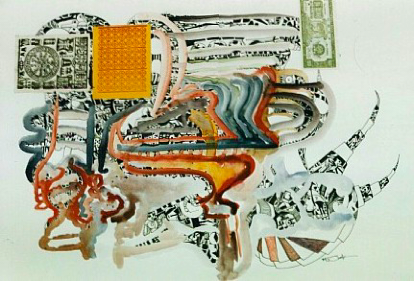
HELL
MONEY
"The naked man and woman are
dancing in the southwest corner of the painting," Moise adds. "Some go to death in
self-indulgence; some go in self-denial..."
"The
dragon guards the world of death, not allowing everyone to pass,"
Crossmann says. "The Hell
Money is the currency which opens doors in the land of the dead..."
"I
love this style," Anthony Hopkins says. "It is abstract in detail; but it is formal in
scale."
"Crossmann's
work almost always contains the dualism merged," Richard Baker agrees.
Reggie
Lyons comes in: "I think Clement Greenberg’s concept of unflinchingly
facing and understanding what is literally happening to oneself as a certain
person in a certain world is equivalent to Harry Stack Sullivan’s idea that the
therapeutic task is to become aware — as comprehensively and deeply as
possible — of what is going on around and in one. Such awareness is
critical consciousness at its most existential: critical consciousness is
consciousness of society and its effect on one in order to survive and hold
one’s own in it, and to develop one’s being in all its humanness despite
society’s inhumanity. (However, I think the Marxist idea that one can never be
fully human—perhaps never afford to be, unless one wants to be a saintly
martyr—in an unfree society and unjust state is correct.) Greenberg thinks that art is inimical
to such doggedly realistic awareness, which is motivated not only by the will
to survive in an alien, unfacilitative world, but to overcome the
self-alienation it induces in one. I think he is wrong because he
overgeneralizes: avant-garde art, as I have argued in my book, involved a
profound awareness of the wound the modern world inflicts on the individual,
and attempted to heal it.
Avant-garde art was an effort to reaffirm as inherently valuable the individual
self modern society insidiously negates by conceiving in collective
instrumental terms. Avant-garde art was thus a mode of critical consciousness.
It in effect acknowledges that we are all Jews in the modern world—a
world which, as Adorno said, is becoming more and more like a concentration camp.
Or, as Beuys said, the spirit, if not the letter, of Auschwitz is alive and
well—and, in literal fact, versions of Auschwitz continue to exist in the
modern world, and in fact seem inherent to modernity...."
"We
are not all Jews in the modern world!" Richard Baker responds. "That is a facile way of achieving
self-exonneration. We are not all
martyrs, not all victims. In every
system, there are victimizers and victims. Victims in one scenario are victimizers in the next. In the modern world we face God, man
and death in the same way we did when we lived in caves. Nuclear holocaust is no different
really, than the primitive hunter facing the lion. The spectre of annihilation was always with humanity. And annihilation of the self,
annihilation of the hunter, was always the same thing as annihilation of the
world. The self-dramatization of
the alienated artist -- this pompous conception of ego inflation -- in which
the artist gives out a kind of primal scream of recognition that the world is
not perfect, is akin to the child when he discovers the dualism between the
perfect world in the mind and the real world of phenomena. Society is not inhumane. It is certainly less inhumane than
Nature. Put a man out in nature
and let him survive by himself -- and he will find, if he survives at all, that
Nature is ruthless and terrible, as she is also beautiful and, at times,
bountiful. Society is also
nature. Man is nature. The avant-garde artist condemns the
world because it is not perfect.
The avant-garde artist is a child who curses God because God has not
allowed the child, the artist, himself, to be the God. That is the great scream of our friend,
Munch, because he has discovered that he is not God. Marx, also, screams because he is not God. He doesn't like the world because he is
not God, he is not the most powerful force in Nature. Of course, he wants the world to be the way he imagines it,
in his purity; when it is not, he hates the world, finds it evil. He is a child, of course. His war is merely his attempt to make
himself the God of the world. And
it does not really matter how many he has to kill, how many lives he has to
ruin, in order to make himself the God.
Ultimately, of course, he never becomes the God, for there is always a
force he cannot control, always a force more powerful than he is. The avant-garde artist rejects the
dualism of life, the complexity of life.
He wants a world that is simple to understand, good only, where the
shadows are cast away. Little does
he realize that he, himself, is one of the world's greatest shadows...."
"I
believe it is true that the dragon guards the underworld in this
painting," Charlie Rose says.
"It is the gate in to the East that the dragon guards. Not everyone is allowed to enter. But Michael Crossmann was allowed to
enter. He did enter. The tunnel her enters, the vortex he
encourters, is, itself, a kind of umbilicus. He enters the womb of the East, to be born again; he enters
the womb of the West, again, to die.
There is a double-womb. He
moves between these. Into the anti-universe; and then back, again, into the
universe, or matter..."
"The
next painting, 'Shadow Puppet', continues the demonic imagery," Hedda
begins.
"I
would call it the underworld imagery," Richard Baker corrects her. "The Shadow Puppet is a form of
entertainment in Indonesia. But
this imagery shows a ferocious puppet with large, dangerous teeth being
commanded by the black and white puppeteer in the background. Of course, this is a meaningful image
to Crossmann, because it exemplifies his idea that an angel (or a demon) lives
behind the phenomenal nature, the body nature, driving the human entity through
life. The beast inside the
machine. The guiding intelligence
inside the monster..."
"I
believe this to also be an intimation," Charlie Rose says, "of
Crossmann's later meeting with Gilbert Patton, the Satanic figure in his novel,
who, for Crossmann at least, represents the monstrous power of the Night,
against which the angel of Light (or the Day) must fight to re-gain Life."
The
Magician sidles up to Crossmann again, speaking again in the voice of the old
woman: "The Sixth Principle in Man, the Buddhis or the Divine Sou, though
a mere breath in our conceptions, is still something material when compared
with divine Spirit, Atma, of which it is the carrier or vehicle. Fohat in his capacity of Divine Love or
Eros, the electric Power of affinity and sympathy, is shown allegorically as
trying to bring the pure Spirit, the Ray inseparable from the One Absolute, into
union with the Soul, the two principles constituting in Man the Monad, and, in
Nature, the first link between the Ever-Unconditioned and the Manifested. 'The First is now the Second World --
that of the Lipikas' has reference to the same..."
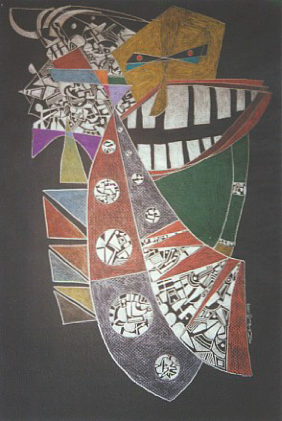
SHADOW
PUPPET
Chitranee Drapkin is standing before
Michael Crossmann near the painting.
She is dressed in a black gown with thin straps. Her arms are, otherwise, bare. She has black hair pulled back. A white pearl necklace. Large one-pearl earrings. Her eyes are amber and filled with
emotion. Her face seems Central
American almost. There is
something primitive in her, which Crossmann finds very attractive. She is intense with energy, passion for
art and Truth.
"My
husband and I have bid on this piece," she says to Crossmann. "This is my favorite painting in
the show. It has a Mayan
spirit. It is filled with ghosts
and with shadows of ghosts..."
"The
letter T, in the Western Quadrant, is a symbol of the cross," Moishe Frank
says. "The cross, of course,
is the tree of crucifixion, the tree of knowledge of good and evil, on which
the lower nature is placed, the alienated son, in order to achieve a
re-birth..."
"The
tones of this painting are superb," Jack Nicholson adds. "Everything has a silver feel, as
thought the whole painting is being bathed in moonlight."
Reggie
Lyons does not appear to hear anything anyone else is saying.
He
continues his soliloquy: "But
I think Greenberg is right about postmodernist art, which he did not address:
it does not make us aware of what is literally happening to us in postmodern
society. Rather, to use Adorno’s
idea, it duplicates the postmodern world through art. Warhol is the excellent example of this. It thinks duplication is ironical, but
it is reifying. More particularly, postmodernist art reifies the facile
creativity that exists everywhere in the postmodern world, and seems to me its
essence. Postmodernist art does not offer a critical perspective on this facile
creativity, that is, it does not ask what its social function is and how it
stands in relation to the idea of a free society and just state in which human
beings can develop. Postmodernist art is in fact indifferent to all three: it
does not believe there is any point in striving for anything so unrealistic.
Its indifference to such striving is typical of the postmodern world. Thus,
postmodernist art duplicates—confirms the status quo—of the
postmodern world more than it knows. It confirms unfreedom, injustice, and
blocked humanity by fetishizing the facile creativity that exists in the postmodern world into a higher social
business, that is, a pseudo-high art. In fact, the issue of postmodernist art
is whether show business can foster critical consciousness despite itself. Can
a paradox be achieved: can show business—the business of
spectacle—which has control of public consciousness in the postmodern
world, and militantly simplifies or one-dimensionalizes consciousness, be used
to critical effect...?"
"Your
perspective is that post-modernist art confirms unfreedom, injustice and
blocked humanity in the post-modern society," Richard Baker reponds. "That is an opinion, of course. History will probably view the late
Twentieth Century as the time in human history in which freedom, a striving for
justice and homage to humanity was at its apex. I don't agree with you that the post-modern world honors
unfreedom, injustice and blocked humanity. I believe we are living at the greatest time of individual
freedom in the history of the globe.
If you don't like modern society, you can leave it. You can withdraw, live in the
mountains, give up comfort and society.
You see, those who scream the loudest, the most Edward Munchian of
characters, about humanity and society are really the ones who are least fit
for either....and it becomes all hollow talk, all idle chatter. Intellectual spoiled-childism. 'I don't like this world. -- I want to
have my own world!' they whine. 'I
won't accept a world that isn't perfect.
If I can't have my way, then I won't play...!' Intellectual chatter.
You cannot look at this painting in front of you and comment on it in
any way except by trying to fit it into your intellectual construct. What can you say about this
painting? You have nothing to give
us but your ideology...!"
The
two men glare at one another.
Denise
Rich pulls back, fearful.
"Don't
worry," Columbo tells Denise Rich.
"The liberal leaves the room when a political discussion
degenerates into a fistfight..."
"Which
one is the liberal?" Denise Rich asks.
"I'm
not sure," Columbo says.
"But one of them must be....!"
"He's
here!" Beth whispers to Denise.
Denise
Rich turns around, looking behind her.
"So
is his wife!" Denise replies.
Bill
Clinton is seen surging through the crowd, flanked by secret service agents in
suits and wearing dark glasses.
Clinton is wearing a black tuxedo.
He seems short and plump.
And his nose seems bulbous, and red, like a strawberry. His hair is a bit wild, roused by the
winter wind. It is gray. He looks a bit older than on tv.
He
moves toward Hillary, gives her a hug -- Hillary says: "Your girlfriend is
over there. Sorry to disrupt your
fun...!"
One
of the secret service men following up the entourage is carrying Bill Clinton's
saxaphone.
"Oh,
don't start that, dear," Clinton says. "I don't even know who she is."
"Don't
lie to me," Hillary snaps.
"I'm not a fool."
"I
came here to be with you," Bill says.
"You
didn't even know I was going to be here," Hillary says. "You thought I was going to be at
the opera! You said you were
coming to town tomorrow...!"
"I
decided I didn't want to miss New York on New Year's," Bill says.
"I
see." Hillary is disgusted.
"So,
how is it here?" Bill asks, innocent.
"We
don't know what to make of this guy," Hillary says. "He's like Reagan; he's made of
teflon. But he's talented. That makes us wonder about him. In some ways, I think he's the future
-- and that we are the past, we're clinging to the past somehow. We think we're the future, but we're really
the past. It makes me depressed
being around him. Because we can't
just dismiss him as part of the vast right-wing conspiracy. He is that -- but he's also something
else. I just don't get it..."
"He's
nothing," Bill consoles her.
"He's this week's exaggeration. He'll be gone next week..."
"He's
been around quite a while already," Hillary says. "Because of that damned
trial! You pushed for that damned
trial...!"
"You
told me to, God damn it!" Bill replies. "You pushed me until I did it! You didn't let up on me...!"
"Well,
whatever," Hillary says, "it was a bad idea. The trial made a victim out of
him...."
"You
also pushed Oprah to humiliate him," Bill Clinton says. "I had Dick run a poll
tonight. His approval rating has
gone up through the roof. We still
have that tape on Springer tonight.
That's our only hope.
Dick's pole had him at 89% positive after Oprah..."
"Maybe
the Charlie Rose Show will sink him," Hillary says.
"Not
a chance," Bill replies.
"No one watches Charlie Rose except intellectuals. And most intellectuals give him credit
because he's a novelist and an artist.
Dick did a poll after the Charlie Rose Show. Only 33% of people defining themselves as intellectuals had
a positive impression of Crossman before Charlie Rose; after the show, 64% had
a more positive impression of him..."
"You've
created a monster," Hillary says.
"I
have?"
"Yes."
"I
did what you told me."
"Did
I tell you to fuck that fat cow?" Hillary asks.
"I
didn't fuck her," Bill says.
"Let's not get into this here again. We don't want anyone to hear us talking about this
now...."
"Look
what you've done to us," Hillary says. "Go say hi to your girlfriend. I don't want to talk with you anymore. And don't get caught again. Use some discretion, if you
can...!"
Allen
Ginsburg cries out: "Who lounged hungry and lonesome through Houston
seeking jazz or sex or soup, and followed the brilliant Spaniard to converse
about America and Eternity, a hopeless task, and so took ship to Africa; who
disappeared into the volcanoes of Mexico leaving behind nothing but the shadow
of dungarees and the lava and ash of poetry scattered in fire place Chicago;
who reappeared on the West Coast investigating the F.B.I. in beards and shorts with
big pacifist eyes sexy in their dark skin passing out incomprehensible
leaflets; who burned ciagarette holes in their arms protesting the narcotic
tobacco haze of Capitalism; who distributed Supercommunist pamplets in Union
Square weeping and undressing whle the sirens of Los Alamos wailed them down,
and wailed down Wall, and the Statten Island ferry also wailed; who broke down
crying in white gymnasiums naked and trembling before the machinery of other
skeletons."
"Howl,
baby, howl!" BB King commands Ginsburg.
"Who
bit detectives in the neck," Ginsburg continues. "And shrieked with delight in policecars for committing
no crime but their own wild cooking pederasty and intoxication; who howled on
their knees in the subway and were dragged off the roof waving genitals and
manuscripts..."
"That
dude is a cruzy, dirty dude," BB King repsonds, shocked by the language.
"Who
let themselves be fucked in the ass by saintly motorcyclists, and screamed with
joy; who blew and were blows by those human seraphim, the sailors, caresses of
Atlantic and Caribbean love; who balled in the morning in the evenings in rose
gardens and the grass of public parks and cemeteries scattered their semen
freely to whomever come who may; who hiccuped endlessly trying to giggle but
would up with a sob behind a p;artition in a Turkish Bath when the blond and
naked angel came to pierce them with a sword..."
"God
bless the AIDS virus!" Jerry Fallwell cries out.
"Queers
on the end of spears!" Anita Bryant replies.
"Hang
his balls on the walls!" cries one of the skinheads, the biggest one.
"Cut
off his cock if he continues to talk!" BB King replies. "Cut off his shank if he gives it
a wank."
"Light
up the faggots," Fallwell calls.
"Let the fire burn like Hades...!"
"Do
you still think the Beats are responsible for the tragedy at Southwest Eugene
High School?" Dan Rather asks.
"We're
riding a continuum," Michael Crossmann replies.
"Do
you still blame the Beats for their anti-hero mythology?" Peter Jennings
asks.
"Everything
in its own season," Crossmann replies.
"Do
you have no morality?" Anita Bryant screams at Crossmann.
"God
judges best," Crossmann responds.
"We
are losing our focus a bit," Hedda says. "Of course, politics and art are famous bedfellows; so
I am not sure we are really that far off-track. But we haven't spoken much about this painting. I wonder if there are any more comments
about the 'Shadow Puppet'...?"
Chitranee
Drapkin smiles shyly at Crossmann.
Her eyes are flashing her excitement.
Crossmann
begins to fall in love with her.
But then her husband moves in next to her.
Off
to the left Crossmann notices that the Magician is again talking with the old
Russian Woman.
"Let's
get to the next one," Oprah shouts to Hedda. "The next painting is openly racist. I'd like to focus on it."
"Hello,
Denise," Bill Clinton says, approaching the beautiful brunette. He shakes her hand. "Who is your friend?"
"Oh,
you recognize Peter Falk?" Denise replies.
"Oh,
of course. Columbo!" the
president responds. "I didn't
see you there?"
"Hello,
Mister President," Peter Falk replies.
He
notices some white powder on the president's nose.
He
brushes his own nose, signalling the president.
"Your
nose, Mister President," Falk says.
"You have something on your nose."
Clinton
brushes his nose.
"Oh,
powdered sugar," he says.
"I had some French toast on the airplane."
Columbo
smiles wryly.
Clinton
turns to the sexy blonde.
"Who is this friend?" he asks Denise.
"This
is Beth Moore," Denise says.
"She's part of our contract, remember!"
"The
'Shadow Puppet' is an authoratative masterpiece," Xavier Rubenstein
intones, "the equal of Ron Mueck's 'Dead Dad', of Vermeer's 'The Lace
Maker' and of Hilliard's 'Portrait of Sir Walter Raleigh'. It leaves Damien Hirst's patched and
increasingly shop-soiled shark looking like the fin de siècle conversation
piece it is. Viewers of the Crossmann are held in its force field. It exerts
the gravitational pull of great art.
Consider their respective
titles. On the one hand, the coffee-bar existentialism of Hirst's 'The Physical
Impossibility of Death in the Mind of Someone Living'. On the other hand, the blunt,
unpretentious, Wyoming factuality of 'Shadow Puppet'. One as pretentious as
possible, a false metaphysic, which has no real meaning to it. A title tacked on to an image, relating
not to the image, but to the mental state of the audience looking at the image. 'Shadow Puppet' is an image symbolic of
a spiritual reality, a metaphysical meaning. But it is not detached. The title explains the painting. In Hirst's work, the title implies that the work itself is
inconsequential..."
"Interesting,"
Columbo replies.
"A
masterpiece!" Jack Nicholson agrees.
"Let's
move on to number Seventeen," Hedda says.
The
Magician sidles up to Crossmann again, speaking in the old woman's voice:
"The Army at each angle is the Host of Angelic Beings, the Dhyan Chohans,
appointed to guide and to watch over each respective region from the beginning
to the end of Manvantara. They are
the 'Mystic Watchers' of the Christian Kabbala and Alchemists and relate,
symbolically, as well as cosmically, to the numerical system of the Universe. The numbers with which these Celestian
Beings are connected are extremely difficult to to explain, as each number
refers to several groups of distinct ideas, according the the particular group
of 'Angels' which it is intended to represent. Herein lies the nodus of the study of symbology..."
The
Magician shows Crossmann a drawing
on a piece of scrap paper:
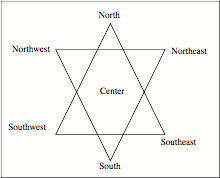
"We now move to a drawing on
white paper, colored pencil with india ink and text," Hedda begins. "The work is entitled 'Othello's
Wife' -- and in the text we find a description of Crossmann's theory of the
double marriage, if you will, the Light Man and the Dark Woman ever opposed by
the Dark Man and the Light Woman.
I think there are probably many people here tonight who can explain
these ideas better than I can..."
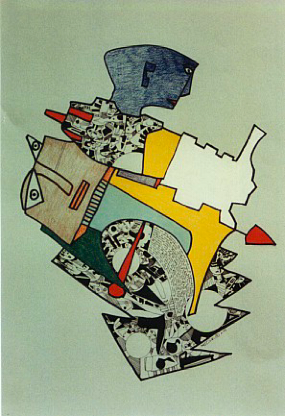
OTHELLO'S
WIFE
"Well, I think I can,"
Oprah Winfrey says.
"According to Crossmann, the White Man has an alliance with the
Black Woman. Opposites attract,
afterall, according to the laws of physics. The White Man is what he might call the clean Sun, the
freshly-born Sun; and the Black Woman is the Earth. Opposed to this alliance is the opposite alliance: the Black
Man, the White Man's shadow, the unclean Sun, the Material Man, and the White
Woman, the Moon. The alliance
between the Black Man and the Moon refers to the Culturral Epoch. The Black Man is the poet, the artist,
the mystic -- and the White Woman is the muse. The dark side of this mythology -- there are several dark
sides. One is that the Black Man
is doomed to never have power on the Earth. His power is always in the darkness. He rules the
Night. But he is always defeated
by the power of the Sun. The Black
Man becomes a kind of Nosferatu.
Also, because the like particle repels, the Black Man is always angry at
the Earth, the Material Life, always opposes the Material Life, so is always
doomed to poverty. Also, because
he, the Dark Man, hates the Earth, there is always hatred expressed between the
Black Man and the Black Woman. The
corollary idea is that the White Man's alliance with the Black Woman, the
Earth, gives the White Man the prerogative always to rule the Earth, to
dominate the Earth, in the name of Light, in the name of civilization. This theory is, at heart, racist. It implies that God has given the White
Man dominion over the Earth, over the Day, the time of bounty, the time of
fruition. And God has given the
Black Man dominon over the Night, the time of Darkness. By implication, when the Black Man comes
to power, the result must always be a time of Night, fear, and nightmare. We can't forget that Othello, in
Shakespeare's play, murdered his wife, Desdemona, the emblem of
unhappiness. This structure
implies that the Black Man will always be dissatisfied with the Black Woman,
that the Black Woman cannot satisfy the Black Man -- and, so, he will always
lust after the White Woman, the Moon, who is the emblem of madness. Othello courts the Moon, madness, and,
so, himself, becomes mad. The
Black Man is always associated with madness, with anti-materiality, with
brutality and crime against the Earth...
This is a racist philosophy.
Racist to the core...!"
"Crossmann,
himself, identifies with both cycles," Moishe Frank replies. "He, himself, is both. He is the dark man, the poet, the
artist, and the mystic, the lover of the Moon, the Muse, and the mystic
mind. He gives birth to himself as
the white man; but he is also the black man -- for he, like his God, is
androgynous: the totality: black and white by turns. He writes, in his opus, that Nature constantly recycles,
transforming the black to white and
the white to black...."
"But
the black skin always remains at the bottom of the cycle," Oprah replies.
"But
the soul reincarnates in different forms," Moise argues. "The soul is white in one
incarnation; and black in the next."
"That
is the same old theological gambit," Oprah cries. "Accept persecution in this life
so that the next life will be better.
That was how we became slaves..."
"We
became slaves," Morgan Freeman responds, "because African tribes
enslaved other African tribes. Religion,
oftentimes, justified slavery. But
warfare created slavery. In
Africa, along the Mediterranean, among Indian tribes in America. Africans made money selling other
Africans into slavery. It was the
white countries that first outlawed slavery. It wasn't the black countries that outlawed slavery..."
"Are
you some Uncle Tom, Morgan?" Oprah asks.
"Anyone
who doesn't buy the party line you dismiss as an Uncle Tom, Oprah,"
Freeman replies. "We are not
living in a binary system any longer in America. In case you haven't noticed, we have yellow and red and
brown here too. And combinations
of all these. There is so much
intermarriage going on that we are creating all shades possible under the
rainbow. The old perspective of
white against black isn't working any more..."
"Well,
that is his theory," Oprah says.
"That's what he's writing about..."
"He
writes about many things, good and bad," Morgan Freeman. "And the art work is quite
interesting..."
Crossmann
seees Alice Walker moving through the audience.
"Black
people and white people have suffered for centuries because of one myth, that
all whites are good and all blacks
are bad," Morgan Freeman continues.
"This mythology obviously is not true. The other side of the myth also is not true: that all blacks
are good and all whites are bad.
We have to learn to live with complexity in this society. The simple truth is almost always not a
truth. We need to live with the
complexity in which we need to think and make judgments for ourselves, not through
the directorate of either of these myths.
We need to judge people as individuals. Some whites are good and some are bad; some blacks are good
and some are bad. In truth, we are
really, each of us, both good and bad at once. There are very few people who are evil to the bone. We need to accept complexity. Ideology makes us feel good about
ourselves -- it always puts us on the right side. And that always makes us feel better. But it does not bring us into a better
environment..."
Crossmann
sees Danny Glover moving through the audience, following Alice Walker.
"Spoken,
truly, like a man!" Gloria Steinem counters, filled with reproach. She is back. She has recovered from her laughing spasm.
"I
am a man," Morgan Freeman responds.
"And,
as such, you shall never know the truth," Gloria replies.
"One
myth posits all men are good and all women are bad," Freeman says. "And the opposite myth posits that
all women are good and all men are bad.
The truth lies somewhere in between...."
"Men
have always had the power," Gloria responds.
"Over
the Earth, but not over heaven," Morgan Freeman.
"That's
just great," Gloria replies.
"Now you are in bed with Michael Crossmann...."
"Just
another traitor," Oprah says to Morgan Freeman.
"Just
another traitor," Gloria Steinem says, turning to face Camilla Paglia.
"Just
another traitor," Joan Baez says, turning to Bob Dylan.
"Just
another traitor," Oprah says, turning to Jim.
"Just
another traitor," Jerry Fallwell says to Michael Crossmann.
"Just
another traitor," Crossmann says, turning to his brother William.
"Just
another traitor," William replies.
Moishe Frank steps up to the
painting and reads the text: "Who are they anyway? The ones who move in to intimidate the
clowns with their frowns? Those who
inhabit trellises and trees; hoping to scare the birds with their share of the
grief? Those who inhabit the
circular dream, hoping to establish themselves as keepers of the drowned reef? Moments come and moments go; the
shadowmen come, black and shimmery, believing that the dark age approaches; and
that the blackfaces rule with the white woman, the blonde woman, the moon,
during this nighttime; the culture coven.
So they plan their revenge, the revenge of a god, on the white man. And also on the dark woman, the
earth. For there is ever conflict
between the white man, the sun, and the black man, the shadow man, and between
the blonde woman, the moon, and the dark woman, the earth. The wun rules the day; and the moon
rules the night."
"It
is interesting to me," Columbo breaks in, "that this mechanism herein
described, in fact, disputes claims to racism. The alliances are inter-racial. The white man and the black woman are natural mates; and the
black man and the white woman are natural mates. This implies racial intermarriage is the plan of God. Clearly the extreme interpretations of
both white racists and black racists, calling for racial segregation,
separation, is imputed by this mechanism..."
"On
the surface that is true," Oprah responds. "But you see, the conclusion is that the white race
still rules everything. The white
man, the sun, rules the day; and the white woman, the moon, rules the
night...."
"Interesting,"
Columbo replies. "On the
surface of things. But I think the
mechanism is this: the white man, in passing through the earth, the black
woman, becomes, himself, blackened, material; the black man, in passing through
the moon, the white woman, becomes, himself, whitened, purified, anti-material. Such, the soul is recycled for ever,
between the poles of white and black, between the poles of anti-matter and
matter. Skin color is merely an
illusion. White into black and
black into white -- and everything in between. Whiteblack into blackwhite. Blackwhite into whiteblack. Crossmann is not really a racist. He is a spokesman for interracial marriage. This painting is proof of that. It also proves the betayal of men and
women along strictly racial lines.
The white man and the white women will betray one another; and the black
man and the black woman will betray one another. If this 'natural theory' is, in fact, true -- which is a
whole other issue..."
"Well,
we've certainly looked pretty significantly at this painting," Hedda
says. "I'd like to move on
the the next painting if we agree.
Charlie, I'm surprised tht you have said nothing about this
painting. How does this work fit
into the biographical interpretation....?"
"Well,
I think everyone else here explained it for me," Rose says. "This is a metaphysical world view
that illuminated Michael Crossmann's view of the world. This mechanism, as Peter described it,
puts the broken pieces back into a whole.
We can argue about what it means, like we have -- but we must agree that
the fractionated picture, the polarized dualism, is resolved, through this
mechanism, back into a metaphysical or philosophical whole, a circle,
tranforming alienation. Crossmann
was a white man who hated white men, who hated his father, who judged his father
immoral, guilty of racism, murder.
He was alienated from America.
He hated his own country, his own father, because it was not on the good
side. But when he went into the
undeworld, gaining this vision from the gods, from the darkness, the Wisdom
Gods, he learns to forgive his father, his country. The picture is, as Peter Falk described it so brilliantly,
beyond moraity. There is One Life
within many forms of life. No one
is for ever moral. Each side is
good and bad; ultimately, each side is the same, two poles of the same
unity. This knowledge allowed
Crossmann to forgive his father, his family -- to, essentially, come back
home. To defend his country, even
if imperfect. Like Odysseus in Ulysses,
Crossmann came back home; he ended his alienation by , in a figurative sense,
eating from the Tree of Life -- having earlier eaten from the Tree of Knowledge
of Good and Evil..."
"There
are a lot of ideas bouncing around here tonight," Hedda says. "Are we solving anything? Mister Lyons, are we solving whether
Crossmann is post-modernist or a post-post-modernist...?"
"I
think we are, inch-by-inch," Reggie Lyons responds.
The
Magician sidles up to Crossmann, speaking again in the Russian woman's voice:
"We know what elements compose the earth; we know that Air is composed of
gases including Oxygen and Nitrogen; and we know that Water is compmosed of
Hydrogen and Oxygen. But we don't
know the essential components of Fire.
We know that one glass of water will not fill up every glass on the
earth; water is finite. But one
flame can light every candle in the universe without being reduced in
quantity. Fire is extinguishable;
can become visible and invisible instantly. But fire, itself, as a quantity, is inexhaustable..."
"The
next painting, the Eighteenth, the mid-point in our show, is a primordial piece
in colored pencil, called the 'Night Warrior'. Charlie, do you have a theory on this...?"
"The
soul is re-born as a warrior," Charlie replies. "Brahma is the first-born. He is a warrior, akin to Mars. He is born from the Moon, in the Night, by the so-called
Lunar Lords who are tribal by nature.
Crossmann becomes a Night Warrior.
Crossmann is dark, is in the Anti-Universe, is given birth by the Moon, as
the Father Principal, the bringer of Law..."
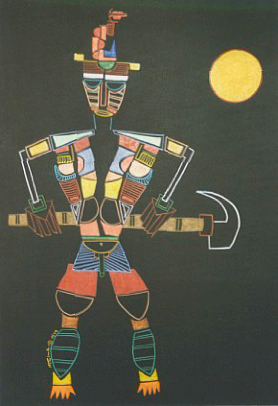
NIGHT-WARRIOR
"We have here, again, a very
aboriginal drawing," Richard Baker begins. 'You will notice here, also, that this Night Warrior also
has a penis. We remember back to
'Castor and Pollux', the twins of Day and Night, that Pollux has a penis and
Castor, the Night Twin, did not.
This Night Warrior, in fact, forms the connecting link between Castor
and Pollux. We can look at this
Night Warrior as being the last stage of Castor or the first stage of Pollux,
both of which are true -- and, in this, we see the unified nature of Castor and
Pollux -- as we see the unified nature of the White Man and the Black Man, the
Night Warrior being the missing link, in a sense..."