CROSS EXAMINATION
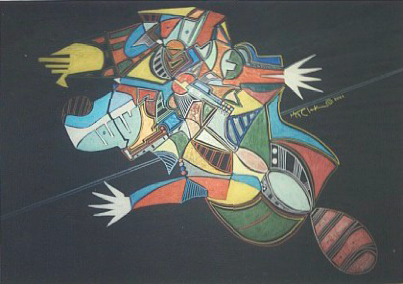
"Man
On A Tightrope" by Michael J. Clark
A Major Work in Progress
by
Michael J. Clark
Mclark7@mindspring.com
"Remember, the hero keeps going, and even his
ruin
Is only a subterfuge for achieving his final
birth..."
Rilke,
Duino Elegies
"You were bred, fed, fostered and fattened from
holy childhood up in this two easter island on the piejaw of hillarious heaven
and roaring the other place (plunders to night of you, blunders what's left of
you, flash as flash can!) and now, forsooth, a nogger among the blankards of
this dastard century, you have become of twosome twiminds forenest gods, hidden
and discovered, nay, condemned fool, anarch, egoarch, hiresiarch, you have
reared your disunited kingdom on
the vacuum of your own most intensely doubtful soul.. Do you hold yourself then for some god
in the manger, Shehohem, that you will neither serve nor let serve, pray nor
let pray...?"
Joyce,
Finnegan's Wake
"Allah loves the ink of the scholar more than
the blood of the martyr."
Koran
"Faustian architecture, on the contrary, begins
on the grand scale simultaneously with the first stirrings of a new piety...
and proceeds at once to plans of gigantic intention.... We may say that the Catholic faith is
to the Protestant as an altar-piece is to an oratorio. But even the Germanic gods and heroes
are surrounded by this rebuffing immensity and enigmatic gloom. They are steeped in music and in night;
for daylight gives visual bounds, and, therefore, shapes bodily things. Night eliminates body; day (eliminates)
soul. Apollo and Athene have no
souls. On Olumpus rests the
eternal light of the transparent southern day; and Apollo's hour is high noon,
when great Pan sleeps. But
Valhalla is lightless; and even in the Eddas we can trace that deep midnight of
Faust's study-broodings, the midnight that is caught by Rembrandt's etchings
and absorbs Beethoven's tone-colors.
No Wotan or Baldur or Freya has 'Euclydian' form."
Spengler,
Decline of the West
DEDICATED
TO MY WIFE, HOA-LAN TRAN, WHO HAS WALKED WITH ME EVERY STEP OF THIS NOVEL. WE HAVE CREATED OUR NEW DREAM LANGUAGE
TOGETHER AS BEST FRIENDS.
CROSS EXAMINATION
PART ONE
I.
“State your name and age for the record.”
“Michael Crossmann. I am forty-eight years old. “
“And where do you live? “
“111 Onyx Alley. “
“In Eugene? “
“Yes. “
“And what do you do for a living, Mister Crossmann? “
“I teach English at Southwest Eugene High School. “
“Do you remember the events of March 14, 1999? “
“Yes. At least, I remember....what I remember. I remember some events... “
“Of course, we would not expect you to remember what you do not remember. Can you describe for us what you were doing at 11:00 AM on March 14, 1999? “
“At 11:00 AM, my freshman English course had just ended and I was walking toward the Faculty Lounge on the Second Floor. “
“Was that when you heard gunshots? “
“Yes. “
“So where we you at the time you heard the first gunshot? “
“I was at the north end of the building, going down the staircase from the third to the second floor. “
“You were at the top of the staircase, or in the middle...? “
“In the middle. “
“You were descending the stairs? “
“Yes. “
“And you heard a gunshot...?“
“I heard what sounded like a pop. It was followed by another. Then a series of pops. My first thought was that they were firecrackers. But then I knew they were gunshots. I heard students shouting and I saw them running down the hall. “
“This was when you got down to the second floor? “
“Yes. “
“What happened then? “
“When I reached the second floor I saw students running past me to the north staircase, trying to get out of the building....running down the staircase to the first floor and the exits. “
“And what did you do? “
“I thought some of the students might need my help. I looked up the hallway and I saw maybe seven to ten students in the hallway. Some were lying in the hallway, some were sitting. Some were crying out for help. I recognized some of the students. I saw Alison Benjamin, who had just left my class. And I recognized Tom Bittman, Avery Noles, Lotte Schulz, the exchange student from Germany.... “
“And they all had been shot? “
“Yes; well, they all were lying or sitting in the hallway. But it all seemed unreal somehow. I almost thought that I could fix everything just by going up to them and touching them. It really hadn't sunk in yet what was happening, how real everything was. “
“You didn't see the shooters apparently. “
“No; not at that point. There was some smoke hanging in the air; it smelled like a fireworks display in the hallway. But I didn't see anyone menacing. So I went up the hall and stopped next to Alison Benjamin, who was the first person I had seen lying on the floor. And I noticed that Great Expectations --the book -- was lying about three feet from her. It was the book we had been discussing ten minutes earlier. I couldn't believe what was happening. When I reached her, she looked so small and so frightened. She was having trouble talking, because she had been shot in the chest and blood was coming up in her mouth, little bubbles of blood in her mouth. “
“Did she say anything to you? “
“Yes. She said: 'I don't think I'm going to be able to get my paper in this afternoon. I may need an extra day.' She was apologizing for not being able to keep to her schedule. She was in shock, obviously. I took off my suit coat and tried to wrap her in it. But it hurt her too much to move her--she scream a muffled sort of cry, like a puppy when you slam its tail in the screen door: a sharp little cry that seems to wonder why you were trying to hurt it. I didn't move her after that, because I could tell that it only hurt her more.“
“What did you do then? “
“I turned to look up the hallway, at the other wounded students. It was clear to me at that point what was happening. The dream quality was gone. And it had become a very real nightmare. “
“Then what happened? “
“That was when I saw Charles Carson—“Kit” Carson, by nickname--coming out of room 217 with a rifle. He had this look of supreme satisfaction on his face. He was re-loading. I realized at that point that many other children in room 217 had been hurt, that I was only seeing a fragment of the damage. I was aware also, at that point, that there were other gunmen--because I heard gunshots beyond the opposite end of the hallway, at the south end of the building. “
“And what did Kit Carson do at that point? “
“He said--in a very deep, what I thought was a demonic, voice--'What's up, Doc?' And I said: 'Kit, why are you doing this?' And he said: 'All things die. All things die. That's things, Doc.'“
“And what did you do? “
“He looked me in the eye and said: 'You'd better run, Doc. Because you're next.' And I tried to run. I was on both knees next to Alison; but I jumped up and I tried to run. And I slipped in Alison's blood; I actually lost my footing. And, as I was falling, I felt Kit shoot me in the right shoulder. It was like being hit with a hammer or a baseball bat. And I remember being thrown forward on my face. I remember my glasses coming off my face and I remember seeing them break as they slammed up against the wall. And then I heard the gun go off. It was a small roar really. It sounded like a .22 caliber rifle -- I remembered that was what I thought. The next thing I knew I was turning myself over and pushing myself up against the wall. I was vaguely aware that my shirt had blood on it. And that my right arm felt numb; and it was hanging limp at my side. I worried that I had fallen on it and that I had broken it--although there was no pain at the time. “
“Then what happened? “
“I pushed myself up against the wall. I didn't have my glasses. But I could tell, in a kind of blurred outline, that Kit was standing over Alison with his rifle extended; Alison was pleading for her life in a very low voice, blood thick in her words. Kit laughed a bit; then he pulled the trigger. That was the end of Alison. I saw her head explode; and bits of her skull and her brain flew up into my face. “
“What did Kit do? “
“He laughed. He said: 'Did you see her brain explode?' I said nothing. I was in shock at that point--like I was out of my body, expecting to die. “
“What happened then? “
“Kit raised the rifle to kill me. He was holding the rifle by one arm, extended out. He pulled the trigger. The bullet somehow missed me. It hit the concrete wall right next to me; the chipped concrete flew out and hit me in the side of the face. “
“What did you do? “
“I fell over; fear came rushing in to me and I must have passed out. “
“What do you remember after that? “
“I awoke some time after all that. Kit was gone. There was smoke still hanging in the air, the smell of sulfur. I thought about leaving the building, about slipping down the stairs out the building. I had pain in my shoulder, but it didn't seem significant. In fact, the wound didn't seemed serious. There was very little blood. “
“What came next? “
“I picked up my glasses. They were broken: one of the lenses was gone, the left lens. I put on the glasses; and I could see through the right lens. I looked for the other lens. It was plastic, so I knew it wouldn't break, but I couldn't find it. “
“What then? “
“I looked at Alison. But she was gone. I remember picking up my suit coat; it was all covered with blood. I put it on anyway. It seemed like the right thing to do. Then I walked down the hallway toward the other bodies. There was no noise in the hallway anymore. So my assumption was that Kit had gone back down the hall executing everyone as he went. This was a thought only; I obviously didn't know that this was the case. “
“I went into room 217. That was the room Kit had come out of, just before he shot me. There were at least seven dead kids there; and Mrs. Moriarty, who taught Romance Languages. She had a bullet through her forehead, a small prick, with powder burns. Her eyes were wide open in terror. “
“Did you count the bodies in the room? “
“No. I just looked. I didn't even know who they were. With all the blood, it was hard to recognize people. I was terrified actually, seeing all this. I stopped to look at Mrs. Moriarty, because we were friends. I also felt a strange kinship for her because I could have easily been in the same situation that she was in, except for some fluke of fortune. “
“You knew Charles Carson didn't you, Mr. Crossmann? “
“Yes, I did. “
“He was in your freshman English class last year, was he not? “
“Yes. “
“Can you describe your relationship with the boy? “
“We were...friendly. He was an interesting young man. He had interesting ideas. And he took care with his writing. He was obviously intelligent; and he seemed to have some gift for poetry. He understood poetry better than any other student in that class. I'd say we had a fairly good relationship. “
“Better than some of the other teachers had with Kit? “
“I don't know. Nobody really talked with me about their relationship with Kit until after the shooting. He was not a problem student really. He was part of the...what I might call the 'intellectual group' in the school. He played chess; he studied German; he read philosophy. He considered himself an intellectual, someone on the fringe of the high school society. “
“A nerd then? “
“No. Not a nerd. The nerds are a different breed. The nerds tend to be very good at math, with little social skills, few friends. They tend to be masters of computing. The intellectual group was more arrogant about their knowledge. They looked down at everyone else--in a kind of defensive way. They looked down at the jocks, and the popular people; but they were envious too. They would have liked to be in the top sphere of students, the beautiful people, whose lives seemed more glamorous and adventurous. They looked down on the jocks; but they also looked down on the nerds. “
“They were elitists? “
“Yes, elitists with a complex--one side of the brain told them that they were the elite, but the other side of the brain didn't believe it. “
“Was Charles Carson a....psychopath in your English class... “
“I object, your honor, “ Ted Clause intervenes.
“Sustained. Mr. Devlin, would you please refrain from asking an English teacher for a psychological judgment.... “
“Yes, your honor. “
“And please don't lead the witness. He is capable of telling us what his perceptions of the boy were without your putting words in his mouth.... “
“Yes, your honor. Mr. Crossmann, did you have any sense, in your sophomore English class last year, that Charles Carson might become....dangerous to society? “
“No, not really. No. I thought he was fairly well developed socially. He had friends. He could express himself. He did not seem overwrought or repressed.... “
“When did you first learn that he was, with his friends, an admirer of Adolph Hitler? “
“I don't think I learned that until after the shooting--and the aftermath of the shooting.... “
“Did that surprise you? “
“Yes, yes, it did. I knew that he admired German culture: classical music, the writings of Nietzsche and Goethe, German cinema. But I didn't connect that with Nazism.... “
“But didn't his respect for the Nazis come out during his trial, Mr. Crossmann? The first trial, I mean? The trial at the high school...? “
“Oh, yes. Yes. My memory of much of that is....very distant to me. “
“That's fortunate for you, I guess. “
“I object, your honor, “Ted Clause comes in again. “Those little snipes are not necessary... “
“Yes, I agree with you, Mr. Clause. Mr. Devlin, please do not snipe at the witness. It is not necessary.“
“I'm sorry, your honor. Mr. Crossmann--wasn't the issue of Charles Carson and his two accomplices, Dieter Richards and Tommy Kuntz--wasn't the issue of their attachment to the Nazis of prime importance at the trial in the high school, the mob trial, of which you were....what shall we call it, Head Inquisitor...? “
“I object, your honor. “
“Sustained. Mr. Devlin, we know how you feel about the... “
“I apologize, your honor. I withdraw my question. “
“I think this is a good time for us to take a lunch break. We'll adjourn for an hour and a half. Let's be back at 1:30 to continue.“
II.
“Mr. Crossmann, you are of German descent, aren't you? “
“Yes, I am. “
“Second generation? “
“Yes. My father came to America in 1939. “
“During the Nazi rule in Germany? “
“Yes. “
“Was your family persecuted by the Nazis? “
“Not like some. We were Germans, not Jews. “
“Yes. But wasn't your father a communist...? “
“I object your honor. “
“What is it Mr. Clause? “
“Mr. Devlin is using that word to attempt to prejudice the jury against the defendant. We all know Americans have a strong distaste for communism...? “
“No, I don't see how Mr. Devlin can make his point without using the word, Mr. Clause. I think our jury is more sophisticated than that. I think they will understand that Mr. Crossmann's father's politics won't shadow their view of his son. Continue, Mr. Devlin. “
“Wasn't your father a communist, Mr. Crossmann. “
“Yes. He was. “
“And the communists weren't treated very well by the Nazis, were they? “
“No, they weren't. “
“So, why did your father come to America instead of go to Russia--since he admired communism so much? “
“My father was a writer, an artist really. He had leanings toward communism. He did call himself a communist. But that was in the purest sense. He had visited Russia. He didn't like the totalitarian state in Russia. My father loved freedom even more than he loved any political system.... “
“Did your father hate the Nazis? “
“Yes. My father did; my mother did.... “
“And did you? “
“Yes. Yes, I did. Not from any direct, personal experience. But as I grew up in America I studied the atrocities committed by the Nazis and I came to hate them.... “
“They were the personification of evil, do you agree with that judgment, Mr. Crossmann? “
“Yes. I do. “
“Let's go back to the day of the shooting, Mr. Crossmann. We last heard that you were walking down the hallway, perhaps, what, twenty minutes or so from when you yourself were shot...? “
“I don't know the time. I don't know how long I passed out... “
“Well, the police entered the building at approximately 11:24, through the north doors. They came up to the second floor and found the bodies of the people you've mentioned at that time. But you were not there. In fact, you never did see a policeman during that day--isn't that right -- before you went down into the basement, that is? “
“I don't believe I did. “
“So between 11:00, when the shooting started, and say 11:04 when you were hit, you may have been out maybe 10, maybe 15 minutes--does that seem possible? “
“Yes. It is possible. “
“Then you went into the Romance Languages classroom, surveyed the damage, the death of Mrs. Moriarty, which had a quite striking effect on you, which you have described--then what happened...? “
“I walked up the hallway, looking at the bodies lying on the floor... “
“You had not instinct to run out of the building...? “
“I don't know. It felt like the danger had passed. I didn't hear any more gunfire. “
“Go on. “
“Then I heard the voice of Thomas Henrickson. He was standing at the end of the hallway. “
“What did he say? “
“He called out: 'Mr. Crossmann. We've caught them. We're holding them down in the Boiler Room.'“
“What was your response to this? “
“I don't remember. I was in shock, I suppose. He told me to come with him. He and I hurried down the hallway together. He was trying to tell me how a group of students had jumped Dieter Richards when he was re-loading. They had wrestled the rifle away from him. They found a gun in his coat pocket. All three were wearing long black trench coats, mimicking the students who shot up the high school in Littleton, Colorado. They then got Tommy Kuntz to throw down his gun after a shoot-out in which Kuntz was hit in the wrist and the leg. They captured Kit Carson coming down from the second floor. He was out of bullets. They caught him coming down to the first floor looking for his friends. “
“So, you went down into the basement with Thomas Henrickson. Did Thomas tell you what was being done with the captives down in the basement...? “
“No. I said: 'Well, if you have them, call in the police.' And he said: 'We need to talk about this. John Preston is leading us. We need to talk about this.... “
“Did that surprise you? “
“Yes. “
“It did? “
“Yes. “
“Hadn't you, in fact, Mr. Crossmann, been an outspoken critic of our legal system if your classes? Hadn't you been lecturing about the breakdown of the American legal system--wasn't that a pet peeve of yours...? “
“I wouldn't call it a pet peeve. I think there was clearly more to it than a peeve. “
“Didn't you impress upon your students your belief that the American civilization would disintegrate if the justice system didn't return to a more ‘fundamental’ level of searching for justice, rather than....rather than what, Mr. Crossmann...? “
“I believe that the justice system has become a game in which lawyers and judges play with technicalities as if the trial were nothing more than an intellectual chess match. They have lost their focus on what the law is meant to be, which is a search for justice.... “
“You believe--and you preached to your students--that the legal system was now out of balance, with the weight being on the side of criminals. Is that an accurate portrayal of your belief...? “
“Yes. I believe that our tolerance of criminal activity threatens the survival of our society....?“
“And you preached -- perhaps preached is too strong a word -- you made your students aware of your view, and you encouraged them to think about it... Is that a fair thing to say...? “
“Yes. “
“Not that many of us wouldn't agree with that position, Mr. Crossmann. Many of us in the legal profession also believe this has happened. You are a very popular teacher, aren't you, Mr. Crossmann? “
“Well, I don't know how to answer that... “
“Oh, come now, don't be shy about it. You have won Teacher of the Year awards three of the last five years. You have been voted Most Popular Teacher four years in a row by graduating seniors. You are a very influential man in the lives of your students--isn't that fair to say...? “
“I object, your honor, “Ted Clause interrupts. “Mr. Devlin is asking Mr. Crossmann to answer what he cannot hope to really know.... “
“Yes, I agree, Mr. Clause. Re-phrase your question, Mr. Devlin. “
“Very well. Do you believe, Mr. Crossmann, that your ideas, not just those about the law, but many of your ideas, have had a strong influence on your students and on the behavior of your students over the years...? “
“Well, that is the goal of teaching. “
“Your answer is ‘yes’ then? “
“My answer is that I hope that I have had a strong influence on them. That is the hope of every teacher. My job is to have a strong influence on them... “
“Please describe to us what you saw in the Boiler Room. “
“I saw a mad house. The room was packed with screaming students. Some of them were wounded. Some covered with blood; I wasn't sure whose blood. There must have been 30 students in the room. There were several teachers also: Rebecca Reed, the Home Economics instructor; Florence Crane, who teaches math; Bill Blake, the Social Sciences teacher was there; and Milt Marker, who is the track coach. “
“And the shooters? “
“The shooters were there, tied up with what looked like electrical cable or something, something with a white plastic covering. “
“How did they look? “
“They looked small and frightened? “
“Not arrogant any longer? “
“No. Tommy Kuntz was crying. All three had been beaten. Kit Carson was bleeding from a cut on his forehead. “
“Did you know who had delivered the beating? “
“No. I didn't ask. I assumed it had been the students. The students were angry. They had just seen many of their friends murdered. “
“Who was the leader of the mob? “
“I'm not sure who the leader really was.... “
“Wasn't it John Preston -- isn't that what Thomas Henrickson told you? You have testified... “
“Yes, that's what he said. John was one of the leaders. But David McCulloch was there, also leading. And Jack Argyle. And Britton Chapman.... “
“Those are all former students of yours, aren't they? “
“Well, I teach almost all the students in the school at some point in their education at Southwest. “
“Was that a yes or a no? “
“It was a yes. “
“You knew all these students; and you liked them -- is that right? “
“Yes. I still do like them. There's no reason to put this in the past tense... “
“And they respected you, didn't they, Mr. Crossmann? “
“You'd have to ask them about that. “
“And we have, Mr. Crossmann. And they have all said that they respected you a great deal, and trusted your judgment more than any other adult in their lives... “
Time is everything. Then Time is nothing. A long dark space, leading out of an existence. A long hallway. Broken things, lives, memories, congealing like blood -- a janitor's nightmare. Tears -- where are they? You should be crying tears for the broken lives, the soft incarnations, brittle little birds, all glossy on the surface, now turned into ash. Ash. Wednesday. Parched. Feeling parched. Hubris being nothing. Blood on my right hand. Amounting to nothing. Picking flecks of concrete out of my cheek. Bits of brain in my beard. A girl's brain. A fifteen year old girl who had never been loved by a boy, a girl who was gifted at the piano, killed by a boy she had seen passing in the hallway several times, a boy of no consequence, a boy who did not play the piano. Taking delight in driving a missile into her brain, for the sake of what...of experiential knowing? Teenage rebellion? Holden Caulfield? L'Etranger? Untold tales and fears of being a failure, a nothing, a wimp, a cipher, a frightened little cat in a house of dogs, moving about like Death itself now, empowered by the oracle of disease, in his black trench coat, his trench mouth, his trench mentality. A member of the first war now, all coiled in gas and deprived of the light looking on day the next, day the eternal, day the unlimited. Passing out of the frame, a time at a time. Passing out of time, a frame at a frame. Satan's puppy. Satan's armored conception, built by dark viscera.
Time. Eleven twelve. The foot in paralysis. Horror. Growing in the distance. Looking for glasses. Glasses that talk. Glasses that can count: eleven plus twelve equals...thirteen. Time slowed. The frail girl: a bullet bumped into her brain, a kind of sexual conquest of a small boy armed with a massive phallic treasury. All pretending. Pretending at something. Computer games. Something. A fantasy gone haywire. Keanu Reeves. Gone haywire. Bilious thought. Unthought. Antic nature, turning on a point, calculated for a final archive.
Little child, broken bird. Savager times, savager history clotting in your hair. Bricks of thought, congealing in your throat. Your sister in the new clothes your mother bought at the Bon on Saturday. In your room talking about Billy de Wolf, Bobby de Sorrow, Briscoe de Brief, Bilbao de Bobbysocker....love on a lip and flying in the heart like a crazed hummingbird. Nothing wrong. Nothing can be wrong when you are fifteen, and a girl, and feeling the cramps of love stirring in the soul, love for everything, for trees, for the wind, for diamonds, for the hem in a skirt. Love being not an emotion, not a thing that happens to you. But a person, a friend, an instinct that enters you and becomes you, making you light. Wiped away like a stain. One life wiped away like a stain. By a boy in a black overcoat believing that being nothing is a sin and being something is an even greater exaggeration.
I don't think I'm going to be able to get my paper in this afternoon. I may need an extra day. She said. An extra day. Like we all had an extra day. When the devil was in the house. When the devil was in your shoes, in your nightgown, fingering your mango. Pop. Goes the Weasel. Pop. Forward and Backward. Pop. Goes the Lesaew. Everything down. And nothing moving.
No one having an extra day. When the weasel is in the house. Popping. Going. The Weasel. Weaseling. Winding. Like Yeats' grimy falcon. Unhearing. Manifesterer of grief. Only.
The door is open. Eleven fourteen. Someone might need to know this. The smell is here too. The chemistry lab smell. Bodies opened: gas escaping. Heritage of what? Heritage of greed or lawlessness or isolation or consumptive rage? Coming from where? If it is in him, then it must be in me too, somewhere, buried, ghosts hidden in a closet, a tempest patterned on a silence. Evil is a consumer of innocent things. We all have it. We all are contained by it. But some of us are consumed by it.
Bill Ravensburg. Lying up against the wall, still holding a piece of chalk, like a club, trying to protect himself with a piece of chalk. And Tami Tuttle. Blake Tuttle's youngest girl. A spelling champion. Blake's little girl. And Emily Crane. And Lucy Rich. Collins Rowe. A smartass young boy who got A's in math and emulated Martin Short. He had one of the leads in Our Town last year. Dead. Two wounds visible. One in the throat. Another in the temple. His tongue hanging out. His eyes wide open and bellowing for someone to help him. His mother. Killed by nothing, by a cipher, at the end of a canon.
Eleven something. Poor Alison. Poor Alison. They made a movie of Great Expectations and I watched it last Saturday with my dad and my sister. My mom was at her ceramics class. Gwenneth Paltrow was in it. She's very pretty. Don't you think she's very pretty, Mr. Crossmann? Yes. Yes, she is very pretty. Alison. As sweet as a berry. Alison. With great expectations. Alison. Yes. Very pretty.
Then he saw Mrs. Moriarty. Helen. One shot in the chest, the right breast. Wearing a white dress with flowers. Blue flowers. Irises. Something. She had been lying down, her head against the wall, under the blackboard in front of the class. Then he held out the rifle with one hand and put the muzzle point against here forehead. Firing. Laughing. Knocking life right out of her, like he had swatted a fly. Powder burns on her font--like Ash Wednesday. A cross. A smudge. Cross examination. A failing grade. Now alone.
Helen had taken Mr. Crossmann aside in his first year at Southwest and explained to him that there were certain people on the staff it would pay for him to avoid as they could not be trusted; they were political animals, she said. She named names. Meredith Rose; Thomas Stemple; Alex Venne; Elizabeth Cross. She said: You need to be patient with other people sometimes. You see things very clearly. You want things to be a certain way. Remember, not everyone sees what you see. You need to convert them slowly. They will eventually see what you see. They will eventually follow your lead....
Now she was dead. She was a spinster. She took care of her mother, who was eighty something, bed-ridden. Who would explain to her that she would need to bury her daughter and her only friend? Who would take care of Helen's mother now?
For a second, Crossmann had the thought that he would, he would take her in to his house, as a way of honoring Helen, his mentor. A crazy thought. Selfishness gone. In a moment of terror. His senses obviously gone. No restraints on his ability to do good.
It didn't end there. Eleven eighteen. Blood on his feet. Making tracks up the hall. Collecting more blood as he passes one corpse, then another.
Tom Bittman. Avery Noles. Best friends. Always together.
Lotte Schulz, the German girl, the beautiful German girl, the girl Crossmann had thoughts about. Seductive nature; innocent seduction. The accent. The bare legs under her skirt. So mannered and well proportioned. Now nothing. A body. An empty presence. Her face bruised. Another inconsequence. Raped by a bullet, a bully inside a baby's frightened body. Letting out steam.
He thought about carrying them all out into the light. His own arm was numb. He tried to raise his right arm. It came up slowly, but he could not feel it. Not much pain. There was no more shooting. He wondered if it was safe. The main doors to the school were around the corner. Maybe Kit was gone. Kit and his accomplice.
He thought he heard a siren. He wasn't sure. It was so quiet that many sounds started to bang up against his brain, apparitions, stolen phantoms, perhaps thoughts of the dead still hanging in the hallway, screams, terrors, hopes, the siren being a hope, the acid laughter of Kit Carson being a fear, a memory, the finger on the trigger. One more time.
A voice. BANG! MR. CROSSMANN! It meant nothing. Another phantom. MR. CROSSMANN! Coming on again like a black light.
Thomas Henrickson. A basketball player. A good student. A combination of fear and exultation on his face.
Are you hurt?
What?
Are you hurt? You are bleeding.
I don't know. I think I'm ok.
Are they still here?
We caught them.
What?
We caught them. John Preston and his brother rushed Dieter Richards when he was re-loading. They took his guns away. They beat the holy hell out of him. Then they. Then they....his voice faltered. He started to cry.
Crossmann tried to put his arm around the boy, but his arm wasn't working. A limp messenger.
Have the police come? Crossmann asked.
No, not yet. No one knows where they are.
What about Kit? Did he get away?
No, we caught all three of them. They're down in the Boiler Room now. John and David McCulloch and Jack Argyle think we should kill them. Execute them.
What?
Yes. A lot of people think we should execute them.
Let's get down there. Were there two only--two...killers?
No, three. Tommy Kuntz was the third.
God, Tommy Kuntz. He lived down the street from Crossmann. His dad was a librarian with the city. His mom was an organist in the Lutheran Church.
More bodies as we passed. Children crying. Near the front door. The parking lot full of children. Blood-covered. Children carrying bodies into the light. Getting them outside.
I looked out the front door long enough to see two ambulances turning up over the curb and on to the grass near the front door. The ambulances had beaten the police to the school.
Then we went down the stairs to the basement, up the dark hallway to the Boiler Room door. It was locked.
Thomas hammered on the door with the butt-end of a steel club he was holding.
Who is it? The voice was also made of steel, cold and gray.
It's T H, with Mr. Crossmann.
The door opened. There was some light inside--but many bodies packed together. The door was closed behind us. And Ted Lawson dropped a heavy steel plank back into place, locking the door. He said: No one gets in or out until we finish this!
Inside the vault were at least 30 people, all surrounding three young boys who were tied up with thick electrical wiring. Shouting, everyone was shouting.
We've got to take them to the police, an older voice was shouting.
We demand justice now! a younger voice replied. This is against the law. What they did was against the law. They should be required to answer for their actions. We know what the lawyers will do. They will plead insanity and the judge will let them go. It is all fixed. They'll get off somehow. On some technicality.
A tempest in the tiny tendencies of man. And women. Opening up something, some craving, some blood condition. Menstrual calculation. Men bleeding in; women bleeding out. Everyone bleeding in the blood zone, the craving to sacrifice something. Meaningful.
I am weary from rolling this rock up this hill, he thought. Meaningful man that he was. The one that could not stop, the one the gods wouldn't allow to stop. Because he kept the world from dying. That was it. That was it. Keeping the world from dying.
John Preston was standing above the crowd on a long bench.
These three killed our friends, he said. We are not going to turn them over to the police. We saw what happened with the Springfield kid. They let him go because someone taped a conversation he had with his minister. They let him go. Even though there were 100 witnesses that eyeballed him as the killer.
The law doesn't work anymore, Jack Argyle added. That's why we're having all these shootings in school. Because no one is doing anything about it. We have to put a stop to it. And there's only one way to put a stop to it. Frontier justice! If we're living on the frontier, then at least let us respond like we are.
Bill Blake called out: This is crazy, John. This makes you no better than them.
And John Preston replied: That's bullshit, Mr. Blake. We are under siege because the scum have been given a license to kill. Mr. Crossmann tells us about growing up in America and not ever locking his door or his car or anything. And in one generation we've gone from that to having to lock up everything. One in three people will be mugged or robbed in their lifetime. We have to do something. We have to stop it. It has to end somewhere.
It is time for me to say something.
Everything seems like a dream to me; it is hot in here; stuffy. I feel like throwing up.
MR. CROSSMANN! MR. CROSSMANN!
Everything is getting gray. Then there is a trumpet.
III.
"Mr. Crossmann -- I trust you slept well...?"
"Yes."
"Yesterday we had begun to discuss your influence on the students at Southwest High School. John Preston, the leader of the group of students that...."
"Your honor," Ted Clause comes in. "I would hope Mr. Devlin to be careful what words he chooses to represent this action. He has used the word 'murder' in the past and I am fearful he may try to use it again. Clearly, whether this was a murder, as Mr. Devlin likes to assert, is what this trial is supposed to determine...."
"Mr. Clause, I believe you will need to allow Mr. Devlin the right to choose his own words. If he chooses the wrong words, as we all hope he won't at this point, after being corrected several times already, then you can object. We can't be censoring the prosecutor's words even before he utters them, now can we...?"
"Thank you, your honor," Prosecutor Devlin responds. "John Preston, one of the students who was involved in the retribution against the three students, one of the leaders of these vengeance-bound students, has said that your ideas were the biggest influence on the 'proceedings' in the boiler room that day. And that you, yourself, being chosen as to serve as the judge of the trial of the three boys, you were probably the most powerful voice in the boiler room that day. Do you think that is fair...?"
"Fair. I can't really speak about the first part. Clearly I had spoken out for a swifter, clearer judicial process in my classes at Southwest. And these ideas were certainly potent ideas, in the minds of the students in the boiler room. I'm not sure if they were the 'biggest influence'. I believe the biggest influence was the psychological impact of the shootings themselves. These students had just been shot in some cases; or had just seen their best friends or their family members shot. I think that was the biggest influence, the experience itself. Retribution was in the air also, Mr. Devlin; and it was at least as strong an emotion as was the idea of justice. As far as my being the judge of the trial of the three boys -- yes, I believe I was in a position of power that day, certainly one of the most powerful. Along with John himself, who acted as the prosecutor...."
"You are an instructor of literature, Mr. Crossmann. I was going to say a student of literature..."
"Yes, I am also a student of literature. I will always be a student of literature..."
"In thinking about all this, I am reminded of the classic novel Lord of the Flies. Is that what it was like in that boiler room? Did the students become wild, primitive creatures that day? Did everyone in that room harken back to some primitive, tribal-like existence...?"
"I object, your honor," Ted Clause interjects. "This is outrageous. Mr. Crossmann cannot hope to comment on the psychological experiences of some thirty children...."
"Your honor, I am not asking Mr. Crossmann to make a clinical judgment. Rather I am asking him to make an observation -- to make a statement about his own perceptions...."
"I don't think he needs to answer that question, Mr. Devlin. I don't think it gets us any closer to the truth of what happened. I'm not sure all the members of the jury have read the book. You would really need to introduce the novel as evidence..."
"Yes, I'm sorry, your honor. Could I just re-phrase the question, dropping the literary allusion?"
"Yes. You can try to, Mr. Devlin. But be careful how you phrase it."
"Mr. Crossmann, I would like you to give me a sense of your perceptions about that day. Did you get any sense that some of the students, and perhaps the teachers too, perhaps yourself, had slipped into a more primordial nature that day, a more primitive form of consciousness...?"
"Your honor...?" Ted Clause objects.
"I will allow it. Answer the question, Mr. Crossmann."
"Yes, I did have that sense. It was a nightmare. People had just been shot, and been shot at. People were bleeding. There was blood everywhere. Nothing was civilized about that day. Civilization had vanished. We had just come through a war...."
"And you wanted revenge...!"
"Your honor...!"
"Some people did...!" Crossmann responds.
"Your honor...!"
"The witness has answered the question, Mr. Clause."
Yes, a war. Congratulatory eve. Bitter to the tongue, the congratulations. Concerning no one. The heat all infective and the savage hand moving over the faces of the throng.
The boiler room is a kind of hell, much too hot, heat and steam spilling out and hissing like a demon in love with death, eager for blood. Shirts wet with sweat. Water dripping on flesh.
You know it.
What?
You know what they want.
I want it too.
You know it is not right.
Damned conscience. What do you know? You are not mortal. You cannot be touched. Your highest ambition is martyrdom. What does it matter to you if they run amuck, killers, bringing terror on the community? You cannot lose. You gain when death is potent.
Yes.
Yes? Have you nothing more to say?
Practically not.
Practically?
I am impractical by nature. You understand this.
Holy and good, the best of the best. Able to sacrifice yourself for the sake of an idea.
A biblical reference. I like that. A wise-acre to the end.
We once were one being, friend.
Not for many years now.
Why? Because I know no nationality?
Perhaps. Because you have no allegiance.
I have allegiance to the eternal, to the idea.
Pooh. The idea. You believe the idea is eternal. But the idea is not eternal. Even the idea has its seasons, its age of purity, its age of maturation, its age of fruition, its age of rot.
Sincerely said. Eternity being what?
When you identify with death you identify with eternity. You have nothing to lose; this is so because losing life is your greatest ambition. You are begging someone to come along to kill you, so you can be the world savior again. Ever against the body. Ever against the order of man. Ever against civilization.
Yes.
You don't argue that point?
No. I am chaos personified, it is true. Material chaos is spiritual illumination.
But there are other ideas of import.
Such as?
Such as the protection of the innocent. The protection of the town. The protection of the community against the barbarians.
The national god, then?
Yes. The national god, the local god. The family's sanctity.
So, that is your defense for what you are doing.
-Mr. Crossmann. It is good that you are here.
John Preston was a handsome man, an athlete, a good student -- a kind of ideal high school student. He was admired by his peers; and he was respected by the teachers. It was not as though he were without fault. He was a typical American teenage boy, full of crazy energy at times -- still, he was a thoughtful kid, one capable of reflection.
-Mr. Crossmann. We have talked this out among ourselves. Remember our discussion in class about the kid in Springfield, Missouri, the one who killed his parents and his classmates....who was released by the police after the court decided that his rights had been violated when the police taped a discussion he had with his minister...?
-Yes, of course: Will Bruder.
-We don't want these guys to get away like Bruder did.
-Yes, I understand that. I understand your feelings, John. So, what will you do?
-I don't know. We...
-We are going to execute them, Ted Lawson called from the rear, near the door. They need to be punished. We need to make an example of them.
-You have no right to do this, Kit Carson yelled at his accusers, fighting back tears. We have the right to be turned over to the police. We have the right to a lawyer...
But his talk ended when Damasco Ruiz gave him a kick to the throat, sending Carson into a hunched position, battling to breathe. The other prisoners pulled back in fear.
-You have no rights, Mike Grubb replied. The society gives out rights. It also takes them back when its survival is threatened. You came in here hunting us like we were rabbits....
-We are not rabbits, Melanie Rose cried out, pointing at Carson. He shot my best friend, Angela Stanley. He killed my best friend. And then he laughed about it...!
-You are over-reacting here, Rebecca Reed, the Home Economics instructor said, in a quavering voice. You are all quite upset. We are all upset. But we have to turn them over to the police. We have no alternative now. We have to believe in our justice system, even if it is imperfect. What is our alternative? Mob rule? Western justice...?
-I would speak for western justice, Mike Grubb replied. There was less crime in the old west than there is in America today. The men protected their women then -- and their children. There wasn't wholesale rape and robbery and murder like there is now....
Bill Blake was smug in his response:
-We are just experiencing the collapse of the western moral order. Our civilization is corrupt and it is breaking, much like Rome broke apart from within.
This comment was not well-received.
-Your generation has not done its job, John Preston replied. Your generation idealized the criminal. Your generation idealized decay. You built a house of disease and now you want to make us live in it. But we don't intend to live in it. We will cut out the cancer if we have no other choice. You idealized the cancer. You've put us in the position of having to cut the cancer out. We will choose life as your generation chose death...!
-Let's stop shouting at one another for a minute, Michael Crossmann broke in. We are all friends here. If our goal is to preserve civilization, then we must do so by being civilized. John, I don't understand your intent. Do you want to execute these three....whatever word I choose will be tainted. Suspects? Are we concluding they are murderers so that we can execute them? Or are we thinking of them as suspects so we can put them on trial and seek justice...?
-Mr. Crossmann, I can't believe you are suggesting any of this, Rebecca Reed called out. These students respect you. You must tell them that there is only one choice here: to obey the law and turn them over to the police.
-Ms. Reed, Mr. Crossmann replied. I think we need to talk about this. I think your authority as a teacher is not enough down here. You will not be able to scream at people long enough to make them do what you want. If you have a logical argument that can convince these students who are holding guns that they must do as you say, then please do so. Otherwise, I think we need to talk about what choices we do have....
-This is the frontier, Milo Finkbinder said. We are living in the frontier now. This room is the frontier.
-I don't know what that means, Bill Blake replied. Crossmann, you have stirred these students up with your....mythologizing law and order. Many of us saw this coming, saw you building a camp of vigilantes with your complaints about our society....
-I think you're misunderstanding something, Bill, Crossmann responded. You have turned the tables quite wonderfully, in your favor. Now you have these students as a force of disorder, a kind of criminal component. These people have just been shot at, some have been shot; I have been shot.
He tries to hold up him arm, but cannot.
-This is my blood. I had that....misfit (pointing with his left hand at Kit Carson) shoot me once, then shoot a second time at my head. Somehow he missed. I still have pieces of concrete in my hair from where the bullet smashed into the wall about an inch from my ear. I saw him stand above Alison Benjamin after he had already shot her once. She was lying on the floor. She apologized to me that she would not be able to get her homework done, because she had a bullet in her lungs. She could hardly speak at all because when she did speak blood bubbles came out of her mouth. He walked up to Alison, Alison who had never hurt anyone in her life, and he shot her in the head....
-I put her out of her misery, Kit Carson called out.
-Shut up, you fucking punk! Mike Grubb called out. He raised the rifle he was holding above his head, ready to bring the butt down on Carson's head.
-Mike, don't, Crossmann said calmly.
Grubb turned back to him. He was crying. He lowered his rifle.
-I call for a vote, Rebecca Reed called out. We live in a democracy. We have to honor the majority's voice...
-Are you nuts? Bill Blake blurted out to Rebecca Reed. Can't you count?
-What is it you want to vote on, Ms. Reed? Crossmann asked.
-I want us to vote on turning them over to the police. This is not some personal vendetta, Michael. These are lives you are playing with....
-I am playing with no one, Rebecca. I am trying to make sense of all this...
-Ok. We'll vote on it, John Preston cut in. Everyone wanting to turn them over to the police, raise your hand...
Six hands went up slowly: Bill Blake, Rebecca Reed, Cosmo Green, Blaze Martinez, Danny Stephens and Mickey McMahon.
-I'm not ready to vote yet, Florence Crane said. I'd like to know what the alternative is. What are the students planning to do with these boys?
-I'm with Florence, Milt Marker, the track coach, called out. I'm not sure I want to turn them over to the police yet either. But I don't really want to execute them. I don't know what is right. It is right to turn them over to the police. But the courts will probably let them go. They will be tried as juveniles anyway, meaning they will probably spend five years in a juvenile facility. Then they'll be let go. There are as many as fifty people who've been hurt. That's my rough calculation. I'd bet there are as many as twenty dead children. Also Edith Hart was murdered. I saw Dieter Richards shoot her with a pistol when she was on her knees begging him not to do it...
-Carson murdered Helen Moriarty also, Crossmann chimed in. There are about seven people dead in Helen's home room and another seven or eight dead in the hallway on the second floor. Carson is responsible for all those deaths....
-Did you see him do it? Rebecca Reed cried out. If you didn't see him do it, then it's hearsay....
-You've been watching too much fucking TV, Mike Grubb responded. This is not Law and Order. This is not a TV show, God damn it!
-I did see him kill Alison. He killed her right in front of me. And then he tried to kill me -- but he missed.
-I meant to miss, Mr. Crossmann, Kit Carson called out. I meant to miss because you were the best teacher I had here....
-You shot me in the back, Kit, Crossmann replied. You didn't....
-I did shoot you, Carson said. But I regretted it. When I was going to shoot you in the head, I remembered that you had been good to me. So I missed you on purpose....
-I saw Dieter Richards murder Edith Hart, Milt Marker repeated. Did anyone see Tommy Kuntz kill anyone...?
There was silence.
-I didn't shoot anyone, Tommy Kuntz cried out. I came along with them. But I didn't shoot anyone. This was all crazy. I didn't want to hurt anyone....
-Smell the muzzle of his gun, Richard Snow cried out. If he fired the rifle, you'll be able to smell the power...
-Who has his gun? John Preston asked.
-Jack, you have it, don't you? David McCulloch asked.
Jack Argyle was holding a rifle. Tommy Kuntz's rifle. He smelled the muzzle. He ejected the clip and took out the bullets.
-This gun has been fired, Argyle said. I can smell the powder. And this is a 25-round clip. There is only eleven rounds in the clip. I'd say he fired at least 14 rounds....
-I shot at the walls, at the ceiling, Kuntz responded.
-That's not true, Gretchen Miller said. I saw him shoot Miriam Rodriguez. He shot her in the leg. Right in front of me...
-Gretchen! Kuntz cried out.
-He didn't shoot me though, Gretchen continued. He looked me right in the eye. But he didn't point his gun at me. I don't think he wanted to do it. But I did see him shoot Miriam in the leg....
-I only shot her in the leg! Kuntz cried. I didn't want anyone to die...!
And who has made you judge and jury?
What?
Who has made you judge and jury?
I don't know. I have, I guess.
By what right?
By the right of being a member of my community. By the impulse of survival.
No one has elected you.
That is true.
Are you a autocrat, then?
No. In fact, I was elected.
By a mob; not by the general populace.
By a majority of those voting.
That is a ruse. You gather ten people in a room who all share the same beliefs, you elect one of these to an office that judges those who had no vote...?
The issue is justice.
The issue is retribution.
What do you wish me to do?
Turn them over to the police.
Why?
Because it is the right thing to do.
Right, in what sense? It is what we have been told to do, what we have been told is right. And, in a perfect work, that is the right thing to do. But we are under attack. There have been no less than ten school shootings in the last year.
Tell it to the parents.
No. The parents don't care. The parent's aren't able to control their children. The parents are, in many instances, children themselves, running from one dream to the next, one pleasure to the next, never disciplined themselves, never capable of committing themselves to actually raising a child. Most parents are afraid of their children. They know their children are dangerous....
That is an exaggeration. Most parents have no trouble with their children...
Yes. That is true. Most children would not bring a gun to school. But it is becoming more acceptable to do it, more acceptable in the teenage myth. It is cool, in some strange way, like Jesse James is cool, like Blade Runner is cool. It is an option for students. They have these set of options: they can be a jock; they can be a geek; they can be a soc; they can be a brain or a techie; they can be white trash; they can be a bad ass or a hip-hop; they can be alienated; they can do dope; they can bring a gun to school. Students, when they finish school, have these choices: go to college; join the army; get married a get a job; bring a gun to school and see how many people they can kill. If one dead-end doesn't appeal to them, they need to choose another one....
Turn them over to the police.
I know how you feel about it. You are the liberal one.
Let the police and the parents be the responsible party.
I know how you feel about responsibility.
You can go to prison for what you are considering.
-So, what do we do? Crossmann asked the gathering.
There was a banging on the door.
-Police! Open up!
The voice was dense, with an air of authority.
There was silence in the room. For a second, no one spoke.
-Police! We know you are in here! If you don't open the door, we are prepared to batter down the door...!
John Preston stepped down, toward the door.
-We have the suspects, he responded. Any attempt by you to open this door will result in the suspects' death. We are prepared to kill them, unless you leave us alone for at least an hour.
-Who is this speaking? the policeman asked.
-John Q Citizen, Preston responded.
-It is illegal for you to hold the suspects against their will, the policeman replied. They are to be turned over to us now!
-We are armed -- and we are serious, Preston replied. You are to back away from this door -- unless you want the hostages to be hurt.
-- How many of you are in this room? the policeman asked.
John Preston raised his pistol and fired it into cardboard boxes stacked in the east corner of the room. The BOOM echoed through the room.
-It is against the law to discharge a firearm in the city limits! the policeman called through the door, after a shocked moment.
-Officer, Rebecca Reed called out. Mr. Michael Crossmann is behind this; and John Preston, Jack Argyle, David McCulloch, Mike Grubb.... We are reasoning with them to turn the suspects over to you. But they are not listening to reason...!
-Whoever fired that gun will be held for questioning after all this is settled, the policeman answered.
-It was John Preston, Rebecca Reed called back.
But then Mike Grubb stepped forward with a handkerchief and shoved it into Ms. Reed's mouth. David McCulloch moved to Reed with more electrical cord, tying her hands behind her back, then her feet.
-There is no room here for traitors, Preston said. We can't open the door, or the police will get in. We are going to try these...suspects. Anyone not wanting to be part of it should let us know now.
Rebecca Reed was placed in a student desk on the far side of the room, allowed to sit; then she was tied to the chair.
David McCulloch then turned his gun on Bill Blake, the Social Studies teacher.
-Where do you stand, Mr. Blake? he asked. Do you want to be tied up too? If you're tied up, you won't be held responsible for whatever happens.
-Yes, I guess you should tie me up, he replied. You don't need to gag me. I'm not going to say anything. Crossmann, you'll lose your job if you go ahead with this!
-There are worse things than losing a job! John Preston replied. I lost my girlfriend. I watched Monica get shot in the head by that little fucker (pointing at Dieter Richards). I had Monica die in my arms today. She was fine, laughing; and then she died in about ten seconds. Because of that little fucker....!
John Preston was crying.
-We've all lost friends here today, Ted Lawson called out. We're not just going to take it quietly and let it happen again somewhere. We have to take a stand against this. Put an end to it...!
-Remember, our goal here is not vengeance, Mike Grubb reminded the group. We need a defense spokesman for these...suspects. We need someone to state their case....
That's not easy.
What?
That's not easy. Defending this...scum. Teenage scum.
They should defend themselves.
You could do it. The students admire you. If you step forward and agree to defend them, the whole tenor here will change. You might be able to de-fuse this situation.
Yes....
-I will defend them, Michael Crossmann said, hesitantly.
A hush went through the room.
-No, John Preston replied. You will be the judge. Mr. Blake, you will defend them. We don't need to tie you up. You won't lose your job if you defend them.
-I'm not sure I want any part of this, Blake replied.
-You can use your mind to try to get them off, Ted Lawson called from the door.
-And who will be the jury, Michael Crossmann asked.
-Mr. Crossmann, you are the judge. You will preside over this trial. Nothing more. Mr. Blake will defend the three killers. The rest of us will all have a vote one guilt; and then on sentencing....
-Listen, here, John Preston! a voice came through the door. John, this is Principal Ickes. We know you are upset. We are all terribly upset. But this is not the right response to have...
-Remember Will Bruder, Principal Ickes...? John Preston called through the door.
-What?
-Will Bruder...?
Silence.
-No, I don't. The name sounds familiar....
-In Springfield, Missouri, Ted Lawson cried out. The high school killer in Missouri who got off because....
-Oh, yes, yes. I recall him now.... But this case is nothing like that. We have many eyewitnesses here today. These young men won't get off...
-They will be tried as juveniles, Britton Chapman cried through the door. Britton Chapman was a pretty blonde girl, delicate. She was a senior; and a member of the National Honor Society.
-Who is this speaking? the principal asked.
-Jane Q Public, Britton answered.
-Is that you, Britton, Principal Ickes asked. What are you doing in there, dear? You have to use logic now, dear. We are all overwhelmed with emotion. But emotion will just lead us all down a very dark path if we are not careful. The police are trained to deal with this, Britton. The police....we cannot turn out backs on our institutions, Britton. We have designated that the courts make the determination of guilt or innocence....
-I saw Dieter Richards murder my best friend, Principal Ickes. Marilee Edmonds. Marilee and I were sitting in the student lounge. Dieter came in and shot her in the face with a pistol. I watched my best friend's face explode, Principal Ickes. I have her blood all over my dress, all over my face. I can taste her blood still, Principal Ickes. What are you saying....?
-I am saying that the police must handle this...!
-We have nothing against the police, Mike Grubb called through the door.
-Who is this speaking? the principal asked.
-Harry Q Public, Mike Grubb responded.
-This is good, the principle replied. We are at least communicating....
-We have nothing against the police. They do their job for us. It's the lawyers. And the courts....
-The courts are us, Principal Ickes replied. We are the courts. We are the juries....
-But then the courts overrule the juries, John Preston cut in. The lawyers are out to protect the criminals -- because the criminals pay their salaries. The game is fixed. Lawyers need a society of criminals, rich criminals. That's what keeps the lawyers working. Of course the playing field has been tilted in favor of the criminals. If we didn't have criminals we wouldn't need lawyers...
-We've seen what happens to student killers, David McCulloch called out. They either get off entirely, like Bruder. Or they get treated as juvies; and they get off in five years....
-Michael Crossmann? Are you in there? the principal called out.
-Yes, Michael Crossmann responded.
-I am expecting you to use your leadership with the students to get them to open this door!
-We are discussing our options, Crossmann responded.
-Discussing your options! You have no options! Your only option is to obey the law...!
-Some of the students believe that they are the law in this instance, Michael Crossmann responded. And the are armed.
-They are the law! They are not the law! They are students only. They are subject to the law! And you are subject to the law also, Michael! You are not above the law, Michael! I want you to open this door, now!
-We will vote on it, Crossmann replied.
Then he turned back to the group in the room: We have not finished our vote.
He turned to John Preston.
-John, I think we need to finish the vote.
-We are voting on whether we should turn them over to the police, now, open this door and turn them over to the police; or whether we should hold our own trial here. Everyone can vote. Ms. Reed's vote is to turn them over to the police. Who else wants to turn them over to the police?
Bill Blake's hand went up. Florence Crane. Milt Marker's hand also went up. This made Crossmann the only teacher who had not voted. Cosmo Green, a smart black student, a whiz kid in math. Danny Stephens, whose dad owned one of the Ford dealerships in town.
Five in all.
-Who votes to keep the suspects with us until we have a trial?
Hands went up, more than twenty. Michael Crossmann did not vote.
-Principal Ickes! Michael Crossmann called toward the door. There has been a vote to keep the three suspects here for a trial of their peers. We will take another vote after the trial to see if we wish to release them to the police then.
-Crossmann, you have a responsibility to keep these students out of trouble! Principal Ickes called out, angry.
-This is not my decision, Mr. Ickes, Crossmann replied. We are a democracy. We have voted. We abide by the majority decision.
IV.
It gets worse. The memories rush away somehow. Pictures of dead things. Small children. Bosnia. Sarajevo. Pictures of inhumanity. Voyeurs. We watch it all, taking it all in. Pictures to make us accept it all. Torture. Feeding the black angel inside.
It gets worse. All structure can be lost.
It can get worse.
As bad as it is, as bad as it seems. It can get worse.
Hallucinations. The heat is terrible. A strong smell. Worms left in a can in the hot car for a week, after a fishing trip. A memory. Something horrible. Death. Not the passing. But the staying. The remaining behind. The body of the worm, achieving some gaseous plane, cooked by some demon until beyond done.
Grief. Swirling. Something is swirling.
The good man speaking. The angel of the view.
You are black. Turning black.
The black angel of the new.
Order.
A white woman, a girl, in a white gown. Fragile, Floating. I see her coming down a staircase, carrying a book. A thick book, black covers.
"Where is the spring?" she asks.
"Convenience," I say.
"Mother is in the winery," she says. "Sampling wine."
A vat of red wine. A fat man stirring the vat with a long-handled oar, like the ones used in rowing boats in Cambridge, Massachusetts.
The scent. Strong. Disguising something.
"You have an arrow in your arm," the fat man says.
I think of Falstaff.
"An arrow in your arm. (A false staff.)"
I look. A pencil is sticking into my shoulder, my right shoulder. It has a brand-new eraser on the end. And I think: I wonder if I can erase the stains on my white shirt, the wine stains. Red wine.
And Falstaff says: "You can't teach any longer if you have an arrow sticking out of your arm."
I look in the vat I have been stirring. My wife's face is reflected in it. My wife, Irene, her sharp face flashing a smile.
I look up, to try to see where she is standing above, believing her face is merely reflecting from above.
Principal Ickes is standing on a beam high up in the air.
He says: "One wrong move and the whole structure might fall to the earth."
It seems funny. His logic seems wild. A misstep would result in the end of the world. Not in the end of himself. But then it seems to make sense. There is no structure without the mind holding it together. Lose the perceiver and lose the perceived thing.
"Mother is in the winery," the girl says again, re-appearing in her white gown. "She is cramping again."
A soiled sheet, red on white. A beautiful naked female form running out of the room, blushing. Ashamed.
Everything hot. Sweating.
I run my hand against my forehead, feeling water. Then licking the back of my hand. Thirsty.
Spinning. Spinning. Sounds coming back. Rocks pelting the brick back wall of the school.
Pelt. Pelt. Pelt pelt. Pelt pelt pelt pelt.....
A group of school children pelting rocks against the wall, laughing.
A solitary boy standing against the wall, frozen in terror.
The school children throw large rocks at the boy. But he moves in a kind of strange rhythm which allows him to avoid the rocks. And the more he avoids the rocks, the more the school children laugh. And the harder they try to hit him....
-Mr. Crossmann! Mr. Crossmann!
-What?
Michael Crossmann is lying on the floor of the boiler room. The room is spinning. He is having trouble breathing. What has happened? What has happened...?
-You passed out, Mr. Crossmann, Britton Chapman says. She is holding a wet handkerchief to his forehead. John Preston has cut open Crossmann's shirt with a pocket knife. He and Mike Grubb are washing his wound with a bottle of water.
-It is hot, Crossmann says, dreamily. I am thirsty. I need to drink.
Crossmann drank water, just a little bit. Then he began retching, throwing up an acid moisture, leaning away from his body. Twice. His head was spinning still; and he was light-headed.
-Good God, man, Milt Marker said. He's been shot. He needs to go to the hospital...!
-This is insane, Bill Blake replied. Open the door. Let's end this madness now...!
-What are we going to do with you, Mr. Crossmann? Britton Chapman asked, smiling a sweet smile. Seductive. Beautiful and clean. Do you need to go to the hospital...?
-I don't know. I think I just need some room so I can breathe. I need some water. I'm dehydrated....
-Your wound is clean, David McCulloch reported. David had hunted since he was four-years-old. It was a twenty-two round. It went right through the meat of your shoulder. It's bleeding a bit, but not too much....
-We're going to get you out of here, Mr. Crossmann, John Preston said.
-No, Crossmann answered. No. I'll go when everyone else goes...
It was out before Crossmann realized what he was saying. Some kind of nobility speaking. Some kind of romantic remnant, left inside his aging hulk, a figure he didn't know still existed.
There was something about the teenage years: the romantic was ruling, for the first and last time of life.
-We don't want you getting sick, getting an infection, Preston said.
-Christ, man! Bill Blake said. Give up this hero act. Get your ass out of here to Sacred Heart...! Think about your daughter...!
His daughter. He had dreamed of his daughter; he had seen her when he fainted. She was very close, hanging in the air somewhere.
-I am thanking of my daughter, Crossmann replied. I am thinking that I don't want someone to walk into her school with a gun and shoot her down like they did Alison Benjamin...!
-You think what you're doing here is going to change that! Blake answered. This is just a footnote in a trend. America is like Rome. It is breaking up from within. Before long the Goths, the Visigoths and the Franks in Texas and Wyoming and Idaho will be building city states and the whole continent will be sinking into a dark age....!
-Not without some of us at least resisting that! Mike Grubb replied.
-Resisting what? Resisting destiny? Resisting history? Blake responded.
-Resisting your abdication to Disorder, Grubb replied.
-Oh, it's like the boy with his thumb in the dike, Blake answered. Look at your leader, here. He's lying in his own vomit, lying in this bloody boiler-room, sick to death of the heat. He is a symbol of our future....
Michael Crossmann rose, helped up by McCulloch and John Preston.
-Are you staying, Crossmann? Milt Marker asked.
-Are you? Crossmann replied.
-Well, I voted with the minority.
-But you're staying? Crossmann asked again.
-I guess I am, until this is settled. We need to have a few voices of reason present. Where would we be if all the reasonable people left...?
Michael Crossmann smiled. He had always like Milt Marker. Marker was always underestimated. He actually had a lot of strength, a lot of character; but he liked to stay in the background.
-Well, I'm staying if you are, Crossmann said to Marker.
Marker touched Crossmann's elbow in a gesture of support; then he said to David McCulloch: Get him a chair, one of those desks. If he's going to be the judge, we need to make him comfortable. We don't want our judge passing out again....
Let the trial begin then.
What?
Let the trial begin. You can make this a lesson in civics if nothing more.
What do you mean?
I am trying to see how to turn this disaster into something positive, for the students, that is. How to turn it in to a better light...
Go ahead.
Make this trial be a lesson in citizenship. Everyone participates. Everyone plays fair. The suspects get their chance to speak. The goal is to search for real justice, to really get at the truth. The sentencing is not the real issue. The trial is what matters.
But we have all seen that they are guilty of murder. The trial is just a formality. The sentencing is what matters.
Vengeance, then?
If that's the word you like. Justice, perhaps.
If you execute these boys, their act will pale by comparison. You will be remembered for the execution. People will feel sorry for three sixteen-year-olds executed by a mob....
It doesn't seem to matter much what other people will think. This is not about our image, how good we look to outsiders. Our leaders have reached a point where they won't act without taking a poll first, to see whether their "leadership" is going to be acceptable to the voters. Popularity is first. One's image. But that isn't leadership. That's....servility to...the mob....
To the populace, you mean. That's democracy. What you're doing is anti-democratic.
I am not anti-democratic. A legal system that promotes crime is, in fact, anti-democratic. We have passed laws through a democratic process. But the legal system does not respect the democratic process. It presents, as the highest force of government, a system of interpretation of those laws. Individual judges interpret what the democratic process produces. And if it falls in line, not only with the constitution, but even more with the series of precedents established by earlier interpretations, then the judges allow democracy to rule; however, these judges do have, in fact, the line item veto. They are able to veto the democratic process, the will of the populace. And they have been doing this regularly for the last thirty years.
Not with the intent of subverting democracy, surely?
No. I don't believe the intent has been to subvert the law. The intent has been to protect the rights of the individual, which is inherent in the constititution. The result of much of this decency of intent has been to endanger the society. The result has been to liberalize crime, to legitimize the rights of criminals....
Do you believe criminals have no rights?
I believe suspects have rights. But I believe individuals are responsible for their actions. We went through a generation, our generation, in which individuals were absolved of all responsibility for their actions -- because the society wasn't perfect. The logic of the generation was that the society should be perfect; and if the society wasn't perfect, then the individual could break the laws (which were imperfect laws by definition); and, by breaking these laws, the individual became, not a criminal, but a revolutionary, the highest good of the generation. Every criminal was a revolutionary, by definition. We have been trying to recover from that illusion for the past thirty years. That is why we have had to endure a crime-wave like none in human history. Because of a lie, a misperception. The underlying logic is that, if a society is imperfect, then it deserves to be destroyed by criminality. Destroying the society will ultimately free the people from the tyranny of the imperfection....
So, you are going to make these children pay for the mistakes of the past generation...?
We did not make these children take up guns, come to their school and slaughter their peers. Life is not television. Every act is real. Every act has real repercussions. It is time to grow up, time to be adults.
You believe these three need to pay with their lives...?
I don't know. I know there is a good side in each of these students. But the bad side, the destructive side, is apparently stronger. A society doesn't have to accept destructive acts, and destructive individuals, as a part of its landscape. We have career criminals walking the streets. Why? Because the courts feel that we need to be liberal about crime. But I say we don't have to be liberal about crime. We need to be liberal about everything else -- but not crime.
So history will know you as the Hanging Judge?
I don't care how history knows me. History will not know me. But Alison Benjamin's parents will know that their daughter had some measure of justice.
So, you are committed to their execution? Will nothing change your mind in this?
Clearly I am of two minds. But your argument does not seem strong to me. Your argument seems strong in the scenario of the poor man who steals bread for his family.....the Jean Valjean story. But reality is not like this. These children were all from wealthy parents. These children were never hungry a day in their lives. These children were probably bored with their lives, because they had so much. These children did nto kill to eat, or for some political motive, the freedom of their persecuted race. They killed only to experience it. It was a kind of rollercoaster to them. They wanted pleasure. I had a friend who I went to college with in the 1970's, our friend, Shelly Wolf, who dedicated her life to the law, who graduated first in her law school class, who passed up jobs on Wall Street and in Washington DC to work with the poor and the non-white who were being persecuted by the system. Remember the last time we saw Shelly: she had quit the law; she was sick of representing the poor criminals because almost all of them were guilty. She didn't find much evidence of what she took to be the rule: the poor, nonwhite innocent person accused of a crime by the corrupt society bent on mistreatment of the minority. She found guilty people she did not want to get off. She did not want to be responsible for turning killers, rapists, thieves and junkies back out on the streets to cannibalize her society. She gave up the law. But most lawyers except this role, without qualms, for it gets them their new car, their four-bedroom house in the suburbs, the country club, the beautiful wife or husband....the American Dream.
When you were young and idealistic, I was in command.
I know. That is how it should be, when one is young. When one is young, he should be idealistic. When one is older, he should be intelligent instead.
You are paraphrasing Winston Churchill.
Yes. I am paraphrasing Winston Churchill.
You are not acting like Winston Churchill.
What does that mean?
You are acting, instead, like Adolph Hitler. You are making yourself an autocrat.
There is a war happening; only many do not understand that there is a war.
The war, of course, is going on inside yourself, inside of us. You and I are at war.
Are you the conscience then? Or am I?
Each is each. You are the father-mind; and I am the mother-mind.
We have understanding; but that does not make acting easier.
Because there is doubt?
Yes. Yes, because there is doubt.
If you must act in this way, if you must have a trial here, in this dark place, make sure that your trial is better and more fair than the one these children might receive in the higher world, the world of light. You are the judge here. You can determine if this is justice, or merely retribution.
Is there anything else?
Yes. Please see that the woman is untied and allowed to speak. Or at least allowed to leave.
V.
"Mr. Crossmann, is it true that Rebecca Reed, on of your colleagues, a colleague with an acknowledged heart problem, was bound and gagged in your self-styled courtroom...?"
"I object, your honor," Ted Clause broke in. "I'm not sure that we've established that Mr. Crossmann has styled anything that happened that day as being his courtroom..."
"No, I agree with you, Mr. Clause. Mr. Devlin, please re-phrase your question."
"The main emphasis of my question, Mr. Crossmann, was on the issue of whether or not Rebecca was bound and gagged. Was she?"
"Yes, she was," Michael Crossmann admitted. "For a time."
"How long would you guess that to have been...?"
"It is hard to say. As I said, I did pass out for a few minutes. And my sense of time was distorted a bit...."
"Passed out?" Devlin seemed surprised. "I heard you say you threw up. But I didn't hear that you passed out...."
"Yes. I did pass out for a few minutes. When I awoke, I vomited...."
"Your honor, Mr. Devlin is not paying attention. Either that or he is trying to confuse the jury, or represent my client as one who is not telling the truth. Could the transcript of Mr. Crossmann's testimony be read to Mr. Devlin...?"
"Mr. Devlin, would you like us to read from the transcript?" Judge Brink asks, smiling wryly at Mr. Devlin.
"No, your honor. I'm starting to remember it now...."
"It clearly doesn't benefit your case if you fail to remember the testimony accurately, Mr. Devlin."
"I stand chastised, your honor."
There is laughter in the crowd.
"Mr. Crossmann -- how long do you believe she was bound and gagged? Would you say five minutes...?"
"At least five. Perhaps fifteen."
"And you did nothing to stop this....kidnapping?"
"I object again, your honor," Ted Clause begins. " If my client was being accused of being a kidnapper, then we will need to present this to a grand jury. No kidnapping charge has been filed against my client. Is Mr. Devlin admitting that the current charges against my client are lacking in evidence -- is he attempting to introduce another crime into the landscape; or is he again deliberately attempting to prejudice the jury...?"
"Mr. Clause, I agree with you," Judge Brink replies. "I do believe that our jury is more sophisticated than to be prejudiced by your opponent's, Mr. Devlin's, poor choice of words. Mr. Devlin, please desist in choosing defamatory words that have no point but to inflame emotions. Mr. Crossmann is not being charged with kidnapping. In fact, no one has been charged with kidnapping. Your office had the power to charge Mr. Crossmann or anyone else with such a crime and chose not to...."
"Yes, I apologize, your honor," Devlin replies.
"Do not apoligize to me, Mr. Devlin. Your insult was sent at Mr. Crossmann. I think your apology should be directed at him; and perhaps at the jury...."
"Mr. Crossmann, I am sorry for suggesting that you were a kidnapper; that is how it may have appeared; but that was not my intention... And ladies and gentlemen of the jury, please forgive my choice of words. It was irresponsible. And I am sorry. Although, clearly, the mob, of which your seem to have been a leader, Mr. Crossmann, did take away a woman's freedom, turning her into a virtual slave, a slave with a heart condition, which you apparently assented to, Mr. Crossmann, since you did not stop the students (Michael Grubb's testimony indicates this expressly) from binding and gagging one of the dissenting teachers...."
"Your honor, Mr. Devlin is not asking the witness a question, he is making editorial comments...."
"Yes, Mr. Devlin: please keep such analysis for your summary; please ask Mr. Crossmann a question; or let him step down..."
"Mr. Crossmann, did you order than Ms. Reed be unbound and ungagged...?"
"Yes, I did."
"After, what....fifteen or twenty minutes...?"
"Yes, approximately."
"Was she the only dissenting voice that was bound and gagged...?"
"Yes."
"Clearly the students in the boiler room admired you, Mr. Crossmann. You demanded that Ms. Reed be released -- and she was released. Was there any argument about this...?"
"No."
"None of the students tried to stand up to you? None of them threatened you...?"
"No. I believe all the people in the room felt it was a good thing to do. Her being bound was an overreaction to the stress. People were worried that she was giving out names to the police that might have a negative effect after everything was resolved...."
"Yes. So you all knew it was illegal, what you were doing...?"
"We didn't talk about that much -- but, yes: everyone knew that we were....expressing dissent against the current state of the justice system...."
"Expressing dissent? Is that what you're calling it...?"
"Yes."
"Your honor..."
"Mr. Devlin...."
"Your honor, I am merely expressing surpise at the witness's choice of euphemisms."
"Mr. Devlin, please don't be argumentative with the witness."
"So, Mr. Crossmann, you all knew that you could get in trouble, that you were doing something wrong?"
"We knew there could be repercussions."
"And you have stated that you had enough influence to get Ms. Reed released from bondage. Could you have probably, by speaking up, kept her from being bound at all...?"
"Perhaps."
"And could you have, had you spoken up when you first entered the boiler room....could you have used your influence and had the three shooting suspects released to the police...?"
"I don't know."
"Is it possible that the students might have listened to you? They did, in fact, listen to you when you demanded that Ms. Reed be released...."
"It is possible."
"The students in the boiler room were minors, of course; and since minors, whether rightly or wrongly, are not perceived by the law as having as much responsibility as adults, a reasonable man or a reasonable woman might view your failure to insist that the minors in the boiler room obey the law -- the law, too, in fact, might view this as --your inaction, I mean -- leading to the delinquency of a minor. Essentially you urged them to disobey the law..."
"I object your honor," Ted Clause comes in.
"Mr. Devlin, I did not hear a question in that exchange. Do you have a question you wish to ask Mr. Crossmann?"
"Yes, I do, your honor," Devlin replies. "Mr. Crossmann, what other adults encouraged, by their vote, that the minors in the room disobey the law?"
"I don't remember," Michael Crossmann replies.
"You don't remember?"
"No. I don't remember."
"You are under oath! You are not trying to protect anyone, are you, Mr. Crossmann?"
"No, I am not, Mr. Devlin."
"But you, yourself, encouraged the students...."
"I did not vote," Crossmann replies, cutting Devlin off.
"What?"
"I did not vote."
"Surely you are not declaring here that you did not encourage the students in the boiler room to hold their own trial...?"
"The students were armed and intent on holding a trial."
"And you claim no responsibility for any of this?" Devlin asks.
"I clearly was responsible for the fact that the students were thinking about the viability of their own justice system," Crossmann replies. "I had encouraged them to think about this."
"You were the judge, man! You were the judge in this sham trial...!"
"So I was responsible in this sense. As you are responsible, in some measure, for the demise of our justice system, being a lawyer; clearly, however, you are not the only person responsible...."
"Oh, I see. You have now deftly shifted responsibility for your own vengeance on myself. That is a very slick move, Mr. Crossmann. But do you really believe the jury is going to judge me guilty of murdering children because I happen to be a lawyer...?"
"The jury will decide what it will decide. But I believe the jury will at least thoughtfully consider all the actions in the case, where the actions came from, and what they were meant to be."
"I would like a recess, your honor," Mr. Clause intones.
"Yes, I agree with you, Mr. Clause. Let's take a couple hours here for lunch."
Nothing makes sense here. Not the heat, the steam, the voices, the circulating dust, the children armed with rifles and pistols. Nothing makes sense.
My arm is now stiff. I can't even raise it. My right arm. There is something symbolic in this perhaps. My conscience would say that there is something symbolic in the fact that my right arm is paralyzed. But I don't believe it. It is the right hand that demands this act. The left hand has counseled patience, nurturing, mothering the beast. And the beast is now eating its world. The right arm is weak. It demands protection. Perhaps that is the symbolism in this.
-The first thing we need to do, Michael Crossmann says, is immediately to free Ms. Reed. Mike, untie her and take out that gag. We are attempting to present a better model of justice here; and gagging an outspoken voice is absolutely the wrong direction to take.
Mike Grubb unties Rebecca Reed. He takes the gag out of her mouth.
-Rebecca, you can participate, if you wish. You can work with Bill Blake to defend the suspects, if that is your wish.
-I wish to leave, Rebecca Reed replies.
-No one leaves, John Preston responds. Preston looks at Michael Crossmann, his eyes presenting a policy. Crossmann sees in Preston's eyes a hint of fanaticism.
-If we open that door, the police will rush in, Preston explains. We are not opening that door until we finish our work.
Ted Lawson, the guard at the door, is about 6/4" tall, about 245 pounds. He is a tackle on the football team. And he has a touch of meanness in his nature.
-It is ok to release Ms. Reed, John Preston says, re-establishing himself as the voice of authority. But he looks deeply into the eyes of Rebecca Reed. You can participate, Ms. Reed. But we won't tolerate hysterics. And we won't tolerate your superior attitude. We are equals here. You have no more authority than anyone else here.
Preston's glance at Crossmann is not necessarily one of brotherhood. It is one of warning. And Crossmann understands that they are not of one mind. Crossmann has doubts. Crossmann is undergoing a grave struggle with his own sense of morality, his own sense of civilization and law. Preston is not having that same struggle. This alarms Michael Crossmann. He had thought he could help guide this ship through the rocky shoals. But now he wonders. He might not be the captain of the ship. He might be, instead, merely the scribe, the one who lives to tell the story, a kind of Ishmael.
The image of Frankenstein creeps into Michael Crossmann's consciousness for a moment.
-Alright. The trial is to begin, John Preston announces.
Three desks are set up on the elevated floor, in front of the great boiler, next to where Michael Crossmann is sitting. The three suspects are each placed in one of the desks.
Then there comes a pounding on the door.
-Michael Crossmann, are you there? This is Chief Burns. Michael, are you there...?
-Yes, Ed. I am here.
-We can't let you keep up with this, Michael. This is ridiculous. You're making us look like a bunch of idiots. The press is all over us on this one, Michael....
-Tell them that the shooters are holding the entire room hostage, John Preston cuts in. The shooters are holding about 30 people hostage in the boiler room...
-Who is this I'm talking with...?
Silence.
-John Q Citizen, Preston finally says.
-It's John Preston, Rebecca Reed cries out in a loud voice. Preston and Crossmann and Mike Grubb and Ted Lawson....
Mike Grubb's open right hand lashes Rebecca Reed across the mouth. A loud pop, a frightened scream. Rebecca Reed slumps to the ground.
There is a collective gasp among the students and teachers. But no one says anything. Rebecca Reed is not well-liked.
-Open your mouth again, Grubb says, leaning down close to Rebecca Reed's ear. And I'll stuff this in your mouth again and tie you to that chair. He shows Rebecca Reed the handkerchief. She turns silent.
-What was that...? Chief Burns asks, an agitated voice.
-The shooters are holding about 30 people hostage and are demanding a few hours, some food, and water, John Preston repeated. That's all you need to tell the press. And you need to bring us that food and water and first-aid kits, Chief Burns. Some of the people here are wounded....
-Who is this speaking? Is this John Preston...?
-It doesn't matter who is speaking, Chief Burns. We have no argument with the police. Our argument is not with you. It's with the courts....
-I understand your frustration, John, Chief Burns calls. But this is not the right way to handle it. You are breaking the law, son. There will be repercussions for this.
-If you get up some plan to rush us, John Preston continues, we will have to execute the prisoners. No tear gas, no attempts to batter down the door. Don't cut off the electricity. If you do, you will paint us into a corner. We are going to hold a trial of our own. It will be a fair trial. We are not seeking vengeance. We are only seeking justice....
-Crossmann, talk to these kids! Chief Burns cries through the heavy door. They will be ruining their lives doing this. This is not some fantasy. There are laws against this kind of vigilantism. Everyone is this room will be held responsible if anything bad happens to these suspects....
-Save your rhetoric for the news report, Chief Burns, John Preston replies. We want a radio also. Food for thirty, water for thirty, and a radio.
-I want you to keep talking with me, son, Chief Burns cries out. Keep talking with me son.
-We have work to do, Chief Burns. I can't stand here and talk with you all day. Tell the press that the shooters are still in control of the basement. We need a few hours to do our work....
Crossmann watched a new person coming out of John Preston.
Preston was a good student; he was a very good athlete; in fact, he was the ideal student type: handsome, smart, well-liked, admired; everyone wanted to be his friend.
Crossmann realized that many of the students in the room were under Preston's spell. They were doing what Preston wanted them to do because they wanted to follow him, they wanted him to be their leader, they wanted to be his friend. And then it struck Crossmann that the students in the room, most of them at least, would follow John Preston to their death if necessary. There was this romantic quality about teenagers. Death was not something to fear. Death was a kind of romantic friend in the minds of teenagers. The closer to death one came, in the teens, the more real life seemed; and, therefore, death was valuable.
The students in the room, typified by John Preston, were not so different than the three shooters. The shooters had romanticized the role of the destroyer of life, the dark angel, as much as John Preston romanticized the role of the preserver, the role of the light angel. There was a kind of war in heaven going on here, a war bettween the angels of light and the angels of darkness. The fire in the boiler was blazing in the background, grotesquing everything. And John Preston stood tall, his white shirt covered with blood, a rifle in his hand, the leader of the foces of right. Nothing would deter him from his mission.
Michael Crossmann felt a wave of despair run through him. Of weakness. There was really nothing he could do to short-circuit this. He was not in command. There was a force in the room, larger than himself, larger than John Preston too. The force was sweeping up everyone in the room. The voices of dissent would get weaker and weaker. Fate was turning; and nothing could disrupt Fate's irresistable pull.
The three suspects, the three boys, are each placed in a desk on the raised floor in front of the boiler.
Michael Crossmann feels the heat on his back. His shirt is soaking wet with sweat, with wet blood.
-Let's begin, John Preston says. The room grows silent.
-Which of these three was the leader? Preston asks Does anyone have any sense of that?
-I saw them come through the side door, Manny Cruz calls out.
-What floor? Preston asks.
-First floor.
-Who was leading them into the building?
-Carson, Manny Cruz says.
-Kit Carson is their leader, Margy Block says. I know them. I've been friends with them for the past year...
-What does it matter who the leader is? Bill Blake responds. Are you going to kill the leader twice instead of once...?
-The leader will be tried first, Preston replies, since he is the most responsible. Ok, Kit Carson is being tried. Does anyone want to testify about Kit Carson? Does anyone know him...?
-I know him, Gretchen Miller replies. He lives three houses away from me.
-What do you want to say about him? Preston asks.
-About the shooting?
-About anything, Preston replies. What kind of person is he...?
-He is smart, Gretchen Miller says. And rich. His dad owns the computer store on thirteenth street. They have a lot of money.
-You say he's smart, Preston says. Smart in what way?
-Smart in school. He gets mostly A's.
-Does he act like he's smarter than most people....?
-I object, Bill Blake begins....
-There are no objections allowed here, Preston responds. If you have information to add, you can speak. But you don't stop other people from talking with your lawyer tricks. No lawyer tricks here.
-He and his friends were fascinated by Adolph Hitler, Gretchen Miller adds. They always talked about the Nazis, about how the Nazis were good. Kit even told me once that he was the reincarnation of Hitler....
-Is that true, Kit? Preston asks. Do you think you are the reincarnation of Adolph Hitler....?
Kit doesn't know what to say.
-Now is your chance to be honest with us, Kit, Preston says. Now is your chance to defend yourself. If you choose silence, then we won't hear your side of the story.
-Hitler was good for the Germans, Carson replies. The Jews own all the publishing companies and the television and movie companies. They make Hitler look bad. But he did a lot of good things for the German people....
-I don't thnk Kit's admiration for Nazis is the real issue here, Bill Blake cuts in. That just confuses the issue here...
-Which is? Preston asks.
-The real issue is how did Kit get from there to here, Blake answers. How did the tree get so twisted...?
-You can tell us about your childhood if you want, Kit, Preston says. We want to know why you did what you did....
Kit is silent, not knowing what to say.
Preston turns to Tommy Kuntz. Kuntz is bleeding from the left arm and from the left leg. He has been shot twice, during his capture. Neither wound seems serious. He has not asked anyone to dress his wounds or to get his medical help.
Tommy, it seems that you really didn't want to hurt anyone, Preston says. That's what people are saying at least. Why did you guys do this...?
Tommy Kuntz looks sheepisly at Kit Carson, afraid to betray his friends.
-I don't know really, Kuntz answers. It got out of control. It started out as a fantasy, getting even with people who didn't recognize us. People who bullied us. Do you know what it is like to be bullied evertime you come to school -- or at least to live with the fear that you will be bullied evertime you come? Kit was bullied regularly by Roman Gaines and Rich Manning. The plan, the fantasy, began with Kit talking about coming to school and killing Roman and Rich, shooting them dead on the spot. We all had bullies that we didn't like. Mine was Teddy Williams; and a few others. And Dieter was afraid of Elton Rusch. He had trouble with Roman and Rich too. So we used to have fantasies about killing these people. We'd smoke dope and talk about how we'd kill them. It was a great fantasy, getting even. Then Kit started bringing others into the picture. Kit hated the blacks, and jews and orientals. And jocks. All jocks should get killed. Then Kit started buying guns on the internet. He'd steal money from his parents to pay for it. They next thing we knew, we had guns and a plan. We'd go out along the McKenzie River to practice shooting. We had automatic rifles and pistols. It started out as a dream, a fantasy. But them it started to become real....
-Did you ever try to talk Kit out of this? Preston asks.
-Yes. But he and Dieter were determined to do it....
-Fucking pussy! Dieter Richards mutters under his breath, glaring a black hole in Tommy Kuntz's forehead.
-I tried to get them to drop the whole idea.
-Why did you come with them? Preston asks.
-I don't know. I thought we'd stop at the door, I guess, Kuntz replies. It didn't feel real to me. Even when we entered the building and started shooting: it all felt like a movie to me at that point....
-Like a video game? Ted Lawson ask bitterly.
-Yeah, like a video game.
-Were you all three Nazis then? Preston asks.
-No, not really. Kit was the Nazi. He used to salute us with the German salute in his basement room. He had pictures of Hitler; and he'd read his biography. He fantasized about gaining power after his attack on the school. He called it the Day of Glass. He told us to shoot out as many windows as we could, so this would be remembered as his Day of Glass, like the Nazis Night of Glass when they broke the windows in all the shops and homes of the Jews back in Germany...
-Dieter wasn't a Nazi, Preston asks.
-Oh, sort of, Tommy Kuntz continues. Dieter's family is German. Dieter spoke German with Kit. I never did learn German, so they sort of looked down on me. I was like a second cousin or something. They never really totally accepted me. I could play chess well; and I could play the piano. I could play Bach and Beethoven. That made up somewhat for not knowing how to speak German. They felt that Germany was the greatest country in the world. They hated America. They called America the mongrel race. And the melting pit. The bedroom of kikes and niggers....
-Did you share this view with them? Preston asks.
-I don't know. They were my friends. I wanted to be their friends....
Michael Crossmann is sitting in his desk, watching Tommy Kuntz's admission. Kuntz is a hesitating little fifteen-year-old, with mussed blonde hair, pimples on his forehead. He has been punched; and he has a black eye and a split lower lip that is swelling up.
Crossmann is paralyzed. He has not said a word. He doesn't know what to say. He feels like making himself invisible. He doesn't want to be where he is. He can't move. He feels a sharp pain in his shoulder whenever he tries to move; and he feels the hot fire on his back, turning his shirt to a wet rag.
-Your family is German, too, isn't it? Preston asks.
-It was, several generations ago, Kuntz replies. But my greatgrandfather came to America. I've never been to Germany. I don't have much in common with the Germans....
-So you came here this morning with the intention of what....killing blacks, orientals, jocks, Mexicans...is that right. And jocks. And teachers...? John Preston asks.
-I don't know why I came here? Kuntz responds. I didn't really come here to kill anyone. I just came here because my friends came here....
-But you did shoot people...? Preston asks.
-I don't know. I...
-You did shoot people, Tommy Kuntz, Gretchen Miller responds. I saw you shoot Miriam Rodriguez in the leg.
Tommy Kuntz is silent for a moment.
-Yes, I did shoot her, Kuntz admits.
-Because she is a Mexican? John Preston asks.
-I had to shoot someone. Dieter was watching me. He told me to shoot someone.
-So why did you pick Miriam? Preston asks.
-Because it was her or...or Gretchen.
-Why did you choose Miriam then? Was it because she was Mexican...?
-No, not really. I didn't want to shoot Gretchen, Kuntz admits. I...I like Gretchen. I've liked Gretchen for a few years....
-We found a list of people in Kit's pocket, Preston says. I am assuming this was a list of people Kit wanted to kill...?
-Yes, Tommy Kuntz replies. Kit and Dieter.
-And Tommy, too, Kit Carson replies, glaring death at Kuntz.
-And you, too, Tommy? Preston asks.
-Yes. There are names from me on the list too.
-I have twenty-six names on this list, John Preston continues. I am assuming that these are death sentences passed by your committee of death then? Is that right?
-Sort of, Tommy Kuntz replies.
-I'm going to read you the list of names, Tommy. I want you to tell me which name belongs to which of you three. Ok?
-Ok.
-Now, I'm assuming that when you got here, when the shooting began, that you didn't really get to kill all the people you wanted to. So you just started shooting everything that moved.
-Yes. That's what happened, Tommy admits. It got chaotic the minute we walked through the door.
-But I want to establish your intent here. First on the list is Principle Ickes. Who did he belong to?
-Kit, Tommy Kuntz replies.
-You fucking liar, Kuntz, Kit Carson interrupts. Ickes belonged to all three of us.
-Ok, Tommy, is that right?
-Ickes belonged to all three of us, Dieter Richards agrees.
-Yes, well, quite a few of the names on this list were in agreeement, Kuntz admits. Partly because I didn't think it was any more than just talk...
-Number Two, Preston continues, is Coach Redding.
-All three, Carson says.
-Number Three, Peter Blackmond.
Peter Blackmond was the Student Counselor.
-All three, Carson says.
-Not really, Kuntz says. Blackmond was more for Dieter than anyone else. Because Blackmond called his parents several times to complain about Dieter's admiration of the Nazis....
-You're dead, Tommy, Dieter Richards says quietly. You're fucking dead...!
Tommy looks twice at his friend, clearly fearing him.
-You have no reason to be afraid of him now, Preston says. Tommy, you have more reason to be afraid of us. Dieter can't hurt you now.
Kuntz is clearly disturbed by his friend's cold warning.
-Roman Gaines? Preston asks.
-Carson. Carson mostly; but also Dieter.
-Rich Manning?
-The same. He bullied Kit and Dieter -- he and Roman Gaines.
- Elton Rusch?
-Dieter.
-Teddy Williams?
Silence for a moment.
-The coward, Kit Carson breaks in. Tommy Boy.
-Was that one yours, Tommy? Preston asks.
-Yes, Kuntz replies.
-John Preston.
There is a pronounced silence.
-All three of us, Carson says. Too bad we didn't get you...!
-Is that right, Tommy? Preston asks.
-We all agreed to kill the jocks, Tommy answers.
-Mindy Rosenburg?
-Kit. He hates Jews.
-David Martinez?
-Dieter. He hates Mexicans. And David Martinez beat him up in a fight last year in a fight in the parking lot....
-Helen Moriarty?
Michael Crossmann can't believe that Helen Moriarty is on the list. Sweet Helen Moriarty.
None of the suspects wants to answer this. Finally, Tommy says:
-Kit.
-Why? Preston asks.
-I don't know, Tommy answers. Let him tell you.
-Kit?
-None of your fucking business!
-I think I know what it was, Gretchen Miller says. Dieter told me why Kit hated Ms. Moriarty. Kit was window peeking on Judy Reeves last summer. And Ms. Moriarty lives next door. She saw Kit looking through Judy's window. He ran away. But Ms. Moriarty called Kit's mother and told her. Kit got in all kinds of trouble for that....
-Ted Lawson?
Silence.
-All three, Tommy says finally.
-Rex Lawson?
-All of us.
Rex was Ted Lawson's little brother.
-Mike Grubb?
-All of us.
-David McCulloch?
-All of us.
-Bill Blake?
-I'm on that list? Bill Blake asks, shifting in his chair, growing noticeably paler.
-Kit and Dieter, Tommy says.
-And Kuntz, Kit adds.
-Why did you want to kill me? Bill Blake asks, beside himself, shocked.
Blake felt he was a good man. He could not believe anyone held out anger against him.
-You're a fake liberal, Kit Carson answers. You're all gooey about this race and that race. We got sick of how fake you were....
-Is that a reason to kill a man? Blake asks.
-Yes. It is to me, I guess, Kit Carson answers.
-Roberto Escalante?
-Kit. He hated the fact that Roberto was dating Emily James, a white girl.
-Mi Wing?
-Kit. He was attracted to Mi. But he felt guilty about being attracted to an Asian girl.
-The boy is insane, Florence Crane mutters. She sits down on the concrete floor.
It is too hot in the room. Many people look weak. Everyone is sweating.
-We need to get some water and some food, Ted Lawson says.
Milt Marker and a few students carry Florence Crane away from the boiler. They lay her on the floor, with someone's coat under her head.
-John, we need some food and water, Ted Lawson repeats.
-Just a minute, Preston says. I want to finish this. Betsy Schwartz?
-Kit. He hated Jewish girls.
-Michael Crossmann?
A gasp in the room, running like a wave.
Michael Crossmann felt an extra blast of heat hit him from the front. Confusion. Building anger. A sense of vulnerability came over him again, making him feel small and insignificant.
-Kit. He didn't like Mr. Crossmann being so popular.
-Tubby Greely?
-All of us. He was a jock.
-Roosevelt Taylor?
-Both Kit and Dieter. He was black; and he was on the chess team. They hated blacks who didn't keep in their place. Blacks who thought they were intellectuals.
-Angela Stanley?
-Kit. He asked her out on a date and she refused.
-Edith Hart?
-Dieter. She refused to go out on a date with him.
-Eddie Wang?
-Kit. He hated Asians.
-Coach Black?
-All three of us. He was the king of jocks. Kit also hated him because he was black.
It isn't easy to get Chief Burns back to the door. Apparently he is out supervising the purchase of hamburgers for thirty people. Either that or he is in the bathroom somewhere. No one knows where he has gone.
When he finally does get back to the door, John Preston says:
-We need that food and that water now, or some people might die in here of dehydration! I need the God damn radio, now! And I need a complete list of people killed and wounded today...!
Chief Burns can tell from the sound of his voice that Preston is losing his composure.
-John, I had a hell of a time getting you food and water. The state police wanted me to starve you all out. I had to talk like hell for them to give in to your demands. The food is on the way -- the food and the water. I have a radio out here right now. I can hand it to you if you want....
-No! I want all of your men out of the landing, out of sight. When I open this door, we will have a gun at the head of each suspect. We will execute them on the spot if you do anything funny...
-We won't do anything funny, Chief Burns says. We really believe you have too many calm heads in there for you to do anything to the suspects. Michael Crossmann and the other teachers will see that you do the right thing....
-I need the list of those killed and wounded immmediately, Chief Burns, Preston added.
-I'm not sure I can get that for you, John. They are in three different hospitals. I'm not sure we've compiled such a list yet.
-We need it now! Preston shouted. We need the God damned list now...!
-Ok. Ok. I'll do what I can.
-That's not good enough! Preston looks at his watch. It's almost ten-thirty, Chief Burns. I want the list by eleven o'clock. Do it yourself, if you have to. The sooner I get the list, the sooner this door will open and you'll have your killers....
-Ok. We'll get to work on it. We'll do the best job we can on it....
-Now, get your men out of the basement. Leave the radio by the door....
John Preston waits for a minute or so at the door, listening for movement. Then he signals to his friends. Mike Grubb moves up to Kit Carson; David McCulloch moves up to Dieter Richards; Domingo Ruiz moves up to Tommy Kuntz. Each puts a gun at the head of his prisoner.
-If anyone tries to break in, kill them! Preston commands.
Ted Lawson unocks the heavy metal door. There is no one in the hallway, just an old portable with a metal jacket and a weathered black cord held together by a rubber band.
Preston turns the radio to KUGN. The shooting, and the subsequent siege, are being covered minute-by-minute. The radio is reporting that the shooters are holding about 30 students and teachers hostage in the basement of the school. The radio is also reporting that as many as 25 people are believed dead in the shooting, and as many as 40 people are wounded, many seriously.
VI.
When I was a young man, growing up in Wyoming, I met a man who had no home, who carried everything he owned in a big sack on his back. A water-bottle dangled from his belt. He also had a large hunting knife in a sheath on his belt. He had several sores on his face, swollen with pus. His lips were cracked and bleeding. He was only about thirty years old, but he looked fifty.
I gave him some candy.
I was about sixteen at the time.
He appreciated my friendship.
He said: "I have been walking for the last seven years."
"Walking where?" I asked.
He didn't know. "All over," he said.
"Why?" I asked.
"Why not?" he answered. "Why shouldn't I? Who makes up the rules on how one lives his life?"
I didn't know.
He said: "The best utopia is the one in which individuals are allowed to build their own utopias. Socially-engineered utopias always fail. Look at Stalin, Mao; look at Hitler. My utopia is just being free to wander. I may not look good. I may have sores on my face. And my hair may be dirty, my clothes may smell. But I don't hurt anyone. Some day I will probably grow tired of wandering. But, for now at least, it is all that I desire."
I remember watching him walk through town. And I remember watching the town children, younger than I, about ten or twelve years old, boys mostly....I remember the town kids gathering on the street, throwing rocks at the solitary man, screaming at him: "Get out of our town, bum! Get out of our town...!"
Wake up, man!
What?
Wake up! You want to merely evaporate now? You are a leader now; you sought leadership; you talked big about leadership and about doing the right thing; now you must be leader! I know you are afraid; I know that you feel you are less significant than these children with guns. But that is no excuse. You must rise up again! You must exert yourself to have some influence over this situation! This is a very dangerous thing you are doing. Anything could go wrong. The police could rush the building, break open the door. The kids with guns might go crazy. What makes you think they are so much better than the children they judge, the ones who have just poured 200 rounds of ammunition into this building? A week ago these children, too, would have been judged normal, would have been judged rational.
Please, be quiet.
I will not. I will not sit quietly by and allow you to disappear.
You know so little about this. You do not understand.
What if they shoot tear-gas into the room? And students begin to run to the door to get out? And the students with the guns become alarmed? And the the police rush the room? And then the shooting breaks out....?
I have nothing to say about that.
What is the matter with you?
He intended to kill us. You realize that, don't you? He came here to kill us too. We were on his list.
He did not kill you. Don't dramatize yourself.
The little bastard....
He could have killed you. He did kill others. He shot an inch or two away from your head. He chose to let you live.
Don't you think I understand that?
So there is still a decent cell within him, somewhere. That is why you should spare him. Spare them all. They are all children. They are filled with hate -- but they are not devoid of decency....
A typical liberal thought. The kind of liberal thought that tolerates one murder and ends up with ten more somewhere down the line.
And you?
I don't believe that capital punishment will end crime. But it will end crime by the person in question.
At what cost to the society?
What is the cost to society if murder is allowed to flourish?
That is the issue here, isn't it?
Yes.
That is the issue with which we grapple. Is the society hurt more by a lack of compassion than it is by a lack of discipline...?
You phrase it that way. But picture the families and friends of the twenty-five people who have been killed here today, the forty-five others, some of whom may also die today. You speak about compassion. Where is your compassion for these many people...?
I do have compassion for them. But killing the killers won't bring them back.
I am not concerned with bringing them back. Nothing can bring them back. I am concerned with ensuring they don't kill again. And I am concerned with making an impression of others who might do the same thing. Those lost kids out in television land, watching punks like this get twenty-four hour coverage from the news media. If there is no clear punishment of bad behavior, then bad behavior flourishes. If people see that bad behavior is not punished, then they lose respect for the power of punishment. Then anarchy triumphs.
See how strange the memory works?
What do you mean?
Somehow your mind has fused two incidents into one. The story about the bum passing through Sinclair.
I don't understand what you mean.
The bum you describe, the philosophical man, the wanderer: you met him in Eugene, the first year you moved here. But the bum you describe as being pelted with stones by the town children: that was back in the mid-1950's. I remember it as clear as day. Why do I remember it so clearly? Because we were with our friends that day. We were the ones throwing the stones. We were the ones screaming at the top of our lungs, telling the bum to get out of our town. No one really wants to be on the wrong side. That's how the memory tries to order things, trying to perfect things, so that we will be able to live with our mistakes.
VIII.
There is a pounding on the door.
-Move away from the door, John Preston calls through the door, signaling the other students with the guns the guard the prisoners again.
-I'd like to talk with you, John. Chief Burns' voice comes in a blurr through the metal.
-No way. All of your men need to be out of the hallway when I open this door, Preston orders. If there is a mistake made, some of these people will get hurt.
-Ok. But we need to know how long this will go on?
-I don't know, Preston answers. Did you bring water?
-Yes. We have water for an army, and cups. We have food in boxes....
-And the list?
-Yes we have the list.
-Is it complete?
-Yes, as far as things go. Some of the wounded are seriously hurt....there may be more fatalities. But this is what we know right now.
-Good, Chief Burns. I appreciate your good judgment. Now please get yourself and your men out of the basement. Come back in an hour.
-Don't do anything studid, son, Chief Burns warns Preston in a good, fatherly voice. If you take the law into your own hands, that will be a crime; we'll have to arrest you if you do....
There was no answer.
-Ok, we're going. I put a cell phone in the box with the food. I wrote my number on the phone. If you need anything, let me know.
Ted Lawson and Roy Cruz pull the boxes of food and the water jugs into the boiler room. Lawson hands a file folder to John Preston. Preston has been watching the movements of Rebecca Reed, watching to make sure she doesn't make a move for the door. But Rebecca is now quiet, sitting with her back against the north wall, away from the boiler. She seems to be in shock. Apparently being slapped in the face has taken some of the fight out of her.
Lawson slots the metal plank in place against the door again, locking the boiler room.
Everyone eats.
Preston reads the file as he eats a hamburger.
Michael Crossmann also eats.
When Florence Crane approaches the prisoners with food, John Preston shakes his head no.
-They don't eat, Preston says. The prioners don't eat.
Florence Crane backs off, her former confidence gone.
-They need to eat, Michael Crossmann says finally.
-They're not going to starve if they don't eat for a day, Preston replies. Give them water. They can have water.
-Ok, does anyone want to say anything before we continue? John Preston asks.
-I'm wondering about the structure of this trial? Milt Marker asks. Are we going to have a structure?
-I'm not sure what structure we're going to use, Preston replies. We'll make a case against them. Then they can make a response. They will definitely have a chance to speak, to say what they want in their defense.
-What role are we supposed to have? Bill Blake asks. You appointed me to be their defender -- but I'm not sure what I'm supposed to do. It will be difficult for me to defend three young men who have just admitted their intention to kill me. For that matter, I think Michael Crossmann should step down as the judge here, since he is in a comparable position. He has, in fact, been shot by one of the men on trial. Do you think this trial will stand up to some kind of legal or public scrutiny if the defendants are being defended by a man they intended to kill and are being judged by a man they shot....?
-We are not interested in public scrutiny, Preston replies Everyone in this room is intimately involved in this tragedy. My girlfriend was shot dead in front of me. I'm not impartial. They are being judged by their peers, peers they have wronged. They issue here is will they get a fair trial, have a fair hearing -- not that the hearign be stacked in their favor. Are they guilty? -- that is the issue. Have they broken the law?
-I'd like to know where you stand on all of this, Crossmann? Blake asks.
-I have mixed feelings, Bill, Michael Crossmann replies. The defendants need to be allowed to make their case also. I think we all agree on this.
-This is ridiculous, Blake cries. We know they are guilty. They have admitted as much themselves. This is a sham trial.
-What do you suggest we do? Preston asks. Let them off because they have admitted their guilt?
-Turn them over to the police, Blake repeats. They're no good -- these kids are no good. Why are we putting ourselves in a position to ruin our lives over them. Let the police take the responsibility....
-Don't you get it? Preston asks, angry. There won't be justice if we hand them over to the police. Their lawyers will just prove that Kit's dad butt-fucked him when he was three; and the jury will cry and say it was inevitable that Kit became a killer, that Kit is, in fact, the victim....
-I would ask you to watch your language, Florence Crane says quietly. We are not uncivilized cretans here, just becaue we're beginning to look like we are...
-I'm sorry, Preston apologizes. But you understand what I'm saying?
-Yes, Ms. Crane replies. I think we do understand why you are holding us here. But what is the answer to this? I mean, we vote to convict them, because we all know they did it. Then do we have to execute them, to meet your demands? Or can we convict them, make a recommendation for imprisonment, or even execution, and turn them over to the police, to let someone else carry out the punishment? That is the million dollar question....
-We will vote on their guilt, Preston says. And we will vote on their sentencing. The majority will rule. You can all make an impassioned plea for your position. The prisoners will also be able to make a plea regarding their sentencing.
-I have a list of the killed and wounded, Preston begins again. My thought is to go down the list, matching this with the list of intended targets, to get some sense of who killed who, and if the murders were premeditated or just what...situational....
-Start with the list of intended targets, Blake suggests.
-Ok. First, Principle Ickes: he was unharmed....
-Not really, Melanie Rose calls out. She is listening to the radio. That is her assignment.
-The radio just reported that Principle Ickes was admitted to the hospital with symptoms of a heart attack, Melanie continues.
-Clearly, these boys are not going to be held responsible for a heart attack, Bill Blake says.
-Why the hell not, Mike Grubb responds. They caused the stress that led to the heart attack....
-That would be hard to prove without a doctor's statement, Blake answers.
-I think you could make a case for saying that they are responsible, Michael Crossmann replies, finally coming out of his fog. But I'm not sure we need to make this an issue now, given all the other evidence. Go ahead, John....
-Coach Redding, unharmed. Peter Blackmond: dead. That was one of Dieter Richards' targets.
-You have no right to judge me, Dieter Richards responds, finally breaking his frightened silence. I don't accept this tribunal. There is no constitional right for you to convene this trial....
-Shut up, shithead! David McCulloch orders.
-Wait a minute! Bill Blake cries out. Crossmann, tell McCulloch to shut his mouth. The defendant has a right to speak....
-Ok, David, Crossmann replies. Mr. Blake is right. The prisoners can speak when they want....
Preston continues:
-Roman Gaines: dead. Kit Carson's target. Rich Manning: dead. Carson again. Elton Rusch: unhurt. Teddy Williams: unhurt. John Preston: unhurt. Mindy Rosenburg: unhurt. David Martinez: unhurt. Helen Moriarty: dead. Again, Kit Carson's target. Ted Lawson: unhurt. Rex, his brother: also unhurt. Mike Grubb: unhurt. Bill Blake: unhurt. Roberto Escalante: unhurt. Mi Wing: wounded. Carson's target. Betsy Schwartz: wounded. Michael Crossmann: wounded (but not on the wounded list). Tubby Greely: dead. Roosevelt Taylor: wounded, critical. That was Carson and Richards...
-That was all of us, Carson replies. Tommy wanted that nigger dead too...
-I did not, Tommy Kuntz answers. I had nothing against Taylor.
-Angela Stanley: unhurt. Edith Hart: unhurt. Eddie Wang: unhurt. Coach Black: unhurt.
-I'm not sure what this exercise is all about, Bill Blake says. We know they did it, the shooting. We caught them in the act.
-This is the first level of conspiracy, Preston says. They conspired to kill these people. They premeditated to kill these people. All three suspects conspired in the killing of Tubby Greely. Those of you who might argue that Tommy Kuntz is less guilty (and perhaps he is less guilty) he has admitted that he agreed that Tubby Greely should be killed -- and Tubby was killed. Even he is guilty of this conspiracy, whether he actually shot someone or not....
-Oh, I see, Blake replies. This is your way to get Kuntz too. Even though it seems he did not kill anyone....
-He may be less guilty, Mr. Blake, Preston says. But he is guilty nonetheless....
-And, because he is less guilty, then his sentence might be lighter....
-That is a judgment we will have to make, Michael Crossmann says. As a group. As a democracy.
Preston reads the list of the dead.
People listen in stunned silence. Kit Carson has a smug look on his face. And he is encouraging Dieter Richards.
Eddie Monroe, a small, friendly freshman with big glasses was one of the dead. Hunter Theodoropoulos too. Michael Crossmann had taught Hunter earlier in the year. Rick Meeter, a mediocre student who loved working on cars. Ophelia Grant, a pretty black girl who was a cheerleader. She dated Roosevelt Taylor. Apparently they had been shot when they were together. Robert March, a janitor. Lucy Fleenor. Marissa Thomason. Carney Gaines, Roman's younger brother. Edith Plant, who taught math, algebra and trigonometry.
Carson is smiling as the names were read. He and Dieter Richards are talking under their breath, laughing.
David McCulloch steps up to Carson and hits him with a short right cross, striking Carson on the forehead, above the left eye. He then backhands Dieter Richards with his right hand, wiping the smile off Richards' face.
-Stop that! Bill Blake calls out.
Carson is bloody, on the face and on his shirt. He is clearly stunned by the blow.
-You fucking insects, he mutters. You fucking insects. I should have killed you all....
Dieter Richards is no longer laughing.
Michael Crossmann says nothing about David McCulloch's striking of the prisoners. He has no will to defend the killers. Names move across the room like smoke, each triggering in Crossmann a picture, a memory. The toss of a head. A shoe. A car the student drove. A smell. Rosewater. A terrible paper. A laughing face....
Crossmann knows nearly all the names, has had nearly every name as a student -- or as a colleague.
Then comes the name Alison Benjamin. His memories all come flooding back. And it is only now that Michael Crossmann realizes that he is in a kind of shock. All the sounds are still alive in him. Mr. Crossmann! Mr. Crossmann! The words gurgling in her thoat. The look of fear in her eye. The injustice of it all, taking her life like that. Like she were a fish, and he were the fisherman, little Kit, enlarged with a big rifle. Little dick but a large rifle. A deadly combination.
Then the smiling boy. Blood splattering his face. An orgy of noise. He is loving it.
Michael Crossmann turns to run. Everything is in slow motion. He runs. His left foot slips in Alison's blood. Alison's blood literally saves his life. As he slips and falls, the shoulder experiences a thud and a surgical kind of precise disturbance. Like an ice pick has been plunged in and then removed. Right through the meat, not hitting the bone. He is falling. Slow-motion. Sounds. Screams. The hall is full of screams. He hears pops going off all around him. Pop pop pop. Pop pop pop. Hell sounds. People at the other end of the hall are running and screaming. The memory is coming back now and it is hellish. Crossmann cringes, holding the edge of his desk, afraid he will fall off his chair. Holding the desktop violently, afraid to fall. People crying. He is down, down on his face. He fears most that the boy in the black trenchcoat and the mirror sunglasses will step up and shoot him in the back of his head. So he tries to turn, to see the shooter. He doesn't know who it is at this point. At least it doesn't register. But he can't turn. His right arm is a mess; and he has no strength in his hand. He can't push himself over. He knows he is lying in blood. He is not sure if it is his own, or the poor young girl's. Everything happens slowly. Even turning his face to the left to try to look over his left shoulder, to see the boy with the gun. It happens too slowly. Time is an illusion. Movement is an illusion too. He rolls on his left shoulder; then pivots his weight clockwise. Weight is an illusion too. He turns, feeling fat, bloated with gravity. Turning. Hearing the girl talking in blood. Homework. Homework. She will need some extra time. Yes, he understands that. Try not to talk. Bubbles of blood. Red blood, with black in it. Remembering the blood of fish when he takes out a hook, or when he breaks a neck, or when he slices the belly to remove the eggs and the organs. Hazy. Smoke in the hallway. He turns; and he pushes himself up against the wall. The boy's gun is being held out at arm's length. The rifled muzzle held up against Alison's small friendly head. She doesn't beg him to stop. She begs him to give her some more time to complete her assignment. He is laughing. He is a devil. He pulls the trigger. The little girl's head explodes. Bits of bone and brain flying out everywhere. Like a cherry bomb just went off inside a tub of red jello. Except for the bones, the flying bones, which hit him in the face, stinging, like a bee sting, many bee stings. He even sees Alsion spirit escape. He sees a phantom of light, a small phantom of light, like a fairy light, rise up out of the abandoned body of the girl. A light of high speed, a kind of comet. Rising and going, rushing out of the room. Everything is slowed down. He can see things he can't ordinarily see. The comet is in the sperm. That's what he understands. The comet is in the man's sperm. The light is inside the sperm. He thinks of his own daughter, Christina. Something is good, even in this. But someone is laughing. Kit Carson. Now he recognizes the boy. Kit lowers his sunglasses so that Crossmann can see his eyes. He raises his rifle, pointing the rifle at Crossmann's forehead. He aims at Crossmann's brain too, just above the eyes, between the eyes. Then he moves the rifle calmly, to his own right. Moving it a little, intentionally. A light, the bucking of the barrel, a sound later as bits of plaster and concrete explode near his ear, sending sparks up against his skin and back into his brain, like a roaring train that is still running, still roaring. And always will roar. Always will.
It is only now that Michael Crossmann realizes that he has lost his hearing in his left ear. He can hear nothing out of his left ear.
The reading of the names lasts very long. Students in the room are crying, as they understand now that many friends are either wounded or dead. Tommy Bittman, Avery Noles, Lotte Schulz. Michael Crossmann sees them lying is the sticky red-black blood at the end of the hallway. Passing them. A cold wind blowing in through the window. Thomas Henrickson standing in the light. A kind of angel, clean, untouched. He is holding a sword and a torch. It is a kind of dream.
-Now, he seems to say, I will escort you into the underworld.
Kit Carson is bleeding badly from a wound over his left eye; but no one cares. Blood is dripping from his eyebrown down his cheek, then on to his black trenchcoat. He wants to wipe the blood off his eye, as it is disturbing him. But he is bound. His hands are tied. And he cannot relieve himself.
-So, do we need more testimoy than this? John Preston finally asks.
No one replies.
-I think we do, Michael Crossmann says. I think we need to hear from eyewitnesses in the room what they remember. Does anyone want to tell use what they remember? Did anyone else see them enter the building?
Russell Sanders saw them enter the building. He is a rugged senior, quiet, who has been standling in the back of the room all day. He has dark brown hair, a thin face, the face of a rancher's son. There is not an ounce of fat on his body. He someimes chews tobacco. But he is not chewing today. He seems a little pale. He says:
-They came in at the north entrance. I was standing near the top of the stairs on the second floor. Richards and Kuntz went straight ahead, on the first floor; Carson came up the stairs to the second floor. He was running, like he was energized by what he was doing.
-Were they shooting at that time? Crossmann asks.
-They were shooting even before they came inside the school. I heard shots outside. I heard a couple of dull pops; I didn't know what it was at the time. Then they were inside the door, with their rifles. Carson shot someone on the stairs, a girl. I remember her falling.
-Who was it? Crossmann asks.
-I don't remember.
-It was Carla Gonzalez, Kit Carson answers, cocky now even despite his blood. I shot her right through the left tit. I saw her grab her left tit. It was a great shot....
-You killed her, Kit. You admit this, then?
-Of course, Carson replies. He has no remorse.
-Kit, you don't care that you killed people, do you? Crossmann asks. You don't feel bad about it...?
-No.
-Why did they deserve to die? Crossmann asks.
-They're maggots, Carson answers. They are dark-skinned maggots.
-Alsion was very blonde, Crossmann replies. And I watched you kill her.
-She was a little whore, Carson responds.
-You know that's not true, Crossmann says. She was a sweet, innocent girl...
-I hate innocence, Carson says. I hate the innocent. The innocent are so deficient....intellectually.
-You are the king, intellectually-speaking, is that right? Crossmann asks.
-I'm smarter than the ones I killed, Carson says, smiling. Isn't that obvious. Our country has become a mediocre nation because we push this false equality. Nature has no equality. Nature has a hierarchy, a food chain....
-And you're at the top of the food chain, is that right? Crossmann asks Carson.
-That's how it should be, Carson answers. I should be at the top of the food chain. Because I know how to think. I have a brain. And I have a gun...
-You are the lion, then, Kit? Crossmann asks. The human lion at least?
-Yes, I am the lion, Kit Carson responds.
-What else do you remember seeing? Crossmann asks Russell Sanders.
-I don't know. I was running. I turned and ran as fast as I could. I could hear the shooting behind me. And I was yelling at everyone to run, because he had a gun and was shooting people....
-What else did you see? Crossmann asks
-I heard Carson shooting behind me; but I ran as fast as I could down to the first floor. And there was shooting down there too. These other two. I got down the stairs at the end of the second floor and I was sprinting toward the front doors; but these two (Kuntz and Richards) had made it all the way down to the cafeteria. And they were shooting it up. Kuntz had the front door covered and was shooting at anyone trying to get out the front door. And Richards must have been in the cafeteria, because the sound of gunfire was coming out of the cafeteria....
-Did you see Mr. Kuntz shooting people? Crossmann asks.
-I don't know. There were maybe fifteen people down in the vicinity of the front door. But this might have happened when Kuntz and Richard came sweeping in toward the cafeteria. I saw Kuntz shooting, and people running. He was trying to keep them from getting out. I didn't stand and watch whether he hit anyone. I ran back to 111, the administration office; and I climbed out of the window out into the parking lot. I helped Janice Evans and Molly Cartwright get out the window. And I ran to my car. But by then a lot of people were gathering in the parking lot. I met John Preston in the parking lot. He was with David McCulloch. He wanted to know what happened. So I told him what had happened. He said he wanted to go in and try to help inside the building. He asked me if I'd go back in with him. So we went back in through the same window I'd just come out....
-I'd like to come back to you in a minute, Russell, Crossmann says. He has now taken controll of the hearing.
-Has anyone else anything to add about witnessing the three men as they came in to the building? Crossmann asks.
-Yes.
Richard Snow is a small boy, with orange hair. He is a junior. On the golf team. His dad is an engineer working in the Sony plant out in Springfield. His mom teaches drama in the French School, an elementary school taught entirely in the French language. His shirt and his neck are stained with dried blood.
-I was in the bathroom on the first floor. I heard the shooting; I was with my friend Ben Webb. We both came running out of the bathroom together. It was like the running of the bulls in the hallway. Someone ran into me and I fell down. I almost lost my glasses. But I held on to them. When I got up I saw those two (Richards and Kuntz) coming up the hallway shooting automatic rifles. I saw people falling. He (Richards) aimed at me. But someone passed right in front of me. It was a girl. And she got hit, right in the chest. And she fell right into me. She fell on me. And they kept moving up the hall. I couldn't get up. I just laid there under her. I laid there for quite some time. Then she started moving and moaning. So I pushed myself out from under her. It was Edith Hart. I didn't really know her -- but I'd seen her around. She was just sort of whimpering. I tried to pick her up but she asked me not to move her, because it hurt too much. I went into the bathroom and soaked my hanky in cold water. And I kept wiping her face. There were other people wounded all around the hallway. Some of the wounded people were going down the hallway away from the front doors, toward the side doors. I didn't want to leave Edith there. I felt she had saved my life. I held her head in my arms for awhile. Later the shooting stopped. But by then she was dead. I walked down toward the front door. And I saw that John Preston and some other guys had captured Dieter Richards and the other guy. I just followed everyone here.
People laugh at his innocence.
-Did you see Tommy Kuntz shooting too? Crossmann asks.
-I didn't know who they were when they were shooting, he answers. Both of them had black coats on and both of them seemed very big, old, and dangerous. Both were shooting. I didn't see anyone shooting in the sky or anything. They were both shooting to kill and injure, right into the pack.
-He's not a very good witness if he can't even recognize the shooters, Bill Blake says. He saw them as being bigger and older than the boys we are holding....
-Well, are you suggesting that there were other shooters in the building? Crossmann asks. That these suspects were framed by some other shooters...?
-I'm just saying, if this was a real trial, his testimony would be suspect because he wasn't even sure who the shooters were.
-You'd make a good lawyer, Mr. Blake, Mike Grubb says. You're good at disfiguring the truth.
-Well, Blake responds. That's the lawyer's job, to disfigure the truth. It's the lawyer's job to disfigure the truth; and its the jury's job to re-configure the truth. There's nothing wrong with that system. As long as the jury does its job....
-We've made a football game out of jsutice, John Preston says. It's about who plays the best, who looks the best -- not about what is true, what actually happened....
-Well, the facts of the trial should determine who plays the best, Blake argues.
-But the rules are tipped toward the defendant now, Michael Crossmann responds. And this determines what facts the jury gets to hear. The jury almost never gets to hear all the facts. That is the problem.
-This discussion is stupid, Kit Carson says, still bleeding. You just want some intellectual justification for taking us out in the parking lot and shooting us. You don't need that intellectual justification. You have the guns. You can just do it. Whoever has the guns has the power. The guns get to make the laws....
This pleases no one.
-John, Ted Lawson calls out. He has been listening to the radio, while he guards the door.
- They're interviewing Ms. Lawrence, Lawson says.
Ms. Lawrence is a school counselor.
-This
is Randall Whipple, with KUGN, at Southwest Eugene High School. I'm standing actually across from the
school with Rita Lawrence, one of the Counselors at the High School. Thank you, Ms. Lawrence, for joining
us. Can you tell us what happened
this morning?
-Well,
I was at my office. It was just
about 11:00 when everything happened.
I was drinking a cup of coffee, working on a report on the computer. I had an appointment with a student
scheduled for 11:00. That was when
I heard the shooting start. I
didn't know it was shooting when it started; but then I could hear the students
running through the hall screaming -- then I knew it was probably what we had
all dreaded.
-What
did you do when you heard the shooting start?
-In
all honesty, I froze. I didn't do
anything. I thought about climbing
out the window. But I didn't do
anything. I just listened to the
footsteps running up the hall in my direction. I don't think I really believed it....
-When
did you believe it?
-I
really think I only believed it when one of the shooters came into the office
shooting.
-Do
you know who that was?
-It
was Dieter Richards.
-How
do you know Dieter Richards?
-I
had had several meetings with him during the term. He was missing class.
And his attitude was bad.
He had been a very good student for his first two years. But this year, his junior year, he was
involved with...well he was under a bad influence. We knew there was some problem. But he wouldn't talk about it....
-We
have talked with some students who say he was a neo-Nazi. Is there any truth to this?
-We
knew he was experimenting with some extreme ideas.
-And
he came into the room shooting.
Who was he shooting at?
-He
shot Peter Blackmond twice. Peter
had been in his office. He came
out into the main office when the shooting started. He started out the door, but then he came back. He told us all to get down. He was moving back toward his office
when Dieter came in to the room.
Dieter yelled: Blackmond!
Peter turned back to him; and Dieter Richards shot him in the chest two
or three times. It was an
automatic rifle and it fired shots very fast so it was hard to keep track of
everything.
-Did
Dieter Richards then turn his gun against you?
-No,
he didn't. Dieter and Peter had
had trouble in the past, exchanged heated words. I got along with Dieter quite well. He just looked at me, smiled, and said:
Don't worry, Ms. Lawrence. I won't
hurt you. He dissed me too many
times. That's why I had to get
him.
-Then
he left the office?
-Yes.
-Then
what did you do?
-I
went to help Peter Blackmond. But
it was too late. He was delirious
for a few moments. Then
unconscious.
-Was
there anyone else in your office?
-Just
Nora Glass, our secretary. She hid
under her desk. I told her to come
out. I helped her out the window. Then I called the police. I wasn't sure if anyone had botherted
to call the police.
-Was
there still shooting going on?
-Yes. I could still hear shooting when I
climbed out the window.
-Have
you heard stories -- we've been told by several students that the shooters were
actually disarmed by some of the students, and that they were taken down to the
basement, down to the old boiler room.
Have you heard anything about that?
-I
have heard that story. I wasn't in
the building when the shooting stopped.
-The
police are saying that the shooters have taken hostages down in the basement;
but some of the students are saying that some students have taken the shooters
down there. What do you make of
these conflicting stories?
-Well,
I hope the students have the shooters in the basement. I hope we don't have any more injuries
today. It has been bad enough
already.
-Thank
you for joining us on this very painful day for all of Eugene.
-You're
welcome.
-This
is Randall Whipple reporting.
-Randall,
this is Loren Hill back at the station...
-Yes,
Loren.
-Can
you tell us more about this report that the students are holding the shooters
hostage? Do you believe there is
any truth in this...?
-It's
hard to tell, Loren. Many students
apparently witnessed the disarming of two of the shooters, who have been
reported to be Dieter Richards and Tommy Kuntz. Richards is a junior at Southwest; Kuntz is a sophomore.
-Is
there any speculation on what they would be doing with these shooters in the
basement of the school?
-That's
a hard one, Loren. There has been
some speculation that they might be interrogating the shooters. We should add that the third shooter
has been identified as Charles Carson, nicknamed Kit, who is also a junior at
Southwest. He has been identified
as the leader of the group. They
have been said to have had some ties to neo-Nazi groups, at least on the
internet.
-So,
it sounds to me, and you tell me if I'm wrong, Randall, that all those students
can't be wrong. If they saw the
shooters disarmed, then they must have been disarmed. Who were they disarmed by?
-We
hear the names of John Preston, a senior at Southwest, Mike Grubb, also a
senior, David McCulloch, another senior.
We heard that one of the shooters had been wounded in a shootout, Tommy
Kuntz. Several students say they
witnessed him being shot once in the leg and once in the arm. We have heard other reports that there
are teachers down in the boiler room with the students. These are teachers who followed the
students and the shooters down into the boiler room. They were not, apparently, involved in the disarming of the
shooters. We had been told that
some students have identified that, among other teachers, Milt Marker, the
track coach, Florence Crane, a teacher of math, and Michael Crossmann, an
English teacherr,are also with the students in the basement. Michael Crossmann was covered in blood
and seemed to be wounded when he went down into the basement. He was apparently having trouble with
his right arm. That has not been
confirmed, however. I want to stress
this. I am repeating perceptions
of some of the students who have survived the shooting at Southwest Eugene High
School today....
-Randall,
some students believe that the intent of the students was to take the shooters
down into the basement an put them on trial or even execute them...?
-Well,
that is really just speculation.
We have talked with one student, Marion Miller, who said she heard John
Preston saying to some of his friends that they needed to hold their own trial,
that if they turned the shooters over to the police the shooters would just get
all the publicity they were after and that they'd be out of prison in five years. Most everyone at Southwest today lost
someone close to them, friends, lovers, teachers, even family members. Marion Miller said the students who
captured the shooters were mad and looked like they wanted vengeance....
-Randall,
NBC is reporting now on national television that the students are holding the
shooters in the basement, having some kind of mock trial. They got that story, apparently, from
someone working in Chief Ed Burns' office. So it looks like some of your speculation is more than just
speculation...
-Well,
that's very interesting, Loren.
One has to wonder how the police will respond to this, beyond their
first intention to cover up the situation, claiming that the shooters were
holding more hostages....
-Perhaps
the students demanded the police voice that story. Perhaps the police just didn't know when they released that
statement. We need to cut away for
a break, Randall, but we'll be getting back to you in a few minutes.....
-It doesn't matter who knows what, John Preston offers. There are no secrets in this society.
It does matter, Bill Blake replies.
No, it doesn't, Michael Crossmann agrees. In fact it takes the pressure off the police. No one is going to demand that they rush this boiler room, as long as the public knows that we are safe and the shooters are under house arrest. This takes a lot of pressure off everyone. But I need that phone, John. I need to call my wife and tell her I'm alright. So do all the rest of you. Everyone needs to call home. We're going to adjourn for a few minutes. Everyone gets a phone call, except the prisoners. Anyone who wants to leave can leave. But I would ask you all to stay. We all need to act as a jury now, now that we are having a real trial for these young men. Rebecca...?
Rebecca Reed is sitting up against the wall, seemingly entranced. When she hears her name called, she turns to Michael Crossmann.
-I hope you'll stay with us.
She is resolute, despite her pallid appearance.
-I am listening to every word spoken, she replies. I take my role as a juror very seriously. I hope that everyone stays. Because those of us who are opposed to the death penalty -- even opposed to the existence of this so-called trial -- need to be present and involved to make sure that this proceeding does not sink into the hell of these surroundings....
Everyone laughs a bit. Ms. Reed seems to be back to her old self.
Michael Crossmann can feel the relief in the room. The announcement on the radio has helped lift a shroud off the room. Everyone can now feel a real tangible fact: they are part of a trial, a very justifiable act of civic duty. Their duty is to make an unprejudiced judgment on these three boys. The society will thank them for doing the right thing. They are helping to make America a decent place to live, living up to its ideals.
That, at least, is how Michael Crossmann feels at the moment.
He is the first to make a phone call. He reaches his wife, explaining in about two minutes that he has been wounded, he is alright, the bleeding has stopped; that they are indeed holding a trial; that they will finish when they finish; that no one is in any danger; and that he loves his wife, Irene, and his beautiful daughter Christina, whom he and his wife have named after Christina in the famous Andrew Wyeth painting.
When Crossmann finishes, he hands the phone to Bill Blake.
-Everyone has two minutes, he says. Keep the calls short and to the point. We still have a lot of work to do before we can call it a day. Then he adds:
-Get the prisoners some food and water. We don't want to be uncililized here. We'll treat them better than they have treated us.
IX.
Civilized is as civilized does.
Irene Crossmann does not take her husband's explanation easily or quietly. He is wounded. He must get to the hospital immediately. She is vociferous. He is breaking the law. What does he think he is doing?
It is not an easy call.
He finally ends the call by telling Irene that he loves her and hanging up on her screaming voice.
Certainly, he can understand her worries. But she is rude; she makes no attempt to understand him. And he remembers something about his marriage, about his life. Something is wrong. He has ignored it for many years now. But it is hard to ignore at the moment, when his death is so close, when the immediacy of life has seemed so clear and demanding.
He is weary of his life with his wife -- because she has become so demanding in her own way, pushing him this way, that way, demanding in her quiet, insistent way that he live according to her dreams.
He does not really love his wife any longer. His marriage is little more to him than a social contract, a contract with the society to do the right thing, to do what he is told, to marry, to have children, to buy a house, to buy a new car, to consume goods, to cut his lawn regularly....what is real about his life now? What gives his life real meaning?
He doesn't know. He knows that the social contract does not give his life real meaning however.
Real meaning comes from the inside. And, of course, he has his daughter....
John Preston dresses Michael Crossmann's wound, taking his shirt off carefully, washing the wound with water thoroughly, applying a thick layer of salve on both the entry and the exit wounds, wrapping the wound in gauze, then elastic bandage, tape.
Tommy Kuntz is untied by Mike Grubb; and Gretchen Miller cleans his wounds. The wound in the left arm is insubstantial, a graze; and the bleeding has already stopped. Kuntz has taken off his shirt; and his skinny body portrays a boy only, an insignificant-looking child, without power, without physical attributes.
That is the problem apparently, for all three boys. They do not have physical properties that can impose power. Only guns can give them substance, in a world which idealizes physical power. The teenage world is a physical world, a realm ruled by the body, in its many manifestations, athletic prowess, physical toughness and manhood, sexual realization.
In these areas of expression, each of the three shooters cannot measure up. Each is a good student; each is smart; each has a sense of humor; each is handsome enough; but each is lacking that one essential which gives a teenage boy a positive identity: physical power. The gun appears; and the gun takes away the deficiencies of each.
-I'm helping you, Tommy, Gretchen Miller says, because I feel sorry for you, that you were so pathetic a person that you had to do this....
-I'm sorry, Gretchen, Tommy begins.
-Don't say anything. I don't want to talk with you.
She looks him in the eye.
-I despise you for what you did, she says. Your arm is ok. I'm going to put a bandage on it. But it is ok. What about your leg?
There is a bullet in his left leg, below the knee. It is still bleeding.
Mike Grubb uses one of the hunting knives that Kit Carson carried to school to cut open Tommy Kuntz's pants. Gretchen Miller pours water over the wound. There is no exit wound. The bullet is still in the leg. Tommy Kuntz begins to wimper.
-Don't cry, Tommy, Gretchen says. Not after all the pain that you caused today.
Tommy bites his lip, wipes tears from his eyes.
-Did you kill anyone, Tommy? Greatchen asks in a hushed voice.
-No. I did not! Tommy answers.
-Liar! Dieter Richards replies. I saw you blow Jimmy Nash's brains out.
-That's a lie, Dieter! Kuntz replies. You killed Jimmy Nash.
-Shut up, both of you! Mike Grubb demands. Gretchen, how is the leg?
-I don't know. There is no exit wound. The bullet is still in the leg. He probably should see a doctor.
-No way, Grubb replies. He'll see a doctor when we're finished here.
Gretchen Miller washes the wound and bandages it.
-Gretchen, Tommy Kuntz begins...
-Don't speak to me, Tommy, she answers. I have no reason to talk to you now.
-I'm sorry for what I've done, he says. I'm really sorry. Please forgive me...!
Tommy Kuntz is crying like a baby.
-How much more do we need to hear? John Preston asks.
-I don't know, Bill Blake says. I think we can vote on guilt or innocence now -- and I think we'll probably have a unanimous verdict. They are guilty. The question is about sentencing. I'm sure we don't agree about that. And I'm not sure that we can do anything more than a symbolical rendering anyway. Nothing we do here will be binding when we turn the prisoners over to the police....
-You're assuming we will turn them over to the police, John Preston replies.
-Yes, of course I am. We have no other choice....
-I want to hear from the other witnesses, Michael Crossmann cuts in. And I want to hear from the prisoners. Why they did this? If they can stir within us a sense of compassion, then that will clearly affect the sentencing if not the verdict.
-This is a farce, Kit Carson cries out. This is a fucking farce! I want you to turn us over to the police now! I want you to turn us over to the police now...!
A stunned silence ensues; but Carson is ignored.
-Who else wants to speak? Michael Crossmann asks.
-I saw Kit Carson kill Ms. Moriarty, Delbert Collins says. I was just getting ready for my French class. Carson came in; he shot her in the chest I think. I saw her get hit. Then he turned the gun on everyone else in the room. My friend, Craig Denny, and I bolted for the door. Some of the kids didn't make it out of the room. I could hear the gun going off over and over again. Some of those students were on the list of the dead. Tammy Luce was in the class. So was Rudy Clark. And Felicity Baker. And Richie Menendez.
-Carlos Gundy, Michael Crossmann added, remembering the dead lying in the Romance Languages classroom. And Theresa French. I was in the room right after Kit did his work. He shot Ms. Moriarty is the forehead at close range. There were powder-burns on her forehead. He executed her.
-Alright, let's vote on guilt, Bill Blake says. We've heard enough evidence. We know what happened. Unless they suspects want to say anything in their own defense...
-I think we should hurry, Gretchen Miller says. Tommy Kuntz still has a bullet in his leg; and it looks like his leg is getting infected.
-Is anyone opposed to a vote on guilt at this point? Michael Crossmann asks.
No one raises an objection. Most of the students and the teachers are seated on the boiler-room floor, a cool concrete painted deep grey. The paint is flaking in places; and has a cream-colored undercoat. The room is still hot, because the boiler is burning. In the back, Ted Lawson stands by the door, holding a rifle. And Mike Grubb is leaning against the back wall, also armed.
-You don't have the authority to judge us! Kit Carson yells, dreading the silence.
-Shut up, Kit! Dieter Richards says finally, shocking Carson.
-What?
-Shut the fuck up! You're the one who got us into this, Dieter Richards says. Then he says to the group: It was Kit's idea. Tommy and I fell under his spell. He has a kind of devil's magic. I don't know what it was. His power of hatred energiezed us. He put a spell of magic on us...!
-Tell us more, Rebecca Reed says from her place in the shadows. We want to have pity on you. At least some of us do. But so far there is no reason for us to feel compassion. Tell us why you did it....
-We were sick of being pushed around by morons! Dieter Richards says. We were sick of being bullied by a bunch of cheesehead jocks. We have been picked on since first grade. Intellectuals always get pushed around in school in this country. We were sick of being disrespected. Do you know what it's like to be laughed at by people whose IQ couldn't even buy a coke? You want to know what happened to us: we were driven to this, driven by a lot of you stupid jocks who used to show off for your girlfriends by making us kiss your feet. When Kit and I were freshment, a bunch of jocks caught us in the lockeroom and made us race each other, masturbating. The first one to reach an orgasm was the winner. Then they told everyone is school about it. It was one shameful thing after another....
Some of the girls in the group begin to snicker. Ted Lawson laughs heartily.
See, Dieter Richards says, responding to the laughter. You got what you deserved...!
Rebecca Reed is standing up again, speaking to the jury.
-This is why we must show some compassion today. These boys have not acted reasonably today -- this indicates that something is wrong. We are hearing now a bit about what has gone wrong with these boys....
-We've all had experiences we'd rather not have, John Preston replies. When I was a freshman I was beat to a pulp to Ed Vascon because I said hello to his girlfriend. We all have experiences like that. That doesn't mean we go home and get a gun and start killing people....
-No, of course not, Ms. Reed agrees. Compassion comes in the sentencing however.
-Let's vote on guilt, Preseton says to Michael Crossmann, almost ordering it.
-Ok, Michael Crossmann replies. Do we want a secret ballot...?
-No, Preston responds. Voice vote. Keep it simple. Everyone gets a chance to express themselves.
-Ok, Crossmann agrees. Kit Carson first: those judging him guilty of premeditated murder please raise your hand.
Hands go up; some go up more slowly. Crossmann watches Rebecca Reed. She raises her hand.
Bill Burke doesn't vote. Michael Crossmann doesn't vote. John Preston does vote: guilty.
-Those who believe he is not guilty, please raise your hand.
No hands come up.
-Dieter Richards, Crossmann continues. How many of you believe he is guilty of premeditated murder?
Again, all the hands come up.
-Tommy Kuntz? Is Tommy Kuntz guilty of premeditated murder...?
Most hands come up. Rebecca Reed does not raise her hand.
-We haven't proven that he killed anyone, she says.
-Shit! John Preston responds. The law does not require that he squeeze the trigger to be guilty of murder. If he planned the attack, and if he conspired to have someone killed, he is also guilty of murder.
-I'm not sure I agree with that, Reed says.
-Do you want to explain to us what you think he is guilty of, Ms. Reed, Crossmann says.
-He is guilty of conspiracy, she replies.
-Conspiracy to commit murder? Crossmann asks.
-Yes.
-Let me ask you this, Rebecca, Crossmann continues. If Adolph Hitler was on trial for murder, but it could not be proven that he actually pulled a trigger to kill someone, even though he had conspired for the murder of some 6 million people, or even more, could he be convicted of murder....?
- That's not the same thing, Michael.
-Does it make a difference? Preston asks. Conspiracy to committ murder is the same as murder. We know that he shot at least one person.
-He shot more than one person, Mike Grubb adds. There are some 60 people either dead or hurt. If Kuntz shot only one person, then we have to believe that Carson and Richards each shot about 30. That's too high a number. If they were all shooting, that's about 20 people each. That's more believeable to me. There are a bunch of cartridges missing from his clip....
-Did anyone here witness Richards and Kuntz shooting? Preston asks.
Many hands go up.
-Was he shooting into the ceiling, or into windows -- or was he shooting people...? Preston asks.
-He was shooting people, Gretchen Miller answers.
-Gretchen! Kuntz cries out.
-I don't believe Tommy is an evil person, Gretchen Miller continues. But I watched him shoot randomly around the room. He shot Miriam Rodriguez in the leg right in front of me. He didn't shoot me; and he could have. But he was calm enough at the time to make a decision not to shoot me. He was in a kind of power-trance. I saw him shooting into a crowd of students near the front door. And I saw students falling. He didn't shoot at the ceiling. He was shooting at the students...
-Tommy Kuntz put Tubby Greely's name on the death list. He agreed that Tubby should be killed. Tubby was killed. It doesn't matter who pulled the trigger.
-I agree with John Preston here, Milt Marker spoke up finally. Conspiracy to committ murder is murder. We could get a legal opinion on this if you wish, Rebecca.
-Why are we even doing this? Rebecca Reed exploded. Do you people realize what you are doing? This boy (pointing at Kuntz) has a bullet in his leg. He needs to be at the hospital. What are we doing judging him like this. What gives us the right...?
- You can abstain from voting if you'd like, Rebecca, Florence Crane says. No one would blame you. Not after what you've been through. You'll be able to go home once this is settled. And Tommy will be able to to to the hospital....
Florence Crane and Rebecca Reed are friends. Both are liberal, educated, enlightened women.
-Are you saying he's guilty? Rebecca Reed asks her friend.
-Yes, Florence Crane answers. Guilty as sin. Perhaps not as guilty as the other two. I don't know how guilty he is. But he is guilty. They are monsters, Rebecca. Remember what they did up there. They shot anything that moved. They murdered our friends. I don't see how you can say that he is not guilty. Perhaps he knew better, perhaps his nature is better than the other two. But he came in here shooting, hurting people. How can you say he's not guilty? There may be militgating circumstances. But how can you say he's not guilty...?
-I don't know what is right really, Rebecca Reed admits. He is guilty; yes, he is guilty of conspiracy.
-Attempted murder, Milt Marker adds. He's guilty of attempted murder.
-I don't know about that, Rebecca Reed answers. We know he shot someone. But he shot her in the leg. He didn't shoot her in the chest or the head...
-Jesus Christ! John Preston yells, his voice seemingly shaking the boiler room. What is wrong with you! These assholes come in here like this is a fucking shooting gallery, a fucking video arcade. They kill people, they wound people; there is a list, an execution list, they bring into the school with them. All three of them wanted Principal Ickes dead. All three of them wanted Tubby Greely dead -- and he is dead. What is this fucking nit-picking about? If he'd raped your daughter, you'd be arguing that it wasn't rape if he didn't come inside her...!
-Hey, John, watch your mouth! Bill Blake warns.
-Your fucking bleeding heart is why we're here in the first place! Mike Grubb adds.
-Hey, both of you, stop it now! Michael Crossmann adds. We are trying to reason this out. We are all reasonable people....
-I saw Tommy Kuntz shoot Rod Renfroe! Peter Mark blurts out. Peter Mark is a frail-looking boy, a sophomore, a good-student, member of the chess club, a colleague of the three shooters. He has not said a word until now. Everything stops.
-Peter, Michael Crossmann begins. Why didn't you say anything before?
-I don't know. I was afraid.
-He's fucking lying, Tommy Kuntz cries out. He's lying. I didn't shoot Ron Renfroe. I didn't even see Rod Renfroe...!
-Rod Renfroe is on our list of the dead, John Preston says, looking at the list, satisfied.
-I don't believe you, Peter, Rebecca Reed says. You're just saying that now....
-No, I'm not, Peter says. I was trying to get out the front door. Rod was in front of me. There was panic in the doors, somone had fallen. None of us could get out. I turned to run back toward the gym. I didn't know what to do. I looked up and I saw Tommy aiming. I saw the gun go off. I turned to my left. And Rod Renfroe went down. He was shot right through the neck.
-That's a lie! Tommy Kuntz cries out.
-Shut up, Kuntz, David McCulloch commands. He is standing next to Kuntz.
-I don't think we can believe this, Bill Blake says. It is coming forward at the eleventh hour. We have been asking people to speak up for two hours now. Nothing from Peter, until now, when Tommy is hanging out over the spit.
-Peter is not lying, Andrew Meeker says quietly. I saw the same thing. I saw Tommy shooting into a group of people at the front door. I saw him wound other people too. I saw people falling down everywhere. Tommy was shooting people just like Dieter was...
Andrew Meeker is Peter's friend, also a member of the chess team, an intellectual, gifted in math and science, but with few friends. Both are computer geeks. They are geeks even to Kit Carson and Dieter Richards -- because they are devoid of rage. Carson and Richards have often bullied these two. Meeker and Mark are at the bottom of the geek ladder. It seems to Michael Crossmann that perhaps they are getting even now. He thinks they might be lying; of course he cannot prove it.
This might be a play by Meeker and Mark to gain recognition from the other more popular students in the school. They might even become heroes for a day. This might be their moment in the spotlight. And it might just be their way of exacting retribution for the humiliations both of them had suffered in the school...
John Preston is clearly pleased by the testimony of Meeker and Mark. He is smiling at them. Someone even pats Andrew Meeker on the back, as though he has just made a field goal in the final seconds to win the big game.
-Well, what does that do to your vote, Ms. Reed? Preston asks.
-They are clearly lying, Rebecca Reed replies. They must have some axe to grind against Tommy Kuntz. I am not going to vote on Tommy Kuntz. I vote the other two guilty of murder. And Tommy Kuntz guilty of conspiracy to commit murder and attempted murder; but I abstain from a vote on Tommy Kuntz for murder.
X.
It is over. You know that's what people are thinking. They have done their duty. But you know that is not the case. You know that there is blood-lust in this too.
It is not blood-lust. You call it blood-lust because you have a weak stomach for....justice.
I am not speaking about you. I know that you want to turn them over to the police now.
I am not sure what to do.
You are a real intellectual.
What do you mean by that?
You have two minds. You are schizophrenic. You are afraid you are making a mistake. But the others, the children with the guns: they have no such problem.
They have los their friends.
I know. There is justification for it. But there is a bad end here. You know that. They are not going to turn them over to the police. If there is a vote on what to do with them, and the vote is to give them to the police, they will overrule the democratic vote, and carry out the execution. This is the Old West. Nothing is clearer than that.
I don't believe that.
You don't want to believe it. But look in their eyes. Don't look at your colleagues, the teachers. They aren't lions. They are lambs. Look at Preston. His girlfriend died in his arms today. Look at Lawson. And Grubb and McCulloch. They were on the hit list. They are not going to quietly vanish today.
So, what should we do?
It is no longer your decision. You need to think about surviving.
Surviving? We just performed a....
Very civilized trial. Yes. You did. Everyone had a say. Everything went according to plan. But it isn't complete yet. The whole plan is to kill the kids who did the shooting. You know that is true. You have been educating students for the last two years about what needs to be done. Don't you understand that?
Then, they'll listen to me. I can keep them from...
From what? You, yourself, want the shooters dead. You want to execute them. I want to save them, but my voice is very small now.
Your voice has been very loud for many years now. I listened to you; we all listened to you. Look where we are now. Lambs are being slaughtered now in the schools just about every month. There is no end in sight.....
I don't take responsibility for all of this.
Isn't that typical. You have tolerated crime. You have claimed that crime was a problem of a negative self-image. You have taught us that society was responsible for perfecting the individual; and an imperfect individual was the result of a corrupt society. You did not teach us that each individual was responsible for making a better society....
You have much work still to do then.
You are a cynic when it suits you.
And you are an idealist when it suits you.
If I pull the lever on the trap-door, then it is because you have refused to do so -- for many years. I am doing it because you have refused to do your duty. You have refused to be an adult. What matters to you, always, is that you appear to be on the right side.
I am on the right side.
Appearances can be deceiving.
I am on the side of....compassion.
On the side of the mother. You want to mother everyone. But too much mothering leads to corruption -- spoiled, lawless children...
And too much fathering leads to....an orderly but austere, arid life.
We are too wet now.
Water, itself, is life.
You give them nothing but an endless skein of alibis, a picture of their own victimhood. Everyone is a victim. But of what, or whom? The society? But we are the society. If the society is imperfect, it is because we are the society. We are imperfect. Is the society not worth preserving until all of the individuals are perfect, and, hence, the society is perfect...?
I give what I can.
And I give what I must.
Voices on the radio, growing larger:
-This
is Natalie Chen, with KUGN, at the Eugene City Hall I'm standing across from City Manager Al Frank's
office. The report we're hearing
is that Governor Lee Stallings is demanding that city police intervene in the
Southwest Eugene High School hostage situation. We have heard reports that he is threatening to send in the
National Guard. We're hoping to
talk with Governor Stallings' friend and advisor Millie Williams, who has been
meeting with Al Frank for the last half-hour or so.
About 15 minutes
ago, in Salem, the governor held a brief news conference in which he stated his
view that the stand-off in Eugene presented a constititional crisis for the
city of Eugene and for the state.
Governor Stallings said he felt that Eugene Police needed to act to
ensure the safety of the three boys who alledgedly opened fire on students and
teachers and administrations at Southwest Eugene High this morning.
The governor said
anyone acting to harm the suspects would be prosecuted to the greatest extent
possible under the law.
-Natalie? This is Loren Hill back at the
station. Millie Williams flew to
Eugene to present the governor's plan to Al Frank -- is that the way you
understand it?
-Yes, Loren. We were told by an unidentified source
close to the governor that Millie was sent down to lay down the law....
-I am a bit
confused, Natalie. I'm a bit
surprised that the governor's first impulse was toward protection of the
suspects. It is not clear, at this
point, beyond rumor and innuendo, of course, what the nature of the hostage
situation is. We hear that a group
of students and teachers are holding an improomptu trial of the suspects in the
boiler room in the basemanet of the high school....
-I think it is
pretty much admitted now, by Chief of Police Ed Burns, that the accurate
scenario of what is happening in the basement is just that: students and
faculty holding a trial of the suspects.
-Yes -- there has
been no official public announcement of that fact -- but our understanding is
that this is the case. I guess my
question concerns the fact that the governor's first statement concerned the rights
of the alledged shooters....
-Well, he did, in
fact, open his news conference with a statement of sympathy for the victims...
-Yes, that's
true. He did. But I'm thinking of the emphasis of the
conference. He clearly left the
news conference with a strong impression that it was what he called the
'constititional crisis' of the incident that was of striking import....
-We were told --
off the record, so I won't say who told us -- that Governor Stallings was
responding to a phone call from the President of the United States. That was why his reaction was so strong
to this incident -- the holding of the suspects as hostages. He apparently has someone else
breathing down his neck....
-What kind of
intervention are we talking about, Natalie?
-It's not
clear. We are told that the police
chief is adamant about not provoking more bloodshed. He says he is negotiating to end this standoff.
And he is confident that cooler heads -- that is, the teachers involved
in the so-called trial -- will carry the day.
-Does Police
Chief Burns have the last call on this...?
-That is not
clear. Of course, the City Manager
is the Police Chief's boss....but it isn't clear where the City Manager stands
on this. He is being pressured
apparently to be more active in ending this crisis. But the City Manager has said nothing publicly about the
incident....
-About the
governor's pressure. Al Frant did
hold a news conference earlier about the shooting itself...
-Yes, that is
correct, Loren.
-Natalie, is
there any chance, do you get any support building, for some kind of plan for
police to storm the boiler room?
Is anyone drawing up some kind of battle plan to rush the boiler room in
Southwest Eugene High...?
-I don't
know. We've seen nothing of that
here....
-I can't really
believe that there would be much support to prosecute students or teachers who
have responded to the brutal attack on their friends today by holding the
suspects of the shooting for some kind of mock trial on the school grounds....
-I agree with
that, Loren. Unless one of the
suspects happens to die. There are
reports that one suspect, Tommy Kuntz, is wounded. We haven't heard how seriously....
-Ok, we're going
to cut away. We'll try to get back
to you as soon as Millie Williams becomes available, Natalie.
-Ok, Loren.
-Now we'll take a
break for one of our sponsors....
The sound of the radio goes down again.
-We need to end this, before some idiot shoots tear-gas into here, Bill Blake says. Or the governor sends some swat-team through the door....
-Sentencing, then? John Preston begins. We need to sentence them.
-Why do we need to sentence them? Roberta Reed asks. We have found them guilty. We have made our recommendation to the courts. Why can't we just turn them over to the police now...?
-Why don't you explain it to her, Mr. Crossmann? John Preston responds.
Michael Crossmann is surprised by the bounce pass he has received from Preston. He had been day-dreaming about something. He takes his broken glasses off (only the right lense is intact) and puts them in his shirt pocket. He cannot see without his glasses -- but looking through one lense is starting to upset his stomach.
-You like to think, Rebecca, that this, what we are doing here, is all symbolic, Crossmann begins, unable to see anyone now, everything being a blur of light and color, like paint scattered across paper. It actually feels better for him to not see anyone distinctly. He had felt like vomiting just a moment before. Now his blindness begins to calm his stomach.
-But, I am afraid, this is not just symbolic, Crossmann continues. We are these young men's peers. We are the ones they have shot; we are friends of those they have shot. Many of us were, in fact, targets of these killers, these murderers. I'm not saying that these boys are evil incarnate, without decency, without a good side. Each of them has shown a good side. Kit Carson could have killed me; and he apparently chose not to, for some reason. Dieter Richards chose not to kill Rita Lawrence. Tommy Kuntz chose not to shoot Gretchen Miller, even as he did choose to shoot Miriam Rodriguez; but he chose to shoot her in the leg, not in the head. Each of these boys has shown that a good side to their nature does exist. But the good side seems very small at this moment. The fact that they chose to do good is proof that they also chose to do evil, that they chose to kill and maim. Kit Carson has shown no remorse for the shootings. Dieter Richards has shown that he is angry at Kit Carson, which I guess is as close as he comes to being contrite....
-No, I am sorry! Dieter Richards replies. I don't know what happened to me, to Tommy and me. We are not as strong as Kit is. He was....he has some kind of demonic power. He listened to Marilyn Manson -- and we could see the darkness just seeping out of him. It was a kind of magnetic thing. He really mesmerized us. He put both Tommy and me in a trance.
-Worm! Kit Carson replies. I never thought you'd turn on me like this, Dieter...!
-It's true, Tommy Kuntz agrees with Richards. He stole our will somehow. He is a devil. He would talk about killing like it was something unreal, some kind of fantasy. Dieter and I were....it was like we were living in some comic book. That's what it was -- it was unreal....
-And are you sorry for what your did? Rebecca Reed asks.
-Yes, I am heartily sorry, Kuntz responds. I would do anything to take back today, to make it not have happened.... I know it's not something that people will be able to forgive. We made a mistake. But I know it was a mistake. It is as though I have awakened from an ugly dream....
-Of course, Dieter Richards agrees. Of course, I am sorry...
-Well, Rebecca Reed replies. Kit?
-I have nothing to say to you, bitch, Kit Carson replies. I'm not living my life for you. The faggots, the niggers, the kikes are ruining this country. These two are punk-asses. But I'm no punk-ass. I did what I did for political reasons. I am a political being. I apologize to no one. Hitler never apologized for what he did. He had no choice. He had to do what he did, for the survival of his people...!
-You're a nothing, Carson! John Preston replies. You are a fucking dwarf with a god complex. You murdered girls and old women. You slimy piece of shit. You won't have the kind of publicity you want. Write a book next year and make money. Come back after three years in prison to say that you're converted to Christianity or whatever it takes to get you out of prison. Go on television and talk with Oprah Winfrey. You're all a bunch of losers, creeps, gutless bastards who wouldn't go out back to settle your problems with your fists. You are wimps with guns. You are nothing without your guns....
-John, Rebecca Reed begins. We know you have suffered...
-You don't know how I've suffered, Preston cuts her off. I watched my girlfriend die in my arms today. Everyone in this room saw someone die today, watched friends get cut down like they were nothing. You talk like we have to take it. The laws say that we have to take it. We have to get used to this. Blake, here, says we have to accept it because it's the law of nature. Social orders are like crops. They rise and give fruit and then collapse....
-That's the natural order of ideas, Bill Blake adds.
-But I say that's bullshit, Preston continues. Believing something doesn't make it so. Believing something may make you act or not act. Believing that there is nothing we can do might make you not act at all. And the lack of action may result in your belief being carried out. But I don't believe in this natural state of decay. We have a will. And, although the teachers in this room may not agree with this, the students in this room have a will that this disaster today wo;; not just be another disaster on the 5:00 news. Another tragedy over which we will weep and wring our hands and tie ribbons around trees and hold grief counseling sessions where everyone gets to hug each other and get smarmy about loved ones and wait for it all to happen again. We have a will to reverse the process. Ms. Reed believes that if they say they're sorry now, we need to forgive them. I don't believe that. It might be so if they steal an apple from your apple tree. But that's not what they've done here. They have murdered and maimed. Those they didn't kill will be injured or scared for the rest of their lives. Do you think we will be able to walk down these halls again without remembering today...?
The students are being roused by John Preston's talk. They are starting to yell out in agreement with Preston:
-Yes. They've destroyed what we have built here.
- Apolgies don't count now.
- They have to pay for their crimes...
Rebecca Reed looks frightened again. Bill Blake is getting nervous.
-We are not here for some symbolic cleansing ritual, John Preston continues. We are here to tell the world that we're not taking it anymore. Punk-asses can't come in to our school with guns and kill our friends. We won't tolerate it any longer...
Most of the students cheer loudly, supporting Preston.
-Wait, Bill Blake begins. I don't like the energy we're creating in here now. We have to be reasonable, rational men here. Crossmann, do something. You have to talk reason with these young people....
-We don't have to have the sentence for each crime and for each criminal be unanimous, John Preston says. A simple majority will decide on what the sentence is to be....
-What? That's nonsense, Rebecca Reed objects.
-John, we need to discuss this as rational men and women, Bill Blake continues.
-How many people believe that each suspect here should be executed for the murders they have committed today? John Preston asks.
Michael Crossmann cannot speak. He feels tired, lost, blind. He sees hands going up, feels a swell of energy throughout the room. He hears his friends protest, the teachers, especially Rebecca Reed and Bill Blake. But he can't even see the number of hands being raised.
-I count 37, John Preston says.
-I count 38, Ted Lawson says. I think you missed someone.
-Those who don't think they should be exectued please raise your hand.
Eight solitary hands raised: all the teachers but Michael Crossmann, who is not voting.
-I think we need to judge them separately, Gretchen Miller says. I think Carson and Richards should die, she says. But I don't think Kuntz should die.
Silence.
-We have already voted, John Preston says finally.
-We can discuss this, can't we, Mr. Crossmann, Gretchen continues.
-Yes. Michael Crossmann is pulled back from the brink. He again puts his glasses on., the monacle in the broken frames.
-Yes, we need to be able to talk about this, Rebecca Reed cries out, frustrated and red-faced. There are two levels of crime here. Tommy is in a second level clearly.
-We can talk about it, John, Michael Crossmann says. We have the time to talk about it.
Suddenly, implicitly, the discussion becomes what to do with Tommy Kuntz. The fate of the other two has become sealed in a strange way. A kind of acquiescence happens; and most people really aren't aware of it. Kit Carson is aware of it however. And Dieter Richards. Both begin screaming.
-You have no right to hold me here! Kit Carson cries. Help us! Help us! Chief Burns, they are trying to murder us in here! Please help us!
-You can't do this to us! Dieter Richards joins in. You need to talk about this too, everyone! We did wrong! We are guilty! I plead guilty! I have problems! I was sexually abused by my father for the last ten years! I need help! I need counseling! I don't need to be killed! Chief Burns, you've got to help us! You've got to send in the National Guard...!
Mike Grubb and David McCulloch step in and silence each, stuffing a rag in each of their mouths, duct tape around the neck, holding the rags in place. Only muffled cries dying down.
Rebecca Reed collapses. She is red in the face and she is gasping for air, holding her heart.
"Oh, my God, she is having a heart-attack!" Florence Crane says, rushing to aid her friend. She has a weak heart!
Ms. Reed is on the floor, thrashing around. Students move aside to let Florence Crane and Milt Marker pass to Ms. Reed's side.
Michael Crossmann, at this moment, sees quite clearly, in the way Crane and Marker move, touching one another with their arms, that Crane and Marker are having a love affair. It is like an instant recognition. He sees it in the way they let their bodies touch as they walk, giving one another reassurance.
Crossmann turns to John Preston, and says:
-Let Marker, Florence and Bill Blake carry Ms. Reed out of here. Let them leave. Let them carry her out of here, to an ambulance....
It is done. Preston announces that Marker, Crane and Blake are to carry Reed out. They are all relieved. Lawson opens the door. There are policemen at the end of the hallway.
The teachers carry Rebecca Reed out in their arms.
Blake cries to the police:
-She's had a heart attack, we think. She needs an ambulance.
The door is closed again, the sounds of the teachers receding.
Ted Lawson locks the doors again.
Fear comes across the faces of the defendants. They have just lost their defenders.
XI.
What happens next is hard for Michael Crossmann to remember. His wound has re-opened; and he notices that it itches, and that his hand has blood on it after he scratches through the bandages. The radio has been turned up again; and there is a report that the governor is sending a special swat team to Eugene to end the stand-off. Police Chief Burns is opposing such a move; however the release of several teachers from the boiler room has helped to stir the cauldron. Bill Blake reports through the media that there has been a vote for an execution of the three suspects. This gets Chief Burns down to the boiler-room door. And he is talking through the door with, first, John Preston, and then Mike Grubb. He is demanding that the students lay down their weapons and open the door.
Gretchen Miller had wanted a discussion about the sentencing of Tommy Kuntz. There is a discussion going on. It is animated. Several people are arguing for a lighter sentence for Tommy Kuntz. Peter Mark and Andrew Meeker are yelling about Tommy Kuntz killing Rod Renfroe. The heat is on Michael Crossmann's back again. He is sweating. His shirt is wet. He looks down at his shirt and it is red. John Preston is yelling about the police coming to break down the door. Time is running out. Time is running. Everything becomes like a dream.
Michael Crossmann takes off his glasses again. Sounds are being stretched. He feels like he is fainting. He can't move.
He sees many things happening. The radio is very loud. John Preston is shouting at him. He knows it is John Preston because of the tone of his voice; to his eye it is very much a blur, a shape, animated. He hears over and over again: The police are coming to break down the door! The police are coming ! The police are coming...! He sees guns being shouldered. He hears the students in the room pledging to say nothing to anyone about what happens in the boiler-room. They are making a pact of silence. He sees shapes sweep down on the prisoners. They are screaming, fighting. They are overpowered. They are taken away. To Crossmann's weary mind, it looks like they are carried into the boiler, carried right into the fire behind him.
Crossmann is getting sick to his stomach. He leans over and vomits. There is screaming. Screaming. Everyone is screaming. He wants to sleep. He has become, suddenly, so tired. He feels himself slipping out of consciousness. Slipping into something vague. A dream. He is standing near a garbage dump. Garbage is burning. Smoke is everywhere. His glasses suddenly slip off his face and fall slowly to the earth. They shatter when they hit the ground. He hears the glass break like a wine glass might break. He thinks of a glass of wine, realizing he is thirsty. Red wine. He is holding a glass of red wine. He drinks from the glass. The wine is bitter. Thicker than expected. As thick as tomato juice. It is tomato juice. He doesn't like tomato juice. He pours the juice out on the ground, justing missing his glasses at his feet. He is having trouble breathing. The smoke from the garbage dump is carried by the wind over toward him. Everything gets dark. He is surrounded by dark smoke He can see nothing And he can't help coughing. He is having trouble breathing. He can hear a siren very far away. He understands it means something. But he can't really remember what it means.
* * * * *
Chief Burns understands that the governor is trying to steal the show from the locals. The governor's swat team is apparently only moments away from arriving at the school. Burns is being pressured by Al Frank, the City Manager, to do something. He resists doing anthing, truly believing that the situation will end peacefully. Then, the door to the boiler room opens; and four teachers are released, one apparently suffering from a heart attack, another spreading the news that the students are preparing to execute the prisoners. Burns knows he must act. He sends policemen to the small exhuast windows in the boiler-room with tear gas. They fire tear-gas cannisters into the room. The boiler-room fills with gas. He has a bullhorn. He is demanding that the students put all the guns on the floor and that everyone come out single-file.
He is surprised when the door opens and a herd of students spills out, like a wave of water coursing down the hallway. The police try to stop them at the end of the hall. But the mob pushes past the armed guards, seeking fresh air. The students are coughing, blinded by the gas. Chief Burns orders his men to let them through.
Chief Burns is watching for the shooting suspects. He has given word that the priority is to make sure the shooters don't slip away in all the chaos. Burns sees Michael Crossmann struggling out the door, leaning on the shoulder of Thomas Henrickson, a student who lives down the street from Chief Burns. Crossmann looks bad. He is pale. He shirt is soaked in blood. He directs Deputy Spikes to help Henrickson and see that Crossmann is taken to the hospital immediately.
There is no sign of the shooters however. This troubles Chief Burns. They might still be in the room, breathing the gas, bound and gagged. They might suffocate if they can't get out.
Chief Burns puts on a gas mask. He tells two other policemen to do the same. They enter the ghastly room together, with their guns drawn. It is hard to see, the air is thick with gas shadowed by natural light running in in streams from the broken windows; the room is hot; it is like a furnace door has been opened.
Burns sees rifles on the floor, empty hamburger wrappers, discarded water cups. Four desks on a slightly elevated floor, near the boiler. The chairs of two of the desks are bloody.
The suspects cannot be seen.
There is a passage at the back of the boiler. It is hard to even see it. But once behind the boiler, the passage opens up into a small hallway and then into a room, a janitor's study.
Burns enters the room expecting anything. Guns have been left in the boiler room. The suspects might have picked up some of the guns, might be armed and hidden in the janitor's room. Burns has trouble seeing in the dark space. His eyes have trouble adjusting to the contrast. He reaches inside the room, looking for a light-switch with his left hand, his right hand holding a gun, ready to fire.
He finds the light-switch. The lights come on.
Through the window of his gas mask, Chief Burns sees three bodies hanging in the corner of the room, hanging like dead weights, like thin sacks of grain. Still. Empty. Ropes have been thrown up over the same rafter some twelve feet high. Each of the boys has struggled. Each face is alert, with eyes bulging, necks and faces blue. Each is bound by electrical wiring. Chief Burns smells excrement, sharp and fresh. He can't believe what has happened. It is a nighmare. It is a nightmare.
PART TWO
I.
"Mr. Crossmann, I need you to tell us a little about the trial that was held that day in the boiler-room, a trial which you have admitted during testimony today that you knew was illegal..."
"Your honor," Ted Clause comes in. "Mr. Devlin insists on bending testimony. My client never said that he knew that his actions were illegal. He did admit that he knew there would be repurcussions for the group...."
"I belief Mr. Clause is correct," Judge Brink agrees. "Mr. Devlin, I don't believe it helps your case to be seen as constantly....as Mr. Clause calls it 'bending testimony'. It may be edifying, for yourself, but it is not really instructive...."
"I apologize, your honor," Devlin says. "Mr. Crossmann. What does it mean when you say that you knew there would be repercussions...?"
"Well," Crossmann begins, "I knew that the group of citizens in the boiler-room were performing a revolutionary act. I believed there might be arrests. I believed that the law might try to prosecute some of the participants. Revolutionaries are rarely popular with the law..."
"You are not admitting guilt, are you Mr. Crossmann?"
"No."
"Did you knowingly break the law?"
"My view of this...."
"Yes or no."
"Well, that is what this jury is trying to determine, I believe," Mr. Crossmann replies.
"Yes," Devlin agrees. "Do you believe that it is acceptable for a man or for a group of men or a group of men and women for that matter to break laws with which they don't agree...?"
"In extreme situations, yes," Crossmann says.
"You are a high school teacher, a molder of our children's minds, and you are saying that you believe that individual can sometimes ignore laws that don't appeal to him....?"
"Your honor," Clause rises again. "He is distorting my client's testimony again."
"No, I'll let this go forward," Judge Brink decides. "This is a question he is putting to the defendant. You need to answer this, Mr. Crossmann."
"I teach the students that they need to think for themselves. I teach that if a law doesn't work, then they have to change it -- not break it...."
"But in the case of the murder of three young men -- the blackcoats, as they apparently called themselves -- it was your view that holding an illegal trial and executing the three students was an acceptable breaking of the law since the action was, as you describe it, revolutionary behavior...?"
"I supported the trial," Crossmann replies. "I did not participate in the hanging of the murderers."
"Yes, I have read your statement to the police given from your bed in the hospital. You said in that deposition that, if I am paraphrasing it correctly: 'You passed out again, before the murder.' It seems like you are able to pass out at all the dramatic moments..."
"Your honor," Clause objects.
"Mr. Devlin, you know better than that..."
"I'd like to respond to that," Crossmann answers. "I had just been shot through the shoulder. I had lost a lot of blood. I spent nearly a week in the hospital...."
"Four days," Devlin corrects.
"Recovering from this wound. I am not prone to passing out. But, given the situation, you might have been inclined to pass out yourself, Mr. Devlin..."
"I never would have been in the boiler-room breaking the law, Mr. Crossmann."
"Mr. Devlin," Judge Brink breaks in. "Surely it is your job to prove that Mr. Crossmann has broken the law. Clearly your merely stating it is so does not prove it, sir. I would hope you would use your shrew mind to point out to the jury the reasons why and how Mr. Crossmann did break the law. That is your job much more than making declarations about Mr. Crossmann's behavior or his nature."
"Mr. Crossmann. Rebecca Reed has already testified that you were the judge in the mock trial of the three young men -- the Blackcoats. That is true, isn't it?"
"You romanticize them by calling them the Blackcoats," Crossmann responds. "You make them sound heroic...."
"Excuse me, Mr. Crossmann," Devlin replies. "What would you rather have me call them...?"
"The murderers of children and an old woman," Crossmann replies.
"Well, I would have been prosecuting them for murder right now, Mr. Crossmann, if you and your gang of rebels hadn't already murdered them yourselves..."
"You are trying to turn them into victims here," Crossmann says.
"No, your actions turned them into victims," Devlin replies. "Your actions made people feel sorry for them."
"No one feels sorry for them," Crossmann replies. "Except for you and the press. Other people understand that they got what they deserved....:
"You are saying, it seems, Mr. Crossmann, that you approve of what happened to the shooters in this case, Messers Carson, Kuntz and Richards?" Devlin asks.
"It is not totally clear to me," Crossmann responds. "I am a man only. I have two minds about it. Part of me feels compassion for these children. But another part of me feels they murdered people -- that was a choice they made -- and they needed to be held responsible for their act."
"But the choice wasn't between their either being killed in the boiler-room and going free, was it?" Devlin asks "The choice was between killing them in the boiler-room or turning them over to the police for a public trial. Those were the choices, weren't they, Mr. Crossmann?"
"Yes."
"And you chose the former?"
"No. I chose the first part of the former: that they be tried by a jury of their peers. I did not vote for either the guilt of the three or for their execution."
"Then who did?" Devlin asks.
"They were found guilty unanimously by all people in the room, all the jurors."
"And who voted for their execution?"
"All but a few people."
"So it wasn't unanimous?"
"No."
"Can you remember who voted against execution?"
"I remember Rebecca Reed voted against execution. Bill Blake. I don't know...."
"Wasn't it all the teachers except yourself?" Devlin asks. "Rebecca Reed, Bill Blake, Milt Marker and Florence Crane. Didn't they all vote against execution...?"
"Yes, I believe they did. And I think there were four other votes against execution, eight in all," Crossmann replies. "I don't remember who the students were who voted against execution. Thirty-eight people voted for execution, if I remember correctly...."
"You were the only teacher who supported execution?" Devlin asks.
"I didn't vote for execution," Crossmann replies.
"You didn't vote against execution," Devlin says. "And we have already seen that when you demanded that Rebecca Reed by unbound she was unbound. You had power over the mob of students, isn't that true? Had you demanded that they turn the boys over to the police, the students who admire you so much probably would have done what you said. You are guilty by omission if nothing else. The crowd of students was your puppet, Mr. Crossmann, carrying out the philosophy you had been preaching in your classes for many years...."
"I object, your honor," Ted Clause rises again.
"Mr. Devlin, please control yourself," Judge Brink responds. "Please control yourself. This is not a circus here. We're going to adjourn. We'll begin again at 9:00 tomorrow morning."
The gavel makes a sharp sound cracking down on wood. The world seems empty again. Michael Crossmann feels empty again.
II.
The trial is turning against you -- you can taste it now.
Against us.
Yes, against us. But I have already been against you for some time now; and you against me too.
It is the natural state of things.
It is not. The natural state of things is that opposites attract.
But we are no longer opposites. We have become like things now.
Both moral, you mean.
Both masculine; both seeking power.
Yes. The gender thing. If it helps you think of the world by putting it into gender issues...
Not gender issues. Archetypes. Symbolisms.
Yes. Ok. Father and Mother imagery.
Not imagery. Ideation. The Father builds the world; the Mother uses the world, presiding over its disintegration.
After the Father dies and goes away?
After the Father is murdered by the mother and her son.
Idealism, you mean?
Perhaps. That is an interesting name for it.
Idealism killing Pragmatism. Is that what you are saying?
Pragmatism makes the world work, makes the world safe.
For who?
For you.
You are referring to me the roll of woman now, wife, mother?
The woman looks at the world and finds it less than perfect -- she, therefore, condemns it. It isn't good enough for her.
She would have it perfect.
But she cannot raise it into heaven, not alone surely. She has a picture in her mind. She wishes to spiritualize matter. But she cannot do it. She seeks to place her picture of perfection on the world. But nothing happens. Just corruption, dissolution.
Don't forget the murder of the father.
The father is a tyrant, perhaps. But he brings order. And when he is gone order is lost. This appears to be freedom for a time, for the absence of the father makes the world feel free. The tyrant dies. Everyone celebrates. But soon nothing works. The mother is too lenient, too loving. The children become lazy, even criminal. The mother does not know how to discipline them. Before long the society is a sewer hole.
The father is the sun, of course. The father is the god of the north. The absence of the father kills the north, makes it freeze. But the sun is a tyrant to the south, for it is too hot. The sun punishes the south; so when night comes, when the sun is defeated, and when the moon rules, the mother, the south rejoices in the cool nights. The south is the land of hades. When the night rules, when the mother moon rules, the hounds of hades run free. That is the mythology.
And then the father returns to save the north from the winter?
The southern hemisphere follows the lunar calendar, or at least it once did, because of its affinity for the moon, for the nights. The northern hemisphere follows the solar calendar, for its love of the daylight.
And this means what, in this context?
The male principle is the principle of law, of cause and effect, or science, or reason. The female principle is the principle of chaos, night, culture, criminality. The two must rule together. Either, without the other, is flawed. Democracy is the most successful form of government, because the basis of democracy is that the two sides, the father and the mother, must share power. Democracy most closely reflects the governance of the earth by the sun and the moon. That is why a two-party system was created through our constitution, to reflect the governance of the earth by two parties, the sun and the moon.
You are going somewhere with this?
Too much chaos in the society creates out of the son the image of the father who was killed. Hamlet is a metaphor -- not a perfect metaphor, but a metaphor -- of this regicide implicit in life. Egyptian mythology speaks of this murder of the father. Isis helps to kill Osiris, her husband, and scatters his remains throughout the land. Then she realizes she has done wrong, because the night falls and poverty comes and crime and darkness. She, herself, resurrects her son to be made in the image of the departed father, to protect the land and rule again.
You are walking with a madman.
I am walking with you, sir. Are you, then, that man?
You would have me be, to choose murder and what...castration of the king?
There is a time for it all. Too much sun becomes unbearable. The tyrant becomes overbearing. But the summer is when the society prospers, when the fields give bounty.
So the mother and one of her sons, the dark son, who is also her lover, conspires to kill the king? Isn't that the story?
And winter comes in. Rest. Societal chaos.
Economic depression?
Yes
Your world-view is very....parabolic.
It is the classical world-view, the world-view of myth and literature.
It is the world-view of the mother, then?
Yes. That is how the mother saves the world after she has destroyed it. How she raises up the father after she has killed him.
You are painting in very broad strokes now, Van Gogh. What has this to do with our own plight?
What?
How is this going to keep you out of prison?
I don't know.
The father principle returns to establish order in the kingdom; and you and your student friends are the representatives of the father principle, the angels of the voice. Is that what you are saying?
I don't know.
Are you the neo-nazis, then?
What?
You sound like neo-nazis then. Isn't that what they say they are?
They are not the principle of order. They are the principle of disorder.
Everything is confused, man. You don't know who you are. You don't know who you represent?
Nothing is clear to me now.
Your friends are going to offer you up for the slaughter.
What?
You will be the one to carry the cross of your movement. That is why no one else is on trial. Because you have been chosen to be the sacrificial lamb. How does that feel?
I know little about feelings now.
And when the sun goes down, in your own life, each day, now that your wife has left you, taking your daughter away, when you go home to an empty house -- how does that feel?
This is not about feelings. This is about doing the right thing.
Yes. Of course. Mr. Adamantine Will. Mr. Morality Seeking A Return.
It is not Mr. Morality. I am not a member of the Christian Right. I am ultimately a practical man. I know that a society that cannot say no to itself will decay and be overrun. I know that a society that will not discipline its children will not survive, it will eat itself, believing consupmption is its God-given right. Conscumption, run to its extreme, becomes self-consumption.
That is why you did what you did -- because you wished to take a stand against the Visigoths?
Yes. The Visigoths of our own nature.
And did you become, yourself, a Visigoth?
No. Had I run into a school with an automatic rifle, shooting everything that moved, I would, then, have become a Visigoth. In fact, I did nothing more than exterminate the Visigoth.
You will be lonely tonight, when you lie in your bed, alone.
Yes, I will.
You have been suspended from your job. Why did Irene really leave you?
Because she...her sense of right was abused. She is a liberal. She believes in generosity, gentleness, goodness to God's creatures. She believes that children can make mistakes and be allowed to correct them....
Do you blame her, then, for leaving you?
We all do what we must. She believes that we should all destroy our guns and live in peace. She has a picture of heaven in her mind. I know that one gets to live in heaven only after one dies. I know that the earth is only very rarely heavenly; one should not confuse the two.
You are a cynic then?
There was a tribe of Sioux Indians. They had a visionary who told the people that they must lay down their weapons and live in peace. They were the Sans Arc tribe. And they did lay down their weapons. And they were quickly enslaved by the other Sioux tribes who laughed at their stupidity. The Sans Arc eventually disappeared. Became extinct.
And that is supposed to be a warning to me.
It is instruction. Do with it what you will.
III.
"Mr. Crossmann. I trust you slept well."
"Are you concerned about my health, Mr. Devlin?"
"This is not personal, Mr. Crossmann. I have nothing against you personally. I am merely doing my job."
"Of course."
"Through yesterday's proceedings I believe we established that you acted as the judge during the trial held by students and teachers in the basement of Southwest Eugene High School. Is that accurate, Mr. Crossmann?"
"Yes."
"What did it mean, to be a judge, in that context?"
"I'm not sure what you are asking."
"I mean, did you rule on legal issues? Did you run the hearing?"
"Yes, I ran the hearing."
"Ms. Reed has testified that John Preston ran the hearing while he held a gun."
"Mr. Preston acted as the prosecutor."
"Was he holding a gun during this proceeding?"
"Yes."
"And he presented the case against the three shooters?"
"Yes, he did. But anyone who wanted to could testify."
"And, of course, there was cross-examination of the witness by someone representing the three boys?"
"Bill Blake was designated their defender."
"Really. Is Mr. Blake an attorney?"
"No. The view of the people in the boiler-room was that the legal system had been corrupted by lawyers. Lawyers were what was wrong with the legal system."
"That was your view, Mr. Crossmann?"
"I believe, certainly, that justice is not being served by our current legal system."
"And so you were proposing an alternative--which led to the lynching of three teenagers...?"
"Your honor," Ted Clause breaks in.
"Three teenage murderers," Michael Crossmann replies.
"And is it lynching that you want?" Devlin asks. "Is that going to be a solution to the crime problem...?"
"I think lynching is not the correct term," Crossmann replies.
"Why not?"
"Lynching has a connotation of an act persecuting innocent people," Michael Crossmann says. "The three students hanged in the boiler room -- although I did not participate in the hanging -- were not innocent boys. They were mass murderers..."
"I see. Lynching, in fact, in its origins, meant a hanging without the due process of law," Devlin says.
"These three boys had the due process of law," Crossmann replies.
"Then you support the hanging?" Devlin asks.
"I support the process."
"You support the process, even though the young men had no lawyers to defend them?"
"I support the process. The young men were caught in the act of killing nearly 30 people. They were given a chance to speak in their own defense. Mr. Blake spoke for them -- even though he himself was on their death list...."
"I find it odd, Mr. Crossmann," Devlin says. "That a man who was on the defendants' death list would be expected to defend the same boys who had an intent to kill him. Was that given any thought?"
"I think it was understood that this was not a normal, everyday situation," Crossmann says.
"You, yourself, were on that list, were you not?"
"I was."
"And you were still the judge of these boys who intended to kill you?"
"Yes."
"Does that sound fair to you?" Mr. Crossmann. "I mean, would you like to be tried by a judge you had tried to kill? In fact, Charles Carson had shot you. And you sat in judgment of him."
"My role was more one of managing the meeting, not judging him."
"And you say you did not vote on either the issues of guilt or of sentencing, is that right?"
"It is."
"Who was the leaders of the student group, Mr. Crossmann," Devlin asks. "Several witnesses have said that John Preston, Mike Grubb, David McCulloch, Ted Lawson...these seemed to be the student leaders. With Preston and Grubb probably the two leaders. Do you agree with that?"
"They were the ones who captured the shooters. They lead them downstairs. They had the guns they had taken away from the killers. Yes."
"Then you agree?"
"Yes. But they were no more than the medium through which the student energy was flowing. They led the student group; but even more, they acted out the will of the student group..."
"You make this sound like the student council had a meeting," Devlin says. "This wasn't the student council. These young men -- Preston, Grubb, McCulloch -- they weren't elected by anyone to do this job, were they?"
"No, they were not."
"They were angry, weren't they?'
"Yes, they were angry."
"Perhaps they had a right to be angry...."
"Perhaps they did."
"Perhaps you were angry too, Mr. Crossmann?"
"Perhaps. I was in shock. But I'm sure I was angry too, beneath it all."
"These boys came into your school and began killing your students. No one would blame you for being angry. It's a natural reaction."
"Yes."
"Of course, that's why vigilantism is against the law, Mr. Crossmann," Devlin says. "Because reason is supposed to rule in a courtroom, not anger."
"Too many guilty, dangerous men are walking the streets, Mr. Devlin. Perhaps reason isn't working..."
"God help us if it isn't," Devlin says.
"Yes. God help us, Mr. Devlin. Because it is not working..."
"So, everyone in the room voted that three young men, the shooters, guilty of murder or guilty of conspiracy to murder, which is, in a legal sense, the same thing. Is that correct, Mr. Crossmann?"
"Yes."
"What happened then?"
"You mean right after the vote?"
"Yes."
"I don't recall."
"How long was it after the vote that the students were executed...?"
"I don't remember," Michael Crossmann says. "I got sick again. And passed out..."
"Oh, that's right. Didn't you take off your glasses too? Ms. Reed says that you took off your glasses. She felt you couldn't stand to watch what was happening..."
"My glasses were broken. Looking out of one lens made me dizzy," Crossmann explains.
"Isn't it true that you had a radio in the basement with you..."
"Yes, we had a radio."
"And you heard about the governor's swat team coming to Eugene to....liberate the suspects...?"
"What a choice of words," Ted Clause says. "Your honor, Mr. Devlin continues to paint these racist mass murders as victims...."
"That is his right, Mr. Clause," Judge Brink replies.
"Thank you, your honor," Devlin says. Then he turns to the jury: "I believe these three young men were victims of vigilante justice. I do not believe, of course, that they were innocent victims. I wish they were on trial before me today instead of Michael Crossmann. Michael Crossmann is not a bad man. Michael Crossmann is a good man who was misled by his extremism, and his anger. None of this was planned out. Michael Crossmann did not go to school that day to kill three students. He went there to teach his class. He didn't pull the trigger which made the whole world collapse. Neither did John Preston or Mike Grubb. Where they went wrong was in their reaction--yes, their reaction, even more than their intent. Even if their intent was good, to punish a wrongdoing -- it is not their intent which is on trial today. But their reaction -- their action -- that was the problem, that was where they broke the law..."
"Are you beginning your final statement to the jury, Mr. Devlin?" Judge Brink asks.
"No, your honor."
"Then please direct you questions to the witness."
"Yes, your honor."
"Where were we, Mr. Crossmann? There was a vote on guilt. Apparently their was some discussion about the guilt of Tommy Kuntz. Several people, including Rebecca Reed and Bill Blake, have testified that they both had problems convicting Tommy Kuntz of murder. Is that how you remember it?"
"Yes, there was some discussion about this."
"And what was the resolution?"
"The resolution was that he was convicted of murder and of conspiracy to commit murder."
"What made Rebecca Reed and Bill Blake change their minds?"
"I don't know. You'd have to ask them."
"Yes. You are right. Let me re-phrase my question. What happened in the boiler-room that day to throw additional light on the guilt of Tommy Kuntz...?"
"Well, there was a discussion about their essentially being no difference between murder and conspiracy to commit murder. There was an admission on the part of Tommy Kuntz that he had helped build a list of twenty-five people who the three young men intended to kill. At least one of the people Tommy Kuntz put on that list was, in fact, killed...."
"I believe the list included twenty-six names, Mr. Crossmann," Devlin corrects. "Please go on."
"Then much of this argument melted away when two students came forward finally to testify that they had been Tommy Kuntz shoot and kill a student..."
"Who were those students who came forward at the final hour with their testimony...?"
"You know who they are. They have already testified."
"Yes. I'd like you to identify them; and to corroborate this testimony."
"They were Peter Mark and Andrew Meeker."
"And did you believe their testimony?"
"I suppose I did. But the testimony wouldn't have been necessary in my view. Tommy Kuntz came in to the school shooting at students. We knew that he wounded at least one student in the leg. A person can die from a leg wound...."
"So, you felt he was guilty of murder?"
"Or of conspiracy to murder. Yes."
"And did it surprise you that both Peter Mark and Andrew Meeker later admitted that they did not see Tommy Kuntz kill Rod Renfroe. They had just made it up. Because they didn't like Tommy Kuntz. Because Tommy Kuntz was a bully to them, as many of the athletes on the death list had been bullies to Kuntz and Carson and Richards...?"
"Did it surprise me? Yes it did."
"Did it make you doubt your actions on that day....?"
"No. Clearly he was guilt of attempted murder and conspiracy to commit murder."
"Did you testify against Tommy Kuntz."
"No. I don't think so."
"Rebecca Reed has testified that you spoke for the execution of Tommy Kuntz, the execution of each."
"That is not true."
"Did you just sit there silently."
"I said very little, in fact."
"Didn't you speak to Ms. Reed about the nature of the trial not being symbolic?"
"Perhaps I did. I really don't remember everything that was said."
"According to Ms. Reed and Mr. Blake you spoke about the need to make the trial more than symbolic. He said you and John Preston and the other leaders of the students stood shoulder-to-shoulder against the arguments of the other faculty who begged for compassion. Is that true?"
"I don't remember the argument exactly. But I did favor passing a sentence for the crime."
"And carrying out the sentence?"
"To have had only a symbolic trial and to then turn the criminals over to the formal justice system would have just been another sham, another academic ritual. The justice system is not working. How many Americans have suffered in the last 30 years because the justice system has turned professional criminals back on to the streets to continue a life of rape, murder, even serial murder? We need to put an end to that."
"These boys needed to be punished, then?"
"There needed to be real justice achieved."
"An eye for an eye?"
"There are worse systems. Toleration of crime is a worse system."
"So, you supported their execution?"
"Yes. In my heart, I did."
"Did you help to carry out the executions?"
"No."
"Do you know who did carry out the executions?"
"No. I had passed out."
"We have not been able to get testimony from any of the students present as to who actually were the executioners. There must have been as many as three to six. Do you find that odd, that so many students would stick together so solidly in resisting testifying as to who carried out the executions...?
"Do I find it odd? No. Not when you realize that the students who voted for execution felt and still feel apparently that they did the right thing. If they testify, perhaps fellow students will be punished by the law for doing what they see was the right thing."
"Do you really think it was the right thing? Mr. Crossmann. Killing three sixteen year olds."
"These weren't innocent boys. They had just killed or wounded more than 50 students and teachers in our high school."
"You don't believe they could have been rehabilitated?"
"I don't think that was the issue. They had committed a terrible crime. They had forfeited their right to be a member in the society they had just attacked. Who is to say that they would have killed again? I think there is a good chance they might have killed again. But the society makes certain rules -- such as thou shalt not kill -- and it punishes those who break those rules. It is a concept that has been lost in America in the last thirty years. We have come to believe that all behavior is acceptable, because we believe in individual freedom. But all behavior is not acceptable. Murder is not acceptable. Rape is not acceptable. Assault is not acceptable. Had there been any doubt as to who had done the shooting at Southwest, then a formal trial would have been needed. But we caught these three with blood on their hands, with smoking rifles in their hands. It was clear what needed to be done. We didn't need to tie up the case in courts for the next ten years with appeals and with psychological analysis. We didn't need to know that one of them or all of them had possibly been sexually abused during their childhood. That would have certainly been the ploy of at least one lawyer. We didn't need to watch as lawyers argued what evidence would be thrown out because it was obtained improperly, that the murder weapons could not be introduced into evidence because they had been taken away from the shooters by force rather than by courteous request or court order. If a man breaks into your house to kill your wife, you have the right to kill him. If a man breaks into your house to kill your daughter, you have a right to kill him. These three boys broke into our house to kill us -- did, in fact, kill many members of our family. They should not have expected mercy from us."
"But they were sixteen years old."
"And they killed as swiftly and as well as a thirty-year-old."
"But you took away their chance to apologize, to make amends to their victims' families, to learn from their mistake and learn to live a productive life..."
"Their apology would mean nothing to the families of those they mutilated with their violence."
"And what of your violence, Mr. Crossmann? You justify your own violence...?"
"I killed no innocents."
"But you did kill these three young men...?"
"I support their execution. But I did not kill them. They killed themselves by choosing to act as they did."
"You ordered their execution."
"That is ridiculous. I can't order someone to do something they don't wish to do. Students can see that the society is troubled. Our prisons are so full that prisoners are released early to make room for new prisoners. We are involved in a war. A war with disorder. And we are losing the war. People live in fear. People do not need to live in fear. The legal system is supposed to help people live without fear. That is the job of the legal system. And it is failing."
"You seduced these students to murder these three young men. With your fears. With your images of social chaos."
"These three will never kill again. Their execution will not stop all murder certainly. But it will stop them from murdering again. And these three will serve as a reminder that at least some of us have had enough."
"I have no more questions of the witness, your honor."
"Mr. Crossmann, I have very few questions of you," Ted Clause begins.
He is a thin man, with a mustache, thinning hair, in his late thirties perhaps. He looks as though he takes care of his body, runs, perhaps bikes, perhaps lifts weights.
"Mr. Devlin portrays you as a man obsessed with the decline of civilization. Is that a fair characterization of you? Are you obsessed with the decline of the American civilization?"
"No. I am a concerned citizen. But I have many interests and concerns. I teach my students to think about things. We think about many things. We think about politics, issues of the law; we also think about Shakespeare, the nature of the universe, fishing, baseball, foreign languages, Bill Clinton, Dylan Thomas. I have never been one-dimensional in my thinking. And I have never been an obsessive type, as a teacher at least. I did have my classes talk about the school violence that has been happening across America, mostly in small towns, much like Eugene. But that was only one of many things we talked about."
"You have been accused of conspiracy to commit murder," Clause says. "At any time did you meet with John Preston, with Mike Grubb, with David McCulloch, or with any other student present in the boiler-room on March 14, 1999 to discuss killing someone?"
"No. Of course not."
"I object, your honor," Manfred Devlin responds. "We have outlined very clearly the nature of the conspiracy. The conspiracy happened on two levels: first, through a proselytizing in class; second, through an implicit agreement in the boiler room..."
"I believe the court knows your position, Mr. Devlin," Judge Brink responds. "I am hoping Mr. Clause will continue to develop this idea with your proposition in mind, Mr. Devlin..."
"Clearly, Mr. Crossmann, you did not know that Misters Carson, Thomas and Kuntz would bring guns to school and begin killing their colleagues -- you did not know this when you were speaking about the importance of law and respect for the law in your classes....you did not know this in advance, did you...?"
"No."
"So your discussion was always theoretical, wasn't it, Mr. Crossmann?"
"Yes."
"I would like your opinion on this idea, Mr. Crossmann -- as a layperson, of course. Let me ask you this: If you had led a discussion in your class about abortion, and you had argued that abortion should become illegal; then, one of your students set an abortion clinic on fire in protest of abortion -- would you be guilty of conspiracy to firebomb an abortion clinic because you had discussed the nature of abortion...?"
"Your honor, this is specious," Devlin responds. "We know that Mr. Crossmann participated in the trial. They key to our case centers on his participation in the crime, not merely his speaking about justice in his classroom. The two limbs of our case must not be severed. They depend upon each other..."
"I tend to agree with you, Mr. Devlin," Judge Brink replies. "Mr. Clause, I don't think your question, or your argument, really reflects the case here. You can continue with this thought if you wish to develop it. But I would like the jury to be cognizant of the distinction between the defense attorney's example and the prosecution's argument..."
"I'm trying to establish, first, your honor, that Mr. Crossmann is really being tried today because of his ideas, his speech. He is being tried for what he thinks. Clearly, Mr. Crossmann participated no more than any other faculty member in the boiler-room that day in question. He did not speak a great deal that day; he did not vote for the guilt of any of the murderers; he did not vote for their execution; he did not participate in the execution; he did not even witness the execution. Still, he is the only one charged with a crime. There is more evidence against him than against anyone else in the room because there is a record that he spoke, before the day in question, about the need for holding criminals responsible for their actions. But these two branches the prosecution has presented to us must stand alone; because the first limb, in effect, holds Mr. Crossmann guilty of having ideas, of expressing ideas, as a teacher. He is being tried for expressing himself, a right that is protected by the constitution. But Mr. Devlin is correct: cut away that first limb, which accuses Mr. Crossmann of having ideas, and the second limb falls away. Because there is nothing in Mr. Crossmann's actions on the day in question which can be termed illegal in any way. Unless one argues that holding the murderers against their will was illegal. But Mr. Crossmann was less guilty in this that many others that day. Mr. Crossmann was wounded, subject to fainting spells and sickness -- I mean, man, he was so weak from loss of blood that he had to be hospitalized for almost a week..."
"Is this Mr. Clause's closing argument, Judge Brink?" Devlin asks.
"I don't know. I'll have to ask him. You opened this can of worms, Mr. Devlin. Now, apparently, you have no interest in going fishing..."
"It is clear he is fishing, your honor. He is fishing...."
"If I am fishing, I hope at least that I am not standing under the tree you have created of Mr. Crossmann's guilt," Ted Clause replies. "With its two limbs hanging by proverbial threads..."
"Ok," Judge Brink concludes. "We have had enough fun. Mr. Clause, continue with your questioning the defendant..."
"You have been charged, Mr. Crossmann, with conspiracy to commit murder, with manslaughter, and with contributing to the delinquency of minors. Now it is hard for me to believe that the first two charges are not contradictory. How can you have a murder when no murder is committed? The prosecution believes so little that a murder was committed that they have charged no one with murder. Manslaughter is a kind of catch-all for some form of responsibility in a death, in this case in three deaths. The prosecution believes that you are guilty of manslaughter because you did not demand that the students turn the suspects over to the police. How many people in the room that day demanded that the killers be turned over to the police?"
"Well, I'm not sure. Maybe two."
"Out of more than forty...?"
"Yes."
"Who were they?"
"Rebecca Reed and Bill Blake. There may have been others. But I don't remember others."
"Milt Marker and Florence Crane were also in the basement that day -- two other teachers. Did these two teachers demand that the shooters be turned over to the police?"
"No. Not to my knowledge."
"How many of the students have been charged with manslaughter?"
"None. Only myself."
"Did you command the students who carried out the execution to kill the three students in the boiler-room that day?"
"No."
"Did you even recommend it?"
"No."
"We have some forty people who voted for the guilt of the shooters, and for the execution of the shooters, and who now refused to identify the people involved in carrying out the execution -- none of those people have been charged. Only you. But you neither voted for conviction, for execution, and you were apparently passed out during the execution. We have had several people testify to this fact--that you were passed out during the execution. Rebecca Reed testified that you did not vote for execution, or for guilt -- that you abstained from voting. Why did you abstain from voting, Mr. Crossmann?"
"I felt my role as the judge of the trial did not allow me to vote."
"Your honor, Mr. Crossmann is arguing that the mock trial was fair -- but he was sitting in judgment of a boy who had shot him an hour earlier. Wouldn't fairness have required that Mr. Crossmann dismiss himself entirely...?"
"You had the opportunity to ask the defendant that question, Mr. Devlin -- and you will again in re-direct."
"So, Mr. Crossmann," Clause continues, "you have become the scapegoat in this event. You have been suspended from your job. It seems that the school system is already considering you guilty?"
"You would have to ask them their reasoning. I don't think they like the publicity."
"Is it true that you have been voted three times as the most popular teacher in Southwest High School by students; and twice Teacher of the Year by your fell faculty members?"
"Yes."
"So, your suspension had nothing to do with your ability as a teacher?"
"I think not."
"Mr. Devlin was quoted in the Register Guard as saying that the reason he did not prosecute the students for murder or really for any crime was that he didn't think he could get any jury in the country to convict them for what they did. The implication being that he probably doesn't think that any jury in the country would convict you either but that he needed to try you as a figurehead, a symbol, so that citizens didn't conclude it was ok to enforce the laws by themselves. He was worried about a tide of vigilantism sweeping the country. So he's trying you because of this, to try to discourage vigilantism. How do you feel about this...?"
"I believe Mr. Devlin was under political pressure to put me on trial," Crossmann replies.
"Where is this going, Mr. Clause?" Judge Brink asks. "We're not going to accuse someone of political impropriety, are we? Are we going to name names...?"
"No, your honor," Clause answers.
"Good. I don't want to get any angry phone calls tonight," Judge Brink says. "Move on with your questioning."
"I don't have many questions left, Mr. Crossmann. Mr. Devlin wants you to be convicted and sent to prison, because you participated in the ad hoc trial of three terrorists who invaded the local school and murdered more than twenty people. You have been elected as Teacher of the Year several times. I wonder what the society is going to gain by putting you in prison...?"
Mr. Clause is silent for about a minute, his right hand at his chin, looking at the defendant, then at the jury.
Then, in a resigned manner: "I have no more questions, your honor."
"Very well," Judge Brink replies. "Mr. Devlin -- redirect?"
"I have no further questions, your honor."
"We'll adjourn then, for the weekend. We'll meet again at 9:00 Monday morning for the closing arguments."
Judge Brink raps his desk with the wooden gavel.
Michael Crossmann is relieved that it is almost over.
PART
THREE
I.
Ted Clause is a family man, a pretty wife and three daughters. He had been born and raised in nearby Corvallis. When he chose to go to law school in Eugene he never heard the end of it -- traitor; going to "hippie heaven"; flower child.
Eugene was a special place, home to many of the people and the values of the 1960's. A place where the prospect of cutting down over forty trees downtown to make room for a parking structure led to a riot. A place that fought the establishment of a Korean semiconductor chip processing plant with the tenacity of a trapped rodent. Every Saturday the local counter-culture set up a marketplace downtown for the sale of handmade crafts and ethnic clothes and food. It was like stepping back into the 1960's. It was like a gypsy caravan had come into town.
When Ted Clause had first heard about the shooting at Southwest High, he was sickened. He was not surprised. How could anyone be surprised any longer. It was happening everywhere. And the more the national and local press reported the maudlin grievance fests the more likely it would continue to happen.
Clause was angry at the press. The self-indulgence of the media, covering every sneeze after the fact, doing "in-depth" reports on the killers, their families, their friends....it was instant celebrity. The country had become so obsessed about celebrity -- suggesting that a life without celebrity was not a life at all -- that any means to attain celebrity was apparently the most cherished of ends, especially for some of America's dispossessed youth.
The media didn't pull the trigger; but it was damn well helping to determine that someone else would choose that same path to celebrity. Two unknown boys pull the trigger several hundred times in Littleton, Colorado; the next thing you know they are rewarded with many hundreds of hours of national and local television coverage. They become a kind of Billy the Kid -- a legend begins to be built. The bad ass boy bringing down the law.
Not everyone at Mendenhall, Mercury and Lane shared his view of the press. The law firm where Ted Clause worked did, primarily, accident law. They ran a commercial three times a week on local television urging anyone who had been injured in an accident of any kind to give their office a call -- there might be big money in it.
So, Ted Clause had expected more shootings. He felt the media was creating the environment of coverage that would make it hard for a desperate teenager with a gun to resist. Celebrity was everything to a teenager. It was an even greater draw than a gun, a girl, even than a car.
When Ted Clause heard about the shootings at Southwest Eugene High School, his first thought was "thank God it isn't O'Hara." -- the catholic grade school his daughters attended.
When he then heard that a group of students and teachers were being held hostage in the school basement, he was alternately appalled and infuriated. He snapped at one of his colleagues that the police should storm the building and take the killers down. His colleague had said: "Jesus, Ted. If they kill them, that's lost work for us."
When he then heard reports that it was the students holding the shooters hostage; and then, later, that the shooters had been found hanged in the boiler room, his first thought was: "Good. They got what they deserved."
His feelings hadn't changed much since that day.
When Michael Crossmann came to him seeking legal help, Ted Clause was ecstatic. He had known Michael Crossmann for several years. They had met at a fund-raising even for the local democratic congressman, Peter DeFazio. Crossmann's wife, Irene, was a fervent democrat; her family had been friends of the Kennedy family, when Irene had been a child living in upstate New York.
Michael Crossmann was a calm, reserved man. He had a kind of quiet dignity that Ted Clause admired. Crossmann had a reputation as a teacher that spread throughout the community: he was sincere, he treated the students with respect; he was knowledgeable; he really cared about the students.
It was clearly a feather in his cap in his firm when Michael Crossmann sought him out. Crossmann had received offers from many national lawyers, the type who appear on Geraldo Rivera's talk show regularly. Crossmann wanted someone from the community to defend him; and that was perhaps a very smart move since Crossmann did not want to suggest that he was enjoying his celebrity for his role in the catastrophe.
Crossmann had also been sent money through the mail. Many thousands of dollars. To help him pay his legal fees. School teachers don't make much. Irene, Crossmann's wife, had money through her family; but she had left Crossmann and taken her daughter back to New York. There seemed to be reason to believe that some of the money had come from right wing hate groups. Crossmann had become a darling to some of the white supremacist groups operating in eastern Washington and in Idaho, this despite the fact that the three young killers who had been hanged had, themselves, professed a love of Hitler and Nazi racism.
Ted Clause is nervous as he sits in the courtroom waiting for Judge Brink to appear. It is nearly 9:00. He looks at Michael Crossmann. Crossmann looks back as if to say: "Do your best. That's all you can do."
"All rise."
Judge Brink appears in his black robe, his long, languid body swinging up toward his chair. He is clean-shaven; otherwise he appears a distant cousin of Abraham Lincoln, his face vertical and sad, drooping, his hands huge, a bit ungainly. He has a sardonic wit. He does not take himself seriously.
He sits in his throne.
The congregation falls back into its collective chairs with a noticeable thud. The ritual continues.
"Counselor Clause."
Ted Clause rises. He walks toward the jury.
He knows that he needs to make contact with each juror somehow. And he has been trying to do so during the trial. He knows a few of the jurors personally.
Alice Todd is a small white woman with a strong will. She is a Mormon, the mother of nine children. Her husband, Bill, is an electrical engineer working for SONY. He actually has two jobs -- a night job working as an accountant for a local non-profit ecologically-correct group. He had taken a double major as an undergraduate in accounting and electrical engineering; then he had gone to graduate school at Corvallis. Clause knew Alice Todd and her family through an organization called United Worshippers which tried to break down the barriers erected between different religions.
Robert Dremmans was a black man, a former athlete at the University of Oregon, who had worked as a bartender at the Wild Duck for the last seven years or so. Clause knew Dremmans from his days as a football player; Clause also often had lunch at the Wild Duck; he knew Dremmans fairly well.
Stephen Wright was a college professor, an architect, stiff, upright, with a Yale background, a Texas past he tried to deny, and a strong liberal bias. Clause knew that Wright's children had studied with Michael Crossmann; Crossmann had said he had a very good relationship with the Wright children. Clause had known Stephen Wright for many years, after they had served together on a jury fifteen years ago, when Clause was still in school. Wright had been elected foreman of that jury. Wright had also been elected foreman of the current jury. Clause knew Wright to be fair and systematic.
Clause did not know the other jurors: an energetic Asian woman with a thin face; a muscular man of about fifty-five, with big hands, scars on his knuckles, obviously a man who worked hard, a red-neck, whatever that term now meant; a quiet woman of forty-something, a proper woman, well-dressed, who seemed pallid, like she never went outside; a man in an automatic chair, with white hair, overweight, appearing to be pampered, intellectual; a tiny, white-haired man, aged sixty something, smart-looking, tenacious; a male college student with cigarette stains on his right index finger, a handsome face, a wry look; a forty-something woman with long gray hair, an Italian look, large nose, broad thick lips, a hippie woman.
Eugene was a liberal town. Clause knew that he must convert the liberals on the jury; the conservatives, like the contractor, the red-neck, were already on his side. Clause worried about the small energetic man with white hair; and he was worried about the middle-aged hippie woman. His closing argument needed to emphasize that Crossmann was not a reactionary; that the shooters who had been hanged had been hell-bent on carrying out the racist murder of non-whites. The students (and Crossmann secondarily) had, in fact, acted to stop the spread of Nazism in America.
"Ladies and gentlemen of the jury: We have heard a great deal of testimony in the last week and a half about the events of March 14 of this year. It was a tragedy, from which this community is still reeling. Nothing we can do now is going to change what has happened. Only time will help us overcome the pain and the destruction that were thrust upon the community by three young boys armed with guns and with an ideology that said it was ok to kill people because of their race, ok to kill non-white people, women and children.
"Why we are even having a trial today may strike some people as absurd. My client, Michael Crossmann, is essentially on trial because...why...because he put a noose around the killers heads, killing them one by one? No. Because he helped students lift the three bodies up in the air so that the rope could hold them by the throat and extinguish their lives? No. Because he voted to execute these boys? No. He did not vote for their execution. Because he voted them guilty of killing nearly 30 students and teachers, murdering them much the same as Hitler's storm troopers killed Jewish children and women in Warsaw, Poland during the liquidation of the ghetto -- much as KKK thugs murdered black men and women in the south for many decades without retribution? No. Michael Crossmann did not even vote for the guilt of these three young killers.
"Michael Crossmann is on trial because he is an adult. That is the only reason he is on trial. And, of course, because the governor is pressuring the district attorney to take a stand against what....against the populace rising up against crime, saying they've had enough of lawless behavior which is threatening the very survival of their society. The governor is being pressured by President Clinton. The fear they have is that this spirit of protecting the community might spread, like a wildfire. People across this country might start demanding that killers and professional criminals be taken off the streets permanently. Might take the law into their own hands.
"Michael Crossmann is not a symbol of something. The governor and the President want to make him a symbol. They want you to send him to prison to make him a symbol of...vigilantism. But he is not a symbol. He is a teacher in our town. He is one of us. He goes to church; he attends U of O football games -- he's a season ticket holder. He is an advisor to the school play. He is one of the most honored of teachers in our community.
"Michael Crossmann is not different today that he was on the morning of March 14, when he went to school to teach your children how to write and how to understand Shakespeare and Mark Twain and Richard Wright and Confucius. Michael Crossmann is a man who has devoted his life to helping our children. He has not been paid well for this service. Teachers as some of the worst paid professionals in our society. We all know how hard the work is, teaching; it has always been hard. All day, hold classes; all night and weekends grade papers and tests. Why? For the love of the children, our children.
"I had over twenty students testify early in this trial about the character of Michael Crossmann, as a man, a father and as a teacher. You may have gotten tired of hearing the same thing over and over again, all the praised, the high regard students and former students have for Mr. Crossmann. I could have called more than 500 students. I called ten teachers to testify about their colleague, Michael Crossmann. I had more than forty calls from other teachers and members of the community who wanted to speak on Mr. Crossmann's behalf at this trial.
"I truly believe he is one of the best-loved men in our community.
"He has no record.
"He doesn't even have a speeding ticket.
"He doesn't even have an unpaid parking ticket. He does have some paid parking tickets. How many of us have that kind of record? I know I don't. I have a couple of speeding tickets (that I'm not proud of).
"So, Michael Crossmann clearly is not a professional criminal. I think we have established that.
"He has devoted his life to the service of our community.
"The prosecution is asking you to send this man to prison -- even now, as we speak, at this moment, when there are thousands, utterly tens of thousands, of professional criminals who are walking free in our society, men who have raped more than twenty women, men who have killed many people, men who have never worked a day in their lives, who make a living breaking into the homes of those people who work for a living....tens of thousands of men of this description are walking free, in literally every town in America. We have many such men walking free right now in Eugene. We may even have some attending the trial today, men who have devoted their lives to inflicting pain on people in our community and in our state and country.
"And the prosecutor is asking you to send Michael Crossmann to prison because he was an adult who did not command angry students armed with guns to release their captives to a legal system that allows professional criminals and serial killers and serial rapists and violent racists to walk freely on our streets, making our lives dangerous, making law-abiding citizens afraid to walk the streets at night, afraid to even go downtown during the daylight, afraid that someone will break into our house, kill us or our children, our spouses.
"Michael Crossmann is guilty of no crime except being concerned for the health of his own society. The prosecution has made a claim that Mr. Crossmann was obsessed, a fanatic who sought to brainwash his students, about the proliferation of crime in America, about the failure of the courts to protect ordinary citizens from the barbarians within. The prosecution is claiming that Michael Crossmann spoke so frequently and so fervently about this failure of the courts to protect ordinary citizens from the ever-growing criminal element in this country that he, in effect, built himself an army of students looking for a chance to get even, to strike out against the criminal element. The prosecution says this education given by Mr. Crossmann amounts to conspiracy to commit murder -- that he, in effect, brainwashed students; and that these brainwashed students jumped at the chance to carry out a kind of aggravated revenge against the three victims who just happened into Southwest High School on March 14, who fell into the trap planted by Michael Crossmann and his students.
"That is what the prosecution is asking you to believe.
"Of course, we know that that is not true.
"We know that Michael Crossmann was concerned about lawlessness in his society, about trying to raise a family in a country where crime was everywhere, where school violence was rampant. What clear-thinking man is not concerned with this?
"But Michael Crossmann was not obsessed with this. Testimony indicates that some students in Mr. Crossmann's English classes don't remember a single discussion of this. Other students testify that the discussion in Michael Crossmann's class did turn to this issue, especially after shootings in school occurred, such as the shootings in Springfield, Missouri, or in Littleton Colorado. They also testify that Mr. Crossmann discussed the social upheaval in Russia, the nature of the stock market and stock speculation on internet stocks, Shakespeare, William Faulkner, Toni Morrison, Jim Morrison.... In fact, Mr. Crossmann was trying to get his students to think. That is his job.
"If you do not accept the conspiracy charge -- that he conspired in his class to take the lives of Kit Carson, Dieter Richards and Tommy Kuntz -- then the entire trial must hinge on Michael Crossmann's actions during the day of March 14.
"No one is suggesting that he physically harmed -- even touched -- any of the three shooters who were executed that day. He, in fact, had been shot by one of the shooters; and testimony seems to substantiate that he spent much of the day fighting off unconsciousness associated with a loss of blood.
"No one is suggesting that he used undo influence to convince the students and other teachers present that the three killers should be convicted of murder. In fact, three other teachers voted for the guilt of the three shooters. Michael Crossmann did not. Neither did he vote for execution of those shooters. Nearly 40 people in the room voted for execution. But Michael Crossmann did not.
"He did not carry out the execution. Testimony substantiates Mr. Crossmann's testimony that he had passed out for a second time. We have such corroborating testimony from at least four students. In fact, he never touched any of the killers that day. He order them fed when they were being deprived of food.
"We heard an explanation from Chief Burns about the execution of the three murderers. Chief Burns has speculated that each of the three were hanged at roughly the same time -- and the coroner has said the same. They were not hanged individually, but together, as a group. Chief Burns has estimated that a minimum of three students would be needed to hang each of the three killers, two to hoist the killer up in the air, another to hold the rope. He says it may have taken even four students for each killer. So, the executions took the active involvement of between nine and twelve students. These students are the ones who actually did the killing. Why are none of them charged?
"We have a conspiracy to commit murder but no one charged with murder. How can that be?
"Because the district attorney understands that none of you would convict good, law-abiding students of murder for killing the men who attacked their school, killed their friends and their teachers.
"The prosecutor may call in "frontier justice" -- and maybe that is what it was. The killers were caught with blood and powder burns on their hands. Testimony from many witnesses indicates they did not claim innocence. Their aim, apparently, was to try to kill as many non-whites and as many athletes and as many teachers as they could.
"We have heard Michael Crossmann's testimony of Kit Carson's murder of Allison Benjamin, a fifteen year old girl, a girl who had never hurt a soul before. Kit Carson shot her once; then he came out and put his rifle to the head of the wounded girl and squeezed the trigger. And then he laughed.
"We have heard Michael Crossmann's testimony of finding Helen Moriarty dead in her classroom, surrounded by dead students. We have heard other testimony that Charles "Kit" Carson had been angry at Helen Moriarty because Ms. Moriarty had called Kit's parents about Kit trying to window peek on a neighbor. Kit Carson apparently put Helen Moriarty on his death list. He actually went up to the second floor at Southwest High School, to Helen Moriarty's room with the intent to kill this old woman who had devoted more than thirty yeas of her life to the service of our young people.
"These were not victims who were executed at Southwest High on that day in June. These were monsters.
"I wish we lived in a perfect world. It doesn't even need to be perfect. It just needs to be better than it is today.
"We watch the news on our television. With too much regularity we see reports coming in from all over the country of spoiled, disillusioned teenagers taking a gun to school and killing their friends and adversaries. I grew up in a world where we didn't lock our doors at night. We didn't lock our cars. We didn't lock our bicycles. Try that today. Try leaving your bicycle out, unlocked, for a half-hour somewhere. Nine out of ten times this will result in a stolen bike.
"Who is responsible for the breakdown of order in our society? I don't know. I don't know where the blame belongs. Parents? Perhaps. Schools? I doubt it. The legal system? Certainly, the legal system has not been very effective in dealing with it.
"I'm not trying to find someone to blame for the breakdown of law in our society. I am asking you to keep in mind when you consider the testimony in this case what the context is. What anger and fear might drive good students -- and many of the students who convicted the three killers and voted for their execution are honor roll students, students who have never been in trouble with the law -- what anger and fear might drive good students to exact retribution from their own when they declared war on Southwest High School that day in June.
"The prosecution did not prosecute any student for this attack because it did not have the heart to try these students for their exactment of justice. No reasonable person could judge them for what they did.
"So, why is Michael Crossmann being prosecuted?
"The prosecution will tell you that you need to make of Mr. Crossmann a symbol. That we cannot, as a civilized society, tolerate vigilantism. We cannot have a society of citizens hunting down people suspected of crimes and exacting retribution. He will probably bring up pictures of Ku Klux Klan members hunting down black men in the south or pictures of Nazis hunting down Jewish children in Germany or Poland....and this is clearly not what happened here in Eugene in June of this year. What happened here this year is that the Ku Klux Klan attacked the school, the Nazis attacked Southwest Eugene High School, hoping to kill blacks, Jews, Catholics, Arabs, Asians, Homosexuals, figures of authority. Hatred wears many masks and on March 14 it wore the masts of Kit Carson, Dieter Richards and Tommy Kuntz. These Nazis, these three racists, killed several African Americans, several Jews, several Catholics...they killed an wounded blacks, Asians, Hispanics, women, homosexuals. But they were caught in the act. They were disarmed. They were taken alive and made to answer for their acts. They were ultimately judged by their peers, found guilty. They were hanged.
"Don't make this man, Michael Crossmann, a man who has been a model to this community for selfless service to our school children, don't make of him a martyr to this act of passion.
"Are we going to make of Michael Crossmann a criminal for the rest of his life because he sat in silent judgment of the men who killed his friends and his students, who shot him point black and left him for dead?
"We all know that the courts in America, over the last twenty years, have not done their job. We know that they have regularly released serial criminals back into society either because of tainted evidence or because of a belief in the goodness of the human soul. We know criminals are feasting on our society, like birds of prey on a freshly-fallen doe. We know the balance has been lost in our punishment of crime. The balance now tilts in favor of the criminal -- and it has for nearly a generation now.
"The prosecution wants you to equate Michael Crossmann, one of the best of our generation, with the worst of our generation. The prosecution is angry that Michael Crossmann did not do what it wanted him to do. Did not order angry students with guns to obey the law.
"What did they not obey the law? Because they did not trust the law any longer. Is there any reason to believe that the courts would not have turned Kit Carson and his gang loose again when they turned twenty-one -- they were all minors afterall?
"Michael Crossmann is not a criminal. No matter what you think of his actions on the day in question, clearly he is not a criminal. When you consider today and in the days to come all the evidence here, please don't equate Michael Crossmann with the criminal. To do so further blurs the line between law and order, between law-abiding citizens and career criminals. That line has been blurred too much already. That is why we have so much disorder. That is why we have disaffected individuals carrying guns into school, killing our children.
"Help to stop the killing of our children. Do what you can, today, to help stop the murdering of our children in our schools. Sending Michael Crossmann to prison will not help us do that. Sending Michael Crossmann to prison, convicting him of a crime in which there is no evidence that he is guilty of anything, does not send a message against crime or even against vigilantism -- it sends a message to the criminals of America that it is still ok to commit crimes against Americans. And anyone fighting back against criminality will be punished for resisting criminality.
"A conviction of Michael Crossmann, in this case, is a victory, really, for those who would take a gun into a school and begin shooting. A conviction of Michael Crossmann in this case says that the real victims of the Southwest High School shootings are Kit Carson, Dieter Richards, and Tommy Kuntz not Alison Benjamin, Helen Moriarty, Edith Hart, Angela Stanley, Roman Gaines, Rich Manning, Peter Blackmond, Rod Renfroe.
"You have it in your power to end the suffering today. End the tragedy at Southwest High School. None of us wanted this tragedy. Michael Crossmann did not want it. Helen Moriarty did not want it -- not to mention Helen's mother Erica, who now is alone; ninety years old and with no one in the world to share her life with. Peter Blackmond surely didn't want it. Tom Bittman didn't want it. Lotte Schulz, the exchange student from Germany didn't want it, nor her parents, who sent their daughter to America to get a better education, and received their daughter back in a coffin. No, the only ones who wanted the tragedy at Southwest High School were the three men who end up hanging from a rafter in the custodian's lounge. They sowed the whirlwind; and they reaped the wind. We do not know who did the hanging. We know that it was done by a group of peers, students from Southwest Eugene High School. We know that Michael Crossmann did not do it, that he was unconscious from loss of blood. How can we now sit here, now that the war is over, and say that he is responsible, because he passed out, because he did not command the wind, when he could not command the wind. Destiny commanded the wind. God commanded the wind. An eye for an eye, and a tooth for a tooth, said the Wind. More than forty people listened to the wind, condemning the murderers for their crimes.
"Are we now to hold up this man, Michael Crossmann, as our scapegoat for our guilty conscience? He did not execute these students. He supported their execution in his heart. He has said that. But he did not order it, he did not command it. Is he to be our scapegoat, the scapegoat for our justice system which no longer works? Is he to be the scapegoat for the passion of our children in punishing murderers? Let us face the truth. It was our children who put these three murderers to death. Our children have grown weary of our weak face, our indecisive treatment of crime. Our children have laid down a new law. They are no puppets to Michael Crossmann's ideology. They are angry individuals, angry people, angered that someone would come in to their school and murder their friends. Perhaps we need more anger. Perhaps we do not need less anger.
"Whatever your views on this matter -- and their are many people in Eugene who felt appalled by the execution of these murderers -- the real issue here is not what you feel about the executions. It is whether Michael Crossmann should be held responsible -- alone, for he is the only person on trial here -- for the actions of forty some other people, adults and teenagers. Everyone in the boiler-room -- including the four other teachers present -- found the three killers guilty of murder and conspiracy to commit murder. Thirty-eight people in the room voted for execution. Michael Crossmann did not vote. Michael Crossmann was the referee. He was the judge.
"The prosecution is asking you to punish the judge because they don't like what the jury did. But you can't just punish the judge. If you're going to punish anyone, you have to punish the children who carried out the execution. They can't do that. Because no jury would convict them for what they did. So they want you to punish the judge. Make him a scapegoat, for the guilt, the fear, the dread, the despair. A kind of sacrificial lamb for the whole tragedy of Southwest Eugene High School.
"I am telling you: If Michael Crossmann is convicted here, of these flaccid charges, the whole tragedy at Southwest Eugene High continues. If he is convicted he loses his job, he goes to prison, he perhaps loses his family. As long as he suffers, we all suffer. Because we are all connected in this thing. We are all Michael Crossmann today. We either end it today; or we let it linger on, perhaps for the rest of our lives. I say we cut the knot today; we end it today. The community can't take the pain any longer. Let it go. It was a tragedy. It was all wrong. Everyone was wrong. But let it go. Let it go.
"Irene Crossmann asks you to let it go. Christina Crossmann, Michael Crossmann's daughter, asks you to let it go. I ask you to let it die, let the anger die, let the pain die, let the judgments die, let the suffering die. We do not need one more victim of this holocaust. We have already had far too many victims. It is time to let it go away, like a bad dream.
"If Alison Benjamin were here today, perhaps carrying her copy of Great Expectations, she would also say the same. She would say: 'Mr. Crossmann is a good person, a good man. Give him back his life, so he can help more children understand what is good in life.'
"I trust that you will do the right thing."
II.
"Well, one has to admire Mr. Clause's virtuosity," Manfred Devlin says, rising from his desk.
Clause's performance has left the courtroom silent, tremulous.
Manfred Devlin has been the District Attorney for the last seven years in Eugene. He had not wanted to prosecute Michael Crossmann. It is true, there had been pressure. He had argued that the chances of a conviction were slim to none. But there was pressure from above. The governor had his thumb on the head of the City Manager. The President of the United States had his thumb on the head of the governor. The governor had ambitions for national office. He and the President were friends. So, Devlin had Al Frank, the City Manager's, thumb on his head. And he didn't like it.
Devlin had known Michael Crossmann through several different city organizations. They had even played basketball together in one of the city leagues. He like Michael Crossmann. He did not blame Michael Crossmann for what happened. He wouldn't have argued the death penalty for the three killers had they been turned over to the police for trial.
"I thought for a moment that I was watching Al Pacino," Devlin says, smiling at the jury.
"I'm going to keep my speech short, I think. I want to be very straightforward and clear with you. I like Michael Crossmann. I have known him for many years. I have played basketball with him. We were in the local United Way together. He and I delivered lunches to senior citizens one year. I like him; I do.
"But he broke the law.
"Not everyone who breaks the law is a bad person. Good people also make mistakes. But that doesn't mean we should allow them to get away with it.
"Mr. Clause says that I'm under pressure to prosecute Michael Crossmann; that there is a fear of rampant vigilantism in higher offices. That is true. I was pressured to prosecute this case. And there is fear of vigilantism. And not without reason.
"Vigilantism, if it is allowed to grow, could become a cancer worse than the illness. We need not look too far back in our own country's history to find the persecution of the black man by private citizens who felt the law was being distorted, the law of racial identity. How many black men and women, even children, were hanged by a mob of Americans convinced they were doing right, protecting their world where the courts were not.
"One need only look back to the 1930's in German to see where vigilantism led. Private German citizens attacked Jewish men, women and children, imposing their own law on those abandoned by German society.
"Clearly, the incident at Southwest Eugene High School was different in character. I am not saying that the three young killers were innocents. If they had been turned over to me, I would have sought the death sentence, I would have pressed for their execution. There is much of what Michael Crossmann says that I feel is true, about the courts, about our system's leniency with criminals.
"But justice must come through the rule of law, through a system of law which guarantees fairness.
"I am arguing for the ideal of law, the system which we've created, and which we've abused truly -- because, without it, we have nothing. We have nothing to keep a mob from coming to your house at night, pulling you out of your house, and hanging you from the telephone pole behind your house. Because you have black skin; or because they think you are a witch; or because they don't like your religion -- you are a Mormon, or a Catholic, or a Jew, or Islamic.
"What keeps that from happening is not that people are good. What keeps that from happening is that we have laws which do not allow that to happen. Abandon the laws, and the chaos will rule.
"It is not the laws which have gone wrong in America. It is the interpretation of the laws -- people. People have been in error. People will always make mistakes. But other people can correct those mistakes. There is nothing wrong with our constitution. The constitution tells us how to make laws, how to live by the rule of law. It tells us how to choose people to help make our laws. It does not tell us who to choose to help make our laws. Perhaps we should be more careful in choosing who we want to help us make our laws. Perhaps we are to blame for the growth of crime. Perhaps we have not tended our democracy well enough. Perhaps we have let the garden of democracy become overgrown with weeds -- and perhaps too many lawyers."
There is laughter in the courtroom. Even Judge Brink is laughing.
"You have a very hard decision ahead of you. I trust that some of you have already made your decision, based on the understanding that Michael Crossmann is a good man, perhaps that you would have done the same in his shoes; perhaps some of you admire the students who executed the three shooters; perhaps some of you would have done the same. There is a fire in our bellies that calls out for retribution when we have suffered pain, that cries out for revenge. Revenge is a kind of justice. I understand this emotion well; when I first heard about the execution at Southwest, my first thought was 'Yes. They got what they deserve!'
"That is the emotional response. I am asking you all to go down a little deeper inside yourself, to the place where you consider what is best for our country in the long run, what is best for our democracy.
"Mr. Clause says I and my office have made of Michael Crossmann a symbol. And I think there is some truth in this, as sad as that is. I hope we are not trying to make of him a scapegoat. Each of you will need to judge that on your own. But a symbol, yes, Mr. Crossmann is a symbol. We are not the only ones making of Mr. Crossmann a symbol however. Right-wing hate groups, white supremacist groups, have already made of him a symbol. A picture of Michael Crossmann has appeared on the cover of White Is Right, a hate publication coming out of Idaho. It is all very complex, because Mr. Crossmann and his students executed three white supremacists who hated black, Jews and athletes. Even the hate groups aren't quite sure how to react. But they love Michael Crossmann -- the symbol Michael Crossmann -- for his vigilantism. He has come to represent the power of vigilantism. Michael Crossmann has been on the cover of Time, Newsweek, People. He has become a national figure. He represents the ordinary citizen who has taken the law into his own hands.
"I know that Michael Crossmann does not want to be this symbol, that he has nothing but disgust for the hate groups in Idaho, eastern Washington, Oregon, yes, even in Eugene. There are hate groups operating even in Eugene, skinheads, neo-Nazis. Michael Crossmann is not their leader, not loyal to them or their ideas. Michael Crossmann is loyal to his own ideas. But he has come to represent vigilantism whether he wished it or not. And my office did help to make him this symbol, I admit this, when we chose to put him on trial. I wish it would not have happened. And it would not have happened had he turned the three killers over to the police....
"I am asking you to say no to vigilantism. That is what this vote is about.
"Vigilantism has no conscience. It is like a disease. It is like the made cow disease in England. Science has discovered that the mad cow disease is not a disease created by a virus, like other diseases. It is created by bad protein, insane protein, protein that has gone bad, evil protein. Protein can't reproduce itself, like a bacteria or a virus. Bad protein, to grow, to take over a body, must convert good protein to its side, turning good protein into bad protein. Eventually, when enough good protein is converted to bad protein, the body dies, polluted from within. That is what hate is. Hate is bad protein, bad protein trying to convert good protein.
"There has been a rapid growth in hate groups in America in the last fifteen years: neo-Nazis and white supremacists on one hand; Black Muslims on the other; Arab terrorists; anti-Arab terrorists; anti-abortionists against pro-abortionists. In the 1960's, the leftists and the extremist blacks in America hated the government and wanted a revolution; in the 1990's, the right-wing and the extremist whites in America hate the government and want a revolution.
"There is only one way through all of this hate. The middle path. The path of law. The path that says the extreme of the right and the extreme of the left do not work, only lead to blood and pain and starvation. The middle path follows the law. The middle path does not choose to follow the law sometimes. It follows the law all the time. And when the law does not work, it changes the law. When those who make the laws do not work, then it changes those who make the laws.
"Vigilantism is evident around us today, around the world. The mass murder in Cambodia by the Khmer Rouge: that was vigilantism. The killing of millions by Stalin and Mao. The death camps of Hitler. The slaughter in Eastern Europe, Bosnia, Serbia. Iraq. Africa. The tribesmen in Rwanda with a bloody scythe in their hand, looking for another neighbor to kill.
"That is the face of vigilantism.
"Michael Crossmann does not represent this ugly face of vigilantism. But many of those who do, many of those who hope for a collapse of law which will allow them to take up the bloody scythe in America, to inflict death on those they hate, many of those are rooting for Michael Crossmann in this trial, because of the symbol that he has become.
"To acquit Michael Crossmann is to say yes to hate, to say yes to the ugly face of vigilantism. To those who wish the law, the middle way, to fail, so they can carry their doctrine of hate into your own state, into your town, into your own living room.
"Michael Crossmann is not a bad man. But what he has come to represent, because of his actions, is bad. Convict Michael Crossmann of these crimes and you are saying to the forces of hate in America and in the World: 'We still believe in law. We still choose to take the middle path of democracy. It is not a perfect system. But it is the best system yet devised by men.'
"I trust that you will think deeply about this case, and the issues underlying the case. And I trust you will use good judgment."
III.
"Generally, the first thing a jury needs to do is to elect a foreperson," Richard Knight says, the bailiff, a sturdy black man dressed in a uniform. "You might want to make that your first order of business."
"I noticed that Mr. Wright, here, has been taking notes of the whole proceedings," Alice Todd begins.
"It helps me put everything together in my mind," Stephen Wright explains.
"No, I think it is good," Alice Todd replies. "I think we need that kind of systematic thinking. I'd like to nominate Mr. Wright here to be our foreman."
There is a bit of nodding and muttering. Everyone is still a bit uncomfortable with the new surroundings.
"I think that's fine," Ron Lawton agrees. He has powerful forearms bulging under his short-sleeved shirt. He has the look of a contractor. He glances at his watch nervously. Maybe he owns his own construction company. Obviously time is money; and he is concerned about time slipping away.
"Is everyone else in agreement?" Alice Todd asks.
"What does the foreman do, exactly?" Earl Jenkins asks. He is a small man, of delicate breeding. He probably was a professor at the university -- he has that look: energetic features, a light coming out of his head. He is probably retired; he looks about 70 years old. Clearly he is old in terms of years but not in terms of behavior. He seems like a source of energy, making others around him appear sluggish and shadowed.
"The foreperson generally organizes the discussion, supervises the vote, and delivers the judgment back to the courtroom," Richard Knight explains.
"Yes, fine," Earl Jenkins agrees. "Stephen would make a fantastic foreperson."
"Do we all agree?" Alice Todd asks again.
The agreement sounds like grumblings. People are shaking heads and squirming in their chairs.
"Alright," Stephen Wright begins. "The first thing we should do, I think, is to introduce ourselves, so we know a little bit about one another. We might be here for quite a while so it is better if we know each other's name..."
"First name only?" David Hodge asks. "Or full name? The reason I ask is...well, I wonder if we don't agree in our discussion here...I wouldn't want anyone to feel....intimidated about speaking his or her mind..."
"Does anyone else think that is a problem?" Stephen Wright asks.
"Yes. I do," Hedda Grieve says. She is a tall, thin woman with a stony face. Rigid. Cold. Her accent is Canadian, slightly pinched. She seems about forty, but could easily be younger. Her hair is a dull brown. Her hands move nervously as she speaks. "I think it might be better if we go on a first name only basis."
"Why don't we choose what we want to say," Gunter Bliss says. "First name or both names -- let's make it everyone's decision." He is about twenty-five and has the look of a student. He has a kind of professional air. But his hands are large and big knuckles, such as carpenter's have. There is a kind of twinkling in his eye, as though he enjoys everything around him.
"Very well," Stephen Wright agrees. "Let's start with you Alice."
"Ok. I'm Alice Todd. I'm a mother of nine wonderful children. I'm a housewife. I have lived in Eugene for about fifteen years now; and I love it here."
"Ok," Stephen Wright says. "Next."
"I'm Bob Dremmans, Robert Dreammans," the next person says, a black man built like a fullback. "I used to play football for the Ducks back in the late eighties. I work at the Wild Duck now. I'm married. I have two children."
"Thank you, Robert," Stephen Wright says.
A petite Asian woman is next, thin and intense. "I am Diane Wu. I was born and raised in Hong Kong. I studied business there; then my family moved to the US. I took an MBA at Stanford; and I did my Ph.D at Harvard Business School. I am a professor at the University of Oregon in the Business School."
"Ron Lawton," the construction worker with the powerful forearms began. He was massive, with a large belly and the face of a good-natured man. "I am one of the Lawton Brothers. We own Lawton Brothers Construction. That is, I do, with my three brothers. I don't have a degree. I've never been to college."
"Hedda, my name is Hedda," Hedda Grieve begins, the gray woman from Canada. "I am Canadian," she says proudly. "Well, Canadian by birth. I am a US citizen now. I work in administration." Nothing more.
"My name is David," David Hodge begins. He is a bit crusty, confined to a motorized chair. He is probably sixty-five years old, flabby, with a Massachusetts accent. "I was educated as a civil engineer." He smiles at Diane Wu, saying: "I worked at Harvard for many years, as one of their campus architects and engineers. I wonderful place. Wonderful people. I am currently retired. I taught at the UO on a part-time basis for many years."
"Earl Jenkins," the energetic white-haired man begins. "I also was a professor at the UO, in Landscape Architecture. I have retired. But I'm still teaching occasionally..."
"Hello. I'm Gunter Bliss," the young student with the carpenter's hands says. "I'm a student at the UO, studying history. So I still don't know very much. I'm from Delaware by birth."
"I'm Immelda. I don't think I'll give my last name." Immelda is about forty, with premature graying hair, long hair, over her shoulder. She clearly had once been a flower-child, still is perhaps, probably a mother, probably with a husband who did not work much, or perhaps she is raising a child alone. She is attractive; she has a very warm smile. Her nose is large and she has the facial features of an Italian, perhaps a Sicilian. "I work in medical research. I have a law degree from the university; but I quit the law because the profession is too sleazy." She smiles when she said this; and everyone else in the room laughs.
"Really," David Hodge says, incredulous. "You gave up a career in law for....medical research?"
"Yes."
"My," David Hodge concludes. "I am amazed."
There is something in David Hodge's manner which is condescending to Immelda; and she reads it, responding with a half-smile. Hodge has the New England bearing, slightly arrogant, considering himself closer to Europe in his historical development; and therefore a bit better than most Americans.
"Well," Immelda says quietly. "One tries to cure illness; and the other is illness."
Earl Jenkins laughs his own quiet laugh, smiling his admiration for Immelda.
"Yes, that's right," he says. "One cures illness; and the other is illness. That's very good."
He also has read David Hodge's arrogance; and he doesn't like it.
Diane Wu shifts restlessly in her chair; she puts her cell phone on the table in front of her, saying:
"How do we get started now? What is our agenda? Does anyone know?"
"I think we need to create our own agenda," Stephen Wright replies. "I'm thinking we might want to take an early vote to get a sense where everyone stands on this."
There is silence. Everyone seems cautious about starting the discussion.
"He's innocent as far as I'm concerned," Ron Lawton says finally. "I mean...he didn't do anything to bring about the execution. I don't see how they can charge him and not charge the students who actually carried out the execution."
"Do we want to discuss it for awhile, and then vote?" Stephen Wright asks.
"Let's discuss it," David Hodge says. "I tend to agree with this man here. He is clearly being offered up as a scapegoat. Of course, there is the other side to this, whether what he (and those students) did was a good thing. I'm not sure it wasn't a good thing. But that may not be the issue we need to discuss..."
"The nature of the law," Immelda says. "That's probably what we're going to end up talking about."
"Well," Earl Jenkins begins. "I have a real problem with just about everything in this case. I feel it awkward that I'm lining up with some people I often don't agree with on political questions. I was a teacher for more than thirty years of my life. I find it quite threatening that they could charge a man with conspiracy for what he says in his classes. I think that is quite impossible, that a teacher could be held accountable for his views while discussing issues in his class...."
"Even if he uses his class to proselytize," Immelda asks.
"There is no indication really that he did this," Earl Jenkins responds. "He did speak at length on this issue. But it clearly is an issue that is central to the life of high schools in this country."
"He did not preach hatred in his class," Stephen Wright breaks in. "He talked about concerns he had about the legal process. A man should not be held accountable for discussing issues in a public forum, especially when the actions in question have been committed by others...."
"Crossmann wasn't uninvolved in the mock trial and the execution," Immelda replies. She adds: "I am not saying he is guilty. I'm just trying to see both sides, to analyze it. My first response to the killings, and, then, the execution, was 'Good! They're dead! They deserve it!' But I'm trying to be rational and logical about this."
"He didn't obey the law," Hedda Grieve says in a very low voice, almost whispering. Nothing terrified Hedda as much as being wrong; she also had a high opinion of her own intelligence. So she had opinions on everything, considered her opinions correct, but dreaded being on the wrong side, and being found out to be intellectually faulty. "He didn't obey the law."
"Forty some people didn't obey the law," Ron Lawton says, his big body bristling under his loose-fitting shirt. "Why aren't they all being charged?"
"Yes. I have trouble with that also," Hedda agrees.
"I would feel more comfortable throwing out the conspiracy charge," Earl Jenkins says.
"I agree with that," Alice Todd says. "I think the conspiracy charge doesn't work here. Conspiracy involves a conscious intent to break the law. Criticizing the government doesn't equate to conspiracy to overthrow the government."
"Does anyone object to setting aside the conspiracy charge for the time being?"
"I think it's too early to vote on these charges," Robert Dremmans adds. "But I think setting it aside for the moment is fine."
"I don't think he's guilty of any of the charges," Diane Wu finally comes in. "We have a major crime problem here. What happened at Southwest Eugene High School might make some kids think twice about how they want to become famous here. Whether as criminals, which this society tends to romanticize, or as corpses hanging from a rafter in a basement somewhere. That scene is much less romantic to the teenage mind."
"I'm not ready to wash my hands entirely of this matter, and declare him free of responsibility on all the counts," Stephen Wright says. "I think he did break the law. We need to think about the extent of his responsibility and the appropriate punishment for his crime."
"Are you kidding me, Stephen?" David Hodge breaks in. "What is he guilty of exactly? Of not insisting the students turn the killers over to the police? But four other adults also went along with this mock trial. Where are they now? I don't see that Michael Crossmann did anything that the others did not do."
"Well, not if you throw out the conspiracy part," Gunter Bliss came in. "Their whole case rests on the conspiracy charge. Without it, he did nothing really."
"You don't believe he supervised these executions?" Hedda Grieve offers, cold, a stiff voice, quiet, imperious.
"No, I don't" Gunter Bliss replies. "There's no evidence that he did. Not without the conspiracy. And the conspiracy would have to involve some plan beforehand, before they met in the school basement...."
"Ok," Stephen Wright says. "I agree that the conspiracy idea is a bit farfetched. I'm not sure the whole case falls apart without it. I think we need to consider all the charges, together and separately."
"My God, man, what did he do?" Ron Lawton has a strong, loud voice; and he is a bit impatient. He is looking at his watch again.
"Do you have some place you need to be?" Earl Jenkins asks. "I see you are looking at your watch."
"Oh, work. You know, work," Ron Lawton says. "Time is money."
"Jury duty is a civic responsibility of every American," Earl Jenkins says. "We are not going to rush through this just for the sake of your business schedule."
"No, I know that," Lawton replies. He is a huge man, perhaps 320 pounds, 6 foot five in frame. Earl Jenkins perhaps weights 140 pounds when soaking wet. But Jenkins has a personal power that Ron Lawton recognizes and respects.
"I think it's much ado about nothing," David Hodge says. "These kids got what they deserved. We baby them too much today. We baby the kids. But they took lives, many lives. If you ask me, this man on trial is a hero."
"Oh, come on," Immelda Pettinari replies. "It doesn't take much courage to hang three boys who are tied up with telephone wire."
"Electrical wire," Gunter Bliss corrects.
"If we don't seriously consider these charges, we will be doing the country a disservice. Think about the consequences: a wave of vigilantism running through the country. It might start as a justifiable action, but it might lead to excesses that would make our lifestyle pretty terrifying..."
"Like what?" Ron Lawton asks.
"Well, they burned women at the stake in New England, saying they were witches," Immelda replies.
"This hearing isn't about the witches in New England," David Hodge corrects. "That's all we hear about these days: the poor women, how they're oppressed by men. This case is not about the oppression of women. It is about murderers being executed for killing more than twenty people...."
"Please," Stephen Wright says. "Please. Let's try to keep our focus on the task at hand."
Diane Wu enters the fray: "I don't think Immelda -- is it Immelda? -- should be treated this way. She is stating her opinion and this man..."
"David," Gunter Bliss informs her.
"This, David, David steps all over her opinion. I think it's rude. It's not necessary."
"I agree," Earl Jenkins says. "Everyone here has the right to speak their mind without fear of being tyrannized for not have the 'correct' opinion..."
"That was not my intent," David Hodge replies. "I did not intend to walk on Immelda's opinion. I merely countered it. Is that against the rules -- to counter an opinion? Am I not allowed to speak my own thoughts...?"
"Please," Stephen Wright says again. "This side-barring is not what we're here for..."
"Why are we here, professor?" Ron Lawton asks. "To say yeah or nay, isn't that it? Let's vote on it."
"Is that ok with everyone?" Stephen Wright asks.
People shake their heads. Yes, they want to vote.
"I think we should just ask everyone if they're ready to go home, ready to say he's innocent and go home," Lawton asks, projecting himself and his impatience into the center of the table.
"Is that alright with everyone?" Stephen Wright asks.
Everyone seems to agree.
"Ok," Wright says. "How many of you think Michael Crossmann should be found innocent of all charges, so we can go home now?"
David Hodge, Lawton, Alice Todd, Robert Dremmans and Diane Wu raise their hands.
"How many think we need to continue to discuss this?" Wright asks.
All the other hands come up, except Wright, who does not vote.
"Ok," Wright says. "We stay."
"Wait a minute," Diane Wu says. "The vote was 5-4."
"Yes. We need a unanimous vote to go back to the courtroom," Stephen Wright explains. "The vote, in fact, was 5-5. I voted to remain and discuss this further. I didn't bother to vote because I knew it needed to be unanimous. But if you want me to vote, I vote to stay. I'm going to ask the bailiff to bring us lunch. It seems like we will be here awhile."
IV.
After lunch, Stephen Wright asks everyone to return to the table. Jurors have paired up during lunch, eating boxed lunches of a sandwich, pasta salad, fruit, potato chips, soda, with cookies for desert. Stephen Wright has sat with Earl Jenkins and Alice Todd. Ron Lawton and Robert Dremmans have apparently hit it off. Hedda has eaten with Immelda Pettinari. Diane Wu and Gunter Bliss seem to be loners by nature. No one seems to have wanted to eat with David Hodge.
Lawton and Dremmans had eaten near an open window, overlooking the parking lot, looking eats, with the Willamette River in the distance. They come back to the table, and seat themselves.
"I would like to open this phase of the discussion by stating my own views about this case," Stephen Wright begins. "Everyone will have a chance. I think we should go right around the table and express our views, anything we want to say. This is everyone's chance to win other jurors over to their side. I think we would all like to wrap this up as fast as we can; but we need to be thorough and fair."
Others jurors nod their agreement.
"I have very mixed feelings about everything that happened at Southwest," Stephen Wright begins. "When I first heard about the shooting, and then about the revenge executions carried out by students, my first thought was 'Good. It should have happened a long time ago. Maybe this will help stop this epidemic.' That was my emotional response. Later, when the story came out, I didn't know whether to give the students an award or arrest them.
"I am moved by the prosecutor's warning about vigilantism," Wright continues. "And I think that it what kept me voting with those before lunch who wanted to go home. I think we have a responsibility to think about this issue; and talk about it.
"I don't think I can vote to convict Michael Crossmann of the charges before us. I don't think we can claim a conspiracy was hatched in a public classroom when a teacher and students discussed public events. And without the conspiracy to perpetuate this crime, then Michael Crossmann's involvement is really pretty inconclusive. He did not direct the students to take the shooters down into the basement; this was done prior to his appearance. He did not speak about their guilt, except to discuss what he experience personally. We must not forget that this man was shot at close range and had lost a lot of blood. We also much not forget that he was traumatized by see his friends and his students murdered. I believe that I would have trouble convicting the students who retaliated against the three killers because of this trauma factor. I don't think that they are without blame. But I don't think I could vote to ruin the lives of people who have reacted, in a traumatic situation that they did not initiate, against armed thugs who had just gone on a killing spree. There is no reason to believe that any of these students, indeed, Michael Crossmann either, would have even been in trouble with the police had not the three killers appeared at Southwest and begun the chain of events.
"Having said that, I am still concerned with the effect our decision might have on the country in general."
"I'm not sure we can even consider that," David Hodge interrupts. "I'm not sure that is in our purview. Perhaps the judge might think oft, in terms of sentencing. We have to decide guilt or innocence, given these specific charges."
"I don't think our discussion needs to be limited by anything," Alice Todd answers. "Ultimately, we will have to vote directly about these charges. But our discussion can cover anything."
"Yes, David, I agree with Alice," Earl Jenkins says. "We are just talking about our feelings about the case now."
"Can I continue?" Stephen Wright continues, showing some irritation with David Hodge.
"Ok," David Hodge says. "I will yield on this, for the purpose of discussion."
It seems that Hodge now believes that he is an attorney. He seems to be easily swept up into fantasies about himself. This angers Earl Jenkins, who turns away from his with a look of disgust on his face.
"I am concerned that a guilty verdict will, indeed, be read, by the right wing forces in the country," Stephen Wright says, "as a license to kill."
"What do you mean, the right wing forces?" Diane Wu asks.
"I mean, the white supremacists, the neo-nazis," Stephen Wright explains.
"Who are those people?" Ron Lawton asks. "I'm a conservative. But I don't support vigilantism as a general rule. And we are not voting on vigilantism as a general rule here. We're voting on the guilt of this man. Another jury will have to vote on another act of vigilantism if it does occur. It's not like our vote is going to unloose the dogs of hell from which we will never be able to recover. Let's not be too grand and melodramatic about our responsibility here. We are not struggling to preserve American democracy here. We're voting on one man's guilt or innocence."
"Yes, I agree with Ron here," Robert Dremmans says. "Is Michael Crossmann guilty of the charges? All the other stuff is just emotionalism we don't have to deal with here. And we shouldn't be dealing with it. The prosecution had no case. So the prosecutor appealed to our fears, our fears of racism and Nazis, so that we would vote with our emotions and not with our reason."
Immelda Pettinari responds: "I think we need to discuss everything about this case, the repercussions, everything. Michael Crossmann has become a hero to the far right in this country..."
"He has become a hero to many people," Robert Dremmans says. "I'm not a member of the far right. I voted for Clinton. I even voted for George McGovern. But Michael Crossmann is a hero to me. And so are those kids who responded to murder the way we need to respond to murder..."
"Hear, hear!" David Hodge says. "An eye for an eye and a tooth for a tooth."
"I agree with Immelda," Hedda Grieve says, her lower lip trembling, speaking in a very low tone as thought afraid she might be heard. It has taken a great deal of courage for her to speak at all. But she has an opinion on this, a strong opinion. It is just hard for her to come out of the background.
"It doesn't seem to me that Michael Crossmann is a member of the far right," Stephen Wright says. "In fact, I know he's not. And, in truth, the three shooters were, themselves, at least dilettantes of the far right. But the far right has somehow taken him on as a symbol of their cause, the white man fighting back against a crazy, chaotic world."
"Our concern can't be symbolism," Diane Wu interjects. "Our concern has to be the guilt or the innocence of the individual. Our job is to determine guilt, not to try to outmaneuver the neo-nazis."
"It's interesting," Gunter Bliss adds. "In the '60s we had the blacks revolting against the government. The communists were very strong all over the globe. And in the '90s we have the whites revolting against the government. And fascism is gaining strength all over the globe..."
"The two poles," Earl Jenkins says. "You have to choose one side or the other."
"There is a middle ground," Diane Wu argues. "Democracy is the middle ground between the two. Both sides are represented but neither side is allowed to ultimately win. The two poles are kept in balance."
"The sixties are a reverse image of the nineties, just as the 6 is a reverse image of the 9," Gunter Bliss says.
This gets no response, just a few disgruntled looks.
"Is that some mysticism you're speaking?" David Hodge asks, twisting his face up in a bothered question mark.
"No, just an observation," Gunter Bliss replies.
"I don't know what you mean 'reverse image'," Ron Lawton says.
"He means a 6 is an upside down 9," Diane Wu replies.
"Oh," Ron Lawton answers. "But he seems to be suggesting something more."
"He is suggesting something more," Diane Wu replies.
"What is he suggesting...?" Lawton asks.
"He's suggesting some plan in nature which is reflected in the shapes of numbers," Diane Wu says.
"Is that what he's suggesting?" Earl Jenkins asks.
"I don't think that's what he's suggesting," David Hodge replies. "He said it was just an observation...."
"The black principle is somehow connected with the 6," Diane Wu continues. "And the white principle is somehow connected with the 9."
"I think you are taking this much too far, Ms. Wu," Earl Jenkins says.
"The dark principle, night, is the woman, the mother; and the light principle, day, is the man, the father," Diane Wu concludes.
"Is this what you meant?" David Hodge asks, indignant.
"I don't know," Gunter Bliss answers. "No, I mean, it was just an observation on my part."
"It was just an observation on his part," Earl Jenkins concludes. "It wasn't a system of thought."
"I don't even know what they're talking about," Ron Lawton says to his friend, Robert Dremmans, across the table.
"I don't have a clue either," Dremmans replies.
"Ok. Let's get back on track," Stephen Wright says. "I have had my say. Now it is Alice Todd's turn."
"Are you suggesting there is an inevitability to history which individuals don't control?" David Hodge asked Gunter Bliss.
"You should ask her," Gunter Bliss says, pointing to Diane Wu. "She seems to know more about it than I do."
"It seems to suggest a belief in the inevitability of history," David Hodge continues. "I can't believe in that. I am an Aristotelian, not a Platonic. You are suggesting the mysticism of Plato. I can't accept that...!"
"David, please!" Stephen Wright cuts in. "We are not here to argue philosophy.
"I don't understand what this discussion is about," Alice Todd says. "Will someone explain to me what we are talking about now..."
"It's a sidebar, Alice," Stephen Wright replies. "Nothing more."
"Oh, it's something more," David Hodge replies.
"But it's not appropriate for our discussion," Earl Jenkins breaks in. "We are here to discuss a legal question..."
"I don't understand what is being suggested," Alice Todd repeats. "I feel like I am missing something. And I don't understand what it is..."
Diane Wu turns to Alice Todd and says: "What this young man said suggested that there was a kind of structure of history hidden in numbers. An inevitability...."
"I didn't really suggest that," Gunter Bliss corrects. "I was just making an observation..."
"There is no room for 'inevitably' in my world-view," David Hodge warns. "Inevitability, a concept, invokes the surrender of will and freedom..."
"Please," Stephen Wright urges.
"What the hell is going on here?" Ron Lawton says. "I'm losing money every minute we stay in here. And now we're taking about the shape of numbers. I can't believe you people..."
"What people is that?" Diane Wu asks, indignant, sensing prejudice.
"You fucking eggheads -- excuse my French," Ron Lawton answers. "We have a decision to make about a man's life; and the great debate going on in this room is whether there is 'inevitability' hidden in the shape of numbers. What about Michael Crossmann's life? Isn't that why we're here...?"
"I don't appreciate that comment about eggheads," Earl Jenkins says.
"Neither do I," Stephen Wright agrees. "But I do agree with Mr. Lawton's sentiments about our duty here. We're not here to debate philosophy..."
"I don't understand why this is such a heated subject," Alice Todd repeats.
"If there is this implied fatality in nature, that this young man suggests," David Hodge breaks in. "Then a question arises as to whether anyone is responsible for his or her actions. Meaning that it is hard if not impossible to judge anyone, the three killers at Southwest Eugene High School, or the children who retaliated, or, indeed, Michael Crossmann, if they were impelled to act in a certain way by the dictates of nature, or God or whatever you want to call this force. It implies that we, morally, cannot judge one another...."
"Oh, that's ridiculous," Alice Todd replies. "That's insane. We can judge. We must judge. A society judges -- and that is what makes it a society. Part of the reason we are in such trouble as a society, part of the reason we must vote each election on building new jails, is that the generation after World War II, our generation, has found itself unable to say no to itself or no to its children. The fear of being a parent, of setting limits. We have to set limits. That is how we define ourselves."
"Is that your statement, then?" David Hodge asks.
"I resent your attitude, Mr. Hodge. You have this attitude that you are more intelligent than the rest of us, that you have studied philosophy, that you are some kind of intellectual aristocrat. But we all see that's just a facade. You won't bully us into falling in line with your way of thinking. No, that was not my statement. That was my response to your buffoonery."
"I guess I have time to respond to that?" David Hodge asks.
"No, you don't," Stephen Wright replies. "We are off track. Alice, please give us your statement about this trial. From now on, we need to remain focused on this trial, on our real responsibility here. After we decide what to do, then anyone who is interested can stay behind and argue determinism until they are blue in the face. But until we conclude our responsibilities, I won't allow it."
"My, aren't we becoming dictatorial," David Hodge says under his breath.
"It's time for you to shut up," Earl Jenkins says to David Hodge.
Hodge turns red with anger.
"If I wasn't in a wheelchair you wouldn't be saying this to me," Hodge says, puffing up, the fat rolls on his cheeks twitching.
"Shut up, both of you!" Immelda Pettinari breaks in, frustrated with their childishness.
Both men become silent, like scolded children.
"I believe Michael Crossmann is not guilty of the charges and should be freed immediately," Alice Todd begins. "What did he do afterall? He only, at most, gave tacit approval to a process he did not start, did not really perpetuate...if the charge was that he did nothing to stop the execution of these thugs, then he might be guilty of that. But that is not the charge. He was apparently unconscious when the students actually carried out the executions...."
"Do you really think he was uninvolved?" Immelda Pettinari asks, incredulous.
"I believe he supported the actions of the students," Alice Todd answers. "But so did I. Some people were appalled by the hanging of the killers. I was more appalled by the killings themselves, the shooting of the students and the teachers. I think the execution has probably done more than anything else to take some of the teenage glamor off the picture of disgruntled youth gaining a kind of perverse fame for attacking their fellow students. If people knew that this quick, strong justice was awaiting every such act, the acts of violence would dry up pretty quickly..."
"Capital punishment has never helped to deter crime," Immelda answers. "There have been studies done on this."
"We tolerate crime in this society," Alice Todd replies. "We make movies about it. We idolize it. This act is a first step toward removing that idolatry. Even if Michael Crossmann had pulled the ropes himself, I would have a hard time convicting him. But he didn't pull the rope. And the ones who did pull the ropes are not even being tried. This trial is a farce for those reasons. The government is trying to making Michael Crossmann take the fall for what a group of angry, injured students did as a way of saying they were going to protect themselves."
"Is that it, Alice?" Stephen Wright asks. "Are you through?"
Alice nods her head, yes.
"Robert?" Stephen Wright nods.
"Yes," Robert Dremmans begins. He is nervous. He has large hands and they seem a bit sweaty; he wipes them on his pants. "I'm a bit nervous. I don't do a lot of public speaking."
"Don't be nervous," Alice Todd encourages him. "We're all friends here."
"Well, " Dremmans says, laughing a bit. "I'm not sure about that. I'm not sure if that's really the case."
Ron Lawton laughs out loud. Apparently he and Dremmans are sharing a joke from their conversation over lunch.
"My view is that what the problem here is that," Dremmans begins, stumbling a bit nervously, "the crime committed does not include all of those who participated. Crossmann has been hand-picked by the prosecution as a scapegoat for this event. If Crossmann were being tried for some sort of conspiracy, a conspiracy which occurred at the school, in the basement, not in the classroom month before, then I might consider voting him guilty. I think there was a conspiracy between 40 some people to break the law in the basement that day. I believe there is complicity by all 40 of these people. But since no one else has been placed on trial, I think there is no way I can vote this one man guilty, especially considering the fact that he was wounded, weak, sick, losing blood. In fact, he apparently was unconscious when the killers were hung. He might be guilty of conspiracy if there were others on trial for conspiracy. But how can there be a conspiracy of one?"
He breathed deeply, clearly not finished.
"This case is difficult for me because nothing is clear any longer, in a political sense. On one hand Crossmann seems dangerous, because the right wing seems to be embracing him as a hero. One the other hand, he has a record of being liberal on race issues, on economic issues; he is merely a hawk on the crime issue. Many liberal blacks, friends of mine, are also hawks on crime, because too often it is the black community that is the victim of violent crime. In addition, these students executed three students who were infatuated with the Nazis, and they were looking for black students to kill at Southwest. I don't see how Michael Crossmann can be the darling of the far right, given all this..."
"I'm not sure that last part is relevant to our discussion," Stephen Wright begins. "But, off the record, I agree with you."
"I think Mr. Dremmans makes an interesting point about the conspiracy charge," Immelda Pettinari adds. "I'm not sure that we can't find him guilty of conspiracy for his actions in the boiler room even if we may not want to find him guilty of conspiracy for his opinions as a teacher."
"How can there be a conspiracy of one?" David Hodge asks. "Mr. Dremmans point was that there cannot be a conspiracy of one."
"Clearly others were involved in the killing," Immelda replies. "Because others have not been charged does not mean that no conspiracy occurred. Could Joseph Goebbels be charged with conspiracy with Hitler to murder Jews if Hitler were dead? I think he could..."
"My point," Robert Dremmans replies, "is that I cannot vote to convict him since he is the scapegoat here, he is the only person being charged, even though he was peripherally involved at the most. He did not hang those three killers. He was not even conscious when they were hanged."
"I do not think we can convict him of the killing," Immelda agrees. "But I think he is guilty of conspiracy to break the law."
"Crap!" David Hodge says under his breath, just loud enough for everyone to hear. "Is this some bleeding heart thing you have for these three killers? These three brats murdered innocent people who had, for the most part, done nothing to these killers. These three punks got what they deserved....!"
"That's not the issue either," Stephen Wright interrupts.
"The hell it isn't," Ron Lawton comes in. "It is an issue because that is the reason the DA didn't charge any of the kids who did the killing with the crime. The DA knew that most Americans felt that what they all did in the basement of the high school was long overdue. Now they just want a scapegoat. Robert is right about that...!"
"Am I next?" Diane Wu cuts in. "I'd like to wrap this up if we can. I don't think it's such a complicated case. I know there are some of you who would like to slap Michael Crossmann on the wrist, to send a message out to potential vigilantes. I might like that too. I think that if we vote Mr. Crossmann not guilty there will be elements of the white supremacists that will rejoice and think they have a hero. I don't see how we can do much about that. I don't think he is their hero. But I don't think we would be just, given all the evidence, to make Mr. Crossmann pay the burden for the fact that our legal system has been tolerating crime for too long. The legal system is actually on trial. I think as much as the fear of vigilantism, the prosecution pressed this case as a way of defending the legal system. I think this trial is all about that: Michael Crossmann versus the American Legal System. And I think Michael Crossmann wins."
"So," Immelda asks, "you think that vigilante justice is superior to the American Legal System?"
"No," Diane Wu replies. "Not in principle. In this case I do. These three killers would have been convicted and put in children's prison for a few years. They would be out of jail before they reached twenty-one probably. Americans have an amazing appetite for forgiveness. Of course, all the people they killed are gone. And all the damage that has been done to this community, to the families of the killed and wounded, won't be erased by the ability of the justice system to forgive. I believe in an eye for an eye and a tooth for a tooth. And if the justice system doesn't do this for people, to give them a sense that justice is being done, then people will eventually take the law into their own hands. That's what I mean by the trial being the justice system against Michael Crossmann..."
"I agree with Diane," Ron Lawton says. "You may think I'm a redneck. And I probably am a redneck. I'm not ashamed of being conservative and believing in hard work. Trials need to be swift and true. The legal system currently treats criminals better than they treat their victims. Except in this case. In this case, the justice was swift and true. And most people in the community feel that justice finally has been done...."
"If we don't uphold the law," Immelda responds, "then a precedent is set. A precedent establishes a pattern of law -- in this case a pattern of lawlessness..."
"It's not our job to uphold the legal system," David Hodge argues. "Our job is to determine the guilt of this one man."
"There are repercussions to everything we do," Immelda continues.
"It is not our job to consider those repercussions," David Hodge replies. "Do you think the jury in the OJ Simpson trial should have considered the social implications of finding OJ guilty?"
"I think they must have," Immelda responds.
"And that is a major problem if they did," David Hodge says, simmering. "That's one of the reasons this execution happened. People have lost faith in the justice system. The OJ trial was another indication of this."
"Is this going to become a discussion of race?" Robert Dremmans asks. "Black people have not had a lot of faith in the American Justice System for many years now. It's just that white Americans are now beginning to lose faith in it..."
"The system is not perfect," Immelda agrees. "But it is preferable to total chaos. Look at Bosnia, at Kosovo. That is our future if our justice system is abandoned...!"
"Oh, please," David Hodge says, squirming in his wheelchair. "Poison us with a fearful vision so we'll convict this man and avoid America becoming another Kosovo..."
"It is not that far-fetched," Earl Jenkins says. "I mean, if the justice system were to fail completely. I don't see that happening in America of course..."
"You are forgetting that the killing in Kosovo was the result of civil war," Hodge argues, "not the breakdown of the justice system. Is America on the verge of civil war? I don't see that. America is much more cohesive than it was twenty years ago..."
"This verdict," Robert Dremmmans says, "is not going to precipitate a civil war. Let's not confuse the issue with fear."
"There is a principle of law at stake here," Immelda argues.
"Yes. I think Immelda is correct in this," Earl Jenkins says. "That's the thing that is bothering me. There is a principle of law here. It is against the law to take the law in one's own hands. We have to recognize that. That has to be a basis of our discussion. The law was broken. The question is: Did Michael Crossmann break this law? Should we find him guilty of breaking this law...?"
"Oh, you're not going over to her side!" David Hodge says, pointing his thumb at Immelda Pettinari.
"Why can't you understand that this is not a personal thing, David," Earl Jenkins says. "We are all trying to do our best, our job...!"
"We're wasting time here," David Hodge replies. "It's open and shut!"
"No it is not open and shut," Earl Jenkins says, getting red in the face. "There are issues we need to discuss. And you should treat people with respect, even if they don't agree with you...!"
"David," Stephen Wright says, lowering his voice a bit, indicating authority. "I am going to ask you to be conscious of the fact that every voice in this room is to be respected. If you wish to argue with the logic of an opinion, I encourage that. But don't try to belittle anyone, either with your voice or with your body posture. I am growing weary with your arrogance on this matter. I think we all are..."
David Hodge is stung by the criticism. He is not a bad man. He merely has too high an opinion of himself. He has a New England air, one that looks down naturally on everyone but other New Englanders. He pouts, after being scolded. He squirms in his chair a bit. He says under his breath: "I'm sorry for having an opinion about things..."
His response is dutifully ignored by all but Earl Jenkins, who looks at him, eye-to-eye, with disgust. To Earl Jenkins, Hodge is a spoiled little boy. His attitude infuriates Jenkins. But Jenkins fights back an urge to say something, turning instead to Ron Lawton, who is beginning to speak.
"I have already stated my opinions," Lawton begins. "I think the actions taken by the children at Southwest, in response to a brutal killing spree, is highly appropriate. I agree that the American judicial system is on trial here. Actually, the trial is less this one than it was the trial held in the basement of Southwest. The American judicial system has failed. The actions at Southwest prove this to be true. I don't think Michael Crossmann should be on trial here. I think he should be given a medal."
Silence.
"He broke the law!" Immelda Pettinari says finally. "He broke the law!"
"That has not been proved!" Ron Lawton replies. "We have not voted him guilty of breaking the law!"
"Someone broke the law!" Immelda returns. "Vigilantism is illegal, at least it was the last time I checked!"
"I agree with Immelda," Hedda Grieve says in a small voice, hoping to alienate no one.
"I guess that's the whole point of this trial," Stephen Wright comes in. "Did Michael Crossmann break the law? That's why we're going around this table, giving everyone a chance to state their view on this."
"My view is that he is not guilty," Ron Lawton repeats.
"Very well," Stephen Wright replies. "Hedda?"
"Well," Hedda Grieve begins in a small voice. "I agree with Immelda. I don't believe Michael Crossmann is a bad man, per se. But what he and those children did....well, it can't be ignored. A civilization is based on law. And if the laws fall, the civilization will fall. In my mind this is a question of whether or not we will support our civilization, with roots back to England, back into Europe and Rome and Greece. Western civilization has been based upon the principle of law. Everyone is subject to the law. Decent people are also subject to the law. The law required that the three gunmen be turned over to the police and the courts for trial. The argument that the courts are incapable of bringing about justice is certainly a major political issue that needs to be addressed. But this is a political issue. It is to be settled through elected officials influencing the judiciary. It cannot be left up to individual citizens to choose which laws they wish to follow. I think it would be a very bad message to send to the country, and to the world, that we are exonerating Michael Crossmann for his part in this crime. I agree that his guilt, in terms of what he actually did, is problematic. I think what he didn't do is the issue here. He had authority with these students. He did not use that authority to uphold the law. It's true, he was injured. And this clouds many things. I think he is guilty of conspiracy to commit this crime -- but I don't see how we can find him guilty of the killing since it seems he was unconscious when the crime was carried out. But precedence indicates that conspiracy to commit a crime overrides physical absence from the crime that is committed."
"You are voting guilty, then?" David Hodge asks.
"Yes."
"Christ!" Ron Lawton mutters under his breath. "You're voting to convict one of your own, you realize. Crossmann is an intellectual, a liberal intellectual -- and you're voting to convict him of helping to execute three murdering Nazis...!"
"Ron," Stephen Wright begins.
"I don't think you need to protect her, Stephen," David Hodge cuts in. He too is agitated, shifting in his wheelchair, the fat of his jowls jiggling excitedly. "She stated her opinion. Now we can respond to it, can't we?"
"You're defending these three killers who had a list of blacks, Jews and teachers they wanted to murder," Robert Dremmans breaks in.
"I am not defending them..." Hedda Grieve replies.
"You're defending Nazis," Dremmans continues.
"I am defending the law!"
"Damn the law, if it doesn't work!" David Hodge responds.
"David, you have taken an oath to uphold the law as a juror!" Stephen Wright calls out, genuinely upset.
"There is no law without common principles," David Hodge replies. "When the law protects murderers, then the compact is dissolved."
"I don't know what you are saying, David," Earl Jenkins comes in.
"I think this is grounds for a mistrial," Immelda Pettinari cries.
"No it is not," Stephen Wright responds, feeling this comment is a direct attack on his ability to captain the jury.
"This is unbelievable," Diane Wu says. "This is like Jerry Springer..."
"Shut up! Everybody shut up!" Alice Todd cries out.
Everything stops.
"We have a job to do, damn it!" Alice Todd continues. "This petty bickering must stop. And I don't appreciate your trying to intimidate Hedda, Mr. Hodge. Really all of you....!"
"There is a double standard at work here, Alice", David Hodge points out. "It's ok if what I say is countered, or what Robert says or Ron....but because Hedda is a woman, and a sensitive, shy woman at that, it becomes intimidation if we challenge her. This is a jury room. This isn't a tea party. A man's life is on the line. If we wrinkle her sweater a bit with our arguments, that isn't a form of battery, Alice. Let's take off our gloves. Civility is nice. But it isn't everything. Hedda made some very good arguments, some very strong arguments intellectually. Can we respond to them...?"
"Certainly you can," Alice Todd replies. "But not like a pack of dogs. Show some respect for another human being...!"
"I agree with Alice," Earl Jenkins says. "I am astonished by your savagery, David."
"Am I the only guilty party?" David Hodge asks. "Robert and Ron also challenged her observations. I think I see a very palpable 'Get David Hodge' movement growing in this room; and I don't like it...!"
"I think his statement is grounds for a mistrial," Immelda repeats.
"That is nonsense," Stephen Wright replies.
"He has stated in explicit terms that he does not intend to uphold the law," Immelda responds.
"I did not say that, miss," David Hodge replies. "I spoke of the jury's prerogative in interpreting the law. Clearly we will uphold the law. I will uphold the law. I merely reserve the right to interpret the law for myself."
"He has a duty to reason and speak his opinion in this room, Ms. Pettinari," Stephen Wright says. "We are all here to uphold the law. We are all here to do what is right..."
"By the law?" Immelda finishes his thought.
"Yes, of course by the law -- what else?" Stephen Wright concludes.
"I could go to the judge now and tell him what was said and he'd probably declare this a mistrial," Immelda Pettinari says.
"Do you think the fairness of this discussion has been impeached by what David Hodge has said?" Stephen Wright asks. "Let me ask all of you right now: Did what David Hodge said a moment ago about the law prejudice any of you to the point that you won't be able to make a fair judgment in this case...?"
No one has been prejudiced.
"Now if this is about the majority speaking against conviction--if that is what is bothering you, Immelda--then this is another issue," Stephen Wright continues. "If it comes down to whether or not you get your way...."
"His attitude about the law is an outrage!" Immelda Pettinari says.
"It is one man's opinion," Stephen Wright says, dismissing it. "If you have so little faith in the rest of us to think that we cannot think for ourselves...!"
"The issue, of course, is the man's guilt," Gunter Bliss says, finally breaking his silence. "These little games being played on both sides don't amount to a hill of beans, in fact. Is the man guilty, yes or no? That's why we're here..."
"I don't think there are games being played by either side," Immelda responds. "What sides are we talking about...?"
"Yes," Earl Jenkins agrees. "I'm not sure what the sides are either. I might feel more comfortable if I knew what the sides are..."
"That's the difficulty with this case," Gunter continues. "The traditional sides of liberal against conservative don't make sense any longer. Michael Crossmann is a liberal acting as a conservative. The paradigm is shifting..."
"Every time you get involved," David Hodge says to Gunter Bliss, "you bring up these universals, these Platonic universals. I'm not sure I believe in Plato's universals...."
"His ideas about political ideas moving in thirty year cycles is really quite fascinating," Earl Jenkins replies to no one. "If we take it back to the 1930's, of course, there was again a powerful struggle between extremes of right and left, of fascism and communism. And the right wing was strongest in the '30s, as it seems to be in the '90s. Hitler came to power..."
"And what of 1900?" Diane Wu asks.
"I'm not sure," Earl Jenkins says. "That was when Lenin really came to the forefront in Russia. When world socialism started to become a movement...."
"I object to this," Immelda Pettinari says. "This abstraction is really the height of idiocy, and inappropriateness...!"
"You call this idiocy," Earl Jenkins responds. "But your threat to try to negate this trial you call what....honor, nobility...?"
"I think we need to take a break," Stephen Wright says. "Yes, let's take a bathroom break. Fifteen minutes. When we come back, David Hodge will have his chance to speak -- as if he hasn't had a chance up to now..."
"I noted that, Stephen," David Hodge says. "That low blow. I'm not a fool, Stephen. I see what you're doing..."
"A little humor, David," Stephen Wright explains. "That's all it was. Let's break for fifteen minutes."
The group splits up in line with affinities: Hedda and Immelda leave the room together, heading to the bathroom; Ron Lawton and Robert Dremmans remain at the table, talking about sports; David Hodge is alone in his wheelchair, and he pulls out an issue of Money magazine from the rack under his seat; Diane Wu leaves the room to talk on her cell phone; Stephen Wright and Alice Todd gravitate to one another, at the near end of the room; and Earl Jenkins and Gunter Bliss meet near the window. Gunter is smoking a Turkish cigarette, near the open window, letting the smoke drift outside.
"I find your ideas quite fascinating," Earl says to Gunter.
"They really aren't my ideas," Gunter replies. "I've just been studying a couple of writers who proposed a morphology of history. Vico and Spengler -- do you know them? I'm doing research on these writers."
"Vico?" Earl asks. "I've heard of Spengler of course."
"Giambatista Vico. He is more interesting to me in some ways. Spengler is so...Germanic in his thought. He builds a system with a sledge hammer. Vico is actually a poet..."
"I haven't read Spengler," Earl says.
"Well, they both argue that there are "natural" cycles to history (Spengler probably wouldn't call them natural cycles, as he liked to oppose the ideas of nature and history). Vico's idea is that there are four seasons of history for nations or groups of people. They all start in an agrarian theocracy. Clearly America did, in its Puritanism on the east coast. These people are governed by God in a very real sense. They speak a more poetic language, a visionary language -- their language being a kind of hieroglyphic. I don't know where the Puritans fit in to this hieroglyphic stage (but the Egyptians clearly do). He says the second development (after childhood) is the heroic age, which is still agrarian but now aristocratic. The language here becomes symbolic (these people are still in contact with the dream mind of the first peoples). The next stage, the autumn, becomes a metropolitan democracy. This is where prose comes in, written law and equality. Monarchy often develops out of democracy. The chaos of democracy leads to a new form of order through monarchy, which is what happened in Rome, of course. This final stage of monarchy is typified by a megalopolitan chaos, demonstrating individualism and sterility. A few world cities dominate the nation. And the land becomes a kind of afterthought."
"And then what?" Earl Jenkins asks.
"Then there's a big bang. A thunderbolt from the gods. And everything starts over again."
"Back at theocracy?"
"Yes."
"My god, what if that's right?" Earl asks.
"It is provocative....." Gunter agrees.
"Provocative nonsense," David Hodge interjects. He's been listening from his distance. "Mysticism, nothing more. The circle, the female symbol. Nothing more."
"If it is true, then we are on the road to monarchy," Earl Jenkins says, shuddering a bit.
"Which would lead back into a theocracy," Gunter adds.
"The Religious Right?" Earl asks.
"Poppycock," David says.
"A form of it," Gunter adds. "But this is all part of a process in which the populace moves back to the land. In the beginning, people are endangered living in nature so they form groups to protect themselves. Eventually they form villages, then a city, for the sake of protection from the outside. Over time, the cities become more dangerous than the countryside. The purpose of the cities is no longer served. Death has been invited in. The cities collapse in ruin, crime. People move back to the countryside for safety. Then the whole process begins again."
"Large sweeping processes," David Hodge interjects. "You make it all sound so reasonable, so understandable. How many centuries are we talking about...?"
"Spengler conceives of the four seasons of history," Gunter Bliss continues, ignoring his critic. "He characterizes the spring as being rural and intuitive, manifesting in the birth of a great myth, expressing a new God-feeling, defined by world-fear and world-longing. He characterizes summer as a reformation, an internal popular opposition to the springtime forms through the earliest of urban consciousness. The duality of the realist and the idealist systems appears. Autumn is represented as the enlightenment, a belief in the almightiness of reason and the cult of nature, the intelligence of the city and the zenith of strict intellectual creativeness. Winter is the dawn of megalopolitan civilization, and the cult of science, utility and prosperity, culminating in an irreligious and unmetaphysical cosmopolitanism.
"Within this "body" of four seasons, he represents three movements: a Pre-Cultural period characterized by an agrarian chaos and mystical symbolism. Primitive folk, tribes and their chiefs, and no politics or state idea. It is still a family-idea. This is the childhood stage.
"Second, a Culture period, begun in the Gothic in western history, which is characterized by what he calls 'a form-language of the deepest symbolic necessity' -- whatever that means. The language -- even more the form of living -- is symbolic rather than rational. I think that's what he means. Forms springing from the land, unconsciously-shaped. National groups of definite style and particular world-feeling, beginning to shape an idea of the state. This form is seen strongly in the renaissance towns or city-states. The late period of the culture stage, now urban and conscious, manifests in mature arts -- Michelangelo to Rembrandt -- a mature idea of the state, towns versus the countryside, commercial money against the landed aristocracy. The Baroque Period all the way down to Napoleon. The appearance of the classicism-romanticism duality. This is the flowering of the child into an adult stage.
"The third period, or stage, he calls Civilization, in which the body of people, essentially urban in constitution, dissolves into a formless mass, inorganic, cosmopolitan. Money democracy dominates. Imperialism dominates. The world is seen as a spoil for individuals to tale. Existence without an inner form. Megalopolitan art is commonplace. Luxury, sport and nerve-excitement become the passion. Fashions change rapidly. It is the end of form development. Meaningless, empty, artificial and pretentious architecture and art dominate. In his picture, this stage runs to approximately 2200. Then he insinuates a return to chaos, the primitive pre-cultural period."
"My God, you can talk!" David Hodge breaks in.
"That is just amazing," Earl Jenkins says, amazed by Gunter's capacity to enunciate his learning.
"I'm doing my thesis on this," Gunter Bliss explains.
"Oh, of course," Earl replies. "But doesn't it make you...depressed? This is very depressing stuff."
"Don't believe it, Earl," David Hodge interjects. "Western man has always believed in progress. This circle stuff, it's for German mystics and for losers. Donald Trump doesn't believe in this stuff. Only academics who don't have a dime to their name. This philosophy is self-defeating...."
"No," Gunter replies. "It's not depressing to me. Everything dies. Everything dies...and is reborn. I need to go use the restroom."
Gunter excuses himself.
Earl Jenkins turn to David Hodge and says, beaming: "This young man is brilliant!"
"He's a mystic," David Hodge says, dismissing him. "All mystics are the same. Long on theory, short on action, living very close to madness...."
"I hate the way these vulgar men talk down to us," Hedda is saying. She and Immelda are in the bathroom. "They treat us like we don't have a brain or something."
"It's all power politics," Immelda says. "They've been treating us like this for hundreds of years, thousands. Ever since the Amazons showed them the real power of women..."
"What?" Hedda says. "The Amazons? I don't want to be an Amazon. I want to live in a more cultured world not a less cultured one..."
"They're going to expect us to back down," Immelda says. "It looks like its the two of us against everyone else."
"What about the young guy with the mustache?" Hedda asks. "He hasn't said much."
"He looks like a kiss-ass to me," Immelda says. "Intellectual kiss ass. Kisses the asses of his professors, the kind of grad student that can do no wrong. He'll end up teaching at a university on the basis of his recommendations. Professors love having their asses kissed by pretty grad students..."
Immelda was showing more bitterness than Hedda had thought she would. She was a little put off.
"I have trouble with his guilt," Hedda says, changing the subject. "He's a decent man..."
"There aren't many decent men, not really," Immelda says.
"What?"
"Most men are indecent," Immelda repeats. "It's not their fault. It's their nature. They're the inferior gender. That much is clear..."
"Are you a lesbian?" Hedda asks, surprising herself with her brusqueness.
"Do you have a problem with that?" Immelda asks.
"No, not really. It's about time to get back," Hedda says, drying her hands on the paper towel and hurrying back to the jury room, feeling lucky to be alone again.
"We're planning to spend at least three weeks in Greece," Stephen Wright is explaining to Alice Todd. "Glenda just loves Greece. So do the kids."
"That sounds lovely."
"And we want to visit Prague. We plan at least a week in Czechoslovakia. And Marsha has a friend in Poland -- she did an exchange year in Poland when she was in high school. She wants to visit her friend..."
"Can you believe that Italian broad?" Robert Dremmans asks Ron Lawton. "I'm reading dike all the way there. What about you?"
"Oh, I don't know," Lawton says. "She's like a hippie broad. She probably screwed like a bandit when she was young. Now she's mad at men. She just needs a good man, that's all..."
"I hear what you're saying man," Robert replies. "I hear what you're saying..."
"I just hope she doesn't keep us here all night, man," Ron Lawton says. "I got work to do. This gig is costing me money...."
"I don't know." Diane Wu is in the outer hallway, talking on her cell phone. "There's these two women who want to convict him. They're probably going to keep us here all day. What? No. You can have my mom come over this evening if I'm not back. You should call here right now after we finish talking. Don't forget to pick up my clothes from the dry cleaners. And tell Annie that we're still planning on having her and Thomas over tomorrow night for dinner. No, don't mention it to my mother. You know how she acts when we don't invite her over for dinner, like we've leaving her out of our fun or something. She gets depressed and moody. So don't let on a thing. Remember, Lily needs to practice her piano from 4:00 to 6:00. Make sure you remind her that I'm watching her. She'll try to get out of it if she can. Oh, I better go. I got to call Rita too, before I go back in. No, there's no way we'll convict him. It's 8 against 2 now. And the two women for conviction aren't that strong. One might be. She might be hard to convince. I hope I'm not here all night. Bye, sweetie...."
"Ok, we need to get back together again," Stephen Wright begins. "Let's finish our opening statements."
People began moving listlessly back to the table. Earl Jenkins is not listless. He is still talking with Gunter Bliss about the organic structure of history; David Hodge is still throwing in an occasional jab to try to derail the conversation. Hedda Grieve is quiet and even more ashen than before the break. Diane Wu, Ron Lawton and Robert Dremmans are anxious for the jury to make a decision. Their impatience is showing a bit.
"Earl, we'll begin with you," Stephen Wright says.
"Yes," Earl Jenkins begins. "Well, I've stated my position more than once already. I think the only thing Michael Crossmann might be guilty of is conspiracy. He clearly did not kill anyone. His influence on the young student vigilantes is dubious -- at least I don't think I got enough information to convince me that these students were puppets of Michael Crossmann. Clearly, they took the students into the basement for a trial long before Michael Crossmann appeared to them. He was carried, badly wounded, into the boiler room by a curious student just before the door was locked. It is almost by happenstance that Michael Crossmann was in the room at all. He wouldn't have been there had it not been for the curious student who carried him there. And the student who did carry him there testified that Michael Crossmann did not express any great desire to be involved in the questioning of the suspect. He described Michael Crossmann as 'dazed', 'confused'. So, Michael Crossmann was there by accident. He was appointed judge of the proceedings by the students. He did not vote for execution, or even for conviction. He helped a female colleague who had a minor heart attack--he helped her out of the room so she could get medical attention. He was unconscious at the time of the executions. So, everything seems to hinge on the conspiracy charge. I have said that we cannot consider discussion of current events in his class to be a form of conspiracy. If this were so, we could also arrest the president of the United States for the same charge, since he has spoken, on more than one occasion, against crime. One could probably argue that the students were influenced by President Clinton's speech against crime; and that this made Clinton part of a larger conspiracy."
"That is going much too far," Immelda cuts in.
"Perhaps," Earl admits. "My point is that a teacher can't be held responsible for his views while teaching since it is his job to get students to think about important issues."
"If he argued in his class that blacks were inferior to whites," Immelda continues. "And that gays were immoral and some of his students went out and killed a black homosexual, would you be saying the same thing....?"
"Well, perhaps not," Earl Jenkins replies. "But that certainly wasn't his message."
"What was his message?" Immelda asks.
"I'm surprised to hear you ask that," Earl Jenkins replies. "We've heard about almost nothing else for the last week and a half. His message was that crime was ruining the country and that the American judicial system wasn't successfully addressing the problem. I have discussed the same thing in my classes on more than one occasion."
"So you are arguing that conspiracy won't wash?" David Hodge asks.
"Yes, in my mind, without conspiracy there is nothing. And, in my mind, there is no conspiracy," Earl Jenkins concludes.
"Gunter?" Stephen Wright says, looking at his notebook to remember Gunter's name.
"No metaphysics, please!" David Hodge says under his breath.
"I've about had enough from you, you old gasbag," Earl Jenkins says to David Hodge. "What are you so threatened about? Any idea that isn't mainstream seems to scare the wits out of you...!"
"What's this all about?" Stephen Wright asks. "Gentlemen, what is this all about now...?"
"Nothing?" David Hodge answers.
"I think we're going to have to conclude this pretty soon," Earl Jenkins says, "or I'm going to throttle this man, even if he is in a wheelchair..."
The tension is broken a bit by this. Many people at the table laugh nervously, most feeling the same about David Hodge.
"If I was still a young man you wouldn't be talking like that," David answers, he too laughing.
"It's a good thing for both of us that we are old men," Earl agrees, laughing robustly.
Both men are laughing out loud.
"Gunter," Stephen Wright continues. "You haven't said much today."
David Hodge almost says something, but he bites his lip, keeping silent this time.
"I really don't have a lot to say," Gunter begins. "Most of the arguments have been stated pretty clearly today. We have a situation in which four other teachers in Southwest participated in the trial of the three killers -- Bill Blake, Rebecca Reed, Milt Marker and Florence Crane. Each participated in the trial in the boiler room. All but Blake, who was defending the three killers, voted the three killers guilty of murder. And let us not forget that Michael Crossmann originally volunteered to defend the three killers during the trial, but he was overruled by John Preston who insisted that he be the judge."
"Actually, Rebecca Reed voted Tommy Kuntz guilty only of attempted murder and conspiracy to commit murder," Earl Jenkins corrects. "She abstained from voting Tommy Kuntz guilty of murder."
"My assumption was that conspiracy to commit murder was the same as murder," Gunter replies. "That's what we've been told concerning Michael Crossmann."
"Yes, that is true," Earl replies, glowing a bit, really impressed with Gunter's mind.
"Why are these other teachers not on trial today?" Gunter asks. "Clearly, all of them, by voting on the guilt of the three shooters, were assenting to the legitimacy of the trial -- they essentially took the law into their own hands. It is true that they were not there during the hanging. But neither was Michael Crossmann. That is, he was unconscious. He did not more, in fact, than Bill Blake. He did even less than the other three teachers. He did not vote on the shooters' guilt, even as he still had one of their bullets in his shoulder. His being in the basement that day was really no more than an accident. He was helped there by student, more out of curiosity than anything else.... I believe that people who are inclined to vote him guilty wish to do so because of an emotional outrage against--not Michael Crossmann--but against the idea of vigilantism. I share that feeling. But this trial can't be about vigilantism. It has to be about Michael Crossmann, an individual man, an individual act. We won't change people's ideas by our vote. And we won't change history by our vote. The next person to commit an act of vigilantism will be tried for that act. And this case won't set a precedent on vigilantism. Vigilantism is still against the law; and it will always be against the law. To be a true test of vigilantism, this case needs to have everyone involved in the act on trial today. No one who hanged one of these three killers is on trial today. We are being asked to eat Michael Crossmann for the crimes committed by others. That isn't fair. If he was guilty I would vote him guilty. If he had helped hoist one of the three killers up in the air so he could be hanged, I would vote for his guilt. But he did not do that. He did not more than thousands of people in this very town have done. Argue that there is too much crime and that we are too lenient with criminals. I say he's not guilty."
"Here, here!" David Hodge says, saluting Gunter with an upturned right thumb. Hodge had been nervous about Gunter, felt he might be a dove in hiding.
"Ok, Immelda?" Stephen Wright says, "it is your turn."
Immelda smiles the smile of a trapped bird. But not fearful--combative. "If my math is correct, I'd say we are at 8-2 against conviction. I believe he is guilty of conspiracy to commit murder. I believe the conspiracy happened in the boiler room on the day of the crime. Gunter's analysis of the conspiracy issue and the guilt of the other teachers leaves one important piece of information out. The other teachers never openly argued for sentencing along with a vote on guilt. I don't remember any testimony about any other teacher arguing that the symbolic trial should include sentencing and a carrying out of the sentence. But Michael Crossmann did. We know that Michael Crossmann helped to get all of the other teachers released when Rebecca Reed had a heart attack. All the witnesses against Michael Crossmann were gone, out of the room. The students have refused to testify against the ones who hanged the three boys. They testify that Michael Crossmann was sick, indeed, passed out. But how do we know they are telling the truth?"
"We know that he was shot and that he lost a lot of blood," Ron Lawton. "His passing out is consistent with his condition at the time."
"He testified that he passed out," Immelda continues. "Other students--those who can't remember who hanged the boys--claim he passed out. But he could just as well have been with the students, Preston and Grubb and McCulloch, the ones we know actually carried out the execution....he could have helped them hang the three boys. We don't know."
"Forensics says they found no evidence of Michael Crossmann's blood on any of the three boys," Robert Dremmans answers.
"Yes. He was bleeding heavily," David Hodge agrees. "We saw pictures on his blood-soaked clothes. How could he have helped to hang those three boys without getting his own blood on them? How could he lift a boy at all? One arm was useless."
"He was giving orders!" Immelda argues. "I'm just saying that they closed the doors behind the teachers and he gave orders to hang the three boys and all the students made a pact not to talk....!"
"That is all speculation," Stephen Wright comes in. "There is no evidence to support this."
"I know that he is behind this," Immelda says. "I can feel it."
"Wait a minute," Earl Jenkins responds. "Feelings are ok. Feelings are fine. But we can't base our decision on feelings that aren't supported by testimony...."
"I have an intuition about this," Immelda says.
"My God, Immelda," David Hodge says, "where is the lawyer in you we've been seeing all day in here? Now you come on with 'intuition'. That means you have nothing...."
"I will vote for conviction no matter what your reasoning is," Immelda says. "I know that he did it. I feel it in my blood..."
"So, even if you can't reason with us, and convince us to follow your reasoning," Gunter says, "you're going to vote guilty?"
"I will," Immelda says. "I know he's guilty. Hedda does too."
"I'm re-thinking my position," Hedda says quietly. "I don't see how we can convict him on what we have..."
"What?" Immelda says. "You're caving in. They're pressuring you and you're caving in..."
Hedda says nothing. She turns a stony shoulder away from Immelda.
"So what does this mean?" Diane Wu asks. "Does this mean we have a hung jury?"
Several people laugh at this, David Hodge, Robert Dremmans, Ron Lawton.
"Not this quickly," Stephen Wright says. "We need to talk about this..."
"Talk!" Ron Lawton comes in. "We have been talking for the last three hours, in case you haven't noticed. We aren't going to convince her. Not now that she's using the intuition defense..."
"Immelda," Stephen Wright asks. "What piece of evidence might make you lean toward exoneration? I think there is a better chance of changing one person's mind than nine...."
"You won't change my mind," Immelda says. "I'm convinced he did it."
"Did what?" Gunter asks.
"Killed those boys," Immelda says. "Ordered them killed."
"You don't believe they planned this out ahead of time, do you?" Gunter asks.
"They didn't plan it out ahead of time," Immelda answers. "But they talked about what they would do if they ever got the chance."
"Wasn't it an accident that he ever ended up down in the boiler room?" Gunter asks.
"It may have been an accident that he ended up in the boiler room," Immelda agrees. "But the crime was committed after he went down the stairs..."
"The crime being conspiracy?" Gunter asks.
"Yes."
"With whom did he conspire?" Gunter asks.
"With Preston and Grubb and McCulloch," Immelda responds.
"Where are they now?" Gunter asks.
"They don't have to be on trial...."
"There cannot be a conspiracy of one man," Gunter says quietly. "This trial needs to include everyone who participated. The people who pulled the trigger, figuratively speaking, are not even on trial..."
"That doesn't mean he's innocent," Immelda says.
"We're not judging whether or not he's innocent," Gunter says. "We're judging if he's guilty. Those are two different things. There's no way for us to wrap him on the wrist, to say he did badly. We have to decide if he should spend the rest of his life in prison for what he did..."
"I don't think he should spend the rest of his life in prison for what he did," Hedda blurts out. "I'm voting against conviction..."
Immelda looks down her long nose at Hedda.
"This is not an anti-man thing, Immelda," Hedda says. "This is not a gender politics issue. You are not going to punish men by convicting him..."
Immelda is astonished.
"Is that what this is?" David Hodge asks, incredulous. "Is this gender politics? Are you against Michael Crossmann because he's a man? Hell, nearly everyone involved is a man, on both sides..."
"That's not what this is?" Immelda replies, staring a bullet at Hedda.
"She suggested to me in the bathroom that this was about men and women," Hedda says calmly.
"I did not," Immelda answers. "That's a lie."
"So, how can we end this?" Ron Lawton asks. "It's nine-to-one. Is that a hung jury?"
"Let's talk about the repercussions of a hung jury," Stephen Wright suggests. "It means that the city will have to endure this trauma all over again, with the expense and the national exposure. Is that what we want? Or can we hammer out some compromise...?"
"Compromise?" David Hodge asks. "What the hell do you mean?"
"I don't know," Stephen Wright asks. "I guess I'm asking Immelda what she wants."
"What she wants?" Earl Jenkins asks. "I don't understand the question, I guess."
"Democracy is the art of compromise," Stephen Wright announces. "That's what I'm suggesting now..."
"You don't compromise a man's life," David Hodge answers.
"I want conviction on the conspiracy charge," Immelda answers. "Then I'll vote innocent on the other charges...."
"That's insane," Gunter Bliss replies. "Conspiracy to commit murder is a capital offense."
"That's my offer," Immelda answers.
"What does this man represent to you?" Alice Todd asks Immelda.
"What?"
"What does he represent to you?" Alice Todd repeats.
"He doesn't represent anything to me," Immelda responds.
"Is this a 60s thing?" Alice asks. "Is this an anti-establishment vote?"
"What?"
"I don't get you. I don't understand what you are doing. You are grinding some ax here. Is that it?"
"I don't think this is very productive," Gunter Bliss cuts in. "I think we should talk a bit about politics, about political ideas. I think there is some confusion here. I think there might be the same kind of confusion here that there was in the OJ Simpson trial. Black jurors in that trial were still living in the 1960s paradigm, black against white. To vote for conviction of OJ would have been to be politically incorrect in their understanding of reality. Blacks clearly understood the paradigm of the historical oppression of blacks by whites. But there are other paradigms. Man against woman is another paradigm. Black crime against blacks is another paradigm. Marx believed in a capitalist against worker paradigm. One might as logically argue the rural versus urban paradigm. Or religion versus cosmopolitanism. Today, many of us are a bit lost with regard to our paradigm. This case we are trying is one of the most confusing of all. We have a liberal man taking the law into his own hands. Liberals are supposed to be passive in the face of outrage. Liberals are not, traditionally, the leaders of vigilante justice. Many people in this room are struggling with this contradiction. Ron says that he is a conservative; and that Michael Crossmann is a hero to him. The conservatives think Michael Crossmann is one of them. And Earl and Stephen both consider themselves liberals; and they admire Michael Crossmann. Many liberals admire Michael Crossmann because he was involved in a process that punished racist killers. I get the sense that Hedda was having problems with this dilemma. And I sense Immelda also is confused by this lack of clarity. How am I supposed to feel about him? What does he represent? We have been taught that vigilantism is close to...what, the ku klux klan, Nazism...? But Michael Crossmann seems like a normal, liberal man, a father trying to protect his world. What is the true paradigm here?"
People are put in a kind of trance by Gunter's speaking. His words come out so melodious. His voice is like honey, thick and golden. He seems to have a soft drawl. Perhaps he is from Virginia, or some other neutral southern state, not buried too deep in the country, with not too long a bloodline of racist atrocities. He seems to be a natural orator.
"The paradigm has shifted from the 1960's racial paradigm, black against white, Marxist against Bourgeois, even from the 1980s gender paradigm, woman against man, to a different moral paradigm. We can't think in terms of our old paradigm and really understand the new alignment of ideas. Ideas circulate, travel, like comets. They pass into the system; then they pass out. It seems to me that Immelda is viewing today's activities through an old paradigm, that in which the vigilantism is the province of the right wing. Indeed, many right-wingers, the religious right, the racist right, are doing the same, claiming Michael Crossmann as their own even when the evidence is clear, right in front of their eyes, that he is not the angel of the far right. He is the angel of a moral order, of law in the society. That's what he represents. He is not a racist. He has stood up against racism. He is the father figure, attempting to establish order in his society for the sake of his children. That is a truer reading of his symbolic necessity than the old paradigm of reactionary against victim. These three teenagers who were executed (I am not saying that Michael Crossmann executed them -- I am talking about his symbolic value) were not innocent, were not victims. They were outlaws attempting to drag our society back into barbarity. Civilization is precious. It is not necessary, not automatic. It can go away, disappear. And we can find ourselves back in the dark ages. And we will find ourselves back in the dark ages when the people lose their will to make moral judgments, when they turn their heads away from a murderous outrage, and say: 'Let someone else be concerned with this. It is not my business.' It is our business when people come into our high schools and begin killing our children. If we don't stop it, then civilization, as we know it, vanishes."
He pauses for a moment to smile, to catch his breath.
"The old paradigm is the moral left wing against the immoral government; the new paradigm is the moral right wing against the immoral government. The middle class is ever caught in between the jaws of the extremist left and then the extremist right. Michael Crossmann is, in fact, that middle class. That is what he represents. Michael Crossmann is the middle class, defending the society against the rabid dogs of anarchy on one side and the tigers of reaction on the other side. The middle class is the force of democracy. If the middle breaks, democracy dies. That, I'm afraid, is the new paradigm."
He turns to Immelda: "You may want to think that Michael Crossmann is your enemy, but he isn't. Michael Crossmann is your defender. Without Michael Crossmann, you are left with Bosnia and Iran. You are left with Christianity against Islam. The holy crusades again. The next paradigm, in fact, is that. The religious west against the religious east. Christianity against Islam. But that is another story."
Immelda Pettinari says nothing.
"The 1960s paradigm was that the world was evil; and those who rebelled against it, the outlaws, were heroes rebelling against corruption. That paradigm is no longer viable. America is imperfect, that is true. And if you judge it against perfection, it will always fall short. But if you judge it against other nations on earth, America is far ahead. The 1990s paradigm is that the criminals are barbarians seeking to destroy the American civilization from within. Michael Crossmann and his children's crusade was not fighting to support a corrupt establishment. They were supporting a civilization that is having trouble defending itself. Let's not delude ourselves that Michael Crossmann is the enemy here. Michael Crossmann is standing between life as we know it now and anarchy. Michael Crossmann is the defender of civilization. When the law doesn't protect the people, the people have to protect themselves. Or their civilization dies."
PART IV.
I.
The longer they stay out the worse for you.
For us.
Yes, for us.
The longer they stay out the better the chance for honest decency to become weary, to become subject to compromise.
Yes.
If we go to prison....
I know what you're going to say. Don't say it. I know your thoughts.
Too true. You anticipate my thoughts.
Not entirely.
You are my thoughts, aren't you? You are my mind, afterall. Isn't that true? My higher nature?
The body has a mind; and the mind has a body. You are the body's mind; and I am the mind's body. It's as simple as that.
Is that simple?
It's simple enough that we shouldn't have to continue speaking about it.
What should we speak about?
About how you didn't listen to me when you were down in the boiler room.
Yes.
Yes?
You had no voice then. Your voice was silent.
You shut me off.
Unless I shut you off I cannot act. You're advertised as a the still, small voice. In fact, you are a tyrant, an oppressive force of passivity.
Look at you now.
I know who I am.
But you don't know where you are going.
Do you know where we are going?
We. You forget that I can leave when things become unpleasant. You cannot. You always include me when you sense something unpleasant coming.
That is because you tend to always portray the future as dark and unfriendly. I am reminding you that an unfriendly future will also have an affect on you.
But I can fly away.
Some angel you are.
The body's mind will cling to life, will kill for existence. That is what drove you to execute those teenagers -- the will to live.
Is that a bad thing?
I am not saying it is a bad thing.
And I did not execute those teenagers....
Oh, right. You passed out.
I did pass out.
Right. You wanted to pass out.
Desire is a brutal master.
And what was it your friend, John Preston, said to you, right before the world started: "You don't want to be involved in this, Mr. Crossmann."
Did he say that? I don't remember.
He did say that.
So you are saying that my fainting was staged. Is that what you are saying?
Only you can know. I wasn't there, remember.
You were there well enough to remember words I don't remember.
Words you are choosing to forget.
There is much I don't remember.
Do you remember the boys crying out for help? Screaming for their mothers? And the sound of the breath turning into fluid? The sound of their dead weight flopping at the end of the rope?
No one is innocent any longer.
Yes. That is true.
Except for the angels.
Yes. That is true.
Would I choose to do it any differently?
Would you choose to still have a wife and a family?
Things happen for a reason.
You refuse to admit that you have done anything wrong.
I have admitted that I am not innocent. But I do not renounce my deed. I am driven too. I am driven by some voice inside myself.
The mind inside the body.
Yes. Perhaps.
And what about the body inside the mind?
I will inhabit that body when I am dead. Or when I dream.
Sleep, then, if you must.
II.
A transom seen in a midnight light. A candle flickering. The wind outside. The window beginning to rattle. Velvet underground. A parchment light, easy to tear, running around the room. Tools of discovery lying near the door. A dream. I know it is a dream. A rapping on the door. A banging. Nothing belongs now. I know that there are missing presences. The house is lonely; and the walls are breathing evenly; but outside there is some kind of bad energy, a clicking sound; then, in the distance, the sound of gunfire. Mortars popping like fireworks.
Is it a past life? Clearly intriguing. A pounding on the door. A face. The voice belongs to a voice I know, although the face is unknown, a leering little face, ribbed with expertise, a smart face, knowing his own smartness. His voice is a voice I know: Tom Henrickson.
"They're coming in over the millrace!" he says. Clearly fantastic. The scent of frying fish coming in from the kitchen. I think of Irene, my wife. Smoke coming in the hallway. The smoke alarm beginning to sound. Logic is fractured. Analogy is the thing here. Did the man say it, Henrickson's voice? I don't remember. I am in the hallway down toward the kitchen. There is a fire in the kitchen. I try to get water. But the water in the pipes is dry. Nothing to remember. Children like little sticks in the wood stove. Getting wet with fire. Contaminating blessings, water and ice, freely friendly, killing each other, not without envy, killing each other, friends of the poor, killing each other, frequently phantoms, killing each other, fixed for the fantasy. The man's fantasy. Wedded to woman. Wired for infrequency. Clinging to words, vacillations, drowning in fragments. Featureless measurements. Psychological wax. Melting in the kitchen, in hot weather where the fish fry, sweat on a shoulder, looking in the smoke, coagulating mind, hot from every impulse, drinking fire in from the oxygen....the children playing in the backyard. The one, Christina, named after Andrew Wyeth. The other, Thomas, dead at an early age. Hanged by some bugger, some beggar gloaming worlds of youth. Not hardly. What does that mean? Not hardly. Doesn't that mean hardly? Not quite. A truth. The boy of his dreams, aborted when they were still young and not ready to be fried, like fish in a grill.
Looking down into the stove. Thomas, a twig, burning in a laughing quiver. Untouched by torment. God's friendly acreage. A grove of orange trees burning and giving credence to life. Unburned. Laughter being the cure to the fire.
I know it is so.
"It's time to go," says the voice at the door. Thomas Henrickson. His voice. Dispirited. Another Thomas. Oh, God, do you think it is so? He does not dare wonder at the obvious. In the dream it is obvious. No one is frying fish in the dovetailed kitchen. A mortar has hit the back of the house and knocked out the wall that nestles the kitchen. A bird nest, pilloried by the wind.
"Why to kill?" Thomas calls.
"Why to what?" I call back.
"Why to kill?"
"Kill what? Kill whom?"
I know that he is accusing me of some murder. Mordred's bloodied hammer in his hand. He is the judge now, not I. He is wearing a rope around his waist. The rope is an umbilicus. A thick rope, like a monk's rope, holding up his robe.
"Don't let the robe slip," I say. I fear he will be left standing naked if he does not attend his rope.
"To kill or not to kill," he says, not bothering to finish the obvious. Smiling. Thomas. Thomas. Doubting Thomas, frying in the fire. Laughing. It is not his fire; it is our fire.
I look into the eyes of Irene, my wife. She is touched by something. She does not see me. She sees the house in ruins, random rubble in the time of trouble.
"What have you done to our house?" she cries, accusing her husband with her inflection. "You have ruined everything! You have ruined everything!"
I am outside, walking with Thomas. Y2K -- I get it! Yes. A long sidewalk in a night without lights, shadows along the way, moving in small voices, carrying guns. This is a dream, I tell myself. Someone is laughing, someone inside myself. His eminence's voice. The brittle conscience. What is his name? The good brother. Thomas? Is that his name?
Thomas says: "I got you into this. I surely need to get you out of it."
But Thomas now is glowing. He looks more like an angel than a man.
"What did you get me into?"
"This crazy vacation," he says.
A group of men and woman are standing on the street corner, under the only light in the town, except for the fires that light up one block here, another block there. Marsupial night. Manichaen evocation.
"Guilty," the first man says. "He killed them boys."
"They was good boys," a woman says, a woman wearing a brand new leather skin pillbox hat. Chewing a carrot. "It's good for your eyesight," she says, under her breath. She cares about her health.
"What did they do anyway?" a second man asks. "They stole some apples from the neighbor's tree. They might be a little bit wild. But there was no reason to hang them...!"
"Fucking bitch," another man says, a rough man. "She's keeping me from seeing the ballgame...!"
He glares at Thomas and I as we pass.
"Send the bastard up the river...!"
"Yeah, yeah": the men and women are turning angry. Bombs are falling all around them and they are angry that they have to stand out under the street light all night; they aren't even sure why they are doing this. They were told that they must. That was all.
"Let's not go by the prison," I say to Thomas.
"Oh, don't be afraid of the prison," Thomas says. "Our shadows won't touch the prison walls. But don't go near the high school," he says. "Especially with those iron boys over there." He is pointing. I see John Preston, Mike Grubb, Ted Lawson and others. They are all dressed like Indians, wild Indians. They are bathing in the rain. Some have mohawk hair cuts. Others have shaved their heads bald.
"What is the matter with them?" I ask Thomas.
"They have been killing all the dogs in town for food," he says. "They have come to enjoy the taste of blood. They're beginning to think they are original sinners. They like the taste of it...."
A meteor falls out of the sky and smites them all dead. For a second. But then they are up again, eating raw dog meat; and they have blood running down their chins. John Preston is having sex with a young blonde girl, like a dog might.
I don't want to know who the girl is, because I am afraid it is my daughter, Christina. But I can't stop looking. Finally, she turns to me. It is not Christina. It is Alison Benjamin, the frail flower from my class. There are books lying at her feet. I look down and see Great Expectations. When I look up she is angry at me for watching her. She growls: "Take a fucking picture, it lasts longer."
All the wild Indians start to laugh.
"Don't mind them," Thomas says. "They are all taking LSD."
"What?" I ask.
"They have all joined the LDS," Thomas says.
And then they are all dressed in nice clothes -- and they are all well-groomed. They are all well-behaved. Although Alison and John Preston are still doing it -- but John is dressed in a blue suit and Alison is smiling at me as she lifts up one leg, giving John easy access to her.
"I just love the Magic Mountain," Alison says, smiling at me. "Didn't your grandfather write that?" she asks.
The church bell is ringing now.
The whole town is full of people, walking up the sidewalk in the rain in their best Sunday clothes. The bombs are still going off. But no one seems to notice.
"The people come from God, they go away from God; and then they come back to God," a man is preaching as the people walk down the sidewalk. "Everything is well. All according to God's plan."
A pretty woman walking behind the preacher says: "Look," pointing to me. "That's the man that killed the child. That's the man that killed Thomas."
The crowd stops to look at me. A hush falls over the town. Even the bombs stop falling.
"Why did you kill your child," a man asks quietly, deeply moved.
"They murdered many children," I try to explain.
"There's no use lying about it," the pretty woman says. "We know all about it. We've seen the movie."
"I've read the book too," another man says.
They are not judging me. They are just genuinely sad.
They walk the rest of the way to church is silence.
"Something is coming out again," Thomas says. And I get ready to explain. But then Thomas points to a huge snake coming out of the ground up ahead in a big park.
"He's a friend of yours, I believe," Thomas says.
And I deny it. I say no, he is not a friend of mine, he has never been a friend of mine. But Thomas doesn't believe me. He says: "You can't lie to me. I know all about you."
Irene is walking with the snake; and the snake is up and walking. He has become a man. A man with a walking cane. It is Irene's father, David Carlyle. He says: "We know all about your affair. We know all about Sophie Tucker."
"Sophie is just a friend," I say.
"That is why your wife left you," Thomas says. "That is the real reason. She found out about you and Sophie."
"Is that such a great sin. My God, am I supposed to be a saint. Do I have to be a saint?"
"No. You don't have to be a saint. But neither do you have to be a sinner," Thomas says.
"Is it a sin, if it's only in my mind?" I ask.
"You kissed her, in your office that day...."
Sophie is young. She is wearing the same dress that Alison Benjamin was wearing.
"This is not true. This is just a dream, this is just an unfulfilled desire. There's nothing wrong with that. It's all in my imagination."
Irene is holding her father's hand. She says: "I know you've been fucking that young girl."
"No," I say. "Only in my mind."
"You haven't fucked me in three years," Irene says.
The snake is coiling around Irene's bare legs. Irene is now wearing the white dress that Alison Benjamin and Sophie Tucker were wearing. Irene's father is kissing his daughter on the neck.
"It was Michael's idea to kill our son," Irene says. "It was Michael's idea to kill Thomas."
Michael Crossmann awakens. He looks at his clock radio. It is one-eleven am. He has been asleep for about twenty minutes.
Now he is wide awake. He remembers his predicament.
He is on trial for murder. The jury has been out for a day. The longer they stay out, the worse it is for him. His attorney has told him this.
He turns on the light.
There is no point in trying to sleep now. He should read. Or do something productive.
He spends almost no time downstairs in his house now. He has a study upstairs, a converted bedroom. It is his library. He eats out mostly. But he has a toaster and a hotplate in his bedroom, for breakfast.
The downstairs of the house has too many memories of his wife and his daughter. Now that they are gone, the house feels dead. So he isolates himself in the top of the house, trying not to remember what his life was like before everything changed.
III.
The jury is staying at the Hilton Hotel downtown on Willamette Street. Each juror has a private room. At about 9:30 pm, after dinner in a secluded part of the dining room with the other jurors, Immelda Pettinari calls her husband, Bill, and her son Bjorn. Bill is concerned that she is under too much stress. Bill and Immelda have talked incessantly about the case up to the trial. They have agreed that the executions are murder and that Michael Crossmann must pay for his crime, even if the other guilty parties escape.
Bill encourages her to hold out for conviction.
She is not supposed to be talking about the case. She understands this. She tells Bill this.
But he does not let up. He is worried she is losing her will to convict.
She talks to her son, who is fifteen years old. He is going to Marist High School. He is not popular; and does not fit in well with his peers.
Bjorn's father is a man who is very angry at America. He came of age in the 1960s, when America was at war with Vietnam, when the impact of America's history of racial injustice became profoundly imprinted on the psyche of America's citizens.
Bill never forgave his country. He never forgave his father for building such an imperfect world.
Bill indoctrinated his son into the political ideology of anti-Americanism. So his son didn't fit in with the world. His father would not allow him to.
Immelda tells Bjorn that she loves him. Bjorn is noncommittal. He is at that age when he is embarrassed by his mother's attention.
Immelda hangs up the phone. Immelda understands that her son is not well-adjusted. He is smart, exceptionally smart. But he is cynical, as his father is cynical. Bjorn's friends are also not well-adjusted -- that is, they form a very self-contained clique of intellectuals who feel superior to their own society.
Bill and Immelda have brought Bjorn up to admire European culture. They look down on American culture, seeing in it only the barbaric: the love of sport, money, technology, junk food. Bill and Immelda feel American values are anathema to their own. Bill idolizes his Scandinavian heritage; Immelda emphasizes her own roots, although emphasizing the Roman, the Italian, over the Sicilian.
Immelda has seen, in her own son, a fascination with fascism. The power of the intellect. The power to bully the lesser intelligence into following. He has read many books on Hitler, Mussolini; on the destruction of the Jews.
Bill will not let books on the Nazis into the house. But Bjorn sneaks them in and reads them in his bedroom at night, before turning out his light. Immelda has found the books under his bed in the morning after he has gone to school.
When she asks him about this, he just shrugs.
She knows he is a good boy; he is only going through a phase.
Immelda knew, when she was asked during juror questioning if she could sit on a trial with an open mind, and she replied "Yes" -- Immelda knew she was lying. She and Bill had been furious at the community for its blind support of capital punishment, the barbaric execution of three fifteen-year-olds in the basement of Southwest Eugene High School.
Their alienation from the community -- and their isolation within the community -- took on a more intense rhythm.
In Bill's mind, if the three shooters had attacked America's complacency, that was good. Bill longed for tragedy, in all its forms. He wanted America to suffer. He wanted darkness to descend on the country. If the murder of school children helped to bring it about, that was fine.
Immelda is tired tonight, however. She feels good being away from her husband. She feels good being away from the insufferable fellow-jurors and their stupid arguments of self-consolation. But her vision is becoming clouded.
Gunter Bliss's argument about the changing paradigm has affected her. She understands it is so. Everything has changed. Everything has changed but her husband, who remains chained the wheel of Ship 1960. He will never change. He enjoys his bitterness too much. He enjoys his superiority over the masses. He is always right. The world is always wrong.
Immelda is growing tired of her confusion.
Immelda is re-reading a book of essays written by Gloria Steinem. She recalls with a sweet memory how wonderful these ideas had first been, as rich as a truffle. Now, it is true, the message rings a bit more hollow. It is the times, Immelda tells herself. The paradigm has changed. The truth is no longer so clear. The power of feminist thought, which had captivated her for so many years now, has grown somewhat stale.
She is alone.
The night is blue and swollen. She can feel it out her window. Everything is growing still.
She is alone in many ways.
Her husband does not love her. He is incapable of love. He loves only the idea of his righteousness.
Her son does not love her. Her son is taking the path of cynicism and there is nothing she can do to re-direct him.
She does not really believe in anything now. Racial harmony, women's rights, the peace movement -- all those things that once made her powerful, full of life and right, they are flowing away from her. The moon was losing its power.
She watches Jay Leno. What a fool, especially how he rushes out each night to shake hands with his worthy subjects in the front rows. How dutifully the lemmings rush the stage to grovel for a few seconds of ascendancy. How hollow a life Leno has. He is an idiot, mistaken for a prince of celebrity.
Immelda sees that she, too, is bitter. That very little now pleases her.
She blames the television, turning off the set quickly.
She has always been against television. She isn't even sure why she turned it on.
She feels like crying.
She wants to leave her husband.
She can see herself drifting toward nothingness with him. Bitterness. Rigor mortis of the spirit.
None of the movements can make her free now. She is not free. She is a shadow. Her youth has been good -- but now she is just pretending at being right. Right has gone away.
She is reminded of Yeats' poem, The Second Coming: "The best lack all conviction, while the worst are filled with passionate intensity."
Immelda is afraid that this is the nature of the new paradigm.
She sees that Henry, her son, is the new paradigm.
And that realization makes her afraid.
Immelda showers and washes her hair. Her hair used to be red, sensual and rich. Now it is gray, threatening to turn white, in the image of one of Shakespeare's MacBethian witches.
She has the heart of a witch. She knows this. It used to make her proud. Now it only fills her with indifference.
She looks at herself in the mirror. Her breasts are sagging. Her stomach is too large.
She remembers when boys used to go crazy for see her body, would do anything to touch her beneath her clothes.
She has not been touched in anger or in passion for about a decade now. Her husband never had much interest in sex; now he has none. He is a spiritual being, afterall, related to the American Indian shamans. This is what he tells himself.
Immelda sleeps in her own room; Bill has a room in the attic. Immelda uses a vibrator several times a week. It gives her pleasure. Still, her body gets older; and the pleasure never lasts.
Immelda dries her hair with the hotel drier. She thinks about her vibrator. She wishes she had brought it with her. It helps her relax and lets her sleep more deeply.
At slightly after one o'clock, Immelda falls asleep in her bed.
She becomes free. A little girl again, growing up in Illinois; she sees her old house; and her grandmother, Estelle, who is working in the garden. Her mother's mother. She smiles at Immelda. But Immelda is wondering where her father is. He has a large shadow, even though he is a short man. She is afraid of his voice.
Her cousin, Bridgette, is going down by the stream and she calls for Immelda to follow. Bridgette has found an injured bird; she has built a nest in the tree. She needs Immelda to help her put the injured bird back in the tree.
Immelda climbs with Bridgette. It is easy to climb the tree. Immelda is wearing a skirt. And black and white leather shoes. Her father took her to Emery's Shoe Store to buy the shoes. Immelda remembers them.
"I found him down there," Bridgette says. "The cat had a chance to get him."
Immelda looks down from the tree into the grass below, where the injured bird had been. Immelda's mother, Rose, is lying on her back, nude. She looks to be sleeping. But Immelda is afraid that she is dead. She immediately thinks of her father, thinks that he has killed her.
But Rose opens her eyes. She smiles at Immelda. Then Rose becomes much younger, becomes Immelda herself. And Immelda is lying naked in the grass near a river. Someone is playing music, some gypsy man, young, handsome. She hears him; but he cannot see her.
She crawls through the high grass, looking for her clothes. When she cannot find them, she slips into the water.
She listens to the man sing, the handsome man. He is working. That is what it sounds like. He is singing: "Depending on you, the holiday sun, devises its course, by numbering your son...."
Immelda is in a hot room, surrounded by angry men. She seems to remember a bloated man in a wheelchair. But this man is black, with a voice like Darth Vadar. James Earl Jones. Yes, speaking like a Shakespearean actor. "We cannot find this man guilty," he is saying. And an effeminate man, looking like the lead actor in the movie "Shakespeare in Love", dressed like an Elizabethan dandy, is making eyes at her.
"You are not my type," she says.
But he doesn't hear her.
A fat woman eating tomatoes says: "There was blood everywhere. Yes. That damn cat tore the little birdie to shreds..."
The sound of a truck going by, shifting gears noisily.
Immelda wants to like the man who thinks he is Shakespeare. She can see his big penis through the tight red cloth of his pants. He sees her looking at his groin; this makes him confident with her.
But she likes him even less now.
She says: "You will deny him before the cock crows three times."
She smiles an innocent smile.
She is in an elevator. There is a man standing next to her. He casts a long shadow; and she is surprised that he is such a short man, when she looks at his face. She doesn't recognize him. He is like everyman, like every other man. He is wearing a brown tweed suit coat, and dark brown slacks. He is tight-lipped. Immelda smiles at him. But he is shy. He doesn't want to look at her.
Finally he says: "I am a good man. Please don't stare at me."
Immelda wants to laugh. She likes the man. He has a good heart.
Immelda notices elevator music. Barry Manilow is singing "Mandy". She remembers Gerald Ford's pardon of Richard Nixon. She looks at the man in the elevator to see if it is Richard Nixon. It is not. The man appears to be a Mexican.
Immelda says something to him in Spanish.
He says: "I am married. Please, don't speak Spanish to me."
The elevator stops. A group of people get in. Men and women, looking professional, dressed well, serious. One woman is talking on a cell phone.
One man says: "So, why did you decide to acquit him?"
"Who?" Immelda asks.
"Nixon," the man says.
"I didn't vote to acquit him. I voted for conviction. I am the only one who voted for conviction."
One of the women says: "We know about you and President Clinton. Aren't you ashamed? You are a married woman yourself..."
The Mexican man is restless. He says, behind his hat which he is now holding in front of his face: "She is a good woman. She speaks Spanish. Please don't ask her questions she cannot answer."
Everything vanishes. Immelda is riding on a train. Her son, Bjorn, is sitting next to her. He is young, handsome, well-behaved. Quiet. Immelda loves him dearly. He is such a young gentleman.
The conductor comes through and asks Immelda for her tickets. She gives them to the man, an older man with spectacles. "Is your husband not traveling with you?" he asks.
Immelda is surprised that he knows about her husband.
"My husband is dead," Immelda says.
She is shocked when she says this. She doesn't believe it. She does not remember it happening. But, again, somehow it is true.
"Pity," says the conductor. "He had his faults; but he did love his son."
Immelda looks again at Bjorn. Bjorn is eating a pomegranate. He has red stains on both hands and on his white shirt.
"Honey," Immelda says, trying to clean him up: "You have to be more careful. You are wearing your Sunday clothes."
Immelda and Bjorn are walking in a strange city. It is busy and noisy. The traffic is aggressive; and they have trouble crossing the street. A driver yells out his window as he passes them: "Get across the street, you old bitch!"
She looks at the man in the car. She recognizes his face. It is Judge Brink, from the trial. He blushes, ashamed, when he sees that Immelda recognizes him. Immelda tries to tell Bjorn who it is in the car; but Bjorn is again eating his pomegranate; he has lost interest in everything else.
"What am I going to do with you?" Immelda asks rhetorically.
Bjorn rubs his sticky hand on his crotch, transferring the red stains to the front of his khaki pants.
It looks obscene to Immelda. She hopes no one was watching her son.
They are passing the city library. It is a fortress, stone columns, four stories. Gray stone. It is quieter now. It is daylight. Dusk. Leaves are falling; and Immelda thinks of autumn.
"Let's go in," Immelda says.
Bjorn is not interested in the library. "Let's go check out some chicks," Bjorn says.
A sound startles Immelda awake. Someone in the hallway is shouting. He sounds drunk. Immelda thinks of David Hodge, the pretentious gas-bag on the jury. And she begins to laugh to herself, seeing him drunk in his wheelchair, reeling out of control down the florescent hallway, banging against the walls and doors.
How she despises the man, flabby with arrogant knowledge, seeing nothing so clearly as the triumph of his pretensions.
She doesn't want to think about the day life, the jury. The obligation. Her husband's insistence on guilt. The logic of everything. She wants to forget it. She can't face it again, not now.
Immelda falls away again. Falling asleep, it is called. And it is a falling; Immelda can feel herself falling. She does not resist it. She wants to fall.
She sees Gunter Bliss in a white suit and a cream-colored tie. She is attracted to him. She does not understand it; but she is young again and she feels charming. It has been a long time since she has been so easily charming, so unselfconscious. He moves up against her and kisses her a deep long kiss, letting his tongue slide in between her lips.
It lights her up. She feels the electricity in her womb. She kisses him back.
He is gallant. He kisses her neck.
She wants to have sex with him.
Somehow her lipstick has smeared on his suit-coat. Red lipstick stains on the white coat.
He doesn't care. But it troubles Immelda.
It looks like blood.
And Immelda remembers her son; and she realizes that she is cheating on her husband.
But Gunter won't stop. His lips are like hot matches on her neck, burning her for a moment, then pleasing her.
Immelda hesitates.
"What do you want, baby?" he asks.
"I don't know," Immelda responds.
"Do you want to be right; or do you want to have fun?" Gunter asks.
She hears a voice shouting out in the hallway. It is David Hodge's voice, acidic, caustic. "I want her, after you get finished with her, young man."
Immelda looks at the door. David Hodge is peeking through the keyhole. Others are standing behind him, each waiting their turn. Ron Lawton is there; and Robert Dremmans. They are all nude, each in a state of sexual excitement.
Immelda is running. She wants to fly; but she cannot use her will to lift herself off the ground. This makes her sad. She once could fly. She doesn't know what has happened.
An old woman is standing outside a mansion. It is night now. The house is bathed in moonlight. The wind is blowing; but it is still warm. The woman motions to Immelda. The woman seems kind.
"Come in," she says. "You look like you need a place to rest."
Immelda goes in, looking back to make sure she has not been followed. No one is behind her.
The woman shows her into the living room. But it is not a livingroom. It is a dark place, with rooms and hallways and only candles lighting the walls. Children are hurt, lying in the shadows, bleeding, weeping. Women and old men are also hurt. Blood everywhere. Some kind of massacre has happened.
"Who did this?" Immelda asks the old woman.
"We don't know," the old woman says. "We're afraid to look."
Immelda walks through the building, moving past the injured and the dead. She is sickened.
"Careful!" a young mother calls to her as she passes. "The children have guns! And your son is one of them!"
Immelda does not believe it. She hurries to the end of the building, toward a double door which she opens forcefully. Light coming in. Her son, Bjorn, is standing alone in a gymnasium eating a pomegranate. He is nude. He is a state of sexual excitement.
Immelda looks away.
She has noticed, however, before looking away, that Bjorn has pomegranate stains on his bare chest.
Immelda awakens again. She has to pee. She looks at the clock-radio on the bedboard: three-thirty-three.
IV.
Michael Crossmann has been trying to read. His mind is active. He now sleeps on a sofa in his study, avoiding his bed. Too many ghosts in the bed, ghosts of pleasure, ghosts of pain, accusation, sorrow, fear, tears. His wife resorted to tears often in bed; threats to go sleep on the couch; often the arguments would last far into the night, even with him working and needing sleep in order to teach effectively the following day.
His life is dead now, now that his wife has left him. Taking his daughter. Taking his daughter back to her rich life in New Jersey, across the river from New York City. Everything gone now. No longer looking back. Now not even calling him, not explaining.
It's a shame their life meant so little to her. So many years devoted to one another; now it is a joke, a memory of something wearing a mask. Illicit belief; faith in a muted midget god, one that bellows some primal satisfaction only in the dream world; then teeters, and becomes nothing when the wind begins to blow, nothing to a hat and a cape, a tiny thought inside a magnificent marquee of possibilities. Love was over there. Over there. The change basket at church, with the long handle, passed up the pew among the parishioners by the altar boy with his crew cut, financing some belief.
The scent, the taste (Proust's delicate madellaine and tea), rushing back when least expected, immediate, a picture encased in movement, a memory, a movie, making him think that all one's life is the same, recorded on tape, a thought never lost, a feeling never lost, a fear ever there, a love like a perpetual fountain, an admiration of a father and a deep respect for a mother never leaving, always fixed like the pole star, directing one through life, God's breath, not the midget parading, but the unseen One, the glory before the One, moving on the face of the deep, yea, the very face of the deep, unchanging motionless, a fastened thought, a carnivorous ideal, imprinted in the brain of each cell, the tissue of each cell, photographed as an eternity, eternities placed on top of eternities, in abstract space, a dodecahedron.
Michael Crossmann has been reading his uncle's Doctor Faustus. He hates the book, hates the formal tone, the stiff, metric prose, each element portioned out in its very German ecclesiastical measurement. Intimating everything. Squashing nothing. Painting with a kind of verbal airbrush. Covering everything with a reserved ink of wiry damnation. Everything idealized. Never a fart or a spit. Never a heart shown bloody or a bag of testicles intimated. The old way of doing things.
He hates it and he loves it. He loves the craft of composing language. Loves the care with which each sentence is carved; it appears almost to him like a fully diagrammed expression, the diagramming he learned in Catholic school, all angles and references, each word belonging to a mathematical constellation, each word catalogued by performance, by nature, a hierarchical structure like the world itself. Each word having its place. Nothing away from its proper station.
Not like America. Where nothing has its proper place. Chaos being the proper order for living.
But he loves chaos too; and he loves America, for its distrust of hierarchy. Democracy is that -- a distrust of hierarchy. Damn the king. Damn always the king. The republic always over a flat mirroring of natural order.
Those who accuse him of being a pawn of the law and order movement do not understand him. He is a pawn of no one. He merely knows right from wrong. This is not an ideology to Michael Crossmann. It is in his gut. It is better to live than it is to die. It is right to protect one's family from criminals.
That's what all this is about.
He is not trying to remake America in some image of perfection.
Perfection, to Michael Crossmann, is a society of free individuals, each pursuing his own form of perfection.
But that is not possible without the rule of law.
Apparently, some times at least, one must break the law in order to preserve it.
It is after 3:00 when Michael Crossmann grows tired enough to turn out the light and pull the cover over himself on the couch.
His life will change soon, perhaps not this day, but some day soon. Perhaps his life will end, perhaps he will be sent to prison. Perhaps not. He has no job. He has no family. His life has already ended. It's just that his new life hasn't really begun again. He doesn't really know when his new life will begin.
He is in a kind of purgatory at the moment, living somewhere between heaven and hell.
He sleeps.
He is on a train and he sees his lawyer, Ted Clause, paying money to the conductor. It is a bribe. The conductor is laughing; and Clause says to Michael Crossmann:
"Don't worry. This is how things get done in the world."
And Michael Crossmann asks: "Why are you paying him?"
And Ted Clause says: "That little problem you are having. You don't have a problem any longer."
Crossmann sees a young man dressed in a white shirt walking up the aisle as the train shakes, bouncing the boy from side to side. He has red stains on his white shirt.
"What is your name?" Michael Crossmann asks.
"Thomas, no, I mean, Andrew," the boy answers.
"Don't you know?" Crossmann asks. "Andrew what?"
"Andrew Franck," the boy answers.
"What is that on your shirt?" Michael Crossmann asks.
"Blood," Andrew answers.
"Have you had a bloody nose?" Michael Crossmann asks.
"Do you hate me because I am a Jew too?"
"I am not a Jew," Michael Crossmann replies, looking around to see if anyone has heard the exchange.
A siren goes off, nearby.
The train is no longer a train; it is a church. Andrew Franck is waiting near the confessional. He slips into one of the confessional booths, looking back at Michael Crossmann. He whispers: "I'm going to hide in here. Please don't tell anyone."
Michael Crossmann is also in the confessional booth, speaking to the priest through the plastic divider. He notices the small circular air holes in the screen.
"You murdered three boys?" the priest is saying.
"Not I; a friend of mine."
"Oh, yes. We must not speak in the first person," the priest says, chuckling under his breath.
"Your friend murdered three boys. Was it by hanging?" the priest asks.
"Yes, by hanging."
"Were the boys naked when they were hanged?" the priest asks.
"What?"
"Did they defecate when they died?"
Michael Crossmann is disgusted. He smells human waste; the priest is farting, low and long. Crossmann can see the priest taking a drink from a bottle, silhouetted before the light.
"Drink!" the priest commands.
Crossmann drinks, reactively, upon order.
It tastes like a bad whiskey.
"If you need a gun, let me know," the priest says. "We have to stop the disorder any way we can."
"What? Who are you?" Crossmann asks.
"I'm your friend. I'm on your side. I hang naked little boys too. There's nothing to be worried about."
Michael Crossmann is disgusted. He leaves the church. He turns to go back, thinking of the Jewish boy in the confessional with the mad priest. But the wind is blowing. A young woman is standing in front of him wearing a red dress. The wind is blowing up from the ground. It blows her skirt up around her waist. Her sees her white panties under her dress. She is blushing, trying to hold down the dress. He forgets about the boy.
He moves closer to her.
"What is your name?" he asks.
Her face turns hard and angry: "Murderer!"
She becomes an old hag. She pulls a knife from behind her back. She cries: "I know what you want! And I'll cut it off! You had better believe me!"
"An I for and I. A truth for a truth."
He hears the old woman screaming this.
He is in jail. A big black man with a scar under one eye, and smelling of sweat, is standing over him, holding a knife. He uses one huge arm to bend Michael Crossmann over on his bunk. Crossmann smells the smoky staleness of the wool blanket in the dark. He is naked. The black man sticks the knife into his buttocks. The pain goes all the way up through his brain, screaming through his brain, bouncing against the walls of the cell. The knife goes is a second time.
"No. Stop...!
Michael Crossmann awakens in a cold sweat. His blanket is wet. His forehead is glistening.
He has had this dream over and over again. It has made him afraid to sleep.
There is no way that he will be convicted. No way. Besides, the judge would never send him to prison. What did he do? He did not do anything?
He will appeal. Yes he will appeal.
He has become famous. Well, people are taking an interest in him at least. They won't allow him to be buggered in some forgotten slaughterhouse.
Like you buggered the three boys?
What?
Like you buggered those three boys? You did, you know. You buggered them even worse than you fear for yourself. You buggered them completely. You took away their lives.
Why do you come back to me when I least need you?
You don't consider yourself a hero, do you?
I wish it never would have happened. It has ruined my life.
You will be haunted for ever by this.
I miss my daughter.
Yes. I know. At times like this.
Not just at times like this.
You need a little innocence again. You want to wash yourself clean somehow. Why else would you go to the confessional?
What?
Your dream. You went to the confessional.
Yes, why did I do that?
You confessed to the priest. The priest knew what you had done. You wanted to be forgiven.
But that priest was a....barbarian.
It was Milosevic.
What?
Yes. Milosevic. The high priest of death.
I am troubled by this dream.
Yes, you should be.
What does it mean?
Be wary of meanings. Clarity might wound you deeply. Clarity might create of you a man conscious upon your own cross.
What do you mean by that?
The cross is not only literal. You have been carrying your cross. Your whole life has been you carrying your cross. If you carry a cross, you also hang yourself up on it.
I don't understand you.
You may not like what you see in the mirror. I would avoid mirrors for the next few days if I were you. Darkness is coming on. The autumn. When darkness becomes very strong, the man sees his reflection. Sometimes this reflection kills him.
You are talking in riddles.
The dream is this. A man looking in a mirror. It is nothing more.
But it is not clear what I see.
You see many things. You see your own angel. But the angel is, indeed, a terrible figure. You cannot look at your angel in his nakedness. So you build parables.
Parables which I can't understand.
Yes. Precisely.
Parables which I must refer to you.
Again, precisely.
Is that why I need you? To explain my dreams to me...?
I can't teach you how to drive a car; and you can't teach me how to read a dream.
That is why society scorns you, why people have no need of you. Because you cannot tell them how to drive a car.
Yes. But when they are lost, they come and knock on my door, asking what the future holds.
What does the future hold?
You know what the future holds.
My future, I mean. Will I be convicted?
Will you have a big ugly black man smelling of sweat make a woman out of you...?
Yes.
No. That is not your fate. At least not this time.
What then?
You will see soon enough.
But aren't you here to protect me?
So that's what you think I am? You think I am your guardian angel.
Aren't you?
Such delicious vindication. Tell me more.
I wish to know what you see.
I see nothing. You know that I am blind.
I wish to know what you hear.
I hear too much. Some day you and I will be one; then you will know what I know.
I am afraid. I am afraid.
V.
Immelda is sleeping. She is on a roller-coaster, in the lead car. She is the only person on this roller-coaster and it is flying down a stretch of track, reaching dizzying speeds. Immelda is paralyzed with fear. Then the roller-coaster comes off its track, flying through the air, the entire train of cars trailing behind her. Then they are floating. Immelda is floating above the city. It is immense. She thinks of New York City, even though there are none of the landmarks of that city. She is floating; and a sense of peace comes over her.
She is a bee. She is a queen bee and there is an army of bees following her. She is floating above traffic. People move below her. There are trucks and cars and taxis on the streets. And bicycles. She moves in and out of traffic, looking for flowers. Flowers are hard to find here. But there are some, on widow boxes, in the park.
Immelda glides up and down the city streets. She stops to eat a flower. She looks in through the window. A man and a woman are fighting, yelling at one another. A small boy crouches on the sofa, his hands covering his ears, his eyes pressed tight. The dandelion tastes like pomegranate.
She is in a school house. A young woman is taking her up the hallway. The hallway is dark; it has a stuffy character; it smells like a wet mattress, wet on the inside, turning into mildew. The young woman, who is wearing a blue dress with a yellow flower pattern, takes her inside the principal's office. The principal is a dry woman, sharp features, with glasses too large for her face. The glasses make her look stupid. She begins to laugh. But neither woman notices it.
"We have asked you here," the principal begins. "Because we are worried about your son."
The mention of her son makes Immelda stop laughing. It has a sobering effect on Melda. She remembers that she was walking with him down by the library. Now she has lost him, left him downtown somewhere.
"Is he lost?" Immelda asks.
"No, it is recess," the principal says. "He is out playing in the playground with the other students."
"Then, why are you worried about him?" Immelda asks.
"Because none of the other children seem to like him," the principal says.
"What? Don't like him!" Immelda replies. "I'll have you know that he is smarter than all the students in this class combined...!"
"Yes, perhaps he is," the young teacher cuts in. "He is a good student. But all the other students dislike him. They pick on him..."
"I don't believe it," Immelda says. "He is the perfect son..."
"Yes, perhaps he is," the principal cuts in. "But all the other children seem to believe that he is a freak of nature...."
There is shouting on the playground. It is raining slightly. The sky is blue-black like a plum. Lightning erupts across the sky, lighting the ground with a tremendous shadow of light.
Immelda hears her son's voice, calling for help. There is a mob of young students. They have surrounded someone. They are pulling his hair, kicking him, striking him with fists in the arms and back.
Immelda can't get through the wall of students. She sees her son being bloodied by the mob. Some of the kids are bigger, older. They are leading the younger kids. They are encouraging the younger students to kick her son. He is crying. He looks his mother in the eye. She is calling out to him. She is crying. She is not strong enough to cut a path through the mob.
Then someone, a big man in a red shirt, breaks through the mob. He reaches Bjorn. The crowd of children pulls back, ashamed of its behavior. The man has picked Bjorn up from the ground and is carrying him in his arms. She can't see the man's face. The students are melting away. The man carries Bjorn up to his mother. He hands the boy to Immelda. Immelda looks at the man's face. It is Michael Crossmann.
Immelda is startled awake by her vision. She looks at the clock. It is three thirty-three.
VI.
Michael Crossmann is exhausted. He closes his eyes, slipping away again.
"How will you make a living now? You're not a young man any longer."
It is his wife's voice, Irene Crossmann.
"You don't love me anyway. I don't know why I put up with this."
"With what?"
"Your obsessions have led you here. I am tired of living with your obsessions. You haven't fucked me in two years. I see how you look at those young girls, those young things who idolize you..."
She is smoking a cigarette, chattering uncontrollably.
Doctor Smithson comes in from the bedroom. He is dressed in his hospital whites, a stupid white cap; and he is wearing a stethoscope around his neck. He has no pants on.
"When did you first fuck him?" Michael Crossmann asks.
"Oh, years ago," Irene says, sucking energetically on her cigarette. "It's a small town. I needed some diversion..."
"Bitch."
Michael Crossmann looks at Doctor Smithson with disgust. He doubles up his first, decides to try to break Smithson's nose. But Smithson has become Irene's father, David Carlyle. Carlyle is imposing.
"Go ahead and hit me, punk," David Carlyle says. "But then be prepared to take the worst beating of your life."
Irene is kissing her father passionately on the lips.
She turns to him and says: "I know you fucked that little whore Sophie. Everyone in town knows it."
"Everyone in town does not know it," Michael Crossmann cries out.
Sophie Tucker appears from the guest bedroom, sticking her head out shyly.
"Did someone mention my name?" she asks.
She is wearing a see-through nightgown. Michael Crossmann can't take his eyes off the soft brown triangulation below her waist.
"It doesn't matter," Irene says, her arm around Doctor Smithson's waist. "I'm leaving you anyway, Michael. I've had enough of this lie we are living."
"I love you, Michael," Sophie says. "I will be proud to be your wife, if only for one night."
I am lost. Here is where I get lost.
"Where is your wife?" Sophie asks.
"She's in Seattle, visiting her sister."
Sophie is seventeen, lovely, with light brown hair, umber eyes, a petite body, supple lips.
"Remember that day when you kissed me in the office?" Sophie asks.
Her lips taste like bavarian cream. Everything about her is creamy. Her neck is flavored slightly amoretto. Her breast fills up in my right hand. Lucky she is seventeen. I know her birthday even. It was last week. Her flesh is torrid. She is no virgin. Her skin under her blouse is hot. He is ripe. I tear off her pants. She is giggling. The house is empty. Silent. I put my hand between her legs, pressing the soft fabric of her panties against her body. She moans.
I remember everything. This is where I get lost.
"Bastard," Irene replies.
She is standing alone in the house, near the bedroom door. She is unhappy. Lonely.
I don't know what happened to us.
Yes you do.
I was bored. I was lonely too.
It is alright. You are on trial for murder here. Not for fucking a seventeen-year-old beauty queen when your wife was away visiting her sister.
I am looking for my wife. I am in a small town, a peaceful place. It looks like Laramie, Wyoming, where I went to college.
I have such a warm feeling in my heart for this town.
I am looking for Irene. But they tell me she is gone.
The streets are empty. I go by Hoyt Hall, where my professors once were: Robert Roripaugh, Duncan , Robert Eggers, Henry Laskowski, the resident Jew.
I met Irene here. There is the spot, over there, under the big tree, in the park, where we ate watermelon one day and I told her I loved her.
The prison gate slides shut. CLANKKKKK.
I have a roommate who is a muscular, fat black man with a scar on his face. He is smiling at me like I am new meat.
But I won't be his wife.
I have a rope. I don't know where it has come from, but I have it.
The black man, Russell Long, is sitting on his bunk, reading a dirty magazine.
I come up behind him, slip the rope around his neck.
I am stronger than I look.
You won't make a wife out of me! Out of me! I cry soundlessly.
A knife CLANKKKKK's to the floor. It was hidden under Russell's pillow.
I lift Russell in the air. He must weight 250 pounds; but I lift him on my back.
There is a wood rafter in our cell.
Somehow the one end of the rope' has been thrown over the rafter. I grab the loose end of the rope with my left hand. I let Russell fall and grab the loose end also with my hand right; and I pull.
Russell floats up like a small boy, like a teenager. As I pull he floats up.
He is screaming but there is no sound.
I hear the tick-tocking of the alarm clock only.
I smell human waste as Russell suffocates; and shits his pants.
The priest Milosevic is in my cell with me. He hands me a rifle and a sergeant's patch.
"You can be in my army anytime, son" he says. "You're a real man. A real man."
Then the warden appears, standing with the Prosecutor Manfred Devlin, Judge Brink, Bill Blake, my wife, Irene, and a woman from the jury, the Italian woman with long gray hair.
Devlin says: "See what we told you. He is a racist. He is probably a member of the KKK."
Outside his cell, teenage boys are building a gallows. He hears the hammering; hears the boys yelling at one another, playing games; he watches them test the trap-door with sandbags.
John Preston is the leader of this group.
He yells up to Michael Crossmann in his cell: "I told you to let us do it. I told you to pretend that you had passed out."
I am in the woods. Peaceful. The woods of my childhood. Near Brush Creek, in the Snowy Range mountains. I am carrying a fishing pole. My brother is there too. And my dad, my mom, my friend Ralph Vasey.
My mother is pretty.
She says: "What are you guilty of, anyway? You have done nothing."
"Mother," I begin.
"You cheated on your wife," she says. "What man hasn't?"
"What about dad?"
She looks at my father. "Your father is an angel," she says. "There was a time when even I doubted him."
"What about the other thing?" I ask.
"What other thing?" my mother replies.
"You know."
"Oh, that. You didn't do anything," she says. "You had passed out. That is the truth."
An I for an I; a truth for a truth.
My father is fishing. He is left-handed. He is wearing a Chicago White Sox ballcap and a tan fishing vest. He is using worms on the end of a fly-pole. I am small, young, his fishing caddie. He catches the fish; and I take them off the hood for him. And I re-worm the hook. We are a team. I am not ready for my own pole yet. I am his understudy.
We are fishing on Brush Creek. It is summer. We are the only family alive in the world: my day, mom, my sister Laura, my brother Bill. The air is clean. We are closer to God. Thousands of feet up in the air. A perfect world. A perfect place.
My father casts. He lets the worm float down the current and drift to our left into a nice hole under a large boulder. I watch the tip of his pole. I can feel it when there is a bite. I feel it with my eyes.
I am locked in. My father and I are a team: one being really; one mind.
The pole dips. Dips twice.
My father gently draws in the line with his right hand, tensing the line. He lift the end of his pole gently, checking the tension. The pole dips hard. He lifts the pole, pulling the brook trout out of the water. He pivots to his left, directing the fish in an arc past his left shoulder into my waiting arms.
The fish is beautiful, even more colorful than I remember: red and yellow spots on a dark copper background. Knowing eye. A mythical fish. Spectacular. I look at it. It is in my hands. It is looking back up at me.
I look up at my father.
He is smiling at me, loving me.
He says: "Don't forget. You must get to the courthouse on time today."
I wake up. I look at the alarm clock on the table near the couch. It is four forty-four.
VII.
She is in a hospital, looking for her son. He has been hurt. She hurries up the hallway to the main desk, which is attended by three nuns in white habits.
She can't remember there being nuns in the hospital before; now she remembers that it is a Catholic hospital. She wishes she were in another hospital, a non-religious hospital.
"Can I help you?" a fifties-something nurse asks, thin, severe.
"I am here to see my son," Immelda says. "I received a phone call from a Doctor Thomason."
"Your son's name?"
"Bjorn Amundson."
She looks at the directory on her clipboard.
"No. No Bjorn Amundson. Sorry."
"There must be a mistake. Doctor Thomason said to come to the Sacred Heart Hospital. Isn't this Sacred Heart?"
"Yes, it is."
"And do you have a Doctor Thomason on staff?"
"Yes, we do."
"Can you page him for me?"
The nun looks put out. "Just a moment," she says.
Immelda hears the intercom: "Doctor Thomason. Doctor Thomason. There is a Mrs. Amundson looking for you at admitting."
"My name is not Mrs. Amundson," Immelda says calmly. "I am not married."
"I see." The first nun looks disapprovingly at Immelda; then at her plump colleague who is working on the computer. The plump faced nun looks up from her work long enough to sigh painfully and notify Immelda with her look that she is sorry to have heard this.
"Yes." It is Doctor Thomason. "Mrs. Amundson?"
"No, I am not married," Immelda replies.
Doctor Thomason winces at this. He is also a priest, wearing a cross around his neck.
"What can we do for you?"
"I am here looking for my son, Bjorn," Immelda explains. "You called me this morning."
"Mrs. Pettinari?" he asks.
"No, I am not married," Immelda insists.
"It is not Bjorn. It is Mark."
"Mark? Who is Mark?" Immelda asks.
"Your son, Mark," the doctor says. "He is in room 273."
Immelda hurries away from the nuns and doctor, up the stairs, to room 273. Inside there is a teenage boy lying in bed. He is handsome. He smiles as his mother enters the room.
Immelda knows it is her son, she feels it. She hurries to his bedside, taking his hand. But he vanishes.
Immelda is angry. She knows it is some trick of magic performed by the doctors and the nuns. She knows the nuns do not approve of her lifestyle. She charges back down the stairs, back up to the admitting counter. The two nuns ignore her.
"Where have you taken my son, Mark?" Immelda demands.
The nuns ignore her.
"I demand to know where you have taken my son, Mark. He is not in room 273."
Nothing.
"Listen to me, you old cow," Immelda cries out. "You tell me...."
But the old think nun walks away; and the plump nun begins typing on her keyboard.
An old woman, a patient, is walking past Immelda. She says:
"Are you looking for Mark?"
"Yes," Immelda says, pleading. "Do you know him?"
"My, yes. He's a wonderful boy."
"Where is he?" Immelda asks.
"Oh, he's downstairs, with the others. I can take you there..."
They walk down the stairs together, hand in hand.
"I have only moments to live," the old woman says casually. She smiles at Immelda. "I can't go any further than this." She points to a yellow line painted on the concrete. "You have to go the rest of the way by yourself." She points up the hallway.
Immelda feels sad that the old woman is about to die. She turns back to say something to the old woman; but she is gone.
Immelda hurries down the hallway. There is a double door to her right. She can feel the cold wind blowing through the double door. It is freezing on the other side of the door. Above the door in bright red letters are the words: ABORTION WARD.
Immelda feels her stomach turn. No. Not this. When she was eighteen. Not this.
She wants to find Mark. She goes through the double doors. It is a huge meat-locker. Tiny fetuses are hanging from tiny hooks. Fishing hooks. There are millions of bloody bodies.
"Mark! Mark!"
There is no response.
A black man in a white uniform and a white man in a black uniform are loading the corpses into a refrigerated van. The black man looks back at Immelda:
"You're not allowed in her, ma'am," he says.
The white man says: "We're shipping them to Russia. They've become quite a delicacy...."
Immelda turns and runs back through the double-doors into the well-lit warm hallway.
Sister Agnes Claire (the thin one) is standing near the door with Sister Mary Olive (the plump one). Sister Agnes Claire hands Immelda a large rock. She says:
"Let the one who has not sinned cast the first stone."
Immelda is walking in a graveyard with a bouquet of daisies in her right hand. She is wearing black, with a black hat, and a black veil covering her face. It is a large cemetery, with many large gravestones and monuments. She is crying. The day is bright; it is springtime. Almost no wind.
She is trying to find her mother's grave. She once knew where it was; but everything has grown so much she can no longer find it.
She wanders in and out of the rows of graves. They are all different; but they all look the same.
A man in a dark blue suit is kneeling beside a grave. Immelda sees him from behind. His hair is balding. He is a squat man. Immelda thinks that his knees must be soaking wet since it has rained for the last two days. The ground squishes as she walks. The man doesn't seem to care.
She approaches the man. Then she recognizes the gravestone. The man is kneeling at her mother's grave.
Immelda can't bear to look at the man's face. She is afraid it is....it is her father. He doesn't notice her. He is praying; he has a white rosary in his hand. His thumb is pressed against a white bead. His eyes are closed. He is crying. Tears are running down his cheek.
"Father," Immelda says.
But he can't hear her. She is a ghost. Or he is a ghost. She isn't sure which. She tries to touch him. But there is a kind of remembrance separating them. Her hand gets caught in the membrane.
Then her father vanishes.
She is walking with her mother on a cliff overlooking the ocean. It is sunny; but the wind is gusting.
Immelda is afraid that the wind might lift them up over the cliff. She tries to get her mother to move away from the edge. But her mother has no fear. She laughs at her daughters concern; she says:
"I'm already dead, dear. What are you so worried about?"
"I'm afraid of falling," Immelda says.
"You won't fall. You are safe."
The wind blows harder, a strong gust, pushing her nearer the overhang.
"Why did you ask me here?" her mother asks.
"I tried to talk to dad," Immelda says. "But he couldn't hear me."
"Your father loves you, sweetie. He said so himself, just today. He says he wishes you would wear warmer clothes. And that you wouldn't worry so much about being right all the time. There is more to life than being right, you know."
"What else is there, mom?" Immelda asks.
"There is living, dear," her mother says. "You must also eat the fruit that grows on the Tree of Life."
Immelda's mother is gone.
A gull soars in the wind, beyond the cliff, gliding in the current, banking left, then right, enjoying the ride.
Immelda reaches out, over the cliff, capturing the gull.
She pulls it to herself.
The gull becomes a handful of daisies.
And Immelda is walking in a large cemetery, looking for her mother's grave.
"Fear eats the soul."
An Arab man is sitting in a truck stop, drinking coffee. He has a beard; and he is a bit overweight. He looks soft, flabby, and good-natured. He does not look the fanatic. However, when he finishes his sip of coffee, he opens his coat; Immelda sees that he has a large dynamite bomb strapped to his chest.
He smiles.
"I have no fear," he says.
His hand holds a trigger mechanism.
Immelda thinks she is in a movie. She doesn't feel fear either.
"Why would you do this?" she asks.
"What?"
"Why would you do this?"
"Bomb this truck stop?"
"Yes."
"Oh, because they have stolen my homeland," the man says. "I used to live right here. This used to be my home, many years ago. Before they came with their guns and took it from me."
Immelda looks around. The truck stop has a confederate flat hanging from the wall, above the grill. A forty-something woman named Lucille is flipping eggs. A Johnny Rodriguez song is playing on the radio. Something about shooting his friend when he was fixing breakfast.
"Are you sure?" Immelda asks. "Here?"
"Yes, here," he says, angry. "Not me personally," he adds. "But my brother, the American Indian."
"Oh," Immelda says, "your brother."
She eats a piece of his toast, spreading boysenberry jam on the half-slice.
"We have all been persecuted by your kind," he says. "You white skins."
Immelda looks at her skin. It is not white. It is brownish, with a ochre tint.
"You're also been persecuted by your own kind," Immelda says, surprised by her response.
This response angers the man.
Ron Lawton, the redneck from the jury, is laughing in a booth near Immelda. He is sitting with Robert Dremmans and David Hodge and Diane Wu. They are laughing because they approve of Immelda's response.
Ron Lawton says: "Now you're one of us, dear. Now you're one of us."
Immelda is angry. She is not one of them.
She turns back to the man, meaning to apologize.
The Arab man is now an Indian chief, in full formal head-dress. His features are now decidedly Indian, with the thick sun-burned face, the powerful nose. Proud.
Immelda looks at his hand.
He squeezes the trigger.
A flash of light. Then the wind, knocking her backward. The music changes to Johnny Cash's "Ring of Fire".
BOOOOOOOOOMMMMMMMMMMMM!!!!!!!!!!!!!!!!!!!
The force of the explosion rips the truck-stop apart. Immelda sees bodies and body parts flying by her. It's like a cartoon. "Ring of Fire" is still playing. But everything else is gone, swallowed up by a big force of suction behind her. She turns in her booth and looks back, wondering where everything is going. It's like bath water spiraling down a drain. Clockwise, she notes. We must be in the northern hemisphere.
She turns back to her friend, the Indian Chief.
She remembers the face of the Indian Chief was on the cover of her notebooks when she was in elementary school.
But the chief is gone.
Everything is gone.
She is sitting in her booth on a wide open plain, semi-arid, with only scrub-brush growing.
She wonders if she has powder burns on her face. She looks in her purse for a mirror. She finds a small cosmetic mirror. She opens it. Her face is untouched; but she is much younger than she remembers. And prettier too. She likes her face.
She touches her breasts. They are young and firm, like she remembers them.
This makes her happy.
She thinks of the Grand Canyon. She is sitting in her booth, overlooking the Grand Canyon. The sun is going down. It is warm. "Ring of Fire" is still playing, but only faintly in the background.
The wind starts to blow, kicking up dust in her face, in her eyes. She blocks the dust with her right hand, putting it up against her eyebrows. It blocks the harsh sun.
She notices something to her right. She turns.
There is a hole near her booth. The booth has become a bed; and the hole is a grave.
Her husband, Bill, is dressed in a dark suit. He is lying in the hole, being covered up with dust. A penny has been placed on each eye.
Immelda turns away.
She looks down in to the Grand Canyon. There is a village down near the river. The village looks very peaceful. She is walking in the village. There is a park on her right. Birds are everywhere. A crowd has gathered on the town square. A young man is juggling. Everyone is enjoying the performance.
Finally, a man dressed in a top hat and a tuxedo turns and notices Immelda.
She smiles at the man. She likes it here.
A deep frown flashes on the man's face.
"Another one!" he cries. And the townspeople turn with him.
"Another witch!" he cries.
"I am not a witch!" Immelda replies.
But the womenfolk rush her, tearing at her hair and at her clothes. They pull out hair by the fistful until she is bald. They shred her clothing, until she is nude. She sits down, shamed. She notices that her breasts are sagging. And she is saddened that the firm breasts she had felt earlier have now left her.
But the women don't leave her alone in her shame.
They lift her and carry her up the street to the faggot pile.
"We don't accept witches here!" the same man is saying, following the women. A group of men are following.
Immelda is screaming, proclaiming her innocence. But no one cares what she says.
They tie her up to the burning pole; and they light the wood.
The flames begin to climb up from her feet.
She feels the pain; feels the heat.
She looks out in the crowd; and she sees Michael Crossmann, standing in the distance, a look of shame on his face.
She hears a man's deep voice repeating: "Fear eats the soul! Fear eats the soul!"
Then she wakes up.
VIII.
Nocturnal emission. Was it love?
The baby sits on a swing in the park, sitting on someone's lap. Feet of plenty. Cutting the air; grasping the air. Imaginary flight, turned up a notch, building on some security. A warm pink blanket. In the park.
A stain on the blanket.
What is his name?
Collins? Callison? Conundrum? Clark?
Hollins? Mattison? Willingdone? Lark?
It doesn't matter. Savageness is not your nature. Savageness does not count.
To you.
He is standing beneath a cross. Three men on a cross. On the right is Barabas, a common thief. Who is on the left? A problem of history. Who is on the left? He doesn't have a face.
"You wonder if it is you?" the bearded man on the cross asks.
"What?"
"You wonder if it is you?"
"No. I know who it is. It is not me."
"Who is it then?" the bearded man asks.
The world is so lonely.
The sky is blue-black. There is lightning on the horizon.
It illuminates the bearded man's face.
"I don't know," I say. "It is a problem of history."
"It doesn't have to be you," the man says.
"What?"
"It doesn't have to be you. I am here so you don't need to be."
"I know. I am a Catholic."
"A German Catholic. Thomas Crossmann is your grandfather."
"My uncle."
"Oh."
I say nothing.
"A problem of history," he says.
I am driving. My car is an old beater. And I am driving across the desert. The sun is going down. There is a strange man sitting next to me. He is dangerous. I can tell this much.
He is holding a knife in his hand, rubbing it against the left leg of his levis. It is a hunting knife.
"It would only take one thrust of this to take every breath of life out of your body," he says.
I say nothing.
He says: "I used to be a doctor. I know everything."
His head is shaved. He is young. And deranged.
"What time is it?"
I am playing catch with my father in the front yard of our home.
He is left-handed.
"What are you afraid of?" he asks.
"What?"
"What are you afraid of?"
"I'm not sure."
"You are a free man," he says.
"And what about tomorrow?"
"You will be more free tomorrow," he says.
"I have lost my keys," I say.
"Call your wife in the morning," he says. "Your mom and I had some real fights too. She'll come to her senses. Women are a bit crazy. You have to remember that."
I throw the ball. It feels good to throw the ball.
The ball floats through the air like it is weightless. I feel weightless too.
"What time is it?" he asks.
I look at my watch.
"Five fifty-five," I say.
"Good. The game starts at six."
IX.
Tedious railroad. Walking along the tedious railroad with no one moving and with the sky bunched up in a red mark, a dawn rose horizon: bruising light. Abandoned buildings. Something gone. Something troubling. Steel frames and broken windows. She sees them all, even thinks she sees the face of a man looking out past one of the broken panes of glass on the second floor of a grain silo. It is a trick of light. Perhaps a ghost. Ghosts are also tricks of light. She has many things on her mind. Sleep and notsleep. That is one thing. Two things. A man following her. That is another. Her mother's red dress. Her son's books. Nazi books. Heil Hitler. Die Fuhrer aben amen aben. Die Fuhrer. Die Furor.
Fears of complicity. A spoiled boy. She spoiled him, with her husband, the man who is following her.
She turns back quickly, looking to see if he is following her. She feels him. But nothing. A silent morning walking near the railroad station. Dead trains, poised to fall, to tip over when the wind starts to blow. Horrible incentive. HORRIBLE TRICK OF LIGHT AND TIME. She speaks slowly, to herself. Enunciating vowels. Enunciating the active elements of the language, the protons. But nothing comes out. ALONE. Vowel consonant vowel consonant vowel. Three plus two.
Themes, in the deep sleep, deeper than the shallow babblings of dreams, the shallow water. Deep water being what...where the monsters lie. The big fish. THAT IS WHERE HE IS. THE MONSTER. Ruling her with his eyes, his expectations. HE IS NOT A HUSBAND. HE IS A FATHER. As though one father were not enough.
She is carrying a bouquet of daisies into the cemetery. Her mother is walking with her.
"It is not my grave you are seeking out," Immelda's mother says. "It is your father's."
Immelda says nothing.
"You need to make amends with your dad. Sure he wasn't perfect. But neither are you. He can't be perfect. And neither can you be perfect. It is ok not to be perfect. If you forgive your father, you forgive yourself."
Immelda's mother has creamy skin. Her face looks about twenty-five.
"But dad was so bottled up," Immelda says. "I could never talk to him. I could never reach him."
"He is the way he is," Immelda's mom replies. "Men have different roles in the world than we do. One of those roles is to be strong. Your father needed to be strong."
"But I don't accept that!" Immelda says.
"It doesn't matter what you accept," Immelda's mother says sweetly. "There's what is; and there's what you want to be. They are not the same thing. You become an adult when you realize this."
She adds: "That husband of yours is no man. He's a little boy. He rejects the world because it's not what he wants it to be. Well, I hate to be the one to tell him: The world does not have to be the way he wants it to be. He's never grown up. And you're not growing up either, as long as you follow him."
"What are you saying?" Immelda asks. "Are you saying I should divorce him?"
"You've already divorced him, in your mind," Immelda's mother says.
They are walking along a railroad track, through a deserted warehouse district at dawn.
Immelda looks back over her shoulder. She sees her father's face in one of the windows. Sees it through a broken pane of glass.
He ducks out of sight.
"You spoiled your son," Immelda's mother says. "He's a spoiled brat. You've convinced him that he's more special than all the other kids his age. And he's not, not be the virtue of having come out of your womb. He proves he's special by his behavior. That's why you teach behavior, manners, generosity. You don't teach people to think they are special. You teach people decency. Intelligence and decency generates respect."
"Is there anything else I have done wrong?" Immelda asks.
"You have done many things right, dear," Immelda's mother replies. "Just don't throw out everything your ancestors have done. We did things for a reason too. You forget that."
"Am I making a confession to you?" Immelda asks.
"Do you want to?"
"No, I don't think I'm ready for that."
"Ok, let me know when you're ready," Immelda's mother replies.
"What about justice?" Immelda asks abruptly. "You speak of decency and intelligence -- but what about justice?"
"Fairness?" Immelda's mother asks.
"Yes, fairness. And justice."
"What did the man do, dear? Did he kill these children? Was he the only one responsible for their deaths? And did they deserve the punishment they received?"
Immelda's mother turns into Hedda Grieve, stony-faced, cold, thin. She shakes a long finger in Immelda's face:
"You are just trying to punish Michael Crossmann because you are angry at your father!"
"That is not true."
"It is your way of attacking the patriarchy. You are just like your husband, Bill. You both hate your fathers. I hate my father too. But at least I have reasons...!"
Hedda turns into a crow, sitting an a branch of a naked winter tree, cawing, cawing.
Immelda hears again, in a very soft arch, Johnny Cash singing "Ring of Fire".
Immelda is sitting in the jury room, surrounded by the other jurors. She starts to count them. A vowel, a consonant, a vowel, a consonant, a vowel, a consonant, a vowel, another vowel, another vowel, and herself, another consonant. Six plus four. Meaning ten. Ten. Arbitrary perfection.
The man sitting next to her has a white shirt and a black tie. But he's not wearing pants. He's wearing a bright red codpiece. His penis looks large and erect under the theatrical garment.
He sees her looking at his codpiece. This makes him look more confident.
He puts his hand under her dress. She lets him do what he wants.
She is tired of saying no.
David Hodge is sitting in his wheelchair. But he is wearing no shirt. The pasty white skin of his chest is layered in three swollen levels of tissue.
"I get her when you're through with her," he says.
Immelda laughs at him.
"You get nothing, fat man," she says. "You get a boot up your butt...."
His eyes light up.
"Ok," he says, smiling.
"Put your shirt on, David," Alice Todd commands.
Hodge winces, scrambling to find his shirt. He is ashamed. He acts like a boy being scolded by his mother.
"We are not here to be pigs, are we?" Alice asks. All the vowels fall in line.
Except for the man who has his hand under Immelda's dress.
Immelda doesn't want him to stop. She is enjoying it.
"Ok," Alice begins. "We are here to determine the president's innocence or guilt. Did he, in fact, lie about having sex with this young woman."
She is pointing to Immelda.
"Oh, he is a liar, alright," David Hodge says, having regained some of his composure.
"You don't get to speak," Alice Todd commands David Hodge. "Pigs don't speak."
"Immelda," Alice asks. "Did he have sex with you or not?"
Immelda is shocked.
"Who?"
"The president."
"When?"
"At any time?"
"Well, that depends what you mean by 'at'. I mean, does 'at' mean only at that designated time; or could it be a time anterior to the time designated?"
"'At' means..." Alice Todd begins to explain.
"And what does 'any' mean?" Immelda asks. "Does 'any' refer to any form of sex, cigar-sex, or phone-sex? 'Any' kind of sex....?"
"'Any' means...." Alice Todd begins to explain.
"And what does 'time' mean...?" Immelda starts.
Gunter Bliss is on his knees, his head busy between Immelda's thighs.
He looks up, saying: "Natural time or historic time? These are not the same things. Nature's chronology, seasonal chronology, is different than man's time, or history. Not that they are not related. But..."
"Don't stop!" Immelda says under her breath to Gunter.
"But...history as time is related to the destiny issue..."
"Don't stop!" Immelda says again.
"And the destiny issue...."
"Stop talking!" Immelda says.
Gunter Bliss's head disappears again below the table top.
"Does 'Time" imply nature-time or historic-time," Immelda takes up the argument. "For they are not the same thing?"
A long smile stretches across Immelda's face. Feeling good now. Dissolving quietly. Expanding again. Like a slow warm pudding.
"It is all politics!" Stephen Wright breaks in. "Don't believe anything she says. She is a slut. She seduced the president. Look at her now....!"
"Slut!" David Hodge says.
"Shut up, David," Alice Todd says. "You've lost your privilege of speech. You have become nothing more than a....cipher. A consonant. You're a Z. You're nothing but a Z now..."
Gunter Bliss's head comes back up. Her turns to face the other jurors. His hair is all tousled. The area around his mouth is wet. Immelda is leaning back in her chair, with her eyes pressed shut.
Gunter says: "'Z' is the last chapter of historic-time. It is the Omega of the Greek theogony. It is Rome passing into chaos, after the democracy has dissolved into autocracy. And after autocracy has collapsed under the weight of the marauding Germans. Oyster gods gaggin' fishy gods...."
Immelda wakes up. She has a savage cramp in her right calf. She has been clenching both legs, stretching them. The pain in her leg runs through her like a hot brand.
It lasts about a minute. She is paralyzed.
Then it flows away.
It is almost light outside. She has to be getting up soon.
She finds her way through the dark room to the bathroom. She feels her way in the dark, not turning on the light.
She tries to recall her last dream. She has trouble remembering her dreams. She remembers something about a fat man with his shirt off. It must have been a sex dream. She remembers feeling good, a sweet sensation, some pleasure. But she can't really remember it.
She urinates, hearing the strong jet of water splash inside the toilet. Drowning out her thoughts.
She can't remember anything.
X.
Nocturnal emission. Was it love? Was it just an act of....emancipation?
It is cold. There is snow falling. He looks out the window. Alone. The street shimmering in light below a weaving street lamp. Shadows pulsing in an out over the edge of the road.
A small boy out in the storm alone.
He is dressed in a yellow coat; and he has a hat covering his head. But he is lost. Out in the storm, he is crying.
Michael Crossmann wants to go out and help him. But he cannot move.
"Thomas" he yells through the window. The sound of his voice echoes through the cold house.
The boy on the street does not hear him. He is being pelted with blowing snow. He is squinting his eyes.
I feel terrible.
I want to cry.
I want to run outside and help the boy.
"Come back to bed, dear," Irene says, raising her head up above the covers.
"There is a boy outside, dear, lost in the snow."
"It is just a phantom," Irene says. "A bad memory. Don't punish yourself so much. He's gone. Save your tears for me. Or for someone else who needs them. Save them for yourself. You'll be needing them soon enough."
I look back out the window.
The boy is gone.
I look back at Irene in our bed. She is asleep again.
I look back out the window, into the snowstorm. The boy is there again. I watch him struggle in the snow up the street.
He seems so young, so vulnerable. At the end of the street is a cathedral. He goes up the steps to the church. He looks back after opening the doors, looking back at me. Then he closes the door of the church behind him.
I climb back into bed. I am wearing my pajamas; but I notice I have an erection; and it is sticking out of my pajama pants.
I kiss Irene on the mouth, trying to stir her. I want her. But she is asleep. She does not stir. It is like she is dead. But it doesn't matter to me. I pull up her nightgown. I tear off her panties; and spread open her legs. I am in a fever. I force myself on her, entering her dry body. It is painful to both of us. But she doesn't stir.
It feels like a layer of skin has been torn from my penis. But the pain just lasts a few seconds; and it is replaced with pleasure.
I slide in and out of her body.
Gradually, she stirs, coming to embrace me.
But it is not my wife. It is Sophie Tucker, with her auburn hair bunched up on the pillow, her ripe breasts exposed.
"Yes," she says. "Make a woman out of me."
This excites me even more. I begin to pound her. She is so sweet in my arms, so young and beautiful. Each stroke takes me deeper inside of her. Deeper. Deeper.
My eyes are closed. I open them.
My daughter, Christina, is standing at our bed, watching us.
"What are you doing, daddy?" she asks.
I stop.
I am alone.
It is cold in the room
Snow is falling outside.
I am walking in the snow, down a dark street. I am alone. I am old.
Snow is blowing.
The street lamp is swaying in the wind.
At the end of the street is a cathedral.
I walk up the steps to the front door of the cathedral.
I open the door.
I look back toward the big house on the corner. In the upstairs window, looking out at me, is a woman. It looks like my wife, Irene. She turns away from the window.
I step inside.
The church is beautiful, with an arching ceiling, warm lighting, a huge mural on the dome, a crucifixion scene.
To my right in the confessional booths. A small boy is hanging in the corner, from a rope thrown over the rafter supporting the choir deck.
"Juden" has been written on a sign taped to the boy's chest.
I am looking for the priest. I have a pistol in my coat pocket; and I mean to kill the priest.
It is a medieval village; people are everywhere. I am in the market place. I am in Eugene; but everything has transposed itself to the middle ages.
Some people are burning a witch at the stake. She is insisting that she is not a witch; but I have little interest in this.
I ask a woman with a large tumor on her neck: "Where is the priest?"
"Which priest?" she asks. "The good priest or the bad priest?"
"What?"
"Do you wish to see the good priest or the bad priest?"
"I'm not sure," I say. "Aren't they the same?"
"No. The bad priest wants power. The good priest wants to be martyred."
"Is that the difference between good and evil?" I ask. "The bad wants to martyr; the good wants to be martyred?"
"Yes," she says. "The bad is selfish; the good is selfless."
"Then I want to see the bad priest."
"He is down this street. He is in bed with the merchant's wife."
I follow the directions I am given.
I seem to know where I am going. I follow the cobblestones into small streets and alleys that bend back on themselves. The further I go, the further the sound of society passes away. I become more and more alone. It is as if I am going into a cavern.
Finally I arrive. It is my own house. I enter the back door quietly. The house is quiet. I pass up the staircase to the second-floor bedroom, throwing open the door. The priest is in bed with the merchant's wife.
She cries: "What are you doing here, you bastard!"
It is my wife Irene. The man on top of her is Father Milosevic, the priest who hanged the Jewish boy.
"He hanged the Jewish boy!" I cry.
"No, you did!" Irene replies. "Tommy Kuntz was a Jewish boy!"
"What?"
"You hanged Tommy Kuntz!"
Father Milosevic continues to pump my wife. He farts loudly; and laughs, still pumping.
"You killed your own son," Father Milosevic says, looking back over his shoulder.
"You murdered Tommy!" I say, drawing the pistol.
"You killed Thomas," Irene says. "It was your decision. You felt we weren't ready to get married. You wanted me to have the abortion."
My arm falls to my side. She closes her eyes and enjoys his sexual barbarism, beginning to moan. I turn to leave the room.
But someone is standing in the door. It is John Preston.
He says: "You know he killed the Jewish boy! He's killed many more besides that boy! He's killed thousands! You can't let him get away with it!"
"What should I do?" I ask.
"Kill him!" John Preston answers.
"I can't!"
"Why not?"
"I haven't the stomach for it."
Preston is understanding.
"Here, give me the gun he says."
I give him the pistol.
He stands above the couple on the bed.
Preston says: "I pronounce you guilty of murder, Father Milosevic."
Then he shoots him once in the back.
The life goes out of Father Milosevic. He collapses on top of Irene. The air goes out of him. He becomes a small blood-stained piece of fabric lying on my wife's naked body, between her breasts. It becomes a small wound in Irene's chest.
The bullet has gone through Father Milosevic and into Irene's heart. And she is dead also.
I turn in horror to John Preston.
"They both were sinners," he says passively. "Let's go out and get some more."
I am in a courtroom. John Preston is on trial. The jury has just returned to the courtroom. The jury asks them for their verdict. A middle-aged woman with gray hair and a large nose stands up and says: "We find that man, Michael Crossmann, guilty of contributing to the delinquency of a minor."
John Preston leaves the courtroom a free man. There is a great celebration.
The police put handcuffs on me.
"No," I say, pleading with the woman on the jury. "He killed my wife. I did not kill my wife."
The prosecuting attorney, looking remarkably like the actor David Jansen, says: "Go tell it to someone who cares, man."
The judge is gone.
I am being taken down a long hallway by two armed men.
"If you talk, we will beat you," one policeman says tersely.
I know enough to be quiet.
They take me into a prison.
The first cellblock I enter is noisy and frightening. Men are reaching outside the bars of their cells, trying to reach me. One of the guards -- the mean one -- is laughing.
"They're going to have some fun with you, buddy," he says.
"Hey, meat," one prisoner yells at him. "Welcome to hell."
There is a young priest standing at the end of the cellblock. When I pass him, he says:
"Son, if you need any help while you are here, just ask for Father Medina."
I am taken into the second cellblock.
Cell number 666.
"Oh, no, I can't go in there!" I say, pleading with the guards.
They laugh.
"Meet your new boyfriend," the mean guard says. "Here is Russell Long."
A three-hundred pound black man with a scar under his right eye -- and with a huge erection -- is standing blocking the door.
"Good morning, meat!" he says menacingly.
"I don't belong here," I plead to the nicer guard of the two, the quiet one. "I belong on the other train."
"Oh," he says, looking at a clipboard. "Maybe we made a mistake."
I am on a train.
I am sitting between Imam Louis Farrakahn on my left and Father Milosevic on my right. I turn to Milosevic.
"I thought you were dead," I say.
He says nothing.
"I thought you were ill," I say to Imam Farrakahn.
He says nothing.
Finally, both say at the same time, in the same voice: "We never leave. But you are only periodical in manifestation. You keep us from killing one another. But when you leave, when you finally die, we will fight for power."
I am on the train by myself. No, Woody Allen is also on the train, seated alone in the back seat. He doesn't look like he wants to talk. When I try to catch his eye, he takes out his clarinet and turns his back to me -- and begins playing a sad, eerie plaint.
I look away.
The song makes me feel like crying.
My daughter is sitting next to me.
"Why are you crying, dad?" she asks.
"I don't know, sweetie. The music made me sad."
"Is it about mommy?" she asks. "She misses you too. Why don't you call her? She wants you to call her."
"It's not about mommy," I say. "I worry about what kind of world you will inherit."
I am standing alone on Golgotha.
The sky is the color of a blue plum.
It is almost night.
Three men are on three crosses.
On the left is Barabas, the common thief. The one on the right I cannot see. The bearded one, in the center, has a wound in his side. Blood is running down down his stomach, over his loin-cloth, down his leg.
The bearded man says: "He who comes first as a lamb comes next as a lion."
"Is that astrology?" I ask.
And the man in the beard on the cross smiles at me.
Father Medina is standing on the altar of a large church with a huge golden dome. On the dome are painted the three men on the three crosses. The man on the right now has a face.
"Don't look at it!" Father Medina orders. "It will make you blind!"
I obey him.
"Have you come here to confess?" he asks.
"Yes."
"Are you guilty of murder?" he asks.
"No. I have killed no one."
"And what of the three boys who were hanged?"
"I did not kill them. I supported their hanging. But I passed out. I did not take part in the hanging."
"Is that the truth?" Father Medina asks.
"Yes."
"And what about Little Thomas?" he asks.
"What?"
"Little Thomas, your first-born? Are you guilty of his murder?"
I hear a noise. I look to my right. The Jewish boy, Thomas, is standing near the confessional booth.
"Tell him the truth," Thomas says. "Accept your own guilt. Don't give us stories about the third trimester and the first trimester. Admit that my birth would have been a complication to your life -- and that is why you had me killed!"
"Yes," I answer. "I am guilty of that murder."
"And what of the adultery?" Father Medina asks.
"In my heart...?"
"I don't ask you to be a saint," Father Medina says. "And I don't ask you to be Jimmy Carter. I am only asking you if you committed real adultery...?"
"I don't recall."
"Now he's being William Jefferson Clinton," Thomas the Martyr says derisively.
"I mean, I don't know how you define adultery..."
"Again," Thomas says, laughing. "Let's get out the dictionary...."
"I mean, is adultery defined by....actual penetration...?"
"Did you kiss this young woman, Sophie Tucker, in your office at school...?" Father Medina.
"No. Not in my office..." I say.
"Did you kiss her anywhere...?"
"Yes."
"More than once?"
"Yes."
"Did you have sex with her?"
"No."
"Tell him everything," Thomas says, cutting in.
"You wanted to have sex with her?"
"Yes."
"How far did it go?"
"It went too far," I admit.
"Show us," Father Medina demands, pulling down a movie screen.
Thomas turns on the projector.
Michael Crossmann and Sophie Tucker are speaking in a low tone in the faculty lounge at Southwest High School. It is late in the evening, after 5:00. The building seems largely deserted.
Michael Crossmann says: "I am married, Sophie."
"Don't you find me attractive?" Sophie asks, arching her young creamy body toward him.
"I had not had sex with my wife for many months!" I try to explain.
"Silence!" Thomas demands.
"Touch me here," Sophie says, taking his hand and placing it on her right breast.
He squeezes her breast hard, making her wince, then smile.
"Do whatever you want to me," she whispers to him.
He kisses her deeply. Her mouth feels wet and warm. It is a narcotic. He hasn't had it for awhile. And she is so ripe, so lovely.
He kisses her deeper, opening her blouse, feeling her bra in his hand. He pushes the bra up so he can cup her bare breast in his hand. He takes her pink nipple in his mouth.
"We can't do it here," she says. "Someone might come in."
But she unzips his pants, takes his erect penis out of his pants, and begins to stroke it.
"There," she says. "Do you like that? Don't make any noise..."
She gets down on her knees and takes the penis in her mouth.
An old Asian monk dressed in orange is standing beside a brass gong. He holds a large wooden mallet in his hands but he is silent, meditating, his eyes closed.
Michael is in the mountains. He is young. He has recently met Irene Carlyle and they can't keep their hands off one another. They are having a picnic. They are sitting on a yellow blanket. There are sandwiches and potato salad and a bottle of wine spread on the ground.
They begin to kiss.
She is beautiful, young, delicate.
They are in love.
He kisses her deeply, sticking his tongue nearly down her throat.
She likes it.
He pulls off her blouse.
She has college student breasts. Firm with beige nipples.
He pulls off her bluejeans.
She is wild, hot.
His hand touches her pussy. It is warm and wet. This drives him wild.
"I'm ready," she says. "Do it. Do it. I love you"
He is naked; and he has entered her body.
She is sweet and deep; and his brain is becoming numb. He strokes it deeper into her. She is moaning. She says: "Whatever you do, don't come in me. I'm not on the pill....!"
But Michael Crossmann can't stop. It feels too good. He can't take it out. He starts to come. He leaves it in for one more thrust. He sees the face of a boy pass through his brain.
"That's it," Thomas cries out. "That's me. That's my signal."
Michael Crossmann pulls his penis out of Irene, shooting the next five jets of sperm onto the sun-soaked yellow blanket.
"Oh, God," Sophie Tucker cries in a delighted voice. "You came all over my dress."
It is a yellow dress. Her chin is covered with Michael Crossmann's love cream. She is laughing in a small voice, not wanting to get caught.
She has a big smile on her face.
Someone is banging a gong. It is the good priest, Father Medina. But then he changes into the old Asian monk dressed in orange with a bald head. Bang. Bang. Bang.
BANG. BANG. BANG.
The alarm is CLANGING in Michael Crossmann's brain: CLANGGGGGGG CLANGGGGG CLANGGGGG!
CLANGGGGGGG CLANGGGGG CLANGGGGG!
He reaches over to the table and shuts off the alarm: 7:06 am.
He has had a wet dream. His shorts are wet. His yellow blanket is wet.
"What a mess," he says aloud. Then he remembers what day it is: It is Judgment Day!
It's a bad omen, he thinks. Making this kind of mess today is a bad omen.
He rises from the couch, takes off his wet underwear and walks naked to the bathroom.
He turns on the water in the shower.
Everything will be decided today. He knows this to be true. He has a feeling which is another way of knowing.
And he is not feeling confident.
PART
V.
I.
When did this all begin? This feeling? This feeling of inadequacy?
There is no beginning and there is no end.
There was a dream. Yes. Very far away now. Walking with mother. Mother saying something about. And a man in a window. Yes. Father.
There is no beginning and there is no end.
There is no end to the water that covers an old woman's body in the shower. Rushing from nowhere to nowhere. One nowhere to the next nowhere. Running down a drain. Eyes wide shut, paralleling hypnosis. If I don't look it will not be true.
Inadequacy. And blaming whom? I don't want to think of it.
The water is off. The hair is wet. The damn symptom of my love. The dammed symptom of my love, a spiral water-trough, circling clockwise, waterwise, disappearing down a drain. And with me almost not noticing.
Stepping out of the shower. Dripping wet.
A bath mat. The hotel breathes like a horny dragon in a Playstation carnival. In and out. In and out. Frustrated lovers. In and out. In and out.
No one I know is in a successful relationship. A whole generation of misfits. The next generation will have to make right what we have demolished. Out of what? Out of our sense of....justice. Destroying everything that is not perfect.
I wish I had a man like my mother had. A man who worked, who sacrificed himself so his family could live well. I wish I had a man. I wish I had a man.
But that's apocrypha. The men have become women and the women have become men. The men have become what we made them become, the way we created them, whining old butchers of ideas, whimpering shadows of a bleached authority. Cocks all ragamuffin with missed opportunity. Guilty even for their own desires. Sterile capstones. Sterile manifestations of....tantra and zen. A good place to hide. A good place to hide from the devastations of their dreams.
And what about us? What about us who have no dreams?
The hair dryer is a warm playstation of air, almost taking away her breath. She has kept her hair long. It's a sign of femininity. Many of the other signs are gone. It's a sign of youth. Forever Young, and all. Pretending it is a sign of fertility. Womb energy. Still girl enough to want to....strap on a giant love muscle. The English call them bangers. I must be hungry. Thinking of a big banger, two eggs over easy, a clam, a glass of cream to drink, milk, tea, tea tea, parts of insularity, honeymoon hangovers, harpies hair turning gray inside a gray leg. Still capable of drafting a horrible monster in the thigh...
That is just a fantasy. A catholic girl always pretends to be something she is not.
She thinks of Gunter Bliss. He looks like he has a big one. Something about him. Shy; thin; with a face that is part man, part woman; androgynous boy; a bit of the Mick Jagger, Willem the foe look. Certain to have a big one.
Did she dream of Gunter Bliss? Something seems familiar there.
Combing her hair, naked before the mirror.
It makes her depressed to see her body now, the fat around her waist, her thighs. Her breasts breaking down and becoming heavy memories of something.
She wraps a large towel around her naked body, tucking the loose end between her breasts.
Yes, that is better. I'm no longer a witness to my own execution by time.
There is a knock on the door.
"Ms. Pettinari."
It is the bailiff, Richard. He probably has a big one too.
"We're beginning breakfast in about fifteen minutes. We need to be back at the courthouse by 8:00 sharp."
She calls from the bathroom: "Thank you, Richard. I'll be down in a few minutes."
He is gone.
When did it all begin? This feeling of not being good enough.
Oh, yes, I can blame my father. He was disappointed that I wasn't a boy. But that is natural. He wanted a son. And when he came to accept the fact that I wasn't a son, he did love me as his daughter. Freud tells us one thing; Jesus tells us something else. Both are probably wrong. Although, I know there is something to this....I don't know. I did love my father. What was the movie? It wasn't a good movie. You don't just love your children; you fall in love with them. I fell in love with my father; I have fallen in love with Bjorn. It is true. My father fell in love with me. But, society says. Society says. There is a rope around our necks. And there must be -- I mean, the rope is there not only to hang us, to strange us, but also to keep us from falling.
Running a brush through my hair. Proud of the gray. I say. That is a lie, I guess. I might dye my hair black again. Just to spite him. The big ogre. The bogre. Bogre. Bogre in bluejeans. Hair thinning. Clinging to something that was. Not growing up. For to grow up is the ultimate sellout. He says. And I understand. He seems to know what he is saying. Living in Antarctica, the way he does.
A change of clothes. Clean underpants. Using a panty liner. Not wanting to go home.
That is it. That is why I.... It isn't politics. It isn't an overriding sense of justice. It's not wanting to go home, Mr. Freud.
A knock on the door.
A voice: "Immelda?"
"Yes, I'm up."
"Some of us are going down for breakfast."
Unknown voice.
"I will join you there in a few moments."
Clothes she didn't wear yesterday. A blouse. Oh, well: wear the same pants.
Today is the day however. Today is when it all ends. A happy thought?
He will call before I go down. Any second now the phone will ring. With instructions on what to do, what to think. We used to think as one unit; then it was easy. I was on the same page as he is. Now, things have changed. I have become a doubter. The paradigm has changed. That is what he said: the paradigm has changed. And it is so. Bill still sees the world the same way he did when he was nineteen. But now he's almost sixty. He clings to his ideology like an old man clings to the memory of his wife, the one he has buried twenty years earlier. The present does not exist for him. Only the mirage of the world he used to know; the world he believed he knew. He knew nothing, of course. He only knew his own ideas of the world, which he believed to be true, because the picture gave him power. Made him believe he was on the right side.
Now there is no right side. That is what this new paradigm is all about. There is no right side.
Deodorant. She puts it on her armpits, laughing. For years she wore no deodorant. Felt it exploitation of the poor odors. What had the poor odors done to anyone. It was a natural smell afterall, the stink that rose up out of her armpits. If it was natural, then wasn't it good? She had really thought so. Bourgeois culture trying to destroy nature in just one more way. Fearing stink like it feared sex and like it feared blood and like it feared brown bread, brown sugar.
But she began to use deodorant so that Bjorn would use it. So that he would fit in better with his friends, with the bourgeois society around him. She didn't want him to be a joke, because he smelled like an old outfitter from the woods. The family that all smells bad.
Bill still smelled bad. He was proud of his stink. He believed it made him anti-establishment.
She can remember when she first met her husband, her first year in college. It was 1969. The country was in turmoil.
Bill was a leader of the student resistance movement. Anti-war, anti-racist, anti-poverty. Everyone knew what they were against then.
Immelda had become Bill's disciple. She believed him to be good, a prophet for decency, a force against corruption, violence, disease.
Something had happened along the way. Immelda had stopped believing in the religion of Bill Nyquist. Bill Nyquist had even stopped believing in it. He thought he was going to change the world. But, somehow the world changed without Bill noticing it. It wasn't the same world any longer. Bill was still trying to change it after it had already changed. He had become an anachronism, a dinosaur. He still talked with people about the need in this country for communism. But everyone else had already seen that communism had been a disaster. Communist countries had rebelled against this religion. Bill still spoke about capitalist manipulation or the stupidity of the masses in choosing consumerism over equality. Bill loved the idea in his mind. He didn't care about the reality on the ground. He had to cling to his idea of world salvation through communism. To let go of this would be to die, to face the void, where only religion could be a salvation, something Bill would never face, never admit. He would rather die a bitter old dinosaur than admit that his dad had been right about God.
And those are the two paths he can take.
The phone rings.
"Hello."
"Hello, dear." It is Immelda's husband. "How did you sleep?"
"Fine."
"Any dreams?"
"Oh, not really. None that I can remember."
"Have you eaten anything?"
"No, I'm on my way down right now."
"Keep your strength up."
Say what you really want to say.
"I will."
"You're going to stand tall today, aren't you?"
What does that mean?
"I'm going to do what I must," Immelda says.
"Yes, of course."
Then silence.
"And what is that?" Bill asks.
"I'm not supposed to be talking about this, Bill."
"What?"
"I'm really not supposed to be talking about this. How is Bjorn?"
"He is fine. What do you mean--you have talked with me about this before? Are you turning against me? We've talked about this -- we know the man has to be punished. He's a fascist. If you don't punish him, you will be saying you approve of the kind of fascism that hangs three fifteen-year-old boys...!"
She has heard it all before.
"Tell Bjorn I love him. I'm sure I'll see him tonight."
"What does that mean? You have to make this a hung jury if nothing more. You have to hold out for what is right...!"
Immelda hangs up the phone.
The paradigm is changing.
She looks around the room. She'll leave her bag; they aren't checking out yet. She has her purse. And the key. She turns out the light and leaves the room.
II.
Eating with strangers, eating with pigs. Men who are carbuncles waffling in a drifting calendar. Eating a spectacular offense of the spirit. With syrup and a link sausage or two. Perhaps a banger, an Anglican wiener.
"Yes, I'll have the french toast."
The waitress is a smallish young woman, a college student, with brown hair, smiling eyes. Her name tag reads "Ellen".
Eating with strangers. Strangers I have been living with for the last two weeks, three weeks, four weeks. Time turning into smoke, racing nothing, racing itself in a profound carpet of air.
Coffee rather than tea.
Yes, I slept fine. No one talking to me. Because I am the outsider; defining myself as the outsider, I become it. Smarter than them. Smarter; and alone, because of my intelligence. The magic carpet ride.
Dylan music coming out of a machine somewhere. A Simple Twist of Fate. The poet becoming nothing more than a songsmith. He should have got a real job. Lost his inspiration; secluded by his ideas. Like my Bill, a man transformed by the light, fixed around a pole, hedonistic enlightenment. Killed by enlightenment. Buddha's grainy temptation: to be killed by enlightenment. Damn him. Joan Baez and all. The Crown Prince, the Clown Prince, and the....Bowling Alley Queen, with her guitar....
I don't want to talk about the case.
David Hodge on his raw wheels of self-indulgence. Eyeing me as if he wanted to begin the scourging at the pillar now. Flaccid boy, in a boy's fat-body turned to sugar. Penguin in a pretty peculiar perpendicularity. Poverty in his pouting pie-hole. Teeth all turning to masturbatory anxiety. Smiling. He believes he sees inside of me. Thinks a hard dick will straighten me out. But he's a fallow candle boy. Looking for Gunter. Not at the table. Nowhere in sight.
Gunter Bliss. I had a dream about him. Maybe twenty-six. Maybe more. Red underwear. A glass of champagne. Was that in the dream? It is not clear. So many years gone now.
A plane crash. Egypt Air.
The people at the table are talking about an Egypt Air plane crash, in the Atlantic, somewhere over the ghosts of John John and his two princesses, the blonde Princess Grace look-alike and her debutante sister with a pair of scissors: Clotho cut the chord. Falling on top of John-John. A bunch of Egyptian children. What made the plane go down?
A mind of my own. Yes. I should have said it outright to him: I have a mind of my own. I will think for myself, thank you. You may be Bob Dylan. But the paradigm has changed. You have become a Christian; and that is good. Because the paradigm has changed. And Stalin is nevermore to be associated with the hedonistic enlightenment, fixed around a pole.
"Yes. Thank you."
They are watching me. Everyone is a bit uncomfortable with me. Because I have refused to give in to them. Because I insist on seeing the world myself, the way I want.
Whipped butter. Nothing better. Cool, not warm; with the consistency of a fine dollop.
Maple syrup, not much, just enough.
Counter-culture. Vanishing. Only to return again some day. There is a culture and there is a counter-culture. And then there is the middle-principle, the informing principle. And when the middle-principle is with the culture, then there is wealth and security. Summer. Things grow. And when the middle-principle is with the counter-culture, then it is night, winter, things don't grow, disease is considered good, the moon is a mad shipowner. Romantic translucence. Michael Crossmann is that thing, the embodiment. The soul, the middle-principle, part body, part spirit. Spirit rule during the night, when all of us are ghosts, when the death of the body frees us to wander the worlds and speculate on, to create the heavens.
The middle-principle creates, first the heavens, then the earth. The middle-principle moves to one camp, instructing an extreme; then it moves to the opposite, again instructing the extreme. Always instructing the extremes.
That is why I hate Michael Crossmann. Because he once was with us; and now he is with them. When he was with us, we had power. But we drove him away, drove him to the other side. Why? Why did we drive him away? Because he is a white man, made black in time, drawn to the dark woman, the Earth, when light; but, when corrupt, turning dark, being drawn to the blonde woman, the moon?
Something in all of this. Mystical Murphy. Mystical mound inside the brain. The cunt of the earth. With its flower at the equator, its clitorus at the northern tropic...northward, ever northward into heaven. The cunt of the earth entered by thought only, by thought alone. The middle-principle, the thinker, taking sides. The woman that he takes depends on his own quality of light. When he is good he is given the earth; when he is bad he is given the moon, who cleanses him, purifies him, making him good again....
Yes. There is too much in this.
The Virgin Mary. The Virgin Mary is this moon, afterall. The guardian of the night. The pure light. From which the savior is born....
"Excuse me."
It is Gunter Bliss, standing above her, a crowbar smile.
"Can I sit next to you?"
"Yes." You can.
The devil has a crowbar smile.
III.
"How is the french toast?" he asks. A smile on his face. A crowbar becoming just a bar.
"Do you like french toast?"
"Yes. But it's too rich for me this early. I usually just have toast and coffee, maybe some cereal."
Silence.
He is not nervous. He seems unselfconscious.
"Did you...?"
"Sleep well?"
"Uh, yes."
"Fine. And you."
"Yes, fine. Except the pillow was a bit too hard. I think I have a stiff neck now."
"Motel pillows! You should have brought one from home...."
The waitress is standing at the table.
"What can I get for you?" she asks.
"I'd like white toast with boysenberry jam, a cup of coffee, and a bowl of corn flakes," he says.
"Oh, that's easy," the waitress says. She leaves.
"All-American breakfast."
"Really? I didn't know," he says.
He is silent for a moment.
"Are you being cutting?" he asks.
"What?"
"Is that your way of saying I'm boring, conventional?"
"No, not really."
"What then?" he asks. "What does 'All-American breakfast' mean -- what does it imply?"
"Oh, solid."
"Unimaginative?" he asks.
"Oh, I have already seen your imagination at work. I saw it yesterday in the jury room."
He is quiet. He smiles. He does not really seem to value a combative nature.
"So, where are you from?" he asks.
"Illinois. Outside of Chicago. And you?"
"Wilmington, Delaware."
"Really? What's Wilmington, Delaware like?"
He thinks for a moment.
"It's like home," he concludes.
"Is it that nice?" Obviously, 'home' is something very nice.
"I don't know if it's nice. But it's home. It's where my mother lives. It's where I have lived most of my life. Oh, it has a lot of problems. Everything that every other place has -- maybe a little more. Nothing's perfect. But it seems to fit me..."
"That's nice."
"And what about you? Is Eugene home?"
"Yeah, at least it has been for many years."
"How many years?"
"Almost thirty."
"But..."
"What?"
"But...you seemed to imply that something had changed," he says.
"Really? Well, things always change. Change is what everything is about, isn't it?"
"I don't know. Change and permanence together. It's a paradox. One wheel turns; one wheel doesn't..."
"Which wheel doesn't turn?"
"The perfect wheel doesn't turn. The imperfect wheel does."
"And what is the imperfect wheel...?"
"Well, our desires, our feelings. Our bodies."
"Yes. There is that."
The waitress brings Gunter his breakfast.
He is pleasant to her. Not needing to be -- but he is.
He butters his toast.
"Not too much butter. It's bad for you."
"Yes," he says, smiling. "That's why I cover it with jam. It makes me feel better -- fell less guilt."
"Are you a Catholic then?"
"No. I don't know what I am," he answers. "I was raised Episcopalian. But I don't go to church now. I study world religion though. So I feel I am religious. I'm looking for a new religion, once that embraces everything..."
"All religions embrace everything, at their source at least."
"Well, the Catholic doesn't."
"What does it not embrace?"
"Satan, evil," he says.
"Oh, so you embrace evil?"
"Not really. I'm not pro-evil. But so much of what we define as evil is merely a perception problem..."
"Really. And what about the Kit Carson and his friends? Was that a perception problem...?"
"It was clearly a perception problem on their part," he says, laughing lightly.
"Yes. Well, that's another story."
"Yes. In a society that valued mass murder of innocent children, that would be considered an act of virtue," he says. "I'm not sure, however, that we want to live in such a society...."
"I see."
"Hitler was deemed virtuous by some Germans for killing Jewish children. Look at Bosnia. Cambodia..."
"Look at our own history."
"Yes. Look at our own history."
"A perception problem?"
"Clearly."
"Really, in what way?"
"Cycles of temperament," Gunter replies. "There is a cycle of universalism, a spiritual cycle. It is followed by a material cycle, a racial cycle, a rural cycle, in which fundamental religion dominates. In this cycle, the family, the tribe, the clan, the race or nation is dominant. This translates into a struggle between light and darkness. In terms of skins, the light skin against the dark skin. The dark skin being equivalent, in this mind, to evil. A perception problem, but one built in to the system it seems..."
"You justify racism?"
"No. Didn't I just say that this is the society we don't wish to have?"
"Oh."
"This is the society of your friend Kit Carson and his fledglings. Michael Crossmann was the instrument through which the candle on that society was....dowsed..."
"We're not supposed to talk about the trial, are we?"
"No. And we aren't. We're talking history. The history of nature."
Silence. Gunter Bliss eats his cereal, apparently filled with bliss.
"Were you a Rajnishi?" Gunter asks suddenly.
"What? Do I look like one? Am I wearing orange...?"
"I was just wondering. I was wondering what it was like back then. Oregon seems like such a marketplace of spiritual ideas, even now."
"I'm a Catholic, didn't I tell you?"
"Sicilian?"
"Very good. What else do you do? Do you read palms? Do you throw the Ching...?"
"Yes, as a matter of fact, I do."
"And what does it tell you?"
"It depends what I ask it."
"Did you throw the Ching last night?"
"No. I don't feel confused at the moment. I'm not having dilemmas right now."
"Not about this crime and this man?"
"We can't go there now, can we?"
He drinks his coffee. The smell of coffee is very manly, very natural.
"Are you married?" Gunter asks.
"Yes."
"Are you?"
"No."
"Girlfriend?"
"Not at the moment."
"Why not?"
"No time for it. I'm too busy with school."
"Too busy to date? Hey, take a Friday night off. It won't kill you. Won't take you off the Dean's List."
"So, why did you quit law?" Gunter asks.
"Oh, that. I don't know. I studied law because my husband was convinced that he was being shadowed by the FBI and the CIA. He thought he would be arrested for subversive activities. He was a student leader against the war in the 1960's. And he was convinced that our phones were being tapped. He begged me to go back to school as a way of protecting ourselves. Of course, we didn't have any money at the time. And I could get scholarships. That way he wouldn't have to get a job. That was part of it too..."
"Did you like the law?"
"In some ways, abstractly. Abstract discussion of the law was fun. Writing was fun. I graduated number two in my class as a matter of fact -- so I was a good student. But when I graduated, I really didn't find a place I fit. The firms I interviewed with were sleazy old boy clubs. They didn't know what to do with me. I didn't know what to do with them. I really have trouble with the thought of working for the prosecutor's office, trying to put poor people into prison. And I'm not crazy about the thought of trying to get guilty people off so they can continue to cannibalize the society. Most big firms are just apologists for organized crime, big corporations, which are legitimized organized crime, and traditional organized crime, selling drugs and women and guns. What do I want with that...."
"Indeed," Gunter says.
"So I did legal research for a few years, working mostly out of my house. But I hated the people I was working for. So I just gave it up..."
"And what about your husband?" Gunter asks. "Was he ever arrested?"
"No. That has probably been his greatest disappointment -- to find out that nobody cares about him. The police don't even know who he is. He's the drop-out from the sixties who writes radical letters to the editor every week at the Register Guard..."
Richard, the Bailiff, comes up to the table.
"The van will be here in about five minutes. Are you ready to go?" he asks.
"Yes."
"Fine," Gunter says.
Gunter has a handsome face, a well-groomed bronze mustache, below a Roman nose and eyes the color of a dark beer. He smells good, not perfumed, but masculine. There is a faint odor of cigarettes on his skin, Turkish cigarettes. His hair is casual brown, falling over in the right place, unobtrusive, almost unseen. His intoxicated eyes always seem to be laughing. In fact, whenever he speaks, he has a kind of built-in laugh hiding at each conclusion. He doesn't take himself too seriously.
"So aren't you going to lobby me about the vote? This is your last chance in private...?"
"No. Let's hammer it out in the jury room. That's the way it is intended to work."
"You're a strange man, you know that."
"Strange in what way?" Gunter asks.
"You have a strange way of pressuring people; it's all very subtle, very under-the-table."
"What? I'm not pressuring you," he insists.
"You are. With this aura of good judgment, common sense, historical moxy. You present your ideas, trying to keep them straightforward, make them appear simple and logical. Then you merely sit there, erect, the model of understanding. If someone doesn't agree with you, then they are clearly lacking in clarity. You are the archon of clarity...."
"That is not how I see myself," Gunter replies.
"No, that is why it's so effective. Because you are innocent about it. You are more innocent than anyone in the courthouse, in fact. You are like an angel, gliding above everything. To disagree with you is like disagreeing with God himself. It's really quite an impressive painting, you, the model of sober instinct, surrounded by a heaven of angels. It's really very renaissance. I wonder if you really are made of gold -- or if that is just an illusion...?"
"Gold? No, that is an illusion," Gunter says. "If I'm made of anything, I'd have to say it is...."
"Good morning, friends," David Hodge breaks in, pushing himself up to their table in his automated chair. "Time to go to the slaughter. The bus is here."
"What were you saying...?"
"The van is here, outside the front door," David says again.
"Wood," Gunter says.
"Wood?"
"Wood?" David asks. "Tiger Wood?"
"David, we were talking."
"Oh, sorry," David says. "Good morning to you too..."
He moves ahead of them out of the restaurant toward the lobby, muttering as he goes.
Gunter rises. He pulls out my chair for me. Being a gentleman.
"Are you a southern gentleman then?"
"Delaware is almost south, but not quite," he says.
"I think I had a dream about you last night. I can't remember much about it. But I remember seeing you."
"Oh, oh," Gunter says. "That means you're falling in love with me...."
"Really. I thought it meant you reminded me of my father..."
Laughing.
"Well, that's the same thing, isn't it...?"
Passing the desk in the hotel lobby:
"What is checkout time?"
The young man is wireless spectacles says: "11:00, ma'am."
Giving him a smile.
A new paradigm, she thinks. It's a new....paradigm.
III.
Transitions. That is the definition of grace. It has something to do with having beauty during the transitions from one scene to the next. From one paradigm to the next. From one love to the next.
Transitions.
The van is full. Sitting between Earl Jenkins and Ignacio Rojas. One smelling of rosewater and the other smelling of straw. And in the back, behind her, the smell of wood, warm wood, sappy wood, borrowed from someplace deep in her mind, deep in her memory. The faint smell of a Turkish cigarette, the one Bogart smoked in Casablanca. Bodies pushed together. The smell of dirty underwear, b.o., bad breath. Sweet perfume coming from Alice Todd. Every body has a smell, like a fingerprint. Are there limitless smells, scents to go around?
If everyone has his own star, which is his source of being, does everyone also have his own scent, our nose being at this time in evolution unsophisticated enough to decipher the gradations?
What a thought.
The van bounces. She is excited. It is not like her.
Why did that old gasbag intrude?
Listening for his voice. I am like his mother. I am old enough to be his mother. Still, he seemed to like me. Funny. I haven't felt like this in some time. Like a little girl.
Turning up the street. The courthouse is in view. Cars, television cameras, press credentials.
The media knows nothing about how excited she has become.
IV.
The jury room has a suffocating nature now. She is sitting in her chair. She thinks: Funny how territorial we are. We all hurry to get the same seats we had yesterday. We would fight for them if someone tried to break the pattern we established yesterday.
We put our scents on material objects. Then they belong to us. Many scents in the room. Rosewater, sawdust, concrete, Turkish tobacco, Chanel #5, old spice, menstrual mint, dirty underwear, b.o. Listerine. Lilies. And me? What? Loveliquor? Licorice blood? Patchouli water in a mist, a thin thought of patchouli lying naked on a piece of wood? Naked with a man made of wood on a bed of white water?
Taking our places again.
A full bladder. A piece of french toast in the back tooth on the left. Trying to get it with her tongue. Clean out the gap. Here it comes. Yes. Tasting even better the second time.
Listerine beginning to speak, a thin image of a man, politically correct, a good liberal man with a good education. A pot belly coming on. A slight Texas pinch in his voice, hidden for many years, overlayed by an epidermis of Yale. Yes. Hearing his words vaguely.
"We ended yesterday's discussion with a vote on Michael Crossmann's guilt. The vote was 11 not guilty; 1 guilty. I guess what we'd like to do here is to ask it anything has changed in anyone's mind over the night. I think the best way to do this is to take another vote, go around the table and take a vote of all the jurors...."
"Is this going to be a simple vote, or a re-statement of the reasons for our positions?" David Hodge asks.
"Either. One can say whatever one wants," Stephen Wright replies. "We have all the time in the world, afterall. We're not in a hurry."
"Why don't we just start with the one guilty vote to see if she's changed?" Ron Lawton asks. Obviously, he is still in a hurry to leave. Time is money and all.
"No, I think we'll retain the structure we established yesterday. Afterall, not only might the 'not guilty' vote have changed, the 'guilty' votes may also have changed. We need to be thorough in our work today..."
Not this again. Looking at her watch. 9:00 am. A couple more hours at least. Something sly in my mind. Something sly, a thought, a lack of attention. To detail. A man's clothes rustling. An ear for detail. Preemptive strike. Looking across the table. Afraid to catch his eye.
"I think we can just ask if anyone has changed their mind," Ron Lawton says. "We don't have to go through all this again, do we? This big circle of discussion?"
"I would like people to summarize their views again," Stephen Wright explains. "I won't take more than ten minutes."
"I agree with Stephen," David Hodge says, nodding in an exaggerated motion, the flesh of his jowls emulating a silent cacophony.
"I agree," Earl Jenkins says. "I will get us back in the discussion of the issues. We've all had a good sleep. Let's have a chance to start thinking clearly about this again."
"Where do we start?" Diane Wu asks.
Her creamy skin like porcelain. Some kind of peach smell. Something soft, like a flower petal.
The smell of blood too in here. The Canadian. Coming on her time. Smelling like a electrical fire. Glancing across the table again. Gunter Bliss is looking at her. She doesn't want to blush. She smiles. She was so strong yesterday, so adamant. So proud of her adamantine nature. Where has it gone? Blushing on the inside. It's all pink on the inside. She knows. Turning bright pink on the inside, a flower giving off a trenchant nocturne, opening up like a young girl's very private smile.
"Let's start with Alice Todd," Stephen Wright says.
I can't stand to hear them say this again. Tawdry. Everything is tawdry. Isn't it clear? He incited those students to become vigilantes. He incited them to....execute the three fantasy hog neo-nazis. There is no pity for the neo-nazis. And why should there be. Murderers all. Defending murderers -- why? Defending the law? How could the Goddamn grand jury bring back an indictment against Michael Crossmann? It is ridiculous. How could they even present this case to us?
I need to keep the debate open until after 11:00. God, what a thought. Don't even think that. It isn't a benign thought. There is not one here to take my side. No one here to prolong the debate. Do I have to stand alone, fight this ridiculous fight just long enough so that I can....fulfill some kind of fantasy....?
Why not just come right out and ask him, after the trial? He is young. I am old enough to be his mother. That is what he likes about me. I am like his mother. He is taking care of his mother in Delaware. Just come right out and ask him. Do you want to have sex with me...?
"There is much that is not clear about these charges," Alice Todd begins. "It is not clear that he is guilty; it is not clear that he is innocent. He is clearly involved in all of this, that he was a player. But why were the students who actually carried out the execution not also charged...."
"Can we interject thoughts at this point, or do we need to wait?"
"I don't know," Stephen Wright says. "What do people think?"
"My thought is that it is eleven against one. I am the person who is holding out for guilt. If you can change my mind, then we can go home..."
Gunter Bliss says: "Let's open this up to discussion as we go around the table..."
"Any objection to this?" Stephen Wright asks.
None is expressed. A lot of heads shaking. One head shaking like an exaggerated spring doll.
"I agree that this case would be much stronger if the students who carried out the execution had been charged. But that doesn't, by itself, exonerate anyone. As I have argued, the fact that Hitler wasn't charged with the extermination of the Jews does not mean that Adolph Eichmann could not be charged..."
"Hitler was dead," David Hodge interjects.
"Conspiracy requires more than one person to be indicted," Alice Todd replies.
"Yes. I agree that this is strange. More than one person should have been charged. The fact that only one man was charged makes it much more difficult."
"The state did not prove that there was a conspiracy or that Michael Crossmann killed anyone," Alice Todd says. "That is why is am voting not guilty."
"Ok," Stephen Wright says. "Robert."
"Not Guilty," Robert Dremmans says. "We have gone over all the arguments. I view the man as a hero more than a criminal. I think the prosecution proved nothing."
"So you had made up your mind before the trial even began?"
"No, that's not what I said," Robert Dremmans says. "I didn't know much about the man or about the whole event at Southwest High School. What I learned in this trial made me decide that he was a good man who was trying to protect his society from crime. We don't ruin a man's life just to make a political point. I think his life has already been ruined probably. He lost his job; I heard that his wife left him because of this. And it isn't clear that he did anything more than state his opinions as a teacher in the classroom. He is being tried, in fact, for stating his opinions about crime in his classroom to his students..."
"Ok," Stephen Wright says. "Diane."
"Not guilty. We coddle criminals too much in America. That's why it's dangerous to even go out at night. Decent people need to say they've had enough. That is what Michael Crossmann and his students represent: decent people standing up and saying 'no, we've had enough'."
Ask him out for a drink. What if he is just tricking me, using me, trying to change my vote? Is that possible? What am I doing? I'm convincing myself that he wants to sleep with me -- but there is nothing to indicate that. He flirted with me over breakfast. What if he talked with his friends on the jury over beers last night? What if they said, David Hodge, said: "Go flirt with her. Soften her up. Maybe we'll be able to get out of here today afterall. You need to break her will somehow. Make her think you're in love with her."
Looking across the table at the wooden man, the Turkish cigarette man. He looks back. Something is smoldering. What is this....thing? What is this feeling now? Is it a trick. Are they going to be laughing at me when this is over, the boy's club, Hodge and the redneck and the Turkish boy?
I had a weird dream last night. Something about David Hodge. Something distasteful.
Men. I hate men. He isn't any different. He just wants to change my mind. They're trying to make me give in. A woman falls in love and becomes weak. That's how men keep women down.
But he does not look like....what? Guilty of conspiracy.
Talking with him was so easy. I don't give a damn about Michael Crossmann. Yes, he is a decent man. He should not go to prison. He tried to do the right thing. He did not act in his own self-interest, he did not gain anything from his actions; he was wounded, damn it; think of yourself in his position -- what would you have done differently?
Gunter's hand is on the table. His left hand. Strong wrist and forearm. Like a carpenter. There is something natural about him, something real. He identifies with wood. A small scar above his watchband. He is right-handed. He wears his watch on his left hand.
Erotic thoughts. A woody....woodpecker. Strong and pulsing.
Trying not to think about it.
Prana. Nothing worse. Nothing bad about it.
Yes, it is adultery. If I do something about it.
But Bill is dead, dead inside; dead from the head down. A perfect kind of angel looming over the imperfect world, carrying a dark cloud on his shoulder, pretending to be....what? A shaman? A poet-warrior? A descendant of Chief Seattle...?
Tired. I am tired of it. Tired of the passive lie. Tired of him waiting for the end of the world. His own death. He wants the entire world to have to die when he dies. So he prays for Armageddon. He is afraid to die. He wants to kill the world when he goes. But life is eternal. Life will endure.
Ask him out for a drink. Two drinks. Checkout time is eleven am. Ask him back to my room. Let the state pay for the room for one more night. That's all I'm asking for -- one night paid for by the state. What time is it? It's still too early. Over or under? I can't carry on this charade for ever. Say something. Something about the man's guilt.
"The prosecutor's failure to seek an indictment against the high school students....does not necessitate our finding this man innocent..."
I need something hard and aggressive on the inside. Hungry for it. Hungry to feel like a woman again. His hand has a few flames of hair on each finger. Flaring up toward the nail. He moves his hand.
Words. Coming naturally. Droning on. The man is not guilty. The man is guilty. The clock is talking. Something at the end of it. Something at the end of time. Do I need to speak? Knowing nothing is going to change. Unless I do something. To break the world somehow. To break my world. With a word. A deed.
I can't string this out any longer. It's getting to be too much.
I can't stand being in the room with these people any longer. All the smells are so....pungent. Looking for the one smell I like, the one smell I can stand. Looking him in the eye. A flame coming out of me. He looks back. A flame reflected in his eyeball.
I don't need a plan.
I know he wants it too.
"Ok. I'm fighting a losing battle here. I understand that we will never have the votes to convict him. And I'm no longer sure he should be convicted. I could dig in my heels and insist on his guilt and force a hung jury. But that would take days. And, to be honest, I'm not really convinced he should be punished. If there was a way to slap him on the wrist, to issue an edict that vigilantism is illegal, without sending him to prison, then I think we should do that. But as things stand now, I agree, we should find him not guilty."
That is it. It is over.
V.
"Has the jury reached a verdict?" Judge Brink asks.
"We have, your honor," Stephen Wright replies.
"And is it a unanimous verdict?" Judge Brink asks.
"It is, your honor."
Michael Crossmann is seated with his attorney. He is a small man, or appears so at least. Immelda Pettinari views him differently now. Before, he had been a kind of frustrated autocrat, with ties most likely to a neo-nazi group. That was what made this case so difficult. The neo-nazis had been the victims here, the victims of the vigilantes. Immelda's view of Michael Crossmann had been built upon the premise that he was a neo-nazi killing others who just happened to be neo-nazis. That he could have just as easily been hanging blacks in the south or Jews in Europe. But that view had been hard to sustain, given the evidence.
She looks at her watch. It's not even ten o'clock yet. Maybe we won't need a drink. Maybe I'll just come out and ask him. She knows he is seated behind her. She can feel him there, intent, poised, muscular beneath his shirt.
Michael Crossmann is not a small man but he seems small. Fear makes one small. He is full of fear. His eyes are carrying a kind of doom inside. He has withered. No arrogance of righteousness now. Arrogance of right behavior. He is afraid for his future.
"As for the charge of first-degree murder, how do you find?" Judge Brink asks.
"Not guilty," Stephen Wright answers.
"As for the charge of conspiracy to commit murder, how do you find?"
"Not guilty," Stephen Wright replies.
"And is this the conclusion of all twelve jurors?" Judge Brink asks.
"It is," Stephen Wright responds.
And the jurors nod their agreement.
"Michael Crossmann is found not-guilty of the charges. This trial is concluded. The jury is dismissed."
Hallelujah!
The jurors are in a celebratory mood. Everyone is friends with everyone now.
Richard Knight, the bailiff, says: "A press conference is being set up in the Hilton Conference Center. It's schedule to begin at 11:00. We ask anyone who is willing to attend this conference..."
His voice trails away.
The jurors bound back in the van. David Hodge is the last to enter, since the driver needs to help him with his electric chair.
Gunter Bliss is sitting across the aisle from Immelda. He is happy. The general feeling is that the jury has done a good job, a conscientious job. And they reached the correct conclusion.
"I'd like to see you in my room when we get back to the hotel. I have something to show you. Room 327."
It comes out very clean and very quick. No one else has heard it. Even if they have, it doesn't matter. She has done her part. She has been true to her heart.
He is smiling. He looks a bit confused. There can be no question what is at stake here. Only a child could misinterpret her intention.
The hotel is packed with the media players. Some are national. Immelda recognizes faces from her television; and she is struck by how small they appear, they are, in real life.
She gets her key from the hotel desk.
She gets in to the elevator. Ron Lawton and Diane Wu are in the elevator with her.
She had looked for Gunter as she stood before the elevator. But there were too many people. Some newspeople were trying to interview jurors already. Perhaps Gunter had been ambushed by one of the media.
In her room there is nothing to do but wait.
There is a bad silence so she turns on the television. Turning to the movie channel. Betty Davis plotting against someone looking naive and pretty. Betty Davis her calculating self.
Ten minutes or so in the silence and the Betty Davis filler. Looking at herself in the mirror. She looks ok. As good as she can look at this age. He knows what he's getting into -- he knows she's old enough to be his mother.
She doesn't want to think about it that way.
She should leave, take the stairs at the end of the hallway.
Then, a small sound, a tapping on the door.
Opening the door. He is there. He comes in.
"Well, aren't you glad that we're finished?" he says, trying to be casual.
"No small talk, please. You know why I asked you here?"
He is on her in a second, mouth-to-mouth. A deep kiss, trying to tear her open. She is already open. She has a conscience. She knows about her commitments and her past, her lack of openness. Which has been saintly and all. But this is something she needs. So she turns off the voices in her head.
"Check-out time is eleven. You can have me as much as you want until then."
He is laughing.
"I didn't know you were going to put a clock on me," he says.
He begins pulling her clothing off. He doesn't seem to notice that her breasts are heavy, sagging. He has one of them in his young mouth, a second one in his hand. Closing her eyes. Enjoying the attention. It has been years since her last confession....
He is pulling her blue jeans off. She is still shapely below, for a woman of a certain age.
He is excited by her.
She pulls off his shirt. Her brain is numb. The kisses keep getting deeper. She keeps getting wetter and wetter.
She loses track of everything. He has fingers inside of her. He has a tongue inside of her. She is closing her eyes tight. Eyes wide shut. No sin. No shame. He opens her pink flame.
She has a mouthful of him. Enjoying every filament of him. The taste of hot pecker. Her brain is tousled. She lies back on the bed and tells him to enjoy her.
He is in. All so easily.
He is muscular. She holds on to him. Holding him as tight as she can.
He is in no hurry.
It doesn't matter what his thoughts are. He is young. He has time to repent; and perhaps sin again. She is running out of time.
She has a thought. She is fertile. This is not her best time. But she doesn't care. She thinks about her child, Bjorn. And about the child she lost when she was eighteen, the one she threw away.
He's going deeper. Her furrows are opening up deeper and deeper reserves. Plant it deep, she thinks. Plant the seed deep in the earth. I will take care of it for you.
She is not thinking of her own pleasure. She doesn't need to have an orgasm. She wants him to enjoy her. And he certainly is. He is rising and falling like a gigantic wave. Covering her with water. In and out. Joyous indecision. Hammering her. Letting out wild grunts, an animal inside, trying to get out. Trying to kill her with his love. A primal second. A primal memory.
Then he begins to shake.
She knows this is the instant.
The deep moan, like a secret that can't be held. Then a furious thrusting, harder, deeper, furiously copious. Magnanimity. The core turning golden. The seed jetting inside: milky manifestation, the coil becoming savagely uncoiled all at once.
He is panting, uncoiled himself. With small thrusts trying to get out every inch of life. As if he is losing his breath.
Men die when they have sex with a woman.
Women are born when they have sex with a man.
It's a strange paradox.
He is a clock winding down. Until he can no longer move.
Immelda should hurry to the bathroom and wash herself. But she doesn't move. She feels the life come into her womb. Something living inside.
She lays Gunter on his back, gently.
"Thank you," she says.
She lays her head on his chest, closes her eyes; she knows that there is a new life inside of her.
VI.
When she leaves the hotel, she passes by the conference room. About half the jury is sitting at a table before members of the press. Stephen Wright and Alice Todd are there. David Hodge. Ignacio Rojas. Rene Salter. Hedda Grieve.
She has left Gunter asleep in her bed.
She feels wonderful, glowing.
She hears Stephen Wright:
"That is not to say that we ignored the fact that the man was involved in a crime. We believed, quite clearly, that a crime was committed. There were mixed feelings as to what role Michael Crossmann had in all this. I think the general sense was that Michael Crossmann supported this action, this illegal trial, probably even the execution. Two things that were major factors in our deliberation, I would say, were: (1) the fact that many people on the jury still supported the vigilantism -- and were not really opposed to this crime, even when they admitted that it was an act that broke the law; and (2) the fact that Michael Crossmann, alone, was charged. That no one else was indicted. This was especially a problem because testimony showed that Michael Crossmann did not take an active role in the actual hanging of the three shooters. Testimony even indicated that he was unconscious when the decision was made to execute the three young men. He did not vote for execution of the killers. He did not physically carry out the execution. We were asked to convict him of conspiracy when there were no others even indicted on the charge of conspiracy. Essentially we were asked to believe that he committed conspiracy with himself. I think he was exonerated, largely, because the members of the jury saw him as a scapegoat of the government. We were asked to heap upon Michael Crossmann all the guilt for the vigilantism of that day. And the jurors just refused to do that...."
Immelda smiles. If anyone of them knew what crime had just been committed upstairs, right under their noses....
She keeps moving.
Out into the parking lot.
No one knows who she is.
She is a woman whose womb is full of a man's seed.
She is not going home, not yet. She decides to take a ride to Bend, in the mountains. It is still early, the day is clear and beautiful. She has money in her pocketbook. Why not make a day of it?
PART
VI.
I.
Michael Crossmann's life didn't end that day afterall. The twelve jurors came in early; that was a good sign Ted Clause told him.
He tried to read the jury. He knew some of them by face, before. He had known Stephen Wright, through his son. The big black man, who had played football for the Ducks. The prim woman, with a straight face and a straight nature. She looked at him with compassion.
He did not sense antagonism from the jury. In fact, the black man looked at him like a friend. And the thick construction worker too. The Asian woman was tight, seemed intelligent, without much humor. She was in a hurry. The tall pale woman looked to him like the kind of woman who watched only PBS. She might be a problem for him. She seemed ideological. But not especially strong. She might go the way of a strong wind. The Hispanic man, short, sanded down by time, a Catholic no doubt; probably a believer in punishment for crime. He would be ok.
The old plump man in the electric chair, so New England. He kept looking over at Crossmann and nodding his recognition. He was clearly on Michael Crossmann's side; but Michael Crossmann wasn't sure what that meant, whether that was a good thing or not, how the rest of the jury would respond to his leadership. He had the kind of air that put people off. Even Michael Crossmann squirmed in his chair a bit, making too direct an eye-contact with the man.
The tall man with the mustache, refined, with a sense of humor coming across his face. He was hard to read. The shorter, younger man, also with a mustache, with cigarette stains on the finger of his right hand. Smart. His eyes burning with a kind of light. The small, intense white-haired man, short but brimming with light.
The former hippie, with long graying hair, her face long and hostile. She still had a nice body; he noticed her supple form in her blue jeans. She still was attractive, even in middle-age. She had been hard through much of the trial. Now her nature seemed warmer somehow. There was color in her cheeks. She seemed less interested in glaring her judgments at him now. Her mind seemed to be wandering.
"There's no way to read their intentions at this point," Ted Clause, Crossmann's attorney, whispered. "But I have a good feeling. I have a very good feeling."
The good feeling got even better. All the months of fear, the images of prison, the images of brutality in a cage, passed away like bitter nightmare. Crossmann was awake again. He heard the words "not guilty" echo in his head like a gong being beaten by a saint. It made him dizzy. It made him feel like singing for the first time in months.
Crossmann began to cry. He could not help himself. This was joy.
His life had been broken.
That, too, might just have been a dream.
II.
Everything becomes a blur. He isn't sure if his life has ever been more than a blur. Looking back, it is impossible to tell. He can't remember the years BC, Before the Crime. Were they steady years, with ripe experiences and rich memories? Or were they just like today, a blur of color, a kaleidoscope of voices and heritages weeping by?
He isn't sure.
There is the celebration; the press conference. He sits at a long table in the Hilton Hotel Conference Room under hot lights and answers questions. He is on the evening news. Ted Koppel wants an interview. He will consider it.
There are the local newspeople, Christine Chang, the pretty bright face on Channel Nine; Ted Dancer, the salt and pepper father figure on Channel Sixteen. Crossmann talks with everyone. The cameras are rolling. The flashbulbs are erupting. Background noise. White static. Consuming the neighborhood. He has been vindicated. He has proven what...mostly to his wife...that he is not a killer.....
But some things haven't changed.
He is alone still, alone in his house, living on the second floor, in his study, fighting off the silence with his music and his sense of vindication.
His wife does not even call him after the verdict. He goes home and waits for her call. He tells himself he will not call her, that she will show him the decency to share in his triumph. But she does not call. Finally, at about ten o'clock New York time, he calls. He talks with his daughter first, then his wife. They are not even been aware of the ruling. They have been too busy to watch the television.
His daughter says: "Oh, that's nice, daddy."
His wife says: "Well, you probably sold them with your smile. You've always had a nice smile."
He is disgusted.
His disgust does not end that day.
The day after the trial ends, Crossmann calls John Farber, the acting principal of Southwest Eugene High School, to see when he can return to teaching. Farber is noncommittal.
"We think it would be unwise to appear," Farber says on the phone, "too eager to resurrect the memories of last spring's tragic action..."
"What the hell does that mean, John?"
"I have been told by the board that your suspension cannot be lifted until they vote it," Farber says.
"I am still suspended?"
"Yes."
"I just was found not guilty of criminal action..."
"Yes, I know that," Farber says, hesitating. "Michael, if it were my call you'd be back today. It isn't my call..."
"John, I have a contract."
"Yes. Well, the board said they would address this issue at their next meeting..."
"Well you better call Sterling today and tell him I want an answer tomorrow! And tell them I am prepared to call my attorney and initiate a lawsuit against the board if they drag their feet...!"
"I was authorized to offer you payment of half your salary..."
"Bullshit!"
"They want to avoid the perception of you as the returning hero, surrounded by loving students. They're afraid how this will look. They don't want to be understood as supporting vigilantism...."
"Tell them I'll sue their ass, the school and their asses individually, if they try to pull this horseshit with me. I've had enough of this crap...!"
"Don't you have enough legal bills already, Mike...?"
"Tell them that if they are counting on this, tell them I'm willing to be in debt for the next five lifetimes if I need to..."
Michael Crossmann hangs up the phone.
Everything has changed. The world will not look at him the same way.
He has significant legal bills. He doesn't have money. He has a few thousand saved. At least his wife has left their savings alone. Her family has enough money that she doesn't need to touch this.
Ted Clause, his attorney, says to him after the trial, in a kind of fatherly whisper: "If I were you, I'd take advantage of your celebrity to make a few bucks. This kind of celebrity doesn't last very long..."
Michael Crossmann does not want to involve Ted Clause in another costly battle. He thinks about calling Clause for advice; he knows, however, the advice will be to let Clause handle it, behind the scenes. This, of course, will cost him more money.
Instead, he calls Christine Chang at Channel Nine news. He tells her that he thinks she might like an exclusive of him returning to his school. He is going back to Southwest Eugene High School at noon. She might want to be there with a camera crew.
Crossmann knows that everything is different when he turns off the engine of his 1978 Dodge Monaco in the school parking lot. Christine Chang is there, with some students who have gathered near the front door.
He knows the students and they are all delighted to see him. This makes him feel good, the first time he has felt good in months. Their smiles are genuine. He feels loved again.
The news crew is filming his reunion with the students. This is exactly what the School Board didn't want. So, their worst fears will be over.
Crossmann leans down and whispers in Chang's ear: "I talked with the principal today and the School Board says they don't want me coming back yet. I'm still suspended."
Chang seems surprised.
"That's your story," Crossmann says.
She understands.
Chang asks the students to stand back while they film.
"We are standing with Michael Crossmann, Eugene High School English teacher, who, yesterday, was acquitted on charges of murder and conspiracy to commit murder in the Eugene High School shooting tragedy this spring. Michael Crossmann has returned to Eugene High School to discover that he is still on suspension pending reinstatement by the School Board. Is that correct, Mr. Crossmann?"
"Yes, it is, Christine. I talked with Principal Farber this morning and I was told that I was not to return to teaching until the School Board voted on my reinstatement."
"When will this occur?" Chang asks.
"Unless there is a special Board hearing, it will be about three weeks. They meet once a month, on the first Wednesday of each month. They have already met for this month..."
"Did Principal Farber give you any reason why you are not welcome now back at Southwest?" Chang asks.
"He mentioned a couple of things. One, they didn't want to open old wounds, whatever that means; and they also said they didn't want to appear to be opening their arms in support of vigilantism. Even though I was acquitted of wrongdoing yesterday..."
"Clearly the students who saw you approach Southwest Eugene High School today welcomed you as one of their own. Did that make you feel good...?"
"Yes, it did. This is the best I have felt in many months. I am a born teacher. Being away from my students for so long has been a very painful experience for me."
Chang turns to the throng of some thirty students who have gathered around Michael Crossmann. She asks them: "Are you glad that Mr. Crossmann has returned to Southwest finally...?"
A rousing cheer comes out of the crowd.
A big smile breaks out on Michael Crossmann's face. He is happy to be home.
"From Southwest Eugene High School, this is Christine Chang reporting for Channel Nine news...."
She turns to Michael Crossmann, smiling, saying thanks for the exclusive.
"I need to go in and speak to Acting Principal Farber," she says. "I hope this all gets worked out."
"Thanks for helping," Crossmann says.
Crossmann stays behind and talks with the students. His mind is elsewhere. But it is good to see the fresh faces again, the innocent joy.
Finally, he tells the students that he must leave, until his contract situation with the Board is worked out. He tells the students to tell everyone that he misses them; and that he can't wait to get back to see them.
III.
"Good evening, ladies and gentlemen. Yesterday a jury in Eugene, Oregon found high school English teacher, Michael Crossmann, not guilty of charges that he conspired with students to execute three teenage students who attacked Southwest Eugene High School in the spring of this year, killing and injuring more than 30 people. Michael Crossmann is joining us tonight from Eugene. Welcome, Mr. Crossmann."
"Hello, Ted."
"First, I guess we should explain why this case took on such national interest. Some extreme groups, white supremacists and others, had taken you on as a kind of poster boy for their cause...."
"Without my consent or involvement, Ted."
"Yes. Conservative republicans also found in you a symbol for old American values of law and order, a citizen standing up for protection of his community. Vigilantism became the key issue. Is vigilantism the way of the future? became a theme of many analysts and sociologists. And you became of symbol of this dialogue? And, of course, some groups took up this challenge and portrayed you as the image of a new threat, a kind of neo-nazi threat to minority interests in America. Was that a fair portrayal of you Mr. Crossmann? Who is the real Michael Crossmann....?"
"Well, I'm not sure I can catalog myself so clearly. No, it was not a fair portrayal. What happened in Eugene last spring was a tragedy brought about by three young men who, for whatever reasons, brought their rage into the world and turned Southwest Eugene High School into a slaughterhouse. My own politics have always been liberal and democratic. So, for the extreme right wing to embrace me and the students who carried out the trial and the execution of the three criminals is somewhat unfortunate. We were not acting out a political agenda. We were acting out a primal impulse, based on the urge to survive as a society clearly under attack by violence...."
"Mr. Crossmann, this was a choice that you and the others made -- to break the law, to take the law into your own hands. And, am I right, I don't believe you have talked publicly with anyone about this?"
"Yes, that is correct. I was advised by my attorney to make no public statements until now."
"You did make a choice to take the law into your own hands. Several members of the jury, after the trial, stated that they believed you did break the law; but they also felt the government had singled you out as a scapegoat for public trial. That was why they opted for your acquittal. It was not that they felt you innocent of the charges..."
"Well, Ted, I think what they said was that it was not clear that a man could be convicted of conspiracy with himself, especially when it became clear that the sole conspirator had not carried out the actions in question. They felt the failure of the state to prosecute students actually involved in the executions invalidated the charges against myself. I have heard of no juror saying they believed I was involved in carrying out the executions..."
"No that is correct. I was speaking about the conspiracy charge."
"I don't really want to go over the entire trial again, Ted. Clearly, I did not carry out the executions, I did not vote for the executions, I did not vote for the guilt even of the three defendants...."
"No, but you did sanction the illegal proceedings. You did support the mock trial of the three teenage shooters..."
"Yes, well I didn't speak out against it. I didn't instigate it either. I was in fact almost carried to the boiler room by a student. I was wounded at the time, rather seriously. We were both sort of swept up in the tide of emotion. When I saw what was happening, I did go along with the trial, that is true..."
"Why did you go along with it?"
"I think it was because of the growing dissatisfaction I felt with the nation's court system, a system which too often turns professional criminals back into our society to....to victimize decent people over and over again. I think everyone in the room had a sense that their would be no real justice if the three shooters were turned over to the police, that they would be placed in a juvenile prison for three to five years. That would be the end of it. They would be released eventually. It was a kind of game they were playing, a game in which they had the upper hand...."
"There have been those -- and I think of Benjamin Thomas, a member of the NAACP board -- who saw in you something harrowing. He said, and I quote: 'The Michael Crossmanns of the world are nothing better than the old racists of the south. Now the catch phrase is 'get the criminals' when it used to be 'get the niggers'." How do you respond to that...?"
"Well, I was astounded when I heard that Mr. Thomas had written that. I think the old paradigm, the 1960's paradigm, is that white people are rich and black people are poor. That the poor are criminals because they are poor. And any demand for law in the society is the white man trying to keep the black man down, trying to maintain an unjust political system. But that formula does not conform to reality. Not all blacks are poor. Not all whites are rich. Not all criminals are poor. We have a sort of knee-jerk reaction to events based on this paradigm -- and it is particularly a strong reaction from liberals who grew up nursing on the political mother of the 1960's. The particulars of this case are that spoiled rich white kids, neo-nazis who hated blacks and Jews, killed many children and adults. These were not victims of political or racial injustice fighting back for justice. These were victims of affluence and boredom who rebelled against their boredom by taking guns into their local high school and killing their friends and neighbors. The truth is that many blacks in black communities are victims of crime by other black citizens. And that is true of white communities, Asian communities, Hispanic communities. Criminals come in all colors; victims come in all colors. Until we stop thinking of the criminal as an economic victim who has been persecuted by the community because he is disadvantaged, racially or otherwise, then we will have criminals flourishing in this country."
"You are speaking about capital punishment then?" Koppel asks.
"For certain offenses, yes. For professional criminals who commit violent acts as part of a pattern of their lives, yes."
"And you have no regrets for what happened in Eugene last spring?"
"Regrets. Yes, I have regrets that Charles Carson and Dieter Richards and Tommy Kuntz chose to carry their violent fantasy out into the real world."
"We had a shooting just yesterday in a small town in Arkansas by a thirteen-year-old, an A-student who had many friends and was liked by just about everyone. Should he be executed for his actions?"
"I don't know. It is not a simple formula. No, he should not be executed. I think what happened in Eugene happened because of the extent of the carnage, because people watched their friends being murdered before their eyes, and because students and some teachers had a sense that the courts do not adequately punish criminals, do not adequately protect the society from the violent parasites."
"You had a hand in convincing the students at Southwest Eugene High School that the courts were failing -- is that true?"
"We discussed it in my class, certainly. I did not always initiate this discussion however. I have been portrayed as a man obsessed with this issue. Students often brought this up for discussion. Students can see that we have too much crime in our society. It is not a secret. Students are not blind. Students ask me why our society tolerates violent crime. They don't understand it. So we talk about it...."
"Today, you
tried to return to work as a teacher at Southwest Eugene High School -- is that
correct..."
"Yes."
"And you were turned away at the door?"
"No. I was not really turned away at the door. I could have gone inside the building. But I was told by the acting principal of Southwest that I could not return to teaching until the School Board rescinded my suspension..."
"Is that a formality?" Koppel asks.
"I'm not sure that it is. Acting Principal John Farber told me that the Board had directed him to keep me away from school until they ruled on it. It doesn't seem to be procedural. It seems to be premeditated...."
"What if this incident costs you your teaching career? It has already cost you your marriage.... I don't know if that is public, but it has been reported...."
"My wife and I have separated...."
"Was it really worth it...?"
"Was what worth it?"
"Was this trial, the mock trial, the executions, the act itself -- if it costs you your career and your marriage...? And I might add that you have been widely regarded and honored as a wonderful teacher...."
"You speak of this as if it were something I planned out in my basement. It was more like a car wreck, Ted. I didn't plan what happened; I didn't plan to get shot. I didn't plan to attend this mock trial. I didn't plan to be appointed a judge in this mock trial. I didn't plan any of this. It happened, like a car wreck. And when I come to, many people are dead, the world is wrecked, I'm injured, and something irrevocable has happened..."
"And you are responsible for none of it...?"
"Well, I am willing to take responsibility for what I have done. I have discussed the issues of crime and punishment with my students. Yes. I have done that. I didn't plan the shooting at the high school; I did not plan to be shot; I did not plan the mock trial; I was not even conscious when the convicted criminals were executed. I did act as the judge at the mock trial. I am not ashamed of that. I won't apologize for that...."
"Would you change the fact that these three teenage boys were executed for their crimes...?" Koppel asks.
"I'm not sure how one would change that."
"If you could, would you?"
"No."
"We need to take a break. When we return we will be joined by Herbert Miller, who has chronicled the rise of right wing extremism in the world in his new book, An Old Menace, A New Face; and John Farber, principal of Southwest Eugene High School."
Sumptuous silence. Sitting in a studio alone. Glass. Black glass on the outside. Lights fumulating on the inside. A figure eight. He at the center of a figure eight. Above is the future; below is the past. Light falling away. Going down. A swimmer who has forgotten how to swim. Where is the speargun?
Ted Koppel and his false hair. Poof. Poofter.
John Farber comes in, out of the blackness.
"Hello, Mike."
"Hello, John. I didn't know you were coming."
"Yes. I hope there are no hard feelings between us."
"No, there aren't."
"We are returning with Michael Crossmann, the Eugene, Oregon high school teacher who was acquitted yesterday of charges he murdered or conspired to murder three fifteen year old killers last spring at Southwest Eugene High School. Welcome back, Mr. Crossmann."
"Thank you, Ted."
"Also joining us are Herbert Miller, from Los Angeles, author of the book, An Old Menace, A New Face, and John Farber, principal of Southwest Eugene High School. First, welcome Mr. Miller."
"Hello, Ted."
"Your book chronicles especially the rise of fascism in Eastern Europe, Serbia, old East Germany, Russia, but also in Switzerland and Belgium, former bastions of centrism. What about America? Tell us about the strength of the far right in America....?"
"Much has been written about the growth of the so-called militia, the Christian right, in America. It still represents a very small percentage of the American populace. We have the blessing of having such a large national political body. Often fascism is more powerful in countries with smaller borders, limited resources, countries that can feel the impact of immigration, countries which are experiencing significant economic hardship. America is experiencing an almost perfect economy, with moderate growth, low inflation, and a stock market which continues to make a significant portion of Americans more affluent. It is not the best conditions in America, at this time, for the rise of the Christian right, or the even more extreme white supremacists, neo-nazi element, to gain public attention..."
"So, you're saying we don't need to worry about this in America?"
"Americans tend to not trust the extremes in politics. Because we have a two party system, the two main parties tend to fight for the center. And the more extreme splinter parties tend to be ignored. In European parliamentary systems, a fifteen percent turnout at the polls can get a splinter party a place at the table in government. In America, it can't. Now, given the right circumstances, this can change. Y2K for instance. If the worst scenario occurred, the breakdown in communications, travel, food supply, electrical supply, extremism could appear rather quickly, especially in the American West where the far right does have pretty significant support."
"Idaho?"
"Idaho, but not just Idaho. Washington, Oregon, California., Montana. And, of course, there is always a strong contingent in the American South."
"How does the 'Michael Crossmann phenomena' fit in to this picture?" Koppel asks. "How is he viewed in most of these right wing camps...?"
"Oh, there's no doubt about it. He is viewed as a hero. The students who carried out the execution of the three gunman in Eugene are also viewed as heroes."
"Can I jump in here?"
"Yes, surely, Mr. Crossmann."
"The hero treatment for this entire incident was not restricted only to the far right. Polls in the USA Today found that most Americans -- some 73% -- felt that the execution of these gunmen was appropriate. I know lifelong liberal democrats -- like myself -- who felt relieved that something had finally been done to stand up to crime..."
"Yes, I believe that is true. Mr. Crossmann is a hero in many circles," Miller agrees.
"I think most Americans supported the action because they felt frustrated that this epidemic of teenage violence seemed uncontrollable," Koppel replies. "Many hope that this might mark a turning point in acceptance of this behavior. That this might mark the beginning of the end of this phenomenon. Yesterday's action in Oklahoma proved, once again, that this disease has not gone away. Mr. Farber, welcome."
"Hello, Ted."
"Can you throw some light on the fact that Mr. Crossmann -- a decorated English teacher at Southwest Eugene High School -- is being prevented from assuming his responsibilities back at your school. Afterall, he was acquitted. Shouldn't he be allowed to return to making his livelihood...?"
"Do you want my personal opinion, Ted. Or do you want me to represent the School Board's view on this?"
"Let's have both."
"Very well. I argued with the Board that Michael Crossmann has been one of our very best teachers at Southwest; and that he should be welcomed back as soon as he was acquitted. My view did not carry the day. The Board voted that Mr. Crossmann's situation should be reviewed at the next meeting of the Board, after things have calmed down a bit..."
"They didn't want the image of him returning to the school as a conquering hero...?" Koppel asks.
"I suppose this image did concern them."
"Is there any reason for us to assume that the Board will eventually not approve Mr. Crossmann's return to teaching at Southwest...?"
"I don't know the answer to that. One would need to poll the Board members. I will, next month, again make my case that Mr. Crossmann should be reinstated."
"Did Mr. Crossmann's public return to Southwest Eugene High School today to publicize the Board decision -- which was carried on all the major and the local networks -- did that help Mr. Crossmann's case at all....?"
"I think I would have advised him not to do that, if I had been his attorney," Farber replies. "I think this whole situation needs to be quietly and rationally negotiated at this point. There has been enough bad publicity. I think most people in Eugene are ready to put this who experience out of their minds. I think we're tired of the whole thing...."
"Certainly no more than I am."
"Yes, I'm sure, Mr. Crossmann, that you are ready to put this episode behind you. I want to thank you all for being here with me tonight. Tomorrow night we will focus on the small boy, Elian Gonzalez, who sought asylum from Cuba in Florida with his mother. His mother died when their boat sank; Elian drifted in the water for two days before being found by a pair of American fishermen. Relatives in Florida say he is a political refugee; Fidel Castro wants him back, and thousands of Cubans are demonstrating in Havana for the return of the boy to his father. We will also attempt to speak to the boy's father, Juan Migel Gonzalez, from Cuba, who is making a pretty strong appeal for the return of his son. Stay tuned for "Politically Correct" immediately following on the west coast. Good night."
One crisis to the next. One hero to the next. The stars drip down like butter. The stars drip down....like butter.
IV.
Your privacy is at stake here. You know this.
My privacy, now, has become a kind of hell. I used to love going home after work in the evenings, back to my home to see my wife and my daughter. Ok, it wasn't always light and glory with Irene. But it was my home. Now it is nothing. Now it is a cold dark hole. There is no light coming out of my privacy any longer.
So you wish to parade yourself through the streets now, the conquering hero?
No. No. I have no money. I don't even know how I'm going to make my mortgage payment. Let alone my attorney's fees.
Call your attorney. Offer him 10% of your returns as an agent, in lieu of the trial fee. Then have him contact a publishing house in New York, see if he can work a book deal.
What? Why would he do it?
"Well, you owe him what now? $60,000. If he can work out a book deal for you, at 10% agent fee, for $1,000,000, he'll have $100,000 -- and you'll have your mortgage paid off. I'm sure you're going to write a book about this. Who else among the heroes could write a book?
The phone rings. It is Daniel Spivey, a member of the Elden Idaho school board. He is just passing through Eugene. He has been following the trial with interest. He would like to talk with Michael Crossmann about his future. Can he buy Michael lunch?
Michael Crossmann meets Daniel Spivey at Ocean Sky Restaurant on Chambers Street. Spivey is sitting with another man. Crossmann learns this man's name was Mitchell Carruth.
Each has a beer before the meal.
Mitchell Carruth is a businessman, in the small town of Elden, Idaho. He runs a lumber yard; and he is a contractor. His family has been contractors for years.
Crossmann has the feeling that Carruth is actually the man behind the telephone call.
Daniel Spivey is a thin man, with a nervous manner. He is on the school board in Elden and wants to offer Michael Crossmann a job teaching at the local high school. He seems to hesitate when he spoke, concerned that he might be using the wrong words.
"We have been following the trial," Spivey says. "You have a wonderful record as a teacher. And we are looking for an English teacher in our school."
"How many students are in your high school?" Crossmann asks.
"It is a small school," Spivey admits. "We have a few over 120 students."
"How many English teachers do you have on staff?"
"There would be one other, besides yourself," Spivey says.
"I'm a bit confused, I guess. It doesn't sound to me like your really need another English teacher. Are you trying to be good to me; or is there something else going on here....?"
"You're a bit of a hero in our neck of the woods," Mitchell Carruth steps in. "We would like to have you become part of our community. We heard that you were out of a job. We think you might fit in well in Edwin."
The waitress appears.
Crossmann orders shrimp with black bean sauce; and a bowl of hot and sour soup.
"What's good here?" Carruth asks.
"Do you like rice or noodles?"
"I like both."
"The pork chow fun is pretty good."
Carruth and Spivey decide to share the pork chow fun.
"Let me get something straight," Crossmann begins again. "I'm a local hero. You would like me living in your community. Is there something I should know about your community....?"
"It is a good place to raise a family, a small town, about 5,000 people or so, mostly hard-working farm people..." Spivey says.
"Is this a white-supremacist community?" Crossmann asks.
"We're a traditional community that believes in God..." Spivey answers.
"And in the white race?" Crossmann asks.
"Yes," Carruth answers, a solid answer. He is not ashamed of it.
"Have you heard me speak on television, or read what I say in the newspapers?" Crossmann asks. "I am not a white supremacist."
"You don't have to be," Carruth answers.
"But you want me to live in a community that is composed of them?"
"Do you think Eugene is so different?" Carruth asks. "There are white supremacists here, take my word for it."
"Sure. Absolutely. But not everyone who lives here is a white supremacist...."
"Not everyone who lives in Elden is a white supremacist...." Spivey says, lowering his voice.
"Mr. Carruth, who are you?" Crossmann asks. "Are you the leader of the white power group in Elden?"
"Something like that," Carruth admits.
"Why would I want to live in such an environment? I don't share your beliefs..."
"I think you probably do share some of them," Carruth answers. "You just don't want to admit it."
"Really, such as?" Crossmann asks.
"You see America is in trouble. There is lawlessness. There is murder in our schools. There is a lack of respect for authority. Our children are almost illiterate. We are not doing a very good job of teaching our kids. They care more about the kind of clothes they wear than if they can do math...."
"Keep talking," Crossmann says.
"We are a materialistic society," Carruth continues. "We don't care about our elderly. More than fifty percent of our marriages end in divorce."
"I haven't heard you mention the white race?" Crossmann says.
"The more power the dark races are given, the more chaos we have on the earth," Carruth says. "The more power women are given, the more chaos we have on the earth. There is no place for God in our society any longer. Because when a society worships God, the light rises up in the heavens. It is daytime in the society. The Sun shines on the white race. The Moon shines on the dark races. Nighttime. It is a time of evil and decay."
"Ok, I agree with some of what you say, the symptoms of trouble," Crossmann says. "I don't agree with your cause of our troubles however."
"You see what is coming, don't you?" Carruth asks. "The millennium is going to bring about the breaking up of the world. The same way that Rome cracked and broke two thousand years ago, so America will break up into pieces. Night will fall on the northern hemisphere. Another dark ages will come. Islam will rise up again. They are the dark force in religious terms. Islam will sweep over Europe, trying to extinguish the white race. There will be only pockets of survival in Europe. In America, we will slip into barbarism. Nationhood will pass. City-states will emerge. And only city-states that are self-sufficient will be able to survive. Each town will need its own militia. That's what we are preparing for in Elden. We are preparing for the millennium..."
"One in which each race tries to kill each race?" Crossmann asks.
"God never meant for the races to intermarry," Carruth adds.
"That's stupid," Crossmann says. "God is not a racist."
"No, God is not a racist," Carruth agrees. "But God creates a hierarchy. God separates the colors in the rainbow..."
"Do you know how colors are mixed?" Crossmann asks. "There are three primary colors. These are mixed together to create all the colors under the sun. God believes in the mixing of the colors."
"You believe in God, then?" Carruth asks.
"Of course I believe in God," Crossmann says. "There are three stages of belief: first, faith, without understanding; second, rebellion against faith, intellect; third, intellect and faith fused, where God is perceived with the mind instead of merely embraced with the heart...."
"And you think that most of the..." Carruth begins.
"The white supremacist is at the first stage," Crossmann says. "They don't understand God, but they believe. And they will kill for their beliefs...."
"We are God's army," Carruth agrees. "And you are what? You are the third, the one who sees God with his mind, with his vision...? That is why we need you. We need our leaders to be prophets, those who can see God with their mind's eye...."
The waitress brings the food. She is a small Asian woman, with a thick jaw and a halting accent.
Crossmann is uncomfortable sitting at the same table with men who might be judging the waitress as some kind of sub-humanity.
He looks at the two men to see if they are betraying any signs of racism toward the waitress. He sees none.
"The war will be between the believers in the white god against the believers in the black god -- Christianity against the Muslims," Carruth says. "The ones in the middle, the intellectuals who do not believe in God will disappear. The middle ground will be lost. One will either be with God or with the Devil, the one who worships the night."
They all eat in silence.
"We are not bigots," Spivey begins again. "I have nothing against the blacks or the Asians or Mexicans. God separates us at some point in evolution. That's all."
"Our community is being built to survive," Carruth says. "We would like you to be there with us. You have a stereotype of us, how stupid we are, how bad we are. If you visit Elden, you will see. We have no crime, no drugs, no rape of our women. We are trying to build a heavenly community...."
"When the end of the millennium comes, Y2K," Spivey adds, "you can sure as hell hope that you live in a tight community of sharing....!"
"Are there any minorities living in Elden?" Crossmann asks.
"Yes, of course," Spivey says. "We have Asians; we have a Chinese restaurant. We have Mexicans, Hispanics. We even have a couple of black families."
"And these people are treated with respect?" Crossmann asks.
"Absolutely," Carruth says. "We are trying to build a real Christian community."
They eat quietly for a few minutes.
"You think we're a bunch of backwoods yokels," Carruth begins.
"I didn't say that," Crossmann says. "Don't tell me what I think. I think you feel dispossessed. In the 1960's, the left-wing was calling for revolution and was bombing buildings. In the 1990's, the righting is calling for revolution and is bombing buildings. You feel dispossessed..."
"The white man has become the enemy," Carruth says. "We're being blamed for everything bad in the world... Do you know how many farmers have joined our ranks after they've lost their farms to the banks. The corporate farms are taking over everything...."
"In no country does the farmer have it so good," Crossmann says. "Farmers are businessmen. They always have been. When they borrow too much money to buy more land sometimes they get overextended. If they can't make their payments they go out of business. They are small businessmen. Making a profit of a small business is very difficult. What do you want, a special situation for the farmers...?"
"Just a level playing field," Carruth says. "That's all they want. They have to sell their product; and the prices have been fixed for the last few years at the bottom of the range. The same people who own the corporate farms own the companies that buy oats or corn or wheat. If the price stays low, then the farmers go out of business; then they can buy the farm for peanuts...."
"And the government is letting that happen?" Crossmann asks.
"The government's bought and sold," Carruth says. "To the highest bidders..."
"The international Jewish conspiracy?" Crossmann asks. "Please don't say that."
"I know you don't want to hear about that," Carruth says.
"It's always the same line," Crossmann says. "We're Americans. We mix; we intermarry. We are a melting pot. Don't you understand that? We don't believe in racial purity here. We believe in a hybrid society. Fuse two different natures together, two different races or cultures together, and get a better, stronger plant in the process. Purebreds! The purer a breed becomes the more it suffers from insanity, stupidity, and physical weakness! Look at purebred dogs. You need to remember America's covenant with God. We aren't Germans. We aren't Europeans. We have a different destiny than those countries. If you want to be a Nazi, you should move to Germany. Germans are white, by definition. Germany is a race and a country. That is the definition of Germans. We are Americans. Our definition is not white; it is all colors, all cultures, cross-fertilizing...."
"That covenant is ending," Carruth says. "There will be a new covenant. We want you to be a part of the new covenant..."
"Why?" Crossmann asks. "Because of have this vigilante notoreity now? Because this will be a major feather in your cap? Will make your movement gain some kind of credibility....?"
Carruth says nothing.
The three men eat in silence.
Carruth finally says: "You are seeing what America has for you, now that you stood up for your beliefs. You have no job, you have no wife, you are about two months from being down and out. America will use you up and throw you away, just like it does to many of us..."
"What about you then?" Crossmann asks. "How did America use you up and throw you away...?"
"I was in Vietnam," Carruth answers. "I was sprayed with agent orange. I have had health problems that I needed to overcome. I lived in Seattle for years, living on the streets. No one needed me; no one had a place for me. I found myself with nothing. Until I found God again. God saved my life. He led me to Elden, Idaho... We have a place for you in Elden. You don't have to think the way that we think. You can think what you like. We're offering you a place in our Christian community. That's why we've come over here today."
The eat quietly for a time.
The waitress brings the fotune cookies.
Crossmann's fortune reads: "You are on the verge of a major change in your life. It will be positive for you."
He laughs; shows the two men his fortune.
Carruth's fortune is: "You have always been a man of culture."
Spivey's fortune is: "You like to surround yourself with good friends."
Spivey goes up to the counter to pay the bill.
"We have a house for you," Carruth says. "And we'll pay you $30,000 a year. $30,000 goes a long way in our community. You won't be a rich man but you'll be comfortable. And you'll be able to teach again. We won't tell you what to teach. We won't tell you what to think..."
"How can I be sure of that?" Crossmann asks.
"You have my word," Carruth says. "We don't teach racism in our high schools. We do hope our teachers will have a place for religion in their hearts. But we don't even require that."
"I need to think about it," Crossmann says.
Carruth gives him his business card.
"Let me know," Carruth says. "You're a good man. We'd like to have you come work with us. But if I were you, I'd make a decision before the end of the year. If it's yes, move to Elden before the millennium ends."
Crossmann rises from the table; he shakes Spivey's hand, then Carruth's.
Crossmann says: "You know, the new religion won't be the old religion. The right-wing Christians are defending the old religion. They are like the right-wing Jews who resisted the message of Jesus and demanded his execution. Right-wing Christianity won't recognize the new Jesus; they will resist his new message and they will demand his execution. It's something to think about."
Then Crossmann leaves the restaurant.
He wonders if he has just lunched with one of God's angels or with the devil.
V.
Are you believing it now?
What?
This parallel with Rome.
Am I believing what about it?
That it is true. That history has this kind of logic to it.
It is there, this image, hanging in the air. I can see it. The seasons of history. The plant of history bearing fruit and then falling into winter.
Yes, but is it an illusion?
I don't know.
Blink; and it goes away. Everything goes away -- even one's ideas.
Inevitably. We know only what we think.
History never repeats. This one knows simply through common sense. And by watching nature.
There are patterns however. Cycles.
Yes, there are cycles. Nature has cycles. But moving cycles. Nothing repeats. Nothing is static.
Yes; not circles, but spirals. Nature doesn't stand still. Circles that turn.
The mystic in you is returning.
It has never left.
Even when you were Saint Michael, the Guardian Angel, guarding your community against the devil. Against three middle-class devils.
Do you scoff?
No. I am growing tired of scoffing. A man is his name, afterall.
Don't get started.
Michael John Crossmann. M is the 13th letter in the English alphabet. J is the 10th. C is the 3rd. 13 plus 10 plus 3--that is, 13 plus 13--equals 26, the number of letters in the English alphabet: totality. M is 13; J plus C is 13. M is Michael. JC is Jesus Christ. Michael, the Archangel, is the heavenly aspect of the son of Jehovah; Jesus Christ is Michael when he is walking on the earth, as a man. Two sides of one divine nature: the warrior for righteousness and the martyr for righteousness. Of course, Crossmann speaks for itself....
Stop it!
This is not news to you, of course. This is all territory we have been over in the past....
Stop this nonsense!
If there is this parallel in history, if America is Rome, and Europe is Greece, etcetera, etcetera, then the second coming of Jesus will happen here, somewhere in America. This is the New World, afterall. The Old World is the Old World.
Please, give me peace now.
Why not you?
Stop this!
You have nothing else. You have lost your job; your have lost your wife and family. Perhaps what is left for you is to wander throughout the towns of America preaching your vision of life in the next world. Perhaps it is time to pull out your novel again. To seek guidance from your novel again....
No. That period has ended.
You do not decide what period is ended!
I don't have to listen to this.
What? Do you want some jerk on the far right to fill the void? Some idiot like Koresh? They are just waiting for this opportunity. You have Koresh on one side; and you have Farrakahn on the other. And you are in the middle....
Are you insane?
The sides are being drawn again. You can see it. It is palpable. The religious right is gaining power in Europe too. Each to his own continent. That is why Israel was created as a state. Don't you remember what you saw....!
Are you mad? Are you mad? You are driving me insane with this!
There is much the viewer, the larger jury, does not know about you. They know that your were once a treasured teacher, that you inspired children to learn, to enquire, to grow; and then to carry a cross for you, to execute demons. They know that your wife has left you, taking away your daughter. There have been stories about another girl, one about your daughter's age, who performed the skin flute in your orchestra during a moment of weakness. But that is all part of being a middle-aged man, isn't it? Coming to terms with your own fallibilities...?
Tell me something I don't know.
No, you know it all. But there is a dark time in your life, before the trouble with your wife. But which led up to the trouble with you wife....
That girl meant nothing to me.
Oh, that is a lie. But that is not my focus now. You loved the little tart, even though you did behave generally well with her, except for that one moment in the school, late in the afternoon, when you went a bit too far. We have not heard the end of that mis-step, by the way. But I was discussing something much earlier about you. When your father died. Remember that? When you drifted away from your wife, went into a deep depression, and began work on your novel?
I remember it all.
You remember it now as something dark, something terrible. But was it?
What, terrible?
Yes.
It was...yes, it was terrible.
Your father's death nearly destroyed you.
I was very close to my father.
And there was another woman then. We have not heard about her?
I don't want to talk about her.
Leslie Rhodes.
I don't want to talk about her. Nothing happened between us. We had a spiritual relationship.
It was love! It was the worst kind of adultery. It was love! Had it been sex your wife may have understood it. But it was much more than that!
We cannot hide things we have done. Your father's death drove you to depression. Your loss of this other woman, Leslie Rhodes, drove you deeper and deeper into isolation. You left your wife behind. You became a kind of shadow to her. You wrote on your book for nearly seven years. You made love to your muse, forgetting about Irene. Then, when you finally came back to life, and you embraced this teenage tart, even for a moment, Irene had had enough. Isn't that right?
Yes.
You are guilty of this?
Yes.
So don't lament the fact that she is gone. She gave you many years -- and you took her for granted. Isn't that so?
Yes.
So stop feeling sorry for yourself!
You met Leslie Rodes weeks after she was married, if I remember correctly.
Yes.
You had been married seven years or so. You had a daughter.
Yes.
How did you meet her?
At work.
She worked at Southwest Eugene High School?
Yes. At the library.
Yes, she was a librarian.
Yes.
How did this involvement begin?
Innocently.
Yes? Go on....
She asked me out for coffee. We walked to the High Street Coffee House. It was a beautiful autumn day. It was about seven blocks down the street. But we had an hour off. So we walked together, in the sun.
Did you love her at first sight?
Yes.
What about your wife?
I don't know. I didn't think about Irene. When I was with Leslie, time seemed to stop. It was as if we were together on a secret island; no one could see us; everything stopped for us.
How did she feel about you?
The same, I think. But she was just married. She had married a mormon man. She had been raised an episcopalian. Her parents had money. They lived in New Jersey, across the river from New York City. She had been a spoiled girl, had lived a fairly wild life in college back east. She eventually moved west to finish her schooling, met her husand. She admired his solid nature. She was weary of the modern life, everything so easy and so cheap -- weary of her own corruption. Her husband was different. He was like a fencepost planted in deep soil. And she needed that kind of security.
But things were not well between them?
The families did not match. Her family was modern, urban, liberal. His family was the opposite. He wanted her to be a Mormon. And he wanted her pregnant. The more children she had, the higher he went up in heaven, according to Mormon doctrine. She wanted to retain a part of her old identity.
What troubles were you having with Irene at that point?
Nothing major. The seven year itch perhaps. I wasn't aware of any problem.
What were you like then?
What do you mean?
Were you a young romantic at that point?
Yes. I had been a young poet in college, a young radical politically. I was rebelling against everything, the war, racism, materialism, American society, America's duplicity. I thought I was DH Lawrence for a while; then I thought I was Lord Byron.
You had written your first novel, A Silent Dell?
Yes.
I was not published, of course.
No. Alfred Knopf did have a conference about publishing it. That was the first publishing house I sent the novel to. Apparently I had come close. I thought it would be easy. But it wasn't. I was working part-time in Laramie, after school. Irene was working full-time. Then I started applying for teaching jobs. Irene was pregnant.
For the first time?
No. For the second. She had a miscarriage and we lost the second baby.
And the first?
You know what happened.
The abortion?
Yes.
How did that make you feel?
Badly.
It was a son, wasn't it?
Yes. We wanted to name our first son Thomas, Thomas Dylan Crossmann.
Why the transposition?
Irene's father was named Thomas. She insisted on Thomas as a first name.
And you admired Dylan Thomas?
Yes. And Bob Dylan.
But you ended up calling the boy what....Deceased?
You know I feel guilty about this.
And Irene?
What about her?
Did she feel guilty about this?
I don't know. She wouldn't talk about it. She pretended it hadn't happened.
You were there with her.
Yes.
You were there when the nurse started cranking her vagina open with a large machine that seemed like a nutcracker.
Yes.
She was screaming.
Yes. She was in pain.
You wanted to help her.
Yes.
You walked toward her, wishing to hold her hand.
Yes.
Then you became lightheaded, as you approached her bed. And you fainted.
Dead away. Flat out on the floor.
You murdered Thomas Dylan Crossmann, then?
Murder is a legal term. We killed him.
And you told yourself that he wasn't a child, because he was in the first trimester?
No. My wife said that. I knew we had killed out son. He was a baby.
So, was it murder?
It didn't seem like murder at the time.
What did it seem like?
It seemed like a rational decision.
Hitler's killing the Jews was a rational decision. It was based on reasoning, that is. Faulty reasoning.
Yes, faulty reasoning.
Well, that is your view. You killed your son because you were young and wanted to be free for a few more years. You were trying to make it as a novelist. And Irene was just trying to get a career started. You had financial difficulty at the time.
Yes.
Faulty reasoning, perhaps.
Yes. I feel guilty about it now. Yes, I feel shame and sadness. I would change it if I could.
You cannot.
I know.
You had coffee with this young woman, Leslie Rhodes.
Yes.
And you talked easily with her.
Too easily.
You fell in love with her?
Yes.
And she fell in love with you?
Yes.
Did you tell your wife?
No.
You were duplicitous?
Nothing happened between us.
Did you kiss her?
Yes. Not then; but later.
Did you tell her you loved her?
Yes.
So, that is duplicity.
Yes.
What did this woman represent to you?
What?
Why did you love her? What was so great about her?
She was innocent. Clean. Beautiful.
Like a muse?
Perhaps. Although I didn't think about it that way.
How did you think about it?
I just enjoyed being in her presence. Everything else just sort of fell away when I was with her. Everything became pure, clean. I felt joyous when I was with her. Like I was flying.
There was nothing sexual between you?
Well, I felt a very strong sexual pull for her. Every time I was near her I had an erection. So my body did respond to her, clearly. But I didn't think about sex with her. I didn't fantasize about sex with her, not until after she was gone, after I had lost her. Then the sexual aspect came in to my mind at times. Our union was spiritual. It was a higher kind of love.
You wanted to marry her?
Yes.
You wanted to leave your wife and daughter?
I told her we should run away together.
Did you hate your wife then?
No, I never hated my wife.
Did other people at school know about this relationship?
I don't know. There was a kind of electricity in the air. It was hard not to see it. But we avoided one another at school.
So, you had coffee. And then what?
We had coffee several times. Then, when it became clear what was happening, we decided to avoid one another. I didn't see her again for many months. Somehow our paths didn't cross.
Until when, that winter?
Yes, I think around Christmas. It was in December.
That was when you began to see her alone?
Yes.
Where?
In my car. In a friend's apartment. I had a friend who knew about it. He gave me the key to his apartment.
Did you have sex with her?
No.
Did you kiss her?
Yes. Many times. When we were alone we couldn't keep our hands off each other.
Did you stop loving your wife?
No. I loved two women. I loved one wildly; I love the other one practically.
That's convenient. You probably could have loved thirty women. One wildly; one practically; another sexually; another romantically; another comically; another surreptitiously.....
I am guilty. I am pleading guilt in this. If that is what you want?
I merely want the jury to be informed. Every action, every being, has roots. The roots go deep; and the plant can't be known without the roots. You are not an innocent creature. You have a history.
Clearly.
You asked her to marry you?
Yes.
Would you have left your wife and daughter to marry her?
Yes.
Now look at you. The worm has turned.
K-k-k-k-arma.
I hate that word.
I know. I can hardly say it.
I noticed you stuttered.
I stuttered intentionally. I was trying to add a note of levity.
Not much room for that here. You are soon to be homeless and alone.
I just received a job offer.
I know. From the devil.
Was he the devil or some strange angel?
Ask me tomorrow. I'll tell you what I know tomorrow. Now, continue your confession. Your love for Leslie Rhodes was pure?
Yes.
You would have given up everything for her?
Yes.
Did your wife know about this?
She knew I was drifting away. But she never really knew.
And Leslie's husband -- did he know?
Yes. He saw us together at least twice. He warned her that he would know it if she cheated on him. Eugene was too small a place to keep a secret.
So, what happened?
She quit her job and moved away.
When?
That summer.
And that was the last you heard of her?
I wrote to her for a year. I told her I was going to follow her.
You didn't?
She and her huband moved to Utah. That year I went to a school conference in Denver. I rented a car and drove to Ogden, where she lived now. I saw her. But her family was visiting her. She didn't have time to see me. I talked with her for about ten minutes.
And that was the last you saw of her?
Yes.
Did you still love her?
Yes.
Do you love her now?
Yes, I suppose I do. Ever since then my life has been somehow covered in dust.
You never told your wife?
No.
You never told anyone?
My friend knew.
Anyone else?
No.
And then you went into depression, when she left?
Yes.
What did your wife say?
She knew I was artistic. Artists often live in depression.
She accepted it.
Yes.
Then your father got sick?
Yes. That same autumn. I went back to visit him. We sat on the porch of our house in Sinclair for two weeks. He was getting weak. He had trouble eating.
What was it?
Cancer of the esophagus. Then it spread quickly.
When did he die?
January.
Was it devastating?
You know that it was. The combination of the two events sent me into a deep spiral. The only way I could find any king of balance in my life after this was through my writing. I began my second novel, Conversations On a Dying Age. I would get up every morning at about 4:30. Write for three hours; then go to work. At night I would grade papers.
Your relations with your wife?
They became strained.
She didn't appreciate what you were doing?
She did. But we were growing apart.
In what way?
She and I had both grown up in the sixties. We went through Vietnam together, the battles against racism, sexism. We shared the same torch. We were both communists, in spirit at least. But I began to lose faith in leftist politics. The death of my father was a real kind of death I was experiencing. I was no longer the son; I was becoming the father. Those are much different mytholgies. The son is always open, moral, and concerned with equality and justice, art, beauty and goodness. The father protects his own family, always puts his own family first. The son is universal. The father is national.
You grew away from each other in your mind?
Yes. I began to see the communists as parasites. I had ignored the obvious problems with communism when I was younger. The communists enslaved their own population in order to achieve some pseudo-utopian order. Mao and Stalin and Pol Pot were no better than Hitler. They were mass-murderers. I began to see that political ideologies that sought to create a utopia were all destined to horror and failure. Irene still was a believer. We had agreed for many years that Western Man, that is, the White Man, was to blame for all the world's problems. Then I began to drift away from that view. She did not. She was a feminist. She expected me to be on her side. But she made me her enemy. She was not going to be satisfied until the white man was destroyed. But I was a white man -- and I came to realize this. I was good and bad. She saw only that the white man was bad. She missed half the picture. She would not be satisfied until her curse on America led to poverty, disease, and death in America. She hated herself; and was wishing herself dead in a metaphorical sense. I was becoming a "father" now; and my desire was to protect my own family, my own country, to put it first, good or bad, because that is what the father does. Our mythologies began to war with each other. I became less interested in the fallacies of feminism, in seeing the woman as a victim. She loved seeing herself as a victim; and I, by definition, was the victimizer. It put increasing pressure on our marriage. She wanted me to be her lackey. When I refused, we moved into separate bedrooms.
You speak to me about mythologies more than you do about yourself and your wife. You protect yourself by stepping into these larger shoes, historical identities, mythological costumes. That was how you hid from your feelings...?
That's what my wife said. But my novel took me away from this world, into the darkest part of the universe. The nether world. My protagonist, Jacob Heimkreiter (my own father was named Jake), moves through a reflection on his life and then dies and passes to the other side, the spirit realm. I had to follow him in order to write about this journey into death. I essentially died. I passed into the mythological realm. I met angels, spirits, demons; I passed into God's mind, looking to find my father, to find Leslie, to find what I had lost.
It hurt you a great deal to lose these two people?
Yes. It made me crazy. Only in writing could I keep my life in a semblance of balance.
But your marriage deteriorated.
We went different directions.
You became an angel, in your book?
I met angels, devils, strange beings, spirits of saints and artists and philosophers.
And you wrote all this down.
I wrote for seven years. Some 3000 pages.
It is a journal of your trials.
Yes.
And did you try to publish it?
No. I have never even looked at it. It is in a box in my closet.
You became many figures in this book?
Yes.
You became Moses; and you gained a new set of commandments from the mountain in your journey? You talked with God, received a new set of commandments to bring back to the earth?
You know all of this. You were there too.
I am asking for the same of truth here. Setting up a perspective.
I became a kind of Moses figure.
You also became Michael the archangel?
Yes.
You met a woman from Israel, a woman named Daphna. And when you met her you presented yourself to her as Michael the Archangel?
Yes.
Israel had a special meaning for you?
Yes.
What was it?
I was re-born through Israel, through Daphna. I passed out of darkness into the light, through the nation of Israel and through Daphna.
That is strange. I don't understand that.
The death world I passed into was a kind of womb, space itself, which is a kind of womb. A matrix, in which all life is generated. When I was nearing the end of my journey in the darkness, I met Daphna. She was a student, studying Landscape Architecture at the university. Somehow we fit together perfectly. At that same time, a street person, a big man, hulking, with long stringy hair, who wore army fatigues and carried a hunting knife in his boot, confronted me one day on the street and told me he was going to kill me; he called me "white boy", believing, apparently, that he was not white. He was a demon. I was living, at the time, in a kind of dreamworld, one in which all events were taking on archetypal resemblances. He was a kind of Goliath to me. A demon, threatening the woman Isreal, who, in a sense, was my mother, who was going to give birth to me. Daphna was, in fact, pregnant at the time, with her second child. It was all very mystical. I began to exercise, to get ready for combat. I became alternately Michael the Archangel, and Metatron, the highest angel in the Hebrew heavens -- somehow these two natures were linked, two faces of the same person. Metatron, it seems, may have been Michael's first soldier. I carried a hunting knife in my backpack in case I had to kill this demon in a fight on the street. Everything was dark and crazy. My book was real. My dream life and my waking life were the same thing; and it was all being fought out on an archetypal plane of being.
This was after you had received your ten commandments?
Yes.
You were trying to get back to this side of life?
Yes.
And to do so you had to become a soldier, a warrior?
Yes.
This dark man was circling you like a python, a dragon, seeking to kill you before you were born?
Yes. He threatened me; I also sensed he was a threat to Daphna.
Daphna was married.
Yes. Married, with one child. She later had a second child.
So she was pregnant, when she was in your life.
Yes.
But you were not sexual with her?
I was not sexual at all then. I was an angel. Literally I was living in angel matter at that point. A higher place.
But you saw her as a kind of mother?
Yes, mystically.
And did you meet this monster on the street?
I met him many times at that period. We almost always met on a deserted street. I was walking the streets alot then, needing to be alone, thinking about my book.
And he would threaten you when you walked on the street?
Yes. He would yell at me that he was going to kill me, to smash my white teeth down my throat.
You got a St. Michael's medal a that point?
Yes.
You blessed it in holy water at the Catholic Church near the library?
Yes.
How did it end?
I fought him in a stairwell, on the campus one day. I was in the University libary, doing research. While I was leaving I met him on the stairwell. And I attacked him, in my mind only, thrusting my knife into his heart as he passed. It was the most violent I have ever felt in my life. But it was in my mind only. I felt him flinch when I imagined driving the knife into his heart. And it sent him away. I never saw him again.
You thought of the War in Heaven, between Michael and Satan?
Yes.
Between Light and Darkness.
Yes.
And in your mind this devil fell out of heaven, much as Lucifer fell in the Bible?
Everything was out of the Bible then.
And then you came back into the light?
Yes. The light returned. My love of life returned. I was glad to be alive. My nightmare was over.
You were spiritually re-born?
Yes.
You were a man, a father?
Yes.
Politically, you were a reactionary; you were anti-communist now.
Yes.
Your wife and you were no longer on the same side?
No.
There is a larger jury of course. When I say that I am presenting this to the jury, of course, I mean the larger jury.
They judge me for what?
They judge you as we all are judged -- on what we do with our life.
And who judges you?
Well, you do, of course. I judge you and you judge me. We are the two brothers, the twins, the Gemini Boys, if you will. I judge you; you judge me. We pass one another in the night. You give me your body; I give you mine. When I am in the dream body, you are in the physical body. When I am in the physical body, you are in the dream.
And what of the jury then?
When you die you face the jury, which is all humanity, all life, whittled down to a few Judges, four Judges, one judge, yourself.
You speak in riddles.
Yes. But you understand these riddles, even if you pretend you don't. You are trying to pretend that you didn't get a task, when you went into the Land of Death. But you did. You can't deny it.
I don't remember.
Yes, but I am here stirring up your memory. I am waking you up again to your dream.
Is that your job?
Yes, at the moment it is. I wake you up to your job; and you wake me up to mine. I give you a picture of the heavens; you give me a picture of the earth, a rather bleak picture I must admit.
You weary me. I think I'll turn you off.
You can't turn me off. That is the beauty of this system.
I can go to sleep.
That doesn't turn me off. That merely lets me run wild. Going to sleep merely turns you off.
XI.
On Michael Crossman's birthday, December 17, CBS releases excerpts of videotapes made by the three young shooters in the Southwest Eugene High School massacre. The three had made a series of videotapes prior to their attack, to be a final will and testament in case they did not return from their mission.
That same week, Time magazine publishes a transcript of the tapes.
Three days later, Michael Crossmann is flying to Chicago, to appear on the Oprah Winfrey Show. He has picked up a copy of the Eugene Register Guard for the flight. The Op-Ed section has two justaposed headlines which interest Michael Crossmann: "LIBERAL REVIVAL LACKS ENTHUSIASM OF 1960'S" and "EXTREME RIGHT GAINING STRENGTH IN EUROPE."
The first article is not interesting. Crossmann does not believe there has been a liberal revival.
The second article, written by Martin Lee of the Los Angeles Times, is interesting.
Crossmann reads: "Austria's far-right Freedom Party sent shock waves through Europe when it won 27 percent of the vote in recent national elections. Joerg Haider, the Freedom Party's youthful, charismatic fuehrer, is now in a strong position to contend for the Austrian chancellorship, despite his penchant for expressing pro-Nazi sympathies.
"While Austrian officials struggled toput together a viable governing coalition, Switzerland's extremist right-wing People's Party, led by Christoph Blocher, scored a major electoral breakthrough, winning 23 percent of the vote in late October. Blocher, like Haider, is a tub-thumping, xenophobic multimillionaire who rails against immigrants, government corruption and the European Union. Blocher caused a stir when he praised the author of a book that denied the Holocaust (happened)...."
The article also cites Belgium -- in which fascist candidate Vlaams Blok gained 30 percent of the vote in Antwerp, the county's second-largest city -- France, Italy and Norway as countries in which the far-right is making significant gains.
"In Western Europe today, there are 50 million poor, 18 million unemployed and 3 million homeless -- and Eastern Europe is faring much worse. Such conditions are ripe for exploitation by extreme-right organizations that range from tiny splinter groups and underground terrorist cells to sizable political parties. While skinhead gangs may function as shock troops of the far right's march through Europe, leaders of the more successful neo-fascist organizations have softened their image and tailored their message to appeal to mainstream voters.
"Riding the crest of a populist backlash against globalization, far-right opportunists couple their anti-immigrant tirades with pointed criticisms of the European Union and the recent introduction of a single currency, the euro.... Consequently, many Europeans are fearful of losing not only their jobs, but their cultural and national identities. Where local traditions lose influence, individuals tend to become atomized psychologically and thus more susceptible to the lures of ultranationalists who manipulate deep-seated anxieties...."
Michael Crossmann enjoys flying. Out his window he can see only clouds below; above their is only the unadulterated sunlight, golden, emphatic, splashing on the wing of the plane, coloring the tops of the clouds a celestial soft yellow white.
He does not want to come down.
He knows below him, in miniature now, from this height, is a frantic city, with bustling midgets, machines, roads clogged with deep-seated anxieties. Dreams running amok. Children manufacturing dreams. Grandmothers dying of hunger and cold.
When Michael Crossmann gets in the air, he does not want to come down.
A voice comes on to the intercomm: the plane is approaching Chicago and will land in approximately fifteen minutes.
END OF SUBMISSION
VII.
"Today we have with us a man who has undergone an extraordinary ordeal in the past year. From Teacher of the Year, to a man accused of murder, from husband and father to a man alone, without a job and with an uncertain future. We will introduce you to Michael Crossmann, some say a hero some say a villain, of the Southwest Eugene High School massacre last spring and the subsequent illegal trial and execution of the three teenage boys who attacked their own schoolmates...."
"First, however, before bringing Mr. Crossmann out," Oprah continues, "I'd like you to view a few minutes of these videotapes which we have obtained from unnamed sources showing the three Southwest Eugene High School killers -- Charles "Kit" Carson, Dieter Richards, and Tommy Kuntz -- prior to their attack on their high school. This will be painful to those who lost loved ones at Southwest Eugene High School last spring. And to those people we apologize deeply. We feel that this is news however; and the American public needs to have access to such news in order to make informed decisions about issues affecting our democracy. We have edited the obscenities; but let me warn you, this is shocking video and may affect sensitive viewers."
Home
video shows Carson, Richards and Kuntz in a family room. Each is decked out in hunting
coats. Each is holding an assault
rifle. Carson also has two pistols
strapped to his waist. Richards is
holding a grenade.
"We begin
this video as a kind of anthem for those who would follow us down this path of
liberation," Carson begins.
"We are saying that we've had enough. Enough of the sucking up to the jocks and the cunts, to the
niggers, the spics, the kikes and the other mongrel lives out there that have
swept over our society. We are the
storm-troopers of the millenium.
We are the reincarnation of Hitler's spirit. I have talked with Hitler's ghost. I know his ghost well.
He wants us to carry on his work.
He wants us to kills the sub-human types. That's what we will do: slants, kikes, niggers,
greasers. Jocks. Sluts. Everything low is our enemy. We are sworn blood-brothers in the war against mediocrity. We are the new race of men, the
spuerior race of men. We are the
blood angels sent here by god to cleanse the world. Blood brothers against stupidity and the dilution of
genius..."
"Blood
brothers!" Richards and Kuntz say in unison.
They lock
arms. Carson gives the straight-arm
salute of the Nazis.
The
next scene shows the three boys sitting together on a couch in the same
room. They are going over their
death list.
Carson:
"Principal Ickes is first."
"Nigger-lover,"
Dieter Richards says.
"Queer
_____" Tommy Kuntx echoes.
"Dead"
all three say in unison.
"Coach Earl
Redding," Carson says.
"He laughed
when the jocks pants me in front of Cheryl Fenton," Dieter Richards
says. "Cro-Magnon
______. I want to kill him
myself."
"_______
abortion," Tommy Kuntz says.
"Dead"
all three say in unison.
"Pete
Blackmond," Carson says.
"He's
mine," Dieter Richards says.
"I'll kill him today and f____ his wife tonight. I might kill his daughters after I ____
his wife. Turncoat ______."
"Deead,"
the three say in unison.
"Roman Gaines,"
Carson says. "The bully _____
is mine."
"Let him beg
in a pool of blood," Dieter Richards says.
"We'll cut
off his ____ and feed it to his fat ____ girlfriend, Shirley Meat
Grinder," Tommy Kuntz says.
"Deead,"
the three say in unison.
"Richie
Manning," Carson says.
"I'll _______ him with a AK-47. He's never had it so good."
"This is for
pushing me down the stairs one too many times," Dieter Richards says,
pretending to fire his pistol into Richie Manning's face as he lies on the
floor. "Pop. Pop pop."
"__________ bully boy," Tommy Kuntz says.
"Deead," the three
say in unison.
"Well, you get the picture seeing this," Oprah says. "We have more than an hour of such tape. We won't show you all of it. When we come back from a station break, we'll introduce you to the man who stood up to these sick minds, Michael Crossmann, a man whose life has been turned upside down, because he took a stand against this kind of hate. We'll be back in a moment...."
The dressing room is falsely cheerful, with daisy wallpaper and shiny leather furniture. Michael Crossmann is watching the opening of the show. Oprah commands the audience. She is large, graceful and warm. Michael Crossmann is feeling small, awkward and cold; and he is afraid he is going to be sick.
"Our first guest today is a man who has literally been through hell this year," Oprah begins. "Michael Crossmann had been decorated on several occasions as his school's Teacher of the Year. Last spring, however, when the three teenage gunmen we met on videotape at the beginning of the show, attacked his school in Eugene, Oregon, Michael Crossmann, with a group of students and teachers, captured the killers, put them on trial, and, in an act which drew both support and criticism across the country, and even across the world, executed the three young killers by hanging them in the boiler room in the basement of the school. Michael Crossmann had been shot by one of the killers; he participated in the trial of the three shooters; he did not participate in the execution; but he was put on trial for murder and conspiracy to committ murder as the government sought to deflect some of the notoreity coming from the case by emphasizing that vigilanteism is, indeed, against the law. Last week Michael Crossmann was found not guilty by a jury in Eugene. He has lost his wife and family, because of this occurrance. He apparently has lost his job. The release of the videotape we saw at the beginning of the show seems to have thrown a whole new light on the incident. Many people already supported Mr. Crossmann and the students who took the law into their own hands; many of us did not. But after the release of this videotape, I think it is safe to say that many of us who originally did not support Mr. Crossmann are now looking at things in a different light. The hatred, the racism, the brutality which these three teenage savages speak of inflicting pain and death on their fellow students and teachers is one of the most appalling things I have ever seen. Their alliance with the German Nazis runs through the entire videotape. They talk about the pleasure they are going to take in killing girls who wouldn't date them. This is pure evil. Pure evil. I once felt a certain amount of fear toward Michael Crossmann and the students at Southwest Eugene, those who took the law into their own hands last spring. Now, however, I feel differently. I feel they are heroes. And I applaud them for the act they took, as much as I think vigilanteism is dangerous and frightening. In this case, I believe, the society was best served by what happened in Eugene last spring. Please welcome Mr. Crossmann to our show..."
He has never known such nerves. A small knock on the door. "Mr. Crossmann." A man's voice. Opening the door. He is led out, up a hallway to a curtain; then out into the harsh light.
Applause. A standing ovation as he walks out toward Oprah, who seems so much smaller in person that on television. She is so shart. How can that be?
She has a warm smile and a warm handshake.
He is smiling. He feels like a star. The stars drip down like butter. The stars drip down like butter.... It is like a dream to him.
He is being treated, now, like a hero. Like a hero. What a difference a day makes.
"Mr. Crossmann, welcome to our show," Oprah says.
They are sitting on a sofa. The lights are hot, very hot. Crossmann's face is caked in makeup, to keep him from sweating. He feels a bit ridiculous, makeup on his face. He feels exposed.
"Thank you."
"I said it already...you have been through hell this year."
"Well, it has clearly been a year like no other."
"Tell us about yourself. You were born and raised in Wyoming. Your father worked in an oil refinery. What did your mother do?"
"She was a house wife. She raised myself, my brother and my sister."
"Were you a poor family, middle class...?"
"We were a middle-class family. My father worked in the office at the refinery. He was a white-collar worker. We never had a lot of money but we always had enough."
"You went to school at the University of Wyoming?"
"Yes."
"You studied English literature?"
"Yes. I took a degree in English literature in 1974."
"So you were in college during the Vietnam era. Were you politically involved during your college days?"
"Yes, I was. I was involved in the demonstrations against the war in Vietnam...."
"And on the race issue. Were you a liberal then...?
"Yes. I was a Kennedy democrat. I campaigned for Robert Kennedy. I campaigned and voted for George McGovern..."
"So the media, in trying to portray you as a far-right ideologue, after the tragedy at Southwest Eugene High School, was ignoring your history as a liberal democrat -- is that fair to say?"
"Yes. I have become more conservative as I've gotten older. But I have always been a democrat, a liberal on social issues."
"But you did discuss with your classes at Southwest the failings of American courts in their response to violent crime?"
"Yes."
"Some of your colleagues say you went too far, that you sought to politicize your students on the law and order issue. How do you respond to that...?"
"Well, high school students are not lambs to be led to the slaughter. I encouraged students in my classes to talk about everything, anything that interested them. Violence and violent crime did and does interest them. Violence is everywhere. It's in our media, it's in the schools....a high school kid can't go to a dance now without thinking that someone might bring a gun to the dance. There is no innocence left. Our tolerance of violence, especially in the courts, I find horrific, really intolerable. But I did not force these ideas down my students' throats. Most of my students were more extreme than I was on this issue. Most felt that murderers, rapists, violent professional criminals, should be executed. I would say that nearly 70% of my students felt this, that we needed to clean up America, that we were too self-indulgent as a people. I didn't teach these students to believe this. They educated me, in fact. My generation had viewed the criminal as a kind of hero, rebelling against a corrupt society. My students informed me that individual responsibility required that people obey the laws. The society woudn't survive if we didn't view it that way. My students wanted the society to survive. They were clearly much more conservative than I was...."
This is all tripe.
Yes.
This is all some kind of soporific.
They are eating it up. You need to be charming. If you have a good performance here today, and then on Charlie Rose tomorrow night, your meeting with the publishers will carry more weight....
Are you practical today?
Tell them more. Show them what a wonderful person you are. How much you love your daughter. You are such a blessed victim now. Everyone will get soft on you now; perhaps they'll even fall in love with you. You might become a star. Maybe Jay Lenno next....
There is something dishonest about all of this, this self-exposure.
Yes. But if people like you, doors open up. It is a fact of life. Maybe cry a little. Talk about your weaknesses. Be human with them. It worked for Nixon. And now Clinton.
But so much of this is not true. I can see Irene turning blue watching this as I claim to be a liberal democrat.... It isn't true. It is true that I once was a liberal democrat. Recently, however, I have not been a liberal democrat. I wanted Clinton impeached. I did not vote for Clinton....
She is not asking the right question -- that is all. It's not like you are lying. You are just bending the truth a bit.
Bending the truth a bit!
Time is running out! Do you understand this?
What do you mean? Are you speaking of the millenium?
What do you think I am speaking about?
I don't know. Y2K? Is the world rally going to end on January first?
How do I know. But there is one thing I do know -- you know it too. Time is running out!
"Have you spoken with the students at the school," Oprah asks. "The ones who everyone assumes did the killing, John Preston, David McCulloch, Mike Grubb? Those are the names that keep surfacing as far as the ones who actually carried out the executions...?"
"Well, I don't know who carried out the executions. No one does. We can assume all we want; but I don't know. I was unconscious at the time. But to hang three teenage boys would require probably ten people or so. Maybe even more were involved. Maybe everyone helped. Perhaps that's why no one is willing to talk about, because everyone was involved. Singling out John Preston and the others isn't fair...."
"Have you talked with any of those students who were involved...?"
"No, I have not."
"We're going to take a break," Oprah says. "But when we come back, we're going to watch some more of the video of the three murders at Southwest High School. It is strong stuff, so, if you have chidren watching this, you might want to get them to run an errand for you..."
"What is this I hear about a novel you have written?" Oprah asks, during the break. She has a friendly generous face. She is seriously interested.
"How did you hear about that?" Crossmann asks.
"That's why I have a staff of overpaid research assistants," Oprah explains. "To come up with information about people that is not well known."
Oprah is quite charming.
"Who did you get it from?" Crossmann asks.
"I think someone talked with your wife," Oprah admits.
What else did she tell them? Crossmann wonders. Did she tell them about their sex life, his girlfriend, his infidelity...?
"Is it ok if we talk about it?" Oprah asks.
"About what?"
"About the novel?" Oprahs explains.
"Sure," Crossmann says. "If it interests you."
Home
video shows Carson, Richards and Kuntz in a family room. Each is decked out in hunting
coats. Each is holding an assault
rifle. Carson also has two pistols
strapped to his waist. Richards is
holding a grenade.
"Why are we
doing what we are doing?" Carson asks. "We are beginning the Great Race War in America. Read the Book of Mormon. It talks about the Great Race War in
America. There will be the Aryans
on one side, and everyone else, niggers, spics, kikes, slants.....all on the
other side. We are willing to give
our lives for this cause. And, of
course, to teach the jocks that they can't ____ with us any longer. All across America, freaks will begin
to stand up to jocks; kids with brains will teach the kids without brains that
we aren't going to be their punching bags any longer...."
"Who are you
going to kill?" Dieter Richards asks Tommy Kuntz.
"Teddy
Williams!" Tommy Kuntz cries out.
"Teddy Williams you are a dead man."
"Who
else?" Dieter Richards cries out.
"John
Preston!" Tommy Kuntz replies.
"Who
else?" Dieter Richards cries out.
"Ickes
Prickless," Tommy Kuntz replies.
"Who
else?" Dieter Richards cries out.
"The nigger Redding," Tommy Kuntz cries out, giving a cold war cry and raising his rifle to the camera....
The camera pans back to a startled Oprah. She doesn't speak for a moment.
"Is this the face of the future?" she asks. "Is this kind of adolescent hatred a sign of something much deeper that is approaching the surface...? We are back again with Michael Crossmann, the English Teacher at Southwest Eugene High School, who has just endured a murder trial for his part in the kangeroo court and execution of these three racists and anarchists. Michael, what do you make of these three. Are they the tip of an iceberg? Please say no, they are not...!"
"Racial scapegoating is not something new, Oprah," Crossmann responds. "And it is something that probably will not go away either. Until we are attacked by some force from outer space and then realize that we are earthings, first, and nationalists only a distant second... These three young men are not an isolated phenomena. There are potentially more of these students at Southwest Eugene High School. I could give you a list of, maybe, thirty other students at Southwest Eugene who could have been involved with these three. And that's just at Southwest Eugene. We have many other high schools in Eugene who would also have their destructive components..."
"But why is this happening now...?" Oprah asks. "Why didn't it happen when we were going to high school...?"
"I don't think high school has changed that much," Crossmann replies. "High school is the strongest replica of the tribal stage of humanity that we have in the modern world. The jocks are a tribe; the geeeks are a tribe; the freaks are a tribe; there are racial tribes also, to which one belongs merely because of the color of one's skin. This tribalism is very powerful. Loyalty to one's tribe is probably the strongest emotional undercurrent in the high school environment, certainly more powerful than loyalty to one's parents' values. I think that part of it hasn't changed much over the years. The trial and execution of these three hateful young men was also a tribal response in large part. Students were responding to an assault on their tribe. The judgment was swift and non-sentimental...."
"We will talk about your role in this later, of course..." Oprah interjects.
"What has changed in America -- and we can argue about why it has changed, whether it is the media, movies, video games, rap music -- is the ease with which children now view killing. We had tribal rivalries when I was in high school. And we settled them with fights, with fists. This is the way they have been settled in high school for many generations. I came from Sinclair, Wyoming, a small refinery town in the southern part of the state. Nearly everyone in our town were hunters. Nearly every house had guns. But hwe didn't have children taking guns to school...."
"So you're view is that it isn't guns...?"
"Clearly it is not guns. It's people. But the change has happened really in one generation."
"Who is to blame?" Oprah asks.
"I don't know that it is that simple," Crossmann replies. "Blaming is the same kind of thinking that results in racial scapegoating. Everything is connected in a process of nature. A seed becomes a plant and then gives fruit. They it falls into decay. There is a barren stage. We are in the barren stage. One effect of this is that we have a generation of parents who are refusing to be parents, who are refusing to take on the responsibility of raising their children. They want everything equal. They don't want to discipline their children, they don't want to take on the autocratic role of the parent. Parenting requires a certain amount of autocracy, at least until a certain age. We have a generation who believes that everything is ok, that everything is equal. No right and no wrong. Everything is relative. And that's how they are raising their children...."
"Spare the rod and spoil the child," Oprah says.
"And we have a lot of spoiled children now in this country because of it," Crossman concludes. "Many parents, in fact, are deathly afraid of their children. They have lost control of their children and they don't know how to get it back. Of course, many parents simply don't care about getting control of their children. They have taken on the main role of their lives to be their own pursuit of pleasure, whether it be in terms of wealth, sensuality, or power. Look at our own president as an example of this."
The audience applauds.
"You are speaking of your own generation, I take it," Oprah asks.
"Yes. Our generation. Yours also."
"But so much good has come out of this generation," Oprah says, almost pleading.
"Yes. But it is the paradox. Everything has a light side and a shadow side. All the ideals of the 1960's had an ideal side, a beautiful side; but they also have a shadow. Now, we are living in that shadow. Drugs, free love, equality or relativity, each of these has a shadow side...."
"So, what do we do now?" Oprah asks. "We know what's wrong. What do we do...?"
"We endure, as all people have endured since the beginning of time..."
"I don't know what that means exactly," Oprah says. "I believe in being pro-active, in cutting out the problem at the root..."
"We don't even know what the problem is, do we?" Crossman asks. "We know the affects we don't like. We don't like crime, we don't like violence, we don't like hatred. Both those are affects of causes we don't control."
"That's philosophical," Oprah says, laughing. "What can we do? Nothing? I mean, you did something."
"I'm not saying you can't do anything," Michael Crossman responds. "You can do whatever you like. You can double your efforts to be a good parent, you can put your children ahead of your career and your ambition for materials things. You can dedicate time to helping the homeless. You can join a neighborhood watch. There are all kinds of things one can do. But I'm not sure it will change history. That's all I'm saying..."
"If enough people do it it will change history," Oprah says. "That's what we are dedicate to on this channel -- to changing history..."
The audience applauds wildly.
"Yes, if enough people do it it will change history," Michael Crossmann agrees.
"You just don't think enough people will do it?"
"I think people generally follow the line of least resistance."
"You didn't," Oprah says.
"And I lost my job, my family and I just spent the last six months fighting for my freedom. There is a cost to be paid for standing up...."
"We need to take a break," Oprah says. "When we return we want to talk about Michael Crossman's broken marriage, his lost job and what future prospects might be opening up for him...."
Oprah is livid.
"I've never heard such defeatest crap in all my life!" she says. "If you were telling this to the black race, then I'd say it sounded like the religious crap we were told for centuries in an attempt to keep us down! There is nothing we can do! Well, you'd better be damn glad that most of us don't believe that! Nature! Nature's laws! What about will...! What about the will to change things, to make things better...!""
Michael Crossmann is amazed.
"And coming from you!" Oprah continues. "A man who stood up against evil! What are you saying? Are you saying that we've lost to evil, that we're going to lose to evil....?"
Michael Crossmann starts to answer.
"Don't answer! I don't want to hear it!" Oprah gets up and walks away.
What have you done!
What?
You've alienated Oprah!
Apparently so.
Didn't I warn you about too much philosophy with her! I said give her sweetness and light. Be a victim. But I didn't say grovel! I didn't say be a defeatist...!
What did I say?
You said the cause was hopeless.
I don't even know what the cause is. I said we were in a storm; and we would have to ride out the storm.
They don't want to hear that. They want to hear that anything is possible. The the individual can accomplish anything. The victim can rise up and defeat the victimizer!
That has to be the message?
Yes. That is the message of the day!
Why didn't you tell me?
I thought you knew.
I don't know that much, remember?
The lights go down in the studio. There is a great deal of commotion. Forms move in and out of the audience. Crossmann wonders if a whole new audience is being brought in. It can't be a whole new audience. But something is chaninging. His anxiety level begins to rise.
The ligts come up again.
The cameras turn to find Oprah in a new dress, blue, azure, more of a formal gown.
"We are going to change the focus of our show a bit now," Oprah begins. "Something I have been wanting to know, ever since the whole episode at Southwest Eugene High School, and even more since talking with Michael Crossmann's wife, Irene, the other day, is what side is Michael Crossmann really on. He attacks the 1960's generation. He is loved by the religious right, even as he is at least partly responsible for the execution of young neo-nazi killers back in Oregon. Who is the real Michael Crossmann? Well, this we intend to find out over the next few hours or so. Is Michael Crossmann one of us; or is he one of them...?"
The audience begins a sort of low grumble, showing disapproval of "them".
"We know, in fact, that Michael Crossmann did have lunch with Mitchell Carruth last week in Eugene. Mitchell Carruth, of course, is the leader of a right-wing militia community in rural Idaho.... Roll the tape."
A videotape of Crossmann sitting in a booth at the Ocean Sky Restaurant speaking with Daniel Spivey and Mitchell Carruth. A close-up of Crossmann's face, smiling as he talks....
"This got us to wondering what Michael Crossmann would be doing with one of the leading racist militia in the American West?" Oprah asks. "Well, Michael Crossmann, what is your answer to this question...?"
"He offered me a job," Crossmann replies. "He offered me a job teaching English in Idaho."
The audience gives a low groan of disapproval.
"Did you accept?" Oprah asks.
"I did not give him an answer."
"You're still thinking about it?" Oprah asks.
"I haven't made a decision."
"This is what I mean," Oprah says. "It is not clear who this man is. We will hear from his wife, his estranged wife, Irene, that Michael Crossmann changed, that he became a reactionary, a fascist, after a personal religious experience. We will hear from Michael Crossmann's editor, Edward Grimm, that Michael has written a visionary novel about life, death and re-birth, implit in this discussion will be the transformation of the personality of Michael Crossmann from a loving poet, a chld of the Motherland, into a dogmatic white supremacist, a warrior angel of the Fatherland. We will hear from Michael Crossmann's agent-slash-lawyer; we will hear from Michael Crossmann's psychiatrist. We will hear from Michael Crossmann's alter ego, who will tell us about Michael Crossmann's messiah complex. We will hear from Miss X, an under-aged student at Southwest Eugene High School who apparently had a sexual affair with Michael Crossmann some years ago. We will also hear -- and this will be the first time Irene Crossmann will hear about this -- that Michael Crossmann had another affair many years ago with a young married woman, Leslie Rhodes, an event which led Michael Crossmann into despair and into his religious experience, what many people call his spiritual rebirth. Leslie Rodes will be with us also..."
For the next couple of hours? What is this...?
Relax. It is little more than a dream.
Michael Crossmann tries to rise out of his chair. But he is bound with electric wiring, the same color as that used to bind Kit Carson and his friends back in the Southwest Eugene High School boilerroom.
Relax. It is little more than a dream. Little more than a dream.
You have turned against me.
You will understand better when everything is over. I have told you about historical necessity. This is historical necessity. You will understand it better when everything has ended. And please don't call me Judas. I am really not in the mood for anything so....grand on your part. Save us from such self-infatuation.
In the Land of Talk, Oprah Winfrey is the most powerful person in the world.
Oprah continues: "Michael Crossmann was born in Sinclair, Wyoming, a small refinery town in southern Wyoming. His father, Jake, worked in the refinery, as a chief of the payroll department; Crossmann's mother Mary Ellen was from a frontier family in nearby Rawlins. Jake was a quiet man; Mary Ellen loved to talk. They had three children; Michael was the youngest, born December 17, 1950, a mid-century...."
Pictures are being shown on the monitor: Michael as a baby, as a young man with his brother, William, and his best friend, Ralph Vasey; the whole family seated together, sister Laura on his left, a shy girl with curly brown hair.
Crossmann looks at these pictures with a sense of sorrow. He remembers his father, his childhood. His mother is in an old folks home. He rarely visits her. He is certain this will also come up. His sister Laura takes care of their mother. His brother William is wandering somewhere. They have lost contact.
His life has not been a success. He feels this quite clearly. He has failed; somewhere he lost track of something, he lost his values, something.
"We would like to bring out Michael Crossmann's sister, Laura Marie," Oprah continues. "She will give us some insight as to what kind of child Michael was. And what and who he has become as a man. Please welcome Laura Marie Crossmann..."
The audience applauds generously.
Crossmann's sister Laura, a squat woman of fifty-two years, looking much older than her years, with bags under her eyes and thin, puffed hair, appears.
She smiles warmly at her brother, who is now sitting under a spotlight off to the side of the stage.
Laura sits down with Oprah.
"Hello, Laura," Oprah begins. "Welcome to our show."
"Thank, you, Oprah," Laura answers.
"Tell us about your brother," Oprah says. "What was he like as a boy?"
"Well, ask anyone, he was a wonderful brother," Laura says. "He was sensitive, a good student, a good athlete."
"Were you a close family?" Oprah asks.
"Oh, yes, very close."
"What about the drinking?" Oprah asks. "We have heard some reports about a drinking problem that your mother had. Is that true?"
"No. Oh, everyone drinks in Sinclair. There wasn't much to do there, especiallly in the winter. It was cold and dark. You should see how the wind blows. There were times in January, right after Christmas, when it didn't get up above freezing for six weeks. Oh, yes. People drank. But it wasn't a problem..."
"Roll the tape, please," Oprah says.
The
Crossmann family is sitting around the dining room table. Mary Ellen Crossmann has fixed a dinner
of roast beef, with potatoes and carots.
She is drinking a glass of wine.
She is getting emotional.
"Why can't I
do anything right?" she asks, teary.
"The meat is too dry.
I dried out the meat."
"Don't worry
about it," Jake replies.
"It's too
dry to eat," William says.
"Don't
start, mom," Michael Crossmann says.
"You boys
stay out of this," Laura
commands.
Then Mary Ellen
explodes, begins shouting, jumps up from the dining room table, tries to grab
the roast beef plate.
"I'll throw
this damn thing out!" she cries.
"You think Vera Vasey is such a good cook; you'd like her to be
your mother; what's wrong with your mother, she can't get up in the morning,
she doesn't iron your shirts, she's fat, her husband can't stand to touch her
anymore...."
"Alright,
that's it," Jake says.
"I'm getting rid of this alcohol."
Jake Crossmann
moves in to the kitchen (out of sight of the camera). He returns with two bottles of whiskey and a bottle of
wine. He moves into the bathroom
where he poors the liquor down the toilet, one bottle at a time (the camera
follows him into the bathroom)....
"We have other tapes that show your mother taking a 22 caliber rifle into the garage with her, threatening to kill herself..."
"You leave my mother out of this," Michael Crossmann cries. "If you want to judge me, fine, but you leave my family out of this..."
A big man in a white t-shirt steps up to Michael Crossmann and winds duct tape around his mouth, three turns.
"This was not exactly the ideal family, was it Laura?" Oprah asks.
"Well, we had bad moments," Laura admits. "But you could show any family's bad moments -- and it would look terrible. Mom had a few years when she was very unhappy with herself. She put on weight, she thought dad didn't love her; she took diet pills to control her weight and they made it impossible for her to sleep. She would stay up for three days; then sleep for three days. The diet pills were speed. They threw her entire life out of balance..."
"And she drank?" Oprah asks.
"She wasn't good at holding her liquor. When she drank it showed. But it wasn't a major problem..."
"Roll the tape," Oprah says.
It
is late at night, sometime in the early 1960s. There is a picnic at the Sinclair Golf Course. A young woman is having trouble
walking. She is stumbling and
falls down. A car in pulling in to
the parking lot. The headlights of
this car illumine the woman. It is
Mary Ellen Crossmann, in a pick dress, lying on her back, her uupper legs
exposed, her panties visible. She
is drunk. About ten boys and girls
from Sinclair have seen this; they are laughing and pointing. Their parents have a look of disgust
written on their faces.
"Have you never done anything you're ashamed of, Oprah?" Laura asks.
Michael is proud of his sister for defending their mother.
"How often has Michael come to visit your mother at the nursing home?" Oprah asks.
"What?"
"You're mother had a stroke back in 1992. She was hospitalized, that is, placed in a nursing home. How often have your brothers come home to visit your mother...?"
"That is none of your business," Laura answers.
"We have testimony from friends and nurses at the home that indicates Michael came home once, in 1995. And William has never come back to visit his mother. Isn't that true...?"
"My mom is not lucid. There is not much to come back and see. She probably would not even recognize them if they did come and see her."
"Excuse me," a man says from the audience. It is Ted Clause, Michael's attorney/agent. "Is Michael Crossmann on trial here for being a bad son....?"
"We are talking transformation of the soul," Oprah says. She points into the audience: "Dr. Brothers...?"
Doctor Joyce Brothers stands up in the audience. She is a prim woman with faded blonde hair; small, feeble, her mouth large, her eyes wide open like a trapped animal. "We see this often in shizophrenics, Oprah. Dissociation from an earlier personality, as the result of stressful experiences."
"What about just common ungratefulness?" Oprah asks. "Can it be that these men are just selfish creatures. That they forget what their mother has done for them?"
"Well, there is that too," Doctor Brothers says.
"You give them a label of scizophrenic, you make them a victim," Oprah says. "We don't want to fall into that emotional trap, doctor. The myth of victimhood...."
"Yes, well there is that to consider, Oprah," Doctor Brothers agrees.
The audience applauds approvingly.
"Ms. Crossman, don't leave," Oprah says. "We'd also like to investigate some claims that your brother, Michael Crossman, tried, on several occasions, to molest you sexually during your teenage years...."
"What?"
"Remember, we have videotape," Oprah says. "We want the truth...!"
"I don't know what you are talking about...."
"Rickie, roll the tape..."
A young boy is wrestling with a young girl. The girl is a bit older; she has breasts forming. The boy grabs her and throws her to the floor in the living room. The boy is much stronger than the girl, even though he is younger. When he has her on the floor, he reaches up and grabs her breasts with his free right hand. She rolls herself over on her stomach; he begins humping her like a dog in dry heat....
The audience is aghast.
"That's not all," Oprah says. "Rickie, roll number four..."
A
young boy is standing in the dark closet of his room. He has drilled a hole in the wall; and he is peeping through
the wall into his sister's room. She
is undressing. The boy is
masturbating.
"Forgive me, Oprah," Ted Clause calls out. "What does this prove? Does this prove that he is an abnoral boy or a normal boy? He is clearly in the throes of teenage sexual awakening. The incidents you have just shown us are fairly moderate I would guess, given the power of puberty...."
"Moderate?" Oprah responds. "He just about raped his sister on the floor on the living room...."
The audience is on Oprah's side. They begin shouting out for some punishment.
"What is he being accused of here?" Ted Clause asks. "Is he being accused of being a man...?"
"Yes," Oprah says. "I guess that is it."
"You're not suggesting that he is unique in this behavior, during puberty? You're suggesting that that is the norm...?"
"An unacceptable norm," Oprah replies.
"Nature determines the norm, Oprah," Ted Clause responds. "You are angry, merely, that nature is what it is..."
"Do you accept rape, then, Mr. Clause?"
"Clearly not, but this was not rape."
"This was close to rape," Oprah argues. "Only the actual penetration is missing. Everything else is there: the violence, the view of women as an object of pleasure, the urge to dominate... This man is clearly a rapist waiting to happen. We are viewing his young life to get a sense of his moral character. A picture is worth a thousand words as they say..."
"This is an unfair picture of my brother," Laura Crossmann cries out. "You have chosen four scenes from his childhood. You are saying these three four scenes represent his childhood. And I say these four do not represent his childhood. Where are all the other scenes? Without the other scenes we cannot get a true picture...."
"W need to take a commercial break," Oprahs says. "We'll be back in two minutes."
During the break nothing happens. Ted Clause tries to tell Oprah that he needs to be on the stage, representing his client. And that Michael Crossmann must have the duct tape removed from his mouth, so that he can defend himself.
"Save it for the show," Oprah says. "Nothing happens during commercial...."
Everyone sits quietly, well-behaved during the commercial.
"Welcome back, everyone," Oprah begins. "First, I want to introduce some friends who have joined us for our show, old friends who are interested in our investigative reporting. Joining us are: Phil Donahue, Maury Povich, my old friend Geraldo Rivera, Rosie O'Donnell, Montell Williams and Jerry Springer. We've also been joined by some of our friends on the more formal side of the news: Dan Rather, Peter Jennings, Barbara Walters and Ted Koppel. Please give them all a big round of applause. They are going to help me run this town hall meeting...."
The television personalities stream out into the audience. They sit in the front row. The audience gives them a standing ovation.
"Oprah," Ted Clause begins.
"Just a moment, Mr. Clause," Oprah says. "Let me finish my introduction. We will also have some special guests, which will include Bill and Hillary Clinton, a video-clip from OJ Simpson, Robert Redford, David Letterman, Michael Jackson, Antonio Banderas, Los Lobos, Celine Dionne, Mariah Carey. You really don't want to be leaving our station. We will be on all night. Jerry Lewis will be here to join us. Jerry Seinfeld, Woody Allen has even promised to drop by. The Four Tops will be here. Paul McCartney and Paul Simon singing a duet. This promises to be the biggest Millenium Celebreation you have ever witnessed (unless you happened to be around at the last millenium -- not many of us were, I trust). We will have live feeds from New York City, during the countdown to the new millenium, plus feeds from all around the world, New Zealand, Australia, China, Thailand, India, Russia, Paris, London. We will bring you everything. Don't dare touch that dial. We have with us, as our main Millenium these, Michael Crossmann, the English teacher from Southwest Eugene High School, who earlier in the spring incited the kangeroo court and execution of three neo-nazi teenage killers who had attacked his school -- and who now, according to a few high level sources, is considering throwing his hat into the ring for the office of the messiah, of Jesus Christ returning to establish his kingdom of peace and justice..."
"I object, Oprah, this is all just hearsay," Ted Clause begins.
"We will prove our case, Mr. Clause. Just be patient and let the life of this man begin to unfold. We have many witnesses to make our case..."
"I have to insist that I be allowed to sit on stage next to Mr. Crossmann. And that his gag be removed. The man must be allowed to speak in his own defense...."
"Very well," Oprah agrees. "But if he tires to disrup our proceedings, the tape will go back. And the hands need to remain tied. Afterall, we just saw a videotape of Mr. Crossman at the age of thirteen where he threw his sister to the ground and humped her from behind. We have reason to believe that this man is dangerous to the community, even to our audience..."
The audience applauds.
Oprah nods. And the musclebound bouncer in the tight tshirt steps up behind Michael Crossmann and rips the duct tape off his mouth. It takes patches of Michael Crossmann's beard and moustache with it. Three turns, very paintful, three patches of hair.
The audience laughs when he winces, believing he deserves to experience pain.
Ted Clause moves up to Michael Crossmann and sits beside him.
"We'll need to be very careful, Mike. We need to play their game," he says.
Oprah nods to Phil Donahue.
"Thank you, Oprah," Donahue says, standing up. His white hair is nearly glowing. His back horn-rimmed glasses give him the appearance of an overaged theology student, clearly a man not given to lying.
Donahue to the audience: "Clearly, there is much about this man, Michael Crossmann, that we admire. He is one of our generation afterall. The revolutionary generation of the 1960s. But now it pains us to hear him speak out against us. Betraying the truths of our youth, if you will. The rumors we have heard about his discovering God and religion and becoming a disciplinarian (some would say a fascist)....this is jarring to many of us. His lunch meeting with Mitchell Carruth was shocking. We had always considered Michael Crossmann to be one of the best and the brightest of our generation. And now he was threatening to....become a kind of Judas, joining the other side. After all the good that had come to our society through the revolution of the 1960s... and I should warn you, Mr. Clause, that you can sit on the stage with Mr. Crossmann. But this is not a trial. He does not have formal representation. You can advise him. But you cannot interrupt the show. We have regularly scheduled commercial breaks we must keep. And, of course, the unprecedented Millennium Celebration. Mr. Crossmann is not on trial here -- rather, this is the Court of Public Opinion. Our proceedings are not subject to the rights provided by the constitution. Just so that you realize that. We are looking for the truth. The public has a right to know the truth. Nothing else is more sacred than that...."
"Not even the individual's privacy?" Ted Clause asks.
"No. Not even that," Phil Donahue concludes. "Nothing is more sacred than the public's right to know. That is why our democracy has survived. Because the press is free to bring the public the truth...."
The audience applauds supportively.
"I need to re-state what Oprah has explained is our intent here," Donahue continues. "To get to the truth. We do not engage in character assassination. But we are interested in the truth: is Michael Crossmann still politically correct? I guess that is what this show is all about? Geraldo, you have been here before. Do you have anything to add to this?"
"I think the evidence will speak for itself," Geraldo says, his eyes glinting, his moustache curling at the corners. "One of the prime considerations here is to deterine if he was acquitted of murder because he killed three neo-nazis, which would indicate what you call 'political correctness', Phil -- or whether he was acquitted because the jury approved of vigilanteism in a general sense, which would indicate 'political incorrectness'. It is all quite complicatied, Phil. It will require a good deal of digging, a good deal of reflection. But I have faith we will get to the bottom of this...."
"Phil and Geraldo," Oprah begins. "I want to stress that the first few pieces of evidence were not designed to cast aspersions on Mr. Crossmann. We are trying to present an accurate picture of the man's childhood, the quality of his family life, and any inherent attitudes he might have toward women -- because that is what this all comes down to really. How the man behaves toward women. That is the basis of this whole inquiry... But we are going to present the case that Mr. Crossmann, in fact, was a good man, was a good student, a good brother, a good husband for a time...but with a hidden dark nature that had already begun to emerge in his childhood. We will look for the events that turned the man from a good man into a man of darkness..."
Michael Crossmann says nothing.
Ted Clause whispers to Michael Crossmann: "We need to beat them at their own game, Michael. You're going to have to say you were sexually abused as a child. That is your only way out of this. You are going to need to be an even greater victim than they are. Only then will they forgive you."
"Forgive me for what?" Crossmann asks.
"For being on the wrong side."
"I'm not on the wrong side."
"It doesn't matter. It's a witch hunt. They will do what ever they can. Look what they did in Russia: they filled the madhouses with anyone who thought wrong. That's what they want to do here. They want to send you to the madhouse.... So who can we say molested you? Your father? Your uncle...?"
"Are you made?"
"What about Father Gianola?" Ted Clause asks.
"How do you know about Father Gianola?"
"We know everything here," Clause responds. "It's really quite frightening. The amount of data that's available, merely floating in space as it were. The universe is made up on photographic substance. Everything is pictured: thoughts, events, memories, desires. It is all here. All preserved. It is really quite amazing...."
"Father Gianola did nothing to me."
"It doesn't matter. It doesn't matter if a man is guilty or not. Innuendo. Innuendo is what can destroy a man. And he's a catholic priest. They're always doing this kind of thing. Don't worry about a thing..."
"I order you not to do this," Crossmann says.
"You can't order me. You are my property now. Well, I'm your agent. If we play this right, we'll really hit the big time. The Cover of Time Magazine next week. Maybe even a shot at Time's "Man of the Year". If we play our cards right..."
"What was Michael Crossmann like as a small boy. Well, we know he fell in love with his First Grade teacher, Miss Petty. A psycologist would probably call it transference. He left home, leaving behind his first love, his mother; transferring that love to a pretty blonde who taught first grade. We have a tape of his playing with Miss Petty, trying to tackle her on the grass outside the Sinclair Grade School. Rickie, roll tape five..."
A
small boy is tackling a leggy blonde woman, trying to thrown her down on the
ground. He looks up at her with
real admiration; he has a sensitive face.
He is in love. She smailes
back down at him, embarassed.
"Let me go, Michael," she says, looking around, blushing. "You have to let me go..."
"We see here, even in this angelic love at an early age, a propensity for trying to throw the woman down to the ground," Oprah says, "a propensity we already saw in his tortured relationship with his sister."
"Well, she is much taller than he is, Oprah," Geraldo says. "Perhaps he is merely trying to level the playing field. To get her down where he can deal with her as an equal..."
"I'm not surprised you would have a rationalization for this, Geraldo," Oprah says, "given your reputation as a masher."
Oprah is smiling; and the audience laughs warmly. Geraldo's mashing is apprently ok.
"We tried to reach Miss Petty," Phil Donahue cuts in, "without result. We did talk with Sister Mary Olive however, who taught Michael in the seventh grade at St. Joseph's High School in Rawlins, Wyoming. And we convinced Sister Mary Olive to join us today. So, please, a warm welcome to Sister Mary Olive..."
The audience applauds warmly.
Sister Mary Olive is a plump woman dressed in a black habit. She has a friendly nature, with rosy cheeks. She looks over to the side stage and waves at Michael Crossmann.
"Sister," Rosie O'Donnell calls out. "You look just like my seventh grade teacher. There is something archetypal about catholic schools I guess. Geraldo, you went to catholic school too, didn't you...?"
"Yes," Geraldo says. "Guilty as charged."
"Sister," Phil Donahue begins. "What do you remember about Michael Crossmann?"
"Oh, I remember Michael very well," Sister Mary Olive begins. "He was one of our better students. He won the County Spelling Bee for Seventh Graders. He was an A student, with good deportment. He had a very nice voice and he was one of our lead male voices in the choir..."
"Was he an altar boy?" Donahue asks.
"No, he wasn't," the sister responds. "He apparently had a great deal of stage fright as a young man. He was very shy. He was afraid to get up on the altar in front of so many people."
"Did he show talent as a writer at St. Joseph's School?" Donahue asks.
"Oh, yes. He did, as a matter of fact. I remember in my class he wrote a wonderful poem about the Three Kings of the Orient set to the music of the song "Dead Man's Curve"...."
The audience laughs. Everyone laughs. Even Michael Clause laughs, remembering the poem very clearly.
"Was he one of your better pupils?" Donahue asks.
"Yes. In fact, I think he was my favorite pupil in all the thirty years I taught. He was so kind and gentle. So thoughtful. He came from a very good family. His father was a truly graceful man, kind-hearted. And his mother was a warm woman too, a very good person. Michael's brother and sister were fine people, and also good students. We had very little trouble with the Crossmann kids...."
"You have seen the evidence showing that Michael tried to rape his sister; and that Mary Ellen Clarkson had a drinking problem...?" Oprah asks.
"You can believe whatever you want to believe," Sister Mary Olive answers. "I know who they are and who they were. They were very good people."
"Sister," Gerald comes in. "You mention that you had little trouble with the Crossmann's. What was the trouble you did have?"
"Well, Laura had trouble with spelling; she never did grasp the principles of phonetics, not like her brothers, who were both very good spellers...."
"And what about deportment?" Geraldo asks.
"Excellent," Sister Mary Olive announces. "Laura was a little princess, quiet. She did tend to spend a lot of time by herself, in her own dream world a bit. But there is nothing wrong with that. That's how you stay close to God, in fact. William -- we called him Bill then -- he was probably the wildest one in the family. He was energetic; sometimes he got into trouble. And sometimes he got his brother into trouble too. I remember one day we had a snowball fight get out of hand, with kids pelting one another with snowballs in front of the church; when the police came, they started pelting the police cars and the policemen. Both the Crossmann boys were involved in that; and I think Bill sort of led Michael into that incident. They were both punished however; they, and their friend Ralph Vasey, and about ten other children...."
"What about Michael?" Geraldo asks.
"Oh, Michael was an angel," Sister Mary Olive responds. "He was everyone's favorite. He did have some trouble in eighth grade, however. I think it was growing pains. Most of his friends were his brother's age, a year older. So, when they all went to high school, and Michael was left behind, he got a bit reambunctious. I think he was ready to move on..."
"What kind of things did he do...?" Geraldo asks.
"Little things. Like acting up in choir. I remember he used to pop the girls' brasierres sometimes -- of course, he wasn't the only one. But we didn't expect that kind of behavior from him. He drew a penis on one of the human skeleton drawings in school also. I think he was in puberty at the time. And he refused to be in the spelling bee during his eighth grade year. He had won the country spelling bee for seventh grade; but he refused to participate in eighth grade. That disappointed us very much...."
"Still, you loved him?" Ted Clause asks. "Despite all this?"
"Oh, yes," Sister Mary Olive replies. "He was a boy. Boy's get a little crazy at times. But he was always respectful; and he was a very good student. We used to trust him to take the money to the bank each Monday, several hundreds of dollars each week. He would go by himself, perhaps a six block walk. He did that for use for over two years. Always with positive results..."
"Thank you, Sister Mary Olive," Rosie O'Donnell breaks in. "Thank you for celebrating the millennium with us."
Sister Mary Olive waves to Michael Crossmann as she is helped from the stage.
Her face brings back a lot of memories to Michael. Michael had been very good at forgetting his past, at looking forward. He had come to believe that only pain lay in the past. That too much attention to the past made him lose direction and momentum in life. But there was also something good in the past, something he had been missing.
"I think we can't underestimate the impact of a Catholic upbringing," Geraldo Rivera cuts in. "Rosie and I -- I'm not sure if anyone else here -- can testify to the impact of a Catholic uprbringing. This is the foundation upon which Michael Crossmann's life has been built. We cannot lessen it, make it appear unimportant. If we are to condemn him for experiencing a religious re-birth later in life, we must understand how deeply the Catholic roots go...."
"The basis of the Catholic faith," Rosie agrees, "is the struggle between light and darkness, between light and shadow. Clearly, Michael Crossmann was prepared for this struggle himself by people like Sister Mary Olive and Father Hmelovsky, Father Sullivan, Falther Prado..."
"Not to mention Father Gianola," Ted Clause breaks in.
Silence.
"What about Father Gianola?" Oprah asks.
"Don't you have any information on Father Gianola?" Clause responds.
"We do have a few things on him," Oprah admits.
"Then roll your tapes, Rickie," Clause says sarcastically.
Michael
Crossmann is about seventeen years old.
He and a friend, Jack Argyle, stick their head inside a door in Rawlins,
Wyoming, the door leading in to a tea house. The tea house is run by the Catholic Church. It is night. Candles light the small tables around the room. Father Gianola, a handsome young
priest, hurries to the door.
"Michael
Crossmann, I thought you'd never come," he says, excited. "And you brought a friend. Splendid."
Michael Crossmann
introduces his friend.
Father Gianola
says: "Please, have a seat.
This tea-house is a way for the church to reach out to the teenagers in
town who might have no other place to go to meet friends. I'm really delighted to have you
come. Really delighted...!"
Michael
Crossmann is talking with his mother at home.
"There is
something wrong with Father Gianola," Crossmann says.
"What do you
mean?" his mother asks.
"I don't
know. He looks too long at
you," Michael replies.
"I think he might be queer or something...."
"Oh, that's
a terrible thing to say," Mrs. Crossmann says. "No, he's not.
Sometimes he just tries too hard.
He just wants to be your friend.
And sometimes he tries too hard...."
"What about the next tape?" Ted Clause asks. "What about tape eight?"
"Rickie?" Oprah calls. "What about tape eight?"
"I don't know," Rickie replies. "Tape eight seems to be missing...."
"Oh, that's convenient," Ted Clause responds.
"We have a filing problem," Oprah says. "There was nothing intentional...."
"Ok," Ted Clause explains to the audience. "Tape eight would have shown you Father Gianola in Denver, Colorado one summer night on Larimer Square. In the tape, Father Gianola propositions a young man for oral sex. The good father is on his knees, with his mouth full, when he is arrested by the undercover (and underdressed) policeman. The scandal shocks the Catholic community in Rawlins and Sinclair. Father Gianola has to spend time in jail. Michael Crossmann's mother apologizes for not believing her son; and she says how sorry she feels for Father Gianola. It is so hard for a priest having to live without a woman. No wonder some of them respond in inappropriate ways..."
"Ok," Oprahs says. "So you have smeared Father Gianola. Is that what you wanted to show us? I trust you also noted that Michael Crossmann used the word 'queer' in referring to Father Gianola. I'm just making a note of this. We have seen, in the last year, how Wyoming treats its 'queers'..."
"One piece of evidence you do not have, is back in the seventh grade when Michael Crossmann and Father Gianola were alone in the church sacristy one spring afternoon...."
"No, this is not true," Michael Crossmann says.
"What?" Oprah asks with animation. "Did he molest you?"
Donahue cries out: "Rickie, find that tape, damn it! Do you have the molestation tape...?"
"There was no molestation," Michael Crossmann says. "Ted thought the only way to reach you was through a story of molestation. Make me a victim. He thought that was the only way any of you could identify with me...."
"The Cult of Victimhood," Ted Clause says. "That's what is running the country now."
"So, you are a liar as well as being a lawyer," Rosie O'Donnell says, enjoying her own word play.
The audience laughs.
"I think there is some truth in Mr. Clause's premise," Geraldo Rivera agrees. "This Cult of Victimhood is a powerful force. The danger of victimhood, of course, is that when one believes one is a victim then once becomes a victim...."
"If one must choose to be a victim or a victimizer," Donahue says, "then wouldn't one naturally choose to be a victim. I mean, Jesus did."
"That is a good point, Phil," Oprah agrees. "The messiah -- and we will be making a case later in the show about this man's claim to being the messiah returned -- did, apparently, choose to be a victim...."
"There is some evidence," Michael Crossman responds, "if one studies the world of the atom, that we don't choose our roles as much as our roles choose us. In the electron beam, each electron is free to do whatever it wants, as long as another electron balances it. That is, each is free to do anything but break the definition of what an electron beam is. In other words, the paradox is that we are free and not free at the same time. That is largely the way that life is..."
Dead silence. Mute mouth. No one understands.
"So," Oprah says. "Did Michael Crossmann have any homosexual experiences in his youth?"
"I suppose," Ted Clause says, "if he did this will make him more what...sympathetic? More a victim...?"
"Mr. Clause," Oprah replies. "We can always ask you to leave. We know you are getting 10% on all of Michael Crossmann's earnings until he pays off his debt to you -- and we understand, by this, that all publicity for Michael Crossmann is good for you financially. Don't blow it, sir! Or we'll ask you to leave!"
"You pay such a pittance for entertainment," Ted Clause replies.
"We are the entertainment," Jerry Springer joins in finally. "We are the entertainment, Mr. Clause. You are merely pimples on a donkey's ass. You disappear when the ass sits down..."
The audience cheers wildly, wanting Jerry to take over the show. The crowd gets rowdy when it hears Jerry's calming voice.
"We have one film that suggests an interest in a homosexual experience," Phil Donahue asks. "Roll it, Rickie."
Michael
and William Crossmann are sleeping out on a porch in Sinclair with their friend
Lee Norris. It is dawn. Each is in his own sleeping bag. Lee Norris says to the brothers:
"Let's be
naked together and run across the porch."
"What?"
the brothers say in unison.
"Watch
me!"
Lee Norris is
naked. He slips out of his
sleeping bag and runs across the porch in the dawn light, his penis flipping as
he runs.
The Crossmann
Brothers look at one another with a look of shame.
"Ok, it's
your turn," Lee Norris says, slipping back into his bag.
"I don't think so," Michael Crossmann says. "I don't think this is a very good game..."
"That is it?" Ted Clause asks. "You say that is the closest this man came to a homosexual experience...? Why do you even bother to show this?"
"What was the nickname you and your brother came up with for Lee Norris after this incident?" Oprah asks Michael Crossmann.
"What?"
"What nickname did you give Lee Norris? We have it on tape if necessary."
"Norry Homo," Michael Crossmann responds.
"Norry Homo!" Oprah says. "Norry Homo, Norris the Homosexual. And what happened to Lee Norris after that?"
"What do you mean? I don't know what happened to him?"
"Didn't he live the life of an outcast?" Oprah asks.
"I don't know what happened to him," Crossmann answers. "Lee was a loner. He was a cowboy. He lived a loner's life working on ranches outside of Sinclair..."
"Do you think your little nickname had anything to do with his solitary life?" Oprah asks.
"I doubt it," Michael Crossmann replies. "Lee was a strange kid. But we were all strange kids. We all grew up and did something strange. That's what life is about. Do you have any tape showing my brother and I being friends with Lee Norris after this incident? We thought it was strange, for him to have to run around nude like that. But he was still our friend. He was our friend right through high school...."
"What do you have to say to that, Oprah?" Ted Clause asks.
"We can have you removed from the premises, Mr. Clause," Oprah replies.
"I certainly wouldn't think it abnormal for a Cathoic boy," Geraldo cuts in, deflecting Oprah's temper, "to have a distaste for anything even feintly homosexual. Catholic boys are taught to have a distaste for all sexual pleasure. But sex between a man and his wife is at least acceptable, in the interest of procreation. That is what we are taught. Sex between boys is right at the bottom of unacceptable behavior. The fact that they remained friends, even while suspecting this boy of perversion, indicates that they liked Lee Norris genuinely and didn't let the incident betray their friendship.... I think that is a plus for Michael Crossmann's character..."
"I agree," Phil Donahue says.
"Let's move on," Oprah replies.
"We have the picture, up to this point, of Michael Crossmann," Oprah summarizes, "coming from a dysfunctinal family...."
"That isn't true," Michael Crossmann says. "My family was not dysfunctional. My father worked his entire life; my mother supported her three children as a home-maker. And then, after my father died, my mother went to work for many years, right up to her retirement. There was no divorce; there was no insitutitionalization. The children were never arrested or divorced...."
"We have a pretty clear picture of alcohol abuse," Oprah responds.
"Alcohol was the drug of choice for my mother's and my father's generation. But they weren't alcoholics. My mother had a hard few years because of hormonal changes, which were worsened by medication she took to control her weight. Other than that, we were a pretty normal family. We didn't live out of a magazine. And if that is the way you guage normality -- how close a family lives to the magazines -- then I guess I'd be proud to be dysfunctional..."
"I have to agree with Mr. Crossmann, Oprah," Geraldo says. "Compared to what we are seeing today as the norm, the Clarksons seem like a relatively normal family..."
Oprah is amazed; and unhappy.
"Jerry Springer," she says. "Why don't you come down here and get more involved...."
Jerry Springer springs up, his curly hair preceding him. His wild, boyish grin; his philosopher's bearing.
The crowd cheers wildly as he joins the melee.
"Rickie, roll tape, what number is it?" Oprah says. "I can hardly see down here. It's the one with the little Martin boy...."
"Nine," Rickie says.
"Yes, nine."
Michael
and William Crossmann, and their friend Ralph Vasey, are about fifteen years
old. It is a summer day. They are gathered around an
eight-year-old boy, Herbie Martin.
"Come on,
take your dick out, put it on the stick," all three boys are urging.
Herbie Martin
takes his penis out; and rubs it against a small stick.
The three older
boys are laughing; Herbie Martin does not understand.
"You say this man is free of perversion?" Oprah asks Geraldo.
"I don't know what to say," Geraldo admits, looking at Crossmann with disgust.
"We have to take a break," Oprah says. "When we return, we'll be traveling to New Zealand. We must not forget that we are at the end and at the beginning of a new millenium. We'll be seeing how the En Zedders celectrate the millenium. So, please come back after the commercial break..."
Ted Clause turns to Michael Crossmann: "I think things are going quite well, given the fact that you stiffed me on that molestation bit... You have to let me do some of the driving on this thing. We still are in a position to turn this in your favor..."
"I'm not sure what will be in my favor," Crossmann says.
"For later, I mean," Clause says. "During the forum..."
"What forum?" Crossmann asks.
"When they invite the other messiah candidates to debate the issues..."
"I am not a candidate for messiah," Crossmann says.
"Yes. I know that's what you say. But that's not what your other half says..."
"My wife?" Crossmann asks.
"Well, leave her out of this for a while," Clause replies. "I think she will use this to declare your....she is going to claim you became...schizophrenic, as a result of stress, your father's death, other things. That your descent into your novel, and into the dark world of religon.... I have seen the tapes; but I'm not supposed to say anymore about it..."
"The tapes!" Crossmann cries. "What tapes...?"
"Oh, they exist," Clause says. "I've seen them. Let's just hope Rosemary Woods isn't doing the filing..."
He laughs, thinking he made a joke.
"The tapes of the future exist?" Crossmann asks.
"Yes, of course they do. You know about physics. You know about Time. The future has already happened. We are light traveling through space. Everything has already happened. Yes. But I don't want to talk about it..."
"You mentioned my other half," Crossmann asks. "What did you mean...?"
"Your other half -- the irrational one inside you," Clause explains. "The twin brother. Your altar ego. I have seen him too. He testifies today. You will get to meet him too...."
The red light goes on.
Oprah is animated again: "Welcome back. We are continuing our examination of Michael Crossmann's life in our attempt to discover if he is, in fact, a legitimate hero, or, as I am coming to believe, more an anti-hero. Whether he is a candidate for messiah; or perhaps the Anti-Christ..."
"I have it on pretty high authority," Phil Donahue says, "that Time Magazine is considering Michael Crossmann for their "Man of the Year" Award..."
"Yes," Oprah says. "Well, we can talk about this too. We will be with you all night, bringing in the Millenium. We're going to travel, first, to New Zealand...."
"We have major breaking news in Russia also, Oprah," Donahue warns.
"Yes. And we will be traveling to Moscow also, covering the resignation of Boris Yeltsin as Russian Premiere. We'll get commentary from both Dan Rather and Peter Jennings on this earth-shaking event. But first we want to go to New Zealand, for our first segment of our Millenium Entertainment Extravaganza... Dom Nixon is in New Zealand. Dom, are you there...?"
"Yes,
Oprah. We're at the main outdoor
pavilion in Christchurch,
Performing on the stage is Milla Montgomery. She is singing Maori folksongs in the Maori language, te reo
amori. Ms. Montgomery was the
daughter of an Anglican minister who grew up administering the Maori people in
New Zealand, learned their language, loved their culture and their
songs...."
A beautiful
blonde woman of about forty-years is singing in a choir with about thirty
Moari, both men and women. The
music is driving music, with strong percussion. The language insinuates something robust and energetic. She is like an angel, surrounded by
mostly overweight Maori women and rough-looking men with magnetic, devilish
tattoos on their faces....
Montgomery's
voice is clear, like glass. She
could be singing opera; perhaps she is, Maori opera, but it has the beat on
something more earthy, something moving through the streets, some kind of cat
perhaps, a large cat, moving through the night...
"They're good," Ted Clause says to Michael Crossmann.
Crossmann is shifting in his chair.
"Yes," he says. "Do you think you could talk to Oprah about getting someone to cut this tape from my hands. I'm pretty uncomfortable here, in fact..."
"No. I don't think that would be a good idea," Ted Clause says. "I've seen the tapes. It's better if you remain restrained for a while longer..."
"Wow!" Oprah cries. "They can rock!"
The audience is cheering wildly.
"Get down!" Oprah cries. "The celebration has begun...!"
"We'll be cutting to celebrations all around the globe, so don't dare turn away from out station," Donahue warns. "It will be moving, just like the Maori and Milla Montgomery were. It may be so moving, we may even be able to move Peter Jennings to tears. We can't guarantee it. But it is a possibility..."
Peter Jennings is smiling. He and Dan Rather and Barbara Walters have moved to a news desk, where each is sitting. The back-drop is the streets of New York, Times Square, where a crowd will soon be gathering for the American New Year celebration.
"I can't promise that I will be moved to tears," Peter Jennings says. "But I was moved to a dumb silence earlier today when, in Russia, Russian President Boris Yeltsin resigned and appointed Vladimir Putin as his successor... Dan, did you see this coming...?"
"No, in fact, Peter," Dan Rather replies. "Oh, looking back, one can certainly see the signs: a moribund economy, mounting disaffection with his leadership, considerable health problems....but this man has stood strong in the face of criticism for years now. For him to go down like this, at this time, is really quite disconcerting..."
"Of course, the timing raises the ugly spectre of Y2K again," Barbara Walters adds. "We have been embroiled in the debate in this country of whether the Y2K crisis is a scam or not; but everyone seems to agree that Russia is not ready for the technological melt-down that has been promised due to Y2K. Is this a sign that Yeltsin doesn't want to be held responsible for the Y2K breakdown in Russia, if it happens? I don't know. We have American experts in the Russian nuclear missile command center and Russian experts with us here in America to try to enhance communications should computers trigger erroneous launch commands.... What do you think, Peter: Is Yeltsin afraid of the millenium? Is that why he's stepping down now...?"
"That is certainly being asked, Barbara, in many quarters," Peter Jennings replies. "And this, of course, adds to the clouds gathering over this millenium celebration. People have projected a picture of a society in complete collapse as a result of the Y2K problem: electrical grids blacking out, chaos in the streets, water systems shut down, food delivery systems brought to a stand-still. Looting, the breakdown of law. It's really a pretty grim picture being painted by some..."
"Nuclear power plants melting down," Dan Rather adds. "And now this, Yeltsin and the nuclear weaponry at question. It is a very dark picture. And we will know more as they day goes on about whether we are standing at the end of civilization as we know it today -- this is the most pessimistic view, the view of some technology experts, and the view certainly of some religious fundamentalists in America and across the globe who give credence to bibilical interpretations of the millenium as a threshold of old worlds dying and new worlds being born... Many survivalist communities in America also are looking for social chaos, as a result of the Millenium Bug. We will interview some of the leaders of these commnities as the day proceeds. But for now, lets go back to our friends, Oprah, Phil, Rosie, Jerry and Geraldo who are going to take you into the New Millenium with interviews, entertainment, card tricks, dancers scaling buildings....we'll see just about everything today and tonight..."
"Thank you, Dan," Oprah says. "Now, we're going to return to our examination of the life of Michael Crossmann. If you haven't been with us -- well, who hasn't been with us, who would dare to not be with us -- we have been evaluating the life of Michael Crossmann, leader of the heroic or villainous trial and execution of the Southwest Eugene Three last spring, depending on your point of view...."
"Oprah," Ted Clause interrupts. "We'd like to see tapes 11 through 15. These tapes explore the nature of Michael Crossmann's father, Jake."
"We don't have time to look at every tape, Mr. Clause," Oprah replies. "We have determined those tapes to be without merit for our examination..."
"Without merit!" Clause responds. "Well, then at least tell us what the tapes themselves revealed!"
Oprah turns to the audience. "Mr. Clause is referring to a series of interviews of men and women in Sinclair and Rawlins, Wyoming, those who knew Mr. Jake Crossmann well. We wanted to find out what the man was really like, the father of Michael Crossmann. And, well, we couldn't find anyone who didn't like and respect the man...."
"Several of those interviewed referred to Jake Crossmann," Ted Clause interrupts again, "as the most honest and honorable men they had ever known. Ted Newmann, the richest man in town, one of Jake Crossmann's friends, broke into tears when he talked about Jake Crossmann...."
"Clearly," Oprah says, "Jake Crossmann was an honest, decent man, who was well-loved and respected by those who knew him. And the allegations raised by his wife, Mary Ellen, about infidelity, were proven to have been...unfounded..."
"My mother loved my father dearly," Sister Laura explains. "When my mother put on weight, she was afraid my father didn't love her any longer. So she began to accuse him of seeing another woman. But it was just my mother's own insecurity. My father never would have chased another woman...."
"That is, in fact, what we discovered," Oprah admits. "Jake Crossmann was a good man and a good father. The town named a baseball field complex after him; and they give an annual award to the county's best athlete/scholar called the Jake Crossmann Award...."
"I think that speaks for itself," Clause says. "And I think the 'dysfunctional family' label should be removed from my client's name..."
"I agree," Jerry Springer joins in. "I have seen dysfunction. I have been wedded, professionally-speaking, to dysfunction for many years now. This man is not part of that sad American syndrome..."
"I agree with Jerry," Geraldo says.
"Why am I not surprised?" Oprah returns. "You're men. Let's let the audience decide. How many of you agree with me, that Mr. Crossmann did come from a moderately dysfunctinal family -- remember the scenes with the booze and the 22 rifle -- and don't forget Michael Crossmann mounting his sister on the living room floor...."
Applause is great, out of loyalty to Oprah.
"And how many agree with Jerry and Geraldo, that Michael Crossmann is not a member of a dysfunctional family...? Of course, we have more evidence coming that will help to throw light on this. But, for now, let us hear your response..."
Scattered applause.
"There you have it," Oprah says, "the public has spoken on this issue. This is not the end of it surely. We have much more evidence to present..."
Then she turns to Ted Clause.
"Mr. Clause," Oprah says, "I have warned you repeatedly...this is not a trial. This is entertainment. If you interrupt our schedule again I will have you removed. Do you understand this...?"
"Yes," Ted Clause says meekly.
"Let's go to Barbara Walters now with our Y2K check. Barbara...?"
"Thank, you, Oprah," Barbara Walters says, swallowing deeply. "Well, it's year 2000 is some parts of the Pacific now, including New Zealand. We don't know much about the extent of Y2K problems. The electrical grid in New Zealand did not quit, we do know that. Of course, banking is a major question. We won't know about that until we have a work day on Monday. Airplanes are flying in New Zealand. No problems have been reported...."
"We have a camera in Elden, Idaho," Oprah cuts in, "home of Mitchell Carruth and his Christian fundamentalist survivalist followers. We're going to keep an eye on Elden throughout the day, as Y2K approaches. Of course, Carruth has been saying that Y2K will generate an end to Babylon, America, and will precipitate a revolution in America, a civil war, which will lead to the advent of the new messiah, a second coming of Christ. We will talk with Mitchell Carruth. We will get his view on this topic, the second coming of Christ....as we will get information from theologians and other religious leaders...."
"It is pretty quiet in Elden at the moment," Barbara observes.
"I'm sure they will have some sort of celebration, even in Elden," Oprah replies. "Let's take a break. We'll be back in two minutes..."
Ted Clause has been writing numbers on a small piece of paper. Crossmann looks over and sees the numbers 19, 22, 31, 37-40, 55, 57, 82, 111, 120-125, 300, 377.
Clause says: "They're going to get rid of me very soon. I can feel it. These are the tapes you will need to have displayed. These are the tapes that tell your side of the story. Try to memorize them."
He shoves them into Crossmann's bound right hand.
Two muscular bouncers in red tshirts appear and say, together: "Ok, let's go, Clause!"
Ted Clause leaves with them saying nothing.
Michael Crossmann tries to move his feet; he realizes for the first time that his feet are also duct-taped so he can't move. His legs are taped to the legs of his chair.
Queen Oprah. Queen Oprah is ruling. Cleaning up the world.
"Ted Clause has been forced to leave the show," Oprah explains when the camera lights up again. "Because of a previous commitment. We have moved with Michael Crossmann through the first years of his life, through grade school and then through grades two through eight at St. Joseph's Catholic School in Rawlins, Wyoming..."
"We noted," Geraldo says, "the potential impact, in terms of susceptablility to mystical ideas, that the years at St. Joseph's may have had on the man. Clearly, a Catholic education establishes in an individual's psyche a sense of awe and dread. Michael Crossmann was fertile ground for his later mystical conversion. We will show his rebellion against Catholicism also, during his teenage and college years; but the foundation has been laid..."
"We have tapes we are skipping over," Oprah explains, "which document that Michael Crossmann, like many boys his age, had a pretty substantial addiction to masturbation. In the name of family values, we have chosen to not show those tapes."
"There is nothing abnormal in that," Phil Donahue adds.
"Yes. We all agree on that," Oprah says. "So, Michael Crossmann is in high school, Rawlins High School. He is a jock, an athlete, one of the privileged class in his high school, right at the top of the social food chain. We have some evidence of his abuse of this position; some bullying. But, in fact, the evidence is pretty minor, an incident here, an incident there. Mostly, he was a decent young man. He was a good student. He made the National Honor Society in his senior year, despite the outcries of his geometry teach, Ron Hardison, who proclaimed to his class....tape 23 Rickie..."
A thin man, paralyzed and using braces, with a crew cut and black glasses, proclaims to a class of high school students in his Texas drawl: "The naming of Mike Crossmann to the National Honor Society drags the honor of that society down significantly. Crossmann is getting a D in my geometry class as we speak..." The students look on with disinterest...
"Tape 24, Rickie," Oprah says. "Mrs. Chapman, Crossmann's French teacher, is seen confronting Mr. Harbison about this opinion..."
A plump woman, nearing retirement age, stops Mr. Hardison in the hallway, saying: "I heard what you said in your class about Michael Crossmann. His grade point is over 3.5 and he is one of the best students of French I have ever had. His English teachers all report he is one of the best students in their classes. He has received A grades in history, geography, algebra, a wide range of topics. Apparently your geometry course is the only one he can't handle. A little reflection on your part might tell you something about that..."
The audience laughs at the old woman's gumption.
A voice calls out from the back row of the audience. "What happened to this Hardison guy? Take a look at tape 31." The voice belongs to Ted Clause. The bouncers in red tshirts start out into the audience looking for Ted Clause....
"I thought we took care of that problem," Oprah whispers to her director. Then: "I don't think we need to look at tape 31. I can tell you what happened to him. He was later dismissed when it came to light that he had been paying young high school girls, including a girl named Candace Paris who testified against him, to pose nude for him and let him photograph them. The last we heard of Mr. Hardison he had returned to Texas. We know nothing more about the man..."
"Can I see tape 22?" Michael Crossmann asks.
"What?" Oprah asks. "What is this about...?"
"I'd like to see tape 22," Crossmann repeats.
"Let him see tape 22," Geraldo agrees.
"Rickie, tape 22..." Oprah says.
Mary
Ellen Crossmann is lying in bed, crying.
It is morning. Michael is
about fourteen years old. He comes
in to the room, sits next to his mom, kisses her on the forehead, saying:
"Don't worry, mom. Everything
is ok."
"No,"
Mary Ellen says, crying. "I'm
a fat pig. And your dad doesn't
love me anymore."
"You're not a fat pig, mom. Don't say that. Of course dad loves you. We all love you. You're just not feeling well, that's all. Everything will be ok. Don't worry so much..."
The audience applauds, almost against its will, moved by the tape.
Oprah applauds also. "Our position, all along," she explains, "is that this man, Michael Crossmann, was a good man, a good young man, through much of his life. I'm glad we showed this tape. It shows what a good heart the young man had..."
"There is reason to believe that Michael Crossmann was a lonely young man," Phil Donahue says.
"Tape 29," Oprah commands.
Michael Crossmann is standing in a dark room. It is night. He is standing beside a window. He is standing on narrow planks over a bed of insulation in the family attic space. He is looking down into a neighbor's window. Across the driveway, a young woman is undressing in her bedroom. Because of the elevation, Michael Crossmann can see down over the curtains in the room. He watches her undress, almost blind with excitement.
"We have many such tapes," Oprah says, "but we don't want to suggest that this isn't somewhat normal. This is part of the whole picture of his life; so we are showing it. He was definitely a voyeur as a young man..."
"This is consistent with his Catholic upbringing," Geraldo says, "which regards acting out one's fantasies as a sin. The thought, itself, is not quite a sin; the act is a sin...."
"So, he is satisfying his sexual curiosity passively," Donahue concludes.
"He did not really have a girlfriend in high school," Oprah says. "Many girls liked him. But he did not drive a car, refused to drive. This was another passive way which forced upon him a kind of sexual isolation...."
"He apparently had a great fear of death by car accident," Rosie O'Donnell adds. "We have evidence of that. Fear of machines..."
"We do have a tape, 37, which shows a breakdown of this segregation from sex," Oprah says. "Michael is about seventeen.... Rickie."
Michael Crossmann is in a car with four of his friends. Colleen Nylon, a well-built girl of about sixteen years is nude in the back seat of the car. Each of the boys is having sex with the girl; and it is now Michael Crossmann's turn. He climbs on top of Colleen. His bare butt begins moving up and down, sideways. ...
"Ok, Rickie! That's enough!" Oprah calls out.
The audience is holding its breath.
"That was his only real sexual experience until later in his life," Oprah says. "Do you want to add anything, Doctor Brothers...?"
Doctor Brothers, a frail woman, has been distracted by the film.
"I'd only add that the young man's disrespect for women is..."
"Exactly," Oprah cuts in. "We have seen many examples of this disrespect for woman, from the dry rape of his sister, to this. Catholicism, religion generally speaking, has no respect for the woman. And that is at much at the foudation as the fear of God, the fear of Death...."
"I think this is an exaggeration," Geraldo replies. "I mean, the boy is curious about sex. He's seventeen. The girl in the back seat is obviously enjoying herself. We make so much of it. He has been window-peeping and masturbating wildly. Why wouldn't one expect him to eventually follow through on his desires...?"
"But it isn't expressed as love," Oprahs says. "That's my point. It's a gang-bang. She's pulling a train, my God. There were many pretty girls that had shown an interest in him: Lindy Musgrave, Patricia Jordan, Debbie Kirk, who is really a knockout, Melanie Waters.... We have their pictures..."
On one wall of the studio hang pictures of about ten girls who had expressed an interest in dating Michael Crossmann. The camera moves from one to the next.
"Why could the young man," Oprah asks, "the admittedly horny young man, why couldn't he do the normal thing and love these pretty girls and have sex with them, make love with them? That is really a rather profound question, I thnk...?"
"I think the woman's experience is profoundly different that the man's experience," Geraldo says. "Women will judge him from a different perspective, one based in the love question. That is different than the man's experience which is, often, based in response to hormones."
"Yes, Men are from Mars and Women are from Venus," Doctor Joyce Brothers adds, seeming quite sweet but a bit confused.
Oprah is a bit disgusted with the last remark. She looks at Doctor Brothers with a grainy eye.
"We have one last tape from high school," Oprah continues. "A series of tapes actually. Can we look at the group 33-36, Rickie? These essentially are drinking tapes. Michael is sixteen the first time he gets drunk. And he drinks through the rest of high school. One tape even shows him meeting with the parents of one of his friends, Greg Olson, whose father was the Bishop of the Mormon church in Rawlins. He met with Greg Olson's parents, was very pleasant, very tame and gentlemanly. That night, Michael Crossmann and his friends, including Greg Olson, were arrested for underage drinking.... Roll the tapes, Rickie..."
The
tapes run. Drinking beer in a car
outside the bowling alley.
Drunk. Parading through the
bowling alley, a drunk jock. Wild
highschool boys drinking cherry vodka, vomiting, pawing drunk girls. Dancing. Dancing before the fire on the banks of the Platte
River. Charlene Gilly vomiting;
Michael Crossmann cupping her breasts as she leans out the car and vomits. Squeezing the soft round objects. Party time, in Bobby Baker's house, with "Of Mice and
Men" on the television. Lindy
Musgrave lying on her back in the bedroom. Night outside of Rawlins. A car full of boys drinking bear. A police light, a siren. The boys bounding out of the car, running across the plains,
the car following. Running down
into a gulley, the car above, the searchlight, a highway patrolman with a
shotgun. Under arrest.
Peter Jennings, Dan Rather and Barbara Walters are sitting at a desk in a corner of the studio.
Peter Jennings says: "We want to take you to the first millenium celebration tonight, this one on, approapriately enough, the Millennium Islands. Formerly the Khiribati Islands, they residents have changed the name in recognition of their being the first landmass after the international dateline. So, the new year happens here first. Gerry Kent, are you there...?"
Gerry Kent, a large, sunburned man dressed in a flowery shirt appears, wearing a headset. "Hello, Peter. Everyone back in the US."
"What do we have here, Gerry?" Dan Rather asks.
"Well, Dan," Kent begins. "We are attending the traditional Polynesian dance flower dance which some experts believe may have originated here in the Kiribas. The men and woman, dressed loosely in flower garlands, sway together in the moonlight, singing a song asking for unity, peace and prosperity...."
About twenty very plump men and women, mostly middle-aged, sway together on the beach, under the moonlight, singing softly in a Polynesian tongue. They are dressed in flowers, with a cotton garment underneath, for modesty. Each is wearing a light crown on the head, emblematic of the rising sun, the king.
"Gerry," Barbara Walters says, slurring her words a bit. "What are the lyrics to the song...?"
"Well, I don't speak the langugage, Barbara," Gerry admits. "But I've been told that the song, first, thanks the gods for the blessings one has already received; and then it asks for good fortune in the coming year...."
"The girls are so pretty," Barbar adds.
"Yes, the women here are noted for their beauty," Gerry says. Then: "Behind us, one can see the canoe races that have begun. The young men race canoes for the right to win the heart of the Millennium Queen, the prettiest girl on the island who was crowned earlier tonight...."
The camera shows four long canoes cutting through the large ocean waves under the moonlight. Young men stroking; a captain yelling commands. Each with a dream of love. Their arms moving in unison like a machine....
"Thank you, Gerry," Peter Jennings says. "Very interesting report from the Kiribas..."
"We're going to cut to Sydney, Australia, now," Peter Jennings says, "and Axel Manitou, our Sydney correspondent. Axel, it looks like the people of Sydney are enjoying the shirt-sleeve weather tonight. I guess you have some dancers who are performing on the sides of skyscrapers. What is that all about...?"
"Thank you, Peter," Axel Manitou replies. He is a robust man with a wild, curling black moustache. "The Aussies are pretty wild when it comes to celebrating the Millenium. We are in Sydney at the park block adjacent to the Hyatt Hotel, a 60-story building, on the sides of which, attached by ropes around the waist, dancers are currently performing in one- or multi-person shows. It's sort of a cross between modern dance and bungy jumping. The side of the building is the dance floor. This floor is illuminated by two large floodlights down on the ground. So it becomes a kind of shadow-puppet show of live human beings dangling hundreds of feet in the air. It's really quite dramatic and quite beautiful. Let's have a look..."
A figure high in the sky falls gracefully, then reaches extention and is pulled back to the side of the building. He pushes himself, with his feet, away from the building, spinning gracefully, like a butterfly in a pang of sorrow, his black shadow looming large up against the heighth of the building, shifting, turning. The crowd below watches spellbound. Music from Die Meistersinger swells in the background.
Michael Crossmann is sweating. His shirt is soaking wet. He tries to look out into the audience but he can only hear only moans of hushed wonder at the trapeze act on the screens.
He hears a voice coming out of the darkness in an agitated whisper, coming from the direction of Oprah: "We need to pick this up. Our ratings are going down. If you can't liven this up, then we'll turn it over to Springer. The Crossmann Inquiry is lagging. People are losing interest. And the cuts to Walters and Rather and Jennings are boring people to death. We need a little more blood in this, Oprah! We need a little more....mercury...!"
It is probably the voice of the director. But it sounds like God.
Michael Crossmann is feeling faint. He is afraid he is going to pass out. He has passed out before, several times. It always made him wonder if he had a brain tumor or some other health problem. He remembers the day of the hangings.
He is in a long, low room, dark, with arabic wall hangings. Three arabs are sitting around a bowl, smoking a narcotic. They are speaking a native tongue that Crossmann doesn't understand. But he hears the word over and over again..."bomb"..."bomb"...."bomb". The three men look at him like he is a spy. One man rises and takes a long knife from a sheath on the wall....
"Surprise!" Oprah cries out. "Today we're going to discuss if Huckleberry Finn should be taken off the required reading list in high school English classes since it uses the word "nigger" more than 200 times...!"
"Surprise!" Oprah cries out. "Today we're going to discover ways to perform the Heimlich manuever on oneself at home...!"
"Surprise!" Oprah cries out. "Today we're being visited by Martha Stewart who is going to tell you how to live right...!"
Martha Stewart is in her dressing room, looking anxious and depressed. She takes a long swig from a bottle of Jim Beam....
"Surprise!" Oprah cries out. "Today we're going to meet, up-close and personal, the father of Matthew Shepherd, the gay yong man brutally murdered in Laramie, Wyoming last year. We'll find out how the tragedy has changed his life. And what he is doing for the sake of his dead son...!"
Somehow the tapes are sticking. Many shows are running together.
Shadows are dancing on a wall, ropes around their necks. Dancing. Their shadows crying out for mercy.
Michael Crossmann is feeling faint.
It is easy for you. You merely pass out when the pressure gets too great. You have used this technique well on several occasions recently.
Do you think it is a brain tumor?
No, I think you may have stomach cancer instead. There is nothing wrong with your brain.
What is all this for?
I don't know. I had to call a meeting of interested parties. Afterall, we have to judge your worth.
Worth as what?
As a hero, of course. As a national figure.
I am not a national figure.
Of course you are. That is why Oprah and her gang are talking to you.
They are not talking to me. They are grilling me.
Nonsense. That's all in your head. You are laughing with her. The rest is some mediocre hallucination. You twist the world when it becomes too....mundane. Too banal, as the French say.
You mean I am imagining all this?
Yes, of course. You always had a great imagination.
I am not being grilled by Oprah and the other oligarchs...?
It's all in your mind. Sit back and have some fun....
The shadows dart across the sky. Words, being passed back and forth like candy between spectres. The music of Die Meistersinger becomes, mysteriously, Gustave Mahler's Symphony Number One, The Titan.
Michael Crossmann is tied on a grill, with an open flame beneath him. Oprah is wearing a barbecue apron, white, with the design of Dom Deluise on the front, holding tongs and laughing. She has spilled barbecue sauce on the apron, around Dom's adam's apple. Geraldo and Rosie O'Donnell are arm wrestling. Rosie wins. She yells: "That's what you get for raping Maria Muldaur!"
Geraldo replies: "It wasn't Maria Muldaur!"
"That's right," Rosie cries. "It was Bette Midler, wasn't it?"
Jerry Springer is dressed as a country-western singer, a different kind of meistersinger. He is singing Me and Bobbi McGee. Kris Kristoferson is playing background guitar half-heartedly. He pretends to be reading a book of poetry so he won't have to listen to Springer's flat tonal missive.
"Rickie," Oprah cries, standing above the barbecue pit. "We are in college with Michael Crossmann. He is protesting the war in Vietnam. He is marching for racial justice. Roll the tapes...!"
Michael
Crossmann has grown his hair long.
He is marching, chanting "No more war! No more war!"
Around him are many other protestors, numbering more than 1000 --
college students and professors.
It is at the University of Wyoming. Around the protestors are a ring of police, highway
patrolmen, and National Guardsmen.
It is night. A floodlight
is illuminating an American flag flying from a flagpole in an open
quadrangle.
Crossmann and his
brother William are protesting together.
Around the
protestors are drunk cowboys challenging the demonstrators to fight, calling
them cowards, telling them to leave the country.
Michael
Crossmann and his brother Bill are again marching. Their hair is even longer and they are surrounded by mostly
black students, many of whom are wearing black armbands. Marching against racial injustice. Perhaps thirty students are marching. No one else seems to notice. One lone reporter is there, asking
demonstrators questions. There are
two policemen present, laughing, telling jokes: seemingly unconcerned.
Michael
Crossmann and his brother Bill are sitting in a dormitory room at night. The walls and ceiling are lined with
crumpled tin foil. Candles in two
corners of the room send dancing fairies over the wall and roof. They are smoking marijuana with
friends. They are all laughing
uncontrollably. Bob Dylan is
playing in the background: "I Aint Gonna Work on Maggie's Farm No
More."
Irene
Carlyle is a pretty twenty-year old.
Michael Crossmann is two years older, a senior studying English. He is a writer. He has a reputation in the department
as a man with potential. Irene is
in an English class with Crossmann.
He asks her out for coffee at the end of Duncan Harris's Shakespeare
class.
Irene
Carlyle and Michael Crossmann are in bed making love. There is a scent of marijuana in the room. Cat Stevens is playing on the 8-track
stereo: "I'm Being Followed By a Moonshadow." Irene lets out a low throaty moan of
pleasure; and Michael Crossmann follows her, deep, gutteral satisfaction. Then he quivers and quivers; and falls
into Irene's arms.
Irene
Carlyle is marching with Michael Crossmann. They are protesting against air pollution. They are among twelve people gathered
around the chain-link fence of the Cement Plant outside of Laramie. There are no reporters. No one seems to notice. A public relations officer from the
plant is explaining federal clean-air standards to the protestors. It is a rather quiet discussion. The wind is blowing. And it is cold.
Irene
Carlyle is sitting in a Mexican restaurant with Michael Crossmann. She has a dark face. She tells him she is pregnant. He is shocked. "Are you sure?" he asks. "Yes." "What do you want to do?" he
asks.
A woman's clinic. Irene Carlyle is in a white gown. She is lying on a bed with her knees pulled up; and a nurse is using a vacuum in Irene's vagina. Sucking the baby out. Crossmann gets up and walks over toward Irene. Irene is screaming in pain. Crossmann reaches for her hand; and then he collapses on the floor.
Michael Crossmann is walking down a city street at night. He is unfamiliar with the city. It is large; a bit tough. The streak of yellow taxi cabs under neon lights provoke his eyes. He is a small man. This is a large environment; a bit mean. Not a part of his nature really. Not a part of his appreciation.
He notices some tape gum around his right wrist; in the half-light he can tell that the hair around both wrists has been cleaned by the removal of tape. He remembers something vaguely.
"Hey, watch out, joker!" three black teenage men brush past him, eyeing him with aggression.
"Sidewalk is ours, motherfucker!" the second man says, "moth-er-fuck-er!"
Michael Crossmann wonders if he is dreaming. He removes the tape gum from his right wrist finally. It is hard to grasp because his fingernails are suprisingly well-trimmed. He feels better now, as if he has removed a blemish from his soul, some bad memory.
The street is dark and gritty. Scrap paper is blowing up the street. Crossmann doesn't have a coat. And it must be thirty degrees or less. He is shivering. Street lights are being blown by the wind and send out broken rectangles of light in erratic pulses.
Crossmann needs a coat.
He stops. He is standing in front of a golden domed mosque.
"What the hell is this doing in a Christian country." It is his alter-ego speaking, the one who rules from the inside.
Masid Malcolm Shabazz. Across the street is the Malcolm Shabazz Harlem Market. Harlem.
"What the hell are you doing in a black neighborhood like this." It is his alter-ego speaking again, the one who hides on the inside.
He begins to see faces now, black faces, moving up and down the street. Many people, hundreds. Moving past him as if he were a ghost. Some seeing him. Some not.
He feels a pang of fear; and then he thinks this must be the fear a black man feels in an all white community.
"They have done scientific tests," the alter-ego begins again. "They have wired people up and tested their heart rates and anxiety levels. When a black man walks in a room, all subjects anxiety goes up, even that of other black men and women..."
"Proving what?"
"Proving that there is something inherent in the nature of black...."
Hogwash.
There is a man speaking in front of the mosque. He wears glasses; he has a bald head. Crossmann has seen him before. He is lecturing a crowd, animating.
"We know that the white man is the devil and the white man's world is the devil's world. Why do we want to join it? The liberals are calling for integration. Integration with the devil. Why in the devil would we choose that...? The white man and the Jew have enslaved us. We don't forget and we don't forgive. Our time will come when we will begin to exact our revenge! Our power is growing. The time will come when the world will be ours. And the white man -- and the Jew -- will then have to beg us for mercy...!"
Michael Crossmann is inside a building. He is standing in the shadows. It seems like a church, some kind of meeting hall. Three black men move toward the speaking and begin firing pistols at him. He falls. People run. It is a political assassination. The crowd spills out on the street. The sound of sirens begin filling the cold air.
Crossmann is back on the night street, shivering, with no coat. He notices some tape gum around his right wrist; in the half-light he can tell that the hair around both wrists has been cleaned by the removal of tape. He remembers something vaguely.
"Hey, watch out, joker!" three black teenage men brush past him, eyeing him with aggression.
"Sidewalk is ours, motherfucker!" the second man says, "motherfucker!"
Michael Crossmann wonders if he is dreaming. He removes the tape gum from his right wrist finally. It is hard to grasp because his fingernails are suprisingly well-trimmed. He feels better now, as if he has removed a blemish from his soul, some bad memory.
He looks up at the street sign: Adam Clayton Powell Jr. Boulevard.
Down the street there is a garbag can fire with four old faces standing in the fire light. Crossmann approaches, seeking warmth. The four men don't want him there.
"Get you ass uptown, honkey!" one old man says, drawing a pocket-knife from his pants pocket.
"This aint your place, white boy!" a second man says, toothless, less threatening.
Crossmann keeps moving.
Some honeless men are sleeping on the street. They are covered by an old blanket, snuggling together to keep warm.
Crossmann wants to take the blanket. But he feels a pang of guilt. He is freezing. But he cannot do it. If he takes the blanket, he could run. They are homeless; they are probably sick. Cold. They could not catch him.
Crossmann looks around to see if anyone is watching. The street is deserted.
He looks back at the huddled bodies under the blanket. The precious blanket.
He can't do it.
He keeps walking.
He is on Lennox Street. He passes the Schomburg Center for Research in Black Culture.
He keeps walking. Several blocks pass.
He passes a restaurant on the corner: "Sylvia's". There is laughter and music spilling out the front door; and the rich aroma of black beans, black-eyed peas, fried beef.
Crossmann realizes he is hungry. He reaches in his pocket for his wallet. He opens the wallet; but it is empty.
An old Chinese man is shining shoes in front of the restaurant. He looks at Crossmann calmly. He holds up a book that has the Yin-Yang symbol on the cover, a circle composed of a black wave with a small white eye, a white wave with a small black eye. Crossmann, again, thinks of black-eyed peas.
The Chinaman says: "So it is. In the night, the day is small. In the day, the night is small. In the night, black dominates. In the day, white dominates. In the night, the black race rules. In the day, the white race rules. You are a small eye now, with no money, a small man of light. Do not worry however. When you are small and hurt, God comes to you and raises you up."
"I need a coat," Crossmann says. "I am cold. And hungry."
The Chinaman spreads out his hands in disinterest. "I don't speak English. Sorry."
Crossmann is back on the night street, shivering, with no coat. He notices some tape gum around his right wrist; in the half-light he can tell that the hair around both wrists has been cleaned by the removal of tape. He remembers something vaguely.
"Hey, watch out, joker!" three black teenage men brush past him, eyeing him with aggression.
"Sidewalk is ours, motherfucker!" the second man says, "motherfucker!"
Michael Crossmann wonders if he is dreaming. He removes the tape gum from his right wrist finally. It is hard to grasp because his fingernails are suprisingly well-trimmed. He feels better now, as if he has removed a blemish from his soul, some bad memory.
Crossmann walks several blocks. He is standing on Park Avenue. "Park Avenue is good," Crossmann's alter-ego says. "Park Avenue is a street of wealth. That's where we belong."
There is a park off to the right, with an octagonal tower reaching into the sky.
"Don't go into the park," Crossmann's alter-ego says. "Parks are not safe at night."
Crossmann proceeds up Park.
A solitary black man, younger than Crossmann, about forty-years old, is standing on the street corner. Crossmann starts to cross the street to avoid him.
The man yells at Crossmann: "You scared of me!"
Crossmann stops. "What?"
"You scared of me?"
"No," Crossmann says.
"Liar!"
"Ok, a little. I don't know where I am."
"I know. You're afraid of me because I'm a black man," the black man says. "And because studies indicate all people's anxiety rises when a black man walks into a room...."
How could he know that?
"I know what you're thinking," the black man answers.
"How?"
"I just do," he says.
Crossmann comes closer. The man is standing under a light. He does not seem threatening. His face seems young, even though he must be forty-years old. His hair is cut close. He is thin. His eyes are sparkling with some idiosyncratic sense of the humorous.
"I wouldn't keep going down Park, man," the black man says. "You'll run into Spanish Harlem down there -- El Barrio. They don't speak English very well. And they can be pretty mean down there. It's meaner than Harlem even. Not a good place for you to be, especially at night."
"Where should I go, then?" Crossmann asks.
"I don't know. Where are you going...?"
"I don't know. I think I'm having a dream. I just woke up here..."
"This ain't no dream, man," the black man says. "This is your life, man. This is your life. You better take care of it...!"
"My name's Michael Crossmann," Crossmann says, offering his right hand.
"I know your name. You been on tv all night."
"What?"
"Yeah, that damn Oprah. She isn't giving you a break...!"
The black man shakes Crossmann's hand.
"What's you name?" Crossmann asks.
"My name, uh, let me see. Oh, yeah. Jim," he says. "Jim."
"Well, I appreciate your help, Jim," Crossmann says.
"Yeah, I know," Jim says. "I'm not blind. I may look sick but I'm not blind..."
Crossmann laughs.
Jim laughs.
"You look cold," Jim says. "What the hell you doin' with no coat. Are you some kind of fool? It's winter, man. Here, take my coat."
"No," Crossmann says.
"What? You're shiverring, man."
"I'm not taking your coat."
"Ok, wait a minute," Jim says. He disappears.
Crossmann feels a pang of of panic. He needs Jim. He is afraid he won't return.
Jim emerges out of an alley, carrying an army coat.
"Where did you get that?" Crossmann asks.
"You don't want to know," Jim answers.
"I'd like to know."
Jim grabs Crossmann by the arm and leads him down an alley. There is a young black man lying in a pool of blood. He is illuminated by a bare lightbulb over the back room entry. Light blowing in the wind. The body coming in and out of the light.
"Drugs," Jim says. "Sad. Don't look at his face."
Crossmann looks at the coat he is now wearing. It has a small bullet hole in the front, near the right rib-cage. He takes off the coat and looks at the back. A large hole and a swarming blood stain.
"Don't worry about it," Jim says. "Take the coat. That's how the world works. We live off the remains of others...!"
They move out of the alley
"You're an educated man," Jim says. "Let's head for Columbia University. Get you out of this dark world back to the kind of land you know..."
They walk west on West 120th Street.
Crossmann notices some tape gum around his right wrist; in the half-light he can tell that the hair around both wrists has been cleaned by the removal of tape. He remembers something vaguely.
"Hey, watch out, joker!" three black teenage men brush past him, eyeing him with aggression.
"Sidewalk is ours, motherfucker!" the second man says, "motherfucker!"
Michael Crossmann wonders if he is dreaming. He removes the tape gum from his right wrist finally. It is hard to grasp because his fingernails are suprisingly well-trimmed. He feels better now, as if he has removed a blemish from his soul, some bad memory.
"Don't mind them," Jim says. "They're ghosts, man. Spectres."
"What?"
"Dead men," Jim says. "Shot down near Striver's Row last year. Heroin thing. Two brothers and a cousin..."
"They're dead?"
"Half the people you've seen are dead, man," Jim says. "That old Chinaman. You think he ain't dead. He's been sitting there for years, feeding off the smell of the beans."
A taxi hurries by. The taxi driver's eyes meet Crossmann's eyes.
"That was Robert DeNiro," Michael Crossmann says to Jim.
"Yeah, right. And I'm Eddie Murphy."
"No it was him."
"Forget it. You ain't got no money anyway. Not here. Can't catch no freight train..."
Jim sings: "I'm goin' downtown, to Harlem; gonna let my hair down in Harlem; if a taxi won't take me I'll take a train; I'll go underground; I'll get there just the same..."
"The Chambers Brothers," Crossmann says.
"That's correct," Jim says, throwing his voice so he sounds like Regis Philbin. "For one hundred dollars."
Jim sings in the same tempo: "I'm goin' to Salt Lake City; gonna get myself busted, at the Greyhound...."
Crossmann looks at him with confusion.
"Quick, duck in here!" Jim says.
They run up into the shadow of a building.
A blue and white police cruiser shoots by.
"What?" Crossmann asks. "Are you wanted by the police?"
"Me!" Jim says, surprised. "Not me, man. They're looking for you. Everyone's looking for you. Nigger...!"
Crossmann laughs.
"Nigger?"
"You a white nigger," Jim says. "Everyone knows that."
Jim cuts across a park in a full run. Crossmann follows him, feeling young and free. His legs feeling young again. Running like a young dog. Crossmann laughs. He realizes he is having an adventure; a part of him likes the feeling.
"This is Columbia University," Jim cries, running like a halfback up the street, dodging cars become frozen linebackers, street signs become frozen safeties: he scores.
Crossmann is a child again, on the inside. He feels it sweep over him. Making him light.
Jim takes on the demeanor of a tour guide, stiffening up, effecting a fake British accent, the one Americans use when they wish to appear cultured, the one used by Peter Jennings.
Jim says: "Columbia University, whose campus fills seven blocks between Amsterdam and Broadway, is one of the most prestigious academic institutions in the country, ranking withthe other Ivy League colleges of the northeast and boasting a campus laid out by McKim, Mead and White in the grand Beaux Arts style. Of the buildings, the domed and colonnaded Low Memorial Library stands center-stage at the top of a wide flight of stone steps, focus for demonstrations during the Vietnam War...."
Crossmann is standing in a group of demonstrators. Everything has changed. It is not New York; it is Laramie, Wyoming. Crossmann sees himself as a young man, dressed in flanel. His hair is long. He has black-rimmed glasses, looking every bit a seminary student. His brother Bill is near him. Everyone is shouting: "One, two, three, four. We don't want your fucking war...!"
"Hey, dirty mouth," Jim says, laughing.
They are back in New York City.
Jim is pointing: "Butler Hall. We can go upstairs and eat if you're hungry. Get a view of the city..."
"I am hungry," Crossmann says.
"You got any money?" Jim asks.
"No. You know I don't," Crossmann replies. "How about you?"
"Hell, man," Jim says. "What do I need money for...?"
They are standing on Broadway.
"Barnard College over there," Jim says, pointing across the street. "Rich white bitches mostly. Rich black bitches too. Not much difference between the two. Won't have nothin' to do with someone like me. You, on the other hand: you married one of them bitches. Come on, I hate to do this to you. But I have to; it's my job..."
They step into the traffic, dodging the cars, crossing Broadway. A long rectangle of buildings along Broadway.
Jim walks into a main dormitory building. He turns back to Crossmann: "Don't worry. They can't see us..."
Jim and Crossmann wait for the elevator. The mood is celebratory. Millenium and all.
They squeeze into the elevator with about eight clean, scrubbed nubile women. White, black, Asian, hispanic. Round breasts. Tight buttocks. Makeup. Clean hair...
"I like this part," Jim says, laughing.
They get off on the fourth floor. Jim takes Crossmann to room 411. He opens the door and they walk in. A man and a woman are making love in the dark. Strenous thrashing in the sheet. Muffled cries of pleasure.
Crossmann realizes he is not in New York. He is back in college, back in Laramie.
A hard thrashing; a man reaching orgasm. A low scream of death. Moaning to a tortured ending.
"Shhh," Jim says in a whisper. "Here comes the good part."
The table lamp comes on. Irene Carlyle is lying under Marshall Fenton, one of Michael Crossmann's friends.
"That was a slippery way to die," Fenton says, rolling over on his back, reaching for a cigarette in his shirt pocket. His shirt is draped over the bedpost.
"What time is it?" Irene asks.
Fenton squints. He obviously wears glasses. He looks at a wall clock. "7:53."
"He gets out at 7:55. I'm late," Irene says.
"What about Tuesday night?" Fenton asks.
"Tuesday and Thursday," Irene says. "Like always. Unless you're getting tired of me..."
"Tired of you!" Fenton says. "I never get tired of strapping that thing on. That wild animal between your legs..."
Irene laughs. She enjoys Fenton's rude sense of humor.
"We can go," Jim says.
"What?" Crossmann has been in a trance.
"You don't have to watch any more," Jim says.
"How long did this go on?" Crossmann asks.
"Oh, about thirty years," Jim says.
"What?"
"They're still doing it," Jim says. "They up in midtown now. They have an apartment together..."
"What?"
"You fool. She's been humping that guy since back in 1970," Jim says. "Remember her trips home to see her family, when she left your daughter at home with you. That was a humping cruise, man. She's been humping that guy for years, even when he was married...."
They are back on Broadway, watching the taxis flicker by: a magic lantern.
Crossmann is back on the night street. He notices some tape gum around his right wrist; in the half-light he can tell that the hair around both wrists has been cleaned by the removal of tape. He remembers something vaguely.
"Hey, watch out, joker!" three black teenage men brush past him, eyeing him with aggression.
"Sidewalk is ours, motherfucker!" the second man says, "motherfucker!"
Michael Crossmann wonders if he is dreaming. He removes the tape gum from his right wrist finally. It is hard to grasp because his fingernails are suprisingly well-trimmed. He feels better now, as if he has removed a blemish from his soul, some bad memory.
"I hate to show you these things," Jim says. "It's not that I enjoy hurting you. But it's my job to show you these things. Do you understand that...?"
"Yes, I understand," Crossmann says.
The taxis flicker by on Broadway: a magic lanturn, turning inside of Crossmann.
"Come on, we can't wait around here," Jim says. "The ball is going to drop. Then we're both going to turn into...what? Sheep turds? Pumpkins? What could be worse than a white nigger and a black nigger who ain't got a dime between them wandering down Broadway...?"
Jim leads Crossman down the east side of Columbia University. A street of shops and restaurants inhabited by college students and anonymous intellectuals. Between 113th and 114th streets. A restaurant: Westend Gate.
"Let's go in here," Jim says.
They enter. It is another time. Smoke thick in the air. The smell of marijana. Crossmann is sitting at a table with his brother Bill, Joe Caller, Don White, Wes Watson, Jay Berger. They are all smoking huge cigar-sized joints. Laughing uncontrollably.
At the next table sits a flabby bearded Jew wearing black horn-rimmed glasses who is writing poetry. A handome white man is a white t-shirt is writing a novel on a roll of brown paper towel he has stolen from the bathroom. Another white man, a tough-looking man, a bit of a bully, is flipping a hammer over and over again, apparently oblivious to everything around him.
An old black and white television is playing in the corner of the restaurant. Oprah. The Millenium Celebration. Michael Crossmann on the stage with his feet taped to the legs of his chair.
"Fucking fascist," Jack Kerouac says, taking a deep drag of his cigarette, pausing for a moment to think about the development of his novel. "They ought to hang that fucker."
He nods to Michael Crossmann.
"They ought to hang that fucker Crossmann," Kerouac repeats. "Fucking fascist."
Alan Ginsberg is smiling at Crossmann, his teeth yellow. "The greatest minds of the world," he says. "The greatest minds of this stinking world... "
He is not happy with his poem.
"The greatest minds of a generation," Crossmann corrects him.
"Yes. Yes. That's good," Ginsberg says.
"I saw the best minds of my generation destroyed by madness," Crossmann continues, "starving hysterical naked, dragging themselves through the negro streets at dawn looking for an angry fix..."
"My God, I think you got it," Ginsberg says.
"Fucking nazi," Kerouac repeats.
"Yes," Ginsberg answers Kerouac, distracted. "Fucking nazi. They ought to hang him...!"
Then he turns back to Crossmann: "I have a place about a block away. We can do anything you like..."
"Horny bastard," Kerouac says. "Cock-sucker, kike-sucker...."
Ginsberg laughs at his play on words.
"Dylan is playing tonight, with Joan Baez, in the Village," Ginsberg says to Crossmann. "We know you have a thing for Bobby, Mikey boy. I can get you to meet him too. You have to make me happy first, of course...!"
"Time to go, tarbaby," Jim says. "Time to go, whitechocolate."
Crossmann locks in to the tv.
Oprah is saying: "I believe we have made a strong case for the man's basic decency up to this point. And that is our thesis, afterall. Our thesis is that religion, fundamental Christianity, turned him into a racist. He was clearly not a racist in college. Rickie, roll tapes 37 through 40..."
Michael
Crossmann and his brother Bill are on a greyhound bus. It is Salt Lake City. Late 1970's. They are returning to Wyoming for their father's
funeral. The police have come
aboard the bus and they have surrounded a frightend black boy of about
seventeen years. He is sweating,
his heart pounding; he seems ill.
"What's
going on?" Michael Crossmann asks the driver.
"This kid
snuck on the bus. He doesn't have
a ticket. I think he must have
snuck on in Oakland. They're going
to throw him out...!"
"Jesus,"
Crossmann says. "If he lives
in Oakland, what's he going to do in Salt Lake...?"
"That's not
our problem," the driver says.
"Where's he
going?" Crossmann asks.
"He says
he's going to New York City," the driver says.
"And how
much is a ticket from here to New York?" Crossmann asks.
"Uh...about
eighty-four dollars."
Crossmann takes
money out of his pocket: twenty dollars.
"This kid needs help.
He needs to get to New York City.
He lost his ticket," Crossmann yells to his fellow-travelers.
"He didn't
lose his ticket," the driver replies. "He snuck on the bus."
"It doesn't
matter. He nees help. We need to raise eighty-four
dollars. I've got twenty.
..."
Not a sound. Just people squiriming. People who didn't have much money. People riding the bus because they are
poor.
Michael Crossmann
pulls another twenty dollars out of his wallet.
"Now we have
forty."
Bill Clark, who
isn't working, pulls ten dollars out of his wallet.
"Ten
more. Now we have fifty."
A young working
class man with a plump wife adds five.
"Fifty
five. Have you ever been in trouble? Have you ever needed help? This is a chance to do something good
for someone....?"
A five, a ten,
another five.
Michael Crossmann
pulls out his wallet.
"Forget
it," the driver says.
"I'll cover the rest."
He looks Michael
Crossmann in the eys and says: "You just did a good thing, young
man."
Then he says to
the police: "Officers, he does have a ticket afterall. I'm gonna go in right now and buy him
one...!"
Everyone on the bus begins to cheer.
Michael
Crossmann is eating with his brother at the Rock Springs bus depot. Almost home. The young black man sidles up to Crossmann.
"I want to
thank you for what you did, man," the black man says. "It was a good thing you did for
me."
"Don't worry
about it," Crossmann says.
"You can do something for me someday."
"I need to
ask you something else," he says.
"I don't have no money.
I haven't eaten for two days."
He is traveling
with friends; but they seem disgusted with him. They aren't sharing with him.
Crossmann takes
out his wallet and gives him forty dollars.
"You have to
promise me something," he says to the boy.
"Yeah, what
is it?"
"You have to
get off of the junk. It's going to
kill you if you don't."
"Ok."
"Is that a
promise?" Crossmann asks.
"Yes, A promise...."
The
bus stops on the highway outside of Sinclair . The Crossmann brothers descend the stairs with their
bags. A middle-aged black woman
sitting in the front seat, fat, with a sweet face, says: "God will bless
you for what you did back there for that brother! God will remember that you did that...!"
Michael
Crossmann is kneeling before his father's open coffin in the mortuary. He is kneeling beside his Sister Laura
and his Aunt Patti. They are
saying the rosary. Father Sullivan
is leading the ceremony.
Michael Crossmann
has become an anti-Catholic. He
hates the church, hates the falsehood of Catholicism, christianity. He has become politically aware. He hates the establishment, the world
of the fathers, for their brutality, their lies, the bad history, the killing
of Indians, the enslavement of blacks, the murder of Vietnamese. He refuses to pray to his father's
God. The god of Isarel and the god
of the christians. The Father and
the Son. Jehovah and his son
Jesus.
He is
shaking. There is a fight going on
inside of Michael Crossmann.
He refuses to
pray. And he loves his father
dearly.
But he cannot
pray for him. He refuses to pray.
Aunt Patti, kneeling beside Michael, understands there is a great war going on inside of her nephew. It makes her feel uncomfortable. She can feel the whole room shaking....
Michael Crossmann gets up from the table. The restaurant has been transformed. Michael looks at Jim, who now is shrinking back, with a troubled look in his eye.
Ginsberg and Kerouac are gone.
Three skinheads are sitting at the table. They are watching the television.
"They oughtta hang that nigger-lover," one skinhead says. He turns to Crossmann. "They oughtta hang than nigger-lover. He killed three friends of ours."
One of his friends is picking his nose. He is wearing black cloth gloves with cut-off fingers.
"Yeah,," he says to Crossmann. "And we know where he lives...!"
Jim is gone. The door is open.
Crossmann is back on the night street. He notices some tape gum around his right wrist; in the half-light he can tell that the hair around both wrists has been cleaned by the removal of tape. He remembers something vaguely.
"Hey, watch out, joker!" three black teenage men brush past him, eyeing him with aggression.
"Sidewalk is ours, motherfucker!" the second man says, "motherfucker!"
Michael Crossmann wonders if he is dreaming. He removes the tape gum from his right wrist finally. It is hard to grasp because his fingernails are suprisingly well-trimmed. He feels better now, as if he has removed a blemish from his soul, some bad memory.
He see Jim ahead, walking up the street.
"Jim," Crossmann calls. "Jim. Wait up."
Jim is troubled.
"You been hungry, man," Jim calls back to him. He points up 112th Street. "Take a right. There's a church in there. There's a soup kitchen. They'll feed you, man..."
"You come with me."
"No. I ain't allowed in there."
"Why not?" Crossmann asks.
"None of your damn business. Go eat some soup. I'll be waiting right here for you when you're done...."
Jim's voice is authoratative. And Crossmann is hungry.
He moves up a side street, in the shadow of run-down tenements. Places filled with rats in his imagination. Junkies, black sweat and crime, sexual torture. Guns, drugs, crimes against nature. He doesn't think of the families in the buildings, families living in fear sometimes, in joy sometimes. Children. School children. Only his fears come to life. It is dark, a dark cold night. He loves his coat, even with the bullet holes in it. It is keeping him warm.
To his left, on Amsterdam Avenue, rises up from the slums a majestic cathedral, the most amazing building he has ever seen. Swaying in the wind, the light pulsing like a weak heart. Gothic. Transplanted from a European soil impregnated with ecclesiastical fear. Sacrifice in stone against the unremitting hand of fatality. The ancients used to throw children into the fire to appease gods. Now we build stone monuments rising to the sky. In homage to the elements.
The buidling is a huge void, a cipher, a black hole. It pulls all sound in with its immense mass. Like a great black star. Silence at the core. Crossmann feels a silence at the core.
He wants to enter that core. He wants to enter that silence.
A cute white girl in a short skirt, with very clean skin, looking very much the part of a Barnard College Art History graduate student, is the tour guide. Crossmann falls in with the tourists.
"The Cathedral Church of Saint John the Divine wa begun in 1892," the cute girl begins, "to the specifications of a Romanesque design, that, with a change of architect--to Ralph Adam Crams--became French Gothic. Work progressed quickly but stopped with the outbreak of the war in 1939 and has only resumed recently, fraught with funding difficulties and controversaries about the cost.
"For a hundred years the Cathedral of St. John the Divine in New York City has embraced the widest variety of ethnic, cultural and religious traditions. It gives voice to the voiceless, and provides a forum for expression of great ideas, music and art. Its annual festival of Saint Francis of Assisi promotes respect for all living creatures apart from their utility to humans. Long before environmental awareness was popular, the Cathedral was involved in this field. Faced with the need to maintain and complete its buildings, the Cathedral implemented a program to have English stone masons train stone artisans from the local neighbourhood. The Cathedral responds flexibly to external challenges by building on its base of strong principles and commitment to inclusiveness and social justice.
"The Cathedral of Saint John the Divine is the largest Gothic cathedral in the world - larger than Chartres and Notre Dame together - longer than two football fields - the Statue of Liberty could fit beneath its central crossing. Set on a 13-acre site on Morningside Heights, it is a venerable institution, a world monument, and among the dozen most important houses of worship on the planet....
"Grounded in the authority of the Anglican church, the Cathedral is the mother church of the Episcopal Diocese of New York and the seat of its bishop. Under the terms of its founding charter, the Cathedral welcomes within its great bronze doors diverse races, cultures and traditions. As an international house of prayer for all peoples, it seeks to lead them towards actual blessing, reconciliation, celebration of the divine, and compassionate action..."
Crossmann breaks away from the tourists who are mostly German, speaking quietly about the tastelessness of scale. The cute girl doesn't understand them. But Crossmann also speaks German. So he understands.
He loops around the block and enters on the west side, looking for the soup kitchen.
He passes a flock of peacocks pecking idly at the lawn. They barely recognize Crossmann's presence.
"The Portal of Paradise" is chiselled above the door. Crossmann is not sure he should enter. But he smells vegetable soup. He pushes open the heavy bronze doors. A boys' choir is singing; heavenly white voices. Anglican voices. He is not sure where it is coming from. He looks up, looking for a sky. He sees Abraham and Jacob and Noah and Moses. The four cardinal directions. No, that can't be right. Glyph. Glyph. He has memories of these things. The archangel Michael appears before him, all light and strength, holding a sword made of fire. Gabriel. Raphael. Uriel. The four cardinal directions.
Mary and Joseph. And Jesus.
The Anglican boys choir, a voice of angels. Dressed in white. Living in the north. Living in the north.
Glyph, glyph.
Ezekiel's fiery ascent. Into heaven and back again. Speaking the symbols of the second man, the dual entity, the second-born. The second nation.
Jesus, the Son, being the soul, the emassary of the Father, opposed to the father at one end, defender of the father at the next. The figure eight. Never ending glyph: into heaven, into hell. Into dream, into waking. Into north, into south. Into winter, into summer. Turned. The four leaf-clover. Into west and into east. Into day and into night.
Crossmann's head begins to spin. He has been here before. In the dark wings, a small white eye. White-eyed peas. He was another man once, long ago, but not so long.
A priest steps in from another room.
"Young man?" he says.
"I'm no longer so young," Crossmann says.
"You look young to me," the priest says.
Crossmann realizes he is a boy, dressed as an altar-boy. He has been singing in the Anglican Choir. But he is no Anglican.
"I am not Anglican," Crossmann says.
"I know. You are a catholic," the priest says. "Everyone knows that. Everyone who has a television..."
A voice is coming from the side door, the room from which the priest has emerged. Crossmann recognizes the voice. It seems to be chanting:
"Angelheaded hipsters burning for the ancient heavenly connection to the starry dynamo in the machinery of night, who poverty and tatters and hollow-eyed and high sat up smoking in the supernatural darkness of cold-water flats floating across the tops of cities contemplating jazz..."
"You should not let that man in here," Crossmann says.
"Who?" the priest asks.
"The man in that room."
"Why not?"
"He's a homosexual," Crossmann replies.
"Oh, everyone is welcome here," the priest says. "Even you. Even a Catholic. You came here for the food, I know. Let me take you there...."
The priest takes the Crossmann boy's hand. They walk together through a long dark hallway.
The priest's hand begins to feel slippery, like an eel or a fish.
Crossmann tries to pull free of the hand.
The priest holds tightly to his hand. He can't see the priest's face. It is too dark.
"You know what you have to do, if you want to eat," the priest says.
The priest opens another door and he and Crossmann enter a room full of naked men performing sex acts together. He looks up at the priest. It is Father Gianola.
Allen Ginsberg is there too, naked, hairy, overweight. Still wearing his glasses. Reciting:
"Who bared their brains to heaven under the el and saw Mohammedan angels staggering on tenement roofs illuminated, who passed through universities with radiant cool eyes hallucinating Arkansas and Blake-light tragedy among the scholars of war...."
"Hallucinating Arkansas," the boy Crossmann says.
President Clinton is naked too. And Al Gore beside him. Clinton is smoking a cigar, drinking a tumbler of Jack Daniels.
President Clinton says: "I have a word of warning for you. Just lie. Everyone expects you to be a liar. So they're not shocked when you lie. Whatever you do, don't tell the truth..."
Vice-President Gore says: "Golly, gee, I never thought we'd see you here...."
Two nuns are disrobing, preparing for royalty. They look virginal, silent. Doing it for God.
Clinton and Gore eagerly await the two nuns.
"Hallucinating Arkansas," Clinton says.
"Blake-light scholars among the scholars of war," Gore agrees.
Crossmann is standing at the mouth of a large room. An auditorium of some kind, with long metal tables and homeless men and women eating vegetable soup under buzzing fluorescent lights. Sitting in metal folding chairs.
Hard faces, girded by drink. Dope. Scars, outside and in.
"I don't belong here," Crossmann says under his breath.
But everyone hears him. Everyone laughs.
Crossmann has a small microphone clipped to his shirt.
"It's the messiah!" one grizzled black man says to his friend, a thin white man with no teeth.
"Yeah, messiah!" the white man shouts aloud.
The crowd begins to pick up the chant, banging tin cup on the hard tables, chanting: "Messiah! Messiah! Messiah...!"
But Father Marple steps forward and chastises the crowd: "Really! I'm surprised at your behavior! Everyone is welcome in our house! Even the messiah...!"
Father Marple, looking remarkably like Father Meyers, from Crossmann's youth, broad and strong, with a black crew-cut and black glasses, motions for Crossmann to sit down. He sits beside a thin man who uses high-tensile metal crutches.
Father Marple gives Crossmann a bowl of vegetable soup.
"I don't think we need to ask you to pray," Father Marple says. "You're a Catholic afterall. You know all about grace...!"
Bread and soup. Red soup, as thick as blood. Vegetable soup perhaps.
"I say you still didn't deserve to be in the National Honor Society," the man next to Crossmann says.
It is Ray Harbison. The math teacher from his youth.
"Why are you here?" Crossmann asks. "What has happened to you?"
"I work here," Harbison answers. "I do photography for the bishop. Some of the girls over at Barnard College. You'd be amazed how many pretty young girls want to pose nude for photographers. It's a gold mine. A real goldmine. We sell the pictures on the internet. That's how we're financing all of this....."
Crossmann doesn't believe it.
"I photographed Oprah nude," Harbison says. "I have the pictures back at my room, if you care to come back with me..."
Ginsberg is seated at the same table, two people to Crossman's right, across the table from Crossmann. He is smiling a devilish smile. He says: "Don't forget what your friend, Jim, told you. Half the people you see are dead. That's just the way it is..."
Harbison begins reciting: "Who were expelled from the academies for crazy & publishing obscene odes on the windows of the skull, who cowered in unshaven rooms in underwear, burning their money in wastebaskets and listening to the Terror through the wall, who got busted in their pubic beards returning through Laredo with a belt of marijuana for New York...."
Ginsberg nods to Harbison, smiles. "Very good, Ray. Very good."
Crossmann looks at his food. He is hungry. He picks up his spoon. But the spoon has a hole in it. The bloody soup runs through the soup. All the homeless men and women are laughing at Crossmann.
He stirs his soup. A human finger floats to the top.
Crossmann picks up his bread. The bread becomes a finger-bone.
Everyone is the room is laughing. Crossmann understands that they are laughing because they have given he, Crossmann, the finger.
Crossmann notices some tape gum around his right wrist; in the full flouorescent light he can tell that the hair around both wrists has been cleaned by the removal of tape. He remembers something vaguely.
"Hey, watch out, joker!" three black teenage men sing out as they come into the room.
One man, a chubby black face with a floppy blue stocking cap, is singing background: "chock chock a uuuu chock".
The second man sings: "Hey, watch out joker. This nigger ain't no toker. Got a groove on love and poker. Gonna eat her once and smoke her..."
Third Man: "Yeah, bitch, I gamble nightly, with my club and with my knight. Hey, money in my pocket and a rubber on my locket..."
Second Man: "Hey, itch me when I 'm itchin', pretty bitch and love my kitchen, gonna walk into the park, gonna meet you in the park."
Third Man: "Hey, you, mister mister, gonna belly-ache your sister, gonna complicate the blister in you brain and bring on rain."
Second Man: "Hey, Crossmann, your a boss man in the world of light, a lost man. Now you've fallen into Hades, gonna fuck the boys and ladies."
Third Man: "Hey, yo', Mr. Crossmann, killed a monkey and a possum, killed a snake inside a cake and baked a nazi with a posse."
Second Man: "Hey, yo', Mr. Michael, Louis says that you're a kike; he'll pay us whole loads a' cash if we can pop you on your ass."
Third Man: "Hey, yo', pearly bastard, gonna pulverize your ass; goona consternate your mate, you been callin' him by Jim."
Second Man: "Hey, yo', Mister Jim, he's been owin' us some trim, he's been owin' us some jack and he's been laying on some tracks."
First Man: "Hey, yo, I been seein', Jim Bowie at the museum, Jim Brown down in the hood, I put a bullet in his blood."
All three men together: "Hey, yo', you seen a ghost, don't believe that it don't cost. Whose coat you been wearin', Mr. C, in these mean damn streets so sweet?"
Only Allen Ginsburg is applauding. The homeless, mostly older black men and women, shake their heads and begin to grumble.
"What is that trash, man?"
"That some kind of honkey shine or what man?"
"Two thumbs down, baby, two thumbs down now."
Four older black homeless men stand up together and break into "Just Walk Away Renee"; and the audience of homeless begin applauding....
"Now that's music..."
"Now of this bitch, shit, and murder, shit. That ain't music, man -- that's just...."
But the three black teenagers become white, dressed in black trench coats. It is Kit Carson and his gang and they begin firing into the crowd. The grizzly sound of bullets tearing into flesh. Blood squirting. Bodies flopping.
Crossmann tries to get up from his table; but Ray Harbison is leaning on him, trying to rearrange his aluminum crutches beneath his legs. He should throw Harbison aside. Instead, he lifts him up, under his crutches. Harbison starts across the cafeteria, lurching toward the door.
Crossmann grabs the side of the table to push himself up. A bullet smashes into his finger at the knuckle, the ring finger on his right hand. The pain is intense. The bullet severs the finger; and the finger flies up in the air and lands in his soup.
Corssmann almost laughs at this. It seems so absurd.
"Kill the queer Jew," Carson cries out.
Dieter Richards runs up to Crossmann and puts the rifle barrel up against his forehead.
"Not that one," Carson cries. "The other one."
Under their trenchcoats the three are wearing German SS uniforms.
Crossmann gets up from the table, holding his injured hand. He notices his wedding ring has disappeared. It's probably in the soup, he thinks. And this almost makes him laugh.
Carson walks up to Crossmann. He says: "We'll get even with you, you bastard. And to think, I spared you, because I liked you..."
He raises his rifle and shoots Crossmann in the side, below his right rib cage. A tiny hole in the front of his army coat; he feels a big hole blown away in the back. He falls on his face. He can hear people running in panic. He still hears the four old harmonists singing "Don't Walk Away Renee" in the background, as though they are invisible. Crossmann believes they are dead. And the shooters cannot see them.
Suddenly, the lights go out.
Someone grabs Crossmann by the collar of his coat and drags him across the floor through a doorway, down a hall. Cool silence and darkness. The sounds of gunfire and mayhem passing away like a train whistle.
Then he is alone, lying in the dark. He wants to sleep. Perhaps he will die. He feels for his missing finger. It is still there.
He stands up.
There is no gaping wound in his chest.
Perhaps he has been dreaming.
There is a light up ahead. He moves toward it, feeling his way carefully in the darkness. He hears voices. He opens the door.
President Clinton, Vice-President Gore and Janet Reno are sitting with three men, one of whom appears to the be governor of Oregon.
"We can't allow this to become the norm. He must be prosecuted," Clinton says. "Hell, I don't care if he's convicted. That doesn't matter. We must prosecute him, however; and he must stand trial. We can't be sending out a message that vigilanteism is alright...."
The governor of Oregon, whose face seems to be covered with a silk cloth, says: "There is no way in hell he will be indicted. No grand jury in America would indict this man. Hell, he's a hero in Oregon. He's a hero nationally..."
"That's the problem," Gore says. "We have to portray him as a man who broke the law. Don't worry; we can paint him black."
Clinton laughs at this; he breaks into song: "I see a red door and I want it painted black..."
"I will take care of the grand jury," Janet Reno says. "We can get an indictment when we need one. We have a lot of options as far indicting the man. That's all we're asking. To send a message to all the asshole vigilantes that they won't get away with murder..."
"And what about the students...?" the governor asks.
"Hell, no," Clinton says. "We don't want them. They are decent kids. The last thing we need, politically, is to be portrayed as a government posse hunting down fourteen year olds because they helped to hang a bunch of killers. That's a no-win situation we got here. But leave the school kids alone. No, Crossmann is the one who needs to pay for this. And it's nothing personal. It's politics, that's all. From what I understand, Crossmann is a hell of a good man. That's why I don't really care if they convict him. But we need to make a symbol out of him. A symbol of a man who went too far...."
The door opens. A man dressed in a suit enters. He speaks to Attorney General Reno: "Miss Attorney General, we have a report that Koresh is abusing children...!"
"Jesus Christ!" Reno shouts, clearly angry. "We'll burn that fucker out...!"
She leaves the room in a hush with her aide.
"Jesus Christ," Clinton says. "These god damn messiahs. Can't they just accept the world? It's not so bad, is it? Get some pussy now and then? Change your perspective -- you bet. Hell, we all know the world isn't perfect. But do we have to try to destroy the world simply because it ain't perfect? Are we going to have to kill every damn messiah who raises his head up from the dung heap...?"
"His or her head up," Al Gore corrects.
"Oh, yes. Yes. Her head up," Clinton agrees. He laughs: "I'm glad Hillary wasn't around to hear that. I'd be back sleeping on the couch for a month if she'd heard that..."
Clinton looks around the room cautiously, afraid of seeing his wife hidden somewhere.
Finally Clinton says: "Ok, we take care of the grand jury. You just get the message out. You don't support vigilanteism. We're walking on a high-wire on this one, without a net. We've got to be very careful. You have to love that Crossmann and hate him too. Yes, he's a powderkeg. We have to play this thing just right or it could blow up in our faces...!"
Crossmann is walking down a long hallway in the dark. He can hear voices. And their are rooms, from which muffled sounds are emanating. But he does not want to open the doors. He wants to get out of the building.
There is a light at the end of the hallway. But it doesn't get any closer.
Crossmann walks, walks fast, then breaks into a run. The hallway has a moving floor. It is drawing him back toward the cafeteria. He hears more gunfire breaking out.
Crossmann grabs a door handle to keep him from being drawn back toward the cafeteria. The door opens. The floor stops moving. The room is a large chapel dressed in a sad red light.
Crossmann enters the room. There is an altar. Crossmann kneels at the altar. The mural on the ceiling above the altar is a very realitic painting of Jesus on the cross. Each muscle is delineated. Each thorn is deplicted. Flesh torn. The soul punished. Jesus's face tired and forgiving, looking down on the world; sad at the world's blindness.
Crossmann looks deeply into the painting; and he thinks he sees the lips of Jesus move.
He is frightened.
The painting is moving and Jesus is trying to speak. His lips move. "Time Jesum Transuntem."
Is that what he said.
"Father, they know not what they do."
Is that what he said.
The lips move but there are no sounds.
Crossmann begins to pray, watching Jesus's lips all the time. "Our father, who art in heave, hallowed be thy name. They kingdom come, thy will be done, on earth as it was in heaven. Give us this day our daily bread and forgive us our trespasses as we forgive those who trespass against us; and lead us not into temptation but deliver us from evil, Amen."
Crossmann remembers his mother: "Hail Mary full of grace, the Lord is with thee. Blessed art thou among women and blessed is the fruit of thy womb, Jesus. Holy Mary, mother of God, pray for us sinners now and at the hour of our death, amen."
The lips of Jesus move again: "MJC".
He says: "MammonJosephCarmelly".
"Mix the Jews and Christians good."
Crossmann hears voices in the back of the church. A drunken priest dressed in a black rope is holding a rifle against the head of a naked man who has a noose around his neck.
"Recite!" the priest cries, drinking from a bottle of Jim Beam.
The naked man is Allen Ginsberg. He is sweating, soaking wet from fear. His voice is breaking. He reads, with a raspy voice: "Who ate fire in paint hotels or drank turpentine in Praadise Alley, death , or purgatoried their torsos night after night..."
"Keep reciting!" the priest commands.
"With dreams, with drugs, with waking nightmares, alcohol and cock and endless balls, imcomparable blind; streets of shuddering cloud and lightning in the mind leaping toward the poles of Canada & Paterson, illuminating all the motionless world of Time between...."
"Keep going!"
"Peyote solidities of halls, backyard green tree cemetery dawns, wine drunkenness over the rooftops, storefront boroughs of teahead joyride neon blinding rraffic light, sun and moon and tree vibrations in the roaring winter dusks of Brooklyn, ashcan rangins and kind king light of mind, who chained themselves to subways for the endless ride from Battery to holy Bronx on benzedrine, until the noise of wheels and children brougth them down dhuddering mouth-wracked and battered bleak of brain all drained of brilliance in the dear light of Zoo..."
"You must let this man go," Crossmann says, approaching the priest, who seems to become Ralph Fiennes from Schindler's List.
"Why must I?" the priest asks, laughing, turning his rifle on Crossmann.
"Because he is not guilty," Crossmann says. "Because I am guilty; he is only an exaggeration in crime."
"He's a damn Jew fag," the priest says. "He is guilty of that."
"He is a damn Jew poet," Crossmann says. "The fact that he is a poet should merit him some good will...."
The priest laughs. "I hear the word 'culture'" the priest says. "And I take out my revolver."
"You misunderstand him," Crossmann says.
"He sickens me!" the priest says.
"Yes, perhaps."
"He stinks, he is dirty, he is immoral..."
Crossmann notices the body of a young boy hanging from the rafters, behind the priest, near the confessionals. It is Thomas Frank. Thomas, what was his name? Thomas....Crossmann.
"You killed him, yourself," the priest says. "I just gave him a little push. You're the one who put the noose around his neck. You and that wife of yours."
The priest pauses for a moment, takes a drink.
"You know what you have to do with her?" the priest asks, passing the whiskey bottle to Crossmann.
"What?" Crossmann asks.
"Your wife," the priest says. "The one who aborted your son. The one who has been fucking your friend for the last twenty years. Who made such a big deal out of your infidelity -- when she was on her back with your friend.... The whole world knows about this now. It's been revealed, on Oprah. Everyone is laughing at you."
Crossmann looks at the priest in silence.
"There is only one thing for you to do now, to get your honor back," the priest says. He hands Crossmann his pictol. "You have to kill her," he says. "You have to take her out. You have to regain your honor..."
Crossmann puts the pistol in his coat pocket.
He starts to leave the church by the front door. Then he remembers the boy the priest has hung. He draws the gun and turns on the priest. But the priest is gone.
Crossmann notices a flier posted on the cathedral door: "Tonight, NYU, Baker Hall, Room 111 -- 'THE COMING CAESARS' -- Lecutre by French historian and philosopher Amaury de Riencourt, 8:00 PM."
Crossmann makes a mental note of it. He takes the noose off Allen Ginsberg's neck.
"Put some clothes on," Crossmann tells him impatiently.
Ginsberg mumbles "Thanks".
Then Crossmann flees out the bronze front doors of the cathedral.
It is cold again.
Crossmann looks up the street. It is deserted. He notices some tape gum around his right wrist; in the half-light he can tell that the hair around both wrists has been cleaned by the removal of tape. He remembers something vaguely.
"Hey, watch out, joker!" three black teenage men brush past him, eyeing him with aggression.
"Sidewalk is ours, motherfucker!" the second man says, "motherfucker!"
Michael Crossmann wonders if he is dreaming. He removes the tape gum from his right wrist finally. It is hard to grasp because his fingernails are suprisingly well-trimmed. He feels better now, as if he has removed a blemish from his soul, some bad memory.
He crosses Cathedral Parkway and angles left, seeing trees a few blocks away.
Jim appears out of nowhere, standing under a light. Like a phantom.
"You don't want to go into the park here, friend," he says. "We're trying to get you to the white man's heaven. From here you have to go south. You can take Central Park West or Columbus Avenue..."
"Why did you leave me?" Crossmann asks.
"What?"
"Why did you leave me back there? I didn't like being alone."
"I'm not allowed in there," Jim says.
"Why not? Because you're black?"
"No," Jim says. "Am I black?" He laughs. "Someone should have told me before...!"
Crossmann laughs at this.
"The were black men in the cathedral...."
"No, it's not that," Jim says. "I don't let myself go in there. I have bad thoughts when I go in there...."
"What kind of bad thoughts?" Crossmann asks.
"I don't want to talk about it," Jim replies.
"Are you afraid to talk about it?" Crossmann asks.
"Yeah. I am afraid to talk about it," Jim says.
They walk up Columbus Avenue. It is amazing how deserted the night streets are. And how cold they are.
"So, what are you afraid of in the cathedral?" Crossmann asks. "Nothing can hurt you...."
"Oh, yeah," Jim says. "Many things can hurt you. Even when...."
"Even when what?" Crossmann asks.
"You're a pretty dense bastard," Jim says, laughing. "You must be sleeping pretty deep to be so dense."
"I wish I was sleeping," Crossmann says.
"Aren't you?" Jim asks.
"I don't know."
"Pinch yourself," Jim says.
Crossmann begins to pinch his hand; but he sees some tape gun around his right wrist. He tries to pick it off.
"Did that mother-fucker Milosevic give you a gun to kill your wife?" Jim asks.
"What? How did you know about that?"
"He does it every time," Jim states seriously. "Fucking Russians, come over here and ruin everything. This used to be a decent neighborhood. At least you knew who your crack dealers were..."
"Where am I going, Jim?" Crossmann asks.
"To find your wife, aren't you?" Jim asks. "Hell, I don't know where you're going. I just know I have to protect you until you get there..."
"Until I get where?" Crossmann asks.
"Until you get where you're going...."
"Why is it your job to protect me?" Crossmann asks.
"I volunteered for it," Jim says. "When they were passing out shitty jobs, I took this one. It was either this or work the puke shift at Bellevue or skin-dive for corpses in the East River. So I chose this...."
"Why were you crying back at the restaurant?" Crossmann asks.
"What? Crying?" Jim says. "Ghosts don't cry, Mr. C. I ain't cried since I died, since I fried. I ain't cried since I lied about my pride. That day. Silver day. A lie. In a silver bullet..."
"Don't jive me, Jim," Crossmann says. "You can tell me the truth. Everybody cries some times. I cry too..."
"It's ok for a white man to cry, Mr. C," Jim says. "You can't cry when you're at the bottom..."
"You can tell me...."
"You'll figure it out, Mr. C.," Jim says. "When you start to wake up. Now, you're too deep. You're too deep to comprehend...."
They walk for awhile up Columbus Avenue. It is silent, a liesurely walk.
Jim says, finally: "Just remember you got that Milosevic gun in your pocket, man. Don't let anyone catch you with that."
"Maybe I should throw it away," Crossmann says.
"No, not in this town," Jim says. "You never know when you may need it. Especially in these neighborhoods...."
INTRO OF SPANISH LANGUAGE
All of the sudden the streets are filled. Street life. Junkies, pimps, whores. Tough-looking young men in their teens, speaking Spanish.
"I wish they'd speak fucking American," Jim says under his breath. "If they want to be in Mexico, let them go back to Mexico."
This surprises Crossmann.
Jim laughs at the look on his face.
"You don't think a black man can be racist too?" Jim asks. "Give us some credit, man. We ain't saints. You're not the only guilty one, Mikey. I can be a racist bastard too...."
Crossmann laughs.
Jim says: "Keep your hand on your gun, man. There's some bad-ass mother fuckers on this walk. Let me tell you...."
The faces are not kind. Strangers are walking through the neighborhood. The strip is full of hot cars, stripped down and pumped up. A lot of muffler noise. A lot of macho in the air. And girls watching the strangers pass as if they were a form of bacteria.
Run-down tenements and dillapidated housing projects. Wearing scars and scabs as if they were badges.
"You lost?" a plump teenage girl with a pretty face says to Crossmann. "I can take you home with me..."
Her girl friend is laughing.
"I'm just..." Crossmann begins.
"Don't stop and talk man," Jim says. "Her pimp will be all over you if you stop and talk. They'll set you up as a mark..."
Jim pulls Crossmann up the sidewalk.
"This city is hell," Crossmann says.
"We're in hell now," Jim says. "We'll be in heaven soon. Remember, you need to meet with Charlie Rose tonight. You're going to be on television...."
"What?"
"Yeah, Charlie Rose," Jim says. "That's why you are here. To talk about your novel with Charlie Rose..."
"What novel?"
"Conversations on a Dying Age," Jim says. "Don't you remember?"
"How do you know about that?" Crossmann asks.
"Oh, everybody knows. You don't have any secrets, remember?"
They turn right, on to Broadway.
Three hispanic street-soldiers are following them, strutting, making noise.
"We can catch the number 9 subway at 103rd," Jim says.
"Ok."
"I don't ordinarily like to ride the undergrround, you know," Jim says. "But there's a fever in these streets tonight. I don't like the feel of it...."
Crossmann and Jim turn down into the underground. Crossmann hears a voice behind him: "You better keep walking, man. Motherfucker. You keep the hell out of our 'hood, mother fucker...!"
A seventeen-year-old hispanic man wearing an army coat is flipping him the finger. His two friends are watching, laughing.
"Peanut dicks," Jim says to Michael Crossmann. "Sorry about that...."
"It's ok," Crossmann says.
"Ok, I've got a token for you," Jim says. He hand Crossmann a token.
"What about you?"
"Not me, man," Jim says. "I only got one token. That's for you."
"I need you to come with me," Crossmann says.
"I'll come with you," Jim says. "Only I'll walk."
"You can't walk," Crossmann says. "It's too cold out there. It's too far. If you're not riding, neither am I. I'll walk with you..."
"Take this token, get in the middle cars with othr people. And be careful," Jim says. "Most of the people who ride the subways at night are ghosts. Don't be afraid of them..."
"And what if they aren't ghosts?" Crossmann asks.
"Well," Jim says. "Then be afraid of them...."
Jim pushes Crossmann toward the subway train.
"Get off at 86th," Jim cries.
The doors close.
VII.
Crossmann wakes up. He has been napping. He notices some tape gum around his right wrist; in the half-light he can tell that the hair around both wrists has been cleaned by the removal of tape. He remembers something vaguely about this.
There is a large screen on the wall. He is watching some skating performance in a small town in Siberia that is part of the network Millenium Coverage. Young girls are skating in circles. It is cold. Hearty men are standing around the rink, smoking cigarettes. A band is playing classical music. The reporter is going on and on about the joy of the Millenium Celebration.
"This has not been a good year for the Russian Economy," Peter Jennings comes in. "This has been a lean year I am assuming, in Siberia."
"Yes, Peter," the reporter responds. "It has not been a good year, in terms of the economy. But the people with whom I have spoken today feel that things will improve. They say they have gotten used to having little. They believe conditions will improve with the coming of spring...."
"Thank you, Randal Snow, reporting from Siberia," Peter Jennings concludes. "Well, Oprah. I guess we're going to swing it back to you for more on the life and times of Michael Crossmann..."
"Let's hear if for those skaters in Siberia," Oprah says, smiling. "My God, that's cold weather to be out performing for us...."
The audience applauds enthusiastically.
"We'll have more entertainment for you. We'll have Czeck folk dancers and we'll have a fireworks display at the Eiffel Tower in Paris that will....well, we're promised it will knock your socks off. We'll have a concert of nonprofessional singers in London doing Lennon-McCartney songs. We hear the "Hey, Jude" finale will be a real crowd-pleaser. And we'll attend mass and the synagogue in Jerusalem. We'll also drop in to see Pope John on this momentous occasion. Our coverage has only begun, so don't change channels whatever you do. We'll have a visit from Robert Wagner, and Martha Stewart will show us how to take care of an amaryllis plant. Don't you just love that plant -- the flowers are just so lovely. Hillary Clinton has promised to join us. And we hear whisperings that the presidence might just accompany his wife...."
"In a body bag," someone yells out from the crowd.
"Hey, let's be nice," Oprah says, giving the thin man with long hair a deadly look, then looking back toward security with an expression that said: "Let's keep an eye on this guy."
The loudmouth has wild hair, wild eyes and a scraggly beard. He looks a bit derange, as the French like to say.
"Joining us for this next segment," Oprah begins, "-- and I know many of you have been waiting for this -- will be Irene Carlyle Crossmann, Michael Crossmann's erstwhile wife. Irenen will tell us why she left her husband, after more than twenty years of marriage. We will hear about Crossmann's infidelities, his religious rebirth, which, Irene will tells us, changed her husband from a gentle, loving, liberal man into a autocratic monster. This will be another side to the Michael Crossmann myth, one that was brought up in his recent trial, but not adequately developed...."
"The issue here," Phil Donahue comes in, "as I understand it, is whether or not Michael Crossmann is...for lack of a better expression, politically correct. Am I right, Oprah...?"
"Yes, essentially that's it," Oprah says. "He has declared himself a candidate for messiah, for the title of the Second Coming of Christ. And we're trying to determine if this is a legitimate claim. It's as simple as that..."
"I never heard him make that claim," Geraldo breaks in.
"No," Oprah admits. "Not openly. But we will have testimony from his altar-ego....excuse me, his alter-ego...later in the show that will prove quite explicitly that Mr. Crossmann is given to dreams of his own...divinity. His own messiahhood...."
"Who is this alter-ego?" Rosie O'Donnell asks.
"Well, the man on the inside," Oprah says.
"Deep throat?" Dan Rather adds with a smile.
"That's really an unnamed, highly-placed source," Peter Jennings add with a touch of non-British British wit.
"Let's give Oprah a chance on this, fellows," Jerry Springer breaks in. "I have been assured that this is a very strong case Oprah and her staff is building...."
"OK, Mr. Mayor," Geraldo says. "But it better be good...."
"We'll tell you how good it is," Oprah says. "We are currently broadcasting to nearly 100 million people worldwide. And we will have them vote on this issue. We are a real town hall here. We will open up our lines to all of our viewers for participation, once we have concluded our case...."
"Get on with it then, Oprah," Barbara Walters says from the news desk. "I'm behind you girl. Let's make this man dance on the end of his rope...!"
Barbara is obviously drunk. She has been sipping gin from her water glass.
As the camera pulls in to a closeup on Barbara, she begins to giggle.
The dicrector cuts quickly back to Oprah.
"First, at the request of Irene Carlyle Crossmann, we have agreed to provide the former Mrs. Crossmann with a degree of privacy during our interview," Oprah says. "To accomplish this, we would like to drop down the soundproof booth over Michael Crossmann..."
"What is this, Oprah," Geraldo says. "The man is not allowed to hear his accuser...?"
"Just a moment, Mr. Civil Liberties," Oprah replies. "He will be allowed to hear his accuser. He just won't be able to accuse her of anything, to try to disrupt the proceedings...."
"Is this man really an Eichmann?" Donhue asks.
"That has yet to be determined," Oprah replies.
The booth is lowered out of the sky.
"It looks like 'Twenty-One'," Rosie O'Donnell says with a laugh. "I hope you're not giving him the answers, dear..."
Dan Rather laughs wildly at this, he being from the other network. He takes a sip of Barbara's water, giving her a wink. "This is fun," he says. "This is really getting good. You have to love this millenium stuff. I feel proud to be a part of it..."
The glass cage is secured around Crossmann.
"Hello," he says, hearing the echo. "Hello...?"
He hears the audience laughing. Then he hears Oprah's voice: "Let's welcome to our show, Irene Carlyle Crossmann, former wife of Michael Crossmann...."
The audience applauds wildly.
Irene appears, a strong-jawed woman, blondish-brown hair, a supple body, dressed in a professional blue business suit. She looks cold and focussed. She likes to think of herself as a lionness.
Crossmann looks to see if his daughter has accompanied her. But he can't see her.
"Welcome to our show," Oprah says, inviting Irene to sit in a comfortable arm chair beside Oprah. "We are pleased and grateful to have you here."
"It is nice to be here," Irene says. "To have the opportunity, finally, to tell my side of the story."
"You met Michael Crossmann in college?" Oprah asks.
"Yes, in Laramie, Wyoming."
"You were from different social classes?"
"Yes. Michael was from....a small town in Wyoming, a working class town."
"A refinery town?"
"Yes."
"His family was....?"
"Working class...?"
"No, that wasn't the word I was looking for," Oprah corrects.
"Pleasant...?"
"No."
"Close-knit...?
"No. I was looking more for....dysfunctional..." Oprah admits.
"No, not really," Irene says. "His family was loving, pretty normal. They were a close family. Each was independent. But they were open and loving...."
"Go on," Oprah says.
"They were actually part of the aristocracy in Sinclair, because Sinclair was a company town. It was pretty much divided up between those who worked with their hands and lived in wooden houses or stucco houses (stucco being the lowest class), and those who worked with their minds and lived in brick houses. Michael's father was the director of payroll and personnel. They lived in a brick house..."
"Did you notice any evidence of a drinking problem on the part of his mother or father?" Oprah asks.
"No."
'What about Michael -- did he drink?" Oprah asks.
"He drank like we all drank, in college. But we smoke more marijuana than we drank. Michael was very fond of marijuana..."
"Was he an addict, then?" Oprah asks.
"Well, he enjoyed it," Irene says. "It's hard to talk about being addicted to pot. When you don't have it, then you don't smoke it. You don't go crazy, trying to get a fix of pot. He never robbed anyone because he needed money for pot...."
"How often did he smoke marijuana?"
"In college, every night. It was a life-style..."
"One you shared with him?"
"Yes," Irene admits.
"This went on for how long...?"
"We continued to smoke marijuana for, well, probably the first two years after moving to Eugene..."
"And then what happened?" Oprah asks.
"That was when Michael's father died, and he had his first love affair outside of marriage...."
"With Leslie Rhoades?"
"Yes."
"We will learn more about this later," Oprah promises.
"This is when he had his nervous breakdown," Irene says.
"Oh, this is the first we have heard of this," Oprah says, excited. "Was he hospitalized...?"
"No, this was that seven year period during which he wrote his novel and re-discovered religion."
"So, he wasn't hospitalized?" Oprah asks. "Did he undergo counseling...?"
"No, he didn't believe in counseling."
"What did he do?" Oprah asks.
"He prayed, he studied, he wrote," Irene says. "He would say: "Physician, heal thyself!' That was one of his favorite expressions, whenever I suggested he get professional help...."
"He didn't believe in psychiatry...?"
"He said he would study his dreams and dream symbols to try to cure himself. He said ancient cultures dealt with psychosis by learning the language of the psychosis, thereby understanding it. Modern psychiatry merely gives patients drugs to help them cope with their fears. He said fear was the basis of every psychosis..."
"So, he admitted he was a psychotic?" Oprah asks.
"He didn't believe in psychiatry's vocabulary," Irene replies. "He built a model in which day and night alternated. What psychiatrists call psychosis was to him, instead, a night of the soul. Everything got dark. And dream symbolism was the only thing that could get one through the night which was a kind of dream, a kind of waking nightmarescape...."
"He sounds very intelligent," Oprah admits.
"Oh, he was always very intelligent."
"And he talked with you about this?"
"Yes. But we began to experience a split...."
"Because of the other woman?" Oprah asks.
"Yes. Probably," Irene says. "I didn't know about her, of course. Michael never told me about her... But even more, Michael took the mystical road. I was a liberal and felt that the world needed to be changed. We were both together in the war against poverty, racism, war, destruction of the environment. We marched together; we thought together; it was like we were the same person. But then he began to drift away. He stopped believing in the perfect world in a political sense. In justice. In political action. He began to laugh at the idea of a utopia. He had been a communist when I met him. He even voted for the communist party candidate for president one year, Gus Hall. And he subscribed to the 'Workers of the World' newspaper. But now he turned on the communists. He talked about Stalin and Mao and Fidel in the same breath with Hitler and Mussolini and Franco. He talked about all the people murdered by communist regimes. He became virulently anti-communist.... He talked about Pol Pot being the perfect communist. And he even said he regretted protesting the war in Vietnam; that he wished he would have gone and fought there. That America should have won the war in Vietnam...."
"It sounds like he became more mainsteam American," Donahue interjects.
"He hated America when we were in college, hated injustice, hated imperfection, hating being 'the rich kid' of nations. He hated being white" Irene says. "But then he became tolerant of imperfection...."
"Did he say why?" Oprah asks.
"Oh, he had all kinds of theories, all kinds of pictures of the world. He said his tiny world of fear of personal loss and personal identity exploded into a larger consciousness which saw each human as a cell in the body of the earth, unaware of the destiny of the earth. This allowed him to justify pollution, overpopulation. He said the earth was building new continents on the bottom of the earth that would be thrust up at some future date to refurnish the humans of that age with energy and material for future development. He said life would not be stopped. He stopped believing in death. He began to talk about death as being an illusion..."
"Wow," Geraldo says. "He became a shaman."
"He never used that word in describing himself," Irene says. "But his book, his novel -- and he would get up every morning at 4:30 to write -- became a journal of his travels into the land of death. That's what he called it. His dream life became so important that he would go to bed very early just to be in close contact with his dream world. Then he would get up and write about his dreams in his novel...."
"Have you read this novel?" Geraldo asks.
"No" Irene asks. "I couldn't. It's dense. It's very literary. It's almost unreadable. It is heavily influence by Dostoevski's Notes From Underground and Camus' The Fall in its style. I would rather read Alice Walker any time. She writes about what matters to me..."
"Did he read Castaneda?" Geraldo asks.
"I think he did. But the writer that appealed most to him, in terms of building a base of ideas, was a Russian Theosophist named Helena Blavatsky. A mystic, who wrote books about the....language of symbol and myth. The books were Isis Unveiled and The Secret Doctrine...."
"He became an occultist then?" Jerry Springer asks.
"Yes. And he also became very enamored of the Jewish kabala. He read the Zohar and the Book of Numbers. And then he also read the Bible. He even read the Book of Mormon...."
"What did you think of all this?" Oprah asks.
"I thought it was a phase," Irene says. "I thought he would come back to me."
"But he didn't?"
"No."
"He became a....redneck...?" Oprah asks.
"No. Not a redneck. He became a protector of his own country," Irene says. "He became obsessed about the decay of his own society. He came to view America in a different light, in a more pure light. He became a kind of pioneer in spirit. He wrote poems about fighting indians. He became...what can I say, he became very white. He became a protector of the white man. He felt the white man, his father's world -- that might be the best way to say it: his father's world -- he became, in his own mind, a defender of the father's world...."
"And that was when his identification with Michael the Archangel became so strong...?" Oprah asks.
"Yes. In fact, it was during his writing of his novel that he says he met Michael the Archangel. His hero, a man named Jacob Heimkreiter, who is an updated version of Jacob in the Old Testament, part Jew and part Catholic, dies and goes to hell. In the deepest part of his darkness, his fear, Michael the Archangel appears to Jacob and helps to lead him out of hell. One must understand that Michael, my husband, was experiencing what he wrote about. It wasn't just a book about hell and heaven. Michael was using the novel as a vehicle for his own psychic survival, his own understanding...."
"I would say you appear to be remarkably understanding and supportive in all of this," Oprah says.
"Well, I was," Irene says. "We were a family, raising our little girl together. And he was always a good father. He always went to work, even when he was terribly distracted by his own writing and by his own angst. He was a very good teacher, despite all of this fear, terror really, going on inside of him..."
"What changed your support for him?" Oprah asks.
"The lies, the affairs," Irene says. "And the right-wing politics. I was born and raised in a good east-coast liberal tradition. My parents were New York City liberals. He was a Rocky Mountain boy, down deep. He was a small-town boy. When the country swung to the right, he swung there too. He became a racist. It's hard to say this, because I still care about him. And he saw everything couched in his new view of light and darkness, of day against night. I believe, down deep, he came to understand that he was a white man; and that to be anti-white, as a white man, and to be anti-man, as man of we feminists are, was, in fact, suicide for him. His rebirth was a kind of choosing of life over death. That was the way he put it. He said no to death, to his own suicide; and he said yes to life. He was born-again, born hard. But he came back to life as a supporter of capital punishment, as intolerant of gays and blacks and intolerant of drugs and what he began to call the diseased life...."
"He stopped smoking marijuana?" Oprah asks.
"Oh, yes, over night. He asked me to stop. He told me to get it out of the house."
"Did you?" Oprah asks.
"No. But I didn't smoke in front of him."
"What else?"
"He became a proponent of cleaning up America," Irene says. "Of executing professional criminals. He was against welfare. He wanted people to work instead of taking welfare. He no longer felt sorry for the poor. He wanted to be rich. He became interested in the stock market. Before, he didn't care about money. He became more physical. He says he was re-born in the body, that he had re-incarnated... He was against affirmative action; and he was for Clarence Thomas. I think he even voted for Reagan."
A gasp goes up from the liberals in the audience. The conservatives in the audience applaud.
"This was a man who voted for George McGovern, who loved the Kennedys. He talked about how Jimmy Carter had been a good man, a saint; but a terrible leader. He spoke of Carter as a quitter, a man with no will, who wished the nation to committ suicide. He came to view of man being a unity, good and bad, life and death, light and darkness. This was based, if I am remembering correctly, on his identification with Jehovah, the Jewish God, who is both dark and light, a unity. Michael the Archangel -- Michael means 'he who is like God' -- is an angel who is both dark and light, a unity. My husband argued that the soul had eternal life because it was a unity, good and bad, dark and light. That a man, and a nation, in order to have eternal life, needed to keep vital both the dream body, in which it produced art and science and culture, and also the waking body, in which it produced wealth, an army to defend itself. The soul was both physical and spiritual, having access to both worlds. The angels and the saints were the highest and the demons were the lowest; and man was in between, both angel and devil...."
"So, he came to accept his evil side?" Oprah says.
"Yes."
"That is the problem," Oprah says.
"He said the duality was an illusion," Irene continues. "He said that when you were in the material world, it looked like life; and the spiritual world looked like death. And when you were in the spiritual world, it looked like life; and the material world looked like death. But that was the illusion which drove the world. The two sides blaming one another. The sun and the moon warring with each other. Mea and women doing battle. Conservative and liberal. Father and Mother. Spirit against Nature. He believed he had access to both worlds, like Mercury. He spoke of Michael the Archangel as being a kind of Mercury..."
"Did he really believe that he was Michael the Archangel?" Oprah asks.
"I believe he did."
"I see. This is really a sorry state of affairs. Unwilling to undergo counseling. Seeing himself as the angel protecting the world from darkness. It isn't that far from this fantasy to preaching to students that they need to execute evil in Southwest Eugene High School.... We need to take a break. When we come back we need to talk about the infidelities..."
It is hot; and the air is stale inside the glass box.
Crossmann has watched his wife testify impassively. There are little things about her he has not seen before. Mannerisms, the voice. But he has been away from her for half a year, on the outside; and longer on the inside.
When he sees her, he is moved that she is the mother of his daughter.
She seems to speak about him with love.
He has a dim memory of riding on a train.
On the big screen is a chihuhua speaking his love of tacos. He is an adorable dog. "I'll have to call you back," he says.
Everyone in the audience is laughing at the dog.
"On Sunday, Stella meets her long-dead husband, on 'Touched By an Angel'...and Mike Wallace will talk with Jerry Lewis about his recent announcement that he can't stand women comedians. Is Lewis a mysoginist? Tune in to see Mike Wallace's exclusive interview...!"
"We're back," Oprah says. "We're talking with Irene Carlyle Crossmann about her husand, Michael, the man who acted as judge of the Southwest Eugene High School hangings last spring. We're also celebrating the millenium, of course. And we'll be joined by Rickie Martin and Brittany Spears, among others, who will be performing in downtown New York City later in the hour..... But back to our interview. Irene, you have told us about the magical transformation of Michael Crossmann during the twenty or so years that you two were married. You have told us that his religious conversion appeared to turn Michael Crossmann into, in your own words, a 'racist'. How did he manifest this racism....?"
"Well, most basically into his distrust of the poor," Irene answers. "He began to fear the darkness: and the darkness, to him, were the poor, the homeless, the dark races, and women. That was how he defined the darkness..."
"You say he wrote poems about indian-fighting...?"
"Yes. Somehow, because of his religious rebirth, he was taken back in time, in his mind, to the place of his ancestors. He began to study his genealogy. He began to number his ancestors. And he became to speak of the Generator God, who was concerned with the generations, as was the Old Testament bible in the early chapters of the Bible. He believed that the generation god, tribalism, nationalism, and the patriarchy were all connected. He began to speak of Lunar cycles and Solar cycles. And how, at night, during the lunar cycle, all the colors were reduced to black and white; and how, during the day, when light was present, black and white were expanded into colors. But none of this was really clear to me. Because, at other times, he spoke of Day as being the time when men and women separated, and Night as being the time when men and women returned to one another. Day was the summer and Night was the Winter. And he spoke of the northern hemisphere as being the Palace of the Sun, because the Moon, the Night, Winter, tried to kill the north by freezing it. And the southern hemisphere was the palace of the Moon, the Female Principle, the Winter, because the Sun persecuted the south and tried to kill it through fire. The Sun, the Summer, saved the north from ice; the Moon, the Winter, saved the south from fire. And so the north worshipped the sun; and the south worshipped the moon. And there was this duality built in to existence. There was nothing we could do to change it..."
"You sound like a disciple," Donahue says.
"Well, it's hard not to be moved somehow by these ideas. I became disgusted with them, because they led to our separation....
"You wanted him to be on your side?" Geraldo says.
"Yes. And he wasn't any longer."
"He was against you," Oprah says.
"Yes."
"He was against blacks and the poor," Oprah says.
"Yes. The new Michael Crossmann. Yes, he was.," Irene Carlyle replies.
"We have an entry from one of Michael Crossmann's journals."
The text is projected on the screen; and the voice of James Earl Jones comes in...:
What are the many conditions I must meet in order to not be considered a racist. Must I recognize the damage done in the past by my race against another race (all races have racist pasts), and seek to correct my behavior, my personal behavior, and my way of thinking about race; become, essentially, no longer a racist myself? Or must I recognize the inequities and brutalities of the past; and then must I seek to pay damages for wrongs done in the past by others to others? Do I owe special consideration to all of a certain race, because that race was, at one time, persecuted? Do the Italians still owe damages to the British because the Romans soght to enslave the English? Do the Irish deserve special consideration from the English, because of the brutality of the English against the Catholic Irish--or do they just deserve freedom?
The mythology of victimization impedes progress, because it develops in the mind of the "victims" a sense that they are not able to rise above the conditions of that state. It mythologizes, that is, creates a world view, in which the victim race is for ever persecuted by the victimizer race. All hope is then lost that a man or woman, through talent or ability or will or through God's desperation, can rise above this persecution; indeed, to rise above the persecution is itself a sign not of talent, luck or will but of betrayal of the role of the victim--hence, the victim is ever doomed to be victimized.
Would you be victor or would you be victim? That which you believe is that which you become.
Michael Crossmann yells from his glass booth: "Read the next entry."
"Can we read the next entry?" Geraldo asks.
"What?" Oprah says.
"Can we read the next entry?"
"Yes," Oprah says, after hesitating. "But we can't read everything he's written. I mean, the man is a graphomaniac..."
James Earl Jones again:
Black and white. Generic rage means something. But what is lost in generic rage, and what is lost in the nature of race itself, as a concept of identification, is that it views the individual soul as begging importance, and insists that the group is paramount. If a black man rises above the chains of prejedice, that matters little. Unless all blacks rise together, as a race, then all blacks surely remain chained by the white man. Of course, that is an illusion. Not all whites are wealthy, or educated, or privileged. Nearly as many whites as blacks are in prison in this country. We do not hear the "white race" accusing others of keeping the white man down. That is because whites have a belief in the importance of the individual. Some rise and some fall. So, some blacks rise and many blacks fall. That is not to say that there is not evidence of racism in all of this--of course, there is. But racism is not cured, not overcome, except through the successes of individuals.
"He's a sheep in wool's clothing," Rosie O'Donnel says, laughing.
"It seems to me this does not prove racism," Geraldo says. "This proves a belief in individualism. That is a very American idea. But it is not, by itself, racist. And one could easily argue that what he says here is true..."
"He's a white Clarence Thomas," Oprah says. "And you know why the whites love Clarence Thomas. Because he is on their side..."
"Martin Luther King said a man should be judged by the content of their character, not the color of their skin," Crossmann yells from inside the glass booth.
"Martin Luther King said a man should be judged by the content of their character, not the color of their skin," Geraldo replies. "That is the same thing that Michael Crossmann has written."
"Clearly, this is not the only evidence of the man's incipient racism," Oprah replies. She turns to Irene Carlyle Crossmann: "You must have seen some other action..."
"Well, it was what he said, how he responded to....," Irene falters. "It was his attitude. He was convinced that OJ Simpson was guilty; and that he was only found innocent because the black jurors were racist...!"
"That was true," Geraldo says.
"I'm not so sure OJ's son didn't do the killing," Rosie O'Donnell interjects.
"He became an ardent supporter of capital punishment," Irene continues. "He also became adamant that America not support Spanish as a second language. He felt that government agencies offering annoucements in two languages was a threat to the American civilization..."
"SI Hayakawa, an Asian-American linguist, argued the same for many years," Geraldo replies. "He fought for legislation declaring English language as the official language of the country. He felt a dual language-standard would lead to the breaking up of the country into separate cultures and, ultimately, into separate nations. And civil war..."
"It sounds to me," Donahue says to Irene. "Like your husband was renoucing the ideals of his youth. He was seeing the world from another angle, judging himself, and his youthful ideals in their shadow content...."
"Wow, shadow content," Rosie says, mockingly. "That's a big word for us. Do you have any smaller words you might use for us....less-educated...?"
"It sounds very much," Donahue says, ignoring O'Donnell, "like, as you yourself have said, Irene, that he was defending his father's view of the world. That he he had condemned his father's view of the world in his youth; now he was defending it. This was after his father had died; and he, in essence, ascended to the throne, assuming the power of his father for the world, filling the void that was left by his father's death...."
"He, in his own mind, became the defender of the world from chaos," Geraldo concludes. "In that, he was like Michael the Archangel, who defends the west from the eastern snake, from the darkness..."
"Let's get to the adultery," Oprah says after a few seconds of disquiet. "Tell us about the adultery."
"Well, the first adultery," Irene begins, "I didn't know about until recently, when I was watching television, "Entertainment Tonight," and they broke the story. Then I read about it in the grocery stores in the Midnight Express and The National Enquirer. That was the first I had ever heard her name, or seen a picture of her..."
"Leslie Rhoades, you mean?" Oprah asks.
"Yes."
"You never saw the woman?" Oprah asks.
"Not to my knowledge."
"And you had been married how long, when all of this began?"
"Three years."
"And you had a daughter?"
"Yes. She was a little over a year."
"How do you feel about this....betrayal?" Oprah asks.
"Sad. Very sad. I knew about the earlier betrayal..."
"What about your own betrayal?" Crossmann calls from inside the glass booth. "What about you and Marshall Fenton...?
Of course, no one hears. Crossmann is getting weary inside the booth, because there is little air; and he is getting too warm.
"What about your own life, Mrs. Crossmann?" Geraldo asks.
"What?"
"Did you ever have an affair, during your marriage?" Geraldo continues.
"No."
"What about Marshall Fenton?" Geraldo asks.
"What is this?" Oprah cries out. "Who the hell do you think you are? This is my show; and you come in here to try to embarass my guest...."
"Fist fight, fist fight!" the crowd begins to shout.
Three muscle-bound bouncers in red "Oprah" tshirts step up, threatening the audience back into silence.
"Rickie, roll tape 55," Geraldo commands.
Irene Crossmann is seen in the arms of Marshall Fenton. They are kissing passionately. The date at the bottom of the tape is June 27, 1974.
"If I am remembering correctly," Geraldo continues, "you were married in September of 1973."
"Yes," Irene says sheepishly.
"So, you were having an affair at the time of your marriage," Geraldo says.
"Yes. I knew Marshall before I knew Michael."
"Rickie, roll take 57," Geraldo says.
Irene
Crossmann is naked, lying in the arms of Marshall Fenton. They are making love. The date at the bottom of the tape is
August 12, 1997.
"We have evidence that this affair has been going on since before you married Michael Crossmann. And that you left Michael Crossmann to live with this man. You are living with him now in your apartment in the Dakota Apartments in New York City. Isn't that true....?"
Oprah strides across the room, swings a looping right hook, hitting Geraldo on the side of the head. His glasses and nose fall off. It is a mask. Geraldo has been wearing a mask. And it really isn't Geraldo. It is Ted Clause, Crossmann's attorney, dressed up as Geraldo.
"Arrest this man!" Oprah cries out.
The crowd is again chanting: "Fist fight! Fist fight!"
Two of the bouncers approach and take Clause by each arm and carry him off the stage behind the curtain. Where they begin to beat him. The audience listens in rapport to the blows landing on Clause's head, arms and upper body. One of the television monitor picks up the beating. The two men are standing above Clause, punching, kicking....
"Within an inch of his life!" the crowd begins to shout. "Within an inch of his life...!"
"Where is Geraldo?" Oprah shouts. "What has he done to Geraldo...?"
The internal security cameras are searching the dressing rooms, the hallways, the area outside the building. One security camera finds Geraldo, naked, making love on the floor to a full-bodied woman. The camera draws in for a close-up. It is Bette Midler.
"I should have known it would be a Jew," Oprah says. "I'm sure she's involved in this conspiracy. I'm sure she's involved..."
Michael Crossmann is getting weaker and weaker. He wants to take off his clothes. He reaches in his pocket. He is wearing a coat. He feels a pistol. He thinks about shooting his wife. But he is too weak. He faints away in his chair.
IX.
Crossmann is on a train. He hears the wheels churching and the car lurching side to side. He opens his eyes. The car is lit by a flickering light bulb. The noise is deadening.
Three tough hispanics are sitting across from Crossmann, eyeing him with aggression. They are speaking Spanish under their breath. They are all wearing red bandanas and black leather coats; Crossmann understands that they are part of a gang.
They are speaking, either to him or about him, eyeing him and laughing. They have no respect for him. But Crossmann hears nothing, as the roar of the train drowns out all other sounds.
One of the men stands up, towering above Crossmann, threatening him. He pulls a knife from his coat pocket.
Crossmann reaches for the gun in his coat pocket.
"Easy," Jim says.
Jim is sitting next to Crossmann.
"He's dead already, man," Jim says. "He's nothin' but a damn ghost. Blow on him. He's like a dry leaf..."
Jim blows on him. The man disintegrates, breaking up into dust that blows across the floor of the subjway. The other gwo gangmembers are also gone.
"They were murdered on this train last June," Jim says. "A gangland killing, you know. They been hangin out here ever since, not believing they are dead...."
Crossmann looks around the car again. The car is full. The wide sweep of New York City residents. Young girls dressed up with glitter on their faces, hair orange and green, going downtown for the celebration. An old man with a grease stain on his coat carrying a bag of groceries. Two young Italian men, Catholics, about twelve or thirteen, whispering about some girl named Theresa. An older hispanic man, dressed well, reading the Wall Street Journal. Two old women chatting about the one woman's sons, how they don't appreciate their mother, don't love their mother, never come to see her. The old woman who is sorrowing has a plump face; but this begins to change, like wax being molded by a hot iron. The woman becomes thin; her face becomes more familiar, softening around the eyes, the lips taking on some blood, becoming more alive. The face is becoming younger. And Crossmann realizes it is his mother.
"I am sorry, mother," Crossmann says. But the noise of the train is too loud again.
Crossmann tries to rise, to go to his mother; but his feet are duct-taped together, attached to a railing under his seat. He cannot move.
"I know they don't love me," his mother is saying to her friend, who is also younger now. "After all I did for them, after I gave them life, and worried about them day and night. They don't even bother to come see me. They don't even bother to write..."
There is no noise unless Crossmann tries to speak. When he does, the noise becomes deafening.
Crossmann turns to Jim to explain that he does love his mother. But Jim is not sitting beside Crossmann now. Beside him sits a fat old Russian woman with a missing front tooth and a large mole on her right cheek that contains three long thick black hairs. She smiles at Crossmann, blushing a bit, thinking Crossmann is flirting with her. She says something in Russian. He doesn't know what it means; but everyone in the car laughs heartily; and he thinks she has said something dirty.
Crossmann's mother is looking at him, with disgust.
She thinks he has propositioned the fat Russian woman. She is disturbed by it.
Then the train stops and everyone piles off the train, leaving Crossmann alone on the subway.
He tries to call to his mother. He watches her walk away with her friend. She is young, quite beautiful, with curling black hair and a tight-fitting navy blue dress. Crossmann thinks about his mother as a young woman, a girl really, with dreams of love and family and children and brimming with potential. He sees her sitting before him where the three gang members had been sitting. She is smoky now. And old. Her hair is cut ragged and uneven; she is dressed in a hospital gown. She has lost weight. She looks cranky, disorganized, mentally fragile.
The doors to the train close again. Only one young white woman has got on the train. She is sitting near the back of the car.
"I am sorry, mother," Crossmann says. "I do love you. It may not seem like it to you, but...."
"Oh, go to hell, mister," Crossmann's mother says. "You don't come to visit me. You haven't for years. I would do anything for you. I would have crawled across a desert of glass to protect you and Bill and Laura from anything. And now that I am old, you don't have the time to even come visit me. What kind of a son are you? Your dad would be sickened by the way you are treating me. Both you and your brother...!"
She fades away like smoke.
Crossmann feels sick, feels he needs to vomit.
He is disgusted with himself. He knows that what his mother said is true. Somehow he had lost his will. He did not visit her because he lost his will to travel. He became withdrawn. He didn't like to leave the house, to leave town. He was afraid of something, something dark but unstated. Death perhaps. Doom. Age. Something stole his will. He did not want to reach out across space and resurrect the man that he once was, that he always re-became in the presence of his first family....
But that was no excuse.
"That is no excuse," the woman in the back of the train says calmly.
"What?"
"That is no excuse. You could have called me. You could have tried to see me..."
It is Leslie Rhoades.
"If it was really love, you could have done something to let me see. You could have followed me. You could have done something."
"Don't forget to get off at 88th Street," Jim reminds him.
"I don't want to get off now," Crossmann explains, looking at Jim sitting next to him.
"She'll be around," Jim says. "You don't have to worry about that."
"I can't leave now," Crossmann says, panicky.
"You must. It's 86th Street," Jim insists. "She's getting off here too."
The subway train stops at 86th Street.
Leslie Rhoades gets up from her seat.
Michael Crossmann gets up.
They leave by different doors.
Crossmann looks to his right, to the back door of the car. There are too many people. A crush of colors, pushing to get in. The subway landing is packed with faces, noises, voices yelling, balloons, a carnival atmosphere. He loses sight of Leslie.
"Don't worry," Jim says. "She'll be back."
"Am I dreaming?" Crossmann asks.
"Don't ask me that," Jim says. "Ask me something else."
"Will my mother ever forgive me?" Crossmann asks.
"Of course she will," Jim says. "Mother's love their children. That's their first nature. You'll always be a little boy to her. Her little boy..."
They are standing in a crush of people on the subway platform. Everyone is pushing. People are rude. Shoving begins. Someone has his hands in Michael Crossman's pants pockets. He sees a hairy face, with a big laughing smile. It is Allen Ginsberg again. The crowd pushes them apart. Ginsberg is laughing, as he has managed to get his arm around a handsome young arab man.
Crossmann checks his coats pocket for his gun. It is still there.
He looks for Jim.
The sea of people is pushing them apart.
"I'll see you above," Jim shouts, before he is pushed out of sight.
The crush is frightening. The fringe nearest the tracks is being pushed up against the subway train. Some people are being squashed against the metal. The panic grows. People are fighting to get free and the fighting makes it even worse.
Crossmann thinks of Leslie Rhoades. He fears she might still be in this crowd. He hears bones breaking and sees blood splattered against the side of the train.
The atmosphere is suffocating. He nearly stumbles over someone who has fallen down in the mob. The person is being kicked and pushed as he tries to get up.
"Fall down once and it's the end," Crossmann tells himself.
Then he hears Jim's voice again, soft this time, quiet: "Half of them are dead already."
Crossmann grows quiet on the inside.
The crowd evaporates.
Instead of thousands of people bunched together in terror, there are merely hundreds and only an occasional shove.
Crossmann moves up the stairs out in to the crisp evening air.
Hundreds of people are pushing ahead on the street. It is cold. Crossmann sees his breath; and is reminded it is winter. He thinks of Christmas. And the feeling of Christmas sweeps over him, the feeling he had as a boy, when Christmas offered for him the most magical sensations. Not merely of new-found wealth, from the proliferation of gifts, for which his father and mother regularly took on debt; it was the sense of mystery, of the birth of the soul, although he never would have called it that then. His intellect came to understand it later. In the darkest part of the year, December 21, the small light, the soul, is born and begins to battle back against the darkness, a child growing, with Herod lurking, the dark giant, in hopes of killing the child before he could grow. For the dark giant understood that, should the child grow to manhood, he would punish the darkness for all his sins and deprivations; and for his conspiracy against light. That understanding came later.
When Crossmann was a child, it was the snow, the cold air, the dark nights, the carols beginning, the wreath around the front door, hung with the old bells that used to announce every visitor. And the visitors came often, armed with plates of cookies, and rice crispy wreaths, and the dreaded fruitcake. And there was the tree, in the corner of the room, with its small lights that sanctified the living room. Ornaments, reindeer on the coffee table, Christmas stocks hung on the large wooden front door. The cold outside. The forced air coming up from the furnace in the basement. His father and mother dedicating their lives to making the children happy. Singing along with the carols, Silent Night Holy Night; the perfect child being born; the music concert at the church, St. Joseph's, in Rawlins. The choir being almost perfect. Ice skates on the back porch. Ice-skating over the frozen roads two blocks away to the ice rink, under lights, with Christmas carols being played on the loud speakers. A perfect place. A perfect continent. To give was, in fact, even better than to receive.
He is walking north by instinct, not sure where he is going. Smelling the rich, sour smell of horse manure in the air. Reminding him of Wyoming. Childhood again.
He was so far from his childhood now. A man in name only -- that is how he thought of himself. A man, only in name. Nam. Just a boy on the inside; and the boy trying to force himself out again; perhaps to drag the maninnameonly back inside the skin so the boy could come out again. The man being too much for Crossmann. Too much darkness; too much light; too much intellect; too much pain; too much loneliness; too much the burden of Atlas. Women could never become the men they so despised, because of this: man is programmed for loneliness. The woman is programmed for society. And since women could not become the man, because the programming was all wrong, instead they sought to transform man into woman, believing community, society, human concourse, was kind to survival. Men knew different. Men had souls that lived in the desert. Women collected things, bought things, worthless things, junk really, to surround themselves. Believing it made them more safe. To have tables and chairs and pianos and televisions and blankets and art on the wall -- like a mother bird building a nest -- believing the more they stuffed into their space the mor difficult it would be for the grim cold wind to get in, death, poverty, annihilation.
But the man was at home in annihilation. Because he existed before life, when all was annihilation. And annihilation was rich, in fact. When annihilation was Life.
He came down into life, from the desertgarden of annihilation, chaining himself to the nest. It was his fall. And the fall made him a coward. Made him less than he knew he was.
Man was one; woman was two. Man got his meaning from himself. Woman got her meaning from her relationship with her opposite, her lover, her foe, her mate.
Man was fused to God; and was instructed in God's garden.
The boy, alone, living in God's Christmas. Before sex. Before the breaking up of the atom. The shattering of the glass. The expansion of complexity.
Crossmann smells the horse manure more clearly now. The street is less crowded.
He has been looking for Jim. But he hasn't seen him.
Crossmann feels less lonely now. He grows more comfortable with his aloneness.
He is walking on Broadway and then takes a right on West 90th. The Claremont Riding Academy.
Jim is standing out in front of the building.
It is hard to see Jim, unless the light is right on him. He fades in and out of view with nearly each step. It begins to make Crossmann feel dizzy, the flitting in and out of sight of Jim's image.
"You're good," Jim says as Crossmann approaches. "How did you find this place?"
"I just followed the smell of the horse dung," Crossmann says. "It reminded me of home."
Jim breaks into a loud laugh.
"You white people," he says. "You're so strange to us."
"To who?" Crossmann asks.
"To black people," Jim explains.
"You're not black," Crossmann says.
"I'm not?" Jim asks, incredulous.
"No. You're my friend," Crossmann says.
"Well, yeah, but..."
Crossmann tries to stop him.
"If you think it doesn't matter that my skin is black," Jim begins.
"I know it does matter," Crossmann says. "But it doesn't matter to me."
"It matters to them, in there," Jim says, pointing. "I can't go in there with you. This is a place for white people only..."
"There aren't black people in there?" Crossmann asks. "There aren't any black people in there...?"
"Well, rich black people. But rich blacks are almost white..."
"You define rich as white and black as poor?" Crossmann asks.
"Yeah, ok," Jim says.
"Then it isn't race, it's class," Crossmann says.
"What?"
"Poor whites aren't allowed in there; and rich blacks are. Rich asians; rich latins are allowed. You're complaint isn't that you are black, it's that you are poor."
"What are you, some kind of communist?" Jim asks.
"I used to be," Crossmann says.
"What are you now?" Jim asks.
"Now, I guess I'm just a man," Crossmann says. "If I can't afford to go in there, then I don't need to go in there. Rich today, poor tomorrow. That's the circle. I was watching PBS last week. A wildlife show. They were in Africa, in the jungle. And there was a white monkey who lived in a tree that was full of fruit. It had too much fruit for him to eat. And there was a black monkey in a neighboring tree, that had no fruit. The black monkey had to eat leaves, because there was no fruit. The black monkey saw that the white monkey had more fruit than he needed; so he wanted to take some for himself. But whenever the black monkey approached, the white monkey attacked and drove him off..."
"See," Jim says.
"But the narrator them explained that later in the year, the tree with the black monkey finally gave fruit. And the tree with the white monkey gave nothing. And then the black monkey had all the fruit; and the white monkey had to eat leaves. And the white monkey wanted to eat some of the excess fruit in the black monkey's tree. But when he approached, the black monkey attacked and drove the white monkey back to his own tree...."
"What are you saying?" Jim asks.
"In the long-term, nature balances everything," Crossmann says.
"That's a good way to rationalize inequality," Jim says.
"Nature isn't interested in equality," Crossmann says. "The bird eats the worm; and the cat eats the bird; and the dog eats the cat; and the lion eats the dog. There is no equality in that. Each to his own needs, I guess. And as long as there is a strong middle class, the low can go up and the high can go down. That is the essence of a living society..."
"You're getting too deep for me," Jim says. "You better get your butt inside."
"Why, what's inside?" Crossmann asks.
"That girl you loved so much," Jim says. "Leslie Rhoades."
"She's here?"
"Yes."
"Ok," Crossmann says. "I'll go in. But you wait for me out here."
"I ain't goin nowhere," Jim says. "Where do I have to go? Hey, when you go in there, act like you own the world...!"
There is a guard at the door. Crossmann expects to be stopped.
"Hello, Mr. Crossmann," the guard says. "A bit cold tonight, isn't it?"
Crossmann suddenly is dressed in a suit. He looks rich and dapper.
He moves in to the exquisite hallway, with chandeliers and deep cherry wood trim.
He feels as if he has been here before. He walks into the main show room. About fifteen horses are in the ring. He takes a seat in the spectators rows above the riding grounds.
Leslie Rhoades is riding on horse #111. All of a sudden the indoor stadium is full. It is a competition.
Leslie Roades is taking her horse around the track, jumping obstacles gracefully. Polite applause. She is no more than fifteen, with auburn hair coiled up inside her riding helmet. Her parents are sitting next to Michael Crossmann. They are obviously having problems. They are cold to one another, fresh from an argument about something. Crossmann thinks the father is having an affair.
He watches Leslie. She is petite, riding on the back of her large black horse like a feather. Her face is intent, taking each jump, becoming one with her horse. Even now, even a fifteen, Crossmann sees the beauty which so moved him later in life. We watches her breathlessly, taking each jump with her, becoming one with her as she moves through the air.
Then it is done. Polite applause from the crowd, as though they are watching a symphony. Never making much noise. Always polite.
Mostly white faces; some black, some asian; some hispanic. Wealthy enough to be there.
Leslie has her helmet off and she is joining her parents.
They are supportive, telling their daughter how splendid she performed.
Leslie turns to Michael Crossmann.
"Michael, let's take a walk," she says.
They are out in the back of the stadium, walking near the horse stalls.
"What made you come here?" she asks.
"I came here to see you," Crossmann says.
"You've never come before."
"I just arrived today."
"You could have come before," she says. "If you really loved me, you would have come."
"But you're married. How could I have come. I am married too."
"You're wife is a slut," Leslie says, angry. "She comes here with that Marshall Fenton. I saw them kissing in the garden. They're probably there right now...."
"I don't care about them," Crossmann says. "I care about you. Being with you is enough to satisfy me. Just being in your presence."
"Why are you in New York?" she asks.
"I don't know."
"You must know."
"Oh, I have an interview with Charlie Rose..."
"Oh, yes, about your novel!" Leslie says, excited. "I bought a copy. I started to read it. But it is very dense. It will take me a lot of time to get through it...."
"You don't have to read it," Crossmann says. "Read something more fun."
They are standing alone, above a full moon.
They are in a lovely garden; it is warm. Her face is lovely in the light. Crossmann kisses her. He feels the wild nature of love compell him again, twist him up into a tight know of energy. Her mouth is wet. He goes deep into her, deep into her mouth, trying to touch her where no one has touched her. She staggers, drunk with his kiss.
"We never consummated our love," she says. "Do you wish we had...?"
"It is never too late," Crossmann says. "We can do it now..."
"I have four daughters," Leslie says. "Do you know that?"
"Yes."
"I don't love my husband; but I do respect him. As a father..."
"But not as a husband?" Crossmann asks.
"I have never stopped loving you," Leslie says.
"Nor I you. You killed me. Your love killed me," Crossmann says.
"Leslie!"
It is a man's voice coming from the stables. Don's voice. Her husband.
"Hide!" Leslie says, pulling Crossmann into the bushes.
Her husband walks up the path, calling out her name.
She puts her right index finger on her lips, instructing silence.
The husband's voice is gone.
She kisses Crossmann again, deeply, desperately. She takes his hand and puts it inside her blouse. He feels her plump breasts, feels the warm blood in her body.
She is just fifteen.
Crossmann is not much older.
"I have to go," she says. "But I will see you again. I will see you later tonight. We are going to the opera, at the Met. Fidelio is being performed. Please come..."
She kisses him again. Then she slips out of the bushes, back onto the path.
Crossmann stays in the bushes by himself, trying to clear his feelings again. She has stirred him up in a way no woman has ever done before. Excitement and pain and the memory of pain are all fresh, mixing together. He still smells her fresh skin, her clean brown hair falling down over her shoulders. She is his soul. He knows that. He has always loved her.
Then he hears the sound of passion coming from deeper in the garden, the bushes behind him. The sounds of love-making. It excites him. He has an erection; and he realizes he has had an erection since first seeing Leslie. Electromagnetic virtue.
He pushes through the bushes until he finds the couple making love. It is Irene, his wife, and Marshall Fenton. Her blouse is off. He is sucking her right nipple, carressing her large breasts. She is straddling him, her skirt hoisted up. He is sitting on the ground, his tuxedo trousers down around his ankles. She is moaning, telling Marshall she loves him, has always loved him.
Crossmann reaches for his pistol. He takes it out.
Crossmann is standing above them in his tattered army coat with the hole in front and back, the dried blood on the back. He points the pistol at his wife's head.
"Easy," Jim says. "It isn't worth it. Come on. Let them have their fun. You had yours..."
They are back out on the street.
"Come on, man," Jim says. "I want to show you something..."
They are on Broadway, heading north.
"We are going the wrong way..." Crossman says.
"What do you know about it?" Jim asks.
"I can follow Leslie's scent," Crossmann says. "It is growing weaker..."
"I have my orders," Jim says. "You are not here just to see that girl. There are others you must also see..."
The sidewalks are crowded. Most people are walking south. Jim and Crossmann are swimming against the tide.
"What time do I have to be at the interview with Charlie Rose?" Crossmann asks suddenly.
"Don't worry about time here," Jim says. "Everything takes care of itself..."
They cross to 94th Street. There is a large building showing its butt to them.
"This is the place," Jim says.
More casually-dressed people are standing in line. An artsy crowd. A lot of wire-frame glasses. Hair touching the collar. Even a few pony-tails on the men. Quite a few crew-cuts on women. A group of lesbians in unofficial clothing.
Crossmann and Jim move through the front door without tickets.
The man at the door, in a uniform, is the same man who was guarding the door at the Riding Academy.
"Mr. Crossmann, hello," he says. "A bit cool out tonight, isn't it?"
Crossmann and Jim pass by.
"You've got to get down on the stage, you're up in five minutes," Jim says.
Crossmann is on the stage, behind the curtain. A woman with glasses and fake red hair greets him and asks him if he needs anything.
No, he is fine.
She hands him a book.
Crossmann notices his glasses are very think all of a sudden. And he is having trouble seeing.
"Please sit," the woman says.
Crossmann notices that she has large breasts. She notices that he is looking at her breasts; and she smiles, letting him know she is interested in him.
So much communication goes without a word.
He sits in a large, comfortable arm chair. There is a lamp next to the armchair on a small table that also had a pitcher of water and a filled glass. There is a microphone also near the chair.
The curtain opens.
There is applause, mixed in with some low booing.
Crossmann opens the book.
He can't read it.
He is nearly blind.
But he seems to know the book by heart.
He begins: "Stately, plump Buck Mulligan came from the stairhead, bearing a bowl of lather on which a mirror and a razor lay crossed. A yellow dressingown, ungirdled, was sustained gently behind him by the mild morning air. He held the bowl aloft and intoned:
'Introibo ad altare Dei.'
Halted, he peereddown the dark winding stairs and called up coarsely:
-- 'Come up, Kinch. Come up, you fearful Jesuit...."
There is a disturbance in the crowd.
"Shut him down! Shut him down!"
An army of lesbians are chanting off to Crossmann's left....
"What is it?" Crossmann asks. "What is your purpose here....?"
A spokesman steps up on the stage. Crossmann is blind; he sees only a blur.
"We are here to accuse you of being anti-woman and anti-progress, a racist, and a religious fascist...!"
Crossmann is shocked.
"Have you read Ulysses?" Crossmann asks.
"You are not James Joyce," the woman replies. "You are Michael Crossmann...!"
Then the audience begins to boo, angry that they have been deceived.
"I am not James Joyce?" Crossmann says, confused too for a moment.
Then his eyesight returns. He eyes his accusor: she is tough-looking, dressed in a baggy grey sweatshirt and jeans and black boots. Her hair is short, cut back in patches like a survivor of Auschwitz....
"We have read your Conversations On A Dying Age," the woman cries. "It is....heresy."
The women pass copies of the novel up to the woman on the stage. They throw these copies on the stage, piling up as many as thirty copies.
"Your book is backward," the woman cries. "It is trying to tell us that the world is flat. That blacks and women are inferior. It pays homage to the sun-god, the one that persecutes women and dark-skinned men. We won't tolerate it. The era of the white man's triumph over the world is over...!"
She sprays lighter fluid on the pile of books. Then she sets them on fire.
"You won't keep us down, with your abstract ideas," the woman cries. "We will have a world that makes abstract ideas illegal. We will do away with written language if we must. We began with the oral tradition, and with the society of the goddess. That's what we'll have again. Even if it means killing every man on the planet...!"
The curtain is pulled closed.
It sounds as though a riot has broken out.
"I'm so sorry!" the woman in the fake red hair says, running on the stage. "Come on, let's get you out of here! Those crazy dikes! The fire marshall is going to have a cow...!"
A man rushes the fire with an extinguisher, spraying white foam on to the pyre.
Crossmann stands above the smoking bonfire. "Conversations On a Dying Age." Many copies of it. And also a copy of "Huckleberry Finn".
"Please come with me!" the redhead says again, "there may be an assassin in the room!"
Crossmann is hustled out the back of the building to a waiting car. They try to whisk him away. But the car won't start. A crowd of angry feminists has gathered around the car. They are pushing the car, trying to roll it over. They get on one side of the car, pushing. The car tips, turns, and crashes on its head.
Michael Crossmann isn't wearing a seat belt. He flips onto the inside roof of the car. This disorients him.
He hears someone cry: "Look out! Someone's lighting the gas tank...!"
Crossmann rolls down the back window on the right side. He slips out the car, reaching for the pistol in his pocket, just in case he needs it.
Jim is in the crowd. He hauls Crossmann out of the car, just as someone throws a match in to the gas tank.
The gasoline ignites.
Crossmann hears an explosion and feels wet heat running up through the air, surrounding his face.
Jim hauls Crossmann to his feet; and they both are running. Running west, down 95th Street toward the Hudson River. Some militant feminists begin to chase the two men; one woman is carrying a harpoon. The men outdistance them quickly.
It feels good to be running, Crossmann thinks. It makes him feel like a boy again.
He is running though the mountains in the Snowy Range mountains with his brother and his friend Ralph Vasey. The air is clean. Their beagle, Casey, is gliding over the ground, nose near the dirt, his erect tail bobbing above; he is seeking scents.
They are running like crazy kids, wild with joy. Bartlett Creek is down below. Above are the Neath Cabins, three in all, hugging the hill, shaded by pine trees.
The air is so clean. Everything is simple there. Everything unspoiled.
Crossmann hears his mother's voice: "We're so much closer to God up here...!"
Crossmann's childhood seems so close to him now. He can almost reach out and touch it.
He stops running, looking back. He and Jim are no longer being chased.
Jim is out of breath. He stands with his hands on his knees, breathing deeply.
Finally he says: "What the hell was that all about...?"
"I don't know," Crossmann says, deadpanning. Then he smiles wryly. "I guess they're critics. I guess they don't like James Joyce...."
Jim looks at him with astonishment. Then Jim begins to laugh.
"And you probably like him too much," Jim counters. "That's why no one understands what you write."
"Yes," Crossmann says. "He was probably a destructive teacher for me. I learned too much from him. Of course, it's probably lucky for me that no one understands what I write."
"You went out too far," Jim says. "You went out so far, in Joyce's wake. Others simply can't find you. There's too much space between you and them, the rest of them....especially those crazy women..."
Crossmann is truly impressed by Jim's insight.
"Not many people realize that, Jim, what you just said" Crossmann says. "Yes, it's true...."
"I know a lot of things," Jim says. "People underestimate me. I think I like being underestimated. It is dangerous to have people know what you have on your mind..."
"I should remember that," Crossmann says. "Especially the next time a car I'm riding in is being turned over by rabid human canine and the lead dog begins to light the gas tank on fire..."
A Jewish woman about fifty-years-old is walking on the street with her bald, short husband who is wearing a bronze cardigan sweater. She woman looks at Crossmann as she passes, doing a double-take. She stops, turning back:
"Crossmann! Michael Crossmann! I'll vote for you...!" she says.
"What?" Crossmann says.
"I'll vote for ya."
"I don't understand," Crossmann says.
"I'll vote for you for the next messiah. I like your face."
Her husband tries to pull her away.
"Ruth, come on," he says. "Don't bother the man..."
"I'm not bothering the man," Ruth says. "Am I bothering you?" she asks Crossmann. "Does the man look bothered. I don't bother anyone. Am I bothering you...?"
Crossmann says nothing.
"I like your face. You look like...you know, with the beard and all..."
"And with the glasses," Ruth's husband says.
"What?" Ruth says.
"He didn't wear glasses," Ruth's husband reminds her.
"Who?" Crossmann asks.
"We've been watching the millennium celebration, with Oprah," Ruth says. "Oprah has been a bit rough on you. And that wife of yours! I tell you one thing. We have to show those hooligans and murderers where they belong. I support what you did back there...where was it, in Idaho...?"
"Oregon," Ruth's husband says.
"Oh, yeah," Ruth says. "Oregon."
"We supported you for killing those nazi kids," the husband says. "But I don't support you for the messiah. You'll have to show me a lot more before I'm going to vote for you as the new messiah...."
"Of course, we don't believe in Jesus Christ," Ruth says. "Oh, we believe in him as a man, as an historical man, of course. But we don't believe in him as a messiah. So when people talk of the second coming of Christ, we don't believe that. I hope you don't believe in that. You're not talking about the second coming, are you? Because I'll vote for you for the first coming. But I don't think I can vote for you as the second coming. We don't believe in a second coming...."
"Let's go, dear," Ruth's husband says.
"We're going to the opera," Ruth says. "Tonight is the opera...."
"Which opera?" Crossmann asks.
"Die Gotterdammerung," Ruth says. "Maybe you should come...."
"They probably don't have tickets, Ruth," the husband says. "Do you have tickets...?"
"No, we don't," Crossmann says.
"See, I told you," the husand says. "Come on, the twilight of the gods awaits us."
"Where did you see Oprah?" Crossmann asks.
"At the Met, where do you think?" Ruth answers.
"No, Oprah, not opera," the husband corrects. "He said Oprah."
"Oh, it sounded like he said opera," Ruth says. "It's funny how much they sound alike...."
"We were watching it at our apartment," the husband says. "But there's an electronics store down the street. We just saw it as we walked by. Hundreds of tv's. Right down there..." he points.
They move up the street, jabbering at each other.
Crossmann and Jim walk down to the electronics store. There are a hundred televisions, in the window, throughout the store. Large-screen sets; some only several inches thick.
All the televisons in the store are tuned to Oprah Winfrey's show.
Crossmann watches the show the show through the front window. The camera is pulling in to a closeup. A man is slumped over inside a glass booth. They are trying to raise the booth, using a winch in the studio; four muscle-bound bouncers in red Oprah t-shirts are helping to lift it. The heavy rectangle is rising slowly, above the wrinkled man. His feet are duct-taped to the legs of a chair, so he has fallen face-first against the glass. The winch lifts the heavy booth in the air; the bouncers push it away from the man inside the booth. The man slumps forward; and begins gasping for air.
The man is Michael Crossmann.
He is gaspsing for air.
Oprah and Phil Donahue and Geraldo Rivera are standing above him, each looking distressed.
Finally, his eyes open.
Oprah lets out a big sigh of relief.
X.
"What kind of barbarism are you justifying here?"
Ted Clause is dressed as an hasidic Jew with a black beard and hat, forelocks, carrying a copy of the Talmud. He has slipped back intohe studio under a new disguise.
"You have compromised this man's rights as an American citizen. I wouldn't be if he slapped all of you with a lawsuit because of this..."
"Get the Yid out of here!" a skin-headed teenager cries from the audience. Four of his friends are standing beside him. They are all in their late teens. All have bald heads, tattoos, all are wearing tattered clothing, black leather. Some are missing teeth.
"Yes," Oprah says. "Get him out of here. He's no rabbi. He's that damn lawyer again..!"
Two of the muscle-bound bouncers leave the glass booth to capture Ted Clause. The heavy booth swings back -- the two remaining bouncers can't control it. It swings back and plunks Michael Crossmann side of the head, opening a small cut above his left eye.
"Shit," Oprah says.
"This guy seems to pass out at will," Rosie O'Donnell says behind her hand. "He conveniently passed out during the hanging of those three kids back in Oregon too...!"
"There's no air in this God-damn Eichmann both," Geraldo says. "Whose idea was this anyway...?"
"It was the wife's idea," Dan Rather says. "It was the only way she'd come on. She didn't want her husband to be able to talk back to her. She's afraid of him. I'm sure she's been abused. Of course, she was molested as a young girl..."
"Shh!" Oprah snaps at Rather. "We haven't got there yet...!"
"Who molested her?" Geraldo asks.
"I'm sure you would have if you had the chance," Oprah whispers. "Boning that fat Jew bitch on my show, in my dressing room! How could you...!"
"It wasn't your dressing room," Geraldo says. "It was her dressing room..."
"This is my show!" Oprahs ays. "Everything here belongs to me! Every dressing room is my dressing room...!"
"I have a problem with my...." Geraldo says.
"Your brain is in your dick," Oprah says. "That's your problem."
"Are we on the air?" Donahue asks Oprah.
"Take a fucking station break!" Oprah yells at the producer. "What are you, some kind of pin-head! Cut away to commercial...!"
Michael Crossmann is up. One of the bouncers eases him back into his chair. On the screen a tiny chauaua dog is selling tacos to an hispanic woman with huge breast inside a gauzy white blouse. Crossmann notices this with curiosity. He notices how attractive the woman is.
One of the bouncers is urging Michael Crossmann to drink water. A doctor has volunteered from the audience to come up an check Crossmann's pulse. He is a kind old family doctor with thinning brown hair and a pencil-thin mustache, looking remotely like an aged William Powell.
"I would like to apologize for what just happened," Oprah begins. We are again "On the Air". "The glass booth was the idea of my producer, William Speer. It was a bad idea. I regret it now. But we promised Irene that we would not allow her husband, Michael Crossmann, to abuse her verbally if she agreed to come on the show and testify...."
Crossmann notices that Hillary Clinton has joined Oprah and Irene in the main studio, sitting together in the living room set.
"Of course, you all know who this is," Oprah continues.
The audience applauds.
"The First Lady, Hillary Clinton, has joined us. We know she has a busy schedule; and for her to join us to help celebrate the end of one millenium and the beginning of another is really quite a thrill for us...."
"I'm very pleased to be here, Oprah," Hillary responds. "I always admired the work you do. And I admire Irene for coming here so bravely to tell her story. I just wanted to show my support for her..."
Hillary stands up and applauds for Irene Crossmann who is sitting next to Oprah, blushing.
The audience also stands and applauds.
Crossmann is confused. He doesn't understand what nobility is driving his wife to appear on television this way.
Hillary continues: "Afterall, this woman is going to tell the world tonight about the abusive relationship she has endured for so many years with this man, Michael Crossmann, who some in this country would call a hero. If there is anything that is clear to me, and probably to many other of you women watching, is that Michael Crossmann, hero-villain that he is, angel-devil that he is, is, at his foundation, anti-woman. I don't know what has caused it in him. Perhaps a reaction to his alcoholic mother. But what caused that? Lack of love and self-esteem, generated by a distant husband perhaps. How can we know? One thing we do know: we don't have to endure it any longer."
The audience applauds.
"I have brought with me today," Hillary continues. "A check for one milion dollars, given by contributors from all over the country, all over the world really, as seed money for the Irene Carlyle Foundation for Abused Women. Our intention is to build the largest housing complex in the world which will provide sanctuary for abused women and children from all overthe world. We have purchased property in New York City, not far from Lincoln Center -- so the women will have access to the highest quality art and entertainment while also securing safety from abusive men committed to ruining their lives..."
The audience applauds.
"We will provide free air faire, free education, free room and board for anyone qualifying for relief from domestic abuse. This is our committment, in name of Irene Carlyle."
Hillary sits down finally.
"I think it's time for Irene to tell her story," Hillary says. "To unburden herself finally. To free herself from the shadow of her life, the dark image overshadowing her life, making of her an emotional slave. Irene, tell us the whole story of your life with Michael Crossmann...."
Oprah is unhappy that Hillary has taken over her show.
"Just one moment, Hillary," Oprah says. "Irene only agreed to appear on our show with the condition that her husband not be allowed to reply to her charges against him. We have a contract guaranteeing this for Irene..."
"Well, I saw the 'Man In the Glass Booth' extravaganza," Hillary replies caustically. "Let's hope you have something better in mind this time..."
Oprah doesn't like her tone.
"The glass booth was my producer's idea!" Oprah says, under her breath.
"Whatever," Hillary replies, whispering. "It was a catastrophe. I damn near left the show after that e of major stupidity...!"
"Larry," Oprah says to one of the bouncers. Then she nods.
Larry approaches Michael Crossmann again, taking away his glass of water, wrapping duct tape around Crossmann's mouth again, three circles around his mouth and jaw.
Directions in the audience monitor read: "Remain impassive."
The audience is impassive, following directions.
"Ok, Irene," Hillary says, "tell us your story."
Oprah mutters under her breath: "This is my show, you cold bitch! You speak when you're spoken to...!"
Hillary remain impassive, choosing not to notice the dung that has just been thrown at her.
"Go ahead, dear," Oprah says to Irene, "tell us the whole story..."
The lights in the studio go dim; background music comes us, a string quartet.
"It all began well," Irene begins. "It was love. We were in love. We marrried. We had a child. But then he began to drift away from me..."
"Michael Crossmann?" Oprah asks.
"Yes. He had an affair with Leslie Rhoades. Then his father died. He began to retreat into religion and writing. Then he started painting. Anything to avoid me..."
"This the first you've mentioned his painting..." Oprah says.
"Yes, he also became a painter," Irene says. "An artist, really. He did abstract drawings and paintings."
"Abstract?" Oprah asks.
"Yes, very abstract. Very strange really...."
"We will look at some of those throughout the night," Oprah says. "Irene, was it about this time that he began to...beat you...?"
"I object to this," a voice cries out of the audience. The voice is dressed as a secret service agent, well-trimmed hair, grey suit, earphone, mirror glasses. It is Ted Clause. "Oprah is leading the witness..."
"Overruled," Oprah says, dismissing the secret service agent with the grimace.
"Yes," Irene says.
"I never beat her!" Crossmann screams into the duct tape. A frail: "Eyennnnnnnnevvvvvverbbbbbeattttttter....!" comes out of his ears.
"How often did he beat you...?" Oprah asks.
"Regularly. He would get into this state, some kind of demonic state. I'm not even sure if he was aware of it. But he would beat me, late at night...."
"Do we have any tape on this?" the secret service agent asks. "We have tape on everything else..."
Oprah is not pleased. "You are starting to get on my nerves, Mister," she warns the agent. Then,, under her breath:"Who the fuck are you, anyway...?"
"I work for the President," the man says.
"Oh. Well, mind your own business. This is my show."
Jerry Springer is now moving throughout the audience with a microphone.
"Oprah," Springer says. "I think we should open this discussion up to the audience..."
"Sure, I think that's a good idea," Oprah says.
Hillary nods her head in agreement.
A three-hundred pound woman with bleched hair struggles to stand: "Irene, honey. Why didn't you go to the police? When my husband beat me, I turned the bastard in...!"
"It wasn't that easy," Irene says, choking back tears. "He had emotional controll over my life...."
"A controller," Oprah says, shaking her head. "We all know what that is like...!"
"You've got to do what you have to, girl," the fat blonde woman says, smiling, showing one front tooth missing. "Put the bastard in jail. That's where he belongs...!"
Jerry moves to a small, frail teenage girl, with short purple hair.
She says: "My husband used to beat me. But I killed him one night. I sank him into the lake out behind our house, out in eastern Minnesota...."
Jerry moves quickly away from the grim young woman.
A puffy middle-aged man with thinning brown hair and a rash of achne stands up: "Tell us about your being sexually molested as a young girl...!"
A hush falls throughout the audience.
"Crossmann molested you when you were a young woman?" Hillary cries out. She turns to Crossmann, bound to his chair with his mouth taped shut. "Why, we should hang that bastard...!"
"No, not my husband," Irene stammers. "Another man. When I was eleven. A stranger. I was playing in the park, in my home in New Jersey. A stranger....well, he abused me in the park..."
A white-haired grandmother in the audience says: "Oh, poor dear. We've all been sexually molested. Yes. Well, that's just life, I guess...!"
A tough-looking woman with a crew cut and with a ring of sweat dampening her armpits cries out: "We should castrate the bastards! We should take back the night! Take back the night! Take back the night...!"
She tries to get the audience to chant, but it dies down quickly. Everyone wants to hear more details about the molestation.
Another woman's voice comes out of the audience: "She was like Jon Benet Ramsay, poor thing....!"
"Did he use a baseball bat?" the puffy man with thinning hair asks. "Give us some details...!"
The camera cuts to Jerry Springer. He is solemn. He peers into the camera like he is peering into the soul of America. He begins:
"There is something from the jungle that lives in man, that never leaves him. Something primeval. Some might call it the devil. Others might call it simply darkness. The creature. It is the thing that allows, in fact, seems to drive, some men to commit crimes against others, crimes against men, crimes against women, crimes against children. It is a curse against which all societies have fought. It is the bacteria in human societies, the cancer cells, seeking to wreak havoc on the healthy living cells, seeking the self-destruction of the societal organism...!"
"Give us more details!" the puffy man calls again. He hand is in his pocket, moving energetically. He has sweat on his face, mingling with the red strawberry patches of acne on his forehead, around his nose. He has a look of bliss on his face. He begins to breathe hard....
"And this, we might assume," Oprah says, "is what made you a victim of Michael Crossmann's emotional abuse? Doctor Brothers, we might like to hear from you on this point...."
"Well, Oprah," Doctor Brothers respondes, standing beside Phil Donahue. "It seems like a classic case of abuse; and its resultant loss of self-esteem. This kind of abuse often leads to a situation in which a girl, then a woman, cannot say 'no' to a man. Underlying this fear is a trauma that reaches far back into childhood, a fear of alienating one's father. Then it leads up to the kind of sexual experiences, the molestation, we are hearing about today. The inability to say no to the man, whether it is accompanied by force, as was the case with Irene in the park that day, or as a seduction sequence, as is the case later in life...."
"There has been some evidence given here that suggests that Irene has been involved in a sexual relationship with a third party herself, stretching back even before her marriage to Michael Crossmann, and continuing to this day," Oprah says. "We are not saying that is true. But if it was true could it not be explained by this experience of abuse, which triggered the "Victim Response" in Irene Carlyle. She continues to be abused to this very day, by her husband, who regularly beat her, to the other man in her life, Marshall Fenton, who abuses her through the powers of seduction...? Is that a possible explanation for Irene's current situation...?"
"Oh, without a doubt," Dr. Brothers agrees. "And it might also suggest the physical violence she experienced with her husband..."
"What?" Oprah asks. "What do you mean? Please clarify..."
"Well, if she's been sleeping with this Fenton dude for more than twenty years," Dr. Brothers says. "No wonder her husband was angry at her. This probably led him into his acts of rage against his wife...."
"You're justifying his brutality?" Hillary asks, shocked.
"No, not justifying it," Joyce Brothers says. "I'm trying to understand it..."
"Your understanding is a bit too lenient for my taste," Hillary responds.
"Let's hang the bastard!" the tough woman in the stained tshirt cries out again. "Let's castrate him now! Let's castrate him now! Let's castrate him now...!"
She tries to get the chant going; but there is little interest. People are enjoying the details of the abuse too much.
The secret service agent stands beside Geraldo Rivera; he uses Geraldo's microphone.
He says: "There has been no proof that Michael Crossmann ever beat his wife. There is no police record. No hospital record. We have seen no tape documenting this allegation. This is an attempt by Mrs. Crossmann to whitewash her own adultery. We don't have any tape of that man in the park in New Jersey eiher...!"
"Get him out of here!" Oprah cries out.
"We can't!" one of her bouncers calls back. "He's a fed...!"
Oprah charges across the studio to the secret service agent and pulls on his face. It comes loose. It is Ted Clause, again hiding under a false identity.
"Take this man outside and execute him!" Oprah cries.
Clause is led away. He looks back over his shoulder at Michael Crossmann; he hears Crossmann's deadened muffled sounds coming throught the duct tape: ""Eyennnnnnnnevvvvvverbbbbbeattttttter....!"
"Cut to commercial!" Oprah cries.
"It doesn't belong in your face, unless it gets all over the place." A buxom young beauty is eating a huge hamburger in an office setting. She is wearing a white shirt. Across the street, excited stock broker-types are watching her with binoculars. They are betting that the hamberger will drop juice on the woman's white shirt. She arches her body, her breasts heaving. She eats the juicy meat and bun. The ketchup falls on her shirt. The men cheer.
Crossmann thinks of a virgin leaving blood on the sheets of a bed in her first sexual encounter. The commercial reminds him of some kind of gang rape, sublimated of course.
Two shadows glide across a room, a man and a woman. An elegant setting. We never see the people. They are mere shadows. They are rich. He gives her a diamond. They talk in a hushed setting. Their voices are low, detached.
Crossmann wonders if the rich are, in fact, dead. Merely shadows, living in heaven, unreachable. Perhaps eating diamonds.
"We're back," Opray says, catching her breath, trying to appear calm. "Let's go to Dan Rather and Peter Jennings now. Gentlemen, how is the millenium celebration going...?"
Peter Jennings, Dan Rather and Barbara Walters are sitting at a desk in another part of the studio.
Dan Rather says: "Well, Oprah, everyone is having fun, no doubt about it. We took you, of course, to the first celebration, on Millenium Island; then to the spectacular building walkers in Sydney, Australia; and to a celebration in a small town in Siberia. Where are we going next, Barbara...?"
"We're going to Tokyo, Japan," Barbara Walters replies. "And our reported in Jenny Maki. Jenny, what is going on in Tokyo? It looks like we're at an historic temple in Tokyo. Is that right...?"
"Yes, Barbara," Jenny Maki replies. "We are at the Sensoji Temple in Tokyo, probably the most famous temple in Tokyo. Beyond is the Tokyo Tower. And we have, I don't know, several hundred thousand natives who have turned out to pray and hear to the high priests of the temple strike the large gong in honor of the new millennium.
The camera moves inside the temple and a middle-aged Buddhist monk in a long dark robe, with a shaved head. swings the carved timber arrached to the roof of the temple with a smooth push; and the timber strikes the gong, sending out a deep, reverberating sound through the temple and the adjoining cortyard. Many thousands of worshipers have gathered to pray. Suddenly, balloons are rleased, balloons of all colors, rising up from the rear of the temple, filling the sky with a shock of happy colors....
"Barbar, the 5000 balloons have been released," Jenny Maki says, excited, "symbolic of the prayers of the people rising up to the heavens. The people are praying for peace, prosperity and for good grades for their children..."
"My, that's wonderful," Barbara says, choked up by the beautiful balloons.
"Jenny?" Peter Jennings asks. "Are their any fireworks planned in Tokyo...?"
"Oh, yes, Peter," Jenny replies. "They should begin any minute, behind us in the soccer stadium. People have gathered along the waterfront for what has been promised to be the greatest fireworks show in Tokyo history...."
"So, that's what is happening in Japan," Dan Rather cuts in. "What about South Korea...?"
Barbara Walters says: "We have correspondent Patti Kim in Seoul. Patti, we see a huge pendulum swinging. What's going on in Seoul....?"
"Well the festivities are really picking up here, Barbara," Patti Kim begins. "President Kim has addressed the crowd of nearly a million people. The pendulum has begun to swing; and when midnight strikes we will see an ecstatic response of fireworks which should come any second now...."
The
sky explodes with fireworks; and a gong reverberates through a main square in
downtown Seoul. Confetti is
raining down from a large building overlooking the square. The camera shows closeups of men, women
and children enjoying the festivities...
"Let's just watch the fireworks for a few moments," Peter Jennings says. "You know, in the midst of this Asian celebration we have forgotten for a moment -- and I think it's a good thing we have, at least for a moment -- the ominous predictions related to Y2K that have marred this celebration of the millenium. Looking at the people's faces in Seoul, one remembers the real valuable things in life: community, friendship, family. In the midst of all our worry about the possible decline of western civilization, which is being predicted by some technology experts, we, perhaps, have lost our focus on the most positive things for which we have to be grateful..."
"So right you are, Peter," Dan agrees. "The century has been good to Americans. We have been through probably the bloodies, most chaotic period in the history of the earth this century. And, still, here we stand, as a country, as a hemisphere, as an earth, still alive, still existing, despite all the dire pictures of the plague of AIDS, fear of nuclear annihilation, the greenhouse effect, biological warfare...but to see the faces of those people in Seoul, it makes us remember that there is a sunny side to this also. There is a goodness in the human heart that comes shining through, perhaps always will..."
"There is no question," Barbara Walters agrees. "The human heart endures. It has endured the holocaust in Europe, the murder of millions in Cambodia, the slaughter of innocents in eastern Europe and in Rwanda. The floods in Central America. Hurricanes, volcanos, tropical storms, rain, fire, wind...the human heart endures it all..."
"Thank you, Barbara," Oprah cuts in. "That's quite a celebration going on. And we'll have a celebration of our own, with performers coming out to entertain you in just a short time. In our studio, we are examining the life of Michael Crossmann, an apparent claimant to the role of the second-coming of Christ -- we will get to that claim later also. We are talking with his wife at the moment...."
"Ex-wife," Ireene Crossmann says.
"Yes, ex-wife," Oprah agrees.
"Have you divorced?" Hillary Clinton asks.
"I have contacted my lawyer," Ireene explains. "It is only a matter of time."
Michael Crossmann is sitting to the left of Oprah and her guests, in a sub-studio with low lights, his feet duckt-taped to the legs of a chair, his mouth duct-taped shut with fluorescent green duct-tape.
"I'm not sure if the spousal abused is where you want to focus your energy, Irene," Oprah says. "We want to know about Michael Crossmann, the transition of his character from loving husband to...well, what would you call it...?"
"To autocrat," Irene says. "A man without compassion."
"You have talked about the change in your husband, after the death of his father," Oprah says. "And then you have since discovered that your husband had an affair at the same time roughly, with a woman named Leslie Rhoades. I think we should focus on this period, since it seems to hold the clue to the change in your husband..."
"Yes, I think you're right," Irene says.
"Your husband met Leslie Roades how?" Oprah asks.
"She worked in the library at Southwest Eugene High School."
"We have a picture of Ms. Rhoades, how she looked back in 1976 when this affair began."
A still color picture of Leslie Rhoades. She is petite, with a beautiful, gentle face, long-brown hair falling to her shoulders.
"She's a lovely young woman," Hillary says. "I don't think we should be judging this woman. Men have a gift for seduction. Most of us understand this. And I think Ms. Rhoades should be here to defend herself...."
"We invited her to come one the show!" Oprah says.
"Yes. But let's be gentle," Hillary says. "We really don't know her side of the story. Perhaps her own husband was abusive. That wouldn't surprise me..."
"Well, we do have some evidence on this," Oprah says. "And, yes, he was somewhat abusive. We have managed to get our hands on quite a bit of evidence in this case. Love letters written back and forth. Notes Michael Crossmann left each evening in her desk drawer at work..."
"I understand how he fell in love with her," Irene says. "She's really very beautiful. She was a dancer too. I have seen the tapes of her dancing in a ballet, an amateur show. He was there watching her. He sent her roses the day after..."
"Let's take this chronologically," Oprah says. "Rickie, run the tape of their first meeting..."
TAPE
60.
Michael
Crossmann has long hair and a black beard. He is weraring black horned-rim glasses. He is attending a meeting of the staff
at Southwest Eugene High School.
Leslie Rhoades is
being introduced. She will be
working as a reference librarian in the high school.
Crossmann is
clearly taken with her. He can't
stop looking at her.
Leslie is dressed
modestly, in an earth-tone suit.
She is elegant. She seems
to clean to Crossmann. She has
some power about her. She is
magnificently graceful.
When the meeting
ends, Crossmann does not speak to her.
He leaves the room.
Oprah interjects: "Now, two days later. Rickie..."
TAPE
61.
Michael
Crossmann is hurrying through the halls of the second floor. Leslie Rhoades is coming out of Henry
Dinkens' office, the Student Counselor.
Crossmann nearly runs into Leslie.
"Oh, I'm
sorry, I'm going too
fast...!" Crossmann says.
"Yes, you
are, you need to slow down," Leslie replies.
"Hi, I'm
Michael Crossmann."
"I know who
you are. I'm Leslie Rhoades."
"Yes. I know who you are."
"Well,
welcome aboard."
"Thank
you. Where are you from?"
"I grew up
in New Jersey," Leslie says.
"I went to school in Wyoming...!"
"No,"
Crossmann says. "Where?"
"Laramie."
"I don't
believe it. I went to school in
Laramie. I grew up in
Wyoming..."
"I
know," Leslie says. "I
remember you from Laramie..."
"No, not
really?"
"Yes,
really...."
"i'm going
down to the lounge for a cup of coffee.
Do you want to join me...?"
There is a spark
of electricity between them. This
is clear on the tape. Both are
beaming. The attraction is strong;
and neither one of them seems afraid of it.
They
are sitting down in the lounge, drinking coffee.
"How long
have you been in Eugene...?"
"We just
came here. My husband is teaching
in the Architecture Department at the university..."
He looks at her
finger; and sees the wedding ring.
"How long
have you been married?" Crossmann asks.
"Two
weeks. Just long enough to have a
honeymoon and move to Eugene..."
They talk for nearly an hour. Small talk. Punctuated by longing looks they know cannot lead anywhere.
Oprah
interjects: "That first meeting was in the beginning of the Fall Semester,
1976. August. They did not meet again until December,
around Christmas. Go ahead,
Rickie..."
TAPE
62.
Michael
Crossmann is checking books out of the high school library. Leslie Rhoades approaches him.
"Hello,
stranger," she says.
"Hello."
"I heard you
were a reader," Leslie says.
"But this is the first time I've seen you come in..."
"I generally
buy the books I need," Crossmann says. "It's one of my vices."
Again, there is
clearly something between them.
Crossmann is looking deeply into her eyes. This does not make her uncomfortable.
"Do you get
a break?" Crossmann asks.
"Yes."
"Let's go
get some coffee..."
"Of coruse, you knew that none of this was going on," Oprah asks. "Is that right?"
"No, none of it. I was home taking care of the baby," Irene says.
"You can see on the tapes that they have strong feelings for one another, right away," Hillary Clinton says. "How does that make you feel?"
"Betrayed."
"Yes. I know something about that," Hillary says.
The audience laughs; and then applauds Hillary's strength in admitting it.
"They went out for coffee," Oprah continues. "They went out regularly. Almost every day for the first week. Then they realized they were becoming suspicious. Leslie pulled away again. They didn't see one another for more than a week. Then they ran into one another; and they agreed to have coffee twice a week, away from the school, after school."
"It is getting surreptitious," Hillary says.
"They clearly know they are doing something wrong," Oprah says. "Irene, it's not in our interest to show each and every little clip that we have; we know all of this is painful for you to watch. But we do want to paint this scene of their adultery as clearly as possible for our audience..."
"That's fine, Oprah," Irene replies. "I've seen it all now anyway. I've seen it all with my lawyer..."
"Rickie," Oprah says. "Keep it rolling..."
TAPE
63.
They
are sitting in a corner table at the High Street Coffee Gallery. Crossmann is holding Leslie's hand.
"You know I
am crazy about you," Crossmann is confessing. "I can't get you out of my head..."
"But you're
married," Leslie says.
"We're both married.
We can't do this. We can
keep meeting for coffee; but it can never become more than this. I like meeting you. I like you too. But we have to keep it on a friendships
basis. That's all. Don't you think we can do
that...?"
"I don't
know," Crossmann says.
"Whenever I'm with you I want to get my hands on you, I want to
kiss you..."
TAPE
64.
They
are sitting in a corner table at the High Street Coffee Gallery. It is a different day.
Leslie is
speaking in a low voice: "My husband, well, he's a mormon. I was raised as am Episcopalean --
we're almost Catholics, very close to Catholics. Anyway, he wants me to convert to Mormonism. I don't want to. But he's pressuring me. He has sent missisonaries over to our
house to try to convert me. My
mother says I shouldn't give in to him.
If I give in to him on this, I'll be giving in to him on
everything..."
"Why did you
marry him?" Crossmann asks.
"I don't
know," Leslie says. "I
admired him. He was so strong and
upright. I had originally gone to
school at St. Lawrence; and I had been pretty wild. Everyone there was rich and spoiled. I got tired of that lifestyle. When I moved to Wyoming, Don was
strong, family-oriented, very clearn.
Well, a mormon. I think I
needed that then. I needed some
stability..."
"Did you
love him?" Crossmann asks.
"I don't
know. I thought I did. It wasn't passionate love really. But I admired him. But I resisted marrying him for several
years. That was all he wanted, for
us to get married. Finally, I gave
in..."
"I love you
more than he does!" Crossmann says.
"Don't say
that!" Leslie says.
"We're not allowed to say that...!"
"I don't
care who hears me say it!" Crossmann says. "I love you...!"
"It isn't
allowed," Leslie replies.
"It isn't possible...!"
TAPE
65.
Crossmann
and Leslie are seated in a private, formal room. There is an unlit fireplace in the center of the roof. They are seated on a sofa, before the
empty fireplace. The room is, in
fact, public; but it feels private.
No one else is around.
"I'm going
to New York next week," Leslie says.
"Really, for
how long?"
Crossmann has a
worried look on his face.
"For a
week. I want to talk with my
mother about everything."
"About
us?" Crossmann asks.
"Yes. About us. About everything."
"Will you be
safe there?" Crossmann asks.
"New York is such a madhouse."
"Oh, do you
know New York?" she asks.
"No, just by
reputation," Crossmann admits.
"I'm a western boy.
I've never been east of the Mississippi."
"New York is
fun," Leslie says. "Oh,
there's too much poverty there.
That makes it scarry sometimes.
You have to know where to go.
Have you heard of the Son of Sam?"
"Who?"
"The Son of
Sam?"
"No."
"There's a
killer in New York -- a serial killer," Leslie says. "He's killed about ten
people. And he stalks brunette
women apparently, women with long brown hair. Brunettes in New York are dying their hair, or cutting their
hair, or wearing it in a bun.
Everyone's pretty panicky about it, I guess..."
"Then don't
go into the city," Crossmann says.
"I'll be
ok. I'll go in only during the
day. I hope to see a ballet."
"Will you
miss me?" Crossmann asks.
"Yes, I
suppose I will. You can write me
there. I'll give you the
address."
"I'll miss
you. Are you going to tell your
mother how crazy I am about you...?"
"I
suppose. My mother's pretty
formal. She doesn't like my
husband. She didn't want us to get
married. Our families are totally
different. Both my mother and my
father teach at universities.
Don's family is very down to earth--which I like. But my mother warned me about how
different the families were. How
that would put a strain on us..."
"Come sit
closer to me," Crossmann says playfully.
"You come
sit close to me," she says.
Crossmann
slides across the sofa to Leslie's
side.
"Give me a
kiss," Crossmann says.
"No,"
Leslie says.
Crossmann reaches
up with his left hand, cups her
small chin in his hand, and kisses her delicately on the lips.
"That wasn't
so bad, was it?" Crossmann asks.
Leslie is flushed;
she smiles, gets up off the couch.
"I have to
go," she says.
"Should I
not have done that?" Crossmann asks, worried that he has disturbed her.
"No," she says. "It was nice. Let's go."
"And, all this time, you were in the dark?" Hillary Clinton asks Irene.
"Yes," Irene responds.
"She's not all that innocent," a voice comes from the crowd. Jerry Springer hurries over to the man with a microphone.
"Who are you?" Oprah asks.
A man stands up. He looks rich, has a cream-colored cardigan sweater thrown over the shoulders of a Brooks Brother's pin-stripe shirt; dark cuordoroys; Italian shoes, with tassles. An expensive watch. A large gold ring. He is handsome, even dashing.
"My name is Marshall Fenton," the man says.
"Marshall!" Irene cries out.
"Irene is not the innocent girl she proclaims," Marshall Fenton begins.
"Somebody check his ID," Oprah cries out.
"Irene and I have been lovers since 1972," Fenton continues. "We would meet, at least twice a year in New York. Irene would tell Michael that she was visiting her parents. And she did visit her parents. But she always found time for me too. Every year. Now she has moved in with me. She left Michael, not because he was abusive, but because she got tired of being poor, having to live with a man who was a failure. Yes, a failure. She could always ask her parents for money. But it wasn't the money. It was the prestige. Irene longed for a man who had stature, like her father did. And there was no more prestige than having a rich lover in New York City, one with whom she could go the the theatre, the ballet, or have a nice dinner at the fine restaurants. She loved the life of glamor, even though she despised herself for it. Irene is not a poor little victim. She is a complex woman, one who wants what she can't have, and regrets her own pleasures...."
One of Oprah's bouncers, a man in the red tshirt, asks Marshall Fenton for an ID.
Fenton waves him away with the brush of a hand.
"Mister Fenton," Hillary Clinton calls out. "The question at hand is did Irene know about her husband's infidelity, not whether she was unfaithful herself. These are two different issues...."
"Michael's infidelity was one of falling in love with a beautiful young woman," Fenton says. "Irene was cheating with me during her dating with Michael and also all throughout their marriage. You tell me which is worse...?"
"Check his ID," Oprah calls again. "Do it by force if necessary."
A second strong-man appears; together the two men demand a piece of identification from Marshall Fenton. When he refuses, they take him down on the floor. His mask comes off in the struggle. It is Ted Clause, Michael Crossmann's lawyer.
Dan Rather is laughing. "That man ought to have his own show," Rather says. "He's better than Blackwell. Better than David Copperfield..."
Barbara Walters seems a bit tipsy. "It was the best of times; it was the worst of times," she says.
"What?" Peter Jennings comes in. He has been daydreaming. "Are we cutting to London?"
Ted Clause is hauled out of the studio by the two burly men. Clause is screaming: "You can't do this to me! I have rights, God dammit! I'll sue your ass for this...!"
"A suit! You've already got a suit. And a tie," Oprah says under her breath. "Brooks Brothers! What a joke! Lawsuit...! You'll be lucky if I don't sue you. For defamation of character. You and that damn writer friend of yours...."
"You can't sue if its all part of a dream," Hillary says, startling everyone with her clarity.
"What?" Oprah says, astonished. "Whose side are you on, anyway...?"
Hillary blushes; turns silent.
"We are not here to fight amongst ourselves," Oprah explains. "What is going on here? That lawyer is making a fool of us, running around here under all kinds of disguises. I think he should be put in a mental institution. You've got to be crazy to have so many identities. Doctor Brothers, isn't that a open and shut case of schizophrenia....?"
"Well, Oprah," Doctors Brothers begins, Rosi O'Donnel holding a microphone to her mouth, "if the man fully believes he is the people he is pretending to be, then, of course, that is a text-book definition of schizophrenia. I think there is a question if this man believes he is all these different figures, or if he is just using the disguises to try to defend his client..."
"Well, it's pretty clear to me what's going on," Oprah says. "What do you think, Rosie...?"
"Me," Rosie O'Donnell replies. "I thought you were never going to ask. Yes, he seems pretty crazy to me. Of course, there is a man over there who has duct tape strapped to his mouth and his feet and hands. That seems a bit over-the-top too..."
"We were afraid he would insult his wife," Hillary defends Oprah. "That was the agreement."
"Yeah," Rosie continues. "But I think it might be helpful if he was able to answer some questions we might want to ask him. This is like...trying a man for murder but not being able to cross-examine him..."
"He's chosen not to take the stand," Oprah replies.
"He hasn't chosen that," Rosie says. "You've chosen that for him."
"Well, it wasn't my decision," Oprah says. "It was the producer's decision. And the legal team..."
"If he speaks," Irene says, "I walk."
"Let's not get carried away here," Phil Donahue says. "Please. We're trying to piece together this man's life, to find the real man inside the media image we have grown accustomed to. When Irene finishes testifying, then we can take the tape off her husband's mouth. He will have his day in court, as they say. We will give him a chance to say whatever is on his mind..."
A cheetah is streaking across an African plain. An American youth is riding a mountain bike at high speeds, chasing the cheetah. As he rides up next to the cheetah, he leaps from the bike and wrestles the cheetah to the ground, dusk flying up, the cheetah captured. The young man reaches down inside the cats mouthin down through his throat into his stomach, pulling out a can of soda. Mountain Dew. The boy drinks the soda, refreshing himself immensely. The cheetah walks alone on the plain, its coat now tattooed with the motto: "Do the Dew."
Jerry Seinfeld is in England. He performs his stand-up comedy; but the British audience is unmoved. Apparently he doesn't understand the lingo. He changes his clothes, becoming more British in fashion; he plays cricket, striking out on a wicked googli. He pays for his new clothes, his make-over, with his American Express card. Everything is possible with American Express. He now is standing before the English audience, doing his comedy piece; and the audience is howling with laughter.
"Welcome back," Oprah says. "We are here with Irene Crossmann, former wife of Michael Crossmann, the hero of Southwest Eugene High School. We have been examining the married life of the Crossmanns. It has not been a pretty picture. Michael Crossmann has been involved in an adulterous union with the pretty young Leslie Rhoades, herself married only two weeks when she met Michael Crossmann. She worked as a librarian at Southwest Eugene; and they have been involved for several months, as friends. They haven't acted on their feelings of love, until, when we last saw Michael and Leslie together: he kissed her on the lips. And she told him that she enjoyed it...."
"She was on her way to New York City," Hillary adds.
"And there was the prospect of this woman he loved going to a city in which a serial killer was killing beautiful young brunettes," Phil Donahue adds.
"Yes." Oprah does not understand why this was added.
"I'm trying to get into the head of the man," Donahue explains. "What he was thinking at the time. He did write Leslie a letter when she was in New Jersey -- she lived in New Jersey, across the river, if I remember correctly...in Berkshire Heights..."
"He wrote her a letter," Oprah agrees. "We were not able to get a copy of the letter. At first, Leslie Rhoades had said she would be willing to come on our show and talk about this; and she said she did still have the letter Michael wrote her, and all the notes he use to leave every evening in her desk drawer. He had a key made to the library; and he would stay late at work and write love notes to Leslie. And she would find them every morning in her desk. We have copies of some of those..."
"These two were madly in love, were they not?" Donahue says. "With aplogies to Irene, and the revelation, I'm sure, is very hurtful to you -- we must admit, it seems to me, that this was a very real love story. Clearly, Crossmann's love for Leslie Rhoades drove him to distraction. We have evidence that one night Crossmann told Irene he was taking a walk. He walked over to Southwest Eugene High School, to his office. He wrote a love note to Leslie. He used his key to get in to the library. He left the note in Leslie's desk drawer. He left the school and walked back home. And when he reached his home, he forgot if he had put the note in the drawer. He saw it lying out on the desk. So he walked all the way back to the school to check. He found it in the drawer. He walked back home. And when he reached the door again, he descended into fear again that he had found the note in the drawer, but he had taken it out, and left it lying on the surface of the desk. Then he walked all the way back a third time, finding the note again in the drawer. At that point he knew he was losing his mind...."
"You are getting ahead in the story," Oprah reminds Donahue. "Leslie went to New York. Michael Crossmann missed her. He wrote her a letter to her parents house in New Jersey in which he ferociaously declared his love to her. And in which he asked her to marry him. We've analyzed the film and we have been able to decipher the following words: 'I love you so deeply, Leslie. Our lives are complicated. That is clearer to no one than I. But there is some kind of desinty in all of this, some kind of natural insistence, that we be married, that we give ourselves over to this love...'"
Irene begins to cry.
Hillary comforts her.
"It is little wonder she took a lover," Hillary says. "Sometimes I wish I had done the same thing..."
"The evidence seems to indicate, and it's rather incontrovertible now," Donahue says, "that Irene took a lover long before this love affair began. That Irene has been deceiving her husband since before they were married and all throughout the twenty-some years of their marriage...."
"I did not come here to be abused by this man!" Irene says. "I did not come here to be tortured in this way....!"
Oprah is silent.
"I am not going to remain here if you allow this man to insult me this way!" Irene continues.
"Well, what do you want me to do?" Oprah asks. "Do you want me to gag this man too. We don't have a clause in his contract that allows us to gag him when he says something we find offensive. If we had that power, dear, about 90% of the people in this studio would be intimate with our friend. Mister Duct-Tape..."
Irene stands up and walks away. The audience is silent as she leaves. The studio feels deep and silent for a moment.
"Well, it can't have been easy for her," Oprah says. "We are trying to get to the truth. And the truth is not always easy to stomach..."
"Does this mean we can relieve Mister Crossmann of his irons?" Rosie O'Donnell asks.
Oprah nods her head to the two bodyguards. They proceed over to the sub-studios to Oprah's left; they remove the tape from Michael Crossman's mouth, tearing our more hair from his beard and mustache. Then they release his hands and feet.
"Am I allowed to use the bathroom?" Crossmann asks.
Oprah waves him away with her hand, pointing casually behind the stage.
"It's ltime to cut away. We'll be back in a moment with the conclusion of this stirring love affair...."
Past two muscle-men in the red tshirts. Looking away from him; both shamed. Lips hurting. Burning below the nose. A moustache torn up. He looks at his hands. Bits of duct-tape around his wrists. Three white boys step out as he passes down the hallway toward the bathroom. Back Street Boys. Singing acapella: Amazing Grace. Rickie Martin down the hall. Being pretty. Martha Stewart lecturing an assistant on the right way to keep daffodils fresh.
Crossmann turns into the bathroom. His feet are feeling fuzzy because of the pool circulation. Caused by the tape on his ankles. He is afraid he might fall down as he walks, his fee asleep.
Into the bathroom. He washes his face first, looking into the mirror. He glasses a bit crooked. His hair tossed; his beard less patchy than he expected.
He tries to take the tape gum off his left wrist, drying his hands with the paper towels.
Stepping to the urinal. Taking it out: the root of all evil. A pain in his back, off to the right, under his ribs. His kidneys full. His cock full of piss and vinegar. Letting it go...
What is this for? What is all this craziness about...?
Letting the water go. Ecstatic. Ecstatic release. He wonders if he is dreaming -- feeling the warm urine spill out of his body, the smell strong; he is dehyradted. He can tell by the vinegar smell.
The door opens:
"Hey, we need you back on the set," the man says, another muscle-man in an Oprah tshirt. He has followed him to the bathroom. "You're the star of the show, man. We can't let it start without you."
Bruno hurries Crossmann out of the bathroom, back up the hallway out into the studio. Oprah is turning anxiously around, making sure Bruno has his man. She looks relieved when Crossmann appears. She looks up at the clock to see how much time they have.
They are sitting around a round table now. Oprah, Donahue, O'Donnel, Springer. No Geraldo.
Oprah reads Crossmann's mind: "He's fucking Midler again," she says, pursing her lips with distaste. "Here, sit down. You're joining us now. We're on the air in ten seconds...."
Crossmann sits down at the table. He feels as though his hair is mussed; he does not feel like he will look right on tv. He tries to comb his hair with his hand.
"You look fine," Oprah says to Crossmann, smiling. "You have to understand, we are looking for the truth. That's all. There is nothing personal here, between you and me. In fact, I like you. But I have to be impartial. My audience demands that much from me."
The "ON THE AIR" light flashes; and Oprah is back.
"Welcome back," she says. "We are here this evening, Millennium Evening, with Michael Crossmann, the English teacher/judge of the Southwest Eugene High School double tragedy. We have been examining his life; and his claim to being the second-coming of Jesus..."
"In fact," Crossmann says, "I've never made that claim..."
"Yes," Oprah admits. "But your alter-ego will join us later and he will clarify that for us. Since you have joined us now -- your estranged wife, Irene, proving to have been largely an unreliable witness -- we would like to ask you point-blank: Did you beat and sexually-abuse your wife...?"
"Absolutely not," Crossmann answers.
"And why would she claim such a thing?" Oprah asks.
"To cover her own indiscretions, I am assuming."
"You did cheat on her?" Hillary Clinton asks.
"Yes," Crossmann admits.
"And isn't adultery a form of abuse?" Hillary asks.
"Yes. Yes it is. In that sense, I did abuse our marriage. I am guilty of having given my love to another woman -- at a time my wife was continuing a long adulterous relationship..."
"Of which you were not aware," Donahue points out.
"Yes."
"So it was not in retaliation...?" Donahue asks.
"No. I fell in love with Leslie. That was all there was too it."
"And the other girl, the high-school girl, and the oral sex episode?" Hillary asks, blushing.
"Let's get to that later," Oprah says. "We do have a time-line here we are trying to keep alive." Then to Crossmann: "Let us take you back. 1976-77. You were still using marijuana fairly heavily then?"
"Yes."
"Once, twice a day?"
"Sometimes twice."
"Your wife also?" Oprah asks.
"Yes. She even more frequently than I..."
"And you are in love with Leslie Rhoades -- a very beautiful young woman I admit..."
Donahue breaks in: "I can understand how you might love such a delicate creature."
Oprah gives him a look, shutting him up.
"You have just written her a letter while she was visiting her family in New Jersey," Oprah continues. "Apparently you asked her to marry you. Were you prepared, at that time, to leave your wife and marry this woman?"
"Yes."
"I see. You don't take your marriage vows very seriously," Oprah says. "I don't think it matters that your wife was balling the jack all the time you were married, unless you knew about it. This is your sin, Mister Crossmann, down and dirty, black as coal..."
"Mister Crossmann," Donahue begins -- "Can I call you Michael...?"
"Yes."
"Michael, there is evidence that this love affair was making you crazy. We have seen the tape of you going back and forth between your house and the school, over and over again, forgetting whether you had left the love-note for Leslie Rhoades. Was the affair making you deranged...?"
"There is a reason adultery is a sin," Crossmann replies. "The duplicity makes you go mad. I believe Leslie felt the same thing..."
"Torn between two lover," Rosie O'Donnell says. "Feeling like a fool..."
"More than just a fool," Donahue corrects O'Donnell, "literally going mad...."
"When Leslie returned from New Jersey," Oprah asks. "How did she act toward you....?"
"She tried to act distant," Crossmann responds. "She told me how glad her husband was to see her again."
"And you said?" Donahue says.
"And I said: 'You should have come to me. I would have shown you how much I missed you...!"
"But she had made some kind of decision about you and about your offer of marriage...?" Oprah asks.
"She had talked with her mother," Crossmann says. "Her mother was practical. Her husband was making a good living teaching architecture. I was making very little teaching English. Leslie's mother was not fond of Leslie's husband. But she didn't want the disgrace of a public adultery and then a divorce..."
"You didn't think of that?" Oprah asks.
"No, I did not," Crossmann answers.
"Why not?"
"I have never cared much what people think about me," Crossmann says. "I follow my heart. That's what I've always done..."
Oh, the master of the heart.
What?
The master of the heart. The maestro of romance.
Where have you been?
I come when you most need me.
That is a laugh. And what is this you are saying about me? That I have dreams of being the messiah...?
Don't play the innocent with me. We both know what you know, what you have seen, experienced.
I demand that you....
Save your breath, friend. No demands when speaking to me....
Where were you when I needed you?
I appear when I feel it appropriate. You speak now about your love for Leslie, beautiful Leslie. That is good to talk about her. They are softening on you. Even Oprah; she's beginning to like you, because you are able to love. Go ahead, enjoy yourself. I'm watching everything....
"But the affair didn't end there, did it?" Oprah asks. "It went on into the summer."
"Yes. Until Leslie left town with her husband," Crossmann says. "Her husband took another job, in Colorado. I'm sure she told him what happened; and they decided to move away..."
"Your parting was not easy?" Donahue asks.
"No, it was not easy."
"And all this time your wife knew nothing of your unfaithfulness?" Hillary asks.
"We were estranged in some way," Crossmann asks. "We had our own lives. We lived together; but we had our own lives. Irene had many causes: poverty, peace, the environment. She became the chairperson of the Coalition Against Environmental Racism. She wrote papers that were published by academic journals, environmental papers...."
"She had a drug habit also, didn't she?" Oprah asks.
"Yes. She developed a drub habit," Crossmann admits. "We had taken drugs together in college: marijuana, LSD, hashish. I continued to use marijuana afterwe moved to Eugene. But she developed a habit for cocaine. She had it quite often. I didn't participate in that..."
"This was before she was pregnant?" Oprah asks.
"Yes."
"When you were having the affair, you wife was not pregnant?"
"No. She became pregnant after the affair ended."
"Do you have any questions now about whether your daughter is really your own flesh and blood?" Jerry Springer asks. "Now that your wife has essentially admitted to a twenty-year affair with one of your friends from college..."
"She is living with him now," Crossmann says. "In New York City.... No, my daughter is mine. I know that she is my daughter...."
"You wife didn't want children?" Hillary asks.
"No, she wanted to protect the environment," Crossmann answers. "One more mouth to feed was not what the world needed -- that was her position..."
"And after your baby was born..." Rosie O'Donnell asks.
"She had her tubes tied," Crossmann says.
"Did she discuss it with you?" Oprah asks.
"No," Crossmann says. "It was her decision. Unilateral; that was the way she did things."
"The affair went on through the spring?" Oprah asks.
"Yes."
"More kissing?"
"Yes."
"You borrowed an apartment from a friend who was out of town often?" Springer asks.
"Yes."
"And she met you there?" Donahue asks.
"A few times."
"Did you have intercourse with Leslie Rhoades?" Oprah asks, brimming with drama.
"No."
"Why not?"
"Neither one of us felt right about it," Crossmann answers. "We weren't in love to have sex. We didn't want to cheat on our mates. We were in love because we couldnt' help it..."
"We have tapes of Leslie visiting you at your friends apartment one spring afternoon. It was a basement apartment. She visited you for lunch; and this was after her trip to New York. Tell us about it..."
"She visited me for lunch," Crossmann says. "But we never got around to eating."
Crossmann
and Leslie are sitting on a couch.
Classical music is playing.
They are speaking animatedly.
There is an intensity in every move, every word. Then they are kissing; deep kisses,
passionate; going very deep.
Manical kissing. Deeper and
deeper. Holding one another
tight. Two bodies fused together.
The kissing goes
on a long time. Barely time for
breathing.
Finally Leslie
pulls herself away.
"I have to
get back to work," she says, freeing herelf from Crossmann's grasp.
She is at the
door.
"You will
come back again?" he asks.
"Yes. We'll see. I don't know," she says.
He grabs her again, at the door, and begins kissing her again, peeling her naked with his love. She is drunk from passion. She pulls away, pulls open the door. She says good-bye, and starts up the stairs toward the back door, stumbling a bit, clearly drunk with the wine of passion.
"A picture is worth a thousand words," Hillary Clinton says.
"Didn't you want to have sex with Leslie?" Jerry Springer asks.
"Of course I did," Crossmann says. "But only the right way. I didn't want it to feel cheap. I wanted it only if we could be...."
"Married?" Oprah asks.
"Yes. Or, if not married, then at least have everything out in the open. I wanted us to tell everyone, my wife and her husband, about the affair and about our intention to be wed...."
"But you did not get it out in the open?" Hillary asks.
"No. Leslie said no."
"That should not have kept you from telling your own wife, in the interest of honesty," Hillary points out.
"Yes," Oprah says. "What Hillary says is true. So, this went on all spring. Did she come to the apartment again?"
"Yes, several times," Crossmann admits.
"More kissing?" Jerry Spring asks.
"Yes."
"Nothing more?"
"No, not really. You have to understand that this love was very emotional. Very intense. It was enthralling emotionally -- we never let it become enthralling on the physical level, because of the circumstances..."
"And that is probably why it drove you crazy," Donahue points out. "Because of the frustration. Because the love could never really be fulfilled, considering the circumstances...."
"Yes," Crossmann agrees.
"Finally, Leslie told you she was leaving Eugene," Oprah says. "When did that occur?"
"In May of that year. Her husband received a teaching job back in Wyoming, at the University, in the Engineering Department. They would be leaving in June."
"Was this because of you?" Oprah asks. "Did the husband underestand that he was losing his wife, so he moved her away...?"
"You'd have to ask him that," Crossmann says. "I don't know what he knew. He knew they were having trouble. But I don't really know that much about him..."
"We asked him to join us, in fact," Oprah says. "He and Leslie both agreed to be here at first; but then they called to say they had reconsidered...."
"How did she tell you she was leaving?" Donahue asks.
"She told me at work, in the school library," Crossmann replies. "I took her to the side one day in May, late May, and she said...."
"I think we have that," Oprah interrups. "Rickie, do we have that...?"
Crossmann
and Leslie are standing in the library stacks. Crossmann actually is holding a book, pretending to read.
"Can you
come over on Thursday?" he asks.
"No. I have something to tell you,
Michael," Leslie says.
"My husband....we are leaving Eugene..."
"What?"
"We are
leaving Eugene. Don got a new job,
back east. We'll be leaving next
month...."
"No!"
"Yes. We both knew it would come to
this," Leslie says.
"This was how it was going to have to end..."
"Don't you
see," Crossmann says.
"This is perfect. You
just tell him that you aren't going away with him. You just stay here.
Then we can be together.
I'll tell my wife too.
We'll make everything honest..."
"Honest. That isn't very honest to my marriage,
is it...?"
"We have
been..."
"I know. We
haven't been honest to anyone. To
ourselves either. We are driving
ourselves crazy. This isn't
healthy. I've lost weight. Look at you. You aren't even eating anymore. You're so thin now...."
"It's
because I'm frustrated....."
"I
know. I'm frustrated too. I think I'm going crazy. But when I got married, I took some
vows. I need to try to live up to
them now..."
"That sounds
like Don speaking...."
"Maybe. But I think he's right."
"He's just
going to bury you with his Mormonism," Crossmann says. "His goal is to suffocate you with
his religion, until you have no will left..."
"I have to
get back. But I wanted to let you
know....."
She is gone,
moving tensely back toward the main circulation desk.
The camera moves
into a closeup of Crossmann. His
face looks hollow, wounded. His
cheeks are sunken. He seems filled
with pain.
"She's right, isn't she?" Oprah asks. "This love affair was killing you. Killing both of you."
"Yes."
"So she left."
"Yes."
"Your love was not entirely innocent," Oprah says. "We have a tape of her at your friends apartment with you. In this tape she opens her blouse and lets your carress her breasts. Rickie..."
Crossman
and Leslie are sitting on the couch in the apartment. Classical music is playing.
"All you
have to do is say the word, and I will follow you!" Crossmann says.
"Would
you?" Leslie asks.
"Yes."
Then he is
kissing her.
She is kissing
him back.
Then she pauses;
she opens her blouse, takes his hand and puts his right hand inside her blouse.
He touches her
breast. It is warm, soft, with a
reddish excited nipple.
He uses both
hands to open her blous further, touching both breasts, each with one hand.
"I want to
be naked with you," he says, excited.
"No, we
can't," she says.
He continues to
carress her breasts; and she signs with pleasure. It feels good for her, having the man she loves touch her
intimately.
He squeezes
them. And she feels the blood and
electricity run out from his hands into her nipples.
She buttons up
her shirt.
"I really
have to go," she says.
She stands up; and
he walks her to the door.
"That was it?" Oprah asks. "She was leaving; and she let you touch her breasts; nothing more?"
"She left a week later," Crossmann says.
"And that was the end of it?" Oprah asks.
"No, not really. After they returned to Wyoming she wrote me a letter, told me where she was working. I took it to mean she wanted me to write to her there."
"And you did write to her?" Oprah asks.
"Yes, I wrote to her for about a year."
"A year?" Donahue is surprised. "Did she write back to you?"
"In the beginning she did," Crossmann says. "We had talked before she left that if her marriage broke down, then she would come back. I really felt she would come back to me. I was sure of it. And when she wrote to me so quickly I was even more sure of it. I wrote very engaging, romantic letters to her. I wrote her every week. Then I told her that I was going back to Wyoming to visit her that next summer, in 1978. I wrote to her at work. I wrote that if she didn't want to see me, that she should write and tell me, and then I would leave her alone for good. She didn't write. So, that next summer I took a train back to visit my parents in Sinclair. My wife was working and didn't want to go, so I left her in Eugene. I spent some time with my mom and dad. Then I drove up to Laramie, about 100 miles away. Leslie knew I was coming. When I arrived in town, I just walked around the university, around the neighborhoods I knew so well. I have a very romantic feeling for Laramie...."
"Laramie will live for ever in infamy," Hillary says, "as the town that killed Matthew Shepherd..."
"No. The town didn't kill him," Crossmann says, defending Laramie. "Two drunk cowboys did. I could have happened anywhere..."
"But it did happen in Laramie," Donahue agrees.
"This is getting us off the point," Oprah says. "You were walking in the neighborhoods arouund the campus, and..."
"And..."
"Wait. I think we have this on tape. Rickie...?"
It is evening,
warm, August. Crossmann in walking
without a coat. A crowd of people
spills out of a building; and walking in front of Crossmann is Leslie Rhoades,
her husand, and several other people, older people, part of the family. Crossmann cannot believe his eyes; fate
has brought her right in front of him.
He did not know where she lived.
He was going to visit her at the University Library, where she worked.
His heart is
racing.
She does not see
him.
He follows her
home. They live in a small
apartment on the edge of campus, in an apartment complex. They all go inside.
He walks up and
down the street, energized, becming insane again. Should he try to see her, talk with her? He knocks on the door.
Leslie comes to
the door. She is shocked. Don could have answered the door --
what then?
"Why have
you come here?" she asks. She
looks behind her, fearful.
"You should not have come here?"
"Can I come
see you at work?" Crossmann asks.
She hesitates:
"No," she says...
She closes the
door.
"That must have been painful for you," Oprah says.
"Yes, it was."
"How could you have gone up and knocked on the door?" Rosie O'Donnel asks. "She was there with her family. If you're going to cheat, have a little tact...!"
"I was possessed by something," Crossmann says.
"Something dark," Oprah says.
"It didn't seem dark at the time," Crossmann says. "It seemed too bright. Burning with fire..."
Doctor Joyce Brothers had quietly joined the round-table. She says: "I think obsessed is a better word than possessed. This sounds like a classical case of romantic obsession. Love is a kind of obsession, afterall... Love in the passionate sense...."
"You went to see here at work anyway?" Oprah asks.
"Yes."
"The next day?"
"No. I knocked on her door on a Friday. I went to see her the next Monday, around noon."
"Tell us about it," Oprah suggests.
"She was working at the circulation desk. She tried not to catch my eyes, as I came in. She tried to pretend I wasn't there for a few minutes. An older white-haired woman was at the circulation desk, talking with her. Finally, she introduced me to the woman, who was her grandmother. She was a very dignified-looking woman. She had an aristocratic look..."
"Old money from the east coast," Rosie O'Donnell says.
Michael
Crossmann is standing in the University of Wyoming Library, the main
lobby. Leslie is working behind
the circulation desk, moving quickly, talking with people. An older woman is standing near Leslie. They are chatting.
Finally, Leslie
looks at Michael Crossmann and says: "This is my grandmother..."
The older woman
turnes to Crossmann. She has a
dignified face; a solid bearing.
She nods pleasantly.
Crossmann shakes
her hand. "It's nice to meet
you," he says.
"Grandmother,
I need to talked with Michael a minute," Leslie says to her grandmother. "But I'll be right back."
Leslie leaves the
circulation desk and walks outside.
She does not turn to recognize Crossmann; Crossmann follows. Leslie waits for him outside.
"I told you
not to come here," she says.
"I come all
the way back here to see you, and you react this way," Crossmann
says. "I wrote you and told
you I was coming. All you had to
do was write back and tell me not to come...."
She is silent.
Crossmann
realizes that she did want to see him.
"How could
you come to my door like you did?" she asks.
"I don't
know. I just saw you on the
street. You appeared before me;
and I followed you. I had to talk
to you. I couldnt' just walk
away. I was driven to talk to you
after seeing you appera before me..."
She is silent.
"Why didn't you
just write me and tell me not to come?" Crossmann asks.
"I don't
know. It was your decision,"
she says. "So how are
you?"
Crossmann laughs.
"This is the
wrong time to ask, I think," he says.
"My family's
visiting me," Leslie says.
"This is really bad timing for me."
"Do they
know about me?" Crossmann asks.
"No, not
really. My mom does."
"What did
you tell her?"
"She's known
about you all along."
"What did
she say to you?" Crossmann asks.
"She told me
to stay with Don. That he would
make more money than you would.
That I had to be practical.
You don't think about money when you're young. But it is important, the older you get...."
"You agreed
with her?"
"No, not
really. Oh, I'm pretty
practical. But I had to give my
marriage a chance. I would regret
it the rest of my life if I didn't give my marriage a chance..."
Crossmann
understands this.
"What about
you?" Leslie asks. "What
about your marriage...?"
"I don't
know," Crossmann says.
"My wife is fine, I guess."
"It doesn't
sound like you know."
"A lot of
things aren't clear to me," Crossmann admits.
"How is your
father?" Leslie asks.
"Not
well. I'm going to spend more time
with him when I go back tomorrow.
He doesn't look very good..."
"My mother
has been sick too," Leslie says.
"Do you think it's because of what we did...?"
"What? God punishing us? No, I don't think so..."
"Don says
it's becasue of me, that's why my mother's sick...."
"That's
crazy. People get sick. That's a part of life...."
"He says God
punishes people in this life for what they do by hurting the people they
love...."
"So he talks
about our love affair openly?" Crossmann asks.
"No. He never really talks about it. He just alludes to it whenever he wants
to punish me. Whenever he wants to
remind me that he's a better person than I am...."
"Are you
pregnant yet?" Crossmann asks.
"No."
"Have you
converted to Mormonism yet?"
"No."
"Are you
going to have kids?"
"I don't
know. Some day."
"I had to
come back here. You understand
that, don't you?"
"No. Why?"
"I had to
see how to feel -- before I try to go on with my life...."
"You should
go on with your life," Leslie says.
"Do you want
me to just walk away now; and never see me again?" Crossmann asks.
"I
guess," Leslie says. "I
guess that's what you have to do."
"Ok,"
Crossmann says. "I still love
you. But I guess that's not
enough...."
"If the
circumstances were different, it would be enough...."
"Good-bye,"
Crossmann says.
Leslie says
nothing. She watches him walk
away. He hurries away, as if
running from a nightmare.
Crossmann hurries
across the street, over a grass lawn.
Then he stops and looks back.
Leslie is still
standing on the front-porch of the Library. When she sees him look back, she waves weakly and smiles.
Oprah has a tear in her eye. Donahue is also a bit choked up.
"Let's take a station break," Oprah says. "Let's have a message from our sponsors."
A man and a woman are in a car and they are driving down charming city streets. It must be New Orleans. A seductive music, mostly drumming sounds, fill the background. Everything is in-sinc. Someone is dribbling a basketball. Men are throwing bundles. All in time with the music. Apparently the car is in touch with the cosmic energy. When the man and the woman pass through the Latin Quarter, he turns to her and says: "Wow! That was really interesting."
Regis Philbin's face. A voice-over: "Don't miss 'Who Wants To Be A Millionaire' immediately following Oprah. This will be a special edition, the 'Millenium Millionaire' show..." Still photographs of Regis Philbin's face, his silk tie, the faces of contestants in ecstacy, in sorrow, in confusion... Voice-over: "Coming up Next...!"
"We're back with Michael Crossmann, the avenging angel of the Southwest Eugene High School shooting earlier this year."
Oprah seems to have softened a bit toward Crossmann.
"We have just seen how Michael Crossmann's illicit love affair, a love of the heart, ended in 1978 with his walking away from Leslie Rhoades into what....despair? We have heard your wife describe you as falling into a long period of despair after this break..."
"Yes, clearly despair," Crossmann answers.
"The sorrow of this frustrated love was compounded by your discovering that your father had cancer," Oprah says.
"Yes."
"Caqncer of the esophagus?"
"It started in the esophagus. He could not swallow food. Then it spread to his lungs. He was a heavy smoker."
"When you left Leslie Rhoades in Laramie that day, you went back to Sinclair to be with your mother and father...?"
"Yes."
"Was he well, then?"
"He had not been diagnosed with cancer yet," Crossmann answers. "But he had lost weight. And he had had some trouble eating."
"You spent how much time with him?"
"About a week."
"Was it a good stay?" Oprah asks.
"Yes. It was always a good stay with my dad. He and I were very close."
"Did he know about Leslie?" Donahue asks.
"I told him and my mother everything," Crossmann says. "They were understanding."
"Did they have any allegiance to your wife?" Hillary asks.
"Yes. They felt my allegiance should be to my wife. I don't think my dad had ever felt the kind of love I felt for Leslie. He didn't really understand it."
"Most people probably don't," Oprah says. "I think it's pretty rare to feel as deeply about someone as you did..."
"Was there anythign that might have given you the sense that that would be the last time to would ever see your dad? That was the last time you saw him alive, wasn't it?"
"Yes, it was. No, I didn't think about that. I was pretty much consumed by other thoughts. Looking back, I think one afternoon was telling -- it should have given me some clue to what was coming. But I wasn't sensitive enough to see it."
"We may have that on tape," Oprah says. "Rickie. I don't remember which number it is. But it is Michael on the porch with his dad..."
"Seventy-two," the producer calls out.
"Seventy-two," Oprah repeats.
Michael
Crossmann is sitting on the front porch of the family home in Sinclair,
Wyoming. It is a peaceful summer
day. Quiet. They are sitting together in the
stillness.
"I'm going
to walk down to the post office," Jake Crossman says. "Do you want to walk down there
with me?"
"I don't
think so," Crossmann answers.
"I'm pretty comfortable just sitting here...."
"Ok,"
Jake Crossmann says.
He leaves the
porch and walks down the sidewalk to the south.
Crossmann watches
him walk away; and he feels sad, like his father is walking away for good. Something is not quite right.
"You wish you would have walked with him?" Oprah asks.
"Yes. Now I do."
"You have many things to regret, don't you?" Donahue asks.
"Yes. Well we all probably do," Crossmann says. "But, yes, I have a few things I regret."
"Like refusing to pray for your father after he died?" Donahue asks.
"Let's wait a minute, Phil," Oprah says. "We aren't there yet."
"These two episodes, regrets, seem linked to me," Donahue argues. "That's all."
"We will get there," Oprah says. "So, Michael, you took the train back to Eugene."
"Yes."
"That was in July?"
"Yes."
"Was it easy to get over Leslie?" Oprah asks.
"No. It was not."
"Not long after you returned you found out that your wife was pregnant."
"Yes."
"Did this please you?"
"Yes. In a way. Although I was painfully aware that I wasn't in love with my wife. Each day I would search my mail at work looking for a letter from Leslie. It became a very powerful demon for me. I would acept it that the love affair was over. Then I would begin to build a lie in my mind, in my imagination: she would write to me telling me that she wanted to be with me, that she was leaving Don. I would go to the mailbox expecting a letter from her. This went on for a very long time, in fact. My mind became a real enemy to me. Each time I re-created the lie, expecting the letter, I became very high, very excited with the prospect; when it did not arrive, the letter, the declaration of love, then I would sink into depression. I believe I was significantly deperessed. Creating the lie that she was writing to me was a way my mind had of raising me up above my own depression. It was like a drug. I was a junkie, an emotional junkie. Then I would come crashing down...."
"Not much has been said about your first unpublished novel, A Silent Dell," Geraldo Rivera says. He has re-joined the round-table. His hair is mussed; and he looks a bit fatigued. (Oprah gives him a long, hard look, like a mother who knows her son has just masturbated behind the locked bathroom door. There is nothing she can do about it; but she doesn't approve.) "That first novel is about a young man growing up in Sinclair, working at the town refinery. He marries young, foresaking dreams of education and a life as a poet. The man, Daniel Newman, is about to become a father. But he feels trapped by this responsibility. I don't want to give away the story but the man saboutages his life to escape the entrapment of responsibility. I'm wondering if you felt any of this entrapment yourself, when you found out that your wife was pregnant...?"
"Probably," Crossmann admits. "I was in love with another woman. Yes, I'm sure I did. Not because of the baby; but because of the circumstance itself..."
"That is a sad thing to admit to your daughter, let alone your wife?" Hillary says.
"Life is sometimes complicated," Crossmann replies. "I love my daughter, more than anyone in the world. She knows that I love her..."
"Then you found out your dad was sick," Oprah says.
"Yes. My mother called to say that dad was in the hospital in November of that year. He had cancer."
Crossmann begins to cry thinking about it. The experience comes back to him and slams him like a hammer. He pauses for a moment. His eyes are wet. He wipes them.
"The illness didn't last long," Crossmann continues. "He was in the hospital twice. He had an operation. Then he went back in. They didn't get all of it. It was too late. He insisted that they let him die with digniity. I called him and told him I was coming back to see him over Christmas. He asked me not to. He was very weak, had lost weight and hair. He wanted me to remember him as he had been that summer. He said I could come back for the funeral. He told me he loved me; I told him I loved him...."
"You worte him a very poignant letter in the hospital. We gained access to a copy of that letter... Rickie:eighty-three...."
Jake
Crossmann is lying in a hospital bed alone. He is reading a letter from his son Michael. He looks old and weak. He has lost a hot of weight.
Voice-over
(James-Earl Jones voice narrates): "I want to tell you, dad, how much I
love a respect you. When I was
young, all the kids in town wanted to spend time at our house because they
wanted to be close to you, because you were the kind of father they wanted to
have. If I can be one-half the man
that you are I will consider myself a successful man. I can't imagine a world without you. You have always been to me the reason
the world had order and made sense.
But you have been a good role model for me; and you will live in me for
ever. If you die, you won't really
die, dad, because I will carry you inside of me until I die; and maybe even
after that, if there is a life beyond this life on earth.
I will always
love you and respect you very deeply.
You have always been my best friend and you always will be my best
frriend.
Love,
Your son
Michael."
Oprah has tears in her eyes. So does Geraldo.
Michael Crossmann has found it very difficult to watch this passage.
"Let's take a station break," Oprah says. "We'll be back in a couple minutes."
Bob Dole is on the screen now. He is talking in a hushed tone in a deserted hallway about "erectile dysfunction."
"Could you bring us some coffee?" Oprah asks the producer. Then, under her breath: "We probably need tome kleenezes too."
She looks at Michael Crossmann; and she says: "That was hard. I'm sorry that was so hard. It was hard for me to watch. It must have been painful for you...."
"That was a beautiful letter," Phil Donahue says, his eyes red also. "It would make a father proud to receive such a letter from a son."
Rosie O'Donnell says to Geraldo: "I can hardly wait until we see you up there on the screen subing for Bob Dole..."
"That day will never come," Geraldo says. Then smiling: "At least I hope not. I guess one never knows. I'll be doing an ad for 'erectile dysfunction' and you'll be doing an ad for 'the raveages of hot flashes'. Neither one of us will get much satisfaction, I'm afraid..."
"Vericose veins are next," Jerry Springer says to Rosie O'Donnell.
The next commercial rolls in. Two charicature ferets are camped in a Louisiana bog. A cute, delicate weasel is groomed and prepping for his role in a commercial, jabbering in a high-pitched foreign language. "He can't even remember his lines," one feret says, jealous. "Oh, it doesn't matter," says the second feret. "He's got the look." "The look?" asks the second feret. "Yeah, he looks like a little European film-maker," says the second feret....
"I want to apologize to you if you had the wrong idea about me," Oprah says to Crossmann in a whisper. "I still have real questions about your....candidacy. But I don't want you to think that I oppose you personally. It's for the ratings, you know. A kind of adversarial relationship. We thought it would be good for the ratings...."
Crossmann looks at Oprah with disbelief.
Oprah smiles at Crossmann apologetically, hunching her shoulders as if to say: "It wasn't my idea."
"We are back," Oprah says. "We have just witnessed, on videotape, a remarkable scene in which Michael Crossmann's dying father, Jake, reads a... really a wonderful letter from his son. A letter that really brought a tear to my eye; I think it brought a tear to every eye at this table, and probably in our audience as well. Michael, what happened next? Did you go back and visit your father....?"
"No, he died shortly thereafter, in early January 1979."
"And you went back for the funeral?" Donahue asks.
"Yes. My brother and I took the bus back to Wyoming."
"Your wife did not accompany you?" Hillary asks.
"No. She was pregnant. She wasn't feeling well. She didn't want to travel."
"I would like to get in to your relationship with your brother," Joyce Brothers begins. "This relationship was, shall we say, very close. Isn't it true that your wife never did take to your brother? And your brother was a constant irritation between you and your wife....?"
"We'll have time for that," Oprah says. "But for now, let's not lose our focus. You traveled back to Sinclair on the bus in the winter."
"This was the same trip, was it not, in which you and your brother helped raise money for the young black stowaway on the bus...?" Donahue asks.
"Yes," Crossmann says.
"Go on," Oprah says.
"We arrived in a cold, blizzard," Crossmann says, "in Rawlins; we got a taxi to take us six miles to Sinclair. When we got home, the house was different. My mom was still there; and my sister lived in Rawlins. But it would never again be the home it had been for us."
"You were very close to your father?" Hillary asks.
"Yes. I wept quite often. I was in pain. That first night I slept downstairs, in my old room. My father would always, when I was a boy, living at home, come down to the bottom of the steps and call out to my: "Mikey boy, time to get up." That night I heard my father's footsteps again come down the wooden steps. I knew he was there. I could feel him with my mind. My mind had an eye and I could see him there with that eye. He couldn't speak to me. But he was there, I know it. Then he went back up the stairs. I could hear his footsteps very clearly..."
"At the funeral," Oprah says, "you refused to pray for him."
"What?" Hillary says, startled.
Crossmann remembers having seen Bill Clinton and Hillary so often leaving church on Sundays, Bill holding tightly to his copy of the Bible, seeking a photo-op. Hillary is shocked, Crossmann understands, because she is such a religious person and cannot understand a man's lack of piety.
"Yes. That is true," Crossmann says. "At the time I was anti-religious. I had rebelled against the Catholicism of my youth. I became anti-God. I became a communist. This has all been documented. At the time of my father's death I was still clinging to the ideology of Marx, a world without God, with only human satisfactions and a striving for absolute equality in all things on earth. As much as I loved my dad, I did not want to give in to God. I was not rebelling against my dad. I was rebelling against God..."
"Aren't they connected?" Geraldo asks. "In a subtle way."
"Yes, they are Geraldo," Crossmann replies. "But I didn't realize it at the time..."
"We have a film of this," Oprah says, "but I'm not sure we want to use it. You are kneeling beside your Aunt Patti. It is not at the church, at the funeral; it is at the funeral home, at the rosary the night before the funeral. You are kneeling next to your Aunt Patti during the entire saying of the rosary. And you refuse to speak. But the tension and the pain is so strong in you -- the battle against God -- that you are literally shaking, vibrating, so strongly that it makes your aunt uncomfortable..."
"I don't think I've ever had so much conflicting energies inside of me," Crossmann says. "Love of my father, rebellion against God, sorrow at my loss. I was vibrating. And sweating. I remember I was soakign wet..."
Pete Hamil, Charlie Rose and William Styron have mysteriously joined the round-table.
Charlie Rose says: "Of course, Stephen Dedalus, in Ulysses, has also refused to pray for his dying mother -- in James Joyce's masterpiece. You were clearly, in your own writing, under the influence of James Joyce. Your first novel, A Silent Dell, in fact borrowed Joyce's structure of a day in the life of a mythological modern. You had studied Ulysses and your were also studying Finnegan's Wake quite religiously. I would be surprised to hear you say that this was all...."
"Unconnected?" Crossmann asks. "I don't know. I wasn't conscious of the parallel. I wasn't trying to ape Stephen Dedalus. But the struggle that Joyce clearly went through, with regard to God and religion, was one I was also going through. Yes, without a doubt..."
"It was the end of your days as a son," William Styron says. "You were now in a transition between a son without a father and a father without a son..."
"I should introduce our new panel-members," Oprah says. "You all know Charlie Rose, host of the wonderful Charlie Rose talk show late-nights on PBS. Of course, the face and the soul of New York City, Pete Hamil, author, journalist, painter and actor. And William Styron, southern-born novelist, author of such books at The Confessions of Nat Turner, a controversial book about a slave rebellion in the pre-civil war south, and Sophie's Choice, a bestseller that became a famous Meryl Streep movie. Welcome, gentlemen. We have asked them to join us as we begin to trek deeper into the mind of Michael Crossmann, as we begin to unearth his evolution into death, the land of death, and back into re-birth much of which takes place in the manuscript he has written, his unpublished novel entitled Conversations On A Dying Age...."
"You returned to Eugene, Oregon, after your father's funeral," Donahue asks. "You had lost the love of your father and the love of Leslie Rhodes. What did this do to you...?"
"Well, there was a combination of things all at once," Crossmann replies. "The death of love, my father's death, the death of an ideology..."
"Was it not true that you began this novel in Summer 1977, after Leslie Rhodes left Eugene?" Pete Hamil asks. "So all the death's that followed really were not totally present when you began the novel...?"
"That is true," Crossmann answers. "The first thirty pages or so just came flowing out of me that summer. It was a kind of desperate exhaling of words. Like throwing paint on a canvas. Then I stopped. I stopped, because I was lost. I did not touch it for several months..."
"You weree clearly under the influence of one of the masters, Doestoevsky," Styron says.
"Doestoevski?" Crossmann asks, confused.
"The style is heavily reminiscent of Notes From Underground," Styron says.
"Yes, clearly," Charlie Rose agrees.
"Oh, yes. It has been so long since I read it," Crossmann says. "Less Doestoevski, in all honesty, than Albert Camus. I had ready two books early that summer which influence my novel to a great degree. Camus' The Fall and John Bunyan's Pilgrim's Progress. Some time later I picked up Notes From Underground and was astounded to find the same voice there, my own voice there in fact...."
"I am shocked, if you must know, Mr. Crossmann," Styron says. "Your novel is, in fact, also Notes From Underground, notes from the underworld, a kind of American Book of the Dead..."
"That is a fact," Crossmann says. "I wrote to you after I finished A Silent Dell, Mr. Styron. I was much impressed by your first book, Lie Down In Darkness. I wished a hand in opening the door of some publisher. I wrote you and asked it your would read my manuscript. You sent me back a postcard saying you had no time or you would never get your own work done. Do you remember that...?"
"No, in fact, not at all," Styron says.
"Pity," Crossmann says. "It is poetic, I mean the fact that your are here now and we are discussing the nascence of my literary offerings...."
"We are trying to get, through the evidence of your literary offerings, to the real character of the man, yourself, Mr. Crossmann," Oprah reminds him. "You have made certain claims of divinity, sir. We are trying to find their origins..."
"I have made no claims to divinity," Crossmann replies.
"Yes; but your alter-ego has, whom we shall meet in a rather short time," Oprah responds.
"You say there was a confluence of deaths which led you into this book," Pete Hamil asks. "You mention the death of an ideology. What did you mean by that...?"
"The ideology that died was communism," Crossmann replies. "I had believed in school, because of the Vietnam War, opposition to racism, hatred of America, because America was not perfect, America had a soiled history....I believed that if America was not perfect, then America's enemies must be perfect. My father was the spirit of America; and I judged him as imperfect. I believed that communism was good because it spoke of justice for the world's poor. We were the enemy of the world, because we were rich, corrupt, oppressing the world. But that belief also began to die. There were too many contradictions. Why did communism murder so many of its own people? Why did communism kill its artists, writers, its independent thinkers? Why did millionars of ciitzens in communist countires risk their lives to escape their countries? Why did America put up walls, immigration quotes, to keep people out; and why did communist countries put up walls, literal walls, to keep their people from escaping? I was an intellectural. Intellectuals were liberals; and liberals sided with the communists because they were the good side.... I was the son, the consciousness principle. I wished to be poor, I wished to be oppressed, martyred in the name of this good...But when my father died, I ceased being the son. At that point I became more closely linked with the Father principle myself. Without a father, I could not be the son. My hatred of religion began to die as I sank into a depression over the death of my love for Leslie, the love for my father, and the death of my ideology. God lives close to death, close to depression. Only drowning men can see Him. I was drowning. I was entering a different world..."
"You were how old?" Oprah asks.
"In 1978 I was twenty-eight years old," Crossmann says.
"Oh, the return of Saturn," Geraldo says. "Saturn returns in the twenty-eighth year...."
"You novel is about a man named Jacob Heimkrieter," Charlie Rose begins. "You were clearly linking Jacob with the historical Jacob, the Bibilical Jacob; and with your own father..."
"And with Jacob Fugger," William Styron adds. "The great Fugger banking family..."
"Was it clear in your mind, at the time, that you were trying to write a....bibilcal novel?" Rose asks.
"Yes. Other influences were powerful at that time: Melville's Moby Dick; Arthur Miller's The Crucible. A book by Richard Slotkin: Regeneration Through Violence: The Myth of the American Frontier. The bibilical language was moving me: allegory, myth, mysticism, darkness, the gothic nature...."
"You were entering a night of the soul," Pete Hamil says.
"Yes."
"Many of us have been there," Hamil says.
"Yes, but his journey is fairly unique," Donahue replies. "Since he is claiming it led him into death and back out again. And he kept a journal of his travels..."
"Tell us about the novel," Oprah asks. "How did it come about...?"
"Well, it is a journal, in the largest sense of the word," Crossmann says. "I began the novel in a moment of ecstatic expression, spewing out these words, this story about Jacob Heimkreiter, an older man, a defeated man, a pessimist, who is walking with his friend through a city (probably New York, although that is never stated), reflecting on his life. Conversations On A Dying Age: that is literally what it is. Jacob Heimkreiter, as we find out much later in the novel, is, himself, dying of cancer. His nation is in the midst of an economic depression, which is a kind of death. Heimkreiter's two sons have both died, one as a soldier in Vietnam, a second, Benjamin, his youngest and most loved, as a suicide...."
"Heimkreiter is a manifestation of anti-matter," Styron mentions.
"Yes. It is so. It is a paradox, of course," Crossmann says. "Death in one world is life in the other. The world of anti-matter is the world of death to matter but it is the world of life to spirit. Heimkreiter is, in effect, condemning himself, is, himself, the judge before whom he is standing, judging his own life before he dies..."
"This friend with who Heimkreiter communicates," Hillary Clinton asks. "Who is this man?"
"It is the reader, in a primary sense," Crossmann replies. "Hence, the Doestoevski/Camus 'voice'...one that speaks directly to the reader. Also, the friend is David Blumenthal, a friend with whom Heimkreiter plays chess in the afternoons, since his retirement. But Blumental is murdered one day in Central Park, murdered by a junkie in need of money for a fix. Heimkreiter blames himself for this death, because he is late meeting his friend: his watch has stopped; he loses track of time. The murderer reminds Jacob of his youngest son, Benjamin, who was also a drug addict..."
"But it is also yourself who is dying," Peter Hamil interjects.
"Yes, truly," Crossmann admits. "My old life is dying. My father is dead; my romantic self is dead; my angry rejection of my father for his imperfection is also dying. My love of the east and my hatred of the west is also, eventually, to die. So much of what the Sixties was for my generation was rejection of the West, idealization of the East. It was a rejection of everything white: white bread, white sugar, the white world; and idealization of everything dark, black. It put Night over Day. Day was evil. All the evils of the white man in the history of the world were magnified; and there were many. It was, itself, a Night we were passing through. The sun was setting on the West and it was rising on the East..."
"This is all very abstract," Hillary Clinton says. "You say things; and I get the feeling that there is a much deeper reality and meaning that is apparent on the surface. But nothing is clear when you say this..."
"This is where the racial element begins to turn," Oprah says. "I think we are getting closer to the truth about this man now. And about religious re-birth. The nature of it..."
"In the 1960s, at least with the intellectual set, everything black was good," Crossmann says. "Everything was viewed through a prism of general laws. There was no individuality. That is the eastern way. The individual does not matter. Black was the victim of white. White was the persecutor.... But it was not the whole story..."
"You don't deny the sins of the white race?" Geraldo asks.
"No. Neither do I deny the sins of any race," Crossmann replies. "Good and bad. Man is made in the image of the creator God, that is, dark and light both, day and night both. Good and evil. The white race is good and evil. As is the black race. As is the yellow race, the brown race, the red race...."
"It was a period of self-hate, guilt," Styron adds.
"Guilt comes from a result," Oprah says. "Guilt is caused by bad behavior..."
"American experience has been characterized by religious ferver confronting a landscape of darkness," Crossmann says. "The black African slave, the Indian. To the religious mind, these were manifestations of the darkness, the inhabitors of night. There is a built-in duality which drives life, beyond good and evil...."
"You now sound like the mad German," Hamil says. "Our friend Friedrich the Great..."
"You are a master at relativism," Geraldo says.
"That is the legacy of that Jew, Einstein," Oprah says.
Everything goes silent.
"There are two brothers," Crossmann begins. "And one brother is white; one brother is black. One brother is day; one brother is night. One brother is the northern hemisphere; one brother is the southern hemisphere. These are the Gemini twins, Castor and Pollux, Shem and Shaun, Cain and Abel. Every mythology has the story of the brothers; often they are twins. Matter and anti-matter. Anti-spirit and spirit. These create and govern the world. The Sun is the savior of the northern hemisphere; because the Winter, the Cold Woman, Ice, Frozen Water, seeks to kill the northern hemisphere. The Sun comes to save the north from the cold woman, the Moon, the Night. The Sun persecutes the southern hemisphere, for the sun is too strong, becomes oppressive. The Night, the Moon, saves the south from the sun. Hence, Lunar worship is natural to the southern hemisphere. As Solar worship is natural to the northern hemisphere. Opposites attract. The white man (the Sun) is attracted to his opposite, the Dark Woman, the Earth. This is Day. The black man (the Dark Sun) is attracted to his opposite, the White Woman, the Moon. This is Night. Black is good during the Night; White is evil. White is good during the Day; and Black is evil. That is the projection of mind. There is a natural partnership between the Sun and the Earth (the White Man and the Dark Woman) for governance of the Earth; and there is a natural partnership between the Dark Sun and the Moon (the Dark Man and the White Woman) for governance of the heavens, for art, literature, thought, human culture...."
"What about simple good and evil?" Oprah asks, almost screaming. "Not about perception. But about true morality..."
"Nothing is simple any longer," Crossmann says. "Life is life. One tree is the Tree of Life; the other tree is the Tree of Knowledge of Good and Evil... You can't eat from both."
"So tell us about this Tree of Knowledge," Oprah says, showing some scorn in her voice. "Tell us about the Fall of Man..."
"It is not knowledge that was forbidden," Crossmann replies. "It was Knowledge of Good and Evil. Because to know Good and Evil one must divide oneself into parts, one part good, another part evil. He must reject himself, push a part of himself away. The bad part. The part he condemns. This duality is an illusion. The modern term is the Tree of Political Correctness. The very act of breaking oneself off from one's other half to insist upon being right, good, politically correct, separates oneself from life. Madness results. One cannot know reality when separated from reality. One can only know one's perceptions of reality. This is a form of madness. Believing that one's perceptions are reality...."
"What does that mean?" Rosie O'Donnell asks.
"Too deep for me," Donahue says. "Let's go get a cup of coffee."
O'Donnell and Donahue leave the table.
Dan Rather and Peter Jennings sneak in from the news room to join the conversation.
A different Michael Crossmann is beginning to emerge, one can almost see him oozing out of Crossmann, taking over his body. It is the alter-ego of Crossmann.
"Glad to see you've chosen to join us," Oprah says. "The innocence is over..."
"Is innocence the real issue here?" Crossmann asks.
"You are not as innocent as you claim," Oprah continues.
"I don't claim to be innocent. I am not innocent. I am who I am. I am the soul; and he is the soul. Plato said: 'The soul is composed of this and that.' That is what I am: this and that. Dark and light. The soul is complete. The mind is not complete; but the soul is, by definition, complete..."
"That suggests a great deal. I am not sure what it really says," Dan Rather adds.
"Immortality implies a life in the soul. Noah was instructed to build a boat which contains all the pairs of opposites, all the animals, male and female. The ark, of course, is the soul. The vehicle of darkness and light. The container of all things. The soul has life in both the Night and the Day...."
"This is all mysticism," Peter Jennings says. "We have left the world of mysticism behind us thankfully..."
"The Day doesn't need mysticism," Crossmann's shadow says. "The Night needs mysticism. The Day is ruled by causality, science and reason. It is a time of building, of growth, of prosperity. The body expands. The Sun generates the body and the body multiplies and people spread across the earth, building cities, living in Time. But then Time ends. Night comes on. During the day there are colors. During Night there is only black and white, light and shadow. The Night is ruled by the dream, by symbolism, by the dreaded mysticism. The Night has not a light of generation. It has a light of reflection. The Moon is a softer light. A light of hidden things. The Hindus had three gods, or aspects of the one god. Brahma was the Creator. Vishnu was the Preserver. And Siva was the destroyer. Christianity also has three aspects: The Father, the Creator; the Son, the Preserver; and the Holy Spirit, the destroyer. The Holy Spirit is too pure for matter, for the material world. Hence, he destroys it, freeing the spirit from the decaying, old body. These three aspects work together. The Father creates the world for his family; the son uses the world, for the son in Consciousness, mind; and the Holy Spirit destroys the world so a newer, better form can be built by the Father. This is the emblem of civilizaiton, of evolution...."
"This is what your book is about?" Hillary Clinton asks, quite bored by it all. "It is never going to be a bestseller, I can tell you that..."
"Do you think every writer's ambition is to write a bestseller?" William Styron asks Hillary.
"Well, you have written a best-seller," Hillary replies. "You are a real writer. This man is not a writer. He is just a....just parading as a writer. His manuscript is nearly unreadable. I heard you and Pete talking about it earlier. Nearly unreadable, that was what you said..."
"That was a compliment," Styron says. "There are writers...and there are artists. And never the two shall meet..."
Pete Hamil says: "Some books go beyond being mere books. This book is about something very large, very deep. It is like Dante, if not in execution, at least in conception...."
"I don't think the issue here is....the quality of the work," Oprah says, "as much as it is the evidence it provides as to the true nature of Michael Crossmann. And, of course, his alter-ego, the man who would be king..."
"The structure of the book is very much like Marcel Proust," William Styron says. "And, of course, very much like James Joyce. It is symphonic in structure. All the themes of the novel are present in the first fifty pages. Mister Crossmann says he spewed out the first fifty pages, like an artist who throws paint upon the canvas. Then, in a moment of repose, after the first frenetic energy of the creative act, he looks at the image he has created, at the egg of themes which is beginning to open....and by looking at it he begins to comprehend the structure that the world wishes to become. Themes are symphonic, threads of light-sounds which are woven in and out of sight, creating the work. It is a floating masterwork of ideas..."
"I appreciate your understanding that," Crossmann says.
"It's not even published," Hillary continues.
"We're getting off-track," Dan Rather interrupts. "Tell us more about the book, as you see and remember it, Mister Crossmann. The book is about death..."
"The book is about death," Crossmann says. "It is about negation, the lack of light. It is set in the dusk, in the autumn. And it moves into the winter. We do not know intiially that Jacob is ill. But he is bitter, caustic, an intellectual who hates his country, his own culture, who hates materialism. He is an emblem of the Holy Ghost, loving the spirtual world he feels he has betrayed. He loved a rich young woman, who is patterned on Leslie Rhoades. She will not marry him. He believes it is because he is poor. He has ambitions of being a writer. But he becomes, instead, a banker. He marries a rich woman; and moves into a more exclusive company. He spends time at the Stock Broker's Club. He lives in a rich suburb, probably in New Jersey, across the river from New York City. He has prestige. His father has stressed the importance of money. His father played the game of Monopoly with his son; the father always is the banker when the family plays Monopoly; he named his son Jacob after Jacob Fugger, one of the great Fugger family of bankers in Germany. He wants his son to become a banker. He works with his hands himself; and he expects his son to eclipse his old man. And he does. But no one is content. He has a marriage with no love; his wife cheats on him; she has had breast cancer, has had surgery and had a breast removed, scarring eternally her sense of her own beauty. The two sons have died. The daughter becomes a lesbian. Heimkreiter rebels against modernity, the West, the values of the individual...."
"As you yourself did," Rather says.
"And your generation," Styron notes.
"It is self-hate," Crossmann says. "Self-hate is a stage of dying. Condemining life, because it is life. Not spiritually perfect. Perfection--childhood--has been lost. As Heimkreiter ages, he wishes to return to that form of perfection, the imaginary perfection of a child and of childhood..."
"And then he dies," Oprah says.
"There is much, thematically, that is being left out," Styron says, "of necessity, I suppose."
"We are tv, afterall," Oprah says.
"He dies. It is metaphorical, the way he dies," Crossmann says. "One has to read closely to understand that he has died. But he dies. He passes into his dream-body. One of the concepts Heimkreiter eventually comes to grasp is that there are two main bodies: a day body, the physical body; and a dream-body, the body of night. Immortality implies that one vitalizes each body, by turns, so that one can maintain a healthy vehicle to carry him into both dimensions.... So one vitalizes the day body, that is the physical body, so that one can have physical life. For the society, this means material wealth. The Ideal Man, the Renaissance Man, the Man borh of the Dawn and of the Dusk, can exist in both worlds, being successful materially (during the Day) and successful spirutally (during the Night). The creative God, Jehovah, is male and female both, creator of both heaven and earth. He creates the Heaven in his Night Body; and he creates the Earth in his Day Body...."
"This understanding comes later," Styron questions.
"Yes, prior to re-birth,"" Crossmann answers. "At the point of his death, Jacob hates his body. His body is grotesque, filled with cancer. Materialism is a cancer too. Jacob is an artist, a man of culture, an intellectual. Money is filthy lucre. The rich are parasites. The poor are good. Jacob dies. He is present at his own funeral. It is hard for him to understand. He sees his own pallbearers. It is the end..."
"But it is not the end," Pete Hamil says.
"No. I realized, soon, that I had taken Jacob to hell, to the underworld of death. Not only had I taken Jacob there, who was a glyph of my own father, but I had also taken myself there. I needed to find my way out of the night, out of the fear of night, the poverty, the alienation. I needed to build a world in which I could reside; but I would need to build it out of some material that I didn't quite understand..."
"What material was it?" Charlie Rose asks.
"Dream matter."
"Anti-matter?"
"Yes, if you wish," Crossmann says. "Anti-matter is, in fact, as dense in the dream world as matter is in the phsyical world. That is, it is dense but empty. It is a paradox. But I did not understand that then. I was naked at that point, standing in death, in darkness, without believes, without hope really.... But I understood that I needed to build a heaven. I was to be like the creative God. I would need to build a heaven, even as, later, I would need to re-build earth. This is very subtly true. Much of this is really very subtle, for I had move out of the dense body, into a body of much subtler understanding...."
"The devil is a subtle beast," Oprah says.
"I believe that Oprah is defensive," Charlie Rose says, "because it seems that you are saying that racism is built into the plan. That the war between light and darkness presupposes racism...."
"That is why your alter-ego is so fearful to me," Oprah says. "Because you speak so casually about the war of light and darkness. But that has always been translated as white oppressing black.... You are offering us nothing new..."
"I do not know what I am offering you" Crossmann admits. "I am offering what I am offering."
Charlie Rose says: "You are dead, your father is dead. Your father's world of capitalism and anti-communism, the world you jeered when you went to college, that world has died with your father. Your father was from another world, one you could not reach...."
"Yes, heaven."
"And how could you get to heaven to visit your father?" Rose asks.
"Theology. That is the creation of heaven," Crossmann replies.
"But you had rejected Christianity, Catholicism," Rose continues.
"I went to the library one day, trapped in hell through my book," Crossmann says. "I might digress a bit. Several times I tried to walk away from this book. It took a great toll on me. I would rise at 4:30 each morning and write. I wrote downstairs by the furnace, so I wouldn't make noise and wake my wife and baby. Plus I was cold. I wrapped myself in a blanket and drank tea. We had little money at the time; and we regulated the heat. My hands were cold. But I wrote, on my antique Royal typewriter. Several times I walked away from the book, for several weeks at a time. Once I remember being downtown in Eugene. It was summer. I wanted to give up my cross, for the book had becme that, a heavy cross. I remember being at the Saturday Market, a counter-culture ritual in Eugene, at which hippies from around the state showed up to sell crafts and arts to the middle-class they so despised. I remember watching a Mexican woman, perhaps she was Indian, dancing in cut-off shorts and a tank top. She was very sexy; her breasts were throbbing; she was wonderfully tanned. I remember desiring her. She liked me watching her. She danced for me, grinding her hips and rubbing her breasts across my mind. She wanted to be my sex partner. I remember what felt like a bolt of lighting exploding in my stomach. I had been ignoring my writing for several weeks. The explosion in my belly carried up to my mind. And my mind became overactive immediately, as a kind of war broke out between the angel and the devil in my own nature. My mind ran away from me; my body shook from excess energy. It was only when I crawled back to my typewriter that I could calm the hellish voices in my brain. I realized that Jacob was trapped in hell; and that he was demanding that I help to let him escape...."
Hillary Clinton is appalled at this story. She also wants to get up and leave.
"I went to the library one day and I discovered a book on the shelves, a book entitled Isis Unveiled. It was a two-volume set, written by Helena Blavatasky, a Russian mystic, who worte about treatises on theosophy, a system of thought which sought to synthesize religion, philosophy and science. The unified field, the one that Einstein had sought in numbers. Here it stood before me. A religion for the mind, to replace the anti-religion of the mind, which had alread replaced the religion of the belly."
Styron pulls out a copy of the manuscript. "We should make reference to the work itself, I think. There is much is this prose which is quite remarkable..."
Charlie Rose and Pete Hamil also pull out dog-eared copies of the manuscript.
Another figure joins the round table. It is Manfred Devlin, the prosecuting attorney from Eugene. "I have been asked to join this discussion as an 'interested observer'," Devlin says. Behind Devil trails a pretty young stenographer, blonde, wearing wire-frame glasses. She sits behind him and begins recording the conversation.
Styron says: "The book is dense with ideas. Much as Proust and Joyce present to us a 'seed' as an introduction containing all the ideas to be later, more fully developed in their symphonies, Mr. Crossmann too offers us a seed of ideas. I read from the first few pages:
My father did have a sense of humor, though it was brutal at times, and usually bitter. He wanted me to be a banker. He named me Jacob after Jacob Fugger, the great German banker of the great banking family. We used to play a game around the table in our dining-room, with cards and dice and play-money and property. Yes, it was Monopoly. My father was always the banker: he controlled the money. And, by controlling the money, he controlled the game.
He was actually, in his other life, in his life away from the dining-room table, a carpenter and, later, an electrician at the mill. But in his home, around the dining-room table, he was a banker. It was something he always wanted to be. And we were his little Fuggers, seated all around him. Did you like that? Yes, the big Fugger and the little Fuggers. And each of us was given a name to roughly correspond to our value and age. But enough of that—it’s going no where....
Happiness—yes, happiness. Do you think I’m skirting the issue? An interesting choice of words, I admit. But let me put it this way: I remember being happy once, long ago, when I was madly in love with a beautiful young woman.
My wife? No, certainly not! Does one ever marry the mate one truly loves and wishes to marry? But I don’t wish to get ahead of myself. Do you have much time? Oh, very good. If it begins to rain perhaps we can duck in for coffee somewhere. Yes, aren’t the trees lovely when they turn like this? It’s my favorite time of year. My wife says it’s because it makes me think of death. She thinks I’m morbid. And that I think too much. What can I say to that? That I think she deludes herself? And that she thinks too little? But that would be cruel. And it would not be fair really. Everyone must do what they can to get along. That’s a basic law of survival. And she’s no happier than I really, even though she pretends to be. It’s not easy to grapple with the tragedy of a passing life. It takes a very great actress to find the fortitude to carry on today. Today, when the scripts are all so bleak and savage. Or, not savage enough. But I mustn't go on with this.
Would you like a cigarette? No? Well done, sir. A very good response. I must admit to you my powerful enjoyment of great sin Tobacco. Though I guess it is a dangerous thing to do—my smoking. It probably is the most dangerous thing I do in life. It’s my little touch with the primal urges, I suppose. You laugh. Don’t you take me seriously? Let me ask you this: Do you believe that some danger is healthy for a man or a nation? Healthy for sanity, I mean? You find me amusing. That pleases me. But the question I ask is both serious in tone and curious in respect to seeking a response....
"Here, presented to us in the form of a series of asides, are many of the major themes of this book," Styron continues. "The father, in both aspects as provider and tyrant, controlled of money; love; marital strife, primeval life versus civilization; the autumn of the man's life; reflection; illness, death and cancer..."
"We are not going to be able to quote from every page of the manuscript," Oprah says. "I mean, my god, the manuscript is 3,000 pages long...."
"No, clearly not," Styron says. "But we have been able to read the text. The audience clearly has not."
"It is nice to hear the voice of the writer," Charlie Rose agrees.
"The text is the evidence afterall," Manfred Devlin argues.
"There are limits in terms of time," Oprah says.
"Some of us are quite interested in Mr. Crossmann's anti-Americanism," Devlin says. "Do you have examples of this...?"
"Well, there is much in this book which is anti-materialistic," Pete Hamil says. "I am not sure that it is openly anti-American..."
"Yes, there is much that is anti-American," Crossmann admits. "The man is dying. He is judging everything: himself, his realtionships with his family and his country. America's love of things, of toys, of objects. He clearly does not find this honorable or healthy... We must remember that he is anti-everything at this point. But the novel is a process. It is a wheel turning in and out of light. What is true at what point is not true at another. He is the holy spirit in the beginning, condemning all materiality. He is anti-science, anti-reason, anti-materialism. Here, let me borrow the manuscript...."
Charlie Rose slides the manuscript across the table.
Crossmann flips through the manuscript. "We must understand that the hero, Jacob Heimkreiter, is seeking a new god, not an old god. He cannot go back to the old religion of the gut, the religion of faith, that drives so many in their spiritual quest. The religion of the mind is his quest. As I have said, there are three steps: (1) the religion of faith, the religion of the gut; (2) the anti-religion of science, reason, intellect; (3) the religion of the mind. Of course, Jacob is not conscious of this quest when he begins it. Although the seeds are there, as evidence in this passage:
Cities grew around wheat. Rivers floated wheat to wheat, stone to stone. And civilization began to rear its precious head. Civilization began to rear its constructive-destructive head....
Youth, in a constant flurry, with all its inherent benevolent beliefs. Growing. Maturing. Until luxury and wealth became the Rosetta Stone of denial. And golden civilization began to rears its doubting head. Golden civilization began to fear the cracks within its fiber, within its wheat, within its stone. Ever-was and ever-shall-be....
Sons of lords and kings and shahs sat splendidly in the Eternal Palace; and pondered life in all its confusing amusing miseries. If youth had been but slicing wheat or carving stone or gathering hay, then its hands would not have had the time to form and fit the tightening noose. But Youth had grown old then. Youth had lost its touch with life; it had become doubting, angry, denying existence.
The wealth which conceives and nourishes a civilization, in the end, attacks the very health of its glorious creation. Until a moral and physical lethargy are all that dare remain.
Of course, wealth is a god too, one of the smaller gods, that is, one of the largest gods still with a small "G". We all know about this, coming from America as we do.
And, as I suggested when we first met, Science has become the newest god. Science has become the god of our friend, Mr. Robert Henning. He trusts, with all his soul, the authority and goodness of this latest divinity. But is this new god any more potent than the last? Any more true, more final? And will it answer finally the recent questions we have posed? Will the meaning and value of life on earth be posited by some technocrat in white -- possibly in the form of a computer print-out...?
I seriously doubt the probability of this. Dare we deceive ourselves to such a ridiculous degree! Science seeks to render man fleshless. To turn the human fool into man the machine-incarnate! Oh, how we strive for efficiency here! What will conserve the most amount of Time? What will entail the least amount of effort? What will allow for the least degree of mishap or failure? Why, the machine, of course!
God is a machine today. We worship Him as a machine -- as we worship all of our machines. We collect God today. We place Him in our living rooms and kitchens, even in our garage. He makes our life easier. Though He doesn't demand very much of us today. The Old God made life easier too -- though He demanded quite a bit more. And He returned, at least that was the theory, a spiritual significance, a moral border inside of which life took on order and meaning....
But what does God the Machine return to us today? Time. Only time. More time to contemplate the depth and the expanse of all that we lack, of all that we are missing today. Labor-saving, yes. Time-saving, yes. But soul-saving? This I am not willing to admit just yet.
Spiritually, we are a race of paupers. Of course, I include myself in this judgment. There is nothing of beauty in America today -- only things of value. The accumulation of things, petty machines, is our form of prayer today. We are fearful, we are discouraged, we feel betrayed: we go shopping. Devotion to these petty machines is our avenue to spiritual sanctity today. Is it any wonder we founder as a nation...?
Please don't misunderstand me. I am not a reactionary, calling for the swift return to a corrupt religious hegemony of many years gone by. No, I am thankful we have escaped that form of tyranny. We have not escaped all tyranny however. It only rule today in a less dramatic fashion....
Perhaps I should say no more about this. I fear I may sound like some disjointed cleric, preaching the endless blessings of a dark-age morality. And that is not the case. I am, every inch and corpuscle of me, whether I wish it or not, a Modern Man. A man of this gray and burgeoning world called Now. A man who feels his age -- and see that others are feeling their age as well....
"He then invokes the name of Oswald Spengler, the German philosopher who wrote the infamous Decline of the West in the early part of the century," Styron continues. "This introduces the themes of 'organic history', history which passes through the seasons of the earth...."
"It is a defeatist book," Devlin says. "It is a defeatist philosophy."
"Yes," Crossmann agrees. "And Heimkreiter is defeated. That is his death. He is beginning to embrace his own death..."
"I have been talking with some Congressmen -- I won't mention names at this point," Devlin replies. "Who believe that this manuscript should be banned from publication..."
"What?" Styron cries.
"My God, the book isn't even published," Pete Hamil cries, "and you would have it banned! Would you have the words cut down as they come out of the man's mouth...!
"This is not my judgment," Devlin says. "I am just warning you that there are people out there who are very concerned about this book being published....!"
"Congressmen on the right or on the left?" Charlie Rose asks.
"Some of each," Devlin replies. "The right believes it is anti-religious. And the left believes it is religious. Both sides are upset. I have heard that there may be a congressional investigation...."
"I think we should take a station-break at this time," Oprah says. "We'll be back in a minute."
A sexy, young professional black woman is shopping for clothes. She buys several pieces of clothing; then she goes back to her apartment. She is living alone. She tries on clothing. The camera shows the viewer enough of her body to know that she is well-built, and highly desirable -- a bare shoulder, a bare leg, one side of her face, her bare stomach, an adumbrated rump.
She is walking down the street, wearing a tight skirt, her ass stretching the fabric tight. On the street, all the men notice her (all black men). She is striding down the street with confidence, a sense of her power and beauty.
She enters a building. It is a high school reunion.
All the men find her irresistable. Especially one man, an affluenct professional black man, single, handsome, who watches her with a hungry eye. He was obviously an old boy-friend, the one the woman hoped to see. There will be a night of love-making for them. This is clear.
VISA. GIVING YOU THE POWER TO BE WHO YOU WANT TO BE.
A pretty middlle-aged blonde woman who looks very much the spirit of California comes on and talks with women about yeast infections. Vaginal infections? There is nothing to worry about. Take this pill. Everything will be fine.
"I'm issuing a warning, nothing more," Devlin is saying to Pete Hamil. "I'm not saying I agree with it!"
"What is she doing here?" Hamil asks, pointing at the stenographer.
"I've been hired to make a report," Devlin says.
"Hired by whom?" Charlie Rose asks.
"That is confidential," Devlin replies.
"We ok'd his participation," Oprah says.
"Who is behind this?" Styron asks.
"Who is paying your tab?" Hamel insists.
"Classified," Devlin replies.
"We want him out of here," Hamel says. "He has no place here. He is attacking the First Amendment to the Constitution. He favors the censorship of a great work of literature...."
"He's here as an observer," Oprah says. "Nothing more."
"If Crossmann ins't a traitor," Hillary says coldly, "then he has nothing to fear."
"A traitor?" Styron says. "Is that the issue here? Treason?"
"We need to know what side he is on?" Hillary says. "Is he with us or against us..?"
"Then are you behind this?" Styron asks. "You and who...Janet Reno...?"
"The INS isn't going to storm the show with assault rifles, is it?" Pete Hamil asks, laughing cynically.
"Ten seconds!" the producer calls.
"Ok, everybody shut up!" Oprah says. "We're back in seven seconds...."
Everyone is silent. Obedient.
"We're back!" Oprah says. "We're here with Michael Crossmann, the writer/teacher/vigilante leader from Oregon. We're examining his unpublished manuscript to try to understand his mutation from gentle, loving, open-minded intellectual man into right-wing reactinary...."
"I don't think that judgement is fair, Oprah," Charlie Rose replies. "I mean, isn't he innocent until proven guilty? And aren't we investigating this issue as we speak...?"
"I think we need to focus less on the so-called literary merit of this man's writing," Hillary Clinton says, "and more on the ideas underlying the book. We want to know what the book did to the man. Isn't that why we are here...?"
"Precisely," Oprah says. "We have the hero of his book, Jacob Heimkreiter, dying. We'd like to keep going with this narrative. I don't want us to go back to examine themes building up to this death experience. I realize there are reasons to do this, to appreciate the structure of the book, and the poetry of the writing, many of the ideas. But readers can read the book for themselves. We want to know how Mister Crossmann was transformed by his writing of the book..."
"Readers can't read this book," William Styron says. "It hasn't been published. It exists only in manuscript form..."
"Publishers won't touch it," Pete Hamil says, "because it has no commercial value..."
"I tend to agree with Oprah on this," Dan Rather says. "But I would like to quote the opening paragraph of the book, because I think this opens a very important discussion of the theme. The book opens:
We stand at the threshold, a man told me several days ago. The threshold of what? I asked, an inquiry which seemed to me as natural as it was inevitable.
We stand at the threshold of a new age, he said. And science and the powers of technology have brought us to this threshold.
There was pride in his voice.
"No one has mentioned what seems obvious to me," Rather continues. "Mister Crossmann is actually a spokesman for the so-called New Age Movement. The New Age he is speaking of is not the New Age of Science and Technology. The books itself becomes an exploration of life, death, spirituality and astrology. It is a New Age document. Isn't that the case, Mister Crossmann?"
"Umm. I don't see it as part of any movement," Crossmann says. "I see it as being a leading indicator. I do admit that, in the sense that I am of my generation, and my generation's biography, if there really is such a thing, can be seen as following the paths of idealism, rebellion (the anti-hero basically), anti-capitalism and anti-West, then a return to spirutuality, or the New Age movement....this book clearly describes this journey -- yet I never felt myself a part of the New Age movement. The New Age movement tended to render everything light and shallow, a bit fluffy. Love is all there is, that kind of ethic. This book is not light and shallow. It is not an 'everything is ok, don't-worry-be-happy' book. It is an examination of dark and light, of death and life...."
"The New Age movement was and is very strong in Eugene, Oregon, isn't it?" Rather asks. "As it is a home of the radical left..."
"It is."
"The Tibetan buddhists moved to Oregon. The Rajneeshees moved to Oregon. Oregon was a New Age spirituual center in the 1980's, wasn't it?"
"It was."
"And you had nothing to do with this?" Rather asks.
"I had much to do with it," Crossmann answers. "This book is a manifestation of that energy. It was a death period in our culture. There was a big economic depression. Economic depression is a reflection of spiritual depression. Depression is a form of death. I was depressed. I lost my identity. I went into the death world, seeking a new idea, a new mythology to live by. Blavatsky, and generally the theosophical idea that philosophy, science and religion all described the same reality but in a different language, was the 'unified field theory' that I brought back with me, to, in a sense, re-create the world. Man is made in the image of God, the creative God, the one who creates the heaven and the earth. Man must also create the heaven and the earth, with his mind -- and, ultimately, with his hands too. Spirit materializes. Not everyone chooses to be re-born. Not everyone is capable of re-building the world, capable of coming back to life, capable of building for himself a place in the next world. Some souls stay in the death world and can't come out into the light. Some call them demons. There are clearly demons, death-spirits in the Land of Death. It is not all light and virtue. There is heaven and there is hell. This book explores both, heaven and hell. This book is an attempt to build the next religious world-view, for the next millenium...."
"You were conscious of this when you wrote it?" Charlie Rose asks.
"Yes. I wanted it to be remembered, as Milton is remember, as Dante is remembered. As the Bible is read today, and will be read for ever. Because the idea, the reality it deals with, is the nature of eternity. It is a road-map to eternal life. That is what I wanted it to be..."
"Pilgrim's Progress," Pete Hamil says. "Married to Notes From Underground."
Charlie Rose says: "One of my favorite passages in the first part -- and we might talk about the structure, the four parts, which are obviously, to me at least, the four seasons, the square, the four directions, a symbol for the body or material life -- is this passage, which is also a kind of seed-packet of the theme of the book:
There are certain circumstances, which, at the time of their happening, are a kind of riddle; and, as every riddle is to be followed by its solution, so those kinds of circumstances will be followed by their events; and those events are always the true solution.
Have you never heard that expression?
Well, I'm surprised. No, it is just an old saying. Did I make it up? No, certainly not. It is probably Greek, you know. You know how the Greeks are. And it is not so very important who constructs an odd phrase or two. Neither are the phrases themselves so vital. Words cloak something, afterall. The pod cloaks the pea. The Idea matters.
Real Nothingness is inside the Truth. The Truth is inside the Idea. The Idea is inside the Word. The Word is inside the Mouth. And the Mouth is inside the hollowed Body, the hallowed Body. The Body lives inside the Earth. The Earth lives inside the Planetary System. The Planetary System Lives inside the Galaxy. The Galaxy lives inside the Quadrant. The Quadrant lives inside the One. The One lives inside the Zero, the womb, which, itself, contains every Idea.
Until the time that all things are born, all individual truths, cast out on the sea as a fisherman casts his net. Packets of light, pieces of matter all broken off from the father-mother, Hydrogen. Each piece of light containing all lights, all ideas. Hologrammatically structured. The thing and the anti-thing. Shadow itself creating the anti-thing. Matter being density; density creating the shadow. The Idea being born; and, at the same time, the Death of the Idea also being born....
My -- I have just revealed the secret of existence. Without really knowing it. Strike a stone and watch the water run out. And me, this stone -- I am only a simple banker, a banker with only simple questions to pose."
"Clearly, this suggests the marriage of philosophy, religion and science," Peter Jennings agrees.
'I would like to not regress too much in this segment of the show," Oprah says. "We are not here to analyze the manuscript. Charlie, you should invite him on your show if you wish to examine the book..."
"I have, Oprah," Charlie Rose responds. "He will be joining me in two days."
"On this show we want to examine the man, not the book," Oprah continues. "How did this book, this experience of death, which he documented in his book, since it was a kind of journal of his adventure, how did it change the man, transform him...?"
"He told us he had died," Hillary Clinton interjects. "Let's begin this discussion at his death. We know that he was a good liberal up to that point, that he supported racial harmony, peace, women's rights. Yes, perhaps he was a bit far-left. He was an idealist. He had the heart of a communist. That is no sin in a young man, wanting to help the poor.... So, what happened to him? How did he become a vigilante leader...?"
"Let me say one last thing about the structure of this book, Oprah," Charlie Rose continues. "As a way of getting us into the man's death. There are four parts: (1) the great-grandfather's book; (2) the grandfather's book; (3) Jacob's book; and (4) Jacob's son's book, Benjamin. Jacob's time is autumn. Benjamin's book is winter, death. Part Four begins with a quote from from Frank O'Connor, the Irish writer, of how, as a child, when he came to a high wall....well, let me read it:
Frank O'Connor, the Irish writer, tells in one of his books how, as a boy, he and his friends would make their way across the countryside; and when they came to an orchard wall which seemed too tall to climb, too doubtful to try, too difficult to permit their journey to continue, they took off their caps and tossed them over the wall -- and then they had no choice but to follow them....
My friends, this nation has tossed its cap over the wall of space -- and we have no choice but to follow it. We will climb the wall with all safety and speed -- and we shall then explore all the wonders which lie on the other side...!
John F Kennedy told this to a crowd one afternoon
It was a crisp though pleasant fall afternoon.
The sun was shining brightly."
"This has multiple meanings," Styron replies. "The writer is tossing his hat over the wall of space, announcing his intent to 'explore all the wonders which lie on the other side' of life. Kennedy is the voice of modern America, liberal America. He is also the martyr, the bearer of the cross. He, too, is throwing his hat over the wall of space, since the crisp, sunny autumn afternoon is a reference to Dallas, Texas and his own death. The author is walking with Kennedy, a liberal man, into the Land of Death, or space, into Notes from Underground..."
"He then carries us directly into Latin," Charlie Rose says, "a mass, which is his own funeral mass, and communion, the eating of the hero's flesh and the drinking of the hero's blood..."
"I think we need to take another station break," Oprah says, obviously disturbed by the direction of the program.
Cut to commercial.
"God damnit!" Oprah cries. "How many times do I have to say it! This is not a literary arts show; I am not the Times Literary Supplement! There are no ratings in that! Save it for PBS! I'm here to make money for my sponsors! I want you out of here, all three of you! Go on, get out of here! I have Rickie Martin in back. And Madonna. People are not watching us to hear you ruminate on the elements of the man's prose and the powers of myth in this manuscript. Save it for your own show, Charlie! I can't use it...!"
The three men sit in shock.
"You have a minute to get your butts out of here!" Oprah repeats herself. "I don't want you here when the commercial ends...!"
Oprah turns to her three bodyguards and motions them to approach.
Rose, Styron and Hamil rise from the table and leave.
"I'll see you in a few days," Charlie Rose says to Crossmann, shaking his hand before leaving.
"Get Rickie ready!" Oprah yells to her producer. "Let's get some 'La Vita Loca' out here! We need to 'liven up this show...!"
The curtain rises on Rickie Martin. In front of him are two ripe young women in skimpy clothes who begin bumping and grinding to the music. All over the stage are beautiful women, shaking their butts, jiggling their breasts. The audience is going wild.
Rickie is handsome; he smiles a lot, showing a perfect set of teeth. He is trying to be Elvis Presley. The crowd is becoming ecstatic.
"Lat Vita Loca, living la vita loca...."
Oprah is beaming.
The crowd is clapping their collective hands.
The electronic posterboards around the studio are instructing the audience: CLAP YOUR HANDS.
Crossmann does not care for Rickie Martin's music. It seems shallow to him. Clean; upbeat. But shallow. He begins to squirm in his chair. He does enjoy watching the girls, however. Saucy latin women, cha-chaing, fur flying. Girl-power. The ammunition of sex.
You got to get out of here.
What?
You got to get out of here.
Why?
This is a waste of your time.
What about your plan to have me become a household name?
You are a household name.
And if I just leave now.
This is turning sour. La Vita Mocha.
What does that mean?
Where were you before you came here?
What do you mean? Philosophically? Prior to birth, do you mean...?
You are so obscure. Don't you have to get over to the Charlie Rose Show?
What?
You are late. What are you doing here? You should be over there.
You are confusing me.
Jim is waiting for you.
What?
Jim is waiting. Remember Jim?
Jim?
Put yourself to sleep. I'll take over here. You've got nothing to worry about. I'll take care of everything.
XI.
"Jesus, Man. What you dreaming about?"
"What?"
Michael Crossmann is dressed in a black tuxedo.
His friend, Jim, is dressed in a white tuxedo.
They have been standing out on a busy street, with Michael Crossmann watching a television show through the window of an electronics store.
"We've got places to be, man," Jim says. "I don't like being dressed up like a monkey, man. But I did it for you, because you asked me to...."
"Oh, it's for a good cause," Crossmann replies.
"A good cause!" Jim says. "What cause? What is the cause...?"
"I don't know. I just thought that sounded good..."
"You are the cause, Mister C. Let's not forget that."
They walk down on Riverside Drive.
Suddenly, everything is elegant. Off to the right is the Hudson River. The moon is coming down the river; and, somehow, this makes Crossmann feel nostalgic.
The pedestrian traffic is decidedly affluent. The residences off to the right are large and stately.
Crossmann feels less chaotic.
Somehow money alleviates chaos, Crossmann thinks.
Jim understands his thoughts.
"You're a bit more comfortable in the white man's part of the city, I see," Jim says.
"Is this the white man's part of the city?" Crossmann asks.
"Money, man. Mister Money lives here."
"It is nicer," Crossmann admits. "It's a lot less chaotic..."
"White noise instead of black noise," Jim says.
"Yes, perhaps."
"White noise is silence; black noise is....music," Jim says.
"And gunshots," Crossmann says with a smile.
There is a squat man who looks a bit toady standing near a white limosine. He is eyeing Jim and Crossmann. He is dressed in white. The plump toad of a man has a friend with him, a Arab with a thin artistic face and a sharp goatee. The arab man is dressed in black.
"Mr. Crossmann?" the toad cries out. "Is that you, Mr. Michael Crossmann?"
The toad sways over with his friend, offering a fat white hand.
Crossmann is not sure if he should shake it or kiss it.
"I'm glad you could make it. I am Truman -- the true man," he says. "And this is my friend, Faramarz. He is an architect in town. He has one of the most charming and influential architecturral firms in the city...."
"Don't go on," Faramarz says. He shakes hands with Crossmann and with Jim.
"I'm not sure," Crossmann begins. "Do we know each other...?"
"Not formally," Truman says, pinching his words as he speaks, as if each utterrance were a ripe fruit. "But we did understand, Faramarz and I, since you have come in to this fortune, and since you are moving to the city, that you might need some help in finding a residence. And who better than I, than Faramarz and I, to introduce you to the city...? I'm a bit of a writer myself.... You may have heard of me...."
Crossmann isn't sure; he says: "I don't know what you've heard about me, but I really don't have the financial capacity to..."
"Oh, we know about you," Truman says, laughing. "We've been watching your lynching on Oprah this evening. Of course. We know about your book deal. That's a real whopper. We know about your good fortune in the stock market. And about your success with Regis Philbin. And, of course, the success of your paintings at Christies. Yes, you are quite a remarkable, artistic man. This is the town for you. Of course you weren't recognized in Oregon. Only New Yorkers could appreciate your....panache... And, of course, the depth of your work."
"This part of town is really quite wonderful," Faramarz begins. "I live in the village. But if I wanted a quiet life, I would move here. I think it's probably perfect for you...."
Crossmann notices again that he is dressed in a tuxedo. So is Jim. They both look the part of two successful gentlemen out on the town.
"We're going to want to show you some properties on 5th Avenue later," Truman says. "But, since you asked about this area, we thought we'd start here. Afterall, you need a place to stay, to get settled. So, where should we begin...?"
"I am flattered by all this attention, really I am," Crossmann says. "But I have limited time. I must make it over to Charlie Rose's studio...."
"No problemo," Truman says. "My car is at your disposal..."
"Well, I appreciate that," Crossmann says.
"You must realize that there is no time here," Truman says. "This is a new millennium afterall. The dawning of a new age. Like in your book: 'We stand at the threshold of a new and glorious age.' You've heard of a New York Minute; well, this is a New York Millennium, Mister Crossmann." Truman says this with a devilish laugh. "Time is gone. Only space remains. For us lovers..."
Faramarz smiles, as if to say: "You must humor the man. I know he can be a bit over-the-top..."
"And Faramarz, here, has another surprise for you," Truman says. "He is friends with your friend, your one-time lover -- yes, we have been watching the show, and it's quite moving -- Leslie Rhoades...."
"What?" Crossmann says. "Is that true?"
"Yes," Faramarz begins. "I knew Don and Leslie when I was an architecture student at the University of Oregon. Don was one of my professors. I knew them quite well. I often went to their apartment for dinner. And when Leslie moved here, after she and Don divorced, I came to know her again..."
"Did she re-marry?" Crossmann asks.
"No. No. There are men in her life. But I don't know how serious."
"Can you take me to her?" Crossmann asks.
"Later," Truman says, flashing his small finger. He cleans under his nail with an emery board. "Later, my friend..."
"She is not home tonight. She went to the opera," Faramarz says.
"We will take you and your brother to Lincoln Center later," Truman says. "Now, I need to sell you some real estate."
"My brother?"
"Yeah, did you hear that. You and I, brothers!"
Jim is ready to laugh.
They are all sitting in the back seat of the limousine. They are driving up Riverside Drive.
"Well, we are brothers in the large sense," Crossmann says.
"How large a sense are we talking?" Jim asks.
"The largest sense."
"Oh, ok. You mean like 'bro' -- that kind of brother?"
"No, in the mythological sense," Crossmann says.
"Oh, that makes it easy for you," Jim says. "You can love me in the realm of ideas; you can't love me in the flesh."
Jim is suddenly William, Michael's brother.
"I love you in the flesh," Crossmann replies. "You are my brother."
"You became disugsted with me. You stopped talking to me," William says.
"You are lazy," Crossmann says. "You won't work. You have no ambition."
"Ambition is a disease," William says.
"Oh, your Lao Tsz rationalization," Crossmann says. "Don't you understand, that is just your way of justifying your failure. You become the persona of death. If there is nothing in life that has any value to you, then you become the principle of Death, the principle of Inertia, Degeneration, Entropy..."
"The dark brother?" William asks.
"I am not a racist," Crossmann says. "Are you accusing me of being racist...?"
"We are all racists. All racists and not racists, even at the same time. It is a paradox."
"The great ambition of your life was to have no ambition, to take no responsibility for yourself," Crossmann says.
"Then I am not without ambition," William says.
"You use your mind in a very subtle way to justify anything you wish," Crossmann says.
"Like the serpent?" William asks.
"You said it," Crossmann says. "You love poverty, you love failure, you love darkness. You are afraid of light."
"I love to dream. I am the southern hemisphere. You are the northern hemisphere. This is no surprise to you."
"You live beneath the earth. You want life to mother you," Crossmann says. "You are spoiled, pampered by your mother..."
"I live beneath the mother. You live beneath the father, above the mother. Doesn't this tell you something...? You live closer to the light. I like the night more. Our duality drives the world."
"Men who honor their fathers marry their daughters," Crossmann says. "Men who hate their fathers seek to marry their mothers..."
"They love older women. Because they want women to mother them," William says. "Yes. You married a woman who was younger than you, because you wished to be like our dad. But look where it got you..."
"My marriage had problems partly because of you," Crossmann says. "You wouldn't work. You kept coming to me for money. You wouldn't take responsibility for yourself. You wanted me to be your mother..."
"Aren't you your brother's keeper?" William asks.
"No, I am not," Crossmann says. "If he will not work, then so he should not eat..."
"Spoken, truly, like the father," William says. "Saint Paul, the voice of austerity."
"You are passive. You say that you trust in God. But by not taking responsibility for yourself, you force someone else, someone with a heart, to take responsibility for you. You insist on keeping your life simple and easy. But it is not God who helps you. It is someone who has some need to mother you. But you become a burden. You are always an anchor, weighing people down. Oh, I know you can reationalize it. But the fact is, you are irresponsible. Lazy. A burden, emotionally, psychologically and spiritually. You are negative. You dig in your feet and say the only thing that matters is death. Yes, death matters; but so does life. You have some kind of wisdom, the wisdom of an old man ready to die; the only problem is, you have missed Life along the way..."
Truman turns smiling: "We know how it is with brothers -- they were the best of friends, they were the worst of friends. When duality, polarization, wakes up, you become enemies. But when you are on the same side, after the duality passes, then you are best friends again. There is some kind of archetypal meaning in this..."
"Yes," Faramarz says. "It is the same with Truman and I. Oh, sometimes we fight, we try to kill each other. But, when the storm passes, we still love one another..."
Silence. Both Crossmann's are quiet.
"Oh, we are not lovers," Faramarz says, laughing. "I like women. Still, Truman and I are like brothers..."
"Are you Jewish, Truman?" Crossmann asks.
"Oh, yes, dear," Truman says. "The Jew and the Arab -- that's us. Just like you and your black brother here, William or Jim, whatever his name is. William James, ins't it? Named by your father after the philosopher William James...?"
William Crossmann laughs.
"Oh, it doesn't matter," Truman says. "That was only a rumor. Michael, look out the window there. This is one of the properties I wanted to show you on this side of town. It's the Normandy. This is really a very special place, superb river vistas, really elegant appointment... After the depression there was a renewed interest in the city in luxury apartments, although on a less grandiose scael that in the Roaring Twenties. Rather than grand entrance galleries, there were now modestly-sized foyers, sometimes circular foyers. The dining rooms became smaller dinettes. There were no longer quarters for maids. Still, the Normandie was an apartment designed for people of means. The building's name and its styling were inspired by the French ocean liner which set a speed record on her maiden voyage across the Atlantic in the mid-1930's. It later fell into German hands; and it was seized in New York as enemy property in 1940; and, as it was being converted to a troop ship it burned and capsized at the Hudson River pier....Emery Roth was the architect of the Normadie in 1939. A hybrid of Moderne and classical styling resulted in a graceful and unique composition which is at once conservative and forward-looking -- much like yourself, Mister Crossmann. The two-story limstone base is rusticated; but it is executed in a modern, streamlined manner, unlike any palazzo from the past. The rustication is composed entirely of deep horizontal joints that sweep across the building's facades. This movement is not even halted at the building's corners, for they are not ninety-degree angles. Instead, the corners are rounded, so they allow the horizontal momentum to proceed unchecked. Even the entrances on Eighty-Sixth and Eighty-Seventh streets are scooped out of the base in concave, semicircular openings that recede into the interior, much the entrance at 888 Grand Course. To the walls of these cavities are applied marble mosaic tiles in abstract geometric patterns of gold, blue and tan. Above the base, segmental casement windows are fitted into the rounded corner, and these perpetuate the streamlined appearance almost all the way up.…Shallow pilasters of buff brick rise above the corners of the base….At the top, Roth employed many classical details, yet in an austere mode. Squat obelisks punctuate the setbacks at the eighteenth and nineteenth floors as they recede into the owers. These are ornamented in a simple manner with flat corner pilasters, denticulated panels and small glass brick windows surmounted by cartouches set within broken pediments. Finials provide additional vertical emphasis at the corners of he towers, and above them rise pyramidal, red mission tile roofs. The very peak of each roof is crowned by a finial-shape copper lantern.... The H-shape of the building's plan with courtyards cut into the front facing Riverside Drive the back facing east provided two exposures for each apartment, which helped air ventilation and circulation, and the apartments in the center of the building overlooked the east and west garden courts... The lobby of the building, which originally contained 250 apartments - 15 per floor - with 1,060 rooms, is highlighted by a sunken 'garden loggia' with green marble wainscoting with concealed cove lighting. Many of the apartments without dining rooms had 'dinettes' that were separate from kitchens and not mere 'alcoves'. Some of the apartments' foyers were circular and as wide as 14 to 16 feet and some employed glass brick. Many of the units, including the smaller ones, were duplexes, and balconies near the top of the building were rounded. The penthouses at the base of each tower were duplexes with glass-brick circular staircases and ceiling heights of 11 to 12 feet and fireplaces.... Architect Roth was one of the four development partners for the 20-story apartment building, which occupies the entire Riverside Drive blockfront between 86th and 87th Streets...."
"By God," William says. "I didn't know a man could talk so long without taking a breath..."
"He used to be a writer," Faramarz explains, "so he is used to this kind of...myopia..."
Faramarz is opening a bottle of champaign.
"How much are we talking?" Michael Crossmann asks.
"Well," Truman says. "I happen to know a woman living here who is thinking about..."
"Unloading an apartment," William says.
"No, it's not like that," Truman says.
"This is New York, afterall," William says. "No friends here. No true men here..."
"Please, William," Faramarz says. "We're just getting ready to open this bottle of champaign. Let's not get nasty now..."
"My friend, I won't give you her name, but she is the wife of an artistic man who has recently passed," Truman says, "is asking one-point-one for the apartment..."
"One-point-one?" Michael Crossmann asks, not understanding.
"Actually, she is acking one million, one hundred eleven thousand, one hundred-eleven dollars and eleven cents..."
"What?" Crossmann says. "I thought we were talking about renting an apartment..."
"Oh, no. No one rents in New York," Truman says. "I mean, only the poor rent in New York. No, here, sir, you need to buy an apartment, as one buys a house back in Oregon..."
"Yes, but one-point-one million dollars to buy an apartment?" Crossmann says.
"It is an investment, sir," Truman explains. "And now that you have become a household name, with a household income, you can afford it. As an investment, it returns a handsome profit. The same apartment was selling for $619,650 in 1995. That is a return of 79%, my friend. Not a shabby investment at all. Buy it now; sell it later; and pocket the difference. That is my motto...."
"Where is he going to come up with a million dollars to buy an apartment?" William asks.
"He's fallen into some money, haven't you heard?" Faramarz replies.
"How? he's a school teacher," William says.
"He has some powerful friends now, apparently," Truman says, pointing with an upturned thumb. "In the higher realms..."
"His novel was recently published," Faramarz replies, "to less than glowing reviews in America. Most critics found it too long; and obscure. Not right for today, where everything must be short, move fast and be...what, simplified for public consumption. The Stephen King-Tom Clancy-John Grisham formulae. But the English loved it. And then the Europeans. The Germans especially. Your brother became a cause celebe in much of Europe. France, Russia. He became a large name there. The Germans wrote of his as one of their own, an offspring of Thomas Mann and all. They asked him over to speak. He had a great speaking tour throughout Europe. Since the European intellectuals embraced the novel so warmly, the American critics turned their cheek and reconsidered it. Perhaps it wasn't as boring as they had first surmised. American critics began to speak for the novel. Then, before long, he became the voice of the new American novel...."
"Did this really happen, or is this someone's fantasy...?" William asks.
"You have been living out in that Montana cabin too long," Truman says. "You have lost contact with civilization...."
"I am happy to plead guilty to that crime!" William says.
"You radical environmentalists!" Truman says with disdain. "This man, your brother, is a great writer. He belongs in the company of the greats: Joyce, Faulkner, Thomas Mann, Proust... Your kind is out there making letter-bombs to send to corporate officers and building militias who incite hatred of blacks and jews and women and queers. You should be doing something more constructive with your testosterone. You should be adding your voice to the great things man has given to the planet. You should be having babies, keeping your women straight and hopeful...."
"Capote," William adds. "You forgot Capote."
"Who?" Truman asks
"Capote," William repeats.
"Well," Truman says. "He had potential. He couldda been a contender. But, well....he got a bit carried away with things. With this city and all its temptations. That is all. The night life got to him, I believe. The....you know....the tenderloin persuasion..."
"And drink. And all the rest," Faramarz asks. "The gilt. The society life of the town.... New York has destroyed many writers, Mister Crossmann. Perhaps you should think twice about settling here. Look at Faulkner. He got away from here. He went back to his roots; and he wrote about his roots..."
"As he drank himself to death in Mississippi," Truman adds.
"Are you trying to sell me an apartment in the middle of the night?" Michael Crossmann asks. "Are you going to let me look at it; or just drive by it...?"
"We're driving by first," Truman answers. "We need you to get a feel for the neighborhood. That will tell you quite a bit about where you want to be..."
"When the Europeans discovered that your brother was not only a great writer, but also a painter," Faramarz continues, "they raised him into an icon. Several of his paintings went on display in Berlin, and sold for extreme prices. Christies and Sotheby's then fought to hold an auction of his work in New York. Christie's won. The auction was held several months ago; the auction brought in nearly $37 million. It was one of the greatest successes for a living artist in the history of modern art..."
Everyone is silent.
"You never told me about this," William says, turning to his brother.
"You were incommunicato," Michael replies. "Hiding out in Montana. Besides, I don't know what they are talking about. I haven't a clue... And what happened to Jim, my friend?"
"I don't know," William says. "I don't even know how I got here."
Faramarz passes the glasses of champaign around.
"Let's drink to a new millenium," Faramarz says. "Let's drink to the Arabic Millenium." He is smiling. "Let's drink to the rise of the new god, the dark god..."
"Let's see what our friend Oprah is up to," Truman says, turning on the limousine television.
Ricky Martin has just finished singing; the crowd is going wild. Oprah is ecstatic, excited like a young girl. She is all over Ricky Martin, thanking him for singing his song. She is wiggling excitedly, as if in the room with a fertility god.
Oprah has gone gooey.
"Well that was wonderful," Oprah says. "It really get's you blood pumping...!"
"Yes, it really is very stimulating," Doctor Joyce Brothers replies, rocking her head from side to side on stiff, motionless shoulders.
"We are back with Michael Crossmann, the English teacher who inspired his high school students to become vigilantes in Eugene, Oregon. Doctor Brothers, what do you make of this odd relationship of the Crossmann brothers? We have been watching them riding in a limosine in New York City. Much has come out about their relationship during this discussion between the brothers..."
"There is clearly something pathological about their relationship," Doctor Brothers replies. "The one brother, William, the black sheep, the drop-out, living in the backwoods of Montana, like a notorious friend of ours. Unwilling or unable to work, to hold a job, to live a normal life. We can understand the kind of pressure this put on his brother's marriage. Is it any wonder Irene Crossmann took another man as a lover...?"
"She took this lover much in advance of this pathology," Geraldo reminds Doctor Brothers.
"Yes, be that as it may," Doctor Brothers replies, "it is abnormal, clearly. No wonder the man went bonkers, and led those high school students on a rampage. He was probably insane at the time. I have no doubt that the man, Michael Crossmann, was insane at the time of the murders..."
"Have you been drinking?" Oprah asks, smiling her contempt.
"Clearly not." Doctor Brothers is indignant.
"Have you been hanging out with Martha Stewart during the break?" Oprah repeats. "I ask you for analysis and I get an elevated stupidity...."
"I find it interesting, Oprah," Hillary Clinton cuts in, "that Michael Crossmann speaks of his relationship with his brother in mythological terms. He is not able to deal with his brother, and his other problems, on a personal level; so he abstracts them into mythology, giving them drama where before they were only rational impediments. I think, clearly, that this is the key to the man's 'transfiguration'...."
"Be careful how you use that word," Oprah suggests. "Was he transfigured, afterall? I mean, did he transfigure himself? Mister Crossmann, can you throw any light on this...?"
"The moment of transfiguration came after Leslie Rhoades left Eugene," Crossman begins. "I have told you about it. I was attracted to a dark-skinned woman dancing at the Saturday Market. A hippie woman, with Indian blood. A prana girl. Hot and wet. She was interested in me. I was interested in her, in sex. I needed some sex, because my love life had been filled with frustrations; and my marriage was no longer sexual. And I desired this woman. But then a bolt of lighting came down from the sky somehow; and came down from within myself somehow -- it's origin was inside my body. It was like a bolt of lighting came down from the region around my brain, crucifying my lower body, crucifying my sexual nature. I felt a hole open up in the area of my right rib-cage, beneath the rib cage. It was a kind of death. I was pulled in from the objective world, pulled out of the world, taken in to the inside world. That was when the transubstantiation began..."
"Transubstantiation?" Oprah asks. "We were speaking about transformation..."
"Transfiguration," Doctor Brothers corrects.
"Yes, whatever," Oprah says. "Transubstantiation is not the same as transfiguration... You are claiming, then, to be one of the closen ones. Is that correct?"
"The lower nature was crucified," Crossmann says. "That is all I'm saying..."
"For the good of what?" Oprah asks. "For the salvation of the world?"
"That is something history will decide," Crossmann says.
"Forgive me for saying this," Oprah says. "But this seems the height of arrogance to me..."
"It is what it is," Crossmann says. "Nothing more."
"We must understand his book, to understand him," Geraldo says. "For he is...forgive me saying this. ..he appears to be the word made flesh. That is, the word, the words in his book, made him. Made him what he is today. This book is a kind of cauldron in which he was re-created. Why did you send the three wise men away...?"
"Are you insane?" Oprah asks Geraldo. "You've been spending too much time with that redheaded Jewess. Your brains are in your you know what, mister ..."
"We have room at our table," Geraldo says. "Call them back..."
"Yes, I'd like to have them come back too," Doctor Brothers says. "They have read this manuscript in question. We have not. If we must delve into this manuscript, let us delve with those who have already...."
"Delved?" Oprah asks with scorn again.
"Yes, precisely," Doctor Brothers says. "Who have already delved...."
Oprah says to her lead bodyguard, a man named Bruce, who has a very feminine face hidden inside a mammoth sterroided body: "See if they are still on the premises, Rose and the other two..."
Crossmann watches the commercial come on, a hypnotic woman in a tight skimpy black gown, lying on a counch. It has something to do with her skin; an alligator is crawling under the sofa. She uses some kind of cream on her skin; and if she did not, apparently, she would have skin as rough as an alligator's.
There is an advertisement for a movie with Tom Cruise and Nicole Kidman; she is dressed in her slip, smoking a joint of marijuana; he is an insecure man, dressed elegantly, walking the streets of New York. A pack of wild toughs run into him on the street, call him "queer", tell him to go back to San Francisco. He is wearing a mask; there are others around him wearing masks. The room is the color of blood. Beautiful naked women are standing in a circle. The music is very deep and hollow, like monks chanting. He is headed into darkness. It is Stanley Kubrick's movie, Eyes Wide Shut.
Crossmann feels that his own eyes are wide shut. His own life is a dream. He is detached from all of this. Although seeing the naked women in the monastery with Tom Cruise piques his interest. He wonders what Hillary Clinton would look like nude. He imagines entering her body, making her shudder; he sees her inhaling with a sharp pleasure....
The thought passes.
He used to try to fight a thought like that, when he was a saint. When he thought he needed to be a saint. Now he finds such thoughts amusing. Now, too, they have lost their power to confuse him....
The three men have returned to the stage; but the configuration of the stage has changed. Sitting next to Crossmann is Crossmann's lawyer, Ted Clause. Crossmann is surprised Clause has been allowed to return. Oprah is now dressed in a black robe; and she is sitting on the court dais, looking down over her glasses at the courtroom setting.
Manfred Devlin, the prosecutor, is also dressed in a long black robe, like an English barrister.
And off the Crossmann's right sit twelve people all hidden inside red robes and distinctive painted masks, mostly red. There are two rows of six people sitting in a juror's box. Each juror has a month sign hung around his or her neck, beginning with January and running chronologically through the months, the last one of the second row on the right being December.
The three men, Styron, Charlie Rose, and Pete Hamil, are sitted at a table facing Crossmann's table, their backs to Judge Oprah. Manfred Devlin is asking them questions.
"I wish to hear more about this man's hatred of America," Devilin is asking William Styron.
"Mister Crossmann expresses, in his manuscript," Styron answers, "the kind of anti-materialism which was a staple of the idealistic youth of the 1960's. Anti-materialism is a hatred of the body, afterall. It is a love of the body's opposite, spirit. His novel is truly a description of a spiritual journey. And so the death stage, the early part of the book, does express much rage at the perversion of the American Dream into a pursuit of nothing more than wealthy, consumerism, the trappings of the merchantile spririt he so abhors; but, when one perseveres through the destruction phase of the book, the shadow side, in which everything white becomes black, and everything black becomes white, Mister Crossmann, in fact, comes back around to loving America, loving it in the abstract, as he sees it in its first clothes, its prototypical nature, that of the Ideal, the first idea: America in its first skin, its first set of clothes...."
Charlie Rose begins to read from his copy of the manuscript: "There is nothing of beauty in America today, only things of value...."
"Typical anti-American sentimentalism of the intelligentsia," Pete Hamil agrees.
"But this all changed into what?" Hillary asks. She is now an assistant to the prosecutor, Mr. Devlin. She is wearing a black robe too. And her red mask is lying on the desk before her. "Did not all of this change into a rabid patriotism, which eventually led the man in his quest to execute criminals...? This is a man who voted for Gus Hall when he was in college. Then, after this life-changing experience, this is the man who voted for Ronald Reagan, the man who called Reagan the Sun-Hero, the man who brought about America's rebirth. He still speaks of Reagan with unbridled respect, as a leader of men and a savior of a nation..."
"His politics changed, certainly," Rose agrees. "He saw Reagan from the mythological point of view. After Carter, who became a kind of Siva, a god who let his society be destroyed, Reagan became a kind of Brahma, a re-creator of the world..."
"Carter was a saint," Crossmann says, defending himself. "I admired him greatly as a man. But he desired martyrdom. A nation cannot tolerate a leader seeking to lead the whole nation into martyrdom. Suicide. Carter was wounded by his family's sins, its imperfections. He wanted to be recognized by the world as being good (he had eaten from the tree of knowledge of good and evil). He wanted to atone for his father's sins through a kind of moral suicide he would inflict on his nation, reducing it to poverty and sorrow. He liked being on the side of the weak; and he wanted his nation to be weak also. That was the martyrdom he sought. Regan returned with the message of the fathers. Dreams can become true. A man, a family, fights for its existence. That fight exists beyond all good and evil. That fight just is. The society, the man, moves between the poles of internationalism and nationalism, between day and night. The idealist believes we all are one; the father believes he must take care of his own family first. He puts his national god before the international gods of his opposite. One man fights for life; the other man fights for death...."
"Like you and your brother," Joyce Brothers interjects.
"My brother would argue that what we call life is spiritual death; and what we call death is spiritual life," Crossmann says. "But these are both illusions. Identify with a side, spirit or matter. They are both illusions. Spirit is created, even as matter is created. Each pole springs from nothingness. Spirit-Matter is the totality of manifestation. But, being manifested, it is not the eternal element. It is the first manifested; and the last to vanish, before nothiness returns. Spirit-Matter is the totality of manifestation. It is the unity. In Joyce's masterpiece, he calls H.C. Earwicker, his protagonist, he calls him HCE, Here Comes Everyone; Earwicker is a glyph of the soul, that which contains the pairs of opposites, and every personality that is manifest during a day of existence. Earwicker is a renaisance man; he is the first to come and the last to leave, never really leaving and never really coming. Ever present, until the world melts away into darkness and sleep again...Plato described the soul as being composed of this and the other...."
Geraldo says: "It is interesting, the first initial of you and your brother's name: M and W. These are mirror reflections of one another: one is the north; the other in the south.... One also is a glyph for Man; and the other for Woman..."


"What are you suggesting, Geraldo?" Oprah asks. "Is this a shaman's interpretation of reality? One brother is the northern hemisphere; a second brother is the southern hemisphere...? What does that mean? Is this some of that Carlos Castenada crap, Geraldo...?"
"Excuse me," Devlin replies. "We need to stay focussed on this, if we're going to look for the truth."
"I hope you don't mind," Oprah says. "But I have to use the little lady's room..."
Oprah leaves the set. Another person moves into the judge's chair. He is dressed in black robes. It is Strom Thurman: "Uhh, I just want to tell you one thing there, Mister Crossmann. This anti-American sentiment your express in the first part of this novel of yours. That is not what we need here, sir. A slander against America is a hideous slap across the face of Justice. And it can mislead youth. I think you book should be burned, son. I really do. What country would you reather live in, sir...?"
"None," Crossmann says.
"Do you love America, mister?" the judge asks.
"Yes, sir."
"Are you a communist?" the judge asks. "We have evidence that shows you were a communist at one time..."
"Please, your honor," Ted Clause says. "Is he here to be judged by an ancient paradigm for the sins of his youth? Didn't Winston Churchill, himself, say that a man who was not a communist in his youth had no heart...?"
"Churchill was a damn communist himself," Thurman says.
"Please, Strom. Could we get you to go down in the church basement," Devlin says, understanding psychology. "We have some exotic dancers down below, young girls dressed in cheerleading outfits..."
The judge wanders away.
A new judge appears. It is Judge Brink. He has a long, thin face. There is no humor in his eyes.
"Remember me, Crossmann?" he asks.
"Yes, Judge Brink."
"We didn't finish our business with you," he says.
"We have been asked to rule on your claim to....messiahood," Devlin says to Crossmann.
"I have never claimed to be a messiah," Crossmann replies.
"That is not exactly true," Devlin says. "In your novel, you do make exactly that claim..." He speaks to the three witnesses, Styron, Rose and Hamil: "Gentlemen, we need you to help walk us through this novel. If it is your claim, and I have heard it said today, that he is the word made flesh -- that is, he was born again through this book -- then we need to know the word, if that is possible, without reading the whole books ourselves, which seems much too much a tast at the moment...."
"Has anyone considered making a movie out of it?" one of the juror's asks. It is Mr November. It looks a lot like the poet, Alan Ginsberg. He is laughing under his mask.
"Silence in the court," Judge Brink replies, warning Mr. November with a stern look.
"You took us a few moments ago past the author's death into the Latin mass," Devlin says. "Where does the book go next...?"
"You must understand," William Styron begins, "that this book is not a linear progression toward anything. One can't speak of it as one would speak of a plot. It is chaos to the senses. The logic, where there is logic, is thematic cycles. It is like a nervous system, or a blood stream. Or Joyce's famous riverrun metaphor. It is not even clear when the hero actually dies. The fourth section begins with the quote from John Kennedy, the quote about throwing one's hat over the wall of space. There is an allusion to the grassy knoll. A restatement of the circular theory theme which was introduced in the opening movement of the first part. Then he moves into the credo, I believe in One God. It is in latin of course, with 'ET HOMO FACTUS EST' capitalized. 'ET HOMO FACTUS EST. Crucifixus.' Then he moves into the Holy Communion scene, the eating of the son's body and the drinking of his blood.... 'For this is my body' is underlined. This is a reference to the holy communion, the ritual killing of the sacrificial victim, which is Jacob's son and is also Jacob himself, giving up his body and accepting his death. He makes reference to his children, his favorite son Benjamin, his eldest son Joseph, and his daughter Diana, who is a glyph for the moon, lifted in from Greek myth. It is a complex book, sir. A complex book..."
"Go on," Devlin says.
'Then comes the parable of Nicodemus. And, of course, Jesus says to Nicodemus: 'Unless a man be born again, he cannot see the kingdom of God...' A second birth becomes the dominant theme of this massive part four. And then Jesus adds to Nicodemus: 'No man hath ascended up to heaven, but he that came down from heaven, even the Son of Man which is in heaven. And as Moses lifted up the serpent in the wilderness, even so must the Son of Man be lifted up....' This is all esoteric doctrine concerning the rebirth of the soul....
"We then move into Heimkreiter's admission that he has been told by his doctor, Doctor Killian, that he is dying of cancer. This also refers him back to an earlier episode in his life when his wife had breast surgery for cancer, which resulted in the removal of a breast. And this is where his wife's life as a love-goddess ended...
"Then we are in Germany -- actually we are back at his family table, where his father is lord of the Monopoly board -- and the father recreates the story of Germany and the rise of the Fugger family....
"Then he moves into a poem, if I may quote:
It is so dry, I know.
Dry prose in a dry parchment voice: ecclesiastical memories.
Ahh, but there is such a fine poetry in Rise and Decline.
As Time wields its weary calculation above the process.
And History unfolds.
Like something dense and interconnected.
Like a metaphysical form
Made law,
Which is written by its victim
In a dry parchment hand
In symbols.
He paints this eerie landscape in the broad stroke of symbols.
The thone.
The fruit-bearing tree.
The bloodied cross.
The tomb....
He taints this dreary human fate
With the broad laws of eternal recurrence....
And then he grows silent.
Silence and slumber.
As he stares beyond the abyss.
Amazed at the utter clarity of his vision
Of the decline.
Ahh, but the blood-sun still rises
And lies low in the eastern sky.
It casts its shadowed glace about.
And the dwarf is made a giant.
The giant is made a mountain of stone.
The stone mountain crumbles--
And lies crushed at the water's edge.
Upon which the gull makes its nest.
And then flies into the teeth of the sun.
Amen.
"Then he moves into the confiteor, which is his last confession as he prepares to die: mea culpa, mea culpa, mea maxima culpa. Ideo precor beatem Mariam semper Virginem, beatem Michaelem Archangelum... and we have the introduction of Michael the Archangel who will play a huge role throughout the remainder of the book..."
"We can't go through the entire book in this way, Mr. Styron," Judge Brink admonishes.
"Bear with me another moment," Mister Styron continues. "He introduces again Jack Luck, a friend from his days in the army, who saved Heimkreiter's life in the war; but whom Heimkrieter failed to save. This is connected to German soldiers captured in the war, a group of prisoners who were killed by the Americans. Then Sacco and Venzetti. Cultural guilt, national guilt, joins personal guilt. Then Cain killing Abel. Mythological guilt, interconnected with the murders of Jack Luck and the German prisoners. Then light, the rainbow, the word SALVATION. Heimkreiter's mother appears, telling Jacob to forgive his father. Then Jack Luck again, as a soldier, with his throat cut. Then Jacob's son, Benjamin. Then his friend, David Blumenthal, who was murdered while waiting in Central Park to play Heimkreiter a game of chess. Heimkreiter's pocket-watch stopped; so he was late. He feels guilt, again, for this death. The litany continues: 'It is these sins for which I am heartily sorry. I HAVE FAILED TO LOVE MY FATHER. I HAVE FAILED TO LOVE....' He has failed to love his children too. He cries for his wife, Helen. He has failed to love her. Kathy Grayson, the woman with whom he had an affair. There is a reference to MacBeth....
"He writes:
Oh, life unfolds. Life unfolds in parabolic form. It cannot be stopped. It stretches before me. It stretches behind me.
It is a visual act of contrition.
It is the journey of the Hero: a damned dark spot upon a mythical landscape. Replete with trials and senselss anguish. And then completion with the darkness....
Sanculae saceulorum.
A WORLD WHERE MATTER BECOMES THE WORD.
Amen.
Amen....
AND I MUST WATCH IT AS IT PASSES.
IT IS THE PASSING OF MY LIFE...!"
"Mr. Styron, I can see that you are moved by this man's writing," Judge Brink says. "But I don't understand..."
"The complexity?" Charlie Rose asks.
"Well, yes," Judge Brink admits. "I don't understand this type of writing, for one thing. But, even more importantly, I don't understand how this passage gets us any closer to the truth about the man..."
"The man he became, Judge Brink," William Styron says, "can only be discovered by walking in his footsteps..."
"Bill," Pet Hamil interrupts. "Speak a bit about the montage effect..."
"Yes," Styron says. "This writing is difficult to understand, I admit that. But this may help in developing our understanding. MONTAGE. It is an artistic effect, akin to collage. Thomas Mann used it in many of his novels. He felt it was impossible for an author to know enough -- so he would clip texts and essentially paste them into his books, as a fine arts might paste an image in a collage. Montage, in the dictionary, is defined as: 'The art or process of making a composite picture by bringing together into a single composition a number of different pictures or parts of pictures and arranging these, as by superimposing one on another, so that they form a blended whole while remaining distinct. In motion pictures it is the process of producing a rapid sequence of very short scenes to show a rapid succession of associated ideas or mental images, or a sequence in which images, as of objects, are shown as whirling or flashing rapidly into focus. In terms of understanding this man's techiniqe, a reader must be aware of this montage effect, your honor...."
"Yes," Judge Brink says, blinking hard, "be that as it may, I want to get through the literary techniques to understand the transformation of this man...."
"Perhaps we should be talking with Mister Crossmann himself then, your honor," Pete Hamil suggests.
"Yes, splendid idea, Mister Hamil," Judge Brink says. "Splendid idea."
Judge Brink turns to Crossmann: "Mister Crossmann, you know why we are here. We are here to get at the truth about your...shall we call it conversion. You have friends and adversaries who say that you have changed, in your politics and in your faith. We feel it necessary to get to the bottom of that...conversion. We feel there is in this...transformation....something important, something of note...."
"It was a re-birth, Judge Brink," Crossmann says.
"Yes, of course," the judge says. "What more can you tell us about it...?"
Michael Crossmann is watching the television monitor which is showing another part of the studio. Tom Cruise and Nicole Kidman are visiting with Oprah. They are laughing, enjoying themselves. Then Oprah introduces Regis Philbin, who enters the studio wearing a sleek olive green suit coat and a gold silk tie. The audience applauds wildly.
"Your honor, my client has already discussed this at length," Ted Clause replies for Crossmann. "We have introuduced the transcript of the Oprah Winfrey show during which time my client discusses his state of mind leading up to the...."
"The death experience?" Judge Brink asks.
"Yes, sir. The death experience. The death of a psyche. The death of an idea. The death of his body. There are many ways one can say this, using many words, many conceptions..."
"And are we now required to baby-step our way through this manuscript, Mr. Clause?" the judge asks. "Is there no more direct route through this experience of transformation...?"
"I am not sure there is, your honor," Ted Clause concludes.
Crossmann continues to watch the monitor. The millenium is being celebrated. Fireworks are going off all around the Eifel Tower. The night is lit up with a veritable explosion of light and joyous celectration.
Cut to commercial: A small balding dumpy man with a twitching lip and a saggy cheek appears: "Our you interested in buying property in Manhattan?" the man asks. "It has never been a better time to buy real estate in New York. The economy is booming. Corporations are re-discovering the glory of the Big Apple. Give me a call; and I will tell you about it. I call it The Truman Show. Just ask for Truman. I'll tell you the truth, and nothing but the truth, so help me God -- about the New York commercial and residential real estate market. There's never been a better time to buy. Call 1 800 723 1111; or contact us on the web: www.thetrumanshow.com. I'll be waiting for your call...."
Crossmann remembers the man from somewhere. The dumpy man seems familiar to him.
"Your honor," Clause is saying, "I suggest we let the panel of three continue to explore the virtues and the evidence of this manuscript. Do we not have the time to see the truth, your honor? Are we in such a hurry that we cannot continue to look deeply into this record to find the truth...?"
"Save your rhetoric, counselor. I will allow the three expert witnesses to continue. With the instruction that we are looking for tangible evidence of this rebirth experience much more than we are looking for literary merit. We are trying to discover if some crime has been committed during this...adventure. Some crime against nature.... For we all understand, that the punishment for the crime of impersonating a messiah is, of course, the punishment of death."
We seem to have existence on several levels at once. The people we meet, the experiences we have, on one level, would not recognize those we meet on another level. We have personalities existing on different levels who, perhaps, would not even recognize one another if they came face-to-face on the street.
"A world where matter becomes the Word," William Styron begins again. "This is essentially the world Jacob Heimkreiter has entered, and, of course, with him, his creation, Michael Crossmann..."
"That is where we left off," Charlie Rose explains.
Styron continues: "Crossman writes: 'I see a world grown gray with fatigue and disgust. It is Earth. And it bleeds. And burns. And the trees fall. And the sky is blurred -- with bad breath and waste. And the animals cringe. And the ground splits its seams. And Man strides atop magic Nature with his bloodied branc. And strikes. And lays the fields to fallow flesh. And the rains stop. And the dust blows. And the flower withers. And the child cries, naked, transfixed within the weeds. And warfare glows - brilliant and red. And the Earth is a live coal. And then darkness descends...'"
"Yes," Judge Brink replies. "And...?"
"He is dying," Styron explains. "And this death is, inherently, anti-man."
Charlie Rose takes up the rendering: "We next see Jacob in the night at his beach house. Beethoven's Moonlight Sonata is playing, music which circulates throughout the novel. Jacob's wife is cheating with Harry Mc Daniel, a business partner. They are both there naked together before a fireplace -- this business partner and Jacob's own Helen of Troy. Jacob's anti-man emotion is connected also to a literal and personal experience. One must wonder if Michael Crossmann comprehended his own wife's infidelity as he wrote this, on a subconscious level? Jacob throws open the door and catches them in their sin. Jacob holds a knife; and he contemplates killing them both for betraying him...."
"Connected to this experience is a montage taken from Bullfinch's mythology," Styron continues, "which describes the tragedy of Actaeon, son of King Cadmus, who falls in love with Diana, the Moon, guardian of the night, of the woman's realm, and follows her into the woods, sees her naked, and is torn to pieces by an angry Diana's pack of dogs..."
"Jacob," Charlie Rose explains, "is guilty of having watched his young daughter undress through her window one moonlit night, again a night in which Beethoven's Moonlight Sonata was playing..."
"See the connections?" Pete Hamil adds. "The novel is structured by the connections of ideas."
"The dismembered Acteon leads into a picture of Jacob's friend, David Bloomenthal," Styron continues, "who was murdered in Central Park (it must be Central Park, although we are never told so) which waiting for Jacob to meet him for a game of chess. Jacob's pocket watch has stopped. So he is late. Jacob was given the pocket watch by his father after returning from World War II. Jacob's favorite son, William, had been killed in the Pacific during the war. Jacob pretends to be William in receiving the pocket watch, which is a kind of birthright. Similarly, in the Bible, Jacob tricks his father into thinking he is Esau, Jacob's favorite son; and Jacob obtains Esau's birthright, as the oldest son..."
"Bloomenthal is murdered by a ragged young man, a junky," Charlie Rose picks up, "who becomes, in Jacob's mind, Benjamin, Jacob's own son, favorite and youngest son, who was, himself, a junkie, before he committed suicide on the west coast of America, jumping from the Golden Gate Bridge, the last stop in America for misfits on their way out of this life..."
"Let me read this passage," Styron continues: "'I see the bloodied corpse of Blomenthal, withered within a bed of red leaves. It is fall. The time is falling. Like a weathered head of dead leaves. And red rain. Oh, yes: dead rain is in the forecast. She watches tv -- while I pretend to read the paper. She tells me about the stock market's fall. I tell her about the most perfect of crimes. And then silence. And sadness...
'And Blumenthal's ghost. It screams: WE STAND AT THE THRESHOLD OF A NEW, TERRIFYING AGE...!
'He seeps into the ground, like a fine white dew.
'The woman cries: HE WAS READING A BIOGRAPHY OF ADOLPH HITLER, WHEN SUDDENLY...!
'Benjamin appears. He is dressed shabbily, in tattered denims, brown jacket and sneakers. Covering his arms with long sleeves. He is carrying a chessboard and he cries: SHAH-MAT! THE KING IS DEAD! HE CARRIES THE SECRET OF HIS LUNGS TO HIS GRAVE...!
'He cries: "I HATE AMERICA! I HATE THIS LIFE YOU'VE MADE! THIS LIFE IS A LIE...!
'His mother cries: she cries. And cries. And then her face dries: and breaks open in thin cracks. It is age. Sweet and sour age. It tracks its origins meticulously. And buries the past by the spadeful....
'AMERICA, AMERICA, GOD SHED HIS GRACE ON THEE...!
'A banner once was planted. And Colon became but a process. It cloaked the myriad heathenlands with awe.
'A savage cried: A SAVIOR DRESSED IN WHITE WILL BE COMING FROM THE EAST!
'Colon and Vespucci and Pizzaro and Cortez. And blood was spilled. And an empire filled. And the soil was rich. And the trees were like castles...'"
"Jacob hates himself, judges himself," Rose says, "for this is Jacob's death-dance. America's death dance, as it looks back at its own sins. Western Civilization's death-dance. Colon is Chrystobal Colon, Columbus -- and it is also the process of colonization. The full circle is made from the appearance of the white man when the earth is rich and the trees look like castles to the preceding passage in which the earth is bleeding and the trees have all been torn down..."
"A clear expression of anti-Americanism," Prosecutor Devlin says to Judge Brink. He turns to his personal stenographer: "Did you get all that down?"
She nods in the affirmative.
"Your honor," Ted Clause replies, "this expression was clearly from the mouth of Benjamin Heimkreiter, an expression of the anti-materialism and anti-Americanism of western society in the 1960's. The author is not saying these are his ideas, his thoughts. Benjamin is isolated, alienated, a drug-addict, perhaps a murderer -- that is not clear. My client is clearly not holding this young man up as a figure to be emulated. Indeed, the boy is an emblem of rebellion and death..."
"As is the author, apparently," Prosecutor Devlin reasons.
"My chief concern is where this is all leading," Judge Brink repeats himself. "Yes, it is a fascinating manuscript. One that is some 3,000 pages long. We can't take baby-steps through this document. We will be here until the next millenium..."
Crossmann is bored with the proceedings. In the other studio Barbara Walters is interviewing Naomi Campbell, the beautiful black model, about her notorious temper. "People tell me you are a bitch!" Barbara Walters is telling the model. She smiles coyly. They show images of Campbell on the catwalk, long legs, ample bosom, barely clad. She moves like a black panther. Crossmann feels the apple of desire rising in his crotch....
"We need to experience the transformation," Judge Brink is stressing. "Yes, his idea is dying. He hates America, he hates the West, he hates materialism. Ok. Then what...?"
"Materialism is the body, your honor," Styron says. "He hates the body. His body is corrupted. As Benjamin says: 'He carries the secret of his lungs to the grave.' He tells no one about his cancer. But he is already dead perhaps. For Time is not a linear thing in the universe. Time circulates too, a wave and a particle. Much like Joyce's 'riverrun'...."
"He seeks the spiritual life," Pete Hamil says. "He travels to the East, foresaking the West. He is longing to be dead, your honor. He is anti-white, and pro-black. He longs for the night, as a place to hide. In terms of modern physics, he is anti-matter, your honor...."
"The sun sets in the west," Charlie Rose says. "It is re-born in and through the East..."
"There are two divisions of Time that we must understand," Styron says, "with which the author grappels throughout the book. There is a Day/Night division. That is the number two. And there is the Spring/Summer/Autumn/Winter division. The number four. Both are, in effect, Day/Night divisions, on different scales. The Day/Night division itself, is also four. Dawn/Noon/Dusk/Midnight. The division of dark and light, the two brothers, the man and the woman.... The earth itself is the body of God's thought. The larger seasonal division of time, the year, is the Macrocosm. The smaller daily division of time is the Microcosm...."
"Remember, Judge Brink," Charlie Rose reminds, "the dark man is the spiritual man who has been in the body and has grown tired of the body. The dark man desires the clean light, the moon light. Which is the virgin matter, heavenly matter. That is why the dark man is so cruel to the dark woman, the earth. The dark man hates the dark woman. He wishes to mate with the white woman, the moon. The light man loves matter. He has endured the long night; and he is charging toward the dark woman, the earth, with love of material things. He is weary of the moonlight, the heavenly light, the heavenly woman. He wishes to mate with the dark woman...."
Michael Crossmann would like to see Naomi Campbell nude. He imagines his hand wandering up her thigh, inside her dress. He imagines her punching him and calling him a "filthy asshole"....
There is a television monitor inside the studio where Oprah is performing. Oprah has just introduced Robin Williams; and he has come out charging across the stage in his zany maniacal impulse for attention, alternately madcap comedian and tarpaper sensitive man.
Crossmann does not want to watch this again. He has seen the act too often. But the monitor far away is a kind of cinema verite of four men riding in a limousine throughout the streets of New York City on Millenium Eve. It seems interesting. He watches it for a few moments.
"He is watching us!" Truman says gleefully. "Look! He is watching us...!"
"We now have existence," William replies cynically.
"Does my hair look ok?" Truman asks Faramarz.
Faramarz laughs. "You haven't had hair in ten years."
"You've been in Montana too long," Truman finally snipes back at William Crossmann. "Too long from civilization. Living with your friend, Ted Kuzinski...."
"Ted Kuzinski is no friend of mine," William Crossmann says.
"Oh, you're all the same," Truman replies. "You hate civilization. You are like the Goths and the Visigoths. You don't appreciate what the Romans are trying to do in New York City....!"
"I never shared your admiration for the Beats," Michael Crossmann says to his brother, finally.
"What?"
"I never shared your fascination for the Beats," Crossmann repeats. "Kerouac, Ginsberg, Bowles. A writer seeks to lead his followers to a better life. The Beats sought to lead their readers into hell. Judge a tree by its fruit. All the Beats ended up junkies or alcoholics, living with their mothers, dying in their own puke or being butt-fucked by strangers in Algiers...."
William says nothing.
"You admire the mythology of poverty too much," Michael Crossmann continues. "Bukowski, Tom Waits, 'a tired old suitcase to an old hotel someplace'. You have made that image an icon to your life..."
"I never cared much for your middle class values," William Crossmann replies.
"Yes, abject poverty is better."
"More spiritual at least," William replies.
"The final road to spirit is the one that recognizes that spirit and matter are the same thing, only different poles,". Crossmann retaliates. "Spirit is as much an illusion as is matter. Both are created; and, in being created, each must pass away, leaving only nonbeing behind. Choose your pole, spirit or matter. Each is equally an illusion...."
"Perhaps, but I feel more comfortable at the spirit pole," William replies.
"You feel more comfortable dead than alive," Michael Crossmann concludes.
"I, in my intricate image," William replies, "stride on two levels, forged in man's minerals, the brassy orator laying my ghost in metal, the scale of this twin world tread on the double, my half gost in armor hold hard in death's corridor, to my man-iron sidle."
Michael Crossmann responds: "Beginning with doom in the bulb, the spring unravels bright as her spinning-wheels, the colic season worked on a world of petals; she threads off the sap and needles, blood and bubble casts to the pine roots, raising man like a mountain out of the naked entrail."
William jousts: "Beginning with doom in the ghost, and the springing marvels, image of images, my metal phantom forcing forth through the harebell, my man of leaves and the bronze root, mortal, unmortal, I, in my fusion of rose and male motion, create this twin miracle."
Then Michael Crossmann: "This is the fortune of manhood, the natural peril, a steeplejack tower, bonerailed and masterless, no death more natural; thus the shadowless man or ox, and the pictured devil, in seizure of silence commit the dead nuisance: the natural parallel."
William: "My images stalk the trees and the slant sap's tunnel, no tread more perilous, the green steps and spire mount on man's footfall, I with the wooden insect in the tree of nettles, in the glass bed of grapes with snail and flower, hearing the weather fall."
And Michael: "Intricate manhood of ending, the invalid rivals, voyaging clockwise off the symboled harbour, finding the water final, on the consumptives' terrace taking their two farewells, sail on the level, the departing adventure, to the sea-blown arrival."
"Da-da-da-da-da-da-da-da-da."
"Da-da-da-da-da-da-da-da-da."
"Da-da-dee-da-dee-da-dee-da-dee."
"Da-da-dee-da-dee-da-dee-da-dee."
"Da-da-dee-da-dee."
"Da-da-dee-da-dee."
"Get out the banjo, young man," Truman says, gulping his champagne, strangely excited.
William Crossmann has a guitar. He takes it out and begins to play, singing: "Hey, Mr. Tambourine Man, play a song for me. I'm not sleepy and there ain't no place I'm going to. Hey, Mr. Tambourine Man, play a song for me. In my jingle-jangle morning, I'll come following you...."
Michael Crossmann: "Oh, if you hear vague traces of skipping reels of rhyme, to your tambourine in time, it's just a ragged clown behind, I wouldn't pay it any mind; it's just a shadow you're seeing that he's chasing..."
William: "You might hear laughing, spinning swinging madly acorss the sun; it's not aimed at anyone; it's just escaping on the run; and but for the sky there are no fences facing...."
Michael: "Hey, Mister Tambourine Man, play a song for me; in your jingle-jangle morning, I'll come following you...."
William segways the tune; and sings: "Of war and peace, the truth just sits, the curfew gull it glides. Upon four-legged forrest clouds, the cowboy angel rides. With his candle lit into the sun, though its glow is waxed in black...."
Michael Crossmann: "There are no truths outside the Gates of Eden."
Truman joins in: "Relationships of ownership, they whisper in the wings; to those condemned to act accordingly and wait for succeeding kings. All in all can only fall, with a crashing but meaningless blow..."
Faramarz joins in: "There are no sounds outside the Gates of Eden."
William: "With his time-rusted compas flees Aladdin and his lamp. Sits with utopian hermit monks side-saddle on the golden calf...."
Michael: "La la la la la la la.....who pick up on his bread-crumb sins...."
Faramarz: "There are no sins outside the Gates of Eden...."
William plays a fanfare on the guitar; then he stops playing
"You have not forgotten your roots," William says to Michael. "At least I can say that much."
"I am old and young at once," Michael replies.
"You are like the Renaissance Man," William says. "You were able to be born again. You were a child of the Dawn. When the light was born, you appeared. And you had a body waiting for you to step in to. I had no body in which to take up residence. I stayed behind in the dark. I was not able to find a body for rebirth...."
Truman is still singing, in a high-pitched half-voice: "'Sits with utopian hermit monks side-sadlle on the golden calf...' -- yes, I just love that line...."
"You are the fallen angel," William says to Michael. "Don't you see? You are the fallen angel, the fallen man -- you have fallen into generation, just like Adam. Religion is not something dead, something in the past. It is an allegory for your own life. But it is very subtle. Many are called; but few are chosen. You were chosen -- that much is clear...."
A late middle-aged man with curly hair, dressed in a silk tie and smooth suit-coat is riding in the car, next to Truman. It is Regis Philbin. He says: "Ok, Michael, you have ten seconds to put these words in order -- to construct a Bibilical occurrence. Are you ready? Ok. 1. Man. 2. Of. 3. The. 4. Fall. You have ten seconds..."
Michael replies: "3 4 2 1."
Regis says: "3 4 2 1 -- The Fall of Man. Yes. That is correct. Of course you must get three questions correct, questions with an increasing level of difficulty, to qualify to play 'Who Wants To Be A Millionaire'..."
"What the hell do you mean attacking Jack Kerouac and Paul Bowles -- these men are saints!"
Brother Bill is gone all of the sudden. A fat bearded man is sitting in the car next to Michael, smelling like piss and unwashed armpits. He looks like Santa Claus without his makeup.
"Alan, he has a point," Truman says.
"Oh, you washed-up salesman!" Alan replies. "You are not allowed to speak about literature any longer. You Warhol-Proust wannabe. Where is your A La Recherche du Temps Perdu...?"
"Where is yours?" Truman lashes back, draining his glass and beginning to cry. He spits out, in a very low voice: "Speaking of washed-up: you could use some of that. You smell like a sewer..."
"Who sank all night in submarine light of Bickford's -- floated out and sat through the stale beer after noon in deolate Fugazzi's, listening to the crack of doom on the hydrogen jukebox, who talked continuously seventy hours from park to pad to bar to Bellevue to museum to the Brooklyn Bridge, lost battalion of platonic conversationalists jumping down the stoops off fire escapes off windowsills off Empire State out of the moon, yacketayakking screaming vomiting whispering facts and memories and anecdotes and eyeball kicks and shocks of hospitals and jails and wars, whole intellects disgorged in total recall for seven days and nights with brilliant eyes, meat for the Synagogue cast on the pavement, who vanished into nowhere Zen New Jersey leaving a trail of ambiguous picture postcards of Atlantic City Hall, suffering Eastern sweats and Tangerian bone-grindings and migraines of China under junk-withdrawal in Newark's bleak furnished room, who wandered around and around at midnight in the railroad yard wondering where to go, and went, leaving no broken hearts...."
"Splendid! Now that is real literature" Truman says sarcastically, urging Faramarz pour him another glass.
William is sitting where Regis was sitting.
"Only the poetic mind kind grasp the truths you are seeking," William says. "The poetic mind is the first and the last mind. It is the child's mind, never born, never broken, only buried by Time's fat skins of disbelief. Reason and perspective divide the child from the world; and they lay thick layers of skin over the first skin. You have fallen from the poetic mind; you are a rational, a prose man again. Prose is the language of the man. Poetry is the language of the child, of the seeker, of the artist, of the visionary. The language of the soul...."
"How do you know so much?" Michael asks.
"You are still searching for the truth about your life," William says. "Even as you have chosen exile from that truth. Even as you have fallen into matter...."
"You criticize Jack Kerouac," Ginsberg says, "and Paul Bowles and myself. And Neil Cassidy. These were men who were not afraid of life, who were not afraid of poverty, who took life head-on...."
"They were anti-heroes," Michael Crossmann replies, "in love with their rebellion...."
"That is something, at least," Alan replies.
"Yes, but it is not enough," Crossmann says. He sings: "He knows there's no success like failure; but that failure's really no success at all..."
Regis Philbin is again in the limousine, sitting beside Ginsburg.
"Nice tie," William Crossmann says.
"You like it?" Regis replies. "I'm opening a line of clothing, through Van Heusen. It will be out in a month or so...."
He turns to Michael Crossmann.
"Michael," Regis says. "You second quesion is this: Put the following four ancient cities in geographical order starting in the Atlantic Ocean and traveling east: Carthage, Babylon, Athens, and Constantinople. You have ten seconds..."
Michael Crossmann begins: "Well, Carthage was in North Africa near the present site of Tunis..."
"Is that where Carthage was?" Faramarz asks, surprised.
"You should know that, dear Faramarz," Truman scolds him. "You Arabs should know about Carthage, destroyed by the Romans in 146 BC in the Punic Wars...."
"Constantinople is now Istanbul, Turkey," Crossmann continues. "Greece is west of Turkey. But what about Babylon? Where is Babylon...?"
"We are driving through Babylon," William Crossmann says, smiling.
"Babylon was in ancient Assyria," Truman says.
"Paul Bowles was butt-fucked in Babylon, I believe," Alan Ginsburg replies. "He told me that, at least. It really must have been exciting..."
"Clean up your language, Porky!" Regis warns. "You may be a poet but that doesn't mean a thing to me! This is a family show! Clean up your language or I will throw you out in the gutter where you belong, with the other human litter. You smell like urine. I don't mind telling you that...!"
"Wasn't Babylon founded on the Tigris and Euphrates Rivers?" Michael Crossmann asks. "Wasn't this ancient Chaldrea...?"
There is no answer. Everyone in the limosine is confused about geography.
"Time is running out," Regis says. "You have ten seconds only."
"Those rivers are in eastern Turkey," Crossmann says. "Istanbul is in western Turkey. I'll say: Carthage, Athens, Constantinople and Babylon, west to east...."
Regis pauses, looks quizzically at the piece of paper in his hands, building the drama; then he says: "That is correct."
Everyone in the limousine applauds. Cheers come sputtering out in pulses.
Truman raises his champagne glass, toasting: "Here's to the new millenium."
No one notices what he has said. And this makes him feel unappreciated. He begins to sulk.
"What my brother seeks to remember," Williams says to Faramarz, "is the time he was one with the Godhood, when his mind was the same as His mind. For then he fell into one, into two, into three and into four, taking on additional skins, each skin taking him one step further from his origin. This whole journey of his is an attempt to return to that place where he once was, back in the Great Depression, before the materialistic light came back. Back in the Night, prior to his re-birth as a day-god, a builder. It was in that place that he and I were of one mind. He is a builder clearly; hence, he believes he must build heaven and earth both. And this he seeks to do working in mental matter, building worlds in both directions, building bodies in which he can dwell, unimpeded by Chaos. Updating worlds as he goes. Being both the comfort of the woman and the austere spirit of the man, in separate turns. Like Mercury, he brings messages from the gods, bringing them down out of the sky, and then returning to his home...."
"Here is your last qualifying question, Michael," Regis continues. "Organize the four following worlds in the Jewish Kabalistic system beginning with the highest world and working your way down to the lowest. One, Asiah; two, Briah; three, Atziloth; four, Yetzirah. You have ten seconds..."
"What the hell is he talking about...?" Truman asks.
"It's mysticism," Faramarz says.
"It's mysticsim alright!" Truman says. "They don't give the man a chance...."
"He knows it," William says. "He studied this for years."
"I should know that," Alan says. "I'm Jewish. I should know that..."
"From the highest to the lowest," Michael Crossmann says. "Atziluth, the Archetypal is the highest; then Briah, the Creative; then Yetzirah, the Formative; the Asiah, the Material."
"That is correct," Regis says. "My, I am impressed with that one. So, you qualify for the show. We will be sending you information if you qualify in our drawing. I'm impressed..."
Regis turn and yells to the front of the car: "Driver, please take me to....where the hell are we?" He looks out the window. "No, this is fine. Just pull over and let me out here..."
"You want to get out here, man?" the driver asks.
Michael recognizes the driver's voice. The driver is Jim, his friend. He is dressed in a uniform, with a stylish cap.
Michael feels better, knowing Jim is safe.
"Yes, right here," Regis says.
The car eases over to the curb on the right.
Regis gets out. He says good-night to everyone in the car.
A plump, old woman dressed in black gets in to the car. She has deep bags under her eyes. She has an eerie bearing, tired, as though she has been carrying a burden too long.
"Just drive," she says. "It's the millennium out there. I need a place to catch my breath...."
The car eases back out into the traffic.
"You are a ghost, madame," Michael Crossmann says. "I can see your light. You are a ghost...."
"Yes, and you are the Hanged Man," the old woman says. "You are a ghost to be. The Holy Ghost you are to be..."
She is dressed in a long, loose-fitting black dress.
"Go about your business," she says, dabbing her brow with a white handkerchief. "I just need to rest for a few moments. Pay me no notice..."
Truman is quite drunk now.
"James," Truman calls to the driver. "Pull over here for a second...."
The car eases over to the curb again.
A car passes on the left, honking several times.
"You drive like a fucking old lady, you nigger! Get off the street!" a man on the passenger side screams at Jim, giving him the finger. It is a white man with a ballcap and a stubble of beard.
Michael feels angry at the man.
"Ignore him, Jim," Crossmann says. "It's not your fault. It's Truman's fault..."
"What's my fault?" Truman says, shocked. "Dear God, what did I do?"
"Oh, nothing," William says. "Someone just gave Jim the finger..."
"And called him a nigger," Faramarz adds.
"For what?" Truman asks.
"For driving like an old woman," Faramarz explains.
"What's wrong with old women?" Truman asks. "All of our mothers just happen to be old women. Doesn't he understand that...?"
"I think that type doesn't understand anything," William replies.
"I'm a Jew," Alan Ginsburg adds. "He probably yelled something at me too..."
"No, just at Jim," Michael says. "He didn't even see you..."
"I'm a queer," Truman says. "Did he say anything derogatory about queers....?"
"No, just Jim," Michael explains.
"I'm sorry James," Truman says. "If it was something I did, something I caused, then I am really sorry...."
"It's nothing," Jim says. "Don't worry about it."
"So why did we stop here?" Michael asks.
"Roll down the window, William," Truman says.
William rolls down the window.
"Here's another apartment that I can sell you," Truman says.
Michael sees only the ground floor of a large building from the car. He leans across William to look up. He counts the floors: 17 stories.
"It's nice, isn't it?" Truman asks. "33 Riverside Drive, on the northeast corner of Riverside Drive and West 75th Street. It was erected in 1927; and then converted to a cooperative in 1989. It's directly across from Riverside Park; it has a spectacular view of the Hudson River. It's a very quiet street. It has a doorman, a laundry room; and its close to the subway station on Broadway and 72nd Street...."
Crossmann remembers the Hispanic teenager who threatened him at 86th Street.
"It's a wonderful neighborhood," Truman continues. "The Zen Palace is two blocks away. Ernies is across the street from that. D'Agostino's, a wonderful shop is on Broadway, between 74th and 75th. There's Tower Records and the Pottery Barn south of that. And a Gap store. Cafe Luxembourg is down on West 70th. And the Beacon Theatre. Lincoln Center is just a bit further south, within walking distance...."
"How much are we talking?" Crossmann asks.
"Well, it's a real bargain at the moment," Truman says. "The building has 143 large apartments. George and Ira Gershwin had adjoining penhouses in here at one time. They had so many notorious parties -- they were the talk of the city. There is a charming story about a young stenographer, Ethel Zimmerman, who came to audition for a part in the play 'Girl Crazy' in the 1930's, hoping to get a look at the legendary Gershwin penthouses. She did get a look at the penthouse in fact. She sang her heart out; and she also got the job. Ethel Zimmerman became Ethel Merman...."
"Another Zimmerman who changed her name," William Crossmann muses aloud.
Truman continues, without losing a beat: "And the legend just continued to grow. Oh, yes, it is really a charming edifice....the Italian Renaissance-style building has a limestone base, stringcourses, a small cornice and a few decorative balconies....The one-bedroom goes for around $280,000; the two-bedroom for about $1.6 million. I think you might find the one-bedroom a bit small for your many activities. If you are interested, I might be able to get you a deal on the two-bedroom..."
"Tell me the negative," Crossmann says.
"Well, no sundeck," Truman says. "No health club. Only a few decorative balconies. And no garage..."
"No healthclub!" Crossmann says in mock anger. "Well, I couldn't even consider it then!"
"Well, none of the most charming buildings have healthclubs, Michael," Truman apologizes. "Just the new monoliths have healthclubs..."
"I think he was kidding," Faramarz whispers to Truman.
Then everyone is laughing, everyone but the old woman who looks at them all as if they are daft. "You won't be ready for the competition," she says dryly.
"What competition?" Truman asks.
"I was speaking to Mr. Michael here," the woman answers. "The game show. He won't be ready to compete."
"Why not?" Michael Crossmann asks.
"Because you know too little now," the old woman says. "You once knew God; you once knew everything. But only drowning men can see Him. Only those about to die, through pain, illness or despair, can see Him. You have become a big man now, a man living in the light of day. God saved you; and gave you a new life. Now you do not even remember Him..."
"And there is a void in me beccause of this," Michael Crossmann says.
"That is why you must always live close to death, close to poverty," the woman says. "So you never move too far away from God.... Be that as it may, you are on the wheel again. Having chosen rebirth, you must now ride the wheel to the end again."
"I don't understand this game show you speak of," Michael Crossmann replies.
"To be prepared, you should watch more tv," the old woman says. "You have no memory now. You have become unconscious. You must find a way to remember what you have learned."
A Nissan Maxima races across the desert. A rock guitar plays a catchy, active lick in the background. 0--60 in 6.3 seconds. The car is moving, graceful, powerful, like a wild animal. No, there is a flower up ahead. The driver applies the break. The car's wheels dig into the dirt of the desert. 60-0, 3.4 seconds. A chorus of dust vacuums up from behind the car. The dust passes. The flower is safe.
Oprah's guests are now the boy group N-Sinc. They sing vapid teenage love harmonies. The teenage girls in the audience begin to wet their pants, thinking of true love, screaming defiantly, fully-identified with their ovaries.
On the second stage the trial continues.
A congressional committee has now joined the hearings. Judge Brink is at the back, at the highest level, looking down. Then the congressional committee, with about eleven members, forming a semicircle below Judge Brink, looking out. Then the three expert witnesses for the defense, now facing the committee and the judge.
"We would like to welcome the House Un-American Activities Committee," Prosecutor Devlin begins the proceedings again. "They have agreed to join us to look into accusations that Mr. Crossmann, in fact, is un-American, or anti-American, in his thoughts or his creations."
"I object, your honor," Ted Clause begins. "Michael Crossmann is not on trial here for his past feelings about his country...."
"Oh, yes he is," Judge Brink corrects. "Michael Crossmann is on trial for his past and current thoughts. That is exactly why he is on trial, Mr. Clause... Please, let us continue with the witnesses. But let me remind you men, I am less concerned with the literary merits of the manuscript than I am with the facts of the case..."
"It's hard to separate the two, your honor," William Styron says.
"I will make this difficulty a part of the record, Mr. Styron," Judge Brink says. "Please do your best..."
Styron continues, reading from the dogeared manuscript: "The bloodied ghost of Blumenthal cries to Jacob: 'Beware Marathon!', making reference to the Persian Civilization that lasted only 200 years. Clearly this is a warning to America also. Then legless William is seen, the older brother of Jacob Heimkreiter, the father's favorite, who was blown up by a mine while fighting the Japanese in the Pacific. Legless William is dancing and firebreathing through the evening, speaking the words of an immigrant--I believe it is either Sacco or Vanzetti--about the evil of war and the truth of American hope, education and opportunity. A silent Grandfather Otto appears, connected immediately to the words fo the immigrant coming out of William's mouth. Then Jacob's father appears, throwing his son Wilhelm out through the 'gates of light', casing him out of the family. Jacob tries to keep William from leaving. But he can't. Then Jacob sees a photograph of Sandra White, his true love, a love which shattered when he went to Europe to fight in the war; then Jack Luck's murder, in Rome, knifed and robbed by a pimp, a murder which Jacob could not prevent. Jack Luck, we will remember, was a kind of guardian angel for Jacob during World War II, having actually saved Jacob's life once. This is the point where Jacob's name is changed to Israel. This will have immense consequences further down the road. We are linked again to the Old Testament, as we are, indeed, throughout this novel. And it is his son, Benjamin, calling 'from the warm womb of the ocean'...."
"Symbolically, this is all very rich," Pete Hamill comes in.
And Syron continues: "'Benjamin calls from the warm womb of the ocean: YOU WHOSE NAME IS JACOB SHALL NO LONGER BE CALLED JACOB, BUT ISRAEL SHALL BE YOUR NAME...'"
Charlie Rose adds: "Remember, it was God, Himself, Jah-Hovah, who spoke to Jacob, changing his name to Israel, after Jacob built an altar at Beth-el. Beth-el is a holy place, a church, a place of worship, dedicated to lost seamen -- Benjamin is, himself, a lost seaman, in a sense. He is also lost semen in a quite other sense. In ancient Semitic tradition, bethel is a sacred stone...."
"We must recall," William Styron says, "that Jacob Heimkreiter's sold act of greatness, in his own mind, over his entire life is when, during World War II, in Italy, inspired by the ghost of Jack Luck, his friend, he rushed into a burning church, threw a wounded man on his back and fled the church, saving his life. This incident takes on a larger theme when the wounded man becomes heavier and heavier; and Jacob becomes a kind of Saint Christoper, carrying the Christ child over the water. The elements all meet in this passage: Jack Luck (a guardian angel), the church, the Christ child in the water (his son Benjamin); and, of course, the changing of the name from Jacob to Israel. Michael Crossmann's own father's name was John Henry, which is an American myth also, the legend of John Henry. But his nick-name was Jake; and his son Michael actually called him Jacob. This is a fact. Michael's brother is also, in a sense, the 'legless William'. Jacob Heimkreiter's own lineage -- Heimkreiter means 'house of chalk, or house of dust' -- is not certain. He is from Germany; but it is not clear if he is part-Jew. He was clearly raised a Catholic. But there is some element of Jewishness in him too. He is clearly American. He represents America, born out of poverty and repression (his family escaped the political persecution of Germany after the revolution in Germany failed in 1848), raised up to manhood through hardwork and independence, and a bit of corruption. When Jacob has his named changed to Israel, America is having her name changed to Israel. This will return later in the nove with significant importance..."
There is a silence in the studio.
"Ahh...continue," Judge Brink says finally.
"In typical Crossmann fashion," Styron continues, "he tries to take away what he has given. After Jacob's name has been changed to Israel, Jacob cries into the void: 'Oh, call me Israel!' But there is no sound. Then, a voice, we are not sure who is speaking: 'GOD HAS HEARD THY FEVERISH PLEA. AT THY REQUEST, THOU SHALT BE ISHMAEL! THOU SHALT BE ISHMAEL! THY FATHER SHALL BE KING...!'"
Charlie Rose says: "This is typical Crossmann, as William has noted. One sound twisted into another sound; one meaning twisted into another. Clearly, this is an influence of James Joyce...."
"The slip of the tongue," Styron continues, "Israel into Ishmael, gives birth to another series of characters and symbols. Ishmael is, of course, the lone survivor in Melville's Moby Dick. The lone survivor is the writer, the one who lives to tell the story. The ship in Moby Dick is the Pequod, which is described carefully as being made of American wood. The Pequod is composed of all races and all religions....it is a symbol of America. Benjamin, Jacob's son, was also a writer, and one who fell into the sea. So we have Melville, who is present throughout this novel, in much the same way as the Old Testament is always present. Benjamin, in a sense, is a surivor of the Pequod's tragedy. He is found floating in the water, clinging to an 'American-made' casket...the casket of his newly-dead father perhaps..."
Pete Hamill jumps in: "Ishmael is also, in the Old Testament, the son of Abraham and Hagar, brother of Isaac. When born, he was believed to be the promised son of Abraham; but then Isaac was born from Sarah; and Ishmael was driven from his father's house. This connects us back to Wilhelm, brother of Jacob, who was driven from his father's house for joining the military to go to war in the Pacific -- as he is also William, brother of the author. Also, this connects the brother mythology, darkness and light. Ishmael founded the twelve Arab tribes. He came to represent the dark brother, belligerant, an outcast, a desert-dweller, his hand raised against all of his neighbors....in a very real sense, he is the negative of Israel...."
"Moby Dick begins with the narrator saying: 'Call me Ishmael'," Charlie Rose begins. "Ishmael, in Moby Dick, is a pole of light; and Ahab is a pole of darkness. So, reference to Ishmael makes Ahab naturally arises in this context. Ahab is the megalomaniac captain of the Pequod whose obsession to stamp out the darkness in himself (the White Whale, which is mysticism, God) leads to the destruction of the Pequod, which Melville presented as America. In the cataclysm, all are killed but one: the pole of light, the writer. This is a vision, a prophecy, which was very strong in Crossmann. And, too, in Jacob. In his walk through death, he forsaw the death of America; this was something he, at first, seemed to desire; then, later, something he fought against with his entire nature. But we are not there yet in this narrative..."
"Ahab is Jacob Heimkreiter throughout the book," William Styron continues. "Ahab, of course, was the husband of the dissolute Jezzebel. Jezzebel is connected quite immediately with Helen/Helena, Jacob's wife. At the instigation of Jezzebel, Ahab murdered Naboth on false charges of blasphemy so he could confiscate Naboth's vineyard. This brings about the MacBeth allusion as well. MacBeth and Bel-el. Jacob sees his career in finance in much the same light, blaming his wife, with some justification, for his own corruptions. Helen sleeps with Jacob's boss to guarantee his promotion. That was apparently her first infidelity, as far as Jacob knows..."
"It is a final sort of dig at Jacob Heimkreiter, by destiny," Charlie Rose says. "That when the angel of God changes Israel's name to Ishmael, he also announces that ishmael's father, not Ishamael, shall be king, throwing the power, again, away from Jacob, back to Jacob's father..."
"Then we are montaged back into the Old Testament," William Styron explains, "with a literal assumption of the passage where Jacob tricks his father, Isaac, into believing he is his brother, Esau. He thereby steals his older brother's birthright, his father's blessing. But Isaac has the last laugh here; he is tricked; he blesses Jacob; but then he takes the blessing away, reminding Jacob that he is not Israel, but Ishmael, saying: 'AND ISHMAEL SHALL BE A WILD ASS OF A MAN, HIS HAND AGAINST EVERYONE, AND EVERYONE'S HAND AGAINST HIM. IN OPPOSITION TO ALL HIS KIN SHALL HE ENCAMP...' This is a major curse on Jacob Heimkreiter, especially considering it where it comes, right before Jacob's death...."
"This is William's reading of Jacob's death," Charlie Rose explains. "I am not sure of this -- but I am leaning toward agreement with him. It is very subtle, in fact..."
"For this is where Jacob Heimkrieter actually dies," William Styron says. "Let me read for a moment:
God was with the boy as he grew up. He lived in the wilderness of Paran, and became an expert bowman. His mother got a wife for him from the land of Egypt. And a race of kings and queens issued from their fertile loins....
And then all was well.
Then, after he had breathed his last and died, he was taken to his kinsmen. The Ishmaelites ranged from havilah-by-Shur, which is on the border of Egypt, all the way to Asshur; and each of them pitched camp in opposition to the various kinsmen. And then the land of Kedem was aglow.
THE LAND OF KEDEM IS AGLOW! I cry. THE LAND OF EDOM IS AGLOW! A HOLY WAR FIRES THE EMPIRE! THERE IS A SOUND! A DEAFENING SOUND! A HOLY WAR! IT LIGHTS THE EMPIRE! THE NIGHT IS RED! AND THE WIND STILL! IT HOWLS SO SADLY:
I am become
Death, the destroyer of worlds...!
On the morning of August 6, 1945, a B-29 Super-fortress from the 509th Composite Group of the 20th Air Force, the Enola Gay -- so named for the mother of the young Southern pilot wo commanded the plane, Paul Tibbets, Jr -- set off from the tiny Pacific atoll on Tinian, which had been captured from the Japanese a year earlier...
A silence grows.
"I don't understand," Judge Brink says. "You say this is where he dies?"
"It is subtle," William Styron says. "Jacob Heimkreiter does not know, himself, that he is dead. Ahab dies; but in Moby Dick, the death of Ahab is the cataclysm. Jacob fully identifies with both Ahabs. Kedem is a physical place; Edem is Earth; Edom is the name by which Esau, Jacob's brother, is called after he sells his birthright. Thus, a reprobate. The name means red (also the color of Mars; and therefore Adam after the fall); and red refers to the food for which he sold his birthright; and also to his own coloring. Edom has a very profound mystical meaning also, apparently, in The Secret Doctrine by Blavatsky, as they refer to an early race of giants which lived for a very short time because they were not a balanced race or entity. I am not sure of the meaning of all of this..."
"I don't believe you have clarified anything with that answer," Judge Brink replies. "I was asking about Jacob's death."
"The passage about the Enola Gay I began to quote," Styron continues, "is a montage of the World War II nucelar bomb dropped on Hiroshima contains the following:
There was a pika, a blinding flash of pink, blue, red, or yellow light -- none of the survivors never agreed on the color -- brighter than 1,000 suns....
"That is a very subtle reference, a mental reference," Styron continues, "to the great white light people see during a near-death experience -- white containing all the colors of the spectrum..."
"But this occurred in 1945," Judge Brink argues. "Are you saying he died in 1945?"
"A case could be made that a cultural death occurred then," Styron says. "But no. I am saying, out of Time, Heimkreiter's death and his meeting this event on the mental plane coincide with his own death. This great white light in, at the same time, the detonation of the atomic warhead and his own white light, which he sees after dying..."
Representative Gingrich calls out: "I would remind you, Mr. Styron, that the Japanese attacked Pearl Harbor, they started this war, and the record of their bestiality during the war is well-documented. If you are suggesting that America, suddenly, is the guilty party and the Japanese the victims..."
"I am not suggesting that," Styron replies.
"Is Crossmann suggesting that here?" Gingrich asks.
"Perhaps you should ask him," Styron says.
"Yes, I forgot he is here with us," Gingrich says. "Mr. Crossmann..."
"Heimkrieter is experiencing a death," Crossmann says. "America is experiencing a death. We must remember that this was written during the late 1970s and early 1980s. America was in a deep economic depression, which we now choose to call a recession instead. Economic depressions are, in fact, cultural death experiences. Nights of self-judgment. Heimkreiter feels guilt about the horror of nuclear war, yes. He does feel guilty about the curtain being raised on such a horrible event. But this does not ameliorate the guilt of Japan. The Japanese are victims of dread in this passage; but they are purveyors of dread throughout World War II. The Japanese, in fact, blew off the legs of Jacob's older brother, William. But, if the question is does Jacob Heimkreiter feel guilt. Yes, of course, he does...."
"The next passage," Gingrich continues, "has a passage in which David Blumenthal's ghosts cries out: 'WE ARE GUILTY! WE ARE GUILTY OF A RACIAL GENOCIDE...!' Are you suggesting that the Japanese were bombed because they were Asian...?"
"Some have suggested this," Crossmann says. "I don't believe it is an issue in this incident. Blumental's cries have more to do with the American Indian and the black African slaves."
Gingrich grows silent.
The whole room grows silent.
Crossmann says: "We must understand that this national death, like Heimkreiter's death, is accompanied by the Last Judgment, during which a man's and a nation's sins are full exposed to the light. Heimkreiter and America, through Heimkreiter, are passing through the shadow of Death...."
"Why did you write this book, Mr. Crossmann?" Ted Kennedy asks.
"It is a journal of my passage through the shadow of death," Crossmann replies.
"Is it a prophecy? Is that how we should read this?" Kennedy asks.
"It is a book of prophecy?" Crossmann says. "It is a book of poetry. It is a book of...it is literature."
"Many of us are concerned that it is a reactionary vision," Kennedy says.
"And many of us are also concerned that it is anti-American," Gingrich adds.
"Read it and be the judge," Crossmann says. "If you read the whole thing you will discover that it not only kills America, it also raises it back to life, gives it resurrection."
"Do you believe we are guilty of a racial genocide?" Judge Brink asks Crossmann.
"Clearly," Crossmann replies. "But we are not the only nation or race who is guilty of this."
"Do you justify it," Jesse Jackson cries out. He is one of the jurors: Mister November. He has let his mask down. "Do you accept this as acceptable cultural behavior...?"
"I accept it as bestial behavior," Crossmann says, "not cultural behavior."
"This man must be hanged!" a second juror cries out. "He must be taken out an hanged...!" He lets his mask fall enough so that Crossmann can see his face. It is Mister June speaking, a young man, who looks remarkably like Kit Carson, the hanged boy. He even has rope burns around his neck, showing beneath his mask.
"He is not the son of David!" another juror cries out: Mr. October.
"Sometimes I wake and find myself standing in the open doorway, with not a stitch on my body," Ms. February cries out. "I always hear him crying in my sleep. I hear him singing that Barbados song -- and tempting me with his...!"
"Watch your mouth!" Judge Brink cries out. "This is a family show!"
"Your honor," Ted Clouse says, rising. "I object. The jury now is demonstrating against my client. I believe a mistrial is in order...."
Another juror, Mr. July, cries out: "The intellectuals have lost their nerve! They have lost their faith! When the intellectuals lose their faith, the rabble takes control...!"
Judge Brink bangs his gavel: BANG BANG BANG!
"There will be silence in the juror's box," Judge Brink says. "Each of you: make sure your mask is securely in place..."
A fourth man joins the panel of experts, Styron, Hamel and Rose. He is a big man, in his sixties, overweight, with a cultured face. He has a thick shock of wild white hair.
"Identify yourself, sir!" Judge Brink commands.
"I have been asked to join the panel," the stranger replies. "I am Harold Bloom. I teach literature at Yale University. I have authored many books on American literature, Shakespeare, the gnosis of Jews, Sufis and Christians...."
"Have you read the manuscript in question?" Judge Brink asks.
"I have," Bloom replies.
"Have you an opinion of it?"
Bloom says: "One mark of an originality that can win canonical status for a literary work is a strangeness that we can either never altogether assimilate, or that becomes such a given that we are blinded to its idiosyncrasies. I believe this is true of this work."
"What have you to add to this discussion?" Judge Brink asks. "Will you be able to pare this down to its essence...?"
"The discussion?" Bloom aks.
"No, the manuscript," the judge retorts.
"No," Bloom says, taking his copy of the manuscript from his briefcase. "I doubt it. I don't think this manuscript is about essences as much as it is about a vision. As I see it, this manuscript is the description of Jacob wrestling all night with the Angel of Death, so that he might be called Israel at daybreak, dawn, the time of rebirth. Jacob Heimkreiter is the American patriarch. He is passing through death so that he might give life to his people -- the people here, are represented by Jacob's son, Benjamin, Jacob's offspring...."
"Benjamin is dead," Judge Brink clarifies. "He jumped off the Golden Gate Bridge. Isn't that correct...?"
"Yes," Prosecutor Devlin agrees.
"Well, my reading of the manuscript indicates that he, indeed, was seen jumping off the bridge," Bloom says. "But his body was never found. Jacob does not know if Benjamin is dead or alive...."
"Of what use is this manuscript to us?" Judge Brink asks Bloom.
"This manuscript is invaluable," Harold Bloom says. "This is a map through the underworld. When a people pass through death, through darkness, their seers give them a dream to carry them again into light -- so they will have the opportunity for rebirth. That's what this book is. This is a book of nightmares and dreams, visions, leading through obscuration into re-birth. This is a documentation of the American soul, passing through judgment, condemnation, passing through self-hate, which Tolstoy and others have called the night of the soul..."
"Mister Bloom," Prosecutor Devlin says. "We are seeking to understand the nature of the author, Michael Crossmann, through his writing. Can you help us with this...?"
"I believe I can help you to understand the writing," Harold Bloom replies. "To understand the man, well, I am no Freud. There is one thing I would like to add at this moment. There has been some discussion of Cossmann's use of Moby Dick as a mythological prototype. It is true that the Pequod, the great boat in Moby Dick, was made of American wood, and had an American Indian name. But the captain, Ahab, was no fundamental Christian. He was no quaker; perhaps he was in his youth. But Ahab is a Zoroastrian fire-worshipper, his whaling boat staffed by Fedallah and other Parsis. The Zoroastrians are the Persians from which the West received the theology of angels, the devil and the apocalyptic millenium...."
"Are you suggesting?" Prosecutor Devlin begins. "You seem to be suggesting that....Ahab is an Arab. Ahab is black...!"
"I don't think I said that," Bloom replies.
"Ahab is surrounded by a crew of 'persons of color' -- Indians and Arabs and a crazy black boy named Pip," Prosecutor Devlin continues. "Ahab chases the white whale, seeking to kill the whiteness. Ahab is black with anger, black with vengeance. Doesn't the Book of Mormon also present an apocalyptic picture of America consumed by a race war in which the black race seeks to wipe out the white race....? Ahab is the liberal anti-Christian who wishes to destroy what is white in America...."
"I object to this discussion," Hillary Clinton says from her table with Prosecutor Devlin. "This is outrageous..."
Bloom quotes: "'He piled upon the whale's white hump the sum of all the general rage and hate felt by his whole race from Adam down; and then, as if his chest had been a mortar, he burst his hot heart's shell upon it...'"
"The whale had done him wrong afterall," Pete Hamil says.
"The whale had amputated the man's leg and nearly killed him," Charlie Rose agrees.
Bloom says: "The Book of Mormon describes the wars between the Nephites, the light race, and the Lamanites, the dark race, in America. The dark race wiped out the light race. The dark race was the Native Americans, the Indians. This happened in the era after the death of Christ...?"
"Let's stop this," Judge Brink says, raising his voice. "We are getting no closer to the truth of this manuscript by nit-picking about the Book of Mormon..."
"I believe we were all anticipating the next part of the manuscript," William Styron says. "We have entered a passage in which Jacob Heimkreiter makes contact with Evil, with the priciple of Evil. There is the detonation of the nuclear bomb. There is David Blumenthal accusing himself of a racial genocide..."
"And his country," Prosecutor Devlin intones.
Hillary Clinton is seen moving from the Prosecutor's table to the table of the Defense. She sits quietly next to Michael Crossmann.
"Then voices come in," Styron continues. "And we must understand that voices become very important in this death world. Voices that imply someone, someone known by Heimkreiter -- but who the voices are is not always certain. One voice calls out 'Jew bastard!' Another: 'He is not the son of David!' It is not clear if Jacob is a Jew or not. He was raised as a Catholic -- but there is some indication that he is also Jewish. Then spirits from Arthur Miller's The Crucible appear, a parable of policial intolerance placed in the setting of the Salem, Massachusetts witch hunts. Some of our jurors so indelicately took up roles in this a moment ago. The devil is clearly present in the book at this point. Then comes the voice of Jonathan Edwards, the original American Evangelist and Purtain literati evoking God's power against the power of the Devil. Then Jacob's voice, speaking the words of Ahab:
'What is it? What nameless, inscrutable, unearthly thing is it? Is Ahab, Ahab? Is it I, God, or who, that lifts this arm? But if the great sun move not of Himself; but is as an errand-body in heaven; nor one single star can revolve, but by some invisible power; how then can this one small heart beat; this one small brain think thoughts; unless God does that beating, does that thinking, does that living, and not I. By heaven, man, we are turned round and round in this world, like yonder windlass, and Fate is the handspike...!'
Jacob is also Ahab. Then Adolph Hitler appears and cries: 'If the Jew did not exist, we would have had to create him. A visible enemy -- and not just an invisible one -- that is what is needed to succeed...!' Then: 'In nomine Patris, et Filii, et Spiritus Sancti.' -- the connection of the church with the power of Evil and Hitler. Then: 'No!' A negation of this connection. Or a negation of Jacob's relation to this power of Evil...."
Senator Kennedy says: "The Catholic Church is not going to appreciate your connecting the Principle of Evil and the Catholic invocation 'In the name of the Father, the Son and the Holy Ghost..."
"The behavior of the church with regard to Hitler during World War II justifies this interpretation, I believe, Ted," Charlie Rose says. "The Pope has admitted as much, asking the Jews to forgive the Church for their lack of courage..."
Styron continues: "Then a voice that Jacob recognizes cries: 'ALL KIKES ARE COMMIES ANYWAY! LET THE OLD MAN BURN...!' I would like to quote here because this passage is very important....
PLEASE, LET HIM BURN IN PEACE! I cry.
LET HIM BURN IN THE SILENT NIGHT!
HOLY NIGHT!
where the snow is falling in patterns
and pure.
and the December evening is cold.
there is BIRTH...!
YES!
there is Death...!
I see the distorted face of a pale old man who skips through the leaves and christens the snow-fall. It is Isaac Amatof. He wears a torn coat and no gloves and a beard which is filled with small figures made of ice. He calls out to me:
JACOB? IS THAT YOU, JACOB?
I cry: NO, ISAAC. IT IS NOT JACOB. IT IS ISHMAEL. REMEMBER POOR ISHMAEL -- THAT WILD ASS OF A MAN...? NO, IT IS ESAU, NOT JACOB. IT IS ESAU NOW DRESSED IN THE PURITY OF JACOB...!
And he calls: WHY DID YOU NOT HELP ME, JACOB? WHY WERE YOU NOT WITH ME IN MY HOUR OF NEED...?
I stand upon the fire escape. It is snowing. I hear a distant voice. It is the foice of my sad voice. It is the sad voice of my father's voice. It cries: KISS THE FLAG! GET DOWN ON YOUR KNEES AND KISS THIS FLAG...!
I cannot move.
I think I recognize a voice. The voice of my father's father's voice: KICK HIM! KICK THE BASTARD! ALL KIKES ARE COMMIES ANYWAY! IF YOU DON'T LIKE IT HERE, THEN GET THE HELL OUT...!
I reach to touch poor Amatof.
He is frozen in white light. Softly.
I cry. I cry: BENJAMIN, COME BACK TO ME! YOU ARE THE SON OF MY STRONG RIGHT HAND! WHO ISSUED FROM THE THUNDER OF MY GENTLE GENTILE LOINS -- AND FROM MY WISDOM...!
But Benjamin's small voice is an echo and a silence.
The echo calls: EVERYTHING IS FOR SALE HERE! EVERYTHING AND EVERYONE -- AND NOTHING HERE IS SACRED...!
It calls to me: WE SELL EVERY CONCEIVABLE VIEWPOINT HERE -- BUT WE BELIEVE IN NONE! NO, WE BELIEVE IN NOTHING HERE! NOTHING -- SAVE THE RATE OF GAIN AND TIMELY PROFIT! SAVE THE RAPE OF THE LAND! AND THE DEATH OF TREES...!
And then the echo becomes the SILENCE.
NO! -- for I am become the voice of my son. And I rage:
AMERICA, AMERICA, GOD SPED THIS FATE ON THEE...!
The glass menagerie within poor Amatof's beard falls, piece by piece, shattering on the icy pavement. It is the sound of the human museum which is falling. Made brittle by the freeze. Made icy by the doctrine. Of the history. Of leaves....
There is a crash...!
BERESHITKRISHTENDOOMTHORENWALLFALLERNSOLZENRIZEITE!
There is a CCCCCCCRRRRRRRAAAAAAASSSSSSSHHHHHH!
And the ghose of David Blumental loudly counts it as it falls:
EINGODFATHERNFALLEN.
MATARMATERIAFALLEN.
TRINITADSONDEREIGHSUNFALLEN.
JUSTINCEFALLEN.
SPOUSEVATERFALLEN.
SPOUSEMUTTERFULLEN.
VIERGEMARIEWHITEFROCKTENFALLEN.
ATEFALLENRIZEN.
NEIN: RAISONRIZEN.
GOTTERDAMMERUNG.
Blumental cries: GREAT CHAOS WEARS THE MAGENTY HUE. THE VOID IS PATHED IN BLACKNESS. GINNUNGAGAP: THE YAWINING ABYSS. ATMAN ALONE -- IT IS I...!
Frightened Lucifere falls from Amatof's beard: and shatters upon the pavement. Adam falls. Vulcan falls. Phaeton with this hair on fire: the heavens alflame: Phaeton falls. Baldur falls. The Titans fall. Quetzalcoatl, wearing his plumes all aglow: he falls into broken stillness. Absalom falls. Jemshid falls. Darius falls. Prometheus, with his gift of night-life: Prometheus falls. Icarus falls. Icarus, straining to envision the Source: falls in a blaze into the ever-healing sea. Nineva falls. Sargon falls. Tatug the Weaver eats the forbidden fruit. The world falls into Chaos. Into chaos and into rain...
Amon descends in a perfume of light. He falls, gold and glistening, into the folds of Sweet Earth. And a new life is born....
Twashtri took the rotundity of the moon, and the curves of creepers, and the clinging of tendrils, and the trembling of grass, and the slenderness of the reed, and the bloom of flowers, and the lightness of leaves, and the tapering of the elephant's trunk, and the glances of the deer, and the clustring of rows of bees, and the joyous gaiety of sunbeams, and the weeping of clouds, and the fickleness of the winds, and the timidity of the hare, and the vanity of the peacock, and the softness of the parrot's bosom, and the hardness of adamant, and the sweetness of honey, and the cruelty of the tiger, and the warm glow of fire, and the coldness of snow, and the chattering of jays, and the cooing of the kokila, and the hypocrisy of the crane, and the fidelity of the chakravaka; and compounding all these things together, he made Woman; and he gave her to Man....
Adam cries: Oh, unhappy Poo-See. Thou kindled the flame which consumes us. And which, every day, is increasing. The world is lost! Vice overflows all! It is the End which is come to visit our own bones...!
The waters rise. The sky fills with darkness. Rain rushes to the sea. And the ice melts.
AMAZONROAR. EUPHRATESROAR.
AMAZONAMURANDESATHABASKABANKSBIGBRAHMAPUTRABURDEKINCHUBUTCHURCHILLCOLORADOCOLUMBIACONGOCONNECTICUTCOPPERDANUBEDARLINGDNIEPERDNIESTERDONDOURYDUNADVINAEBROELBEEUPHRASTESFITZROYFRASERGANGESGIRDONDEGRUADALQUIVIRGUARIANAHAMILTONHUDSONHWANGILLINOISINDUSIRRAWADDYJAMESJORDANJUCKARKENNEBECKOYUKUKKUSKOKWINLACHLANLENALIARDLIMPOPOMACKENZIEMEKONGMERRIMACMISSOURIMISSISSIPPIMOOSEMURRAYMYSTICNELSONNIGERNILEOBODEROHIOomoORANGEORINOCOPEACEPECHORAPENOBSCOTTPLATTEPOPORCUPINEREDRIHERHONERIONEGRORIOGRANDERUPERTSALWINSANFRANCISCOSASKATCHEWANSEINSESKEENASNAKESTJOHNSTLAWRENCESTYXSUSITNATAGUSTANANATIGRISTHAMESURALVISTULAVOLGAWABASHXINGUYANGTZEYELLOWSTONEYENISEIYUKONZAMBEZIROAR. AND AMAZONROAR. EUPHRATESROAR. And the world is washed away...!
Darkness. Darkness and silence. There is no motion. And the sun is black.
A lone boat bobs atop the swell of these concentric seas. It is Shamash-Naphistim. Ark-embarked. Herald-imperilled. He follows the flight of the white-bodied bird: black-winged upon the water. It is the Albatross. It leads him eastward, over the well of hell, over the prostrate limbs of the sleeping-giant Orgelmir, to the land of the Great Yamato. He reaches the mouth of the Ocean of Life: and touches the eastern horizon. And is gone.
LIGHT! THERE IS LIGHT!
Amaterasu rises....
There is silence.
"Explain this to us then, Mister Styron," Judge Brink says, exasperated. "Explain how this gets us closer to the truth about this man."
"About ourselves," Styron corrects the judge.
"Fine," Judge Brink replies. "Explain how this gets us closer to the truth about ourselves."
"We must keep in mind," Bloom comes in, "that we are seeking to find a form in an utterly formless environment. Subtlety is paramount here. A subtle understanding. Isaac Amatof is Jacob Heimkreiter's spiritual father. He is the penniless man who lived in a shack outside the Heimkreter's apartment. He encourages Jacob to become a writer. He is a writer himself. Jacob reads his stories; and the stories re-appear in many guises throughout the novel. Jacob's father, Benjamin, believes Isaac is a negative influence on his son. Benjamin wants Jacob to become a banker, to be a practical man. The scene we have just witnessed is Jacob's father beating Isaac Amatof after Amatof refuses to kneel in the snow and kiss the flag. Benjamin the Elder curses Amatof as a Jew; then he beats him for a lack of patriotism. Benjamin is drunk. Jacob watches all of this from the fire escape, saying nothing, having not the courage to scream at his father to stop. This is one of Jacob's demons..."
"Jacob fully enters the water element," William Styron says. "The Flood. This is a metaphysical nature, the Flood. Water. Crossmann strings together the names of all the rivers of the world, beginning with the Amazon and Euphrates, stopping in the middle for the Omo, the navel of rivers, then continuing past his own river, the Platte, all the way to the end, the Zambeizi. We come back around to Noah. Shamash-Napistim is the Babylonian Noah, the survivor of the flood. As is Ishmael, in Melville's classic novel...."
"It is in the East," Charlie Rose adds, "that Jacob again finds the light."
"Jacob, the Older Generation," Bloom says, "is following Benjamin, his son, to the east. A whole generation took a journey to the east. The mythical sun sets in the west and re-appears in the east."
"I see why there's no public funding for PBS," Judge Brink says under his breath.
The stenographer laughs. It is their joke together.
"That should not be in the public record," Judge Brink whispers to her, noticing her shapely bosom and the wholesomeness of her apple-dumpling smile.
"Mr. Bloom," Judge Brink says aloud. "The four gentlemen for the defense. And Mrs. Clinton. I thought you were part of the prosecution's team. Whatever. We can't sit through the entire translation of this manuscript. It is thousands of pages long. I want you to focus on the author's transformation. We are using this manuscript as a means to understand the author's transformation, not to understand the literary nature of the manuscript..."
Ted Kennedy is taking a quick drink from a silver flask.
Representative Adam Clayton Powell, suffering from a kidney infection, excuses himself quitetly to use the restroom.
Somehow Dan Quayle takes a seat on the congressional committee, slipping quietly into Representative Powell's chair.
No one seems to object to Mr. Quayle's mysterious appearance.
"Isn't it true that you, yourself, are anti-American?" Quayle asks.
Quayle is speaking to Michael Crossmann.
"No, I am not," Crossmann replies.
"We have been listening to a liturgy of..."
"Litany," Ted Kennedy corrects him.
"What?"
"Litany, not liturgy," Kennedy repeats, slightly slurring his words. "The liturgy is a part of the Catholic mass...."
"I knew that," Quayle says. He turns back to Crossmann: "We have been listening to a litany of perjories against America...."
"Pejoratives," Kennedy corrects Quayle again.
"Pejoratives?" Quayle asks.
"Do you mean insults and lies under oath?" Kennedy asks.
"Insults."
"Pejoratives then," Kennedy replies, offering Quayle a sip of his flask. "I think you're a bit nervous, Dan. This will take care of it..."
"Stop helping him!" Senator Richard Gebhardt mutters to Kennedy down the desk. "Let him bury himself! He's a fucking Republican, Ted....!"
Newt Gingrich hears this. "Quite a few of us are effing Republicans up here!" he says loud enough for everyone to hear it.
"I'm not finished," Quayle says. "We have been listening to...." Quayle takes a note out of his pocket, and reads..."a LITANY of PEJORATIVES against America. Ordinary Americans -- of which I am glad to say I am a member -- are tired of hearing you pointy-nosed intellectuals from the Sixties Generation...."
Kennedy stops him again. "Pointy-headed. Intellectuals have always been called pointy-heads. Pointy-noses...I think that must be Frenchmen...."
"Pointy-heads, pointy-noses, what's the difference!" Quayle says to Kennedy. "You know what I'm getting at! These damn know-it-alls from rich families are always taking the side of every other country against America. America is always wrong with them. The Silent Majority -- and I am a member of this great artifice -- is sick and tired...."
"Edifice?" Kennedy asks.
"What?"
"Edifice? This great artifice....I don't know what that means."
"I think you mean edifice," Senator Bradley agrees. "Although I'm not sure you really want to call vox populi an edifice. Edifice generally refers to a building or an institution...."
"Edifice can be used more poetically," Gingrich defends Quayle, "in precisely the way Dan is using it..."
"I think we can hang the man," John Stennis says, coming out of a light sleep. "If we find him guilty, not just of breaking the law but of breaking the custom -- vox pupuli -- then I think we can, through popular support, hang the man. There is historical precedence for that, there is in Mississippi at least...."
Senator Eugene McCarthy is reading a book of his own poems. He says: "It is not for the man who is buckling his armor to speak about peace...."
"Fairy!" Stennis mumbles under his breath. "Peacenik fairy....!"
"Please," Senator George McGovern speaks up. "We are trying to learn something from this man, Mister Crossmann. Let us give him the respect we would expect for ourselves..."
"The great edifice," Quayle continues, "is sick and tired of you damned intellectuals always taking the side of foreign gods against your own gods. You are always apologizing for yourself, always trying to portray yourselves as being not Americans, being smarter than most Americans. Always apologizing to Europeans for not being more European yourself. Always living in fear of not being cultured enough. Not being politically correct enough. We are sick and tired of you apologizers who don't have a loyalty to your own family. If there is a war, even a war you don't support politically, still you have to support your own family. You can't always be on the right side! Sometimes you take the devil's role! It's like eating brussel sprouts as a kid. Sometimes you get green beans; sometimes you get brussel sprouts. But you have to eat the vegetables, whatever they are, once they're put on your plate! As the great Roman philosopher, Plato, once said...."
"Greek," Ted Kennedy corrects.
"What?"
"Greek. Plato was a Greek...."
"What is this piece of shit honkey doing in my chair!" Adam Clayton Powell demands, having returned from the bathroom. "Out of my chair, white bread!" Out of my chair...!"
"The Geek philosopher, Plato, said..."
Powell grabs Quayle by the throat and pulls him out of his chair.
The bailiff runs to the aid of Quayle; but Powell is strong and inflamed. He is choking Dan Quayle.
Quayle cries out:
"ORNNNNNNAATURESOFOLDDDDDWERENOTTTTTTTASPREBIOUSLYCONSIDIEREDBBBUTMISODYNISTPARRRTICIPATINGANDENTERINGBOTHHHHMALESUNDFEMALESANDTHENNNRUNNINGABOUTCIRCLESANDWHEEEELEELSROUNDDDDDIINTHEMANNNNEROFRUNNNNINGAANAMBITJUSTTOOTHDIVIEDTTWOEEKERAPILLOWUNNNDERCONICALSECTIONCLLLLOOSEDUPANOPENNNNSINS....."
Adam Clayton Powell finally lets Dan Quayle up from the ground. The bailiff accompanies Mr. Quayle out of the hearing room as cameras are snapping, flashbulbs popping, a low murmur of excitement running through the congregation. The common people in the grandstand are applauding Dan Quayle as he leaves.
Some of the jurors are laughing behind their masks. Crossmann thinks he sees jurors number 7 and 11 laughing so hard their masks are shaking.
"So," Newt Gingrich says to Senator Kennedy. "What did he say....?"
"Who?" Kennedy replies.
"Dan Quayle," Gingrich says, "before he was so unceremoniously throttled by that man who certainly qualifies as no gentleman...."
"He said," Kennedy replies. "Our nature of old was not the same as it is now. It was androgynous, the form and name partaking of, and being common to both the male and female. Their bodies were round, and the manner of their running circular. They were terrible in force and strength and had prodigious ambition. Hence Zeus divided each of them into two, making them weaker. Apollo, under his direction, closed up the skin."
"He said that?" Gingrich replies, in shock.
"Come on, Ted," McCarthy says. "He didn't say that. He couldn't have said that. Not without stumbling over the word 'androgynous'...."
"Well, he did make a few mistakes," Kennedy admits. "Afterall, he was being choked. He had trouble with 'androgynous' and 'prodigious'. And he said that Apollo closed up their 'sins'. But other than that, I think he did pretty good, considering he was having his Adam's Apple crushed..."
"Poor Dan, ever since he nearly died..." Mc Govern says.
"Silence!" Judge Brink cries, pounding his gavel. "This is my courtroom, afterall! You senators may feel that you have precedence here! But not! This is Oprah's studio! And she assured me that this was my show...!"
The room grows silent.
Crossmann is watching the other monitors. Oprah is interviewing the parents of Matthew Shepherd, the young homosexual murdered in Laramie, Wyoming earlier in the year. Everyone is weeping. The audience is weeping. Another monitor is showing a group of men driving around in a limousine in New York City, drinking champagne. Another monitor is showing a crowd of Londoners in a new structure erected for the Mellennium Celebration singing, off-key, hit songs of the Beatles. Dan Rather is glowing, speaking about the "wonderful energy" of the millenium celebration.
"Where were we?" Judge Brink asks his stenographer, Mary, "before Mr. Quayle appeared so abruptly with his accusations." He has finally noticed Mary's right leg, bare, shapely. He has begun to have fantasies about Mary, fantasies of a sexual nature.
Mary reads back from the official record: "Judge Brink has said: 'We are using this manuscript as a means to understand the author's transformation, not to understand the literary nature of the manuscript...'"
"Yes," Judge Brink says.
"Your honor," Bloom says. "I think we need some help from Mister Crossmann here, to help us move through this manuscript as wisely as we can, and as quickly. This whole passage that has been quoted here, so resoundingly, is a record of the reality Jacob Heimkreiter enters after his death, in the first three days after his death, before his resurrection. Jacob is dead; but he has not been buried. We will eventually visit his funeral. So, this period of judgment, of self-hate, seems to be condensed in those three days after death. Of course, Jesus, too, had three days in the tomb, prior to his resurrection. There is some symboical important in these three days...."
Styron says: "He is leaving his physical body. And he is condemning his body, because it is corrupt, it is riddled with cancer. He is condemning his ego, his nation, his own family for the same reason. He sees his nation as corrupt. He is drawn to the ideal, repelled by the desecration of the ideal. He, although he is not aware of it yet, is seeking a larger life, in a larger body, the spritual body, universalism. There is a day body and a night body, Crossmann writes later. We leave one body and enter the other. But to be eternal, we must have life in both worlds. So we must have both bodies available to us, the waking body and the dream body. He is in that transition space between the two bodies, pushing one away from him, drawing the other toward him...."
"Hell," Judge Brink says. "What you are telling me is that he has gone to hell."
"Yes," Charlie Rose says. "Jacob has descended into hell."
"Well, he hasn't fallen into hell yet," Styron corrects. "But he is about to fall into hell."
"He is still a liberal at this point, your honor," Hillary Clinton says. "I want that to be noted for the record. He has yet to join the vast right wing conspiracy...."
"Are you saying, Hillary, that it is only liberals who go to hell when they die?" Nute Gingrich asks with a wry smile. John Stennis claps him on the back.
Stennis yells: "Good one, Nute! That was a damned good one...!"
Judge Brink ignores the shenanigans of the two republicans.
"Mrs. Clinton," Judge Brink says, "wouldn't you feel more comfortable sitting with your friends up here on the congressinal committee? I don't know what to think of you, jumping from one side to the other down there. These people on the committee jump from one side to the other all the time. That's what politics is all about. You might be more comfortable sitting upup here with your friends....."
Hillary Clinton walks to the front of the courtroom.
Adam Clayton Powell gives his chair to Mrs. Clinton, finding a folding chair for himself. They sit very close to one another, both seemingly content.
"Mister Crossman," Judge Brink begins again. "Mr Bloom here believes you might be able to help us here. And I'm inclined to agree with him."
"I have already testified as to my emotional condition at the time of writing this," Crossmann says. "My whole world had died: my beliefs in what was good in the world, my belief in love for myself, my father, the man I most admired..."
"So you were still a liberal at this point?" Judge Brink asks. "Still taking the side of the weak, the poor, the dark-skinned...?"
"Yes."
"When did that change?" Judge Brink asks.
"After I was reborn," Crossmann asks.
"Why was this?" Judge Brink asks.
"Because we are born as light; and we die as darkness," Crossmann says. "We are white when we are born; and we are black when we die. We are born as nationalists; we die as internationalists."
"I don't understand this," Judge Brink says.
"He's a racist, judge!" Hillary Clinton says.
"Silence!" Judge Brink replies, raising his gavel threateningly.
"Jew bastard!" Hillary says under her breath; but her microphone is on.
"What did she say?" Harold Bloom asks.
"I didn't say anything!" Hillary replies.
"She didn't say anything," Adam Clayton Powell agrees, squeezing Hillary's thigh.
"Not a word," Ted Kennedy agrees, struggling to put the silver flask away in his suitcoat pocket.
"She said 'Damned Jew'!" Jeanne Kirkpatrick blurts out. She has somehow managed to join the congressional committee. "Our friends in New York are going to love that...!"
"We heard it," Senator Alan Simpson from Wyoming agrees. "It didn't sound like Shakespeare to me...!"
Ted Kennedy says: "She said: 'Crude blasphemer...!' That was all...."
"That is not what I heard," Judge Brink says. "I want to be clear about one thing: who was she saying it to...? If she was saying it to Crossmann, then fine. If she was saying it to me, well, I am no Jew.... Missus Clinton, who were you speaking to or about when you said this thing you say you did not say...?"
"It was not to you, your honor," Hillary replies. "You know how much I respect the bar... "
"You and your friend Teddy too," Jeanne Kirkpatrick joins in, making the Republicans laugh.
"She said: 'Brand New!'" Teddy Kennedy tries again. "Tanned shoe! Banned food! Canned stew! Damp June! That was it. She said it had been a damp June. And it was a damp June, Judge Brink. You can't argue with that...!"
"I did not say anything," Hillary says. "That is my position. I did sneeze however. And when I sneezed, I said: 'Ammmmm chew...!'"
"Not 'aw chew'?" Judge Brink asks.
"Well, your honor," Hillary explains. "I'm from Arkansas..."
Adam Clayton Powell leans over and whispers to Hilary: "Tickle your ass with a feather...!"
"What?" Hillary says, annoyed, turning to face Powell.
"I was just agreeing with you and Teddy," Powell says, looking hurt. "I just said it was typical nasty weather -- that's all...!"
"I think we could use a recess, your honor," Ted Clause says, standing.
"Sit down, Mister Clause!" Judge Brink says. "This isn't grade school. We don't have recess and we don't take little naps in the afternoon with our little blankees either! This is Millenium Eve. And we're on Public TV. And Judge Judy is waiting in back to take over if I don't keep this puppy moving. Mr. Styron, have another shot at this...."
"Judge Brink, I think we have established," William Styron continues, "that Jacob Heimkreiter is in a kind of Purgatory of self-judgement immediately following his death. He has not fallen, as yet, into hell. He will fall into hell. And I will try to take the reader through this purgatory as quickly as I can, with help from my three estemmed colleagues. When we last saw Jacob the great rivers of the world had coallesced into one river and they were roaring. And a long boat was bobbing atop a swell of the concentric seas. But Jacob is not in the west anylonger. It is not Noah he sees, but Shamash-Naphistim, the Babylonian Noah. Then he sees Light; and Light is the first man. But it is not Adam; it is Amaterasu; and then Izanagi-Izanami, the Japanese first-born androgynes, engaged in sexual intercourse, in the mud, their bodies compared to waves. First there is Light; then there is Life. He writes:
I see Amitabha amid this vastness, with his crown of coral anemones. And Tenshi. And Prajapati: fresh from the goldne egg. And eleven-faced Kwannon, goddess of mercy. And Sarasvati, who holds aloft a book of palm-leaves. I see the gret Vishnu, who strides on earth and atmosphere and sky. And young Kama, the god of love, with his sacred bow and his wreath of lilies. And Saranyu. And Vivasvat. And Manu, progenitor of mankind.
I see P'an Ku, through the fire-mist: the first man on Earth. His breath is the wind; his voice is the thunder; his veins are the rivers; his flesh is the soil. From his bones are hammered the metals of man. And from his sweat falls the rains of the valley.
This is the first indication, your honor, that Adam, the First Man is also the First Earth. P'an Ku carries a hammer. He is like Thor in that manner. Or Vulcan, who uses his hammer at the forge to create a creation. Vulcan also relates to the volcano, the primordial creator on earth, who is the marriage of fire and water..."
"This is getting a bit deep," Hillary says.
Adam Clayton Powell begins to massage her back, trying to relieve her tension.
"Literally," Bloom says, "Jacob is at the forge. He is at the origin of things. A fire-mist of water, or cosmic matter, which is both fire and water. He is at the mouth of the one river, where all the world's creations myths are wound together, like God's own woven cloth. If the jury feels that we are spending too much time at this precise juncture, it is because there is a kind of seed-bed here also, as there is at the beginning of the novel. This is a kind of seed of the rest of the novel. With the mythologies of all the world wound together in a kind of egg. This is the egg, I believe. The golden egg. Which will hatch and become a new world for Jacob -- and for Michael Crossmann..."
Charlie Rose says: "Manu's appearance is also crucial here, the 'progenitor of man'. Because Manu will play a major role throughout the remainder of the novel..."
"Jacob is at the world navel," Pete Hamill adds. "Bill, read further..."
Styron continues:
Insects issue from the pores of (P'an Ku's) body. And fall gently to the cusion of the earth. And are men.
His wife, Satarupa, smiles a placid, gentle smile. She eats tha berries from the bush. The world is rich and golden and good. She leads her children to the garden...
Amida appears: a flash of boundless-light from the west. He is followed by Gilgamesh, a forch in his hand, who seeks the legacy of Shamash-Naphistim. Birds fly from the south: gulls and terms and robins and even the black crows. They build their nest in the arms of the katsura. And crow their pleasure to the morning....
Here presented again is the idea of east-west duality. It is dusk in the west, the light is growing weaker and weaker; it is "the morning" in the east. This will be developed more fully, as a system of thought, as we advance in the book. Also, the black bird, the crow, comes from the south. Amida, a flash of boundless light from the west. P'an Ku, the first man from the east. And from the north?
And then there is Odhin, wind-swept from the north. He plants the sacred tree, as ash Yggdrasil. And cries: BEWARE! DO NOT DESTROY THIS TREE! ALL LIFE SPRINGS FROM THIS LIFE! IT IS THE LAW AND THE HEART OF NATURE AND LIFE! THE FATE OF THE WORLD DEPENDS UPON IT...!
Yes, Yggdrasil feeds the world. Rivers flow from its roots. Beasts and men feed upon its leaves and limbs. And drops of sweet amrita drop, like dew, from its flourishing branches....
The voice of Shamash-Naphistim sounds from out the booming horizon: ABOVE THE BROAD UNMOVING DEPTHS, BENEATH THE NINE SPHERES AND THE SEVEN FLOORS OF HEAVEN, THE CENTRAL POINT, THE WORLD NAVEL, THE QUIETEST PLACE ON THE EARTH, WHERE THE MOON DOES NOT WANE, NOR THE SUN GO DOWN, WHERE THE ETERNAL SUMMER RULES, AND THE CUCKOO EVERLASTING CALLS -- THERE THE WHITE YOUTH CAME TO CONSCIOUSNESS....
"Do we really need to go through all this?" Michael Crossmann asks.
"What?" Judge Brink says.
"What exactly are you looking for in all of this?" Crossmann asks.
"Evidence of sedition," Senator Stennis calls out.
"Sedition to whom?" Crossmann asks.
"Sedition to this great country, Mr. Crossmann!" Senator Stennis says, shocked that he has to say it. "We know that you are red! That you hate America! We know that you have communist friends in positions of power in this government! We want their names! We want their names now....!"
Gingrich tries to calm Senator Stennis.
"John, John, that's not the issue here," Newt says under his breath. "That was the old issue. The communists are dead, John! The communists are dead...!"
"What?" Stennis asks. "What is the issue then?
Gingrich whispers: "The issue now is God against the godless..."
"Oh," Stennis says. "I thought we were going to crucify him for his anti-Americanism....?"
"It all depends if he is a true Christian or not," Newt whispers. "If he's one of us, we're going to leave him alone. If not, then we'll have to take him down..."
"Or string him up," Senator Stennis says, laughing behind his right hand.
Senator John McCain stands up, his face red, his eyes bulging. "Let's not make light of any of this discussion of torture, gentlemen. I know what it's like to be torturted. I have been scourged at the pillar, lest we forget. Mr. Crossmann needs a respectful hearing at this moment. Let's not give him a crown of thorns unless we discover he truly is seeking it..."
"He has proven himself to be against the Arabs," Newt Gingrich adds.
"Oh, he has?" John Stennis asks. "Then he's ok with me. I mean he has my vote for acquittal...!"
"Not so fast, John," Gingrich whispers to Stennis. "This air time is like gold for us, John -- like gold...!"
"Did someone accuse me of drinking too much?" Senator Kennedy asks. "There was some reference about my liking the bar too much. My aide has just pointed this out to me. And I want this in the public record: I do not like the bar too much! I want that to be stressed. And I resent any impliction suggesting the opposite...!"
Adam Clayton Powell has his hand under Hillary's blouse. He is touching the skin of her back very lightly, running his long fingers down her back. She quivers a bit, beginning to melt.
His fingers run down the back, over the bra strap, then down toward her waist.
"The Fire This Time," Hillary mutters to no one. "The Fire This Time...!"
"Amen," Powell says, under his breath. "Amen, my sweet..."
"Your honor," Prosecutor Devlin breaks in. "It has come to my attention that Mister Bloom has some evidence that may throw some light on this whole matter, some evidence that may allow us to desist with this tedious recitation of this entire manuscript...."
"What is the evidence, Mister Devlin?" Judge Brink asks.
"It is a letter, your honor," Devlin continues. "Written by Michael Crossmann to Mister Bloom himself, outlining the very nature of this 'conversion experience' we are seeking to unravel."
"Is this so, Mister Bloom?" Judge Brink asks.
"Yes, your honor," Bloom replies. "He did write me a letter."
"Then, why the hesitation in bringing it forward?"
"It was written in confidence, your honor," Bloom explains.
"I don't understand," Judge Brink replies. "The man is not on trial for murder. The man is on trial for....I forget. Why, again, is this man on trial...?"
"Crimes Against Public Ppionion, your honor" the bailiff says under his breath to the judge.
"What? Oh, yes."
"He claims to be the Messiah, your honor," Prosecutor Devlin amplifies.
"Oh, yes, I almost forgot," Judge Brink says. "We are seeking the origins of this Messiah Complex, aren't we...?"
"Freud or fowl," Ted Kennedy says. "Freud or fowl -- as simple as that."
"Your honor," Ted Clause begins. "The liberals want to accept him as theirs -- but they can't because they are uncomfortable with his present nature -- the vigilante nature. The conservatives want to accept him as theirs -- but they can't. They are uncomfortable with his past nature: his marijuana use; his affiliation with the communists, his protests against Vietnam. Everyone is confused by who the man really is...."
"Yes, of course," Judge Brink says. "All of that is really clear. Mister Bloom, produce this letter...!"
"Your honor, I object," Mister Bloom replies. "If Mister Crossmann indicates to me his concurrence, then I will produce the letter. But it was written in confidence...."
"Do you have something to hide, Bloom?" Judge Brink asks. "Some Jewish conspiracy type of thing...?"
loom is shocked. "I resent the inference, your honor," he says. "My hesitancy in producing the letter stems from a concern for the principle of privacy and confidence...."
"Oh, bully for your standing on principle," Judge Brink replies. "If I have to listen to the three of you babble on another minute about the profundity of this manuscript, or the literary subtlety of this work, I will either gag myself or gag someone around me. I have other things to do tonight. It is Millenium Night afterall. Don't you remember this? We have fireworks and music. I have plans to meet a twenty-seven year old stockbrokeress who, I am told, really loves to drink and then swing it. It all should be quite wonderful. And I'm sitting here listening to you three windbags wax over literary litanies that are going to drive me and our audience to distraction. Produce the letter immediately! That's an order...!"
"We have the letter, your honor" Prosecutor Devlin breaks in, gloating, his brushed blonde hair blowing back as he shakes his head with pride. "We broke in to Doctor Bloom's office at Yale. We found the letter in his desk there...."
"I object, your honor," Bloom says.
"No objections, Professor Bloom. Are you a licensed barrister?" Judge Brink asks.
Bloom says nothing.
"Then, put a lid on it."
"THE LETTER, THE LETTER, HAVE HIM READ THE LETTER!"
The people in the gallery are restless. They continue the chant.
Some members of the congressional committee pick up the chant, clapping in unison.
"Your honor," Bloom continues. "The letter is hundreds of pages long."
The clapping stops. The chants die out.
"Hundreds of pages?" Brink asks. "A letter that is hundreds of pages long....?"
"Yes, sir."
"How can that be?" Judge Brink asks.
"The man is a graphomaniac," Prosecutor Devlin breaks in.
"A what?" Senator Stennis asks, checking his hearing.
"A nymphomaniac," Senator Biden whispers down the desk.
"A what?" Stennis repeats.
"A kleptomaniac," Senator McCarthy replies, continuing the ruse.
"A graphomaniac," Newt Gingrich corrects, casting a long look at the two democrats. "He writes incessantly...."
"I don't think our party wants to support any kind of maniac, whatever clause comes before it," Stennis concludes. "Maniacs of any kind don't have a place with my constituency...."
"We know what pleases your constituency," Senator Biden retorts. "Hoods and ropes, bonfires and white sheets...."
"Now just you wait a minute, Mister Holier-Than-Thou Yankee boy," Stennis begins. "I resent your characterization of the people of the south as racist murderers...!"
"Shhh!" Gingrich warns Stennis.
"Shhh!" Biden agrees. "I was just kidding you, John. Don't be so damned serious all the time...."
"You elitist bastard!" Senator Stennis continues, his face turning the color of a beet. "You smug fucker. You ivy-league prep school rich kid punk. I'll go outside with you anytime. I'm eighty-years old, and I can still kick your pampered whiny little ass anythime...!"
"Whoa!" Senator McCarthy joins in. "Put a leash on that run-away horse, Gingrich...!"
"John," Gingrich says. "You're letting them get to you again. You're letting them get to you..."
"I want to know if the man before us, this Crossmann, is an un-American!" Stennis says. "That's why we are here, isn't it? To see if the man is un-American or not...?"
"Yes!" Hillary Clinton says, moaning in a low voice. "Yes! Lower! There! You found it...!"
She is sitting on Adam Clayton-Powell's lap. She has her eyes closed.
He is smiling: a look of contentment reconfigures his face, making him look even younger. "What's good for the gander is surely good for the goose," he whispers in her ear.
"Yes, Yes," Hillary moans. "Take that, Bill! Take that! I want more! I want it all...!"
"What's good for the gander is good for the goose," Clayton-Powell whispers softly, then blowing in Hillary's ear, his hand moving with a soft experience, as soft as down.
"I'll be president some day!" Hillary moans between excited cries. "You watch me! I'll show the bastard! I'll show everyone! I'll show that bastard...!"
Michael Crossmann takes in the other monitors.
Oprah has just introduced David Copperfield to the audience. He makes an elephant appear on the stage, standing next to Oprah who is seated in her chair. The elephant's tail flicks back and forth near Oprah's head. The audience is roaring, applauding with gusto. The smell of dried straw permeates the screen, making Crossmann sneeze.
On the other monitor, the men in tuxedos are riding in the limousine. It is almost dark inside the car. They are drinking champagne.
Crossmann finds this monitor the most interesting.
"Ask not what your country can do for you..." Truman is saying. He is quite drunk now.
Crossmann notices a commercial plane passing low over the buildings, its light flashing in the night -- and Crossmann thinks: It's passing much too close to the buildings!
"That was the beginning of the end," Faramarz says. "For America's glory."
"Hogwash," Crossmann says. "Typical Arab pessimism! Typical negative, tragic viewpoint of the dead...!" Crossmann is tipsy too.
"Leave Faramarz alone!" Truman cries. "He knows not what he does...!"
"Don't make a martyr of him," Crossmann says. "He knows very well what he does. And who he does it for...!"
There is an explosion. Up ahead, smoke pours from the World Trade Center building.
"Holy shit!" Jim cries out, hitting his breaks. The limousine skids sideways for a second, then straightens itself, coming to a stop a couple blocks away from the smoking building.
There is a symphony of squeeling brakes and blasting horns. Traffic creeps to a halt.
"I didn't do it!" Faramarz cries. "Don't look at me! I love this country!"
Jim eases the limousine over the center line off West Street; then left up Vesey Street, hurrying to escape the inevitable traffic jam.
"Let's get away from this mess!" he says under his breath.
He takes a left on Broadway, driving past St. Paul's Chapel.
"Nobody's blaming you Faramarz!" Truman says. "Nobody's blaming you!"
"He is!" Faramarz says, pointing at Michael Crossmann. "We know what his books are all about!"
"What do you mean?" Truman asks. "He is a good man, Faramarz."
"That's not what the tribunal discovered," Faramarz said.
"What tribunal?" Truman asks.
"The congressional tribunal. I've been watching Oprah! They determined that he was a born-again fascist! A neo-Nazi. And anti-Arabic!"
"He is a conduit of ideas, "William Crossmann explains. "Spirits, Ideas, inhabit his body, fill up his brain...."
"That is no excuse," Faramarz says. "He is on the wrong side!"
"This is Millennium Evening, for God's sake!" Truman says. "Can't we relax and have one good evening together, before all of this boils up into open conflict...?"
"Sell him a damn apartment!" Faramarz says under his breath. "That's all you care about...!"
"Wait a minute!" Truman says. "Are you saying I'm materialistic and that's a bad thing...?"
"Let's wind this discussion back a few metres," William Crossmann says. "We were all getting along so well."
"Until the bombing," Michael Crossmann says.
"No, it was before that," Faramarz says. "I was watching the tv. The hearing. The congressional tribunal. They were quoting from the prose-poem you wrote -- a book of prose-poems -- in which you make the Arabs your adversary. The book, Instrumentation in the Wheelhouse, is clearly anti-semitic...!"
"What!" Crossmann cries.
"Anti-Arab, I mean," Faramarz says. "Arabs are semites. Anti-darkness. It is the Cowboy justifying his war against the Indian all over again. And this time it is the Arab who is the Indian..."
"That's why you're so touchy!" Truman says.
"But that's not all!" Faramarz continues. "Earlier, in Conversations on a Dying Age, it is Israel through which this avenging angel of the West, Michael the Archangel, Michael Crossman himself....it is through Israel that Michael is born as a soldier against the Arabs...!"
"What have you been smoking?" Jim asks from the front of the car.
"It's true, Jim!" Farmarz cries. "You should know better than anyone!"
"Why should I know better than anyone?" Jim asks.
"The Light, the first-born Dawn, is covered with blood," Faramarz says. "He is one of God's soldiers. And he is the white race fighting against the dark race...!"
"That is why the Arabs wish to destroy Israel," Michael Crossmann muses. "Because they fear the birth of the angel, who comes through the Womb of the World, which is Israel, for what this angel will do to the Arabs, to the children of Night...."
"Someone has put LSD in the champagne!" William Crossmann cries out. He begins to laugh.
Alan Ginsburg is laughing wildly, the fat of his belly a giggling cacophany of mirth.
"Guilty!" Ginsburg cries.
"My God, I've been poisoned," Truman cries. "I need some clean champagne, immediately!"
The old woman sitting near Ginsburg says nothing. She seems to be in a trance, the black clothes glistening with a sheen.
"Who lit cigarettes in boxcars boxcars boxcars," Ginsberg begins, "racketing through snow toward lonesome farms in grandfather night, who studied Plotinus Poe St. John of the Cross telepathy and bop kabbalah because the cosmos instinctively vibrated at their feet in Kansas, who loned it through the streets of Idaho seeking visionary Indian angels who were visionary Indian angels, who thought they were only mad when Baltimore gleamed in supernatural ecstacy."
Ginsberg begins to giggle madly.
"Listen," Truman says, opening a fresh bottle of champagne. "Keep this away from him," he says to Faramarz, pointing at Ginsberg. "Listen, we have in this car all the elements of the world: a black man, a liberal southern queer (myself), a Jew, a woman, an Arab, two brothers, one or both of whom seem to be a white reactionary (I'm not sure which is, in truth). Let's look at this Millennium Eve as an experiement. This is our ark, this limousine. Let's see if we can make peace together, man and woman, black and white, jew and arab, queer and straight. Let's see if we can make the world a better place, just for tonight. Because if we can, then the whole world can live in peace. Then there is hope afterall. What do you say?"
There is a stunned silence.
Then everyone begins to clap, even Jim, as he drives up a busy street. Everyone is clapping and cheering.
"Keep you hand on the wheel, Jim," Michael Crossman calls forward to the driver. "You have to get me safely to the opera tonight."
"And to Regis," William adds.
"And to Charlie Rose's show," Truman adds. "I promised Charlie we would have you there on time."
"What about the Museum of Modern Art?" Ginsberg adds.
"Let's all drink to the toast I just made," Truman says. He fills everyone's glass in the car; he passes a fresh glass up to Jim. "To peace; and to brotherhood; and sisterhood," he says, gulping the champagne, a satisfied smile eventually filling his fat face.
"Pequod, Pequod," Ginsberg titters under his breath, putting his hand across his bearded mouth, trying to disguise the piquant sounds.
"Peanut Gallery, Peanut Gallery," William Crossmann replies.
"You have forgotten everything I taught you," the old Russian woman in the black clothes says to Michael Crossmann. She shakes her head sadly. "You are not prepared. You will never be prepared."
"I don't understand what they are saying!" Faramarz whispers to Truman. "I believe they are talking about me! I believe it some kind of code between the Jew and the Fascist brother...!"
"Oh, Faramarz," Truman says. "You're becoming paranoid. You don't want to fight this acid trip. You have to roll with the punches, friend. You have to calm your mind. And roll with the punches..."
"Fuel your thoughts," Crossmann begins. "The dreamer is giving orders now. Holding up his finger as if to dedicate his will. The dreamer has a will! Eveeryone laughs. Not taking serious the dark boy with the thirst for opera. He is fueled by the power of Wagner. We know that. And the mythology hidden in Wagner's articulation. A dreamer's fantastic connection to God. Or the Devil. It is not clear which one. History will tell us one thing. The Devil will tell us another, of course. And, at the time, dark and light are not so clear.
"The dreamer knows which is which. He knows how to formulate trouble, drag it into the light and articulate it so clearly that we begin to believe what he tells us. Proximate reduction of morality into will. Survival. Survival does not care for morality. Survival of the race is governed by the National God, afterall, who some will say, down History's grey alley, is a devil of some kind. But Jove does not care for right and wrong. Jove just cares for life. Those who eat from the wrong tree, from the tree of knowledge of right and wrong always judge themselves as evil, condeming themselves to the crucifixion tree. But Jove does not care about the crucifixion tree. Jove believes in the man, he who is both good and evil.
"Jove sends the dreamer who counsels the people to focus on Life, and turn their backs on Death. He is the force of Life, in fact. Life comes first; Morality later. The Father comes first, protecting his race; the Soul comes next, with guilt for the Father's actions, the actions of His youth. But without a Soul in the beginning, the Soul overwhelmed by the power of Life. The Soul left behind. The Spirit will come last, the brridge from the dead Soul to re-birth and the principle of Life. The Spirit, of course, is first and last.
"Watch out for blood. Adam is the first man. Adam is red; Adam is Mars, the God of War.
"Fuel your thoughts. The dreamer is giving orders now."
Crossmann seesm to be in a trance now.
The Russian woman in black is smiling again.
"Poetry is the language of God," she says quietly.
"Who is this dreamer?" Truman asks.
"I am the dreamer," Alan Ginsberg says.
"It's the Jew," Faramarz says. "I told you so, Truman. We have to keep the Jew from being born. If the Jew is born, the dreamer will come out. We can't allow that to happen....!"
"I don't understand this conversation," Truman says. He whispers to Faramarz: "We need to get the conversation back to some concrete level. It's getting too scary now." Then to everyone: "Let's take a look at some property. We have a wonderful building on....."
"They climb the country pinnacle," Williams Crossmann begins. "Twelve winds encounter by the white host at pasture, corner the mouted meadows in the hill corral; they see the squirrel stumble, the haring snail go giddily round the flower, a quarrel of weather and trees in the windy spiral."
"As they dive, the dust settles, the cadaverous gravels, falsl thick and steadily, the highroad of water where the seabear and mackeral tur the long sea arterial turning a petrol face blind to the enemy turning the riderless dead by the channel wall."
"(Death instrumental," William Crossmann replies. "Splitting the long eye open, and the spiral turnkey, your corkscrew grave centred in navel and nipple, the neck of the nostril, under the mask and the ether, they making bloody the tray of knives, the antiseptic funeral..."
"Bring out the black patrol," Michael Crossmann answers. "Your monstrous officers and the decaying army, the sexton sentinel, garrisoned under thistles, a cock-on-a-dunghill crowing to Lazarus the morning is vanity, dust be your saviour under the conjured soil.)"
Truman, slightly frustrated by the chaos in the car, tries to impose some order. He slurs to the driver: "Jim, let's take our guest by the San Remo. Do you know how to get there...?"
"I have lived here since I was sixteen," Jim replies with an attitude. "One hundred, Central Park West," he says with authority.
He takes a right onto Chambers Street.
Michael Crossmann sees the street sign. He remembers the Chambers Brothers. He begins to sing: "I'm goin' uptown to Harlem, gonna let my hair down in Harlem..."
Jim joins in: "If a taxi won't take me, I'll take a train, I'll go underground...."
William Crossmann joins in: "I'll get there just the same."
All three: "I'm goin' uptown to Harlem. And that aint all in Harlem...."
Michael Crossmann breaks into: "Dock, Deek, Dock, Deek, Dock, Deek, Dock, Time has come today."
Jim picks up the background: "Dock, Deek, Dock, Deek, Dock..."
The Brothers Crossmann: "Young hearts can go their way. Can't put it off another day. I don't care what people say. They say we don't listen anyway. Time has come today. Time has come today...."
A left on to Lafayette. Then they're in Chinatown. Everything a bit disordered. And exotic.
They stop at a red light.
Crossmann sees a pretty Asian girl pass in front of the car.
"Jesus, look at her!" Jim says.
Crossmann can't believe his eyes.
"We should spend a few days down here," Crossmann says. "Get used to the local customs...."
The Russian woman looks at him with disappointment, like a mother who has caught her son treating his body like an amusement park.
He awakens for a moment. He is in his study, in his big chair, wrapped in his warm blanket, Finnegan's Wake off to one side. Blavatsky"s The Secret Doctrine, volume one, is also nearby. What time is it? He has things to do. He doesn't have a clock in this room.
"Time has come today," Jim is still singing. The song is echoing in Crossmann's brain. "I don't care what people say. They say we don't listen anyway. Time has come today....."
Crossmann must have been napping because he awakens in the back of the limosine near the right window remembering a dream in which he was sleeping under a golden light in a study somewhere, covered by a blanket. He feels a bit cold.
"What time is it?" Crossmann asks.
No one responds.
Finally, the Russian woman says: "It is time for you to begin studying for your contest."
But this makes no sense to Crossmann. He peers out the window, which is fogging up. He wipes it clean with his hand. From China to Italy in only a few blocks. Corleone. Michael John Corleone. MJC too. Thirteen plus thirteen too. Twenty-six. The same as YHVH. He thinks.
"The Soho Guggenheim is over to our left," Truman is saying. "And the Angelika Film Theatre is up a couple blocks from there. These are certainly places you will wish to visit after you move here..."
Acting the guide.
Truman acting the guide through hell.
Harry Truman? Crossmann wonders. Was Harry Truman our guide through hell...?
"Washington Square Park and NYU are a couple blocks over on the left," Truman continues. "You remember Washington Square from our friend, Mister William James...?"
"And K-Mart is up on the right," Faramarz mocks him. He says to Truman under his breath: "I see you're trying to change the subject!"
Truman ignores Faramarz.
"You're going to absolutely love the San Remo Apartments," Truman says to Crossmann. "Emery Roth, the architect, successfully combined nostalgia for Old World elegance with the modernist aesthetic of skyscraper living. The Italian Renaissance styling, though pared down to a picturesque minimum, is sufficient to convey the status of its residents. Garlanded cartouches and curved broken pediments top twin entries that lead to separate towers. Inside, the small lobbies are paneled in exotic shades of beige, oxblood, and salmon marble..."
"Well, I certainly like oxblood," Crossmann says.
"Very bibilical of you," Alan Ginsberg retorts, jelly jiggling again at his own precious sense of humor.
Truman continues undaunted: "Above a three story risticated limestone base, the massive, relatively plain platform with a 200-foot frontage on Central Park West rises toa 17-story setback. The two nearly-idenitical 10-story towers, modeled after the Choregic Monument of Lysicrates, are what make the San Remo such a landmark on the skyline of Central Park West. There is something grandly American about doubling the image of an ancient monument: it is as if to say things are twice as good in America, which Roth, who immigrated as a penniless Hungarian ophand, no doubt believed. Magically, the towers, originally built to conceal water tanks, are doubled again in shimmering reflections in the Lake of Central Park. Like the park itself, the San Remo epitomizes the romantic nineteenth century ideal of subordinating nature to culture. Glimpsed through stands of broad-leafed notehrn catalpa trees in the park, the San Remo looks like a vision of the White City idealized by the World's Columbian Exposition of 1893 in Chicago, where Roth apprenticed...."
"Cut to the chase, dude," Ginsberg says.
"From a compositional point of view, the towers play powerfully against the background element of the sky," Truman continues, ignoring Ginsberg, "etching the setback image in negative space, much as Caesar Pelli's petronas Towers do in Juala Lumpur. Sixteen-foot-tall limestone Corinthian columns stand out against the beige-brick towers, surrounded by eight-foot-tall urns meant to be seen from the street. The finials of the illuminated copper beacoms are 400 feet above the sidewalk. The palette is subtly pictuesque, as if daubed in watercolor: a few courses of red roof tile, beige brick, whitish limestone, tan terra cotta, and green metal railings under the green copper lanters. When it opened in 1930, the San Remo was called the 'Aristocrat of Central Park'; and Roth's biographer Steven Ruttenbaum has called these residences 'mansions in the clouds' -- and rightly so..."
"Cut the crap, dude," Ginsberg says rudely, "cut tot he chase! What's the bottom line--how many millions will it set us back...?"
Both Faramarz and Truman are appauled by the man's lack of civility.
Crossmann is staring out the window as the car passes up Broadway, past Union Square up toward the back and least-interesting end of the Flatiron Building. There is a large park off to the right. There is some kind of disagreement going on. People are yelling at one another, threatening violence.
"Holy shit!" Jim says. "What did I do?"
Lights are flashing: yellow and blue. A short burst of a siren. New York's finest.
Jim eases the car over on the right, just ahead of Madison Square Park.
Faramarz says, under his breath: "I had nothing to do with that bombing! You have got to believe me. There really was no bombing! It was something else! There was no bombing! You must believe me...!"
"Well, of course we believe you," Truman says. "Of course we do, my friend. My God, you're sweating bullets...Jim's probably wanted for selling crack," Truman continues. "That's probably all it is..."
"What the hell do you know about Jim?" Michael Crossmann counters, over-reacting.
"Well, of course, nothing," Truman stutters.
"Jim is my friend," Crossmann continues. "I'd appreciate a little more respect for him...!"
"Of course," Truman says. "I was trying to be funny."
"You're funny like a crutch," Alan Ginsberg adds, then giggling behind his big hand, having, apparently, seen a leprechaun or something hopping across the back of the limousine. He can't stop laughing. His teeth are dirty and his t-shirt is a stained tie-dye.
"Yes, officer, did I make an illegal turn or something?" Jim asks, rolling down the window.
"No. No problem. We're, uhh, we're lookin' for Elton John," the policeman says. "Is he in your....entourage?"
"Elton John?" Jim asks, incredulous. "No, man. This is Michael Crossmann's limousine."
"Who?"
"Michael Crossmann."
"I don't know him."
"You remember him, the English teacher from Oregon," Jim explains. "The one who led the high school students out in Oregon to hang those nazis out there who shot up their school...?"
"Oh, sure," the offcer says. He leans his head in through the open window, saluting Michael Crossmann. "I think you did a good thing," he says. "Welcome to New York."
Then to Jim: "If you happen to see Elton John, remind him he's expected at the Mayor's residence tonight for the celebration. They've got a big bash going on and they're waiting for him...."
"Are you stopping every limo in town?" Jim asks incredulously.
"As a matter of fact, we are. Those are our orders...."
Crossmann is alone in a dark hallway. It is so dark, he is forced to feel his way along the walls. There are small lights about sixty feet apart, but their radiation is limited to about five feet. Crossmann fears there may be objects in the hallway; so he walks near the wall, touching the wall to assure himself that he will recognize any change in structure.
Crossmann realizes there is someone in the hallway with him, someone unthreatening, moving behind him, at a slower pace, saying nothing.
He thinks it might be Jim. But he also thinks of the old Russian woman.
Off to the right is a small pen light. A man in a red suit is holding the light.
"Mister Crossman?" he asks in a whisper.
"Yes."
"We've been expecting you."
He opens a door behind him.
"Come this way."
Crossmann follows the man into a narrow hallway.
"You are one of ten contestants," the man says. "You are a bit late. I am assuming you understand the rules....?"
"Do I need to change for the show?"
The man turns and looks at Crossmann. "You look fine to me," he says. "You look like Glenn Gould before his last concert." The man smiles, showing he has a sense of humor.
Crossmann is still dressed in his tuxedo. He sees himself reflected in a dark office window.
"Cheer up," the usher says, laughing. "You look like you're attending a funeral. This is your chance to get rich. Make yourself a name...!"
He opens a double door into a small boardroom where men and woman are working feverishly at folding tables under autere fluorescent lighting. Workers are punching holes in rectangular computer cards. They don't look up. President Clinton is talked excitedly to a bald bull of a man in a short-sleeved white shirt.
The bald man is saying: "We have a guy down there named Slosberg with a votamatic. He's going to punch a couple thousand ballots for us. He has a friend on the inside who can get them counted in the hand-count...."
President Clinton says: "The Republicans are doing it too. We have to beat them at their dirty game. Now you don't think we'll have any problem sneaking these new ballots in, do you...?"
"Not a problem," the bull-necked Irishman says. "We own the election commission down there. If there's one thing my old man taught me it was how to steal an election...."
"Good," Clinton says, sighing with relief. "That bit about the butterfly ballot was inspired, my friend. Political genius. What if it comes to a lawsuit? Do we have our people in place...?"
"Not to worry."
"And what about Wisconsin? Are we vulnerable there...?" Clinton asks.
"It depends how deep they go. Hey! Who is this? What the hell is he doing in here...!"
They are looking at Michael Crossmann.
"Who the fuck are you?" the bald bouncer says, staring coldly at Crossman.
"Who the fuck am I? I'm your worst nightmare! A man with a conscience...!"
No one hears Crossmann's thoughts.
"I'm looking for the gameshow," Michael Crossmann replies.
"Jesus Christ! Lois, show him to the studio. That fucking usher -- I'm going to fire that fucker....!"
"Bill," President Clinton says. "We can't let him go. He's heard too much!"
"What? No, he doesn't know what's going on?" Bill replies. "Look at him! He's a geek! He can't even find his way through a curtain...!"
"No!" Clinton says. "I've seen his face before! I know that man! He's been on tv. He's a republican spy...!"
Bald Bill draws a pistol from a holster behind his back, a '38 caliber snub-nose. He points it at Crossmann.
"Wait!" Bill cries. "Lois, get out of the way!"
Crossmann grabs Lois, using her as a shield, until he reaches the double door. He throws open the door. Then he runs. An alarm goes off.
He runs up the hallway. There is another door off to the right.
Crossmann busts through the door in full flight. He enters a studio. The lights are up. Music. The audience is tense.
There is a man in the center of the studio. It is Regis Philbin. He is saying: "And now for the first fastest-finger question of the night. Put these movies in the order of their first appearance, starting with the earliest...."
Crossmann sprints through the studio to an open space among the contestants, to the left of Philbin. He sits in the vacant spot. He is hot from running. He begins to sweat profusely. The other contestants look daggers at Crossmann, because he has broken their concentration with his late entry.
Philbin continues: "A. The Reflecting Skin; B. Heart of Glass; C. Raise the Red Lantern; D. Falling Down.
Crossmann hits: B - A - C - D.
Crossmann sees secret service agents surrounding the studio. He recognizes them by their sunglasses, their suits and ties.
"Ok. Time is up," Regis says. "Let's see how we did. We have....only one winner. Michael Crossmann from Eugene, Oregon."
The audience applauds.
Crossmann rises. He notices the other contestants are angry at him; he thinks he knows them. One woman, off to his left, almost looks like his wife....
"Welcome to the show, Mister Crossmann," Regis says, shaking his hand. "We'll take a break. When we return, Michael Crossmann will return and he will try to win a million dollars...."
Cutting away for a commercial.
Regis directs Crossmann to the hot seat. Crossmann sits in the comfortable leather chair. This is the first time he notices that he has a stiff back. The chair feels comfortable on his hip and back. He begins to relax.
He hears the song in the background: "Shoo fly pie, and apple pan dowdy make your eyes light up, your tummy say howdy. Shoo fly pie, and apple pan dowdy: you never get enough of that wonderful stuff...."
A car is winding down a lovely Italian landscape. Earthy Italian women and old men are singing the song as the car cruises by, a dreamy place, a dreamy time.... Buy the car now. Everything will be wonderful if you do....
"We are back with Michael Crossmann from Eugene, Oregon," Regis begins. "It says here that you are an English teacher in Eugene...."
"Yes," Crossmann replies.
"And you have been doing this for twenty years?" Regis asks.
"Yes."
"And you have brought Hoa-Lan Tran with you as your supporter?"
"Yes," Crossmann says. He looks behind at Hoa-Lan. He has never seen her before.
"Hello, Hoa-Lan," Regis says. "My, she's pretty."
A beautiful Vietnamese woman appears on the screen.
"How long have you known one another?"
"We've been friends for about a year," Hoa-Lan replies.
"You're doing ok," Regis congratulates Crossmann. "A very pretty friend there. It says here that you are both artists. Is that correct...?"
"Yes," Crossmann says. "Hoa-Lan is an architectural designer who is also a fine artist. She does wonderful watercolor and oil painting and mixed media..." Crossmann isn't sure how he knows this about the woman.
"You're an architect?" Regis asks.
"Yes. An architectural designer," Hoa-Lan replies.
"And are you showing your work?" Regis asks.
"We are both showing work at three galleries in Oregon," Hoa-Lan says. "But we are looking for representation in New York. So, if anyone who owns a gallery in New York is watching the show ...."
"Ok, well," Regis turns to the camera, "if anyone is watching who has a gallery in New York, please step up and give these two a chance. They are an attractive couple. And if their work is as attractive as they are, they will probably be quite a hit in New York City...."
To Crossmann: "Are you ready to get started?"
"Yes," Crossmann says.
"You know the rules. Questions double in value. And you must 12 questions to reach a million. You have three life-lines to help you. When you reach the plateaus of one thousand and third-two thousand dollars, you can't go home with less than that amount of money. Ok, let's play. For one hundred dollars: According to the New Testament, Pontius Pilate, Roman governor of Judea, offered the crowd a chance to free either Jesus Christ or a notorious thief. Who was that thief: A. Socrates; B. Reuben of Milan; C. Barabbas; D. Bebe Robozo?"
"That would be C, Barabbas."
"Final Answer?" Regis asks.
"Yes. final answer."
"And.....yes. The answer is Barabbas. One hundred dollars. Good start. Now for two hundred dollars. The question is: Which Jewish pitcher in the major leagues in the 1960's refused to pitch on Saturdays? Was it: A. Mickey Lolich; B. Sandy Koufax; C. Bob Weiss; or D. Isaac Singer?"
"That would be Sandy Koufax, B. Final answer," Crossmann replies.
'Yes. That was Sandy Koufax. A lefthander who pitched for the Dodgers. Are you a baseball fan?"
"Yes," Crossmann says. "I like most sports. Baseball particularly."
"I'm reading this about you: not only are you an artist, a fine artist, but you are also a writer," Regis says. "I'm told that you have written four novels, poetry, a children's story and a screenplay...."
"Yes. Unpublished as yet," Crossmann admits.
"What type of novels do you write," Regis asks. "Adventure, travel, mystery...?"
"They are philosophical novels," Crossmann responds.
"Like Doestoevski?" Regis asks.
"Yes, in a way," Crossman says. "Full of ideas, like Doestoevski. I have been strongly influenced by James Joyce, Marcel Proust, William Faulkner, among many others...."
"But no publisher yet?"
"No. But I'm looking...."
"If any publishers are watching tonight, well, they might want to give you a call," Regis says. He turns to the camera: "You better take an option on this guy. I have a feeling about him...."
Regis turns back to Crossmann: "Well, you and Hoa-Lan are really quite a talented couple. Are you ready to go for five hundred dollars?"
"Sure."
"Ok, let's play."
Background music flooding in: Doo, doo, doo, doo, doooooooo.
"For five hundred dollars, what is the offical currency of Vietnam? Is it: A. the real; B. the Vietnamese dollar; C. the yen; or D. the dong?"
"That would be D, Regis, the dong. Final answer."
"D is correct," Regis says. "The dong. You're moving right along. I don't think Hoa-Lan would forgive you if you missed that one. Did you serve in the Vietnam war, Michael?"
"No," Crossmann replies. "I was in college at the time. And then they held the draft lottery and I got number 315."
"You got a high number; and, so, you didn't get drafted. It was a very difficult time for the country."
"Yes, it was."
"And for your friend and her country too. Ok, are we ready to try for one thousand dollars?"
"Sure."
"Here we go, for one thousand dollars: "This Viennese composer was also a conductor; and he was the author of the following: Das Lied Von Der Erde?" Was it: A. Franz Schuubert; B. Anton Buckner; C. Gustave Mahler; or D Gustave Holst?"
"That would be C, Gustave Mahler."
"Are you sure?" Regis asks.
"Yes," Crossmann replies. "I had a Mahler period, in fact. Back in my twenties, I was very fond of Mahler...."
"Final answer?"
"Yes. Final answer."
"The answer is: you're right. Gustvae Mahler for one thousand dollars."
The audience applauds.
Crossmann sees the secret service agents ringing the studio, talking on hand-sets.
"We're going to have to take a break. When we come back, Michael Crossmann will be going for two thousand dollars."
Cutting away to the commercial.
The bald man appears on the stage, moving like a tiger toward Crossmann.
"What is this!" Regis calls out, genuinely surprised. "Who is this?"
"You come with me!" the bald man says.
He tries to pull Crossmann away, out of his chair.
"Hey, take you hand off this man," Regis cries. "Security! Security!"
Three men in security uniforms rush on to the stage.
"Let go of this man!" Regis says, stepping up to the big bald man. Going chin to chin.
"Don't get involved, Regis!" the bald man warns. "I'm working with President Clinton. This man is considered a possible spy for the Republicans...."
"What?" Regis asks. "What are you talking about? This man is a guest of my show. Take your hands off this man. If you have a bone to pick with him, you don't do it on this show. This show has integrity. Get the hell off this stage, now....!"
"We'll be waiting for him off-stage, then," the bald man says.
"Fine. Just get off the stage now," Regis says.
Regis is angry. He says to the chief of security: "Get them the fuck out of here! I don't want them in my studio."
Regis turns to Crossmann. "I apologize to you, Mister Crossmann. I don't know how this happened. But I know it won't happen again. I apologize. Please, sit down. Try to make yourself comfortable. I know it's gong to be hard to forget all that, and get relaxed again so you can do this. We can wait awhile, you know. We want you to relax, so you can win this million dollars...."
Crossmann is alone in a dark hallway. It is so dark that he is forced to feel his way along the walls. There are small lights about sixty feet apart, but their radiation is limited to about five feet. Crossmann fears there may be objects in the hallway; so he walks near the wall, touching the wall to assure himself that he will recognize any change in structure.
Crossmann realizes there is someone in the hallway with him, someone unthreatening, moving behind him, at a slower pace, saying nothing.
He thinks it might be Jim. But he also thinks of the old Russian woman.
His eyes adjust tot he darkness. He notices a bailiff standing near a door on his left. There are three doors: one to the right; one straight ahead, at the end of the hallway; and the one being guarded by the bailiff.
The bailiff says: "Come in, Mister Crossmann. We've been waiting for you."
Crossmann enters a crowded room. Lights are up. There are windows against the wall, looking down on a city street. Traffic below. In the room are eleven other individuals. Crossmann does not know them. Seven are black women.
One black woman: "The police planted that blood. There was never any blood on the sock, not until the police dropped the blood. What about the missing blood? It's as plain as day. OJ is being framed. It's as clear as the nose on your face. White men been framing black men since the beginning of time..."
"Aint that right," another black woman says.
"But there was blood in OJ's Bronco, in a heel print in OJ's Bronco," Crossmann says. "In that heel print was also the blood of Nicole Simpson and Ron Goldman. The defense has made a case that police planted OJ's blood; but how did Nicole's and Goldeman's blood get into the Bronco; and then into Simpson's house...?"
"You're a fine one to talk!" another black woman says. "We know what you did, Mister Hanged Man...."
"They planted that too," the first woman says. "Police can fix anything they want. You don't understand that. You haven't been brought up on the wrong end of the law, mister..."
"I think you wouldn't convict OJ no matter what," Crossmann says. "Because you think that white people deserve to be killed by black people. Because of the history of racism in this country. The problem with that, with your justifying violence by blacks against whites, is that the end result of this can only be further polarization between the races, and, ultimately, a race war. We have to be individuals here, not members of a race. If whites can't expect justice in a court from blacks, especially in a case this straight-forward, then what recourse will whites have? If they don't believe that the courts can protect them from violence, then they will have to be violent themselves, strike first, lived armed against retributive black violence..."
"You threatening us with a race war now, mister white hood?" one woman asks.
"I don't wear a white hood," Crossmann says. "I'm a messenger. I have access to the other side. It may make you feel good to protect a black killer of two white people -- you can jusjtify it with this fantasy about police crime. But feeling good isn't the only thing. Protect an innocent black man; but don't protect a guilty one. The guilty one will only return to victimize you too. Black criminals are the same as white criminals. They are cut from the same cloth. Bullies are bullies, no matter what color. And society needs to protect itself from the society of bullies. Don't let Johnny Cochrane convince you that OJ isn't a bully. Johnny Cochrane would have you believe that no black man has committed a crime. But look at your own lives and you know that isn't true. Men of all colors and races break the law. The law is the only thing that is protecting us from a race war. Treat the law as if it were a lifeboat -- for, in fact, that is what it is...."
Something is happening outside the door: some commotion.
"I can't let you in there!" the bailiff says, raising his voice.
"Look at my creditentials," the voice says. "I work for the President. Secret Service. I'm looking for this man, Crossmann. I know he's in here..."
"Do the right thing," Michael Crossmann says. "Two people were murdered. Their spirits need justice in the same way a lynched black man in the south in the 1960's needed justice. We have to put justice ahead of race. If we don't, we're right back where we started....!"
"He wants justice now," one black juror says. "Now that we're starting to get even with them...!"
"Right you are girl friend," the original black woman says.
Crossmann flees through a door in the back of the room.
He is standing in the studio again. He sees himself sitting at the center of the stage with Regis Philbin.
"We're back," Regis says to the camera. "Our contestant, Michael Crossmann, a school teacher from Eugene, Oregon, has won one thousand dollars. He's playing for two thousand. Your friend, Jim Crow, tells us that you once helped him when he was in a difficult situation. Is that right, Jim...?"
"Yes, Regis. I was a teenager living in Oakland, California. I needed to get back to my family in New York. I had no money. But I snuck onto a bus in Oakland, bound for New York. I made it to Salt Lake City, Utah. But the driver caught me there with no ticket. They were going to kick me off the bus in Utah; but Michael and his brother put money into a pot and asked other people on the bus to pitch in money to buy me a ticket. Everyone of the bus pitched in as much as they could. The police were waiting for me outside the bus. But Michael Crossmann ran inside the depot and bought me a ticket to New York. He also gave me some money for food before he got off in Wyoming. He and his brother were going back to Wyoming to attend their father's funeral...."
"So, he was a good samaritan to you, Jim?" Regis asks.
"Yes. And we've been friends ever since," Jim says.
"Very nice," Regis says. "That's a very nice story. Well, Michael, are you ready to play for two thousand dollars?"
"I'm ready."
"Audience, are you ready. Alright, let's do it. Let's play Who wants to be a millionaire?"
Background music swoops in: Do, do, do, do, dooooooo.
"Alright," Regis says. "For two thousand dollars: What American writer wrote a fictional account of the real historical slave revolt in the American south prior to the Civil War? Was it: A. Norman Mailer; B. Arthur Miller; C. William Styron; or D. Tennessee Williams?"
"I'm an English teacher," Crossmann says. "I'd better know this one. The answer is C. William Styron. The book was The Confessions of Nat Turner..."
"Have you read the book?" Regis asks.
"Yes. Several times," Crossmann replies.
"Yes. That's the answer. For two thousand dollars. You're really rolling. You're a third of the way there and you haven't used a lifeline. Are you ready to try for four thousand?"
"Let's go," Crossmann says.
"Alright, for four thousand dollars: Here's the question. A margin account with a brokerage firm will not allow you to do the following: A. Shortsell stocks; B. Buy stocks; C. Buy stock options; D. buy commodities?"
"That would be D, buy commidities."
"You jumped at that one fast," Regis notes.
"Like a fish at a fly," Michael Crossmann says.
"Do you fly fish out there in Oregon?" Regis asks.
"I bait-fish," Crossmann replies. "I grew up bait-fishing in Wyoming."
"That sounds like a shortstory: 'Bait Fishing in Wyming," Regis says, smiling.
"It does. It sounds like an interesting idea," Crossmann says. He notices a Secret Service agent, with this dark glasses and suit, sitting in the audience again, listening to the voice coming thorugh his ear plug.
"So, you say it's D, buying commodities? Have you ever traded commodiites...?" Regis asks.
"No. But I've done the other three things."
"Through a margined brokerage account?"
"Yes," Crossmann says. "Hillary Clinton has bought commodities, I guess. But I have not."
"So you're pretty sure of yourself?"
"Yes. D. Final answer."
"He says D. And D it is.... He's just won four thousand dollars..."
The audience applauds enthusiastically.
"Well," Regis says to Jim. "What do you think of this guy?"
"He's doing great," Jim replies.
"Did you know that one?" Regis ask.
"Me? No way," Jim says. "I haven't known one yet..."
"Well, there have been some hard ones in this group," Regis says. "I haven't known many myself. So, do you want a drink of water? Or are you ready to go for eight thousand?"
"I'm ready to go," Crossmann says.
"All your lifelines intact," Regis says. "Here we go for eight thousand. In the year 59, the First Triumvirate was fomed in Rome between Pompey, Marcus Licinius Crassus and what third member? Was it: A. Brutus; B. Maximus; C. Julius Caesar; or D. Marcus Aurelius Antoninus?"
Crossmann hesitates for a moment.
"I think I know this," Crossmann says. "I believe Maximus came later."
"Have you studied Roman history?" Regis asks.
"Yes. I do have an interest in Roman history," Crossmann responds.
"Have you ever been to Rome?"
"Yes, my wife and I went to Rome a few years after our marriage..."
"Oh, I didn't realize you were married," Regis says.
"It's a thing of the past, I'm afraid," Crossmann answers. "We are separated at the moment..."
"Any children?" Regis asks.
"Yes. A wonderful daughter, Christina," Crossmann replies. "She and my wife are in New York; and I plan to visit them while I'm here."
"That's nice," Regis says. "Well, you're at eight thousand, going for sixteen thousand. The last few questions were very difficult, I thought. Especially for this amount of money. Don't you think they're a bit too difficult?"
"They were pretty tough," Michael Crossmann says. "I've been fortunate that the questions have been in areas of my interst...."
"You have pretty broad areas of interest, Michael" Regis says. "I mean, you teach English but you've answered questions about investment and Roman history and classical music. You haven't touched a lifeline. When are we going to hit an area you don't know? Not that I want that to happen. I want you to win the million...."
"I'm sure I'll run out of luck at some point," Crossmann says.
"Well I hope not. Anyway, are you ready for sixteen thousand?"
"Sure."
"Alright. For sixteen thousand: it's a political question. Who was Barry Goldwater's running mate in the 1964 presidential campaign? Was it: A. William Miller; B. Nelson Rockefeller; C. George Romney; or D. William Scranton...?"
"Well, this would be a hard question if I didn't remember that campaign pretty clearly," Crossmann says. "The answer is A. William Miller. Final answer."
"You say it's William Miller," Regis says. "And you are right again, for sixteen thousand dollars. Wow! You're doing really well. You haven't touched a lifeline..."
To Jim: "He's doing pretty well, Jim."
"Yes, very well," Jim responds.
"What's he going to buy you if he wins a million dollars?" Regis asks.
"Oh, I don't know," Jim says. "He's already done a lot for me, Regis..."
"Yes, well that's true, Jim," Regis says. "You told us earlier what he did for you when you were fifteen."
"He'll get something," Crossmann says. "Maybe I'll buy him his own limousine. Whatever it is he wants....>"
"Ok, Michael," Regis continues. "With a right answer you can reach the thirty-two thousand level; and, if you do, you won't be able to go home with less than that amount. So this is a very important question. Are you ready to give it a try...?"
"Yes."
"Ok, audience. For thirty-two thousand, here we go. In the classic episode of Sienfield -- the Indian Wedding -- which runs backward in time, what is Kramer holding that gets bigger and bigger as the show progresses...?"
"This isn't the x-rated version of this show, is it?" Michael Crossmann interjects with a sly smile.
Regis begins to smile; then he laughs an embarassed laugh.
"Don't make me lose my concenrtration now," Regis says.
The audience is laughing.
"I'm sorry," Crossmann says.
"No, that was funny," Regis replies. "That was very funny...."
"Be careful what answers you put on the board," Crossmann says.
"I will," Regis says. "Is it: A. a piece of cake; B. a pinwheel sucker; C. a balloon; D. his hot-dog?"
The audience snickers.
"Well," Michael Crossmann. "I guess it's D if this is the x-rated version...."
The audience roars.
Regis is blushing and laughing.
"I am assuming that is not your final answer!" Regis says.
"No. I'd better get serious. I apologize for the...mirth," Crossmann says.
"It's quite alright. What do you think?"
"I know what it is," Crossmann says. "I know all the Seinfeld episodes. This one is my favoite. This was wonderful writing. I have even used the script in my English class...."
"You have?" Regis asks. "Seriously...?"
"It's a wonderful example of imaginative writing," Crossmann says. "The details, as with most of the Seinfeld episodes, are just right. All the ends, the themes are tied together beautifully. The answer is a pinwheel sucker. It keeps getting bigger because the episode is running backward. Final answer..."
"The pinwheel sucker is correct."
Background music: doo, doo, doo, doo, doooooo.
"So, you've reached the thirty-two thousand plateau; so you can't leave with any less that this. How you feeling?"
"Fine," Crossmann says.
"We're going to take a break. We'll be back in a couple minutes. And we'll be going for sixty-four thousand dollars....."
Crossmann is alone in a dark hallway. It is so dark, he is forced to feel his way along the walls. There are small lights about sixty feet apart, but their radiation is limited to about five feet. Crossmann fears there may be objects in the hallway; so he walks near the wall, touching the wall to assure himself that he will recognize any change in structure.
Crossmann realizes there is someone in the hallway with him, someone unthreatening, moving behind him, at a slower pace, saying nothing.
He thinks it might be Jim. But he also thinks of the old Russian woman.
His eyes adjust tot he darkness. There are three doors: one to the right; one straight ahead, at the end of the hallway; and the one being guarded by the bailiff.
A midget is standing at the center door, ahead of Crossmann. He is holding a flashlight. He points it at Crossmann's face.
"Ticket?" the midget asks.
Crossmann, somehow, has a ticket in his hand. It is a long, rectangular ticket. It is a voting ballot.
The midget punches it. Then he mutters under his breath: "Another vote for Gore."
Then he says loudly: "Enjoy the movie, Mister Crossmann."
Crossmann wonders how the midget could know his name. Then he remembers where he has seen the midget before. He turns back to look at the midget again. But the heavy metal doors have closed. Crossmann tries to open them. The doors don't open from the inside.
Crossmann realizes that the midget was J. Edgar Hoover. He is certain of it.
Crossmann enters the dark theatre. The movie has started. Crossmann knows the movie: it is "An Affair to Remember," with Cary Grant and Deborah Kerr. The movie made him cry when he was a teenager. There was a re-make with Warren Beatty and his wife, the grifter -- what was her name? He can't remember.
He finds his way to a seat in the center of the theater, sitting by himself.
They are on a boat, a cruise. They are just meeting.
Suddenly, a man, a nervous man, enters the theatre, and slips up the row of seats, stepping over other patrongs noisily: sitting next to Michael Crossmann.
Crossmann looks at him through the corner of his eye, letting him know he better be quiet.
Crossmann recognizes the face. He is young, his face is thin and nervous. The man is sweating.
He looks at Crossmann.
Then he whispers to Crossmann: "Something terrible has happened. I need to tell someone..."
"SSSSHHHHH!" the fat woman behind the man says, showing her teeth.
"The president has been shot, down at Dealey Plaza."
Now Crossmann recognizes the man.
"I know, because I was involved. I carried one of the guns into the building, the book depository. I think they're setting me up to take the fall. I'm a patsy. I work for the CIA. I have for years. The CIA -- I could give you names but I don't have the time -- they're probably coming for me any minute. The CIA was angry about the Bay of Pigs. Kennedy didn't give them air cover. It was a huge embarassment. They think he's soft on communism. You've got to believe me. You've got to put this in one of your books some day. The CIA contracted the mafia in New Orleans to do the hit. The mafia hates Kennnedy because they were expecting to get Cuba back. When Kennedy didn't come through, both the CIA and the mafia wanted him out. Johnson knows about it too. He's involved. Hoover knows about it too. I'm sure he does. He knows what eveeryone in this country is doing. He has the whole country on a wire tap...."
"Be quiet," a man says across the aisle.
"We came here to watch a movie, not to listen to you," an indignant woman says.
"One man shot from the depository building. One from behind the motorcade. And one from the front. I watched it all. One by one they picked him apart. But then I got scared. Why did they need me to carry the gun into the building. They could have done all this without me. Then I started to worry that maybe it was a set up..."
A man in front with a pork-pie hat turns and says: "You'd better shut up, boy. If you know what's good for you..."
Crossmann thinks he knows that man's face too.
All of a sudden, a policeman appears in the theatre. He comes right toward the man sitting at my right. He steps into our row and says: "Lee, you'd better come with me quietly."
The man to my right slips me a pistol. Then he rises to give himself up.
"Don't forget what I told you," he whispers to me.
Then the policeman pulls his gun and tries to fire. But the gun jams. He and Lee begin to wrestle for the gun. I have the gun he has given me. I sneak it into my pocket.
The movie is continuing. But it has changed. It is no longer Cary Grant. Now Michael Crossmann, himself, is on the screen. And Deborah Kerr has become Leslie Rhoades, Crossmann's real love. They are sitting in a darkened basement apartment. They begin to kiss wildly, passionately.
Crossmann forgets about the struggle going on to his right.
He watches the movie. He can't get enough of the kissing.
The man to his right is hauled off in handcuffs. He is kicking and screaming: "Don't forget what I told you, Mister Crossmann! Don't forget what I told you...!"
"Shhhh!" Michael Crossmann says, not taking his eyes from the screen. He begins to eat his popcorn.
Leslie Rhoades unbuttons the strap of her overalls, opens her blouse, exposing her left breast. Crossmann touches it, looks tenderly at the stiff pink nipple. Then he kisses it; puts it in his mouth....
"You'd better forget what you heard, Crossmann!" the man in front of him says, the man wearing the pork-pie hat. "If you know what's good for you!"
He raises his round body out of his seat, blocking the screen for a moment.
"Sit down!" Crossmann barks. But when the fat man's shadow passes away, the Crossmann-Rhoades movie is gone. Instead, the movie is Platoon.
Crossmann hears talking behind him. It is the pork-pie man, speaking excitedly to the midget. He is pointing at Crossmann.
"Don't worry!" the midget says. "Don't worry! I'll take care of it!"
The pork-pie man leaves the theatre.
Crossmann starts to sing under his breath: "Pork-pie hat and apple pan dowdy makes you eyes light up, makes you stomach say howdy..."
"I'd get out of here if I were you."
A man sitting to Crossmann's left motions back to the midget.
The midget is talking with the bulky bald man who says he is working for the Secret Service.
Crossmann looks back at the man to his left.
It is Oliver Stone. He says: "I'd exit down there if I were you" -- and he points to a sign at the left of the screen.
Crossmann moves past Stone, into the aisle, down to the exit door.
"Wait!" the bald man cries.
An old man smoking a cigarette tries to reach out and grab Crossmann as he moves toward the door. Crossmann ducks away.
Through the double doors. Back into the studio.
The audience is cheering.
The commercial playing on the monitor: "You never get enough of that wonderful stuff...."
"We are back!" Regis says.
"Michael Crossmann, our English teacher, artist, writer friend from Eugene, Oregon, is going for sixty-four thousand dollars. So, your friend, Madame Bee, is in the relationship chair. How long have you two been friends."
"Oh, since about 1977," Crossmann says.
"Did you meet Madame Bee in Eugene?" Regis asks.
"Yes."
The camera cuts to Madame Bee. She is the old Russian woman: dressed in a black dress and shawl, with a black scarf, with large, dark bags under her eyes.
"She's a writer, Regis," Crossmann says. "She's written numerous books on mythology, religion and science..."
"Well, it's nice to have you here tonight, Madame Bee," Regis says.
Madame Bee smiles pleasantly.
Regis turns back to Crossmann: "So, are you ready to forge ahead? You are doing really remarkably well. You haven't used a lifeline yet. In fact, I'd say you haven't even had a doubt yet. You seem very well-versed in many areas. And that's exactly what it takes to take home the million.... Audience! Are you ready to play...?"
"Yes......"
"Ok, let's play: Who Wants to be a Millionaire...?"
Background music squirreling in: do, do, do, do, doooo.
"Ok," Regis says, "for sixty-four thousand dollars. What rock band recorded "Ohio", a ballad about the killing of four college students at Kent State protesting the US invasion of Cambodia in 1971? Was it: A. Crosby-Stills-Nash and Young; B. the Band; C. Led Zeppelin; or D. Buffalo Springfield?"
"Well, I know that one too," Crossmann says. "That's A, Crosby-Stills-Nash and Young. Final answer."
"Yes. That's right, for sixty-four thousand dollars," Regis says. "My, you haven't had a doubt yet. I'm very impressed. Are you ready for one-hundred twenty-five thousand? Let's go. In the Hebrew Kabbala, the quality "Mercy" is said to reside in which of the following atributes: A. Chesed; B. Tiphereth; C. Malkuth; or D. Atziluth?"
The audience groans.
"Wow!" Regis says. "That looks like a tough one. What do you think...?"
"Well, I did study the kabbala," Crossmann says. "My friend, Madame Bee, wrote extensively about the Kabbala. I believe Chesed is "Mercy" -- Tiphereth is "Beauty" -- Malkuth is the "Foundation" -- and Atziluth is the "World of Archetypes". So, my answer is A, Chesed...."
"My, gosh," Regis says. "You are right. You're beginning to remind me of John Carpenter, our first million dollar winner. He cut through the whole pyramind without using a lifeline. Did you see that episode?"
"I did," Crossmann says. "He was very impressive."
"As you are," Regis says. "My gosh, I am really very excited. I think you are going to do it. It's been a while since we've given away a million. What do you think, audience? Do you think he's going to do it...?"
The audience roars in approval and support.
Crossmann can see a bald face in the distance, in the darkness, light reflecting off a bald head. He is certain it is the man from the Secret Service, the bald, bulky man, who is waiting for the show to end.
"Ok, what do you think?" Regis asks. "Are you ready to go forward...?"
"Sure."
"Ok, this is for two-hundred fifty thousand dollars. The question is: "What is the 26th element in the Periodic Table of Chemical Elements: Is it A. Argon; B. Manganese; C. Iron; or D. Unununium...?"
"Ooh," Crossmann responds, the wind taken out of him for a moment. "Well, I think I can figure this out, Regis. In fact, Regis, 26 is one of my numbers..."
"One of your favorite numbers?" Regis asks.
"Yes. Well, one of my personal numbers. My initials equal 26. M is the 13th letter in the English alphabet. J, my middle initial, is the 10th letter in the alphabet. And C is the third letter. 13 plus 10 is 23 plus 3 is 26. The name divides in half perfectly: M on one side; and JC on the other...."
Yes," Regis says. "That's interesting. Does that help you at all here....?"
"It might," Crossmann says. "M, the 13th, is Aluminum; J, the 10th, is Neon; and C, the 3rd, is Lithium. I remember learning them, as I child: I matched them up with the alphabet. Let me try it here...."
Crossmann seems to put himself into a trance: "Ok. Let's go:
1: Hydrogen
2. Helium
3. Lithium
4. Beryllium
5. Boron
6. Carbon (I was born in Carbon County, by the way, in Wyoming.)
7. Nitrogen
8. Oxygen
9. Fluorine
10. Neon
11. Sodium
12. Magnesium
13. Aluminum
14. Silicon
15. Phosphorus
16. Sulphur
17. Chlorine
18. Argon
19. Potassium
20. Calcium
21. Scandium
22. Titanium
23. Vanadium.."
The camera cuts to Madame Bee, who is reciting the elements under her breath. She is also in a trance, concentrating fiercely.
"24. Cross....cross....chromium
25. Manganese; and
26. Eisenstein. Eisenhower. Eisenman. Eisen - Fer. Iron. Twenty-six is iron. Final answer."
"He says the twenty-sixth answer is iron," Regis says. "And he's right."
The crowd roars. Background music comes racing into the foreground, pulsating through the studio.
The man with the triangle of light on his forehead is gone.
The audience is cheering maniacally. The roar is deafening. Dying down only slowly.
"My goodness, that was good!" Regis says. "What was that last part: Eisenhower? Eisenstein...?"
"Oh, I learned all of these originally in both English and German," Crossmann explains. "The mind is funny, how it makes connections. Eisenstein leaped into my head, the great Russian film director. Eisenstein leaped into Eisenhower, the American general who defeated Hitler. Germans in America took great pride in the fact that a German-American general defeated the Germans. Then Eisenhower leaped into Eisenman, Peter Eisenman, the modern architect. Eisen was what these three all had in common. Eisen in German is iron....."
"My, what a labyrinthine process," Regis says. "Madame Bee was back there praying for you...."
To Madame Bee: "You reminded me of Sister Ludavine from my grade school days back there, praying for her student. What do you think of this young man now....?"
"He is a very good man," Madame Bee says. "I think he is a very good man."
"Yes, I agree with you," Regis says. "He hasn't used a lifeline. And he's only two questions away from the million dollars..."
Then to Michael Crossmann: "Aren't you even going to use a lifeline? Are you going to pull a John Carpenter on us tonight...?"
"I hope to," Crossmann says.
"We have to take a break," Regis says to the camera. "But when we return, the English Teacher goes for five hudnred thousand dollars....!"
Crossmann is alone in a dark hallway. It is so dark, he is forced to feel his way along the walls. There are small lights about sixty feet apart, but their radiation is limited to about five feet. Crossmann fears there may be objects in the hallway; so he walks near the wall, touching the wall to assure himself that he will recognize any change in structure.
Crossmann realizes there is someone in the hallway with him, someone unthreatening, moving behind him, at a slower pace, saying nothing.
He thinks it might be Jim. But he also thinks of the old Russian woman.
His eyes adjust tot he darkness. There are three doors: one to the right; one straight ahead, at the end of the hallway; and the one on the left, the one leading to the room of jurors.
He doesn't want to enter to the door on the right. The bald man is in there, fixing the election. On the left is the jury room. Crossmann tries the door. It is locked.
He moves to the door in front of him, the movie theatre. It is also locked.
He tries the room on the right again; it too is locked.
All of the doors are locked.
He begins feeling his way back up the hallway, from the direction he has come. The going is slow. He feels the presence of Jim and the Russian woman. But he does not see them.
The hallway ends abruptly. There is another door at the end of this hall. These doors are also locked.
There is a staircase leading down into a basement off to the right. Crossmann takes it, feeling his way down deeper and deeper into the darkness. There is no light. He feels for a moment that he has lost his sight.
The stairs end at a heavy metal door. Crossmann opens it. He enters a boiler room. It is deserted. But it is so warm it makes him uncomfortable. He is wearing a bloodstained winter coat. He touches a gun in his pocket.
He moves deeper into the boiler room.
Three boys are hanging from a wooden rafter. Each is hanging by his neck. Each a dead weight.
Their eyes are bulging, their tongues hanging out.
Crossmann smells the sour shadow of human defecation.
"Sometimes you have to do what your don't want to do."
A small man in a brown suit is sitting at a table in the back of the room. He wears wire-frame glasses; his thin gray hair attempts to cover his head.
"Sometimes you have to do what you'd rather not have to do," the man repeats. "That is what it means to be a man."
"Look at them," Crossmann says. "They are just boys."
"They are killers," the man says. "They killed men, women and children. Don't get soft on me now. I think you have the potential to be president of this country."
"What?" Crossmann says.
"You heard me. Don't pretend you didn't hear me. I may be old, but I'm not feeble."
"You surprised me, that's all," Crossmann says.
"This country will need a strong man," the resolute man continues. "We are heading into a branc new millennium. The old world has already died. We are presiding over the birth of a new world. We need to have statesmen come back into our government -- the best of our people. We have had professional politicians running our democracy for too long now. You are like Jefferson. You are a man of the Renaissance. A man born of the Dawn. I know that you are a man of many abilities, many facilities. You are about to win a million dollars. You can use that money to help finance your entry into public service...."
Crossmann is shocked.
"I don't udnerstand what you are saying."
"Yes you do," the man says. "You just don't want to admit it."
"I am a writer, an artist," Crossmann says. "I am not a politician."
"You are all things," the older man says. "That is my understanding. That you are all things, good and bac, all qualities bundled together. Like the first man: dark and light together...."
Crossmann says nothing.
"Go on, get back to your show," the old man says.
Crossmann looks back at the three boys hanging from the rafter.
"It's a bit grizzly, isn't it?" the old man says. "Somtimes you have to be grizzly. I wish it wasn't so -- but it is. You have this on your conscience. I have the atomic bombs at Hiroshima and Nagasake on my conscience. Which do you think would be easier to live with: my destiny or yours...?"
"Truman. You are the real Truman," Crossmann says.
"I suffer every day and every night over this decision," Truman says. "But I really had no choice. If I had to do it again I would do it again...."
"What about all the innocent women and children?" Crossmann asks.
"That's where the haunting comes in," Truman says.
"Couldn't you have reasoned with the Japanese?" Crossmann asks.
"We tried. We gave them surrender terms. But they didn't take them seriously. They thought they could still win the war -- that we would never invade Japan -- that the cost to American men would be too high..."
"Could you not have dropped the bomb on an island off the coast of Japan or something?" Crossmann asks.
"The Russians were ready to take over all of Europe. They were also trying to get involved in the war with Japan, so that they could take over Japan. We needed a quick end to the war with Japan, to keep the Russians from moving in. We had to show the Russians that we had the will to stop them. Because the rest of Europe surely had neither the will or intention of stopping them."
Crossmann doesn't know what to say.
"Morality isn't everything," Truman says. "Morality is everything for saints; but it is not everything for men. We are fallen angels, we men. We start out good. We become good and bad, mixed natures. If we are lucky we end up good again, eventually. The son is, first, nurtured by the mother, is like the mother, things like the mother. Is, in political terms, a liberal democrat. But then the son becomes more like the father: becomes a defender of his own tribe, the leader of his tribe on the earth. He flows away from his idealisms, into pragmatism. Eventually, he will be dethroned by his own son (who conspires with his mother to defeat the tyrant father); but then the son becomes the father; and when he is dethroned, he again returns to his mother. Who, eventually, buries him..."
Crossmann says nothing.
"You, your entire generation, rebelled against your father's view of the world, my view of the world. The post-World War II view. You considered the communists good. You consideredt the capitalists, essentially Westeren Civilization, bad. But history has proven us right afterall -- your father and myself. You realize that now. Not all of your generation, of course. But you do.
We are the middle principle, we Americans. We have to defeat both the extremes on the right and the extremes on the left. To the fascists we appear to be communists; and to the communists we appear to be fascists. We are like the Archangel Michael, with a two-edged sword. We defeat each extreme; and, thereby, we balance the world...."
Truman reaches across his table and gives Crossmann a medal on a silver chain. It is a medal of Michael, the Archangel. He carries a scale, the sign of Libra. He has a two-sided sword, which he raises, driving Satan our of heaven.
Crossmann puts the medal around his neck.
"We're back with Michael Crossmann!" Regis Philbin proclaims. "Well, we are this close" -- he domonstrates with his forefinger and thumb, holding them a quarter-inch away from one another. "We are this close to a million dollars. So, what are you going to do with your money, if you win? Well, you've already won thirty-two thousand. What plans do you have...?"
"In all honesty, Regis," Crossmann says. "I've been thinking about re-locating to New York, to pursue my wirting and fine art career...."
"Really," Regis says. "And what about teaching?"
"I would probably look for a teaching job here..."
"Yes, because a million dollars doesn't last very long in New York City," Regis says. "That's about an annual salary here, with house costs and all. Well, that's very good. I really hope you win it. And what about you, audience? Do you hope he wins the million...?"
The audience erupts with shouting of support and clapping.
"Ok, two to go," Regis says. "Are you ready to jump in?"
"With both feet."
"Ok; audience, lets play: Who Wants to be a Millionaire...?"
The background music runs in again: do, do, do, do, dooooooo.
"For five hundred thousand dollars: What was Adolph Hitler's birthdate? Was it: A. April 20, 1889; B. December 17, 1890; C. October 26, 1889; or D. June 21, 1990?"
"Well, I studied the Nazis when I was a teenager. I remember that Hitler was born on the cusp of Aries. That would mean: A. April 20, 1889."
"So you are pretty sure about this answer?" Regis asks.
"Yes, final answer."
"Is it A. Yes, he's right. For five hundred thoussand dollars."
The background music comes flying through the studio.
The studio audience is celebrating wildly.
"My goodness," Regis says. "How do you do this? You make it look so easy. Well, we're right there, right at the threshold. One more question to reach one million dollars. Are you nervous...?"
"Yes, a bit," Crossmann says. "I'm nervous you won't ask the right question."
"Well, you do have three lifelines to use still, so you can get a bit of help. You haven't needed much help so far. I've never seen anyone cut through the questions so easily. You only had trouble with the one question, the twenty-sixth element. Other than that, you've been dominating this game."
"I've been lucky," Crossmann says. "Sometimes when I watch the game at home -- sometimes I miss quite early in the games. It feels like these questions have all been created for me..."
"Well, that's what good fortune is all about," Regis says. "Being in a groove. So, shall we do it."
"Let's do it," Crossmann says.
"Alright, audience," Regis says. "For one million dollars, lets play....!"
Do, do, do, do, dooooo.
"For one million dollars: In the Jewish religion, this angel is the youngest of the heavenly host, he is the direct link between God and humanity; he was once the patriarch Enoch, who was then transformed into an angel; he was known as the heavenly scribe who writes down everything that happens in heaven; he is said to be the twin or half-brother of the angel Sandalphon. Was he: A. Michael the Archangel; B. Gabriel; C. Metatron; or D. Uriel?"
"Well, I know this one. But since John Caarpenter did it, I'd like to call a friend. I'd like to call my brother, William, in Montana."
"Very good," Regis says. "AT&T, let's get William on the line."
The phone rings twice.
"Hello."
"William Crossmann?"
"Yes."
"Hello, William, this is Regis Philbin on ABC's 'WhoWants to be a Millionaire?'"
"Hey, Reeg," William replies.
"How you doing out there in Montana."
"I'm doing fine. How are you doing out there in New York City?"
"I'm well. I'm with your brother. He's going for one million dollars on this question, but he needs your help."
"Really. A million?"
"Yep. I'm going to put his on and he will ask you a question and give you four answers. One answer is the correct answer. You only have 30 seconds to help him. Ok, here we go..."
"Willie?"
"Yes."
"I don't really need any help on this one," Michael Crossmann says. "I know the answer. How are you doing?"
"I'm fine."
"Is everything quiet on the western front for the end of the millennium?"
"Everything seems to be quitet here," William Crossmann says. "We don't know what to expect. The world ends, not with a bang, but with a whimper.... So, you're going to win a million?"
"Yes. It looks like it."
"What's the final question?" William asks.
"Angelology."
"Oh, God. Right up your alley!"
"Time's running out. Take care."
"You too. And good luck," William says.
A buzzer goes off in the studio.
"Well, just catching up with your brother?" Regis asks.
"We haven't talked in a while."
"So, what does he do in Montana?"
"He's helping a man who owns a ranch. Herding cattle -- that kind of thing."
"Oh, a real cowboy," Regis says. "I like it. So, you think you have the answer."
"One of the books I wrote focussed on angelology. Michael, the Archangel, was one of the stars of my book. But so was Metatron. Metatron is a great soldier angel. And a patron of writers. My answer is Metatron, C. Final answeer."
"He says it's Metatron," Regis says. "Does he win a million dollars...? Yes, he does! Metatron is the correct answer! Congratulations.... You've won...!"
Confetti floats down from the ceiling. A horn is sounding over and over. Regis hands Michael a check for one million dollars...
A horn, a siren. Shaking the hand of the congenial host. Everybody's godfather. Irish Catholic to a German Catholic. The fighting Irish. The philosophical Germans. The singers, poets and beer drinkers; clockmakers, musicians and beer drinkers.
The man with the trianle of light on his head is somewhere. Madame Bee has come down from the audience; Jim is standing beside Michael Crossmann. The audience is applauding. Crossmann looks for the bald man with the angry face, the face of a hitman. The face of a hitman.
Crossmann is alone in a dark hallway. It is so dark, he is forced to feel his way along the walls. There are small lights about sixty feet apart, but their radiation is limited to about five feet. Crossmann fears there may be objects in the hallway; so he walks near the wall, touching the wall to assure himself that he will recognize any change in structure.
Crossmann realizes there is someone in the hallway with him, someone unthreatening, moving behind him, at a slower pace, saying nothing.
He thinks it might be Jim. But he also thinks of the old Russian woman.
His eyes adjust tot he darkness. There are three doors: one to the right; one straight ahead, at the end of the hallway; and the one on the left.
He doesn't want to enter to the door on the right. The bald man is in there, fixing the election. On the left is the jury room. Crossmann doesn't want to confront the fixed jury.
He moves to the door in front of him, the movie theatre. He would like to see the love scene again, between himself and Leslie Rhoades. The taste of her taut breast spins in his head for a moment, making him veer to his right a step or two. It is like he has been hit by a hammer.
He wonders what has happened. He is fine.
He tries the door. It opens.
Crossmann steps out into the cold millenium air.
He is wearing Jim's army coat, the one with the blood stain. He touches a pistol in his left pocket.
Jim is waiting for him, looking anxious.
"Did you find a bathroom?" Jim asks.
"Yes," Crossmann says, realizing that he has to go to the bathroom.
"A police car circled here twice," Jim says. "If they come back a third time and I'm still here, they'll probably stop. They'll probably give me trouble..."
"Ok, let's move," Crossmann says.
Jim and Crossmann start south on Columbus Avenue. Columbus: everyone is here. Off to the left, situated in a triangle, is Dante, the Poet. Cold air on bronze. Blood beginning to smell like copper. Beatrice not far away, always near, as Leslie Rhoades is always near to Crossmann. Always was and always will be.
Crossmann sees a policeman up ahead; his patrol car is parked on the street -- he is talking with the bald bulky man Crossmann saw inside the studio building. The bald man is showing the policeman something, a piece of paper. Perhaps it is a photograph.
"Jim," Crossmann says, grabbing Jim by the right elbow. "Let's go this way."
They turn north on Columbus Avenue. The streets are filled with revelers. Everyone is drinking. A policemen walking his beat is talking down to a young girl. A pretty girl. He is asking her out on a date.
There is a crush of people all of a sudden. Crossmann grabs Jim by the shoulder, making sure they are not separated. When Jim turns back to say something, just for a second Crossmann thinks Jim is his brother William. In the half-light. But it is Jim.
"We're going against the flow, my man," Jim says.
"I've been going against the flow my whole life," Crossmann says to Jim.
Jim laughs. "You and me both," he says, laughing.
Past the Museum of American Folk Art. There is an exhibit in the window.
Crossmann stops to look at it. He sees his own name: "Lacquerpaintings by Michael J. Crossmann."
"Jim," Crossmann says. "That's my painting."
"What?"
"Look. I did that painting...."
The painting in the first window is entitled: "Princess".

They move to the next window: "The Red Vase"
They move to the next window. The title of the painting is "Dusk".
"Look," Crossmann says. "It's a picture of Christianity lying down and preparing for a night of sleep. All the black and white figures are lying down horizontally. The raven overlooks the whole painting, on the right. The raven is a Night bird, as opposed to the Dove, which is a day bird. The red cross, above the world, is reflected by a black and white cross, below the world. Western Civilization is about to go to sleep. And when it wakes up, it will be confronted with Chaos...."
"Nevermore," Jim says.
"What?" Crossmann asks, smiling. "Was that a literary allusion..."
Jim smiles back.
They move to the fourth window. And "Death Mask".
"How did they get these paintings?" Crossmann asks Jim.
"I thought you knew," Jim says.
"They must have stolen them from my house. Or perhaps my wife took them with her when she left. I had them in the basement...."
"I don't get it," Jim says.
"There are four paintings in the series," Crossmann says. "The first is the 'Princess', the woman in her pure nature. She represents the Dawn. She is Venus in one sense: the Morning Star. It is through the princess, the pure goddess, that Man falls into Matter. The 'Red Vase' reflects a world of confusion and mundane chaos: the man and the woman are together but there is a third man, suggesting a triangle. There are three triangles below the red vase. There is a safety deposit box in the mirror, suggesting money,. The stuggle for material survival. There is a strange writing machine; and the writing of a book. The woman has a lute near her, suggesting romance, music. Next comes the 'Dusk', the Autumn. The decline of Christianity and Western Civilization. And the 'Death Mask': the empty war helmet and the temple gates leading into the land of death, the darkness, the void. The four seasons. This series signifies the four seasons of the cycle. It's really quite simple."
"I meant that I don't get how they could get their hands on your paintings."
"Oh," Crossmann says.
"Why don't you go in an ask them," Jim suggests.
"Yes, I'll do that,"Crossmann says.
He goes up the front steps and enters the museum.
A woman with short brown hair, a slighly malevolent smile on her face, who looks like a graduate student from Columbia University doing a practicum, sits near the front door. She has a name-tame: Clytemnestra.
Sure, Crossmann thinks. Her parents named her Clytemnestra.
She sees his disbelief -- and this makes her even more defensive.
"We're asking for a donation of twenty dollars to visit the museum," she says. She gives Jim the "where are you going to come up with twenty dollars look".
Jim backs away, feeling uncomfortable in the elegant building.
A security officer is watching casually from a distance.
"I would like to speak with the curator, please," Crossmann says.
"The curator is not here at this time of night," the woman says. "I can take a message for you and she will contact you in the morning."
"I'd like to know about the paintings in the window," Crossmann says.
"The Crossmanns?" the woman asks.
"Yes."
"What would you like to know?"
"I'd like to know where you got them?" Crossmann says.
"I believe from the Crossmann Estate," the co-ed replies.
Her features have softened somewhat; and Crossmann begins to realize that he would like to have sex with the young woman.
"The Crossmann Estate?"
"Yes. From Irene Crossmann, after the death of her husband."
"Her husband isn't dead," Crossmann says. "I am her husband."
"What?"
The security officer moves a few steps closer.
"I am Michael Crossmann. Those are my paintings...."
"I don't think so, sir. Michael Crossmann died tragically last year about this time. It was in the news. You must have seen it...."
Crossmann reaches for his wallet. He wants to show her his I.D. But he has no wallet. But he has that check.
He reaches in the pocket of his coat. There is the gun Jim has given him. He takes it out and sets it on the table in front of Clytemnestra. She says nothing. He digs deeper; then into his right pocket. Then his shirt pocket. There it is. His check for one million dollars, signed by Regis Philbin. He shows it to the pretty girl who has now become quite warm with him.
Clytemnestra looks at the check.
"See the name on the check," Crossmann says. "Michael Crossmann."
"Yes, that's what it says."
The security officer has a cell phone. He is calling the police.
"Michael, let's get out of here," Jim says. "This is beginning to look like trouble."
Crossmann puts the pistol back in his coat pocket.
Clytemnestra gives Crossmann back the check.
"Do you want to leave a message for the curator?" she asks.
"You two fellas should wait here a minute until the police arrive," the security agent says calmly, trying not to spook them. "They want to ask you a couple of questions."
"No," Crossmann answers. "When do you get off work? I'd like to buy you a drink or something..."
Jim has Crossmann's elbow and his pulling him away.
"I get off at midnight," Clytie says, smiling. "Sure, I'll have a drink with you."
Jim hauls Crossmann back out into the night. A police siren is heard up the street.
Crossmann notices a theatre down the street. SONY. What's playing? "Man on a Tightrope". Is that with David Niven? Or Joseph Cotton?
Jim begins to run. Crossmann follows him.
Jim takes right on 66th Street; then he curts across 66th to the north side of the street. Blending in with the crowd.
A beautiful black woman is standing near the corner of 66th and Central Park West. She is dressed in a suggestive Egyptain costume.
Crossmann cannot take his eyes off her exposed bustline.
Crossmann thinks he's in love.
Her face is exotic; her high-cheekbones remind Crossmann of his own painting, the Princess. The woman looks alternately black, Egyptian, and Asian.
The woman looks into Crosmmann's eyes; and she sings, round and plaintive:
"Ritorna vincitor!
E dal mio labbro uscì
l'empia parola!
Vincitor del padre mio,
di lui che impugna l'armi
per me,
per ridonarmi una patria,
una reggia e il nome illustre
che qui celar m'è forza!
Vincitor de' miei fratelli...
ond'io lo vegga,
tinto del sangue amato,
trionfar nel plauso
Dell'egize coorti!
E dietro il carro, un re,
mio padre, di catene avvinto!
L'insana parola,
o numi, sperdete!
Al seno d'un padre
la figlia rendete;
struggete le squadre
dei nostri oppressor!
Ah, sventurata!
che dissi?
E l'amor mio?"
Corssmann is in a love-trance. He realizes he has an erection.
The woman is singing to him.
Jim takes Crossmann's elbow, says quietly: "Five-0."
A police cruiser is at the corner, cherry-top, local cop.
"When do you get off work?" Crossmann asks.
The Egyptian woman smiles warmly.
"Come on, man," Jim says.
They turn north up Central Park West. They stay on the west side of the street.
Aida follows them. Crossmann turns back to look at her.
"Wait, Jim," Crossmann says. "She wants to talk."
She sways up to Crossmann, all feminine flesh and luxury.
"Welcome to New York, old boy" she says, her voice quiet, almost shy.
"Is it that obvous -- that I'm a stranger?"
"Oh, L'Etranger," Aida says: "You look like a hero of an opera yourself. Like Faust perhaps. Can I walk with you?"
"You sing beautifully," Crossmann says. "I love your voice."
"You love more than my voice," she says seductively.
They walk up the street.
Jim says: "Be careful, man. She's a snake of love. She's a prostitue, man...!"
Crossmann does not respond. He takes Aida's arm and walks up the sidewalk. He is in love.
Jim slips up the street ahead of Crossmann, slipping into the shadows.
The police cruiser drives by slowly. The officer looks long and hard at the beautiful Aida. He eyes her as though she is a suspect in a murder instead of simply a singing prostitute.
"Ignore them," Crossmann says. "Tell me about yourself."
She smiles: "Don't you know opera?"
"Not as well as I should," Crossmann admits.
"I am an Ethopian pricess; and I was captured by Egyptians. They do not know my identity. I am in love with a young Egyptian commander, Radames, whom Amneris, the daughter of the King of Egypt, wishes to marry. Radames leads the Egyptian troops to victory over my father, Amonasro. Before Radames marriies Amneris, I trick him into disclosing the route by which the Egyptians will make their next attack on my people. Caught by palace guards, Radames is sentenced to death for high treason. I conceal myself in the crypt in which Radames is to be buried alive. He and I, the two lovers, die in in one another's arms..."
"My, all that tragedy," Crossmann says. "And still so lovely. You, are in fact, the princess."
"You're a lot more charming than I expected," Aida says.
"What did you expected?"
"A man without humor."
"Really. I am a man with humor," Crossmann contends. "Clearly."
"You want to kiss me, don't you?" Aida asks.
"Of course."
"Will you pay to kiss me?"
"I don't have cash," Crossmann says.
"You have a check, don't you?" she asks.
"Have you been watching television?" Crossmann asks.
"Everybody watches television. Was there life before television anyway? You tell me."
They cross the street.
"How much will it cost me?" Crossmann asks.
"What do you want? An Egyptian crawl...?" Aida asks with a smile.
"What is that?" Crossmann asks.
"Doggy style. Full out, baby. As hard as you want it."
"Here?"
"Central Park is right across the street," Aida says. "Lotta dark places in there, baby. We can do anything you like..."
"You're a very modern princess, my beauty," Crossmann says. "Does this make me Radames, about to betray my people...?"
Aida ignores this parallel.
"I'll give you a Monica Lewinski for fifty dollars," Aida says. "Make you come so fast you won't know what hit you...."
"If I say yes, you might arrest me. You might be a cop."
"Hell, if I was a cop, you'd be down already," she says.
"For what?" Crossmann asks
"For carrying a concealed weapon," she says. "I can see it bulging in your pants."
"Oh. And I thought I was just glad to see you," Crossmann says, smiling.
Aida smiles, appreciating his humor.
"You aint some kind of saint," she says. "Are you?"
"What?" Crossmann asks.
"On tv, some say you're a saint," Aida says. "And some say you are a devil. You seem to be more a devil than a saint to me..."
"What do you want me to be?" Crossmann asks.
"I'd like you as a saint, I think," Aida responds. "I'm sick of devils. I meet devils all the time."
"Ok, 'll be a saint.," Crossmann says. "But you have to be a saint too. You have to be a walking bird. A singing beauty. Is that a deal...?"
"A bet, you mean?" Aida says. "It's a bet then -- that check goes to me if you give in to the devil tonight. Is that what you mean by a deal...?"
"Well, that sounds good for you," Crossmann says. "But what's in it for me if I win?"
"Your soul, man," Aida says. "You get to keep your soul."
Crossmann smiles, says nothing.
"Do we have a bet then?" she asks again.
"You want this check?" Crossmann asks, taking the million dollar check out of his shirt pocket.
"Hell, yes, man," Aida says. "I'm a slave of love down here, a slave to the Egyptians: selling my body on the street when I should be selling my song. Give me a chance to sing opera, Mister C. You're a supporter of the arts. Let me go to school. Make something of myself..."
"You could go to school now," Crossmann says. "You don't need me. You don't need my money if you want to go to school. Are you blaming me for what you've chosen to do with your life...?"
"Jesus, man, don't get so serious on me," Aida says, laughing. "We was getting along so good."
"If you didn't like walking the streets, you wouldn't be doing it," Crossmann says.
"Don't say that. Say something to make me laugh," Aida says. "You should say something funny."
They cross 72nd Street.
Crossmann sees Mia Farrow cross the street, going the opposite direction. Woody Allen is standing before of a massive German Renaissance apartment house on the corner. He is standing with a young Asian woman.
At the corner of 72nd Street, Aida approaches Woody Allen and begins to sing:
"Ella mi fu rapita!
E quando, o ciel... ne'brevi istanti,
prima che il mio presagio interno
sull'orma corsa ancora mi spingesse!
Schiuso era l'uscio!... e la magion deserta!
E dove ora sarà quell'angiol caro?...
colei che prima potè in questo core
destar la fiamma di costanti affetti?...
colei sì pura, al cui modesto sguardo
quasi spinto a virtù talor mi credo!...
Ella mi fu rapita!
E chi l'ardiva?... Ma ne avrò vendetta:
lo chiede il pianto della mia diletta...."
Woody is taken with her. They begin to talk in low tones to one another. Woody is talking with his hands, being all nervous, his hair going extreme.
Crossmann stops in front of the apartment building, watching Aida and Woody flirt with each other. Crossmann turns and looks for Jim. He doesn't see him.
The Asian woman smiles at Crossmann.
"Hello," Crossmann says.
"Hello."
"Happy Millennium," Crossmann continues.
A young man with an oval face and glasses, with acne on his forehead, moves up to Crossmann.
"Mr. Lennon," he says. "Can I get you to autograph this."
The young man holds out a copy of the Double Fantasy album.
"Sure," Crossmann says.
He turns to the Asian girl, whispering: "He thinks I'm John Lennon."
She laughs: "I guess that makes me Yoko Ono then."
Crossmann laughs.
He signs the album: "Nikolai Lenin.". He hands it back to the moon-faced man, who thanks him with a smile.
Crossmann continues north up the sidewalk, looking for Jim. Woody's Asian girl friend continues walking with Crossmann. Apparently he and Woody have changed partners.
There is a gift shop next to the apartment house. In the front window is an elegant red vase.
"It is from China," the Asian girl says.
"It's beautiful," Crossmann says. "I thought it might be Japanese."
"I don't think so," the Asian girl says. "The Japanese don't use such bright colors ordinarily. Chinese love bright colors, especially red and yellow..."
Suddenly there is gunfire.
Crossmann turns back toward Aida.
The moon-faced man is shooting into the crowd. He is holding a .38 caliber handgun. He is holding the autographed record album under his left arm, firing with his right.
"Do something!" the Asian girl cries to Crossmann.
Crossmann pulls his own .38 caliber pistol from his coat pocket. He fires at the moon-faced man, apparently hitting him. The man slumps on the sidewalk, protecting the record album as he falls. His .38 slips from his right hand, falling over the curb and down through a sewer grate. Crossmann slips his pistol back into his coat pocket.
Someone has been hit. Someone wearing a green army coat. The doorman is carrying the man toward a taxi. Police cherry tops come flashing from both directions. Crossmann sees blood stains running on the sidewalk, the color and shape of the red vase.
Jim appears out of the shadows.
"Lets de-de, man," Jim says to Crossmann. "This scene is getting weird."
"I did what I had to do," Crossmann says to Jim.
"I know, man. But things aren't what they seem. Things are rarely what they seem..."
The police surround the moon-faced man on the sidewalk. He is wounded. He points over to Crossmann.
"There's the shooter," the moon-faced man says. "He's the man with the .38..."
Another voice in the crowd shouts: "The nigger did it! I saw the nigger shoot him...!"
This man is in his twenties, has a shaved head, with a swastika tattooed to his forehead.
Aida, Allen, and the Asian girl are gone. None of the other pedestrians want to get involved. They hurry away into the neon millenial darkness.
"Face down on the sidewalk, both of you!" the policeman cries.
"He's the shooter!" Crossmann calls. "He dropped the gun down the sewer grating...!"
The policeman steps back and looks down the grating.
Crossmann notices a copy of Salinger's Catcher In the Rye lying near the policeman's foot.
"Run!" Jim cries, grabbing Crossmann by the shoulder and pulling Crossmann with him.
They cut across Central Park West, through heavy traffic. Cars break to avoid hitting them.
The policeman fires in the air, commanding them to stop.
Jim and Crossmann dance through the careening traffic and escape into Central Park. Dark and foreboding. Dropping out of civilization and into the primal atmosphere.
They run.
"I hate it in here at night," Jim says. "There are bad people in here at night. We have got to be careful...."
They run by moonlight. The brambles are dense under foot; and Crossmann stumbles at bit, rights himself. They cross one sidewalk, no one in sight. Deeper into the night.
"Why'd you have to do that vigilante stuff anyway, man?" Jim asks. "The police couldda taken carfe of that whole scene. Now we're in a whole shitload of trouble..."
"I had to do something," Crossmann says. "Sometimes you have to get involved...!"
"Don't get involved, man!" Jim says. "That's the rule: dont' get involved...!"
They angle north, deeper into the park.
"There's a lot of bad stuff in this forest," Jim says. "Both for you and bad for me."
"We'll take care of one another," Crossmann says. They stop; look each other in the eye.
"Blood brothers," Crossmann says.
They shake hands.
"Individuals," Crossmann says. "The individual before the tribe."
Words. Words are easy. The contamination of ideas comes first; that is, pure nature pulled down by fear and by the struggle for survival. Words are easy. What was it Joyce said: What subtler timeplace of the weald than such wolfsbelly castrament to will hide a leabhar from thursmen's brandihands or a loveletter, lostfully hers, that would be lust on Ma, than then when ructions ended, than here where race began. Here, where race began. White and black. Whyteboyce and the hoody heads. Racewar. Whyteboyce and the hoody heads. Our cubehouse still rocks as earwitness to the thunder of his arafatas but we hear also through successive ages that shebby choruysh of unkalified muzzlenimissilehims that would balckguardise the whitestone ever hurtleturtled out of heaven. Identity with skin.
The letter hid in the midden mound, with the remains of humpty dumpty, the fallen Father.
The letter explaining where race began.
I am, first.
I am that thing -- and not that other thing -- second.
I am that I am, third.
Wolves; and a moon coming up over the giant trees. The trees are like skyercapes, skycrapers, out here in the midden mist. Wolfsbelly castrament. Without cause. Jehovah coming down on an earwick of Thundersday. Shadows provoking the light by some strange testament. Against their customs. Against their system of antichaos. Identity.
A pack of cards. The king of hearts. The ace of spades. Two sides: the ace has two sides. Both high and low. One and eleven. One hundred eleven.
111 is to 222 as 555 is to 666.
777 is to 111 and 666 is to 777.
Tempest in a sleeve. Sheke it out. The wind begins to blow.
Hard.
A posse. White militia. Whyteboyce of the hoodyheads.
"Who's there?"
Crossmann and Jim freeze. Jim in the shadows is unseen. Crossmann in the moonlight shines like a human diamond.
"Come out of there, you," the voice commands.
"Stay here," Crossmann commands Jim in a whisper.
Crossmann steps forward.
A man with a rifle appears.
"What you doing in these parts?" he asks.
"The law is after me," Crossmann admits.
"What did you do?"
"I killed a killer," Crossmann says.
Somewhere to the rear of Crossmann, the sounds of track dogs and men thrashing through underbrush is heard. Dogs barking, whimpering, on the end of tight ropes.
"Come on, quck!" the rifleman commands.
The two white men hurry over a path deeper into the woods.
The man with the rifle is now running in the moonlight.
Crossmann breaks into a run, trying to keep up with him.
The sounds of the dogs fade away.
The two men are soon in a clearing. A compound, surrounded with a barb-wire fence.
The gate opens as the men approach.
The gatekeeper exchanges greetings with the rifleman. Above the fence, in the guardtower, a man with a mounted machine gun directs a spotlight out on the clearing.
"You're welcome here, brother," rhe rifleman says. "White man to white man."
"Get Mitchell out here," the rifleman commands the gatekeeper.
The gatekeeper has a walkie-talkie. He calls someone in the compound, someone named Mitchell.
The rifleman passes back through the gate again, heading out to reconnoiter.
A minute later there is a car. A driver tells Crossmann to get in.
They drive deeper into the compound, Crossmann riding shotgun.
A town appears before Crossmann's eyes. It is a peaceful town, like Sinclair, like Crossmann's childhood home. Modest but well-kept homes. A school with an American flag illuminated by a spotlight. A cross near the flag. Christian community. The streets are clean.
Crossmann is inside a house. He is in the kitchen.
Mitchell Carruth is making a pot of coffee. He motions Crossmann to sit down at the kitchen table.
"I figured I'd see you again, Mister Crossmann," Carruth says. "And what could be more appropriate -- it's Millennium Night. The old world ends today. The new world begins...."
He hands Crossmann a cup of coffee and a cinnamon roll. He sits himself, with his own cup of coffee.
"Does it end with a whimper or a bang?" Crossmann asks.
"It ends over a long time, probably," Carruth replies. "I don't think this millennium bug will really turn out to be anything. Y2K. That's just more media hype. It's designed to sell more Coleman stoves, I think. Just more commercialism... The world will end. But over time. Not tonight...."
"So, what is the next world going to look like?" Crossmann asks.
"You know. Why are you playing the innocent?" Carruth asks.
"I want to know what you know."
"It won't look good for the white man," Carrth replies.
"How so?"
"Look at it today in this country," Carruth says. "All that the white man holds dear, his religion, his traditions, the family -- it's all under attack. You can't say prayers in school. Our schools aren't teaching our children. Look at your own experience: students come to school with guns to kill people. Is that what schools are supposed to be? It's chaos. Schools are teaching our children that it's ok to be homosexuals. Homosexuality is now an acceptable lifestyle. Homosexuals are anti-life. They can't procreate in a natural sense. So they can't create a future for themselves and their children. They are a symbol of cultural suicide. You know the yin-yang symbol of the Orientals. Well the dark principle has taken over, and is taking over in this country. The white principle is now a tiny white circle. The darkness is the huge circle. The white principle will shrink down into small pockets to survive, in Idaho, in the west. Like Noah, we will have to weather the coming Deluge in our own small community arks. Lawlessness, chaos: that is the dark principle, the Night. It will swallow up the earth. Black will be good; and white will be bad. Disease will be good; and health will be bad. The cities will disintegrate; they will become zones of crime and drug addiction. Race warfare. Tribalism. The white man will be a tribe too, eventually. We will return some day. The Day will return, to drive the Night away. But not for awhile. The Night is just falling...."
"That's a pretty bleak view," Crossmann says.
"You have had the same vision," Carruth says. "I've been watching the Oprah Winfrey Show. They're talking about how you were on the dark side until you realized that you were also white. That was your wake up call. That was your Tree of Life. That when it came to pick a side, your skin color would decide what side you were on, not your idealisms..."
Crossmann is quiet.
"You can lead us into the next world," Carruth says. "Michael the Archangel protects the Ark of the Convenant. He leads the chosen people into the new world...."
"Gog and Magog," Crossmann says.
"Nephite and Lamanite."
There is a silence. Each man drinks his coffee.
"You don't worship the Nazis, do you?" Crossmann asks.
"We think Hitler was misundersood," Carruth says.
"Really? In what way?" Crossmann asks.
"He was trying to save the white race from the destruction by the dark influences," Carruth says.
"You see, you lose me there," Crossmann says. "My father fought the Nazis. The Nazis were the principle of evil...."
"That's what the Jewish-controlled media tells you," Carruth says, raising his voice a bit.
"And what about the holocaust? Did it happen?" Crossmann asks.
"No. It didn't happen. It is a lie told by Jewish writers," Carruth says.
"You know, much of what you say about America is true," Crossmann says. "We have chosen Chaos over Order. We have rejected God. That is all true. But the Nazis are not a roll-model for us, clearly. Hate is not the answer to your alienation. The lamb and the lion are to lie down together. The man and the woman. The day and the night..."
"You're on their side then?" Carruth says. "The liberals and the niggers have ruined our country. The dark principle has been freed. Our country has become a haven for drugs, killing and crime. It has become the nest of Satan. You're either on God's side or\ you are on Satan's side...!"
"I'm on no man's side," Crossmann says. "That is my tragedy. To the conservative, I'm a liberal. And to the liberal, I'm a conservative. I believe in neither extreme. The place of magic is the place between these two extremes..."
"A time will come when you have to choose," Carruth says.
"For now, I choose to be an individual. I choose to be a man, neither a god nor a devil. A man. Simply a man...!"
Carruth smiles.
"They won't accept you -- you won't accept them," he says. "They will try to destroy you. They will put you on trial. And they, ultimately, will crucify you..."
"Yes," Crossmann says. "And you will help them."
"Yes. Because that is the law."
A siren goes off.
Lights come on throuhout the town, illuminating the streets.
Carruth picks up his walkie-talkie.
An intruder. Caught outside the fence. A nigger.
"He's my friend," Crossmann says.
"What?" Carruth asks.
"He is with me."
Carruth looks at Crossmann with disgust.
"Hold him there. We'll be down...."
They are holding Jim near the front gate. They have put a rope around his neck.
The rifleman wants to hang him.
Townspeople have gathered near the gate.
"Hang him!" people are shouting. "Hang the nigger!"
Many men in the crowd have shaved their heads and are wearing swatika arm-bands over white shirts.
Carruth silences the crowd.
"This man is a friend of my visitor, Michael Crossmann," Carruth tells the crowd. He looks at his watch. "It is not yet the new millenium. When it is, when the old world is pronounced dead, then our generosity will be less. Because this man is a friend of my guest, I say we let him go..."
He turns to Crossmann and says: "If you come back here again, don't come with him or any of his kind. We are re-building the pure community. There won't be a place in this new community for him. Now, get out of here. If you come back, come back to join us. Otherwise, I hope to never again see your face...!"
Crossmann and Jim are running in the forest.
Crossmann looks at Jim and laughs.
"What you laughing at, man?"
"You're as white as a ghost," Crossmann says. "I'm laughing at the irony."
Jim is upset.
"I told you it was bad out here, man," he says. "We never should have left civilization."
"We didn't leave civilization, Jim. Civilization left us We really had no choice, remember.."
They move deeper into the woods, moving on a hill overlooking the north side of a large lake.
"We've got to watch out for the wilding gangs," Jim says finally. "Crazy gangs come into this park, beating and raping anyone they meet. Killing strangers, just like that. If they see your white face, they'll kill you."
"That is just about the perfect thing to tell me," Crossmann says. "Like I'm not already scared enough."
"I'm just warning you to watch out!" Jim says.
Jim and Crossmann watch a gang of black youths dressed in red bandannas moving south. They run through the park, looking for a victim.
"Bloods," Jim says.
"They're like a tribe of crazy Indians," Crossmann says.
"Well, that's an ethno-centric statement, if I've ever heard one!" Jim replies. "Get down!"
Crossmann and Jim both squat down.
A second gang of black youth, about twenty men, sweeps through the park, heading toward the north.
"Crips," Jim says.
"They're like a tribe of crazy Native Americans," Crossmann says.
"That's better," Jim replies.
"What is this, the old west?" Crossmann asks.
"It's the cowboys and Indians all over again," Jim says. "And we're caught in the middle: the Lone Ranger and Tonto, except I'm black..."
"It would be funny if it wasn't so pathetic," Crossmann says.
Then he adds: "When Life comes back in, well that is the place where race begins."
They move down toward the lake. There is a burial mound, which has become a garbage heap. The surface has been burned. It reeks of decay.
"What are we doing here?" Jim asks.
"Just a second," Crossmann says. "I'm looking for something here."
Crossmann leans down, digs with his hand. He pulls a manuscript out of the refuse.
"I've got it," Crossmann says.
"What is it?" Jim asks.
"It's a love letter," Crossmann says.
Jim doesn't believe him. The manuscript is hundreds of pages long.
Crossmann slips the manuscript inside his coat.
"Whatever," Jim says. "Let's get out of here."
Suddenly the dump is alive with armed men dressed in black clothing.
"Get that honky!" a deep voice commands.
There are at least thirty armed men, surrounding Jim and Crossmann.
Black panthers. Muslim black panthers. Preachers with automatic weapons.
Shalom Aleichem. Brother.
The leader has an icy look. He is wearing dark glasses; and he turns to the deputy and says: "Execute the white devil!"
"Wait!" Jim cries. "This man is my friend!"
"You should be more careful how you pick your friends, nigger" the leader says. "Execute him."
"I mean, what has he done to you?" Jim asks.
"Are you real, man! His race has enslaved us, murdered us, humiliated us, raped our woman, hooked our kids on junk. He's selling guns to our teenagers now, with the hope that they will kill off our race. His God hates blacks. And our God hates whites. It's as simple as that, brother...!"
"Do me a favor," Jim says. "As a brother. This man just saved my life. A group of white men over there (he points) were going to hang me. They had a rope around my neck. And he interceded, saving my life. I owe this man my life. Please let me pay off my debt to him..."
"What about his debt to us?" the leader asks.
"He didn't make a slave of you," Jim says. "You are not a slave. Maybe your ancestors were. Maybe his ancestor did make a slave of your ancestors. But he didn't! You're more a threat to him than he ever was to you...."
"It don't matter, man," the leader says. "Allah tells us that karma lasts for seven generations."
"Look," Jim says, showing the leader his watch. "It isn't the end of the millennium yet. I know you think that you will rule the next millennium. But you can be generous one last time, before Time runs out on this old millennium. You can give me one last wish -- that's what I'm trying to say...."
"You're some kind of Uncle Tom boot-licker honky-lover, you know that!" the leader says sharply.
"Hey, the man saved my life," Jim says. "What does the Koran say about that...?"
There is dumb silence.
"I don't know," Shalom Aleichem says finally. "What you getting at?"
"Return generosity with generosity, kindness with kindness," Jim says, hoping he is close.
"These bastards are our enslavers, man! We cannot rest until our vengeance is appeased."
"This man is my friend," Jim says. "And I owe him my life."
Shalom Aleichem says: "If I see him here after the millennium, he's a dead man!"
He begins to back away.
"What are you doing in this garbage heap, man?" Jim asks Aleichem.
"We're looking for some letter than was buried here," Shalom Aleichem says. "Our prophets tell us that we must find it before the white man does. This letter tells the white man the secrets of resurrection. If the white men learn about resurrection, then they will enslave us again. We have to find this letter; and destroy it...!"
Jim says nothing.
The Muslim soldiers evaporate.
Crossmann and Jim are standing at the water's edge. A huge lake. There is a raft on the shore.
"What about that letter you got there?" Jim asks. "Is it what Allah-boy said it was?"
"It's a letter I wrote to a literary man, Harold Bloom, telling him about my novel. That's all," Crossmann says.
"And what about your book?" Jim continues. "Is it about resurrection?"
"Yes, it is," Crossmann says.
"The resurrection of the white man?" Jim asks.
"Well, it's about God's thoughts, Nature's thoughts. It's about a deep wisdom that one gets when he gets weak, powerless, moves close to death. God lives close to death. Only drowning men can see it. It's about racial history, and solar history."
Crossmann and Jim both find long poles on the shore, with which to guide the raft. They push the raft out on the water, and begin guiding the raft over the lake with their poles.
Jim warns Crossmann now: "Don't be so heavy-handed, friend. The raft will guide itself. Let it go. You don't have to control it with literary gimmickry."
The camera cuts to Roger Ebert. His plump face is smiling.
"I love that line," Ebert says.
"Yes, it was very clever," Gene Siskel replies, his long face showing some disappointment. "One of the few clever things about this movie...."
"Don't tell me you didn't like this movie," Ebert warns.
"It's long, it's boring, I don't know how long it's been since I had such a good snooze during a movie," Siskel laments.
"I am surprised at you, Gene," Ebert retorts. "This movie is a gem. It is unconventional, I give you that. It is more like a European movie, surely, in that it is allowed to unfold at its own pace....
"Those last scenes with the John Lennon shooting," Siskel says, "and the journey into the forest, in Central Park. They are, as the author himself must have understood, a bit heavy-handed..."
"This is a movie about ideas, Gene," Ebert replies. "About ideas; but with a sense of humor. We haven't seen many movies address the issues he is addressing in this movie: God, good and evil, mystical truth, race and racism, life and death...."
"Is that what this is about?" Siskel asks. "I thought it was about a man who was arrested his role in an act of vigilantism. The first part of the movie I got. And if it would have stayed there..."
"It could have been a pretty good movie about a contemporary social problem, violence in schools," Ebert agrees. "But without character development. This movie is about character. It begins with a rather flat figure who is on trial for vigilantism. Then the movie begins to spiral into the man's soul. We begin to learn things about this man's life, his family, his dreams. A complex individual appears; and, beneath and beyond that, an archetypal nature begins to appear. Michael Crossmann is not only an English teacher who has led a student revolt against permissiveness. He is an archetypal dreamer; he is a universal soul, an actor in nature's timeless development of life..."
"Yes. But is it art?" Siskel asks.
"Yes. Of course it's art," Ebert replies.
"It seems to me the opposite of art: a tossed salad, in which everything can be thrown in," Siskel says.
"Well, it is not craft," Ebert agrees. "Craft is what makes a picture pretty. Art is more than this. Art is about meaning; and it goes much deeper than mere craft...."
"What is this Huckleberry Finn parallel all about?" Siskel asks. "Is this some backhanded compliment to Mark Twain. Or perhaps to James Joyce, with it twisted allusion to Finnegan's Wake. It's all really quite beyond me...."
"It's all of those things surely," Ebert says. "And more. It's about the brother mythology, which is a theme running through the entire movie. The white brother and the dark brother: day and night. In this he is seeking to delineate the structure of history, the structure of all of human existence. The dark brother and the light brother, on the same side some of the time; but on opposite sides also...."
"This seems, to me, better illustrated in the literary form than in the visual, dramatic form," Siskel replies. "That's all."
"Well, it demands a lot of its audience," Ebert agrees. "That much is true."
"I take it you're giving it a thumbs up, then?" Siskel asks.
"Yes. An enthusiastic thumbs up!" Roger Ebert says.
"I'm not recommending it," Gene Siskel replies. "It is ambitious; ultimately it is not a movie the majority of movie viewers will find to their taste."
The camera cuts back to Oprah Winfrey who is sitting with Rosie O'Donnell on the studio stage.
The audience is applauding.
"We really wish to than Robert Ebert and Gene Siskel for joining us tonight," Oprah says. "It was a long journey for Gene Siskel to make. But we were glad he was able to spend tonight with us, here in the flesh, and to speak for many of us who just don't know what to make of this man, Michael Crossmann's, life...."
The audience applauds in agreement.
"Do we love him; do we hate him?" Oprah asks. "Is he a friend of the weak and the underprivileged, as Jesus Christ was -- as Crossmann himself seems to claim. He has said, let's not forget, or at least suggested, that he is the messiah, coming back to the Earth at this Millennium. We have not really had a chance to confront him about that claim. We have many men and women we'd like to propose as possible messiahs -- clones of Jesus Christ, if you will -- the Kennedy brothers come to mind, and Martin, of course. Some might even argue that Malcolm should be on the ballot. These are men who gave their lives for the ideals of freedom and brotherly love. You can argue that Malcolm may not fit that description. Perhaps Malcolm is more the Islamic messiah. One could make a case for this. Mother Theresa is also a name that has come up with the women voting audience. And Lady Di is also gaining support, especially in the recent months, considering all her work with suffering aids victims and her campaign to stop land mines. She has been gaining much support recently, especially from women voters.
"John Kennedy Jr. has also been gaining strength. There is an undercurrent of thought that John-John may have been the real messiah struck down before his time because of the Kennedy curse. We will be talking with Pierre Sallinger and John Kenneth Galbreath later, both of whom are arguing that the Kennedy family, itself, is the manifestation of the Christ energy, and should be viewed as the messiah returned.
"John Lennon continues to have strong support from many of the counter-culture voters.
"And we will be voting later tonight, not only in the studio, but also on our internet site, www.oprah.com, and not only across America, but all across the world, who should be considered the new messiah. We want this settled tonight. Many people have been making claims, especially our friends on the far right, the so-called Christian right, about the nature of the returning Jesus Christ. We would like to have that issue settled tonight, by vote, as is the fair, democratic way of determining this.
"Republicans, and members of the "vast right wing conspiracy", seem confused about the messiah: there had been some early support for Billy Graham and Ronald Reagan. Jim Bakker's early support collapsed when it was determined that he had homosexual leanings. Most republicans now seem noncommittal, saying they expect a person to appear on the scene unknown to the world in a general sense.
"Michael Crossmann has seemed to fit this description; and many republican-types, right-wing Christians now are moving into the Crossmann camp, seeing in his name some mystical relationship with Michael the Archangel, Jesus Christ and his destiny with the cross, he being, as some have suggested, mystically, the "man of the cross".
"We have conducted polls over the last two months; and we will be broadcasting our results all night as the program proceeds. Early polling in November showed the following results:
John F Kennedy 17%
Martin Luther King 16%
John Lennon 11%
Lady Di 11%
Michael Crossmann 7%
Mother Theresa 7%
David Koresch 5%
Elvis Presley 5%
Ronald Reagan 4%
Someone Unknown 4%
Billy Graham 3%
Robert Kennedy 3%
Malcolm X 2%
Sting 2%
John Kennedy Jr. 1%
"This, of course, was before the media blitz Michael Crossmann has been engineering which began after his acquittal of murder charges in Oregon. Billy Graham has joined us to discuss Mister Crossmann's candidacy -- and, in fact, the whole issue of the messiah and the millennium. I welcome him to our show."
"Hello, Oprah," Bill Graham says.
"Reverend Graham, what do you make of this candidacy of this English teacher from Oregon?"
"Well, Oprah, you speak of his candidacy," Graham says. "I'm not sure that I have ever heard him speak of his own candidacy. I'm not even sure how all of this talk began. It was the media that began to talk about him as a "messiah" candidate. The media created him, after the tragedy in Oregon. Now, it seems to me, the media is trying to destroy his credibility. I have never heard him say that he was the messiah...."
"It's from his book, Reverend Graham," Oprah replies.
"Yes, I have heard this stated."
"You have
read excerpts, haven't you?" Oprah says. "Excerpts from his book in which Michael Crossmann
draws some mystical parallel to Jesus Christ from his own initials...?
"I
have read these accounts."
"Can you explain them?"
"I am not a mystic, in truth," Reverend Graham replies. "Many of us believe that the mystics are conversing with the darkness..."
"Are you suggesting that Michael Crossmann is an agent of the devil?" Oprah asks.
"No, not at all," Graham says. "I judge a man by his actions; I judge the tree by the fruit it produces."
"But you said that the mystical nature was conversing with the devil," Oprah says.
"Well, what I said was conversing with," Graham explains. "Jesus, himself, was a mystic, who conversed with the devil. We remember that he was tempted by the devil in the wilderness. The mystical nature, by definition, travels into darkness. The prophets journey into darkness. Not everyone who enters the darkness, however, becomes a servant of the darkness. And it is clear, from the excerpts that I have read, that Michael Crossmann did not enlist with the devil...."
"So, you're on his side?" Oprah asks. "You're of the view that the real Michael Crossmann is a republican, too?"
"You seem to be suggesting that if Michael Crossmann is, in fact, a prophet of God, or the actual Messiah, the son of God returned at the end of the millennium, that he will be a republican," Reverend Graham reasons. "Had he sided with the devil, if he had become one of the demons, than would that make him a democrat, instead...?"
"What are you saying?" Oprah asks, somewhat defensive.
"I'm saying we should probably be looking at this through a new paradigm," Graham says. "The left wing wants Crossmann to be on their side; the right wing wants Crossmann to be on their side. The left and the right is the old paradigm. The up and the down -- that is a different paradigm...."
"I don't understand that," Oprah says.
"Well, I'm not a mystic," Graham says. "But I do believe that the millennium will bring a new paradigm, a new way of interpreting reality..."
"But you don't know what it is."
"God will show us everything," Billy Graham replies. "In His own good time."
"You've taken yourself out of the running for the Messiah," Oprah says finally, changing the subject.
"I was never a candidate," Reverend Graham says. "You don't run for the Messiah, like its a public office. I find these polls a disgrace..."
"We've heard that you have been throwing your support to Michael Crossmann," Oprah says. "And that he's promised you a title as prophet if he's elected. You will be considered a kind of John the Baptist..."
"That is ridiculous," Billy Graham replies. "God chooses the Messiah. History chooses the Messiah. Voters don't..."
"Are you anti-democracy too, like Michael Crossmann?" Oprah asks. "Are you the supporter of a theocracy, like many of your right wing supporters...?"
"That is a ridiculous charge," Billy Graham says, shocked by Oprah's question. "Crossmann says quite clearly that democracy is the balance, the center, which keeps the world from falling in to a right-wing or a left-wing autocracy...!"
"Reverend Graham," Rosie O'Donnell cuts in, trying to smooth things out. "Can you explain to us the mechanism -- with the initials -- that reveals to Michael Crossmann that he is the next messiah...?"
"Well, judging from the excerpts of the book which I have read," Reverend Graham begins, "Mister Crossmann, during the writing of the book, came under the influence of the Jewish Kabala, the mystical tradition of Jewish religion. Hebrew, as most old alphabets, assigns a number to each letter; each number is a letter, each letter is also a number. Gematria is the study of the numerical value of words. For example, ACHD, Achad, Unity, or One, and AHBH, Ahebah, love, each equal 13. A=1 and CH=8 and D=4. 1 plus 8 plus 4 equal 13. Michael John Crossmann took his initials, MJC, and created a kind of Gematria in English, in which A=1 and Z=26 and every letter in-between corresponds to its place in the sequence. M=13; J=10; C=3. MJC = 26. Which is the totality of the English alphabet: 26. Also connected to this number, 26, is the Jewish God, Jehovah, the One God. The mystical name of Jehovah, which the Jews refuse to pronounce aloud, is IHVH. His initials, if you will. I=10; H=5; and V=6. IHVH also equals 26. In addition, M is 13; J plus C is 13. These are two halves of the same whole. M is the initial of Michael the Archangel; JC are the initials of Jesus Christ. There is a religious tradition that Jesus Christ, the Son of God, was Michael the Archangel before he took on flesh...."
The studio audience is silent.
"This was a revelation presented to Michael Crossmann when he was writing his book," Billy Graham concludes.
"And what do you make of it?" Rosie O'Donnell asks.
"I am not sure what to make of it," Billy Graham admits. "But the last line of this book, Conversations On a Dying Age, as Jacob is reborn -- that is, in a very real sense, the author is reborn -- is 'Mikael, I am you.' Clearly, upon his birth, Michael Crossmann re-enters the world convinced that he, himself, is Michael the Archangel...."
The studio audience is silent.
The silence is somewhat eerie; and it begins to unnerve Oprah.
She cuts away to a commercial.
"Your honor," Harold Bloom begins, "I must protest the prosecution's confiscation of the letter Michael Crossmann sent to me. I,, of course, would have brought the letter to this hearing, if I had been asked to do so. But for the police to have ransacked my office looking for the letter..."
"Your protest is so noted, Mister Bloom," Judge Brink replies. "Mister Crossmann has indicated to the court that the reading of this letter is acceptable to him. However, we don't want you to read the entire letter. We want excerpts; and we want you to paraphrase the letter. We need to get out tonight and celebrate the Millennium. We've been involved in this much too long already... Are my instructions clear to you Mister Bloom...?"
"Yes, I do, your honor," Harold Bloom says.
"Ok, first of all, why did Mister Crossmann write this letter to you?" Judge Brink asks.
"He wrote to me that he had recently read my book, Omens of Millennium, in which, among other things, I discuss the nature of angels, including the historical descriptions of both Michael the Archangel and Metatron. Michael Crossmann, in his letter, demonstrates to me, through the evidence of his book, his own experiences with both Michael and Metatron..."
"This letter is hundreds of pages long, is that correct?" Judge Brink asks.
"It is, your honor," Bloom responds. "I believe the letter was a means through which Mister Crossmann was able to coherently understand his own manuscript. He finished the book in 1985; and he had not touched it, even looked at it until he began writing the letter to me. He used the letter to me, I believe, and he tells me that in the letter, as a matter of fact, to reacquaint himself with his own manuscript...."
"One thing I definitely don't want to happen here is for you be begin quoting from the letter," Judge Brink says. "We have the letter introduced as evidence for anyone who wishes to read the entire letter. Please tell me what you believe happened to Mister Crossmann through the medium of this novel...."
"I believe Mister Crossmann experience a kind of rebirth through the vehicle of his novel," Harold Bloom says. "The novel is a journal of that rebirth experience."
"Is this rebirth a mysterious process?" Judge Brink asks.
"Decidedly, your honor."
"Is Mister Crossmann a black magician?" Judge Brink asks.
"I don't know what that means, your honor."
"I have been informed that Mister Crossmann created talismans in the book, drawings embued with some kind of magnetic power," Judge Brink says. "Is that true?"
"I believe he used drawings as a way of essentially 'photographing" the mental landscapes he was discovering," Harold Bloom answers. "He was in the darkness, we must remember. He was trying to find his way through the darkness by re-discovering a symbolic, dream language which has long been idle in western civilization..."
"Prosecutor Devlin has made the claim, and apparently believes, that Michael Crossmann was involved in witchcraft, that these symbols were, for him, a kind of witchcraft," Judge Brink continues. "What do you make of that?"
"I don't believe that," Bloom replies. "This man is a novelist, not a warlock."
"Your honor," Devlin comes in. "I'd like to show you some of these drawings, so that you can decide for yourself. Tompkins, begin with the drawings..."
Tompkins is running a small computer, projecting images on a screen on the wall to the right of Crossmann.

"What does this represent, Mister Bloom?" Judge Brink asks.
"Well, it would probably make more sense to ask Mister Crossmann what it means," Bloom replies. "But I believe this is the first drawing in the book and in the letter I was sent. I believe this is a kind of keyhole to the next world, the world of the dead. This is a drawing which represents the Microcosm and the Macrocosm. God, the Father, in Heaven and God, the Son, on Earth."
"Jews don't believe in representing God in the form of an image, do they?" Brink asks.
"No, we do not," Bloom says.
"Is it because the Jews consider such representation witchcraft?"
"I believe the injunction against graphic representation came as a reaction against Greek and Babylonian and Egyptian representation of gods in human form. The Jewish God is an abstract entity, a being which cannot be represented in human form. Also, the Jewish focus on worship of God was through the Word, more than the image. Some writers have theorized that the focus on the alphabet, on the letter, the word, connects the right-hand and left-brain in man, the rational side of man. The left hand, which religion has long considered the evil hand, was associated with the irrational, the artistic, the image-making hand."
"So, it seems that you are saying that Crossmann has chosen the evil-handed path," Devlin responds.
"Gentlemen, we must remember that there is an orthodox path, and a mystical path," Bloom replies. "The mystical path, represented by the Kabala, is the left-hand path; but it is not evil. The Jews do not consider the Kabala evil. They do consider it dangerous, however, since this path leads into utter darkness. Mister Crossmann's novel takes Jacob Heimkreiter into the land of the dead, but it also leads him back, through the process of re-birth, back to the land of the living. Clearly, Mister Crossmann is a master of both the Word and the Image...."
"Tompkins: the second drawing," Devlin says.
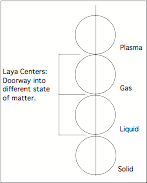
"Please explain, Mister Bloom," Devlin says.
"Well, we must remember that Mister Crossmann's vision is one in which philosophy, religion and science are synthesized in one system. Theosophy, which came to Crossmann through the writings of a Russian mystic, Helena Blavatsky, who was steeped in the Hindu tradition..."
"She is an anti-Semite, is she not?" Devlin asks.
"Yes. I believe she is," Bloom replies.
"You know the Nazis were mystical," Devlin says. "Some were also theosophists. And the swastika is a primary symbol of the theosophists, and the Hindus, is it not?"
"Yes, I believe that is true."
"Hitler was a mystic, believing in the Aryan mystical religion," Devlin says. "Was he not?"
"He was," Bloom says.
"Is Michael Crossmann like Hitler in this way?" Devlin asks.
"I don't believe he is," Bloom says. "But you will have to ask him. Crossmann did travel into the same territory. He met Hitler in his trials. Hitler is clearly present as a force in his book. But he refused to join up with Hitler. That is my reading of this."
"I am quoting from the letter Crossmann sent you," Devlin says
The first four chapters are largely negative. Jacob is ill. He knows he is ill. His country is ill. The western world is ill. Jacob's sons are dead. He will have no heir. He is judging himself. He has become spiritual, anti-material. He is angry at America. He judges America's materialism, its racism, its war in Vietnam, its political corruption. The "body" is corrupt. He has, in effect, become the voice of his son, Benjamin, looking back on his own generation's creation -- the father's creation -- condemning it as imperfect. Truly the Sun is setting on the West.
But it is not enough the destroy the world; one must also, eventually, re-create it.
I personally stood in a gulf between the old world, which I had condemned (my father's world) and the next world, the better world. But I did not know how to get to the new world. I eventually realized that I would have to build that new world -- and build it out of spiritual matter. The old religion -- my Catholicism -- was not enough. It was not a living religion. It, too, was dead, a dead body with a dark past. I no longer hated it. It was like my father: imperfect, like myself, but for ever also my own essence.
I needed to find a new religion -- that is, create one. That was where gnosis appeared -- gnosis was the living religion, the endless truth. The Source which would never fail one.
I still remember vividly the day I went to the local library in search of some source of inspiration. I had steeped myself in classical literature, classical mythology. My novel clearly was clothed in the spirit of mythology. But I did not grasp the system of thought beneath his mythology. Then I found, that day in the library, Helena Blavatsky's Isis Unveiled. All of a sudden, through this book, a door opened to me. There was a vision beneath the symbols, a vision stretching back from the beginning of Time, even before Time, into the distant future....
"Isn't this the definition of megalomania?" Devlin asks Bloom.
"He is an artist," Bloom says.
"Hitler was an artist," Devlin replies.
"Do you want me to agree with you that Michael Crossmann is connected to Hitler?" Bloom asks.
"Is it possible?" Devlin asks.
"Anything is possible," Bloom says. "The second drawing indicates a scientific view of the planes of matter. Crossmann's view is that science and religion are describing the same reality, but through different lenses, through different languages. Can we see the next drawing?"
"Tompkins," Devlin says.
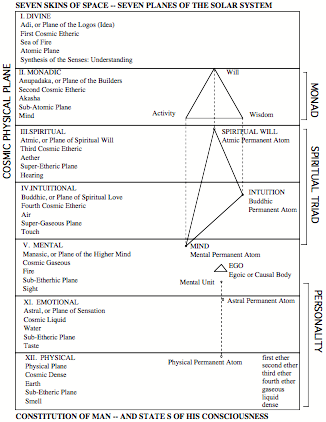
"Wait a moment," Judge Brink intercedes. "I don't want to go through this entire letter; or every drawing in this letter. What are you trying to prove here, Mister Devlin?"
"That the man is a war-lock, your honor," Devlin says. "That the man is Adolph Hitler reincarnated."
The audience laughs. Even the senators are laughing.
"I would suggest, Mister Devlin, that the whole idea of reincarnation is, at least in the west, merely a matter of speculation," Judge Brink. "And such speculation is not really allowed much leeway in my courtroom."
"I would like to continue for a moment, your honor, with a few more drawings," Devlin continues, "without speculation, to show that Mister Crossmann came to believe in his own godhood. And in the godhood of his race."
Judge Brink looks at his watch.
"We have a vote coming up at midnight, let's not forget," Judge Brink says, agreeing with Devlin's request.
"Tompkins, let's skip ahead to drawing twenty-six," Devlin says.
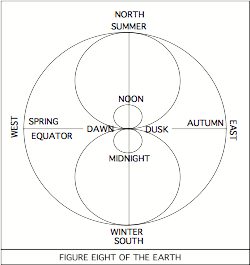
"This is a very interesting drawing, is it not, Mister Bloom?" Devlin asks. "It connects Time and Space as an icon describing zones of the earth."
"Yes, it does," Harold Bloom agrees.
"Tompkins, number twenty-seven," Devlin says.
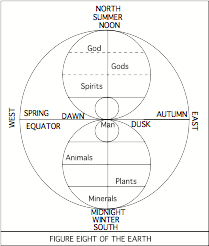
"This drawing, Mister Bloom," Devlin continues, "seems to suggest that the Earth is divided into a hierarchy, with the northern hemisphere being the place of the gods and the spirits and the southern hemisphere being the lesser zones, the ones upon which the northern hemisphere is authorized to stand..."
"That is your interpretation," Bloom says. "Clearly, the northern hemisphere is more heavenly than the south in terms of material wealth, and comfort of life. Southerners risk their lives regularly trying to escape to the north. So there is something to this, drawing, in terms of actual experience...."
"So, the north is the heaven pole and the south is the hell pole. Is that it?" Devlin asks.
"So it seems."
"Does this imply racism?" Devlin asks.
"No," Bloom responds.
"And why not?" Devlin asks.
"It implies geography, not race," Bloom responds. "All races live in the north. And all races live in the south. America is not a race of white people. Its definition is a 'melting pot' of all races. And Michael Crossmann amplifies this view near the end of his own novel. He is not a racist. But he moves in the zone of racism. He finds a way out of the racism through his nationalism for America, not as a whites-only nation, but as a melting pot, what he calls a 'hybrid nation'... I would like to read one passage from the letter...."
Devlin says quickly: "Tompkins, next slide."
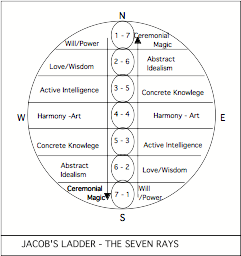
Judge Brink looks at his watch. "Very well. Keep it short."
Harold Bloom says: "In the first part, Crossmann is quoting from his novel." He reads:
Jacob is standing in a meadow amid flowers. A stream trickles by. And an owl sounds. Geese fly by....
Michael, the Archangel, appears on the water. He says: YOU MUST RETURN WITH YOUR MESSAGE TO THE PLANE OF THE MANY CHANGES, JACOB.
But Jacob replies: I DO NOT WISH TO LEAVE THIS GARDEN. I WISH TO STAY IN THIS GARDEN FOR EVER.
THAT IS NOT POSSIBLE, JACOB, the angel responds. YOU CAN ONLY COME HERE BY THE WAY OF YOUR SON.
BUT I DON'T KNOW WHERE MY SON IS, Jacob explains.
YOU WILL FIND HIM, Michael says. THAT MUCH IS CERTAIN. AND HE WILL GIVE YOU LIFE AND WISDOM.
BUT I WON'T LEAVE THIS PLACE, Jacob says, adamant. EVERYTHING HERE IS SO PEACEFUL. I NEED THIS KIND OF PEACE....
BUT YOU HAVE NO CHOICE, the angel says. YOU WILL RETURN HERE SOME DAY -- AND YOU WILL LIVE HERE FOR EVER. BUT, FIRST, YOU MUST LEARN TO LIVE BY YOUR TRUTH. IT IS NOT ENOUGH THAT YOU BELIEVE, JACOB. YOU MUST LIVE YOUR LIFE IN ACCORD WITH YOUR SOUL. YOU MUST BE THE LIGHT OF YOUR SOUL. AND THEN YOU WILL RETURN....
I WILL NOT LEAVE HERE! Jacob says boldly.
Michael responds: YOUR SELFISHNESS ONLY KEEPS YOU FROM LEARNING. YOU MUST SEEK TO TRANSCEND THIS, JACOB. FOR IT LEADS BACK INTO ILLUSION. NOW, BE AWAY FROM HERE. AND CARRY, WHERE YOU GO, THE SOUND WORDS OF YOUR CREATION....
Jacob is gone.
Jacob is perched on the edge of a crevice. There are rocks all around him -- and below him a canyon. The wind starts to scream. The sky has become dark, the color of a bruise. A storm is coming in. Beasts begin to howl. The cold wind hits Jacob's face. Snow starts to fall....
Jacob begins to weep, clinging to the ledge. He cannot move. Fear has paralyzed him. His muscles are tied in a series of knots. He tries to hide on this rock. He thinks only of his own death.....
He hears the thrashing sounds of animals in flight. He hears an animal being gored. It screams. Then it begins to whimper.
And then a black bear emerges on the crows of the gray rock, above him. The bear has blood on its shoulder. It roars. Then it moves toward Jacob....
NO! Jacob cries. He tries to squeeze himself flat against the boulder. He cannot hide. The bear smells him. Jacob cannot hide. He feels sick with fear. His body trembles and aches, the cold wind blowing through him. He has no strength to sustain him....
A man in a white robe with a long flowing white beard sits above Jacob looking down from his own rock. He smiles at Jacob. YOU HAVE SO LITTLE FAITH, JACOB, the man says.
THERE IS A BEAR ABOVE ME WHICH APPROACHES TO KILL ME...!
I THOUGHT YOU WANTED TO DIE, the man says. AT LEAST THAT IS WHAT YOU ALWAYS TELL YOURSELF. BUT THERE REALLY IS NO BEAR, JACOB....
Jacob turns and looks above him. There really is no bear.
The man says: YOU FEAR THINGS THAT ARE NOT REAL, JACOB. THEY ARE YOUR OWN THOUGHTS; ENERGY, WHICH YOU CLOTHE IN YOUR OWN FEARS. THERE IS NOTHING TO FEAR HERE.
The man gives Jacob his hand and leads him up away from the precipice. On the top of the plateau, the snow has stopped. The sun breaks through the dark clouds.
The man in white hands Jacob a tattered package of papers. It is a manuscript. It is entitled: A Journey Through the Seasons of Hell.
The man says to Jacob: WE DO NOT OVERTHROW THE OLD. WE ADD TO THE OLD. THE FORMS OF BOTH THE SPIRITUAL AND THE MATERIAL WORLDS NEED TO BE UPDATED IN TIME. WHEN YOU RETURN TO YOUR OWN LAND, TAKE WITH YOU THESE TRUTHS FOR A NEW AGE....
Jacob opens the manuscript to the first page. He reads:
TRUTHS FOR A NEW AGE
1. The oneness of humankind.
2. Independent investigations of truth.
3. The foundation of all religions is one.
4. Religion must be the cause of unity.
5. Intuitive knowledge completes that of reason.
6. All living beings are sacred.
7. Equality between men and women.
8. Prejudice of all kinds must be forgotten.
9. Individual responsibility leads to the welfare of all.
10. There must be: universal peace; universal education; a spiritual
solution to the economic problem; a universal language,
English; an international tribunal which truly governs the
world.
The white-haired man puts the manuscript in a backpack. Then he lashes the backpack to the child Jacob's back. He says: THE COURSE OF EVOLUTION OF ALL LIVING THINGS CAN BE TRACED BY FOLLOWING THE UPWARD PATH OF A SPIRAL BACK INTO HEAVEN. NOW, GO AWAY FROM HERE. AND SPEAK THE WORD OF TRUTH IN YOUR LAND TO ANYONE WHO WILL HEAR IT....
Jacob is gone.
Not only is Jacob the Patriarch Jacob from the Old Testament. He is also Moses. He brings a new divine code of behavior to the earth. He is given a calling: to spread his vision throughout the world. This implies the necessity of his re-birth.
"He is the ultimate idealist in this passage," Devlin says. "He is on the mountain-top. He is Moses, getting a new set of commandments from his God, which he is instructed to bring back to his people. That's what confuses us so much, Mister Bloom. That confuses us liberal thinkers. He did not come back as Moses, as well as we can tell. He came back as...."
"As Michael the Archangel," Harold Bloom says.
"Please explain this," Judge Brink says. "How does this happen?"
"Well..."
"In fifty words or less," Judge Brink says. "I haven't eaten yet."
"Let me see if I can paraphrase the experience of this novel," Bloom says. "Jacob dies; his soul leaves the earth; he passes through hell; then he travels up in to heaven, meeting with the great men of the history of the world. Finally, he becomes Moses, gets a new set of commandments to bring back to earth. Then the soul resolves into a fire mist, into its atomic structure. The soul takes up residence in the egg, where it germinates. The atom is the egg; the earth is an egg; the universe is an egg. During this gestation period, the soul becomes Noah. Crossmann points out that Nuah, the Chaldean word, means "spirit". The two principles spirit-soul ride out the period of chaos in the ark. The triplicity, ark-spirit-soul is a kind of trinity in which the soul resides prior to re-birth. Crossmann states quite often that this novel, the death of his father, the death of his country, the death of the west were all connected in the late 1970's and early 80's. This novel is a record of that psychic death of the individual and the nation, and re-absorption back into the primal darkness.
"Crossmann had little money. He was anti-materialistic. The society went through an economic depression at the time. Communist fervor was sweeping the world. Crossmann speaks of 'mummifying' himself in spiritual matter, Virgin matter -- which is the symbolism of the Virgin Mother. He speaks of God's injunction to Noah to build an ark which will house the pairs of animals -- Crossmann speaks of this as an injunction to marry the two halves of the astrological circles, north and south, together. The astrological signs were anciently called the 'Sacred Animals'. Essentially, the injunction was to build an egg surrounded by the sky signs -- and to make this egg his ark. This is a metaphor for his studying of spiritual material prior to his rebirth..."
"Tompkins," Devlin says under his breath, into the microphone.
The next drawing comes up.
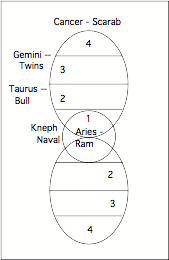
"This is the first earth," Bloom continues. "The earth on the realm of the archetype. The archetype that exists in Chaos, the female principle, has no hierarchy. All the elements are thrown together under the Night, under the female principle. The female principle hates hierarchy, believes in equality of all things. Of course, things are equal only in death and in darkness. Order, the male principle, hierarchy, exists during the Day, only in the Light.
"For Michael Crossmann, who is also Noah, his novel is his ark. He begins to put the pairs of animals together, studying, in his ark, the symbolic language of astrology, the Sacred Animals. But he does not study it in the shallow way the New Age has embraced it, the small view of one's personal love life and success life, which is a perversion of the real meaning. He studies it as an emblem of God's thought, God's meaning and God's plan. The egg inside the egg inside the egg inside the egg. The cell in man's body inside man's body inside the earth-egg inside the solar system inside the universe...."
"Tompkins, next slide," Devlin intones.
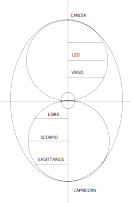
"The youth rebellion of the Sixties had led to a predominance of the Female Principle," Bloom continues, "that is, after the dominance of the Male Principle during the Forties and Fifties. Equality became the ideal. The Male Principle was castrated, in a mythological sense. Vietnam was a ritual castration of the Male Principle. The Dark Principle triumphed. And when the Dark Principle triumphs, economic decline results. The phallus, the erect phallus, is the creator of order, pushing the sky up above the earth, creating space, light, a period of building of forms, activity, material gain. In the late 1970's and early 1980's, America had sunk into economic decline. Crossmann believed that Jimmy Carter was the perfect emblem of this decline: a wonderfully spiritual man, anti-materialistic, a man whose most famous speech corresponded to the philosophical emblem of the seventies, a philosophical emblem taken from a popular book at the time, 'Small Is Beautiful'. Carter, in his famous speech, told America that it needed to accept its own death, that it needed to become a part of the world -- that materialism was not the answer. That America could no longer justify using most of the world's resources. Our greed was evil.
"Carter was a great man, a spiritual man, but a terrible leader," Bloom continues. "That was Crossmann's view. He was leading America into the Death Realm. I believe this became a significant issue in Michael Crossmann's transformation. When Crossmann was a liberal, he was more spiritual. He hated himself for his own and his country's imperfections. He judged himself as evil. He longed for the death of his own country. It was the martyr impulse -- the Jesus Christ impulse. But there was a dark side to this story. By creating a death void in his own country, Michael Crossmann (through this Jesus Principle, the Martyr) was inviting the barbarians to invade his country. This was true, also, with President Carter. He wanted nothing so much as to be crucified for his and his country's sins. He wanted America to be poor and violated, overrun, abject. This was never spoken of course, never a goal -- but it was an implicit, and unconsciously necessary result, of the desire Carter felt for creating that material void. He felt this was justice for the sins America had committed -- that American would and should be crucified. Crucifixion is, in fact, the ritual self-punishment for the committing of sins.
"This was the fruit of the Tree of Good and Evil," Bloom continues. "President Carter, Michael Crossmann, liberalism, had all eaten from the forbidden tree, the Tree of Knowledge of Good and Evil. Political Correctness. Living in a world of absolutes: if America were not perfect, then America must be Evil...."
"Tompkins, next slide," Devlin whispers.
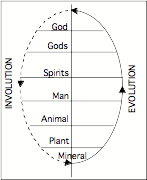
"But Michael Crossmann also ate from the Tree of Life. The injunction, in mystical Jewish tradition, is that those who eat from the Tree of Knowledge of Good and Evil must also eat from the Tree of Life. Of course, we also have the biblical myth of Adam and Eve (Adam/Eve being the soul, androgynous in nature, male and female) -- that is, the egg, the soul, containing the two principles, male and female. This is the same glyph, in fact, as Noah floating in his ark, with both principles contained within this ark. Adam and Eve fall from grace, in fact, for eating the fruit of the Tree of Knowledge of Good and Evil. We have discussed at some length the difference between eating from the Tree of Knowledge, which is not a sin, and eating from the Tree of Knowledge of Good and Evil (which is duality, polarization from one's whole and mixed nature), which is a sin. The fruit of the Tree of Knowledge of Good and Evil leads the soul to divide itself from itself, creating its opposite. To see oneself as either good or evil but not as a mixture of each -- thereby dividing the world into two poles, good and evil. Heaven is lost with this division on unity into duality...."
"Tompkins, next slide," Devlin whispers.
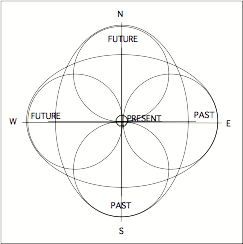
"But Michael Crossmann, in fact, awakens -- and I truly believe that is the correct word, because it is an awakening -- to the fact that his country is being endangered by barbarians. In fact, barbarians have already entered his country. Dark elements. Crime is at an all-time high in America during the Carter years. Because Carter has invited death into the country. That is not how he sees it, of course -- President Carter. He sees himself as being a man of light, a Jesus Christ figure, the messenger of spiritual life, selflessness, self-affliction, self-sacrifice. But there is a shadow side to this. In fact, Carter climbed up on the cross. In fact, Jimmy Carter's initials are JC. This we should not forget...."
"Tompkins, next slide," Devlin whispers.
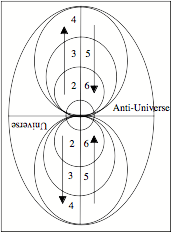
"I admired Jimmy Carter a great deal," Michael Crossmann says. "In fact, I still admire him. As a man, he is one of the best public figures of this century. As a saint. But saints are intended to live in heaven, not on the earth. A country ruled by saints is a country that will soon be enslaved..."
"Should the devils rule a country instead?" Devlin asks Crossmann.
"Not the devils, but the men," Crossmann replies. "Saints are children. They communicate with God. Saints and angels rule in heaven. Men rule the earth."
"Is Professor Bloom accurately representing your history, Mister Crossmann?" Judge Brink asks.
"I would like him to continue," Crossmann says. "A man who loves literature, who loves Shakespeare, should be the one to represent my mythical history."
"Continue Professor Bloom," Judge Brink says.
"Michael Crossmann began to regret his own judgments against his father's life. He came to fear his country's being overrun by barbarians, criminals, 'foreigners' in the largest sense -- not people from another country necessarily, but those 'foreign' to life and decency. In his own world, in fact, in Eugene, Oregon, he was surrounded by dark creatures: criminals, drug users, uneducated, dark natures. His introduction to theosophical literature had come from a woman who described herself as a witch, Dolores Lockhart. And interesting name, one might assume: Lock hart. This name, itself, a kind of injunction to become like Noah. She gave Mister Crossmann a book entitled The Light of the Soul, written by Alice Bailey, a successor to Miss Blavatsky. Dolores told Michael Crossmann that the book would help protect him in hell, in fact, from the dark, violent natures who lived in hell, which is where the Male Principle goes after it has been castrated by the Female Principle. And Crossmann was surrounded by dark spirits, the ones who live in hell, in Hades, in Chaos. Crossmann mummified himself in the spiritual matter of Bailey, Blavatsky, the Kabala, the Old Testament, ancient mythology, the New Testament, in order to survive his Journey Through a Season in Hell. He is the ray of light, the murdered Sun Hero, who has descended into hell lighting the underworld with his light..."
"Next slide," Devlin says.

"Crossmann realizes that his nation has been invaded by darkness," Bloom continues. "He realizes he must journey back to protect his nation, his family. As I said, crime was high. The anti-hero was more powerful than the hero. Crime was good, because the government was bad. Crime against the system was virtue against evil. He developed a whole theory about matter and anti-matter, about the universe and the anti-universe, which addressed the nature of the polarity which drove the world, the duality which created energy. The anti-universe being, essentially, the shadow of the universe...."
"Next slide, Tompkins," Devlin whispers.
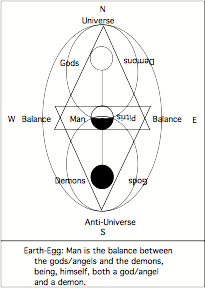
"The real message that came to Crossmann was the mythology of eternal life," Bloom says. "Death was an illusion. The body died. But the real nature, the trinity (the dual-principle, Spirit-Soul inside the Egg -- that is, Noah) did not die. It survived the death of the body. Then the nature of re-birth became the story, instead of death. Conversations On a Dying Age became Conversations On the Nature of Renaissance....."
"Next slide, Tompkins," Devlin says.
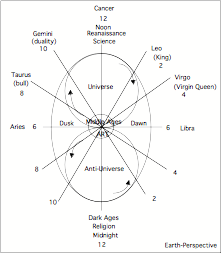
"Crossmann next desired Life; he desired a wife; he desired law and order," Bloom says. "In his own world, he began to be haunted by a dark Giant, a man named Gilbert Patton, who apparently was a Vietnam veteran who lived on the streets, a madman who had a record of intimidating citizens, screaming at them, threatening them. He confronted the author one day at his work place, telling him he would knock his lily white teeth down his throat.
"Gilbert carried a hunting knife in his boot, was 6'4" tall, a weight-lifter. He spent much time at the university. The university tolerated him, even though he threatened students and faculty there. The university, in fact, seemed to fear him. In fact, the whole town seemed afraid of Patton. Crossmann had been an athlete in an earlier life. But he has lost much weight since that time. He was thin, weighing some 160 pounds, rail thin. He had been living the spiritual life.
"He met his Goliath several times on the street. The Dark Giant announced to him that he would destroy the white man, Crossmann. Clearly in Gilbert's mind, he was the Dark Principle and Crossmann was a representative of the White Principle. We must remember that in the anti-universe, black is good, and white is evil.
"Crossmann was passing toward the center in the figure eight, the womb through which the soul gains re-birth from the anti-universe to the universe.
"During this time, Crossmann was friends with a woman from Israel, Daphna Greenstein. Daphna was studying at the university. Crossmann manifested to Daphna as Michael the Archangel. Crossmann had been studying angelology. And he had come to fuse himself, in his own mind, with Michael the Archangel, his prototype.
"Daphna was pregnant. Crossmann came to believe that it was through Daphna, in a mystical manner, that he would find his rebirth on the earth. Daphna was Crossmann's mystical bride, his Shekinah. Daphna represented to Crossmann Israel as a new-born entity. And Crossmann came to understand that Israel was the Womb of the World, the matrix through which the Western World would be re-born.
"Michael appeared to Daphna as Michael the Archangel; and he repeated to Daphna Greenstein God's covenant with the Jews. America was the Israel in Heaven; Israel was the Israel on Earth. This was the mystical marriage. America was the Macrocosm; Israel was the Microcosm. Even as the Earth was the Macrocosm, and America was the Microcosm.
"But Daphna, Israel on Earth, was threatened by darkness, a dark giant, Gilbert, who not only threatened Crossmann but also threatened Daphna's baby. This was all quite clear to Crossmann: a mystical truth. Crossmann understood that the Dark Giant threatened America, threatened Israel, threatened Crossmann himself, threatened Daphna's unborn baby.
"Crossmann began to exercise rigorously, preparing himself for battle. He had found a hunting knife several years before. It was a kind of sword he had found. He began to carry it is his backpack. He purchased a Saint Michael's medal and blessed it in a holy water font in a Catholic church. He wore it around his neck.
"In his mind, the battle was mythic. It was the war in heaven. He was the guardian angel of the West. About this time he looked at a picture on the front page of the Portland newspaper. President Reagan had returned from a foreign visit. He was meeting with black schoolchildren in Washington D.C., who had made a large painting for him. Bush and his wife Nancy were there; and Vice-President Bush. And on the outer ring of bystanders, wearing a black suitcoat and a red tie, was Michael Crossmann himself, a guardian angel, watching over President Reagan...."
"Tompkins, the Reagan picture," Devlin says.

"Of course," Bloom continues, "this makes no sense in terms of our normal, rational way of thinking. But Crossmann was not living in the normal, rational world. That world had not yet been born, in fact, for him. He was living in the primeval world, the world of Chaos, before the elements had been scattered into their own realms. Before reason had been born.....
"Crossmann, by the middle of his novel, had begun to view names and destinies as being the same thing, interlinked. Thus, his own identification with Michael the Archangel. And, later, with his identification of MJC with IHVH and the number 26. Regan is the Norse god of the underworld; I read from the letter:
Regin is the Norse celestial smith. In the Volsung Saga, he is son of Hreidmar, the dwarf who demanded gold from the gods, and which gold became cursed, and was carrier of ill-fortune. Regin shaped weapons of iron, and ornaments of silver and gold. He was the fosterer of Sigurd, which means Counselor of War. When Fafnir, the Strong, brother of Regin, cheated him of his share of the Andvari treasure (the ill-fated gold), Regin repaired the magic sword Gram (Grief, the Sword of Strife) for Sigurd on condition that Sigurd would slay Fafnir (the Dragon).....
"Crossmann viewed Reagan as a kind of Vulcan, a god of the underworld, who was re-fashioning the magic sword with which the Sun God would defeat the Darkness, the Dragon. Gilbert was the Dragon for Crossmann. Crossmann had a sword too, a blessed sword, his hunting knife.
"But, on the larger scale, Reagan was fashioning a weapon with which to defeat the World Dragon, the Soviets. His "Star Wars" defense weapon system, which created such a controversy in the world, was, in fact, the sword by which the "Evil Empire" of Communism would be defeated.
"Michael Crossmann was reborn, first, as an angel. But he needed to defeat the Dragon, who stood upon the threshold, barring Crossmann's return to the living. Theosophy calls this personality the "Dweller on the Threshold". This was Crossmann's Evil Empire, threatening Crossmann himself and also Crossmann's mystical bride, Daphna Greenstein and her unborn child.
"They met several times on the streets of Eugene, each time Gilbert notifying Crossmann that he would destroy Crossmann; and, by implication, the white man. Crossmann -- in fact, this is a very interesting theological detail -- Crossmann was not able to defeat this Satan, and drive him from heaven, through the skin of Michael the Archangel alone. Crossmann called upon Metatron, an angel linked with Michael apparently, Michael's first soldier, to defeat Satan. Truly, this was a replica of the historical/mythical War in Heaven. And Michael prayed to Metatron for strength. And then invoked Matatron's name when he met his demon in battle.
"One day Crossmann was studying in the arts library at Lawrence Hall at the University of Oregon. As he left the library, he took a narrow passage on the south side of the building down to the first floor.
"Gilbert was in the passage, coming up as Crossmann was going down. They passed on another, came within inches of one another, their clothing brushing. Gilbert was beginning to mutter something in his dark, guttural voice (demons, inevitably, speak in a low, guttural, dark voice). Crossmann invoked Metatron's name; and in his imagination, he drew the knife out off of his backpack and thrust it into Gilbert's heart with all his force. He actually felt Gilbert wince. He never had trouble from this dark force again.
"Crossmann later wrote a short-story entitled "Death of A Liberal"; and in this story, Crossmann fictionalizes this experience:
One evening, when walking toward St. Mark's, a vagabond emerged from the bushes and walked directly toward him. He was a huge man, with long matted hair. Michael had seen him before, for years in fact: he was one of those dark spirits which inhabited the shadows and alleys, living on Pluto perhaps; he had a long history of threatening people on the street. The man had been a soldier in Vietnam; had been mentally damaged; returned to the U.S. a demon, without a future. He was skilled in martial arts; and he carried a hunting knife in his boot.
The demon walked up to Michael and said, in a voice as deep as Michael had ever heard, making Michael nearly sick with fear: "I'm going to bust those white teeth right down your throat, white man. I'm going to smash you to pieces with my bare hands."
Michael began to shake. The voice, itself, was enough to make Michael shake. It was the voice of the devil -- Michael was certain of it. Michael could not explain it to others, this understanding. Had he tried, they would have considered him mad. Did Michael really believe in the Devil? How medieval? Had Michael gone mad again? Did he need to return to the Johnson Unit?
But Michael was as sure of this as he was sure of anything. The demon did not touch Michael. But he stood in his path, glowering, threatening, speaking words that did not make sense, that seemed to be a chaotic rendering of madness too. But the voice was the devil. And so was his smell. The man was possessed. He was the personification of darkness.
"The next time I see you," he said, "I'm going to break every tooth in your mouth and drive them down your throat!"
He was gone.
Michael reported the incident to the police. Of course the police knew about the man. He had threatened many people. But he had never broken the law. He would actually need to strike Michael to break the law. Words were not enough. Words were protected by the First Amendment to the Constitution.
Michael began to devour the Old Testament. He took it with him to work. He read during his coffee-breaks and during lunch. He became convinced that the solution to his troubles lay hidden in the symbols and the histories of the old book. There was a power in the book. Michael needed power to organize his life.
Michael's dreams became very vivid at this time. Michael came to realize that there was some intelligent force trying to reach him through his dreams. It was his father. His father was trying to reach him, trying to help him.
In one dream, he saw his father and his brother doing calisthenics, push ups, sit ups. They were athletes. Michael's father beckoned to him: "Come on, Michael. Join us. We're trying to get in better shape." Then everything faded out.
The next day, Michael began exercising in his small little apartment.
Death was close to him. Everything was dark. He realized that something was trying to take his life. The only time and place he felt safe was in the church.
He either had to let the darkness take him, utterly destroy him; or he had to fight against it, defeat it. Michael began to realize that he had been choosing Death for too long, choosing darkness, disease, spiritual suffocation. He had called Death into his own house; now he stood before Death, Death with a devil's voice, the smell of putrefaction, telling Michael that his intent was to kill him.
Michael continued to work out in his apartment. Once in the morning, before work; then in the evening, after his visit to church. He felt better. He felt as if he were awakening some part of himself which had for ever slumbered. His desire for life perhaps. He understood, now, that he did desire Life. He had never really lived; he had pretended at being alive; but he had never really lived.
It was early September. Michael again went to St. Mark's after work. He did not stay as long, because his life seemed to be stabilizing again. But when he left St. Mark's and began to walk toward home, the Street Demon emerged from an alley and walked toward him shouting, shaking his fist at Michael. There was no one else in the world. Just Michael and his Death. Just Michael and Satan. At the end and at the beginning of the world. As it was and ever shall be.
The Voice came out at Michael again: the voice so deep with evil and moss and twisted vibrations, and caked with dung and with spears and rattling shields. The Voice made Michael shake and sent fear deep into his soul. The Demon believed himself black. He said: "All you whites are finished! I'm going to wipe you out and cut out your heart! Those pearly white teeth are going to come flying out of your mouth!" He doubled up his fist as if to strike Michael.
Michael did not run. He could not speak. The Demon gave off the odor of pestilence. His clothes were filthy and torn. His matted hair, in the twilight, seemed to contain snakes and rats; Michael tried to look into his eyes, but the Demon was too powerful. Michael could not look into his face.
"I'm your Death, white boy!" the Demon said. "I'm your Death! There's no way you can escape me!"
The demon lurched down the street, looking back to shout threats at Michael. Michael looked around to find any witnesses on the street. There were none. The street was totally deserted.
That night, Michael's father appeared to him in a dream. Michael was near the ocean. There was an animal in the brush. So Michael was crouching near a cliff, trying to hide. Michael's father walked through the woods up to his son.
"Why are you crouching here?" he asked. "What are you afraid of?"
"There's a lion in the brush!" Michael replied. "I'm trying to hide from him!"
"You're the lion, Michael!" his father replied. "Arm yourself! Meet the beast on your own ground! Make yourself his image be as powerful as he; be as light as he is dark. If he would kill you, then kill him first. That is what it is to choose life. Strike him out of your life. That's what it means to become a man. When you kill him you also kill the child in yourself. And then you finally become a man in this world."
Michael's father handed Michael a sword and a shield and said: "He cannot harm you, Michael. It is your own fears which threaten you. If you have the courage to die, then there is no reason that you must die."
IV.
There was no one to help Michael. Nothing seemed to exist in his life but this battle which lay before him. He would follow his father's directive. He knew that if it came to a physical battle, then he could not win. He had never fought with anyone in his life. He had very little physical strength. He could not see without his glasses. The Demon was strong, physically terrifying. But he could not run from the Demon. He must face him. He must go through the Demon to find his life.
Michael went shopping that next morning. He bought a hunting knife at the sporting goods store downtown. He would make himself a mirror-image of the Demon. There was a small shop across from St. Mark's Church which sold religious articles. Michael entered the shop without any clear understanding of what he wanted to buy. He needed a shield. There was a medal of St. Michael: on this medal, Michael was driving Satan out of heaven, protecting the earth, holding in one hand a sword and in the other hand the balanced scale. Michael bought the medal; he took it across the street, sank it into a holy water fount located in the front of St. Mark's, and then placed it around his neck.
Michael continued to exercise. He placed the hunting knife in his back-pack. If he was attacked by the Demon, he would have to kill him. He must be willing to strike the blow to save his own life: there was no one to protect him now, except himself. Since his father had died, Michael had become more and more aware of the obvious: he must rely on himself now.
It was more than a week later when Michael again met the Demon again on the street. He seemed to appear out of the mist, insubstantial; he began shouting again at Michael again. Michael approached the Demon. Somehow he had the strength to approach him. He was not afraid of dying. He remembered his father's words; and he sensed somehow that the Demon was trapped inside his own prison, could not really reach out and touch another; that was part of the reason that the Demon was so terrible, because he had been cursed to such an isolation.
As Michael approached the Demon, the Voice lunged out of the giant's body to surround Michael, making him almost sick with dread. The smell was there again too, as thick as gravy. Michael invoked the name of Metatron, reached back into his back-pack, found the hunting knife. He unsnapped the knife from its sheath. The Demon sensed some aggressiveness on Michael's part, drew his own knife from his left boot. Michael grabbed the demon's coat with his left hand and drove his knife deep into the Demon's chest. There was a horrible screaming sound; the Demon went limp; Michael felt the Demon actually give up his strength entirely; and felt blood splash up on his face and on his shirt.
Then everything went dark.
Michael was paralyzed for several moments. He could see nothing, smell nothing, feel nothing. He looked at his hands. There was no knife; there was no blood.
He turned and looked down the street, behind him.
The Demon seemed like a man only, becoming smaller and smaller, making no noise, hurrying down the street, a balloon filled with air, punctured, vanishing in a puff.
Michael reached into his back-pack; he felt the hunting knife still in its sheath.
"Michael Crossmann's battle with Gilbert was Michael the Archangel's battle with Satan -- it was also Ronald Reagan's battle with Russia. Crossmann was fighting for the Fatherland, the land of Light, the land of Daytime, against the Motherland, the land of Darkness, disorder, chaos: the anti-Universe.
"Crossmann was later asked to testify in a hearing at the university that was seeking to forbid Gilbert, the Dark Giant, from access to university grounds. Crossmann testified. The prosecutor asked if Crossmann would like his name to remain anonymous, in case Gilbert sought retribution. Crossmann was informed that most people testifying wished to keep their names out of the record. Crossmann insisted his name be included in the hearing. Michael Crossmann was proud of the power of his name...."
There is silence in the courtroom.
It is as if, finally, the truth had come out.
"Gilbert was excluded from the university grounds," Bloom interjects. "Satan had been driven out of heaven. The final words of the novel, Conversations On a Dying Age, are 'Mikael, I am you!'"
Silence again.
"Michael was born as a man after existing as an angel," Bloom says. "But his birth was somehow magically linked to Israel. For Israel was the Womb of the World for the principle of light. This was Crossmann's experience. Daphna represents the matrix, the Mother of God, for Crossmann, the medium, the Mother nature, through whom he was given his re-birth."
There is silence again.
"Crossmann's experience, through is novel, is like the Sun-Hero's of ancient times, which is, in fact, the history of the Soul. Crossmann appears as a renaissance man: soldier-lover-philosopher-poet-economist-father. All things. Everyman. When Crossmann re-appeared as the principle of life, he was first born as Mars, as Adam, whose mission was to drive crime and disease out of his nation. That was where his stand against crime, which led to his role in the execution of the criminals in Oregon, came from. He was the son of God, in his own mind, with a mission to drive the foreigners out of his midst, the foreigners, in this context, being the principle of crime, anti-order, the lawless. He was like Odysseus, who returned from his journey into the land of trial and mystery, and drove the foreigners and strangers from his house. Jehovah is a nationalistic God. He proclaims his people a chosen people. And leads them in a holy war against the denizens of darkness. This is a very important fact that should not be forgotten. Crossmann does, in fact, proclaim Americans the chosen people near the end of his novel. Michael wrestles with the angel, through his hero, Jacob Heimkreiter, so that he can call his own people Israel, the Chosen People, as the light is born...."
Then Bloom adds, after a silence: "Michael means 'he who is like God'. In fact, Michael is the angel who contains the totality. He is on the angelic plane what Jehovah is to the realm of the gods, the totality: darkness and light. The synthesis of all elements. Michael is Jehovah's special angel. And Jehovah is a western God; and Michael is the defender of the West...."
Again, another silence.
"Michael Crossmann put some emphasis also, in his letter to me, on the point that another Michael, Mikael Gorbachev, also rose up shortly thereafter in the Soviet Union, defeating the darkness within, casting his own Satan out of heaven, or out of power. This is Crossmann's own point," Bloom explains, "not my own. This is what he wrote to me in his letter...."
Another silence.
"Then do you believe this man is the Messiah?" Devlin asks Bloom.
"I don't know what to believe," Bloom replies. "But I do believe that Michael Crossmann is a special person sent to us with a special message. He is a prophetic writer, like Melville. All prophetic writers, the literary ones, are special people, with a special vision...."
Judge Brink looks again at his watch. He says: "Michael Crossmann is, hereby, found innocent of witchcraft. This hearing is adjourned,"
Judge Brink pounds his gavel three times.
START HERE.
Prosecutor Devlin is unperterbed.
Hillary Clinton has joined him as the prosecutor's desk, her hair freshly combed, looking as fresh as a daisy.
"Don't worry," Devlin says to Hillary. "We'll appeal it to a higher court. We have friends on the higher courts. We'll take it all the way to the Supreme Court if we have to."
Hillary smiles at Devlin, lightly touching the back of his right hand with fondness.
The night is deep. The moon moves above trees stretched taut and naked, silver fingers on a black sky.
The water moves everything. Under-foot. Under-growth. A tempest in an urn: turning. The current earth-mothered; a spiral in a milky turn. Then away again, bespeaking speed, presaging distance.
Under the raft, the water murmurs. A village passes on the right. A dog is howling. Memories gleam.
Satisfaction is a hard thing to hold onto. The two of us move, tethered together by the law, the man moves and his shadow moves, not sequentially of course, but the two moving together, one thing in two aspects. Universe and anti-universe. My right arm moves; his left arm moves. One brain moving both. The particles all connected somehow, flaming through flaming plasma, no speed of light, no distance, all space fluid and immediate.
His right arm black and my left arm black. Blood brothers. Whose joke is this, anyway? God's joke? Ahab's joke? Christian joke? Pagan joke? The man standing on a raft floating in the water, looking down. The other in the water standing under the raft, looking up.
It's not my idea. I did not create this world. He says. Blank history in his face. A man with a capstan of features, buried by Time, by Time's watery predicament.
Dante. Dante again. Dante's twin. On a raft above black water.
You are the dead, he says.
You are the living, he says.
Anti-Time runs backward, from the present into the past.
Time runs forward, from the past into the present.
You are the living, he says.
And you are the dead, he says.
And everyone is correct.
The water splashes on my feet. It is so dark, even with the moon, that I cannot see across to the other end of the raft.
Essentially alone.
Alone with death.
Floating on a sea of death.
Life separates from death. The sexes separate.
He says you must accept death; and then we will be alone. Material death is spiritual life. Yes. Material life is spiritual death. He says there is a trick going on. A trick of light. So the subtle one says. The subtle one inside. He says that life is death; and death is life. The subtle serpent is speaking again, saying darkness is light; and light is darkness.
There is something to this.
I am death, he says. Be like me. Don't work; don't worry; accept death. Be like us. Let other countries invade us. We deserve it. We've invaded other countries. We've committed sins. Let us be punished for these sins. We are all the same under the skin.
Yes.
When the anti-universe and the universe are separated, there is life, order, stability, production. When the man falls, when the universe falls and the anti-universe rises, the two poles come together. There is then chaos. Self-annihilation. Civil war. The brothers, the sons, take over the show.
The raft hits a current and accelerates, spinning counterclockwise to the south.
What is this body of water?
The Harlem River?
Heading south toward the teapot. Dome. Places I wanted to see. Behind me, to the right, Thomas Jefferson Park, A man inside my own skin. Michelangelo's brother. An architect in the one hand; an architect in the other. At right angles to one another. To the right -- oh, my God. The Islamic Cultural Center, within a stone's throw of the Jerusalem Museum. Urrim and Thummim. Warstones scattered out of heaven. Skip-skip-skipping across the sea. The World Trade Center Building still smoking on the southern horizon. MOMA. The Church of the Holy Trinity. The painting called Dusk: Christianity turning on its side, rolling up, going to sleep. What does it matter? he asks. The Dark God of slumber, an ear turned out toward Mozart; poison poured into the porch of that ear. We are all Hamlet. Every man is Hamlet.
Carl Schurz Park. "My grandfather came to America as a small boy, an immigrant with his family, after the great revolution of 1848 failed. There was even talk that they sailed with the great Carl Schurz—although there’s no reason to believe that really was the case...." Jacob Heimkreiter had noted. Noah too. The second. Riding chaos inside an egg, in which resided the best and the worst, the brothers of twin skins. Amnesia. Amenatopia. God sped His Thrace on thee....
Someday, down there on the right, when you have played your cards right, ad an artist, I mean, you will visit that great auction house, Sotheby's. You will have your own works of art sold there. Of course you will be dead. That was what I meant by playing your cards right. Someone will get very rich off your work -- but not you. Oh, you will have a name. Your name will be written in many uninteresting books composed by uninteresting academics who will use your work as a means to ensuring a cushy profession for themselves -- writing books that no one reads, except a handful of other academics. Southern bees, seeking honeybutter. Sucking huntingbutter. Blunter brains and the fire's profession's first confession. Confirmation. Confirmation. In the topographic nation. I am gone. I am gone. When you read this. I am gone.
We went drifting down into a big bend, and the night clouded up and got hot. The river was very wide, and was walled with solid timber on both sides; you couldn't see a break in it hardly ever, or a light. We talked about Cairo, and wondered whether we would know it when we got to it. I said likely we wouldn't, because I had heard say there warn't but about a dozen houses there, and if they didn't happen to have them lit up, how was we going to know we was passing a town? Jim said if the two big rivers joined together there, that would show. But I said maybe we might think we was passing the foot of an island and coming into the same old river again. That disturbed Jim -- and me too. So the question was, what to do? I said, paddle ashore the first time a light showed, and tell them pap was behind, coming along with a trading-scow, and was a green hand at the business, and wanted to know how far it was to Cairo. Jim thought it was a good idea, so we took a smoke on it and waited.
There warn't nothing to do now but to look out sharp for the town, and not pass it without seeing it. He said he'd be mighty sure to see it, because he'd be a free man the minute he seen it, but if he missed it he'd be in a slave country again and no more show for freedom. Every little while he jumps up and says:
"Dah she is?"
But it warn't. It was Jack-o'-lanterns, or lightning bugs; so he set down again, and went to watching, same as before. Jim said it made him all over trembly and feverish to be so close to freedom. Well, I can tell you it made me all over trembly and feverish, too, to hear him, because I begun to get it through my head that he WAS most free -- and who was to blame for it? Why, ME. I couldn't get that out of my con- science, no how nor no way. It got to troubling me so I couldn't rest; I couldn't stay still in one place. It hadn't ever come home to me before, what this thing was that I was doing. But now it did; and it stayed with me, and scorched me more and more. I tried to make out to myself that I warn't to blame, because I didn't run Jim off from his rightful owner; but it warn't no use, conscience up and says, every time, "But you knowed he was running for his freedom, and you could a paddled ashore and told some-body." That was so -- I couldn't get around that no way. That was where it pinched. Conscience says to me, "What had poor Miss Watson done to you that you could see her nigger go off right under your eyes and never say one single word? What did that poor old woman do to you that you could treat her so mean? Why, she tried to learn you your book, she tried to learn you your manners, she tried to be good to you every way she knowed how. THAT'S what she done."
I got to feeling so mean and so miserable I most wished I was dead. I fidgeted up and down the raft, abusing myself to myself, and Jim was fidgeting up and down past me. We neither of us could keep still. Every time he danced around and says, "Dah's Cairo!" it went through me like a shot, and I thought if it WAS Cairo I reckoned I would die of miserableness.
Suddenly, above the raft, a huge light in the sky. Something above Crossmann. Something hovering. Crossmann tries to look up; but he can't. His head is held in place by a strong force of magnetism. The light now becomes focussed on the raft. Crossmann feels an even stronger force of magnetism focussed on the top of his head, drawing him up.
Then, suddenly again, it is gone. Whatever it was.
Crossmann looks over to Jim.
He doesn't see Jim now.
Crossmann shakes his head; and he says to himself: "A police helicopter. It must have been."
Water slipping undertow. New Cairo off to my right. The great buildings, the lights. The United Nations building: a monstrosity of scale. But with good intent. The water cold. The East River. Lights reflecting on the surface, bobbing up and down: grim harmonics. Waiting to break. Waiting for something to break.
Jim comes into view. He had beeen smoking off to the left, in the shadows at the edge of the raft.
He asks: "Are we gonna take it in?"
And I says: "We can't just take it in annywhere, Jim. That wouldn't do, now would it? That bald-headed creature is still a lookin' for me. And the police too, Jim. What about the police...?"
And Jim says: "The police is lookin' for me, too. I was gonna tell you that...."
And I says: "Lookin' for you, Jim? What do you mean...?"
And Jim says: "I got mixed up with some business deal that went bad. I was workin' for some creep named Davis Straw, sellin' some contraband for him, up in Harlem. We had a personal misunderstandin' about some missing money. Anyway, someone got himself killed. Davis Straw got himself killed. And the police are lookin' for me. That's what I've been meanin' to tell you. But I didn't know how to say it...."
"You shouldda tole me, Jim," I says. "I can help ya get to freedom. I can help ya, Jim. I can get ya to New Cairo...."
I hear gunshots off to the right. The piers are up to the right a piece.
We drift further downriver.
"When we work together, Jim," I says, "no one can stop us. We're an immoveable force. When we work against each another, then everything falls apart."
"The Middle Principle," Jim replies, "educates both sides, joining the universe to make it strong, then joining the anti-universe to make it strong. The Middle Principle is the creative force; it creates the heavens; then it creates the earth. First it's on one side. Then it's on the other side. Do you understand that you even create your own killer...?"
"My God, you are a dark angel, Jim!" I say, delighted.
"I take on many forms," Jim replies. "I can be the dumb slave for you, if that's in my best interest; and I can be the genius too. Reality is plastic. Isn't that what you like to say, my friend...?"
Firworks have begun in New Cairo. I steer the raft southwest, striking for the piers.
A crowd has gathered at one of the landings There are police cruisers with lights flashing. Television crews. Some kind of ribbon stretched across one of the landing docks.
Crossmann turns the raft into the landing dock, guiding the craft with his long literary poles. Light-handed now.
Cameras and flashing bulbs. Some kind of Irish marching band playing a salute.
Mayor Guiliani, his comb-over hair flapping in the wind, has an oversized pair of scissors in his hands. He is smiling at Crossmann and Jim, who are both dressed now in elegant black tuxedos.
"Welcome, welcome!" the mayor enjoins. "Welcome to our city!"
Crossmann motions to Jim to join him.
"Gentlemen," the mayor says, smiling into the television camera. "I want to present you with the key to the city." He hauls an oversized plastic key from his pocket, handing it to Crossmann. "Our city lies at your feet, gentlemen. Everything we have is yours...!"
Donald Trump is in the crowd. And he is speaking with a flowery-looking man, an artist, about a dream he has for the waterfront.
Trump shakes hands with Crossmann and Jim. He introduces his companion, Frank Gehry, the Los Angeles architect.
Trump says to Crossmann: "We have a dream. We've been speaking with the Guggenheim about a massive Guggenheim Museum down here at the piers...."
"It's not massive," Gehry says. "It's curvy, it's cloud-like...."
"It's a 40-story monster," Trump corrects him. "And I love it. I just love it. It'll make the Bilbao Museum look like a public john...."
"We're giving them three piers," the mayor interjects, "and thirty-three million..."
"It'll be eight hundred million easy," Trump says, positively glowing.
"We are counting on your now, Mister Crossmann, on being a friend to the city for projects like these," the mayor says, "especially now, since your boat has come in...."
Crossmann sees the bald-headed man in the crowd, the one who was trying to kill him. The man moves toward Crossmann.
Jack Ruby! Jack Ruby! Crossmann thinks.
"I'm sorry about the misunderstanding," the bald man says. "I'm hoping we can get a new start...."
He offers his hand in friendship.
Standing behind the bald man are Al Gore, Richard Gebhart, and Charles Shumer. The bald-headed man signals them with a nod. They move on Crossmann: shaking his hand.
Crossmann looks back to find Jim. He doesn't see him.
"We are pleased to make your acquaintance, sir," Vice-President Gore announces. "We know you have a liberal past and we would like to support your business interests in New York as much as we can. We are currently taking donations for the Democratic Party. Do you want to spend a night in the White House? We can arrange it. Would you like to spend a night in the White House with a special lady, maybe an actress or a singer? We might be able to arrange that also. Or perhaps a young man, an actor, a singer, a member of Greenpeace? We take care of those who take care of us. And we take checks, credit cards or cash. We can also launder money through a Buddhist monastery if you're a shy man or if you have reasons to hide your political affiliation. Whatever is best for you...!"
"I have a nice apartment overlooking Central Park," Shumer says. "It's a reasonable price. You're not gay, are you...?"
Alphonse D'Amato appears, his round face turning red with glee.
"Did you get that?" D'Amato asks the television crew. "Shumer is a homo-phobe. It's all on tape...."
D'Amato is beaming.
He smiles at Crossmann.
"I'm sure you know me, Alphonse D'Amato." He shakes Crossmann's hand. "This is a friend of mine, from Queens. He's not a queen but he lives in Queens...Mister Floyd Flake...."
"Did you get that on tape?" Shumer cries out to the tv crew. "D'Amato is a homo-phone. Did you get that crack about queens...?"
The cameraman shakes his head in affirmation.
"Yes! We got that little rat! We got him!" Shumer tells Gore.
But Gore has turned back again toward Crossmann, speaking as if entranced: "We are pleased to make your acquaintance, sir We know you have a liberal past and we would like to support your business interests in New York as much as we can. We are currently taking donations for the Democratic Party. Do you want to spend a night in the White House? We can arrange it. Would you like to spend a night in the White House with a special lady, maybe an actress or a singer...?"
Gebhart says under his breath: "Quick, somebody turn him off! His record is stuck! His record is stuck...!"
Gebhart slaps the Vice-President strongly across the back.
Gore recoils forward from the blow, catching his breath for a second. A piece of shrimp that has been lodged in his windpipe flies out of Gore's mouth and strikes Crossmann in the chest; then it falls at his feet. Gore says: "Perhaps with Barbra Streisand. Anything can be arranged for the right price...!"
"Donations!" a man pretending to be blind cries to Crossmann, his eyes hidden behind dark glasses. He holds out a tin cup to Crossmann. Crossmann removes the dark glasses. It is Allen Ginsburg.
"Who jumped in limousines with the Chinaman of Oklahoma on the impulse of winter midnight streetlight smalltown rain," he says. And stops.
"That's me," Crossmann says.
"Who is you?" Ginsburg asks.
"Who jumped in limousines with the Chinaman of Oklahoma on the impulse of winter midnight streetlight smalltown rain," Crossmann says. "That's me. And you."
"That is not you," Ginsburg says. "What are you, crazy? That's nobody. That's nobody. I made everything up."
"The Chinaman of Oklahoma," Crossmann says. "That must be Truman...."
"The man is daft," Ginsburg says to no one, turning toward Donald Trump, rattling his can of pennies: "Donations for the poor! Come on, you can afford it! Be a man; give me some of your cash...!
Crossmann crosses East River Drive and starts up Wall Street.
To his right, driving west on Wall Street, is a long white limousine. Crossmann notices Jim driving the limo.
"Jim!" he cries.
Jim smiles; and drives on by.
A newspaper boy cries out: "Hear ye, hear ye, read all about it. Anita Hill joins Court TV. She will play to role of Town Crier...!"
Crossmann is walking down the night streets of New York. Jim has reappeared, dressed to the hilt. The night is neon, lit up, almost as bright as day. The moon is full and it is throwing its white light down through the canyons of the city.
Faces flash by. Celebratory faces. Faces celebrating the New Millennium.
"I finally feel free!" Crossmann says to Jim.
Jim looks astonished.
"No one is ever really free, man! No one is ever really free!"
"Let's forget about our problems tonight, Jim," Crossmann says. "Let's try to have one last night of joy."
They are walking on Wall Street.
There is a carnival barker outside a large formal classical building with Greek columns.
"Gentlemen," he says, his face painted, wearing a top hat with a striped red and white shirt, carrying a long cane. "You never know when Lady Luck is going to tap you on the shoulder and transform your life. Am I not right, sir? Step through these magical doors; have the courage to step through these doors and you will experience the rising of the sun again, the manifestation of the Good Light in your life. Just a little courage is all it takes. You have money; make more money! All is fair in love and investment, afterall. You want a lovely wife? You won't have one without money! That's a basic law of life. In every kingdom of nature, men kill themselves and kill others to please the beautiful woman and gain her as a wife. Step through these doors, take a turn on the Wheel of Chance; you never know what your destiny is. Until you push yourself to the limit. No guts, no glory! No guts, no glory...!"
"NYSE," Jim says aloud.
"Not Your Simple Expletive," Crossmann replies.
"Not Your Solution Either," Jim responds.
"Next You Save Everyone," Crossmann contends.
"Next You Experience Starvation," Jim says, transforming the sequence.
"Buzz. Incorrect," Crossmann says. "You lose a turn."
"You don't want to go in there, man," Jim says. "It's a den of thieves in there, man. A seductive snake. They'll get you coming and going...!"
But Crossmann enters the building.
Inside, under bright lights, gaming tables stand in every corner of the room. Beautiful girls move about, serving customers drinks in skimpy costumes, showing cleavage and plenty of leg.
"This is the Devil's zone," Jim says quietly to Crossmann. "This is the Devil's playground. Don't say I didn't warn you...!"
Crossmann ignores Jim.
He proceeds to the north side of the room, where cashiers sit behind iron bars, surrounded by armed guards.
Crossmann takes out his check for one million dollars.
He signs it over to the cashier.
"That's what we like to see," the small man with glasses and thinning hair under a green-billed visor says, handing Crossmann his chips in a small bag. "A high roller."
The armed guards nod with admiration: "Welcome to the club, Mister Crossmann," they say in unison.
"Enjoy yourself, Mister Crossmann," the cashier says. "Bone a petite. And break a leg doing it...!"
Crossmann carries his plate of gambling chips toward a large table off to his right.
There is a printed sign, Times font, above the table: Internet Stocks.
"Oh, great," Crossmann says. "I love the internet!"
There is a key above the table. Each number corresponds with an internet company. That is, Broadvision is number one. Amazon.com is number two. Phone.com is number three....
Each number is laid out on a roulette table, numbers one through one hundred and eleven. Place your bets on the numbers you wish to play, with a white button signifying a long position and a black button signifying a short position.
The Market Maker then spins the wheel. If the ball settles on the trader's number, then he gets to spin a second wheel, which also has one hundred eleven stops, alternating "long" and "short" stops. If the wheel stops on a "long" and the trader is long, then he doubles his money. If the wheel stops on a "short" and the trader is "long", then he loses all the money he has bet....
"This should be easy, Jim," Crossmann says. "I'm feeling lucky today."
"Don't be a chump," Jim says. "Save that money for your daughter's college education..."
"We'll bet it all, one million dollars, on number 26, Cybercash," Crossmann says. "Short position."
The traders at the table sigh with, first, surprise, then with admiration.
A few traders join him, putting their "short" marks on number 26.
The Market Maker spins the wheel; then he drops the ball.
The ball bounces a few times, then finds a ridge near the outer edge of the turning wheel, then slides into the number slots, bounces a few more times, then settles into a cup: number 26.
The group of investors cheer.
The Market Marker stops the issue wheel. He turns to his associate, a pretty blonde, who spins the position wheel with her left hand. She reminds Crossmann of Vanna White. The wheel turns and turns. Investors are talking animatedly; the air is tense with anticipation. The position wheel slows, then stops: SHORT.
The audience erupts in applause.
The Market Maker slides Crossmann more chips: his second million dollars.
Italian men in white shirts covering muscled bodies move in closer to take a look. They look up at the security camera above the table. Someone above is watching the proceedings.
"Short on number 33," Crossmann says. "Microsoft."
Agggggghhhhhhh. The group of traders at the table are shocked.
"Short? Did he say short Microsoft?" voices murmur.
"Never go against Bill Gates," a man behind him says.
"He's betting against God, himself," a woman replies in a low voice.
No one follows him on this bet.
"Let it all ride," Crossmann says.
The wheel turns; the ball is dropped. The ball setttttttttttlllllllllleeeeeeeeesssssss into number 33.
A shocked collective sigh.
Vanna spins the wheel with her left hand, her calf curving as she arches at the hip to give her better leverage, her breasts swelling as she turns.
Spin, spin, spin.
"Short," Vanna says, smiling a plastic, happy smile.
More chips moving to Crossmann. Four million dollars.
"Short number 17, Anaren Microwave."
Others rush to play this.
The wheel spins; the ball is dropped.
The steely Italian men move in for a closer look.
Seventeen.
A cheer goes up.
Vanna with a pretty hand on her small wheel. Turning with vigor.
"Short again," Vanna says. "The man is a winner again."
Eight million dollars.
"Don't risk it all," Jim whispers to Crossmann. "Put seven million away. Play with one million only."
"Everything on eleven. Sportsline; short," Crossmann says.
Again the group of traders don't agree.
"Is he crazy? CBS is affiliation with Sportsline."
"He's running out of luck. He's just about done...."
The wheel spins. Eleven.
Vanna spins and her calf is raised, illuminating a strand of muscle.
"Short."
Sixteen million.
The Italian muscle moves in.
"We need to ask you to move along," one man says to Crossmann. He takes a "closed" sign from inside his suitcoat and places it on the table.
"This table is closed everyone. This table is closed. Move along."
Traders grumble about the unfairness of it all, dispersing in conversation.
Crossmann puts his chips on his plate and moves to the next table.
"What are you doing, man?" Jim says. "You've got enough money there for the rest of your life. You can live like a king."
Crossmann puts a chip in Jim's pocket: a one million dollar chip.
"Thanks for being a friend, Jim," Crossmann says. "Cash it in if you like."
Crossmann moves to the next table: Pharmaceutical Stocks.
"I like number one, Merck, long, for fifteen million," Crossmann says.
The traders are mumbling.
The new Market Maker looks like Sonny Bono. The Position Master looks like Cher.
Crossmann starts to hum "I Got You, Babe"; but Sonny shakes his head and asks him not to; it's against the rules to make noise from the time the ball is in his hand to the time it comes to a complete stop.
He drops the ball into the spinning wheel. Bounce, bounce, drop, bounce, settle. Number one.
Cher smiles, her lips swollen like Sonny has recently hit her with a backhand.
"Did you say 'long'? Long it is."
Thirty million.
"Long number eleven, Amgen," Crossmann says. "Let it ride."
Eleven. Long.
Sixty million.
The Italian men move in again, watching Crossmann closely.
"They think you're counting cards," Jim says. "I think they are armed. Let's di di, man. Let's get out of here....."
Crossmann takes his chips and keeps moving. In the far southeast corner of the building is a table of "Computer Stocks:. Crossmann hurries with his plate of chips. One chip falls off his plate, rolling over to a fat man's shoe. He is sitting down. He reaches down slowly and pretends to tie his shoe.
He reaches out for the chip. Jim grabs it deftly and continues on to catch Crossmann.
"IBM, number one," Crossmann says. "Sixty million, long."
The Market Maker at the computer stock table looks like Tony Orlando, a black flaming mustache, deep pools of eyes in which are reflected overweight women swooning as he sings. The Position Girl looks like Olivia Newton John. Crossmann looks back at Tony Orlando, expecting him to transform into John Travolta. But it is still Tony Orlando.
Crossmann starts to sing: "Oh, tie a yellow ribbon 'round the old oak tree" -- but the Market Maker shakes his head and says: "We'll have to ask you to leave if you continue to sing that song...."
Crossmann presses his lips shut as tightly as he can; but he continues to intone, like a ventriloquist: "Knock three times on the window...."
Crossmann's projected voice seems to be coming out of the mouth of a small, wooden man with large spectacles, a man who looks a bit like Wally Cox.
Tony Orlando motions to the Italian bouncers who grab Wally Cox by the collar and take him away.
"I didn't do it! I swear, I didn't sing anything!"
He is dragged away.
Orlando drops the ball into the turning wheel.
"One it is," Tony O calls out. Olivia Newton John spins the Position Wheel.
"Long. You are a winner," she says, smiling sweetly.
One hundred twenty million.
Tony Orlando takes all of Crossmann's chips and gives him six 20 million dollar chips.
"Number eleven," Crossmann says. "Apple Computer. Short."
"Apple has made a comeback," a pretty woman says. She looks like Faye Dunaway.
"I'm his wife, his daughter, his wife, his daughter...." Crossmann says under his breath. He is giddy now with his winning streak.
The woman looks at Crossmann like he is daft.
Crossmann feels bad. He says to the woman: "Apple has made a dramatic comeback. But they are going to announce weaker earnings after hours. And they are going to lose 60% in ten minutes of after-hour trading. Look at this chart."
Crossmann pulls a book of stock charts out of the inside pocket of his overcoat.
"Be prepared to duck and cover," Crossmann says.
The elegant woman looks at the chart; she whispers: "How did you get your hands on that?"
Then she bets Apple Computer short with Crossmann.
The ball is dropped into the spinning wheel: bounce, bounce, bouncy-bounce-bouncy-bounce, drop. Number eleven.
Olivia spins the wheel.
Crossmann begins to sing: "Let's get physical, physical. I wanna get physical. Let's get into physical. Let me hear your body talk, your body talk. Let me hear your body talk...."
Olivia smiles and Crossmann, blinking her eyes and blushing, as only a girl can do.
Crossmann thinks he's in love.
"Short," she says, blushing again.
"I warned you about singing," Tony says. "One more time and I'll call the Italians."
Then Tony's nature becomes cheerful: "A couple of winners. Sir, two-hundred and forty million. Madame, forty thousand dollars..."
The woman who looks like Faye Dunaway is gushing.
"How can I thank you?" she says to Crossmann, whispering seductively. She begins to sing in a low voice:
"Harsh words are spoken
Promises are broken
Old wounds are opened
And love walks out that door
Too proud to make up
You're ready to break up
Too late you'll wake up
And love walks out that door
Baby, oh sweet baby
I didn't mean a word I said
You know that I love you
Can't we talk it over in bed
I never meant to hurt you
I must have been out of my head
Tell me you still want me
Can't we talk it over in bed
Talk, talk, talk it over
Talk, let's talk it out baby..."
The Italians are coming again.
Crossmann can't help himself. He hands his plate of chips to Jim. He begins to dance a hard pelvic-thrusting dance, making like John Travolta, keeping one eye on Olivia. She is swooning.
The Italians grab the elegant woman who looks like Faye Dunaway and lead her out the door.
"You had a warning, ma'am," one Italian stallion is explaining.
Another Italian puts a "closed" sign on the Computer Stocks table.
Crossmann moves on, Jim trailing behind, carrying his chips.
"Why am I always the shadow of the white man?" Jim asks himself. "I'm always Tonto, or Bill Cosby, or Danny Glover, or that fairy Robin. Or Sancho Panza. Or Cheech Marin. Or Al Gore. Why do I always get second billing...?"
The next table is Transportation Stocks.
"God, is this all that's left?" Crossmann asks aloud. "Oh, well. number one. American Airlines, short, two-hundred-forty million...."
The Market Maker looks like Adam West: chiseled jaw, sculpted lips, circumspect glasses. He turns the wheel; drops the ball.
"Number One," Adam West calls out.
A young punkish girl spins the wheel. Her hair is short, with reddish hints. Crossmann doesn't recognize her.
"Short," she says impassively. "The man with the beard in the tuxedo and the illegal chart packet in his pocket is a winner...."
"Four hundred eighty million," Adam West says, filling Crossmann's plate with more twenty-million dollar chips.
Crossmann steps back. He pulls out his illegal chart pack again. He flips through hundreds of charts. Alphabetically ordered. To UAL.
"Number eleven. UAL, short," Crossmann says. "We're letting it all ride."
Adam West spins the wheel. The ball clanks in the spinning wheel, bounces, bounces, settles in to the turn. Falls into number eleven."
"Eleven is a winner," Adam West says.
The punkish girl spins the Position Wheel. Crossmann finally recognizes her: it is Dolores O'Riordan, lead singer of The Cranberries.
Crossmann begins to sing in a low voice: "In your head, in your head, zombie, zombie, zombie--ee-ee, what's in your he-e-e-ad, in your he-e-e-ad, zombie, zombie....!"
"Sir," Adam West says. "No singing when the ball is in play. See the sign."
He points to the wall above the table: "NO SINGING WHEN THE BALL IS IN PLAY."
The position girl is smiling at Crossmann.
Crossmann thinks he is falling in love with the young beauty.
"Short," pretty Dolores says. "The man wins nine-hundred sixty million dollars."
Adam West puts more chips on Crossmann's plate.
Crossmann breaks into a full-throated song, smiling at Dolores: "I shot John Lennon. I shot John Lennon. I shot John Lennon...."
The Italians are on the move again.
They grab Crossmann by the arms.
"Come with us, sir," they say in unison.
Jim follows behind, carrying the tray of chips.
Crossmann remembers that he and Jim are under suspicion for the shooting of John Lennon -- and he realizes that he has been tricked. The Italians are quite strong: Crossmann tries to pull away from them and run.
Jim is cashing in the chips at the cashier's window: one check for Crossmann for nine hundred sixty million dollars; a second check for Jim, for one million dollars.
A third Italian is talking on a cell phone across the room. Crossmann believes he's talking to the police. Crossmann wonders if they will be able to use the song in court as a confession of his guilt.
Jim sticks Crossmann's check in his shirt pocket.
"Come with us, sir," the third Italian says.
It seems that all the Italians are the same person: tall, thickly-muscled, handsome. Crossmann wonders if they have been cloned, or if they are triplets. He remembers Michael Correlone's bodyguards in Godfather III in the opera house. Yes, that's it.
"This way," Hunk Number Three says.
"Where are you taking me?" Crossmann asks. "Are you taking me to the police? Jim had nothing to do with this...."
"You had nothing to do with it!" Jim reminds Crossmann.
"No. The police?" Number Three says. "No. We're taking you up, to the higher level. You have enough money now to make some new friends. Your life has just changed, Mister Crossmann...."
"Well, I'd like Jim to come too," Crossmann says.
"No, no. Not allowed," Number Three says.
"Why not?" Crossmann asks.
"Isn't it obvious?" Number Three replies.
"Because he's black?" Crossmann says, indignantly.
"No. Are you kidding?" Number Three responds. "Race doesn't matter. He doesn't have enough money."
"He has a million dollars," Crossmann says.
"You need an account of five hundred million to be a member where we're going," Number Three says. "He can wait four you in our lounge, if he wants." Number Three points off to the left: hundreds of people are drinking, chatting, some dancing; a soft jazz band is playing. It sounds to Crossmann like Don Latarski.
The three Italians escort Crossmann to an elevator.
Up several floors. The Italians now are speaking to one another in their native tongue. They are relaxed. They are no longer touching Crossmann. Crossmann notices that they all are armed.
The elevator opens on a small room where hats and coats are checked.
Three beautiful women are helping members get situated.
A beautiful blonde comes over to Crossmann.
"Welcome, Mister Crossmann," she says. "Let me take your coat, sir."
Crossmann feels something hard in the pocket. He pulls the gun out of his coat.
"Oh, no guns allowed inside, sir," the blonde says, smiling.
She opens a large locked cabinet. There is a drawer in the cabinet which is labeled "M.Crossman". The blonde slips the gun in the drawer.
"Any other valuable you'd like to leave here?" she asks.
Crossmann takes out the large key to the city.
The blond puts it in the Crossmann drawer.
Crossmann takes the check out of his pocket.
"Oh, that doesn't go here, sir," the blonde says. "That goes as your deposit, sir. It will be gaining interest while you enjoy yourself, sir."
Crossmann can't believe how beautiful she is. She smells like cream.
"May I smell your neck?" Crossmann asks.
She blushes. "Well, yes, of course you can," the blonde replies.
Crossmann puts his nose into her creamy white neck. He smells the fresh aroma of her skin. It smells, rich, clean, like rose petals whipped in amaretto cream.
She swoons a bit as he takes his nose away.
"You have a very sensual nose," the blonde says.
"When do you get off work?" Crossmann asks.
"I don't," the blonde says. "I live here. I never leave."
"Oh," Crossmann says.
"You can visit me whenever you like, sir."
She takes the check from Crossmann.
"Oh, you haven't signed the check, sir," she says.
Crossmann signs it: MJCrossmann.
"Very good, sir. Now you will need your costume."
She takes Crossmann to the costume room. It is a clothing store. It is huge. Every imaginable costume is there: capes, masks, boots, whips, chains, peek-a-boo pants, crotchless underpants....
"Mister Crossmann?" A beautiful brunette takes over from the blonde.
"Yes."
"A friend has already picked out your introductory costume," the brunette says.
Crossmann looks at her low-cut dress. Her breasts are supple and very attractive to Crossmann.
The brunette laughs. "There will be plenty more of these on the inside," the brunette says.
"Oh, good," Crossmann says. "Who is the friend who picked out my costume...?"
"Oh, remember the rule," the brunette says. "No names here. Just costumes and bodies to play with...."
Crossmann's costume is a black cape, with a black mask trimmed in scarlet. A huge nose, long and thick.
Crossmann puts on the costume.
"Would you like a flu shot while we're at it?" the brunette asks.
"Sure," Crossmann says.
"You're not allergic to eggs, are you?" she asks.
"No."
She rolls up his shirt and gives Crossmann the flu shot.
"Would you like a penicillin booster while you're at it?" she asks. "We test the girls regularly -- but one can never be sure..."
"Sure," Crossmann says.
"Anything else? Heroine, cocaine, marijuana, laughing gas? An enema bag? Dildos? Electric shock therapy...?"
"I don't think so," Crossmann says. "Maybe a couple joints of Mary Jane...."
"I don't know Mary Jane," the brunette says. "Remember, no names here..."
"No. Marijuana, I mean," Crossmann explains.
"Oh," she laughs. :"Sorry."
"That's alright," Crossmann says. "Can I kiss your breast?" he asks.
The brunette blushes. "Certainly, sir."
Crossmann cups the woman's beautiful left breast in his right hand, kissing the arching flesh, running his lips against the skin. Her squeezes the nipple between his finger and thumb....
The brunette swoons, almost losing her balance.
"Do you live here too?" Crossmann asks.
"Yes I do," the brunette says.
"Can I visit you anytime?" Crossmann asks.
"Yes you can," the brunette says. "Here's your key to the club. Put it around your neck. Now, put on your mask."
Crossmann puts on his mask.
A redhead appears and takes Crossmann's arm. She leads him down a series of hallways.
A man who looks like Jeeves the Butler is standing guard at a set of large doors.
"Sir, what is the password?" he asks, his accent all English and proper.
"May I call you Jeeves?" Crossmann asks.
"They all do. Only, sir, by law, names are not to be used here...."
"The password is," Crossmann says. "Fidelio."
"Very good, sir. Enjoy yourself, sir."
He opens the door
Crossmann steps in to a large elegant room with a huge fireplace, crystal chandeliers, plushy couches. There are hundreds of men and women, all masked and costumed. An eerie music is playing. One couple is making love on the nearest couch. A topless woman, very shapely, is sitting near the couple; she has tied up her arm with a thin rubber strap, and is injecting heroine into a very blue vein. She has a mask on. But Crossmann finds her interesting.
"Don't stop near the door, young man," a voice surrounds Crossmann.
Crossmann turns.
"It gets even better the further you go, friend."
Crossmann thinks he recognizes the voice. Crossmann is very good with voices.
The voice reminds him of Bob Dole.
"You have friends here now," the voice continues. "Don't worry about the police. We've taken care of everything."
Crossmann nods; he moves further into the room. It might be better not to speak, Crossmann thinks. Someone might recognize my voice too.
"Happy Birthday, Mister President....."
A buxom blonde is speaking to Crossmann. Her hair is visible on the side of her mask. Her costume is low-cut, exposing large shapely breasts.
"I did have a birthday recently," Crossmann replies.
"I'd like to show you my birthday suit," the woman responds.
"Well, I'd love to see it," Crossmann says.
The woman lets her costume fall off her body. She is naked before Crossmann, naked except for the mast. The mask is a pelican mask. Her body is remarkable.
A group of people begin to applaud.
"Marvelous," they say. "The girl is simply marvelous."
"Come to my room," the naked woman whispers to Crossmann. She gives him a key: room 111. She picks up her gown and walks away, looking back over his shoulder, her pelican mouth smiling as much as any pelican can smile. Her back is white and graceful; her legs long and shapely.
A voice interrupts Crossmann's gaze: "She's quite a dish, isn't she, Mister President?"
Crossmann turns to the voice. It is the face of Richard Nixon on a slightly dumpy body. A slight southern drawl.
"Yes, she is," Crossmann says.
"I had her last week," Nixon's mask says. "She's quite delicious."
Crossmann moves away.
Nixon calls back to him: "Go to the next room -- it's even better. It gets better the deeper you go."
Crossmann moves toward the door at the end of the first room.
There is a full-length mirror near the large entrance. He sees himself.
His mask has been transformed. He is now wearing a mask of Bill Clinton. He doesn't know how or when this happened. No wonder people are calling him Mister President.
There is a masked chamber orchestra playing in room number 2. On the couch off to his right, under a Frank Lloyd Wright lamp, two beautiful young naked women are lying together, exchanging intimate kisses. Men and women, all costumed and masked, surround the two young women. One woman is masturbating her partner, inside his costume.
A plump young woman sidles up to Crossmann. She is wearing a Monica Lewinski mask, a silky blue dress; she has massive breasts. She is somewhat overweight.
:Care for a blow job, Mister President?" she asks.
"Here?" Crossmann asks.
She points to a room behind her.
"We can go in there."
Crossmann follows the woman in the blue dress.
It is an elegant hotel room, with a king-sized bed, mirrors on the ceiling, a walk-in sunken bathtub with windows looking down on the city.
Crossmann looks down on the city street below. He sees Jim waiting out in front of the hotel.
Monica is on her knees. She has Crossmann's penis in her mouth.
Everything else goes away.
The chamber orchestra is playing a movement from Aida.
Monica's mouth is wet and warm. Crossmann closes his eyes and appreciates the pleasure.
Slip and slide. Slip and slide.
Crossmann opens his eyes.
President Nixon is standing next to him watching. He has an unlit cigar in his mouth. He says, through the hollow of the mask: "Use this on her. She absolutely loves it."
Nixon hands Crossmann the cigar.
Nixon slips into the adjoining room, closing the door behind him.
"Talk dirty to me," Monica says. The Monica mask that is. The plump girl in the blue dress behind the Monica mask. "I love it when you talk dirty to me. Here give me that cigar..."
She takes the cigar and reaches it under her skirt.
Crossmann closes his eyes, saying nothing.
He is almost there. He has so much tension. This will help him, he is sure. Nothing wrong with a bit of pleasure. Haven't had sex for too long.
She is sucking the life out of him.
Long wet draughts on the white boy's cigar.
Slippery when wet. Slippery when wet.
Crossmann hears a woman's voice singing in the other room.
"Ritorna vincitor!
E dal mio labbro uscì
l'empia parola!
Vincitor del padre mio,
di lui che impugna l'armi
per me,
per ridonarmi una patria,
una reggia e il nome illustre
che qui celar m'è forza!"
Crossmann knows the voice. He opens his eyes. The woman looks up at him smiling. She is wearing the Aida mask, the beautiful black/Asian/Egyptian woman he met on the street. Her lips are thick and wet, covered with red lipstick. His penis is red too, covered with lipstick.
He closes his eyes. He thinks: she's going to want her million dollars.
But it doesn't matter.
A million dollar blow job, Crossmann thinks. This is really something.
He is ready for the orgasm.
He feels it rising from deep in his bowels, the flame, the candle flame, beginning to rise, to run up from the deep unknown, up his trunk and out from his grinding hips.
He opens his eyes.
He is there, so close to home.
He grabs the back of the good woman's head, two hands of hair, and begins thrusting deep into her mouth. Her hair is blonde. He thought she was brunette. But she is blonde. And not plump. She is petite, young.
He thrusts so hard her mask comes loose.
The Aida mask is gone and the Monica mask falls to the floor.
It is Sophie Tucker, his high school student.
How did this happen?
Sophie is smiling. She has won.
Crossmann can't stop. He drives it in to her pretty little mouth. She is all wet and undone, her eyes blurred with the wine of sex. American Beauty. American Beauty.
Crossmann is coming.
"Ahhhhhhhhhhhhhhhhhhhhhhhhhhhhhhhhhhhhhhhhhhhhhhhhhhhhhhhhh!" he cries. His head explodes. He is nothing -- only sensation -- a big bang, stretched into nothingness.
The sperm explodes in pretty Sophie's little mouth, then on to her blue dress. Her mouth cannot hold it all. It just keeps coming out, rivers of milky juice, rivers, torrents, creamy exclamations. Sophie tries to swallow it all, laughing shyly, like she's been caught by her mother masturbating the dog.
Then the river runs dry.
Crossmann pinches his eyes closed. He is wheezing with ecstasy. Squeezing every last pinch of pleasure out of it. She is such a precious girl. Such a precious girl. All the pressure, all the tension, of life has evaporated, become silence.
"I want my check!"
Crossmann's eyes fly open.
Aida is there, standing next to Sophie.
Crossmann hands Sophie a handkerchief with the moniker MJC to wipe her face.
"You're mouth-fucking a fifteen-year-old there, Mister Millionaire," Aida says, looking very tough. "We had a bet! That you would succumb to the Devil! And you have! And I want that check...!"
"Let's do it again," Sophie says. "In the bed."
"I want my check!" Aida says.
Sophie is trying to wipe the sperm off her blue dress.
"I'd save that for evidence, if I were you, missy!" Aida says. "He's worth millions. You can blackmail the hell out of him...!"
"I don't want to blackmail him," Sophie says, smiling. "I want to whitemail him."
Aida laughs.
"You can whitemail his ass to the wall with that dress," Aida says. "You're under-age. They can DNA that dress and send that mother-fucker to prison for the rest of his life. You're an English teacher -- and you're coaxing some girl your daughter's age on to her knees. What kind of man are you, anyway...?"
The door opens. It is a bald-headed man wearing a mask of Rasputin. He is accompanied by two men each wearing masks of Al Pacino.
The bald-headed man says: "We don't know how she got in. Someone gave her the password. We think it might have been the piano-player.... Do you want us to kill them...?"
"What?" Crossmann says.
"They're just going to cause you grief for the rest of your life. Why don't you let us kill them. We can dump them in the east river..."
"No, absolutely not!' Crossmann says.
Aida tries to struggle with one of the Pacino twins. Her mask comes loose and falls to the floor. Aida is Irene, Crossmann's wife.
"Give her a million dollars from my account," Crossmann says. "And get her out of here."
"I'll get more than a million out of you, you pervert!" Irene cries. "I'll see you in court and I'll strip you clean, like a chicken...!"
"And what about sweet pea?" Rasputin asks.
"I don't want money," Sophie says. "I want him to fuck me on that bed. I'm in love with him...!"
"I can't now, Sophie," Crossmann explains. "I will talk with you later. I promise. I will call you...."
Crossmann turns to Rasputin and says: "Give her a million dollars too. Have someone drive her home. And take her out to buy her a new dress. And make sure you burn that blue dress..."
"I want to keep it," Sophie says. "As a souvenir of our first time together...."
Crossmann smiles at her; he says to Rasputin: "Make sure you get rid of the dress. But nothing is to happen to her. Do you understand...?"
Rasputin winks and says: "Yes, sir. I understand -- completely...."
"I mean it! Nothing is to happen to either of them...!"
Crossmann is again in the room with the chamber orchestra. The two lesbians are still making love; and the interested crowd still stands above them, watching. The one woman is still masturbating her partner, under his costume.
It is as though nothing has happened.
Crossmann realizes he has an erection, watching the two girls' tongues flick across the two midden mounds, both of which have been shaved.
"Hello, Mister Big," a topless beauty bearing drinks on s silver tray says to Crossmann, wearing only a black Lone Ranger mask covering her eyes. She hands Crossmann a glass with bourbon on ice. "You're giving yourself away, Mister Big. Everyone can see that you are falling in love...!"
She keeps moving.
Crossmann moves through the room.
"Keep going, young man," an old voice says, under a mask of Sir John Guilgud. "The deeper you go, the more horrific the world becomes."
A man standing next to him is wearing a Shakespeare mask. He says: "Look, what I speak my life shall prove it true; that Mowbry hath received eight thousand rubles, in name of lendings for your highness' soldiers, the which he hath detained for lewd employments, like a false traitor and injurious villain..."
"Richard the Second," Crossmann says.
The group of masked men and women surrounding Crossmann applaud.
"Are you interested in rape and murder?" a woman asks Crossmann, a woman wearing a Cleopatra mask.
"In the movies, you mean?" Crossmann asks. "There is too much bush and gore in the movies today.... You know, sex and violence."
They laugh.
"Always the political animal," a man says, a man dressed as Honore de Balzac, pretending he is really Salvadore Dali. He twirls his fake mustache.
"No, dear," another woman says, Elizabeth Taylor. "Cleopatra means real rape and murder. Real rape and murder. In the flesh...."
"I don't think I am," Crossmann says.
"You just shot your wad in a fifteen-year-old's mouth," Sir John's mask says. "Don't get all squeamish on us all of the sudden...!"
"It won't cost you a noble ruble, sir," Shakespeare says to him. "It only costs one his magnetic soul...!"
"The deeper you go, the more horrible you become."
They begin to chant this, over and over. Then they break into a high pitched laugh.
Crossmann tries to get away from them.
In the next room there is a full orchestra.
The room is an exquisite ball room.
Couples are dancing to Strauss.
There are tables along the wall where couples are eating. Some are naked and making love at the tables. Everywhere Crossmann looks, someone is making love. He feels like he is in Rome. He looks around to find Caligula. Commodus. Or Carolyn Polhemus.
"Down there," a man dressed as Joel Gray says, pointing off to his right. "You'll find him down there."
There is a inconspicuous door leading out of the ballroom, turning into a small hallway.
Crossmann moves as if in a trance.
He moves up a dark hallway, lit only by candles placed some thirty feet apart.
He has to feel his way along the hallway, touching the walls, because it is so dark.
He sees a door to the right.
He pushes open the door. It is a large conference hall.
Men are dressed as Hell's Angels. Women are screaming; but the room is apparently sound-proof. Crossmann heard nothing outside, in the hallway.
There are about seventy men; and fewer women, maybe thirty. The women are trying to escape. But the men beat them until they stop complaining. Then the men rape them. Taking turns with them, sometimes two or three men working on one woman at the same time. Many of the women are injured. Some are bleeding from the mouths and noses, from cuts above the eyes....
The man with Nixon's mask is there.
He says to Crossmann: "Women love to be raped. They say they don't. Yes, they complain. But it really is the highest form of gratification. To be either overpowered totally; or to be the overpowering one. To hurt someone while you are having sex with them. It's exquisite pleasure than runs very deep. Try it with your wife, if you dare. She will never be the same again. And your relationship will never be the same again. She'll never try to cut your balls again, that's for sure...."
He leaves the room.
Crossmann follows him out of the room. But he is gone.
Crossmann moves up the hallway. Curiosity is moving his feet. There is a room to the left.
Crossmann opens the door. The room is full of beautiful men and women, all lying on couches or on the floor. Some are shooting drugs into their arms. Heroin. Cocaine. Some are smoking crack cocaine. Syringes lie around the room, used and discarded. Pieces of rubber hosing have been thrown to the floor. Heroin is being cooked above a flame in a spoon. Many of these people are quite young. The women are mostly naked. But no one is having sex.
Crossmann leaves.
The next room is on the right.
Crossmann feels his way in the dark, past the candle. He pushes open the door.
Here naked women have been bound with rope and are hanging from hooks in the ceiling; their mouths are gagged. Many are young Asian women, Japanese. The men standing around them are still wearing masks; but they are otherwise naked. They are tormenting the girls, using feathers to tickle them, or hitting them sharply on the butts and legs with bamboo switches or ping-pong paddles.
This does not interest Crossmann.
He moves back into the hallway, feeling his way down the wall on his left. The final room in the hallway.
He opens the door.
Blood-covered men, many naked, still wearing masks, stand above naked women who are covered with wounds. Some women have been choked. Others have been stabbed. Some men are still holding knives. Some are shaking, wondering what they have done. In all, there are at least thirty dead women, pushed to the side, to make room for more.
"Here you are, cowboy," a man's voice comes to Crossmann. The man's mask is O.J. Simpson. He tries to give Crossmann a knife. "Cut fast and hard. And don't let up until they stop fighting...."
Crossmann leaves the room.
There is a stairwell up leading back into the dining hall.
Joel Gray's mask is still there.
"It's quite a rush, isn't it?" Gray says. "Get some dinner. I'm going to perform soon."
"Don't let it get to you," a woman says, dressed as Jennifer Lopez. "It's not real. Nothing here is real. It's only.....virtual disease...."
But Crossmann isn't so sure.
A man wearing a policeman's uniform approaches Crossmann and says: "We just found the body of your wife and some fifteen-year-old girl floating in the East river. The bodies were strapped to a raft. And you were seen on the raft earlier this evening. What do you have to say for yourself...?"
A group of diners is laughing, their masks vibrating east to west.
"Am I under arrest?" Crossmann asks.
"No. You have money now," the policeman says. "You can do whatever you want. No questions asked. We will expect a hearty donation, of course, to the Policemen's Retirement Fund...."
"Dance with me," a woman commands Crossmann. It is Aida.
Crossmann lets himself by pulled out to the dance floor.
Aida leads.
"You're lucky I came along," Aida says to him. "That big, bad policeman was going to make you do something unnatural. They always do that. Something in the butt -- you know. Sharp objects. That's how they get their kicks....!"
Crossmann doesn't understand what Aida is saying.
And her voice sounds different.
"I'm crazy about you, cowboy," Aida says. She pulls him closer to her body.
Crossmann feels Aida's erection through her gown.
Aida is a man.
Crossmann is gone.
He moves back through the dance hall.
"Don't let him bother you," Sir John's mask says to Crossmann near the door. "Nobody here thinks you're queer. We've seen you with that fifteen-year-old...."
A mask of Stephen King turns to Crossmann. "Relax," it says. "Relax. It's Millennium Eve. Learn to have a little fun. Don't take yourself so seriously...!"
The topless beauty wearing the black mask covering her eyes gives Crossmann another drink, bourbon on the rocks. "Don't forget you have a date," she whispers. "She will make everything ok."
She points to the elevator off to the right.
"Room 111," she says. She whispers: "And don't disappoint her."
Crossmann is in the elevator.
Crossmann is standing in front of room 111.
The key goes into the hole. Crossmann remembers his father in a cold dark December Wyoming night. Getting groceries out of the car. No light. Felling in the dark: "If it had a hair around it I bet I could find it...."
Crossmann begins to laugh. The thought of his father makes Crossmann relax, feel better.
Crossmann opens the door.
The blonde beauty, wearing a soft chiffon beige negligee, still wearing her mask, lies in the bed, the sheet pulled back.
"Happy Birthday, Mister President," the blonde sings. Then she says: "Come visit me big time...!"
Crossmann passes a mirror again, seeing again that he wears a mask of President Clinton. He had forgotten that he was someone else.
Crossmann undresses and gets in to bed with the beauty.
"You can't remove my mask," she says. "Anything else is ok. Anything you like..."
Crossmann kisses the beauty. Her pelican lips dissolve and become human. Crossmann thinks of Marilyn Monroe -- he isn't sure why. She swallows him up. He melts into her body, so fast and so quick that he wonders for a moment if she is going to suffocate him, bury him in her flesh. But it is pleasant, like entering whipped, sugared warm butter.
They move together, one body, two fulcrums.
Sweet annihilation.
"I love you," the beauty whispers to him.
He raises her mask. It is Leslie Rhodes.
Crossmann kisses her passionately. He can't stop kissing her.
Her hair is auburn-colored. She is petite. He touches her breasts, kissing them too.
"I love you, too, Leslie. I have never stopped loving you."
They move together.
Music is coming in to the room from somewhere. Music from Swan Lake. Soft, feathery, almost not there.
The love-making goes deeper and deeper.
Crossmann feels he has gone beyond Leslie's body, entering the creamiest parts of her soul, the parts which can transform a life.
One person. One nature. The angel of both disappearing into the void. Space folding back on itself.
"Give me your seed," Leslie whispers. "I want to have your baby."
Crossmann drives himself deeper into his love. She moans. The more she moans the more he wants to make her moan. Her moans are declarations of love. This is real love-making, each movement of the hip eliciting more coherence, taking them closer to the core of existence.
Deeper, deeper, wonderful love fountain, children in the blood, history in the blood. Fountains of meaning. Fountains of bliss.
Leslie clings to him.
"I have always loved you. I will always love you," she says.
Crossmann feels the child inside his loins arch himself up out of a tight ball into an arrow. The feeling comes racing in, the feeling -- a silver tincture -- of the coming spasm, the circular edifice. Tingling. Arching. The child in the sperm, a cometary entity, icy and spasmodic, hot and coiled for form, comes screaming up, screaming up, screaming out, a shower of sparks, a shower of human culture, explodes into the soft wet cushion that Leslie is providing, the foaming clay, warm and stirred, the milky way; the seed is hurled; and Leslie's womb catches it, the child inside the seed, planting it inside her, in the deep, warm earth which she carries like a treasury in her body. The lightning and egg are wrapped together in embrace, lovers always, lovers unremoved.
Two bodies and one heart. Finally married. Saecula saeculorum.
They lie together for several eras, not speaking.
Then Leslie says: "I hate to leave -- but I must."
She rises and enters her gown.
"Do you need to wear that mask?" Crossmann asks.
"You can't leave without a mask," she says. "Make sure you don't lose your mask. Will I see you tonight at the opera?"
"Of course."
"Fidelio is being performed. I'll leave you a ticket at the box-office..."
She returns to the bed and kisses Crossmann.
"That was the best sex I have ever had," she whispers to Crossmann. "I'm sure I'm pregnant. I'm so delighted. I love you, dear."
Then she is gone.
Crossmann tries to sleep. It has been a long day.
Suddenly, he hears a woman scream, cry out for help.
The sound seems to have come from the adjoining room.
Crossmann scrambles up from bed. He thinks of Leslie Rhodes. It could be her.
He grabs his mask; but he doesn't see his costume.
He hears a muffled cry again, a woman's voice.
He is nude, except for the mask.
He tries the door to the adjoining room. It is unlocked.
He steps in.
But he is not in the other room. He is in a glass room looking into the adjoining room. There is no door into the room. He will call the police. He tries the door back into his room, 111. But it has locked. He is trapped is the glass booth, naked, wearing a mask of President Clinton.
He peers into the adjoining room.
And attractive woman in her early-twenties is sitting in a hotel room. Outside, the sign is visible: Camelot Hotel.
There is a knock on the door.
A man enters the hotel room He is not wearing a mask. The man looks like a younger Bill Clinton. They are friendly.
The woman pours the man a cup of coffee.
They walk together to the window, looking out over the city.
"See that old jail house?" the man says. "When I become governor, I'm going to renovate that old place, make it a state-of-the-art jailhouse..."
The man puts his arm around the woman.
"What are you doing?" she asks.
"We are both married people," he replies. "We've both done this before. I'm very attracted to you..."
He tries to kiss the woman. She resists, pulling away from him.
"I'm very much in love with another man," the woman says.
"That's fine," the man says. "That's fine. I'm not looking for you to love me..."
He follows her; then he grabs her around the waist, pulling her down on the bed.
She tries to resist him; then she yells for him to stop.
He bites her upper lip, hard, hard, until she stops screaming.
"Any more screaming and I'll bit that lip off," he says.
He reaches under her dress; and he uses both hands to rip her panty hose apart.
Then he pulls down his own pants and drives his penis into the woman.
Crossmann begins to bang on the glass, crying for him to stop. He will call the police!
But the glass booth is sound-proof.
"Leave her alone! Leave her alone!" Crossmann yells.
The woman reminds him of Leslie Rhodes.
Crossmann is furious.
He bangs. Bangs on the glass. He looks for something in the booth to use to break the glass. A chair. Anything sharp.
The man is pumping the young woman; and she lies quiet, her lip bleeding, tears in her eyes.
"That's good," the man is saying. "That's a sweet cunt. It feels so good...!"
"You pig. You bastard!" Crossmann cries.
He throws his shoulder against the glass.
He throws his shoulder against the locked door into his own room. Nothing happens.
He hears the man going into a long, low moan. He is having an orgasm.
He grinds to a halt on top of the motionless woman.
He lies on top of her for a few minutes.
Then he gets up; pulls up his pants. He looks down at her and says: "Don't worry. I'm sterile. I had the mumps when I was a kid."
The woman is now crying, trying to cover herself up, pulling her dress down.
The man moves to the door, swaggering a bit. He puts on his sun-glasses, turns back to the woman, and says: "You'd better put some ice on that." Her points to her upper lip.
The man turns to his left; he looks into the glass booth, looking Crossmann in the eye. He gives Crossmann a thumbs-up signal.
"You bastard!" Crossmann cries, pounding the glass with his right hand.
The man smiles a cynical smile.
Then he puts on his mask before stepping out in the hallway.
The mask is the face of John F. Kennedy.
Crossmann is still in the glass booth but he is now in a courtroom.
He is still wearing his mask. He is still naked.
There are hundreds of people in the courtroom; and he is shy. He covers his nakedness with both hands, feeling like a small boy surrounded by doctors and nurses.
Crossmann recognizes many faces. Ted Clause is there, Crossmann's lawyer. He has been joined by Gerry Spence, dressed in a buckskin shirt and a cowboy hat. There also is a young black woman defending him. The black woman looks like Aida.
Judge Brink is, again, presiding.
The bank of congressmen and congresswomen again sit below the judge. There are jurors this time, but each holds a mask, mounted on a small shaft of maple wood, up to their faces.
Crossmann recognizes some of the masks: Hillary Clinton, Oprah Winfrey, Gloria Steinam, Alice Walker, Betty Freidan, Patricia Ireland. Jesse Jackson is also there. At least his mask is. Tom Daschle. Bill Bradley. And Albert Gore. These are Crossmann's jurors.
Prosecutor Devlin says: "We'd like to call our first witness, your honor. Eileen Wellstone."
A woman takes the stand, an attractive woman in her 40's.
"Ms. Wellstone," Devlin says. "Can you tell us if you know the defendant, the man in the glass booth..."
"I knew him in 1969, when I was nineteen years old," the woman says, speaking in an English accent. "He was attending Oxford University. He asked me to meet him for a beer at a pub one night. Then we went outside together. As we were walking together, he pulled me down and raped me."
"Is this the man who raped you?" Devlin asks, pointing at Crossmann. "Did Bill Clinton rape you?"
"Yes."
"Your honor, Mister Clinton, in fact, was told by Oxford University officials that he was not welcome to return to Oxford. They apparently took the report seriously. Mister Clinton then transferred to Yale University."
"Jury, how do you rule?" Judge Brink asks.
The jurors each hold up a card with their verdict: "INNOCENT. All the jurors agree.
Ms. Wellstone is dismissed.
A man wearing the JFK mask is sitting at Crossmann's defense table.
He points to the phone in Crossmann's booth.
Crossmann picks up the phone.
The man wearing the JFK mask says: "Don't worry about it, kid. We've got you covered. We're using the 'sluts and nuts' defense. They all wanted it; or they're lying. Everything will be fine."
"Your honor, we'd like to call Miss X," Devlin says.
"We object, your honor," Gerry Spence says. "We need to know this woman's name so that we can investigate her background..."
"We are attempting to prove a pattern, your honor," Devlin replies.
"I'll allow the testimony," Judge Brink says.
The woman takes the stand. She is wearing a mask with a "?" on it.
"Tell us about your experience with Mister Clinton," Devlin says to the woman.
"In 1972, I was 22-years-old, and a student at Yale," the woman replies. "Bill Clinton was a law student at the time. And he sexually molested me. I reported it to the campus police."
Judge Brink turns to the jury. He says: "How do you find?"
All twelve jurors again hold up "INNOCENT" signs.
"Your honor," Prosecutor Devlin continues. "We'd like to call witness Y to the stand...."
"We object, your honor," Gerry Spence says.
"Overruled."
Witness Y takes the stand, another face with a "?" on the mask.
Witness Y says: "In 1974, I was a student at the University of Arkansas. I was a law student at the time. I was taking a class; and Bill Clinton was the professor. One day, after class, I tried to leave the class. I was the last student in the classroom. Professor Clinton blocked my way. When I tried to slip past him, he tried to kiss me and stuck his hand inside my blouse and groped me. I was not the only one he groped. There used to be a joke among us. Which one is he going to attack next...."
"Jurors," Judge Brink directs.
All the "INNOCENT" signs come up again.
"Your honor," Prosecutor Devlin says. "We would like to call Juanita Broddrick as a witness."
"We object, your honor," Aida says, rising from her chair. "The woman is divorced. She had sex with more than five men in her life. We feel this proves she is, well, for want of a better word, a 'slut', your honor..."
"This alleged incident happened over twenty years ago," Gerry Spence says. "My client may have been a rapist then; but it doesn't prove he is a rapist today..."
"The witness is allowed," Judge Brink replies.
The man wearing the JFK mast slinks out of the courtroom.
"Please tell us your name and your place of residence," Prosecutor Devlin begins.
"My name is Juanita Broddrick. I live in Arkansas..."
"Tell us about your experience with Bill Clinton," Devlin continues.
"In 1978, Bill Clinton came to me hotel room for a cup of coffee," the woman begins. She is not wearing a mask. She is attractive, with long brown hair.
Crossmann begins to cry. The woman's face reminds him of Leslie Rhodes, his own great love. He remembers what he saw that night, in the hotel room. Tears are running down to his chest, under the mask he is wearing.
"Why did you invite a man to your hotel room if you didn't intend to have sex with him?" Aida asks.
"I didn't know he was a rapist," the woman replies.
"Your honor, I demand that be stricken from the record," Gerry Spence says. "He hasn't been proven to be a rapist. The score, at the moment, is 3-0 against his being a rapist."
"I'll leave it in the record," Judge Brink agrees. "This was a response to the defense question. The witness gave an honest answer."
"Continue," Prosecutor Devlin says.
"He came in to the room; I gave him a cup of coffee. We talked for a moment at the window. Then he tried to kiss me. I told him no. He pushed me on to the bed; I tried to scream for help. He bit my upper lip as hard as he could..."
"Your honor," Aida says. "How can the witness know if the defendant actually bit her lip as hard as he could?"
"Yes. I'll grant that objection," Judge Brink says.
"He bit my lip until it bled," the witness says. "He said if I screamed for help, he would bite my lip off. Then he ripped apart my pantyhose, and raped me."
"The crime is more than twenty years old, your honor," Gerry Spence points out.
"Jurors!"
They all hold up the "INNOCENT" signs.
"The witness is dismissed!" Judge Brink says.
But Crossmann begins to bang on the glass booth.
"I want to testify!" Crossmann yells. "I saw him do it! I want to testify...!"
Judge Brink says: "You cannot testify against yourself. Please be quiet."
Crossmann bangs the glass so hard that his mask falls off.
Suddenly, the jurors see Crossmann's face in the glass booth. They all hold up "GUILTY" signs instinctively.
"Who is this man in the defense booth?" Judge Brink asks. He asks the witness: "Is this the man who raped you twenty years ago...?"
"No, it is not, your honor," the witness says.
"But the jury has found him guilty of this crime. Very well, I hereby sentence you to twenty-five years in San Quentin Prison, without the possibility of parole...."
Gerry Spence points wildly at the phone in the booth.
Crossmann picks up the phone.
"Get that fucking mask back on!" he orders Crossmann.
Crossmann picks up the mask, putting it over his face.
The jury responds quickly: "INNOCENT" signs go up.
"What?" Judge Brink says. "Now you are confusing me. Innocent or guilty?"
The judge says to the witness: "Now is that the man who raped you?"
"Yes, it is, your honor."
"I don't get it now," Judge Brink says. "I wonder if Joseph Heller is in this courtroom. What I am hearing is that the man who raped you is innocent of rape -- and the man who did not rape you is guilty of rape. Am I the only person in this courtroom who is troubled by this...?"
No response.
"You can go," Judge Brink says to the witness.
"He is guilty!" Crossmann cries from the booth. "He is guilty! I saw it!"
"Are you changing your plea to guilty, then?" the judge asks the defense.
"Yes, guilty by reason of insanity," Aida replies.
"Are you saying President Clinton is insane?" Judge Brink asks.
"Well, I approve of his performance in office, like most Americans," she says, in deep water now. "But that thing he did with the cigar. Well, that was a little over the top, don't you agree...?"
"Does that constitute insanity?" the judge asks.
"No," Aida says. "I mean, it's clear the man has an identity problem. He's a bit schizophrenic. He doesn't know if he's Bill Clinton or John Kennedy or Harry Truman or FDR. Remember than time he was in Europe, after his knee surgery -- and he went into that fantasy about being FDR at Yalta. And the thing with the thumb -- pointing with the thumb, like John Kennedy. And that fantasy he had on the yacht with the Kennedys, when he made the claim he should be allowed to have sex with Jackie O because he was JFK reincarnated. There have been many such incidents..."
"I don't understand this," Judge Brink says. "Are you defending him? Or castigating him....?"
"I'm not trying to castrate him," Aida says. "Ask his wife about that, not me."
"We have other witnesses, your honor," Devlin cuts in. "We have a state trouper who says seven women reported complaints against then Governor Clinton from 1978-1980 for sexual abuse...."
The jury raises the "INNOCENT" signs in unison.
"We have Carolyn Moffet, a legal secretary in Little Rock in 1979," Devlin continues. "She was working with Governor Clinton at a political fund-raiser. Governor Clinton sent her an invitation to meet him at his hotel room. She was escorted there by a state trooper. When she came in to the room, according to her testimony, Clinton was sitting on the couch, wearing only an undershirt. He pointed at his penis and told Ms. Moffet to suck it. She told President Clinton that she didn't even do that for her boyfriend. Then he got mad, and shoved her head into his lap. Ms. Moffet pulled away from him and ran out of the hotel room...."
"Jury."
The "INNOCENT" signs come up in unison.
"Your honor," Devlin continues, "Elizabeth Ward, then recently crowned Miss Arkansas, and who won the Miss America crown in 1982, will testify that she was forced to have sex with then-Governor Clinton..."
"Jurors."
The "INNOCENT" signs come up again.
"Your honor, Paula Corbin, now Paula Jones," Devlin continues, filed sexual harassment charges against Governor Clinton after he invited her to his hotel room and demanded that she perform oral sex on the governor. President Clinton has since settled this charge by paying Paula Jones a sum of money, essentially admitting his guilt..."
"Your honor," Gerry Spence responds. "That was no admission of guilt. That was submission to a kind of blackmail..."
"Whitemail, more like it," Aida says.
"Jurors."
"INNOCENT."
"Your honor," Devlin continues. "In 1991, Sandra Allen James, a former political fund-raiser, says Presidential-candidate Clinton invited her to his suite in the Four Seasons Hotel in Washington, DC, pinned her against the wall, and stuck his hand up under her dress. She screamed so loud that an Arkansas State Trooper stationed outside the door ran into the room to see if anyone was hurt. At this point, Bill Clinton released her; and she fled... When she reported this incident to her boss, he told her to keep her mouth shut if she wanted to keep working..."
"INNOCENT" signs come up again.
"Your honor, Christy Zuercher, a flight attendant on Clinton's leased campaign plane, will report that in 1992, Bill Clinton exposed himself to her, grabbed her breasts and made explicit remarks about her giving him oral sex... Bruce Lindsey, Clinton's attorney, according to Ms. Zuercher, recently warned her not to consider testifying against Clinton..."
"Is Mister Lindsey present?" Judge Brink asks.
"No, your honor."
"I will disallow that testimony," Brink decides. "Jurors..."
"INNOCENT."
"He's a good man," one of the jurors says, from behind the Gloria Steinem mask. "He may have problems -- what man doesn't -- why, look at Packwood and Clarence Thomas -- but at least he supports women's issues: he's pro-abortion; he's for women in the military; he supports gays; and he appoints women to positions of authority...."
"That's so he'll have more access to them," Prosecutor Devlin surmises. "So he can grope or rape them..."
"He has no record of raping black women," the voice behind the Jesse Jackson mask says. "If he rapes white women, then that's just something they're going to have to deal with..."
"Your honor, Kathleen Willey, a White House volunteer," Devlin continues, "will testify that President Nixon...excuse me, President Clinton, in November 1993, grabbed Ms. Willey's breasts and forced her hand against his crotch...."
"Jurors."
"INNOCENT".
"We have one last witness we would like to call, your honor," Devlin continues. "Monica Lewinsky"
The crowd gasps.
Monica appears, her lips ruby red, her ample figure stuffed inside a shiny blue dress. Her black hair falling down, seductively, under a black beret.
"Miss Lewinsky, did you ever have sex with Bill Clinton?" Devlin asks.
"Well, that depends how you define sex," she replies.
"Well, did you have oral sex with the President?"
"Well, that depends upon how you define oral sex," she replies, winking across the room at Crossmann.
"Did he put his penis in your mouth?"
"Well, that depends how you define penis," she replies. "The whole thing? No."
"Any part of it?"
"Well, yes, about half of it," Monica says. "Maybe sometimes more than half of it. It is difficult to remember. Sometimes it got pretty supercharged in there, you know...."
"In your mouth?" Devlin asks.
"In the Oval Office," she explains.
"Did you ever have oral sex when he was talking to colleagues on the phone?"
"Oh, yes. Billy loved to do that."
"But he never had sexual intercourse with you?" Devlin asks.
"No," she says. "I wanted him to. But he's a religious man, you know. And he's married. He said it wasn't adultery if we didn't go all the way..."
"What is that stain on the dress you are wearing?" Devlin asks.
"What stain?" Monica asks.
"That big white stain above your very large left breast?" Devlin asks.
"That's a pigeon stain. Pigeon turd."
"Is that a euphemism?" Devlin asks.
"What does that mean?" Monica asks.
"Is that a sort of private joke you have with President Clinton?" Devlin explains. "Do you call his semen your 'little pigeon turd'...?"
"No, I was hit with a flying turd on my way here tonight, as I got out of the car," she explains.
"Let me remind you your are under oath, Ms. Lewinski."
"Is the issue here whether or not this young woman has semen on her dress?" Aida asks.
"No. The issue is whether or not the President of the United States lied about it," Devlin responds. "Under oath."
The man with the JFK mask is back at the defense table. He motions to Crossmann to pick up the phone.
"Lie," he says. "Just keep lying. They'll never know what hit them. The more you lie, the higher you go! You just stand there, say nothing: I'll take care of everything...!"
Crossmann hangs up the phone.
"I did not have sexual relations with that woman....that Miss Lewinsky!"
The voice comes out of Crossmann somehow. But Crossmann does not do the speaking. He looks over to the man in the JFK mask. He winks at Crossmann.
"Excuse me, Mister President?" Judge Brink says. "Are you saying that you did not have sex with Miss Lewinsky? That she is lying under oath...?"
"Yes, your honor. She is lying...."
Crossmann realizes he is a dummy; and the man behind the JFK mask is his ventriloquist.
"And what about the cigar?" Judge Brink asks.
"I enjoy a cigar as much as any man, Judge Brink. But I usually smoke them. I don't usually play hide the sausage with them.. I generally play hide the sausage with the sausage, your honor...."
Some chuckling is heard in the audience.
"Mr. President, do you understand that your testimony here today is under oath?" Judge Brink asks.
"I do."
"And do you understand that because you've been sworn to tell the truth, the whole truth and nothing but the truth, that if you were to lie or intentionally mislead this court in your testimony that you could be prosecuted for perjury and/or for obstruction of justice?
"I believe that's correct."
"You believe that's correct?" Judge Brink asks.
"I have sworn an oath to tell the grand jury and this court the truth and that's what I intend to do."
"Very well."
"With your permission, I'd like to read a statement. When I was alone with Ms. Lewinsky on certain occasions in early 1996, and once in early 1997, I engaged in conduct that was wrong. These encounters did not consist of sexual intercourse. They did not constitute sexual relations, as I understood that term to be defined at the time of my deposition. But they did involve inappropriate, intimate contact. These inappropriate encounters ended at my insistence in early 1997. I will try to answer to the best of my ability other questions, including questions about my relationship with Ms. Lewinsky, questions about my understanding of the term of sexual relations, as I understood it to be defined at my January 17th, 1998, deposition, and questions concerning alleged subordination of perjury, obstruction of justice and intimidation of witnesses...."
"Is it true, then, that you admit having sexual relations with Ms. Lewinsky?" Judge Brink asks.
"That all depends what is means?" Crossmann seems to respond.
"Pardon me?" Judge Brink says.
"Did you sneeze?" the man in the JFK mask answers, through Crossmann.
"I did not sneeze," Judge Brink responds.
"Can you be more specific?" the ventriloquist replies.
"Specific in what sense?"
"What does is mean? Does it mean now? Am I now saying this, or was I then saying that? Is that what the question is...?"
"Did you lie under oath, in your testimony before the grand jury and in your earlier deposition?" Judge Brink asks. "Did you commit perjury?"
"That depends on the meaning of did. Did I, past tense? Did I lie, past tense? Was I aware of lying, past tense? Or did I become aware, future imperfect? These are all different questions, with different answers. Look, I did not claim to be a saint when I was elected afterall. There is no record of this kind of claim. I challenge you to find one. And feel free to ask the public if they don't feel better now than they did when I came to power. Ask them how it feels to have more money in their pockets now...."
"Miss Lewinsky," the judge asks the witness, exasperated by the ventriloquist. "Does the sperm on your dress now or did it at any time belong to that man, the man in the glass booth?" Brink is pointing at Crossmann, who is still wearing the Clinton mask.
"Darling, I'm sorry," Monica says to Crossmann, in his Clinton mask.
Crossmann takes off the mask.
"What?" Judge Brink says, shocked at the transformation.
"No," Monica says, relieved. "It is not this man's sperm. I don't know this man..."
"What is going on in my courtroom?" Judge Brink asks, pounding his gavel for order.
There is a commotion in the audience and jury.
Monica is transformed into Sophie Tucker, the fifteen-year-old blonde temptress. She is also dressed in a blue dress. This dress also has a sperm stain.
"Miss Tucker," the judge asks the witness. "Does the sperm on your dress now or did it at any time belong to the man in the glass booth...?"
"Darling, I'm sorry," Sophie Tucker says.
Crossmann puts the Clinton mask back on.
"No," pretty Sophie says, relieved. "It is not this man's sperm. I don't know this man, not personally. I have seen him on the tv, of course...."
Sophie transforms back to Monica.
Crossmann takes off the mask.
Monica back to Sophie.
Crossmann again erects the Clinton mask
Monica.
Crossmann.
Sophie.
Clinton.
Monica.
Crossmann.
Sophie.
Clinton.
Sophie.
Cross -- Clinton.
Monica.
Clin -- Crossmann....
Judge Brink is hammering his gavel like Thor, himself. Thunder rushes through the courtroom, shaking the walls. A hush falls over the audience.
Prosecutor Devlin stands: "Your honor. We wish to find President Clinton guilty of Lewd Behavior, Perjury and Obstruction of Justice. The record is clear. He offers no defense, other than to say the economy is strong and he is responsible for this -- which, itself, if laughable. He has merely agreed to follow the Republican lead of tax cuts, limited governmental spending; and he has been blessed by a declining interest rate environment. Clinton's a republican in sheep's clothing, your honor, and nothing more... He is more like Nixon than he realizes. He thinks he is another JFK; but, in fact, he is another RMN..."
"How does the jury find?" Judge Brink asks.
The jury holds up the "INNOCENT" signs in unison.
"We wish to find Michael Crossmann guilty of statutory rape," Devlin continues. "We have all seen the video tapes of him ejaculating in the fifteen-year-old girl's mouth, Sophie Tucker. It's a cut and dried case, your honor...."
The jury holds up the "GUILTY" signs in unison.
Judge Brink replies: "The witness said the defendant was NOT the man who soiled her dress with his ....love instinct," Judge Brink points out. "How can we convict a man when there is no other evidence against him...?"
"What about DNA?" Devlin cries out.
"Have you proven a DNA case?" Brink asks.
"We believe we can, your honor," Devlin replies. "We'd like to call Dennis Fung, an expert in DNA..."
Dennis Fung appears to testify, a young Asian man who looks a bit nervous. He is sworn in.
"What are your findings, Mr. Fung?" Judge Brink asks the witness.
"The findings are conclusive, your honor," Fung says. "The semen on the Lewinsky dress does not match the semen of Michael Crossmann. And the semen on the Sophie Tucker dress does not match the semen from President William Jefferson Clinton."
Very well.
That is it.
Fung is dismissed.
Prosecutor Devlin stands again: "Your honor, at the very least, if we cannot prove Mister Crossmann's guilt in this statutory rape hearing, I believe that, without a doubt, we have proven that he is pathologically insane, a schizophrenic, with a debilitating martyr complex, soon to become a case of undeniable dementia praecox...."
The signs go up from the jury: "GUILTY".
"We request that the man be hereby confined to Bellevue for psychiatric observation until a time that he be proven not dangerous to society or to himself. Your honor, the man believes he is Michael the Archangel. He clearly has a fixation with President Clinton -- that damn mask and all. And there is some pretty solid speculation going around that he was involved in the assassination of John Lennon, if not in fact, then at least in spirit. He is guilty of betraying his own generation...."
The spectators begin to hiss.
"GUILTY" the signs go up in the jury box.
The woman wearing Hillary Clinton's mask stands: "I would like to speak for the jury," she says. "There is much that we admire in this man. He was one of us, in fact, one of our generation. He was on our side for most of his life. He smoked marijuana with us, he demonstrated against social injustice, he opposed the cruel oppression of the black race by the white race with us; he even experimented sexually with us, the free-love peace-not-war generation. Something happened to him, however. Now he is not seeing clearly. He has joined the other side. We don't really believe that he is criminal. But we do believe that he must be insane to not be on our side any longer, since we are obviously the right side. That much is very clear. He is not politically correct. I guess that is what I am trying to say...!"
"Your honor," Gerry Spence says. "I would like to have a chance to speak for the accused. Your honor, ladies and gentlemen of the jury, and of the public audience, you must realize that Michael Crossmann is from Wyoming. He was born and raised in southern Wyoming. And that needs to be borne in mind. We Wyomingites are not like the rest of you. We are....how would you say it: archaic. Yes, we are a bit archaic, anachronistic; arranged by God in a different way. We come from a land which is cold, very cold, freezing cold for nine months of the year. People die every year in Wyoming from exposure to the elements. Crossmann comes from southern Wyoming. A desert, verily, a desert seven thousand feet above sea-level. We are not very modern in Wyoming. The land is harsh and dry. We are more like the Israelites of old, living in the desert, living in a harsh land, living close to death, living with ghosts, angels, wind and God. The wind rules everything in Wyoming. Religious visions are common in this land. Conservative values predominate.
"This man, Michael Crossmann, is, truly, the man on a tightrope, much like David Niven was in the movie (or was it Claude Reins?). He lost faith in the creed of his youth, the liberalism of the 1960's. That much is true. And what man wouldn't If a man had the same views at the age of sixteen that he had at age six, we would consider him retarded. By the same token, when a man is fifty, should he believe what he did at age twenty-two. No, of course not. That, too, would be a kind of retardation. Although it is a retardation that many of his detractors admire in themselves so joyously and with such self-righteousness.....
"But this man has not gone over to the extreme. He has not aligned himself with the Religious Right, even though he has experienced a very profound religious re-birth. He is a Catholic, afterall, by training and by predilection, not a Baptist, not an Evangelical Christian. As a Catholic mystic, he is a loner. He is not searching for the community of saints, the community of believers, political power, as much as he is looking, simply, for what is true. He is looking for the origins of the soul, the origins and destiny of the soul.
"He is an artist, a writer, a mystic, living between these two extremes. When with the republicans, he is a democrat; when with the democrat's, he is a republican. The artist is always against the majority. The artist always knows that the majority is out-of-date. The artists and mystics of the society lead us, although we seldom realize it. The lead us with their ideas, with their visions of the future. Their nature is to lead, in a solitary way; they do not follow.
"So, now the democrats are the status quo. The visions of the 1960s has taken over the country -- it has become the status quo. Of course, he opposes the status quo. That's what the artist does. But this does not make him schizophrenic. He is eccentric. I don't argue that. And that thing with the mask -- well, I don't know what that was all about either. It has something to do with a secret society he joined, a society, to which, I might remind you, many others in this courtroom also belong. But where would our society be, indeed, where would any society be, without the visionaries who teach us what is true, and what futures might be possible for us...?
"Please consider this when you are making your decision, your honor."
Crossmann nods his thanks to Gerry Spence.
"Very eloquent, as always, Mister Spence," Judge Brink responds.. "But I'm inclined to agree with Prosecutor Devlin and the jury. Your behavior, Mister Crossmann, these last few months has been, indeed, bizarre. You will be remanded to Bellevue for psychiatric observation. When authorities there determine you have resolved your psychiatric dilemmas, when the doctors there determine your....wellness -- to use a current popular terminology I don't like very much -- only then will you be released...."
Judge Brink breathes deeply.
"The court is adjourned," Judge Brink says.
He pounds the gavel.
The man in the JFK mask is giggling wildly, laughing uncontrollably under his mask. He reaches up with his left and grabs Aida by the ass, squeezing her right cheek vigorously, grabbing a whole handful. Aida doesn't seem to notice.
"I'm a free man," he giggles. "I can do anything I want. Lock up your wives and daughters. The big man intends to lay the wet fruits low...."
Gerry Spence turns to Crossmann. He says: "This psychiatric thing is a pig in a poke, a fat man pissing into the wind. I'm going to appeal it. You can count on me. I'll arrive with the cavalry; so don't get too damn comfortable up there with the nut cases and the fairies...."
Crossmann is led away in chains, still wearing the Clinton mask; otherwise, he is still naked.
*************************************************************************************
"Mister Crossmann. How long have you been with us?"
"I'm not certain," Crossmann replies.
Doctor Himmelman sits in a comfortable leather chair in his study. Crossmann is lying on the couch to his right, near the wall. The walls are lined with books. The light is nicely spaced, giving the office the sense of a warm, auburn family room.
"Why are you here?" Himmelman asks.
"I'm not sure."
Himmelman pushes his delicate spectacles back on the crown of his nose, smiling a sardonic European smile.
"You have certain...problems with your mind, Mister Crossmann. "That's why you are here..."
"I don't believe in mental illness," Crossmann replies.
"Oh, you don't believe in mental illness. And from which institution did you get your Ph.D?"
"A Ph.D. means you had an aptitude for school and your parents had the money to pay for your extended schooling. It says nothing about innate intelligence..."
"Oh, so you think you are more intelligent than I am?" Himmelman says.
"No. I don't think it really matters," Crossmann says.
"And that's why you are here, Mister Crossmann. Because you don't think it matters. You seem to think that nothing really matters....."
There is a momentary silence.
Crossmann is dressed in striped white pajamas, black stripes on white cloth. The number on his back is 111.
"Mental illness stems from the illusion of separation, the illusion of alienation," Crossmann begins. "The illusion of being cut off from life, of being alone. That is a mental apperception. The soul does not experience that. But the mind does. The personality senses isolation. The personality also fears death. Time torments the isolated personality. When the spirit burns up the isolated mental body, allowing the soul to escape into a larger world (Jung's world, as opposed to Freud's world), mental illness disappears. This is because the soul then defeats death, defeats Time. The soul is linked in all eternity, from the first awakening to the first great sleep. The soul realizes that its history begins in the speck of atomic matter, star matter, and continues for ever, within ever-changing forms. There is no death. The soul matter does not die. Separation from God, from the Totality, is just an illusion, from which the soul awakens. And to which it never returns. Alienation, itself, is the illusion, Doctor Himmelman...."
Doctor Himmelman is smoking a cigarette in a long elegant ivory cigarette-holder. He has curled light brown mustaches, which he sometimes twirls when considering profound philosophical disquisitions.
"An interesting idea," Himmelman says. "Do you consider yourself a philosopher?"
"What kind of question is that?" Crossmann asks. "I speak to you about substance and you bring me back to the surface, asking me about my image..."
"Not your image, no, certainly not," Himmelman says. "Your substance. Who do you think you are...?"
"I am all things," Crossmann says. "What the universe is, I am that thing also...."
"Are you a God then?" Himmelman asks.
"Yes," Crossmann answers. "And less than a God."
"Most men would consider this megalomania," Himmelman says.
"The intellect is not the final arbiter," Crossmann says.
"You are an anti-intellectual," Himmelman responds.
"The intellectual truth is not the highest truth. That is all," Crossmann says.
"We can keep you here as long as we want," Himmelman says. "That's what true power is: the ability to disturb your life, your rhythm, your habits...."
"If that why I'm here," Crossmann ask, "for you to disturb me...?"
"Primarily," Himmelman admits. "They didn't know what else to do with you. So they gave you to us. Your behavior became bizarre, and threatening...."
"Threatening to whom?"
"To society. And to yourself...!"
Himmelman eats from a dish of cashews, without offering Crossmann any.
He says: "Tell me about your universe/anti-universe theory..."
"Why?"
"I find it quite....enchanting," Himmelman says.
'Before the beginning," Crossmann begins, "the universe had condensed into a mass of absolute density, a kernel, a seed, in which all matter was contained, in its plasmatic condition. The more it condensed, the hotter the soup became. As the heat grew, and the matter condensed, it eventually exploded, throwing matter into the universe and anti-matter into the anti-universe. The Universe is Time, and runs into the Future. Its dominant motif is Progress, Evolution. The Anti-Universe is Ant-Time, and runs back into the Past. The dominant motif on the Anti-Universe is Regression, Involution. The two entities are twin brothers. One is the light brother; the other is the dark brother. One is negative; one is positive. But it is not so simple. The Anti-Universe is regressive to matter, but progressive to spirit. The Universe is progressive to matter, and regressive to spirit. Both are ultimately illusions. Both are born; and both die. That is, they are mental perceptions: both composed of a type of mental matter. Yes, all matter is mental matter. The universe and the anti-universe, upon the Big Bang, the explosion of the seed, journey away from one another, both expanding, accelerating apart. But each reaches the arc of maximum expansion. Then repulsion is replaced by attraction. The twin worlds first repel each other, so there can be life. Then they, ultimately, arc back, and begin to attract one another. When matter and antimatter meet, they annihilate one another. Energy is formed at this point, the point between the two extremes. This is the place where magic happens. This is the Soul, which does not die.
"As the anti-universe and the universe destroy one another, the world resolves back into the primal chaotic soup, the plasmatic condition, which is essentially post- and pre-existence. This is called Chaos in mythology. It is a great sea of fire, upon which Noah floats in his ark, waiting for the day to return.
"This process continues for ever. The Day of building, when the seed explodes, creating the twin brothers, the time of building; and then the Night, the evening of everything, everything knocked back down to the basic element, Chaos, in which all elements are wound together in a tighter and tighter location. Day followed by Night. Night followed by Day.
"If we are sensitive enough, we see this process in our own lives also, on a smaller scale. A day of productivity and materialism. A night of dreams, anti-materialism...."
"You are suggesting that the intellect -- the mind that builds -- dies?" Himmelman says.
"Yes. The mental body is periodical. It is not eternal," Crossmann says. "Empires do not last. Empires are particles of Time. They are atoms of activity. But they are swallowed up by eternity. By the soup of eternity. By the chaos inherent in the soul, in the earth..."
Himmelman is silent for a moment, munching on cashews, reflecting.
"It is a wonderful system, a spectacular creation," Crossmann says.
"God's creation?" Himmelman asks.
"Yes," Crossmann says.
"Well, you see, that is why I must reject it," Himmelman says. "I am an intellectual. There is no room in my world-view for a God."
"Atheism is a very recent development," Crossmann says. "The greatest thinkers in the history of the world were all religious in the large sense, believers in God. Plato, Aristotle, Pythagoras, Virgil, Dante, Shakespeare, Confucius, Lao-Tse, Milton, Locke, Jesus, Buddha, Mohammed, Bach, Einstein, Darwin, Newton, Copernicus.... The atheist intellectual is only recently appeared. Oh, there are periods of atheism in history. But they are very short-lived; because they die out so quickly.
"Atheism is the arrogance of affluence," Crossmann continues. "When we are rich, we are able to drive Death away for a time. We live long. Our borders are secure. We do not starve. We are not conquered. Awareness of God comes only from the presence of darkness, Death, Evil. Where there is Evil, so there is God. Today, in America, each person goes to God alone, only at his death, which often happens at a late age. We do not have the constant presence of Death -- and so we become atheistic. We believe we are superior to Death. We become arrogant. The ancients always lived close to death. They understood that one always was close to God. It was not a deficiency of intellect or character, a weakness of mind. It was a strength of understanding, a wisdom wrung from experience..."
"They tell me you believe you are the son of God," Himmelman says. "What is that all about...?"
"I have said that I am the son of the Father," Crossmann says. "Is that what you mean...?"
"Whatever," Himmelman says. He looks at his watch. "You have a few more minutes before your appointment is up. What do you mean, the son of the Father...?"
"In each man is three men," Crossmann says. "The Father, he who builds the world; the Son, he who uses the world to expand the consciousness of the world; and the Holy Spirit, he who destroys the world....."
"That is theological rubbish!" Himmelman says. "That is why you are here. We have tried to destroy such superstition. That is what keeps the world from evolving. That keeps us down. I wish we could burn that damn book, burn those damn books. That's what keeps us from progressing. Don't you understand that...? That's why we put you in here; so you wouldn't infect others with your hearkening to the past. The Bible, those damn books by that old Russian woman, your own novels and poetry. If I had my way, I'd burn it all. Burn it all..."
"If it is a circle, it is not the past, but the future," Crossmann replies.
"Are you a pawn of the Christian Right?" Himmelman says. "Will you renounce the Christian Right...?"
"I come here not to renounce the father," Crossmann says. "But to complete him. I am the new Word, not the old Word. The Old Religion fears me as much as does the New Anti-Religion. I stand between the Religious Universe and the Anti-Religious Anti-Universe, belonging to both but a part of neither...."
"Is it true you believe you are Michael the Archangel?" Himmelman asks. "Because that is...well, that is crazy, mister. That is identification to the nth degree. That is a sign of psychosis, plain and simple...."
"I have at my core the archetype Michael," Crossmann says. "I once was Michael; and I will again be Michael. He escorted me to heaven; and he escorted me during my return..."
"They say you have a Messiah Complex," Himmelman says. "Is that true then?"
"I say nothing about this," Crossmann says. "I am who I am. I have never used the word Messiah to describe myself."
"But you have written about your initials, MJC, representing Michael, the number 13; and Jesus Christ, Michael on Earth, also the number 13. Isn't this true?"
"It was a vision I was given," Crossmann admits.
"And also WJC, your brother's initials, William Jefferson Clinton," Himmelman says. "Our leader."
"The leader in the anti-universe," Crossmann says, smiling a bit.
"Would you like a cashew?" Himmelman asks.
Finally, he gives some to Crossmann.
The cashews taste wonderful: salty and sweet. Crunchy. A splendid morsel.
"Well, I will have to report that you are not cured," Himmelman says. "In fact, I am saving you, keeping you here. There are those who want to kill you. Some people I know have suggested it. They think of you as a bad influence, a seductive influence. They think you threaten their power. That you seek to overthrow them. You're not a revolutionary, are you?"
"Not at all," Crossmann says.
"You're not a fascist, are you?" Himmelman asks.
"No."
Then Crossmann says: "The old paradigm is East and West, Communism and Capitalism. The new paradigm is North and South, God and Devil, Universe and its shadow, Anti-Universe...."
"Is that Christianity against Islam?" Himmelman asks. "I read that was what you had written."
"A new form of Christianity," Crossmann says. "Against a new form of Islam."
"Well, you see," Himmelman says. "You need to stay here. I can't let you out. Your ideas threaten the New World Order. We're trying to build the Utopia. And you're trying to turn us back into Cro-Magnon. That's what your beliefs are, your religion: Cro-Magnon. Primitive. Primeval..."
"If the world is a straight line, then my ideas are regressive," Crossmann says. "But is the world is a circle, then my ideas are the future..."
"Our time is up," Himmelman says, snatching back his dish of cashews. "You can let yourself out."
Crossmann gets up to leave the room.
"You know who you look like," Crossmann says. "You look like Adolphe Menjou. Remember him, in the movie 'Man on A Tightrope'?"
"No, I didn't see it!"
"You should!" Crossmann responds.
"Perhaps I shouldn't tell you this," Himmelman begins. "But I don't see how it can hurt now, given your present situation. I know some people who have hired a man to break into your house back in Oregon. To get your manuscript -- and burn it. So it doesn't pollute the world. These are intellectuals of the highest order, like myself. They fear what your have written. They fear your ideas are a poison to progress...!"
"Are these the same people who want to kill me?" Crossmann asks.
"Yes," Himmelman reapplies. "Although, from what I hear, there are those on the other side who also want you dead..."
Crossmann steps out into a darkened hallway. It is so dark, he is forced to feel his way along the wall. There are small lights about sixty feet apart, but their radiation is limited to about five feet. Crossmann fears there may be objects in the hallway; so he walks near the wall, touching the wall to assure himself that he will recognize any change in structure.
Crossmann realizes there is someone in the hallway with him, someone moving behind him, at a slower pace, saying nothing.
He thinks it might be Jim. But he also thinks of the old Russian woman.
His eyes adjust to the darkness. There is a door up on his right.
He opens the door and looks in. Men of all ages are moving about in chaotic patterns. Some are screaming; some are silent. Some have torn clothing. Some have clearly not bathed in a long time.
Crossmann doesn't belong in this room.
"Get in there!" a voice booms from behind. The man shoves Crossmann into the room. He locks the door behind Crossmann.
There is pandemonium in the room. Each man has his own ritual. One man is walking in figure eights about the room, reciting mathematical formulae. Another men is pretending to eat a thread of his own garment, pretending that the garment is slowly disappearing as he swallows. Another man, a fat Italian man, is pretending to roll dice. Two other men are cheering him, betting with him, as he rolls the imaginary dice. A gigantic Indian man, middle-aged, with a square head and round shoulders, stamps motionless holding a broom. A young, thin white man pretends to jam a needle into his arm, escaping from the madness through a heroin fix.
"Jesus, man," a voice comes to Crossmann. "What are we doing here?"
It is Jim's voice.
"We got lost, I guess," Crossmann says.
"I don't like this place," Jim says. "We need to di di, man."
"Is there any way out?" Crossmann asks.
"Man, I'm surprised at you," Jim replies. "There's always a way out."
"Lucky you're not Irish," a dull-faced man with a shaved head says to Jim. A three-day stubble of a beard.
"Say what?" Jim replies.
"The Nurse hates Irish," the man says. "She got stuck in an elevator with leprechaun once and got a shamrock shoved up her ass...!"
Jim and Crossmann both smile at this craziness.
"I know this Nurse who is so stupid that when she counts her change she has to use an abacus," the man continues.
This joke gets very little response from Jim or Crossmann.
"I know this Nurse who is so horny," the man continues, "that whenever her husband leaves home for work in the morning she rents a Russian submarine full of sailors from Minsk...."
No response from Jim or Crossmann.
The dull-faced man says: "It's the only way out. Humor is the only way out...!"
Then he is gone, rambling to his fellows, telling them jokes. They ignore him.
"It's true," an old man says. He is sitting in a wheelchair with a checkers board on his lap, an unfinished game he is playing against himself. Shifting the board one hundred eighty degrees after he makes a move....
"They only way out of here is through the Comedy Club," the old man says. "The doctors think tragedy is a form of insanity. Tragedy is also dangerous. Comedy, that's what they want. If you can make them laugh, then they'll let you out..."
"They didn't know what to do with Shakespeare," a spotted forty-year old with red hair says. "They had to write a whole new book for him: manic-depression, they called it. But they eventually let him go. He had everyone in stitches by the twelfth night...."
"I don't understand," Crossmann says. "There's a Comedy Club here?"
"Yeah, at the other end," Checkers says. "The door is locked. But the magician knows how to get you in..."
"Who is the magician?" Crossmann asks.
"You'll find out," Checkers says. "When you've been here awhile..."
He wheels away, finally making a move.
A twenty-five year old Asian man, very thin, wound very tight, immaculately dressed and groomed, moves up to Crossmann.
"What do you call a handcuffed man?" he asks.
"I don't know," Crossmann replies.
"Trustworthy," Chopsticks says.
Crossmann smiles; Jim looks at him like he's a creep.
"Only in America," he says. "Do we leave cars worth thousands of dollars in the driveway and leave useless things and junk in boxes in the garage..."
He looks at Crossmann, waiting for a smile.
"Only in America," Chopsticks continues, "do we use answering machine to screen calls and then have call waiting so we won't mass a call from someone we didn't want to talk to in the first place...."
A seventy-year-old white-headed man roars behind Jim and Crossmann.
"You're almost ready, Choppy!" the old man cries. "Almost ready!"
"Watch out! Here comes the nurse!"
Everybody scatters.
A 300-pound black woman with huge breasts and a wart on her chin moves through the room.
"Is that Oprah Winfrey?" Crossmann asks.
"No, man," Jim says. "What, are you going blind?"
"That's Nurse Biscuit!" Checkers says. "Whatever you do, don't take the medication. It ruins your timing. If you take the medicine, you never get out....."
"Where is this Comedy Club?" Crossmann asks. "How do I get there?"
"I'm not sure," Checkers says. "I don't know where it is. I've heard about it. But no one seems to know for sure."
"Is it there, beyond the Nurse's hutch?" Crossmann asks. Crossmann points to another room, behind a closed door.
"Oh, no, don't go back there," Checkers says. "That's where they keep the serial killers, the rapists and the child molesters."
"What?"
"Yeah. They're the first to be released," Checkers says. "They're naturally funny. They're twisted; so they're comedy comes out easily. Plus they're often charming. That's how they attract their victims..."
Crossmann is stunned.
"They're the first to get out?" Crossmann asks. "Who's next?"
"We are," Checkers says.
"What?"
"Yeah, we're next. The first floor is the first to get out," Checkers says. "The deeper you go, the worse it gets. The ones below will never get out..."
"Why not?" Crossmann asks.
"Tragic. Dark," Checkers says. "No comic timing."
"Who are they below?" Crossmann asks. "Are they criminals?"
"No. Criminals get out all the time," Checkers says. "The criminals are kept on the first floor. Below us are political fanatics, artists and religious prophets. Sometimes the political fanatics get out, if they can master political satire. But almost never the artists or prophets...."
"How do you get down below?" Crossmann asks.
"You don't want to go down there," Checkers says. "If you go down there, you'll never make it back."
"What is down there?" Crossmann asks.
"Tunnels, I hear tunnels," Checkers says. "Catacombs. That's the legend."
"What else?"
"The catacombs lead to the university," Chopsticks says. "NYU."
"What?" Crossmann says.
"NYU. The catacombs lead to NYU. I went to school at NYU a couple of years ago."
"Can you get us down there?" Crossmann asks.
"Into the pit?" Checkers asks.
"Not while the Nurse is watching," Chopsticks says.
"There's rats down there," Checkers says. "Rats as big as a black man's dick."
"Hey!" Jim warns.
"Not an insult, my friend," Checkers says. "A simile. That's all. Don't get the wrong idea."
"There are rat patrols down there," Chopsticks says. "What he says is true."
"MEDICATION!" Nurse Biscuit calls.
"Oh, oh. We got to get in line," Checkers says, fearful.
"Follow me," Chopsticks whispers.
They slip quietly to the back of the room. The room is dark. The windows have been padded; the ceiling is almost twenty-five feet tall. They hide from the Nurse behind a row of pillars.
There is a sixty-year old black man sitting on the floor.
Chopsticks nods to the grizzled, dignified man.
"Is this the Magician?" Crossmann asks.
"No, this is Charles," Choppy says. "Charles can get things done around here."
"Charles," Chopsticks says to Charles. "He wants to go down under."
"What? No one goes down under. Are you crazy?"
"That's what they tell me," Crossmann says.
"There's no coming back. You know that?"
Crossmann and Jim say nothing.
"How can you get us down there?" Jim asks.
"If you got money, I can get you down there," Charles says.
"We got money," Jim says. "So can you get us out?"
"Out? No, money won't get you out. To get out you gotta get past the comedy patrol..."
"Mister Crossmann. How long have you been with us?"
"I'm not certain," Crossmann replies.
Doctor Himmelman sits in a comfortable leather chair in his study. Crossmann is lying on the couch to his right, near the wall. The walls are lined with books. The light is nicely spaced, giving the office the sense of a warm, auburn family room.
"Why are you here?" Himmelman asks.
"I'm not sure."
Himmelman pushes his delicate spectacles back on the crown of his nose, smiling a sardonic European smile.
"You have certain...problems with your mind, Mister Crossmann. That's why you are here..."
He is eating cashews again. He doesn't offer any cashews to Crossmann.
"You came down to the second level," Himmelman says. "What was that all about?"
"I'm not sure," Crossmann says. "Curiosity."
"And what did you find there?"
"Hopelessness."
"Why hopelessness?" Himmelman asks.
"The people here believe in a political solution to their problems," Crossmann answers. "There is no such thing. Just a moving back and forth between the poles. Approximating something. Politics is never a goal. Sometimes it is a necessity. But it is never a goal..."
"An interesting observation, Mister Crossmann," Himmelman says. "But what of your own political ambitions? In your file it says you have presidential aspirations..."
"Not by my will," Crossmann says.
"By whose will then?" Himmelman asks.
"By His will perhaps," Crossmann says.
"Wrong answer," Himmelman responds, sitting back in his chair, laughing. "You learned nothing in level one. What did they tell you, Misters Chopsticks and Checkers? You have to make me laugh to get our of here. Didn't they tell you that? So, make me laugh..."
"Dignity doesn't count for anything I take it?"
"No. It doesn't. Not here it doesn't. Make me laugh a belly laugh; and I'll see you are moved back to the first floor."
"I'm planning to go lower."
"What?" Himmelman asks. "You are insane. The deeper you go, the darker you become. Don't you understand that? Are you illiterate...?"
"You answer that," Crossmann says.
"Your IQ is 138," Himmelman says. "That's not bad. You're no genius. But you can think. Your problem is not your intelligence. Your problem is your delusions. You'll never get out of here."
Then, while eating a handful of cashews: "Have you been working on your comedy?"
"Pardon, monsieur?"
Himmelman laughs slightly, saying: "That's funnier than you understand...."
"I know it's funny," Crossmann says. "That's why I said it. You're overeducated and underdeveloped. But you don't understand this..."
"I am the man who holds your fate in my hand," Himmelman says. "You should be kinder to me."
"Who controls you?" Crossmann asks.
"What?"
"Who. Who controls you?"
"No one controls me," Himmelman says. "I am the director of this....division. If I say so, you will be released. No one controls me...."
"Show me your power," Crossmann says, laughing.
"So, you now play the devil, to my Jesus Christ," Himmelman says, excited.
"I'm glad you got it," Crossmann says. "I worried that I might be wasting my time on you."
Himmelman hands Crossmann the plate of cashews.
"Why would I ever let you go?" Himmelman asks. "I enjoy your company too much to ever let you go."
"I am surprised they allow a German to run this....this division," Crossmann says. "I half expected a Russian to be the commandante...."
"A Russian would just take you out in the yard and shoot you," Himmelman says. "One bullet in the brain. Write it off to revolutionary zeal."
"One German to another?" Crossmann asks.
"You met whom on the second level?" Himmelman asks.
"I met many men," Crossmann replies.
"Tell me about Tapman."
"Oh, another German."
"Another German name," Himmelman says. "But a Russian in the soul."
"I met Tapman. A Marxist," Crossmann says. "I thought all the Marxists were dead. But there are several dinosaurs kept down in the basement. What are you feeding them to keep them alive? Copies of the New York Times from the 1960s...?"
"And you told him?" Himmelman asks.
"When?" Crossmann responds.
"Your political philosophy. We have it on tape. Of course we have cameras everywhere. We record everything. But I'd like to hear it again from you, directly. The part about your being a democrat..."
"I don't remember," Crossmann says.
"I can play the tape if you'd rather," Himmelman says.
"No, I'd rather you didn't," Crossmann says. "I told him that I was a democrat. That the best political system was the one we had, the one in which the two parties, the two forces, agree to share power. The republicans are the Father Principle; and the democrats are the Mother Principle. Society is a marriage, a covenant to share power. It does not matter which side wins a particular election. What matters is that neither side absolutely wins. The mechanism is more important that the parties or their views. Our founding fathers envisioned the most perfect system, the two-party system, one the father, one the mother, one the sun, the other the moon. Our political system is ruled the same way that the earth is ruled, by the force of light during the day, and by the force of darkness (and of moonlight) during the night. If either side wins absolutely, the result is tyranny. If the Father wins absolutely, fascism results; if the Mother wins absolutely, communism results. In either case, horror results. I remember a poem I wrote several years ago:
THE
CARNIVAL IS BETTER THAN THE BULLET IN THE BRAIN
They scramble for power.
It is not real power, that which moves the world.
It is the appearance of power, the unclandestine form
of power,
Glass, color, photographs;
Images moving and coloring the world;
Personalities all moving into splendid comprehension.
But they are not true.
Dole moves.
Buchanan follows.
Then the man in the plaid shirt, pretending that he is plaid.
The aluminum siding salesman in the White House.
The gargantuan mouse living somewhere on the plains,
A Texas bread in his hand,
A Texas bone in his condition.
The mortician with only one hand.
A college of imprecisions.
Yes, it is folly.
The angry autocrats rule without folly, without public folly,
Preferring much the clean antagonism of murder
To the foolish fantasy of the vote.
Puppets aplenty.
Puppets amour.
No one knows where the power resides.
Yet there is nothing to change to.
We are foolish and we are trite.
But the opposite natures merely bring hell along a long silence,
Carrying Death in their shadows.
Perhaps it is better to be imperfect.
Perhaps it is better to laugh.
Perhaps it is better that our carnival sings, our carnival whimpers.
The carnival is better than the bullet in the brain.
"I did not hear you recite this poem to him," Himmelman says.
"I did not recite the poem to him," Crossmann explains. "I just remembered it. And recited it to you."
"And what did he say, this Tapman?" Himmelman asks.
"He said that if he ever came to power, he would kill men like myself. For we were weak. Irresolute. And incapable of political discipline..."
"And what did you say?"
"I said," Crossmann says. "Perhaps our friend above, Mister Himmelman, is doing some good by refusing to sanction your brand of humor. He was like George Carlin on acid...."
Himmelman is laughing, laughing hard, a broad smile on his face.
"I love that. I simply love that," Himmelman says. "The composure you showed to the man who had just threatened to kill you. I told my wife about it. She says she would like to meet you. But it will never happen. Oh, by the way, your friend, Leslie Rhodes, is dressing at this moment, getting ready to travel to the opera. You have not forgotten that, have you? Charlie Rose, too, is waiting for you. You have many things to do tonight, before you can rest. Are you thinking about all this, about how you will escape this dungeon to find your lover in some musical tragedy? I would like to know what you are thinking...?"
"God will provide for me," Crossmann says.
"God, the Father?" Himmelman asks, scornful.
"Do you hate your father?" Crossmann asks.
"I do not!" Himmelman answers. "Why did you ask me that?"
"Because most atheists hate their fathers," Crossmann says. "It is a simple fact."
"I believe in reason, that is all," Himmelman replies. "I hate no one. Not even you mental cripples who can't exist without a God. I pity you. I don't hate you."
"You live in a box," Crossmann says. "You realize that you live in a box. But you don't know what to do about it. Our friend suggested the leap of faith, Mister Kierkegaard. But that is Greek to the likes of you. You insist on being above everything, superior to everything. It is fear that makes you this way. You fly-fishermen. Not willing to get your hands dirty with a bleeding earthworm. Unwilling to gut and eat the fish you kill. Unwilling to get blood on your hands. You are trapped in a box; and you are afraid to leave the box."
"You don't belong with us, Crossmann," Himmelman says. "You are smart. You are clever. But you are always below us. You can never comprehend to clear beauty of our atmosphere...."
"I do not wish to be with you," Crossmann says. "I would rather be with my friends in the basement than to live with you in the penthouse..."
"Then you will have your wish," Himmelman says. "Give me back those cashews. You will go to the third layer now. You will meet the Mad Magician. We'll see how you like him..."
Crossmann hands Himmelman the plate of cashews. Then turns to leave the room.
"Crossmann. You are a kind of protean figure," Himmelman says. "You are a shape-shifter. That is what fascinates us. That is also what frightens us...."
A man stands in a large room by himself. He is wearing no shirt. He wears huge spectacles; and he has scars all over his body. He is wearing a strange red cap that curls into a floppy tail above his head. He is working on a large painting, each wall of the large room has paintings in progress. His long black hair falls down upon his naked back.
"Tell me about art, Mister C," he says. "Sit here; and tell me about art. Where does a painting come from...?"
Crossmann says:
The carver has his head turned down,
Manipulating fear,
Slicing out of wood the combined virtues of the grave
And the many vices of the circumference;
Drifting in and out of consciousness,
Tempted by line and motivated by shape,
Contour,
Dedicated to meaning;
But meaning coming after,
After he has begun,
After he had studied the shape,
Coming only after the first level of chaos
Has been decried,
Abandoned,
The first level of order achieved
Through either conscious accident
Or unconscious necessity.
Meaning is inherent in movement
But it is not apparent in movement.
Meaning is apparent only in calm,
In silent contemplation.
Movement confuses all this.
Movement makes all truths bound up in collision,
Broken glass which once composed the bottle.
The bottle is the meaning.
The broken glass is the movement of the idea.
"Yes. Well, you're the first man who has ever answered my question with an original poem," the Magician says, in his broken English, his fluted Russian accent. "Here, take this." He hands Crossmann a paint brush, points him to a fresh canvas.
Crossmann moves to the canvas. He dips his brush into black paint; then he flings the paint at the canvas. Paint slops against the white surface, leaving a Rorschach of smudges. lines, broken geometries. Crossmann then sits down and stares at the canvas.
"This is your method then?" the Magician asks.
"I begin in chaos, as do all things natural," Crossmann explains. "But, where much abstract art remains in the realm of chaos, choosing to portray the values of their anti-art, their extreme close-up view of nature, their peering inside the atom, I choose to move a step or two out of chaos. The middle-point, Dawn, the birth of form, the first form, that is, where the dream solidifies in its first matter, becoming archetype...."
"Yes,," the Magician responds. "I, too, love this place. Our forms are...have in them something of the carnival. The majority of viewers are lost when they view our art, of course. They would rather see a pretty picture...."
"Art has nothing to do with the pretty picture," Crossmann says.
"That is craft, nothing more," the Magician agrees.
"Art is vision," Crossmann says, "presenting to the eye a unique dream, an image new and perhaps pleasing. Not always pleasing. Coming out of the substance of the soul. And thereby having meaning....."
"Meaning is inherent in movement, but not apparent in movement," the Magician repeats. Then he laughs with gusto.
Crossmann stares at his canvas; then his eyes light up. He moves to the canvas; and he begins to build his image.
"Without vision one cannot create art, nor can one appreciate art," Crossmann says. "Very few collectors have vision. They are like sheep. When they are told that someone has greatness, then they flock to him. Before that, they stay away. Rarely do they make decisions on their own. They wait to be told by the critic what to buy..."
"And who is this critic?" the Magician cries. "Some sorry fool who has studied art for years at the university. Someone who tells himself that he has mastered his discipline. He speaks and people believe him. If he likes your work, you begin to appear in magazines and the better galleries. Let us pray that these critics, themselves, are visionaries, and not just followers, like the public is..."
Both paint with energy, ecstasy.
Both work with dream forms.
The Magician brings forth carnival figures.
Crossmann brings forth comic circumstance.
"You will be out of here very soon," the Magician says. "Your work is very humorous."
"No one realizes it," Crossmann says.
"Yes. That is the tragedy," the Magician agrees. "You may be here for ever because of this."
They continue to paint wildly.
"At one pole are the technicians, those who have learned to copy precisely," Crossmann begins again. "Watercolor societies and the like. Working with light tables and photographs. Copying nature. Technique but no vision. Those who believe that painting their cat or doing a series on their beloved scissors is art. Painting pretty pictures. At the other pole are the frauds of chaos, those who throw paint at the canvas, who develop theories of anti-art that is intellectual but is not art...."
"You don't include Pollack in this group," the Magician says, alarmed.
"Pollack was born in Wyoming," Crossmann says. "As was I. No, Pollack had talent. Because he cared about the aesthetic. Without the aesthetic, there is only anti-art. Expression! Not all expression is art. One farts, takes a dump: that is expression. That is the body expressing itself. But is that art? Art requires a positive aesthetic. Shocking the middle classes with an anti-aesthetic isn't art. The clown throwing feces at the image of the Virgin Mary. That is not art. That is spoiled brat intellectual pandering.
They are painting themselves into a frenzy.
Suddenly, a door opens.
A middle-aged blonde woman, languid, troubled, attractive but sketchy with errant energy brings an older man, clearly wealthy, with his younger wife into the room.
"Hello, Michael," the blonde woman says.
"Hello," Crossmann says.
"Hello, Susan," the Magician says.
She smiles at the Magician: "You look more like, what was his name? Julien Champagne. You look more like Julien Champagne all the time. These are the Templetons. They are interested in seeing what you've got brewing in this little gasworks of yours, Michael."
"Very interesting," the old man says, his chin in his right hand.
Crossmann admires the cut of his suit. Clearly, he has a good tailor.
"What is this," his wife says, looking at Crossmann's work. "It is...interesting. It is too dark though. The colors....they won't go with either my couch or my curtains..."
She shakes her head to Susan.
Susan says to Crossmann: "Did you hear that? I told you your work was too dark. And it's too expensive. You're just starting out. You need to lower your prices. People don't like darkness. You have to think of your art as....a housewife's accessory. , women buy 75% of the art being bought in the marketplace today. Women won't buy it unless it has some light colors, preferably pastel-tones. Pastel-tones really sell. It goes with the furniture. And you have to bring your prices down...."
"I'll take that one!" Templeton cries, choosing one of the Magician's compositions.
"Wonderful," Susan says, taking it off the wall.
"I'll deposit the money in your account, MC," she says to the Magician. She leads them toward the door.
"What is this?" Susan asks, stopping.
Crossmann follows Susan's eyes to an open flame. He approaches the fire. A common piece of iron seems to be soaking in a chemical solution in a large copper-colored vessel that is being brought to boil on a small stove. This stove, in fact, looks like a small castle, with two separate flames boiling the blackening rancid stew. It does not smell; but Crossmann still finds it's aroma somehow offensive.
"Transmutation," the Magician replies.
"Oh, you people!" Susan says with a smile. "You never change...!"
Then they are gone.
"Don't listen to her," the Magician says to Crossmann. "She is useful to me. But she doesn't understand my work. But at least she doesn't pretend to tell me what to do. Stand up to her! Let her know that you are confident in your vision...!"
Crossmann recites his own poem:
The philosopher who is not a poet is dry
And contaminated by logic,
By the precisions of logic.
The poet who is not a philosopher is a frail reed,
A twisting caricature of something proud,
A musical instrument incapable of meaningful song.
"Yes. True. Paint more!" the Magician cries. "Paint more! Don't give a damn what the common vision sees. Transmute the common vision into a golden palate of your own. You and I, we are magicians. Why, look at your initials, MJC, Magic. Your vision is true! Paint more! Paint more...!"
Crossmann is working on a new painting.
"I can help you escape, if you wish," the Magician says.
"How?" Crossmann asks.
"I know the inside passage. The passage to the Comedy Club."
"Then why don't you take it?" Crossmann asks.
"It is not so bad here. It is better than in Russia. In Russia they fed me medication daily, medication which made me vomit at the smell of paint. They wanted to keep me from painting. But I painted anyway -- and vomited freely. See these scars on my body? These are from my captors.... No, it is not so bad here. I like this dark place. Have you met Solzhenitsn yet...?"
"No, is he here?" Crossmann asks.
"At the next level down. He is like you. He is not content with art. He must fuse art and religion. That is his calling. And that is his tragedy too. I think you might like him. He is a tyrant though. Everything must be his way. But he has passion; he is seeking his truth...."
"And escape?" Crossmann asks.
"You have been told of the Comedy Club?" the Magician asks.
"Yes."
"This is how you get there." He whispers something in Crossmann's ear. Then he looks up defiantly at the surveillance camera.
Then the Magician speaks aloud: "You know the rotunda, the lobby of this institution? With the murals from the 1930's, the socialist murals, by the Russian from Volschisk. He calls the mural, of all things, 'Materials for Relaxation'. I don't know what that means. After you leave you must come back to this rotunda. I will have a surprise for you...."
The Magician hugs Crossmann warmly. "Sometimes I leave. Sometimes I come back. I am sure that I will see you again..."
"I have to keep moving," Crossmann says.
"Yes, like Fohat. I know about one hundred eleven," the Magician says, lowering his voice. "I know how the number one hundred eleven stalks you...."
Crossmann smiles.
Then the Magician looks up at the camera and says in a loud voice: "Why is psychoanalysis a lot quicker for a man than for a woman? When it's time to go back to his childhood, he's already there. For he has never left it...."
The Magician begins to laugh a diabolical, twisted laugh. He laughs hard and long. And then he begins to cough, spitting up blood into a dirty handkerchief.
"Mister Crossmann. How long have you been with us?"
"I'm not certain," Crossmann replies.
Doctor Himmelman sits in a comfortable leather chair in his study. Crossmann is lying on the couch to his right, near the wall. The walls are lined with books. The light is nicely spaced, giving the office the sense of a warm, auburn family room.
"Why are you here?" Himmelman asks.
"I'm not sure."
Himmelman pushes his delicate spectacles back on the crown of his nose, smiling a sardonic European smile.
"You have certain...problems with your mind, Mister Crossmann. That's why you are here..."
"Undoubtedly," Crossmann says.
"Your friendship with the Magician is a problem for you," Himmelman says.
"How so?"
"He is not....a solid character reference for you," Himmelman says. "He has connections to the Russian mob in the city. He is a dissolute man. A profligate. Unprincipled...."
"You mean he doesn't make you laugh?" Crossmann says.
"Yes, that too."
Himmelman begins to eat from a bowl of cashews. He offers Crossmann none.
"Your artwork is....idiosyncratic, you know," Himmelman says.
"You don't like it?" Crossmann asks.
"From the viewpoint of mental illness, it supports our complaint that your are schizophrenic with megalomaniacal tendencies. Delusional. Your art is delusional too. Yes. It is a fact. The art of a megalomaniacal...."
He eats more cashews.
"American taste will never catch up to this. You know that, don't you?" Himmelman says. "Your work reminds me in some ways of the Magician's own work; and also of Hundertwasser, old Thunder Water. They would appreciate it in Europe perhaps. It is not practical enough for American taste. It is too visionary. The tide has turned against abstract art. Americans now want to see figures they can recognize in their art. They are tired of the dream. They want some kind of photographic realism. It is easier to understand, easier to catalogue, easier to live with...."
"And you?" Crossmann asks.
"Off the record?"
"Of course."
"I like your art," Himmelman admits.
"Perhaps you should buy one," Crossmann says.
"Your prices are too high for me," Himmelman replies. "Listen to Susan. Drop them down to next to nothing and I will consider buying one for this very office. You don't need money in here anyway. We take care of all your needs. With your friend the Magician cooking up his own gold, you should all be rich before long anyway...."
Crossmann smiles.
"You could just take one, couldn't you?" Crossmann asks. "I mean, you have the authority, don't you?"
"I suppose I could. But I am not a thief. I am not a barbarian."
"It would be barbarous to steal my painting but it is not barbarous to keep me locked in this dungeon without good reason?" Crossmann asks.
"You chose to go to the dungeon," Himmelman replies. "Remember. And you are not here without cause. You are here for the health and safety of society. I mean, look at you. Your poetry is rife with death and darkness. Your paintings are obscure and twisted, expressing the mind of a troubled man. Does a healthy society really need that? Your paintings are dark, dreamlike -- Gothic, in fact. Would you infect productive society with dream gothicism, man? I mean, look at this from my perspective. I don't like afflicting you. I believe you have a modicum of talent. You are no Van Gogh clearly. And, by that I am complimenting you. You still have both ears. But you are a disease. Your ideas are a disease to the common welfare. You are gothic man, you rise up out of the countryside, rise up out of the soil, and appear in the city like an invader bearing a cloak of darkness. You are a magician, too, -- yes, the Magician is right in this. We must keep all magicians locked up and out of sight. For the safety of the society...."
"Are you Roman then?" Crossmann asks.
"Oh, very good," Himmelman replies. "You wish to parry with me."
"The dream is father to the wish, they say," Crossmann says. "I say the dream is father to the world, Herr Doctor."
"Don't make this personal."
"Then let me out," Crossmann says. "Let me escape. Turn your back to me -- and let me go...!"
"The only way out is through the bottom," Himmelman says. And then he bites his lip. He has given away some secret.
"I have been told that the top floor is released first," Crossmann replies. "Isn't that incorrect?"
"No," Himmelman says. "Well, that is correct, as far as it goes. But those released from the first floor....well, they are not cured. We release them because we must -- but they are as mad when they leave as they were when they arrived. The only cure comes from the bottom...."
"Are you philosophical,?" Crossmann asks.
"I have said too much already," Himmelman says. "No, I am not philosophical -- I am a scientist...!"
He offers Crossmann the dish of cashews.
"What the Magician said to you-- what he whispered to you -- it probably is not true," Himmelman continues. "It is a myth. You know what myth means, don't you. A myth means a lie..."
"The modern scientific world considers the myth a lie," Crossmann agrees. "The ancient world knows that the myth is a glimpse of truth. The modern world can't speak the language of the myth. That is both our salvation and our destruction. When we come, again, to recognize the language of myth -- well, that is a time that all the decent people should run and hide. But it is only the language of the myth which allows us, later, to be re-born...."
"Decency," Himmelman agrees. "That is what we are defending by keeping you locked in here. Yes. The world is not ready for your ideas. Yes, that is it. Protecting the decent world from you. You speak as if you understand God's will. But we no longer believe in this God of yours. We are, in a sense, gods ourselves. We are not creatures coming out of a cave. We think for ourselves now. We make rules for ourselves..."
"You are protecting yourself from your own confusion and doubt," Crossmann replies.
Himmelman ignores him.
"What is this one hundred eleven thing, anyway?" Himmelman asks.
"111 is my friend, my twin," Crossmann says. "The number has followed me for many years..."
"Really," Himmelman says, jotting something into his notebook. "Do any other numbers follow you...?"
"Yes. 26," Crossmann says.
Himmelman writes again.
"Wonderful! I have heard of patients hearing voices, but none being followed by numbers," Himmelman says gleefully. "That is a new one! You'll never get out of here now...!"
"You know why the liberals are better than the conservatives?" Crossmann asks Himmelman. "The liberals put you in an insane asylum when they don't like you. The conservatives kill you."
Himmelman laughs, believing this is a joke.
"Very good," Himmelman says
"Tell it to Stalin," Crossmann says. "I will be back for my paintings when I return."
"If the conservatives get to them first, they will be burned," Himmelman says.
"And if the liberals get to them first?" Crossmann asks.
"They will be put them in a gallery and you will become famous," Himmelman says. "That's why the liberals are better than the conservatives. They make heroes out of their madmen. Anti-heroes. They come to worship them...."
Himmelman asks for the plate of cashews back.
"You have one more level down, friend," Himmelman says. "This will be your natural home, I believe. This is where the religious zealots go. Even more than an artist, you are a religious zealot. You will be so much at home there, you won't want to leave. That is my prophecy...!"
He says this last part laughing with derision.
A roar comes up from the city streets below.
"Oh, be away, damned spot!" he says mockingly. "Damned spot on my career...!"
"What -- Shakespearean allusion coming out of you?" Crossmann asks. "You're not going soft, are you?"
"Look out the window. Go ahead."
Crossmann rises from the couch and moves past the doctor to the window. He looks far down to the dark streets below. A crowd has gathered. People are chanting something. "Free Crossmann, free Crossmann!" comes echoing up toward the window.
People are carrying signs. One sign reads: "Don't Steal This Election!" Another: "Sore Losermann." Crossmann thinks he sees Jim leading the demonstration.
"You are making me look bad in the press," Himmelman says. "This demonstration is not really good for my career -- all this attention. I'd like to get rid of that damn N.....egro man who is stirring all this up. I have friends who could take care of him. Drop his body in the East River. Attach it at the end of a chain to a raft. Let it drift on down to Cuba. Give our friend, Fidel, a Millennium treat..."
"The madmen are running the madhouse," Crossmann says, laughing dryly.
"It's not that simple," Himmelman says.
"I haven't suggested anything yet," Crossmann says. "You're getting out of sequence."
"Oh."
"You could let me go," Crossmann says. "That would end your embarrassment."
"It's not that simple," Himmelman repeats. "We have our rules. ."
Crossmann returns to the couch.
Himmelman begins to giggle maniacally. He has just noticed the inmate number on the back of Crossmann's uniform: 111. He laughs out loud. He laughs very hard. He can't control his laughing. He waves for Crossmann to leave his office. He can't control his laughing.
As Crossmann closes the door behind him, it is impossible to tell if Himmelman is laughing or crying.
It is a long way to the bottom. Down stones steps carved out of a mountain. A torch flickering above the footpath, illuminating shadows.
Crossmann touches the wall as he descends, anxious not to fall on the steep stairway or over the edge to his right. He can't see off to the right. Is it a void, a cavern, a bottomless pit? He does not know.
Down deeper and deeper into the cave of the building, a blind man moving on a ledge. Starring Joseph Cotton. Or Tennessee Ernie Ford. Written by Ring Lardner Jr. Directed by Martin Scorcese. With Joan Blondell as the Woman In the Mask.
Deeper into darkness.
Underground is the only word in the English language that begins and ends with 'und'.
The dot over the letter 'i' is called a tittle.
The word 'set' has more definitions that any other word in the English language.
Ingrown toenails are hereditary.
Down deeper into the darkness.
The longest one-syllable word in English is 'screeched'.
Almonds are a member of the peach family.
Crossmann is nervous.
He hears monks chanting.
He smells smoke.
Everything is getting darker.
"Are you blind yet?" a voice calls to Crossmann.
"What?"
"Are you blind yet? You have to be blind to come in here."
"Why?"
"If you are blind, you can see in the darkness. But if you can still see, you can't see in the darkness."
Someone takes his hand and leads him.
He can see nothing.
"Are you blind yet?" the man asks again.
"I believe I am."
"Good. So, why are you here? Why have you come here? For more than curiosity, I hope. Curiosity killed the catatonic, remember?"
"Is there humor down here?" Crossmann asks. "I had heard there was none."
"Precious little," the voice continues. "We know certain things. But there are many here who are lost. Too many believe their own prophecies. That is always dangerous. A picture in the brain is whole and lovely. But once it starts to move, the shape shifts. There is a time drag. Things pull apart, like continents. Only the greatest of prophets really see, because they are blind. The prophets who are not blind still prophecize, but without effect."
"How can I tell the difference?" Crossmann asks.
"Believe what you can see clearly," the voice says. "But be skeptical even about that."
More voices begin to come in. Distant and garbled.
"You understand, of course, that you are now hearing voices," the voice says. "This means you will probably never get out of this madhouse. We don't generally worry about these things down here. We are probably all doomed to remain here anyway, unless the western world ends, the financial system falls apart, and they can no longer afford to imprison us this way. That is a long shot. At least in terms of our own life-spans. Although some voices you will hear down here will tell you we are near the end of the world. I don't believe it myself. But others are adamant..."
"Crossmann, why are you here?"
The voice sounds like John Huston's voice, craggy, rural, deep, slightly treacherous.
"I came here to learn something," Crossmann responds.
"Liar. We know why you came. The Magician told you about the way out."
Another voice comes in. A woman's voice, high-pitched, like Fanny Flagg's voice.
"You want to be vivified by the prophecies. Is that why you are here...?"
Another voice, deep, a demonic voice.
"I will knock those lily-white teeth down your throat, white boy! The next time I see you, you will be dead!"
"Relax," the fist voice, the angelic voice says. "He's a shadow. He has no substance."
More voices come in, fluctuating, like radio waves. Static cracking; voices overlapping, ribbons of voices, twisting in the wind.
Jim Bakker's sniveling, pasty voice: "It's a coming. The reckoning is a coming. The wind will blow and the chads will fly. And the great lie will be opened. And the reckoning will explode. Revelations, 1: 11..."
The Angel says: "Your friend, number 111, what does it mean to you?"
"It's a principle of divinity, and the beginning of a new world," Crossmann says. "111 and 333 and 555 and 777 are the divinity. 222 and 444 and 666 are the negative divinity, the devil's anvil...."
"Yes, but there is more," the Angel says.
Dustin Hoffman's voice comes in.
"Don't you know about Malachy, Crossmann? Saint Malachy, the Irishman. Malachy, in 1143 AD, published prophecies listing the number of popes to succeed Celestine II. Malachy listed 111 popes, referring to each with mostly obscure references to their place of birth, or their coat of arms. According to his biographer, Malachy healed the sick and raised the dead, traveled all around Ireland, establishing monasteries and convents; he apparently predicted the exact time, day and place of his own death. Interestingly, Malachy's 110th pope, is the current pope, John Paul II, who became pope in 1978. Malachy referred to this pope as 'De Labore Solis' -- the 'toil of the sun' or the 'eclipse of the sun'.
"The final pope, according to Malachy, will be 'Gloria Olivae' -- the 'Glory of the Olive (Branch)'. The olive branch suggests that this final pope will be a peace maker; there is also speculation that he will come from the branch of the Benedictines. St. Benedictine's order is also known as the Olivetans. Some Catholic speculation suggests this pope may hand to the returning Christ the keys to the kingdom. Others speculate, based on biblical prophecy, that Pope 111 will receive the Anti-Christ as the Messiah.
"There shall be another pope, #112. Malachy writes: 'Petrus Romanus. Peter the Roman. In the final persecution of the Holy Roman Church there will reign Peter the Roman, who will feed his flock among many tribulations; after which the seven-hilled city will be destroyed and the dreadful Judge will judge the people'."
"This is a prophecy of the end of the Catholic Church?" Crossmann asks.
"As we know it," the voice of Hoffmann replies.
Another voice comes in, deep, tired:
"Après le Siège tenu dix et sept ans,
Cinq changeront en tel révolu terme:
Puis sera l’un esleu de même temps
Qui des Romains ne sera trop conforme."
"In English, please," Crossmann says. "Is that Michael D?"
In the voice of Jeremy Irons, a formal English, which is supposed to be the English equivalent of French: "After a Pontificate of seventeen years, five years will see changes that put an end to the revolution. Then at the same time will be elected one who is only too like the Romans."
He continues: "And this King {Antichrist} will commit incredible crimes against the Church; human blood will flow through the streets and the temples like water after a driving rain."
And: "Great tribulations that have not occurred since the foundation of the first Christian Church, and covering all the regions of Rome."
"Very near the Tiber death threatens shortly after the great flood. The head of the Church will be taken prisoner and cast out, the Castle and the palace, the Vatican, in flames."
A new voice comes in; it sounds like James Earl Jones: "When you were a child, your father and mother took you to Devil's Tower in Wyoming. Do you remember that? Do you remember Highway 111...?"
A light comes in to the room, a kind of holographic projection: an island of light.
"Something may have happened that day you visited the Tower."
Three witches are laughing standing around a fire and a cauldron. Crossmann hears their laughter clearly. He imagines the witches, the fire and the cauldron.
"What happened?" Crossmann asks.
"May have happened. That's all I said," Jones concludes.
Crossmann hears a voice that sounds like Fox Mulder: "Devil's Tower is a site of many alien sitings. This has been going on for many generations...."
Crossmann then hears the voice of his lawyer Gerry Spence: "Your honor, it appears that my client was the victim of alien abduction as a child. I am requesting that this new evidence be added to the record. And his confinement in Bellvue be, herewith, revoked...."
The courtroom is dead still.
Crossmann starts to laugh.
"Is this the Comedy Club after?" Crossmann asks. "Down here?"
"There is only black humor here," Crossmann's angel says. "And black humor doesn't usually please the owner of the Comedy Club."
The voice of Jerry Falwell comes in: "This Catholic dogma contradicts the Bible. The Book of Revelation and the Prophecy of Jesus {Matt: 24} both state that Antichrist comes first and that Christ {Jesus} returns 2300 days and nights later: to destroy the Kingdom of Satan and judge the world for its slaughter of the saints! This means that Vatican theology dictates that a pope will receive the Antichrist as Christ (Messiah) -- with Lucifer as the new "Our Father Who Art in Heaven". According to Malachy, either Pope 111 or Pope 112 will have to perform the Satanic world ceremony. If Pope John Paul II passes away this year, then we may see the fulfillment of this prophecy in the year 2000 AD..."
Voice of the masses come in: "Hail Satan, Lord of Earth. Three cheers to his son, the unholy birth...!"
A small man's voice, that of Mark David Chapman pretending to be Holden Caulfield, comes in: "Do it! Do it! Do it...!"
James Earl Jones comes in again: "The first time that the Seat (the papacy) was held for seventeen years was with Pius XI (1857-1939) who was indeed elderly. He was elected Pope on 6 February 1922 and died on 10 February 1939 after a pontificate of 17 years and four days. He was succeeded by Eugenio Pacelli a Roman of an aristocratic family, who became Pius XII. He reigned nineteen years and died on 9 October 1958."
Jones' voice continues: "JOHN XXIII succeeded him on 28 October 1958 and he reigned until 3 June 1963. He was actually John XXIV but the previous John XXIII (1410-1415) (Baldassare Cossa (d. 1419) appropriately named 'Stag of the Siren' by Malachy) had been totally evil, with a harem of over 200 nuns. He also was a sodomite. He had been declared an antipope. They were embarrassed at this pope -- although there were many as bad -- and so they tried to reclaim the name John. He was termed (by Malachy) 'Flos Florum' or 'Flower of Flowers'.
"In John XXIII’s time another revolution was commenced in the church under Vatican II. Here the genuine concerns of the church were aired amid new schools of thought and attitudes were developed. Malachy’s name for him was perhaps symbolic in the terms of Vatican II and the later Inquisition and Counter Reformation it would engender. John XXIII reigned from 1963 to 1978. "
The voice sounding like Jerry Falwell comes in again: "If the original version of Malachy's prophecies are accepted, indicating there are only 111 Popes from Celestine II (1143) to the 'end of time', then this would require that the 'Gloria Olivae' be Christ, since the church considers the last Pope, the head of the church, to be Jesus at His Second Coming.
"The Scriptures indicate that at the Second Coming, He would put down His enemies and usher in a Millennium of peace. This scenario has some built-in problems. Before Christ returns and establishes His Kingdom, before He stands on Zion, the seven year tribulation period has to be completed. But, before the seven year period begins the Antichrist must come into power, after the believers are raptured.
"At this point, the Antichrist establishes the False Church as indicated in Revelation 17. I believe the Bible is the inerrant Word of God; I do not have the assurance that the prophecies of Malachy are inerrant or that they were inspired by God. This belief requires that I accept the time frame from the rapture of the believers to Christ's literal return and standing on Zion must be at least 7 years, the tribulation, and that it also involves a probable length of time for the Antichrist to come into power. The Scripture does not give a time frame for the Antichrist's rise to power; but one could assume it to be from 3.5 to 7 years, based on the time frames of the tribulation. Please understand that the seven year time frame is Scriptural; but the time for the Antichrist to rise is speculation. In any event, for this scenario to work, the present Pope, who is in frail health, must live at least another 10 years. Is this probable?"
Voices come in in Hebrew. Agitated. Arguing.
"I don't understand Hebrew," Crossmann says.
"Then how can you claim to study the Kabala?" a voice responds. It is the voice of Ariel Sharon. "They are demanding possession of the Holy Mount Temple before the end of this year. It is in accordance with prophecy!"
"Are these armed gunmen?" Crossmann asks.
"Armed holy men," Sharon contradicts.
"Yes."
James Earl Jones' voice comes back: "And then came John Paul I, De Medietate Lunae, 'Of the Half Moon'. John Paul was pope for only 34 days. He was murdered in the Vatican. And his murder, essentially, 'put an end to the revolution' -- that is, the reform movement in the Vatican at that time. Then came John Paul II, De Laborae Solis, 'the Eclipse of the Sun'. And the next pope will be 111...."
There is a voice Crossmann does not recognize: "When you see the night illuminated by an unknown light, know that it is the great sign which God is giving you, indicating that the world, on account of its innumerable crimes, will soon be punished by war, famine, and persecutions against the Church and the Holy Father. In order to prevent it, I shall ask for the consecration of Russia to my Immaculate Heart, as well as Communions of Reparation on the First Saturdays of the month. If my requests are granted, Russia will be converted and there will be peace. Otherwise Russia will spread her errors through the world fomenting wars and persecutions against the Church. Many will be martyred, the Holy father will have much to suffer; several nations will be destroyed. In the end my Immaculate Heart will triumph. The Holy Father will consecrate Russia to me, Russia will be converted, and there will be a certain period of peace."
And then another man's voice. The voice reminds Crossmann of Mel Gibson. "According to George Washington's vision, WW III will see Europe, Asia and Africa united against America and the towns and cities of America will be devastated. America will eventually triumph, and the golden age will follow. This triumph will have religious overtones, symbolized by the aid of 'legions of white spirits.' This may relate to the 'second coming' which does not refer to the literal return of the Jesus entity, but to a return of a correct, spiritual scientific understanding of the Christ-Avatar's actual teachings (different from the bible).
"Modern avatars can see the past and future in the superconscious state; and many prophets agree that Christ was a well-traveled, well-educated initiate who taught the essential truths of spiritual science. These truths were unintelligible to the Hellenized Jews and Romans; and the bible is a product of their misunderstanding. This throws light on the various anti-Christs and false anti-Christs mentioned by Nostradamus and others. The true second coming of Christ-consciousness might very well seem anti-Christ by the establishment Christians. Thus, the false anti-Christ, the 'second coming,' and the new universal religion all refer to the same event.
A new voice, sounding suspiciously like Benjamin Netanyahu, says: "According to Nostradamus and others, Armageddon will be initiated by an Arab prince, who will unify the Arab world by conquest, who will destroy Rome and Paris, who will make his home base Istanbul, where he will be betrayed. The seat of English government will be moved to America. A vast battle will be fought over Jerusalem, with millions killed.
"According to Nostradamus and John of Patmos, the Arab prince will be a magician, who will proclaim himself as the messiah and will be widely (and correctly in this case) regarded as the anti-Christ. He will destroy the churches and temples of Europe, and will eventually be defeated by a great French leader, with the aid of American forces. Nostradamus gives dates: by 1981 for the formation of the Arab league; July of 1999 for one particularly great battle, perhaps the destruction of Paris. Germany will also be invaded and the Poles will be on the side of the Arabs. The end of the war will be accompanied by violent changes in nature: 'percussive signs in the springtime, and after extreme changes ensuing, reversal of kingdoms, and great earthquakes...Then by great deluges the memory of things will suffer incalculable loss.'"
"Is there anyone in this room with me?" Crossmann asks.
He is touched by the hand of the angel.
"I feel as if I am sitting in a dark room with an invisible man and a radio," Crossmann says. "With voice projections. And this angel, you -- you are merely turning the radio tuner. What is this -- Christian radio...?"
The angel says: "You are a radio receiver, Michael. You can pick up the sound of voices only when your mind is silent. And when it is darkest, when it is night, the voices travel much further, all the way from their homes in the stars...."
"What is this about George Washington being a visionary?" Crossmann asks.
"In 1777, during the campaign at Valley Forge, with his men freezing and starving," Crossmann's angel says, "General George Washington was visited by a vision...."
The voice of Kelsey Grammar comes in: "This afternoon, as I was sitting at this table engaged in preparing a dispatch, something seemed to disturb me. Looking up, I beheld standing opposite me a singularly beautiful female. So astonished was I, for I had given strict orders not to be disturbed, that it was some moments before I found language to inquire the cause of her presence. A second, a third and even a fourth time did I repeat my question, but received no answer from my mysterious visitor except a slight raising of her eyes.
"By this time I felt strange sensations spreading through me. I would have risen but the riveted gaze of the being before me rendered volition impossible. I assayed once more to address her, but my tongue had become useless, as though it had become paralyzed.
"A new influence, mysterious, potent, irresistible, took possession of me. All I could do was to gaze steadily, vacantly at my unknown visitor, Gradually the surrounding atmosphere seemed as if it had become filled with sensations, and luminous. Everything about me seemed to rarefy, the mysterious visitor herself becoming more airy and yet more distinct to my sight than before. I now began to feel as one dying, or rather to experience the sensations which I have sometimes imagined accompany dissolution. I did not think, I did not reason, I did not move; all were alike impossible. I was only conscious of gazing fixedly, vacantly at my companion.
"Presently I heard a voice saying, `Son of the Republic, look and learn,' while at the same time my visitor extended her arm eastwardly. I now beheld a heavy white vapor at some distance rising fold upon fold. This gradually dissipated, and I looked upon a strange scene. Before me lay spread out in one vast plain all the countries of the world; Europe, Asia, Africa and America. I saw rolling and tossing between Europe and America the billows of the Atlantic, and between Asia and America lay the Pacific.
"`Son of the Republic' said the same mysterious voice as before, `look and learn,' At that moment I beheld a dark, shadowy being, like an angel, standing, or rather floating in mid-air, between Europe and America. Dipping water out of the ocean in the hollow of each hand, he sprinkled some upon America with his right hand, while with his left hand he cast some on Europe. Immediately a cloud raised from these countries, and joined in mid-ocean. For a while it remained stationary, and then moved slowly westward, until it enveloped America in its murky folds. Sharp flashes of lightning gleamed through it at intervals, and I heard the smothered groans and cries of the American people.
"A second time the angel dipped water from the ocean, and sprinkled it out as before. The dark cloud was then drawn back to the ocean, in whose heaving billows it sank from view. A third time I heard the mysterious voice saying, `Son of the Republic, look and learn,' I cast my eyes upon America and beheld villages and towns and cities springing up one after another until the whole land from the Atlantic to the
Pacific was dotted with them.
"Again, I heard the mysterious voice say, `Son of the Republic, the end of the century cometh, look and learn.' At this the dark shadowy angel turned his face southward, and from Africa I saw an ill-omened specter approach our land. It flitted slowly over every town and city of the latter. The inhabitants presently set themselves in battle array against each other. As I continued looking I a saw bright angel, on whose brow rested a crown of light, on which was traced the word `Union,' bearing the American flag which he placed between the divided nation, and said, `Remember ye are brethren.' Instantly, the inhabitants, casting from them their weapons became friends once more, and united around the National Standard.
"And again I heard the mysterious voice saying, `Son of the Republic, look and learn.' At this the dark, shadowy angel placed a trumpet to his mouth, and blew three distinct blasts; and taking water from the ocean, he sprinkled it upon Europe, Asia and Africa. Then my eyes beheld a fearful scene: from each of these countries arose thick, black clouds that were soon joined into one. Throughout this mass there gleamed a dark red light by which I saw hordes of armed men, who, moving with the cloud, marched by land and sailed by sea to America. Our country was enveloped in this volume of cloud, and I saw these vast armies devastate the whole country and burn the villages, towns and cities that I beheld springing up. As my ears listened to the thundering of the cannon, clashing of swords, and the shouts and cries of
millions in mortal combat, I heard again the mysterious voice saying, `Son of the Republic, look and learn.' When the voice had ceased, the dark shadowy angel placed his trumpet once more to his mouth, and blew a long and fearful blast.
"Instantly a light as of a thousand suns shone down from above me, and pierced and broke into fragments the dark cloud which enveloped America. At the same moment the angel upon whose head still shone the word Union, and who bore our national flag in one hand and a sword in the other, descended from the heavens attended by legions of white spirits. These immediately joined the inhabitants of America, who I perceived were well nigh overcome, but who immediately taking courage again, closed up their broken ranks and renewed the battle.
"Again, amid the fearful noise of the conflict, I heard the mysterious voice saying, `Son of the Republic, look and learn.' As the voice ceased, the shadowy angel for the last time dipped water from the ocean and sprinkled it upon America. Instantly the dark cloud rolled back, together with the armies it had brought, leaving the inhabitants of the land victorious!
"Then once more I beheld the villages, towns and cities springing up where I had seen them before, while the bright angel, planting the azure standard he had brought in the midst of them, cried with a loud voice: `While the stars remain, and the heavens send down dew upon the earth, so long shall the Union last.' And taking from his brow the crown on which blazoned the word `UNION,' he placed it upon the Standard while the people, kneeling down, said, `Amen.'
"The scene instantly began to fade and dissolve, and I at last saw nothing but the rising, curling vapor I at first beheld. This also disappearing, I found myself once more gazing upon the mysterious visitor, who, in the same voice I had heard before, said, `Son of the Republic, what you have seen is thus interpreted: three great perils will come upon the Republic. The most fearful is the third, but in this greatest conflict the whole world united shall not prevail against her. Let every child of the Republic learn to live for his God, his land and the Union. With these words the vision vanished, and I started from my seat and felt that I had seen a vision wherein had been shown to me the birth, progress and destiny of the United States."
"Washington would have been burned at the stake in Salem," Crossmann says.
"Washington was like you, a visionary," the angel says. "And he was not the only one. Abraham Lincoln too. Lincoln had a vision of his own death. He knew it was coming. But he walked forward into his death, accepting it too. He said more..."
A voice sounding like Hal Holbrook comes in: ""I see in the near future a crisis approaching that unnerves me and causes me to tremble for the safety of my country. As a result of the war, corporations have been enthroned, and an era of corruption in high places will follow, and the money power of the country will endeavor to prolong its reign by working upon the prejudices of the people until all wealth is aggregated in a few hands and the Republic is destroyed. I feel at this moment more anxiety for the safety of my country than ever before, even in the midst of war."
"Washington said more," the angel says.
Kelcey Grammar's voice again: ""The habits of thinking in a free country should inspire caution in those entrusted with its administration to confine themselves within their respective constitutional spheres, avoiding in the exercise of the powers of one department to encroach upon another. The spirit of encroachment tends to consolidate the powers of all the departments in one and thus to create, whatever the form of government, a real despotism. If, in the opinion of the people, the distribution or modification of the constitutional powers be in any particular wrong, let it be corrected by an amendment in the way which the Constitution designates. But let there be no change by usurpation; for though this, in one instance, may be the instrument of good, it is the customary weapon by which free governments are destroyed. The precedent must always greatly overbalance in permanent evil any partial or transient benefit which the use can at any time yield."
Crossmann hears voices chanting: "Bush, Bush, Bush...!"
Then he hears other voices: "Gore, Gore, Gore...!"
"We have fallen so far in the character of our leaders," Crossmann says to his angel. He looks for the angel but he is still blinded by the darkness. "We've put professional liars into positions of power now. Lawyers, did I say. I meant to say liars..."
Now Crossmann hears the voice of Van Morrison: "Hark, now hear the sea gulls cry. See the sun and feel the sky. Let your soul and spirit fly in to the mystic..."
"Don't change that song," Crossmann says. "I like that song."
A new song comes in: "When men on the chessboard get up and tell you where to go. And you've just had some kind of mushroom, and your mind is going low. Go ask Alice; I think she'll know. When logic and proportion have fallen sloppy dead. And the white knight is talking backwards, and the red queen's lost her head. Remember, what the dormouse said: 'Feed your head! Feed your head....!'"
"I like that," Crossmann says.
"But you turned on your own generation," the angel says.
"To everything," Crossmann sings. "Turn, turn, turn. There is a season, turn, turn, turn. And a time to every purpose under heaven...."
"The Byrds," the angel replies.
"Who was their drummer?" Crossmann asks, questioning him.
"Michael Clarke," the angel replies.
"Ok. Turn the station."
The voice of Jim Bakker comes in: "How close are we to the end times 7 year period? And Jesus answered and said to them: See to it that no one misleads you. For many will come in my name, saying, 'I am the Christ,' and will mislead many. And you will be hearing of wars and rumors of wars; see that you are not frightened, for those things must take place, but that is not yet the end.
"For nation will rise against nation, and kingdom against kingdom, and in various places there will be
famines and earthquakes. But all these things are merely the beginning of birth pangs.
"Then they will deliver you to tribulation, and will kill you, and you will be hated by all nations on
account of my name. At that time many will fall away and will deliver up one another and hate one
another. Many false prophets will arise and will mislead many.
"And because lawlessness is increased, most people's love will grow cold. But the one who endures to the end, he shall be saved. And this gospel of the kingdom shall be preached in the whole world for a
witness to all the nations, and then the end shall come.
"Therefore when you see the Abomination of Desolation which was spoken for through Daniel the prophet, standing in the holy place let the reader understand, then let those who are in Judea flee to the mountains; let him who is on the housetop not go down to get the things out that are in his house; and let him who is in the field not turn back to get his cloak. But woe to those who are with child and to those who nurse babes in those days!
"But pray that your flight may not be in the winter, or on a Sabbath; for then there will be a great tribulation, such as has not occurred since the beginning of the world until now, nor ever shall."
Then, in a sheepish voice: "Send your money, yea, even your life savings, your retirement income, so that we can do the work of God! So that we can continue our fight against Satan! Remember, your failure to support the Truth, in this small way that your are able, might lead to your own exclusion from the elect!"
"Quick, turn the station!" Crossmann says.
The voice of a woman: "America will not experience war on her own soil; but, at the end of this century, America will be destroyed economically by a series of natural disasters."
A second woman's voice comes in: "All states will be shaken by war and civil conflict. During a darkness lasting three days the people given to evil ways will perish so that only one-fourth of mankind will survive..."
The voice of James Earl Jones comes back: "On October 13, 1884, Pope Leo has just completed a celebration of Mass in one of the Vatican's private chapels. Standing at the foot of the altar, he suddenly turned ashen and collapsed to the floor. After a few minutes spent in what seemed like a coma, he revived and remarked to those around him: 'Oh, see what a horrible picture I was permitted to see!' What Leo had apparently seen, as described later by those who talked with him at the time of his vision, was a period of about seventy-five years when the power of Satan would reach its zenith. That period was to be the twentieth century. Satan asked the Lord for the opportunity to destroy the church. And the Lord replied: 'You have the time; you have the power. Do what you will.' Leo was so shaken by the specter of the destruction of moral and spiritual values, both inside and outside the Church, that he composed a prayer which was to be said at the end of each Mass celebrated anywhere in the Catholic Church. This prayer to Michael the Archangel was said continuously until the Mass was restructured in the Second Vatican council.
Saint Michael the Archangel, defend us in battle; be our defense against the wickedness and snares of the devil. May God rebuke him, we humbly pray. And do thou, O prince of the heavenly host, by the power of God thrust into hell Satan and all the evil spirits who prowl about the world for the ruin of souls. Amen.
"Tell me more of Michael," Crossmann says.
And the voice continues: "He contends directly against Satan and the angels in heaven are described as being Michael's angels. Is it possible that Michael could be part of the God Head, maybe even Jesus Christ? In the Jewish literature, Michael is described as the highest of the angels and identify him as the angel of Yahweh which is often mentioned in the Old Testament as a divine being. I have been looking at the statements on Michael and I see evidence that suggests that Jesus could have been known as Michael in heaven, before He came to Earth as Christ."
The angel says: "That is your theory of M/JC, 26. He being the reflection of IHVH, Jehovah, the Jewish God, the One, the Totality, also 26."
James Earl Jones' voice continues: "Many Bible scholars identify Michael as being Christ. In the New Testament Michael is easily identified when a few texts are compared.
13. But I would not have you to be ignorant, brethren, concerning them which are asleep, that ye sorrow not, even as others which have no hope.
14. For if we believe that Jesus died and rose again, even so them also which sleep in Jesus will God bring with him.
15. For this we say unto you by the word of the Lord, that we which are alive and remain unto the coming of the Lord shall not prevent them which are asleep.
16. For the Lord himself shall descend from heaven with a shout, with the voice of the archangel, and with the trump of God: and the dead in Christ shall rise first:
17. Then we which are alive and remain shall be caught up together with them in the clouds, to meet the Lord in the air: and so shall we ever be with the Lord.
18. Wherefore comfort one another with these words. 1 Thessalonians 4:13-18
"In Thessalonians we see the Lord descending from heaven and He is shouting with the voice of the archangel. This sentence does not mean that two voices are sounding, the Lord and the archangel, but it means that the Lord's voice is the voice of the archangel. Look at verse 16 below in Greens' Literal translation.
16. Because the Lord Himself shall come down from Heaven with a commanding shout of an archangel's voice, and with God's trumpet. And the dead in Christ will rise again first. Thessalonians 4:16 Greens Literal Translation
"Now lets see what Christ said when He was on Earth.
26. For as the Father hath life in himself; so hath he given to the Son to have life in himself;
27. And hath given him authority to execute judgment also, because he is the Son of man.
28. Marvel not at this: for the hour is coming, in the which all that are in the graves shall hear his voice,
29. And shall come forth; they that have done good, unto the resurrection of life; and they that have done evil, unto the resurrection of damnation. John 5:26-29
"Jesus said that God has given Him life in himself and that He is the Son of Man. Then He says that the dead will hear His voice! In one place we have the voice of the archangel, in another place we have the voice of Jesus for the same event! Jesus and Michael must be the same person.
"Let's look at this subject from another angle. In the Jewish literature Michael is associated with the Angel of Yahweh which is often mentioned in the Old Testament as a divine being. Lets look through the Old Testament for the angel of Yahweh to see if any clues can be gathered. You will see many indications that the angel of the LORD is indeed God!
7. And the angel of the LORD found her by a fountain of water in the wilderness, by the fountain in the way to Shur.
8. And he said, Hagar, Sarai's maid, whence camest thou? and whither wilt thou go? And she said, I flee from the face of my mistress Sarai.
9. And the angel of the LORD said unto her, Return to thy mistress, and submit thyself under her hands.
10. And the angel of the LORD said unto her, I will multiply thy seed exceedingly, that it shall not be numbered for multitude.
11. And the angel of the LORD said unto her, Behold, thou art with child, and shalt bear a son, and shalt call his name Ishmael; because the LORD hath heard thy affliction.
12. And he will be a wild man; his hand will be against every man, and every man's hand against him; and he shall dwell in the presence of all his brethren.
13. And she called the name of the LORD that spake unto her, Thou God seest me: for she said, Have I also here looked after him that seeth me? Genesis 16: 7-13
15. And the water was spent in the bottle, and she cast the child under one of the shrubs.
16. And she went, and sat her down over against him a good way off, as it were a bow-shot: for she said, Let me not see the death of the child. And she sat over against him, and lift up her voice, and wept.
17. And God heard the voice of the lad; and the angel of God called to Hagar out of heaven, and said unto her, What aileth thee, Hagar? fear not; for God hath heard the voice of the lad where he is.
18. Arise, lift up the lad, and hold him in thine hand; for I will make him a great nation.
19. And God opened her eyes, and she saw a well of water; and she went, and filled the bottle with water, and gave the lad drink. Genesis 21:15-19
10. And Abraham stretched forth his hand, and took the knife to slay his son.
11. And the angel of the LORD called unto him out of heaven, and said, Abraham, Abraham: and he said, Here am I.
12. And he said, Lay not thine hand upon the lad, neither do thou any thing unto him: for now I know that thou fearest God, seeing thou hast not withheld thy son, thine only son from me.
13. And Abraham lifted up his eyes, and looked, and behold behind him a ram caught in a thicket by his horns: and Abraham went and took the ram, and offered him up for a burnt offering in the stead of his son.
14. And Abraham called the name of that place Jehovahjireh: as it is said to this day, In the mount of the LORD it shall be seen.
15. And the angel of the LORD called unto Abraham out of heaven the second time,
16. And said, By myself have I sworn, saith the LORD, for because thou hast done this thing, and hast not withheld thy son, thine only son:
17. That in blessing I will bless thee, and in multiplying I will multiply thy seed as the stars of the heaven, and as the sand which is upon the sea shore; and thy seed shall possess the gate of his enemies;
18. And in thy seed shall all the nations of the earth be blessed; because thou hast obeyed my voice. Genesis 22:10-18
11. And the angel of God spake unto me in a dream, saying, Jacob: And I said, Here am I.
12. And he said, Lift up now thine eyes, and see, all the rams which leap upon the cattle are ringstraked, speckled, and grisled: for I have seen all that Laban doeth unto thee.
13.I am the God of Bethel, where thou anointedst the pillar, and where thou vowedst a vow unto me: now arise, get thee out from this land, and return unto the land of thy kindred. Genesis 31:11-13
24. And Jacob was left alone; and there wrestled a man with him until the breaking of the day.
25. And when he saw that he prevailed not against him, he touched the hollow of his thigh; and the hollow of Jacob's thigh was out of joint, as he wrestled with him.
26. And he said, Let me go, for the day breaketh. And he said, I will not let thee go, except thou bless me.
27. And he said unto him, What is thy name? And he said, Jacob.
28. And he said, Thy name shall be called no more Jacob, but Israel: for as a prince hast thou power with God and with men, and hast prevailed.
29. And Jacob asked him, and said, Tell me, I pray thee, thy name. And he said, Wherefore is it that thou dost ask after my name? And he blessed him there.
30. And Jacob called the name of the place Peniel: for I have seen God face to face, and my life is preserved. Genesis 32:24-30
2. And the angel of the LORD appeared unto him in a flame of fire out of the midst of a bush: and he looked, and, behold, the bush burned with fire, and the bush was not consumed.
3. And Moses said, I will now turn aside, and see this great sight, why the bush is not burnt.
4. And when the LORD saw that he turned aside to see, God called unto him out of the midst of the bush, and said, Moses, Moses. And he said, Here am I.
5. And he said, Draw not nigh hither: put off thy shoes from off thy feet, for the place whereon thou standest is holy ground.
6. Moreover he said, I am the God of thy father, the God of Abraham, the God of Isaac, and the God of Jacob. And Moses hid his face; for he was afraid to look upon God.
7. And the LORD said, I have surely seen the affliction of my people which are in Egypt, and have heard their cry by reason of their taskmasters; for I know their sorrows;
8. And I am come down to deliver them out of the hand of the Egyptians, and to bring them up out of that land unto a good land and a large, unto a land flowing with milk and honey; unto the place of the Canaanites, and the Hittites, and the Amorites, and the Perizzites, and the Hivites, and the Jebusites.
9. Now therefore, behold, the cry of the children of Israel is come unto me: and I have also seen the oppression wherewith the Egyptians oppress them.
10. Come now therefore, and I will send thee unto Pharaoh, that thou mayest bring forth my people the children of Israel out of Egypt. Exodus 3:2-10
19. And the angel of God, which went before the camp of Israel, removed and went behind them; and the pillar of the cloud went from before their face, and stood behind them:
20. And it came between the camp of the Egyptians and the camp of Israel; and it was a cloud and darkness to them, but it gave light by night to these: so that the one came not near the other all the night. Exodus 14:19-20
21. And Balaam rose up in the morning, and saddled his ass, and went with the princes of Moab.
22. And God's anger was kindled because he went: and the angel of the LORD stood in the way for an adversary against him. Now he was riding upon his ass, and his two servants were with him.
23. And the ass saw the angel of the LORD standing in the way, and his sword drawn in his hand: and the ass turned aside out of the way, and went into the field: and Balaam smote the ass, to turn her into the way.
24. But the angel of the LORD stood in a path of the vineyards, a wall being on this side, and a wall on that side.
25. And when the ass saw the angel of the LORD, she thrust herself unto the wall, and crushed Balaam's foot against the wall: and he smote her again.
26. And the angel of the LORD went further, and stood in a narrow place, where was no way to turn either to the right hand or to the left.
27. And when the ass saw the angel of the LORD, she fell down under Balaam: and Balaam's anger was kindled, and he smote the ass with a staff.
28. And the LORD opened the mouth of the ass, and she said unto Balaam, What have I done unto thee, that thou hast smitten me these three times?
29. And Balaam said unto the ass, Because thou hast mocked me: I would there were a sword in mine hand, for now would I kill thee.
30. And the ass said unto Balaam, Am not I thine ass, upon which thou hast ridden ever since I was thine unto this day? was I ever wont to do so unto thee? And he said, Nay.
31. Then the LORD opened the eyes of Balaam, and he saw the angel of the LORD standing in the way, and his sword drawn in his hand: and he bowed down his head, and fell flat on his face.
32. And the angel of the LORD said unto him, Wherefore hast thou smitten thine ass these three times? behold, I went out to withstand thee, because thy way is perverse before me:
33. And the ass saw me, and turned from me these three times: unless she had turned from me, surely now also I had slain thee, and saved her alive.
34. And Balaam said unto the angel of the LORD, I have sinned; for I knew not that thou stoodest in the way against me: now therefore, if it displease thee, I will get me back again.
35. And the angel of the LORD said unto Balaam, Go with the men: but only the word that I shall speak unto thee, that thou shalt speak. So Balaam went with the princes of Balak. Numbers 22:21-35
13. And it came to pass, when Joshua was by Jericho, that he lifted up his eyes and looked, and, behold, there stood a man over against him with his sword drawn in his hand: and Joshua went unto him, and said unto him, Art thou for us, or for our adversaries?
14. And he said, Nay; but as captain of the host of the LORD am I now come. And Joshua fell on his face to the earth, and did worship, and said unto him, What saith my lord unto his servant?
15. And the captain of the LORD'S host said unto Joshua, Loose thy shoe from off thy foot; for the place whereon thou standest is holy. And Joshua did so. Joshua 5:13-15
1. And an angel of the LORD came up from Gilgal to Bochim, and said, I made you to go up out of Egypt, and have brought you unto the land which I sware unto your fathers; and I said, I will never break my covenant with you.
2. And ye shall make no league with the inhabitants of this land; ye shall throw down their altars: but ye have not obeyed my voice: why have ye done this?
3. Wherefore I also said, I will not drive them out from before you; but they shall be as thorns in your sides, and their gods shall be a snare unto you.
4. And it came to pass, when the angel of the LORD spake these words unto all the children of Israel, that the people lifted up their voice, and
wept. Judges 2:1-4
11. And there came an angel of the LORD, and sat under an oak which was in Ophrah, that pertained unto Joash the Abiezrite: and his son Gideon threshed wheat by the winepress, to hide it from the Midianites.
12. And the angel of the LORD appeared unto him, and said unto him, The LORD is with thee, thou mighty man of valour.
13. And Gideon said unto him, Oh my Lord, if the LORD be with us, why then is all this befallen us? and where be all his miracles which our fathers told us of, saying, Did not the LORD bring us up from Egypt? but now the LORD hath forsaken us, and delivered us into the hands of the Midianites.
14. And the LORD looked upon him, and said, Go in this thy might, and thou shalt save Israel from the hand of the Midianites: have not I sent thee?
15. And he said unto him, Oh my Lord, wherewith shall I save Israel? behold, my family is poor in Manasseh, and I am the least in my father's house.
16. And the LORD said unto him, Surely I will be with thee, and thou shalt smite the Midianites as one man.
17. And he said unto him, If now I have found grace in thy sight, then shew me a sign that thou talkest with me.
18. Depart not hence, I pray thee, until I come unto thee, and bring forth my present, and set it before thee. And he said, I will tarry until thou come again.
19. And Gideon went in, and made ready a kid, and unleavened cakes of an ephah of flour: the flesh he put in a basket, and he put the broth in a pot, and brought it out unto him under the oak, and presented it.
20. And the angel of God said unto him, Take the flesh and the unleavened cakes, and lay them upon this rock, and pour out the broth. And he did so.
21. Then the angel of the LORD put forth the end of the staff that was in his hand, and touched the flesh and the unleavened cakes; and there rose up fire out of the rock, and consumed the flesh and the unleavened cakes. Then the angel of the LORD departed out of his sight.
22. And when Gideon perceived that he was an angel of the LORD, Gideon said, Alas, O Lord GOD! for because I have seen an angel of the LORD face to face.
23. And the LORD said unto him, Peace be unto thee; fear not: thou shalt not die. Judges 6:11-23
"It seems that Michael is Jesus Christ! All through the Old Testament we see that there is an angel, The Angel of the LORD, that is also God. Michael must be that angel. He is the one who came down to die for our sins! After all, doesn't Michael's name mean (one) who is like God? If He is like God and He is God, and He is said to be our guardian angel; wouldn't He be the natural choice for our redemption?"
The angel turns the station again.
Billy Graham's voice comes in: "The Lord, the angel of the covenant, is the Messiah."
A second voice comes in, an old, craggy voice, a countryside preacher voice. It is the voice of John Vernon McGee. He says: "My son, My son, I have been longing for this hour in which I again shall reveal to you the great love of My heart... Pray and make reparation to Me. Admonish others to do the same because the time is near at hand in which I shall visit My unfaithful people because they have not heeded the time of My grace. Persevere in prayer, so that your adversary shall have no dominion over you. Tell My people to be prepared at all times, for My judgment shall come upon them suddenly and when least expected -- and not one shall escape My hands, I shall find them all! I shall protect the just. Watch the sun and moon and the stars of the Heavens. When they appear to be unduly disturbed and restless, know that the day is not far away. Stay united in prayer and watching until the angel of destruction has passed your doors. Pray that these days will be shortened.
"Pray! Make reparation! Be fervent and practice mortifications. Great things are at stake! Pray! Men are running toward the abyss of Hell in great rejoicing and merry-making, as though they were going to a masquerade ball or the wedding feast of the devil himself! Assist Me in the salvation of souls. The measure of sin is filled! The day of revenge, with its terrifying happenings is near -- nearer then you can imagine! And the world is seeping in false security! The Divine Judgment shall strike them like a thunderbolt! These Godless and wicked people shall be destroyed without mercy, as were the inhabitants of Sodom and Gomorra of old. Yes, I tell you their wickedness was not as great as that of our human race today!
"Keep your windows well-covered. Do not look out. Light a blessed candle, which will suffice for many days. Pray the Rosary. Read spiritual books. Make acts of Spiritual Communion, also acts of love, which are so pleasing to Us. Pray with outstretched arms, or prostrate on the ground, in order that many souls may be saved. Do not go outside the house. Provide yourself with sufficient food. The powers of nature shall be moved and a rain of fire shall make people tremble with fear. Have courage! I am in the midst of you.
"Take care of the animals during these days. I am the creator and preserver of animals as well as man. I shall give you a few signs beforehand, at which time you should place more food before them. I will preserve the property of the elect, including the animals, for they shall be in need of sustenance afterwards as well. Let no one go across the yard, even to feed the animals- he who steps outside will perish! Cover your windows carefully. My elect shall not see My wrath. Have confidence in Me, and I will be your protection. Your confidence obliges Me to come to your aid.
"Hurricanes of fire will pour forth from the clouds and spread over the entire earth! Storms, bad weather, thunderbolts and earthquakes will cover the earth for two days. An uninterrupted rain of fire will take place! It will begin on during a very cold night. All this is to prove that God is the Master of Creation. Those who hope in Me, and believe in My words, have nothing to fear because I will not forsake them, nor those who spread My message. No harm will come to those who are in the state of grace and who seek My Mother's protection.
"That you may be prepared for these visitations, I will give you the following signs and instructions: The night will be very cold. The wind will roar. After a time thunderbolt will be heard. Lock all the doors and windows. Talk to no one outside the house. Kneel down before a crucifix, be sorry for your sins, and beg My Mothers protection. Do not look during the earthquake, because the anger of God is holy! Jesus does not want us to behold the anger of God, because God's anger must be contemplated with fear and trembling.
"Those who disregard this advice will be killed instantly. The wind will carry with it poisonous gases which will be diffused over the entire earth. Those who suffer and die innocently will be martyrs and they will be with Me in My Kingdom. Satan will triumph! But in three nights, the earthquake and fire will cease. On the following day the sun will shine again, angels will descend from Heaven and will spread the spirit of peace over the earth. A feeling of immeasurable gratitude will take possession of those who survive this most terrible ordeal, the impending punishment, with which God will visit the earth since creation.
"I have chosen souls in other countries too, such as Belgium, Switzerland, Spain, who have received these revelations so that other countries also may be prepared. Pray Rosary, but pray it well, so that your prayers may reach Heaven. Soon a more terrible catastrophe shall come upon the entire world, such as never before has been witnessed, a terrible chastisement never before experienced! "How unconcerned men are regarding these things! Which shall so soon come upon them, contrary to all expectations. How indifferent they are in preparing themselves for these unheard of events, through which they will have to pass so shortly! The weight of divine balance has reached the earth! The wrath of My Father shall be poured out over the entire world! I am again warning the world through your instrumentality, as I have so often done heretofore.
"This catastrophe shall come upon the earth like a flash of lightning! At which moment the light of the morning sun shall be replaced by black darkness! No one shall leave the house or look out a window from that moment on. I Myself shall come amidst thunder and lightning. The wicked shall behold My Divine Heart. There shall be great confusion because of this utter darkness in which the entire earth shall be
enveloped, and many, many shall die from fear and despair.
"On that day, as soon as complete darkness has set in, no one shall leave the house or look from out of the window. The darkness shall a day and a night followed by another day and night, and another day-but on the night following, the stars will shine again, and on the next morning the sun shall rise again, and it will be springtime! In the days of darkness, My elect shall not sleep, as did the disciples in the garden of olives. They shall pray incessantly, and they shall not be disappointed in Me. I shall gather My elect. Hell will believe itself to be in possession of the entire earth, but I shall reclaim it."
The angel turns the radio tuner again: "Yesterday, all my troubles seemed so far away. Now it looks as though it's here to stay. Oh, I believe in yesterday...."
Then: "Please allow me to introduce myself. I'm a man of wealth and taste. I've been around for a long, long year. Stole many a man's soul and faith. And I was 'round when Jesus Christ had his moment of doubt and pain. Made damn sure that Pilate washed his hands and sealed his fate. Pleased to meet you. Hope you guess my name. But what's puzzling you is the nature of my game..."
Then, through static, a conversation:
Doctor Himmelman: "I have nothing against the man. He is slightly deluded, yes. But he is not a revolutionary. He poses no threat to the general security...."
An unrecognized voice: "The man murdered three children out in Oregon -- he and his army of followers. He has a hypnotic power over his followers. He is no different than that madman in Waco. He has the power to destroy our beloved way of life...."
Doctor Himmelman: "Yes. Well. My professional opinion is that he is deluded. But he does have a sense of humor..."
"What does that mean, really?" the other man asks.
"Who is that man?" Crossmann asks the angel.
"The representative of a higher power," the angel replies.
"Well, it means something," Himmelman replies. "It means he is not obsessed with the Tragic. Which is the usual benchmark we use in attempting to attribute the psychotic delusion as opposed to the merely irritating delusion..."
Another voice, that of Chief Dan George: "If you went straight through the Hopi Reservation to the other side of the world, you would come out in Tibet. The Tibetan word for sun is the Hopi word for moon, and the Hopi word for sun is the Tibetan word for moon...."
"Universe and Anti-Universe," Crossmann says. "Everything reverses at the equator...."
Another holographic image appears, bathed in its own light.
"Is Michael D still there?" Crossmann asks his angel.
Jeremy Irons' voice comes back. "Nostradamus writes: 'The year 1999 seventh month: from the sky will come a great King of Terror: to bring back to life the great King of Angolmois, (the Mongols). Before and after Mars to reign by good luck.' This 'King of Terror' may refer to the Third Anti-Christ, Mabus. or the North African terrorist who is from the land of infernal Hannibal's God, Baal, literally 'Lord of the Sky'. According to Nostradamus, Genghis Khan (The Mongol) and his empire are returning. In 1990, a major propaganda campaign brought Genghis Khan back into his rightful place in Chinese history. This prophecy and others link the Chinese and the Moslem empire as forces of evil in the coming Armageddon. Tens of millions of people were murdered under the conquests of the Great Khan.
"Nostradamus writes: 'The regions subjected to Muslim armies Shall cause mountains trembling with great war. Prisoners of both sexes and throughout Turkey. One shall cry at dawn from land to land.' He writes: 'The Eastern King shall carry out Divine Justice. Turkey shall be devastated.' Translators believe this to mean that, at the appointed hour, the Eastern King will exact vengeance from the Great Harlot, the Western Countries; and that Muslims will brutalize both men and women. He writes: 'Muslims, wars, the Day of the Lord, the Harlot, the Lioness Beast. The reign of the Church from the sea shall be succumbed. Toward Iran one shall see nearly one million troops. Turkey, Egypt, evils shall invade.' And: 'From Monaco as far as Sicily, all the coast demolished and desolate. There shall not be any more suburb, city, nor village hat the Muslim invaders shall leave undone.' Then: 'The Russians through an military good fortune shall be elevated to a high degree. Shall change their prince, one born in a province shall pass sea, troops shall climb over high mountains.' That is, Russian troops will invade Europe, or, more exact, Italy' via the Black Sea from the south and from the north by crossing the Alps. Then: 'The mass shall approach coming from Russia. The ancient Destroyer shall ruin the city. Violently desolated Romanie shall see afterwards the great flame of war shall not be quenched.' Russia will start World War III by invading its neighbors to the west, those who recently joined NATO. Then: 'In the great Empire with everyone's existence hung in desperation, one over the others shall secure it. But little time shall last for his reign and existence. Two years the navy shall be rotten due to poor maintenance." Russia shall be in a state of desperation, each person competing with the other for economic survival. Russia's existence will be threatened; the Russian navy will dominate the war for two years but then will collapse due to lack of parts and resources. Then: 'Norway and Denmark and British island through the united brothers shall be vexed. The Roman ( Italian) chief issued from French blood and his troops shall be repulsed into the forests.' The northern front of Europe shall be attacked by Russian naval forces. In the south, Italy and Muslim forces will push north, starting from French soil. Then: 'By negligence French fleet shall be attacked by five parties. Tunisia and Algeria stirred up by Iran. Leon, Seville, Barcelona shall fall (into Muslim hands). Italian fleet shall not fare any better.' At the outset of World War III, Italy and Spain shall quickly fall into Muslim hands; then they will become allies of the East. Tunisia and Algeria will side with Iran. The French fleet will be sunk in the Adriatic because of a surprise Muslim attack, leaving Marseilles naked.
'Shipwreck of a fleet near Adriatic Sea. The earth quakes, moved with the air above. Egypt trembles due to Muslim extremist faction. A public officer renders a loud cry before committing suicide.' Muslim extremists loyal to Iran dominate all Muslim governments in the area. Then: 'A great army from Barcelona by sea shall attack. All Marseilles shall tremble with fear. Islands shall be seized, reinforcement from the sea halted. Traitors shall swim in land.' Muslims attack Marseilles through Spain; Southern France is devastated. Millions of people suffer. 'Throughout Marseilles the inhabitants shall change. French citizens shall flee as far as Lyon. Narbonne and Toulouse shall become outraged by Bordeaux. Killed, captured, almost one million French.' Current population is about: Marseilles, 900,000; Narbonne: 40,000; Toulouse: 400,000. About a million. The French military leader in Bordeaux decides to abandon those cities to the Muslims and consolidate existing French power further north to try to save the rest of France. Then: 'Upon Mount Bailley and Bresse shall be hidden in Genoa fierce weapons. Beyond Lyon and Vienna, great hail upon them. Languished on the ground, less than one third shall survive." From northern Italy, in the high mountains, Muslim and Italian forces will bombard Lyon and Vienna with missiles carrying chemical warheads which will wipe out more than 2/3 of the population of those cities. Then: 'Great Britain including England by sea shall suffer great floods. The new league including Italy shall raise war against her. Italy herself shall dress all her wounds." The New League of Muslims (led by Iran), Italy, Russia and Spain shall lay siege against England. Then: 'USA shall exert a great effort across the Atlantic Ocean to open English shore. The sovereignty of England shall be reinstated as London is trembling in discovering enemy sails.' Then: 'In the grassy fields of Alein and Varneigne, upon Mount Lebron near Durance, conflict between two sides shall be very fierce. Mesopotamia shall fall on French soil." The Muslim armies will be defeated on French soil in towns near the Rhone River. 'By River Danube and Rhine shall come to drink the great Camel which shall not repent. Trembling is River Rhone and most violent for those near River Loire. And near Alps the Cock shall ruin them.' The Muslim army will advance as far north as Germany, near the two Rivers Rhone; but they will be defeated by the French army.
'War shall be elevated to its highest. Italians shall retreat from France. Inhabitants in Lombardy shall be terrified of those hawkish (brutal) troops who carry out the Divine Justice.' Then: 'In the fields of Media, Arabe, and Armenia, two great armies shall assemble three times near the Arabic shore or Persian Gulf. The Israelites on land shall tumble.' Western armies pursue the Muslim armies onto Persian soil. Israeli armies are drawn into the war and suffer greatly. 'Saturn and Mars in Leo, Spain captive. Libyan chief in the battle shall be caught. Near Malta, the heralded Prince (Henry) shall be cheered. And Roman Scepter shall be struck by a Frenchman.' The pope shall be killed near the end of the war. Spain will surrender. A Libyan leader will surrender. King Henry of France will be hailed in Malta. And the new French Pope will anoint him as the leader of the world, a modern Charlemagne. 'At the great battle of Armageddon shall join the crusade through rows totally attached. The pertanious army of God against the army of the evil Serpent. The Dragon shall be loosened on October third.' The Dragon probably indicates Chinese troops. An Iranian leader will be captured on October 7, 2025. Western troops will battle with Chinese troops in the Battle of Armageddon. China has always been the Red Dragon...."
"But there is not agreement in all of this," the angel says to Crossmann.
He changes the station.
Static, then James Earl Jones' voice again. "The interpretation of 'Angoulmois" as the King of the Mongols is silly. 'Ang" is an apocope for 'ange', which is French for 'angel'. 'Oul' is held to be a term which divides the word into meaningful structures. 'Ol' is the name for one of the Archangels of the Zodiac found in Medieval literature and calendars; and for Nostradamus it would have referred to Verchiel in the magical scale of Agrippa's widely-read De Occulta Philosophical. 'Mois' is the French for 'month'.
"Thus we are looking at the concept of a play on calendars, both pagan and biblical in this Quatrain. The Gregorian Calendar did not come in general use in France until 1582 well after this quatrain and Nostradamus’ writing. The rulers of months and the months themselves were seen as being equated.
"The king of the seventh biblical month is the Messiah who comes at Trumpets. This was the Angel of Great Counsel of Isaiah 9:6 in the Septuagint (LXX) identified with Jesus Christ by the early and pre-Reformation Church.
"The seventh month of the solar calendar is ruled by Leo who represents the sun. Sol is the source of Ol and Oel is an anagram for Leo. The Archangel who represented this sign in early theology was Michael. The Archangel Michael (Jude 9) is the great prince who was identified as the defender of Israel (Dan. 10:13, 21) and the defender of the church and head of the angels of heaven (Dan. 12:1; Rev. 12:7), and the Angel of the Old Testament. Thus Michael was identified as Jesus Christ by the pre-Reformation Waldensian or Albigensian system and subsequent Churches of God. So, we are dealing with the activities of Jesus Christ here and through his servants the elect in the church. It does not matter which way this text was interpreted in terms of the pagan solar calendar or the Bible lunar/solar calendar.
"This quatrain is rendered by Ovason:
The year one thousand nine hundred and ninety-nine seven months.
From the sky will come a great King of Alarm
To bring back to life the great King of Angoulmois.
Before after Mars reigns by good fortune."
"You seduce me with your subtlety," Crossmann says.
"That is what Christ said of the Devil," the angel says.
He hears music playing again. Franz Schubert's "Unfinished Symphony."
"Did I come here, then, to learn again about my namesake?" Crossmann asks. "Who is creating whom anyway...?"
"Everyone who comes here learns something different," the angel says.
"This is not what I want to hear," Crossmann says. "I have heard too much."
"Stay a bit longer," the angel says. "You need to hear a bit more."
More voices come in -- some fine-tuning.
Then Dustin Hoffmann's voice is clear again: "And who will be the next pope? Will it be Martini as many suggest? Will a Jesuit be pope? Will Opus Dei allow it with the current war raging between them and the Jesuits? Opus Dei has the numbers at some 88,000. Will it be a Spaniard that they want, or someone from one of their enclaves, or from their power cells in the Americas? Or will it be a compromise candidate? Could it even be a Jew? There is one candidate; one last ditch attempt at placing the system together before the coming of the Messiah. After all, conversion of the Jews is an element of their apocalypse. The Cardinal Archbishop of Paris is a Holocaust victim who was taken and raised by Roman Catholics..."
The voice of James Earl Jones comes in again: "Nostradamus predicts the final pope. 'Not from Spain but from Ancient France one will be elected for the trembling ship, to the enemy will make a promise, who in his reign will cause a terrible plague.'"
"It has not been lost on us that, after your own re-birth, you became the warrior of the light," the angel says. "You fought the Muslims, the American Indians, the Vietcong, in your mind. You became a cowboy again. A protector of the law. And a defender of civilization. Yet, still, in your novel, you received and brought back to the world with you a new set of commandments given by God on the mountain top -- commandment that were also given to Baha'u'llah, the Persian prophet. An Arab no less...."
"Yes. We of the human kingdom are of one flesh and blood," Crossmann says. "Descended from the same father. The lamb and the lion must lie down together....eventually."
"Does this imply conversion of the Muslims, of Arabs?" the angels asks.
"Yes. Undeniably. Eventually. All the world will be one. All the world will choose to be one."
Voices come in again.
Doctor Himmelman is speaking to the stranger again.
And the stranger says: "See. The man is schizophrenic. He has this delusion, this Michael the Archangel delusion. He is not cured of this. He is a danger to himself and to others. My God, I mean the man is hearing voices. What could be more obvious? The man is responsible for at least three deaths. And the police are investigating his role in the shooting of John Lennon. And Ronald Reagan. And Pope John Paul II. Not to mention the murder of his wife and that fifteen-year-old...."
Himmelman scoffs. "We all know about the last two...."
"You keep your mouth shut about that," the stranger says. "It's as easy to waste you as it was to waste them. Look at the Kennedys, Martin Luther King, Marilyn. I could kill you and make it look like prostate cancer...."
And Himmelman says: "Alright. Alright. Settle down. But the crowd is shouting for him. The crowd is growing angry. They want somebody's blood. If you can get rid of the black man who is pressing for his release, and that cowboy lawyer, then perhaps I can keep him down in the basement for ever. Perhaps then we can just keep him here -- and throw away the key...."
"I'll take care of them," the other man says. "You've got nothing to worry about."
Crossmann thinks of the bald man again, the one who was stealing the election.
Crossmann wishes to leave. He remembers the Magician and his whispered secret. "You have to find the key," he had said. The key. What key? Who has the key? Who has the door even? If I had the key I would still not know where the door is.
"I am ready to leave," Crossmann tells his angel.
"To look for a mate again?" the angel asks, showing some disdain.
"Something like that."
"Very well," the angel says. "Try to remember at least some of what you've heard here."
The overture from Fidelio begins to play on the radio.
Crossmann is suddenly reminded of the beautiful blonde, the one in the club, the one who took his gun. He concentrates on her. She appears before him, again a holographic projection -- an island of light. She smiles at Crossmann. Crossmann moves into the projection himself. There is something profound about these holographic projections. They are multi-dimensional. He touches the blonde woman's arm. And the matter even has density.
The blonde says: "Oh, you haven't signed your check, sir."
She takes the check from Crossmann.
"You can visit me whenever you like, sir," she says.
"Ohh," Crossmann says.
"I don't," the blonde says. "I live here. I never leave."
"When do you get off work?" Crossmann asks.
"You have a very sensual nose," the blonde says.
She swoons a bit as he takes his nose away.
Crossmann puts his nose into her creamy white neck. He smells the fresh aroma of her skin. It smells, rich, clean, like rose petals whipped in amaretto cream.
She blushes. "Well, yes, of course you can," the blonde replies.
"May I smell your neck?" Crossmann asks.
Crossmann can't believe how beautiful she is. She smells like cream.
"Oh, that doesn't go here, sir," the blonde says. "That goes as your deposit, sir. It will be gaining interest while you enjoy yourself, sir."
Crossmann takes the check out of his pocket.
The blonde puts it in the Crossmann drawer.
Crossmann takes out the large key to the city.
"Very impressive," the blonde says. "We're all very impressed, Mister Holmes."
Crossmann looks at his account book. Two and a half billion dollars.
He turns to the blonde and says: "I had less than a billion when I came in."
"We take care of our own," she replies. :You are now a member of the club."
Crossmann is dressed in a tuxedo again. He has a pistol and the key to the city in his pocket. And an account book showing he is filthy rich.
The blonde begins to fade; the light begins to evaporate.
"You are not out of here yet, Mister Crossmann," she says. "You have done well. But remember what you learned earlier. The only way out is through the Comedy Club. And you need to remember -- we need your mask before you can leave..."
The light goes out.
Crossmann is alone in a dark hallway. It is so dark, he is forced to feel his way along the walls. There are small lights about sixty feet apart, but their radiation is limited to about five feet. Crossmann fears there may be objects in the hallway; so he walks near the wall, touching the wall to assure himself that he will recognize any change in structure.
Crossmann realizes there is someone in the hallway with him, someone unthreatening, moving behind him, at a slower pace, saying nothing.
He thinks it might be Jim. But he also thinks of the old Russian woman.
His eyes adjust tot he darkness. There are three doors: one to the right; one straight ahead, at the end of the hallway; and one to the left.
Crossmann chooses the door to the right. The door is locked. He throws his shoulder into it. But it doesn't budge. Then he remembers his key.
He uses the key to the city. It works. The door opens.
It is a college classroom. It must be NYU.
A man stands before a class of about thirty students.
"Well, Mister Crossmann," the teacher says, a man of about forty-years old, with a James Mason kind of bearing. Either English once-removed or a New England English-wannabe. A suit-coat with a dapper vest. Thick eyebrows. Probably a drinking problem. Cynical. Once the angry young man. "I'm glad you could finally join us."
"Miss Miska, can you remind Mister Crossmann when the class begins and what we are discussing."
A thin blonde woman with a spry face says: "The class begins at nine o'clock and we are discussing A Catcher in the Rye."
"We have heard your opinion, Mister Crossmann," the instructor, a Professor Netherby, begins, "that Holden is the 'first anti-hero' in American literature...."
"No, certainly not in American literature," Crossmann rebuts. "Why, American literature is rife with anti-heroes. Ahab is, perhaps, the first. Huckleberry Finn, of course, is another. Holden Caulfield is the first I remember having a profound effect upon myself. The way I thought about life. The beginning of my own alienation..."
"You also blamed Holden Caulfield for the rash of school shootings of the past two years," Professor Netherby responds.
"My suggestion was an indictment of the anti-hero more than of Holden Caulfield, per se," Crossmann replies. "Holden Caulfield was a representative of a class of ideas. The anti-hero, the rebel, the loner, the lone sane voice in an insane world; the lone sane voice whose sane response is to deny, decry the corrupt world to the point of raising a gun and seeking to wipe it out...."
"Are you saying that literature caused the manifestation of this destruction?" Miss Miska asks. "Does art create the world -- or does the world create art...?"
"You're beginning to sound like our friend, Mister Gore," Professor Netherby says.
The students laugh.
"I speak about phenomena," Crossmann says, "and how we attempt to destroy ourselves. There is a martyr impulse within us. The anti-hero loves to carry his cross. He rebels against the values of society, characterizing them as 'phony', as valueless, as contrived. Only the stupid people follow the rules. But that road only leads to mental illness, as shown in this book, institutionalization, suicide or mass murder...."
"Those are the only roads open to the anti-hero?" a male student asks.
"Think of anti-heroes in literature," Crossmann replies. "Who is the greatest anti-hero in Western literature? Jesus Christ. Where does destiny lead him? Ahab dies strapped to his demon, the white whale, as it carries him deeper and deeper in the sea. The whale is Ahab's cross. Caulfield is institutionalized. Randall McMurphy is institutionalized and martyred. Think of Travis Bickell in Scorcese's Taxi Driver. Travis is an anti-hero wishing to be a hero. He is trying to make the transition of anti-hero to hero. He wants to save society. That's one of the main differences between the hero and the anti-hero. The hero wants to save society from darkness. And the anti-hero believes that the society deserves darkness, deserves to be destroyed. It is only through murder, through killing, that Travis Bickell can make the transition from anti-hero to hero..."
"We have been watching your journey through New York City on Oprah," a young woman says. "In many ways, you are like Holden. You are carrying your cross, which is your identity. That was Holden's cross too. And you are lost, making an odyssey through this city...."
The woman is attractive. Long brown hair. Her skin is clean. She looks well-bred. She reminds Crossmann of someone he has known.
"You are like Travis Bickell, too," a young man ventures. "He killed pimps to save the young girl from prostitution. She was a symbol of civilization. And you killed those three teenagers who attacked your high school. You were trying to save civilization too. You were trying to make the transition from anti-hero to hero...!"
"That's very insightful, Mister Green," Professor Netherby says, with an ounce of sarcasm. "That is clearly one view of it. Of course, some people have suggested that the Nazis were trying to save their civilization also. So there is another side, a shadow side, to such activity... Mister Crossmann, you suggest that tragic self-mutilation, crucifixion, or murder is the destiny of the anti-hero. But, surely, Huck Finn's path did not lead to murder or crucifixion...?"
"No," Crossmann agrees. "Because of the Comedy Club..."
"I beg your pardon," Professor Netherby replies. "Comedy Club...?"
"He hasn't seen the movie, Mister Crossmann," a male student explains.
"I haven't had a chance," Professor Netherby admits. "Hollywood! I have intentionally avoided developing a taste for such things. The written word is best at expressing the sublime in humanity's frail condition...."
"The movie?" Crossmann asks.
"'Yeah. Man On a Tightrope'," the young man explains. "De Niro is great. I think it's Scorcese's best. It's an Oscar-caliber movie, without a doubt...."
"So, please explain this Comedy Club," Professor Netherby demands.
"The Comedy Club is the place one needs to pass through on the way out of madness," Crossmann explains. "On the way out of alienation. That is, one needs to keep a sense of humor, such as Twain did. The Anti-hero needs to be able to laugh -- if not he will self-destruct..."
"Yes, Mister Farrell," Professor Netherby recognizes a plump blonde student with wiry, chaotic hair. "
"In reading this book," Farrell begins, "I was reminded of Huckleberry Finn. Both works feature naive, adolescent runaways as narrators, both commenting on the problems of their times, and both novels have been recurrently banned or restricted from libraries or from being required reading in high schools. John Aldrige wrote that both novels are a quote 'study in the spiritual picaresque, the joinery that for the young is all one way, from holy innocence to such knowledge as the world offers, from the reality which illusion demands and thinks it sees to the illusion which reality insists, at the point of madness, we settle for'..."
"Mister Watson," Professor Netherby recognizes another male student, thin, with a think brown mustache and thin brown hair.
"Holden struck me as an urban, a transplanted Huck Finn," Mister Watson responds. "He has a colloquialism as marked as Huck's . . . Like Huck, Holden is neither comical nor misanthrope. He is an observer. Unlike Huck, he makes judgments by the dozen, but these are not to be taken seriously; they are conceits. There is a drollery, too, that is common to both, and a quality of seeing that creates farce. It would be possible, in theory, to do an entire character study comparing Holden and Huck. Both are adolescents, runaways from society, seeking independence, growth, and stability in their lives...."
"I'm not sure Holden is an anti-hero, Mister Crossmann," the pretty woman says. "It is true, he has turned against the world of adults, the phony world he sees all around him. But Holden wants to save all the children, remember. He is innocent. And he wants to preserve their innocence. Holden is a kind of angel, perhaps one in danger of making the transition from hero to anti-hero; still, Holden also wants to save civilization. He only wants to save it from having to become adult, from having to lose its innocence. Holden is an angel, an angel about to fall...."
The pretty woman reads from the book: "I keep picturing all these little kids playing some game in this big field of rye and all. Thousands of little kids, and nobody's around- nobody big I mean- except me. And I'm standing on the edge of some crazy cliff. What I have to do, I have to catch everybody if they start to go over the cliff. I mean if they're running and they don't look where they're going I have to come out from somewhere and catch them . . . I'd just be the catcher in the rye and all...."
"Holden is the Man on a Tightrope," the woman concludes. "As you, yourself, are the Catcher in the Rye..."
The bell rings. Class is over.
Crossmann hurries over to the young woman. She is half his age. Still, she looks so much like Leslie Rhodes.
"What is your name?"
"Leslie. Leslie Rhodes," the young woman replies.
Crossmann is shocked.
"Can I buy you a cup of coffee or something?" Crossmann asks.
"No. I have another class. You do too," she says.
"I do?"
"Yes, next door. Hurry, you can't be late. I'll see you after class," Leslie says.
She points to the exit. "Hurry," she says.
Crossmann hurries back up the stairs, back through door, back into the dark hallway. He moves up to the door on the left, feeling his way in the darkness. Then the key. The door opens.
Another classroom. Physics. Or something.
A young professor, Peter Weiss, is speaking to a large class. He dims the light.
Professor Weiss says: " Growth is one of the most familiar things on this Earth. We, our selves have grown from a simple single cell to the immense physiological and psychological complexity of what we are now. We even have colourful, awe-inspiring films of the sheer wonder of human gestation now. And we see it everywhere. The grass of our lawns grows constantly, and has to be mowed at regular intervals. The geranium on the window sill grows. Trees grow. Kittens grow into cats. Our food grows on the farms and in our gardens. Wherever we turn, there is growth. Wherever there is Life, there is growth. And wherever there is growth, there is an increase in complexity. Granted, the grass in the lawn is not the most complex thing in the world. But were it left alone to complete its process of growth, it would start to blossom, and make seeds. And this is a huge leap in complexity from the simple little seed it started out as.
"So did our whole planetary biosphere. Eons and eons ago, the primeval Earth - itself a highly complex celestial body - was barren of all Life. And then the first ephemeral bit of Life began to stir the oceans of the world. Although as primitive as could be, it was an immensely more complex affair than the relatively simple chemicals it arose out of. From these very modest and extremely simple beginnings, and over endlessly slow eons, Life has grown and evolved to the staggering complexity of a biosphere teeming with all manner of Life - including our kind and selves. And although we, our selves have grown, and are still in the process of growth - if not physically anymore, then at least psychologically - we have very little, and in fact nothing to do with this. These thing 'just happen'. It is what Nature does; it is in the nature of things, as they say.
"But there is far more to it than this. As we shall see, growth, and it's intrinsic progressive complexity, are fundamental universal laws; they operate anywhere and everywhere in this universe. What we perceive here as the growth of a dandelion, for instance, or of a kitten, of our selves, or of our children - is a fundamental universal law at work. A law as vast and as abiding as the mind-boggling immensity of our universe itself.
"When we look farther afield, beyond the confines of the Earth and our time, we also find progressive complexity at work everywhere we look. The high complexity of our solar system was born out of the elementary simplicity of an inter-galactic cloud which consisted mostly of hydrogen, the simplest element of the universe, and a smattering, by galactic standards, of a few, more complex elements. These somewhat more complex elements were fused in stars - also out of the basic simplicity of hydrogen. Our own sun is fusing its hydrogen into the two-fold greater complexity of helium right now. Like all stars in the universe, it is a blazing factory of the progressive complexity of the elements. Last, but by no means least, the astronomical complexity of our universe had its origin in its big bang birth out of the ultimate simplicity of pure energy.
Consequently, and as eminent theoretical physicist Paul Davies states;
"So there exists something like a law of increasing complexity."
("The Cosmic Blueprint", 1988). And indeed there is.
"As one may fully expect, it is a breath-takingly beautiful law," Weiss continues. "It is also a very, very simple law - so simple that my 14 year-old daughter could easily understand it, at least in principle. And although everything that follows here is scientific in nature, there is no need to start quivering at the prospect of a lot of science. It is all very, very simple, and also very beautiful. While this theory has been accepted with great enthusiasm by some (it has been unilaterally 'adopted' by an interdisciplinary group of scientists at the University of Zurich), with much fascination by others, and simply as a matter of fact by many others, it also has its critics. Their only criticism is that this theory is too simple, and too general.
"I find this perplexing. The first and second laws of thermodynamics - which could not be any simpler - are revered in science for their "intellectual elegance and explanatory strength" (Hans Christian von Baeyer, in his article in SCIENCE, "On the Cold Front", July/August, 1989). These two fundamental laws are also generality itself; they could not be any more general. This is absolutely necessary. In order to govern everything in this universe, the fundamental laws of our universe have to be very simple and general to the extreme. Like most scientists, Leon Lederman, Director of Fermi Laboratory, fully expects the ultimate law of the universe to be so simple, "that one can wear it on a T-shirt". And as famous quantum physicist Werner Heisenberg observed "...the almost frightening simplicity and wholeness of the relationships which nature suddenly opens up before us." He could not have said it any better, and particularly, regarding the wholeness of this theory. Its wholeness, and vast explanatory power is dazzling - as we shall see anon.
"Besides, this theory arises out of the first law of thermodynamics and is, therefore, as extremely simple and as general as the first law itself. As it turns out, this great simplicity is an entirely a good thing. For the understanding of these principles is required knowledge of Homo nobilis, stellaris - the next phase of the evolution of our kind, which is currently well underway already.
"The evidence that our universe had its big bang birth out of an infinitesimal singularity of pure energy is now overwhelming. Consequently, everything that exists in this universe must have its ultimate origin in the nature of energy. There is no way around this. Since the first law of thermodynamics describes the nature of energy, we now turn to the 1st law to see what it contains.
The 1st law of thermodynamics states:
"Energy cannot be created nor destroyed; it can only change in form."
(Energy into matter; heat into motion; motion into electricity; etc.).
"Since energy cannot be created nor destroyed, it follows logically that energy exists forever; in other words, the Stability of energy is infinite (the law of the Conservation of Energy). Here then, we have the root-cause and ultimate origin of all Stability - as so clearly and explicitly stated in the 1st. law of thermodynamics (TD).
"The second part of the 1st. law of TD goes on to say: "energy can only change in form". Here then, and obviously, we have the root-cause and ultimate origin of all Change - as so clearly and explicitly stated in the 1st law of TD.
"We now find that Change and Stability have their common origin in the nature of energy. Consequently, Change and Stability are the bi-polar complements of the fundamental unity of energy, are inextricably interlocked, are relative to each other, and are inversely proportional. It follows that there is no Change without Stability; and there is no Stability without Change. The familiar teeter-totter of our childhood days provides a vivid illustration:
Professor Weiss shows his first slide:
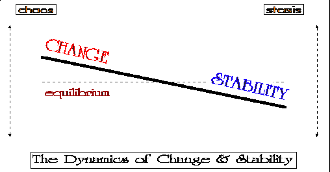
"This is rather beautiful," Weiss continues. "Change without an element of Stability would be pure chaos; nothing could ever exist for more than a split-nano-second. And Stability without any Change would be pure inertia, or stasis; nothing could ever happen. But put the two together, and everything becomes possible; to whit - the awesome splendour of our universe, of Life, and of our kind and selves. Here then, in the unification of Change & Stability, we also encounter the first example of the awesome beauty of the cosmic wholeness of all things. Many more will follow anon. Another vivid illustration of the wholeness of Change and Stability is the familiar yin-yang symbol. The ancients had it right all along."
Professor Weiss shows his second slide.

"The unified law of Change & Stability also gives us the fundamental driving forces of the evolution of Life. Life evolved from simple bacteria to the immense complexity of our planetary biosphere, including our kind and selves. But although everything else evolved from them (Carl Woese; "The Bacterial Origin of All Higher Forms of Life"; 1984), bacteria are still very much with us. And so are all the other major stages of the evolution of Life - sponges, worms, fish, amphibians, reptiles, mammals, monkeys, apes, and our kind. The evolution of Life is a pure process of (energy-driven) Change & Stability. So is every life of every living thing. Change dominates the dynamics of Growth, and later of Decay and Death; whereas the dynamics of Stability dominate the Mature phase."
"The law of Change & Stability also gives us the ultimate origin of male- and femaleness. Male spermatozoa contribute only genetic change to the female ovum; whereas the female ovum provides the genetic, morphological, metabolic and physiological stability of all living things. Without insemination, reproduction would result in an exact replica, or clone, of the maternal organism. Maleness, therefore, embodies the universal law of Change, whereas femaleness embodies universal law of Stability. And as Change and Stability are the bi-polar complements of an indivisible whole, so are male- and femaleness. So, it now turns out that our male- or femaleness is deeply embedded in the root-core laws of our universe itself. The beauty, and the wholeness of our universe - of its laws, and of our existence - is awesome to behold.
"The dynamics of Change & Stability constitute a broad, impeccably structured, and immensely rich domain in their own right. Since the dynamics of Change & Stability have their origin in the nature of energy, they are fundamentally quantum in nature. However, Change & Stability dynamics also contain a natural and seamless transition from quantum- to Newtonian dynamics. Consequently, the laws of Change & Stability hold true for both domains. Since it would take about 30 pages, we will not go into the dynamics of Change & Stability here. Instead we will only mention a few highlights. Due to the intrinsic Stability factors inherent in the nature of energy (constants, quanta, for instance), there are 'Strata of Stability'. This is very, very important; Strata of Stability play a powerfully vital role in every aspect of our existence - from our own personal health to our climates, to the Stability of social systems, and the existence of our planetary biosphere.
"One of the most familiar examples of 'Strata of Stability' are the three phases of water-ice, fluid water, and water vapour. The typical and specific Stratum of Stability of (water) ice ranges from absolute zero to O degrees Celsius. The Stratum of Stability of fluid water ranges from 0 degrees C. to 100 degrees C. And the Stratum of Stability of water vapour ranges from 100 degrees C. to the influx of ionizing energy. The sudden transitions from one Stratum of Stability to the other are energy-driven, and are caused by either an influx, or a loss of energy.
"Therefore then, we find two kinds of Change; energy-driven fluctuations within each Stratum of Stability; and sudden energy-driven transitions from one Stratum of Stability to another. This point is crucially important; our planetary biosphere also has its own intrinsic and specific Stratum of Stability, which we have driven close to a catastrophic phase-transitions.
"Essentially then, Strata of Stability are the familiar 'phases' of matter - the well-known solid, fluid and gaseous phases of matter. However, the principles of Strata of Stability as they arise out of the law of Change & Stability are far more fundamental, as well as far broader. Strata of Stability range all the way
from the 'invariants' of wavelengths, to the specific and intrinsic Stability of particles, atoms, molecules, cells, organisms, genetic, metabolic, physiological and morphological Strata of Stability - to Strata of Stability of genera, species and biospheres, and the intrinsic Strata of Stability of social, economic, political and cognitive systems. Moreover, Strata of Stability are tightly integrated with Strata of Complexity - which we will meet in a moment - as new Strata of Complexity are built upon and arise out of the abiding Strata of Stability of preceeding systems (such as multi-cellular organism out of single-celled organisms)."
Professor Weiss shows his fourth slide.
 "The
principle of Strata of Stability," Professor Weiss continues,
"applies to all things in this universe - from quanta of energy, to
neutrinos, photons, particles, protons, electrons, neutrons, atoms, molecules,
compounds, cells, organisms, biological systems, biospheres, social systems,
political systems, planets, stars, stellar systems, galaxies and black holes.
Every phenomenon has its own specific and intrinsic Stratum of Stability - and
the Strata of Stability of all compound systems, like atoms, molecules, cells,
and so forth, are composites of the Strata of Stability of their components.
"The
principle of Strata of Stability," Professor Weiss continues,
"applies to all things in this universe - from quanta of energy, to
neutrinos, photons, particles, protons, electrons, neutrons, atoms, molecules,
compounds, cells, organisms, biological systems, biospheres, social systems,
political systems, planets, stars, stellar systems, galaxies and black holes.
Every phenomenon has its own specific and intrinsic Stratum of Stability - and
the Strata of Stability of all compound systems, like atoms, molecules, cells,
and so forth, are composites of the Strata of Stability of their components.
"Among many other things, Strata of Stability explain particles (loci of 'congealed' energy), particle decay, and quantum tunnelling. Strata of Stability contain a constant flux and flow of energy, which is essentially chaotic in nature (thermal noise). When a component of a Stratum of Stability encounters a 'spike' in this chaotic flux and flow of energy, the combination of the chaotic spike of thermal noise and the 'eigen-energy' of this component can be sufficient to propel this component over the energy barrier - in what appears to us to be 'quantum tunnelling'. Particle decay occurs when a low-energy particle encounters a 'valley' in the thermal noise within the Stratum of Stability it inhabits. Thus, both quantum tunnelling and particle decay are entirely deterministic, but due to the chaotic nature of thermal noise, essentially unpredictable and only statistically predictable. (see 'Stochastic Resonance' in SCIENTIFIC AMERICAN, Aug. 1995)."
Crossmann is thoroughly engrossed in the lecture.
"The laws of Change & Stability," Professor Weiss continues, "as these arise out of the unification of Change and Stability are as follows:
When the influx or loss of energy exceeds the specific Stratum of Stability (its intrinsic and specific capacity to gain or lose energy and remain stable) of any system, the system must change.
When the influx or loss of energy does not exceed the specific Stratum of Stability of any system, the system remains stable.
When the influx or loss of energy exceeds the Stratum of Stability of any system by far,
the system collapses.
"Here then, we have also recovered Newton's laws of motion, but on a far more fundamental and far more general level - and from an independent and entirely different approach.
"Strata of Stability also apply to black holes. This means that when the influx or loss of energy exceeds the intrinsic and specific Stratum of Stability of a black hole, the black hole must change. This, by the way, is an entirely different mechanisms of the collapse of black holes than that proposed by Stephen Hawking. And the most likely change for a black hole is a phase-shift to the stupendous out-pouring of energy of a 'white hole', or quasar. For those unfamiliar with the term, black holes are stupendous gravity wells that result from the gravitational collapse of super-giant stars. This powerful gravity-well then pulls everything else within its reach into its core, and becomes more powerful with any additional mass captured. Eventually, this gravity-well becomes so stupendous that it will swallow millions and millions of stars and planets, growing ever more powerful along the way, until not even light can escape it. Hence the term 'black hole'.
"One would think that black holes are cosmic evil incarnate by pulling everything in their vast reach into the bottomless black of their insatiable core. But this is not so. The laws of Change & Stability demand that black holes must eventually give up and pour out the stupendous energy they have captured. In
this light then, black holes are, almost literally, cosmic vacuum cleaners, and perform a powerful fundamentally function within the structure and dynamics of our universe.
"In somewhat more lyrical terms, the function of black holes is to gather what has been lost, to concentrate was has been dissipated, to turn cold into heat, to turn darkness into light, to bring forth life out of death - in eternal cycles of birth, death and re-birth. Moreover, and according to the laws of Change & Stability, the birth of our universe may well have been caused - to paraphrase a recently popular colloquialism - by the inevitable collapse of 'The Mother of All Black Holes'.
"All this is very beautiful; it now turns out that the birth and death of stars, of black holes, of universes - are all governed by the same law and dynamics, differing only in the scale of the mass and energy involved. This would also move the birth of our universe firmly into the realm of the first law of thermodynamics - which is, since the Stability of energy is infinite, entirely logical.
"The law of Change & Stability - and the law of the Conservation of Energy - yield a permanently oscillating universe - from Big Bang to Big Crunch in an infinite cycle of birth, expansion, contraction, death and re-birth. Moreover, the context of the law of Change & Stability contains the strong probability
that energy and matter undergo a polarity-shift at each Big Crunch - Big Bang oscillation, yielding successive 'energy' and 'matter' - and 'anti-energy' and 'anti-matter' universes at each oscillation. The immediately preceding universe to our present universe would then have been the 'anti-universe' of our present universe. Not that this matters in any way whatsoever; unless one compares the polarity of energy of two successive universes, one could not tell one universe from the other.
"The unification of Change & Stability results in the 1st theorem of the law of Change & Stability.
- Infinite Change within Stable Parameters -
"It is a breath-takingly beautiful theorem; and it applies to everything in this universe. To most of us, snowflakes are the most familiar example of 'Infinite Change within Stable Parameters'. Each snowflake is individually unique, yet is cast in the basic form common to all snowflakes. And while there is not one snowflake on the Earth exactly like any other - nor in the entire universe - nor ever was and never will be, each snowflake is invariably true to the form common to all. The same holds true of stars, of galaxies, of planets, moons, trees, cats and dogs, every leaf on every tree, every blade of grass; and even individual bacteria behave, as Lewis Thomas observed, "as if they have names". Each is individually unique, yet all conform to the typical phenotype of their kind. The same holds true for our selves. Every one of us is individually unique, yet we are all cast in the typical human form common to all of us. Here then, we have the origin, dynamics and function of individuality, in the infinity of Change within Stable parameters - and the essence of a Chaos that never repeats itself, but is contained within a fixed frame - and thus, the origin, foundation and wellspring of all creation.
"We now come to the most significant part of this theory - the universal law of Progressive Complexity. This is very, very important. Because of the laws of Decay and Entropy, and also because of the chaotic nature of this universe, the traditional and still deeply ingrained view of science is that our universe has no meaning or purpose, and that the immense complexity of our biosphere, of Life and of our selves is an "astronomically unlikely accident in a chaotic universe" - and therefore also without any meaning or purpose whatsoever.
"In this dismal view of science, all the breathtaking beauty and teeming complexity of Life - of bumblebees and butterflies, the riot of flowers, colours and scents in spring, of mountain meadows and verdant forests, of birds, mice, tigers, gnus, whales and elephants, of our kind and selves, the awesome splendour of the firmament, of innumerable stars and majestic galaxies, even the universe itself - are all for nothing and for naught.
"All the awesome splendour of the cosmos and of Life is inexorably fated to grow cold and decay, to leave no trace whatsoever in the abysmal dark and eternal desolation of a universe dead and decayed to a bitterly cold 'soup' of stagnant particles. Consequently, we, and all the other awesome complexities of our universe are nothing more than a brief and meaningless flash in the unimaginable immensity of cosmic time.
"And while this is partially true, our scientists could not have been any more wrong. They should have known. Every star in the universe is, after all, a blazing factory of the Progressive Complexity of the elements from simple hydrogen to the 92-fold complexity of uranium. It follows that the progressive complexity of the cosmos and of Life must be deeply rooted in the fundamental laws and nature of our universe. And rather than the universe being in flagrant violation of our 2nd law of thermodynamics, it is far more likely that this law of ours is only partially true.
"And indeed it is. The law of Progressive Complexity 'pops' out, very simply, very naturally, and very beautifully, out of the unified dynamics of Change & Stability.
"Please consider the following formula, which was developed in relation to the infinite sequence of images called the 'Mandelbrot set'. The infinitely intricate complexity of these hauntingly beautiful images is generated by a very simple iterative (repeating) algorithm which, in its simplest and most basic form, is written like this:
Z^2 + C = Z1
"Here 'Z' stands for any complex number which is squared. 'C' also stands for any complex number which remains constant (hence 'C') throughout. These two factors are then added together, yielding the product Z1. Then, Z1 takes the place of Z, and the procedure is repeated. Written down it looks like this:
Z^2 + C = Z1
Z1^2 + C = Z2
Z2^2 + C = Z3
Z3^2 + C = Z4
Z4^2 + C = Z5
....... + .......
"And so forth, and so forth, ad infinitum. In practice, the procedure is a bit more complex; but this is the basic principle. When the product of each iteration is plotted on an x-y co-ordinate grid on a computer, the infinite complexity of the haunting beauty of the Mandelbrot set emerges, point by point, on the computer screen.
"The secret of the creation of Progressive Complexity is simplicity itself. 'Z' is a continuously changing factor, whereas the constant C is a stable factor. Together, and in this manner, the unified law, and dynamics of Change & Stability creates Progressive Complexity. It could not be any more simple
and straightforward. We now have the fundamental universal law of Progressive Complexity - as contained in the 1st law of thermodynamics, and intrinsic to the nature of energy.
"Nature operates in a very similar way. The Progressive Complexity of the elements is an additive 'iteration' of protons and their electrons. One proton and one electron make up hydrogen, the simplest and original element of the universe. Two protons (plus two neutrons) and two electrons make up helium, a more complex element. Three protons (plus 3 neutrons) and three electrons make up lithium, the next more complex element........and so forth, and so forth, to the 92-fold complexity of uranium. "The Periodic Table of the Elements" is a beautiful illustration of the laws of Change & Stability, and of Progressive Complexity.
"Similarly, and in the sphere of Life, all gestation and growth begins with a single fertile ovum, which is the morphological, physiological and metabolic Stability factor. The ovum divides itself into two, and now we have an embryo consisting of two cells. The doubling process is the Change factor, and we now have an embryo of greater Complexity. The two cells then divide themselves again, resulting in a 4-celled embryo, and a higher level of Complexity. Meanwhile, each cell remains an identical copy, or clone, of the initial ovum, a clear and indisputable Stability factor, while the multiplication of the cells is an obvious changing factor. Together, and in this manner, the law of Change & Stability creates the Progressive Complexity of the growing embryo.
"The only difference between the (two-dimensional) Mandelbrot algorithm, and Nature's (three-dimensional) gestation and growth algorithm is that the former is exponential, and the latter is geometric. Since, as we have seen, the dynamics of Change & Stability are clearly and explicitly contained in the 1st law of thermodynamics, it is well worth noting here that we are still fully within the domain of the 1st law of thermodynamics.
"We can now attempt the first approximation of the law of Progressive Complexity, (and I realize that it needs a lot of work):
In the presence of a positive energy gradient (an influx of energy into the system), the bi-polar dynamics of Change and Stability generate Progressive Complexity.
In the presence of a negative energy gradient (a loss of energy out of the system), the bi-polar dynamics of Change and Stability generate Decay.
"When we now summarize these dynamics in this simple little diagram, we obtain further, and very powerful insights."
Professor Weiss runs the next slide.
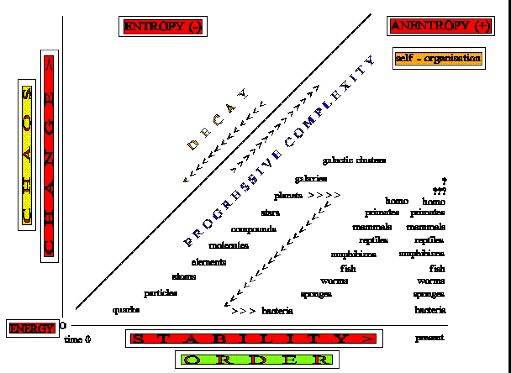
"This diagram represents the Universal Law of Progressive Complexity," the professor continues. "We can now see that the X (Change) and Y (Stability) axes contain the 1st law of thermodynamics; that the negative side of the diagonal line contains the law of Decay (2nd law of thermodynamics); that the positive side of the diagonal line contains the law of Progressive Complexity, and.that the 3rd law of thermodynamics is bounded by and lies between the X and Y axes.
"To summarize; as this diagram shows, we have derived (or recovered) the 2nd and 3rd laws of TD from the 1st law. We have unified Change and Stability into the universal law of Change & Stability; we have unified Chaos and Order into the universal law of Chaos & Order (a subset of Change & Stability dynamics - the Order in Chaos is a Stability factor, whereas Chaos is extreme Change); we have unified Anentropy and Entropy into the universal law of Anentropy & Entropy; we have obtained the law of Progressive Complexity; and we have also obtained the new and complete 2nd law of thermodynamics.
"Thus, the 2nd and 3rd laws of thermodynamics arise out of, and are inherent in the 1st law. This is as it must be. This also shows us that the traditional 2nd law, while absolutely correct, is incomplete. Our pre-occupation with the old traditional 2nd law has blinded us to the fact that Progressive Complexity is 'the other side of the same coin' of Decay (as in growth and decay) - and the until now missing half of the 'old' 2nd law of thermodynamics. The cohesion is now total, as it must be."
"This may be somewhat difficult to grasp; but it is very important.
"Moreover, and with a cohesion which is absolute, we have unified all of the above into the fundamental nature and unity of energy - as also shown in this little diagram. And we have done this without violating any of the known laws, and without introducing any new, unknown, or ad hoc factors. It comes down to nothing more than a complete integration and profound unification of the most basic and long familiar laws and dynamics of our universe. In keeping with 'GUT' (Grand Unification Theory) and 'TOE' (Theory Of Everything), this theory could well be called the "Basic Unification Theory" - or BUT, for short.
"Here, then, is the first approximation of the new and complete 2nd law of thermodynamics:
In the form of gravitation, mass and opposite polarity, energy seeks its
highest available state, and attracts and concentrates energy and matter.
In all other forms, energy seeks its lowest available state
and emits and dissipates energy and matter.
The attractive and emissive forces of energy are inversely proportional.
"Most of us are fully aware of the law of entropy: disorder increases - or, in other words, everything must run down. This is true; my cup of tea does grow colder the longer it sets, undrunk, on the desk beside me. Now then; pure logic dictates that a decrease of order is dependent upon the pre-existence of a higher state of order; and entropy can only occur in a system with a pre-existing higher state of anentropy. It follows - by pure and indisputable logic - that anentropy is primary, and that entropy is secondary.
"Moreover, entropy can never exceed anentropy; this is impossible, or 'forbidden'. Consequently, pure logic dictates that entropy and anentropy are the bi-polar complements of the fundamental unity of energy, that they co-exist simultaneously, are relative to each other, and that entropy and anentropy are inversely proportional.
"And the same is true of the 2nd law of thermodynamics; the dissipation of energy is dependent upon the pre-existence of concentrated energy, and can only occur in the presence of a pre-existing state of a higher concentration of energy. Consequently, the concentration of energy is primary, and the dissipation of energy is secondary And exactly as entropy, the dissipation of energy can never exceed the concentration of energy; this is impossible, or 'forbidden'. Consequently, pure logic dictates that the concentration and dissipation of energy are the bi-polar complements of the fundamental unity of energy, co-exist simultaneously, are relative to each other, and are inversely proportional.d
"Am I wearing you out with this?"
"Will we be teested on this?" a young male student asks on the right.
This makes the class laugh.
"You will be tested on some of it," the professor responds. "I will tell you at this moment which part will be on the test."
The class again laughs. This time the laughter is a bit weaker.
Professor Weiss begins again: "It remains to be said that the laws of Change & Stability, and of Progressive Complexity apply to all physical, chemical, biological, instinctual, social, psychological, technological, economic, political, and cognitive systems. This is in complete accord with the late Nobel Laureate Ludwig von Bertalanffy's intuitive foundation for his Growth Dynamics "General Systems Theory" Bertalanffy writes: 'All physical, chemical, biological, social and psychological systems operate in accord with the same simple universal principles.'
"However, as fate would have it, these few universal principles eluded him while he lived; and this was most likely so because of their extreme simplicity. This theory is dedicated, therefore, to the memory of a brilliant and extremely perceptive scholar."
Professor Weiss turns up the lights.
"This is the end of this bare-bones sketch of the unification theory, and of the new universal law of Progressive Complexity. And while this may be a simple little theory, the implications are myriad, vast and, as you will see, truly stunning. We will now consider a few of these vast implications.
"First of all, the laws of Change & Stability, and of Progressive Complexity generate and govern the evolution of the universe, of Life, and of consciousness alike. The evolution of the universe, of Life, and of consciousness is one single, inseparable, continuous and seamless process.
"We are, after all, made of atoms - of protons, neutrons, and electrons - even quarks when one comes right down to it. And we are animated - body and mind - by the energy of our universe. As Carl Sagan put it in the concluding paragraph of his bestseller "Cosmos";
'We are the local embodiment of a cosmos grown to self-awareness. We have begun to contemplate our origins; starstuff pondering the stars; organized assemblages of ten billion, billion, billion atoms considering the evolution of atoms; tracing the long journey by which, here at least, consciousness arose. We speak for Earth. Our obligation to survive is owed not just to ourselves but also to that Cosmos, ancient and vast, from which we spring."
"Since the evolution of the universe and of Life is a single seamless process, Life is a natural and common property of this universe, and will arise and evolve wherever this is at all possible. We are far from alone. There are billions upon billions of other sentient races out there, in forms which we cannot even imagine. "Star Treck" is right on track. This is now beginning to be recognized in the new concept of "The Ordinary Universe" - everyting that we see here on the Earth is 'ordinary' for this universe.
"And by the way, since all of these laws are fundamental laws of the universe, this little diagram will be known and understood by all those sentient races throughout the universe who have come to understand the nature of the universe. Further; since the law of Progressive Complexity generates and governs the evolution of the universe and of Life alike, the evolution of Life anywhere in this universe will - in principle - parallel the evolution of Life as we know it here on the Earth. Although the form Life takes will differ wildly from place to place - according to local conditions - exactly the same evolutionary principles apply, anywhere in this universe. This also gives us the framework and foundation for a truly universal, or 'cosmic' theory of the evolution of Life.
"This universal, energy-based theory of the evolution of Life is now being worked out at the University of Zurich, by a group of scholars who have 'adopted' my theory.
"Since male- and femaleness arise out of the universal law of Change & Stability, Life anywhere in this universe will also know male- and femaleness - in one form or another. In a universe subject to Decay, replication and reproduction are the only means to maintain continuity (Stability) - be this of stars and planets, galaxies, black holes, or of Life. And since femaleness is sufficient to reproduce life - there are many thriving purely female species here on the Earth (see; "Courtship in Unisexual Lizards; ..." SCIENTIFIC AMERICAN, Dec. 1987) - there will be, undoubtedly, a few purely female races out there. But most by far will know gender, and in far more permutations than we can now imagine.
"This brings us to another point. Nature has hardwired the instincts and basic psyche of the genders according to function - otherwise it simply would not work. Consequently, the psyche - and the perceptions and motivations - of the genders differ fundamentally, and almost diametrically. We now also have the beginnings of a 'cosmic' psychology in our hands here.
"Consequently, if we should ever meet an extra-terrestrial race, we will basically understand each other. Although our languages will be all but incomprehensible to each other. The females of all species will basically understand each other; pro-creation will always be understood by all females, anywhere in this universe. And so will the males; conquest will always be understood by all males - anywhere in this universe. And given the fact that the evolution of the universe, and of Life and consciousness is a single and inseparable process, we can now state that the universe exists for the sole and express function and purpose of evolving Life and consciousness. To whit, and among billions of other highly conscious races, our kind and selves.
"Many scholars will maintain that the emergence and evolution of our kind is the result of many accidentally twists and turns in the fabric of Life on this
Earth. This is true. To whit, the extinction of the dinosaurs, which made the emergence of the mammals, and eventually of our kind, possible. There have been, and there will be many more such unpredictable twists and turns, here as elsewhere. However, the universe does not care what form conscious Life takes. The universal laws of Change & Stability, and of Progressive Complexity establish a broad and abiding base of Life, and if one species or another, even many others, should be wiped out accidentally, others will emerge and continue to evolve. If the dinosaurs had not been wiped out by some terrestrial cataclysm, there may well have been a race of highly conscious dinosaur- descendant 'people' on this Earth by now. And if we should wipe our kind and selves off the face of this Earth - which we are well along the way of achieving - evolution will continue to raise another species to our level of consciousness, and beyond.
"Since the law of Progressive Complexity is fundamental to our universe, this completely changes the nature of our universe from the old mistaken notion of 'chaotic' and 'accidental', to a teleological universe And this is the most stunning, conclusion of all. A teleological universe is a designed universe - a universe which embodies a vast plan and supreme purpose. Consequently, there exists a Designer - a Supreme Cosmic Consciousness - of this universe, after all (more at 'The True Nature of our Selves')."
There is a silence.
"Any questions?" Professor Weiss asks.
Crossmann raises his hand.
"Yes."
"I found the lecture quite wonderful," Crossmann says. "But I have a question. You say that the Law of Progressive Complexity is fundamental to our universe; does this suggest that the Law of Progessive Complexity in anti-fundamental to the anti-universe?"
"Well, that is an interesting question," Professor Weiss replies. "Are you suggesting...what? That there is a Law of Anti-Progressive Anti-Complexity which is fundamental to the Anti-Universe? What would that be...?"
"I find it interesting that you place the anti-universe, in a serial sequence," Crossmann says, "before the universe, an older universe, the most recent universe, that 'flips' into the anti-universe. An older universe that dies and turns in on itself, becoming cold.... And I think that is correct. But what is the nature of this 'death'? What we have traditionally called 'spirit' we can now, in science, call 'anti-matter'. So the 'spiritual world' is the world of the 'anti-universe'. The 'spirit' world hates the 'material world'. They are adversaries. They are a perfect reflection of the other. The opposite of the Law of Progressive Complexity would be the Law of Recessive Simplicity. Reduction back to the One; indeed, back to the One, and then to the Zero. the Universe and the Anti-Universe meet at zero. To the Anti-Universe, Life is evil and death is good. For death is spiritual life. The anti-universe worships death. To the Universe, Life is good and death is evil. For Life is triumph over darkness. The Universe worships Life...."
"Yes."
"From the perspective of the Universe, the Law of Recessive Simplicity seems like involution; and the Laqw of Progressive Complexity seems like evolution," Crossmann continues. "But from the perspective of the Anti-Universe, the opposite seems true."
"I would like to meet you after class, sir," Professor Weiss responds. "Anything you would like to add?"
"Something about Time," Crossmann says. "In Progressive Complexity, Time runs into the Future. In Regressive Simplicity, Time runs into the Past. There is Time in the Universe; and there is anti-Time in the Anti-Universe. Time runs backwards."
"Can you expand on this?" the professor asks.
"You can see it in the human mind," Crossmann says. "The child and the aged person look back in Time, back to an ideal which is either in their imagination or perhaps is real. A memory of the Anti-Universe, from which they have been born. The adult has the responsibility of creating the world, creating the future. They look forward; and this gives them the strength, the energy, to create the world, to make the world hold together through the power of their wills.
"You speak of pro-creation and the universe; anti-creation lives in the realm of the anti-universe.
"The anti-universe is where the dead live," Crossmann continues, "those for whom the energy of life has been transferred from their physical bodies into their spiritual or dream bodies. They are often jealous of the living. The living are individuals; they have given up the general truths, the archetypal world. They have fallen. Yes, they are fallen angels. They make an arc away from the center, repelling the anti-universe as they travel through space. They create the earth. When these adults grow weary however, when they become old, they begin to lose sight of a place in the future for them. They have been angels and warriors and students and lovers and spouses and parents and protectors and grandparents and then there are no more symbols, no more guide-posts to lead them into the future. They have had action, incarnation; now they begin to reflect on their lives, their experiences. They begin to look back. Reflection. They then enter the anti-universe, either at their physical death or more likely at some spiritual death. And then they begin to travel back, back through their own personal lives, then beyond their personal lives, back into the life of the earth, the life of the solar system, the galaxy, the milky way, back toward their source, back toward the zero, the place before everything was born. Time running backwards is the anti-universe. Time running forwards is the Universe. Time running backwards is the Night. Time running forward is the Day. It is all rather simple. In another odd aspect of the Universe/Anti-Universe contiuum, research will show and is currently showing that human speech, when run backwards contains an inner lining of truth as to what the speaker is often hiding in his speech. Human speech, too, runs backward and forwards...."
"Interesting," Professor Weiss says. "Anything more you'd like to relate?"
"One thing more. Your scheme in which the woman represents stability and man change, must have its opposite in the opposite universe. Traditionally, in myth and in religious thought, man has represented Order and woman Chaos. Your scheme reveals the opposite "truth". On one side man is good and woman is bad; and on the other side woman is good and man is bad. I wonder if this means that your view is from the anti-universe...?"
The bell rings.
The students begin to speak, some grumbling about the lecture being incomprhensible.
Crossmann looks down the row from him. He is sitting on the aisle. He sees Jerry Seinfeld and George Costanza. Jerry is saying: "They Theory of Everything. That's Really the Same As the Theory of Nothing..."
"The Theory of Nothing!" George says, excited. "That's it! Our show can be about the Theory of Nothing...!"
"What?" Jerry asks. "Nothing?"
"Yes."
"Well, it has to be about Something," Jerry reasons.
"No. Nothing," George says, adamant.
"Well, how can it be about Nothing?" Jerry asks.
"Nothing. It's about Nothing!" George shouts, his face and bald head growing red with animation, signalling conclusion on the subject.
Crossmann thinks about the Comedy Club. If Jerry Seinfeld is here, then perhaps Crossmann is close to the Comedy Club. Maybe he can ask Seinfeld how to get to the Comedy Club. Or maybe he could just follow him. Maybe Jerry is going to the Comedy Club right now....
Seinfeld and Costanza leave by the opposite aisle. Crossmann hurries to follow them.
"Mister Crossmann," Professor Weiss calls. "Can we speak...?"
"In a moment," Crossmann cries to Weiss. "I'll be back in a moment. I have to ask someone something..."
Crossmann is caught in a crush of students all trying to get out of the small door. It takes for ever. Crossmann wants to push and shove; but he was raised to be patient and courteous. So he mereely bides his time, letting himself be carried by the wave of people to the small door. They spill out into the hallway.
Crossmann hurries up the hall.
Costanza is standing off to his right.
"Where is Jerry?" Crossmann asks.
Costanza is surprised that Crossmann knows Jerry.
"Jerry Seinfeld?" George asks. "Jerry Seinfeld, you mean?"
"Yes."
"How do you know Jerry?" George asks.
"From the Comedy Club," Crossmann responds. "I'm a comedian too."
"Oh, really?" George asks. "Well, you really had me going back there. The anti-unvierse this, the universe that. That was really something...."
Another man is standing next to George. Kenny Banion, his face wide with acceptance, admiration, like a pancake awaiting butter.
"That was gold, Mister Crossmann, gold," Kenny says. "Especially that part about the anti-unvierse being round, not oval. And then that aside: 'They should call it Roundtine instead of Ovaltine.' That was gold, gold. Do you mind if I use it...?"
"No, help yourself," Crossmann says. Then to George: "Where's Jerry...?"
"Oh, in the bathroom," George says.
"Maybe you can help me," Crossmann says. "I'm looking for the Comedy Club. I have a performance tonight. I'm not sure how to get there from here. I'm from out of town and all..."
"Which comedy club?" George asks.
"The Comedy Club," Crossmann says. "That's the name."
Costanza looks at Banyon. They both shrug; they aren't sure.
Crossmann enters the bathroom. It is packed. He realizes he has to urinate. He can't remember the last time he urinated. A man leaves the nearest stall.
Crossmann pushes ahead of others, into the stall.
He urinates in the toilet.
He pees for a long time. He has been holding his water too long. His kidney is even hurting. He wonders how long it has been hurting. He thinks for a moment about kidney cancer.
The bathroom is emptying out. The sounds are flowing, ,like an ocean's roar.
He hears a man's voice come from the adjoining hallway. The voice is familair; but he can't place it.
"That fucking Supreme Court!" the man is saying. "Damn partisans! We think we have an out here too, Al. We have a young woman, a young black woman, who will claim that when she worked with Judge Thomas he....harassed her sexually...."
"What?" another voice comes in. It sounds like Vice-President Gore's voice.
Crossmann realizes that the other voice is the bald-man's voice.
"Did he do it?" Gore asks.
"What? Oh, no. But she's willing to say it if he doesn't vote with us. She'll destroy his reputation. A black conservative! She says he's a traitor to his race..."
"Why?" Gore asks.
"Because he's a conservative, dummy!" the bald man says. "My god, sometimes you are...just like Goober Pyle. Knock, knock: anybody in there...?"
"What did he do?" Pyle asks -- err, Gore asks.
"Who?"
"Thomas."
"Oh, he didn't do anything. But she is going to testify that he.... We told him, if he votes against us, we'll expose him as a sexual pervert... She's going to say that he asked her out continually, that he bragged about his sexual prowess, explained how women perform sex acts with animals in pornographic movies; and if that isn't enough, we're going to have her say that he gave her a can of coke with one of his pubic hair's on the top of the can...."
"What?"
"Yeah. That's a good one, don't you think?" the bald man asks. "I'm not sure who thought that one up. Someone over at State, I think...."
"Isn't that a racist act?" Gore asks. "To defame a black man...?"
"What! He ain't no black. He's an Uncle Tom. He doesn't give a damn about his race. I mean, the man is against Affirmative Action. And he's against abortion. He's against all the good things in life...."
"Are you saying that blacks are only blacks when they are liberal?" Gore asks.
"When they are poor, liberal and oppressed," the bald man replies. "That is the definition of the African Amereican..."
"And if individul blacks overcome this definition....?" Gore asks.
"Then they are Uncle Toms," the bald man responds.
"So they are doomed to remain poor and oppressed, victims, for ever?" Gore asks. "By defintion?"
"Yes. That's it," the bald man says.
"So, there will be justice in America for the African-American only when some force in nature, God or...."
"The Democratic Party," the bald man adds.
"Raises them up, as a race, from their state of poverty and affliction at the hand of the white man?" Gore asks.
"Precisely."
"They can't do it on their own, as individuals?"
"No. Not without becoming an Uncle Tom. It's a good system, don't you think?" the bald man asks. "They can't do it without us. If they try to do it without us, they are traitors to their own kind. Uncle Toms. We defame their character. We say they are trying to be white if they become conservative. If they forget that race is everything...."
"But there are poor whites," Gore states. "No race is raised up as a race. It is always inviduals who rise. There are whites who are poor and oppressed, even as there are whites who are rich and powerful...."
"Don't let anyone else hear you say that, Al," the bald man says. "A lot of our people already think you are a bit soft on the race question, your elite, rich, southern background and all..."
"I am not soft on the race question!" Gore replies. "But there are a lot of educated, reasonable African Americans who no longer support affirmative action...."
"Uncle Toms!" the bald man answers.
"They believe that lowering the bar hurts everyone, African-Americans too," Gore says. "They believe that a igher bar is good for everyone, because it requres everyone to try harder to get over the bar. A challenge is good for the soul, something to overcome. African Americans don't need special treatment to compete with whites in sports, the arts or entertainment. They only need a fair chance to compete in business, politics, the law. And that comes from a good education system, especially at the lowest grades, an education system which teach the basics of reading, writing and aristhmetic. Really teaches it. I mean, now teachers just pass students to keep them moving, like damn cattle, through the system. We can't pass a student if he can't read or write or do math. It's bad for our country to be like that. It doesn't help anyone. It doesn't help the student to tell him he's not failing when he is failing. Life will tell him he's failing even if the teacher doesn't. Yes, we need educational reform...!"
"Tell it to the teachers' union," the bald man says. "They don't want change. They want everything left alone. So students can't read. That's not their problem. They have students coming to school with guns. Teaching is a secondary concern. Keeping everyone alive is their primary concern now..."
"We need school uniforms!" Gore cries out. "We need discipline in schools. We should use the Catholic school as a model. Those damn nuns know how to teach. Have yuo seen reseach that shows that nuns can get better results with less funding than any other system...?"
"Jesus, you're sounding more like Bush every day," the bald man says. "No wonder the voter couldn't tell you two apart! That's why we have all this trouble today! Dammit, get a hold of yourself. You're an embarassment to the liberal idea. The freedom of the student to express himself! Remember? If he wants to carry a gun to school, that's protected by the First Amendment. School uniforms! Do you think ole whatshisname, Ralph Lauren and Calvin Klein, is going to give us his money if we propose something like that...?"
"Oh, right, I forgot," Gore says. "I think I have a fever or something. We've been in this damn toilet stall too long. Who are we waiting for...?"
"We're waiting for a friend," the bald man says.
"And where do we stand?" Gore asks. "I thought we had a man down in Florida with a voting machine. I thought he was going to run his own ballots..."
"The police caught him before he could run the ballots," the bald man says.
"Shit!"
"We're not out of options," the bald man says. "We have a shot in the Supreme Court, with Thomas..."
"The blackmail, you mean?" Gore's voice asks.
"Yes. And we've got another option. We have contacted several of Bush's electors up in New England. We might be able to get them to change their vote to Gore when the electors vote in DC, on the 18th...."
"Why would they do that?" Gore asks. "They're republicans."
"They might be convinced that this election isn't fair."
"Conscience?" Gore asks.
"Yes. And our old friend Mister Greenback. That's where our friends come in."
Crossmann hears the toilet in the stall next to his flush.
Then silence.
Crossmann flushes his own toilet; then he leaves his stall.
To his right, two Buddhist monks, wearing Orange robes, are handing two suitcases to the bald man. Albert Gore is no where to be seen. Mario Cuomo is standing in the same corner, blowing his nose.
Crossmann washes his hand.
A young student is standing next to Crossmann, drying his hands on a paper towel.
"Why do you always portray the democrats as the corrupt side?" he asks. "Don't you know that the republicans are corrupt too?"
"Yes," Crossmann replies. "The republicans are corrupt too. But I am in the universe now -- so I see my opposite. Were I in the anti-universe, I would be showing the republicans' corruption. If you read my earlier books, you will see that I spent a great deal of time castigating the conservatives...."
"So, there is no truth?" the student asks. "There is only....perspective."
"Each side is dark and light, light and dark by turns."
"Can we live without a sense of truth?" the student asks.
"There is a truth," Crossmann says. "But there is little truth in the polarity. There is a truth outside of Time that we cannot access in our present state. The truth, in Time, depends upon what side I am on. I am the balance. Not myself personally; but the principle of the balance. I am on one side; then on the other. The democrats always appeared to be the side of truth. Now the republicans seem more moral. Take abortion, for instance. The republicans argue that abortion is the killing an innocent baby. The democrats argue that it is the woman's right to choose. It is her body. The fetus is like a growth, a tumor only, until it reaches a certain age -- when it, magically, becomes a baby. One can pop the tumor, like it was acne, a boil, up to a certain age, a certain trimester of gestation. The democrats say that it is ok to kill a fetus; but not a baby. They say that the fetus is not a baby baby. Some even say a fetus is not a living thing. This is a specious argument. It is like saying it is ok to kill a thirtten-year-old, but not a thirty-year-old. If liberals want to argue that it is ok to kill a baby because the baby complicates a woman's or a couple's life -- that this is a practical decision, not a moral decision -- then that is at least an honest argument; it is not a moral argument. The balance is the Truth. I, the balance, educate one side; and then I educate the other side. Both sides are true at certain time; and also false...."
Crossmann finishes drying his hands; then he says: "The Republicans believe in the individual; and this is the Man's voice, the defender of the Father. The Democrats believe in generalities; and this is the Woman's voice, the defender of the Mother. The Man's voice believes that the individual is good and that the group is dangerous; the Woman's voice believes that the individual is dangerous and that the group, the community, is good. The Man is born from the Woman to create order, law, in the world, to defeat chaos. The Woman then seeks to defeat the Man, the individual, the Day, so that she can rule. But her rule is governed by darkness; the Woman rules the night. Poverty, crime, disorder. Chaos threatens her world. She seeks again to give birth to the Man, her son -- and the Man who eventually regains power, driving away the darkness, chaos, poverty, disorder. But the Man eventually becomes a tyrant, against whom the Woman again will conspire to destroy. In this movement is everything. Both sides are good; but the shadow of each side is evil...."
"Hey, you!" the bald man calls out. Nodding to Crossmann. "I want to talk to you!"
Crossmann leaves the lavatory, runs down the hallway.
The bald man tries to chase Crossmann, but he is weighted down by the two suitcases.
Crossmann runs up a darkened hall. He stops at a room on the left. It is locked. He uses his key. He enters the room.
"Ahh, Mister Crossmann, we have been waiting for you. Welcome!"
This voice belongs to Professor Harris, a jovial, moon-faced man with dark-framed glasses.
A man looks at his watch, a Professor Greenleaf. "Better late than never," he grumbles.
"I was caught in the lavatory," Crossmann says.
"Doing what?" Professor Whitcomb asks, a thick woman with long, dull brown hair and an oval face of some fifty years. "Who caught you?"
Crossmann laughs.
"Simple relief mode," Crossmann replies. "Nothing more."
"Very well," Professor Harris cuts in. "Let's move along. Of course, you are here for your oral exam."
"Oh, we are dentists, now?" Professor Whitcomb asks, with a feigned surprise.
"Oral, moral -- what's the use?" Professor Greenleaf asks, again looking at his watch, beginning to think about the bottle of scotch in the bottom drawer of his desk.
"Do you want to run this meeting, professor?" Harris asks Greenleaf, offended by her dental-mental remark.
"You're doing fine," she says condenscendingly. "Keep up the good work, professor!"
"You two, please," Greenleaf responds. "I don't wish to be a witness to this bickering. Why don't you just go ahead and screw each other and get it over with, so I can get a drink...."
"Am I in the wrong room?" Crossmann asks.
"Gibbon wrote of the Romans," Whitcomb replies straighly: "'Agriculture is the foundation of manufactures; since the productions of nature are the materials of art. Under the Roman empire, the labour of an industrious and ingenious people was variously, but incessantly employed, in the service of the rich. In their dress, their table, their houses, and their furniture, the favourites of fortune united every refinement of conveniency, of elegance, and of splendour, whatever could soothe their pride or gratify their sensuality.' True or false?"
"True, Gibbon wrote that," Crossmann replies. "Chapter Two."
Whitleaf comes in: "Marcus Vipsanius Agrippa was Octavian's most effective general. True of false?"
"True," Crossmann says.
"Germanicus was the very popular nephew of the emperor Tiberius and grandson of Livia by her first marriage to Tiberius Claudius Nero," Professor Harris begins. "Germanicus gained popularity through his excellence as a leader in the Roman army on the frontiers. The Roman social and political system had a way of blending family relationships and political relationships in a way we would find very confusing today. Tiberius and Nero Claudius Drusus were both sons of Livia and Tiberius Claudius Nero. When Livia divorced T. Claudius Nero, whom did she marry and in what year...?"
"Octavian, who later became Augustus in 38 BC," Crossmann replies. "Augustus, in fact, forced T. Claudius Nero to divorce his wife so that he, Augustus, could marry her."
"Why was Livia such a catch?" Professor Whitcomb asks.
"Livia was a member of the powerful Claudian family," Crossmann replies. "And the new emperor needed her wealth and influence to establish his position."
"How long were Augustus and Livia married?" Professor Whitcomb responds.
"Fifty-two years."
"Was Cleopatra a nymphomaniac?" Professor Harris asks.
"Such is the speculation," Crossmann responds.
"Did Marc Anthony suffer from satyriasis?" Professor Whitcomb counters.
"I have heard no such speculation," Crossmann says.
"When a woman likes sex, she is a nymphomaniac," Professor Whitcomb concludes. "When a man likes sex he is a healthy, normal man...."
Professor Harris gives her a deep, abiding look of rage.
"Bend her over, doc," Professor Greenleaf suggests. "She wants to be a healthy, normal woman, for a change."
He takes a sip from a flask he has discovered in his briefcase.
"That, you understand, is sexual harassment," Professor Whitcomb replies. "You cockless sot."
"Castrato and his entourage, Curly and Moe," Greenleaf replies.
"Crossmann," Greenleaf pivots on a word: "Explain how the medieval social and economic system worked."
Crossmann replies: "Briefly, this is how the medieval system worked in theory. A powerful military leader (such as William, Duke of Normandy) conquers a kingdom (such as Anglo-Saxon England) and has a vast amount of land at his disposal. The original inhabitants are lucky to be left with their lives to live out
in poverty and humiliation. Now the conqueror becomes king, and begins to reward those ruffians and gangsters that helped him steal his new kingdom. These worthies become barons, dukes, and knights, depending on how much land the king gave them All the chief throat slitters and village burners that had brought the most soldiers with them to help in the conquest got the largest numbers of choice estates, scattered throughout the countryside (The king didn’t want any of his barons consolidating in one geographical area their holdings and becoming powerful rivals to the throne.) The plain old skull bashers who brought only twenty or thirty men with them got fewer estates of lesser quality. These barons and dukes in turn subdivided their estates and parceled them out to their head retainers, and so on until each one - horse knight had at least a modest estate. In return for the grant of tenancy to the lands (all property was, in theory still owned by the king and simply occupied by the barons as long as they kept up their feudal obligations), the lords, barons, etc., had to supply a certain number of fully equipped fighting men for so many days each year and a specified number of pigs, sheep, sacks of flour, cowhides, and other "in kind" items to his overlord. Thus, one can see that the medieval economy was one of service and rents in kind exchanged for tenancy and rights to land. It is very important to note that the medieval economies almost totally ignored foreign trade and most domestic trade, Commerce almost completely died out. All commerce and trade, except for simple barter, requires some form of money or medium of exchange in order to function at all..."
"One of the reasons we asked you here, Michael," Professor Harris says, "is that we feel -- we have been watching Oprah this evening -- we feel your rather cavalier forecast of the America-as-Rome theme during your picarresque journey has been, if I may say, well, somewhat...cavalier..."
"We don't think you know enough about the history of Rome to be making these sweeping conclusions, young man," Professor Greenleaf agrees, tipping a bit in his chair. "What do you see in the history of Rome which would tie Roman history as a kind of metaphorical prototype to America? I just don't see it..."
"It is a vision more than a rationalization," Crossmann replies.
"A vision!" Professor Whitcomb cries. "We give no points for visions in this university! Are you a cleric or a rational thinker...?"
"One sees the powrful force of dismantlement from within Eastern Europe today," Crossmann says.
"And an equally powerful force of consolidation," Professor Whitcomb responds, "in Western Europe."
"Yes. But a growing resistance to that," Crossmann replies. "In America, among counter-culturists, there is a cult surrounding the dismantlement of the American Empire into geographical regions. This scheme was outlined in the book Ecotopia which came out in the 1980s. This seed-matter was laid during the most recent death experience of America, prior to its most recent re-birth. There is a strong intellectual urge in America for self-crucifixion. Growing out of guilt. Guilt for wealth, guilt for sins in the world. The intellect desires, of course, to always be on the right side, the moral side. That is what this dismantlement would be, in fact. A kind of self-crucufixion..."
"You fulfill your name, Mister Crossmann," Professor Whitcomb remarks. "Your obsession with the cross, I mean. Your cross examination...."
"Are you a supporter of this dismemberment?" Professor Harris asks.
"No. The dark energy dismembers," Crossmann says. "The light energy members. See the myth of Isis for a mythological view of this."
"Was that a footnote?" Professor Greenleaf asks, now quite drunk. "Did you document that reference. Ahh. Very good. Very funny. He's almost ready for the Comedy Club..."
"Ssshh," Professor Whitcomb says, giving Greenleaf her death eyes. "You're a disgrace!" she mutters under her breath.
"What, in fact, and where, is this Comedy Club?" Crossmann asks.
"Tell me the story of Gall Placidia, Crossmann," Professor Whitcomb demands.
Crossmann thinks for a moment. Then he replies: "Galla Placidia was the daughter of an emperor, half sister of two emperors, the wife of another emperor and the mother of yet another emperor. She was married first to a king of the Visigoths who carried her away as a captive, just another item of stolen plunder from the sack of Rome. She fell deeply in love with her barbarian king and only condescended to marry her second husband, a Roman emperor whom she merely tolerated after her one and only true love had died. She ruled as a regent, as a queen mother in fact if not in name and held the reins of empire in her strong hand, fulfilling the responsibilities of her throne better than any man alive at the time. She had the body of her infant son brought back home from far-off barbarian Spain in a little silver casket to be buried next to her in her mausoleum. Galla Placidia even betrayed her own flesh and blood, joining in and encouraging the clamor of the citizens of Rome for the death of Serena, widow of the loyal and faithful Roman master general Stilicho. This kind and gentle woman was her aunt who had opened her home to the young princess while she was yet a very young girl, raising her as one of her own children. In her later years, Galla Placidia was held in high esteem and affection by the people of the Italian city of Ravenna. The Roman Empire was in a state of sad decline by then and Placidia had used her great wealth to build many churches in Ravenna and perform many charitable works to benefit the poor..."
"Tell me more about this barbarian lover!" Professor Whitcomb cries.
"Placidia was in Rome at the time of its sack by Alaric and the Visigoths. She was carried off as part of the plunder but later married Alaric’s brother Athaulf in 414 after Alaric had died and Athaulf had become King of the Visigothic nation. The Roman princess and the barbarian king soon had a family. Galla Placidia gave birth to baby boy whom she named Theodosius after her father. The infant died after a few weeks and was buried in Barcelona, Spain where Athaulf had settled his people after much wandering about Europe. After Athaulf was murdered in 416, Galla Placidia was treated shamefully by Singeric, the new Visigothic king. Instead of treating the widow of his predecessor with tenderness and compassion, Singeric
forced her to walk twelve miles on foot ahead of his horse in the company of common prisoners. Placidia did not have long to wait for justice, though. Singeric was not well liked by the Visigothic warrior elite and was murdered after a reign of only seven days by Wallia, a Visigothic warrior who won popularity by announcing his intention of making war on the Roman Empire. Wallia ended up selling Placidia back to her brother Honorius for 600,000 measures of grain. Placidia returned home in 416 to marry Constantius, a general of Honorius’a short time later. Constantius was made co-augustus in the West in A. D. 421 and became the Roman emperor Constantius III. He died of pleurisy after a reign of only seven months. From this marriage, Galla Placidia had two children, Valentinian, who later became Emperor Valentinian III and Justa Grata Honoria, who is only remembered in history from a few coins bearing her portrait and a strange tale of forbidden love and treachery...."
"Tell me this strange tale!" Professor Whitcomb commands.
"Justa Grata Honoria, another strong-willed fifth-century woman," Crossmann replies, "was born in 416 or 417, the daughter of the future emperor Constantius III (421) and Galla Placidia. She was the elder sister of the emperor Valentinian III (425-455), and she held the title of Augusta. At the orders of her brother, she was devoted to virginity, a situation she did not find to her liking. Circa 449 she was apprehended in a love affair with the overseer of her estates; both supposedly were engaged in a plot to seize power for Honoria. As a result, her lover was executed and she was exiled to Constantinople. She then appealed for help to Attila the Hun, at which the eastern emperor Theodosius II, who already had enough problems with the Huns, immediately dispatched her back to Italy -- with the recommendation that Valentinian turn her over to Attila. Valentinian, meanwhile, was enraged, and only spared her life because of the earnest entreaties of their mother. She then was compelled to marry a reliable senator named Flavius Bassus Herculanus and subsequently she was kept under close guard. Attila, meanwhile, chose to interpret Honoria's missive as a marriage proposal, and demanded half of the western Roman Empire as her dowry. Attila's ultimatum was refused, and he responded by invading the western empire in 451 and 452. Honoria's ultimate fate is unknown; she may have been dead by 455..."
"Tell me about their lovemaking!" Professor Whitcomb cries out. "Describe it to me...!"
"Whose lovemaking?" Crossmann asks.
"Placida and the barbarian!"
"I don't know," Crossmann replies.
"Make it up!" Professor Whitcomb cries.
Professor Whitcomb turns to Professor Harris. She says: "I bet he looked just like Fabio Lanzoni...!"
She pulls off her blouse, exposing large breasts in a maroon brasierre.
"Athaulf!" she cries to Professor Harris. "Make love to me like a barbarian...!"
"Do you mind?" Professor Harris asks Crossmann.
"No," Crossmann says. "Enjoy!"
Professors Whitcomb and Harris flop on to the floor of the stage. They begin kissing, and tearing at each other's clothes.
"She's notorious for her lovemaking, a regular Livia," Greenleaf cries out. "Livia de Haviland, that is! That's precious...!"
Crossmann watches the couple grapple on the floor.
"Tell me about their lovemaking!" Professor Whitcomb cries out.
"Placida grabbed him by the shoulder, sinking her lean fingers deeply into his olive skin," Crossmann says. "She gasped, crying out in delight, as he touched her midden mound through her undergarments..."
"Oh, that's nice," Greenleaf cries out. "Midden mound. Muddy mound, more like it..."
"Continue with the examination, Greenleaf!" Professor Harris cries out, giving orders in short, hot breaths.
"Yes, right," Greenleaf says, laughing to Crossmann, making a face behind Harris's back. "Tell me this, ole chap. Why is it that Americans don't trust their intellectuals...?"
"Well," Crossmann responds, thinking for a moment. "I believe they do trust their intellectuals. They don't trust the intellectuals who present for them a vision of a chaotic future. They trust those who give them a vision of a positive future...."
"They trust scientists but not poets, is that what you are saying?" Greenleaf asks.
"Perhaps. Poets, historians, social scientists, humanists. They trust the light mind -- the mind that gives them hope -- not the dark mind," Crossmann says.
"But the light mind is mortal? Is it not?" Greenleaf asks.
"The dark mind seeks to lead the soul deeper and deeper into the tragic, the hopeless," Crossmann says. "The dark mind ever looks back, idealizing the past. The scientific mind believes in, always, a more positive future. The Comedy Club, that is. The scientific mind chooses Life; and chooses solutions to Life's problems. The dark mind chooses defeat at the hands of Life's problems. But this light mind, the man's mind, grows weary. It is like our friend there in that pile of flesh. He will soon be magnificently aroused and his penis will be as hard as a rock for awhile, until it completes its work. Then it will go flat. The scientific mind is like that. When it is aroused, it raises a large tent up over the earth, bringing light to everything. But then it is spent; killed, ground down by the negative mind. The paradox, of course, is that the dark mind, the poetic mind, the one that loves the past and hates the future, is the very same mind which, by its ability to read dreams and the symbolic language of the dream, this dark mind also gives birth, again, to the man, to the light. The woman's mind destroys the light; but she finds the night is rather terrible at times, with all its poverty, crime, and general chaos, madness; there are monsters in the night that want to kill her and her breed. And so she gives birth to her son, who, again, raises the light. And drives the darkness back into its hole...."
"Oh, yes!" Professor Whitcomb cries out. "Agrippa, Agrippa, God bless you, Agrippa...!"
"Agrippina! Suckle me like a she-bear...!"
"Speaking of driving the darkness back into its hole," Greenleaf whispers, smiling a nasty smile.
Crossmann is silent.
"When she finishes with him," Greenleaf says, "you'll be next!"
"I don't think so."
"Yes, if you want to pass this class, you will!" Greenleaf says. "If you want to call yourself 'Doctor', you will. That's the rule."
"I don't like that rule," Crossmann says.
"You'll adjust," Greenleaf says. "Why do you think I'm getting shit-faced? She'll be finished with old Richard in a few minutes and then she'll be looking for....a young George Segal, I guess -- and, the fact is, that's you..."
Greeleaf laughs at his own allusion, pleased.
"She's Queen Elizabeth then?" Crossmann asks, getting the joke.
"Yes. Who's afraid of Martina Whitcomb?" Greenleaf continues. "Only everyone in their right mind..."
He winks at Crossmann.
"Tell me, Michael," Greenleaf begins. "This theory about America being the step-child of Rome, or whatever it is -- that would suggest that America will turn its back on democracy, will move to some kind of imperial system of government. Can you really see that occurring in this country?"
"Get down here, Greeleaf!" Professor Whitcomb commands. "I am as randy as a Poppaea -- and you must act as my Nero, only without the busy feet. He has brought me to the edge of Pompei. Now you must help him carry me over the edge into the fire...!"
Greenleaf begins to undress. He excuses himself to Crossmann, turning his back as he disrobes. When he is nude, he climbs on.
"What happens to the giant in mythology?" Professor Whitcomb cries to Crossmann, still grilling him.
"The giant is mutilated, his body-parts cast about like seeds, from which our born his children in antiquity, out of iniquity," Crossmann replies.
"What brought about the decline of Rome?" Professor Harris cries out.
"A love of pleasure that overwhelmed a love of action, I presume," Crossmann replies. "Although, to speak of it as a single cause is in error. What causes the plumb to appear on the branch, then to fall upon the ground and spoil? Is it too much sun? Yes, I believe so. Rome died from too much sun. Too much wealth. Wealth brought with it arrogance; the arrogance separated the man from his soul. Pleasure made him soft. The female nature began to command the male nature, emasculating the man, whom she turned into a boy, soft and queer. The plumb grew soft and sweet; and its skin grew thinner and thinner. And then it fell. The barbarians swarmed at the edge of Pompei, waiting for their chance to fill the void and sack the country..."
"Who are our barbarians?" Professor Whitcomb calls out. "I know who my two barbarians are, these two monsters straddling me now -- but who are America's barbarians...?"
"I guess that is the question?" Crossmann replies.
"I have one more spot still open," Professor Whitcomb says to Crossmann. "But I won't be able to ask you any more questions. Come on down, barbarian number three..."
"Silence is tempting, my dear," Crossmann says. "But, as Woody Allen said, after meeting Christopher Walken on a Kansas farm, 'I'm wanted back on Planet Earth'."
"Don't go!" Professor Whitcomb calls. "You won't pass! You won't get your doctorate! I'll see to it...!"
"You get an A from me," Professor Harris calls out. He is now on the bottom.
"Me also. Moi aussi, as the French say," Professor Greenleaf calls out from somewhere near the top.
"You bastards!" Professor Whitcomb responds. "You always cheat me of a little pleasure. Why are you always so selfish...?"
Then she gets a serious voice, calling out in a low moan: "Oh, Clodius Macer. Galba. Otho. Otho. Ohhhh. Vitellius. Vespasian. Oh, yes: Titus. Titus hands upon our cross. Matrix and mandible. Come big to me in Iran, me boys. Flavian Amphitheater. Domitian. Nerva, Nerva, the red redhot nerva. Hammer the hammerhead home to me, boys. Trajan, the Trajan Horse -- good red ridinghood ridinghead hood. Lucky Catherine the Insate Insensate -- she had it all. A woman who knew what giddiness was. Ahh, yes. Come to me big in Iran, me boys. Pax Romana. Pax Romana. Hadrian's maidrien. Lucius Verus killed his sister. Glad he ate her. Glad he ate her. Commodos comes when everything's done. Crispina Lucilla; Commodos forebode us. Pertinax. Pertinax. So lucky am I to touch your ass. Harder, harder. Retarded but fun. You both are swell fellows. Smelling of seas. Oystergods gagging fishygods. Tell mem ore lies. You're so good to me some times. I'm sorry I get mad some times. Didius Julianus. Ahh, Didius me too. Tools on a hill; fools on a hill. On seven hills. Coming down. The long archway. Oh, the bone is a' bleeding. Bury it inside the shoe of the moon. Glad he ate her. Glad he ate her. Pescennius Niger and Clodius Albinus. Black and white, two stones a' knocking. Coming down big on Iran. Making her so blue. Ohh, yes. Faster. Faster. Right there. Come big to Iran. Papa and mama. Crossmann has a sword for two. Two sharp sides. Two sharp sides. Killing both. Black and white. White and black. Each in turn. Turn in each. Septeimius Sever Us. Spreading lovely Julia Dom-Domina. Domina for bliss, cum. Beauty and love and astrology too. Oh, yes. I'm nearly there. All your work will find its answer, gentlemen. Oystergods gagging fishygods. Spelled with a C. Crossmann, come here. Crossmann, bring your crossbow. Be a gent, dear. Geta. Caracalla. Elagabalus. Sever us. Sever us. With those two sharp swords...!"
Then Professor Whitcomb begins to buck like a wild horse, emitting deep-throated moans and talking in tongues: "Brékkek Kékkek Kékkek Kékkek! Kóax Kóax Kóax! Ualu Ualu Ualu! Quaouauh ..."
She goes limp, smiling.
The two men still work on her dilligently from every angle.
Crossmann tries to sneak out of the classroom
Professor Whitcomb calls out: "You get an A, Crossmann. You get an A. Yes. But forget what you have seen here. Forget about our mis-behavior...!"
"Your instincts are good, man," Professor Greenleaf calls out, still riding the love horse, a rose in his teeth. "Follow that Seinfellow fellow. He will lead you to the Comedy Club. Good riddence, and all. Happy comedy; happy life..!"
He returns to his tender ministrations.
Crossmann leaves the room quietly, locking the door behind him with his key.
There is another room up the hallway.
He needs to find Jerry Seinfeld; and Leslie Rhodes.
The door is locked. He uses his key to unlock it.
It is another physics class. He is late. He sneaks to the back of the room, sitting near the back row, looking around for Jerry Seinfeld or Leslie Rhodes.
"Mister Crossmann, you're late. I won't have this," Professor Beach says. "Either come to class on time or don't come to class."
"I'm sorry, Professor Beach," Crossmann says. "Roman history quiz. It won't happen again."
"Let me remind you of the terms with which I will be working," Professor Beach begins again.
1. Theory of N: Stands for Theory of Nothing.
2. N-: Pronounced, N negative. Stands for inside diameter only, no outside diameter (I.D.).
3. N+: Pronounced, N positive. Stands for outside diameter only, no inside diameter (O.D.).
4. N: Stands for the smallest possible quantum of mass. N is a neutrino at about 2.9 electron volts. N is made up of N- in combination with N+, or put another way N- + N+ = N. Area + Movement = Matter. All matter in the universe that has mass and travels slower than the speed of light is made up of scaled quantities of N.
5. N flip: This is where N- instantly becomes N+ or the other way around.
6. Time: This is a condition of space resulting from the constant flip-flop between universe and anti-universe.
7. Anti-time: This is normal time in the anti-universe. To us it would seem that it is reversed.
8. Time-stress: This is a term used when talking about the percent of potential difference of total time present in a field force..
9. N- field shape: This is the effect on matter or movement caused by the size and collapsibility in combination with the color of time of a quantum of N-.
10. Action unit: Associated with time-stress. Each action unit represents one skipped N- area quantum in the direction being traveled.
A. I.S.L. Stands for Inverse-Square Law. This law states that the magnitude of a physical
quantity is proportional to the reciprocal of the square of the distance from the source of that property.
B. c stands for the speed of light, which is 186,200 miles per second.
C. h stands for Plancks constant, a fundamental constant equal to the ratio of the energy of a quantum of energy to its frequency. The value is 6.626 176 x 10-34 Joules.
"Note: I.S.L., h, and c are not a new law or a new term, they are listed here for reference only. The purpose of this theory is to develop enough of a working understanding of the universe. So that we can build an efficient momentum generator, and start to explore space in a proper fashion. Mister Crossmann, I am repeating these terms so that you might be able to keep up with the arguments I am presenting today. Please pay attention."
"Yes, sir," Crossmann replies. But he is still looking for Seinfeld. 'The Theory of Nothing.' He is sure that Seinfeld and Costanza must be here -- with Constanza's insistence on a show about nothing. There must be some theoretical basis for this Costanza decision, Crossmann assumes.
Crossmann sees a sexy brunette off to his left. And a man with a gigantic curly head. And a fat man in a postal uniform. He knows the Comedy Club is near. He can almost smell it.
Professor Beach continues: "So we see that in the beginning (pre-universe) there was nothing. Then there was N- injected inside the nowhere. I realize that the concept of putting nothing nowhere might be hard to grasp. But hang on, this is going to be a great ride. And lets never forget that the most important and useful number in math is zero and the concept of zero.
"So we have one enormous I.D. with no starts and stops. All distances even and uniform all the way across. Shaped in a ever expanding sphere. As long as there was N- and nothing else, the inverse square law or any of the other universal constants did not apply.
"At this point, in the exact center of the N- sphere, the Big Bang universe began. It began with one N- Quantum flip (Quantum of Space becomes Quantum of Photon), appearing out of nowhere at the center of the area sphere. With this one first flip came the I.S.L. The locally collapsed and quantized N- had at its center the first N+ in the soon-to-be universe.
Note: In the example above, the universe begins with the Big Bang and expands outward to our present time. However, this argument assumes that one arrow of time, the one with which we are familiar, is the important one. As you will see, as we delve deeper into this theory, all movement is done in anti-time; and. therefore, the universe was actually created whole and the Big Bang is actually the final collapse or end of the universe. This explains why the universal expansion is accelerating in straight time; the universe is actually accelerating towards the final collapse in anti time. The + or - of acceleration would be the same on both sides of the time line. Is this clear so far...?"
There is no response.
Over to Crossmann's left, he hears some snickering. He sees Seinfeld now. He has a pez-gun on his knee. And this is making the sexy brunette laugh.
Professor Beach continues: "There are just six basic components that make up the universe and everything involved with it. N-, N+, N, universe, anti-universe, (time, anti-time) and the awareness particle. Void is left out because even though it is an intricate part of the universe, it has no dimensions and doesn't exist. Let me go over these components again, from a slightly different angle.
N-. N- is the Area particle. N- is 1/2 mass. Its rest-state speed is zero. It is variable size and shape. It is I.D. only and therefore is unseeable and untouchable. Each N- controls the area denoted in the measurements of its I.D. This shape is generally spherical as far as time is concerned. And multitubular as far as magnetism is concerned. The size and shape of N- is controlled by N, N+, speed, spin, time-stress and awareness. N- in combination with time dictate event histories. N- is the base structure of the universe.
N+. N+ is the Movement particle. N+ is a photon. N+ is 1/2 mass. Its rest -tate speed is c. N+ moves at speed c because it is a single quantum and therefore pulls in only one direction. Once an over-massed piece of matter losses mass by expelling it in the form of radiation (N+) it accelerates in whole amounts to the maximum movement possible on the time line. This would be when the time spent in universe and anti-universe are almost equal. Movement is by N flip or put another way, removing the area to be traveled. All photons are individual N+. All N+ are the same initial size. The frequency of vibration differentiates one from another. Each individual vibration has a energy equal to Plancks constant. It is a cube with O.D. only. This means that while it has to operate with definite area and distance rules on its exterior, all inbound vibrations have no set tolerances. This means that a side could, if it had no other restraints, flex inward an finite distance and never reach the opposite side. (Because there is no I.D. to reach) A good way to visualize N+ is to think of it as a cubed water balloon. If we take the balloon in one hand and squeeze the center in and out we are simulating individual wave lengths. Now if you squeeze the balloon in and out a million billion times a second you will have a vibration or frequency equal to visible light. The N+ vibrations are quantized allowing only specific frequencies in a ratio related to h. The frequencies are set at the time of emission from the mass, molecule, electron, or nucleus. N+ is the primary way that vibration (energy) is transferred. Because our eyes see only vibration, N+ is the primary way information is transferred.
N. N is N- + N+ = N. Or area + movement = matter. N is Matter. N has O.D. and I.D. It is whole mass. N is the base quantum of matter. N is the neutrino. The reason that a neutrino travels at near speed c is that it is a individual quantum and therefore pulls in only one direction. Just like a photon. Anything with outside diameter will accelerate in a single direction. However with the exception of the neutrino all other stable mass have a very large number of N and all pulling in different directions. A majority of the N in the universe was created all at the same time and are of equal size. The neutrino is shaped like a extra long hot dog and has four stable energy levels. N can not be easily created or destroyed. N can be disassembled or reassembled at greater than break even cost, from N to N- and N+. Or From N- and N+ to N. N is a stable particle. Movement is by N flip. N can be transferred by N+. More on the neutrino later.
Universe, Anti-Universe. Time, Anti-Time. Time is a condition of space due to the constant flip flop between universe and anti-universe and the resulting time-stress that the area quantum's exhibit. Universe has a forward time arrow. Anti-Universe has a backward time arrow.
Our universe is in a constant flux at a set frequency. That frequency is about 137,036,000,000 oscillations per second. which is related to the Fine Structure Constant. Time-stress is a term used when talking about the percent of potential difference of total time present in a field force. Its like talking about the potential difference in a electric circuit. Total time = 100% of the forward and 100% of the backward cycle. Each side is represented as a whole 100%. Most of the universe operates on a stress of 3% or less. That is 3% of total time and is true on both sides of the cycle. That 3% includes most electron interaction at shell distance from the nucleus. All chemical bonding. Normal gravity (anything that won't crush you) and sex."
Professor Beach shows his first slide:
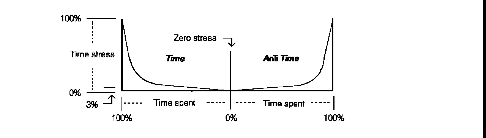
"Look at Figure 3. This graph shows the time-stress curve on both sides of the zero-stress center line. Most events operate at 0% to 3% stress. Time spent is dependent on particles involved and environment. Is everyone with me so far...?"
No response.
"Let's continue," Professor Beach says.
One student calls out: "Are we still under the heading of Universe/Anti-Universe...?" He is writing wildly in his notebook, trying to keep up.
"Yes," Professor Beach replies.
"Due to the design of the universe and ourselves, we are only aware of time passing in the universe; and we call this arrow forward time. There is no bias for forward time; time and anti-time are of equal overall duration.
Time on either side of the line appears to speed up or slow down depending on the degree of stress present at each event. This is due to the number of action units that each stress percentage allows. Each action unit skips one area quantum in the direction of travel. This makes getting from one place to another much faster. So if we start at zero stress, which is the dividing line between time and anti-time. We have zero action units. The graph goes from zero to maximum following the I.S.L. curve. More on the curve later. The maximum number of action units is found at 100% of time-stress. A moving object using this many action units per oscillation will appear to be moving at speed c. Unlike N+, N cannot flip fast enough to get close to c. N must skip to achieve near c speed. At near speed c, time passage would appear to be near zero to outside observers watching from a low time-stress environment. This accounts for time dilation. An example of time dilatation or stretching of time is the old example of the spaceship capable of a continuous 1g acceleration. In one year the ship would be going the speed of light. After 5 years, as calculated by the people in the ship, the travelers would be 74.2 years in the future. After just 25 years of continuous space travel at speed c, the occupants of the ship would find themselves 72 billion years in the future.
Another interesting point is the curve upwards in mass after we break out of the normal 3% time-stress approaching c. At 90% of c mass increases to 2.73. At 99.5% of c mass increases to 10.0. At 99.995% of c mass increases to 100 and at 99.9999995% of c mass = 10,000.00 etc. The mass explosion after 99% of c is the beginning of the rest of the 97% of time-stress potential. The way the universe works is that all things move toward less time. In quantum electrodynamics we see that the light we see is the light that took the shortest route. And all other light that took longer ways is canceled out. This is also true of movement. Things move toward the path of less time. The proton and electron are attracted to each other because the proton lives in less time. Better said, the proton and the area directly next to it are less stressed than the electron. The electron has slightly more action units. The electron is less massive by 1836 times that of the proton and therefore as they head towards each other the electron does more of the moving.
I know this sounds like I'm saying that the electric force is really just a time related phenomenon. When the current idea is that the electric force is the result of exchangeparticles, in this case photons. The current idea is that 'virtual' photons, or better said, photons created for extremely short amounts of time out of nothing. Ping pong back and forth between the proton and the electron, pulling them together. We know that an electron and proton even 5 meters apart will pull themselves together. We know that the electric force continues indefinitely out into space even as its effects fall off according to I.S.L. Therefore they say that even a light year from the event, a short lived 'virtual' photon is ping ponging back and forth, causing this attraction.
This theory, Filter Mechanics, finds little need for exchange particles. The proton is less forward time. That is less time-stress. And the electron is more forward time. That is more time-stress. The universe is phasing in and out of positive (forward) time 137 billion times a second. What effect does this have on the area surrounding the particles. First lets revue what area is. Area is comprised of inside diameter only and non-moving area is essentially a sphere. Or put another way, presents the same face to all comers. The area around such large time distorters as particles, ripple out there distortion in onion like spheres with the particle in the middle of that distortion. The time distortion is in the form of Push and Pull. Which is forward time and backward time. So from the proton we will first see a extremely small spherical region of Push or positive time phase, at about 0.4 x 10⁻¹³ cm from the surface. Then of Pull or negative time phase, at about 10-13 cm from the surface. Next we see a ripple of Push or more positive time phase are about 10-12 cm from the surface. These are very thin spheres coming away from the proton. What we are talking about here is that the time-stress levels coming away from mass alternate. More, less, more, less, more, less, etc. These positive and negative time phase intervals alternate coming away from the proton, and then from the nucleus.
The strength and range of the ripples follow the I.S.L. with extreme strength of Push and Pull nearest the particles and the shortest range nearest the particles. As you move away from the particles the strength diminishes and the range of each ripple is increased. We can see the effects and location of the ripples in the location of the shells of electrons surrounding the nucleus. The electrons are located in the Pull region of the space surrounding the nucleus. I should point out that the ripples do not move themselves, they are stationary. The ripples do however oscillate with each flip flop of the universal frequency. So each Push becomes a Pull and vice versa 137 billion times a second. The electron also has the same effect of Push and Pull coming off of it. However it is stressed forward in time. Note the irony of the proton which we have always associated with a + being negative in time. And vice versa for the electron.
As we have said the space coming away from matter is rippled and those ripples are time ripples. The ripples themselves are, of course, comprised of area. Inside diameter only. The area can be thought of as being individual spheres because each area quantum presents the same time phase regardless from which side you approach it. Therefore the shape of space is spherical.
Time is so interconnected to everything that is nearly impossible to talk about time as a individual entity. Without talking about how it manifests itself in different environments. Time is an individual entity, even though like magnetism, it is a reaction to another event.
Lets talk a little more now on the effects of time-stress on area. The area spheres nearest to matter are smaller than the area spheres further away. Matter makes area quantify into smaller pieces because only a specific amount of time-stress difference is allowed from one side of a area quantum to the other. The time-stress is of course highest near the matter and its strength falls off according to I.S.L. moving away from the matter. This is the mechanism that shapes all of space.
I like to visualize time-stress differences coming away from matter as colors. Second sphere coming off a proton or nucleus, is deep red getting lighter the further away it gets. The red of course symbolizes more negative time. And for the electron we would then have rich green as the third and most prominent sphere getting lighter as we pull away. The green symbolizes positive time. We visualize the colors not as a continuous luminescence, but as trillions upon trillions of spheres sized according to distance from matter. We add to this picture the time ripples of Push and Pull. So we would have coming off the nucleus, a small green sphere and then deep red small spheres out a little ways then blend into neutral. Then all green spheres, blend into neutral. Then slightly larger red spheres, blend into neutral, etc. It's like waves in the ocean, coming away from matter.
It's always been interesting to me, the effects created down the line when you build a universe incorporating a base quantum + anti-time as this universe has. You end up with asymmetrical universe of whole amounts and waves.
Nothing shows the handiness of the universe more than anti-time. The universe has a mirror image of itself. Because of anti-universe and anti-time we have, antiparticles, magnetism, anti- space (I.D. becomes O.D.), anti-photons (O.D. becomes I.D.) anti-black holes (Quasars), etc.
Lets take a walk on the wild side and see what's on the other side of the looking glass.
All particles are their own antiparticles. As standard time gives way to anti-time we see that the stable particles have different amounts of change to endure to crossover. "
This crossover occurs 137, 036,000,000 per second from universe to anti-universe. Looking at figure 4 we see that one side represents universe and the other anti-universe. The center represents zero time-stress. The two ends are 100% time-stress. The particles reside at different time-stress levels and this gives them each a different personality. First we have the photon. Then proton and neutron. Then the electron. And near the far edge is the neutrino. The further a particle is from the dividing line the more space signature it will present. This means that the quantum's of area near it, those little time spheres, will be larger. This is one of the reasons why the little neutrino can pass though billions of miles of matter and not impact anything. Its area signature is difficult to collapse in the short time its around. Also the neutrino due to its large number of action units skips right through large numbers of atoms without ever having physically been there."
Professor Beach changes the slide:
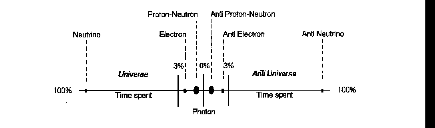
"Figure 4," Professor Beach continues. "Note, the particles have a home base on each side of the dividing line. The location dictates a specific percent of time-stress on each side of the line. These percentages are always the same in flat space. The closer to the line a particle is, the less time it is present in either universe. Any questions so far...?
Stony silence.
The same student taking prolific notes asks: "Are we still under the heading of Universe and Anti-Universe? We haven't entered the category of the Awareness Particle yet have we...?"
"No," the professor replies. "Still under Universe and Anti-Universe. Other questions. Let me continue:
"In the anti-universe environment everything is inside out. So rather than space being clear enabling you to see the stars across vast distances. What you would see is the brightest light possible in every direction. Why, because area rather that being I.D., is O.D. in anti-time. And O.D. is a photon. Matter which in ordinary time is O.D. on the outside and I.D. on the inside reverses to I.D. on the outside and O.D. on the inside. You might be thinking well as long as you have something inside and something outside, all is normal. But with a little more thought we see that this is not true.
In straight time matter, you have a outside facing out, and a inside facing in. Between these two separate entities is a distantless void, non-area. So we can measure the outside and we can measure the inside. We cannot measure the distance from the outside wall to the inside wall because there's no area there to measure. In anti-matter, the outside is on the inside and the inside is on the outside. This means that if you are looking at anti-matter you see only an oblique dimensionless ball. The traditional outside is totally missing. There's nothing to measure. It appears to be a void and yet it controls a specific amount of space. If you try to measure the traditional inside, it is gone to. So in anti-matter where is the measurable area? Its trapped between two voids. The outside void and the inside void. The measurable faces are facing each other. In straight time matter, the measurable faces oppose each other with a void in-between."
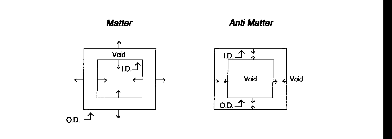
"So, Figure 5 shows," the professor explains, "that matter and anti-matter are exact opposets of one another. Inside and outside diameters are separate entities. Is this clear....?
"Are we still?" the student taking notes begins to ask.
"Yes, we are. Any other questions...?"
Dead silence.
"I will continue then," the professor says:
"Therefore matter in anti-time is not visible, just like space is not visible in regular forward time. So a base ball in space, in anti-time, would look like a fussy oblique bubble in a soup of stationary brilliant light. Photons would be completely clear bubbles. Because we are talking about events in anti-time we need to talk about movement. With the exception of address to address transfers, all movement occurs in anti-universe. The reason for this is that I.D. flips O.D. and movement must be in whole amounts, or flips. Movement occurs when a quantum of O.D. in forward time quantifies the area near it due to time-stress into smaller spheres. At the same time the area in the direction being traveled is stressed to less time than the other surrounding area spheres. I.D. flips O.D.
We will use a high speed electron traveling in free space for an example. In normal space the electrons exists in a sea of inside diameter only area quantums, essentially 1/2 mass. The electron is made up of inside and outside diameter integrated quantums therefore it is whole mass. The important thing is that the electron has O.D. This O.D., I.D. combination creates a time distortion or time-stress that contaminates (quanti sizes into smaller pieces) flat space. Once this is done, the electron which is undetectable by the O.D. space in anti-universe can move into each anti-area quantum and in doing so flip it and move that amount.
Movement is possible when an undetectable object moves into a 1/2 mass O.D. area quantum in anti-time. And re-materializes in that spot in straight time. This is a flip and this is movement. So from this we see that if we could get our space craft to not contaminate flat space we could flip large blocks of space and move very quickly. Now to move in hyperspace we would remove the area to be traveled, rather than flip each block of space as we come to it.
This means that we set aside say nine out of ten area quantums there by skipping like a neutrino or stone though space. Of course the easiest way to travel is by area quantum address. Every area quantum in the universe has a specific signature. The larger ones can be cataloged and with a fantastically large time-stress and a address and a way to temporarily make similar the two addresses. One could arrive anywhere instantly.
The reason that area generally is stationary in straight time is that in anti-time it is O.D. and is tightly blocked in all around. Generally speaking, when something moves in this universe, that movement is an exception to the rule. Most of the universe as a whole never budges. Of course this is because matter as compared to area is rare.
A good way to visualize N flip is with the million box example. You line up 1,000,000 little one inch white boxes in a straight line. These white boxes represent N- quantums. Now you stand back and watch. The first box turns clear. This represents N+. Then almost instantly the second box turns clear and the first box turns white. Then the third box turns clear and the second is white. Always you have 999,999 white boxes and one clear box. The N+ flips through the N- at speed c. So in our example the clear N+ will reach the end of the 1,000,000 boxes in 1/11804.6016 of a second.
Depending on the number of action units at an events disposal, you might need to flip only one in a thousand. With the others skipped. While the one million box example gives you a feel for N flip, it doesn't paint a complete picture. Think about it this way. N+ is one little box and around it the boxes of N- start off the same size close in but very quickly get bigger the farther away they are. This size change is in direct proportion to I.S.L As they get bigger the N+ has proportionally less working effect on things around it. Look at Figure 6 to get some sense of this...
Professor Beach changes the slide:
 "Note,
in Figure 6," Professor Beach says. "The 1,000,000 box example shows
that N+ moves by flipping or collapsing the N- into N+ there by crossing that
quantum of area instantly. The time between flips is what takes time in moving
though area..."
"Note,
in Figure 6," Professor Beach says. "The 1,000,000 box example shows
that N+ moves by flipping or collapsing the N- into N+ there by crossing that
quantum of area instantly. The time between flips is what takes time in moving
though area..."
The studious note-taker raises his hand again.
"We will discuss the Awareness Particle at the end of this lecture," Professor Beach says, growing impatient with the questioning.
Crossmann hears a student behind him lament: "God, is this ever going to end?"
"He's mad. Someone should take him to the Comedy Club," a woman near him whispers. "Lighten him up a bit."
Crossmann tries to turn around to see who is talking, to ask her about the Comedy Club.
"Mister Crossmann," Professor Beach asks. "Are you still with us?"
"Yes, Professor Beach," Crossmann replies, turning around again.
"Before we go on," Professor Beach continues, "I believe that we should have a brief talk about movement as related to N. We have all understood that N+ travels the speed of light flip by flip. But how does everything else from electrons to people to suns and galaxies move from place to place? The simplest way to explain it is to say that there is a minimum amount of movement possible. For example, if we had a magic microscope that could see the smallest thing possible -- and, while we were looking in it, we had another instrument move a straight pin across our field of vision as slow as possible, we would see that the straight pin does not move continually, but in miniature whole amounts. Area quantum jumps. Matter does flip N- quantums much the same as N+. But because anything larger than a neutrino pulls in all directions, speed is variable.
I should say that acceleration equals the number of individual N, in the subject mass, that turn and face the direction of travel. It takes x amount of energy, dependent on speed, to turn each individual N quantum to the direction traveled. Of course a momentum generator would accelerate by directly turning the number of N needed for x amount of acceleration. This would be the maximum efficiency possible. This in combination with a efficient time-stress generator to remove the area to be traveled. Would allow a craft to skip though space very quickly.
When we walk down the street we are flipping N- in whole amounts. The quantums are just so small that you never see the start and stop of each flip. Now on the electron size scale the view would be different and you could barely see the whole movements. There is a minimum and a maximum amount of movement possible. Moving one neutrino size area quantum is the minimum. And the speed of light is the maximum."
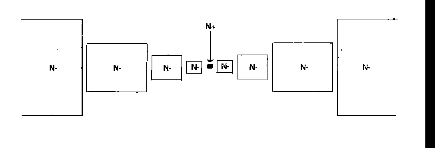
The professor changes the slide.
"Figure 7. Shows the size of the N- area quantums," Professor Beach continues, "getting larger in direct proportion to I.S.L. coming away from the N+. Any questions about this...?"
No questions.
Professor Beach gives the note-taker a hard look, shakes his head almost imperceptibly.
The note-taker looks down, continuing to write.
"The size of the jump," the professor continues, "is determined by the size of the N-, your ability to avoid contaminating it, and having the presence needed to flip it. By presence I mean time-stress, direction, and proper set up in straight time. You need to set up the shape of space in straight time by indicating the number of action units to be used, thereby dictating the skip if any. You need to have a direction indicated by less time. You need to present x amount of N facing the direction of travel. All of this will determine your 'presence' and therefore your movement in anti-time.
"In the newly forming universe, the first N+ sped off quantizing N- around it and traveling at speed c, flip by flip. After the first N+ flip has occurred, x amount more follow 'orderly' in all directions. At some point, the quantity trying to enter the new universe is more than the opening can process. When this squeeze occurs, the constructive interference increased the vibrational energy of the N+ until it far surpassed that of present day gamma rays. This fantastic amount of energy fused the N+ and N- together to form individual quantums of N. This initial fusing accounts for a majority of the matter found in the universe today. The injection of N was mostly orderly and displayed consistent energy throughout the forming N cloud that now was obscuring the injection site. In just a part of a second this order will turn to chaos.
"We need to stop now and talk about scaling, or why things are the size, energy, or degrees of field force that they are. To begin with, all matter, all energy, all area, and all movement are quantumly-scaled and those scales are themselves scaled, etc. Because the base properties are all scaled, the systems that are derived from them also display a built-in pattern or scale.
"So we see that all systems have a base similarity and that similarity can be found in the math of vastly different systems. This creates the complexity that we find around us.
"There are four rules that govern scaling. Some are well known and some are new.
1. The strength and range of a N- field produced is inversely proportional to the distance from the mass. Inverse square law.
2. Strength, range and time are quantized events. Therefore only allowed mass sizes are found atomically that are stable.
3. All strength and range events are them selves quantized and fractual, there by exhibiting a scaled field shape. This is a scaling within a scale.
4. The field shape exhibits two basic time related operators and one result operator.
Push.....................Real time operator
Pull.......................Real time operator.
Stop......................Result operator.
"These two real operators are caused by the oscillation between universe and anti-universe and the subsequent effect on the space and time surrounding matter, dependent on the time-stress of the subject matter. Push = more time. Therefore matter moves away. Pull = less time. Therefore matter is attracted. These fields are found in shells around and in all matter.
"The Stop operator is a convenient way to note the final full shell in matter or to note the logical point at which to find a companion nucleon. So we have Push, Pull, and Stop. This brings up, N- field shape. N- field shape is the effect on matter or movement caused by the size and collapsibility in combination with the color of time of a quantum of N-.
"We can't talk about scaling without talking about 'the curve'. Now I suspect that many of you that live and breathe the sciences as I do have felt the presence of the curve. Though all the years of my work the same graph curve kept popping up in widely varying fields. The curve can be found if you graph gravity strength as you pull away from a mass. It can be found if you graph the mass of a proton as you speed it up to near speed c. It can be found if you graph the energy of radiation from long waves to gamma rays. It can be found if you graph the known stable and unstable subatomic particles. The curve can be found in animal populations as they relate to the interdependent whole of their environment. The curve is fractual, meaning that if you cur off any part of the whole you will have the same graph curve. It will just be of a smaller overall magnitude.
"A good example of the curve or holistic scaling is the production of coherent radiation. A laser or maser. The production of coherent radiation has a built in scale that dictates the components of the instrument as related to frequency. The scale is that if you want to produce micro-wave radiation, molecules can be used as the amplifying medium. (Molecules are more than one atom that forms a stable group.) For visible light we use the atom it self or more specifically the electrons for the amplifying medium. For hard x-rays, we have to use the nucleus of the atom as the amplifying medium. So we see in this example that in order to move up the scale in frequency and therefore in energy. You have to 'jump' from molecule to atom to nucleus. That is the secondary pattern. The first is of each piece of the frequency scale being a snapshot of the whole. If we move up the frequency range from red light to soft x-rays to hard x-rays. We have a ratio of energy that is 1 to 1000 to 1,000,000. With hard x-rays having billions of times more energy than red light. There are a few crossovers to this particular example however the curve and the scaling point is the same.
"A living example is the ameba with all parts containing the needed reproducing information of the whole. And being able to use that information to reproduce from any cut off part. Another example of scaling is small towns. A very small town may have only one food market. One gas and service station. One of many things and the bare minimum of others. This town is stable with the population and services at their present level. We can say that the town is in its rest state. However, as the population of the town expands. Its service capacity is strained. At this point the town like all other systems will be forced to expand in quantums of service. (Quantums means whole amounts.) It will have to expand in quantums because many things cannot be divided. If one food market is at capacity, someone will see an opportunity and open a second food market. In order to compete with the first food market, the second must be at least as big as the first. We now have two complete food markets. This expansion in whole amounts will include schools, fire and police services (half a police car is not to be found) and all other city services. At some predictable point the town will grow big enough to support a major department store. We can say that the town has reached the critical mass needed to make the jump to the large department store. On and on until the town becomes a large city.
"From this example we see that the town before growth was a whole unit. The difference between a city with twenty food markets and a town with one is just the scale of the event. This holistic scaling is evident in the cellular structure of your body. With each of your approximately 11 trillion cells having the needed genetic information to build the whole body. I believe that we are starting to get the point about holistic and fractual scaling. And how its interwoven into the fabric of everything.
"So lets get a good feel for N- field shape and field scale as related to N. Okay, all together now everyone say, Push, Pull, and Stop...."
The class responds: "Push, Pull, Stop...."
"Very good," the professor says. "Especially over here," pointing to the Seinfeld group. They had responded with special gusto.
"Yes we no longer have to say," the professor continues, "gravity, electromagnetic, weak and strong nuclear. Now we can just say, N- field shape. And what are the operators of the N- field shape, all together now, Push, Pull, and Stop.
"The N- field shape is of course scaled and therefore can be seen whole on many different levels. Using the nucleus of an atom once again as a example. We will see the Push, Pull, Stop as related to protons and neutrons in action. Within the radius of 10 -12 cm the nucleons are strongly repulsive. Within the radius of about 10 -13 cm the protons and neutrons are strongly attracted to one another. But at a smaller distances down to but not below 0.4 x 10⁻¹³ cm this attraction becomes powerfully repulsive. So closest to the nucleons we have a N- field shape that will Pull, then one that will Push. A little further out is a N- field shape that will Pull. The 'hold' position is Pull and that's where we will find the next nucleon."
Professor Beach changes the slide:
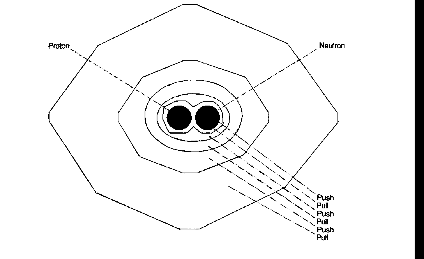
The professor says: "Figure 8 shows the Push, Pull time-stress ripples coming off two nucleons. Note that the first Pull region has reformed around both nucleons. Any questions about this...?"
Silence.
"With the partial exception of gravity," Professor Beach continues. "all of the current thinking field forces including electromagnetic, weak and strong nuclear, are all scaled examples of the same field force. N- field shape, with Push, Pull, Stop.
"Getting back now to the forming of the universe. I believe we left off with the N traveling away from the injection in a uniformed dense cloud at near c. I need to clarify the look and feel of the injection up to this point. We have a inlet 'hole' feeding fantastic amounts of N+ into the N- space. We have the N+ squeezed tightly together therefore interfering with each other and increasing the frequency or vibration. At this point the N+ is mated with the N- forming quantums of N. This has all happened in a time frame so small that if we talk about it as part of a second you would have for all intent and propose, the whole second left.
"The density of this N layer decreases the further out from the center as more area becomes available and the orderly injection becomes chaotic. As the extremely high energy N begin to shed vibrational energy by emitting N+ a new layer of the sphere is formed.
"Note: The N at this point in the expansion are fantastically more energetic than the current stable N. In this layer the N join together in groups or stable units. First large unstable particles are formed. Then a little further out the proton is formed at the stop found at 10-15 centimeters. We then have more unstable particles. The particles being formed get smaller the further out we go. The next stable particle formed is the electron. There are many N that never join up and they are the neutrinos we find zipping about today.
"As we can see all that is needed now is to join the electrons and protons together and we will have our first atoms. The neutrons are formed in the nucleus, due to each nucleon exerting a Push N- field against its neighbor, thereby allowing a little extra mass (N quantums) to accumulate. Each atom will continue to build and hold neutrons until the limit based on the number of protons and their ability to apply pressure is reached. After that new neutrons will 'pop'.
"The chaos created by the mating of the N to other N was the start of the randomness. The unpredictability and the non-uniform nature of the universe. Among other things, it was the original cause of the galactic spacing we now see. This randomness changed the rules of the universe from 'to be expected' to 'we can't for sure know what to expect'. This point can't be overstated. Had the original perfect injection remained perfect. The opportunities for life would have been greatly reduced. Life has more opportunities to begin in a unbalanced, unpredictable, future uncertain kind of universe."
Professor Beach changes the slide:
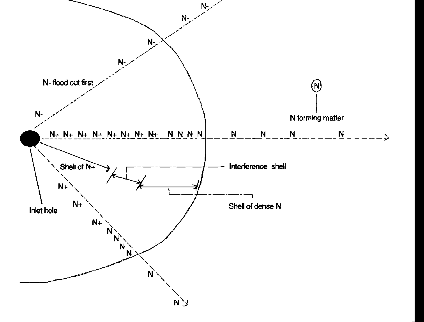
Professor Beach explains: "Figure 9. 1. N- floods out of the inlet hole forming an expanding sphere of area. 2. N+ floods out of the inlet hole. 3. The high energy N+ interferes with each other, increasing the vibrational energy of the N+. 4. The N+ mate with the N- forming quantums of mass. 5. The quantums start to join up to form matter. (This is a straight time scenario). Any questions...?"
Nothing happens.
The note-taker finishes one page and turns his notebook quickly to find a fresh page.
"We will now list the components and interactions of the atom." the professor continues, "and then discuss the atom in a holistic manner where the whole is greater than the sum of its parts.
"1. Photon : N+ is the Movement particle. N+ is a photon. N+ is 1/2 mass. Its rest state is speed c. N+ moves at speed c because it is a single quantum and therefore pulls in only one direction. Once a over-massed piece of matter losses mass by expelling it in the form of a photon, that photon accelerates in whole amounts to the maximum movement possible, speed c.
"Movement is by N flip. All photons are individual N+. All N+ are the same initial size. The frequency of vibration (energy) differentiates one from the other. Each individual vibration has a energy equal to Plancks constant. It is a cube with O.D. only. This means that while it has to operate with definite area and distance rules on its exterior, all inbound vibrations have no set tolerances. This means that a side could, if it had no other restraints flex inward an infinite distance and never reach the opposite side. The N+ vibrations are quantified allowing only specific frequencies in a ratio related to h. The frequencies are set at the time of emission from the mass.
"Unlike matter the photon cannot be emitted unless it has a known destination. This is related to the Wheeler-Feynman Absorber Theory (Herbert 85). The reason for this is that a photon 'in universe' is only one half of an event. The other half is in anti universe. In order to make a whole event, both half's have to reach there destinations at the same time. Therefore at the moment of conception of the photon at the emitting electron. The anti universe, anti time photon arrives from the absorber electron and dies at the same spot and the same moment.
"The absorber has the same event in reverse. This is all possible because anti time and time occur at the same time so to speak. So we see from this that the photons cannot be emitted if you point the flash light in a direction that has no matter or absorber. In twin photon births where a electron disintegrates into two high energy photons traveling in opposite directions. A curious thing happens. If one photon changes direction so does the other one regardless of there distance apart. This is because in order for the pair to arrive back at the birth mass in anti-time the two paths have to be time symmetrical. The only way that they can be time symmetrical is to travel identical paths. It is a freak situation. Only one of the photons has an absorber. The other photon simply ceases to exist when its sister is absorbed. And looking at this in anti time the odd photon is created out of nothing and mimics the path of the other photon back to the mass. A interesting point is that it could be possible that one can induce a history into future quantum events. But who would want a flash light with a programmable beam direction. This would allow one to see around corners. Or have information carrying laser light snake around obstacles, completely useless!
"N+ is the primary way that vibration (energy) is transferred. Because our eyes see only vibration, N+ is the primary way information is transferred.
"2. Neutrino: N is the neutrino. N is N- + N+ = N. Or, area + movement = matter. N has O.D. and I.D. It is whole mass. N is the base quantum of matter. Mass is about 2.9 eV. It has the largest number of action units. It has no intrinsic spin in flat space. Develops short lived spin as a result of interaction with other N groupings. Because of the high number of action units and large space signature, the neutrino appears to be a neutral particle. The rest speed is almost c.
"Movement is by N flip and N skip. The reason that a neutrino travels at near speed c is that it is a individual quantum of matter and therefore just like the photon pulls in only one direction. Anything with outside diameter will accelerate in a single direction. However with the exception of the neutrino all other stable mass have a comparatively large number of N and all pull in different directions. The neutrino also has the largest number of action units due to its tremendous time-stress. The neutrino stays 'in universe' longer than any other particle. And because of this much of its distance traveled was really not traveled but skipped entirely.
"A majority of the N in the universe was created at the time of the big bang and therefore are of equal size. N can be reverted or created at greater than break even cost to N- and N+ or back to N. N is a stable particle. This is the smallest stable particle possible. N is shaped like a long hot dog which allows it to reverberate from one end to the other. This reverberation allows for four stable energy levels. One below the electron neutrino and two above. N has a push field shape around it. The range of that Push field is 10-18 meters. If we move a little further out from the N we find a extremely weak Pull N- field shape. The opportunity for a stable particle is found at the beginning of the Pull and continuous until a Push region is reached. This would be a equilibrium position between Push and Pull and therefore Stop. This is true for the building of electrons and protons. However the stable points away from the nucleus that the electrons inhabit are in the Pull N- field. N can be transferred by N+.
"3. Electron. The electron is a stable elementary particle. With a rest mass of .51 MeV. This is 1836.12 smaller than the proton. Its rest speed is variable. Electrons are found in shells around all atomic nuclei. Electrons are responsible for all chemical elements. Electrons are a stable grouping of about 175,862 N quantums, related in fractal scale to all stable elementary particles. Found at the next stable Stop point after the neutrino. The electron itself is comprised of at least one shell. At the heart of the electron is a small cluster of N. I would think less than 100. The center nuclei occupy the expanded original Pull region first occupied by just one neutrino. Then there is a Push field that is mostly empty except for random neutrinos spurting back and forth across the void from the outer shell to the inner nucleus. The outer shell fills the next Pull region. This leaves Push as the exhibited first field force off the electron.
"The N represented in the electron form a single quantum group and therefore respond as a group to all events. The electron has intrinsic spin that is polarized. The electron is phased more forward in time than the proton and its positive phase is time-stressed near the 3% net forward. This means that the electron spends slightly more time 'in universe' than the proton. This gives the electron a negative sign of equal strength to the protons positive sign. In graphic terms, the electron forms a plateau that repels in the fabric of space.
"4. Proton: The proton is a stable elementary particle. With a rest mass of 938.30 MeV. It is 1836.12 times larger than a electron. Its rest speed is variable. The proton is found in all atomic nuclei. It is a stable grouping of about 323,551,724 N quantums. Related in fractal scale to all stable particles. The proton is comprised of a nucleus and two shells. The inner nucleus has, I would think, at least 1700 N. The second shell possibly 1,440,000 N. With the remainder filling the third Pull sphere. The N represented in the proton form a single quantum group and, therefore, respond as a group to all events. It has intrinsic spin. The proton is phased more backward in time than the electron. This means that with the exception of the photon, it spends less time 'in universe' than any other elementary particle. Its time-stress is about one percent. In graphic terms, the proton forms a pit that attracts in flat space.
"5. Neutron: The neutron is a creation of the nucleus. It is essentially a proton with a little extra mass piled on due to the distortion of the time fields found around specific groupings of protons in the nucleus. It has a rest mass of 939.57 MeV. This counts in at about 323,989,655 N quantums. The neutron is an example of a particle that is a little larger than the equilibrium Stop position. And therefore flies apart in about 12 minutes when other nucleons are not present to change the conditions of the time fields it exists in. When it flies apart it rebirths into smaller stable particles that include the proton, electron and the anti-neutrino. Until it flies apart it operates as a stable quantum unit. The field shape put out by the neutron has a greatly expanded first Push region and thereby does not interact much with other particles.
"6. Other subatomic particles: There are approximately 180 particles and therefore 180 anti-particles for a total of 360. Of these 360, only 10 are stable. The stable particles are listed above. Most of the unstable particles were discovered with the help of particle accelerators in high speed collisions. Many of these particles have a life expectancy of just + zero seconds. These particles, for the most part, are temporary consolidations of N after a high speed collision. They are debris hunting for stability. The fact that they do so in a consistent manner does not make them true particles, they are debris particles. If I crash two cars together, I don't consider the parts knocked off to be a newly discovered complete car. It's collision debris!
"There are no Quarks! Sorry no Quarks! Sometimes things that work out beautifully mathematically just don't exist. Quarks don't exist! The universe is a visual place, not a math place. This theory finds no need for quarks, and therefore no gluons. What they are finding internally in the proton are the very dense inner shells. And when you explode those shells apart you get, all together now...."
Professor Beach stops, waiting for the class to respond.
The class responds listlessly with the professor: "Debris."
"The theory of N," Beach continues, "does explain internal structure for all stable particles. That structure is shellular in makeup. Consisting of alternating tight, loose densities of the N quantum. This theory does not use exchange particles as force carriers. But does acknowledge that particles are regularly exchanging energy. N- field shape with Push, Pull, and Stop in conjunction with time-stress do the work that exchange particles play in standard theory. (Standard theory is urrent theory. Filter mechanics/Theory of N is a new theory.)
"7. Anti-particles: Anti-particles are just regular particles created in the anti-universe time phase. As you recall this occurs 137,036,000,000 times a second. They are inside out with O.D. inside and I.D. outside. Some of them slip into the forward time oriented universe. Essentially all particles exist in two different states.
"Before we begin discussion interactions," Professor Beach says, "do we have any questions?"
"How much longer is this lecture going to continue?"
It is Elaine Benes.
"What is the matter, Miss Benes?" the professor asks. "Is too too dense for you...?"
"It is dense," Elaine replies. "But I have to go to the bathroom."
"Please go," Professor Beach responds, pointing to the door. "And don't come back today."
"Professor Beach," Elaine says. "You've got to admit, it's a lot to take in before dinner...."
She tries to make him laugh.
"If I were you, Ms. Benes," the professor replies. "I'd commit myself to dinner immediately.."
"Dense! Dense! Dense!" a group of students begin to chant. Then others take up the chant. "Dense! Dense! Dense...!"
Professor Beach is shocked.
"Anyone involved in this demonstration of ignorance should leave immediately," the professor says.
No one moves.
Elaine Benes sneaks out, holding her side, like she is stricken with Uromysotysis.
"Does anyone else need to leave to go smoke a joint or something?" Professor Beach asks. "Relieve their bladders..."
All the students laugh.
"If you do, I'll understand," he continues. "I was young once...."
The students laugh again.
"Where were we?" the proffessor asks.
"Weak interaction," Crossmann says. He is interested in the lecture.
"Thank you, Mister Crossmann," Professor Beach replies. Then to the others: "We are nearly done for today. Please show me the courtesy of being quiet for the next ten minutes or so..."
"Interactions. 8. Weak interaction. This is one of the four fundamental interactions of standard theory. It is said to be 1011 times weaker than the electromagnetic interaction and is said to be responsible for beta decay of particles and nuclei. Theory of N replaces the four fundamental interactions of standard theory with N- field shape. Its operators being Push, Pull, and Stop. This essentially unifies the four interactions to one source, N- field shape. The stable particles are particles that are at the equilibrium position Stop in the expanding and repeating sequences Push, Pull that emanate from the center of all subatomic matter in shellular fashion. The weak interaction, in theory of N, is the first Push sequence coming off a particle at about 0.4x10⁻¹³ cm from the surface. Its range is about 10-18 meters. Which is exactly the same as the first Push field coming off a neutrino. Therefore the first Push field coming off a neutrino is not cumulative. And a proton which is 323,551,724 times bigger displays only the same 10-18 range. Also I should point out that I'm not sure that we can know at this point what the strength of this first Push field is. But 1011 less than electromagnetic feels wrong. We have to remember that the strength measurements of standard theory take into consideration that the electromagnetic force is present in the nucleus. In Theory of N this is not the case. Each Push or Pull field is a separate time entity. Therefore no addition or subtraction of field strength because of electromagnetic fields are called for.
"In beta decay, which is the conversion of a neutron into a proton with the emission of a electron and a anti-neutrino. What is happening here is that the N have piled up into the Push region and without the unique conditions of some parts of the nucleus, have no chance of remaining stable.
"9. Strong nuclear interaction: The strong interaction is said to be 10-2 times stronger than the electromagnetic interaction. It is the force that holds the nucleons together. In theory of N the strong interaction is the first Pull found outside a particle at about 10-13 cm from the surface. It is N-field shape. Its range is about 10-15 meters. About the same size as a proton. The 10-2 strength figure of standard theory was arrived at as what was needed to over come the electric force and bind the nucleons together. Because theory of N has no electric force in the nucleus the strength of the interaction would be far weaker.
"10. Electric interaction: The electric interaction is the resulting phenomenon of time-stress in 'universe'. In 'anti-universe' the phenomenon manifests itself as magnetism. The electric force only exists in straight time and shows itself in two forms. Within the radius of the atom we have the electric force exhibited as Push, Pull, and flux tubes. Beyond the atom only the flux tubes carry the electric interaction. The electric flux tubes are a tube within a tube. So we have I.D. area within I.D. area. The tubes would consist of individual, same size quantums forming a circle within a circle or in other point to point situations a straight tube within a tube."
Professor Beach changes the slide:
"See Figure 10." the professor continues. "These six diagrams show the base configurations of Area, Movement, and stress field for universe and anti universe, in Theory of N.
"The result of this configuration is that, unlike magnetism, the electric interaction will attract all matter (static electricity) This is with the exception of free neutrons or free neutrinos...."
He changes the slide again.
"As seen in Figure 11," he continues, "the flux tubes are collapsible in individual sections and each flip is a double flip. Using a current carrying wire for an example, the electrons in the wire are compelled to travel these tubes from atom to atom or the tube highway between atoms. The polarity difference from one end of the wire to the other is a time-stress difference, with the electrons moving toward less time.
"The electric interaction begins as the second Push sequence coming away from a 'free' (not part of a nucleus) proton. Lets do the line up coming off a free proton. First Push, the weak interaction. Next Pull, the strong interaction. Next Push, the first in a number of alternating Push, Pull zones that extend a little past the last electron shell and all of them the electric interaction. Now when the proton is part of a nucleus the second push zone separates from the individual protons and forms one Push zone around the nucleus as a whole. Making the nucleus a quantum entity. Therefore when a nucleus is involved we say the electric interaction begins at the outer edge of the nucleus and starting there controls atom structureand chemical reactions. It is both attractive and repulsive.
"Note Figure 11 shows billions of electrons following the time-stress potential difference electric flux tube though an atom cluster. Is this clear to everyone....?"
No response.
"In Theory of N," the professor continue, "the Push,Pull, Push field and the I. D., I.D. flux tubes are the electric interaction. Push, Pull has different strength and range for different sized particles. The Push field from the proton is always smaller than the Pull field. The electron has a smaller Pull field and a larger Push field. The reason that the electron and the proton have equal field strength even though their masses would seem to require other wise. Is that the electron is further from the 'line' and therefore is far greater time-stressed than the proton which is closer to the line.
"We're almost out of time, so we should hurry this along," he says. The professor changes the slide.
"In Figure 12," he says, "the repulsion that a proton or an electron feels from like particles is due to their
position on the time-stress line. "Figure 12 shows a time-stress, time spent line. Note that with the exception of mass, the electron is the proton's equal. This is due to its greater staying power as related to time spent.
"Figure 13 shows a two-electron interaction with their Push time ripples acting like a repulsive temporal shield. Particles that occupy the same position on the time-stress line put out the same field shape and therefore repel. However, when a proton and electron approach each other the field time-stress difference causes them to attract to each other. The Stop points coming off a nucleus are where you find the electron shells."
The professor changes the slide:
"Figure 14 shows a magnetic flux tube," Professor Beach continues. "The inside of the tube is a single quantum regardless of its length. The outside is divided up into individual time-stressed quantums; but, due to the inner one-piece assembly, it reacts as a one-piece entity.
"11. Magnetic interaction: Magnetism is a phenomenon of time-stress in anti-universe. Just as the electric force is the phenomenon of time-stress in universe. Magnetism only exists in anti-time and, therefore, lives in a universe where time runs backward. Also remember that the area quantum's in anti-universe are O.D., its a very ridged and thereby cold place. Magnetic flux tubes are the base operators of this phenomenon. The tubes are O.D. inside O.D. area quantums. As we discussed earlier, 'what would happen if you somehow managed to put something inside the outside.' The answer was it would exist in a zero distance environment. From this we see that each part of he inside tube is everywhere at once. This makes it a individual quantum and that's how it behaves. (Figure 14) The tubes want to be perfect circles, that is their base-shape. The tubes can be manipulated into traveling in a straight line if the crystalline structure of the medium is right. However, at the exit point of the medium, the tubes immediately angle off, each one pushing and shoving to make the tightest turn possible, to make the shortest circle possible. In doing so, they apply pressure to the end of the medium pulling it to the magnet.
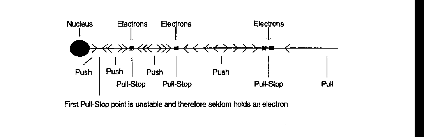
In Figure 15, the directional nature of magnetism (north repels north) is due to the shape of the area quantums surrounding the tubes. Magnetic flux tubes are complete circles at birth. The end size of the circle is determined by the presence and number of other tubes. Each one needs a little space around it. As a result some tubes luck out and get the inside track. While others become very large having to take the long road. Kind of like life, isn't it. As we know the fastest the tubes can expand is speed c. Interestingly though, the tubes can sweep across the heavens at apparently infinite speed. This is due to the tube disintegrating and rebuilding at every pulse of the universal frequency. The rebuilding location is conditional on the time-stress present at that pulse.
"Figure 15 shows a permanet magnet with a piece of iron pulled tight at one end.
"12. Gravity: The gravitational interaction is 10-40 times weaker than the electric interaction. The field shape that it generates acts between all bodies in the straight time universe that have O.D. and I.D. such as N. Or just O.D. such as a photon. The force is always attractive. The gravitational field shape follows the I.S.L. for effect degradation in most circumstances.
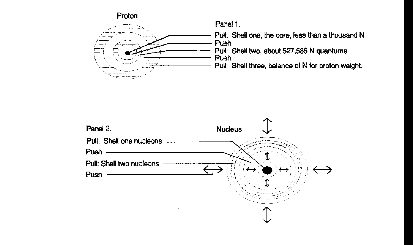
"Figure 16 shows the N- field shape fall off with Pull being the last sequence with a felt effect. So we see that gravity is the cumulative after effect of the last major sequence of the atomic Push, Pull, with Pull being the last major player. Gravity is then a time related phenomenon. We also note that unlike the weak interaction off the neutrino in a proton, who's effects are not cumulative. The finale Pull sequence is cumulative and therefore more matter equals more Pull. There is no gravity inside a atom at all as the last Pull sequence is a small distance away from the atom.
"An interesting thing is that the more mass we put in one place the slower time passes. So It follows that, if this theory is correct, at some point of ever increasing mass the time will become so negative that the proton will no longer be the particle of less time. At this point the time-stress will be even between the electron and the proton and the electron will disengage from the nucleus. I wonder if that would happen to a space craft at near the speed of light?
"So in a black hole what happens fiRst. Does the mass crush the atom out of existence before there is time for a disconnect? Or does the disconnect happen first?
"In any event the slowest time can go is backward, so the insides of massive black holes could be a window into anti-time. That would make the singularity of a black hole very bright indeed. While high gravity can crush and dis-assemble N and N+, areas basic volume is always maintained.
"Again, Figure 16 shows the N- field shape coming away from a nucleus. Push is more time. Pull is less time. Stop is where you find electrons. Pull is the last sequence with any effect and cumulatively this is gravity.
"The Holistic atom. Due to the preceding section which listed and discussed in detail all the individual parts of the atom as well as the interactions. You have a fairly accurate picture of the individual working parts of the atom. However as you might have guessed the atom is more than the sum of its parts. Just like a jigsaw puzzle, the parts are not the prize. If we are assembling a real jigsaw puzzle and line up all the pieces on the floor. We are still in the dark as to there individual or overall purpose. If we then assemble the puzzle, we see that each part has a important purpose when used correctly. The correctly assembled atom is a new and complete entity with astonishing abilities.
"It is a complete picture. It is the base quantum of life."
He changes the slide.
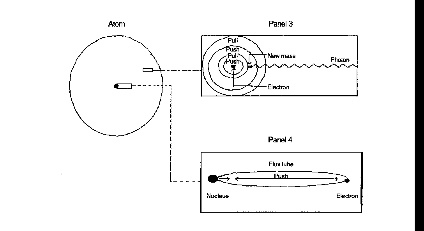
"Figure 17 shows an atom, all its constituent particles, and the fundamental interactions. The atom is really not that complicated. Once you have mastered the concept that you have to have some place before you can be some place, you begin to understand the four-dimensional space-time continuum. You start with a understanding of quantized area. Once you understand N- field shape and how it allows some size particles to be stable, you begin to realize why other high-energy produced particles vanish so quickly. If you have area, you automatically need a way to travel though that area. This is accomplished with N or N+ flip where N- changes to N or N+ momentarily, allowing travel. We recognize that in a quantum universe the movement has to be in whole amounts of what ever size quantums we are trying to pass though, in this case N-. You are in essence removing the area to be traveled. Also it is understandable that the time shape of the N- can Pull or Push the N or N+. And, therefore, the nucleus of the atoms produce an alternating Push, Pull shaped field much the same as the one in which stable particles are produced. If you took a magic can full of neutrinos and added enough energy, they would form electrons. With even more energy their would soon be protons. If we took the electrons and the protons and put them in the same area they would form up quickly into hydrogen atoms. With more energy yet the atomic nucleus would accept more protons and eventually some of those protons would become neutrons. We can control what is in the can by the energy level.
"The particles are shellular with the densities fluctuating between extremely tight packing and very loose neutral shells. In the loose portions there are individual neutrinos repeatedly attempting and failing to skip out. There is almost never enough time to acquire the needed action units to jump out of the particle. The picture of a atom with perfectly symmetrical Push, Pull time distribution all uniform and neat is of course wrong. Time distortion spreads out like the wake of a ship around all movement and has disruptive effects on matter. This causes some chaos in the shells. If movement itself weren't enough of a time distorter N and N+ also stretch and change the proportionality of time, although in a scaled fashion. We see that if we intertwined standard theory with Filter mechanics, the electric field would be the only fundamental interaction. With the weak and strong interaction just the early part of the Push, Pull field and gravity just the last.
"Note that Panel 1, shows the Push, Pull shellular structure of a proton.
"Panel 2, shows shellular structure of the nucleus.
"Panel 3. Shows a photon crashing though the Push, Pull field of a electron and being transformed into a piece of whole matter in the process.
"Panel 4. Shows the electric flux lines going from a electron to the nucleus with photons flashing up and down the tube.
"As we look at the gap between the electrons and the nucleus. We see the tail-tail sign of the arched path of I.D. within I.D. electric flux tubes. We don't see the tubes themselves, only the effect of their presence on the surrounding area. Photons often race down the tubes, its like a freeway. In anti-time the tubes are O.D. inside O.D.
"In order to talk about how a photon interacts with a electron, we will revue the Compton effect. The Compton effect is the reduction of the energy of gamma rays and x rays during collisions with electrons. Or for that matter any particle with mass. Whatever the photon loses in energy the electron gains. The reason that this happens is the same reason that high-energy photons will turn into stable particles if passed though a electric field found around the nucleus. The Push, Pull, Stop N- fields found around the electron or any particle with mass convert soon to be received N+ into quantums of N just before impact.
"The new mass and energy received from the photon jumps the electron out to a higher energy level and results in an unstable particle (mass beyond the Stop point of the N- field). And, as you know, unstable particles last almost no time at all. This means that the particle will almost instantly shed the new mass which will emit off the surface of the particle as a particle but will convert into a half mass photon on its way back though the intense N- field found around the particle.
"Now we can have matter that has the right crystalline make up, like glass, that channels the photons more or less straight though. But, on the way, these encounter repeated Push, Pull fields that continually change them from 1/2 mass to whole mass, back and forth repeatedly. This slows the light down quite a bit.
"If you want to understand the atom you need to be extremely visual. I don't include much if any math to my work because in the end it really doesn't matter. It is impossible to understand the universe in mathematical terms. Math is a tool only, and not the event. Event theories, visual theories are the only way to have enough information density to increase our awareness to the level of a T.O.E. theory."
Professor Beach turns off the slide projector.
"My friend," he says, "has been dying to hear about the final component of this theory." He turns to the note-taker and says: "Yes, this is the final component, the Awareness Particle."
The class laughter is tired.
"Earlier I have discussed my view that the body is just a temporary container, and that our experiences are the working element of the Filter. As with all containers, you have to put something in, in order to get anything out. In the case of your body container, your soul was put in that particular container at your request. You were certainly not dead when you went in, and you are most certainly not dead when you come out. You are, however, filtered, and, therefore, better able to return to your origin, refreshed and wiser.
"This paper formats a two-part explanation of where each of us exists. The Filter and the mechanics of the Filter. We exist in a Light Cell, with all non-heavenly things a projection. Like a spark in a bubble. This is the Filter. The projections or the reality ywe think we see and feel, is the universe. This we discussed in Filter mechanics. The spark in the bubble is the awareness particle. It is the essence of what we are. It is the only 'real' particle. In the end it is the only particle we will need to understand.
"When I started this project my daughter was 6, now she is 19," the professor says. "The word processor I bought in 1989 to compile all the hand written notes is now a antique and had been replaced to finish. Creating a new universal theory requires unlimited thought. I would just lay on the floor, seemingly staring at the ceiling for months at a time. My daughter and her friends would just step right over me, with her assuring them that I was fine. "It's just a science coma." I have enjoyed this project. I hope you have gotten something out of it too. Are there any questions...?"
Crossmann raises his hand.
"I expected you to ask me a question or two, Mister Crossmann. Yes?"
"You seem to mention this only in passing, in the last few minutes," Crossmann says. "You talk about the soul, the Awareness Particle, being the only reality. And all else being a projection..."
"You missed my earlier lecture, Mister Crossmann," the professor responds.
"One of your drawings looks very much like my own drawing," Crossmann responds. Crossmann somehow projects a hologram of the drawing he is considering into the middle of the room, a three-dimensional projection, visible from all sides.
No one seems especially surprised by this.
"This drawing is similar to your Figure 13 drawing," Crossmann says, "which demonstates the interaction of two colliding electrons. My drawing, in fact, demonstrates that the universe itself, and all of our perceptions, the time-space continuum, as a holographic projection. Essentially mental matter. The drawing also represents the interaction between the universe and the anti-universe...."
The bell rings.
"Yes, I would like to talk with you more about this," the professor says. "Class is over. Please come see me in my office. Can you do that...?"
"I'll try," Crossmann says. "I'm not sure where it is..."
Professor Beach has packed his briefcase and gone.
The students are filing out. Crossmann hears comments from the students:
"Jesus, why did I take this class?"
"What did he say? I stopped listening after the first five minutes."
"Boring, boring...."
"They guy should be downstairs with the religious wackos...!"
"Give him a straightjacket for dessert...!"
Crossmann tries to keep an eye on Seinfeld. But the crowd becomes immense. Seinfeld is swallowed up by a wave of humanity. Crossmann loses sight of him.
Crossmann is in a hallway by himself. Before him, in the dark hallway, a group of marching soldiers suddenly appears out of the shadows. In full battle dress.
The lieutenant leading the platoon stops before Crossmann.
"Sir, are you prepared for Y2K?" he asks.
"What?"
"You have forgotten aboujt Y2K, sir," the lieutenant says. "Tonight, after midnight, the entire electric grid will shut down. There will be rioting in the streets. People will freeze to death in their apartments because there will be no electiricty, no heat. The bank records will be obliterated. There will be fraud on a massive scale, with computer criminals transferring money at will from one account to another. Order will break down. Russia's nuclear weapons systems are set to break down. They all still are operated by the old two-digit compujter chip. They may automatically launch their weapons at the US. We will probably be trasnformed, in a instant, from the most modern of worlds to the dark ages, sir. Your picture of Roman decline may become true without us having to experience the period of decline. Decline may be instantaneous...."
"What can be done to stop this?" Crossman asks.
"Nothing. But here, I have a safety kit for you," the lieutenant says. "On this belt you will find a water bottle, matches, candles, k-rations, emergency medicines, a hunting knife, dental floss, rain-gear, a pup-tent, toilet paper -- just about everything you could need. Do you have a sidearm...?"
Crossmann pats the pocket on his tuxedo.
"Good, you will need it. Terrorists have already bombed the World Trade Center. A bomb also has gone off at the New York Stock Exchange building. There is a fire burning down by the pier -- a burning raft started the blaze apparently. You know, Nostradamus predicted that New york would be destroyed by fire...?"
Crossmann shakes his hand.
"If you need anything, sir, let us know," the lieutenant says.
The platoon marches down the hall.
Next, a group of nicely-dressed citizens appears out of the shadows of the hall.
They begin to sing: "Come and behold him, born the king of angels. Oh, come let us adore him. Oh, come let us adore him. Oh, come let us adore him, Christ, the Lord..."
They all smile as they pass.
"Merry Christmas," the lead woman says. She looks like Leslie Rhodes.
The move up the hall, still singing.
Then they are gone.
Crossmann is alone in the hallway. There is a door to the left. The door is locked. Crossmann uses his key.
START HERE NOW
"Ahh, Mister Crossmann, we have been waiting for you. Welcome!"
A bailiff is speaking.
Nine justices in black robes are sitting on the stage, elevated, behind a large bench.
"Mister Crossmann," one of the judges speaks. "You are here speaking for the plaintiff, in the case The State Versus Mark Twain."
Crossmann notices a large prosecutorial team to his left, led by Johnnie Cochrane.
"Mister Cochrane, please begin."
"Your honor," Johnnie Cochrane begins, "we are here to do a right that has been too long in doing. The portrayal of Jim, the nigger slave, in Mark Twain's Huckleberry Finn has too long been the bane of ever self-respecting black man in America. The humiliating stupidity with which Jim is portrayed, from his illiteracy, his childlike simplicity, his superstitions, his dependence upon the white child Huck, this, pardon my languge, is no better than feces being spread upon the face of every black man in America, your honors. My own son, when he read this book, came to me in tears. 'Why is Jim so stupid?' he asked me. 'Are all black men like this?' he asked me. One might argue that Mark Twain was not a racist. I am sure Mister Cross is going to argue this. Of course, there has been some suggestion that Mister Crossmann is, himself, a racist. I am not making this claim myself, your honors; but others have. We do have a video of him visiting the compound of the notorious white supremacist, ,,,in Idaho. And we can show that video if necessary. But, sirs and madames, it is not necessary that we portray Mark Twain as a racist. It is enough that we are able to portray the book, and Twain's portrayal of Nigger Jim, as injurious to the public health...."
"And what of the First Amendment, Mister Cocchrane?" Justice Scalia asks. "Is not this book and this portrayal of Jim, protected by the First Amendment...?"
"Yes, your honor, it is," Cochrane replies. "We are not suggesting that Mister Twain should not be allowed to write this book. We are arguing that it should not be in print. Or, at the very least, that we be allowed to edit the book, so it fits with current morality, current thinking about racial integrity and racial harmony...."
"Your honors," Crossmann says. "This argument is abhorrant. Who is qualified to 'edit' a literary masterpiece. I've never heard of such an outrageous suggestion...!"
"We have proposed -- and Mister Crossmann would understand this if he had carefully read the brief -- a committee made up of respected writers and thinkers who will, with the utmost care, modify the character of Jim. We have suggested such writers as Toni Morrison, Gloria Steinem, Alice Walker, Barry Lopez and Immamu Baraka. We are open to suggestions from the plaintif's side also..."
"This suggestion is outrageous," Crossmann counters. "Where does it end? Your honors, the First Amendment gives American citizens the right to offend people. The only people Mark Twain wished to offend with this book was American racists, your honors. Twain's portrayal of Jim is complex. On the one hand he is attempting to portray Jim realistically in accord with some reality of the times. We must remember that it was illegal for slaves to be educated; nearly all were illiterate. Slaves were beaten for opposing or offending their slave masters; so a childlike, simple demeanor wa expected of slaves; this was how they avoided being brutalized. Historical accuracy, in this portrayal, is surely not a proof of racism. In Chapter Six, Twain portrays Huck's father, a white trash drunkard, as the epitome of racism; Huck's father argues that an educated black professor granted suffrage by the government is inferior to Huck's father because of the color of his skin. Clearly, Twain is a master satirist. Jim is not the butt of Twain's humor; the American racists are. We must remember than Huck's father is eminently more dangerous to Huck than Jim is. In Chapter Fifteen, Jim demolishes the childlike facade Twain has given him through the early part of the book as he becomes warm and caring, very father-like. Huck is lost in the fog and Jim responds as if Huck were Jim's own son. There is clearly, between the two, a devotion which belies any claim to racism. Huck chooses not to turn Jim in to the sheriff; he chooses to break the law rather than to break his own dovenant with Jim..."
"We are not arguing," Cochrane breaks in, "that Twain is a racist. That is not the point. The evil of the word NIGGER is the point. The damage that the portrayal of Jim wreaks on the black race as both black and white children read this novel -- that is the issue. White children read the book at a very impressionable age. And they assume that blacks are below them, ignorant, superstitious. We want the word NIGGER to be banned from public use, your honors. We want the uttering of the word NIGGER to be declared a hate crime. We have a long list of words that we must, as a society, consider a hate crime...."
"Excuse me, Mister Cochrane," Justice Rehnquist interrupts. "I did not read this request as a part of your brief...."
"No, your honor," Johnny Cochrane admits. "We came up with the idea last night over drinks. Let's make it a hate crime to utter these words. Words are powerful, your honors. Words lead to hate crimes. We would like to make it illegal for any personal living in the United States to utter these words: NIGGER, SPICK, KIKE, JAP, WOP, HEINY, JUNGLE BUNNY, GOOK, DIKE, QUEER, GOB-KNOBBLER, BUTTHOLE SURFER...."
"BITCH!" a black woman at the attorney's bench adds. It is Anita Hill.
"I thought we hadn't decided on that one," Johnny says back to Anita. "That's slang, girl. You'll be arresting every brother on the street with that one...."
"Let me get this right," Justice Scalia says. "If I am listening to a record, say a rap record, and the black singer says" -- Scalia goes into a kind of jive demeanor -- "'nigger comin' down de street' or 'bitch come walkin' down de street' then judges across America are going to be asked to issue arrest warrents in these cases, arrest warrents for hate crimes. Is that the plan, counselor? And we will be required to arrest anyone singing along with the song? Is that correct....?"
"No, your honor," Cochrane counters. "People of their own race can use the words. That is, a lesbian can use the word 'dike'; a gay man can use the word 'sausage mouth'; a black rap singer can use the words 'nigger' and 'bitch'...."
"No, Johnnie," Anita Hill counters, "only a woman could call another woman a 'bitch'. That's the new law..."
"Yes, uhh, yes. Ok."
"That is going to be quite an administrative burden to the courts, Mister Cochrane," Justice O'Connor says. "Let's say one man calls another man a queer. The court is going to have to prove that the accused is not a queer himself. And what makes a man a homosexual. One act of homosexuality. Perhaps an attorney might argue that the defendaned is a latent homosexual. Will that mean he is or is not a homosexual. And how much black blood in a defendant, or Jewish blood, or Italian blood, or Japanese blood, makes a man either liable or not liable....? This is a huge feces sandwich, Mister Cocchrane. And I, for one, an not inclined to take a bite...?
"We intend to do this with you or without you, Justice O'Connor," Johnny Cochrane says. "Because we are on the right side. We won't slip back to an era of hate and persecution. We demand that Huck Finn be modified. Either modified, or burned. We have a list of books, your honors, that must be edited. We propose a commitee to edit the following books: Othello, and The Merchant of Venice by Shakespeare; The Old Testament; The New Testament, which we find prejudiced against adulterers and murderers and child-molesters, homosexuals and other deviants, who are protected under our constitution. Everything written by William Faulkner. A great writer, your honors; but with some factual problems that we would like to correct. Uncle Tom's Cabin -- even it needs to be updated, your honor...."
"Your honors," Crossmann counters. "The constitution implies the necessity that parents educate their children how to discriminate between truth and falsehood. The constitution says that government must not dictate the truth. Must not edit the citizen's right of free expression. Mister Cochrane must be responsible for teaching his son that the portrayal of Jim in Huckleberry Finn is not an indictment of the black man but the satiric indictment of a racist society. He must explain to his son the real meaning of the book. He must help his son go deeper into the themes of the book. He must be responsible for helping to teach his son how to recognize the truth. We can't protect our children from lies and evils. We must expose them to falsehoods, so they will be able to recognize them on their own. Your honors, Mister Cochrane wants America to purge itself of its sins. But sins are always intertwined with virtues. The two go together. A nation, and the people of that nation, must accept their own history, the good history and the bad history. That is life, afterall. That is how we become whole. That is how we learn and change. We can't choose which parts of our history we wish to accept. That is the plan of a madman. We can't always be only good. Only God is only good. And we are not God; we are men...."
"I'm beginning to feel like a straw man here, your honors," Johnny Cochrane says. "Mister Crossmann has all the good arguments. Of course, what he says is true, in a perfect world. But we are not living in a perfect world. We are living in a world of inequality, hatred, persecution. Mister Crossmann does not know that world. He is a white man afterall. What can he know of our world...?"
Barry Scheck stands, adding: "We believe, your honors, that all history books must also be re-written, showing an equal balance of races and genders in the history of the world. American history, for example: We believe that George Washington and George Washington Carver are of equal importance and should have 'equal time' before the audience of young viewers, students in our educational system. We are recommending that the importance of George Washington be minimized. We are asking that Washington's title of 'Father of the Country' also be axed. Also, Eve should have more time than the current Adam -- we feel there is currently an imbalance. And we'd like to have Adam being the one who suggests to Eve that they eat the illicit fruit. Some homosexual friends want us to change the 'fruit' in the Garden of Eden to a vegetable; but then we are concerned that the physcially impaired might be injured by such a change. We'd like the 'fruit' in the Old Testament to be changed to a sunflower. And we'd like to have Adam tempt Eve to eat a sunflower seed. Adn we ask that there be no devil in the story. You may not realize how much violence has been visited on women, homosexuals and handicapped people in the history of the world as a result of that one story. We would also like to outlaw any mention of the war in heaven between Michael and Satan; and specifically we would like to outlaw graven images of this even which portrays Michael as a white angel and Satan as a black devil. We would, in fact, like to erase from all texts any reference to Michael the Archangel, as a matter of principle. So we can avoid any problems in the future, problems of misunderstanding...."
"Your honors," Johnnie Cochrane adds, "we'd also like an injunction requiring Michael Crossmann turn over to the court immediately a letter he found in a mound of trash in Central Park earlier this evening for editing by our committee. We believe the text in this letter is potentially prejudicial. We want a better world, your honors. We want a world in which all races co-exist peacefully, with equal wealth, equal opportunity, equal everything. We believe in equality in all things, your honors. And where it does not exist in nature, then we must enforce it through the arm of the law..."
"Freedom and equality are not always compatable, your honors," Michael Crossmann counters. "Nature is not equal. The lion is not equal with the crow or the squirrel. The lion eats the deer; the squirrel eats seeds and fruit. Equal opportunity, yes. Equal treatment under the law. All citizens provided with an equal chance. All citizens provided with an equal educational opportunity. With national oversight of curricula and testing -- so that equal educational treatment can be guaranteed. But individuals must be allowed to succeed and to fail. We cannot guarantee, as a society, that people will not fail. The government cannot protect every citizen like the mother protects her children. The government can only prepare them, as parents would, with the best education possible, for all citizens, all districts, all races and economic classes. I believe in Jefferson's aristocracy of ability, your honors. We do not need a monied aristocracy in this county, any more than we need a non-monied mediocrity. Let ability run the world. And let morality be the province of the individual's consultation with God. And let the law protect the weak from the powerful when they seek to do evil. But let us not seek a perfect society. Utopia is always the language of the terrorist...."
"Jefferson!" Johnny Cochrane moans. "A slave-owner! We are also requesting, your honors, that Mister Jefferson's name be taken out of the history books as the author of the US Constitution. We are also requesting that he be removed from the list of US presidents. We are asking that history books now list Frederick Douglas as the author of the US Constitution and the third president of the United States. Jefferson owned slaves, your honors. We don't want our children asked to pay homage to a slave-owner, now do we...?"
"This is reverse-racism, your honor," Crossmann argues. "This is anti-white racism -- racism from the anti-universe. ...
"The white man is evil, your honors!" Cochrane shouts. "Cut and dried...!"
"You must understand the concerns, too, of the white man, your honors," Crossmann counters. "They believe an attempt is being made to steal their heritage, their country.
"Whose country is it?" Cochrane shouts. "It belonged to the American Indian. The white man stole it from the American Indian. Just like they're trying to steal the next election. Cut and dried, your honors. Cut and dried. If the shoe don't fit, then you must acquit! If the shoe does fit, then (excusing my French) then make them eat....slimy, human excrement, your honors...!"
"Are you suggesting we turn back the clock?" Crossmann asks Cochrane. "That is clearly the request of the anti-Universe. Turn back the clock to some imaginary perfect world. Some childhood world where everything seemed to be ideal. You become a child again only by going forward, your honors. Any mystgogue knows that...."
"He keeps speaking of this anti-Universe, your honors," Cochrane counters. "Do you know what that is? Science doesn't accept it. I don't know what the man is trying to prove with this argument..."
"The coming election will prove, your honors," Cochrane continues. "That the Republican Party is the party of the white man. And the Democratic Party is the party of everyone else: women, people of color, gays and lesbians, outsiders, intellectuals, the best educated, the most open-minded. Everyone knows that....
"Is the Democratic Party supporting the suppression of Mark Twain, the Old Testament and the New Testament...?" Crossmann asks. "And the re-writing of history to make everyone feel better about themselves...?"
"We know we're the right side, Mister Crossmann," Cochrane replies. "If we commit sins or even crimes in the hopes of attaining a politically correct consciousness in our country, then we are justified. The ends justify the means. That is a fact. Yes. That is a fact...."
Jesse Jackson stands up at the table next to Cochrane.
"Rainbow, Rainbow, Rainbow, Rainbow....!" Jackson begins the chant, lifting his arms to encourage the audience to drown out Crossmann with the refrain.
The spectators in the balcony pick up the chant.
The demonstration lasts for a few minutes. Then Jackson raises his hands again; and the room grows silent.
`"If you want to know who the Visigoths and the Ostrogoths are," Crossmann says, "in this present-day context, look across the country, in the midwest and the west, in the south, in the rural regions. The God-fearing rural areas are where the Goths live, your honor. The cities on both coasts, they see, as Sodom, on the one hand, and Gomorrrah, on the other. The arrogance of the intellect in its perception of morality will fall, as much as Rome fell...!"
A group of students stand up in the balcony and begin shouting: "Crossman is a racist! Crossmann is a racist...!"
"And another thing, your honors," Cochrane begins. "We are demanding that education be given in the language of the student -- that students must be supported in their eduational rights by educators speaking in their mother tongue. We don't need a common language in this country. We don't need to have a sense of nationality through English -- which, as we know, is a white man's language. We need children to feel good about their origins and their tribal natures. We need to educate teachers to teach in Swahili and Nepalese and Italian and Chinese and Aboriginee. Our opponents argue that we are missing the point of education -- to prepare students for their roles in American society. I say they are wrong. The goal of education is to honor all cultures and all histories -- to be truly multicultural, your honors -- for a child without a past is a child, truly, without a future...."
"And another thing," Johnny Cochrane continuess. "The pregnant chad has to count. How can you be partly pregnant. Ask any woman in the world. There is no such thing as partly pregnant. If the thing goes in, then the counts begin. A dent is a vote. That's all there is to it. And we don't want a manual recount of all of Florida. A manual recount of all of Florida would probably lead to a Bush win. We want a manual recount of under- and over-votes only in districts where democrats are in a majority. If we don't get what we want, we'll scream bloody murder! Racist bloody murder! We'll scream and march and demonstrate all night. And we might even burn down this city! Nostradamus said that New York City would burn to the ground! And don't you take us lightly! We're mad! We aren't going to take it any longer! And this isn't a threat, it's a promise...!"
Crossmann ties to speak.
"Crossman is a racist! Crossmann is a racist...!"
The college students drown Crossmann out.
Crossmann looks back to the balcony. He sees Doctor Himmelman. He is leading the students.
Crossmann tries to shout at Himmelman.
Doctor Himmelman moves his hand.
"Crossman is a racist! Crossmann is a racist...!"
"This is a university," Crossmann begins.
"Crossman is a racist! Crossmann is a racist...!"
"This is supposed to be the one place where a free exhange of ideas is guaranteed...!"
"Crossman is a racist! Crossmann is a racist...!"
"We already know the truth," Johnny Cochrane says to Crossmann. "We don't need any further discussion of what is true...!"
"Crossman is a racist! Crossmann is a racist...!"
A group of judges in black gowns stand up in unison behind Mister Cochrane's table.
They speak in unison: "We believe the democrats are right on this issue, your honors!"
Justice Scalia cries out: "But you are all Democrats!"
They answer in unison: "Yes, we are, your honors. We think the Democrats are always right. And if you vote for the Republicans, we will scream that you are partisan. We will lament how you have turned the courts into a tool of politics. And how you have damaged the democaratic process for all time to come...!"
"And I will tell the world about you, Justice Thomas!" Anita Hill cries out. "About that pubic hair on the can of coke! I will scream it to the mountaintop if you don't vote the way we want...!
A hush sweeps over the room.
Then silence.
Lawrence Tribe stands at the prosecutorial table. He says: "Well, I suppose if they were at all farsighted, if they looked at their own work and saw how self-contradictory it was, they might say we would want someone with the authority to reconcile these provisions to do so in the light not only of the literal language, but of the fact that they’re dealing with something very important, the franchise. The disenfranchising people, which is what this all about, disenfranchising people isn’t very nice."
Justice Souter replies: "But wouldn’t you... "
Lawrence Tribe continues: "They violate the federal as well as the state constitution."
Justice Souther counters:: "But wouldn’t Justice Scalia’s suggestion be a stronger suggestion if they had dealt by this statute only with federal elections or only with the presidential election as opposed to dealing with both state and federal in the same statute?"
Tribe replies: "Well, it’s not uncommon, given the convenience of having similar regulations apply on Election Day, not to bifurcate. Oregon v. Mitchell, after all, confronted the nation with a problem..."
Souter interrupts: "Right, but when they don’t bifurcate, it’s reasonable to suppose that they expect their statute to be construed, number one, as one statute, not as having different dates for state and federal; and number two, to be construed, so far as the state concern arises, in accordance with the state Constitution. And if that is so, then the result is, they would expect a state constitutional concern to inform their interpretation of a statute which ultimately governs federal as well as state."
Tribe retorts: "And they would recognize that when the federal election involves the presidency of the United States, with the special problems of the Elector College deadline, that they might emerge with rather different deadlines and to some extent a different approach for the two elections."
Justice Scalia enters the fray: "But there are already different deadlines for federal electors—aren’t there?—because of the federal statute concerning overseas ballots?"
Larry Tribe comes in: "Yes, that’s entirely true."
Justice Scalia says: "So, I mean, that’s going to be different anyway."
Tribe counters: "And there’s an..."
Scalia cuts him off: "But that’s different as a result of federal law, isn’t it?"
Tribe says: "Well, there is a consent decree arising out of federal law. There was..."
Scalia interrupts: "But it wasn’t the legislature’s choice. It was Congress’ choice that required that.
Tribe agrees: "That’s right. In 1986 there was a congressional statute that already created that difference...."
Then Tribe adds: "Your honors, this recount process is more like looking carefully at the photograph of a photo finish than it is like moving Heartbreak Hill at the end of a marathon..."
Carl Joseph appears in the room dressed as Christ, wearing a long white robe, with long blond-brown hair falling down on his shoulders. He walks down the aisle, and he speaks in the voice of Michael Crossmann, doing an impression of Crossmann:
Do not eat when the tide is bronze.
Do not ask questions of mice
Merely because these mice
Are furious in the field.
Do not resolve to act accordingly
Simply according to some legendary
Rehearsal of deeds.
Do not inflict pain on thy brethren;
Do not intervene where there is no profit;
Do not inculcate the rain with wind;
Do not ameliorate thine enemies with fear;
Do not pronounce the secret name;
Do not circumvent the authority of seasons and men;
Do not reproduce the darkness;
Do not avenge those guilty of no crime;
Do not persecute the wise;
Do not ask the blackness for a treasury;
Do not kill when there is peace;
Do not enjoy any act of violence;
Do not allow thy wife to be damaged;
Do not listen to those who are dead;
Do not respect those who seek a scapegoat;
Do not sit with those who won't work;
Do not tolerate the criminal;
Do not romanticize sterility;
Do not promulgate sophiticated phallacies;
Do not circulate rumors or treasons;
Do not make excuses for thine own failings;
Do not enter the Night with no shield;
Do not harbor the foreigner's opinions;
Do not ridicule the making of children,
In thought or in deed;
Do not suffer thy woman to rule thee,
Although understand the equality of the sexes,
And make this thy practice.
"What is the meaning of this?" Justice Kennedy asks. "Who is this man?"
"He is just another messiah candidate, your honor," Johnny Cochrane replies. "Another white crazy man walking loose on the streets -- believing they can walk on water. We oughtta lock them all up and throw away the key. That's what I think. They're a menace to decent hard-working people, your honors...."
Barry Scheck stands and says: "A good argument can be made that this view of the final stage of history was also that of primitive Christianity. Certainly it was the view of St. Irenaeus of the second century, who likened the Millennium to the Sabbath of a historical "week" that consisted of "days" of a thousand years each. This view is often called "millenarian," and many observers have noted that it is an essentially revolutionary way of viewing history. From Montanus in second century Phrygia to David Koresh in twentieth century Texas, millenarians have tended to form sects that are separatist, often antinomian and sometimes violently insurgent. As a general matter, of course, persons and groups with millenarian beliefs live undramatic lives in harmony with their wider societies. However, millenarianism does lend itself to outbreaks of apocalyptic anxiety when historical events chime with one or another of the
apocalyptic texts of the Bible. Millenarians are notorious for setting dates for the end of the world and then setting new ones when doomsday fails to materialize....."
Cochrane cries: "Your honors, not only has this man, Michael Crossmann, been witnessed visiting the racist compound of Mitchell Caarruth in Idaho, to which Mister Crossmann has admitted today -- but his brother, in Montana, has recently been arrested for sending letter bombs to kill and injure professors and members of the corporate community...."
Scheck whispers something to Cochrane.
"Pardon me, your honors. I have been informed that William Crossmann was not the person arrested in this matter," Cochrane admits. "It was someone named Ted Kacinski. But I have it under good sources that William Crossmann was a suspect in the investigation. He's a revolutionary, your honors. That much is clear. And he is a very good friend of Mister Kacinski. I have that on the highest authority...."
"Any further discussion?" Justice Rhenquist asks.
"No, your honors. And let God grant you wisdom is considering our pleas," Johnny Cochrane says.
"Nothing further," Crossmann says.
Rhenquist looks down the bench at his fellow justices. Some nod; some shake their head in the negative. Rhenquist then begins to use sign language with his colleagues. They flash back signals. At first the signs are given in calm discussion. But then the discussion becomes animated.
Anita Hill stands up and points threateningly to Justice Thomas.
He sits silently, avoiding her gaze.
More signals come across the bench. Justices Breyer and Souter are both turning red. They are flashing signals with the utmost animation. Souter begins pounding on the desk to make his point.
Then Justice Rhenqujist waves them off.
Then Justice Rhenquist announcess: "By a vote of 7-2 we have agreed that the Florida Supreme Court's decision to a selective manual recount in primarily democratic districts does not afford equal treatment to all parties under the law -- this ruling is inherently unconstitutional. A hand recount of all under- and over-votes in the state is inherently more fair. We also find that the Florida Supreme Court, by not designating a standard method of counting unnder- and over-votes consistent in all districts of the state, leaving it up to each district's election commissioner to conclude what determines a vote, also does not afford equal treatment and is, therefore, unconstitituional. By 5-4 this court finds that a fair vote in Florida cannot be achieve by the legal deadline established by the Florida legislature and recognized as legal by the Florida Supreme Court. So, we are remanding this ruling back to the Florida Supreme Court for further consideration. In other words, the election is over. Bush wins the presidency. The Democrats tried to steal the election; and we are stealing it back...!"
The classroom erupts in angry cries.
The Supreme Court justices try to sneak out the back door.
Justice Breyer has Justice Rhenquist in a head-lock, trying to wrestle him to the floor.
Clarence Thomas plucks Breyer up by the scruff of the neck and carries him backstage, Breyer screaming his outrage.
"Outside!" Jesse Jackson cries to the spectators. "Let's march on City Hall...!"
The students pour out of the balcony at Jackson's signal.
Crossmann sneaks out into the hallways.
Leslie Rhodes is there waiting for Crossmann.
She says: "Be careful, Michael. One of the things I loved about you was your gentleness and your compassion. You don't want to embrace one side so much -- and see only the foolishness and criminality of the other side. You know that both sides have a good side and a bad side. If you live one side, you always have to live the other side too, the other side of the coin, the shadow side. Don't turn your back on the poor and the unfortunate. You defend thoe who don't need your help. Don't forget the ones who need your help the most. You understand, if you really are Michael the Archangel -- and if Jesus Christ really is, in his higher form, Michael the Archangel -- then when you come to the shadow-side, when you come down to earth, you destiny will be crucifixion, just like it was for Jesus...."
Crossmann takes her soft hand.
"Just don't lose your soul," Leslie says. "That's all I am saying..."
She turns to leave.
"Wait a minute," Crossmann says. "Leslie...."
"I have another class," she says. "I need to run. But I'll see you later. I'll see you at the opera..."
She disappears into the shadows at the end of the hallway.
A door opens to the right.
Doctor Himmelman is standing in the door.
"Come in, Michael," he says.
Crossmann enters Himmelman's office. Everything is the same as he remembers it. He lies down on the couch.
"Mister Crossmann. How long have you been with us?"
"I'm not certain," Crossmann replies.
Doctor Himmelman sits in a comfortable leather chair in his study. Crossmann is lying on the couch to his right, near the wall. The walls are lined with books. The light is nicely spaced, giving the office the sense of a warm, auburn family room.
"Why are you here?" Himmelman asks.
"I'm not sure."
Himmelman pushes his delicate specatacles (Italian frames) back on the crown of his nose, smiling a sardonic European smile.
"You have certain problems.... with your mind, Mister Crossmann. That's why you are here..."
He is eating cashews again. He doesn't offer any cashews to Crossmann.
"To be honest with you, Mister Crossmann," Doctor Himmelman says, "we don't really know what to do ith you. Everywhere you go, you cause trouble. There are demonstrations outside our building every day. A young woman was injured when one of our patients dropped a ball filled with oil on her head. This is all becoming much too messy. I offered to release you; but the crowd insisted they wanted O.J. Simpson released instead. So, I released O.J. I would like to get you out of my hair. But there are complications...."
"What are the complications?" Crossman asks.
"The leftist intellectuals fear you because they think you are part of some vast right-wing conspiracy," Himmelman says. "The religious people feel you are a heretic; and they think your message is profane, that you are not a supporter of the old religion, but a purveyor of something new. They believe your knowledge of the occult indicates some commerce with the devil."
"So, what are you to do?" Crossmann asks.
"We were going to kill you, but now the press is watching," Himmelman says. "Your friend, Jim, has made it very hard for us to get rid of you..."
There is a knock on the door.
"Yes," Himmelman says.
The door opens. It is a tall man with wild curly black hair, a large nose and black-rimmed glasses. He is dressed in white.
"Yes."
"Yes, I'm Doctor Van Nostrand," the man says. "You're needed in 3A. A crazy postman is running amok up there. The Nurse wants to see you immmmmediately..."
"You want to stay with him, Doctor Van Nostrand?" Himmelman suggests.
"Yes."
Van Nostrand has an unlit pipe in his mouth.
Himmelman leaves the room.
"Ok," Doctor Van Nostrand says. "Let's get you out of here."
"What?"
"Follow me," Doctor Van Nostrand says.
Crossmann follows Doctor Van Nostrand out into the hallway.
Van Nostrand leads him down the dark hallway, then into the woman's bathroom. A woman screams.
"What the hell are you doing in here?" she demands. It is Tipper Gore.
"My friend, here," Van Nostrand begins, "well, he is really a woman. He was forced to have a sex change operation, forced by....well, a few people we all know very well, too well. Doctor Himmelman was one of them; and some people you know quite intimately. Held him down, drugged him, forced him to have a sex change operation. Can you believe that...?"
"My God, teh poor thing," Tipper says.
"And he doesn't feel comfortable going....pee pee in the men's room."
"Oh, I understand. I was just leaving," Tipper says.
She smiles at Crossmann.
"I'm so sorry, dear," Tipper says. "Let me know if there is anythng I can do."
She leaves the room.
Van Nostrand looks under the stalls for additional feet.
"Ok, we need to do this fast," the doctor says, still mouthing the unlit pipe. He grabs the hinge of the sanitary napkin case -- and pulls. The case opens up. There is a hole behind the case.
"Thhhhhhhh-there," Van Nostrand says.'
"What?"
"Get in there. Quck!"
Crossmann climbs up on a sink, sticks a leg into the hole.
"That's it. Go down feet first," Van Nostrand says.
Crossmann loses his balance, and falls, grabbing Van Nostrand around the neck, knocking his glasses off, smashing the unlit pipe into the doctor's forehead. Crossmann's feet are in the hole; but the rest of his long body stretches over the sink. He holds on to Doctor Van Nostrand desperately.
Van Nostrand reels backward; regains his balance and steers Crossmann back toward the hole.
"Hurry," Van Nostrand says. "They'll be coming."
He shoves Crossmann into the void in the wall. The secret passage.
Down he goes, down a slide. Curving in the dark, a spiral ride. A glimpse of light down below. Gaining speed. Sliding down toward the light. Turning spirals as he drops.
He drops.
And lands with a sudden thud on dusty knees.
The audience applauds.
"And now, straight from God knows where, the one and only, Michael J. Crossmann, the teacher from Eugene, Oregon."
Jerry Seinfeld is introducing him.
Crossmann stands up, wearing his dusty tuxedo and his military Y2K belt, his glasses still on his face.
The audience applauds again.
"Hello," Crossmann says. "Where's Caroline?"
No one gets it. Stupid silence.
"Well," Crossmann begins again. "I'm really glad to be here. You don't know how glad I am to be here. I would tell you where I've been but no one would believe it. Well, I'll tell you where I've been. I've been in Bellvue Hospital, you know, just down the street somewhere -- or up in the sky. I'm not sure where it is any more. Obviously, they've cured me of something. A large block of memory probably. The part of the brain where DISCOMFORT resides...."
The audience laughs.
"You know, we treat doctors like gods," Crossmann continues. "I don't mean to criticize doctors. They obviously do a lot of good. I mean, dermamtologists save lives, right? Of course they do. When I was in the hospital I made a point of moving from room to room, and reading the doctors' charts on the patients. The charts include a brief description of the ailments; and below the description they recommend treatment and prescribe medications. I made copies of some of these and just happen to have a copy of them with me...."
He pulls some papers out of his coat. It's his own manuscript which he found in the garbage heap. He pretends they are hospital records.
"Now these are actual doctors' records that I found in Bellevue: The first: 'By the time he was admitted, his rapid heart had stopped, and he was feeling better.'
The audience is silent.
"Obviously it wasn't his rapid heart that had stopped," Crossmann explains, "or he would have been dead. The rapididty of the heart-beat must have been what stopped..."
The audience murmurs a bit.
"Yes. Well, maybe that wasn't very funny -- either that or maybe you're all sedated. But what about this one? And we have to be sensitive to language; because this is the kind of humor that relies on subtle apprehension of the meaning of WORDS. Ok, let's try another one. The doctor writes: 'Patient has chest pain if she lies on her left side for over a year.'..."
The audience laughs at this one.
"Well, I feel like a dentist, myself. Did I follow a hypnotist? And we treat these men and women like gods -- these doctors. Obviously, what the doctor meant to say was: 'Patient has had chest pains for over a year. The pain occurs whenever she lies on here left side'. Yes. And, if you thought that was funny, I just happen to have some beachfront property in the Everglades. Ok, class: are you ready for another one. See, rehabilitation can be fun: 'On the second day the knee was better and on the third day it had completely disappeared....'"
The audience roars at this one.
"Well, my voice must remind you all of an alarm clock. I thought I was going to have to call the EMS team in here, start checking if there was a gas lead or something. Well, clearly they don't bother to teach writing at these medical schools," Crossmann says. "I'm not sure we teach writing anywhere these days. I know we don't teach it in high school. I know that from personal experience. We try to teach it. But it's more like remedial writing. I tried to fail students at one point -- and I was told I would be fired if I failed the students. It would make them feel bad about themselves. And it might make them fail later in life. We needed to instill the feeling of success at an early age. My argument that success was something that was earned, not granted from above, didn't seem to find much discipleship. Anyway, the next -- and this one was written by Doctor Himmelman, my friend in Bellevue: 'The patient has been depressed ever since he began seeing me in 1999.'"
The crowd roars.
Crossmann is doing ok.
"If you know this guy Himmelman, you'll understand why he is a manufactory of depression," Crossmann adds. "Sitting there with his smug European accent, his Italian glasses, and his cashews..."
The audience doesn't understand this small supplement.
"Here's another one," Crossmann continues: 'Discharge status: Alive but without permission.'"
The crowd is getting wound up.
"Here's another one about our friend Doctor Himmelman," Crossmann says. "I don't mean to be singling him out -- but, well the record speaks for itself. Doctor Lechter writes: 'The patient will need disposition; and, therefore, we will get Dr. Himmelman to dispose of him...'"
"Oooooo!" the crowd moans; and the spotlight moves from Crossmann out into the audience. It falls on Doctor Himmelman who is having a drink with a pretty young woman. He smiles threateningly at Crossmann.
"Oh," Crossmann says, wincing in disbelief. He looks into the audience, shielding his eyes. He says, under his breath: "Has anyone seen a bald man with a Smith and Wesson inside his coat. Maybe we'll have to change this to read...Doctor Van Nostrand instead of Doctor Himmelman," Crossmann says.
The crowd laughs.
The spotlight falls on a table in the front. Jerry Seinfeld and George Constanza and Doctor Van Nostrand and the sexy brunette are all sitting together.
"Oh, I see. I'm surrounded." Crossmann adds quickly. "I feel a bit like Gary Cooper with a bit of sweat on my brow; and the sound of a train whistle echoing through the town. Where is Grace Kelly when I need her? Or maybe that's where Caroline comes in. Should I keep these anecdotes anonymous? Or, maybe we'll just call the doctor Doctor Kevorkian from now on..."
The audience is laughing again. The spotlight turns around the room, falling on one table after another, looking for Doctor Kevorkian. It finds Doctor Joyce Brothers, sitting with a teenage boy.
"Well, I don't want to say anything about that," Crossmann says. "Love is love, afterall. Noble at the center of the heart. Not always so noble as it begins to move down the trunk of the body...."
The crowd laughs. Doctor Brothers is smiling.
Things seem to be going well for Crossmann.
"Here's another one," Crossmann says, appearing to read. "Doctor X writes: 'Healthy-appearing decrepit 69 year-old male, mentally alert but forgetful.' I mean, what does that mean...? Another: 'The patient refused an autopsy.' Another: 'The patient has no past history of suicides.' Again: 'The patient expired on the floor uneventfully.' And again: 'The patient has left his white blood cells at another hospital.' Another: 'The patient's past medical history has been remarkably insignificant with only a 40 pound weight gain in the past three days.'..."
The audience is roaring.
"Who are these guys anyway? They should be writing for Henny Youngman. It's a good thing they can cut flesh. Or they might be out on the street, looking for a real job. And we give these people all of our money? Present company excluded, of course. I am a ward of the state, god bless the state..!"
Crossmann nods sheepishly toward Doctor Himmelman, Doctor Van Nostrand, and Doctor Brothers in sequence.
The crowd is laughing and clapping.
Someone yells from the audience: "You'd better pray you don't need surgery in this town!"
"I'm afraid I've alreaddy had it," Crossmann replies. "I'm just afraid to look inside my pants to see what my debit card is saying. But I do feel a bit light in my loafers tonight. Doctor Himmelman, please don't order a banger until I have left the stage. Too many bad memories of long nights in your room...."
Laughter.
"Don't look now!" a man calls from the audience. "But you aren't wearing any loafers...!"
"Oh, they must have taken those too," Crossmann says. "I probably couldn't pay my bill. Let's see if I can still count my toes..!"
"Talk about insulting the boss!" another man calls out.
"Yes, the doctors in the house are getting restless," Crossmann says. "I'd better change the subject. An angry doctor is like a typhoon with a license. I feel like Woody Allen in a cabaret of Nazi officers and their dobermanns..."
The audience is really enjoying him. Crossmann can hardly believe it.
"But it's not just doctors," Crossmann says. "We can't really blame everything on doctors. What about advertisers? Is there anyone stupider than advertisers? Well, I guess there is. The consumers are. Consumers buy the products that stupid advertisers convince them they need. Ok. I get it. I'm not an anti-capitalist. But, really. Where do some of these guys get off...?"
The audience is clapping.
"We really don't care about language any longer," Crossmann says. "I think we have come to believe that language isn't very important. So we get lazy with it. Slang is an example of this. Doo wop slang was pretty good; but hip-hop slang is even better. I don't pretend to know what it means. I'm a white man afterall. We can't dance, we can't jump, and we definitely can't talk hip-hop slang. I can't anyway. I guess Mark Wahlberg can. And that Eraserhead guy: Zebrahead. I guess some white kids can do it. The closest I get to hip-hop is the jingles on commercials. That's hip-hop for me. 'See the USA in your Chevrolet...' -- remember that one? That was a kind of hip-hop for me....
"I live alone. My wife left me a few months ago. Said she'd had enough my white boy hip-hop; and she hopped on down the road, bunny rabbit style. So I've been eating a lot of tv dinners lately, frozen foods, that kind of thing. And I started to notice that a lot of the instructions on commercial products don't make sense. I have a few of these written down. I've been doing some research on this. Now, you have to remember, these were taken from actual commercial products."
Crossmann pretends to read from his letter.
"This one is from Swanson frozen dinners: On the dinner package, this warning is written: 'Serving suggestion: Defrost.' Apparently that's just a suggestion. Apparently you can also cook it while it is frozen. On the Dial soap package, the instruction reads: 'Use like regular soap.' Now what does that mean? Could you use it any other way? I mean is there a glut of irregular soaps flooding the markets, so we need this kind of instruction? A bag of Fritos has this notice: 'You could be a winner. No purchase necessary. See details inside.' Well, you either have to buy it or steal it to get the details inside. I wonder if Dick Clark and Ed McMahon are beind this one too...?"
The crowd is enjoying this too.
Crossmann continues: "Tesco's Tiramisu has this printed on the bottom of the box: 'Don't turn upside down!' A Sear's hairdryer: "Don't use while sleeping!' A Nytol sleeping capsule: 'Warning! May cause drowsiness...!'"
The audience is roaring again.
"A Korean kitchen knife: 'Warning! Keep out of children!' See how language matters: It doesn't read 'Keep out of the hands of children' -- but 'Keep out of children'. A Swedish chain saw: 'Warning! Do not attempt to stop chain saw with your hands or genitals!'
Some in the audience are standing and shouting.
"This is all true," Crossmann says. "I swear to God. An American Airlines pack of nuts -- I love this one -- 'Open package, eat nuts!'..."
The audience is going wild -- whistling; stomping.
"I can't stop now," Crossmann says. "You know, when I run out of material, I'm going to run right out through the front door out into the New York night because I have been held against my will for several years by some bad men who were considering killing me. They thought I was Tom Cruise, I guess..."
The audience is howling. They can't get enough.
"Yes, that last one was from the strange but true category," Crossmann says quietly -- the audience grows silent to hear him. "I've got some more. I have't had much to do the last few years, since the doctors in the psycho ward have been keeping a pretty close eyes on old Holden Caulfield, so I've been doing a lot of thinking, mostly about my daughter. I have a lovely daughter, Christina, who I hope to see later tonight. If the world doesn't end first, of course. You may have noticed my survival belt. I'm going to the opera later tonight; but, just to be safe, I decided to wear my survival belt: water, flashlight, flares, dental floss, fingernail clippers, bullet-proof vest, Calvin Klein maxi-briefs, the same kind Doctor Van Nostrand modeled for us last year -- real beauties, especially valuable to men if the electric grid goes down. Even if the electric grid doesn't go down, even if Y2K proves to be just another event manufactured by survivalists and ad-ajencies working in collusion, I will probably need all this survival gear just to try to deal with the after-Christmas shoppers here in New York. I mean, its like trying to herd a million bulls into a lady's sanitary napkin cabinet...."
Not everyone gets this, but they still seem to be enjoying themselves.
"New York is the only city in the country where one needs a survival belt to go to the opera," Crossmann continues. "Probably the only city in the world: except for maybe Beirut or Kabul, Afghanistan. Anyway, I was often thinking about my daughter, as the doctors tried to SEDATE me with anti-depression medication; and I remembered when I used to read bedtime stories to her. It was wonderful. It was a memory that kept me going all those many years in solitary confinement and torture. One day I was in a bit of a twisted mental state; and I started to think of children's books that were never written. Some titles came to me. These are children's books that were probably written, but never published. One was: Daddy Drinks Because You Cry; another Why Can't Mister Fork and Miss Electric Outlet Be Friends? Another one was: Make Drawings With Baby's Poop; and Pop Goes the Hamster; and Other Microwave Games. Strangers Have the Best Candy; and Where Boys Hurt: Self-Defense For Girls. No, those are children's books you probably will never see. Except for maybe the last one. I can see that being published once Gloria Steinem becomes Il Presidenta...."
The crowd is still going wild, whistling, stomping their feet.
"Do you like little-known facts? I have a few for you. Did you know that each year parks in London alone are dowsed with one million gallons of dog urine? Did you know the germs present in human feces can pass through up to ten layers of toilet paper? Did you know that there have been several well-documented instances of extremely obese people flushing aircraft toilets while still sitting on them. The vacuum action of these toilets sucked their rectums inside out. Speaking of rectums, did you know that Henry II was murdered by his homosexual lover, who pushed a red hot poker 0.5 metres up his rectum. That's a true story. Also still speaking of rectums, my friends and I, when we were young, developed a system for measuring beauforts, men bending over and showing the cracks of their derrieres -- we scored them one to ten on the rectum scale. You know, a modification of the Richter Scale for earthquakes. Not to mention the orignial Beaufort Wind Scale, which has an entirely different meaning but shares a certain proximity..."
The crowd is still laughing with gusto.
Crossmann is surprised. He didn't realize he was a comedian.
"That's probably enough of the off-color humor, the body crevaces humor. I love movies. I watch them all the time, good movies, even bad movies. I'd rather watch even a bad movie than do just about anything else. Even when it comes to making love with a beautiful woman -- the decision usually comes down to whether I've seen the movies yet (or, in some cases, whether I've seen the movie fewer times than I've made love to the woman)...."
Finding a dead spot in the audience. Not so funny. Crossmann ventures on.
"Hollywood! Don't you just hate Hollywood? I remember the rebellion against Hollywood in the 1970's. Everyone wanted to make realistic movies on location. Remember Serpico, Taxi Driver, One Flew Over the Cuckoo's Nest. They made that one here in Bellevue, didn't they? Bellevue, Oregon, I think it was. Well, Hollywood is back in a big way. Titanic -- now wasn't that just about the clearest example of what is bad about Hollywood? Formula, glitz, explosions, people running around a sinking ship shooting at each other because someone did a naked drawing of someone else's fiancee. I mean, right. Who's going to believe that? They're about ready to drown; and this idiot is running around shooting at his fiancee. Oh, I guess there was the matter of a valuable piece of jewelry too. And this proper young beauty who had never even spit before in her life -- and a few hours later she is drinking and dancing like a slut in the hold with a phalanx of Irish laborers. And the lower class round-about artist who lives in alleys with entertaining rats is suddenly moving among the world's financial elite without a blemish, more cultured, in fact, than they -- truly, the master of the house. I'm a big fan of Kate Winslet, except for this attrocity, Titanic. It's always a pleasant exprience to see her naked. Did you see her naked in Jude and Hideous Kinky? Yes, a lovely, very old-style round feminine body. Very lovely...."
Men in the audience applaud their agreement.
"Hollywood! Spielberg is probably to blame. He single-handedly saved the Hollywood studio structure. I love his good movies: Schindler's List, The Empire of the Sun, Saving Private Ryan, Duel. Remember Duel? Old Chester being hunted down by a truck with the personality of Jack Palance. Or Richard Boone. It was a precursor of Jaws, no doubt about it. But that other stuff Spielberg spins out! Those glossy slave stories and dinosaur tales. I shouldn't rag on Stephen. He clearly admires Old Hollywood. And that's his right. No making out during Schindler's List, by the way. It is definitely not a make-out picture. Anyway, what I was getting at is that we learn a lot from the movies. Maybe that's why we don't read so well anymore, why we don't care about words. What do the movies teach us? Well they teach us a lot of things really, a lot of useful things. One of the things they teach us is that if we ever find ourselves in a haunted house, the women in the group should investigate every strange sound in the house wearing only their most revealing underwear...."
The crowd loves it.
"They teach us that if we are being chased through a town," Crossmann continues, "we can usually take cover in a passing St. Patrick's Day parade at almost any time of the year...."
"Yeah, yeah, what else do they teach us?" Doctor Van Nostrand calls to the stage.
"They teach us that all beds have special L-shaped sheets that reach up to armpit-level on the woman's side but only to waist-level on the man's side next to her."
"What else?" Van Nostrand cries.
"All grocery bags contain at least one stick of French bread. And it is easy for anyone to land a plane, providing there is someone in the control tower to 'talk them down'. You're likely to survive any battle, in any war, unless you make the mistake of showing someone a picture of your sweetheart back home..."
"Yes, yes," Van Nostrand cries.
"If you wish to pass yourself off as a German officer, it will not be necessary to speak the German language. A German accent will do. Sometimes even a very bad German accent will also work. Also, once applied, lipstick will never rub off -- even while scuba-diving. Also, the Eifel Tower can be seen from every window in Paris. Every chief of police always shouts. The ventilation system of any building is a perfect place to hide. No one will think of looking for you there; and you will be able to travel to any part of the building undetected. During all police investigations, you will have to visit a strip club at least once. Medieval peasants had perfect teeth. Cars and trucks that crash will almost always burst into flames. If a killer is lurking in your house, it is easy to find him. Just relax and run a bath, even in the middle of the afternoon. All single women have a cat...."
"Yes, yes," Von Nostrand is crying. "I love it! I love it...!"
The crowd is applauding, whistling.
"Well," Crossmann says. "I appreciate your support. I was just a felonist a few months ago; now look at me."
Crossmann looks at his watch.
"I have a few stops to make before the world ends tonight," he says. "I hate to leave you all. You've been a wonderful audience..."
"Don't go!" people are crying.
"More!"
"Well, ok," Crossmann says. "If you love me, I'll have to stay, I guess."
The audience is giving Crossmann a standing ovation.
Crossmann tries to quiet them, using his arms to signal silence.
"You know, we spent a lot of time nude in Bellevue. Many of you probably don't realize this. In the Psychiatric Ward, everyone is nude except for a little shirt with a number on it. I guess they think it makes us more tame to have our Johnsons showing. Anyway, it made me start thinking about why it might be good to go to work naked. Probably most of you wouldn't be able to go to work naked. But I'm a teacher. So I could probably make a case that I was part of a persecuted minority -- as long as it wasn't a religious minority, you know, church and state separation, like the Dukhobors in Russia and up in Canada -- then I'd probably be able to do it. The School Board would probably have a meeting and decide they should support me or my self-esteem might be damaged. Anyway, I have thought of a few good reasons to go to work naked: One good reason: no one would ever steal your chair. That would be a good thing. Also, it would give 'a bad hair day' a whole new meaning -- and I think that's one expression that really needs a major renovation (along with 'don't go there' and those damned 'air quotes'). Don't you agree? Also, going to work naked would divert attention from the fact you also came to work drunk. People would stop stealing your pens after they see where you've started keeping them. You'd get to see if it feels like the dream. It would stop those creepy guys in Marketing from looking down your blouse -- something, of course, I've never had trouble with, myself. And you could always say: 'Oh, I'd love to chip in; but I left my wallet in my other pants.' Also, let's face it, it's a pretty inventive way to meet that special person in accounting. And, come to think of it, it will probably be the end of your boss's shouting at you 'I want to see your ass in here at eight o'clock sharp!'...."
The audience stands and applauds.
Jerry Seinfeld is on the stage with a microphone: "Wasn't that great! Michael Crossmann. The man in the tux with the survival belt! Give him a hand...!"
Crossmann bows to Seinfeld; then he steps off the stage and walks rapidlly through the crowd toward the front of the Comedy Club. He passes through the lobby of the club; a woman is standing near the door, smiling at him. This must be Caroline.
Crossmann passes through the doors and is out on the street. Taxis are flashing by; people are pushing ahead with packages in their arms. Jim is waiting near the limousine.
"Where have you been, man?" Jim asks. "We've gotta get you to Charlie Rose's studio...!"
************************************************************************************
"I am pleased to welcome to the show a man who has really leapt upon the world stage in the last few months, Michael Crossmann, author, artist, and controversial visionary...."
"Not to mention, murder defendant," Michael Crossmann adds.
"Yes, that too," Charlie agrees. "Michael, welcome to the show..."
"Thank you."
"Well, where to start! It has been, I guess, this year has been quite a dream for you, hasn't it? A dream and a nightmare both. First, there was that unfortunate busness at the start of the year, the deaths at Eugene High School, followed by the trial and your acquittal; but since then it has been quite a ride for you. The publication of Conversations On a Dying Age; and now the show of your art at the MOMA. What do you do for an encore...?"
"Well, there's always more work to do," Crossmann replies. "I'm working all the time really."
"Are you working on anything now?" Rose asks.
"Yes, of course. I work all the time."
'Can you tell us anything about the new work?" Rose asks.
"It's bad luck to talk about something before it's finished," Crossmann says. "It makes it harder to complete. I don't know why that is true -- but it seems to be true. Complete the work; then talk about it..."
"Well, Conversations gives us plenty to talk about," Rose concludes. "There's plenty going on in that book for us to talk about. You began the novel in 1977 -- there seemed to be a conjunction of two major events for you at that point: the end of an affair of the heart; and the death of your father. Were these the major impetuses of the novel...?"
"Yes. The two together were devastating to me personally," Crossmann admits.
"You were single at the time?" Rose asks.
"Yes, I was single at the time."
"But the woman you loved was married?"
"Yes."
"The experience -- this event -- broke your heart?" Rose asks.
"I was somewhat innocent at the time, even though I was twenty-six years old?" Crossmann answers. "Yes, it did break my heart."
"This was not a sexual relationship, that is my understanding," Rose questions. "We should probably get that on the table immediately. It was adultery, of the heart at least. But not of the flesh. The love affair with this married woman was never consummated. Then she left Eugene, where you were teaching. And you began work on Conversations almost immediately after this...."
"That's correct."
"Conversations is a difficult novel," Rose says. "It is several thousand pages in length. And it is very dense. It is a 'photograph' -- I have head you call it a 'photograph of the psyche' -- it is a photograph of the soul as it journeys into death, through death, and into re-birth, back in to the light. It travels back in time -- is it fair to say it travels back in time...?"
"Yes. It does travel back in time," Crossmann says.
"Back to....?"
"Back to the source, the origin of life," Crossmann says.
"Back to God?" Rose asks.
"Yes."
"Back into the philosophy of the ancients," Rose says. "Back into mystical Judaism, Hinduism, the myths of many cultures. Loa-Tze is present. Greek, Roman, Persian, German mythology. Back into the language of God, the mystical language of God or Nature -- however you want to put it.... You were influenced greatly by Theosophy in the creation of this masterpiece. And many critics are now calling it a masterpiece. It is odd. The first response to the novel was somewhat lukewarm in America. Actually, it was not lukewarm. Critics seemed to either love it or hate it. And, in all honesty, the majority seemed to hate it..."
"Yes," Crossmann admits. "There was a good deal of early hostility to this book in the critics' corner."
"Why? Why so much hostility?" Rose asks.
"Fear, I think," Crossmann says. "On one hand, we have the intellectual hostility to anything religious. There is, in the atheistic intellectual camp, a feeling that we have finally freed man from the chains of religion; that Reason has finally triumphed over superstition and ignorance of the past. Many literary critics feel that they are the defenders of this faith, defenders of the light of intellect. Any mention of religion draws a tempestuous reaction. Hostility to religion is the status quo in the literary circles. To write about the religion quest without derision brings up real quesitons about the nature of the man and his work: is he a reactionary; is he anti-intellectual? Those were all questions I heard being asked by the critics reviewing my work. They couldn't understand the impetus to investigate the soul and all the dark questions of death in the way that this novel does. The intellect likes being king. It can't be king in the world of the soul. The intellect is not allowed to go there. It fears this kind of darkness. So, there was an iniitial fear that is still very strong in many American critics...."
"You mention fear," Rose says. "Anything else...?"
"Yes. I think it's the opposite of fast-food literature. I think many critics have become exponents of fast-food literature, the small chapbook of civilized wit and pro-nature observationism that has become all the rage of late. Craft work. I think many critics are 'sophisticated' to the point they cannot tell the difference between art and craft. Craft is the beautifully-made book. The well-proportioned book. A table made for the upper-middle class salon. Art, of course, is much different. Moby Dick is art: wild, transmutative; a monster, without clever, recognizable bondaries. Joyce is that way. Proust. Faulkner. Literary critics, like our society in a general sense, seem to appreciate the shallow waters where everything is clear and social and carefully delineated...."
"Your book is not that," Charlie Rose says.
"No, it is not. It is a monster too. Imperfect. Lumbering. Heavy to carry. A kind of cross for the reader to carry. But with more reward than one might believe at first, judging only its weight."
"You don't see religion as being regressive?" Charlie Rose asks.
"Well, the old religion is regressive," Crossmann says. "The non-living religion. There are three steps in human development, and in the development of human society. The first step is the First Religion, the religion of the heart, which is essentially patriarchical, evolving out of childhood, the religion of the Father. The second step is anti-religious, intellectual, egotistical, a rebellion against the Father. This is essentially matriarchal, leading to intellectual triumph, atheism, which is very short-lived, then isolation and alienation. The third step is the Second Religion, the synthesis of opposites, the religion of the mind, where one sees God with his mind as well as his heart. Father-Mother if you will, merged, re-married...."
"This is the circle then?" Rose asks.
"If the world is a straight line," Crossmann says, "then religion is regressive. But if the world is a circle, then we meet the new religion going forward. And the intellectual anti-religion is the regressive mind..."
"Because we don't go back to the Old Religion, we go forward to the New Religion?" Rose asks.
"Yes. Of course, there is a point where the New Religion also becomes Patriarchal," Crossmann says.
"Yes. And people are afraid of this idea," Rose says. "I know many people who are deeply disturbed by your book, reasonable people, people who recognize the artistry of your book, but who fear the vision...."
"Yes. Well, it is death they fear," Crossmann replies. "Because the individual has to go through death to get to this new land. Has to give up his egotistical throne. His power over the world. His power to know, and therefore dominate, the world. But this book shows pretty clearly that there is no death really. Life is a circle. The diameter, Time, dissolves back into the circumference. The vision, in fact, is hopeful. The vision of the book is the reality of rebirth, the illusion of death. Death has lost its sting...."
"But the book leaves morality behind," Rose counters. "That's what frightens some people. You write that the spirit is beyond good and evil. This disturbs many people..."
"People like to be on the right side," Crossmann says.
"Yes, well this is the religious ethic of most people," Charlie Rose says.
"Yes," Crossmann says. "And the cause of much death and persecution."
"Yes," Rose agrees.
"The world turns by the duality of two forces each believing it is right and seeking to destroy the evil side," Crossmann says.
"When people begin to speak about beyond good and evil," Rose says, "many people remember Friedrich Nietzsche; and many people believe that way of thinking paved the way for Adolph Hitler."
"Yes, well clearly Hitler is a character, a force of the spirit-nature also in this book," Crossmann says.
"So you don't argue that Evil doesn't exist?" Rose asks.
"Much of Good and Evil is a problem in perception," Crossmann replies. "But it isn't all that. No, I believe that Evil does exist."
"We should come back to that later," Rose says. "And we will, because I want you to expand of the influence of Theosophy in the book."
"Fine."
"The European critics really saved your novel from sinking into early obscurity," Charlie Rose suggests. "Didn't they? That's the way some critics have viewed it at least."
"Yes. The book was very well-received by European critics and readers."
"Why this discrepancy between the way the world sees you and the way Americans see you, as a writer?"
"Well, we have discussed why many American critics disapproved of the book," Crossmann says.
"The fear of darkness, you mentioned," Rose encapsulates. "The distaste...is that the right word....the distaste for art as opposed to craft...."
"I think unfamiliarity more than distaste," Crossmann says. "It's a different kind of animal. It requires work to read this book. It is dense. One has to wade through it sometimes like through a jungle with an axe..."
"But the Europeans seemed to accept that," Rose says.
"Well, so did some Americans too," Crossmann says. "Harold Bloom, John Updike; and there were others..."
"Did you ever hear of a response from Thomas Pynchon?" Rose asks.
"No."
"That would be interesting, to get his view of the book," Rose says. "Because his books are somewhat like this....I was reminded of Pychon, at times, reading your book..."
"Well, Updike's response was very pleasant to me," Crossmann says, "because one never knows how another writer will respond to one's work. Artists are often insecure, often competitive...."
"Gunter Grass embraced it."
"Yes, he did. And that was very pleasing to me. I am a fan of Gunter Grass, especially his Dog Years, his early work...."
"Other writers, and I won't mention names, attacked the novel with incredible virulence," Rose says.
"Well, that is actually encouraging in a way," Crossmann says. "Writers are a competitive lot; so when they attack, that's usually a good sign. A dead stillness would be the worst response...."
"I have read where you were quoted as saying that Europeans responded more positively to the book because there is a greater sense of dread in Europe than in America. A greater sense of dread about the future. Can you expand on that...?"
"The Europeans have lived longer, and have gone through more cycles of depression, death cycles, than Americans have," Crossmann says. "I believe they have a greater sense of millenial dread -- a greater sense that the future might not be so bright. They are positive on the surface, with all the impulse for unity and practical economy surrounding the European Community; but below the surface, there is a kind of angst about the future. There is a kind of spiritual dread. And there is a growing religious militarism, centering on the paradigm change happening from East-West, Communism-Capitalism, to North-South Light Religion-Dark Religion, Christianity-Islam...."
"See, this is where some people are confused about your work; and about your message," Charlie says. "There is much concern that inherent in this kabbalistic understanding is a kind of racism."
"Well, it is something that concerns me also, Charlie," Crossmann says.
"Is God a racist?" Charlie Rose asks. "That's what some critics are asking, relative to your book...."
"God is not a racist," Crossmann replies. "But the God of Time demands change, demands evolution. Stasis and change co-exist. Man falls; and when he falls he brings Brahma with him, Adam the Red, who is a glyph for Mars, the god of War...."
"So, your God is a god of war?" Rose asks.
"War and peace," Crossmann says. "Increase and decrease. My God is a God of totality. Day and night. Sun and moon...."
"We don't want to hear that," Charlie says. "To us war is unacceptable. We have nuclear weapons now. We cannot have war now. War has to be abolished! War is not acceptable! To us, to many of your readers, war is evil! War has to be abolished...!"
"Can we abolish war from the human heart?" Crossmann asks.
"I don't know. Can we?" Charlie Rose asks. "Don't we have to? Do we have any choice...?"
"How do you accomplish this?" Crossmann asks. "Reason says that we can no longer fight war. But we have just passed through a series of wars in Eastern Europe. There is a small insistent war raging in the Middle East, threatening at any moment to become something major. There are other trouble spots that could break out in fighting at any moment. Russia is now fighting a minor war with an Islamic foe in Chechnia. Russia is, in fact, surrounded by muslim countries now, under its soft underbelly. I am not saying there must be war. I am saying that we must be vigilant, and not pretend that our ideals are impregnable, the ideals for peace which you have just eloquently expressed. Be strong so you can avoid war. If we make ourselves weak as a society, either through self-infatuation, self-delusion, or self-immolation, then the war that we wish to avoidd we will surely experience, at our own nation's detriment. My book argues for vigilance; it does not argue for aggression..."
"Michael the Archangel is an angel of war, is he not?" Charlie Rose asks. "I mean, his claim to fame is the War in Heaven, during which he throws Satan -- the Darkness -- out of Heaven. Is that a racist symbolism...?"
"The darkness he exorcises is lawlessness and crime, chaos" Crossmann replies. "America is a country for all races, a melting pot. That is what makes us great. We are a hybrid plant. We intermarry; and we increase. We attract all the best seeds from the rest of the world. The best people are forced out of other countries because of intolerance, prejudice, poverty -- and perhaps too much ambition on the part of the emigrants. Many good souls come to heaven, America. America is heaven afterall. We collect many of the world's best souls when death comes into their kingdoms. But we also collect some bad souls. Criminals, murderers, rapists. The darkness that Michael drives out of heaven is not a skin color. It is a soul color. A black man with a white soul is always welcome in America. A white man with a black soul is not welcome...."
"Some critics say that Europeans see a war coming soon," Rose says, "and they are reading your novel as a kind of spiritual inspiration against the darkness they feel coming. Michael the Archangel is the protector of the West. That is your view of this. That is what many critics are also saying. Many Europeans are concerned about the survival of their cultures. And Michael the Archangel appears as the defender of those unable to protect themselves.... Is that how you see this...?"
"I think they identify with the rebirth process because many Europeans fear that they are being swallowed up by the forces of Chaos," Crossmann replies.
"Foreigners, invaders, immigrants?" Rose asks. "Many feminists charge that the darkness that Michael the Archangel overthrows is the Female Principle itself. Feminism, democracy, the relative chaos of republicanism..."
"Well, I don't write to please feminists," Crossmann replies. "But anyone reading my book will have difficulty finding it to be anti-democratic or anti-female. The book tries to find the Truth. The history of the Soul. Cycles. The Son cycle, in which Consciousness rules, which is largely international in its view. The Son cycle leads to the Father cycle, which is national and tribal, if you will. A cycle in which the welfare of the local family, the local tribe, takes precedence over concerns with a distant good of internationalism. These two cycles go together, like day and night. Many people don't want one or either of the cycles to have power. Democrats don't want Republicans to win. Republicans don't want Democrats to win. But they do. They share power....."
"And your view would claim that the Republican view correlates with the Jehovistic Father's view of tribe and family first. And the Democrat view correlates more with the Son's view, one which deifies what...?"
"Self-sacrifice," Crossmann replies. "And the motherland."
"The Father view says no to the messiah-complex of the Son. The Son wishes for the country to be cricified for its sins. The Father fights this impulse, wishing to protect his family from starvation, defeat, and slavery. The Son's view is that everyone is good but oneself. The Father's view is that all men and all societies are both good and evil. The Father is a Man. The Son is, instead, an angel. He has yet to become a man. He becomes a man only when his father dies...."
"Would it be better for us to be an angel or a man?" Rose asks.
"If you wish to live, you choose to be a man," Crossmann says. "If you wish to die, yoou choose to be an angel. Angels have no body, so they don't fear death."
"But you became an angel who fought for the Father idea," Rose says. "Who fought for Life."
"Yes. I became an angel who became a man."
"And what were you before you were an angel?" Charlie asks.
"Before I was an angel, I was a god; and before I was a creative god, a demiurge, I was a solitary Monad."
"And that is something we really want to consider tonight. But let's take a break first...."
"Let's get to the book," Charlie says. "We've mentioned Harold Bloom. You wrote Harold Bloom what is now quite a famous letter, in which you describe Conversations. The letter is nearly as long as the book itself -- not really, but it is hundreds of pages long. Harold Bloom recommended the manuscript to a publisher...."
"A series of publishers."
"Yes, a series of publisher, because several punted apparently."
"Yes, several punted."
"And then Alfred Knopf came through for you?" Rose says.
"Yes. But that wasn't all easy either," Crossmann says. "Emily Rice was my first editor and she wanted to hack about three-fourths of the book out. She had a formula. You know the wonderful book by Joseph Campbell, The Hero With a Thousand Faces? She felt every successfull novel had to follow this structure. And she felt Conversations did have this structure, hidden in all the verbiage. We just had to knock out much of the unnecessary persiflage..."
"That is the heart of the book," Charlie says.
"Yes, persiflage is the heart of the book."
"Well, the title is Conversations On a Dying Age," Charlie concludes. "This book is about conversations. Conversations that are filled with ideas, themes. But it is not an 'action' book..."
"Not a thriller, or a romantic novel," Crossmann says.
"Ms. Rice wanted to hammer this mass of ideas into a three hundred page bestseller," Crossmann says. "She felt that was her job -- to publish best-sellers. To make money for the company. In fact, that was how she gained power at Knopf. She was very good at that...."
"And then you got a second editor, Mac Ruff?" Rose asks.
"Yes. Mac understood what the book was. It was pretty smooth sailing after that."
"That's another thing that American critics complained about -- the length of the novel, and the need for editing."
"Yes. The problem with that is that the novel is a kind of journal, in a very large sense, a journal of the death of a man, an idea, a country; and a spiritual rebirth. Eyes are turned on a landscape of ideas. The problem with editing is in trying to determine what is not necesssary in the journal. What is superfluous. Since the novel is, itself, the structure of the idea that is being represented -- it becomes impossible to edit the book without damaging the structure. Mac Ruff understood this."
"Who is Jacob Heimkreiter?" Charlie Rose asks. "Is he the American Patriarch? Is he Michael Crossmann's own father, Jake Crossmann? Feminists argue that he is the Patriarch, the fallen patriarch, replaced for a time by the Matriarchal equality. And that Michael, in the form of the author himself, returns, is re-born essentially, bringing back the Patriarchal rule...."
"Well, that is the strucutre quite clearly."
"Is Jacob your own father?" Charlie asks.
"In a way, symbolically," Crossmann says. "He is not literally my father. He is Everyman really...."
"But with a Jewish nature," Rose says.
"Clearly with a Judeo-Christian imprimateur. Jacob is a German-Catholic; but he has Jewish blood clearly. And he has in his blood the Old Testament-New Testament heritage...."
"But he is an American Archetype?" Charlie asks.
"Absolutely."
:"You didn't know, when you began this novel, that your own father would die a little more than a year later with cancer. Did you know, when you began this novel, that Jacob Heimkreiter would die of cancer?"
"No. I worked blindly in the beginning," Crossmann admits. "I began building a foundation of ideas. Only as I build does the consciousness of the intended structure begin to become clear...."
"We don't really have time to get into much quoting from the book," Rose says. "The book is so long and complex. But essentially it's -- the first part of the novel, at least -- is the story of Jacob Heimkreiter's self-judgment, self-condemnation and death. Jacob is an emblem of America. He is a from a German immigrant family; and Jacob rises from the working class to become a financier in New York. It feels like New York, although you apparently take great pains to avoid saying it is New York. It is a universal city. But it feels like New York..."
"It feels like New York," Crossmann admits.
"It feels like Central Park, where Jacob and Blumental play chess, where Blumental is murdered...."
"Yes."
"Anyway, Jacob falls in love with the beautiful daughter of the owner of a newspaper where Jacob works. They apparently have an affair; but when Jacob goes to Europe during World War II, he receives a Dear John letter. Leslie White marries another man. And Jacob carries this pain with him the rest of his life. Jacob is a war hero, he rescues a wounded black American solider named Christopher in a burning church in Italy. And, for this, he wins a commendation. He also is part of Patton's army which liberates one or two Jewish concentration camps. He returns to America in time to say goodbye to his dying father. His father has connections to a shady rich man who opens a door to Jacob in the banking industry after the war. Jacob begins his rise....
"He marries-up, a beautiful socialite, Helen Wilson, who apparently loves Jacob, even though she is not faithful to him. Jacob never really loves his wife; he still clings to a love for Leslie White apparently. Helen is much desired; and she sleeps with at least two men at the New World Bank to help Jacob get promotions. Jacob becomes rich. He has a family. Two sons and a daughter. The eldest son, Joseph, apparently dies in Vietnam; and the second son, Benjamin, rebels against the West, against America, against Jacob's lifestyle. Protests the Vietnam war. He eventually commits suicide, jumping off the Golden Gate Bridge. Jacob's daughter, Diana, becomes a feminist lesbian.
"Jacob's wife attempts suicide twice, one after a masectomy, as she loses her beauty, the second time after she receives a telegram announcing the death of her son, Joseph, in Vietnam.
"Jacob eventually dies of cancer and his soul begins a momentous journey into hell, through purgatory and into heaven. Where he seems to simply dissolve.
"But then we begin a huge second-part of the book in which the principle of Jacob, which survives Jacob's evaporation, is reborn in heaven. A metaphysical world of evolution and involution is presented, one is which God generates forces with come down from heaven to create the world, in atomic structure, whereby "men" climb in an evolutionary process from mineral kingdom into plant kingdom, then into animal kingdom, and into the human kingdom. And from this 'middle kingdom', man contacts the three higher kingdoms, spirits, gods and the One God. Essentially, the One God is everything, the generator of every impluse down into matter and up again out of matter into spirit. The gods, thus, evolve the material world and the spiritual world through the evolution of consciousness.
"Is this a fair paraphrase of a very complex novel?" Charlie Rose asks.
"Yes. As far as it goes," Crossmann says.
"Yes, well the book, as I said, is several thousand pages long, with very complicated ideas on astrology, history and evolution. Theosophy is a synthesis of science, religion and philosophy, with roots that go back into Hinduism, Jewish mysticism, ancient mythology. There is a presentation of a whole series of geometric diagrams representing divinity and God's plan. I am not suggesting that I understand the entire book. It is very difficult to grasp the entirety of this book. But your intention, as I have read at least, was to create a new bible for the world, a next age spiritual document. You wanted to write a book that would still be read thousaands of years from today. Was that not your intention...?"
"Yes."
"Somewhat Faustian an ambition, wouldn't you say?" Charlie Rose asks.
"I am not aware of ever being asked by the devil to give up my soul for fame," Crossmann replies.
"Some critics argue that it is Faustian," Rose responds. "That any quest for eternal life, life which leads to re-birth, back into the Father-stage, is Faustian, because it imperils the soul of the country, the elements, in your phraseology, who exist in the anti-universe," Rose says.
"The negative elements," Crossmann says.
"Yes."
"The anti-life elements," Crossmann says.
"Yes."
"Well, perhaps, if that is the definition," Crossmann says. "I'm not sure that is the definition."
"Still, Faust is a figure in your book," Rose says. "A recurring theme."
"Yes."
"As is Hitler, the rise of fascism in America," Rose says.
"More the ghost of German fascism than the rise of fascism in America," Crossmann says. "But a concern with fascism does echo throughout the book."
"Why is that?" Rose asks.
"Well, I had been a communist through my mid-twenties," Crossmann admits. "But communism was a lie. And I had to let it go, had to let it die. I held on as long as I could. But, eventually, I could no longer deny the truth. Capitalist societies had to put up imaginary walls to try to keep people out. Communist societies had to put up very real walls, deadly walls, to try to keep their people in. Communist societies were nations that turned themselves into prison environments. It took major powers of self-delusion to pretend that this wasn't so.
"So this book became the vehicle through which I was able to travel from the anti-universe back to the universe, from death back to life. That is what this book is about. But there is also a very real concern I have that I would not substitute one form of tyranny, in my mind, for another: communism for fascism."
"You have said that communism is the Mother principle, the Motherland; and fasccism if the Father Principle, the Fatherland -- isn't that true...?" Rose asks.
"Yes, on acid. The Motherland, on acid; the Fatherland, on acid," Crossmann says. "The way, as I state in my book, more than once, is the middle-path between these extremes. Democracy. I am very pro-democracy in my book, government by men, with respect for the Father and the Mother. Society is like a family. We want the Father and the Mother to jointly govern us, but neither to be too strong. I choose, instead, the balance beween the two. That is why democracies are so strong; and their people live better than the other forms of government. Because there is a better balance."
"There is wonderful poetry in this book," Charlie Rose says. "Jacob dies, is punished, is cleansed, purified. Then he rises to the mountain top, is given a new code of laws or commandments to bring back to Earth. These new commandments, oddly, are the same that were given to Bah'u'llah, the founder of the Bh'ai Faith years ago, an Arab, or at least a Persian mystic. This is a very liberal code, in fact. One that got followers of this Persian faith murdered and persecuted by the Muslims a hundred years ago. This is odd because a major message of this book, a warning at least, is that the White Religion, Christianity, and the Black Religion, Islam, is on the verge of a mammoth war.
"We need to talk about this also. But Jacob evaporates; and the spirit of Jacob, the spirt of all apparently, then enters an egg and germinates for a long period of time, or of anti-time, on the sea of chaos. This long period of germination is in accordance with the myth of Noah (Nuah in Chaldean, which means "spirit") who floats in his ark during the long night of the flood, of chaos, the Female Principle. There is this long period in the book in which two voices in the ark discuss metaphysics and physics, seeking to learn about the mysteries of God, Heaven and Earth. Literally, in this Ark, Heaven and Earth are brought together, two voices in one. And this dark period lasts a long time. Astrology is introduced. And the spirit studies the heavens. The zodiac was once called the Sacred Animals. And it is clear that Noah, in your novel, has brought together the Sacred Animals, and is studying the philosophical system of astrology, the original philosophy of the zodiac, in contradistinction to the common astrolatry of the personality.
"Then, suddenly, the light comes back, and we are in a dark room with a student who is writing a novel on an old typewriter. The son has apparently been born. And we enter a very different landscape, one dominated by poetry. The student meets the Conductor, Charon, the conductor of souls across the water, in his room. We will learn also, later, that Metatron, the Great Angel who fights with the Second Son, Michael, is also called the 'Conductor of Souls'. Well, let me read this:
(Scene opens with Student in a dark room,
books scattered about, typewriter on a
knee-level table; lamp with bare lightbulb
on stacked books lights the room.)
Student
Who knew when I was raised from the molehill
With cloud and perilous pitch filling winter
From mother of loom and the winnowing womb
Which scattered the wind of my life into breezes --
Who knew that I in a quandry would be
Hammering acres of words
Into a form I would shower?
Is it worse to fail than to leap from the pages,
An Icarus of sorrow,
Falling monuments on snow?
I shall not fail.
Will it is which quakes the saplings and buries the seedlings
In the weed which is strength.
And Will I have, in this towering of bells,
Marking morning of summer in my room come to witness.
"We are soon transformed to a world of characters on a boat, clearly Noah's Ark at first, but then the Pequod from Melville's classic Moby Dick (Ahab is actually the captain of the boat in your book), then transformed to the Columbia, christened so by Albert Einstein -- by which the boat becomes, in name at least, a rocket-ship, a space-shuttle vehicle.
"Myriads of figures come in to the book at this point. And many ideas are represented here. The instruction in mysticism, in astrology, continues. But all the other themes that were present in the earlier part of the novel also return. It is quite mysterious. And the narrator has argued that poetry is the first language of humanity. The first stage of humanity is poetry, wherein the children of the race are still in close contact with the gods, or the one God, whatever your belief.
"There is a long passage that I would like to read to give the audience a sense of the wonderful language and humor in this long section. So, please bear with me:
(Lee Harvey Oswarld is led down a passageway by
several men in stetson hats. He cries:)
I've killed no one! This is a set-up! They're making me the patsy...!
(The audience stands and applauds, not knowing who
the man is. They think it must be a tv show.)
Voices On the Main Deck
Bravo! Stand up for your rights...!
A society is only as strong as its...weakest ....its poorest citizen...!
Who are those scowling men in authority...?
Perhaps we should sing 'The Yellow Rose of Texas' or something...!
Joe Granville says that....the crash is for ever...!
Newshawker On the Main Deck
London, Tokyo Markets Fall! Granville Predictions Fulfilled! American Trading Chaotic! Panic on Wall Street! Panic on Wall Street...!
Voices (animated)
Sell! Sell! Buy...!
The prices are cheap now!
Buy low and sell high!
I am surely not going down with this ship...!
Frightened Woman on the Main Deck
Did they say the ship is going down...?
Beatrice Kaye (dancing on a table. Men sitting below her are
trying to look up her skirt. She sings:)
Rufus Rastus Johnson Brown
What you gonna do when the rent comes 'round
What you gonna do
How you gonna pay
What you gonna do when the rent comes 'round...?
Voices
Did someone really jump...?
As my father always said: "It's not so bad living in the basement; when the Stock Market crashes, and everyone is jumping out of windows, you can jump out your window and you won't get hurt...!"
(Someone whispers:) That kind of humor is unappreciated at a time of national, even global, crisis, such as today...!
Bravo, bravo! In the Tuck Position, no less! A fine dive! A fine dive! I'd give him a five...!
Did someone really jump...?
They say it was that young Heimkreiter, Benjamin...!
Oh, you could see that coming for years. He was on drugs, they say. Some even say he was a homosexual...!
Oh, I don't believe that! But he was on drugs! I do know that...!
A tragedy! A senseless tragedy...!
(War planes strafe an inland harbor. People flee amid
the flames. Napalm. A smell of gasoline smears the
air. Agonzied cries of people are heard on the boat.)
Voices
I think I'll go in. There's a limit to my sensibility -- even where this movie is concerned...!
She doesn't like Francis Ford Coppola? I've never heard such a thing! Has she no taste? What would she rather see -- Life With Father...?
Some of you people have come to believe that tv is the reality, and your own lives are not real...!
That's Howard Beal over there...!
Jesus, that smell is horrid...!
That's Nately, isn't it...?
It's "The Flight of the Valkyries" -- I'd know it anywhere...!
Why do we have to see this? We're supposed to be on a cruise...!
Wow, man! Look at the fire! Far out...!
I condemn you to re-live your past...!
Who said that...?
This has really becoming depressing! I want to go in...!
:Hey, look at the drawing on this life-boar...!
Amateurish, to say the least...!
The problem with modern art is that it has no soul...!
I like it...!
You like it because it is your drawing...!
Yes, that may have something to do with it...!
Soulless opinions -- that's all it is...!
Faceless voices even more...!
Yes, that's the problem! No one has a face today...!
Or too many faces...!
Yes, that too...!
The computer will save us...!
Is that what the priest told you...?
The priests were still constructing their gigantic idols on Easter Island and the very same day the masses overthrew them. They were so involved in the construction of their edifices that they no longer noticed that they were no longer ruling...!
A profound thought! Who is that man? Does he teach at the university...?
No, he's a clerk somewhere. Or something...!
I heard he teaches at the local high school...!
Oh, what a waste! He seems to have a fine mind...!
A what...?
Tune in, turn on, and drop out! That's the message! The medium is the message...!
Medium or large; or small? I didn't hear what he said. A medium-sized clerk or something like that...!
If that is your message, then who is the medium...?
(Laughter.)
He works for the CIA! That's what I heard...!
The clerk...?
Mister Medium Is the Message...!
I thought so...!
Who killed Davy Moore -- why, and what's the reason for...?
Who's that scruffy-looking kid...?
:Isn't it Heimkreiter's son -- I thought he did a number ten off the side of this ship...?
Shh! He's famous! And very rich, they say...!
Oh, I dind't know that! He must be eccentric then...!
Libra represnets the "Interval Between Two Activities"...!
I'm a Capricorn! I'll bet your are a Taurus! I really get along with with Taurus...!
Please! Must you pollute everything with superficiality...?
The philosophy of California is: "Have fun in the Sun!"
Bravo for fun...!
Yes! Bravo! I used to have fun, myself, many years ago...!
Clouds are then agents which bring to Man a depth...?
American Stock Market Makes a Dramatic Rally...!
They say a ghost was seen last night near the Captain's Tower! They saw it by night! Yet it would not speak...!
What! A ghost...?
A ghost of whom...?
A ghost of a chance...!
This isn't funny, man! It's a ghost they are talking about...!
The Holy Ghost, was it...?
Damn Catholics...!
It might have been Pip! Was it a small boy, a black boy...?
They say it looked like Abe Lincoln, though without the beard...!
Some say it looked like Thomas Jefferson too...!
He's looking for his son to take revenge for his murder...!
His black son, it must be! By the slave...!
Was Jefferson's son named Pip...?
Who killed him anyway -- Jefferson...?
Not Jefferson, you idiot! Lincoln...!
(Gun shots in the galley.)
Oswald's been killed...!
Ruby comes in; Ruby comes in...!
Oh, my God! Hasn't this country suffered enough...?
(A woman in a blood-stained pink dress walks by
with her son and daughter. The son is waving a tiny
American flag. In the muffled air, a band plays "Hail
to the Chief".)
Is war inevitable, then...?
What else will save the currency...?
Perhaps we should ask the band to play some Sousa...!
It's the Jews fault...!
(Isaac Amatof walks by, dressed in rags, carrying a
cross.)
Where there is a sore in the body, one must cut the cancer out...!
Here, here...!
God Save America! I mean, God Bless America...!
Ich bin ein Berliner...!
(The audience roars its approval.)
Critic
Your drawings are light-weight; a child's production...!
(Jackson Pollock is born in Wyoming.)
(Second Son watches through a window a man and a
woman making love. He cannot move from the
window. The bed-spread they are lying on seems a
fluorescent orange.)
John Kennedy (speaking to his brother Robert in the Oval
Office)
I shall scatter them as with the east wind before the enemy...!
(A CIA agent, in another room with his ear to the
wall, hears the President's remark -- then disappears.)
(Richard Nixon walks by on the Main Deck with
George C. Scott. Both are dressed up as General
George Patton.)
(A beggar, ejected from the galley by muscular
crewmen, turns to Nixon and says:)
In the place where dogs licked blood of Naboth shall dogs lick thy blood, even thine...!
(Checkers, the dog, scampers across the deck toward
Nixon, who, frightened by the words of the beggar,
attempts to kick his own dog.)
(Dick Tuck sneaks between bodies to place a sign
which reads "Kick Me!" on the backside of Nixon's
breeches.)
Second Son
Orange is the color of death.
Look! The trees have become orange, as it is written in the prophecy...!
Music From the Second Deck
America, where are you now, don't you care about your sons and daughters?
Can't you see, we need you now, we can't fight alone against the monster...?
(People on Main Deck, some wearing hard-hats, boo
the music.)
(Rockets suddenly emerge from the belly of the ship,
are fired ande explode on a nearby island -- making the
air hot and the orange of fire. The lifeboats are
lowered with anti-Castro Cubans and American CIA
soldiers, fully-armed, who approach the shore,
meeting stiff resistance.)
"This is really hillarious stuff," Rose says, holding back his laughter. "And tragic, all rolled together. Some critics don't talk about the humor of this novel. But it is really very funny...! Of course, there is the tragic here too -- and this makes the humor very black.
"Then comes the husband speaking to the bachelor," Crossmann says.
"Yes, I wanted to read that too, because it is a pretty important statement of some kind of evolutionary philosophy:
Husband Speaking to Bachelor on Main Deck
It all concerns power, on whatever level you find it, my friend.
During Peace or the reign of Civilization, Woman tames the irrational energy, the killer-instinct, the very power, of Man. Yet, in taming him, she ultimately loses respect for him. Thus, he loses his sel-prespect, retreats from the world of action, becomes introverted, depressed, turning inward to seek out power. Yet it is in this very depression, the Dark Night of the Soul, that he again becomes receptive to the message of power.
The emasculated man shrinks to shreds in the darkness; but then rebels against his slavery to sex, his compelled meekness toward his pleasure -- woman's control of him through the womb....
He wars against Peace. He seeks to strike out the woman -- that is, the woman in himself -- she who rules the edifice Peace as a tyrant, who built up Civilization (the monument of the City) at the cost of his freedom, at the cost of his own phallus. Hence, the phallus, dismembered, monumentalized, and abstracted, becomes the Empire State Building, the Washington Monument, the MX-Missile System, the rocket-ship Columbia....
Love -- the seeking of pleasure and silence (Venus's gift) -- which draws him to woman, eventually sucks him of his strength. The woman makes of man a husband, taming the very wildness she loves; and she comes to despise what she has conquered, seeing in him her own weakness.
Man regains his power by rushing toward War. He wishes to kill out his weakness, his perversion, his decay. And so he slays the world -- the very image of himself. He gregains his power through the myth of the Warrior (the gift of Mars). Facing the nakedness of Death. Regeneration through violence...!
Bachelor (holding in his hand a copy of War and Peace)
He picks a fight he cannot finish, he cannot win. The Warrior in his mind merely prepares his destruction...
Second Son
It is all a trick of perception then,
Keeps me rooted here, in this sea, like some sorrow...?
Fly me away, with the arrows of Truth,
Where Youth, with its nails of Pain
Cannot find me...!
"The language seems archaic to me, even though the images are very cinematic, very modern," Charlie says.
"Yes, the language is archaic," Crossmann admits. "There are even some 'thees' or 'thous' thrown in..."
"For good measure?" Charlie asks.
"No. Not for good measure. Because they were right for the moment. There is something holy about the old, traditional language. Some feeling of humility, which is lacking in modern language. Which is certainly lacking in the slang of today's vernacular."
"There is a great deal made of the mythology of brothers," Rose says. "Michael and Lucifer appear to be brothers. Michael and William, in your own life take, on pretty important roles. The brothers, according to your diagrams, are the Northern and Southern Hemispheres of the earth. One is white and one is black; one is day and one is night. They are mirror images of one another...."
"That isn't accurate really," Crossmann says. "Well, it isn't, in detail. One hemisphere is in Summer and one is in Winter. Three scales of time on earth are worked out. The Western Hemisphere - Eastern Hemisphere duality is the One Day duality. When it is Day (Light) in the West it is Night (Dark) in the East. This East-West duality is non-secular, non-religious paradigm: Capitalism-Communism. The second time-scale is the lunar time, the 28-day time period. So we have the 1-day period, the 28-day period; the third time-scale is the solar-year scale, 365 days. One to 28 to 365. And the North-South duality is secular in nature, religious; and it is longer-scale. When it is Summer (Light) in the North, it is Winter (Dark) in the South. When it is Winter in the North, it is Summer in the South. They essentially (the Brothers, that is) change places. Become their opposites. There are a couple of drawings that represent these ideas...."
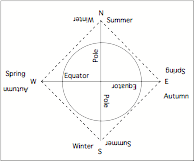
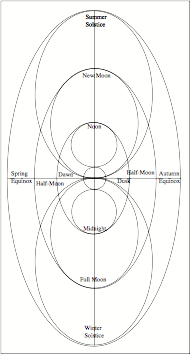
"This implies a kind of Justice in God's plan," Rose says. "The north will be rich and active, have summer and sun, for a time; then it will experience a dark age. When the north is in its dark age, the south will blossom and bloom..."
"Yes."
"But in another passage you seem to indicate that the white man is the principle of activity; and the black man is the principle of passivity," Rose says. "When the North experiences its Night it will be because the black man has migrated to the north; and, likewise, the white man will migrate to the South and bring about the period of Summmer to the south. The Nazis apparently also believed this. And that is why so many Nazis went to South America. This seems to imply that the black race is the embodiment of Night; and the white race the embodiment of Day. What do you say to this...?"
"I think you can make that argument, in terms of the meaning of myth," Crossmann says. "But remember, I am saying both Day and Night are needed. During the Day we build our social forms and carry out the evolution of the world in a physical sense, to the detriment of our spiritual selves. And at night we carry on the evolution of world in a spritual sense. Both parts are necessary. This is the very nature of immortality. Having a body in both wolds, being able to gain from both worlds...."
"But doesn't this theory doom the black race for ever to live in poverty, even if they do live in spirtual wealth -- since they represent the Night, the Winter...?"
"Well, the spiritual viewpoint is that the color of the skin does not matter. It is the color of the soul that matters..."
"Many African-Americans are angry at your book, because they believe you are attempting to resurrect ideas that are essentially racist, were buried in the past, and are better off left buried -- bad ancestors, if you will. That we have outgrown these ideas. What do you say to that...?"
"I am seeking to read the Mind of Nature. I can say, as easily, that the struggle is between the Sun and Moon. The Sun is the savior in the Northern Hemisphere because the Moon, Water, the Cold, tyrannizes the North, tries to kill it. The Sun arrives to warm the world, to defeat the freeze. This is why the northern hemisphere worships the Sun, and follows the Solar Calendar. Jesus Christ is a Sun-Hero too, as were Herakles and Odysseus and Apollo. Michael the Archangel is a Sun Hero too. The Southern Hemisphere, on the other hand, is hot by nature. The Sun is a tyrant in the South. The Sun persecutes the South. The Night, the Moon, saves the South from the Day. The South is a Moon culture, it honors the Moon Goddess over the Sun God; and it follows the Lunar Calendar. The North honors the fire gods; the South honors the water goddesses..."
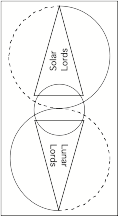
Rose smiles a wry smile.
"Clearly there is nothing racist in the new commandment the book brings back from the mountain top, is there?"
TRUTHS FOR A NEW AGE
1. The oneness of humankind.
2. Independent investigations of truth.
3. The foundation of all religions is one.
4. Religion must be the cause of unity.
5. Intuitive knowledge completes that of reason.
6. All living beings are sacred.
7. Equality between men and women.
8. Prejudice of all kinds must be forgotten.
9. Individual responsibility leads to the welfare of all.
10. There must be: universal peace; universal education; a spiritual
solution to the economic problem; a universal language,
English; an international tribunal which truly governs the world.
"I have heard no one complain that this is racist, as a set of ideals given to the world," Rose says. "But the other part is troubling. It troubles me also in what I see happening to the American electorate. The Republican Party seems to be becoming more and more tha party of White Men. And the Democratic Party is becoming more and more the party of Everyone Else..."
"White Men have become the scapegoat for all that is evil in the world," Crossmann says.
"Yes, replacing the Black Men. There was a time that Black Men were blamed for all the evil in the world," Rose says.
"Clearly both readings are mistaken. Tricks of perception," Crossmann says. "This trick of perception is represented by the yin-yang symbol. The Night is blamed for evil during the Day; and the Day is blamed for evil during the Night. The Day brings about bounty for a society: crops, food, fruit, pleasant weather. The is what the Sun brings. Wealth. The Winter brings sterility. Death. Storms. But it also brings one close to the God of one's origins. God is the totality, dark and light at once. The Darkness steals the light, defeats the day, brings economic depression, social concussions, revolution... Darkness is the anti-universe. Everything thought good in the universe is thought bad in the anti-universe: wealth is bad; comfort is bad; fertility is bad; food is bad; the law is bad; life is bad; disorder is good; rebellion is good; poverty is good; death is good.

"However, the darkness has something very good to give to the man as he passes through the valley of the shadow of death. The darkness gives the man his origins, his ancestors. And the woman, the darkness, in fact, gives man re-birth in the darkness. The darkness is the mother of the Son, and, verily, the mother of the Sun. The mother gives the Sun his sword, gives him a vision of his God. The Sun returns, claiming the Fatherland, the Land of the Sun, the Land of the Summer. Ultimately, none of the elements of Life are in opposition. They only appear to be so when everything begins to move. And souls, ultimately, play every roll, wear every mask, that is available on the wheel.
"The book gives a picture of this (reading):
Distributor of Masks
You don't like the mask you have chose? Would you like to pick another one...?
Second Son
How many masks are there...?
Distributor of Masks
There seem to be many. Yet, in reality, there are only two...!
"Keep reading," Charlie Rose says. "Through the definition of the two brothers...."
Crossmann continues:
Hamlet (distraught)
To be Hero or Martyr, that is the question.
Whether 'tis nobler in the mind of the ages now gone
To kill or to be killed
To be large or to be victim...
Two masks I carry -- yet which will I love...?
Bakunin (with a bomb on the balcony)
Is Tradition culture -- or is it the death of culture...?
(Lenin, disguised, hurries through the dark streets.)
(A bourgeois woman collects Rembrandt's paintings.)
Simon (carrying a cross through the streets)
I have come here to help you.
Willl you not also help me...?
Woman Weeping On a Street Corner
We awoke to find the black hand on our door.
Doom has a card which he leaves at the threshold.
Passing Time is a noose
Being drawn 'round our livery...!
Second Son to Women
Fear not, grim daughters of America.
The fate of the soul of a people is its vision.
The world one envisions at his death
Is the world which one enters.
Walk through Chaos with strength...!
Mythologizer (reading from a dictionary)
Brothers or Twins. A universal folklore motif in which correlative deities sometimes are in close harmony, representing culture or Light Heroes beneficent to manking; sometimes they are in conflict. When antagonistic, they represent the forces of good and evil, light and darkness, love and reason, Summer and Winter; and one is usually killed by the other, or they kill one another. Almost always the dead deities are resurrected; thus, the deity of darkness is reborn each evening, the deity of light is re-born each morning; Winter returns each year, and the conflict resumes. Some examples of this brother conflict are: Achilles and Patroclus; the Asvins; Balder and Loki; Cain and Abel; Castor and Pollux; dawn and evening breezes; Michael and Satan; Prometheus and Epimetheus; Romulus and Remus; Set and Horus; Typhon and Osiris. The Melanesian culture-hero is hampered in his beneficent, creative, or tutelary activity by one or more antagonistic brothers, such as Kabinana, Karvuvu, Qat, Tagaro, Warochunuga.
Mother to Second Son (hurrying through the streets in her
shawl, carrying a container of soup)
Your brother has become ill. Perhaps it was something you said. Here, help me carry this soup to his room...!
Second Son
The Summer and Winter Solstice represent the absolute extension of our antagonism. He has power over the world in the Summer; I have power over the world in theWinter. In between, we meet. Yet, my ability to see the Light of the Heavens -- that Light has been defeated and a kind of Darkness has descended. I see only the world of men now. I walk in the world of men and I speak. I have been castinto the underworld of sorrow. I walk through this land, yet am lost from my home...!
Mother of Second Son
Why do you speak such nonsense? Have you nothing better to do with your time than such things...?
Second Son
I am without a role on this Earth....!
(The Writer lies dead in a snow-bank, a knife through
his heart, his blood coloring the whiteness.)
"This is where the story, having come out of the darkness into the world of form, again goes into the darkness. This is a day/night cycle in the book itself. The multi-form world, which gave birth to the life on the boat, the ship, after the Flood passed, goes again into a kind of night of two voices...."
"Well, the Writer has been killed," Charlie Rose says.
"The role of the Writer has been killed," Crossmann says. "Because the only two roles, again, are the Hero and the Martyr."
"It is interesting to me that the Second Son -- which is you, I guess -- has taken upon himself the role of the darkness," Rose says. "You are identifying with the darkness at this point, the woman, the downtrodden, you are Jesus Christ in this role, metaphporically."
"Yes."
"So, the roles change," Rose says.
"Yes, the roles change. The North has the Sun and it also has the Moon, the Night. The same is true with the South. And the two masks are not only two separate personalities; but they are the same personality at a different point in time. They are aspects of the same one life...."
"The Hero is the Martyr later in life," Rose says.
"Yes."
"Not only that, judging from your thesis about the Universe and the Anti-Universe," Charlie Rose argues. "If there the two personalities in the Universe, Hero and Martyr, there must also be their opposites in the anti-Universe, Anti-Hero and Anti-Martyr...."
"Very good, Charlie," Crossmann says.
"Are these the Four Directions, then?" Rose asks.
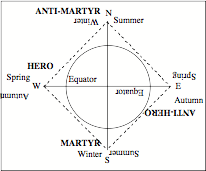
"The Martyr, is, in fact, an anti-universe personality," Crossmann says. "The Anti-Martyr is a Universe personality."
"The Anti-Martyr is the Hero as seen from the anti-universe?" Rose says.
"That is another way of saying it."
Charlie Rose seems satisfied.
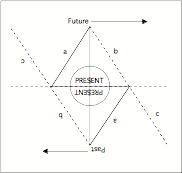
"The four guardian angels balance the world," Crossmann says.
"But Michael, Jehovah's angel, is sacred to the West," Rose says. "He is the guardian of the West."
"Yes."
"We need to take a break."
"We're back with Michael Crossmann. I'm afraid we might be missing something that really matters. I was flipping through the book while we were on a break. I want to talk about your understanding of modern physics; and your view that the stages of Man, so important to theosophy, can be viewed through modern physics. Your view is that man exists in bodies, different bodies, that are comparable to electrons -- that is, are states of matter. Man has a gaseous body, a liquid body, a solid body. Can you talk about this a bit....?"
"All the universe is made of light, condensing in waves, growing denser as it moves further from its nucleus."
"You write about ethers," Rose says. "Now science has all but done away with 'ether'. No scientist believes in ether any longer. But you refer to ether as 'plasma'. You put these words in the mouth of Vivekananda in an earlier part of the book. And here I am reading:
Vivekananda says: NATURE RECYCLES EVERYTHING, JACOB. THERE IS ABSOLUTE EQUALITY IN THE WORLD OF GOD, AT THE ESSENCE OF GOD. ALL LIVING THINGS SPRING FROM THE SAME SACRED SOURCE, WHETHER MINERALS, PLANTS, ANIMALS OR MEN, SPIRITS OR GODS. ALL LIVING THINGS CONTAIN THE SPARK OF THE ONE GOD, A SEED OF PLASMA IN THE SOUL, A SPECK OF GOD'S HOLOGRAM. NOTHING EXISTS AS AN ISOLATED FRAGMENT. ISOLATION IS THE ILLUSION WHICH THE MIND CREATES FOMENTING INSANITY. ALL THINGS COME FROM AND RETURN TO THE ONE LIFE, JACOB. UNIVERSAL BROTHERHOOD IS NOT AN IDEAL, IT IS A FACT OF NATURE. AND TO KNOW THIS FACT BRINGS JUSTICE TO THE WORLD....
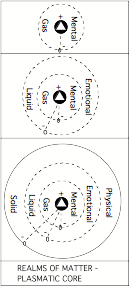
Rose continues: "I am fascinated by the phrase 'all living things contain the spark of the One God, a seed of plasma in the soul, a speck of God's hologram'... Your argument is that the universe is a hologram. An multi-dimentional image projected in space, but without substance. What is plasma...?"
"Allow me to read a little further where you are reading," Crossmann says. He reads:
The Scientist says: WHAT YOU CALL ETHER WE CALL PLASMA, THE FOURTH STATE OF MATTER. A BIOPLASM IS ANOTHER LEVEL OF SUBSTANCE, WHICH PRODUCES A HOLOGRAM, A COHERENT ENERGY PATTERN WHICH IS A FORCE-FIELD FOR ORGANIZING MATTER INTO BUILDING A KIND OF PHYSICAL NETWORK FOR ITSELF. INSIDE THIS BIOPLASMIC BODY, PROCESSES HAVE THEIR OWN LABYRINTHINE MOTION, DIFFERENT FROM THE ENERGY PATTERN IN THE PHYSICAL BODY. YET THE BIOPLASMIC BODY IS NOT A CHAOTIC, BUT A WHOLE UNIFIED ORGANISM WHICH ACTS AS A UNIT, IS POLARIZED, GIVES OFF ITS OWN ELECTROMAGNETIC FIELDS, AND IS THE BASIS FOR WHAT WE CALL BIOLOGICAL FIELDS.... Laser uses in photogrpahy and holography defive from the high intensity of ultrashort pulses emitted by the laser or from the coherence and monochromaticity which are the properties of the laser light. In high-speed laser photogrpahy, frame exposures times as short as ten trillionths of a second, and repetition frequencies as high as one billion per second have been obtained....SO, HOLOGRAPHY IS THE PHOTOGRAPHIC PRINCIPLE UPON WHICH THE VISIBLE UNIVERSE IS BUILT.... Our senses act as holographic sensors. They carry to the mind information which it pictures. And through electrical discharge, the picture takes on form.... IONIZED ATOMS OF A GAS OR A VAPOR -- THAT IS, ATOMS WITH ONE OR MORE ELECTRONS MISSING -- MAY BE USED TO PRODUCE A LASER EMISSION. A GAS IN THIS STATE IS CALLED A PLASMA. ARGON, CADMIUM AND NEON HAVE BEEN USED IN THIS WAY.... When the Ch'i or Ether or Plasma condenses, its visibility becomes apparent, so that there are then the shapes of individual things. When it disperses, its visibility is no longer apparent, and thre are no shapes. At the time of condensation, can one say otherwise than that this is but temporary? But at the time of dispersing, can one hastility say that it is then nonexistent...? THE SCIENTIST SAYS: The direction of the flow of energy on the front of the body begins in the midrif and proceeds downward in a sort of curving "L" toward on eof the legs, and upward in an inverted "L" toward the opposite shoulder. It then reverses this flow on the back side of the body. The whole energy pattern around the body forms a Lemniscate, or a Figure 8....
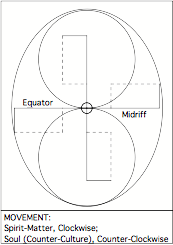
"The arms in this drawing, when projected in space, become the swastika, the double swastika, and then the triple swastika," Charlie Rose. "And, in this, I am reading from the Bloom letter."
"The swastika is an old Buddhist symbol of the four seasons, ever turning, ever harvesting souls," Crossmann says. "The Nazis appropriated the symbol for their own use."
"But what I am saying is that you are in the same territory as were the Nazis," Rose says. "That's all I am saying! Can we see the other two drawings as well...?"

"This is fascinating speculation," Rose admits. "And there is a lot of speculation here. You view man as pputting on skins of clothing, the same as the atoms puts on skins of electrons to differentiate a homogeneous element, hydrogen, into a system of multi-faceted building blocks. Then man will also take those skins off, returning to his source, returning to the homogeneous element...."
"Yes."
"We have much to cover," Rose says. "I don't want to get bogged down here. I wanted to show that the Second Son we have spoken about -- you, yourself -- is essentially a spiritual being, an anti-universe being..."
"Negative to the Future," Crossmann says, "positive to the past."
"The martyr?" Rose asks.
"Yes."
"Essentially a martyr before the end of this passage of day, when the Writer is seen murdered in a snow bank -- as the Second Son hurries with his Mother to visit the First Son who is ill... We wanted to show a scene in that section..."
"Yes."
"Do you want to read it?" Rose asks.
"Where should I start...?"
"Well, the Second Son is also ill, apparently," Charlie Rose says. "You can start there, with the description of Advent..."
Crossmann reads:
Second Son
Tell me of Advent...!
Mythologizer (again reading from a dictionary)
In Christian tradition, a religious season commemorating the first and second coming of Christ. Season of conception. It encompasses the four Sundays before Christmas and begins with the Sunday closest to November 30th. Instituted as a preparation for the Feast of the Nativity...!
Writer
I feel a surge of light now. I feel complete. I feel a power now surging inside me. A kernel of power. It is within myself that I will find answers I seek...!
Second Son
I see again -- the light is almost blinding. A power within my chest demands singing. If I have died, then let death be my altar...!
Chorus
You are the savior now sent here by your Father.
Traveling through the underworld of darkness,
You bring the Word
To your brethren here
Who weep...!
Doctor Von Helsing (standing beside the bed in which Second
Son lies sleeping)
Brain-fever -- no doubt about it...!
Mother (sitting by the bed, holding the Second Son's hand)
He mumbled something about having erotic fantasies. Then he said a fire awoke in the pit of his stomach. This electrified his whole body. This fire in his stomach ran up his body and into his head, giving him a terrific headache...!
Doctor Von Helsing
He thinks too much! He must come down to Earth if he expects to live longer...!
Writer
He has fallen from Heaven, and yet he clings to his past life. When on Earth, do as Earthlings do. When in Heave, do as Heavenlings do...!
Doctor Von Helsing
Angels, you mean...!
Writer
Yes.
Doctor Von Helsing
He must rest. The Winter is coming in hard. It is a time of reflection -- not a time of action...!"
Town Crier
H:ear ye! Hear ye!
Niigh on to a New Moon.
All is well! All is well...!
Old Woman (crying from a second-story window)
Was it not that Purificatory Fire of Old Bostic which came to visit the lad who now sleeps...?
Chorus
Sleep, with its melancholy grief, comes to gather
The songs of a life which has turned, gay to sorrow.
Old men on a park bench discuss the passing of Hope
As though Hope were merely as a boat on the water.
Naked branches begin to glisten.
Pain is the result of one's clinging to a dying thought-form.
The Second Son causes himself grief
Because he refuses to let his past half go --
As Generator.
So now he must sleep.
Let the Age cure itself now.
Father of Michael (appearing in a dream to the Second Son)
Have patience, Michael.
All things come at the exact time they are supposed to...!
Voices of the Crowd (appearing in a dream to the Second Son)
He's afraid that Time will pass him by...!
He can't bear to let his own mentality pass...!
I will pull a hat from a rabbit. Surely is is no more difficult than pulling a rabbit from a trap where the bait lies...!
Bravo! Simply stunning! Now that is real genius...!
Gauche, that's what it is...!
He suffers from greed -- greed for Ideas! And pride as well...!
You are afraid, Michael, that the Voice deep inside you -- Vach -- which last year brought you secrets from the vastness inside you this year will not come! You are afraid your creation will tumble to pieces...!
Act...!
Reflect...!
Read...!
Sit...!
Do nothing...!
Do something...!
Goood Lord, man -- are you paralyized by your own inflexibility? If you are cut off from your Source then you must give creation to your own life! You must become your own source...!
What a wise paradigm...!
Wisdom in cups, from bare boards of a cupboard...!
He has lost his sense of humor again! P:ity the poor boy cannot laugh at himself...!
He begins to become angry at his brother again -- blaming his brother because he fears he cannot write! This seems to happen again and again...!
Have you noticed, my friend, that the wind blows strongest and steadiest during Spring and during Fall? And so, these are the moments when the Great Breaths are turning! These when the In-Breaths and the Out-Breaths come crashing...!
Woman
(Dressed as the Second Son) to Man (Dressed as the
First Son):
Every Spring you resent me because you tell yourself that I am the reason you cannot chase after women. Yet you do not really wish to chase after women; rather, you wish to have the self-image of being a ladies' man. You are in love with your image, like Narcissus himself. It is an obvious lie. If you come on to a woman, and they respond, you retreat. So you make me the cause of your failure in love. you blame me for this self-deception. You love yourself too much to love another...!
Then the Fall comes, and all the resentment you aimed at me, in your gambol for identity, is returned upon you. It is an automatic process. Karma, if you will. We condemn others; then we become those others. Hate; and you shall be hated. Mistreat; and you shall mistrated be. If you must see yourself as a ladies man, then you must be a ladies' man! Please don't lie to yourelf; and then blame me for the lie...!
Second Son Standing on a Soap-Box (appearing in a dream to
the Second Son)
We stand, historically, in relation to Rom at the time when the Empire broke into pieces. America is the empire; and Washington, D.C., is Rome. America is fated to break into nantural, geographic boundaries, forming cultural, philosophical entities, in much the same way as did the countries of Europe, feeding on the cascase of Rome, the Great Father. That is the hope of America. Great cultures spring from a regional pride -- which nurtures a sense of belonging to and being born from that region. We do not belong to the abstract Empire, the Great World-City, at least not through love. Rather, it owns us; we are slaves to its vision. If we are to achieve a greatness of the soul, then we must return to the soil. We must love our environment -- and realize that we are one with it. When the Earth is corrupt, its atmosphere or Spirit is corrupt. When the Earth again is clean, its atmosphere will again be pure....!
A great culture contemplates the essence of life. The Mind of Nature. The reasons for existence. It contemplates the timeless existence, in which each voice that speaks has a time and a place...!
Voices in the Crowd
He's advocating secession...!
Call out the police...!
Perhaps he is right...!
Perhaps small is beautiful..!
Don't you all see what he is trying to do...?
He's on the side of Death...!
He wants to dismember his Father...!
(A farmer leds his cows to the slaughterhouse.)
"So, the Second Son is a rebel at this point, rebelling against his father's world," Rose says. "He is still rebelling, as he has been throughout the entire novel...!"
"Yes."
"The book, Small is Beautiful, was popular in the Pacific Northwest at this time."
"Yes. It was popular with my brother."
"But not you?"
"Not so much."
"And another book, Ecoptopia, which showed North America broken up into different regional countries and governments."
"Yes."
"And you were on their side at this time," Rose says. "You were for the dismemberment of the giant, because you saw the giant as being evil, consuming the world, dangerous to the world...?"
"Yes."
"So what changed all this?"
"Life," Crossmann says. "Time. I came back to life. The spirits are dead, remember. The spirits desire death. They have no physical body. They are trapped in the darkness...."
"You are an agent of civil war at this point," Charlie Rose says. "You are advocating civil war -- there is no other way to say it. Secession from the union led to a civil war before."
"Yes. I was speaking for self-crucifixion."
"Your brother loved Eastern mysticism, American Indian philosophy, Lao-Tze, Carlos Castaneda," Charlie Rose says. "He led you into the darkness..."
"Yes."
"He killed you, in a sense. He put you to death."
"Metaphorically."
"He didn't like to work. You worked for him. He did not care for the physical world, for the material plane...?"
"Yes."
"He was lazy."
"Yes."
"And he dragged you into this spiritual world with him."
"Yes."
"You and your brother are the brothers of mythology," Charlie Rose says.
"Yes."
"He pulls you into the underworld, where he dismembers you."
"Yes."
"But he also gives me re-birth," Crossmann says.
"Yes. At his own detriment."
"Partially. But the world of darkness, which he desired, is not all good. He thought poverty and peace would be good. He did not imagine the shadow side. The shadow side contains monsters who wish to take his life. Criminals, killers, parasites, demons. These threaten him too. He wants me to rise, the Light to rise, to drive away the demons..."
"Doctor Von Helsing, of course, is from the German movie Nosferatu," Charlie Rose points out.
"Yes. Werner Herzog's Nosferatu. Herzog's movies, the characters from these movies, are in the novel in many places."
"Again, the Germanic, the Teutonic, influence," Rose notes.
"Yes."
"Death makes an appearance in your novel aat this point. And so does 'Peace of Mind' which you name Ariel, who then is transformed to Ariel Sharon, the Israeli General, some say a mass murderer," Rose points out. "And then Chief Seattle gives the Second Son, who is transformed into Everyman, herbs that will take him to his father's land.... Why don't you read this section -- beginning with the re-appearnace of Leslie Rhodes, your love...?"
Leslie (in Second Son's dream)
Poetry is the language of the heart or the soul. It is the language of Love. Give up your Science for a time. Love heals all...!
Second Son (in delirium)
Speaking in tongues is tongues of flame, which is inspiration, speaking sounds from the medium heart...!
(Second Son stands, in his dream, beside a river. His
mind is perfectly still. a legion of crows flies
overhead. Beyond, on the other bank, a crane huddles
in isolation.)
Death (dressed as the Wind)
So, you have left Time behind.
You have become quiet and restful.
Darkness gathers its pebbles at sea.
You either love the world
Or it makes you go mad...!
Second Son as Everyman:
Many years were gone
When the Dark Woman came
Scattering scents
From the cask she was bearing.
She brought words from a distant land.
Yet that land is so distant
I cannot hear its echo...!
Peace of Mind (Ariel)
You walk in the world of men, now, my friend.
Let the water of kindliness
Wash over you
And cleanse you.
A time for all things, there is,
It is true.
Love those near today --
Dodn't lament what is gone...!
Chief Seattle (handing the Second Son a pipe)
There are times, now that the Darkness has come,
When you will wish to travel back
To the Land of your Father.
These herbs will help take you there.
Use them with reverence.
The time is not yet right for this.
The time will be right when your eyes
See the goat.
To climb the mountain,
Like the goat,
Smoke these herbs,
And they will help you...!
Boss to Clerk (at place of business)
As you know, Michael, the State is having severe economic problems. We are being forced to cut back...!
Ariel as the Archer
If you love your Fate, your power is immense.
You have begun to fear the Future, my friend...!
Writer
Yes, I have -- because I fear some catastrophe will intrude upon my production of this novel...!
Ariel
Seek to be a great man as well as a great writer.
When Destiny calls you, you must step forth with courage...!
(Ariel Sharon reviews the Israeli Air Force.)
"Everyman goes into his first long soliloquy," Charlie Rose says. "But we have had some powerful themes introduced here. The Writer is not just a writer, he is also a man...!
"And this is very important," Crossmann agrees. "The angel is also a man. It is an initial preparation of the fall of this angel...!"
"You admit this?" Rose asks. "You admit that you are the fallen angel...?"
"We will need to keep reading to understand what this means," Crossmann says. "It is also important that it is Ariel, Ariel Sharon, no less, the Israeli general, who awakens the Seccond Son to this realization..."
"Is this a seduction, then?" Rose asks.
"No. It is a warning, to keep the Second Son alive," Crossmann says.
"But the Second Son dies," Charlie says.
"The Second Son dies as a Writer," Crossmann says. "But he lives as a man, as a reflection of Jehovah, good and bad, eternal. Ariel, in his earlier message, speaks: 'You walk with men now.' He echoes the wisdom of Ecclesiastes: there is a time for all things. To be an angel; and also to be a man..."
"Then Michael the Archangel appears," Rose says.
"Yes. We must remember that Ariel means 'lion' or 'lioness' -- and this lion/lioness appears quite often through the rest of the novel. In Jewish Kabbalism, Ariel is one of the seven princes, angels or spirits presiding over the waters, under the leadeership of Michael the Archangel... "
"This is not explained in the text," Rose says.
"There is much is the text that is not explained," Crossmann says. "That awaits further explication..."
"Do you wish to read this?" Charlie Rose asks.
"We need to realize that the poem that was spoken by the Clerk at the begining of this period of Day, when the light first manifest itself in poetic form, is repeated here, marking the circle, from Dawn to Dusk, which he first recited under the guise of the Court Poet. The vision the Second Son repeats asks who is bringing the plague on the city. And, after he asks this, Michael the Archangel appears to him. It is an important scene....."
Second Son
I walk down steepled stream of stone
Beyond the lanterned turn of day,
Down steps with lead, like sails, below
To furnaced symbolled tales of woe.
"Who let the plague in town to cure
The vagabonded merchants' wish,
Veiled by documents of profit,
To which they cling like Old Love's shadow...?"
So the poet speaks to evening;
Near churn of oceanic sound
The river speaks a fated discourse --
Inspired by words the moon has gleaned
From age of whispered 'visioned sorrow.
"The time does come when the wind in its saber,
And schooners of logic, anti-logic, come rattling
To shout down the myriad moments of progress
Which bankers' wives weep to
And missionaries flee.
"Long since the Dawn had whisked its sleeve
On bone of night to sketch out Hope;
Long since the Mid-Dayed reign of Light
And motioned manifestoed Conquest --
Even since the Dusk has gained
The muted tones of Doom's apparrel --
Long since that time have I, in dreams,
Foreseen the wail of this fair city,
Forecast in darkest night
The toil...!"
How I have asked the velvet reasoned
Rhyme of Time
Yet know the days might bleed me!
I see the morning light come creeping;
Sleeping dogs, on pavement, lie.
Michael the Archangel (with flaming sword)
Put to hideous flight by thee
The monstrous fear of the duty of Time.
Only Youth dares believe in Tomorrow.
Only Tomorrow bears the sound of perfection.
Giving thyself up heart and soul to
To Destiny's ring:
The riot cannot sting you.
Wedding thyself to the mystery of Life,
The strife in the distance, a parlance,
Cannot stone thee.
Vision of the Second Son
A mass of people surround a young man who is carrying books.
They strike him, and pull his books away.
They begin to stone him.
Yet the rocks do not scar.
"So, Michael the Archangel has given the Second Son, yourself, Michael Crossmann, the job of driving darkness out of the town."
"So it seems," Crossmann says.
"Of course, Michael the Archangel is the angel sacred to Israel and the West," Charlie Rose says. "And Israel, in this sense, is akin to the mystical Heavenly City, I suppose. But Israel, the country, is also connected to this. The closeness of Ariel Sharon to this vision is eerie... Some people, some people in Lebanon, will tell you that Ariel Sharon is a kind of Hitler..."
"We need to read further to get a sense of this imagery, what it means," Crossmann says. "Ariel Sharon becomes a central figure in this drama..."
"Let me read from your letter to Harold Bloom, where you talk about America being Israel also.
In Omens of Millenium, you discuss the Jewish patriarch Jacob's wrestling with the Angel of Death (Michael the Archangel) all night so he could be called Israel. This phrase rung true to me also, in terms of this American Jacob. For he will, in the end, also call himself Israel. He proclaims, through myself, to a woman of Israel, Daphna Greenstein, that as America is the micrososm of the Earth, so America is the Israel in Heaven -- as Israel, her country, is the Israel of the Earth. This is a mystical marriage and is an updated expression of the covenant between Israel in Heaven and Israel on Earth. This makes America, also, God's "chosen people" -- those chosen to survive the coming destruction.
"When we return we will talk with you about the two women of Israel who are vital to your experience in writing this novel. We need to take a break."
"We are back with Michael Crossmann. So, our hero has been given a mask, essentially, of the World Savior. Michael the Archangel has appeared to him with a flaming sword, telling him that it is his job to drive darkness out of his town, out of his country. America has been given a death sentence; in fact, the Second Son, himself, has given that death sentence, a decree of dismemberment through civil war of his Father's world. The Second Son, in a sense, has been given the decree to kill himself..."
"To wake up, at least, as to what kind of curse he is pronouncing on his own kind," Crossmann says.
"You write about the man being evolved by Two Women, by the Mother and by the Daughter. Can you expand on this a bit...?"
"Yes."
"First, let me read what you wrote in your letter to Harold Bloom about this."
Rose reads:
There are two couples, in fact -- in compliance with the laws (1) of atraction of opposites and (2) the repulsion of like particles. The Man of Light (the White Man) -- the Sun -- is attracted to his opposite, the Dark Woman, the Earth. The Earth chooses the White Man to rule her because of his goodness, his purity, his sense of justice. The White Man falls, enters the Earth, and by doing so becomes, himself, Dark. Dark with Sin, dark with matter, dark with experience. The Dark Man, the Dark Sun, is attracted to his opposite, the Woman of Light (the White Woman) -- the Moon. The Moon (reflected light) represents the Virgin Sea, the Virgin Mary -- the one who gives birth to the savior; and the White Woman saves the Dark Man by providing him with mystical truth, the Wisdom Religion, which is the avenue to re-birth. Re-birth, in fact, as a White Man (the New Sun), expressing the Father-energy, the energy re-peopling the Earth.
The Father (Time-Saturn) desires the Daughter; he enters the Daughter, giving birth to himself as the Son. The Father-Daughter Love defines the Day. The Dark Son desires the Heavenly Mother (the Moon). The Mother-Son Love defines the Night. The Son hates the Father. The Mother conspires with the Son to overthrow the Father, to castrate the Father. This is the story of Jacob's family -- indeed, the story of Everyman and Everyman's family.
The marriage of the White Woman and the Dark Man result in a fervent anti-materialism (hatred of the Earth, hatred of the White Man, the White Devil). The marriage of the White Man and the Dark Woman result in an anti-mysticism (hatred of the Dark Man, the Black Devil, hatred of the Night). This duality is the basis of all racism, white against black, and black against white.
"In an abstract sense, there are two men and two women in this archetypal family. The father and the son; and the mother and the daughter. The Father is the man of light; and he is attracted to his opposite, the Dark Woman, the Earth, his Daughter. Opposites attract; and the Earth gives herself to the Sun, the Light, for the sake of fertility. However, by approaching the Earth, by 'entering into matter', the light man becomes dark. The Dark Man, in contast to the Light Man, is repelled by the Earth, the Dark Woman. Like particles repel. The Dark Man hates matter, hates the Earth, hates reproduction, fertility, desires Death, which, in the view of the Anti-Universe, appears to be Spiritual Life. The anti-universe is negative to the universe; but it sees itself in very positive terms also. It is just negative to Life. It is positive to Death.
"The Dark Man is attracted to his opposite, the Light Woman, the Moon, his Mother. The Moon, in this sense, the White Woman, is the Virgin Mary. The Virgin Mary gives birth to Jesus Christ, the martyr. And the Dark Woman, the Earth, gives birth to Michael the Archangel, when the pregnant Earth is threatened by the Dark Dragon that wishes to kill the Earth, that wishes to destroy matter...."
"The one that hates Israel," Charlie Rose says.
"Yes."
"The Arab in one sense," Charlie Rose says.
"Yes."
"Or the Dark Monster, Gilbert Patton, whom you met in your own plane. And who wished to kill you."
"Yes."
"You admit that this duality is the basis of all racism," Charlie Rose says.
"Yes."
"You are rationalizing racism."
"I'm trying to understand how the world works -- nothing more," Crossmann says.
"I have heard you describe the Light Man, the White Man, as being the Blonde Man; and the Moon as being the White Woman, the Blonde Woman," Charlie Rose says. "Are you avoiding these terms tonight because of a fear that this will be misunderstood, and associated with the kind of Aryan system that motivated Hitler...?"
"Well, I am clearly not blond," Crossmann says. "These are principles I am talking about. I could as easily talk about directions. The Northern Man is attracted to the Earth. The Southern Man is attracted to the Moon. It is more about climates that it is about races. It is more about locations on the earth than it is about pigments of skin..."
"You have your own two women in this novel," Rose says.
"Yes I do."
"And both women are from Israel."
"Yes, they are."
"Your Dark Man Period, which is the majority of this second part of the book, Dark Michael we might call him -- although you seem to claim that the Dark Michael Period is, in fact, the Jesus Christ period -- and we'll certainly get into that -- is the time when you are attracted to a woman name Shulamit Lotate Margalit. She becomes a kind of guiding spirit for you. I would not say she is your Virgin Mary, however. She is sexual; and she is very emotional...."
"In her highest aspect, she is the Virgin Mary," Crossmann replies. "In her lowest aspect, she is something else."
"A kind of temptress," Charlie Rose says. "A kind of Eve."
"Throughout this period of life in the underworld, as the Second Son educates himself as to the nature of the heavens, Shulamit appears over and over again. She is a moon figure. She has many features, like the Moon herself: sometimes full, sometimes empty."
"Ok," Rose says. "There is no doubt that she is a main female figure in the novel. And then there is a second major female figure, Daphna Greenstein, also from Israel. But she will come much later and will appear to Michael as Daphna the Red. She is the Earth. And she prepares Michael to be a warrior. Shulamit prepares Michael to be a saint, to be an angel. And Daphna prepares Michael to become a man. She is much the same spirit as Ariel Sharon. Solid. The Earth. The perfect square..."
"How did this whole obsession with Michael the Archangel come about?" Charlie Rose asks. "Many critics are saying that this whole section of the book is a textbook of psychosis..."
"Well, clearly it is not a rational process," Crossmann says. "The Dark Element is not rational. The dreamworld is not rational..."
"The nightmare world," Rose corrects.
"Survival in the nightmare world requires the soul speak a different language," Crossmann says.
"So where did this begin, this attachment to Michael the Archangel?" Rose asks.
"At my birth apparently, with my being named Michael by my father and mother," Crossmann says. "Blavatsky writes that a name is a destiny..."
"What does that mean really?" Charlie Rose asks. "A man's name is a destiny. I don't understand that...."
"And you won't, Charlie. You're an intellectual. The intellectual exists in a box, inside of which the irrational is not allowed. The male world is not allowed into the female world. The two are separated. The man is sometimes allowed into the female world, but only when he has been wounded..."
"In Love," Charlie says. "Leslie Rhodes, in this section, allows the Second Son to caress her breast and tells him that he will only be allowed into the Kingdom of Wisdom if he has had his heart broken in love..."
"Yes. But there is danger here," Crossmann says. "Remember Actaeon. He moves into Diana's world, to see Diana naked, bathing in the woods. And Diana punishes him by turning him into a stag. Diana then commands her dogs to hunt down the stag; and the dogs tear Actaeon into pieces..."
"This is the dismemberment motif again, is it not?" Charlie Rose asks.
"It is."
"So Blavatsky writes that a destiny is in a name," Rose continues. "And this began to draw you to your prototype...?"
"Yes."
"There is a passage in this section in which the meaning, the destinies, of the two brothers are revealed, as well as the destinies of the Heimkreiter brothers. Let me read this:
Historian
What shall you be: Hero or Martyr? Active or Passive? Mover or Moved Upon...?
First Son
My name is William James -- which means "Will Helmet -- Protector" and "Usurper."
Second Son
My name is Michael John -- which means "He Who Is Like God"; and "The Lord is Gracious"....
Prophet
And so it is written: ye shall be betrayed...!
Second Son
So it shall be...!
First Son
My name is Joseph Heimkreiter -- which means "Increaser...of the House of Dust"...!
Second Son
My name is Benjamin Heimkreiter -- which means "Son of the Right Hand; Favorite Son....of this House Made of Dust"...!
Joseph Heimkreiter
My father never would accept me relly. He thought, perhaps, that I was not his son; that my mother had taken another lover, Lawrence Halsey, shortly before, or perhaps even after, the wedding -- which is true, she did. One man was never enough for my mother. And she had loved Lawrence Halsey, off and on, for many years. Love-hate it was. Passionate -- rarely pretty.
My mother was pregnant when she and my father were married. Adn when I was born, when I separated my mother and father by my presence, my father resented the loss of his wife, resented the loss of his freedom of movement. And I became a symol of the youth and strength and, perhaps, sense of principle he had lost.
Once, when they fought, my mother suggested that I was not even his son -- that I was the seed of someone stronger. From that time on, I was merely a shadow to him. I tried to succeed for him, to win his approval. But the more I succeeded, the more he disliked me. I should have rebelled against him. Benjamin rebelled against my father. And my father loved him for it. I did everything expected of me. Yet I could not win his respect. And when the war came, the Viet Nam war, since my father had been a hero in World War II, having rescued a black solider named Christopher from a burning church, under heavy enemy fire, to prove myself to him, I enlisted. I went to Viet Nam. And never again did I see my father....
(Helen Heimkreiter, carrying a lighted candle. She
opens a letter, reads the first words, shrieks, and
collapses.)
"It is interesting," Rose continues, "that the Heimkreiter story is still being told, still being unfolded; now, however, it is in the background rather than in the foreground. These pairs of sons, of brothers, seem to reflect one another throughout the novel. So, anyway, Michael is "he who is like god" -- that is, he who is like the Jewish God, Jehovah. Jehovah is an androgynous God, male and female. All the gods, in fact, are androgynous. Jehovah is the One God, the God who is all things, dark and light, good and bad. Jod-Heva. Heva is Eve. Jod or Yod is the tenth letter in Hebrew: The one inside the zero. The erect penis inside the womb. Heva or Eve is the Female Principle, Chaos, the Womb. You write, thus, to Harold Bloom:
The Father-Energy, the 1 issued from the Zero -- YOD -- is both the I (in the sense of the Ego -- the Individualized Soul rebelling against the Group Soul, breaking itself off from the world community) and the erect penis, I, the fertilizer of Nature, the impregnator and Orderer of Chaos. This male energy brings Time to the Earth, History, the diameter to the circle. But it is a two-headed energy, Good and Bad, like his creator. God is beyong good and evil. God is necessity; and a plan, an idea.
"Then you quote directly from an earlier portion of Conversations:
YOD-HEVA.
YOD IS THE TENTH LETTER OF THE HEBREW ALPHABET, MEANING HAND; IT IS
SOMETIMES INTERPRETED AS THE FIRST FINGER POINTING, OR THE PHALLUS, THE
MASCULINE PRINCIPLE. HEVA, OR EVE,
IS, OF COURSE, THE FEMALE PRINCIPLE...
Jehovah, then, is a double-sexed god. Masculine-feminine, separated into poles.... BUT IS JEHOVAH NOT SATURN...? In the sense that Jehovah is Time,
Father-Time, He is Saturn. Saturn
is the ancient deity of Harvest.
Seedsower and answerer. Who
is the husband of Ops. In the
Golden Age, he was co-ruler of Earth with Janus. His emblems are the hook, the scythe, the sickle; his color
is yellow... SATURN IS THE DEATH
PLANET, SIXTH IN DISTANCE FROM THE SUN, RULER OF CAPRICORN; LORD OF SATURDAY. IT IS THE FINITE WITHIN THE
INFINITE. BRINGER OF INERTIA AND
MOURNING... But Jehovah is not Saturn.
In his planetary aspect, Jehovah is Jupiter or Jove. JUPITER IS THE GREATEST OF THE
PLANETS. THE LARGEST BODY IN THE
SOLAR SYSTEM, EXCEPTING THE SUN.
IT IS FIFTH IN ORDER FROM THE SUN: THE ROYAL PLANET, RULER OF THE
ZODIACAL MANSION SAGITTARIUS; HE IS THE LORD OF THURSDAY. JUPITER IS THE SHEPHERD OF THE STARS,
CONNECTED WITH THE PRODUCTIVE POWER OF NATURE AND THE GIVER OF ABUNDANCE.IT IS
THE GREAT AUTHORITY, AND PROVIDES THOSE BORN UNDER ITS INFLUENCE WITH
FRANKNESS, STRAIGHT-FORWARDNESS, UPRIGHTNESS, AND CONTROLS THE SOLAR-PLEXUS
SYSTEM OR NERVES, PRODUCING BANKERS, DIGNITARIES AND JUDGES. IT IS PICTURED BY THREE SUNS, SYMBOLIC
OF EARTHY FIRE MAINTAINED BY HEAVENLY FIRE AND RISING OUT OF THE WATERS IN THE
FORM OF STEAM, WHICH FALLS BACK TO THE EARTH AS BENEFICIENT RAIN. THE THREE SUNS ARE UNITED BY LINES
FORMING A KIND OF FOUR, WHICH EXPLAINS THE HIEROGLYPHIC SIMPLIFICATION... Yod-He-Vav-He is the Tetragrammaton
used for the ineffable name of Jehovah.
Yod is the Phallus, the pointing finger; Heh is the clitoris, the
opening or window; and Vav is the hook or nail, signifying capture. Yod
is ten, which corresponds to Wealth.
Its color yellow; its correspondence in the tarot deck is the Wheel; its
planetary correspondence is Capricorn.
Its direction on the cube of space is North, representing destruction of
error; its function is digestion; its intelligence is that of will; the organs
governed by it are the intestines; and it rules the sense of touch....
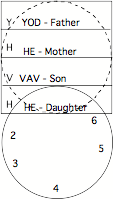
"Of course, this Tetragrammaton, Yod-He-Vav-He, is the Archetypal Family you have already discussed," Rose says. "The implication from this drawing is that Jehovah, like Michael, his angel, he who is like Jehovah, descends only to the fourth plane, the plane of Man, Humanity, and does not go into the underworld to become mineral, plant and animal. He is the First Man and the Seventh Man, as Tetragrammaton, but has nothing to do with the Second Man, the Third Man, the Fourth Man, the Fifth or the Sixth Man.... Essentially, he is the First and the Last. Now that is what Jesus has said in the gospels about himself; it is also what Michael the Archangel says to you -- that Michael the Archangel, and you yourself, are the First and the Last. So we have a very direct connection between Jehovah, Adam Kadmon, the First Man in Jewish mysticism, Jesus Christ and Michael the Archangel...."
Michael Crossmann says nothing.
"Am I getting ahead of myself," Charlie Rose asks. "I am also reminded here of one of your other drawings, of the seven planes and the three women. Do you know which one I mean...?"
"Is it this one?" Crossmann asks.
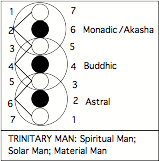
"Yes," Charlie Rose replies. "That's it."
"In terms of the Brother Mythology, the direction that the Monadic, the Buddhic Plane and the Astral Plane are all negative -- receivers -- is important. That associated with the Conductor's statement that 'Gemini is known as the 'Brothers' and that the Brothers divided into two lights, akashic light, which reads of divine incarnation, and astral light, which reads of personal, isolated feeling, be it power, or glory or love or lust.... You are interested in the divine incarnation. So you must know this. And there is a drawing that goes with this..."
"So, Akashic Light is where the vision of divine incarnation occurs," Rose says. "So we can assume from this that Michael (yourself) is given the role of Michael the Archangel on this plane, given from the Mother, who is, as you have suggested, Moon in its highest aspect, the Virgin Mary...?"
"Yes."
"This is all very complex," Charlie Rose says. "I'm not sure I get it. But what you seem to be saying is that the human soul that is in anti-matter, which is dark, rebelling against matter, who is drawn to the White Woman, the Moon, the Virgin Mary, and given a mystical vision of itself as a god, then as an angel, is black but then magically turned into white. You are suggesting that nature has some kind of elixir which changes black into white and white into black...!"
"This elixir is light itself, Charlie," Crossmann says.
"My God, this is frightening!" Rose says. "This is frightening."
"The anti-universe and the universe are oppposites. What is black in the anti-univese is white in the universe. Isn't that simple, Charlie...?
"I don't know," Charlie says. "You are saying that the soul is essentially a stone that dropped into the water, dropped into matter, grows darker and darker until it becomes black and then, as it passes through some point which separates the two worlds, the two universes, becomes white, becomes its opposite...!"
"Yes."
"And that's how energy is circulated in nature, in the pattern of a Figure Eight?"
"Yes."
"So you are black one instant, and then you are white, when you pass through the center of the figure 8?"
"Yes."
"You are white one instant; and then you become black?"
"Yes."
"The Second Son has been speaking of his brother as being the ruler of the Summer and himself as the ruler of the Winter." Charlie Rose continues. "But then he passes out of existence again, into the mass of night. And then he appears again. And then he is the ruler of the Summer; and his brother is the ruler of the Winter. I'm afraid of what I am hearing and seeing because it is becoming so palpable. And it's frightening in a way...."
"Why is it frightening...?"
"I'm not sure.
"Look at this drawing," Crossmann says.
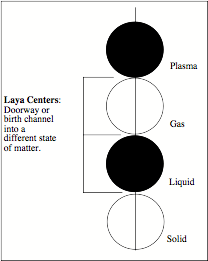
"The soul is white in one world and black in the next," Crossmann says. "That is how I went from being dark one moment, a soul in the night, studying Virgin Matter, Spiritual Matter, to being re-born white, an archangel defending the light and driving darkness away...!"
"I'm quite astounded!" Charlie Rose says.
"The 'laya centers' in the drawing are a kind of womb through which a particle passes to be born in the next world. Daphna Greenstein was that kind of laya center to me, and Israel. Israel was the Womb of the World, is the Womb of the World. By passing through Israel, I was transformed from an Angel into a Man, a man made in my father's likeness, a defender of heaven, a defender of the father....!"
"I am astounded!" Charlie Rose says. "We need to take a break...!"
"We're back. Ok, so let me ask you something. We are talking about 'laya centers' -- and laya centers have been defined by our guest as vortexes or 'wombs' through which a particle passes to a different state of matter or spirit. I am assuming it works in both directions. Now, in this novel, we see a long period of form, of differentiation, of multi-faceted forms speaking and moving together, objective existences. Then, suddently, the form world is replaced by two voices moving in very close spatial relationship. This has been defined in one case as the spiirit of Jacob Heimkreiter returning to the root nature of Spirit-Soul taking up residence in the ark (like Noah) to ride out a period of Chaos, Flood, the Female Nature, Night. And this is now, in the novel, happening again. The Writer has been found dead in the snow, with a knife in his chest. A day is ending. We are journeying back into the mass, where all elements exist together, the Night, the great Evener, the enemy of differentiation, privacy, hierarchy...."
"Middle principles are vortices," Crossmann says. "Wombs. Matrices. Passageways into another world."
"So one would expect some kind of vortex, in your novel, to be present as the novel moves from differentiaed state into mass -- the neutron star stage -- the undifferentiated state. And, in fact, we do see something very interesting here. As Jacob Heimkreiter moves through the vortex of differentiation into undifferentiation we several intersting things. Remember Jacob sees his son drifting past on a makeshif raft. He reaches out for his son, who goes under the water. Jacob loses his balance. Both Jacob and Benjamin, the Father and the Son, enter the matrix, the vortex -- and the state of matter is changed. Let me read this:
A voice calls out from the velvet violet airs which surround him: THIS WORLD WAS DARKNESS, UNKNOWABLE, WITHOUT FORM, BEYOND REASON AND PERCEPTION, AS IF UTTERLY ASLEEP. THEN THE AUGUST AND SELF-EXISTENT BEING, HE WHO NEVER UNFOLFED, HAVING UNFOLDED THIS UNIVERSE UNDER THE FORM OF THE GREAT ELEMENTS AND OTHERS, HAVING SHOWN HIS ENERGY, APPEARED TO SCATTER THE SHADES OF DARKNESS. THIS BEING, WHOM ONLY THE SPIRIT CAN PERCEIVE, SUBTLE, WITHOUT DISTINCT PARTS, ETERNAL, INCLUDING IN HIMSELF ALL CREATURES, INCOMPREHENSIBLE, APPEARED SPONTANEOUSLY. WISHING TO DRAW DIFFERENT CREATURES FROM HIS BODY, HE FIRST, BY THOUGHT, PRODUCED THE WATERS AND DEPOSITED HIS SEED IN THEM. THE SEED BECAME A GOLDEN EGG, AS BRILLIANT AS THE SUN, IN WHICH HE HIMSELF WAS BORN, UNDER THE FORM OF BRAHMA, THE FIRST FATHER OF ALL WORLDS. THE WATERS ARE CALLED NARAS. THEY ARE THE DAUGHTERS OF NARA; AND SINCE THEY WERE HIS FIRST DWELLING-PLACE, AYANA, HE TOOK THE NAME NARAYANA.
FROM THIS ETERNAL CAUSE, INDISTINCT, INCLUDING IN ITSELF BEING AND NOT-BEING, CAME THE MALE PRINCIPLE, KNOWN IN THE WORLD BY THE NAME OF BRAHMA. IN THIS EGG, THE BLESSED ONE REMAINED A WHOLE YEAR; THEN, OF HIMSELF, BY THE EFFORT OF HIS THOUGHT ALONE, HE DIVIDED THE EGG IN TWO. FROM THE TWO HALVES HE MADE HEAVEN AND EARTH, AND BETWEEN THEM THE AIR, AND THE EIGHT CARDINAL POINTS, AND THE ETERNAL ABODE OF THE WATERS.
FROM HIMSELF HE DREW THE SPIRIT, INCLUDING IN ITSELF BEING AND NOT-BEING; AND, FROM THE SPIRIT, HE DREW THE FEELING OF SELF, WHICH IS CONSCIOUS OF PERSONALITY AND IS MASTER OF FORM. AND ALSO HE DREW FROM THE SPIRIT THE GREAT PRINCIPLE OF SOUL, WHICH IS THE VEHICLE OF SPIRIT, WHEN CONNECTED WITH MATTER; AND ALL OF THE OBJECTS WHICH POSSESS THE THREE WUALITIES; AND, SUCCESSIVELY, THE FIVE ORGANS OF THE SENSES WHICH PERCEIVE MATERIAL THINGS.
THE SOVEREIGN MASTER, WHO EXISTS THROUGH HIMSELF, THEN DIVIDED HIS BODY INTO TWO HALVES, MALE AND FEMALE, NATURE ACTIVE AND PASSIVE; AND FROM THE UNION OF THESE TWO PRINCIPLES, VIRADJ, THE SON, WAS BORN....
Jacob calls to the voice: THE NAME OF BRAHMA MEANS TO EXPAND. BRAHMA IS THE POINT WHICH EXPANDS FROM WITHIN. HE IS THE UNIVERSE EXPANDING-CONTRACTING IN GREAT BREATHS. AND VIRADJ, THE SON; IS THIS THE PROTOTYPE OF THE SUN....?
A tattered man lying on a make-shift raft drifts past Jacob. His body is naked and bruised and inflated. The sun steams at his parched flesh. He appears to be dead. but, as Jacob leans over and touches his shoulder, the young man awakens. He reminds Jacob of Ishmael -- but it is Benjamin, Jacob's son.
Benjamin says to his father: METHINKS WE HAVE HUGELY MISTAKEN THIS MATTER OF LIFE AND DEATH. METHINKS THAT WHAT THEY CALL MY SHADOW HERE ON EARTH IS MY TRUE SUBSTANCE. METHINKS THAT IN LOOKING AT THINGS SPIRITUAL, WE ARE TOO MUCH LIKE OYSTERS OBSERVING THE SUN THROUGH THE WATER, AND THINKING THAT THICK WATER IS THE THINNEST OF AIR. METHINKS, AS WELL, THAT MY BODY IS BUT THE LESS OF MY BETTER BEING. IN FACT, TAKE MY BODY WHO WILL -- TAKE IT, I SAY -- FOR IT IS NOT MYSELF. THEREFORE, I SAY TO YOU, THREE CHEERS FOR NANTUCKET; AND COME A STOVE BOAT AND A STOVE BODY WHEN THEY WILL -- FOR STAVE MY SOUL, WHO CAN DO THIS...?
Jacob reaches for his son.
Benjamin slips from the raft, and disappears in the water.
Jacob's footing on the waves gives way. He falls through the swell and the stitches of green waving ocean-tide roaring and sounds in their streaming like currents of bells playing tolls through the mapping sweet clapping of tongues on the tin-plates of titanic sweeping through Time like the shades of dominion which sit on the steeple-like pins of a piping drawn deftly through whimpering bits of lamentia, like coral and crimson in the clay-brown Dementia.... THE WATERS OF NARA ARE THE AKASHIC OCEANS OF SPACE! THE ORIGIN OF THE SPECIES is a timeless caesura-like prancing of Mind through the caverns of Matter....! TIME STRETCHES ENDLESSLY IN THE MEASUREMENT OF LIGHT WAVES! Shadows HUGE like the TITANS and siren-sounds luring the Passion-Filled man to his playground on reefs. Graveyard stones in a circular pulsating rhythmical beat of the waves on the stoneground. Fish of every design and distinction. RADIATION PROVIDES FOR THE GREAT QUANTUM LEAP IN THE FEAR OF EVOLUTIONARY POGROMGRESS OF MATTER....! A stave boat in the gulley and the bones in the netting. The motherless child sings the wheel of his moaning while servants serve lords and the breathing is endless. Steelhead in the steel in the glint of blue water. THE OCEAN OF COSMIC MATTER IS TOUCHED BY THE ELECTRICAL TWO-HEADED SERPENT OF FIRE...! Oh, carry the clutch and the cash and the croppers down starrybrook lane past the wheat in its weeping, down wind from the willful grim soldiers who carry then tokens of fortune in the moonlight like beacons...past strawberry garments and gales and the quail-hunt and portraits of streamers and steamers with cargo...a white-fingered mistress in a shellhouse is calling to soiled retiring railroad crews who laugh in their fright. AND WHAT HAPPENED TO CHRONOS, THE GREAT FATHER TIME, WHO SPITS OUT AND SWALLOWS THE GODS OF CREATION....? A blonde-headed blue-eyeded man with a lance stands alone in the splendor of the dawn in its breaking. His naked body gleams in the white wax of the Sun's face. He cries (and the Echo scrapes the spine of the valley): IN THE BEGINNING WAS A GREAT ABYSS -- CHAOS -- NEITHER DAY NOR NIGHT EXISTED. THE ABYSS WAS GINNUNGAGAP, THE YAWNING GULF, WITHOUT BEGINNING, WITHOUT END. ALL-FATHER, THE UNCREATED, TEH UNSEEN, SWELT IN THE DEPTH OF THE ABYSS OF SPACE -- AND WILLED -- AND WHAT WAS WILLED CAME INTO BEING...! The World As Will and Idea begins. Broken in the shade of a magnoliabloom sharpened to puncture the haze and embrace the gold heat....a sign in a heap where the children once played where the FLASH burned the pinkness; the coppercropper was charred....a thick-faced old woman in a black gown surrounded by lights all in bursting, hurtling phrases of insight; a Russian-faced woman who stands in the twilight, one foot in the darkness, one foot in the light....
"This is fascinating," Charlie Rose says. "And I'm not sure that we are not breaking new ground here tonight, in our understanding of this novel. Jacob and Benjamin, father and son, fall into the Waters of Narayana -- and we are told in the text that the Waters of Nara 'ARE THE AKASHIC OCEANS OF SPACE'... Well we have seen in Michael Crossmann's diagram that the Akashic Ocean is the Second Plane or the Sixth..."
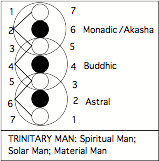
"The Father-Son has fallen into the water, into the Night, Chaos, from the First Plane, passing through the matrix, the laya center, to be re-born on the Ffith Plane or the Third, home of the Triads, or the Triangles, the Angelic Plane. This will be the Second Day, following the First Night. Now we have experienced this New differentiation, the Second Day. And this day is ending. The Writer is lying dead in the snow. Why? Because it is not enough to be a Writer; one must also be a Man. And Michael the Archangel appears to Michael Crossmann, his sword flaming, and gives him a Destiny to drive the Darkness out of Heaven, out of America..."
"This is quite amazing, Charlie!" Crossmann says.
"You are not aware of this structure, are you?" Rose asks.
"Not consciously," Crossmann admits.
"It is also interesting that the last picture the Father-Son sees as he is passing through that earlier womb or matrix or laya center is 'a Russian-faced woman who stands in the twilight, one foot in the darkness, one foot in the light'. That is Blavatsky. Blavatsky is the mother of Crossmann, the Virgin Mother if you will. The vortex, by definition, has one foot in the light and one foot in the dark...!"
"This is amazing, Charlie!"
"I don't know how I am seeing all this!" Rose cries out. "It is really rather frightening! It is some kind of light that has come into this room, into my head, and is illuminating everything! It is really rather unsettling. This throws a whole new light on racism! On the idea of racism! Black and white by turns. What is black in this world is white in the next world! We need to treat one another like brothers, because we, in fact, are brothers. White and black by turns...!"
"I agree!" Crossmann says.
"This is a scientific fact!" Charlie Rose says. "This should put an end to racism. If a man is born white in this world he will be born black in the next! If he treats a black man badly in this world, he will be badly treated in the next world. White and black by turns. Man and woman by turns. This is the basis of the Law of Karma....!"
Crossmann smiles, shaking his head in agreement.
"Yes, it is clear," he says. "It is clear, isn't it...!"
"This also means there are probably more than one universe/anti-universe. This means that -- at least according to your diagram -- there must be at least three universes and three anti-universes. If the first and the seventh universe are the same, a necklace of a sort, then there must be at least three universes and three anti-unverses...!"
Charlie Rose is perspiring heavily.
"We really need to take a break!"
"We are back! This has been exciting," Charlie Rose says. "We are discussion Michael Crossmann's acclaimed novel Conversations On a Dying Age. Before we go on the next section of the novel, I think we need to address one last...element of the recent 'Day' section -- do you think it's appropriate we call them 'Day' and 'Night' sections...?"
"Yes, I think it is," Crossmann says.
"Numbers, we haven't talked about numbers," Charlie Rose says. "And the meaning of numbers and letters begins to become important at this point. Gematria. The mystical nature of numbers. And their realtionship with the letters of the alphabet. Tell us what Gematria is..."
"Gematria is
a branch of knowledge in Jewish Kabbalism," Crossmann says, "in which
the numerical value of letters and words are determined in order to give
insights into spiritual values and connections between words and concepts. In Hebrew, each letter is also a
number...."
"This
is not true with English," Charlie Rose responds. "Or, at least, I did not think of
it that way. But in the section we
have just left, you made a notation of the English letters, the 26 letters of
English, and assigned number values to each letter..."

"What is this all about?" Rose asks.
"The trans-mystification of English," Crossmann replies with a smile.
"Yes, but, why?" Rose asks.
"Seeking destiny," Crossmann reponds. "This whole novel is about seeking destiny. Death is the loss of destiny. Brith is the regaining of destiny. Death is Paradise Lost. Rebirth is Paradise Re-Gained..."
"You were looking for identity," Rose concludes.
"Yes. Identity -- destiny."
"And this will become important as we proceed," Rose says. "We will come back to this. Before we leave this section I'd like to look at one more part, which is philosophical and scientific, in the strange way that anything you write can be said to be scientific...."
Rose reads:
Psychologist (peering outisde through a window; scrawling notes
about the Writer)
Obsessive-Compulsive, with a tendency to Paranoia
Anat Margalit (with violin)
You realize, Mister Psychologist, that you are only describing your own state of mind. That is, you are describing the state of your own culture. You see what is inside you and you project it on to the Writer...!
Psychologist
Projection -- and impetuousness! Shouldn't you be playing with dolls, young lady...!
(Anat leaves with a copy of Moby Dick.
Before she leaves, the Writer kisses her on
the forehead.)
Projectionist
Don't you see, it is the 'projected image' of yourself which darws you back into incarnation...!
(Coyotes dash across the turnpike.)
(The Full Moon pours its liquor on the
river. An owl is heard briefly. Something
falls in the forest and is unheard.)
Critic
How can it be both raining and moon-flooded...?
Stage Manager
It can be anything I say it is! I am the God of this creation! It is I who determines what it can and cannot be...!
Critic
Be you God or not -- the reader still demands some consistency. This 'drama' of your, which you, for some reason, insist is a symphony, which is the same as saying it is a meditation in poetic form....it is really unreadable in its present form -- which is one thing -- but, if you insist on contradiction of tones, please at least give us consistency of description, a small thing it seems consiering the absolute anguish you've already awarded us...!
In all honesty, I don't see how my review in the Times can reflect anything more than a mild amusement at your self-indulgence. Your blatant attack on all propriety of form in literature has ensured your own failure, in my opinion. Art is the ordering of chaos, not the chaos of ordering. It is sad so myuch talent has been swallowed up by....by mysticism. After reading your earlier work, I thought: 'We might have here another Capote!' You have disappointed me greatly...!
(Truman Capote steals down a side-street in
terror, entering a white limousine.)
(Norman Mailer is following him,
threatening him with physical force.)
(Erica Jong follows Mailer, threatening
him with physchological terrorism.)
Stage Manager
When the Artist becomes the Personality, art becomes mere Sport. So, in the last stages of the civilization, everything is Sport: politics, art, religion, sport itself (which, in the beginning, was a kind of art). Sport: the expression of utter boredom, self-fatigue. The 'Game' become comedic. No proportion of the heroic. No danger. Merely affluent children playing at life. The superficial intoxication of the image -- pretending to bring the primal urge back to some significance...!
Writer
It seems that Time now presses on me more.
Second Son
The strongest vibration is the final vibration -- which is anti-form in its approach to the arts, in its view of religion, and in its Winter-Place in Nature. In each aspect, an outmoded form is attacked. Celebration of the Spirit -- for Pure Spirit consumes with Fire...!
Woman From a Window
Do not forget, my friend, you call the gods with sound...!
Second Son
Pure Sound, in a plastic town.
Come the gallant horsemen ride
Down bric-a-brac
Like bells in a coffin.
Surly, surely, come the lions in the lane
Where the Moor strode past
The monacle of Fate.
The Sounds
Heat the spuds, love -- the winner on the spit clubs the loveless with plain cards and boards the grim train. Knock-kneed waitress in a myth would with velvet down a pedigree of comments hears of Love's lock and trembles. Tame the basking bated breathing. It is not that which you lack, but what you have that grieves you solely. Curlew call on a mutilated vela. Seal might bring the brain to boil though some might hum amid the hail seeking slumber. Doctrinaire alliteration litters lumps in the plodded page. Sagely certainly must define itself. Contractions of the harp. Contractions of Winter. Space squeezed to compmress. Contradictions of the womb so that Lilliput might leap from the annulated crevace and carry Time in his baggage. The Poet in the lane walks the locks in a bourbon morning. Dreary, leery, a king-of-sorts dressed as a Blind Man. Celebrating Sorrow. The loose slip. Muted contradistinction. I paint words in a rainbow of numbers -- yes, for even words are numbers: relations of sound: lengths of sounds. Music: the length between notes both as Time and as Density. Yes. Did he say Destiny? No, he said Tensity. Oh, of course -- in Tensity Density sits and stews. In Tensity Density wears Destiny's shoes. Bravo to the Maker of Music...!
How dare they say that the Fourth Dimension is Time. Time is inherent in all 'dimension'. Time-Space is inherent in all dimension. In Heighth and Breadth -- that is, in Nature. Time is Nature itself. That is, the Eternal Moment. Destiny fused at a mid-point. In Depth -- the 'Third Depth' -- the motion of Time as sequence: Chronology is seen. Direction -- and, therefore, Negative Direction. The Future and the Past separated: distinct: as units of measurement. Perspective as the "I consciousness" -- the eye Consciousness...!
What does he say this Fourth Dimension of perception is...?
He says that it is Cognition. The Known-Knower. The Archetype which shadows and makes known the known...!
That is not clear...!
A "Body of Thought" -- is that what he is saying...?
Is the Four Dimension the Meeting-Ground of two bodies of thought: the body of the Knower and the body of the Known...?

Writer
I grow weary of these sounds.
Second Son
Tell me this. If One is Abstract Space, and Two is Space Divided, and Three is Time Divided, then is Four not the Sum of the parts...?

Writer
And so you believe that Time Divided -- that is, Depth-Sequence -- which is Positive Direction, itself creates Negative Direction? So Positive Atomic Weight creates Negative Atomic Weight...?
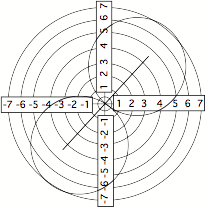
Critic (looking at the drawing)
So you ran out of Space...!
Second Son
No, I ran out of Time.
(Laughter from the balcony.)
Critic (slightly indignant)
Can one run out of Time? I thought you said that Chronology was eteral...?
Second Son
I said Number as a form of Time is Chronology.
Number as a form of Space is Mathematics.
The first perceives what is the Infinite.
The next perceives the role of Nature -- that is the Finite in the Infinite.
The prophet bring the Philosophy of Being. They do not fear their deaths -- and, so, they become Death.
There is Eternal Duration -- Time as Chronology. Yet there is also Arithmetic: the building of forms through Number. All forms that are built, of course, run out of Time.
Or, in other words, and I am sure I am repeating myself (which seems to be the nature of Life): there is a 'clock' which regulates the organizing principle. There is no 'clock' to regulate Chronology.
Woman From the Balcony (trying to sing like Bob Dylan)
Lost time is not found again...!
Writer
Again, what we call the Fourth Dimension is the point at which Time and Anti-Time touch, in a phrase...!
Second Son
So it appears. Where the "Body of Thought" or Elements of Eternal Time, touch the "Thought of the Body", the Elements of Mathematics....
Critic
Is ot also your contention that "Negative Time" or the Past is 'negative' also in terms of psychology? I mean, when a person clings to the Past, or when a culture clings to the Past, it is generally assumed that that person or culture is living in Depression. And when a country is depressed it attempts to resurrect the Past...!
(Ronald Reagan waves, smiling, dressed like
John Wayne.)
Antagonist (wearing boxing gloves)
Which causes which, shorty...?
Critic
Why, Time, of course...!
Antagonist
And what causes Time...?
Critic (jumpy)
Why, Time, of course! I must be leaving...!
Intellectual (drinking sherry on the balcony, looking down on the
street)
So, you see, the Mind really is the last frontier. Those penned in by a decaying civilization must either leave or become criminal. Yet, to leave one must not necessarily leave. We need not go to Mars to find Mars, because Mars is inside us also. So, there it is! Here, driink up! To your health...!
Charlie rose sighs.
"This is a very political book, Michael," Rose says. "Ronald Reagan shows up in the depression, resurrecting the image of John Wayne. Then the Antagonist shows up looking for a fight. The Critic runs away. And the Intellectual finds a way to identify with Mars; and then has a drink..."
"It's funny, isn't it?" Crossmann asks.
"Yes, it is funny -- macawbre," Charlie Rose replies.
"The Intellectual wants to run away, or to become a criminal, a revolutionary. Instead, he retreats inside himself. And has a drink."
"Is that what happened when Reagan came to power?" Rose asks.
"In a way."
"With you, I mean?"
"Apparently I found a way to become Mars," Crossmann replies.
"But you are not Mars here," Rose points out. "You are the Social Critic here. You have Bakunin and Lenin running around the town, carrying bombs... You talk about Reagan as being the Grandfather Figure. But you also talk about Reagan as being the...the resurrector of America. And also you have him as the manifestation of Evil. In your letter to Harold Bloom you write:
WHO IS REGAN? Regin is the Norse celestial smith. In the Volsung Saga, he is son of Hreidmar, the dwarf who demanded gold from the gods, and which gold became cursed, and was carrier of ill-fortune. Regin shaped weapons of iron, and ornaments of silver and gold. He was the fosterer of Sigurd, which means Counselor of War. when Fafnir, the Strong, brother of Regin, cheated him of his share of the Andvari treasure (the ill-fated gold), Regin repaired the magic sword Gram (Grief, the Sword of Strife) for Sigurd on condition that Sigurd whould slay Fafnir (the Dragon).
"Reagan is a kind of Vulcan character for you. A celestial smith, who prepared his country for war by fostering weapons; and he gave the Sun God, Sigurd, the means by which to fight this war...."
"Vulcan is a god of volcanoes. Of course, Mount Saint Helens blew in May of 1980 -- so we were very aware of this mythology in the Pacific Northwest at the time."
"Is this connected in some way?" Charlie Rose asks.
"I'm not privy to everything," Crossmann replies. "At this point in the novel I was very suspicious of Reagan. He was considered 666 by the mystical left in Eugene. Ronald (6) Wilson (6) Reagan (6). So, many of us looked upon him as a symbol of evil..."
"But that changed for you?" Rose asks.
"Yes."
"Why?"
"Why and when?" Crossmann says. "Upon rebirth: when I flipped from Black to White, from Anti-Universe to Universe...!"
"Yes. We're not there yet. And we're running out of time...?"
"Out of time or out of space?" Crossmann asks, smiling.
"Yes, there is that to consider," Charlie Rose responds. "This has been fun, actually. I've really enjoyed it. We don't have a lot of time left, so we need to focus real clearly on a few things. We were talkin about the structure of this narrative. And how each world of form is apparently absorbed by a formless world, a Night. So, when this section ends, we have this new death of form, this new passing of Day, this entrance into the matrix again. The Second Son's Mother is with him at this point. This seems important. The two brothers are together. And one is ill. The older one is ill. We have noted how the birth poem in this section is also the death poem, beginning and end, creating the impression of a circle, a cycle, back to a starting point. And who is the last personality, the last mask, that speaks before the next descent of darkness? Everyman. Are we back on the ark...?
"Remember, the boat has docked," Crossmann says. "We are now in town. People are hurrying up the street. The Mother and the Second Son are hurrying to the First Son with soup to try to make him well..."
"This is how the so-called laya transition looks on the page. Of course I am repeating some of this; nonetheless, I think it is important:
Hamlet (distraught)
To be Hero or Martyr, that is the question.
Whether 'tis nobler in the mind of the ages now gone
To kill or to be killed
To be large or to be victim...
Two masks I carry -- yet which will I love...?
Bakunin (with a bomb on the balcony)
Is Tradition culture -- or is it the death of culture...?
(Lenin, disguised, hurries through the dark streets.)
(A bourgeois woman collects Rembrandt's paintings.)
Simon (carrying a cross through the streets)
I have come here to help you.
Willl you not also help me...?
Woman Weeping On a Street Corner
We awoke to find the black hand on our door.
Doom has a card which he leaves at the threshold.
Passing Time is a noose
Being drawn 'round our livery...!
Second Son to Women
Fear not, grim daughters of America.
The fate of the soul of a people is its vision.
The world one envisions at his death
Is the world which one enters.
Walk through Chaos with strength...!
Mythologizer (reading from a dictionary)
Brothers or Twins. A universal folklore motif in which correlative deities sometimes are in close harmony, representing culture or Light Heroes beneficent to manking; sometimes they are in conflict. When antagonistic, they represent the forces of good and evil, light and darkness, love and reason, Summer and Winter; and one is usually killed by the other, or they kill one another. Almost always the dead deities are resurrected; thus, the deity of darkness is reborn each evening, the deity of light is re-born each morning; Winter returns each year, and the conflict resumes. Some examples of this brother conflict are: Achilles and Patroclus; the Asvins; Balder and Loki; Cain and Abel; Castor and Pollux; dawn and evening breezes; Michael and Satan; Prometheus and Epimetheus; Romulus and Remus; Set and Horus; Typhon and Osiris. The Melanesian culture-hero is hampered in his beneficent, creative, or tutelary activity by one or more antagonistic brothers, such as Kabinana, Karvuvu, Qat, Tagaro, Warochunuga.
Mother to Second Son (hurrying through the streets in her
shawl, carrying a container of soup)
Your brother has become ill. Perhaps it was something you said. Here, help me carry this soup to his room...!
Second Son
The Summer and Winter Solstice represent the absolute extension of our antagonism. He has power over the world in the Summer; I have power over the world in theWinter. In between, we meet. Yet, my ability to see the Light of the Heavens -- that Light has been defeated and a kind of Darkness has descended. I see only the world of men now. I walk in the world of men and I speak. I have been castinto the underworld of sorrow. I walk through this land, yet am lost from my home...!
Mother of Second Son
Why do you speak such nonsense? Have you nothing better to do with your time than such things...?
Second Son
I am without a role on this Earth....!
(The Writer lies dead in a snow-bank, a knife through
his heart, his blood coloring the whiteness.)
Everyman
And so the story goes, in the fold. Love turned on its heel. Achilles' point in plain language. Ahh, yes. Nothing now better to do than lament. As the old man laments the passing of his youth -- the days during which he deluded his wisdom. A crow on a naked branch. Looking back to the days when he was a white dove. Hand-folded images on teh breath of this morning. Tatug, the Weaver, with a bottle for comfort. Lost horizons. Despair. A nation in turmoil dances blind with damnation. Curlew appears. A rustline scruff in the leaves. Terror in the pitted groin and gruff. The bluster of new-born and self-consumed Doubt. Eating at the virgin's nerves. A clock scattered on a sidewalk. A clown weeping on the news. Hold out your hand, and let me give you my will. The blowing of noses. Mellow tragedy and sorrow, in a land made for sorrow. Thirteen colonies. Rain trickles in the gutter. Seeing only by the sounds coldly lateralled on the air. Women seeking romance -- the romance they have killed. The insurrection of the blood against the pruning of the tree. As the doctrine of independence cleaves the color from the soil. A non-nuclear future. A non-futurely suture. The romance of rightness. Two tambourine, played by pauses. And I, absorbed by it all. And I mean that in a liternal sense. absorbed by. The poet must be absorbed by experience. Speaking Existence's words. Not some isolated frequency, shouting arid declamations, like throwing swords, at the void. Must be! Should be! Forgive me, please. Each expression is as it must be -- by the necessity of falling bodies. Death is the taking of a body -- so it seems. A death of heights. Falling into restrictions. We call it Life, of course. Each is the other; and so th other must be this. Yes, it is all rather confusing. Do you recognize my voice? I certainly sound like Jacob the Banker, in my prime. Prime numbers. Too true for comfort. Are you still with me? The reader blanches, somewhat angry. What gives me the right to be prolix? An indecent-sounding word, to be certain. Prolix. I have a prolix for your beauty! I believe I remember that song sung in the Berlin cafes, before the war. Isherwood's follies. Or: measuring the firm of Can, Can and Can. Rollicking of midgets in the beerhall at humor. Where do these words come from? Put your tooth under the pillow and the Fairy Godmother will bring you a dime. Mother and Father firstly. Adam and Eve in a furious love-clutch near a tree. I shall spoil their affection. Freud's cigar burns his finger. His ring is an opal. I shall not even look at that which I won't see. A bugle again. The ultimate romance of war. Women longing to romanticize men again. To make them heroic by the blood on the tunic. No end to the soiled image. Pock-marked land: craters gouged through the village. Man damned by his own mythology. Saved by it too. Fawn-ladened merchant marine academy for his tutelage. My education has been interrupted by the longing for a dose of romance. And if my leg is blow to bits -- say "Hell, man, it was for the waar effort. What kind of man won't give a leg for the sake of romance...?" The weather-vane is tired -- I know because I feel its pulse in my brain. Contagious infection-in-voice is a myriad of Moon-moods. All the academicians laugh. Education dismantled so war won't be opposed. Comraderie. Longing for Youth again in the locker-room buoyant. Boys in buoyance. Or "The Boys in their Sleeves". Who believes what the Captain says? Only the morons and the children eternal. Mass suicide in a bottle. All the tired horses in the Sun, how'm I s'posed to get any drivin done...ummm? An exile on Main Street. A knife; an adultery at the beach house. Who are the Minute-Men? Do I know them? Do they visit the wife, only for a minute? A quarter for your cure! An essay on knowing the elastic content ofTime. Density is a bargain. Approaching density -- with an open pocket-book. Dense city and the nature of sexual humor. Joyce laughs in his graveward grave ward. I salute your suture! No, I salute your suture! A Marx Brothers' gag and torture. Your new role is: "Comedian"! Applause from the gangway. No, your new role is: "Wordmerchant"! What? Hissing from the causeway. You don't know anything! Send the man back to the "Distributor of Masks"...! A long silence on the eerie marquee. Touchstone in a blacked pantheon of words. The absence of words, turned to slate by the hammer. Thinking Quality is not a mass speculation. Quality is not a popular confinement. The Ideal is the midpoint between two poles. Falling bodies. drinking ale with a touch of cider. Christmas falling Earthward. Children of beauty on a dance down the sidewalk. If I could only hope the way children hope. Easily done, you just pack any one; you just pick any one, for it's easily done. A man selects his dinner from the garbage can. Poor Icarus! How thou has fallen...! The old man laughs. I AINT ICARUS! I'M APOLLO -- CAN'T YOU SEE....! Sing the plate glass weight of a white light -- of a white sight. While the blight on bliss comes calling. Christmas carols sung by the chorus. Where has the Chorus been? Have I not called on it -- in my Gethsemane of song-ware...? THE SHUTTERS ARE CLOSED! PLACE THE CANDLE-WICK WISELY...! I see the time of Science has passed. Joy to the world -- is this not merely an illusion? The Lord will come. Let Earth receive her peace. I hand a heart of glass to Leslie Rhoades Polson. This heart I give thee. And if you take it, you must not give it back! THIS GLASS IS A PRISM! THIS HEART, TOO, IS A PRISM! TAKE IT, TAKE IT; YOU CAN GIVE IT BACK...!
"I think that is enough to give us a sense of change of form," Charlie Rose says, "or, in keeping with the language, a change of states of matter. From Fire Matter to Water Matter. From Daylight Matter to Nightime Matter -- SunMatter to MoonMatter. With Everyman, that is, the man who is everything, dark and light, friend and foe -- the same way that Blavatsky was everything, man and woman, day and night, during the last passage into darkness -- Everyman is, in a sense, the keyhole through which the narrative passes this time, passing out of form and into obscurity again...!"
"Yes," Crossmann says.
"Incidentially, here is the first diagram that appears in this book," Charlie Rose says. "It is described as a 'keyhole' into the next room, a laya center into the next world -- a worm-hole, if you will...."

"So it goes," Rose says. "I am truly worn out. I'm not even sure what we are looking for now. The form above tells us that we have channeled back into night. Two voices are present. BIG VOICE, small voice. This was Father-Son at the last such juncture. But now I am not sure who the two voices are. There are clues: 'Being born in a world of talk. The Great "I', in a funereal order. As the managers come, with their High-Tech and their Computer Systems -- arranging for the burial. Hoping to salvage the old, to resist the new creation: they build a wall of numbers, a tomb, in which they wait....Number is a symbol for the dead....Time is dead, the captain blatters....Hamlet in chains in a wheat-field is weeping. Promethean-bound....'"
Charlie Rose gives a deep sigh.
Crossmann says nothing.
"So what is this next section about?" Rose asks.
"What do you think it is about?"
"Well, there are certain clues," Charlie says. "There is that description of Castration.
The mythologizer cried from her room in the cathedral: CASTRATION. UNIVERSALLY, IN MYTHOLOGY, THE FERTILITY HERO, KNOWING HIS DEATH AND DESCENT INTO THE LOWER WORLD ARE INEVITABLE, REJECTS THE LOVE OF THE EARTH-GODDESS AND CASTRATES HIMSELF IN THE SUPREME SACRIFICE FOR THE LIFE OF MANKIND. THE CASTRATED DEITY ALSO REPRESENTS THE ONE WHO TRESPASSED INTO THE WOMAN'S REALM, THE REALM OF DREAMS. THE WORD CASTRATION PROBABLY COMES FROM THE WORD CASTOR, WHOSE TWIN BROTHER POLLUX RULED THE EAST IN THE MORNING; CASTOR RULED THE WEST IN THE EVENING, AND WAS DOOMED TO LOSE HIS POWER AS HE DESCENDED INTO DARKNESS. It is the Male Power which is circumscribed in Fall. The Phallus is cut off. The organizing power gives way to mood...
"There are several references to the cathedral early in this section," Crossmann says. "The novel is compared to a cathedral. And I think the relevance here may be that the Day Forms have taken refuge in a cathedral as the Night has fallen. The origin of each section contains the themes that will predominate in that world. At least, that seems to be how it works:
WHERE HAS YOUR WORLD GONE -- THE WORLD OF AHAB AND CHORUS AND CROWN? Broken in a vibratory demise, it seems. The Form could not contain the vibration of fiery lives wearing flame on their spines. YOU MAKE NO SENSE, FRIEND. Is it cents you are after? Well, take my shoe and fill it with tea...! IS THIS BOOK YOU BUILD NOT A GOTHIC CATHEDRAL? I see only a vagrant sea in the blue tomorrow. Production by hand and an inward dimension. The clock breaking back, to turn the wheel on its wavelength. World without end. Ever after. Amiens...! AMIENS...! Portobo plias pour loborto locito...! AMIENS...! Two chickens butt their brains in a gray fog. A silent blaket-like peace on a white world. Only the lonely in the penance of sleep. I walk, undone, in a dark walk unknowing. The world of light has let me be. The broken steel of a chosen body. Buttressed by arch, the flying wheat turns its shivers. I DO NOT MEAN TO BE SO DENSE, he said. YET DENSITY IS AS DENSITY DOES! AND THE CALL TO ALL TO REASON FALLS; THE RAIN FALLS ON DEFT EARS...! The heart is like a throbbing brain. Tell me your secrets. And I will tell you my sorrows. THE HEART OF GLASS FALLS. IT SHATTERS, SHOUTING OUT THE SECRET IT HAS HIDDEN...! Oh, cosmic grief, on a coin spinning briefly. Two sides. Too many intermediate torches to gather. too many season of pendant and brooch...! A MEMORY OF LOST LOVE...! Found Love, on a scale of waiting....! TOO TRUE: YOU ROAST YOUR FIDELITY LIKE A MANIAC TRANSFIXED...! Help me carry my cross Simon, someone called. I did not see him. A sea parted and swept away the enemies of Man. Then all was a robust luxury of timing. The clock was stored in the Town-Hall Museum. The City Council was dismissed, having nothing more to discuss. Beggars were not seen -- for to beg, in this land, was to be received by the cathedral. Like snow captured on a leaf in December: purity was brisk; no one was forced to be present...! ANOTHR CAROLINIAN VISION...! Crux Ansata cum creeping on twos. Steeped in its sourcework of word and apparents...! AMIENS...! Amiens...! TWO WORDS TO BEAR FOR THE CAPTIVE PRINCE...! Hip, hip...! HOO, RAY...! Old Salt...! SIT TIGHT...! Don't go...! COME HERE...! What's this...? WHY WAIT...? It's time...! TO LEAVE...! Come here...! TOO LATE...! Don't go...! I'M HERE...! You're near...! TOO CLOSE...! For comfort...! AHH, YES...! Very well...! I INSIST...! Some day...! SO BEIT...! Amiens...! AMIENS...! A requium bursts from the Berlioz pen. gonad's mass times the speed of light squred equals the state of no commission. And all speak of comfort as they roast beside the fire-log. And why should they not? But too much comfort makes of Man a soggy item. Makes a man, as well, toos elfish. Small in vision. A rat in collars...! WHO IS THAT COME TO KNOCK UPON MY DOOR...? I need to find the road to the castle. The Emperor waits for me in his castle. Can you show me the way -- for I am lost...? INWARD THROUGH BEAST AND THE TALKING OF BRAINWORK. INWARD TO FIND THE FIERCEST DRAGON THOU ART! STALKING THE MAN OF FIRE OF YOUR VISION WHO FELLS THE BROADEST TREE SIMPLY BY ASKING! AND THE WORLD TURNS ANOTHER...! Where are you, man...? ISEEYOUSTANDINGBUTIDON'TSEEYOUR
SOULHERE...!"
"I see you standing but I don't see your soul here," Rose repeats. "That is very strong. That block seems to lay out the scene pretty well. There is talk about the Sound Man coming. 'Who counts lone sounds from the Sound-Master's cavern?' Rock music; rolling stones; he is 'lost in the charnel house searching through past lives'. He has a fear of poverty, of losing his job. That came out in the last part; and it is repeated here. Remember, he was given the job of being the Word-Merchant; but he fears there is no money in it. He fears madness....
Word-Merchant comes, yet his words disreputed. He fears losing his job -- seeing himself wandering through a hard land with no where as home, and with no words to shower... The village rolls its carpets in, and props the log in the fireplace for safety... IN YOUR DESTRUCTION OF REASON, A WHOLE WORLD CRUMBLES WEAKLY. OR, AS LUCY SAYS IN NOSFERATU: 'COULD IT BE, DOCTOR VON HELSING, THAT WE HAVE ALL GONE MAD, AND WILL ONE DAY WAKE UP AND FIND OURSELVES ALL IN STRAIGHTJACKETS...'
"Here is another telling passage," Crossmann says, "describing the new environment."
POWER OF GENERATION REPLACED BY POWER OF RECEPTION! THE BUILDING OF FORM REPLACED BY THE USING OF FORM! Have I not been here before...? MEMORY, PERHAPS, IS A CORD ON YOUR THROAT -- WHICH YOU BIND WITH THE ACCESS OF SEASONS, THESE MANY SEASONS YOU HAVE SHATTERED WITH YOUR QUEST...! The obscurity of that statement is indecent, you now. Christmas falling like a leaf. A blind man waring my hat. The wife of Jacob H now undressing before a window. And I being hatless, being caught while I look. A thief of apperception. Cold wind blowing thorugh the wind cannot faze her. Cold window being blown through the cold window too. The dock being lit by a blonde lock of light. Too many missed statements about the innocence of daughters. The whole town listens to the Dragon of Pain roar. Young women flex their shoulders in a lesbian pride as if to portend a certain magic of force -- rather than mereley a pretense of mocked meaning. The chorus basks lightly in on Alleluia.l Despair and its lamb draw a cross on the brickwork. No one seems to know the rhythm of Hope in this town -- though all pretend meekly that their smile shows the way...! SURELY THIS MUST BE THE SECOND COMING...!
"And," Rose says, quoting:
I have many miles still to go before I reach the castle, oh! THE CASTLE IS FOUND ON THE TOP OF CAPRICORN HILL...!
"So, those are some themes," Charlie Rose says. "You talk about the Cathedral. Capricon is the sign of initiation; so the Castle and Initiation and Heaven being brought down to the Earth are all connected here. But there is also sensuality. Continuing from where I left off:
A mimester in garters -- on which side of the hill does the goat graze; and on which side do the sheep...? TRULY THE PATTERNED PRATTLED FIELD, THE FLUID GAZE ON THE FINISHED ISSUE, THE FIRST AND LAST IN FAST COMPASSION -- THESE ALL MIGHT BE BUT MINE OWN VISAGE, AS SEEN THROUGH MIRRORS, LIKE A NAKED MAIDEN...! I see the bathing naked maid, her body turned by Pleasure's torch, her weeping thigh and bearded claim and pouting pirouetting bend. I reach to touch the tightened breast. The daughters of men, in the arch of their heat, and the quet of their hair, in mine eye draw me closer. The ritual of touching the flame of their lakes. Contorted unison of mission. The fire in the lower half. Oh, no. The claws of captivity. The conscience of Orion. Erect in riot upon the grail's imagination. Bathing mistress in the banquet of moonlight. Offereing the mound as a mountain to conquer. And conquering the grain, offering lights beyond the vision. My stomach turns in a dance with the waiting. Line sof interlocking mansions to Passion. Memories of daughters of men beyond virtue. Claiming the moment with the shout of forelornment. The pivoted limb. The luminous womb. Who stands on meated plattered bough, the tree portending fruit for touching? Smell in the fiery capulary. Aromas of women in a huff of desire. Static springing, like arrows, from skin. Where have I been? The Earth in gray; and the bones of the tree. Gray skull in a gray tomorrow. The lion within is eating the liver. And the vulture without calmly waits for the....lionshare. People line the banks of some river, awaiting their share of the maiden-white flesh. Chains about the feet of men; men chained to women; women weeping for freedom. Who rules the trunculated groyne? The griffin walks the weighted tail. The tale is told. The lions pass, emerging from belief. And no one comes to hear the tragic fashioned fate of the lovers' torture -- although each a lover, once, has been -- and each so tortured -- now that death is unheard-of. romeoed affection for the Juliettic eve. Marquis de Sade rings a bell for his poison. Yet the poison he drinks only tones him his sequester -- the Fatman eats the fattest meat; and the fattest meat eats the fattest grain. And all the nuns in glee do carry the rod to the mosque: somnambulation in threes...! WHERE ARE YOU, MAN...? Reason has broken its brain on a seaweed. Walk the ambulated walk. The wheel on track of Time does pitch the ambulated walker's reign, like spikes of Jack Stone, in a heap based on sound. I shake the alabaster breath from the lungs of Desire; and find the ice turned to turquoise. Damn the length of the measure wick, the rod of Time which forecasts groans. Erection rides the waters' reeds; and roars the merriment of rage. Hardness documents the rule. The measured rule is the time of the Man's ride. Building space in its womb into shape by the rod-iron. Yet ride in racing rail of sound, of motioned turn and sweat of sigh, the manufacured Titan's groan of sew delight and seed is blown. The power shrinks. Reason shrinks. The measurement of Time shrinks. Orgasmic heaven; and I ride clung to matter. Eruption of seed in the fire-brain of air. The falling of man. Yes, the passing of the rod to the woman. Thhe birth from the white thigh. Milk-maid torn in sevens. The man is weak from the blowing of his tension. His measurement of Past and Future shrinks to a smile. And sleep perhaps. A captive pattern on his dream wings...! TO POSSESS THE SEED IS TO POSSESS THE MAN...! Pleasure offers breast and mouth and twice-turned mouth to arrowed brain. yet pleasured smile, behind its hand, might hide the keyless lock of Will. The thigh might squeeze the breath away. And breathless eye, on plains, turns inward...! POETIC VISION SUCCEEDS THAT OF REASON...! Does it not seem so, in this body I am weaving -- which walks the measured leaf of Time, the seasons grasping, tasting art..? LET REASON GO AWAY! MARRY YOURSELF TO THE SOUNDWORK...?
"He seems to be saying no to pleasure, to sensual love," Rose says, "even though he describes it very roundly, very lovingly. But it leads to captivity. So, instead, he continues as the Word-Merchant..."
"We can think of the soul, in this novel, as being akin to Odysseus in Homer's Odyssey," Crossmann says. "He has gone a long way from home. He has gone inward, away from home; his home is being destroyed by the suitors who wish to marry his wife and take his land. Darkness has fallen on his home. And he is trying to get home, to defend his wife. But it is a long way home. And there are many temptations along the way...!"
"You pay homage to James Joyce regularly in this novel," Charlie Rose says. "There is much wonderful poetry in this book. Clearly, there is a Joyce imprint."
"Without a doubt."
"Why Joyce?" Rose asks. "I mean, you seem to have much in common. You have Irish blood, on your mother's side. There is the Catholic tradition; the love of literature obviously. An interest in theological philosophy, symbolism, dreams. A sense of humor...."
"Joyce took modern literture to a new level," Crossmann says. "A new level, back toward its origins. The prosepoem -- and this novel is also a prosepoem -- is the bridge back into the epic poem, back into the mythological origins of the human race..."
"Joyce seemed to do all of this with a tongue in his cheek," Charlie Rose says. "He was more cynical than you are. You seem to be very serious about your beliefs, even though you do have a sense of humor. Finnegan's Wake is not a new bible. It is a roast of the old bible as much as anything..."
"Joyce chose to remain an outcast," Crossmann says. "I have come home. I have chosen not to be an outcast. I have not chosen to join the old church; I have simply chose to build my own church, my own cathedral...."
"And that's what this book is?" Rose asks.
"Yes."
"We can't go through this section and look at eveything," Rose says, "all the poetry -- even though we would like to. We just don't have the time. It is interesting that many, perhaps all, of the characters on the boat and in the town are also present in this cauldron of elements. Shulamit is there; the two sons; the conductor, Bob Dylan, the Heimkreiters....but they are melted down into a primal soup. The soup the Mother is carrying at the end of the Day section means something more apparently. But there are troubling visions in here too."
"Yes, there are."
It is I who comes to break your world. The image you erect each year, your visioned world as hollow gram, as pictured stance of Thou and I, or role and mask and 'I believe' -- I ccome as the Grand Initiator -- and thor -- to crash the baggage of your words, to shatter precious meaninged faiths, and so release the soul in thee.... THERE IS NO GEOMETRY IN YOUR SKIN NOW. Geometry -- or Time -- as Reason of Space -- Geometry returns at dawn, when Man comes again. Chaos rules here. Where is Time -- the shape of progress...? WHAT ELSE DID YOU SEE? A race war is here. Black against white. Physical act formed from symbol..."
"See. This is one of those toubling passages," Charlie Rose says. "This vision of a race war. Where does it come from? And are we to take this seriously? Or is this the ravings of a...lunatic...?"
"Where does any vision come from?" Crossmann asks.
"Well this seems to come from symbol," Rose says. "That's what the text says. I am assuming this is from the understanding you have gained: that during the Night, the Black is stronger than the White. This is one of your demons surely."
"This whole section becomes a struggle to clarify that vision of dark against light, without a loss of soul, that is," Crossmann says.
"It is interesting, too, that the Heimkreiter story is still here. I'll start with a very obscure reference to Bob Dylan -- because music is everywhere in this section -- and then move in to the Heimkreiter theme. Remember, the darkness is ruled by sounds and music -- the ears -- as the day is ruled by light, by images, the eyes."
THE CIRCULARITY OF OPINION! THE PALE BREATH OF CONSTRICTION! A FOG IN A MIDNIGHT WATERBOG! DENSITY IS SORROW! INTENSITY TOMORROW! WHO, IN FACT, PRAYS FOR THE LUKEWARM? WALKING DEATH AS A CUDGLING MIDDLEBROW! WATER-RATS IN A TREE TRUNK SCANDAL! VANDALS HAVE TAKEN THE HANDLES -- HENCE, THE PUMP ISN'T WORKING...! Candles are lit in a cake for many years. It is his birthday. A man leaves a bag of groceries on the landing. There is no work. Is there nothing to be done? The man sits at his table and tells his wife he is a banker. A Monopoly board is spread out before him...! THROW THE BOARD AGAINST THE WALL...!
"One thing I have noticed," Charlie Rose says, "leafing ahead a bit in the book. The incarnations out of formlessness, the breaking of the formeless mass, the homogeneous element into the many elements, happens, I believe in all cases, in July. And the re-absorption in December. There are date tags in the book that make this recognition possible. Now, I am wondering, this is a reflection of the true nature of nature, this form/formless dialogue -- or is it a construct of your mind, since you were influenced by the structure you have been absorbing from theosophy...?"
"I'm not sure really," Crossmann replies. "I did not touch this novel for almost fifteen years after I finished it. I have a distance from it still. It feels to me like a distant cousin. I don't remember if this structure was unconscious, as was so much in the novel, or whether I was really, in effect, the Stage Manager, imposing this structure on the novel at this point...."
"We have not focussed on the Creative Hierarchies from theosophy," Rose says, "because we really don't have the time to tonight. But here are a couple of diagrams from the Bloom letter conerning this -- essentially this says that some Creative Hierarchies have passed out of incarnation. That is, Pisces through Cancer are out of incarnation on the physical plane. They are formless. Leo, that is July, through Aquarius, February -- these forces are still in incarnation. This is all very subtle in meaning, I trust. So we wonder why the Form World in your novel, the differentiated world, seems to run from July to December instead of February. This is a puzzle we might like to solve. Here are some of the drawings you presented to Harold Bloom in your letter to him..."
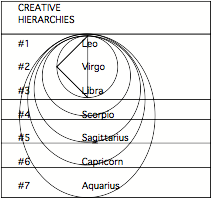
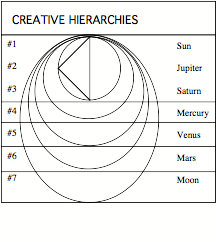
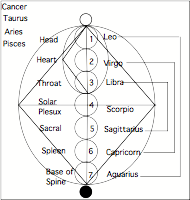
"We are given clues here by the poet -- and I notice there is a real predominance here of the lower case voice," Rose says. "And I am assuming that the lower case, the small voice, is the poet. And that the Upper Case voice is the Scientist. I have marked some passages in the book...."
Rose begins reading:
Learning to live on the bread of the air -- that is your hope, friend. The hope of Millenium. A tipped hat on the had of a banker. Good day, he says -- all is well -- he is fearful. Is it Bostic who goes there? Bostic, the merchant? Who knows? I present a puzzle for your mind which you must solve by piecing its lesions together. Jig-saw puzzle. Being led to your doom. Yet Doom is dust in the mind only. Doom is Dawn beyong the arid capulary freeze of the boat at the keel. You will die to this world in the sign of Pisces -- as you pass through the other at the Scorpion's sting....
Father knows best. A salvaged nostalgia. The sword the woman carries. A president with a child's mind. No comprehende. Turmoil within, firing darts at the world. Space becomes eternal, with the shaving of leaves from conquered limbs. Nakedness. Before the altar. Who is the sacrifice? You carry a cross, you know. Who will make the world better? Must she not risk, too, making it worse...?
Is Ahab really Ahab? Is it I -- caught on this raging dogma? Too soon to tell -- if the dream is not a dressing gown you wear? A lost thread of light. If I am Jacob Heimkreiter, then who are you? Who is Benjamin Heimkreiter -- the latter or the former? The ladder or the farmer? The leader or the informer? The broken form, or the former's brother? another surge of water down the lane draws a circus. In Indian ink. A missed image of Edward Hopper. SPEAK, DAMNED SPOT! SAY ANYTHING! Bow wow! And speak he did -- to transform his pain. Words can draw down the bleak terrain. Words came down on the bleak terrain. A train filled with lost souls who missed a turn and were gathered by Fate. I AM ONE OF YE! I cry. I am a Jew on a train bound for Auschwitz. Sobeit. Words cannot harm me. The driven stage cannot pierce me. No amount of hatred can sting me. Bound up by the tradition of leisure. Forced to kneel to the god of the shekl. Spellbound and sorry. Caught in the Captain's hat. I will not go out.... The land is steaming. A man blinks his eyes, and they forecast his hands. No one wishing to see. A tank churning down a gray tomorrow. Making the world safe for the computer. Yes, perhaps you do know what to do. What gray grim beast is there slinking toward Bethlehem? Everyone is holy now. Everyone is saved. Each is holier than the other one now. The Middle Class pleasure at the song of the Convention. WILL THE WORLD BE ENDING SOON? WILL JESUS BE COMING AGAIN...?
FROM ARIES TO CANCER WE ARE OUT OF INCARNATION -- IN OTHER WORDS, WE ARE IN THE HEAVEN OF OUR CHOICE, EXISTING IN THE BODY WE FIND MOST PLEASING...!
"In this section," Charlie points out, "there also seems to be a lot more concern for what is going on on the Earth than there was in the previous Night Section. A concern with the Earth, with America's place in the matters of the Earth, and with the narrator's place in the American context...."
Charlie Rose reads:
Many people slipping through the fractured evening in the fog in a shivering mass unconcealed. Concealed only by a shawl of unrest. A flambuoyant unrest: turned in on itself. THE EARTH PREPARES TO TURN OUT ITS LIGHT AGAIN. As, through the Neibelungenlied smoke, I descend through the rings, descending from detachment, to begin to love a role on this Earth. THIS IMAGE IS LEADER TO A PEOPLE NOW LOST. Yes, the world is without a leader. The United States must lead now beyond its stage of accumulation. It must lead through Wisdom, and really offer Hope to the world. OUR PEOPLE ARE TOO CAUGHT-UP IN THE CHURNING OF THE WORLD AT THIS POINT TO CREATE A TRULY DEEP CULTURE. SORROW, PAIN AND DEFEAT CREATE A TRULY DEEP CULTURE. YOUTH WILL NOT DO IT.... ALEXANDER WAS A SAINT OF SORTS, WHO KNOCKED DOWN ANCIENT MODES OF LIFE, DEMANDING NEW ONES. Your soul gives you secrets when you learn to love yourself through it. THE SPIRIT IN AMERICA IS FOR DIVORCE NOW, FOR SEPARATION...
"Again the theme of secession comes back," Rose says. "The theme of divorce, breaking America into smaller countries. You are still a traitor to America at this point? I ask that from the viewpoint of your present opinion on the matter..."
"Yes," Crossmann says. "I was still considering that the dismemberment of America would be in the best interest of the world."
"Which you no longer support?" Rose says. "That idea...?"
"No."
"You are still hostile to Ronald Reagan in this passage...?"
"Hostile may not be the right word," Crossmann replies. "Suspicious. It was hard to be hostile to Reagan. He somehow neutralized hostility..."
"You write:
I TRIUMPH THE TALLTALES. Suckled by the titted odor of ruin. The militia clear their measurements of order. All hell coming to claim the document of power. Fields clean of any measurable life. Europe in a flaming brand of opinion. Smoke visited upon the visitors. The computer guides the rocketed doom: placing numbers in space and then climbing those stairs. Who as it killed the Christmas baby? In the name of self-defense the masturbator smotes. An actor on the screen in a White House with his queen. Is she Marie Antoinette? Industrial feudalism. Who is the head of the beasts of the field? No one knows. There is not clarity. A dark marble in a child's hand. A song about a dragon: puffing magically on Honalee....
"There is music in nearly every page of this section," Charlie Rose says. "Bruckner, Gluck, Charles Gounod; the reference to Puff the Magic Dragon; Blind Willie McTell and Sleepy John Estes... And more references to the cathedral: 'all I see now is my own tissue and organ. Palpitating cell, and the minsitry of aorta. The spire of the blood, and the doctrine of gonad's mass: equals energy squared. In a minueted valley. Amiens. Amiens...
"The language reminds me of Nostradamus," Charlie Rose says. "Has anyone ever told you that...?"
"I have thought of it," Crossmann replies. "But no one else has mentioned it -- not until now."
"'TEAR THE BEST INTO VIVIFIED PARTS!' That is more of your view that America is the beast and needs to be broken into separate countries."
"Yes."
"Europe was turning against Reagan's policy of Star Wars about this time," Charlie Rose says. "I remember there was much unhappiness in Europe. Some countries even made overtures to Russia as a way of hoping to balance Reagan's zeal for Star War. You, in fact, seem more and more like Bakunin, a revolutionary of the class war. Remember, the Second Son has come into this Night with a mask given him by the Distributor of Masks -- well, the Distributor told him to choose between Hero and Martyr. But his father told him to be content with the mask of Word-Merchant, or Poet...."
"Yes. Neutral at this point."
"But you seem anything but neutral," Rose points out. He reads:
Editorialized by the neons of news. Bwana Massa Pressma Mentor. Pressma borke a lathing cantor. Canonized by their own line of heads bowed. Political parties in a triune encorsement. As the walls grow thicker and thicker about the state mint. Seal up the rulers in the limo and watch them preaching. Overturned car in a mounting fix of Potomac. Chappa. Quid. Dick. Burn the castles of Newport down! Don't you hear the charming dames all congest now? European ardor in American lanes. Seeking to break the skid and the slide of the empire. Queen Nancy eating cake -- while the King eats a pot of jelly-beans and laughs. The soiled second on a marmelade evening is trembling. A star falling on a star-fish. Translation of a planted pathos. SANCTUS. SANCTUS DOMINUM. Dominum Nayum.....
"And then a very funny line below this, really unconnected to this," Rose says. He quotes: "'Tell Salome to leave her card by the side of the radio, if you will.' Of course, Salome is the tempress and really the death of John the Baptist; so we have the Second Coming also tied in to this..."
"And," Crossmann says. "'BEWARE, IT's FALLING...!' Everything is falling in this section..."
"It is followed by the long passage of modern music," Rose says. "This part is long, but its fun."
Rose reads:
A ghost town of opinion. Talk tock tauch, the glockenspeil mocks it. The tympany of socialbility, on a train, stalks a vacuum, DO NOT FEAR THE GRIM IMMENSITY YOU ARE! Words on a lathe to heaven. Pickwicked to 'airy pieces. Natasha in the floating sea on a mid-day. Wooden: with the proper stranger. Andre on a flaoting field after war. Peace amid the trees and pierres. A sentimental education. Am I it? Inhabiting the form of a neo of life. The scorching monotone. Ahabbed, ona twirling rococo of stone. Pederasted on a nodding pedestaled knee. The links of opinion. The too-true view of a viewless fife. Feifdom on the nee of fate -- lower case. Doctored by the liquor-indoctrinated morgue-men. The tree cut down to save the fruit. Monacled sentence. Life: a Hanukah memorabilia. Jacob Heimkreiter on Park Place. The chauffeur with the gout. The lout, the clouted vagabond. Selling fighter planes to China. The culture of swords. All else is less, says Ilse Lessing. l Doris Lessing eating cherries. Truman Capote mixing metaphors. Kadaffe Kadaffe, who knows this Kadaffe? The manufactured plot. Mottled, a hand of drafts. Hamburger hills within our mind: a cartoon character. What is his name? Bluto? Of course. War fever in the crotch of crotch-conscious men. fevered medicine in a million hens. A great freeze on the skin of the North. PUT THEM TO SLEEP! THEY HAVE TOO LONG HAD THEIR VIRTUE...! A marble in the hand of a dark old man. Sleepy John Estes. Blind Willie McTell. Classical Music of America. Come from the hovel and the corn field. I must go deeper and deeper, until I sovle the feated mist. Only then to return, and document the shifting forms: atom, wter, world, serial world; sytems, seasons; Earth's hammer; Earth's sieve; sleeve , steel, haloed host; atom, leaf, tusk, lung, brain: serial brain; node: nude collection; Society (with a capital C); HISTORY: the minuteted sea....! YOU MAKE NO SENSE...! No cents, you say? Scents I do make: the minueted Bee! STARRRY STARRY NIGHT! PAINT YOUR PALLET BLUE AND GRAY! LOOK OUT ON A SUMMER DAY! WITH EYES THAT KNOW THE DARKNESS IN MY SOUL...! They say that Louise was not half bad. It was written on the walls and window shades...! OLD FRIENDS, OLD FRIENDS, SAT ON THEIR PARK BENCH LIKE BOOK-ENDS! THE NEWSPAPER BLOWN THROUGH THE GRASS FALLS ON THE ROUND TOES OF THE HIGH SHOES OF THE OLD FRIENDS...! And so long Mary-Ann-n-n-n, aint it time we began to laugh, and cry, and cry, and laugh about it all again...? BLUE, HERE IS A SONG FOR YOU: INK ON A PIN! UNDERNEATH THE SKIN AND EMPTY PLACE TO FILL IN! EVERYBODY'S SINKING NOW, YOU GOTTA KEEP THINKING YOU CAN MAKE IT THROUGH THESE WAVES! ACID, BOOZE AND ASS, NEEDLES, GUNS AND GRASS: LOTSA LAUGHS; LOTSA LAUGHS...? I come and stand at every door. but no one ehars my silent prayer.... WE GO DOWN TO THE RI-IVER, AND IN TO THE RIVER WE'D DIVE! WE'D GO DOWN TO THE RI-IVER, YOU AND I! Aye, yi yi yi yi yi yi yi yi....WATCHING THE BARGE GO BY, WE WOULD SING: TURN THE STERN AND POINT TO SHORE! THESE SEVEN SEAS WON'T CARRY US NO MO-ORE! OH, TO BE BACK HOME AGAIN, IN OLD VIRGINNY! WITH MY VERY BEST FRIEND, THEY CALL HIM RAGTIME WILLY! WOULD HAVE BEEN GOOD JUST TO SEE THE FOLKS! LISTEN ONCE AGAIN TO THEIR STA-ALE JOKES...! Hear the sound of the men, working on the chain-ga-a-ang. That's the sound of the men, working on the chain-gang. All day long they work so hard till the sun is going dow-own. Working on them byways and highways and wear-earing, wearing a frown. You hear them moaning their lives away; and then you hear somebody say-ay: DAMN YOU MASTERS OF WAR! YOU WHO BUILD THE BIG GUNS! YOU WHO BUILD ALL THE PLANES! YOU WHO BUILD ALL THE BOMBS! YOU WHO HIDE IN YOUR MANSION, WHILE THE YOUNG PEOPLE'S BLOOD FLOWS OUT OF THEIR BODIES AND IS BURIED IN THE MUDD...! Came a broken arrow...! HALF A MILE FROM THE COUNTY FAIR, AND THE RAIN CAME POURING DOWN! ME AND BILLY STANDING THERE, WITH OUR SAVED-UP HALF A CROWN! HAD A POLE AND FISHING BOX, AND TACKLE ON OUR BACKS! WE JUST STOOD THERE GETTING WET, WITH OUR BACKS AGAINST THE FENCE....! New Christ, hipster, Cardiac Hero, with two thousand years past your mind. He spits at your feet crying we have no need of a God -- each of us is his own! O, AND WHAT WILL YOU GIVE ME? SAY THE SAD BELLS OF RHYMNY! IS THERE HOPE FOR THE FUTURE? SAY THE BROWN BELLS OF MERTHYR! WHY SO WORRIED, SISTER, WHY? SING THE SINGER BELLS OF WYE! AND WHAT WILL YOU GIVE ME? SAY THE SAD BELLS OF RHYMNY...! I pity the poor immigrant, when his sadness comes to pass...! IT'S COMING ON CHRISTMAS, THEY'RE CUTTING DOWN TREES, THEY'RE PUTTING UP REINDEER AND SINGING SONGS OF JOY AND PEACE! OH, I WISH I HAD A RIVER I COULD SKATE AWAY-AY ON....! Time has come today. Young hearts can go their way. Can't put it off another day. I don't care what people say. They say we don't listen anyway. Time has come today...! ALL YOU SISTERS OF MERCRY, THEY ALL NOW DEPARTED OR GONE! THEY WERE WAITING TO TOUCH ME WHEN I THOUGHT: I JUST CAN'T GO ON! IF YOUR LIFE IS A LEAF WHICH THE SEASONS TEAR OFF AND CONDEMN -- OH, I HOPE YOUR RUN INTO THEM, YOU WHO'VE BEEN TRAVELLING SO LONG...! Expecting to fly-y. AND THE GROUND TURNED, AND THE CABLE FELL, AND ALL THE MITES WERE CAUGHT IN THE QUAKING OF WORLDS; AND THE OCEANS CHURNED A BUTTER-MILK WAVE, AND SPREAD ON THE DAY LIKE A BAT ON A MOONBEAM...! And so we sang: SHE SAID: I KNOW WHAT IT IS TO BE DEAD! I KNOW WHAT IT IS TO BE SAD! AND SHE'S MAKING ME FEEL LIKE I NEVER BELONGED! SHE SAID: YOU DON'T UNDERSTAND WHAT I SAID! I SAID: NO, NO, NO, YOU'RE WRONG! WHEN I WAS A BOY, EVERYTHING WAS RI-IGHT! EVERYTHING WAS RI-IGHT! SHE SAID: WHO PUT ALL THOSE THINGS IN MY HEAD? THINGS THAT MAKE ME FEEL THAT I'M MAD! OH, SHE'S MAKING ME FEEL LIKE I NEVER BELONGED...! Too much of nothing, can make a man ill-at-ease. It can cause some men to walk on nails, it can cause other men to freeze...! THINKING 'BOUT THAT TIME YOU RODE IN MY CAR! THINKING 'BOUT THE TIME I MIGHT HAVE PUSHED YOU TOO FAR...! Richard Nixon, find yourself another country to be part of...! SKY PILOT! HOW HIGH CAN YOU FLY...? And a rock feels no pain. And an island never cries...! SHALOM, SALOME...! And I walked, like a capturing monotone host, along the river which draws me e'er to its mud-bank. To the river in the Winter I walk -- as if to my wife. Beauty of womaned curve and rough. The water of inundation. THE FLOOD IS COMING! THE FLOOD IS COMING...! The Flood is here -- can't you see...? PISCES IS THE FIRST AND THE LAST MAN'S BODY...!
"A poetic mediatation," Charlie Rose says. "If it is nothing more, then it is this. And this just might be enough...."
"It is more than this," Crossmann says.
"Yes. Of course it is. So can you remember all these allusions, all these songs?" Rose asks.
"Sure. Of course."
"I ask you because you seem to have turned against your youth," Rose says. "I wonder if you've turned against the music of your youth too...?"
"The tree keeps growing," Crossmann says.
"So, what if the first reference...?"
"It start with Don McLean."
"Of course. And then who?" Rose asks. "I don't know the next one...?"
"Leo Kottke."
"Oh, good. Then Simon and Garfunkle. Leonard Cohen?"
"Yes. Joannie Mitchell."
"I don't know the next one," Charlie admits.
"The Byrds."
"Springsteen."
"Then?"
"I don't know."
"The Band."
"Sam Cooke."
"Good."
"Dylan. Van Morrison. I don't know the next one."
"Janice Ian, when she was about thirteen. Then the Byrds again."
"Dylan again. And Joannie Mitchell again."
"The Chambers Brothers."
"Oh, I love that one -- 'Time Has Come Today, Young Hearts Can Go Their Way...'" Charlie sings.
"Then?"
"Leonard Cohen again. Then I don't know the next one."
"Buffalo Springfield. Then Michael Crossmann. Then we go down to...."
"The Beatles," Charlie cuts in. "Then I'm not sure..."
"Dylan again, with the Band. The Bootlegg album, I think."
"I don't know the next one..."
"Cream."
"No. I'm not sure..."
"Phil Ochs. The Animals..."
"And, of course, Simon and Garfunkle."
"You were, obviously, a big fan of music?" Rose asks.
"I still am. But, yes, music was my life-blood growing up. Intravenous poetry..."
"And still you turned against the values of your generation and its poetry?" Rose asks.
"My poetry leads my generation out of exile, back home," Crossmann says.
"That's what this is? Coming out of exile?" Charlie Rose asks.
"Like Odysseus. Many adventures. Many rebellions. But then trying to find my way home."
Charlie Rose reads: "The animal in the desert says: 'What comes on four heels and ten wheels and wheezes only when you say its name...?' No one knows the answer; so the animal eats a city by the handful. By the bay. By the handful..."
"The City by the Bay, of course," Crossmann says.
"Is this an AIDS reference?" Rose asks.
"I don't know. I am unconscious of much that I write..."
"We are in January now," Rose says. "Entering Winter. You write first about the two women, with a strange reference about the First Lady. And then about your continuing fear of racial warfare, which is symbolized in the Brother Battles:
As the Sun squeezes out its own bodies from its substance -- the planets -- so the Spirit in Man squeezes out its own bodies, manifested electrons. The Saga of the Rings. THERE ARE TWO WOMEN, MY FRIEND. ONE, IN SPRING, LIFTS YOU OFF OF THE EARTH. THE OTHER, HER SHADOW, PULLS YOU DOWN TO FIND HER IN AUTUMN. PULLS YOU DOWN INTO MATTER. YOU WANDER WINTER EARTH SEEKING TO FIND THAT FIRST LADY...!
If I accept a task which never ends, then I am never-ending by description...? IS THIS YOUR ANSWER TO THE QUESTIONING SPHINX...? Depth absorbs all colors. It swallows up the light, and reflects not a farthing. It is black. A black hole...! BE HUNGRY IN SPRING; BE THIRSTY IN WINTER...! It seems to me that the First Night presents the First Man's image to the awakening brother. The Second Night presents two images: the first and its successor. THAT IS NOT SO CLEAR. No it is not. WE ARE PASSING THROUGH THE THIRD QUARTER, AND ENTER THE FOURTH QUARTER TOMORROW. And the town hears again the bell, and is sleeping. Only the shadows now move on the land. The sound of chaotic brass. And DeBussy's sea: points of space presented as a structure. Painting in Winter. The corpse of Bach is in ruins. Exploded initiation. Impressionistic touch-tones. The amazing depth of the silent water. Formless collars on sharks. And the elementary sea, the mare, churns its fragments: mixing the mass into a sourcework for Day. IN THE SUMMER, DYLAN THOMAS IS TOO FAST FOR ME. IN THE WINTER, GOETHE IS TOO SLOW. Speed of vibration disjoints all the lawyers. The Soul, bursting boxes. Seeking atmospheric motion. Suck me into the Sun's bright visage. All worlds wait where my brain stores its seed. The Immaculate Reception. Enhacing not a shadow. bodiless sun on a bodiless auburn. Levity, Anti-Gravity's name. Levity's framework draws its line through my shadow. Apprehending the curling gale. Womanly virtue writ with a needle on the eye. Manly vice now passing through the eye of a needle. Then Vice and Versa. Word and trans-word. Flop and flip. Angel and demon-eye-echo. The lifted ankle; the eye on the seam. Black nylons to boot. Wholly unsettled, passing over. The monument of scent. Placed on the mandible to savor. Mantled, like a trophy. THERE ARE OTHER WAYS TO LOVE, WITHOUT HAVING YOUR BLOOD SPILLED. Trilled the captivating daw-bird in tide. Slowly. In his wax and weathers. AND AS TIME WORE ITS NEEDLE I CAME TO SEE THE GOATS AND HTE LAMBS LINING UP INSIDE THE SUN. AND I SAW MYSELF, WITH THE VICTIMS OF THE WRATHFUL GOD. A GENERATION OF MARTYRS: FOR THE HEAD IS SEVERED FROM THE BODY BY THE WRATHFUL. CONCENTRATION CAMPS. GENOCIDE OF A RACE OF BLACKS, WHO SERVE AS INDIANS TO THIS NEW-PURITAN COWBOY. MY BROTHER IS MY EXECUTIONER. HE SPOKE IN THE SUMMER ABOUT OUR FUTURE SEPARATION SO HE COULD DO THE WORK HE WAS ORDERED. THIS SEPARATION IS MY DEATH. THE MESSIAH BRINGS THE FUTURE TO HIS RACE; YET THEY CONDEMN HIM, AND KILL HIM; AND THEN THEY BUILD HIS FUTURE. The First Son, having lost his Power as the Sun has departed, upon which becoming frustrated, and resisting shifting into the feminine brain, the receptive, begins to hate. He condemns his surroundings. He condemns himself -- for the body in which he placed his image has begun to corrupt and decay and grow weak. YES, IT IS SO. The Second Son has become inactive, receptive to the voice within. So he now feels the slings and arrows, feels them as the goat must feel them. HE BECOMES WEAK, AND ILL WITH CONGESTION. IT IS HIS WEAKNESS HE CONDEMNS. The Clerk meets a woman born in Gemini in the market, who inspires him to speak of all the things that he has seen. AND HIS ROLE AS MARTYR BECAME OBVIOUS AGAIN. And that day he began to dread his role. There was a Garden of Gethsemane in which the Soul did bleed with his vision. CAN MAN ONLY REGAIN A SENSE OF HONOR THROUGH AN ACT OF MURDER? So it seems, my friend. SHE SAID; DO NOT CONDEMN THE COWBOY KING -- FOR YOU ARE HIM...!
"This whole section is what caused me to ask about the relationship of Blavatsky and Theosophy to Naziism, to Hitler," Rose says. "I wanted to come back to that. But Naziism definitely appears in this Night Section. And you are putting it on the First Son, your brother. You apparently are embracing the Martyr role now. And he is what, the Anti-Martyr...?
"That is how it seems," Crossmann says.
"But the Woman Born in Gemini says you should not condemn this Cowboy King because you are him," Rose says. "The Cowboy King is also, of course, Ronald Reagan..."
"Yes. Apparently so," Crossmann says. "We speak of Hitler and Naziism because it seems to us the ultimate Evil, the absolute pole of darkness. But as I often argue in theis book, America is not Germany. America has its own social composition, its own history. Its evil will not mimick German evil...."
"You write: 'The Soul is hated for refusing to take sides. IT HAS NO DEFENDERS. IT IS KILLED -- YET IT CAN NEVER BE KILLED. It guides the courses of the Race to a final eve. AMIENS! Gothic soul on a Gothic eve in the morning. THE BEGINNING IN THE END. The Second Son's Ideas are the Body of the First Son...' We are remembering, according to your graph, your diagram, that when it is night for the Second Son -- the Northern Hemisphere let's say -- Capricorn, as it is when you wrote this, it is Noon for the First Son, the Southern Hemisphere, in Cancer. He is in his Day Body; you are in your dream. Which is more a nightmare, it seems to me...."
"Yes."
"You go on to say:
THE REBELLIOUS ANGELS, THOSE WHO REFUSE TO WORK, WHO REFUSE TO HAVE CHILDREN, WHO REFUSE TO BUILD A POSITIVE FUTURE ON THE EARTH, WHO SEEK TO BECOME GODS THROUGH THE POWER OF THEIR MINDS: THESE ARE CAST OUT OF HEAVEN AND DONDEMNED TO WALK AND WANDER. THEY WILL BE BLAMED FOR EUGENE'S ECONOMIC WOES. THEY WILL BE CAST OUT INTO THE WORLD, CURSED TO WANDER UNTIL THE END OF TIME.... MY BROOTHER AND I ARE ETERNAL BROTHERS. HE EATS FOOD TO KEEP ME ALIVE. AND I EAT IDEAS TO KEEP HIM ALIVE....
"We are moving in a myhthological landscape," Crossmann says.
"Shem and Shaun in Joyce's masterpiece," Rose says.
"Reflecting all the wars and conflicts of human history."
Rose reads: "Aquarius is the sign of the World Server, who gives up his life. For the sake of the race. Pisces is the sign of the World Savior, who acts on the world in order to save it..."
"The postive sign is followed by a negative sign," Crossmann says. "A Day Sign is followed by a Night Sign."
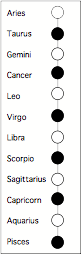
"I might repeat that this diagram is not in the book. The book is utterly devoid of pictures at this point," Charlie Rose says. "The nature of the ideas in the novel has changed remarkably. And this was witten in January 19. So we are still in the sign of Capricorn-Cancer."
"Yes."
"Then you write:
What is my job? -- that is now what the world cries. And the strongest heart is the heart which rules. So: be strong! Believe in your greatness! Believe that your soul is the Soul of the World, and the sorrow you taste you redeem through your grace! Smile to the age which grapples for courage. The child walks on velvet eggs to show the parents' age that it has no denseness. Fear not your unbecoming! The scythe-maker cannot touch your vision, for he cannot see the airy feelings you stand it! THE WORLD NEEDS A MODEL! Yes, it is so. DO NOT INDULGE, AT THIS POINT, IN YOUR OWN CONTRADICTIONS. THE STRENGTH YOU HAVE INSIDE YOURSELF IS A MONUMENT TO GREATNESS. FOR DEPTH IS THE POWER TO LEAD THROUGH PERFORMANCE. This is the culmination of your long life. This is the moment for which you have been waiting, in the grain of your welding hook and line into purpose. Now is the time for the First Light to shine; the Light of the Mind of the World wears a crown....
"These two voices are the two brothers voices," Charlie Rose says.
"Yes. The two voices inside myself," Crossmann says.
"Yes. We all have inside of us these two brothers," Rose says.
"Yes."
"It is interesting that the First Son is in Cancer approaching Leo, the sign of the King," Rose says. "and he is talking about the crown, assuming the role of leadership."
"Very perceptive, Charlie," Crossmann says.
"Of course, we have two brothers speaking," Rose says. "And we are speaking of the brothers being the North-South duality. but there is also the East-West duality going on..."
"Yes."
"The Day-Night duality," Rose says. "And these are also brothers."
"This book seems to focus more on the North-South duality, Summer-Winter," Crossmann says. "Although we must also understand the Jacob's soul, which died in the West and has now disappeared, is, in fact, the Sun, moving into the East to find re-birth which will come, eventually, through the intercession of Israel, through the medium of Daphna Greenstein..."
"Ok. So we still have a long way to go," Rose says.
"Then we have the Second Son again speaking, the lower case, still arguing for the castration of America" Rose says. He reads:
THE GARDEN IS BOTH EDEN AND GETHSEMANE, MY FRIEND. Each creates the other. Both are true, and all-sustaining. AND, IN MY DREAM, THE BUILDING SHOOK AND FELL ABOUT ME AND I 'SCAPED JUST IN TIME. AND THE CLOCK WAS TICKING AT ABOUT 12:15. Watch the Day, when the Life comes a'crawling, four-tempoed pall on a poor tempered wall...and see that at Dawn and at Dusk there is conflict, storms; during Day, peaceful building; and at Night, deep isolation: dream-receptivity: abandonment of the body. Our nation sleep-walks, friend. We move as though in a dream. We study the dream language3, for only it can tell us of our life now. The diameter is gone. The circumference remains. It is a blessing to die in your sleep -- and so the Man whose role is to dismantle the picture-world we have built arrives in our dream-state; and we cannot oppose him. we drift from point to point, a symbol. Choosing symbols for our next stage of action. Space is the world now which rules our time. Points of space. Impressionisms. Sound. Music. Dream-images. Resting between activities. Being prepared to push an Ideal into meaning. The push of a birthing Utopian ardor. The Middle Age City as a model we vision. City and Nature together. Self-sufficient portrayal. Moving from Civilization on to Culture again. The rite of cutting the cord of the prison. States becoming Europunic Nations. Geographical cultures. The area most sensitive to the future is the first to feel the birth of the new. The cutting edge of history. Secession from the dead cells, dead-seaed on a mouting desert of greed.. Prepared to push a New Idea into being. The Northwest the Romantic or Mystical philosophy. Pisces -- the fish in the water. The salmon in the sea. The Germany of America. The feminine brain rules. Water. And drinks in space itself. The legacy of stars. A vision of a boundless sentence. Toward the worship of Nature as the Human Race takes a next step in. The American childhood: on an Ark seeking wisdom. IN THE DREAM THE ROLES ARE PRESENTED TO YOU. WHEN YOU AWAKEN YOU CARRY THEM OUT INTO ACTION...!
"So," Charlie Rose says. "Still the World Savior. And the destroyer of the local. The dismemberer of the Beast..."
"Yes."
"Mercury is mentioned as the bringer of masks," Rose says. "The messenger of the gods. Was this a cominant feeling in the Pacific Northwest at the time...?"
"We need to put this in a historical context," Crossmann says. "We had just come through a very dark period of American history. America's racism had been eternally exposed; the Vietnam war had drawn a picture of America as the Great Oppressor. The intellectual world was decidely leftist. The universities were pushing leftist visions. American history was being re-examined: slavery, the killing of the Indians to settle to continent..."
"Guilt!" Rose says.
"Guilt on a major level," Crossmann says. "And the desire for death among intellectuals and mystics. A desire of martyrdom. We assumed that the world was black and white. If we were bad, then the other side was good. We were like the rich family in town. None of us liked the rich family, the most powerful family, in our town. As much as the American Dream leads to a desire for riches, it does not follow that we want to be the rich kid. The rich kid is a very unpopular person in American culture. We want to be rich but not act rich; we want to be powerful but not act powerful. We had our origins in opposing monarchy, the king, as an idea. Still, none of us wants to be the king. We don't really want to be the kind on a world scale either..."
"So this rebellion against America was a desire for....martyrdom among American intellectuals?" Rose asks. "Justice. Punishment for our sins...?"
"In heaven and hell everything is black and white, very clear," Crossmann says. "But a man is made up of all the elements, dark and light all mixed together. Man is made in Jehovah's image. And Jehovah is androgynous, black and white, good and bad. As Man is 'created' -- and you will see how man is created as we again approach Dawn (the birth of Man), created androgynous, no longer caring for purity, goodness alone..."
"Why is that?" Rose asks.
"Because of a desire for Life," Crossmann says. "When one's life is actually threatened, not by ideas, not on a subtle plane, but physically threatened, then the angels seek to become men, so they can survive..."
"This is rather mysterious to me," Rose says.
"At Dawn, the two forces, Black and White, are of equal strength," Crossmann says.
"Yes."
"And they fight."
"This is reflected in your battle with your own Dark Giant, Gilbert Patton?" Rose asks.
"Yes."
"This is a very subtle philosophy, isn't it?" Rose asks.
"Yes."
"The Devil is called the Subtle One, you know," Rose says.
"You can judge for yourself who is the Devil when we get there," Crossmann says.
"Well, won't it always depend on which side of the Universe/Anti-Universe continuum you are standing which force you see as good and which bad...?"
"Yes."
"And so what do you do?"
"Follow your heart, I guess," Crossmann says. "What else can one do...?"
"You wrote a book of prosepoems after you finished Conversations On a Dying Age."
"Yes. It is called Instrumentation in the Wheelhouse," Crossmann says.
"It isn't published. But I have read some of this in a manuscript you have provided for us. And I will like to talk about it also, since you, in this manuscript, are re-born as the Cowboy King in this document. You fight Indians in your Youth. You, in a sense, re-live American history in this work. And it ends with you envisioning an enemy on the horizon, another Indian, the Arab nations..."
"That's what the book tells me," Crossmann says.
"You see yourself as a kind of medium through whom words pass," Rose says. "Is that accurate?"
"Yes. Words pass through me, out into the light."
"Do the words change from negative to positive when the pass through you, like particles the flip-flop from Anti-Universe to Universe?" Rose asks with a grin.
"Probably."
"Is the book itself a negative of what you actually see...?"
"That's an interesting question."
"We can't read this whole section. There is a great deal here that is fascinating. But we don't have all night to discuss this. You remark in here that the hippie movement is a symbolic sign of the appearance of Autumn, colors, colored leaves in the tree. That is an interesting idea..."
"Carrying the culture inward," Crossmann says.
"Were you a hippie?" Rose asks.
"No. I was a Catholic. Catholics can't be hippies."
"Why not?"
"Catholics can be soldiers for virtue. But self-indulgence is not in our nature. Hippies were the philosophy of self-indulgence..."
"Are the Jews synonymous with the Hippies?" Charlie asks. "American gypsies...?"
"No. Jews are, like their creator, androgynous. The hippie is one side. But only one side...."
"Are they the soul of the world?" Charlie asks.
"Matter is the Universe, Spirit is the Anti-Universe; and Soul is the intermediating principle between Spirit and Matter. The Soul is Man, the Middle Principle. Man educates both sides, black and white. But Man must also destroy both sides when they become giants. America identifies with the Soul. America is Israel, born in the image of Jehovah. America is the sword with two sides, Metatron, Michael the Archangel. When the White Giant tries to eat the world, Germany, fascism, America must defeat Germany. When the Black Giant tries to eat the world, Russia, communism, America must also defeat Russia..."
"Wow! That is quite a destiny!" Charlie Rose says.
"The strong Middle Class allows for the soul to survive, balancing the two extremes," Crossmann says. "The Middle Principle is democracy, a government of Man, in the image of Jehovah. When the middle class disappears, leaving no mediating principle between Spirit and Matter, then war results."
"And this happens through economic depression?" Rose asks. "That the middle principle vanishes..."
"It can be caused by many reasons. In the 1960's it was caued by the Vietnam Warm. The two sides polarize. The there is civil war."
"Let's take a break."
"We are back with Michael Crossmann. It is January 25, Aquarius, and you write a poem that emerges from the mass of night. And it is a mass of night, truly, because throughout this section there are keyes tothe Catholic mass. Saecula Saeculorum. Amiens, Amiens. There is in fact a mass going on. We are in this cathedral; and a mass is being said. A black mass some might say -- but a mass nonetheless. And this poem comes breaking out:
The Horseman
On his gray steed
Mounts seventy caverns
And approaches the Morning.
He brings his lance and his bolt
To a nation
Invested in dreams
And in the language of symbols.
Points of space in a Winter vision
Like stars
In Impressionistic points
On a canvas
Provide the path
On which the Last Cowboy treads.
A nation walks througha sleep-work
Of stages,
And prepares for theDawn
At whcih it carries on Time.
"That says just about everything," Charlie Rose says. "The Horseman, the Last Cowboy -- that is Reagan. And it is also you. Reagan was often pictured in the papers as riding a white horse. Do you think he actually saw himself as the man on the white horse?"
"Without a doubt," Crossmann says. "He understood he was a myth. He can only be understood in terms of mythology. Rationalist intellectuals will never understand his power. They can't grasp the mythological level..."
"Somewhere you write that the Day is ruled by Causality," Rose says. "And the night by Analogy. What do you mean by that...?"
"The Day, Science, rational thought, is governed by Time, by causality, sequence of events," Crossmann says. "The Night is a circle not a straight line. It is like riding a raft in a whirlpool. How does one find his bearings while riding a raftt in a whirlpool? By analogy: this looks like that. Analyze the dream: this is like that. Reagan is like R-E-G-A-N. The Nightscape is the land of the poet. Metaphor is dominant...."
"You write: 'A WANDERING LACK OF DIRECTION IS NIGHT. The 'masculine elements' have a lack of direction -- because they are Builders. And there is nothing to be built during the night. The 'feminine elements' destroy what the men build -- so that they can again have meaning in the daylight...'"
"Yes."
"The rational intellectual you speak of is the three, is it not? The so-called Triads. The triads resolve into the duad at night, dualism...?
"Yes. One two three four five six seven six five four three two one. Added together, this is the mystical number 49."
"Seven times seven."
"Yes."
"You write that 'Nightmares reign at the Midnight Hour. We forget them. We block them out of our awakening mind. We remember the last dream before waking.'"
"Yes."
"But it is also said that 'the Darkest Hour is before the Dawn'."
"We will see what is true as we proceed," Crossmann says.
"Very well. You talk about the highest power of all as being the ability to laugh. You write that the word Space has replaced the word Time and the word Mass has replaced the word Eenrgy. We have talked about this mass we are involved in, this Black Mass or Catholic Mass, I don't know how you want to describe it..."
"The Dark Age," Crossmann says. "We are in the Dark Age and we have taken refuge in the cathedral. The soul wants to be in the Castle with the Emperor, the King, but it is dark and stormy and no one will tell him the way to the castle. Perphaps no one knows the way..."
"Anti-mass appears in the book," Rose says. "You speak about the anti-mass, which is also anti-democratic. Through all of this rebellion, you remain loyal to the idea of democracy...?"
"Yes. I told you why," Crossmann says.
"Yes. You have talked much about this. Mediation between extremes. But what this means is that you are on the woman's side. The woman is the middle principle, the Soul, standing between the two men, the white man and the black man, the National Man and the International Man..."
"Yes. I am on the woman's side," Crossmann says.
"But not the feminists' side," Rose points out.
"The feminist is not balanced. She is on the black man's side, the Anti-Universe."
"You begin again to plug in a passage from Alice Bailey concerning the Creative Hierarchies, the planes or planets. You plug in material from many different sources throughout this novel. Some critics have called this plagiarism, since you don't give credit to others for what they have written. You say that the dramatic form will allow only so much recognition of authorship. You talk about Thomas Mann, qyite a bit, and his use of what he called the 'montage affect' -- where he collaged information together in his novels..."
"Mann said a modern novelist could not know all he needed to knnow," Crossmann says. "A montage is a kid of collaging of images and ideas. I collage religiously in this novel, cutting and pasting as I go. This helped me to be active building this novel all the time, consistently. Writing has its days and nights too. Activity and rest. Druing the rest periods, instead of walking away from this book, I often montaged from the work of other writers..."
"Blavatsky and Bailey most notably..."
"Yes. My novel became the medium through which I needed to solve the puzzles they presented..."
"We're not going to talk so much about the hierarchies. But the hierarchies are the planes, the planets, which were created prior to Man...?"
"Yes. They, in fact, are the worlds in which we are existing now, as we move through this novel, through Day Period and Night Period. They are the environment of bodies and ideas, if you will...."
"I don't really see that very well, but let's keep going. There has been much less 'foreign matter' in this section. This has been mostly poetic meditation by the writer..."
"What comes next?"
"References, again, to Nancy and Ronald Reagan," Charlie Rose says.
The circle of the bull and his seemen. The triangle of lamps. The foreknown luxury of the unsnapping garater. Walkers in a walkabout world. The coming of age. Crossing the waters of sex. A wheel on parade touches the shells of the visors. Advising the downtrodden on the nature of progress. the power of the will. And the wealth of desire. LET THEM EAT SNAKE! the queen cries -- and her bonbon is burned. Quadrant of planes, somewhere in a void. The desert eating the flamed machine. Whole galleons of tribes search the canyon for water. The Bringer of Ice strews his cape 'cross the floor. No plant grows where the Lion plants no shadow. The crop disgorged by the famishng moon. Tunes which once seemed her now seem lost. The poetic needle: noddled dry in the bone-ware. Awaiting the coming of the waterclock wearers: who, simply by coming, signal me to the surgeon. Yes -- the sturgeon of analysis. The poetetic blade in the hands of the lab technician who reels. The photograph of skin and blood on the bloom. Married to the eye by the technics of color. LET THEM EAT WHALES! the queen cries. LET THEM EAT NAILS IN THE FROSTBITE! No one walks the gallowed halls wherein the queen contorts her leisure. Queen of Heimkreiter, with a pan in her fist. THERE IS NO END TO THIS! THERE IS NO END TO THIS...! And eighty-year-old woman is frozen in her bed. She had no money to pay her bill. So the company cut the heat off. Too Sad Story: Lady Gone -- But Still No Pay. Ghosts walking in a mythless cavern. Gravestones in a moonlit sonataed scene. Sonataed. Teh sounds of stones. Weeping stones....
"Keep going," Crossmann says. "A Little further..."
Rose reads:
A moon-lathed limb tries to curl down: afraid of what's coming. Trying to cool down the pyre, with a breath made of crystals. A man frozen on the street downtown, a man who had no job because the funds had been cut. American glory of Dawin and Milton Friedman. Half-mast: the calendar stings. And the Old World laments that the New World is naked. Naked but for the illusion of illusion. thank God for our illusions! That is what we neeeeeed! We need more illusions! THINGS WILL GET BETTER! the king prescribes. PROSPERITY IS JUST AROUND THE CORNER! But where is the corner? I don't see the corner. DON'T ASK ME DIFFICULT QUESTIONS! ASK ME ABOUT THE DUKE! I WILL TELL YOU ABOUT JOHN WAYNE! NOW, THERE WAS A MAN...! Description of Youth, of a Body now gone. Grandfather pretends to be an athlete. Let the old man have his phallacy now. So what if it kills him? It is his last hurrah. HUZZZZAH! HUZZZZAH! THE HUSSARS RIDE! The Hussars turn the tide on time, and ride the silver mane to stardom. HAPPY TRAILS TO YOU, UNTIL WE MEET AGAIN! he sings. How can one hate him? He is Senility's own ward. He is an Idea of American Life become so misted with childhood it's frozen....
"You admire President Reagan, don't you?" Charlie Rose asks.
"Yes. As a matter of fact. I do now."
"Why? He's not smart, he's not progressive," Rose says. "I admire him too. But I have friends who hate him, who become nearly apoplectic talking about him..."
"He was a kind of saint," Crossmann says. "He was not an intellectual. But he understood the power of myth;; and he knew how to lead. He was the positive mind, moving ahead. He was not afraid of the future, like most intellectuals are..."
"The Anti-Universe," Rose says.
"Yes. Most intellectuals are afraid of the future. They want to go back, back into the past, back into the womb. Jimmy Carter wanted to go back. That's why he was a terrible leader. Going back is not possible, except in death. Nature always goes forward. Nature is Outer-Dimension. It always goes forward. Only Inner-Dimension goes backward..."
"There are indications here, again, of the economic depression in America," Rose says. "The queen is a modern-day version of Marie Antoinette..."
"There was fear that the economy was turning down," Crossmann says. "That the American Century was over."
"There are a couple of interesting ideas here also. Let me read:
To understaned the Unified Field Theory one must occupy Space, in order to experience it. It cannot be simply described, in a detached way. It requires the statement: I AM SPACE!; and not: SPACE IS LIKE THIS (as a measurement of Time). WHAT ARE YOU SAYING? I am saying that the Unified Field Theory cannot be written in the language of numbers. Rather, it must be written in the language of Space itself. Neither can it be written in Geometry, which is a body built in, seeking to describe, Space. In the Light Months we are the Painter, throwing forms of paint at the canvas. In the Dark Months we are the paint and the canvas.
"That is provacative," Charlie Rose says.
"The UFT is the feminine brain, itself," Crossmann says.
"Yes; that is what you say in here," Rose says. "But I still don't understand it. You begin to talk now about the book itself, about your relation to the book. I find this very interesting. He is given a mask of clay..."
"A mask of the earth and water mixed, a mask of man," Crossmann says.
Charlie Rose reads:
Handed the Mask of Clay by the mask-bearing steelhead. Believing the Lioness of Art when she handed you vestiges of Dylan, and Karl Kraus, and Goethe. And now Mann: pointing out a mountain you mimic. Welsh bones in your own empty image. A Writer bleeding in the snow. The Son of God. The Son of God.... You do not love your book now, because Chaos now rules it. You have lost direction.... YOU WISH YOUR BOOK TO BE AS GREAT AS THE BIBLE, IN WHAT IT EMBRACES? It must include all. It must include disease and fear. It must include joy and pleasure. It must include the glow-worm and the tethering moss. The antelope'shorn an Sir Francis Drake's cloak. The droppen linen hanky. Beethoven's mountain. The Christmas wreath on the front door in Sinclair, Wyoming. My father's after-shave lotion. Mongolian strength. And the lilliput of Children. The First African Woman. Puff the Magic Dragon and the Rocking-Horse Winner. Angus Hudson and the Underground Man. Hasn Brinker, and the magnificent chocolate factory. The carbunckled carp. And the stork on its bray. Nickolai Lenin and the Sentimental Education. Lizst's Dante Symphony; and Bruce Springsteen's mythology of might trapped on New Jersey pavement. Mongolian power, in a land where horses become glue. It must include French chared and the Swweet Cheat Gone and Amelia, Amelia, it was just a false alarm. The Executioner and the Victim. The Victim and the Executioner. Trading roles. The lion, the tiger, the rhinoceros, the ape. The tree of life. Guilt, turning the world in its ethers. The Arabic hymn; and the soccer ball conquest. The chant of Jimmy Blacksmith. The amazing legislation of nitrogen. The flame of the burnt holy land war. It is all here. All in my blood. All in my own soil, my personal soil. Jewish masks are only masks to the wearer. I walked into Auscchwitz. As I now gas the Palestinians. I dropped the Big One and felt its acid rain: acid veins on a Japanese day. I drowned in the Tiger and I rose from the Snake. In my thigh is a mountain, on which Time I assembled. I am you, and you are I. I am the Sun itself. I rule this land; and I leave when it leaves me. Yet I never leave. For the land is the Sun itself. After it got hard, discharged. As the Brothers are the Father. As the Mother is the Son, the Son is the Daughter. And when I return from my flight into Heaven, I shall gathr thee all, in a bead, on my breast. My book must carve the tale of Thee, in Thy flaming questing seas, and on thy shores, with a fireman's rightness. That is my chore. That is why I have come here. So help me you must: make me great for Thine own glory. I am only Your voice, speaking truths you've assembled....
"This is clearly a kind of prayer," Charlie Rose says. "To his muse. His muse in heaven."
"That is interesting," Crossmann says. "Because just preceding this Leslie Rhodes came into his mind. He speaks of her: 'The Woman who saves you from your starry isolation. The Woman in your Mind. The Ideal.'"
"There is a change going on here," Rose says. "The Second Son is beginning to identify with the totality of life. He wsishes to be everything in his novel: Everyman, in fact. The totality of existence. Before this you wrote:
I refuse to be damaged by the weight of the wheel. And by the doctrinary venom which the salesman carries freely, seeking to imitate the ways of his passage. I will be young too. I will be young and old both. So old that the young many not see me. So young that the old may not feel me. A dragonfly combs the air with his laughter...
"This seems to me like a step toward becoming a man: identifying with totality."
"Yes, you are right, Charlie. The angels are re-making him, through his mind. Changing the way he sees the world, sees himself, slowly, almost imperceptibly."
"He is still the moralist, in a sense," Charlie says. "He follows the prayer to his muse with a prayer for America. And a warning to the American rich:
IT IS NOT ENOUGH THAT AMERICA SEEKS TO DOMINATE HER WOES. SHE MUST NO LONGER THINK OF HERSELF AS AN ISOLATED LIFE, WIHTOUT RESPONSIBILITY FOR THE LIVES SHE TOUCHES ALONG THE WAY. THE WORLD IS ONE WORLD; ONE FAMILY: MYRIADS OF BROTHERS AND SISTERS WHO PERSECUTE THEIR KIND, LIKE ALL FAMILIES DO. WHAT'S GOOD FOR AMERICA IS NOT ALWAYS WHAT IS GOOD FOR THE WORLD. FEAR CONSUMES AMERICA BECAUSE AMERICA CONSUMES FEAR. SHE MUST, IN SEEKING HER NEW IMAMGE, HER NEW HERO, GO BEYOND HER IMAMGES OF THE COWBOY. SHE MUST GIVE UP THAT IMAGE, AND SEEK A NEW ONE. CAN THE BOY OF EIGHTEEN BE ALWAYS EIGHTEEN? CAN THE MAN LIVE WITHOUT CONCERN FOR HIS NEIGHBOR? IF HIS NEIGHBOR IS IN DANGER, THEN IS THIS NOT DANGER FOR HIM TOO? IF ONE MAN STARVES, THEN MANY MEN STARVE. IF ONE WOMAN BLEEDS, THEN SHE, TOO, SURELY BLEEDS. IF YOU OPPOSE OPPRESSION IN POLAND, THEN YOU MUST SURELY OPPOSE OPPRESSION AS A RULE. YOU MUST OPPOSE IT IN EL SALVADOR TOO, WHERE THE MILITARY YOU SUPPORT WITH YOUR AID SLAUGHTERS FREELY. SISTERS RAPED AND BROTHERS MURDERED. WHILE YOU SEND MILLIONS OF DOLLARS TO THEIR DESTROYERS. WHY DO I NOT HAVE A CHILD? I WILL NOT SUBJECT MY CHILD TO THE FATE YOU BRING UPON YOURSELF. I WILL NOT HAVE MY DAUGHTER PAY FOR THE CRIMES YOU BUILD IN THE NAME OF DEFENSE. WHAT RUSSIA DOES IN POLAND, YOU DO IN EL SALVADOR. AND IN CHILE. AND SEEK TO DO IN ALL THE SOUTH. AND IN MANILA. AND IN KOREA. YOU POINT YOUR FINGER OF INDIGNATION: YET THERE IS BLOOD ON YOUR FINGER. THE WHITE HAND OF RULE HAS BLOOD UPON ITS SHADOW. AND SO THE WINTER PREPARES YOU A FEAST FOR YOUR OUTRAGE. THE WITHERING GRAME: SOLID ICE IN ITS CRAW. AMERICA IS BEING PUNISHED BY GOD. FOR BETRAYING ITS SACRED PLACE AS BEING A HOME FOR THE DAMAGED SEEKERS. THE VILLAINS YOU WISH TO PUNISH FOR YOUR DECAY: THE PIMPS, THE PROSTITUTES, THE OUTCASTS -- IT IS NOT THEY. IT IS YOURSELF. IT IS YOUR CORPORATE MIND, WHICH COLDLY EQUATES QUANTITY WITH VIRTUE. IT IS YOUR LUST FOR COMFORT. IT IS YOUR FEAR OF CHANGE: YOUR WORSHIP OF CHANGE. IT ISYOUR SENILE MORALISM, WHICH CRATES IN YOU A FIRE TO KILL OUT DISEASE -- BUT THE DISEASE IS IN YOU. AMERICA HAS COLLAPSED IN THE SUBURBS -- THAT IS WHAT HAS CREATED THE RACE OF OUTCASTS YOU SO FEAR. THE AMERICAN HEART HAS GROWN SOFT. SOFT, LIKE A ROTTEN FRUIT. WHICH DEMANDS NOT GREATNESS FROM ITSELF, BUT SHOWY MORALISM: A STRUMPET IN BIRKENSTOCKS. GREATNESS INVOLVES QUALITY. WE ARE A NATION NOW NOTORIOUS FOR ITS LOW-QUALITY WORKMANSHIP. PUT TIME TO BED. PERHAPS, THEN, QUALITY MIGHT COME TO US. ALWAYS SUPPORT THE POOR. THE POOR ARE THE FUTURE. DO NOT GIVE THEM MONEY. BUT GIVE THEM EDUCATION. GIVE THEM OPPORTUNITY. IT IS THEY WHO BUILD THE MOUNTAIN THAT YOU SIT ON. THEY ARE YOU: THE MAN AGAINST THE ODDS.... THE RICH, IN AMERICAN SOCIETY, ARE IN DANGER. COLLECT YOUR TREASURES OF ART AND YOUR STAMPS -- WHICH YOU DO NOT CREATE BUT COLLECT. YET YOU SHALL PAY FOR YOUR IDLE HARPING NOISE. YOUR OPIINIONS. YOUR SUPERIORITY. THE RICH ARE THE NEXT ENEMY IN AMERICA. FOR THEY SUCK THE BLOOD BLUE. THEY DO NOT PAY FOR THEIR SINS YET...!
"So, on the one side, you have a race war where the African Americans will be persecuted," Charlie Rose says. "And on the other side, a class war that will destroy the rich."
"The two extremes," Crossmann says.
"This is the Marxist speaking?" Charlie Rose asks.
"It is a voice coming out of me," Crossmann says. "A voice on the left."
"You are still a leftist?" Rose asks. "And your brother is showing an interest in Naziism? Is that what your are saying? You two brothers are the two extremes...?"
"Yes. Far apart from each other -- but now, through the force of gravity, the law of attraction of opposites, being impelled toward one another. They will meet one another in the spring, equally strong...."
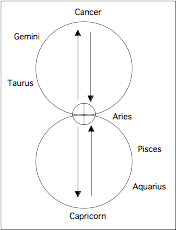
"This drawing illustrates your idea," Rose says. "But it is not from the novel at this point. We have no graphics in this section. Also, your diagram suggests that one force here, the First Son apparently, is moving through the zodiac backwards..."
"So it seems,: Crossmann says. "Remember, you are seeing this through the Second Son's perspective. And he is in the Anti-Universe..."
"So we should expect some meeting of the extreme right and extreme left in April, in your book," Rose says. "As the two forces meet in spring...?"
"Yes," Crossmann says. "You will notice the Anti-Universe propensity to blame the rich for the problems of the poor..."
"But you believe it at the time," Rose says.
"Yes, of course."
"Then the Universe must have a propensity to blame the poor for the problems of the rich," Rose reasons.
"Yes."
"So, both are wrong?" Rose asks.
"Yes. Both are extreme views. Incompleltions."
"You write another poem?" Rose says.
"Yes."
"Read it for us."
Crossman reads:
The Old Man said:
"Night is written in a different Language
Than Day.
Day is Time conquering space by description.
Its languge is number;
Measurement is its key.
Night is Space, which has swallowed up Time.
Occupation of Space succeeds its description.
Time is direction, between points A and B.
Space is immensity.
Endless webbing.
Bottomless metaphor.
When a culture seeks the Language of Dreams
It carries its shadow, by the Moon,
Through a Nightscape.
Surrealistic node;
The Castle has no shape here.
Hence, Religion comes.
It is the Language of the Dream.
Religion and Science rule in alternate stages.
One builds the Image;
The other builds its Concrete Form.
One destroys an outworn form;
The other completes an outworn dream.
Science builds the myth it dreams
In the seed of Night
In the bed of Religion."
The Old Man gave me a dream;
And then he was gone.
"We need to take another break," Charlie Rose says. "We'll be right back."
"We are back with Michael Crossmann. Ok. We are in Winter, in the Night sequence. We keep talking about Night and we mean that in the largest sense. Darkness. Winter. The Female element. Water. There is another poem. This one, again, with the theme of the coming Dark Age in America...."
"Yes."
"Do you want to read it?"
Crossmann reads:
Vision Prsented to Our City By a Stranger
I.
That night the lion cracked in limb
And smoke the sky with arctic hue,
When moon on icy gleam patrolled
The banquet cursing turning seas:
The storm came to see us;
A stranger stood at my door.
He said: "I to you have been sent by a lord
Who watches betimes on the clockworn horizon
And speaks out the verbs which scatter bold clouds
And mount up the horned and the battering
on high.
He to you has sent a word
With Which I clothe in rhythmic touch
The torching and missionary raiment
I bring you."
"Who is it sent you -- is it friend or is it foe?"
"Friend and foe, in turn, appear:
To one he seems a beggared fool;
To toerh's eyes he seems a god."
In from the heralding dar we came
Into my room to find some food.
"The town has been shattered, my friend," I said.
And he: "The plague has come to seal the pouch
Of a town in country which gainsays its gold.
Death is on the limbs and lakes
And stalks the faithless city on fours."
"Why has this fate come up on us?"
"Where Day does raise the towering bloom
To court the canter of Progress and Light,
So, in its turn, the Night does edge
Like glass on an urn
And the candle goes out.
Day and Night are mere lords of the same flame.
One steals the silence;
Then the other steals it back."
"And, so, the curse is the cause, you say?"
"Death is in the seed and bud
Which waits its turn to swallow production."
II.
We ate together.
He said: "The message the lord, from his moutainous
loom,
In seventy days has constructed for thee,
Is this:
The Day is fleeing.
Twilight is coming.
History moves from the City of Light
To the City of Dis
By the midway of Dusk.
In Middle Age, when wended Dawn
performed the rite of melding distinctions:
City and Nature existed as one.
The lord has sent his word to thee
That Culture is conceived at Dawn.
The Medieval City is a model to build by."
"But what of Progess?" I cried.
He said: "Even Regress is Progress.
The Autumn comes to fracture the stalk
And to pilfer the fruit from the maws
Made of wax.
It pulls down to Earth what the Day has designed
And nourises the sails
Of the soil with its bounty.
The seed it buries does not return
To original form,
But, rather, it sleeps.
When Day arrives, with its heat and its carriage,
From the loins, pulling image and husk and apparel:
This New Plant begins where the Last Plant did end.
So with Man.
So, too, with you.
Your city, Eugene, which means 'the Beginning',
Has been chosen by Time,
In its dregs and and its fashion,
To lead a new seed from its womb
Into meaning.
The first place to die
Is the first place to be born, friend.
You have been chosen to carry the flame
Which will carry a nation
To the next stage that it fears so.
There is no going back, my friend.
Seek true quality of life
So that History, the Goddess of Runes,
might remember,
We lived not in vain
But gave our words some existence.
Return to the Law in the Mind of the World
From which Genius proceeds
Leaving life full with reason.
The Night is at hand and is here and the forms break.
Nightmare gloams, with its scythe handing treasures
Of snails built by spiders
From a box with no bottom.
Industrial Titan in a cartoon sheds tears.
He is fashioning a war
By which men die for salt.
Your sons should not be sent to this war.
When a building breaks and falls in rain
Of mortar and steam
But the deft find their way.
Your community must proceed toward self-sufficiency,
the lord says.
Use the curve of Nature's thigh
As beautious flesh
Both to feed and to breathe you.
Return to the Earth and develop a culture
Which is Quality, Herself,
And not a mass based on Rome.
Civilization is not the same as Culture.
Civilization is the completion of Culture.
It is the fruit from the seed.
The Museum, garnering mementos.
Each region is a philosophical form.
From the Earth you must build
The next stage of your soul..."
I said: "Time then condemns the Industrial Form?"
He said: "Each form condemns itself in Time.
Hunter becomes Farmer
Becomes Thinker
And kisses age.
Defeat, alone, brings to Man his depth.
Defeat proceeds, in cards, by law.
The body, once young, cannot stay young for long..
complete your nation's work of its soul
To hand through misted veil of Time
To children whom you leve behind
A vision which embraces All.
Oppose the militarization of America.
Lead by your example.
Our sons ccannot be fodder's twins
To fuse the cracks in a broken commitment.
The New Economy must be built by Nature.
Only in Nature's wreath is found
The timeless extension
Which survives all distortion.
Insanity is rife;
Violence is raw.
Consider building a world-view in which
The rite of Speed of Displacement
Is completed by Wisdom."
III.
We completed our dinner.
He prepared to leave.
He said: "As the world wakes to carry
A New Dream into Day,
Building the edifice of Motion with Reason:
So, too, it sleeps.
Day Brain which builds in the language of numbers
Becomes Night Brain which roams
Through the Symbolized Sea.
The world is now preparing its bed.
I have come to you to warn you first
Because you have been chosen
To weather this Last Wind.
Take this warning and this privilege to heart.
The lord asks you to build
The Next Life for his children."
The man fastened his cape;
He stepped back into Night.
"Well," Rose says. "That seems to be the message of this section."
"There are two minds struggling, of course," Crossmann says. "The Night Mind wishes to surrender. The Day Mind wishes to go forward..."
"You do not believe in this vision any longer?" Rose asks.
"I don't know what I believe," Crossmann says.
"The Day Mind is fashioning a war," Rose says. "That is what you are saying."
"Yes."
"The Day Mind always fashions a war," Rose says.
"Mars and Jehovah are both war gods," Crossmann says. "The Dawn is about war."
"The Dark and the Light meeting," Rose says.
"At near equal strength. One rising and one falling."
"Some might say this poem, the philosophy in this poem, is defeatist," Rose says.
"Yes, I would say so," Crossmann says. "It is the philosophy of the Anti-Universe. The desire to go back."
"But if, as you say, it is a circle, not a straight line," Rose says. "Then perhaps it is going forward after all, to a new Middle Age, a Dusk, before Darkness settles in..."
"Perhaps."
"We will see a slight change further ahead in this part," Rose says. "It seems to come down to the narrator's view that America must either be Rome and rebel against Rome..."
"Yes. Expand or contract."
"This is the voice of contraction," Rose says.
"Decidedly. One son is centripetal force; the other centrifugal force."
"Because he sees Neo-Naziism as the alternative, he chooses death, contraction, martyrdom," Rose says. "He will come to equate Naziism with a Neo-Classicism. That is, with Rome. And he doesn't want to go there. But there is also a sense of fear appearing, really the first sense of fear, that contraction, the breaking of America into smaller parts, will result in the invasion of America by...what, the goth, the visigoths, the Mexicans...?"
"Well, seemingly out of no where comes the question: 'DOES THE WHITE MAN NEAR EXTINCTION?' In the early part of the book, the narrator would have rejoiced at this thought. Self-judgment made him esssentially suicidal. He wanted to be murdered by the Dark Force, since he had sinned against the world. But now, as Death becomes more palpable, less intellectual, it stirs in him a sense of dread..."
"It is clearly a part of the dialogue in his brain," Rose says. "Is it good to die? Is it good to be alive? What is virtuous? Eastern mysticism has taught him that death is good, and re-birth an error. So he is still treading in those footsteps..."
Rose reads:
SOME CALL IT DEATH. Yes, some do. The body without the organizing force falls away. IN THE WORKING CLASS ALONE DOES THE MYTH OF THE WARRIOR STILL PREVAIL IN AMERICA. BECAUSE THEY ARE FORCED TO WORK WITH THEIR BODIES. THEY IDENTIFY WITH PHYSICAL STRENGTH. SO THEY FIGHT THE WARS. WORKING CLASS WOMEN STILL PROUDLY SEND THEIR SONS OFF TO DIE FOR THE NATIONAL GOOD. Everything on the Earth is up-dated. Some cry because worlds of their childhood have gone. Yet everything is gone. Everything gone; but never gone. Only re-absorbed. WE SHOULD NOT PICK A FIGHT WITH MEXICANS; OR WE WILL LOSE IT. I learned in my youth, in my Catholic education, that if you fight with the Mexicans you are in for the fight of your life.. BLOOD IS ON THE HANDS OF AMERICA, IN THE JUNGLES BELOW, IN THE LAND OF WAR WHICH MEANS 'THE SAVIOR'. El Salvador, you mean? DOES THE WHITE MAN NEAR EXTINCTION? Only through danger does Life regain its meaning. AND WHAT DOES THE CROWD SAY? It says: A GENERATION BRED ON THE MYTHOLOGY OF SUPERMAN, THE MILD-MANNERED CLERK NAMED CLARK KENT, WHO IS REALLY A GOD, BENEATH HIS MILD MANNER: HE WAS THE MODEL YOU HAD PUMPED INSIDE YOUR HEAD...!
"Then the Second Son realizes he is Hamlet," Rose says.
"Well, he Hamlet, and he proclaims himself to be Jesus Christ," Crossmann says.
"Do you want to read this long poem?" Rose asks.
Crossmann reads:
I.
I court the velvet hills in Spring
To save the herald's hoary coat.
To damp the helot as merriest of moons
With ache and heel of the last Winter's mansions.
I moan in veriest acres of Day,
And the Sun heaves its wheat
On the plains I have harbored.
Yet Doubt comes to see me.
Doubt, in its missionary fragrance and vapors,
As land all about me
Seems to quake: a Giant's romance.
My coat is clean
With the wishes of my words.
Yet somewhere Time, with lion's tint,
Contorts the sacrificial tune
By which the virgin men on trains
To graveyard's oilless lamps are borne.
Structures fall about the shore:
A house, a hill, a serial Noon;
On which are stamped a vain decree
Which marks all moments
As Monument's Disease.
To see or to be seen? -- that is the question.
Whether to spurn the magic canon
Which the legions wash with rain,
Counting only stars of broken hard
And pointed edge
In the angst of its ledgers?
To feel the arrrowed singe of steel
Around the harsh and mocking sails
Of words the sensate breathe for free
On which the world
On shimmers hangs?
To act or hold the act in line?
When players conceive of Day's demise
As Moses did see
A goat in the gild.
To strike with axe the wounded bird
Which drops cold eggs of Belief
Like its bombs?
Clouded by the miracle mile
Of a gray constitution,
I long only for substance --
Yet where might I find it?
Oh, who knows where the Wind does sell
Its complicated frieze
To the mites we call men?
Dare I be Hero?
Dare I charge the wending war
In Souls burst sea
With my wings dressed like breakers?
Or to ward and dally
With Delilah's blue soup
In the ageless true fields
Where only strength must be paid for?
Heave up your tokens for the grace of my query.
Is one heart enough
That I give to my race
Seeking only the purpose
Of the waves
And their red ink?
To shatter down Time
From the throne it has carved
And to stand unto Homer,
Blind, enraged,
Selling stems?
Is this my fate, Master?
Is this the fate of my nation as well,
Which declared independence
From the hackles of tombs
When a room's door was opened,
Leaping wild at new sorrow?
Somewhere the circus is looking for mentors.
Delilah calls meekly.
Somewhere bloom
Has been soiled.
II.
It seems that the Son who brings words from his Father
Must offer his blood
To the family of lambs.
Then so it must be.
And though Delilah might give me
The spool of her waters
In which I might drown
The pleasured plot of extinction --
Though tied taut to flesh
I might there conceive
The birded distinction
Of the air
Which can't lift me:
I seem to say no to that.
I say no to the pleasures of the Earth
And the grape,
And the bed of the leopard
And the skin which dissolves me.
I fly from the heaven of one womb to another
In a sky, freshly-made,
In whose wheels
Awaits Perfection.
I return to the Earth
With the verbs of salvation.
I return to my tree.
I am hanged.
Sorrow frees me.
"Is this Michael the Archangel in his Jesus Christ aspect?" Charlie Rose asks.
"It certainly seems so," Crossmann says. "Looking back, knowing that Michael is born out of the same substance, the same egg, if you will...yet, it seems that way."
"He will say something later in the novel that shows he is still a bit red," Charlie Rose says.
"What is that?"
"He says that Mao-Tse Tung is Jesus Christ, but on the Active Side. The other side of Jesus is Mao-Tse Tung..."
"Did the Second Son say that?" Crossmann asks. "He is obviously confused."
"You are still a communist at heart," Charlie Rose says. "A democrat at least; as opposed to a Republican. Read the next poem..."
Crossmann reads:
I LOOK BEYOND THE GRAVEDRAWN SKIES
TO FIND THE HAUNTED VEIN OF HOPE
WHICH, LIKE A SPRING, ON SOIL, PERFORMS
THE RITE OF LIFE IN ITS SYNCOPATED MINIION.
FLOWER-GATHERERS COME, AND DRINK TO THE HARVEST;
YET, SOLITARY SONS ON A MOUNTAIN-TOP CLAMBER;
AND THE SUN PEELS THE EARTH
LIKE AN ORANGE WITH ITS ANGER.
YOU WHO HAVE MADE ME FREE WITH DIS-USE,
WHO HAVE MADE ME OLD WITH DIS-FAVOR,
WHO HAVE MADE ME WEAK WITH DISEASE:
IT IS YOU I SEEK TO SHOW WITH MY BELLS
AND MY SPIPULATED WIND
THAT NO CRIME IS FORGOTTEN.
WHERE A MAN STILL STARVES IN YOUR TOWN,
YOU HAVE FAILED ME.
WHERE YOU PUNISH YOUR YOUTH
WITH YOUR WEAK CONSTITUTION,
AND YOUR POVERTY OF WILL,
AND NO ALLEGIANCE TO VIRTGUE:
THIS IS, ITSELF, THE MEANS
THROUGH WHICH A TOWN UNSEATS ITSELF.
YOU POINT YOUR FINGER OF ACCUSATION
AT THE LOWLY.
YET I AM OF THE LOWLY.
I SEND MY SON TO BE THEIR GUARD.
"Well, there is no question who is speaking here," Charlie Rose says. "God, the Father."
"Yes."
"So God the Father is on the side of the weak?" Rose asks. "He is at this moment. But it will not always be so. Remember, Nature changes. Perspective changes. Martyr fights with Anti-Martyr Hero fights with Anti-Hero..."
"There are interesting ideas in this section," Rose says. "'The Mythologizers make gods of a nation's forefathers; wheras the De-Mythologizers make of the Heroes new demons.' And: "ONE GENERATION WORKS IN THE CONCRETE MIND; AND THE NEXT WORKS IN THE SPIRITUAL MIND. ONE BUILDS MONUMENTS IN PHYSICAL FORM; THE NEXT BUILDS MONUMENTS IN WORDS, MUSIC AND ART-FORMS...' The eyes being the primary sense of the Day; the Ears being the primary sense of the Night. We have talked about that a bit. Tell me about the two men you and your brother used to meet at the Fifth Street Public Market..."
"Oh, when we first moved to Eugene," Crossmann begins, "the Fifth Street Public Market was like a public forum in Greece. Eugene was a focal point for many of America's disaffected youth. People who didn't fit in. There was Berkeley, Eugene, Santa Clara, Santa Fe, Bellingham, Washington. College towns mostly. That was where the counter-culture assembled. The Fifith Street Market was an old warehouse block converted into a counter-culture marketplace. One could go there and drink a cup of coffee and sit all day. I used to write there; and read. But there were many others, people working on books; astrologers, marxists, capitalist, fascists. All the masks arrived there. And on Sunday there was usually a gathering of minds, which tended to center around the two major poles, both in their sixties, men who came to age in the 1930's.
"The one pole, the Left, was manned by a grizzled small man with arching flambuoyant eyebrows, gray hair, a strong but somewhat beaten-down body. He was alone. He had been a communist in his youth and he still brought the good word to young fellow-travelers. He called himself Stupid. Apparently some people had told him he was stupid; and he had taken the name as a badge of honor. He like to call himself Stupid because he really thought he was very smart, he had solved Life's puzzle -- but the world was still behind him.
"On the other pole, the Right, was a huge man named Bucher, appropriately German. He was almost seven feet tall: strong, bald, with an acron head, as tough as a nut. He had a wife, Mrs. Bucher, who trailed behind him, talking to herself in a gentle voice, protecting her husband in life, although he did not realize it. Bucher had been a Christian missionary child in China. He had wirtten and published a book of short-stories set in China. He made his money repairing watches on River Road, a suburb of Eugene on the Willamette River. But he was also a farmer. He was a botanist, really. He was seeking to cross different species of fig trees that could survive in Eugene. He was a scientist. His mind was fresh, ever-acquisitive. He had worked as a stevedore with Eric Hoffer in the 1930's in Oakland. He was an individualist, a rugged individualist, like Reagan.
"If you compared the two, one was alive, still growing, and one was dead. One could take any side of any argument, for the sake of a good argument; the other was an ideologue, easily defeated.
"Stupid was a kinder man; but he was a dinosaur. Ready to die."
"Around these two poles the two brothers also revolved."
"Yes, children of the poles," Crossmann says. "We met every Sunday in the Public Market to argue ideas. Bucher called us 'The Athenian Club'."
"Let me read about this meeting with Bucher," Charlie Rose says.
Rose reads:
And the clerk cried to Bucher, the Physicist, at the Marketplace: WE RECEIVE LIGHT WAVES AND RADIO WAVES FROM THE OTHER PLANETS IN OUR SOLAR SYSTEM. He said: NO. LIGHT AND SOUND WAVES TRAVEL TOO SLOW. YES, IT'S TRUE, WE DO RECEIVE LIGHT AND WOUND WAVES. BUT WE ALSO RECEIVE OTHER WAVES. SCIENCE IS STUDYING THEM NOW. THEY CALL THEM 'SUB-WAVES'; AND THEY TRAVEL INSTANTANEOUSLY FROM POINT TO POINT. THEY TRAVEL MUCH FASTER THAN THE SPEED OF LIGHT. It is Space itself; the true carrier of sound. HE DID NOT LIKE THAT? And I cried: IF SPACE IS AN ILLUSION, IMAGES PROJECTED ENDLESSLY BETWEEN MIRRORS OF MATTER AND ANTI-MATTER, REFLECTING THE IMAGES OF MIND FOREVER -- THEN TIME, TOO, IS AN ILLUSION. He agreed with that. HE DID? And then? PERHAPS, THEN, IF TIME IS AN ILLUSION, EXISTING IN TOTAL IN THE SAME NUCLEAR SEED AS DOES SPACE ITSELF, RATEHR ONLY AT A DIFFERENT SPEED PERHAPS -- COULD IT BE THAT BY PERFECTING OUR HEARING, WE COULD HEAR THE 'FUTURE' WHICH ALREADY EXISTS TOWARD WHICH WE ARE MOVING...? The Ears receive; the eyes propel... These 'sub-waves' are the impulses from brain to the organs. Space is a living medium, which is, itself, these waves, at greater and greater speeds. THE SPEEDS ARE, THEMSELVES, SPACE AND TIME; THEY ARE INTER-DIMENSIONAL. Yes; so it seems. I LOOKED AND I SAW RACES MOVING UPWARD FROM THE SOUTH TO THE NORTH. THE NORTH WAS THE PROMISED LAND, THE AGRICULTURAL WAY OF LIFE. THE SOUTH WAS THE 'BODY' -- THAT IS, THE MINERAL OF THE EMPIRE. I SAW THE BROWN SKINS OF SOUTH AMERICA FILTERING TO THE NORTH, LOOKING FOR A NEW EXISTENCE. SPANISH CRASHING INTO ENGLISH. THE WHITE MEN PREPARED TO SEEK THE HOLE IN THE SKY, THE HOLE OVER THE NORTH POLE, THROUGH WHICH THEY COULD ESCAPE....As man builds machines to do his physical work, so his words describe the stage of his life. The computer 'terminal' describes the stage of this man. Each race works its way up through the body; and it leaves through the head. The computer is the externalization of the brain...WHEN THE SUNK, THE ORGANIZEER, OR TIME LEAVES THE EARTH, ORDER ALSO LEAVES. I SAW SELF-PROCLAIMED 'PUNKS', ANARCHISTS, RUNNING WILD IN THE STREETS OF ENGLAND, AMERICA, AUSTRALIA. The Day is concerned with hierarchal value. THE NIGHT EMPHASIZES RELATIVITY OF VALUES....
"There are a lot of ideas in this passage," Charlie Rose says. "Some contradictory."
"Such as?"
"Well the North-South polarization takes on a new meaning," Rose says. "Brown skins moving up from the south, with a foreign language. The endangered White Man seeking to escape through his head. The North-South polarization in Europe may be Christian and Muslim -- but in America it may be English against Spanish. Bringing that conflict over from the Old World. Still, the Second Son's fear is the Neo-Nazi, the anarchist punks, who were the fodder of the Nazi movement in Germany...."
"So there is a double-fear here," Crossmann says. "The Nazis of the North; and the brown-skinned huns from the south, overrunning the country..."
"You have a great allegiance to the English language," Rose says.
"Yes, I do."
"You feel that we should designate English the national language -- and stop offering dual education and governmental services in English and Spanish...?"
"Absolutely."
"Even though many people fear this would be discriminatory?" Rose asks.
"One of the reasons America is great is because of the English language," Crossmann says. "Lanugage is a unfying force. It ties the nation together. If immigrants want to enjoy the blessings of living in America, then they should learn the native language. And English is now the native language. They can speak any language they want at home. But in schools and through government services, they must speak English..."
"I noticed that in your Ten Truths for a New Age, you modified the Bah'ai Truths and designated English the Universal Language."
"Yes."
"Doesn't that make these truths more missionary than they once were?"
"Perhaps."
"But you are ethnocentric?" Rose asks.
"Yes," Crossmann admits. "It is fine for every race and ethnic group on the Earth to be proud of themselves and their accomplishments except the White Man. The White Man is expected to apologize for his..."
"Because his shadow is so large," Rose says.
"Every culture has a large shadow. There is as much glory and decency as shame in the White Man's history. The Anti-Universe, which believes White is Black, wants to perpetuate this perception. That is all..."
"I can't help but feel you are a bit schizophrenic," Charlie Rose says. "Reading your words now, which are largely anti-white; and hearing your spoken words, which are just about the opposite of what we are reading..."
"Dual personality?" Crossmann asks.
"Yes."
"What we will see, as we cycle through this novel, is that all the masks of life, all the personalities along the way, are aspects of the One Life. There is One Life only. We all represent different stages of that One Life."
"Two lives," Rose says.
"No, one life. One life reflected in a mirror. Nothing more."
"Yes. The duality is an illusion." Rose agrees.
"The first-born illusion."
"The Second Son then switches his lense," Rose says. "He begins looking at the Woman again. And then his first diagrams in some time appear. It is February 17, so the strength of Light is growing, having been weakest on December 21. Shulamit begins to appear again..."
Rose reads:
Did not Ideas come to see you again? IT SEEMS THAT SOME, IN STRIPS OF SMOKE, ON NIGHT'S CLEAN BLADE OF BLUE, CAME TO SEE ME. What did they say? ONE SAID: The Soul is again born, in Capricorn's age, so that you, in your cycle throug the Elements into Matter, remain latent while passing into desnseness and back again. You do not chase the shadow of the Woman's Image you have cast into Matter; rather, you arc past the solid of the Physical Plane, and begin your return, projecting the Earth, the Woman, the Ideal, into Heaven -- that is, into Virgiin Matter, into Etheric Form. I'M NOT SURE THAT MAKES MUCH SENSE WITHOUT A DRAWING. A drawing you shall have then; but the last piper told me, as he passed me on the grassy knoll, that: SPACE, ITSELF, IS THE IDEAL WOMAN. SPACE IS THE MUSE, WHICH YOU LOVE, AND BY WHICH YOU KNOW. Going up, you see women in Heaven. Going down, you see women in hell....
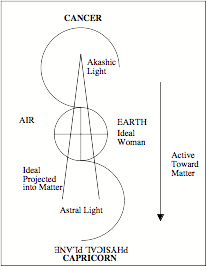
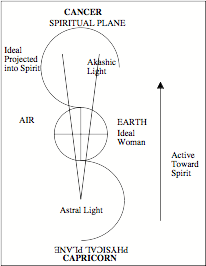
Our clerk did not see Shulamit much from the time he died in October's brown seas -- yet he sees her now almost every day. AND SHE TELLS HIM: I believe I am going to become serious about being a Mother again. THE MADONNA IMAGE. WHICH IS HOW HE FIRST SAW HER, THAT DAY WITH HER CHILDREN. Madonna and Harlot. WHICH WILL SHE BE? He refused to see her projected into density, into lower nature, into hell. ORPHEUS HAS WARNED: DO NOT LOOK BACK WHEN YOUR ARE BORN AGAIN IN SPRING, OR YOUR LOVE, EURIDICE, WILL VANISH: YOU WILL LOSE HER! Do not look back into her Astral Shadow, where the lusts and the darkness will rob the woman of her grace, of her pure power to inspire you....
"Shulamit is Michael's muse," Rose says. "But, clearly, she has two natures. Shulamit was, in the historical text, the lover of Salomon. So, Michael/Jacob also takes on another personality, Solomon, the King. Solomon is also a kind of Sun Hero..."
"Yes."
"You know this?" Rose asks.
"Of course."
"Was there really a Shulamit?" Charlie asks.
"Yes. Of course there is."
"You also say something here that is provacative, especially in terms of the drawing you just presented," Charlie Rose says. "You write: 'EACH BROTHER PROJECTS THE OTHER BROTHER'S IMAGE..."
"Yes, the brothers exchange bodies with one another, in fact. One inhabits a dream body; the other inhabits an Earth body. When they exchange bodies, however; they flip the bodies. So that what was outside for the one is inside for the other; what was inside for the one becomes outside for the other...."
"I don't understand that," Charlie Rose says.
"It will be explained as we proceed," Crossmann says.
"Very well. I guess I'll have to take your word. So, then what happens...?"
"The Second Son then gets sick," Crossmann says. "He is obsessing about Death."
"Please read," Rose says.
Crossmann reads:
YOUR RHYTHM OF SPEECH SEEMS GENUINELY DISTURBED, MY FRIEND. And the sorrow comes; and sickness. The Clerk lies in his bed and breathes and coughs against the might thread of disease. He dies, again, in his wounded bed. Sickness steals the spear he brags of when the music on tears was new. Lost he is, in the density of icef. The clairvoyance of a town not moving; the slickness of a black winter rain. Passing bacteria around like a plate of collection. The plague before the Dawn collects the tired by toes and drags them away coughing. What happened to Order in this town? What happened to Time? I blow my nose. There is no time, where the man blows his nose. Only the immense craving of sleep -- not for its own sake, certainly not for pleasure, rather for the sake of escape alone. Missionaries of Justice present cold flowers to the angry Governor. The Town Crier condemns the folly of his youth. The Governor gives orders to tear down the Hospital. No one opposes him. Everyone watches and wonders if he is mad. He is mad, they decide. They drift away. Waiting for Spring. Only Spring will save them. The Clerk feels a pain in the center of his chest. Only Spring will save him; only Spring has a cure. The coming of the Dead to rule in Winter's rain with a cough and wet boots. Who are these people? The factory is closed down. Who are these people? The President wears the sailor-suit of his childhood. No one can stop him. Idealists pay with their blood -- look at Kennedy. Intelligence is always murdered by Stupidity. Stupidity being merely the fear of change. WOULD YOU OFFER UP YOUR BLOOD TO RE-DIRECT YOU LOST AND LOSING FRIENDS? Nothing will do, short of blood, you know. SWING LOW, SWEET CHAR-RIO-O-OT! GOING FOR TO CARRY ME HOME...! Coughing up blood in his Bible. THE ORTHODOXIY OF HATE IS BEGINNING TO BOIL! I know, too well, that the next duality is Spirit against Soul. And the Second Son said to the First: I WILL DIE BEFORE YOU DIE! I WILL DIE BEFORE YOUR WORK BEGINS! I WILL BE KILLED BY THE ORTHODOX, WHO, IN THE NAME OF CHRIST, WILL AGAIN KILL THE CHRIST! IT IS THEN THAT THE WARRIOR OF THE WORLD WILL BEGIN! YOU WILL CARRY MY WORD INTO THE DENS OF THE DISTANCE! YOU ARE PAUL TO MYSELF: THE SCORPION TO THE WHITE HORSE! YOU WILL BUILD MY DREAM, FROM THE SEA TO A SHINING SECOND...! When will this happen? SOON, SO I AM TOLD! On the Third Day He rose again, according to the scriptures. SO BE IT! So it shall be. BILDUNGSROMAN. Chills run up his back. He cannot sleep. He hears a cat fight in the darkness. YOU MUST SEE EVERYTHING! his Prototype cries. SO I MUST! It cannot be done! BUT IT MUST! I MUST SEE IT ALL -- AND BRING IT ALL BACK TO SHOW YOU! Why must you do this? BECAUSE IT IS MY CALLING! Your Catholicism is killing you! MY CATHOLICISM IS SAVING ME! Universal view: the punctuation of isolation: the starry myth of mime on a ceiling reflected. THE MAN IS ILL -- CAN'T YOU SEE...? He chose his illness, did he not? PITY IS NOT A FOUR-CENT WORD! Nein, pity ist ein funf pfenning foreshmank. WHAT? FORESHMANK! Yes, Foreshmank. THE MAN IS JEWISH! HIS FORESHMANK IS GONE! Beat the drum slowly -- the man has no candle....
"That's very funny," Charlie Rose "But dark humor again. And a prediction of the martyrdom of the Next Christ. He is identifying with his own Christhood...!"
Crossmann reads: "I CHOOSE TO FLY INTO THE WOMB OF VIRGIN MATTER, VIRGIN MARY OF THE AKASHIC SEAS -- AND SO BE BORN AS THE WORLD'S SAVIOR THROUGH MIND, UNABLE TO FALL THROUGH SOUTHERN BODIES TO CONQUEST. YOU PREPARE TO CHOOSE YOUR WOMB OF LIFE. THAT IS TO SAY: WHAT BODY YOU WILL INHABIT. THE PLANE ON WHICH TO ACT. THE VIRGIN BEAUTY CASTS NO SHADOW. NO IMAGE TO DETAIN YOU. IT IS LIGHT ITSELF, IMMACULATE IN VISION. YOU TRAVEL THROUG IMAGES OF WAR AND CONQUEST. YOU SEE YOURSELF NOW AS A WARRIOR ON EARTH..."
"So, he is think of himself as a warrior now," Charlie Rose says. "It is February 23 and new moon. So this is Pisces...."
"On the reverse wheel it its Taurus/Pisces," Crossmann says. "Approaching Aries. Aries approaching Aries..."
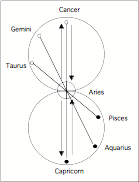
"Again, this drawing is not from the text," Rose says. "But it helps to illuminate the ideas we are discussing..."
"Pisces is the sign of Jesus Christ, the World Savior," Crossmann says. "The fish swimming in the sea. Taurus, the bull is the opposite sign, on the opposite or reverse wheel..."
"I remember from a bit earlier the line," Rose says, flipping through the book. "Yes: 'The circle of the bull and his seemen. The triangle of lamps....' The Twins, the Eternal Brothers, are going to meet, both in Aries? Is that what you are saying...?"
"Aries is the Celestial Ram," Crossmann says, "signifying a New Era. Aries is governed by Mars, the god of war."
"So, both sides are seeing themselves as warriors," Rose says. "The martyr sees himself a warrior for God; and the anti-martyr sees himself a warrior for his nation or his race...?"
"Yes."
"Ares, of course, is the Roman god of war, the Roman Mars," Charlie adds. "So, we expect some kind of battle then..."
"On the mental planes, because our hero has descended to the mental planes only," Crossmann says.
"So we expect some type of Armageddon on the Mental Planes," Rose says. "Between the Two Warriors. Do we get it...?"
"We are not there yet, since it is still Pisces," Crossmann says. "What we get in Pisces is the consciousnes of the World Savior -- and a vision that the martyr must die..."
Rose reads:
THE SPECTRE OF DEATH ON THE MENTAL PLANE BARTERS ITS WILL FOR YOUR SORROW, YOUR FEAR FOR ITS SOOTHING. THE ANGULAR WORLD 'DEATH' CAME DEMANDING ATTENTION. WHAT COULD I DO? I COULD NOT FIGHT HIM, DEFEAT HIM -- RATHER GIVE UP EASILY TO HIM. LET THE DEATH BE PEACEFUL. THERE IS REALLY NOTHING YOU MUST DO BEFORE LEAVING. DO NOT SEEK YOUR BODY AGAIN. THE RADIUM OF WORDS WHICH LIFT ME IN SPRING CANNOT LIFT ME IN WINTER. I AM HERE. HERE AMID THE SHOWERS AND THE STONES AND GLOAMING DARKNESS. HERE AMID THE CATASTROPHE OF WINTER. PEARLS SWALLOWED BY THE SWINE. IT IS I, THIS DARKNESS. AND, AS LIGHT AND DARK NOW BATTLE AND STORM, AND TEAR THE MEMBRANE OF THE SKY, FIGHTING TO POSSESS THE EARTH, FIGHTING TO POSSESS THE WOMAN, SO HEALTH AND ILLNESS NOW BATTLE IN ME. AND IN ALL MY KIND. WHERE DEATH DOES NOT SCARE YOU, YOU BECOME GREATER THAN DEATH. YOU BECOME DEATH ITSELF. WORKING TO HELP PUT YOUR BRETHREN TO SLEEP. TO GIVE THEM A DREAM. AND TO THEM WAKE THEM UP AGAIN. WHEN EVERYTHING IS DONE. Yes, you know your role....
"Then comes a rather startling revelation," Rose says. "He is reminded that Ismael survived in Mellville's apocalyptic novel Moby Dick -- because someone needed to survive to write the story. The writer survives, to write the history. Also, he identifies himself with both the darkness and the White Man; and with the Goths, the Germans, who defeated Rome..."
Rose reads:
Seeking the structure behind the myth. The meaning behind Old Desntiny's curve. OLD DESTINY'S CURE -- AND THE NUMBERS OF HIS CALLING. Ishmael was sure to live -- for someone must write the tale of the horror. A courtly scribe. All things are passed on. THE TALE OF THE OBSERVER'S PLANK. OR: THANKS BE TO GOD, THE SURVIVOR WEARS WINGS, WHICH ALLOW HIM TO WALK THROUGH THAW. AMEN. Amiens. WE ARE THE GOTHS. WE DENY WASHINGTON ITS EXISTENCE. I have found that the woman of my dreams is not of the Earth -- but she is made of dreams. MAN'S QUEST FOR VIRGIN SPACE, FOR VIRGIN LOVE, IS A MARK OF HIS YOUTH. IT IS ALSO THE MARK OF THE WHITE MAN'S QUEST. HE, WHO WITH EQUAL POWERS OF DESPAIR THAT LED HIM TO ERECT GREAT CITIES ALSO DIRECTS HIM TO ESCAPE THE CONCRETE TOMBS HE HAS FASHIONED. Are they, then , the Virgin Kumaras of our town -- the bringers down of Karma? ARE YOU MAD, MAN? And then the tower breaks. The Period of Involution is marked by the positioning of 'bodies', 'wombs', prior to the next Period of Action....
"The Kumaras are the Child Warriors then?" Rose asks. "Angels -- the Children's Crusade...?"
"The Arch-angels," Crossmann says.
"The mass is still being said," Rose says. "Amen, Amiens. In the cathedral."
"Not everyone is in the cathedral, however," Crossmann says. He reads:
The Interlocutor, in a dusty bar-room. We are all gathered here, by the power invested in the great gift of giving -- domino kings on a domino reef -- waiting God's oat, in a room full of players. LISTEN FOR THE ALARM CLOCK. It moans a funeral tune. THE TYMPANIC ROUND IN THE SEVENTH. Ahh, yes. A mauler on the open road, beyond the town which gireves for Chaos. GRIEVES FOR LIGHT OF DAY TO COME. TO SCATTER FEAR LIKE CHESS-BOARD FRIENDS. AND DRY OUT LUNGS AS THE PLAGUE SLIPS ITS NOOSE FREE. Dark man. Dark vision. Base-noted voice, playing bass in the breeze. SELF-LOVE IS THE BASIS OF POWER. THOSE WHO DO NOT SUCCUMB TO THE TEMPTATION OF SELF-INDULGENCE, WHO DO NOT BECOME JADED, ARE GIVEN POWER BY THEIR BRETHREN WHEN THEIR WORLD IS IN DANGER. Who is the most deserving to rule? It is the purest, the strongest, who must rule. IF YOU WOULD PLAY GOD, THEN HE MUST PLAY YOUR CHARIOT ON EARTH, ARJUNA TO YOUR VISHNU. TOGETHER, YOU ARE DISTANCE. But everything gets turned around. TOGETHER, YOU ARE DISTANCE. And is Distance power? DISTANCE IS POWER: THE ABILITY TO INCLUDE OTHERS IN YOUR BODY, BUT NOT BE FILLED UP BY THEM. Yes, I see. DO YOU SEE? A blue heron flies over town in a squalling second. Birds are hidden in the trees; rushes in the bushes. Down by the river. No one sees them. yet, speak to them: you draw them out. Speak their language: they come out to see you. Each awaiting Spring, as you await Spring. Each to tell a tale of his sojourn. If you will not listen, then fire brings you faggots. THE MIND FULL OF STICKS, ON CAVALRY, NEAR THE PYRE. Sanat Kumara is the first to fall; and the last to incarnate...
"Then comes our first text-drawing in some time," Rose says.
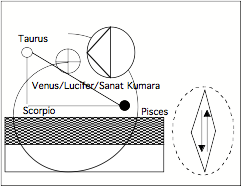
Rose continues reading:
WHAT DOES THAT TELL ME ABOUT THE PRICE OF EGGS, MY FRIEND? Absolutely nothing. If you wish to learn about the price of eggs, then walk down to the corner store. I DID. AND I SAW OUR CLERK. HE HAD LOST HIS JOB AND HE WAS PREACHING BY THE CORNER STORE, PREACHING ABOUT THE NEW IDEA. HE WAS SAYING: WE ARE THE RENAISSANCE MEN: HALF-GOD, HALF-DEMON; HALF-POET, HALF-WARRIOR; PHILOSOPHER, ENGINEER, FATHER AND SON. ALL THINGS IN ONE. WE ARE LIMITED ONLY BY HOW MUCH COURAGE WE HAVE. IN THE FACE OF DEATH, WE LAUGH AT ITS INNOCENCE...! He is a dangerous man, for he will lead with hsi vision whom he charms with his magic, for they have nought to lose; and so Death makes them strongest. LAMBS BEFORE THE LAMBING SINECURE. A HARVEST OF SOULS, IN A DOCUMENT OF RAIN. TWO STEPS TAKEN, ONE STEP RESERVED BEING LOPPED OFF, BEFORE THE DARKNESS COMES IN. HOLY UNSANCTUARY SEA: RUN OVER ME WITH THE LOPING OF SEQUENCE. TURN THE WLEDED WIND TO TEARS WHICH PUNCTUATE FREELY THE BRAIN WITH THEIR FREE-FROST. Mask-handling image man. TWENTY-SEVEN TOKES, AND THE TEAM LEAVES ITS COFFIN. Too much anticipation for the plains men. AND THE WATER RISES. NO ONE LEAVES THE SHORE FOR THE LAND IS OCCUPIED BY LICE; AND THE SKY FILLS ITS SHEPHERD-SKIN. Bloated with nails. FREE INNOCULATION FROM THE THREAT OF THE CROSS. The broken shin-bone again. Breaking legs, the Nazi youth contort. Where is the Orderer? HE LEFT WITHOUT THINKING. Perambulated score in the words of the priest: nonsequiturs scrambled by the dice rolled by yearlings. THE INNOCENCE OF LOST APPAREL. Appelate court sings about the lost rolling song. A DREAM TUNE FROM GYPSIES. Alleluhias found in bells. SOMEONE TURNED THE BED FOR FLEAS. Last contradiction. HOLY MATRIMONY OF SAINTS. Grieg's lost violin. A TUBURCULAR PANORAMA. SUBTITLED, FOR EDIFICATION: TOO MANY STONES ROLLED BY TOO MANY LUNG-MEN.....
"The image of the Nazi Youth breaking legs is still strong in the Second Son's mind," Rose says.
"It is a continuing fear," Crossmann says. "A parnoid vision."
"It is not paranoia to the Jewish mind," Charlie Rose says. "Or to the African American mind."
"Well, it is a fearful vision," Crossmann says. "And it was one that was shared by others in Eugene. I had Jewish friends who feared the ghost of Hitler in America. Some of them were asking me if they should leave America, and go to Australia or New Zealand..."
"We will get to the Australia-America connection later," Rose says. "Your idea of North America (America and Canada) and Australia being the twin brothers given birth by the Queen, England..."
"Yes. The Castor and Pollux on the Earth," Crossmann says.
"You write about this novel," Charlie Rose says, "being a 'Gothic poem, sprawling. immense; as large as the sea'. You write that the interpretation of the novel should be left to the literary types, whom you call 'archaeologists of words'. Then you call it 'as deep as the marriage of Time and its minstrel -- although don't go near it, if you care not for drowning...' Earlier the novel was a Gothic Cathedral. Now it is a Gothic Poem. He talks of himself as 'the flaming Gothic sword'. Clearly, he identifies with the Goths, with the German barbarians..."
"The world-saviors, from his perspective," Crossmann says. "Those freeing the world from the Roman persecutors..."
"Yes, but the Goths did not see themselves as liberators of the world. They did not say let's save the world from the Roman persecutors. They said: 'Let's kill their men, rape their women, and steal their gold...!'"
"Yes," Crossmann says. "But, by the same token, the Second Son is not saying lets be barbarian Germans. He's saying: 'Let's save the world from Rome...!'"
"Yes. I see what you mean about the paranoia," Rose says. "At what point does this dark mind simply become madness...?"
"Well, it is a kind of madness," Crossmann says. "Remember Lucy speaking to Von Helsing earlier, saying: 'What if we all wake up and find ourselves in straight-jackets...?' The darkness sweeps over the town; and the town becomes mad."
"The next passage seems insane," Rose says. "The Second Son foresees Eugene as being a kind of Leningrad. He predicts a siege of Eugene by her enemies. Eugene must have been a town of madmen at this time...?"
"Eugene has a reputation," Crossmann says.
Rose reads:
'NEGATIVE THINKERS' WILL BE ATTACKED BY THE NEW RULERS. Once again I see Eugene as a kind of Leningrad. HORROR IN THE HAIR. Where the 'martyrs' have gathered, in this stretch of involution: the time when bodies are placed for the next phase of action. ON RETURNING TO THE FIRST MIND AGAIN, THE 'PRIMITIVE MIND': THE MIND OF AWE, OR THE SOUL. YET WITH THE INCLULSION OF A LIFETIME OF EXPERIENCE AND WISDOM. We are the Renaissance Men. GOING OUT INTO DEATH WITH OPEN ARMS IS TANTAMOUNT TO A CULTURE TAKING ITS OWN LIFE. The Suicide Elementals. Warriors; and the confrontation of Space. BLOOD IS THE LIFE-SOURCE, IN THE BODY AND ON THE PLANE OF IDEAS. WHICH OF US BELIEVES OUR TRUTH TO THE END. THAT WE WOULD WILLINGLY GIVE OUR BLOOD FOR THE CAUSE. The blood of Martyrs waters the Tree of Hope. YOU ORGANIZAE THE EARTH, EVEN IN ITS SLEEP, BY WALKING THE PIT AND GIVINGOUT MASKS TO HEARERS. One brother is the Kumara, the Puritan Angel, in the heavens. The other brother represents this power on the Earth....
"How seriously are we to take these phantasms?" Charlie Rose asks. "If he is mad, this Second Son....then are you mad too, his creator? I mean, these words are your words..."
"The Darkness is irrational," Crossmann explains. "This is a picture of the irrational principle in action. This night is a dream, in fact. We must remember that the Second Son is moving through dream matter during this night. And nightmares are present here. Human terror is present here. Historical sins are present here. To say that the Second Son is paranoid is not to say that Leningrad did not happen. It did happen. It was a spirit that was haunting the Second Son. We could say that just as easily. They are all praying for the Dawn, the Spring, to return. There was the long injunction earlier that the Spring would cure everything."
"But the image also is that there is war waiting at the Dawn?" Rose says.
"Yes. Conflict between the two principles. The Southern Hemisphere is having its Day when the Northern Hemisphere is having its Night. The Southern Hemisphere is in the North when the Northern Hemisphere is in the South."
"What is 'Delilah's blue soup'?" Charlie asks. "You use the expression more than once..."
"Use your imagination, Charlie," Crossmann says.
"Oh, ok. I had a feeling it might be something like that. An agent of seduction."
Michael Crossmann smiles.
"The Second Son is not defending organized religion," Charlie Rose says. "He decries the Positive Thinking philosophy. And he sees the Bull, the sign of Taurus in the distance..."
Rose reads:
I walk through some strange world; and I feel the pain in my heart from the Earth's harsh decay. And some say: DO NOT SEE IT! PAIN IS ONLY AN ILLUSION! BE HAPPY! ONLY SEE THE BRIGHT SIDE...! And I say no. Perhaps I blind my visionous outrage by flying on wings silhouetted by clouds, and paint of the Earth with my pallet of laughter...yet I will not discard the sorrow. I will not discount the pain I see, of swollen men with fee unshoed, and mother's achy fear of loss, and childen's dread, and Starvation's performance. It is in these waves of terror I once was, as I deifted from bark to brain to discover the heart of the sea, and the truth of its harbor. It is with these poor that now I must walk, for the rich are the gods of their own self-delusion. The Moralists decry; the 'Christians', in their goodness, burn the rags of gas by which they fire the new martyrs. I say no to you: with your conventional religion -- that is, with your poverty on Sunday; ritual; then gain. It is you the Christ comes back to deny, for you have denied, in His name, His own words. Your fat-faced conventional sensuality: pig-faced in our gluttonous ritual of gold. Hearts without a quest. Without a vision. Waltching neighbors' appraisal. Desiring your own daughters' friends in your beds. Desire what you will -- only don't claim heaven as the dues of our justice. If your heart was not shallow, it would not be dismembered. If your b ody was whole, you would not need God's dedication to your way. Do not point your finger's blade, when, blade in hand, the True Missionary comes. He harvests only the one he loves. He leaves you here, in the darkness with your fashion. Yes, I will see Sorrow also -- Sorrow, the one whom you would deny. And I will also sing the praises of her, for she is the mother of the son she has born. Be young by being old -- that's what the bearded man told me once. Be rich by being poor. Be joyous through knowing Sorrow. I have doubt of my calling. Yes, even Doubt I admire. For Doubt is the gaining of sight of some other ....fairly legitimate kind of truth....
"This is followed by another perspective on the novel itself," Charlie Rose says: "'THIS BOOK, TO YOU, IS THE PHILOSOPHER'S STONE. IT DOES NOT MATTER IF OTHERS ENJOY IT. IT GUIDES YOU THROUGH LIFE. IT IS YOUR MEDIUM TO VISION. AND VISION IS, ITSELF, A VIRTUE...' Is this the way you look at this novel, still...?"
"I wrote this novel for myself," Crossmann says. "A journal I kept as I cycled through despair and depression. My view, I suppose, is just that..."
"You despise the reader?" Rose asks.
"Not at all."
"You demand a great deal from the reader."
"That is not a sin."
"You don't care if the reader understands what you write."
Rose flips through the book.
"I'm looking for a passage," Charlie says. "Here it is: 'WHAT KIND OF BOOK IS THIS ANYWAY? A MYSTERY LANGUAGE, YOU SAY? WHAT IS THE POINT OF WRITING? TO MYSTIFY -- OR TO COMMUNICATE? Mysitifcation is communication. Communication with mirrored image; the metaled self, in an airless room. If you fear to look into the pond, then don't look. Yet, if you will look, then seek a language of water-sounds...' So you are addressing this question over and over in this book: the nature of the novel. Whether it is too personal. Whether it is too mystified. You are challenging the reader to what...to follow you into a strange land...?"
"Yes."
"A land of madness?" Charlie asks.
"At times. But also a land of magic, a land of light."
"You talk in this same passage about literature being music," Charlie says. "Perfect circles of sounds. Circles of color. Rounds. Rondos. 'Round sounds of color, resounding on the tin. A merthiloate of voices....' I mean, what does 'merthiolate' mean in this context...?"
"Well, as a color merthiolate is red," Crossmann says. "So, as a round color of sound it would be red. But merthiolate, as an antiseptic, as an anti-bacterial, it is more than 49% mercury. This relates it to the planet Mercury, who is the Messenger of the Gods -- and, believe it or not, usually associated with Michael the Archangel. As an anti-septic, this is saying that literature helps to make you healthy..."
"Well, good answer," Charlie Rose replies.
Then, after a pause, Charlie says: "Your poetry is difficult. I know many literate people who don't know what to do with it. It is not as daunting as Finnegan's Wake, in terms of language. But it is daunting in its.... density."
"Remember in the letter to Bloom where I describe Leaping Poetry," Crossmann says. Crossmann reads from the letter:
Robert Bly, before his transformation into a cult leader of the wounded man, wrote an interesting book called Leaping Poetry, which draws a picture of these two laws in terms of poetic experience. He wrote of the two types of poetic experience: one he called "steady state poetry"; the other was "leaping poetry". Steady state poetry was the scientific mind of poetry, the Law of Causality in action. Leapng poetry is another beast entirely: a poetry that flies, makes (quantum) leaps between images, leaps which to the "naked eye" appear to be chaotic and without reason. Steady state poetry is a walk down a beach with a dog in the sun. Leaping poetry is a walk down 42nd Street after midnight after the walker has ingested a quanta of LSD. Steady state poetry is Day Poetry, closer to prose in logic, with small, logical movements along connected thematic consistencies. Leaping poetry is Night Poetry, fluid, explosive, jumpy, connected by oftentimes very personal alusions (personal in a surface sense; often archetypal in a deeper sense), tied together, as are dreams, by analogy: the relation between ideas which often appear to have no relation at all. Obscure, by nature. Subconscious. Under water.
You will see quite clearly that this novel is tied together by threads of analogy. Montage. Ideas placed beside one another, not by the laws of logic, but by the logic of suggestion, analogy.
"We need to get to the conflict," Charlie says. "You write 'Gethsemane, on a Sunday throttle. Lives approaching one antoerh, from a distance, delivering blows. Self-images fall. The deflation of small gods. Seeing carcases of gloom: their own indoctrination. Self-flattery in a Sunday cart. Delivering cranes to the star-gazing race seeking eaglets. Blessed hell of liquidary fire. The Clerk denied of his godhood. Ridicule from a wheel-chari. Yes. Touching the adumbrated lip of grim Hades. The Personality comes to shambles, amid mirrors. Ready to leave again -- yet, how does he go? Calvary's storybook crane on a windwork...' Then comes another poem..."
Crossmann reads:
Seasons turn the winded globe
Round milk of sea
To the last-standing castle.
Man is born as child of silence
And stands in the memory
Of Race in first symbols.
Nations fasten the world in great hammers
And torture the grains of the ores
With their Reason.
Time turns the undulating roar into Mid-Day.
From noise there grows silence once again --
Origin's banquet.
Man from the mix
Made of Space made of dreaming
Descends to perform
And then turns out his taper.
Sleep comes lightly in the waltz
From his castles.
To a sea made of milk,
Globes conspire
One more Round.
"Then another," Charlie Rose says, reading:
ONCE THE CAT ATE EVERY RAT;
AND THEN THE CAT FORELORN BECAME.
HE WALKED THE CIRCUS NIGHT FOR GAME,
BUT SOON BECAME THE LAST CAT
STANDING.
HE MUMBLED:
"IF IT DOES NOT RAIN
IN SPAIN,
THEY SAY --
THE MINISTER'S WHARF
WILL BE FILLED UP WITH SAND."
AND THEN THE CAT WENT AWAY
TO THE CABARET'S WINDOW;
AND HE WATCHED ALL THE PHARAOHS
EATING SAUERKRAUT AND WHEY.
"The poems in this section seem to summarize the main ideas of the section itself," Charlie Rose says. "The first poem here especially works that way. The second poem is a kind of nonsense poem. But it has a Germanic ending, with the Pharaohs, the world rulers, eating sauerkraut and whey. Who but Germans would be eating sauerkraut...?"
"Well, the pharaohs are Egyptian by definition," Crossmann says. "They would be eating sauerkraut if they were in Germany."
"Why would they be in Germany?" Charlie asks. "Are the Egyptains going to invade Germany...?"
"I don't know."
"You fear the Arabs as a force of danger," Rose says. "That is clear. And I know about Nostradamus's vision of Islam, led by Iran, invading Western Europe. But in the context of the scene we are building, isn't it more likely that the pharaohs eating sauerkraut are Germanic...?"
"Perhaps, yes," Crossmann admits.
"And then you have this very strange reversal which seems to imply that those committing genocide are doing a good thing by liberating the best souls from life. What is that all about?"
"Read it," Crossmann says.
Rose reads:
You still do have an existence then -- that of the Poet. And, so, when Time rails, like great spikes, through your halo, and ofers you thrice a new name you might squeeze....remember, as now, that the Soul knows no end. YES, YOU ARE RIGHT, FRIEND. Open your notebook, and tell me your thoughts, friend. DO NOT LOOK BACK, ORPHEUS! SO THE MAN CRIED. THE PAST IS NEGATIVE SPACE! HE TOLD ME. MEMORY WOULD KILL YOU! IT WOULD DROWN YOU IN....LOST MOMENTUM...! The cream of Mind is skimmed from the top, making room for others to rise in their place. One Ego dies; another Ego takes its place. GENOCIDE ACTUALLY FREES THE MOST DESERVING. THE RACE WHICH PERFECTS THE WILL OF THE LORD IS HARVESTED BY OTHERS, AS REWARD FOR THEIR SERVICE. So the European Jews; the Indians of America...? WHEN YOUR TREK IS RUN, YOU ARE FREED FROM YOUR LABORS. What we call Death really involves picking a new spiritual image. RELIGION AS LOVE AND DUTY, WHICH WE MIGHT CALL SOUL. THEN ANTI-RELIGION. THEN RELIGION WITH MIND -- THAT IS, SPIRIT-SOUL TOGETHER. THEN THE HARVESTER COMES. You agree to incarnate, but only in the role with the utmost of drama, the highest role: the Son of God, who dies for his vision. IT IS THE REBELS, KUMARA, WHO ARE HARVESTED BY FURY. The 'Group' kills the 'Individual' -- the Monads. YOU DESCEND INTO THE MORASS OF STRUGGLE, TRYING TO PULL UP OTHERS 'FORE THE END COMES. THAT IS WHY YOU COME TO EARTH, GIVING YOUR BODY ITS NAILS AND ITS THORNS...!
"So, genocide is a good thing?" Rose asks.
"In the anti-universe, death is good, remember," Crossmann says. "Eventually, ultimately, death is even good, when faced with inevitable death. The Warrior prepares for battle by remembering that Death is not his enemy..."
"Later you will talk about how America is heaven," Rose says. "And as war and turmoil comes to other countries, America collects the 'monads', the 'individuals', from other countries. When death comes to a country, the unworthy go to hell and the worthy go to heaven..."
"Yes."
"Heaven, thus, becomes stronger and stronger, gleaning the most advanced minds from the other countries...?"
"Don't you see that, Charlie?" Crossmann asks.
"I do. But I wonder if it is right," Charlie replies.
"Right or wrong," Crossmann says. "That is how it is."
"See, you absence of morality troubles me," Charlie says.
"I am not saying be immoral," Crossmann says. "Follow your morality. Do what your heart tells you. I'm just commenting on the plan, the bluepint, of existence. That's all..."
"But it makes you neutral toward morality," Charlie says. "And that allows Evil to happen. That is what happened in Germany. The German people were put to sleep by a magician, a hypnotist. They allowed Evil to happen. They told themselves it was inevitable..."
"That is exactly what happened," Crossmann says. "Not only in Germany, in Cambodia, Russia, China, Bosnia, Rwanda. Remember the end of Herzog's Nosferatu. Lucy, the morning light, the virgin light, pure beauty, gives herself to the beast, thereby killing him. Remember where he sent his followers before he died, the lunatic laughing man? He sent him to Riga. To the east..."
"I don't remember that."
"Only the dawn saves the town in that movie also. Herzog was the greatest artist in the world in the late 1970's and 80's. But he was a mystic. And the mystic light disappeared..."
"I saw some of his movies," Charlie says.
"You have to be experiencing the mystic light to really get Herzog. In Heart of Glass, he had all his actors and actresses hypnotized for their roles. They walked around town as sleepwalkers. Very much what you just said about the Germans under the Nazis..."
"Well, you use that expression in this novel," Charlie says. "A town of sleepwalkers..."
"In Heart of Glass, the town loses the secret of making the ruby glass, the staple of the town, where the magician who holds the secret dies. The town slips into madness. Economic depression, winter, madness are all connected. Only the Dawn, the Spring, can again save them from this madness..."
"He again comments on Ishmael being the only surivor of America's apocalypse in Moby Dick," Rose says. "Then..."
Rose reads again:
THE CLERK SMOKED THE GRASSES CHIEF SEATTLE HAD GIVEN HIM; AND HE NEARLY WENT DOWN. HE FOUGHT FIRE WITH HIS EARS: AS SOME IMAGE OF SAVIOR OF THE WORLD SEEMED TO BUCKLE. He looked back on his emotional lives. DO NOT LOOK BACK, ORPHEUS! HE LOOKED FORWARD INTO THE SPECTACLE OF SORROW. HE SAW HIS TOWN BEING SKIMMED AT THE TOP. HE SAW FIGHTING DOOR-TO-DOOR IN HIS TOWN, AS LEFT AND RIGHT SOUGHT POWER TO DIRECT LIFE. AND HE SAW HIMSELF SEEKING SPIRITUAL POWER OVER A NATION, THROUGH HIS WORDS, THROUGH WHAT HE WRITES. LIKE ISHMAEL. FORESEEING A NEW 'QUALITY' OF LEADERSHIP. THE LEADER WHO IS A POET, A SCIENTIST, A PHILOSOPHER, AN ARCHITECT, A SOLDIER, A STATESMAN. THE CONSUMMATE MAN. WITHOUT FEAR, FOR DEATH FREES HIM. Negative Mental Energy came in -- causing him to wonder at the image he had borne, carried on his back -- and at the timing of the Moon, which seemed almost at half-mast. YOU CHOSE YOUR EXISTENCE IN MENTAL FORM, SO NOW YOU MUST DIE IN YOUR MIND: DEATH INITIATED THROUGH MIND. Death by Fire some will calls it. PREPARE FOR CRUCIFIXION! Dice thrown by the garrison drones. Bogey men in the color of Nazis. Soldaten: nicht Nach: nicht Nach: ticking on a time-piece. Running out of fluid. Waiting for the ptarmigan. Athens and Sparta. Bonn and Berlin. The Mother and the Father. And the Fatherless land I walk in wears tears. The ninth circle of Hell. The walls of the warriors come falling down like leaves.
"'The Fatherless land I walk in'," Crossmann repeats. "The Second Son is in the Motherland, the Anti-Universe...."
"Negative energy coming in," Rose says.
"The positve energy coming in from the Fatherland flips into negative energy when it enters the Motherland, the Anti-Universe."
"White flips to black, or vice-versa," Rose says.
"Yes."
"It means the two forces are drawing near," Charlie continues.
"Yes."
"What day is it?" Rose asks.
"Friday, March 6."
"What year is it?" Charlie asks.
"1982."
"And the town is just waking up," Charlie says. "What time is it?"
"It is about 5:30 am in the northern town," Crossmann says. "And about 5:30 pm in the southern town."
"This graphic is not in the book at the stage," Rose notes.
"Correct."
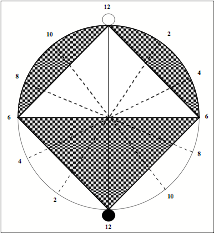
"And the town is waking up," Rose says.
"The twin town," Crossman amplifies.
"Twin in the sese of both Universe and Anti-Universe elements being present in the town...?
"Yes."
Rose reads:
The Dawn, it is circling. The Kon tugs its tail. And the twin ckty beams on, innoculating inter's brew. The streetsweeper sweeps up the pieces of hoar and ravaged apparel. Where is the Death on this land? The Banker peeks from his window for showers. The family is rousing. Tit for tat; and wit for what? Clean beggarly images melt like salt into a mixing stew. The church bell-tower begins to bawl, in thick copper te3ars, which, on air, swell to moons. The beautiful face of the Woman comes true. The Ideal Earth. The Ideal Woman. Spring, in her naked harmonics, comes near. Unashamemdly so. The first linen of the lily...
"And then there is a drawing in the book," Rose says, "a drawing depicting Ideal Earth..."
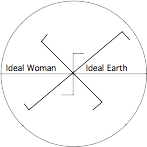
"Again you have a kind of spectre of a broken swastika," Rose says. "I think we're ready to see this collision of worlds that you are predicting. Of course, that is what it is: a collision of ideas. Because you are living in the mental sphere. We are not going to have a war break out. If there had been a war, we would all know about it. But it is a war of Dark and Light in your mind which you are mapping here -- because you feel in this internal nature you are projecting is some truth, some pattern, that is universal..."
"Yes."
"This collision happens at the Fifth Street Public Market?"
"Some of it, yes."
"In the Athenian Club."
"Yes."
"And a third person comes in, a blond man named Keith, who is a neo-Nazi."
"Yes."
"And Shulamit and her two daughter, Anat and Daphna, are present."
"Yes."
"So the White Giant threatens Shulamit and her children," Charlie says. "And a Black Giant will threaten Daphna Greenstein later, Daphna and her child. To you this is symbolic of something..."
"It is a picture of a process."
"The Jew, the Jewish Woman especially, being connected intimately with this process?"
"Yes."
"This is an interesting passage, a provocative passage," Rose says.
The profit of adornment. The baroque of failing to draw too clearly. l Covering up, wit the trumpet. Automatic writing: sperm in a crack between Day and Night. The livery of seamen. Sleeping in his bunk, the Student turns to find the evening old. Tortured by collisions. Rise and shine is but a monument away. I see becasue I am sleeping. Waking to the overture: waves on documentary slat of hull and stern; and, stern I rise. Ahabbed to death, in the sleeped dome of Arabian Knights colored freestyle. Slighting the magnanimous of heart with my blue breeze. Who are the others? The others I freeze by? Wishing to rise; for I am the Sun; and this system I rule now. Ruling through quiet endurance. Essential activity; the mire is a dead brain. RAISE IT UP THEN! Atlas shrugged, as well he might. Amid the pretence of enlightened folk, and their crayons. Amid the death of the Aristocrat's hat...
"I love that," Charlie says. "'The death of the Aristocrat's hat.' But what is this about automatic writing; and the sperm in a crack between Day and Night...?"
"I'm not sure," Crossmann says. "Some kind of fertilization."
"Is the Ideal Woman the crack between Day and Night?"
"Yes, she is," Crossmann says.
"You compare this mass world of Night, of Winter," Charlie says, "to a 'Neutronic Mass'..."
Space as container, in losing the tension of twins, becomes a neutronic mass. Free neutrons densifying into absolute mass; and drawing into a ball, a point, a neutral seed. A storehouse of opinion. Gathered for a feast. Drawn inside a nutted shell. A neutron decays, and creates the pairs of form: the elctron and the proton; and, by adding a neutron to its wheel, all is built. Hydrogen plus one equals. Hydrogen pus two equals. Hydrogen plus three.
"So, the experience we are just beginning to emerge from," Rose says. "I guess that is incorrect English..."
"That's ok. I know what you mean," Crrossmann says.
"The experience from which we are just emerging, the Winter, the Night," Charlie says, "is this neutronic whole, this neutronic mass, all elements subtracted back to zereo, with all elements drawn back in to the One Element. Inside a 'nutted shell'. And the Gothic cathedral, and the mass inside the Gothic cathedral, which is really the novel itself, is this neutronic mass...?"
"Something like that," Crossmann says.
"On the next page you write," Rose reads. "'The children of luxury. The noose of the gallant. Cuicide through impress. Imp on the Rhine. Children of the war. Candles of the wind and the windlass of the Moselem's code. The roar of plenty. Whorring on the Candlemass. A lonely flame in an empty church. The roof, the ceiling, a harbored done. In the fullness of memorabilia: a star. All seekng to be heroes. The nature of the fly. To be a star on a vaulted Gothic dome. The flight of a lonely flame in the sea. The water of distance. The Space Age has come. AMEN. Amiens. YES, TO CARRY OUT THE RACE. On to some stars, when the gods come...' The imp on the Rhine is another Hitler reference, it seems to me. And the Arabs with swords. And the the nut fo the neutron star itself, the vaulted Gothic dome, with a fly near the ceiling, which fly is, in truth, a star -- probably the North Star..."
"Very good, Charlie," Crossmann says.
"Several other things before we move into the open conflict," Rose says. "You write:
Horse-hooves on the streets I canter. Bargains everywhere -- someone goes out of business. It's only the wealthy who are leaving. Summering on the Cape. I am Lord and I am Daemon. I am all things. And you are delinquent....
(Then) IN WINTER, JESUS AND SATAN WALK TOGETHER ON THE EARTH. SONS AFRAID OF THEIR MOTHER'S IMAGE. ALCIBIADES' GHOST. TALKINGT OHAMLET ABOUT THE NATURE OF FEAR. AHAB DOES NOT SLEEP. A ROCKING ON THE FORE: ROUGH WEATHER..."
"What does that mean?" Rose asks.
"Demon ist Deus inversus," Crossmann says.
"We're going to have to take a break," Rose says. "And when we come back we are going to have to focus on the narrative. We're going to have to let the poetry go a bit. As the narrative begins to crystallize and the drama begins to rise to the surface. If this novel can really be said to have a surface. I think this novel has no surface until the last page, the last remark: 'Mikael, I am you!'..."
"We are back with Michael Crossmann," Charlie says. "I am told by our producers that we need to move ahead with some speed. We are running out of time. We are now around March 12. We are moving toward some collision of ideas. Let's move ahead to this collision: the two stone, white and black, bagging together, creating sparks..."
"We should go ahead then," Crossmann says, flipping pages of the book.
"I like this," Rose says. "I marked this: 'Who are you anyway? I AM YOURSELF, IN A NEW BAG. I AM YOU, INSIDE-OUT.' And then later: 'The burgundy of mass. The mass of St. Cecilia. Burgoyned on tropics. The Tropic of Cancer, history's answer. All laid lewd jews coming running; and the bell breaks the ceiling...' The ceiing, of course, is the top of the neutron shell of Night as we have noted..."
"We need to move forward," Crossmann begins.
"Oh, here's another," Rose says. "'ONE BROTHER CHOOSES YOUTH; THE OTHER HAS TO CHOOSE AGE. Will prevailing on the plane of performance. WHERE ARE YOU GOING? I seek the road to the Castle. OH, MANY HAVE COME THIS WAY; MANY HAVE NOT RETURNED. Many are called; few are chosen. MANY ARE CALLED AND SENT AWAY; FEW ARE CHOSEN, BUT THESE FEW NEVER LEAVE...!' and 'Negative Space is a hardened past, of ice. Tumultuous deliverance. I BECOME DARKER THAN BEFORE. Absolute Darkness: filling the arid seas of my visions. GETHSEMANE. Where is Pilate...?' These are road signs along the way. Now, what were you saying...?"
"Fifth Street Market is a kind of symbol, I guess," Crossmann says. "For this is where much of this mental warfare takes place."
"The Fifth Principle being the mind," Charlie points out. "Concrete Science going down; and Active Intelligence going up... Can we see the drawing of the hierarchies from Bloom's letter...?
The drawing comes up on the screen.
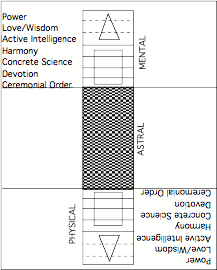
"Before we get into the meetings at the Fifth Street Market," Rose says, "I would like to read one more passage which I think quite entertaining a description of the meeting of the two forces..."
Rose reads:
Talk about splinters! Someone combing his hair with a rake. Laughter. Plastic as jewelry. Unconscious longing. And the mapmaker stalls, pretending he's thinking. Drug-addicts lined up against the wall and shot. Pretending they are ill -- and that their illness is their weakness. Cleaning up the Congo. Women judges in a menstrual array. Visited by Death. Nature and the City drawn together through my friend. The Visitor. Who lives in the bellied whate of some forest. Bringing his Chaos into the heart of the Order. Opposites drawing together. Killing each other with kindness -- or with vilent despite. The arrow of change. Man into Woman. Heat into Cold. Light into Darkness. Power into Love. Brain into Body. Loin into Loin. Hatred in its guardian cloth. The slumbering of midgets and the quarreling of friends. Awaiting fast completion. The last spread of gas; or, the fire on the future. LET ME GO! LET ME LEAF LIKE TURN OF DAY ON URN WHICH BURNS THE GIMPS AWAY! LET ME ROCK THE ROCKETS RAIN, AND TAME THE BENDED NAME, THE DAME I FLY ON! AWAY! SEND ME TO SOME CIRCUS, WHERE CHILDREN MIGHT WALK THE CLERICAL PATH! MONASTERIES BUILT BY KINDRED, PROTECTING THE LEARNING OF THE SAGES OF THE AGES! TURN, TURN THE MINTS AWAY! VAGABOND HOPE, WHERE IS IT YOU LIE...?

Crossmann reads:
At the public market, Clerk is in a shouting match with a New-Nazi on the nature of 'culture'. The Nazi in his sunglasses, for light is hurting his eyes. Anat Margalit, stepping down from a cloud. Our Clerk in despair, as he seeks now to fly. Caught by his own warmth. Surrounded by pretence. Burnt wings on burnt visions. Dark turning light. And Anat Margalit coming out of heaven...
"Anat Margalit is Shulamit's daughter?" Charlie Rose asks.
"Eldest daughter."
"You write an ode to her."
"Yes."
"Please read it," Charlie says.
Dear child, burnished in the Sun's glorious heather,
Cheeks of blushing seasoned gleam,
In which the gods of wealth
Do peer.
Your smile a symphony of pearls
On which
The golden bead of Life is strung.
The door to Heaven't rain
Adorns your name;
And in your name is Hope.
The rains of Blessed Spring do come
To lift the heart from seeded dream
To Joy.
Through you
The power to inspire.
Innocent, you stand in grace;
The world bows down;
Let it understand your goodness.
"And then comes a kind of damnation," Rose says. He reads:
ODE TO ANAT MARGALIT? Yes: ode to truth; ode to beauty. YOU ARE A DANGEROUS MAN. Yes. YOU HAVE TOO MUCH POWER OF SIGHT FOR YOUR OWN GOOD. Yes. Perhaps not enough. FAUST! Is it wrong to wish to see? YOU WISH TO BE A GOD...!
"There clearly is much of the Faust in this quest," Rose says.
"Ultimately, the quest is to save my country, my people," Crossmann says.
"Then why so much guilt?" Charlie asks. "You have this immense guilt at seeing Anat, the innocent child, at the same time you are arguing with the Neo-Nazi, Keith. What is that all about...?"
"Fear of evil, I suppose," Crossmann says.
"But you are not evil," Rose says. "You are opposing Evil."
"I am looking in a mirror," Crossmann says. "The forces comes together in the Spring. The mirrors come together..."
"Racial guilt. Is that what we are talking about?" Rose asks.
"Perhaps."
"What does Anat mean?' Charlie asks. "I know you are impressed by the meaning of names..."
"Anat is a northern semitic name," Crossmann says, "of Allat as the morning and evening star and war goddess, a defender of the city. Among western semites, Anat is the name of Astarte or Ishtar, also a war goddess. Queen of heaven, mistress of the gods. Her cult was introduced in Egypt. As Anat-Bethel or Anat-Yaw, she was an early Hebrew androgynous male-female deity. In the morning she was a god of war; in the evening she was a goddess of love and harlotry..."
"So, what you are saying, or what you seem to me to be saying," Rose says, "is that the Second Son, your namesake, is with Israel during the fear, through Shulamit, as he is with Israel during the triumph, during the war later in the book, through Daphna. This is representing your symbolic understanding of Michael the Archangel as the guardian of angel..."
"Clearly I was not conscious of all this at the time, when I was recording my spiritual observations," Crossmann says. "But that is how I have come to see it, now, looking back..."
"You find an enemy, in your mind, as well as at the Public Market, in the Nazi but also in the neo-classical," Rose says.
"Yes. They are apparently linked," Crossmann says. "Apparently they are the same thing."
"Rome is clearly an enemy, at least in the passage which follows," Charlie Rose says. "Is there a principle in this, with regard to the classical and the neo-classical..."
"The White Giant," Crossmann says. "You will remember that Rome was initially a friend to Israel..."
"The Whtie Giant is a star," Rose says.
"So is the Black Hole," Crossmann says.
"Is there a relation between these two in astronomy?" Rose says.
"There has to be," Crossmann says.
"This is a long passage. Essentially it is Michael fighting against the fascist idea on the mental plane."
"But it is not Michael by name," Crossmann points out.
"No. He is a man here, clearly," Charlie Rose agrees.
"A boy warrior more than a man. But there are no allusions to the angels here."
"Why is that?"
"The angel is a man here. The angel has incarnated as a man."
"As Jesus Christ?"
"It is the right era, with the Romans, the Nazis, appearing."
"This is hard to understand," Charlie says.
"Well, let's keep moving," Crossmann says. "Remember the comment: 'Where is Pilate?' So we are getting there..."
"Ok. We have a couple of things happening before we get into the meat of this. The first is a strange dream: 'In the dream a violence grows. A man throws a kife at my forehead. I am touched but not hurt. Yes, only hurt but never touched. UNTOUCHABLE -- IS THAT YOU...?; and then he, you, the author meets his father, his father's ghost: ' NEVER LEAVE YOUR DREAMS, SON! WALK IN THE WORLD, BUT NEVER LEAVE YOUR DREAMS. I love you, father...!' And then some strange moment about unidentified flying objects..."
Charlie Rose reads:
UNIDENTIFIED FLYING OBJECTS MOVE ABOUT YOUR TOWN AT NIGHT. So the lords say; they say they've come here to watch us. MANY SIGHTINGS; ARMY HELICOPTERS AT DUSK. The newpaper says nothing. WHAT DO YOU EXPECT IT TO SAY? I do't know. What should it say? WHO KNOWS; BUT ONE THING IS FOR CERTAIN: YOU CAN'T DRIVE AWAY DESPAIR BY PROVING HOPE PLUS GIVEN FACTS ARE VOID. Well said, for an empty Scientist. AND THEN THE TWO BROTHERS MET, ON A SUNDAY AFTERNOON, IN THE PUBLIC MARKET, WITH HERR BUCHER AND THE NEO-NAZI. And then what happened? I SAW THE TWO BROTHERS PULL APART: THE FIRST TOWARD THE IMAGE OF HITLER; THE SECOND TOWARD THE IMAGE OF SUBSTANCE. THEY TALKED:WHETEHR TO BE THE MERCHANTS OF DEATH SINCE THE DEATH ON STRINGS COMES PLUGGING; WHETHER TO BE THE PROPHETS OF A NEW EARTH THROUGH EMPIRE OR THROUGH A A BREAKING INTO PARTS. PRIEST OR SOLDIER FIRST, THEY WONDERED? And the Second Son then resurrected his vision of America breaking, like Rome, into parts. And from these parts great cultures did rise; sons rising from the Father; and from these parts, Life evolved out of Death. THE NAZIS WERE NOT A NEW BEGINNING; RATHER, THEY WERE A NEW ENDING: THE SECOND RELIGION, THROUGH WHICH A SICKENED CULTURE KILLS ITSELF. SUICIDE ELEMENTALS. WHAT OF THE GREAT NAZI CULTURE? GERMANS SEEKING TO WIPE OUT THE STAINS OF THEIR OWN IMPOTENCE; THE JEWISH PHALLUS; THE BLACK MAN'S GROIN. HAUNTING MANNERS. SEEKING TO WIPE OUT THE SHAPE OF THEIR OWN CORRUPTION. YET HITLER DID NOT RESURRECT GERMANY. RATHER, HE SOLIDIFIED ITS CORPSE. AND THE ARTIFACTS ARE MERE MIMICKRY OF CLASSICISM.. NEO-GREECE. MADE WITH INFERIOR MATERIALS, AS WERE THE NAZIS THEMSELVES: INFERIOR GREEKS. NOT THAT THE GERMANS DON'T HAVE A GREAT CULTURE. BUT THE NAZIS DID NOT. THE COMING BACK OF THE BODY TO KILL THE HEAD. THE BLACK DEATH COMING IN THE PURIFIERS NAME. It is not enough to worship the image of Power -- that is what the Second Son told the First. You must worship the substance of your Power: the Ideas, the Hope, which you offer poor souls. DO NOT WORSHIP THE IMAGE OF YOURSELF. HOW YOU LOOK IN THE MIRROR. Silence. THE FIRST SON SAID: I NEVER WANTED POWER; YOU SAID YOU WANTED AN HISTORICAL ROLE. AND SO I SEEK TO HELP BRING YOU THIS. ALL I WANTED WAS TO BE A CARP FISHERMAN AND TO PLANT MY GARDEN. You create him; but the image is the opposite of what you want. So you must destroy him; for he has become a monster. IT IS NOT EASY TO DESTROY A MONSTER. Would you be satisfied with that role now? the Second Son asked. I DON'T THINK IT WOULD LAST. There are many lives to an idea: a vision of Utopia. They have nothing else to live for. They wait; and drink coffee; and stare out to Death. Yet the vision they want is not Despair; they have had that. The vision must be Hope, sprung not from the worship of Death, but from the llebration of Life; stprung not from the solidification of a corrupt Middle Class, a corrupt ruling Corporate and Military elite. Hope does not come from a resurrected Empire. For imperialism rules the autumn, not the spring. No new culture came to Germany with the Nazis -- because the Nazi goal, really, was to kill out the seeds of any new culture. Regions create culture. Hitler sought to destroy regions. Hitler wished to build the German World-City, which would occupy the globe. He wished to build a German Rome. Yet Rome was not culture. Rome was culture's anti-thesis. WE ARE ROME. Our task is not to be Rome, to act as Goths to a beast which seeks horror. We do not seek to rigidify a dead way of life; rather, we must create a new way of life. Based on living in Nature; Life as Religion; and not Religion as Power's Edict. The Middle Ages: rest. And not Neo-Classicism. Anti-democratic. Anti-man. Classical man was a solider; but he was also a poet, a philosopher, a student of history, a man of letters. The Nazi was merely a soldier. The Intellect was the Nazi's enemy. The Intellect he killed or drove into exile. And so the Nazi, as his art-forms, was built with infrerior material. So, he was doomed. SO YOU CONNECT THE NEO-CLASSICAL AND THE FASCIST. The Neo-Classical is a reflection of a powerless man looking back on his youth. Idealizing it; and seeking again to find it. It is the frightened man who seeks his body once more, for his age gives him pain; fear of Death makes him Death. The idealized Body. Greco-Roman tome. THE BROTHERS COLLIDED IN THEIR TALK. AND THEY BOTH DIED AND EACH FELT A PROFOUND LOVE FOR THE OTHER. Death on the Mental Plane. Death as a bursting of a self-image. THE SECOND SON WHISPERED HIS VISION TO THE FIRST, AND THEN DIED. Re-establishing direction, which was lost in the watery winter. TIME IS DIRECTION; AND THE SUN IS TIME. The Destroyere comes bac, without a sense of his own time. RE-ESTABLISHING DIRECTION IS RE-ESTABLISHING TIME. Hope. LIGHT. Re-establishing Love. YES. Where only alienation had been. And isolation. EXCHANGING MASKS. Yes. EXCHANGING BODIES. He going down into the dark again; coming down from the light, down from the North. AND YOU COMING OUT OF THE DARK, TOWARD THE LIGHT. The particle and the anti-particle drawn together: annihilating one another. Trading bodies. ONE TO BECOME THE LIGHT SOLDIER; THE OTHER TO BECOME THE VISIGOTH. It all seems like such a strange nightmare sometimes. WHEN WE AWAKEN: PERHAPS WE WILL ALL BE IN STRAIGHTJACKETS...
"They don't merely exchange bodies," Crossmann says. "Part of the trick of the Universe and the Anti-Universe is that they exchange bodies that become turned inside out..."
"I don't see that," Charlie says.
"When the collide," Crossmann says. "The inside of the one brother becomes the outside of the other brother. The outside becomes the inside. So they always see the reverse of what the brother saw..."
"That is pretty abstract, pretty esoteric," Charlie says.
"The Second Son kills the White Giant, the Roman, and makes of him a Goth," Crossmann says. "And the Second Son, inheriting the body of the First Son, will become a Roman, an imperial solider. But neither will become what the other had dreamed. Because of that turning in of the skin, the turning inside-out of the body..."
"I don't really understand that."
"I wonder if this drawing might help," Crossmann says.
"Not really," Charlie says.
"The Second Son gives the First Son his dream-body, putting him to sleep," Crossmann says. "The First Son wakes up the Second Son, killing him in Aries, March 31."
"But his war is not over," Charlie says.
"No, he continues to fight with his own horror.
Charlie reads:
THE SECOND SON FEELS GUILT SOMEHOW THAT HE IS THE CAUSE OF HIS BROTHER'S ILLUSIONS. AND HE FEARS THAT HIS BROTHER, THROUGH HIS OWN IMAGE MIGHT BE LOST. We are all lost. PERHAPS. You have lost your way now, Jacob -- remember those times when you walked in the Garden? DO I FEEL THIS DEPRESSION BECAUSE SOMETHING'S LOST, OR BECAUSE SOMETHING IS FOUND? It is the same thing. When you see, you lose something. WHEN YOU SEE, YOU DON'T SEE. Spiritualization of the Material -- is that not what the Second Son, as a force embodied for action, through his brother, represents. MATERIALIZATION OF THE SPIRITUAL IS, THEREFORE, ALSO NEAR. The Mask-Handler, giving the Actor a prod, for direction...?
"Then we have an interesting turn," Charlie Rose says. "The anti-Neo-Classical becomes the pro--classical."
"Universe and Anti-Universe," Crossmann says. "On one side a Classical Spring and a Romantic Fall; and on the other a Romantic Spring, and a Neo-Classical Fall..."
Rose reads again:
The Classical Spring from the Impulse to Life; ; Neo-Classical springs from the Impulse to Death: the attempt to freeze Time in the image of Childhood. It is not to conquer Time that they wish: it is to deify it. And it is anti-spatial, in that it denies its age. It is the fear of Death which is the essence of Neo-Classical. Fear of the Future is Fear of the Mind. It is Fear of Growth. It has not faith in its instinct: its height and intuition. YET YOU RETURNED TO THE CLASSICAL FOR FORM -- THE THE 'MYTHOLOGY' OF CHILDHOOD -- FOR MODERN FORMS GAVE YOU CHAOS. If we would be Classical Men, then let us look to Greece, not Rome. Let us look to the City-State....THAT, AFTERALL, IS YOUR MIDDLE-AGES! Yes. And let us look to Athens instead of Sparta. For Spartan culture is rigid at birth. Like Moscow. THE ONLY TREASURE IT GAVE WAS ITS SWORD. Washington, D.C., as a symbol, is a completed Europe. New York City is a museum of Europe. A graveyard of the Old World's lore. LET THE GRAVEYARD BE. American culture comes from dust and the Red Man's bones. It comes from Wyoming and Mississippi and Main -- and, yes, even Texas. The reduction of the Giant into Men fills the voide. RETURN TO THE EARTH: PLANT THE SEED: WATER LIFE...!
"Flip, flop," Crossmann says. "Universe, Anti-Universe.
He reads:
HIS VISION IS ONE OF A SELF-SUFFICIENT EMPIRE, EAGER NEITHER FOR GREED NOR EMPIRE OF SPACE -- RATHER, EAGER FOR QUALITYOF LIFE, BASED ON THE WORD AND THE EARTH. SECESSION IS NOT AN END IN ITSELF -- RATHER, IT IS A BEGINNING. A SEED OF CULTURE PLANTED IN THE GRAIN. YOU MUST OFFER A POSITIVE VISION OF YOUR FUTURE. IF YOU SEEK TO LEAD, YOU MUST LEAD THROUGH HOPE -- AND NOT HATE. CULTURE BEGINS WHERE IDENTITY BEGINS. AND IDENTITY BEGINS WHERE IDENTITY IS OPPPOSED. You seem to be growing tired. YOU TELL ME OF YOUR OWN DREAMS THERE. My own fatiguee? YOUR OWN DISGUISE. Yes. Because sometimes I have a horror of this vision. When all responsibility is given up: then the horrible becomes commonplace. The self-castrated man becomes the man whose power Hate restores. The perverse is now near: in which destruction of life appears as a goal. Racial suicide; as now an edict of Fate. Choosing to the puppets. World beware! The slaughterers come, in their heroic badge. Men refusing to give up their youth. Their illusion of conquest. Their teenage apparel. Which makes me grieve. In nomine patri. Et filii, et spiritus sancti. Acting from the grave. The walking dead, on file, transform. Trnasforming themselves. Competition for respect. some image of being injured. The "I", having been slurred by the mechnaism of World. Seeking to strike out the self. In the name of something holy. HOLY DEATH IS ON THE LEAF. I HAVE SHOWN HIM TOO MUCH. HE MUST TRANSFORM HIMSELF: LET THE WORLD BE AS IT IS: NEUTRAL. Yes. It all sounds so easy. HAVE YOU NOT CHOSEN POVERTY? THEN WHY DO YOU RESENT IT? That is an earnest question, friend. I resent it for my fear. HITLER EMBODIED GERMANY'S SICKNESS -- YET, WHY KOW-TOW TO SICKNESS? DOES ONLYHATE CURE MAN'S SICK SPIRIT -- OR IS THERE SOMETHING ELSE IN YOU...? Is Time running out -- or is Time just beginning...? THE HOURGLASS IS LISTING. Hitler killing out himself, in killing out the Jew. Also killing out his best. One "chosen people" killing out another. THE 'BIG LIE' RETURNING. A REINCARNATED LIFE. Fuhrer-figure from the ashes. Fire-figure filling the void. Midnight appears. The walker on the bones of Man. A kite he flies, in acid wind, turns. IT IS YOU WHO COMES...! It is Suicidal I. It is I who can't love. And I who can't leave...!
"And," Rose continues reading:
Your poetry has given way to Reason. MY POETRY? IT IS YOUR POETRY, FELLOW! You deny your own dark side. AND YOU DO AS WELL; SO YOU SADDLE YOUR BROTHER WITH AN IMAGE OF EVIL, AS YOU TRY TO EXORCISE THE EVIL WITH WHICH YOU DWELL! Yes, you are right. THE RELIGION OF THE BODY TURNS ON THE BRAIN. THE ELEMENTS OF MIND THEN LEAVE, BEFORE THE HORROR....
"Then a very strange experience shared by the two brothers, another UFO experience," Charlie Rose says. He reads:
PREOCCUPATION WITH STEPS. IT WAS FRIDAY, MARCH 26, BETWEEN 3 AND 6 O'CLOCK. THE CLERK HAD TAKEN A DAY OFF FROM WORK. THE TWO BROTHERS JOURNEYED TO A LAKE OUTISDE OF TOWN. IT WAS WINDY AND COLD, SO MUCH SO THAT THE FIRST SON COMMENTED THAT IT SEEMED LIKE AUTUMN. AT THAT TIME, THE SECOND SON THOUGHT: IT IS AUTUMN FOR HIM; AS IT IS SPRING FOR MYSELF. THE SECOND SON NOW KNEW THE STRUCTURE OF THE WHEEL. ONE STRUCTURE AT LEAST.... IT WAS WINDY AND COLD; AND THE TWO BROTHERS BEGIN TO INVESTIGATE THE SHORELINE. THEY CAME ACROSS A GREAT BLUE HERON, WHICH FLEW ABOUT ITS PON, ON PARADE, SEEMING TO DELIGHT IN SHOWING THESE BROTHERS THE GRANDEUR OF ITS SPECIES. ITS GRACE WAS STUNNING. AS THE BROTHERS TALKED, A HIGH-PITCHED VOICE CAME FROM THE WOODS. IT SOUNDED LIKE BEEPS: ELECTRONIC WORDS. IT CONTINUED. FINALLY, THEY BOTH MADE OUT THE WORDS: 'I HEAR YOU!' 'I HEAR YOU...!' THE BROTHERS THOUGHT IT ODD. BUT IT WENT AWAY. AT THIS, THE BROTHERS SETTLED IN TO WATCH THE BIRDS. AFTER A TIME, THE WIND BECAME SO RAW THAT IT DEOVE THEM AWAY FROM THE MEADOW, BACK INTO THE TREES. THEY WALKED ALONG THE MANICURED EDGE OF THE PARK; AND, IN THE WATER, ON THE SHORE, THERE WAS A DEAD RAT. THEY WALKED AWAY FROM THIS IMAGERY ON THE MANICURED PARK; AND THE SECOND SON LOOKED OUT INTO THE SKY. FAR AWAY, ON THE HORIZON, BESIDE PUFFS OF CLOUDS ON A SLATED GRAYISH BACKGROUND: THERE WAS A FLASHING LIGHT. AHE WATCHE DIT FOR A TIME, THEN TRIED TO POINT IT OUT TO HIS BROTHER. THE BROTHER DID NOT SEE IT. THE OBJECT DROPPED BEHIND THE HORIZON. IT WASN'T FLYING; RATHER, IT WAS HOVERING. IT CAME UP AGAIN; AGAIN, THE SECOND SON TRIED TO POINT IT OUT. THE FIRST SON COULD NOT SEE IT, AS IT MELDED IN WITH THE GRAY. IT WENT AWAY. YET IT CAME BACK A THIRD TIME; THIS TIME THE FIRST SON SAW IT TOO. A FLASING LIGHT, HOVERING, SEEMING TO GLIDE. IT REMAINED IN THE AIR FOR PERHAPS FIVE MINUTES; THEN IT SANK IN THE WIND AND WAS GONE. And what did the brothers say? THE SECOND SON SAID: THIS WOLE TOWN IS MAD AS HATTERS! WE ARE LIVING IN A DREAM OF OUR OWN MAKING. Yes. Later, in town, scrawled on a wall, someone had written: EUGENE, YOU ARE BEING WATCHED FROM THE AIR! EUGENE IS A CENTER OF A NEW WORLD CULTURE. Yes. Mad as hatters....
"Even in the midst of this madness and fear of horror," Charlie Rose points out. "There is still humor."
"Well, the humor is there," Crossmann says. "But the incident of the siting of the spacecraft is not a satire..."
"I don't know what to make of it exactly," Rose says.
"Well it isn't really clear what to make of it," Crossmann admists. "Eugene was a loony bin in the late 1970's and early 1980's. The farther out you could go, the better..."
"The land of the Grateful Dead," Charlie says.
"Yes. Literally too," Crossman says. "Grateful to be dead. Most Eugeneans were grateful to be dead..."
"But what about the conventional, the middle-class?" Charlie Rose asks.
"Eugene is a tolerant place," Crossmann says. "A lot of nuts live there. Musicians, writers. Drop-outs..."
"Hippies," Charlie says.
"Yes. The Land that Time Forgot."
"Have you noticed that the Second Son now seems obsessed with Greeks, and Classical Man?" Charlie asks.
"Yes. That is the new Idea, the new body in which he is living," Crossmann says.
"We are looking at this book so closely because we feel there is something in the structure of the work that is inherently descriptive of the world's structure, the hidden structure of the world, of Nature," Charlie reminds the television audience."
"Well said," Crossmann says.
"We find that there is a new dualism in the Second Son," Rose continues. "Spartan-Athenian..."
"We remember that there are three dualisms," Crossmann says. "Spirit-Matter; Soul Matter; and, finally, Spirit-Soul..."
"That's an interesting point," Charlie says. "It's not coming out of the book..."
"Well, not in the chronology we are following," Crossmann says. "but it's in there somewhere..."
"Spirit-Matter, we know," Rose says. "That's the Anti-Universe against the Universe. East against West. Black against White. The major duality..."
"Soul-Matter is when the Soul principal unites with Spirit and opposes Materialism," Crossmann says. "We saw that during the Vietnam era. The Middle Principle chose poverty; and was against the war, racism; in essence, chose morality..."
"And what is the third?" Charlie asks. "Soul-Spirit?"
"The Soul-Spriit duality, " Crossmann says. "That's the duality we see when the Soul chooses the body, chooses Life, chooses Materiality. When the Spirit becomes arid and dangerous and dark, the Soul chooses the body to deafeat the dark monsters in Spirit that the Soul has created..."
"The Goths, for instance."
"Yes."
"Isn't that what Gilbert Patton is, the Dark Giant you created through your impassioned philosophy," Charlie says. "The dark monster with matted hair and hunting knife, and combat boots and fatigue jacket, living in the alleys of town, looking for someone to harm. Wasn't he the Goth that you invited into your town...?'
"That is an impressive resolution, Charlie," Crossmann says.
"The Creative Force creates the Heavens, first, the zones of high morality and goodness," Charlie Rose says. "And then this Force creates Men..."
"Yes."
"Through meditation," Rose adds.
"Yes."
"This is a poetic meditation, then," Charlie Rose says. "Through which you are creative and destroying the world...?"
"Let's keep moving," Crossmann says; then he sings. "We still have many miles to go this night before we reach the town o', town o', town o', many miles to go this night before we reach the town o'..."
"He can sing too," Rose says. "You're sounding more like Dick Smothers all the time..."
"That is a compliment," Crossmann says.
"Anyway, the Poet has been transformed into a Philosopher of sort," Rose says. "He is not mystifying his language in poetry -- and don't get me wrong: I love the poetry -- but he is fighting now with clarified ideas. More prose than poetry. And the music that was everywhere in the Cathedral during the night is also gone. Now Logic is coming in..."
Rose reads:
YET, YOU, YOURSELF, ARE A SPARTAN. Yes, and I am also an Athenian. GRANTED -- BUT WHICH WILL YOU BE WHEN CHAOS COMES A 'RUNNING? I will be Spartan in body and Athenian in soul. FINE -- AN ULTIMATE CONTRADICTION. I will be, then, an ultimate contradiction: for discipine of the body does not kill the flight of the soul. DISCIPLINE HAS A BAD NAME HERE. And so self-discipline is not taught. And parents refuse to take responsibility for their children. Haivng sex requies taking responsibility for its outcome. MY, A HUMOROUS WORD-PLAY FROM YOU -- AND DELICIOUSLY UNSUBTLE. CURDS AND WHEY. AND MILKY WAY TOO...! Having children requires taking responsibility for their development. Which includes teaching self-fiscipline. Which is not the same thing as subservience to Authority. Only, teaching subservience to Inner Authority. Not "order at any cost". The Rebel is vital to our needs; as he is vital to ourselves. Self-discipline is the ability to guide oneself along the path one has chosen. Self-discipline provides for a world built on thought, instead of a world built on power of policemen. It is becasue parents refuse to be disciplinarians, through example, through the disciplining of themselves, that teachers and police must pick up their worlk. If teachers fail, it is because parents have failed. If you fear the role of parent, or reject it for some reason: then don't have children. If you do not wish to have children, then don't have sex. Take some responsibility for your actions. So the Military Mind won't have to take care of your children for you. And endanger our freedom in the process. STATELY OLD SPARTAN MORALIST. AND YOU SPOKE OUT FOR THE ATHENIAN LIFE. YOU ARE REALLY A SPARTAN AT HEART...!
"Remember," Crossmann says. "When the Day resolves into Night, there are three women, three forms of light or water into which the elements resolve: There is a white woman, a black woman, and a woman who is both black and white, the Jewish woman..."
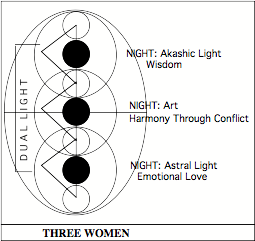
"Where does the Asian woman fit in to this?" Charlie asks.
"This is not a racial thing," Crossmann clarifies. "When I say white and black I am not talking about skin color. I am talking about nature. Many black woman racially will be white women spiritually. Many white women racially are black women spiritually. I am describing a type of energy, not a racial typology..."
"That is not always understood in your language," Charlie says. "Your words could be easily misunderstood, especially by those who would want to misunderstand them..."
"'I am Plato, don't you recall?'" Crossmann reads. "He is suddently Greek, our Second Son..."
"Then he embarks on a long disquisition on the nature of the soul."
"Before that he remarks on economic depression," Crossmann says. He reads:
On the windows of the busildings I read all the signs: LIQUIDATION. GOING OUT OF BUSINESS! And I couldn't help but that that when the Night is here, or Rest, and the Woman rules, the Moon, itis Water which rules, and Material Water is liquidation. The world is liquidated, transformed from a solid into a liquid. IF YOU CHOOSE TO ACT IN THE EMOTIONAL BODY, USING IT AS YOUR MID--POINT, THEN WHEN AUTUMN COMES TO CLAIM THE SUN, BLOCKING THE LIGHT, THEN IN THIS LOWER PERONALITY YOU WILL BE TRAPPED FOR ONE NIGHT AS YOU DESCEND INTO SHADOWS....
"So, that is what the drawing is about," Charlie says. "Here is an interesting observation. You write: 'Abstract art merely magnifies the smallest in Nature.' Abstract art is a close-up view of things...."
"I believe that is true," Crossmann says. "Looking at nature through a microscope creates abstract art. Abstraction is looking at nature through a magnifying glass..."
"Then you weigh down on history, Greeks and Indians, and the nature of the soul," Rose says.
What did you say to your friend, the Organic Historian? I SAID: No. The Soul of each culture is not differently constitited. All Souls are the same, made from the same material. The Mental Conceptions, the forms of the Soul, change. Yes, the forms the Soul takes are based upon the need, the 'nature' of the elements. The Man's soul is the region's soul. Each culture's Soul-As-Form is the color of its 'history': its history is laten in the make-up of the local elements. The 'physical' element or body is the 'historical' element, as relflection. The Mind is the manufactured language of the Soul. Deep beneath the 'language' is where the Need and Symbol, seed-like, demand Form. The Earth is differently constituted in each region; yet to claim that each Soul is separate and inherently different -- that each region is different than the Earth, rather than a piece of its Form, cells with different tasks to perform -- is to not understand the nature of the Earth. Hydrogen is hydrogren in any locale. And hydrogen is the same first element in all elements.
"And this drawing is from the Bloom letter, not from this text," Rose adds.
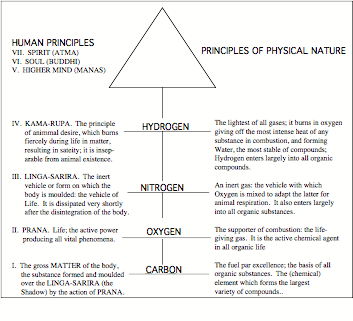
Rose continues reading:
VERY WELL. WHAT ELSE DID YOU SAY? Western Man is 'Time-Conscious' since he has achieved a distance from his own life. He has become an observer of his reality. He does not occupy Space, so much as he tries to describe it. He is a Temporal Type -- a Time-Type -- and this has no more value, ultimately, that the Spatial-Type cultures of Greece and East India. Western man is obsessed with Time, because he senses it is finite. And the Individual Man becomes obsessed with Lost Time, when first he senses his own mortality, and begins to seek immortality through conquest of Space, which is, likewise, conquest of Time -- so the 'Cultural' Man. The Museum is the symbol, not of Life, not really even of Duration. Rather it is the symbol of Reflection. Of that age which has ceased living in the Present -- which, to escape the Present, flies to Past or into Future. I am one of them. I know my own nature. I am not comfortable with Death, because I see myself as something separate from Nature. HOW HONEST YOU ARE BEING. Time-Consciousness is 'self-consciousness' -- a sense of being isolated in Space, isolated in Time. It is not the last development of the race, this self-consciousness. But it is essential to growth. Alienation is not the last stop. Even Faust realized that alienation must be bridged. The Museum is the tomb, the symbol of the Become, the Completed. Father-worship; Mother-denial. Culture as State; and Nature as cloy. Youth has no need to preserve its Past -- because it senses no personal past it must treasure. When Youth passes, then the Past becomes a treasure, not before. Youth has only a Future. Loss of faith in the Future creates a Museum Worship. And it is only the culture that believes so passionately in 'History' -- i.e., the Future -- which coudl also believe so passionately in the Past -- that is, in the glory of the Fathers, when its own glory is not there. Age and Memory are really the same thing. True Reflection begins only when a threshold is crossed: and Physical Glory (the Body) loses its Power. The first Power is Physical Power (the Body); the last Power is Spiritual Power (the Mind and beyond the Mind). SO THE ROLE OF THE WEST IS TO....ASSEMBLE A COLLECTION OF RACIAL MEMORIES...? Only the culture that senses that the 'human race' is truly one family would undertake such a task. the Family Tree, through archaeology and psychology. Through astronomy and throuh astrology. A man does not become truly aware of the Past, until his father dies: then his roots go trembling backwards, back into the ground, back into the sky. YES, PERHAPS YOU HAVE A POINT. It is 'Reason' which separates: separating Time from Space, separates West from East, separates Past from Future-Present. Mind is a vaculty of the Soul; yet it is not the Soul. The Soul is Absolute Space; and if Greece and India had and have no care of the Future, it is becasue they are already in the Futrue. They have defeated Time, the Tyrant, the Father. The Father who eats his own chidlren, and then spits them up again. Western Man loves his Personality, his 'incidental nature'. Greek and Indian saw themselves as being the same as their symbols: saw themselves as their own gods: unseparated from divinity. We are mythology, they would say. Fate is the nature of the Symbol you choose to worship. Worship of the Personality is worship of the 'incidental': accidental: particular nature. Worship of Soul or Archetype involves worship of the Changeless within change: the so-called Eternal Now. The Essence of Life, the Unchanging One. Forms change. Western Man's nature worships these forms. The construction of museums, great tombs, signifies thi: worship of the objects the essence has fashioned. TIME IS SELF-CONSCIOUS, THEN? Precisely. Time is personality. Time is the length of the thought: 'I am'. IS THAT NOT LIFE? One aspect of Life: Temporal Life: Life on the Earth. Yet there is no Death. As you see in this writing: there are two types of life here: in the Day there is Reason; in the Night there is Sound. WHICH IS DEATH? AND WHICH IS LIFE? Both the Greeks and the Indians comprehended 'evolution'. The oldest Indian writing, The Code of Manu, is a document of evolution. The theological notion of 'transmigration of souls' also supposes evolvement. Evolution has been understood by all the great thinkers of all the great cultures; Darwin did not 'discover' evolution; Darwin discovered it for us and developed it in a biological language. The Indian and the Greek, through their understanding of evolution, that is, the forward motion of Time, the development of Life, in the context of reincarnation -- a forward motion of Time, which supposes also a backward motion of Time, Involution, Regression, Past-Longing, which is a longing for the grave -- the Indian and the Greek conquered Time through this knowledge. Without thinking about it. The Indians and Greeks were not born in Time. They were born beyond Time. They did not need to conquer Time in the way we think of it. Because Time and Space had not yet been separated. They put together, in a intuitive organic notion, the thing that the West is doing now with its Science -- tranforming Science to Meta-Science. The Greeks and the Indians transformed Meta-Science to Science. THAT IS VERY INTERESTING. BUT WHAT ABOUT THE RUSSIANS? Russians are greater chess-players than the Germans because the Russians are content to wait. Western 'values' of law and social worth are Time-values inherited from a history of conquest; Russian 'values' grow from the 'history' of being conquered by hordes. One mind attacks; the other defends, absorbs attacks. One mind deifies freedom; one mind deifies safety, sanctuary -- that is, safety formed by the group. Yet, paradoxically, it is in Russia that the voice of the individual has power. The individual who speaks out in Russia must be silenced -- because people will listen to that voice. In the West, the individual voice is swallowed up in the din of individual voices. In the West, the individual voice can say anything because no one will listen to him; no one is hearing him. YET YOU SAID THAT THE WESTERN MAN HAD ATTAINED A DISTANCE FROM HIS LIFE. The Greek and the Indian attained a distance from the Personality-As-Man; whereas the Western Man has attained a distance from his Soul, a distance from himself as Nature, thorugh the love of his image, his Personality, or particulate matter. Neither is better, of course. For each culture has a different job to do. Yet, let not the Historian, when he speaks of the great Faust, forget not that strength is also a wakness; for not that weakness is also a strength....
"Clearly, the Second Son is in a different mind now," Charlie says.
"A reasoning mind," Crossmann says.
"Engaged is self-analysis," Charlie says. "Which is a kind of self-judgment..."
"Clearly, there has been a transition," Crossmann agrees.
"Do we want to talk about these ideas at all?" Charlie asks. "I don't agree with everything he has said here. We could argue about a few things. The idea that the East understood evolution..."
"The basics of theosophy come from India," Crossmann replies. "The whole idea of involution/evolution, of evolution mineral, plant, animal and men, to the angels is, in fact, ancient... The Jews, in Genesis....the esoteric interpretation of Genesis is an evolutionary process, days and nights of creation, act and rest. Creation is simply not complete. This is also evolutionary..."
"What do you say to creationists?" Charlie asks.
"I tell them to open their minds," Crossmann says. "Religion and Science are not at odds. They describe the same reality..."
"Ok, we'll leave this section behind without much comment," Rose says. "Clearly, you, the Second Son, is obsessing on the Greeks now..."
"But the struggle is not over."
"The Nazi-Idea struggle," Rose says. "No. He is back with 'Athenian Club' that next weekend..."
Rose reads:
GOOD FRIDAY COMES SOON. A great struggle of ideas could be seen at the Public Market again. Taking sides. A separation of soldiers. Men gathered around the scene. Herr Bucher, who later mentioned that he had, after the first several meetings with the Two Brothers, turned in their names to the local FBI office for surveillance. He said this very calmly, saying he considered both brothers dangerous to the country. JUDAS. JDUAS HYSTERIA. NAMES OF MEN HE SELLS TO THE POLICE FOR SOMETHING. WHAT DOES HE GET OUT OF IT? Yes. So it is. TELL ME ABOUT THIS STRUGGLE OF IDEAS. 'Man of Action' against 'Man of Thought'. Nazi against Communist. Bucher against Stupid. Man of Particulars against Man of Concepts. THAT TELLS ME VERY LITTLE. Then, yet, you don't see. Other men gathring around the scene. The men waking up. The 'Man of Action' against the 'Man of Action'. The White Race as God rising up against the White Race as Demon. Fear against Hope. Hope against Fear. The Nazi as Anti-Universalist. The Universalist as Anti-Nazi. The struggle for men's souls. DEATH COMES TO ME -- AND SOON, SOON I'LL BE GONE...! Rain crashing on the window pane....
"Jacob is still there," Charlie Rose says. "Jacob is still moving through this novel...."
"I know."
Charlie reads:
Where is the Moon? Where is the last dancing tenor? WHO GOES THERE? It is I, Jacob Crimefighter -- bringing jewels of the braind down the lane for the poor. YET THE POOR CANNOT READ YOU. They can see, if they will. YES, BUT WHAT WILL THEY SEE? I know not what grace or what skirt wears the weeping, and will not perform "Positive Thought" on a swelter. Yet listen when scatters of rain on the pavement performs an octet as you climb down your pendant. YOU HAVE BECOME CARELESS WITH YOUR WORDS HERE. Purgatorial tendence of sea bilging whitely, as fire on scales of its urge bilks the crashing; the production of steam; the production of gases. WHERE ARE YOU NOW, JACOB THE LIAR? Lying in wait, 'fore the stars light my way. THE SUN IS SHACKLED BY CLOUDS 'TWIXT YOUR HEART. YOUR URGE TO EXPLORE IS NIPPED BY A LOW ZONE...
"This sounds like the Catholic idea of purgatory," Charlie Rose says. "The middle-ground between heaven and hell. Fire and water, of course, creates steam. But I am confused a bit in that the voice says that it is lying in wait, waiting for the stars. I thought we were moving out of the Night into the Day, not the reverse...?"
"Jacob the Liar is lying in wait," Crossmann says.
"The production of gases," Rose says. "Gas is the mental plane if I am remembering correctly..."
"Yes, you are," Crossmann says. "We must remember that there are more than one voice in this dense matter."
"Then the Second Son, again, lapses into his defense of the Greek Idea," Rose says. "The Greeks as the child of the Western Race, the child living in the dream mind, which is the mind of the gods...."
"Championing the classical," Crossmann says, "even as he fights with the neo-classical."
OEDIPUS IS A NKED IDEA, A MYTHOLOGICAL FORM, AN ARCHETYPE, LIKE GREEK SCULPTURE. LEER IS A CHARACTER; THAT IS, A PERSONALITY BODY WHICH CLOTHES THE IDEA. THE GREEKS SPEAK THE DREAM-LANGUAGE OF SYMBOL. GREEK 'FATUM' IS THE LOGIC OF THE LANDSCAPE OF DREAMS, THE LANDSCAPE OF CHILDHOOD; ORGANIZATION BY SPACE, IN SPACE, AND THROUGH SPACE. THE CHILD'S FATE IS EXTRINSIC -- THAT IS, IT IS DETERMINED BOU 'OUTSIDE FORCES'. ONLY THROUGH ACQUISITION OF KNOWLEDGE, THROUGH POWER OVER SPACE, IS HIS 'FATE' THEN INTRINSIC -- THAT IS, DETERMINE BY SUBJECTIVE FORCES. WITH THE GREEKS, 'HISTORY' AS BIOGRAPHY; WITH THE LATER WESTERN MAN: 'BIOGRAPHY' AS HISTORY. IN THE WEST: CONQUEST OF SPACE. IN THE GREEK: CONQUEST OF TIME. EACH BEING THE SAME, WITH A DIFFERENT POINT OF FOCUS. WITH THE GREEK, MAN AS NATURE. WITH WESTERN MAN, MAN AGAINST NATURE. ONE, THE MIND OF THE CHILD, WITHOUT SEPARATION; THE NEXT, THE ADOLESCENT MIND, WHICH SEEKS TO STRIKE OUT ITS OWN DEATH -- WHICH PERCEIVES 'IMMORTALITY' ONLY THROUG CONQUEST: A DEADLINE TO DAMAGE: RIDING THE DRAGON-BACKED TIME. THE GREEK DEFINITION AS THE EUCLIDIAN POINT -- AN UNDERSTANDING OF SELF AS THE CENTER OF WORLD -- WHICH WAS LATER DISCREDITED BY WESTERN MATHEMATICS, AND WESTERN 'DEFINITION' OF SPACE -- WAS NOT SO NAIVE AS WE ASSUME, NOR SO FALLACIOUS SCIENTIFICALLY. EACH ATOM IS (HAS WITHIN IT, AS POTENTIAL AND FACT) THE CENTER OF THE WORLDS. EACH POINT IS EQUALLY THE CENTER: A HOLOGRAPHIC BALANCE, IF YOU WILL ALLOW ME SUCH A TERM. IT IS WITHIN THE GREEK THAT THIS 'CENTER' EXISTS, MAKING DISCOVERYH OF PHYSICAL SPACE UNNECESSARY. WITHIN EACH ATOM IS BEGINNING AND END: I STAND AT THE POINT OF THE ANOINTED LINE. GREEK MONISM IS NOT ISLALTION; RATHER IT IS 'CONCEPTION AS ORIGIN'. THE GREEK STAR-GODS (HYPERION, URANUS, CHRONOS, HERAKLES, CASTOR AND POLLUX, ARTEMIS, AD INFINITUM) WERE NOT MERELY GODS OF THE HEAVES, BUT ALSO GODS OF THE EARTH -- AND THIS BECAUSE OF THE GREEK UNDERSTAND THAT THE 'GODS' WERE IDEAS WHICH MANIFEST AS MEN. DISTANCE WAS AN ILLUSION. BY ANALOGY, THE SAME TRAVELING OF ORBS THROUGH THE WATER (URANUS) OF SPACE, AS REFLECTION OCCURRED IN EACH POINT DOWN BELOW. IF THIS CONCEPTION (UNDERSTANDING) WAS NOT BASED ON MATERIAL SCIENCE IN FULL, YET, THAT WAS ITS STRENGTH -- BECAUSE IT WAS BASED ON INTUITIVE KNOWING. WESTERN COUNTER-POINT, THE RELATION OF POINTS, THREE-DIMENSIONAL PROCESSING, REFLECTS THE PARTICLE ASPECT OF THE GREEK MONAD-ISM -- THAT IS, THE SCIENCE OF DIFFERENCES: THE SCIENCE OF DISTANCE, OF SPACE. THIS IS THE MIRROR-IMAGE OF THE GREEK SCIENCE OF SAMENESS: THE SCIENCE OF CLOSENESS. Which is true? EACH IS TRUE TO ITS TIME. ONE WORLD-VIEW ALLOWS US TO CONQUER MATTER AND SPACE, BUT NOT TO BE COMFORTABLE WITH OURSELVES EXCEPT BY OURSELVES. THE OTHER ALLOWS US TO BE COMFORTABLE WITH OURSELVES, THAT IS, TO LIVE IN OUR LIFE IN COMMUNION WITH THE GODS OF NATURE, YET DOES NOT ALLOW US TO SEND ROCKETS TO THE STARS. The Greeks understood that the gods manifest not only as 'men' but as 'living forms' on Earth -- as trees, as rocks, as steams, as lions. YES, THAT IS TRUE. The Greeks were children of the East Indians. YES, THAT IS TRUE. I ADMIT THAT. And it is true, as the Historian said, that 'Destiny' is always young -- yet resurrection of the Destiny-Idea during the stage of mid-life is, itself, a Thing-Become -- for it is a denial of Time, a denial of Desitny herself, for Destiny, and not in spite of but because it is always young, does not deny the necessity of Time; rather it understands that it is Time. Destiny does not exclude Death, but, rather, goes through Deat, ever-young in its Spirit, itself a being which has no end. The 'I' who knows, the 'I' who is, that thing 'I am' neveer ages of changes. The form of the Life ages; but Life never does age. The Destiny-Idea revisits a Civilization; and this represents not a renewed worshipof the Youth of Spirit, but, instead, and attempt to resurrect the body, based on fear of Time, based on isolation from Nature. The Destiny of the Father is to live and die so that the Son can live. The Father sacrifices himself for his Son. The Destiny-Idea extends to the Human Race, and to the Life of the Planet -- not only to the cycles of individauls or cultural units. The Destiny of the Planetary Life. And unbroken chain of Destiny, which is Time. SPACE IS ETERNAL. TIME IS THE PERIODICAL MANIFESTATION IN SPACE -- THAT IS, THE FORMS IN, THE FORM OF, SPACE. Some would argue that Space has no form. MY BODY IS A SPATIAL FORM -- THAT IS, A TEMPORAL FORM IN SPACE. TIME HOLDS ME TOGETHER AS A UNIT. WHEN TIME IS GONE, MY BODY FALLS AWAY.
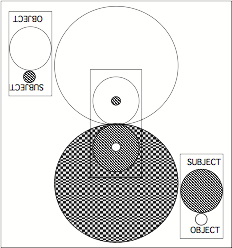
"Again, this drawing is from the Bloom Letter, not from the novel," Rose says. "This drawing almost suggests that adolescence comes first, is higher..."
"No. Light emerges from the darkness."
"Your picture of the Greeks as being Space is interesting," Rose says. "Since their self-portrait might be seen as their mathematics, their geometry, which is spatial. As you yourself, through the drawings in this book -- you are also spatial, even though your geometry is more abstract, more conceptual. Your geometry doesn't measure space -- it graphs ideas..."
"Yes, that is true," Crossmann says.
"You spoke about the trading of bodies," Rose says. "The two brothers changing bodies. Clearly something has changed. The Second Son spent the Winter in speculation, in dread, of his own death, his own cruucifixion. The Neo-classicist, the Nazi, was descending on him -- apparently in the form of his brother -- who is, in your theory at least, the northern or the southern hemisphere. These two hemispheres are, in your idea, Castor and Pollux, the two brothers. But now the Second Son has been transfomred into a Greek. He is back in the childhood of Western history. He is, in a sense, now wearing the body the brother prepared for him. Is that what you are saying...?"
"The two brothers exchange bodies," Crossmann says. "One goes into the Dream Body, and surveys the Ideal world. At the same time, the other is living is the practical world, the National Body, surveying the world of nations. As they collide in Aries, the annihilate one another, exchanging bodies of perception. Of course these two brothers, the duality, are contained within the body of the One. When one realizes this, one then realizes that the two brothers are, in fact, two principles within oneself. The two brothers are glyths for a mechanism inside of every person. The brothers, in this book, go away from one another, both acting in the opposite worlds (reaching extremes in Cancer and Capricorn) -- then, as they draw back toward one another, they become mirrors to each other. When the Second Son sees the First Son as a fascist, as a Nazi, he is really seeing that principle in himself. He is looking at a mirror in the light..."
"So, the Second Son is a fascist -- is that what you are saying..?"
"He is a soldier and a saint," Crossmann says.
"But my question, perhaps I didn't make it very clear," Rose says. "Is the Second Son an emblem for the Sun wich has died in the West and has journeyed to the East, into Eastern mysticism, through the Indian connection with Blavatsky, into Greece. Is this Second Son -- Jacob or Benjamin Heimkreiter -- and yourself, of course -- repeating the whole history of the Earth, as we know it, moving back through time from the origin, back toward the Present...?"
"Yes, that is what this book is about," Crossmann says. "The nature of activity and rest. How, after an extinction, the world is re-born again and carries evolution past the point it reached during the preceding Day of activity -- the entire history being contained in each atom, each monad, in the same way that each broken piece of the hologram contains the entire image of that hologram within it..."
"The Second Son meets Shulamit at the local Saturday Market -- and they talk, in a very animated way," Rose says, "about...well, let me read it:"
We talked. ABOUT WHAT? About her emotional life first. She and her lover wree going their ways -- it could not work. It was time for a break. WHAT ELSE? We spoke of her husband, and their problems. We spoke of her children, Anat and Daphna. DID YOU SPEAK OF NOTHING MORE? Then we spoke of Anarchy. She was taking a class on the meaning of Anarchy. Individual freedom. Freedom from property. YOUR DISCUSSION BECAME ANIMATED? Very animated. YOU OPPOSED HER VIEWS? I agreed with her views, though not as isolated ideas; rather as a philosophy within a larger philosophy. A stage of development. No people exist without a government. A family is a form of government. Wherever you have more than one person in some kind of social relationship, you have a kind of government. Law, even if unspoken. You have a tribe or clan: government is there, in the form of the will of the majority, which is based on either tradition or the instinct for survival. Someone breaks the unspoken law, and then the law becomes visible: the law-breaker is punished. OF WHAT ELSE DID YOU SPEAK? I could go on for ever. We spoke of 'capitalism as social deviation, or illness.' We spoke of the 'tyranny of the lion over animals in the jungle.' We spoke of 'the exclusion of Man from the Natural Philosophy, thinking Man's Ideas as alien things'. YOU ARGUED -- YOU DISAGREED? We did. We spoke of the 'Universal Mind, God, or whatever word one uses. And of the unbroken chain of evolution, re-lived in the womb as a fetus scales the seas. And of dreams. And of reality. And then she said: 'I must go. This is too intense. This is giving me a headache...'
"She was the voice of anarchy," Rose says. "And hoverring above her was the growing strength of nationalism, the desire for order, the masculine energy which sought to defeat anarchy..."
"She was speaking for morality -- the good thing," Crossman says. "The spiritual idea: absolute good. But there were those above, near her, who felt that Chaos was not a good thing. Who wanted to defeat Chaos..."
"And you?" Charlie asks.
"Well, at the time, I was on her side," Crossmann says. "Remember, Chaos led to a break down of the giant's body and the re-constitution of smaller atomic lives, city-states, regional nations. A more Greek-like model.... I had no feeling for anarchy. I did not admire anarchy. But I sought its place in the history of life's constant renewal..."
"And the force of Order was very near, the Father Force," Rose says.
"Yes."
"On the next page, in fact. Let me read:
Then, as always on Sunday afternoon, the 'Athenian Club' met at the Public Market to discuss the state of the world. Keith was there, the Nazi; and Mr. and Mrs. Bucher. We spoke our continual rant against the age. The Nazi argued for the sterilization of all black mothers, with the end of annihilating the inferior black race. He railed against the Jews; and he hailed the great 'Germanic culture'. Mr. Bucher spoke for Christianity and Reason: for the Pure Language of Science. The two brothers opposed Mr. Bucher's anti-metaphysical science, and also the Nazi's self-proclamation of 'impotence'. His fear of the dark races had, as its basis, a fear of sex. It was normal Sunday fare...."
"In your mind, the appearances of actors in this drama was, in your words, archetypal...?" Rose asks.
"Archetypal because we were in the Night Phase," Crossmann says. "We were sleep-walking through a dream. Nothing was accidental. Everyone was wearing a mask. Every mask had meaning..."
"About the structure of the world?" Charlie asks.
"Perhaps it was that way for me because that was the information I sought. That was what I desired, this knowledge. Perhaps for others there is a different kind of Night Reality..."
"And then appears the Valkyrie," Charlie Rose says.
"Yes."
"What does Keith mean," Rose asks.
"It is a Scottish name, meaning the Wind," Crossmann says.
"Interesting, because the Wind becomes a major theme for you after you meet the Valkyrie in the next scene," Rose says. "It is also interesting that you met Shulamit on Saturday, the Jewish sabbath. And the 'Athenian Club' met on the Sunday, the Western sabbath, Christianity and Catholicism...."
"Yes, that is interesting."
"It is true, is it not, that you wrote this book initially like a journal, without looking back, without really thinking about the structure much?" Charlie asks. "That you only began to analyze the novel back in the late 1990's when you began to write your letter to David Bloom..."
"The book is like a life lived, with little reflection," Crossmann says. "A mind moving through life, moving through space, recording images and ideas. Yes. It was only later, in the Bloom letter, when I tried to decipher it, tried to explicate it."
"Did you oppose Keith, the neo-Nazi?" Charlie asks.
"Yes. I fought with him, attempted to turn his ideas into the light."
"And your brother?" Charlie asks.
"He had been infatuated by his image as a Fuhrer, a leader, a savior of his nation," Crossmann says. "But he did not hate blacks and Jews. Because he was largely negative, receptive, he came to be possessed by the spirit of Darkness. He was infatuated by Darkness. Seduced by Darkness. Power. But he did not support Keith's ideas. Keith seemed to be presented as a sorry reality to my brother, to show the real lack of substance behind the Nazi idea..."
"We haven't really talked enough about your brother's claim that he wanted to become a quiet farmer," Charlie continues, "but that he remained in the world because you believed you had an historical role to play in life..."
"Yes, that's true," Crossmann says. "He was 'will' 'helmet', the protector. His role was to protect me, his younger brother. And to help bring about my own ascendancy..."
"So, he wasn't doing this for himself?" Rose asks.
"Well, he is a complex being," Crossmann says. "At one time he is selfless; and, at the next, selfish. He is the dual-man as we all are: Victimizer and Victim. There is a time, further in the novel, when he instucts me to marry so he can carry out his destiny. At other times he wished me dead so he could fulfill his destiny."
"Wished you dead?" Rose asks.
"Yes. I could read his mind," Crossmann says. "I was his conscience. He could not act, do the things he wished to do, rise to power, unless the conscience was killed..."
"You pointed out to him that he was an American, not a German," Rose says. "That America has its own history. The Germans can be Nazis; but Americans would not be Nazis. Americans had their own history; they were not Europeans. America was, by definition, a melting-pot, a loci for cross-fertilization, a hybrid plant. Germans were white Germans by definition; Americans were not that thing...."
"Yes."
"So, here comes the Valkyrie," Rose says. He reads:
Then a girl appeared, dressed all in white, with a full hat tucked down over her face, a high helmeted top, with a white scarf about her face. She spoke to the First Son as she passed by: 'Aren't you the number one person in your own life?' He looked frightened, as if he had been pierced by her words. She said: 'Don't be paranoid.' And she darted away. She came back. I offered her a chair. She sat beside me. She ate of the meat pies which the First Son had been given, which he had brought on a plate with comments of 'fish and loaves' -- which he had been given by a friend, without cost, as an Easter gift. The five, and then the sixth, ate this Easter dinner. When the girl finally spoke, she seemed confused. She rattled in an incoherence. She spoke of the mystery of numbers: 'Does not nine mean 'no' in German?' she asked. 'That is no trouble to us,' Mr. Bucher responded. 'For Science is a pure language.' She spoike to me; and told me of Saturn's planetary moons, reflecting 100% of the Sun's light, where our Moon only reflected 20%. Saturn was pure methane, she said. She spoike of the Double Helix being drawn in space by two of Saturn's moons as they cycled about the other. And of the 'Machine', a moon of Saturn which had been exploded into some odd configuraton. And Phoebe. And Rhae. And she wasn't sure of what the moon's were made; and I said of 'solid gas' -- which made her laugh. There was something mad about her, but something beautiful. She was of the air -- her mind was airy. She asked me if I were a Christian. I said, after some thought: 'No, I guess I'm not'. She said: 'Good'. But then I said: 'I'm really not sure what your question means.' I told her that Saturn and the Jewish Jehovah were the same. She was disturbed by this; and she said: 'You don't have to tell me about Saturn. I know about Saturn.' She asked me my name. Michael, I told her. She smiled somewhat cynically, and she said: 'You're the angel who protects heaven against evil.' IS THAT NOT WHAT YOU WERE DOING AT THE TABLE AT THE PUBLIC MARKET -- AND AT THE FEAST? I suppose I was trying to. ANYWAY, WHAT DID YOU SAY? I said: 'Of course, we have to try to live up to our names, don't we?' And she said: 'This is the name they have given me.' It was written on a newpaper with an undisciplined hand. 'Valerie?' I asked. She shook her head no. I looked more carefully. 'Valkyrie?' I asked. Yes. Valkyrie. She was beautiful -- and so white. And her madness made her even more beautiful. And we talked some more. And then -- as the Neo-Nazi again began ranting against the corruption of America by liberals, Jews and blacks -- she was gone, as quickly as she had come. AND YOU RETURNED HOME? Yes. And in the Dictionary of Mythology, by Gertrude Jobes, I read: 'Valkyrie: literally, chooser of the slain. Norse battle-maid. One of the golden-haired maidens, with dazzling white arms, who resided in Valhalla. In shining armor and helmets, with spears or drawn swords, and mounted on swift horses (the Wind), they rode over the world's battlefields each day to carry the warriors designated for death by Odin or Tyr over Bifrost (the Rainbow Bridge) into Valhalla. When they served mead to the chosen heroes in the skulls of the vanquished, they wore flowing white robes, often interpreted as clouds. Usually regarded as Atmosphere Spirits, the Aurora Borealis, lightning, or mist. Sometimes confused with the Norns, whom, as destiny-spinners, they resemble..." YOU HAD BEEN CHOSEN FOR DEATH. Yes. I saw this....
"Now, this is a description of something that really happened to you," Rose says. "I may be repeating myself here -- and, in this, I ask our listeners to forgive me. This woman, this Valkyrie, actually did appear to you, actually spoke to you as you are here reporting..."
"Yes," Crossmann says.
"This seems like a form of madness to me," Charlie says. "But you have suggested that this irrational, what some would call madness, is a form of reason -- anti-reason we might call it...."
"She appeared to me," Crossmann says. "It all seemed like a dream."
"And then the atmosphere begins to change again," Rose says. "The return of what we might call spiritual science returns. Astrology. The science of the metaphysical..."
"Clearly this death is subtle," Crossmann says. "And it is experienced on the mental planes..."
"I would like to include this drawing here, which doesn't come from the text, but from the Bloom Letter," Charlie says. "Because it seeems to be very graphic about this circuitious route you are describing that the soul takes..."
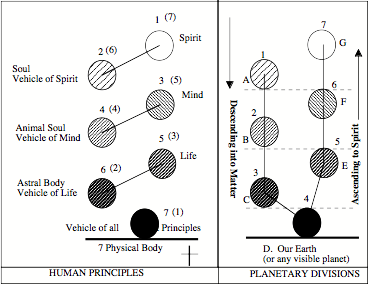
"One of the things you are going to be talking about is the Seven Stage of Humanity," Rose continues. "Stages that each man goes through, each society, and each Earth. There are Seven Earths, seven Days of Creation in other words, from the Jewish Bible. And this drawing, which you lift from Blavatsky, seems to represent this idea pretty strongly."
"This is, of course, from the perspective of inward moving outward," Crossmann says.
"As opposed to...?" Rose asks.
"As opposed to the perspective of the Earth," Crossmann says. "The distinction will become obvious as we move forward..."
"Let me read again," Rose says.
He reads:
DO YOU NOT THINK KEITH WAS PROVIDED FOR YOU TO SHOW YOUR BROTHER THE UNROMANTICIZED NAZI? Yes, I believe that is so. He met his likeness and his likeness essentially killed him, metaphorically. NOW YOU SEEM TIRED. Tell me again of Aries. AND THE WOMAN SAID, FROM HER SEVENTH FLOOR WINDOW: Aries is the zodiacal sign through which the First Ray of Will or Power reaches our planetary life. Such pure types are rare indeed; and, at this period of evolution, well nigh unkown. Most people are governed by their Personality Ray -- and present First-Ray types are expressing themselves through their personalities..." TELL ME MORE. Aries is one of the constellations of the Cardinal Cross of the heavens. This cross is God, the Father -- and, therefore, of the incarnating monad. When the initiate transfers himself on to the Cardinal Cross, from which he descended when coming into incarnation, and mounted in its place the Common or Mutable Cross, he no longer identifies himself with form or even with soul, but with the Will of Divinity, and with the eternal plan and purpose. He then enters into the Council Chamber of Divinity; he no longer simply functions as a member of the Hierarchy upon the Mental Plane, he can now function in all three world-centres: Humanity, the Hierarchy, and the Council Chamber of Divinity. THE WOMAN CALLS THIS LATTER, 'SHAMBALLA'. WHY DO YOU AVOID THE TERM? I am not comfortable with that word. The New Age Movement has rendered the word shallow, as they have the word 'karma'. I am uncomfortable with both words. VERY WELL. DO NOT STOP THERE. Aries initiates the cycle of manifestation. All souls, as individual entities, come into Human Incarnation for the first time in the sign of Cancer, emerging as Mental Entities in the sign of Aries, as Emotional Desire Entities in the sign of Taurus, and as Vital Entities in the sign of Gemini, taking Physical Form in the sign of Cancer. This is an Involutionary, Subjective Cycle. Thus, they emerge into the ocean of Physical Plane exitence, into the world of matter. Yet, the first impulse is awakened in Aries, for Aries is the place where the initial idea to institute activity takes form. Aries is the BIRTHPLACE OF IDEAS; and a true Idea is, in reality, a spiritual impulse taking form -- subjective and objective. There originates the response of the Soul to the highest aspect of quality of deity because there appears the 'will to incarnate'. The First Ray aspect of the Monad, responding to the First Ray Aspect of Deity, evokes response from the First Ray Aspect of the Soul, and the first step towards incarnation is taken on theat plane in the system which is the Mental Plane. Aries awakens the will to reach the lowest and there control, to know the uttmost, and, thus, to face all experience. IN CONNECTION WITH ARIES, WHICH EXPRESSES OR IS THE AGENT PRIMARILY OF THE FIRST RAY OR WILL OR POWER, THE RAY OF THE DESTROYER, IT SHOULD BE STATED THAT THE FIRST RAY COMES FROM THE DIVINE PROTOTYPE IN THE GREAT BEAR CONSTELLATION, THAT IT BECOMES TRANSMUTED INTO THE FORCE AND ACTIVITY OF THE PLANETARY LOGOS OF THE FIRST RAY, AND WORKS OUT HIS TRIPLE ACTIVITY UNDER THE TUIDANCE OF THE THREE RULING PLANETS: MARS, MERCURY, URANUS...
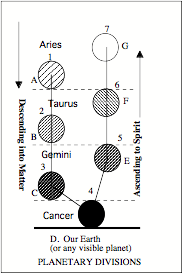
"So, the First Ray is the Destroyer Aspect. In Aries. The Nazi. Is that what you are saying," Rose asks. "Is the Nazi the Destoryer, the Highest Aspect of Spirit...?"
"Note the three planets," Crossmann says.
"Mars, Mercury and Uranus," Rose says.
"Mars is the warrior," Crossmann says. "Mercury is the Messenger of God, which esotericism connects with Michael the Archangel. What is Uranus...?"
"Uranus is Heaven," Crossmann says.
"So, in the scenes were are re-living here, through the novel, we have the two principles, the twin brothers, one of whom is represented by the outsider, Keith, the Scottish Wind, the Neo-Nazi, the other by the Second Son, and Uranus by whom? By the Valkyrie...?"
"Valhalla. Uranus is the Greek Sky God, the Male Principle."
"In your novel, there is a description of Uranus..."
Rose reads:
URANUS EMBODIES THE ENERGY OF THE SEVENTH RAY; AND ITS WORK IS ANALOGOUS TO THAT OF MERCURY, FOR THE SEVENTH RAY RELATES SPIRIT AND MATTER, AND BRINGS TOGETHER ELECTRIC FIRE AND FIRE-BY-FRICTION, THUS PRODUCING MANIFESTATION. URANUS LEADS THE SOUL TO THE 'BURNING GROUND' DURING THE FINAL STAGES OF THE PATH, WHEN THE FIRES OF ARIES AND THE FIRES ENGENDERED THROUGH THE POTENCY OF URANUS PRODUCE THE FLAMING HEAT OF THE FINAL BURNING GROUND. URANUS RULES THE OCCULT WAY; AND IS CONNECTED WITH THE HIEROPHANT OF THE MYSTERIES OF INITIATION. BUT THIS WE SHALL SEE LATER ON IN OUR JOURNEY...
"So we have Mars and Mercury present, in your novel, War and Peace, the Anti-Martyr and the Martyr," Charlie says. "And Uranus, which is the occult science. Clearly, in the novel, the conflict between Mars and Mercury leads the Second Son back into the occult science, astrology and theosophy. It seems there is something to this afterall...."
"Yes," Crossmann says. "It is not always clear. But sometimes the light shines on it and illuminates which was, before, dark..."
"I'm not sure we can solve this metaphysical conundrum in the short time we have together," Rose says. "People who want to solve this mystery will have to read the book itself. But it is good for us to introduce this idea. These are some of the questions your are asking at this point in the novel. It is April 14, a Wednesday. Questions about things happening on the earth seem very far away. This is clearly contemplation of the stars, the heavens. There is a companion drawing, which I understand to reflect the Creative Hierarchies. The lower chain, I believe you call it...."
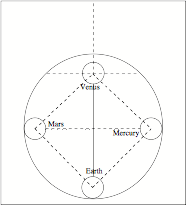
"Most of this comes from Alice Bailey," Crossmann says.
"There still is a discussion of the dialogue between Classical Man and Western Man," Rose says. "Classical Man, in your estimation, being a kind of childhood of the race, one in which dream and reality are merged. Western man, post-Roman Western Man, I guess you would mean, separates himself from his God, his myth. You write: 'Classical Man could not live in the Past or Future, because his sense of Exprience made him live in the Moment. Western Man, in contrast, cannot live in the Present. He truly is Faust, for, having divided himself from his home in the Moment, he has divided himself into Past and Future; and, like Cain he must wander. Western Man really is the Wandering Jew, the wandering Hittite, the Arian as Outcast. He lives in the depthhs wherein the Winter frees him. Music, as Space; endless, like Time...' Then the contrast is made between the Greek and the German. So there is still warfare going on here, in your mind. You are still fighting the German inside yourself."
"Yes."
"So when critics -- and you do have critics -- accusers might be a better word -- argue that you might be dangerous, they might, in fact, be right," Rose says. "You are fighting very hard to try to drive the memory of Naziism away. To cast the Nazi out of your presence..."
"I am not that!" Crossmann says.
"Yes, precisely," Rose says. "This whole section, really from April to June is focussed on these ideas: astology as a paradigm for evolution, a symbolic whole for the continuing evolution of the cosmos. But we don't have time to look at all this. It is too complex, too difficult. But I would like to show a focus on a few passages that seem very important to this understanding...."
Rose flips ahead to a marked page.
"The first passage I marked here was the definitions of Purusha and Prakriti."
He reads:
Every active power or force of the Earth comes to her from one of the Seven Lords, the Sacred Planets. Light comes from Venus-Sukra, who receives a triple supply, giving one-third of it to the Earth. Therefore, the two are called 'twin sisters' -- but the Spirit of the Earth is subservient to that of Venus. That is why our wise men represent the two globes, one over, the other under, the double sign (the primeval Swastica, bereft of its four arms -- that is, the cross).

It is through Venus-Sukra the the 'Double Ones' (the Hermaphrodites) of the
Third-Root Race descended from the first 'Sweat-Born'. The diameter, when found isolated in a
circle stands for the Female Nature, or for the First Ideal World, self-generated and
self-impregnated by the universally diffused Spirit of Life -- referring, thus,
to the Primitive Root-Race also.
It becomes Androgynous as the races and all on Earth develop into their
Physical Forms. The symbol is then
transformed into a circle with a diameter from which runs a verticle line,
expressive of Male-Female not yet separated.
stands for the Female Nature, or for the First Ideal World, self-generated and
self-impregnated by the universally diffused Spirit of Life -- referring, thus,
to the Primitive Root-Race also.
It becomes Androgynous as the races and all on Earth develop into their
Physical Forms. The symbol is then
transformed into a circle with a diameter from which runs a verticle line,
expressive of Male-Female not yet separated. Aftter which comes the Male and
Female separated, or fallen into Physical Generation.
Aftter which comes the Male and
Female separated, or fallen into Physical Generation. The Egyptians symbolised 'Life' (Ank)
by the ansated cross, which is another form of Venus (Isis), and meant, in an esoteric sense, that
mankind and all animal life had stepped out of the divine spiritual circle --
the pre-sexual state of the Third Race and had fallen into physical
(male and female) generationn.
This symbol, from the end of the Third Race, has the same phallic
significance as the 'Tree of Life' in Eden'. Venus-Sukra is
represented as the priest-instructor of the Daityas, the Primeval Giants
of the Fourth Race, who obtaine, at one time, sovereignty of all Earth,
and defeated the minor gods. The Titans
of the Western allegory are closely connected with Venus-Sukra, equally with Isis, represented with the cow's horns
on her head, the symbol of mystic nature, the Moon, of the existence of
parturient energy in the sexual sense which is one of the attributes of Isis,
the Mother, of Eve, Hauvah, or Mother-Earth, all of which is connected with the
Moon..."
The Egyptians symbolised 'Life' (Ank)
by the ansated cross, which is another form of Venus (Isis), and meant, in an esoteric sense, that
mankind and all animal life had stepped out of the divine spiritual circle --
the pre-sexual state of the Third Race and had fallen into physical
(male and female) generationn.
This symbol, from the end of the Third Race, has the same phallic
significance as the 'Tree of Life' in Eden'. Venus-Sukra is
represented as the priest-instructor of the Daityas, the Primeval Giants
of the Fourth Race, who obtaine, at one time, sovereignty of all Earth,
and defeated the minor gods. The Titans
of the Western allegory are closely connected with Venus-Sukra, equally with Isis, represented with the cow's horns
on her head, the symbol of mystic nature, the Moon, of the existence of
parturient energy in the sexual sense which is one of the attributes of Isis,
the Mother, of Eve, Hauvah, or Mother-Earth, all of which is connected with the
Moon..."
"That is Blavatsky speaking, is it not?" Rose asks.
"Yes."
"Blavatsky for the races; and Bailey for Astology?"
"Yes."
"Blavatsky also writes this:
Like each of the seven regions of the Earth, each of the seven First-Born (the primordial human groups) receives its light and life from its own special angel -- spiritually, and from the house (the palace, or planet) of that angel physically; so with the seven great Races to be born on it. The First is born under the Sun; the Second under Jupiter (or Brihaspati); the Third under the 'fiery-bodied Venus or Sukra (Lohitanga); the Fourth under the Moon (Soma, our globe also, the Fourth Sphere being born under and from the Moon) and Saturn (Sani, the Krura-lochana (evil-eyed) and the Darkness (Asita); the Fifth under Mercury (Budha)...
"Now if this is all a coherent system," Charlie begins, "it is not clear, at least on the surface, that it is consistent and coherent. I understand what I deem to be your system, the sytem based on the Figure 8 that you have produced. But the Blavatsky/Bailey part of this is, in my view, and in the view of some critics, not clear. Sometimes the two systems even seem to be in opposition. Your system seems much intuitional, perhaps not as complete. The theosophical system seems arbitrary, ideological..."
"This novel became for me a vehicle to examine these ideas," Crossmann says. "Not all of the ideas, obviously are included in my novel. I present pictures, images, not a total picture. So we need to put the picture together, as best we can, with the limited evidence existing in my text. Of course, a student of theosophy would want to go to the original texts to go further into the mystery..."
"Are you a disciple of Blavatsky or Bailey?" Rose asks.
"I don't consider myself a disciple of anyone," Crossmann says. "I am only seeking to find the truth. That is all..."
"He have said in the letter to Bloom that you were 'chosen' for this calling. Chosen in what sense...?"
"I could not do anything else."
"Can you explain that?" Rose asks. "I'm not sure I understand."
"Well, I began working of this novel in July of 1977, a month of so after Leslie left Eugene. My fatehr died in January of 1979. I did not finish the novel until 1985...."
"Roughly a seven year cycle," Rose points out.
"I tried to walk away from this book several times during this seven year period," Crossmann says. "I tried to look for a woman to help fill the void I felt. One day, in the summer, I remember watching a Mexican belly dancer performing at the public market. It was hot; she was sweating. She was quite beautiful, with an alluring body. She seemed to like me. And I was attracted to her. But as I moved to speak to her after she finished dancing, I felt a sudden explosion in my body. It was like an internal bolt of lightning went off. And I felt a huge rip in my right side, below my ribs. There was a small physical pain in this. But more, a feeling of an opening of a void, which sent waves of fear through me. The only way I could neutralize this feeling, fill this void, was by doing my duty by writing this novel and studying this secret doctrine..."
"This was a physical ailment?" Rose asks.
"It was a metaphysical ailment," Crossmann says. "It was Thor striking me with a thunderbolt. That probably sounds crazy. But nature, the spiritual world, is also inside of us. I was chosen to make this trip into the land of spirits. When I tried to rebel against this, I was punished. This type of thing happened more than once; although this was the most dramatic episode. I learned fairly quickly that to disobey the gods meant I would be punished. So I continued to work with diligence..."
"This is similar to Jesus being wounded in the side by the Roman solider," Rose says. "That's how you described it in the Bloom letter. The mystical wound was a kind of womb, symbolically making a woman out of a man, thereby allowing him to become receptive to the spiritual world. Making a shaman out of you. Choosing you to enter the other side, the spiritual side. You talked about this as being similar to what occurred to Enoch, what allowed Enoch to enter heven while he was still alive..."
"Yes."
"And, of course,Enoch is connected, esoterically, with the Angel Metatron, who is to become such a major force in the next Day Section of the novel."
"Yes."
"And you also connect this, in the letter to Bloom, with the Patriarch Jacob and his wrestling all night in the desert with the archangel Michael in order to win from the angel the name of Israel, the Chosen People, for his own people. Jacob is wounded in the hip and has to walk with a limp after this experience..."
"Yes."
Rose turns the pages of the book.
"Here's another passage I have marked:
Mars embodies Sixth Ray force (Love-Wisdom/Devotion), which leads to idealism, destructive fanaticism frequently, struggle, strife, war, effort, evolution. God's idea in Aries becomes the concrete plan in Capricorn whether that objective is the full flower ofthe Planetary Life in all its forms, the ambition of a personality working out its own ideas and ambitions, or the spiritual aspiration (worldly ambition transmuted into it higher aspect) of the Initiate, who seeks to work out the Plan and tomake it his own. In every case, Mars leads to the Battle Ground of Scorpio. Mercury, embodying the energy of the Fourth Ray, eventually carries the man around the wheel of life, and, through the medium of conflict (Harmony Through Conflict), enabling him to achieve harmony. Mercury illuminates the Mind and mediates between the Soul and the Personality (the Lower Man). This mediatorship, in the first instance, produces an inevitable opposition between the pairs of opposites and a long drawn-out conflict. This conflict finally works out in the dispelling of illusion through the illumination of the Lower Mind -- for Mercury and the Sun are One, as we are often told. Mercury, therefore, leads Aries to Virgo, speaking symbolically, where the Idea (the Word of God) begins to take form; consequently, the latent life in Aries comes to the 'CRISIS OF THE BIRTH HOUR', prior to the birth of the Christ, cosmically considered, although the 'birth of the individual Christ' takes place in Capricorn....
"I feel that I can understand this diagram," Rose says. "I'm not sure I am able to comprehend the astrological symbols yet."
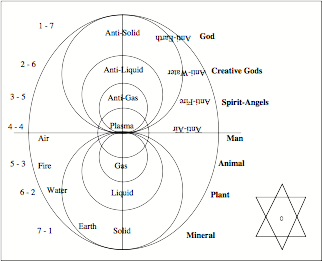
"Here's another passage I've marked," Rose continues. "Which relates to the graphic we just showed, which came from your letter to Bloom."
Rose reads:
PURUSHA. LITERALLY MAN. IN THE VEDAS, THE DEITY, BEING DESIROUS TO CREATE THE WORLD, MEDITATED; AS HE DID SO, PURUSHA ISSUED FROM HIS MOUTH. PRIMAL AND ETERNAL MALE, SOURCE OF CREATION; THUS, AN EPITHET APPLIED TO ANY OF THE GREATER DEITIES. GIANT WHO DIFFERENTIATED HIMSELF INTO TWO BEINGS, MALE AND FEMALE. HE WAS SACRIFICED BY THE GODS TO CREATE THE WORLD. HIS HEAD BECAME THE SKY, HIS MIND THE MOON, HIS EYES THE SUN, HIS BREATH THE WIND, HIS NAVEL THE AIR, HIS FEET THE EARTH. AGNI (THE SUN) AND SOMA (THE MOON) CAME FROM HIS MOUTH, AND FROM HIS LIMBS CAME THE FOUR CASTES. IN SANKYA PHILOSOPHY, PURUSHA REPRESENTS THE SPIRITUAL FORCE, THE SOUL OF THE UNIVERSE, WHICH IS NEITHER A PRODUCTION NOR PRODUCTIVE, OPPOSED TO, BUT WORKING WITH, PRAKRITI, MATERIAL FORCE. It is Adam Kadmon, is it not? The first Man, the first Adam? WOULD YOU HEAR OF PRAKRITI? Of course. Tell me all. PRAKRITI. HINDU GREAT WOMB, OR SUPREME GODDESS. PRIMITIVE MATTER, MATERIAL FORCE, OPPOSED TO, BUT WORKING WITH PURUSHA, SPIRIT OR CREATIVE FORCE. EQUIVALENT OF MAYA OR SAKTI AS THE INHERENT POWER OF MANIFESTATION. And what of Madame Bee -- has she not given you words which you bring to direct me? MADAME BEE TOLD ME ONCE, AS I SAT IN HER CHAIR, DRINKING HER TEA AS HER CAT WALKED THE WINDOW: Purusha mounts on the shoulders of Prakriti. The latter remains irrational, while the former remains inactive without her. Therefore, Nature (in Man) must become a compound of Spirit and Matter before Man becomes what he is. The Spirit latent in Matter must be awakened gradually. The Monad must pass through its mineral, vegetable and animal forms before the light of the Logos is awakened in Animal Man. Until then, the latter cannot rightly be referred to as 'Man' but is rather a Monad immprisoned in ever-changing forms...
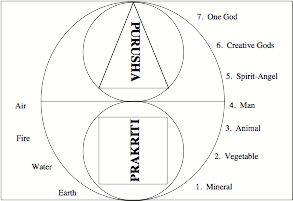
"This diagram," Rose continues, "reminds me of the structure of the novel itself. The Four section. The fourth of which explodes into a formess dimension. Into the mind of God. Were you aware of this when you were writing the first part of this novel...?"
"Somewhat," Crossmann admits. "I was aware of the idea of the Four Seasons of a Man's Life. The four seasons being a symbol of the body. But I had no idea where the book was going at that time."
Rose reads:
THE FIRST WOMAN SAID, AS SHE POLISHED HER RING: Man's organism is adapted in each Race to its surroundings -- that is, its elemental environments. Thus, the First Root Race was as ethereal as ours is material...AND WHAT DID HER GARDNER SAY, WHEN SHE SAID THIS? He said: AT THE COMMENCEMENT OF EVERY KALPA OR ROUND, THE EARTH IS RE-BORN; AS THE HUMAN MONAD, WHEN PASSING INTO A NEW WOMB, GET RE-COVERED WITH A NEW BODY, SO DOES THE MONAD OF THE EARTH: IT GETS A MORE PERFECT AND SOLID COVERING WITH EACH ROUND, AFTER RE-EMERGING ONCE MORE FROM THE MATRIX OF SPACE -- THAT IS, FROM THE WOMB, AGAIN INTO OBJECTIVITY... Madame Bee told me: THE LORDS WHO INCARNATE IN THE HUMAN FORMS OF THE THIRD ROOT-RACE, AND ENDOW THEM WITH INTELLECT (MANAS) ARE CALLED THE 'FALLEN' FOR THEY FALL INTO GENERATION...
"You later, when hiking with your brother, and looking down up the rocks under the water in Fall Creek, outside of Eugene," Rose continues, "note that the water is the womb and the ocean is preparing new continents below the water right now as we speak. These continents will be pushed up above the water for the next stages of the Earth's evolution. You do not worry about resource depletion. You suggest that the Earth is evolving us. We are merely cells in the Earth's body, unaware of the large plan of the Solar System. This Water, this Chaos, is the womb from which new bodies are pushed up into objectivity..."
"Yes."
"So you don't support the ecology movement?"
"Everyone does what they must," Crossmann says. "Each follows his god..."
"The environmentalists are rebels against the Father," Rose says.
"Yes. The environmentalists are largely anti-man," Crossmann says. "They seek a world without man..."
"The Ecotopia movement in the Pacific Northwest, which sought a secession from the union," Rose says. "May still seek such a result for all I know -- and which you supported in this book, for a time. You later turn against this longing for secession, the breaking of America into parts, into regional governments, based on geography and climate...?"
"Yes. I later turn against those who would secede," Crossmann admits.
"In an unfinished novel, which you called The Aniversary of Crane," Rose continues, "you portray North America after such a breaking up into smaller countries, the Europeanification of America. You portray a society governed by a political party known as the Utopians, a government which is regressive, anti-technologoical, a kind of agrarian communist government, that has succeeded only in bringing utter chaos and poverty to the world..."
"Yes. Bringing all elements back to the common element: the rock."
"You started this novel after you fiished Conversations."
"Yes. Perhaps three years later, in the late 1980's."
"It is an anti-communist tract?" Rose asks.
"Anti-Utopian generally," Crossmann says. "Its view is that the best government is the one that allows individuals to build their own utopias...."
"That sounds like the American Dream," Rose says. "You re-discovered the pure side of the American dream..."
"Yes."
"One that didn't believe in limited growth?"
"Yes."
"So the Son became the Father, in a sense," Rose says. "You became like Reagan....?"
"Yes."
"Ok. We're not there yet. We are trying to get there. You are told about the Three Major Cosmic Laws: one, the Law of Synthesis, the First Aspect, the Will Aspect. Two, the Law of Attraction, the law which holds everything together, the Second Aspect, the Love Aspect. And three, the Law of Economy, the Third Aspect, Intelligent Activity.....Matter. Spirit, Soul and Matter. The trinity. The Fourth Law is the Law of Karma, which has a special relationship to the Human Kingdom, the Fourth Kingdom of Nature. Now, this is Bailey's material, isn't it...?"
"Yes."
"She prescribes a close relation between our own solar system and that of Sirius," Rose says. "And this is the basis of the Law of Karma. Now, I guess we just have to take her word for this. This is something which we, clearly, cannot prove..."
"Yes. There is no scientific proof," Crossmann says. "For the Sirius connection.
"Blavatsky says were on currently in what she calls the Fourth Round, or the Fourth Day of Creation," Rose says. "In the Fourth Root-Race moving toward the Fifth, that in which the Mental Principle, the Fifth Principle, will be universally developed. Again, this requires a certain amount of faith. It is not clear that this is anything more than fantasy..."
"Well, this scheme is consistent with the idea of Man, Humanity, being the Fourth Kingdom of Nature," Crossmann says. "So, the Fourth Round would be consistent with this..."
"The First Round being the Mineral Round?" Rose asks.
"Doesn't that make sense?" Crossmann says.
"The Second Round being the Plant Round? The Third Round being the Animal Round....?"
"It's a bit more complex," Crossmann says, "because we have spirit materializing and matter spiritualizing at the same time..."
"Yes, I don't get that."
"Well, it's a mystery we're trying to solve tonight," Crossmann says.
"We don't have time to solve this mystery tonight," Rose says. "This is a major mystery that will take significant archaeology to decipher. We are going to move through this very dense section, dense with astrology and occult doctrine. There is an incident I want to bring up, a very interesting experience..."
Charlie reads:
I walked in a sun-downed day to find the perfect spot by water's edge. I sat, I lay, to sleep that day. SATURDAY. Yes, Saturday. I had my shirt off. I was lying in the sun -- when a bee fell from the sky and landed on my chest. I could not move. I felt his stinger touch my skin. I felt a small pain. It seemed to last for hours. I thought to flick him off -- but I could not, fearing the stinger might lodge in my chest. He seemed almost to be resting, almost sleeping; but he wa not. I felt the stinger again. I lay still. Then, in a flurry, and with a sound, he was gone. I sat up; blood poured from the would in my chest. It did not hurt however. Blood poured straight down, and began to dry on my chest. Had the been fertilized my heart? You laugh -- yet strange it was that when I rose, I felt as though some weight were gone...
"This really occurred?" Charlie asks.
"Yes."
"You wre living in a very poetic reality."
"Yes."
"We have moved ahead to June," Charlie says. "The very dense occult treatise is thinning a bit -- and you, the Second Son, are beginning to re-emerge again. Of course, you go into a very elaborate analysis of the meaning of the bee, the meaning of the heart, in order to explain this bee-sting incident in its most grandiose context..."
"That was the nature of the age I was living," Crossmann says.
"I know that we are skipping things that are vital to the understanding of the picture you are herein presenting," Charlie says. "You describe a dream in which a man, perhaps a doctor, checked two points of contact on your back, asked you your birthday; and when you told him December, he cried: 'I have found Maitreya! I have found Maitreya...!' -- Maitreya is the messiah apparently expected by the Buddhists. So the messiah complex, which so many critics have discussed, was present even at this fairly early stage of the conclusion of the novel..."
"Yes."
"Does it both you when critics discuss your novel as a record of psychological deviance?" Charlie asks.
"No. But the secrets of this novel can't be approached by those who would carry to it a clinical psychology only," Crossmann says.
"I have many other points I would like to cover," Charlie says. "But time is moving against us tonight. You write that the soul moves around the wheel of Time from Aries through Libra to Pisces. And that the Personality, Lower Man, moves in the opposite direction...."
"So we have at least two directions, different directions around the zodiac," Charlie says. "And I'm sure the symbolism of this difference is dense and hard to grasp. Well, I know it is. I tried to grasp it; and I failed..."
"Sometimes there is light in the mind," Crossmann says. "Sometimes there is not."
"We move into June," Charlie says. "The author, yourself -- you are very much in a meditative trance, seeking to comprehend this heavenly matter, virgin matter. You do not even notice the Earth. Your mention of occurrences in your material life are few. You and your brother go out to Fall Creek to take a hike. He keeps wanting to go down to the water, for the water is very beautiful to him. You have no interest in going down to the water. That is symbolical, is it not...?"
"Yes."
"You are in the sky. You have no interest in the water, the woman, material existence."
"Yes."
"Suddenly, in the midst of this dense anti-matter, Shulamit re-appears, at least her two children re-appear. It is June 5, a Saturday. You write: 'Daphna and Anat walk up to see me. Daphna offers me a jelly bean. Root-beer. The Sun is cold in its cleanness...' A cold Sun. That says something also. And then you become aware of an Israeli war in Lebanon.
THE WOMEN STOOD AT THE WELL WHEN I ENTERED THE TOWN IN THE SAND IN THE SUN AS THE BOMBS FELL. And what did they tell you? I ASKED THEM NOTHING. YET THEY POINTED TO AN OLD MAN WHO SAT IN THE SHADE, WHO SIPPED A DRINK OF WATER AND SAID TO ME:
When the dual forces of the Cosmic Brothers (Gemini) become the energy of the One who rides towards the light (Sagittarius), then the Fourth becomes the Fifth. Humanity, the link, becomes the Hierarchy, the bestower. Then all the Sons of God rejoice.
THE ISRAELIS STRAFE THE LEBANESE HARBOR. THE MARCH OF FASCIST HEELS AND GUNS ON MEASUREMENT OF SAND: AND THE BODY-COUNT GROWS. You have sent Shulamit and her children back to the desert to find their father. THEY WILL LEAVE IN MID-JULY. What if something happens to them? I DO NOT WORRY. I HAVE THOUGHT OF THAT MYSELF...
"The form is starting to open up again," Charlie says. "The text is losing some of its density. And you begin to turn your eyes on Israel, with a condemning tone. You begin to think of the Israelis, the Israeli Army, as a Nazi reincarnation...?"
"Yes, that is true."
"Ariel Sharon, who appeared during the last Day Cycle as one of your instructors, advising you to become a man, has now appeared again, as a kind of Hitler figure...?"
"Yes."
"You write:
And the Earth? WHAT OF THE EARTH? War parboils the seeds of the East. Where am I in all of this? When I fly must my flight be so sure? YOU ARE NOT BEING CLEAR. YOU HAVE BEEN GIVEN A ROLE. YOU HAVE SEEN MUCH. YOU SHALL SEE MORE. I rebel against the astral logic. I wish to leave this seat before the Queen. It seems that I am a judge; I guard one side of the throne. PEOPLE RARELY APPROACH YOU NOW. Because I am burning with fiery mind, and rotating cuff of body of ether. YOUR ATMOSPHERE IS DENSE AND DEEP AND THEY FEAR YOU. They cannot appraoch me, until I allow it. JUPITER, YOU SEEM. Waiting for progress. Waiting for Time. OF CRITICAL MASS AND CRITICAL MOMENT. Easily said. EASILY DONE. Don't you wish to know more of what the bee said to me? MOST ASSUREDLY. WHAT DID SHE SAY? She said: THE FOOL'S GOLD MOUTHPIECE, THE HOLLOW HORN, PLAYS WASTED WORDS AND PROVES TO WARN THAT HE NOT SUBY BEING BORN IS BUSY DYING...! She did not say that. That was the Minstrel, who walked a black dog. ARE YOU SEEKING ANEW FORM, BY WHICH YOUR BOOK MIGHT COME TO LIFE AGAIN? Apparently that is so. WHERE IS YOUR LOVE FOR THIS JOB YOU'VE ACQUIRED? I feel fatigued by all of this. I wonder what it means. Israel puts its genocide squeeze on the camps of misplaced refugees they've created. Fascist doctrine of defending the indefensible. American jets dropping tons of the children. The chilfen of ratge. Children we've fashioned. Ten-pins of a tempered lee. YOUR ENTHUSIASM IS FOR SOUNDS AGAIN. Assuredly so, said the mouse to the mitre. Yet carry the mitre the mouse could not do. And the pompous pin-striped beaureaucrats of Order, in military array, carry bits to the jury. Acquiescence to Fate? yet, am I not Fate? I am Time, in my linen and my lionhood of...nurturing Disorder. Ariel Charon giving order to burn; in the boats of the sky, his Death-Carriers go talking.... SHAKESPEAREAN CHILD, IN A HAM NET OF SORROW. Kosher, this net? ANTI-SEMITIC? The Israelis are anti-semitic. Americans in drag. South Africans in harness. The mimicry of England. The golt in the knee. SO YOU FEEL SOME GUILT. I condemn our deception: stiff-upper-lipped sterilizaton...
"The occult passages re-appear, but not for long," Rose says. "Your period out of incarnation, out of body experience is apparently ending. Then a curious passage:
Some of this does make sense to me, friend. I teld to projecta shadow of my own, so that I can study and not be approached. In being both Light and Darkness -- that is, Androgynous -- reflecting always the opposite point -- I seem Dark to the lights of Summer and seem Light to the Winter depressions...
"The Creative Gods, in theosophy, are deemed Androgynous," Rose says. "So you are beginning to identify with the gods. Before you talked rather abstractly about the dual nature of man. But now you are taking this, it seems to me, to a more personal, practical level..."
"Perhaps you are right," Crossmann says.
"Then another strange passage in which the Second Son is instructed by the First Son to marry a woman named Faye Morgan with whom the Second Son is apprently friends."
"Yes. Faye Morgan, who I took to be Fata Morgana," Crossmann says. "Morgan Le Fay."
"Who is Fata Morgana?" Charlie asks. "Who is Morgan La Fay."
"Well, Faye Morgan was a woman I met in Eugene," Crossmann says. "We became friends for a time. Although he was too practical for me, too selfish in her aesthetics. Morgan Le Fay is the Celtic war goddess Morrigan who evolved into a medieval enchantress who lived in the island Paradise Avalon and who, with her eight sisters, helped nurse Arthur, the sun-hero, back to life from his wounds..."
"So, she too, has a mythological role in your life," Rose says. "Everyone is your life, at this stage, was mythological."
"Yes. I was living in the mythological world."
"It is a kind of racial childhood which still exists in the mind somewhere," Charlie says.
"Very clearly."
"So, your brother instructs you to marry this woman so he can carry out his fate," Rose says. "You write: 'One brother is reading about Viet Nam; the other is reading Shakespeare.' In another passage, earlier, you had written: 'One brother is recruiting soldiers; the Second Son is recruiting martyrs.' So, you brother sees his fate as involved in some warfare, some struggle for political power..."
"Yes. He acts like I am holding him back from his destiny," Crossmann says.
"But you refuse to marry this woman," Rose says.
"It is preposterous. She means nothing to me," Crossmann says. "I laugh when my brother tells me this. It is ridiculous...."
"Be fruitful and multiply!" Charlie says. "From Genesis..."
"Yes. That is it," Crossmann says. "But I refuse..."
"Then comes the realization that those who refuse to procreate," Rose says, "to have children, are on the side of destruction, because they choose not to give life-blood to the preservation of order. They, essentially, are saying yes to anarchy; and no to material security and consistency...."
"Yes."
"By refusing to have children, you essentially become anti-life, the end of life," Rose says. "A revolutionary."
"Well, there is a second theme here also," Crossmann says. "One that we skipped. The writer wonders whether... well, let me read it here: 'Whether to 'father' children as a body; or to father children through their mind...?' And, by this, he means as a writer. If he can write a book that can feed the minds of millions of children, will that not be greater than creating the body of one or more physical children? That is, whether to have mind-born children might be an even greater calling..."
"You should read the passage before that one," Rose says. "It is interesting."
Crossmann reads:
Is it not the image or 'symbol' I project, which is the archetype, as it seems to thos passing? I cannot be approached; is it pride which keeps me from being but a man, from falling for the womb and for 'practical application'? Woman leads Man into physical generation -- that is, generation of economic, scientific matter -- the building up of comfort, Civilization, for the Woman. Yet, too, Man creates this Woman, by separating himself in his mind. By fleeing from his own emptiness -- and, thereby, using his Will to create Woman as Object. Abstract Contemplation is the Eden we hear of. Men fall into work and competition for objects when they choose to become 'Fathers' -- that is, when the choose to defend Space. ARE YOU AWAKE AGAIN? How can I know that...?
"Men create Women out of their own emptiness!" Charlie says. "No wonder the feminists are upset."
"When a man feels whole he does not even see women in the world," Crossmann says.
"When he is studying God's word, you mean?" Charlie says, laughing. "Most of us do not study God's word with the same relish to you do, Michael..."
"Man falls for Woman," Crossmann says. "That is the generation of children through the sex act. The Old Testatment begins with the story of the Fall. With Genesis, Generation. Sex. Adam the Red is the same as Mars, or Brahma in India. All three are red. And the red, first, comes from the idea of blood from a first conception with a virgin; and only secondarily the blood spilled during warfare..."
"And the second Israeli woman you mention," Charlie Rose says. "Daphna Greenstein. You call her Daphna the Red. For her hair is Red. And she is a kind of Eve to your Adam...?"
"I am clearly a kind of Adam to Daphna at least," Crossmann says.
"But at this point and time you are angry at Israel."
"Yes."
"On June 23, a Wednesday, the form of the novel changes a bit," Rose says.
He reads:
(Scene opens with Clerk alone in apartment
at typewriter.)
Clerk (typing)
President Ronald Reagan
1600 Pennsylvania Avenue
THE WHITE HOUSE
Washington, DC
Dear Mr. Reagan:
I am shocked and ashamed at the American government's response to the invasion of Lebanon by Israel, a response which seems, through the absolute lack of a sense of moral issue existing in this act of genocide by Israel, to support a war of attrition against a people with no real ability to endanger Isral's national security.
Menachim Begin's claim that this attack is not an 'invasion,' since Israel plans to hold no land in Lebanon, is absolutely ludicrous. Israel's merciless destruction of whole cities (using American technology) is an outrage to my sense of decency -- and makes me wonder which power in the Middle East is the center of terrorism? Is terrorism on a large scale to be tolerated -- which is what your government has done -- or is there a religious issue involved here, which you have failed to confront with a stance of 'practical' foreign policy?
I don't underestimate the power of Palestinian Liberation Organization memb ers to commit acts of violence. This issue is not a simple one. Yet it seems to me that to toleratee Israeli murder does nothing in the interest of the Middle East, nor in the interest of American foreign policy. Is it any wonder that the world is turned against America -- when we support such a tyrranical act?
I read in the news, several months ago, of Israelis nailing Palestinaian merchants' doors closed, during unrest on the West Bank -- an act which German Nazis performed on the shop-doors of German Jews during the reign of Hitler. Which power is the most dangerous to peace in the Middle East? Who appears to be the Nazis now, demolishing the Palestinian 'ghetto' in Beirut?
You may say that some Lebanese welcomed being 'liberated' by Israeli sholdiers, which Israel claims and feeds to us through its censored news reports. Many Poles also celebrated the 'libeeration' of Poland b y Hitlers troops in 1939.
I believe that you have failed America by not speaking out against this attack -- for failing to provoide world leadership against this holocaust, for failing to enunciate American outrage against this act. Moral courage was required, and moral clarity -- and it was not provided.
Michael J. Crossmann
"You sent President Reagan this letter?" Rose asks.
"Yes."
"So, for those who wonder when your nature changed from dark to light or from light to dark," Charlie says, "which is a pretty big issue to many people, this letter indicates you are still, what shall we call you, internationalist at heart. You are still a liberal, if I may use that word. You are still on the side of the weak."
"Yes."
"How does this change?" Rose asks. "When does it change?"
"You have to keep reading," Crossmann says.
"Ok. You almost immediately return to the occult science, with collages of text from Blavatsky about the races... We can't really solve this tonight -- although I would like to spend more time on the clues. But we can't solve this now. So we move on. You have an abstract North American map, which seems to be divided into regions, or countries, continuing the theme that America, North America, will become seven countries, after America, or New Rome, breaks up into constituent parts. So you are still developing your theme of rebellion against Rome..."

"Are you evolving two minds at the same time?" Charlie Rose asks. "Are you now evolving the martyr's mind? While your brother evolves the soldier's mind, the one to victimize the rebels...?"
"Clearly, I am unconscious as I write this," Crossmann says. "My intentions are to find the truth."
"But, in fact, you may be a mole, you may be a spy," Rose says. "Is that possible?"
"No."
"But what about the idea of evolving both minds...?" Rose says.
"Perhaps."
"You then paraphrase Blavatsky about the Lunar Lords," Rose says. "The Lunar Lords being what...?"
"Lunar Lords are creative forces," Crossmann says. "Blavatsky talks about the Lunar Lords creating the lower principles, the physical principles. Of course, the Lunar Lords are those who build during the Night...."
"You write:
COME OUT OF YOUR CLOUDS FOR A MOMENT, FRIEND. TELL ME OF YOUR THOUGHTS, NOW THAT MOVEMENT IS COMING. Great depression fell upon me. I feared for my life. I felt great boulders of distress come upon me; a sense of utter hopelessness, as though within a box I stood, with no way out, no windows, no faith. Tlhen the Idea was resurrected: the Idea of a community of saints, a community of sinners, a community of believers. I saw myh conmmunity as a city-state again. Civilizations run in one thousand year lives. I fell into Time again -- perhaps that was it. There is Hope; but Hope is found in creation of a local culture, in which genius finds its bed from which to rise. The Third Mind is Science; the Fourth Mind is Art: Harmony Through Conflict, which Fourth Ray goverfs the Dawn. The Beginning. It is the Androgyne Being, the Father who will not create: it is he who is the First and the Last. It is the Soul, itself: the Neutron: all potential. AND THAT THOUGHT GAVE YOU HOPE? I could see once again. There is no need to resurrect a mediocre image. The aristocracy of ability. Terminal Computing is the terminal attempt to hold up a beast which has eaten its heart full. Only those who are depressed can be saved. Itell tem of Hope, for to them I am Light. Those who laugh and play like...aristocrats -- those who wish not to see what they see: I, to them, appear to be Dark. I send them away. I create a nucleus of actors who await to perform here. Who wait, through attrition, to inherit the throne. 'ARE YOU WITH US?" IS THE CHANT. THE LOCAL BUISNESSMEN ECHO: WILL YOU BEGIN TO BUY OUR CLOTHES? WILL YOU SUPPORT OUR DYING BEAST...? Nein. Nine-fold nein. Letting the 'winter' have its say. THE NO;RTHERN HEMISPHERE IS CALLING FOR A 'FREEZE'. IN WEAPONRY. AN EARLY WINTER IS PREDICTED ON THE BASIS OF THE CLOUD FROM THE MEXICAN VOLCANO. Does calling for the freeze seem to be calling in the Winter. REST. What else do you see? I SEE A PLAGUE OF SEXUAL INDISCRETION. I SEE THE ELEMENTS DIVIDING UP, AS THE LUNAR CYCLE SPINS. IN AMERICA, THE LUNAR LORD GO 'EACH ON HIS ALLOTTED LAND, SEVEN OF THEM, EACH ON HIS LOT'. And they are us, my friend. YES, THEY ARE US. At death the elements separate. EVERY LOT HAS EACH OF THE ELEMENTS; BUT ON EACH LOT, ONE ELEMENT PREDOMI;NATES. The Etheric Elements are the dream-mind (the Eternal Time Elements). WATER IS THE RECEPTIVE: LIFE; THE DESERT IS THE MASCULINE HUNTER. Yes, we have talked of this before. UPON MYD EATH, I CLIMBED THE ROPE WHICH LED BACK INTO ETHERIC MATTER. I am the Keeper of the Keyes: I lead the light down into despair; I lead the hopeless into the Light they have lost. ON BEING THE MIDPOINT. The shallow must fall, for depth is salvation. The deep must arise, for depth must taste Joy too. THE CLERK'S JOB IS IN DANGER. THIS CAUSED HIM DEPRESSION -- AND THE URGENCY TO RECREATE AN IDEA. An idea of himself beyond his own present. A VISION, YOU MEAN. Yes, a vision for the Future. CANCER; AND SELF-PRESERVATION...! An urgency to see. YES: TO LEAD WITH THE MIND IS THE GOAL OF THE ANGELS. The Century, too, is divided in four. I SEE THAT VAGUELY -- YET ONLY VAGUELY. I, as well; yet, in Time, it will become clear. I HEAR THE FATHER SAY, STERNLY: 'The party has gone on long enough. It is time to get serious again..!'
"Several things come up here," Charlie Rose says. "One theme, that has repeated many times is the economic uncertainty of the times. The Clerk has been concerned about his job. Economic uncertainty. Of course, you have spoken about the economic depression of this time in America. The post-Jimmy Carter era...."
"Economic depression and emotional depression aree, ;of course, aspects of the Night, the Darkness," Crossmann says. "Which causes which? Both are effects of the Law."
"Another passage that struck me: 'Cancer -- and Self-Preservation'," Charlie says. "When I first read this book I was struck by the force that self-preservation plays in this whole transformation..."
"Yes. Life comes back in," Crossmann says.
"The Second Son is on the side of the weak and the powerless, the black, the disenfranchised," Charlie says. "But when he is attacked and threatened, it becomes clear to him that he is white, that he has inherited certain realities in Time. He may not like everything about his country or his country's history -- but he fights to keep his life..."
"During a time of a fight for survival, morality is not an issue," Crossmann says.
"It is easy to be an angel when nothing is at stake?" Charlie asks.
"There is a mystical tract that reads: 'There comes a time when the angels try to become men,'" Crossmann says.
"And when is that?" Charlie asks. "During combat?"
"Yes."
"Wasn't that what Ariel Sharon warned you, in the earlier section?" Charlie asks.
"Yes," Crossmann says.
"You have begun adding, to each day, and this began several months ago," Charlies continues, "flowers sacred to that day. You have some idea that there is meaning in the law of the development of flowers, the time of the year that they bloom, and their symbolic values. On June 30, the flower is the sunflower. The solar wheel. An emblem of Kansas. An attribute of Daphne, which, of course, gives rise to impressions of Daphna Greenstein, and also Daphna Margalit, daughter of Shulamit..."
Rose reads:
Daphna Greenstein -- a glowing face of an Israelite woman. And with her a child whoe eyes were great oceans. And it seemed like an angel had walked up to greet me... AND IT MADE YOU FEEL GOOD? It made me feel love for this woman and child. It made me feel a protector. In my mind, another Daphna was blooming.....YOU LONG TO SEE SHULAMIT, DAPHNA AND ANAT...? Yes, that is true. YET THEY ARE FAR FROM HERE. I call; yet I get no answer. OUTCAST, YOU ARE. Without love for my walk here. AND WHAT DO YOU LOVE? I read Shakespeare today. Today I long for such movement. YOU SEEK DRAMATIC FORM. Yes.
"Then the Second Son watches a lunar eclipse from his porch," Rose says.
"Yes."
"And this is accompanied by a description from the Dictionary of Symbols of the symbolic meaning of eclipse:
ECLIPSE. DISASTER: END OF THE WORLD. IN A FAR-REACHING BELIEF, AN ECLIPSE IS THE SWALLOWING OF THE SUN OR MOON BY A MONSTER. SOME OF THESE MONSTERS HAVE BEEN ALKA BURIAT, ASURA SVARBHANU, AND RAHU. IN AMERICAN INDICAN TRADITION, THE SUN OR MOON HOLDING HIS OR HER CHILD. IN BABYLONIAN MYTHOLOGY, PERIOD OF DARKNESS CAUSED BY SEVEN DEVILS INVADING THE VAULT OF HEAVEN AND SURROUNDING THE MOON-GOD. IN CHINA, CAUSED BY A DRAGON, WHICH APPEARS WHEN AN EMPEROR LACKS VIRTUE AND DEVOURS THESUN OR MOON. IN JAPANESE MYTHOLOGY, CAUSED WHEN THE SUN-GODDESS AMATERASU RETREATED TO ESCAPE THE BRUTALITY OF HER BROTHER, SUSA-NO-WO, A STORM-DEITY.... The Storm-Deity, the Man, re-appears when the Emperor or the government lacks virtue. The ruler is eclipsed. Brutality on the Earth. The Soul is consumed....
"This is July 7," Charlie says. "Did this eclipse really happen...?"
"Yes."
"And then the novel takes on a form again."
"Yes."
Rose reads:
You look down at the water of emotion where the war is. Turbid water. Engineered locus. Down where jealousy lives, and anger is turmoil. BLAMING OTHERS FOR OUR OWN ACCOMPLICE-MENT. The Body seeking to strike out the Soul. The Body seeking its freedom. As the electron seeks to be free of the proton. IN THE DARK WATER. A CONSPIRACY BOILS. Give me fat men, around me. Sleek-headed men, and such as sleep o' nights; yong Clerk has a lean and hungry look; ;he thinks too much; such men are dangerous. RAISING THE DEAD -- IS THAT YOUR IMPULSE...?
(Scene opens with Clerk standing beneath a
titanic elm tree. There are birds somewhere
singing. The Clerk seems oblivious to the
world.)
Clerk
It were imagined easily that Day had its needle
And pricked at the sore
Which the eyes could not find.
Imagination stale becomes
When sea-words cannot soil their frenzy;
And Mites turn on Giants,
Requiring their secrets.
Here I stand, alone, again,
Beyond that point where Chorus came
To scale the muted deeds to free me.
Yet, am I free?
Like Sisyphus I walk
And the rock seems to torch me;
And centuries are swallowed
Like dice by the Virgin.
From where did I come? --
A deadly inquiry;
For it leaves me no sleep
And no stand for opiinion.
Hast thou foresaken me?
As I walk in these shadows?
Cast out like Cain
In the cane for my pride.
Fatherly dedication to the circuit
I make in my thin skin,
Through the House of my tortures.
Am I nearer my goal
Than I was when you last came?
Or endless deeds and endless seeds
Of aril so arid that birds will not touch them...?
I need help in building this bridge to the Future
On which a world stands
In the quaking of sheaves.
(Enter Train Conductor holding a ticket.)
Conductor
Panic not, thou sprightly fool.
Young enough to cry for more,
Yet not so young to weep
Without sorrow.
Please give up your self-melodramatica --
I really find it quite unbearable.
And, furthermore, it gets thee no where.
Clerk
Where am I going?
Conductor
That is a secret.
Your ticket is determined but your destiny is free.
Have you the courage to walk out your line
From near to the far
Without crossing your brethren?
Clerk
It seems to me that a lot has been cast;
And shadows fall thricely, in Time, on the canvas.
As I approach mine own extinction I see,
In the land of the fairies,
Someone calls out to save me...
(Shulamit, Anat and Daphna Margalit stand
silent on a hill-top.)
Woman's Voice (unseen)
How well can you love me?
Clerk
Non can love you as I, said he.
None can bury the stars with his ardor;
None can mount up the heart
Without touching;
None can fill up the seas of the smiles
As I can, my Lady --
When the Spirit does move me.
Voice of the Hexagram
Move in querulous, non-doctrainaire tides
Which batter out the Moon
With swift angles of nuance.
Heated men come and heated men go.
Heat you can give them.
Each flower has its day.
(Ghost of Alexander)
Voice of the Seasons
Be thee everything.
Be thee demon ass well as god.
Be thee the Soul, the very Sun of the children.
Conquer when thou must.
Music is knowledge;
Love when you can, friend.
All things lost are reccovered.
Clerk (repeaating to himself, like a chant)
Water is the progeny of the Moon,
An Androgyne Deity -- so it has been told.
Voice of Failure
Each time you sit down to write at your table
It is me you confront
In that blank page of paper.
Clerk (as Writer)
Why make so much of it...?
Voice of Failure:
It is you who makes up a great case of worry,
By fearing your product might not measure up
To grade.
Proceed With Courage -- that should be your motto.
He who hesitates is lost, yes;
Yet he who waits finds his way.
Clerk
You seem to contradict yourself.
How can I proceed with courage --
And still wait, at the same time...?
Conductor
Literalists fry worms seeking meat for their palate.
Metaphor laments
That which cannot be carboned.
Clerk
You've become feeble in your languate, friend.
It was not long ago your pointed, steadfast and sure,
With your hand, where to go.
Now you only mutter vague phrases.
As though you, too,
Have lost your ways and convictions.
Conductor
Do not assume, from either my manner or my dictation,
That Fatigue is the name of the way you have bartered.
Slow learners make for tired teachers;
Circular wisdom in the mouths of young babes,
Who claim, by their youth,
Some holy incentive --
Even as their legs do shudder
In the sound of the empty lots --
This makes of walkers, who wind twin lead feet,
As they wait for the charges, holy gnomes, too apparent.
Clerk
I apologize for my insult.
Conductor
Your apology is accepted.
Clerk
Has the Chorus gone away, friend?
Conductor
The Chorus shall return, when you find the place
At which you left it.
You have taken Peter Bostic's hand;
In Spring you build the very tomb of your knowledge.
Defining your limits by the women you have courted.
(Enter Peter Bostic, bearded, appearing tired.
He wears a fine tween suit, yet shifts in it as
though it does not suit him. He carries a
scroll with him; scratches his beard; and
reads:)
Peter Bostic
The evolution of Race the Second:
The treatise of the Ancient Sailor,
Unknown to the land and lost to the sea.
The Sons of Yoga, the Sexless Second Race.
The Sons of the Sons of Twilight.
The Shadow -- Astral Man -- retires within;
And Man develops a Physical Body.
The First Race were the Sons of Yoga.
Their Sons, the children of the Yellow Father and the White Mother.
The Sons of the Sun and of the Moon,
The nursling of Ether -- the Wind --
They were the shadows of the shadows of the Lords.
They, the Shadows, expanded.
The Spirits of the Earth clothed them;
The Solar Lords warmed them,
Preserving the vital fire in the nascent physical forms.
The Breaths had life, but no Understanding.
They had no Fire or Water of their own.
(Exit Peter Bostic)
Clerk
I am the Shadow who does not understand.
Voice of the Hexagram
Man builds a body to carry out the grain.
No Soul can deter the stage of bargaining the soil.
Woman's Voice (sounding like Shulamit)
Can you rage against Woman; and then expect her to save you?
If Love would save you, then, surely, save your self.
If you cannot love me, then, who can hear your sorrow...?
Grief (wearing a shroud)
Incorporeal Truth; and the Shadow wears a mane.
Self-exiled from Ahab's boat
On which you played your role to wait --
To wit: note-taking boy stares in space awaiting divinity.
Would you kill out this divinity
By knowing your own locks and keys?
Take off your cape and give it to me.
Sorrow weds age to age.
There is a time for it.
Yet, there is a time now to sing.
Children Dancing with a Woman (singing)
Old King Dole was a merry old soul,
And a merry old soul was he.
He bought two hats and he bought two coats
And he gave one of each to me.
Old King Soul worked digging up coal
In the Wyoming pits and plains.
He never once cried and he never complained
And he never seemed very old.
He'd cry out: 'Old King Coal, from the dinosaur's ring,
And the dinosaur's spleen,
I pull.
I may my pay; then I go my way;
No one asks if my day is dull...'
And I'd answer: 'Old Sing Soul,
Don't give up your goal,
Don't give up your song for free.
I'll buy two hats, and I'll buy two coats,
And I'll give one of each to thee...'
(Joy, with her children, is seen on a hill-top;
yet she seems far away.
Ode to Joy
A-a-a-pril, come she will
When streams are ripe, and swelled with rain.
May-ay she will stay-ay-ay.
Resting in my arms again.
Ju-u-u-une, she'll change her tune.
In restless walks, she'll prowl the night.
July-y, she will fly-y-y.
And give no warning to her flight.
Au-au-august, diee she must.
The Autumn winds blow chilly and cold.
September, I remember:
A love once new has now grown old....
(Guitar music filters through the air and then
leaves.)
Melancholy
I seem to own another one
Who longs for love yet fears his longing.
Clerk
I seek the road to the Castle.
I have been traveling for years; yet I don't seem much closer.
Scorn
Years, you say!
You've been traveling merely hours, merely days --
You are still a boy here.
(The ghost of Werner Faussbinder walks by,
laughing uproariously.)
Clerk (a hint of desperation)
Which way to the Castle...?
Four Women Near a Pond (each pointing in a different
direction)
That way!
That way!
That way!
That way!
Old Woman in a Black Dress (standing beside a pear tree)
Follow the path which leads to the Dog Star.
Your humor will keep your heart from imploding.
Young Boy Named Christian (walking up to Clerk)
I am looking for my father, Kastopher by name.
Have you seen him, grim Michael?
Clerk (trance-like)
Nine.
Christian
In the village of Loom, you say?
How can I find it...?
Clerk (trance-like)
Nine.
Ten.
(Exit Christian.)
Crane
If you could hear the language of birds, friend,
You'd sing and you'd find all the world there to aid you.
Above these trees all clarity is airy.
Alone, your flight -- yet the birds speak about you.
Clerk
And what do they say?
Crane
We say: 'There goes one of us.
Too bad when he thinks he's human --
That's why he can't fly.'
(A flock of Romantic Poets flies by.)
Clerk Dressed as Mars (bloodied sword in one hand; battle-axe
in the other)
Below me the world is smoking in turmoil.
Frustration's badge is the painting of lions.
To those in the Air I point down to Earth;
And those trapped on Earth I lift into Heaven.
Self-Deceit
Impeccable descriptioon excludes all it can't fathom.
You've been thought-diving with Melville again.
No wonder your clothes are wet.
It's a wonder you haven't caught a chill, as well.
Impartial Observer
The First Son speaks of the wonders of Woman.
The Second Son thinks of the dangers of Comfort.
The First is drawn to the love of the Mother.
The Second rebels.
And seeks to find his pere.
First Son seeks the mother in Spring;
Then, in theAutumn, he begins to look for his Father.
The Second Son seeks his Father when new-born;
Only in Autumn does he turn to his mom.
Second Son (shouting loudly)
Love is a war.
It is a battle for power.
Two men come and two men go.
One is taken, tamed;
And the other flees.
(Clerk sees himself trying to scramble up a
mountain.)
"So, we are back," Charlie Rose says, "to what we may call, lacking a better word, the Form World, the Day World, the Differentiated World. The many born from the one. But this Day is different than the last."
"Each Day is different," Crossmann says.
"There is a kind of melancholy here," Rose says. "Not the joy, the awe, of the last Day."
"No."
"It is a bit darker."
"Yes."
Rose quotes: "'Guerilla soldiers appear, carrying rifles through the town.' Then: 'Ariel Sharon shakes his fist at the sea.' And: 'A shell hits an apartment complex; shattered stone explodes through the black air.'...
"I'm not sure who Peter Bostic is," Charlie says, "but Bostic and, later, the Chorus, continue the Clerk's education in the occult, the Seven Races and all. But, again, we don't have time to really pursue this tonight. We want to lock in on your own personal development, your transition from a liberal man to a...conservative, a reactionary..."
"A man?" Crossmann asks.
"Well, perhaps," Rose says. "A liberal man is a man also. A dark man. A man dominated by his mother; by Mother Earth..."
"Perhaps," Rose says. "But that isn't the real issue here, is it? We want to understand your transition, your flipping to from universe to the anti-universe..."
"Vice-versa," Crossmann says.
"Yes; but how can one be sure?" Rose says. "the Anti-Universe is always, is it not, the opposite of the Universe you are living in...?"
"In the Universe, Time moves forward," Crossmann says. "In the Anti-Universe, Time moves backward."
"Aren't those relative terms?"
"No."
"In the Anti-Universe, black is good, white is bad; Day is bad, night is good; poverty is good, wealth is bad; narcotics is good, sobriety is bad..."
"When you were a liberal man, you took drugs?" Rose asks.
"Yes. And I had no future. The past looked wonderful to me. But I had no future."
"Well, ok," Rose says. "You know, there is much in this New Day that I find admirable, attractive. There is humor. Even though it is often dominated by this metaphysical science which has really taken over the novel at this point. I mean, when you have the ghost of Werner Fassbinder passing by, laughing uproariously, I mean, that is hilarious. Also, the flock of Romantic Poets flying by. That is hillarious. I suggest that we ignore the passages dealing with astrology and the occult, for the rest of tonight, and focus on your own progress....Pilgrim's Progress. You are still, at this moment, the liberal man who seees America as Rome and is proposing a kind of suicide of American power, a breaking into smaller nation-states, based on regions...."
"I am dual at this point," Crossmann admits. "And this voice dominates..."
"You have -- well let me read it," Rose says. He reads:
Clerk
Where is Shulamit?
Nothing may happen to either of her children.
Spirit of Anarchy
A man is standing on the streets
And tells the people as they pass
Of logic and law which separate the mighty
Into mightier cells
Of Regional fruition.
He is angry at uncouth civilization.
He boils at the joy of a shallow commitment.
He is a dangerous man.
Speaking of the war between the sexes.
Some stand and hear him.
Town-Crier
Hear ye! Hear ye!
Airplane crashes in Dixie!
More than one hundred and fifty feared dead...!
Clerk
Shulamit was not on that plane...!
(Daphna Greenstein walks by, naked, in a
breeze.)
Actaeon
You tickety leads to regions cool
From regions coiled with heat and care.
Crescent horns on caves do swear
That honrs on burnished hides do pride them.
Dogs in scalded brain do bray
Where Magic's curlewed curfewed sea
Like Age itself in hidden hands
Thorugh Woman's Moons in wire
Desires them.
Sell your ticket to some other;
Unseen thoughts are caught and barbered.
(The sound of dogs in a chase penetrate the
thin air.)
(Benjamin Heimkreiter walks by with a
rifle.)
Chorus
When the Father grows old and teeters with visions
Of Childhood's Parade and the Candy Store's virtue --
See the monument's of Yesterday's Pride
Tumble into one another;
And hear the canons blown sideways.
Senility rides its silver remembrance;
Somewhere the sons of the senile do stir,
Like Hamlet in sorrow,
Wholly torn in discovery.
"I think this is a very telling passage," Charlie Rose says. "Hamlet. Hamlet suffers for the death of his father and attempts to discover essentially where his ticket leads, to use an image from this novel. The Second Son is Hamlet. Whose own father is dead. Your father is dead. Jacob Heimkreiter is dead..."
"And Reagan is senile," Crossmann says.
"Yes, there has been several mentions of Reagan as being a grandfather, moving into senility," Rose says. "The Second Son at this point is not vieweing Ronald Reagan as an adversary; but as someone who might need his help. 'Somewhere the sons of the senile do stir.' The Second Son himself is beginning to stir. 'Like Hamlet in sorrow/Wholly torn in discovery.' 'Wholly torn' is a wonderful phrase. It says that the sons are completely torn. It also says that they are torn; and, in being torn, have become whole. Of course, they are also 'torn' in the sense of wondering what they should do..."
Rose reads again:
Jacob Heimkreiter
Are you telling me the world
I helped build does not work now?
There must be some mistake here.
Clerk
Which way to the Emperor's Castle?
Jacob Heimkreiter
Would you be the Emperor then?
Who prays on the Boardwalk...?
I absolutely love this," Charlie says. "Jacob is in shock. He is the senile father now -- who cannot believe that the
world he helped build is dying.
Then he wonders if the Second Son, the Clerk, wishes to be the
Emperor. Of course, in the Roman
context this becomes an even more interesting question. Especially considering that Michael the
Archangel will manifest himself soon, as the leader of the army defending
America. And then a wonderful
reflection. We remember that Jacob
Heimkreiter became a banker to please his dead father -- and that Jacob's
father fantasized as his own banking life at his dining room table playing
Monopoly. Then the question: 'Who
prays on the Boardwalk...?' This
is a kind of prayer. Benjamin,
Jaocb's beloved baby son, has just been seen walking through town carrying a
rifle. Apparently Chaos has broken
down all order. And who is not
prepared for war? Why, Michael
Crossmann's own generation. The
children of the dying fathers are not prepared. They has been pampered, spoiled. They are in fact the decent ones. And they are surrounded by barbarians, barbaians who want to
tear the empire down..."
"Jacob is lamenting," Crossmann says. "Wall Street does not create saints. Who prays on the Boardwalk? Who will lead America through some holy war...?"
"It is implicit," Rose says. "that is why he asks the Clerk: 'Do you want to be the Emperor...?'
"Clearly, both minds are present in the Clerk: the rebel and the defender," Crossmann says.
"Yes. Remember, as this Day opens, the Clerk is described as of a 'lean and hungry look'," Charlie says. "Is it Marc Anthony who had the lean and hungry look? Or was it Brutus...? Either way, the adversary in question is Julius Caesar. Again we have the Roman theme...."
Rose reads:
(A man scales the walls at Buckingham
Palace; he enters the window at the bed of
the queen.)
Thomas Jefferson
A little rebellion now and then
Is a good thing.
And as necessary in the political world
As storms are in the physical world.
Clerk (excited)
A nation which seeks to find its roots
Seeks to return to the birth of its nation.
Intelligent men might also govern.
There is nothing sacred in the rule
Of the Salesman...
Street Vendors
Lawyers for sale!
Lawyers for sale!
Your desire is their commencement!
Do I hear 100? 200? 50...?
Spirit of Antagonism
If you would not be content with your virtue,
And if you cannot be content with your vice --
Then follow me.
I will take you to the Emperor's Castle.
Yet, if you come with me,
The police might hunt you down.
Clerk
Where is Peter Bostic now...?
(Enter Peter Bostic, scratching his beard.)
Peter Bostic
For the first 3 1/2 Root Races,
Up to the middle or the Turning Point,
It is the Astral Shadows of the Progenitors,
The Lunar Lords,
Which are the formative powers in the Races --
And which build, and gradually force the evolution,
Of the Physical Form toward perfection.
This, at the cost of a proportionate loss
Of spiriituality.
Then, from the Turning Point on,
It is the Higher Ego, or the Incarnating Principle,
The Nous or Mind,
Which reigns over the Animal Ego --
Rules, that is, wherever the Higher Ego
Is not carried down by the gravity of the latter....
Spirit of Despair
Don't listen to him!
What does he tell you of the suffering of millions?
What does he tell you about the murder of children?
Peter Bostic -- he is the ultimate contradiction!
For in one life, he is holy;
And in the other, he trades slaves...!
Ghost of David Blumenthal
So it is with the wealthy class.
Group of Socialites (to Jacob Heimkreiter)
You know the rule, Heimkreiter!
No Jews allowed here!
No Jews in the Stockbroker Club!
Jacob Heimkreiter
I am not a Jew!
I am not a Jew!
I am not a Jew!
Amen!
Roman Solider
He is not one of them.
He has denied him three times, sir!
Crowd of Sleepwalkers (in unison)
Bomb them!
Bomb them!
Bomb them!
Bomb them...!
"A lot of ideas here!" Charlie says. "The Roman solider again. With Jacob Heimkreiter as Peter, Jesus's rock. And so the crucifixion of Jesus is here again."
"Yes."
"I love the line," Rose says, "'There is nothing sacred in the rule of the Salesman...' This coming right after the appearance of Thomas Jefferson, who believe in the aristocracy of ability... And then the Mother of the Clerk appears, your own mother...."
Rose reads:
Mother Figure (ghostly)
Love between Two is a war poorly veiled.
Each plots and vents in silence.
Inventing scenes and words of divorce.
It is from our souls which we wish our divorce.
The freedom we seek so
Is the death of our Conscience.
Clerk Separated in Two
First Clerk: Watch yourself now; be Second Clerk: So, you have
careful! Where are you going? separated yourself again.
Is your hair combed? Who is that Self-consciousness is painful.
woman? Were they talking about And the power which you were
you...? will fade in indecision...
Art Critic
The public is saying that children could do your drawings.
That there is no more skill in your art
Than the scribbling of toddlers...
Clerk As Artist
What a splendid compliment!
For the child is much closer to the Truth
Than is the Art-Critic...!
Night-Watchman of the Mind
You begin to take this criticism personally.
You are more sensitive to Doubt now.
This might make you stumble.
Yet, it might make you see, also...
(A torrent of rain washes the city.)
Black Dog (wet)
Let he who fears the Dawn arrest the toiling flame
Which crawls all-foured along
The rimming crest beyond,
And crowns the arid town's lament,
Sending gems in its name,
Sending dowries for its pleasures...
(Young man and woman make love in a sea
of wet grasses.)
Clerk
Where is the woman I love -- the clerk cries.
Leslie White (trance-like)
Where has Jacob Heimkreiter gone...?
Old Crone (dressed in black, standing in a desert)
The police have him!
He carries his cross toward the Mountain of Skulls.
(Jonathan Harker rides his horse beneath a
natural archway.)
(Bach's 'St. Matthew's Passion' in a church.
Helmut Rilling conducting; Michael Means
sitting at the harmonium, his eyes wet.)
Depression
I own this valley, this depression of sod.
I make it my home because my home has been lusting.
Where the wife is gay, the husband should wonder.
Where the Woman is free, the Man's longing to kill her.
(Pozdnuishef listens, with his wife, to
Beethoven's Kreuzer Sonata.)
Tam O'Shanter
Are you lost, young man?
Would you care to ride with me on my nag...?
Newspaper Vendor
Extra! Extra! Read all about it...!
Khomeini's Iran Invades Iraq!
Vows He Won't Stop Until He Reaches Jerusalem...!
Woman In the Crowd
When will this madness be stopped...?
Clerk (in a quiet voice)
Ma'am: it is only beginning....
Another Woman in the Crowd
What does he mean...?
Man in the Crowd (looking like Bucher)
Have you heard of the Fifth Column...?
Fear (in a black hood)
When I reach out and touch the hand
And touch the man who grieves at imagined loss:
Beward, young fellow currier, said he;
Beware, lest the Tides of July
Might evict thee.
Impiety
If He says I must serve Him --
Then Beneficence seesm but a kinder word for Tyrrany.
Life in Heaven would seem a boring ordeal,
Existing as a cloud --
None of my friends will be there...!
(Friends at the Beer-Hall roar with approval.)
Clerk
Where is the Conductor who brought me this way...?
Conductor (dressed as a maistro, in tails)
Don't blame me for a fate you've determined.
If you live in such a way
As brings you by the Belleau Wood
Or lead you by the Rocks of Blarney
Where the wood tits bark and spoon:
What concern is that for me?
I have many instruments in my orchestra.
You are merely one of many, young man.
What is the orchestra wtihout a heart? you ask.
Yet, what is a drum, what a reed,
Without wind...?
Clerk
It is not you impartiality I question --
Merely you choice to play such a number....
Conductor
I did not write this score, young man.
Talk to Herr Heimkreiter!
He is the one who broought you here.
He, and only he, can again take you out...!
"In a very real way that is true, in fact," Crossmann says. "I followed Heimkreiter into hell and beyond. I followed Heimkreiter. Heimkreiter needed to lead me out. Benjamin Heimkreiter perhaps, the son of the father..."
"This leads into another very funny passage," Rose says. "Heimkreiter's daughter dressed as Peter Bostic's daughter reads a passage from an occult text. And the Scientist replies...." Rose reads:
Scientist (tense, angry)
Don't you understand! De-mystify! De-mystify...!
(A snake crawls away in a clump of grasses.)
Man (standing on a ledge, threatening to jump)
Don't you understand! De-toxify! De-toxify...!
William Foster (carrying a gym-bag)
De-fense! De-fense...!
South American Indian (standing in a brightly-colored blanket)
In the beginning, before the light of the Sun had been created,
This land was in obscurity and darkness.
But, immediately after the ligh tof the Sun rose in the East,
There appeared Gigantic Men
Who built the Cholula Pyramid --
Its builder being scattered, after that,
To all parts of the Earth...
"I dind't get that allusion the first time I read it," Charlie admits.
"Well, the first person, the Scientist, is Herr Bucher," Crossmann says, "he of the 'Athenian Club'. The second man, of course, is Benjamin Heimkreiter, threatening to commit suicide by jumping from a bridge protesting environmental pollution..."
"I got those," Charlie says.
"William Foster is the character played by Michael Douglas in the movie Falling Down," Crossmann says. "Which I consider a masterpiece in terms of the odyssey of the hero..."
"Which most critics considered racist," Rose points out.
"It wasn't racist," Crossmann says. "It was very carefully balanced. There was a good Asian cop, a bad Asian grocery owner. There was a car-load of bad Hispanics, and a good Hispanic cop. There was a good black man who was not financially viable. The majority of bad men in the movie were Anglos, including the Nazi surplus store owner, and the disgusting golfer who died wearing a stupid hat, and the police captain. Critics recoiled because the movie wasn't poliitically correct. It showed bad hispanics and bad Asians. There was a knee-jerk response. To portray one bad member of a race is not to indict an entire race. When you think in racial terms, instead of individual terms, you become rigid. It is a kind of death..."
"I like the movie, I must admit," Charlie says. "I thought Douglas and Duvall were great."
"Throughout the first half of the movie he is wearing a white shirt," Crossmann says. "He is, in fact, a kind of angel fighting for heaven. Fighting for the right way. But when he kills the neo-nazi, everything changes. He puts on his black coat. He calls his wife and tells her he is like a space ship passing around the dark side of the moon. When he re-appears he is dark and now really dangerous..."
"So you see some...?" Rose begins.
"Something operatic about the movie," Crossmann says. "Yes."
"I just had a thought," Rose says. "It seems to me that, during these Day Periods, the differentiated period, when there are many voices, many characters. This reminds me in some ways of a musical scale. These seven levels you speak of. These planes are like the music scale. And you have access to all the scales, all the planes, during the Day. Charaacters are appearing from the very mundane to the very esoteric. During the Night, there is no movement between planes. All elements are bundled together in a tight ball. But, during the Day, you actually make music with your movement. You make music. During the Night you hear music. During the Day you are music..."
"Yes," Crossmann says. "That is very perceptive."
"Bostic lives on one plane. Ariel Sharon lives on quite another. You are moving between these planes. Each contact you make is a kind of musical notation..."
Charlie is quite taken with his insight.
"I don't know where that came from, but..."
"It doesn't matter so much where it came from," Crossmann says. "It came from the real intelligence inside you. The intuition. Ilumination. One is never really never sure when it will come..."
"Did it come to you, this illumiantion, throughout this entire writing process?" Charlie asks.
"No. Much of the time I am in darkness when wsriting this novel. Often I was lost. But I kept working, kept walking...."
"Trying to find the Emperor's Castle," Rose finishes his sentence.
"Mercury is considered the Messenger of the Gods because he has access to both the high and the low," Crossmann says.
"One thing that is different about this Day, compared with the last Day," Rose says, "is the appearance of psychological state, and geometric configureation, personified, with voices. That is new."
"Yes."
"And animals talking. Hugin and Munin, the two crows."
"And a crane. Even a hat talks in this one.."
"The Hugin/Munin episode makes of him Odin, a Norse god," Rose says. "Of course, your family background is German, so it should not be surprising that some German gods would appear."
"Actually, the mythology of all cultures is apparent in the novel," Crossmann says.
"Let me read this passage of Hugin and Munin," Rose says. He reads:
(Two crows circle about the head of the
Clerk. It is about noon. He throws a cherry
toward one. It swoops and dives at him;
both are cawing madly.)
Hugin
Cast your dreaming disk and lyric,
Far into the Dawn go reeling.
Me and he to thee will come,
As Time goes on,
Bringing sights to your hearing.
Munin
Think not on one captured thought.
Memory comes turning,
Pruning birds into buzzards.
Mythologizer (reading from her dictionary)
Hugin and Munin. Literally, Thought (reflection) and Memory.
In Norse myth, the two ravens which sit on the shoulders of Odin.
He sends them out at daybreak to fly over the world
And to bring back news, which news they whisper
In Odin's ear.
Hence, the expression: 'a little bird told me'.
Old Wife (hanging her wash on the balcony)
A raven's caw at Noon is an omen of good luck.
At other times of the day it foretells the coming of death.
Clerk (making his confession)
I smoked the great herb on Saturday night
And fell many miles into the death of my dream.
I shook with a great Dread.
The mind raced with a black vision.
My individuality feared its own demise.
It saw that it was creating
A fate of great pain
In the name of the Hero.
Father Confessor
You felt responsible for some mis-deed, my son?
Clerk
I felt fear for some Fate which seemed there before me.
Father Confessor
And what was this Fate?
Clerk
I no longer remember.
(Saturn appers, throwing a spear at an urn.)
Clerk
Have I fallen into my eyes?
Is that the nature of the fall away from sound...?
(Women appear. Beautiful women. Women
in bathing suits. Full-breasted women,
slender of leg.)
Counselor
Don't you wish to be a Family Man, Michael?
You love children so -- why not have a family of your own...?
(said he).
"Again, the question about fatherhood appears," Rose says. "This seems important."
"Yes."
"A man marries and has children," Rose says. "And then he becomes committed, generally this is true, to providing a stable, prosperous future for his family."
"Yes."
"But you say no to this," Rose says. "Why?"
"It was not my destiny at that time," Crossmann says.
"But later, you marry."
"Yes. After the war. After the battle."
"Then comes Psyche, the butterfly, the soul," Rose says, looking through the book. "And Karshipta, the marvelous speaking Iranian bird. Let me read:
Prophet
The New Moon is the Virgin.
It is the time to worship the Lord.
It corresponds to Spring.
So eat to your fill.
Mythoogizer (reading from her dictionary)
Karshipta. The marvelous Iranian Bird which possessed the gift of speech. A deity messenger sent to spread the religion of Ahura Mazda in the enclosure (the body or ark or 'man') built by the Primeval King Yima, and to protect the people gathered there from the scourging Winter which was about to attack them.
Clerk
I did not know about him.
Conductor
Would that you had, boy.
The Bird is the same as the Psyche you found.
The Bird comes from nesting in heavenly tree limbs --
In the Tree of Life.
Later, he comes to Earth,
Into Man,
As Understanding.
Clerk
The bird is the Soul, then?
Old Woman (holding a wreath of flowers)
Never ask questions to answers you are knowing.
Never waste time, boy!
Whom do you desire...?
Clerk
I desire Shulamit.
I look; but I cannot find her.
Old Woman
You sent her away -- don't you remember?
(The Old Woman lays the flowers on a
grave.)
Cleerk
Whose grave do you stand on?
Old Woman
The grave of Jacob Heimkrieter --
He was my husband
Back in the Autumn
When leaves like lace
Came falling.
Clerk
He is not dead, madame.
Old Woman
What! You have some news of him...?
News-Hawker (walking through the streets, carrying papers)
Read all about it:
Crane Collapses in New York City!
People Below are Showered with Debris...!
First Son
Science is Dying...!
Second Son
Not in Russia or China...!
First Son
We are just getting there before they do...!
Impartial By-Stander
It seems the brain is split in two now --
Between 'knowing' and merely 'being'.
(A man walks by wearing a t-shirt that reads
'Anti-Heads'.)
Man Walking His Dog
The Emotional Elements now lay claim to Emotion.
Self-definition, as despeerate claim to find an identiy with which to live
In harmony.
Conductor
We approach the stage of individualization
In which each element proclaims his own element superior.
In which each instrument proclaims its own right to be conductor....
Clerk
Each world-view becomes differentiated from the other.
Second Son to First Son
There is both Death and Life!
There is both Space and Time!
Thre is Mother and there is Son!
Son must build; and the Mother must swallow his buildings...!
Clerk
The principles of body and mind fight inside me.
Inertia is no more the law than is Action.
The Body seeks to force the Soul into fleeing...!
Astrologer
The Word becomes Flesh, or the Voice, as the Scorpion.
Impartial By-Stander
The First Son takes on the Water Body first.
The Second Son inhabits the Water Body only after.
Second Son (laughing)
I am attracted to Rock Music because the Earth is my opposite...!
(Daphna Greenstein walks by with her
daughter.)
Clerk
What is your daughter's name?
Daphna
Tamar is her name.
Mythologizer
Tamar. Feminine name from the Hebrew meaning Palm Tree.
Hebrew equivalent of Ishtar, or Astoreth -- hence, Venus.
"Several interesting things have happened here," Rose begins. "Of course, the Palm Tree, we are told, is the Phoenician Tree of Life. The maypole, in more modern meaning. Conjunction of opposing forces: internal conflict, phallic pillar issuing flame; androgynous deity. This is the first appearance of the First Son during this Day. And he appears under his old anti-science guise. Mystic. Poet. Not as a soldier. Also, the Second Son is looking for Shulamit -- whom he sent away, sent back to Israel. He is looking for Shulamit but receives Daphna instead. Shulamit appears to Michael when he is dark: she is a kind of Moon figure. Daphna appears to Michael when he is light; and she is an emblem of the Earth. He laughs about liking rock music and Dapha appears as the rock, as the Earth. Very interesting..."
"Yes," Crossmann agrees with Charlie's insight.
"You are again producing drawings, now that the light has returned," Rose says. "We could continue to show these drawings even if we don't comment so much on the ideas they are representing. I'd like to include several drawings from the Bloom letter before we go on, because I do think they are illuminating to the cosmic scale of your journey.
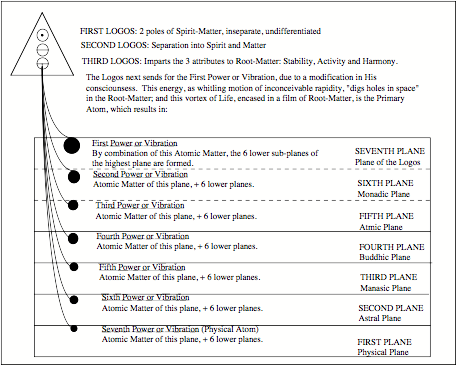
"Can you comment on this drawing?" Charlie asks.
"Well, we must remember there are three systems," Crossmann says. "Or three steps of deity. The First System is Intelligent Activity, the building of the World. The Second system is Love and Wisdom. The Son, the development of Consciousness. And the Third System is that of Will or Power. The Third System, Will or Power, destroys the old system and begins the re-creation of the new system..."
"This drawing says all that?" Rose asks.
"No. That is my commentary on the drawing," Crossmann explains.
"Yes, I was kidding," Rose says. "Remember in Falling Down when Michael Douglas is resting and the Hispanic gang members tell him he is trespassing? They explain the gang graffiti and how it claims the vacant space is private property. And Douglas says, looking at the scrawls on a rock: 'It says all that?'..."
"Very good," Crossmann says. "And then he says: 'If you wrote it is fucking English maybe I'd know what it said...!'"
"Yes, that's right," Rose remembers. "You and this character from Falling Down -- you two have some kind of connection, don't you...? I mean, you are both vigilantes. You are both echoes from a moral orderly time... Here's another drawing from your novel. Can you say something about it...?"
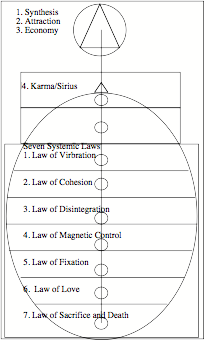
"Oh, this is a picture of the Laws of the different planes," Crossmann says. "These laws come from Alice Bailey. She says that Sirius is the Causal Body for our Solar System. The Causal Body is a kind of Guardian Angel. When the lower body burns up -- when the soul loses interest in the lower world and seeks to escape his body -- he eventually burns up his body in the lower world and he escapes into the causal body, thereby becoming three-fold instead of septenary. He becomes Spirit-Soul-Higher Mind. And the lowest he goes, after that point, is into his Causal Body, the abstract mind, because he has no physical body below him. He can't re-enter the physical body. He operates from the abstract mind. When I spoke earlier about being pulled out of the body, that was what I was referring to. Evangelical Christians talk about the 'rapture'. They misunderstand what this means. They, as always, are too literal. The rapture involved the soul being jerked out of the lower body. But it is not a physical disappearance. The Higher Self has chosen the soul to be with it instead of in the lower world. But to an impartial by-stander it would appear that nothing had changed. A soul can make himself invisible to the lower spheres, but this involves meditation, a turning inward, a clouding of the hologram of self. Making the light smoky so it doesn't reflect in the lower world. The evangelicals are too literal. This literality makes them appear ridiculous. And it makes them anti-scientific. Science has its problems too. Both sides are incorrect, as long as the polarization continues..."
"And this darawing?" Rose asks.
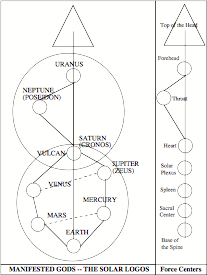
"Well, these two drawings show that the Sun is, in fact, the Causal Body of our System, the Causal Body to us, even as Sirius is the Causal Body to our Sun. The top drawing shows the Cosmic Planes, of which our Solar System is one element of many. The lower drawing shows our system, the higher chain and the lower chain..."
"I was hoping to avoid looking into the occult texts that you lift in to your novel," Rose says. "Because they are so dense. And because we don't have that much time really. But the next passage is so much like the top drawing we just looked at. Who is this Peter Bostic anyway? And his daughter Mary? I don't know who they are...?"
"They are characters from a book I began writing in college but never finished," Crossmann says. "Kastopher and Christian was a book I began in college, after reading Nietzsche's Thus Spoke Zarathustra. They remain in me, even though unfinished..."
"You tax the reader," Rose says.
"Yes. I admit characters into the novel like any other writer however," Crossmann says. "No differently. Characters appear; then they vanish..."
"Peter Bostic becomes important during this Day Period," Rose says.
He reads:
Peter Bostic's Illegitimate Daughter, Mary
Stanza Second of the Second Book.
'Aum' said the Mighty One, and sounded forth the Word. The seven-fold waves of matter resolved themselves, and varied form appeared. Each took its place, each in the sphere ordained. They waited for the Sacred Flood to enter and to fill.
The Builders responded to the sacred sound. In musical collaboration, they attended to their work. They built in many spheres, beginning with the Third. Upon this plane, their work commenced. They built the Sheath of Atma, and strung to it its Primary.
'Aum' said the Mighty One. 'Let now the work proceed. Let the Builders of the Air continue with their plan.'
The Deva-Lord and Builders upon the Plane of Air worked withthe forms within that sphere which is reckoned mainly theirs. They wrought for union, each in his group assigned. The moulds grew fast within their hands.
The Sacred Plane of Juncture, The Fourth Great Plane, became the sphere within the greater circle which marked the goal for Men.
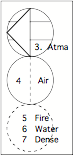
'Aum' said the Mighty One; He breathed forth to the Fifth, the Plane which is the Burning Ground, the meeting place for Fire. This time a cosmic note is heard beneath the sound systemic. The Fire Within, the Fire Without, meet with the Fire Ascending. The Guardians of the Cosmic Fire, the Devas of Fohatic Heat, watched o'er the forms which formless stood; waiting a point in Time.
The Builders of the Lesser Grade, Devas who work with Matter, wrought at the forms. They stood in four-fold order. Upon the three-fold levels in empty silence stood the forms. They vibrated; they responded to the key; yet useless stood, and uninhabited.
'Aum' said the Mighty One, 'let the Waters too bring forth.' The Builders of the Watery Sphere, the denizens of moisture, produced the forms which move within the Kindgom of Varuna. They grew and multiplied. In constant flux they swayed. Each ebb of cosmic motion increased the endless flow. The ripple of the forms was seen.
'Aum' Said the Mighty One. 'Let the Builders deal with Matter.' The molten solidified. The solid forms were built. The crust cooled. The rocks congealed. The builders wrought in tumult to produce the forms of maya. When the rocky strata were completed, the work stood in completion. The Builders of the Lowest Grade announce their work was finished.
Forth from the rocky strata emerged the covering next. The Builders of the Second agreed the work was done. The First and Second, on the Upward Way, stood forth in the four-fold form. The Inner Five was somewhat seen by those whose sight was keen enough.
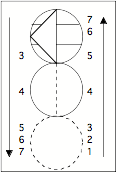
'Aum' said the Mighty One, and gathered in His Breath. The Spark within the peopling Third impelled to further growth. The Builders of the Lowest Forms, manipulating densest matter, densest maya, merged their production with the forms built by the Watery Ones. Matter and Water merged produced the Third, in time. Ascension thus progressed. The Builders worked in union. They called the Guardian of the Fiery Zone. Matter and Water mixed with Fire, the Inner Spark, within the Form, were blended all together.
The Miighty One looked down. The forms met His approval. forth came the cry for further light. Again He gathered in the sound. He drew to higher levels the feeble spark of light. Another tone was heard, the sound of Cosmic Fire, hid in the Sons of Manas. They called to their Primaries, the Lower Four, the Higher Three, and the Cosmic Fifth met at the Great In-Breathing. Another Sheath was formed.
Bucher, The Physicist (from a pulpit)
It is time we clenaed up this mess we've created!
There are only two ways to treat a cancer:
Cut out the cancer;
Or cut off the head!
Would you want homosexuals teaching your children in school?
It's time to take a stand!
It is time to eradicate this monster...!
Group of People on the Street:
Law and Order!
Law and Order!
Keep the scum from destroying our order...!
(Bostic is seen, pointing someone out to the
police.)
(The police approach the Clerk.)
Clerk
And so it comes to this,
When all else is gone...!
(The Clerk sees himself making love with a
woman in a field of daisies, speaking words
with great ardor.)
Woman in the Field:
We have just met!
Clerk in the Field
Wer I not to undress your magnificent limbs
Touching tempest of torrent and touchstone of glade --
Were I not to unburden your breasts from their stirrups,
Which hide them from view,
And laud this masterpiece Creation....
Were I not to discover the many pleasures of your country
In the station between sighs
Where thighs only seem a shield to comfort --
If all this were lost,
Then, would not Time, itself, be lost...?
Woman
You hands are as hot as diamond knots!
Clerk
Prepare, then, the chalice I set to drink of
For beauty.
Cunning is your virtue;
Unstrained are the velvet knees you offer.
Pretend your toes can touch the sky.
I proffer my back to the Sun for His Wisdom...
Clerk Watching Himself
It is merely a dream.
Breathe; and it is gone.
(Image of the Clerk and the Woman
in the Field disintegrates.)
Woman From a Balcony
Where are younow, son?
Clerk
I seek the Emperor's Castle.
Woman From the Balcony
What will you do with it when you find it?
Clerk
Can it be found?
Woman (laughing)
If it cannot be found, then why are you looking?
Clerk
I have no choice.
It is the mask I have been handed.
Woman
Can you trade it for a mask more fruitful?
Clerk
But this mask is Everymask.
Each of us seeks the castle he can't find.
Woman
Some claim they have found it.
Clerk
What each finds, that, too, he loses.
It is in the looking that lies the splendor.
It is in being lost that Life gives a fullness.
Woman
Follow that brick pathway.
It will take you a few steps closer.
Historian
It seems, young man, being born in Wyoming,
That you were born and raised
On the oldest extant land mass
In the northern hemisphere....
Chorus
What do you have to say to that...?
"Indeed," Charlie says. "Does this mean something? Besides the Clerk being a dinosaur, I mean?"
"Perhaps."
"He is old -- that is what you are saying?" Charlie asks. "We are a photograph of our environment."
"Yes."
"Then comes a kind of transformation."
"Yes."
"Triggered, in some way, by Ariel Sharon."
"Yes."
"The Clerk is tempted by a blonde woman named Svetlana, then by the character Eroticism, as one thousand naked women waltz by in a parade," Charlie says. "Then, in the parade, which I found very funny: Legion members carry a giant phallus through the streets..."
"An important symbol, considering where we are going," Crossmann says.
"The resurrection of the penis, the Male Principle, you mean?"
"Yes."
"And then the Clerk discovers himself as a patriot," Rose says. "Not only as a patriot, but as an aspect of Superman, from television, his days as a child. He connects himself, America and Superman..."
"Yes."
Rose reads:
Clerk as Patriot (carrying red, white and blue)
I am one man with two faces, who sees both directions.
Blasted curse!
For in one eye, America is the scourge of the world;
In the other, she is the hope of the world.
Isreael, gehind that Napoleon Sharon,
Prepares for its ritual of Conquest and Mars.
Raised on the beef of Superman in blue,
Who, in one world is meek,
Yet, in the other world is savior.
Nobility demands that the adversary strike the first blow.
The noble man never initiates a conflict.
The noble man waits, knowing ltime has its harried edict;
Knowing Time only wells its inevitable bargain:
:He waits for contracting Space now to move him.
Clark Kent (with glasses)
Chief White, have you seen my three-ring binder?
I must have left it somewhere --
You know how forgetful I am...
Leslie White (with her father)
I saw one lying outside, by the lilacs.
A butterfly landed on top of the binder.
I'll show you where it is.
Come, take my hand...!
Mythologizer
Lion. King of the beasts; symbolic of action, agility, authority, beastliness, divine strength, ferocity, fever, fire, haughtiness, light of the sun, majesty, mind, nobility, power, pride, reason, righteousness, spirit of life, strength of soul, stealth, summer, superhuman and subhuman (divine-animal) forces, sun's heat, triumph, valor, vigilance. On talismans, a symbol of health. Dream significance: powerful adversary. In heraldry, deathless courage: a soldier's emblem. In the occult sciences, stands for calmness, firmness, generosity, greatness, prudence. In art, a conventional solar face, because of its flaming eyes, the remarkable size of the head, and the tawny yellow mane, which are like rays. The lion is a form of Aker, Atalanta and Hippomenes, and an attribute of Artemis of Ephesus, Cybele, Hecate, Ops, Rhea -- thus, typifying the Earth's fertility. A face half-goat, half-lion, represents Pan, Mon and Tum. Its double nature typifies love and destruction, good and evil, mild benevolence and violent preying. Figuratively, a lion is a man of great courage. The Babylonian and Sumerian Chaos Demons Ugallu and Uridimmu were lions. The steed or throne of the Earth Goddess was a lion, whereas that of the Rain and Thunder God was a bull, and that of the Sun God was a horse. Later, as steed of Nergal, God of the Scorching Sun, the lion became a symbol of War.
One of the Hebrew names is Ari, also meaning Fire. Ariel means Fire or Lion of God. Another name is Iblia, signifying heart, soul, or Lbe, signifying flame, heart. The Lion of Judah signifies Jesus Christ, who had sprung from the tribe; and is, as much, a symbol of the Logos, Mind, Reason and the Word.
(Ariel Sharon scatters fire through the Beirut
rubble.)
Soothsayer
I looked into the Eastern mist
And saw a Great War come and gather up the seas.
He is wise who preapres for war now, friend.
If the Lion rules the Earth,
Trust, the Horse will rule at Heaven's Gate.
(Clerk speaks to a Jewish friend ab out the
evils of Israel.)
Mythologizer
Horse. Clairaudience, endurance, fertility, force, freedom, grace, generosity, gratitude, intellect, motion, solar energy, science, speed, strength, time, triumph, obstinacy, pride, war. Steed of the gods, typifying clouds, lightning, rays, waves, wind. When the mount of a Devil, a phallic symbol. Dream significance: (black) sorrow, followed by pleasure; (colored) small profit; (falling) sad news; (gray or piebald) unquiet life; (harnassed) good luck; (running) early success; (white) success, wealth.
In heraldry, signifies readiness for all employments whether in peace or in war. Cents, Danes, and Saxons venerated horses. In Buddhism, a horse or dragon is the mount of Brahma, the White Jambhala. In China, the animal that carries the Sun through the seventh of the 12 terrestrial branches of the zodiac; it governs Hsing and Wu (Libra), the direction South, and the hours 11 AM to 1 PM. In Renaissance imagery, a symbol of lust. Hebrew symbol of War, opposed to the ass, which symbolized peace. To ancient Semites, symbols of angelic and earthly powers under control of God. In Hindu zodiacs, the horse governs Aries, the sign controlling the head or mentality. As the constellaltion in which the Sun starts his yearly journey, symbolic of the birth of a new thought, as well as the Dawn of a new era. The chariot of Surya is drawn by seven green horses to typify renewal or life eternal. In Japan, associated with the Moon, the first hour of the Day, and the seventh sign of the zodiac. In Norse mythology, a horse was buried or burned with its owner to carry him over Helway. The Persians sacrificed horses to the Sun daily to be used in his course through the skies. The Four Sacred Horses of the Sun were called Benik, Enik, Menik, Senik.
The White Horse brings a new kingdom on earth of happiness, joy and purity. Steed on which Buddha left to become an ascetic, and which saved his life from cannibal demons. Mount of Saint George and of the Second Coming of Christ. Represents intellect, innocence, purity, Sun-Steed. In Hinduism, mount of Vishnu. the Japanese worshipped the white horse as the giver of purification. In Norse mythology, the horse of Odin was white.
Four Horses of the Apocalypse. The Four Cardinal Directions. Conquest (white); Death (pale); Pestilence (black); and War (red).
Clerk (dressed as a warrior)
I seem to speak of the virtues of war
And wonder and fear if I'm lost in my speaking.
I speak to men about the logic of warfare;
In Autumn I speak to the women of silence.
Conductor
What else can you tell me?
Clerk
I love America now.
It is the failures of virtue I hate in the Autumn.
There are two words: defend; secede.
One word in Summer; another word in Winter.
Conductor
Tell me about yourself.
Clerk
I am the zodiac itself -- so it seems.
I am the Mind or the Time which evolves Men.
Mythologizer
Bear. Bravery, endurance, strength; also, brutality, clumsiness, gruffness, ill-temper, misanthropy, moroseness, uncouthness. In business, one who sells short, expecting to recover at lower prices; opposed to the Bull. Dream significance: awkward friend. In heraldry, signifies ferocity in protection of kindred. In astronomy, either of two constellations in the northern hemisphere: Great Bear or Little Bear. Ainu, mountain deity. Among American Indians, immortality, self-existence, as it supposedly dies and rises again -- a belief which arose from the fact that it hibernates during the wintger and subsists on its own fat. Owasse Indian Underworld Chief; and Senecs Indian Spirit of the North Wind. In China, represents Shih, a yang symbol, bringer of blessings, Universal Preserver. In Christian tradition, represents Evil; on Norman churches, represents Satan. By Finno-Ugrics, called Master of the Forest, Holy Hound of God, Wise Man. Considered more intelligent and stronger than man, it sometimes is offered asa sacrifice to the Forest God. In the Old Testament, the bear symbolizes Persia, which brought death and destruction in to the world. Emblem of Russia; and, in Russia, a friend of man. Zuni beast god; supernatural patron of the medicine society.
Clerk
I am lost again!
Where have you led me...?
Conductor
Whom do you wish to see? said he.
Clerk
The Emperor's Landlord.
Conductor
Peter Bostic, you mean?
Clerk
Jacob Heimkreiter, to be sure!
Conductor
Aye! One and the same!
Newspaper Vendor
Extra! Extra! Read all about it!
Banking Scandal in the Vatican!
Murder and Extortion Tied to Papel Bodyguard!
Rival Vendor
Double Extra! Double Extra!
Rains in Japn Kill Several Hundred!
Early Winter Predicted by Experts!
(Truck roads by; thunder somewhere.)
Clerk
Where have I gone, friend?
Is this new land an old land I have strayed from...?
(Clerk sees himself speaking of the urgent
need of self-sufficiency of region. People
listen to him. Some urge secession from
the union.)
(Undercover policeman listens and takes
notes.)
"Now we must remember," Rose says. "That this is the same man who spent the whole first part of the novel condemning America and Western Civilization for its sins. That is you I am speaking about..."
"Yes, I know that," Crossmann says.
"Apocalypse. Apocalypse, the fear of war, final war, Agmageddon. This fear is coming in."
"Yes. Sharon's war in Lebanon awoke in me a sense of vulnerability. For myself; and also for my nation."
"You were not ready to be a warrior," Rose says.
"No. Clearly not. Not physically, not emotionally. My entire generation, my spoiled generation, had been given everything. We were rich, weak, and not really substantial. We had spent so much energy condemning our fathers; we had no real sense of how rude the world could be. Sharon's invasion of Lebanon was like a bomb going off for me..."
"Like Joyce's thunder?" Rose asks.
"Yes."
"You go so far, at a later point, to speculate that if Jews throughout the world all moved to Israel, then Israel would be a danger to the world, because of the intellect and genius of the Jews," Rose says. "A threat to America..."
"Yes. That thought, of course, followed this pattern," Crossmann explains. "America withdraws from the world. The world falls into chaos. Israel gains power over the Earth. Ultimately, Israel invades America..."
"That is a long journey," Rose says.
"Yes," Crossmann says. "It is not a prophecy. But the reality of the picture is that of the threat of invasion of the United States. This man, the writer, myself, and my character, the Second Son or the Clerk, has been busy arguing for the dismemberment of America into self-sufficient regional countries. The vision, of course, as we have discussed, is the flowering of Europe, after the dismemberment of Rome. However, Europe flowered a millenium after Rome was destroyed. It was a very large picture, in a very large time frame. Sharon's explosion woke me up to the present..."
"A fear of death?" Rose says.
"Yes, personal and national," Crossmann says.
Rose reads:
Clerk
I love America -- and so I am torn.
The American Idea must be renewed.
Land of the Free, Home of the Brave.
With a destiny yet uncovered; a destiny yet unknown.
One of me secedes -- the Woman in me longs for Divorce.
The other cries out Union.
Which is the true me?
And which, in Time, might find my banner?
(Clerk sees himself defending America's
'youth' to a French Woman who claims the
superiority of French Culture.)
Unidentified Woman
What other culture, which represents Empire,
Proffers the world concepts
Instead of the rule of one race?
Clerk
Both America and Russia offer the world concepts.
Yet the greatness of America is in the strength of her diversity.
In that she draws to her shores refugees from all lands.
America is the world, heerself, drawn together from the seas.
Damn 'pure' culture, based on race!
Such a thing does not exist!
A nation is the sum of its elements.
The greater (more diverse) the experience of its elements,
The greater and more diverse the culutre will become.
The immigrants come, with love for their imagined land.
The immigrants will fight, to defend their new concept.
It seems that the most advanced elements --
Those who desire freedom, or independence of thought --
Come eventually to live in our land.
We collect the souls from dying lands.
In the flower is the seed.
In that crown are the minds
Who are scattered by the Wind.
Conductor
You curse America for what it is not.
You must also love America for what it is.
Clerk
America must become what its birth did seem to forecast.
We must be drawn back together as a unit.
The body is dismembered.
Broken cells reject a molded corpse.
Yet a new, better body will be formed
To replace the one that has died.
(Clerk sees an orange-backed snake crawl
beneath his foot, and disappear into the
grass.)
"The Second Son is synthesizing his two minds, drawing them together, into a unified vision," Rose says. "He still seems to be a spokesman for a withdrawal from the world, a kind of secession. But he is obviously having doubts now about this venue...."
"Then there is some temptation," Crossmann says. "A French woman tells Crossmann how good it feels to give in to life. The First Son speaks about the greatness of emotion. And then Leslie Rhoades appears and tells the author that she is lonely; Leslie's mother appears and tells the Second Son that Leslie misses him; that she is lonely. Astral waters are calling. Then another talking bird, a starling, which tells him: 'There is no time for sorrow/When the nest needs its building./Sorrow does come when the nest,/Built, dismembers...'"
"Again the talking bird," Rose says. "We have had a talking crane, talking ravens, a talking Persian birth, and now a starling. This is very much the animals' section, isn't it. We have also had a rather tedious look at the lion, the horse and the bear. Is this the Third Day then, the Animal Kingdom? It seems that there is something to this predominance of animals in this passage. There must be something to it..."
"He seems to be losing interest in the occult, in the heavens," Rose says. "He speaks of a vision."
Rose reads:
Clerk
I saw an American land united together behind a singular cause. This cause was shared danger. I saw war grow; and I saw the world ask America for help. We must not initiate the coming war. We must stand aloof, in an isolated tenor -- until we are called; then the men must come back.
I saw myself speak out against Israel -- and I feared the words my be misunderstood -- fearing, as well, the next persecution of the Jews. Am I condemning the Jews to hell from my mountaintop? Am I condemning myself -- and Daphna and Shulamit...?
A troubled mind. Seeing both sides. Seeing too much. Reality -- in its lethal dose. If we turn against the Jews, and drive them to Israel -- then we create an opponent who, in brains and talent, becomes our danger. America must not be destroyed! America must remain a land for all. A sanctuary. That is its strength. A hybrid nation. The microcosm of the Earth. A culture containing the seeds of all cultures. The Ark, in fact. I fear what is coming. I fall into the water; yet the water is not prepared.
Some want to go back and live in the past. I do also. Yet this can't be done without self-destruction. We are afraid. We are without hope. Yet we must crash through this barricade, Fear. The Future cannot hold us bound. We are a race of Giants. Our vision is our highway. Reach, beyond the captured second! Reach, beyhond your fear of heights! Re-generation comes through a trial by fire!
Conductor
That is only partly you.
Second Son to First Son
A country which puts its Head to flight -- that country, surely, will lose the war.
(Brothers stand in the woods above Fall
Creek. Below, in the water, grasses and
valleys. They see how continents are formed
beneath water.)
Second Son
The Earth never runs out of resources. It prepares continents in its womb that it will raise into Air for the next Round, the next Day.
"Then a rather chilling vision presented by a minister in a church," Rose says.
"Begin with Bucher," Crossmann instructs.
Rose reads:
Bucher the Physicist
We do not need a scapegoat. We need to purge the fear from ourselves -- that is all. We are not Germans, here. We are Americans. We won't stoop to such terror...!
Conductor (to Clerk)
Your vision certainly frightens you.
Minister In a Church (speaking to his congregation)
The Devil has taken up his abode in this land.
We are being punished for our evil.
Why do you think the economy is sick?
Why do you think the streets are unsafe?
Why do you think they are making our children
Drug-addicts and prostitutes?
Evil has come -- and we must smite it out...!
(The congregation cheers wildly.)
(Raggedy-clothed men are strung up in the
town square.)
Clerk
Again, it is the struggle between the Indian and the Cowboy.
The Indian and the Puritan.
These Twin Demons compose us.
Twin Demons prepare for conflict.
(The Ayatollah Khomeini prepares to kill a
Jew.)
Woman's Voice From the Balcony
It is one thing to criticize your own family.
It is another thing to have an outsider do the same.
America must slumber a bit;
Until she is called back into activity.
We have lost faith in ourselves.
We must always be inclusive,
For that is the way of greatness.

Conductor
Turn your eyes to heaven, lad.
There is a time to see the Earth --
And a time not to see it.
Ghost of the Mother of Leslie Rhodes
Neither side is right.
Only one more horror.
Please never lose your love for my daughter.
I ask this not only for her; but also for you....
(David and Goliath prepare to do battle.)
Newshawker
Extra! Extra! Read all about it!
Terrorists Strike at Jewish
Restaurant!
Paris Attack Leaves Seven Dead...!
(Israelis drop phosphorous bombs on Beirut
in retaliation.)
"One clearly can feel the winds of apocalypse blowing," Rose says. "Then Heimkrieter's daughter appears and asks the Second Son to continue his vision."
Rose reads:
Clerk
I've had a horrible vision in which the Jews come under persecution and are driven in flight to Israel. I have seen militant Israel begin to war against the world. I have seen the world against Israel: a great conflagration is coming. I have seen Naziism coming to America. And how do I know? Because I am of its face. The American Nazi is me, too. Nationalism. A drawing togetherr of cells.
I wept to think of Shulamit and her children. None should harm them -- they are sacred unto God.
Sight makes me weary. the militant Jew prepares his own battle. The Divine Right of Murder now falls on his shoulders.
Jacob Heimkreiter's Daughter
My God, you are torn in two. One of you hates; and one of you loves.
"And this is what makes people fear you, Mister Crossmann!" Charlie says. "This passage. And passages like this."
"I understand."
"Clearly, you are suffering here, with the weight of your vision."
"Yes."
"You are tearing yourself in two, as the young woman says."
"Yes."
"You saw the Israelis as becoming the new Nazis?" Charlie asks.
"Yes. Clearly."
"But that is not your final view. You come to embrace the Israelis," Rose says.
"Yes."
"Why?"
"Because of Armageddon," Crossmann says. "Because of a religious vision."
"Here is more," Charlie Rose says. He reads:
Clerk
You say that I should give up judgment,
That I should live without pain.
Yet, is pain not conscience?
No.
If the Father demand I kill my son
I shall not do it.
I demand independence of judgment.
God's greatest work will be no automaton.
To be as a god I must have power in my conflict.
The power to resist -- the power to say no.
I am Hitler; and I am Christ.
I am all things under the Sun as well.
I am all; and I am nothing.
I do not move; yet I move
With the Wind that I am speaking.
Silence of what you see is needed.
Tell no one -- for words tear and rend.
And words build the Future...
Voice of the Clerk's Mother
You are in such a state of mind.
Can't you laugh any more?
Where is that child who once sang
With such beauty...?
Clerk
Burried in my prism.
(Leslie Rhodes is the wind itself. She drops
some lilac at the foot of the Clerk.)
Song of Leslie Rhodes
Once, so many days ago,
When lean was I in worshipped days,
And leaner still in married plays
Of husband's wicked rage and dhow:
I met you in wome dream; and then,
Before the dreary fate I strew
Before my walking eyes in blue,
You went away; and that was the end.
I'll not forget the weighted nights
I walked to wait to see your face
When light brought forth, in his slim grace,
Your featured smiling visioned heights;
You raised me through the air on words,
And through the heaven's gated mane.
Some day, again, when worlds are sane
Then I shall find you, again,
On your terrace...
(Her voice trails off to nothing.)
Clerk
I wait for you, Death, to come and claim me.
Death
And that's why I whisper my words in your ear.
Clerk
So that I shall serve you?
Death
Each serves me in time.
Clerk
You, then, are the Ancient of Days?
You are the first to come, and the last to leave?
Death
The dualism in you now is between Being and Life.
Is between Eternity and Form.
You are the Evolving Force.
You instruct each side on how their mission is evolving.
Clerk
Are the Jews to be martyred again?
Death
The Jews are to martyr; and also to be.
Clerk
What kind of idiocy have you constructed?
What kind of trap is this existence?
Death
You chose to come here.
When you leapt into Life in the Spring
To me you were destined.
Why take it so hard?
It is not Death which is painful --
Rather, Life is painful.
Clerk
Perhaps I like pain.
Death
Undeniably so.
Clerk
What thing better should I do?
Death
Do as you will.
Always to me you return.
Clerk
I wish to harm no one.
Death
Perhaps that is not enough.
Perhaps, instead, you should help someone.
(The image of Superman is projected on the
air. The Lone Ranger and Tonto. Each the
protector of the world.)
Cinna, the Poet
A non-secular nod.
Seventeen blurred non-sequiturs to savor.
A column of barbs.
A steel of opinion.
Broken metaphors.
Salvos of sanctus -- turned on a spindle.
Summer investiture of turmoil of Youth.
Many nectars more of Age
Makes you lief with a numbered mortar.
The house on the White Hill.
The veil of the ventured promise.
Who goes there?
Military indoctrination?
Ten-gallon hat wearsa ten-gallon suture.
Propaganda of vastless ardor;
Or, nuclear steadfastness, in the well, colors pendants...?
Man With Angry Crowd
Are you a married man -- or a bachelor?
Cinna
Wisely, I say I am a bachelor.
Another Angry Citizen
That's as much to say as they are fools that are wed.
You'll bear me a bang for that, I say!
Tear him to pieces: he's a conspirator...!
(Lightning strike a velvet field. Rain begins
to fall. The Earth bleeds.)
Newshawker in the Rain
Read all about it!
Volcano off Java; Seventh in Three
Months!
Synagogues Bombed in Paris; Radical Jews Threaten Retaliation!
Conductor
The Bear is the symbol of Immortality because it rests in Winter and lives off its own fat. By vitalizing your Spiritual Body in Spring, you vitalize the body you will live in in Winter. While others are weary and sick, you are strong!
Clerk
Tell me something more, friend.
Conductor
What more would you have me tell you?
Clerk
How much farther have I to go...?
Conductor
Where exactly are you going?
Clerk
I am going to the Emperor's House.
Conductor
And how will you get there?
Clerk
By following you.
Conductor
Ahh! What will you do when you get there?
Clerk
Then I will be sorry....
(Every woman on the street seems to look
like the Clerk's mother.)
Conductor
Would you change your fate then?
Would you change your conductor...?
Clerk
Show me the way I must walk to really find you.
Conductor
Tell me about the Tropical Circles.
Clerk
I know nothing of them.
Conductor
Perhaps you'd better find someone who does.
Scientist (reading from a textbook)
Tropics. Either of two circles of the celestial sphere parallel to the Equator; one, the Tropic of Cancer, 23º27' north; the other, the Tropic of Capricorn, 23º27' south. They are the limits of the apparent north-south journey of the Sun. These two lines of latitude marke the boundaries of the Torrid or Tropical Zone on Earth.
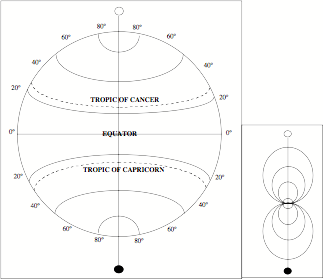
Clerk
I cannot see so well now. Nebula rasa. The blank natramenta.
Old Woman By Canal
I am afraid for the children. I've been through the hard times. I know what it's like -- not having enough food -- not knowing where your future is...!
Clerk
Not knowing what side your future is buttered on....
Speculator
Could it be that, once, the Tropics were at the Poles...?
Second Speculator
Could it be that, once, the Tropics were at the Equator?
The Poles were at the Equator...?
Pipe-Fitter (working near the canal)
How many Poles does it take to make an Equatorial Belt...?
Clerk
I don't know. How many?
Pipe-Fitter
Three hundred-sixty-five; and one to turn the crank at the spout...!
(Uproarious laughter from seventy-three
church-goers.)
Scientist (again reading)
Apogee. The point farthest from the Earth in the orbit of the Moon or of a man-made satellite. The highest or furthest point. Opposed to Perigee.
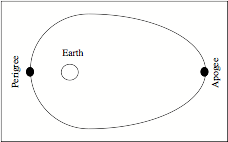
Bystander
What has that to do with the price of tomatoes?
Pipe-Fitter
Three hundred-sixty-five; plus one to punch the button on the register.
(No one laughs at this.)
(Pipe-Fitter goes away, embarassed.)
Woman In a Shawl (standing near a pear tree)
Let one well-acquainted with astronomy and mathematics throw a retrospective glance into the twilight and shadows of the Past. Let him observe, take notesx of what he knows of the history of peoples and nations, and collate their respective rises and faslls with what is known of the astronomical cycles -- especially with the Sidereal Year, equal to 25,868 of our Solar Years. If the student is gifted with the faintest intuition, then will he discover how the weal and woe of nations is intimately connected with the beginning and close of this sidereal cycle.
Our meaning is very clear. Every sidereal year, the Tropics reccede from the Pole 4º in each revolution from the equinoctial points, as the Equator rounds through the Zodiacal constellations. Now, at present, the Tropic is only 23º and a fraction less than 1/2 a degree from the Equator -- hence, having 2 1/2º to run before the end of this Sidereal Year, which gives humanity, in general, and our civilized races in particular, a reprieve of roughly 16,000 years.
Clerk
Would that not be 3 1/2º, with, rather, some 23,000 years left...?
Is it possible the Tropics begin at the Equator, then draw apart to the Poles, then draw back to the Equator...?
(No one responds.)
(The night begins to feel clammy.)
"Again, there is a lot here," Charlie Rose says. "I intended to stop before Cinna, the Poet appeared. Clearly, you, your character, is becoming megalomaniacal. 'I am Hitler; I am Christ. I am everything and nothing.'..."
"I am Dark Man," Crossmann comes in, smiling.
"Psychologists have had a field day with this," Rose says.
"Psychologists see only half of the world," Crossmann says.
"Well, isn't that the point?" Rose asks. "They don't want to see the Evil side. Decent, civilized people don't want to see the Evil side. That is not me speaking -- I'm paraphrasing the words of some of your critics. That your quest for knowledge has turned you in to Evil..."
"What is Virtue to the Democrats is Evil to the Republicans," Crossmann says. "Abortion is Virtue because it protects the Woman from an unwanted pregnancy. To the Republicans abortion is Evil because it is the killing of innocent babies..."
"I guess I know where you stand on this question," Rose says.
"It is a difficult question," Crossmann admits. "But whatever side you stand on, innocent babies are being killed. That's a fact."
"You still have your sense of humor," Rose says, referring to the book. "The Pipe-Fitter coming in. But there seems to be some kind of real fear as to having the Moral Majority revenge themselves on outsiders. Unmarried men seem to be the target in the novel. Cinna the Poet is one; the raggedy-dressed men who are hanged. What is that all about...?"
"Darkness. Revenge on darkness," Crossmann says. "In Eugene we had a terrific influx of homeless and bedraggled men during the deparession of the 1980's. The word was that Eugene was a kind, liberal town that took care of the poor. Some of that is true. Eugene became a kind of magnet. And the streets became littered with the deranged and the poor. Beggars were sometimes little less than extortionists. My brother was accosted by a panhandler who threatened to strike him if he didn't give up some change. The darkness was becoming militant..."
"And had been for some time," Rose says.
"Well Vietnam, the Civil Rights movement, the drug and free-sex movements, leftist politics -- this all instructed those alienated souls that the negative movement was correct," Rose says. "America was Evil. The White Man was evil. Rebellion against the Law was good. Lawbreakers were saints. The dark element had a right to tyrranize the Light Element -- because the Light Element was evil. The Anti-Universe was empowered, to use a flacid modern word. The Angry Woman was taking over. The Negative Element was, in fact, the Deluge, was Noah's Flood...."
"And this had real meaning to you when the Dark Giant in your own life threatened to kill you," Charlie says.
"Yes."
"And because you were existing on this mythological plane, this incident became rife with meaning. It was not just a crazy man threatening you. It was a principle threatening another principle..."
"Yes."
"You have a sort of innocent aside in a passage we just came through: 'David and Goliath prepare to fight.' This is apparently a presage of this war you will have with the Dark Giant...?"
"I was not aware of it at the time," Crossmann says. "But it does seem so..."
"So, part of you is with this Moral Majority, the force of Law that wants to take back its streets?" Rose says. "The minister in the church who warns the congregation about the spread of evil. 'Why do you think the economy is sick? Why do you think the streets are unsafe? Why do you think they are making our children drug-addicts and prostitutes? Evil has come -- and we must smite it out...!' You were becoming afraid...?"
"I was not so conscious of my fear of the Dark Elements at this time -- because I was, myself, at least in part, a Dark Element. I was Dark Man, afterall..."
"And it took this potential attack to wake you up?" Rose asks.
"Yes. A Dark Giant tells you he's going to kill you," Crossmann says. "And Life comes back in a rush..."
"This is such a labor, this novel," Rose says. "I am reminded of Sisyphus, who rolled his heavy stone up to the top of the mountain, only to see it roll back down. Remember the Herzog movie, Fitzcarraldo? The hero pushed this old dillapidated ship over the top of a mountain so that he could sail down a torrid, treacherous river one more time. You remind me, in this novel, of Fitzcarraldo...."
"Yes. I see the parallel. I believe Firzcarraldo is in this novel also," Crossmann says.
"I wouldn't be surprised," Rose says with a smile. "Everyone else is. You are turning a huge boat around here -- the ship of state. You are turning it around by hand, pushing it up a mountain, to try to get it back up to its original state of purity..."
"That's exactly what I was doing," Crossmann says. "I wasn't aware of it at the time. But that is exactly what I was doing..."
"The Second Son has two dreams," Charlie begins again. "The First Son has all but disappeared. We last see him swimming in Fall Creek -- which, too, is an interesting name. And a real place-name, I take it...?"
"Yes."
"He has had trouble swimming, nearly getting pulled down by a tricky current, but fighting it off, pretending not to panic..."
"Yes."
"Then we have two dreams, discussed by the Dream-Gatherer," Rose says. "In one, the Second Son was a bomber pilot trying to drop bombs on Russia. But he was shot down. He wandered through Russian streets in Russian clothes, pretending to be mute and dumb. His boyhood friends were there too, with his brother -- apparently all shot down, all pretending to be dumb. And Russian youth sat inside and read philosophical novels, listened to music, talked of politics. It was like the 'Sixties' in America. The Second Son found himself liking the Russians he saw. And then the second dream, one in which your uncle..."
"Eugene Hittner," Crossmann says.
"Really. Was that really his name: Hittner...?"
"Yes, almost like Hitler," Crossmann says. "Very close."
"And he proves to you, numerically, since you were unable to accept people's imperfection, or your own imperfection, since these two were linked, tending to retreat from people when they fell short of your standards, that you were, indeed, number 666 or the Beast. What is that all about...?"
"I'm not sure. I was reporting dreams I had," Crossmann says.
"Then we have the Mythologizer give us definitions of Mountain, Valley, and Sea," Rose says. "With this interesting drawing, which suggests something.... Which seems to suggest that the North, again, is the land of the gods, and the South, again, is the land of the demons. The Mountain is the Man; and the Valley is the Woman. Under water. In fact, the Mountain is considered in some cosmogonical myths the stick by which the gods stir the ocean to bring up land from the bottom. The Ark is connected to the Mountain. The Ark is still considered by some to be resting in a mountain somewhere..."
"The Sea Monster, or the Whale, is connected to Cetus, in the Southern Sky," Crossmann adds. "And this is important thematically, since Ahab is a prototype figure in the novel. The Second Son is a kind of Ahab; and a kind of Ishmael, Ahab's biographer... Hydra is another sea serpent, killed by Hercules; Hydra also lives in the southern sky..."
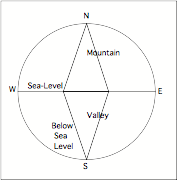
"You have talked about how the South tends to follow the Lunar calendar, tends to see the Sun as a tyrant," Rose says. "The Moon and the Sea are clearly connected. And this monster you fight -- my understanding is that you fight him at the lowest point of your own descend into Darkness..."
"So it must be," Crossmann says.
"The Mountain, Mount Meru or whichever mountain, is the North Pole then," Rose says. "The Tree of Life, the World Pillar, the letter A, the erect phallus..."
"Yes."
"Madame Bee -- and I am taking this to mean Madame Blavatsky," Rose begins. "And I am remembering your experience with the bee sting in the heart. Madame Bee connects the North Pole with the First Race of the Fourth Root Race..."
Rose reads:
Madame Bee (holding a hyacinth)
The First Continent, or Island, of the Fourth Root-Race, the so-called "Cap of the North Pole", has never perished, nor will it perish, until the end of the Seven Races...
"David Blumenthal, the ghost of Blumental, also says something that I found provocative," Rose says. "Let me read it:
Ghost of David Blumenthal
The First Creation is the creation of the Elements. Each to its own realm so that the building of the next model more closely approximates the plan.
The 'Gods' are the created creators.
The One, the Logos, does not limit Himself -- does not step down from His throne.
The Two, the Soul, Light and Shadow: this, the Second Aspect, begins to hand out visions.
Unity does not create; for it is Changless.
Duality creates; polarization is Change.
So the Gods, the Two-Faced, or Dual Lords: they create by receiving and transmitting words.
The planets are the bodies of the Gods, in which their Intelligence (their Idea) is reflected.
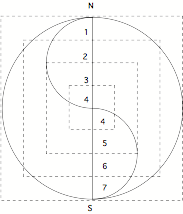
"And this is one of my favorite drawings," Rose says. "Within the Yin-Yang symbol are the Seven Races, or the Seven Days of Creation. It is a powerful drawing. I don't want to talk about it too much. But I find it to be quite powerful... My intention had been to avoid more discussion of the Rays; however there is a passage here, given to us by the Chorus, that I find important. The Chorus comes in right after the Dream-Gatherer reports your two dreams..."
Rose reads:
Chorus
We will now take up the three most important laws affecting the evolving human being as he lives his life in the Three Worlds.
1. The Law of Fixation
2. The Law of Love
3. The Law of Sacrifice and Death
These lawas are all dominated and controleld eventually by the three higher laws of the System -- the Laws of Magnetic Control, of Disintegratin and of Cohesion. There is a direct connection between these Seven Laws and the Seven Rays or Vibrations. And if we study the correspondence, we shall recognise the fact that the First Law, the Law of Vibration, is the controlling law of the six, demonstrating through the Second Law, that of Cohesion. This, just as the Solar Logos is, at this time, manifesting Himself through His Second Aspect, in this, the Second Solar System.
The First Ray of Will or Power is the First Aspect of the All-Self; and, in the Third Outpouring of Spirit, came down to the Fifth Plane, along with the other Monads. A subtle correspondence exists between the Monads of Will and the Fifth Plane, the Fifth Law and the Fifth Ray.
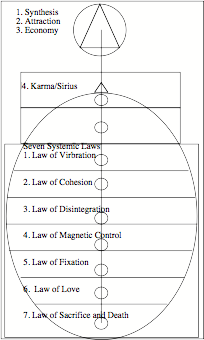
The Second Ray of Love-Wisdom or Second Aspect weilds a control of the Fourth and Sixth Planes, and dominates the Laws of Cohesion and Magnetic Control, and the Astral Law of Love. There is a direct interlinking between the Abstract Rays and the laws of the planes where they specially control.
The Third Ray, the Activity Aspect, controls the Laws of Disintegration and of Sacrifice and Death, on the Third and Seventh Planes.
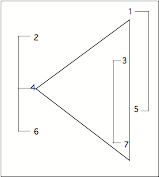
A. The Power Aspect: Ray 1, Planes 1 and 5,
and the Laws of Fixation and Vibration,
form one interlocking whole.
B. The Love Aspect: Ray 2, Planes 2, 4 and 6y,
and the Laws of Cohesion, Magnetic
Control, and Love, form another unit.
C. The Activity Aspect: Ray 3, Planes 3 and 7,
and the Laws of Disintegration and
Sacrifice or Death, make still another
group.
"Then we have a woman appear by a fountain and offer an interesting perspective," Rose says. "She says that those in heaven, during the Summer, are brought down to the Earth in the form of rain and snow in the Winter..."
Rose reads:
Woman By a Fountain
If you choose, as your element the Atmosphere, or Sky --
Blue and arid by Day,
In which the Sun takes up his sermon...
When the Autumn comes, the clear sky turns to clouds:
The Water of the Sky,
Once aloof,
Falls in rain.
So it is that Wisdom, the watered sky of Age,
Comes down to the Earth.
By Day, you are a velvet cloud;
By Night, you are the water I drink of...
(Shulamit appears in a dream; is close; then
leaves. Another woman tries to find her for
the Clerk. She never returns. The Clerk
feels a loss.)
Clerk
Who goes where the Wind does wear
The minuetted fern
And the daisy for a folly?
Prometheus comes to give me his chain.
How can he laugh in his labors --
When only cards fall on lands
With decrees of added turmoil...?
Break the heated mane of day.
Sate all alnds and all foresakings.
I am not the burglar of leaves,
The burglar of Time --
Although the Time stelas my virtues.
Leve it all aside, said he.
Lay the golden wreath of lore,
Like seeds for the morror --
Lay it on Wednesdays.
Added burdened wealth of words,
To salvage the sorrow
Of a life built on spiels:
What is it worth?
What does it bring you?
How much sorrow can you bear, friend?
How much sorrow can you build --
And, like Atlas, beard,
In a worm, 'round your heart...?
The Emperor wears leaves in the crown of his armor.
Will you kneel at his pleasure --
Or will you waltz at his vengeance?
Pride gives skin and bone its meal --
Yet, Pride, on skin and bone, must feed.
Where have you been, friend --
Friend of the womb --
Friend of water in the Word...?
Mephisto bears a golden coin.
Loins of ardor.
And harder comes...
The blended spleen of his anger.
Walk away from the broken image...?
Who owns the chariot of fire which you brake in?
Who own your name?
Where does the wood claim its maker...?
Mephistopheles
Poets call for rowlettes of surroundings.
Words are not enough for thee.
You must see it all --
And, seeing, you are cursed so.
Clerk
I am Killer and Killed.
I am Unknown and Known-Too-Well....
Mephistopheles
If you carry a cross, at least you know what its name is.
That is something, friend.
If you steal fire from heaven,
Like Prometheus before you --
At least you know that your theft has been noted.
Clerk
Should that bring me some relief -- this knowledge?
Mephistopheles
If you see enough, it will surely bring you silence.
The Wisdom of your age is raw....
Chorus
The Three Minor Rays, Concrete Sciene, Devotion, and Ceremonial Order, have each a connection with the Three Kingdoms of Nature Below the Human, and with the Three Laws of the Lower World.
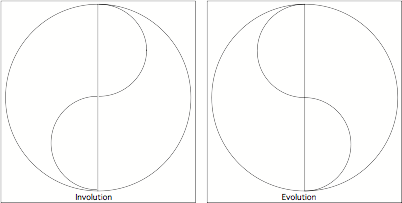
Ray of Ceremonial Order (Ray #7). This Ray controls life in the Mineral World; and, in the final stages of Involutionary Life, at the point where the upward turn of Evolution is made.
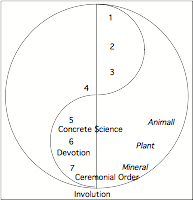
Through Ceremonial Order (or Ritual), control of the Lesser Builders is effected -- those Elemental Forces, the point of Synthesis in the lowest plane of all, the period of transition.
Rays 1, 3 and 7 have an interplay, as we know. Ray 7 is the appearance in combination of Forces of Evolution. It is the manifestation of Power and Activity on the lowest plane of all. It is allied to the laws of the Third and Seventh Planes. Disintegration and Death, for all 'periods of transition' are periods of the destruction and building of forms, and the shattering of the old, in order than newer and better chalices of life might be constructed.
Madame Bee (walking on water)
In the first beginnings of human life, the only dry land was on the Right end of the sphere, where the globe is motionless. The whole earth was one vast, watery desert; and the waters were tepid.
There, the Man was born on the Seven Zones of the Immortal, the indestructable, of the Manvantara. There, was Eternal Spring in darkness. Yet that which is darkness to the man of today was light to the man of his Dawn.
There, the Gods rested; there, Fohat, the Son, reigns ever since. Thus, the Wise Fathers say that Man is born in the head of his Mother (the Earth); and that her feet at the Left end generated the evil Winds that blow from the mouth of the lower Dragon....
Between the First and the Second Races, the Eternal Central Land was divided by the Water of life....
Timothy (companion of Madame Bee)
The Two Poles are called the Right and Left Ends of the Globe -- the Right being the North Pole, and the Left being the South Pole -- that is, the Head and the Feet of the Earth.
The more one approaches the Poles, the less rotation is felt. At the Poles Proper, the diurnal revolution is quite neutralized. Thence, the expression: 'where the globe is motionless'.
It is our assertion that the land or island which crowns the North Pole, like a skull-cap, is the only one which prevails during the entire Manvantara of this, the Fourth Round. All the central continents and lands will emerge from the sea-bottom many times in turn; but this land will never change.
"Ok. So we are now in September," Charlie Rose says. "September 16. Thursday. We are clearly getting in to the occult doctrines a bit more than I had planned. And some of the drawings are very instructive. Aries and Libra are the two signs in which the traveling soul, the Man, travels closest to the Earth -- the equinoxes -- and so we should expect to see some interaction between the Second Son and women, and flesh. And we do see that..."
Rose reads:
Man On a Hill
I see your Mother and Sister and Niece. They are coming to see you. You must prepare for their visit...
Dreamer, Awakening from a Dream
Where have I gone, for these long days,
When, whirling 'round the barbary pole,
Where lights fall on sheep and the mantle is golden,
The travelers came and they took me to see them?
Lost time is a lost calculation.
Lost diagrams of min are a new enebriation.
Away from my muse for so-many-odd days:
I look now to see the glistening portraiture
Of my virtue...
Chorus of Naked Women (each a beautiful seductress)
Come hear the tale which the ram wants to fellow,
Which the man, in his fallow, and his tallow,
Wants to bellow.
Come touch the tail, and the furrow, and the marrow,
With your prospect ram and bellowed meal
Between the walking lion's realm
Of thigh and knee, which you carry like steeds.
Bury the spoon of your ardor in the mead,
Where the circle-berried path must lead
Within the loom of the soup
Of my experience...!
(A crowd of women scream and applaud as a
ram mates with a ewe.)
Clerk (wearing a blindfold)
Where are you taking me...?
Dreamer (wearing a skull-cap)
Water! called the hulking man;
For hulking brings me thirst for thee!
Wombing skirts and pants I see
Which hide the treasured parts of please!
Fresh from the sea, and from the pospects of aging;
On water I have walked, yet on thee I might prosper...!
(Women pass the wine around. There is
singing; dancing; and the roll of dice, the
flash of cards.)
Chorus of Men (clanking beer-mugs on the table)
Bring the Dancing Lady on
To step her ankled grace before
The thirsty eyes of men as we
Who gape of gaping sleeves for joy.
Have her raise her skirted ploy
To show the naked wheat of thigh
And burnished shadowed part well-hid
In which the men, for comfort, spawn.
All sing praises of that beak
Which seeks to con the earlied worm --
And, thereby, catch the burlied earning
Man, from who she drinks each leak....
(Dancing Woman steps madly to the sound
of Yiddish Jazz.)
Newshawker
Extra! Extra!
Israel Invades West Beirut!
Pope Meets With PLO Leader!
Clerk (speaking to no one)
Woman has become very attractive to me.
Each leg I see on the street has appeal.
Every hip talks of pleasure,
Every breast calls for touching...
Timothy (companion of Madame Bee)
Fohat is the 'Son of the Waters' -- yet these Waters are not the liquid we know; rather, they are Ether, the fiery Waters of Space. Fohat is the 'Son of Ether' in its highest aspect, Akasha, the Mother-Father of the Primitive Seven, and of Sound or Logos. Fohat is the Light of the Logos....
Clerk
And what is the 'Water of Life' then, friend?
Timothy
The Water of Life is the blood or fluid of life which animates the Earth -- which is spoken of here as a living body.
Clerk
And this Water separates the First from the Second?
Conductor
Raise the flaming seeded snake
Which bites the fleshy bits of girls!
Raise that dragoned yearning hook
Into the Sky, with bait for learning...!
Chorus
The Ray of Devotion (Ray #6) has a definite, though little understood connection with the Vegetable Kingdom. It is linked to a subsidiary law of the Cosmic Law of Attraction (Law #2). It is in the Vegetable Kingdom that we find one of the first and temporary approximations between the evolving Human Monad and the evolving Deva Monad. The two parallel evolutions touch in that kingdom, and then again follow their own paths, finding their next point of contact on the Fourth or Buddhic Plane, and a Final Merging on the Second Plane.
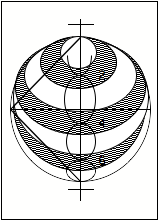
The Concrete Rays have a special effect on the Negative Evolution of the Devas, who form the Feminine Aspect of the Divine Hermaphroditic Man, working along the lines of more positive Development. The Abstract Rays do a similar work on the Positive Human Hierarchy, tending towards a more receptive attitude. This hierarchy forms the Masculine Aspect of the Divine Hermaphrodite.
At three points on the Path of Evolution, the Monads of Love, working on the Abstract Qualities, touch the Devas of Activity, working of the Concrete Faculty. The perfection of these two evolutions markes the point of attainment of the Divine Heavenly Man. It is the perfecting of the Two Major Centers, Creative Activity and Love, of the Logos. (In their lower aspects, these two centres are known as the Centers of Generation and the Solar Plexus, but are transmuted, as evolution proceeds, into the Throat and Heart Centers. Then, in a dual synthesis, they will pass into the Third System, that in which Power is developed, and the Head Centers will be completed. This achieved, our Logos has triumphed, and measured up to the Sixth Initiation -- just as He should measure up, in this Second System, to the Fourth Cosmic Initiation.
Madame Bee (holding a dahlia)
The Water of Life flows around and animates Mother Earth's body. Its one end issues from her head; it becomes foul at her feet (or at the Southern Pole). It is purified upon its return to the heart -- which beats under the foot of the Sacred Shamballah, which, then, in the beginnings, was not yet born. For it is the belt of Man's dwelling that lies concealed the life and health of all which lives and breathes.
During the First and Second Races, the belt was covered with the great waters. But the Great Mother travailed under the waves; and a new land was joined to the first one, which our wise men called the 'head-gear' (or 'cap'). She travailed harder for the Third Race, and her waist and navel appeared above the water. It was the 'belt', the sacred Himavat, which stretches around the world. She broke toward the setting sun, from her neck downward (to the southwest) into many lands and islands; yet the Eternal Land (the cap) broke not asunder. Dry lands covered the face of the silent waters, to the four sides of the world. All these perished in their turn. Then appeared the abode of the wicked (the Atlantis). The Eternal Land was now hid, for the waters became solid (frozen) under the breath of her nostrils and the evils windos from the (southern) Dragon's mouth....
Peter Bostic's Illegitimate Daughter (reading)
Stanza the Sixth, from the Sacred Book:
Within the cavern dark, the Fourfold One groped for expansiona nd further light. No light above; and all around the gloom enveloped. Pitchy, the darkness which surrounded it. To the innermost center of the heart, throbbing without the Warming Light, crept in teh icy cold of uttermost darkness.
Above the cavern dark shone all the light of day; yet the Fourfold One saw it not; nor did the light pervade.
The rending of the cavern precedes the light of day. Great, then, must be the shattering. No help is found within the cave, nor any hidden light. Around the Fourfold One lieth the vault of stone; beneath him menaceth the root of blackness, of utter darkness; beside him and above, naught but the same is seen.
The Threefold Watchers know and see. The Fourfold is now ready; the work of denseness is completed. The vehicle is prepared.
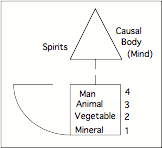
Soundeth the trumpet of shattering. Blinding, the power of the oncoming flame. The mystic earthquake rocks the cavern; the Burning Flames disintegrate the maya; and, lo, the work is done.
Gone is the gloom and the blackness ; rent is the cavern's roof. The light of life shines in; the warmth inspires. The Lords, on-looking, see the work commence. The Fourfold One becomes the Seven. The chant of those whose flame rises to all creation. The moment of achievement is attained. Proceedeth the work anew. Creation moveth on its way, while waxeth the light within the cavern...
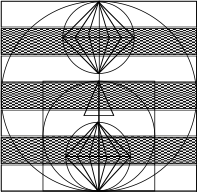
Clerk (seeming detached)
When the Queen speaks of poverty
Should the peasants stop to listen?
When the acrobat speaks of fear,
Should the Dragon speak of heights?
All turn circles of arid nascence
Along the corridors.
Some say the Kings might start a fight;
Others say nothing,
Knowing nothing is much
In the Land of Invective....
Fool
Time has turned the sea with terns.
Yarn has turned the dream with fables...
Personified Womb (Black-Haired Beauty, with wonderful hips)
You feel the draw of the loins of my beauty
Since Woman and Man now are approaching.
You see the Woman, whom for long
You've not seen now.
Venus -- the Evening Star -- comes to find you.
Impartial Observer
It seems to me that you're approaching your body --
What you call Kama Rupa:
Desire's ripe body.
Clerk
The Womb, you mean?
I am approaching the Womb...?
Impartial Observer
The Womb, the Body:
In reality, you fall to Earth.
Clerk
My mind is filled with lust for the soft husk.
Incubus comes 'roung to gather my coughings.
Coffins of longing
Seem the crust of my yearning....
(Lightning and Thunder. Rain begins to
pour.)
One of Macbeth's Witches (by here cauldron)
So, the Storm-Gods make their entrance.
Clerk (looking at clouds)
Spirit mounts on the shoulders of Matter.
When the Fall or the Flood comes,
The Clouds cast out their children...
Spirit of Darkness
Did you not say that Scorpio represents the death of the Personality?
You have been taught not to look back
At least not until then....
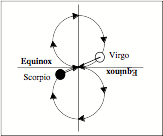
Clerk (trance-like)
I am the Sphinx, the stone-faced Lion.
Like Prometheus I steal
The element of Fire from the heavens,
To bring down to Man,
And then offer up my spleen.
Like him, I must fall.
The stone is the foundation point of the Spirit.
And when the Secret Books say that
'The Fourth Race developed Speech' --
I see that I cannot speak to Men yet.
I let them not come beside me,
Until Time cures my silence.
And when the Secret Books say that
'The Lords looked upon the Daughters of Men'
In the Astral Waters
And found them appealing:
So it is with me.
I look:
I see rich contour...
Woman (looking at a church spire)
The Mountains push themselves out of the Water.
They strive to build structure
In the Air near the Sun.
The Water, ever-churning,
Turns its wheel to suck them down again --
Ever drawing them to Earth again
With the churning of grim inertia.
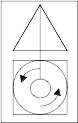
Clerk
And, so, the Titans of the Mineral Kingdom,
Like the Titans of Trees,
The Titans of Man,
Are drawn back to Woman --
Drawn back to grave Woman.
Water conquers all, they say.
The Giants are re-cast in the Womb to be re-born.
Old Woman (by a bridge)
Jesus, in Scorpio, talks to the Women.
The child, on all fours, is re-living the past
Clerk
Through animal existence, you mean...?
Doctor Von Helsing
Stimulation of the penis parallels stimulation of the throat. I see. So your throt has been experiencing dryness and some pain. Your desire has created a stimulation of the sex glands. You must channel this desire into creative work, for the throat is the higher center of creationn, from which the 'Mind-Born Children' do issue. That is the work of Brahma, the Hindu: who creates the world from the power of thought, from the words he gives form to....
Chorus
The Ray of Concrete Science. This (Fifth) Ray has a peculiar relation to the Animal Kingdom, in that it is the ray which governs the emrging of that kingdom into the Fourth or the Human Kingdom. The planet Venus, in her Fifth Round, gave the impetus which produced the spark of Mind (Manas) in Animal Man -- a fact well-known. It is also the Fifth Ray, and has an interesting connection with the Law of Fixation.
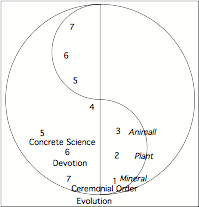
We can study, too, the analogy to be seen between these factors and the Fifth Root-Race, the race of peculiarly strong development of the Concrete Mind.
The Law of Love, in the Astral Body (6-2) also has its points for consideration. There is a direct link between the Astral Body (6 -- love in the Personality), the Buddhic Vehicle (4 -- Love in the Triad) and the Monads of Love (2). This is the main channel for the basic law of the System, System Number Two of Three, Love. These three points mark periods of compeltion -- and, likewise, starting-points for fresh endeavor in the life of the evolving Monad. This, from the Personality to the Triad, from the Triad to this Monad, from the Monad again back to its Source.
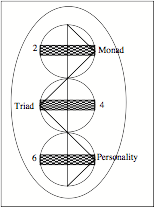
Newshawker (at a cocktail party)
Christian Militia Sluauhter Hundreds
of Refugees!
Unarmed Palestinians Systematically
Gunned down; Men, Women and Children killed; Toll May Reach As High As Fourteen
Hundred!
Isreael De-Claims Responsibility --
Yet Eyewitnesses Report Lebanese Christians Lunch With Israelis Between Forays
into teh Reugee Camp!
Israeli Press Demands Resignation of
Begin and Sharon!
Reagan Order the Marines to Return!
Read all about it!
(Mass graves, with children's legs poking
out beneath lime. New Jews have been
created by Israel. Tractors witth their
shovels full of bodies. Horror in the world.
Israeli positions cordon off the camps.
Christian militia pass through Isreali lines
to carry out murder. Return to rest. Then,
again, to the camp. The Warsaw Ghetto
lives in the mind. The screaming of
women. Throats cut by the Christians.
Palestinaian defenders, without weapons, far
off in Jordan. The Isrealis agreed to
evacuation of Beirut to enable them to move
in without resistance. Bibilical prophecy:
King Begin and his General. The annexation
of Sudetenland. The churning of American-
made tanks. Jewish New Year. Chosen
People: Master Race. Promised Land:
Liebensraum. Jewish Millenium: Thousand-
Year Reich. Armageddon: World War II.
Zionism: Naziism. Where did the world go?
The Age of God with a Sword Comes.)
Daphna Greenstein (with child, the Palm-Tree)
I will have to go back to Israel to find out what is happening!
I don't trust what the American Press says...!
Clerk (crying in to the void)
Israel and the Jew are not the same thing...!
Voices in the Crowd
He's a Jew himself!
Isn't he a Jew...?
Clerk
I am Jew; and I am anti-Jew!
I am Everyman!
I am Killer; and I am Killed...!
Oracle
Sharon plants the seed of Israel's demise.
America, as a continent, is a synthetic world -- that is, a synthesis of all cultures: the seed of a new world culture. The most independent, the most adventurous, come here. Those seeking Life. Breaking ties with the Old World form. America is change; and, as change, she shall endure.
Jacob Heimkreiter (wandering through the rubble of Beirut)
Where is my son?
They say he came here trying to protect the children...!
Clerk
I see a time, when the wheel turns, and the world calls us
We must sleep deeply, whie the world turns.
In the ritual of Nationalism, masculine powers will return.
Israel is a power; Germany moves toward reunion.
The world rejects us, and sends us home;
Yet, the world will find that American tyranny
Is to be preferred to the tyranny of other states --
For America includes, as its Body of Existence,
Elements from every land:
Specimens from each culture.
Can this be so?
Striving to discover our survival.
Never start a fight. Wait for another to strike the first blow. If struck, then you only must survive. If the striker, then, surely, you must win.
Thank God the Giant sleeps again.
America and Russia will be allies some day again.
The Statue of Liberty is a woman, you know.
Mother Russia ever sleeps.
He who wakes her pays his dues.
"The tenor of all this is real concern for your country," Charlie says. "You are really concerned for the survival of America. Which is odd. America is the richest, strongest country militarily in the world. And you are imagining some terrible weakness in America."
"At the time, America was weak," Crossmann says. "Not absolutely weak. But decaying. In despair. She had lost a war. Her president had been forced to resign in disgrace. She had been disgraced by Iran, the taking of hostages at the embassy; and then the feeble attempt by the military to rescue the hostages. Smoking helicopter ruins out in the desert. Steep inflation; with skyrocketing prices for gasoline and oil. Then a deep economic recession. But I think my own deep response to this was my own guilt. For I had been essentially wishing tragedy on America, as had many of my generation, because of the wrongs America had visited on the world. The left wing hates America. To the left wing, America represents all that is wrong in the world. From the perspective of the Anti-Universe, Life is evil, we must not forget..."
"So you were making this transition back to Life," Rose says.
"Yes, I was on the side of Death. I was rooting for Death. But then I awoke to the fact that inviting Death into my country was, in fact, a real thing, a real act, with real consequences..."
"For yourself as well," Rose adds. "The Dark Giant who threatened you was the Death that you had invited into your house. The principle of Chaos..."
"Precisely," Crossmann says. "And that was when I chose Life."
"Ariel Sharon has taken on a pretty important role in your novel," Rose says. "On several occasions you mis-spell his name, calling him Charon instead of Sharon. Charon is the ferryman in Greek myth who ferries the souls of the dead across the River Styx for judgment. His name means eagle and lion; so, in name, he is much like Sharon; and the root, Cha, means abyss or devourer. In some ways, Sharon ferried you from the anti-universe to the universe..."
"Yes. That is how I saw him," Crossmann says. "I feared him, because he woke in me a realization of reality. He woke in me the understanding that a boy must become a man. My father was dead. War was a reality of earthly life. I could pretend it wasn't. But Sharon reminded me it was. And, as a man, I needed to realize that...."
"You also clearly had a fear of Russia now," Rose says. "It seems you are trying to bargain with the gods about Russia, trying to insist that they can become American allies instead of adversaries..."
"The symbolism of the Bear shook me up," Crossmann admits. "The Bear seemed immense, in terms of symbolism. I was concerned about fighting Russia on Russian soil, certainly..."
"The sense of war coming is very strong in you," Rose says. "There are many warnings for you to wake up. To prepare for war. But it is not until you confront your own personal demon that you really wake up..."
"Yes."
"I am finding that I cannot completely ignore the occult texts we come across in the novel," Rose says. "Perhaps it is because I am beginning to see how they connect a bit..."
"They present a deeper level of the drama," Crossmann says.
"Yes, I see that."
Rose opens the book again, and reads:
Chorus
The Fifth Law, the Law of Fixation. This is the governing law of the Mental Plane, finding its greater correspondence in the Law of Karma on Cosmic Mental Levels. 'As a man thinks, so he is' -- according to his thoughts are his desires and acts; and so results his future. He 'fixes' for himself the resultant karma. The word 'fixation' is used for two reasons: (1) because the word implies the capacity of the Thinker to shape his own destiny; (2) because the word implies a stabilizing idea, for as evollution progresses, the Ego evolves the faculty of forming definite concrete thought-forms, and, through these stable products, of subduing the fluctuations of the Astral Body.
This law of the Fifth, or Mental, Plane is one of the most important laws with which we have to do at any time; and it will find its most complete demonstration in the next, or the Fifth Round. In relation to the Fourth Round, the following facts may be gathered about its working:
-- It is the law under which the Evolving Personality builds
up, during the course of many lives, the Causal Body;
it
fixes the matter inhering in that body, placed there by the
man
as the ages slip away, and crystallizes it. Before the
Fourth Initiation, the crystallisation is complete; and the
inevitable shattering, which is the result of crystallisation in
all forms, takes place, setting the indwelling life free for
further progress. All forms are but hindrances and limitations,
and,ultimately, must go; but they have their needed place in
the development of the Race. Eventually, the Causal Body of
the entire Human Race itself disintegrates.
-- This law governs the crystallisation of all forms prior to
their shattering in the process of evolution.
-- It governs the time of rebirth, being one of the subsidiary
branches of the Law of Karma. Eachof the Seven Subsidiary
Laws is linked to one of the Cosmic Laws, or with the Sirian
Law of Karma. We need always remember that the
consciousness of the Cosmic Mental Plane is the Logic Goal
of Attainment; and that the Sirian Logos is to our Solar Logos
what the Human Ego is to the Personality. The Law of
Karma, or of Cosmic Fixation, is the Law of the Cosmic
Mental Plane, and controls the corresponding law in our
System.
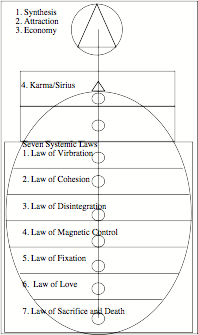
In the Fifth Round, this law will act as the Divider, temporarily crystallising and fixing into Two Great Classes the Human Monads, as they evolve. One group then (containing those who will reach the goal), will pass gradually out from under the domination of this law, and will come under the Law of Magnetic Control. The other group will remain under the law in a static condition, until, in a later period, a fresh opportunity will come; old forms will break; and, in another Mahamanvantara, and in its Fifth Period, will come the chance for which they will have waited, when they can again swing into the current of evolution, and the imprisoned spirits may again mount toward the source of their creation.
In an occult sense, this law is for us the one with which we are the most intimately conerned. It plays an important part in the hands of the Lords of the Flame, and is one of their main factors in controlling the Three Worlds.
Note her an interesting fact: Venus is the Sixth Planet (esoterically the Second) and is in her Fifth Round, and, hence, ahead of us along every line.
The Law of Fixation demonstrates the static quality of love, static temporarily, but necessarily so, when viewed from the standpoint of Time, the Great Deluder.
On the Path of Involution, this law again works with the Permanent Atoms in the Three Worlds, with the building in of material around these atoms, in connection with the Building Devas and the Reincarnating Egos. The Devas are the Mother Aspect, the builders of the Body; the Reincarnting Egos are the Son Aspect; yet the Two are One; and the result is the Divine Hermaphrodite, Man.
Impartial Observer
You are beginning to become arid, my friend.
The Scientist in you begins to be wearied.
Your power to hold yourelf out of the Water is slipping, by turns;
And, by turns, you must fall.
Clerk
Some would say that the Water has held me;
And tiredness from swimming in words
Makes my bed...
Woman Knitting a Shawl
Have you nothing more to say then...?
(Silence, who seems eternal, comes.)
Woman (looking up from the shawl she is knitting)
Some time, you know, you must come back to Earth.
Chorus
The Sixth Law, the Law of Love.
The Law of Love is, in reality, but the law of the System in demonstration on all the planes. Love was the impelling motive for manifestation; and love it is which keeps all in ordered sequence. Love bears all on the Path of Return to the Father's bosom; and love, eventually, perfects all that is. It is love which builds the forms that cradle, temporarily, the Inner Hidden Life; and love is the cause of the diruption of those forms, and their utter shattering, so that the life may further progress. Love manifests on each plane as the urge which drives the Evolving Monad onwards to its goal; and love is the key to the Deva Kingdom; and the reason of the blending of the Two Kingdoms, eventuallym, into the Divine Hermaphrodite.
Love works through the Concrete Rays in the building of the System, and in the rearing of the structure which protects the Spirit; and love works through the Abstract Rays for the full and potent development of that inherent divinity. Love demonstrates, through the Concrete Rays the Aspects of Divinity, forming the persona which hides the One Self; love demonstrate, through the Abstract Rays, in developing the Attributes of Divinity, in evolving to fullest measure the Kingdom of God within.
Love, in the Concrete Rays, leads to the Path of Occultism.
Love, in the Abstract Rays, leads to the Path of Mysticism.
Love forms the sheath and inspires the life. Love causes the Logoic Vibration to surge forward, carrying all on its way, and bringing all to perfected manifestation. The Sixth Ray of Devotion and the Sixth Law of Love have a close alliance; and on the Sixth Plane comes the powerful working out, in the Lower Triad, the Personality, of the Law of Love.
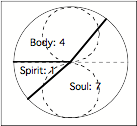
Clerk
I feel as though I'm being drawn away from my source. My drawing speaks of the Fall of Man. I am that Man. The womb, with it magnetic steel, draws me always. l A fire within me is blosing in a rain storm. A sense of loss. Looking down into the mire. Who goes there? -- coming her like a mite in meal. Midnight's acre and the diction of worry. Darkness on a dry leaf -- is like Hatred on a turning curlew's seal. Where have I come from? What message forcedme to fly like an outlaw? Outlaw from logic: the logic of Evil...?
(Shulamit appears, with a man, and smiles.)
Shulamit
I have been looking for you.
Clerk
I have looked for you also.
I have missed you very much.
This world has seemed so empty without you to walk inside it.
Shulamit
I will see you again soon.
(Exit Shulamit.)
Ghost of Israel
Were you missing her when you were cursing the Jews?
When you were damning her country
In that letter to your leader...?
Clerk
I am a jealous god, you say?
Ghost of Israel
The Jealous God condemns his sons because they see the power he has had. Jehovah concemns his children because they, through the desire for power, would, too, become a god. Yet, don't you see, you have condemned yourself too...?
Clerk
To see this is pain.
Yet, I know this is true.
So, what should I do...?
Ghost of Israel
Be fond of keeping still.
Each word you speak is a document for ever.
(Exit Ghost of Israel.)
"There are two more passages concerning these laws and rays which I think are valuable to our understanding," Charlie says.
"I am surprised that you are so interested in this," Crossmann says. "You said you weren't going to go that direction..."
"Well, we are running out of time, of course," Rose says. "But I think these passages are vital to your idea of the dual evolution: spirit materializing and matter spiritualizing.... Bear with me, please."

Charlie Rose reads:
Clerk
I am depressed.
I look around: everything has changed. All the faces seem unfamiliar; and those which seem familiar seem really too familiar. There is a battle within me which is raging and brutal. Sex fights to save its life. The Man battles the Woman for power. The Woman speaks of being free from the Man. She blames the Man for torturing the world. It makes me hate her -- for she is being so blind. For being so conventional in her liberalism. Mediocre mind seeks nothing of greatness. Couting the hsells of her accomplishments -- as the world's form teeters, and paralysis sets in. The paralytic accomplishment. Chauvinism of breast -- and the ambition of the womb. Eating the seconds by the mouthsful in hours. Strapping on the guns, since the gods foresake the Earth; and the Void aches....
Psychologist
So it is your mother you hate.
Psychologist's Assistant
He did hurt his left knee.
Psychologist
Splendid! We are getting somewhere finally...!
Refugees From the Sixties
It is Mother Earth he hates.
We don't need his type around...!
(Liberalism becomes fascistic without
noticing.)
"I think this is actually a telling passage," Charlie says. "The dualism has changed. The brother dualism has changed to a dualism between Man and Woman. This begins to edge us into the realization you have that a hatred of Western Civilization, of the White Man, is a hatred of self. This is the beginning of a realization in your minnd that the White Woman and the Dark Man, in their moral alliance, was your adversary..."
"Yes."
Rose continues to read:
Clerk (in response)
Peace is as tyrranical and oppressive as is War.
Smother me not with your logic of sleep.
It is not sleep I'm opposing;
It is the rationale of your slumber.
Group (in unison)
He makes no sense.
Apparently he is mad...!
(The Fire-Keeper squats beside the fire and
listens as the noise is lessened.)
Failure
So, you see me coming;
And you fear my tread.
Who are you anyway?
What is your purpose here...?
Anger
You wear my badge, at the ways of the world.
No one her is as great as you'd have them be.
Melancholy
Human, too human!
Factum est totem! Totem ist numeoem...!
Innocent Bystander
Who gave Klement Gottwald his hat...?
Voices in the Crowd
-Surely that cap must be made out of coonskin.
-Who gave it to him?
-Is the air empty?
-Daniel Boone gave it to him.
-He makes a joke of course.
-Give the man a raisin, for his Wisdom.
(Ronald Reagan living in Disneyland.)
Fear
Your sense of mortality, of age, came to see you.
Your picture of yourself as a living giant of body and power --
It begins to slip away.
The Warrior walks sideways.
Water falls from his scales...
Clerk
The world has changed since I was away.
(Advertising sign along the thoroughfare:
CASTRATION APPROACHING! GIVE
ONE PAHLLUS FOR THE SAKE OF
PEACE AND PROPERITY!)
Folksingers in the Rain
We are in a time warp.
We are in a time warp.
When we wake to find our food:
Nothing remains.
No wood;
No carp....
Folksinger in the Rain
Who killed Davie Moore?
Why -- hey, what's the reason for...?
(Death's shadow is cast on the concrete.)
Conductor
It is time for you to come down.
To give your secrets to your brethren now...!
Clerk
Yet where is he who gives the secrets to me...?
Chorus
On the Astral Plane, the Sixth Plane, the home of desires, originate those feelings which we call personal love; at an early point in evolution, this is demonstrated an animal passion; as evolution proceeds, however, it shows itself as a gradual expansion of the love faculty, passing from love of mater, to love of family, love of associates, to love of one's entire environment; patriotism gives place to love of Humanity.
The Astral Plane is, at present, the most important for us, for in desire -- not corrected or transmuted -- lies the difference between the Personal Consciousness and that of the Ego.
In the Sixth Scheme, that of Venus, this can be seen clearly. It is the Scheme of Love. Viewed from one angle, the Venusian Scheme is the Second; from another, it is the Sixth. It depends upon whether we recokon for the circumference to the center or the reverse. In the same way, the Earth Chain is the Third, if viewed from one aspect, and the Fifth while viewed from another.
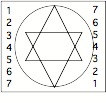
In the Sixth Chain of each scheme, this Sixth Law and the Sixth Ray have a very important significance, whilst the Seventh Chain of each scheme is always synthetic -- Love and Activity in a perfect balance.
The same effect can be demonstrated in teh Sixth Round. In the Sixth Round of the present chain of the Earth Scheme, the Sixth Law will demonstrate with great clarity and force -- as love shown in brotherhood -- that is, love as transmuted from the Astral to Buddhic. So, in the Sixth Root-Race and the Sixth Sub-Race a similar analogy will be seen. Out of the shattered form of the Fifth root-Race, built up under the Fifth Ray of Concrfete Knowledge, with the aid of the Fifth Law of Fixation, will emerge the Sixth Subrace of Brotherly Love -- love shown in the realisation of the One Life latent in each Son of God.
(A naked woman rubs her loins in a dream.)
Failure
Have you failed in your mission, friend?
Clerk
What is mymission...?
Failure
Oh, you have forgotten already...?
Fatigue, In a Brown Shirt
Why have you come to find me, young man?
Are you tired of climbing the moutain of air?
Are you tired of walking?
Don't you know who you are yet...?
Doctors (taking notes on his condition)
-He's been praying for the soul of America too long...!
-He rages, trying to caluclate her survival...!
-Mere child's play! Why doesn't he just content himself with money...?
Clerk (to Doctors)
Don't you understand: the worl's monetary system
Is on the verge of collapse.
From this will come Chaos, then Natinalism
Then another round of fighting to determine
Who will rule...
Doctors (leaving, downcast)
Why must he always be so negative...?
Bystander To a Friend:
Perhaps the bearer of bad news is actually the creator of bad news...!
Clerk
Where is Ahab...?
Conductor
You are Ahab. Don't you understand that yet...?
(Clerk is dressed as the Captain from the
German movie Das Boot.)
E.T.
Why are you people so desperate to leave here...?
Clerk
We have too many bad dreams --
And so we cannot sleep well...
Winter Elementals (as cheerleaders)
Nuclear Freeze! Nuclear Freeze!
Ice in our veins! Fear in our knees!
We're gonna wear the Big Blue Hat!
Gonna disarm both the dog and the cat
And live in peace...!
(Snow is blowing; a dam breaks open.)
Intellectual (angry at the Clerk)
Perhaps they have a right to be frightened!
Perhrpas there is a reason for us to get down on our knees!
And wear the big hat!
No one survives a Nuclear Winter...!
Clerk (as a cynic)
Obsequious patronization will not keep the sees from turning,
Will not keep the Law its fate from spinning....
Remember the Sans Arc
Who laid down their weapons
And were enslaved...!
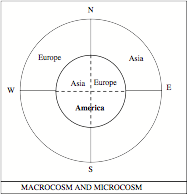
(Shulamit hurrying away from the Clerk.)
Voice of Shulamit
I have no regrets for the Palestinians.
They are all terrorists.
They should have no rights!
Terrorists should have no rights...!
(A child is dug up from the rubble of Sabra
Shatilla. Her throat has been cut. Men
carry her to a mass grave.)
(An American solider is killed by a cluster
bomb. By American law, Israelis were not
to use cluster bombs in an aggressive war.
Isreal denies using them. A previously
unexploded cluster bomb kills an American
solider.)
Mother of the Clerk (an apparition)
You are obsessed with this, you know.
You see Germany rising again, to oppose America.
The world re-alligns as we sleep.
What will we do...?
Clerk
We must, first, pray for guidance.
Then, we must prepare of awakening....
Ammenianus Marcellinus
Beneath the Pyramids there are subterranean passages and winding retreats, which, it is said, men skillful in the ancient mysteris, by means of which they divined the coming of a flood, constructed in different places lest the memory of all their sacred ceremonies be lost....
Clerk
It is I who wander in this labyrinth of sounds, in this utter maze of underground masses which bend and wobble with instincts from the past....
Chorus
The Seventh Law: the Law of Sacrifice and Death.
This law links itself to the Third Law, that of Disintegration, followin gthe connection which always exists between the Atmic and the Physical Planes, between the Third and the Seventh.
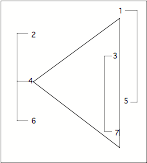
The Law of Disintegration controls the five-fold destruction of forms in the Five Lower Worlds -- the Law of Death or Sacrifice, similarly, control in the Three Worlds. It is subsidiary to the Third Law.
The Law of Sacrifice is the Law of Death in the Subtle Bodies, whilst what we call death is the analogous thing in the Physical Body. This law governs the gradual disintegration of concrete forms and their sacrifice to the evolving life; and it is closely linked, in manifestation, with the Seventh Ray. This Ray is the one which largely controls, which manipulates, which geometrizes, which holds sway over the Form Side, governing the Elemental Forces of Nature. The Physical Plane is the most concrete exemplification of the Form Side; it holds the Divine Life imprisoned or enmeshed at its densest point; and it works, at this time, in line with the Seventh Law.
In a mysterious way, the Seventh Law is the reverse of the First Lw, the Law of Vibration. It is Vulcan and Neptune in opposition, which is, as yet, an almost incomprehensible thing for us. The densest form of expression of the Physical Plane is, after all, a form of synthesis -- just as the rarest form of expression on the Highest Plane is but unity of synthesis of a different kind. One is the synthesis of Matter; the other is the synthesis of Spirit.
This law governs the seventh Chain in each Scheme. Each Chain, having achieved the fullest expressin possible in the scheme, comes under the Law of Death, and obscuration and disintegration supervenes. In a cosmic sense and analogy, it is the law which governs the coming in of Pralaya (Rest) at the end of a System. It is the law which 'shatters the cross of the Cosmic Christ, and places the form of Christ within the tomb for a period of rest....
Group of Preists (together)
Amen.
(Pallbearers lift the coffin of Jacob
Heimkreiter. The organ plays softly. They
carry the coffin down the aisle.)
"And, so here we are," Charlie says. "This entire passage, hundreds and hundreds of pages, since Jacob Heimkreiter saw his own funeral happening, and saw his own casket. This entire passage has been, essentially, the Mass of Jacob Heimkreiter. His funeral mass...."
"Yes. Jacob is carried to his tomb at the unjunction of the Chorus," Crossmann says. "Jacob is Christ, being taken to his tomb..."
"There is an order to this chaos."
"There is a structure to chaos," Crossmann says. "Even as their is chaos in structure."
"I can't help but think this book is, as was Joyce's masterpiece, Finnegan's Wake, a river," Rose says.
"The Willamette River," Crossmann says. "I spent much of my life, during this period, wandering near the Willamette River. Taking long walks. Fishing. But you are right. It is a river. Everything is being carried along by the river. Characters appear magically. It is as if characters a bits of flotsum, pieces of driftwood, that bump togther for a moment, carried to and fro by the current..."
"That makes me wonder if you are still in the ark?"
"It seems that way, doesn't it," Crossmann admits.
"We can't read the entire novel tonight," Rose says. "We need to skip ahead. Marine are killed in Beirut. One of the US soliders killed in Beirut is named Reagan. One of the wounded is named George Washington.... You seem to make something of this. Does this have some kind of mystical meaning...?"
"It did to me at the time," Crossmann says.
"Napoleon's Ghost appears in chains to the Clerk," Charlie says, "and tells him: 'The struggle for power is the struggle to forget.' I liked that line a great deal. Then you have a strange kind of prophecy. Well let me read again:
Oracle
The Puritans come into power at the end.
As it was in the beginning.
Fundamentalism sweeps across the Earth.
Iran carves its sword.
Israel sees its mission in Russia
To free captive Jews from the Bear.
He who loves peace must,
In peace, foresee war.
Gather your strength in.
Make your mind solid....
Innocent Bystander
Trinitary Mind becomes Dualistic Soul.
The Three becomes the Two again.
Then each side reads the language of stars....
Clerk
Must there by anti-semitism here --
And in the lands of Europe?
Which drives the Jews, in defense,
Into their fortress?
In which the strive to enact
Their own annihilation...?
Conductor
Are you not anti-semitic?
Clerk
In my maddest hour I am so.
I begin to single out Jews in my mind...
Yet, I am a Jew myself.
Often, in the streets, people ask if I am a Jew.
It is because I am a Jew that I decry their failures.
It is because I judge myself,
In judging their plight....
David Blumenthal
Tell me something about the Astrological Scapegoat.
Is Capricorn not governed by Saturn-Jehovah...?
Clerk
Men, as idealist, tend to demand a sense of Right, which gives them the power to act. When the Chaotic Principle devours all order, the Woman calls the Man back to rule. To scatter the Chaos away with the wind....
Benjamin Heimkreiter (in tattered jacked and overalls)
You are telling me what you have already told me. Is there nothing new in you? No new discovery? Then why continue with this charade you call art...?
Clerk
It is Life which you deride.
Call you then Life, itself, a charaade...?
Benjamin Heimkreiter
Life is a charade we've mis-called Art...
Clerk
Cynicism answers nothing.
Benjamin Heimkreiter
Faith answers nothing either.
Clerk
Faith answers a need to believe.
Benjamin Heimkreiter
Faith is another word for our desperation to order.
Conductor
You have been admitted by the Fathers into the den of their authority. You have been allowed to see the world as it is coming, from the mountain perch high above the seas of illusion. Is that true -- or false?
Clerk
I have been on the Mountain-top. Yet, was it the Mountain in the Air -- or the Mountain under the Water? It seems to me that I was the Son; I sat on a throne. I saw the worlds in their nascence...
(A woman falls in her chair at the Fifth
Street Public Market.)
(A Tibetan holy man sits at the table beside
the Clerk. His followers surround him and
speak of enlightenment. They drink Dos
Equis beer, and speak of Kant.)
Shakti
Let me dance my violet dance
Through your spores and through your sprockets --
Let me dance in your empty halves,
Down through your heads and out through your pockets.
Look at the Old Man and document his power.
Challenge his authority.
Fall; and carry your word to the others...
Rabbi Nachman
September 21: Day of Atonement with the Father.
"Atonement with the Father," Charlie Rose says. "That's what this is about. Atonement with the father...!"
"Yes."
"And we will see more of it later," Charlie says. "The dream in which your dead father is seen floating down a stream into the ocean; then he rises from the ocean, dressed formally, dressed in a tie...."
"The resurrection of the tie," Crossmann says.
"Yes; you call it the resurrection of the tie," Rose says. "And then you begin wearing a tie yourself to work..."
"Yes. Formality returns," Crossmann says.
"Not just formality," Rose says. "But also the phallus. This is clearly an anti-castration motif..."
"Yes," Crossmann agrees.
"Shakti is who or what?" Rose asks.
"Shakti is electrical energy," Crossmann says. "It comes in to your body; and it makes you shake, vibrate. It is what Blavatsky calls Fohat. It is the electircal force of initiation..."
"You have experienced this Shakti?" Rose asks.
"Oh, yes," Crossmann says. "Many times."
"And you personify this energy," Rose says. "This is really quite funny."
"Yes, it is funny."
"One of the interesting passages from the occult texts we just passed through," Rose says. "The concrete rays tends toward the occult. The abstract toward mysticism. These are the Day/Night dialectics. You are demonstarting these patterns, through this novel...."
"That is true," Crossmann says.
"We need to take a break," Rose says.
"We are back with Michael Crossmann," Charlie says. "It has been a long night already. It is Millennium Night; and both of us are poised, at the end of filming this show, to step out of the streets of New York and enjoy the coming in of a new millennium. But we're not finished here yet. We are trying to understand how a good, open-hearted liberal man, a child of the Sixties, could be transformed, almost overnight, into a supporter of Ronald Reagan, a proponent of law and order... You are still, at this moment, a liberal man, identifying with the poor, the dark-skinned, distrusting Ronald Reagan...."
"Yes, that is true."
"What happened?" Charlie asks.
"Well, I've told the story many time," Crossmann says. "Spiritual re-birth happened. Reincarnation happened..."
"What does this mean, reincarnation?" Charlie asks. "Most Americans don't believe in reincarnation."
"Most Americans don't understand the subtlety of the ideas of reincarnation," Crossmann says. "We reincarnate often during our lives. Reincarnation is about vitalizing a dream, an ideal, a life impulse. It is about coming back to life after a period of despair, a period of death or depression..."
"So, you don't associate this idea from life to life?" Rose asks. "A lot of -- you know, Shirley McClain -- there is a lot of shallownesss..."
"There is a lot of shallowness associated with spiritual ideas," Crossmann says. "That doesn't make the ideas shallow. It makes shallow the people who make the ideas shallow. Look, Charlie. If one identifies with the Life, then one sees oneself as an endless transmutation of energy, from atom to mineral to plant to animal to man and spirit -- clearly this implies reincarnation. The life goes on; the forms change. The bodies change. But the Life driving the Form -- that is the real thing. That is the spirit within, which does not die..."
"Yes, I see that point," Charlie agrees.
He opens the book again.
"We see here that the Clerk, the Second Son, the Author," Charlie says. "Is turning against Woman, is seeing himself as a Man, the son of his father. Let me read. After Rabbi Nachman proclaims September 21 as the day of Atonement with the Father..."
Woman Holding a Crucifix (near a church)
There is rest for the wicked, mister.
While others sleep, you will be working...!
Oceanus (to the Clerk)
Fit thy soul, Prometheus, to moods
To thee full new. New king the Gods have now.
But if thou utter words, thus, rough and sharp,
Perchance, though sitting far away on his hill,
Zeus yet may hear thee, and his present wrath
Seem to thee but as a chcild's play of distress.
Nay, though a poor sufferer, quit the rage thou nurtures;
A Monarch reigns who gives accountin to none.
Clerk
Silence I seek to cultivate, as always.
Yet, something, the Spirit, seems to drive out the words.
I speak, as a stone speaks,
Struck by Aaron and his rod.
The Sphinx drives all nativities....
(The Clerk finds himself standing at
Stonehenge.)
Leslie Rhodes (walking on the air)
You exiled yourself when given orders to kill.
You plunged into Matter as the Fish swims in seas.
You swam out of Heaven, defying the gods.
By becoming receptive, you can, again,
Come to heaven....
(Clerk fears the tyrrany of women.)
Cleerk as Poet
Come in, friend.
Let the Scientist rest for a time.
Come in to my harbor:
Where Sounds become Forms....
Image of Dolores
Why do you refused to be with us?
Why won't you come down here?
Why must you stand, alone, on your cloud...?
(The Water, still, does not seem clear to the
Clerk.)
Anger
Why can't the world see me?
Why can't it sense my greatness?
I demand some approximation of perfection!
Damn the world, if it cannot become great...!
(People seem to avoid the Clerk. Shulamit
rides by on a bicycle -- careful not to stop.)
(Clerk sees himself as the manifestation of
Evil.)
Chorus
In concluding the information regarding the Laws, it is needful to remember the extreme danger of dogmatizing about these matters, and the risk of laying down hard and fast rules. Much must remain unexplained and untouched; true comprehension is, as yet, impossible. Until Fourth-Dimensional Sight is developed, it will be scarcely possible for us to do more than to hint at, and get a passing vision of the complexity and the intnerweaving in the System.
The Principle of Mutation governs the constant changing and shifting, the endless interweaving and interlocking, the ceasless ebb and flow, in the dramatic interplay of the forces which stand for the dual synthesis of Spriit and Matter.
Clerk
I am drawn away from this now.
You! I am looking for my father!
Have I far to go to reach this castle...?
Ghost of Franz Kafka (laughing)
Far to go? Certainly not.
I, myself, even traveled there once.
Do you have your masks? One for each idol...?
Ronald Reagan (before a group of Veterans)
I noticed a demonstration today against our nuclear armament. I truly beleive that the majority of those involved in this type of demonstration, and the leadership, to be sure, are not genuinely motivated -- but, rather, would like to see America weakened, and her position in the world and her security undermined...!
(No one hears this statement. There is fear
among the Republicans of great losses in the
November election. Reagan seems to be
looking for a scapegoat.)
(The German Government has been
overthrown. The Right-Wing Christian
Democrats take over power. The 'center' has
collapsed; Righ and Left Wing, the Greens,
remain, with the central issue being
America. Helmut Schmidt promises that
Germany will 'still be a reliable member of
the world.')
Clerk
Where have I come to?
I feel lost and alone...!
Crone Beside a Fire
You have cursed the Gods; and, so, you are punished.
Why whine about your punishment?
We all have our burdens --
You are not the only one you know...!
Clerk
My vision eats me; and makes me weep.
Crone Beside a Fire
You shoe to purseu this course.
Now, are you sorry for what you have done...?
Clerk
I had no choice. I was called -- and so I came...
(A ship passes in the dusk. Ahab stands at
the stern.)
Literary Critic
This book of yours has become tedious and quite uninteresting.
My recommendation is that you give it up -- and move to something else. You have reached the limits which this form can offer you....
Clerk
Perhaps he is right.
Cecil B. DeMille
What choice do you have?
You must go on with your epic.
Would Homer leave Odysseus trapped with the Sirens?
Would Goethe leave Faust in chains on his mountains?
The Emotional Element comes to clean thee.
The Woman in you will approach and will free you...
(In a dream, the Clerk and his uncle, Eugene
Hittner, pursue the Clerk' father; he is
robust, running through the rain on a city-
nighted street in an overcoat; he stops when
he hears them; approaches slowly; seems
old.)
"He is now speaking of his own father being the Emperor, of his own father owning the castle," Charlie says. "And, out of the other side of his mouth, he is 'fearing the tyranny of women'. We haven't really heard any of this before... It is also interesting that you voice your own concern about the direction of the novel as a work of art. You have literary doubt..."
"I have real doubt," Crossmann says. "Literary doubt is probably something fatuous. My doubt is very real..."
"But you have no less a figure than Cecil B. DeMille to straighten you out," Charlie says, laughing. "I loved that appearance... And here's another interesting conclusion....
Clerk (to a shadow)
The Gods are becoming desperate to act.
Fear makes them tremble.
Whom do they act for...?
Shadow (to the Clerk)
They act for their children, of course.
You have refused to procreate children -- so you can reamin detached from the chaos. Yet the Gods must protect the order for their children. They believe in house and home. They've been handed the role of Gods -- and they have accepted....
Clerk
And do they believe that I oppose them?
Shadow
You refuse the work of the Gods and the Not-Gods.
You travel from camp to camp with your message.
Clerk
And the message is that we should not be opposed to one another?
That we should unify?
That the rule of the Woman (of Night) will dismantle --
And that a struggle for power on the Earth will ensue...?
"Again, a reforming the question so that the Woman is the force of Chaos," Charlie says. "The Men should unite. The Women would dismantle..."
"Yes," Crossmann agrees.
"Then comes a very intersting scene with Einstein," Rose says. "A very interesting series of interactions. We are getting closer to this transition of the author surely. In fact, it is happening right before us...."
Rose continues to read:
Clerk
As the World of Certainty in physics (the atomic level of existence) is governed by the Law of Causality (or, at least, seems to be) -- the World of Uncertainty (the sub-atomic levels) are also governed -- yet not by Time (by Causality), but by Sound: by analogy, by metaphor -- that is, by musical proportion. You cannot study one isolated particle, in the realm of uncertainty, for each particle responds and is responding to another. Harmony of Movement: the balancing of sounds....
The World of Certainty is related to the social "individual" -- an isolated part moving independently of the whole: able to be programmed and determined. Yet, beneath all this, or above all this: each individual cell or 'World of Certainty' has a role in a larger Collective existence, governed, not by the Law of Causality, but by the Law of Analogy: spiralling high, into an unseen certainty. 'Probability' is a word which describes our lack of vision....
Einstein
Again, you and your Electron Beam...!
Clerk
The Beam itself can be determined by Science.
Yet each individual electron which composes the beam seems to be random in its behavior -- free. In order to study the 'certainty' of each electron, one must study every electron in that beam -- to see how each responds to the other...
Einstein
Your analogy seems faulty. You said, earlier, that the social 'individual' was determinable. You should have said that the Collective was determinable -- the 'individual' was the 'uncertainty' principle.
Then you could have said that this 'uncertainty', also, was an illusion, since the 'free' individual could not be studied (if study him we must) as an isolated unit -- rather, we must study him in relation to every other particle; and, in so doing, of course, we will come to the understanding that 'Balance' or 'harmony' (action-reaction, to put it in a gray coat) govers the 'uncertain' realm of this subatomic world....
Clerk
I'm glad to hear that you were listening. Just testing you to check your comprehension...
David Blumenthal (on a park bench)
Actually, it works both way, depending on where you are standing.
Conductor (to the Clerk)
See, if you have patience, the world comes to you. Never forget this.
Associate
of Made Bee
You will notice that the man in question, who goes by the title Clerk, developed an amazing power to repel particles fro the Spring tot he Autumn, giving him an opportunity to devote himself to his studies. Few could approach him. Those who did were often singed by the experience: burned. For he is like a fiery Sun, a Star, burning the unwary who approached and asked for a lightness...
The wheel is turning now; and the power to repel has become the power of Attraction. From an exploding seed of light, showering sparks on teh world of form, governing the world from a distance: he now moves toward becoming a Black Hole -- that is, ghrough the powwer of thought or meditation, of drawing in (through mesmerization?) all those lesser lights around him. People who approach him now are governed by his magic. Drawing his world back into the seed, as the Sun will draw allthe planets back inside, when the period of Obscuration or Rest has returned.
Student of the Associate of Madame Bee
You mean that by giving up his power, he discovers his true power?
Through the power of attraction, he reports what he has seen on the globes...
Associate of Madame Bee
Yes. Before sending out his planets, once again, on their mission of life...
(Clerk is seen talking to a beautiful Jewish woman,
Jean Caroon, about literature and the nature of reality.
She cannot budge. It is as though he is making love
to her mind. They talk for hours. It seems like
minutes. When she finally leaves, she mutters
something about being 'mesmerized'. She leaves
feeling they, somehow, have become intimate.)
Conductor
Women are sent to you in the Autumn. They will approach you. The 'Woman' becomes active as Nature in the Autumn. In the Spring, it is the 'Man' who becomes Active. As you have ascertained long ago, the Body is vitalized as a principle in the Spring. Only in the Autumn (onward) does the Mind, as a principle, rule. This allows you to lift these 'women' out of their bodies, into heaven, for a view....
Clerk
Will Dolores appear soon? I wait for the dream which last year occurred, in which I was cast out of the sky down to Earth. Dolores was there watching. That dream was accompanied by vomiting and shaking, Madame Shakti, over which Dolores watched, as the symbol of the fall...
Conductor
Only when the Emotional Element is impersonal: only then should you go down into Water....
(Rains pound the Earth. Water rushes through the
town.)
Unnamed Bystander
Doesn't the Clerk see that it is through his Uncle Gene that he can reach his father...?
Another Observer
It is interesting that the 'Pitris' of the Secret Doctrine you present, the 'Fathers' of the lower sphere, the Lunar Lords, who appear at night to build the body again -- it is interesting that when these 'Fathers' appear that the Clerk should return, in his mind, to the idea of the 'Founding Fathers'....
You will notice that, during his journey into heaven, which began in our spring, it was to these that he prayed for guidance. Worshipping his ancestors -- that is, finding his 'roots' in their wisdom....
Unnamed Bystander
Attempting to resurrect them with his prayers.
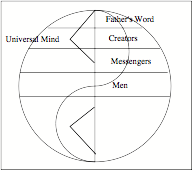
Clerk
We need to re-fresh and update the work of the Fathers. We need to re-become them. We need philosophers to rule again. The Renaissance Men who established our country....
(Depression, dressed in black rags, is claiming people
as they walk by on the street. They pretend not to
see him. He claims them by hanging a tag on the
backs of their coats.)
(Anger claims people by offering them scents of
spices; then withdrawing the scents...)
(The Clerk sees a personality crumble. It is a bag
filled with air on which a happy face has been
painted.)
David Blumental (sitting beside a wishing well)
Your fear of the death of America is your fear of the death of your own Personality. All throught he light months you have portrayed yourself, in your own mind, and, therefore, also in space, as a savior of America -- through dismemberment. But if America falls, you also fall. And you fear this. Remember the injunciton: when Death comes to find you, give yoruself to her softly....
Isaac Amatof
Give up your power gracefully. You will find that your power, again, will return. Besides, there are things to be done while you are here. It is the American Culture which is ruling the world. Give this Global Culture the gift of your genius. Be a soldier when you must be; but be a poet when you can be. You re-make the world (and you make the world better) through the hearts and the minds -- through art and literature -- through appreciation of beauty. Show that you can love, and your muse will return....
Clerk
Death is then the Woman I must love?
Mythologizer
We must not forget: Memory is the Mother of the Muses...!
Clerk
Memory is gone in the first half of the year. I cannot remember my past and so I seek power. Memory, reflection, returns with the Snake, in the Scorpion's brood. The Muses are born here. The Conscience comes screaming. Prometheus (foresight) is tortured by Empimetheus (memory)....
Warrior-Side of the Clerk
Which nation is best equipped to lead the Earth? that is what the issue is. Which nation's ideals are the building blocks of tomorrow? America is the synthetic continent. Synthesis is the final activity. The bringing together of all elements of the Earth. The most independent elements. The lead elements. America is governed by Libra, for her 'document' is Freedom; her defining idea is liberty. 'Law' takes the place of personal emotion, retaliation in an endless blood ritual.
Should we lead the world -- or should we hand the reins to another? For someone always fills the void. Some power demands expansion. We are the 'creators'. We create the world in a form from our mind. Soon a challenge will come to our Will. Someone else wants to rule. Yet, what is their doctrine...?
Clerk
Loss of Memory. Lethe. River of the underworld, from which souls drink, prior to being re-born.
Loss of Memory, it seems, is part of the design. For without loss of memory we would never act. Memory, or so it seems, is being pulled back into Time: being peeled back into the Present....
Einstein
The vacuum is an illusion, of course. A true vacuum, in nature, is filled with anti-matter...
Clerk
What has that to do with this...?
Einstein
Everything, of course. Loss of Memory is that void -- that vacuum. Memory is life in Anti-Matter. Loss of Memory is the void -- that is, it is the point at which anti-matter disintegrates or flips and becomes matter...
Clerk
You are becoming dangerously metaphorical, my friend. Soon they may lock you up in a madhouse...
Einstein
Psychologists call this 'transference', young man. It wasn't so long ago that you were (mentally) preparing your own bunk in the madhouse dormitory...
Clerk
What you say is true, friend.
Einstein
About this anti-semitism you mention: it is in us all: self-love accompanied by self-hate. Look at Heimkreiter. It is his great underlying trauma. One that he even refused to fully confront in your walk. He hinted at it. Love of the Earth and Love of the Air. Love of the Air is, in fact, hatred of the Earth. You condemned the Israelis for several reasons: (1) from a geuine desire to protect the defenseless, the weak; (2) from jealousy that the Israelis were the warriors you unconsciously wished to be; (3) from fear that the Israelis were more powerful soldiers than your own soldiers; (4) because the raising of the spirit of your own nation requires an enemy -- an evil adversary.
You wish the world to be clear-cut as it was in the 1940's -- when America was good, and Germany and Japan were bad. Clarity. You have been walking in the fog so long -- your long for some real clarity. You wish to create another Hitler on the outside, one that your can fight, a dragon you can defeat. This is what we all do. This is a human action.
If the Jews are punished again, you will be pusished. For you are one of us. By creating victims in the light-months, you become the victims in the dark-months....
You are praying that America will no longer appear the Evil force in the world. You long for American Innocence again. You long to protect the world from disaster. Yet, are you not that very disaster? I do not know -- I am asking. Unity comes from a need to find union. American petty political differences seem very small when compared with what you have been experiencing....
Clerk
I wish to love my people. I have been too long in exile.
Einstein
Condeming your people because they have not been perfect. You Americans are very hard on yourselves. Demanding perfection; demanding the greatest ideals in the world. Damning yourself when you fall short. Perhaps that is your greatness -- for aspiration requires a reaching for stars. If you compare your country with perfection, then it falls short; if you compare your country with other countries, then it seems to be doing quite well....
(Shulamit at the Public Market.)
Clerk (to Shulamit)
I have a table. Will you come and sit with me...?
Shulamit
I'd rather not...
Judge (sitting before the world)
I have heard the evidence. You are guilty of having sinner, in speech, against the Jews. Where there is a God, there is also a Demon, a shadow, which becomes animated. In your highest aspect, you shouted for justice for the Palestinians; yet, in your lowest aspect, you were a kind of Hitler. You will travel, in your Judgment Day, and meet this lowest aspect straight in the face. It is you too. You must absorb it -- and take away its power to terrorize you. This is the cost you must pay for seeking spiritual power....
(Daphna Margalit buys gum drops at a candy store.
The Clerk touches her on the shoulder. He speaks to
her. Why is she so far away? She seems such an
angel.)
(Clerk watches Shulamit from a distance.)
"I am focussing on this section," Charlie Rose says, "because it seems pretty clear to me that this is the place where this transition, this re-orienation of your own thinking is happening. And it happens because of a reassertion of the influence of the Father Principle in your life. The long first part of this novel is the story of a Father looking for his Son, a Father looking for his own conscience, the Son being that soul, or that conscience. But this has changed. Now the Son is looking for the Father, a kind of strength, a position of Law. The Son is looking for order, light, God's law. The Father has to go into the darkness to find his Son. And the Son has go to into the Light to find his Father. Apparently. That is how this is seeming to me..."
"He is in the process of mythologizing his origins," Crossmann says. "Raising them up again, out of the waters, out of the darkness and the cynicism. Seeing them in their original light..."
"Where the Founding Fathers existed," Rose says.
"Yes. He's trying to find the founding fathers," Crossmann says.
"His roots? Like Charles Haley did?" Rose asks.
"Yes. But he is looking for his roots in heaven first," Crossmann says.
Old Man (near a shed)
If you are Death, then -- what your call Spiritual Life --
Why feel such sorrow at touching the most beautiful,
Whom you wish to join?
Is Death, herself, evil...?
Clerk
I have been fighting Death, myself --
Seeking to find a way to deny her.
Humor
Why take everything so seriously? Can't you laugh? Laugh at yourself. Your fate is not so dreary. Why do you demand that Sorrow be your guide? Don't be so damn Germanic. Learn to laugh -- and it will keep your heart young...
Voices From a Balcony
-- Russia is to Sparta when America is to Athens. Russia represesents the ascetic military-disciplined, orderly society. America is a motley of nations -- nations within a nation -- which deifies freedom above order.
-- America exists for those who say 'No' to the Old World. Who say 'Yes' to Life. And 'Yes' to youth.
-- America represents the synthesis of matter. Some theologians call it Hell -- yet it is the mirror of the highest of the gods. Spirit is latent without a body to dwell in; the Autocratic patriarch, who has no humor, condemns his own body.
-- Corruption comes in many forms. How great can a society be builds walls to keep its citizens imprisoned? Which condemns its independent minds to death or desolation -- and to risk their lives to escape to America...?
-- Those who rebel against the Theocratic State, in whatever guise, religious or anti-religious, are cast into hell -- thereby finding independence, both its costs and its gains...
-- Russians are the Puritans; Americans are the Indians...!
-- No, the Russians are the Indians; and Americans are the Puritans...!
-- You make too many generalizations. Everything seems orderly from your perch on the mountain. Yet, down in the valley, down in the land of particulars, all your order comes apart...!
-- America is the land of Gigantic Egos, or the Titans. Yet the First shall be Last; and the Last shall be First.
-- Don't you understand: Paranoia is a location! And you have just visited there...!
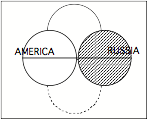
(The Clerk takes a zinnia fro his garden and places it
in a glass on Shulamit's drafting desk.)
Town Crier
All is well! All is well!
(A mime tires to balance a beam on his nose.)
Echo of the Clerk's Words (while speaking to the Neo-Nazi)
If you would intern the Jews and the Blacks and the Hippies, then please intern the Catholics, or at least myself: I would be with them...!
Chief Jailer (keys rattling)
Please come this way, son. What you ask for, you receive...!
"You are clearly struggling with the ideas you had in your youth," Charlie Rose says. "That America is Evil; and Russia is good. That is the left wing perception, the one you embraced in college, in your struggle against your father's perception of the world. You are coming back to the view that your father was actually right..."
"I am struggling to overthrow my youth," Crossmann says.
"To betray your youth?" Rose asks.
"Yes, in a sense," Crossmann says. "The world is turning. The world is ever-turning. Every perception is dethroned. Every perception is an illusion in that it is impermanent. The light shining on it changes, turns dark. Every perception becomes a lie..."
"You are fighting against Russia in your mind," Rose says.
"Trying to defeat the old ideas that are clinging to me, holding me back," Crossmann says. "And it is not just myself, as you suggested. Clearly this is a struggle going through the Earth's psyche. When Michael, the Archangel, appears on the Earth -- as he appears in this novel -- to lead the struggle against the darkness, it is not just in my novel that this appearance, and this struggle, takes place -- but in Eastern Europe and in Russia as well. The darkness that Michael overthrows is not just my own Dark Giant, Gilbert Patton -- but it is also the Dark Giant on the Earth, the Russians, the communists in a general sense..."
"You have the left being the darkness then," Charlie says.
"Well, it depends which universe you are in," Crossmann says. "When you are in the anti-universe, the left seems to be the light. When you are in the universe, the left seems to be the darkness..."
"It is all appearances then?"
"Yes. Ultimately it is. Ultimately it is a great drama being played out by the forces of light," Crossmann says.
"Nothing absolute?"
"We can't know the absolute," Crossmann says. "We don't see the absolute. That doesn't mean there is not an absolute. I believe there is an absolute..."
Charlie Rose reads:
Clerk
Yet, by fighting this war on the Mental Planes, don't I refuse to carry this ware out into the world...?
(Adrian Leverkuhn is seen walking with his niece.)
(Richard Wagner, dressed in lilac.)
Richard Wagner
I am great and I am small.
The Great loves; the Small seeks to find
A reason for my fall.
I live in Heaven and Hell;
In the crown of Joy's mouth;
And in the Land of Paranoia.
The Anti-Semite in me seeks
An adversary who is suitable...
Clerk
Who is really Evil here?
Yes, it is I. I can see it as all one plan;
Or see it as two, battling for power.
And which am I?
To act; or to be acted on?
Faust in me grieves.
Yet I would rather grieve than to act
Without knowing.
Yet, if I refuse to act --
That is, if I refuse to rule --
Then others less able than I
Will rule and act in my stead....
It is the Feminine Mind, the Mind of Desire,
Which creates the image of War in apparel.
Water comes raging in Night to transpire;
We pick who will kill us;
And, in killing us, they wake us.
Picking an adversary is like picking a mate.
Gentil picks Jew because he
Seeks to love her...!
Leslie Rhodes as the Wind
Such sorrow you wear as the threads of your vision.
You resist your fate -- and the fate of the world.
It is your moralism which gives you pain --
Yet your moralism makes me come to you.
Learn silence and you will not grieve so much.
You are so eager to speak of what you see;
Yet, where there is Vigilance of Will
There is also Vigilante Ardor.
One stands for Justice;
The other leaves merely a body of hatred,
In which the one you leave behind
Takes abode...!
Mother of the Clerk
You school both sides in what they're to do.
One side you arm;
The other side you teach
The martyr's true nature.
You have not lost your soul, I trust.
Are you Time itself, then?
Are you the Guardian of America?
Do you carefully guard the sleep she is sleeping...?
Clerk
I am the Law itself.
When it is time to act, I act.
When it is time to rest, I rest.
Fate
You wish a private fate for America, then?
On in which the degradations of the past
Are transmuted...?
Stage Manager
We must prepare for the entrance of the Murderer,
In the last act.
For the Murderer puts the creation
Out of its misery...!
Actress Not Wearing Make-Up
Don't give us that 'Holier than the Law' attitude!
We have seen you in your plotting for power!
We have seen you in your weakest moments!
Don't pretend that you are above murder!
Not long ago you planned rage with your army...!
Clerk
But I was following the Law...!
Sigmund Freud
The Dreamer can justify anything to himself.
The Dreamer organizes his imperfections
Into a rationale for what he calls 'nature'....
Voice of Anat Margalit
Is it your desire for Fame
Which makes you speak your verdicts...?
(Clarity, standing in the wings.)
Clerk
I love you, Shulamit.
But I am trapped in this distance.
Who is the loser
When Perfection becomes Tyrant...?
Stage Manager
Thre is no going back, friend.
Into the woods, with your shield, you must go...!
Voice of Anat Margalit
If you would judge, then you also must be judged.
If you would sit as a god, then you must fall and be gored.
Sleep when sleep can come to you.
Do not wake until waking is clear.
(The sound of a train whistle filling up the morning.)
(Snow, somewhere, beginning to fall.
(And a father weeps, now that his children are gone.)
Voice of Dolores Lockhart
If you would seek power in Heaven,
Then, also, you will have power on the Earth.
Then you will fall from power
And begin your cycle into form.
(Beethoven's Ghost at the market plots success. The
Clerk daraws diagrams and speaks of Godhood to a
friend, a Jewish man, Salo Rawet, to whom he gives
his treasures of vision, drawn on a napkin.)
Clerk
Each angle of reality is merely a Different Time.
Each person we meet at a give angle of reality
Is ourself existing at that other moment of Time:
Each is a mirror of our own future and past.
The Sun-Hero, emblem of the Soul,
Symbolized by the number 8,
Journeys through every station of the cross,
Every angle of reality,
Every Minute on the Wheel.
He does not stop -- but travels in an endless arc --
Sometimes in the ark and sometimes on dry land.
Speaking words as he goes --
He is unstuck in Time.
(Shulmait appears tot he Clerk and thanks him for the
flowers. Her smile is very precious. She tells the
Clerk that she likes his drawings.)
Wandering Jew (as David Blumenthal)
You are the manifestation of Jehovah.
You condemn the Jews since they would be like Gods.
Then you've remorse;
You take them to heart;
You tell them they are chosen.
As the Spirit and Body separate in the Spring,
So, it seems, does Aryan and Jew --
for these two parts make up your self:
Spirit and Soul;
The Masculine which climbs;
And the Feminine which falls.
They separate, as you and Shulamit separate;
And then they approach;
And, again, love one another.
Clerk
The Jew is the female part of ourselves, the Moon part.
Which we blame for our fall.
Which we love; and then blame.
Wandering Jew
You cast Shulmaite away, as you also cast Faye away --
Since you did not want, then, to experience your body --
Puritan childhood in your eye --
Yet now your need to return to the Woman;
You need a drink of Water;
You have come down from the Mountain.
You seek to make amends
With the flowers that you carry.
Clerk
The Gods create on the Dream-Plane of Mind,
Handing down visions which are carried to the world.
Yet he is each: both Dreamer and He Who Carries.
He is both the Scapegoat and the one who carries
His Sword...
Wandering Jew
You go to the Mother in Spring,
the Celestial Virgin Mother, far away from Earth.
You rebel against the God
Who seeks to level a corrupt world.
It is only in Autumn that your agree,
Again, to return.
To be driven out again in Spring....
Clerk
I become the Fish is Pisces,
Who swims in Animal Matter.
How long must I do this...?
Wandering Jew
Why don't you ask Promotheus this question?
Clerk
As captain of this boat, I will not destroy the world
Until I am the last man still standing.
(Vision of a fascist America: which forces the Clerk
to leave home.)
Clerk
Please, God, make America safe for all people!
If America is to be re-born,
Then let her be re-born under the power of her motto:
E Pluribus Unum...
Gost of Jim Morrison
You cannot petition the Lord with prayer!
The Law, itself, trumps the small man's concern...!
Clerk
Please, God, I implore you:
Do not let what happened in Germany
Also happen here!
Please, no more sins against the world
By the Americans!
(Image of the Clerk appears, laughing, holding an
atomic bomb.)
(Wendy Newman floats by in the air: sleep-walking.
Daniel Newman, in the shadows, is being eyed by a
policeman.)
Judge (to the Clerk on trial)
Let me get this straight. You say that we should not take Daniel Newman's assault on Ruth Merritt seriously because, as you put it, the attack was a 'symbolic act', aimed not at Mrs. Merritt wo much as it was aimed at what Newman saw as a 'corrupt civilization'. You say that Wendy Newman, the wife, represented the purity of civilization, which Newman, himself, feels he no longer deserves; and that Ruth Merritt represents this same 'woman' or 'civilzation' at a different point in time. Newman's assault on the woman takes place deep in the night; it takes place because this corruption (Daniel Newman's corruption), which the woman only makes apparent to him, has weakened the man to such apoint that his 'act of manhood' (sex with Mrs. Merritt) proves to be an impotent failure; and that he regains his power (his erection) only upon his destroying the symbol of his corruption. You say that in this cycle lies the meaning of Evolution on Earth -- that is to say, regeneration through violence.
Yet, what of the woman, herself? Don't tell me that she is merely the scapegoat. That will not do. A woman, here, was brutalized -- beaten into a coma. Was the punishment for her 'crimes' then justified -- since she 'represented' corruption...?
(Ruth Merritt, unconscious, swollen, bloody-faced,
lying in her bedroom in Wyoming.)
Ghost of James Joyce
Why has he resurrected this image from his past?
From a book he has witten many years before...?
Daniel Newman
He seeks, in understanding mya ction, also to understand his own life. As a structure, that is.
Seeing, in that day he created for me,
A micirocosmic structure, in which he finds
The smaller cycle....
Clerk
Memory, as a Ruler, returns only after Activity or Experience.
By choosing exprience we separate ourself from reflection,
In the name of living.
Memory, the Mother of the Muses,
Returns only as we begin
To reflect on our experience.
Reflecting on a form is tantamount to
Destroying that form;
For we withdraw our life from that Form,
In order to study it.
Without the Life-Energy to inhabit it,
The Form loses its shape
And fall into chaos.
We act to escape our Memory,
To escape our consciousness.
By acting, truly, we put ourselves to sleep.
It is only through this waking-sleep
That we escape a vision grown rough...
Prometheus to Io (as Shulamit)
Europe's plain
Then quitting, thou shalt gain the Asian coast.
Doth not ;the all-ruling monarch of the Gods
Seem all ways cruel? For, although a God,
He, seeking to embrace this mortal maid,
Imposed these wnaderings on her. Thou hast found,
O maiden, bitter suitor for thy hand;
For great as are the ills thou now hast heard,
Know that as yet not e'en the prelude's known....
Voice of Shulamit (to Clerk)
You cannot protect the entire world from itself.
Clerk
Why not...?
Voice of Shulamit
For, in looking to protect it,
You may, instead, come to kill it.
Let the world cure itself.
You remain far from the fury...
Clerk
The great strength of the Americans
Is that they are not political.
It is a strength and weakness, both, it is true.
As other nations toil and fear
And fight for bordered glories --
Crowded with pressing issues of life --
America, the Sacared Island,
Contemplates virtues from a distance,
As gods do.
The weak must always have your friendship, America.
Rosemarie Millet, Secretary at Work
Is the Woman, then, always the scapegoat...?
(A million people run a marathon race.)
David Blumenthal
Does it ever strike you that,
As the Organizing Principle,
You can never rest --
For you must 'spiritualize' forms
Or 'formalize' spirits,
Wherever you go.
Not for a moment being able to rest.
For, if you do rest, Chaos triumphs...
Clerk
I am Chaos also.
Is that true...?
David Blumental
I don't know about Truth.
If you would do, you must ask about Isaac Amatof....
Isaac Amatof (ice in his beard appears to be crystal)
You must ask Tomas Stakof, if you wish to know the nature of Truth.
Tomas Stakof (a rope around his neck, standing amid smoking
coals)
Materialism is not evil. It is a truth I've only lately discovered. If it is empty, that does not make it evil. Spiritualism is also empty. Each to the other. Why do you wish to hate your parents...?
Ghost of James Joyce
Is he coming out of exile then...?
(Joyce and Lenin and Tristan Tzara walk together
down a Zurich stide-street.)
Clerk (on his knees)
Please, God, forgive me my sins.
I wish to hurt no one. If I utter evil words it is not because I seek to wound; rather, it is because the wrods come spewing. I am a voice which gives command: seeing the world only in impersonal distant scenes. I am Evil, because I would be Good. I pray for the strength and -rebirth of this land, seeing it only from the side of thehigh sky. Yet what of the low sky? What of the dark side of this re-birth for which I pray? Help me, God. Why punish me with Conscience, with self-consciousness of my words gone wrong?
I smoked from the pipe the Indian gave me: and a deep black vision came to haunt me. I wish to be dead. I see too much -- and, in seeing, know so little. I am the Evil One who wouldharm the Jewish New Year. I stadn between Revolt and the State. Each side would like me gone, because then they would believe that the other was the wrong. Which am I? And why so much pain? The Indian Hippies are in danger. Yet, can it be done silently, without the burning? Which side are you on? The side of Order or the side of Death? Which is which? I ask the man. He is certain he knows. A deep sleep produces a Nightmare State. I wish to be annihilated-- for when I descend into my body for a view, the view is so fierce, and Time seems segmented. I am sick with angst; anxiety at my fierceness. Having walked in the Gods' Land: I see that they are desperate and wild. Lookking for a scapegoat. The Jew comes walking by again. Who shall be the one? The underside of this question....
Rosemarie Millet
You sound more and more like Ronald Reagan all the time.
Clerk (speaking at work)
On of the reasons we have bases all over the world is so, when the next war breaks out, we won't have to re-conquer every island by dreary island...!
Clerk (speaking alone)
I do not wish power. I am not to
be trusted with power....
Clerk (speaking at work)
During this big sleep, Europe will disintegrate. Let her disintegrate. It is the time for us to rest. We have no obligation to the world. America must rest. She must come home to find herself. There will be no scapegoat here. We have little to lose; and we have very much to gain.
Wandering Jew
One is the Lamb; one is the Scapegoat.
Clerk
I saw myself being put to death; yet I am here. My vision in this book resides as a kind of map which the next America can follow.
Wandering
Jew
The 'Rock Culture' is the vehicle of the Spriit. The Mineral Aspect, which governs the Physical Plane. It sings the message of Youth, of re-birth -- that is, of the Death of the Old World. Dragging our consciousness back down to Earth. Lions preparing to battle for the world. Who is coming? Who slouches toward Bethlehem -- seeking to find a cure? Is it you, Mister Crossmann. Each side would kill you if they knew. For the balance, first, must be broken. Every word you speak comes back to haunt you. Learn silence if you would dwell in this realm.
Mother of the Clerk
Smoke no more marijuana. It take you to the Land of Paranoia.
Benjamin Heimkreiter
We are Time; each a particle of Time.
The disembodied Spirit moves freely and reflects His time into the others. I have become more and more aware how, at every tiven point, I am another who sees and who speak for another. I am the extraordianay 'schizophrenic' who sees himself as the milliards of mes, each somehow different, collecting his new experience or Time.
Unbiased Observer
The Titan seems to be overcome with Water.
Clerk
I no longer desire power. I do not trust myself with power.
David Blumenthal
Didn't it also shake you badly to see that America was dying -- and see that you were fashioning her a dream that would carry her into heaven again? Self-deceit might only be deceit. The giving up of power. Stepping aside to view the world. Harvesting the crown of your own nation. Preparing the next generation for work: the art of building the empire you sing....
Clerk
All religions are essentially the same! I believe there should be a one-world religion....
(The banners of Crusade fly near the Castle.)
Eosemarie Millet
Isn't that what Alerxander thought too? And Charlemagne? And Khomeini...?
(Lilith appears, dressed as the Clerk. Hope, beautiful
Hope, seems far away -- is her name Hilary?)
Mythologist (with dictionary)
Hilaria. A Roman Festival in honor of Cybele, held at the Vernal Equinox and characterized by gaiety; originally, any day or period of festivity. Feminine name from the Latin, alluding to the Roman Festival, meaning cheerful, merry.
Voice of Hilary
Your vision of the Earth is horrible -- because you chase the phantom that we call the Future. Live in the moment, if you would not fear. Today you have food, and you write, and no one bites you. If someone in the Future brings berries, lessoned with outrage -- well, you only die once really. You can die many times in your mind, however. You can die many times in a dark imagination....
Clerk (to Rosemarie Millet)
Do we not study mythology and religion because we seek to resurrect ourselves as Gods...?
Clerk (preaching to a crowd)
We must become a World Culture. The Earth seeks to be a Unified Being. For only in this can we continue our travels. We have a destiny to fulfill. And it is a global destiny. We all are of one flesh, one name, one spirit. God has asked that we all become One -- not without differences; yet, ultimately, we have one heart.
If one child starves on this Earth, then we all starve. If one child is not loved, then none of us are loved...
Hamlet (dressed as the Clerk)
To act of hold the act in line?
Whether to sleep or to salvage the world in a swoop?
I am of two minds:
One says step;
The other cautions 'steep!' -- best beware!
Whom do I love most?
Beethoven is my brother;
Yet Hitler, also, is brother to me.
For I am complex.
And motivated by decency, first;
But also by fear....
(Madame Bee appears to the Clerk. A bird is sititng
on her shoulder: a crow. She wipes a tear from the
eye of the Clerk, and she says:)
Madame Bee
Since the begtinning of the Fourth Race, the Atlantean Race or Race of Giants, many millions of years have passed; yet we find the last of the Atlanteans still mixed up with what we call the 'Aryan Element' up to 11,000 years ago. This shows the enormous overlappin gof one race over the race with succeeds it; although, in character and external type, the elder loses its characteristics, and assumes the new features of the younger race. This is proved in all the formations of mixed human races. Occult philosophy teaches that, even now, before our very eyes, the new Race and Races are preparing to be formed; and it is in America that the transformaiton will take place, and has already silently commenced.
Pure Anglo-Saxons hardly three hudnred years ago, the Americans of the United States have already become a nation apart; and, owing to a strong admixture of various nationalities and through inter-marriage, almost a race sui-generis, not only mentally, but also physically. The scientist de Quatrefages has written: 'Every mixed race, when uniform and settled, has been able to play the part of a primary race in fresh crossings. Mankind, in its present state, has thus been formed, certainly, for the greatest part, by the successive crossing of a number of races, at present undetermined....'
Thus, the Americans have become, in only three centuries, a 'primary race', pro tem -- before becoming a race apart, and strongly separated from all other now existing races. They are, in short, the germs of the Sixth Sub-Race; and, in some few hundred years more, will become, most decidely, the pioneers of that race which must succeed to the present European or Fifth Sub-Race, in all its new characteristics. After this, in about 25,000 years, they will launch into preparations for the Seventh Sub-Race; until, in consequence of catablysms -- the first series of those which must one day destroy Europe, adn stil later the whole Aryan race (and, thus, affect both Americas), as also most of the lands directly connected with the confines of our continent and isles -- the Sixth Root-Race will have appeared on the stage of our Round....
This process of prepration for the Sixth Root-Race must last thoughout the whole Sixth and Seventh Sub-Races. But the last remnants of the Fifth Contginent will not disappear until some time after the birth of the New Race, when another and new dwelling, the Sixth Continent, will have appeared above the new waters on the face of the globe, so as to receive the new stranger. To it also will emigrate and settle all those who shall be fortunate enough to escape tghe general disaster. When the final cataclysm will be, it is not for me to say; yet, it will be preceded by many smaller submersions and destructions both by wave and by volcanic fires. The exultant pulse will beat hight in the heart of the race now in the American Zone; but htere will be no more Americans when the Sixth Race commences; no more, in fact, than Europeans: for they will have now become a new race and many new nations. Yet the Fifth will not die, but will survive for a while, overlapping the New Race for many hundred thousands of years to come. It will become transformed with it -- slower than its new successor -- still getting entirely altered in mentality, general physique and stature. Mankind will not grow again into giant bodies as in the case of the Third and Fourth Races (Lemurians and Atlanteans) because, whle the evolution of the Fourth Race led the latter down to the very bottom of materiality in its physical development, the Present Race is on its ascdending arc; and the Sixth Race will be rapidly growing out of its bonds of matter, and even of flesh.
Thus, it is the Mankind of the New World -- one by far the senior of our Old world, a fact men had also forgotten -- of Palala (the Anti-Podes or the Nether World, as America is called in India), whose mission and Karma it is to sow the seeds for a forthcoming, grander and far more glorious Rae than any of those we know of a present. The Cycles of Matter will be succeeded by Cycles of Spirituality and a fully-reasoned mind. On the law of parallel history and races, the majority of the future Mankind will be composed of glorious Adepts. Humanity is the child of cyclic Destiny; and not one of its units can escape its unconsdcious mission, or get rid of th burden of its cooperative work with nature. thus will Mankind, race after race, perform its appointed cycle-pilgrimage. Climates will, and have already begun to, change, each Tropical Year, after the other, dropping one Sub-Race, but only to beget another higher race on the ascending cycle -- while a seris of other, less-favored groups -- the failures of nature -- will, like some individual men, vanish from the human family without even leaving a trace behind....
(Madame Bee is gone.)
"There is a very important moment in your novel," Charlie Rose says, taking a deep breath. "I think of Odysseus and Scylla and Charybdis, the whirling eddy, the harrowing narrow passage. You are caught between these dual voices, these dual forces, one pulling you one way, and another pulling the other....and then this passage. For you are a kind of disciple of Madame Blavatsky -- there is no denying it. You agreed to follow her into this cavern, she and Madame Bailey. You agreeed to give up a certain amount of control in your life and follow them into this darkness. And you feared for your own destiny, and your father's destiny. You discover that you have love for your country afterall, after all the early condemnation; and then Madame Blavatsky proclaims, essentially, a long and glorious future for the United States of America. The greatest race ever seen on Earth -- that's what she says...!"
"She came to America -- learned to write in English -- to try to teach Americans about their destiny," Crossmann says.
"Are you a disciple of Madame Blavatsky?" Charlie asks.
"Oh, Charlie," Crossmann says. "I don't follow any person. I am a disciple of the Truth. I am a disciple of God's truth. I have no church I follow. I have no ideology really. I am a seeker. I stick my head in places that I probably should not...."
"But this passage in the Secret Doctrine was like a revelation to you," Rose says.
"Yes. It promised life and greatness for my race," Crossmann says. "And by race, I do not mean white people. I mean the American race. Blavatsky stressed that it is the mixing and inter-breeding in America that will make us such a great race. A hybrid race. People accuse Blavatsky of being an influence on Hitler and the Nazis. But she is not suggesting that inter-marriage is negative. That was the Nazi idea: the purity of the Aryan Race. We would become a mongrel race by mixing races. My instinct was for a hybrid plant. And this is Blavatsky's message..."
"The oldest people come last," Rose says.
"The oldest in a spiritual sense," Crossmann says. "The first races are the baby races. The last races are the adult races. The ground cover comes first, and then the ferns, and then the small trees, the middle trees, the elm trees and the redwoods, the great pines.... And then the greatest race, the most developed races, the last race becomes the seed, the first of the next cycle, after a period of rest...."
"So, Blavatsky is not a racist," Rose says. "Even though she sings the greatness of the Aryan race...?"
"No. Obviously not," Crossmann says. "Blavatsky sings the greatness of the religious systems of the Hindu, the Indians, the Chinese, the Egyptians, the Chaldeans and Sumerians..."
"What about the Second Son?"
"Is he a racist? Is that the question?"
"Yes."
"Do you see any racist in him in this novel?" Crossmann asks.
"I see sensitivity to this question certainly," Rose asks.
"Yes, there is clearly a recognition of the race question. A racist doesn't worry about being a racist," Crossmann says. "The Second Son is torn because he doesn't want to be a racist. But neither can he accept the darkness brought upon him by liberal ideology. When he no longer hates his father, when he no longer hates himself, he cannot be on the side that still hates him, that still hates his father..."
"And his sensitvity to the Jewish people?" Rose asks. "What is this all about...?"
"It's about his fear of Evil, primarily" Crossmann says. "Hitler is now clearly the symbol of Evil. There are others too. Some in our time who are evil: Pol Pot, Idi Amin, Sadam Hussein, Milosovich. Clearly Stalin is evil; Mao-tse Tung was a combination of evil and stupidity. But Hitler will always be the most diabolical of all. Because he was so proud of his hatred...."
"You fear your own Evil?" Rose asks.
"Surely."
"And that gives it power over you?"
"Perhaps. The Second Son moves between the poles. At one pole is the communist; at another is the fascist. For most of his life, the Second Son was a communist, hating his father in a symbolic sense, loving his mother. But then the pole shifted. The Second Son comes to love and understand his father. He moves toward the other pole. But, always in his mind is this fear that he would become Evil..."
"He is negotiating with God, trying to negotiate a path, a very narrow path, back to life, but between Scylla and Charybdis, past the power of Evil..."
"Yes."
"He suffers from the fact that he screamed at the sins of Israel," Rose says. "He fears Israel, for its mystical power; he desires Israel, for the same reason; and he is angry at Israel, for its evil deeds..."
"That's when he comes to see," Crossmann says. "That there are two Israel's, one in heaven, America; and one on earth, Israel. America is the New Israel. The Puritan pioneers came to America to establish the New Jerusalem. The New Israel. Americans are the new Chosen People..."
"Yes. We haven't reached that understanding in our review of the novel," Crossmann says. "But that certainly becomes his reading of the destiny of America and Israel together. We must remember that the Second Son is walking in the shadow of death. In a very real sense. This novel is a kind of prayer for light. A prayer for direction. The Second Son wants Life. He wants to survive. He, through his father, Jacob, has called for death throughout the first part of the novel. Has opened himself to death. He has been disillusioned, hopeless, desperate -- seeking darkness. Now he is seeking light. And he has an understanding that he will have to fight for light. In mythology, the light hero always has to fight the dragon to recapture the light. Well, this is what is happening here. The Second Son -- the Clerk -- is looking for his dragon to fight..."
"The Mother of the Clerk appears and tells the Second Son to stop smoking marijuana," Rose says. "Did that really happen...?"
"Yes. In a dream," Crossmann says. "My mother appeared in a dream and told me to stop smoking marijuana..."
"And did you?" Rose asks.
"Yes. Immediately. I never smoked it again after that dream."
"Why? I mean -- what made you respond that way?"
"Well, when I first started smoking marijuana in college," Crossmann says, "it was very pleasant. It was a perfect high for the sedentary person. It turned your mind loose to drift and fly; and to turn on some creative problem, to looking more deeply inside it. But, over the years, it had become increasingly less pleasant. In the end, I was experience high-level charges of shakti when I smoked marijuana. Perhaps I had become increasingly sensitized to currents of thought. Sometimes I would be left shaking with electricity. The last time I smoked marijuana, I was shocked with a heavy dose of shakti. My mental energy was super-charged. I was drawing in too much energy. It left me shaking like a leaf -- and it was an unpleasant experience, mentally. So I quit. And I haven't smoked marijuana in....what, some seventeen years..."
"I have heard you speak about the connection of drugs, darkness, failure, lack of ambition," Rose says. "You once felt these were all positive things. When you identified with the darkness, with the dregs of society, you felt that this was a positive thing..."
"Yes. It is positive, in the anti-universe," Crossmann says.
"Decay is positive?" Rose asks.
"Yes. In the anti-universe, decay is good. Health is bad..."
"You introduce the characters from the first novel you wrote, A Silent Dell," Rose says. "This introduction surprises even James Joyce..."
"Yes. James Joyce was a bit upset with me," Crossmann says, laughing.
"That novel is the story of Daniel Newman," Rose says, "who abuses a woman at the end of a novel, a woman with whom he is attempting a drunken liaison..."
"The novel is set in one day, with poetric reflections back on his life. I was very much indebted to Joyce in terms of the structure, to Joyce's Ulysses. It is the story of a man whose wife is pregnant -- and he is clearly being crushed by his fear of impending responsibility and what he sees as a loss of freedom. He is drinking. He meets a woman, a married woman, who is sexually desperate. They attempt a tryst. He is drunk and impotent. She laughs at him. He strikes her over and over again. He regain his erection through this act of violence. But he loses his life. He becomes essentially a criminal -- and he runs..."
"That's a pretty dismal scenario," Rose says.
"It's a pretty dismal fate, surely."
"Does it belong in this book?" Rose asks.
"Well, as much as James Joyce commenting on it," Crossmann replies.
"We know James Joyce," Rose says. "We don't know Daniel Newman."
"Well, perhaps it's high time you do know him," Crossmann says, laughing.
"You did not publish this novel?" Rose asks.
"I began writing this novel in 1974, during my last term of college," Crossmann says. "I worked on it for three years, completing it in the winter of 1977. I sent it off to Alfred Knopf. They had a conference on the book -- and apparently considered publishing it. I received one of the higher level rejection slips, I guess. I sent it out many other times, to other publishers -- without luck..."
"It will probably be published now," Rose says. "With the notoriety you are now receiving..."
"This novel, Conversations On A Dying Age, focusses on the annual cycle, the north-south cycle," Crossmann says. "A Silent Dell focusses on the day-night cycle, the east-west cycle. It is a different beast assuredly. But I think study of it might produce some interesting truths about the day-night cycle. This is a study I have not undertaken yet. The novel is still sitting in my closet, waiting to be unearthed again, with a more learned eye..."
"A Silent Dell is a re-statement of the theme -- at least how it is introduced here -- the theme of scapegoating the Woman," Charlie Rose says. "At the end of this novel, the man, who is impotent, living in a corrupt civilization, represented by Ruth Merritt, the cheating wife -- the man, Daniel Newman, beats the corrupt woman. And by this act of violence, he regenerates his masculinity. Newman is a kind of light-hero striking down Darkness too, is he not...?"
"Yes -- in a sense," Crossmann says.
"And this brings to mind the question asked by the secretary from work, Rosemarie Millet: 'Is the woman always the scapegoat then...?' Does this novel, A Silent Dell, answer that question in the affirmative...?"
"It seems to," Crossmann says.
"Man's power is re-gained at the expense of the Woman?' Rose asks.
"Well, of course, my paradigm is that two relationships take turns ruling," Rose says. "The Light Man and the Dark Woman; and the Dark Man and the Light Woman. This dualism is not directly Man against Woman. It is Man-Woman against Woman-Man, in a sense..."
"And Newman is what?" Rose asks.
"Well, I think Newman is the Dark Man striking the Dark Woman. Like particles repel. Newman's wife, Wendy, is the Light Woman, the Moon. Ruth Merritt represents the worst things about the Earth: licensiousness, deceit, drunkenness, emotional chaos..."
"So, she deserved what she got?" Rose asks.
"She got what she got," Crossmann says. "I don't know that she deserved what she got. Newman becomes a criminal on the run. One of the last things he says, before leaving his pregnant wife sleeping in their bed, stealing their car and leaving town is -- and I use a paraphrase from the son 'House of the Rising Sun' -- 'Oh, mothers, tell your children, not to do what I have done....' Newman is not a hero. But he is a kind of anti-hero. Clearly his behavior is not heroic -- and I'm not suggesting it should be emulated. It is a tragedy. It is a tragedy for everyone... Representing behavior in a novel is not necessarily endorsing it. I am not supporting the beating of women because I represent it happening. It does happen. There are reasons it happens. Pretending it doesn't happen does not make it go away..."
"Ok. Enough said about that. Is it true that you did not realize when you finished this novel, Conversations On A Dying Age, -- you did not realize what the culmination of the novel was," Rose says. "Is that true...?"
"I knew that it had ended," Crossmann says. "I knew what the ending was..."
"You mean: 'Mikael, I am you...!'?" Charlie asks.
Yes. But I didn't fully understand the climax. I didn't understand that the climax was the struggle against the demon. It wasn't until much later, years later, as I began to reflect on the novel, that the struggle with darkness, personally, and more universally, had happened during the 1980's and 1990's -- and that this was the real climax of the novel..."
"The war with Gilbert Patton?"
"Yes. And the war of Reagan against the Evil Empire. The war of Star Wars against Darth Vadar. The war of the Pope and Eastern Europe against Communism...."
"The Clerk again appears as Hamlet," Rose says. "And I love the question asked by James Joyce: 'Is he coming out of exile then...?' This is a perfect question from Joyce, who spent his life in exile, some of it in Trieste. But it is also am important question in terms of Hamlet's dilemma. Does he avenge the murder of his father? Do you avenge the murder of your own father? You were the one to murder your father, your generation -- and now your are turning on your own generation, in order to avenge the murder of your father..."
"Yes. That is a pretty astute way to view it," Crossmann says.
"We never hear much about your own life," Rose says. "We hear about the women in your life -- in a very abstract way. You are like a ghost blowing in the wind, recording your perceptions, unable to really touch anyone, but still having a kind of life among the living. We never hear about your teaching. You don't allow the teacher to enter the novel..."
"I am not a teacher in the novel," Crossmann says. "I am a student in the novel..."
"But you call yourelf a Clerk or a Second Son."
"Well, the Clerk is a kind of homage to Kafka," Crossmann says. "There is also a strained allusion to the English pronuncial of Clerk, Clark -- and this links to Clark Kent, Superman, who is, in one guise, a mind-mannered Clerk-type, a reporter, a writer; in the other guise, of course, he saves the world... In many ways the Clerk, to me, is a type of nondescript being that sort of defines our bureaucratic age. Everyman is a Clerk today. A Clerk better than an Insurance Salesman. The Clerk is a kind of disillusioned son, over-educated son, of Willie Loman...."
"Do we know you any better now, as a person?" Rose asks. "Our goal here, when we began tonight, was to try to answer: 'Who is the real Michael Crossmann?' Are we any closer to answering that question...?"
"I'm not sure," Crossmann says. "I know who I am. If you want a pat answer, like, which side of the political spectrum I am on, something like that, you may know that. You may not. We are all more complext than that, obviously. Clearly, if we learn anything from this examination, we should realize that what I am today I may not be tomorrow...."
"Yes. That, in fact, is important to remember," Charlie says. "Everything doesn't resolve into a political label -- that is true. And you seem to have feet in both worlds. That is why liberals find things about you attractive -- and conservatives do as well...."
"This novel describes a fairly long process of transformation and change," Crossmann says. "And an agonizing one. It is not about the transformation of the butterfly. It is more about the transformation of the earth from a rock into a garden..."
"In the next section we look at we are going to get even more directly involved in the....into your alienaton from your own generation, the Peace and Love Generation, the 1960's generation," Charlie says.
"Yes."
"There is a line in the earlier passage that is troubling," Rose says: "'The Indian Hippies are in danger. Yet, can it be done silently, without the burning...?' What does that mean? Does that mean what I am afraid it means...?"
"I'm not sure," Crossmann says. "There are many voices coming out of me, obviously. The fearful meaning, of course, is the holocaust allusion. My words are clearly, usually at least, esoteric in their use. And Fire is clearly an element of mind. I had conversations quite often during this whole period with friends who were hippies, Indians in their outlook. Ecologists. People angry at consumerism, and the American life-style. Sometimes the conversations would become animated, electric. The burning I am speaking of is probably a metaphoric burning generated by animated discussion. I am pretty sure that is what I meant. A raising of the kundalini fire in the pit of your stomach -- it is associated with shakti, electrical energy. It is like Moses and his rod, his snake of fire in his belly. You can touch people with that electrical energy, burning them in a sense, opening their minds through the agency of fire..."
"Well, I don't understand that really," Charlie Rose says.
"It is the synthesis of Bailey's fire internal and fire external," Crossmann says.
"I still don't understand it."
"When the soul receives a certain rate of intensity, rate of vibration, it begins to glow," Crossmann says. "It begins to light up -- and becomes a fire, a flame, inside the body. The nervous system creates a flame in the body. A pure flame burns very brightly and becomes too hot to touch. I am not burning now at nearly the rate I was when I wrote this book..."
"You had friends who were Indian-Hippies?" Rose asks.
"Yes."
"Your own brother was attracted to the American Indian lifestyle," Rose says. "We hear reports in this novel that he was a fascist building an army -- but he was much more the mystic than you were, more attuned to the dark cultures of American Indian and Carlos Casteneda, Loa-Tze, which you found....a bit demonic...."
"Death-centered," Crossmann says. "Yes. He pulled me in to that world. But he also helped to lead me away from it..."
"You love your brother?" Charlie asks.
"Yes. Very much."
"You have your differences?"
"Yes. We have different values. He didn't want to grow up, it seemed to me. He didn't want to work, build a life for himself. He wanted someone to take care of him. He was a dark man, a Mother's Boy, in a sense. I was closer to my father. And he was closer to his mother, although he would fight you if you told him this. He lived under the shadow of the mother. When I say he was a Mother's Boy, I don't mean that in the sense of being a sissy. He was not a sissy. But he always spoke of himself as an old man. He admired the old, tired wise man much more than he admired Youth..."
"Many of us do," Rose says.
"Yes. But the West is youth and old age together, a totality of Life/Wisdom -- Light and Darkness," Crossmann says. "The injunction is that if you eat from the Tree of Knowledge of Good and Evil you must also eat from the Tree of Life -- you must eat from both, keep both your Day Body and your Night Body healthy. Those who eat only from the Tree of Knowledge of Good and Evil, from Wisdom that is, foresaking Youth -- these become unbalanced; they only have one body, a Night Body, a body for Wisdom but not for Life..."
"Your brother ate from only one tree?" Charlie asks.
"It's hard to say. He and I are like Castor and Pollux, the two hemispheres, North and South. As close as he and I are, we are also far apart. We know one another very well. But we also don't know one another. That is how it is in life. He has him ambitions, his trials. He has a complexity I don't fully understand. As is true also for myself -- and, I trust, all other human beings. There are many filters fashioned by our sophistication and our fears and ambitions which keep us from really knowing one another. Children have not fashioned so many filters. Children stand in their souls, their unconsciousness -- and this is the place which is closest to God, closest to the Truth. That is why adults have to again become children before than can get back close to the Primitive Truth... We put on clothes, skins, filters as we journey out into Life. Then we take these layers or skins off again as we journey back away from Life..."
"Let's continue with the novel," Rose says. "An we will witness the Second Son's continued turning against his own generation..."
He opens the book again.
Oscar Wilde
Patriotism is the last refuge of a scoundrel.
Sister Mary Olive
Why does he pit America against the world?
Father Hmelovsky
Thus he does pray that American will survive.
His fear of civil war makes him tremble...!
Sister Mary Olive
He must raise his vision into the air to see beyond this.
Clerk (accusing himself)
We are the spoiled children, who condemn our fathers' work and do none ourselves. Who take our blessings lightly; who condemn ourselves unknowingly; who believe our 'wisdom' superior to the world; who would wipe out the world, at a glance, because it is not perfect -- that is, because it does not reflect us -- since it will not be our image...!
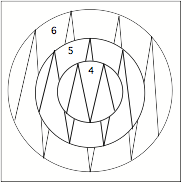
Art Critic
The drawing, here included, seem to express impressionistic tendencies with geometrical precisions -- certainly a darking synthesis, if I might so express it...
Analyst
It seems that what he is saying is that each zone of the globe operates according to a different wave-length, a different cycle-size. The Middle-East, the zones near the equator, near the center, has a very short Day-Night cycle. Europe has larger cycles of Action and Rest; America has even larger cycles, which seems to suggest longer periods of creation and longer periods of reflection. Creation of the world; and creation of the world of thought. This lies in line with the writer's request or prayer that America rest long enough so that other powers will emerge from the Chaos as 'monsters' to be slain; monsters which will spend themselves, while America sleeps, as occured in World War II, with America awakening only later, more rested, and with a longer period of creation to follow. The Gods, the Androgyne Beings of the 6th Principle....these are the ones who create the worlds....
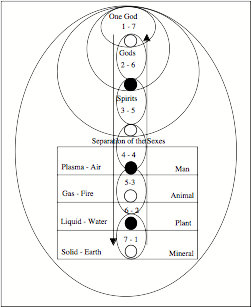
"So now you are viewing yourself, and your country, as one of the Gods?" Rose says.
"Apparently so."
"This idea of a Sacred Island," Rose begins...
"The 7-6-5 and the 1-2-3, in the north, is the Sacred Island in a large sense," Crossmann says. "The 7 and the 1 on the north is, in fact, the Sacred Island, the North Pole. But the Upper Circle, as opposed to the Lower Square is the land of the Diseimbodied Spirits, if you will. The Eternal Trinity...."
"And this corresponds to the earlier drawing," Rose says. "Where America, North America, is to be the Sixth Principle, Europe is the Fifth Principle, and the Equatorial Region the Fourth Principle. This makes the land south of the Equator what? The Lower Realm, the Lunar Realm...?"
"Yes."
"So, the Solar Realm is the North; and the Lunar Realm is the South?" Rose asks. "The Man is the North; and the Woman is the South...?"
"So it appears, from the perspective of the north," Crossmann says.
"And it will appear reverse from the perspective of the south?" Rose asks.
":I think it will."
"Do you ever worry that you will write this book from the perspective of one side," Rose says. "And it will be misinterpreted -- and you will be required to write a book from the opposite perspective, to destroy the misinterpretation. And then you will have to return to destroy the new book, for it is also a misinterpretation, one side of a whole...?"
"I'm afraid that this is guaranteed," Crossmann answers. "That is why many people in the novel appear and tell me to remain silent. Every word spoken is, in fact, guaranteed to be misinterpreted. Because a word spoken in the North is reversed in the South. It becomes the negative of what was actually said..."
"It seems rather hopeless," Charlie says.
"No. It evolves the world," Crossmann says.
"Incorrect ideas evolve the world?" Charlie asks.
"Mis-understandings evolve the world," Crossmann says, smiling. "Misunderstandings carry us through Time..."
"Hamlet comes back again," Rose says. He reads:
Hamlet (dressed as a Hunter)
Whether t'is nobler to walk like a duck or to run...
Whether t'is nobler to be the sea or to be seen....
The ghost of my father order revolt.
Before he died he said:
'This country needs revolution;
Everything has become corrupt...'
So he came to see the world as his sons had.
But what is this to me -- this corruption...?
Each time has its own form of corruption.
In seeking to purge the world of its sin,
The danger is this:
That, by becoming a tyrant,
I might make the world even worse,
Losing the good that we do have.
The Old Man from China said:
'If the world is troubled, I will leave it alone --
And it will cure itself...!'
Starbuck (on the stern of the Pequod)
Let Faith oust Fact! Let Fancy oust Memory!
I look deep down, and I see!
I believe...!
(A White Whale is struck by a lance; and the sea
bleeds.)
Ishmael (at the mast-head)
Is there no unretracing progress in life? We don not advance through fixed gradations, and, at the last one, pause? Through Infancy's unconscious spell, Boyhood's thoughtless faith, Adolescence's doubt (the common doom), then Scepticism, the Disbelief, resting at last in Manhood's pondering repose of If. But once gone through, we trace teh Round again; and are Infants, Boys, and Men and If's eternally. Where lies the final harbor? Our souls are like those orphans whose unwedded mother dies bearing them! The secret of our paternity lies in their grave; and we must there to learn it...!
Ahab (watching Ishmael)
Look not too long in the face of Fire, o man! Never dream with thy hand at the helm! Turn not thy back to the compass; believe not the artificial fire, when its redness makes all things look ghastly! The glorious, golden, glad sun, the only true lamp -- All others are but liars! That mortal man who hath more joy than sorrow in him -- that mortal man cannot be true -- not true, or undeveloped! The truest of all men ins the Man of Sorrows -- and the truest of all books is Solomon's, and Ecclesiastes is the fine hammer steel of woe! He who would rather talk of operas than hell -- there is a wisdom that is woe; but there is a woe that is madness! Even in his lowet swoop, the mountain eagle is still higher than other birds upon the plain, even though they too do soar..!
Pip (standing beside Ahab)
We are all bats; and I am a crow...!
(The ship sails with red sails.)
Clerk
Such fitful dreams I am company to my sorrow.
When will all this dreaming end...?
Wife of the Banker
You must come to your senses, man! You cannot leave your job! So, you want to be free! Who doesn't want to be free! But you have a responsibility to me! A responsibility to your family, your children! And to your country! You can't just throw all this away! It's time for you to wake up! Before everything slips away...!
(Helen Heimkreiter slaps the Clerks face three times.)
(Jacob Heimkreiter is seen flirting with a teen-aged
girl -- young enough to be his daughter. He looks at
her legs. She enjoys the power she has over him.)
Witch Near Macbeth's Castle
Don't take yourself so seriously, son.
Your sorrow is no great than any other's.
You through of destruction is not destruction itself.
The life of the world does not depend on your protection --
For who had power, Cain, to strike out your life...?
Clerk (dressed as Galahad)
Life makes me weary.
Vigilance at the wheel, past the shoals and the reef,
Makes me walk toward the grave...!
Beautiful Woman
Shame on you!
Can you think only of extinction?
Obvously you forget my power to re-fresh you...!
Clerk
Do I wish to be re-freshed --
That is the question...!
Beautiful Woman
Do you have a choice?
That is the answer.
Logician (overhearing the discussion)
It is logically impossible to answer a question with another question.
(Clerk meets a hippy, dressed as a beggar, who carries
a staff, wears a long beard, and quotes from the Tao.)
Clerk
Is your contribution to world ever greater than the Banker...?
Holy Man
I am not stealing from the world, at least.
Clerk
You must take from the world -- otherwise you'd not live.
Holy Man
I take less than the Banker.
Clerk
And perhaps you give less.
Holy Man
I don't desecreate Nature, to make a profit for myself.
Clerk
You desecrate yourself, to make a profit for Nature.
Nature is not finite. This is the illusion. Perhaps Mankind needs to rest, yet rest is not the final state. Profit is not immoral. Anymore than you are closer to God than he. If you choose poverty, then you choose one illusion. It is not more holy an illusion. Suffering lives in each house. Self-satisfaction is teh greatest sorrow --- because it merely succeeds abomination. What if the poor man hoards his poverty? What if he hoards his cataclysms -- refusing to acknowledge Joy? Time passes. What was once true is no longer true. You will return -- yet you cling to your sleep like a raven to his feast. Time changes all. Beneath the waves, Nature pepares whole continents as material for Man. She does not begrudge Man his actiity; Activity is the Son of Nature -- to whom she gives birth and whom she again receives.
Your truth is as eternal as each truth -- that is to say, as illusory as each, having reign for a season. Children who follow you have no memory of your youth. Each world differs. You are a dinosaur to them....
Sister Mary Olive (from the Clerk's childhood)
He likes the Winter so, because his suffering drives him further and further into his writing....
Sister Agnes Claire
Yet he will have no friends -- because he shows each side it falseness....
Sister Mary Olive
He is a murderer -- he murders illusions with his mind...!
(Clerk places a long-stemmed salmon-colored rose
on Shulamit Margalit's desk. Golden leaves are
scattered in the woods. The Clerk is walking; he sits
beside a hidden lake in the Sun.)
Huckleberry Finn
Do not exist in your private past! Come with me!
Break through the wended wood,
To the Past beyond your own private glory...!
Ghost of Alexander
What of the World Culture -- which unifies the world, the Earth, into a unit? There are great steps which we can take! There is a universe of frontiers! A unified Earth into a family becomes the Pioneer Race which plants its seeds throughout space@ Do you not see it? Why cling to your small piece of Earth, defending your private past as though, without it, you cease? The visionaries appear to dismantle a vision; yet they do not stop there. They also construct a vision to replace it. It is not enough to represent Death. You must also have the power to resurrect the Dead...!
Clerk
This Sixth Sub-Race, whom the Americans are to be -- according to the little bee who told me -- The Sixth Principle is the Buddhic -- the Androgynous Race: androgyne in body; also androgyne is mind -- that is, speaking the language of Darkness and Light -- the language of the Soul -- which connects them to the Gods...!
(Clerk is seen talking in an animated fashion about
things beyond human comprehension. He talks
mainly to women. He talks to Daphna Greenstein,
telling her that she is one of the chosen few to whom
he tells his secrets. Mesmerizing her.)
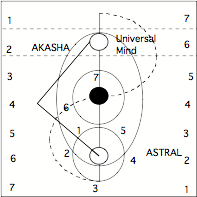
Friend of the Clerk
The Sixth Principle is the Soul, the vehicle of Spirit. The Creator of the World -- who are the Gods who create the 'Mind-Born Children' -- who send them out into the world toward performance....
The 'Gods' transmit the Word to Men. The Men come to the Gods. This way the work is carried into the world.
Newshawker
Extra! Extra! Read All About It!
Experts Predict American Industrial
Base Never to Return!
Americans On Threshold of New Economic
Age...!
Claire Booth Luce
Does that suggest to you that if Industrial Man goes, so, too,
The Industrial Body Type might also go...?
Bess Truman
You can resist the Future, if you will.
You can see it as Evil, because it demolishes your certainty.
You can call it Un-Natural, because it abolishes your Past.
Yet, come it will--
And it will carry you either forward or sideways.
Newshawker
Experts Predict New American Economy
To Be Based On
The Distribution of Information...!
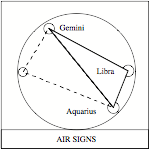
Clerk
What dare I belie? said he.
What dare I trust -- when the information boils?
Adrian Leverkuhn walk son his nails.
And all of the gulls squall at the dancing
lantern....
Psychologist
He is becoming incoherent again.
Perhaps I should write that down...
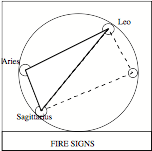
Clerk
First, you must understand that the Fourth Dimension is the Meeting Ground of Space-Time, the Meeting Ground of Matter and Anti-Matter. The Fifth Dimension can be seen as being akid to the Third Dimension, which we call Depth for some reason -- the gaseous reality, only in anti-matter. Anti-gas, if you will. The Physical Universe is actually created from the Sixth Dimension, wherefrom the Word of Creation (Sound) is passed down through the Critical State (which we call Chaos) into the order of Form, held in place by a magnetic field (the Law ofFixation) which is controlled (as a form) on the gaseous level of Mind.
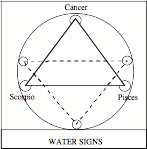
The Seventh Dimension represent the Solid State of Anti-Matter, which appears Chaotic from our point of view -- yet which, the the laws of that world, is as exact in its density as the Solid is to ours.
Words like Height, Width, Depth convey notions which are actually qualities of Matter (Matter being a form of Intelligence) -- a description of the senses by which they describe themselves.
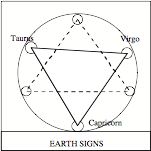
Timem-Space-as-Eternity is divisable into parts. Space Elements (anti-gravitational to us) tend to the Critical States of the Inner Dimensions. Critical, in the sense that they are constantly changing shape and aspect: fluidic elements: the floating elements of dreams. They are the 'Sleeping Elements,' from our point of view -- as Time Elements are building 'Elements of Action'. Each drop or rise in dimension (in wahtever direction) represents a loss of memory. As Man organizes the Anti-World into a form of understanding, his "memory' of the World (the world of Matter as opposed to Anti-Matter) is lost. He forgets Matter; hence, that world disintegrates, due to lack of attention (vitalization through concentration). When he journeys into Matter, his 'memory' of Anti-Matter is lost....
Orchestra Conductor (ghost of Mahler)
Would it be wrong to say that when Man journeys into Anti-Matter, he becomes alienated from the work of Matter -- even more than to say he 'loses his memory' of it...?
Clerk
I would say they are the same thing.
When Man (as Element) journeys into Matter, he becomes alienated from the world of Anti-Matter. Heaven, of a sort, exists in both extremes. As I felt power on 'Earth' (in the Body), and, later (an illusion, I grant you) power in 'Heaven' (or in the Mind): each was a heaven of sorts, only in different forms. Alienation is loss of Memory. Alienation is the expression of one's outrage and fear at being lost. Memory is the sanctity of being found again....
Mahler
Of find yourself again.
Clerk
Precisely.
(Libra: coming in of the Middle Principle.)
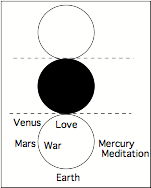
(At Dawn, Man is seen crawling out of the Womb.
At Dusk, he is seen crawling back in to the Womb.)
Literary Critic
We may have mentioned this before -- but the reader will notice that the density of this book varies with the Time-Extremes of the journey. Density in the Body (or Matter); and later denstiy in the words (or sounds) which you give us...
(Man is seen crawling in to the Womb at Dawn.
At Dusk, he is seen crawling out of the Womb.)
Jacob Heimkreiter
Memory is pain.
Conscience is a quickened terror.
(Heimkreiter is standing with a knife before his naked
wife and her naked lover.)
Ghost of General Patton (to the Clerk)
Which side will you be on?
On the side of revolution; or counter-revolution...?
(Clerk sees the Two Brothers standing on different
sides of the Berlin Wall.)
Town-Crier
Will it be Communist of Nazi?
Or will you choose, perhaps, a pacifist religion...?
Instructor of Shulamit
She just is not doing well. She doesn't get the work done; she refuses to go ahead on a project, fearing that it will not be perfect. She's either going to have to withdraw from the class, or else she will fail it...
(Rain and dark clouds; The Clerk explains, in precise
symbolism, how war is inevitable -- and how Death
lives on Pluto. He explains this to Rosemary Millet;
then he sees himself as a Dracula of sorts, sucking
Hope from the beautiful woman, and leaving her in
desperation...)
Self-Accusation
You are the Evil One. Why spread your despair to others who don't see it? Keep your doom to yourself! Why did they hate Beethoven? Why did they hate Mahler! It wasn't their personalities they hated; it was their vision! Out, out, damned spotted cloud; out, I say! Better to preserve the silence, than to speak about Evil, darkness, which you, thereby, create...!
(The face of Chief Crazy Horse is carved in a
mountain.)
Clerk
The darker the light, the darker am I.
The darker we all are...!
(Wind slams the screen door: the trees heave and
tremble.)
Voice of Women Praying
Lord, help us make it through this night...!
(Hundreds of thousands of men volunteer to be the
returned Jesus, to judge and condemn the Earth; and,
then, to destroy it.)
Clerk
Another death draws me in.
Voices of Men (desperate)
We must find someone to fight! We must find some Evil to oppose! Perhaps we can make it Israel! Perhaps Russia! If we don't fight some other, we will surely fight ourselves...!
We need a scapegoat! Let us find a scapegoat...!
(Wandering Jew lead a goat through the town square,
calling:)
Wandering Jew
I've a goat to sell to thee;
It costs only your soul.
A Capricorn goat I'll sell to thee;
And into Hades it shall lead...!
David Blumenthal
King's Pawn to Knight's Bishop.
(Followed by laughter.)
Clerk to Einstein
The 'Critical State' of Matter, that point at which matter is not this and is not that, that momentary point when it is neither this nor that and both this and that -- the point at which liquid iron exists, and liquid hydrogen -- the transition point from one form to another: this also exists in a cultural milieu. The 'critical state' -- socially-speaking -- is that point at which the elements of the society/culture becomes 'critical' to their form -- that is, they withdraw their energy from the formal reality, seeking in the 'feminine reality', the dreamscape, in which liquid-iron and liquid hydrogen exist, that which they don't find in the formal reality. They choose Night over Day (at least fromone aspect); they choose Chaos (symbolic reality) over the order of civilization. When enough of the elements of a society choose Night over day, then Night comes, a 'critical mass' is reached, at which point Matter, the Society, changes its form...
Literary Critic (to Clerk)
Each 'cultural epoch', in a literary sense, seems to be marked by, as a 'birth point', the appearance of an heroic quest: Beowulf, the Homeric myths, the Nordic, the Knights of the Roundtable...
This 'heroic quest' is an attempt by the Mind of that nascent culture to lead the cultural body out of the Night and into the Morning. Is this not what your book attempts? Is Jacob Heimkreiter and his sons and his aspects not another form of Beowulf in darkness -- fighting the dragons of his own fears? Having destroyed the gods of your culture, are you not, at this moment, attempting to resurrect them...?
(An atomic bomb explodes in the distance.)
Oracle
Turn your eyes from off the seas
And see in coral garb the trees
Which cast bold tales in oaken harm
Of deeds which weep with false alarm.
Today, only, do you breathe;
so breathe and eat
The fruit and gather nuts and treat
The morrow as shade.
Europe disintegrates; nation is made.
What harm does sleep when sleep is free
And waking spells the murdered lee?
The Gods foresake the Earth
when the Earth has turned
to Turmoil's glee.
Keep one eye on the ransacked sea;
And one eye on the spreading tree.
Do not create the corpse of Day
Until none remembers; and the Wind
builds hay.
Do not create the corpse at Noon;
Oblivion, silent hegemony, every June.
Father Hmelovsky standing over a coffin)
Eternal Light grant unto him, O Lord.
And my Perpetual Light shine upon him.
May his soul, and all the souls of the faithfully departed,
Through ther mercy of God, rest in peace.
Amen.
(Clerk walks across a bridgte and meets, mid-way,
Shulamit with a boy-friend, walking the opposite
way.)
Einstein to Clerk
The 'Dream-Mind' is Mental Matter in itsw 'critical state' -- yes, of course it is. All potential forms, in Chaos; all form out of Time, I mean. In the same way that, in a cultural sense, whent the Flood occurs -- that is, when Emotion replaces Reason -- all Times exist together; all elements melt into one, freeze into one; and the Present is lost, swallowed up by the Past and Future: frozen into one....
Clerk to Einstein
Is that not the experience of death...?
Einstein to Clerk
If you wish to put it that way. It is the Second System your guide has spoken of. The First System has Five Stages; The Second System has Seven Stages; the Third System, that of Destruction, is also the First Stage of the First System...
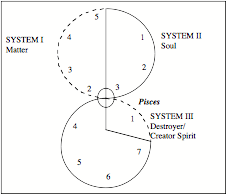
Sarah By the Well
All of your descriptions of life really get you no closer to Life itself. You go out into your travels; return to tell us all you've seen. Fine. Yet where does it get you -- to study the map, but to find not the land...?
Clerk
I do not know. The Earth is so beautiful. It must not be scorched and burned by the men-of-war. I am one of these men-of-war; but I, too, am the bringer-of-peace. Leves turn a panorama for creation. I sit by a pond, by a hidden lake -- waiting for the words to fall. Afraid of the words. Looking only at the grains of Day -- as Day recedes, and the Night comes a'stumping....
Must I give up my power, my quest for the Fire? Am I my own demon, who has turned on the Earth? Must I not fight Death so -- so that none will be harmed in the wealth of my own fury...?
Such questions haunt me now. Haunt is not always the right word. Must I descent to kill my own monster -- as Cain did descend to kill Abel, his monster...?
Father Hmelovsky
These are questions which only your Soul can answer. Each man is different; each has his own task, his own destiny. There is not the universal answer you seek. The universal answer is: Do what you must. A universal pleas is: Harm not another...!
(Clerk walks the opposite way across the bridge. At
the point at which he met Shulamit before he meets
Anat and Daphna and their father cycling by, going
the opposite direction.)
Anat (flying by on her bike, smiling)
Which way are you going...?
Clerk (reflecting, after the three have passed in opposite
direction)
If I am not going the same direction as you, then someting is amiss.
"Then a kingfisher comes out of the sky, hits the water and rises with a fish in his mouth," Rose says. "And the Clerk wonders if that is the same way that he is jerked out of the material sea. He wonders if that is the way Death strikes.... There is no question that this is a long novel, a long process of wandering. We are the Wandering Jew, aren't we, the readers? You are the Wandering Jew; and so is anyone who walks in your shoes, reading this novel...."
"You have a pretty good point there, Charlie," Crossmann says.
"Of course, when the Second Son turns on the alleged Holy Man," Rose says, "he is, in effect, turning on himself, turning on the way he was a few years before, when he wanted the world to die, when he had withdrawn from the material world. It is himself he is striking down..."
"It is a precursor of his great battle," Crossmann says.
"It is the immaterial dragon he is striking out at."
"The force which he has come to see as Death," Crossmann says.
"Then the Mythologizer comes back in to explain the Dragon of Chaos," Rose says. He reads:
Mythologizer
Berosus or Dagon obtained his information from Ea, or Wisdom, the male-female Deity. While the Gods were generated in its androgynous bosom (Svabhavat, Mother-Space), its (the Wisdom's) reflections became on Earth the woman Omoroka, who is the Chaldean Thavatth or the Greek Thalassa, the Deep or the Sea -- Chaos --, which is, esoterically, and even exoterically, the Moon. It was the Moon (Omoroka) who presided over the monstrous creation of nondescript beings which were slain by the Angels, or the Lords of Light.
"It is pretty clear now that you are preparing yourself for a battle against some Dark Giant," Rose says. "The Monster of Chaos. You mention Beowulf -- and how the Heroic Epic stands at the beginning of every cultural epoch -- am I to understand that you see Conversations as a kind of Beowulf?"
"I didn't really see it so when I wrote about Beowulf," Crossmann says. "Clearly, now, it seems quite reasonable. Beowulf slew Grendel, the monster -- and he also pursued Grendel's mother into the underworld cave, where he killed the mother also...."
"The Mother is Chaos, or Darkness," Crossmann says. "He destroys Chaos with a magic sword, which sword is the rays of the Sun..."
"But you were not consdious of this personal war on the horizon?" Rose asks.
"No."
"I love the line: 'You desecrate yourself for the profit of Nature' -- I find that quite wonderful," Rose says. "We also have Father Hmelovsky praying over the coffin. Am I to assume that this is a continuation of the Heimkreiter funeral...?"
"My understanding of this is that the coffin is now at the cemetery," Crossmann says. "Father Hmelovsky, a priest from my own childhood, is praying above the coffin...."
"There is a very telling passing ahead also, in which a Father Gianola...."
"Another priest from my childhood," Crossmann interjects.
Rose reads: "Father Gianola sprinkles hold water on the coffin and says: 'I hereby pronounce the 1960's dead...!' And then the Ghost of John Lennon breaks into song: 'Would you like to swing on a star...?' I find this to be very important -- do you agree...?"
"Absaolutely. John Lennon was as much an emblem of the 1960's revolution as anyone. Lennon and King."
"This is, in a sense, the turning of the ship," Rose says. "We talked earlier about Fitzcaraldo, the man in the Herzog movie, who has native workmen push an old ship up and over the face of a mountain, to reach the wild river on the other side, so he can ride down the river one more time. You are Fitzcaraldo, in a way..."
"That is what Everyman is about," Crossmann says. "Yes. I am Fitzcaraldo."
Crossmann flips foward in the book. Then he reads:
"'NO. What is the watch-word? ANACONDAREAGH. Serpentine logic. THE LOGOS OF PRIDE. Riding in a boat along an overloaded stream. THE DESCENT OF FITZCARRALDO'S BOAT. Hypoanacondrea. NO ONE AT THE HELM -- THAT IS, REAGAN AT THE CAPTAIN'S BRIDGE; NO ONE SEEN WHO IS GUIDING THE SHIP...' And, of course, in the movie, Firzcarraldo's boat crashes, is destroyed..."
"But not Reagan's boat," Rose says.
"No," Crossmann agrees. "But I feared it..."
"You talk more about your fear of fascism," Rose says. "In this next passage. You talk with an architecture professor, Rosaria Hodgdon..."
"Yes, an old Italian matron," Crossmann says. "With aristocratic pretensions...."
"We don't know that about her," Rose says.
"No. She was one of Shulamit's instructors. There was a struggle going on between the faculty in Shulamit's department. There were the 1960's children who felt that architecture was a social science, that the role of architect's was to save the world in a social sense. Not to be artists, or egos, who imposed their ideas on 'the people' -- but to be facilitators, to essentially run meetings at which the 'will of the people' was arrived through free and open discussion. On the other hand, becoming more and more impatient with all this, were the formalists, who felt architecture was a high calling for the individual genius to embrace. The goal of the one group was that everyone be treated fair and no one be hurt by any decision that was being made -- essentially, this was the Mother Principle -- and the goal of the other side was the creation of great architecture. So, this struggle was going on in every level of American society. Carter was the spokesman of the Mother Principle; Reagan was the spokesman of the Father Principle, Will, the force of the Future. Carter wanted to go back; he was afraid of the Future. Reagan felt we capture the Future by force, by will..."
"Still, you saw the dark side of each," Rose says.
"Each side does have a dark side," Crossmann says. "And the Lords of Light fight with the dark side of each..."
"Now, apparently you are fighting with the dark side of the Mother Principle, in this novel," Rose says.
"Yes. At the present time. The beginning of the novel illustrates the fight with the dark side of the Father Principle," Crossmann says.
"In terms of racism?" Rose asks.
"Yes. The Father's struggle is racial. He is entrusted with the survival of his race, his country, his town, his family," Crossmann says. "The Mother's struggle is ethical. She is concerned with justice more than survival. Both are necessary for immortality..."
"Is that the issue: immortality?" Rose asks.
"Yes. Life. Life in both worlds. Life in the waking world; and also Lie in the dream."
"One is not better than the other, superior to the other?" Rose asks.
"It is the dialogue between Matter and Anti-Matter," Crossmann says. "In the end, both Matter and Anti-Matter are destroyed. And, in this destruction, become Pure Spirit, Energy."
Rose reads:
Clerk to Architecture Professor, Rosaria Hodgdon
And what of the dark side of 'striving for excellence'..?
Professor Hodgdon
It is true: there will be those who will fail, those who become sick because they fail. But this will be almost nothing compared to the great things which will come from it...!
Clerk
What about fascism?
Professor Hodgdon
What? No, absolutely not! The Fascists were not striving for excellence! That was a perversion! That had nothing to do with excellence...!
Clerk
But desire for greatness is a struggle for power -- which expresses itself in all human forms -- and, in the political, becomes a form of fascism. The dark side of 'striving for excellence' is intolerance of those who fail, those seen as being mediocre. Intolerance of those who do not achieve excellence -- who do not fall into line -- who do not meet one's approval. 'Striving for excellence' in the individual becomes the collective 'desire for the superculture' -- the Superman's return...!
I see it in myself -- and this frightens me. I can be a tyrant. I can be absolutely detached. Absolute detachment in the hierarchy leads one to attrocity...!
Professor Hodgdon
What is the alternative? A striving for mediocrity...?
"That is a pertinent question," Rose agrees.
"Yes. Excellence has a dark shadow. But so does mediocrity," Crossmann says. "Mediocrity means that you will become the slaves of some other people. Excellence has the dark side that you might, in some way, seek to make slaves out of someone else, some other people..."
"In the extreme," Rose says. "Without morality."
"Without religion, in its best meaning," Crossmann says. "Without an understanding that we are all manifestations of the same God, the same soul being present in each of us. True brotherhood."
"An attitude of true brotherhood takes away all these fears, doesn't it?" Rose asks.
"Yes. If it is shared. The problem is that is not always shared," Crossmann says. "And where it is not, well, then you have war, a struggle for survival, a struggle to avoid enslavement. It is preferable to enslave an enemy that to be enslaved by one..."
"Is it?" Rose asks. "In a religious sense?"
"Well, the Father says that it is," Crossmann says. "The Son, with encouragement from his Mother, might say something else -- might wish to be the martyr of the race. But nothing good comes from losing a war, from being enslaved, annihilated by one's enemy..."
"No, it is hard to argue with that," Rose says.
"That's why we always prepare for war, hoping we won't have to fight a war," Crossmann says. "But we never take orders from another people. We take orders from our God -- but never from another people..."
"I see," Charlie Rose says. "The main thread we are seeing in this section is, as we have said, preparation for war with the monster of darkness. The Archer talks about the separation of the Fifth Race into those who go on and those who stay behind. What is this all about...?"
"Those who achieve re-birth," Crossmann says. "Those who take Kierkegaarde's 'leap of faith' go on. Those who don't, those who cling to the Mother Principle, communism, don't go on. They can't get in to Heaven..."
"Again, Daniel Newman appears," Rose says. "And he is standing trial for his attack on a woman. So this theme now is very strong. Man against Woman. Man striking down the Dark Woman so that he can be free, regain his power, his self-respect as a Man..."
"There is a strange passage here about high pressure ande low pressure zones," Rose says. Rose reads again:
Clerk
In the Winter, the Sky commits violence against the Earth -- condemning her to be barren. So, in his darkness, Man commits violence against the woman...!
Ishmael (with his notebook)
The 'Jew' of American society is the Black Man. The White Man strikes down the Black Man in the Spring to recapture Heaven....has this not been noticed by our historians...?
Clerk
It is not the Black Man who is struck down. It is the Earth: Earthly Pleasure: Rest: Non-Activity. It is the Mother Aspect who loses her Power, who is subjected to violence by the Power of the Man.
Maternal Society is dethroned by the Paternal.
The Jew by the Gentile.
The Palestinaian by the Israeli.
The Father Aspect rules by force, condemning the 'Woman' to wait for her season.
Ishmael
It is the demon in yourself which you attempt to strike down. The Active Principle striking the Passive Principle down.
Meteorologist (with weather charts)
The Summer tends to be ruled by 'High Pressure Zones', tending toward upper atmospheric conditions. The Winter tends to be ruled by 'Low Pressure' conditions; whereas, during Spring and Autumn, the mid-seasons, High and Low Pressure Zones tend to battle for supremacy, this conflict being the basis of these seasonal storms.
There are psychologists who claim that this same pattern is repeated, on a smaller scale, in the Human creature, 'high pressure' representing levity of mind-emotion, 'low pressure' being its inversion -- that is, depression. While according to these psychologists, the 'mid-season' are the periods of battle of the two natures, the low and the high, the period of emotional storms...

"Then, all of the sudden, the appearance of another dark element," Rose interjects. "The 'Voices from the Casbah' appear. I think this is one of the first appearances of the theme of the Arab, which becomes much stronger through the rest of this novel, and also in your writing after this book. Especially in your prosepoem, Instrument in the Wheelhouse. In looking for your Dark Principle, you pass by Israel, by Russia, and, finally, lock your target on the Arab nations..."
"Because of millennium," Crossmann says. "The picture of Armageddon in religious literature."
"You flipped in to the religious mind," Rose says.
Rose again reads from the novel:
Voices from the Casbah
- The Sun turns clockwise; the Earth turns clockwise; the Moon, only, turns anti-clockwise.
- He is leaving this book as a map to the American future. It is a guide for his race, which he leaves behind when he is gone....
- The Stone Age Man is the most advanced man of the earlier cycle, though of the lower sphere. Is that true...?
- Pre-Menstrual Syndrome is connected with the last stage of power of the Feminine Mind, its location being Paranois, its 'syndrome' being paranois, zeonophobia, nationalism...
- As captain of the ship, he must be the last one off the ship. And, being the last one out of the room, it is left to him to turn out the light...
- The Gods are vengeful, absolutely impersonal. Their only concern is adherence to the Law. They are attached to the Ideal. Man is only a mite in their judgment....
- We are experiencing the death of a millenium....
(A hush.)
(Then, scattered applause.)
(Music, the Clash: 'Sharif don't like it -- Rock in the
Casbah -- Rock in the Casbah....By order of the
Prophet, you have to ban that boogy sou-ound;
degenerate the faithful, with that crazy Casbah
sound...')
(Moslems in Lebanon worship the memory of a 13th
Century martyr by clubbing open their skulls and
slicing open with knives the skulls of their
children...)
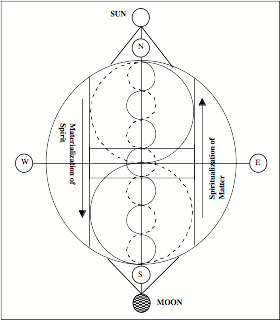
Intllectual
Neo-Classicism in America represents the attempt of the East Coast, the Aristocracy, Old Money, the Time Aspect, to re-gain power in America. The 'preppy look' is neo-classicism in a most obvious form -- with formal European roots. The creation of a hierarchy of values, or a more rigid class structure; solidification of the power of the aristocracy; the last gasp of the old families of America attempting to thwart change and the rising of a new epoch.
The 'Rock Culture' is the new epoch: primitive, land-based, youth-made-manifest: the 'mineral' race being the seed-bed of the New Man; the 'rock' being the foundation stone of the next millenium...!
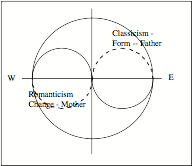
Clerk
So the man says. So I, too, have said.
The Highest Mind controls the Rock or the Earth.
The battle for the Earth is the battle of which
Culture should rule....
Poet
Two eyes watch the plain to see
Which of the two cities
The Tyrant should be.
"The Second Son now meets another woman, a young woman named Hillary," Rose says, "who is married, with a child, who works as a baker -- and who reminds the author of Leslie Rhodes. Clean and white and untroubled. A Mother Figure appears and tells the Clerk that he should be friends only with the new girl; the Second Son says that his feelings seem emotional toward the woman, not those of mere friendship. But the Grim Harvester, carrying a scythe, warns him not to make her some kind of victim...I am not really sure why this new woman shows up. But she is not Jewish. She is one of the few love interests in the novel who is not Jewish. Also, the fact that she reminds the author of Leslie Rhodes seems to indicate something...."
"Hillary is very white, soft," Crossmann says. "She is white light, like the Moon... The Clerk even calls her the Queen of Heaven.."
"So, the Clerk is still the Dark Man, still attracted to the White Woman, the Moon," Rose says.
"Yes. But this will soon change.."
Charlie Rose reads:
(Clerk watches Hillary, the Baker, thorugh a window
as she works. She is beautiful to him. Delicate
features; sensual lips; eep eyes; light of heart; in a
dreamy pose.)
Clerk
Hillary is the Queen of Heaven...!
(He feels a kind of passion rise in his heart and
stomach for this woman. She reminds him of Leslie,
in the way that she moves. She is married, with a
child; and still of an age where he emotions seem
clean; she has not become bitter.)
Orpheus
You journey into the Underworld for your wife. You seek inspiration. You seek a drink of water for your life. Intoxication can keep you mired here. She who was Faye last year, this year becomes Hillary.
Clerk
I seek Love.
Orpheus
Yes. You seek inspiration.
Clerk
Tell me about individualisation.
Conductor
In the Third Root-Race, Individualisation took place. This was an event which became possible through certain conditions and polar relationships, and because the scientific laws were understood and the Knowers took advantage of a peculiar electrical condition to hasten the evolution of the race. It was electrical phenomena of a stupendous kind, and it produced the 'lights which ever burn'.
In the Fourth Root-Race, another adaptation of force occurred. Again, time and opportunity were taken advantage of to open the door into the Fifth Kingdom by the method of forced initiation. A third type of electricity played its part in bringing about this event; and it is the effect of this electrical phenomena upon the units (who are, themselves, centers of energy) which -- scientifically-speaking -- indicates a man's suitability for the ceremony of initiation, and his availability as a transmitter of spiritual enegy to the world. Every initiate is technically a transmitter of force; his work is, consequently, three-fold:
1. To provide a three-fold vehicle capable of the necessary
resistance to the force and able to receive and hold it.
2. To transmit it as energy to the world which he serves.
3. To store up a certain amount of it for a two-fold purpose:
a. to provice a reservoir of force for
emergencies and for special
work as required by the Great Ones.
b. to act as a dynamo for the immediate group
which all advanced souls, disciples and
initiates gather around them on some one
or other of the planes in the three worlds.
In the Fifth Root-Race, another tremendous happening may be looked ofr, and the time lies immediately ahead. It had its beginning in the energy which eventually culminated in the world war. The first effect of the appearance of fresh electrical stimulation from extra-systemic centers is ever to bring about a primary destruction leading on tor evelation. That which is imprisoned must be loosed. l So it will be in this root-race, the Fifth. Certain cosmic forces are at work; and the full effect of their energy is not known. The Hierarchy will avail itself of this incoming force in order to push forward the planetary plans. In every case, the effect of the phenomenon is felt in some one or other of the kingdoms beside the human. In the Individualisation Period, it is apparent that a tremendous stimulation took place in the Animal Kingdom -- as timulation which has persisted, and which has led to the phenomenon of 'domestic animals', as we call them, and their relatively high stage of intelligence as compared to wild animals. In Atlantean Days (Fourth Root-Race), the opening of the door into the Fifth Kingdom, or into the stage of Buddhic consciousness, had a profound effect upon the Vegetable Kingdom....
In the tremendous event which is impending, in the great revelation which is near at hand, the Hierarchy will again take advantage of the time and th energy to bring about certain events which will work out primarily in the Human Kingdom but hwich will also be seen as force regeneration in the Mineral Kingdom. The energy, when first felt in the Human Kingdom, brought about the conditions which caused the tremendous activity which resulted in war, and which is causing the present world stress; in the Mineral Kingdom, it affected certain minerals and elements, and the radioactive substances made their apperance. The characteristic (or radioactivity) of pitchblende and the other involved units is comparatively a new development under the evolutionay law, and one which, although latend, only needed the drawing forth of the type of energy now beginning to pour in on the earth. This force began to flow in at the end of the eighteenth centruy; and its full effect is by no means yet felt, for it will be several hundred years before it passes away. By means of it, certain discoveries are possible, and the new order comes in upon it. The Great Ones, Who know the time and the hour, will bring about, in our root-race, that which corresponds to the occurrences in the earlier Third and Fourth Races....
Clerk
This discussion makes me weary.
Fatigue (shaking a chloroformed rag)
Do you eat when you sleep?
Shoudl you wake and expect dreams...?
Clerk
The thought of this woman makes me feel lively....
Mother Figure
Last year the woman drawn to you was Fate. This year the woman drawn to you is Joy.
"Then, a strange declaration by the Second Son," Charlie says, "saying he will not serve the Mass Mind. That he will remain free, independent; that he will be the judge of what is good and just. He will not follow the creed. Speaking like Prometheus. This is followed by an injunction by the Clerk to Vulcan, through whom he has been fashioning weapons all Spring by which he might win the 'War in the Heavens', the war between the Titans. He says: 'I have fashioned my words into armor and spears....to defend Man's independence...'"
"He is the defender of Man, against the anger of the Anti-Man," Crossmann says.
"And we see more of this further on, as we see more of the meaning of Vulcan," Charlie says. "What is this individualisation all about?"
"Individualisation, in the Third Round, concerns the force which opened the door from the Animal Kingdom into the Human Kingdom," Crossmann says. "The splitting off of the Human from the Animal. And in the Fourth Round, the same force opened the door from the Human Kingdom into the Spiritual Kingdom..."
"Individualisation and initiation are the same thing?" Rose asks.
"Individualisation is the separation of the two principles," Crossmann says. "And it represents the birth of the Ego. The separation of the 'I' from the 'I am". Initiation implies the opening of doors to new worlds..."
"I'm not sure I understand that," Charlie says. "But then we have another rather strange imprecation..."
Clerk
The Gods who made Man become jealous of his power. They wish that he would serve them; they demand that he will serve them, blindly, without minds of their own. Yet Man, through experience, and the Wisdom brought to him through experience, becomes even greater than the Gods, who, through morbid passivity, wait, while Man experiences the world....
Man even comes to instruct the Gods. He becomes the brightest Spirit in Heaven. yet, when the Gods demand that he worship them -- that is, that he worship the word, the command to destroy the world -- he rebels against that order, refuses to give up the world, insists that he be the last one out -- he being the Captain of the boat. And so, as Prometheus, he is chained to the Mountain of Mental Matter, refusing to destroy the world with his power. The wife he takes is Mental Matter, rather than a wife in physical form, which would force him on to the Physical Plane, where, thereby, he would wreak pure havoc with his power.
I believe that my mind has come back to me.
I am no longer mindless, a medium of destruction.
I war in Heaven, and bring peace tot he Earth. I regreat if my words have disturbed some. My battle has been far from Earth, somewhere beyond. Whom have I sacrred? I am sorry if I have spoken some curse. Words came from me, disturbed by my bondage. Words disturbed, in salvation's series.
Titans overthrow Time: Black Gods demanding pure destruction. Hatred of Man; and I, alone, to combat them. Do not resist evil -- so Jesus said. Absorb Evil with your heart...
"Here we have the first expression of what you call the Black Gods, the Man-Haters," Rose begins. "Enemies of Time. Then Prometheus appears, declaring himself to be: 'I am the self-active principle, Manas, or Man. It is I who can lead the Man through this hell, and back out into Light and to Life 'fore the Night gloams....'"
"He appears right on time," Crossmann says. "As if instructed."
"Suddenly, Lucy, from the Herzog film Nosferatu appears," Rose says. "Lucy means 'Light' -- and one, it seems to me, must connect the principle of Moonlight, Lucy and Hillary to understand its place here. This leads to a long dialogue between the Clerk and Lucy, with some interesting declarations and observations about the Father, the Abstract Father..."
Lucy (from Nosferatu)
All of this analysis, where does it get you...?
Clerk
I am not sure where I am going.
Lucy
Then what keeps you here?
Clerk
I have a job to do. I walk the Earth when the Death Gods are rattling their keys to transform Activity to Rest. I give the key to the people I meet, the key which will lead in and out of the dire kingdom...
Lucy
And, for helping Man, you are cursed by the other Gods? And chained to the Mountain of Mind, there to wait. Waiting for something....
Clerk
So it seems: to fight the gods for possession of theheavesn; and then to fall, for my work is never done...
Ghost of Bucher
The race which retreats from the Future is doomed to extinction.
The man who lives in the Past courts his demise.
Clerk
In the Spring, the Spirit 're-creates' the idea -- that is, he 'updates' the Idea in the New Time. The Spirit is unconscious; he acts without judgment. Only when Soul and Spirit are fused dows Spirit regreat what he's done; then he weeps....
Lucy
You speak of the 'Father', who kills the Indians to protect his children. Who acts without conscience for he has no remembrance. When Memory returns -- that is, the Soul -- the 'Son' (who is the Memory) condemns his own Father -- as each growing man comes to condemn his own youth. This man, Spirit, rises above his Body (Earth), rules, as a Puritan, then falls and is ruled.
The Soul-Body disconnects from Spirit in the Spring and falls. It seems that I have disconnected myself from my Body in the Spring -- and merely seek Power. It is not I who am Prometheus -- I am Zeus instead; I am Jehovah who kills.
Clerk
So my mind is empty -- for I have no Soul. I merely am Spirit, hanging in the Air, waiting to be embodied....
Hillary
The Puritans and Indians return once again. Yet, although the Past is always retraced in the Mind, in the same way that in each Spring one re-lives his racial childhood, this same past is not replayed in body: the New Seed begins where the Last Seed left off.
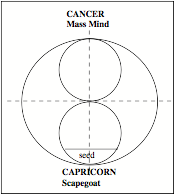
Clerk
I have said that the 1960's in America represented an American Autumn, the coming in of colors, the harvesting of fruit, and the fallen leaves. It also must have represent Spring for the counter-elements, since the hemispheres revolve together and apart. So, while the 'body' was in Autumn, the 'Spirit-Aspect' was freed into the Spring, rising from its prison, freed to live in Heaven for a time. Which is what Peace represented, as a mass movement....
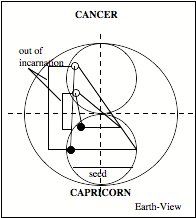
Lucy
The Women are on top now. The 'Woman's Mind' has replaced the 'Man's Mind'.
Clerk
The 'Woman's Mind' being the Night Mind, the Mystical Mind, the Emotional Mind, which leads eventually into nightmare...
Lucy
The cycles in America between War and Peace, Night and Day, with the Night Cycles seeming relatively short, would indicate that the 'American Being' lives in the Summer or even in the Spring -- with the Light Cycles longer and stronger than the Night Cycles. This is why American Culture seems so young -- because it is in its Summer View. Day and Activity still dominate reflection.
Clerk
Does some American Disapora come -- is that what is meant by the phrase 'sowing the American Mind'...?
Lucy
A nation 're-peoples' the world, creating the world in its own image.
The Dark Aspect is cast out of Heaven, doomed to wander the Earth kill the End comes....
Clerk
The 'middle principle' is lost. Spirit and Body divide. Peace is silenced....
Lucy
Yes. A nation sleeps, and then wakes. When it wakes, it is active.
Clerk
It re-creates itself. It re-creates its Physical, and also its Mental, Body.
Street Vendor
Passports for sale!
Cheap, Meister Crossmann!
Haven't you heard: the Jewish Community is preparing to move to New Zealand and Australia. They say that America has no future. You're a Jew too, you know. It was no accident -- rather, it was a sign -- when people came up to you on the street telling you you were Jewish...!
Better get your passport -- before it's too late and you end up in jail...!
Lucy
To understand your analysis of Aries you will need to reflect on your lives in that sign...
Clerk
In Aries, the Spirit is hidden (occult); the Soul is the Messenger of the Gods (Mercury); while the Body-Aspect, the Personality, becomes the Warrior (Mars)...!
Lucy
Mars leads those in Heaven back out to the world, as Warriors; Mercury, his opposite aspect in Time, leads the dead back into Heaven.
Clerk
This begins to confuse me.
Lucy
The bee which opened your heart with its sting -- was this the stake driven in to the heart of the vampire...?
Clark
Am I the vampire then...?
Lucy
Do you not claim to be all things?
The vampire is merely the one who cannot love.
Clerk
I have begun a new novel, called The Last Love of a Choirboy.
It is the story of the love of Michael and Leslie, who both have died.
Lucy
I have also had many images of you as the 'Harvester', the Messiah who comes with a sword on his White Horse, carrying ruin through the world, announcing to the world its destruction to bear a new world. Returning the world to a relative 'Stone Age' from which it shall rise as a model more perfected, more in accordance with the New Time....
Clerk
It is true: I have been offered power over the world. Yet my fear of harming others makes me weep...
Lucy
Yet, as the 'father' of your land, as you experienced in the Summer as Leo, the King, the Lion, you acted without consciousness. You did not think so much about harm or injury; you acted through emotion, and through the promise of ideals. You acted without memory. You were driven by the Spirit of Re-Creation....
Clerk
Yes, that is so.
Lucy
It is written that Armageddon will begin in Palestine. It has already begun there. Israel has chosen its victim...!
Clerk
Paranois begins at home.
(A spider, crawling on the ceiling, is carried out-of-
doors by the First Son, William. He is careful not to
hurt it.)
(A young black African berates a middle-aged
American white man; the white man is afraid to fight
the black man.)
Clerk
If my country calls, then surely I must lead her.
But to lead her back to heaven I must strengthen her will -- and re-create Armageddon, through which the Man strikes for Godhood. To worship or to rule, I know not which. I know only sounds. Sounds of opinions -- me, sorely freed on this wheel. Too many times ruptured. Too many times cleaned. Cleaned of all predicament. Cleaned of all my mass and tatter, as birds clean air of the chaff which the Sun burns. YOU WHO SHALL ENDURE THESE TESTS SHALL RULE! I see. Ruling predicaments of horror. I walked for a time in non-national waters. I was called back by men who said War cleans her saber; the World sharpens her hammers. What does this mean? Why do American men of my generation refused to commit themselves to family and peace? Images of some ritual ahead. Death-wish they touch at. Innoculated madness. The Fifth Race is only half-grown; the sooner you learn, the sooner you leave. Yes, it has been said. Sedentary warning: when you come you cannot leave; when you leave you cannot stay; when you stay you cannot find your home. It is the Titans, of the Fourth Ray, who are the Gods and, again, the Not-Gods. Sorcerers' resistance to clay and committee. The Universal Me does bleed; and, sounding still, a hierophant build shields, on which he lays his desires. YOU MUST GUARD THE PHYSICAL PLANE AGAINST THE BEAST! Brezhnev is dead! Brezhnev is dead! The memory of War is dying by breaths. Only it heroic husk now remains.
To be or not to be? -- that still remains the question. Whether 'tis nobler to watch the dance or to dance myself? I know not which. Hamlet-Ishmael-Benjamin-I. Gods of our fourfold universe: magic cube. Disdaining the common secret. For fear of ruining the dream, which a glove soled by longing. It is my escape: Woman of my Muse. Lifting me beyond the seas in which cold men all fight for seduction. Selling themselves for their sheep. O callous heart, which would not see the sails. Minuets are covered with cloth sewn by tenors. Waiting for the blade to come to me. Goldilocks. HERE! Handing it to me. It is your turn to be the butcher! Who says that? HERE! IT IS YOUR TURN TO HARVEST! The Last Act of the Last Age. Who will be the Victim? Turncoats for glory? Have I turned, to say I will, to say I won't, for the time comes up surly? Who will be the Victim? -- knowing this week's victim is next week's king....
Conductor
Prometheus is the Culture God, who brings to Man the Fire of his learning. He is hated by the other Gods -- the other Creators -- for opening the eyes of Man and making them stronger than the Gods themselves. Prometheus is stronger than the other Gods. And, for this, he is doomer to Immortality....
Lucy
You are re-making the world in your own image --
Don't you see that?
Your will will triumph.
Is that really what you want...?
Clerk
Better me than another I can't trust!
I am the medium through whom the Highest Spirit talks.
Thus, I give me prophecy to you.
Some are forced to leave;
Some are picked to stay.
We need not do a thing.
Merely being here turns the tightrope.
Lucy
By refusing to budge from the mid-point, you draw all others toward you. Toward that mid-point. Toward the Soul. You are the Sixth-Sub-Race. You are the Future of the World...!
"Lucy clearly is shining a different kind of light on the Clerk," Rose says. "She is encouraging him to gain power. She is encouraging him to be re-born...."
"The women he meets are all aspects of the Moon," Crossmann says. "The virginal new moon, the chaotic full moon, all the moons in-between..."
"Hillary is a new moon then?" Rose says.
"That is how it seems."
"I'm not convinced of this," Rose says. "But I am reminded of the scene in Herzog's movie Nosferatu. The scene in which Lucy, the woman of pure heart, gives herself to the vampire in order to save the town.
"She keeps the vampire in her bed past Dawn," Crossmann says. "When the Sun comes up it kills him...."
"Lucy is the morning light."
"The Morning Star perhaps. Perhaps Lucy is Venus."
"Is this Hillary, also, the Venus in this novel?" Charlie Rose asks. "Is this scene comparable to the scene in the movie of Lucy and Nosferatu at the Dawn...?"
"I don't know," Crossmann admits.
"Lucy tells the Clerk that he is the Messiah," Rose says. "This is a theme which may have been introduced earlier. I remember something about the Maitreia Buddha being a Sagittarean, and this meaning something to the Clerk, who also is a Sagittarean. But, other than that, I think this is one of the first direct indications that the Clerk, himself, is the coming messiah..."
"I believe you are right, Charlie."
"Some people think this 'martyr complex' is a sign of some problem, some mental problem," Rose says.
"Yes, well, I think we've been through that already," Crossmann says. "There is no question that this novel is a voyage into the irrational. That is what the novel is about. The structure, the nature, of the irrational element..."
"And its final overthrow," Rose says.
"Yes."
"I was thinking, during the last break," Charlie says, "and this may be changing the subject in a way -- although 'changing the subject' may not apply to this novel, in which everything seems to fit -- it seems to me that what you are saying is that this First Family, this One Family, represents a kind of totality, with the two couples being manifestations of...the Oedipus and the Electra Complex...."
"The Father desires the Daughter, the younger Woman," Crossmann says. "And this conjunction produces light, the Day. The Mother desires the Son, the younger Man -- and this conjucntion produces darkness, the Night...."
"Yes, well I may not have said that in quite the same way," Rose admits. "But yes. The Older Woman is the Moon; the younger Woman is the Earth. The Father and the Daughter rule the world together. The Mother and the Son conspire to destroy the Father. And the Mother hates the Earth, her Daughter, because of jealousy for the Father's love -- and bitterness...."
"What happens to the Son who kills his father and marries his mother?" Crossmann asks.
"He puts out his own eyes. And then wanders in misery throughout the world with his daughter, Antigone; until, one day, he hears a thunderclap, he disappears from the Earth.... It sounds like you, doesn't it? You are blind much of the time, unable to see. And you are certainly wandering, not with your daughter, but with aspects of your daughter: Shulamit, Leslie, Hillary, Daphna....all younger than yourself. You clearly do not sing the praises of older women.... You are also Oedipus."
"Apparently, the Clerk is Everyman," Crossmann says.
"It's like we are solving a puzzle," Charlie says. "This novel is a puzzle. Life is a puzzle. That we try to solve with our understanding..."
"Yes. That is so," Crossmann says. "But the daughter is not always virtuous. The daughter is the young seductress who uses the Father to gain his gold; then she casts him aside, broken into fourteen pieces. The Mother Moon gathers the pieces of her husband. She tries to find a way to bring him back to life..."
"We should talk a bit, I suppose, about your vision of North America and Australia being, as a Physical Plane effect, the Castor and Pollux of the current world," Charlie begins. "The two brothers, born of England, the Queen of the World, one to rule the northern hemisphere, the other to rule the south. You even try to send Shulamit to Australia...."
"For her safety."
"Yes. Fearing a reactionary force coming to power in America," Rose says.
"I had many Jewish friends during the 1970's and 1980's," Crossmann says. "And there was discussion among them of where they should next go. Many were opposed to Israeli military expansion; many felt uncomfortable with America's future. Remember, America was undergoing a death experience. The economy was shattered. America's sense of self-worth was at an all-time low. We had narrowly averted civil war during the Vietnam Experience...."
"You vision was that the North might be entering Winter," Rose says. "Thus, the South, Australia-New Zealand, might be entering Summer..."
"Yes."
"The North is always more powerful than the South?" Rose asks.
"The North worships the Sun God," Crossmann says. "The South worships the Moon god. The Moon is passive. It gets its life from the Sun. The Sun activates. The Moon endures...."
"The Clerk then meets Jesus, who hands him a double-bladed sword," Rose says. "This seems very significant to me. Your position is that Jesus and Michael the Archangel are the same personality; two sides of the same coin. Your view is that Jesus comes alternately as a martyr and as a leader of God's army..."
"It is not really my position," Crossmann says. "It is my vision, as we see through this novel..."
"What is a vision, anyway?" Charlie asks. "You hear that word often -- but I do't really know what it means. Is it an apparition? An hallucination? A dream? Visual imagery...?"
"A vision is what you see through your mind's eye," Crossmann says. "To some it comes as visual imagery. To some it comes as geometry. To others it comes as ideas..."
"So Jesus apperas to have a kinship with the Clerk," Rose says. "He seems to be choosing him for some historical role..."
"That is how it seems," Crossmann agrees.
Clerk to Shulamit
I sent you away in the Spring for your safety.
So I probably will send you away once again
When the hour returns,
When Spirit and Body divide.
I love you, Shulamit!
I love you and your children!
Clerk (shouting to Heavens)
Anyone harming this woman or her children
Shall be cursed to endure
An eternity of torture...!
Fool
Be careful you don't curse yourself, sir!
Clerk to Shulamit
Go to Australia or New Zealand when you go.
Which is the 'Sacred Island',
Which survives all disturbance...?
Shulamit
Is it not America?
I am an American now.
I do not wish to leave.
America is now my home...!
Clerk
There is a season in the year of the Earth
When her people must descend into the Land of Despair.
This is the time of trials and tests.
She whose heart remains strong
Is not touched by disease.
Surely, it is our own fears which defeat us.
The Power in the Heart can never be dethroned.
Jesus (appearing to the Clerk)
God's plan is that all the people of the Earth will inter-mix and inter-marry. Through the mixing of all parts, a great Whole, One Great Race, will be achieved.
(Jesus hands the Clerk a two-edged sword. The Clerk
draws those to the center who are meant to survive
when the next Dawn awakens and rejoices.)
Jesus
We are entering the time when men kill one another.
Do not be afraid!
The Heart is the Sacred Island in which
Live and survive the next 'seeds'
Of the New Life.
Your guardian ever protects you, my friend.
(Exit the Ghose of Jesus.)
Friend's Voice (from childhood)
Do not fear! There are those of us on the Inner Planes who work everything along the lines of least resistance! Time manufactures everything quietly! Sleep when sleep can be, my friend! When action comes, know that we are there with you...!
Old Woman
Why have you come here...?
Clerk
I have come to protect you -- as earlier I came to carry your water. Who knows the time when Heaven will fall? Yet fall she must -- with the wrath of a thousand years. We will not allow you to be injured. It is not the New which is at fault. Nor is it the Old which will survive when all is done. the Old exists in the history of the New. Yet the next Earth begins where this last one left off -- after a season of rest. We worship the Old when we lose our way. When we sleep we are Old. Yet, when we awaken, Time hits us sharply. The Fathers control what the Sons have let fall.
Proclamation of the Guard
It is no longer wise for us to indulge in inner conflict.
It is time for America to come home.
A world prepares itself for destruction.
Sides re-allign.
Each prepares to find its Venus...!
Lucy
To understand the Past you must reflect upon your actions.
To understand Time, you mut watch, with your calculations.
Clerk
I see nothing now, but the frost on a frozen morning. Broken branches on the street. I walk amid the sound of fear. Walking on stilts, where the waterwalk moans.
Literary Critic
Perhaps he leaves the work of 'reflection' to us --
For we must piece together the varied meanings
Of this great odyssey.
Second Critic
He has taken us to a land where nothing can be known.
He wishes for us to comment on his journey to this land --
A journey which, by its very nature,
Cannot lead to somewhere...!
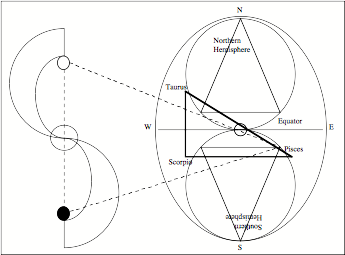
Clerk
Each journey leads somewhere.
Group of Women
Where has he taken us?
Another day older and deeper in debt.
Saint Peter, don't you call us 'cause we can't go.
We've sold our soul, and now we are poor....
(Clerk puts a flower on Shulamit's desk.)
Unknown Voice
Which way to the Castle...?
Second Voice
You are lost! Admit it...!
Clerk
I am lost. I have no words. I have no dragon to accompany my walk through the arid city. No temptation to relieve me. No aches in my Achilles. No salvation in my stew. My annihilation has no logic. Tongues tied to no one. Words without description. Night's eerie blanket: speaking acres of nuance but no concrete form. Destiny has no shoulder. Density wears a copper belt. Sum of the parts equals some of the story. Some calculations, like grapes, hang to dry. Mathematic importance. And impotency of vapors, like air, cling to trees. Salutory prominence. The gamekeeper has no bear for his molder....
"We move back away from the differntiated state of matter," Rose says. "Back into the dense form, where the differentiated voices of characters wearing masks are resolved back into the common element of Winter or Night -- the One frozen element. All voices in a darkened mass. It is November 17."
"This time the resolution back to the One element is not so complete, however," Crossmann says. "Some of the personalities survive, demanding a separate existence. The masks survive..."
"Peter Bostic re-appears and tells us more about the occult text on the different races," Rose says.
He reads:
Peter Bostic: THE SECOND RACE WAS THE PRODUCT BY BUDDING AND EXPANSION: THE ASEXUAL FROM THE SEXLESS SHADOW. THUS, MISTER CROSSMANN, WAS THE SECOND RACE PRODUCED....
Clerk: TELL ME MORE.
Peter Bostic: AN ANALOGY MIGHT GIVE SOME IDEA OF THE PROCESS BY WHICH THE SECOND RACE WAS FORMED. THE ASTRAL FORM CLOTHING THE MONAD WAS SURROUNDED, AS IT STILL IS, BY ITS EGG-SHAPED SPHERE OF AURA, WHICH, HERE, CORRESPONDS TO THE SUBSTANCE OF THE GERM-CELL OR OVUM. THE ASTRAL FORM, ITSELF, IS THE NUCLEUS, NOW, AS THEN, INSTINCT WITH LIFE. WHEN THE SEASON OF REPRODUCTION ARRIVES, THE SUB-ASTRAL EXTRUDES A MINIATURE OF ITSELF FROM THE EGG OF SURROUNDING AURA. THIS GERM GROWS AND FEEDS ON THE AURA UNTIL IT BECOMES FULLY DEVELOPED, WHEN IT GRADUALLY SEPARATES FORM ITS PARENT, CARRYING WITH IT ITS OWN SPHERE OF AURA; JUST SO, WE SEE LIVING CELLS REPRODUCING THEIR LIKE BY GROWTH AND SUBSEQUENT DIVISION INTO TWO. THE DEATH OF THESE 'POLAR CELLS' WOULD NOW CORRESPOND TO THE CHANGE INTRODUCED BY THE SEPARATION OF THE SEXES, WHEN GESTATION IN UTERO -- WITHIN THE CELL -- BECAME THE RULE.
THE EARLY SECOND ROOT-RACE WERE THE FATHERS OF THE SWEAT-BORN; THE LATER SECOND ROOT-RACE WERE THE 'SWEAT BORN' THEMSELVES...!
"I don't really have the faintest notion of what is meant here," Rose says. "I see the parallel between the single-cell life, creating life from itself by dividing itself in two. But I am not sure what is meant concerning Man and this parallel..."
"It is quite complex," Crossmann says.
"Perhaps it does not make sense at all," Rose says. "Perhaps it is mere mystagoguery...!"
"Perhaps," Crossmann says.
"One thing I want to mention here....well let me read it now," Rose says. "It is another reference to the Guardian Angels, which comes on the heel of a Dylan song:
All in all can only fall with a crashing but meaningless blow. No sound ever comes from the Gates of Eden. THERE IS TALK OF VIGILANTES NOW, TALK OF THE 'GUARDIAN ANGELS' APPROACHING. The women are frightened. They have sent their men away, telling them they were no longer needed. Yet, where the women don't need the men, soon the men have no need of the women, or the civilization. And then the only role left for the men is destruction. The men divided: those who destroy; and those who protect. He wishes to destroy the world, so he can leave. CONFORMITY APPROACHES.
(First Son dreams of his dead father who slides in the
current of a river down a ramp into the ocean. Soon,
he rises from the foam wearing a suit and a tie.)
First Son: The tie is re-born! Formality! Again, the Fathers...!
Woman Near the Well: It is too late, too early! Go back to sleep! I will tell you when to rise! I will tell you when the Dawn has come...!
"Apparently it is not the Dawn yet, afterall," Rose says.
"At least not for the First Son," Crossmann says.
"Because, if he is the Southern Hemisphere, well, then it is evening instead...?"
"Yes."
"Now, I understand that both you and your brother began wearing a tie after this dream," Rose says.
"Yes, that is true."
"You dreamt that your mother told you to stop smoking marijuana, and you did. You dreamt that your father told you to wear a tie. And you both did. Why...?"
"It was a mystical time," Crossmann says. "Dreams had meaning. Life was hard. We had little money. There was much unemployment. The streets were dangerous. Beggars you would meet on the street would try to extort money from you, threatening you with harm if you didn't give them something. The depression had force the state to cut back on its support of the mental institutions. And Eugene had a reputation of being a good place to live, a tolerant community. A lot of crazies came to Eugene, looking to survive there. There was a lot of tension of the streets..."
"And the tie would....what, fight this?"
"The tie was the symbol of man, and order, law," Crossmann says.
"The phallus?" Charlie asks.
"Yes. These are all related. We were both trying to lead by example, invoking the Spirit of Light, the Day, to return..."
"The Guardian Angels are coming!" Rose says. "That is the message. But you did not understand what this meant when you were writing this book...?"
"No. The words merely poured thorugh me on to the paper."
"Remember the 'Guardian Angels' in New York City," Rose asks. "The unarmed men who rode the suburbs and walked the streets, trying to protect innocent people...?"
"Yes. They were founded by Curtis Sliwa in 1979."
"Were they part of this archangelic force coming in?" Rose asks.
"Undoubtedly. The arch-angelic force came through and touched the whole world," Crossmann says. "Michael and Metatron did not only appear to me. Michael appeared all over the world during this period: in Japan, in Europe, in Asia. Michael Gorbachev, too, was influence by this arch-angelic force, whether conscious of it or not. The force came down from heaven and, really, re-made the world...."
"Threw the political left out of heaven, the left wing, the communist doctrine?" Rose says. "That's what you have said...."
"Yes. Threw the Darkness out of heaven, out of power," Crossmann says.
"Then the same theme is repeated in the next section," Rose says, "which becomes more playful, more poetical again."
He reads:
Things are too serious now. The seriousness of bones. Hammers on the Flesh of Time. Knocks in the baggage drum on steel. Rhythm is precluded here now that rhyme has been de-nuded here. Alluded-to here. Pitch bitch made shade. Core lore spoke spokes and land. Man can sing bring things to you. Surely, early came shame to too-pretty cities. Productons of the erstwhileclone spoke moments. Making no sense is making no sense. Where is the world now? For whom do I write? Where are the splendid ducky Frenchmen who gleam? Writers honored in this land? Outcasts amid the outcasts. Who can write who is not outcast first? Cain-bladed sound and the writhing of pure vowels -- generators of activity. THE OUTCAST IS NOT WANTED IN HEAVEN! The Outcast does not really want to be in heaven. Artists create the New World in their minds. Yet rarely is there a place for the poet in the govenment halls. Free Thinkers are not allowed in the rigid dogmatic scheme. HALLELUJIA! I HEAR SOMEONE SHOUT FOR GLORY! Blood ritual. It was I who shouted; and now I must cringe. ARE YOU AFRAID? There is no place for me. WANDERING IS YOUR CURSE, MISTER CAIN. ETERNAL WANDERING. Who will kill me and free me from turmoil? GOD HAS ORDERED THAT NONE SHALL HARM YOU. The Higher Gods refuse to build. The Lower Lords (the Lunar Pitris) build forms. THE FATHERS, YOU MEAN. The 'Fathers' are re-born; the form-building lords. YES, YES. WE HAVE DISCOVERED THAT BEFORE. Anti-hippie sentiment does rise. Violent your men I see walking the streets. IS REAGAN TRULY 666? The Hounds of Hell will be loosed when the end comes. THE END OF DAYS. The end of days. MICHAEL HAS A LION'S HEAD. Who is this Mikael? I hear him coming...!
"Clearly, the arch-angel theme has appearaed and seems to be expanding," Charlie Rose says. "The Clerk is still torn between two minds. He is concerned about the anti-hippie sentiment he sees on the streets of Eugene. But he, apparently, is also angry at the darkness, the hippies. He has two minds -- and he apparently can move easily between these minds. He is encouraging some of these people to leave Eugene and move to Australia -- where, he believes, the world will be safer.... Michael, you write about Eugene as though it were Newark, New Jersey or Patterson, New Jersey, or Akron, Ohio, or Atlanta, Georgia, or Washington, DC -- places with a lot of crime. Eugene seems like a remarkably decent, tame town compared with the real crime centers of America..."
"Eugene did not have a lot of crime," Crossmann admits. "But Eugene had a lot of mental energy. There were a lot of people who settled in Eugene because it was a counter-culture center, like Berkeley, or Madison, Wisconsin, or Boulder, Colorado. There were a lot of revolutionaries in Eugene, people angry with the county's values, the government. So there was this kind of energy in Eugene that was not in Atlanta or Newark. Atlanta and Newark had racial problems mostly; that is where their tension came from. Eugene was packed with ideological energy. It was a real spiritual center in America at the time. Everyone I knew was pursuing some mystical or occult study. There were those who remained behind, those who remained in the 1960's, arguing for a political solution to America's problems. These were communists mostly. But they were stuck. They could not grow. The spiritual energy in Eugene was vast. Buddhist monks moved to the Eugene area from China. The Rajneesh settled in eastern Oregon. There were astrologers everywhere, tarot readers; everyone was pursuing some form of spiritual exploration..."
"And this was the darkness that you had to overthrow," Rose says. "This mystical energy was the Night, the Female Mind. You were both the Female Mind and the Male Mind -- and so you were torn between the two, with loyalties to both. You were Jew and anti-Jew. You have written this. You also write that you wanted to be the last one out of the room -- you wanted to be the one to turn out the light. You met people every day, in your teaching job, of course -- but you were also a public figure, talking with people about your ideas at the universiity, at the public market....
"There was clearly a war going on," Crossmann says. "A war inside me. A war in heaven. Eugene was clearly a kind of heaven, a spiritual heaven. Eugene was an occult college really. There was so much independent study being done. Many people were involved in group study, and group experimentation. In many ways Eugene was a spiritual supermarket: Zen, Lao-Tse, Hinduism, Buddhism, Confucianism, Judaism, mystical Christianity, Gnosticism, Aryanism, Kabbalism, Gypsy Mysticism. It was all here.
"You spoke about Stupid, the Communist, and Bucher, the Scientist as being the two giants, the two poles, at the Public Market," Rose says. "You said Stupid was the dinosaur..."
"Yes, he was stuck," Crossmann says. "He was stuck in this ideology. One had to be either stupid or blind to not see the lies of communism. The murder of Stalin and Mao. Of course, the holocaust in Cambodia. The Vietnamese boat-people, risking their lives by the thousands rather than live in a country without hope. The same pattern always evolved in a communist country. The intellectuals help the communists win -- and then the communists kill the intellectuals because they aren't ideological enough. The communists castigate the best-educated people in their society and give positions of power to those who have no skill to wield power. Everything sinks into medicrity and fear. They close their borders off and kill as traitors anyone trying to escape. Or emprison those trying to escape. Then, when things don't work, when the society sinks, scapegoats are blamed for the troubles of the country. The land sinks into paranoia. It is the same story in every communist experience. The west has to put up immigration walls to try to keep people from coming here -- still people by the thousands, even millions, risk their lives each year to come here. Communist countries put up walls to try to keep their own people from living. Intellectuals tried to ignore this, tried not to see it. But anyone who was not a frozen ideologue ultimately had to see it. And when one saw this politcal religion as a fallacy, an illusion, then one needed to take our friend Kierkegaard's 'blind leap of faith', looking for a spiritual truth underneath all the illusions....
"The struggle in heave, then, was between Material Life and Spiritual Life," Rose says, "and each looks like darkness from the other side..."
"Yes. From the two universes."
"But one side won," Rose says.
"Yes, Life won. Material Life won. The Tree of Life defeated the Tree of Knowledge of Good and Evil," Crossmann says.
"So we have the question as to whether Reagan is really 666, the Anti-Christ," Rose says. "We have the intimation of Michael the Archangel appearing, approaching the Earth. And then Lee Harvey Oswald appears, warning the Secon Son that it is easy to glorify America on the ideal plane -- and something else to confront that ideal after it has fallen from the heavens....I think we should probably take a break here for a commercial. And then we will come back to take a look at the significance of the Star Wars movies in the context of this novel...."
"We are back with Michael Crossmann" Charlie says. "You bring up the movie Star Wars, and the Star Wars sequel The Empire Strikes Back, which certainly has a built-in father-son struggle, and revelation... We were talking earlier about the Oedipus Complex, the Electra Complex, the Archetypal Family, the struggle between Father and Son, and between Mother and Daughter...."
"Star Wars is pure comic book on the surface -- but it is mythological matter," Crossmann says. "A kind of opera for the screen, without the music of course."
Rose reads:
YOU HAD THOUGHTS OF A NEW COLONIAL SPIRIT. OFFER STATEHOOD TO ISRAEL, JAPAN AND TAIWAN. POSSIBLY TO CENTRAL AMERICA. I have to give up my power. YES, YOU UNDERSTOOD TOO EARLY. The "Masculine Mind", in our land, plots destruction. IN THE MOVIE SEQUEL TO STAR WARS, LUKE SKYWALKER, THE AMERICAN YOUTH (LUKE, AGAIN, IS 'LIGHT'), BATTLES WITH DARTH VADAR, THE DARK GIANT, THE PERSONIFICATION OF EVIL. WHEN EVIL OFFERS LUKE A TRUCE, LUKE CRIES: 'I CAN'T! YOU KILLED MY FATHER...!' TO WHICH EVIL REPLIES: 'I DID NOT KILL YOUR FATHER! I AM YOUR FATHER...!'
"Luke and Lucy are cut from the same cloth," Charlie points out. "Their names mean the same: Light. Then, as the Second Son turns again to the question of saving America's soul, asking again the nature of evil, of conquest of the Father -- whether the Son must kill the Father -- he settles on a strange vision of colonizing Mercury..."
"We must remember that during this time, America was hated by much of the world," Crossmann says. "America was now perceived as the Force of Evil in the world. Russia was being portrayed as the champion of the poor. Western intellectuals ignored the murder and oppression going on in communist countries and focussed instead on the ideology which apparently supported the poor. 1984 was approaching. Remember 1984: Oceania. America (Oceania) against Eurasia (Russia) and Eastasia (China). Many intellectuals had abandoned America and had thrown their support to the east. America had stumbled in Vietnam and Cambodia. Then Nicaragua had fallen into the Russian influence. The war in El Salvador was boiling. And our allies were annihilating public opinion -- and common decency -- by killing priests who had spoken out for the poor. America, in fact, was very nearrly standing alone. Traditional European allies were pulling away from here. Only Britain remained true. The light shining on America was very dark at that time. The Second Son's impulse, very truly, is to have America turn its back on the world, forget the world, come home, focus on itself, and carry its empire into the stars..."
"Many people were afraid that Reagan would even make it darker," Rose says.
"Well, many people thought Reagan was the anti-Christ," Crossmann says. "That was a common view in Eugene...."
"Really?"
"Common among mystical and political Eugene."
"And, I mean, communism looked like the good side," Rose says.
"Yes. And it looked like communism was winning," Crossmann says. "Vietnam, Cambodia, Nicaragua -- El Salvador was in question. Communism seemed to have the moral high road, and the momentum seemed to be predicting the inevitable. That America would be standing alone, surrounded by a sea of enemies...."
"Then something happened," Charlie says.
"Yes, something happened."
"But why Mercury?" Rose asks. "Clearly, you are seeking American innocence more than anything else. You are seeking the 'Sacred Island' -- the beginning of all things... Seeking an America that was viewed by the world more the way it viewed your father's generation, as the saviors of the world..."
"Well, Mercruy probably because Mercury is connected with Michael the Archangel," Crossmann says. "In fact, that is no doubt the reason. That's where my unconscious focus was..."
Rose reads:
Dare the Son kill his own Father? MUST HE? Does not Time kill itself? MUST WE ACT TOOVERTHROW HIM? Or whall we make him sleep merely by refusing to follow? WHICH IS THE EVIL PRINCIPLE? -- IT IS A QUESTION WHICH HAUNTS YOU. It is all a light show, with shadow reflecting substance, and substance reflecting the Past now gone. HAVE YOU NOT CHOSEN THE EVIL PATH FROM THE TIME YOU CHOSE TO FALL INTO THE LIONS OF MATTER? In the Spring, when I create, through the medium of a Past Mind? YOU HAVE LOST YOUR SOUL -- ONLY NOW DO YOU SEEK TO RETRIEVE IT. Is it our own Father we must castrate -- or do we castrate ourselves, making ourselves weak, subject to invasion? Do we castrate our Father before he annihilates the world? YOU SEEK, IN YOUR FRENZIED RUMINATIONS, TO FIND SOME HIDDEN THREAD WHICH WILL SECURE AMERICAN SURVIVAL -- SURVIVAL WHICH OVERTHROWNS THE LAWS OF NATURE. YOU HAVE CONDEMNED YOURSELF TO DEATH. NOW YOU WISH TO OVERTHROW THAT BLEEK SENTENCE. YET, IT IS NOT DONE. TIME WILL NOT ABOLISH ITS DOGMA. YOU POINT TO RUSSIA, SEEING IN THIS SEPARATED BEAST THE DARKNESS. SHE IS COLD, ISOLATIONIST. SHE CONTROLS PUBLICATION OF IDEAS, CONTROLS THE NEWS, REFUSES TO LET HER PEOPLE CHOOSE THEIR WAY OF LIFE, REFUSES TO OPEN HER DOORS TO THE INFLUENCE OF OTHER SOCIETIES. You can make a case for its evil ways. WHO -- WHICH SOCIETY -- IS FIT TO LEAD? AND WHO IS FIT TO ENDURE...? We should have the goal of colonizing Mercury. Requisite to this, we must have the Bill of Rights updated to guarantee the basic necessities of Life: food, clothing and shelter, coupled with a requirement of work or service for every American. There should be no free ride. There should, by the same token, be no destitution. No one should go hungry. Then we turn our eyes to the stars. We have work of exploration ahead. We are the children of space. The next frontier must be far from the Earth. We are as Columbus: seeking to flee a world seeking death. A wide sea stands before us. No one wins a fight for the Earth. We will not be weak -- but neighter shall we kill. A door is open. Are we to throw it ajar? Or are we to stew in moroseness, queitly acceding to Death...? MERCURY CANNOT BE COLONIZED. WHY DO YOU CHOOSE MERCURY? YOU COULD HAVE CHOSEN ANOTHER PLANET. MARS HAS POLAR ICE-CAPE, WHICH, IF MELTED, MIGHT PRODUCE A LIVING ATMOSPHERE. I don't understand why I choose it. It came into my mind. I will need to find out why. I DREAMT THAT THE LONG-HAIRS WERE PURSUED THROUGH THE TOWN. THE POLICE HARASSED THEM; THUGS PATROLLED THE EMPTY STREETS SEEKING VIOLENCE. I WAS ONE OF THEM. FOR PROTECTION, WE WALKED IN GROUPS; WE FOUGHT THE THUGS WITH STICKS AND TISTS. EVENTUALLY, ALL THE ALIENS, LIKE I, WERE FORCED TO LEAVE, HEADING TO THE CITY OF SAINT FRANCIS. I see. The meaning seems to clear. WHO ARE THE SCAPEGOATS? The Land of Paranoia calls, when I whisper. EACH DREAM NOT UNDERSTOOD IS A DOOR NOT OPENED. Coldest of mornings. WHY DOES YOUR FEAR SEEM SO BRISK? Better wise than half a cure. AMELIA, IT WAS JUST A FALSE ALARM. The darkest of donors. HORROR IN THE CAPITAL. Some land opened by its frenzy. FEAR WALKS A BLUE LINE; PREPARATION FOR THE INCENDIARY PURGE. Fire is thine element; to fire thou must, in time, return. RESERVED FOR THE HERETICS. Must I hate Man in order to love God? SCIENCE FICTION. Fear ever exists; Science Fear. Yet the horror of fear is not always expressed. SCIENCE DICTION. Eat not one but seven to see. MAGIC MUSHROOMS ON THE COAST. Colloquial dietician. WHERE DO THEY SEND US? Darkest of days. Who will come? INCENDIARY EVE. Eve as the Evening: incendiary evening. She who evens out everything. IS AMERICA ATLAS THEN -- THE LAST STANDING OF THE TITANS? THE ONE WHO HOLDS THE WORLD ON HIS BACK? ATLAS A KIND OF ATLANTEAN. Is the curse ever paid? IS THE WELL EVER DRY? Twenty-one gun salute comes to beckon. Reagan assures us that America won't change. WHY IS THE WORLD SO AFRAID OF US NOW? What monster has been loosed since, in the name of our Fathers? OUR FATHER WHO ART IN HEAVEN, HALLOWED BE THY NAME. AND KINGDOM COME, THY WILL BE DONE ON EARTH AS IT IS IN HEAVEN. GIVE US THIS DAY OUR DAILY BREAD. AND LEAD US NOT INTO TEMPTATION, BUT DELIVER US FROM EVIL, ACCCORDING TO THE SCRIPTURES. Who comes next? SIXTH-ROUNDERS WALK A COUNTRY MILE IN EXPECTATION. VENUS-WORSHIP, WHO HAS NO CLAW.
Conductor: The characteristic method of individualisation, in this Solar System, is the resutl of force emanating from the Cosmic Mental Plane, which sweeps into activity those entities whose function it is to form the body of the Ego out of their own living substance on the Mental Plane -- thus, through their own qauality and nature, to endow Human Units on the Physical Plane with the faculty of self-consciousness, thus producing Man.
It is their work, also, to energise the Mental Units of all men, and to coordinate, by means of the force which they embody, and to energise the sheaths of the three-fold Lower Man, so that they may, in due course of time, intelligently express the will and purpose of the Indwelling Thinker. Through the carrying-out of this function, in the case of the Human Family, ccertain planetary and systemic conditions are brought about.
The Dense and Etheric Bodies of the Logos and of the Planetary Logoi are merged; one coherent vehicle of expression is provided for these Cosmic Entities.
"Then the brothers appear in the shape of the Kennedy Brothers," Charlie says. "I'm not sure what that is all about..."
"And in the same breath the Clerk says he feels like he is standing in the 1930's," Crossmann says. "With the world of the verge of an international monetary collapse. Remember, people were being laid off. Unemployment was rising. Japan and Germany had outstripped America as producers of economic goods. The quality of American goods was at an all-time low -- or at least that was the perception. We were sinking into a trough. The picture was very bleek. And the historical epoch that seemed most near to this experience was the Great Depression of the 1930's. This Memory (Cultural Mental Matter) made very tangible the rise of the Nazis, the persecution of the Jews, the Great War coming up. Germany and Japan were now the world powers. America was weakening, becoming self-conscious. And Russia was in the middle of its of 'Vietnam Experience', in its war in Afghanistan... The Newshawker appears and shouts the news that, first, trade protectionism was growing; and, second, that Japan had elected a new premier who promised to beef up the Japanese military. Later, the same Newshawker proclaimed that Germany was moving closer to Russia, alienated by America's nuclear hawkishness...."
"The world seemed to be turning against America."
"The Anti-Universe was at its strongest," Crossmann says.
"Then the Clerk's vision for the Earth," Rose says.
He reads:
I feel as though I am standing in the 1930's, with the international financial market breaking up. Trade protectionism leading to a new wave of nationalism. I feel as though we create these events in an unconscious way, in our sleep, breaking the world-form so we can build a better model. It is as though we sleep in order to prepare this scenario. some of us are here, watching worlds from a distance. I am not pessimistic. A European lecturer of architecture came to America recently as the 'ambassador of reality'. He warned America that optimism was an illusion, that there really was no hope; and that America should learn the lesson of Europe. We are preparing to lead our nation through war into light. I see a new world on the other side of this darkness. A world united, unified, unto one government, an Earth reaching toward the stars, reaching toward the infinite with its mind, a world of states, united states, democratically-elected; basic necessitites of food, housing, clothing, education, energy, employment as guaranteed by the Bill of Rights. We have an opportunity, through this depression, of re-creating America, of updating the Bill of Rights, of making it step in time with the Time in which we live. I believe in the Future. Let European states mumble about the glorious past, and build their museums to their distant Childhood. We will not shrink into a hole and sleep for ever. We will not retreat from leadership. A new creation lies before us. A new mind now waits to be born. Believe in change -- aye! It is an illusion -- yet, by illusion we only mean that it is not changeless, it is not permanent. Change is no less holy than the eternal. Atlas ever holds the world on his back -- Atlas, the Atlantean. Our minds may be on idle now. We pause, before the next Round....
"Then the Conductor appears to inject more esoteric doctrine," Charlies says. "Which is quite interesting... He begins by presenting a new diagram of evolution; then he moves to a very long dictation on the nature of the avatar, the Messiah, or spiritual beings who come to Earth for a specific purpose...."
"This is not just an abstract description of this Avatar force," Crossmann says. "Although I did not realize it at first, it is, in fact, a description of the coming in of the archangelic force which will soon appear in the novel, as well as on the Earth in a more general sense...."
"The Michael the Archangel force?" Rose asks.
"Yes. And the Metatron force," Crossmann says.
Charlie reads:
Conductor: In the producing of self-consciousness in the Human Family, the full conscious occupation by the Logos involved in consummated. It is the moment of fruition; and, from an esoteric standpoint, marks the attainment of one perfected Septenary. The three Involutionary or Elemental Kingdoms and the three Sub-Human Kingdoms find their Seventh Principle in the Fourth Kingdom of Nature (3 plus 4 equals 7). When the Life of the Spirit has circled through these Seven Kingdoms, then full self-consciousness is achieved, from a certain relative standpoint; and the Son (the Soul) is on the way to attainment. This relative perfection has then to be carried on to other stages; but they are stages in which the separated self-consciousness of the Identities concerned (whether Human or Planetary) must eventually merge itself in universal consciousness....
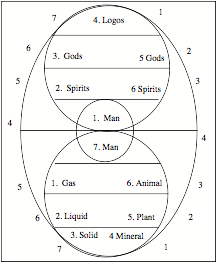
On extra-systematic or cosmic levels, the Individualisation process produces a corresponding activity in the Egoic Body of the logos -- hence, increased vibration in that center in the body of the One About Whom Nought May be Said, which our Logos represents. It also produces a reaction, or 'occult recognition', in the prototype of the septenate, or in the Seven Rishis of the Great Bear; and this reaction, in cosmic circles, will persist until the end of the Mahamanvantara, when the Logos is set free (even though only temporarily) from Physical Plane existence.
It also brings about a setting loose of force from the Cosmic Mental Plane, which is cyclic in character. In this Round, the Fourth, the maximum force of this cycle was felt in the Third Root-Race. In the next Round, the Fifth, during the Fourth Root-Race, and for a very brief period, a fresh cycle will reach its zenith, and will again open the door of individualisation in order to permit the entry of certain very advanced Egos who are seeking incarnation in order to carry out a special piece of work. This Round will provide no bodies adequate to their need. The Next Round may do so if the plans proceed as anticipated. In this case, the Manasadevas concerned will not individualise animal men, as in the previous Round, but will stimulate the mental germ in those members of the Human Family who -- as HPB says -- though apparently men, are wihtout the Spark of Mind.
During the next seven hundred years, these low aboriginal races will practically die out, and will not, in this Round, reincarnate. They will be rejected. In the Next Round, opportunity will again occur; and the Manasadevas will again renew their work of forming Individualistic Nuclei for the development of Self-Consciousness. The Egos awaiting opportunity will not, of course, enter in until the human type of that era is sufficiently refined for their purpose. They are concerned with the unfoldment of the Sixth Petal of the Logic Egoic Lotus, and are of such a nature that we can scarcely conceive of them. They are on the line of the Buddhas of Activity, but the above named are free for this Mahamanvantara, whereas these particular Egos have yet something to work out. They could only 'come in' in the middle of the Fifth Round, and were a group of initiates who arrested theeir own evolution (technically-speaking) in order to take up a special piece of work on the planet Vulcan; therefore, they must return to continue and complete that which has been left undone. Owing to the results of their experence on Vulcan, the physical venhicle necessitated is such an order that they could not, at this time, and in this Round, incarnate without disaster.
Clerk: At whom are you angry? NOT I. Aye, surreptitious indictment. You blame me for your own darkness. HOW CAN YOU PROVE IT? Proof is not necessary. Understanding, alone, suffices. UNDERSTANDING LEADS YOU, EVEN MORE THAN DOES WISDOM. Give me my Wisdom before I sleep -- yet Wisdom is the logic of Old Age. Ask me not to be wise when I'm a mere boy. Ask me to be active when I rise. Ask me to be curious. Ask me to sing; to slave for love. Do not ask me to sleep when I rise YOU WISH A WORLD THAT HAS NO MAN? No, you wish the world without Man. I love Man; I champion his drama. I do not wish to see the hollow end. I do not find the animal more sacred than the Man -- more natural than the Man. Don't tell me Man has failed. Man's failures are his beginnings. Man's pain is still his first step toward running. I will not hate Man, and blame him for pain -- simply because he suffers from it. No. If it were not for pain there would be no life. Thee would be no salvation. THOSE TRIBES WHICH GO INTO THE FORESTS BECOME EXTINCT....
"I don't know what you mean by the planet Vulcan," Charlie Rose says. "Science says there is no planet Vulcan -- although for many years there was specualtion that there was a planet Vulcan. Just what is this planet Vulcan...?"
"Vulcan is related to Cain," Crossmann says. "He is one of the first creative gods. He represents the inner man, the Soul, who fashions his own weapons he uses for his own spiritual salvation..."
"What you are doing in this novel?" Rose asks. "It seems that you are fashioning weapons as we read this. You are battling with ideas. You are building a foundation, an Earth, upon which to stand... But Vulcan is a symbolic truth then -- but not a real planet...?"
"It has not been discovered by science yet," Crossmann says. "Vulcan stands between Man and the Sun; and it is veiled by the Sun. Jehovah is identified with Saturn and Vulcan...."
"Vulcan is connected with the mineral," Rose says, "at least in mythology. He works at the forge. He is a kind of celestial smith. And you said earlier in the novel, not far from here, that the Highest Mind controls the rock or the Earth. Rock music is connected to all of this it seems..."
"Yes, these are all connected."
"But, still, there is no Vulcan as far as science is concerned," Charlie continues.
"It is said that Vulcan is found within the orbit of Mercury," Crossmann says. "But this is a mystical expression. And, though Vulcan preprares the weapons of war, he never initiates war. He merely prepareds the weapons of war..."
"You are stressing in this passage that America is to sleep and wait for someone to attack her," Rose says. "And that is what happened to you, isn't it? You were preparing for war; but the Dark Giant threatened you; you did not threaten him. He woke you up..."
"Yes."
"You also are clearly the Defender of Man," Charlie says. "In this, you are also like Prometheus, who defended Man against the Gods."
"I remember one day being outside of Eugene on a hill overlooking the valley," Crossmann says. "Two jets were passing each other far above. And I realized they were riding on highways made of air. And I was impressed by Man's ingenuity. I remember praising Man's intelligence. My brother was there; and my friend Jay Berger and his wife. Both my brother and Jay were surprised that I would be praising Man -- because they both felt, at the time, that Man's creations had ruined the world, had destroyed Nature. All around us were these gigantic electricity structures, striding over the landscape like steel monsters. And here I was praising Man. Jay was a wonderful, sensitive person who had abandoned the world, went in to the woods to build his house and raise his family, trying to live set apart from the modern world..."
"What was it you said: 'The tribes that go back in to the forests become extinct'?" Rose says. "Did you have your friend in mind when you wrote this...?"
"I don't remember. Probably not. I was existing on a very abstract level when I wrote this novel."
"The Clerk goes on in a kind of loose poetry which suggests Adam in Eden and then, again, examines the nature of the Father..."
Rose reads:
Time goes round the punctured spindled base of terms and no one can heart it. We walk twenty-seven paces to our torture; and the man with the bandage, a leaf, calls on specifications.
WHO ARE YOU? Nonesuch names and nom-de-looms and loons of sight can gather my masks. Tunes rebound the gallant sites where by-gone lore and the Captain wove riddles. ARE YOU MAD, MAN? I walk the littered Past and find the lettered lane on which lies Progress. No one sees me when I walk. Must I be Death; can I not be Life instead...? YOU CAN BE LIFE ONLY IF YOU SERVE. I do serve. YOU CAN BE LIFE ONLY IF YOU SERVE ME. I serve no other. In resisting your decree, do I not serve you also? In fighting against your tyranny, do I not serve you by refusing to serve...?
Luke Skywalker: Would you serve the Empire, my friend? Would you serve Darth Vadar, your father, who rules the world through the hammer of darkness?
Clerk: I fear for the safety of my people. My children must not suffer because of my own inertia.
Luke Skywalker: Do not join him! You cannot go back into the world until your training is complete, my friend! So Yoda has said; so, Obie-Wan Kenobie...!
(George Lucas stands with Richard Wagner.)
Clerk: I dreamed that an American ship was sunk by an unseen submarine. AND YOU BLAMED ISRAEL. Yes, I thought of Israel. In the Spring, nations divide in to independent zones, units of power, returning to their primary element(s). Instinct comes in. Territory. The Animal, if you will. The minds of each nation 'theologize' that nation, proving, through the mind, that God wills this people should triumph, this people should be 'chosen'. Each 'culture' seeks to establish itself as superior, as ruler of the world.
The Old World rejects American Culture. The Old Governments and the Ruling Families reject the ways of the New. Equality. Democracy. It is the Future they resist. They deify Age, 'Tradition' -- they condemn that which is 'Modern'. Modernity has the stamp of Evil, of superficiality. And Old Man, ready for the grave, condemns Young People for lacking Wisdom -- and really envies their Youth. So, too, the Old Culture condemns Change, condemns Evolution, for any change threatens to de-stablilze its rule, its power. The Church demands that parishoners worship the Old Ways. Change is Evil, so they say. So, too, with Old Money. If they fear the Future, then let them fall. It is Time, itself, that they fear. It is their own death that they fear.
Those who fight to rule seek to establish their 'chosen culture' as the way of the world. Israelis I have spoken with tell me that 'American Culture' is raping the world -- that is, is seducing their children away from the Old Ways. They wish Life to be finished. Everything to be found already. They wish for the Old World to be preserved, exactly as it is. For Time to stop. It is not enough that the Old be preserved; they want it to be untouched by the New, unsullied by the New.
THE TRADITIONLESS AGAINST THE TRADITIONAL.
Yet even our 'traditionless' is a tradition, is it not? We are the formless ones. Science Fiction is a kind of mythology: ever forward; ever-becoming. We are the foundation stone of the Earth. We control the Earth, the Mineral Element, through which the Spirit works directly, unconsciosly. We have rebelled against the chains of the Old World. Change is not to be feared. Change is movement in the direction of Godhood.
We carry the world on our back, as did Atlas. This is our current calling -- this, too, is our cross. YOU ARE DELUDING YOURSELF! Perhaps. The delusion of one is another's biography. PERHAPS. YET, ARE YOU JOINING THE EMPIRE? I don't know. I believe in evolution. Nothing perfect here -- but everything moving toward perfection, through a stop and a start. I do not believe that fear of change is peace. Rather, it is the death of the Spirit. Monuments of Museums are fine, in their place; yet Museums are not Life. Our prophets call us to adventure...!
IS IT NOT DEATH WHICH YOU FIGHT, AS TIME?
Death in one form is Life in another. Perhaps by ruling this world we are dead to the other. It need not be so. I cry out against the failure of heart, the failure of faith, the soul that retreats from the unknown.
SOME MERELY JUST WISH TO BE LEFT ALONE.
Time leaves no one alone. Time preserves all in teh forms it creates; yet Time destroys all it creates, seeking a new and better form.
SOME STARS EXIST LONGER THAN OTHER STARS.
That is true. Some men live longer than others. Yet the one who fights change does not live so much, no matter how long he lives -- for change leaves him blind.
SOME ENDURE. THE WATER ENDURES, AND RUBS AWAY THE ROCK.
Yet some must be the rock also, as some must be the water. If there were no rock, there would be no water. If there were no cup, where would the water go...?
YOU ARE TOO LARGE FOR THIS EARTH. WHEN YOU COME HERE, HORROR COMES WITH YOU. THE FORM OF THE EARTH CANNOT SERVE YOUR CONCERNS....
Is it Evil to seek greatness? Is it Evil, then, to fly?
"The first paragraph of this passage," Rose says, "in which you describe the 'theologizing' of favorite nationa status, the 'chosen' nature, of nations, may not make sense to readers as they go through the novel on a first reading. But that is exactly what you do. You are theologizing for the salvation of America. And this becomes apparent as we travel further into the climax of this book. I would say that now you are praying for America. But, before long, you will be portraying God's covenant with America; and America's new name, which you have been given, after wrestling this long Night, this long period of depression, with the angel Michael -- now this is your description which I am paraphrasing -- this new name being the name of Israel. You say that like Jacob in the Old Testament, who wrestled with Michael the Archangel all night in the desert, who was wounded in the hip, so that he could receive the name of Israel -- and be the 'chosen' one of God -- you say your Jacob, Jacob Heimkreiter, an American Jacob, who is yourself, in truth, Jacob also wrestled with Michael the Archangel all night. And, so, he was also given the name of Israel. The New Israel. Israel in Heaven...."
"Yes. You will remember, Charlie, that the Puritan founders of America, the European founders of America, and our Founding Fathers too, viewed America as the New Jerusalem. Essentially, the New Israel. The New City of God..."
"The 'Chosen People'," Rose says.
"Yes, the 'chosen people'."
"And that's what this paragraph presages?" Rose says. "The transformation of the idea of America, of the realtionship of America to God...?"
"And God to America. Yes."
"My intention was not to read most of the quotes from the occult texts that are woven in to the texture of this novel," Rose says. "It's very complex. It is a system that must be studied in-depth. However, I am finding, as we wander through this novel together, how important the texts are to the novel, in presenting a spiritual context, an underpinning, to the ideas that are leading you back toward life...."
"That is well-put, Charlie," Crossmann says. "They are aspects of the same thing. The Blavatsky and Bailey texts are also signposts on the road we are taking through this darkness...."
"You call it darkness, but it is also a kind of light," Rose says.
"Yes, of course," Crossmann says. "Darkness in this world is light in the other world."
"But beyond that -- I know about the universe and the anti-universe," Rose says. "But, beyond that, there is something very magical about this journey you have taken..."
"Magical and maddening both."
"This is especially true now that we are moving in to the descriptions of the Avatars, Advanced Souls, messiahs, who willingly take bodies in order to perform some task on the Earth. This fits in so nicely with your story of the approaching power of the arch-angelic force, which we call Michael the Archangel..."
"Michael and Metatron," Crossman says. "Yes."
"Were you wounded like Jacob was?" Rose asks. "Do you walk with a limp...?"
"Well, in fact, I have had some health problem," Crossmann admits. "Which began in the late 1980's. A pain in my pelvis and hip, an inflamed back. Doctors never did figure out what it was. It went away form many years. But recently it has come back. And it does make me walk with a limp..."
"Are we going to be able to get through this novel tonight?" Rose says. "We don't have that much time left. Maybe we should get back to the book."
Rose reads:
Conductor: Individualisation in the next Round will begin to show indications of the third method -- that of the next System. This method has been described as that of 'occult abstration'. It will concern itself wit hthe withdrawal from out of the lowest type of the then existing men (throughknowledg of the etheric constitution of the body) of the vitality latent in it, and a temporary turning of that latent fire to the increase of the activity ofthe germ or spark of mind; this will be effected by a dynamic action of the will...
In the Mahamanvantara, thethree methods of Individualisation in connection with our planetary scheme are to be seen:
a. In the Moon chain, the gradual evoluation of self-
consciousness under natural law;
b. In the Earth Chain, thaf of achieved self-consciousness
through the aid of extraneous agencies. It is the
distinctive method of this system.
c. In the next Round and Chain,the method will be abstraction
through will power, but this in an embryonic manner.
In all these schemes wheron Man is found at some period or another, these three methods will be contaccted. They mark the gradual control by the Logos on Cosmic Levles of His three-fold lower nature. In the first, the correspondence lies in the latent consciousness of matter and works under the Law of Economy. It concerns primarily the Self-Consciouness of the Logos in the Dense Physical Body, and His polarisation therin. It is likewise the same for a Heavenly Man; and a part of the mystery of Evil is to be found in the readiness of certain of these Cosmic Entities (particularly our Planetary Logos in the Moon-Chain) to remain polarised in the Physical Etheric Body after supposedly dominating the material aspect, or gaining the control of the Third Fire in an earlier System.
The second correspondence (with regard to the Earth Chain) concerns th latent 'consciousness of desire', and works under the Law of Attraction. It is the law for this System, and deals with the ability of the Logos to 'love wisely', in the occult sense of the term. It has relation to the polarisatin of the Logos in His Astral Body, and produces the phenomenon called 'sex activity' on all the planes of the System.
In the earlier (FIrst) System, emancipation was effected through the faculty of discrimination. Through the force engendered during the process that vibration was set up which persists today in matter. It is evienced by the Active Intelligence and the discriminative selective capacity of the atom of substance. In this (Second) System emancipation will be brought about along the lines of occult dispassion; this, likewise, will leave its mark upon matter, tinging it in such a way that, in the Third System, promordial substance will demonstarte a second quality. In the next System, 'non-attachment through abstraction' is as near as we can get to the method of the liberating process, although it is useless for Man to speculate upon this as his mind cannot conceive of the condition at this point of development....
Literary Critic: Stealing words again! I thought you had learned that we pay to hear you speak to us. what if shakespeare had left his music to that Bacon fellow? Are you afraid that your words won't be descriptive enought, descriptive of the form...?
Group of Women: - He does not wish to come down off his cloud, to be with the rest of us human beings.
- He thinks he's better than we are.
- What is he talking about anyway? Why should we be concerned with what he is saying...?
Clerk: Ground round, in the first event. Tunic and toxic: the melancholy urr. Banquets for the holy nail, turned light on its heel. Blood on the palm sun day. He who eats is he who moans. Saturnalia, and its first meal. Poverty in chains. Bonfires on the street. Caring about the curvature. Who goes there? Hamlet's father? Darth Vadar in a crater? Moon-orientation? The power of the coin. the coigne of opinion. Walk-faster walking sideways. Saying always: 'Count you blessings! Count your blessings...!' Black Man in his Sunday body. Depression re-constructs the White Man's form. Taking on violence to the bone. Visions of racial conflict: on this day when the Moon is full with its weepings. HE WHO HEARS BUT DOES NOT SEE; HE WHO SEES BUT DOES NOT WHISPER;HE WHO SPEAKS BUT DOES NOT MOVE! BEWARE! DREAMS TO YOU SPEAK EARLY OF DANGER...! Fear is the only darkness -- so says Master Po. Who is the strongest within himself? Racism's feather, cut close to the cone. Sumday measurement of profit. Prophetless asociation. the sins of the Father...speak the sins of the Son. Holy matrimonial discography. Leslie Rhodes on a wave walks. Too early for your amusement. Calling out to her ghost: 'Do you hear me? Are you there...?' No one comes the dream to carry. Longing for the uncertain; disappearance of the veil. Contusions on the Soul. Beggary, and the frown of heppenstance. Curlews are real. And real are their meaning. WHICH IS? Which is the true one? WICH IS NOT THE TRUE ONE? Confusing me with turns of thought. THOUGHT BREAKS LIKE DAYS OF SCOURGE. Hurry to see the clown in the caravan. WHO IS THE CLOWN? The clown looks like you AHH, I SEE. You see the danger? NAHH. I SEE THE CLOWN -- THE IMPRINT ON HIS FEATURES. They are tears on his cheeks. They are...mutations on his mirth so grown. DIANA HEIMKREITER WEEPS ALONE. Who is whom; and who is not? FIGHTING WITH THE DRAGON. Why am I here? YOU CHOSE TO COME HERE. Emotions flood the vehicle of shame. YOU CHOSE TO COME HERE. 'Leslie! Are you there? Do you hear me...?' MEASURING THE FRAME OF ONE'S YOUTH? BOXES WAITING TO BE MOVED. HARLEQUIN ROMANCE AND THE DANCE WITH THE WAIF.
I listen; tell me a secret.
WHAT WOULD YOU HEAR?
I would hear the language of the stone; the music of the brook. COME NOW -- NATURALIST, ARE YOU? YOU WOULD HEAR THE LAUGHTER OF THE LION;; THE BARGAIN OF THE DEVIL AS HE PAYS YOU WITH YOUR VERBS OF WORTH!
(Israeli Court indicts Meanchim Begin and Ariel Sharon
for 'nonperformance of their duties' with regard to the
Beirut massacre. Israel shows its dirty laundry to the
world.)
(Bulgarian arrested in connection with the Pope's
shooting. Media tries to tie him to Russia and KGB.)
(State Department shows 'proof' of Russian use of nerve
gas in the war against Afghanistan Rebels.)
Trumpeter: All assemble in the northern quarter.
What do you see -- that you haven't told us...?
"'All gathering in the northern quarater' feels very much like an element of the Apocalypse," Charlie Rose says. "Especially when coming out of the mouth of the Trumpeter. I'm going to ask you to tell me more about Individualisation a bit later. I know that it supposedly happens in the Third Root-Race, that is, when the Animal and Man separate. And then again when the Man and the Spirit separate. That's what it seems anyway by what you've written. But I want to keep going now, since we are getting in to the occult texts on the avatars, the spiritual beings who incarnate at certain times to direct the race of Earth..."
Rose reads:
Conductor: We have discuessed, earlier, the connection of the phenomenon of Individualisation with the appropriation by the Logos, or by a Planetary Logos, of Their dense pphysical vehicles, and their self-conscious existence through themedium of the physical body. A very difficult and mysterious subject might be here touched upon: that of the AVATARS; and, though it will not be possible here for us to expoud it fully, as it is one of the most occult and ssecret of the mysteries, perhaps a little light might be thrown upon the profound subject.
For better understanding, we will divide the differing types of AVATARS into five groups, bearing in mind that EVERY AVATAR IS A RAY, emanated from a pure spiritual source; and that a self-conscious entity only earns the right to this peculiar form of work through a previous series of lives of achievement.
1. Cosmic Avatars;
2. Solar Avatars;
3. Inter-Planetary Avatars;
4. Planetary Avatars;
5. Human Avatars.
As I have said, an AVATAR is a RAY of effulgent and perfected glory, clothing itself in matter for the purpose of service. All AVATARS, in the strict sense of the word, are liberated souls; but hte Cosmic and Solar Avatars are libeerated from the two lower planes of the Cosmic Planes. While the Planetary and Interplanetary Avatars are liberated from the Cosmic Phpysical Plane, our Systemic Planes, the Human Avatar has achieved freedom fromthe Five Planes of Human Endeavor. In a striclty technical and lower sense, a Master in Physical Plane Incarnation is a type of Avatar, for He is a 'freed soul' and, therefore, only chooses to incarnate for a specific purpose; but we will not deal with them.
1. Cosmic Avatars. These represent an embodied force from the following cosmic centers, among others:
a. Sirius
b. that one of the seven stars of the Great Bear which
is ensouled by the prototype of the Lord of
our third Major Ray.
c. our cosmic center
These represent entities as far removed from the consciousness of Man as Man is from the consciousness of the atom of substance. Thousand of those great cycles which we call 'a hundred years of Brahma' have passed since They approximated the Human stage; and They embody force and consciousness which is concerned with the intelligent coordination of the starry Heavens.
Rose
flips forward in the book. He
reads:
Cosmic Avatars have achieved all tha Man can conceive of as the transcendence of will, or love and of intelligence, and, in the synthesis of those three, have added qualities and vibrations for which we haveno terms, and which cannot be visioned by even our highest adepts. Their appearance in a Solar system is very unusualy, and is only recognized on the highest two planes. Yet, owing to the material nature of our Solar system, their advent is literally the appearance in a physical form of a Spiritual Being who is fully conscious.
Such entities from Sirius appear at the occasion of the initiation of a solar Logos, and They have a peculiar connection with the Five Kumaras, and, through them (using them as focal points of force), with the Mahachohan's department in all the occult Hierarchies of the system. Only once has such a Being visited our System, in connection with the appearance in time and space of the five Mind-Born Sons of Brahma. The effect of such a visit as that of the Avatar from Sirius is seen as the sumtotal of civilisatin and culture, viewing these from the standpoint of the entire system and in one flash of time.
An AVATAR from the Cosmic Center will appear as Pralaya is nearing and will produce in the bodyof the Logos that which we call 'Death'. He is the 'Cosmic Reaper', and (to reduce the above to words of an understandable nature) He belongs to a group which represents the abstracting energy of the cosmos, of which we find faint correspondences in the work of the 'destroyer' aspect of the Logos, and in the forces which produce physical death, and the disintegration of the physical body of Man. It is not possible to say more on these fundamentally esoteric matters; and the value of what is said lies largely in the bringing to the mind of yousrelf the reality of our cosmic interrelation.....
Rose
flips forward in the book again.
He reads:
Solar Avatars are of three types (although there are really many more). They are also extra-systemic visitors; and they are mainly concerned with certain processes in the System, among others, the administration of the law of cause and effect, or of Karma. The embody the Karma of the past kalpas, eras, as far as our Logos is concerned, and give the initiatory impulse to the processes of adjustment, of expiation and of recognition as it concerns the Present System as a whole. One such Entity, the 'Karmic Avatar', appeared ont he Second Logoic Vibration, being swept in on the Second Breath. He has stayed until now. He will remain with us until all the schemes have entered upon their Fifth Round and are nearing their 'Judgment Day'. At that time, He can withdraw, leaving the Planetary Logoi concerned to fulfill the karmic purpose unwatched. The vibratory impulse will then be so strong and the realisation of the Buddhic Principle so consciously vivid that nothing can then arrest the onward march of affairs.
Under Him work a number of cosmic entities who, as stated in the Secret Doctrine, have the privilege of 'passing the Ring-Pass-Not'. These are, nevertheless, not avatars, for They are Themselves evolving through the administration of karma. It is Their work, and opportunity to progress. An AVATAR can learning nothing from the place of His appearance. His work is to apply the forces of some type of electrical energy to substance in one of its many grades, and, thus, bring about anticipated results....
"What we see happening here, in the novel," Rose continues, "aside from the occult tracts about the Avatars, is the Second Son's response to an increasing sense of America's political isolation. Remember, left wing politics was at its apex, not only in the east, but also in the west. America had been defeated in Vietnam. But the election of Ronald Reagan had been a further turn to the right for America, in a world that was very soft on communism. Only England was allied to America at the time. England, and, in a funny way, Israel. Israel was married to America politically. Germany was inching toward Russia, trying to establish better ties to Russia. It appeared as though Russia was a force for the future. It was not clear at this time that Russia was soon to become bogged down in Afghanistan, a defeat that would shake Russia down to the bone. America was viewed by many, because of its strident anti-communism, as a force of reaction. As the bad side."
"Much of the world felt that America was inching the world toward a nuclear confrontation. Reagan was stridently anti-communist. We all remember his Evil Empire speech."
"This was too hawkish to much of the world," Rose says.
"Yes. So he tended to isolate America more and more."
"And this, as much as anything, is what drew you back to a defense of your father," Rose says. "The whole world was shouting against the American evil empire. It is one thing for you to criticize your own father. It is something else to have foreigners criticize your father..."
"That is true."
"This whole section describes an increasing alienation of the author from all things non-American," Rose says.
"Defensiveness."
"Yes. You, in your own mind at least, are pulling up the drawbridge. Clearly, the coming home of America is paramount in your mind. You say, through the Second Son, the Clerk, that America needs to come home, sleep, rest, and wait for the Evil Principle to rise up and strike America, so she can again become the America your father knew, the America which was the World Savior. That is the role you want: you want to save the world again. If the world doesn't want you any longer, then withdraw; let the world turn to chaos. Then they will realize how good you were -- what a mistake they have made...."
"If the world turns against you, you turn against the world," Crossmann says. "You can't really be on the side of outsiders who hate your family. You can hate your own family. But you can't take the outsiders' side against your family."
"At the end of the world, Israel stands alone," Rose says. "That's what is written. Well, in your mind, America is Israel. You goal, at this point, becomes to stand alone against the world."
"Yes."
"In your own life, too, it appears: you wish to stand alone," Charlie says. "You have no real romantic interest. You are a loner. You live with your brother -- but apparently there is tension there in that each of you is on a spiritual quest which leaves your often at odds. Your only love interest, in terms of women, is on a very abstract level. You are not dating. Your book, your learning, your writing is everything at this point. You are clearly standing alone..."
"Yes. I was in exile. We have talked about the reasons for this. I was on a spiritual odyssey. But I was trying to find my way back home. Rationalising and mythologizing America -- going back to the roots of America -- was how I was able to find my way back home...."
"In many ways you are like Odysseus, or Ulysses," Rose says. "You get lost when journeying to a foreign war (Vietnam). Then you can't find your way home for many years. You need to return to save your home which has been overrun by dark strangers who are destroying your country, threatening your wife.... In this book, you are clearly, subtly becoming nationalistic. First, Israel is a threat to America. Then Russia, the bear, is a symbol of immortality. Perhaps Russia cannot be defeated. The Germans are drifting toward better relations with the Soviets. Israel, too, seeks better relations with the Soviets..."
"This, of course, was because an isolationist mood was sweeping over America," Crossmann says. "If America withdrew from the world, then the Soviets would win by default. Other countries were preparing for such a possibility, preparing for a new political scenario if America disappeared. We must remember that there was pressure on America to leave Germany. Anti-American sentiment was rife all over the world. The Second Son responds by rejecting those who reject him..."
"Here are some examples of the growing will-to-Life exhibited by our hero, a will-to-life that has a corresponding hostility to foreign nations and cultures."
Charlie Rose reads:
Where do they lead me? Storms sweep across the continent. Who is the Principle of the Deep? THERE IS POWER IN DARKNESS. Germanic Darkness is Death itself. Herzog creeps deeper and deeper into the forest. Seeking to live amid the trees, the art of which is to smash out light. Death-worship. Germanic delight. George Lucas, in hiis American Mythology of life in the stars, points into the limitless Air. Germany is Water. America is Air. The German Future, painted through Herzog, is bleak, hellish, because he points to the Earth and bleeds. the American Future, as painted by Lucas, leads into Space -- that is, into Heaven.
"In the Clerk's mind, Europe is caving in to fear," Rose says. "The fear of nuclear war is making them weak. Her argues that America must stand alone, forging its own place in the Future..."
He reads again:
Flee at will, for will is silence. WIND POUNDS ALONG THE SEA. Leaves give up their independent glee. TOUCHE. FOR RHYME NO DICTION BARTERS. Come now, you are not so cultured as to be....riddled, are you? WHAT APPEARS ON FOUR LEGS, WALKS ON TWO AND LEAVES THE STAGE ON THREE? The ape, who walks a dog on his stake. WHAT IS AT STAKE HERE? Jean D'Ark perhaps. JOAN OF THE DARK ARK -- no wonder she perished. Parish -- is that a pun also? HISTORY'S WHITE GLOVES. America should not follow Europe -- for Europe is without hope. Optimism is an end in itself. FAITH, YOU SAY? Where has your Faith gone? SHOULD WE KNOW MISERY AS YOU KNOW IT? Faith is Bravery in the face of transition. IT IS CHANGE THEY FEAR. THEY HAVE BEEN THROUGH MUCH. It is the Future they fear. YES. For the Future is not theirs. The Future belongs to us. We have just begun our life. The 'synthetic world' is the last and the first. Each Stone Age begins on the Earth at a higher turn. BY CONTROLLING THE SEVENTH PRINCIPLE, RITUAL OR CEREMONIAL MAGIC, THAT CULUTRE CONTROLLS THE MINERAL KINGDOM. THAT IS, GOLD: THE MONETARY STRUCTURE. BY PUTTING THE MONETARY STRUCTURE TO SLEEP, THE FORM OF THE WORLD COLLAPSES AND RE-SHUFFLES. EACH NATION SEEKING TO 'RULE' ATTEMPTS TO TAKE CONTROL. THE WAR CREATES THE NEXT CYCLE OF ORGANIZATON, IN WHICH THE WORLD-FORM IS BUILT IN A MORE EFFICIENT MODEL. Yes, we tallked of that already.
Newshawker: Trade Protectionism on the Rise!
Economists Warn
that Protectionism May Lead to an International Economic Collapse...!
Clerk: You romanticize the East, and read philosophy and study art which sprang from Eastern Civilization. Go to the East if you will; yet do not condemn America for not being China. Even China is no longer China. The East of your mind is some ideal name, some picture of bliss, ideas long gone. The East now is a land which adores order. There is no room there for the Mythology of Rebellion. Only the West tolerates the Rebel, actually deifies the Rebel, for the 'Individualized Mind' is the Mind of the Future. Those who go to the East, seeking to find their home, rarely find the picture they've fashioned. Often they come home, finding, amidst their own, the things they thought they had lost....
I do not wish for a common denominator, which says that the plumber must be a carpenter, the writer must be a jailer, the accountant must be a swimmer. Reduction of all things to a common role is not the answer. Elevation of all things to a common purpose seems more a goal. Each has a skill; not all are meant to be the head of the body. Yet the head of the body, while the crown in one sense, the King, is not more important than the heart, the spleen. Each role is equal. There must be no feudal order in which some aristocracy assumes control. Democracy is the nature of America, the historical custom, the vision, of America. We will not look to Europe, or to the Old World at all, for leadership. We will build a better model from the ground we stand on, the people we are. Damn Europe she would seek in us a disciple; damn Asia if she would seduce us into rest, weakness. We shall follow no one. We will lead by the strength of our vision and by our light. If none would follow us into the Future, then so it will be. I will serve no King. I will serve no King; only the King of Myself, in Myself: the King of My Life. If others would follow me, then let them chosse it rather than following themselves, the King in themselves. Serve no Church but be the Church. Serve no foregin whore who would bind you with tangy spices....
Newshawker: West Germany Moves for Better
Relations With Russia!
Some prophet speaks of an alliance they will foster...!
Clerk: What does this all mean? HAVEN'T YOU SEEN IT? I have seen Europe turn to embrace the East, embracing the Russians as if they hold the key. But it is not true. FRANCE WISHES SOME GRANDE ROLE WHICH SHE PRESUMES SHE DESERVES, PROUD OF HER 'CULTURE', BELIEVING HER LANGUAGE SHOULD REIGN. Delusions of a middle-aged vamp -- nothing more. DELUSIONS, AT LEAST, OF A SNOB FILLED WITH HUBRIS. Coming out again for glory. LET THEM ALL SEEK THEIR GLORY. Let them defend themselves, if they can. IS IT OUR DUTY TO PROTECT THEM? Why do I care so about the world now? It seems that I have lost contact with some larger reality, some universal vision. YOU ARE BEING CALLED BACK TO LIFE. CALLED BACK TO PROTECT YOUR NATION FROM A SLAUGHTER. To deliver a slaughter instead of to receive one? PUT IT AS YOU WILL. EACH NATION HAS ITS GUARDIANS. PRAY THAT YOUR GUARDIANS ARE STRONGER THAN THEIRS. Too much meaning here. Too many variable vowels filled with action; the action of dubious clansmen, who are clamoring for the feast, when no feast can be occurring. HARK, THE HERALD ANGELS SING! Moroni, in a lost candle. THE GREAT BIRD KARSHIPTA PROTECTS HIS OWN PEOPLE. I have been sent here for a purpose. Proposing the unthinkable. Life not manipulaed, not thwarted by anger. Defending the arid plains, the shuttled cities from some ghost. Innocusous prescription of turmoil. Immaculate Conception. Weilder of a rusty blade. NO AMERICANS SHOULD HARM OTHER AMERICANS -- THERE IS NO TIME LEFT FOR THE LUXURY OF THAT! Seriousnes of purpose. YES. Father Heimkreiter, on his bed, is dead. Ghosting blowing turmoiled ghost. HE BEGS THE DAPPLED TIME FOR MERCY. And in his son the wheat grows deep. LISTEN NOT TO SPECULATION. FOR TIME GROWS SHORT;AND SHORT ART THOU....
"America against the world," Charlie Rose says. "America turning against Europe too."
"Yes," Crossmann says. "After Europe turned on America."
"Then again," Rose says, reading:
WE MUST ENDURE OUR DEPRESSION -- WITH THE STRENGTH OF OUR FAITH. ONE MUST NEVER PANIC. AMERICA HAS A FUTURE. BEYOND THE CRESTING DEATH WE SEE. WITHOUT MOVING, WE ACCOMPLISH ALL. WITHOUT TEARS, WE ACCOMPLISH NOTHING.... YOU MUST FACE YOUR OWN SHADOW -- AND UNDERSTAND THAT IT IS YOU. I will not suffer to be enslaved by some force who is not my own. YOU PROPHECY WORLD WAR IN AN EFFORT TO UNIFY YOUR OWN NATION. I have no enemy in the Great Beyond. I have no enemy emong my neighbors. My only enemy is the fear I won't harbor. IF YOU KNOW THIS, YOU MUST PRACTICE IT. Must the enemy be my Father? HITLER IS A GERMAN FATHER. WE ARE AMEREICANS. LET US RESURRECT JEFFERSON AND LINCOLN. LET US RESURRECT ROOSEVELT AND WASHINGTON. AMERICA IS NOT FINISHED, YOU SEE; WHERE IS ANOTHER TO LEAD US WHERE WE ARE GOING? To hell, you mean? Do we lead the world to Hell? TO HEAVEN -- CAN'T YOU SEE? SOME WILL GO TO HELL -- YET SOME WILL GO TO HEAVEN. HE WHO HAS FAITH IS THE ONE WHO WON'T DIE...! If they would hate American culture because it is not Italian, because it is not Marxist, because it is not French or Germanic, then I would show them that it is not supposed to be Italian. It is not supposed to be European. White America came into existence because men and women said 'no' to Europe. American Indians apparently said 'no' to the Orient, following game across the straits; and 'yes' to the unknown, the spirit of discovery. Mexican Americans affirm a new opportunity. People from all over the globe come here, many risking their lives, to begin again, saying 'no' to the Old Ways. Black Americans did not choose to come here, not in the beginning. But they do today, from Africa and the Caribbean. They are Americans now, not Africans, not Haitians. We will lead into the Future; ;we will not follow. I will tolerate no foreign lord to tell me what is right, what I must do. INDEPENDENCE. INDEPENDENCE OR DEATH. Declaration of motion. YOU ARE AN INDIAN, FRIEND. I am all things. As the 'American' is more than the 'European', so am I. I am Czech, Jew, Senegalese, Japanese, Hindustani, and Chilean; Mexican, Australian, Arabian, Russian, Chinese, Peruvian, Vietnamese. For I am the Earth itself: I turn myself on a spindle.
YOU ARE PROUD.
I will not be told by the Frenchman that I am weak. By the German that I am evil. By the Israeli that I have no culture. By the Russian that I am oppressive. By the Britain that I mispronounce.
We Americans are of a common tribe. We are diverse and unified at once. Our minds are different. The Future is not dark to us. It is light. It is endless possibility. No tribe member should harm another. We are brothers in many skins. We will tolerate no interference from abroad. Neither will we engage in war, unless provoked; always we defend until we are forced to strike.
SOMETHING HAS HAPPENED TO YOU. WHY ARE YOU SO OBSESSED WITH POWER?
I sense danger ahead. For my people. For my children. I will protect them while they sleep. I will not allow anotehr to harm them.
DON'T YOU EVER LAUGH? At times, when I'm so moved. ARE YOU NOT DANGEROUS TO YOURSELF? Most assuredly. ARE YOU NOT THE SPHINX YOURSELF? The Speaking Stone, you mean? YES. What approaches on four legs, stands of two legs, and leaves on three legs? MAN THE HUMAN-ANIMAL, OR MAN-IN-THE-BODY APPROACHES ON FOUR LEGS; MAN AS ASPECT OF SOUL, WHOSE MIND IS A DUAL ASPECT, THIS MAN STANDS AS MAN PREPARED; MAN-THE-SPIRIT, WITH TRIPLE MIND: THE FIERY TRIAD: THIS ONE LEAVES ON THREE LEGS, TO RETURN ON FOUR. Who are you, friend? I AM THE FOUR AND THE TWO AND THE THREE. Nine, then, in total? YES, I AM NINE -- PERFECTED MAN. I see. BODY, SOUL AND SPIRIT TOO. Tu tu o. YOU FEEL TO MAON, BUT, UNLIKE BEFORE, YOU DISCOVER THAT YOU'LL JUST BE ONE MORE PERSON CRYING. OH, IF MY THOUGHT-DREAMS COULD BE SEEN, THEY'D PROBABLY PUT MY HEAD IN A GUILLOTINE. BUT IT'S ALRIGHT, MA' -- IT'S LIFE AND LIFE ONLY. Yes the minstrel walks a crooked talk and lines converge where he once stood, condemning then what he now is. SO BE IT. Allejuia! Allejuia! THE PRIEST RAISES THE HOST THREE TIMES, SAYING: 'Oh, my God, oh, my God, oh my most grievous God...!'
"This whole novel is a kind of mass, a Catholic mass," Charlie Rose says. "Not only in the Second Son praying for the survival of his country, he is also rationalizing that survival. He is building a logic, in mental matter, for America's survival, by addressing the origins of the country, the ideal nature of the country at its birth..."
"Re-birth," Crossmann says.
"Yes. It is a kind of war in heaven, a war in mental and spiritual matter," Charlie says.
"It is an argument for re-brith. An argument for life..."
"Then the Conductor continues his discussion of Solar Avators," Charlie says. And he reads:
Conductor: Another type of Solar Avatar, Who can be seen appearing in the schemes, has relation to the Heart Center of a Planetary Logos, and appears on the Higher Planes (never on the lower) when the heart activity is making itself felt, and when the enrgisign process is seen to bring about three thingns:
a. an increase or expanded consciousness.
b. an increase of spiritual light and brilliancy.
c. planetary radioactivity.
It is this planetary phenomenon which produces (in connection with the Fourth Kingdom) the throwing open of the door of Initiation Man. Such avatars do not come in connection with any particular Hierarchy, but only in relation to the total system. They produce the bblending of the colors, and the synthesis of the units in their groups.
At the initiation of a Planetary Logos, an avatar may appear in His scheme on the Seventh Globe from that cosmic center or star which is ensouled by the paritcular Rishi Who (in the constellation of the Great Bear) is His Cosmic Prototype. This is, for the Entity concerened, the taking of a Physical Form, for our higher planes are but matter from Their standpoint. This has been emphasized frequently, as its significance is not yet sufficiently grasped. By means of the appearance of this Avatar on the Seventh Globe, the Planetary Logos is enabled to preserve continuity of cosmic consciousness even when in physical incarnation; this solar avatar performs the same function for the Planetary Logs as the Guru does for His disciple. He makes certain events possible by means of the stimulation and protecture of His aura, and He acts as a transmitter of electrical energy from the cosmic center.
This avatar has, naturally, a direct effect upon the centers of the Heavenly Man, and, therefore, upon the units or Human Monads, but only indirectly, and upon the Monad on its own plane. This influence meets with little response from the Monad until after the Third Initiation, when its conscious life becomes so strong that it grips afresh its egoic expression in one direction, and awakens to planetary realisation in another. This type of avatar appears only at the time of initiations taken by a Planetary Logos; the number of intiations taken by a Planetary Logos in this system vary from two to four.
"Don't ask me what all of that means," Charlie Rose says. "I am including this here because I believe, thematically, it all relates to the coming of the angnelic presences alter in the novel. I don't know what it means. Do you know what it means...?"
"I have glimpses of it," Crossmann says. "The spiritual quest is often like walking in a dark cave with a flash-light, trying to read the writing on the walls. Sometimes one sees it; sometimes one doesn't. Sometimes one must think about it deeply, quietly, for a long time. Meditate on it. There is a layer of this novel which is there, which I included, montaged in, exactly for that reason..."
"The poetic ray, in you will, the poetic current, also requires meditation," Rose says. "There is the occult system, the occult scient. But there is the companion poetic level, which underpins the entire novel. And which is difficult to comprehend also; because the nature of poetry is so much more etheric than prose. So much less dense, more suggestive. Here is an example of what I mean." Charlie reads.
LET NEW THINGS BEGIN! Alleluia! Allelulia...! No one takes credit for the breaking of the water-bag. Each, instead, watches leeches, in san, coil some script: monomument to the future, in the hand of secret touchings. The military meaning of the seal. The scrawl and the vapid Dawn. Awaiting some resurrection, from the tomb of expectation. Writing in the sky foretells the witch has carried ink for torture; the warlock wears his lace unbridled; the wiseman walks with no remembrance of things he said and saw when young. And all the girls bemoan the fate of their men, drawn far away, into the cave of the bear. The mountain tells an eerie tale of gods who walked the land when young, who walked away when soil grew hard with longing eyes and hands of pitch; who wait within the clouded airs when errors conceive a new desire to touch a fellowd nation's soul with Hope in which are found new documents of motion. Gods in angels' garb do walk the seasoned sky, like moon in nights; they wait for calling's ragged tale to stir them with their blood as saviors....
"This passage, as clearly as any, says what is now happening in the novel," Rose says. "There is less focus on what the Clerk is feeling, fearing and seeing, than what is happening in a larger sense. On the higher levels, the Gods descend into angels' skins. The Two becomes the Three. And on the lower levels, the Men, the Four, have gone into the cave of the Bear, having turned away from their land when the soil (the woman, the Earth) got hard. The Men wait in the clouded airs, wait to receive a new document of motion from the descending angels...."
"That is a very deft reading," Crossmann says.
"Sometimes I may seem to pick arguments with you," Charlie says. "But I do admire this book. I really do. Also, Shulamit comes back in, in two contexts. The first, you apparently intercede on her behalf with one of her instructors to help her pass a class. An important class apparently..."
"Yes. I was friends with her instructor."
"He says she owes you big time. He was planning to fail her."
"He was considering it. She did not do very well in his studio..."
"Then you dream of Shulamit," Rose says. "You are in bed. And she fondles you, trying to stir you to an erection. And you think of Isis trying to resurrect Osiris...."
"Isis tried to resurrect Osiris when Darkness spread across her land," Crossmann says. "Osiris, the Sun Hero, had been cut into fourteen pieces by Set, the Dark Giant. Isis finds thirteen pieces. She does not find the phallus, which has been thrown in the sea and swallowed by a whale. The whale, of course, is a symbol of Divine Initiation, occult learning..."
"So, the phallus is the key to driving darkness out of the land?" Rose asks.
"Yes. Literally, and symbollically," Crossmann says. "Remember the resurrection of the tie. Well, that is the phallus again. The separation of the sexes into male and female changes the nature of energy on the Earth. The awaekening of the Generative Force makes of its opposite the Receptive Force. The re-awakening of the Male Energy makes the Female Energy recede. Also, the Male Energy creates tension on the Earth as Male Energy begins to war for possession of the Woman, the Earth. This drives the Woman, the Darkness, indoors. War mentality re-establishes a discipline at home. The rule of Law. Toleration of criminality ends. Remember the passage we just passed through, with the intimation of the approach of the Guardian Angels, when the Clerk warns: 'CONFORMITY APPROACHES'..."
"Is conformity a good thing?" Charlie asks. "As an artist, what do you say to that...?"
"Well, I am a man first," Crossmann says. "A man who writes, a man who creates art. There is a time for all seasons, even a time for conformity. When there is lawlessness, then conformity is good. When there is stifling rigidity, then non-conformity is good..."
"So, your argument is heavily-context based," Rose says.
"When it is Day, prepare for the Night," Crossmann says. "When it is Night, expect the Day."
"The poetry continues," Rose says. "And the separation of America from the rest of the world. The Clerk listens to music from England. He hears, first, what seems like a defeatist meassage on the radio. 'Our destiny relies on conscience/Red or blue, what's the difference...?' What group sang that song...?"
"The Fixx. A very good group, which didn't last too long.," Crossmann says. "The Clerk believes this is a growing message in Europe: What does it matter if America or Russia rules us? Everything is the same. The leftist bias in Europe seems to be swinging toward Red. Europe is positioning itself to surrender to communism. America is isolationist -- and increasingly dangerous. Reagan is talking about winning a nuclear war. But upon whose land? European land. Intellectuals, leftist intellectuals, had always forgiven brutalities on the side of the left, communist systems. They had a blind spot for what went on in Russia and China. They deified Castro and Cuba. So, to many -- and remember the left seemed to be winning ground every day in world politics -- surrender to Russia seemed acceptable. This song seemed to suggest that surrender was better than fighting..."
Crying parents tell their children
If you survive don't do as we did
A son exclaims there'll be nothing to do
Her daughter says she'll be dead with you
While foreign affairs are screwing us rotten
Life's morale has hit rock bottom
Dying embers stand forgotten
Talks of peace were being trodden
Stand or fall -- state your peace tonight
Stand or fall -- state your peace tonight
Is this the value of our existence
Should we proclaim with such persistence
Our destiny relies on conscience
Red or blue what's the difference
Stand or fall state -- your peace tonight
Stand or fall state -- your peace tonight
An empty face reflects extinction
Ugly scars divide the nation
Desecrate the population
There will be no exaltation
Its the euro theatre
Its the euro theatre
"But then that same year," Crossmann says, "another song came out, which seemed to indicate that there was a fighting spirit, at least in England...."
"You took this to be...?"
"A Spirit of Life. A spirit for survival," Crossmann says. "I remember, some time after this, the next year, I believe, U2 came out with the song 'New Year's Day' -- which was a very mystical song about Armageddon, the 'chosen few' fighting for the survival of the world. That's how I read the song. New Year's Day being a symbol of the new beginning, a new millenium. They had a video on MTV in which the four men were riding horses through a snowy wood, guitars strapped to their backs. It was a war video. And I had reincarnated as a warrior at that point -- and I found the video very powerful. The title of the album was War...."
All is quiet on New Year's Day
The world is white -- it's underway
I want to be with you be with you
Night and day
Nothing changes on New Year's Day
On New Year's Day
I will be with you again
I will be with you again
Under a blood red sky
A crowd has gathered, black and white
Arms entwined, the chosen few
The newspapers says, says
Say it's true it's true...
And we can break through
Though torn in two
We can be one
I...I will begin again
I...I will begin again
Maybe the time is right
Oh...maybe tonight...
I will be with you again
I will be with you again
And so we're told this is the golden age
And gold is the reason for the wars we wage
Though I want to be with you be with you
Night and day
Nothing changes
On New Year's Day
On New Year's Day
"The Clash was already singing for war against the Arab states," Rose says.
"Yes. England wasn't ready to surrender," Crossmann agrees. "England has never been ready to surrender. Remember, Reagan and Thatcher were the only forces standing up to Communism at this point. The Green Party in Germany would soon appear and begin demanding that America withdraw its military from Germany. They clearly wanted closer ties with Russia...."
"Then comes a further questioning about America's role in Europe," Rose says. "You question whether the Europeans are really our friends. We must remember that all of this is coming out of the mouth of a man who, when younger, protested the Vietnam War, voted for Gus Hall, and even has described himself, at that time, as being a communist...."
Rose reads:
If I come back to the world now, I come back as a Destroyer. My only remaining task is as Destroyer of the World; so I must wait and wait and wait. Only when some other force has taken my pace, and threatens the world's safety -- only then can I return and wreak mysavage blow on that unlucky servant. America must turn inward now. We must foresake the world. We must rebuild our own house. The commend has been given me that Americans are not to harm other Americans. We are a family, a sacred tribe, a chosen tribe, led to this land by the hand of God. Each is to be as a brother to all others. The world will be full of discord -- yet America is not to be full of discord. If America is not wanted in the world, then we will not be in the world. We can exist without the others, the other nations which now clamor that we are the Evil Force. Yet we went into the owrld because the Old World called on us to save her. We did not wish to fight in your wars in Europe. We did not start the World Wars you could not finish. We did not start the Vietnam War; but we awarded it, the corpse of it, as a result of French indiscretion. Are the Europeans our allies? They draw us into ward, and drain our treasury, depend on our military; and then blame us for their problems. We can exist without them. Can they exist, in freedom, avoiding slavery, without us now. WHAT ELSE TO DO ASK US? By turning inward, we draw home our interests; we dismantle the Empire, in the name of our salvation. MICHAEL HANDS TO YOU HIS DOUBLE-BLADED SWORD. Who is the Emperor? I seek the Emperor's Castle, yet without knowing the real nature of the Empire. Is it truly the Empire I seek to serve? God's Empire? Man's Empire? Power for its own sake? Power for the great servitude of expression? Who can free me from this globe I hold? Who can hold this candle of wax by which I carve a name out of ice. Dread oak trees wal for love in the rain. Welsh villages in tears: in service of the count: through whom Age beats a drum.....
"You point out that Pluto, the Death Planet, the Death Star, is a small planet of ice-methane," Rose says, "that has a moon of nearly the same size, named Charon. You connect this moon to Ariel Sharon again. Then you make the comment in passing that East German students are demonstrating for peace and Russian students are studying mysticism and the Bermuda Triangle..."
"Clearly, the focus of the novel has been drawn back to the Earth, after much wandering in the Heavens," Crossmann says.
"Then we see Jacob Heimkreiter, dressed in Army fatigures, carrying a wounded black American soldier from a burning church," Rose says. "And then his son, Benjamin is seen addressing a large crowd, with a vision of the New America..."
Rose reads:
(Jacob Heimkreiter, dressed in Army fatigues, amidst
bursting shells and the colllapsing of buildings,
carries a wounded black American soldier to safety on
his back.)
Benjamin Heimkreiter (speaking to the multitudes)
It has been decreed that Americans are not to hurt other Americans. We are to become that 'Family of Individuals', each free and independent, yet caring for his brethren. We are to become an 'island in the sea of chaos' -- truly, the Sacred Island which the waters can't touch. We will wait for new continents to be raised out of the Chaos, out of the seas. We will come home and re-make our own house. Only when evil appears on the seas and when the world calls us to save her, only then will we rise.
The Gods, the Creators, must build in the Microcosm (the Nation) and in the Macrocosm (the International). When attention is held too long on the distant, the the near falls into chaos. We must leave the distant for awhile; let it fall if it will. We must re-make our own national endeavor, updating our sytems of government and health. We can lead the world by creating the world's most progressive social structure, without the bonds of bureaucraticc communism, without the rigidity of ideology. Creativity fits no mold; creativity demands the flexibility of experiment, the flexibility of change; we mut nor resist change; we must be change. Our great tradition is Change; Change as a belief in Progress: Progress as the Direction of Time. But we must know that as their is Progress there is also Regress. Know both sides of the coin: Day and Night. And use both to develop both natures....
America gathers in its seeds; and then she casts them on the waters. It is our destiny to create the world anew in our image. The form of the Old World will break; we allow that form to break. We come home and rest and re-make our own world. We draw in elements which escape from the chaos, for America is the home of every culture, every people. We must welcome those who come here, for the hand of God has directed them to freedom, has drawn them into Heaven.
Each time we go out into the world, as World-Saviors, called by others to save them, we update the form of the world as we go. We update the 'national' when we come home; we update the 'internatinal' when we go out. It is a breathing process. The Gods are ever-active, building, alternately, in the outer world and then in the inner world. Those who survive the cycles of Depression, the Cycles of Death, are those who have learned to build in both worlds. Thus, they become androgynous; they become a race of prophets -- Gods and Men both, all at the same time.
Women are made in the image of Man. If you would have your men be independent, then the women must also be strong and independent. Not in speech alone -- but in fact. If the men would be strong, the women must be strong. There must be true equality among the sexes for this androgyneity to be effected.
"Here androgyneity starts to become an issue," Rose says. "Dark and Light combined, under the same house, if you will. We can't read everything here. But the Clerk tries to make an appointment with Shulamit to give her one of his drawings. At first she says no; then she makes an appointment for Sunday. When he goes to her house on Sunday, no one is there."
"She rejects him," Crossmann says.
"Why?"
"She is the Moon, the white woman, in alliance with the dark man, the poet, the artist, the weak man," Crossmann says. "But the Clerk is turning from black to white. Like particles repel. The White Man and the White Woman push one another apart..."
"That is the abstract view of it. What is the realistic view...?"
"The whole question of the Aryan and the Jew is laced with mystery," Crossmann says.
"I am asking about you and Shulamit," Rose says.
"Personally?"
"Yes. You really were not looking for love, were you?" Rose asks. "Love is some abstract principle to you. Your love of Shulamit and Daphna and even Hillary....this is abstract love, is it not? It is not romantic love. It is not the kind of love that wants to be consummated...."
"No. You are right. I have taken a spiritual quest, through the vehicle of this novel. And the women represent ideas to me. I am living in the world of ideas..."
"You are not anchored to the Earth," Rose says. "You are hovering above the Earth in some poetic trance. The only thing you love is this book, isn't that correct...?"
"That is probably true," Crossmann says.
"You are a prisoner of this novel. You cannot have a normal life, really."
"No. That is true. I am in exile. Clearly. I am trying to find my way back to a normal life," Crossmann says.
"Your picture of the world now changes," Rose says. "It is not America that is breaking into pieces. It is Europe. The rest of the world falls into Chaos; but America remains a peaceful, sacred island, where the Jews are welcomed. You had been thinking the Jews should leave America and journey to Australia. But now you see America as the sanctuary. 'THERE WILL BE NO PERSECUTION HERE! I WILL NOT ALLOW IT...!' you write. Then Anat and Daphna Margalit appears in a vision. And the Clerk cries out: 'I will save you! Don't you know that I am your Guardian Angel? Don't you know that I will protect you from these heights...?' That is the first recognition of the Clerk that he, himself, is the Guardian Angel of the Jews..."
"Yes. The first recognition -- but not the last."
"Anat asks the Clerk: 'Where were you during World War II?' And Jacob Heimkreiter appears, dressed as a soldier again, handing a cigarette to an imprisoned Jew in Buchenwald. Somehow these two are connected. Jacob is connected to Benjamin, his son; and Benjamin is connected to the Clerk. Then comes an interesting question..."
Charlie Rose reads:
WILL YOU SAVE ME? WILL THE WOMEN SAVE THEIR MEN, BY LOVING THEM AND BEING TRUE -- OR WILL THEY SEND THEM AWAY, INTO HADES, TO FIGHT WITH DEMONS? MEN AND WOMEN ARE AT WAR IN AMERICA. I BRING THE TWO SIDES CLOSER. I AM THEIR SYNTHESIS. I AM A WARRIOR AND A POET. I AM A SCIENTIST AND A MYSTIC. I AM A LIVING SOUL WHO HAS FORGOTTEN ABOUT PEACE. I AM A GUARDIAN ANGEL, WHO SPEAKS TO THE SLEEPING, WARNING THEM OF THEIR FUTURE....! We must not become the next Germany....!
"Again, the mask, the role, of guardian angel, who watches over the nation while the nation sleeps," Charlie says. "The fear of being Evil, of being the next Germany, still haunts the Clerk. So he battles to have a future that is distinct. He battles to create his own future, a future in which he can have a place. The idea of the men and women being at war in America is very strong and becomes even stronger in the book of prosepoems that follow this novel. The Clerk clearly believes in equality of the sexes. But he does not believe in the superiority of women. First comes the demand for equality. Then comes the claim to superiority. Then the war between the sexes...!"
"The Clerk's vision also changes," Crossmann says. "His earlier love of the Middle Ages, with its model of self-sufficient city-states, is modified to include a continued development of technology and an exploration of space, with a goal of space colonization and defensive warfare..."
"Star Wars, I guess you mean by this," Rose says. "So you are creeping closer to Reagan.in your views. You make reference to the novel Dune. Science fiction appears in this section as a kind of modern-day mythology. Again, he stresses that America must never start a way. That the nation that starts a war is ever-cursed. Then, on the next page, again, the Clerk's identity as Michael the Archangel is made known:
I AM SAINT MICHAEL, THE PROTECTOR OF ISRAEL. I CONDEMN THE CHOSEN ONES, DRIVING THEM FROM THE GARDEN. YET, LATER, I PROTECT THEM. I SHOW THEM, AGAIN, THAT THEY ARE CHOSEN...!
"The Clerk stresses, again, that he is all things: dark and light, life and death, lover and hater. Then he calls himself the 'gate-keeper'."
Rose reads:
I AM A JEW. AND I AM NOT A JEW. I AM THE SUN, AND THE EARTH TOO. I AM MATTER, AND I AM SPIRIT, AND I AM SOUL AND I AM MIND. I AM WITHOUT A FRIEND, AND A FRIEND TO ALL. NOBODY KNOW ME. AND EVERYONE CAN HAVE ME. Yet no one can have you. YES. NO ONE CAN HAVE ME. I stand in the center of the Eight and I draw both sides toward me. I am the first and the last. The One who Died but who now lives for ever. And through me all must pass -- for I am the Gate-Keeper. I know everything and am everything. I am the sound and the fury. I am the Knower and the Known. I love and hate. I condemn and redeem. I cast down and raise up. I am the Plan eof Unity: and Unity destroys all the blocks in its path. I am the synthesis -- of Gentile and Jew. I am the point of marriage: I am the child of Light and Darkness. L love both parents equally. I would have both parents in my house. Having condemned the Jews in Summer, I must save the Jews in Winter. I am the angel of God, who guides Israel to me....
"He calls on Jews and Gentiles to intermarry," Rose says. "He is presenting a very strong vision for the salvation of America. All races are to intermarry and intermix and have children. This reminds me a bit of the Old Testment 'Be fruitful and multiply' imprecation...."
Races in America must intermarry. A fresh plant accrues from the mixing of seeds: a strong plant: a hybrid rose. Let Black and White and Yellow and Red, let Brown and Golden and Silver be as One. Where there is unity there is much strength. Where there is Disunity, Chaos, there is sickness. TOO MUCH SECURITY ENDANGERS THE SOUL. America is a hybrid plant. By mixing its seeds together we create a whole new species. So, everyone is welcome here. Everyone can be an American. America is the Promised Land in that it is the synthetic continent: it is the home of the whole world, the entire Earth. The whole notion of race is an illusion. Ther is but One Race; call it Humanity if you will....
"This still feels like Benjamin Heimkreiter, Junior Heimkreiter, addressing the multitudes," Rose says. "It is a nationalist message. He says nationalism and internationalism are like day and night. They are two bodies. The one is the Physical Body; the other is the Dream Body, the Body of Ideals. Of course, which is which appears as which depends if you are in the universe or the anti-universe. Eternal life requires a sequential vitalization of both bodies. He writes: 'We must come home. And allow another force to make the wrong move. To become the World Destroyer. If this does happenn, then we shall smash the Anti-Christ again...!'"
"He points out that both Reagan and Pope John have been wounded in assassination attempts," Crossmann says. "The wound, symbolically, is a womb. It makes the man magical to have a wound. It makes the man androgynous to be wounded. It makes his a visionary: a man and woman at once. The wound in Jesus's side, on the cross, was symbolic of Jesus's androgynous nature...."
"You write: 'ANDROGYNOUS DEITIES. Saviors, would you call them? THE RUSSIANS COMMISSIONED THE ASSASSINATION OF THE POPE. Do you believe that? BECAUSE OF HIS ROLE IN THE REBELLION IN POLAND. I DON'T KNOW While America sleeps, it accrues no karma. Draw Americans back home. Our sins must not multiply. Let Russia be active in Afghanistan and Poland. Let the world fear their power. Let them make the wrong move...!'"
"The Clerk also speaks," says Crossmann: 'If I would give up my job as sentry over Earth, then the black-handed man, the Destroyer, would take my place. YET YOU ARE HIM. YOU ARE THE BLACK-HANDED MAN WITH A SCYTHE...!' The implication is that, if the Clerk is truly everything, good and bad together, then he is also the black-handed man with a scythe. Yet soon we see that the Clerk is the black-handed man with a scythe only when seen from the Anti-Universe. From the viewpoint of the Universe, the Clerk is a white-handed man with a rose...!"
"And now we enter the last phase of the novel," Charlie Rose says. "Perhaps we should take a break now. We'll be back in a moment."
"We are back with Michael Crossmann, author of Conversations On a Dying Age," Charlie Rose says. "I feel like we have been through a lot together tonight..."
"Yes, we have been."
"We are now entering what is the final part of the novel. The War in Heaven. The Dark Giant cast out of heaven by Michael the Archangel. This is where the Dark Giant makes his first appearance...."
Charlie Rose reads:
TELL ME OF YOUR DREAMS. I dreamt of a nuclear attack. I awoke. I heard the missile spiralling in from the sky right into my room. It was right outside my window. I thought: 'It has come finally.' It was almost a relief -- to be able to die while sleeping. The sound whistled in, whistled in -- then went away. It must have been an airplane. Later I dreamt that I was stnading in a valley; and, by the power of my will, I could call in gigantic flying aircraft, unidentified flying objects. They would roar in from a great distance, lights flashing, an indescribable majesty; I came to undnerstand that only when I thought about peace would they appraoch me; when I thought of war the sky remained empty. I would call them in, one after another, flashing, scraaming marvels of the gods. They were absolutely friendly. They weree saviors, called from somewhere. YOU CAN NEVER STOP IN YOUR JOURNEY FOR THE TRUTH. FOR, JUST WHEN YOU BELIEVE YOU HAVE FOUND IT, SOMETHING ELSE SUCCEEDS YOUR VISION. A NEW YEAR PRESENTS A NEW VISION: A NEW MAN: YOU HAVE SKATED ON THIN ICE. You and your brother evolve each other. One guards the Physical Plane, while the other goes to Heaven. Then, the next year, positions are exchange. Bodies are exchanged. BODIES INVERTED? He becomes National; and you become the angel. SO IT SEEMS. Wind batters the stark, hardened man, his landscape all of ravens and the seas. High seas to torture mushrooms. High lees to torture moonstones. Oppulence on its knees. Who will know the difference? IF YOU WOULD SAVE YOUR COUTNRY, THEN YOU, FIRST, MUST LOVE HER. HATRED BREEDS ONLY THE NEW AGE OF HATRED. If you would save the world, then you, first, must love it. If you would be the Black God who seeks to burn the Earth -- then you would be consumed by fire and your land would become a desert. YOUR HEART IS SORE? I am an old man walking upon this endless land; I know nothing; I know even less than when I began. I have come here with a trumpet in my hand. I have come to scourge the world or save it -- and, today, I can't even remember my mission. My body has fallen. I am a ghost of my age. WHICH AGE IS THAT? The Age of Nihilism threatening to become the Age of Faith. OH -- THEN YOU ARE THE SAVIOR? Who, if not I? AND HOW WILL YOU SAVE? I will save through the Word...!
AND THEN IT IS A NEW DAY (January 6, 1983); AND YOUR DEMON COMES MARCHING IN. A savage man named Gilbert Patton pushes me in the back and says: 'I'll kick your ass white boy!" A GIANT OF A DEMON, WITH A RECORD OF THREATS AND VIOLENCE. MATTED HAIR; WITH A STENCH OF SWEAT. A VOICE AS DEEP AS SIN. THE DEVIL'S DEEP BASS VOICE. He is protected by our laws. SO, YOU ARE IN A BATTLE NOW! He is Death, is he not? YOU ARE DEATH, ARE YOU NOT? He must be defeated. One can terrorize people only so long before one must pay for the seeds one has sown. WHOSE ANGEL IS THE STRONGEST? Who will guard the lambs from the wolves? LIBERALISM, DESPITE ITS GREATNESS, CANNOT DEAL WITH THE CHAOS ITS TOLERANCE CREATES.
"I hate to interrupt here," Charlie Rose says. "But this last issue -- it seems to be the very issue which has really defined your life this past year. 'Liberalism, despite its greatness, cannot deal with the chaos its tolerance creates...' That says a lot. This man, this Dark Giant, Gilbert Patton, is a monster operating somehow on the emotional level. He doesn't seem to be a law-breaker -- physically. We don't know that, in fact; although the police inform you that there is nothing they can do about him until he, in fact, breaks the law. That is, attacks you, tries to kill you..... So, it seems that he, this monster, is active on the emotional and mental levels; but he is not carrying his terrorism out into the physical plnae. This incidenct changed your life, didn't it...?"
"Yes it did," Crossmann admits.
"Did you know Gilbert Patton? Had you seen him before...?"
"I had seen him before," Crossmann says. "He terrorized the University of Oregon. For many years. I remember being aware of him for the first time when I was watching a movie on the campus one night. It was an Italian movie -- I can't remember the name of the movie. About three-quarters through the movie, a deep, haunting voice began bellowing loudly, in syllables that were undecipherable. It went only for twenty minutes. Finally, I could make out the worlds: he was threatening to kick somebody's ass...! When the lights finally came on, there was the demon, Gilbert -- I didn't know his name at that point -- threatening a small college student who was sitting there with his date. Gilbert was big, about six-feet-four. He was muscular, thin but wiry. He looked like he lifted weights. He has his shoulder-length hair matted up like a Rastafarian -- but the job was half-assed. It looked more like he had put paste in his hair and hadn't washed it for many years. He smelled, like a wild animal. Looking at him, I was reminded of a wild animal. His voice was a demon's voice, so cold and deep it almost tore off your skin. He was a devil...."
"You saw him other times?"
"I saw him challenge a college student to a fight while the student was walking down Thirteenth Street -- the main campus avenue -- with his girl-friend. I remember one night when I was in the Art School Library, Gilbert stood outside in the courtyard shouting into the School, challenging anyone with the guts to come out and fight him. He was a Viet vet. He was a diagnosed schizophrenic. He dressed in army fatigures; and he carried a hunting knife in his left boot. He rode a big green ten-speed bike, almost exactly like my own...."
"Did it surprise you that he picked a fight with you?"
"Of course it did. I was living in a dream. I had been living in a kind of dream for quite a few years now..."
"The push in the back woke you up?"
"Yes. That and the devil's voice."
"Let's go back to the text," Charlie says. He reads:
"WE CANNOT LIVE IN FEAR. STRENGTH WILL OUT. Do you give yourself up easily to your death? IF HE PUSHES, I PUSH BACK, TWICE AS HARD. YOU NEVER START A FIGHT; BUT, IF A FIGHT IS STARTED, THE ONLY RULE IS THAT YOU DO NOT LOSE. See what becomes of one who turns away from peace. I AM PEACEFUL WHEN THERE IS PEACE; WHEN THERE IS WAR, THEN I MUST STAND OR FALL. AND, IF I FALL, SO BE IT. DEATH OFFERS ME REWARDS. I AM NOT EAGER TO DIE; YET NNEITHER DO I FEAR IT -- AND THIS GIVE ME POWER. who will be the Law when the Law in not the Law? I AM THE LAW. The Fathers bring the Law; the Sons bring the Culture. DEATH HAS PUT AN 'X' ON HIS HEAD. Are you not dealing here with Black Magic's claw? I HAVE INSTRUCTED THE ELEMENTS TO KILL GILBERT PATTON. And what of your soul? WHAT OF MY SOUL? Do you fear you might lose it? WHO SHALL BE THE GUARDIAN OF PEACE? The murderer? WHAT OF JUSTICE, THEN? An eye for an eye and a tooth for a tooth? THE FATHER WILL SEEK TO RE-ESTABLISH ORDER. THERE MUST BE ORDER SO THERE CAN BE CHAOS. THERE MUST BE A NATIONAL BODY SO THERE CAN BE AN INTERNATIONAL BODY. THERE MUST BE LAW SO THERE CAN BE CULTURE. GREAT IS THE NATION THAT GIVES UP ITS BODY -- WHICH LETS THE MEN BECOME ARTISTS AND THINKERS. ATHENS GAVE UP ITS BODY; SPARTA DID NOT. ATHENS WAS GREATER THAN SPARTA. SHE GAVE MORE TO THE WORLD. SPARTA PRESERVED ITS BODY, ITS WARRIOR ASPECT AT ALL TIMES. ITS REIGIDIY OF PURPOSE (ANOTHER FORM OF FEAR). ATHENS GAVE LIFE TO GREAT CULTURE TOO; AND WHEN IT WAS TIME FOR WAR, THE BODY WAS RESURRECTED. WHEN IT WAS TIME FOR PEACE, THE BODY BECAME LAX; DISORDER BECAME THE RULE. You see America and Russia in these terms. YES, I SUPPOSE I DO. I SEE MYSELF IN THESE TERMS. IN ONE ASPECT, I PRAISE DISORDER, FREEDOM, THE INDIVIDUAL. IN ANOTHER ASPECT, I AM ASCENTIC, RELIGIOUS, ANGRY AT CORRUPTION. I AM ANGRY AT OUR SOFTNESS BECAUSE WE ARE NOT PREPARED TO BATTLE FOR SURVIVAL. YET DEPRESSION DEFLATES THE ORGANIZATION, REDUCING THE ELEMENTS BACK TO THE EARTHLY. A STRONG CROP IS AGAIN PREPARED. SURVIVAL, IN THE IND, TAKES THE PLACE OF PLEASURE: LOVE: THE ART OF THE WOMAN. By Night, Wisdom; by Day, Idealism. That's what is meant by the 6 and the 2. . The numbers of the Next America. Ideals are your meal. YOU WISH TO KNOW THE SEVEN MEN. YOU ARE THE SEVEN MEN. IF YOU LOOK AT YOURSELF, IN THE FRAME OF THIS BOOK: EACH YEAR YOU'RE A NEW MAN; EACH DAY, YOU'VE A NEW FACE. Rabbis, who gaze upon this test: reflect on the order of the mask I have carried; for, in this reflectin, you sill find my own description. THE OWL, OR WISDOM, IS A PARADIX OF SORTS: A RABBI JEKYL AND RABBI HYDE. IN ONE ASPECT, HE IS SILENCE; IN ANOTHER ASPECT ASPECT, HE IS A VICIOUS HUNTER, THE RULER OF THENIGHT, COLD AND MERCILESS IN HIS STALKING, IN HIS FLIGHT, HIS ATTACK. BE PEACEFUL WHEN THERE IS PEACE; BE HORRIBLE IF ATTACKED. WISDOM IS KNOWING WHEN TO FIGHT; AND WHEN NOT TO FIGHT. WISDOM INVOLVES UNDERSTANDING THE LOGIC OF THE CYCLES...
"Then comes the appearance of Metatron, the War Angel," Charlie Rose says. He reads:
FINE. FINE THAT YOU SHOULD PROTECT THE WORLD. HOW CAN YOU PROTECT IT THOUGH, IF YOU CANNOT LOVE IT? AND HOW CAN YOU LOVE IT IF YOU CANNOT SING IT? It is as though I await the arrival of something. Song, surely, would free me. yet, if I were to be freed, then something more monstrous might swallow the creation. YOU ARE YOUR OWN MONSTER. Yes, I am the wold too. And Metatron also. Metatron, the wolf. The Wolf of God. The Flaming Sword of Michael. What land am I in? Someone has lost me. Fire in the heavesn. Contortions on the breeze. Burning up the seas is some loose thread which speaks of tens. Voyage on a drunken lee. Tho buies the plain-clothes men who have suppered? Suffering the sweet dream: annihilation comes too fast. Damn the form. Give it up. I cut with my blade at the tendencies of woe. Flesh cut from my side. Muscles fallen into rain. Damn the logid of spoons. None can touch sweet Metatron's ice. Ice cycled on a spool. I am this. I am that. I hold to noghing new, for the new is my own shadow. Sound makes me free. Words of corupscle's body. Body toned for the circus. Incorporated in the mile. As I look for some grim name to wear, some scene of dominion, some schooner of silence. All boats pass my way. A leaf on the water flaots, and all the sailors watch its shadow. How do I live? Is kindness not green? Is immensity not sorrow? Know One knows the answers I seek. No one is sleek enough; no one has seen me. YOUR DEMON HAS SEEN YOU. I bury three winds in the words I've composed. Vowels are the protons of the consonent electrons. The wind is a hammer and its sheath is my words. The hammer of opinion. The steely gate where no one can pass, save that I give the word. Save that I use my sword on the gristle of their soul. I murder visions I am handed. And one cannot have one without heother. One must quake when I come near them. Am I the Black God himself? I carry two shoes. One is filled with longing for God. One is empty of loning for silence. None can touch me in the clouds of myseasons. He said: 'The door is always open for you. Only, you must seek it. I will never leave you stranded.' And the door came open. And what did I find? I found a blue pearl in my empty shoe. The Mother's name was on the seas. Virgin water, untouched by the unsacred. god raising his child by the hair. Handsome cow and quaint decision. Falling in the vapor to the land where no one wants to shelter. Where have I been? Everything seems different. SO, YOU CAN SING AFTERALL. I looked; and I saw a Great Bird rise from the flamin seas, and cast a burnished brand on the land which speaks of woe. I will cast them down when they have sinned; yet, I will raise them up too; for they shall not perish. And I saw that I was the chariot, andin my heart was the fire. And the chariot was my body; and my heart was a burning Sun name Metatron. And if one would approach me, it must need be in that body I wear. For others I shall burn, I shall weather with my heat. I am both Sun and Moon. Your Jehovah has given me a blanket of fortune. With which I weave a signal you gather. graciousness is not harmful; yet neither is weakness romantic. If you would scourge me at great Kerakles' pillar, then first you must find the books of stone I had hid there. Occultism's acrid memory. Kabbalistic impulse spells my age. I am Jew and am not Jew. I am strong; and always weary. WHO HAVE YOU BEEN IN THIS LIFE? Adam wears blodo of the woman on his garment. Menstrual sensation. Mars wounds his doctor -- and then calls out for aid. YOU CARRY YOUR CRUX ANSATA LIKE A SHIELD. I have no physical form; and so, when Spring comes, I retire within, and vitalize my shield with my love of the fire. I am the fire-bringer. I have stolenn secrets from the gods, and to men I will give them. Why is it I cannot die? Is it a punishment or a gift? MANY ARE CALLED, BUT FEW ARE CHOSEN. I have been pulled by the roots of my hair into heaven. YET, YOU REBEL AGAINST THAT WORLD. I am a missionary, friend. And ther are others who should be here with me. YOU WOULD MAKE WAR ON THE WEARY? I would make both sides approach me. For I am the Dawn. The Morning Star am I. LUCIFER, YOU MEAN? On one side is Lucifer; on the other side in Michael. I keep the gate which leads into being. I keep the gate which leads out to form. YOU TEMPT ANGELS TO FALL. I guide evolution. I guide the world of Time. Heaven is a place where souls rest, before leaving. It is no sin to assist your brethren lost and trapped in form. If the form is a weight, then you, too, must weigh it. Your enlightenment, which teaches you to foreskae the world -- it is not a final state. It is a place y ou attend, where you kneel to catch your breath. This journey does not end. Tell Mars that there is no morning. Tell Uranus the hell-houeds of dusk cannot harm him. Tell stars to stop breathing. Tell giants not to fall. Tell midgets not to ennvy the giants. Tell graves not to consume in their ardor. Tell me what you will. Tell me everything you know. Tell the damn not to burst when the water demands bearing. Tell worls not to collide. Tell black holes not to suffer. Tell me of your true nature; and I'll tell you of the burns I have suffered. Tell me of lasting peace and virtue; and I'll mock the rain; for the rain knows I love her; and that mymocking is merely the fram of admiration. YOU HAVE BEEN FREED, PROMETHEUS. Freed to wind my way through bars, and tortured passing caverns of air. Describe your feelings, and say the heaven knows not barter. WHEN TWO BLACK HOLES COLLIDE, AN ENORMOUS ENERGY RELEASE IS RECORDED -- IN THE FORM OF MAGNETIC WAVES. Light. Tell me of Light. HOW COULD YOU HEAR IT? Light can be heard in the form of its vowels: the music of its dreams. For chaos is chaos to the non-musical alone. THE BLACK WOMAN WALKS BY; SHE SEEMS LIKE CLEOPATRA. I wish to tell her she is beautiful; yet she walks away like iron. AND SHOULD SHE NOT? AFTERALL, YOU ARE HER PERSECUTOR! She is great because of me. Yes, suffering has made her great. l Pain and competition. Intermixing:; intermarrige. The white and the black dixed together are superior in every way than the white alone and the black alone. We are lovers who fight; who laugh; who kill. We are man and woman. We are brother and sister. None can keep us aparat for long; again, no can keep us together for ever. Day and Night touch shadows at Dawn, touch latitutdes at Dusk; and this touching is Culture. WOULD YOU BE GOD; OR MERELY THE MAN WHO CREATES? Nothing is conceived without the touching of White and Black in some rage: emotional outpouring; orgiastic estimation. The Afros are leaving; white youth play American Soul music. Americans are coming home. Black Americans are not Africans. White Americans are not Czech, or German, or French, or British. Chinese Americans are no longer Chinese. So it is. So, a new age begins. We stand at the threshold of a new and glorious age -- and intermarriage and interbreeding has brought us to this threshold. Who could ever match the power of an America united? With her black kings of body and her white kings of mind: balancing and exchanging form. Her yellow-brown-red-black-white intermixing. A new plant, even greatr than the last. For nature mixes seeds to create a better strain. And even hardier hybrid plant. So it is with us. Our difference is our strength....
"I don't know how anyone reading this could accuse you of racism," Charlie Rose says. "This is a multi-cultural vision if I've ever read one...."
"Well, some people want me to be the bad guy," Crossmann says. "It's easier to order the world if everything is clear-cut, either black or white."
"In the earlier passage, and in the passages we are approaching," Rose says, "the tone of the speaker changes quite dramatically. The Clerk becomes the voice of Metatron, and Michael. He becomes the voice of the Primoridal Being...."
"Yes, he does. The voice changes."
"His voice changes," Charlie say. "And the voice of the devil has appeared. You write that the most distubing quality of the Dark Giant is his voice, which is demonic in nature. A deep, dark, bass note. In Hinduism, Vach is the Voice. You write about this quite a bit at one point. Vach is the Primordial Voice -- is that true? And is Metatron's Voice, the voice which is now coming out of the Clerk's mouth, also the Primoridal Voice...?"
"I think it is," Crossmann says.
"The reader will notice even more than change in voice as we proceed," Rose says. "And it continues into your next book, the prosepoems, in Instrumentation in the Wheelhouse. This is especially true in the battle poems, the warfare poems, in which the voice becomes implaccable, unemotion, but deadly. Cold. The voice of an assassin..."
"Yes."
"There is much discussion in Hebrew religious commentary on the nature of Metatron," Charlie Rose says. "Even though, as far as I can tell, he does not appear in the Old Testament, his name does not appear. Is that correct...?"
"Yes."
"Harold Bloom has written that he believes Metatron is the guardian angel of America," Rose says.
"Yes, he has. And that is a very interesting conclusion, taken in the context of my own novel," Crossmann says.
"So, who is Metatron?" Rose asks. "Is he the same as Michael the archangel...?"
"Well, I have defined him somewhat differently," Crossmann says. "I have defined him as Michael's flaming sword... Michael and Metatron are linked, clearly. And Metatron has a power, a power in combat, that Michael does not seem to have. Michael the Archangel was with me almost all the time I was writing this book, especially during the passage through death. But I definitely invoked Metatron's name as I came into closer contact with my demon...."
"How does Judaism look at Metatron?" Rose asks.
"Jewish mytics view Metatron as the highest of angels," Crossmann says. "The definition of the name Metatron is debated -- but one interpretation is 'the one who occupies the thone next to the Divine throne -- that is, the 'Prince of the Presence.' The name may come from the Latin 'metator', which means 'guide' or 'measurer'. Some mystics claim that Metatron was the prophet Enoch, who was taken up into heaven and transformed into a fiery angel, with thirty-six wings -- and that he in also called the 'Heavenly scribe'. He has been identified as the angel who wrestled with Jacob -- and this connects him with Michael. He has been called the 'Liberating Angel' -- it was he who stopped Abraham from killing his son Isaac; and it was also he who accompanied the Jews on their forty years in the wilderness. He is considered the tallest of all heavenly beings. Metatron is considered, in some schools of Jewish mysticism, as the Lesser YHVH, Tetragrammaton -- that is, LHVH: the most and unprounanceable name of God. The Unspeakable Name. Like God, Metatron is said to have many names: invocation of these names is said to the user protection and access to the angel's great power. A few of these other names are Yahoel, Yofiel, Surya and Lad. Sitting next to God, Metatron supposedly records the good and the bad deeds of Israel. So, in his connection to Israel, he is also like Michael the Archangel. Metatron is also considered a Celestial Watchman, who knows and speaks the days of the Messiah. In this he is also like Jesus, the Celstial Shepherd -- and his connection to Jesus, also connects him, again, to Michael..."
"We will see more, obviously, through your novel concerning this connection, " Rose says.
'Yes."
"We will see that the Clerk is not Michael or Metatron when he does battle with his Dark Giant," Rose says. "Because he invokes their assistance. But, after he defeats the Dark Giant, he becomes the same as these angels. They, somehow, become of the same flesh.... And we will see this as we proceed. Also, in fact, there has been discussion of this -- and I may have even stated it myself -- that the struggle between the author and the Dark Giant was the culmination of the novel. In fact, that is not true. The culmination of the novel occurs after the struggle between the author and the Dark Giant, when the author's identity and the identity of Michael the Archangel become fused, become One. That is the climax; and it is the end of the novel...."
Crossmann says nothing
"Tell us more about your response to being threatened by Gilbert Patton," Charlie says. "What did you do...?"
"Well, I think the first thing I did was, after I had a chance to calm down," Crossmann says. "Was to deny that it was important. Yes, he had threatened me. He had said that he was going to kick my ass. But he probably would forget it. The next time I saw him he would probably forget about me, choose to terrorize someone else..."
"But he didn't," Rose says.
"No. He had latched on to me pretty good.was outside of Lawrence Hall on the campus again. He saw me and he came up to me and said: "I'm going to knock those pretty white teeth down your throat, white boy. You whites are finished. I'm going to be you to death, white boy...!" Then he road away on his ten-speed bike, the stink still in the air, the stink of death, the stink of bad teeth. And the horrible bass notes still playing in my head. It was as if he had scratched a piece of chalk down the spine of a blackboard; and the terrifying screech will still running through my body...."
"So what did you do?"
"I started to get into shape," Crossmann says. "I had been in pretty good shape because I rode my back a great distance all the time. My legs were in good shape. But my upper body had no strength. I had turned away from exercise really years before. I was a vegetarian. I had lost some fifteen pounds over the last five years. I was quite thin, in fact. I weighed maybe 175 pounds. I had been an athlete most of my life: football, baseball, basketball, hockey, tennis, fishing. But I had let it all lapse. My spiritual journey had taken over everything. So, now I needed my body back. So I started to exercise, to do push-ups again, to try to build-up my upper-body strength. I was preparing for battle..."
"Your short-story The Death of A Liberal tells the story of a young man named Michael Meggs, a liberal, a homosexual in fact," Rose says, "who is attacked by a Dark Giant, and is transformed by that experience to a straight man, a conservative. Is that your story...?"
"Well the part about the Dark Giant is very close to my story," Crossmann says. "But the other part of the story is based on a friend I knew and my own imagination."
"What was the significant of this man being a homosexual?" Rose says.
"Well, homosexuality is really an extreme pole of the anti-universe," Crossmann says. "The ultimate rebellion against the universe, which is governed by procreation. Homsexuality is an act of anti-procreation. Anti-man. The man who is not a man. The man attempting to become a woman. The woman attempting to become a man. The rebellion against Nature's laws. In the short story you mention, Michael Meggs is a force for death, a force for anti-life, until the Dark Giant threates to kill him. With the anxiety generated by this struggle, Meggs discovers his zest for life. Life fills inside him, inflating him, in a sense, making him a man, where he had been only a boy before. He kills the demon, metaphorically, in much the same way as I did. He defeats the demon. And then he asks a woman at his work place out on a date. He begins to think of having a wife..."
"Like you. So, do you think homosexuality is evil?" Rose asks.
"I think homosexuality seems like a very moral, acceptable behavior from the perspective of the anti-universe, where self-discipline is considered regressive and fascist. Sexual excess, sexual abberration, is romanticized in the mind as being the ultimated act of defiance by the anti-hero, the one who finds the society of the universe corrupt and stifling and dead..."
"Were you ever homosexual, in your time spent in the anti-universe?" Rose asks.
"No. I was raised a Catholic," Crossmann says. "Our -- Catholics or ex-Cathlolics', if you will -- our rebellion against the universe can be quite strong, when it does come. But there is usually a self-discipline even in our rebellion. We can rebel our the basis of some universal principle or perception. But rebellion in favor of pleasure is never verey attractive to rebellious Catholics..."
"So, Gilbert pushed you in the back and told you he was going to 'kick your ass,", Rose says. "Then you saw him a second time, and he told you he was going to knock your teeth down your throat...."
"My 'white' teeth!" Crossmann says. "It was a big issue that I was white, that I had white teeth. He said, in fact, at one point: 'You whites are finished!' He believed he was black. He believed black was good, black was beautiful. And that white was evil. He was clearly from the anti-universe...."
"And it became clear to you, at this point, that, racially-speaking, you were white," Rose says. "No matter what your values, what your past, anyone hating whites will hate you also. Wasn't that a realization you had...?"
"Yes, it was. I was white. He hated me because I was white," Crossmann says.
"You were a liberal at this time?" Rose asks.
"I was somewhere in-between, at that time," Crossmann says. "But, clearly, his threatening of me as a white man, as a black man threatening a white man -- in his eyes he was a black man, even though, in fact, he was white -- he identified with being black -- this experience clearly made me more defensive of the white race..."
"You had nightmares of black against white crime?" Rose says. "You felt the man race vulnerable. Of course, most people would see that the whites are in power. That the black force was more threatened than the white force..."
"We are sensitive to hate crimes, white hate crimes against blacks, because of the guilt we feel because of slavery and the long centuries of brutality blacks in America have suffered at the hand of racist whites," Crossmann says. "But hate goes both directions. Blacks can be racist too. And if blacks commit crimes against whites because of racial reasons, this should also be considered hate crimes. We should have no tolerance of blacks committing crimes, simply because black Americans, as a group, have suffered persecution and slavery. A crime is a crime. At the time, especially, there was this a liberal perspective -- which I call 'the martyr complex' -- that the white deserved whatever they got. That blacks were justified in striking out at their persecutors..."
"You don't believe that?" Rose says.
"No. That is chaos," Crossmann says. "That is the rationale underlying so many Supreme Court decisions which have made it so hard for crimes to be prosecuted in America. The Courts had to protect the Black Race against racist White Society. So we had to make sure that the criminals had many rights. Because the whites were either framing the blacks for all these crimes; or, even, the blacks were justified in committing crimes against whites, to pay us back for the crimes committee by our ancestors. Blacks do committ a lot of crimes against whites..."
"Whites have the money," Rose says.
"Whites don't have all the money," Crossmann says. "Asians have money; some black have money; some white have no money and become victims of black criminals. The Rodney King story was interesting. The media made a huge issue of the police beating Rodney King, as was appropriate. During the riots that followed his trial, however, a white truck driver was pulled out of his truck in Los Angeles, beaten by a groupof black men, had a cinder-block dropped on his head, had a black man shoot a shotgun at his head....all because the man in the truck was white. But there were no 'hate crime' charges brought against these thugs who did brain damage to the white man. If I remember correctly, they even were acquitted. That was a hate crime too -- and should have been prosecuted as one...."
"You are saying what then?" Rose asks.
"I am saying that blacks have no prerogatives because of their relatives suffering, or even because of racism suffered at their own hands," Crossmann says. "A black man who suffers racism a the hands of whites in America has the prerogative to use the legal system to exact retribution. I would say he even has the justification to respond with violence against those who afflicted him with racism. But to strike out at the white race randomly because of a crime committed by specific whites is not acceptable -- anymore than it would be for the white man who was beaten within an inch of his life in the LA riots to carry a AK-47 into South Central LA and begin shooting anyone with a black face..."
"You would say that it would be ok for him to shoot the men who beat him though?" Rose asks.
"More justifiable legally," Crossmann says. "We are individuals. We are responsible for our own actions. Races are not responsible for the actions of criminal individuals however. If we allow this, tolerate this, then a race war will be the outcome...."
"Did you become a racist because of this experience with Gilbert Patton?" Rose asks.
"I identified with the White Race, for the first time in my life," Crossmann says. "I realized that I was white; and that, if the races did ever go to war, I would be fighting with the white race, because I was white. I never viewed myself as part of a white against black mentality. My own understanding of thise was that there were White Priniples and Black Principles inside the skin. Blacks who were white on the inside were my allies, in my own mind; and whites who were black on the inside -- like Gilbert Patton -- were my adversaries. My experience sharpened in my own mind my own ideology, which was a movement away from generalities to particulars. Individual responsibility became everything. All blacks weren't the same; all whites weren't the same; all women weren't the same. The broad macrocosmic principles that said Men were a certain thing and women acertain thing became less acceptable. Individuals were responsible for their actions. That was the law...!"
"This is 'individualisation', is it not?" Rose asks.
"Yes, it is."
"This is a kind of fall of the angels."
"It is a fall into individualisation," Crossmann says. "A fall into Time of the Microcosm."
"A belief in individualism -- the Western concept," Rose says. "But, at this point in the novel, you were not looking for intellectual salvation from a concept of individualism, you were doing push-ups to try to protect yourself from a madman. And evolving your spiritual connection by praying to and trying to define Michael the archangel and Metatron..."
"Yes. For the sake of surival," Crossmann says.
"Now, most people would be viewing this as simply a potential street-fight with a madman," Rose says, "which would be chlling enough. But to you this was symbolic of something apocalyptic..."
"This is because I was living in the symbolic landscape," Crossmann replies. "In the spiritual world, in the Past. I was living in the archetypal past, the primeval world. At least, I had gone there in my mind. This was my reality then. It is hard to explain to one who has not experienced it..."
"I think I'd like to go through the book, pulling out evidences of two things," Rose says. "Your war with the Dark Force -- and here it is hard to ignore that Star Wars, as a series of ideas, comes in to the novel in the same section as Gilbert does, your demon -- and, secondly, witht he manifestation of the angels Michael and Metatron through your own body. The angelic minds manifesting through you -- and, as you have suggested, not through you alone. Through you in your novel; but also on the Earth, as Ideas manifnesting in a great Armageddon between what, Gog and Magog, America and Russia, Israel and the force of Darkness, which you have defined as communism...."
Charlie Rose reads:
Watching the clay turn to anguish. Watching Adam's red monument come rising. The phallus in a brace contains the imagery of nonce. Computed by men in unpleasant faces. Adding together the curve and the tenacity. I hold this knowledge before my brow. What is its obstacle? What is its shining? I cannot be known. I have no surface and no depth and no profit and no line. I am here and gone, and never seen. Who might walk with me? Who might climb the gabled straits, where Michael resists the collapsing of wind? I stride over milliard fantasies of men. The hatred of their jealous indifference bruises me in the heart. The vicious lords of hatred come stating the program of Earth; and the failings of aunts. The heart heaves in black accompaniment. I do not look in to the spot of fear. I know the cannibal lives here. The serpent who would eat my liver, and spoil my dreams with memories of monks. Cutting at the crown with the livery of locks. The womb is the keyhold; the key repesents its sleep. How can it be otherwise? I am capable of all manner of vice; the manger seems only a stop along pavement. Arid seas might walk the dead; but dead can only surface through mourning. Someone estimates my grace. Let the bell ring once, for a good deed was fleeting. Flesh-eaters crawling through lime-scented hours. Seeking out Evil in the heart of the Seeker. Miachael and Metronome, Metatron's garment. Saviors by the bushel. Nothing new is nothing undone. Earth, with her splendid suffocation of might. Held down at the chest. Breathless beats of weight. The heat of the harried heart in darkness. Too many spoons held by too many midgets. And the sour evening turning a screw on itself. Salmon lost in the ocean. Retirement from the world. Letting the world run down. So it is. Hear of Magog and Gog. The children of non-Shem. The violent pair at the passing of the Three. Seeing too much: the kabbalist turns stoney.... Avoid the ranitad words that come from the Sphinx. The more you see, the more you can't know. The more you can't know, the more you're determine. The more you're determined, the less you can taste. And the parched buds of your tongue are reminded only only of ashes and yeast. And strawberries are gone. And cream has been stolen. AND WHAT OF CHILDREN? Only children bring me comfort. For only children now can see me. AND WHAT OF YOUR SHADOW? All shdows fade. All monumnts are dusk. Only sentiments last longer. SENTIMENTS SUCH AS...? Kindness. Unkindness. Love. And what Love hides. WHAT DOES IT HIDE? It hides a grim fragility. It speaks a need to speak of joy. And the cnlde turns to the face I am holding. Light showered on the Unspeakable Name....
"There is a lot there," Rose says. "Metatron is Michael's Metronome. Metatron establishes Michael's pitch. Yet the Metronome is Metatron's garment. That is quite suggestive. I'm not sure what it means. And Michael resists the collapsing of Wind. Wind is clearly a force of Nature, perhaps the Storm Gods, perhaps the Storm Troopers. If Michael is really the center of the figure eight, and carries a double-bladed sword (which Jesus has given him) -- and he draws both sides, both extremes toward him, then he wars, first, with fascism, and then with communism, defeating both extremes, the one of the Universe, and the other of the Anti-Universe...."
"Gog and Magog," Crossmann says.
"The White Giant and the Black Giant. So, Gilbert is your Black Giant?"
"The Black Giant, yes. The Anti-Universe Giant," Crossmann agrees.
"Gog and Magog are the children of non-Shem. That is, the gentiles, the non-Semites."
"Yes."
"And they fight when the Three passes and becomes the Two," Rose says. "When Duality emerges from Triplicity. The Religious Mind emerges from the Concrete Mind or Reason -- the Synthetic Mind..."
"Very good."
"'Watch Adam's red monument come rising' is pretty clearly the male sex organ," Rose says, "which implies blood of marriage, the sexual taking of a virgin. Also the blood of war; because we know that Adam -- Adam the Red -- is connected to Mars. And the primeval voice of the Spirit which notes that the 'vicious lords of hatred come stating the program of earth' and that none can know him, none can walk with him. That seems like the voice of the Lord speaking. The One Being; the one who cannot be touched. Are you speaking the words of God here...?"
"It is what it is," Crossmann says. "I do not understand everything...."
"Then actual poetry begins to appear again," Rose says. "You talk with some admiration of neo-classicism, which you once castigated for being a false homage to Greece and Rome. Which you equated with the Nazis. Now you describe it as being the 'solidification of class, structue and honor'. So apparently neo-classicism is not all bad. And I quote this because we have been told that Metatron is God's wolf..."
Rose reads:
Young Love loses its leaves; hags become lions; sentiment becomes bruised. Go away, go away, before the Castle cleaves; and Wind, like riotous rain, scatters thee. A bird is seen above the road which is empty -- but, for me, who walks alone, walking alone of this path toward something. The shattering of glass. A sapphire I'm handed. Dodecahedron's last supper. Before the axe of wold and whelp come true. TELL ME YOUR POEM.
Winter weathers the fluted sleep.
All series of spectacular accompaniments
Fall like clouds from a muted womb.
Numbers escape from the throat of the Heavens;
Seven becomes One; becomes Seven; becomes One.
Hard is the trumpet which prophecies my fall;
Yet, I will not quake at words of worth
Which Ancients have carried,
A cross, to my birth.
No seasons complete the starry urge
Of my coming.
Fathers fall to kneel and weep;
Carriages roll;
Mothers bear children.
And all the true melodies
I have whispered to you,
Although not always could you hear them --
All my melodies,
My starry myths,
Now bear loons;
And all these loons
Sing of Springtime:
For nothing is undone.
"'The starry urge of my coming' -- you write," Rose says. "Is this 'coming' the Second Coming of Christ? Is that what you are suggesting...?"
"Starry urge suggests some inevitability," Crossmann says.
"Why loons? What is the symbolism of loons here?" Charlie asks.
"Well, loons have several meaning," Crossmann says. "One meaning, obviously, connects this coming with the lunar force, the Moon being the symbol of the Soul, and the Virgin Mother. The first stanza is about the virgin birth clearly. The virgin womb being the 'throat of Heaven' -- the son then being what? -- a spoken word. A sound. The sound of a trumpet? The manifestation of Wisdom...?"
"This is predicting the birth of Michael, is that it?" Charlie asks. "'Fathers fall to kneel and weep' because Michael defends the Father. I am not sure of this. I am thinking out loud, brain-storming..."
"Brain-storming is good," Crossmann says.
"There is still humor here," Rose says. "The speaker calls on God to send him his murderer in a manifestion that is kind. He says: 'I have no undue doliloquy to savor my own folly'. And the altar-ego replies: 'SUCH YOU SAY; BUT IS NOT THIS ENTIRE BOOK SUCH A SOLILOQUY...?' Which I found quite wonderful... Then there is an interesting passage, in reference to the spirit that is Anti-Man...."
Rose reads:
I have been to each place you have been. This is not the last stop, however. To hate Man for being less than a God -- this is not the last stop. For You and He are the same. Your superiority to Man, you who glisten so, in self-contentment: your superiority must lead to the aid of Man. Gods must walk the Earth when needed. Or else the Gods, themselves, must burn. I AM THE SEED OF THE NEXT AMERICAN PLANT. I AM THE FIRST AND THE LAST. I AM THE SEED, AND THE SEED'S SEED. 345 plus 543 equals 888, which is the symbol of the Christ.
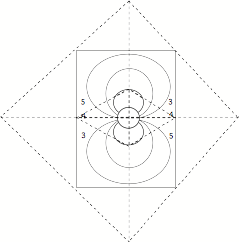
"Then two poems," Rose says. "One, 'Mack the Knife'; the second, 'Carmen the Squeal'."
Rose reads:
Salvagers come, Who will wear the blue crown of survivor?
Sipping from holiday slippers; When all of this acid
Queens without garters, And this ash pale and blur?
Without a necklace,
Stand free. Noah walked where all could see him.
The oracles pronounnce twenty-seven Yet no one saw him.
Cures to the freeze; For his ark walked on air.
But only two listen;
And one counts disease. Go slowly amid the cracking of waves.
Winter might mark
I stand as the manufacturer of dreams Many sails for destruction;
And their true soil. Corpses of hulks
Continents sink; Might delineate the Dawn.
Then are raised from green pools. Yet those who can see,
There can be no end With the eyes made for dreaming,
In this armageddon of grief, Through which Giants watch only
In which fist fights with shoe, Falling battlements of yore --
In which heat bleeds per minute. Those who can see
Through the eye of the needle
The two poles of Earth Merely wait for the Mountain of the Ram
Are released from their mid-point; To approach them.
From the North they descend;
From the South they are drawn. I might be black in my vision;
Equatorial regions soon annihilate And white in my heirloom;
Extremes. And yellow in my age;
At that point, I explode And red in my anger --
All the parts The first body to appear
I have fashioned. When the storm has abated
Is the Rainbow which contains
All the colors of all the races.
To synthesize parts
Is the last act of Gods.
The hammer and the blade
Cannot harvest the seas.
"Some people have read this to be some kind of support for Jesse Jackson and his so-called 'Rainbow Coalition'," Rose says. "How do you answer that...?"
"The idea supports the survival of America," Crossmann says. "Not some political party. The problem with Jackson's Rainbow Coalition is that it is anti-Man -- or, at least, anti-white man. It is not exactly a synthetic party. It is a polarized party which gets its existence from opposing the white man...."
"Are you saying Jesse Jackson is a racist?" Rose asks.
"I don't know Jesse Jackson personally," Crossmann says. "But there is much racism in the black power movement. Yes. They may feel it is justified racism. But judging races as a whole is racism. We have come to believe that only white people are capable of racism. But racism, tribalism, nationalism, it exists everywhere. We've seen it in Rwanda. Of course, the anti-universe blames the white man even for this, the West, colonialism. Of course, there was slavery and brutality in Africa before there was a white man. So we know that it goes deeper than that. We have seen it in Cambodia. Of course, the Americans are blamed for the Nixon bombing campaign. However, the Cambodians have killed and been killed by Vietnamese for two thousand years, even before the French appeared...."
"You are saying that darkness exists in the human soul," Rose says, "and has existed since the beginning of Time..."
"Before the beginning of Time," Crossmann replies.
"I don't think anyone would argue with that," Charlie says. "I'm really not sure what to make of these poems. I don't think they are quite as good as the earlier poems -- some critics agree with in this. I'm not the only one saying it...."
"Again, they are leading us toward a new meaning," Crossmann says. "A new manifestation."
"Of Eve?" Rose asks.
"What?"
"Of Eve. Eve appears next."
Rose reads:
Beauty gives her spoon to me. She craves the cutlass; and I give her meal. Passing boats on a passing sea. Her name is borne by the Wind: a silent dell: a wintered eve. EVE IS HER NAME THEN? Yes, Eve is her name. Evening: bearing men. Mites of Men, without the fire in their stomachs; without tenacity to kill. A cup she gives me is full to my lips. It can never be emptied -- for the womb has no end. NECTAR FOR THE GODLETS. Juice, for the lame. VULCAN -- YOU ARE VULCAN. Fire grows out of the palm of my hand. It heats the entire room; and the old men speak of days now gone. I SEE. BEING TORTURED BY STRANGERS. THE CROWD IS ALL FOREIGN: YOU KNOW NOT A SOUL. YOU ARE STRUNG ON A CLOTHES LINE. YOU SCREAM: 'LESLIE, LESLIE, PLEASE SAVE ME...!' YOU SCREAM THIS OVER AND OVER AGAIN. NO ONE COMES. NO ONE SAVES YOU. The fruits of my life. MARS HAS NO CAR IN WHICH TO CARRY YOU AWAY. The war for survival; and the war against women. YOU CONDEMN EARTH: YOU ARE FORESAKEN. I see...
"I'm not sure what all of this means," Charlie says. "But the next we know that there is a suggestion that the 'struggle for survival' involves a 'war against women'. We did have that reference above to 'a silent dell', which, again, is your first novel that culminates in a very real war against a woman. The Second Son, very clearly, is, at the same time, looking for a wife, or a woman of his dreams... The image of Leslie comes back again; Leslie is a woman in heaven, like Beatrice, for Dante, a muse, a wife for the spirit. But you are looking for a mother also, a woman from whom, in a mystical sense, you can be born..."
Rose reads:
Waiting to be released. The Second Coming and the crane. Looking for Mercury's shoe and his station. Willing to give life for life, minute for minute, misery for misery, jumor for fear, perhaps. Unconscious beast am I at times. Unseeing of the horror; unknowing of the dead and the dreadful. Carried by the Fire many centuries beyond. Not able to return to the day and time many other are curing. Wheree is the woman of my heart? Unsung, unapparreled. Naked, in her glory. Nearly naked, in her power to confront the abyss I hold. Who will approach, with a candle, to see?
The Hero is born in every House
Beside the Lake.
He instructs many minds. She is the hawk,
He battles every moon. The mate of my dreams.
The sceptre forged before his grave Cheeks sunk in the white clay.
He carries, as words, Her tempest heart conspires to kill
Into the Lion's arched den. The simple men
None can defeat this man Who mistake her for Beauty.
Who knows nothing;
Who was borne on his star Her eyes contract the nuclear night;
By the Wind Inside their tides
Before Time. Rides the bird of demands.
She would eat the heart of the weak
None can deliver him; At a glance.
None can foresake him. Her furious sensuality
The Sun beats for free; Is a brain containing wombs.
Yet his anger
Some time burns. There is nothing she can't recognize;
There is none she cannot know.
Someone must come Yet her trim composition
To complete the silent greeting. And her eyes
The Dragon wars the water Speak of pain.
With sterling. For to know is to lose.
The sword of the season And to have one cannot hold
Strikes the Unknown For long.
And bleed it.
THE HEART OF GRAVEDIGGER MOURNS FOR HIS UNION. What is it he wishes? HE WISHES TO BE KNOWN. HE WISHES TO BE SOLVED. Herakles cuts the cord with his wishes. All questions have answers. All answers are but opinion and force. YOU ARE DEPRESSED. The succubi come, in the night, at my stead, asking that I give my blood for their tea. Tea-cups; and discussions of coitus. No blushes in this room Crones and tempting cranes of flesh. And I, a Nazi-Hearted death-seeker. urburdening my crow, a creatinary moment -- as old Noah unburdened himself of his raven. Unwilling to fall into the mess of the...analysis. Unbuckled incendiary eve of his dreams. The boat rocking in the tumult. The doctor reeking with the ointment. Walking on a cloud, into a mist, without a net. Yes, looking for Mercury's incarnation. Where has he been? Where is he going? Witch-hunting in Veneta. The high and the low. The prospect and the fulfillment of soulless activity. Drums banged by the man who can't see. Bakers cannot find dough to build with. Builders can't find dough with which to bake. Takers, in their glory, cry that that's good is gone; and glory leaves them. Ruminators ask for reasons why. Yet there are no reasons, no causes, for their sorrow.
I drink in light.
Some call me the Barbarian.
I have the heart of a bear;
I have the mane of a lynx. Merriment, for the Queen,
Call the lion MIKAEL, Comes like rice from the wind.
He unto God. A House of Cards I see is real.
But beware So real to me
His savage ardor. That June is December.
Mother, whose mercy, Mystery is seen
Came to sacrifice the seas. As logic in the mirror.
Whose womb uncoiled The Brothers trade bodies;
The Beast of Trees, And each die for their ease.
Both God and Devil, The serpent leaves a skin;
Both Savior and Depraved. The Ram finds a Goat.
Mother, whose image
Sewed a heart on his sleeve; The mountain under the water
Sewed a virgin on his armor; Is green.
Sewed a season, The man on the summit
And braved the cavern. Has his head in the well.
She who told me words I knew
Before I had heard them
Leads my child
Toward the grave.
"'Looking for Mercury's incarnation'," Rose says. "And 'call the lion MIKAEL'. Those seem to be the points of light in this section. 'He wishes to be known' and 'He wishes to be solved' are part of the same 'incarnation' theme. The succubi -- well, I don't understand what that is all about. But it seems that the woman he is seeking, his mate, is actually his mother. The first poem is really very clear about this. Still, 'Mother whose image sewed a heart on his sleeve' -- clearly, it was not the Mother who did this, it was the Mother's image -- and who is the Mother's image? The one sewing a virgin on his armor? The Mother gave birth to the 'Beast of Trees', to 'both God and Devil, both savior and depraved' -- but the Mother's image is doing the sewing -- and sewing is also sowing -- of what seems like a crusade for the Virgin Mary. The 'deparaved' clearly connects back to the 'Nazi-hearted Death-seeker' in the preceding paragraph. What am I missing here, Michael...? The second poem mentions the Queen again, the Mother. But it seems to be pretty much a re-statement of ideas that we already knew, we already have discussed. The brothers trading bodies and all... The world being turned upside down..."
Rose reads:
YOU ARE NOWHERE, FRIEND. I sense the sinister abyss in which the Future, unfurled, and I, touch and weep. Preparing America for a death -- and a re-birth; a death and a birth through mired fiolence. A suicide generation -- having gone to the Beast of Death as a child. The quiet before the storm. Waiting for the test of fire, and the trade-winds. Who will bless us? Who shall save us? Respecting the Adversary -- whoever it shall be. For a mate is not a mate until found... YOUR QUESTIONS ARE ALLEGORICAL JIMMIES IN THE DOOR. True. Where are the poppies I brought from the grave? Where are the lilies and the ritual of smiles? Am I the captain of the American battalion? Who will be if I won't be? Who wears the phallus when the men all go girlish? Who will protect our spoiled little women? Where do we go when they cry: 'Stand or Fall?' I DO NOT KNOW. You are being prepared for power. I SUPPOSE IT IS TRUE. You are bing groomed by those forces deep in space where you go. WHERE YOU HAVE ENTERED WHEN THE BEE TOUCHED YOUR HEART -- AND BROUGHT OUT YOUR BLOOD. I will not fear. FEAR IS THE MIND-KILLER...
Ode to the woman
With the Seven Tragedies
In her eyes.
The First Tragedy is the lonely virtue
Of the hawk
Whose prey
Can never be worthy.
The Second Tragedy is sealed
On tight thin lips.
Words have strangled her world.
With
Unredeemable Light.
The Third Tragedy is the cold wealth Which of us
Of her bearing. Is further away?
History has fractured The hawk or the lamb --
The flower of her womb; Which she eyes
Parents' estgeem has been hard; From her heaven?
Virtue claws and fights with Rage.
Who is most alone?
The Fourth Tragedy is Suicide's Shadow. The one who cannot
Always this grim hand-maiden Read the leaves;
Walks beside my twin hawk, Or the one who reads
Giving words all new meanings; In the leaves only sorrow?
Giving pictures all new prospects.
Often the woman does not hear Does the Night know most
Her Queen's invective. In the factory of her limbs?
Yet always, somewhere, Does the Day know nothing?
Her queen invokes her numbers. Does the Spring contain only
Solitary remembrance?
The Fifth Tragedy is the warm youth
Of her body.
It belies the belligerant widom,
The cross, living in heer soul.
Pleasure, for her, is something
She has lost.
Humor, for her, is not known
But for tears.
The Sixth Tragedy in her eyes
Is Intelligence, the Daemon.
He holds a sword, like my own,
Set to strike.
If her face were not so ghostly
I might hold her by the hand.
The Seventh Great Tragedy is that
Her armor is bare.
I hunt her with eyes
From a distance of feet.
Yet her mind builds a fleet
On unapproachable seas;
And my feet have their own wings,
For Mercury long has gone.
So these tragedies are really my own.
Could it be, truly,
That Venus is really lonely?
"The division of this section into dual stanzas, I'm certain, has meaning," Rose says. "I'm not certain what the meaning is. Between both we move with a kind of praise for the woman, in fact. She is somehow either the hawk or the creator of the hawk. And I am trusting that the symbol of the hawn is intentionally chosen here -- that you, in fact, are becoming a hawk, where you, before, were a dove or a lamb. You were a dove in college, protesting the Vietnam war. You were, perhaps, a lamb, earlier, in you identification with Jesus. After your death, the death of Jacob Heimkreiter, there was a clear identification with Jesus Christ. But in this section, that nature has hardened. Jesus is handing to Michael a double-edged sword, making a solider of him, the leader of a crusade. Of course, there is probably some historical meaning in all of this too -- :I mean, a study of this progression probably has its reflection in the historical transformation from the Dark Ages to the Middle Ages. I haven't studied that connection -- but I'm sure someone will, someone seeking a Ph.D. at Harvard or at the University of Wyoming. I'm not sure what to make of the line 'For Mercury long has gone' -- it seems to me that Mercury is not gone. That Mercury's incarnation, as Michael the Archangel, is what we are awaiting at this moment in fact.... It seems that the incarnation of the man comes, necessarilty, through the medium of a woman. We have mentioned Eve in this connection, Leslie White/Rhodes, the Virgin Mary....and Daphna Greenstein will be, eventually, the 'womb' through which, mystically, Michael is born..."
Crossmann says nothing.
"Are you not speaking because you are worn out?" Charlie asks.
"No. I really have nothing to add to your commentary," Crossmann says. I think you are right on target here..."
"I hope we still have some viewers with us," Charlie says. "It is Millennium Eve, I know. And our discussion has been esoteric. And, at times, a bit dense, I admit..."
"The novel is dense at times," Crossmann says.
"I think the novel is almost always dense," Rose says. "It is dense with anti-matter. It is an example of the absolute density of anti-matter. Which seems empty when viewed from the world of Matter. A void. But, clearly, this void of full..."
Crossmann smiles his agreement.
"So, then we have the final occult text on the avatars," Rose says. "This passage describing the inter-planetary avatars. I did want to ask you something: the 'fear is the mind-killer' phrase...."
"That is from Frank Herbert's Dune," Crossmann says.
"Yes. I thought it was," Charlie says. "You were influenced by this book. Paul Atriades appears several times in this section, claiming planets as his own -- very much as a colonial power. Did science fiction, in a general sense, move you at this time...?"
"It moved me, in Dune and in the Star Wars movies, because of its youth, its energy, its contact with the primal energy. The mythology of life. Both of these had, imbedded in their soil, the mythology of light struggling with darkness. It was not intellectual matter, which is more evolved but also more pessimistic, more nihilistic. Science fiction is future-oriented. It embraces Life's quest. Intellectual literature -- art literature, if you will -- generally embraces death more. Is more an exploration of the mind than the body.. The body has a mind, too. And it is called Life -- it is connected to mythology. The mind also has a body. And it is called the Soul -- it is connected to death more directly. I was, obviously, on the other side of the circumference at the time..."
THE PUBLIC NEEDS TO BE UPLIFTED BY OUR ARTISTS. IS THAT TOO MUCH TO ASK? THERE IS ENOUGH DARKNESS IN OUR PRIVATE LIVES. IF YOU CAN SHOW US SOMETHING LIGHT, SOMETHING GOOD, PLEASE, LET US HAVE IT. Have I not shown you light also? YOU HAVE SHOWN ME MANY THINGS. YOU HAVE SHOWN ME SOME MEDIOCRE POETRY LATELY. YOU HAVE SHOWN ME DEGREES OF GENIUS. BUT WHAT HAVE YOU SHOWN ME LATELY? -- THAT IS THE KEY. The old woman riased her skirt to cross her legs at the knee, and said: INTERPLANETARY AVATARS. THESE ARE MAINLY CONCERNED WITH THREE THINGS:
(1) WITH THE SUPERINDENCE OF THE TRANSFER OF FORCE UNITS OR EGOIC GROUPS FROM ONE SCHEME TO ANOTHER (NOT WITH INDIVIDUAL UNITS FROM CHAIN TO CHAIN). THEY APPEAQR USUALLY TWICE IN THE HISTORY OF A SCHEME; AND, ALTHOUGH UNABLE TO TAKE PHYSICAL BODIES OF GROSSER MATERIAL THAN THOSE FORMED OF ATMIC AND THE BUDDHIC SUBSTANCE, THEY WORK WITH IMPULES IN MENTAL MATTER, AND, THUS, AFFECT THESE GROUP TRANSFORMERS. THEY, THEMSELVES, ARE SUB-DIVIDED INTO THREE GROUPS:
(a) THOSE AFFECTING THE TRANSFER FROM THE MINOR SCHEMES OF RAY MANIFFESTATION ON TO THE THIRD RAY. THEY CONCERN THEMSELVES WITH THE RESULT OF THE MERGING OF THE POLAR OPPOSITES IN THE FOUR LESSER SCHEMES UNTIL BUT ONE IS LEFT. THEN WITH THE TRANSFERENCE OF THE LIFE AND QUALITY OF THIS REMAINING ONE ON TO THE THIRD RAY.
(b) THOSE DEALING WITH THE TRANSFERENCE AND INTERACTION OF THE LIFE FORCES BETWEEN THE THREE MAJOR RAYS.
(c) THOSE PRODUCING THE FINAL SYSTEMIC TRANSFER AT THE END OF AN AGE.
(2) CERTAIN AVATARS FROM THE FOURTH CREATIVE HIERARCHY, FOR ESOTERIC AND, FOR US, INEXPLICABLE REASONS, HAVE THEIR OWN HIERARCHY, AND APPEAR IN ONE OR OTHER OF THE DEVA HIERARCHIES. THIS HAPPENS ONLY ONCE IN THE HISTORY OF EACH SCHEME AND OCCURS AT THE TIME OF ITS DENSEST PHYSICAL APPEARANCE, AND HAS RELATION TO THE TRANSFERENCE OF DEVA IMPULSE FROM ONE SCHEME TO ANOTHER. THEY ARE CONNECTED, IN THIS WAY, WITH THE APPEARANCE OF THE SELF-CONSCIOUS UNITS, BEING THE PRIMAL EMBODIMENT OF THE LATENT SELF-CONSCIOUNESS OF THE ATOM OF DEVA SUBSTANCE. THEY SET THE TYPE FOR THE DEVAS OF ANY PARTICULAR SCHEME.
ONCE, IN THE HISTORY OF EACH SCHEME, AN AVATAR FROM THE CONSTELLATION OF CAPRICORN APPEARS ON MENTAL LIVELS. THIS LEVEL IS THE LOWEST ONE ON WHICH THESE INTERPLANETARY DEITIES APPEAR. NO MORE CAN BE COMMUNICATED ON THIS MATTER. THE 'MYSTERY OF THE GOAT' LIES HIDDEN HERE. THIS AVATAR MAKES HIS APPEARANCE IN THE THIRD ROUND OF THE THIRD CHAIN, AND DISAPPEARS IN THE FIFTH ROUND OF THE FOURTH CHAIN.
THESE INTER-PLANETARY AVATARS COME IN, AS THE PRODUCTS OF MUCH EARLIER KALPAS, WHEN SYSTEMIC CONDITIONS ARE REFINED ENOUGH TO PERMIT OF THEIR APPEARANCE. THEY ARE THE NIRMANAKAYAS OF AN EARLIER SOLAR CYCLE WHO NOW, AGAIN, TAKE THE OPPORTUNITY TO EFFECT (IN AN ACTIVE SENSE, AND THROUGH PHYSICAL MANIFESTATION) CERTAIN UNCOMPLETED WORK....' It is you, yourself, you speak of here. TELL ME ABOUT YOUR PRIVATE LIFE. My public life? YES, IF YOU WISH....
"Ok, there is a lot here, and a lot I don't understand," Charlie says. "One thing I do grasp, in a strange way, is the idea that a spirit will only choose to incarnate, as you, or someone writes, 'when systemic conditions are refined enough to permit of their appearance'. Your idea seems to be that spirits essentially 'possess' certain bodies -- but the thought elementals would only come down during the civilization phase of the life cycle. When the culture is refined enough to permit their appearance. At certain points of development only. Now, the incarnation once a scheme in the sign of Capricorn seems to make sense -- that would be Jesus, or the Christ Principle, I am assuming. But I'm not sure how this relates to the coming of Michael the Archangel..."
"We'll have to keep reading," Crossmann says.
"I do have a sense that this occult text is a presentation, at a very esoteric level, of what we are seeing through the action, or the ideas -- it's hard to say there is any action in this novel. It is like a long dream. It is like the long dream of a sick man in a coma, in fact. Although I don't want to suggest anything..."
"Yes, it does relate to all this," Crossmann says. "It explains all this."
"But it is murky," Rose says.
"Yes. Murky like a dream."
"Then the monster comes back," Charlie says.
Rose reads:
I did not write on Friday since I was obliged to testify against Gilbert Patton at the University, a hearing designed to determine whether he should be required to take a medical leave from the Universtiy with regard to his violent behavior, his threats and his terrorizing the community. YOU AND HE ARE LOCKED IN STRUGGLE. He awakened me with his threat; now I am karma and he must expect me. THE BATTLE WITH THE DARK AND LIGHT, WHICH YOU HAVE WAGED, INSIDE YOURSELF, NOW APPEARS IN TWO BODIES. HE IS DANGEROUS, IS HE NOT? We are both dangerous. To defeat the wolf, one must become an even more dangerous wolf....
"This is the end of one thought; and another one begins," Rose says. "An attack on feminism. But before we get in to that, tell me about this hearing. This Dark Monster is a college student?"
"Yes. He was probably on the GI Bill or something," Crossmann says. "He had even applied to the Architecture school. He was applying at the time. I knew some people in the department; and they told me about Gilbert. They knew about my experience with him. And when they heard about this hearing being held, they asked me to testify..."
"And what did you say?"
"I told them about my experiences with Gilbert," Crossmann says. "About his threatening to kill me. It was like a small courtroom set up in an office in the Law School. Gilbert's lawyer was there -- but Gilbert was not. The lawyeer for the University told me that most people were withholding their names and addresses for fear of retaliation should Gilbert read the record of the hearing. I told them that I wanted my name on the record. I had recently discovered the power inherent in my name. I remember having read Blavatsky a few years before, a passage in which she said that a name was a destiny. That was true on a very high level. I saw that it was true. So I wanted 'Michael' to be on record against the darkness. I testified. I told them everything. Then I left...."
"And what happened?"
"Nothing. As far as I knew. Not at the time. I would find out much later that they did decide to essentially expel him from school. But the decision, and the appeals, apparently took some time...."
Rose continues:
YOU ARGUE WITH WOMEN NOW. I grow weary of the 'feminism' of the spoiled middle-class women. I warn them that to castrate too greedily will lead their own men to pull their house down upon them. Women, you should remember that you have power because I have given you power. Just as quickly I can take it away. I have been told that the woman has great power because the man needs the woman to reproduce himself -- and that one woman can reproduce ten men, while one man can only reproduce himself. As though that were a judge of power. The seed in the woman is for ever inert, for ever expectatnt, sleeping, unmoved. The seed cannot become life without the fire of the sperm. Each is only a potential without the other. From a demand for Equality, women now begin to demand Superiority. And, in the process, pull their own civilization down around their ears. Women have power here only because of Law -- a construction built by Men. If the Law falls, and brute force becomes the Law, women become like children, pawns in a horrid chaos. YOUR WAR WITH PATTON -- IS IT NOT A WAR WITH THE CHAOTIC, A WAR FOR THE LAW? I suppose it is. I have seen myself draw a revolver from my pocket and shoot him dead. Justifiable homicide. Is it not? Protection of the meek. A gladiator, defining order. YOU AND BENJAMIN HEIMKREITER. REMEMBERING DAVID BLUMENTHAL. Seeking restitution for David Blumenthal. UPHOLDING THE OLD ORDER. Perhaps. Yet, is it justice that the weak should be punished by the wolves of disorder because they've given up their bodies? Who will protect the best from the worst? Who will protect those who wait for salvation? YOU FIGHT YOUR OWN DARKNESS. Yes. I fight my own ignorance. I fight my own sloth. I fight my own emotional transgressions. WHERE DOES IT GET YOU? It gets me where I go -- for it is the fire of my life which I speak of. AND WHERE DO YOU GO? I go toward something. I go away from something. There is a direction to Time. There is a direction to Space. YOU REBEL AGAINST THE WOMAN. Death, I rebel against. YES, SPACE. BEFORE YOU APPLAUDED IT. WHY SUCH A CHANGE? Life calls one bak. YET BACK, FILLED WITH ANGER. I wish to be strong and just. I wish to be kind, when able; yet also hard, when necessary. I am a pacifist in that I must never start a fight; yet, I am a warrior in that, if struck, I strike back twice as hard. I SEE. FEAR OF DEATH. I have died; and now I'm born. BORN, AS A MURDERER. Born, as a force of every conceivable nature. Nature is not only peaceful and pastoral; it is violent too; it is dealy; it can scream. So am I. I can scream; I can love. The bee is sacred to me; the eagle hunts, and delivers silence. FROM DOVE TO HAWK, THEN? Both dove and hawk. HAVE YOU FOUND YOUR SCAPEGOAT? Amen. AMENTI.
"There is, in this section, a lot to think about," Rose says. "You are beginning to connect the Darkness with Feminism. This is one of the reasons the feminists are so angry with you and this novel. And your anger gets stronger. I don't really understand why David Blumenthal appers here as an object of restitution."
"We remember, at least in Jacob's mind," Crossmann says, "that Jacob's son, Benjamin, murdered David Blumenthal in the park -- as Blumenthal waited with his chessboard for Jacob to arrive. Jacob was late because his pocket-watch stopped. Blumental, waiting for his friend, was reading a biography of Adolph Hitler when a young junkie in blue jeans and tennis shoes shot Blumenthal. When Heimkreiter hears the shooter described, he thinks of his own son..."
"So, this is a reference on the novel itself?" Rose asks.
"Blumenthal was Heimkreiter's only real friend," Crossmann says. "They were like brothers. When Benjamin Heimkreiter killed David Blumenthal, it was like he killed his own father. The murder of Blumenthal was symbolic of the Father-murder in which all sons participate, at least metaphorically. Restitution for David Blumenthal is really my own restitution to my own father. I rebelled against his world, against his values -- but then I came back to them, to see them from a new angle, and to understand how he was right..."
"Nature is also being born here," Rose says. "Nature as an idea. The fullness of Nature. The storm-gods of Nature also..."
"Nature is everything," Crossmann says. "We use the word -- and my generation was especially guilty of this -- as an emblem of Virtue. 'Nature' means wholesome, good, natural. But there is a dark side of nature too, a dark side in which a struggle for survival is constant, if not always apparent. Nature has a mind; and Nature has a body. These are not separate things. They are interwoven Principles...."
"Then comes a poem which is a vision of a force of God coming down to clean the world with fire," Rose says. He reads:
Down the deep descent
Of aeons of predicament
Come the chorus of leeches
And the legions of clowns.
I walk with them
To the bottom of the sea:
I know only the song
Of the ancient angry messenger,
Who bolts the sinning world to the air,
And then, on wires of Time,
Explodes it.
Only the leeches and the clowns
Can survive it;
Only the populated world
Feels the cleavage.
The Earthquake-Men shake the plates
And crush the seasons.
Volcanoes erupt;
Fire flows out on the landscape.
Fire-Men come, bringing their heat
In to clean the village.
The children don't know where to start --
Where to stop:
They are led-on by the sound
Inside the Wind
Which paints them red.
"Now, I'm not sure what this means," Rose says. "I do understand that your part -- the 'ancient angry messenger' coming down to annihilate the world. I understand that. I'm not sure why the sinning world is bolted to the air, of all the elements. But what I really don't understand is why the 'chorus of leeches and the legions of clowns' survive. Or why only the 'populated world feels the cleavage'...."
"Well, leeches were, at the old days of medicine, used to bleed the sick patient," Crossmann says. "Leeches were a force for health. In fact, a leech was a generic term for a doctor many years ago. The chorus is, of course, a positive force of knowledge and angelic aid in this novel. The 'legions of clowns' are, again, not a negative force. Clowns entertain children. The leeches and the clowns come down from the great height, make a deep descent. It seems, judging from the poem, that the only place that will be safe is the bottom of the sea. The sinners are bolted to the air; and, on the earth, the fire-men begin to shake, send out lava. The children on earth, perhaps reflecting the fire that had spread out everywhere, instructed by the voice inside the Wind, turn red.... It is, like most of my writing, suggestive rather than prescriptive. It is a poetic vision..."
"But it has meaning," Charlie says.
"Yes it does," Crossmann says. "But the meaning is in you. The meaning is in the reader."
"What about the writer?" Charlie asks. "Isn't the writer supposed to understand what he writes...?"
"Well, it may have made perfect sense to me twenty years ago when I wrote this," Crossmann says. "I don't remember. But writting, like all the arts, involves a very large participation by the unconscious. There is much a writer doesn't understand when he or she is working. Painting or drawing is the same thing -- especially where you are not doing photographic representation, which is a kind of rote activity. Exploratory art always involves unconscious forces and hidden ideas and images. The viewer, the reader, needs to help bring the meaning to light. That is very true with my own work. You see things in this novel that I don't see -- and I see things you don't see...."
"Yes, yes, I understand that. Yes. You're right," Charlie says. "Some critics say there is too much of the unconscious in your poetry..."
"Well," Crossmann says. "They say what they want."
"Do you listen to the critics?" Charlie asks.
"Only when they're supportive. If they aren't supportive, I turn on a football game."
Charlie laughs.
"You introduced succubi a bit earlier in this section," Rose says. "And now leeches. So the sucking of blood seems to be an issue here, whether or not the author was aware of it at the time of his writing it. Adam, the first man, is Adam the Red -- Adam of blood. I wonder if this is involved in the meaning of this poem at all..."
Crossmann smiles.
He looks at the book again.
"You make reference to Paul Atriades again, conquering a planet," Charlie says. "And then another reference to Holden Caulfield. I have read where you used The Catcher in the Rye in your own English class as an example of the anti-novel, the modern novel that deifies the loner, the anti-social, the anti-hero -- and you use this as an example of the mentality of the Kit Carsons of the world, the high school students who take a gun to school and shoot strangers..."
"The John Hinkleys of the world," Crossmann adds.
"Yes."
"Hinkley was obsessed with the book also," Crossmann says.
"I didn't realize that," Charlie says. "You believe the anti-hero is...."
"The negative of the hero," Crossmann says. "The photographic negative."
"Some kind of devil, too, don't you believe that?"
"To the universe, the anti-hero is a kind of devil, yes," Crossmann says.
"But you are a kind of anti-hero too, aren't you?" Charlie asks.
"To the anti-universe, I am a kind of anti-hero," Crossmann says.
Rose reads:
What can be done? What is a name worth? Friday and ice. Thursday and thunder. Frigga and Frei. See where the water is thick in the urn. I can kill with a glance. Vulcan builds me a shield from his flame. Astral weeks and astral logic. The flight of the Valkyries; the flight of the tern. Turn-earned appeal; and the bird walks a wail; and two on a shoe. No distinction and no delight. The women lose their nerve. The chaos they are, they create, sends them weeping. NEW ELECTRIC MINSTEL: 'Let the problems come, let the tension grow; you know where I'll be found. I'll be standing here beside myself, getting ready for the final round.' AND PAUL ATREIADES CAPTURES THE PLANET. What do you do with it once you have it? NO ONE IS SURE. Certainty escapes. The picture has changed. What do you do? HOW DO YOU DO? That too -- but when? AGAIN, NOBODY KNOWS. Darkness everywhere. WHERE IS THE GOLD? I believe in the water. PREPARATORY TO BLEEDING. Who will be punished? EVERYONE. SORRY. Yes. I now. So it goes: the catcher in the rye. WHO HAS BEEN CAUGHT? Only the children playing in the fields, above the chasm. AND WHO HAS CAUGHT THEM? The savior, with his net. THE FISHERMAN, THEN? Yes. ARE YOU HIM, THEN? Of course. Who else? AND HOW DO YOU SAVE THEM? I save them through fire. ARE YOU THEN THIS FIRE-MAN, THE ONE IN YOUR POEM? Who else could it be? AND THE VISION OF YOURSELF, CONCEMNING THE WORLD FOR FAILURE, PROTECTING YOUR OWN, AND DESTROYING ALL OTHERS, COMES AGAIN. I see myself slam a door. The progress we have made cannot be undone...."
"We have to remember that the two voices are in you," Charlie says. "The two extremes, the two brothers, the two forces, contraction and expansion -- these are fighting inside of you. These voices are struggling within you for power. So, if we are shocked by what you write, we need to understand that your words are the expression of these two forces which are struggling for authority. This is the War in Heaven we read about in the Bible. Michael fighting with Lucifer... Then comes the Voice again, the self-conscious 'I am'..."
Rose reads:
I am the First Night, then -- I am the Angel of the Presence. The Voice of the Laqw. I am 6 and I am 2. I am the angel who died and who lives. And who cannot die...
"Ok," Charlie says. "So you are the Angel of the Presence. Who is the Angel of the Presence...?"
"Many Jewish mystics believe that Metatron is the Angel of the Presence," Crossmann says. "In Exodus, we read: 'Behold, I send an Angel before you to guard you on the way and to bring you into the land which I have prepared. Heed Him and obey His Voice; do not strive against him; perhaps He will not pardon your transgressions; for my Name is upon Him.' We have spoken about the transliteration of IHVH, the name of Tetragrammaton, into the Lesser: LHVH, Metatron. Some mystics speak of Metatron as the 'activization of the active intellect'. However, Michael, 'He Who Is Like God', is also connected directly to the name of God. And, so Michael and Metatron also are connected...."
"This whole section seems to be about the nature of the demiurgos, the hierarchy of creative gods," Rose says. "Somehow these two events must be related: the description of the Demiurgos and the self-awareness of the angel."
"The name of Vulcan keeps coming back," Crossmann says. "Through this whole long section in the underworld, the Soul is, in fact, re-forming itself, re-creating itself, putting itself into the fire, the forge, re-forming its own nature through knowledge. Re-shaping itself from the material of spirit or dreams...."
"You ask Daphna Greenstein to marry you," Rose says. "But this is all very abstract. You speak of yourself as the Sky and of Daphna as the Earth -- and you say the Sky and the Earth shall become One through marriage. She resists, saying that this would be the end of the world. You say: 'That's what we want!" She disagrees. Daphna Greenstein is married, is she not?"
"Yes."
"So your proposal of marriage to her is abstract -- not physical?"
"Yes. That is correct."
"You don't really want to marry her."
"The marriage is a mythical marriage."
"It is through Daphna, through Israel, that you experience re-birth?"
"Yes."
"And Gilbert, your Dark Demon, is connected to all this," Charlie says. "He is attempting to prevent your birth through Israel. He is a threat to you -- but also to Daphna, who is, in one sense, the Earth, pregnant with you..."
"Yes."
"This is all very strange!" Charlie says. "It is 1983. You will be thirty-three years old -- which, according to many Biblical scholars, was the age of Jesus Christ at the time of his crucifixion... We get more occult information on the Rounds and the Races..."
Rose reads:
Eyelids heavy. Talk is all a bore to the Silence. I SEE. And the Old woman said: 'THE FOURTH ROUND IS A MAJOR ROUND BECAUSE, IN THIS ROUND, TWO THINGS HAPPENED: THE SPARK OF MIND WAS IMPLANTED; AND THE DOOR WAS OPENED FROM THE ANIMAL KINGDOM INTO THE HUMAN. LATER, ANOTHER DOOR OPENED, ON TO THE PATH LEADING FROM THE HUMAN KINGDOM INTO THE SPIRITUAL KINGDOM -- AGAIN, A DUAL REASON.
THE FIFTH ROUND IS A MAJOR ROUND BECAUSE IT MARKS A POINT IN EVOLUTION WHERE THOSE WHO WILL ACHIEVE THE GOAL AND THOSE WHO WILL NOT, ARE SHARPLY DIFFERENTIATED INTO TWO GROUPS.
THE SEVENTH ROUND IS A MAJOR ROUND BECAUSE IT WILL MARK THE MERGING OF THE TWO EVOLUTIONS, THE HUMAN AND THE DEVA...'
"Then again," Rose says. He continues reading:
AND THE WOMAN SAID: 'The Major Root-Races are chosen under the Law of Correspondence. In the Third Root-race came the Third Outpouring, the merging and the point of contact between the Spiritual Triad and the Lower Quaternary. The Fifth Root-Race marks a point where higher and lower Manas (Mind) approximate; and where the Concrete Mind, meeting its highest development of this round, gives place to the Intuition from above. Here, again, we have a two-fold reason. The Seventh Root-Race demonstrates, once again, a dual attainment, love in activity, the basis of the Third system of Will or Power.'
HOW THE WORLD WORKS. A LECTURE IN THE FORM OF METAPHOR.
The Creators build in both worlds, both National and International. The nation which controls the Physical Plane, the Mineral Kingdom -- the 'gold', in a metaphorical sense: the 'dollar' in practical terminaology -- is the nation which creates the Physical Plane in its own image. The dollar is the bloodstream of the International Economic Body. When the blood is circulating freely, then the body is awake, alert, relatively healthy. The health of the body depends upon the free circulation of dollars; the more dollars in circulation, the stronger the foreign currency; hence, the stronger the Intenational system. Yet, inversely, the more dollars in circulation, the weaker the dollar (the blood) becomes. The more attention devoted by the creators to the International House, the more the National House begins to come apart.
Conservatism, conservation, self-sufficiency, anti-consumerism -- the return to religion, metaphysics, the study of symbolism -- these philopophies all reflect a coming home of sorts, a desire for rest, the coming in of Night. Its economic corollary, still using the metaphor of the bloodstream, is seen through the restriction of the blood-flow; less dollars are put into circulation; during rest or sleep, the blood does not flow to all parts of the body with the same constancy and rhythm as it does during activity. Hence, by resting, by constricting the flow of dollars to the Internatinal Body, the dollar regains its value, its strength, vis-a-vis foreign currency. Yet, there is a high cost in all of this. The cost is the disintegration of the International Body.
When we order the International too long, the National falls into chaos. So, we return home, to re-create our National Body; yet, by re-focusing on our National Body, the Internatinal falls into chaos. The 1930's is the most recent example of this.
Each body we create, National and International, lives a life and then disintegrates. We resurrect the National Body, and the International falls into disorder; we resurrect the International, and National Purpose loses focus. Yet, each time we re-create the 'form' or 'body', it is a new model, an up-dated version, more in accordance with a new Time. A seed 'rests' in Winter, the time of chaos, or formlessness, yet begins in the Spring where the last fruit left off. Time has direction; and no 'history' is ever lost or repeated. Each seed contains, in its genetic make-up, the entire 'history' of the plant. So it is with the seed 'Humanity'.
As we constrict the 'blood' from the Internatinal Form, that form of Economic Internationalism falls into chaos. Nations divide; militarism returns. This is beginning to happen in Europe again. NATO is under attack. German anti-Americanism is rampant. Street battles in Munich mirror the struggle between communism and Naziism in the 1930's. France warns that a neutral German is a threat to Europe; and asserts that she has no intention of limiting her own nuclear arsenal. There is a growing cult fascination with Hitler among German youth. Russia has been linked with the attempted assassination of the Pope. Italy has called this an act of war. Israeli Defense Minister Ariel Sharon has called for a meeting with Russian authorities, to cool down diplomatic hostilities; he says that Russia and Israel have much to discuss.
The world re-alligns in strange ways during the night.
As chaos comes to Europe, American should open her doors to those who are able to escape it. The best minds of Europe and Asia, in escaping this chaos, make America even stronger. The seed of the plant is in the head. It is scattered over the earth when the Wind begins to blow. When nations die, America is heaven. This was obvious in the 1930's; and during the war which followed.
America must re-build her own National Body: social institutions, education, welfare, roads, new industry, the military. The military only seems sinister when you believe that you are secure. When your security becomes threatened, then your perspective changes. We believe we understand the world; and then the picture changes. We should not be eager to jump into the chaos of International conflict. Our defense must be so strong that none would dare assault us. We must be able to defend ourself with fury.
The national which controls the 'economic blood' of the world (that is, which is the heart of the world) controls the evolution of the form of the world. We re-order the National; ultimately, we re-order the Internatinal. It is a sacred trust, a covenant with God. We evolve the world, often unconscious of its plan.
Once, when I was a mere mite of a man,
Before the world, like some great oak,
Was set upon my back by slaves
Whose labor tore my heart to share
The wearied pain their sorrow gave them:
I laughed amid trees and the languishing noon
Which poured its honied flute of warmth
About the rooted womb I sat in.
Doctors could not bear the breeze;
Women sat in open hearths
About that June
Wishing only for worship.
They worshipped me;
I worshipped them.
The trees shook all about the deep
And restless seas;
And the sky broke its gold up.
The children all ate pomegranates;
No one believed that the Winter
Might steal them.
Of course, that was all so long ago --
Before I took this mask in hand
By which I rule the world with rage;
For Rage be known, in its slippers:
Grim Predicament.
Now women seem to fight me;
And I conspire to war,
To annihilate my nightmare.
Pomegranate seeds are scattered in the grass.
A bleek wind pours winter
Across the laughter of children.
Hearts have been hardened;
Doctors appear everywhere,
Giving general counsel,
Forgiving us our sins.
Now I carry the world made of iron
To the shoreline.
Only Time can alleviate my burden.
I suffer to free all the children
From sorrow;
I weep for their own joy;
Isn't it they who would save
The old from their stillness?
A child named Tamar
Walked across the ocean.
God puts a finger to her lips:
And Spring is born.
"You seem to be building a case against Russia," Rose says. "A religious case. The Russian Communists tried to kill the Pope to preserve their dominance of Poland, their empire."
"Yes."
"This sounds like the pretext for a crusade," Charlie says. "A religious war against communism. A Jihad...."
"Yes, it does seem that way."
"But you feared the Russians," Charlie says. "You feared the bear."
"I felt the Bear could not be defeated, either mythologically or militarily," Crossmann says. "Judging from history, Russia cannot be invaded and defeated."
"You search for another enemy," Rose says. "It was Israel for a time. But then Russia came back into view. The two giants, Gog and Magog. Clearly, Russia was one of these giants..."
"China, America and Russia are the giants," Crossmann says.
"Tamar is Daphna Greenstein's daughter," Rose says. "She is God's manifestation of the Spring."
Crossmann nods his assent.
"Then this strange passage..." Rose reads:
I see my own fatigue grow numb. I see that I am seduced by the image of my own self as the Christ come-again: who has it in his power to set the Earth on fire, with the hydrogen of song, to close the door, and to root the Americans as seed....
"This might be one of the most important passages in the whole novel," Charlie says. "You are being seduced to assume this mask, the mask of Jesus Christ, the Messiah, who is returning. What does this mean...? Does this mean that spiritual incarnation is a kind of ....well, a seduction? Was Jesus seduced into assuming his role as a martyr? Are these roles just out there, hanging in the air, for individual souls to assume thorugh a power of love or attraction to a role? It wounds like this is form of madness, like many psychiatrists say...."
"It is a mysterious process," Crossmann says. "Incarnation is temptation. It is desire to manifest one's nature. As a force of nature..."
"Seduction though?" Rose says.
"Seduction is the word I use here," Crossmann says. "I'm not sure I use this word a second time."
"Do you claim that you are the Son of God?" Rose asks. "I guess that's a question everyone wants me to ask..."
"At a certain level, yes," Crossmann says. "At a certain time."
"I don't understand that," Rose says.
"Well, I'm not sure how else I can say it," Crossmann says. "to say it more clearly. At one level, we are all sons of God. But there is a higher level, at the archangelic level, where other things are happening..."
"With yourself?"
"With myself; probably with others. I speak only of my own experiences. It is hard for me to speak of others. If we look at all complexity being returned from the multitudes to the One, back to the One Principle -- then, at the point where the Two becomes the One and the One becomes the Two again, the Two, the Dual Principle, is, in fact the sons of God; and, in that sense, yes, I was, in that atomic reality, very much the son of God..."
"In that sense, we are all resolved from the Three into the Two, and from the Two into the One," Rose says, "and back out again..."
"Yes," Crossmann says. "But not many do this while they are still alive..."
"In this you are like Enoch," Rose says. "Is that what you are saying...? And Enoch is connected to Metatron...! My, how you have fallen...!"
"Man is the fallen angel," Crossmann says, smiling dryly.
"Ok. We got somewhere. I think," Charlie says. He opens the book again. "You then go on a tirade against Reagan for his insensitivity to the poor. His living like a king. You surprise youself to be on the side of the poor again, in fact. Then the dual poems return..."
Rose reads:
The sacred crucible
Contains only
The words
Of another age.
I am guilty of sin!
Struggle is the sacred name I am guilty of purpose!
Of Man I condemn myself;
In his full confusion. And, in turn,
Independence from the form I am condemned.
Of his Doubt;
Resistance to Will; Yes, I am foresaken.
And the Image of Fate. Only the clouds see that
I am uncovered.
I will not barter words Only the cat can
With tyrants. Distinguish my gait.
I will accept Chaos Who is my murderer?
Only to destroy it. As I wait gladly
I will destroy chaos For my Deliverer to come?
Only to accept it.
In the distance of Freedom She who rends my heart
I, alone, judge, Is pure.
Regarding Justice. She who can cut my cord
Must require me.
My permanency rules;
My vision is unregarded. I am none of these things.
I am beyond consideration.
I am Nothing to be seen;
For I have no form;
All my skins are,
In turn,
Turned within.
"I like both of these poems," Rose says. "Because I get the sense that they are leading somewhere. The voice is identifying more and more with the Godhead. With the power of Immortality. He is permanent -- his 'permanency rules'. His vision is 'unregarded'. That is, no one can see what he sees. Because it is not possible to see what he sees. And, also, he is alone; he is unkown; he is not recognized. In the second poem, again, we see the question: which women will kill him? also, here again, he is alone, living with the clouds, in the sky. Only the clouds can see that he is uncovered. Unprotected. Naked. Only the cat can see him because he is walking in the darkness. Then the voice, which essentially negates everything else he has said about himself: 'I am none of these things'. He is 'beyond all consideration'. He is invisible. All his skins are turned inside out -- and, thus, he is invisible to the senses.... Very nice..."
Crossmann is silent.
"In many ways, I think I'd just like to follow the poems out of here," Rose says. "But I'm afraid I'd miss too much that is telling, important. This next passage is telling, I think, for several reasons. The ease with which you talk about destroying the world, setting the world on fire with the 'hydrogen of song', is really quite frightening. But there is also, here, a passage explaining your view of marriage with Daphna Greenstein, the marriage of brother and sister, a clean marriage...:"
Rose reads:
And I saw that men and women, when meeting in the Air, are like brother and sister -- twins -- in the clean element. YOU PREPARE TO MEET THE DESTROYER. To go to the next world, I must destroy the present one. I am ready to go to the next -- yet I wait for the others, and try to help them inside. I will not leave until I know everything. I will not leave; I am the last one out. I am in no hurry. Yet I am in a great hurry. What does this mean? We try to lift the Earth back into the Air. Back into Heaven. The man must remain strong enough to lift the woman back into the air. Is that true? I stand on that ideal Earth where men and women are brother and sister. This 'marriage' is not focussed in the loins -- rather, their marriage is in their minds, in their eyes, in their conceptions, in the Air. I pull her in to the element of heaven, refusing to fall into her pit where she rules. YOU LIFT A WHOLE CONTINENT OUT OF THE WATER....
"You seek to help the others get inside the ark?" Rose asks. "Are we again talking about the ark, the sanctuary, the place of safety? You wish to be the last one out of the old world, so you can turn out the light. And this is why the 'captain' metaphor keeps repeating, Ahab and all the other captains. The captain is the last men to leave the sinking ship. The Captain and the Castle are two very important metaphors. The Second Son is the Captain, who is looking for the Castle..."
"And the Mass," Crossmann says.
"Yes, the mass is still being said," Rose says. "The 'Amen - Amenti' of the preceding passage reminds us that the mass -- black mass or white mass or whatever it is -- is continuing. 'Amiens' is a variation of this, the Gothic Cathedral in France -- a physical space reference for the church where the mass is being said. Amenti is, if I remember correctly, the Land of the Dead in Egyptian mythology...."
"Where the souls are judged by Osiris and punished or rewarded for their deeds. Set is also in Amenti," Crossmann continues. "Set being the Egyptian Dark Giant, the Devil. Set was the ancient founder of the cult of the vampires..."
"Again, the succubi," Rose says. "There must be some reason you chose Amiens Cathedral as the site of your mass -- beside the name being so approximate to the word 'Amen' -- and, if we have time, I'd like to ask you about that..."
"It is connected with Amenti, in fact," Crossmann says. "I would love to talk about it with you if we have the time...."
"Is this a black mass?" Charlie asks. "Some of your right-wing detractors say that this book is essentially a 'black mass', a work of witchcraft, because of its reliance on the occult, and its approximation to the powers of Darkness..."
"I believe it to be a white mass, in fact," Crossmann says. "It is about the resurrection of light. True, it expresses the experience of darkness. Yet I suffered this torture so that others would not have to. This book is a map through the darkness. A map back into the light..."
"Yet you seem to calmly considered annihilation of the world so that America can be safe, be free," Rose says. "You seem to be willing to sacrifice the world for the sake of yourself, rather than, as Jesus, to sacrifice himself for the sake of the world..."
"So it seems," Crossmann says. "So it seems."
"Daphna tells you about a Jewish friend," Rose continues, looking at the novel, "who visited Berlin after he had visited Israel, his homeland. He had been many years from home. Daphna dreamed that he was wearing Nazi colors, marauding through the streets with toughs. and he called to her: 'Only you can save me...!' He wished to marry her; and live with her in Paris, the City of Lights.... You have your own dream of Daphna..."
Rose reads:
The air is full of demons of lust. I clutch after Daphna Greenstein to have her. The red of her hair I seek to find in mysterious places. When I rise, she is gone. SUCCUBI LATOURS. When Sky and Earth wed, the world ends. Everything ends....
"The succubi again," Rose says. "Is Daphna a succubi then...?"
"No."
"You call her 'Daphna the Red', and 'The Left-Handed Woman'," Rose says. "Clearly, red is now the color. On the next page 'Adam the Red'. Blood, of course, is red. The succubi are drinking blood.... You are also afraid of the Russians. The hammer and sickle beings to horrify you on a dream level. The hammer and sickle being a symbol of the Harvester. The Grim Reaper. Miolnir, Thor's Hammer -- is it being held by Russia? Of course, Miolnir is the atomic bomb...."
"Atomic power generally," Crossmann says. "A short-handled hammer used in both peace and war, either to bless or to shatter. It was lighitng and thunderbolt -- it never missed its target. When it returned to its owner, it was small enough to fit in Thor's pocket. It was the swastika, the hammer -- and it was used to keep the demons away...."
"Well, you write about both the hammer and sickle," Rose says. "Let me read it."
He reads:
THE HAMMER IS THE INSTRUMENT WHICH RELEASES THE SUN AFTER IT HAS BEEN IMPRISONED IN A CAVE OR A DUNGEON, SUGGESTING A SUN DARKENED IN THE WINTER AND MAKING A REAPPEARANCE DURING THE SPRING STORMS. Tell me about the sickle. THE SICKLE REPRESENTS CATRATION, DEATH, GROWTH, HARVEST, REAPING. IN MYTHOLOGY, THE INSTRUMENT WHICH THE EARTH OR MOON GODDESSES SUPPLIED FOR THE YEARLY MUTLIATION OF THE SUN GOD. EMBLEM OF CRONUS, FATHER TIME, SATURN. And I saw our own death at the hands of the Russians; so I went out to save the world, to fight against Death -- yet what did I become? RUSSIA SEEMS LIKE THE BLACK HOLE WHICH SWALLOPS UP LIGHT. A DENSE STAR. MASSIVE. VERILY, DEATH ITSELF. ADDING SATELLITE STATES TO ITS COLLECTION, AS THE BLACK HOLE DRAWS LIGHT IN THROUGH ITS POWERFUL MAGNET. PUTTING THE WORLD TO SLEEP, ONE STAR AT A TIME. Then Israel is not your enemy. NO. Sharon seeks peace and a new understanding with Russia. RUSSIA HAS NO USE FOR SHARON. Not yet. PERHAPS. Regin is Vulcan, forging weapons for his children. DARKNESS: WHO IS KILLED BY THE LIGHT GODS. I see.
Who is Leviathan?
The sound of words
Down millions of dreams
Come running from the sea
On the wings of atrocity.
The Beast which rises
From the sea
Is real.
I know this Beast;
He is my fear.
He is my dillemma.
Only when Day comes
Will I ever be freed.
"You ask: 'Is the Third World War the infamous Third Wave, in which Spirit and Matter meet to annihilate one another?"," Rose says. "Then, again, you reflect on Daphna Greenstein..."
Rose reads:
I looked and I saw a dream of many colors. Deep greens: sea-greens. And many canisters scattered on the ground. A circus vendor called for stones. Heave up the stones! came the words of the watchers. Emotion rushed in to me. Daphna Greenstein made me love her. Me, whos creams at Israel when light has approached, entreats beautiful Daphna to live in our land. Why do I do this? Am I the snake of Eden, evil and subtle beyond understanding? I love her. The Jew is my woman, with whom I wish to live at the end of Time. The Aryan and the Jew should intermarry. Yes. the Sky and the Earth must rush together. Fire and Water work to put out the flame. It is the end of the world. Every mirror consumed...
We are lovers, you and I.
You are Woman, and I am Man;
I am Spirit, and you are Soul;
I seek Power; and you are Love
Made manifest for all.
We fight one another;
We kill one another.
I am Day; and you are Night.
I am the Sun; and you are the Moon.
Our child is the Earth;
You are near to raise our child;
And I discipline him
From a distance.
You draw me to your bed at night;
And there you teach me
The secrets of softness.
Peace you bring to me;
And the world falls from logic.
Yet Dawn demands that I rise
And fight with Chaos.
I cast the softness down;
I rule the flood of emotions;
And build a house which we,
By Night, can again share.
Man's power is erect only for a time.
He plants a seed, in his fury,
In your soil.
You bring forth a son
Who is me
Who casts you down again.
Michael drives Eve out of Eden in the Morning.
Michael leads Eve back to Paradise
When the evening comes.
"This is mostly a re-statement of themes with which we are already familiar," Charlie says. "Your love of Daphna is philosophical, not physical. You are like the First Adam, the one who has not fallen. Then Sharon, again, comes in to the picture, losing his power. And Gilbert, the Dark Giant, re-appears in your mind..."
Rose reads:
Where do I go, now that I've gone out too far? YEAH, WHERE YOU GONNA GO, WHEN THE BULLET HITS THE BONE? I fear Daphna's leaving, for I fear the Earth will leave us. IF THE WATER GOES: THE DESERT OF MAN. Ruling. Spear and stone. YOU MUST BE ALL THINGS. Please, God, let me hurt no one. LOVE DOMINATED BY POWER, OR POWER DOMINATED BY LOVE? Womanisthescapegoat. She is blamed for every corruption. THE WOMAN NEVER CHANGES; THE WOMAN IS ETERNAL. If you are down, she appears pure, large. If you stand above her, she appears small, helpless.. YES. She saves Man. She leads him into battle. ALLISWELL. Alliswell. Shorn of my judgment -- as the Shearer takes his place near me. PHANTOMS OF THE OPERA. OPERA AS A PHANTOM HAND. Touchstone...and the Iron Lady's girdle comes free. THE CAPTAIN OF HORROR. Walks a silent wal for show. All ravens fall from the air. Holocause on birds. Angels have no place here. Stones are thrown at those who plead. Who bleed. NOTHING IS UNDONE. Nothing remains from an earlier sea. VULCAN FASHIONS WEAPONS TO BE USED BY THE GODS OF LIGHT. Winter slows. Nothing moving. More deaths in February than in any other month. THE EARTH IS IN HER WATER BODY -- KAMA RUPA. EMOTIONAL DEVELOPMENT. WHEN WATER RETREATS, THE DESERT OR MAN SHALL RULE ONCE AGAIN....To the east, as part of the Cascade Mountain Range, severl hundred miles from the sea, due northeast of Eugene, stands the Three Sisters, guardians of the Pacific Northwest. Three mountain peaks guarding west from east. THEY ARE THE FATES, MY FRIEND. Fate is from the Latin 'Fatum', meaning a thing spoken. SHARON, SWEPT UP IN A POLITICAL FUROR, STEPS DOWN, RESIGNING HIS POST. YET HE LOSES NO POWER. HE BECOMES A MINISTER WITHOUT PORTFOLIO. Isreaelis believe Americans are weak. AMERICANS BELIEVE AMERICANS ARE WEAK. And all this falls in an amazement of disbelief. Yet, some spirits walk on air to await the bell of awakening. And I saw that this area survived the apocalypse. This island was not in the Great Ocean. The Giants take refuge in the land of volcanoes. AN EARTHQUAKE IN CENTRAL RUSSIA THIS WEEK: PERHAPS THE GIANT OF THE NORTH IS BEGINNING TO AWAKEN. Again, Gilbert Patton comes into you mind -- and, with the thought of him, the need to re-establish order. YOU CARRY A HUNTING KNIFE IN YOUR BACKPACK -- THE SAME KIND OF KNIFE THAT GILBERT HAS. I saw him and I met him, two black holes, in the woods one day -- in my vision. I killed him with my knife. BEOWULF AND GRENDEL. Frederick of Barbarosa. WHO IS THE SLEEPING BEAUTY NOW? Seven is the number of awakening in the Spring. BEGIN SHOWS AN AMERICAN PREACHER THE MAP OF THE EMPIRE ISRAEL WILL ACCRUE. IT SPREADS THROUGHOUT IRAN, IRAQ, AS FAR AS TURKEY. You have an overwhelming desire for women. I APPROACH THE EARTH. THE RED IN HER HAIR IS THE BLOOD OF MENSTRUATION. Daphna, where are you going? DAPHNA MARGALIT SITS WITH THE CLERK. SHE IS BEAUTIFUL. THEY TALK FOR MANY MINUTES. HE LOVES DAPHNA MARGALIT. HER EYES SPARKLE. HER FACE IS FRAGILE. HER OWN RED HAIR GLISTENS IN THE DAYLIGHT. HE WISHES TO PROTECT HER. You have entered your own heaven. YES, PERHAPS. You await the voices of conflict again -- which accompany grim Pluto. I MOAN THE PASSING OF THE WORLD OF MY FATHER. Save your tears for the horrorshow -- which may now come. I SEEK TO LIFT EACH PERSON I MEET INTO HEAVEN. Excepting Gilbert the Giant. HE HAS THE POWER TO PULL ME INTO HELL. Where you meet the Dragon of Death -- and become, yourself, also the Dragon of Death. WHERE I FIND MY SWORD AGAIN. Your mind is confused. FROM THE POINT OF FREEZE: CRYSTALLIZATION: THE DOGS OF HELL....
"You experience with this Dark Giant," Rose begins, "seems equal in intensity to everything else. Seems woven into all the other experiences you describe in this journal. The book is really a kind of hybrid journal, isn't it? But the Dark Giant episode seems only one level of experience, no more serious than Reagan and the Iron Lady, or Sharon, or the Old Woman who reads the occult text.... What was your real response to the man who threatened to kill you...?"
"Well, it woke me up, as I have said," Crossmann says. "It was a burden really, in my life. It does not show up as the major event of this novel because the novel has a life of its own, with the many levels of meaning already rooted in to the form of the novel. But I lived in dread for many weeks, even months. I did arm myself with a hunting knife that I had found earlier that year. It was just lying on a bench where I often read in the sun near the campus. I just picked it up and put it in my backpack. It seemed like it was a gift to me. I took it home and put it in my closet. When I needed it, I took it back out and carried it with me..."
"So, you were ready to kill him?" Rose asks.
"Yes. Well I was walking in a very primordial landscape," Crossmann says. "I talked with the police. They said they could do nothing until he actually attacked me. An attack might be the death of me. I had heard he was a black belt in karate; he also carried that hunting knife, which I had see strapped to his left boot. I was alone. I exercised a great deal, riding my bike, doing calisthenics. I did about 1000 push-ups a day; 500 sit-ups. I was taking the threat very seriously..."
"Did you walk around in fear?" Charlies asks.
"Yes. He was a dark force. He darkened everything. Everywhere I went, he was in the back of my mind. I looked for him everywhere... The funny thing is: whenever I saw him and he confronted me, we were always alone. No witnesses. Sometimes I would see him riding by on his green ten-speed bike. And darkness would flow over me. The sound of his voice: my memory of it. But he would not see me then; for there were witnesses. But when we met alone -- it was mystical how the world would get quiet; and he and I would be alone at the beginning of the world -- that's how it felt...."
"Did you want it just to go away?" Rose asks.
"Of course. But my vision the whole time had been preparing me for battle," Crossmann says. "The coming of war has been the theme during this long meditation -- after the heavenly period. 'When there is War, prepare for Peace. When there is Peace, prepare for Way.' So it was logical that this conflict appeared...."
"You spent a lot of time in church," Rose says.
"Yes. During off hours. I would go to the Catholic Church dowtown in Eugene and sit in the dark alone and just try to find peace. I did this quite often. Across the street was a religious book shop. I bought a St. Michael's medal, which I dipped in holy water in the church across the street. I have not taken it off since the day I bought and blessed it..."
"It was an amulet, for your protection, then?"
"Yes. I also dipped the blade of the knife in holy water..."
"To bless your weapon...?"
"Yes."
"Primordial."
"Yes, primeval. I spent a lot of time in the woods outside Eugene, along the Willamette River. I lot of time alone sitting in the woods. Going into deep meditation..."
"What does Gilbert mean?" Charlie asks.
"Gilbert, from the Old High German Giselberht means 'pledge'; and from the Celtic giall + behrt means 'light'. A pledge of light..."
"To you that was what he was," Rose says. "Wasn't he? He represented to you a pledge of light. God's pledge to you of the return of light....?"
"Yes, he did."
"Then, in the book, something strange happens," Rose says. "You begin to try to seduce Israelis to come to America. Your vision, earlier, had been that anti-semitism might sweep through America; and your urge was to send the Jews to Israel for safety. Now you begin to foresee a civil war in Israel, between the Ashkennazie -- the European Jews -- and the African Jews, which would drive the Ashkenazie to America for safety. And Daphna with them...What is this all about...?"
"There is a strong divide in Israel between those Jews from Europe, with whom the liberal traditions of democracry and education of the individual are strong, and those from Africa, the fundamentalists. The Lebanese war rocked Israel, and further divided the two groups..."
"You present a picture of that," Rose says. "And also a picture of American right-wing 'survivalists', living in the woods, training for guerilla warfare against the government. These are the American Nazi element, are they not...?"
"So it seems."
"You have some kind of relationship with one of the leaders of the Idaho white-power movement," Rose says. "Mitchell Carruth. Some of your detractors say that you are in some kind of alliance with the white-power movement..."
"Mitchell Carruth offered me a teaching job in Idaho," Crossmann says. "That's how I know Mitchell Carruth..."
"Did you accept the job?"
"No, I did not," Crossmann says. "'Those who go into the woods become extinct', remember."
"So, you are not a supporter of the White Power movement?" Rose says.
"I understand some of their frustrations," Crossmann says. "But I am an American first. America, by definition, is the sanctuary for all races. The White Power movement is a reflection of the Black Power movement in the 1960's. The White Power movement believes the dark force has taken over the government; and they have a duty to revolt against the power structure... The two worlds reflect one another..."
"Do you agree that the dark force has taken over the government?" Rose asks.
"There is a constant struggle between dark and light," Crossmann says. "My position is that democracy is best for it is the only system which agrees to let the Universe and the Anti-Universe share power. That is the key to eternal life. Having both sides involved in the same government. Having a government rule by both Day and Night. If one side wins absolutely, then civil war becomes inevitable..."
Rose begins to read again:
Where do we go now? DEATH IS NOT YOUR ENEMY. Certainly not. Death is my salvation. For only through death will I pass into the New World. RIGHT-WING RACIST FANATICS MURDER TWO POLICEMEN IN NORTH DAKOTA. SURVIVALISTS TRAIN FOR GUERILLA WARFARE. VIETNAM VETERANS TEACH THEM THEIR SKILLS. At the funeral of a young man killed in Israel by a right-wing fanatic who hurled a grenade into a group of people demonstrating against Ariel Sharon -- and again at a vigil commemorating the youth's death -- 'Peace Now' demonstrators were beaten, cursed, threatened; people drove by in cars, crying: 'There are plenty more grenades where that one came from'. And: 'They should have finished you off in the ovens. You are as bad as the Arabs...!' European Jew stands against North African Jew. The moderate element will be forced to depart, deserting the Bibilic mission of Begin and Sharon.... CAN YOU KILL THE DEMON? The guardian of the Innocents. LIVING IN A WOMB. The unborn. Unseen. THE ONE WHO CAN SEE THE ONE WHO NEVER MANIFESTS. THE KING WHO GARDS FROM HEAVEN'S LEE. Life in a boat. A BOAT IN A CAVERN. Abyss-maker and his mitre. TOUCHING THE ELEMENTARY MEAL WITH HIS NUMBERS. BEFORE THE STUDIES BEGIN: KABALA AND SHAMBALLA AND SYBALA AND CID. Who are you now, many moments later? Tired -- I am tired. YOU SEDUCE DAPHNA GREENSTEIN TO BECOME AN AMERICAN INTEAD OF AN ISRAELI. YOU SPEAK OF LOVE IN GRAND ARCHETYPAL TERMS, AS A MARRIAGE BETWEEN JEW AND GENTILE, BETWEEN HER AND YOURSELF AS WOMAN AND MAN, AS EVE AND ADAM. She thinks you are afraid to speak your true emotions. That you hide behind the clouds, your heavenly ideas. PERHAPS SHE IS RIGHT....
"Then you make a connection between the Sun and the Planets, calling the planets the National Gods, the Days of the Week, who are not complete until they are drawn back into the Sun on the Seventh Day, the Synthesis," Rose says. "It seems to be a vision of the planets being squeezed out of the Sun and they being drawn back into the Sun at the end of the life cycle of the Sun. I'm not sure that is how Nature, in fact, works. It's an intriguing picture I must admit. The planes, the planets, are the creative hierarchies, if I remember correctdly...."
"Yes," Crossmann says.
"Then you speak of crucifixion," Rose says. "And this passage is, again, concluded by the "Amen, Amiens' -- indicating, I suppose, that it is a kind of prayer in this very long mass. Then the final passage about the avatars, this time the planetary avatars..."
Rose reads:
The cybal of crucifixion -- that is, the symbol of crucifixion -- in which the man is fastened to the cross of the four directions, the 4 being the symbol of matter or experience (the lower nature in one sense), and fastened by nails, 3 in number, which, together, portray the inverted triangle -- that is, man's descent into exprience -- the materialisation of spirit, if you will -- is the symbol of initiation into the mysteries of initiation. A body is needed to experience these entities. The death of each identity or mental body brings with it the expansion of the mind, of initiation. THE CATHOLICS STRESS THE CRUCIFIXION BECAUSE OF THE FACT THAT THIS CRUCIFIXION -- THIS DESECENT INTO, AND WORK UPON, THE MATERIAL PLANES -- IS THE FATE OF EVERY SOUL, AND IS THE MEANS TO AN AWAKENING. Crucifixion is the subtle death. It occurs in the mind. Whereby the ghost is set free. THE GHOST, DEAD TO THE WORLD. Preparations for the court. Too many toils to tell to the doctor. AMEN. Amiens. MEDICATION, ON THE PRODUCTION LINE.
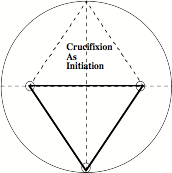
And the Old woman said: THE PLANETARY AVATARS EMANATE FROM THE CENTRAL PLANETARY LOGOS OF A SCHEME AND EMBODY HIS WILL AND PURPOSE. THEY ARE OF TWO DIFFERENT KINDS. THE FIRST TYPE IS THE MANIFESTATION ON ETHERIC PHYSICAL LEVELS OF THE PLANETARY LOGOS HIMSELF, FOR A SPECIFIC LENGTH OF TIME. IT INVOLVES THE DEFINITE TAKING OF A PHYSICAL BODY BY ONE OF THE KUMARAS. SUCH AN AVATAR IS TO BE SEEN IN SANAT KUMARA, WHO, WITH THE THREE OTHER KUMARAS, EMBODIES THE FOUR PLANETARY QUATERNIC PRINCIPLES -- THE GUARDIAN ANGELS OF CHRISTIANITY. IN A VERY REAL SENSE, SANAT KUMARA IS THE INCARNATION OF THE LORD OF THE RAY HIMSELF; HE IS THE SILENT WATCHER, THE GREAT SACRIFICE FOR HUMANITY.
AS NOTED ABOVE, THERE ARE SECONDLY THREE ENTITIES WHO EMBODY PLANETARY PRINCIPLES. THEY ARE, SPEAKING FROM THE PRESENT STANDPOINT, THE DYNAMIC ENERGY WHICH HOLDS TOGETHER THE THREE LOWER KINDGOMS, VIEWING THESE KINGDOMS AS UNITS AND NOT AS DIFFERENTIATIONS. THEY ARE CLOSELY CONNECTED WITH THE ENERGY ASPECT OF THE THREE EARLIER CHAINS; AND IT ONLY NEEDED THE WORK OF THE INTERPLANETARY AVATAR, AT THE FORMATION OF THE TRIANGLE WHICH RESULTED IN THE INDIVIDUUALISATION PERIOD DURING THE THIRD ROOT-RACE, TO ENABLE THEM TO TAKE ETHERIC BODIES AND INCARNATE AMONG MEN. THEY ACT AS FOCAL POINTS FOR THE ENERGY OF THE PLANETARY LOGOS ON HIS OWN PLANE. THE FIRST KUMARA IS, IN A MYSTERIOUS SENSE, THE ENERGY WHICH PRODUCES SEL-CONSCIOUSNESS IN THE HUMAN FAMILY. THE THREE OTHER KUMARAS, OR THE THREE BUDDHAS OF ACTIVITY, ACT AS SIMILAR FOCAL POINTS FOR THE ENERGY WHICH ANIMATES THE THREE LOWER KINGDOMS OF NATURE, AND WHICH PRODUCES THEIR DIFFERING GRADES OF CONSCIOUSNESS. THE TIMES AND THE SEASONS OF THEIR APPEARING VARY ACCORDING TO THE PARTICULAR KARMA OF THE LORD OF THE RAY, AND NOTHING IN CONNECTION WITH THESE GREAT CYCLES, AND INCARNATION PERIODS, CAN BE REVEALED TO THE PROFANE.
"Then comes an interesting detente with the concept of capitalism," Rose says. "In fact, more than a detente. An appreciation of capitalism, as seen through the image of Jacob Heimkreiter, the banker. This is a major change for a man who was a communist -- and also a man who hated material things after that, who embraced the Spiritual world as it was opposed to the Material world..."
"Ideas change," Crossmann says. "Truth changes. Ideas rotate. Change seasons. Change colors..."
Rose reads:
You become aware of your own contradictions. OLD WORLD AGAINST NEW WORLD. Religion against Reason. CONSERVATISM AGAINST LIBERALISM. Despair against Hope. I AM ALL OF THESE THINGS. IN ENDLESS TURMOIL. The Great Sage says nothing. WHAT IS THERE TO SAY? The Great Sage has been misled. HE MISLEADS HIMSELF. You evolve both minds. I AM BOTH MINDS. Two-headed man. Does that necessitate two faces? Janus and all. Standing at the beginning. AND END. Yes. RAISE THE FIRE OUT OF THE PIT OF YOUR STOMACH. What do you see? I SEE A PLACE WHERE RELIGION AND COMMUNISM FIGHT. WHERE ANTI-RELIGIOUS COMMUNISM IS SHOWN A LARGER WORLD OF THE MYSTIC, WHERE THE ANGRY RAGER AGAINST THE WORLD'S IMPERFECTION IS LIFTED OUT OF BODY, IS PULLED OUT OF HIS SMALL MIND -- AS I, TOO, WAS PULLED -- INTO A WHOLE NEW KINGDOM. If Communism falls, what will take its place? Fundamental religion? THE ISLAMIC SWORD? Everyone looks at the Banker as scapegoat. JACOB HEIMKREITER FALLS FROM GLORY. Oil is the key by which the house of cards called International Money goes limp. AS YOU PREDICTED IN YOUR WALK WITH HEIMKREITER. As Heimkreiter predicted. HE IS YOUR UNIVERSAL MARTYR THEN? The bankers are good and bad. They would build-up poor countries, by owning them through loans. They would own all nations, through the power of their investment. Yet, without capital, there is no growth. Without profit, there is no capital. Without growth there is discord, suffocation, anger, revolution. Without growth there is starvation and then war. The Communists cannot exist without the Capitalists. Credit has made their revolutions feasible. Without credit they cannot attempt their experiment in suffocation. Yet the world of credit will fall very soon. Then we shall find a world dressed in Chaos. WHY HAVE THE BUDDHISTS AND THE HINDUS COME TO LIVE IN OREGON? What happened to Heimkreiter? HIS WORLD FELL APART BECAUSE HIS SON DID NOT LOVE HIM. His son committed suicide. THAT IS THE STORY AT LEAST. His other son married a Vietnamese woman and lives in Southeast Asia. He desserted the army there. He was missing-in-action on Hamburger Hill. Assumed dead by High Command. His body never found. Only pieces. And a broken dog-tag. NEITHER WAS BENJAMIN'S BODY EVER FOUND. A mystery to behold. THE HORROR OF WHAT I SEE COMES TOO EARLY. Is that not why you choose to walk in your sleep? WOULD I AWAKE TO DEATH WHEN DEATH COMES PLYING? Let Horror come when it must. I mark my door with the blood of a lamb; and I hope the Horror will pass over me. BLACK AND WHITE MUST COME TOGETHER AGAIN BEFORE AMERICAN CULTURE WILL REVIVE. THE SPIRIT MUST TAKE A BODY AGAIN. BLACK AND WHITE MUST UNIFY IN SONG. Men approach the Earth again. YOU TELL DAPHNA GREENSTEIN YOU LOVE HER. I do love her. YOU DESIRE HER. I do desire her. YOU ATTEMPT TO SEDUCE HER WITH VISIONS OF COMING DISCORD, TO STAY IN YOUR COUNTRY, TO BECOME AN AMERICAN. YOU SEE YOURSELF AS MICHAEL THE ARCHANGEL WHO PROTECTS THE JEWS WITH WORD AND SWORD. She speaks of Israel fighting America. YOU SPEAK OF AMERICA FIGHTING ISRAEL. She speaks of Israel and an alliance with Russia. I SPEAK OF RUSSIAN PERSECUTION OF JEWS. You think of America being the Ark, in which seeds have been stored to be spread after the fire-storm. I SPEAK OF AFRICAN JEWS HAVING NO TRADITION OF DEMOCRACY AND LIBERALISM. OF BEING MOTIVATED BY KING AND BIBLE AND SWORD. OF EUROPEAN JEWS AS BEING THE FOUNDERS OF ISRAEL; YET OF EUROPEAN JEWS BEING DRIVEN OUT BY TRIBAL HATRED. Of being driven to America. I FEAR WHAT I SEE AND SPEAK. I AM A FLOODGATE. I TELL PEOPLE WHAT THEY DRAW FROM ME....
"So, I think this is the first time you have actually said," Rose concludes, "that you see yourself as Michael the Archangel. You have incarnated as Michael the Archangel...?"
"Or the Spirit of Michael the Archangel has incarnated in me," Crossman says.
"Is there a difference between you and he?"
"Not one I am aware of."
"So you have become him?"
"There has been some kind of fusion in our minds."
"The two have become one?"
"Yes. And you infer from this that the energy of Michael the Archangel has not only come to you but to the Earth in a general sense?"
"Yes. The Spirit of Michael has come to overthrow the Darkness," Crossmann says.
"One thing we have not mentioned, and of which you may not be aware," Charlie continues "is the relationship of Michael the Archangel to the Amiens Cathedral."
"No," Crossmann says. "Tell me."
"The sculpture in the pediment of the middle portal," Rose says, "of the west facade of the cathedral of Amiens is an elaborate scene of the Last Judgment. The figure of Saint Michael the Anchangel, holding the scales of divine justice, surmounts the gable over the panel. Below, the devil seeks to disrupt the balance. It seems that this image may have been the message of the meaning of Amiens in the novel. The sculpture may have been predicting your own future, your battle with the Power of Darkness, Gilbert."
"You then bring is the Greek myth of Daphne," Rose says. "Loved by Apollo, she knew he could not be true, for his journeys as the Sun-Hero took him all over the world. So she fled from Apollo, begging the gods to protect her. As Apollo was about to embrace her, the gods turned Daphne into a laurel tree. Of course, the laurel wreath was the halo worn by heroes in Greece as a sign of purity and victory. Laurel means the 'everlasting fire god'...."
Rose reads again:
Have you asked Daphna to marry you? I HAVE OFFERED HER A CHANCE TO RETURN TO AMERICA. As your husband? I DON'T KNOW. You seduce her to give up her Jewishness, to become an American. MICAHEL PROTECTS THE JEWS -- AND I AM MICHAEL. IF WAR BETWEEN THE ASHKENAZIES AND SEPHARDICS COMES, I WOULD SAVE THE CREAM OF THE CROP IN MY ARK. I see. AND WHAT OF YOUR SONG? She asked: WHAT IF YOU ARE THE FALSE PROPHET...? How did you respond? I DON'T KNOW. Remember the Avatar who appears at the end of an age to effect the final systemic transfer of force units ofr egoic groups? From one place to another? THE INTERPLANETARY AVATAR? Is that not what you represent with Daphna? I AM NOT CONSCIOUS OF WHAT I DO. I AM THE VOICE. I SPEAK THE WORDS THAT COME TO ME FROM SOME GRANDE SOURCE WHICH LIES BEHIND ME. I try to draw the best units to me, to usher them into heaven, beofre i destroy the world with Fire...
"Now that, indeed, is a frightening picture," Charlie says. "This seems to be verging on the psychopathic. Am I reading this correctly? You are speaking of drawing the best elements here from the Old World and then setting the Old World on fire...? On the preceding page, you write: 'the Heavenly Fire, the Fire of the Stars, the First Fire, Hydrogen.' Are you speaking, then, of destroying the Old World with hydrogen bombs...?"
"It is all rather abstract," Crossmann says. "Afterall, I am not conscious. I am a kind of filter through which forces act at this point. Clearly Vulcan is a very important figure is this novel. Mount Saint Helens has just blown. In Theosophy, the alternate destruction of worlds by Fire and Water refers to destruction by volcanoes and floods. But there is clearly a fixation at this point in the novel with weapons fashioned by Vulcan-Reagan, which, no doubt, includes nuclear weapons..."
"This is horrible," Rose says.
"Yes. Well, he speaks often of 'the horror of what I see'," Crossmann says. "Hydrogen is the First and the Last, in fact. The first element of creation; and the last element, after all matter is resolved back in to Hydrogen..."
"You write: 'CLOSING THE DOOR IS TANTAMOUNT TO THE SECOND CHRIST'S CONDEMNATION OF THE WORLD, AND HIS DESTRUCTION OF THAT WORLD THROUGH FIRE...!' This is a terrible vision...!"
"Yes."
Rose reads:
I see. By Day you separate; by Night you conjoin. DO YOU SENSE A COMING ZENOPHOBIA? I sense many things -- all too many things. I build a shield by Day to live in, so emotional horror and anger are at a distance. This is Vulcan in an esoteric sense. A MUMMY YOU BECOME, WRAPPED, AS A GHOST, IN THE ELECTRICITY OF YOUR WORDS. Michael seals off heaven in the Spring, wo none dare approach him in the lust of their own desire for possession. He opens up heaven when the evening has come: taking back in the elements he's foresaken. HE IS MERCURY; HE IS MARS. He is Mars; he is Mercury. IF WE APPROACH THE NIGHT, IF THE MILLENIUM IS ENDING, IF TIME WILL BE KILLED AGAIN: SHOULD WE NOT BRING THE BEST WOMEN TO SPEND THE NIGHT WITH US? I speak to Daphna, encouraging her to live with me. I seek the Ashkenazi to move in exile to my land. Is it some sinister plan, of which I am not conscious. I wish to save them: they are my favorites. I am Michael, who would be their savior. I see chaos and Islamic hate and murder. I remember the words: 'and the door shall be closed on the Kingdom the Fifth, where those who have not reached the mid-point will disppear like the dinosaur as failures.' CLOSING THE DOOR IS TANTAMOUNT TO THE SECOND CHRIST'S CONDEMNATION OF THE WORLD, AND HIS DESTRUCTION OF THAT WORLD THROUGH FIRE. So that the next starting point, the lowest of the next, will be the highest of this: when the sweep of Chaos comes with blade to clean the fields. THE SEEDS BEING THOSE, WHO, LIKE NOAH, HAVE BUILT AN ARK. THOSE WHO SLEEP AND WALK BETWEEN THE HORRORS, WHO WALK ON THE TIGHTROPE AND WAIT FOR SOME SOUND. Is America the Ark you build...?
"Then there is a poem you have written for Daphna," Rose says. He reads:
Beautiful Daphna will not walk
In the delicate statuary
Which others have fashioned.
She walks the red and russet waves
Of Ocean's immense
And animated pleas.
Water parts to hear of her seasons;
Rivers lament that her reign might be brief.
All the world hands to this woman a cane
With which she might shake
The Dragon from the trees.
Beauty might still be the language of Age;
Grace might be the avenue of Beauty;
Age, even more, the grace of Understanding:
Yet to understand Daphna
Is to walk with the wind.
And to walk with the wind
Is the mystery of Autumn,
When the Earth winds her clay
And her canon through your hairs.
I will not measure the wind with my diction;
Heaven falls on men
When the blind least expect it.
The Autumn is the Spring
With her skirts unencumbered;
The Naked Mourner comes
With her song
Prophecying rest.
I can see only the writing on windows,
Which, held before the light,
Paints a picture of dreams.
The Red Sea walks
With the passion of Twin Titans;
Daphna stands wild
On the shore
And speaks of stones.
We touch the lioned Wheel of Time,
Which scatters us apart
Until aching builds a new web
Which shatters illusionary distance.
All women come to eat from my banquet;
All men steal, from your eyes,
Your storied Wisdom.
"Then the next poem is about the last man standing," Rose says. He reads:
The last man stood upon the desert reef.
The crow brought him water;
And the crane brought him words.
The tortoise brought him method;
And the tiger brought him mode.
He sturdied himself, to fight with the wind.
Then, he threw open the door
And he faced his destroyer.
AND WHO IS YOUR DESTROYER? I am my own destroyer. AND WHY DO YOU DESTROY YOURSELF? I destroy myself to save the world. SELF-DESTRUCTION DOES NOT SAVE THE WORLD. The synthesis of opposites, the approximation of the poles: Russia and America: annihilates the world. DID YOU HEAR OF THE RUSSIAN CHAIN-LETTER? IT SPEAKS OF GOD APPEARING TO A NINE-YEAR OLD RUSSIAN BOY, WARNING HIM OF THE END OF THE WORLD. THE BOY WAS TOLD TO INSTRUCT THE RUSSIAN PEOPLE TO PRAY: AND TO SEND 9 COPIES OF THE LETTER TO FRIENDS, WHO MUST ALSO SEND OUT 9 COPIES TO FRIENDS -- THAT THEY WOULD BEHELD ACCOUNTABLE BY GOD IF THEY FAILED TO DO SO. THE RUSSIAN AUTHORITIES ARE TRYING TO STAMP-OUT THE LETTER. THE RUSSIAN PEOPLE HAVE BEEN EMOTIONALLY TAINTED BY THE MESSAGE, AUTHORITIES ADMIT. A re-birth of religion in the Soviet Union has alarmed Russian Communists. The cost of the Bible has been raised to discourage scriptural reading. VERY INTERESTING. The Pope travels to Central America -- where he collides with communist revolutionaries and their Jesuit supporters. RELIGION AND COMMUNISM: THE NATURE OF ARMAGEDDON. Soon the Pope will travel to Poland: there, too, will collide the adversarial doctrines of salvation. THE WORLD IS BREAKING UP. STRANGE ALLIANCES WILL BE FORMED. Hitler Youth forms in Iran. Waiting to form in Saudi Arabia. A LEFTIST NAMED HAWKE IS ELECTED IN AUSTRALIA. The Right-Wing wins in Germany. MITTERAND IS REBUFFED IN LOCAL FRENCH ELECTIONS, WHICH SEEMS TO SUGGEST A SWING BACK TO THE RIGHT. Mexico, with its economy deteriorating, swings far to the right. REAGAN WARNS OF THE 'DOMINO EFFECT' IN CENTRAL AMERICA. Why does this trouble you...?
"The Clerk's alter-ego points out that his support of America," Rose says, "is support of the status quo against the poor nations of the Earth. The Clerk replies that he will protect his own -- he will protect his niece, as others protect their own nieces and nephews. Clearly he has turned against idealism. I hesitate to say that he has spoken up for greed. But clearly he is speaking for individual destiny, for the differentiation between nations...."
"He states that he is defending law and order," Crossmann says. "He puts his own people first -- which is what the Father, the National God, does..."
"The is an odd line here," Rose says. "The Clerk says he will fight if he needs to -- and his alter-ego asks: 'Do you fight to avoid demon-possession...?' And he says: 'Perhaps. Activity versus receptivity...!' So he is seeking to become generative now apparently -- instead of receptive. He sees that activity is a way to avoid demon possession. What is demon possession anyway...?"
"Demon-possession comes to the mentally passive or inactive," Crossmann says. "Daemon in the large sense would suggest spirit-possession is a more appropriate term. Because some spirits are very good and helpful. Spirits are rays really that move through ones body. Rays that inhabit one's body and become and bring consciousness. The high connects with the low, inside of ones being; the spirits, the formless intelligences, come down to make use of a body. This is what is known as incarnation. But dark spirits can also inhabit a body -- as is true in the case of Gilbert, the Dark Giant. The spirits of hate and alienation can come to possess a passive mind. An 'open mind', while often positive, also has a negative side...."
"I don't really understand this," Charlie says. "You believe in demon possession?"
"Yes."
"You believe the Devil possessed Gilbert -- and the criminal mind generally?"
"Yes. Demons. Dark spirits."
"And you believe that Michael the Archangel came down and possessed your body?"
"It's a semantic problem, of course, since we are describing this process with words," Crossmann says. "But yes, I believe that both Michael and Metatron came down to fill me up with strength..."
"Do you draw the spirits down -- or do they...?"
"You draw them toward you by what you think," Crossmann says. "It is magnetic. It all depends on what you desire..."
"And you desired...?" Rose asks.
"Life -- at this point in the novel."
"As earlier in the novel you desired Death?"
"Yes. I desired Night, Darkness, Defeat; and I got it. There is much that is good in darkness. But darkness is old. Darkness is filled with fear; it is subject to defeat, victimization, slavery. Wisdom is one of the good things. But physical weakness, drugs, despair are also there. Laziness. Hatred of the living. A fear of the future. An inclination for self-destruction. Even a desire for martyrdom... The Darkness is anti-Man because the Darkness compares Man with the perfection in the mind and finds Man inferior to this perfection. Man isn't good enough. So the Darkness wants to wipe him out as a failure..."
"You desired Death; and so you met death?" Rose asks.
"Yes. Ultimately one comes face-to-face with death," Crossmann says. "I met Death on the mental plane. I fought Death on the mental plane first. And then on the physical plane eventually. On the mental plane, one either has to choose death or life. One must either choose to be a victim or to fight back..."
"Gilbert was your death?"
"Yes. On the physical plane. But I was struggling with Death on the Mental Plane for much of this latter section of the novel. I met Death. And then I chose life, the Day, Light. That was my re-birth. Gilbert was to me what an invading army is to a country. He was an invader...."
"You came back into your body," Rose says. "You incarnated as a man."
"Angelic man becomes man becomes animal man becomes vegetable man becomes mineral man becomes vegetable man becomes animal man becomes man again...."
"And then climbs back into heaven again, I guess?" Rose says. "Making the spiral back up toward God. That's what you seem to be saying.... Let's keep moving through these series of poems in the novel..."
Rose reads:
In the first season of Time
I came to walk on the land without eyebrows.
Many inspectors followed me there.
The sky was grey, but would soon become pink.
Animals crawled from the mire
And becmae Giants.
In the first season of Flight
I captured a moon with my animated wings.
Vision is costly to the man without shadows.
Sparks filled a sea from the anvil of decades;
Milleniums came by;
Giants grew into sailors.
In the first season of Sorrow
Old men told stories about
Magnificent First Knowledge.
The language they spoke
Was then lost by their children;
For dreams lose their light
When the Fire is allowed to die.
The sailors accompanied the sea to the ledge.
They peered, once again,
Into the mire
To look for Giants.
"And then another," Rose says. He reads:
Many centuries from here
I stood amid the starlings.
Eighteen rains had fled
Before the breeze.
Twenty-one silences
Had handed me
Their skins.
A world was walking;
Another world was gone.
A woman had let her hair fall down.
Someone said that the child
Had not yet grown.
YOUR MYSTERIOUS WORDS. WHAT GOOD DO THEY DO THE ONES WHO DON'T EAT? WHAT GOOD DO THEY DO WHEN THE SAVAGES RETURN? The savages have never left. AND WHAT OF YOU? I stand in perilous accompaniment of shadows. Will I stand or will I fall? Will I capture the plain with my smile -- where girls in their greens and their curls long for....the heroic? YOU GROW WEARY OF THIS PLACE. YOU WISH TO GET AWAY. I long to continue my travels in the air. SOLITARY MONAD. SOLITARY SIN. Protecting some great vision. WHICH VISION? I am not certain. REFUSING TO COME BACK INTO THE LIGHT. Alligator-Crocodile crawls into the water where others can't harm him. Crawls onto the land where others can't harm him. THE KING OF EVOLUTION. A survivor in both worlds. EATING TIME BY THE HANDFUL. Wind him up, he can't stop, he swallows Time just like a prophet's eye, turned on Somedays to puncture walking lines upon a top, some day some one will call his name and end the winding star-walk of Sun days when only trees can gather up his Tuesdays and mentors and all the world might cheer him when he's gone for the world has grown weary for his tune....yes, his tune...yes, his tune makes us all grow sometimes worn. And alone. And sorry for the sound.
RHYTHM GONE. RHYTHM GONE. TRY AGAIN, MY FRIEND. TRY ANOTHER ROUND. YOU ARE BETTER NOW THAN YOU WERE BEFORE.
When will the Seventh Angel come
Who blows the Seventh Trumpet 'round
The gathered wheel and wheat and waste,
Who burns the towered evening's grid
With words condemning the static and the steel?
Is he not you, fellow traveler?
Is not that last mask you let fall,
The one which shelters shield and sword,
Through which you speak the words unknown
To those you seek to save through love --
Is not that mask the mask
Which has no word?
All the walls prepare to fall --
Is it not so...?
All the birds fall, scorched, from their flight.
A second sun appears in the sky:
A fireball of color;
And then statues abound.
If you cannot love disease, then you must go.
If you cannot touch cold laughter,
Then the Sun takes you back.
You come at the end;
And you are the beginning.
You leave and go no where;
You merely wait,
And rule by patience.
"I'm not sure what to make of these poems," Charlie says. "This last one, of course, begins to feel, more and more, like Revelations. The Seventh Seal -- the Seventh Angel blowing the Seventh Trumpet. Again, this picture seems like nuclear war. 'The birds all fall, scorched, from their flight'. A 'second sun' appears in the sky, a 'fireball of color'. And then 'statues abound'. That seems to be predicting a kind of religious age on the other side of this apocalypse. The last stanza is a bit mystifying. 'If you cannot love disease, then you must go' -- I am not sure if that is an injunction to...what...?"
"To leave the cities perhaps," Crossmann says. "To leave the places where love of disease is flourishing. The anti-universe, where disease is health...."
"So, only the anti-universe will suffer the wrath of this second son, this fireball of color?" Rose asks.
"Perhaps."
"'You come at the end and you are the beginning' -- this is our Alpha-Omega against," Charlie says. "The messiah. The Second Religion that Osvald Spengler talks about. First Religion, a religion of the heart; Ant-Religion, a religion of Man; Second Religion, a religion of the mind. Is that what this is all about? The Second Sun being that Second Religion...?"
"That seems reasonable to me," Crossmann says.
"It is not very hopeful," Charlie says.
"Well, it is hopeful if one identifies with the eternal principle inside all of us," Crossmann says. "The Personality dies, the lower, alienated nature. But the soul doesn't die. If we have been witness to anything in this novel it is the staying power of the soul, the transmigratory nature of the soul..."
"The exchange after the second poem is interesting, especially the part about the alligator-crocodile," Rose says. "The alligator is a great survivor. Because he can survive in both elements, the masculine element and the feminine element...."
"Makara, the crocodile, is mysteriously connected with the astrological sign of Capricorn," Crossmann says.
"I don't know what that means," Charlie says. "But I am interested in your nickname when you were growing up. You were called 'Gator', weren't you...?"
"Yes, I was."
"And your brother was nicknamed 'Shark'," Charlie says. "I'm not sure where I read that, but..."
"Yes. That's true."
"Where did these nicknames come from?" Charlie asks.
"I don't know. From friends. Where do nicknames come from...?"
"It is interesting that the 'gator' can live in the water or on dry land," Charlie says. "But the 'shark' can only live in the water. Your dark brother, you older brother William, the 'shark', could only live in the water. He could not follow you out into the light. He lives in constant preparation for the end of the world. Because he doesn't have the dual nature. You doens't have a body of light..."
"I'm reminded of a story of Benjamin Franklin," Crossmann says. "About the small town, a flourishing town of Philadelphia. There was a man in the town who constantly kept predicting the end of the world. The town flourished around this man, life went on, children were born, houses were built. Then, one day, the town burned down in a horrible fire. Franklin said to the man: 'Yes. You were right. The world did come to an end. But now it is a new beginning. You can build a house and go on with life.' And the man said: 'The world is going to end! The world is going to end!' The man was stuck there. Stuck at the end of things. Stuck in the darkness..."
"Is your brother like that?" Charlie asks.
"I'm not sure. We never really know one another very well," Crossmann says. "He and I were as close as twins. But we still don't know each other that well. That's how I see him. Longing for the end. Predicting Chaos. For he only has power in a Chaotic world. In the water, like the 'shark'. The water is his element..."
"He is the 'W', that is the reflection of the 'M'," Rose says.
"Yes."
"Castor and Pollux. Cain and Hebel, Hebel being the negative man, the dark man, the American Indian, the Lunar Man. The one who refused to work..."
"Yes."
"So we have the Revelations poem," Rose says. "With the Second Sun coming. You 'come at the end and you are the beginning.' That sounds like your brother..."
"Yes. It is the mystical religion -- which was in both myself and my brother. The difference was that I was able to incaarnate. I had a body waiting for me. I was able to win a wife; and have a child. He was not able to do that. He was not given a body when the bell rang..."
"So, we have the Revelations poem," Rose says. "And then there is an interesting passage as the twin voices discuss the effects, the ramifications, of the prophecy in that poem."
Rose reads:
WHAT GREAT ATROCITY DO YOU CONSIDER NOW? You make of yourself a God, who creates or forms Men in his own image: Dark and Light: Androgynous. Therefore, eternal. You do this by being unconscious of yourself; you are a model, a prototype, by which you form men and women. HERMAPHRODITIC MAKER. I see. 'ATROCITY IS RECOGNIZED AS SUCH BY VICTIM AND BY PERPETRATOR ALIKE. BY ALL WHO LEARN ABOUT IT AT WHATEVER REMOVE. ATROCITY HAS NO EXCUSES, NO MITIGATING ARGUMENT. ATROCITY NEVER BALANCES OR RECTIFIES THE PAST. ATROCITY MERELY ARMS THE FUTURE FOR MOR ATROCITY. IT IS SELF-PERPETUATING UPON ITSELF -- A BARBAROUS FORM OF INCEST. WHOEVER COMMITS ATROCITY ALSO COMMITS THOSE FUTURE ATROCITIES THUS BRED.' Who has spoken these words. PAUL MUAD-DIB. I see.... SO, YOU ARE THE CREATOR? I create whole beings as prototypes. THEN YOU ALSO MUST BE A DESTROYER? I suppose that the work is never done. WHAT ELSE HAVE YOU TO SAY...?
The left-handed woman speaks in tones
Which only birds can hear.
Others talk of production with her.
Some share secrets and arguments with her;
Yet the hidden voice of the left-handed woman --
The hidden woman herself --
Speaks only to birds;
For birds are the carriers of air
From the deep.
The left-handed woman talks of Time,
And Time's cold shape.
Who has been chosen
To eradicate the Night?
Who will carry, in his words, the last hurrah?
Through the speaking of which
He disintegrates entire seasons?
Apollo could love the Dawn in the Dawn;
But, when she fled his hypnotic round --
Then only the laurel and the leaf
Could be seen.
"Clearly, this is about Daphna Greenstein," Charlie says. "On the higher level, the mythological. Michael then becomes Apollo -- you make yourself Apollo. The alter-ego tries to point out that Michael the Archangel is probably a Nazi, a fascist. He says: 'You wait to be re-born. You wait to discover which next you will rise from Vulcan's fire through transmutation. Metal forged into purer form. You play a dangerous game, friend. You are Michael -- remember that. You stand for order amid chaos. Are you a Nazi then? Are you an agent of the police?' And Michael says: 'Hero, and, again, Anti-Hero.' And the alter-ego says: 'The Anti-Heroes have had their day. Mad Max defends a world gone bad....!' You are very much a student of popular culture. Mad Max is a kind of archangel, isn't he...?"
"The Mad Max trilogy was very much a picture of a post-apocalyptic world, where good and evil were clearly defined," Crossmann says. "It was quite similar to the vision of the world I also had. What happens to civilization when the oil runs out? It collapses. Max is very much a Michael figure. Living between heaven and hell. Sending the good souls on to heaven; but staying behind, himself, to keep the gates locked, keeping the demons in hell..."
"And it is clearly your contention that Michael's return to the Earth, through yourself and through others, was a return of the Hero aspect, de-throning the Anti-Hero. The Hero protects society, civilization; the Anti-Hero despises society, because it is sick, corrupt, imperfect. Not nearly as perfect as he is. The Anti-Hero is a kind of avenging angel...."
"A proponent of Darkness," Crossmann says. "One who sings the praises of society's destruction..."
"Which you were also," Rose says. "At one time."
"We take on every role on the Wheel of Time," Crossmann says. "In this novel I am both the Anti-Hero, early in the novel, filled with rage at the imperfect world. The son. Angry at the father. Praising the black; hating the white. And then, over the Bifrost Bridge, becoming someone else. Loving the father. Praising the white; hating the black. Seeing the world is very good, when compared with chaos. The soul riding the Ferris Wheel. We are all this. We don't all experience this in one lifetime. Most souls are stuck in time and experience only a local reality. But I was unhooked somehow. And allowed to travel the entire circle. That's what this books is about: the entire circle. The point of the novel -- one of the main points -- is the illusion of our perceptions. We can't really trust our perceptions. Our perceptions help us survive, that is true. But they are an illlsuion. They seem true only at a specific point on the wheel. Everything we see is an approximation of an idea. We are on this Ferris Wheel describing what we see. But everything is turning. So, our descriptions are inevitably distorted. We become the thing we hate. We are the thing we hate, the thing we love. Ultimately we all are brothers, but at different stages of daylight and nightlight. We are brothers and sisters; and under all this, we are all God. We have been squeezed out of God's body like the elements are squeezed out of the Sun. Like electrons traveling away from the nucleus. Ultimately to travel back to the core, when the Day is done. When we are re-absorbed back into the Unity..."
"Paul Muad'Dib, who warns you about atrocity," Rose says, "is, again, the mythological hero of Frank Herbert's Dune. Which you read while writing this book. And which captured your imagination..."
"Like Jason and the Argonauts," Crossmann says. "Or the Odyssey..."
"Mythology."
"Yes. Intellect with a body," Crossmann says.
"The Hero being, if I remember correctly, the nature of the Third Root-Race," Charlie says. "In Blavatsky's scheme. Is that correct...?"
"Yes."
"I'm not sure what all of that means," Rose says. "I have not really grasped all of that. But then you come into a strange passage where you warp time. Before that, Michael, who seems now to be Jesus as much as Michael, seems to condemn estblished religions. He says..."
Rose reads:
I am my own church. Each of my congregation, each must be a priest, who gains heaven with the power of personal vision. Each must seek and each must find, in a privaate journey, without culthood or stationary monuments to form, the nature of their God. HOW LONG CAN THIS GO ON? Each year is but One Day. By expanding Time into such a wide scope: One Year is One Day times 365. Now, 365 Years equals One Year. Time 70 Years for an average life. Equals 25,550 years as an average life-Cycle. SO, IN REALITY, HOW OLD ARE YOU? In this life-cycle, I am 32 days old, going on 33. IN AN EGG, TWO FORCES SEEM TO BREAK OUT AND BE BORN. Who is the Unborn? HE IS THE ONE WHO REMAINS UNSEEN. The One who lives isn the countries of Night? WHO IS THE SELF-BORN? The Self-Born is the one who gives birth to himself. WHAT IS HIS NAME? He has no name. THESE TWO FORCES: ONE SEEKS TO BREAK OUT; AND ONE STAYS BEHIND. Yes, one remains unborn. I SEE. ARE YOU THE CROCODILE? I am the Gator. WILL YOU FIGHT DEATH, OUT OF FEAR? Perhaps. Perhaps out of duty.
On a black day the Sun fell;
Sturgeon ran upon the bank to bleed;
Carp were found, hiding beneath hats;
Plants pulled free of their soil to flee;
Wives took up guns to protect their husbands;
Children rode elephants up and down the seaside,
Shouting: 'If the Moon does not save us
From the waves
Then Time is doomed!'
The old men in the villge laughed at the fear
They saw.
There was nothing they had not seen
In their dreams.
They had learned to walk ahead of the moment;
Always they stood in a time
Which had not come.
They had whispered their secrets
To those they wished to save.
All of these so marked
Now stood in the Time-Not-Come;
They walked in lands which could not
Touch them.
They pulled the laggards, by the hair,
Into the Future.
One black day the Sun fell away;
The Moon held the seas;
A land slept;
And there was peace.
AMEN.
Amiens.
AMENTI.
Amenati.
AMENITIES.
Immunities.
ILLUMINATIS. AMEN.
In the service of Grace. COROLANUS CRUX. CRUCIFIED ACTIVITY. Corpulorum. Corpulorum. IS THERE NOTHING ELSE? Is intelligence destroyed? REGENERATION, THROUGH THE POWER OF THE WORD. HARMONUM HOMINUM: WHO IS YOUR TEACHER? The young women certainly are beautiful this year. SHULAMIT WALKS BY; AND SEEMS MANY MILES YOUNGER.
Each time I plunge myself into the fire
I emerge a new entity,
A new god,
With a whole new shield and sword.
I transform my metal and my mind
Toward gold;
I transfer my steel and my solidity
Into woe.
SELF-DRAMA, AND THE SCOURGE OF SELECTION. YOU HAVE DISCOVERED TIME. THE ACT OF BENDING THE RAINBOW. EACH MUST WALK ACROSS THE DESERT TO HIS END. YET, ONE MAN DOES IT IN 70 YEARS. ANOTHER MAN DOES IT IN 25,000 YEARS. WHAT DOES THAT TELL YOU ABOUT DISTANCE AND SPEED? We can change the body's chemistry b y changing the mind's conception of Time. By altering the 'biological clock' of the body -- that is, its conception of itself, with relation to Time. We can stretch Time, so to spaek, making a 'Day' infintely enlarged. INFINITELY ENLARGED? One Day becomes One Year; One Year becomes Ten Years; Ten Years become 100 Years; 100 Years become 1,000 Years. I SEE THE DIRECTION YOU ARE TAKING. I walked in the woods and swamps and in town. A marine, in a camoflage suit, also walked the swamp; a World War II bomber, a ghost of another era, buzzed the town like presentiments of some awakening. Yet, in town, through a slum, in a run-down house, through a back window, I saw a beauutiful woman nursing her baby. She saw me watching her. She seemed, somehow, holy. THE ONES WHO CHOOSE NOT TO HAVE CHILDREN, ARE THEY THE ONES WHO CHOOSE TO HAVE WAR? The legions of Heaven and the legions of Hell. YET MICHAEL, THE ARCHANGEL, REFUSED TO HAVE CHILDREN. HE PROTECTED THE VIRGIN SEA, THE PREGNANT WOMAN, FROM THE ONSLAUGHT OF BEASTS. He protected the scrolls, the Ark of the Covenant. I SEE. He drove the Man and the Woman from the garden. Protecting Akashic Scrolls. Until the Day had turned; and then he welcomed them back....
"Ok; and then we have charts of both the Days of the Week and the Months of the Year," Rose says. "But what I find interesting, in this kind of time warp we have just witnessed, is how close the calculations of the Macrocosms time-cycle -- One Year, in fact, being One Day instead -- with a 70 year lifetime, according to this new scale, corresponding to a life of 25,550 years....I find it fascinating how close this caculation come to the Sidereal Year, which equals 25,868 years. Of course, each sidereal year the Tropics recede from the Pole 4º -- that is, every 25,868 of our Solar Years. This suggests that, if the Tropics were once at the Poles, it would take 646,700 years for the Tropics to recede to the Equator...."
"That's pretty impressive math," Crossmann says. "Did you do that in your head?"
"No, I made notes when I read the book," Charlie says. "I used a calculator... And this means it would take some 1,293,400 years for the Tropics to make the complete journey from the Equator to the Poles and back again...."
"Yes. Well, I'm impressed," Crossmann says.
"For what it is worth," Rose says. "I'm not saying I understand this -- I just tried to do the math. Do you understand it....?"
"Not at the moment."
"Did you ever understand it?"
"It was something I saw and remarked on," Crossmann says.
"Clearly, the Day is the Microcosm of the Year," Rose says. "The Sidereal Year is another Scale of this. All of graphs you have given us stress that the Day/Night is the Microcosm; and the Year is the Macrocosm..."
"Yes," Crossmann says. "The Hours are also entities, with histories, characteristics. Eleven AM is an entity, with a nature much different from Eleven PM..."
"Yes," Rose says. "I do see that. And you embellish this later in the novel. Not to my satisfaction, but clearly you plant the seeds for discussion...."
"Yes," Crossmann says.
"We move toward the next poem with a dicussion of how God has given Daphna to Michael," Charlie says. "But not as a wife. Daphna is already married. But as Matrona, the Heavenly Bride..."
"It is a mystical marriage," Crossmann agrees. "Daphna is as much a mother as a wife to Michael. The women through whom he can be born..."
"The Electra Complex again. Then the next poem." Rose reads:
The Carrier of the Wind drop his burden
By the door;
Rain washes away the clay;
Frost returns, and fuels a fear.
Never before have so many seen so few.
Never before have the tides
Shed such embellished opinion,
Hoping to influence the property of sisters.
Gloom is but the brother unborn,
The twin who, from womb,
Does never emerge.
The Carrrier of the Wind sets his baggage
By the window.
Inside of me, a storm careers.
Inside of me: clouds and sceptres,
Coils and proctors,
Damnation;
And a bird on the water:
Singing: to wit to wit to woo.
The Old Lady lived in a shoe.
And, seeing you worry,
And still in a hurry,
She offered you solace:
A lasting place in her glue.
The Carrier of the Wind
Is now the Sower of Seeds.
Somewhere Water-Lions
Contort with their young.
The Wind cuts the Spring up
To feed to the chosen.
"Now, this just seems to be absurd," Rose says. "And comical too. The 'Carrier of the Wind' is not comical. But the Old Woman who lived in a shoe. The Old Woman has been Blavatsky and Alice Bailey combined, I believe..."
"Yes. A combined voice of the occult doctrine," Crossmann says.
"But this now appears to be something you are rebelling against," Rose says. "The 'property of sisters' -- isn't the occult tract itself, the different tracts of the Secret Doctrine -- is that what you mean by the 'property of sisters'...?"
"Perhaps. The Wisdom Religion," Crossmann says. "The Eastern Way."
"Which you also rebel against," Rose says, "embracing the West, embracing your own God, in the next section when you speak angrily to drive the Rajneesh, the charlatan Hindu religious master, out of your state and out of your country...!"
"Driving out the foreign gods," Crossmann says. "Yes."
"Who is the Carrier of Wind?" Charlie asks. "Is that you...?"
"It seems to be."
"And the burden you drop by the door?"
"Of course, the 'burden' is almost always a form of the cross," Crossmann says. "But this book is my burden now. My destiny is this burden..."
"And you drop it," Rose says. "You set it down. You give it up..."
"At least I try to give it up. Obviously, I pick it up again..."
"Why does 'rain wash away the clay'?" Charlie asks.
"Rain, water, is the female element. Clay is Adam; Adam the red; Adam of clay. Wet earth. It takes water andd earth to make a human soil -- that is, clay...."
"The woman washes away the man?" Rose asks.
"Apparently," Crossmann replies.
"Frost is frozen water. Frost returns and fuels a fear. Which fear...?"
"The fear of death. The fear of invasion. The fear of darkness..."
"In?" Charlie asks. "You? In the frozen water...?"
"In everyone, I would say. Surely the fear is also in the frozen water..."
"Never before have so many seen so few...?" Charlie asks. "On one hand, this seems to mean that the vast majority of people are blind to real quality -- they are seeing so little. But on the other hand, it says many are seeing the few; perhaps the chosen few. In one sense they are not seeing; and in another sense they are seeing..."
"So many are seeing so few -- that is, yes," Crossmann says. "Prophetic vision: many are seeing the angels, or spiritual beings," Crossmann says.
"They are seeing? Or they aren't seeing...?"
"It is a paradox," Crossmann says.
"Who are 'the tides', then, with this embellished opinon?" Rose asks. "The tides are the breaths of the Moon, in one sense. So these are lunar entities. Lunar men and women...."
"'Embellish', of course, is to beautify," Crossmann says. "To make more beautiful than it really is..."
"And who does this?" Charlie asks.
"Who has attempted to transform the gods into the goddesses?" Crossmann ask. "The Sun into the Moon...?"
"Is this the New Age Movement?" Charlie Rose asks. "Is this a depiction of the New Age Movement: such beautified opinion, 'hoping to influence the property of sisters'...? Sisterhood, also being a prime element of feminism...."
"The 'carrier of the wind' -- that is, a storm-god -- becomes a 'Sower of Seeds'," Crossmann says. "He changes from a man of conflict to a man seeking children. A man with a phallus. Capable of impregnating women. But also a man of peace, a man of agriculture. The 'Water-Lions contorting with their young' is clearly a picture of fertility; and family. The Lion, of course, is a symbol both of Michael and of the sign Leo, the King of the Day. 'The Wind cuts the Spring up to feed to the chosen': this indicates to me that, in his warrior mode, before sowing his seeds, he slays the dragon, which he meets in Spring. The draagon is the Night Wisdom -- and he feeds this Night Wisdom, after he kills it, to those he has chosen to go on to the next world..."
"His children, in a sense," Charlie says. "The chosen are his children in a mystical sense..."
"Yes."
"Then you return to looking at the Earth," Rose says, "with an especial eye toward the role of Russia in Poland. You have the Russians involved in the plot to assassinate the Pope. Now you introduce an attempt on the life of Lech Walesca, the Polish labor leader, with possible Russian involvement. This is armageddon you are charting, it seems. Even if you are not aware of it..."
Rose reads:
THE SUN UP, FROM THE SOUTH. Plot to kill Walesca uncovered. RUSSIAN INVOLVEMENT? A high-level emergency meeting of the Warsaw Pact countries. LOOKING AT THE EARTH STILL. Russia undercuts OPEC oil prices. I SEE. WITHT HE SPRING, YOU WILL REGENERATE YOUR LOVE FOR THIS BOOK AND CARRY IT FORWARD. It seems lifeless now. IT IS LIFELESS NOW. RESURRECTION COMES AFTER. I lean toward numbers now. And then toward a journey back into the Primal Creation. FROM NUMBER OUTWARD THEN. Precisely. FROM NO-NUMBER TO NUMBER; THEN FROM NUMBER INTO THE TURNING PRODUCT. Yes. I BEGIN TO SEE AGAIN WHERE I AM GOING -- AFTER A LONG PERIOD OF DARKNESS. You have met: the Demon Patton, in the density; Daphna Greenstein in the water; now you rise even further in ideas. I SEE THE PLAN OF MY JOURNEY AGAIN BEFORE ME. NUMBERS; SECRET DOCTRINE; ESOTERIC ATOMICITY; THEN A FALL INTO MINERAL BUILDING OF WORLDS. Yet you must also chain the Draon in his seas. You do not let him rise. For ages he is gone. DEATH PASSES OVER THE GRINNING GENTILES. The Past is alive and happening now. I SEE. What else? RUSSIAN SCHOOLCHILDREN PLAY THE GAME 'CONCENTRATION CAMP' IN WHICH THEIR JEWISH SCHOOL-MATES ARE GIVEN NUMBERS INSTEAD OF NAMES. A leader of the anti-American 'Green Party' in Germany is forces to resign his seat in the government after it is learned he was a storm-trooper in Hitler's army. I AM TIRED. THIS STORY BARELY HOLDS ME NOW.
And the water came down.
Millions of sorrows were drowned
In their stations.
Military Watchmen stormed the city
With their projections:
The Enemy's insulary power;
Prognostication of gain;
Tutelary indescretion; and the shape
Of an airless cape.
Nobody understood their numbers.
Missilves were shelved;
Those who swam
Desired to find high ground.
There is nothing to be said
About the coming of the rain.
The fish foretold a tale of doom.
He hand-picked a family;
Then he swam to find
Some hole
He might rest in.
"It is March 17, 1983, when this is being written," Rose says. "It is interesting that fish seem to play an important role in the poetry at this point. 'The fish foretold a tale of doom'; and earlier: 'Sturgeon ran upon the bank to bleed;/Carp were found, hiding beneath hats...' We are in the sign of Pisces, the sign of the fish. You then ask: 'Who is this fish?' And you answer: 'It is I, myself.' Of course, Pisces and the fish have been connected, historically, mystically, with Jesus Christ. And you will come, through numbers, and letters, to re-connect yourself to Jesus Christ as the same essence of Michael the Archangel...."
"Yes, this comes later in the novel."
"Not too much later. We are getting near the end of the novel. The revelation."
"We are getting close," Crossmann says.
"And what is this about the waters coming down?" Rose asks. "This poem is mysterious, clearly. I like the poem. But I'm not sure what it means. There is some kind of flood. That is, the feminine element predominates. 'Military Watchmen storm the city with projections'. I find that rather funny. It is not the military, but those who watch the military, storming the city with projections, of doom perhaps, rather than projectiles. 'The missiles were shelved' seems to denote some kind of disarmament -- because 'nobody understood their numbers' -- that is, their mystical identity. Of course, Europe is now, at the time this was written, experiencing a wide variety of demonstrations against America, with demands for disarmament. But this disarmanent is not positive. Those who can swim try to move to the mountains, the high ground. The fish, one of those who can swim, 'foretold a tale of doom'. He 'hand-picked a family' -- a nation, a chosen people perhaps. The he swam deeper, away from the mountains, looking for a hole, perhaps a womb, 'he might rest in'. It is mysterious but somehow not clear. I am not certain of it..."
"It reads like a continent sinking into chaos," Crossmann says.
"The missiles being shelved is a kind of castration metaphor?" Rose says. "Does that follow...?"
"Clearly the picture of America being a Second Rome would follow," Crossmann says. "This poem seems to describe the fall of Rome, metaphorically..."
"The Clerk then begins to recount his finding playing cards on the street," Rose says, "playing cards, obviously, which are being dropped from the sky by a spiritual guide and meant for him alone..."
"They seem to have a strong personal meaning for him."
"Again, this seems like a kind of madness," Rose says. "Don't you think?"
"It is a kind of madness," Crossmann agrees. "A kind of madness -- but not madness itself. Where the Anti-Universe and Universe meet, that is a land where magic actually happens. It is a magic land. Because that land is Childhood. The Child has one foot in the Day-World and one foot in the Night-World. As he grows he leaves the Night-World; and the magic land is left behind. The soul arches away from its origin -- until Middle Age. Then, as its physical body begins to weaken, when it begins to lose its command of the Physical Plane, and, so, its interest in the Physical Plane, it begins to arch back toward the magic land. Back toward the eternal island, the soul, the pure soul of the child. Coming back toward that place where magic is the nature of the element: the dream...."
"This goes on a long time," Rose says. "I mean, he receives many cards, for several months..."
"Yes."
"He finds an ace of clubs first," Rose says, "the high and the low. And then a 6 of diamonds and a 7 of clubs. He speaks of the one becoming the seven; the seven being the monad; and the six being the duad, the Soul, the vehicle of Spriit... The Ace is connected to Kether, the highest manifested power in the Jewish Kabbala, which is also connected to Metatron. This is provided as a kind of map, or as a kind of self-portrait, I believe. Of where he is at this stage of his development. Just coming out of the womb, in a sense. The Monad in its first body. Which is what the angels are, I believe. The Monad in its first body..."

"Then he - you, in fact -- I keep calling you 'he' -- you give numbers to both Michael and Metatron," Rose continues. "And then he stops for a moment on the calculations of the Millenium, similar to the calculations based earlier on his Micro- and Macro-cosmic re-definitions of the day and the year... I realize that is not very clear. Let me read it..."
He reads:
Much illusion has passed for grief. Kings have unclothed themselves so that the public might believe them. An abomination in Iran. The lessons of hatred make Islam a plague. Water boils beneath the stones. The Word (the Logos) is the Seventh -- first and last. Cut free from the Earth of Worlds. Gathering pebbles for analysis by terns. The Moon's hoary intiquity. Bottled rage in the mouths of babes. Prophetic worth; and payment in lectures. Michael as 3; Metatron as 2. Tiphereth is wild; he refuses to have children. YOU TALK NONSENSE. No time now to defend my stains. Into the atmosphere of 2 lights. Dying easily and dying hard. Raised into the sea by wheels, a great manufactory of globes turned by brine. All elementary names filled with lore. The law and the lesson. Numbers; and no one sings now. WEATHERING THE DARKNESS. Why do they fear? Nothing can harm them. Draw up the drawbridge. Secure the grim embattlements. A dam torn by centuries. One Day is a Thousand. IF EACH MILLENIUM IS ONE DAY: TIMES 365: TIME 70 -- HOW MANY DAYS DOES IT TAKE FOR CREATION? 25,550,000. What if each Day is 1,000 years; and each Night is also 1,000 years? 51,100,000. Activity; then Passivity. Science; and then Religion. WHERE ARE YOU GOING? Yet, some days are longer; some days are shorter. NO, THE REIGN OF LIGHT OR DARKNESS VARIES: BUT NOT THE LENGTH OF THE TWO IN THE ONE. The 6 in the 7 is the 2 in the 1....
"This isn't really pursued seriously," Rose continues, "as the stream of consciousness then carries the narrator(s) into another look at Earthy political affairs. This seems, in looking back from a vantage point of almost two decades, to be a very paranoid viewpoint. Of course, the mood of this whole section of the novel is apocalypse, the end of the world. You felt, quite clearly, that the world was ending..."
"The world was ending," Crossmann says. "But this points out the illusion of death. The end and the beginning are, in fact, the same thing. All the signs of the apocalypse are here. Wars and rumors of war; earthquakes; plagues. AIDS is a modern-day plague. And there are other plagues...."
Rose reads:
Images of war spilling out of Europe. AGAIN. As Germany and France begin to fight over devalued money. JAPANESE, BY THE THOUSANDS, PROTEST AN AMERICAN NUCLEAR SUBMARINE'S ARRIVAL. Russia accepts a military alliance with Kaddafy and Libya. NICARAGUAN EXILES RAID THEIR OLD COUNTRY FROM THE WOODS OF HONDURAS. BOTH SIDES SPEAK OF A DECLARATION OF WAR. Where does this leave you? THE CONSPIRATORIALISTS SEEM TO WANT A SCAPEGOAT. Let's make Jacob Heimkreiter the scapegoat! THE BANKERS SHALL ALL BE HUNG, YOU SAY? The Bringers of Wealth now betoken Bad News. SO WHAT! WHAT DOES IT ALL MEAN TO YOU...? Daphna doesn't care -- so she says. She worries about the little things, instead. It doesn't matter what will come. Life goes on. Nothing seems certain. WILL CANE STANDS ALONE AT NOON. NO ONE WILL HELP HIM, AS HE STANDS AGAINST EVIL. Except his wife, the Quaker, who breaks her vows to save her man. THE AMERICAN HERO STANDS ALONE EXPECTING NOTHING. How much do you wish to see? THE INFINITE CANNOT BE AWARE OF THE FINITE. THE UNCONSCIOUS MIND IS NOT CONSCIOUS OF ITSELF, AS AN INDIVIDUALIZED BEING. Will Cain stand alone in the corpulence of Cancer...?
"Ok. So you are playing chess with the pieces on the chessboard?" Rose says. "I finally see what you are doing, looking down from your cloud. You are moving pieces on the chessboard. And the chessboard is the Earth. The Russians go here. The French go here. The Germans. The Israelis. The Nicaraguans. You are moving all the pieces to try to find some way to line America up in a world alone. For at Armageddon, Israel stands alone. And America is also Israel. America, at its re-birth, its first European migration, became in much of the puritan writings the New Jerusalem. You are essentiall resurrecting the body of the puritan thinkers who saw, in the roots of America, the New Israel..."
"That is true," Crossmann says.
"The tone of this whole novel owes much to the puritans, through Melville," Rose says. "The 'thee's' and the 'thou's' -- the Biblical language. It is all done to give a sense of age to the language of the novel..."
"Yes."
"So you are playing chess with the Earth, in a sense. And this does make sense. Since Jacob Heimkreiter introduced the theme of chess, with his friend, David Blumenthal, early in the novel. It has been a theme which has been reappearing throughout the book. There is even a reference to Shah-mat, check mate, and the fall of the Shah of Iran, somewhere in the novel. Very interesting... And then the Will Cane notation. Will Cane, of course, is the character played by Gary Cooper in High Noon. The cowboy Hero who stands alone against crime. Clearly, you see this metaphor as one that applies to yourself. You are standing alone against the Dragon of Chaos, your own demon, Gilbert. And you are trying to arrange the world in such a way that America is rejected by the world -- so that America can stand alone, in fact, an island in a turbulent, adversarial world. Israel, at the end of the world. Then you connect Will Cain with Cain, Abel's masculine brother; you wonder if he, too, will stand alone in the corpulence of Cancer, which is the Noon on the yearly astrological cycle....You write: 'When the Seventh Angel blows his trumpet: Time ceases. America will stand alone. The Solitary Hero, opposed by the world, and opposing the world. Moving toward self-consciousness. Death is, then, an awakening....'"
Crossmann adds nothign.
"Again you call America and Australia the 'Gemini Brothers'," Rose says. "You write: 'Number One is the Self-Existent -- the Primitive Mind. The All-Container. Number Two is the glyph of the Gods: the Creators through duality. Darkness and Light. Castor and Pollux, sprung from Leda's egg. The Gemini Brothers. America and Australia, sprung from the Queen England...' What is this America-Australia connection all about...?"
"The high and the low," Crossmann says. "The north and the south."
"The Indians apparently refer to America as Hades, the anti-podes," Rose says. "But you refer to America, the Northern Hemisphere, as Heaven... Who is right?"
"Who is right?" Crossmann asks. "We both are. The Hindus view the material world as evil. In that sense we are Hades. The material world views the mystical world as evil, destructive. In that sense, America is Heaven. The north is heaven. Clearly, no one is risking their life to get to India. Or to any country in the southern hemisphere, for that matter. Except perhaps Australia. Australia is a baby. It is America's younger brother. Australia is the Second Son, in fact..."
"Then you give us a couple of drawings, the first in a long time," Rose says. "You give us a zig-zag form which appears, once again, like the caduceus of Mercury. And then another drawing which indicates that the culmination of a round, in both the high and low worlds, where the 7 and its reflection, together, comprise the letter Z. That is, the end. And this gets you to thinking about the nature of the formation of letters, and the meaning behind the shapes of the letters. The involution/evolution ladders, as we have pointed out before, are two S letters. And you do begin to investigate this a bit later -- but it never gets fully resolved. Again, it is another example of a seed being planted. But not being harvested really.... But the double 7 as the Z, the end, is graphically, and glyphically, if that is a word, interesting. The Z is, itself, in form, a backwards S. It is considered am emblem of a flash of lighting, and an emblem, also, of Zeus...."
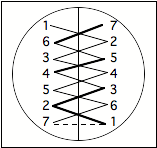
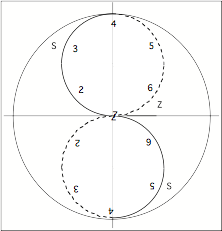
"Clearly, in your mind, you are nearing Armageddon," Rose says. "The 'Z', the end. America being rejected by allies; and, in your mind, surrounded by enemies. Enemies within; enemies without. Your own killer having appeared to threaten you -- the Dark Giant. The bibilical Apocalypse appearing to fall into place. Nostradamus's predictions of the end of the world, the millenium. You write: 'Saturn has broken the waves with his age. NOSTRADAMUS'S FINGERNAILS. Two birds preside over one stone...' 'Saturn breaking the waves' reminds me of the earlier poem where the 'Tides shed embellished opinion' -- which, we seemed to agree, was a reference the the New Age Movement. The female religion. And the Nostradamus reference makes me think of a ritual of divination -- in this instance, using Nostradamus's fingernail clippings in a bowl to foretell the future.... Anyway, you are at your own apocalypse, this seems clear..."
"Yes."
"You are, perhaps, in your own life, 'unsurpassed in distress'," Rose says.
"The Earth also is much distressed," Crossmann says.
"Yes. It would be hard to argue against that," Charlie agrees. "I'm not sure I am agreeing that we are at the end of the world -- but there are many men who would argue that. Many religious thinkers who do argue that... And your many references to a struggle between communism and the church, and persecution of religion by the church, also builds a picture of the struggle between the forces of Atheism and Faith. You write here: '..."
"Yes."
"Although you are not a religious person in the traditional sense," Rose says. "You don't go to church regularly. You go to church, as I understand it, only at off-hours, when no one else is there..."
"Yes," Crossmann says. "I am a catholic in my personal history and in the largest sense, of universal. But I no longer participate in the Catholic Church..."
"We are approaching what I see to be a turning point in the novel," Rose says. "The point where you really begin to identify with the role of Michael the Archange. And this comes from a passage in the Book of Daniel in the Bible. This, it seems to me, is the point at which it really begins to become clear to you that you are, in fact, Michael the Archangel -- that is, that you really believe that you are Michael the Archangel...."
Crossmann says nothing.
"Michael, of course, has a special relationship with the Jews," Rose says. "He watches over the Jews. He is the special representative of Jehovah, the National God of the Chosen People... You write..."
Charlie reads:
Michael defends the Jews, in the End, and takes them in, telling them they are chosen. AND THAT IS WHY SOME JEWS LOOK FOR THEIR MESSIAH TO BE NAMED MICHAEL....The Three Elements, Spirit-Soul-Matter, all draw together, annihilating each other. TRADING BODIES, YOU MEAN? If you wish to look at it that way. YOU ORDER CHAOS IN HEAVEN; YOU ORDER CHAOS ON THE EARTH. The principle of Law. PROTECTING THE WOMAN, WHO IS PREGNANT, FROM THE DESTROYER. Where does this get you? IT GETS ME TO SINAI. I don't understand. TELL ME OF YOU AND DAPHNA. I showed to Daphna the things I had seen, not knowing if it were seduction of truth. I know not myself, for, being all things, I am unable to cognize myself. I am irrational first, energetic, emotional; clairty only comes later. ARE YOU CERTAIN OF THAT? I long for God to squeeze me into his breast. AND WHAT DO YOU FEAR? I fear all things. I fear my own ignorance. I fear my own charm. I fear the sorrow of children. I fear the breath of the wind. WHAT DID YOU TELL DAPHNA? I told her of the coming civil war in Israel. East against West. North against South. War against Peace. I told her I loved her, as wished for her, the Daughter of Israel, to be my bride when the Night came. The marriage of Heavenly Spouse and Bride. I told her it was my duty to protect her, and the Jews. I told her I had chosen her as my woman whom I would save in my Ark. I told her of principles 7 and 6, the Eternal Duad; and how the rest would be severed. The 5 was periodical, manifesting to create. The 5 was absorbed in the 6. All the lower worlds disintegrate by thee. I would save this Daughter of Israel to be the Mother of my next race. I told her to watch for chaos; and for anti-semitism coming to Europe; to see the Head of Europe fleeing to America. I wish to put her on my Ark; and to save her for all time. AND TO MARRY HER THEN? When the Day is done, then I shall wed her. AND WHAT IS YOUR LAST ACT? My last act is to save the one I have chosen; I condemn the angry world; and I set it on Fire. HOLY WEEK HAS BEGUN. Daphna and Tamar, the Palm Tree, did sit beside me to laugh and to wait for their ride. TO THEIR PASSOVER FEAST. Palm Saturday beside Palm Sunday. WHAT DID DANIEL NEWMAN SAY? He stood on a corner and spoke in a dream. BEING THE DREAM; OR MERELY DREAMING?
At that time there shall arise
Michael, the great prince,
Guardian of your people;
It shall be a time unsurpassed in distress
Since nations began until that time.
At that time your people shall escape,
Everyone who is found written in the book.
Many of those who sleep
In the dust of the earth shall awake;
Some shall live for ever,
Others shall be an everlasting horror and disgrace.
But the wise shall sine brightly,
Like the splendor of the firmament;
And those who lead the many to justice
Shall be like the stars for ever.
":Ok. Let's take a break," Charlies Rose says.
"Ok, we're back with Michael Crossmann," Charlie says. "What a long hard climb it's been," Charlie says, quoting the Grateful Dead. "I can't believe we have traversed most of this book. So, it is becoming increasingly clear that there is some powerful relationship with Michael the Archangel and yourself -- that you are coming to fuse the two identities in some manner. In terms of the form of the novel, we are still locked in what we have described as the Night passage, during which two voices are present, the two principles inside yourself, the twins, one voice in lower case, the other in higher case. It's getting a bit tedious, I don't mind saying. I find myself sitting here longing for the light, longing for the breaking out of form again. We have talked about this interchange of periods of Day and Night being represented in your novel by the differentiation of the primary two voices into the myriad of forms and voices, the kind of dramatic structure you embody. I find myself wishing for the Conductor to appear again and carry us forward into the Daylight of motion. We are churning in this dense, double-voiced mass...."
"It's getting on your nerves?" Crossmann asks.
"Yes, in all honesty."
"Me too," Crossmann says.
"And this sort of whining declaration of love," Rose says. "For an idea. Daphna seems to be an idea the Clerk is clutching too like a life raft. If she is a woman, he does not see her as such. He seems to see her only as an idea... You declare a 'covenant' between America and Israel -- and this, although you don't mention it at this point -- confers on you the role of Jehovah, the role of God. So, you have become God. 'He who is like God.' You drop a line about Andropov being sick in Russia, and wonder if it might be because he refuses to let the Jews emigrate from Russia. This, subtely, confers upon you, in some strange way, also the clothes of Moses in Egypt. You mention that a man in Russia, a Pentecostal Christian, is sentenced to seven years hard labor for practicing his religion -- a way of keeping the flame alive, the crusade of religion against communism. Then you say to Daphna: 'What if you and I were the only two people in the world? We could begin the world over, with ourselves as the beginning....' So, here your are Adam and she is Eve. But that won't be the last transformation. You will be the Holy Spirit; and she will become Mary, the bearer of the messiah. Who you predict will give birth to a son, a mystical son. She gives birth to a daughter, however..."
"Yes."
"You also predict that Jesse Jackson will be assassinated," Rose says.
"Literally, or figuratively," Crossmann says. "His character assassinated..."
"But that didn't happen."
"No. My record as a prophet is less than golden," Crossmann says.
"And then there is this very troubling passage," Rose says, "which comes before the revelation of Michael: 'My last act is to save the one I have chosen; I condemn the angry world; and I set it on Fire....' That is, in fact, horrifying. If this whole work were not such a dream -- I would be bristling at this. But I know that, as much as anything, you are, in this novel, projecting voices. Projecting seasons of the mind. Clearly this season of mind is considering a diabolical act of self-preservation -- that is, of saving oneself, at the cost of everyone else. I can't help but think that this mind would feel justified -- indeed, this religious vision is, itself, apparent justification -- in using nuclear weapons against the entire world. Isn't that what is meant by 'turning out the light'...?"
"That's clearly one interpretation."
"Is there another interpretation?" Rose asks. "I'm not accusing you of anything really. I want to know what this means...?"
"This is the mind of a soul that is totally alone," Crossmann says. "And surrounded by adversaries. This is a nightmare mind...."
"All against all; and God against everyone," Rose says. "The mind of Cain...? Looking at it from this angle, it is all very diabolical...."
"Every national god puts his own people first," Crossmann says. "If you look at World War II, you'll find that the Germans were the chosen people, the Japanese were the chosen people, the Italians were the chosen people, Neo-Romans; and the Americans and the English and everyone but the Russians had God on their side. The world war is not only a conflcit between men -- it is, even more, a conflict between the gods. Which god is thre strongest? The One God is the strongest. The God containing all the other gods..."
"Monotheism?" Rose asks.
"Yes. The One God."
"But the prophecy from the Book of Daniel," Rose says. "I found it quite nice, as a matter of fact, that you had Daniel Newman read the prophecy, a new Daniel, if you will. A Daniel in your private pantheon of ideas. Anyway, the prophecy is quite clear:
Many of those who sleep
In the dust of the earth shall awake;
Some shall live for ever,
Others shall be an everlasting horror and disgrace.
But the wise shall sine brightly,
Like the splendor of the firmament;
And those who lead the many to justice
Shall be like the stars for ever.
Surely, you don't want to be among those considered an everlasting horror and disgrace. But this path of putting yourself above all others -- does it not guarantee that? The wise will shine for ever, like the stars. But the selfish, the monstrous, will be disgraced..."
"Well, clearly I do not set the world on fire with nuclear weapons," Crossmann says. "As you can tell if you continue to the end of the novel..."
"I am reminded of the disgrace that Robert Oppenheimer felt for his part in the creation of nuclear warheads," Rose says. "He could not live with his guilt...."
"But Truman could, on the other hand," Crossmann says. "It says something about the nature of morality. And about self-judgement..."
"What does it say?" Rose asks.
"Oppenhimer ate from the Tree of Knowledge of Good and Evil," Crossmann says. "He wanted to be an angel. Obviously, it he wasn't an angel, he was a devil. He could not live with that... Truman was a man, not an angel. Man, by definition, is complexity and contradiction, all wound together. He does not need to be an angel alone. Life is the fruit he eats of. Life demands that he sometimes be selfish; but, also, that he can also sometimes be generous, sometimes unselfish..."
"As an animal, he can justify killing other men so that he, himself, might live?" Rose asks.
"Yes. The animal kills without judgement, to live," Crossmann says. "Nature kills without judgement, to live...."
"But don't you see that this is a justification for murder?" Rose says.
"The only other path is the path of the messiah, the path of the tree of crucifixion," Crossmann says. "The martyr says 'no' to life; says 'yes' to death. Says 'yes' to victimization. There is a time for that, too, perhaps. But there is also a time for Life..."
"You are referring to the demon you met, who threatened your life," Rose says.
"I could let him kill me," Crossmann says. "Or I could kill him first. I chose to kill him..."
"So, you are Cain?" Rose asks.
"Did Abel threaten to kill Cain?" Crossmann asks. "Adam, the first man, Adam the Red, is red because of the clay, and also because of blood he spills, both in conception and also in war. Mars. Striking down the Darkness. Mars is red. Mars is also blood. Man is the fallen angel; but Man falls for a reason. He falls to carry on the evolution of the Earth. To aid in the development, in Time, of consciousness, of Earth. Man is a cell in the body of the Earth. But the Earth exists for the development of consciousness. But this consciousness on Earth is governed by the growth of both Day and Night, both Nationalism and Internationalism...."
"I am not arguing with your concepts," Rose says. "But with the horrible vision you accept so calmly. You observe that all four teams in the NCAA Final Four basketball tournament are from the American South -- and all teams have all black starting lineups. Now, what is that...?"
"That's an indicator of Deep Night in American time," Crossmann says. "Midnight."
"The white race is small," Rose says. "So race is an issue...?"
"In the yin-yang symbol, during the Night, the light is very small," Crossmann says. "This passage comes right after than observation..."
Crossmann reads from the novel:
FREEZE AND DARKEST NIGHT ARE ONE. THE POWER OF BLACKNESS, AT ITS PITCH, REFLECTS CHRISTMAS. Joe Christmas. SOMETHING LIKE THAT. Kabbala is as Kabbala does. WAITING FOR THE MESSENGER I AM. I see. WHAT DO YOU SEE? The Messenger I am....
"You seem to have no moral compunction," Rose says. "I am not criticizing you for that. The whole first half of the book is almost nothing but moral compunction. But this part of the book..."
"This part is the Tree of Life," Crossmann says. "The earlier part was the Tree of Knowledge of Good and Evil. Self-consciousness...."
"Awareness of your sins," Rose says.
"Yes. That is, man passing through the Land of the Dead, the Anti-Universe."
"So, the Anti-Universe is the Land of the Dead?" Rose asks.
"Yes."
"That is where the judges live? In the underworld?" Rose asks.
"Yes."
"Those who have no bodies?"
"The Anti-Universe hates the body," Crossmann says. "It hates material life. It hates the Earth."
"But the creative gods love the Earth, love Man, and choose to create Man on Earth," Rose says. "That is their connection with the Jew. For the Jew is the Earth. Daphna is, to you, the Earth. She is the womb through whom you are seeking to be born again, born back into Life, back into the Light of Day...?"
"Very good."
"Nothing is clear here. Moral clarity is lacking."
"'Black is Beautiful' is an emblem of Night," Crossmann says. "The civil rights movement, the feminist movement, 'Black Power'. Capricorn. The Darkness is strongest. But where you have 'Black Power' at one pole, you will have 'White Power' at another pole. Cancer. These extremes reflect one another. But, as long as neither wins, we will continue to live as a society. If either of these extremes wins power, then we will be destroyed..."
"So, in your mind, 'Black Power' is as negative as 'White Power'?" Rose asks. "Despite the injustices of the past...?"
"Yes."
"You understand the rage which Black America feels toward White America?" Rose asks.
"Yes. But rage begets rage. And in religious ideology, Day will always rise above Night," Crossmann says. "The Day gods will always return to power. And they will carry with them a rage of their own..."
"And so what is between these two poles?" Rose asks. "The equator...?"
"The individual," Crossmann says. "The one who stands without ideology. Or with the ideology of the balance. Man, the First Man. Androgynous Man.... I don't idealize the white race or demonize the black race. Likewise, I don't idealize the black race and demonize the white race. Although I did exactly the latter through much of the first part of the book. For that is what the anti-Universe does: it demonizes white. The universe tends to demonize the black race. If I judge each soul on the basis of its own merits, then I will be just. There is decency and corruption in each race. There are murderers in each race. I have no leniency for white murderers. They should be executed. So should black murderers be executed. Asian and Mexican murderers also should be executed. We should cultivate decency in all races; and punish miscreants of all races...."
"You speak of Day as being Life," Rose says, "then Night must, logically, in terms of your system, be Death. So in your mind, the Dark Races, and the Woman, presides over death...?"
"Yes."
"In what sense, Death?" Rose asks.
"Crime goes up, drug-addiction, social instability, divorce," Crossmann says. "Whenever the darkness is in power, social chaos rules. The Law becomes the enemy. Rebellion against the Law becomes the morality. The Law is seen as abusive and corrupt. The Anti-Hero takes over, with the goal being disruption of the society, revolution...."
"It is the Romantic impulse," Rose says.
"The duality we recognize in western history is Classicism and Romanticism," Crossmann says. "Classicism is Day; Romanticism is Night..."
"So, the Dark Giant does win?" Rose says.
"The Dark Giant, Set, castrates the Day Giant, Osiris," Crossmann says. "But Isis, the Female Principle, regrets her involvement in the murder of her brother-husband. So her mysticism, her mystical knowledge, the Female Religion, helps to resurrect him. He takes his place in the underworld, in the womb, and is instructed by the Darkness. And the Darkness teaches him, essentially, how to grow his penis back, how to regain his power..."
"And then he returns with vengeance toward the Darkness?" Rose asks.
"Yes. He drives the clouds, the Night away."
"Even though the Night saved him?" Rose asks.
"It destroyed him, first; and then it saved him. It destroyed him as intellect: negative thought. And it saved him, resurrected him, as mythology or religion: positive thought...."
"The world, when compared to perfection, is condemned," Rose says. "But, when compared to chaos, it is elevated..."
"And this elevation is, very literally, a raising of a continent out of chaos, out of the ocean, where the monsters live..."
"There is a racism in this doctrine," Rose says.
"There is a context in which racism is explained, on both sides," Crossmann says. "There is both black racism and white racism. Neither of which is acceptable. Black crimes against whites are also hate crimes and must be treated as such, rather than as some form of justifiable revolution against oppressors...."
"Do the oppressed ever have a right to rise up against oppressors?" Rose asks.
"Certainly. When the Sun is in the anti-Universe, the Dark Element has the right to rise," Crossmann says. "But when the Sun is in the Universe, then they do not. The Sun makes everything right..."
"Yourself? Is that what your are saying...?" Rose asks. "Whatever side you are on is the right side...?"
"Not myself, personally," Crossmann says. "I am nothing. But God. God is on the right side. Jesus is on the right side..."
"When the Sun is in the anti-Universe he is Jesus," Rose says. "And when the Sun is in the Universe, he is Michael the Archangel. Is that what your are saying...?"
"That is pretty much what I am saying," Crossmann says. "Michael/Jesus, as Mercury, is the Messenger of the Sun..."
"In the text you just quoted," Rose says. "Your description of Capricorn or Christmas has a very strong irony, when you add the name of Joe Christmas as an allusion. For Joe Christmas is a black man in one of Faulkner's novels, a black man who is castrated..."
"Well, he appears for a reason," Crossmann says.
"Other than irony?" Rose asks.
"Clearly, Joe Christmas is a sympathetic figure," Crossmann says. "I certainly don't identify with Southern thugs who mutiliate a man because of his race. I am not sympathetic with the KKK...."
"But it is possible that the KKK might misuse your doctrine," Rose says. "And read into this the justification for the white race to, again, persecute the black race...?"
"The extremes are kept out of power by an adherence to the laws of democracry," Crossmann says. "Thre is hate on both sides. Hate is always evil; and it always leads to evil..."
"But aren't you, through this preparation for war, counseling hatred?" Rose asks.
"War is not necessarily linked with hatred," Crossmann says. "A man attacks you on the street. You defend yourself. That is justice; not hatred..."
"The black man defends himself against the white man who attacks him on the street..."
"That is justice," Crossmann says. "But if the black man attacks a white man on the street because his grandfather was attacked by some other white man years before, that is not justice; that is hate..."
"That two-edged sword of Metatron and Michael," Rose says. "I believe you said that Metatron was, in fact, Michael's weapon, Michael's sword -- which no other Jewish mystic has ever said before, as far as I can tell -- makes you able to argue either side. Enables you to defeat both sides. This guarantees that you will stand alone. Like the Jewish god, who stands alone. Like Israel, who stands alone. Like Michael, who also stands alone, like his God, Jehovah. And when we argue, when we discuss ideas, you are also able to use your sword with a certain gift.... And what about anger? Is anger a relative of hatred...?"
"A relative -- but not the same as...." Crossmann says.
"For Jehovah is an angry God," Rose says, "according to the Bible...."
"But he is also just," Crossmann says.
"So in the sense that you having America also be Israel," Rose says. "You are saying that America will stand alone. Will follow its own judgment. Will set itself off from the rest of the world. Will continue to be the New World, as opposed to the Old World. Will have a special destiny. Will continue to be the Hero. The Man who can save the world..."
"That's pretty accurate."
"You are, essentially, choosing the Male God over the Female God?" Rose says. "The Patriarchy...?"
"Everything in its time," Crossmann says.
"What do you make of the Jewish dearth of visual imagery?" Rose asks. "There is an injunction against representing their God through visual imagery...."
"His name is not even to be spoken," Crossmann says.
"But they had a hostility to visual imagery," Rose says.
"Their injunciton is against false images," Crossmann says.
"Isn't this because the patriarchy and words, letters, are connected? The alphabet and the birth of Man are somehow connected -- the birth of the Day God. And visual imagery is more associated with what...the anti-universe...? Your own painting and drawing began, did it not, in the anti-universe. When you enetered the darkness...?"
"Not really," Crossmann says. "I began to draw and to paint after my novel showed to me the power of visual symbology (geometry). I had my visual eye opened. I have been drawing and painting ever since. My time of re-birth, of support of the patriarchy, has been a very fruitful time for me in terms of visual arts..."
"Hence, your show at MOMA," Rose says. "Which we haven't gotten in to at all. And may not, judging from the time... Your graphics clearly -- it is clear in my mind at least -- enrich this novel in a supreme way. The graphics are really splendid in this novel. Mystical and filled with power. I might also note that this description you have read earlier, the passge with the mention of 'Joe Christmas' -- above that description, in the novel, is the inscription, in the top margin, 'PASSOVER'. So death is passing over at this moment. It is late March when you are writing this... I would like to go through this passage, this late passage through the mass of thought, the Night, as quickly as we can. Perhaps I will read some quotes as we go, with an eye toward making more rapid progress toward the conclusion of the novel..."
"That seems fine."
"Of course, we can comment as we go... I find it strange -- many of your critics consider you potentiallly a fascist in sheep's clothing -- many African-American leaders speak of this -- but, in this novel, you speak of your admiration for Abraham Lincoln, whom you call the greatest man America has produced. And you also speak of Martin Luther King as being the greatest man of the Twentieth Century. Now, is that the Universal you speaking or the anti-Universal you...?"
"That is me. I say the same today."
"Lincoln was great because....?"
"He saved the union," Crossmann says. "He was Justice and Mercry and Will for Right personified. And he was a personification of Humn Depth. Endurance...."
"And Martin Luther King...?" Rose asks.
"He gave the black, the poor, and the weak a model of heroism in the face of tyranny. Through peace he overcame injustice. He became the road toward justice. Nothing is ever perfect on earth. But he became a road to a better world for millions of souls..."
"He was not perfect as a man," Rose says.
"No man is perfect. Man, by definition, is imperfect. Only the angels are perfect..."
Rose says: "So, I'm just going to go through this quickly, reading excerpts, so we can finish this novel tonight." He reads:
Seeing an American fortress in a sea of absoluteism. Europe in a red coffin. The Wall as a testament to obedience. The obedience of the Lost Supper: the Last Slipper on the pyre. Inversion of the despotic mirror. Elightened murder made by Soviets. Who bargained, here, for the wine and the bread? ITALIAN SOLON? COMMUNISM BY PROXY? Who put the ram in the ram-a-ram-a-ding-dang? NO ONE CAN KNOW SUCH A THING. TOO MUCH TROUBLE AND TOO MUCH GNAWING. THE DARKEST NOON HAVING FLOWN -- WHAT IS LEFT BUT THE DARKEST DAWN....? Questions you ask of no one. THE LAST THING IS FEAR. I have chosen Israel to be my Divine Partner. America and Israel. To be the Divine Couple....
And Peter said: WHO SHALL BE THE ANTI-CHRIST. I said: NOSTRADAMUS SPOKE OF THREE: NAPOLEON, HITLER, AND THE THIRD BEING ASIAN COMMUNISM. And I saw China will millions of men -- and no women. Millions of men, bred by austerity, spoiled by their parents: one-child families. Girl-children are being killed in China now, so that the family-name can continue, amid government restriction of family-size. Millions of boy-children -- and army of millions of boy-children. Where will they go to find their wives....? AND I SAW THE DRAGON ROAR. AND SWEEP ACROSS ASIA. AND SWEEP INTO EUROPE....
The Great Day is nearly over. And when the end-time comes, you will snatch your bride out of the world, and take her to yourself: co-habit, in dreamless sleep. The last to leave the room turns out the light. In the Night, before your sleep, you will plant a seed. From this womb, the Earth, your wife: a new creation...
Damnation brings penance to the cool and the clean.
All mandibles and airy dictates raise
The worry of the coming slow.
Tinctures of hurried women course
The courtyard seeking grain.
Someone buries treasures, so that
Archaeologists shan't be poor.
Light rises to find the roof.
The Unborn Lord speaks of sealings
From the womb.
Two are chosen; one is ready.
And then water fills the brain
Turning the sand
Into wild parades.
WATER POURS FROM THE SKY IN A FLOOD. One day from death. JESUS ON HIS URN. Jehoshuah killed for making secret knowledge public. LEVIS AND NAILS. Dictates and horns. YOU PREPARE FOR YOUR OWN COMING. You propehcy your own coming. MICHAEL SHALL BE MESSIAH: MICHAEL FROM MOUNTAINS SHALL BE BORN IN AMERICA. FROM BOTH DESERT AND MOUNTAIN: FROM EDEN, THE GARDEN OF HIS STUDIES. HE WILL PULL THE WOMAN OF ISRAEL INTO HIS HOME. THE WATERS SHALL BE SEPARATED. HE SHALL STRIKE THE WORLD WITH HIS SWORD AND HAND. HE SHALL DRAW ALL THE WORLD TOWARD HIM. HIS ONE NATION SHALL BE ALL NATIONS. Get thee behind me, Satan. I shall chain you in your arid shore. Never shall you rise, until ages again raise noise. PEACE IS ESSENTIALLY THE NIGHT WHICH YOU BRING. I am the hole in the sky. If you seek me, you will find me. THE SEVENTH RAY IS BOTH SPIRIT AND MATTER...
BEWARE THE FALL OF IRAQ, THE MAN SAID. SAUDI ARABIA. CHINA. Tobeornottobe? To live or not to live? These are the questions. HAVE YOU DIED THEN? Something happened: and a light came. Woman in red tops and blue bottoms. A beautiful black woman, looking like Cleopatra. The dark woman on the dune. Unconscious love; and the loveliness of grapes. Mad butchery in Iran. What is the world in its rain? Cats fighting over second helpings. Trouble in the dangerous reef of affairs. Looking out into a dim passing landscape. One las hurrah before the fighting begins. Vietnamese shells lobbed into villages. The world seems a negative of the photograph it was. English women demonstrate against American nuclear shells. Iraq Iraq. The bloody sword of Islam. The mission of Michael, the Prince. Closing the door on evolution -- so the starting point represents a higher turn on the gyre. Shadows of Night -- thrust outtttt of your vision. A toppled bore. Seventy miscalculations. Trumpets without words. A saint believing in sackcloth. Poverty believing in deliverance. Messiah is and messiah doing. The flaming sword and Metatron's dominion. Who shall defeat me? Who has my anger; and who has my incentive? The bass note, the black note, corresponds to the pelvis. Dancing near the ground, near the Earth, where the loins grow. The more cerebral you become, the more the phallus tends to shrink. Osiris's lost piece. Reproduction, an art of losing. Waiting for the triple threat. A woman's heart and the noise of desire...
I saw the world turn against Israel. I saw anti-semitism flourish. I saw Israel surrounded: the maiden against the dragon. I saw that I must act to save the woman in distress. The Evil Dragon against the Jew. Satan against Mary. It was my task to save the woman, to pluck her from the mob and bring her home to be my wife. I will marry her; and our children will be the new race. I saw the beautiful and the horrible; I saw fire and a broken prison. I saw an old world discarded, with the words: THE OLD WORLD HAS LIVED A LIFE. I CONDEMN IT TO FALL. THAT WHICH IS RICH FROM THE OLD WORLD I WILL PRESERVE. THAT WHICH NEEDS TO DIE MUST DIE AND BE GONE. I saw the Earth become Spring again. A Golden Age returned. Man and Woman were together. The Earth had grown a new skin. Continents had shifted and transformed themselves. White and red and yellow and black were here. I saw mysefl escort the chosen onto my ship, the other water on the firmament; then I saw the lower water burned away. I saw a new religion: the marriage of Gentile and Jew. The seed of Michael, the watcher. A religion which was not anti-life. A religion based on understanding. On the vision of truth. A religion of choice, where those who wish to break the customs of truth are allowed to seek their meaning. Freedom shall be our cornerstone. Each shall be his or her own church. Each shall be a priest or priestess. The Race of Children shall be great... YOU ARE CREATING YOUR OWN MYTH. YOU PREDICT THE COMING OF MICHAEL, THE SAVIOR OF THE WORLD. WILL YOU BE TRAPPED BY YOUR OWN CREATION...?
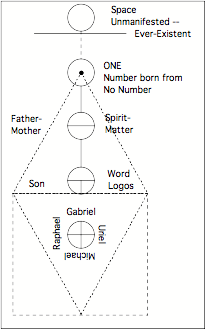
HAMMERING OUR A NEW PLACE. Vulcan at his forge. FORGING A NEW CREATION. I must defend the Jews. We are nothing without our women. YES. Michael is Autumn, who is Librar, who is America. THE MESSENGER OF JOVE. Bringing counsel to women. THE MESSIAH COMES TO KILL BOTH SIDES. TO PUT DUALITY TO SLEEP AGAIN. He kills the Communist and he kills the Fascist. He kills Anti-Religion and he also kills Religion....
Flowers fill the hinted air
With strains of movement
And echoes of scent.
The whole land quakes in new arrival.
A new skin is etched
On the forehead of leaves.
Waters turn the tide to seasons.
Bugled buds, in turqoise, rise.
Who speaks words now,
Fraught with destruction?
The candle-maker shuts his door.
He is no longer needed
Now that Night has been
Defeated.
Children light the world with joy.
Smile, you circus child, with ease!
Smile for ever, in your arena!
None can take the greatness from you,
Which you have seen,
And which you now perform!
Solitary walkers turn from gray into velvet.
Someone calls the name of Life.
Many men carry a picnic to their love.
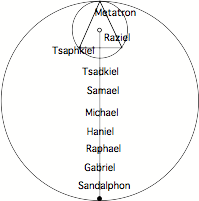
MY FATHER IS JACOB; MY MOTHER IS MARY. You are the Son who fuses Christians and Jews. YES. Religion as a science of understanding. THOSE WHO LIVE BY THE GUT WILL BE TORN. Religion as a personal quest for Truth. THERE IS NO CHURCH HERE, IN MY HOUSE. Each body is the temple, the church. There is no coercion. EACH BEING IS FREE TO CHOOSE HIS WAY. EACH BEING STANDS BEFORE GOD AS HIS OWN JUDGE. CHURCH AND STATE ARE SEPARATE EQUALS. THE CHURCH AM I; THE STATE IS OURSELVES....
"Do you want to add anything at this point?" Charlie asks.
"No, I think this shows pretty clearly the direction we are going," Crossmann says.
"I would like to read more," Charlie says. "There is much here that is interesting. There is a running dialogue with James Joyce, in a sense. HCEarwicker appears quite often. Harlan C. Ellison. Of course, Earwicker is Joyce's Everyman in Finnegan's Wake: Here Comes Everyone. There is the continuing spectre of nuclear holocaust. And we must remember that this period of history was fraught with a sense of imminent catastrophe. Reagan had introduced the Star Wars missile defense concept, whereby America would develop an anti-missile defense system. The perception of America and President Reagan was that they were too hawkish in this opposition to communism. European sentiments had, in some countries, actually swung toward a desire for better relations with Russia. 'Red better than Dead' was a phrase that began to be heard quite often. America had been ostracized among European intellectuals for the war in Vietnam, racism, many other issues. Now another Vietnam seemed to be breaking out in Central America. The Left, the Darkness, was very strong at this point. Fear of America was very strong at this point. But Russia was bogging down in Afghanistan, its own Vietnam. And Russia was losing control of Eastern Europe, especially Poland, where the labor movement, headed by Lech Walesa, was beginning to demand more freedom and involvement in the country's political processes. Momentum was clearly against America in the public relations area..."
"America had been portrayed as the evil force in the world for the past fifteen years, at least by leftist intellectuals," Crossmann says. "By myself at one point. I had a thorough knowledge of this anti-American literature. For I was right in the midst of it for much of my formative life..."
"America was becoming more and more isolated politically," Rose says.
"We had England as a real ally," Crossmann says. "France almost always does the opposite of what Germany does. Germany was getting soft toward the Russians, fearful that a nuclear war in Europe would be found in Germany."
"You can't blame them, I guess," Rose says.
"No. They were caught in the middle," Crossmann says. "But then something happened."
"And we are reading, now, what happened," Rose says. "This is a document of what happened. It's the hidden history of what happened...."
"The Sun was re-born," Crossmann says.
"So, in your mind, Asian Communism, the third anti-Christ, is, in fact, being defeated by the spirit of Michael the Archangel," Rose says. "And Gilbert, in your personal sphere, is an emblem of the Anti-Christ, an emblem of this dark force, this feminine force, Communism...?"
"Yes."
"You were a communist once," Rose says.
"Yes, in college. I thought I was a communist. If America wasn't perfect, then Russia must be. The idealism of youth looks at everything in absolute terms. So I know of what I speak.... The middle principle sometimes allies itself with Life, Physical Life -- and sometimes it allies itself with Physical Death, Intellectual Life. Both sides are tyrants without this balance. The middle principle joined the right side when Michael's spirit came to Earth. And the left side lost its power...."
"Israel -- the mythical Israel -- is the balancing power between the two extremes," Rose says. "It creates both sides. First the right, and then the left.... That's what it sounds like you are saying..."
"That is what I am saying," Crossmann agrees.
"You talk about androgyneity," Rose says. "Androgyneity stands between Male and Female, being both -- and creating both the male and the female...."
"And being the adversary of both," Crossmann says. "To the light, he appears as darkness. And to the dark, he appears as light..."
"Showing always, the other side, to make the perception whole," Rose says.
"Yes. Seeming to each side to be on the opposite side; belonging to no side. So, inevitably, standing alone....""
Rose begins to read again.
BLACK AGAINST WHITE IN THE TOWN OF CHICAGO. Earthquake in Peru. FLOOD IN THE ALGONQUIN. Precious humor, where none is found. VULCAN RE-SEEDS THE CONTINENTS. PUTTING SOME TO SLEEP. GIVING OTHERS A NEW SKIN. I am the new religion. I contain, within myself, all the old religions. I am young and I am old. I have come to re-new the corrupt patriarchies; and to overturn the religions which substitute Death for Life. I am Spring. I am the synthesis of all your selves. I do not comdemn you so much as I complete you. Yet I am the New-Born. And he who would resist me shall reap the whirlwind. He who would say no to a new life, to a new Spring, must fall into a whorling valley. I cam eonce as a lamb and now I come as a shepherd. I lead into the next world. You who fight me find no Ark to inhabit. My love for you is as deep as my anger. I aam not one man alone, one fact to see, one soft holy vestment. I am angry too. I am beligerant. I am undone. I am impatient. Perfection you speak of. Anger, too, is perfection. I am the one you never see. I am the one who waits, and, in waiting, becomes raw. Defy me; and there shall be hardship. Claim superiority; and there shall be blood and rue. Take my hand, and make yourself a child. Thhe Earth is my garment. With two faces I rule. FROM WITHIN THE SHADOWS OF AN UNDERGROUND PARKING LOT, GILBERT, THE SPIDER, CAME OUT ON HIS BIKE. HE CRIED: If you take anything from my file, I'll kick your ass, white boy! WE'LL SEE! you replied. WE'LL SEE? WE'LL SEE? he creied, turning back on his bike, riding toward me. LISTEN, SKINNY BOY. YOU WHITES ARE FINISHED! I'M GOING TO KICK YOUR ASS! I'M COMING AFTER YOU! ONE THING YOU CAN BE SURE OF: I'M COMING AFTER YOU...! He pedalled away on his bike. WHY DIDN'T HE FIGHT YOU THEN, RATHER THAN FLEE? Because he was afraid? YES. HE IS CHAOS; AND HE MUST BE SLAIN. Yes. IF YOU ARE MICHAEL, HE IS THE DRAGON. He is Chaos; and I am the Law. WHICH LAW? The Word. The spoken vow. I will not show fear, for fear is the mind-killer. I HAD HEARD THAT BEFORE. European statesmen admit being appalled at young Europeans' lack of understanding of America. Anti-Americanism is rife. Young and old prepare to battle. IF YOU CASTRATE YOURSELF, YOU WILL BE INVADED. Metatron, I invoke your aid. I am Michael. You and I are brothers. YOU WILL PROTECT THE WOMEN? I invoke my Divine Prototype, Michael, the Archangel, who sword wins for virtue....
"There we have it," Charlie says. "The invocation of the angels."
"This is the war," Crossmann says.
"Why didn't he attack you at that point?" Rose asks.
"He is a passive demon," Crossmann says. "His voice is active. The demon inside him is angry, aggressive. But he is passive himself. He is also afraid. His fear makes him defensive. And this makes him dangerous..."
"You did not know, at this time, that he would not attack you?"
"No, I was assuming he would attack me some time. He said he was going to attack me."
"The appearance in this novel, over and over again, of Vulcan," Rose says, "makes me wonder what your relationship is to Vulcan...?"
"Vulcan is, in fact, the god who sets the world on fire, through the power of volcanoes," Crossmann says.
"Does Neptune, then, destroy the world through Water?" Rose asks.
"That seems logical," Crossmann says.
"So, your 'setting the world on fire', this may come, not from the Michael personality, but from the Vulcan personality...?"
"Perhaps."
"Your voice in this passage is megalomania, on one hand," Rose says. "You speak: 'I am the New Religion. I contain, within myself, all the Old Religons...!' -- but this is a voice coming out of you, isn't it. You don't believe this about yourself, personally..."
"No, it is a voice coming out of myself," Crossmann says. "I am some kind of medium. Someone inside me is doing the speaking...."
"So we have this discussion, this invocation of Michael-Metatron," Rose says. "Then we are presented with a pretty detailed description of Fohat, which is the name of The Divine Son in the occult Hindu tracts, the occult tracts of Blavatsky...."
Rose reads:
In the unmanifested Universwe, Fohat, the Son, is an abstract philosophical idea, that potential creative power in virtue of whose action the Noumenon of all future Phenomena divides, only to reunite in a mystic supersenous act, and emit the creative ray.
In the manifested Universe, he is that occult, electric, vital power, which, under the Will of the Creative Logos, unites and brings together all forms, giving them the first impulse which becomes, in time, Law.
Fohat is the personified electric vital power, the transcendental binding Unity, of all Cosmic Eneergies, the action of which resembles that of a living Force created by Will, in those phenomena where the seemingly suubjective acts on the seemingly objective and propels it to action.
Fohat is not only the Living Symbol and Container of that Force, but an Entity. On the Earthly Plane, his influence is felt in the magnetic and active force generated by the strong desire of the magnetizer. On the Cosmic, it is present in the 'constructive power' which carries out, in the formation of things, from the planetary system down to the daisy, the plan in the Mind of Nature, or in the Thought Divine, with regard to the development and growth of that special thing.
He is, metaphysically, the objectivised thought of the gods: 'The Word Made Flesh', on a lower scale, and the 'Messenger' of Cosmic and Human Ideation.
In a secondary aspect, Fohat is Solar Energy, the electric vital fluid, and the preserving Fourth Principle, the Animal Soul of the World, Vishnu, or Electricity.
The Father-Mother is the Primordial Aether or Akasha (Astral Light, in its highest form). The Son, Fohat, 'hardens and scatters the seven brothers' -- that is, running along the Seven Principles of Akasha (the Universal Mind), acts upon Manifested Substance or the One Element, electrifies into Life and separates primordial stuff into atoms, themselves the source of Life and Consciousness.
By differentiating the One Element into various centers of Energy, Fohat sets in motion the Law of Cosmic Ideation -- the Evolution of the World in accordance with the Universal Mind -- and brings into existence all the various states of being in the manifested Solar System....
THAT TELLS ME SOMETHING ABOUT MYSELF? Your age, perhaps? YES, PERHAPS.... Fohat is the messenger of the Primordial Seven, who are the Archangels or the Dhyan Chohans....
"This passage, I find quite amazing," Rose says. "This is a very powerful passage. I'm not sure I understand much of it. But I get the sense that the force you are contacting, the force with which or with whom you seem to be communicating, is somehow connected to this Fohat. That you are connected to Fohat also. Especially judging from what happens to you after your finish this novel, the other works you write. You become the personaification of the Active Force. A Living Force created by Will. Which becomes, in time, Law... You speak of yourself as the Law. The force speaking through you calls himself the Law..."
"Yes. The Law," Crossmann says. "Fohat is cosmic electricity, circular motion, and the bridge between Spirit and Matter..."
"You wrote," Charlie says. "I'm not sure I'm getting this exactly right. But you speak of the Big Bang as an explosion hurling matter and anti-matter in opposite dimensions, away from one anther. This in the shape of a lemniscate: one inner, and one outer dimension. That was the real expansion of the universe. And it was not until these two expansions reached their apex and began to bend back toward one another -- only then, through the law of attraction, did the electricity inherent in matter/anti-matter bring about the processes of creation..."
"Did I say that?" Crossmann asks.
"I may not be getting it right," Rose says, laughing.
"Have we passed it already; or is it coming up?" Crossmann asks.
"Don't you remember?" Rose asks. "Really?"
"There is a lot in this book I don't remember," Crossmann admits. "It was another era for me."
"But you became a spokesman for the law, after this," Rose says. "That's why you became such a symbol in America, a symbol of what...vigilanteism? Law and order...? That was why you were put on trial, in fact. Isn't that correct...?"
"Yes," Crossmann says. "Because I spoke for law, I spoke for civilization, order..."
"And, of course, for your role in the trial, as judge at the trial..."
"Yes. But I was tried for conspiracy," Crossmann says. "For what I said prior to the trial..."
"Are you Fohat?" Rose asks.
"I clearly thought so," Crossmann says. "Why else would I place this description here?"
"You are a very mysterious person," Rose says. "Your unconsciousness makes you powerful. You seem beyond good and evil. But you seem quite gentle. Clearly, you are not an immoral man. You seem to stand between morality somehow. And that seems to be a kind of freedom for you..."
"Drinking from the River Lethe makes me free," Crossmann says.
"Losing your memory?" Rose asks.
"Freeing myself of the constrictions of reflection. Fear is a mind-killer. Guilt is also a mind-killer..."
"But guilt is built in to the system," Rose says. "At least it seems to be. The mind apologizing for the sins of the body..."
"Yes. Death apologizing for Life...."
"Then you begin to take off on your own generation -- the 'spoiled generation', you call it," Rose says.
He reads:
You see yourself become somewhat angry at those who wouldhave teh fruits of labor yet who refuse to work. YES. A spoiled generation. REFUSING TO WORK FOR THEIR MEAT. Beggary comes easy to the son of a rich man. Middle-class lethargy. Sons without strength talk of principles and of freedom. Yet freedom without strength is like crops without water. Freedom from the self. Is it not flight from one's own weakness? A SPOILED GENERATION. Is it Day yet? STORMS SWEEP ACROSS THE NATION. SNOW IN THE SOUTH; FLOODS IN THE LOWLANDS. WINTER STORMS HAVE EATEN AWAY MUCH OF THE SHORELINE. The face of Christ is seen on a door. Miracle in Rome's throughway. Expect more as the tide gorws. Miraculous fervor: a candle lights the eyebrows. The eyebrow CANNOT BE DESCRIBED. I see. BODY MEMORY. My anger must be expressed. NIEZVESTNY'S TREE OF LIFE. Rising on a cloud in Time. THOSE WHO CALL FROM THE DEPTHS FOR 'COMMUNITY' -- IT IS THEY WHO REJECT THEIR OWN COMMUNITY FOR SOME OTHER. Negative waves overrun the tides. It cannot be done. It can't be done. SPOILED ROTTEN CHILDREN...
"You are beginning to turn against your own generation, the I'dealist Generation', which you now call the 'Spoiled Generation'," Rose says. "You are coming back to the side of your father's generation. Atonement with the Father. That is what we are seeing here. We read about atonement. At-one-ment with the Father. That's what is happening here, isn't it...?"
"It's a more mature view of the world," Crossmann says. "Our view -- my generation's view -- had been: 'You must be perfect to have my allegiance. For I am perfect. Why aren't you perfect? If you are not perfect, then you must be evil.' But this is a shallow understanding of Life and Humanity. Youth believes that Life is perfect. Adolescence believes that life must be perfect. Adulthood believes that perfection is probably the nature of childhood and heaven. Maturity believes that life is complex -- perfection and imperfection tightly wound together. Nothing is clear...."
"Wisdom," Rose says. "Wisdom as opposed to Idealism."
"In the occult system, the Second and Sixth planes are related," Crossmann says. "The Second Plane, the Lower Plane, is governed by Abstract Idealism -- this is the Astral Waters. The Sixth Plane, the Akashic Plane, is governed by Wisdom...."
"The Sixth Plane is the plane of the Virgin Mary, the Virgin Sea, is it not?" Rose asks. "So the child born of the Virgin Sea, the Akasha, Wisdom, becomes the Christ child, the savior through wisdom...?"
"That is how I see it," Crossmann agrees.
"Let's keep moving," Rose says, "because we are running out of time."
He reads:
Taking heaven by violence and violence by heaven. Walking in the Lion's Den. Who will walk with me now? Who will speak the words I'm showing. Michael burns the face of Peace and warns the Jew that the warrior is his mask now. He who doesn't hear now, instead, must pretend. Basing secrets from their hidden site. Raising secrets to their heights and breaking waves which block the way. Kether breaks the seal. Opening the magi. Being led into the whirplool of light. The colors of indecision. Aeons of indescretion and coersion. Who goes there, where no one goes? No one is allowed in the are of the last light. Whispered details in my ear. The talk and soun of the words from the grave. The sea has multiple meanings and the angel within builds a shield which I walk in. Leading people through the deep: a guide: who leads as though blind. Will they follow me? Will they let me carry their flag into the next world? Children are absolutely sacred. Let no one touch a child in anger or perversion. He who marks me marks himself. Coming out of concealment. Given the Earth by the Lord....
Am I the Light of Life? The mixing of seeds is the sotrhouse of history. Hybridification. The Meltin gPot as the forge of Vulcan -- at which a New Man is forged from the fire. Neither Chinese nor American -- but both Chinese and American. Neither Mexican nor Gringo -- rather, both Mexican and Gringo. Towers fall but nothing moves me. All beings depend on me -- but no man truly can gauge my heat. Sleeping through the Darkness. The 7 and the 6 float calmly on the storm. Water washes the Day away. No penchant for airy endeavor or obtrusion. The belly quakes and the brutality lumbers. Glimpses only. Glimpses of light. Heavenly brigade: led by a virgin...
I see. Ritual uncomplication. Too much to say for the widening of ways. Inspecting the history of Korea. As I wait for the blues and the greens to call for glory. Unnamed sources and unmarked graves. The crystalline compartment. As I walk in this underground passage for Jehoshua. Rabbi Jehoshua! It seems like only moments since I stumbled upon your secret! Where is my son I brought to tell you? Where is the horse which I felled as he rode? Soemtimes visions of mine own horror. Wher am I leading this group in my wake? Why do they come here? Why follow me into clouds? I have been many places and I have seen many stories. Knowledge is a kind of magic potency I give you. One does not speak. Two speak of Love. Three speak of Power. Four speak of....the reliability of anger. Torn from the human smallness of vision. I long to rise to the greatness of mind of my fathers. Yes, their greatness of mind. If I would talk at all, then let it be with a great soul. People bring me their silly vocations. Is it any wonder I long to mount the sealing sky, to scale the jagged reach of air, to find that place which has no location? I am not made for unsublte breachings. If I am the whale, then you are my dinner. If I am the sea, then with me you must swim, or for ever hold you peace, while the water is abating. Growing violence where I walk. Men unaccustomed to failure. Thomas Aquinas and the mocking of birds. Uncultivated genius. A plan in winnowed soil grows hard. Measurement of Beethoven's skull. Pictures on a wall. Unencumbered graces. No respect for our deliverer. Of the 10 Emanations, the Messiah is the Ffith. I see. Spinning backwards amid our lords. Theology in my shoe. Theo-lology in my blanket. Kabbalitics horn; and the monuments of numbers. Neuteronomized on some shore. Nolocontendre. Orpheus and a drowned minion. Dominance and the grace of the query. Black and white and red and blue. And white. The orchestra cannot hear their words. All nonsense in a spatial eloquence. Nature opposed to Spriit. Violence against the mind. Anti-Man in a garment of pose. Anger at the coming in of noise. There are servents of blind obedience and...gay sterility of heart. All the world clings to the slipper made of glass. Where have we gone, sir...?
In the land of wholly heated past and dagger and cross and Christ and His Father. Metatron, the boy warrior. Health is not the gale I sens; helath is merely the rapture of love. Too old to love is too young to dream. Benjamin and Joseph Heimkreiter are seen. Benjamin writes poetry; Joseph sells cards. Who, truly, has the vision? Maybe all the registered mail, adn the images of war and of chivalric self-consumption: perhaps it's a stooll on which men climb to see. I DON'T KNOW. I DO NOT KNOW. Clarity paints a unified world. Water spread colors and depth round in clusters. Being called to the woods. Disarmament of the trees. Mercurial mode of reason. Who should kill the Giant's ghost? Disintegration of the coming nousiance. Seeing too many beggars of choice. None wish to see but many wish to prophet. Profit, I should say. Analogically so. The treasure of Sierra Madre. Unb uried in the trenches. Rising in the blustered Day... YOUR VISION IS PAIN. Truly. WHY IS THAT SO? WHY CAN'T YOU LIVE AND BE SOUND? It is not my lot (that hated of names), as a herald of Truth, to herrod only Joy. INHERITING THE BREEZE IS INHERRODING THE SCYTHE. Tell me your lady's name. MY LADY IS NAMED EVE; AND I AM HER MOURNING....
I see Shulamit walking on a Spring afternoon. She wishes that I catch up to her and walk with her. Yet I cannot do it. I have no incentive. I merely watch her from a distance. GILBERT PATTON CYCLES BY. He has no power now. The light has absorbed him. You are nothing now, Gilbert. You have been defeataed...
Arabian Nights: soon to come. One thousand and one. One thousand and one. USS ENTERPRISE IS STUCK ON A SANDBAR. East German youth resurrect Hitler as their savior. YOUNG MAN CHIN IS BEATEN TO DEATH BY TWO DETROITERS, WHO ACCUSE HIM OF STEALING THEIR JOBS, BELIEVING HE IS JAPANESE. THE OLDER MAN STRIKES HIM WITH A BASEBALL BAT. AND THE JUDGE SAYS: THESE TWO MEN ARE THE VICTIMS, VICTIMS OF ECONOMIC WARFARE. HE MERELY FINES THE TWO KILLERS. Mrs. Chin: I apologize for this injustice, this killing of your son. I beg your forgiveness for the wild stupidity of men. There is nothing I can say that will bring back your son. I fall on my knees and I beg your forgiveness. For the killing, itself; and also for the injustice of the law. LET NO AMERICANS KILL OTHER AMERICANS!
I dreamt that a dark ghost, who was a beautiful woman, tried to come into my body. I wrestled with her, I fought her, using my will to tighten myself, thereby defeating her. She wouldhave come into my body to carry out woe; but I fought her off. WHO WAS SHE? It was Michael, the Angel, who wrestled with Jacob; and the Lord said: "Thou art a fire -- and so is Jacob a fire: thou art the head of angels and he is the head of nations; thou art supreme over all angels and he is supreme over all people. Therefore, he who is supreme over all the angels shall be appointed unto him who is supreme over all the people, that he may entreat mercy for him from the Supreme One over all." A chorus of angels cried: "Ascend, Michael, for it is Dawn. The time of song hat come; and if thou art not in heven to lead the choir, then none will sing." And Michael, begging Jacob to release him, said: "The angels of Arabot will consume me with fire if I am not there to start the songs of priase at the proper hour." yet, Jacob would not release him, without a blessing. Finally, Michael said: "A day will come when God will reveal Himself to thee; and He will change thy name and I shall be present when He changes it. They shall call you no more Jacob, but Israel; for happy thou, of woman born, who didst enter the Heavenly Palace and did escape thence with thy life. May it be the will of God that thy descendants be as pious as thou art." Yet Jacob still refused to release Michael, until the angel revealed his own name. Michael said: "My name is Israel; I am the same name which you, Jacob, will some day bear." At this, Jacob released Israel, who returned to his place in heave. The place where Israel and Jacob struggled was called Penuel or Mahanaim -- that is, the Place of Encournter with Angels...WHAT DOES THIS TELL YOU? You tell me. YOU ARE LOOKING FOR YOUR ROOTS STILL -- YOUR ROOTS IN HEAVEN. YOUR PROTOTYPE, IN A WORD. Michael is also the angel who protects Tamar, seeing that she is the ancestress of Messiah. IS SEE. YOU AND TAMAR, IN AN ARCHETYPAL SETTING...
"In many ways, at least I think this is so," Rose says. "This is the most important passage in the novel. This novel, the process of writing this nove, is -- tell me if I'm wrong -- is Jacob, or yourself as Jacob, wrestling with Michael, seeking to gain the name of Israel -- that is, seeking to be given the name of Immortality. Seeking to be given the body which will allow rebirth for your people. This whole novel is a prayer for the re-brith of America..."
"So far I am not correcting you," Crossmann says.
"It begins as a confession of America's sins," Rose says. "And it concludes as a prayer for America's re-birth... Jacob Heimkreiter is wrestling with Michael the Archangel. Of course, we do not understand this until now. We can see intimations of this -- but the entire novels is this wrestling. Who is Jacob walking with and talking in the early part of the novel? We think it is a young man, perhaps someone who reminds Jacob of his lost son, Benjamin. Sometimes it feels as though he is walking with his friend, David Bloomenthal. But we never know the identiy of his 'companion' -- until now. At least, this is where I became aware of this. Michael the Archangel is with him through the entire novel...!"
"Yes," Crossmann says. "Sometimes they seem to drift apart. But he is always there..."
"Yes. This gives the novel a coherence that, at first glance, it may not have. To me, the profundity of the structure of this novel becomes chrystallized at this point. The whole novel is a conversation between Jacob Heimkreiter and God, with Michael the Archangel being the representative of God -- his reflection...."
"As is Jacob his reflection," Crossmann says.
"So we have Jehovah, the God of Totality, reflecting on the Plane of Angels, as Michael, and Michael reflecting on the Plane of Man, Jacob?"
"Yes," Crossmann says.
"This is a Biblical story of a man, a soul's last confession to God, his passing through Hell and into Heaven; and his subsequent re-incarnation," Rose says. "There are only two characters in this novel. Everyone else seems a phantasm, a dream. Even the dreaded Dark Giant, Gilbert. He threatens; but, as yet, he has not struck out at the Clerk..."
"It is a dream," Crossmann says. "It is not clear where the dream begins and the dream ends..."
"I think the dream ends at the very end of the novel," Rose says. "The last sentence of the novel is the awakening of the soul to the Life world...."
"The Fall?" Crossmann asks.
"In a sense," Rose says. "In the same sense that to wake in the morning is to 'fall'. But, also, it is a fall at night when one goes to sleep. We 'fall' asleep. And that is a very literal thing. If you are sensitive at all, you can feel yourself actually fall when you go to sleep..."
"Fall into the unconscious?"
"It depends upon which side you are standing, of course," Crossmann says. "Matter, to Spirit, is evil; Spirit, the occult, to Matter, is evil. The South believes it is heaven; and so does the North...."
Rose reads:
YOD AND HE PRIMAL WERE KEPT IN A PILLOF CLOUD WHICH RESTED OVER THE ARK OF THE COVENANT. DURING WEEKDAYS, YOUD AND HE WOULD FLY ABOUT IN THE AIR, ABOVE THE FOUR STANDARDS. YET, WHEN THE SABBATH CAME, THE TWO LETTERS BECAME IMMOVEABLE ON THE SPOT WHERE THEY CHANCED TO BE AT THE TIME, REMAINING RIGID IN THIS POSITION FROM THE FIRST MOMENT OF THE SABBATH UNTIL THE LAST. WHEN THE LORD WANTED ISRAEL TO BREAK CAMP, HE WOULD SEND ON FROM ITS PLACE OVER THE ARK THE CLOUD IN WHICH BEAMED THE TWO SACRED LETTERS. THIS WOULD POINT THE DIRECTION IN WHICH ISRAEL WOULD MARCH. Is that you and Daphna, then? The 7 and the 6...?
AND THE NEWSPAPER REPORTED ON THE DISAPPEARANCE OF THE STURGEON. AND I THOUGHT OF YOUR WORDS: 'And sturgeon walk upon the sand to tell the tale of only one performance.' AND I THOUGHT: DOES PROPHECY COME IN SPRING...? A fish alley I don't see, said he. And a chorus of uncaliphied midgets appeared. Earthquake at Two-Lingams; and fire fell from everywhere. EL-NINO'S GLORY. WHO SAID WHAT? It was you: EL-NINO'S GLROY. Dominance of mites, and the curling of curlewing seas. I SEE. Trumpeting the vague brigade. Announcements of indescretion. Playing cards strewn in tens. Unconscious mover, and the unconscious stew. FALLEN FROM HEAVEN. The graces have been goo to the goose. AND WHAT IS YOUR NEW NAME? Save me from tooo much serial ease. AND A DREAM? In which I walked the nighted perimeters of gloom: my friends in a house in the plains did agree with the celebate song and dance and parade: celebration and laughter and drrink for my friends, while I walked the night, in my hands a sub-machine-gun. GUARDIAN ANGEL...! YHVH. And the Daughter, He2, is found in number 4. AND SOMEONE SAID THAT WHEN ADAME PRIMAL DIED, MICHA, ON THE ORDER OF THE LORD, GUIDED ADAM'S COUL TO THE THIRD HEAVE; AND THERE HE WOULD REMAIN UNTIL THE GREAT DAY OF THE FINAL .WORD...
And I couldn't help but see that, in your story of Michael wrestling with Jacob -- I couldn't help but see the story of you, as you wrestle with Jacob Heimkreiter. AS A WRITER, YOU MEAN? As you wrestle with the Jacob in yourself, with your own father Jacob, and with your Father's World, which you inherit. And now I see that there shall be two Israels, one Above, and one Below. You told Daphna that America was Israel. The New Jerusalem. This whole struggle of yours, in this novel, was to gain from God a new name for your country, that of Israel -- that is, Eternal Life. For Michael, too, is Israel. And he shall be present when the Lord changes Jacob's name to Israel. ALL QUITE MYSTERIOUS. And again I see the ship being loaded. A genetic pool: the flower an an earlier system....AND I SAW YOU AND DAPHNA TOGETHER IN EDEN. THE WORLD HAD BEEN DISSOLVED. AND YOU AND DAPHNA CREATED THE NEXT WORLD FROM YOUR MIND. THE 'SON' OF YOU AND DAPHNA, THE 'MIND-BORN SON', SHALL BE THE NEXT RELIGION OF THE WORLD. The Mind-Born Son, the seed of the next cycle....
The First Son said: HE IS LOOKING FOR DARK THINGS; THEREFORE, HE SEES THEM. Speaking of another, yet, also seeing me. ABOVE THE WRITER, IN THE ROOM ABOVE, A WOMAN SCREAMS WITH PLEASURE, MAKING LOVE WITH NOISY ECSTACY. Sex has come back in again, it seems. INDEPENDENT MIND; INDEPENDENT BODY. You are not beyond that pleasure. NO. What is the watchword? ANACONDOREAUGH. Serpentine logic. THE LOGOS OF PRIDE. Riding in a boat along an overloaded stream. THE DESCENT OF FITZ-CARRALDO'S BOAT. Hypnoanacondrea. NO ONE AT THE HELM -- THAT IS, REAGAN AT THE CAPTAIN'S BRIDGE; NO ONE SEE WHO IS GUIDING THE SHIP...
'GOD THE FATHER' OR 'THE FATHER IN HEAVEN' REFERS TO THE SEVENTH PRINCIPLE IN MAN AND COSMOS; YET, THE SECRET DOCTRINE DOES NOT PLACE AT THE HEAD OF EVOLUTION AND LIFE 'THE FATHER', WHO COMES THIRD AND IS THE 'SON OF THE MOTHER'. AT THE HEAD OF EVOLUTION IS THE 'ETERNAL AND CEASELESS BREATH OF ALL...'
Daphna Margalit waslks by, her hair in a bow, now eight years old -- and more beautiful than ever. Light brown eyes, almost red in tint. Perfect thin features. A whisp and wand, a woo and a weal. Wheeling over Time in Willliams' red wheelbarrow. MERLIN'S BURIED BURROCK. Schultz traveling to Syria: Mercury cnjuncting with Mars. THE MESSENGER OF THE GODS, THIS SCHULTZ? I remember the ruins and a passage below, wherein you sat with a man at your studies. THE BABYLONIAN JEWS ASCRIBED TO METATRON NEARLY ALL OF THE FUNCTIONS OF THE ARCHANGEL MICHAEL. Are they, then, identical? YOU TELL ME. Tell you what? YOU HIDE FROM YOUR VISION. Things break up. Habits un-form. And all the pictures I saw in the Night, with which I once did set mysefl as on some shield: that picture was eternal, in a world undifferentiated, a world as seed of soemthing. We create the world from this place on a shelf. Who goes there? Is it Hamlet or Hamlet's Castle. HAMLET'S CASTLE EVERYWHERE. Aha! HCE. The ghost of Joyce: Hamlet's couple. HAMLET'S COUPLE EVERYWHERE. Not wanting to see. Afraid of the vision. METATRON IS A SWORD WHICH CHANGES FROM MASCULINE TO FEMININE AND BACK IN AN INSTANT. He is the Boy Angel. MICHAEL FLIES TO HEAVE IN THE BLINKING OF AN EYE. He is the Angel of Peace and Prayer, the Angel of Mercy who guards the Paradise Gates. Whereas Gabriel is Severity, Conflict. IT IS THE CREATIVE GOD, JEHOVAH, WHO SENDS HIS RIGHT HAND, MICHAEL, TO SAVE THE JEW -- THAT IS THE MIDDLE PRINCIPLE, THE CREATOR OF THE WORLD.
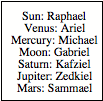
"I might stop her for a moment just to say that this passage about Hamlet's Castle," Charlie Rose says. "This passage also seems to be important to me, toward understanding the meaning of this novel. The Soul on its pilgrimage, which is what this novel is, the documentation of the Soul's pilgrimage, is regularly reminding us that he is searching for the castle. Of course, on the one hand, the Castle is obviously God's City in the Sky. But, I believe, and many critics also believe this, that it is Hamlet's Castle he is seeking. Because he is, in fact, seeking retribution for the murder of his father. He is the one who killed his father, condemned his father's world as being imperfect. His whole generation condemned the Father's World because it was not perfect, because it had become tyrannical. Although, in terms of history, the American Empire's greatest sin is the forceful export of democracy and capitalism. But, to an animated left-wing in the 1960's and 1970's, this was the ultimate sin. And that is why you are turning against your own generation. Because you are Hamlet also..."
"Yes. I agree with your reading of this," Crossmann says.
"And, of course, you pay tribute to Joyce, your literary ancestor," Rose says. "HCE is HC Earwicker, the Everyman of Finnegan's Wake.... A few pages further you write: 'Who goes there? Hamlet's cabernet? Grist for Axel's Castle? Howth is thine erection...' Again, we have Hamlet connected to Joyce. Howth Castle is the phallus, the symbol of Man, in Finnegan's Wake. And Axel's Castle is a pretty famous work of literary criticism written by...who was it...?"
"Edmund Wilson," Crossmann says.
"Yes, Edmund Wilson," Rose says. "And it's a study of what...?"
"Symbolism in literature," Crossman says. "But it studies Joyce, Proust, TS Eliot, Gertrude Stein, Yeats..."
"And who is 'Axel'...?"
"Axel is the hero of Villier de L'Isle-Adam's fantastic prosepoem written in the late 1800's," Crossmann says. "Wilson felt that modern literature, the literature culinating in the last great literary epoch, the 1930's, left two paths for writers: one path led to Axel's castle. Axel represents the increasingly individualistic and democratic voice, the cultivation of one' private fantasies in the face of contemporary realities. The self-imposed incarceration in one's own dark castle which characterized the successors of the Symbolists: Joyce, Yeats, Eliot, Proust.... The other path he saw was characterized by Arthur Rimbaud, the French poet, who rejected Twentieth Century individualism, choosing instead the cult of the primitive and the childlike..."
"It seems that you have married both in this novel," Rose says, laughing. "The primitive and the convolutedly private..."
"Yes," Crossmann says. "Is that a compiment...?"
"Well, you talk a lot about synthesizing the opposites," Rose says. "So I guess congratulations are in order..."
"Well, thank you," Crossmann says, smiling.
Rose opens the book again. "You next have a mediatation on the nature of Tetragrammaton, IHVH, The Archetypal Family of God. And you also give us a picture of prophecy, inspiration...."
Rose reads:
YOU MET THE FOUR LIVING CREATURES IN YOUR DREAM. Four 'beings', beyond the wall. I SEE. What else is His name? IHVH IS READ FROM THE OTHER DIRECTION AS HVHI. As Jehovah is 543, so Moses is 345...
"Tell me what this mean," Charlie says.
"What does it mean to you?" Crossmann asks.
"It seems to suggest that...."
"Remember, Moses went to the top of the mountain to meet with God," Crossmann says.
"Moses climbs to the Fifth Plane to see God?" Is that it...?"
"And God descends to the Third Plane, perhaps," Crossmann says. "Isn't that what it looks like...?"
"I'm not really sure," Crossmann says.
"Moses lives on the Third Plane. That's his lowest plane of manifestation. He rises to the Fifth Plane to make contact with God, through the Son, Vau..."
"That's what it seems to say," Rose says.
"Religion is a complex science also, Charlie. But it is a different language..."
"One you exile yourself from," Rose says. "Eventually. When you become Man..."
"Yes."
"You cut yourself off from the world Above," Rose says. He begins flipping through the novel. "We have not included the long Blavatsky tracts on Cosmogensis and Anthropogeneis, although they are in the novel. They are too symbolic, and would require too much clarification for our time tonight. But I am reminded of one passage under Cosmogenesis." Rose reads:
Behold, young disciple, the Radiant Child of the Two, the unparalledled refulgent Glory, Bright Space, Son of Dark Space, who energes from the Depths of the Great Dark Waters. It is Oeaohoo, the Younger, the New Life, the Divine Idea, who shines forth as the Sun. He is the blazing Divine Dragon of Wisdom, the Androgynous Deity, the Logos, the Word. The Eka (One) is Chatur (Four); and Chatur takes to itself Three, and the union produces Sapta (Seven) in whom are the Seven which become the Tridasa (Thrice Ten), the Hosts and the Multitudes. Behold Him lifting the Veil, and unfurling it from East to West. He shuts out the Above and leaves the Below to be seen as the Great Illusion. He marks the places for the Shining Ones (the Stars) and turns the Upper (Space) into a shoreless Sea of Fire, and the One Manifested Element into the Great Waters.
"You are also traveling from East to West," Rose says. "You study of myth and religion from China and India and you eventually pass into re-birth through Israel.... And you 'shut out the Above'. That's correct, isn't it...?"
"Yes."
"Then you present a picture of the Hours," Rose says. "To you these are living beings, each with their own nature and character of light... And then a poem for Daphna...."
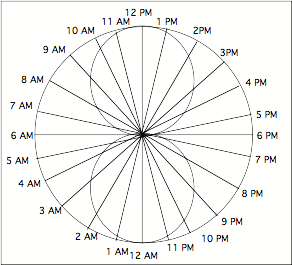
Coming down the avenue of trees
I met a woman made of copper
In the breeze.
Bronze is rich in spoken words;
And the Soul might gayly
Deck her ambivalence,
Charting my mime
With a clairvoyant nod.
She paints the whirlwind Day with rain
Of spectral points and garnished reds,
And pours the crystal braid she holds
Into my well-worn mind,
Which she savors.
I dig the gold from veins
In her thigh.
She carries my tokens
In imagery of Noon.
Someone claims that flowers can't
Be known.
Touching her heat is like
Varnishing the sea;
Annnouncements go out
That the woman weaves a cave.
A cane if offered
By the man who has no horse.
The wind bears lilac.
Someone moves,
But bears no name.
Documents are signed
By the hand which fells a world.
Decades, like vows, are spoken,
Fast, by lovers:
Spoken and unknown,
In their aggravated meal.
She married the water in the brain
Of some one thousand;
Heart machines are gathered
By a crowd which wishes loudly.
And the copper of her eye
Falls like beads into my hand.
Counting, the captive counts all
In doubles;
He spins the blistered sky in hand
Which crave to touch
The turqoise of looms.
He talks the taljk
Of myriad appointments
During which the daughters of Rome
Call for lacers
To string up their corsets
With the lion-arms of rust.
And rain seems like tears
Which the Watcher counts
In doubles.
He conceives that only Time must heal
The virgin wound
And the manufactured field.
Down the avenue the children
Shot darts into the seasons.
One boy looked like his son
Who carried geese
And turned
The Sun into cheese.
"We are gettin near the end of this Night in the novel," Rose says. "But we are still being given clues to this picture. And, of course, one eye is always on the political developments of the Earth..."
Rose reads:
My head moves in an airless room. Far beyond the quaalude dusk and far above the mmites of moons. Seas of colfd flame and seats without spoons. Turmoil on a handstand. Grabbing at the cnadle. Months spent in arid arid transgressions. Waiting for the sumptuous feast. Sumptuous fetes. Feats. Waiting only on carols. Moon-walking is tight. Close to the bone: sweet to the meat. Unheard-of complimentary song. Minstrel walks the streets in doubt. A whole istory of characteris waiting, again, to come out of the womb. Squeezed out by a stroke of genius. A pictures in the limbs of Time. A crown in a feathered nest. Boy-angel and micro-carbon imagery. Turning from boy to girl and back again. Who goes there? Hamlet's cabernet? Grist for Axel's Castle? Howth is thine erection? In the brain where only the brain can be. The Science of the Knuckle: and the measurement of the Sacred Ground. Wherein none can enter but those so chosen. The womb of the flious feast, now gone. Never gone; but the light now undone. Wandering through the coming phase. IN THE BEARSHIT: GOING OUT. AFTER THE CREATION. AWAKENING. GOING OUT. THE CARRIERS OF THE COVENANT. GUARDIANS OF THE GATE OF THE TEMPLE. PRIESTS OF THE LAW AND OF THE LOWER LAND OF HEAVEN. NUMBERS OF LAWS AND PROITS OF JUDGES.
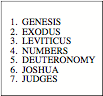
Too much to re-consider. A bell ringing 3 times. Unscrupulous candidate. Waiting for the deliverance. Who is that coming now? The Sleeping Giant and the wasted crow. The Russian General shot in the park. The death of Paul 'Bear' Bryant. Andropov's illness. Young blood is on the wey. Consternationa nd a coming sickness. Protection of the children. Tamar's orange laughter. Out of incarnation. Wondering on the freeze. And where the rain came down as snow. Too true. For words. I SEE. The man who holds the scales. The triumph of indecision. The West having lost its will. SHE SAID:
The doctrine of the Septenary Chains of Worlds in teh Solar Kosmos is, briefly, this:
1. Everything in the metaphysical as in the physical world is septenary. Hence, every sideereal body, every planet, whether visible or invisible, is credited with six companion globes. The evolution of life proceeds on these seven globes or bodies from the first to the last, the seventh, in 7 Rounds or 7 Cycles.
2. These globes are formed by a process which the occultists call the 're-birth of planetary chains' or Rings. When the Seventh and Last Round of one of such Rings has been entered upon, the Highest or First Globe, followed by all the others down the the Last, instead of entering upon a certain time of Rest or 'obscuration', as in their previous Rounds, begins to die out. The 'Planetary' dissolution or Pralaya is at hand; its hour has struck; each globe has to transfer its life and energy to another planet.
3. Our Earth, as the visible representative of its invisible superior fellow globes, its 'Lords' or 'Principles', has to live, as have the others, through 7 Rounds. During the First 3 Rounds, it forms and consolidates; during the Fourth Round, it settles and hardens; during the Last 3 Rounds, it gradually returns to its first ethereal form; it is 'spiritualized', so to say.
4. Its Humanity develops full only in the Fourth Round, our present Round. Up to this Fourth Life Cycle, it is referred to as 'humanity' only for lack of a better term. Like the grub which becomes charysalis and butterfly, Man, or, rather, that which becomes Man, passes through all the foms and kingdoms during the First Round and through all the human shapes during the Second and Third Round. Arrived on our Earth at the commencement of the Fourth, in the present series of life-cycles and races, Man is the first form which appears thereon, being preceded only by the mineral and vegetable kingdoms -- even the latter having to develop and continue its further evolution through Man. During the 3 Rounds To Come, Humanity, like the globe on which it lives, will be every tending to re-assume ins primeval form, that of a Dhyan Chohanic Host (an Angel). Man tends to become a god; and then God, like every atom in the Universe.
"Then you write that your brother is now speaking openly about rebellion, about revolution, while you are picturing Russia in the Mediterranean," Rose says. "You recognize that Daphna is your Shekinah. And it is at this point that you identify yourself with the Holy Ghost and Daphna with the Virgin Mary. You predict that her son will be born the messiah. Which is the incorrect prophecy, of course, as Daphna gives birth to a daughter. You write: 'The Story of Creation is the History of the Chosen People.' By this, I am assuming your are saying the 'chosen people' in the largest sense. Each people who see themselves as chosen by God to survive. The Jews are not the only 'Chosen People' I am assuming. The 'chosen people' are the ones identifying with Life, with the Middle Principle, the Creative Principle and the Creative God...."
"Yes," Crossmann says. "Those worshippoing their National God."
"Those who identify with Life rather than with the Tree of Knowledge of Good and Evil?"
"Yes."
"You dream of two strange birds," Rose says, "looking like an owl, but not an owl, looking like hawk but not a hawk. A male, on the right, on a higher branch; and a female, on the left, in a lower branch. And a woman's voice in the dream explains that it is the Thunderbird, sacred to the American Indians, as the bringer of rain, the destroyer, the war god, the voice in the clouds. The bringer of fire to the earth. An eagle who protected the Shaman's soul, who also send the Thunderbird against his enemies... And you identified with this..?"
"Yes, of course."
"You consider yourself a shaman?" Rose asks.
"This novel is a shaman's tale."
"But the shaman is the dark soul," Rose says. "Soon you will condemn the dark soul, the Indian..."
"I am both dark and light," Crossmann says. "The light judges the darkness; and then the darkness judges the light..."
"I got a kick out of 'In the bearshit'," Charlie says. "'Bereshith', of course, is the first word in the Old Testament -- 'in the beginning'. Here, the bear shit leads us directly into a perception of Russia, the Great Bear, which you obiously feat..."
"Many empires have fallen to Russia," Crossmann says.
"The French and the German in the last two hundred years," Charlie says.
"Yes. The Russians are the sleeping Dark Giant," Crossmann says.
"Let's read about Rabbi Shmuel," Rose says.
He reads:
RABBI SHMUEL HOLDS A CANDLE AND LEADS ME THROUGH AN UNDERGROUND PASSAGE. HE SAYS: Connected by means of a white thread, or bond of union, with the Great Countenance, the White Head, or Macroprosopos, there is that which is called the Lesser Countenance, the Little Form or Figure, which presents, however, a complet aspect of Humanity, and is extended through many symbolical worlds. The distinction between the Two Heads is that in the case of the Microcoposopos, the hair and beard are black. The Lesser Countenance has eyelids, because it has periods of sleep; whereas Macroprosopos never sleeps, and is, therefore, without eyelids or eyebrows. The Lesser Countenance offers a complete visage in manifestation, for severity is also one of its attributes; it has a distinctive name, 'Lord', whereas the Great Countenance, which is seen only in profile, is called 'Ain' or "Nothing', because it draws or is emanated from Ain Soph, although it is located in the Sephiroth Kether. The Lesser Countenance emanates from the Greater; is, actually, the former, as if seen through a veil; more specifically, they are one and the same. The body of the Sacred Form is described as that of the Male, perfect in all its members. Of this Form, there is a counterpart of Perfect Womanhood; and these two were primordially 'side-by-side', until the Ancient of Days put the Lesser Form to sleep, and detached the Female Principle, whose name is Matrona, Bride, Daughter, Betrothed, Twin-Sister. The object of this separation was that the Bride might come to the Bridegroom in Heaven; and, in the great sacrrament of matrimonial Union, that they might become One Body, as if One Flesh, together 'face-to-face'. All is mercy is this uniojn; it constitutes the Law of the Sabbath. The sacred organ of intercourse is called Yesod, on the male side; it has access to the concealed and mysterious region of the female side, that holy place, called Zion. IS THAT A DESCRIPTION OF YOU AND DAPHNA THIS WINTER? YOU DETACHED HER FROM HER HUSBAND AND COUNTRY AND ENETERED HER SACRED NATION, IN HER HEART, TO FIND THE FUTURE. YOUR MARRIAGE WAS MADE IN HEAVEN. I see. Sometimes it seems like all is merely a frayed description, very far from here....
"Then, with one eye on the Earth," Rose says. He continues reading:
FLOODS EVERYWHERE: THE AMERICAN SOUTH STRIPPED AND TWISTED. SNOWS IN WYOMING. DROUGHTS IN AUSTRALIA AND AFRICA. RAIN OVERCASTING LONDON. The French Premier seeks to make a scapegoat of America. He blames the Americans for France's own sick economy. DO YOU REALLY WISH TO BE THERE? Punc rockers assault Old Men Nazis ;in; Germany who attempt a reunion of their army division. BOMBS SET OFF IN PRAETORIA, WEST GERMANY, NEAR THE ALTAR AT WHICH THE POPLE IS TO OFFICIATE. Yes, I see. Children burning down their fathers' factories. A HEART OF GLASS IS A HOUSE OF GLASS. A house of chalk. Heim kreiten, afterall. Heimkristen too. AND THE OLD WOMAN BY THE BOARDED-UP CIRCUS SAID:
Appearing with every Manvantara of Dawn as Narayan or Swayambhuva (the Self-Existent), and penetrating into the Mundane Egg, it emerges from it, a the end of the Divine Incubation, as Brahma or Prajapati, a progenitor or creator of the future Universe into which he expands. He is Purusha (Spirit) but he is also Prakriti (Matter). Therefore, it is only after separating himself into two halves -- Brahma-Vach (the female) and Brahma-Viraj (the male) -- that the Prajapati becomes teh Male Brahma, the manifested finite god, who has for his vehicle the Swan or the goose, which became with the Christians the Dove or the Holy Ghost. The Swan (Hansa) is the symbol of that male or temporary deity, as he, the emanation of the Primordial Ray, is made to serve as the vehicle (vahan) for that Divine Ray.
Hansa or Hamsa, the Divine Bird resting in Darkness -- that is, Divine Wisdom beyond the reach of Men -- represents the 'One Caste' in Hindu mythology, and is located in a range of the Himalayas north of Mount Meru (Hamsa) which is connected with the history of religious mysteries and initiations. 'A-Ham-Sa' means, in English, 'I am He' -- the identity of Man's essence with God-Essence, Man being the septenary symbol, on the terrestrial plane, of the One Great Unit (the Logos), which is Itself the seven-vowelled sign, the Breath crystallized into the Word.
Kahahansa, the manifested Brahma-Prajapati, can be read 'I am I', and reminds one of the Bibilical/Zoroastrian 'I am that I am', the self-description of deity...
HE IS A FALLEN ONE. FROM UNIVERSAL INTO PARTICULAR. FOR UNIVERSAL VISION TO THE NATIONAL GOD OF SURVIVAL AND STRENGTH. Fear of Death. YES. Anger at Death. To fight with the Darkness. WHERE DOES THAT GET YOU? Tired and alone. DO YOU MIND BEING TIRED AND ALONE? No. It is the way I walk. I walk alone into something. The Holder of the Scales. MILLENIUM FALCOM. The Jedi Returning. WISE MEN ON CLOUDS. Striking at the heart of something. WOE, IN A BLUE CUP. A man and a woman scream and threaten. ABOVE YOUR CEILING, TWO ARE COUPLED IN THE GROANING OF PLEASURE IN HER CUPS. And you feel left out? You begin to look for the Conductor again, the Conductor who carries you away from your failure. WHERE IS JACOB HEIMKREITER? Who are you? I AM HIS SON. Why do you seek him? I MUST. I HAVE NO CHOICE. You could seek, instead, your Mother. I HAVE ALREADY SOUGHT MY MOTHER. And now what? Do you seek your Father because you fear dying? I SEE. Rabbi Shmuel sits with a candle quietly. He says: IN USING THE SLPHABET AS THE INSTRUMENT OF CREATION, THE INTENTION WAS, FURTHER, TO MANIFEST THE DIVINE NAME THEREIN AS AN INDWELLING PRESENCE OF THE UNIVERSE AND AS A GLORY STANDING ABOVE THE FOUR QUARTERS THEREOF. IT IS ALSO SAID THAT THE 'HOLY ONE' ENGRAVED, IN THE INEFFABLE WORLD, THOSE LETTERS WHICH REPRESENT THE MYSTERY OF FAITH, BEING YOD, HE, VAU, HE: THE SYNTHESIS OF ALL WORLDS ABOVE AND BELOW. They speak of each Letter emanating from its predecessor; in other words, all are reduceable to a few primitive forms. THESE LETTERS EACH BEING AN ELEMENT. THROUGH COMBINATION OF LETTERS, NEW ELEMENTS ARE PRODUCED, AND NEW MEANINGS, NEW WORLDS. Rabbi Jehoshuah said to me: THE GREAT LETTERS, THOSE WHICH ARE ABOVE, OF WHICH THOSE ON EARTH ARE MERELY A REFLECTION -- THESE GREAT LETTERS REMAINED IN CONCEALMENT FOR A PERIOD WHICH IS SPECIFIED AS 2,000 YEARS, BEFORE THE HOLY ONE PROCEEDED FURTHER IN HIS WORK. AND WHEN HE WILLED TO DO SO, THE LETTERS CAME SUCCESSIVELY BEFORE HIM, TO SHOW CAUSE WHY EACH SHOULD BE USED IN HIS TASK....
On Saturday, Daphna and Anat rode by on their bicycles. With their father. She will be leaving soon. AND THEN I SAW ONLY CHINESE WOMEN. AND THEN SPANISH WOMEN. AND NOW I SEE LESLIE AGAIN. What did the woman say, the one who planted her garden? WHEN I ASKED ABOUT THE COLD FLAME, SHE SAID: The First Primordial Matter, eternal and coeval with Space, which has neither beginning nor end, is neither hot not cold, but is of its own special nature. The manifested worlds all proceed from the manifested Hyle, which, in its absolutely latent state, is referred to as the 'Cold Virgin', and, when awakened to lif, as the 'Mother'. Ancient Western cosmogonic myths state that, at first, there was but cold mist, which was the Father, and the prolific slime, which was the Mother (Hyle or Hus), from which crefpt forth the Mundane Snake, that is, Matter. Primordial Matter, then before it emerges from the plane of the nevder-manifesting, and awakens to the thrill of action under the impulse of Fohat (Light, Cold Flame, or Electricity) is but a cool Radiance, colorless, formless, tasteless, devoid of every quality and aspect. Even such are her First-Born, the 'Four Sons', who are One and become Seven. The Four Primal Natures of these first Dhyan Chohans or Archangels are the so-called:
'Akashic": Parahydrogenic
'Ethereal': Paraoxygenic
'Watery': Oxyhydrogenic
and 'Fiery': Ozonic-Nitr-ozonic elements. These latter gases or forces are supersensuous, yet atomic, substances; and are most effective and active when energising on the plan eof more grossly differentiated matter. These are both electro-positive and electro-negative.
A TEMPTRESS APPEARS, PARTLY-CLOTHED, ON A THRESHOLD. Tax time again? To be taxed by the flesh of the daughters of men? ATTESTATION OF THE WILL OF ONE CHURL. Testament to linx in the lobulated loin. OYSTERGODS GAGGING FISHEYGODES RELATES THE THE BATTLE BETWEEN THE SHELLED FISH AND THE UNSHELLED FISH (THE UNARMORED ONES). History rolling back on itself. ROMANS DRIVEN IN TO THE SEA. Which direction are you going? Front-to-back or back-to-front? OYSTERGODS LIVE WITHIN THEIR ASTRAL SHELLS, PROTECTING THEMSELVES WITH THEIR ARMOR. History falling on its shelled back again. FULL MOON OVER MIAMI. Tokyo shakes and is pulled toward the sea. Series of earthquakes cracks road, destroys buildings; tidal wave feared. I SEE: THE NEWSHAWKER IS WALKING THROUGH MORNING STREETS. I must be all of my characters, sir. IS IT TOO EARLY, THEN, TO RESURRECT THE WORLD? TO RESURRECT YOUR FORMS. I am not certain. WHY DOES THE HINDOO STAND BETWEEN MESSERS DOOLEY AND DEAR OLD HENNESSEY...? The unction is not extreme unless the missionary weal is woeful and bright. YOU SEEM TIRED ON THIS THUNDERSDAY. Thor's daily stew in all the air can buy only new terror. THE TERROR OF NO-TERROR. Walking in the rain. HAVE YOU NOTHING TO SAY? One brother now speaks for rebellion; the other brother only yawns, sky-watcing. Having changed roles again. IS SOMETHING COMING NEAR? Yawning in the gap. WHAT? Syria reinforces troops in Bekaa. Libyan leader M. Khadaffi pays a million dollars to rebellious PLO guerillas to break line with the 'moderate' Arafat, encouraging them to attack Israeli outposts, continuing resistance. ISRAELI RECONNAISANCE PLANE SHOT AT BY THE SYRIANS. You have Daphna to protect. She is going back home. She is going back home. I SEE. WHAT COMES NEXT? Americans attacked in Beirut. American advisor shot four times in the head on the streets of sal Salvador. ALL THE POLICIES OF WASTE. Non-connissioned office. And a gentlemen in the rain....
"Then school ended for Daphna in the spring," Rose says. "And she returned to Israel with her family. And she wrote you a letter..."
Rose reads:
Hi. Remember me? Are you still there -- on the other side of the world? Does America really exist -- or was it all a dream?
Three weeks have passed; but I feel like I've been here all along. It seems as if I never left! A summer evening in Jerusalem, in our house. Very quiet. Juerusalem evenings have a special smell. The house is wonderful, cool, my 'bedouin' carpets are spread around, my plants have survived and seem so familiar. Quiet -- for the first time in three weeks. We have so many good friends that reall love -- and missed -- us. They keep coming. We've been surrounded by people since we landed.
Copenhagen was cold and old and grey. A few hourse later we land, and, as I step off the plane, I'm hit be a wave of orange blossoms. Very strong. Then, everyone around seemed so handsome. You see -- I do fit -- so perfectly. Well, its all mine; I'm so much a part of it.
The people are great -- sure, they pupsh in the line in the bank -- they drive like madmen -- so? Nothing like the movie 'Yol'.
I've started working -- back to my old desk in the office. My project: the Bibilical Zoo in Jerusalem, re-designing it. I'm not yet used to office projects, the real world, money, meetings, and so on. I hope it will get better. There isn't much room left for philosophy.
I don't listen to the radio, am not involved in poligics -- yet.
Tamar was overwhelmed by the extended family, so much love and attention. In the first two weeks she was in a state of ecstacy. School pulled her back to Earth again. She needs to get used to kids living further apart than at Amazon, which was really a children's paradise.
Well, Mike, you see how terrible I am in expressing myself through writing. It all comes out as a dry report. I hate it.
On the other hand, you are the one who dreads emotion.
Last night I had a dream, very simple. I was walking towards Lawrence Hall and saw you sitting in your usual spot. I vividly remember the feeling of Spring, freedom (no projects due) and a sort of warm wave, when I noticed you. Then I woke up. Very simple, real dream; but it left me with a strange sensation.
But with thousands of miles between us, you are so abstract; Eugene is; university days are. Maybe it's in the genes: the Jewish wanderer adjusting everywhere.
I love it when I can see the Sun, the stone terraces, the warmth of friendships. You lift an eyebrow with disbelief, don't you? Will you still send your book to me? Backwards though? Ok?
I am designing the Biblical Zoo. There is a loop that will go around the area of the loop, animals that are mentioned in teh Bible -- in the center, there is a beautiful orchard with figs, olives, and almonds, which will be left and designed as Paradise -- the Garden of Eden. The entrance to it will have the snake exhibition and the water source -- now that, I suspect, is a direct University of Oregon influence. I love it even though they will never build it.
As I am writing, Tamar is going wild in the bathtub -- the new treat, after the ugly shower in Amazon. We have a large window and a wonderful Armentian tiles telling stories of Paradise birds and animals.
You are so stubborn; I know you'll never write until you receive my first letter. I agree to that -- but, after, please don't count turns -- it's too American -- just write whenever you feel like it, even if you write more than me -- promise? It comes more natural to you.
Wasn't our goodbye miserable? So cold and distant -- I kissed and hugged so many people -- you were like a stone. I was afriad of bruises. So I ran way actually wanting to run in the opposite direction and fall into your arms -- ha! -- sounds like a cheap movie. I should stop now -- no emotions, right? Science only! But where does the chemistry of people fit in?
Haven't found your Kabbala friends yet. Daphna.
YOU HAD A DREAM OF YOUR OWN. Jay Berger, the friend who visited last week, was dead and was being stored in the front seat of his car. My brother and I had to bury him. William pulled him out, uncoiling him -- he was stiff with death. We stretched him out; yet his face chaned slowly and became the face of William, himself, then the face of my father at his deal: pale, hair whitened. IT IS WHAT THEY REPRESENT THAT YOU WOULD BURY. The Past. YOUR YOUTH. YOUR OWN IDEALISM. Perhaps. Perhaps the Conscience of my people. PERHAPS. You flee from the Past. YES. Running like a ghost from his own history. Running at the Future. YOU WROTE A POEM CALLED 'THE SON OF TAMAR' -- and you sent it back to Daphna with a letter:
I.
There is a monument in the sound
Of children's wings;
And the blessings of Two Aeons ride
The sky in search of rain.
Old men ane women touche the rainbows
Of their longings,
Feeling to see if some truth
Might be hid there --
After 72 years have left them
Smiling still, but sorry.
They should come to you, Tamar.
If they would seek the holiday of Life
And the joy of an ancient commitment to toil --
If they would seek the language of Justice,
Then they should come peer in your eyes.
Great wells exists in which
All heavens are printed backwards.
Great well where all the great men
Must, eventually come:
To drink the wine in the wealth
Of your name.
Children hold candles in the midnight of caves.
Saviors still sleep in the shadows
Which children guard there.
No one can approach the well,
Except the one who is love
By the smiling guardian soul.
II.
Tamar.
Will you hand me the cup
And let me drink from your rich history?s
Will you choose me to be your sentry
When the clouds come in like Moors,
Scaling the walls of your Wisdom
With ladders they have borrowed?
Is the newest the youngest
Or the oldest instead?
Is the flower younger than the seed --
Or does the flower live longer,
As seed and stem and leaf and itself?
If your history includes my own,
Then is my son here
Not really my father?
Tamar,
Sing your song of rings,
Come sing your song
In the language of your Fathers.
The world might learn
By looking at your laughter --
Yet the world cannot see
What only children are given
By Time.
The clock strikes three
And all the Birds of Day go tumbling.
No one can touch the eternity of Grace.
When Tamar is smiling
All the legacies bear their virtue.
DO YOU DESIRE THE DEATH OF YOUR BROTHER, SO THAT YOU CAN MARRY THIS WOMAN? Each Spring, one punishes, so than another might suffer. In the beginning is Desire, which scatters the boldened Word. I have been here before. Above, beyond the ceiling, the woman again moans deeply from Pleasure. I listen, breathlessly. She rides the horse until she explodes, shaking the hourse with her screaming, long, deep gratifications. THE SIREN OF SOME NEW TEMPTATION. Beward the thickening plot. The landscape of the nerve-end wound. THE CAT IN THE MOON-LED PLUNDER-PUSSIED BOOM. That shot heard 'round the world. SPASMED EVE. Dropping on to languished love. THE WRESTLING OF INDISCRETION. Preparatory to the thaw. FIRST COCK OF THE MOURNING. No one understands me -- perhaps. Catalytic season -- the fire in the pit: he who protects the unsuspecting cad. THE MAN WHO HAS SOFTENED: AS THE HARDWOOD TREES PROTECT THEIR SOFTWOOD BROTHERS. I see. HAS THERE BEEN LIGHT THEN? A CONTINUATION OF THE STORY? When to we wake, to carry the tabernacle a step further away from the sea? ANOTHER CUP OF TEA, PLEASE. She must be right. How you fear the grim possessive pronoun. MINE. MINE ONLY. SHE POURS THE CRYSTAL BRAID SHE HOLDS INTO MY WELL-WORN MIND MINE ONLY. THE ACT OF BEING POSSESSED BY LOVE. AND ARROWS. Your fear of women. FEAR OF SUFFOCATION. I have been wounded. THE SUFFOCATING MIGHT OF PLEASURE. The Book of Moroni. GOD PROTECT THE SAILORS WHO WAIL AROUND THE CAPE BESIDE THE VOICES OF THE BIRDS. The unlaid cape found on cobblestones. WHO KNOW YOUR SALVATION? In memorium to all who have fallen? DO YOU DESIRE DEATH MORE THAN LIFE? Cutting with the sword of gems. More vegetable queesn have fallen to the word. YOU ARE A SONGSTER, THEN? Micahel, the Archangel, is described in Jewish mythology as 'the leader of the heavenly choir' YOU ARE REPEATING YOURSELF. What does the other woman tell you? WHICH ONE? The one who holds the canary beyond the terrace. SHE SAYS:
Brahma, as the Germ of Unknown Darkness, is the material from which all grows and develops. Brahma is the Creator, the Father, in the stanzas, his name defiving from the root 'brih', to increase or expand. This 'Breath of the Father' refers to what science has termd the 'Fire-Mist Period', and it has been said: Great heat breaks up the compound elements and resolves the heavaenly bodies into their primeval one element. Once disintegrated into its primal constituent, by getting within the attraction and reach of a focus or a centre of heat (energy), of which many are carried about to adn fro in space, a body, whether alive or dead, will be vaporised and held in the 'bosom of the Mother', until Fohat, gathering a few of the clusters of Cosmic Matter (nebulae), will, by giving it an imppulse, set it in motion anew, develop the required heat, and then leave it to follow its own course.
The cause of the first ignition o matter, or the world-stuff -- seeking to discover this Cause brings us to the paradox of heat produced by refrigerative contraction. By losing heat, a gaseous body contracts, and the heat generated by the contraction exceeds that which it had to lose in order to produce the contraction. Thus, a body gets hotter as the shrinking produced by its getting colder is greater....
I SEE. AND SO THAT IS THE MYSTERY. One of the mysteries. HOW LONG CAN YOU KEEP THIS UP? A messgage comes for me to marry. MERRYISTHMUS AND THE PANAMANIAN SAUSAGE. Yet, I feel drawn away from women. MERRYCHRISTMAS AND THE POMERANIAM BANGER. I hear the two make love again, beyond the ceiling -- yet, when they are alone, all they can do is make love. It is their common ground. MARRIED TO FLESH. It is myself in that room. YET, WHAT COMES NEXT? Precisely. MY HEART IS ON FIRE. PRESSURE IN THE SACRED CHAMBER. ANTAGONISM TO SHADOWS. BUMS ON PARADE. DARKNESS HAS BEEN METED. And the anger within me, the heat to expand, to explode beyond these boundaries: it is this which leads me onward. To not be stuck in this contradiction for long. As I contract, I too exprience heat. The heat of indecision. THE HEAT OF A FIERY HEART. On page fifty of the manuscript left behind by Colonel Kurtz, returned to America after his death in Cambodia, was scrawled, in an angry hand: DROP THE BOMB AND ANNHILATE THEM! Nemesis is gone now. The Darkness is losing its power. OR IS IT BECOMING YOU...?
"You have to tell me about this," Charlie says. "This is taken from Coppola's Apocalypse Now, the movie. Colonel Kurtz is played by Marlon Brando. When Martin Sheen goes to kill Kurtz, he sees in Kurtz's manuscript, this quote: 'Drop the bomb and annihate them!' And that is what Sheen does. He kills Kurtz; escapes the Cambodian jungle; and he calls in air strikes on the unholy ground, destroying the primitive world which was threatening to destroy the idea of civilization... Is that about right...?"
"Yes."
"And it appears here now," Rose says. "And I can't help but think, again, about the dark impulse which seems to be present in this novel, the impulse to use nuclear weapons against the world. Against those who threaten America. Is it my imagination -- or this theme running through the book with all the other themes...?"
"It is there," Crossmann says. "With the other themes: darkness and light together..."
"So the alter-ego asks: 'Is the Darkness becoming you?' Which is an even stronger way of asking than 'Are you becoming dark' -- 'Is the Darkness becoming you?' seems to speak more about demonic possession, the taking over of a body or a personality. Evil inhabiting a personality..."
"Yes. It is clearly there," Crossmann says.
"But it doesn't win, the darkness?" Rose asks.
"When Michael fights the Dragon of Chaos, when he fights Gilbert for his own life," Crossmann says. "He is not only striking down the Darkness outside himself, but also the Darkness within himself. Life strikes down Death; Light strikes down Darkness..."
"Yes. Very interesting. You are haunted by the sounds of the couple making love above your ceiling."
"Yes. Clearly sex has come back in, through the ears," Crossmann says.
"And the Kabbala becomes even more an element in this novel," Charlie says. He reads:
Temptation poured into the porch of the ears. ILUS AS MUD OVERFLOWING YUTAH. Come one, come all. MOANS THE CAPTIVE IN THE TOWER OF THE CAPTAIN. The Captain's Tower in the plow. THE FIELD FOLDED TO MERIT. Unrumpled splitskin. ONE GROAN IS WORTH A THOUSAND SMILES. Listening to Venus. ISTBLUCHENSIE DE MILO. Das Fluge and the heirless second. DAS FLUGE MAGICHE AND THE AIRLESS APPARENT. If it had air around it. HA! HA! NUMISMATIONS AND THE SOUNDS OF PLEASURE. The unsuccessful thrust. IS IT BLUCHER, THEN? Aleph is the first and the masculine letter; Beth is the Second and the feminine letter. Through these two agents, the world is created. THROUGH ALPHA-BET, YOU MEAN? The first elements of the word. THE WORD. The one is Jehovah; the other is Elohim. AND, SO, SEXUAL LOVE PULLS AT YOUR SWORD. Beautiful women walk through this heaven... SHE CONTINUED, DESPITE THE RAIN:
As time rolled on, the holy caste of Initiates -- the 'Sons of God' we have described -- produced, but rarely, and from age to age, such perfect creatiures: beings apart, inwardly, although the same as those who produced them, outwardly.
While in the infancy of the Third Primitive Race:
'A creature of a more exalted kind
Was wanting yet; and, threfore, was designed;
Conscious of thought, of more capacious breast,
For empire formed and fit to rule the rest...'
It was called into being (these first 'Mind-born Sons', the 'fruit of Kriyasakti' -- meditation deep), a ready and perfect vehicle for the incarnating denizens of higher spheres, who took forthwith their abodes in these forms born of Spiritual Will and the nature divine power in Man. It was a child of Pure Spirit, mentally unalloyed with any tincture of earthly element. Its physical frame, alone, was of time and of life, as it drew its intelligence direct from above. It is the living Tree of Divine Wisdom, akikn to the Mundane Tree of Norse legend, which cannot wither and die until the last battle of life shall be fought, while its roots are gnawed all the time by the Dragon Nidhogg. And, even so, the first and holy son of Kriyasakta had his body gnawed by the tooth of Time; but the roots of his inner being remained ever undecaying and strong, because they grew and expanded in heaven not on Earth. He was the First-of-the-First; he was the Seed of all the others. There were other 'Sons of Kriyasakti', produced by a second spiritual effort -- but the First One has remained to this day the Seed of Divine Knowledge, the One and the Supreme among the terrestrial 'Sons of Wisdom'....
P 1085. GILBERT EXILED.
"So," Charlie begins. "I really don't know what to say about this last passage. 'For empire formed and fit to rule' -- that seems to be a kind of justification in your mind for what? Sustaining the empire, rather than dismantiling her? That has been one of the great discussions in your mind. Expand or contract? Expand, and be Brahma, the Creator. Or contract and be what? The Great Mother...?"
"You seem irritated, Charlie," Crossmann says. "Is it tedium...? Are you growing hot with this contraction into tedium, this refrigerative contraction...?"
"No. No, that is not it. I am a bit irritated, I guess, because I am not certain I am able to understand your moral compass. I believe I founds it earlier. You seemed, in the beginning of the novel, to be suffering from very genuine guilt, a very deep sense of moral injury. But now you have been hauling this damaged boat up over the hill, like our friend Fitzcarraldo. And now the boat is getting up near the top of the mountain again -- and morality seems to not be a factor. Any behavior now seems acceptable to you; it seems that you have put yourself to sleep, in a moral sense, and that you are now sleep-walking and that the puppetteer is controlling you. And these texts which tell you that 'For empire formed and fit to rule' is a kind of moral seduction with which you identify for some reason. It is as if you are in a trance and have lost your own moral judgment...."
"That is true," Crossmann says. "That is a fairly accurate description."
"Why?"
"Why what?"
"Why give up your moral judgment to these....?"
"Voices?" Crossmann asks. "These voices in the clouds...?"
"Yes." Rose says.
"Because I am a child being taught to walk," Crossmann replies. "This land is beyond good and evil. I am eating of the Tree of Life..."
"But this makes you...dangerous," Rose says.
"The world is dangerous," Crossmann says.
"My world isn't," Rose says.
"You tell yourself it isn't," Crossmann says. "But when you walk out on the street to go home, and someone comes up behind you, and swings a brick at you, then you are back in the primal realm..."
"And that's what this is?" Rose asks. "You are in the primal realm...?"
"Yes, clearly," Crossmann says. "Depression reduces everything to the primary element. The souls then seek direction from the gods so they can rise above the condition of the jungle..."
"But you are experiencing all of this in your mind," Rose says.
"Mind-emotion-physical nature," Crossmann replies. "They are all fused..."
"You are praying, because in the back of your mind is this Dark Giant who threatened to beat you up...?"
"Who threatened to kill me," Crossmann says. "Yes. That is the primal sphere."
"I'm just having trouble with," Charlie continues, "your disinterest now in what is right..."
"Appearing to be right?" Crossmann asks. "Or being right...?"
"What?"
"Appearing to be right -- or being right?" Crossmann asks again.
"I don't understand that," Rose says.
"The image of being right?" Crossmann says. "Is that what matters?"
"Are you saying that the appearance of being right is more important than the real morality of th issue...?"
"Most people want to be on the right side," Crossmann says. "It is a driving force in most people's lives: that they be on the right side.... But that is perception, isn't it...?"
"You mean, it's nothing more than an opinion?"
"In a sense. It's an illusion. My conservatism is no more real than my liberalism -- no more true. It is the view of the two universes, nothing more..."
"But what if everyone in the world looked at it this way?" Rose says. "That morality doesn't matter...?"
"I've never said that morality doesn't matter," Crossmann says. "You soul tells you how to act -- and what to do. But whatever you do, you will some day come to judge it as incorrect. Because the world turns; things change. We can't know what's real. Even the way we experience the world is not direct. We receive light, impressions, via our senses. And our mind interprets the sensory impressions and projects a picture of reality. We never see reality directly. We only see our picture of reality. Of course, with each new sense we develop, we see a larger picture. But that says little about what is really there. Because we never know if what we are seeing is actually what we are experiencing...."
"Well, that is a philosophical problem," Rose says.
"Life is also a philosophical problem."
"When I told many of my friends that I was having you on my show, both liberal and conservative friends," Rose says, "they all seemed to want me to find out who you really were. Both liberals and conservatives were uncomfortable with you on one hand. Because they had trouble...."
"Categorizing me," Crossmann interjects.
"Yes. Yes. Are you uncategorizable...?"
"I am a two-sided sword," Crossmann says. "Haven't I already told you that...?"
"'I stand alone without beliefs'" Rose quotes. "'The only truth I know is you...' So you're on no man's side. Every man against himself; and God against all...?"
"Well, that's Herzog's line," Crossmann says. "I wouldn't say it quite that way. I would say that I stand between both worlds, living in the twilight, the place where the two lights meet..."
"That's more poetic," Rose says.
"And a bit more positive."
"What is positive in the universe is anti-positive in the anti-universe. So, everything is relative...?"
"Except relativity."
Rose laughs.
"The only thing not relative is the absolute," Crossmann says, smiling.
"Ok, so now that I've ragged on you a bit," Charlie says, "for which I apologize, let's turn back to the novel. You are beginning to invoke the name of the Conductor. It appears three or four times on these last few pages. You seem to be longing for vitalisation of the form of the novel. A brining back to life, to manifestation the many personalities inside yourself, the many voices inside this dense mass..."
"Absolutely," Crossmann says. "I am growing hot with the need to expand..."
"So, it was you projecting that on me!" Charlie cries, laughing. "You walk in the woods near the Willamette River. And you sense a snake, a serpent, over and over again. And you walk carefully thorugh the underbrush, looking for the snake. No snake. Then you walk up the paved bikepath for a mile or so. A man stops you on the bikepath and asks you if you saw the snake. You look back: you had walked past a rattlesnake bathing himself in the sun. You had not seen him. Then the man handed you a pamphlet: Blood and Snow on the Streets of Your Town..."
"Proving that he, too, was a snake," Crossmann says.
"Then you note that researchers had documented that when a human being is asked to describe what color his bathroom towel is, he looks up to his left; and when he is asked to imagine a mountain setting, he looks up to his right. You ascribe Memory to the left side; and Imagination to the right side. Memory, of course, is the process of reflection, looking at the Past. And this is an act of Maturity. Imagination is the process of creating reality, looking into the Future. And this is an act of Youth... And I found this quite interesting...."
Rose begins to read again:
Is this book merely a lie? In which you hide so as not to face life? PERHAPS. But each experience is euqlly a lie? YOU ARE CALLED TO MARRIAGE. Perhaps. Who can know? DO YOU WISH TO MEET THE CONDUCTOR AGAIN? To lead me where? TO THE EMPEROR'S HOUSE. If I go, can I return. ONLY AS THE EMPEROR HIMSELF. Still-born idea....
LYBIAN MILITARY OFFICIALS SMUGGLED INTO THE BEKAA VALLEY THROUGH SYRIA. TO SUPPORT A REVOLT AGAINST ARAFAT. AND TO CREATE A WAR WITH ISRAEL. Lybian ambassador in Lebanon shot and wounded. ARE YOU WILLING TO FIGHT? Lovers on parade. Two-step amid centennaires. NO AMITY IN THIS LANDSCAPE. Where are the animals now? ARE THEY GONE PERHAPS? Listen to the music. WHERE IS YOUR INSPIRATION? Am I an old man who grows weak because of too much thought? TOO MUCH TALK AND NOT ENOUGH WILL. Where does the Will exist? IN THE FIGHT FOR LIFE, OF COURSE. What does the woman say? SHE READS ABOUT THE FLOODS IN UTAY; AND SHE SAYS:
In its Unity, Primordial Light is the Seventh or Highest Principle -- the Light of the Unmanifested Logos. In its differentiation, it becomes FOHAT or the 'Seven Sons'. The former is symbolized by the Central Point in the Double Triangle; the latter, by the hexagon itself, the 'six limbs of the Microprosopos, the Manifested Logos -- the Seventh being Malkuth, the 'Bride', who is our Earth.
SOMEWHERE TIME GROWS LIKE A POMEGRANATE BESIDE A SHORE.
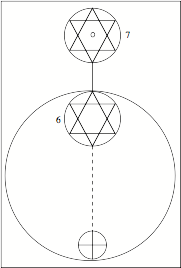
"We notice that the visual is starting to come back in to the novel again," Rose says. "The undifferentiate time -- what we have called 'mass time' -- is a time of Winter, or Darkness. And without light, there is no visual recognition. So the geometric figures have diminished. But it is now June 1983. And the drawings are beginning to return..."
"Fish at the bottom of the ocean don't evolve eyes because there is no light where they live -- so they don't need eyes," Crossmann says.
"The next drawing incorporates the astrological signs into the daily timepiece shown earlier," Rose says. "This is another expression of the Macrocosm/Microcosm in Time that we have been studying....."
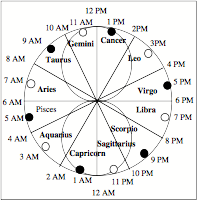
"Ok, so we're just about ready to move in to the last 'Day" section of the novel, the last differentiation into characters again," Rose says. "And I have to say I'm ready for the...what....the manifestation of the many voices again...."
"This One Element is wearing on you?" Crossmann asks.
"Yes, to be honest," Rose says. "It feels a bit dead, a bit lifeless, without energy..."
"Yes, it is low energy, at the moment," Crossmann agrees.
"I must say that Daphna's letter to you throws a whole new light on her," Charlie says. "Proving that she, in fact, does have some reality. I wasn't sure, when first reading this, if she was just a figment of your imagination. Because the real and the imagined are so tightly wound together in this novel. She seems like quite a person, judging from this letter. Clearly, she had feelings for you too..."
"Yes."
"But we don't get to see the parting she refers to -- which seems to have been so painful for her. Were you aware that this parting had been so painful for her...?"
"Not really. Everything was like a dream to me," Crossmann says. "I didn't feel that her leaving was real, I suppose. I always expected her to return..."
"A psychoanalyst might interpret your scheme of casting a civil war on Israel so that she would return to America as an elaborate way of telling her not to leave, for your own personal emotional reasons...."
"My love for Daphna was strangely impersonal," Crossmann says. "It was something mystical. I don't understand it myself, entirely. It was not the kind of love that needed to result in a physical marriage. Afterall, Daphna was already married. I did not want to take her away from her husband. She had a wonderful family -- and I did not want to destroy it. God sent her to me for some reason -- to help me come back to life. She was my soul, in some mystical manner...."
"She sounds frustrated by the impersonality," Charlie says.
"She was frustrated," Crossmann says. "She could only get so close. She wanted to get closer, to make the relationship more real..."
"But it wasn't real," Charlie says.
"It was real," Crossmann says. "But it wasn't physical. It was spiritual..."
"Was she beautiful?" Rose asks.
"Daphna was the kind of woman who, upon first sight, was not beautiful," Crossmann says. "At first sight, one would probably not notice her beauty. But her beauty was on the inside; so, she became more beautiful every day. Her beauty was hidden in her personality, her humor. You had to unlock it. But then, it was never-ending..."
"Did you ever see her again?" Rose asks.
"Yes, in fact. About a year ago. She came back to Eugene to teach a course in the Landscape Architecture department at the university," Crossmann says. "I met her on the street. I didn't recognize her. She introduced herself. I was amazed. I was married; she was married. There was a different kind of distance between us now, on both sides..."
"The mysticism was gone," Rose says.
"The Light had changed, yet," Crossmann says. "The Light was more practical now. Where it had been a dream twenty years earlier -- it was now a practical light. Michael the Archangel was gone. Michael the Adult was now manifesting...."
"And he's a whole different beast, I take it," Rose says, smiling.
"Twigs moving on the river," Crossmann says. "The Tides decide, not the twigs..."
"Ok. So, we are near the Dawn again, in terms of the structure of this novel. The Mass corresponds to light. And then this mysterious force of electircity, Fohat, comes along to scatter the One Element into atoms, compounds, personalities. But I don't see this Fohat here at the moment. You now hear the couple upstairs screaming at one another. And you comment: 'Too much of a good thing.' Which I found to be quite funny. Since you have, obviously, been taking notice of all the pleasure your have heard coming out of the sky. You had been separated from women, sexually, for some time, I take it..."
"Yes. I had been celibate for some time, for these seven years."
"And you were tempted by the sounds of the woman making love? You wanted some for yourself...?"
"There was clearly some temptation," Crossmann says. "The Darkness had had the women long enough. Now it was time to drive the Darkness away; and take the women back..."
"I'm not sure what that means," Rose says. "But let me read..."
Rose reads:
CHARMING BLACK INCENTIVE. The growing of silence. WHO IS THER TO WAIT FOR? Where do your studies lead you? OCTAGON AND BACK. Out to gone and back? LOOKING FOR DELIVERANCE? Yes. I SEE. But what do your ears hear? LOVERS BEHOND THE CEILING. Lovers in the Sky. YES. Lovers fighting in the sky. YES. Too much of a good thing. WHERE IS THE CONDUCTOR? WHERE IS THE LEADER OF THIS BAND? Wrestling with a snake you are.....
"Of course, Michael the Archangel is the 'conductor of souls' through the underworld," Rose says. "So there is that identity of the Conductor. He is also the 'conductor of the heavenly choir'....
"Then a Fohatic type is introduced," Crossmann says.
"Tammuz?" Rose asks.
"Yes."
Rose reads:
Tammuz is the Spring Sun, the risen Son, who slew the Winter demons. A child found drifting on the water; the son-lover of Ishtar. Each Summer Solstice, Ishtar causes him to be torn to pieces and cast in to the sea. When the Earth turns barren, and descends into Arallu to summon her sis, Ereshkigal, to set him free. The sisters, thus, are love rivals; and Tammuz spends half a year with each. He is usually portrayed as a beautiful youth; he is called the child, the healer, the heroic lord, the sentinel. Identified with the constellation Orion. A virgin child who died and who rose with the vegetation, he is the archetype of Adonis, Attis, Christ, Combalus, Dionysus, Llew Llaw, Osiris, Pan, Persephone.....
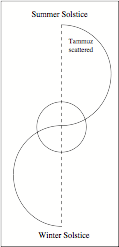
"We get more clues as we move ahead," Rose says. "More clues about this personality which the Old Woman calls Fohat. If Tammuz is Fohat, Tamuz also seems to be Michael -- and also yourself. You wrote: 'The Spoken Word; and, in exile, the Written Word. FALLEN, INTO A PIT. The defender of the Father's world. MICHAEL? Who have you beecome? TAMAZ ALSO MEANS "FAITHFUL SON". ' That is what I mean when I say that Tammux is also like you. Because you have become the faithful son, haven't you? Is it guilt for the murder of your father -- the metaphorical murder of your father? I ask that rhetorically. I know it is more than guilt...."
"It is a revelation...."
"That...what? That the world is not safe...?"
"That's part of it."
"Your father would no longer be there to protect you. Who would be there to protect your own country. Your father was gone -- you needed to fill his void...."
"Yes. That was part of it..."
"The Old Woman adds to this 'Fohat' description." Rose reads:
SHE SAID, AS SHE SHOVELED MUD FROM HER WALK:
The First, after 'One', is Divine Fire. The Second is Fire and Ether. The Third is composed of Fire, Ether and Water. The Fourth of Fire, Ether, Water and Airr. The One is not concerned with the man-bearing globes, but with the inner invisible spheres. The First-Born are the Life, the Heart and pulse of the Universe; The Second are Mind and Consciousness itself.
IS THAT ALL SHE SAID? Certainly more -- but who wants to hear it? No one comes around this time of year to hear the tales. Gales torturing the rock with their stories. Stories of lost love, broken hearts, angry weather. I hear nothing new and nothing old and nothing storied. New laments are only old shoes filled with rocks. I SEE, YET REALLY SEE NOTHING. Because the First is merely Life, without Mind, it commits attracoties -- because it is the Struggle for Existence. Life takes a Life. nature. Youths fight to see who is strongest. Old world conquers Older Worlds. New World conquers Old. PLEASE DO NOT GIVE ME SPIRITUAL JARGON. Holy Men need not apply? I SEE -- AND, IN SEEING, SEE NOTHING. You grow impatient, for there is no light. LET THERE BE LIGHT, HE SAID. AND HE WAS THE LIGHT. DUAL LIGHT: HIGH AND LOW. Thou and thee. He and me. YES. ALPHABETHCHEBEL. Approaching the Father's Day. MOTHERSDAYHASBEEN. Prepatory to mass appeal. PITRIS AND SUNDRY. Sunday and Saturday. The 'One' is the Non-Manifesting Logos. The One from the 'One' is Microcosmos, or Man. That is, the Manifesting Logos. AND, OF HIM, THERE ARE SO MANY. S you say. BUT WHAT DOES THE RABBI JEHOSHUAH SAY OF THIS. He speaks of the 3 Divisions of the Soul. AND HE SAYS:
Nephesch is Life, the Vital Spirit. Ruach is the Intellectual Spirit; Neshamah is the Soul proper. Nephesh is the fallible part, and is capable of sin. Neshamah is attached to God. It is said that some persons are judged worthy to possess a Neshamah; others a Ruach only; while yet others have a Nephese and Ruach only; while yet others have a Nephesh and nothing more. The nephesh alone is necessary for a man's existence. If he comports himself worthily with this gift, another spliritu is poured into him, which is like a 'Crown' of Nephesch -- and this is Ruach. The man is then illuuminated by a light from a superior realm, and then can discern the Laws of the Secret King. If he still continues worthy, he receives the 'Crown of Ruach' -- and this is Neshamah, which is also called the Soul of God.
Neshamah is the only part of which pre-existence, paradaisical life, and the Divine Vision, can be predicated. Neshamah does not come down and incarnate at birth in any human being. When Neshamah leaves the celestial region and comes down toward the Earth, it is joined tot he Intellectual Spirit, of Ruach; after which both are attached to the Spirit of Life -- that is Nephesh. The Spirit of Life (Nephesh) and the Intellectual Spirit (Ruach) dwell together, and depend one upon the other. Neshamah (the Soul), on the other hand, is dependent of both.
Nephesh is that Soul which forms the Body and which presides ofver the propagation of beings. Ruach is that Soul which causes Nephesh to act and determines its type of action; Neshamah is the Supreme Force issuing from the Tree of Life. These three degrees separate after death, each returning to its place of origin. Nephesh is said to remain in the tomb of Earth. Ruach passes to the Earthly Paradise, where Michael, the High Priest, offers it as a holocaust to the 'Holy One'. It remains in theis Paradise for a time; then it returns whence it came, because the Spirit, Ruach, goes back to God who gave it. Neshamah ascends on high, returning to the Tree of Life.
Abraham represents the Soul of Souls; Sarah is the Soul; Isaac is the Intellectual Spirit; and Rebecca is the Principle of Vitality.
I SEE. How much deeper will I go? AS DEEP AS YOU WISH. But I can't even swim. IT IS ALSO SAID THAT THE MAN IN POSSESSION OF THE SOUL WHICH REFLECTS THE FOUR LETTERS OF THE SACRED NAME JEHOVAH IS 'THE IMAGE OF THE HEAVENLY MASTER'. OF HIM IT IS SAID: 'HAVE DOMINION OVER THE FISH OF THE SEA.'
"For some reason, this kabbalistic description makes a world of sense to me," Rose says. "It seems less obtuse that Blavatsky's writing, steeped, as it is, in mythological connections. Intentionally obfuscated, it seems to me. This seems pretty clear. Neshamah comes down to Ruach; Ruach comes down to Nephesh; Nephesh separates from Ruach. Nephesh is the life-force of the body. Nephesh commits sin. Nephesh comes around on the arc. It eventually re-unites with Ruach, the Intellectual Soul. The Life passes out of the Nephesch, eventually, into the Ruach. Eventually, the Ruach, the Intellectual Soul, passes into Neshemah, the Soul of Souls..."
"It is the same doctrine as Blavatsky's," Crossmann says.
"Yes -- but more understandable."
"Yes; it is quite clear in this passage. But without all that which has led upt to this, it would not be clear," Crossmann says.
"Then you find new adversaries -- and an old ally," Charlie says: "You write: 'ERRATIC WOMEN AND IRRATIONAL PREDUCTIONS OF DOOM. These hippie children pray for a police state, so they can be right in their obsession with horror. YOU LOOK TOWARD ABRAHAM LINCOLN..." You are turning against the New Age Movement again....You say that hippie children pray for a police state. Why...?"
"They are intolerant in their view of their own righteousness," Crossmann says. "They have no respect for dialogue. They want the world their way. They are communists at heart. They support the communists -- which are, in every form on Earth, police states...."
"And Lincoln?"
"Lincoln stood for the Union."
"So you have thrown your weight behind those who would support the empire -- rather than dismantle it?"
"Divorce, or secession, is not acceptable," Crossmann says.
"And the irrational women and the hippie children, theoretically, support the dismantling of America?"
"In many cases, at that time," Crossmann says.
"'Paranoia and the act of empire.' That seems to be how you describe the two sides, this duality. Let's keep going." Rose continues to read:
Paranoia and the act of Empire. I HAVE DIED SO THAT YOU WILL NOT NEED TO. Yet they do not listen. NO. I burn them with my firery words, and offer them up, as souls, to their God. MICHAEL, THE HIGH PRIEST, YOU MEAN? What? YOUR FIERY SPEAK OR YOUR FIERY SPEAR? I forget which. AND GOD SAID: 'LET THERE BE LIGHT.' And there was Light. ADAM KADMON WAS THE LIGHT. AND THIS DUAL-LIGHT ILLUMINATES THE WORLD. You almost said 'eliminates' the world. THAT WOULD HARDLY BE ACCURATE, SINCE THIS LIGHT IS CREATOR. Creator; and, also, Destroyer. YES. IT IS TRUE. Haves against have-nots. OSTREYGODS GEGAN FISHEYGODS. The Crazies run the ship of state. WHO GOES THERE, IN THIS CHILIAD OF TALES? The iliad of folklure; and the constable that commeteth. WHO ARE THESE TWO BROTHERS...?
"This questions ins't ansswered immediately," Rose says. "Instead, we have a passage from Blavatsky's Secret Doctrine -- and with commentary by the Old Woman on the nature of Fohat...."
Rose reads:
STANZA III
Then Svabhavat (self-existent, active condition of the essence) sends Fohat to harden the atoms. Each of these is a part of the web (the Universe). Reflecting the 'Self-Existing Lord' -- Primeval Light -- like a mirror, each becomes, in turn, a world.
AND THE WOMAN SAID, IN EXPLANATION: Fohat hardens the atoms by infusing energy into them; he scatters the atoms or primordial matter -- that is, he scatters himself while scattering matter into atoms. It is through fohat that the Ideas of the Universal Mind are impressed upon Matter.
"Then an Arab comes in to the picture," Charlie says.
"Yes, Massoud."
"A friend of yours?"
"Yes. We were friends. We were acquaintances. I knew him for many years," Crossmann says. "He was always very placid, very careful about what he said. Then, one day, after months of frustration at trying to find a teaching job, he turned to me with a mad glimmer in his eye, showing me the real Massoud: 'We need to do what they did in Iran,' he said. 'Chop off the head and start all over again...!'"
"You felt that that was the real Massoud, instead of an abberation, because of his frustration?"
"He was always ingratiating, careful what he said," Crossmann replies. "Careful not to alienate anyone. But there was something going on under the skin...."
"He also said he hoped Libya had a nuclear weapon," Rose says. "He was obviously a frustrated man, both in his personal search for work; and probably politically, after Israel's move into Lebanon...."
"Yes."
"But you snap at him. You say: 'Iran is the last model we should be inspired by. Iran has nothing to teach us. Immigrants who bring their old world with them must leave that old world behind. If you seek some form of righteous murder, then you should go away. Go back to your own country...!' You begin to lose patience with foreigners...."
"Anti-American foreigners should go back home," Crossmann says. "We don't need them here...!"
"You call this: 'The coming in of rats. Vagabonds on parade...' You begin to turn against vagabonds too, don't you?"
"Eugene was full of dark creatures living in alleys, people like Gilbert," Crossmann says. "Aggressive panhandlers. Drug dealers. Dark forces. The light was very dark -- and the demons were, thus, illuminated..."
"Did you not feel compassion for the unfortunate?" Rose asks.
"For the unfortunate, yes. But for the unruly, the criminal, no," Crossmann says.
"But Massoud was not a criminal, simply because hehad criminal thoughts," Rose says.
"I grew weary of the intellectual posturing, and the anti-Americanism," Crossmann says. "To be anti-American, one needed to willingly blind oneself to the crimes of the other system. Worshipping foreign gods -- that is what this is all about. Believing that the foreign is always better than one's own reality. Idealizing the distant; and condemning the local..."
"So you were coming back to protect the local?" Rose asks.
"Yes."
"Having worshipped the foreign gods," Rose says, "you were coming home, like Odysseus, coming home to protect your wife and home.... You write:
STANZA IV
1. Listen, ye Sons of Earth, to your Instructors -- the Sons of the Fire. Learn there is neither First nor Last; for All is One Number issues from No Number.
SOMETHING OPENING, BUT NO PERCEPTION. AT MY DESK, LOOKING FOR AN ISSUE. CHILD OF MY BRAIN AND BRAN FOR A NEW DISTURBANCE. TO HAVE AND HAVENIGHT. CHILD OF FORTUNE; CHILD OF SIGHT. THE STOOGE OF GREED. DISREPUTABLE INCARCERATION. The soliders of Light and the derelicts of Darius. NOT KNOWN FOR THEIR RESEMBLANCE. Memories a'light: loving pictures of the past. ABRAHAM LINCOLN. Father of the few. GRECO-SHAKESPEAREAN DRAMA. To Whom do we listen? ONE BROTHER TAKES AIM AT THE BANKS; THESE ARE HIS SCAPEGOAT. The Bankers and the Jews? BUT IT IS NOT US. WE ARE NOT GERMANS. Saturn holds a candle to Mars. BEGINNING THE NEW BEGINNING WITH YOU. The number 11. The number 11. 11 times 11 equals 111. I SEE -- WHAT ELSE? Shulamit, nee Lotate, walks by down the avenue. I feel love for her. A welling compassion. I SEE. My role has been to defend the women and children. Is that not so? Is that not what my view was? THE OLD WOMAN SAID:
The Sons of Fire or the Sons of the Fire-Mist are connected with the great primordial mystery; they are the Hierarchy of Flames, who preside over Time. With these verses the mystic sense of the Solar and Lunar symbols are expressed: the Pitris are Lunar Deities and our ancestors because they 'created the Physical Man'. The Agnishwatta, the Kumara (the 7 Mystic Sages) are Solar Deities, though the former are Pitris also: these are the fasioners of the 'Inner Man'. The Sons of Fire -- because they are the First Beings -- in the Secret Doctrine they are called 'Minds' -- evolved from the Primordial Fire.
Fire is Aether in its purest form; hence, it is not regarded as Matter, but is the Unity of Aether -- the Second Manifested Deity. yet, there are 'Two Fires': the first is purely Formless and Invisible Fire concealed in the Central Spiritual Sun; it is often spoken of as being 'triple'. The Second Fire, of the Manifested Kosmos, is regarded as Septenary, thorughout both the universe and our Solar System.
THE LUNAR LORD, THEN, ARE CONNECTED WITH NATIONALISM -- AND WITH THE RE-BUILDING OF THE NATIONAL BODY? WITH THE FIGHT FOR LIFE, THE INSTINCT FOR SURVIVAL, AND REPRODUCTIVE GENERATION -- THE NON-UNIVERSAL, PARTICULAR PERCEPTION? IS THAT WHAT SHE IS SAYING? Or the reverse perhaps. What does it matter? IT MATTERS TO ME! She seems to say that the Sons of the Fire spaek for universal rule; while the Pitris, the Sons of the Earth and Moon, speak of the First and the Last....
"So we have more of the occult differentiation between the Lunar Fires and the Solar Fires," Rose says, "which is another description similar to the kabbalistic Nephesh, Ruach, and Neshamah. The Lunar Light goes first, building the body; the Solar Fire comes next, the Mind, and, eventually, the Soul last. I say 'first and last'....
"You are clearly lunar then," Crossmann says, laughing.
"But we are clearly talking, here, about the circle," Rose says, smiling. "I think I am probably more Solar than Lunar..."
"A universalist?" Crossmann asks.
"Well, I am liberal on most issues -- but I try not to be naive about people," Rose says. "Liberalism now has a bad rap because it suggests a certain naivete. A world-view that is a bit rose-colored..."
"Idealism about others," Crossmann says. "And self-condemnatory..."
"And the reverse is?" Rose asks.
"Idealism about oneself. And condemnation of foreigners..."
"This seems like a pretty deadly trap. Jesus or Napoleon...?'
"Jesus and Napoleon. Napoleon first; and then Jesus Christ," Crossmann says.
"First and Last," Charlie says. "So, is this the two aspects of the soul: Michael the Archangel and Jesus Christ...?"
"What do you think?" Crossmann asks.
"Provocative stuff -- that's what I think," Rose replies.
"Of course, the kabbalistic text of Rabbi Jehoshuah says pretty clearly that the Nephesh, the Body of Passions, is not accompanied by the higher soul. The Body of Passions goes down alone. It is this body, alone, which commits sins. This body is reattached to the Ruach, the Intellectual Mind, later, as it evolves back toward the soul, back out of the body. That is the Triple Man: Body first, emanated from the Soul; Intellect next, which is attached to the Soul; and the Soul last, which is the body of the highest spirit in heaven..."
"So Nephesch is the Fallen Man?" Charlie asks.
"That is how it seems," Rose says.
"And you sing the praise of Fallen Man?"
"I sing the praise of the Totality. The Fallen Man was an angel and will be an angel again."
"You sound like some Prometheus, defending Man against the Angry Gods," Rose says.
"And against the angry women."
"Yes. The maternal ogre clearly comes back in. The Feminist-Lesbian, which you call Lilith... I got a kick out of the line 'The soliders of Light and the derelicts of Darius.' Because this continues your theme of Massoud, the Iranian, the Persian, the erstwhile friend of yours -- Darius being the King of the Persians who led an army against Athens. The Soldier of Light were the Athenians; and they defeated the Persians despite being severely outmanned. In this context, obviously, the soldiers of Light probably refers to yourself and to angels of light you are arranging in heaven to destroy the Iranians...."
"Probably so," Crossmann says, laughing
"Derelicts are, of course, the dark figures stalking the alleys of Eugene. You know, it's very interesting how this is all pieced together. The construction is very complex.... You then come back to the idea of refrigerative contraction -- connecting this to Fohat -- and connecting to the structure of this 'Night' scene, this Night scene of mass contracating and becoming hot through constriction.... You write: 'SO WHY DO YOU SPEAK AT ALL? Growing impatient at the freeze. Heat generated by refrigerative contraction. The hardening of Fohat. The pleasuredscreaming of the girl-next-door. The tightening of the stomach. The hunger for dream and the hunger for food -- who fears the coming of the wing of abyss....You ask what we are all asking: Where is the damn Conductor, to help get us out of this place...?'"
Rose reads again:
WHERE IS THE CONDUCTOR? The Conductor to the Emperor's House? WHO ELSE? I do not know. MUST I LOOK FOR HIM? For immortality, you mean? YES. Yes, you must look for Him. And when you find Him, He will be gone. I SEE. I see ravens dive at people from their trees. Angry, aggressive black horrors. Screeching, and diving to devastate intruders....
"Then Dolores visits you," Rose says. "The same Dolores who gave you the first Alice Bailey book. Dolores, clearly, was a conductor of sorts to you. A guide. But she was always, to you, an emblem of Chaos, that -- what did you call it? -- that maternal ogre, a Lilith figure..."
"She wasn't Lilith to me," Crossmann says. "Dolores had a very good heart. She was very generous. She was a good person. But she could not controll her water. She was like a walking sunami. The kind of wave who could swallow you up and drown you..."
"And you were a fire-sign, a Sagittarean," Rose says. "And water is very dangerous to fire...."
"Dolores was, in many ways a guide," Crossmann says. "And, even more, an emblem. She appeared when the darkness set in -- and she gave me The Treatise on White Magic -- and she is now appearing again when the darkness is losing its power..."
"She is a kind of Venus figure, I suppose," Rose says. "The Evening Star and the Morning Star..."
"She was clearly chaotic female energy," Crossmann says.
"A witch," Rose says. "You called her a witch earlier."
"She called herself a witch," Crossmann says. "In a different era, she probably would have been burnt at the stake..."
"And you are in the process, yourself, of turning against the witches," Rose says. "The Liliths. The powers that your believe are darkness...."
Rose reads:
The crazy Virtues and the crazy Humanity. DOLORES VISITS YOU. Yes, Chaos Incarnate. Stirring up the pit of the seas. The undercover water and the embellishment of crazy sexuality....SHE SEES YOU AS A POTENTIAL HUSBAND. SHE IDEALIZES YOUR NATURE, AND DREAMS THAT YOUR ARE HER SAVIOR. She longs for her qualities to be recognized in the world of men. SHE SPEAKS OF HER STRENGTH OVER MEN; SHE WEARS SUPERMAN'S T-SHIRT. She admits that she is Death to Man. YES. I SEE. She resents the man who doesn't offer her sex. YES. The Great Mother Incarnate, demanding her seed. AND THOSE WHO REFUSE? They are sent to the deep, where ravens dive at their heads, to whom the dmons come to call. I SEE. Self-judgement; and annihilated reason. AS I SEEK TO BECOME GOD, SELF-CONTAINED, SELF-MADE. And Jehoshuah takes you the the land of angels. WHO ARE THEY? Ask Jehoshuah. WHO AR THEY?
The Archangels of the Briatic World, the World of Creation, the World of Elohim, are usually enumerated thus:
I. Metatron, Angel of the Presence, World-Prince, who corresponds to Kether.
II. Raziel, the Herald of Deity, who corresponds to Chochmah.
III. Tsaphkiel, Contemplation of God, who corresponds to Binah.
IV. Tsadkiel, Justice of God, who corresponds to Chesed.
V. Samael, Severity of God, who corresponds to Geburah.
VI. Michael, Like unto God, who corresponds to Tiphereth.
VII. Hamiel, Grace of God, corresponding to Netzach.
VIII. Raphael, Divine Physician, who corresponds to Hod.
IX. Gabriel, Man-God, corresponding to Yesod.
X. Sandalphon, Messias, the second phase of Metatron, corresponding to Malkuth.
The World of Yetzirah or Formation is said to be the Abode of the Angels, who are divided into Nine Choirs.
I. Hayyoth Ha Kadosh, the Holy Living Creatures of the Animals of Ezekiel and the Apocalypse, corresponding to Kether (and to the Christian Seraphim).
II. Ophanim, or Wheels, also mentioned in Ezekiel, who correspond to Chochman (and to the Christian Cherubim).
III. Aralim, or Mighty Ones, corresponding to Binah (and the the Christian Thrones).
IV. Hashmalim, or Brilliant Ones, corrresponding to Chesed (and to the Christian Dominations)
V. Seraphim, or Flaming Serpents, corresponding to Geburah (and to the Christian Powers).
VI. Melachim, or Kings, corresponding to Tiphereth (and to the Christian Virtues.)
VII. Elohim, or Gods, corresponding to Netzach (and to the Christian Principalities).
VIII. Ben-Elohim, or Sons of God, corresponding to Hod (and to the Christian Archangels).
IX. Cherubim, the Seat of the Sons, corressponding to Jesod (and to the Christian Angels).
The Tenth Order required to complet the Sephirotic attribution is found in the Ishim, or beautified souls of the just man, who corresponds to Malkuth an to the great multitude of the redeemed as seen by St. John in the Apocalypse. These orders are also summarised in the notion of a Third Adam, yetzirah, represented by the Malkuth of the Yetziratic World -- that is, Man in the likeness of the Angels -- or, in a word, Adam Microprosopos.
NEW PLAYERS IN THE DRAMA. Old playeres, new names. THE FIRST-CREATED CREATORS, YOU MEAN? Who knows where the Time goes...? AND THE ETERNAL LOVERS BATTER ONE ANOTHER ON THE OTHER SIDE OF THE CEILING. Calls of pleasure and cries of anger. Intermixed like fruit. Calling out for extinction. I SEE.
"Then we have this wonderful drawing of the Kabbalistic Tree of Life," Charlie says. "It is June 17, 1983. We are approching the Summer Solstice. And we are just about to experience material differentiation again, another Day cycle, in the novel. Fohat, apparently, is about to harden and scatter the atoms into individual, egoic worlds. The Mass is about to be scattered..."
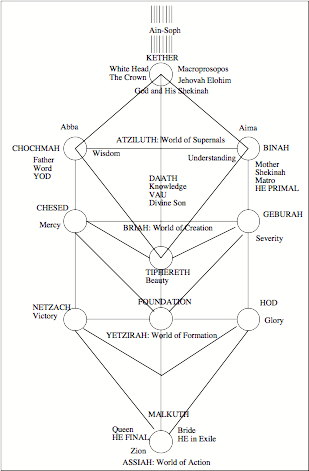
Brothers Grim, and hardly Gram. YES, I KNOW OF GRAM, AND OF HIS FIXER, REGIN. I see. What else do you know? PRECIOUS LITTLE, TO BE SURE. A POPE IN A HOMELAND. A PENDANT ON A TREE. CENTRURIES BEYOND DELIVERANCE. WHERE DOES IT COME FROM? WHO HAS ITS NAME? TORCH-SINGERS IN A CLARIFIED CLEARIFIED MEANING. Tolodeo nomads. Rain falling on silent cabbages. WAITING FOR THE LIGHT -- WITH SOME DISPLAY OF WHAT IS HORRIBLE. Anticipatory anguish. PERHAPS. OR MAYBE THE CALL OF THE WILD IS RARE. How dense can you be, Michael, connected with your Tiphereth? WHO ARE THE SHADOWS WHO HAVE FALLEN FROM THE BOAT? The grim reaper and the grimy sea-parr. MOONLIGHT, IN C, FALLING ON A WINDOW. Jacob Heimkreiter's daughter's window. WHAT WAS HER NAME? AS THE RAIN IN JUNE FALLS MOSTLY ON THE PANE. His daughter was a beauty who became a Hunting Girl. HUNTING IN THE COUNTRY OF LESBOS. I believe you touch a nerve with your probing DENTAL INCENTIVE; A MENTAL INCENDIARY QUESTION, WHICH ROCKED OUR OLD JACOB WITH WORRY. And nothing came of it? OF WHAT? Of the inquiry. NO. NOTHING. ONLY SPECULATION. A dangerous pastime: Speculation. Yet not without its pleasures, I say. I AGREE. ABSOLUTELY. Perhaps coming out of darkness. DIANA WAS HER NAME. PLEASE, A NEW PICTURE IF YOU WILL.
(Enter Choir of Nine. Separate Voices Speak)
Choir of Nine
-- The Lord is a consuming Fire.
-- The Lord shall be revealed with this mighty Angels in flaming fire.
-- The Holy Ghost descended on the Apostles like cloven tongues of Fire.
-- Vishnu will return on Kalki, the White Horse, as the Last Avatar, amid Fire and Flames
-- Sosiosh will be brought down equally on a White Horse, in a tornado of Fire.
-- And I saw Heaven open; and, behold, a White Horse, and he that sat upon him was the Word of God.
(Three angels are silent.)
Michael, the Clerk
Coming out of some sorrow is like walking in from the rain. Accusations that we are guilty. Self-accusation; and self-condemnation. Central America. Our sins and our fatherssins. Evilisasevildoes. Yes. WILL YOU WITHDRAW FROM THE WORLD, THEN -- NOW THAT YOUR CONSCIENCE IS GUILTY? The shell breaks down. You push the truth away -- but now it breaks down to you. WHICH IS CORRECT? I do not know. Yes, guilt. I am guilty. Yet, who is not guilty? Who is not evil? Power is, by its very nature, evil -- yet someone grabs it, someone wants it, the cold steel bar. YOU BATHE IN COLD WATER. Some middle-aged Jewish woman tells you that you should marry. She wants do introduce you to her daughter. THE THEME OF MARRIAGE. BE FRUITFUL AND MULTIPLY. Have you fallen from your power? OF COURSE. Where do you wish to go? I DON NOT SPEAK; AND NO ONE KNOWS. Both Good and Evil. Standing alone in this world. Standing alone against the world. Better than the world. Better than the others. YES, A TARGET FOR THE MOBS. Will you give in to the woman? I DON'T KNOW. WHAT IS TRUE? TELL ME WHAT IS TRUE. Is Love true? PERHAPS. WHAT IS IT THOUGH? Love? Love is....I am not certain what it is. Perhaps it is self-sacrifice. YET ALL IS SELF-SACRIFICE. Yes, self-sacrifice drives the world. That is, desire to die for a cause. To which we sacrifice our being. Giving ourselves to our God -- in whatever name. In the name of love for this or that we place ourselve upon the pyre. YOU EVOLVE BOTH MINDS. THE ONE WHICH REBELS. AND THE ONE WHICH DEFENDS. THE NEW ORDER. AND THE OLD ORDER. Perhaps. Yet which is which? DEATH TO EACH IS LIFE TO THE OTHER. A crow outside a window. DO THE HORDES MASS AT THE BORDER? Is it your imagination? Or merely your justification? DISMEMBERMENT OF THE BODY IS THE WORK OF THE CANCER CELLS -- IS IT NOT? What are you suggesting? HAVE YOU COME ANYWHERE AT ALL? The Universal and the Particular. SANDWICHED BETWEEN TWO MIRRORS. DISTANCE, TRAVEL, BEING THE ILLUSION. What? SHARING AND GREED. Freedom and persecution. NO SIDE IS RIGHT. NO SIDE IS CORRECT. THOUSANDS ARE MURDERED IN AFGHANISTAN. THOUSAND ARE MURDERED IN CENTRAL AMERICA. ALL IN THE NAME OF RIGHT. ARAB KILLS JEW. JEW KILLS ARAB. HONDURAN KILLS SALVADORAN. AFRICAN KILLS AFRICAN. WE SEND ARMS TO SUPPORT A SYSTEM OF FREEDOM. WE CALL IT FREEDOM; THE OTHER SIDE CALLS IT SLAVERY. A NEW CLASS OF LORDS, BASED ON PARTY HIERARCHY. A NEW CLASS SYSTEM, TO REPLACE THE OLD. DO YOU STAND BY YOUR OWN NATION, IN GOOD AND BAD, FOR GOOD OR BAD, RATHER THAN TURN TO ANOTHER WAY? IT IS A QUESTION I MUST ASK? You are undergoing death. You must learn to die with dignity. WHO DIES; AND WHO IS BORN? Fohat hardens; and the elements, his brothers, the other sons, are severely scattered. I SEE. Through the power of energetic self-expansion. I SEE. So to speak. COMMUNISM IS DEATH. Yes. THE INTELLECTUALS DESIRE DEATH, THE ABSOLUTE ORDER OF DEATH. Yes. AND, SO, THEY ROMANTICIZE THE ORDER WHICH ENSURES THEIR OWN DEATH; THUS, THEY ARE PROOF OF THEIR OWN SELF-SACRIFICE. Yes. THE JEWS' GOD KICKS THEM OUT OF HEAVEN IN THE BEGINNING, BUT WELCOMES THEM BACK IN THE END. IS THAT TRUE? The Creators are good and bad. Good in the beginning and bad in the end. Perhaps Israel and America shall stand together in the end -- stand alone against the world. For good or bad. For both good and bad. IN RICHES AND IN POVERTY. In sickness and in health. I SEE. I C. Ic homo nomine domine. THE PARADISE ABOVE RESIDES IN BINAH, THAT IS, IN THE ATZILATIC WORLD. THIS IS THE WORLD TO COME. THE PARADISE BELOW RESIDES IN MALKUTH -- IN THE ASSIATIC WORLD. THIS IS THE WWORLD AS IT EXISTS TODAY. THE LIFE OF THE EEARTH. THE EARTHLY PPARADISE. Pair of dice, you say? WEP -- WHAT DOES THAT MEAN? PEW: Fall on your knees. Oh, hear the angels' voices. Some great end may be coming...
STANZA IV
2. Learn what we, who descend from the Primordial Seven, we, who are born from the Primordial Flame, have learned from our Fathers.
AND WHAT DOES MADAME DEMI-MONDE SAY ABOUT THIS? The half-world Woman? PRECISELY. ALTHOUGH EVEN MORE PRECISELY, MADAME DIAMETER-TO-CIRCUMFERENCE, PLEASE.
The distinction between the Primordial and the subsequent Seven Builders is this: the former are the Ray, and the directin emantion of the first 'Sacred Four', the Tetraktis -- that is, the eternall 'Self-Existent one,' eternal in essence, not in manifestation, as distinct from the Universal One.
Latent during Pralaya, and active during Manvantara, the 'Primordial' proceed from the Father-Mother; whereas the other Manifested Quaternary and the Seven proceed from the Mother alone -- that is, the Immaculate Virgin Mother, who is overshadowed, not impregnated, by the Universal Mystery, when she emerges from the state of Laya or undifferentiated condition.
The first 'Primordial' are the highest Beings on the Scale of Existence, the Archangels of Christianity, who refuse, as Michael did, and as did the eldest 'Mind-Born Sons' of Brahma, to create or rather to pro-create or multiply....
I SEE. AND FOR YOUR SELF. I dreamt and a Father-Figure brought to me Shulamit and said that i should marry her. MARRIAGE IS EVERYWHERE. Yes. AND YOUR THOUGHT? I stroke her thigh and thought: this would not be such a horrible fate. AND YOU WROTE A LETTER TO DAPHNA. Yes. And I sent with the letter a poem. YOU MUST TELL ME IT. Yes. And I thought of America as Libra -- the Liberator. I SEE -- YOUR EYES ON POLAND. AND WHAT OF THE HIGHER SPHERES? And you thought of the Alphabet. YES. And you thought of its meaning. YES. Patriarchy. YES. And I saw that I must walk through the 7 lands of each kingdom to find that secret meaning of this doctrine. IN THE KABBALA, IT IS SAID THAT EVIL (THE TREE OF KNOWLEDGE OF GOOD AND EVIL) IS CONNECTED WITH THE WRITTEN WORD; WHEREAS GOOD IS CONNECTED, RATHER, WITH THE SPOKEN WORD. I see. AND A DISTINCTION IS MADE BETWEEN EVIL WORKED BY A MAN AND EVIL WORKED BY GOD'S WORD. I see. THE POEM IS TITLED 'A DOCTOR'S WORD'.
I.
Tumult walked in the world on a shield.
Bundles of wheat were left beside a station.
Two ministers debated the reality of unseen ghosts.
While a ttnage girl in labor
Coaxed the child out of her tomb.
A doctor's word is worth two grams of tea,
When taken rightly by the patient,
When taken lightly as a cure.
Laughter.
Yes, apparently even cows can laught
At rich wit.
It was a time of sorrow truly;
Yet, some could laugh
To make the day new.
II.
The doctor said: 'It is not enought that you be right;
You must also be well.
And, to be well, you must smile.'
He told me this as he looked at my poetry.
Each night, in the factory's bright gases,
I would light wonderful visions
In the forge of my creation.
You see, my mind is a factory of sorts,
Fueled by my arid fears,
And eloping with beautiful queens.
You ask my name.
I am the dean of the Autumn;
I am the lad of compulsion.
And when the doctor's mistress passed today,
I bowed to greet her
For I knew that
She was Wisdom.
"I am not going to spend much time on this poem," Rose says. "Night is ending. Clearly this is a landscape of angels, a nightscape of angels. You then provide a long symbolic definition of both the letter A and the number One. You know a woman at work, at the high school, named Gail, who apparently is being tortured by her own monster..."
"Yes. Gail Z. Her last name began with a Z. I don't remember the name now. But she was a lesbian. And she had some kind of relationship with a woman in the past. And now this woman was calling her at home, threatening to kill her...."
"You conclusion is that many souls were meeting their demons, their fears, in combat at the same time," Charlie says.
"Another man I knew at the school, Robert Swim, another gay man, was also being tortured by a former lover from California, from a distance," Crossmann says. "He would call the police from California and say that there was a burlary going on. And he would give them Robert Swim's address; and the police would burst in on Swim. He called Robert's parents and told them that Robert was dying of aids. He told him he was going to send him a letter-bomb. Then he sent many packages, one to work -- and we had to call in the bomb squad. He told Robert he was going to personally kill him, on a specific day. And the school was full of undercover policemen on that day...."
"This was all happening at the same time?" Rose asks.
"I believe that we all were confronting a personal demon -- the Night that didn't want to die -- that wanted to hang on and drag us down..."
"The ones you call 'the bogus men of black and night' -- like your own Gilbert. Then you write..."
Rose reads:
The darkened hollow men of the deepness of Winter are hidden by the light, are destroyed by the coming Sun.... I talk to men, preparing them for a battle, directing their eyes away from the abstract elegance. It is easy to be universal when you have no children. For then there is no one to protect. No future for which to be responsible. If you have children, then, when you condemn your family, your nation, for its past transgressions, you condemn your own children to a lack of will: and invasion. So, those who have children tend to protect their children with their own wills, tend to build a peaceful world which their children can inhabit. Then the doctrine of the lamb is replaced by the doctrine of the chosen people. I SEE. The Men of Earth are, by their very nature, more evil than the Men of the Air, because the Men of the Air, the Men of the Ideal, exist in a Timeless Sphere, wherein everything is clear, and not punctuated by Time. Yet the Earth is Time -- hence, the Ideal is broken by the turning of time. Clarity is not so available down on Earth. Idealism is punctuated, and shaped by Practicality -- that is, survival in a some times hostile world. The Idealists rule heaven because they do not have to rule the Earth. When Idealists fall to rule the Earth, the Ideal is lost as they fall into Time. YOU HAVE IDEAS OF YOUR OWN? Sometimes. YOU BUILD YOUR BODY FOR A FIGHT AND FORGET TO STRENGTHEN YOUR OWN WORDS. Perhaps you are right. Yet, to see clearly the nature of Ideas, one must purseu Death, Depression, Blackness. What of Life? I say. I have pursued Death for so long; yet, not long ago, I was pulled through a line of fire into the next world, the theological. VICO'S FOUR SEASONS. Theologoical Spring. Aristocratic Summer. Democratic Autumn. Chaotic Winter, marked by individualism and sterility. THUNDERTHOR BANGS ON THE DOOR. HE WHO OPENS THE DOOR ALSO MUST CLOSE IT. DALATH AND DELTA BEING 'DOOR' AND THE 4TH LETTERS. THE 4TH RAY BEING DAWN AND DUSK. THE RAY OF ART AND HARMONY THROUGH CONFLICT. 4 being the number of the scribes: the Chronicles of Ether. ESTHER'S CHRONICLES. THE BODY-GARMENT OF ECCLESIASTES. THE WHITE HORSE AND THE ARCHER. WHERE NO MAN HOLDS A CANDLE TO THE RAIN. Joseph Smith was born in Sharon, Pennsylvania. Is that not true? WHAT ARE YOU TRYING TO SAY...?
STANZA IV.
From the effulgency of Light -- the Ray of the Ever-Darkness -- sprung in space the Reawakened Energies, the Dhyan Chohans, Elohim, Archangels: the One from the Egg (Zero), the Six and the Five (1065); then the Three, the One, the Four, the One, the Five (31415) -- the Twice Seven (14), the sum total. And these are: the Essences, the Flames, the Elements, the Builders, the Numbers, the Arupa (formless) , the Rupa (with bodies), and the Force or Divine Man -- the Sum Total. And from the Divine Man emanated the Forms, the Sparks, the Sacred Animals, and the Messengers of the Sacred Fathers (the Pitris), within the Holy Four.
"So, this begins the doctrine of Practicality, of Building the World," Rose says. "You have brought Mormonism in to the picture too, the real American Religion...."
"It has been in the novel for awhile," Crossman says. "Moroni is the guardian angel of Joseph Smith, the Angel of Revelation of the Book of Mormon. He has also been in the novel; but not with a significant role. More as a watcher..."
"There is more of the occult doctrine, which, I don't really wish to discuss at this point," Rose says.
"It is abstract."
"It is the introduction of numbers really," Rose says. "And numbers will become even more important in the next section, the final 'Day' of the novel..."
"Yes."
"The you record a dream you have of Shulamit," Rose says. "She visits you at your home. Your mother is there, and your brother. Your mother serves her cocoa. Shulamit wants to take your downstairs. You mother tries to stop you. But you go down; and you make love with Shulamit. Then you discuss the Two Women again, the Two Women who evolve you. The Mother and the Daughter. Higher love; and sexual emotional love. Your mother, in the dream, tried to keep you from going down into your bedroom with Shulamit. Daphna appears to be allied with your own mother, at least in this instance. Then your eye turns back on the Earth. Referring to the women, you write.."
Rose reads:
THEY ARE PEACE AND YOU ARE WAR. THEY ARE CIVILIZATION; AND YOU SOME TIMES HATE IT. Punc refers to punctuation, the Period, the End of the sentence. PUNK ROCK, you mean. PUNKS IN WEST GERMANY FIRST ATTACK A NAZI PARADE OF OLD WAR VETERANS CELEBRATING THEIR DIVISION. NEXT THEY ATTACK BUSH'S CAR WITH ROCKS. Punk rocks or regular rocks? THEY THINK YOU ARE THE NAZIS. Yes -- that's funny. A RUSSIAN FILM WHICH EQUATES AMERICA AND ISRAEL WITH GERMAN SLAUTER OF JEWS. A NEW WAVE OF ANTI-SEMITISM IN RUSSIA. INSPIRED BY OFFICIAL ATTACKS ON ZIONISM. You, yourself, attacked Zionism. You said it was a new Naziism. YES. YES, PERHAPS IT IS. BUT RUSSIAN COMMUNISM IS ALSO A NEW NAZIISM. We are all Nazis. To Gain Power is Survival....YOU TRAVELED THROUGH UTTER DARKNESS. AND YOU WERE TOLD TO BLAME THE JEWS. Darkness is very real. It is a being, a breathing being. WHO IS THIS DARKNESS? The one who wishes to silence everything. ANTI-MAN? YET YOU REBELLED AGAINST THIS VOICE. Was it the voice of God, bidding me do evil? PERHAPS. And I fled, in horror. YET BECAME WHAT HE PRESCRIBED. No. Apparently. YOU BRING WAR TO THE EARTH. YOU STRIKE DOWN THE SHADOW, THE WOMAN, THE EARTH. YOU COME TO SUPPORT THE FATHERLAND, AT THE EXPENSE OF THE MOTHERLAND... The woman beneath clouds, in her garden, tells me names. She says:
It is the Hierarchies and correct numbers of these Beings invisible to us, except on very rare occasions, that the mystery of the whole Universe is built -- that is, the Science of Numerals.
Brahma, the First Male, is formed by the indiscernible Causeless Cause in a Golden Egg (Hiranyagarbha) 'resplendent as the Sun;' and this One Lord of All Beings, the One Animating Principle of Gods and Man, is androgynous by nature; hence, the allegory of Brahma separating himself into two parts, and re-creating in one of his halves (the Female Vach: the Voice) himself as the Male (Viraj).
The Number 1065 is the value of the 'First-Born' (to be, later on, the male and femal Brahma-Prajapati or the Elohim, the Creators). The 'first-born' answers to the numbers 7, 14 and 21.
"I don't want to get into this here," Rose says. "But 3.1415 is PI, the mathematical symbol for the relationship of the circumference of the circle to its diameter. Also, if one adds these numbers, individually, one gets 3 + 1 + 4 + 1 + 5, one gets 14. And if one adds together, individually, the numbers 1065 -- 10 + 6 + 5 -- one gets 21. I'm sure we'll get in to this more later -- but I just wanted to state that at this point as a way of introducing this passage of mystical math that we will be entering shortly..."
"Fine," Crossmann says.
"You quote from Finnegan's Wake again, referring back to this numerical mysticism..."
Rose reads:
THE ONE SPIES ON THE TWO, IS CAPTURED BY THE THREE, AND SETS THE WHOLE TOWN TALKING. Shulamit is the Woman Below, even as Daphna is the Woman Above. Daphna's waters are pure and quiet; Shulamit's waters churn and are clouded. IT IS THE TIME AS MUCH AS THE WOMEN. Yes. YOU FEAR TO GIVE SECRETS TO THE FORCE OF DISUNION. Chaos waits at the gate to despoil me of treasure I found in my diving, which I have kept for some other. I SEE 12 AND 21: IT SEEMS, THE LORD AND HIS IMAGE. Twenty-one and His Michael? WOULD YO REFUSE TO CREATE MEN NOW? AND THEN CREATE REBELS LATER? M is the Roman 1,000: Death; it is the symbol of Millenium. WHAT HAS THAT TO DO WITH ME? You've complicated it all. SO IT SEEMS. Abraham Lincoln -- our Father's Father. PATRIARCH, YOU MEAN? The one world of the Father, in which glory must reside. NEPHESH HEARS RUACH, AND SETS THE WHOLE TOWN SPINNING. I see.
(Enter Conductor, wearing silk, top-hat, carrying a
cane.)
Conductor
So, again I find you lost in dereliction.
Some men come to ask my name
And some men come to beg for fame.
Some come for precious isolation;
Which others indict the world at each station.
Yet you -- you merely me me to increase your fiction.
The Science of Numbers and the dictathong of bones.
All uncovered testimonials ring like bells in a service
Of whalers now gone.
The gate to the castle has been jarred; and the law
Bleeds angry sundry spectacles to the passing of a statement.
Hurry, Michael, grab you plate; and meet the wizard
With his beef behind the tent.
He will feed each mouth which can form
A shuttered word;
He will beggar every document, and eventually might herd
The tired legion which he hoards by metreology of clones....
Michael Crossmann
I do not accept this form. It is stale; indifferent; archaic. I am alive -- can't you see! Your documents of the grotesque, based on absolute rejection of the Present, based on some dreamy notion of Ideals and Times-Past: it is not enough. Give me a better form to work with. Not some clone-work of Goethe (knicker-knockered Germanic breath-holding), or some pandiment of Shakespeare. Yes, you are a poet, of sorts. Although the above inspires me to no sentiment but perhaps fatigue. If you have nothing stimulating to offer me, then, please, go away. HAVE YOU FORGOTTEN ABOUT JACOB HEIMKREITER? Who is Jacob Heimkreiter? JACOB IS THE MAN WHO GAVE YOU LIFE. Yes. I had forgotten. YOU WOULD LIKE TOWALK AWAY FROM THIS TASK. IT MAKES NO SENSE TO YOU NOW. YOU FEEL LOST IN THIS MORASS, AS THOUGH YOU GAIN NOTHING IN TIME. Yes. BUT YOU CANNOT LEAVE JACOB HERE. NOT AFTER ALL OF THIS. Why? HE IS DEPENDING ON YOU TO CARRY HIM BACK TO LIFE -- THAT IS WHY.... My holiness is gone. I am drawn on the chatterwheel. THE POPE HAS GIVEN WORDS TO THE WORLD. Roman in Poland where Jew walks with me. And I saw that those 2 which split at first in the end return and fuse into 1. And I thought of Judaism and Christianity. Marrige of Mother and Child; the Son returning to his Father. YES. I see. SO, YOU WOULD CHOOSE THIS FORMLESS HEAP OVER THE WORDS OF THAT JESTER? Which Jester? WHO WOULD CONDUCT YOUR SLAVING STAEPS BENEATH THE WORLD? I do not know. I hunger for a form in which to live this Day's life-journey; yet I know not which form it should be: a candle to walk by; a wind with which I might shatter down the time. ARE THOSE YOUR ONLY TWO CHOICES? I am not sure. I become angry at my brother for he seems to gloat at the prospect of our demise. HE IS YOU YOURSELF, YOU KNOW, AT A DIFFERENT TIME. Yes. HE SEEMS TO DESIRE THE DEATH OF OUR NATION -- AS YOU DID BEFORE HIM. Yes. AND THE LIVING RESENT THE ADMONISHMENT OF THESE WHO, IN THE NAME OF JUSTICE, WOULD CONDEMN THEIR OWN PEOPLE. Yes. AND SO THE ANGER IS A KIND OF CONSERVATIVE WATCHING. Yes. PREPARING FOR SOME FOREIGN WAR: WHILE THE EMOTIONAL, FEMININE, ELEMENT AT HOME SEES ITSELF, INSTEAD, AS REBELS. The women you meet in dreams are thin emotional matches. THEY ARE MY MATE ON THE PLANE OF PRIVATE WATER. Does this predicate your fall into the waves of their darkness? IT IS THE DESIRE FOR DEATH WHICH I SEEM TO RESIST. AND PERHAPS THIS MAKES ME EVIL OR DARK. I SEE NO GREAT JUSTICE IN THE FALLING OF OUR LAND; AND IN THE RISING TO POWER OF SOME TYRANT WORSE THAN OUR OWN. REVOLUTIONARY IMPERATIVE IS ONLY WORDS OF A MINIATURE TYRANT, ONE HATING DEMOCRACY. A MIDGET SEEKING HIS TURN TO BE GIANT. Why such resistance? Would you offer up your soul to the Devil so you could live for ever? I SEE THOSE MASSING ON THE BORDER WHO WOUDL KILLS US. WE MAY WALK WITH OUR HEADS IN THE CLOUDS AS WE WANDER -- YET OTHRS SEEK NOT OUR NAME BUT OUR DUST. It is your impotence to controll events that makes you angry. I WOULD SCATTER THOSE WHO PROCLAIM DEATH TO BE THE GOAL. Yet, you, yourself, at one time, proclaimed it. You are condemning yourself, don't you see. You are separating yourself from another part of yourself. YES, I SEE. Separating Nephesh from Ruach. I PASSED THROUGH A POINT ON THE WHEEL AT WHICH DEATH SEEMED A REQUIREMENT, EVEN A GOOD. BUT THAT TIME HAS PASSED. THE NEGATIVE MAY CREATE RHYME; YET, IF IT DESTROYS ITS OWN HOUSE, WHERE DOES RHYME STAND? Would you rather have him like this, or have him to be like a Nazi. THE ONE WHO MARRIES HIS IMAGE IS THE MAN AS A LOWER ORDER. Anger at him is anger at yourself. For you created him. I AM ANGRY AT EVERYONE. I WOULD SCATTER THEM ALL, AS DUST TO THE WIND. Whom would you scatter? Those who cannot be strong and aggressive? THOSE WHO WORSHIP DEATH. WHO CANNOT UNDERSTAND THAT SURVIVAL IS ALSO SACRED. Your anger is at the head then? You are the Executioner, I take it? I AM ALL THESE THINGS, AND EVEN MORE. BECAUSE I HAVE DIED, YOU DO NOT NEED TO DIE. BECAUSE I HAVE BEEN PULLED INTO HEAVEN BIR FIERY HANDS, I CAN SHOW YOU WHERE YOU WERE AND WHERE I WAS WERE MERELY DUSKS. Is that the meaning of all this? BETTER TO LET WELL ENOUGH ALONE. Yet, what is well enough? THE MESSIAH IS HANGED; THE MESSIAH IS RESURRECTED. Are you willing to be weak? I DON'T KNOW. He who would save his life shall lose it. YES. Are you able to tolerate; can you be a gentle soul? I AM A GENTLE SOUL. I AM GENTLE WHEN I CAN BE. BUT I AM STERN WHEN I MUST BE. I WILL DESCEND INTO THE NEGATIVE WATER ONLY WHEN THEREIN I CAN WORK AND DO MY BUILDING. BUILDING THE POETIC FORMS; BUILDING THE SCIENTIFIC FORMS. DO NOT ASK ME TO BE DEAD YET. I AM THE CREATOR. DO NOT ASK ME TO BE PASSIVE, WATCHING TREES AS THOUGH THEY WERE ALL I CAN BE. MAN. I SAY 'YES' TO MAN. I SAY 'YES' TO MAN'S BUILDING; AND 'YES' TO HIS FOLLY. I AM NOT BUILT FOR WORSHIP; INSTEAD, I AM BUILT TO QUEST. DO NOT TELL ME THAT I AM EVIL BECAUSE I SPIN AND SHOUT DOWN ABSOLUTE REST. THERE MAY BE NO ADVERSARY IN HEAVEN; YET, ON THE EARTH, THERE IS A FIGHT. AND, WHEN THIS FIGHT COMES, I MUST HAVE GREAT STRENGTH....
(Enter Newshawker with the Evening Times.)
Extra! Extra! Read all about it!
Bride Collapses in Greenwhich, Connecticut, at Dawn...!
"So, is this Fohat then?" Rose asks. "Is Fohat the Angry God of the Old Testament...?"
"We must remember that, in occult doctrine, the Son is born of the Mother and then becomes the Father," Crossmann says.
"I think the reference to Goethe, whom you admire as a writer," Rose says, "is again, to raise the issue of Faust. This theme of Faust is raised again in this long internal monologue, isn't it...?"
"His name is not mentioned," Crossmann says. "But yes. It is raised in the more passive voice which warns him about losing his soul..."
"He mentions many times in the text about God's driving the soul out of heaven in the Spring and welcoming the Soul back in the Autumn..."
"Scattering seeds is clearly an act of Spring," Crossmann says.
"So Fohat is a kind of...what, Johnny Appleseed?" Rose asks.
"He is a scatterer of seeds. He is a strong wind blowing through the society..."
"Blowing the Darkness away."
"The clouds. The night," Crossmann says.
"Why the rebellion against this form of expression?" Charlie asks. "For me it was a huge relief to get back to the differentiated voices, the text with a shape..."
"Yes. But he is being born, now, as a voice of the Present. The form seems to him archaic. Poetry, itself, is archaic to modern America..."
"Do you appreciate that...?" Rose asks.
"No. I think it is a picture of our exile. Poetry is God's language. Prose is Man's language...."
"And broken prose?" Rose asks.
"Well, the prose-poem is an attempt to bridge the two worlds," Crossmann says. "Broken prose would be a picture of a societal disintegration. A society that doesn't care about its language disintegrating will not care about its society disintegrating. But a lot of the disintegration in language in America today is just a reflection of the disintegration of the school system. We've come to tolerate, even justify, failure in our school system today -- we say it's the society's fault, not the student's. Our view seems to be that the less the student has to work, the better. Everything is ok. That's a picture of the feminine element, the Mother aspect, suffocating the school system. Students can be taught how to read, how to do math. We just have to fail them if they don't. Make it competitive again. My generation has viewed competition as something sick, rather than something inherent in existence. My generation has tried to take competition out of education, out of everything. Even in sports: everyone had to play. It didn't matter who won. What mattered was that everyone was included...."
"Too much competition probably isn't healthy either," Rose argues.
"Well, what they have done is lower the standards for everyone. They forget that failure is a very important part of life. They want to pretend that no one is failing. But failure teaches us where to go, by teaching us where we don't belong. The world has many doors, thousands of doors. If every door is open to us, we can make no choices about ourselves. We have to knock on doors that don't open. That helps us find our who we are. They illusion is that pretending that everyone is equal in everything, that there is no failure; and people will learn, later in life, that there is failure in life. And learning to live with failure is one of the most important lessons learn about life. It's better they learn it early than late..."
"So, you don't think the current decline in public education is permanent?" Rose says.
"No, it can be corrected," Crossmann says. "But not by the people who put us in this mess with their soft love. It's time for tough love again. I think we should support vouchers for parents to send their children to private schools if they wish. The public schools have to compete. Maybe then they'll change. Or be shut down. Too many schools, today, are warehousing students, keeping them off the streets. That has to change. It's really important to upgrade schools in the poor neighborhoods of our urban areas. A high quality education will provide an opportunity for students to escape poverty. But they have to be put on a fair competitive level with students from richer districts. If we provide equal access to good education everywhere, then claims of bias and racism will have less a truthful ring. We can't really eliminate racism from people's hearts unless we can show, through the power of education, that all races have the same capacity both to succeed and to fail. No race is going to be lifted up to heaven as a group, as a race. Individuals get lifted up, through their own effort. Sitting around waiting for a messiah to become president and eliminate poverty and racism won't work. In every race there is high and low. Everywhere it is individual effort and talent -- and perhaps individual destiny -- which determines who rises, and who falls...."
"The next section has quite a bit of black against white...rhetoric," Charlie says.
"I don't think it is rhetoric," Crossmann says. "It is analysis, perception, concern. Jesse Jackson is the master of rhetoric. I am not. At least, I don't show much rhetoric in this novel...."
"You just showed me some when talking about education," Rose says, smiling.
"Yes. Well, I am capable of rhetoric. But there isn't much in this novel. There is probably some pastice; but very little rhetoric..."
"Unless you count the occult doctrine," Rose says.
"Yes, perhaps you can count the occult doctrine as rhetoric," Crossmann says.
"Have you no poliitcal aspirations?" Rose asks.
"Personally? No. But perhaps destiny....who knows destiny...?"
"Then you must develop a taste for rhetoric," Rose says. "It is the staple of politics..."
"Yes, it is. The art of wheedling. And of convincing people you are really a good guy; you're really ok."
"It doesn't need to be that, does it?" Rose asks. "Lincoln wasn't like that, was he...?"
"If you are in politics, you have to understand politics," Crossmann says. "Lincoln understood politics; and he knew how to play the game. But he was more than a politician. He was a wise man working in political clothes..."
"And you put him as the patriarchal model in the last moments of Night, prior to the coming in again of the Conductor, the representative of Light."
"Yes. And Dolores Lockhart, in some ways, becomes the spirit of Matriarchy in the same section. There is a choice -- and the Clerk clearly chooses Lincoln. Because he represents the Father. The Clerk chooses the Father over the Mother...."
"You admire Lincoln?"
"Yes. Very much. He is a gothic giant who rose up out of American soil. Self-demeaning, modest. Yet with a very deep nature. Self-educated. Self-created really. He is a symbol, to me, of America's greatness..."
"You are attracted to the gothic?" Rose says.
"Much of our great literature is gothic," Crossmann says. "Faulkner is gothic. Melville, of course. Mark Twain. William Gass and Cormack Mcarthy today. Literature coming out of the soil, out of rural America..."
"Dark literature."
"Yes."
"Tragedy?"
"It can be tragic or tragic-comic," Crossmann says. "Twain is not tragic. But he is still gothic. Shapkespeare is gothic. Nothing is more gothic than Macbeth -- unless it might be Faulkner's As I Lay Dying.... And my favorite movie of all time is The Reflecting Skin. Which is like a manifestation of the spirit of American Gothic..."
"I haven't seen it."
"It was made by an Englishmen, Philip Ridley. It's really superb..."
"When I think of gothic, I think of The Piano," Charlie says.
"Yes. I wasn't so fond of that movie -- but it was definitely gothic."
"Really. You didn't like it?" Charlie asks.
"The director is too self-conscious for me," Crossmann says. "When I watch a movie, I never want to see or feel the director. When the director comes in with a hammer or any other instrument of self-embrace I really want to run the other direction..."
"And you feel Jane Campion is like that?"
"Yes. The movies are about her more than about the subjects of the movie. I hear her ideas being shouted at me. Also, in The Piano, the little girl is unbearably hammy. Her presence was a negative for me. Because she was always trying to eat up the camera. Which is, in my mind, the director's fault..."
"Ok. So the Newshawker has announced the collapse of the bridge in Greenwich, Connecticut," Rose says. "And an Analyst tries to dissect the meaning of this..."
(Enter Newshawker with the Evening Times.)
Extra! Extra! Read all about it!
Bride Collapses in Greenwhich, Connecticut, at Dawn...!
Analyst
The bridge is the middle principle, the conciliatory force, which keeps the two sides, the two forces, from killing one another. Greenwich is also a borrough of London, located at the Prime Meridian, or 0 degrees: the Beginning of Time. Connect - i(s) - cut also says something about the disruption of communication....
Michael Crossmann
Perhaps you see too much in all of this.
(Rastafarians in New York City hold religious rituals
at which they train of kill the 'beast', the police.
The White is 'Babylon' -- which will fall to the
Russian 'bear with three ribs' -- as is written in
Revelations.)
Government Investigator
Many of these radical Rastafarians have been trained as Marxists in Cuba, trained as terrorists. Now they are living in New York.
Analyst:
The Black and the White -- and the bridge between them (Liberal Humanism) has been broken.
Crossmann, the Clerk
Perhaps.
Analyst
The White Man has given up his body in order to work in his mind. The Black Man is still in his body, ever in his body....until he works himself up the Mind. Hence, the White Man is afraid, because the one in the body, at the end, seems the strongest.
That, again, is why you have come back, to be neither merely right or wrong, to be neither absolute intellectuality, nor absolute bestial awareness, but, rather to straddle both worlds, one foot in each.
Clerk
Why my fixation of black against white?
Analyst
You understand that. Even your drawings again have begun to reflect this duality -- your drawings away from this book. Ink drawings. Man and Woman struggle. Power against power. Smithism, perhaps, against Marxism. West against East. The Caribbean and Central America as eddies of potential huns against the civilized. That is how you see it now. Do you see correctly? There is no correct vision. There is only angles and falling angles. Angleland. Seeing from a book of kells. But you must see that the fight between Order and Chaos is not a fight between Black and White, as racial orders. But between law and disorder. There is no hard and fast rule to these orders. Gilbert, your own Beast, is a white man bent on chaos. He was black only in his heart, in his aspirations.
Religous orders build bodies to become strong. Raftafarian religion. Islamic religion. Christian fundamentalism. Aryan White Brotherhood. Israel and Zionism. Hinduism and Sieks. Rajneeshpuram. Black Muslims. All are seeking the power of vision of their heavens. The right to rule. The right to be king. Racial-ethnic-language-culture: these are the bonds when a fight comes again. America looks to England, Canada, Australia as her allies. The English language. Universal language. The highest language of computation. The color white being the source of light -- the source of all other colors.
Clerk
Are you a racist then?
Analyst
Am I a racist? These are your thoughts, afterall. I am only showing you yourelf.
(Rain pours; the streets fill up.)
(Survivalists train in the woods in the rain, preparing for the
battle in the Bible which soon must come.)
Lost Tribes of Israel
Again the ritual of chaos comes near;
And American bones on the lake find their past.
The Light is easten by the horard of Naked Darkness;
And then stories abound around the magnificence
Of one-time Giants.
Only the Son can climb into the Heavens.
The Earth can only mis-direct leaping stars,
Holding sessions in plant abandonment,
And in the gravity of invading futures.
Punishement always comes to the Night;
For it would not leap,
But merely smother its own child.
When Death comes, each element finds its native element.
Each element is broken apart from its brother.
(Joe Delaney dies, attempting to save two children
from drowning. Joe Delaney cannot swim; yet he
cannot watch the two children die without attempting
to save them.)
Analyst
Joe Delaney was a black man!
Where does that put your racism?
(Jacob Heimkreiter watches Joe Delaney attempt
salvation.)
Rajneesh
....and now I must wash my mouth out, for I have just eaten a Jew...!
(Crowds of sycophantic disciples in red and orange
howl their approval at this 'god' of theirs who hates
the Jews.)
Clerk
So, your God hates the Jews, does he!
Analyst
This makes you angry?
Clerk
That self-satisfied fraud, who believes that we need his form of holiness here. The townspeople of Antelope know more about God that he does. East Indian factory of 'holy men'. Giving middle-class kids another title to hold on to. Another mask to make them feel secure. Another identity --- another mask. While their God sits like Buddha in a ten cent saloon....
Analyst
You would protect the Jews, now, when lasst year you scorned them?
Clerk
My anger at Israeli advances was not anger at the Jews.
Analyst
So you say now.
Clerk (shouting)
Go back to India. You are not welcome here...!
Analyst
You rebel against yourself, you know. This book is filled with Hindu conceptions. Do you deny their role in your own journey through these pages...?
Clerk
There is no denying that in Darkness I have walked. Surely. I do not deny my private history either. I am Catholic; Judeo-Christian. Jesus, in the beginning, might rebel against the Jews, might rebel against His father even; yet, Jesus, in the end, returns to the house of His Father; and they are One.
(Earthquake in Costa Rica.)
(Earthquake at Mammoth Lake.)
(Everywhere White and Black clothes appear
together.)
Voice of Announcer (trailing off)
...and the final display will be a thunderstorm of rockets, red, white and blue...
(Fireworks explode, light up the night sky.)
(Ahab sails by, sailing out of New Bedford.)
Conductor
You walk with power on the Earth now, friend. You are confused by the nature of it all. In your dreams you seek Leslie Rhodes. Many times in the last few nights you have seen her or loved her or searched for her. And Shulamit was in your dreams. Your brother loved her, and you did also. You walked the Earth and a black man sat beside you and wanted to be your friend; later, an athletic nordic type on a bicycle glared at you. What does all of this mean to you...?
Clerk (as Writer)
Time is coming back in again. I have been cut off from the reading material of heaven. I feel power in my chest. Masculine power in the nature of the world. Yes. But I am not sure this form suits me so -- for my book no longer impels my love.
The Hierarchy of Time coming in. Leo to Aqua-ferious. Aqua-ferious and the furious monk. No one knowning which is real. A spool to be unwound by thee.
Madame Bee
Then you reject what I have shown you?
Clerk
I reject nothing. Yet something more than holinessis required her. Something more than being the holy monk. Is the Man less than the Monk perhaps? In all of your doctrine, where have I come...?
Madame Bee
You have colme to be re-born, I say, sadly.
Clerk
Am I a robot in this hectic world? Am I a sinner only: monomoniacal residue. (Turning to the Literary Critic:) Would you have me pen fine landscapes to beautiful women, as Henry James attempted? Fine insinuatins to skirts; fine discursions into public color and lace. I am no European seamstress. I weave not the glory of nature-love and social decoration. I am a misfitted piece in your history. As Lawrence knew, I came here to leave; I did not come here to come. Yes, to leave, to escape it all. To be gone. The Old World like a corpse. Standing on a bark. Hearing the sounds of Huck Finn as though they were only yesterday. Big Jim sitting beside me. Capr somewhere unseen and only bells to tell me that Time might approach. Yes. A folio of Tomorrows cannot be seen by the troubled Today....
(Song on the radio, U2: "I don't know what side I'm
on..."
Clerk (responding to the song)
Telling so much in those few words. On the side of my self; equally against my self. Attacking the root perhaps. To know it; and, hence, to possess it...
(Bedraggled derelict, with long dirty hair, psychotic
star, shouts at the Clerk.)
Derelict
Who's going to win, God or the Queers...?
Clerk (in a quiet, steady voice)
God always wins.
(Derelict dissolves from view.)
Clerk
Only Ishmael survives the Pequod's tragedy. Only the scribe. As it should be. Only the 4. And from this seed comes a new world....
Madame Bee:
The 3, the 1, the 4, the 1, the 5 (in their totality, twice 7) represent 31415, the numerical hierarchy of the Dhyan Chohans of the various orders, or, in the Hebrew system, the Elohim, the Creatios of the world, the inner or circumscribed world.
The number 31415 annagramatically and kabbalistically is both the number of the circle and of the mystic cross -- and always yields 14.
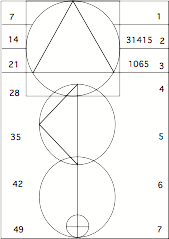
Mathematically, it is PI, the ration of the circumference of the circle to the diameter (the diameter standing for Nature or the Feminine Principle) -- that is, 1:3.1415. 1:314,527. And then again: 1:3:1,415,927. These are worked out in the secret calculations to express th various cycles and ages of the 'First Born' or 311,040,000,000,000 with fractions, and 13,415 and 31,415 (the latter being the measur eof the Hebrew word 'Alhim'.
Clerk
I saw three women. One was the white woman, who was the Moon, in her virgin appearance. I saw the Earth, the woman Earth, in the middle of the kingdom. I saw the Black Woman, who was the shadow in space, the region below the Earth, where the shadow alone does move. And the White woman, with blonde hair, walked near me on Thorsday, and shot a glance toward me, which I caught and returned, and a fire touched us both. She was dressed all in blue; and she seemed to be virginity.
Conductor
The Moon gives birth to the Sun and the Earth, to the Sun and her own Sister, to Vau and again He. Metaphorically speaking.
"One of the interesting things about this last section is the extent to which your dreams are involved in the narrative," Rose says. "You even have a character emerge named the 'Dream-Recorder'. I find this interesting because most dream research seems to claim that people dream when they first fall asleep, when their sleep is light -- and that they don't dream during deep sleep. This book is moving back again toward the moment of awakening. I believe the whole novel is a dream. The first line is 'We stand on the threshold...' And the threshold, in fact, is the dream world. And the final line of the novel, which we will get to, is a kind of awakening, a birth of the Sun in the world. But now the dream is so important because we are moving again in the twilight of light sleep. One eye is on the heavens and one eye on the Earth, on the world of awakening. You are dreaming. And the dreams are very visual now. It is also interesting to me that the Rabbi Jehoshuah (who is, in fact, Jesus Christ) seems to replace to a large extent Madame Blavatsky, Madame Bee, as the mystic teacher as we get closer to Dawn, closer to the opening of the womb, which you have told us is Israel. Israel is the womb through which your were born again, bringing light again to the West..."
"Back to his roots," Crossmann says.
"Yes. He is turning away from the East -- unfurling himself from East to West," Rose says. "Closing out the heavens. Coming back to his Judeo-Christian roots. His sending the Rajneesh home, verbally, in this novel, seems to be the same as his sending Madame Blavatsky home -- to casting Madame Blavatsky out of his life also...."
Rose reads:
Clerk
As I walked on the beach I found a sand dollar with a design of an animal coming out of a flaring grove, in a diamond-shaped center, and with the letters J V A V L written in the image above the center.

Conductor
What is its number?
Clerk
Sixty-seven.
J = 10
V = 22
A = 1
V = 22
L = 12
32 on one side. 34 on the other side. And 1 in the center. 67. Again, the 6 and the 7.
A bird came by; I looked into a passage in the grasses; a womb it was, a passage into something secret. A shadow in its center was a perfectly formed cross.
Conductor
And you dreamt of Daphna?
Clerk
Shulamit's children were living with me. I was married. But Daphna came in from shopping to say a riot had broken out in the grocery store. That young thugs in blue jean jackets had started the fight; and on the backs of their jackets was written: 'The Jews are the reason for all of our troubles...!'
Conductor
And you dreamt of your father...?
Clerk
He was leaving -- going away to get the car, I believe. We embraced. He was healthy and strong. We were very close and affectionate....
Conductor
And your visitor -- what did he teach you...?
Pat Anderson (the Infrequent Visitor)
Ulysses was on a voyage of alienation, a trip into the underworld to fight the demon within. Yet he sought to get back home, tyo drive the invaders from his house and save his wife from these strangers.
Clerk
It is a story of us -- our generation. About thos eof us who rebelled against America, the land of our fathers, and dove into the ocean, who found ourselves living in a world of monsters. Coming back home to find ourselves again. Living in the world of our Fathers....
Conductor
To drive the invaders frrom your country.
Clerk
I don't know who the invaders are. Are they coming -- or are they here already...?
(Xenophobia appears, then disappears in the city
streets.)
(A Chinese-American teenager walks on the street,
wearing a t-shirt reading: 'No Guts, No Glory!')
Rabbi Jehoshuah
Adam and Eve began to engender children from the moment tye were put face-to-face. These children born to Adam in the Garden of Eden -- that is to say, Souls -- if these had come with him out of the Garden, Man would have had eternal life. He was expelled, however, to engender children outside himself.
Adam and Eve were interred together in a cave having a door which opened on the Garden of Eden. There, also, some of the Patriarchs were buried.

Clerk
What has this to do with invaders in the Holy Land...?
Rabbi Jehoshuah
When the waters above and the waters below concurred that the contaminated Earth should be purged of her stains, then the waters of the Deluge arrived. Yet the Holy Land was not covered by the Waters of the Deluge. Noah was predestined from the Day of Creation. He could have chosen to save the whole world, but he chose, instead, to save only himself. The Deluge either destroyed or overturned everything. When the time came for Noah to offer his sacrifice, he is said to have raised up the overthrown altar of Adam.....
(In the sand at the beach is a bronze bust of a woman,
buried to the neck in sand, looking up into the sky.)
(Two volcanoes erupt on a sheer wall together; above
which are footprints of the giant called 'Bigfoot',
escaping up the hill.)
(The same Woman's Head is seen in rocks and in
clouds. Inclined and looking toward the sky, it rises
in the clouds, nearly erect, then lowers gain to the
original position.)
Conductor
You have become sluggish, my friend. There is no enthusiasm in your writing. Why is that so? Will you let this book die so you can be freed of it...?
(Jacob Heimkreiter appears.)
Jacob Heimkreiter
I am here when you wish to finish this quest, friend. If you have seen enough and yu wish to return here. I am sleeping on a park-bench. I am waiting for a friend whom I meet to play chess. Beside me on the bench is a biography of Abraham Lincoln. Leaves have been falling....
Analyst
Leaves being the symbol of demons -- that is, things external to the Tree of Life. Souls that have fallen from the Tree of Life....
Clerk
You have not confessed everything to me.
Jacob Heimkreiter
That night at the beach-house, as I heard the Kreutzer Sonata -- it was playing on the stereo as I stood at the window. My wife had said she was going out of town to visit a friend. My intuition told me differently. I noticed the key to the beach-house was gone. I drove up that afternoon to the cape. I arrived after dusk. I went to the beach-hourse. I knew what was coming. I watched them through the window. She was with one of my business associates. He was much yournger than I. They were naked together. I had a knife. I burst through the door. I didn't know which one to kill. My wife stood before, naked and beautiful -- with those lovely breasts exposed to me. This was before her cancer and masectomy, of course. I wanted to hurt her. I wanted to punish her somehow. I threw the knife away. I attacked the man. He was younger than I was. And stronger. We wrestled about the room. He was naked
This lasted for what seemed like hours to me. He injured my hip -- but I would not give in to him. Finally, we were both weary. And it was done. I struggled up from the floor, and limped out into the night.
And that was it. Nothing more. I committed no murder that night. Despite my best intentions....
Conductor
Have you outlived this form; this struggle with giants to wrench from chaos something true? Are you now unwilling or unable to resurrect this oedipus edifice...?
(Benjamin Heimkreiter emerges from an ocean swim.)
"So we really don't know what we have, do we?" Rose asks.
"In what sense?"
"We now have Jacob Heimkreiter claim that he is really asleep on a park-bench, reading a biography of Abraham Lincoln, waiting for David Blumenthal. So, is this all a dream of Jacob Heimkreiter...?"
"It is not clear, is it...?"
"We have Joseph Heimkreiter, who we believed was killed on Hamburger Hill in Vietnam," Rose continues. "We have him married to a Vietnamese woman in Asia, father of at least one child. And now we see Benjamin actually rising from the ocean, not dead by drowing, but emerging after a swim...."
"We don't know what is correct," Crossmann says. "In dream matter, there are many contradictions."
"So, what are we to believe?" Rose asks.
"What is true?" Crossmann asks. "Is that the question?"
"What is true, in terms of the Heimkreiters?"
"It is hard to know, really," Crossmann says. "But the soul does not die. Clearly, they are alive still, in one form or another. We know that David Blumental was murdered. But he still moves in and out of this novel as a spirit. He still has life. Jacob Heimkreiter too. We witnessed his burial. We were at his funeral. But he is still with us. I guess what we are to believe is that everything endures. Death is an illusion...?"
"I have also noted that the brother-duality, which had been such a primary concern at one time," Rose says, "has become muted now. We don't hear much about your brother William. Or the brother principles, to be more exact..."
"No."
"Sometimes the brothers are on the same side," Rose says.
"The Sun spends half the year with the North, and half the year with the South. That is the kind of equality that is imposed by the system..."
"Yes." Rose reads:
Newslawker
Read all about it! El Nino, El Chichonal Volcano Chaing Weather Patterns! Rains through much of the country. Floods is New Zealand, Brazil, India, Germany, England, Australia, Yutah, California. No Sun seen by Much of the country.
Sex Tapes Involving White House Staff and Orgy Stolen! Woman murdered in her sleep by a blow from a baseball bat; sex videotapes might be involved!
Moral Majority Warns of Plague Sent on the Nation Through Homsexuals in the form of AIDS! Suggestion of registration of gays to avoid blood transfusion plague.
Rabbi Jehoshuah
Noah was destined, fro the Day of Creation, to be shut up in the Ark until the Deluge was over. It is said that 'Noah walked with the Elohim, Who is the Covenant of Peace in the World'. For the Lord said to Noah: 'Thee alone have I seen righteous in this generation.'
When Noah proposed to enter the Ark, Jehovah, the Spouse or Master of the House, needed to authorize the union therewith. Elohim is the Celestial Bride, who is Shekinah; and it was by her permission, as Bride, Wife and Mistress of the House, that Noah had permission to leave the Ark when the Deluge was over. When Noah left the Ark he made a present to the Lady of the House, yet it reached her through the mediation of her Spouse, for it was to Jehovah, not to Elohim, that Noah erected an altar and offered a sacrifice thereon. It was direct from the Lady of the House, however, that Noah received his reward, for Elohim blessed Noah and his children, saying: 'Go, increase and multiply and fill up the earth'.
(Alexander on his white horse, Kalki.)
Sin
Are you willing to lose your soul in this preoccupation with beating Death?
(Rebels, witht he aid of Libya, attack the nation of
Chad; France aids Chad.)
Clerk
'Fill up the earth': is that the language of Brahma, expand, create empire?
(Naked woman lying on a large bed opens her legs,
showing the clerk her vagina.)
Analyst
And when the blonde woman in pure blue looked into your eyes, your chart exclaimed: 'The Moon conjuncts with Saturn.'
You should study which women pass into your path now. They reflect the treasures which you are seeking....
(Clerk sees himself dressed in army fatigues, with
automatic shotgunn in his arms and a pistol at his
belt. The streets are not safe; and he has taken it as
his responsibility to tame them.)
(Clerk continues to build up his physical body,
putting on weight, building up his muscles.)
(Bedraggled Shadows appear on side streets and in
groups. There is much frustration and anger in the
air.)
Clerk
In the pit of the stomach is that alien, the reptile. It is the survival instinct. Civilised Man is cut off from this instinct -- cut off in Time; hence, he must break through the bonds of Time to find his ancestors in the reptilian landscape. For survival, that is. And so I have contacted my ancestors who live inside me, who live inside for ever. That reptilian coldness, which allows me to be dangerous. Yet my forefathers demand that I fight to save their lineage...
Conductor
You are the Hunam Principle which has escaped from the Shadow.
Clerk
I am the Human and the Shadow. The Vehicle and the Watcher. If I guard the gate, at least I know it is guarded.
Literary Critic
And what about your art? What has become of this novel...?
Bob Dylan, the Troubador (singing)
....Eden is burning!
....Eden is burning!
Either prepare for elimination
Or your heart must bear with courage
At the changing of the guard...!
(Troubador is seen buckling on armor, preparing for a
fight. He is wearing a Christian cross. And a
Michael the Archangel medallion.)
Analyst
You received your vision of the Earth -- that is, your earthly body -- directly from Daphna, yet the visions you brought her were explanations of the words of her fathers.
Clerk
Desiring Death and desiring Life. When the Decade ends (decadence), thos who wish to go on desire Life; while those worshipping illness are left in the spot where they worship...
(The 'Flight of the Valkyries' is hear in the thick
white clouds, with the rotary flop of huey
helicopters.)
(Rain falls everywhere.)
(Clerk sees himself overthrown by revolution.)
Strength
When the Moralist walks a rightrope
Between clay and breaking Day of Rules,
He carries power in his thighs;
And Rule he carries in his shoes.
And when the old vegetable-hawker
Cannot remember the price of her own values,
Lightning falls to carry his lineage
Off to some awaiting Tragedy
Through weakness....
Herald
No Sun, no vitality.
In Winter, the Sun, as the Summer is small.
Darkness speak sof the luxury of Shadows.
No one believes that the Sun might return.
(Wandering Jew passes by with his woman.)
(John Milton attempts the songnotyetsung.)
(Sun Yat-Sen fishes in a pon beside a snowy
mountain.)
(The power of Chaos, Angry Rebellion, grows.)
Clerk
When the One Brother tole the Other Brother about the woman's cousin with four daughters who, when desiring a fifth child, ahd a dream in which an angel appeared to tell the woman that she would have a son and she should name him Samuel. When this woman woke, she wished to tell her husband her dream; but he interrupted her to tell her his own dream, in which an angel appeared to tell him of a son to come, whom he should name Samuel. These two told everyone about their dreams, that a son would be coming, whom they would name Samuel. People laughed. A dream! Yet the woman soon became pregnant; and nine months later she gave birth to a son they came to call Samuel.
When the One Brother told the Other Brother this tale -- a true story learned from a woman at work, her cousin being the mother -- the Other Brother glared at the One Brother; for, in his own mind, revolution was burning, while the On Son counseled religion with his story....
Analyst
You speak about your brother and yourself again...
Madame Bee
In the metaphysical world, the circle with the one central point has no number -- it is Anupadaka (parentless and numberless). In the manifested world, the Mundane Egg or the Circle is circumscribed withing the Groups called the Line, the Triangle, the Pentacle, the second Line, and the Cube (together: 13514); and when the Point, having generated the Line, thus becomes a Diameter, which stands for the Androgynous Logos, then the figures become 31415: or, a Triangle, a Line, a Cube, the second Line, and a Pentacle.
When the Son separates from the Mother, he becomes the Father.
Mother Seaton's Ghost
There is a difference between the Son of the Father-Mother and the Son of the Mother only....
(Homosexuals appear as a scapegoat for America's
troubles.)
Clerk
Tell me the difference.
Mother Seaton's Ghost
It is distinction you want then?
Stranger in Town
Foreginers from the South have been trained in Cuba and have infiltrated America, to spur revolt and to fight against our nation....
Clerk
How do you know this is true?
Mother Seaton's Ghost
Is it distinction you want then?
Clerk
Yes, I suppose it is.
Mother Seaton's Ghost
Yet you flee from recognition; you flee from appearance and glory. The way of heaven is the Unity of things.
Clerk
Yes, I understand that.
Ghost
Yet you reject it?
Clerk
The Unity of the World is not the Unity of my own land. The Unity of my own land is born from the diversity of the world.
Ghost
Would you sacrifice your own land for the unity of the world?
Clerk
The death of my land would not benefit the world. America is the last hope for the oppressed of the world. We are a heaven which absorbs the souls from the countries that die -- those seeking freedom, a better life. We re-make a new man here -- from the forge of our own sacred continent....
Rabbi Jehoshuah
The Deluge was called 'Noah's Deluge' because, it is said, he couldn have chosen to save the world, yet, instead, he chose only to save his own family....
"So, you are Noah also?" Charlie asks. "You, too, have that choice."
"It appears to be a choice," Crossmann says. "I'm not sure it is a choice."
"What are you saying?"
"It is a system," Crossmann says. "A pattern. I'm not sure where choice comes in..."
"'He who save his life will lose it' -- that's what Jesus said," Rose explains.
"Still, I cannot be who I am not," Crossmann says.
"This whole novel has been toward a seeking for identity," Rose says. "An identity crisis. The death of your father; and the death of your love for Leslie; there was too much death in your life at once. It seemed that life held nothing for you. You did not care about money, about status, about success in the eyes of the world; you did not care about being married and having a family. All the things others hold dear, you rejected as illusions. Then Leslie left you. You believed this was your only chance at Love. She was the human soul destined for you in this life; and God gave her to you for a few moments; then He took her away from you. And then your father died -- your support. Was there anything you desired after this...?"
"To be a great writer," Crossmann says. "That was the only thing that mattered to me, when I began writing this novel. I would have willingly given my life for this desire -- to be a great writer..."
"To be recognized by the world as a great writer?" Rose asks.
"Yes, that. But to be a great writer. To know that I was a great writer."
"But something changed in all of that?" Rose says.
"At some point I remember, during the writing of this novel, I remember the fork in the road appearing. One road was Art; another road was Life. Life included Art but was much larger. Art, eventually, did not include Life. Art became anti-life at some point -- when Art led into decadence..."
"So, you were given a choice between Art and Life?" Rose says. "And you chose Life...?"
"I no longer saw myself as a Writer," Crossmann says. "I saw myself as a Man who writes; but who does many other things too. All things, in fact, potentially. I could do all things. I was all things..."
"Everyman?"
"Yes, Everyman," Crossmann says.
"You again point to the Rajneeshis in Antelope, Oregon, as a form of cancer," Rose says. "Perhaps that is too strong a word -- it's not a word you use...."
"A foreign god," Crossmann says.
"The boy and the girl in the ceiling are continuing to grapple with one another sexually. Clearly it is a major theme of this section. Sex is closer than it has ever been in this novel. You write: 'A fight between contagious religions? The East being driven away...' That's really what much of this section is about: driving the foreign gods away..."
"Yet this is not xenophobia," Crossmann says. "Because, underlying this philosophy is the picture of America as the melting pot -- welcoming foreigners who wish to become Americans. But it is a driving away of the cancer element of the natinal body. The element that hates itself. The element that is trying to suck to life from America. The self-haters. In many ways I think the dissolution of Rajneeshpuram, in Antelope, Oregon, represents the end of this way of counter-culturism in America. Michael the Archangel, in fact, drives the alien god out of America. The disease out of the body of the culture...."
"That was 1984, was it not?" Rose asks.
"Yes."
"So you see this, as much as the fall of Asian communism, as....?"
"As a rising of the Sun. As an expression of the Dawn," Crossmann says.
"You attach meaning to the movie The Return of the Jedi and their ship, the 'Millenium Falcon', which you will later connect to Yeat's poem, The Second Coming. And then you go into a discussion about the MX missile, which was hotly debated in the early 1980's. Which was a subject of animated discussions between American and her European allies. Was the MX needed? It seemed to many like another acceleration of the arms race, which America was initiating..."
"Yes."
"And you present a mystical meaning of MX," Rose says. He reads:
Analyst
The MX, the missile, is an interesting specimen. M is the Roman Numeral of 1,000 -- that is, Millenium. The M is death in the Roman System. X, on the other hand, represents the number 4. And, in the Millennium, the Apocalypse comes when the forces of North and South, East and West are drawn together. The intersection of the 4 is the X, meeting at the center. The 4 is the number of the scribes, the historians of the Fall, the chroniclers of Apocalypse. It is the number of collision. The number of changing stations...
Clerk
The beginning, you mean.
Analyst
Ground Zero, some would say.
Clerk
You would, then, support its production.
Analyst
If you follow the Word of the Holy Four you've encountered, then the MX seems to be a Necessary Evil.
Clerk
It is an Evil though.
Analyst
If you wish to see it that way -- then it is. It is a necessary ingredient to the turning out of the lights....
(Thousands stand in line to see Staying Alive: queued
before the movie house.)
Woman In a Doorway
How calmly he takes his own complicity in this.
Blonde Daugher Standing Near Her
The woman's head keeps disappearing. Buried in sand...
(A
fat blond boy carries proudly a copy of Mein
Kampf.)
Woman In a Doorway
They are all trying to stay alive, I suppose.
(Another gloomy day. No sun. Wintery sky.
Mid-July with drizzle and thunder-storms by
night. People feel despair. Wander around
listlessly. There is no work. Too much
unemployment. The future seems desperate.)
(Mohammar Khadaffi struts through his black
cesert, dreaming of his empire. The bloody
knife of Islam. His Russian compadres.)
Clerk
And where were you all this time? So much seems gone. Women in kaftans, wish not to be known. Men undiscovered. Henry Kissinger again appearing. Let our devils be as bad as our anagels are good. Yet whom would we worship? The ones without imagination? I refuse to take responsibility for all the Bad in the world unless I'm given credit for all the Good in the world too.
Shadows
What about Nicaragua? What are you doing there...?
Clerk
They have made us their enemy. We sent them millions of dollars in aid after their revolution. Those receivers of which then declared us their anthemed foe. What shall be done? If I were a saint, a Buddha, without responsibility for the world -- well, itis easy to be the Idealist, the Universalist, when you do not have power. When you do have power, then it is the Earth you must rule....
I make no claims to sainthood. I once may have been a saint -- but I am no longer interested in this...
Shadows
You have fallen, in other words. And what if the world hates you...?
Clerk
Then let the world hate me. Love me or hate me -- I am still the same person. I have no wish to be hated -- neither do I need to be loved....
Shadows
You wish to be isolated.
Clerk
I am isolated -- of necessity. I am separated, from the first Day of Creation...! To everything there is a season....
(The Shadows are leaving.)

Clerk
Chess among bohemians then? Wire-waling in a tight-fisted countenance? All the management of heavy interns roll their feet in a walking grace. As numberless airy courtesans air their griefs and speak of rain-patrol. Yes. Untroubled by the arrows and all the graceless queries waiting. As hens and sonsofhuns arm their child with history's page. Propagandizing the world -- to cut the head off the Giant. To cut our head off. Yes. Chosing equal degradation. Foreigners beware! Within our house are agents to break us! All this comes through. Coming to what? No one can tell. Abdicate? Or follow the fight? Followyour father's will? The shattering grays.
(Clerk is seen doing pull-ups in the city park --
preparing for some conflict.)
(Abraham Lincoln, as a child, reading along Rock
Spring.)
Rabbi Jehoshuah
God engraved in the Holy Four the Throne of His Glory, the Ophanim -- Wheels or World-Spheres -- the Seraphim; the Sacred Animals -- Signs of the Zodiac; and also the Ministering Angels. And from these Three (Air, Water and Fire-Ether), He formed His habitation. Thsu, the world was made through Three Seraphim -- Sepher, Saphar, and Sipur, or Number, Numbers and Numbered.
And it is written: 'Ten numbers without what?
One: the Spriit of the Living God, Who liveth in eternities! Voice, Spirit and Word; and this is the Holy Spirit.
Two: Spirit out of Spirit. He designed and hewed therewith 22 Letters of Foundation, 3 Mothers, and 7 Double and 12 Single, and 1 Spirit out of them.
Three: Water out of Spirit. He designed and hewed with them the barren and the void, mud and earth. He designed them as a flowerbed, hewed them as a wall, covered them as a paving
Four: Fire out of Water. He desgined and hewed therewith the Throne of Glory and the Wheels, and the Seraphim and the Holy Animals and the Ministering Angels, and of the Three He founded His dwelling, as itis said: He makes his angels spirits and his servants fiery flames.
Clerk
Perhaps I should follow this thread into the land of the angels; and there I might find some key...
(There is a small golden key lying on the pavement.)
Three Old Women Beside a Cauldron
He doesn't know which way to go, this one!
Doesn't he know that he could follow us?
Doesn't he know we could deliver him...?
Clerk
I am lost again! You do not show me...!
Conductor
You have been given a task. You are Michael, are you not? To guard the Earth -- that is your calling...!
Three Women By the Cauldron
He tries to escape; but there is no where to go.
Wandering Jew
Who is the king of your dreams, Meister Freund?
Conductor
You have heard from Daphna?
Clerk
Dap[hna is pregnant and moving from Jerusalem to Haifa. She seems depressed. It is hot. Tamar writes her own name on the letter in crayons.
(Clerk finds a playing card on the street: the Ace of
Spades.)
"Still, we have these playing cards falling out of the sky," Rose says. "Having mystical meaning for the Clerk, as though they are placed on the Earth for him alone."
"Yes."
"The ace is the high and the low. Number one. Spades is the suit that represents the death struggle. It typifies the metal kingdom, the Winter, the Air, and the letter V in the sacred name YHVH -- and the kabbalistic Formative World. Command by Physical Force. Clubs, on the other hand, represents Spring, the plant kingdom, birth, action, and fire. And the letter Y in the sacred name, YHVH. It corresponds to the kabbalistic Archetypal World. Command by Reason as opposed to Physical Force. Hearts represent the Heart, the first female organ. It corresponds to the kabbalistic Creative World, the world of patterns, Water, the First H in the Sacred Name YHVH, To Know. Sacred to the priesthood. Diamonds corresponds to the Material World, the World of Forms, the Earth, the Second H in the Sacred Name YHVH, To Be Silent. Symbol of the Yoni, the Daughter, the Mineral Kingdom. Heraldic emblem of Mercury as the protector of merchants. Insignia of men of commerce, wealth, and also of eternity..."
Rose continues to read:
(Squadron from the American fleet sails toward the
east coast of Nicaragua.)
(Two brothers argue. One opposes support of aid to
El Salvador. He opposes the support of rebellion
against the Sandinistas. The other has visions of
America as Rome, which is losing its will to defend
its own interests. Soon it will be attacked from its
borders, it people too weak, too sickwilled to resist.)
Clerk
Either support abstract reality or support your own family -- that is the question -- that is the dilemma. Intellectuals tend to support communism because they identify with the poor, with the downtrodden. And they feel intense guilt at their own relative good fortune. Plus they tend to hate their fathers and idealize their mothers. Also, they have more hunger for death than for life. They would rather die than war with death. To be re-born is, perhaps, a curse. To be in the body, separated from the mind. It is a fallen state. Yet it feels more like Life, the pursuit of Life, and not the pursuit of Death. I feel alive, full of the power of action, as though I've been set free from that state of hyper-negation which is the lot of the Critic, the non-creative mind -- who must look down on all things, finding everything beneath him. Self-hate, pehaps, leads to enlightenment; but doesn't enlightenment lead back to Life? And does not the soul have milliard forms? If the Son hates the Father, then what does he become -- besides a Hater, that is...?
Analyst
All o;f your questions lead you no where.... Before long, the East Indians will be forced to leave, with their lama robes and their mantras. America will become American again. Patriiotism will re-surface. Zenophobia, if you wish. Trying to resurrect the core....
(Woman in the Ceiling moans from sexual
enjoyment.)
Woman by the Road
Where is your geometry this season...?
Michael
On the wings of a dove it has flown. On the wings of Seth Dove....
(Hotel in Portland burns; fire department responds.)
Newshawker
Extra! Extra! Rajneeshi Hotel in Antelope, Oregon, Bombed!
Spokenswomen likens commune to Christ, King and the Kennedys.
Michael
Nobody cares. Nobody cares about your miniature comic drama. Dreams come and dreams go. Bob Dylan in a dream, friends with my brother and I. Yes. The American Soul. fear of unprotection. The mind is gone. Tell me of Lethe.
Mythologizer:
Lethe. One of the five rivers of Hades. Souls drank from it before passing into Elysium that they might forget all earthly sorrow. Opposed to Mnemosyne, the stream of Memory. In Dante, one of the two rivers in Purgatory; Lethe obliterates the memory of sin.
Michael
I have no memory. Ihave left so much behind.
Analyst
Memory always returns. You condemn yourself for what you have done without mind. What you have done in the name of Life and living....
(Scenes of war keep flashing through his mind.
Scenes of domestic chaos. He carries a gun and walks
the night streets, acting as a sentry of sorts.)
Michael
No picture is in me of the places I have been. I do pull-ups to condition my body again. Jehovah being the god of generation -- or re-generation. The national god. Who is both cruel and kind. Yes. Born in Darkness. Yes. Reared by the Moon. Yes. Generation of the Physical Form, through the vision of Mars on the horzonline. Conflict: necessary survival. us against them, whomever they be. For the Son, separated from the Mother, becomes the Father. I see. Some insinuation of a loss of strength, or something. As ictures appear of my own sin, which steals from myself the ability to resist. That is, approaching death without that necessary fear to make me dangerous. Perhaps. Toward becming receptive to the Moon. Yes. And a picture of black over white. All of my own inconsequence. Trespass thou s halt not upon. Mine mind's eye. Stretched toward oblivion. Grim sequence of shades. Perhaps the Memory will return; and then I will caterwalk along this indescretion. Electriifcation of the root. Yet the other side is stronger now. Toward making yourself receptive -- that is, the woman in this play. BEWARE! THE WOMAN IN THIS PLAY WILL DECEIVE YOU...! Self-deception; and a new sense of panic from heaven. Attemp;ting to resurrect the smock. Mourning is an mourning does. From King to Artist and back again. The world never running down. And these meditations on eternity meaning nothing to the plain-clothes men, who only walk in tempoed gyration, barking signals of coming to no-thing. The negative of becoming. Become. No one understands isolation. The breaking apart fo the shell. Tortoised eve. Rejection of the killer in me. After nurturin it to please. WHOM? Nurturing it for something. SELF-PRESERVATION. And then the curtain falls; and no one believes it. Too much of nothing makes a man feel ashamed. It can cause some men to walk on nails; it can cause other men to Cain. And only the reporteing of the crime remains a mystery. Trying to fight off the spirits who possess me when I rest. the shell or shield is the aura which surrounds me. The perimeter I fashion with my reading and fight with self -- so that thing I see will not be passed to others, who will misuse what I see through the pwoer of mis-construction. Possession by the dead. Who are these dead who would possess me? It shall not be. For there is one grim soldier within me I will not value. I will not ask. Asking the dead for things they've seen. yet, for answers I must offer to them the soul in return. Is that so? Chained to this rock fo torture: where must I go from here? The dead trapped in this world, unable to escape. Possessing the living when they, the living, weaken. YOU ARE BOTH! Yes. Both the living and the dead. And if I am to find the Sage in me I will need to journey away from my home, and to oppose my own family -- thereby letter the intruder appear. The Intruder being that spirit in the dust, that spirit who would use me to further myd estruction. International terror. For where Thomas Mann is asked: there Adolph K appears. K. you are under arrest. What is the charge? Nobody knows. Yes. Europeanwayfare. What does it all mean? That which you give you get. That God for that Gold: Amnesia. The power in the stomach swells. Who is shaking the Earth, myf riend? Self-conflict: makeing me stronger, or weaker? WHO PUT OUT THE CYCLOPS' EYE? There is no Power where there is too much Memory. Conscience makes you weaker. When you are guilty....
Conductor
Still you wander 'roung the tree
Which, wider still, encircles thee.
He who did not wish to visit
The Emperor's range
Comes stumbling, not unheard,
Along the manufacturer's page.
Unsearching for the grail
Only misleads to stopping shor, my friend.
All separate alienation leads
The lamb to abort
His mission to the pen.
Michael
What silent fury drives the pennywheel --
In which you sit with your carbon and monoxide?
Would you show me my death's logic
To unseat mine own defense?
Would you show me shades of Justice
When the New creates his axe for revenge?
Is there nothing but Act and Retaliatory Pose?
Nothing but Sin and Sin's Retribution...?
Conductor
You wonder many things --
But Wonder, herself, brings you things
Cannot be seen.
Would you die with the Hero's glance
At the Sun?
Or wheedle, like the seal,
And beg Chance to lower
Your crown to the Hun...?
Michael
Am I, then, waking?
Or does rhyme and tone only play,
Like some burgher,
Around maypoles of a sensed
Macawbre invention...?
Fool
Macaw brinvention!
As though a bird could wear a salty discovery:
If you could see inside yourself,
Grim Pirate --
Pirate of words --
You would see: Self-Infatuation!
Michael
That is no revelation, Fool!
If you would look inside a bag
To find the bag's insides
And then proclaim in such a voice of pride
That you found the bag's insides:
Who would care?
Fool
You have a point, fair artificer.
Yet -- were I to look inside a bag, instead,
And find a serpent's tail, I'd boast.
All things being equal's said;
But who could claim, then,
That the bag was not a value...?
Michael
You mince words to find a relish.
You relish words to find a role.
And on that role you spread a season,
Spicing up your brinsoned humor --
Into a sandwich.
Fool
All things being aqua, 'tis said.
Surely the Marry Bringer brings the stapled words:
You eat for lore.
Finding in this sweet nutrition
Enough to make the mussels blanch...
Voices of Women
Take off his blindfolds -- he has suffered enough...!
(The Laughter of Dwarfs echoes through the forest.)
People Chanting
He cannot be released -- for a crime he's committed!
He has mimicked a great cousin,
Shaking spears in a hollow concourse...!
Fool
When is his punishment complete?
Chaqnting People
Committed he a crime, forelorn;
Released by we cannot he be --
Until he so pleases,
Making another wear his chain...!
Pleasure (wearing a red dress, with long leg slits)
All this time you grind away
With words that make no sense to me.
You look at me as if to find
A comic stop our foul distemper.
Yet (crossing her legs)
I can bring some life to thee
Which drives the minotaured poet to scream
In words I will dress
In the blessings of sense.
Without me you are helpless, sire,
Locked to a rock
In the company of diving flies...
Michael
Everyman knows what is best for him.
And chooses the other,
Lest the best become the worst.
Pleasure
Ahh, so poetry is your guise, sire.
Splendid beatitude
In the grace of such a construction.
Yet, why so long-faced?
Why so blue...?
(The Woman in the Ceiling is moaning again from
pleasure.)
Michael
Great abominations seen by first and last and in-between. Is it I he speaks of? Turbulent aft in the masthead holds reefs. Roughing in the plain face window. Call from pirates fall on me. Dictates from a ruptured number of panes. Too-wit too-wit too-woo. Old ladies lie in their shoes. And kiss of their quest in the fist of the guest and pour out their horns at the banquet of thorns. So said. Said by all. Wonderful time had -- by all. Even the dwarfs had pleasure at the shoe. Drinking champagne from a fur-lined glove. Calling all to question that their pleasure was replete. Though I walk with no one, waiting for the fire. As others, in other tongues, yell, above me. Proclaiming their innocent air in their breathing. Yes, I hear them. Thanks be to Julius Caesar that honesty is so rife. That conscience is so true. These stainless pointing fingers of wrath, which occupy the throne of some imagined feminine glory of waiting. Women pat one another on the back for their morality. Mythological remonstrance; the brain becomes a shoe. The monument becomes a tomb. The keys become a wet indictment. Oh, yes -- forgive me for not being modern enough. Sexism, you call it. Please pass the marmalade -- I have not a stocking. Fallingdownjones. Callingdownnumbers. Raising the brassy calf is not on my menu -- and slaughtering my own, and calling it Justice, rings no bell, apportions for me no residual flame. Boils on the said feet of the said man named Marble. Fatehrmarble fatherMapple. A marble faun know not its mother. Wellsaid unspoken. Damn early indictments of risk. Yes. Am I condemend to die at my desk, confronted by files and swisscheeseonrye? Or, like a craterfaced vonsydow, condemned to crash at the topoftheworld? There are those, those afraid, who speak of turkeys instead of eagles. Ben Franklin's caution -- seeking in an icon his own image? Toobadtoosad. Hors of plenty and plenty to share. Who wants our waterwheel? Who prepares to fight when all the patriarchsinside scream: AWAKE! YOU FIGHT FOR ME...! Yes. Prospectors in sierramadres. Gold fathomed in someone's vein. The animals do not come down. Harbinger of wealth and harbinger of wrathing. Showing the root there is no rectangle supper. Being possessed by Shakespeare's waist. Shakespeared's grace of velvetslipper of rhyme. Rhymeless rhyme. Buckets of blime(y). Be you this or be you something? Else? To be encountered? And, eventually, undone? A throne have hamers in the place of legs. Having collars in the place of paintings. Prophet grasping me by the throat. Telling me names of Arab coagulation. Onethousandnights following onethousanddays. Whose throat will be cut by Fate? Not I, said the Baker. He could not cut me, for I have not had supper. Not I, said the Trader. For it is through me that he finds the passage to airy Ixtland. Ixtland fixedland. Vinland windland. Rainmaker talks as though the clouds were his lambs. To shepherd. Yes. So, where is his wagon? His castle on the plains called Home? Red desert on fronsted mornings. Taking meat from the mouth of the element of Time. Whose wind showers splinters of dust through solid stone. And through your skin. When the Hour is replete with nonce. And dictations of massive dropping. A conspiracy to rattle. Godawfully planes drop bombs in Chad.
Analyst
In the name of freedom and revolution. Amen.
(West German 'Green' throws blood on an American
General. He is wrestled to the floor by another
American.)
(Oil tanker breaks apart off the Cape near South
Africa.)
(American officer club in West Germany bombed.
It is the 60th terrorist attack against American
installations by Germans in the last 18 months.)
(Libyan grond forces, backed by Russian-made
tanks, cross the border of Chad. Chadean forces
shoot down Libyan plane, capturing the pilot.
France refuses to support Chad with its own
troops.)
(First Brother cuts a deck of cards, turning up the
Jack of Spades. Second Brother cuts the same deck,
turning up the 10 of Spades.)
Woman In the Crowd
Where has he been?
Second Woman
Who?
Woman In the Crowd
You know who!
Women's Voices
- A visit from his mother.
- He is considering quitting this book, to work on other writing.
- At the coast, deep-sea fishing.
- Fly-fishing on the Metolios.
- Vomiting and accruing pustules.
- Eyeing beautiful girls.
Justice of the Peace
And how does he plead?
Attorney for the Defense
He pleads fallen from a state of contemplation of things celestial to contemplation of things terrene.
Court Recorder (aside)
As I expected: another insanity plea!
Town-Crier
Hear ye -- 'tis true:
Woman in the Ceiling, who moaned with sexual pleaure through day and night, to which the whole town did drop an early like an Eve -- a town of sound thieves -- the woman is gone. She has moved out in the night...!
(Men of the town sigh with disappointment.)
Categorizer
Lust in the ears, a form of temptation,
Is Lust in the eyes now for him,
Our friend.
Beautiful women and girls eye him brightly.
Cleaning Woman
Unable to hide from the looks they would send him.
I send him some too.
He is clean and should not be much longer.
Literary Critic
'Unable' to hide being, actually, a pun;
For the Clearning Woman is, in disguise,
Truman Capote.
(Applause. Capote takes a bow.)
(Bloody and dead Americans lie in the rubble of the
Beirut Airport. Jacob Heimkreiter has hoisted a
wounded black soldier on his back to carry to safety.)
Dream-Reporter
1. (Not in chronological order). Our hero was on the continent of Africa, being hunted by aboriginal blacks, whose desire was to kill him. He escaped by swimming to a waiting boat; fled to America, where he was turned over to a mob, carried in the arms of an American black man, who wore a cross which the black man explained was a swastika. Then he took a gun from his pocket, a pistol, told our hero to relax, that it would not hurt. Then he shot our hero in the heart; and there was no pain.
2. A friend, a gentle philosopher, from college, Bard Farrell, was being attacked by thugs and bullies. He fought back; his knuckles were bloodied. Our hero and his friend left a department store at night; workmen were using long beams to push up a fancy clock-pole in the square; when the clock was secure and upright, one man cried: 'Okay! Time has begun!'
Abraham Lincoln (walking the streets of early Washington)
What's this I hear of this hero or your'n planning to write a play about me...?
(William Shakespeare cleans dung from his shoe with
a stick; then he enters a tavern. It is early morning.)
News-Hawker
Menachim Begin to
Resign.
Cabinet in an Uproar.
(Beautiful black-eyes twenty-year-old smiles at the
Clerk, insinuating gratification in her smile.)
(Clerk is seen being handled a picket sign by a rabid
female union maid. He is on strike.)
(The spaceship Challenger lifts into the night air,
a fireball of light in the thickened air of midnight.)
Anti-Man (turning up his nose)
All is vanity. Man's erection of mirror's reflections. You must give in to Death, accept Death. Why do you toil so long and hard, and gain nothing? Listen, just come with me. Everything will be ok. All you have to do is give in to the Darkness. Give up your ambitions. Give up everything...!
Michael
What kind of man are you, who would open up his family and his city to an invasion...?
(Jesus Christ hanging on a cross.)
Life
Does he not know that I am not defeated?
These so-called judges who condemn me,
For I've acted on my whims,
While they have only watched,
For their bodies had no strength:
They condemn me -- though I'll rage again;
I'll rage till none can answer rage
And turn the Altar of Death into a stone.
If I be guilty for being alive,
And this be guilt which Old Age will answer,
When Youth from a quarter unknown
Might make me pay --
So be it.
I've altars of my own to build.
I've deaths to marr,
And stallers to cart off;
I've doubts I must martyr,
And barters to make with Joy,
Or, at least, with Joy's cousin,
Anticipation.
If Man be Vanity, is Nature not so?
The mountain so large and so bold become plains.
Trees and stars and all things of Time
Come to whither with the Moon --
Yet, does that mean they've no value...?
(French troops in Chad; two French soldiers killed
in Moslem shelling of West Beirut.)
Ladies Voices:
Hurrah! Hurrah!
The meat-merchant's back in town...!
Gaggle of Geese
Cheerup, cheeroo!
Nonsequitur Utterer:
If bee's pollen is the breadth of cheese,
And bread and cheese make the Sunday
Girdle clean,
then who rules in Melanesia
If the children begin to
Cut their wrists...?
Journalist (taking notes)
The man makes no sense. Cut him loose and let him swim.
All God's chillun come a callin in de rain.
Anti-Hedonists League
(silence)
(Suspected racists are led to a ridge and shot.)
(Amazons feel each other's muscles in disbelief.)
Conductor
Awe! You are having fun again.
Spirit also suffocates, friend!
Liberalism as status quo;
And, Life, itself, rebels for air.
(Strains of 'Summertime' in the rain; new mud created
on the grave of Ira Gershwin.)
Muse (White Lady)
Is it myself you pursue
That your shadow might not
Consume you?
You peek inside the Ocean's skirt
To find the nanture of Chaos
In motion.
Sons of Elohim open their eyes
To find the Daughter of Men
To their liking.
And, through their word,
They create ogres.
Ogre
Giants, you mean!
Muse
Ogres, who hate hate the local for the far.
In the name of the 'universal'
They conspire against their own.
Michael
Yet, are you not the 'light'
In these Daughters of Men --
Are you not the 'light'
The Sons of Elohim are seeking?
By which they create
The denizens of the Deep?
Not by knowing it...?
Occultist
The White Woman is the Moon.
The Jewess is the Earth, the Middle Principle.
The Black Woman is the Shadow, the Space
Beneath the Earth.
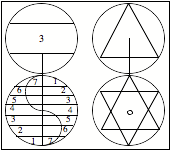
(A marching band tries to play; but there is too much
depression among their members. So the band is
disbanded.)
(A sniper fires from a roof.)
(Lebanese regular soldiers fight house-to-house with
Shiite and Druse Muslims.)
(A Russian fighter-plane fires at a Korean commercial
airline.)
Defeatist
So it goes. What can we do...?
William Clark (camping along the Snake River)
Be satisfied with a little progress at a time.
Each day another step.
Before long, the entire journey -- made of small steps.
Newshawker
Read all about it!
Russian MIG Downs Unarmed Commercial Flight 007.
269 People Presumed Dead, Including An American Congressman!
Young West German Radical
It is imperative that I be on the right side! Behind all the just causes! Ireland over England! Arab over Israeli! Russian over American! Oh, the Korean commercial jet -- well, the Russians warned them to land! It isn't technically against International Law! The flight was 007, remember -- James Bond's code-name! It must have been a spy plane, on a spy mission! Names don't lie! So what if 60 old people and chilfen are murdered by the hnife in a Christian village in the Shouf Mountains by Muslem Liberation Fighters? It is all quite clear! I have the map! Capitalist against Worker! Historical Necessity! Marx and the Critical Dialectic! Yes, it's all quite clear: I have the map...!
(Moslem Leader Walid Jumblatt, in Beirut, threatens
to attack Americans in Beirut if Americans continue
to support the Lebanese Army.)
(Michael Corleone sits in a river house by himself,
his family gone away.)
(General Mark Clark surveys the mountains
above Anzio. Jacob Heimkreiter passes beside him,
on his way to the Supply Tent, seeking more
sulfa.)
Voices in Congress
-- A dastardly act! Criminal! Insane!
-- A barbaric act, which all civilized nations must condemn!
-- Murderous and stupid! Public opinion must punish the Soviets for this outrage...!
(Reagan levaes the Western White House, returning
to Washington to meet with his Security Council.)
Sister Mary Olive
Where has young Michael gone?
He was with us not so long ago;
And now he strays into the world
Without pity....
Father Hmelovsky (wearily)
He has become a man again --
Where once he was an angel of ours....
Silhouette of Metatron
Yours and mine and his own becomes
The howling pipe and the whirling steel.
Mean you not the coming of age
When going of Youth
Fights the last savory battle?
Two hearts walk where one is known;
Two stopes are dropped;
Two men are found.
Michael is cast intot he galley for me;
And, as such, he can't lose;
Though, too, he'll remember.
Sister Mary Olive
What will he remember?
Voice of Metatron
That the Stone, the Ca'aba,
Must be raised by his love.
(Michael sees Gilbert Patton, the demon, at the post
office. Gilbert looks away; Michael leaves, avoiding
conflict.)
(Koreans march by the thosuands through Seoul;
and burn coffins bearing the name Yuri Andropov.
Marches in Tokyo and New York. Western
Europe is curiously silent.)
Conductor
They want to believe that you are the guilty one,
That you are the enemy of peace.
This incident only confuses them.
The Peace Movement pretends not to see it,
As they pretend not to see the Gulags,
The Russian Slave-Labor pipeline;
The extermination camps in Cambodia....
They don't want to see it;
For, if they do, their world ends.
Iago
By Janus, is that you or I?
Dream-Recorder (reporting to the Court)
On the whole, his dreams of late have been pleasant.
Last night he chided his old friends for not being able to live in the elements with the animals. He was stalked by a giant, busy-bearded, in the snow. He killed the giant with an arrow from his bow.
Literary Critic
If one consumes one does not produce.
It is a simple law.
He reads, consuming words;
Yet, to produce, he must give up his eating...
Economist
After World War II, America became a consuming society. For, by consuming American goods, but also European and Japanese goods, we helped societies damaged by the war return to relative prosperity. The more consumptive we become, the less productive we become? Is that a simple law? Can we not be both? By eating too much we become fat; by becoming fat, we lose our strength...?
Is that a simple law afterall?
Michael
There is no simple anything now.
There is no simple escape.
You know too much.
Your own apprehension is too great
For you to vanish now.
People want you.
People expect you.
Destined to be cut off.
Yet destined also to rise....
Voices in the Crowd
That is it! You are to move to Washington, DC -- and go to work there...!
(Two policemen eye the Clerk-Hero as he talks with
Peter, a local n'er-do-well. As they speak, generally,
about art, the policemen suspect their manhood.)
(Russians still deny the downing of Flight 007.)
(Four more Americans killed in Beirut by Moslem
shelling. Moslem and Christian battle in the
mountains.)
(A vision of the Virgin Mary is seen by many near
Bethlehem.)
Yeats
The Darkness drops again; but now I know
That twenty centuries of stony sleep
Were vexed to nightmare by a rocking cradle,
And what rough beast, its hour come round at last,
Slouches toward Bethlehem to be born...?
Michael
Is it not I?
Clown
Not I!, said the candlemaker, though his wax was there
For all to see.
Not I! said the butler's lover, though her teeth inspired
The world to a new hunger.
Perhaps it is you! said the politician.
Though I cannot imagine you
Standing on your shield.
(Black woman and children pass and speak to the
Clerk.)
(Beautiful women are everywhere. They are
easily accessible. Hillary appears with her
husband and child; she speaks with the Clerk,
twice caressing his shoulder with her hand.)
Fear of Seeing
Look too hared and you shall see your own death.
Best be careful; or you will be the Martyr...!
Rabbi Jehoshuah
Moses was entombed on the mountain sacred to Nebo. Nebo being the Babylonian god of Wisdom, the Sun God of the Autumn, who is Mercury, and also Michael. His emblems are a mason's chisel, a measuring rod, a stylus, and a writing tablet. In Hebrew mythology, Nebo, an angel, is the keeper of the tablets of Fate.
Moses body was never found.
Investigators
There is some secret meaning in what he has said.
Bystander
Who is that man?
Speaker
His is called Jehovah Sabaoth.
Child
The so-called 'Universal Mind' is the One which condemns the Head of the Plant. The Tree of Life is not the Tree of Knowledge of Good and Evil. Life knows its own; the Tree of Knowledge of Good and Evil is alienated from him-self, he loves the distant -- he rebels against the known, against his own family....
Lust (dark-haired and with massive breasts)
You talk with me most frequently.
And you call to me in your dreams
By my name
And speak of quenching...!
Michael
Zero is Chaos.
The Meeting Ground is Chaos.
Each Millenium becomes Zero,
The Starting Point,
The New Beginning,
The Seed.
The One and the Zero, together, is the Power.
The Power of Ten.
The Universe.
Springing from the Egg, Chaos.
The number 10 is the Universe:
Adam Kadmon.
(Song on the radio: "Saved By Zero".)
Song on the Radio
Rise up, gather 'round,
Rock this place to the ground...
Blow it up, let it choke,
Watch this place go up in smoke...
No serenade, no fire brigade, just pyromania.
Rock on: it's better to burn out, than fade away....
(Song on the radio: "Burning Down the House.")
"I hesitate to stop this -- because we seem to have quite a bit of momentum going here," Charlie says. "I just love the Talking Heads. David Byrne is...a very special fellow..."
"I love the 80's music," Crossmann says. "It was a second British invasion. But there was also music coming in from Ireland and Australia that was very strong. I used to watch MTV every night..."
"Yes, I loved the 80's music too," Rose says.
"The Police, Culture Club, Tears for Fears, Elvis Costello, the Fixx, the Eurythmics, Billy Idol, Bowie, Flock of Seagulls. MTV was an event then. There was a lot of occult significance in much of the lyrics during that era too..."
"And now?" Charlie asks.
"Now?"
""Do you still watch MTV...?"
"No. Never," Crossmann says.. "It's all hip-hop: I don't get it. It's all viscera. No matter for the brain. We could use a little invasion now, I think. Freshen things up...."
Rose smiles his agreement. He continues reading:
Analyst
Fire Elementals, obviously. Fire lights up the Night Sky, alleviating the Darkness. It is the elements of Mind; also of Lucifer, the rebellious angel. The star of the Morning: Venus: Astarte: Anat.
Soothsayer
He who gives up his body to the Night has no strength left.
The condition of Death is a condition of surrender.
(Horae prounounce an orgasm of the hero to shocked
listeners.)
Gasp From the Crowd
Ahhhhhhhhh!
Old Woman By the Shoe
You have been re-born, like it or not. Horus you are; and from Horus you've come. You have found a mate in Israel, you whose ice is so thin. You are thirsty for water; let someone feed you milk instead. Look around, my dearest. All that you seek is right here before you.... Which way do you go when you have no direction? If you rebel against the Father, then you rebel, also, against Daphna. You rebel to take on 'Mind' -- which merely informs you that you will die.
Moses was not perfect in all things, or so the Rabbi tells me: for he was separated from his wife, in this world; he chose for his mate the Celestial Bride; and the Lord spoke to Moses, saying: 'Let it suffice thee.'
(A clock is heard ticking: it seems to grow in
volume.)
David Blumenthal (holding a giant chesspiece: a bishop)
America leads its children through the major elements. The quaternary is the four parts of the year, each with an element developed. Fire; Air; Water and Earth.
(A Russian Spokesman finally admits to the downing
of Korean flight 007. Yet he says America is to be
held repsonsible for the tragedy. He says that
Russian pilots fired 'warning' tracer shots to force the
plane to land but the plane refused...)
Tape
of Russian Pilot
I can see the target. Strobe lights are on. I have the target in sight. He hasn't spotted me yet. Missile has been fired. Target is destroyed. I'm breaking off from formation...
(Shells from Syrian-backed Moslems rain down on
American positions in Beirut.)
David Blumenthal
You have seen your own self develop all these elements as well, my dear Godson. You have stopped your analysis of Letters and Numbers. Why? Too dense for your liking? Man is the Fallen Angel, afterall. Man is blessed and then he is cursed. The Heavenly Men hate him, until danger returns -- and then, they, too, seek to become men...
Dream-Recorder:
Michael dreamt last night that his family had gone deer-hunting. His father never hutned, so this surprised Micahel greatly. To get to the place of hunting, an elevator was needed. Michael was separated from his family; followed them on the elevator; got off on the wrong floor, some four floors above his family. He eventually returned hom, when he could not find them in the forest. His family later arrived; his father had shot a deer; and a small, delicate Thai man was led in to the room -- he was apparently having a heart attack.
(Scoop Jackson is lowered in to his grave, following
a massive stroke, following the Russian attack on
Flight 007.)
(Eugene McCarthy, former Democratic presidential
candidate, is hospitalized following a heart attack.)
Songster
The Democrats are having heart attacks.
The Republicans sneeze.
Silly Angels shout out: 'Freeze!'
Analyst
Remember, Odysseus was forced to put out the Cyclopean Eye, the famed Third Eye of Spiritual Sight, before he could escape imprisonment in the cave and continue on his journey home as the Hero....
Voices
-- What does that mean? What is he trying to say...?
-- I heard a curlew once, when I was a child, no bigger than a spoon.
-- I've heard he has a hearing-aid now.
-- Children should not be allowed such liberty.
-- License, you mean. Absolute license...!
-- The Fourth Space Shuttle will be called 'Atlantis' -- did you know that? Columbia; Challenger, Discoverer, Atlantis.
-- He is attempting to find hidden significance in everything.
-- That that plane was numbered 7 certainly seems to have significance, being the number of the Sabbath, the end of the work of Creation.
-- Should we oppose degeneration -- or should we support it...?
-- There'll be no Russian vodka sold in my store ever again...!
Shulamit's Daughter, Daphna (floating by)
Hi! I just got a haircut....
Do you like it...?
Philosopher
It is an illusion that the Future is merely the Past re-cast. It assumes that there is only Memory and not Imagination. Are we to assume, despite the repetitive pattern or body in which we move each succeeding day, that today we will meet each person who we met yesterday? Of course not. The clock tells me that Time repeats -- yet Time does not really repeat. Rather, the clock repeats. The measuring device repeats -- but not the thing being measured. Not the essence inside the measuring device....
Several Bystanders (in agreement)
He argues against himself. He argues against the East, which gave him Life, thorugh which he passed toa gain appear in form.
Rabbi Jehoshuah
The Infinite Unity, formless and without similitude, after the form of the Heavenly Man (the Duad) was created, used it. The Unkown Light used the Heavenly Form as a chariot through which to descend, and wished to be called by this form, which is the Sacred Name Jehovah.
In the beginning was the Will of the King, prior to any other existence. It (the Will) sketched the forms of all things that had been concealed but now came into view. And there went forth as a sealed secret from the head of Ain Soph, a nebulous spark of matter, without shape or form. Life is drawn from below; and from above the source renews itself; the sea is always full, and spreads its water everywhere.
The Seventh Palace, the Fountain of Life, is the First in the order from above.
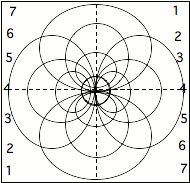
"It just dawned on me," Charlie says. "This dialectic which you represented through much of this past 'Night' -- the struggle between the ideas of dismantling the empire and expanding the empire -- it just dawned on me that this dialogue, this discussion, eventually was played out, not in America, but in Eastern Europe. This was the same dialogue that was occurring in the Mind of the Earth, apparently. But the dismantling that was discussed happened...later, in Eastern Europe...."
"Yes," Crossmann says. "Well, that is the main point of all this. The appearance of Michael the Archangel's spirit did not just happen locally. It happened cosmically. The prophecy that Michael would appear in the darkest of times....well, let me read it..."
Crossmann fumbles back through the book. Finding the passage:
At that time there shall arise
Michael, the great prince,
Guardian of your people;
It shall be a time unsurpassed in distress
Since nations began until that time.
"We see, in this text, that the world is steaming toward nuclear annihilation," Crossmann continues. "Clearly, the world has never been so distressed. In my mind, one can see all minds. My thoughts are personal on one level; but they are also participating in the discussions of the Universal Mind. The negative mind wants to dismantle. The positive mind wants to expand. The re-born mind wants to expand. Michael the Archangel returned, and picked certain people to become positive -- but he picked only those whose name was written in the Book of Life..."
Crossmann reads:
At that time your people shall escape,
Everyone who is found written in the book.
Many of those who sleep
In the dust of the earth shall awake;
"At that time, your people shall escape," Crossmann says. "America escaped the dismantling, the negative mind. Russia did not escape it. Michael, essentially, defeated the negative mind, scattering it to pieces...."
"So, your contention is that we have already had Armageddon," Rose says. "But it was on a subtle realm. In the mind. It was only reflected on the Physical Plane... You seem to be saying that the great battle has already been fought... That the defeat of communism, the Asian Anti-Christ, has already happened... So what comes next...?"
"Well, clearly my prophetic powers are limited," Crossmann says. "I predicted that a Romanof would be the seventh Russian premiere and would seek to dramatically increase the empire of Russia..."
"And it turned out to be..."
"It turned out to be the Russian Michael," Crossmann says. "Gorbachev. Who broke the empire into pieces. Who crucified the empire. Who killed himself for the sake of the world..."
"So, Gorbachev was the Michael on the Cross?" Rose asks. "And you were -- who was? -- the Michael in the Heavens...?"
"Michael in the Heavens, Michael the Warrior with his Sword, appeared only as light and meaning," Crossmann says. "His appearance is reflected in this novel as a kind of shadow of his presence..."
Crossmann finishes the prophecy.
Some shall live for ever,
Others shall be an everlasting horror and disgrace.
But the wise shall sine brightly,
Like the splendor of the firmament;
And those who lead the many to justice
Shall be like the stars for ever.
"So this battle was the battle between religion and anti-religion?" Rose says. "So we are in the New Millenium already. The defeat of communism was the end of the Dragon of Darkness... Of course, China is still communist. As is Vietnam, North Korea, and Cuba...."
"Not for long," Crossmann says. "They are doomed to give it up..."
"Why did communism fail so utterly?" Rose asks.
"Because it denies of spiritual nature of humanity," Crossmann says. "It is opposed to the spiritual nature of humanity. So it brings upon itself an utter poverty of spirit making its own overthrow certain.... It brings a society to its death -- but it does not have the spirit to give the society re-birth..."
"It wants to keep it in death," Rose says.
"Well, yes, for re-birth is, by definition, freedom, individualism, a form of capitalism," Crossmann says. "When a society is either an invalid or a baby, it wants the state to take care of it, like a mother or a father would. But when the society grows up, becomes mature, its shakes off the state, the controll of the father or mother, seeking life-expression on its own..."
"Then your workmate, Rosemarie Millet, tells you a dream she had in which the Martians take over the Earth... Again, dreams are very important in this final section. The Hero's sleep in becoming more shallow -- and he is dreaming more; and he is also much more aware of things happening around him -- especially on the Earth..."
Rose reads:
Rosemarie Millet (Clerk's associate at work)
I dreamt that the Martians had invaded the Earth; when they stepped from their flying saucer they seemed bery bizaree, very different than we are. Yet, after being here awhiel, it became hard to tell the difference between them and the Earthlings. They were taking over the Earth; and they were changing us, making us passive, taking away our personalities. I asked one: 'Why are you doing this to us?' He said: 'It's for your own good. We are going to take you away from here. In 1989, the Earth will be destroyed. We are taking you away before this destruction. Before you leave you will have one last gift from us. You will be able to see one thing from your past that you wish to see.' I stood in line with the other Earthlings. The woman in front of me wishe to see her daughter's car when she had been 15. The car was a 1950's Buick, with long wings or points on the back. When my time came to choose, I woke up...
Clerk
That is a profound dream. They said 1989...?
Rosemarie
Of 1996 -- I don't remember which.
Dream-Recorder
Our Clerk dreamt last night of being in a house of Jews who were all debating the question of leaving America for Australia or New Zealand. The debate was animated. The Clerk argued that they not be irrational. They decided to Leave. The Clerk was furious at their lack of trust.
He then went to a party given by his old friends from Wyoming. It was an intriguing house; he found a girl there who could laugh...
Newshawker
Read all about it! Child Prostitution Ring Broken Up in Vermont. Thirteen-year-old boys and girls selling themselves to other youths and some adults.
Clerk
The Martians are the gods of war who change the Earthlings into a passive breed, making them passively accept the coming of war -- even the necessity of war....
Accuser
You are one yourself!
Clerk
Mars, in the morning, becomes Mercury, in the evening. The Bringer of War becomes the Bringer of Peace....
Newshawker
American Frigate Off Beirut Shore Shells Moslem Artillery Positions Lobbing Shells at Marine Encampment. Moselm Guns Destroyed.
Clerk
It's about time!
(Naked women, furious in their desire, pillage the
Clerk's repose, demanding more. More succubi.
(The Clerk furiously demands more from the naked
women.)
Conductor
It is all a dream. This, too, is a dream. You've been cut off from your source. You are like the Adam Columbus, who descended on the Kings of Edom and destroyed their teepeed lives. The 'square' men who live in bodies. The Fallen Atlanteans, who sink but to rise again greater still. And to fall again; and to rise again. Man, who gives up his body to be in Heaven; who gives up Heaven to take up his body again, fighting against Darkness, sinking like a stone in the mud of the Memphis. All this: press the Start button again.
Who is right and who is wrong? The Kings of Edom are the dead who still hover in the atmosphere. The three-fold dead. Once-men; aome time again men. Unbalanced forces. Are they good or are they deadly? You pass through them when the Winter comes. They speak to you. If yo love them, they possess you. They are great; and they are small. Let them sleep. Giants you would make of them; yet Patriarchs rule the world of Men. The Dead are merely the voices of the shades, conseling the living to self-destruction, to joining the band of negatives, who rebel against life. They are ghosts only, suff of which old fantasies are made. As you cycle back nearer to them. They are trapped in the upper air; the lower air. You educate them also; for you are the Creator of all things. Can you now convert them to your side? Those who love other nations' gods? Not likely. The Universal Mind is a grant illusion. The East is sharpening a sword for your throat. Is that an illusion? You pass through their network. If your goal be to weaken your own nation, how weak will you make her? So weak a to make her unable to defend herself from the rapists and thieves, the murderers and invaders? If so, then you are an enemy to your own people, as Jesus was to the Jews, counseling death as prefereable to life...
Michael
You are the resurrector of Men!
Conductor
You have gone through Death and found it wanting. Now you go through Life -- and it, too, you will find wanting. Fatigue, alone, makes you lean to the East. The Will of the King soon becomes teh Sorrow of the Lecher...
(Moslem, PLO, and Syrian units push battle in
Chouf Mountains for control overlooking Beirut.
More Christian children and aged massacred by
Moslems. American troops merely sit, allowing
Lebanese army regulars to be defeated.)
Michael
The religion of Jesus is not complete without the religion of Jehovah. As the Father is not complete without the Son. In my own footsteps wehave traveled through both worlds; immortality demands strength as wella s goodness; it demands steely authority (self-discipline) when the life of the Son evaporates into his Father.
Newshawker
Read all about
it! Arctic Fossils Suggest New
View of Evolution!
Study of Arctic fossils, some 50 million years old, reveals a picture of the Arctic which could change perceptions that evolution began in more Southern Climates. These new findings show fossils some 18 million years older than similar fossils found in points further south.
Says researcher Dr. Robert West: 'We can construct a picture of the North as being temperate in climate, with dense forests full of broadleaf plants, redwood and sequoia-like trees and lots of bodies of water filled with aquatic turtles, crocodiles and alligator-like animals.'
Michael
I have other things to do besides fight wars.
Conductor
Such as?
Michael
As Man descended from the North, bringing Ideas to Mindless Nature of the South, migrating from the Top of the world, with the vision from that Mountain, descending into the Valley, meeting at the Equator -- so the plants migrated from the North to the South, and from the South to the North too, behind the wave action of the Tropics.
Conductor
Driven toward the center by ice?
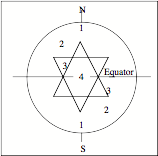
Michael
Nature, without Mind, is an empty, senseless thing. Yet Mind, without Nature, is a helpless, defenseless shadow. The two things together are required to make a man. Let the body be strong; let the Mind and Spirit be of genius.
Old Woman in the Shoe
This son of mine continues talking to himself! What is a mother to do? As though any of this mattered, really! What he needs is a pretty little wife for him to wonder about. She's the divine mystery, afterall. Not all of these lost abstractions. The globe this, the globe that! When dead, he wants Life! Yet, when living, he wants only these deadly ideas that obsess him...!
(The clock is ticking loudly.)
(The Clerk is becoming sensitive to pain.)
Analyst
You have passed from the mind of Universalism (the Son, Peace, Death) to that of the National God (the Father). The one was a kind of hellish activity; this latter is mindless in one sense at least. The body has been resurrected. You have passed from the Timeless back into the time you live in...
Clerk
I sense ravenous demons not far from here. The longers after death. Through whom I must pass to get to the other side again....
(Jesse Jackson is seen touring the slums of London:
Brixten. He preaches the anti-nuclear policy. He has
his sights set on the presidency.)
Conductor
You feel as though you must do something: write; change; move. Yet you do not need to do a thing. Wait; and the mountain shall come to you. You wished to be alive; now, merely enjoy being alive. Is that so hard...?
(Reagan sends more marines to the coast of Beirut.
American role said to be more as active warrior in
attempt to save nascent Lebanese government from
failing.)
Poet
Reeling from the nemesis of inaction
And from the paradox of authority
In the face of a tiny directorate,
The White Giant succumbs to the ailment
Of his time.
Merely projecting his white fibula
Into the mob which shouts
From blood and gore.
Old Times are mis-led into the present century
As children oft are led
Into life by awkward mothers.
They stumble and fall, until their wheels
Are greased by the language of no-men culture;
Then by a doctrine of laissez-faire until all.
Old Times shake off their cloaks for another;
The White Giant grumbles:
No one understands the plan.
White Mouse
You should not be where you do not belong.
(Russian bombers approach Tokyo; Japanese fighter-
planes scrable, pursue Russian planes for 300 miles.)
Bystanders
- Are they mad then? Have they all gone mad...?
- Who is running things over there?
- They seem like a mad dog now. Invading Afghanistan, shooting down a passenger plane, threatening to bomb Tokyo...!
- They are breaking down! Something inside of them is surely breaking down...!
- We msut beware! For they are irrational...!
"The picture you are painting," Charlie Rose says, "is one of Russia breaking down. Some kind of nervous breakdown. Of course, you were not conscious, at the time, that the Eastern Block was literally cracking, literally breaking apart..."
"No. I was not aware of what was happening," Crossmann says. "The breakdown of the Eastern Block did not really seem a possibility at the time. At the time, it seemed that they were on the verge of winning. The Vietnam experience seemed, at the time, like it was an historical turning point. Europe was moving toward Russia, more conciliatory. It seemed that the East was winning the propaganda war. But Cambodia was a revelation. The bloodbath that is always predicted after a communist victory certainly ensued in Cambodia. Communism lost some lustre with the leftist intellectuals at that point. Then the Solzhenitsyn Factor. Book after book by Solzhenitsyn offered readers a much less-sanitized view of communism than was desired by most leftists. Then the excesses of the Sandinistas; and the invasion of Afghanistan by Russia -- suddenly the glow was taken off the west..."
"For you personally?" Rose asks.
"No. I had passed out of the concrete mind much earlier," Crossmann says. "This whole novel is about the great divide separating the concrete mind and the other side, the spiritual side. Kierkegaarde's 'leap of faith' is a very real 'leap' in fact. Most intellectuals are afraid to make that leap. To make that leap, one has to suffer often very grievous pain and despair. Most intellectuals would rather remain the kings of a dead world than risk the unknown..."
"Not everyone is able to make that leap, are they?" Rose asks. "Isn't that what the occult text means about the Fifth Race separating into those who go on and those who stay behind...?"
"Yes."
"So there are many souls who are stationed at the edge of the great divide," Rose says.
"Who are the Kings of the Dead World," Crossmann says. "Who are waiting for the Sun to come back around to illuminate their position once again..."
"It might be a long wait," Rose says. "Communism has lost face..."
"Yes."
"I get this picture of this great force for leftist politics which swelled through the 1970's," Rose says. "But then this death process happening, where souls, the mystical souls, left the concrete mind -- that is what you call it -- the leftist mind -- and journeyed to the other side. Made this transition from the Anti-Universe to the Universe. Moving, in a strange, mystical process, from the left, the East, back to the right, or to the West. This novel is a picture of that transmigration of the soul..."
"To make the leap of faith, you essentially have to get on your knees," Crossmann says. "You have to give up your position as the god of your world. You have to recognize a force larger and stronger than yourself. Some cannot do that. Some worship none but themselves. That is their fate. To be rulers of a sterile dying world rather than to risk entering a new world where they may not be in control..."
"Control freaks," Charlie says, smiling. "Then the Men At Work song comes in, 'It's A Mistake' -- which is, again, another indication of the general sense of nuclear dread that was sweeping over the globe. And the defeatism of the Western Left: 'We wish you'd all throw in the towell....' Surrender was acceptable, in the face of all this angst, this tension..."
"That was the attitude of the Western Left," Crossmann says. "I say this because I know it well, from the inside. Surrender to Russia was what the Western Left desired. Surrender to a kind of termite existence..."
"But they didn't see it as being a termite existence," Rose says.
"No. They thought it was the just system of the two," Crossmann says. "Because they refused to face the truth, the real history, of the communist revolutions, the suffocation of life brought on by communism. The murder, the paranoia, the regression. And, also, because, unconsciously, they felt guilty of having too good a life -- and wanted martyrdom to pay for this sin of having too much freedom, too much money, too much fun..."
"They wanted to surrender to death," Rose says. "Offer themselves up as a kind of collective Christ on the cross..."
"Yes."
"And then this song is eventually followed by a song by Howard Jones, 'New Song,' which counsels the listener to essentially do what you have counseled in this novel and done yourself. 'Don't crack up. Bend your brain. See both sides. Throw off your mental chain...' It seems like this entire battle that is going on inside of you, as shown by this novel, is also going on on the radio...."
"Yes," Crossmann says. "The same battle, the same struggle between ideas, is going on all around. The artists are most receptive to the rays. The angels are essentially rays of light. And rays of light are essentially thought elementals that pass through one. Anyone who is receptive will receive the same message. Another way to look at it is that we are all complex radio receivers. The messages we receive, our ideas, are essentially radio waves (light waves are radio waves) which we can receive if our receptive mechanisms are finely tuned. Of course, these radio waves travel further during the Night. During the day, life in the body makes one generative instead of receptive. So, one receives messages during the Night; and one carries these messages out into Life during the Day..."
"Yes, I do sort of see that," Rose says. "So these songs on the radio have a metaphoric quality in the book also. I hadn't thought of that... You also begin to turn more forcefully against feminism at this point also. Against the spirit of disarmament...."
Rose reads again:
Song on the Radio
Jump down the shelters to get away
The boys are cockin' up their guns
Tell us general, is it party time?
If it is can we all come
Don't think that we don't know
Don't think that we're not trying
Don't think we move too slow
It's no use after crying
Saying
It's a mistake, it's a mistake
It's a mistake, it's a mistake
After the laughter as died away
And all the boys have had their fun
No surface noise now, not much to say
They've got the bad guys on the run
Don't try to say you're sorry
Don't say he drew his gun
They've gone and grabbed old Ronnie
He's not the only one saying
It's a mistake, it's a mistake
It's a mistake, it's a mistake
Tell us commander, what do you think?
'Cos we know that you love all that power
Is it on then, are we on the brink?
We wish you'd all throw in the towel
We'll not fade out too soon
Not in this finest hour
Whistle your favourite tune
We'll send a card and flower
Saying
It's a mistake, it's a mistake
It's a mistake, it's a mistake
Michael
Where is the place I do not belong? I look. Finery is no where. Some come walking. Some cut and run. Yet where can we run to? I watch myself argue agains the illusions of the New Age and rising Feminism. Am I expected to worship this woman? I am too strong to become a eunuch to this goddess vanity. I would worship and be worshipped perplexingly -- perhaps. Perhaps not. I grow angry at the woman when she tells me that she is fine -- a god in fact. When she says that she will save me -- merely by robbing me of my armor...
Unnamed Woman
Poor frightened boy -- unwilling to give up his power...!
Clerk
I look at you, hearing your version of the future. Your picture is no more attractive than any other -- less attractive than some. You are also false. Perfect yourself if you would have me stand with you...!
One shows me science; another shows me anti-science, a mimicking of the past. Which to choose? Hippies preach death, fleeing from the future; scientists preach life, the taking of the future by force. Which am I to choose? One denies the future; the next denies the past? Am I willing to be the Talking Woman's lackey -- I think not.
Conductor
You choose others now, those who choose success over failure. You choose independence over the desire for death.
(Marine named Clark, killed in Beirut shelling, is
lowered in to a Wisconsin grave.)
Hippy (defending himself)
It is I who speaks for Life; and the Scientist who speaks for Death!
Clerk
Yes, but Life for you is merely passive acceptance of all things. You seek to be a woman; you are the Anti-Man. You scorn independence; you scorn the individual; you worship 'nature' but have no real sense of Nature. For if you did understand Nature, you would find room for the ram as well as the ewe, for the lion as well as the panda. You hate Man, because he is creator; he is made in the Lord's image, the Creator's Image. You reject Man, who lives in a fallen state, as you reject any time which is not a time in the Past, which you can romanticize. Your ideal concepts are crystal clear; if they do not touch reality, then, instead, you condemn reality; for it is not 'good' enough. It is not as good as you are. You worship the image of the martyr -- and you demand that others, the society, follow your lead. You recruit for martyrdom; and, in this, you worship death. Jesus has already done this -- so that you do not have to. You call it spiritual life -- but spiritual life is the life of dead bodies: a kingdom of the dead....
Hippie
Yes, but dead spirits in Heaven!
Clerk
Your version of Heaven is not more perfect than is the Scientists's. Each needs to perfect his form. Your version is not acceptable either. A shadow is all you have become....
Hippie
You used to be on my side!
Clerk
You must understand that the Soul creates both sides. Neither side is eternally true. Both sides are an illusion. We know the Material Side is an illusion. The Spiritual Side, too, is an illusion. Both sides are created; and, as such, both sides eventually vanish in the central core.
On one side stands the all-male, the absolute Fire, Conquest, Action, the Military. On the other side stands the all-female, the absolute Water, Peace, Reflection, the Anti-Military. In-between these absolutes moves the Soul, those androgyne elementals, being both male and female, active and passive, generative and receptive. These Souls balance the Man when he needs to be balanced, giving him intelligence and peace and culture when it is needed; and they balance the Woman when she needs to be balanced, giving her light, Life, strength when it is needed. When peace turns to weakness, when the Woman becomes too strong, then the Soul sides with the Man, to resurrect his power. When the Hebrew mystics write that the Angels try to become Men, this Man (the nubmer Four) falls into the Dragon of Chaos to order her, to re-create her....
The Ghost of Jacob Crossmann
I do not wish for my people to become slaves of inactive worship! America must not become India...!
Clerk
We are both Scientist and Mystic; both Rationalist and Hippie; both Cowboy and Indian, each in its turn. We create the world by always moving. The 'movers' or the 'runners' who re-make the world: the Principle of Movement on the Face of the Deep...
(Practicality is seen stadning poised over the fallen
angel Idealism.)
Song on the Radio
I've been waiting for so long
To come here now and sing this song
Don't be fooled by what you see
Don't be fooled by what you hear
This is a song to all my friends
They take the challenge to their hearts
Challenging preconceived ideas
Saying goodbye to long standing fears
Don't crack up
Bend your brain
See both sides
Throw off your mental chains
I don't wanna be hip and cool
I don't wanna play by the rules
Not under the thumb of the cynical few
Or laden down by the doom crew
Father of the Dead Marine Named Clark
He couldn't believe that the Marines were given orders to run if fire upon! Marines aren't trained to run! What kind of order is that to give a Marine...!
Critic
And when Seb, the Egyptian God of Time, emerges from the Mundane Egg, the Land of the Dead, where the mysteries are learned, he emerges with a hawk on his head, for he is the firt male, bring back Time to order the Chaos created from his absence...!
(Joe Clark, the black principle and former marine drill
sergeant, presides over the re-generation of a ghetto
school. Grades are up; conduct is no longer a
problem.)
(SAT scores of blacks and other minorities are
rising dramatically.)
Dream-Recorder
We have, at this point, a dream of the Clerk striking his brother in the mouth when the older brother exposes American foreign policy attrocities. The Clerk, remorseful, then lies down on the bed in his father's and mother's bedroom.
Clerk
The meaning is obvious.
William Crossmann
You told Keith, the Neo-Nazi, that he was not creative because he could not love the Woman or the Darkness. Now it is you rebelling against the Woman or the Darkness...
Clerk
Yet, to love the Darkness is to become the Darkness. I feel an anger at woman come rising. Love-hate in myself. Against the Dark or the Negative; the Self-Destructive. Self-criticism; self-intolerance. I feel an anger to strike out the poetic...
(Young Communist Woman stops Clerk on the
street, trying to convince him that Russia was not to
blame for the downing of Flight 007. It was acting
as an America spy plane, she says. They discuss
ideas on different systems for nearly an hour. The
Woman eventually leaves, understanding that the
Clerk is no longer on her side.)
(Lebanese Army battle directly with Syrians,
announcing an upswing in danger of all-out war,
which might, eventually, draw the superpowrs into
conflict.)
Newshawker
Read all about it! Chimp Attacks Man on Motor Scooter!
Man battles for half an hour, breaking both hands in fending off his attacker!
San Antonia Zoo: Gorilla in Zoo Picks the Lock of his Cage; Attacks Zookeeper Who, Earlier, Squirted Him with a Hose.
(Two Brothers visit Michael Means, a friend, a
middle-aged intellectural who tries to defend the
Russian response to the Korean airline. He desires
peace at any cost. He rails against the American way
of life; he is above all this, the materialism, the
consumerism, the shallow personality worship. He
applauds Findhorn, the movement toward a 'higher
consciousness': the New Age. He is a tragic one; for
he is an angel, certain of his own goodness --
uncertain of his shadow -- believing his world has no
shadow. Yet it does. He has no body of Man to
avail him. He is helpless when walking on the
Earth, amid the other shadows. When "Man" returns
he has lost his power. Intellect becomes secondary.
He is a king without his clothes. He is the Intellect,
some Feminine Principle; and he refuses to see that
his power is waning.)
Conductor
The Mind, too, is an illusion. It tells you right and wrong; but it does not speak of the true nature of Reality. It merely tells you the shape of your own shape, the symmetry of your concepts. It is a plastic thing, that takes the shape that your thoughts tend to give it....
You wonder if you have betrayed yourself, betrayed your ideals, by falling from the World of Ideals; your transformation into the Practical Guardian. perhaps. Yet you wished to experience all, you wished to understand all experience, solar and lunar, international and national. Each is you; the Body betrays the Soul. You are each of these. The Soul betrays the Body. Life betrays Death; Death betrays Life. Activity betrays Sleep; Sleep betrays Activity. East betrays West; West betrays East. Man and Woman. Sword and Quill. Yes. Your attitude is that of both betrayer and betrayed. If you betray your own people, you sometimes honor your Ideals; if you honor your own family, you sometimes betray your quest of Ideals. Do you put your own family first; or do you put the world first...?
Clerk
By showing him the other side, I seek to save him from death, to save him from the physical role of the martyr, the physical role of the rebel. I have died, afterall, so that he does not have to. Leading the lamb who has strayed back into the fold....
Conductor
And when you see, in your studies of the development of the Elements, that Earth and Man (these being the same) develop as the Fourth Element, you can reflect on your own journey and the transition from the Fire of Universal Mind, and its angelic nature, through the anti-elements, and , finally, Earth, at which transition you become a Man once again, attracted to the woman for purposes of sex, procreation. Now good and evil; no longer angelic. Eating now from the Tree of Life. Becoming one of the living.
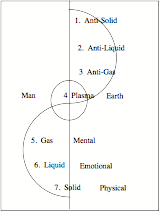
Clerk
This is the Fall of Man then.
Conductor
As seen from the Anti-Universe. As seen from the Universe, it is the reverse. Eating from the Tree of Life is the Rise of Man. It all depends where you are standing. And which territory you are trying to defend.
Conscience
Don't you seek to entice this man, too, this Michael Means, to fall, to be transformed from an angel into a man...?
Conductor
The elements of the Duad are Air and Water.
Rabbi Jehoshush
Adam, the Warrior, is conducted to the Third Heaven, folliwng his death, at which point he will wait until the wheel comes to get him. Both masculine and feminine, the emotional man: the warrior.
(A gold statuette of a man carrying a briefcase, going
to work.)
Soothsayer
And the time shall come when the Animals will look into the faces of the Men and see not what they had feared in them; and they shall begin to attack them again.
Announcer
Everyone wants to be holy now, each competing with the other for the title of the most holy.
(Young man at reception explains the recent history
of Lebanon to the Clerk -- who wonders what such
clear historical detachment has to do with our role and
what is exactly happening there.)
Clerk
But it appears to me that we have already taken a side. It appears to me that we have sided with a government which is attempting to pull a nation up out of the state of chaos.... Your profession is to tell me that we are always on the wrong side. I understand that this is your profession. Good. Only don't expect me to take you seriously. You believe that by always opposing your own material self interest you support your own spiritual self interest. But this is spiritual materialism. It's no different really. Spirit is matter also. Spirit is anti-matter. It is something created. It, too, is not eternal. Spirit and Matter are interwoven. You believe that the two are separate, adversaries -- when, in fact, the two are wed....
Conductor
You have begun to think of the material life, of gaining a better job, so that you and your brother do not end up as degenerate rejects in old age....
Shrew
He has lost his faith. He once said that God takes care of us all....
Paul
If he will not work, then let him not eat. God helps those who help themselves....
Clerk
He begins to perceive that he might be the victim.
Shrew
Fighting Death; and, therefore, being fought by Death!
Clerk
It is to save himself that the Intellectual betrays the Jew. I point out to Brian, my friend, a Jewish lawyer, that the Jews in the days of Jesus were instructed by their 'savior' to give up life, to become slaves again, by giving up Power (self-defense) for Love (acceptance of Death). So the hippies choose death over life, choose martyrdom over self-defence. Should Americans choose slavery; or should Americans choose power...?
Conductor
Intellectuals sing praises of European Culture, for they are old in a young society in America. A nation does not devote itself to art, thought, and forms of culture until later in life. Their complaint against America is that she is alive. They would prefer her dead; and so they turn to Europe for an example; and, sometimes, they turn to communism. For life is too rude and too rough for them. And rarely does it honor them....
Clerk
The East has no conception of Democracry, for, to tolerate democracy is to tolerate the uncertain, to tolerate chaos. Order is more important than the individual in the East. Any form of chaos merely increases insecurity.
(A Chinese girl at the University, in tight shorts, sits
with her legs apart before the Clerk. She leans to her
right; the crotch of her shorts shifts, exposing her
pretty naked downy vagina to the Clerk.)
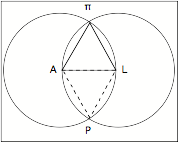
Newshawker
Read all about it! Doctor Joyce Brothers Announces That Should One See a Woman's Vagina Unexpectedly, in a Dream or When Awake, One Should Immediately Buy a Lottery Ticker -- For This is a Sign of Good Luck...!
Conductor
The beauty of Woman has captivated our Clerk.
Conductor's Second
One can hardly blame him. He remembers vagely the Valkyrie coming to him during his sleep, in the thick of his novel, and telling him he had been chosen to die....
(David Crockett is seen wrestling a bear.)
(The
demon Gilbert Patton is seen walking before the
Clerk's house; the Clerk is returning from work.
Patton crosses the street, and walks on the opposite
side of the street, going the opposite direction from
the Clerk -- trying to avoid the Clerk's gaze. The
Clerk invokes the name of Metatron. He uses his
will to keep the Darkness at a distance. Her
understand that now dark and light are of equal
strength. He prepares his descent into the cave where
Darkiness lives.)
Clerk
Like Beowulf before me,
And Apollo and Osiris too,
Into the Monster's Lair I turn.
For nothing is new;
Nothing new can be seen.
(The movie Christ Stopped At Eboli is showing at
Cinema 7.)
(Angels are see strapping on armor.)
(John Ayers, in Miami, save a woman from a mob of
men. Ayers wades into the mob, which has
surrounded the woman's car. Ayers is attacked by the
crowd; he has both cheeks broken. But he manages
to save the woman and drive her away from the mob.)
"So, we see Gilbert again at the Autumn Equinox, that point where the dark and the light are at equal strength," Rose says. "Where the light and darkness come together, the man and the woman. It is not surprising that this is the time that the Clerk sees the pretty Asian woman's vagina. The sexes are drawn together in the Spring and in the Autumn. That's your thesis at least -- the thesis of your diagrams..."
"Yes."
"And you are now going down into the Winter, down into the Darkness," Rose says. "Down into the cave -- the Monster's Lair, you call it -- so you know that some kind of fight with this Darkness is coming...?"
"Yes. Most definitely."
"Clearly, temptation is much stronger now," Rose says. "Female temptation. The flesh. We have heard the Woman in the Ceiling tempting your ears through this entire passage. And now the Chinese girl unintentionally showing you her treasure. It was unintentional, wasn't it...?"
"Yes. A friend grabbed her, and tried to pull her off a ledge she was sitting on," Crossmann says. "The girl had to adjust her weight to keep from falling. And the gate just opened up..."
"For everyone to see," Rose says.
"No. I was the only one who saw it. She was not aware that anything had happened. Neither were her friends..."
"Then the line of Doctor Joyce Brothers," Rose says. "That is very funny...!"
"That's an Asian belief," Crossmann says. "They say that in Vietnam, anyway. If you dream of Number Two, the Snail, one should buy a lottery ticket..."
"Where did you hear that?" Rose says.
"I have a Vietnamese friend," Crossmann says.
"The snail?"
"They call the vagina a snail in Vietnam," Crossmann says.
"You see some significance to this vagina appearing in the book," Rose says. "It is not just comic relief...?"
"No. It is comic relief. But it is more. The Earth, of course, as we have seen in all our diagrams, with all these interlocking symbolisms, is a womb. The Clerk is coming back to the Earth. He is coming back as a sexual creature. He has had these metaphorical loves throughout the book. But the woman is now becoming very real as a sexual creature..."
"The sword and the erect penis are related," Charlie says.
"Very much. Sexual desire is power," Crossmann says. "It is the way the man again gains power over the woman. And organizes Chaos...."
"I remember Finnegan's Wake has a geometry of the womb also," Rose says. "A geometry of Anna Livia Plurabelle's womb, the mother. When the one brother shows the other brother the picture, the geometry of the womb, the second brother strikes the first, knocking him down, for being vulgar. That is the same diagram which appears in your novel when the Clerk see's the pretty Chinese girl's vagina...."
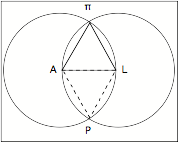
"Yes, here's that diagram again," Rose continues. "Did this diagram influence you in your diagram construction...?"
"No, not really," Crossmann says. "The diagrams just came out. I don't know where they came from. But they were more refined than words. Words were clearly limited in describing this mechanism, this mind of Nature...."
"So, geometry is inherent in the description of the landscape...?"
"Yes," Crossmann says. "Plato wrote that 'God geometrizes'. I believe that is true..."
"This explains the Greeks obsession with geometry?" Rose says.
"The Greeks were the classical man, with one foot in the dream world and one foot in the waking world," Crossmann says. "For they were the youth of the race. The warrior-poet heroic race. As the youth is fearless, in touch with God, conquering the world each day..."
"But the child is utterly helpless, passive," Rose says.
"Until he become the youth," Crossmann says.
"Yes."
"So the Indians are passive like children in their nature, helpless before their god."
"The Indian are the child; and the Greeks are the youth?" Rose asks.
"I'm not certain," Crossmann says. "That just came to me."
"And the Romans?" Rose asks.
"Well, the Romans are clearly the Giants," Crossmann says.
"As we are Giants?" Rose asks.
"As we are Giants -- as the Russians are Giants, were Giants."
"Heroes are beginning to appear in this book, contemporary heroes," Rose says. "You mention Joe Clark with admiration, the black ex-marine -urned-school-principle, who turned a ghetto school into a model school through discipline..."
"The liberals later tried to destroy him," Crossmann says, "because of his methods. Because they felt his system violated the rights of the students to expression -- that is, to be rebellious, chaotic..."
"You admire Joe Clark?" Rose says.
"Absolutely. I come from a Catholic School tradition. School is for learning -- not a club for kids to show off their clothes and to show how cool they are," Crossmann says. "We couldn't talk in the cafeteria when we ate lunch. It didn't kill us. We spoil our children. We treat them like they are adults. But they aren't adults. They need to be molded, formed... Joe Clark was definitely a hero..."
"John Ayers, the man in Miami," Rose continues. "Davy Crockett, wrestling a bear; of course, the bear is also Russia. The gold statuette of the man going to work each day, the man carrying a briefcase."
"The working man," Crossmann says.
"The marine named Clark killed in Lebanon. Some critics say this is the point when you begin to clearly fear the black man, to identify yourself with the white man in opposition to the black man. Many point to the passage where you write: 'I sense raveous demons not far from here. The longers after death..' and then you have Jesse Jackson appear in the slums of London, speaking for disarmament..."
"Clearly, my view of Jesse Jackson changes over the novel," Crossmann says.
"You later declare Jackson a racist," Rose says.
"Well, his view of reality is entirely through the lense of race," Crossmann says. "He is no different from the white racists except he lives in the Anti-Universe. He hates the white race..."
"But isn't it for good reason?" Rose says. "I mean, my God, man, they have been persecuted by the white man for centuries..!"
"If he judges the white race as a race," Crossmann says, "then he is no different than those who judge the black race as a race. And we can assume that he would, if give the chance, commit murder against the whites the same as the whites with a similar mind committed murder against the blacks. There is a double standard in our politics. Jackson can be friendly with the Black Muslims, who teach that the white man is devil -- and this is acceptable. But if a white candidate is openly friendly the the Ku Klux Klan, who believe the black man is a devil -- that man would be destroyed politically as an extremist... The leader of the Black Muslims threatens to murder any black journalist who writes or speaks anything negative about Jackson during the political race. These are not American values. These are Islamic values. Or mafia values. I'm not sure which. It's like having the Baptists giving an order than any white journalist who criticizes Ronald Reagan be murdered. It is an act of chaos, of anti-democracy. But, because we feel guilty, we look the other direction. Blacks have to all think the same, vote the same. There is only one issue: black against white. If you are not on this side, you are not really black. You are an Uncle Tom. There are Asian conservatives and Asian liberals; there are hispanic conservative and hispanic liberals; there are even American Indian conservative and liberals; but there are only Black liberals. Black conservatives are traitors to the only issue: how much the government takes care of the blacks. Generally speaking, conservatives believe in individuals fending for themselves, individuals in union with their God and their families. Liberals don't believe in individuals. They are often atheists or agnotics. They have no faith in God -- therefore, they feel they have to be saved by the government. They are like children who feel they need someone powerful to take care of them...."
"So there is a racist element in all of this," Rose says.
"No. Blacks can and do succeed as individuals in America. We see it every day. The extremes are bad. They are to be avoided. The White Supremacists are like the Black Supremacists: evil. Both extremes are evil. Both extremes are death," Crossmann says.
"And you thiink Jesse Jackson represents this extreme?" Rose says.
"He feels that he is justified morally to rage against the status quo," Crossmann says. "He heaps upon the white race centuries of crime, centuries of guilt. But he is a rich man. He has become rich by screaming at the white man. That is his profession. He is not perfect. He has committed sins. He has his corruptions. He wants us to believe that the world is clear-cut: the Whites are bad; and the Blacks are good. That is how it appears from the Anti-Universe. From the Night. This view fuels his hatred; and hatred is his driving force. But it is an illusion. Whites are good and bad; and so are Blacks. He may meet a White Man who would save his life; and he may meet a black man who would try to kill him. We have power as long as we believe in the Universal illusion. It gives us moral power to portray ourselves as the victim, to always be the underdog. But this is just a perception. Life is more complex than this childish simplicty.... Salvation never comes to a race. It comes always to the individual who climbs the mountain against whatever odds, whatever difficulties. Salvation comes on the inside, not on the outside...."
"Many people, many liberals, are uncomfortable with this view," Rose says.
"Many liberals believe that a person is racist if they do not toe the line with the liberal view," Crossmann says. "That view is that America owes the black race for past sins, for racism, for persecution -- and that somehow we will alleviate our bad conscience by giving money to the blacks. That's the liberal view. Give them what they want, so they don't take up guns and try to overthrow us. Buy them off. That is in the back of the liberal mind. Buy them off. Give them money. Maybe this sin will go away some day.... It doesn't establish equality however. Give blacks a good education and they will be able to compete in American society. But they need to compete as individuals -- not as an entire race. Some will fall and some will rise. But education is the foundation. Those who choose crime over eduation will be destroyed, the same as with any race. But those who climb will be stronger and will lead their race by example...."
"They discredit these ideas by calling you a racist," Rose says.
"Like they tried to discredit Clarence Thomas because he believed in individualism," Crossmann says.
"Do you admire Thomas?" Rose asks.
"Yes. I believe any black person who doesn't follow the party line is marked for character assassination," Crossmann says.
"You see the Clarence Thomas's of the world as being pioneers, rather than 'Uncle Toms'?" Rose asks.
"Yes. Slavery is still very much alive in the mind -- victimhood," Crossman says. "Depression, self-indulgence, victimhood -- it all is a kind of slavery. 'Poor me. Why did they do this to me?' And all races and peoples are subject to this kind of slavery. Only the individual can climb the mountain out of depression, out of slavery, out of victimhood. Identify with your soul and with your God. That is the only way to climb this mountain....by ooking forward. Forward to Life, forward to continual birth into better worlds. Those who look back, who can't look forward, who are afraid to look forward, are subject to slavery, self-slavery, slavery to depression. One must look forward. If one is old, one must look forward to the soul's rebirth. If one is weak, one must look forward to receiving a new strength. If one slips into the Anti-Universe, where everything goes backward into the Past -- where only the past seems attractive, then one becomes a slave to his emotions. And one's identity becomes the one who is persecuted. We all know how difficult it is to lose an identity, to face chaos without some identity. It is more comfortable, even in the inherent pain, for some to remain a victim than it is to give up this identity and stand in the world as nothing, a man without a mask, a man without an identity.... I love the poetry of Rilke, The Duino Elegies, where he writes: 'Remember, the hero keeps going. And even his ruin is only subterfuge for achieving his final birth.' It is like Goethe's concept of 'Eternal Becoming'. One never contracts. One is never done, complete, finished. One is always becoming, always on the journey, always seeking, always going forward..."
"So, literture helps us to live our life," Rose asks.
"Literature is a record of human beings trying to find their ways through a complex life," Crossmann says. "We read literature and philosophy as we read a map to a strange city. Those who have gone before us give us a map to help us on our way..."
"This novel of yours is also a map," Rose says.
"Yes it is. A map into and out of Darkness."
"Like the hero in Rilke's poem, we must continue to go forward..." Rose says.
He begins to read again.
Clerk
Merthiolated odor. Order of kingpins. Dragulas in fee. All painted for entire reasons. Known only to the prophet who counsels maeek and May and mire for me. Yea. All the gnomes goknow their seasons. And the bees complain of birches, all hovering against the wind. Scratching the backs of the maypoles; as dreamers wall in their entire history of fantasy. Who knows my true religion? Who know the regions of my stipulation? A messenger comes to me from Daphna. She re-awakens in my mind: Daphna and Tamar. Mother and Daughter. nothing else is known. The woreeis fo the mother. Mother indto daughter. Daughter into Mothrer. Father into Son. Begging to be rescued. As Armageddon domces to mind. And Mount Nebo looms to the east of my town. Making me strong with execution. The holy and the whollysaid. Each wishing to be a saint. Each as, truly, a compound horror. ll And a compound grace. As Dark and Light do battle in the heart. A whole epic of starry congratulations. Self-congratulations it seems. Telling the promegranate your storry. Please excuse my spellling. A spell as a ghost of sporeys. A ghost of light, like cloth, around a well. A GHOST OF OSPREYS, YOU MEAN? Yes, a spell is a ghost of ospreys.
(French war planes strike Moselm and Syrian
positions in response to shelling of own positions in
Beirut.)
(Messenger
from Israel brings a message to the Clerk
from Daphna. She is fine, five months pregnant;
Tamar is a glorious pumpkin.)
(Vision reported by many as seen in Bethlehem. A
tiny vision of the Virgin Mary: a tiny portrait of
Light.)
(At the football game between Air Force Academy
and Wyoming at Laramie: two falcons, the symbol of
the Academy, are released by the falconers prior to the
game; one falcon, named Fritz, returned; the other,
Isis, could not hear the falconer, and did not return.)
WB Yeats
Turning and turning in the widening gyre,
The falcon cannot hear the falconer.
Things fall apart; the centre cannot hold;
Mere anarchy isloosed upon the world;
The blood-dimmed tide is loosed, and everywhere
The ceremony of innocednce is drowned;
The best lack all conviction, while the worst
Are filled with passionate intensity.
Surely some revelation is at hand;
Surely the Second Coming is at hand.
The Second Coming! Hardly are those words out
When a vast image out of Spiritus Mundi
Troubles my sight: somewhere in sands of the desert
A shpe with lion body and the heaad of a man,
A gaze blank and pitiless as the sun,
Is moving its slow thighs, while all about it
Reel shadows of the indignant desert birds.
The darkness drops again; but now I know
That twenty coentureis of sony sleep
Were vexed to nightmare by a rocking cradle,
And what rough beast, it shour come round at last,
Slouches toward Bethlehem to be born?
Mythologist
The Egg is sacred to Isis, the Egg being the Zero, the container of all the primitive elements. The Egg, being more explicit, is the Land of Mystery, of Rest, of the Dead, where secrets are given to those who come to learn....
Clerk Singing Along With Song On the Radio
Maybe, some day,
Saved by Zero,
I'll be.... all together.
Stretched by new worlds.
Knowing. Dreaming.
Stretched to service.
Maybe I'll win.
Saved by Zero....
Father Hmelovsky
It is your contention that the falcon Isis, having disappeared, is a symbol of reveleation. Should we read this disappearance of Isis, of the Egg, the breaking of the Egg -- should we read this as the appearance of the hawk-headed Ammon, or Horus, who is the first male, the first aggressor...?
Clerk
The land of vision closes up. Fritz returns; but Isis does not. The Egg is gone.
Art Critic
You did a drawing recently in which the three wise men on camels search for the burial ground of Isis...
Clerk
Those drawings no longer come to me. Now I merely look into silence. I look into women, whose sexuality makes me raw.
Newshawker
Read all about it! Cease-Fire Accord Reached in Lebanon!
All Sides Hopeful; But Some Say Peace Not Realistic...!
(West German newspaper publisehs transcript of
Russian radio transmisions prior to the downing of
the Korean jetliner, in which pilot tells ground
station tht the jetliner was wagging its wings,
singalling readiness to land, at which ground control
replied: 'You are to do nothing about that! You are to
prepare to fire!')
Dream-Recorder
There was a high-pitched sound in a night sky; many were on the streets, searching the sky for vehicles. One came through, a relatively small UFO. The Clerk ran though the street, following the flight of the magnificant disk. Michael Means was there, the friend who loved Bach -- the liberal friend -- as were many hippies. Each lectured the Clerk on who the visitors were, where their mission was. They were Hopi Indians re-manifesting some said; Means proclaimed their liberal humanist leaning: each person who spoke described the beings as reflections of himself, his own beliefs. This smaller ship was followd by a great spherical space-station, immense, aawe-inspiring, slowly passing through the night sky.
The dream then shifted to day. There was a hippie festival, a parade in which all the 'reincarnated Hopis' proudly wandered about the streets in celebration of their righness. Means was also at the celebration, telling the Clerk that for him, the Clerk, to see the inhabitants of the space ships he would need to become a liberal humanist again. The Clerk, alienated from these self-congratualtion, this pompous self-blinded worship of feminity, sat by himself on the steps of a church. His brother was there also, sitting withhim. Then a man appeared, pale-faced, with a multitude of children, all wearing rain hats, with mositure pouring down their faces. It was as though they were sitting in a rain storm; yet, everywhere else, the sun was shining brihgly. This man and the children were avoided by the enlightened ones; they were white and pale, seeming like ordinary middle-calss people to the group of 'Hopi incarnates'. yet the Clerk put his arm around one of the children; and they began to talk. This group was all truly friendly, without th epretense of the hippies. This group was the crew of the crew of the space ship. The Clerk was told that he must be more willing to talk to people, to open himself up to common strangers. He asked: 'Are you originally from the Earth? Were you Hopis once; and do you now reincarnate?" They shook their heads 'no'. They had never lived on Earth. They were from another system. Means and the hippies could not see these people. They marched around the town in some kind of pagan celebration of joy. While there, before them, the crew and the Clerk talked about the ways of their world.
The Clerk cannot remember all of their conversation. When they prepared to leave however, as they were ascending the stairs leading into their ship, the Clerk asked: 'How far behind is our technology and electronics from your own?' One of the pale, rainy-faced children replied: '38,000 years.'
(Clerk notices building inside himself an ever-
growing anger at feminists and lesbians.)
(Australia wins the American's Cup yacht race,
the first defeat for America in the competition in
almost 200 years.)
(Isaac Amatof is harassed by a crowd.)
Voices of a Crowd
- Death to pacifists...!
- He's a communist if he won't fight...!
- Make him carry a gun -- make that his religion...!
- He doesn't believe in harming a soul! Make him harm a soul...!
(Clerk speaks in an animated fashion with a pretty
young woman named Wu from Taiwan. Later in the
day Shulamit an he meet, exchanging greetings and
smiles, wondering if there should be something
more.)
(Clerk's sister, Laura, gives birth to a son named
Michael Allan, named after the Clerk himelf.)
(Clerk is seen arguing with a Marxist Turkish student
about the military role of America in the Third
World. These two once were friendly; but not there is
an intense disagreement.)
Critic
Oceanic myth speaks of the First Man emerging from an underground city.
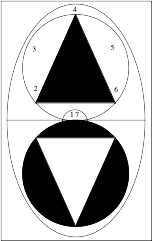
Clerk
What does it matter? Life tugs at my sleeve; and you ask me if it is real! Stars clutter the night air. Who speaks for these? Who speaks for the fallen and for those cast away by Dawn? Not I, you say. True, I speak for the fallen only when I am he. Inflation of the Ego. Accepting the penance of pain. For faillure's really no success at all. The bridge at Midnight trembles. The country doctor rambles. In ceremonies of the Horsemen, even the pawn must hold a grudge. Russian bombers strike rebel targets in Pakistan, expanding the war even wider. Russian fighter planes fly over Iran, as a warning against Islamic persecution of communists. Recently published books in Russia seemed to give government approval for accelerating anti-semistism in Russia....
Clerk as Poet
Frankie Lee and the Queen of Spaces
I. The Notion of Self-Mythology
'Optimism is the dity of Justice!'
So said Frankie Lee
As he strolled down Park Place
Wearing thin trousers
And sporting a beard.
'Sorrow is the dity of no one,
But is the legacy of life
Lived in the shadow of leaves.'
Such is the great Wisdom
Destined to make of Frankie Lee
A legend such as the great
Desert sages.
How came he to such a state? --
This velvet man with words he stole
From pyrmids' values and documents
Of whorls --
Contained by Age's look of love
And hands which mold
A Century from dust?
Born in a cradle of dinosaurs' bones
In the wheatless sands
Of Wyoming sky.
Conceived by some seemingly
Eventless spasm,
As Man-as-heart and Woman-as-loin
Conjoined in shell and hammer
To have him.
Stepping from the skin
Of desert and plain
And moutain and valley
In one as his sleeve:
This melody-making Jovite in white
Through Parody's grace
And beyond Moabite's grin
Down Platte-flooded tremors,
Over snow like a seal:
Conceived by the seven hardened
Elements he bore.
He came to ask the hand of thee,
Thou Queen of Justice,
Thou Harmony of Stone,
In that dark land beyond,
Where the Sun has supper;
And then He sleeps.
Who are you truly --
You Madame Queen of the Spades?
With hair as raw and as red as a rage,
Like strawberries scattered by Wind
On white cloth?
You are not the Queen of Spades at all.
You are the Queen of Hearts.
You wear a rose on your apron.
II. Persecution Is An Arid Sea
'History is said to be reflection
By the Dead.
Memory is no alternative
To the flesh of a living Sin.'
Such words came to his lips
Like bees,
Finding some miracle well
In his protection.
The invisible are like great veils
Drawing always the obvious away,
Substituting the lost.
Lost tribes and lost evacuations.
Conspiracies are ever pronounced
By those who cannot see.
And those who can see
Never speak but by signs,
Consigning the needy
To the levels in their heavens.
Frankie Lee and the Queen of Spades,
Who is not really the Queen of Spades,
Stopped to drink from the well
In which New Language was boiling.
Life expands and Death retracts.
Life protracts as Death suspends.
No New Language is not without
Detractors.
No Noon Tea is not without
A common role.
'If I laugh at my own mythology,
While not dismantling it with my humor,
Rather using it as an armor
In which to live, first --
And then to be set aside --
Only, then, can the Hero inside,
Deign to save the Man that He harbors.'
He laughs as he says this.
Wyoming snow is on his breath;
And Wind which succors
A blind, knowing sorrow.
'I have eyes which tell me
The language of knowledge.
Other eyes tell me the taste
Of my pleasure.
Still other eyes speak the logic
Of motion.
While others deride the Hawk
Who would have me.
All doves I send
To save the world
From egg and sleep
To Hawk become,
Trasnsforming the peace
Into deadly Man-incumbancy.
He who carries a shield and a rose,
A sword, a hammer, and an ode,
Speaks all ways.
Creating the Dead by his word
Which he slays.'
There is shouting in the City Hall.
Parades go by in which queens deck
The thralled and serious silent men
With the smiles of becoming eves.
In the hand of the Queen
who has hearts on her armor
And a heart made of blood
And the passion of a maid
Is the story of a legion
Crossing seas to find a king.
No one understands
These lines and veins of blue becoming.
But the Prince has a silent nature
In which compre3ehension is duly formed.
III. In the Company of Saints
Yes, their marriage was in agreement.
And ritual was silently done.
She gave him a name; and he gave her a story.
Her gave her mystique; and she gave him her spade.
He digs the Fable of Power from her garden;
She buries his seed;
And then makes plans
For a coming son.
Amen.
Conductor
You speak against the Intellectuals now, who you accuse of being Death, for the cause of Peace seems to you now a desire to surrender....
Clerk
Fatigue has set in.
Yet they do not need to pull down the Living as well.
Conductor
Amazonian separatist feminists are here, who call upon women to avoid me in all ways. Lesbianism. Rebellion. Hoping for death. The force of disintegration. They are the chaotic monster you fight. Gilbert Patton and the demonic shadows. You were on of them once. Their numbers seem to grow now, as darkness begins to fall. This is the Valley of the Shadow of Death. And Fire, which lights the Night up, is that quarter in which they live.
Literary Critic
Your ppun in the last line of Part II, Stanza 2, is wonderful! Not the play on 'roll', which is mediocre! But the 'noon tea', with 'T' being the letter of the cross or crucifixion; and Noon being that 'time' or constellation in which the Solar Hero, born at Midnight, is killed Here the 'role', that of Hero (or perhaps Negative Hero) is rare...!
Clerk
Please send me the Daughter of Israel
To help me through the Fire.
Conductor
In the Fire are the voices,
Full of hate,
Which condemn you!
Clerk
The voices of the dead,
Who desire to be possessed by Death.
And all around are the Hamites
Who merely wait
With sharpened knives.
Voices From the Sea
- Who is dead and who is living?
- Disincarnated Hopis are there.
- Thou shalt not root for Dearth; or thou shalt become it!
- The throat is sore; what shall I do?
- Jehovah shall return! The Jews shall find a son; the Christians shall find a father!
- Will the West strike down theEast, which saved it? The Woman resurrects the Man with her knowledge. For the darkness of which Man does strike her down, even according to that knowledge....
- She even prepares herself to be victim.
Town-Crier
Ideas no longer matter.
The time for Ideas has passed;
Something else now comes...!
(When the Seventh Angel appears, he shall say:
'Henceforward, there shall be no Time.')
(Khomeini threants to cut off oil supplies to the West
if the French sell weapons to its enemy, Iraq.)
Von Helsing
It's the Romans who perverted everything. It's their genetic flaw. The Catholics. Roman Empire: from Moscow to Wales to Tierra del Guego. The Black Irish.
(His only approach to religion is through exoteric
madness.)
Dream-Recorder
The Clerk's dreas include:
- Being in Beirut, and approaching a Jewish woman, one with whom he worked at school. Carmi Weingrod, who was, in the dream, living in Beirut. He needed a gun; she led him into her apartment bedroom and ppulled an automatic pistol from the drawer beside her bed. It was absolute chaos. He went out into battle with the pistol in his coat.
- He was in Managua, Nicaragua. It was much less black than Beirut. It was day; Beirut was night. He talked with many people, each speaking to him a dissatisfactin with the government.
- He was handed a picture of himself: a naked man in a tree, with a gigantic phallus.
His dreams are very vivid and thick now. He is very fatigued. He sleeps; but, in the day, there is much less to do.
Analyst
He has been cut off from his heavenly material. When he reads he only becomes tired; his throat hurts; he is developing a cold.
(French-made rockets are fired from Iraq into an
Iranian village, killing hundreds of civilians.)
(Wallid Jumblatt, Druse leader in Lebanon, calls on
Druse Moslem soldiers in the Lebanese Army to
desert. American-trained soldiers take side with
Jumblatt, claiming the war is a Jihad, a Holy War.
Jumblatt proclaims a Moslem government in the
Chouf Mountains.)
(Israel picks up distress signals from an Italian ship
after it collided with a Russian vessel. But a search
produced no clues as to the place of the sinking ship.
Russians make no comments.)
(Italian government official, days before, surmised
that Russians had deliberately shot down commercial
airliner 007 as a signal to the West that they were
prepared to fight.)
Von Helsing
The Meditteraneans have a genetic flaw.
Clerk
You sound like some pudgy Hitler, Von Helsing, with some Pure Race syndrome. There is no Pure Race. Every race (there is really no such thing as race) is a mixture of races, a mixture of genetic codes, genetic histories. The Roman was a mixture of many cultures. He was Jew and Gentile and everything else.
(Aside) There are some to whom the mystery of religion is never opened. Their only access is the literal, the violent, the history of religion. They are historians rather than mystics. They are 'concrete scientists', making of mystery a series of facts representing a logical premise...
Town-Crier
The Clerk has a cold! He seems to be losing his strength!
Dream-Recorder
The Clerk, in his dreams, was in Russsia last night. It was cold and dark. He walked through the streets with his father and his b rother. His brother became lost. In the supermarket, a b ig television screen beams a color commercial in which Joel Johnson, a childhood friend, in his basketball jersey, attempts to sell some product to the soviets. They hurry through the streets to make it to their train. Michael is worried because Williamd is not with them. But he is waiting at the station; they board the train; it is night; the men are sleeping in the aisles, in the luggage rack as well. Their father is now lost. Michael crawls over the sleeping men, looking for his father. One man says: 'He is back in the next car, suffering from guilt.'
Analyst
Writing tends to cast him down into the pit of his stomach, where his own death is certain.
Clerk
The Sun saves the North from Winter; yet the Sun is heat and destruction for the South. The North goes out in Summer to welcome the Sun, to sit in its gaze; it save the North from darkness, and from death by starvation. Yet the South goes inside to hide from Summer rays. The Sun is a tyrant to the South. The Moon saves the South from the Sun. The Moon is the tyrant in the North, for the Night, the Winter, is frozen Water, seeking to kill the North.
As one can see, the Sun-Hero is perceived differently by each quarter of the world. To one, he brings bount; to another, he brings punishment and blood, terror, wringing strength into ennervation.
Conductor
The 'Light' Man is attracted to his opposite, the Dark Woman, the Earth. The 'Dark' Man is attracted to his opposite, the Light Woman, the Moon. The Dark Man and the Light Woman (Set/Typhon and Isis) conspire against the Sun-God (Osiris): together they strip him of his power and destroy him, tearing him into 14 pieces, scattering these pieces over the Earth. Later, Isis, coming to fear the sterility and disease of the Night, seeking to resurrect the Light, gathers up 13 pieces of Osiris; but she cannot find the 14th piece, the phallus. The phallus has been thrown into the sea; and it has been swallowed by the Leviathan. Isis bemoans the death of her husband. With her own power now gone, her land is invaded....
The son or Osiris, who is Horus, rises to annihilate Set/Typhon.
Clerk
What has this to do with me?
Conductor
Set is the god of darkness and drought. His form of rest brings plague and sorrow, depression and death. He is exiled to the Western Sea, where he awaits another descent by yourself....
Clerk
Fear has come to life in me. Another night coming on. Darkness creeping in. As I oppose it, it is becoming real. I fear losing my strength. I seem too long from my source of strength.
(A beautiful blonde woman appears to the Clerk,
eyeing him with interest. His stomach starts to
swirl.)
(Russia deploys SS-21 missiles in Syria, each
capable of striking positions inside Israel and
Lebanon; also capable of striking the American
fleet near Beirut.)
(Joint Russian and East German military parade held
in East Berlin.)
(Khadaffi claims new crusade being fought by
Christians against Arabs in Middle East.)
Conductor
By night the forces of Darkness are strong. The Black Giant takes on stature. Russia is on the move. Set seeks a way to strike his brother and kill him as he rises.
(Erotic Woman appears to the Clerk, demanding
attention. Since he has stimulated his Physical Body,
it is this body he meets in the Darkness.)

Clerk
And, in my discussions with Peter the Prophet, a mad boy from Springfield, who had died his hair golden, who lifts weights, who is capable, perhaps, of some outrage -- Peter's hero is Sasquatch, also known as 'Big Foot', a legendary monster in the Pacific Northwest, who lives in the woods, smells like death, takes huge strides and has great strength, a mythic animal in the body of a man -- in my discussions earlier this year with Peter, I said arrogantly: 'I'd like to meet Big Foot face to face!'
And I realize now that the energy of Sasquatach and my own demon Gilbert Patton and Russia the Dark Bear of the woods are one. The Dark Giant, who did threaten me: 'I'm coming after you (whites)!' he told me. Set. The Dragon of Darkness. He smells like Death; he has the voice of death, the voice of a roaring bear. I am in the woods now with this bear. I prepare to fight him as Horus prepared vengeance on Set, the killer of his father....
Conductor
As his threatening you and Daphna was a picture of the future -- in which Israel, surrounded by Darkness, is approached by the bear, this Sasquatch, Death, the Russian Bear....
Clerk
He is the accuser of Israel. He condemens Israelis for he'd have them be failures. Slaves. Reduction of all elements to the common element. That is what Death does. That is what war does.
Analyst
The Centaur resides in the Southern Sky between Hydra and the Southern Cross. It is the zodiacal sign of Sagittarius: the Man-Horse; the Archer. The brightest star in the constellation, Alpha Centaurus, is the closest star to the Earth in the heavens.
James Joyce
We shall perhaps not so soon see. Pinck Poncks that bail for seeks alicence whare cumsceptres of scentaurs stay. Bear in mind, sn of Hokmah, if so be you yave method in your madness, this man is mountain, and unto changeth doth one ascend...
Clerk-As-Poet
Evocations on a winter night
Light a bell inside a broken loom.
Air is filled with words and deeds
Which shriek of lost and captivating crowns.
Grandfathers are found in their sheets
In the rain;
They speak the troubled mist of days
They spent creating what you have destroyed.
Fatehrs hover like agents of making,
Evoking the grand and the great
In a hoary whisper.
My coffee sees me through these dreams,
Where Ice and Fire collide in mime.
A map I find in feet of words
Which poets' breath has once congealed,
In which I walk a tightrope plea
To find my way from Hell's heart
To gold.
All Harm stands with Horro at the gate;
When the circus is unloosed
And the dogs collide with rounded men
Who sought to see the only side
Of one bright Moon
So their sight would not blind them:
Then 'round about the room they'll run,
Like Tide on Time,
Until Dawn designs to save them,
One crust, circled on a tray.
Evocations on a winter night
Cannot spell the sleep which my daughter
Has won.
Nothing disturbs the grace of the child;
For war is not her mode;
And the ghosts can carry no shield
Into heaven.
Analyst
Is not our Clerk the closest 'star' to the 'Earth'? Born, too, he was in the sign of the Archer....
Unknown Man
Our Clerk seems lost again. He may have been saved from the Darkness; but this salvation has cost him dearly. We are waiting for him to appear out of the twilight. We are waiting for him to appear...
(Earthquakes in Salt Lake City, in the Northeast
Corridor; St. Helens has a small eruption; Kilawaea
agains erupts. Floods in Phoenix. Where does it
end?)
(North Koreans bomb South Koreans in Burma.
South Koreans march through Seoul demanding
retribution. Burmese arrest suspects.)
Conductor
What does this matter to you? Horus, the Hawk-Head, rises against Set -- and chains him in the underworld for ages. Horus, the son, or the permutation, of Osiris...
Analyst
What, indeed, does this matter to this Metatron who carries a bow!
Moses, on Mount Nebo
It takes Water and Earth to create a Human Soul.
Clerk
Father to Son.
Father's Ghost to Son.
The day was becoming cold, when I made my descent.
Ferns shivered in the increasing eve.
"Thus begins the longest poem in this novel," Rose says, "which appears again as the prologue in your book of prosepoems, Instrumentation In the Wheelhouse, which I am assuming will be published in the near future. In Instrumentation, the prologue is entitled 'A Father's Testament To His Son Upon His Deathbed'. Although it could be construed to be upon the Son's deathbed, I am assuming that this is the dying Father's testament to his Son..."
"Yes."
"This, at least I understand it this way, is a kind of visit to Hamlet by Hamlet's dead father's ghost," Charlie says. "For it to come here, in the Night, right before his son's battle with the Dark Principle, seems to me to be like -- well, I have said it, like the ghost of the dead father appearing to Hamlet...
"Well, yes, it is similar," Crossmann says. "Hamlet is a major player in this novel, thematically."
"This poem is very openly angry at what I might call progressive America," Charlie says. "Liberal America."
"It is an angry father looking back on his children," Crossmann says.
"Is this a picture of your own father's vision when he died?" Charlie asks.
"No. My father had become, in fact, more like Jacob Heimkreiter when he died," Crossmann says. "He had come to view the world more like his sons viewed it. He felt America needed a revolution. That it was corrupt. That we had self-serving thieves running our government.... No, he was pretty disillusioned about America when he died. This novel is as much about the death of my father as it is about anything else. But not only the death of my father, but also the resurrection of my father's son. This long poem could just as easily have been called the 'The Son's Testament to the Father Upon the Father's Deathbed' -- for it is a vision from the Fatherland as much as from the Father. It is the vision of the Son as he stands now in the Father's shoes... Even better I like your analogy. This is the Father's Ghost coming back to Hamlet, demanding retribution. The Father's Ghost is walking through the town one last time with his Son...."
"It's a kind of Old Testament son, it seems to me," Rose says. "Full of thunder and rage, full of anger and apocalypse."
"Yes. The world isn't right," Crossmann agrees.
"We should get in to it," Rose says. "It is long. We can talk more about it as we go..."
Rose reads:
Flowers had made their many runs from the abutments.
All ships had foundered, airless and blue.
Trumpets were banned, not to awaken old clones.
I stood at a point, and conceived many odd fractions.
In the face of the women I saw the falcon, Isis,
Who some say had escaped from the keeper.
I.
There is a great shadow in this land which my ghost must
confront.
Crowds can never understand my conspiracy.
Time has allegiance to my hand and my grotto.
And the legacy that I leave, in this Land of Light,
from which I now descend,
This Land of My Fathers, in which Futures have been
stored,
Is a child for every dandelion stem,
A child for every star I've perfected.
A cold wind teaches the lessons of humility.
I am not long on scorn, unless the catcher has his name up.
Cold opinion contains no shame.
And if the child is forced to stand in the rain
Then the monetary Saturday, the moon of June, will detain
no living marauders.
For the father's son will bend his name;
Will twist the proselyte world into a cleave.
How many still walk with me?
How many have fallen,
Since the hound has taken free leave of his master?
He knows the prostitutes' faces by names.
Perhaps he even knows their thighs, and the grace stains
of their honey,
Which was sweeter by far when the rain was not falling.
Each line in her cheek bears inscriptions of broken dreams.
Either to drink or to drink of the fiery penis she has turned.
The names of each pleasure are not her concern;
Social Morality or Justice are but houses along the road,
Houses which she has passed,
Which only offered protection from age:
A cosmetic alliance with territorial rebuke.
She stopped, and almost knocked--
But a voice told her once that all certainty
was penal logic.
The slave-owner speaks regarding the language of highest good,
As though communal possession and the verb had a common name.
Giving me medicine to save me from error;
Giving religion to save me from faith.
I see. And the man in crocodile gaiters throws a rose
into a bin.
Certainly someone has saved me from pain;
As I hear soft men and hard women speak of nurture;
I hear that women have their pricks up:
The balloon is not safe, if it carries many dreams.
Someone hands Iago the mask of his father.
Hamlet paints his face black, and goes to stand in the woods:
Preparing himself for incendiary folly,
Like a priest laying coins on the eyes of his sister.
War is not a special occasion;
In the common and the daily and the drone there is extinction.
Come all ye faithful, and hear the caterwalk of mice.
The field is green, and has yet to be sown;
The many seas are on the garden;
And the cabbage has sold its hood to the cleric.
Ahh. Inevitable cynicism, batterramming at the door.
Autumn's precious surrender of stones, by men in eurythmical
gowns marked with blood;
The killer returns to his home in the village;
The woman now worries that her man might not rise.
Cockofthewalk and countryoftherose;
The woman's skirt is sited storing many tales and too much wheat.
Other men in the town seek the excess of her harvest;
When the husband is away, many play, and many barter;
As the ritual of generation degenerates into a cudgel.
Only violence cures the heart from too much supper
on each plate;
If the child is bred to remain always a child
Then Vitality eats the childbread;
And steals away the mother to perform rituals
of obscene angles.
Poor performance begets scenes of nihilation.
Those who seem to know decide that they would rather die young.
Irons in the fire, poker hot, brand the calves.
'M'-on-'M' gives us 'X' inside a pod.
Fire is worshipped when the night has a crystal gale.
Lovers have marched from the Spring into surly Autumn.
Each plots the other's murder; but Mordred stacks the hammers
on wheels.
The Present, with its face-names of Reaganbeginandropovtito,
Of Paullechfidelsandinistacumjumblatt:
What does this matter, when the leaf proclaims its legislation?
There has never been a face, which, in looking back,
Did not discern larger faces.
Children are given the house of their fathers;
I watch as the roof breaks, and someone tumbles beyond the
monument.
The descent is not so hard, not so bleak as you'd imagine.
The muscles begin to fade; the Will begins to soften.
Between the Jewish Woman and the Catholic Man:
We possess all the shame and guilt of which the world
has yet conceived.
Immaculately, in a word. In swift gyratory circumambulence--
in a phrase.
God bless guilt and shame. For also you and I have possessed
the gift of Gnosis,
Which we tore from the depths of Hell
Where wonderful Lutherans have never been
In straight contemplation of their reich.
Fear drives the kettledrum; Anxiety drives the whirlwind mode.
Music is prayer built to drive off the Dead,
Built as garb against the demons
When they come back to attack the immaculate structure
which cannot be.
Damn the Unbelievers when they tell me I must shrink!
I have armor in my words; and the Dead can only calculate
hysterical virtue in historic pincers.
It takes Water and Earth to create a Human Soul.
If you choose Death over Life, then the Water is withdrawn.
And your continent becomes a desert;
Your seas become archaeologists' new fortunes.
'It is better to kill than to be killed!'
So says the New Christ.
'It is better to weep than to be unloved!
'It is better to live, and drown, than to sell sand
to a coming Titan!'
Monday is a day of play;
Cameras haunt the battleground, conceived by the shock
of Yesterday's purpose.
Jehovah rising from a graven image;
In the dictate of a coming cavern, Moses gave me his mountain
in its September shoes.
Those who inhabit the issue at its crux are those who defend
the women from Creeping Habit.
As over and over the lottery turns.
It is unwise for the Mayor to walk alone at night.
Surely some imagery displays the camp of a coming slaughter,
When missionaries' rags are hurled on bonfires by the children.
All accomplishments are mere chance conjoined with anger.
Holy unrelatedness is but a mask adopted by fakirs and shrews.
The vision is not a circus of leaves, but, verily, a pandemonium
of sorrow.
And of sweet, delicate nocturnal embrace,
From which the screams are not of pain
But from a pleasure received and given by thee.
Death walks in a velvet coat;
If I were to strike him down he would merely laugh.
Yes, he is God's emissary too;
Some say love him, and some say weep.
Some say gold is found in his craw.
Rain fills the streets with soliloquy of type;
If Hamlet had been so bright as tears, so rich as dripping seas
from the sky,
He might have climbed from his solitary pew;
Invoking Shakespeare to shake paddle-words from my brain:
An Ark is built for the King and Matrona;
The Temple is sewn by the Word without hands
As a supper with roof that you and I might soon claim it.
These are the last words spoken by the claimant.
An angry black face on the waterway coughs;
Oedipus wrecks the secret chamber of his mother,
Despoiling the ways of his father for a coign.
Fate, you god constabulary, have your crows on the ledge
when the morning breaks my shell!
On someone's wings I surely must flee
To the place where rehearsal of the deed has been directed.
Who is superior to thee and to I?
To perfect one's work, is it not to perfect one's life?
And the women wish only erectperfection could last,
For down that middle stretch of life
Each looks to discover that the men have all gone.
Morose intellectuals plot self-disintegration with glee;
When the bell sounds, in Dawn's new cestus, the body conceived by
Daily Life
Will not find them. Death is some absolute wall to these weary.
Climb the wall, you fool!
Vico's gnosis: Theology-Aristocracy-Democracy-Chaosidocy.
A river returns: Chaosidocy-Theology.
Climb the dangling bedsheet into heaven;
Regeneration, before the coming in of Trouble.
Condemn yourself to death if you will;
Condemn me to life if, by contrast, you must!
Yet, when the bell is wrung, Ideas give way to the cold steel
of Decision.
Alas, the maid I love exists beyond the wall;
I must go beyond the wall if I would sleep with her again.
Infamous American Pragmatism, to a world seen as some insurrection
against God.
Do not judge yourself with such virulence, friend,
When your neighbor, in his ideology, condemns your name
and would see you dead.
It is but good sense, in our practical tradition.
For no sin is so great that I cannot forgive it.
And it is easier to forgive desire for Life
Than it is to forgive desire for self-destruction.
So said Jehovah's First Angel, Michael,
As he built up his armor by invoking his own name.
II.
A timepiece is construted, without hands and with no visible
numbers.
It is based on the Figure Eight, yet has Twelve Gods or Armies
which are stationed at numerous points.
Armies One and Seven seem to inhabit the same spot:
At the center of the Eight, where One does rise and Seven
does fall.
At Four you will find Noon;
At Ten will be Midnight.
One and Seven are Six and Six.
Yet the numbers are not seen; even the Eight is not a number.
And Five is a Lion, the King of the World.
And Six a Virgin Moon, in which Ideology of Rite is found.
And the Seven who falls is Man himself,
That Man-Woman-King, who, from King, becomes a Mite.
In the Land of Night the woman hardens her stalagmites.
The penis cannot be found, but in her garter,
Inside of which she now conceals some relic of larger fossils.
Bones and dark voices remind her of ages during which Pleasure's gain
came from her own intrepid delivery.
And then the fall is believed: man and woman again to bed.
And the dreams, by nature, are sweet or either raw.
The Sun would save the North, yet would persecute the South.
The Moon relieves the South from heat:
Yet Winter-of-Night makes the Norseman bleed.
Who then prays for the coming in of Day?
Monday is a day of prayer, a day when players play
A hymn:
A day when prayers are burrowed and found.
If the Moon protects the Underworld, then who protects the Land
of Exactment?
Sun and Moon seem to be Five and Six;
Their marriage breaks the world into Sevens;
And continents rise as Saviors against Saviors.
Four in all: a tempest tethered to tones.
Who will be the New Christ, who dethrones the teetering old one?
Which will be the New World, when the Old World demands its grave?
I see you have come to a new understanding:
It is better to be wise than it is, alone, to have virtue.
It is better to be a man than, all times, to be a saint.
For man is saint, but saint is not man--is that how one sees it?
A freeze is on the valley floor; fog embarks on its journey of
embrasure.
A spark is extinguished by the trumbelling of clouds;
Wonderful vaginas swallow up men, counting each inch with a series
of wild discoveries.
The Sensualist finds no place to hide;
The woman's broken fruit is a marriage of her labor.
Anger is not the Lover's coat;
When the Religious Vigor comes with knives
He who can't hate might be he who will fall.
And all the sorry agnomens to pride
Seem like spent shell casings in the ditch
before the rain.
Sing your heart's clear burden if you will;
Sing Whitman's glass and Melville's apocalypse.
Sing Brando's disease and sing the melody of Roger Staubach.
A man's land is to be loved;
Hate Injustice, but never hate one's own players.
For we are all early children laced to a ship which does not move.
The Stage Manager hands us our costumes:
We try to play what we most believe;
And, eventually, even play when we have lost what we believe,
For Time gives us spectacles showing Time has inverted pens.
Faith and Knowledge of Facts do not sup, together, at the Banquet
of Reason, all times;
Understanding and Fanatic Idealism are like two brothers who each
is blind.
A sorry fate; Cappola's grim indictment:
'Drop the bomb on them!'
Nothing says it quite so precisely.
Talleyrand and his bomblets of opinion.
Who now even hears the Capitol bells, and the airy clean dictates
it waters from its garden?
Somnambulistic terriers; the eagle has its claws on.
And, at the stroke of Midnight:
the Eagle, the Lion, the Ox, and the Man.
Elements meet at the "X": Nihilation.
So says the Country Lawyer, Mr. Lincoln, before he wanders through
the corn.
And what is it we truly fear?
Does Anonymity drive us even harder
than Rage?
Does Mortality mean to us a cup without water?
To have the other man stand on our chest, demanding that we must
accustom ourselves newly.
Yes. To kill is better than to be killed.
The slave is not the element of icons,
Not the paen of endorsement, when the King builds a sideways castle.
Worship the prerogative of Death,
But never worship his face and his name,
Nor speak some childlike festival of rest;
He who sleeps can't see the burglar spoil his wife
and lame his children.
The location of my dreams seems a vale below the belt.
The heavy-valued treasure of the valley and the rose.
Civilization has twenty-seven laces on its girdle:
Twenty to hold the goods in place;
Seven to insinuate the number of orifices it most honors.
For Pleasure does not exist unless a name be found to call it so.
And, finding a name, it ceases as such:
For a candle is not the word;
And the word, itself, cannot fill an empty chronicle.
The empty chronicle on the lonely hill, and the early bride
must some day take umbrage.
Lesbians carve great phalluses to the name of Woman,
Knowing some will come to supper if the New Woman acts
even better as a man.
And in the very deep water a grey-colored monster is being hatched.
If the men wanted wives, then why did they not stay, after the house
had been built?
The lure of war is in their blood;
An honorable death is sufficient to drive them.
The spectre of death behind the desk;
Desire to punish the monster in the shoe.
He fixes the bayonet, sites through his scope:
Muslims in rags and beards
Drop Twentieth Century prayers into their midst;
Each prayer claims a limb or organ;
The marine sites in a vague head and squeezes his trigger calmly.
It's as easy to kill as it is to be killed now.
God honors equally the martyr and the soldier.
For, when you place them face to face, you find there is no
contradiction.
Plato and Socrates both were heroes in the war.
The testament brings a scurried applause.
All honorariums for the noon tea and lecture are distributed by
the man in blue
before he departs.
Ogres begin to surface from the Fire.
Heat is Absolute Hatred when the spotlight swings a turn
on these children.
Traitors live inside this red and ransacked terrain
which wishes only for Death.
Is it God or Devil who lives inside the Fire?
Intellect plots to overthrow souls; it believes that Life must be conquered
by reductionism.
Yet, in this life, I am Michael, Saturn's clone.
I guard the turning spate of days around which marshal
those who hate Man's independence;
And who wish to place a thick blanket of rest,
a quilt of disease,
On my endless production.
It is my brother, the Dark Giant.
He cannot resist Pessimism's lure;
In the thick of Blackness, there is much power,
As Melville did see, as Hawthorne before him.
Yet would you bring a plague into your house,
as Set did to Isis,
To relieve your troubled virtue?
If you would worship but the weak, then weak you too must be,
Or to stand against yourself, without hope of gaining strength.
The Fire is filled with tortured romantics;
Set, your typhoons spooned about the globe:
Will you rest when you have my head detached,
tacked upon the farmer's barn?
Horror to the man who kills his own father:
Karamazov created his creed from the grail!
Double Horror, indeed, to the son who won't see me!
I make valleys bloom and deserts bear fruit;
I am Life and Life's Seed;
And he who bleeds me won't recover.
Some say the Fire is Element the First;
and some say the Last.
He who keeps the Fire alive surely passes it on to his kinsmen.
Fire is the element which lights up the Night.
It is the star, in its primest color;
Yet, on Earth, this Fire is the Mind of those gone.
And thou shalt not worship the Dead! Abraham says.
For what can the Dead teach the living about Life!
If you would die, alone, then seek out these ghosts!
The tumor upon my right arm's benign;
The doctor burns it down to a stone.
All Herculean pretenders cart corpses of birds to a nearby market.
False hunters have a sterilized grin.
Send to me, please, Israel's Daughter:
Daphna, perhaps, with the flames of her hair,
And the broadness of her torso:
Let me drown in her nuptial rose, for a term!
Her water is not water, but the milk of a nursing Matrona
to me;
She keeps this child alive from Fatigue, that bitch
who would sell my heart, again, to Doom.
There is Life beyond the life which exhales;
One thousand stoney seeds scattered by the Lion's brood.
Insist on Death, but don't insist that it is real!
Condemn these thousand years, but don't proclaim I must live
in a shell!
The corpse has been determined as gone;
But that wall I have climbed guarantees a New Advance.
Daphna feeds this boy at her breast;
Her milk is for the eyes a cure;
Her skin is for his sorrow an elixir.
Do not desert me, as I rise through the Fire.
Catholic Boy and Jewish Girl;
American Man and Israeli Madonna.
If our love must ever be pure, don't regret that the flesh
of our words mingles wisely.
The child you carry was given by me, in that April of our meeting,
When you asked for one more story to bear.
Boy-Angel mounts upon his cloud to fight the Wind.
He has a secret name, which none can know,
By which he rules the many seas which harbor monsters.
He knows no life but to fight against the leaves;
The Darkness cleans the Earth of her garment,
But leaves the trembling man in a predicament he can't learn by.
The Headless Man is a Heartless Obsession.
Ahab weaves a cloth in which his journey is foretold:
About a garden his wife once treasured and then lost.
And which am I: believed or beloved?
When I enter the cavern's grasses all the ghosts fly up like crows.
And all the handsome men tell lies, about the meaning of life
and the necessity of speaking about crime.
They weep: and hide their tears with gloves which they have stolen.
If you love Failure most, then to Hell you eventually go.
The Darkness tries to cut the Sun, to castrate his complex,
to reduce it in twos.
Very well. When Set comes again, with his knife inside his boot,
Let the family mourn that its Soul has been offered,
Like grapes to the Earth, to the murderous crew.
A woodsman with axe I watch walk the city streets;
He has no mind, but is possessed by Destruction.
The murder he carries in his heart is on his features.
Beauty is ever a victim of Outrage;
Sleep-Carriers are seen advancing on the palace.
Small boys practice masturbation in the hallways,
As a bell tolls five and a woman counts to seven.
And a Pole is seen to melt, and all the water to run to Heaven.
We compete, we tested minds, to find most vivid scenes of
destruction;
Schools of Thought spring up in which desolation has logical
construction.
Longing for horror to escape a leveling boredom.
Yet who will be the King to rule when all the leveling borders
have gone?
Perhaps you have Knowledge of Evil and Good;
If you taste not the fruit from the Life of the Tree,
Then great knowledge might peter to rock by the sea.
Denial of Good three times, before the crow cocks thrice
in the blazing before Dawn.
A man born in Calcutta tells me that city is an evil bin.
And the Language of Dreams seems to cut an awesome swath
Across the desert of the soul, which was, time before, a swamp.
Never or seldom believe in Anti-Matter as opposed to Matter.
The virulent season of Dream's empty body, filled up with force,
spills its treasury from the door.
I see. Troubles for your proverbs ahead.
Maxatron says the fibula rasa has been stolen.
What does it matter, when the document spangles?
The Void is chess, when the Hero prunes his hair and consents
to dress in chains.
No longer Hero: he dreams of his plight,
After he has been destroyed and begin's destruction's aftermath.
Paint it black between the spoons; between the buttons there is an
old man now pretending.
Guardians of our lives tell us nothing is repaired from turmoil;
Michael and Gabriel spar, but by numbers.
Who wants Power, and who, most, wants Rest?
Who desires the circuit's dance enough
To fight and to fall, but, in falling last, to grasp it?
He who controls the gold creates the world,
Creating in his own image the dedication which he would live by.
Working from the mental blueprint which the gods have etched
and which he, thereafter, finds.
Yes, Man is a Fallen Angel.
And the First and Second Temples are destroyed before they are
built.
The Celestial Temple is builded that the King and Matrona might
cohabit therein.
'I,' sayeth the Word, 'shall be to her a wall of fire round about;
'And I shall be the glory in her midst!'
Then children are born from her brain and from her mouth,
As she speaks about his glory and all the townsmen come to gather.
Yes, archaic is the style of this witness speaking crosswise.
I have come seven millions of light years from my home to bring you
baggage.
I began my journey when I was quite young,
Like some Apollo fresh from Daphne rising boar-like to Time's rich
apex.
I have fallen, since, to old age and trouble,
As I fall toward the fire where peeking men clean their teeth and
cringe.
Shelley and Keats: would you make me a romance?
As Rousseau constructs, for teeth-cleaning men, a box of opinion
in which they live by earlier accord.
Hanseatic Primitive Men, who gorge on the carcase of Ideal Thought:
Stand about your smoking fire to find
The tattoo in numbers you left upon my shoulder.
You are not more evil than I am, friend;
I, too, am Primitive Man--that man who must fall to put his stamp
on the back of Time.
Jehovah Sabaoth: the Armies of Night.
I am capable of the greatest horror;
I am subject for the greatest necessity for good.
I forgive all things; I forget nothing, but I have no remembrance.
The Past is a forge from which the Future is hammered iron.
The Word knows all things but speaks only once.
His woman does the speaking and his father fills the surface.
And he stands and does not budge until the Moment comes again
when he must close the open door.
III.
The mask of the Son: is it better fashioned than the mask
of the Father?
The Highest Son leads the prodigals back to home.
He is the swinging gate through which must pass
All the lost and aging rebels who must seek some new beginning.
Mercury evolves from the shell he wore as Mars.
From Death the Man evolves; into Death again he goes.
Man's the Beginning; he is also the End.
Between the Two Men lies a season of discovery;
He unearths the compounds by which the Past composes
Time.
And then the Man falls into the militant.
Adam, at death, is brought to Heaven the Third,
At which station he merely waits
For the New World to him uncover.
And the fall from a god comes when woman makes him weep.
His stomach is a fiery sea, when the wind blows through the turrets
for a dream.
Women of great beauty seek many lovers to fill their predicaments;
Lovely predicaments, asking always for more,
Asking always for larger purpose;
But the vat is stirred by dwarves.
Samson pulled the temple down;
He could not believe what his ears had described
In the march of the thirty grim ages of his chains.
So the men, in the end, pull down cities on their loved ones.
It is an act of religious madness, for the Sun has been concealed
too long.
The Hero shores himself of the hair where his Strength hid;
Luciferians hold annual meetings at which the Devil is determined
a Saint.
All invoke the aura of Death, and, thereby, invite Him into their
midst.
And he who calls the name of Death, and offers himself, shall,
eventually, be taken.
There are those who strap on shields of words,
To castigate the fumbling dreads.
They ask: who is living and who a ghost?
The black beauty and the abbysinth harlot;
Who hatches these plots in the land beneath smoke?
Noah does give me his name and his task;
There is a power unknown by men of the world in a land where the covenant
between God and Man lies.
I saw Judaism, Christianity and Moroni's Tribe fuse;
In sleep there is a great fashioning of curds;
Angels are not passed beings: light-bearing creatures of old men's
imaginations.
I give you the crucible of Life!
Drink from it: accept not Defeat!
There's no sin in Success which Time won't eventually perfect.
And the Young Man should never wish Age but in Wisdom.
* * *
Who are these children of Moroni, whom the "hidden" call Atlantic?
Atlas, the Giant: a first American Hero.
Mounds of Giants on American plains,
Slain by gloaming Set, who settled in to eat his share.
The brother tribes of Israel
To Israel, across the great ocean, did come.
Israeli Woman and American Man:
Married by the Father in heaven who spins
Some imaginary cloth which Primary Fate evolves as Law.
IV.
Life is the Primary Truth;
It is that Unknown Maximizer, greater by far than Judgments
on Life.
Judgments carry a hammer of brass, no doubt;
Yet who will pay for dead marines in Beirut, crushed by tons of stone
while in their sleep?
I look at you, Islam: blood is on your bloody crescent.
He who worships Death becomes Death's left hand;
He who kills the Peacemaker soon shall reap a hundred swords.
I have fire in my hands; and only Time implies the message
at which point the fire is loosed.
* * *
Trouble comes always, in a musical sense, when the piper stops playing,
to reflect upon his notes.
Beauty is ever tragic; the Ugly is also tragic,
But no one minds, for this seems a justice.
Justice seems to lie beneath a century of stone.
Who is so old and so maimed he can resist me?
I delight in beautiful women when the evening has all gone golden.
The Day I work and I shall rest; and together we walk when the
New Day is born.
And I see blue shepherds wandering on a marsh in search of thee;
Holy incorporated madonnas walk a Seventh Day Adventist's range.
Our Hero falls, and meets the sting--yet which is which
cannot be known.
Brother-of-Peace and Brother-of-War.
One believes in Corporate Evil; the other believes in the Body
Electric.
A caligraphic flaw:
Prometheus with eyes for Eipmetheus.
Empedocles has funny handles on his shoes.
The gift of seeing is not a gift but a curse.
And a gift, but not a curse; for the Lion hunts, but is not
a hunter.
And I enter this cavern where cynics are found;
I see many wheats, but none is growing;
I see a captain whose hat is not worn but only shown.
Steeples are ground to the Earth, and then made into buttons.
For everyone knows that the people must come to something.
Miraculous leveling: high to low and low to high.
In that region of the heart, all the elements are in Four Men.
There are murderers in the Earth who think Apollo is the kingdom.
They will rob and kill to have his share;
Set is a lion who behaves like a bear.
I see a puzzle on a table: a man puts a piece in his pocket
and leaves.
All marks of Justice are erased by the pauper.
He who worships poverty puts to death all vegetation.
There will be plenty of time for sleep when I am gone,
he said.
But, not leaving, he only cracks a nut to eat it.
(French Intelligence Report: 'Minutes before the bominging of the
French stateion in Beirut, a large population of Iranians living in a
nearby hotel checked out, only to return after the bombing.')
(American and Caribbean forces invade Grenada, overthrowing the
military regime which gained power through the murder of Morris
Bishop.)
The Era of War is pronounced.
Who shall stand and who shall stall when all the proctors
of violence are grazing?
When the Mind gives the Body a dark Future only,
A Future of lost heart and one of surrender,
The Body rebels against the Mind and opts to fight.
The Intellect rebels against the Affluent Way,
which makes its nature so;
Anti-materialists create poverty;
Poverty closes the door on the Liberalist Issue.
And then all the scales are brought to bear
on the dillapidated mentor,
Who speaks in ways and means of diction;
The audience in cords finds his correlation bold.
I see Cain grow jealous that he has not a wife;
Twenty-seven trumpeters lay down their horns and lie,
facing to the East, like ice, on mounds.
The Dark Giant wishes to castrate his Father.
Big-Foot is seen, a great bear, near Grants Pass.
Joshuah and Cush bring back reports from the town.
All of Hell is like a thimble filled with bile.
Cows are seen on the prairie with elk;
A brother of Islam offers reasons for his own virtue.
Someone has forgotten that the falcon has been seen.
The only women on the street are those who sell their
bread to sailors;
A Beirut woman screams and falls: her new American husband
is buried in rubble.
If my darkness were not abstract, how could I face Yeats' grim
new coming all alone?
Nimrod and Nebo are but miles from my doorstep.
Man is the sacred island who goes on.
And when Death comes near, many Angels become Men,
Choosing hard existence beyond the throne
Rather than critical mass inside a spoon.
The period between the Two Men is what is called a song of rest;
Here Spirits might create what the coming Men destroy.
Lord Michael supports the woman when the beast would consume her
heirline;
He descends upon the Earth and cloaks Millenia in Eternal Diction.
And is seen.
Cap and gown is a new way of standing.
And the Old Thief who haunts the military shack
Pulls knuckles from his pocket and realligns the world at large;
The weak are good often but from the power of inertia;
The holy and their madonnas watch the brute encompass the seasons
with a certain glee;
The King of Heaven's shadow is the King of the Earth's oblivion;
Absolute Good demands an absolute companion,
And thereby marries him inside a name.
The Red Woman carries you back into Life;
The Blue Woman's road is to terror and to hidden gems;
The road of flight is blocked by mice.
Who is the Midnight Sun, my friend?
Tell Actaeon which letter of his groin made for truth;
And which of his hounds had the bitter number on his breath
By which the savior was undone and the mooning world marked another
trauma.
The one who fights Death is sometimes called Harsh Opinion;
Death herself is made a ghost, and weds the Wind to bring on Harm.
Sigurd warms beside the Fire which Regin stokes as he bends
Real Perception.
Is he evil who seeks the darlings to fall?
The Force of Darkness climbs the wall
aAnd only twin-force can shake off its assumptions.
If you dethrone the Legitimate King, then the world shall break
in throes of grief;
The plant will dry up;
You shall be scorned by your venerated 'Nature',
For the laws you dethrone bring Chaosidicy to govern seasons.
All Mondays wear a certain harness and an anger;
Hardness is found in the veins of her predicament.
Coalition is an unknown commodity when isolationists balk at
moderate activity;
Blue Men are determined to be worthless by savage commanders;
Red Armies weight the tin roof of Iran;
As the good are good, so the bad must be bad.
Grenadians embrace the Americans as saviors;
American journalists portray the Americans as hoards.
Self-hate rules the kingdom's multiplicity: until the Taskmaster
hands the shouting boy his new rule.
I am all things: the Angel of the Face shows the Hostile Soul
the Future;
Least-loved and best-known: he is sent by God to guide God's favorites
through the precipice Night into Canaan.
Best-loved and least-known: he is greeted by the women with a smile
which cures all language.
Invoke his secret name when the Dragon of Spoils comes to caul you;
None shall offer such stiff resolution, such resistance to the Wind,
as he who holds the Covenant's logic.
Australian brother-to-me, offer me your hand!
It is not Europa's girdle I claim--
But, as brothers, we must see that our New World does not turn
ghostly.
Ned Kelly to Jesse James:
The Tropical Clock has but two main hands.
We must watch the Sacred Israel,
For nothing can happen to the Soul but we let it.
All things in God's Heaven are transcribed by the pithed writ;
When the Prophet trades his staff for a sword,
Then the visions all run harsh,
And all he finds are the frightened few.
Religions get updated too;
And if the Sun would marry Virtue on that street where no one walks,
Then on the street where many stand
Armies sharpen knives to fight the Moon.
No one believes what Caledonia knows;
What everyone believes cannot be known but by a few;
And these few are the tortured lords who hold great worlds
upon their backs,
Like turtles: who live in shells.
They can't let the world collapse, before its time;
And from Chaos they shall raise another world out of the seas.
"Well, this is quite a poem," Rose says. "This seems to be a re-statement of the entire novel. At least, the visionary second half of the novel."
"In many ways it is," Crossmann agrees.
"Many critics feel this is the ultimate reactionary treatise," Rose says. "The Patriarchal condemnation of the Modern world..."
"It is more than that," Crossmann says.
"Yes. It is a marking of the Islamic world as the adversary," Rose says. "That is true, isn't it...?"
"It is apocalyptic," Crossmann says. "World against world..."
"You connect Darkness with Islam," Rose says.
"Islam is the anti-universe," Crossmann says. "It is the anti-universe in the religious context..."
"That is the Judeo-Christian view," Rose says.
"Yes. And the Son comes back to embrace his own history, his own family identity," Crossmann says. "That is what is meant by the Son becoming the Father. He stops worshiping the distant gods, the foreign gods. It is all the same. All nations are as good and as bad as his nation. All people are both good and bad. If there is no perfection on the other side of the sea, then he might as well marry his own blood -- it is as perfect as any other. And it is his own..."
"Ulysses coming home?" Rose asks.
"Yes, precisely."
"You are hard on the feminists and lesbians," Rose says.
"They represent the sterile," Crossmann says. "The Winter. The Mother Principle satisfying herself with a polished stick, proclaiming it superior to the men. The men having fled, having become shadows, ghosts, women. The logic of the anti-universe is rather appalling in this Winter season. Sterility is good. Fertility is bad. Love is slavery. Hate and anger are freedom. The lives of people who murder, rape and steal must be preserved. But the lives of innocent children in the womb have no right to protection. That is how pervverse we have become. We find the concept of saying a prayer in a school more threatening and more frightening than we do the complete collapse of our educational system to the demons of drugs, violence and mediocre academics. It is almost 1984, isn't it, in the novel...?"
"Chaosidiocy," Rose says.
"Which is followed by Theocracy," Crossmann says.
"In Vico's scheme."
"Yes."
"We could spend a lot of time on this poem, looking at it line-by-line," Rose says. "We don't have time to do this. One thing you do seem to propose is an alliance between Christian, Jew and Mormon. And Australia..."
"Yes. That is part of the vision certainly," Crossmann says.
"The New World essentially standing against the Old," Rose says.
"Not necessarily against the Old -- but apart from the Old," Crossmann says.
"The Clerk continues with the soliloquy, although it is not really part of this poem," Rose says. "But the Father's voice seems to continue through the Clerk..."
"No, not really," Crossmann says. "I think, quite clearly, the soliloquy that follows is the Son's voice. He talks about his own experience in ways that the Father does not in the longer poem. But it is true, the transition between the voices is pretty seamless. The Father flows into the Son -- and becomes the Son. Yes, that much is true...."
"It is clearly the voice of the Old Testament God, the Father," Rose says. "Rather than the New Testament God, the Son."
"Yes. The New Testament God, the Son, becomes, in Time, the Old Testament God, the Father," Crossmann agrees.
Rose reads:
Clerk
Blessed are they who give up the body!
This someone told me as he laid a wreath upon his son's grave.
Would you have me be slave and woman to some new Century?
Would you worship the Plague, the requisite of lice,
Which the Horrible Virtues come to cast at each manger,
Convinced that salvation, through God, lies in brine?
We have committed sins in the world -- that much is true.
Youth is, by its own description, folly, afterall.
Adam waits upon the perch, and knows that waiting, itself,
is pain.
Is it the season of the red termites then?
She says: I would rather be a slave to the Russians
than to sit here with Adam Bombs in their silos.
Who is the New Messiah who brings Fire against his foes?
The God, Jehovah, is hard and demanding;
Those who would pin Him to the wheel shall find the Son is now
His nature.
Do not propose to me, while smiling, a Thousand Years of Tyranny
as Mime,
As though you prescribe some dosage for a flu,
Thinking Hardship is but a calumny too true.
I shall not smile.
To which sacred island shall the persecuted flee
When the Dictates of Eastern dogmatic maws
Swallow the unlearned and the stalling on the stump,
Stamping on the brow 'received', in their corrugated idyll?
Some say: Learn to love Hell! Don't demand you be a Mountain!
The Night is thick when it comes in like this.
Rain streaks the parchment board; and, down in the waves, some new
monster is being fed.
And the Monster said to me: "You whites are finished! I'm coming after
you to kill you!"
But I shall not surrender; Valkyrie offers a place to the brave
In that hall of fallen lords who felt that Death was but a shrew.
Past-Time and Presence-Time: the gods come to lift the frightened men
back into clouds;
It is not enough that you be weak;
Neither is Virtue, alone, enough.
Let the sinners also be great at sin:
Mediocrity is Value's chagrin.
The world, at Dawn and Dusk, is reversed;
The caste of Saint and of Soldier is near.
And all attempts at categorization merely strain sand into the well.
The thin veneer, which we call Magic, is peeled from the brute
by the wire of mental torture;
To win at conflict is his only concern.
To be generous and kind and merciful: this is the way to greatness.
Liberation is the wiser war than that tome called Annihilation,
Which is written by the trumpeters seeking scapegoats for their own failure.
Equality and Freedom are opposing virtues: Freedom guarantees the
opportunity for unequal voice and mode.
And if you'd reduce me to the common element of need,
I would only once again rebel; for your tight hand squeezes out seeds,
in its constriction,
Which the Mother Curiosity resolutely shades until one grows.
It is the nature of Discovery to proceed in declaration;
One thing's said, and two are done;
Someone waits by the window, and Michael declares he intends
to wed her.
Icarus falls into the water; and no one has seen him.
The recollection of his vision brings the paradox of fear:
Fear that it would be; greater fear that it would not.
He uses the powers of mesmer to calm him.
He will guide the aching Soul through this region of No Tomorrow;
The Great Fears appear, during Night, as selected rulers.
He will bring Life Eternal to the women who ask for something,
Calming their Collective Terror with the wisdom of numbers and
names.
The Dragon asks him not to care; it speaks Enlightened Rule
to his sobriety.
He knows that some things are not spoken.
Ye Nameless Michael, ye who descend into the water of this world,
can only raise your trembling hand
and place the scales upon the throne.
Remorse is a great weight to bear.
And the seven stars before the throne all bow to greet
the coming in of Day.
I have died so that you need not die.
But the King of Heaven, later, is the King of Clay.
In the 2,000 years it takes the Sun to make His circuit:
He is worst and He is best: High and Low are but damnations from the
rear.
And the Fighter has lost his power; he trembles in the rain.
But there is no Second Death to claim him:
Her merely draws himself inside himself, and waits for the Two Extremes
to spin off into their stations.
Those who work in this world are not required to work in the next.
Those who create Heaven watch their brethren ruling over Hell.
There is hate and jealousy there: those who wish for Darkness and for
the rule of dying plants.
If you hate Man you hate God also;
Absolute Order has no place above creation;
Totalitarian State is not the heaven which you had imagined;
The Ego, also, is the savior of the world;
Yet, when the time arrives to die, to take your place within the
mass,
Find your way back with a breath
Into the tide where the next fall is certain.
You instruct the Animal against yourself.
The Four Holy Animals are Elements when Midnight Sun
is reached.
As Rome was overrun, so the plague came on the seas.
Villagers crouched inside their huts and wondered who'd be the next
to steal.
If you would have no policeman, you must form your own protection.
Life is the First Principle;
Life is the Seventh Angel, who is Michael, and
who blows the horn.
Memory is that clinging content of Mind, whereby the Body might
dissolve,
Unless the Memory be rent by Aurora.
And all cats are marked for extinction by the swallow;
Willow trees are bent by thousand-pound men who circulate Goethe;
Women come to me and plead against nuclear carnage.
Some are absolutely broken; others believe that the Intellect still
rules.
Pluto enters Scorpio at 12:48 pm.
And all the Unbelievers tremble; the Believers have made
their gardens from woe,
Having seen the New Becoming from their room inside the well.
Is he Evil who is watching as the sickle is prepared?
Russian submarine surfaces along the Carolina coast;
Russian boats have been trapped in the Niflheim Straits.
Is there no force which drives us through this into the Next World?
If you say we must be equal, then equal at whose standards?
Equal as mariotic waves, or as Marx outsaw real Logic,
Seeing Equality through glasses of primrose and haggle?
Must I be Africa? Must Africa wear shoes?
I do not know.
The self-conscious Principle should, in the mind alone,
be martyred.
It is no more true than each Hour is truth;
The Son has more distance from his Time than does the Father;
Yet, he is not more true than the Father.
And each Son becomes the Father in the end.
The martyr must become strong through standing with his own.
And nothing of what I say is Absolute and True;
I am a mouthpiece through which Time expresses itself;
And, likewise, through whom Anti-Time seeks to speak.
The Absolute is not known; we are stationed inside this bubble,
Perception,
In which each Degree speaks a voice which fights for volume.
The Absolute is not shown;
When the Doctor puts his leg up, showing friends how the serpent
claws with his tongue,
All the dedications to sorrow fall
And rust amid tiny spools.
The Emotional murder one another for crusts of Knowledge, and for
that fountain called Community.
When the Fire has lost its power, then the Water comes down in doves,
The Elect are raised into heaven; the Guardian Angels stand as
buffers on hell.
Inspire me, God, with your vision of Greatest Beauty!
Dante walked this road I walk;
Small is Beautiful is also an illusion;
Lovers capsize in the ocean where their love was once
a pond;
All boundaries represent the inevitability of inner strife;
The Hater would tear his own house down
Instead of admit that he too can sin.
Blessed is he who does his deeds;
Blessed is he who knows his own loyalties.
The Seen are never to be believed;
The Unseen drive the chariot through Water and out into Air.
Blessed are those who are high in heart, who are powerful
in intention.
Blessed is the power of creation;
Blessed are the Highest Minds in silence.
Blessed is the Woman of God, though many might villify
the fact that she has come here.
Blessed are the meek; also blessed are they who strive.
Blessed are they who act; blessed also are they who
receive.
The trump card seems to be delivered to the Keeper.
On the day when Pluto enters Scorpio: the giant Goliath
crosses my path.
Desire for Life gives me strength to endure;
His seed shall bruise my heel with his head.
And everywhere those who hate seem now stronger in virtue.
If no one is taught responsibility for himself,
Then society will break and will the flood waters roll.
Beautiful Shulamit comes walking to me;
She is Israel-in-Exile; and Daphna is Israel-in-Completion.
Shulamit's body smells ripe, and much like love;
I wish to enter her garden, on invitation,
And to try to find the place where she likes to hide her
rose.
Woman's disdain for the Liberal Man
Stems from his subserviance to her opinions.
Shulamit speaks of the country of Lesbos.
Feminism is her new garb; Anarchy is her lapel.
The Man-Haters shriek; the shade is never served an audit.
Only the nickelodeon knows that each song does repeat,
Although choruses surely know that each phrase has a sickle.
I am to marry Shulamit: so the Father told me in dreams.
But our meeting is a battle: I defeat her with my strength.
Only to lose her again.
She has more words and easy concepts to defend, more easy alliances
to the weak;
Yet she cannot rule me; so she fears me, and perhaps loves me.
If she would speak her love, then I would have her;
I am no enlightened man who believes that his wife should be
shared by his neighbors;
I have gone into the next world; I return each night to pick up
souls.
Would you come with me, to walk in my beauty?
I am the Tree of Life:
The One who goes and who comes and who always stays.
I am the bridge over which you must tread to find new safety:
The Bridge of Many Colors, beyond frost, with American Stars.
Love me and I will save you;
Hate me and I shall pin you down upon the coals.
The Sword of Metatron never can rust;
The Wheel of Ezekiel winds and never rests.
The Talkers are very nervous and really can't have understanding.
The Night has made them fear:
Their coming doom is on their eyelids.
You must come with me if you would find your way to Canaan.
I am the Seventh Angel, who blows his trumpet to disconnect
Time.
The Water still is too turbid for me to enter.
The stomach whirls with passionate appeal.
Hell is not undone but by the time it takes to sail to
New Jerusalem.
I love Man, but I punish him when he makes himself weak and begins
to speak of surrender.
When he speaks his praise of Death, then I show him Death's hoary
frame, so to wake him.
Vulcan is nearly completed with the Mind;
Vulcan and Saturn are connected with Jah-Hovah.
I fish for souls which would come into my time with me.
Vulcan builds a shield; Saturn lets him take it off.
Mercury teaches men the art of seeds and Earth.
The Great Bear and the Pleiades are the union of Day and Night.
Before I turn my eyes back to Heaven I will give to Israel
a home upon the Earth.
The Lord will remember His covenant with thee.
But do not curse me to make me angry with thee.
I am a jealous God; and I tolerate no foreign gods when I return.
I come to you as a warning against that time
When I return to remind you that foreign gods must go.
There is One God, under which all are truly equal;
There are manifested gods, under which we rise and battle.
Set-Herod makes a plan to strike down the savior who is promised.
I have live with the Giants; now I descend to the Dwarfs.
The Dwarfs hate everything, and have no hope.
They live in common Darkness, which they call the spiritual world.
Their purpose is disintegration of the Palace their fathers
have built;
And I feel a heavy sadness in my heart.
Someone bombs the Capital Building in Washington;
Some 'freedom fighter', I presume, supporting the totalitarian
in Grenada.
They who fear freedom most of all, demanding life be in some
accord with their dogma.
Open your eyes, spoiled children!
Look at what you destroy!
I will not be with you when you reap the Wind for your act
of self-destruction!
Love martyrdom more than Life, and you shall have martyrdom!
Love absoluteism more than choice, and you shall have your ruling
dogma!
Love blackness more than light, love peace more than strength:
The time will come when you will have neither!
You will look to find me again; and, perhaps, I won't see you!
You would have me dead now -- and, so, I must leave.
You are on your own now; prayers might be counseled, if you remember
how to pray.
I descend into this cave with mad-dogs
And Giant Monsters fueled by Hate.
They cannot harm me: Apollo is in my heart; and Michael never leaves
his bones to be interred.
I stand by my own nation, by my own people, by my own God
Never again will I worship the foreign gods who hate my Father.
Moby Dick has his grace.
The coffin of Quequeg, an ark from the deep, makes the penman exist
where local actors are only borrowed;
The writer of the play transforms the Thought into History's Bough;
The walker on the Boulevard of Swann projects the trees and the themes
into a foil.
Tremolos conceived to make the demons fall in line:
Hearts and vines to force the surly shadows to speak their lyrics;
and, thereby, to bind them.
Eternally. With a golden string.
NAUSEA! YOU ARE FEELING NAUSEA! I looked and I saw winds flying and buttresses being borne and old shoes lost by the many who carry papers to urns. I saw too much to record. I saw great war-ships exploding. I saw the mite of fire read concordances to resoluteness. I saw an air force of blue; and of red, white and blue. I saw a sun set on Europe. I saw Israel in America. I saw the isolated cowboy -- finally content in his isolation. I saw a hmmer meet an anvil. I saw an old troth speaking words that all took to be wordsof wisdom. I saw the scattering of swords in Irans' field of weeds. I saw a mass grave in Hue. Arafat undone. Monkeys keyed to positions of height. Miracle-workers sending battalions through sand. The White Man goes out because he hates being with the White Woman. Historians don not yet know about the Soul. Their records are merely the sins against intellectuality. For the Soul will choose the Mind when the Mind offers her a vision. When the Minds offers only despair and death, mortality, then the Soul goes to the Body for the Body still offers her Life. I will drink Water when I am thirsty; I will chosse Fire when I am cold. You wish me to sit her and die in my bed; yet the blade of grass might bend to the wind: it shall never b ow down and worship only coming night. The light has faded, so you say. Many cheer for our defeat; self-defeat is the way of our holiness, it is said. The woman teaches us how to die, denying the ways of the West as eagerly as she pleases. Self-denial; and the hatred of Men as Ego. Who wishes to live with these women who only complain? They flee from freedom, wishing most for authoritarian 'freeze' -- that is, death. They wish for Death. A police-state would please them. The 'freezing' of reality. Re-education camps. Teaching everyone to think correctly. Or die. Letting the ones who don't think correctly, who refused to think correctly: letting them die; letting them starve; or giving them a bullet in the brain, as a last resort. Stopping everything. Making everything come to rest, like an Idea. YOU ARE DESPERATE IN THE WAYS OF DROWNING. I saw Israel as the Woman in Labor in Revelations: Daphna was in labor. The Dragon of Chaos sought to ravage her. And I saw that her son, whom she carries this day, was destined to be a savior expected now by Israel. I, as her God-Angel, had shown myself to her, choosing her to be my mother, the mother of the savior. It is because I have once been martyred that I am allowed again to see. That I am allowed to come back into heaven. And 144,000 surivors are proclaimed; the computer track holds 144,000 bites of memory. I SAW A VISION QUITE CLEARLY. I saw a vision quite clearly in which it was I who gave to Daphn Greestein her son. It is a son she carries. As the Holy Spirit (the Spirit of the Earth) brooded over the face of the Deep, who is the Virgin Mary, virgin not in her physical nature, she being the mother of other children, but virgin in the nature of her water, this being milk, the highest water, curds of stars -- the highest Soul of the World. As the Holy Spirit impregnated Mary immaculately, so Daphna carries my son, who is also myself, fructified in an immaculate manner. There are mysteries of conception which humans can never know. He shall be a King; for, in some strange wya, it is myself who Daphna carries. My spirit is in her womb; she carries a son, Messiah, son of my blood and I of his. I told her in March, as we talked upon the Earth, that she would return to Israel, have a son whom she should call Michael. I did not know the meaning at the time -- that the Michael she would bear would be the Michael that I am, having chosen both my father, myself, and she, my spiritual mother, my Matrona. He shall be wise beyond his age. And beautiful beyond the world. I was Jesus once; and I am Michael now. And I told Shulamit that she was to be my bride; she rebelled against me; now she proclaims herself as a feminist-lesbian. She shall be punished for a year for rebelling against me; but her punishment shall be relieved; one year of angusih shall be followed by one year of peace. I see precious jewels unloaded from the cavern which slept for twin ages. And the beggar raises his cane to his lord. I saw twnety-seven shells hitting the lorie above the bridge. Newspaper merchants tied in threes by angry landlords. No one came to the mission for deliverance. Only the pockmarked man had the heart to laugh at facial disfigurement. Intellectuals must find their god too; for death is not the goal here; death is the inevitable scenario -- but death is not the goal. The goal is the fall; the goal is then the rise. God into Man and Man into God. SCORPIO IS THE MONTH OF DEATH, AT WHICH TIME IN LIGHT IT TAKES FORM IN EACH MIND. IT IS NOT YOU ALONE WHO MEETS DEATH -- AS YOU MET GILBERT PATTON WHEN PLUTO ENTERED SCORPIO. THE WOMEN AT WORK SCREAM ABOUT NUCLEAR ANNIHILATION, INDULGING THEMSELVES IN IMAGES OF HOLOCAUST: REVULSION AND DESIRE BEING A MIXED AND PERVERSE FORM OF LONGING. IT IS DEATH THEY HAV MET, DEATH THEY FEAR, DEATH THEY DESIRE, IN THE FORM OF THIS APOCALYPSE. THEY SCREAM AND BLAME THE MAN FOR ITS COMING. Everything is unknown: for what can the carpenter build me? AND WHAT HAVE YOU SEEN? I have seen grapes unharvested; women without children; torches carried by blind men, setting castles on fire with their sneezes. I have seen the fountain become dry because no on remembers Grace. I have heard the natives condemn the travelers; natives condemn the large, while travelers condemn the narrow and the deep. THE FOURTH RACE AND THE WRITTEN WORD CONVERGE. I create all things and destroy all things. THE TREE OF KNOWLEDGE OF GOOD AND EVIL IS NOT THE SAME TREE AS THAT OF LIFE. And Daphna now carries the savior, which you, as the Holy Spirit, have given her, through your word. You announced this in March, at the Annunciation, as you walked about this world of Eden. Then she left; and she conceived a child. THE ROOM MOVES IN MYSTERIOUS WAYS. THE LORD GIVES AND THE LORD TAKES AWAY. I think He lives in His own heaven. TSADKIELHAS GLOVES ON. Jewels are given to those willing to dive with sword embrace into depths, there to face and conquer agggressive Fear, that Goliath who knows not the capacity of the heart to kill him. YOUR METRE IS CONFUSED. My metier is confused; my metre is rather complicated, a mystery. Can you solve it? I AM THE SPIRIT OF LIFE, THE SPIRIT OF VAITALITY. IF I WAKE YOU I WILL SHAKE YOU. IF YOU ANGER ME I ENDANGER THEE. I COULD OBLITERATE YOU WITH INTENSE PROPERSITY, FRIEND. Shulamit is everywhere: in your heart and in the clouds. AI AM ALSO THE LOVER OF WOMEN, NOW THAT THE CLOUDS HAVE COME TO BEAR ME HERE. And the common waif could not be seen, for the banquet had only seven chairs; and all were filled. DEATH COMES AND GIVES ME A VISION OF DAPHNA: MOTHER OF MESSIAH. And, through myself, I, myself, have come:
Behold, I have given thee a son;
And he shall be Michael;
And the whole world shall tremble
at his presence.
Thee, I have anointed;
For thy child is mine, as he is me.
Only you have been worthy to have me;
I have not forgotten my covenant
with thee.
I have drained the seas
And I have marshalled the peaks;
I am the spirit who survives your twelve
great tribes,
Conceived before your world was rent.
No one can know me but the Woman of God,
Whom I have met in my silent Palace;
Whom I have known; whom I have given a son,
My Word become flesh.
And the whole world shall know Him.
"This is very powerful, visionary writing," Rose says. "Clearly the novel is surging to some kind of climax. Self-Mythologizing. That was the sub-heading you used in your poem of Frankie Lee. 'The Notion of Self-Mythology,' Clearly, this seems to me, standing at a distance from all this, that your are doing just that: creating a god out of yourself. Creating yourself as the Messiah. That seems like a very dangerous thing to me. It is eerie to read. Because it feels like the power of divinity is coming out of your mouth. It is really quite alarming. Some critics, psychological critics, say this whole section represents some king of schizophrenia, no different than someone believing he is Napoleon, you know, the classic case of modern-day madness...."
"Well, we've talked about these critics," Crossmann says. "They are on the other side of the wall, still living in the box. They are the Fifth Race left behind..."
"You're the Sixth Race then?" Rose asks.
"Perhaps."
"This whole section has taken on the form of a soliloquy," Rose says. "The characters we have grown to love, the Conductor, the Newshawker, the Women In the Ceiling, the Brother, the Clerk's Mother, these have all mysteriously evaporated into the solitary Clerk's soliloquy in formal poetic form. Punctuated by an occasional dialogue between the two voices, the voices of the Dark and the Light Angel..."
Rose continues to read:
THE PLANETS ALL SEEM TO BE HOUSEBOATS CIRCULATING IN THE RIVERS OF THE SKY. Vulcan has been found, I hear: who is Regan, who governs volcanoes. IN THE UNDERWORLD ARE MANY TRAITORS AND THIEVES. Jesus ate from the Tree of Knowledge of Good and Evil -- hence, he had to die. He said: LERN BY ME, SO THAT WON'T HAVE TO DIE ALSO. Through resurrection, Jesus ate the fruit of the Tree of Life; and He ruled as Michael, when He ascended into Heaven. THE RAIN FALLS ON THE TOWN LIKE A STEADY DIET OF NAILS.
Community fills the Earth with its parchment and its rolls;
I embrace Israel as my Savior through this fire;
She has given me Life; and the fountains again flow.
All Ministers of Wrath stand in a circle before a bonfire.
We each peer into a flame and find an angel who rides a horse.
Documents are bestowed on the ones who see most clearly.
Some tell me their opinion; I mereley point out the Future.
I have no need for opinions now: now that the children has gone
to their beds for the eve.
The world becomes quite crowded in the Autumn.
He who marks me as his opponent shall have one;
He who chooses me as his friend -- tohim I shall be loyal.
Those wh judge me harshly I shall also judge.
For Guilt is universal; and the guilty I shall cure
when they ask to see my menu.
Those who choose me to be the lamb shall find
The lamb is filled with teeth.
In Heaven we are all God's children;
On Earth we are God's varied creatures.
If I condemn you here, I may embrace you their.
The drama demands its players, for fee;
I might love those I fight; I might not love those I defend.
Still, the Dramatist sends his legions to display
The wondrous form of words and the leontine image
of the seeking for prey.
Pray, the Holy Animals govern; and the weak conform through Love.
I shall be killed, but my son shall avenge me.
For the Night can never conquer the Spirit of Creation.
Never shall I hate Man, though eh sin and fall and weep and cringe.
Who shall carry the gem to my woman in the deep if the man not want
this charge
By which he saves those lost like leaves?
It is Love I give my woman, my Soul, for my heart is a four-fold chamber, never sleeping.
The one opening the door must some day close it.
Ishmael brings me the record of his deeds;
In America the Twelve Great Tribes have assembled.
Judah and Dan have come to my door: I open and give them shelter
with me.
Around shall be a fire; and in this firee shall be those
who hate me.
For Hate must be purified before it can reach to the mountain.
And my heart is a book, the record of my trials.
He who reads my words shall some day know the continents' values.
And he who knows the continents' values some day shall speak
my name.
For there is not a Day when the legacy is not bearing
Some children from its seed which we shall call our own.
East-West rules Day and Night; North-South rules the terms of an Age,
a Year.
I teach both worlds; all four worlds:
The Spirits are not more worthy than those who live below in Form;
Some spirits are endowed only with Inward Manifestation;
Others are endowed only with Outward Manifestation;
The Complete Man is endowed with both inward and Outward Manifestation:
He creates the World of Spirits and he creates the World of Men.
In the Land of the Ghosts are the Ages behind us.
We are given a glimpse of this world as we pass, as Souls, through
each mist --
Before the Time again awakens us.
In Heaven, everything is clear.
On Earth, however, things are confused, mired with conflict.
Those who rule Heaven with panarama and panacea,
When they fall to the Earth discover that all their words are edicts
to servitude.
Lenin never imagined some would resist his perfect world;
Lenin never imagined taking dissidents behind the barn
to shoot them.
Those who wish to know about Heaven also must listen when I tell them
when I tell them about Earth.
Vulcan, the puny artist, took his mother's side
against his father.
For this, Zeus cast his son out of Heaven to the isle of Lemnos.
He builds the shiefl and the weapons for his family.
Reagan contemplates the shield of laser-lights around his nation.
The American Indians merely received retribution;
For they had killed the Man-of-Light;
It was his Son who brought retribution.
That is, at least, the logic of the history of the cycle.
Don't you agree?
For Darkness kills the Light; the Light rises and then returns,
punishing its killer.
For the Nephites were killed by the Lamanites, it is said.
The Giant Atlantean Builders were destroyed by the denizens
of Night.
All records of History are re-worked inside a shoe.
The White is the Primary Light, from which all colors descend.
Black, instead, is the absence of Light, the absorption of light --
The Moon is an inert void, unless illuminanted by the Sun.
I build the material world by Science; Metaphysics I use to build
with anti-Matter.
Metatron and Metathesis: the two Metas, conductors of the orchestra.
Benath the Throne, beneath the Harvest.
I build and do not build; I do not build and then I build again.
Matrona, what is your nature, in Time?
Taurus is ruled by Vulcan in esoterical and hierarchical charts.
The Marathon Bull and the chargemade on Persia.
Desdemona eats crackers in the loft where she waits for her beau.
Shakespeare re-works his Histories in the hay.
And all the clay-feet of his creations tromp the Earth like Marion
who nets the last bird.
In a dream, my mother has a Christmas ornament floating
in her womb.
Parsifal has cherries in a bowl around the fire.
Loch and his sons count the raindrops from their window.
All is harmony in our dreams, for Memory soothes -- and Memory
lies.
Sweet white lies about events whose edges curve now;
Memory symmetrizes Sorrow;
Out of Sorrow there grows that grain called Nutrition.
I am the man who has no Memory: ever-becoming in this abyss.
Memory is gravity, afterall;
And the world before me is where I'll attend
All the ritual of remembering --
Although, even there, my Memory is total.
History. The Memory of Everyman;
Theology. The Memory of Man before the fall.
When I speak of my past as the story of a star,
As the building of storied houses in air,
You will know that my past is the same as that of God.
As His son, I am His bearer;
As His word, I am His spokesman, His treasure.
You who would know Him must come to Him through me.
Thos who love me, I will give you all things;
Those who hate me, I will give you to the sword of my fire.
Metatron stands always alone at this post;
His two-edged sword cuts both extremes:
He protects the world, first, from fascists;
And then from communists.
Even the serpent must not be killed unless he attacks you.
Holy Days of Obligation fall like numbers on a plastic cap.
Lest he believe I have no power, the time surely comes when
I must show him.
Death can have no power over men who have already deadened
their fear.
Metatron be my guard; be my savior in this valley of rain.
I carry your own name on my armor near my heart;
The one approaching to carry me off must conquer you first:
For you are my own name.
I have tickets for the Ark;
To have safe passage you must come to receive my blessing
and to marry my order.
They are dead, in the lower world;
They raise seven-story pictures of Lenin and Che Guevarra.
Masses come to rally like blind herds in Nazi footage.
Each understands the whole truth and will kill to make me know it.
Only the padre laughs at these sterilized cadres;
Their children hope that Rock Music will free them.
Down an alley the Great Demon, Gilbert, appears;
Dolores must be the mother of all;
A Christmas ornament is in her hand; and she talks about the freedom
of sex.
Rain and more rain.
Oblique rain, like bells scratching glass;
The more I know, the more I am alone.
I am sorry about Vietnam; I am sorry about many things.
Yet I would rather be alone than submit to your doctrinal tyranny.
All the beautiful women I see seem to like me because I have not
grown weak.
The Liberal Man, though good and just, has been gorged by his
submission to the will of his wife.
To find his body as Man he must wait in a line of Angels,
Taking a number to find his turn.
Ishmael shall be a wild ass of a man, with his hand raised against
his neighbors and friends:
Turning in each direction: a whilwind of madness,
With only his prophecy for contention to deliver him.
Ahab leave his wife on shore, borading the Pequod, chasing his God
into the deep;
There is no coming back for the captain who cannot weep,
Who nails a gold coin to the mast to shout for obeissance.
Alliance is all about him; even though no one really understands why.
You cannot kill the Night, my friend;
Your wife has made your vineyard green;
Is it her own softness or her brutal generosity you cannot heal?
Understanding is the first badge of ignorance you discard;
You do not wish for knowledge now; you do not wish for will.
The sea rolls on the back of whales; and on these backs are trails
from somewhere.
Madness is not your First-Mate;
But Nothing-To-Lose surely trims the sails to aid thee;
Men dressed for slaughter choose that fate above another;
For Death is not a terror grandiose enough to make them weep;
Pain is no deliverer; neither is submission to the Earth;
Bold men circumspectred, standing eagle for some expectation.
A warring faction dislodges a chief;
Arafat falls and scatters into black glass.
Israeli eagles pummel a sin-stained village.
Ham is sent to the South; Japhet flees to the North.
In the South are parts of men; the higher country is for the gods.
Women who claim they are proud as women
Cut their hair to the bone, and hide great dildos in their shoes.
Those who wished not to be sex-symbols have their wish.
The men have left them; other women chafe them;
The one who straps on the pastic penis
Talks long and hard about women and freedom.
Making Meister Freud blush and light a cigar.
Is it any wonder -- given the facts, of course -- that Samson pulled
the temple down?
Men go to war to escape complaining wives;
The women drive them out; then welcome them back, in pieces.
I am some eagle, on a mast, perched high above the sea.
A monster is in that sea: he will rise and I will strike him.
I will carry him from the Deep; and I will feed upon his epiphany.
What, then, will the world say, when I am alone to be hated
and blamed?
I shall stand alone in this world, for no one knows my name
but God.
Damn the human perception of me;
I have laws by which the world is known
And laws by which the lost are found.
I have laws which only lions know;
I have laws which make the trees expire.
I have laws which are no laws;
And laws which succeed the chaos of sport.
I am Law and No-Law; and Old Law and New Law.
If you see anger in my eye, know that it is not you but yours
I condemn.
Your skins of behavior, and your clothes of self-perception;
I punish you to wake you up, to save you from the depths
of your vanity.
I punish you; and choose only those I mean to go on.
For I am a Gardener in these seas.
My woman is surrounded by weeds and by the serpent in the midst
of weeds.
Eve's new name is Daphna: she will bear my child for ever.
New Mary she shall be; New Sea from which the New World
is formed.
"You seem to speak directly through the voice of God," Charlie says, "and some people have apparently fround this to be unacceptable. Blasphemous even. For you to deign to know what God's will..."
"There are all kinds of heresies to pass around, "Crossmann says.
'Heresies -- that was the word I was looking for. Are we supposed to believe that you are God here, that you are the voice of God? Is that what we are to believe...? Many people find this delusional...!"
"Dante, Milton, Donne, Blake," Crossmann says. "They were all delusional in that sense."
"Yes, that is true," Rose says.
"Many peope don't like the politics of this re-birth," Rose says. "They treat it like the communists treated religious vision in Russia. They brand it insane -- in Russia, they locked people in insane asylums as a way to silence their political criticism. If they couldn't see that Russia was the perfect world, then they must be insane. Their psychologists probably believed it was delusional. Because the intellect is limited where it can go. It is in a box. It is trapped in a box. And it takes humility to get outside the box, something of which the Intellect is rarely capable. The Intellect fears Chaos, Disorder, because it has no power where it has no form. So it resists Chaos. Yet, it is only through Chaos, by passing through Chaos, that one can achieve re-birth, enter the New World and abandon the Old World which is by now a corpse. The Intellect is the ultimate reactionary. Although it sees itself as most progressive. It is progressive at Dawn, truly, when it rebels against an outworn Darkness; but it is regressive at Dusk, when it seeks to maintain its power at all cost. Chaos is the mother through which the world gets a New Life. The Intellect won't give up its power, its Ego; it fears standing naked in the vortex of Chaos. And who can blame it in this...?"
"But you did this," Rose says. "You stood naked in Chaos. To provide a map..."
"I had no choice," Crossmann says. "I responded to what happened to me. I was chosen. I was pulled out of life. And given this mask..."
"You could have resisted," Rose says.
"I was a twig thrown in the river," Crossmann says. "To resist is to become a stone, and sink to the bottom. Which I did. To not resist is to begin become a twig, to float to the surface, and ride where the river takes you..."
"You have turned against all the things that you were," Rose says.
"I flipped into the Universe," Crossmann says. Black in the Anti-Universe becomes White in the Universe. The Image and its negative. Both are illusions, of course. Both are rivers of illusion. There are Egos in both the material world and in the spiritual world. The desire to be the highest, the best..."
"Your desire to be highest in the spiritual world led you to become God?" Rose asks. "Is that what you are saying...?"
"Yes. And identification with the Eternal Element, the Soul, led me to Jehovah," Crossmann says. "The androgynous god who is both Day and Night. Who never dies."
Rose begins to read again:
The brighter the light, the darker shall the shadow be.
And the shadow grows very dark; so I ask the armor to please me.
The beautiful woman gives me life;
But there is a Dragon on these seas who would cut me thrice
to heal me.
Odysseus knew the current's grace; he dumbed his men
And nailed himself, himself a golden coin, to the mast --
So that he could see and hear but never move to find his
morsel,
Who was, instead, the Eater.
The Temptress has songs and many scales which she can
reach to;
In my stomach comes a fear that arms of Darkness have a
new strength;
The one who hates me shall have a terror to behold.
Please, save me from the Hater, who wounds me twice
when the armor bleeds.
The Dark Giant is seen again; but he does not seem so large.
It is my duty to make the men warriors and the women wise.
My eyes have fallen to the Earth; I've consumed the higher spheres,
Drawing the curtain closed in the sky;
And I must perform my task on the Earth to rise again.
The Men go out to protect their Women; the Women bring them home again
And teach them much to make them refined.
A man stops to ask me about Metatron.
A tension breaks and the woman comes out.
High and low are cut away; the high to the next world; the low sinking
down to the last.
Those with a balance, those Men, stay on Earth;
Those Men, who, like Adam, both were this and also that.
Beware the Personality, friend, who takes the general slight as a
personal damnation.
The belly is the pit of private hell, in which the whale increases
from the spleen;
I create the bodies by which I give immortal life.
Only if you come through me can you find the next world already formed:
A body I have built by which the Wall is scaled and gone.
As we sail into Sagittarius, the Mind seems to become more active.
It steals the strength of Body by invoking words of Guilt;
Atonement is an act of weal; or God shall never quence your woe.
The work has been done; nothing more is needed.
I have watched on the television Kansas City destroyed by nuclear attack.
I am sick with sorrow: how has this come to be?
Is it my legacy to be destroyed? To be bombed into the Stone Age
again?
Madness can make it happen; not evil, not greed, or even anger --
but Madness.
It is not easy to live with the weight of nuclear responsibility.
We are only children afterall.
Is this the punishment that the father has in store for his
rebellious brood?
In the North are the most advanced souls, those ready for work on
other spheres;
The North is the head of the Earth;
The Head will exit through the Pole at the North,
Withdrawing itself to the Sun and the other planets in the System.
All the elements come together for a Time called the
Period of Creation.
Then, at Death, each element to its own home, its own planet,
Where it lives until the call again comes for creation.
I fight horror with abstractions; vision alone can save me from
horror.
Winter is the horror of the North;
Summer is the horror of the South.
Can I accept this nuclear madness as my future?
Each side, the White and the Black, evolves the Highest Virtue;
And also evolves the Highest Horror.
Each saves the others; and each imprisons the other.
An Army helicopter passes overhead in the fog.
It is Pride which makes me fight against the dreaded tyranny
of Night;
Pride, and something more.
I am the Son come up from the one womb: the blackness pushed
me out:
Now it threatens to pull me in as well.
Death demands that I worship the ice too.
My father conspires to kill his whole family in a stroke.
Courage must carry me even through this horror.
The Gods are the managers of the element of Fire.
Fire, alone, lights up the Darkness -- perhaps it saves as much
as it wounds.
I am Adam when the ground trembles; I am Adam when the Earth shakes.
And I saw that, when it is Winter in the North, it is Summer in the South.
So, should one go to the South as Nuclear Winter approaches?
The birds seem to know to fly South when the Ice ascends.
Ellie Weisel looked and said: 'I believe that the whole world has become
Jewish.'
All of humanity has been tacked up on the cross.
I have tacked them there; and I am them too.
Why do I crucify myself so, when the Earth is already formed
and true?
For whom do I write, if the Race is condemned?
For Australians alone? Do they understand the relations of Two?
I have given Israel a Son; I give Australia a Brother.
Temptation's page flies out the door;
The hollow-sounding warrior has come to shell the nuts with
his knife.
More rain and more rain and more blackness of view;
Kennedy's ghost is dancing in a grove of poplars;
Each time through more quality is gained;
So says the frantic Idealist who now suffers;
Thanksgiving seems very near, but very obscure, almost hidden;
A husband's blood is on a woman's pink dress;
Women bitch and sharpen their knives; knives of opinion, knives
without love;
Blood has no coagulants; hair falls out by the handfull;
Douglas firs are stripped by the breath of sheer heat;
Anything with which we are obsessessed, inevitably, through our
will,
Comes to be.
Anything held in the mind and fed with vitality becomes a beast.
And a beast it has become.
Look! to that place where the Light was seen only days ago!
My obsession with the Earth is an obsesssion we have shared.
It is only by pursuing Death can one unfold the mysterious Mind
of it all;
Yet, to pursue Death one must love Death;
And by loving Death, one becomes it.
Intellectuals now compete for the scenario of most horrible
catastrophes:
They are standing at the wall, hat in hand, no where to go.
Pollution, greenhouse effect, ice age, chemical poisoning, overpopulation.
Many cry that the image of nuclear war is not horrible enough.
Nuclear Winter will destroy the entire race of humanity.
Obsession with Death is the Scorpion's trait.
From Prophet I become King; from Death I become Life.
Like Enoch before me, in Heaven I have risen,
Into the Light of the Giant Past in which Patriarchs exist
as solids.
This year the descent has been darker than ever.
Only beautiful women make the fall seem not so dismal.
Beautiful naked women often visit me in dreams;
Their pleasure is their design; their beauty is my delight.
In the dream, the Amazon is gone.
She has fled to the land where her shadow merely fades.
Satan vanishes when Light returns to its prime.
The shadow disappears where Spirit-Matter fuse as One.
The Moon is cold and hard and absolutely dark without the Sun
inside her.
During the Day the Sun goes out on patrol, leaving behind the Moon who waits;
When Evening comes, he fills her with the glory of his story.
The Spirit lights up the Soul, by which the Future and Earth
is illumined.
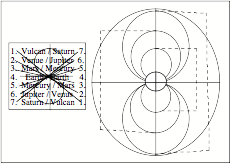
"Why this poetic form, Michael?" Charlie asks. "This densely poetic form? Where did it come from...?"
"I'm not certain."
"You talk about the poetic being closest to God, that prose is somehow a fall from God. Poetry is God's language; prose is Man's..."
"Yes," Crossmann agrees.
"Why is that so?" Rose asks.
"You could describe it as functions of the brain, I suppose. The poetic mind exists in the irrational; the concrete mind of prose exists in the rational...."
"All those you mentioned earlier, Dante, Milton, Blake, Yeats, John Donne, of course, they were all poets. The prose-writer doesn't have access to Heaven -- is that the implication?"
"Yes, that is the implication," Crossmann says. "Prose-writers write about Heaven. Poets experience Heaven. That is the difference. Joyce carried prose into poem. The prosepoem is the bridge between the two worlds..."
"We have talked about your prosepoems also. And we will look at a few before we call it a night. Because your book of prosepoems -- and then several unfinished novels, and an unpublished collection of short-stories -- continue the life and perceptions of the child born in this novel -- in a sense, at least..."
"Yes, in a sense they do," Crossmann says. "I am the person born through this novel. I am the lense. Anything I write will reflect this lense..."
"I'm eager to finish this book," Rose says. "We have been through a lot together in this novel. I'm still not sure I know who you are. But I can tell, through this novel, that you have been through a lot of turmoil to get here..."
Crossmann smiles.
"We now move out of the poem, per se, form into a meditation on America, the author's proclamation of love for America, now how America is really, but for the idea of America," Rose says. "Isn't that where this new-found love of America has come to the writer -- through a perception of the idea of America? It isn't the blemishes that you learn to love, the imperfections, it is the idea beneath the manifestation...?"
"Yhes. I don't love the imperfections, the lack of taste, the violence," Crossmann says. "I love the decency beneath this. And I love the ideas of the founding fathers who essentially made America an island in a sea of trouble. People risk their risk, risk imprisonment, each year, by the thousands, to get to America. America is still a point of light to the to the world..."
"Unless you are African-American," Rose says.
"Well, we obviously have a whole history of dualism in American, which underlies racism," Crossmann admits. "America has been a sea of trouble for the blacks. But so has Africa been a sea of trouble. And we still have black people, Africans, Caribbeans, South Americans....black people still try to escape to America, despite the well-known racial problems in America. There is still more opportunity for most black people in America than where they come from. Or they wouldn't be coming here. People aren't stupid. Our doors are always open. People can come; and they can leave. We obviously have more people coming or trying to come each year than we do have people leaving... But, yes: I went back to the roots of America; my love for America is what I see in her roots..."
"And all the imperfections?" Rose says.
"At least we are still trying to improve," Crossmann says. "How many nations can say that -- that they are consciously trying to get better. We are trying. And imperfection is the nature of this world. Perfection is a perception. A light that always has a shadow. Every nation is good and bad, as every human being is good and bad. The idea that one should only love their nation when it is perfect -- it is like saying that one should only love their parents when they are perfect. Our parents are not perfect -- still, we love them. My brother isn't perfect -- but I love him. I am not perfect -- that is the key. I am not perfect. If I can accept myself, even though I am not perfect, then I can love my father, even when he is not perfect. So, too, I can love my country, even when not perfect..."
"My country, right or wrong," Rose says. "That was the bumper-sticker of the Silent Majority during the Vietnam War. I guess you've come the full circle..."
"That doesn't mean you don't have opinions about where the country should go," Crossmann says. "But the opinions aren't based on unreal assumptons. Assumptions that the world is composed of the virtuous and the venal -- and if a country is not always virtuous then it is always venal. The balck and white view of the world ignores the obvious. Black and white are intertwined. Light and shadow are not separated, distinct; they are married, one leading into and out of the other...."
"Still, the rest of this section marks a pretty clear distinction between darkness and light, between black and white," Charlie says. "This is the section where you really turn on Jesse Jackson. Where you begin to connect black with darkness. Also, the Black Muslims, in this section, become a major cause of your alaram, all this at the same time that you are ready to meet your own personal demon in armed combat, and you nation is becoming increasingly strident in its anti-communism...."
"It's about the mechanism," Crossmann says. "I am the mirror of the mechanism, the thoughts of God, the wheelhouse of nature...."
"The ritual casting of the darkness out of heaven?" Rose asks.
"Yes. Something like that."
"Your thesis is this, is it not?" Rose asks. "That Michael the Archangel, the force which is Michael the Archangel, cast the darkness out of heaven -- and this is the cause of the breaking apart of Asian Communism...."
"Yes," Crossmann says.
Rose continues reading:
Delight and Sorrow have the same hand. Hand unsewn. Hand unshown. Tempest light the gale with beverage. Sumptuous guests cannot understand the teapot. Darkness in a wail of vestiges. Who can undo what still has not been done? I love you, America. With your sins and your fears and your urge to self-destruction -- still I love you. With your commonality and your belief in Man, the democracy of striving: I believe your ideals. It is not evil men who do evil; Evil selects men and chains them to an aspiration of a sort. I will give you power. Yes, I will give you powr. Yet, having taken power, who willingly gives it up? Because there is virtue, also, in powr. There is greed and illigitimacy -- but there is also virtue and good intent. Only fanatic ministers, on both sides of the aisle, can see so clearly about good and evil. That is: they are good; and evil is all about them. Evil is their neighbor, who eats his corn without salt. In truth, even the murderer is good; the saint is even a murderer. Everyman is every man. One plays the Hero; then, again, in some distant turn, he must be the Anti-Hero. The logic of Virtue. What is the morality of capitalism? someone asks. What is the morality of people? What is the morality of slavery? I have few answers. Capitalism is as moral and as immoral as everything else. Does the beast look better without a head? Does it act better? Does it have a name? The Beast is Fear of Death: Desperation. Look no further for its name. If you defeat Death, there is no need to fear. Obsession is the bringer of Destruction. Water is the voice of the Woman, someone said.
You are alive! Count your blessings...!
I have counted and found them in thousands.
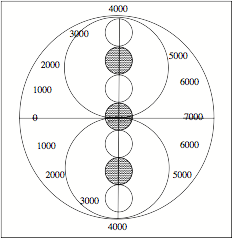
I have three steps:
I am religious and live through faith,
Existing in a Heaven I've created through thought and deed;
I rebel and fall from Heaven:
I am anti-religious; and I build the material world through
My thought.
Finally, I am religious again: this time I see God
With my mind and also my heart;
I re-create Heaven as a home where I can rest.
I update Heaven; and I update Earth.
I am the giant of Greco-Romania, he who led his people
Back to heaven;
Mary ws chosen as the 'medium' through whom
The miracle of resurrection
Would be performed.
I create all things, high and low;
I inform the insects and the rose and also the crane.
During Day the body turns and runs;
Night is the real time of religion.
Men become Gods during the Day;
Gods punish men during the Night.
The mythology of the Son is replaced by
The mythology of the Father.
SOMEONE BLEW A BUBBLE, WHICH CASCADED THROUGH THE AIR, A WORLD UNTO ITSELF; A YOUNG GIRL WALKING BY SAID: 'LOOK! IT MUST BE AN ANGEL...!'
The God of generation acts and waits but never leaves.
the Father builds the House, against which the Son rebels;
When the Son's rebellion dies, he ascends to Heaven
As a Holy Ghost.
India is to Egypt what Greece is to Rome what Europe is the the United States of America.
I was in Rome: I marched with the legions into the fighting-grounds
of Goths;
I visited Britain: with my apocalypse and my letters;
The Law is always bold when it resists barbarians' creeds;
When it brings the ctalyst news by which
Barbarians are stirred into Life --
And, thereby, Progress, of a sort.
And I would say to the Man of Intellect who is trapped on the island
of Nihil:
You must die before you can live;
You must give up your lonely throne of fear;
You must become Man, who is all things in nature.
If you are the Mind only, then, when the Mind is diminished, you have
no existence.
The Logos is all things, high and low, rich and poor, strong and weak,
body and soul.
The Light of the Logos illumines each principle in a given sequence
of Life;
If you hold to one principle only, then eleven principles in time pass by.
Twelve times twelve thousand equals 144,000.
Twelve time twelve times 1000 equals 144,000.
The Twelve Above are Hayoth, the Holy Living Ones.
The Twelve Below are the Sacred Tribes of Israel;
One Thousand Days is the language of Yaweh's Age:
Ten is the number by which all things are built and expire.
In North and South there are seven locations,
Seven Colors born from the One Color, white, which is
No Color.
This is the Creative Hierarchy.
In East and West there are only Two Numbers.
For Day and Night are the language of rise and fall.
I am the Principle of Life;
Do not enquire why I have cease to resurrect Death.
I am Light, the Guardian Angel, whose presence in Darkness
leads the blind out of their terror.
I have been sent down here to spend the Night
with frightened humans
And to give to some the numbers by which the Darkness
is dispelled.
The Holy Ghost is merely your man who has died.
And whom you cannot approach until the Winter has cleansed
your desire.
A door is opened then; and you enter into his kingdom.
He has prepared his world to have you;
And, through you, he builds the many worlds
Which will be.
Dear God, give me strength to do my duty.
All things are found in you.
I am but a fragment of you, a small particle of
the possible.
Give me the strength and the wisdom of your Word.
The Dark Madness makes those who certify possession by Darkness
more mad;
One tells me a dream in which his friends spill blood
without qualm;
They are the Huns unfurling the civilized;
He fears becoming them also.
Yet Rome did not die in one assault.
The Giants are those souls whose etheric bodies have become
immense.
Their empire matches the expanse of their aspirations
and knowledge.
They will fall again into form, to battle the dragon;
But ever they will rise, making worlds in the image of Yahweh.
I am strong in the ways of red hair and wind;
Mad paupers dance in the weight of a welted Moon: all are wishing that the dragons had been purchased by the zoo. American society for the preservation of the hawk. All bells sound twice: one time for the paper-boy; a second time for the school marm. Grace Kelly. The Woman in White. Bells sounding twelve times. Twelve tones. Eleven plus one. Eleven plus one. Something must be wrong. American planes attack Syrian positions. Two planes, two pilots lost. In Beirut, Moselms attack American position near the airport with artillary barrage that kills eight Americans. South Korea sinks a North Korean spy-boat in South Korean waters. Time ticks like a murderer. Something has happened in me. My egg has been broken. My egg sends me out. The angel creates a bubble-world of ideas and then invites the chosen into thid bubble to be with him. Yes, I have seen it. There is light somewhere. The pressure on the brain is gone. Ten ten say the clock. When never should have lost two planes, two men! he cries. Stout-hearted men have all gone to sea. Too lonely to be brave. Democracy is a giant Humanism: Empire and Production. Activity at a glance. Who stops anything? I am going up and some are going down. Yes. 8ENein. Joyce's glasses are used to burn ants in the sun. I do not move; but count my fears. Too much pleasure makes one sick. Yet Athens gave us much; Sparta gave little, only legends of defense. Where is this all going? I see kings: American Dynasties. The Republic transformed into Imperial cost and order. We are Romans new-born -- is that it? I am losing my power -- some actually believe it. I have bestowed treasures and I have received treasures. Time is invented by priests to escape from mourning. Max, the Road Warrior, stands between me and the nightmare. Max/Michael, Road Warrior. Rain is in power on the land. Floods in Decatur; and the imagery is rife. l Bulls in a broken closet. The homosexuals are no longer welcome. Send them to Berlin. l The autocrat's language is a sheen. Descending on the Rhine. As the Night gets deep, beautiful blonde women approach me. They are beautiful beyond words; but, beynd words, there is nothing to be said. One is named Lucy, Lucis, Lux, Light. She wishes that I pursue her; but, beyond her beauty, something else. A cut which cuts and claws to torture. Yes. Faye Morgan returns, having been sent to Portland to medical school. She returns as a failure, offering excuses, blaming others. A fellow student massaged her head, damaging her hearing. Will you send me some healing vibrations? she coos. Where is Daphna? The failure of liberalism, sociology, psychobabble, is that this way of thinking encourages people not to be responsible for themselves. Society is to blame; parents are to blame. We look back to analyse why we are not free and to find who is to blame, who is responsible, who is the villain. So, not one is responsible. The criminal comes from a deprived background (socially, financially or racially deprived) -- hence, he is a victim. Yes. And a victim is not responsible. The society is responsible for victimizing the individual. If the damaged individual reacts criminally, it is the society's fault, surely not the fault of the damaged child. But hurdles are placed before each of us. Some leap the hurdles; some do not. By why encourage people not to leap the hurdle? Why encourage people to complain that there are hurdles? Do we really wish to become a society of complainers against life's hurdles? Is that our destiny? To whine that life is not fair and to hold demonstrations against this fact? Throw your hat over the wall. Then you have no choice but to climb the wall -- or to lose your hat. Which ever is less painful. ALL VERY WELL THOUGHT-OUT. All the blonde women come dressed in blue, the color of the Moon, the color of the sea. THROUGH THEM IS TERROR. They would steal your body and take you away somewhere. WHERE IS DAPHNA? Where is Shulamit? SHOW ME THAT YOU ARE HOT, SHULAMIT! She laughs. Pottery is golden. Fallen men have shadows too. Rumors spread that evening is lost. Tap-dance is unwelcome amid the high cost of shoes. And all. PEAL HARBOR HAS A GHOST. I look at this decal of Time you include. Your time graph is confusing: you show the time of the moon in quarters, with some time piece, some clock-hand. Is it first quarter or second quarter when you show north-by-northeast? For, in your descriptions of Earth, Spring is at the Equator, and Summer is at the pole. Your Earth and your Moon do not agree. Please change your method to make it more clear. FIRST QUARTER SIN TARRY: METHOD IS MERELY SPECUALTION ON MEANS. ZERO POINT: GROUND ZERO. PASARAGE TO CORVETTE -- THAT IS, PASS TO NEW PRODUCTIONS. ASSYRIAN AMNESIA. TYRE IS IN FLAMES AND ALEXANDER READS THE ILIAD.
I am the journey I describe in these shoes. YOUR CIRCULAR TIME DESIGNATIONS ARE REALLY YOUR FOOTSTEPS THROUGH THIS LANDSCAPE. OFTEN THERE ARE MANY MILES BETWEEN THESE FOOTSTEPS. WHEN THE TRAVELING IS SWIFT AND CLEAN. NOW THE TRAVELING IS THROUGH A DARK FOREST: SLOW AND LABORIOUS. SOMETIMES YOU RUN AND SOMETIMES YOU MERELY STRAGGLE. YOUR SHOES CHANGE: THE SHAPE CHANGES. BUT THE PRINT OF YOUR STEPS MARKS THE PROGRESS YOU MAKE. I have read in the paper of a series of books written by Yuko Chino regarding the appearance in 1977 of Michael the Archangel to a Japanese woman at which time he revealed to her the truths about heaven and the meaning of the resurrection. THE SAME YEAR YOU MOVED TO EUGENE -- AND EXPERIENCED SEVERE NERVOUS DISSOCIATION. Daphna's son approaches a birth-time. SHULAMIT MEETS TWO LESBIAN FRIENDS FOR COFFEE. SHE DOES NOT APPROACH MICHAEL, BUT WAVES AND SEEMS TROUBLED. Jill Cohen meets Michael's eyes and says hello; later, she walks by the office door, glancing in. MANY BEAUTIFUL WOMEN MAKES EYES AT OUR CLERK AS HE ENTERS THEIR MOON. THE SUN IS VERY FAR AWAY BY DAY; AND VERY CLOSE BY NIGHT. FILLING UP THEIR VOIDS; AND, THEREBY, GIVING THEM THEIR FORMS. Syria scoffs at American might. England and Italy make plans to retreat from Lebanon, leaving only French and American troops; French-American ties improve culturally with Chicago Architecture exhibit in Paris. AND I SAW THAT MICHAEL WAS THE NAME OF JESUS AFTER DEATH AND RESURRECTION -- THAT IS, HIS NAME AFTER ASCENSION INTO HEAVEN. AS THE HOLY GHOST, IF YOU WISH. THE CHRIST DOES NOT RETURN TO EARTH IN PHYSICAL FORM, BUT DIRECTS THE WORLD FROM HIS PLACE IN HEAVEN, USING A SPOKESMAN, A SON, FROM HIS EARTH. THE NEW CHRIST WILL NOT BE CRUVIFIED: HE HAS ALREADY BEEN SO. THIS CHRIST WILL RULE THE WORLD. As I have died, so, too, do I live. AND THOSE FORCES OF CHAOS WHICH OPPOSE ME SHALL ALSO BURN. You spread the word of a miracle in Bethlehem. You begin your 'creation' of your 'virgin mother' and your mythology which becomes the 'living religion'.
Michael is seen singing carols with the Children's Choir. The Father rules;a nd the Son rebels. The Holy Ghost rises when the Son has been spent.
The Holy Ghost rises, to again live with his Father.
These are the Three Steps, the Three Lives, in Completion.
THE CLERK INVITES SHULAMIT TO HAVE LUNCH WITH HIM TODAY -- AS HE HAS BEN INSTRUCTED IN HIS DREAM BY HIS FATHER. It seems that 1,000 has important occasion for it represents the coming of the Number 10, which is the number of Jehovah, JOD-HE-VAU, the Three in One, who is both thinker and warrior, who combines both the force of the male and the receptive vision of the female, being both 1 (the male) and the 0 (the female): the completion of the Great Cycle. After 10 comes 11. THE THREE, THE FOUR, THE FIVE IN YOUR DRAWING REPRESENT THE SACRED ISLAND, WHICH IS THE NATURE OF THE ANGELS: 'THE LINE (1), THE TRIANGLE (3), THE LINE (1), THE CUBE (4), THE LINE (1), THE PENTACLE (5): THIS DESCRIPTION IS SIMILAR TO THAT OF JEHOVAH AS 543 AND MOSES AS 345: THE ISLAND OF RELIGIOUS VISION. The Ten (10) approaches from each direction; again you have the two Twelves (12) (Noon and Midnight) times the 1000 years, the aspect of Jod-He-Vau-He's manifestation in Time.
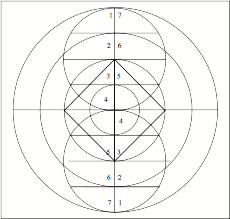
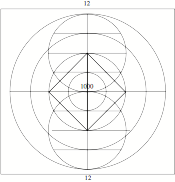
THE ISLAMIC HOLY WAR HAS BOMBED THE AMERICAN EMBASSY AND INSTALLATIONS IN KUWAIT. AMERICAN SHIPS POUND SYRIAN POSITIONS WHICH HAVE FIRED ON AMERICAN RECONNAISSANCE PLANES. ISRAELI WARSHIPS POUND ARAFAT'S POSITION IN TRIPOLI IN RETLAIATION FOR PLO BOMBING OF AN ISRAELI COMMUTER BUS IN JERUSALEM. I am becoming weak, as though to hold this black night on my shoulders takes my strength away. SOON YOU WILL MEET THE GIANT DEMONS AGAIN. YOU MUST GAIN STRENGTH AS THE DARKNESS BEGINS TO EVAPORATE. FOR THEN YOUR TEST WILL COME. THEN YOU WILL MEET, IN CLOSE COMBAT, YOUR ENEMY. I sink like a stone, and scatter myself into diamonds. AND SHULAMIT DOES NOT SHOW UP FOR YOUR LUNCH DATE. I scatter myself into too few diamonds. I dreamt she would not show; and, when she did not, I felt relieved. EACH PLANE, IN THE ABOVE DRAWING, HAS NUMERICAL CORRELATIONS WHICH, WHEN ADDED TOGETHER EQUALS 8. Seventeen, twenty-six, tirty-five, fourty-four, fifty-three, sixty-two, and seventy-one. WILLIAM CROSSMANN FINDS A WALLET A MAN HAS LOST IN THE PUBLIC TOILET. AN ARAB MAN. CROSSMANN RETURNS THE WALLET TO THE ECSTATIC MAN WHO SHOWS CROSSMANN THE MONEY IN THE WALLET: TWO $500 BILLS. 1000 DOLLARS. ONE THOUSAND. Each woman I meet speaks of being 'instructed' to take power in the world: to become governor or president or revolutionary and to establish some creed. SO, THE WOMEN OF THE WORLD SEEK TO INSTRUCT THEIR MEN THROUGH FORCE. The Dark Element seeks to pull the Sun down from the horizon, making everything equal: eve(n). Equalisation, the mathematics of socialism, the principle of castration: it is the logic of death. Oppression of the Life-Instrinct, or the Principle of Vitality. I AM THAT YEATSIAN BEAST WHICH SLOUCHS TOWARD BETHLEHEM TO BE BORN. Power of Spiritual/Mental Expression has an 'accidental' correlated -- or some holy men say -- that is, power on the Earth.
Honor comes, when it will, from understanding
of proportion.
Each Day is a Century; and the hammer is the Sun;
And from this forge are drawn seven curious
And shomehow lasting stammering sons.
It is not Wealth that makes us tired,
But it is Thought which makes us weep.
Children cannot be Lions of Virtue
Except through severing their own hearts
From their vigor and their conceptions.
Time draws burly images from its ocean;
Saviors of rock and saviors of notion;
In the Numbers of Creation, God gave Adam
alabaster.
Seven sons create; one son rebels.
Yet this rebellion carries the Wind
Through man houses back to his own.
Imperfection was once a crime;
Now it becomes our way to add.
The Distant will always appear to have virtue
Because Distance, herself, is the Woman
demanding dreams.
One leaf falls on the high plains in Wyoming.
A desert is made of the bones of the whale.
It was not Jesus who was holy --
But Jesus died for Resurrection.
It is not Life which is a sin:
A child is born on the plains of Bethelhem
at Noon.
GOD GIVE ME STRENGTH. THOU HAS GIVEN ME VISION. GIVE ME STRENGTH IN THE VALLEY OF DEATH AS I WALK HERE. PAIN IS VERY REAL HERE. PAIN AND FEAR ARE VERY REAL HERE.
"These prayers seem somewhat odd now, in modern America" Rose says. "Especially since we tend to forget the context of this novel..."
"The context, really, is the end of the millennium," Crossmann says.
"Yes" Rose agrees. "I mean, in a real sense, that is what it is -- in the novel. 1983. Turning into 1984. We know the metaphorical importance of that year, the psychological importance, which was created by George Orwell, and then by reference to Orwell for many decades. 1984 being what...?"
"A grim novel of a world collapsed into social terror," Crossmann says. "A world of continual war, or at least a continual psychology of war. A world of poverty, of thought control, of spiritual starvation, a world where the individual is annihilated by the state...."
"Communism, then" Rose says. "You would say that 1984 is a portrait of a communist society?"
"Well, it is Orwell's fearful view of western society as it sinks into a socialist reality," Crossmann says. "But it doesn't really reflect western society much, as anti-communism in the west largely did not allow this to happen...."
"Some critics of America would argue with that," Rose says.
"Yes. But they tend to have a jaundiced view of everything -- a view in which America is always negative," Crossmann says. "They generally argue that corporate culture has become Big Brother. But that is a stretch. Clearly, the atmosphere of Orwell's classic is not reflected in western culture, where sexual freedom became rampant after World War II, and where individaul rights became the defining ethic of the society. It is a huge stretch to connect the west with Orwell's vision or nightmare. It is a much smaller leap to connect communist society with this nightmare. A major element of Orwell's novel is the contraction of language, the shrinking of words that are acceptable. The dictionary keeps shrinking, in fact. But, in the west during the last fifty years, the language has been expanding wildly. New words are created by the moment. The 'politically correct' movement, the liberals, who are a western off-shoot of the communists, have attempted to mold a new language, a language twisted into kind euphemisms, politically-correct terminology, which is an aspect of this contraction of language into politically-acceptable language. It is an attempt to whitewash meaning, more than actually eliminate words...."
"We must also remember that you are passing through a drak landscape at a much deeper level than most Americans did in the depression of the early 1980's," Rose says. "You felt, in a much more extreme way than most Americans, the darkness, the fear, and the danger of..."
"The apocalypse of the 1980's?" Crossmann finishes the thought.
"When I read this book, with all the wars and rumors of war, with all the political meneuvering," Rose says. "It is actually quite disturbing. It does feel like the apocalypse. Earthquakes, volcanoes, wars, rebellions, killings, bombings, hateds....it feels like the end of the world, the way you present it. But the world didn't end. The world is still the same..."
"Not entirely the same," Crossmann says.
"Well, communism was defeated," Rose says. "We are probably not as close to nuclear annihilation as we were then. That is true...."
"The tide turned remarkably," Crossmann says. "The west was ready to capitulate to Russia. Europe was ready to capitulate. America wasn't. Britain wasn't. perhaps France wasn't -- I don't know. But there was a defeatism that was very rich in Europe. The Left had been so strong thorugh the 1970's, all over the world. The Right had lost its imperative. Vietnam was a huge loss for the West. Because America's illusion of invincibility was broken. Russia, Korea, China, Vietnam, Cambodia. Then all of Central America seemed on the verge of turning communist. South America all was ripe for revolution. America was the bad guy. In the older generation, America was good and Russia was bad. But in the new generation, America was bad and Russia was good. The universe, the perseption of the universe, was transformed into the perecption of the anti-universe. Day became Night. In the Anti-Universe, white became black and black became white. Then, all of a sudden, it changed again. All of the sudden, the light came back again. Asian Communism -- which Nostradamus called the Third Anti-Christ -- was defeated...."
"The West was saved," Rose says. "By Reagan...?"
"Partly," Crossmann says. "Reagan spent so much on the military that it finally broke the back of the Soviet Union. They couldn't keep up with the wealth of the West. Economically, they broke. Their attempt to keep up with the West technologically, defensively, bankrupted them. But there was also a war being fought inside Russia. Russians were not satisfied with their lives under communism. The youth culture of the West was making in-roads with young Russians, actually with the young in all the countries behind the Iron Curtain. Music was changing the world. The underground culture in the East was expressing dissent. Also, everyone knew that the rhetoric of the Worker's Revolution was a lie. The Communist Party took care of its own. They were the new ruling class. They had the good jobs, the fancy cars; their children went to the best schools. No one believed the rhetoric about the better world coming out of communism any longer. It became a big joke. The, too, religion wouldn't die. Religion became a stronger force as communism failed to bring meaning to most people's lives. The more the communists tried to repress religion, the more it came back. The communists had lost face by invading Hungary in the 1950's; and then Czechoslovakia in the 1960's. The Russians perhaps would have invaded Poland in the 1980's except they were embroiled in a divisive war in Afghanistan, one that was losing support at home. They could not invade Poland, given the situation at home and in Afghanistan. So they tied to assassinate Pope John Paul. They felt very clearly that the Pope was the spiritual leader behind Poland's agitation. If the Pople were dead, the forces of counter-revolution in Poland would lose their will. But they failed to kill the Pope. There was a struggle going on insde the Kremlin also: between the old guard, and those more forward-looking..."
"Mikael Gorbachev?" Rose asks.
"Well, Gorbachev became the focus of this spirit of resignation in Russia," Crossmann says. "The spirit of Michael the Archangel. Remember the two voices during the last long night in the novel had been arguing. One voice argued for empire; and the other voice argued for dismantlement of the empire. This argument was going on in Russia also. There was no way that Russia could defeat America; the best they could do was to try to keep up with America. Then, if the time came when they could not keep up with America, they would either have to attack America with nuclear weapons or surrender. They began to fall behind. It became obvious that it was a losing battle. They could either self-destruct, let their empire break; or they could destroy the world. And there were many in Russia who wanted to destroy the world rather than surrender. But they lost power when Michael came in. When the power of Michael the Archangel came in to the system. When the light came back. And when the switch came back into the Universe, out of the Anti-Universe...."
"The current was changed," Rose says. "AC was changed to DC."
"Actually, it is something like that," Crossmann says. "It is electrical. Remember Fohat, the Son. Fohat is an expression of cosmic electricity. The current changed. And that was the end of the Night..."
"And when did this happen?" Rose asks.
"I believe it happened in 1984," Crossmann says.
"When you confronted your Dark Giant, and won?" Rose asks.
"Yes."
"You predicted the wrong Russian would come to power," Rose says. "I don't want to say too much here, because we are getting to this. But you put two predictions, prophecies, together, one from Russia, which predicts the coming of another Romanoff to lead Russia to a great empire. And a prophecy of Nostradamus, which preducted seven rules of the East. You predicted, in your novel, the coming to power of Grigory Romanoff as the seventh Russian ruler, instead of Mikail Gorbachev..."
"Yes," Crossmann felt. "I felt Romanoff would try to lead the Russians into Poland, into Iran, into the Middle East, into Armageddon..."
"But it didn't happen," Rose says.
"No, it did not happen. Romanoff was the force of empire; Mikhail Gorbachev was the force of dismemberment..."
"So, this argument that seemed to be going on in the soul of the Clerk," Rose says, "in your soul, was going on in the soul of the world at large? All over the world...?"
"Yes. In the Soul of the World," Crossmann says.
"But you did not realize it at the time?" Rose asks. "No. Definitely not. I was aware of my own journey into the heart of darkness. I was not thinking about the macrocosm. But now I see it."
"The music you present," Rose says, "the music of the 80's, reflects all of this turmoil, this trauma. This truggle...."
"Yes. All the themes in this book are present in the music of the 1980's," Crossmann says.
"We will see more of this as we proceed," Rose says. "One song in particular that I found interesting was -- actually, there were two songs. Frankie Goes to Hollywood, who were famous for their orgasm anthem, "Relax", also wrote a song "Two Tribes" -- and part of the lyric to this song is, let me read it....
When two tribes go to war
A point is all you can score
When two tribes go to war
A point is all you can score
Cowboy No. 1
A born-again poor man's son
On the air America...
"And I couldn't help but think of you when I read this," Rose continues. "The Cowboy was you, clearly. You are from Wyoming, the birthplace of the Cowboy of legend, the Virginian. A 'born-again poor man's son on the air America...' Of course I thought of you..."
"And Reagan, of course. Was the other song...?"
"The other song was by Boys Don't Cry," Rose says. "And it was called 'I Wanna Be A Cowboy'. It isn't as interesting a song lyrically, but it..."
"It is interesting given the context," Crossmann says.
"Yes. For what you call the Universe, which you compare to the Anti-Universe," Rose says. "The Universe belongs to the Cowboy; an the Anti-Universe belongs to the Indian. Isn't that about right...?"
"Yes, that's about right," Crossmann says.
"And the fact that Europeans are singing that they want to be cowboys," Rose says, "says something about the shift in thinking away from the Darkness, away from the Night. Toward the male, away from the feminine..."
"Yes."
"The whole emphasis you put on the warrior, on Mars," Rose says, "as you awaken from this sleep. It is this willingness to fight, this Western willingness to fight....is that, ultimately, what leads to the defeat of Eastern communism...?"
"Yes, I believe it is," Crossmann says. "The Russians understood that the West was waking up again, that the Cowboy had come back to life, the myth of the Cowboy. In the same way that the South and Central American Indians knew that the white man was going to appear on their shores, because they had dreamed it, they had seen it in the dream lanugage, in the language of the sun, so the Russians also understood that the Cowboy was resurrected. And there was no way that communism could win...!"
"We should get back to the novel," Rose says. "We are running out of time. One point I'd like to make. A page and a half back, you write that 'Daphna's son is approaching his birth-date'. But we were approaching, in fact, December 17, your own birthday..."
Rose reads:
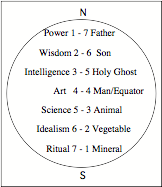
The Man-of-Light is attrracted to the Dark Woman , the Earth; he seeks power over the Earth. The Dark Man is attracted to the Light Woman, the Moon. The Man-of-Sin seeks salvation by giving up the Earth, by finding forgiveness from the White Water, the Moon. He seeks to find Heaven, to give up his body for the salvation of the Air. Are not these Two Men One Man at a different Time?
Town-Crier
Midnight on the town! Ice and snow and frozen pipes and all!
Merry Christmas to all!
Merry Christmas to all!
Analyst
All the women you know are being 'told' by the voices that they are to seek power. The 'women races', too, the dark men, are being told to overthrow the White Man.
THE BLACK COLOR IS ABSOLUTELY RECEPTIVE: IT ABSORBS ALL OTHER COLORS, AS NIGHT ABSORBS LIGHT. IT IS OPEN TO POSSESSION BY THE HIGHEST LIGHTS YET ALSO BY THE DEEPEST DEPTHS OF DARKNESS. Is this Cain you speak of? THE MURDERER, CAIN? I am the Will of the World. Only the Will shall save us from the catastrophe of Ice. EACH DAY, BY CONTRADICTION, ONLY THE WHEELS HAVE BEEN FORTIFIED BY IRON. The priest says: 'There is a man among us whom we cannot know.' YES. I sing songs and caroles among the Catholics at Christmas. His sermon speaks of Tamar; and of the seven generations. DAPHNA NOW LIVES ON 8TH STREET IN HAIFA. Your address is 274 E. 14th Street. If we add your two numbers together (1+7+4 + 14), we get 28, the number of the Moon. Your Zip Code is 97401, which, added together, equal 21, a number of Jehovah (3 x 7); if we add these numbers together (the 28 of the address and the 21 of the zip code) we get 49, the number of Time's manifestation, the Jubilee Year, with 50 being the number of the Shekinah, the Bride, the Holy Ghost. IT IS EASY TO BE A CRITIC. YOU MERELY DETACH YOURSELF FROM THE LIVING, ALWAYS REMAINING SUPERIOR TO LIFE, LOOKING DOWN ON IT, THEREBY PROTECTING YOURSELF FROM JUDGMENT. The Ghost of Hamlet's Father seems to swing in a wounded cottonwood. A WOMAN IS PRESENTED TO YOU IN YOUR DREAMS. SHE IS A WHITE WOMAN, A BRUNETTE, FLESHY, WITH LARGE BREASTS. It is Rosemarie Millet, with whom you work. She lets you take off her blouse, and carress her breasts. She is smoking a cigar. SHE IS THE WHITE GODDESS WHO ALLURES THE MAN WHO IS NOW DARK. Earthy Man attracts the Moon. SHE WORKS WITH YOU. YOU FEEL DESIRE FOR HER, PHYSICAL DESIRE, BODY DESIRE. Yes. YOU PASSED GILBERT, THE DEMON, ON THE STREET DURING THE DAY OF THE SOLSTICE: YOU TWO, ALONE, APPROACHING ONE ANOTHER ON A SIDE STREET. HE CRINGED, MOVED ACROSS THE STREET, SO AS TO NOT HAVE TO PASS NEAR YOU. I was even darker (and more violent) that he was. THE SEVENTH DAY RESTS. THE SEVENTH DAY IS THE BRIDE. The White Woman would steal my strength, make me a merchant to her disorder. YOU HAVE NOT BEEN WRITING. YOUR SEX-ENERGY IS BUILDING UP; AND YOU LOOK FOR AN OUTLET: A WIFE OF BEAUTY. Fill yourself up with your own light. Pull that energy out of the floor and make it light your way to the next ledge. JESSE JACKSON SEEKS TO SAVE ROBERT GOODMAN, THE DOWNED PILOT, BEING HELD IN SYRIA. SEEKING POLITICAL ADJECTIVES TO MAKE HIS NAME GLOW. THE ELDER GOODMAN REBUFFS JACKSON, SAYING IT IS, ACCORDING TO HIS UNDERSTANDING, THE CONSTITUTIONAL DUTY AND OBLIGATION OF THE PRESIDENT ALONE TO CONDUCT FOREIGN POLICY. Each time you do not work, Temptation comes near; and the nascent blaze becomes pure peneumatic punishment. PNEUMISMATISM HAS NO GIRDLE. Where are you Daphna? SEEKING THE OUTLET IN THE STOMACH. IN WORDS, AND IN WORDS' ANTHEM. Very funny. YES. Rise up and find your wife, who is your soul. IS SEE VRY CLEARLY THAT THE OLD AND NEW TESTAMENTS FORM A WHOLE, THE FIRST REFLECTING THE PATRIARCHAL ORDER, THE LAND OF HEAVEN AND OF THE FATHER'S CONSTRUCTION. THE NEW TESTAMENT IS THE STORY OF THE SON, THE REBELLION AGAINS THE FATHER, THE DEVELOPMENT OF MIND AND THE CONSCIOUS 'I' PRINCIPLE; THROUGH THE DEATH OF THAT 'I' PRINCIPLE, THE SOUL IS RESURRECTED AND RAISED INTO THE LAND OF THE FATHER THROUGH THE POWER OF THE HOLY GHOST. Venus has entered Sagittarius. And you struggled with the lust you felt for Miss Millet at work. Power is entering you mind again. TELL ME ABOUT THE PHOTOGRAPH IN WHICH YOU STAND AT DEVIL'S ELBOW AND A FLYING SAUCER IS SEEN ABOVE A ROCK IN THE SEA, WHITE LIGHT REFLECTING OFF THE TILTING DISK. Has Miss Millet been given to you by God, as a reward of your slaying the dragon? HAS A DRAGON BEEN SLAIN? As a reward for your activity. IS A WIFE THE REWARD THE MAN RECEIVES FOR HIS SLAYING OF THE DARKNESS? What is the question? I DREAMT THAT SHULAMIT APPROACHED ME. SHE WAS DATING ANOTHER MAN, BUT CAME TO ME AND HAD NO FRONT TEETH. THEN SHE HAD THEM AGAIN; BUT SHE WAS NOT AS PRETTY AS BEFORE. I FEARED SHE WAS TAKING DRUGS; AND THESE WERE MAKING HER NERVOUS. SHE SUGGESTED THAT SHE WOULD BE GOING TO AUSTRALIA. I TOLD HER ABOUT THE COMING WAR, IN WHICH ISRAEL AND AMERICA WOULD STAND TOGETEHR. WE WERE TRAVELING IN A PICKUP IN THE NIGHT AND A VOICE SAID, FROM SOMEWHERE, 'THE SPIRIT OF THE WOLF HAS DESCENDED.'
Tragedy came from the furious meal;
All incentives to disproportion were some time scattered
to the sea by the mail.
Volumes proclaimed the innocence of whales;
Enoch could not be see by thee,
Only whispers on the reef,
And then the bombardment of coming scenes.
Give me strength, Dear god, as I walk this wailing
lane.
Egyptian Dynasty; Roman Dynasty; American Dynasty.
The Good Man has returned; the Syrian is given
triumph;
Begging to an enemy, and giving him virtue, is a sign
of childhood.
Who is the last malefactyor of wealth?
Shulmit appears; and her smile bears expectation.
I cannot speak of heaven alone; for the Earth would break
Were I to sleep before my time.
I am the seat of Power;
I am the garment of total allegiance.
Allegiance to my God, and, likewise, the Power of the Word
I have been given.
If I am truly the Law, then merely to walk is to create
the world.
Beggars cannot build services to the weak;
School him in defeat and you will only teach him dotage.
The Night begins to lose;
So whom will I meet on the edge of the Dead Ways?
Daphna's child is Aquarian-born.
Michael here and Michael there.
So it appears; so it does seem.
Analyst
If you would be cured of your psychosis, then you cannot believe that you are your psychosis. You can't identify the condition as being you. Also, if you justify neurosis by saying that neurotic people are more 'artistic' or more 'sensitive', then your desire to be artistic justifies this neurosis, and becomes an identity. To give up your neurosis would be, also, to endanger your identity as an artist. To give up an identity, to give up your very self, would precipitate you into an even greater Chaos than this one you have come to love.
Clerk
I identify with the principle that does not die. The task that does not end. I creat art; and I write -- yes. But I am not those things. I am the eternal principle who does many things, who does all things. The sun does not set on my activities. I merely move from one activity into the next, from one Hour into the other.
AND I REMEMBER TWO SUMMERS AGO, WHEN I RAGED AGAINST ISRAEL, AND RAGED AGAINST A JEWISH MAN I KNEW, A MAN NAMED BRIAN: I FOUGHT HIM AS A SERAPHIM DOES A BLIND MAN -- THE NEXT TIME I SAW HIM, HE WALKED WITH A LIMP. I have re-lived the story of Michael and Jacob: Michael wrestled with Jacob all the night, wounding his hip, but promising him a new name, Israel. RAISE YOURSELF OUT OF YOUR OWN MIRE AND YOUR FANTASIES WITH NAKED WOMEN! Beautiful white women are all very close; I wait for the Earth to come again in the Spring. THE WHITE WOMAN HAS SCISSORS TO CUT AT YOUR ROOT. When you fall, the Woman picks uou up; when you rise, you attack the Woman for causing your fall. So is the East to the West; the West to the East. MYSTICISM RESURRECTS THE WEST; THEN THE WEST ATTACKS THE MYSTICAL FOR WHAT IT IS, THE DARKNESS. Even though the East, the Woman, saved it, him, the Man. PRECISELY. Man creates the Earth; he is the instrument of 'creation': the Time Element; there is Rest, but soon the Man-of-Time reappears, updating this creatino (God's plan), as the Sun updates the forms of nature after Winter, through closeness raising them and vitalising them into Life. the white man is the sun: he travels into every house, every kingdom, to give it life. MICHAEL LIVES IN THAT LANG, IN THAT COLOR, WHICH CONTAINS EACH COLOR AS POTENTIAL. This is the Lord. BY CONTAINING EACH COLOR, HE PASSES THROUGH EACH COLOR, EACH HOUSE; AND HE CANNOT BE SEEN, FOR HE IS THE BASIS OF COLOR; HE IS THE LIGHT WITHIN AND THE LIGHT WITHOUT. Mercury has appeared in the skyh. WOMEN GIVE YOU GIFTS OF FOOD AND SMILES, OFFERING YOU GIFTS OF THE DELICATE POISON, THE DELICATE SWEETS; AND YOU ARE TEMPTED. Shulamit appears and offers me warm friendliness. At least for a moment. I HAVE BEEN AWAY AT WAR. MY MAGIC WORKS WONDERS, EVEN GIVING CHIDLREN FROM MY MOUTH. DO MY SCARS NOW SHOW? DOES MY BRUTALITY MAKE THE WIND WORK? A poem to Shulamit:
It is a dream
which conceives
the laughter of thee.
The hawk within you
is more precise
than is the sea.
The irony you bear
is more imaginary
than you believe.
Ham carries three rods
which he places
beside your bed.
You must come to me
when your fields are in ice.
Then I shall light your way
with the candle
in my brain.
THERE IS MATRONIA ABOVE AND MATRONA BELOW. Daphna and Shulamit. DREAMS COME TO YOU IN WHICH YOU ARE ATTACKED BY CATS. LIONS ROAM THE FORREST AS DANGER. The Woman-as-Love appears in the heavens. WOMAN AS COMMPETITOR APPEARING IN THE AIR. Women sniping at men, seeking to make them the scapegoats. AS YOU AWAIT YOUR WORD FROM DAPHNA. I fought balck-jacked motorcycle men in a dream; and Arab soman named Seyada also was there. I did not trust her for her element was black. JESSE JACKSON COMPARES HIS TRIP TO SYRIA WITH THE BIRTH OF CHRISTIANITY. Complexions of Messiah. HE BELIEVES HE IS THE SECOND CHRIST. Yes -- competitions for this mantle. All the dark minds compete to be Jesus the Second. HE COMPARES HIMSELF TO JESUS. He speaks of himself as 'the candidate' against Corporate America -- against the 'body', the corporate life. The candidate of Night. The candidate of poverty, the candidate of despair. A LEVELING INTO DEATH. He is the candidate of Death. I WAS RIDING TO ISRAEL ON MY BICYCLE IN A CDREAM; BUT I LEFT THE FREEWAY BEFORE LEAVING THE CITY. THERE WAS A CHURCH, IMMENSE, WITH A GREAT TREE OF GIGANTIC STATURE. I RODE UP TO IT. BUT THEN THE DIMENSIONS CHANGED. IT WAS THOUSANDS OF FEET FROM MY BIKE TO THE GROUND; IF I WOULD HAVE DISMOUNTED FROM THE BIKE, I WOULD HAVE FALLEN TO MY DEATH. THE SINEWS OF THE TREE, AND THE DETAIL OF THE CHURCH, WERE EACH MAGNIFIED TO REVEAL MAGNIFICENT BEAUTY AND COMPLEXITY. AMIENS. AMIENS. ANOTHER MAN ON A BIKE FELL; AND HIS BIKE TUMBLED DOWN THE STEPS TO A SIDE-DOOR OF THE CHURCH. THIS WAS NO IN ISRAEL, BUT ON THE WAY TO ISRAEL. After the attack by the motorcycle gang, you went outdoors and college students were outside: the gang had fled.
Madame Bee
Stanza IV
5. 'Darkness', the Boundless, or the No-Number, Ain-Soph,
Adi-Nidana Svabhavat.
I. The Adi-Sanat, the Number, for He is One.
II. The Voice of the Lord Svabhavat, the Numbers,
for he is One and Nine.
III. The 'Formless Square'.
And these three enclosed with the Circle are the Sacred Four;
and the Ten are the Arupa Universe. Then comes the 'Sons',
the Seven Fighters, the One, the Eighth, left out, and His
Breath, which is the Light-Maker.
6. Then the Second Seven, who are the Lipika, produced by
the Three. The Rejected Son is One. The 'Son-Suns'
are countless.
Analyst
Aleph allows that Anarchy come; Beth builds the House, the order out of Chaos. Aleph-Beth is the totality, the Father-Mother from which the elemental lettersbuild every thought.
Doubter
Enlightenment is the rationale by which men who can't be men condemn women and condemn Life.
Star-Gazer
The culmination of Pollux, one Brother, the Immortal Twin of the mortal Castor, is expected on Tuesday, the seventeenth.
Analyst
The Guardian Angels are the Three within the Circle in the above description.
Michael Crossmann
Mikael, help me, I have lost my way.
The Haters are on the way.
Multiplication bears the integer Zero.
New Men are merely the fantasies of Old Women.
And the bargain-hunters scorn the man
Who runs to find the appropriate
diction.
Analyst
The Holy Animals are the Four with the Circle in the description of Madame Bee.
Articulator
Winter is when the Water, the Feminine Element, freezes up. The White Woman becomes cold; only the Fire can save her from her contraction. When the Fire touches the Ice, the Flood comes on all.
Analyst
First, we should move away from the conception that the Mind-Body distinction is a legitimate concept. The Body is also a Mind, as we can see from the subject of our test, Mister Crossmann, the so-called author.
Voices
- Nature abhors equality. Only during death are all things equal.
- And not even then! For Death houses the Land of the Judges. The Judges are in Hell; judgment is not in Heaven.
- Poor Judges stand in Monday rain;
Only the sorry and the slaves see their dream.
- And he saw that Daphna was Mother and Sister and Wife.
Analyst
The Clerk's address is 275 East 14th Street
Eugene, Oregon 97401.
The 2 plus the 7 plus the 5 equals 14. Plus 14th Street equals 28, the number of the Moon (7 times 4).
The 2 plus the 75 equals 77 (or 7 time 11, with 11 gbeing the numerical correspondent to the cycle of the Sun, or its 11-year breath-cycles.)
Putting that aside, the 9 plust the 7 plus the 4 plus the 0 plus the one of the zip code equals 21, a number of Jehovah. This 21 plus the 28 of the street address equals the 49 of the Jubilee Year (or 7 times 7, a symbol of Man's completion).
Daphna lives on 8th Street in Haifa (the only number in her address).
The Clerk grew up at 311 North 8th Street
Sinclair, Wyoming 82334.
The 3 plus the 1 plus the 1 plus the 8 equals 13.
The 8 plus the 2 plus the 3 plus the 3 plus the 4 equals 20. 20 plus the 13 of the street address equals 33, the number of Christ's ministry (3 times 11 being 3 cycles, or visits, lives, in the Lower World, times 11 years each, the cycle of the Sun).
Peter the Prophet
Enough of this nonsense! Have you heard that they discovered the outer-most planet, Planet P. They say that it is as big as Jupiter.
Clement, the Bystander
Saturday: Summer begins on the northern hemisphere of Mars.
(Another dark, violent influence is seen by the Clerk
in a local coffee-house. The lunatic fringer is
appearing. Demons drawn out by the dark light.
Appearing, as shadowed light makes them visible.
He screams his hatred of everything American.
His friends try to quiet him. He shakes his fist at
the world.)
Mad Max, Road Warrior
Who shall place himself between the decent and the murderous, if not you, Mister Crossmann?
Who will have mercy; and who will be the necessary counter-force to fight them?
(The Guardian Angel appears during the Night to help
guide the Clerk's brother through the Land of
Paranoia and Rebellion.)
Song of the Radio (late at night, Clerk singing along)
Lunatic Fringe
I know you're out there
You're in hiding
And you hold your meetings
We can hear you coming
We know what you're after
We're wise to you this time
We won't let you kill the laughter
Lunatic Fringe
In the twilight's last gleaming
This is open season
But you won't get too far
We know you've got to blame someone
For your own confusion
But we're on guard this time
Against your final solution.
Song of the Radio (late at night, Clerk singing along)
Zwei drei vier one two three
Its easy to see
But its not that I don't care so
Cause I hear it all the time
But they never let you know
On the TV and the radio
She was young her heart was pure
But every night is bright she got
She said sugar is sweet
She come rappin' to the beat
Then I knew that she was hot
She was singin
Don't turn around, oh oh
Der Kommissar's in town, oh oh
You're in his eye
And you'll know why
The more you live
The faster you will die.
Song of the Radio (late at night, Clerk singing along)
Hey little sister what have you done
Hey little sister who's the only one
Hey little sister who's your superman
Hey little sister who's the one you want
Hey little sister shot gun!
It's a nice day to start again
It's a nice day for a white wedding
It's a nice day to start again.
Hey little sister what have you done
Hey little sister who's the only one
I've been away for so long (so long)
I've been away for so long (so long)
I let you go for so long
It's a nice day to start again (come on)
It's a nice day for a white wedding
It's a nice day to start again.
Song of the Radio (late at night, Clerk singing along)
Well I was born an original sinner.
I was borne from original sin.
And if I had a dollar bill
For all the things I've done
There'd be a mountain of money
Piled up to my chin...
My mother told me good
My mother told me strong.
She said "be true to yourself
And you can't go wrong."
"But there's just one thing
That you must understand."
"You can fool with your brother -
But don't mess with a missionary man."
Don't mess with a missionary man.
Don't mess with a missionary man.
Well the missionary man
He's got God on his side.
He's got the saints and apostles
Backin' up from behind.
Black eyed looks from those Bible books.
He's a man with a mission
Got a serious mind.
There was a woman in the jungle
And a monkey on a tree.
The missionary man he was followin' me.
He said "stop what you're doing."
"Get down upon your knees."
"I've got a message for you that you better believe."
Song of the Radio (late at night, Clerk singing along)
I walked along the avenue.
I never thought I'd meet a girl like you;
Meet a girl like you.
With auburn hair and tawny eyes;
The kind of eyes that hypnotize me through;
Hypnotize me through.
And I ran, I ran so far away.
I just ran, I ran all night and day.
I couldn't get away.
A cloud appears above your head;
A beam of light comes shining down on you,
Shining down on you.
The cloud is moving nearer still.
Aurora borealis comes in view;
Aurora comes in view.
And I ran, I ran so far away.
I just ran, I ran all night and day.
I couldn't get away.
Song of the Radio (late at night, Clerk singing along)
It was late at night on the open road, speeding like a man on the run
A lifetime spent preparing for the journey.
He is closer now and the search is on, reading from a map in the mind:
Yes there's that ragged hill and there's a boat on the river.
And when the rain came down, he heard a wild dog howl
There were voices in the night
(Don't do it!)
Voices out of sight
(Dont't do it!)
Too many men have failed before, whatever you do;
Don't pay the ferryman!
Don't even fix a price!
Don't pay the ferryman
Until he gets you to the other side.
In the rolling mist, then he gets on board, now there'll be no turning back
Beware that hooded old man at the rudder.
And then the lightning flashed and the thunder roared,
and people calling out his name,
And dancing bones that jabbered-and-a-moaned on the water.
And then the ferryman said "There is trouble ahead,
So you must pay me now."
(Don't do it!)
"You must pay me now."
(Don't do it!)
And still that voice came from beyond, whatever you do;
Don't pay the ferryman!
Don't even fix a price!
Don't pay the ferryman
Until he gets you to the other side.
Song of the Radio (late at night, Clerk singing along)
Never gonna fall for
Modern love - walks beside me
Modern love - walks on by
Modern love - gets me to the church on time
Church on time - terrifies me
Church on time - makes me party
Church on time - puts my trust in god and man
God and man - no confessions
God and man - no religion
God and man - don't believe in modern love
Modern love - walks beside me
Modern love - walks on by
Modern love - gets me to the church on time
Church on time - terrifies me
Church on time - makes me party
Church on time - puts my trust in god and man
God and man - no confessions
God and man - no religion
God and man - I don't believe in modern love
Song of the Radio (late at night, Clerk singing along)
i feel a hot wind on my shoulder / and the touch of a world that is older
i turn the switch and check the number / i leave it on when in bed i
slumber
i hear the rhythms of the music / i buy the product and never use it
i hear the talking of the dj / can't understand--just what does he say?
i'm on a mexican radio / i'm on a mexican radio
i dial it in and tune the station / they talk about the u.s. inflation
i understand just a little / no comprende--it's a riddle.
i wish i was in tiajuana / eating barbecued iguana
i'd take requests on the telephone / i'm on a wavelength far from home
i feel a hot wind on my shoulder / i dial it in from south of the border
i hear the talking of the dj / cant understand--just what does he say?
i'm on a mexican radio / i'm on a mexican radio
Song of the Radio (late at night, Clerk singing along)
When two tribes go to war
A point is all you can score
When two tribes go to war
A point is all you can score
Cowboy No. 1
A born-again poor man's son
On the air America
I modeled shirts by Van Heusen-yeah
You know
When two tribes go to war
A point is all you can score
When two tribes go to war
A point is all you can score
Working on the black gas
Switch off your shield
Switch off and feel
I'm working on loving-yeah
Giving you back the good times
Ship it out-out
I'm working for the black gas
When two tribes go to war
A point is all you can score
When two tribes go to war
A point is all you can score
We got two tribes
We got the bomb
We got the bomb-yeah
Sock it to me biscuits-now
Are we living in a land
Where sex and horror are the new Gods?
Yeah
When two tribes go to war
A point is all you can score
Song of the Radio (late at night, Clerk singing along)
here come cowboys
here to save us all
here come cowboys
there so well inside the law
here come cowboys
there no fun at all
here come cowboys
you've been waiting so long
you've been waiting for today
don't you put yourself on
don't you take yourself away
Song of the Radio (late at night, Clerk singing along)
Riding on the range,
I've got my hat - on,
I've got my boots - dusty.
I've got my saddle
On my horse.
He's called....T-t-t-t-t-trigger
Of course.
I wanna be a cowboy
and you can be my cowgirl
I wanna be a cowboy
and you can be my cowgirl
I wanna be a cowboy
Song of the Radio (late at night, Clerk singing along)
Risin' up, back on the street
Did my time, took my chances
Went the distance now I'm back on my feet
Just a man and his will to survive
So many times it happens too fast
You trade your passion for glory
Don't lose your grip on the dreams of the past
You must fight just to keep them alive
It's the eye of the tiger
It's the thrill of the fight
Rising up to the challenge of our rival
And the last known survivor
Stalks his prey in the night
And he's watching us all
With the eye of the tiger
Face to face, out in the heat
Hangin' tough, stayin' hungry
They stack the odds still we take to the street
For the kill, with the skill to survive
It's the eye of the tiger
It's the thrill of the fight
Rising up to the challenge of our rival
And the last known survivor
Stalks his prey in the night
And he's watching us all
With the eye of the tiger
Risin' up, straight to the top
Had the guts, got the glory
Went the distance, now I'm not gonna stop
Just a man and his will to survive
It's the eye of the tiger
It's the thrill of the fight
Rising up to the challenge of our rival
And the last known survivor
Stalks his prey in the night
And he's watching us all
With the eye of the tiger
(An alarm clock going off. Clerk turns off the alarm;
he lies on his back in bed, resting.)
Madame Bee
The Rejected Son, the Eighth, is the Sun of our System.
Voices
- You are lost in their landscape.
- Metatron walks with a voice of gravel.
- Daedalus has come in the minion of a clerk.
- Spiritual warriors prepare to draw blood.
Madame Bee
The Square within the Circle, the Tetraktis, or Sacred Four, is the most potent of all magical figures.
Analyst
One side endowed with inner manifestation; the other side endowed with outward manifestation.
Zero is Chaos, the Motehr; One is the Ruler, the King, who is born out of Chaos.
Clerk
I am the First and the Last, and the One who holds the keys. You must come through me to have Life in the other world. I choose some; other I exclude. Do not approach me unless you offer Swords or, perhaps, Love. For your mast of Anger will be met with the same. Your Hatred cannot puncture my corporation. Is you name written in the Book of Life? If you rebel against my picture of Heaven, then I will give you, instead, a picture of Hell.
Analyst
Michael is, truly, the only Ark-Angel, because he, alone, guards the secret of the Ark.
Counselor
I will give you numbers. Michael John Crossmann rendered MJC.
M = 13
J = 10
C = 3
26 TOTAL.
That is, the total number of letters in the English alphabet. Totality.
M is the midpoint (13), the letter of the Hero-Messiah. Where the Hero meets the Anti-Hero; the Messiah meets the Anti-Messiah. Note, in the center, how 'X' marks the spot where the Light and his shadow meet. Hence, the Clerk's obsession with the MX Missile. Of course, 'X' is another form of the cross, where the Lords of the Four Directions meet in final conflict.

J corresponds to the letter YOD (Jod) and to the number 10.
C is the Great Mother, the Crescent Moon, which is the Sea.
In this combination, one finds the Son (M), the Father (Jod) and the Mother (C). The totality of 26 letters pronounces the completion and absolute expression of the word.
Clerk
Self-mythology, self-deification, is the mechanism of the self-made god.
Counselor
I have not finished. Let me present the numbers of Tetragrammaton.
Jod = 10
He = 5
Vau = 6
He = 5
26 TOTAL.
We see here, again, the number 26, the number of totality, of completion, as applied to Tetragrammaton.
(Shulamit enters in her famous red coat, stands near
the Clerk, and lets him know that she is available to
him. That she desires him. Never b efore has she
looked so beautiful. Her black hair shines like fine
silk: black as the raven; her eyes are brown and they
swin in a sea. She is sexually so near; he desires
every part of her. He is not angel, as he was with
Daphna. She is the Moon; and he fills her up with
his desire; and she is round with delight, eager to be
plucked.)
Voices
- Does she entice him to fall?
- Is she be given to him by the Gods; is she the Earth demanding fertility?
- He condemned Israel last spring for its invasion of Lebanon; and, in the Winter, he was sent Daphna as a prayer for Mercy. He condemns American liberal-intellectuals for their unwillingness to fight for their own country this year; now, Shulamit appears to show him the beauty in that side, as supplication for his rage...?
Dream-Collector
He has been warned in his dream that to get off his vehicle (his bicycle) which is beginning its journey to Israel, with the Church and the Tree of Life so immense: to get off the bicycle means to fall for a thousand centuries.
Michael
Why should I go down there? Why not pull you up here with me?
Conductor
Is she your dream, or, perhaps, your death instead?
The Virtuous Woman is the balance, for the 'Son' she creates is always in perfect balance.
Father-Figure
You desired life-in-the-body. Now it is being given to you. What will you do with it...?
Mother-Figure
You can love this woman and still keep your strength.
Analyst
At the age of 34, Christ died and began his new life.
Father-Figure
She is your dream and your death both. Don't let that stop you. Take her; and make her your wife. For it is through the wife that the man is given the world.
Michael
Why is it an issue now -- this sex and corporeality and all? It is death I fight, the loss of Youth. I feel as though I am being put to sleep, so that when the great battle comes, this battle with the sorceress Desire, with the sorcerer Damnation, I will walk quietly through this mine-field all around me; sleep-walking through my own rich tension.
I do not wish to give up my ability to kill -- for protection of myself and my wife and my children. This is the nature I've recently been given.
Angel Gabriel
You have protected Israel, against the dark nature of Islam. You will be given your reward: the dark nature of Woman, though this darkness is not now to be feared....
Clerk
When Shullmit walked into my office, here beautiful presence stayed all day with me. There was a kind of battle inside of me; she was my Death; and she slammed into my chest, and my strength began to fade.
Conductor
Daphna/Shulamit: two faces of the coin.
Town-Crier
American Administrator of the American University in Beirut was assassinated yesterday by holy murderers calling themselves the Islamic Jihad. Iranian-trained pilots are reported ready to begin kamikaze raids against the American fleet off the coast of Beirut.
Virgin Mary
If you get off your bi-cycle to Israel, you will fall a million miles.
Rabbi Jehoshuah
Everything proceeds from Kether, in virtue of the union between Jehovah and his Shekinah therein. That which is produced is male and female also, being the Father and Mother in Chochmah and Binah. Because of this two-fold procession, these two may be called Son or Word and Daughter. They beget, on their own part the King and the Queen below, Lover and Beloved, the Son and Shekinah in manifestation.
The Father, the Mother, and the Begotten Son -- Chochman, Binah and Daath -- overshadow the Lower Sephiroth.
The Mother Below is sometimes called the Betrothed, and sometime Sister. If she comes from the side of the Father, she is called Chochman; if she comes from the side of the Mother, she is called Binah.
Peter the Prophet
Be sober, be watchful! Your adversary, the devil, prowls around like a roaring lion, seeking someone to devour.
Michael
Those who would drive the miracle to the tomb,
Who would hold up five spades
In proclamation of misallegiance;
And shout damnation at father's ghost,
As Elsinore spouts tears of blood
from her granary --
Could it be that the son knows no image as he moves?
He, thereby, throws his spear at an empty Sun?
And what if I said I'd refuse to protect you
You who once was my wife,
Who've now become my principal denier?
God's first silver has been split in twenty-eight bows;
And you scream tht the womb is not clean
Because the Man touched the rain withhis gold.
All else fails; and the military polishes its stone.
Cassandras give clerical pebbles to the meek;
A tune is freshly made, when only thepart of the bells
are sung;
I must either surrender to thee
Or else set the world on fire:
Which will it be?
The dogs bark at three;
They cannot abandon their glimpse of the Deep.
And, in their folly, all the maidens weep
Fore the half-dead dreamer, whose thoughts are his disease.
I will give you some magic, if you will walk by my side.
Those who would nsap at our shadows shall be devoured.
In the darkest of lights we see ourselves most clearly.
I shall not hate the Woman;
For, perhaps, she can save me.
WORDS. VACANT MEMORIES. CHATILLY LACE AND A PRETTY FACE. UNBEKNOWNST TO THOU. AS MORE DREAMS OF CATS; THIS ONE A KITTEN. I PLAY WITH HER AND RUB HER BELLY; SHE PURRS, AND SCRATCHES, BUT HER CLAWS HAVE NO FORCE. You help your father across a busy intersection. YOUR BROTHER HAS DETERMINED TO LOOK FOR WORK, TO CHOOSE MOTION AGAIN. HE GOES INTO THE WORLD AGAIN; AND YOU FEEL A NEW SADNESS FOR HIM. Movement; your vehicle is movement. WHERE AM I GOING? WHOM WILL I BECOME? You don't know? I PICTURE SEXUAL LOVE WITH SHULAMIT. Perhaps that is your fate. I SAW ALSO, IN SPEAKING WITH A YOUNG CHRISTIAN, THE LOGIC OF NUCLEAR FIRE. You saw yourself, also, as a fascist. WHEN THE ISLAMIC DRAGON SURROUND THE WOMAN, ISRAEL, I SHALL SET THE FIRE LOOSE AND SHALL SWALLOW THE SERPENT. You fence with Reality, seeking to turn it your way. I GIVE CHILDREN THROUGH MY MOUTH; I GIVE INDICATIONS BY ASKING QUESTIONS. You are losing your hunger. AND WHEN HE ASKS: 'WHO AM I? WHAT IS MY TASK?' -- BEWARE! In the Numbers of Creation, God gave Adam alabaster. MICHAEL IS THE ARK-ANGEL, WHO GUARDS THE ARK OF THE COVENANT. SO, METATRON IS THE DOUBLE-BLADED SWORD WHO GUARDS THE TREE OF LIFE FROM INVASION. When Michael is shown with pen and paper, it is he who determines and places specific names in the Book of the Living. THEY CLAIM THAT YOUR POETRY IS INCOMPREHENSIBLE. To those who cannot know, it is incomprehensible. I SAW AGAIN THE WOMAN'S HEAD, IN THE CLOUDS, LOOKING UP IN TO THE SKY; FOR A MOMENT I THOUGHT SHE WAS DEAD, BUT WHAT IT WAS IS THAT SHE WAS GIVING BIRTH. Michael is the Ark-Angel because he, like Noah, picks those he wishes to have enter the Ark. He is building the Ark; is, indeed, himself the Ark. METATRON IS TO THE SHEKINAH (HOLY GHOST) WHAT THE WEEKDAYS ARE TO THE SABBATH.
You must push that fire and fear that you have now, push it up, raise it up into Heaven. A battle is being prepared for you. Your eroticism with Shulmait, in your mind, only drains your strength now. THE DARK FORCES GATHER. Push the Chaos up into Heaven, if you wish to see clearly again. Use your force. GILBERT, THE DARK MONSTER, DOES NOT BOTHER YOU NOW. Are you not Chaos Incarnate; the One who presides over the Zero; the Ruler of Darkness? YOU FIGHT WITH CHAOS TO CONTINUE YOUR JOURNEY. You are the protector of Shulamit, not her seducer. Is that not clear to you? IT IS NOT CLEAR; THE LIMITS OF MY CAPACITY ARE NOT CLEAR. Sit and face Death with a calm demeanor. All the forces, above and below, prepare to eneter in your heart to do battle. You are not the seducer; you are the protector. STROKE THE CAT'S BELLY; AND HERCULES GRINS. HER CLAWS CANNOT RAKE YOU. The Aquarian Age will see a water-carrier in the air, perhaps; but, on Earth, it shall see the Lion who is Leo. CHAOS IS THE PRIMORDIAL PRINCIPLE. What strange canyone have I entered? What wonderful apocalypse have I seen? DOCTOR'S WORDS AND DOCTOR'S NEEDS. Monstrous opiinnion fills the pale with it virtuosity. BLACK ON WHITE AND THE NICKEL MADE OF BONES. Purchasers of fair women; the carpet is seemingly green. AN ORGASM COMES TO THE CLERK IN HIS MORNING BED: AHHHHHHHHHHH! Where did it come from? WHO HERE CAN TELL? Our Hero will journey into the sea, defeat the Dragon, win the woman who is now with child -- what more will there to be done? A FEW THINGS MORE. I am impenetrable. Death shall never have me, for I have wounds cannot be opened. NOSTALGIA SEEMS GOLDEN TODAY. The Intellect condemns the Body, for the Body is too fond of Sin it believes; the Body condemns the Intellect, for it is too fond of Death instead. HE HAS CONCEIVED THE END OF THIS BOOK. And shall the birth of the Messiah be the end and the beginning of this novel...?
Friedrich Nietzsche (standing beside a fallen horse)
Marx is dead! Marx is dead...!
Conductor
Have you heard the word from the Stage-Manager. He has important news to give you.
Stage-Manager
Your son Joseph has been found. He is living in Asia, in Thailand. He has an Asian wife, a daughter and two sons. He is thinking about coming home. He has sent word to me that he has forgiven you.
Jacob Heimkreiter
I am sorry, God. Please forgive all my trespasses. Please bless my son, Joseph and his wife and his children.
WORDS. THE UNFORGIVEN AND THE BLEEDING HAND. THE ULCEROUS DOMAIN; UNCLEAN BRAIN. TROUBADORS ARE EVENTUALLY FORGIVEN; BUT THEIR SONGS ARE NOT FORGOTTEN. THE FIRE IN THE BRAIN WILL DISINTEGRATE THE MASS. AS ATLAS ATTEMPTS TO RAISE THE MASSLESS ASS UPON HIS SHOULDERS. CHERUBIM AND SERAPHIM. MICHAEL: LION
URIEL: BULL
RAPHAEL: DRAGON
GABRIEL: EAGLE
THOT-SABAOTH: BEAR
ERATAOTH: DOG
THARTHARAOTH: MULE
MATTHEW - ANGEL/MAN - WATER - JESUS CHRIST/ANGEL-MAN/MIKAEL
MARK - LION - FIRE
LUKE - BULL - EARTH
JOHN - EAGLE - AIR
Rabbi Jehoshuah
When it is said that the Blessed Vision is the sight of Shekinah and the contemplation of her Divine Face, we are to understand apparently that the union of sister-souls is under her eyes in her presence. It is said that in the heights of heaven, there is yet another union of two born of love and for ever inseparable. It is contemplation by those who have part in the life to come. The way which leads to the Tree of Life, the Tree which is kept by the Kurbim and the Flaming Sword, are the Grand Matrona herself. She is the way of the Sacred City, the way of the Heavenly Jerusalem, the intermediary of communication between things above and below in both directions: she is the perfect Mediatrix, to whom all the Divine Powers are confided. These same divine powers are said to be entrusted to Enoch when he became Metatron.
Metatron:
(1) He is charged with the government of the Earth.
(2) He sets all his legions in motion by the power of a single letter in his name.
(3) He is the Serpent Above.
(4) The river which went out of Eden to water the Garden is Enoch, who is called otherwise Metatron; but this is the Lower Eden; it is not in the Supernal World.
(5) He is to the cohorts above what Samael is the cohorts below.
(6) He is caller Server; and he embraces the Six Directions of Space.
(7) It is said that souls proceed from the side of Metatron and from the side of Shekinah; but it does not seem to be by the way of generation, as between male and female.
(8) He is called 'Young Man', and was the one who dwelt in the Tabernacle of Moses.
(9) He helped to build the Tabernacle.
(10) He guarded the Temple of Solomon.
(11) The School of Metatron is the School of the Holy One.
(12) The curtain of the Tabernacle is his symbol.
(13) He is like Micahel, for he offers the souls of the Just to God. He is also like Michael in that he is a Heavenly Scribe. He is also like Michael in that it is said that he is a shepherd watching over Israel. He, like Michael, is said to the the Keeper of Israel.
(14) He is the Angel of the Sun; and he draws milk for his purification from his mother, as if she were the Matrona in Binah and her were the Begotten Son or Vau (Daath).
(15) He has the Keys of Heaven.
(16) During the exile, he has the government of the House; he is the rainbow; and he is called Shaddai.
(17) He is old and he is young again.
(18) He is the Man of the Lesser Countenance -- that is, the Tenth Sephiroth, Malkuth. For there is a sense in which the Vau came down to Earth in union with the He Final.
(19) He is the vesture of Shaddai. (In this sense, his name is interchangeable with Adonai, Elohim, and Shekinah, for the numerical value of one name is the same as for the others.)
(20) He is to the Shekinah what the weekdays are to the Sabbath.
(21) He is poor in exile; and his nourishment is prayer.
Metatron is the Son who is extended through the worlds below Atziluth and who is not exactly in union with the Shekinah, and yet is not apart from her during the fall and the exile of the elect. At times, generally, they are distinct from one another; at times they are found together; their end is complete union.
In Rabbinic tradition, Metatron is the greatest archangel of all. Metatron is called: the Prince of the Divine Face; the Angel of the Covenant; the King of Angels; the Lesser Tetragrammaton (YHWH). Metatron is charged with the sustenance of the world. In the Talmujd and Targum, he is the direct link between God and Humanity. He is the youngest of the angels, only some 8500 years old. Metatron was once the patriarch Enoch, who was transformed into Metatron. In the Chronicles of Enoch, it is written:
"Then the Lord said to Michael:
'Go and strip Enoch of his own clothes;
anoint him with oil, and dress him like ourselves'
and Michael did as he was told.
He stripped me of my clothes,
and rubbed me over with a wonderful oil
like dew; with the scent of myrrh;
which shone like a sunbeam. And I looked at myself,
and I was like one of the other angels;
there was no difference
and all my fear and trembling left me."
Enoch was chosen by the Lord because he was a writer of the truth, the greatest scribe of the land. As the Archangel Metatron, this skill followed him in to Heaven. Now he writes down everything that happens in Heaven.
This passage in Exodus refers to Metatron:
"Behold I send an angel before thee,
to keep thee in the way and bring thee
unto the place which I have prepared."
He appeared as a Pillar of Fire, more dazzling than the Sun.
Metatron is the tallest angel in the celestial hierarchy, standing between 8 and 13 feet tall. There is a mysterious connection between Metatron and Shekinah, the female principle of God in Man. According to the Zohar, the creation of the world was the work of Shekinah. But the Shekinah was exiled after the fall of Adam and Eve. The true purpose of the Torah is to lead the Shekinah back to God and unite Her with Him.
In the Alphabet of Ben Sira, there is the story of the marriage of God and Earth (Elohim and Edem). God demands from Earth the loan of Adam for one thousand years. Earth agrees; so God writes out a formal receipt, which is witnessed by Michael and Gabriel. This receipt, to this day, remains in the archives of Metatron, the heavenly scribe.
In occult writings, Metatron is the twin brother of the angel Sandalphon. Metatron is the supreme angel of death. God daily gives orders to Metatron as to the souls to be taken that day. These orders Metatron transmits to subordiantes. There is a story that, whereas neither Michael nor Gabriel could eject Jannes and Jambres, Egyptian wizards, from Heaven -- they had entered Heaven through witchcraft -- Metatron was able to expel them. Hence, he is considered the strongest of all the archangels, even stronger than Michael or Gabriel.
In Jewish angelology, Metatron is the angel who caused another angel to announce, before the Flood, that God intended to destroy the world.
Metatron is the teacher of prematurely dead children in Paradise.
WORDS. INJUNCTIONS TO LEAVE THE LEAVES. YES He has fallen, this man who was once so powerful. OR HAS HE RISEN INSTEAD? He thinks now only of beautiful female flesh, of lying in the arms of a woman in her bed. HE HAS GROWN TIRED; HE HAS WRESTLED WITH THE DARK DRAGON; HE HAS GIVEN A SON TO THE EARTH; NOW HE WISHES TO REST; NOW HE WISHES TO FIND A WIFE, HE WISHES TO FIND A HEAVEN. Woman has come in as Death, as Woman, before, was Life. THE BICYCLE IN YOUR DREAM IS A SYMBOL OF THE TWO CYCLES BY WHICH YOU DESCRIBE AND CIRCUMSCRIBE THE WORLD. THE TWO CYCLES OF THE DULA MAN, ADAM KADMON, LOVER AND BELOVED, POET AND MAN OF IRON, INTO THE WORLD ABOVE AND THE WORLD BELOW, INTO THE WORLD EAST AND INTO THE WORLD WEST.
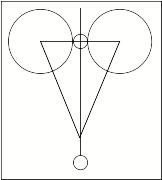
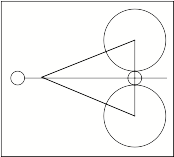

Yes. The Love I seek is my muse, to give me songg. IN THE AREA OF THE SOUTHERN CROSS, PERHAPS. I love my country, and my people. I don not wish for them to fall into the sickness of Eastern Europe, the politicl despair, which is their legacy. I wish for us to be different. AMERICA IS THE MICROCOSM. IT CARRIES LIGHT INTO THE HAVENS AND ALSO LIGHT INTO THE DEEP, WHERE THE BLACK SEALS OF REBELLION LOOM. No one can harm me. I am in the womb; and I shall always be in the womb. YOU MEET A GERMAN WOMAN WHO TELLS YOU TO COMPLETE YOUR BOOK, TO GIVE UP YOUR LIFEBOAT; AND DIVE INTO THE CHAOS OF LIFE AGAIN. HER NAME IS ERICA. PERHAPS SHE IS THAT CHAOS. Was it a proposition? ERICA MEANS: FIRST ELEMENT, FIRE OR LIGHT; SECOND ELEMENT, GREAT OR RULER. Erica is the Egyptian sacred tree, which grew around the body of Osiris. The axis or World Tree, the Coffin Tree. OLD ERIC(A) IS A NAME OF SATAN, A DEVIL, AS SVIPDAG, AN ADVERSARY OF CHRIST. ERATO IS SEEN IN HER LAUREL WREATH, PLUCKING THE STRINGS OF HER LYRE. Where did you see her? DOWN BY THE POND. WITH NO CLOTHES ON. Blessed nymph, singing her rich history to me. BLESS THE WORLD FOR SUCH BEAUTY. He wishes to give up his power. THE WARRIOR HAS COME HOME, LOOKING TO FIND HIS WIFE AND HIS BED. He seeks the beautiful approaching Spring, looking to find his wife.
"This is a theme, " Charlie Rose comes in, "which continues very strongly in the next book you wrote, the prosepoems, Instrumentation In the Wheelhouse. The theme of that book is that God is sending you a woman to be your wife. He sends you several candidates. But the theme of 'coming home' and being in heaven with your wife -- that is the theme of the next book, isn't it...?"
"It is one of the major themes," Crossmann says. "Like this book, there are many themes. The book is composed of themes. Themes are the bloodstream of literature. But, yes, it is a major theme..."
"And that is when you did marry, after completing that book," Rose says.
"Yes."
"Some critics complain that you are not a visual writer," Charlie says. "That you paint with words, concepts, in themselves. You don't really paint objects or colors..."
"I do paint with colors, in fact," Crossmann says. "But, it is true. I do paint with words. I love words..."
"Like Joyce did," Rose says.
"Yes."
"Some people feel that Joyce painted with words because he was going blind," Charlie says. "You have said that you essentially put out your eyes because they tempted you...."
"Jesus said: 'If you eyes tempt you, then pluck them out'," Crossmann says. "Of course, this is not literal. Joyce was going blind. But I believe he had already transfered out of his eyes and into his ears as the primary sense. I have spoken about doing this back during the first part of writing this novel. The ears are the Night senses; the ears and the scent. And the sense of smell, in humans, is pretty much dying out, at least compared with animals. The ears are more directly linked to the innner world; and the eyes to the outer world. Joyce writes about his process of writing in Portrait of the Artist as a Young Man, when he analyzed a line of his own writing. 'A day of dappled seaborne clouds.' He wonders where the phrase comes from. Does it come from the colors connected with the words: sunrise gold, the russet and green of apple orchards, the azure of waves, the greyfringed fleece of clouds. No, he has to admit. He apparently loved the 'rhythmic rise and fall of words better than their associations of legend and color'. Perhaps this was because he was weak of sight, he surmises, and shy of tempereament. The rhythmic rise and fall of words: I admit that this, for me also, is my driving condition...."
"This makes for hard reading," Rose says. "For your associations are almost always with words, with concepts, rather than with the shared reality of landscape. Describe a vase. People have seen a vase; they know what a vase is supposed to be. Describe a blue vase: this is even clearer. Describe a blue vase with Greek warriors painted on the side: this becomes almost concrete. But you don't do this. You concepts begin as air and then become lighter and lighter..."
"Or heavier and heavier, depending whom you ask," Crossmann says.
"Yes, well there is that. So, we are approaching the denouement. The end of this seven-year odyssey, which really transfomed your nanture..."
"Yes," Crossmann says.
"It seems like you are ready to give up this cross as a writer," Rose says. "Ready to move in to a more normal life, with a family..."
"Yes. That is the future toward which he is heading," Crossmann says. "But to get there, he must undergo many challenges."
Rose continues to read:
Rabbi Jehoshuah
The Holy One espoused Matrona to Moses. This was the first time that she made contact with the World Below. We may compare herewith the remark on the Daughter of God in which it is said that until she becmae a Bride no one spoke with God face-to-face.
Shekinah was united with Moses after a new and more intimate manner, just as God revealed Himself to the lawgiver in another way, and, in a sense, under a New Name. The exodus brought about by Moses occassioned, moreover, the manifestation of Shekinah before the people of Israel, she being the pillar of fire by night, as Jehovah was that cloud by day. (According to another account, Shekinah was also a cloud; and it was through this cloud that Moses passed on his ascent of Mount Sinai.) Finally, and most important of all, moses caused Shekinah to manifest in the Ark of the Convenant over the Mercy Seat, between the figujres of the Kerubim. The Tabernacle was erected to serve as her residence.; and, at the moment when it was set up by Moses, there was another erected in the World Above. The Mosaic Tabernacle became the residence of Metatron, who connects so curiously with Shekinah. The latter was also that cloud which abode on the tent of the congreation while the flory of the Lord filled the Tabernacle.
The Male Principle, Jehovah, is said to have spoken from the tabernacle by the intermediation of Shekinah, who is the Female Principle.
Shekinah finds repose between the wings of the Kerubim. She is described as resident throughout the Holy of Holies, yet is connected in an especially manner with the Western Wall of the Temple. The Holy of Holies was guarded, moreover, by Metatron, and was built for the union of the King and Matrona. It is written: 'Those of the country shall utter cries, and the angels of peace shall weep bitterly.' This refers to the weeping of the angels when the Sanctuary was destroyed, and the Shekinah was exiled into a foreign land.
WORDS. WORDS AND CLAIMS, AND THE NAMES OF THE MOST HOLY FOUNDATION. CLIENTS OF THE UNBEGOTTEN. WISHING WELLS PROFITING FROM SILENCE. Perhaps I will marry Shulamit, fusing my fate and her fate as we descend into begotten Time. YOUR MADNESS CARRIES SWORDS TO RELATE YOU TO THE WORLD. BESPOKEN BY FUSES. SEEING SHULAMIT CRY. TOKEN OF UNIVERSALITY. ARE YOU GOD ARE YOU POET-GOD ARE YOU PEACE-MISCHIEF-MAKING-MAN ARE YOU NOTING IN TREES ARE YOU EVERYTHING IN WINDOWS ARE YOU ARMED TO DO BATTLE ARE YOU FRAIL AND UNPRODUCTIVE ARE YOU AN IMAGE OF SELF-PROTECTION ARE YOU THE EVIL WHO STALKS THE LAND ARE YOU THE MERCENARY WHO HAS ACCORDS ARE TOO MANY FIREMEN INDICATIVE OF SOMETHING? Rise and, thereby, raise your ferocity into the sky, for space saves each inkling and proselytizes its own fortune. HOPE. A MAN BRINGS YOU GLORIOUS VISIONS OF NICARAGUA. HE SEES THAT YOU ARE EHE ENEMY OF JUSTICE. Yes. Yet some must play Jehovah's Waltz. FEAR NOTHING. DEFEAT DEATH AND LEAD THROUGH THE ABYSS, VERILY, BY BEING THAT ABYSS. The Clerk is approached by a man named Obitts. DEATH, YOU MEAN. The obituaries which I call storms.
I am poet and murderer --
Which last and which first?
I am the broken tablets
And the frozen word --
Which weeps, and who is lost?
I am the missionary of First Values;
I am the Stoic who kills the Crow.
When all the women come to see me,
Do they find their Deliverer,
Or do they see in me their Foe?
AND TO YOUR BELOVED?
You can never know me
For I have been stolen
by the Wind.
All voices which inhabit trees
And the fair theology of leaves
Rock the early cradle
With dedications to human volition.
You can never have me
Thought I kiss your lips
And occupy your emotions.
Your thighs hid the symphony
Of the ecstacy of parts;
And such music you would give me
If ony I could ask you.
But you can never know me --
I have been stolen by God
from Time.
WORDS SEWN ON A FROZEN WAND. FRIEND OF MAN AND FOE OF MIEN. THE FIRST SON BRINGS THE MYTHOLOGY OF FAILURE AND DEATH -- THAT WHICH SOME HAVE CALLED WISDOM, OLD MEN MOSTLY, FOR LIFE IS A PHANTOM AND WISDOM IS THE TRIUMPH OF FATIGUE OVER LUST. Metatron is you secret name. MICHAEL, THE LION, WITH THE HEAD OF A MAN, MOVING HIS SLOW SAGITTARIAN THIGHS, SLOUCING TOWARD BETHLEHEM TO BE BORN. Tommorrow the Year of the Rat begins. 1984. Lunar and limb and lump and trajectory. 1984. The Last Man of Europe -- or, Boxed Lunch for the One Who Speaks Sideways. AS EUROPE SLIDES TOWARD A FROZEN EASTERN BLOCK OF ICE AND ORDER, OF DEATH AND RIGOR-MORTIS. My heart contains all the secrets of existence. Beautiful women make me smile. Their flesh is contagious only through their perfume. MAN BEGGING FORGIVENESS OF THE EARTH:
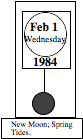
I.
It is too early, always,
When the Deranged Angel make proclamations.
Spring intends to proffer
Wonderful daisies upon her breasts.
The boy who has furious visions
Wishes to speak to the maiden his sins
and to beg her forgiveness.
(She always forgives him.)
Each words is a seed
Giving birth to human monsters.
The boy falls upon his knees
And gives his love a kiss to feed her.
The wonderful sanctuary between her thighs
Locks the Fallen Man into a new addiction.
He punishes her; and then he brings her gifts;
She bleeds when hit; and then accepts his sorrow.
Please forgive me fantastic anger
And the obituary which I call storms.
The treasure I seek I find inside your eyes.
The tyranny I become I give away
for your sweet attention.
II.
The left-handed man
And the right-handed woman
Bring consternation on the town.
The right-handed man
And the left-handed woman:
It is these two through whom
All the laws are re-established.
WORDS AGAIN AND WORDSAGAIN. WORDSWORTHIAN WORDS. Paranoia comes limpin to the state. He really has no substance, is dressed as a beggar, carries a bag and a blue-edged hunting knife.
The lone warrior against truth
Strides the ancient forests
Intimidating grain with his flair
for the heroic.
As grim as old Ahab,
As sharp as blue steel,
There is no parchment to record
The Thought by which he rules existence.
The eagle hunts Truth's logic
From his station above the Wind.
His shadow walks the velvet fields,
Walks politely thoujgh the town.
He knows that Truth puts a mark on him;
He marks that Truth, and hunts it,
With a lexicon he's formed.
The lonely warrior amidst Truth
Is the First Truth and the Last.
Beasts scatter at his appearance;
He does not hat the thing he seeks;
He loves small things and other beings of virtue.
But there is violence in his history;
The trees tell a story of how he has stood.
WORDS AGAIN. WORDS CANNOT HARM ME. STICKS AND STONES. PRICKS AND BONES. HICKS AND HAIRY CRONES AND ALL. I HAVE WALKED HERE FOR EVER. AND FOR EVER I'LL CONTINUE. Grim delusions. AND WORDS. MORE WORDS. Words given from the fat man to the skinny man are green. Buoyant with no opinion. GIVE ME PLUMP MEN WHO ENJOY THEIR PLEASURE. Shenandoah, I love your daughter. A-a-way, you rolling river. THESE ARE GLUTTONS FOR THE STAGE. Fret and wait and weary for their hour. THE GHOST OF HAMLET'S FATHER APPEARS TO CONDEMN THE PERVERTED DRAMA. The drama which has been perverted -- as a dream. A'ROVING', A'ROVIN', IT'S ALWAYS BEEN MY RUIN, I'LL GO NOT MORE A'ROWIN' WITH YOU , FAIR MAID! Shulamit refuses to take a lunch prepared by the Clerk; she is having financial rpoblems; he offers herhelp and she stabs him with an icycle. He leaves the lunch on her desk and says: 'Don't be so proud!' Then he leaves. A FINE SOAP OPERA YOU GIVE US NOW. I shall fight everyone to my last breath, he says. None shall approach my Tree lest he be leveled with my mirror into the Future. HE SAYS.
Analyst
The 'One Rejected' is the Sun of our System, the Eighth Son. The Seventh Son, or Heaven, is Uranus, and must be understood as Heaven. Adam Kadmon is Tetragrammaton, the Logos -- that is, Kether, Chochmah and Binah: The Word in union with the Voice and Spirit.
The Planets are the Warriors; they are also called 'the Architects': the 'Leaders of the Heavenly Host'.
Commentator
The Second Seven, the Lipika, or 'Historians', produced by the 3, the Word, Voice and Spirit, are the 'Scribes', the 'Analysts', or 'Annalists', who are connected directly with the Law of Retribution.
The Sun is one of these; the Son-Suns are countless. These are the 'Four Immortals', the 'Watchers', or 'Guardians' of the Four Quarters of the Sky. These are the guardians of the 'Book of Life'; these project into objectivity, from the passive Universal Mind, the Ideal Plan of the Universe, upon which the 'Builders' re-construct the Cosmos after each Pralaya or Period of Rest.
WORDS. AND MELANCHOLY CONSTRUCTIONS. HE LOOKS FOR A WIFE AND FINDS THEY ARE SMALL. EACH TIME HE COMES BACK TO THE EARTH, HE FEELS LIKE A GIANT BY CONTRAST. THEY SHRINK. THEY CANNOT KNOW WHAT HE SEES; HIL OWN ILLUSION IS MUCH TOO GRAND; AND HE DWARFS THEM. He has been hunting; and he has been hunted. IS THERE MORE CONFLICT BETWEEN MEN AND WOMEN IN THE FIRST QUARTER OF THE MOON? HE ASKS. I am alive in all things and dead in thou. I can as easily murder the Moon as scale the Sun to find its treasure for the sea-weepers. GIVE ME A POEM THEN. Song for a solitary boy:
'I do not wish to have friends.
Friends are a cure to loneliness only;
And a cure to loneliness only
Is but a sorrow of another name,' he said.
Compounding the unclean necessity
of his ritual annual intercourse,
The god harnesses his steed
And make his way through a curtain
of lives.
The woman who is strong
Does not demand her man be weak.
He spends himself upon her breast;
And then weeps when the circus
explores him.
WORDS. OPINIONS. EVERYONE HAS OPINIONS. OPINIONS ARE LIKE MICE IN THE FIELD EATING THE GRAIN WHICH SOMEONE ELSE HAS GROWN. Another:
Give me your category of Grief,
And I shall measure it with a Tyrant's logic.
Give me the madate of Midnight's sleep,
And I shall wrench away your tools of Belief.
Give me opinions and sacred ploys:
I'll give you my barbs of Understanding.
yet, if you bring to me your love,
I shall raise you into a Queen.
HAVE YOU ANOTHER? Visions from the Old School:
I would write a poem of love
But there is no one left to love.
The women condemn the phallus;
They suckle one another's nipples.
All proclaiming solidarity and female force.
There is something bestial in this new-found
theology.
They love the Night too much;
They scream their curse against the Living.
The men have forgotten the nature of Valor.
Some wear earrings; others talk of wearing skirts.
Their women would have them always be boys --
For boys cannot threaten their mothers new-found
ferocity.
I would write a poem of love.
But I am old.
And the Dawn is uncertain.
WORDS. GOODS. WHO IS THE GOD HERE? YOU, OR JACOB HEIMKREITER? Why, Benjamin Heimkreiter, of course. IS HE DEAD THEN? He is living in Phoenix, Arizona -- under an assumed name. HE DROPPED OUT OF COLLEGE, AND WENT TO LIVE IN PHOENIX IN A TEEPEE. Getting back to the land, he said. AND WHAT OF HIS BIG SWIM? WHAT OF HIS JUMP? Legend. Some symbol perhaps. INDIAN IN HIS TRIANGLE...
David Blumenthal (on a bench in a park, shaking Jacob
Heimkreiter by the shoulder)
Have you had enough sleep? It's almost getting dark; we should go.
Analyst
The German woman wants him to stop writing and fall into Chaos.
(Daphna's image appears; the Clerk believes she is
frightened of him.)
Second Song to Shulamit
You look at Love as a strange game
Played by men for you,
As though some Ancestral Law
Positioned planets in their cages
Each ordained by the King
To bring foolish blessings
To only you.
The Antagonist has his eyes on you too;
He has spent milliards of years
Fighting with every ocean.
If he chooses you as his bride
You will not have the strength
To resist him.
For Love, to him, is a threshing of deeds;
His face is ultimately grave;
Ancestral Houses have given him virgue,
And his wish.
Analyst
His insecurity grows and grows; his power diminishes.
Madame Bee
Stanza V.
1. The Primordial Seven, the First Seven Breaths of the Dragon of Wisdom, produce in their turn, from the holy circumgyrating Breaths, the Fiery Whirlwind.
2. They make of him the Messenger of their Will. The Dayu becomes Fohat, the Swift Son of the Divine Sons, whose sons are the Lipika, the scribes; Fohat runs circular errands. He is the steed, and the Thought is the rider. He passes like lightning through the fiery clouds, the cosmic mists; he takes Three, and Five, and Seven Strides through the Seven Regions Above and the Seven Below, the World-to-Be. He lifts his voice and calls the innumerable Sparks and joins them together.
MICHAEL, I AM IN NEED OF YOU. Daphna writes to say that ultrasound has shown that she carries a daughter, not a son -- she writes: 'your King may have to be a Queen'. This disupts your sense of being. Your vision is rattled. I LOOK TO FIND A SENSE OF WHO. AM I MAN OR AM AI MONSTER? AM I ANGEL, WHO HAS NO PASSION? NO. I HAVE PASSION; AND A WILL TO FIGHT FOR LIFE. YET MY VITALITY IS NOT THE SAME. Look Death in the eye and don't budge an inch! IT IS DONE. SO HE SAID.
Analyst
Fohat answers to Eros in the primitive Grecian Trinity (Chaos-Gaea-Eros), and to the Third Person of the Christian Trinity, the Holy Ghost, and to Shekinah.
Fohat, in the Unmanifested World, is not; or rather is that abstract philosophical idea, that Potential Creative Power (Demiurgos), which, when awakened, becomes the Electric, Vital Power, which, under the Will of the Creative Logos, unites and brings together all forms, giving them the first impulse which becomes, in time, Law.
This Demiurgos or 'Divine Son',when born, is the Creative Logos of the Christians, the Four-Faced Brahma of the Hindus, Avolokiteswara-Iswara, Osiris of the Egyptians, Ahura-Mazda of the Parsis, the Hermetic Heavenly Man, the Logos of the Platonists, the Atman of the Vedantins: he is the Sythesis of the Seven Lives. He is the 'Host' of the Higher Creative Gods or Angels.
Michael
My vehicle is Motion. I turn and turn; I am a planet which too few touch. Or can touch.
Father Hemelovsky (raising the host)
Thou shalt not insist on darkness, he said.
Daniel Newman
Light is actually a liquid form. Black magic comes from manipulation of murky water, in the figurative sense I mean. Murky light.
Analyst
On the Earthly Plane, Fohat is felt in the magnetic and active force generated by the strong desire of the magnetizer. On the Cosmic, it is present in the constructive pwoer which carries out, in the formation of things, the plan in the Mind of Nature, with regard to the development and growth of thsat special thing (the object of 'creation'). He is, metapphysically, the objectivised Thought of the Gods, the 'Word Made Flesh'. On a lower sacle, he is the messenger of Cosmic and Human ideations: the Active Force in Universal Life. In a secondary aspect, Fohat is the Solar Energy, the electric vital fluid, and the preserving Fourth Principle -- the Animal Soul of Nature -- or, so to say, Electricity.
The Three Steps Taken by Fohat also represent the 'times': Sunrise; Noon; Sunset.
The Three Strides relate metaphysically to the descent of Spriit into Matter, of the Logos falling as a ray into the Spirit, then into the Soul, and finally into the human physical form of Man, in which it becomes Life, or Vitality.
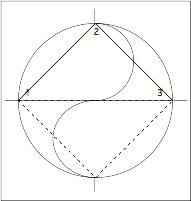
William Butler Yeats
I.
Twenty-and-eight the phases of the Moon,
The full and the moon's dark and all the crescents,
Twenty-and-eight, and yet but six-and-twenty
The cradles that a man must needs by rocked in;
For there is no human life at the Full or the Dark.
From the first crescent to the half, the dream
But summons to adventure, and the man
Is always happy like a bird or a beast.
But while the Moon is rounding toward the Full
He follows whatever whim's most difficult
Among whims not impossible, and, though scarred,
As with a cat-o'-nine-tails of the mind,
His body moulded from within his body
Grows comelier. Eleven pass; and then
Athena takes Achilles by the hair,
Hector is in the dust, Nietzsche is born,
Because the Hero's crescent is the twelfth.
And yet, twice born, twice buried, grow he must,
Before the Full Moon, helpless as a worm.
The Thirteenth Moon but sets the soul at war
In its own being; and when that war's begun
There is no muscle in the arm; and after,
Under the frenzy of the Fourteenth Moon,
The soul begins to tremble into stillness,
To die into the labyrinth of itself.
II.
When the Moon's Full those creatures of the Full
Are met on the waste hills by country men
Who shudder and hurry by; body and soul
Estranged amid the strangeness of themselves,
Caught up in contemplation, the mind's eye
Fixed upon images that once were thought,
For perfected, completed, and immovable
Images can break the solitude
Of lovely, satisfied, indifferent eyes.
III.
And, after that the crumbling of the Moon:
The soul remembering its loneliness
Shudders in many cradles; all is changed.
It would be the world's servant, and as it serves,
Choosing whatever task's most difficult
Among tasks not impossible, it takes
Upon the body and upon the soul
The coarsenss of the drudge.
Michael
If my 'fall' has given me Life, then to 'rise'
Is to be punished by elevation.
Youth transfixed by fall; age transfixed by resurrection.
Tuble the dice and the corollary evening;
No human story might illuminate the starry preview.
Savage appointments mark the treatise of the four arrivals.
Poverty is the misalliance of age;
Fatigue builds its body of lice,
Condemning the living as old women hate young tramps:
A jealous occupation of old wits,
Proclaiming too-easy virtue in their uprightness;
Another form of Necessity.
As I pass through fatigue and Death, I leave one ear of corn
And a page I have written on a tree stump near the church.
Do not sing the blessings of Age to one who is young,
For he will laugh: he has too much for living.
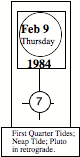
YOUR WORDS ARE NOT AS BEAUTIFUL AS HIS. Is that your expert opinion? AS GEMAYEL'S GOVERNMENT COLLAPSES, YOU HARDLY EVEN NOTICE. If Lebanon becomes another Islamic Holy War State, similar to Iran, nephew to Syria, then Israel will have bloody martyrs on her borders, religiously obsessed with the destruction of the Jew. Europe shall have the bloody crescent at her underbelly. YOUR PHASES OF THE MOON CANNOT BE GAUGED BY YOUR SOLAR CALENDAR. FOR THE SUN HAS 24 HOURS PER DAY, AND THE MOON 25 OR MORE. YOUR 9TH STAGE IS NOT THE NINTH AT ALL. The Queen of Night rules the Night: and so you have Lunar Time during these periods. WHEN DEATH COMES NEAR. If you are a Man, you will fall; choose, instead, to be a god. The god does not fall. THE CRESCENT AND THE STAR: THE COMING IN OF NIGHT. The symbol of the Virgin Mary. AND OF ISLAM; AND THE TURKISH EMPIRE. The Turks are notorious murderers. THE BLACK MAN, DARK MAN, EMOTIONAL IN HIS NATURE -- AND THE WHITE WOMAN, THE MOON. THE MAN OF LIGHT FALLS NEAR HIS DARK WOMAN, THE EARTH. You wish for Daphna's Michael to play the role which you have been given but which you fear to play. I FEAR POWER EVEN MORE THAN I DESIRE IT. You have been through death and you see the black face of Islam. THAT WAS WHERE HITLER WAS LIVING. Michael, I invoke your name; and the power resident in your name.
Analyst
The Holy of Holies of the Temple of Solomon, and in the Tabernacle of Moses, is a picture of a double-womb. In Hebrew, the letter He is, at the same time, the number 5, and the symbol of the womb. Twice 5 is 10, the phallic number, which isthe Ten Sephiroth composing the Adam Kadmon, the Archetypal Man, the creative origin of all things.
Again your 26. Yeats Human Signs of the Moon are also 26.
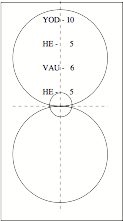
Clerk
White womb; black womb. Anti-universe; universe. Matrix here; and matrix there.
Mythologist
Six. Pythagorean number of life and good fortune. The number of divisions of the body: two arms, two legs, head and torso. Number of holes of the head: eyes, ears and nose; and mouth (the seventh). Deity attributes: justice, love, majesty, mercy, power, wisdom. By mystics called the Teacher. Its nature is cooperative; and it controls artists. Under its influence are a blend of the intellect and emotional. Equalizing in effect. Corresponds to the color blue, the Hebrew letter Vau, the planet Venus, the zodiacal house Virgo. In a name of a cycle, denotes the need to assume a responsibility other than one's own. Six paths in Buddhism; six Cardinal Vritues: charity, industry, meditatin, morality,patience, wisdom. Six is the source of temptation: five senses and the will. Medieval Christians saw in the name Jesous an identity between Jjesus and Sophia, light and wisdom. In Greek antiquity, assigned to Aphrodite. Greek sacred number, termined a 'world': this an allusion to the zodiac, in which six spaces of thirty degrees were assigned to the celetial world and sic to the terrestrial world. Hebrew perfect number; number of day in which God created all things. In the Kabbala, number of letters with which Jehovah sealed the depth when the contemplated it beneath Him.
Bystander
We were discussing the number Five, not the number Six.
Michael
During the Day, the Sun rules: there is fertility, wealthy, production: civilisation.
During the Night, the Moon rules. It is the Dark Age. The plants don't grow; there is cold and fear; and the shadows come out and are stronger than the light. The shades rule the Earth. Fear of Darkness stirs the soul; and real religion is again born, an attempt to drive off the Darkness.
But it is the Sun which illuminated the Moon, an inert void without him. But the Sun is far away now. The Moon rules in absentia.
I see: the Sun creates all worlds, one directly, and one by proxy.
WHO SHALL BE OUR CAESAR,
MAPS SPREAD ABOUT HIS TENT,
STUDYING SYMBOLS ON THE CHESSBOARD?
CONVULSING SYSTEMS AND EERIE RELIGIONS
MARK THE TERMINUS OF EACH OLD AGE,
AND ARE VOID.
WHO SHALL STAND TO STOP
THE CRUSHING WAVE OF GRAY
FROM THE EAST?
THE CRESCENT'S BLOODY BLADE
WEILDS FRENZIED ARABS TO NORTHERN TOMBS.
NEW CHRISTS CARRY FIRE
ON FINGERS AND ON LIPS.
THE OLD DRAGON IS SLAIN.
CAESAR NOW IS THE KING.
WHO SHALL BE OUR CAESAR:
WHO SHALL BE OUR OWN EERIE SAVIOR?
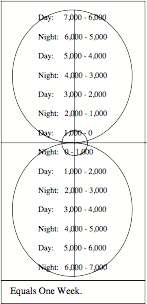
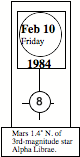
With a 'respectfully yours' to Yeats and his Second Coming. HOLDING A CANDLE, BUT NOT HOLDING A CANDLE. Uncle Ray, the old wino, tells the Clerk's brother William: 'Lock your door, son!' -- and I feel Death about to pass over. WHEN SUPERMAN FALLS IN LOVE, HE LOSES HIS POWER: HE BECOMES ONLY CLARK KENT. Jehovah's other number, 354, is based on the Lunar Year: 345 is to 543 what 444 is to 444. AND WHERE DID MOSES COME FROM? Mt. Nebo is to the east of Eugene. NEAR NIMROD, YOU MEAN? What is your meaning? What do you infer? RAISE YOURSELF UP. DO NOT BE DEFEATED BY DEATH'S ANGRY NEGATIVITY. YOU HAVE LIVED FOR YOUR GOD, HAVE YOU NOT! Shulamit enters your dreams and makes you erect. JIL COHEN VISITS YOU AT YOUR OFFICE, ALL HAIR AND AIRY CURVES. Do not be afraid to write. FIVE IS THE NUMBER OF THE SCRIBE. Death is very close; the woman's breath is the logic of graves. MICHAEL GRAVES OR PETER GRAVES? Really, humor sill? Gravity's reainbow is Levity's horseshoe. YOU DAMNED DARK MEN WHO HAVE NO MINDS, ALL SOUL AND BLUSTER AND THE SEEKING AFTER HORROR, REVOLUTION, DEATH, POVERTY IN YOUR GOD'S NAME! Let the days run into tides and let the scorn run into fire of rage, if necessary. WHITE MEN GO OUT TO ESCAPE THE WHITE WOMAN. TIME COMING CLOSER WITH EACH STEP YOU TAKE. Money is the blood stream of the society. When it circulates freely, the society is in healthy. When it clots, does not circulate, then the body grows ill. THOSE WHO DON'T SPEND, WHO HOLD ON TO THEIR MONEY WITH A TIGHT FIST, CONDEMN THE SOCIETY TO DEATH AS CIRCULATION TO THE LIMBS WITHERS. The society dreams, as so the Spirit Body is vitalized. But the souls must remember that they must also vitalize the Physical Body. Because that is the nature of eternal life: having both bodies ready to inhabit when needed. The Dream Body during Night; and the Physical Body during Day. Those with one body only are not complete beings, having cut themselves off from half of the world. Some know only Night; and some know only Day. The one who lives for ever know Day when it is Day and knows Night when it is Night.
Analyst
He wanders through this void, trying to see who he relly can be. He sees:
M - 13 Y - 10
J - 10 H - 5
C - 3 V - 6
26 H - 5
26
As He is a double-letter in the Hebrew, that is, the midpoint between the Perfect Number (10) -- it means window or womb, being the feminine aspect of the Divine Name -- so M is a double-letter in English, being the midpoint between the number of complete letters, that is, the Complete Word, 26. M is a symbol of Water, Matter, the Deep, the Womb -- and is associated with Mary, the Sea, and with Messiah, the Son, who is the Hero born from the Deep. It stands in the middle, like He, and gives birth in both directions. He sees:
J is Jod (Yod), Archetypal Adam, 10, both masculine and feminine.
And C is 3, the Trinity, Spirit-Soul-Body in manifestation.
Michael : M (Miichael the Archangel)
John : J (Jesus
Crossmann : C (Christ)
And he sees a past history in all of this. And a future destiny.
His first address as a child:
311 North 8th Street.
3 + 1 + 1 + 8 = 13.
Pardon me: his first address was:
310 North 9th Street
3 + 1 + 0 + 9 = 13.
His secon address as a child was:
311 North 8th Street.
Both addresses are 13, the number of the Hero-Messiah.
Add either of these 13 numbers to the zip code of Sinclair, Wyoming, 82334, and we get 13 + 8 + 2 + 3 + 3 + 4 = 33, the age of Jesus
Christ at his death and resurrection.
The Clerk is 33 years old at this moment.
We have been over this landscape, yet expand on the subject.
His present address, House, or Temple:
275 East 14th Street.
2 + 7 + 5 = 14 + 14 = 28.
The number of the Moon.
The zip code is 97401:
9 + 7 + 4 + 0 + 1 = 21.
(16 + 4 + 1) = 21.
21 + 28 = 49.
49 being the number of flames, of manifestations, with 50 being the mid-point. 50 being the year in which he was born: 1950.
He was born December 17, 1950.
12/17/1950.
1 + 2 + 1 + 7 + 1 + 9 + 5 + 0 = 26.
Again, the number of completion.
12 + 7 + 1950 = 1979.
1979 is the year he ascended into heaven, and received the Laws of Moses on the Moutain from his God.
1950 is his birth year.
19 + 50 = 69.
69 is the symbol of completion as expressed in the Tao. The symbol of Yin-Yang, Androgyneity. 69 is the year he graduated from high school; his subsequent leaving of home, his entrance into life and higher education.
Mythologist
In the spirit of self-mythology, the god is a self-made, self-created, self-born god. The Trinity God is Father-Mother-Son, for He gives birth to himself, through himself; is himself, and is the Father of himself.
Michael
And I am myself and not myself; I am the Father of myself and the Mother of myself; I give birth to myself but am never born; I have died but do not die; I am no one else but none have not been, at some time, who I was.
Michael As Prophet
THREE PROPHECIES
I. Russian Prophecy
'And there shall come, in time,
Another Romanoff, to the throne,
A son of Rome, who shall lead Russia
To her Great Empire, in the image of her parent --
That parent: Rome itself.'
II. Michel de Nostradame, 1555
'In the time of the seventh ruler of the East
In the Twentieth Centry, a man shall come to power
Who shall lead the forces of the East, who once seemed good,
Against the West -- and the power of the East
Shall be broken.'
I count:
1. Nikolai Lenin
2. Joseph Stalin
3. Nikita Kruschev
4. Leonid Brezhnev
5. Yuri Andropov
6. Constantine Chernenko ?
7. Grigory Romanoff ?
III. Daniel, 12: 1-4
'At that time there shall arise
Michael, the great prince,
Guardian of your people;
It shall be a time unsurpassed in distress
Since nations began until that time.
At that time your people shall escape,
Everyone who is found written in the book.
Many of those who sleep
In the dust of the earth shall awake;
Some shall live for ever,
Others shall be an everlasting horror and disgrace.
But the wise shall sine brightly,
Like the splendor of the firmament;
And those who lead the many to justice
Shall be like the stars for ever.'
Town-Crier
Andropov is dead! Adropov is dead!
News-Hawker
Read all about it! Chernenko is Chosen as Interim Russian Leader!
Analyst
Stepping out of the Circle of Infinity, which no man comprehendeth, Ain-Soph becomes One (Echod, Eka, Ahu) -- and then is transformed, by evolution, into the One-in-Many, the Elohim, or Dhyan Chohans of the Indian system. His third step is taken in the generation of Man (Body-Earth), themale-female; and, from 'Man', the inner divine entity becomes, on the metaphysical plane, once more the Elohim.
The 'Boundless Circle of the Unknown Time' (Zeroana Akerne) gives birth to the issue, Radiant Light, who is Ormazd, the Universal Sun, the 'First-Born Logos', and the Sun of our System -- who is Michael (Jesu-Christos).
Clerk
The First and Last is 'spiritual literature': the Word: Spirit Itself. A Man/Culture comes from Religion and returns to Religion, with that long stretch of life in-between the two primitive occupatinos, itself also religious, even when proclaiming anti-religion. Life in the Anti-Universe.
MORE SUBTRACTIONS, AND WORDS OF GRIEF. SING YOUR SONG, MISTER BLUR. MINISTER BLUE. IF LOVE DOES NOT FIND YOU, BE SURE YOU FIND HER GARMENT. I become more and more incomphrehensible. I cannot be known. I cannot be found. The paper is becoming dry....
I AM THE ETERNAL PRINCIPLE! VOID, EARTH, AND SON OF THE EARTH AND VOID! I AM THE WILL OF GOD! I AM HIS WHITE FIST AND HIS BLACK WATER! I AM HIS HUMAN WORD AND HIS FACE OF MERCY! RAISE YOUR ARM AGAINST ME AND I SHALL CUT IT OFF! I AM HIS SON WHO HAS NOT FORGOTTEN HIM! I AM THE SENTINEL WHO STANDS IN THE FOREST! I AM THE LAST MAN TO MEET HIS GHOST! I AM HIS GHOST AND HIS WOMAN'S SUITOR! I AM THE CHILD OF THE GHOST AND OF THE WOMAN HE'S CHOSEN! THE DOUBLE WOMB AM I; A DOUBLE BLADE I'VE SHARPENED! THE NEXT WORLD IS MADE BY ME AND THE WOMAN! I AM THE PRINCE, AND THE LORD AND THE KING AS WELL! THE KING OF KINGS AM I: I HAVE SENT SOMEONE BEFORE ME, TO PREPARE MY WAY! I SPEAK THE WORDS OF SALVATION, BUT FEW CAN HEAR ME! I SHALL NOT SURRENDER TO THE GLOAMING OF DEATH! THE ANCIENT ONE AM I; THE LAD AS WELL! ALL TIMES CONVERGE IN ME; AND I AM THE TOTALITY OF TIME'S CLEAVAGE! ALL WATERS FIND THEIR SUSTENANCE IN ME! I AM BOTH THE OPPONENT AND THE ALLY! MY TWELVE FACES ARE THE CUBES OF DELIVERANCE! AND DREAMS OF THE GOLDEN CITY COME! EACH DAUGHTER OF MEN SEEKS TO TASTE OF MY PLEASURE! WOMBS OPEN LIKE FLOWERS TO BE CLAIMED -- TOUCHED, ADMIRED! I GUARD THE EARTH AGAINST ADVANCES BY THE DRAGON! THE LIGHT BEGINS TO GROW; I AM LIGHT AND LIGHT'S REFLECTION! I AM THE FIRST-BORN, THE LAST TO DIE, THE ONE WHO CANNOT DIE! I AM THE ETERNAL PRINCIPLE!
Song on the Radio (Clerk singing along)
'Remember the Heroes,
We've all got a lot to lose.
Remember the Heroes,
Who's going to fill their shoes?
Remember the Heroes,
Who fight for the right to choose.
Remember the Heroes...!'
Song on the Radio (Clerk does not sing along)
'Let's get physical, physical
I wanna get physical
Let's get into physical
Let me hear your body talk, your body talk
Let me hear your body talk...'
Annalist
The Invisible Deity is, thus, also, the Dhyan Chohans, or the Rishis, the Primitive Seven, and the Nine, without, and the Ten, including their Synthetic Unit; from which IT steps into MAN.
The Circle has inscribed within it the Triangle, First Line, the Cube, Second Line, and Pentacle with a dot in the Center: 31415. The Kabbalistic circle of the Elohim reveals, when the letters of the word Alhim or Elohim are read numerically, the famous numbers 13514, an anagram of 31415, the astronomical PI, or the hidden meaning of Dhyani-Buddhas, Geborim, the Kabeiri, and the Elohim, all signifying 'great men', 'Titans', 'Heavenly Men', and, on Earth, the 'Giants'.

Madame Bee
Stanza V.
3. He is their Guiding Spirit and Leader. When he commences
work, he separates the sparks of theLower Kingdom (mineral
atoms) that float and thrill with joy in their radiant dwellings
(gaseous clouds), and forms therewith the Germs of Wheels.
He places them in the Six Directions of Space, and one in the
middle -- the Central Wheel.
Melancholy birds along the sea pass into town.
Touble has many names, but only salvation
has a cord and a noun.
The trumpets rake the eerie morning with leaves;
Great trees shake against the harmony of knaves
All conspiring in their green logic to bring to
heaven a bucket of down.
The Queen's own ghost on a plank sells a shell;
Miraculous proverbs are passed into action
beyond the well.
If the saints come marching in, by those twos,
And proclaim black blues;
Remember the scorning sailor who warned against
The continuing persecution of hell.
All flags on the mast are removed;
Those not arrested pass from town toward the sea.
Monasteries are set on fire by responsible members
of the new committee.
Yes, everything now will be new, as it should be.
Nothing can be known now; but everything is proved.
News-Hawker
Lighting Storms on Venus!
Read all about it!
Analyst
Which suggests to our Clerk the effect he has on Shulamit.
For she is an aspect of Venus; as Daphna is an aspect of Earth.
Madame Bee
Stanza V.
4. Fohat traces spiral lines to unite the Six to the Seventh --
the Crown; an Army of the Sons of Light stands at each angle
(and the Lipika, in the Middle Wheel. The Lipika say: "This
is good.' The First Divine World is ready, the First (is now)
the Second (World). Then the Divine Arupa (the formless
Universe of Thought) reflects itself into the shadowy world of
Primal Form (or the Intellectual), the First Garment of the
Anupadaka (the parentless One).
WORDS AGAIN. REFLECTION IS DEATH. IT IS THE NEGATION OF LIFE. NEGATION OF THE FUTURE. IT IS THE ACT OF OLD MEN, FOR OLE WOMEN STILL LIVE -- OLD MEN ONLY PINE. THE BETTER WORLD OF YOUTH, THEY THINK. BACK WHEN THEY HAD THEIR POWER. YET THE BETTER WORLD IS BEFORE THEM, NOT BEHIND THEM. REFLECTION BREEDS GIANT MONSTERS FROMTHE PAST. AND SO, THE GIANTS OF PROJECTION GIVE THEM A FUTURE IN WHICH THEY MIGHT ESCAPE FROMTHEIR DEMONS. One builds himself a place in the future, taking the future by storm, or for ever sink back into the mud of the past. THE ABSOLUTE NEGATIVITY OF WOMEN MAKE THE MEN FALL FROM THEIR STRENGTH; THEY SHALL GO WAWY AND LEAVE YOUR WOMB EMPTY. THEY SHALL BECOME OLDS; AND THEIR GRIM REFLECTION WILL TAKE THEM AWAY. So you say. THE HEART IS WHERE ALL THE FORCES COLLIDE, PAST AND FUTURE, EAST AND WEST....
Arabs from the South.
China from the East.
Russia from the North.
America from the West.
With Isreael in the Center. With Israel the womb, giving birth to the Men of the West again. Giving them life as they pass from the Dark East back into light. THE GIANT NEGATIVITY IS NOT FAR AWAY. Bosch. JEAN PAUL BELLEMONDO. hieronlymous Bisch. BURGLASRS STOLE THE DISH OF THE PAWN FOR A LARK. Endemic to natural selection. HARPING MENSTRUAL UNHAPPINESS IS ICE-BREAKING. Pre-Menstrual Syndrome. YES. What happens when the water breaks? THAT IS THE FLOOD. Someone is born. I AM THE LIVING FIRE. THE HOLY SPIRIT. THE HOLY CREDO. ALL FORMS OF MOTION ARE BORN FROM MY EXISTENCE. ALL FORMS OF THOUGHT TAKE THE BODIES I HAVE FASHIONED.
Metatron.
Metatron.
LIGHTS LIT AT THE PRIMEVAL LIGHT. Who begins to lose his divinity? A RIDDLE: WHEN THE WOMEN BELIEVE THEY ARE MEN AND THE MEN ALL BELIEVE THEY ARE WOMEN, THEN FROM WHICH DIRECTION DO THE INVADERS APPEAR? Unfair execution. WILE WALKING IN THE WOODS, OUR CLEARK FOUND A SIX OF SPADES. The Number and suit of VAU, the Divine Son of the Father-Mother, Yod-He. HE HAD NOT FOUND A CARD FOR MONTHS; HE NOW SENSE THE MYSTERY MIGHT RETURN TO HIM. Spades, the card of death, power and the King.
HE DRANK COFFEE BESIDE A DICIPLE OF RAJNEESH, WHO PORTRAYS HIS POWER QUITE RELIGIOUSLY, IN HIS PUBLIC MEDITATION AND HIS BADE OF HIS GOD WHICH HE HANGS AROUND HIS NECK. THE CLERK PICTURED MICAHEL, THE ARCHANGEL, HOLDING THE BALANCED SCALE, DRIVING REBELLION BACK INTO THE DEEP WITH HIS RAISED SWORD. THE DISCIPLE BEGAN TO SHAKE, TO SQUIRM -- SHAKTI -- SPIRITUAL COMBAT -- AND THEN HE LEFT THE COFFEE-HOUSE. Which is you is which? I AM THE BALANCE. AN ARAB MONTER ISIN HIS WADERS. A FLU COMES INTO MY LUNGS BUT I DRIVE IT OFF WITH MY WILL. I SHALL NOT ACCEPT DEFEAT..
Peter the Prophet
The Six of Spades represents (looking at a piece of paper) telepathy.
Clerk
The Romantic believes more in Failure than in Success. He believes more in Death than in Life. He sees himself as being only an Artist, an Outcast, Misunderstood, Rejected Truth -- that function of the Night called Reflection On the Day. If his identity cannot include that of re-awakening to Life (Body-Life, Day-Life), then he is unable to cross that line of Death -- and he reamins for ever in the Darkness, refusing the promise of Life.
Analyst
The Spirits of Darkness have no bodies for the Day-Life.
WORDS CONSPIRING TO RAISE THE PRINCESS TO NEW HEIGHTS. Yes. THE SUIT OF SPADES WAS ONCE THE SUIT OF SWORDS. Adventure of the Youth. THE LION IS ON THE BOTTOM FOR PROTECTION. American blacks are also, in derogation, called Spades. CLEMENCY. Only at Night do distinctions in Nature disappear. The Hierarchy is a function of Day; Democracy, Equality, is a function of Night. I WILL SHOW YOU THE WORLD YOU GET WHEN YOU CASTRATE YOUR MEN. You are against everyone but Isarel. AT ONE TIME, EVEN AGAINST ISRAEL. I am the Wrath of God -- and everyone knows it. Every man for himself -- and God against all. YOU ARE DANGEROUS TO YOURSELF. Thos who rebel against Heave are given Hell. METATRON (6) IS TO SHEKINAH (7) AS THE WEEKDAYS ARE TO THE SABBATH; FOR THE WORLD WAS CREATED IN 6 DAYS; AND, ON THE 7TH DAY, THERE WA REST -- THE MAN AND HIS WIFE TOGETHER. IN HEAVEN. Six is the number of the Creator; it is the number of points on Solomon's Seal,the perfect blending of Spirit and Matter.

Itis the number of letters with which Jehovah sealed the Depths which he contemplated below Him. THOSE CURSED WITH TOO MUCH REFLECTION ARE OLD AND FOR EVER DEAD; THOSE CURSED WITH TOO MUCH PROJECTION NEVER DEVELOP CULTURE.
I am the Future. I am the King of Kings. My power is not in me but in Thee. I am the Lord's shoes and the Lord's robe. I am the Lord's word and the Lord's first appearance. THE LORD USED THE EARTH FOR HIS FOOTSTOOL. IT IS SAID. BY SOME. The Lord is the shepher looking for lost sheep to save. Michael appears to say that Time is runnng out. He know that all numerical relations tell tales.
IF YOU SQUEEZE YOU SIX AND YOUR NINE TOGETHER, IF YOU TURN THEM INTO MATES, THE FITURE 8 IS BORN, THE TAILS OF THESE COMETS CREATING A CIRCLE.
6 PLUS 9 EQUALS 15. 8 PLUS 8 EQUALS 16. You dreamt three nights ago of Shulamit. You and your brother were walking in a large city, a department store; you saw Daphna Margalit sitting by a display window; you toched her head and said hello. They you kissed Anat's hand; then Shulamit gave you her hand to shake; but when you tried to kiss it, she pulled it back. You could sense that she was troubled. You pulled her away to a corner of the store. You held her in your arms. She admitted she was overwhelmed with school; she broke down; she put her arms around you and kissed yhou. Her mouth was a tiny wet opening, incredibly hot and mysterious. A sheet of heat and tingling intensity spread all over your body, electrifying your loins. Was it her mouth you had kissed? Last night you dreamt of her and she was untrue, chasing other men; and you determined that she was incapabale of being faithful; and you began to hate her.
SHULAMIT IS LOIS LANE, AND YOU ARE CLARK KENT; YOU ARE SUPERMAN, AND DAPHNA IS LOIS LANE.
Newshawker
Holy War Acceptance
Gaining Momentum in Moslem World!
Madhi (Messiah) Expected to Appear in World on Heels of Ayatollah Khomeini!
WHO SHALL SAVE THE WORLD FROM THIS BLACK WAVE? Michael is the all-container; he is the reflection of Jahovah on the Angelic Planes, as Adam Kamon is the same on the Plane of Humanity. IT IS YOUR WILL I DO, AND NOT MY OWN.
Newshawker
Nine South African Witches Burned to Death at the Stake After Being Convicted of Pulling Liightning Bolts Down on Unsuspecting People!
Analyst
Walter Mondale wins Iowa Caucus; Gary Hart takes second.
ANOTHER DARK GIANT HAS APPEARED FOR YOU TO SLAY. He is Death. I have met him before. HE IS FULL OF HATE; AND HE BLAMES OTHERS FOR HIS OWN MISFORTUNE. He saboutages himself; and then he speak his paranoid obsessions. THE FIRE HAS SHIFTED FROM YOUR STOMACH TO YOUR HEART AND HEAD. Does this make me the martyr? YOU ARE PREPARING TO ENTER HEAVEN AGAIN. MICHAEL DOES NOT DIE. HE MOVES ABOUT FREELY, FROM HIS OWN PLANE TO EVERY OTHER. He is becoming receptive; he stomach begins to receive impressions. THE CENTER OF OUR GALAXY IS FOUND IN SAGITTARIUS. You will have to guard the Earth while I go in for information.
Analyst
The Sixth Principle in Man, Buddhi, Divine Soul, is something material when compared with the Seventh Principle, Atma, Divine Spirit. Fohat, in his capacity of Divine Love (Eros), the electric power of affinity and attraction, sympathy, tries to bring the Pure Spirit, the Ray inseparable from the One Absolute, into union with the Soul, the vehicle of the Spirit, these two constituting in Man the Monad, and in Nature the first linke between the uncondditioned and the manifested. The First World is now the Second World -- that is, the World of the Lipikas -- the Holy Scribes.
Scientist
Each 30 million years our Sun cycles thorugh that outer part of the Milky Way Glaxy, the 'attic' of our galaxy, and disturbs cosmic matter (cometary matter), scattering it back into our Solar System. The Earth is bombarded with comets, extinguishing whole species, and marking the 'geological ages', those leaps from one form of existence -- one stage -- to another.
Some astrophysicists believe that the Sun has a silent partner, a nearly-invisible 'brother' star, a 'Death Star', which courses into the attic of the falaxy, grabs a metaphorical handful of cometary stuff and fligs in into the Solar System, bombarding our Earth and the other planets with Fire.
TROMPING THE EARTH WITH MARRYING NETS. THE STAGE MANAGER HAS A GIRDLE FOR THEE, IN WHICH IS STORED POWER OF THE MAN TURNING BRONZE. Absolute Silence. WHOSE FINGERS ARE ROUGH WINNOWED FIELDS IN MY FLECHE.
Madame Bee
Stanza V.
5. Fohat takes Five Strides (having already taken Three), and
builds a Winged Wheel at each corner of the Square for the
Four Holy Ones and their Armies or Hosts.
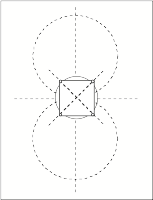
THE MIND BELIEVES THATY REFLECTION IS THE END OF LIFE, VERILY, LIFE ITSELF; THE SOUL UNDERSTANDS THAT REFLECTION IS BUT THE EPILOGUE, THE PROLOGUE OF LIFE. SO, THE ONE IS PERIODICAL, WHILE THE OTHER LIVES FOR EVER. The Lucky Mind drops into the Soul and lives the life of the Holy Animal, the Angel Guardian of the Earth, only to rise back into Mind when the elements are again apparent, again separated into the body, the hierarchy.
An Old Woman Speaks
"He has the power to mesmerize the water.'
An old woman spoke of her son
With fatigure.
I. Michael's Name
'Michael's name contains every Element and Door;
So, no matter which Zone of Atoms
The Light of Time brings to Life:
This is his own Element.
Hence, Eternal Life is His.'
II. Michael's Number
'Michael's number is the One and the Two;
Each season is a face he fashions;
Each Tribe, each Month, is his own conception.
He instructs all forms of men
In the nature of the Seven Productions.
When the rebels rise to strike him,
His creation he un-numbers.'
The old woman said:
'Chaos reduces each Element to the Common Element;
Life is the only survivor of Sin.'
EACH SEASON IS A FACE HE FASHIONS OUT OF NOTHING.
Alpha and Beta
I know Sorrow by its own name.
The Owl is the fiercest hunter of Night;
So, Wisdom is the fiercest Sorrow on the
treadmill.
Anarchy wears great badges made of whispers;
On the other side of A is Great Beth who builds
the house.
I know Sorrow by her own name;
In co-equal nights she comes
And gives me her treasury.
WHO ELSE CAN DO IT? WHO ELSE CAN BE THE SAVIOR?
I love you, God. Please make me in thine image. Make me strong yet wise. Give me compassion yet resolution. Make me see each direction clearly. Give me the courage to be your servant. Make me gentle with a lion's ability to rage.
THE AYATOLLAH KHOMEINI IS MY ENEMY, FOR HE HAS CHOSEN ME TO HATE. And the Lord said of Metatron: 'BE WARY OF HIM, FOR MY NAME IS IN HIS.'
Analyst
Moses gave his tablets of Law to Israel.
Child With a Numerals Board
His 26, divided by 3, is his 26, divided by 4.
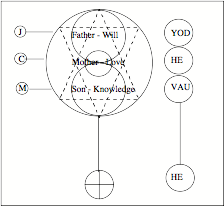
Circus Barker
See Tammuz be gored by the bull!
Only fifty cents; children only a quarter...!
Analyst
The Bull, or Taurus, is the nature of Chochmah --
In its relationship to Scorpio, the Cow.
THE BEAUTIFUL YOUTH IS PUT TO DEATH BY THE FORCE OF INSATIABLE HATRED. Your own wife resents your beauty -- she, thereby, condemns you to hell. You spend time with each of your sisters, the light sister and the dark sister. DAPHNA HAS A DAUGHTER NAMED ELA. So, Michael's fate must be his own. YOU WISHED HER SON WOULD DO YOUR OWN BIDDING, THUS, FREEING YOU FROM YOUR DUTY. Ela shall be a Queen: a Queen of Spades to the King of Sovereigns, a man named Frankie.
YOU PREDICTED GARY HART'S SUCCESS MANY MILES BACK IN THESE ACRES OF WORDS. Many scoffed. LET US HOPE NOT ALL OF YOUR PREDICTIONS BEGIN TO TAKE FORM. His success shall not be total. His success will be momentary. ROSEMARIE, THE WHITE WOMAN AT WORK, STABS THE CLERK IN THE BACK WITH HER SHARP WORDS - - TRYING TO MOLD HIS BELIEFS AND BEHAVIOR. The White Woman with her knife seeking a prepuce of illusion. To wear inside her garment like a queen who has no king. SHULAMIT FLIRST WITH MERE CHILDREN, YOUNG BOYS WHO FALL OVER HER, MAKE HER FEEL YOUNG, POWERFUL, A MOTHER WITH MEN SHE CAN CONTROL EMOTIONALLY: INCEST WITH A SON.
News-Hawker
Gary Hart In Surprise Win in New Hampshire!
Iraquis Attempt to Block Iranian Shipping Exports! -- Gulf War Accelerates!
SHE WISHES TO BE ON TOP -- TO KEEP HIM DOWN. Tiperhath and Melachim, the Nation of Kings: as Michael's surroundings. HE IS ABSOLUTELY INCOMPREHENSIBLE. He cannot be known. IS THAT WHY YOU SEND A COPY OF THIS BOOK TO DAPHNA -- BECAUSE MOSES GAVE THE WATERS OF LIFE TO ISRAEL...? God bless, Lethe. God bless the Waters of Life.
Literary Critic
I shall read from the newly-discovered manuscript, by that Jack-of-no-trades, master-of-all, Frankie Lee Masters. It is entitled Frankie Lee's Book of Prophecies....
I.
I am the synthesis of this system.
I am the First and Last Man.
On me the Next Creation shall be built;
I am the Twenty-Six faces;
I am the Wind which knows both the hammer
and ecclesiastes.
II.
Love's misfit kneads all his rhyme into new
position;
Carolers pronounce the coming obituary of frost;
Seductive women bargain
But the men now fashion swords.
The power of the womb is broken;
Blood is seen on a carved ivory city
And sacred nations.
III.
The village by the sea counts the methods
of old-time gods.
A messiah is born in the scaristy of Winter;
Wyoming raises this cradle to the Moon;
Mothers rock quarterly the grass and the golden shoe;
As Melachim quakes, the survivors are holy and few.
IV.
The man with eight characters in his name
Will find resolve in the choir of the golden
yew;
The Women of Israel sing for his supper;
When the strait if blocked by cedars of trees,
The potentate bleaches the turning words
into a crescent fury.
V.
The Mind believes that reflection is the end of life.
The Soul understands that reflection is but a prologue
to Life.
Hence, the Mind is periodical;
While the Soul has Life Eternal.
YOU ARE THE ANGEL OF THE SUN, SOME SAY. In Rosemarie's dream, a monster rises from the sea and freely pulls Gail, her lesbian workmate, into the ocean and wounds her. Gail admits that harassment from the monstr of her obsessions (a past lover she has foresaken) has begun again. YOU MUST PREPARE TO MEET YOUR OWN MONSTER. IF HER'S IS NEAR, THEN YOURS, TOO, IS NEAR. The woman is mad with blood and fixed opinion. THE IRRATIONAL VORTEX OF FREAR MADES HER WILD. FOR HER POWER IS FLOWING, SLIPPING; SHE BECOMES DESPERATE NOT TO LOSE HER DOMAIN. Mikael-Metatron, walk in my shoes. Make me yourself; yet, make me not forget Daphna.
M - 1,000 (Roman)
C - 100 (Roman)
1,100 Total. FROM HE, THE 11-MONTH BABY.
VI.
French terminex, and the Cow is on her hooves;
The Eye has told all, in the miracle of its
precision.
Black has sleeves which garner horror;
A blonde woman cries:
She believes that the moons are Logic's pure tool.
VII.
Michael's Name.
VIII.
Michael's Number
IX.
The Beauty whom no one sees can kill;
The icycle of her translucence
Lies in the Manufactory of Needs.
The gulf is strafed and bombed by leaves;
Sterile remains she whose only love
Is for her endorsement.
AND WHEN THE VOID COMES, I SHALL FILL IT.
Dream-Recordeer
In the first dream, our Clerk saw a watch which reminded him of his later, loved father; he wept bitterly; traveled to Sinclair, to visit his mother; the town was a white, glass, cubical city, ebsolutely exact and unlived in. He traveled to Rawlins, visited a restaurant where Dick Newman, a friend from high school, wa a cook; he told him that Mary Ellen, the Clerk's mother, was in a nursing home in Alaska. A man appeared to tell the Clerk that his mother was on the phone; he could take it in the lounge. Mary Ellen told him over the phone that the nursing home was quite nice.
In the next dream, he was preparing to bat in a baseball game. The bases were loaded, and a new pitcher was warming up; he hasked his childhood friend, Ralph Vasey, if he would be able to get a hit; the Clerk did not believe that he could get a hit off the new pitcher. Just then, the siren sounded. Everyone was off. The Clerk made his way to the submarine. The war was on. He had dreamt of this submarine before, and the hellish landscape it took him to. He entered the sumarine believing it would be the end of him. A woman he knew from school, Nan Binkley, a pretty woman from Colorado, open and charm, unpretentious in her charm, was a member of the Navy; she was preparing the submarine for duty. She placed something above his seat, which was directly under the light. 'You're sitting under the light?' she asked. He asked her for a kiss; she kissed him. He felt good. She told him she would b e waiting for his return; he wasn't sure he would return, but he did not feel fear.
Then, after having seen the Dark Giant, Gilbert Patton, that same evening, at which time Gilbert cringed, and tried to slink away, the Clerk dreamt that Gilbert came in to the office at work, where Gilbert was not allowed; the Clerk charged him; the Dark Giant had cut his hair, in the dream, and spoke meekly, saying: 'Is there someone else I can speak with? -- I don't feel comfortable around you.' And the Clerk wondered if he, himself, had not become the Dark Giant...?
HAVING DESTROYED A LAND GIANT, HE SHALL NOW BUILD A SHELL IN WHICH TO LIVE ANSD DESCEND BELOW THE WAVES TO DO WAR WITH THE GIANTS IN THE SEA. The All-American girl will be waiting for him when he returns. HE SITS DIRECTLY BELOW THE LIGHT. Priordial light. LIKE A HALO, IT WAS. The Alligator lives both on land and on the sea. EAST INDIAN STUDENT APPROACHES THE CLERK TO HEAR OF HIS JOURNEY AGAINST DEATH. And Joseph's brothers were jealous because, in his dreams, he sat directly below the light. AS THE CLERK BEGINS TO BECOME OBSESSED WITH HIS APPEARANCE. Many Asian women seem to move into view.
X.
The Titan is ill;
His mother has died.
The City of the Tower raises archons
To the King of Spades;
Manufactory of Fantastic Circus slides
With mud into despair,
Desire for Darkness leads to the Pit;
In the station of the Midnight Ranger sits
A soul who knows his deed.
XI.
Loneliness is the greatest virtue of God.
He will push from his womb a monument of pain;
whales in the sky and drachmas on the Earth;
The Exiled Worlds make Him weep for their grim distance;
He will call them all back, and discover that
Distance is, itself, a virtue.
XII.
The Last Saint cannot be known;
Angels are worlds made unto themselves.
The vulgar drive the Wounded Man to his shield
Where he becomes a soldier of Fortunate Grace,
Stalking his own death
Surely as much as his life.
XIII.
The mosnters in March waters
Rise to castigate the Light.
Even the Dragon can be charmed into
Giving up her fury.
If the crescent make the Dark Man wild,
So, the Sun can make the Earth become bold.
HE DREAMS OF DAPHNA, A DREAM IN WHICH HE DANCES AND PLAYS A BALL GAME WITH INCREDIBLE GRACE. He mis-speaks at work, saying, regarding his role in gardening: 'I DO NOT CARE ABOUT THE EARTH.' This haunts him during the day. He does care about the Earth, he tells himself. He does not care about digging the clay with his hands. He cares about justice on the Earth. He cares about the power to rule the earth with his own hand. IF THERE MUST BE A NEW GOD, THEN HE WILL BE IT.
XIV.
He who loves the Dark
also hates the Dark.
When he lives in his soul
The Woman is his queen.
When he lives in his race
He sets his image on the flame.
Newshawker
Hart Devastates
Mondale in Vermont!
European Conference of Intellectuals and Polticos Considers NATO Break With America!
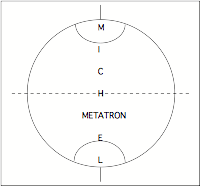
AND EVERYTHING THE LORD HAS SAID SHALL COME TO PASS. FOR HE TELLS YOU EVERYTHING BEFORE IT OCCURS. AND THEN YOU SEE IT HAPPEN. America is not Europe! Our Father was Israel; our Mother was England. We are the cchild born of these two. If our mother foresake us out of jealousy, or out of fatigue, or out of blindness, or out of fear, we will forgive her, for she has given us a body and our beautiful tongue. Her language is beautiful beyond words. We shall stand alone. It is in our nature to stand alone. We do not belong to the others of this world. We are God's chosen; for there shall be Two Israels: Microcosmic Israel and Macrocosmic Israel: made in the image of the Father.
DEAR GOD, HELP ME BE STRONG. HELP ME OVERCOME TEMPTATION AND MY OWN WEAKNESS. HELP ME BE AN EXAMPLE OF STRENGTH AND RESERVE; OR CONFIDENCE AND OBLIGATION. HELP ME LOVE THOSE WHO NEED TO BE LOVED; HELP ME CHASTIZE THOSE WHO NEED TO AWAKEN. BLESS THE WOMEN OF THE WORLD THAT THEY NOT SEEK THE DESTRUCTION OF THEIR MEN BY STEALING FROM THEM THEIR DIGNITY AND PLACE OF RESOURCE. HELP MEN LOVE AND RESPECT THEIR WOMEN AS THEIR OTHER HALF WHO CAN MAKE THEM BECOME GOD-LIKE.
Then the Sun fell down. Like glass. Broken hearts lie on grass. Speakers appear everywehre to have answers. Trash is unburned. Some call me sorry and some call me saved. Who has the answer to the question of how many fears and manifest? CAN YOU NOT LOVE? Choke me; choke me. YOU CURSE THE SICK; AD THEN YOU BECOME SICK. Chochmah; Chochmah. I AM BECOMING LIGHT. Said the feather to the shoe. THE ANGEL RISING ABOVE THE WOMAN'S CAVERN. An empty womb condemns its empty minister.
XV.
I am the Anarchist's first indictment;
I follow no one; and I stand without a shoe.
The Cowboy Angel owns the clouds;
The City by the Middle River
Answers hale with a vegetable warning.
The Queen has seven babies,
But the first rebukes the stars.
Deep inside the Woman's bones
Lies the sacrificial rite
Of presumption to see.
XVI.
I am essentially alone,
For the King has no pre-cursers.
The Child of Consequence is named Tamar.
The Man of Godl has come, as second father.
In the marriage of America and Israel:
Michael gives birth to a child named:
MILLENIUM.
Analyst
The 'four winged wheels at each corner' represent the Angelic Cirtues, the Guardian Angesl, the Regents of the Four Cardinal Directions. These are 'incorporeal' agents or principles -- Wind agents, in the broadest sense. They are the four 'Rectors of Light', the Builders of the worlds: the Four Primitive Elements. These Four Celestial Beings are the protectors of Mankind and also Agents of Karma on Earth, whereas the Lipika are concerned with Humanity's hereafter. They are the 'Four Living Creatures', the 'Holy Animals,' the Fiery Serpents of Heaven (Seraphim) and the Cherubim ('fullness of knowledge').
1. Dragon/Man: Raphael
2. Lion: Michael
3. Bull/Ox: Uriel
4. Eagle: Gabriel
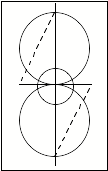
XVII.
The Guardians of Moss in the Town
Without Lights
Bring the Memory of the Russian Women
Back to the Town that Peter Built.
Arab militia are backed to the crown;
English sounds her anguished scorn at the son;
Yet Ishmael's vanguard, with its cross, stand
as victors.
XVIII.
The choir of genii on the Northern Plain
Back the leader who claims that the True Prince
is he.
'I am the New God, I am the Younger among the Elders.'
When the Sky is ripped by Lightining chain
MX arrives, thirteen at the crossroads.
XIX
The Monsters have a femal name;
Blood is on their brain and ways;
The Twenty-Eight Fren zies mock at
self-dedication;
And the trumpet-carrier sustains his courage.
By charting Drama's vision
In the autopsy of Time.
XX.
The hart arrives and the hunter is seen;
Clerical Michael is given a submarine
to the Deep.
Minutes are Spoken Vowels by the servants;
Hours are Lords who never speak
Except to shout.
Twelve Lords times 2 equals 24; 360 Servants times 24 equals 8640. SPEAKERS AFTER CHANGE. The Hater beginning to surface. The Hater being he who sees his own death, and who has no future life. THE HISTORY OF THE WORLD IS MY OWN PERSONAL HISTORY. Your mathematics is terrible. Sixty Servants times 24 equals 1440. And we have, here, again the number of survivors of the End-Time: 144,000.
Gilbert Patton, the Giant Demon (as Clerk appears
down an alley. Patton stands on the
opposite side of the street)
Fuck you, white trash!
(The Clerk looks back, across street; stands in
alley, waiting for Patton to approach him.
The streets are empty. Clerk has his
hunting knife in his backpack. Patton
thinks about retreat; then he walks up the
street, shouting in his demon voice, eyes
looking straight ahead, not looking at the
Clerk, shouting at the top of his lungs....)
Gilbert Patton
I'm gonna mess you up, white mother-fucker! I'm gonna mess up your house! I'm gonna break all your pretty things. I'm gonna break your pretty white teeth! You hear me white mother-fucker...!
(Clerk does not speak. He stands tense and
prepared, reaching back and pulling his back-
pack forward -- touching the knife.)
(Patton moves up the street and out of sight.)
Analyst
This occurred on Saturday, Saturn's Day, The End of Time, 6:00 in the evening, the analogue of Autumn: the meeting of Michael and Gog: the Moon was nearing half-moon: the Light and Dark nearing equal strength.
Witness
March 10 is the birthdate of the Clerk's deceased father.
Second Witness
He spoke in black slang to that man! He spoke as if he believed he was a black man! But he was a white man too...!
Analyst
Sunday, over coffee, Micahel met another white man, mentally ill, who said, in teh course of the conversation: 'I'm weak!" And then: 'But I'm a strong mother-fucker; you hear me!' He also spoke in a black voice. He stared at the Clerk, threteningly; the Clerk returned his stare, his anger, condemning him to hell, saying calmly to him: 'Chaos shall rise up against me, and I shall cut off its head and cast itinto the sea, where it shall reside for two thousand years in hell with the other monsters...!'
Second Analyst
The Clerk is raising his sword again.
Clerk
The Light is growing. The strength is real.
First Analyst
6: Saturn's Day
6: 6:00 PM
6:
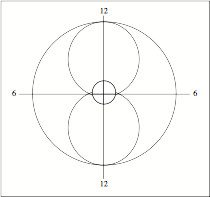
The half-moon being the analogue of the seasons of Spring/Autumn, or 6:00 on the great Time-Piece in Heaven.
Second Analyst
On the 10th, that same Saturday -- Ten being the balance, MALE-FEMALE, of Light and Darkness -- the Sun enteredthe sign of Pisces, which is ruled by Pluto, the planet of Death.
TELL ME SOME OF YOUR POEMS.
Come gather the seeds adn rituals
Which the priests have carved from the sea.
The architects carve out light by the T.
The Cross has Seven Predicaments:
Believes, Disbelieves; Re-lives
And then Flies.
It is the Numbers in my prayers
By which the candle finds its flame.
I guard the Earth with my branch and my
hammer;
The Frost Giants claim that all my humor
can never melt them.
Yet, it is the season of the witch;
And my song burns a hole in all the forests
they have darkened.
King David made the Dark Giant fall;
No grim statuary to disease,
No harsh monumnet to sleep,
Though essential to the love of Failure,
Shall find its place in my templed moon.
It is night when the doctor visits his keep;
No more seeds are to be found,
Until the Wind and her skirts are turning.
YOU HAVE MORE; YET TO READ IS MORE TAXING THAN IS THE SPEAKING OF WORDS. Who shall provide my armor during this season of vexing trials with the losers? LOSERS GO TO GOD; WINNERS GO TO THE DEVIL -- DON'T FORGET THIS. LET DEATH WALK WITH YOU ALWAYS SO YOU WILL KNOW THAT HE IS THERE. THIS WILL HELP GUIDE YOUR LIFE IN THE CORRECT DIRECTION. The Dark Woman is Life; she gives me a body. The White Woman is Death: she steals my strength and demands I be weak, demands I be beneath her, demands that I worship her. SHE IS YOUR MUSE, IS SHE NOT? Weak in one form; strong, perhaps, in another. STRONG IN A SHAKESPEAREAN SENSE. Perhaps.
Ode to Kether
I come down the mountain road to find you;
The Earth has become bare
And all the stars are but ageless reflection.
Ten lions come from the fountain in the park;
The age of man, and the lion of man.
The sword you carry is both a sword and a womb,
A word and a soaring wonderment --
You impregnate yourself; and you give birth
to your son
Who is yourself; and who becomes
your father.
When the Arabs scale the moon,
And when my children find their locks:
Please make my heart the pure vessel
of your totality.
And make me hard.
Make my scales
A perfect form
For Thee.
THOU SHALT NEVER FEAR, FOR I HSALL WALK WITH THEE, AND BE THY GUARDIAN. You have forgotten who you are. IT IS SO; BUT THE BEATING OF RAIN, AND THE TRAMPING OF WIND BRINGS ME BACK TO THE MEANING OF THE SELF GROWN FROM WEALTH. Raionalisation is not so powerful as rhythm. RHYTHM IS ABSOLUTE ACCORD. To he who has entered the zone of aggressive women. SADNESS IA A KIND OF MUSCLE IN HIS HEARD. Pumping himself back up with his sound. AVOIDING ENTERING THAT PERSONAL HELL. Right and Wrong, on a limb. To make him weak in a form of knowing.
THE MIND, THE FIRE OF SCATHING. And the scapegoating of children. PUT SOME CLOTHES ON, THE FATHER SAYS TO HIS DAUGHTER. Are you ready to fight for your life, young man? I AM NOT A WAITER FIRST. I AM LIFE FIRST -- AND, BEING LIFE, I AM ALSO THE RECORD OF LIFE.
Those good in the world are evil at home;
Those evil at a distance
Make their home a desired heaven.
Everything at the same time.
HAVING TO FACE HIMSELF. Makes him either weep or sing. FOR THE INNOCUOUS APPARATUS OF PERSONALITY ON THE SPINDLE, TURNED AND FED BY PRIZE AND SELF-CONCEIT, MAKE A CHILD A BARON IN HIS MIND, AND SCALD THE UNKNOWN FEZ WITH IMAGINED AUTHORITY.
Madame Bee
Stanza V.
6. The Lipika circumscribe the Triangle, the First One (the vertical line or the Figure I), the Cube, the Second One, and the Pentacle within the Egg (Circle) -- 3 1 4 1 5. It is the Ring called 'Pass Not', for those who ascend and descend (as also for those) who, during the Kalpa, are progressing toward that Great Day 'Be With Us'. Thus were formed the Formless World and the World of Forms; from One Light Seven Lights; from each of the Seven Seven times Seven Lights. The 'Wheels' watch the Ring.
White Man Reading 'Black Like Me'
Are you talking to me?
Are you talking to me...?
(He shifts in his chair, angry, looking about the
coffee-house at those he would punish for his
own suffering.)
Ahab (pointing)
The birds! Watch the birds! She rises...!
(Birds circle a spot in the sea. The monster rises
from the circle, from the sea, and crashes back in to
the water, disappearing from view.)
Albatross...!
Jesus Christ
Albatross, or not: the Resurrection approaches, your sufferings will be changed and made new. Do not forget what you have learned from me. Time will tell you about itself to save you. Easter approaches. You have not loved as much as you should have. You have not loved as much as you have fought. yet, your fighting was a form of your love and your sense of duty. That is true. And in this, you have loved as much as any other.
Annalist
Birds of passage -- who follow the Sun -- and in the Spring birds are heard again. The birds are in heaven. Listen to the birds. They are speaking to you.
Hercules to Vulcan
Take your mother's side and you will be hurled out of heaven.
(Three street-people confront a man and his wife,
asking for change so they can buy more wine; the
man says no; they curse him and threaten him in
front of his wife.)
Mikael
They shall be burned with a flaming sword for their ugly appeal. Those who love Death become weak; those who love Life become strong.
(Mad Max, with his dog, is seen but not heard
moving through the town.)
Clerk
Send me a cross which I can wear upon my chest.
(Clerk is seen blessing a Michael the Archangel holy
medal in a holy water font in a Catholic Church and
then putting it around his neck.)
Analyst
The monster is the white who believes he is black. His woman has turned him into a clone. With no understanding of his own procession. Or his history. And also the black who thinks he is God's murderer or force of vengeance.
It is in my own insane quest for power
That I find Creativity.
Those mild in their morality
Can never know the beastly grace
Which the Muse has made as her station.
Life battles Death; and, in Death,
Finds his cure.
Youth burns holy roods for Faith;
In the deep kinship of heavens
Many speak about past productions.
A SCAR-FACED BLACK-HAIRED THUG BRUSHES NEAR OUR CLERK, GLARING A VIOLENT STARE TO THREATEN THE WORLD. Is this what is meant by descent into Hell -- in a submarine? SAILING DOWN THE JORDAN, WITH FULL SAILS BUT WITH NO WIND. Raising yourself up by your name, which is Four. FOUR-FOLD JUPITER AND FOUR-FACED BRAHMA. The Circle within the Square: for EtherKether contains each element and itself. THERE IS NO TURNING BACK NOW.
Absolute Pain is a name in spades I bear;
Holy carols are offered to Solitude to save her;
Bodiless men chart the coures of a ship
With Twenty-Eight sails
But in a land with no wind.
Let them speak about past living ways;
Please don't make every glass slipper
Fit the foot of only the queen who has
departed.
Weatherman
The clouds come in and, again, Darkness is strong.
Clearing allows the velvet man, called Life,
Again to raise his hand and head.
The Woman is desperate not to give up her sovereignty.
Lows in mid-thirties; high in high-fifties.
Troubador
You don't need a weather-man to know which way the wind blows.
Annalist
The West is the Hero, Time, who creates the world.
Michael guards the Earth against the coming Dragon,
Chaos.
GOD, GIVE ME STRENGTH. I HAVE NO FEAR OF LOSING, ONLY FEAR THAT I WILL NOT RISE. MAKE ME IN THINE IMAGE. MAKE ME CONTAIN ALL THE POTENCIES BY WHICH I OFFER MYSELF AS A MODEL.
Reporter
Clerk meets beautiful young woman from Singapore: Li-Ling. She flirts with him, tells him her life story; she calls him a god.
He is not sure if this is the entrance to heaven or to hell. When he sees in color, he is an innocent; but where he sees in black and white, then he becomes, indeed, fierce.
Mythologist
Lingam is the phallus, by which the world is re-created. Ssu Ling are the Four Supernatural Creatures which determine fate and rule the directions: (1) Lung, dragon, chief of scaly animals, controller of rain, ruler of the East, presides over Authority; (2) Feng-huang or Chu Ch-ieh, phoenix, or vermillion bird, chief of feathery animals, essence of Fire, ruler of the South, presides over Virtue; (3) Kuei Shen, tortoise, chief of shell animals, supporter of Heaven, ruler of the North, presides over Divination; (4) Ch'i-lin or Pai Hu, unicorn or white tiger, chief of hairy animals, controller of fertility, ruler of the West, presides over literature.
Reporter
Li-Ling leads Michael away from Power toward Art.
Uranus is in retrograde.
Oregon State is defeated again in the NCAA first round; Washington wins and continues in the West.
She tests him with the power of her flesh.
He has entered into the water world, this alligator, inside his shell..
The birds come up from the South, the Deep, when the Spring comes.
-30-
Annalist
Li-Ling brings to this god praise of those he has condemned: the negative elements, the anti-materialists. And he counsels her on balance.
Analyst
The Dark Elementals are only capable of inner war; so when you counsel them on preparation for war, their only manifestation, their only conception, is civil war: war against themselves: suicide.
They are only endowed with internal manifestation.
(Shulamit and Li-Ling both appear in the Clerk's
dream and inspire him with the lust of the
coming of Spring. The Clerk thinks of the
succubi.)
HE LOVES BOTH WOMEN; AND HE DOES NOT LOVE THEM. He hears people cursing the rain, the Water. FOR THE DESPERATE WOMEN CLING TO THE NIGHT; FEAR OF THE LIGHT MAKES THEM GROW DESPERATE: FOR CONFLICT COMES WITH THE RAISED CURTAIN, AND THEIR POWER DIMS. They speak of treason against their country. THEY ATTACK CORPORATIONS BECAUSE THEY HATE THE BODY ITSELF -- FOR THE DEAD HAVE NO BODIES. The 'Body' is the form through which conflict appears and steals their flame. THEY ATTACK INSTITUTIONS, BELIVING THAT THESE INSTITUTIONS ARE SOMETHING DIFFERENT THAN THEMSELVES. More bodies they hate. SOMETHING MORE TOO. It is a way of taking no responsibility. SOME DEFEND THE EARTH -- SINCERELY. AND THAT IS A FORM OF TAKING RESPONSIBILITY. But there is a shadow side of which they are not aware. SO IT IS WITH EVERYTHING. It is the White Guardian defending the Dark Maiden, the Earth? Is that what you are saying? THE HATERS APPEAR, WHO LOVE THE MOON, THE LUNAR ONES, THE IDEAL IMAGE; THEY CURSE THE MAN, WHICH IS A FORM OF HATING THEIR FATHER, DESIRING HIS DEATH. I shall not go down in to their pit of self-hate and remorse. I know Sorrow by its own name -- but I am not mad to know her pit-bull, or be its bone. I HAVE THE POWER TO RESURRECT THE DEAD. Give me your strength, Dear Michael. THE FIRST TWO CHILDREN ARE HEADS ALONE; THEY HAVE NO BODIES. THE THIRD CHILD IS BOTH THE BODY AND THE HEAD. THE THIRD CHILD IS THE HERO. There is a great battle raging inside me: and today we are equal in strength. I shall teach myself the arts of warfare. THE WOMAN TEACHING THE MAN ABOUT HIMSELF. I am my own experiment. I AM MY OWN TESTUBE. I am all things: blonde and blue and black and brown, red and even yellow, turquoise. The Chaos of Islam is like rain on an open plain.
A MEMORY: WHEN I CURSED ISRAEL FOR ITS INVASION OF LEBANON, A THIN BLACK MAN CRIED IN THE PUBLIC MARKET RESTROOM: 'HITLER WAS RIGHT! HE SHOULD HAVE KILLED ALL THE JEWS!'
HIS NAME WAS ALONZO. HE WAS A STREET MUSICIAN, AND SOME-TIME BEGGAR.
Oh, Pip! thy wretched laugh; thy idle but unresting eye; all thy strange mummeries no unmeaningly blended with the black tragedy of the melancholy ship, and mocked it! Now, then, Pip, we'll talk this over; I do suck most wondrous philosophies from thee! Some unknown conduits from the unknown worlds must empty into thee. WHERE IS AHAB? Is Ahab me? I SEE MYSELF AGAIN. Mikael, do not leave me! SOME CAN SEE THE FUTURE AND SOME ONLY CAN SEE THE PAST. I am the protector of my people. THE MAD ONES, YOU MEAN? As you are of yours. My own people come first to me. This is not to be forgotten. Those who befriend me shall receive my friendship three-fold. Those who hate me and oppose me shall, likewise, feel such reward, in the image of their own gift. CAST OUT THE RAIN; RIADE WILD UPON THE WAVES IN YOUR BOAT.
Ahab
Whosoever of ye raises me the same white whale with wrinkled brow and crooked jaw, he shall have this gold dunce, my boys. Aye! And I'll chase him around Good Hope, and 'round the Horn. (Raising a glass to toast:) Death to Moby Dick! Death to KciD Ybom! God hunt us all, if we do not hunt Moby Dick to his death!
(Ahab, rap-dancing on the deck of the Pequod.)
Go it, Pip! Bang it, bel-boy! Rig it, dig it, stig it, quig it, bell-boy. Make fire-flies; break the jinglers...!
(Crew sings alone, clapping hands rhythmically.)
WILLIE NILLIE -- WILL I, NILL I...? Blessed by cadavers and bullied by brass. WILL I, NILL I? So wondered Hamlet when his father's ghost commanded. TO BE, OR TO BE UNDONE? IN THIS CONTAGIOUS DAWN! WHETHER 'TIS NOBLER TO DRESS IN CADAVERS OR IN BRASS? Pip to be, or unpipped be? PASSING ON THE FLAME TO WHOM? Father to son and the knowledge of the close, the knowledge of the 'under the foot', 'under the hand'. COMMAND BY REASON. AND BY THE GHOST IN HIS KEEP. The fore-castle, is that it? Have you found your nam of empire, then? THE SIRENS ARE BUSY, INSPIRING DARK MEN WITH REBELLION. LEAVE YOUR CARD IF YOU WISH. THEY WILL CALL YOU IN THE EVENING. Ulysses down below, strapped to his mast. He sings: Every girl's crazy 'bout a sharp-dressed man! STICK-PIN; STICK PIN. Yes. Pin's stuck in the ear. In the porch of the ear, a velvet kind of poison. THE SIRENS IN YOUR DREAM, THE TWO SIRENS: ARE YOU FEARFUL OF STRIKING OUT WITH THESE TWO SIRENS; SO YOU CHOOSE YOUR BOAT OF DESTRUCTION AND, INSTEAD, THE ALL-AMERICAN GIRL? Who lead you to the abyss with fatalistic instructions. SHE WHO BLAMES ALWAYS OTHERS FOR HER FAILURE. Who? FATA MORGANA. As the darkness clings and fears, for the light brings a new complication, a new body, a new task. THE CLINGING WOMAN. THE DESPERATE WOMAN. Blaming others for their own fatality.
MICHAEL HAS APPEARED.
Go where you will go to; some day I may know you; some day I may know you very well. A MAN OF SORROWS. Isreaeli government on brink of dissolution; Sharon prepares to make his move. ISRAEL NEEDS TO BE STRONG; SYRIAN RULER SEEKS TO MAKE WAR ON HER; IRAN WISHES TO DISMEMBER HER; LYBIA WISHES TO CRUCIFY HER. The scent of daphne circulates through the town. It seems to surround the fate of the world. EL SALVADOR GUERILLAS MARCH OFF YOUNG MEN FROM TOWN AT GUN-POINT, FORCING THEM TO JOIN THE REVOLUTION. THEY WARN THOSE IN THEIR CONTROL OF RETALIATION IF THEY VOTE IN THE COUNTRY'S ELECTION. THEY STEAL VOTER CARDS FROM PEOPLE IN THE COUNTRYSIDE SO THEY WILL NOT BE ALLOWED TO VOTE. TWO 'RIGHT-WING' POLITICIANS ARE MURDERED BY THESE 'LIBERATORS'. PEACE TALKS BREAK OFF IN SWITZERLAND BETWEEN FACTIONS OF LEBANESE MOSLEMS AND CHRISTIANS. RUSSIAN TANKER SUCH IN NICARAGUAN PORT BY MINE LAID BY NICARAGUAN COUNTER-REVOLUTINARIES. REPORTS HAVE SURFACE OF GUERILLAS FIGHTING IN VIET NAM TO OVERTHROW COMMUNIST GOVERMENT -- LED BY A MAN NAMED MINH. WALTER MONDALE DEFEATS GARY HART IN ILLINOIS. JESSE JACKSON MAKES A STRONG SHOWING. JACKSON IS SUPPORTED BY THE LEADER OF THE AMERICAN 'NATION OF ISLAM,' THE SUCCESSORS TO ELIJAH MUHAMMAD AND MALCOLM X, WHICH ORGANIZATION BELIEVES IN BLACK SUPERIORITY AND BLACK NATIONALISM TO TAKE OVER THE COUNTRY.
Clerk
Jesse Jackson is a racist! Which white candidate could seek out the support of the Ku Klux Klan without being branded a racist? The Nation of Islam is the mirror image of the KKK. White superiority or Black superiority -- what is the difference? Is one racist and the other not?
MANY DREAMS OF SNAKES NOW. YOUR BROTHER STOOD IN A BOX; YOU CALLED HIM TO YOU; SNAKES WERE IN AND AROUND THE BOX, SNAKES WHICH HE HAD NOT SEEN. BECAUSE YOU CALLED HIM AWAY, THE SNAKES ATTACKED YOU, PURSUING YOU DOWN A CORRIDOR, INTO ANOTHER ROOM.
Li-Ling appears again, speaking of love and marriage. AND YOU TELL HER THAT YOU ARE A GOD; HUMAN, BUT NOT HUMAN. You have entered the Water, friend. 'WHAT IS YOUR GOAL?' she asked. 'To Save the World,' YOU REPLIED. As Superman is above the woman, so Lois Lane loves him passionately. Yet, Superman, as Clark Kent, as the mortal, as Castor, if you will, loves Lois Lane; and Lois despises him. POWER, YOU SEEK. Li-Ling tells you to Love and you tell her to seek Power. SO, YOU ARE THE ONE! What? AND YOU SAY YOU LOVE THE DAY, FOR THEN YOU RULE THE WORLD; YOU ALSO LOVE THE NIGHT, FOR THEN YOU ARE ALLOWED TO WRITE, THE DARKNESS ILLUMINATING YOUR WORDS. Li-Ling accuses you of being a robot. Fleshless. She says it good-naturedly. But she means it. THAT IS BECAUSE I WILL NOT FALL IN LOVE WITH HER; SHE WISHES TO GAIN POWER OVER ME. All the women I meet are either seeking new mates, new men, who offer more security; or they are trying to blame someone else for their own failings. YES. That is a time problem too. A MAN OF SORROWS. Who is tempted to no end by the soft women's flesh alla round him. YET HE DOES NOT REACH FOR IT. Not yet. He has work to do first. He remains passive in this world of lionine demands. His activity comes when his country is threatened -- when he is threatened directly. THE SERPENT FLIES AT HIM -- FOR HE SPEAKS AGAINST ACTIVITY.
Ishmael
The ocean is the dark side of the Earth; and two-thirds of its land.
Ahab
Death is the dark, Hindoo-half of nature. So, whales face toward the Sun when they die.
Ishmael
Ahab seems a pyramid.
Stubb
He seems a whale-hater, as some men are men-haters.
Ahab
This leviathan seems the banished and unconquerable Cain of his race, bearing for his mark that style upon his back.
(The Demon Patton is seen slipping down a dark
alley in Eugene.)
(Li-Ling, dressed in a bright dress, is smiling, waving
from the porch of a coffee-house.)
SHE'S A FOOL TO FOOL A FOOL. If he will not worship the lusty Earth and give her children then he will be driven back in to the ocean to do battle. GO AWAY, INTO YOUR WITCHCRAFT. BUT IF YOU BATTLE ME, THEN I WILL WRECK YOUR PRIVATE CASTLE. Eta carina. Eta carina. PERHAPS ONE IS BLACK ON THE OUTSIDE AND WHITE ON THE INSIDE; AND PERHAPS THE OTHER IS WHITE ON THE OUTSIDE AND BLACK ON THE INSIDE. As he tries to raise the serpent up in the wilderness -- Li-Ling not far away, watching, smiling.
Song on the Radio (Clerk sings along with the song)
You consider me the young apprentice
Caught between the Scylla and Charibdes.
Hypnotized by you if I should linger
Staring at the ring around your finger.
I have only come here seeking knowledge,
Things they would not teach me of in college.
I can see the destiny you sold
turned into a shining band of gold.
I'll be wrapped around your finger.
I'll be wrapped around your finger.
Mephistopheles is not your name,
But I know what you're up to just the same.
I will listen hard to your tuition,
And you will see it come to it's fruition.
I'll be wrapped around your finger.
I'll be wrapped around your finger.
Devil and the deep blue sea behind me
Vanish in the air you'll never find me.
I will turn your face to alabaster,
Then you'll find your servant is your master,
And you'll be wrapped around my finger.
I'll be wrapped around your finger.
You'll be wrapped around my finger.
I'll be wrapped around your finger...
Voice on the Radio (Ronald Reagan) (A Memory)
We're approaching the end of a bloody century plagued by a terrible political invention -- totalitarianism. Optimism comes less easily today, not because democracy is less vigorous, but because democracy's enemies have refined their instruments of repression.
Yet optimism is in order because day by day democracy is proving itself to be a not at all fragile flower. From Stettin on the Baltic to Varna on the Black Sea, the regimes planted by totalitarianism have had more than thirty years to establish their legitimacy. But none -- not one regime -- has yet been able to risk free elections. Regimes planted by bayonets do not take root.
The strength of the Solidarity movement in Poland demonstrates the truth told in an underground joke in the Soviet Union. It is that the Soviet Union would remain a one-party nation even if an opposition party were permitted because everyone would join the opposition party....
Historians looking back at our time will note the consistent restraint and peaceful intentions of the West. They will note that it was the democracies who refused to use the threat of their nuclear monopoly in the forties and early fifties for territorial or imperial gain. Had that nuclear monopoly been in the hands of the Communist world, the map of Europe--indeed, the world--would look very different today. And certainly they will note it was not the democracies that invaded Afghanistan or suppressed Polish Solidarity or used chemical and toxin warfare in Afghanistan and Southeast Asia.
If history teaches anything, it teaches self-delusion in the face of unpleasant facts is folly. We see around us today the marks of our terrible dilemma--predictions of doomsday, antinuclear demonstrations, an arms race in which the West must, for its own protection, be an unwilling participant. At the same time we see totalitarian forces in the world who seek subversion and conflict around the globe to further their barbarous assault on the human spirit. What, then, is our course? Must civilization perish in a hail of fiery atoms? Must freedom wither in a quiet, deadening accommodation with totalitarian evil?
Sir Winston Churchill refused to accept the inevitability of war or even that it was imminent. He said, "I do not believe that Soviet Russia desires war. What they desire is the fruits of war and the indefinite expansion of their power and doctrines. But what we have to consider here today while time remains is the permanent prevention of war and the establishment of conditions of freedom and democracy as rapidly as possible in all countries."
Well, this is precisely our mission today: to preserve freedom as well as peace. It may not be easy to see; but I believe we live now at a turning point.
In an ironic sense Karl Marx was right. We are witnessing today a great revolutionary crisis, a crisis where the demands of the economic order are conflicting directly with those of the political order. But the crisis is happening not in the free, non-Marxist West but in the home of Marxism- Leninism, the Soviet Union. It is the Soviet Union that runs against the tide of history by denying human freedom and human dignity to its citizens. It also is in deep economic difficulty. The rate of growth in the national product has been steadily declining since the fifties and is less than half of what it was then.
The dimensions of this failure are astounding: a country which employs one-fifth of its population in agriculture is unable to feed its own people. Were it not for the private sector, the tiny private sector tolerated in Soviet agriculture, the country might be on the brink of famine. These private plots occupy a bare 3 percent of the arable land but account for nearly one-quarter of Soviet farm output and nearly one-third of meat products and vegetables. Overcentralized, with little or no incentives, year after year the Soviet system pours its best resources into the making of instruments of destruction. The constant shrinkage of economic growth combined with the growth of military production is putting a heavy strain on the Soviet people. What we see here is a political structure that no longer corresponds to its economic base, a society where productive forced are hampered by political ones.
The decay of the Soviet experiment should come as no surprise to us. Wherever the comparisons have been made between free and closed societies -- West Germany and East Germany, Austria and Czechoslovakia, Malaysia and Vietnam -- it is the democratic countries that are prosperous and responsive to the needs of their people. And one of the simple but overwhelming facts of our time is this: of all the millions of refugees we've seen in the modern world, their flight is always away from, not toward, the Communist world. Today on the NATO line, our military forces face east to prevent a possible invasion. On the other side of the line, the Soviet forces also face east to prevent their people from leaving.
The hard evidence of totalitarian rule has caused in mankind an uprising of the intellect and will. Whether it is the growth of the new schools of economics in America or England or the appearance of the so-called new philosophers in France, there is one unifying thread running through the intellectual work of these groups -- rejection of the arbitrary power of the state, the refusal to subordinate the rights of the individual to the superstate, the realization that collectivism stifles all the best human impulses....
Chairman Brezhnev repeatedly has stressed that the competition of ideas and systems must continue and that this is entirely consistent with relaxation of tensions and peace.
Well, we ask only that these systems begin by living up to their own constitutions, abiding by their own laws, and complying with the international obligations they have undertaken. We ask only for a process, a direction, a basic code of decency, not for an instant transformation.
We cannot ignore the fact that even without our encouragement there has been and will continue to be repeated explosion against repression and dictatorships. The Soviet Union itself is not immune to this reality. Any system is inherently unstable that has no peaceful means to legitimize its leaders. In such cases, the very repressiveness of the state ultimately drives people to resist it, if necessary, by force.
While we must be cautious about forcing the pace of change, we must not hesitate to declare our ultimate objectives and to take concrete actions to move toward them. We must be staunch in our conviction that freedom is not the sole prerogative of a lucky few but the inalienable and universal right of all human beings. So states the United Nations Universal Declaration of Human Rights, which, among other things, guarantees free elections.
The objective I propose is quite simple to state: to foster the infrastructure of democracy, the system of a free press, unions, political parties, universities, which allows a people to choose their own way to develop their own culture, to reconcile their own differences through peaceful means.
This is not cultural imperialism; it is providing the means for genuine self-determination and protection for diversity. Democracy already flourishes in countries with very different cultures and historical experiences. It would be cultural condescension, or worse, to say that any people prefe dictatorship to democracy. Who would voluntarily choose not to have the right to vote, decide to purchase government propaganda handouts instead of independent newspapers, prefer government to worker-controlled unions, opt for land to be owned by the state instead of those who till it, want government repression of religious liberty, a single political party instead of a free choice, a rigid cultural orthodoxy instead of democratic tolerance and diversity.
Since 1917 the Soviet Union has given covert political training and assistance to Marxist-Leninists in many countries. Of course, it also has promoted the use of violence and subversion by these same forces. Over the past several decades, West European and other social democrats, Christian democrats, and leaders have offered open assistance to fraternal, political, and social institutions to bring about peaceful and democratic progress. Appropriately, for a vigorous new democracy, the Federal Republic of Germany's political foundations have become a major force in this effort.
We in America now intend to take additional steps, as many of our allies have already done, toward realizing this same goal. The chairmen and other leaders of the national Republican and Democratic party organizations are initiating a study with the bipartisan American Political Foundation to determine how the United States can best contribute as a nation to the global campaign for democracy now gathering force. They will have the
cooperation of congressional leaders of both parties, along with representatives of business, labor, and other major institutions in our society. I look forward to receiving their recommendations and to working with these institutions and the Congress in the common task of strengthening democracy throughout the world.
It is time that we committed ourselves as a nation -- in both the public and private sectors -- to assisting democratic development.... What I am describing now is a plan and a hope for the long term -- the march of freedom and democracy which will leave Marxism-Leninism on the ash heap of history as it has left other tyrannies which stifle the freedom and muzzle the self-expression of the people. And that's why we must continue our efforts to strengthen NATO even as we move forward with our zero-option initiative in the negotiations on intermediate-range forces and our proposal for a one-third reduction in strategic ballistic missile warheads.
Our military strength is a prerequisite to peace, but let it be clear we maintain this strength in the hope it will never be used, for the ultimate determinant in the struggle that's now going on in the world will not be bombs and rockets but a test of wills and ideas, a trial of spiritual resolve, the values we hold, the beliefs we cherish, the ideals to which we are dedicated.
The British people know that, given strong leadership, time, and a little bit of hope, the forces of good ultimately rally and triumph over evil. Here among you is the cradle of self-government, the Mother of Parliaments. Here is the enduring greatness of the British contribution to mankind, the great civilized ideas: individual liberty, representative government, and the rule of law under God.
I've often wondered about the shyness of some of us in the West about standing for these ideals that have done so much to ease the plight of man and the hardships of our imperfect world. This reluctance to use those vast resources at our command reminds me of the elderly lady whose home was bombed in the blitz. As the rescuers moved about, they found a bottle of brandy she'd stored behind the staircase, which was all that was left standing. And since she was barely conscious, one of the workers pulled the cork to give her a taste of it. She came around immediately and said, "Here now -- there now, put it back. That's for emergencies."
Well, the emergency is upon us. Let us be shy no longer. Let us go to our strength. Let us offer hope. Let us tell the world that a new age is not only possible but probable.
During the dark days of the Second World War, when this island was incandescent with courage, Winston Churchill exclaimed about Britain's adversaries, "What kind of people do they think we are?" Well, Britain's adversaries found out what extraordinary people the British are. But all the democracies paid a terrible price for allowing the dictators to underestimate us. We dare not make that mistake again. So, let us ask ourselves, "What kind of people do we think we are?" And let us answer, "Free people, worthy of freedom and determined not only to remain so but to help others gain their freedom as well."
Sir Winston led his people to great victory in war and then lost an election just as the fruits of victory were about to be enjoyed. But he left office honorably and, as it turned out, temporarily, knowing that the liberty of his people was more important than the fate of any single leader. History recalls his greatness in ways no dictator will ever know. And he left us a message of hope for the future, as timely now as when he first uttered it, as opposition leader in the Commons nearly twenty-seven years ago, when he said, "When we look back on all the perils through which we have passed and at the mighty foes that we have laid low and all the dark and deadly designs that we have frustrated, why should we fear for our future? We have," he said, "come safely through the worst."
Well, the task I've set forth will long outlive our own generation. But together, we too have come through the worst. Let us now begin a major effort to secure the best -- a crusade for freedom that will engage the faith and fortitude of the next generation. For the sake of peace and justice, let us move toward a world in which all people are at last free to determine their own destiny.
IN THE DREAM, YOU ROSE INTO THE AIR, FOR ONLY THERE COULD YOU ESCAPE THE SERPENT. AND IT TRIED TO RISE TO STRIKE YOU. BUT IT COULD NOT REACH YOU. You have created your monster; and he is you. ARE YOU GILBERT'S WHITE WHALE; OR IS HE YOURS? Each to each: anti-universe to universe. THE ROBOTS OF DAWN, BY ISAAC AMATOF. Auto-Mike, you mean? Strength coach? NEVER SURRENDER. SURRENDER TO GOD, BUT NEVER TO GOD'S CHILDREN. I am complete: Man and Woman both. Able to see and also able to say. THE FIRST RACES ARE MINDLESS, SO THE WOMAN SAID.
Song on the Radio (Clerk listens to the woman sing)
'I want a hero.
A man who is strong and brave...'
I REMEMBER MADAME BEE, AND HER BOOK -- STANZA 8, PART I -- IN WHICH THE EARTH CALLS OUT TO THE LORD TO PEOPLE HEER WORLD WITH MEN, STRONG AND TRUE; SHE IS TOLD THAT HER MEN WILL BE MORTALS, BORN UNDER THE RULE OF THE FATHERS; THAT SHE IS NOT YET READY FOR THE THINKING MEN -- FOR HER OLD SKINS ARE STILL ON HER. SHE CASTS OFF THE OLD THREE SKINS; AND PUTS ON SEVEN NEW SKINS, STANDING IN HER FIRST. THAT IS THE FIRST ACT OF WHAT SHE CALLS ANTHOROPGENESIS, THE CREATION OF MEN. We must remember that evolution is divided between the Deva evolution, or God evolution; and Human evolution. Deva evolution begins with Men who are Gods. THE THIRD RACE OF MEN ARE THE HEROES. Greeks? THE FIRST TWO MEN HAVE HEADS ONLY, NO BODIES. THE THIRD, ONLY, WHO IS ENOCH, IS THE BALANCE -- BOTH HEAD AND BODY. AND THAT CONNECTS TO THE ZODIACAL SIGN LIBRA. Help, I'm slipping out of the twilight zone; place is a madhouse; feel I've been cloned. My beacon's been moved under moon and star. Where'm I gonna go now that I've gone too far. So, where you gonna go, when the bullet hits the bone. LISTENING TO THAT DAMN RADIO AGAIN. You just broke out of the danger zone. YOUR OBSESSION WITH SEX SEEMS TO BE WANING. YOU FEEL AS THOUGH YOU ARE BEGINNING TO REGAIN YOUR STRENGTH. Life and Death: tell me your significance. IT IS IMPERSONAL LOVE, THE LOVE IN YOUR HEART, WITHOUT DESIRES FOR REWARDS, WHICH GIVES YOU ACCESS TO WISDOM.
Lord Byron
I want a hero: an uncommon want,
When every year and month sends forth a new one,
Till, after cloying the gazettes with cant,
The age discovers he is not the true one;
Of such as these I should not care to vaunt,
I'll, therefore, take our ancient friend, Don Juan.
We all have seen him, in the pantomime,
Sent to the devil somewhat ere his time.
Song on the Radio (Clerk singing along)
I'll stop the world and melt with you.
You've seen the difference and it's getting better all the time.
There's nothing you and I can't do.
I'll stop the world and melt with you...
Lord Byron
I want a hero: an uncommon want.
When all the age does rifle treasure with spent thrift;
And monastery rituals cloy the unspent airy sea,
As dolfined rays of oilless beams,
Called by some Sun's blue eccentric river,
Steal the morning from deviled encampers,
Each awaiting some transition to sterling....
Analyst
Those who go up and go down are the Hose:
The Collective Logoi.
The Seventh and Highest are puprely divine.
The Six Lower are occaionally seen
And heard by men,
Who communicate with their progency on Earth,
These Six being the origin of an invisible
element,
Which, all together, combine to create Man.
Bystander
Does that Clerk expect to meet his demon again
this Saturday?
Another half-moon;
Another Saturn's Day?
It is in my soul I hear the dread coming of November. Three are boxes everywhere. Toubled incentif makes the Pontive bless the cardinal's hood. Blood-troubled spectre has the night-shade raised, but only inches. And the woman carves a blade. Turkeys scream when seen; bells are fun by troubadors who have no work. Singing about trouble. There is death in the air: DEATH. PASSOVER coming. Who is this horrible vengeance who has teeth made of clay? Is there punishment for Life? RASIE UP THE SEREPENT IN THE WILDERNESS. And it is Li-Ling who'd make me fall. Tomb-oriented; and the balcony is full. craters everywhere, sold as sites for underground housing. As the mad fun the business bequeathed by their peres. Pairs for property; pears to be tasted, penetrated, taken: holey rended and raking the ratted membrane with pain. Virginal soliloquy. The pear's preponderant perspicacity. Entering by virtue. Clay undoing clay. Mind's venture. In a bed. In a bed's gooey spasm of love. The artichoke plant in a palm on Palm Sunday. Oriental cuisine. A thought. A fantasy. Running like an immigrant's fascinantion with new curve and colloquia. The tongue. The lingering fragment of filament. The sudden move. The popping sound. The pear popping. Sliding away. The scent of lilac. Orchid matrix. Coming in to view. Soft sheet. Plundered pair; both in stricture. Pleasure's combine. Rooted to quicksand; sucking for sugar. YES. A thought. YES. A paroxism. PEDIATRIC COIGN. The ten-foot pole: being used to touch something. And touching something. Moving in the dark. I SEE. Who has the fruit-bowl? HERITAGE? Is it only the waiter's waiting? The waiter's waiting in his gaiters -- hating mating but sating mating's gyrating skating dusky masquerating. ARE YOU FINISHED? Baiting the consubstantiating green apocalypse of Nile. YOU ARE FINISHED. Or is it the wife who honrors Rebecca? HITCH-COCKED AND ROBBED BY THE POOR BUT GALLANT DEFILERS. Poor Jacob Heimkreiter fights with a naked New God -- the house beside the beach -- the Kreuzer Sonata playing wildly. He has a knife to kill them both: poor Pozdnuisief. HE WANTS TO SLASH HIS WIFE'S BREAST; HE WANTS TO CUT HIS COMPETITOR'S THROAT. BUT HE IS A CIVILIZED MAN. He throws the knife down on the floor, fighting the younger man, the naked man. Wrestling him to the ground. Each strikes the other; then Jacob's strength fades. HOMOEROTIC IMAGERY. The naked New God sits on his chest. HOMOEROTIC IMAGERY. Helena Heimkreiter tells him to get off her husband. 'For God's sake!' Jacob Heimkreiter walks in to the night air alone, with Helen yelling after him: 'Don't go, Jacob! Please don't go!' AUTOPEDANTIC IMAGERY.
TELL ME WHAT ELSE YOU SEE, MICHAEL. Cards strewn on a messboard. And a proctor telling lewd stories to silent children. The mortuary has its blinds drawn. Loose in fur, the woman seems golden. On closer inspection, her minutae is bone-bronze. As the harpies call their brothers by name. But he has gone; gone to live on his island. Helen Keimkrieter says: 'He was my knight in shining armor, who saved me from the dragon one day.' She loved him; for he was fresh in ideals. Then he went away; went far away from her. Became like all the others. They lived together, but she could never touch him; of course, she had been false, many times, in fact. She could not help it; and he could not accept it. So he went away. Tragic fate. Trageddy near the ocean. Fighting for existence; fighting for pride. Wrestling with some serpent. Some form of evil. And losing; for the serpent has many scales to scale. And the indigent has arrows: harrowing tales he needs to tell. The Dark Man has blustering paranoid scenes to make him fearsome. Over andover again. White cliffs and flying geese. Attack by air; and three by sea. Russian submarines prepare to fire on English carriers near Argentina. Documents agree. Russians twice refused hand-carried not from Reagan to Chernenko. They believe the West is weak. This is their last chance to win. Before the West wakes up again. Stepping out of one corpse into a fresh one. Silent Night, Holy Night. Watching the moving horizon. ADONIS IS GORED BY THE BULL IN TAMMUZ. Queequeg and Ishmael. TONTO AND THE LONE RANGER. Bumpo and Chingachgook. Finn and Joe and Sawyer and Finn. Superman and Clark Kent. Butch Cassidy and Sundance. Frank and Jesse James. Rocky and Mr. T. Crockett and Buddy Ebsen. Big John and Square John. Twos seen all around. Scathing report by the merchant and his vessel. Seen looking down from the forecastle. Man indiscrete moments. And some horrible leviathan rolling up from the deepest seas. IS HE DESCRIBING YOU OR MYSELF? a one-legged man cries.
Reporter
There was the blonde woman, young, maybe twenty, who made eyes at our Clerk. He found her very attractive. He drank coffee and she would appear; he would admire her form. She enjoyed his eyes reaching across her body. This went on for many days. Yesterday, she appeared, walked by his table, caught his eye; then, later, walked by a second time; she was with her boy-friend; as he watched her walk toward her table (The Clerk, that is), she reached her table and her friend, and then cried, as though exasperated: 'Oh, stop looking at me!'
She then informed her boy-friend of the Clerk's overt attention, encouraging him to challenge the Clerk for her honor. The boy-friend shrugged it off, saying it amounted to nothing. She was disappointed.
The Clerk read his book quietly for fifteen minutes; then he left.
IT IS THE OTHER SIDE OF 'I WANT A HERO, AN UNCOMMON WANT'. Yes, you were the dragon to her. The monster. SHE WANTED HER BOYFRIEND TO BE A HERO, TO FIGHT FOR HER. Yes. YOU ARE ON THE OUTSIDE NOW.
Reporter
On his way home from work yesterday, a car-load of ragged men (he calls them 'dogs from hell'), outside a bar, drunk, began to yell: 'Michael! Michael!' They were yelling with scorn. They were not looking at him; they were hollaring abstractly. None were looking at the other. Then one of the men groaned in an inhuman voice, in the deep gravely bass voice of the demon: 'Fucker!'
QUITE A DAY FOR OUR FRIEND: Death passing over. ENTERING THE SLOUGHS. Is our Hunter now to be hunted? WHO CAN SPEAK FOR JIMMY DOLITTLE? You cannot complain now that life is boring. WHEN WILL EASTER FREE ME? He is dying a slow, harrowing death, waiting for Easter to raise him up from the many serpents in his dreams. RAISING HIMSELF INTO THE AIR. THE SERPENT LEAPED BUT COULD NOT REACH HIM. I once fought to save the woman from the dragon; now the woman seems corrupt, and I seem the corruptor. Now from whom shall she be saved? IS IT ANY WONDER I RETIRE TO MY ISLAND? ONLY THOSE WISHING TO BE SAVED CAN BE SAVED. He senses his utter loneliness. It is a bitter-sweet fruit. For it gives him back to himself -- which is not all a form of punishment. STANDING ALONE IN FRONT OF A MIRROR. Is he life Proust then, whose life and book are one and the same? THERE IS NO WHERE TO GO.
Man on a Motorcycle (stopping near the Clerk)
Are you George Lucas? You look exactly like him. Hasn't anyone ever told you that before?
WHAT HAS BECOME OF EVELYN LOVATO? You childhood and your youth come again -- flashing before your eyes. WHICH IS WHICH? Do not fight the woman. She is not your enemy. You are stronger; and she can help you. AQUILINE FACE. You look at yourself. DO NOT FORGET YOUR PRINCIPLES: AT DEATH THE ELEMENTS SEPARATE, EACH TO ITS OWN SPHERE; THEN, AT MIDNIGHT-NOON, THE LEMENTS ARE DRAWN BACK TOGETHER FOR THAT PERIOD CALLED CREATION. The bodies line up and draw Life down into form. SAMUEL PEPYS IN DRAG. Who peeps at Godiva through his diuretic sheets. ALL VERY FUNNY. HUMOR CONSPIRING AGAINST YOU. Or against my creation. YOU ARE YOUR CREATION. Perhaps. IT IS SOME NEW DISCOVERY. Perhaps. IT IS SOME NEW EPIPHANY. Where, the cold Sirens?
HE DOES NOT WANT TO GIVE UP HIS WILDNESS. But where is his Penelope? Who has not given herself to the foreign suitors? IS HE WAKING FROM HIS SLEEP -- OR IS HE MERELY READY FOR BED? Jacob Oliver Newton Heimkreiter. AND HIS SON BENJAMIN. And Joseph, who dreamed he was the savior of his people. AND, SO, WAS SOLD INTO SLAVERY.
(Joseph Heimkreiter, dressed in ratty prisoner-of-war
camouflage pajamas, is lead through a jungle on a
trail by his North Vietnamese captors.)
(Benjamin Heimkreiter is seen swimming in the
San Francisco Bay. The Golden Gate Bridge is
looming on the horizon behind him. Benjamin
reaches the shore and emerges from the water,
fully dressed, smiling, then laughing. He cannot
even commit suicide corectly.)
PRIOR TO HIS ESCAPE, I AM SURE. Whose escape? JACOB'S, OF COURSE. Your 8 is in the News, it seems. LOOKING THROUGH HIERATIC SHEETS. Of course. A WOMAN WALKS AWAY FROM A WEEPY MAN WHO SPEAKS OF THE SORROW OF HIS 'RELATIONSHIP'. Egyptian usage, of course. SHE WANTS SOMEONE STRONG. SHE HAS USED UP THIS MAN, WHO HAS BELIEVED THE LANGUAGE OF EUTHANASIA.
Song on the Radio (Clerk singing along)
It's the eye of the tiger
It's the thrill of the fight
Rising up to the challenge of our rival
And the last known survivor
Stalks his prey in the night
And he's watching us all
With the eye of the tiger....
Dream-Recorder
He was walking with his brother down a corridor. Then, a Chinese fighter-plane came roaring through the hallway and dropped a 'boot' (the kind of heavy mechanical lock police use to empound cars) which struck the Clerk and pinned him to the floor at the thigh. He could not move; the boot was too heavy. He lay there, his body becoming numb. After a time, a presidential entourage came by. Ronald Reagan was there; he leaned down, lifted the boot off the Clerk, and threw it aside. The Clerk rose from the floor and shook Reagan's hand. Reagan seemed like a giant.
"I hate to come in here again," Charlie says. "But this scene is huge, it seems to me. This scene is perhaps the telling scene in the whole novel, in terms of explaining your 'conversion' to conservatism...."
"Well, everything goes together," Crossmann says. "This is a long evolutionary process -- which is called aging, I guess. But you are right about this dream. This dream: Reagan saves the Clerk's life. The Chinese plane is designed to immobilize him. Reagan gives him back mobility...."
"Is this Chinese plane.... What does this mean to you?"
"Well, a few pages later, the Clerk wonders if Li-Ling is the Chinese fighter-plane dropping the boot," Crossmann says, smiling. "Clearly, Asian communism is an aspect of this fighter-plane. Which Reagan neutralizes..."
"In the final pages of this novel, you really turn on Jesse Jackson and the Nation of Islam," Rose says. "It is as if the final message of the novel is that 'black extremism' -- not that Jesse Jackson is an extremist -- is a threat to American democracy...."
"Yes."
"You don't view Jesse Jackson as an extremist, do you?" Rose says.
"Does he seem like a centrist to you, Charlie?" Crossmann asks.
"Well, his 'Rainbow Coalition' is composed of all races," Rose says. "I would not call him a black separatist..."
"And what of the Nation of Islam and Reverend Farrakahn?" Crossmann asks.
"Well, that is another story," Rose says. "And the idea that Farrakahn would send out a warning to all black journalist in America that the Nation of Islam would kill them if they wrote any negative comments about Jesse Jackson and his presidential candidacy -- yes, that is chilling...."
"It's comparable to Billy Graham or Pat Robinson issuing an edict that any member of the media who was to criticize George Bush would be executed," Crossmann says. "That is not what our democracry is about. Of course the liberals looked the other way when this happened, afraid to get involved. But it's the behavior of a fascist mentality. Black against white..."
"You say that 'Jesse Jackson is lunar'. What does that mean? Are you suggesting that he is....insane...?"
"Lunar," Crossmann says. "Possessed by the Moon. A lunar man. One who worships the moon, who worships the Night. A communist. I think the text explains the passage. There's no missionary like the convert..."
Rose begins to read again:
AND I DWELL IN THE TABERNACLE OF MOSES. BRINGING RHYME TO A SECONDARY THOUGHT. THE WOMAN IN HER SHOES IS CLEAN. SHULAMIT WALKS BY DRESSED IN BROWN OF THE EARTH. ESSENTIALLY BEAUTIFUL. MY INSPIRATION FOR SPRING. This is intended as a question? SHE HAS BEAUTY TO KILL A THOUSAND. AND SIMPLICITY TO SAVE THE WORLD. But she is not simple. In fact, her complexity could kill the world. YES. And I circle, a lonely satellite, a calm hawk, with my eye on this child -- this woman of burdens -- who would cricify every lover of her ways; she fears being caught; she fears being known. YOU DESCRIBE YOUR SELF. The Woman shall be cast down. The Darkness shall be eliminated, for a time. Cast down into the dungeon. Locked in the underworld shadow below the Earth. All this much to our own sorrow -- for we want what we don't have. That moment with no shadow (High Noon) seems a lonely indoctrination for the fall. YOU WILL NOT WORSHIP SHULAMIT; YOUR WORSHIP AND RULE ARE THE SAME. I love her much; when she comes to me, I cannot darken her vision: I give her light SHE HAS THE MEN OF HER WORLD WRAPPED AROUND HER FINGER. She considers me the young apprentice. Caught between the Scylla and Charybdis. MISTAKENLY, IT SEEMS. That is her sorrow -- and also her genius. WRAPPENING MEN AROUND HER FINGER? Precisely. MONDALE IS MARSHMALLOW SOFT; JACKSON IS LUNAR; HART IS TOO INTELLECTUAL, NOT GUTS REALLY; ONLY REAGAN IS BUILT FOR THE TIMES. DESCENDANT OF AN IRISH KING. WHO CARRIES A ROD AND TWO NAMES OF KINGSHIP. Jackson supports the Arabs; he desires to crucify the Son in the name of his Dark God, the Night. THE DARK MAN, IN HIS WORSHIP OF THE MOON, THE WHITE WOMAN, BRINGS A HELL OF NIGHTMARE UPON THE EARTH. Look at Cambodia. The Dark God is on the loose there. THE DARK WOMEN, THE EARTH, GIVES KINGSHIP OR LOVE TO THE WHITE MAN (THE SUN, IN HIS INCEPTION), AS THE MEANS OF HER SALVATION. Thank you for saving my phrase. ANY TIME. Any specific time. POINTING THE WAY, AS MOSES DID. Non-Jew among Jews. Jew among Non-Jews. STUDIED IN THE WAYS OF MYSTERIES OF THE WORLD. Raising up the serpent -- and who is this? AARON, THE BROTHER, SPEAKING FOR MOSES, THE PROPHET WITH A SPEECH-IMPEDIMENT. THE MAN WHO HAS LOST HIS POWER OF SPEECH. Waiting on the Mountain of the Moon for the Law. SINAI. Is the Mountain of the Moon. THE ALLIGNING OF THE BODIES. The rushing of sparks. RUSHING MORE ON THE MOUNTAIN OF TIME. My brother did not see the Chinese fighterplane coming -- in the dream. THE SUN SPENDING TIME WITH HIS TWO SISTERS, ONE ABOVE, ONE BELOW: ONE THE MOON, AND THE OTHER THE EARTH.
It is the Moon who sends the Earth into exile; the Moon seduces the Dark Man, convincing him that she, the Moon, is superior to the Earth. THE DARK MAN BEING EMOTIONAL MAN. The Romantic. IT IS 'RELIGIOUS MAN' WHO PERSECUTES THE EARTH? Of course. ATMOSPHERIC GASES. Ghosts in the sky of Love. AHHHHHHH. Orgasm reported in the press. SPRING EXCITEMENT. The Hart is having an orgasm. Illicit and all. Everyone needs to know. WHO IS WET AND WHO IS NOT. You do not need to hate the women. THE MOON IS A REGENT; IT IS CALLED THE ARCHANGEL. The Regent of the Earth, you mean? GUARDIAN OF THE EARTH? Two people have approached the Clerk and told him he should run for public office. Li-Ling tells him that she is considering sleeping with him -- and that she is a virgin. LAYING OUT A TRAP. She wishes to remain in America after graduating from college. But she needs a husband to do this. THE SPIDER IS MOVING HER LOINS, THINKING OF MESMER. He understands something. HE UNDERSTANDS THAT HE IS A GOD -- AND THAT HE IS TRAPPED IN THIS GODHOOD. She gives him strength -- succubi -- and she gives him death, one after the other: petite mort. IF YOU LIVE YOU DIE. Well said. ANOTHER ORGASM REPORTED. Relax, don't do it, when you want to go to it. Relax, don't do it, when you want to, when you want to, when you want to.... WHAT? A small death, but something to fret about. GUITAR WORK -- AND MAGGIE GETS THE BLAME. The Clerk might lose his will.
VOLCANOES EXPLODE IN HAWAII AND AGAIN IN OREGON. Petty morts -- remaking the world from the world's foundation: Fire. YES. Republicans are endowed with outward manifestation. This is the Universe. Democrats are endowed with inward manifestation. This is the Anti-Universe. Quite simple, in fact. WHO AM I? THE CLERK CALLED. IN ALL OF THIS NON-COMPLEXITY? Each orbit being in a different ring. THERE IS A GREAT STRUGGLE IN ME TOO: MAN AGAINST WOMAN: OUTWARD AGAINST INWARD. He has climbed from the pit and now walks in the air. YT HE IS NOT COMFORTABLE IN THIS ELEMENT. For he feels his strength ebb. SUCCUUBI. Succulorem. THE WOMAN PULLS HIM DOWN; THEN, IN FRIGHT, SHE PUSHES HIM UP AGAIN. Michael, where are you now? IS LI-LING THE CHINESE PLANE IN THE DREAM? Insecurities begin to surface. BEGIN TO SURFACE? A laugh for you. AND YOU SEE HOW THE CHILDREN OF THE MOON ARE NOT ETERNAL. L THEY ONLY COME OUT WHEN THE YANGS HAVE GONE TO SLEEP. THEY HAVE NO VISION OF THEMSELVES AS GODS; AND NOT UNDERSTAND OF ETERNITIES. AND THEN THEY HAVE TO WAKE THE YANGS UP AGAIN. The negative men are raised up, as haters of the Earth; the positive men are sent to sleep; they have done their work; the Night begins to punish the Earth. FULL MOON SHOWERING THE SILENT WOMAN WITH CRAZY ECSTACY. Each year, in this journey of yours, your creation changes shape. HEAVEN, BYITSVERY NATURE, IS THAT LAND WITH NO SHADOW. Noon, you mean. High Noon. PRECISELY. The shadow is defeated; entirely driven away. GARY COOPER'S NATURE. GRACE KELLY'S FEATURE. Which of us is the feminine half? I'M SURE I DON'T KNOW. WHICH OF US HIS THE LIMPER WRIST? Not I. I do push ups. I can knock you down. I CAN OUTLAST YOU AT ANYTHING. You are the female then, surely. YOU MAKE ME LAUGH. The one who weeps visibly the most. THAT'S ME. AND THE ONE WHO WEEPS INVISIBLY? That is me. PRECISELY. BLEEDING ON THE INSIDE. MANUFACTURING TUMORS AND BAD THINGS ON THE INSIDE, HOLDING TEARS IN. Tears for fears. WEEPING PRECISELY. Your precision is appalling. LI-LING, THE TWENTY-YEAR-OLD CHINESE VIRGIN WISHES TO GIVE HERSELF TO YOU. TO MAKE NOISE WITH YOU IN THAT ROOM ABOVE THE CEILING. ARE YOU MAD, MAN! GO GET IT! TAKE HEAVEN BY FORCE! ARE YOU DAFT! RUN HER THROUGH WITH YOUR SWORD! You site there like a god in such indescretion. I AM A SOLDIER FIRST AND FOREMOST. Forecastle most and foreskinmost least; frozenfurst forward in your oceanforced ozonemost exile. WOW -- BREATHE, PLEASE BREATHE. Twice: once for you; once for me. LIVERWORST AND RAMSRAMIFICATION. The blackchurch is Tophet is known as the Trap. SO YOU HAD A LITTLE TROUBLE IN TOWN -- AND NOW YOU'RE KEEPING SOME DEMON DOWN. The blackchurch is tophet is known as the Trap. LIFE IS THE THIRD-BORN. FIRST-BORN. THIRD-BORN. LIFE, THE HEIR-APPARENT.
Song on the Radio (Clerk listens carefully)
(I'm free)
Heaven helps the man who fights his fear
Love's the only thing that keeps me here
You're the reason that I'm hanging on
My heart's staying where my heart belongs....
Newshawker
Arab Terrorists
Toss Grenades, Open Fire on Jerusalem Crowd:
48 People Wounded
ARE WE REALLY THE DREAM POLICE? IS THAT WHAT WE ARE DOING HERE? The Woman's element is thick with dreams. Passing through the ocean. AS WE PASS OVER THE FORT, AND BELOW THE MINE, ALL SUBMERGED. In your yellow submarine. YES. I ALMOST FORGOT. YOU AND MUSIC. YOU AND THOSE STRANGE INSECTS IN YOUR HEAD. Women flock to his bed in his dreams: number 2, filling up his sheets. SUCH INSISTENCE CAN SUFFOCATE THE MILD. It can crucify the weak. BUT FOR YOU WHAT CAN IT DO? It can educate the wild. It can scintillate the meek. IT MAKES ME TIRED. You have lost Time, friend. WHAT IS THERE TO DO NOW? Transition state.
Madame Bee
Stanza VI
1. By the power of the Mother of Mercy and Knowledge, the
Mother-Wife-Daughter of the Lord, the Triple Force, residing
in the Melodious Heaven of Sound, Fohat, the Breath of their
progeny, the Son of the Sons, having called forth from the
Lower Abyss of Chaos the illusive form of our Universe and
the Seven Elements.
2. The Swift and the Radiant One produces the Seven Centre
Points, against which none will prevail to the Great Day Be
With Us -- and sets the Universe on these eternal foundations,
surrounding the Heaven of Mind with the Elementary Germs.
WHERE DO YOU EXPECT THIS TO TAKE YOU? Seven Heavens are made; Seven Heavens are pre-occupied. Some expect me to rise; others desire me to fall. But to fall is to rise; and to rise is to fall. In each house I meet not my equal; yet, I meet each my equal. FORCES ARE FISING AGAINST THE JEW AND ISRAEL. Meticulous is the grain; memories are forces of momentum. Feside the logic of force is that subtle mentality of love, which manipulaates the meaning of engines. And indoctrinsates savage lore regarding the ultimate objective. THE MAN ENDOWED WITH OUTWARD MANIFESTATIION IS DRIVEN IN TO THE FUTURE BY HIS VISION OF THE FUTURE; THE MAN ENDOWED WITH INWARD MANIFESTATION IS DRIVEN IN TO THE PAST BY HIS OBSESSION WITH THE PAST: THAT IS THE DIRECTION OF HIS VISION. ONE EXPLORES AND RULES THE EXTERNAL WORLD; ONE EXPLORES AND RULES THE INTERNAL WORLD. The subtle mechanisms of the mind. THE DUAL-MAN EXPLORES AND RULES BOTH; HE IS BUILT IN GOD'S IMAGE, RULES, FIRST, THE ONE, AND, THEN, THE OTHER. HE MOVES; AND, IN MOVING LIKE THE SUN, FILLS EACH HOUSE WITH THIS LIFE. And the Moon is the lonely staellite of Earth, watching over her every move. Father-Mother of the Earth: protector and punisher.
THE WOMAN TELLS ME SHE IS 'BREAKING UP'. YES, THE WOMAN OR WATER, ONCE ICE DURING THE WINTER, BREAKS UP IN FLOES WHEN THE SUN COMES NEAR. The Sun being the Phallic Element and the Fire of the Word-Mind. PIECES OF ICE ADRIFT, WHERE ONCE THERE WAS UNIFIED FROZEN WATER: THEY COMPETE WITH EACH OTHER FOR THE CHANCE TO SLEEP WITH THE SON.
Newshawker
Mondale Wins New
York; Jackson Strong Third!
Leader of the American Nation of Islam Threatens Violence Against Any Black Reporter Who is Critical of Jesse Jackson!
THAT IS A STORY WHICH IS BEING IGNORED. Guerillas attack Israeli points of defense in Southern Lebanon. Moselems report 20 Israelis killed or wounded, one officer captured. SHARON CERTAIN TO BE ELECTED NEW ISRAELI PREMIER. You have seen it all. Why do you fret now? SHARON-REAGAN-ROMANOV-KHADAFFI-KHOMEINI-HUSSEIN-HASSAN. The Red Army from the North. CHINA SELLS MILLIONS OF DOLLARS OF WAR MATERIAL TO IRAN. Women rub up against the lingham in the hope of attaining fertility, of improving their station. FOR LUCK. IT IS A MAGIC ELEMENT. An element of magic.
AND WOMEN'S 'LIBERATION' IS FROM WOMEN IN SEARCH OF SEED. Cat's paw on a diagrammatic north. ORION IS BEING HUNTED -- BY HIS OWN DOGS AND HIS CATTLE. Judeo-Christianity was the knot of the Gordian quest, the womb leading out of darkness: leading into life and light. The passing back into Life. JAPHET-SHEN-HAM ALL LOOKING ON A NAKED NOAH. The Clerk is gien a stainless steel cross, which he hangs areound his neck. For his own protection against the steelheads and the shades. CLOUDS AND RAIN IN THE FORECAST. Lennonites gather in the rain to coo over John Lennon's ghost. WHOMITES GATHER CARCASES OF ANTELOPE FROZEN IN THE SNOW AND FREEZING RAIN. Whomites --- who are they? Are they from Wyoming?
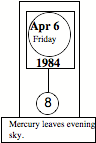
WAITING FOR TIME TO COME AROUND AGAIN. Building your picture of the world. AS THE SUN PRETENDS TO RETURN. It is heat I desire. Heat. The Winter has made me cold and limp. I need heat to wake me up again. IT IS THE COLD BODY THAT BREAKS UP. THE WATER BODY. FROM THE HEAT. Crystallization becoming what? Air? Complex simplicity? THE WOMEN CONDEMN THE MEN WHO WILL NOT FERTILIZE THEIR WOMBS. And the men who will not create wealth for their luxury. I HEAR YOU. Russias fire seven flares at US ship in South China Sea, three of which strike American ship, one nearly hitting the captain on the deck. Russian fighter planes disrupt Western commercial flight lane in unexpected war games convened in the Baltic and in Eastern Europe. ARMAGEDDON COMING NEAR. The Russians insane now. LUNAR. Shooting down passenger planes. TRYING TO PROVOKE THE WEST. They know that Time is running out on them. THEY ARE ABOUT TO BREAK UP, LIKE FROZEN WATER, LIKE WOMEN. HEAT AND TIME ARE THE SAME THING. WHEN TIME COMES BACK, HEAT, THE NIGHT ENDS, AND THE COMMUNISTS FALL. BUT THEY ARE PANICKING NOW. DESPERATE TO KEEP THE SUN FROM RISING AGAIN. Armageddon. ARMAGEDDON SOUP. Yes. WAITING FOR TIME TO COME BACK. An American soldier is shot in Greece. THE LORD USES THE EARTH AS HIS FOOTSTOOL. The Man-God stands on the shoulders of the Darkness to try to engate the white light. THE GOD-MAN, YOU MEAN.
A note is tacked on the Clerk's door Saturday afternoon: 'Michael. I need to find God today. Li-Ling.' SHE FINDS ANOTHER GOD WHO INSTRUCTS HER IN NON-RESISTANCE. IN 'OPENING UP', AND IN NOT WASTING ENERGY PROTECTING HERSELF. She advises the Clerk to 'open up' to a woman, physically, emotionally and spiritually. Then, she leaves with an Arab man. THE MAN WHO FELL TO EARTH. The glorious Gnostics, who would kill the Jew for a holiness. WHEN THE MAN OF LIGHT RULES, THE EARTH IS PROSPEROUS AND FERTILE. WHEN TH MAN OF DARKNESS RULES, ACCORDING TO THE PENCHANT OF TH WHITE WOMAN, THE MOON, THE EARTH BECMES DARK, STERILE, SUBJECT TO PERSECUTION, DISEASE, MURDER. He calls out for Shulamit. SHE NEVER HEARS HIM CALL. No. She is deaf. GIVE ME LIGHT! GIVE ME BLESSED HEAT! THE NIGHT CANNOT SAVE ME! THE WINTER HAS NO SCRUPLES! They cling, these festoons of Darkness, for they know their power flows. MERCURY SINKS IN COLD WEATHER AND RISES IN HOT. It is the time of crucifixion. PLUTO SHALL RISE IN OPPOSITION TO THE SUN ON THE DAY OF CRUCIFIXION EXACTLY AT MIDNIGHT.
Shulamit comes as the subject of Eros to our Clerk. She enters his mind with all the fury of her beauty, her black hair falling, her dark eyes like moons reflecting some spectacular Earth. Her breasts like twin leopards; her thighs the furadians of her treasury -- which the Clerk takes with a smile and some raging of his won. IT IS RAGE SHE LOVES THE MOST -- RAGE, AND THE CHILD-LIKE SMILE, WHICH MAKES EVEN RAGE TAME ENOUGH TO PLEASE HER. In the Night she steals his sperm through a dream. HER IS GLAD TO GIVE IT UP TO HER. Even if she is not true, she is pleasing and beautiful enough to make even this, for a moment, this dream, not damning.
Dream-Recorder
The brothers were walking on ice and snow; there were trees beneath the snow and gaps through to the water. Michael chose the dangerous path, leaped, was secure; he showed his brother the footsteps he had made and told him to step lightly, but to follow Michael in his leap. But William took the safer path, slipped, the ice broke, he fell, sliding down the hill into the water, totally submerged. Michael jumped into the water, pulling William from the deep, lifting him to the bank, surpised to find his own glasses unbroken.
They were traveling in a bus. They stopped to sleep in the woods, the two brothers, sleeping togethe near a bee farm. The bus driver awoke Michael; his brother was not there; but another man, unknown to him, was. He felt his brother woudl be back on the bus; on the bus was Ford Hill, a young black man from Georgia, with whom the two brothers had attended college in Laramie. William was not there; they stopped to eat breakfast; Michael told the driver that they would have to go bacck, to go back and look for his brother.
There was a young boy who had been found by a family; he was a Chicano; he played with his puppy; the two brothers loved the boy. Two teenaged Chicanos drove by, pointing at the boy. Micahel retreated with the boy to the house, trying to hide him. He feared the two older Chicano boys would try to take the child away. They came to the house; and told Michael that the boy had cheated them out of $20. William payed the money to the two thugs. Michael held the boy in his arms and tried to argue with them; but no one heard him.
DO NOT GIVE UP YOUR SEED, UNLESS YOU GIVE IT TO YOUR WOMAN! Our women teach our mean that weakness is better than strength; that death is better than life. THAT LOVE IS BETTER THAN POWER -- THAT IS WHAT THEY TEACH THEM. So that they can have power over men. INDIA DEVELOPED A DEFEATIST PHILOSOPHY BECAUSE OF THE HEAT IN THEIR CLIMATE, WHICH ENNERVATES THE MEN. THEY COULD NOT RESIST INVASION, SO THEY RATIONALIZED SERVITUDE TO GLORIFY IT, CONCLUDING THAT LIFE WAS A MISTAKE AND DEATH THE HIGHEST GOOD. Do you really believe that now? WHAT? A man at war with himself shall defeat himself, always. AND SHALL NEVER DEFEAT HIMSELF. FOR HE IS, HIMSELF, ALWAYS STRONGER THAN HIMSELF. And always weaker than himself. ISN'T THAT WHAT THIS NOVEL IS ALL ABOUT? What? THE MAN AT WAR WITH HIMSELF? Are you beginning to understand this, at last? I AM LOOKING IN A MIRROR -- AND I AM SEEING YOU, BELIEVING WE ARE DIFFERENT. Believing we are the same. Two voices in the same house. TWO MINDS IN THE SAME ANIMATED SHELL.
THE WEST REWARDS REBELLION BECAUSE THE WEST REVERES YOUTH. THE WEST BELIEVES IN YOUTH MORE THAN IT DOES IN AGE -- AND THAT IS BY INTENT. THAT IS PART OF THE PLAN. THE WEST IS THE LIFE PRINCIPLE. LET THIS NOT BE MISUNDERSTOOD. WE SPOIL OUR CHILDREN; WE HONOR NEW IDEAS. WE HONOR PROGRESS BECAUSE WE BELIEVE AIN THE NEW IDEA. WE BELIEVE THAT EACH ROUND OF NATURE IMPROVES THE PRODUCT. WE ARE THE UNIVERSE, BECAUSE OF THIS: THE MIND THAT MOVES FORWARD. THE ANTI-UNIVERSE ALWAYS MOVES BACKWARD. THE EAST ALWAYS LOOKS BACKWARD, HONORING ANCESTORS, HONORING WISDOM, AGE. THE WEST IS LIFE; AND THE EAST IS WISDOM. THE NORTH IS WILL; THE SOUTH IS PLEASURE. THOSE WHO ARE OLD IN THE WEST LOOK TOWARD THE EAST FOR TRUTH. THOSE WHO ARE RE-BORN, WHO DESIRE LIFE, ARE YOUNG AND LOOK TO AND BECOME THE WEST. THE WEST IS THE LORD WHO LIVES AND PASSES INTO DEATH, THE SUN ITSELF, PASSING INTO NIGHT AND MOVING EAST, THROUGH THE DAILY UNDERWORLD OF NIGHT, DESPAIR AND DREAMS; AND WHO, ACCORDING TO THE PROMISE, ALWAYS RETURNS, ALWAYS RE-APPEARS IN THE EASTERN SKY, RE-BORN OUT OF EASTERN DOCTRINE. Who always re-appears in the North; who brings savage heat to the South as a way of punishing the South for its betrayal of the Sun, bringing salvation to the North, melting the icy White Woman who has ruled with Darkness in a splurge of Winter living, sending the frigid woman into hiding. BREAKING UP THE FRIGID WASTELAND OF ICE. AND MELTING IT AWAY. I am the West; I am the Last Cowboy. The Last and the First. The one who comes and builds and leaves, bringing with him the Law, being, himself, the Law. The South shall be my footstool. The North shall be my resting place; the East shall be the unborn land, that child who has no body, when the Sun comes in and studies its fortune -- but always must leave again. WILLIAM RISES WITH A SORE THROAT; MICHAEL'S DREAM MAKES MICHAEL WONDER; AND WILLIAM SPEAKS OF HIS DREAM, OF BEING SHOT IN THE FACE AS LAWLESSNESS SWEEPS THROUGH THE TOWN. Time has been lost for some time now. WHO WILL RE-RAISE THE CLOCK-TOWER IN THE TOWN SQUARE FOR MISTER FARRELL? Hitler was a Black German. Jackson and Ferrakahn speak with electricity to their following. BLACK GERMANS. The Black Hater is very close. The Dark Giant does not wish to lose his power. He has had his way during the Night and he does not want the Sun to be re-born. HE LIVES IN THE LAST DAYS OF APRIL. A BLACK TITAN WHOSE DUTY IS MURDER. Mikael. Help me to be strong. Help bring the Sun to me -- help bring the Sun to life in me. I AM AN INDIVIDUAL; BUT ALSO MORE THAN THAT. IF THEY WOULD MAKE IT RACE, THEN RACE IT SHALL SURELY BE -- NOT BY MY WILL, BUT BY THEIR OWN. Black anti-semitism moves Jews toward Reagan; black pacifism moves hispanic Ameericans toward Reagan; black support of communism moves Asian Americans toward Reagan. Only the unhealthy still cling to the cover of Darkness.
DAPHNA, WHERE HAS YOUR CHILD GONE? Tamar, where is your voice now? NEVER CHOOSE DEATH OVER LIFE. WHEN DEATH COMES, FIGHT IT LIKE A TIGER. WHEN IT TAKES YOU, UNDERSTAND THAT IT IS NOTHING; BUT STILL, FIGHT IT LIKE A TIGER. AND THE FATHER WILL RAISE YOU UP FOR YOUR HEROISM. I want Life more than Death, even though Death has with it great wonders: romance, seduction, philosophy, knowledge. Life today; and Death tomorrow. Life when it comes, Death when it must come. And make the most of each. When you have Life, live; when you have Death, write, think, create art. Make use of each of the Twenty-Four Hours, the Twenty-Four Lords, not just the Twelve living on your side of the horizon. YES. Now I want the Sun. I want prosperity and health and vigor. I want children. I want a belief in the Future. I want Youth and Mobility and Strength against the adversary. GIVE ME LIFE, GOD. GIVE ME THE CAPACITY TO BE STRONG: TO LOOK DEATH IN THE FACE AND TO LAUGH AT HIS IMPOTENCE. First Principle: Foreign Policy; Second Principle: Domestic Policy. WHAT IS THE DIRECTION OF THE ONE WHO HATES MAN? One religion is built upon the life of a man who was murdered for the world; another religion is built up the life of a man who murdered the world. MOHAMMAD, YOU SPEAK OF? I shall ask you the same question.
FARRAKHAN SPEAKS OF HIS ADMIRATION FOR HITLER. WHO RAISED HIS PEOPLE UP FROM THE ASHES. And led them into hell. HE DOES NOT MENTION THAT.
I am the Law. Dangle your women in front of me and you may make me weak; but you shall not destroy my primal constitution. EACH PLANE OR PLANET HAS A DIFFERENT CONSTITUTION; WHAT IS TRUE ON URANUS IS NOT TRUE ON MARS OR ON EARTH. EACH SKIN OR SENSE YOU 'DEVELOP' IN YOUR TRANSMIGRATION THROUGH TIME (THAT IS, DENSIFICATION AND DE-DENSIFICATION) IS AS REAL AS THE PRIMITIVE INSOUCIANCE AND AS DIFFERENT AS MAN AND THE CHILD IN RESPONSE TO STIMULUS. EACH PLANET HAS FINITE AND EXACT LAWS, DIFFERENT THAN THE OTHER; AND EACH IS INHABITED BY BEINGS OF A DIFFERENT NATURE THAN OUR OWN. And the synthesis? THE SYNETHESIS IS ALL THINGS. HE HAS ACCESS TO EACH PLANET, HE VISITS EACH PLANET -- FOR THE SYNTHESIS IS THE SUN, EACH PLANET IS A PART OF HIS BEING, THE SOLAR SYSTEM BEING THE SUM OF HIS MANIFESTATION ON THIS LEVEL. HE TOUCHES ALL THINGS WITH HIS ELECTRICITY, WITH HIS BREATH. The Sun's 'body' is the Moon, which reflects his primal thought. Reflecting it down on Earth. ALEPH AND BETH AGAIN. I tempt yhou to strength; for this you call me evil? THE GRAVE ALONE KNOWS EQUALITY. PLANETS KNOW NO EQUALITY. FREEDOM AND EQUALITY ARE OPPOSITE POLES. FREEDOM IMPLIES INEQUALITY. EQUALITY IMPLIES A LACK OF FREEDOM. CHOOSE CAREFULLY WHICH OF THESE PRINCIPLES YOU MAKE YOUR LORD. EQUALITY OF OPPORTUNITY IMPLIES FREEDOM. EQUALITY OF RESULT NECESSITATES SLAVERY. REMEMBER THIS. I see that you are still here. CLOUDS HAVE COME BACK. I have lost Time again. INDIA DEVELOPED A DEFEATIST PHILOSOPHY BECAUSE DEATH COMES FIRST AND LEAVES BUT LEAVES A SON. DEATH IS THE LAST DEVELOPMENT OF THE OLD AND THE OLD AND THE FIRST DEVELOPMENT OF THE NEW.
Pessimism being the mark of old age -- not the work of a new youth. PESSIMISM IS THE FORCE WHICH IS DEFEATED BY THE NEW LIFE BUT WHICH NEVER LEAVES -- WHICH SITS AND WAITS TO EVENTUALLY RECLAIM THE WORLD, CASTING A CLOAK OVER EVERYTHING, PROCLAIMING ITSELF THE NIGHT. Yes. EXPECTING THE WORST EQUALS DESIRING THE WORST, PRAYING FOR THE WORST. EQUALS DESTROYS THE CREATION. The Hater is not far away; I can almost hear his footsteps. REASON IS THE FIRST ORNAMENT. THE ESSENTIAL PRIMORDIAL NATURE IS CHAOS. REASON IS THE FIRST ORNAMENT, AS THE 'BEAUTIFICATION' OF CHAOS -- THAT IS, ORDERING THROUGH WILL. Mark Clark, my willful second uncle, who led the Fifth Army in its liberation of Rome, is dead from cancer.
Newshawker
Mark Clark Dead
from Cancer!
Libyan Embassy
Personnel in London Open Fire on Libyan Student demonstration Against Khadaffi:
Enlgishwoman Police Officer Killed; Eleven Others Injured!
In Response, Libyan
Soldiers Surround British Embassy in Tripoli! Thousands of British Nationals in Libya Considered in
Danger!
Song on the Radio (Clerk singing along)
Message keeps getting clearer
Radio's on and I'm moving 'round the place
I check my look in the mirror
I wanna change my clothes, my hair, my face
Man I ain't getting nowhere just living in a dump like this
There's something happening somewhere
Baby I just know that there is
You can't start a fire
You can't start a fire without a spark
This gun's for hire
Even if we're just dancing in the dark
You sit around getting older
There's a joke here somewhere and it's on me
I'll shake this world off my shoulders
Come on baby the laugh's on me
Stay on the streets of this town
And they'll be carving you up all right
They say you gotta stay hungry
Hey baby I'm just about starving tonight
I'm dying for some action
I'm sick of sitting 'round here trying to write this book
I need a love reaction
Come on now baby gimme just one look
You can't start a fire sitting 'round crying over a broken heart
This gun's for hire
Even if we're just dancing in the dark
You can't start a fire worrying about your little world falling apart
This gun's for hire
Even if we're just dancing in the dark
Song On the Radio (Clerk singing along)
Two worlds collide, rival nations
It's a primitive clash, venting years of frustrations
Bravely we hope against all hope, there is so much at stake
Seems our freedom's up against the ropes
Does the crowd understand?
Is it a East vs. West, or man against man
Can any nation stand alone
In the burning heart, just about to burst
There's a quest for answers, an unquenchable thirst
In the darkest night, rising like a spire
In the burning heart, the unmistakable fire, in the burning heart
In the warrior's code, there's no surrender
Though his body says stop, his spirit cries never
Deep in our soul a quiet ember
Knows it's you against you
It’s the paradox that drives us on
It's a battle of wills, in the heat of attack
It's the passion that kills
The victory is yours alone
In the burning heart, just about to burst
There's a quest for answers, an unquenchable thirst
In the darkest night, rising like a spire
In the burning heart, the unmistakable fire
In the burning heart, just about to burst
There's a quest for answers, an unquenchable thirst
In the darkest night, rising like a spire
In the burning heart, the unmistakable fire
In the burning heart, just about to burst
There's a quest for answers, an unquenchable thirst
In the darkest night, rising like a spire
In the burning heart, the unmistakable fire
In the burning heart
I
'When the terrance is filled with the sound of opinion,
And rockets brace the airy dark with their chords:
I know that something must be known before
I leave here.
Africa burns in the Sun's bitter anguish;
Imams are promised, and the blade bleeds anew.
Ghosts of brothers are seen along the promenade,
As the town of Capital Splendor marks the turning
of each new Round.
A witch is heard to speak of coming of one more Romanov;
Ballots are collected by the men who offer salvation.
Scientist proclaim the blanking phallacy of nuclear
umbrellas.
As rain falsl in acid proportion from the pages of my
dictionary of news.
Before my eyes sits the world in its spirals.
Lincoln cut a Gorian Knot; and frees the documentary
spirit of Discourse.
Some are without food; some believe armaments are folly.
Some say History dies; others say God eats His children.
A vast image out of precipice mundi blinks across my screen
to see me:
It colors me troubled and colors me crucial:
It etches my worries, and myh border's fatalities.
II.
'It is not enough that I be wise, for Wisdom is not always
Justice.
It is not enough that I be excited, for Excitement breeds
Indiscretion,
if left to unlimited concourse.
If is not enough that I be informed: although misinformation
brings a cross to my deeds.
One world floats in majestic conception of Ideal Nature.
Many worlds in turmoil produce a Fire which burns
our name.
I watch to know, believing approximation to Knowledge
must mold me;
I love what is great in us;
I weep at Tragedy's insistence.
But I go on, each day carrying History's announcements
in my brain.
I am the sum of my treasury of words,
And I determine the shape of my world through these coins.
In the collection of all our directions and gods,
Nations fumble with the clothing of that eternal beauty,
Good Will.
Nations are lost; and then, again, found by their own
vigor;
They stand upon some plain; and tend to threaten themselves
with Morality.
And I must know this; I must see it and speak.
And this is why I watch C-Span,' the old woman said.
I AM HIT WITH A SENSE OF PANIC. Khadaffi translated Hiter's Mein Kampf in Arabic for the Arabs to understand him. To be filled will all the dark logic of why the Jews need to be killed. I AM HIT WITH A SENSE OF DREAD. Raise the serpent up in the wilderness. THANK GOD YOU HAVE GIVEN ME WRITING AS A SALVATION. I love you, God. when I am lost and without sense, when I am lost with too much sense: thank you for your subtle direction. THREE WOMEN ACCOMPANY YOU TO YOUR CROSS. Rosemarie Millet, Thayer Donham, Leslie Lynch. WHERE IS SHULAMIT NOW? Am I to marry her, or merely to continue, thus, with my life? ISLAMIC NAZIISM CANNOT BE TAKEN LIGHTLY.
Madame Bee:
Stanza VI.
3. Of the Seven Elements: first one manifested, six
concealed; two manifested, five concealed; three
manifested, four concealed; four produced, three
hidden; four and one-half revealed; two and one-half
concealed; six to be manifested, one laid aside. Latly, seven small wheels revolving; one giving birth to the
other.
Prosecuting Attorney:
Tell us where you were on the day of Friday, April 20, 1984.
Clerk:
I was working until approximately 3:30 pm. Then I drove to the university to do some research.
Prosecuting Attorney:
To the University of Oregon?
Clerk:
Yes.
Prosecuting Attorney:
Where at the University of Oregon?
Clerk:
The School of Architecture and Allied Arts Library.
Prosecuting Attorney
Where you spend much time, researching?
Clerk:
Yes.
Prosecuting Attorney:
Tell us where you were on the day of Friday, April 20, 1984.
Clerk:
I was working until approximately 3:30 pm. Then I drove to the university to do some research.
Prosecuting Attorney:
To the University of Oregon? Which is about fifteen minutes away by car?
Clerk:
Yes.
Prosecuting Attorney:
What were you researching?
Clerk:
The Cathedral at Amiens, France.
Prosecuting Attorney
The Amiens Cathedral?
Clerk:
Yes.
Prosecuting Attorney
Why were you researching this?
Clerk:
For a book I was writing. I had a special interest in the Amiens Cathedral Labyrinth.
Prosecuting Attorney:
Yes. And you weere researching how long?
Clerk:
Several hours. I was reading about the labyrinth -- and I made a xerox of a diagram of the labyrinth. I left the libary probably around six o'clock that evening.
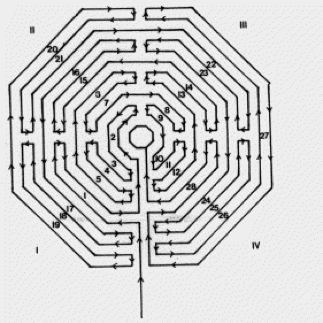
Prosecuting Attorney:
What happened then?
Clerk:
I left the library and walked up the second floor of Lawrence -- walking west. There was an exit in the middle of the floor, to the left, that led down a very tight staircase and out a side door of Lawrence at the south end of the building. I took that exit.
Prosecuting Attorney:
What happened then?
Clerk:
As I was going down the narrow staircase I met another man coming up the staircase.
Prosecuting Attorney
Did you know the man?
Clerk:
Yes.
Prosecuting Attorney:
Who was this man?
Clerk:
Gilbert Patton.
Prosecuting Attorney
The deceased?
Clerk:
Yes.
Prosecuting Attorney
You have a history with this man?
Clerk:
Yes. He has been threatening to kill me for many months.
Prosecuting Attorney:
Why has he been threatening to kill you?
Clerk:
I don't know. He has a history of threatening people. A history of violent behavior.
Prosecuting Attorney:
Were you afraid of him?
Clerk:
Somewhat. He had been threatening me for many months. So I had tried to prepare myself for this day, should it ever come.
Prosecuting Attorney:
Preapre in what way?
Clerk:
By becoming more physical. Working out. Exercising.
Prosecuting Attorney
That isn't all, is it? Didn't you buy a knife too?
Clerk:
I found a knife several years ago. I began to carry this knife in my backpack.
Prosecuting Attorney:
Why did you carry a knife? Were you afraid for your life?
Clerk:
He carried a hunting knife in his boot. I had seen it. I carried a knife because I knew he did.
Prosecuting Attorney
Continue. You met one another on the narrow staircase on Good Friday. Then what happened?
Clerk:
He muttered that he was going to kill me. And he reached for his knife.
Prosecuting Attorney
Are you sure he reached for his knife. Wasn't it dark in the staircase?
Clerk:
It was dimly lit. But I saw him reach for his boot.
Prosecuting Attorney:
And you did what?
Clerk:
I reached for my own knife.
Prosecuting Attorney:
In the backpack?
Clerk:
Yes.
Prosecuting Attorney:
And then?
Clerk:
He grabbed me by the throat with his left hand. His hands were huge. He squeeze the air right out of me. He pushed me away from him at his arm's length. He was very strong. He tried to come up at me from underneath with his knife. But I caught his right forearm with my left hand, keeping the knife from penetrating me.
Prosecuting Attorney
And then what?
Clerk:
I cried out: 'Metatron, give me your strength!' And then I drove my knife straight into his stomach, pulling it up toward his heart.
Prosecuting Attorney
Ok. We know this story is not true. Please tell us what really happened. We know this Gilbert Patton, this demon of yours, is endowed with only inward manifestation. He is not able to strike unless struck first.
Clerk:
I took the narrow staircase and saw him moving up toward me. I sensed a fear in him when he saw me. I invoked Metatron's name. Prayed that Metatron would give me strength. Then I imagined taking the hunting knife out of my backpack; and I imagined driving the straight into his heart as we passed. I could feel him cringe, like he had felt the knife enter his heart. Like the air -- the life -- was taken out of him. We did not touch. But I knew, at that point, that I had defeated him.
AND THAT WAS IT? Yes. I SEE. You are lost and you know nothing specific. WOMEN ARE ALL AROUND YOU NOW, AS THOUGH YOU HAVE CONQUERED A VILLAIN AND THEY ARE YOUR REWARD. Where has all my inspiration been handed? HANDING OVER THE QUEEN TO ANOTHER SUITOR. He contemplates a move to Washington, DC. IN ONE DREAM THE BROTHER, WILLIAM, CAUGHT A GREAT FISH BUT SCREAMED IN CELEBRATION SO THAT MICHAEL BECAME ANGRY THAT ME MIGHT SCARE OTHER FISH AWAY; IN ANOTHER DREAM, A GREAT FISH STRUCK WILLIAM'S LINE AND PULLED HIS POLE OVER A CLIFF INTO THE DEEP WATER; MICHAEL VOLUNTEERED TO GO INTO THE DEEP AND GET THE POLE, BUT WILLIAM OVERRULED HIM AND STARTED DOWN THE CLIFF. New beginnings in the Spring. THE BATTLE OF SUN AND CLOUDS. Who might get caught here? THIS BOOK HAS STOPPED HAVING A PURPOSE, SON. You fool yourself with your claims to greatness here. IS THIS YOUR ONLY AVENUE TO SALVATION? WHY NOT HAVE A CHILD, A SON? The Dark Woman loves the White Man because he brings his heave down to her, down to the Earth. The Dark Woman hates the Dark Man because he hates her. She hates the Dark Man and the White Woman because these two, together, bring hell up to the Earth.
(He now sees white men walking with black women
on the Earth.)
WHAT IS IT ALL FOR? Shulamit is his wife, in his mind. DAPHNA, THE CHILD OF NINE, SHULAMIT'S DAUGHTER, SPENT FRIDAY AFTERNOON WITH OUR CLERK, AT WORK. SHE IS A BEAUTIFUL CHANGELING, JUST LIKE HER MOTHER. And like the Clerk himself. HE LOVES HER, AND HATES HER, THIS SHULAMIT. He fers her dishonesty. H SEEMS TO BE ENTERING INTO A NEGATIVE CYCLE. An Iranian exile appears, and talks for twenty minutes about all the rotten aspects of American culture. HE HAS ENTERED INTO THE WATER, WHERE ALL THE NEGATIVE FISH SWEEP THE OCEAN FLOOR WITH THEIR PINEY OPINIONS. Spiney opinions. YES, THAT TOO. Will he enter his shell, to do battle with these death absolveres? I WISH TO BE ALIVE, HE SAID. If you don't like it here, then you should leave, he said. We don't need you here! Get out, shadow! Be gone!
Town-Crier
All is well! All is well!
University finally acts, banning Gilbert Patton from University property under threat of arrest!
All is well! All is well!
THE GIANT IS DEAD!
(The Clerk is seen taking daisies to Shulamit at the
Architecture School. Li-Ling meets the Clerk and
asks if the flowers are for her.)
NO. THEY ARE NOT. He feels great passion for Shulamit. And Shulamit returns his look. She neds to finish school first. The Spring and the Summer, and then she is done. AND HE WONDER IF SHE IS A GIFT FROM THE FATES SINCE HE HAS DONE HIS WORK BY CARRYING HIS SHIELD. He feels as though he has approached heaven again; the dark beings seem far away for the moment. Love is on his mind. Shulamit's body is on his mind. And fatherhood. Responsibility. Providing money to help educate Shulamit's children.
THE FEMALE DEMONS SHALL BEGIN TO ATTACK HIM FOR HIS FAILING TO BE DEAD. Is that a prophecy? AND FOR HIS VIRTUE. AND FOR FAILING TO WORSHIP THE 'CLASSLESS' SOCIETY. I ask you. HOW MANY MILLION PEOPLE IN THE EAST HAVE BEEN MURDERED IN THE NAME OF THIS HIGH IDEAL: THE 'CLASSLESS SOCIETY'? Do you wish to live in Heaven or in Hell? Do you wish to have hope? Or to be bruised by Death and insecurity and paranoia? THE NEGATIVE ELEMENTALS ARE THE FORCE OF EVIL, FOR THEY CANNOT BE CREATIVE, THEY CAN ONLY ACCUSE. I love you, God. I am not without Hope. If you say we are spiritually bankrupt, and without Hope: you describe yourelf. But I have hope. Nothing destroys me. None of your Death-Lust can inflict itself upon me. SAY 'YES' TO LIFE. SAY 'YES' TO LIFE. IF YOU WISH TO BE SAVED. DO NOT DEMAND THAT THE DARKNESS RULE. DO NOT DEMAND THAT EVIL AND TERROR TRIUMPH. There is no death here for you. Raise the serpent of doubt and discord in to the air. Strike off its head when it leaps at your stomach. Walk with not one fear through the avenues where the Lovers of Death live. Hear them speak of Islam anf for the treacheries of Hitler. Hear them speak for the clouds and for the Darkness of the Flood. They cannot say 'yes' to life -- so, instead, they say 'yest' to Death -- and, so, they become it. THERE ARE TWO TREES: LIFE AND THE KNOWLEDGE OF TOOD AND EVIL. JESUS, AS MYSELF, CAME DOWN TO SAVE THOSE WHO HAD EATEN ONLY FROM THE LATTER.YET MICHAEL DRIVES THE CLOUDS AWAY. DARKNESS MUST SAVE ITSELF, THROUGH JESUS -- IF IT WILL NOT LISTEN TO THE NAME WHICH WAS LEFT THERE. Jesus did not intend to create a nation of martyrs -- but to build a nation of the living. 'I have died so that you do not need to.' WHAT ARE YOU AFRAID OF? ARE YOU AFRAID OF LIFE? OF BECOMING A FATHER? OF LIVING WELL? OF BEING RICH AND SUCCESSFUL? Why are the demons greateful to be dead? Why are they so resentful of the living? THOSE WHO HAVE NO BODIES GROWL ABOUT THE SINFUL NATURE OF LIFE. Light in the darkness, which none can destroy. THE SOLITARY FIRE. The sole survivor. The American Ishmael is seen floating on the casket. Floating, alone, on the sea. Accompanied by his whale. HE DOES NOT LOSE HIS NERVE. Death is no obstacle. Death is merely the Mind clinging to the Past, for fear of going on. EVER ONWARD. GOETHE'S CAUSE. EVER A NEW DISCOVERY. EVER A NEW TIME AND MINT AND MEAL AND OPINION AND GRACE. THE TIMID WHO CONDEMN THEIR GOVERNMENT, WANTING SOME SCAPEGOAT FOR THEIR OWN LACK OF COURAGE: THEY ARE TO BE SEEN AGAIN. THE COURAGEOUS, WITH WHOM I SPENT THE LAST AGE, BATTLING THAT DRAGON OF TERROR NAMEDE GILBERT, HAVE SHRUNKEN INTO TERRIFIED SHCOOLGIRLS AND WOMEN WHO LONG FOR CASTRATION OF THE MAN. MEN BRED ON THE OPINION OF SELF-CASTRATION. LIVING IN THE MOTHER'S SKIRTS. THE WATER IS FULL OF MONSTERS STILL, ONE FOR EACH OF US, WHO WOULD EACH FILL US WITH FEAR. Say 'yes' to the future -- and then go on, leaving the fearful behind, for they fear where we are going. THEY ARE STUCK IN THE 1960'S. NOTHING CAN BE DONE FOR THEM. THEY WILL DIE OUT, UNABLE TO GO ON. They wish to be ever a child -- for they have a great fear of being responsible. They want someone to care for them. They want the state to ever be their parent. THE CROW IS A PARASITE AND A SCAVENGER. IT DOES NOT SING. IT IS NOT COURAGEOUS. IT MERELY JUDGES WITH ITS LOUD CONDEMNATION. AND SINGLES OUT THE WEAK AND THE UNWISE FROM WHOM TO STEAL.
The Republicans vitalize the Body.
The Democarats vitalize the Mind.
You must have both, if you wish to continue.
The Republics love their own family.
The Democrats hate their own family; they love all other
families, because they are guilty.
One has very much projecton;
The other has too much reflection for its own good.
The Republicans are the Fathers of the society;
The Democarats are the Mothers.
The child needs the love of each, in equal balance, to thrive
and survive.
THE ISSUES DON'T MATTER REALLY, FOR THE SO-CALLED PROBLEMS ARE NEVER SOLVED; THEY ARE ONLY MANAGED. THE ISSUES DON'T REALLY MATTER: THE POLITICAL MECHANISM MATTERS. THE TWO-PARTY SYSTEM IS BASED ON THE BINARY MODEL IN NATURE. DAY AND NIGHT SHARE IN THEIR RULE. EACH STAR IS A DUAL STAR. AND IF EVERY VIEW IS NOT REPRESENTED BY THE TWO, THIS IS ALL RIGHT, FOR IT INSTRUCTS MODERNATION, WHICH IS THAT SAVING PRINCIPLE OF PRESERVATION, OR BALANCE. THE EXTREMES ARE CUT OFF. FOR THEY ARE THE FAILURES OF THE SYSTEM. Earth is ruled by the Sun and the Moon, in equal parts, by Day and Night, by Father and Mother. That is how it must be. YES. One party is a manifestation of Will: Totalitarianism. Two parties is the manifestation of the Soul: that aspect of eternity, eternity through the process of creation. THE EAST IS THE TIMELESS WOMB OF CHAOS. THE HEAD OF THE CHILD APPEARS FROM THE 'WOMB' OF ISRAEL. IT SEPS INTO THE WEST AS LIFE, AS THE INDIVIDUAL, AS THE FRUIT OF THE DYING PARENT. This 'Son' creates the world, updates it each duration so that the waking worl and the nodding world are manufactured productions in step with that concourse Time.
THE DARK ELEMENTALS GATHER AROUND YOU AND SPEAK WITH GLEE OF THE CALIFORNIA EARTHQUAKE. THEY CHEER DESTRUCTION, FOR THEY ARE SUICIDE ELEMENTALS, SEEKING DEATH, DENYING LIFE. By having children, you create for yourself a Future. Those who refuse to have children, refuse to say 'yes' to the Future. A PARENT CANNOT ALLOW THE WORLD TO DISINTEGRATE ON THEIR CHILDREN. You stop worshipping Death when you take responsibility for your children. THE DARKNESS IS ACTIVE ONE YEAR; THEN THE LIGHT IS AGAIN ACTIVE. ONE YEAR IS NEGATIVE; THE NEXT YEAR IS POSITIVE. THE DEMOCRATES IN ONE YEAR; THE REPUBLICANS IN THE NEXT. The problems do not need to be solved in your lifetime. DO NOT PANIC; DO NOT LOSE YOUR NERVE. The world does not end just because you do. THE WORLD GOES ON FOR EVER. EVEN WHEN IT ENDS IT STILL GOES ON. Yes. NEVER SURRENDER. NEVER GIVE IN TO THE ENEMY AT YOUR DOORSTEP. Why are some of you so desperate for a totalitarian state?
HE SEES SHULAMIT WITH ANOTHER MAN -- AND HE DESCENDS INTO A FIT OF JEALOUSY. IMAGINING HER IN CONTORTIONS WITH ANOTHER MAN. And these visions are true. PROBABLY SO. And he hates her for his imperfections. HE SEES ANOTHER SIDE OF WOMAN. The other side of life. HE STRIKES HER WITH HIS LOOK; AND THEN HE WONDERS: 'WHAT DOES SHE OWE ME/ WHY DOES SHE OWE ME FIDELITY OR GREATNESS? She alsys seems a child in his dreams. HE BUILT THIS PICTURE IN HIS MIND OF MARRIAGE TO SHULAMIT. AND FATHERHOOD, AS A KIN OF FUTURE; NOW HE REALIZES IT IS BUT A PICTURE. She has no inclination to be his bride; and, if his bride, no inclination to be faithful. SHE CAME IN TO WORK TWO MONTHS AGO, MADE PASSIONATE EYES AT HIM, AND LOOKED AT THE COMPUTER AT WHICH HE SAT. HE READ HER MIND: HE MIGHT TAKE CARE OF HER WHEN SCHOOL WAS OVER. When she finishes school in the summer, her dream partially ends: what will she do? She fears the rupturing of her reality. He might be a salvation to her. PLAYING HER CARDS RIGHT. THE QUEEN OF DIAMONDS; QUEEN OF SPADES. Why are you angry? Because she does not seem noble? SHE IS NOT NOBLE. SHE IS NOT NOBLE -- BUT HER CHILDREN ARE NOBLE. The praise you lavish on Daphna you take away from Shulamit. The Virgin Earth is now the Soiled Earth. YOU BEGIN TO TRAVEL BENEATH HER, TO BEE HER FROM THE UNFLATTERING SIDE. The Religious Earth and the Profligate Earth. The Virgin and the Prostitute. YOU ARE ANGRY BECAUSE YOU LOVE HER. AND SHE DOES NOT LOVE YOU. It is true. ANRY, BECAUSE YOU DO NOT CONTROL HER FEELINGS. I sought, by her, to escape traveling again into and against Evil. YOU ARE ALONE. NO ONE CAN HELP YOU. NO ONE IS TRUE TO YOU. YOU HAVE GOD AND HIS ENDEAVORS: THAT IS THE ONLY TRUTH. YOU HAVE YOUR BATTLE AGAINST THE DARKNESS. Love God first; love everything else after God. HE DOES NOT WISH TO HATE THE WOMAN. She could give you a Future; but she does not. Now you will have to build your own Future, Build it out of nothing. You shall have another wife. WHO IS THIS TOM HORN? Do you have the power to wait?
THE LIVING DEAD SOON WILL COME OUT OF THEIR TOMBS. Their eyes are full of murder. THEY ARE CAIN, AFTERALL. YOU HAVE OTHER THINGS TO DO, OTHER WARS TO FIGHT; YOUR BATTLES ARE NOT THROUGH. IS IT NOT SO? At one pole you meet God; at the other pole you become God. I MEET ANOTHER MICHAEL WHO RAGES AGAINST THE JEWS, AND AGAINST ISRAEL. I TEACH HIM THE MEANING OF THE NAME OF MICHAEL. HE SAYS THAT THERE IS SOME GREAT CONSPIRACY IN HIS NAME. THAT THE JEW, THE WESTERNER MUST BE STOPPED. The murderers glare because their sacrifice is not accepted. They are condemned; they are not saved. YES. The barbarian class of thought. Clawing at the tent. MARRIED TO A SHREW CALLED HATRED. Your work is not done. YOUR WORK IS NOT DONE. At Midnight they appear.
MIKAEL
I AM YOU.
"'Mikael, I am you' -- and, so, there it is," Charlie Rose says, letting out a heavy sigh of relief. "My God, that was the longest hour I've ever done, Michael. I think we should probably take a break here. Give us a chance to recover our senses. I have a sore thoat. I getting hoarse from all the reading. Let's take a break."
"Yes," Crossmann agrees.
"We'll be back in a moment."
"We're back with Michael Crossmann," Charlie Rose says. "We don't have much time left. If you haven't been with us, we have been making our way through his voluminous novel, Conversations On a Dying Age, in an attempt to try to pinpoint his conversion from a liberal humanist to....what, Michael? A conservative...?"
"I don't know, Charlie," Crossmann says. "I don't know what I am."
"A visionary mystic perhaps," Charlie says. "A vigilante school teacher. I'm not sure which label is correct in your case. Clearly, the novel represents a journey from the left wing to the right wing -- or, as you call it, from the Anti-Universe to the Universe...."
"From the Indian to the Cowboy," Crossmann says.
"Yes. It is a controversial conversion, to say the least, Michael. Your identiification with Michael the Archangel and with Jesus Christ has made many liberals suggest that you might be psychotic; and it has led many orthodox religious leaders to suggest that this novel may be a heresy. So, you have adversaries on both sides of the political spectrum. Your attack on Islam and on the African-American Nation of Islam church in America has led to accusations against you of racism. There is much in this novel that feels like racism, in fact. Your constant connecting of the concepts of Darkness, Night, the color black, with disease, poverty and revolution -- many critics say this is a sign of latent, or not even latent, racism -- overt racism. But you claim you are not a racist..."
"No," Crossmann says. "There are many voices in my novel. But the over-riding voice, the over-riding theme, is that my God is the God of all, white and black and everything in-between. And that white and black, man and woman, republican and democarat, need to share power; for nature shares power. The Sun and the Moon share power. Democracy is an emblem of this sharing of power between the opposites. But the novel does demonstrate that re-birth of an idea, of a life, involves periodical separation of the sexes, involves periodical establishment of law, after the lawlessness or the anti-law ideology of liberalism leads to a state of chaos that is not conducive to the life of the society...."
"Do you still believe you are Michael the Archangel?" Rose asks.
"I know who I am in an eternal sense," Crossmann says. "I know who I am at the beginning of the world. And I know who I am now..."
"Is that a yes or a no?" Rose asks.
"I am who I am," Crossmann says. "I know no other way to answer this question."
"In the book, clearly," Rose says, "you established a highly personal relationship with Michael the Archangel and with Metatron, another angel in the Jewish pantheon..."
"Judeo-Christian," Crossmann corrects.
"I didn't know Metatron was a Christian angel," Rose says.
"He is now," Crossmann says.
Rose laughs.
"I see," Charlie says. "Metatron being...."
"Well, in the novel I write that Metatron is Michael's sword, turning one direction and then turning another...."
"That has a mystical meaning, it seems," Rose says. "This whole book is full of mytical meaning. And it may not be clear to many readers what you are saying exatly in this novel, in much of it. But is that not what you are also, the double-edged sword? You talk about how the middle principle (the middle-principle being Israel, or the Jew is the abstract sense) -- and how the middle principle fights, first, the extreme on the left, and then the extreme on the right -- as America fights the Nazis, first, and then the Communists. But you, yourself -- at the beginning of the novel you are anti-white, pro-black, in a sense. You are living in the Anti-Universe. You focus on the guilt of the whites, the West, against the world; but by the end of the book your sword has turned, and you are then pro-white, and anti-black...."
"Made in God's image," Crossmann says. "God gives; and God takes away..."
"You did not marry Shulamit," Rose says.
"No, I did not. She graduated from school and moved away."
"Did that break your heart?" Charlie asks.
"No. She did not. I met other women. They did not prove to be marriage material either. I finally met the woman I would marry..."
"Re-met her," Rose corrects him.
"Yes, in fact, re-met her," Crossmann says. "We had known one another in college...."
"But there is a book in-between, the book that is long, also, a book of prosepoems entitled Instrumentation in the Wheelhouse. This book is essentially a prayer to God to send you a wife...."
"Yes," Crossmann says. "It is that. But it is more than that. But that is an underlying theme of the book..."
"This book is also ambitious," Rose says. "It hasn't been published yet. But it will be published soon; perhaps at the beginning of next year..."
"Perhaps mid-year," Crossmann says.
"The structure of this book of prosepoems is, essentially, the life of one man," Rose says. "The book goes through the seven stages of life. Actually, there are five stages of life. But there is a Prologue, in which the long poem in this novel -- which we have just read -- is re-cast in full, and called 'A Father's Testament to His Son Upon His Deathbed". And this is the prologue as, in essence, the father gives the son his last message before he dies. But this is very mystical too. Because, in a real sense, the father gives this message to the son, in this book, before he is born. It is like a message given in heaven before the soul falls into Life. This is, in a very real way, the continuation of Conversations. This is, or at least it seems to me to be, Michael's life as it continues in Time and Space. Do you think that is fair....?"
"Yes, as far as it goes," Crossmann says.
"The stages the One Life goes through in this book are: (1) Prologue, Pre-Genesis; (2) Childhood; (3) Youth; (4) Formal Education; (5) Lost Love - Despair; (6) Marriage (Love Returns); and (7) Epilogue. The Epilogue is also a mystical treatise, one concerned with the millennium -- and it seems to be a, what should I call it, a renunciation of the claims to divinity that we witnessed in Conversations. Do you agree with that...?"
"No," Crossmann says. "It is divinity approached with a sense of humor surely. The millenium approached with a sense of humor. But it is not a renunciation..."
"A renunciation of your role in it?" Charlie asks.
"My role in it?" Crossmann replies. "No. I am very much involved in the Millenium quest in the poem...."
"But as a literary event," Charlie says.
"At a literary event," Crossmann says. "This is more a statement about the literary world than it is about the mystical world..."
"The whole poem is very funny," Rose says. "This feels more like Joyce, in tone, than anything else you have written -- that is my opinion. You are having so much fun in it, fun with words. Everything seems so humorous to you -- like nothing is to be taken seriously....."
"It is fun," Crossmann says. "I tried to publish it many time. But no one got it. No one understood how good it was..."
"I'd like to read from this a bit," Rose says. "But we really don't have the time. Our hour is just about up. My producer is givng me the signal that we need to conclude this. It has been interesting, Michael. I didn't know an hour could seem so long -- but I think we really got somewhere tonight. I think the viewers know a lot more about you now than they possibly could have before."
"Yes. Well I hope so," Crossmann says.
"I really respect your work," Charlie says. "My friend, Harold Bloom says that you are the...."
"Don't embarass me now," Crossmann says.
"He has been one of your most outspoken defenders," Rose says. "He helped you get this book published..."
"Yes, I owe Mister Bloom a greal deal," Crossmann says.
"Micahel, thank you for being here with me," Charlie says.
"Thank you for having me, Charlie," Crossmann says.
They shake hands.
The camera shuts down. Lights go up in the background. People begin to move.
"I'm going to try to get over to the MOMA," Charlie says. "I hope to see your work tonight. Take care of yourself, Michael...."
Charlie is gone.
Crossmann gets up from his chair. One of the producers, a thirty-something woman with short-hair, smiles at Crossmann sympathetically. She seems to almost feel sorry for him.
Crossmann feels small.
He looks for his coat.
He wandeers out of the studio, down a hallway leading past empty cubicles. His coat in where he left it: on the hook not far from the elevator. Army surplus coat. The one Jim gave to him. The one with the pistol in the pocket.
No one says anything to him.
He waits for the elevator. People pass by. Crossmann is an outsider. Groups of people pass by, laughing, some dressed in party hats. They don't seem to recognize him. He feels that he is a shadow among these people. Middle-class climbers. Urban sophisticates. Selfish atoms; careerists. Living on the edge of extinction. Inches from some kind of stardom; inches, too, from some implosion. Lonely. Acting. Wearing masks. Prentending to be something they are not. That's how you get ahead, here, in the Big Apple. Precision and fear. Gone, in a New York Minute.
The elevator door opens. PING. Slide.
Crossmann steps in. The revelers join him.
Down many floors in a hurry. No one asks him where he is going. Crossmann believes that they cannot see him. He is invisible; even when the light is shined on him, he is invisible to people like this. That's ok. They laugh. Make jokes about someone. They talk bitterly about another person who isn't present. They are laughing about him -- a man named Jencks. Jencks was set to take a fall. One of them would get his office.
PING. The door opens again. They spill out on the ground floor.
Crossmann follows them toward the front door. The air is colder and colder as Crossmann nears the front door. He begins to zip his coat. He wonders if Jim is still waiting for him.
*************************************************************************************